<?xml version="1.0" encoding="ISO-8859-1"?><article xmlns:mml="http://www.w3.org/1998/Math/MathML" xmlns:xlink="http://www.w3.org/1999/xlink" xmlns:xsi="http://www.w3.org/2001/XMLSchema-instance">
<front>
<journal-meta>
<journal-id>1405-3195</journal-id>
<journal-title><![CDATA[Agrociencia]]></journal-title>
<abbrev-journal-title><![CDATA[Agrociencia]]></abbrev-journal-title>
<issn>1405-3195</issn>
<publisher>
<publisher-name><![CDATA[Colegio de Postgraduados]]></publisher-name>
</publisher>
</journal-meta>
<article-meta>
<article-id>S1405-31952011000300004</article-id>
<title-group>
<article-title xml:lang="en"><![CDATA[Photosynthetic characteristics and growth of alginate-immobilized Scenedesmus obliquus]]></article-title>
<article-title xml:lang="es"><![CDATA[Características fotosintéticas y crecimiento de Scenedesmus obliquus inmovilizada en alginato]]></article-title>
</title-group>
<contrib-group>
<contrib contrib-type="author">
<name>
<surname><![CDATA[Ruiz-Marín]]></surname>
<given-names><![CDATA[Alejandro]]></given-names>
</name>
<xref ref-type="aff" rid="A01"/>
</contrib>
<contrib contrib-type="author">
<name>
<surname><![CDATA[Mendoza-Espinosa]]></surname>
<given-names><![CDATA[Leopoldo G.]]></given-names>
</name>
<xref ref-type="aff" rid="A02"/>
</contrib>
<contrib contrib-type="author">
<name>
<surname><![CDATA[Sánchez-Saavedra]]></surname>
<given-names><![CDATA[M. del P.]]></given-names>
</name>
<xref ref-type="aff" rid="A03"/>
</contrib>
</contrib-group>
<aff id="A01">
<institution><![CDATA[,Universidad Autónoma de Ciudad del Carmen  ]]></institution>
<addr-line><![CDATA[Ciudad del Carmen Campeche]]></addr-line>
<country>México</country>
</aff>
<aff id="A02">
<institution><![CDATA[,Universidad Autónoma de Baja California Oceanographic Research Institute ]]></institution>
<addr-line><![CDATA[Tijuana-Ensenada Road Baja California]]></addr-line>
<country>México</country>
</aff>
<aff id="A03">
<institution><![CDATA[,Centro de Investigación Científica y de Educación Superior de Ensenada Departamento de Acuicultura ]]></institution>
<addr-line><![CDATA[Ensenada Baja California]]></addr-line>
<country>México</country>
</aff>
<pub-date pub-type="pub">
<day>00</day>
<month>05</month>
<year>2011</year>
</pub-date>
<pub-date pub-type="epub">
<day>00</day>
<month>05</month>
<year>2011</year>
</pub-date>
<volume>45</volume>
<numero>3</numero>
<fpage>303</fpage>
<lpage>313</lpage>
<copyright-statement/>
<copyright-year/>
<self-uri xlink:href="http://www.scielo.org.mx/scielo.php?script=sci_arttext&amp;pid=S1405-31952011000300004&amp;lng=en&amp;nrm=iso"></self-uri><self-uri xlink:href="http://www.scielo.org.mx/scielo.php?script=sci_abstract&amp;pid=S1405-31952011000300004&amp;lng=en&amp;nrm=iso"></self-uri><self-uri xlink:href="http://www.scielo.org.mx/scielo.php?script=sci_pdf&amp;pid=S1405-31952011000300004&amp;lng=en&amp;nrm=iso"></self-uri><abstract abstract-type="short" xml:lang="en"><p><![CDATA[The micfoalgae Scenedesmus obliquus was immobilized in Ca-alginate beads at two stocking cell densities (6.7 X10(5) and 1.5X 10(6) cell bead-1). The photosynthetic fate (P), the initial slope of the photosynthesis (&#945;), and the threshold fot irradiance-saturated photosynthesis (Ek) were determined; later, the growth and protein content for S. obliquus immobilized in beads-alginate under two light intensities (135 and 200 &#956;E m -2 s -1) was evaluated using stocking cell densities that had previously presented the largest photosynthetic rate. Results showed than photosynthetic rates (P) and &#945; of cells immobilized in beads at low stocking density (0.14 &#956;mol O2 h-1 10-6 cells and 0.00056) were greater than in beads with high stocking density (0.02 &#956;mol O2 h-1 10-6 cells and 5X10⁻⁵). Therefore, the beads at low stocking density were selected to be cultured under two light intensities (135 and 200&#956;E m-2 s-1). Both irradiances showed no significant differences on growth rates (0.157 d-1 and 0.172 d-1) and protein content (15-16 % of dry-weight biomass), which represents only around 5.14-4.73 mg L -1 as N-protein of the total nitrogen removed from medium. This suggests that the light intensity within the limitation area described in the waves P-I did not affect the growth and content of protein when low cells stocking density beads are used. Therefore, it was concluded that the light intensities selected in the present study not had significant effects in the growth and protein content in beads with low cells stocking.]]></p></abstract>
<abstract abstract-type="short" xml:lang="es"><p><![CDATA[La microalga Scenedesmus obliquus fue inmovilizada en esferas de Ca-alginato en dos densidades celulares del cultivo (6.7X10(5) y 1.5X10(6) células esferas - ¹). Se determinó la tasa fotosintetica (P), así como la pendiente inicial de la fotosíntesis (a), y el nivel de saturación de irradiación-fotosíntesis (Ek); después, el crecimiento y contenido de proteína para S. obliquus, inmovilizada en esferas de alginato bajo dos intensidades de luz (135 y 200 &#956;E m -2 s -1), fue evaluado usando densidades celulares del cultivo que previamente presentaron una mayor tasa fotosintética. Los resultados muestran que las tasas fotosintéticas (P) y a de células inmovilizadas en esferas a una densidad celular baja (0.14 &#956;mol O2 h - ¹ 10 - 6 células y 0.00056) fueron mayores que en esferas con alta densidad celular (0.02 &#956;mol O2 h -1 10 -6 células y 5X 10 5). Por tanto, se seleccionaron las esferas con baja densidad celular para ser cultivadas en dos intensidades de luz (135 y 200 &#956;E m -² s - ¹). Las dos irradiancias no mostraron diferencias significativas en las tasas de crecimiento (0.157 d- ¹ y 0.172 d- ¹) y contenido de proteína (15-16 % de la biomasa peso seco), lo que representa sólo alrededor de 5.14-4.73 mg L -1 como N-proteína del total de nitrógeno removido del medio. Esto sugiere que la intensidad de la luz dentro de la zona de limitación observada en curvas P-I no afectó el crecimiento y contenido de proteína cuando se usaron esferas de baja densidad celular. Por tanto, se concluyó que las intensidades de luz seleccionadas en el presente estudio no tuvieron efectos significativos en el crecimiento y contenido de proteína en las esferas de baja densidad celular.]]></p></abstract>
<kwd-group>
<kwd lng="en"><![CDATA[Scenedesmus obliquus]]></kwd>
<kwd lng="en"><![CDATA[photosynthesis]]></kwd>
<kwd lng="en"><![CDATA[immobilized cells protein content]]></kwd>
<kwd lng="es"><![CDATA[Scenedesmus obliquus]]></kwd>
<kwd lng="es"><![CDATA[fotosíntesis]]></kwd>
<kwd lng="es"><![CDATA[contenido de proteína de células inmovilizadas]]></kwd>
</kwd-group>
</article-meta>
</front><body><![CDATA[  	    <p align="justify"><font face="verdana" size="4">Biotecnolog&iacute;a</font></p>  	    <p align="justify"><font face="verdana" size="2">&nbsp;</font></p>  	    <p align="center"><font face="verdana" size="4"><b>Photosynthetic characteristics and growth of alginate&#45;immobilized <i>Scenedesmus obliquus</i></b></font></p>  	    <p align="center"><font face="verdana" size="2">&nbsp;</font></p>  	    <p align="center"><font face="verdana" size="3"><b>Caracter&iacute;sticas fotosint&eacute;ticas y crecimiento de <i>Scenedesmus obliquus</i> inmovilizada en alginato</b></font></p>  	    <p align="center"><font face="verdana" size="2">&nbsp;</font></p>  	    <p align="center"><font face="verdana" size="2"><b>Alejandro Ruiz&#45;Mar&iacute;n<sup>1</sup></b><sup><b>*</b></sup><b>, Leopoldo G. Mendoza&#45;Espinosa<sup>2</sup>, M. del P. S&aacute;nchez&#45;Saavedra<sup>3</sup></b></font></p>  	    <p align="justify"><font face="verdana" size="2">&nbsp;</font></p>  	    <p align="justify"><font face="verdana" size="2"><sup><i>1</i></sup><i> Universidad Aut&oacute;noma de Ciudad del Carmen. 24180. Calle 56 #4. Avenida Concordia. Ciudad del Carmen, Campeche, M&eacute;xico.</i> (<a href="mailto:aruiz@pampano.unacar.mx">aruiz@pampano.unacar.mx</a>). *Author for correspondence.</font></p>  	    ]]></body>
<body><![CDATA[<p align="justify"><font face="verdana" size="2"><sup><i>2</i></sup><i> Oceanographic Research Institute, Universidad Aut&oacute;noma de Baja California. 22800. Km. 107 Tijuana&#45;Ensenada Road, Baja California, M&eacute;xico.</i> (<a href="mailto:lmendoza@uabc.mx">lmendoza@uabc.mx</a>).</font></p>  	    <p align="justify"><font face="verdana" size="2"><sup><i>3</i></sup><i> Departamento de Acuicultura, Centro de Investigaci&oacute;n Cient&iacute;fica y de Educaci&oacute;n Superior de Ensenada. Carretera Ensenada a Tijuana 3918, Zona Playitas, Ensenada, Baja California, M&eacute;xico.</i> (<a href="mailto:psanchez@cicese.mx">psanchez@cicese.mx</a>).</font></p>  	    <p align="justify"><font face="verdana" size="2">&nbsp;</font></p>  	    <p align="justify"><font face="verdana" size="2">Received: July, 2010.    <br> 	Approved: February, 2011.</font></p>  	    <p align="justify"><font face="verdana" size="2">&nbsp;</font></p>  	    <p align="justify"><font face="verdana" size="2"><b>Abstract</b></font></p>  	  	    <p align="justify"><font face="verdana" size="2">The micfoalgae <i>Scenedesmus obliquus</i> was immobilized in Ca&#45;alginate beads at two stocking cell densities (6.7 X10<sup>5</sup> and 1.5X 10<sup>6</sup> cell bead<sup>&#45;1</sup>). The photosynthetic fate (<i>P</i>), the initial slope of the photosynthesis (&#945;), and the threshold fot irradiance&#45;saturated photosynthesis <i>(E<sub>k</sub>)</i> were determined; later, the growth and protein content for <i>S. obliquus</i> immobilized in beads&#45;alginate under two light intensities (135 and 200 <i>&#956;E</i> m <sup>&#45;2</sup> s <sup>&#45;1</sup>) was evaluated using stocking cell densities that had previously presented the largest photosynthetic rate. Results showed than photosynthetic rates <i>(P)</i> and &#945; of cells immobilized in beads at low stocking density (0.14 <i>&#956;</i>mol O<sub>2</sub> h<sup>&#45;1</sup> 10<sup>&#45;6</sup> cells and 0.00056) were greater than in beads with high stocking density (0.02 <i>&#956;</i>mol O<sub>2</sub> h<sup>&#45;1</sup> 10<sup>&#45;6</sup> cells and 5X10<sup>&#45;5</sup>). Therefore, the beads at low stocking density were selected to be cultured under two light intensities (135 and 200<i>&#956;E</i> m<sup>&#45;2</sup> s<sup>&#45;1</sup>). Both irradiances showed no significant differences on growth rates (0.157 d<sup>&#45;1</sup> and 0.172 d<sup>&#45;1</sup>) and protein content (15&#45;16 % of dry&#45;weight biomass), which represents only around 5.14&#45;4.73 mg L <sup>&#45;1</sup> as N&#45;protein of the total nitrogen removed from medium. This suggests that the light intensity within the limitation area described in the waves P&#45;I did not affect the growth and content of protein when low cells stocking density beads are used. Therefore, it was concluded that the light intensities selected in the present study not had significant effects in the growth and protein content in beads with low cells stocking.</font></p>      <p align="justify"><font face="verdana" size="2"><b>Key words:</b> <i>Scenedesmus obliquus,</i> photosynthesis, immobilized cells protein content.</font></p>  	    <p align="justify"><font face="verdana" size="2">&nbsp;</font></p>  	    ]]></body>
<body><![CDATA[<p align="justify"><font face="verdana" size="2"><b>Resumen</b></font></p>  	    <p align="justify"><font face="verdana" size="2">La microalga <i>Scenedesmus obliquus</i> fue inmovilizada en esferas de Ca&#45;alginato en dos densidades celulares del cultivo (6.7X10<sup>5</sup> y 1.5X10<sup>6</sup> c&eacute;lulas esferas <sup>&#45;</sup> <sup>1</sup>). Se determin&oacute; la tasa fotosintetica <i>(P),</i> as&iacute; como la pendiente inicial de la fotos&iacute;ntesis (a), y el nivel de saturaci&oacute;n de irradiaci&oacute;n&#45;fotos&iacute;ntesis <i>(E<sub>k</sub>)</i>; despu&eacute;s, el crecimiento y contenido de prote&iacute;na para <i>S. obliquus,</i> inmovilizada en esferas de alginato bajo dos intensidades de luz (135 y 200 <i>&#956;E</i> m <sup>&#45;2</sup> s <sup>&#45;1</sup>), fue evaluado usando densidades celulares del cultivo que previamente presentaron una mayor tasa fotosint&eacute;tica. Los resultados muestran que las tasas fotosint&eacute;ticas <i>(P)</i> y a de c&eacute;lulas inmovilizadas en esferas a una densidad celular baja (0.14 <i>&#956;</i>mol O<sub>2</sub> h <sup>&#45;</sup> <sup>1</sup> 10 <sup>&#45;</sup> <sup>6</sup> c&eacute;lulas y 0.00056) fueron mayores que en esferas con alta densidad celular (0.02 <i>&#956;</i>mol O<sub>2</sub> h <sup>&#45;1</sup> 10 <sup>&#45;6</sup> c&eacute;lulas y 5X 10 <sup>5</sup>). Por tanto, se seleccionaron las esferas con baja densidad celular para ser cultivadas en dos intensidades de luz (135 y 200 <i>&#956;</i>E<i> m <sup>&#45;</sup></i><sup>2</sup> s <sup>&#45;</sup> <sup>1</sup>). Las dos irradiancias no mostraron diferencias significativas en las tasas de crecimiento (0.157 d<sup>&#45;</sup> <sup>1</sup> y 0.172 d<sup>&#45;</sup> <sup>1</sup>) y contenido de prote&iacute;na (15&#45;16 % de la biomasa peso seco), lo que representa s&oacute;lo alrededor de 5.14&#45;4.73 mg L <sup>&#45;1</sup> como N&#45;prote&iacute;na del total de nitr&oacute;geno removido del medio. Esto sugiere que la intensidad de la luz dentro de la zona de limitaci&oacute;n observada en curvas P&#45;I no afect&oacute; el crecimiento y contenido de prote&iacute;na cuando se usaron esferas de baja densidad celular. Por tanto, se concluy&oacute; que las intensidades de luz seleccionadas en el presente estudio no tuvieron efectos significativos en el crecimiento y contenido de prote&iacute;na en las esferas de baja densidad celular.</font></p>      <p align="justify"><font face="verdana" size="2"><b>Palabras clave:</b> <i>Scenedesmus obliquus,</i> fotos&iacute;ntesis, contenido de prote&iacute;na de c&eacute;lulas inmovilizadas.</font></p>  	    <p align="justify"><font face="verdana" size="2">&nbsp;</font></p>  	    <p align="justify"><font face="verdana" size="2"><b>Introduction</b></font></p>  	    <p align="justify"><font face="verdana" size="2">Algal cultures have been extensively used for the tertiary treatment of wastewater (Lavoie and de la No&uuml;e, 1985) and, under certain conditions, they may also be used for secondary treatment as an alternative to activated sludge (Tam and Wong, 2000). A topic of interest is the utilization of algal biomass, but this depends on its biochemical composition, which is affected by the nutrients concentration and culture medium composition, as well as, temperature, light intensity and wavelength. These can be manipulated during the stages of culture to improve the biomass production and biochemical composition (S&aacute;nchez&#45;Saavedra and Voltolina, 2002). Changes in light intensity would result in variations in the pigment composition, concentrations of the components of electron transport chains, carboxylic enzyme activities, photosynthetic rates, dark respiration rates and biochemical composition (Bartual <i>et al.,</i> 2002). Each species is usually characterized by a maximum growth rate under ideal conditions of growth (Bartual <i>et al.,</i> 2002; Bouterfas <i>et al.,</i> 2002). Therefore, it is important to determine and use optimized culture conditions for the correct interpretation of the experimental results.</font></p>  	    <p align="justify"><font face="verdana" size="2">Light is an important variable in the design and operation of microalgae culture systems and bioreactors (Andersen, 2005). The light limitation effect in immobilized microalgae increases inside the beads as the cellular density increases with time, suggesting that microalgae located in the center of the beads have limited access to light and, as a consequence, a normal physiological activity cannot be maintained (Chevalier and de la No&uuml;e, 1985; Tam <i>et al.,</i> 1994).</font></p>  	    <p align="justify"><font face="verdana" size="2">In immobilized cells cultures, light intensities commonly reported are within the range of 95&#45;174 <i>&#956;E</i> m <sup>&#45;2</sup> s <sup>&#45;1</sup>, where approximately 90&#45;95 % of nitrogen can be removed from artificial and urban wastewater (Kaya <i>et al.,</i> 1996; Tam and Wong, 2000; Jim&eacute;nez&#45;P&eacute;rez <i>et al.,</i> 2004). However, the optimum light intensity in immobilized cultures has not been reported, as growth and content of proteins within the matrix can exist, due to light availability. Light limitation by the self&#45;shading effect is one of the main causes affecting algae growth and their protein content in immobilized systems (Pane <i>et al.,</i> 1998). Therefore, in immobilized systems it is important to determine the appropriate amount of light in order to reach maximum levels of biomass, nutrients removal and protein content.</font></p>  	    <p align="justify"><font face="verdana" size="2">It is possible to reach high contents of chlorophyll and high photosynthetic rates for immobilized cells in alginate for species such as <i>Chlorella</i> sp. (Robinson <i>et al.,</i> 1986), <i>Botryococcus braunii</i> (Bailliez <i>et al.,</i> 1986) and <i>Chlamydomonas reinhardtii</i> (Vilchez and Vega, 1994). Jeanfils and Collar (1983) evaluated the oxygen evolution for the microalgae <i>Scenedesmus obliquus</i> alginate immobilized to one light intensity (60 W m <sup>&#45;2</sup>), and reported a similar photosynthetic rate for free and immobilized cells (200 and 210 <i>&#956;</i>mol O2 h <sup>&#45;1</sup> 10 <sup>&#45;9</sup> cells), concluding that the chlorophyll&#45;protein complexes were not affected by the immobilization.</font></p>  	    <p align="justify"><font face="verdana" size="2">However, there are few studies about the photosynthetic characteristics of <i>S. obliquus</i> and the relation between light intensity and growth, nitrogen removal and proteins content. Therefore, the purpose of this study was to evaluate the rate <i>(P)</i> and photosynthetic efficiency (&#945;) in two types of cultures: 1) high and low stocking cell density in alginate beads; 2) the biomass production and protein content of <i>S. obliquus</i> immobilized in alginate in cultures under two light intensities within the range of light limitation.</font></p>  	    ]]></body>
<body><![CDATA[<p align="justify"><font face="verdana" size="2">&nbsp;</font></p>  	    <p align="justify"><font face="verdana" size="2"><b>Materials and Methods</b></font></p>  	    <p align="justify"><font face="verdana" size="2"><b>Routine of culture</b></font></p>  	    <p align="justify"><font face="verdana" size="2">Stock suspension of <i>S. obliquus</i> was obtained from the culture collection of the Centro de Investigaci&oacute;n y de Educaci&oacute;n Superior de Ensenada (CICESE), Baja California, M&eacute;xico. The cells were routinely cultured in artificial wastewater under non&#45;axenic conditions in the Water Quality Laboratory of the Institute of Oceanographic Research (Laboratorio de Calidad del Agua del Instituto de Investigaciones Oceanol&oacute;gicas&#45;IIO). The composition of the artificial wastewater (A<sub>w</sub>) was 7 mg L <sup>&#45;</sup> <sup>1</sup> NaCl, 4 mg L<sup>&#45;</sup> <sup>1</sup> CaCl<sub>2</sub>, 2 mg L<sup>&#45;</sup> <sup>1</sup> MgSO<sub>4</sub>.7H<sub>2</sub>O, 15 mg L<sup>&#45;</sup> <sup>1</sup> KH<sub>2</sub>PO<sub>4</sub>, and 115 mg L<sup>&#45;</sup> <sup>1</sup>NH<sub>4</sub>Cl in purified water.</font></p>      <p align="justify"><font face="verdana" size="2">Artificial wastewater concentrations simulating the mean values of the secondary effluent from the Universidad Aut&oacute;noma de Baja California (UABC) campus in Ensenada wastewater treatment plant prepared to reach the following concentrations: N&#45;NH+4: 32.5 mg L<sup>&#45;</sup> <sup>1</sup>; N&#45;NO <sup>&#45;</sup> <sup>3</sup>: 2.0 mg L<sup>&#45;</sup> <sup>1</sup>; P&#45;PO <sup>&#45;</sup> <sup>3</sup>: 2.5 mg L <sup>&#45;1</sup>. Trace metals and vitamins were added according to the guidelines for medium f/2 (Guillard and Ryther, 1962). Cultures were kept at 26 &plusmn;1 &deg;C and illuminated continuously with white fluorescent tubes (135 <i>&#956;</i>E m <sup>&#45;2</sup> s <sup>&#45;1</sup>).</font></p>  	    <p align="justify"><font face="verdana" size="2"><b>Immobilization method</b></font></p>  	    <p align="justify"><font face="verdana" size="2">Prior to immobilization, the stock suspension of microalgae was centrifuged at 2500 rpm for 15 min and the cell pellets were washed twice with distilled water to remove the residual nutrients that might adhere to the cell surface. The cells were re&#45;suspended in 50 mL distilled water to form a concentrated algal suspension of 10 X10<sup>7</sup> cells mL <sup>&#45;1</sup> and mixed with 50 mL of sodium alginate to yield mixtures of 2 % (w/v) Na&#45;alginate&#45;algal suspension. About 6500 beads of calcium alginate (2.5 mm diameter) with concentration of 6.7X10<sup>5</sup> cell bead <sup>&#45;1</sup> and 1.5X10<sup>6</sup> cell bead <sup>&#45;1</sup> were formed after 100 mL of Na&#45;alginate&#45;algal suspension were titrated into a 2 % (w/v) CaCl<sub>2</sub> solution. The calcium alginate beads were prepared with the method described by Tam and Wong (2000).</font></p>  	    <p align="justify"><font face="verdana" size="2"><b>Photosynthetic rate estimation</b></font></p>  	    <p align="justify"><font face="verdana" size="2">Photosynthetic rates <i>(P)</i> of immobilized cell cultures of <i>S. obliquus</i> were estimated with the oxygen evolution method using a Clark&#45;type oxygen electrode (Yellow Spring Instruments, 5221, Ohio, USA) in a 7 mL custom&#45;made Plexiglas chamber at 28 &deg;C and under 8 light intensities ranging from 30 to 2490 <i>&#956;</i>E m<sup>2</sup> s<sup>1</sup>. Two types of beads were prepared, one with stocking cell density of 6.7X10<sup>5</sup> cell bead <sup>&#45;1</sup> (Low density) and the other with stocking cell density of 1.5 X10<sup>6</sup> cell bead <sup>&#45;1</sup> (High density). For both experiments, beads were incubated and harvested during the exponential growth phase of <i>S. obliquus</i> for the photosynthetic rates estimation.</font></p>  	    <p align="justify"><font face="verdana" size="2">Ten beads and stock suspensions of <i>S. obliquus</i> were incubated by triplicate and independently placed in the Plexiglas chamber with artificial wastewater (A<sub>w</sub>) after 15 min of pre&#45;incubation in darkness. Maximum oxygenic photosynthesis (P<sub>max</sub>), the initial slope of the photosynthesis (&#945;), and the threshold for irradiance&#45;saturated photosynthesis <i>(E<sub>k</sub>)</i> were determined by a non&#45;linear direct fitting algorithm of the data to the exponential equation (Prioul and Chartier, 1977). The <i>P <i>vs.</i> I</i> curve indicated the specific irradiance that allows a maximum photosynthetic rate without reaching photo&#45;inhibition. The changes in <i>P<sub>max</sub></i> ratio in relation to the initial cellular density within beads allowed to reach the best conditions for the immobilized systems.</font></p>  	    ]]></body>
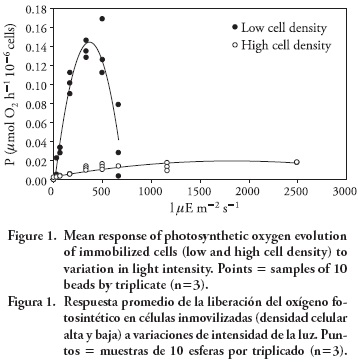
<body><![CDATA[<p align="justify"><font face="verdana" size="2"><b>Analysis of the cellular density and proteins</b></font></p>  	    <p align="justify"><font face="verdana" size="2">Reactors consisted of cylindrical transparent polyethylene terephthalate (PTFE) vessels (3 L capacity) each containing 2.5 L of A<sub>w</sub> and approximately 6500 beads with the initial cell density previously selected from the irradiance&#45;photosynthesis curves. Cultures of immobilized <i>S. obliquus</i> were maintained under two light intensities within the range of light&#45;limitation zone. Each reactor was operated with a beads concentration of approximately 2.6 beads mL <sup>&#45;1</sup> of wastewater maintained at 25 &plusmn;1 &deg;C and continuous illumination. All experiments were run in triplicate. The beads in each reactor were kept in suspension and mixed by means of small air diffusers through which compressed air filtered through an activated carbon filter was introduced.</font></p>  	    <p align="justify"><font face="verdana" size="2">Every 6 h the numbers of cells in the beads were counted with a particle analyzer model Beckman Coulter Multisizer 3, after dissolving one bead in 5 mL of 0.25 M Na<sub>2</sub>HPO<sub>4</sub>.7H<sub>2</sub>O solution (pH 7.0) in triplicate. For the determination of ash&#45;free dry&#45;weight biomass in beads, five beads in triplicate were dissolved in 5 mL of 0.25 M Na<sub>2</sub>HPO<sub>4</sub>.7H<sub>2</sub>O solution (pH 7.0) and filtered through a Whatman GF/C glass fiber filter (2.5 cm diameter) previously rinsed with distilled water, and incinerated at 450 &deg;C for 3 h to constant weight. The samples were dried in a conventional oven at 120 &deg;C for 2 h to constant weight, and placed at 450 &deg;C in a muffle furnace (Sorokin, 1973). The same procedure was used to measure the protein content of the algal biomass (Lowry <i>et al.,</i> 1951). Proteins were analyzed using a standard of bovine albumin (98 %). Protein extraction was undertaken with a NaOH 1N solution at 100 &deg;C and an extraction time of 90 min.</font></p>  	    <p align="justify"><font face="verdana" size="2"><b>Statistical analyses</b></font></p>  	    <p align="justify"><font face="verdana" size="2">The photosynthetic rate data in the experiments with two cellular densities in alginate beads were analyzed by analysis of variance (ANOVA). ANOVA was also used to evaluate the growth and protein content in cultures under two light intensities (StatSoft Inc., Tulsa, OK, USA). The Tukey test (p&le;0.05) was applied when results showed significant differences. As mentioned earlier, experiments were run in triplicate.</font></p>  	    <p align="justify"><font face="verdana" size="2">&nbsp;</font></p>  	    <p align="justify"><font face="verdana" size="2"><b>Results and Discussion</b></font></p>  	    <p align="justify"><font face="verdana" size="2"><b>Activity of immobilized algae</b></font></p>  	    <p align="justify"><font face="verdana" size="2">The photosynthetic rates reached for high and low stocking density of immobilized <i>S. obliquus</i> were significantly different (p&le; 0.004). It was observed that the photosynthetic rates for immobilized <i>S.</i> <i>obliquus</i> at low density increased until 0.14 <i>&#956;</i>mol O2 h <sup>&#45;1</sup> 10 <sup>6</sup> cells with respect to the irradiance followed by a short saturation zone after 300 <i>&#956;</i>E m s and the decrease of the photosynthesis rate as a result of photo&#45;inhibition over 500 &#956;E m <sup>&#45;2</sup> s <sup>&#45;1</sup> (<a href="#f1">Figure 1</a>). This may be caused by the previous adaptation of <i>S. obliquus</i> to low light intensities as a result of the light attenuation caused by the matrix or to the self&#45;shadow effect (Platt and Jassby, 1976). Although fast light saturation was found at low stocking density, the initial slope (&#945;) was higher (p&le; 0.05) than beads at high stocking density, suggesting that cells immobilized at low stocking density had higher physiological activity (<a href="/img/revistas/agro/v45n3/a4t1.jpg" target="_blank">Table 1</a>). Jeanfils and Collar (1983) reported for <i>S. obliquus</i> alginate immobilized a low photosynthetic rate (210 <i>&#956;</i>mol O2 h <sup>&#45;1</sup> 10 <sup>&#45;9</sup> cells) compared to the present study. This difference is attributed to the fact that the photosynthetic rate was estimated to a light intensity (60 W m <sup>&#45;2</sup>) and not for a maximum obtained to different intensities (photosynthetic curve) as reported in the present study.</font></p>  	    <p align="center"><font face="verdana" size="2"><a name="f1"></a></font></p>  	    ]]></body>
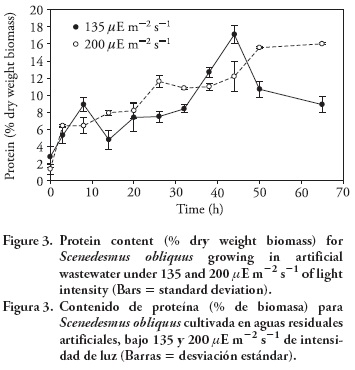
<body><![CDATA[<p align="center"><font face="verdana" size="2"><img src="/img/revistas/agro/v45n3/a4f1.jpg"></font></p>  	    <p align="justify"><font face="verdana" size="2">Beads with high cell density showed an increase of the photosynthetic rate with a maximum of 0.02 <i>&#956;</i>mol O<sub>2</sub> h <sup>&#45;</sup> <sup>1</sup> 10 <sup>&#45;</sup> <sup>6</sup> cells at 500 &#956;E m <sup>&#45;</sup> <sup>2</sup> s <sup>&#45;</sup> <sup>1</sup>, which was followed by a longer saturation zone between 600&#45;2500 &#956;E m <sup>&#45;2</sup> s <sup>&#45;1</sup> without reaching photo&#45;inhibition. This could be advantageous, because the cultures can work with a wide range of intensity of light in tropical regions. However, in immobilized cells this can represent a disadvantage, as the high cell density would cause light limitation within beads followed by lower growth and nutrients removal capacity. Chevalier and de la No&uuml;e (1985) reported that a greater number of cells within the beads reduce the nutrient removal efficiency and algal growth due to the self&#45;shading effect. It seems as if shading effects could be overcome by increasing light on the surface, yet high irradiance causes inhibition of photosynthesis, which is not desirable in immobilized cultures.</font></p>  	    <p align="justify"><font face="verdana" size="2">Results in the present study suggest that cellular activity of immobilized cells decreases as stocking density increases, as noted by the lower photosynthetic rate <i>(P)</i> and <i>Ej</i> obtained in cultures with high cell density beads (<a href="/img/revistas/agro/v45n3/a4t1.jpg" target="_blank">Table 1</a>). Similar results were reported by Tam <i>et al.</i> (1994) and Robinson <i>et</i> al. (1985) for immobilized <i>Chlorella vulgaris;</i> both authors suggest that the cellular metabolic activity of immobilized <i>Chlorella</i> cells decreased as the cellular density increases.</font></p>  	    <p align="justify"><font face="verdana" size="2">In the analysis of P&#45;I curves it is important to take into account the conditions of the culture, such as high cell density cultures, which may cause considerable light attenuation. The photosynthetic variables obtained for immobilized <i>S. obliquus</i> in the present study indicated a higher physiological activity for low stocking density beads than those reached in cultures with high cell density beads. On the basis of these considerations, the growth and protein content using beads with low cellular density cultivated under two intensities of light (135 and 200 &#956;E m <sup>&#45;2</sup> s <sup>&#45;1</sup>), presented the highest photosynthetic rates and, thus, were selected be further tested.</font></p>  	    <p align="justify"><font face="verdana" size="2"><b>Growth</b></font></p>  	    <p align="justify"><font face="verdana" size="2">The growth of immobilized <i>S. obliquus</i> measured in terms of cell density by bead increased gradually with time from 3.5 X10<sup>5</sup> to 8X10<sup>5</sup> cells beads<sup>&#45;1</sup> at 200 <i>&mu;E</i> m <sup>&#45;2</sup> s <sup>&#45;1</sup> in 2 d of culture. This cellular concentration was higher than that obtained at 135 UE m<sup>&#45;2</sup> s<sup>&#45;1</sup> from 3.5X 10<sup>5</sup> to 6.5 X10<sup>5</sup> cells beads<sup>&#45;1</sup>. This suggests that after immobilization the microalga <i>S. obliquus</i> was still able to undergo cell division and carry out photosynthesis (<a href="#f2">Figure 2</a>).</font></p>  	    <p align="center"><font face="verdana" size="2"><a name="f2"></a></font></p>  	    <p align="center"><font face="verdana" size="2"><img src="/img/revistas/agro/v45n3/a4f2.jpg"></font></p>  	    <p align="justify"><font face="verdana" size="2">Both treatments showed immediate growth after the beads were added to the medium, unlike other studies where immobilized cells showed longer lag periods compared with free cells as reported by Chevalier and de la No&uuml;e (1985) and Lau <i>et al.</i> (1997). The light intensity used in the present study (135 and 200 <i>&mu;E</i> m <sup>&#45;2</sup> s <sup>&#45;1</sup>) did not cause significant differences on growth rates (p&ge;0.05), within values of 0.157 d <sup>&#45;1</sup> and 0.172 d <sup>&#45;1</sup>. A similar trend was reported by Bartual <i>et al.</i> (2002) for cultures of <i>Rhodomonas saline</i> under intensities between 15 to 320 &#956;E m <sup>&#45;2</sup> s <sup>&#45;1</sup>.</font></p>  	    <p align="justify"><font face="verdana" size="2">Both growth rates were lower than those reported for <i>S. intermedius</i> of 0.336 d <sup>&#45;1</sup> (Jimenez&#45;Perez <i>et al.,</i> 2004) and 1.08 d <sup>&#45;1</sup> (Chevalier and de la No&uuml;e, 1985). This difference could probably be due to the different conditions of the cultures. Studies of <i>Chlamydomonas reinhardtii</i> have shown that in free cultures the growth rate and photosynthetic activity depend on the amount of light received by the culture (Le&oacute;n and Galv&aacute;n, 1997). However, in the present study it was observed that the irradiance ranges matched the light levels used for the culture of this genus of microalgae (Kaya <i>et al.,</i> 1996; Tam and Wong, 2000; Jimenez&#45;Perez <i>et al.,</i> 2004). A valid consideration is that if nutrients are not limiting and physiological conditions are optimal, then the photosynthetic activity is controlled only by light intensity. In the study of immobilized cells, the high activity associated to the high content of chlorophyll is related to the limitation of the light in the beads. However, it can be observed that in contrast to free&#45;cell cultures, the appropriate light intensity obtained within the light limitation zone (P&#45;I curves) does not guarantee a high biomass production and protein content. Other factors such as CO<sub>2</sub> and temperature should be taken into consideration.</font></p>  	    ]]></body>
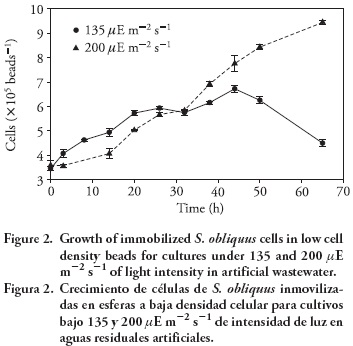
<body><![CDATA[<p align="justify"><font face="verdana" size="2"><b>Protein content</b></font></p>  	    <p align="justify"><font face="verdana" size="2">The protein content (15&#45;16 %) obtained in the cultures under two light intensities did not show significant differences (p&gt; 0.125). The gradual proteins increase with time indicated that the growth and production of proteins began immediately after adding the beads to the culture medium, showing that the microalgae <i>S. obliquus</i> was maintained in exponential phase (<a href="#f3">Figure 3</a>).</font></p>  	    <p align="center"><font face="verdana" size="2"><a name="f3"></a></font></p>  	    <p align="center"><font face="verdana" size="2"><img src="/img/revistas/agro/v45n3/a4f3.jpg"></font></p>  	    <p align="justify"><font face="verdana" size="2">Ruiz&#45;Mar&iacute;n and Mendoza&#45;Espinosa (2008) showed that some ammonium can be removed by ammonia volatilization (17.6 mg L <sup>&#45;1</sup>) as a result of the high pH (9.0&#45;9.5) observed in similar systems. The pH did not seem to interfere with algal growth. Taking into consideration the amount of ammonium at the end of the 42 h of cultivation (6.56 and 7.03 mg L <sup>&#45;1</sup>) it appears that only around 5.84 and 5.37 mg L <sup>&#45;1</sup> of the total nitrogen removed from the medium under light conditions 135 and 200 <i>&#956;E</i> m<sup>&#45;2</sup> s<sup>&#45;1</sup> was incorporated as N&#45;protein by the microalgae. For <i>S. obliquus</i> the amount of non&#45;protein nitrogen (expressed as a portion of total nitrogen) is 12 % (Becker <i>et al.,</i> 1976), yet the N&#45;protein in the present study accounted for 5.14&#45;4.73 mg L <sup>&#45;1</sup> which are lower than the values reported by Nu&ntilde;ez <i>et al.</i> (2001) for free <i>S. obliquus</i> cultures.</font></p>  	    <p align="justify"><font face="verdana" size="2">Under the light intensities selected in the present study there were no significant effects of light intensities on the growth and protein content of <i>S. obliquus.</i> In order to increase protein content, other factors such as CO<sub>2</sub> level, temperature and pH should be tested if the aim is to use the biomass as food supplement.</font></p>  	    <p align="justify">&nbsp;</p> 	    <p align="justify"><font face="verdana" size="2"><b>Conclusions</b></font></p>      <p align="justify"><font face="verdana" size="2">The photosynthetic parameters obtained for immobilized <i>S. obliquus</i> in the present study indicated a higher physiological activity for low cell density beads than those reported for cultures with high cell density beads. The growth and protein content using beads with low cellular density cultivated under two intensities of light, which corresponded to the zone of the highest photosynthetic rate, showed a high response to light intensity at 200 <i>&#956;E</i> m <sup>&#45;2</sup> s <sup>&#45;1</sup>.</font></p>  	    <p align="justify"><font face="verdana" size="2">The high activity associated to the high content of chlorophyll is related to the limitation of the light in the beads. However, in contrast to free&#45;cell cultures, the appropriate light intensity obtained within the light limitation zone (P&#45;I curves) did not cause a high biomass production and protein content. Both irradiances showed that only around 5.14&#45;4.73 mg L <sup>&#45;1</sup> as N&#45;protein of the total nitrogen removed from the medium. Therefore, light intensities not have significant effects on the growth and protein content in beads with low cell density cultures.</font></p>  	    ]]></body>
<body><![CDATA[<p align="justify">&nbsp;</p> 	    <p align="justify"><font face="verdana" size="2"><b>Acknowledgements</b></font></p>      <p align="justify"><font face="verdana" size="2">This study was partially supported by the Universidad Aut&oacute;noma de Baja California (Autonomous University of Baja California) internal project no. 568. A scholarship by the Mexican Department of Education (SEP) granted to Alejandro Ruiz Marin is gratefully acknowledged.</font></p>  	    <p align="justify"><font face="verdana" size="2">&nbsp;</font></p>  	    <p align="justify"><font face="verdana" size="2"><b>Literature cited</b></font></p>  	    <!-- ref --><p align="justify"><font face="verdana" size="2">Andersen, R., A. 2005. Algal Culturing Techniques. Phycological Society of America. Elsevier Academic Press Amsterdam. pp: 578&#45;600.    &nbsp;&nbsp;&nbsp;&nbsp;&nbsp;&nbsp;&nbsp;&nbsp;[&#160;<a href="javascript:void(0);" onclick="javascript: window.open('/scielo.php?script=sci_nlinks&ref=554002&pid=S1405-3195201100030000400001&lng=','','width=640,height=500,resizable=yes,scrollbars=1,menubar=yes,');">Links</a>&#160;]<!-- end-ref --></font></p>  	    <!-- ref --><p align="justify"><font face="verdana" size="2">Bailliez, C., C, Largeau., C, Berkaloff, and E, Casadevall. 1986. Immobilization of <i>Botryococcus braunii</i> in alginate: influence on chlorophyll content, photosynthetic activity and degeneration during batch cultures. Appl. Microbiol. Biotechnol 23: 361&#45;366.    &nbsp;&nbsp;&nbsp;&nbsp;&nbsp;&nbsp;&nbsp;&nbsp;[&#160;<a href="javascript:void(0);" onclick="javascript: window.open('/scielo.php?script=sci_nlinks&ref=554004&pid=S1405-3195201100030000400002&lng=','','width=640,height=500,resizable=yes,scrollbars=1,menubar=yes,');">Links</a>&#160;]<!-- end-ref --></font></p>  	    <!-- ref --><p align="justify"><font face="verdana" size="2">Bartual. A., L. M, Lubi&aacute;n., J. A, G&aacute;lvez, and F. X, Niell. 2002. Effect of irradiance on growth, photosynthesis, pigment content and nutrient consumption in dense cultures of <i>Rhodomonas salina</i> (Wislouch) (Cryptophyceae). Ciencias Marinas 28: 381&#45;392.    &nbsp;&nbsp;&nbsp;&nbsp;&nbsp;&nbsp;&nbsp;&nbsp;[&#160;<a href="javascript:void(0);" onclick="javascript: window.open('/scielo.php?script=sci_nlinks&ref=554006&pid=S1405-3195201100030000400003&lng=','','width=640,height=500,resizable=yes,scrollbars=1,menubar=yes,');">Links</a>&#160;]<!-- end-ref --></font></p>  	    <!-- ref --><p align="justify"><font face="verdana" size="2">Becker, E. W., L. V, Venkataraman, and P. M, Khanum. 1976. Effects of different methods of processing on the protein efficiency ratio of the green alga <i>Scenedesmus acutus.</i> Nutr. Reports. Int. 14: 305&#45;319.    &nbsp;&nbsp;&nbsp;&nbsp;&nbsp;&nbsp;&nbsp;&nbsp;[&#160;<a href="javascript:void(0);" onclick="javascript: window.open('/scielo.php?script=sci_nlinks&ref=554008&pid=S1405-3195201100030000400004&lng=','','width=640,height=500,resizable=yes,scrollbars=1,menubar=yes,');">Links</a>&#160;]<!-- end-ref --></font></p>  	    <!-- ref --><p align="justify"><font face="verdana" size="2">Bouterfas, R., M. Belkoura, and A. Dauta. 2002. Light and temperature effects on the growth rate of three freshwater algae isolated from a eutrophic lake. Hydrobiology. 489: 207&#45;217.    &nbsp;&nbsp;&nbsp;&nbsp;&nbsp;&nbsp;&nbsp;&nbsp;[&#160;<a href="javascript:void(0);" onclick="javascript: window.open('/scielo.php?script=sci_nlinks&ref=554010&pid=S1405-3195201100030000400005&lng=','','width=640,height=500,resizable=yes,scrollbars=1,menubar=yes,');">Links</a>&#160;]<!-- end-ref --></font></p>  	    <!-- ref --><p align="justify"><font face="verdana" size="2">Chevalier, P., and J, de la No&uuml;e. 1985. Efficiency of immobilized hyperconcentrated algae for ammonium and orthophosphorus removal from wastewater. Biotechnol Lett. 7: 395&#45;400.    &nbsp;&nbsp;&nbsp;&nbsp;&nbsp;&nbsp;&nbsp;&nbsp;[&#160;<a href="javascript:void(0);" onclick="javascript: window.open('/scielo.php?script=sci_nlinks&ref=554012&pid=S1405-3195201100030000400006&lng=','','width=640,height=500,resizable=yes,scrollbars=1,menubar=yes,');">Links</a>&#160;]<!-- end-ref --></font></p>  	    <!-- ref --><p align="justify"><font face="verdana" size="2">Guillard, R. L. L., and J. H, Ryther. 1962. Studies on marine plancktonic diatoms <i>Cycloterlla nana</i> Hustedt and <i>Detonula Confervacea</i> (Cleve). Gran Can. J. Microbiol. 8: 229&#45;239.    &nbsp;&nbsp;&nbsp;&nbsp;&nbsp;&nbsp;&nbsp;&nbsp;[&#160;<a href="javascript:void(0);" onclick="javascript: window.open('/scielo.php?script=sci_nlinks&ref=554014&pid=S1405-3195201100030000400007&lng=','','width=640,height=500,resizable=yes,scrollbars=1,menubar=yes,');">Links</a>&#160;]<!-- end-ref --></font></p>  	    <!-- ref --><p align="justify"><font face="verdana" size="2">Jeanfils, J., and F. Collar. 1983. Effect of immobilizing <i>Scenedesmus obliquus</i> cells in a matrix on oxygen evolution and fluorescence properties. Eur. J. Appl. Microbiol. Biotechnol. 17: 254&#45;257.    &nbsp;&nbsp;&nbsp;&nbsp;&nbsp;&nbsp;&nbsp;&nbsp;[&#160;<a href="javascript:void(0);" onclick="javascript: window.open('/scielo.php?script=sci_nlinks&ref=554016&pid=S1405-3195201100030000400008&lng=','','width=640,height=500,resizable=yes,scrollbars=1,menubar=yes,');">Links</a>&#160;]<!-- end-ref --></font></p>  	    <!-- ref --><p align="justify"><font face="verdana" size="2">Jim&eacute;nez&#45;P&eacute;rez, M. V., P. S&aacute;nchez&#45;Castillo, O. Romera, D, Fern&aacute;ndez&#45;Moreno, and C. P&eacute;rez&#45;Mart&iacute;nez. 2004. Growth and nutrient removal in free and immobilized planktonic green algae isolated from pig manure. Enzyme Microb. Technol. 34 : 392&#45;398.    &nbsp;&nbsp;&nbsp;&nbsp;&nbsp;&nbsp;&nbsp;&nbsp;[&#160;<a href="javascript:void(0);" onclick="javascript: window.open('/scielo.php?script=sci_nlinks&ref=554018&pid=S1405-3195201100030000400009&lng=','','width=640,height=500,resizable=yes,scrollbars=1,menubar=yes,');">Links</a>&#160;]<!-- end-ref --></font></p>  	    <!-- ref --><p align="justify"><font face="verdana" size="2">Kaya, V. M., J. Goulet., J. de la No&uuml;e., and G. Picard. 1996. Effect of intermittent CO<sub>2</sub> enrichment during nutrient starvation on tertiary treatment of wastewater by alginate&#45;immobilized <i>Scenedesmus bicellularis.</i> Enzyme Microb. Technol. 18: 550&#45;554.    &nbsp;&nbsp;&nbsp;&nbsp;&nbsp;&nbsp;&nbsp;&nbsp;[&#160;<a href="javascript:void(0);" onclick="javascript: window.open('/scielo.php?script=sci_nlinks&ref=554020&pid=S1405-3195201100030000400010&lng=','','width=640,height=500,resizable=yes,scrollbars=1,menubar=yes,');">Links</a>&#160;]<!-- end-ref --></font></p>  	    <!-- ref --><p align="justify"><font face="verdana" size="2">Lau, P. S., N. F. Y. Tam, and Y. S. Wong. 1997. Wastewater nutrients (N and P) removal by carrageenan and alginate immobilized <i>Chlorella vulgaris.</i> Environ. Technol. 18: 945-951.    &nbsp;&nbsp;&nbsp;&nbsp;&nbsp;&nbsp;&nbsp;&nbsp;[&#160;<a href="javascript:void(0);" onclick="javascript: window.open('/scielo.php?script=sci_nlinks&ref=554022&pid=S1405-3195201100030000400011&lng=','','width=640,height=500,resizable=yes,scrollbars=1,menubar=yes,');">Links</a>&#160;]<!-- end-ref --></font></p>  	    <!-- ref --><p align="justify"><font face="verdana" size="2">Lavoie, A., and J. de la No&uuml;e. 1985. Hyperconcentrated cultures of <i>Scenedesmus obliquus:</i> a new approach for wastewater biological tertiary treatment. Wat. Res. 19: 1437&#45;1442.    &nbsp;&nbsp;&nbsp;&nbsp;&nbsp;&nbsp;&nbsp;&nbsp;[&#160;<a href="javascript:void(0);" onclick="javascript: window.open('/scielo.php?script=sci_nlinks&ref=554024&pid=S1405-3195201100030000400012&lng=','','width=640,height=500,resizable=yes,scrollbars=1,menubar=yes,');">Links</a>&#160;]<!-- end-ref --></font></p>  	    <!-- ref --><p align="justify"><font face="verdana" size="2">Le&oacute;n, R., and F. Galv&aacute;n. 1997. Short communication: Analysis of effective light in different photobioreactors: its influence on growth, photosynthetic activity and glycerol production by the freshwater green alga <i>Chlamydomonas reinhardtii.</i> World J. Microbiol. Biotechnol. 13: 237&#45;239.    &nbsp;&nbsp;&nbsp;&nbsp;&nbsp;&nbsp;&nbsp;&nbsp;[&#160;<a href="javascript:void(0);" onclick="javascript: window.open('/scielo.php?script=sci_nlinks&ref=554026&pid=S1405-3195201100030000400013&lng=','','width=640,height=500,resizable=yes,scrollbars=1,menubar=yes,');">Links</a>&#160;]<!-- end-ref --></font></p>  	    <!-- ref --><p align="justify"><font face="verdana" size="2">Lowry, O. H., N. J. Rosebrough., A. L. Farr, and R. J. Randall. 1951. Protein measurement with the Folin phenol reagent. J. Biol. Chem. 193: 265&#45;275.    &nbsp;&nbsp;&nbsp;&nbsp;&nbsp;&nbsp;&nbsp;&nbsp;[&#160;<a href="javascript:void(0);" onclick="javascript: window.open('/scielo.php?script=sci_nlinks&ref=554028&pid=S1405-3195201100030000400014&lng=','','width=640,height=500,resizable=yes,scrollbars=1,menubar=yes,');">Links</a>&#160;]<!-- end-ref --></font></p>  	    <!-- ref --><p align="justify"><font face="verdana" size="2">Nu&ntilde;ez, J. V., D. Voltolina, M. Nieves, P. Pi&ntilde;a, A. Medina, and M. Guerrero. 2001. Nitrogen budget in <i>Scenedesmus obliqqus</i> cultures with artificial wastewater. Biores Technol. 78: 161&#45;164.    &nbsp;&nbsp;&nbsp;&nbsp;&nbsp;&nbsp;&nbsp;&nbsp;[&#160;<a href="javascript:void(0);" onclick="javascript: window.open('/scielo.php?script=sci_nlinks&ref=554030&pid=S1405-3195201100030000400015&lng=','','width=640,height=500,resizable=yes,scrollbars=1,menubar=yes,');">Links</a>&#160;]<!-- end-ref --></font></p>  	    <!-- ref --><p align="justify"><font face="verdana" size="2">Pane, L., M. Feletti, C. Bertino, and A. Carli. 1998. Viability of the marine microalgae <i>Tetraselmis suecica</i> grown free and immobilized in alginate beads. Aquaculture Int. 6: 411&#45;420.    &nbsp;&nbsp;&nbsp;&nbsp;&nbsp;&nbsp;&nbsp;&nbsp;[&#160;<a href="javascript:void(0);" onclick="javascript: window.open('/scielo.php?script=sci_nlinks&ref=554032&pid=S1405-3195201100030000400016&lng=','','width=640,height=500,resizable=yes,scrollbars=1,menubar=yes,');">Links</a>&#160;]<!-- end-ref --></font></p>  	    <!-- ref --><p align="justify"><font face="verdana" size="2">Platt, T., and A. D. Jassby. 1976. The relationship between photosynthesis and light for natural assemblages of coastal marine phytoplankton. J. Phycol. 12: 421&#45;430.    &nbsp;&nbsp;&nbsp;&nbsp;&nbsp;&nbsp;&nbsp;&nbsp;[&#160;<a href="javascript:void(0);" onclick="javascript: window.open('/scielo.php?script=sci_nlinks&ref=554034&pid=S1405-3195201100030000400017&lng=','','width=640,height=500,resizable=yes,scrollbars=1,menubar=yes,');">Links</a>&#160;]<!-- end-ref --></font></p>  	    <!-- ref --><p align="justify"><font face="verdana" size="2">Prioul, J. L., and P. Chartier. 1977. Partitioning of transfer and carboxylation components of intracellular resistance to photosynthetic CO<sub>2</sub> fixation: a critical analysis of the methods used. Ann. Bot. 41: 189&#45;800.    &nbsp;&nbsp;&nbsp;&nbsp;&nbsp;&nbsp;&nbsp;&nbsp;[&#160;<a href="javascript:void(0);" onclick="javascript: window.open('/scielo.php?script=sci_nlinks&ref=554036&pid=S1405-3195201100030000400018&lng=','','width=640,height=500,resizable=yes,scrollbars=1,menubar=yes,');">Links</a>&#160;]<!-- end-ref --></font></p>  	    <!-- ref --><p align="justify"><font face="verdana" size="2">Robinson, P. K., A. L. Dainty, K. H. Goulding., I. Simpkins., and M. D. Trevan. 1985. Physiology of alginate immobilized Chlorella. Enzyme Microb. Technol. 7: 212&#45;216.    &nbsp;&nbsp;&nbsp;&nbsp;&nbsp;&nbsp;&nbsp;&nbsp;[&#160;<a href="javascript:void(0);" onclick="javascript: window.open('/scielo.php?script=sci_nlinks&ref=554038&pid=S1405-3195201100030000400019&lng=','','width=640,height=500,resizable=yes,scrollbars=1,menubar=yes,');">Links</a>&#160;]<!-- end-ref --></font></p>  	    <!-- ref --><p align="justify"><font face="verdana" size="2">Robinson, P. K., K. H. Goulding, A. L. Mak, and M. D. Trevan. 1986. Factors affecting the growth characteristics of alginate&#45;entrapped Chlorella. Enzyme Microb. Technol. 8: 729&#45;733.    &nbsp;&nbsp;&nbsp;&nbsp;&nbsp;&nbsp;&nbsp;&nbsp;[&#160;<a href="javascript:void(0);" onclick="javascript: window.open('/scielo.php?script=sci_nlinks&ref=554040&pid=S1405-3195201100030000400020&lng=','','width=640,height=500,resizable=yes,scrollbars=1,menubar=yes,');">Links</a>&#160;]<!-- end-ref --></font></p>  	    <!-- ref --><p align="justify"><font face="verdana" size="2">Ruiz&#45;Marin, A., and L. Mendoza&#45;Espinosa. 2008. Ammonia removal and biomass characteristic of alginate&#45;immobilized <i>Scenedesmus obliquus</i> cultures treating real wastewater. Fresenius Environ. Bull. 17(9a): 1236&#45;1241.    &nbsp;&nbsp;&nbsp;&nbsp;&nbsp;&nbsp;&nbsp;&nbsp;[&#160;<a href="javascript:void(0);" onclick="javascript: window.open('/scielo.php?script=sci_nlinks&ref=554042&pid=S1405-3195201100030000400021&lng=','','width=640,height=500,resizable=yes,scrollbars=1,menubar=yes,');">Links</a>&#160;]<!-- end-ref --></font></p>  	    <!-- ref --><p align="justify"><font face="verdana" size="2">S&aacute;nchez&#45;Saavedra, M. P., and D. Voltolina. 2002. Effect of photon fluence rates of white and blue&#45;green light on growth efficiency and pigment content of three diatom species in batch cultures. Ciencias Marinas. 28(3): 273&#45;279.    &nbsp;&nbsp;&nbsp;&nbsp;&nbsp;&nbsp;&nbsp;&nbsp;[&#160;<a href="javascript:void(0);" onclick="javascript: window.open('/scielo.php?script=sci_nlinks&ref=554044&pid=S1405-3195201100030000400022&lng=','','width=640,height=500,resizable=yes,scrollbars=1,menubar=yes,');">Links</a>&#160;]<!-- end-ref --></font></p>  	    <!-- ref --><p align="justify"><font face="verdana" size="2">Sorokin, C. 1973. Dry weigh, packed cell volume and optical density. <i>In:</i> Stein, J. R. (ed). Handbook of Phycological Methods. Culture Methods and Growth Measurement. New York, Cambridge University Press: 440 p.    &nbsp;&nbsp;&nbsp;&nbsp;&nbsp;&nbsp;&nbsp;&nbsp;[&#160;<a href="javascript:void(0);" onclick="javascript: window.open('/scielo.php?script=sci_nlinks&ref=554046&pid=S1405-3195201100030000400023&lng=','','width=640,height=500,resizable=yes,scrollbars=1,menubar=yes,');">Links</a>&#160;]<!-- end-ref --></font></p>  	    <!-- ref --><p align="justify"><font face="verdana" size="2">Tam, N. F. Y., P. S. Lau, and Y. S. Wong. 1994. Wastewater inorganic N and P removal by immobilized Chlorella vulgaris. Wat. Sci. Technol. 30: 369&#45;374.    &nbsp;&nbsp;&nbsp;&nbsp;&nbsp;&nbsp;&nbsp;&nbsp;[&#160;<a href="javascript:void(0);" onclick="javascript: window.open('/scielo.php?script=sci_nlinks&ref=554048&pid=S1405-3195201100030000400024&lng=','','width=640,height=500,resizable=yes,scrollbars=1,menubar=yes,');">Links</a>&#160;]<!-- end-ref --></font></p>  	    <!-- ref --><p align="justify"><font face="verdana" size="2">Tam, N. F. Y., and Y. S. Wong. 2000. Effect of immobilized microalgal bead concentrations on wastewater nutrient removal. Environ. Pollut. 107: 145&#45;151.    &nbsp;&nbsp;&nbsp;&nbsp;&nbsp;&nbsp;&nbsp;&nbsp;[&#160;<a href="javascript:void(0);" onclick="javascript: window.open('/scielo.php?script=sci_nlinks&ref=554050&pid=S1405-3195201100030000400025&lng=','','width=640,height=500,resizable=yes,scrollbars=1,menubar=yes,');">Links</a>&#160;]<!-- end-ref --></font></p>  	    <!-- ref --><p align="justify"><font face="verdana" size="2">Vilchez, C., and J. M. Vega. 1994. Nitrite uptake by <i>Chlamydomonas reinhardtii</i> cells immobilized in calcium alginate. Appl. Microbiol. Biotechnol. 41: 137&#45;141.    &nbsp;&nbsp;&nbsp;&nbsp;&nbsp;&nbsp;&nbsp;&nbsp;[&#160;<a href="javascript:void(0);" onclick="javascript: window.open('/scielo.php?script=sci_nlinks&ref=554052&pid=S1405-3195201100030000400026&lng=','','width=640,height=500,resizable=yes,scrollbars=1,menubar=yes,');">Links</a>&#160;]<!-- end-ref --></font></p>      ]]></body><back>
<ref-list>
<ref id="B1">
<nlm-citation citation-type="book">
<person-group person-group-type="author">
<name>
<surname><![CDATA[Andersen, R.]]></surname>
<given-names><![CDATA[A.]]></given-names>
</name>
</person-group>
<source><![CDATA[Algal Culturing Techniques]]></source>
<year>2005</year>
<page-range>578-600</page-range><publisher-name><![CDATA[Phycological Society of AmericaElsevier Academic Press Amsterdam]]></publisher-name>
</nlm-citation>
</ref>
<ref id="B2">
<nlm-citation citation-type="journal">
<person-group person-group-type="author">
<name>
<surname><![CDATA[Bailliez]]></surname>
<given-names><![CDATA[C.]]></given-names>
</name>
<name>
<surname><![CDATA[Largeau]]></surname>
<given-names><![CDATA[C]]></given-names>
</name>
<name>
<surname><![CDATA[Berkaloff]]></surname>
<given-names><![CDATA[C]]></given-names>
</name>
<name>
<surname><![CDATA[Casadevall]]></surname>
<given-names><![CDATA[E]]></given-names>
</name>
</person-group>
<article-title xml:lang="en"><![CDATA[Immobilization of Botryococcus braunii in alginate: influence on chlorophyll content, photosynthetic activity and degeneration during batch cultures]]></article-title>
<source><![CDATA[Appl. Microbiol. Biotechnol]]></source>
<year>1986</year>
<volume>23</volume>
<page-range>361-366</page-range></nlm-citation>
</ref>
<ref id="B3">
<nlm-citation citation-type="journal">
<person-group person-group-type="author">
<name>
<surname><![CDATA[Bartual]]></surname>
<given-names><![CDATA[A.]]></given-names>
</name>
<name>
<surname><![CDATA[Lubián]]></surname>
<given-names><![CDATA[L. M]]></given-names>
</name>
<name>
<surname><![CDATA[Gálvez]]></surname>
<given-names><![CDATA[J. A]]></given-names>
</name>
<name>
<surname><![CDATA[Niell]]></surname>
<given-names><![CDATA[F. X]]></given-names>
</name>
</person-group>
<article-title xml:lang="en"><![CDATA[Effect of irradiance on growth, photosynthesis, pigment content and nutrient consumption in dense cultures of Rhodomonas salina (Wislouch) (Cryptophyceae)]]></article-title>
<source><![CDATA[Ciencias Marinas]]></source>
<year>2002</year>
<volume>28</volume>
<page-range>381-392</page-range></nlm-citation>
</ref>
<ref id="B4">
<nlm-citation citation-type="journal">
<person-group person-group-type="author">
<name>
<surname><![CDATA[Becker]]></surname>
<given-names><![CDATA[E. W.]]></given-names>
</name>
<name>
<surname><![CDATA[Venkataraman]]></surname>
<given-names><![CDATA[L. V]]></given-names>
</name>
<name>
<surname><![CDATA[Khanum]]></surname>
<given-names><![CDATA[P. M]]></given-names>
</name>
</person-group>
<article-title xml:lang="en"><![CDATA[Effects of different methods of processing on the protein efficiency ratio of the green alga Scenedesmus acutus]]></article-title>
<source><![CDATA[Nutr. Reports. Int.]]></source>
<year>1976</year>
<volume>14</volume>
<page-range>305-319</page-range></nlm-citation>
</ref>
<ref id="B5">
<nlm-citation citation-type="journal">
<person-group person-group-type="author">
<name>
<surname><![CDATA[Bouterfas]]></surname>
<given-names><![CDATA[R.]]></given-names>
</name>
<name>
<surname><![CDATA[Belkoura]]></surname>
<given-names><![CDATA[M.]]></given-names>
</name>
<name>
<surname><![CDATA[Dauta]]></surname>
<given-names><![CDATA[A.]]></given-names>
</name>
</person-group>
<article-title xml:lang="en"><![CDATA[Light and temperature effects on the growth rate of three freshwater algae isolated from a eutrophic lake]]></article-title>
<source><![CDATA[Hydrobiology]]></source>
<year>2002</year>
<volume>489</volume>
<page-range>207-217</page-range></nlm-citation>
</ref>
<ref id="B6">
<nlm-citation citation-type="journal">
<person-group person-group-type="author">
<name>
<surname><![CDATA[Chevalier]]></surname>
<given-names><![CDATA[P.]]></given-names>
</name>
<name>
<surname><![CDATA[de la Noüe]]></surname>
<given-names><![CDATA[J]]></given-names>
</name>
</person-group>
<article-title xml:lang="en"><![CDATA[Efficiency of immobilized hyperconcentrated algae for ammonium and orthophosphorus removal from wastewater]]></article-title>
<source><![CDATA[Biotechnol Lett.]]></source>
<year>1985</year>
<volume>7</volume>
<page-range>395-400</page-range></nlm-citation>
</ref>
<ref id="B7">
<nlm-citation citation-type="journal">
<person-group person-group-type="author">
<name>
<surname><![CDATA[Guillard]]></surname>
<given-names><![CDATA[R. L. L.]]></given-names>
</name>
<name>
<surname><![CDATA[Ryther]]></surname>
<given-names><![CDATA[J. H]]></given-names>
</name>
</person-group>
<article-title xml:lang="en"><![CDATA[Studies on marine plancktonic diatoms Cycloterlla nana Hustedt and Detonula Confervacea (Cleve)]]></article-title>
<source><![CDATA[Gran Can. J. Microbiol.]]></source>
<year>1962</year>
<volume>8</volume>
<page-range>229-239</page-range></nlm-citation>
</ref>
<ref id="B8">
<nlm-citation citation-type="journal">
<person-group person-group-type="author">
<name>
<surname><![CDATA[Jeanfils]]></surname>
<given-names><![CDATA[J.]]></given-names>
</name>
<name>
<surname><![CDATA[Collar]]></surname>
<given-names><![CDATA[F.]]></given-names>
</name>
</person-group>
<article-title xml:lang="en"><![CDATA[Effect of immobilizing Scenedesmus obliquus cells in a matrix on oxygen evolution and fluorescence properties]]></article-title>
<source><![CDATA[Eur. J. Appl. Microbiol. Biotechnol.]]></source>
<year>1983</year>
<volume>17</volume>
<page-range>254-257</page-range></nlm-citation>
</ref>
<ref id="B9">
<nlm-citation citation-type="journal">
<person-group person-group-type="author">
<name>
<surname><![CDATA[Jiménez-Pérez]]></surname>
<given-names><![CDATA[M. V.]]></given-names>
</name>
<name>
<surname><![CDATA[Sánchez-Castillo]]></surname>
<given-names><![CDATA[P.]]></given-names>
</name>
<name>
<surname><![CDATA[Romera]]></surname>
<given-names><![CDATA[O.]]></given-names>
</name>
<name>
<surname><![CDATA[Fernández-Moreno]]></surname>
<given-names><![CDATA[D]]></given-names>
</name>
<name>
<surname><![CDATA[Pérez-Martínez]]></surname>
<given-names><![CDATA[C.]]></given-names>
</name>
</person-group>
<article-title xml:lang="en"><![CDATA[Growth and nutrient removal in free and immobilized planktonic green algae isolated from pig manure]]></article-title>
<source><![CDATA[Enzyme Microb. Technol.]]></source>
<year>2004</year>
<volume>34</volume>
<page-range>392-398</page-range></nlm-citation>
</ref>
<ref id="B10">
<nlm-citation citation-type="journal">
<person-group person-group-type="author">
<name>
<surname><![CDATA[Kaya]]></surname>
<given-names><![CDATA[V. M.]]></given-names>
</name>
<name>
<surname><![CDATA[Goulet]]></surname>
<given-names><![CDATA[J.]]></given-names>
</name>
<name>
<surname><![CDATA[de la Noüe]]></surname>
<given-names><![CDATA[J.]]></given-names>
</name>
<name>
<surname><![CDATA[Picard]]></surname>
<given-names><![CDATA[G.]]></given-names>
</name>
</person-group>
<article-title xml:lang="en"><![CDATA[Effect of intermittent CO2 enrichment during nutrient starvation on tertiary treatment of wastewater by alginate-immobilized Scenedesmus bicellularis]]></article-title>
<source><![CDATA[Enzyme Microb. Technol.]]></source>
<year>1996</year>
<volume>18</volume>
<page-range>550-554</page-range></nlm-citation>
</ref>
<ref id="B11">
<nlm-citation citation-type="journal">
<person-group person-group-type="author">
<name>
<surname><![CDATA[Lau]]></surname>
<given-names><![CDATA[P. S.]]></given-names>
</name>
<name>
<surname><![CDATA[Tam]]></surname>
<given-names><![CDATA[N. F. Y.]]></given-names>
</name>
<name>
<surname><![CDATA[Wong]]></surname>
<given-names><![CDATA[Y. S.]]></given-names>
</name>
</person-group>
<article-title xml:lang="en"><![CDATA[Wastewater nutrients (N and P) removal by carrageenan and alginate immobilized Chlorella vulgaris]]></article-title>
<source><![CDATA[Environ. Technol.]]></source>
<year>1997</year>
<volume>18</volume>
<page-range>945-951</page-range></nlm-citation>
</ref>
<ref id="B12">
<nlm-citation citation-type="journal">
<person-group person-group-type="author">
<name>
<surname><![CDATA[Lavoie]]></surname>
<given-names><![CDATA[A.]]></given-names>
</name>
<name>
<surname><![CDATA[de la Noüe]]></surname>
<given-names><![CDATA[J.]]></given-names>
</name>
</person-group>
<article-title xml:lang="en"><![CDATA[Hyperconcentrated cultures of Scenedesmus obliquus: a new approach for wastewater biological tertiary treatment]]></article-title>
<source><![CDATA[Wat. Res.]]></source>
<year>1985</year>
<volume>19</volume>
<page-range>1437-1442</page-range></nlm-citation>
</ref>
<ref id="B13">
<nlm-citation citation-type="journal">
<person-group person-group-type="author">
<name>
<surname><![CDATA[León]]></surname>
<given-names><![CDATA[R.]]></given-names>
</name>
<name>
<surname><![CDATA[Galván]]></surname>
<given-names><![CDATA[F.]]></given-names>
</name>
</person-group>
<article-title xml:lang="en"><![CDATA[Short communication: Analysis of effective light in different photobioreactors: its influence on growth, photosynthetic activity and glycerol production by the freshwater green alga Chlamydomonas reinhardtii]]></article-title>
<source><![CDATA[World J. Microbiol. Biotechnol.]]></source>
<year>1997</year>
<volume>13</volume>
<page-range>237-239</page-range></nlm-citation>
</ref>
<ref id="B14">
<nlm-citation citation-type="journal">
<person-group person-group-type="author">
<name>
<surname><![CDATA[Lowry]]></surname>
<given-names><![CDATA[O. H.]]></given-names>
</name>
<name>
<surname><![CDATA[Rosebrough]]></surname>
<given-names><![CDATA[N. J.]]></given-names>
</name>
<name>
<surname><![CDATA[Farr]]></surname>
<given-names><![CDATA[A. L.]]></given-names>
</name>
<name>
<surname><![CDATA[Randall]]></surname>
<given-names><![CDATA[R. J.]]></given-names>
</name>
</person-group>
<article-title xml:lang="en"><![CDATA[Protein measurement with the Folin phenol reagent]]></article-title>
<source><![CDATA[J. Biol. Chem.]]></source>
<year>1951</year>
<volume>193</volume>
<page-range>265-275</page-range></nlm-citation>
</ref>
<ref id="B15">
<nlm-citation citation-type="journal">
<person-group person-group-type="author">
<name>
<surname><![CDATA[Nuñez]]></surname>
<given-names><![CDATA[J. V.]]></given-names>
</name>
<name>
<surname><![CDATA[Voltolina]]></surname>
<given-names><![CDATA[D.]]></given-names>
</name>
<name>
<surname><![CDATA[Nieves]]></surname>
<given-names><![CDATA[M.]]></given-names>
</name>
<name>
<surname><![CDATA[Piña]]></surname>
<given-names><![CDATA[P.]]></given-names>
</name>
<name>
<surname><![CDATA[Medina]]></surname>
<given-names><![CDATA[A.]]></given-names>
</name>
<name>
<surname><![CDATA[Guerrero]]></surname>
<given-names><![CDATA[M.]]></given-names>
</name>
</person-group>
<article-title xml:lang="en"><![CDATA[Nitrogen budget in Scenedesmus obliqqus cultures with artificial wastewater]]></article-title>
<source><![CDATA[Biores Technol.]]></source>
<year>2001</year>
<volume>78</volume>
<page-range>161-164</page-range></nlm-citation>
</ref>
<ref id="B16">
<nlm-citation citation-type="journal">
<person-group person-group-type="author">
<name>
<surname><![CDATA[Pane]]></surname>
<given-names><![CDATA[L.]]></given-names>
</name>
<name>
<surname><![CDATA[Feletti]]></surname>
<given-names><![CDATA[M.]]></given-names>
</name>
<name>
<surname><![CDATA[Bertino]]></surname>
<given-names><![CDATA[C.]]></given-names>
</name>
<name>
<surname><![CDATA[Carli]]></surname>
<given-names><![CDATA[A.]]></given-names>
</name>
</person-group>
<article-title xml:lang="en"><![CDATA[Viability of the marine microalgae Tetraselmis suecica grown free and immobilized in alginate beads]]></article-title>
<source><![CDATA[Aquaculture Int.]]></source>
<year>1998</year>
<volume>6</volume>
<page-range>411-420</page-range></nlm-citation>
</ref>
<ref id="B17">
<nlm-citation citation-type="journal">
<person-group person-group-type="author">
<name>
<surname><![CDATA[Platt]]></surname>
<given-names><![CDATA[T.]]></given-names>
</name>
<name>
<surname><![CDATA[Jassby]]></surname>
<given-names><![CDATA[A. D.]]></given-names>
</name>
</person-group>
<article-title xml:lang="en"><![CDATA[The relationship between photosynthesis and light for natural assemblages of coastal marine phytoplankton]]></article-title>
<source><![CDATA[J. Phycol.]]></source>
<year>1976</year>
<volume>12</volume>
<page-range>421-430</page-range></nlm-citation>
</ref>
<ref id="B18">
<nlm-citation citation-type="journal">
<person-group person-group-type="author">
<name>
<surname><![CDATA[Prioul]]></surname>
<given-names><![CDATA[J. L.]]></given-names>
</name>
<name>
<surname><![CDATA[Chartier]]></surname>
<given-names><![CDATA[P.]]></given-names>
</name>
</person-group>
<article-title xml:lang="en"><![CDATA[Partitioning of transfer and carboxylation components of intracellular resistance to photosynthetic CO2 fixation: a critical analysis of the methods used]]></article-title>
<source><![CDATA[Ann. Bot.]]></source>
<year>1977</year>
<volume>41</volume>
<page-range>189-800</page-range></nlm-citation>
</ref>
<ref id="B19">
<nlm-citation citation-type="journal">
<person-group person-group-type="author">
<name>
<surname><![CDATA[Robinson]]></surname>
<given-names><![CDATA[P. K.]]></given-names>
</name>
<name>
<surname><![CDATA[Dainty]]></surname>
<given-names><![CDATA[A. L.]]></given-names>
</name>
<name>
<surname><![CDATA[Goulding]]></surname>
<given-names><![CDATA[K. H.]]></given-names>
</name>
<name>
<surname><![CDATA[Simpkins]]></surname>
<given-names><![CDATA[I.]]></given-names>
</name>
<name>
<surname><![CDATA[Trevan]]></surname>
<given-names><![CDATA[M. D.]]></given-names>
</name>
</person-group>
<article-title xml:lang="en"><![CDATA[Physiology of alginate immobilized Chlorella]]></article-title>
<source><![CDATA[Enzyme Microb. Technol.]]></source>
<year>1985</year>
<volume>7</volume>
<page-range>212-216</page-range></nlm-citation>
</ref>
<ref id="B20">
<nlm-citation citation-type="journal">
<person-group person-group-type="author">
<name>
<surname><![CDATA[Robinson]]></surname>
<given-names><![CDATA[P. K.]]></given-names>
</name>
<name>
<surname><![CDATA[Goulding]]></surname>
<given-names><![CDATA[K. H.]]></given-names>
</name>
<name>
<surname><![CDATA[Mak]]></surname>
<given-names><![CDATA[A. L.]]></given-names>
</name>
<name>
<surname><![CDATA[Trevan]]></surname>
<given-names><![CDATA[M. D.]]></given-names>
</name>
</person-group>
<article-title xml:lang="en"><![CDATA[Factors affecting the growth characteristics of alginate-entrapped Chlorella]]></article-title>
<source><![CDATA[Enzyme Microb. Technol.]]></source>
<year>1986</year>
<volume>8</volume>
<page-range>729-733</page-range></nlm-citation>
</ref>
<ref id="B21">
<nlm-citation citation-type="journal">
<person-group person-group-type="author">
<name>
<surname><![CDATA[Ruiz-Marin]]></surname>
<given-names><![CDATA[A.]]></given-names>
</name>
<name>
<surname><![CDATA[Mendoza-Espinosa]]></surname>
<given-names><![CDATA[L.]]></given-names>
</name>
</person-group>
<article-title xml:lang="en"><![CDATA[Ammonia removal and biomass characteristic of alginate-immobilized Scenedesmus obliquus cultures treating real wastewater]]></article-title>
<source><![CDATA[Fresenius Environ. Bull.]]></source>
<year>2008</year>
<volume>17</volume>
<numero>9</numero>
<issue>9</issue>
<page-range>1236-1241</page-range></nlm-citation>
</ref>
<ref id="B22">
<nlm-citation citation-type="journal">
<person-group person-group-type="author">
<name>
<surname><![CDATA[Sánchez-Saavedra]]></surname>
<given-names><![CDATA[M. P.]]></given-names>
</name>
<name>
<surname><![CDATA[Voltolina]]></surname>
<given-names><![CDATA[D.]]></given-names>
</name>
</person-group>
<article-title xml:lang="en"><![CDATA[Effect of photon fluence rates of white and blue-green light on growth efficiency and pigment content of three diatom species in batch cultures]]></article-title>
<source><![CDATA[Ciencias Marinas]]></source>
<year>2002</year>
<volume>28</volume>
<numero>3</numero>
<issue>3</issue>
<page-range>273-279</page-range></nlm-citation>
</ref>
<ref id="B23">
<nlm-citation citation-type="book">
<person-group person-group-type="author">
<name>
<surname><![CDATA[Sorokin]]></surname>
<given-names><![CDATA[C.]]></given-names>
</name>
</person-group>
<article-title xml:lang="en"><![CDATA[Dry weigh, packed cell volume and optical density]]></article-title>
<person-group person-group-type="editor">
<name>
<surname><![CDATA[Stein]]></surname>
<given-names><![CDATA[J. R.]]></given-names>
</name>
</person-group>
<source><![CDATA[Handbook of Phycological Methods. Culture Methods and Growth Measurement]]></source>
<year>1973</year>
<page-range>440</page-range><publisher-loc><![CDATA[New York ]]></publisher-loc>
<publisher-name><![CDATA[Cambridge University Press]]></publisher-name>
</nlm-citation>
</ref>
<ref id="B24">
<nlm-citation citation-type="journal">
<person-group person-group-type="author">
<name>
<surname><![CDATA[Tam]]></surname>
<given-names><![CDATA[N. F. Y.]]></given-names>
</name>
<name>
<surname><![CDATA[Lau]]></surname>
<given-names><![CDATA[P. S.]]></given-names>
</name>
<name>
<surname><![CDATA[Wong]]></surname>
<given-names><![CDATA[Y. S.]]></given-names>
</name>
</person-group>
<article-title xml:lang="en"><![CDATA[Wastewater inorganic N and P removal by immobilized Chlorella vulgaris]]></article-title>
<source><![CDATA[Wat. Sci. Technol.]]></source>
<year>1994</year>
<volume>30</volume>
<page-range>369-374</page-range></nlm-citation>
</ref>
<ref id="B25">
<nlm-citation citation-type="journal">
<person-group person-group-type="author">
<name>
<surname><![CDATA[Tam]]></surname>
<given-names><![CDATA[N. F. Y.]]></given-names>
</name>
<name>
<surname><![CDATA[Wong]]></surname>
<given-names><![CDATA[Y. S.]]></given-names>
</name>
</person-group>
<article-title xml:lang="en"><![CDATA[Effect of immobilized microalgal bead concentrations on wastewater nutrient removal]]></article-title>
<source><![CDATA[Environ. Pollut.]]></source>
<year>2000</year>
<volume>107</volume>
<page-range>145-151</page-range></nlm-citation>
</ref>
<ref id="B26">
<nlm-citation citation-type="journal">
<person-group person-group-type="author">
<name>
<surname><![CDATA[Vilchez]]></surname>
<given-names><![CDATA[C.]]></given-names>
</name>
<name>
<surname><![CDATA[Vega]]></surname>
<given-names><![CDATA[J. M.]]></given-names>
</name>
</person-group>
<article-title xml:lang="en"><![CDATA[Nitrite uptake by Chlamydomonas reinhardtii cells immobilized in calcium alginate]]></article-title>
<source><![CDATA[Appl. Microbiol. Biotechnol.]]></source>
<year>1994</year>
<volume>41</volume>
<page-range>137-141</page-range></nlm-citation>
</ref>
</ref-list>
</back>
</article>