<?xml version="1.0" encoding="ISO-8859-1"?><article xmlns:mml="http://www.w3.org/1998/Math/MathML" xmlns:xlink="http://www.w3.org/1999/xlink" xmlns:xsi="http://www.w3.org/2001/XMLSchema-instance">
<front>
<journal-meta>
<journal-id>1405-3195</journal-id>
<journal-title><![CDATA[Agrociencia]]></journal-title>
<abbrev-journal-title><![CDATA[Agrociencia]]></abbrev-journal-title>
<issn>1405-3195</issn>
<publisher>
<publisher-name><![CDATA[Colegio de Postgraduados]]></publisher-name>
</publisher>
</journal-meta>
<article-meta>
<article-id>S1405-31952009000100003</article-id>
<title-group>
<article-title xml:lang="en"><![CDATA[Effects of nitrogen fertilizer input on the composition of mineral elements in corn grain]]></article-title>
<article-title xml:lang="es"><![CDATA[Efectos de la aplicación de fertilizante nitrogenado en la composición de los elementos en los granos de maíz]]></article-title>
</title-group>
<contrib-group>
<contrib contrib-type="author">
<name>
<surname><![CDATA[Yu-kui]]></surname>
<given-names><![CDATA[Rui]]></given-names>
</name>
<xref ref-type="aff" rid="A01"/>
</contrib>
<contrib contrib-type="author">
<name>
<surname><![CDATA[Shi-ling]]></surname>
<given-names><![CDATA[Jiang]]></given-names>
</name>
<xref ref-type="aff" rid="A02"/>
</contrib>
<contrib contrib-type="author">
<name>
<surname><![CDATA[Fu-suo]]></surname>
<given-names><![CDATA[Zhang]]></given-names>
</name>
<xref ref-type="aff" rid="A01"/>
</contrib>
<contrib contrib-type="author">
<name>
<surname><![CDATA[Jian-bo]]></surname>
<given-names><![CDATA[Shen]]></given-names>
</name>
<xref ref-type="aff" rid="A01"/>
</contrib>
</contrib-group>
<aff id="A01">
<institution><![CDATA[,China Agricultural University College of Resources and Environmental Science ]]></institution>
<addr-line><![CDATA[Beijing ]]></addr-line>
<country>P.R China</country>
</aff>
<aff id="A02">
<institution><![CDATA[,University of Manitoba Department of Plant Science ]]></institution>
<addr-line><![CDATA[Winnipeg Manitoba]]></addr-line>
<country>Canada</country>
</aff>
<pub-date pub-type="pub">
<day>00</day>
<month>02</month>
<year>2009</year>
</pub-date>
<pub-date pub-type="epub">
<day>00</day>
<month>02</month>
<year>2009</year>
</pub-date>
<volume>43</volume>
<numero>1</numero>
<fpage>21</fpage>
<lpage>27</lpage>
<copyright-statement/>
<copyright-year/>
<self-uri xlink:href="http://www.scielo.org.mx/scielo.php?script=sci_arttext&amp;pid=S1405-31952009000100003&amp;lng=en&amp;nrm=iso"></self-uri><self-uri xlink:href="http://www.scielo.org.mx/scielo.php?script=sci_abstract&amp;pid=S1405-31952009000100003&amp;lng=en&amp;nrm=iso"></self-uri><self-uri xlink:href="http://www.scielo.org.mx/scielo.php?script=sci_pdf&amp;pid=S1405-31952009000100003&amp;lng=en&amp;nrm=iso"></self-uri><abstract abstract-type="short" xml:lang="en"><p><![CDATA[Excessive and inappropriate application of industrial N fertilizer can result in severe environmental and ecological problems, but whether the input of N fertilizer could affect the composition of mineral elements in corn has not been reported. Effects of input of N fertilizer on the composition of mineral elements (Se, Mo, I, Mn, Fe, Cu, Zn, Ca, Cr, K, Na, and Mg), in corn grain were investigated by ICP-MS (inductive coupling plasma-mass spectrometry). Se, I, Mn, Fe, Zn, Cr, K and Ca were significantly lower in the treatments with N fertilizer compared to a control without N fertilizer. There was a significant negative conrrelation (R) between four mineral elements and N fertilizer input: I, -0.71; Zn, -0.65; Ca, -0.75; K, -0.89. Therefore appropriate reduction of N fertilizer input cannot only prevent environmental problems from excessive application of industrial N fertilizer, besides it might reduce the problem of malnutrition induced by mineral elements deficiency.]]></p></abstract>
<abstract abstract-type="short" xml:lang="es"><p><![CDATA[La aplicación excesiva e inapropiada de fertilizante comercial nitrogenado (N) puede ocasionar graves problemas ambientales y ecológicos; sin embargo, no se ha reportado si la aplicación de fertilizante N puede afectar la composición de los elementos minerales en el maíz. Los efectos de la aplicación de fertilizante N en la composición de los elementos minerales en los granos de maíz (Se, Mo, I, Mn, Fe, Cu, Zn, Ca, Cr, K, Na, y Mg) se analizaron mediante espectrometría de masas con plasma acoplado por inducción (ICP-MS, por sus siglas en inglés). Se, I, Mn, Fe, Zn, Cr, K y Ca fueron significativamente inferiores en los tratamientos con fertilizante N comparado con un control sin fertilizante N. Hubo una correlación (R) negativa significativa entre cuatro elementos minerales y fertilizantes N: I, -0.71; Zn, -0.65; Ca, -0.75; K, -0.89. Por tanto, la reducción apropiada de la adición de fertilizante N puede no sólo evitar problemas ambientales debidos a la aplicación excesiva de fertilizante comercial N, sino que además podría disminuir la desnutrición causada por la deficiencia de elementos minerales.]]></p></abstract>
<kwd-group>
<kwd lng="en"><![CDATA[Corn grain]]></kwd>
<kwd lng="en"><![CDATA[ICP-MS]]></kwd>
<kwd lng="en"><![CDATA[plant nutrition]]></kwd>
<kwd lng="en"><![CDATA[trace elements]]></kwd>
<kwd lng="en"><![CDATA[urea]]></kwd>
<kwd lng="es"><![CDATA[Granos de maíz]]></kwd>
<kwd lng="es"><![CDATA[ICP-MS]]></kwd>
<kwd lng="es"><![CDATA[nutrición de plantas]]></kwd>
<kwd lng="es"><![CDATA[elementos traza]]></kwd>
<kwd lng="es"><![CDATA[urea]]></kwd>
</kwd-group>
</article-meta>
</front><body><![CDATA[ <p align="justify"><font face="verdana" size="4">Fitociencia</font></p>     <p align="justify"><font face="verdana" size="2">&nbsp;</font></p>     <p align="center"><font face="verdana" size="4"><b>Effects of nitrogen fertilizer input on the composition of mineral elements in corn grain</b></font></p>     <p align="justify"><font face="verdana" size="2">&nbsp;</font></p>     <p align="center"><font face="verdana" size="3"><b>Efectos de la aplicaci&oacute;n de fertilizante nitrogenado en la composici&oacute;n de los elementos en los granos de ma&iacute;z</b></font></p>     <p align="justify"><font face="verdana" size="2">&nbsp;</font></p>     <p align="center"><font face="verdana" size="2"><b>Rui Yu&#150;kui<sup>1</sup>*, Jiang Shi&#150;ling<sup>2</sup>, Zhang Fu&#150;suo<sup>1</sup>, Shen Jian&#150;bo<sup>1</sup></b></font></p>     <p align="justify"><font face="verdana" size="2">&nbsp;</font></p>     <p align="justify"><font face="verdana" size="2"><sup>1 </sup><i>College of Resources and Environmental Science, China Agricultural University, Beijing 100094, P.R China. </i></font></p>     <p align="justify"><font face="verdana" size="2"><sup>2 </sup><i>Department of Plant Science, University of Manitoba, Winnipeg, Manitoba, Canada R3T 2N2. * Author for correspondence: </i>(<a href="mailto:ruiyukui@163.com">ruiyukui@163.com</a>).</font></p>     ]]></body>
<body><![CDATA[<p align="justify"><font face="verdana" size="2">&nbsp;</font></p>     <p align="justify"><font face="verdana" size="2">Received: March, 2008.     <br>   Aproved: August, 2008.</font></p>     <p align="justify"><font face="verdana" size="2">&nbsp;</font></p>     <p align="justify"><font face="verdana" size="2"><b>Abstract</b></font></p>     <p align="justify"><font face="verdana" size="2">Excessive and inappropriate application of industrial N fertilizer can result in severe environmental and ecological problems, but whether the input of N fertilizer could affect the composition of mineral elements in corn has not been reported. Effects of input of N fertilizer on the composition of mineral elements (Se, Mo, I, Mn, Fe, Cu, Zn, Ca, Cr, K, Na, and Mg), in corn grain were investigated by ICP&#150;MS (inductive coupling plasma&#150;mass spectrometry). Se, I, Mn, Fe, Zn, Cr, K and Ca were significantly lower in the treatments with N fertilizer compared to a control without N fertilizer. There was a significant negative conrrelation (R) between four mineral elements and N fertilizer input: I, &#150;0.71; Zn, &#150;0.65; Ca, &#150;0.75; K, &#150;0.89. Therefore appropriate reduction of N fertilizer input cannot only prevent environmental problems from excessive application of industrial N fertilizer, besides it might reduce the problem of malnutrition induced by mineral elements deficiency.</font></p>     <p align="justify"><font face="verdana" size="2"><b>Key words: </b>Corn grain, ICP&#150;MS, plant nutrition, trace elements, urea.</font></p>     <p align="justify"><font face="verdana" size="2">&nbsp;</font></p>     <p align="justify"><font face="verdana" size="2"><b>Resumen</b></font></p>     <p align="justify"><font face="verdana" size="2">La aplicaci&oacute;n excesiva e inapropiada de fertilizante comercial nitrogenado (N) puede ocasionar graves problemas ambientales y ecol&oacute;gicos; sin embargo, no se ha reportado si la aplicaci&oacute;n de fertilizante N puede afectar la composici&oacute;n de los elementos minerales en el ma&iacute;z. Los efectos de la aplicaci&oacute;n de fertilizante N en la composici&oacute;n de los elementos minerales en los granos de ma&iacute;z (Se, Mo, I, Mn, Fe, Cu, Zn, Ca, Cr, K, Na, y Mg) se analizaron mediante espectrometr&iacute;a de masas con plasma acoplado por inducci&oacute;n (ICP&#150;MS, por sus siglas en ingl&eacute;s). Se, I, Mn, Fe, Zn, Cr, K y Ca fueron significativamente inferiores en los tratamientos con fertilizante N comparado con un control sin fertilizante N. Hubo una correlaci&oacute;n (R) negativa significativa entre cuatro elementos minerales y fertilizantes N: I, &#150;0.71; Zn, &#150;0.65; Ca, &#150;0.75; K, &#150;0.89. Por tanto, la reducci&oacute;n apropiada de la adici&oacute;n de fertilizante N puede no s&oacute;lo evitar problemas ambientales debidos a la aplicaci&oacute;n excesiva de fertilizante comercial N, sino que adem&aacute;s podr&iacute;a disminuir la desnutrici&oacute;n causada por la deficiencia de elementos minerales.</font></p>     ]]></body>
<body><![CDATA[<p align="justify"><font face="verdana" size="2"><b>Palabras clave: </b>Granos de ma&iacute;z, ICP&#150;MS, nutrici&oacute;n de plantas, elementos traza, urea.</font></p>     <p align="justify"><font face="verdana" size="2">&nbsp;</font></p>     <p align="justify"><font face="verdana" size="2"><b>INTRODUCTION</b></font></p>     <p align="justify"><font face="verdana" size="2">Mineral elements play many important roles in human health (Zeng and Zhao, 2007). Obtaining mineral elements for the human body principally depends on food; thus, content of mineral elements in farm products is a key index to appraise the quality of the latter.</font></p>     <p align="justify"><font face="verdana" size="2">Nitrogen (N) fertilizer, which is necessary to biosynthesize amino acids and carbohydrates in plants used to feed animals and humans, has played a significant role in increasing crop yield and solving malnutrition problems. Production and application of N fertilizers have increased, resulting in an excess of them in China (Sun <i>et al., </i>2006; Ju <i>et al., </i>2004). Excessive and inappropriate application of industrial N fertilizer can result in severe environmental and ecological problems. For example, nitrate pollution in groundwater (Ju <i>et al., </i>2006; Thorburn <i>et al., </i>2003), eutrophication of coastal waters (Paerl, 2006) and greenhouse gases emissions that contribute to global warming (Scheer <i>et al., </i>2008). In addition, its influence on nutrient composition in farm products has received more attention (Fabio <i>et al., </i>2007; Li and Guo, 2007).</font></p>     <p align="justify"><font face="verdana" size="2">Increasing the yield and improving the quality of crops have been the challenges for sustainable agriculture. A high input of N fertilizer can increase the yield and improve the composition of proteins and amino acids in farm products. However, whether the input of N fertilizer could improve the composition of mineral elements in corn has not been reported.</font></p>     <p align="justify"><font face="verdana" size="2">In order to study effects of input of N fertilizer on the composition of mineral elements in corn grain, different N fertilizer inputs in soil were used. Besides, concentration of Se, Mo, I, Mn, Fe, Cu, Zn, Ca, Cr, K, Na, and Mg were determined in seed after harvesting. T</font></p>     <p align="justify"><font face="verdana" size="2">&nbsp;</font></p>     <p align="justify"><font face="verdana" size="2"><b>MATERIALS AND METHODS</b></font></p>     <p align="justify"><font face="verdana" size="2"><b>Materials </b></font></p>     ]]></body>
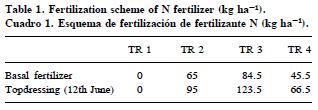
<body><![CDATA[<p align="justify"><font face="verdana" size="2"><b>Corn seeds</b></font></p>     <p align="justify"><font face="verdana" size="2">The corn seeds, Denghai 3719, were produced and donated by Shandong Denghai Seeds Co., Ltd.</font></p>     <p align="justify"><font face="verdana" size="2"><b>Fertilizers</b></font></p>     <p align="justify"><font face="verdana" size="2">The N fertilizer used was urea, total N no less than 46.4%, produced by PetroChina Ningxia Petrochemical Company Beijing xilu No. 1338 (Yinchuan city, Ningxia province, P.R. China). The P fertilizer was superphosphate, no less than 16% P<sub>2</sub>O<sub>5</sub>, produced by Yunnan Honglin Chemicals Co., Ltd (Kaiyuan city, Yunnan Province, P. R. China). The K fertilizer was KCl, no less than 60% K2O, produced by Ural Potassium fertilizer joint&#150;stock company (Berezniki city, Perm State, Russia). The Zn fertilizer was ZnSO<sub>4</sub>, no less than 95% ZnSO<sub>4</sub>, produced by Shandong Zouping Zhenzhong Chemicals Co., Ltd (Zouping city, Shandong province P. R. China).</font></p>     <p align="justify"><font face="verdana" size="2"><b>Field management</b></font></p>     <p align="justify"><font face="verdana" size="2">Experiments were carried out in a field at Shangzhuang experimental station, China Agricultural University, Beijing. The corn variety was Denghai 3719, sown on April 25, 2007, and harvested on September 20, 2007. Density was 100 000 plants per km<sup>2</sup>. Four treatments were applied to the same P, K and Zn fertilizer and each treatment was repeated four times. Properties of soil are found in Hu's <i>et al </i>paper (2006).</font></p>     <p align="justify"><font face="verdana" size="2"><b>Fertilization scheme</b></font></p>     <p align="justify"><font face="verdana" size="2">For the four treatments, P fertilizer, K fertilizer and micronutrient were the same: 90 kg P<sub>2</sub>O<sub>5</sub> ha<sup>&#150;1</sup> (superphosphate), 80 kg K2O ha<sup>&#150;1</sup> (KCl), 15 kg Zn ha<sup>&#150;1</sup> (ZnSO<sub>4</sub>). The difference was the N fertilizer input (<a href="#t1">Table 1</a>).</font></p>     <p align="center"><font face="verdana" size="2"><a name="t1"></a></font></p>     <p align="center"><font face="verdana" size="2"><img src="/img/revistas/agro/v43n1/a3t1.jpg"></font></p>     ]]></body>
<body><![CDATA[<p align="justify"><font face="verdana" size="2">Treatment 1 (control, TR 1): no N fertilizer during the growth period of corn.</font></p>     <p align="justify"><font face="verdana" size="2">Treatment 2 (optimized treatment, TR 2): fertilizing according to the needs of the plants to obtain the best ratio of yield to input and for detecting results of N fertilizaer in soil.</font></p>     <p align="justify"><font face="verdana" size="2">Treatment 3 (TR 3): N fertilization time was the same as TR2, but the fertilizer input was 30% more.</font></p>     <p align="justify"><font face="verdana" size="2">Treatment 4 (TR 4): N fertilization time was the same as TR2, but the fertilizer input was 30% less.</font></p>     <p align="justify"><font face="verdana" size="2"><b>Field observation</b></font></p>     <p align="justify"><font face="verdana" size="2">The seedlings emerged on May 6, additional seedlings were planted on May 10, irrigations (45 mm) were carried out June 15&#150;16 and July 16, maize worm was controlled with Furadan on June 21&#150;22, manual weeding was carried out on June 22&#150;35. There were two rains: June 30&#150;31 and July 13.</font></p>     <p align="justify"><font face="verdana" size="2"><b>Detecting methods</b></font></p>     <p align="justify"><font face="verdana" size="2">Samples were treated as described by Rui <i>et al. </i>(2007) and Rui <i>et al. </i>(2006). Briefly, 0.5 g of corn grain powder, fixation from six ears was weighed and placed into quartz crucibles for digestion with 1.5 mL HNO<sub>3</sub> and 0.5 mL H<sub>2</sub>O<sub>2</sub>. The digestion procedure was as follows: 150 &deg;C for 15 min at 500 W; 200 &deg;C for 20 min at 800 W; 100 &deg;C for 10min at 400 W power. The solution was diluted to 10 mL after digestion. The diluted solutions were analyzed for Se, Mo, I, Mn, Fe, Cu, Zn, Ca, Cr, K, Na and Mg using ICP&#150;MS (ELAN DRCII, PE company, USA).</font></p>     <p align="justify"><font face="verdana" size="2"><b>Parameters for inductively coupled plasma (ICP)</b></font></p>     <p align="justify"><font face="verdana" size="2">Parameters for ICP were those of Huang method (Huang <i>et al.</i>, 2003; Liu <i>et al.</i>, 2002): 1200 W; flow rate of cooling gas (Ar), 15.0 L min<sup><sup>&#150;1</sup></sup>; flow rate of supplemental gas (Ar), 1.80 L min<sup>&#150;1</sup>; flow rate of carrier gas (Ar), 0.95 L min<sup>&#150;1</sup>. Parameters of mass spectrometry: vacuum of analysis chamber, 5.89X10"<sup>6</sup> Tor r; impulse voltage, 1200 V. Parameters for detection: resolution (10% peak height); 0.8 amu (Nor), 0.6 amu (H); retention period, 100 ms; times of replication, 5; times of circulation, 10; mode of analysis, scanning of mass, period of analysis, 72 s; rate of sample, 1mL min<sup>&#150;1</sup>.</font></p>     ]]></body>
<body><![CDATA[<p align="justify"><font face="verdana" size="2"><b>Statistical analysis</b></font></p>     <p align="justify"><font face="verdana" size="2">Data was analyzed by one&#150;way analysis of variance using SPSS 11.5 for Windows and Excel. The data presented is the mean of three replications.</font></p>     <p align="justify"><font face="verdana" size="2"><b>Results Composition of mineral elements in corn grains</b></font></p>     <p align="justify"><font face="verdana" size="2">Elements analyzed were Se, Mo, I, Mn, Fe, Cu, Zn, Ca, Cr, K, Na and Mg (<a href="#t2">Table 2</a>). Elements detected at the ng g<sup>&#150;1</sup> level were: Se, Mo, I and Cr; elements at the <i>&micro;</i>g g <sup>&#150;1</sup> level were: Mn, Fe, Cu, Zn, Ca, K, Na and Mg. Concentration ranges for Se, Mo, I, Mn, Fe, Cu, Zn, Ca, Cr, K, Na and Mg, were: 24.04 to 32.58 ng g<sup>&#150;1</sup>, 588.48 to 942.46 ng g<sup>&#150;1</sup>, 5.56 to 31.52 ng g<sup>&#150;1</sup>, 2.06 to 6.91 <i>&micro;</i>g g<sup>&#150;1</sup>, 13.04 to 43.49 <i>&micro;</i>g g<sup>&#150;1 </sup>2.32 to 3.75<i> &micro;</i>g g<sup>&#150;1</sup>, 11.93 to 23.95 <i>&micro;</i>g<sup>&#150;1</sup>, 12.21 to 20.36 <i>&micro;</i>g g<sup>&#150;1</sup>, 243.87 to 411.62 <i>&micro;</i>g g<sup>&#150;1</sup>, 3069.60 to 3907.36 <i>&micro;</i>g<sup>&#150;1</sup>, 2.81 to 21.48 </font><font face="verdana" size="2"><i>&micro;</i>g g<sup>&#150;1</sup>and 879.65 to 1265.22 <i>&micro;</i>g g<sup>&#150;1</sup></font>.</p>     <p align="center"><font face="verdana" size="2"><a name="t2"></a></font><font face="verdana" size="2"><img src="/img/revistas/agro/v43n1/a3t2.jpg"></font></p>     <p align="center">&nbsp;</p>     <p align="justify"><font face="verdana" size="2"><b>Differences in mineral elements composition from N fertilizer input</b></font></p>     <p align="justify"><font face="verdana" size="2">The contents of the 12 elements detected in corn grain were different among treatments. Thus, these 12 elements could be classified into five groups: a) Se and I, with the highest contents in corn grain for zero N fertilizer (TR1), and the contents in optimized treatment (TR2) were higher than in TR3 and TR4; b) Mn, Fe, Zn, Cr, and Mg, with the highest contents for zero N fertilizer (TR1); c) Mo, which was lowest for zero N fertilizer (TR1), and highest for TR2 and TR3; d) Cu and K, which was not different between treatments; e) Na, with the highest content for TR4. From the above data, the contents of Se, I, Mn, Fe, Zn, Ca and Cr in corn grains from TR1 were significantly higher than for the other treatments (<a href="#t2">Table 2</a>)</font></p>     <p align="justify"><font face="verdana" size="2">&nbsp;</font></p>     <p align="justify"><font face="verdana" size="2"><b>DISCUSSION</b></font></p>     ]]></body>
<body><![CDATA[<p align="justify"><font face="verdana" size="2">Mineral elements play a key role in metabolism and maintenance of tissue function; therefore, an adequate intake is necessary to sustain metabolism and tissue function (Shenkin, 2006). Today, many countries and areas are still severely short of mineral elements required for human health (Barclay <i>et al.</i>, 2003). So far, the prevailing solutions are fortification (Reilly, 1996) and transgenic biotechnology (Goto <i>et al., </i>1999), but both of them are faced with the food safety problem. On this regard, Jiang <i>et al. </i>(2007) reported that most of the other mineral element contents in rice are significantly correlated, but there are few reports about the relationship between mineral contents with N fertilizer input in corn.</font></p>     <p align="justify"><font face="verdana" size="2">In our study, we analyzed the effects of N fertilizer input on the content of twelve mineral elements. It was found a significant negative correlation (R) between four mineral elements and N fertilizer input: I, &#150;0.71; Zn, &#150;0.65; Ca, &#150;0.75; K, &#150;0.89. These elements are deficient in food in many parts of the world. These elements were 38% to 210% higher in TR1 than in the other treatments with N fertilizer (<a href="/img/revistas/agro/v43n1/a3f1.jpg" target="_blank">Figure 1</a>), which agrees with reports by Ray <i>et al. </i>(2007), M&uuml;ller <i>et al. </i>(2007) and Zimmermamm and Hurrell (2007).</font></p>     <p align="justify"><font face="verdana" size="2">The negative correlation between contents of elements and N fertilizer input migh be due to: 1) N fertilizer urea is hydrolyzed into NH<sub>4</sub><sup>+</sup>, which might compete at the absorption point with other cations, including K, Na, Mg, Ca, Zn, Cu, Fe and Mn, so the accumulation of these elements in the kernels diminishes as the fertilization increases (Shi <i>et al.</i>, 1999); 2) urea can acidify the soil, which would accelerate the leaching of K, Na, Mg and Ca, reducing their accumulation in the kernels as the fertilization increases (Shi <i>et al., </i>1999); 3) as soil is acidified by urea, the amount of I and Se as I <sup>&#150;</sup>, IO<sup> &#150;</sup><sub>3</sub>, SeO<sub>3</sub><sup>2&#150;</sup>, SeO<sub>4</sub><sup>2&#150;</sup> that can be absorbed by the plant, will decrease in soil and the accumulation of these elements in the kernels is reduced (Xie <i>et al., </i>2007).</font></p>     <p align="justify"><font face="verdana" size="2">&nbsp;</font></p>     <p align="justify"><font face="verdana" size="2"><b>CONCLUSIONS</b></font></p>     <p align="justify"><font face="verdana" size="2">Altogether, an appropriate reduction of N fertilizer input can prevent many environmental problems caused from excessive and inappropriate application of industrial N fertilizer. Besides, the problem of malnutrition might be reduced by increasing the composition of mineral elements, which is more effective than fortification and biotechnology of mineral elements.</font></p>     <p align="justify"><font face="verdana" size="2">&nbsp;</font></p>     <p align="justify"><font face="verdana" size="2"><b>ACKNOWLEDGEMENTS</b></font></p>     <p align="justify"><font face="verdana" size="2">The authors appreciate the financial support from China National Nature Science Foundation (NO 30571296 and NO 30500352), National Project of Scientific and Technical Supporting Programs in the Eleventh Five&#150;year Plan Period Funded by Ministry of Science &amp; Technology of China (NO 2006BAD25B02) and Program for Changjiang Scholars and Innovative Research Team in University (NO IRT0511). Thanks are also expressed to Ms. Wang Xiaoyan from Peking University Health Science Center for technical assistance.</font></p>     <p align="justify"><font face="verdana" size="2">&nbsp;</font></p>     ]]></body>
<body><![CDATA[<p align="justify"><font face="verdana" size="2"><b>LITERATURE CITED</b></font></p>     <!-- ref --><p align="justify"><font face="verdana" size="2">Barclay,  D.  V.,  J.  Mauron,  A.  Blondel,  C.  Cavadini,  A.  M. Verwilghen, C. Van Geert, and H. Dirren. 2003. Micronutrient intake and status in rural Democratic Republic of Congo. Nutr. Res. 23(5): 659&#150;671. </font>&nbsp;&nbsp;&nbsp;&nbsp;&nbsp;&nbsp;&nbsp;&nbsp;[&#160;<a href="javascript:void(0);" onclick="javascript: window.open('/scielo.php?script=sci_nlinks&ref=528433&pid=S1405-3195200900010000300001&lng=','','width=640,height=500,resizable=yes,scrollbars=1,menubar=yes,');">Links</a>&#160;]<!-- end-ref --><!-- ref --><p align="justify"><font face="verdana" size="2">Fabio, S., D. B. Vincenzo, and P. Michele. 2007. Effects of N fertilizers and rates on yield, safety and nutrients in processing spinach genotypes. Sci. Hortic. 114:225&#150;233. </font>&nbsp;&nbsp;&nbsp;&nbsp;&nbsp;&nbsp;&nbsp;&nbsp;[&#160;<a href="javascript:void(0);" onclick="javascript: window.open('/scielo.php?script=sci_nlinks&ref=528434&pid=S1405-3195200900010000300002&lng=','','width=640,height=500,resizable=yes,scrollbars=1,menubar=yes,');">Links</a>&#160;]<!-- end-ref --><!-- ref --><p align="justify"><font face="verdana" size="2">Goto, F., T. Yoshihara, N. Shigemoto, S. Toki, and F. Takaiwa. 1999. Iron fortification of rice seed by the soybean ferritin gene. Nat. Biotechnol. 17:282&#150;286.</font>&nbsp;&nbsp;&nbsp;&nbsp;&nbsp;&nbsp;&nbsp;&nbsp;[&#160;<a href="javascript:void(0);" onclick="javascript: window.open('/scielo.php?script=sci_nlinks&ref=528435&pid=S1405-3195200900010000300003&lng=','','width=640,height=500,resizable=yes,scrollbars=1,menubar=yes,');">Links</a>&#160;]<!-- end-ref --><!-- ref --><p align="justify"><font face="verdana" size="2">Hu, K. L., B. G. Li, Y. Z. Lv, Z. Q. Duan, Z. Z. Li, G. T. Li, and D. F.Sun. 2006. Spatial variation of physico&#150;chemical properties in  Shangzhuang  experimental  station  of China  Agricultural University. J. China Agr. Univ. 11(6):27&#150;33. </font>&nbsp;&nbsp;&nbsp;&nbsp;&nbsp;&nbsp;&nbsp;&nbsp;[&#160;<a href="javascript:void(0);" onclick="javascript: window.open('/scielo.php?script=sci_nlinks&ref=528436&pid=S1405-3195200900010000300004&lng=','','width=640,height=500,resizable=yes,scrollbars=1,menubar=yes,');">Links</a>&#160;]<!-- end-ref --><!-- ref --><p align="justify"><font face="verdana" size="2">Huang, Z. Y., Q. Zhang, K. Hu, J. L. Wu, and P. Y. Yang. 2003. Determination of ultra&#150;trace Au,  Pd and Pt in geochemical samples by co&#150;precipitation ICP/MS. Spectrosc. Spect. Anal. 23(5):962&#150;964. </font>&nbsp;&nbsp;&nbsp;&nbsp;&nbsp;&nbsp;&nbsp;&nbsp;[&#160;<a href="javascript:void(0);" onclick="javascript: window.open('/scielo.php?script=sci_nlinks&ref=528437&pid=S1405-3195200900010000300005&lng=','','width=640,height=500,resizable=yes,scrollbars=1,menubar=yes,');">Links</a>&#160;]<!-- end-ref --><!-- ref --><p align="justify"><font face="verdana" size="2">Jiang, S. L., J. G. Wu, Y. Feng, X. E. Yang, and C. H. Shi. 2007. Correlation analysis of mineral element contents and quality traits in milled rice <i>(Oryza stavia </i>L.). J. Agric. Food Chem. 55 (23):9608&#150;9613.</font>&nbsp;&nbsp;&nbsp;&nbsp;&nbsp;&nbsp;&nbsp;&nbsp;[&#160;<a href="javascript:void(0);" onclick="javascript: window.open('/scielo.php?script=sci_nlinks&ref=528438&pid=S1405-3195200900010000300006&lng=','','width=640,height=500,resizable=yes,scrollbars=1,menubar=yes,');">Links</a>&#160;]<!-- end-ref --><!-- ref --><p align="justify"><font face="verdana" size="2">Ju, X. T., X. J. Liu, F. S. Zhang, and M. Roelcke. 2004. Nitrogen fertilization,      soil      nitrate      accumulation,      and      policy recommendations in several agricultural regions of China. Ambio 33:300&#150;305. </font>&nbsp;&nbsp;&nbsp;&nbsp;&nbsp;&nbsp;&nbsp;&nbsp;[&#160;<a href="javascript:void(0);" onclick="javascript: window.open('/scielo.php?script=sci_nlinks&ref=528439&pid=S1405-3195200900010000300007&lng=','','width=640,height=500,resizable=yes,scrollbars=1,menubar=yes,');">Links</a>&#160;]<!-- end-ref --><!-- ref --><p align="justify"><font face="verdana" size="2">Ju, X. T., C. L. Kou, F. S. Zhang, and P. Christie. 2006. Nitrogen balance and groundwater nitrate contamination:  Comparison among three intensive cropping systems on the North China Plain. Environ. Pollut. 143:117&#150;125. </font>&nbsp;&nbsp;&nbsp;&nbsp;&nbsp;&nbsp;&nbsp;&nbsp;[&#160;<a href="javascript:void(0);" onclick="javascript: window.open('/scielo.php?script=sci_nlinks&ref=528440&pid=S1405-3195200900010000300008&lng=','','width=640,height=500,resizable=yes,scrollbars=1,menubar=yes,');">Links</a>&#160;]<!-- end-ref --><!-- ref --><p align="justify"><font face="verdana" size="2">Li, H. H., and D. Guo. 2007. Effect of different nitrogen fertilizer level on yield and quality of lettuce. North. Hortic. 10:4&#150;6. </font>&nbsp;&nbsp;&nbsp;&nbsp;&nbsp;&nbsp;&nbsp;&nbsp;[&#160;<a href="javascript:void(0);" onclick="javascript: window.open('/scielo.php?script=sci_nlinks&ref=528441&pid=S1405-3195200900010000300009&lng=','','width=640,height=500,resizable=yes,scrollbars=1,menubar=yes,');">Links</a>&#160;]<!-- end-ref --><!-- ref --><p align="justify"><font face="verdana" size="2">Liu, H. S., N. F. Wang, B. Xue, H. E. Xu, and S. M. Yan. 2002. Determination of Ultra&#150;trace rare earth elements in biological samples by inductively coupled plasma mass spectrometry. J. Chinese Mass Spectrosc. 23(2):96&#150;99. </font>&nbsp;&nbsp;&nbsp;&nbsp;&nbsp;&nbsp;&nbsp;&nbsp;[&#160;<a href="javascript:void(0);" onclick="javascript: window.open('/scielo.php?script=sci_nlinks&ref=528442&pid=S1405-3195200900010000300010&lng=','','width=640,height=500,resizable=yes,scrollbars=1,menubar=yes,');">Links</a>&#160;]<!-- end-ref --><!-- ref --><p align="justify"><font face="verdana" size="2">M&uuml;ller, O., M. Garenne, H. Becher, A. Sie, and B. Kouyat&eacute;. 2007. Malnutrition,   zinc  deficiency,   and  malaria  in  Africa.   The Lancet 369(9580):2155&#150;2156. </font>&nbsp;&nbsp;&nbsp;&nbsp;&nbsp;&nbsp;&nbsp;&nbsp;[&#160;<a href="javascript:void(0);" onclick="javascript: window.open('/scielo.php?script=sci_nlinks&ref=528443&pid=S1405-3195200900010000300011&lng=','','width=640,height=500,resizable=yes,scrollbars=1,menubar=yes,');">Links</a>&#160;]<!-- end-ref --><!-- ref --><p align="justify"><font face="verdana" size="2">Paerl,  H.  W.  2006.  Assessing and managing nutrient&#150;enhanced eutrophication in estuarine and coastal waters: Interactive effects of human and climatic perturbations. Ecol. Eng. 26:40&#150;54. </font>&nbsp;&nbsp;&nbsp;&nbsp;&nbsp;&nbsp;&nbsp;&nbsp;[&#160;<a href="javascript:void(0);" onclick="javascript: window.open('/scielo.php?script=sci_nlinks&ref=528444&pid=S1405-3195200900010000300012&lng=','','width=640,height=500,resizable=yes,scrollbars=1,menubar=yes,');">Links</a>&#160;]<!-- end-ref --><!-- ref --><p align="justify"><font face="verdana" size="2">Ray, J. W., K. J&uuml;rgen, and A. H. Don. 2007. Technological issues associated with iodine fortification of foods. Trends Food Sci. Tech. doi:10.1016/j.tifs.2007.08.002, In Press. </font>&nbsp;&nbsp;&nbsp;&nbsp;&nbsp;&nbsp;&nbsp;&nbsp;[&#160;<a href="javascript:void(0);" onclick="javascript: window.open('/scielo.php?script=sci_nlinks&ref=528445&pid=S1405-3195200900010000300013&lng=','','width=640,height=500,resizable=yes,scrollbars=1,menubar=yes,');">Links</a>&#160;]<!-- end-ref --><!-- ref --><p align="justify"><font face="verdana" size="2">Reilly, C. 1996. Too much of a good thing? The problem of trace element fortification of foods. Trends Food Sci. Tech. 7(4): 139&#150; 142.</font>&nbsp;&nbsp;&nbsp;&nbsp;&nbsp;&nbsp;&nbsp;&nbsp;[&#160;<a href="javascript:void(0);" onclick="javascript: window.open('/scielo.php?script=sci_nlinks&ref=528446&pid=S1405-3195200900010000300014&lng=','','width=640,height=500,resizable=yes,scrollbars=1,menubar=yes,');">Links</a>&#160;]<!-- end-ref --><!-- ref --><p align="justify"><font face="verdana" size="2">Rui, Y. K., H. X. Zhang, J. Guo, K. L. Huang, B. Z. Zhu, and Y. B. Luo. 2006. Heavy metals content in transgenic soybean oil from Beijing market. Agro Food Ind. Hi&#150;Tech. 17(2):35&#150;36. </font>&nbsp;&nbsp;&nbsp;&nbsp;&nbsp;&nbsp;&nbsp;&nbsp;[&#160;<a href="javascript:void(0);" onclick="javascript: window.open('/scielo.php?script=sci_nlinks&ref=528447&pid=S1405-3195200900010000300015&lng=','','width=640,height=500,resizable=yes,scrollbars=1,menubar=yes,');">Links</a>&#160;]<!-- end-ref --><!-- ref --><p align="justify"><font face="verdana" size="2">Rui, Y. K., J. Guo, K. L. Huang, Y. H. Jin, and Y. B. Luo. 2007. Application of ICP&#150;MS to the detection of heavy metals in transgenic corn. Spectrosc. Spect. Anal. 27(4):796&#150;798. </font>&nbsp;&nbsp;&nbsp;&nbsp;&nbsp;&nbsp;&nbsp;&nbsp;[&#160;<a href="javascript:void(0);" onclick="javascript: window.open('/scielo.php?script=sci_nlinks&ref=528448&pid=S1405-3195200900010000300016&lng=','','width=640,height=500,resizable=yes,scrollbars=1,menubar=yes,');">Links</a>&#160;]<!-- end-ref --><!-- ref --><p align="justify"><font face="verdana" size="2">Scheer,  C.,  R.  Wassman,  K.  Kienzler,  N.  Ibragimov,  and R. Eschanov. 2008. Nitrous oxide emissions from fertilized, irrigated cotton <i>(Gossypium hirsutum </i>L.) in the Aral Sea Basin, Uzbekistan: Influence of nitrogen applications and irrigation practices. Soil Biol. Biochem. 40: 290&#150;301. </font>&nbsp;&nbsp;&nbsp;&nbsp;&nbsp;&nbsp;&nbsp;&nbsp;[&#160;<a href="javascript:void(0);" onclick="javascript: window.open('/scielo.php?script=sci_nlinks&ref=528449&pid=S1405-3195200900010000300017&lng=','','width=640,height=500,resizable=yes,scrollbars=1,menubar=yes,');">Links</a>&#160;]<!-- end-ref --><!-- ref --><p align="justify"><font face="verdana" size="2">Shenkin, A.  2006.  The key role of micronutrients.  Clin.  Nutr. 25(1): 1&#150;13. </font>&nbsp;&nbsp;&nbsp;&nbsp;&nbsp;&nbsp;&nbsp;&nbsp;[&#160;<a href="javascript:void(0);" onclick="javascript: window.open('/scielo.php?script=sci_nlinks&ref=528450&pid=S1405-3195200900010000300018&lng=','','width=640,height=500,resizable=yes,scrollbars=1,menubar=yes,');">Links</a>&#160;]<!-- end-ref --><!-- ref --><p align="justify"><font face="verdana" size="2">Shi, J. Q, R. X. Ding, Y. Z. Liu, and Y. H. Sun 1999a. Acidification of soil by urea and fallen tea leaves. J. Tea Sci 19(1):7&#150;12. </font>&nbsp;&nbsp;&nbsp;&nbsp;&nbsp;&nbsp;&nbsp;&nbsp;[&#160;<a href="javascript:void(0);" onclick="javascript: window.open('/scielo.php?script=sci_nlinks&ref=528451&pid=S1405-3195200900010000300019&lng=','','width=640,height=500,resizable=yes,scrollbars=1,menubar=yes,');">Links</a>&#160;]<!-- end-ref --><!-- ref --><p align="justify"><font face="verdana" size="2">Shi, J. Q., R. X, Ding, and L. Pan. 1999b. Influence of urea and fallen tea leaves on element leaching in uncropped soils. J. Tea Sci. 19(2):125&#150;130. </font>&nbsp;&nbsp;&nbsp;&nbsp;&nbsp;&nbsp;&nbsp;&nbsp;[&#160;<a href="javascript:void(0);" onclick="javascript: window.open('/scielo.php?script=sci_nlinks&ref=528452&pid=S1405-3195200900010000300020&lng=','','width=640,height=500,resizable=yes,scrollbars=1,menubar=yes,');">Links</a>&#160;]<!-- end-ref --><!-- ref --><p align="justify"><font face="verdana" size="2">Sun, Z. M., Z. J. Wu, L. J. Chen, and Y. G. Liu. 2006. Research advances in nitrogen fertilization and its environmental effects. Chinese J. Soil Sci. 37(4):782&#150;786.</font>&nbsp;&nbsp;&nbsp;&nbsp;&nbsp;&nbsp;&nbsp;&nbsp;[&#160;<a href="javascript:void(0);" onclick="javascript: window.open('/scielo.php?script=sci_nlinks&ref=528453&pid=S1405-3195200900010000300021&lng=','','width=640,height=500,resizable=yes,scrollbars=1,menubar=yes,');">Links</a>&#160;]<!-- end-ref --><!-- ref --><p align="justify"><font face="verdana" size="2"> Thorburn, P., J. S. Biggs, K. L. Weier, and B. A. Keating. 2003. Nitrate in groundwaters of intensive agricultural areasin coastal Northeastern Australia. Agr. Ecosyst. Environ. 94:49&#150;58. </font>&nbsp;&nbsp;&nbsp;&nbsp;&nbsp;&nbsp;&nbsp;&nbsp;[&#160;<a href="javascript:void(0);" onclick="javascript: window.open('/scielo.php?script=sci_nlinks&ref=528454&pid=S1405-3195200900010000300022&lng=','','width=640,height=500,resizable=yes,scrollbars=1,menubar=yes,');">Links</a>&#160;]<!-- end-ref --><!-- ref --><p align="justify"><font face="verdana" size="2">Xie, L. L, H. X. Weng, C. L. Hong, and A. L. Yan 2007. Uptake of bok&#150;choy and Ipomoea aquatica Forsk to iodine species. Plant Nutri. and Fertilizer Sci. 13(1): 123&#150;128.</font>&nbsp;&nbsp;&nbsp;&nbsp;&nbsp;&nbsp;&nbsp;&nbsp;[&#160;<a href="javascript:void(0);" onclick="javascript: window.open('/scielo.php?script=sci_nlinks&ref=528455&pid=S1405-3195200900010000300023&lng=','','width=640,height=500,resizable=yes,scrollbars=1,menubar=yes,');">Links</a>&#160;]<!-- end-ref --><!-- ref --><p align="justify"><font face="verdana" size="2">Zeng, Z., and Y. Q. Zhao. 2007. Lack of microelements to the effcts of children's health. Stud. Trace Elem. Health 24(6):14&#150; 16.</font>&nbsp;&nbsp;&nbsp;&nbsp;&nbsp;&nbsp;&nbsp;&nbsp;[&#160;<a href="javascript:void(0);" onclick="javascript: window.open('/scielo.php?script=sci_nlinks&ref=528456&pid=S1405-3195200900010000300024&lng=','','width=640,height=500,resizable=yes,scrollbars=1,menubar=yes,');">Links</a>&#160;]<!-- end-ref --><!-- ref --><p align="justify"><font face="verdana" size="2">Zimmermanm, M. B., and R. F. Hurrell. 2007. Nutritional iron deficiency. The Lancet 370(9586):511&#150;520.</font>&nbsp;&nbsp;&nbsp;&nbsp;&nbsp;&nbsp;&nbsp;&nbsp;[&#160;<a href="javascript:void(0);" onclick="javascript: window.open('/scielo.php?script=sci_nlinks&ref=528457&pid=S1405-3195200900010000300025&lng=','','width=640,height=500,resizable=yes,scrollbars=1,menubar=yes,');">Links</a>&#160;]<!-- end-ref --> ]]></body><back>
<ref-list>
<ref id="B1">
<nlm-citation citation-type="journal">
<person-group person-group-type="author">
<name>
<surname><![CDATA[Barclay]]></surname>
<given-names><![CDATA[D. V]]></given-names>
</name>
<name>
<surname><![CDATA[Mauron]]></surname>
<given-names><![CDATA[J.]]></given-names>
</name>
<name>
<surname><![CDATA[Blondel]]></surname>
<given-names><![CDATA[A.]]></given-names>
</name>
<name>
<surname><![CDATA[Cavadini]]></surname>
<given-names><![CDATA[C.]]></given-names>
</name>
<name>
<surname><![CDATA[Verwilghen]]></surname>
<given-names><![CDATA[A. M.]]></given-names>
</name>
<name>
<surname><![CDATA[Van Geert]]></surname>
<given-names><![CDATA[C.]]></given-names>
</name>
<name>
<surname><![CDATA[Dirren]]></surname>
<given-names><![CDATA[H.]]></given-names>
</name>
</person-group>
<article-title xml:lang="en"><![CDATA[Micronutrient intake and status in rural Democratic Republic of Congo]]></article-title>
<source><![CDATA[Nutr. Res]]></source>
<year>2003</year>
<volume>23</volume>
<numero>5</numero>
<issue>5</issue>
<page-range>659-671</page-range></nlm-citation>
</ref>
<ref id="B2">
<nlm-citation citation-type="journal">
<person-group person-group-type="author">
<name>
<surname><![CDATA[Fabio]]></surname>
<given-names><![CDATA[S]]></given-names>
</name>
<name>
<surname><![CDATA[Vincenzo]]></surname>
<given-names><![CDATA[D. B.]]></given-names>
</name>
<name>
<surname><![CDATA[Michele]]></surname>
<given-names><![CDATA[P.]]></given-names>
</name>
</person-group>
<article-title xml:lang="en"><![CDATA[Effects of N fertilizers and rates on yield, safety and nutrients in processing spinach genotypes]]></article-title>
<source><![CDATA[Sci. Hortic]]></source>
<year>2007</year>
<volume>114</volume>
<page-range>225-233</page-range></nlm-citation>
</ref>
<ref id="B3">
<nlm-citation citation-type="journal">
<person-group person-group-type="author">
<name>
<surname><![CDATA[Goto]]></surname>
<given-names><![CDATA[F]]></given-names>
</name>
<name>
<surname><![CDATA[Yoshihara]]></surname>
<given-names><![CDATA[T.]]></given-names>
</name>
<name>
<surname><![CDATA[Shigemoto]]></surname>
<given-names><![CDATA[N.]]></given-names>
</name>
<name>
<surname><![CDATA[Toki]]></surname>
<given-names><![CDATA[S.]]></given-names>
</name>
<name>
<surname><![CDATA[Takaiwa]]></surname>
<given-names><![CDATA[F.]]></given-names>
</name>
</person-group>
<article-title xml:lang="en"><![CDATA[Iron fortification of rice seed by the soybean ferritin gene]]></article-title>
<source><![CDATA[Nat. Biotechnol]]></source>
<year>1999</year>
<volume>17</volume>
<page-range>282-286</page-range></nlm-citation>
</ref>
<ref id="B4">
<nlm-citation citation-type="journal">
<person-group person-group-type="author">
<name>
<surname><![CDATA[Hu]]></surname>
<given-names><![CDATA[K. L]]></given-names>
</name>
<name>
<surname><![CDATA[Li]]></surname>
<given-names><![CDATA[B. G.]]></given-names>
</name>
<name>
<surname><![CDATA[Lv]]></surname>
<given-names><![CDATA[Y. Z.]]></given-names>
</name>
<name>
<surname><![CDATA[Duan]]></surname>
<given-names><![CDATA[Z. Q.]]></given-names>
</name>
<name>
<surname><![CDATA[Li]]></surname>
<given-names><![CDATA[Z. Z.]]></given-names>
</name>
<name>
<surname><![CDATA[Li]]></surname>
<given-names><![CDATA[G. T.]]></given-names>
</name>
<name>
<surname><![CDATA[Sun]]></surname>
<given-names><![CDATA[D. F.]]></given-names>
</name>
</person-group>
<article-title xml:lang="en"><![CDATA[Spatial variation of physico-chemical properties in Shangzhuang experimental station of China Agricultural University]]></article-title>
<source><![CDATA[J. China Agr. Univ]]></source>
<year>2006</year>
<volume>11</volume>
<numero>6</numero>
<issue>6</issue>
<page-range>27-33</page-range></nlm-citation>
</ref>
<ref id="B5">
<nlm-citation citation-type="journal">
<person-group person-group-type="author">
<name>
<surname><![CDATA[Huang]]></surname>
<given-names><![CDATA[Z. Y]]></given-names>
</name>
<name>
<surname><![CDATA[Zhang]]></surname>
<given-names><![CDATA[Q.]]></given-names>
</name>
<name>
<surname><![CDATA[Hu]]></surname>
<given-names><![CDATA[K.]]></given-names>
</name>
<name>
<surname><![CDATA[Wu]]></surname>
<given-names><![CDATA[J. L.]]></given-names>
</name>
<name>
<surname><![CDATA[Yang]]></surname>
<given-names><![CDATA[P. Y.]]></given-names>
</name>
</person-group>
<article-title xml:lang="en"><![CDATA[Determination of ultra-trace Au, Pd and Pt in geochemical samples by co-precipitation ICP/MS]]></article-title>
<source><![CDATA[Spectrosc. Spect. Anal]]></source>
<year>2003</year>
<volume>23</volume>
<numero>5</numero>
<issue>5</issue>
<page-range>962-964</page-range></nlm-citation>
</ref>
<ref id="B6">
<nlm-citation citation-type="journal">
<person-group person-group-type="author">
<name>
<surname><![CDATA[Jiang]]></surname>
<given-names><![CDATA[S. L]]></given-names>
</name>
<name>
<surname><![CDATA[Wu]]></surname>
<given-names><![CDATA[J. G.]]></given-names>
</name>
<name>
<surname><![CDATA[Feng]]></surname>
<given-names><![CDATA[Y.]]></given-names>
</name>
<name>
<surname><![CDATA[Yang]]></surname>
<given-names><![CDATA[X. E.]]></given-names>
</name>
<name>
<surname><![CDATA[Shi]]></surname>
<given-names><![CDATA[C. H.]]></given-names>
</name>
</person-group>
<article-title xml:lang="en"><![CDATA[Correlation analysis of mineral element contents and quality traits in milled rice (Oryza stavia L.)]]></article-title>
<source><![CDATA[J. Agric. Food Chem]]></source>
<year>2007</year>
<volume>55</volume>
<numero>23</numero>
<issue>23</issue>
<page-range>9608-9613</page-range></nlm-citation>
</ref>
<ref id="B7">
<nlm-citation citation-type="journal">
<person-group person-group-type="author">
<name>
<surname><![CDATA[Ju]]></surname>
<given-names><![CDATA[X. T.]]></given-names>
</name>
<name>
<surname><![CDATA[Liu]]></surname>
<given-names><![CDATA[X. J.]]></given-names>
</name>
<name>
<surname><![CDATA[Zhang]]></surname>
<given-names><![CDATA[F. S.]]></given-names>
</name>
<name>
<surname><![CDATA[Roelcke]]></surname>
<given-names><![CDATA[M.]]></given-names>
</name>
</person-group>
<article-title xml:lang="en"><![CDATA[Nitrogen fertilization, soil nitrate accumulation, and policy recommendations in several agricultural regions of China]]></article-title>
<source><![CDATA[Ambio]]></source>
<year>2004</year>
<volume>33</volume>
<page-range>300-305</page-range></nlm-citation>
</ref>
<ref id="B8">
<nlm-citation citation-type="journal">
<person-group person-group-type="author">
<name>
<surname><![CDATA[Ju]]></surname>
<given-names><![CDATA[X. T]]></given-names>
</name>
<name>
<surname><![CDATA[Kou]]></surname>
<given-names><![CDATA[C. L.]]></given-names>
</name>
<name>
<surname><![CDATA[Zhang]]></surname>
<given-names><![CDATA[F. S.]]></given-names>
</name>
<name>
<surname><![CDATA[Christie]]></surname>
<given-names><![CDATA[P.]]></given-names>
</name>
</person-group>
<article-title xml:lang="en"><![CDATA[Nitrogen balance and groundwater nitrate contamination: Comparison among three intensive cropping systems on the North China Plain]]></article-title>
<source><![CDATA[Environ. Pollut]]></source>
<year>2006</year>
<volume>143</volume>
<page-range>117-125</page-range></nlm-citation>
</ref>
<ref id="B9">
<nlm-citation citation-type="journal">
<person-group person-group-type="author">
<name>
<surname><![CDATA[Li]]></surname>
<given-names><![CDATA[H. H]]></given-names>
</name>
<name>
<surname><![CDATA[Guo]]></surname>
<given-names><![CDATA[D.]]></given-names>
</name>
</person-group>
<article-title xml:lang="en"><![CDATA[Effect of different nitrogen fertilizer level on yield and quality of lettuce]]></article-title>
<source><![CDATA[North. Hortic]]></source>
<year>2007</year>
<volume>10</volume>
<page-range>4-6</page-range></nlm-citation>
</ref>
<ref id="B10">
<nlm-citation citation-type="journal">
<person-group person-group-type="author">
<name>
<surname><![CDATA[Liu]]></surname>
<given-names><![CDATA[H. S]]></given-names>
</name>
<name>
<surname><![CDATA[Wang]]></surname>
<given-names><![CDATA[N. F.]]></given-names>
</name>
<name>
<surname><![CDATA[Xue]]></surname>
<given-names><![CDATA[B.]]></given-names>
</name>
<name>
<surname><![CDATA[Xu]]></surname>
<given-names><![CDATA[H. E.]]></given-names>
</name>
<name>
<surname><![CDATA[Yan]]></surname>
<given-names><![CDATA[S. M.]]></given-names>
</name>
</person-group>
<article-title xml:lang="en"><![CDATA[Determination of Ultra-trace rare earth elements in biological samples by inductively coupled plasma mass spectrometry]]></article-title>
<source><![CDATA[J. Chinese Mass Spectrosc]]></source>
<year>2002</year>
<volume>23</volume>
<numero>2</numero>
<issue>2</issue>
<page-range>96-99</page-range></nlm-citation>
</ref>
<ref id="B11">
<nlm-citation citation-type="journal">
<person-group person-group-type="author">
<name>
<surname><![CDATA[Müller]]></surname>
<given-names><![CDATA[O.]]></given-names>
</name>
<name>
<surname><![CDATA[Garenne]]></surname>
<given-names><![CDATA[M.]]></given-names>
</name>
<name>
<surname><![CDATA[Becher]]></surname>
<given-names><![CDATA[H.]]></given-names>
</name>
<name>
<surname><![CDATA[Sie]]></surname>
<given-names><![CDATA[A.]]></given-names>
</name>
<name>
<surname><![CDATA[Kouyaté]]></surname>
<given-names><![CDATA[B.]]></given-names>
</name>
</person-group>
<article-title xml:lang="en"><![CDATA[Malnutrition, zinc deficiency, and malaria in Africa]]></article-title>
<source><![CDATA[The Lancet]]></source>
<year>2007</year>
<volume>369</volume>
<page-range>2155-2156</page-range></nlm-citation>
</ref>
<ref id="B12">
<nlm-citation citation-type="journal">
<person-group person-group-type="author">
<name>
<surname><![CDATA[Paerl]]></surname>
<given-names><![CDATA[H. W]]></given-names>
</name>
</person-group>
<article-title xml:lang="en"><![CDATA[Assessing and managing nutrient-enhanced eutrophication in estuarine and coastal waters: Interactive effects of human and climatic perturbations]]></article-title>
<source><![CDATA[Ecol. Eng]]></source>
<year>2006</year>
<volume>26</volume>
<page-range>40-54</page-range></nlm-citation>
</ref>
<ref id="B13">
<nlm-citation citation-type="journal">
<person-group person-group-type="author">
<name>
<surname><![CDATA[Ray]]></surname>
<given-names><![CDATA[J. W.]]></given-names>
</name>
<name>
<surname><![CDATA[Jürgen]]></surname>
<given-names><![CDATA[K.]]></given-names>
</name>
<name>
<surname><![CDATA[Don]]></surname>
<given-names><![CDATA[A. H.]]></given-names>
</name>
</person-group>
<article-title xml:lang="en"><![CDATA[Technological issues associated with iodine fortification of foods]]></article-title>
<source><![CDATA[Trends Food Sci. Tech.]]></source>
<year>2007</year>
</nlm-citation>
</ref>
<ref id="B14">
<nlm-citation citation-type="journal">
<person-group person-group-type="author">
<name>
<surname><![CDATA[Reilly]]></surname>
<given-names><![CDATA[C]]></given-names>
</name>
</person-group>
<article-title xml:lang="en"><![CDATA[Too much of a good thing? The problem of trace element fortification of foods]]></article-title>
<source><![CDATA[Trends Food Sci. Tech]]></source>
<year>1996</year>
<volume>7</volume>
<numero>4</numero>
<issue>4</issue>
<page-range>139- 142</page-range></nlm-citation>
</ref>
<ref id="B15">
<nlm-citation citation-type="journal">
<person-group person-group-type="author">
<name>
<surname><![CDATA[Rui]]></surname>
<given-names><![CDATA[Y. K]]></given-names>
</name>
<name>
<surname><![CDATA[Zhang]]></surname>
<given-names><![CDATA[H. X.]]></given-names>
</name>
<name>
<surname><![CDATA[Guo]]></surname>
<given-names><![CDATA[J.]]></given-names>
</name>
<name>
<surname><![CDATA[Huang]]></surname>
<given-names><![CDATA[K. L.]]></given-names>
</name>
<name>
<surname><![CDATA[Zhu]]></surname>
<given-names><![CDATA[B. Z.]]></given-names>
</name>
<name>
<surname><![CDATA[Luo]]></surname>
<given-names><![CDATA[Y. B.]]></given-names>
</name>
</person-group>
<article-title xml:lang="en"><![CDATA[Heavy metals content in transgenic soybean oil from Beijing market]]></article-title>
<source><![CDATA[Agro Food Ind. Hi-Tech]]></source>
<year>2006</year>
<volume>17</volume>
<numero>2</numero>
<issue>2</issue>
<page-range>35-36</page-range></nlm-citation>
</ref>
<ref id="B16">
<nlm-citation citation-type="journal">
<person-group person-group-type="author">
<name>
<surname><![CDATA[Rui]]></surname>
<given-names><![CDATA[Y. K]]></given-names>
</name>
<name>
<surname><![CDATA[Guo]]></surname>
<given-names><![CDATA[J.]]></given-names>
</name>
<name>
<surname><![CDATA[Huang]]></surname>
<given-names><![CDATA[K. L.]]></given-names>
</name>
<name>
<surname><![CDATA[Jin]]></surname>
<given-names><![CDATA[Y. H.]]></given-names>
</name>
<name>
<surname><![CDATA[Luo]]></surname>
<given-names><![CDATA[Y. B.]]></given-names>
</name>
</person-group>
<article-title xml:lang="en"><![CDATA[Application of ICP-MS to the detection of heavy metals in transgenic corn]]></article-title>
<source><![CDATA[Spectrosc. Spect. Anal]]></source>
<year>2007</year>
<volume>27</volume>
<numero>4</numero>
<issue>4</issue>
<page-range>796-798</page-range></nlm-citation>
</ref>
<ref id="B17">
<nlm-citation citation-type="journal">
<person-group person-group-type="author">
<name>
<surname><![CDATA[Scheer]]></surname>
<given-names><![CDATA[C]]></given-names>
</name>
<name>
<surname><![CDATA[Wassman]]></surname>
<given-names><![CDATA[R.]]></given-names>
</name>
<name>
<surname><![CDATA[Kienzler]]></surname>
<given-names><![CDATA[K.]]></given-names>
</name>
<name>
<surname><![CDATA[Ibragimov]]></surname>
<given-names><![CDATA[N.]]></given-names>
</name>
<name>
<surname><![CDATA[Eschanov]]></surname>
<given-names><![CDATA[R.]]></given-names>
</name>
</person-group>
<article-title xml:lang="en"><![CDATA[Nitrous oxide emissions from fertilized, irrigated cotton (Gossypium hirsutum L.) in the Aral Sea Basin, Uzbekistan: Influence of nitrogen applications and irrigation practices]]></article-title>
<source><![CDATA[Soil Biol. Biochem]]></source>
<year>2008</year>
<volume>40</volume>
<page-range>290-301</page-range></nlm-citation>
</ref>
<ref id="B18">
<nlm-citation citation-type="journal">
<person-group person-group-type="author">
<name>
<surname><![CDATA[Shenkin]]></surname>
<given-names><![CDATA[A]]></given-names>
</name>
</person-group>
<article-title xml:lang="en"><![CDATA[The key role of micronutrients]]></article-title>
<source><![CDATA[Clin. Nutr]]></source>
<year>2006</year>
<volume>25</volume>
<numero>1</numero>
<issue>1</issue>
<page-range>1-13</page-range></nlm-citation>
</ref>
<ref id="B19">
<nlm-citation citation-type="journal">
<person-group person-group-type="author">
<name>
<surname><![CDATA[Shi]]></surname>
<given-names><![CDATA[J. Q]]></given-names>
</name>
<name>
<surname><![CDATA[Ding]]></surname>
<given-names><![CDATA[R. X.]]></given-names>
</name>
<name>
<surname><![CDATA[Liu]]></surname>
<given-names><![CDATA[Y. Z.]]></given-names>
</name>
<name>
<surname><![CDATA[Sun]]></surname>
<given-names><![CDATA[Y. H.]]></given-names>
</name>
</person-group>
<article-title xml:lang="en"><![CDATA[Acidification of soil by urea and fallen tea leaves]]></article-title>
<source><![CDATA[J. Tea Sci]]></source>
<year>1999</year>
<volume>19</volume>
<numero>1</numero>
<issue>1</issue>
<page-range>7-12</page-range></nlm-citation>
</ref>
<ref id="B20">
<nlm-citation citation-type="journal">
<person-group person-group-type="author">
<name>
<surname><![CDATA[Shi]]></surname>
<given-names><![CDATA[J. Q.]]></given-names>
</name>
<name>
<surname><![CDATA[Ding]]></surname>
<given-names><![CDATA[R. X]]></given-names>
</name>
<name>
<surname><![CDATA[Pan]]></surname>
<given-names><![CDATA[L.]]></given-names>
</name>
</person-group>
<article-title xml:lang="en"><![CDATA[Influence of urea and fallen tea leaves on element leaching in uncropped soils]]></article-title>
<source><![CDATA[J. Tea Sci.]]></source>
<year>1999</year>
<volume>19</volume>
<numero>2</numero>
<issue>2</issue>
<page-range>125-130</page-range></nlm-citation>
</ref>
<ref id="B21">
<nlm-citation citation-type="journal">
<person-group person-group-type="author">
<name>
<surname><![CDATA[Sun]]></surname>
<given-names><![CDATA[Z. M]]></given-names>
</name>
<name>
<surname><![CDATA[Wu]]></surname>
<given-names><![CDATA[Z. J.]]></given-names>
</name>
<name>
<surname><![CDATA[Chen]]></surname>
<given-names><![CDATA[L. J.]]></given-names>
</name>
<name>
<surname><![CDATA[Liu]]></surname>
<given-names><![CDATA[Y. G.]]></given-names>
</name>
</person-group>
<article-title xml:lang="en"><![CDATA[Research advances in nitrogen fertilization and its environmental effects]]></article-title>
<source><![CDATA[Chinese J. Soil Sci]]></source>
<year>2006</year>
<volume>37</volume>
<numero>4</numero>
<issue>4</issue>
<page-range>782-786</page-range></nlm-citation>
</ref>
<ref id="B22">
<nlm-citation citation-type="journal">
<person-group person-group-type="author">
<name>
<surname><![CDATA[Thorburn]]></surname>
<given-names><![CDATA[P]]></given-names>
</name>
<name>
<surname><![CDATA[Biggs]]></surname>
<given-names><![CDATA[J. S.]]></given-names>
</name>
<name>
<surname><![CDATA[Weier]]></surname>
<given-names><![CDATA[K. L.]]></given-names>
</name>
<name>
<surname><![CDATA[Keating]]></surname>
<given-names><![CDATA[B. A.]]></given-names>
</name>
</person-group>
<article-title xml:lang="en"><![CDATA[Nitrate in groundwaters of intensive agricultural areasin coastal Northeastern Australia]]></article-title>
<source><![CDATA[Agr. Ecosyst. Environ]]></source>
<year>2003</year>
<volume>94</volume>
<page-range>49-58</page-range></nlm-citation>
</ref>
<ref id="B23">
<nlm-citation citation-type="journal">
<person-group person-group-type="author">
<name>
<surname><![CDATA[Xie]]></surname>
<given-names><![CDATA[L. L]]></given-names>
</name>
<name>
<surname><![CDATA[Weng]]></surname>
<given-names><![CDATA[H. X.]]></given-names>
</name>
<name>
<surname><![CDATA[Hong]]></surname>
<given-names><![CDATA[C. L.]]></given-names>
</name>
<name>
<surname><![CDATA[Yan]]></surname>
<given-names><![CDATA[A. L.]]></given-names>
</name>
</person-group>
<article-title xml:lang="en"><![CDATA[Uptake of bok-choy and Ipomoea aquatica Forsk to iodine species]]></article-title>
<source><![CDATA[Plant Nutri. and Fertilizer Sci.]]></source>
<year>2007</year>
<volume>13</volume>
<numero>1</numero>
<issue>1</issue>
<page-range>123-128</page-range></nlm-citation>
</ref>
<ref id="B24">
<nlm-citation citation-type="journal">
<person-group person-group-type="author">
<name>
<surname><![CDATA[Zeng]]></surname>
<given-names><![CDATA[Z]]></given-names>
</name>
<name>
<surname><![CDATA[Zhao]]></surname>
<given-names><![CDATA[Y. Q.]]></given-names>
</name>
</person-group>
<article-title xml:lang="en"><![CDATA[Lack of microelements to the effcts of children's health]]></article-title>
<source><![CDATA[Stud. Trace Elem. Health]]></source>
<year>2007</year>
<volume>24</volume>
<numero>6</numero>
<issue>6</issue>
<page-range>14- 16</page-range></nlm-citation>
</ref>
<ref id="B25">
<nlm-citation citation-type="journal">
<person-group person-group-type="author">
<name>
<surname><![CDATA[Zimmermanm]]></surname>
<given-names><![CDATA[M. B.]]></given-names>
</name>
<name>
<surname><![CDATA[Hurrell]]></surname>
<given-names><![CDATA[R. F.]]></given-names>
</name>
</person-group>
<article-title xml:lang="en"><![CDATA[Nutritional iron deficiency]]></article-title>
<source><![CDATA[The Lancet]]></source>
<year>2007</year>
<volume>370</volume>
<page-range>511-520</page-range></nlm-citation>
</ref>
</ref-list>
</back>
</article>
