<?xml version="1.0" encoding="ISO-8859-1"?><article xmlns:mml="http://www.w3.org/1998/Math/MathML" xmlns:xlink="http://www.w3.org/1999/xlink" xmlns:xsi="http://www.w3.org/2001/XMLSchema-instance">
<front>
<journal-meta>
<journal-id>1405-2768</journal-id>
<journal-title><![CDATA[Polibotánica]]></journal-title>
<abbrev-journal-title><![CDATA[Polibotánica]]></abbrev-journal-title>
<issn>1405-2768</issn>
<publisher>
<publisher-name><![CDATA[Instituto Politécnico Nacional, Escuela Nacional de Ciencias Biológicas]]></publisher-name>
</publisher>
</journal-meta>
<article-meta>
<article-id>S1405-27682014000100002</article-id>
<title-group>
<article-title xml:lang="en"><![CDATA[The community of Furcraea parmentieri, a threatened specie, Central Mexico]]></article-title>
<article-title xml:lang="es"><![CDATA[La comunidad de Furcraea parmentieri, una especie amenazada, en el centro de México]]></article-title>
</title-group>
<contrib-group>
<contrib contrib-type="author">
<name>
<surname><![CDATA[Almeida-Leñero]]></surname>
<given-names><![CDATA[Lucía]]></given-names>
</name>
<xref ref-type="aff" rid="A01"/>
</contrib>
<contrib contrib-type="author">
<name>
<surname><![CDATA[Mondragón]]></surname>
<given-names><![CDATA[Ana María]]></given-names>
</name>
<xref ref-type="aff" rid="A01"/>
</contrib>
<contrib contrib-type="author">
<name>
<surname><![CDATA[Ludlow-Wiechers]]></surname>
<given-names><![CDATA[Beatriz]]></given-names>
</name>
<xref ref-type="aff" rid="A01"/>
</contrib>
<contrib contrib-type="author">
<name>
<surname><![CDATA[Aguilar-Zamora]]></surname>
<given-names><![CDATA[Verónica]]></given-names>
</name>
<xref ref-type="aff" rid="A01"/>
</contrib>
</contrib-group>
<aff id="A01">
<institution><![CDATA[,Universidad Nacional Autónoma de México Departamento de Ecología y Recursos Naturales Facultad de Ciencias]]></institution>
<addr-line><![CDATA[ DF]]></addr-line>
<country>México</country>
</aff>
<pub-date pub-type="pub">
<day>00</day>
<month>00</month>
<year>2014</year>
</pub-date>
<pub-date pub-type="epub">
<day>00</day>
<month>00</month>
<year>2014</year>
</pub-date>
<numero>37</numero>
<fpage>25</fpage>
<lpage>46</lpage>
<copyright-statement/>
<copyright-year/>
<self-uri xlink:href="http://www.scielo.org.mx/scielo.php?script=sci_arttext&amp;pid=S1405-27682014000100002&amp;lng=en&amp;nrm=iso"></self-uri><self-uri xlink:href="http://www.scielo.org.mx/scielo.php?script=sci_abstract&amp;pid=S1405-27682014000100002&amp;lng=en&amp;nrm=iso"></self-uri><self-uri xlink:href="http://www.scielo.org.mx/scielo.php?script=sci_pdf&amp;pid=S1405-27682014000100002&amp;lng=en&amp;nrm=iso"></self-uri><abstract abstract-type="short" xml:lang="en"><p><![CDATA[The flora and vegetation of Furcraea parmentieri (Roezl ex Ortigies) Garcia-Mend. (F bedinghausii) community was studied on the Pelado volcano, at the S area of Mexico City. Following Zurich-Montpellier criteria, 25 phytosociological plots were done, and the Jaccard index of similarity was calculated. Furcraea parmentieri is associated with Muhlenbergia macroura to form an azonal community between 3 020 and 3 300 m, on rocky soils and gaps of Pinus-Alnus forest. Three subcommunities can be distinguished: Furcraea parmentieri-Trisetum virletii, Furcraea parmentieri-Aegopogon cenchroides and Furcraea parmentieri-Solanum cervantesii. 87 species were recorded, representing 63 genera and 27 families, of which the most abundant were Asteraceae and Poaceae. The proper environmental conditions for Furcraea parmentieri are: altitudes between 3 020 and 3 100 m, N exposures, acid soils with pH 6.0 and slopes among 36° and 45°. The main problem for species preservation in the area is repeated burning, that depletes soils and destroys vegetative bulbils, causing population diminishment. Conservation of Furcraea parmentieri community is important because, it is an endangered and endemic species, as well as a soil-stabilizing species for severely degraded zones (NOM-059-ECOL-2001).]]></p></abstract>
<abstract abstract-type="short" xml:lang="es"><p><![CDATA[Se estudió la flora y vegetación de la comunidad de Furcraea parmentieri (Roezl ex Ortigies) Garcia-Mend. (F. bedinghausii) especie amenazada y endémica de México (NOM-059-ECOL-2001), en el volcán Pelado, al S de la Ciudad de México. Se realizaron 25 levantamientos siguiendo la escuela fitosociológica Zurich-Montpellier, a los que se calculó el índice de similitud de Jaccard. Furcraea parmentieri se asocia con Muhlenbergia macroura formando una comunidad azonal, entre los 3 020 y 3 330 m, sobre suelos rocosos y claros del bosque de Pinus-Alnus. Se diferenciaron tres subcomunidades: Furcraea parmentieri-Trisetum virletii, Furcraea parmentieri-Aegopogon cenchroides y Furcraea parmentieri-Solanum cervantesiis. Se registraron en total 87 especies agrupadas en 63 géneros y 27 familias, siendo las más abundantes Asteraceae y Poaceae. Las condiciones ambientales propicias para el establecimiento de Furcraea parmentieri son altitudes entre 3 020 a 3 100 m, en exposición N, suelos ácidos con pH 6.0 y pendientes de 36° a 45°. El mayor problema para la conservación de la especie en el área son las quemas repetidas que empobrecen el suelo y destruyen los bulbilos, causando la disminución de las poblaciones. La conservación de F. parmentieri es importante porque además de ser una especie amenazada y endémica, estabiliza suelos en zonas severamente degradadas.]]></p></abstract>
<kwd-group>
<kwd lng="en"><![CDATA[mega-rossette]]></kwd>
<kwd lng="en"><![CDATA[vegetation azonal]]></kwd>
<kwd lng="en"><![CDATA[endemic]]></kwd>
<kwd lng="en"><![CDATA[conservation]]></kwd>
<kwd lng="es"><![CDATA[megaroseta]]></kwd>
<kwd lng="es"><![CDATA[vegetación azonal]]></kwd>
<kwd lng="es"><![CDATA[endémica]]></kwd>
<kwd lng="es"><![CDATA[conservación]]></kwd>
</kwd-group>
</article-meta>
</front><body><![CDATA[ <p align="center"><font face="verdana" size="4"><b>The community of <i>Furcraea parmentieri</i>, a threatened specie, Central Mexico</b></font></p>     <p align="center">&nbsp;</p>  	    <p align="center"><b><font face="verdana" size="3">La comunidad de <i>Furcraea parmentieri</i>, una especie amenazada, en el centro de M&eacute;xico</font></b></p>     <p align="center">&nbsp;</p>      <p align="center"><b><font face="verdana" size="2">Luc&iacute;a Almeida&#45;Le&ntilde;ero, Ana Mar&iacute;a Mondrag&oacute;n, Beatriz Ludlow&#45;Wiechers, y Ver&oacute;nica Aguilar&#45;Zamora</font></b><font face="verdana" size="2"></font></p>     <p align="center">&nbsp;</p>      <p align="justify"><font face="verdana" size="2"><i>Laboratorio de Ecosistemas de Monta&ntilde;a. Facultad de Ciencias, Departamento de Ecolog&iacute;a y Recursos Naturales, Universidad Nacional Aut&oacute;noma de M&eacute;xico, Ciudad Universitaria, CP 04510, DF, M&eacute;xico. Correo electr&oacute;nico:</i> <a href="mailto:lal1@hp.fciencias.unam.mx">lal1@hp.fciencias.unam.mx</a>; <a href="mailto:verin_a16@yahoo.com.mx">verin_a16@yahoo.com.mx</a>.</font></p>     <p align="justify">&nbsp;</p>     <p align="justify"><font face="verdana" size="2">Recibido: 2 abril 2012.     <br> Aceptado: 14 mayo 2013.</font></p>     ]]></body>
<body><![CDATA[<p align="justify">&nbsp;</p>      <p align="justify"><font face="verdana" size="2"><b>Abstract</b></font></p>  	    <p align="justify"><font face="verdana" size="2">The flora and vegetation of <i>Furcraea parmentieri</i> (Roezl ex Ortigies) Garcia&#45;Mend. (F <i>bedinghausii)</i> community was studied on the Pelado volcano, at the S area of Mexico City. Following Zurich&#45;Montpellier criteria, 25 phytosociological plots were done, and the Jaccard index of similarity was calculated. <i>Furcraea parmentieri</i> is associated with <i>Muhlenbergia macroura</i> to form an azonal community between 3 020 and 3 300 m, on rocky soils and gaps of <i>Pinus&#45;Alnus</i> forest. Three subcommunities can be distinguished: <i>Furcraea parmentieri&#45;Trisetum virletii, Furcraea parmentieri&#45;Aegopogon cenchroides</i> and <i>Furcraea parmentieri&#45;Solanum cervantesii.</i> 87 species were recorded, representing 63 genera and 27 families, of which the most abundant were Asteraceae and Poaceae. The proper environmental conditions for <i>Furcraea parmentieri</i> are: altitudes between 3 020 and 3 100 m, N exposures, acid soils with pH 6.0 and slopes among 36&deg; and 45&deg;. The main problem for species preservation in the area is repeated burning, that depletes soils and destroys vegetative bulbils, causing population diminishment. Conservation of <i>Furcraea parmentieri</i> community is important because, it is an endangered and endemic species, as well as a soil&#45;stabilizing species for severely degraded zones (NOM&#45;059&#45;ECOL&#45;2001).</font></p>  	    <p align="justify"><font face="verdana" size="2"><b>Key words:</b> mega&#45;rossette, vegetation azonal, endemic, conservation.</font></p>     <p align="justify">&nbsp;</p>      <p align="justify"><font face="verdana" size="2"><b>Resumen</b></font></p>  	    <p align="justify"><font face="verdana" size="2">Se estudi&oacute; la flora y vegetaci&oacute;n de la comunidad de <i>Furcraea parmentieri</i> (Roezl ex Ortigies) Garcia&#45;Mend. <i>(F. bedinghausii)</i> especie amenazada y end&eacute;mica de M&eacute;xico (NOM&#45;059&#45;ECOL&#45;2001), en el volc&aacute;n Pelado, al S de la Ciudad de M&eacute;xico. Se realizaron 25 levantamientos siguiendo la escuela fitosociol&oacute;gica Zurich&#45;Montpellier, a los que se calcul&oacute; el &iacute;ndice de similitud de Jaccard. <i>Furcraea parmentieri</i> se asocia con <i>Muhlenbergia macroura</i> formando una comunidad azonal, entre los 3 020 y 3 330 m, sobre suelos rocosos y claros del bosque de <i>Pinus&#45;Alnus.</i> Se diferenciaron tres subcomunidades: <i>Furcraea parmentieri&#45;Trisetum virletii, Furcraea parmentieri&#45;Aegopogon cenchroides</i> y <i>Furcraea parmentieri&#45;Solanum cervantesiis.</i> Se registraron en total 87 especies agrupadas en 63 g&eacute;neros y 27 familias, siendo las m&aacute;s abundantes Asteraceae y Poaceae. Las condiciones ambientales propicias para el establecimiento de <i>Furcraea parmentieri</i> son altitudes entre 3 020 a 3 100 m, en exposici&oacute;n N, suelos &aacute;cidos con pH 6.0 y pendientes de 36&deg; a 45&deg;. El mayor problema para la conservaci&oacute;n de la especie en el &aacute;rea son las quemas repetidas que empobrecen el suelo y destruyen los bulbilos, causando la disminuci&oacute;n de las poblaciones. La conservaci&oacute;n de <i>F. parmentieri</i> es importante porque adem&aacute;s de ser una especie amenazada y end&eacute;mica, estabiliza suelos en zonas severamente degradadas.</font></p>  	    <p align="justify"><font face="verdana" size="2"><b>Palabras clave:</b> megaroseta, vegetaci&oacute;n azonal, end&eacute;mica, conservaci&oacute;n.</font></p>     <p align="justify">&nbsp;</p>      <p align="justify"><font face="verdana" size="2"><b>Introduction and aim</b></font></p>  	    ]]></body>
<body><![CDATA[<p align="justify"><font face="verdana" size="2">Mexico is crossed by the Trans&#45;Mexican Volcanic Belt (TMVB) at about 20&deg;N. Eighteen million inhabitants place demands on the TMVB within the Valley of Mexico, resulting in the decrease or extinction of the flora and fauna in the surrounding areas (Lugo, 1984; Rzedowski <i>et al.,</i> 2001).</font></p>  	    <p align="justify"><font face="verdana" size="2">Various authors have studied the coniferous forest in the TMVB and the Valley of Mexico. It is part of the floristic province of the Mesoamerican mountain region, which is a zone of transition between the Holarctic and the Neotropical Kingdoms and consists of mountainous massifs characterized by temperate forests (Challenger, 1998; Rzedowski, 2006; Luna <i>et al.,</i> 2007).</font></p>  	    <p align="justify"><font face="verdana" size="2">The mega&#45;rosette community (Vel&aacute;zquez y Cleef, 1993) dominated by Furcraea parmentieri (Roezl ex Ortigies) Garcia&#45;Mend. <i>(F. bedinghausii)</i> is a mature community in the Pelado volcano. This is a threatened species endemic to Mexico and protected by specific laws (NOM&#45;059&#45;ECOL&#45;2001; SEMARNAT, 2002). The species distribution is restricted to the TMVB, being the Pelado and Ajusco, the volcanos with the major populations of this species. It is located in the igneous&#45;rock slopes between 2 500 and 3 400 m, associated with <i>Pinus</i> and <i>Abies</i> forest in shallow soils (Rivera y Henze, 2007). <i>F. parmentieri</i> is present in the Valley of Mexico, and in the states of M&eacute;xico, Guanajuato, Hidalgo, Jalisco, Michoac&aacute;n, Morelos and probably in Veracruz (Rzedowski <i>et al.</i>, 2001). In spite of its wide distribution, its populations are scarce and small and it forms communities only around the Valley of Mexico, on the Ajusco and Pelado volcanoes on volcanic soils, below the summits of the highest mountains and in some high&#45;lying recent lava streams (pedregales). The Ajusco community populations show teratological phenomena such as fused or twisted flowers and flowering spikes. It has a stenoic habitat specificity, small populations and demographic rarity; studies on the gene pool of the plant have demonstrated a very low level of variation among populations, which suggests that most plants may be of clonal origin, via bulbils (Garc&iacute;a, 2001).</font></p>  	    <p align="justify"><font face="verdana" size="2">The species occurs in <i>Abies, Quercus</i> and <i>Pinus</i> forests, on rocky sites. Its physiognomy resembles a cluster of palms with a showy panicle in the middle of the forest (Rzedowski <i>et al.</i>, 2001). The species is also used for soil stabilization, the dried leaves are used as fibers for bundling cereal crops, maize plants and fodder for livestock, and the whole plants are used as living hedges. It is cultivated as an ornamental in botanical gardens in Europe and the USA, although it is not grown in large numbers. In Mexico, <i>F. parmentieri</i> flowers from April to July, with flowers arranged in white&#45;to&#45;cream panicles visited by hummingbirds. Flowering seems to occur in plants that are 20&#45;50 years old. Few of the capsules reach the fruiting stage (Garc&iacute;a, 2000, 2001); most inflorescences are replete with bulbils.</font></p>  	    <p align="justify"><font face="verdana" size="2">It is essential to investigate factors that will aid conservation and management (Galv&aacute;n, 1988). For these reasons, the aim of this study was to analyse the flora and vegetation of the azonal community of <i>Furcraea parmentieri</i> on the Pelado volcano, DF, Mexico based on a physiognomic&#45;floristic analysis.</font></p>     <p align="justify">&nbsp;</p>      <p align="justify"><font face="verdana" size="2"><b>Study area</b></font></p>  	    <p align="justify"><font face="verdana" size="2">Pelado volcano, with a surface area of ~4800 ha, lies between 19&deg;06' and 19&deg;12' N and 99&deg;12' and 99&deg;16' W. It is located in the Valley of Mexico, forming part of the Sierra Chichinautzin of the central region of the TMVB (Mondrag&oacute;n, 2001). Geologically this volcano belongs to the formation Chichinautzin from the Plio&#45;Cuaternary (Demant, 1978, <a href="/img/revistas/polib/n37/a2f1.jpg" target="_blank">fig. 1</a>).</font></p>  	    <p align="justify"><font face="verdana" size="2">The topography of the study area is rugged with an altitudinal gradient of 3 020 to 3 550 m and with a series of ridges having regular and moderate gradients. The volcano has a cineritic cone between 3 450 and 3 550 m (Gonz&aacute;lez, 1982). There are andesites and basalts derived from the lava flows of the Chichinautzin formation during the Upper Pleistocene (Rzedowski, 1978). The Pelado volcano forms part of the ridgeline of the Basins of Mexico and Balsas, with a radial hydrologic system that allows the formation of intermittent streams during the raing season, that are important for the recharge of the subterranean aquifers of the S of Mexico City (Cervantes, 1980; Gonz&aacute;lez, 1982). The soils of the study area are mainly Lithosols and Humic Andosols of medium texture, with a high capacity for the retention of water and nutrients; they are susceptible to erosion and occur on flat or slight slopes zones (Ortiz&#45;Villanueva, 1975).</font></p>  	    <p align="justify"><font face="verdana" size="2">The nearest meteorological station is 'El Guarda', at 3 000 m. According to Garc&iacute;a (1988), the climate corresponds to Cb'(w2)(w)ig type, cold temperate, with rains in summer and precipitation/temperature quotient exceeding 55, equivalent to the most humid of the sub&#45;humid categories. The rainfall in winter is less than 5&#37; of the annual precipitation, the summer is long and cool and there is little oscillation in average monthly temperature (between 5 and 7&deg;C). The average annual temperature is 9&deg;C. The highest monthly average temperature occurs in May and August (14 to 15&deg;C) and the lowest in January and February (2 to 5&deg;C). The total annual rainfall is around 1 226.8 mm, of which 91.3% occurs during the rainy season from June to August. The driest months are November and December, with an average rainfall of 9 mm. December has the most days of freezing temperatures. The rest of the months have a precipitation that goes from 11 to 50 mm. The greatest number of days with frost occurs in December, whereas June and September have the highest number of days with fog.</font></p>  	    ]]></body>
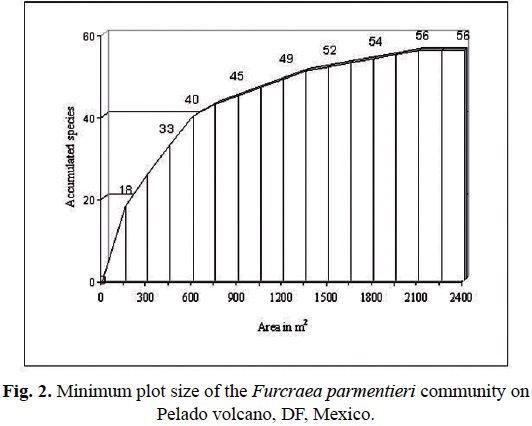
<body><![CDATA[<p align="justify"><font face="verdana" size="2">Zonal coniferous forests grow on the slopes of the volcano between 2 400 and 3 600 m. The lower slopes are cultivated with seasonal, rainfed crops. For this zone, Vel&aacute;zquez y Cleef (1993) distiguished seven physiognomic types of vegetation according to the dominant species: <i>Abies religiosa, Pinus hartwegii,</i> subalpine tussocked grassland with <i>Festuca tolucensis;</i> mixed forest with subalpine tussocked grassland of <i>Muhlenbergia macroura&#45;Alnusfirmifolia,</i> meadow with <i>Stipa ichu&#45;Potentilla candicans,</i> the azonal community of <i>Furcraea parmentieri</i> and communities of disturbed vegetation of <i>Avena sativa, Zea mays</i> and <i>Opuntia streptacantha.</i> The floristic characteristics and the vegetation on the Pelado volcano and the adjoining zones have been studied (Reiche, 1926; Espinosa, 1962; Mart&iacute;n, 1980; Gonz&aacute;lez, 1982; Ben&iacute;tez, 1986; Campos <i>et al.,</i> 1987; Sandoval, 1989; G&oacute;mez, 1990; Vel&aacute;zquez y Cleef, 1993; Silva <i>et al.,</i> 1999; Hern&aacute;ndez, 2009).</font></p>  	    <p align="justify">&nbsp;</p>  	    <p align="justify"><font face="verdana" size="2"><b>Methods</b></font></p>  	    <p align="justify"><font face="verdana" size="2">Twenty&#45;five phytosociological plots were documented in the azonal vegetation (Walter, 1979), following the criteria of the Zurich&#45;Montpellier phytosociological school (Braun&#45;Blanquet, 1979) adapted for tropical mountains (Van der Hammen <i>et al.</i>, 1989), both in the dry and the rain season; the standard plot size was 150 m<sup>2</sup> (10 x 15 m). Sample sites were selected for physiognomic and floristic homogeneity in areas where <i>F. parmentieri</i> forms communities.</font></p>  	    <p align="justify"><font face="verdana" size="2">The number of plots was established on the basis of the curve of species/cumulative area (Matteucci y Colma, 1982); the inflexion point occurs at a cumulative area of 2 100 m<sup>2</sup> and 56 species (<a href="#f2">fig. 2</a>).</font></p> 	    <p align="center"><a name="f2"></a><img src="/img/revistas/polib/n37/a2f2.jpg"></p>     <p align="justify"><font face="verdana" size="2">For each plot, the locality, altitude, physiognomy and gradient were recorded, and a complete inventory of vascular plants was compiled. The percentage cover was estimated for the vegetation layers and for species in relation to the surface area of the sample site. At ground level, the bryophyte cover was estimated separately. In the herbaceous layer the cover of grasses was estimated separately from other herbs. In the same sites, 250 field individual <i>F. parmentieri</i> plants, the circumference at breast height (CBH) and the plant height were measured, thereby obtaining the composition of height classes and average diameters in the population. For each species, the following data were considered: stratum and life form sensu Raunkiaer (1934). For the species identification the criteria of Rzedowski <i>et al.</i> (2001) were used. Most collected material was deposited in the "Herbario Agustina Batalla" of the Faculty of Sciences (FCME) at the Universidad Nacional Aut&oacute;noma de M&eacute;xico.</font></p>  	    <p align="justify"><font face="verdana" size="2">A phytosociological table was constructed, classifying the species according to presence or absence and &#37; cover. In addition, the percentage of bare soil, and the percentage of rock and the depth of soil were recorded. Soil samples to an average depth of 10 cm were studied; in total, 20 samples were analysed, recording colour when wet and when dry for comparison on the Munsell scale, pH ratio 1:2.5, KCl, percentage of allophane and organic matter.</font></p>     <p align="justify">&nbsp;</p>      <p align="justify"><font face="verdana" size="2"><b>Results</b></font></p>     ]]></body>
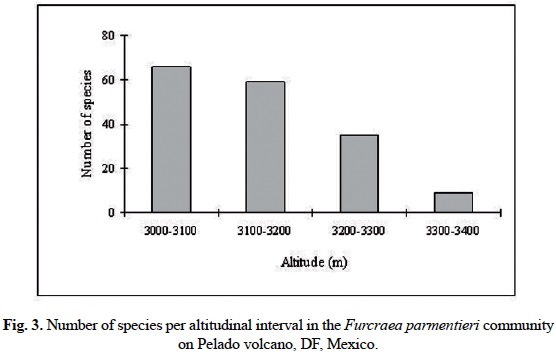
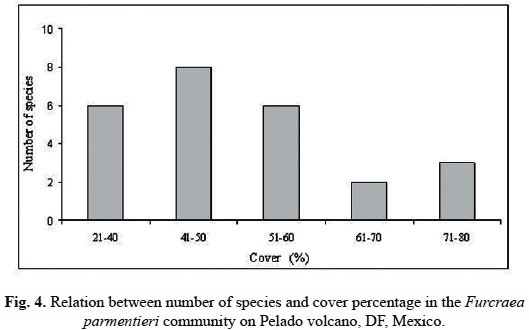
<body><![CDATA[<p align="justify"><font face="verdana" size="2">The azonal community of <i>Furcraea parmentieri&#45;Muhlenbergia macroura</i> is abundant from 3 020 to 3 330 m, on the N, S and E faces of Pelado volcano, DF, on rocky soilsnin clearings of <i>Pinus&#45;Alnus</i> forests. Three well defined, subcommunities can be recognized: <i>Furcraea parmentieri&#45;Trisetum virletii, Furcraea parmentieri&#45;Aegopogon cenchroides</i> and <i>Furcraea parmentieri&#45;Solanum cervantesii</i> (<a href="/img/revistas/polib/n37/a2t1a.jpg" target="_blank">tables 1a</a> and <a href="/img/revistas/polib/n37/a2t1b.jpg" target="_blank">1b</a>).</font></p>     <p align="justify">&nbsp;</p>     <p align="justify"><font face="verdana" size="2"><i>Furcraea parmentieri&#45;Muhlenbergia macroura</i> community (3 020&#45;3 330 m)</font></p>     <p align="justify"><font face="verdana" size="2">Typical plot <a href="/img/revistas/polib/n37/a2t1a.jpg" target="_blank">table 1a</a> and <a href="/img/revistas/polib/n37/a2t1b.jpg" target="_blank">1b</a> N 20.</font></p>  	    <p align="justify"><font face="verdana" size="2">This is a semi&#45;open community, in which <i>Furcraea parmentieri</i> is the dominant species with an average cover of 50&#37;. height of young plants rangos from 0.75 and 1.50 m, whereas the height of adult plants ranges from 2 and 8 m. Adult plant, have erect trunks and a mean CBH of 98 cm. The leaves, semi&#45;fleshy and narrow, are 30&#45;60 cm long and arranged in the form of a rosette. <i>Senecio cinerarioides</i> and <i>Symphoricarpus microphyllus</i> occur in the shrub layer. The herbaceous layer, strongly developed, reaches a height of 1.50 m, covering an average of 70&#37; of the land, both with grasses and with other herbs. The ground&#45;level vegetation, less than 5 cm in height, has a mean cover of 14&#37;, and the most frequent species is <i>Lachemilla procumbens.</i></font></p>  	    <p align="justify"><font face="verdana" size="2">The characteristic life forms of the community, in terms of percentage cover, are as follows: phanerophytes 50&#37; (F<i>urcraea parmentieri),</i> hemicryptophytes 23&#37; (<i>Muhlenbergia macroura),</i> therophytes 16&#37;, chamaephytes 10&#37;, and geophytes 1&#37;. Growth habits are diverse the erect habit is well represented 71&#37;, an example being Salvia elegans; tussocks such as <i>Muhlenbergia macroura</i> are found in 15&#37;; the prostrate form such as <i>Sicyos deppei</i> in 7&#37;; the climbing habit in 2&#37;; and cushions and rosettes in 1&#37;, for example, the moss <i>Bryum argentum</i> in the most humid areas.</font></p>  	    <p align="justify"><font face="verdana" size="2">The characteristic species is <i>Furcraea parmentieri,</i> with 20&#45;100&#37;, and the co&#45;dominant is <i>Muhlenbergia macroura</i> with 2&#45;70&#37; cover in the herb layer. With a lower incidence and with a high percentage of cover, there are <i>Lachemilla procumbens, Dahlia scapigera</i> and <i>Eryngium columnare.</i> Other important species are <i>Salvia elegans</i> and <i>Villadia batesii,</i> the latter on basaltic rock. Bryophytes occur on rocks or trunks, although <i>Bryum argentum</i> appears on the surface of the soil. In addition, during the rainy season, the following species appear: <i>Commelina alpestris, Oenothera purpusii, Oxalis alpina, Peperomia campylotropa, Piptochaetium fimbriatum, Tagetes coronopifolia, Trifolium amabile, Trisetum virletii, Sicyos deppei</i> and <i>Conyza canadensis.</i> The two last&#45;named are characteristic of disturbed areas, and they may form dense populations.</font></p> 	    <p align="justify"><font face="verdana" size="2">The greatest floristic diversity occurs between 3 000 and 3 100 m (<a href="#f3">fig. 3</a>), where <i>Furcraea parmentieri</i> has a cover of 4050&#37;. At high altitude, the number of species decreases, and this also occurs when <i>Furcraea parmentieri</i> accounts for 60&#37; of cover (<a href="#f4">fig. 4</a>).</font></p> 	    <p align="center"><a name="f3"></a><img src="/img/revistas/polib/n37/a2f3.jpg"></p> 	    <p align="center"><a name="f4"></a><img src="/img/revistas/polib/n37/a2f4.jpg"></p>         ]]></body>
<body><![CDATA[<p align="justify"><font face="verdana" size="2">This community develops in a cold&#45;temperate climate. There is not a typical altitudinal distribution; it generally appears in places where the rock covers on average 25&#37; of the surface and where the gradients are between 36&deg; and 45&deg;. The soils are Lithosols with a depth of 10 cm and with organic matter, with no change in colour between the dry and the wet state (dark brown, <a href="/img/revistas/polib/n37/a2t2.jpg" target="_blank">table 2</a>). The percentage of leaf litter is variable (1 to 90&#37;).</font></p>     <p align="justify"><font face="verdana" size="2">Even though the rocky substratum is not an indispensable environmental condition for the establishment of the <i>Furcraea parmentieri</i> community, it is an important factor, since the greater percentage cover of this species occurs when the rock covers 18&#45;30&#37; of the area.</font></p>  	    <p align="justify"><font face="verdana" size="2">The greatest number of individual <i>Furcraea parmentieri</i> plants is found on the N slope (65&#37;), followed by the E slope (45&#37;) and the S slope (35&#37;). The greatest floristic diversity is found when the soil pH is 6.0, and it decreases as the pH increases to 7.0&#45;7.2.</font></p>  	    <p align="justify"><font face="verdana" size="2">Outside the Valley of Mexico, in the states of Hidalgo and Mexico, it has been reported communities of <i>Furcraea parmentieri</i> at altitudes of 2 650&#45;3 200 m in association with <i>Quercus, Pinus, Abies</i> and mixed forest (Rzedowski, 1985).</font></p>     <p align="justify">&nbsp;</p>  	    <p align="justify"><font face="verdana" size="2"><b>Subcommunities</b></font></p>     <p align="justify"><font face="verdana" size="2"><i>Furcraea parmentieri&#45;Trisetum virletii</i> sub&#45;community (3 020&#45;3 270 m)</font></p>  	    <p align="justify"><font face="verdana" size="2">The surface with vegetation amounts to 90100&#37; cover. The herbaceous layer develops preferentially on areas near rocks, whereas the ground&#45;level vegetation covers 2&#37; of the surface. The life forms present are as follows: therophytes 37&#37;, chamaephytes 32&#37;, geophytes 12&#37;, phanerophytes 10&#37;, and hemicryptophytes 7&#37; (<a href="/img/revistas/polib/n37/a2f5.jpg" target="_blank">fig. 5</a>).</font></p>  	    <p align="justify"><font face="verdana" size="2"><i>Furcraea parmentieri</i> is the dominant species with 30&#45;100&#37; cover. The co&#45;dominant species is <i>Trisetum virletii</i> (1&#45;15&#37;). Also occurring are <i>Lachemilla procumbens, Eryngium alternatum, Eupatorium glabratum, Salvia fulgens</i> and <i>Verbesina oncophora.</i></font></p>     <p align="justify"><font face="verdana" size="2">This subcommunity is found on the S, E and N slopes of the volcano, with 1&#37; of the soil exposed, and with 15&#45;60&#37; rock and 3&#45;15&#37; stones. The soil has an average depth of 10 cm, 1&#45;90&#37; leaf litter content, a pH of 5.9 to 7.2 with and organic matter content.</font></p>     ]]></body>
<body><![CDATA[<p align="justify">&nbsp;</p>      <p align="justify"><font face="verdana" size="2"><i>Furcraea parmentieri&#45;Aegopogon cenchroides</i> subcommunity (3 050&#45;3 110 m)</font></p>  	    <p align="justify"><font face="verdana" size="2">The vegetated surface covers 80&#37;, of which <i>Furcraea parmentieri</i> accounts for a mean cover of 30&#37;. The herbaceous layer develops preferentially on areas protected by the rocks, with a mean cover of 28&#37;. The ground level has a cover of 2&#37;. The coverages of the respective life forms are as follows: therophytes 37&#37;, chamaephytes 34&#37;, geophytes 13&#37; and hemicryptophytes 10&#37;. <i>Furcraea parmentieri</i> represents the phanerophytes with 6&#37;.</font></p>  	    <p align="justify"><font face="verdana" size="2">Species found in the herbaceous layer are <i>Aegopogon cenchroides, Castilleja arvensis, Eupatorium prunellifolium, Muhlenbergia robusta</i> and <i>Stevia salicifolia;</i> among the ground&#45;level species are found <i>Lachemilla pringlei, Piptochaetiumfimbriatum</i> and <i>Trifolium amabile.</i> As associated species, <i>Arenaria lycopodioide</i>s and <i>Penstemon campanulatus</i> appear with great frequency.</font></p>  	    <p align="justify"><font face="verdana" size="2">This subcommunity is found on the N slope on the lower parts of the volcano, with mean gradients of 40&deg; to 45&deg;, with 13&#37; bare soil and on average 20&#37; rock. There are zones where soil accumulates with fine material, with a depth of 10 cm, a pH of 6 to 6.8 and with organic matter content.</font></p>  	    <p align="justify">&nbsp;</p>     <p align="justify"><font face="verdana" size="2">Furcraea parmentieri&#45;Solanum cervantesii subcommunity (3 020&#45;3 060 m)</font></p>     <p align="justify"><font face="verdana" size="2">Vegetation covers 90&#37; of the surface. <i>Furcraea parmentieri</i> and <i>Solanum cervantesii</i> account on average for 50&#37; cover. In the shrub layer there is only <i>Senecio cinerarioides</i> with 10&#37; cover. The herbaceous layer represents 60&#37; cover, comprising Poaceae and other herbs. At ground level there is 10&#37; cover. The life forms are as follows: therophytes 29&#37;, chamaephytes 29&#37;, hemicryptophytes 21&#37;, geophytes 11&#37; and phanerophytes 8&#37;.</font></p>  	    <p align="justify"><font face="verdana" size="2">The species best represented are <i>Bromus mexicana, Conyza canadensis, Muhlenbergia microsperma, Physalis coztomatl</i> and <i>Trisetum altijugum.</i></font></p>  	    <p align="justify"><font face="verdana" size="2">This subcommunity is found principally on the S and E slopes, with gradients of 19&#45;50&deg;. There is 1&#37; bare soil and on average 25&#37; rock. The soil depth is 10 cm, pH is 6.5, with 20&#37; litter, and organic matter is present.</font></p>  	    ]]></body>
<body><![CDATA[<p align="justify"><font face="verdana" size="2">The 87 species recorded represented 63 genera and 27 families; of these, the highest representation was in the Asteraceae (37&#37;) and Poaceae (22&#37;). Other families included Caryophyllaceae, Labiatae and Umbelliferae (6&#37;), Rosaceae and Solanaceae (4&#37;), Cucurbitaceae, Geraniaceae, Onagraceae and Scrophulariaceae (3&#37;), and Loganiaceae, Polypodiaceae and Verbenaceae (1&#37;).</font></p>  	    <p align="justify"><font face="verdana" size="2">On the basis of field observations and the data on diameters and heights of the <i>Furcraea parmentieri</i> plants, individual plants are considered to be juvenile plants have a stem diameter of 0.15 to 0.20 m and a height of 2 to 3 m (35&#37;). Adults when the diameter of the stem is 0.22&#45;0.32 m and the height are 4 to 5 m (50&#37;). The oldest plants have diameters of 0.35 to 0.40 m and a height of 6 to 8 m (15&#37;).</font></p>     <p align="justify">&nbsp;</p>      <p align="justify"><font face="verdana" size="2"><b>Discussion</b></font></p>  	    <p align="justify"><font face="verdana" size="2">The <i>Furcraea parmentieri&#45;Muhlenbergia macroura</i> community is azonal because it grows in the lava streams (Vel&aacute;zquez and Cleef, 1993). It is distributed between 3 020 and 3 330 m, on Pelado volcano, DF.</font></p>  	    <p align="justify"><font face="verdana" size="2">Three subcommunities can be differentiated: <i>Furcraea parmentieri&#45;Trisetum virletii, Furcraea parmentieri&#45;Aegopogon cenchroides</i> and <i>Furcraea parmentieiri&#45;Solanum cervantesii.</i> The shallow soil depth and the low organic matter content are conditions that favour the establishment of <i>Furcraea parmentieri,</i> factors that do not offer sufficient support or nutrients for <i>Pinus</i> spp.</font></p>  	    <p align="justify"><font face="verdana" size="2">The best localities for establishment of this community are open the clearings in the forests, regularly on rocks, with many plants on the N, E and S slopes, at an altitude of3 020&#45;3 100 m, on N&#45;facing slopes, and soil pH 5.9 to 6.2. The greatest floristic diversity occurs when rock covers 6&#45;17&#37; of the terrain, and this diversity decreases with increasing rock cover. The lowest floristic diversity occurs between 3 300 and 3 400 m, and with a neutral to slightly alkaline soil, on the W side there are only isolated individual plants.</font></p>  	    <p align="justify"><font face="verdana" size="2">The basaltic rock influences the establishment of some species characteristic of zones with a humid temperate climate just as much as those of a hot climate, by retaining heat on being exposed to the solar radiation; species affected include <i>Echeveria mucronata, Eryngium columnare, Peperomia campylotropa</i> and <i>Villadia batesii.</i></font></p>  	    <p align="justify"><font face="verdana" size="2">The mega&#45;rosette vegetation type present on Pelado volcano is well conserved compared with the Ajusco community with its teratological anomalies, and within its area of distribution in other states of Mexico there are only isolated plants or infrequent small populations. This community is unique for Mexico and can be compared only with the branched mega&#45;rosettes community of the liliaceous <i>Yucca</i> that is very common to the W of Xalapa, Veracruz.</font></p>  	    <p align="justify"><font face="verdana" size="2">The fact that the <i>Furcraea</i> community on Pelado volcano grows on lava streams suggests that it lies at the interface between <i>Furcraea</i> and <i>Pinus</i> communities. If soil accumulation continues, this might lead to the establishment of <i>Pinus</i> species and the eventual disappearance of the <i>Furcraea</i> community. To avoid this, monitoring should be in place to control the establishment of the surrounding <i>Pinus</i> community.</font></p>     ]]></body>
<body><![CDATA[<p align="justify">&nbsp;</p>      <p align="justify"><font face="verdana" size="2"><b>Conclusion</b></font></p>  	    <p align="justify"><font face="verdana" size="2">In this locality, the vegetation has a healthy status and includes <i>Furcraea parmentieri,</i> which is on the endemic species list (NOM 059&#45;ECOL&#45;2001; SEMARNAT, 2002).</font></p>  	    <p align="justify"><font face="verdana" size="2">Since the <i>Furcraea</i> community is unique in Mexico, new monitoring and conservation programs should be developed to maintain an open forest. Otherwise, new invasions of underbrush species could reduce the <i>Furcraea</i> community to a small population with small and isolated plants.</font></p>  	    <p align="justify"><font face="verdana" size="2">Further, plant communities that resemble the present one in structure and ecology are those of <i>Furcraea&#45;Peperomia</i> and other Compositae communities found in the dry intermontane valleys of the Colombian Andes. Physiognomically similar communities of <i>Furcraea&#45;Agave</i> are present in the mountains of Guatemala (Vel&aacute;zquez and Cleef, 1993).</font></p>  	    <p align="justify"><font face="verdana" size="2">However, the human settlements around the volcano are causing a deterioration in this community, principally as a result of grazing practices, agriculture, tree felling, unauthorized dumping of rubbish, the large number of roads and trails, and the frequent visits of illegal hunters. The greatest problem is repeated burning, with its consequent impoverishment of the soil and the destruction of the vegetative bulbils of <i>F. parmentieri.</i></font></p>  	    <p align="justify"><font face="verdana" size="2">The present information on the structure and floristic composition of the <i>F. parmentieri</i> community on the Pelado volcano represents a further contribution towards the conservation of this species, with great importance in the volcanic soils and vegetation communities of the Valley of Mexico, not least because it is used as a soil stabilizing species in the restoration of severely degraded zones.</font></p>     <p align="justify">&nbsp;</p>      <p align="justify"><font face="verdana" size="2"><b>Acknowledgments</b></font></p>  	    <p align="justify"><font face="verdana" size="2">The authors thank Ph. D. Atila Borhidi and Ph.D. Heike Vibrans for their assistance in the revision of manuscript and valuable corrections, and Ann Grant for the translation of the manuscript.</font></p>     ]]></body>
<body><![CDATA[<p align="justify">&nbsp;</p>      <p align="justify"><font face="verdana" size="2"><b>Literature cited</b></font></p>  	    <!-- ref --><p align="justify"><font face="verdana" size="2">Braun&#45;Blanquet, J.J., 1979. <i>Plant sociology, the study of plant communities.</i> Transl. by Fueller, D. &amp; H.S. Conard. McGraw Hill, New York. 438 pp.    &nbsp;&nbsp;&nbsp;&nbsp;&nbsp;&nbsp;&nbsp;&nbsp;[&#160;<a href="javascript:void(0);" onclick="javascript: window.open('/scielo.php?script=sci_nlinks&ref=6086612&pid=S1405-2768201400010000200001&lng=','','width=640,height=500,resizable=yes,scrollbars=1,menubar=yes,');">Links</a>&#160;]<!-- end-ref --></font>	</p>     <!-- ref --><p align="justify"><font face="verdana" size="2">Ben&iacute;tez, B.G., 1986. <i>Arboles y flores del Ajusco.</i> Instituto de Ecolog&iacute;a, Museo de Historia Natural. Consejo Nacional de Ciencia y Tecnolog&iacute;a. M&eacute;xico DF. 62 pp.    &nbsp;&nbsp;&nbsp;&nbsp;&nbsp;&nbsp;&nbsp;&nbsp;[&#160;<a href="javascript:void(0);" onclick="javascript: window.open('/scielo.php?script=sci_nlinks&ref=6086614&pid=S1405-2768201400010000200002&lng=','','width=640,height=500,resizable=yes,scrollbars=1,menubar=yes,');">Links</a>&#160;]<!-- end-ref --></font></p>  	    <!-- ref --><p align="justify"><font face="verdana" size="2">Campos, G., F. Romero, y J. Paniagua, 1987. "Estudio fitosociol&oacute;gico preliminar de la vegetaci&oacute;n del Volc&aacute;n Pelado, DF". <i>Memorias del X Congreso Mexicano de Bot&aacute;nica.</i> Guadalajara, Jalisco.    &nbsp;&nbsp;&nbsp;&nbsp;&nbsp;&nbsp;&nbsp;&nbsp;[&#160;<a href="javascript:void(0);" onclick="javascript: window.open('/scielo.php?script=sci_nlinks&ref=6086616&pid=S1405-2768201400010000200003&lng=','','width=640,height=500,resizable=yes,scrollbars=1,menubar=yes,');">Links</a>&#160;]<!-- end-ref --></font></p>  	    <!-- ref --><p align="justify"><font face="verdana" size="2">Cervantes, F.A., 1980. "Principales caracter&iacute;sticas biol&oacute;gicas del conejo de los volcanes Romerolagus diazi Ferrari P&eacute;rez <i>(Mammalia lagomorpha)".</i> Tesis de licenciatura. Facultad de Ciencias, Universidad Nacional Aut&oacute;noma de M&eacute;xico, M&eacute;xico, DF.    &nbsp;&nbsp;&nbsp;&nbsp;&nbsp;&nbsp;&nbsp;&nbsp;[&#160;<a href="javascript:void(0);" onclick="javascript: window.open('/scielo.php?script=sci_nlinks&ref=6086618&pid=S1405-2768201400010000200004&lng=','','width=640,height=500,resizable=yes,scrollbars=1,menubar=yes,');">Links</a>&#160;]<!-- end-ref --></font></p>  	    ]]></body>
<body><![CDATA[<!-- ref --><p align="justify"><font face="verdana" size="2">Challenger, A., 1998. "La zona ecol&oacute;gica templada h&uacute;meda (el bosque mes&oacute;filo de monta&ntilde;a)". En: <i>Utilizaci&oacute;n y Conservaci&oacute;n de los Ecosistemas Terrestres de M&eacute;xico, Pasado, Presente y Futuro.</i> CONABIO. M&eacute;xico.    &nbsp;&nbsp;&nbsp;&nbsp;&nbsp;&nbsp;&nbsp;&nbsp;[&#160;<a href="javascript:void(0);" onclick="javascript: window.open('/scielo.php?script=sci_nlinks&ref=6086620&pid=S1405-2768201400010000200005&lng=','','width=640,height=500,resizable=yes,scrollbars=1,menubar=yes,');">Links</a>&#160;]<!-- end-ref --></font></p>  	    <!-- ref --><p align="justify"><font face="verdana" size="2">Espinosa, G.J., 1962. "Vegetaci&oacute;n de una corriente de lava de formaci&oacute;n reciente, localizada en el declive meridional de la Sierra Chichinautzin". <i>Bol. Soc. Bot. M&eacute;xico,</i> <b>27</b>: 67&#45;114.    &nbsp;&nbsp;&nbsp;&nbsp;&nbsp;&nbsp;&nbsp;&nbsp;[&#160;<a href="javascript:void(0);" onclick="javascript: window.open('/scielo.php?script=sci_nlinks&ref=6086622&pid=S1405-2768201400010000200006&lng=','','width=640,height=500,resizable=yes,scrollbars=1,menubar=yes,');">Links</a>&#160;]<!-- end-ref --></font></p>  	    <!-- ref --><p align="justify"><font face="verdana" size="2">Demant, A., 1978. "Caracter&iacute;sticas del Eje Neovolc&aacute;nico Transmexicano; sus problemas de interpretaci&oacute;n". UNAM. <i>Inst. Geolog&iacute;a,</i> <b>2</b>: 172&#45;187.    &nbsp;&nbsp;&nbsp;&nbsp;&nbsp;&nbsp;&nbsp;&nbsp;[&#160;<a href="javascript:void(0);" onclick="javascript: window.open('/scielo.php?script=sci_nlinks&ref=6086624&pid=S1405-2768201400010000200007&lng=','','width=640,height=500,resizable=yes,scrollbars=1,menubar=yes,');">Links</a>&#160;]<!-- end-ref --></font></p>  	    <!-- ref --><p align="justify"><font face="verdana" size="2">Galv&aacute;n, R., 1988. "Las familias Amarillidaceae, Juncaceae y Liliaceae en el Valle de M&eacute;xico". Tesis de doctorado, Escuela Nacional de Ciencias Biol&oacute;gicas, Instituto Polit&eacute;cnico Nacional, M&eacute;xico, DF.    &nbsp;&nbsp;&nbsp;&nbsp;&nbsp;&nbsp;&nbsp;&nbsp;[&#160;<a href="javascript:void(0);" onclick="javascript: window.open('/scielo.php?script=sci_nlinks&ref=6086626&pid=S1405-2768201400010000200008&lng=','','width=640,height=500,resizable=yes,scrollbars=1,menubar=yes,');">Links</a>&#160;]<!-- end-ref --></font></p>     <!-- ref --><p align="justify"><font face="verdana" size="2">Garc&iacute;a&#45;Mendoza, A., 2000. "Revisi&oacute;n taxon&oacute;mica de las especies arborescentes de <i>Furcraea</i> (Agavaceae) en M&eacute;xico y Guatemala". <i>Bol. Soc. Bot. M&eacute;xico, </i><b>66</b>: 113&#45;129.    &nbsp;&nbsp;&nbsp;&nbsp;&nbsp;&nbsp;&nbsp;&nbsp;[&#160;<a href="javascript:void(0);" onclick="javascript: window.open('/scielo.php?script=sci_nlinks&ref=6086628&pid=S1405-2768201400010000200009&lng=','','width=640,height=500,resizable=yes,scrollbars=1,menubar=yes,');">Links</a>&#160;]<!-- end-ref --></font></p>     ]]></body>
<body><![CDATA[<!-- ref --><p align="justify"><font face="verdana" size="2">&#45;&#45;&#45;&#45;&#45;&#45;&#45;&#45;&#45;&#45;, 2001. "Revisi&oacute;n del g&eacute;nero <i>Furcraea</i> (Agavaceae)". Tesis de doctorado. Facultad de Ciencias, Universidad Nacional Aut&oacute;noma de M&eacute;xico, M&eacute;xico, DF.    &nbsp;&nbsp;&nbsp;&nbsp;&nbsp;&nbsp;&nbsp;&nbsp;[&#160;<a href="javascript:void(0);" onclick="javascript: window.open('/scielo.php?script=sci_nlinks&ref=6086630&pid=S1405-2768201400010000200010&lng=','','width=640,height=500,resizable=yes,scrollbars=1,menubar=yes,');">Links</a>&#160;]<!-- end-ref --></font></p>  	    <!-- ref --><p align="justify"><font face="verdana" size="2">Garc&iacute;a, E., 1988. <i>Modificaciones al Sistema de Clasificaci&oacute;n Clim&aacute;tica de K&ouml;ppen. Instituto de Geograf&iacute;a.</i> Universidad Nacional Aut&oacute;noma de M&eacute;xico, M&eacute;xico, DF. 79 pp.    &nbsp;&nbsp;&nbsp;&nbsp;&nbsp;&nbsp;&nbsp;&nbsp;[&#160;<a href="javascript:void(0);" onclick="javascript: window.open('/scielo.php?script=sci_nlinks&ref=6086632&pid=S1405-2768201400010000200011&lng=','','width=640,height=500,resizable=yes,scrollbars=1,menubar=yes,');">Links</a>&#160;]<!-- end-ref --></font></p>  	    <!-- ref --><p align="justify"><font face="verdana" size="2">G&oacute;mez, J., 1990. "Ecolog&iacute;a de poblaciones de peque&ntilde;os mam&iacute;feros en el Volc&aacute;n Pelado, DF". Tesis de licenciatura, Facultad de Ciencias, Universidad Nacional Aut&oacute;noma de M&eacute;xico, M&eacute;xico, DF.    &nbsp;&nbsp;&nbsp;&nbsp;&nbsp;&nbsp;&nbsp;&nbsp;[&#160;<a href="javascript:void(0);" onclick="javascript: window.open('/scielo.php?script=sci_nlinks&ref=6086634&pid=S1405-2768201400010000200012&lng=','','width=640,height=500,resizable=yes,scrollbars=1,menubar=yes,');">Links</a>&#160;]<!-- end-ref --></font></p>  	    <!-- ref --><p align="justify"><font face="verdana" size="2">Gonz&aacute;lez, J.G., 1982. "El Pelado como Reserva Natural". Tesis de licenciatura. Facultad de Ciencias, Universidad Nacional Aut&oacute;noma de M&eacute;xico, M&eacute;xico, DF.    &nbsp;&nbsp;&nbsp;&nbsp;&nbsp;&nbsp;&nbsp;&nbsp;[&#160;<a href="javascript:void(0);" onclick="javascript: window.open('/scielo.php?script=sci_nlinks&ref=6086636&pid=S1405-2768201400010000200013&lng=','','width=640,height=500,resizable=yes,scrollbars=1,menubar=yes,');">Links</a>&#160;]<!-- end-ref --></font></p>  	    <!-- ref --><p align="justify"><font face="verdana" size="2">Hern&aacute;ndez, R., 2009. "Estudio poblacional de <i>Furcraea parmentieri</i> (Agavaceae) en bosques templados del suroeste del Distrito Federal, M&eacute;xico". Tesis de licenciatura. Facultad de Ciencias, Universidad Nacional Aut&oacute;noma de M&eacute;xico, M&eacute;xico, DF.    &nbsp;&nbsp;&nbsp;&nbsp;&nbsp;&nbsp;&nbsp;&nbsp;[&#160;<a href="javascript:void(0);" onclick="javascript: window.open('/scielo.php?script=sci_nlinks&ref=6086638&pid=S1405-2768201400010000200014&lng=','','width=640,height=500,resizable=yes,scrollbars=1,menubar=yes,');">Links</a>&#160;]<!-- end-ref --></font></p>  	    ]]></body>
<body><![CDATA[<!-- ref --><p align="justify"><font face="verdana" size="2">Lugo, H.J., 1984. <i>Geomorfolog&iacute;a del sur de la Cuenca de M&eacute;xico.</i> Inst. Geog. Universidad Nacional Aut&oacute;noma de M&eacute;xico. M&eacute;xico, DF. Serie Varia T1,<b> 8</b>: 1&#45;99.    &nbsp;&nbsp;&nbsp;&nbsp;&nbsp;&nbsp;&nbsp;&nbsp;[&#160;<a href="javascript:void(0);" onclick="javascript: window.open('/scielo.php?script=sci_nlinks&ref=6086640&pid=S1405-2768201400010000200015&lng=','','width=640,height=500,resizable=yes,scrollbars=1,menubar=yes,');">Links</a>&#160;]<!-- end-ref --></font></p> 	    <!-- ref --><p align="justify"><font face="verdana" size="2">Luna, I.; J.J. Morrone, y D. Espinosa, (Eds.). 2007. <i>Biodiversidad de la Faja Volc&aacute;nica Transmexicana.</i> UNAM, M&eacute;xico, <i>&nbsp;</i>DF. FES&#45; Zaragoza&#45;CONABIO. M&eacute;xico, DF. 514 p.    &nbsp;&nbsp;&nbsp;&nbsp;&nbsp;&nbsp;&nbsp;&nbsp;[&#160;<a href="javascript:void(0);" onclick="javascript: window.open('/scielo.php?script=sci_nlinks&ref=6086642&pid=S1405-2768201400010000200016&lng=','','width=640,height=500,resizable=yes,scrollbars=1,menubar=yes,');">Links</a>&#160;]<!-- end-ref --></font></p>      <!-- ref --><p align="justify"><font face="verdana" size="2">Matteucci, D., y A. Colma, 1982. <i>Metodolog&iacute;a para el estudio de la vegetaci&oacute;n. Secretar&iacute;a General de la Organizaci&oacute;n de los Estados Americanos. Programa Regional de Desarrollo Cient&iacute;fico y Tecnol&oacute;gico.</i> Serie de Biolog&iacute;a. Monograf&iacute;a No. 22. Whashington D.C. 168 pp.    &nbsp;&nbsp;&nbsp;&nbsp;&nbsp;&nbsp;&nbsp;&nbsp;[&#160;<a href="javascript:void(0);" onclick="javascript: window.open('/scielo.php?script=sci_nlinks&ref=6086644&pid=S1405-2768201400010000200017&lng=','','width=640,height=500,resizable=yes,scrollbars=1,menubar=yes,');">Links</a>&#160;]<!-- end-ref --></font></p>  	    <!-- ref --><p align="justify"><font face="verdana" size="2">Mondrag&oacute;n, A., 2001. "Flora y Estructura de la comunidad de Furcraea bedinghausii en el volc&aacute;n 'El Pelado' M&eacute;xico, DF". Tesis de licenciatura. Escuela Nacional de Estudios Profesionales Iztacala, UNAM.    &nbsp;&nbsp;&nbsp;&nbsp;&nbsp;&nbsp;&nbsp;&nbsp;[&#160;<a href="javascript:void(0);" onclick="javascript: window.open('/scielo.php?script=sci_nlinks&ref=6086646&pid=S1405-2768201400010000200018&lng=','','width=640,height=500,resizable=yes,scrollbars=1,menubar=yes,');">Links</a>&#160;]<!-- end-ref --></font></p>  	    <!-- ref --><p align="justify"><font face="verdana" size="2">Ort&iacute;z&#45;Villanueva, B., 1975. <i>Edafolog&iacute;a.</i> Escuela Nacional de Agricultura, Chapingo. M&eacute;xico. 110 pp.    &nbsp;&nbsp;&nbsp;&nbsp;&nbsp;&nbsp;&nbsp;&nbsp;[&#160;<a href="javascript:void(0);" onclick="javascript: window.open('/scielo.php?script=sci_nlinks&ref=6086648&pid=S1405-2768201400010000200019&lng=','','width=640,height=500,resizable=yes,scrollbars=1,menubar=yes,');">Links</a>&#160;]<!-- end-ref --></font></p>  	    ]]></body>
<body><![CDATA[<!-- ref --><p align="justify"><font face="verdana" size="2">Raunkiaer, C., 1934. <i>The life forms of plants and statistical plant geography.</i> Clarendon Press, Oxford. 632 pp.    &nbsp;&nbsp;&nbsp;&nbsp;&nbsp;&nbsp;&nbsp;&nbsp;[&#160;<a href="javascript:void(0);" onclick="javascript: window.open('/scielo.php?script=sci_nlinks&ref=6086650&pid=S1405-2768201400010000200020&lng=','','width=640,height=500,resizable=yes,scrollbars=1,menubar=yes,');">Links</a>&#160;]<!-- end-ref --></font></p>  	    <!-- ref --><p align="justify"><font face="verdana" size="2">Reiche, C., 1926. <i>Flora excursoria en el Valle Central de M&eacute;xico.</i> Talleres gr&aacute;ficos de la Naci&oacute;n. M&eacute;xico. 303 pp.    &nbsp;&nbsp;&nbsp;&nbsp;&nbsp;&nbsp;&nbsp;&nbsp;[&#160;<a href="javascript:void(0);" onclick="javascript: window.open('/scielo.php?script=sci_nlinks&ref=6086652&pid=S1405-2768201400010000200021&lng=','','width=640,height=500,resizable=yes,scrollbars=1,menubar=yes,');">Links</a>&#160;]<!-- end-ref --></font></p>  	    <!-- ref --><p align="justify"><font face="verdana" size="2">Rivera, J., y A. Henze, 2007. "Flora y Vegetaci&oacute;n del Distrito Federal". En: Luna, I., J.J. Morrone, y D. Espinosa, (eds.). <i>Biodiversidad de la Faja Volc&aacute;nica Transmexicana.</i> pp. 321&#45;253. UNAM, M&eacute;xico, DF. FES&#45;Zaragoza&#45;CONABIO. M&eacute;xico, DF.    &nbsp;&nbsp;&nbsp;&nbsp;&nbsp;&nbsp;&nbsp;&nbsp;[&#160;<a href="javascript:void(0);" onclick="javascript: window.open('/scielo.php?script=sci_nlinks&ref=6086654&pid=S1405-2768201400010000200022&lng=','','width=640,height=500,resizable=yes,scrollbars=1,menubar=yes,');">Links</a>&#160;]<!-- end-ref --></font></p>     <!-- ref --><p align="justify"><font face="verdana" size="2">Rzedowski, J., 2006. Vegetaci&oacute;n de M&eacute;xico. 1ra. ed. digital, Comisi&oacute;n Nacional para el Conocimiento y Uso de la Biodiversidad. M&eacute;xico.    &nbsp;&nbsp;&nbsp;&nbsp;&nbsp;&nbsp;&nbsp;&nbsp;[&#160;<a href="javascript:void(0);" onclick="javascript: window.open('/scielo.php?script=sci_nlinks&ref=6086656&pid=S1405-2768201400010000200023&lng=','','width=640,height=500,resizable=yes,scrollbars=1,menubar=yes,');">Links</a>&#160;]<!-- end-ref --></font></p>  	    <!-- ref --><p align="justify"><font face="verdana" size="2">Rzedowski, G.C. de, y J. Rzedowski y colaboradores, 2001. <i>Flora Fanerog&aacute;mica del Valle de M&eacute;xico.</i> 2da. ed. Instituto de Ecolog&iacute;a, A.C. y CONABIO, P&aacute;tzcuaro, Michoac&aacute;n.1406 pp.    &nbsp;&nbsp;&nbsp;&nbsp;&nbsp;&nbsp;&nbsp;&nbsp;[&#160;<a href="javascript:void(0);" onclick="javascript: window.open('/scielo.php?script=sci_nlinks&ref=6086658&pid=S1405-2768201400010000200024&lng=','','width=640,height=500,resizable=yes,scrollbars=1,menubar=yes,');">Links</a>&#160;]<!-- end-ref --></font></p>  	    ]]></body>
<body><![CDATA[<!-- ref --><p align="justify"><font face="verdana" size="2">Rzedowski, J., 1978. <i>Vegetaci&oacute;n de M&eacute;xico.</i> Limusa. M&eacute;xico. 431 pp.    &nbsp;&nbsp;&nbsp;&nbsp;&nbsp;&nbsp;&nbsp;&nbsp;[&#160;<a href="javascript:void(0);" onclick="javascript: window.open('/scielo.php?script=sci_nlinks&ref=6086660&pid=S1405-2768201400010000200025&lng=','','width=640,height=500,resizable=yes,scrollbars=1,menubar=yes,');">Links</a>&#160;]<!-- end-ref --></font></p>  	    <!-- ref --><p align="justify"><font face="verdana" size="2">Sandoval, A., 1989. "Descripci&oacute;n de la vegetaci&oacute;n de la ladera oeste del volc&aacute;n Pelado M&eacute;xico, DF". Tesis de licenciatura. Facultad de Ciencias, Universidad Nacional Aut&oacute;noma de M&eacute;xico, M&eacute;xico, DF.    &nbsp;&nbsp;&nbsp;&nbsp;&nbsp;&nbsp;&nbsp;&nbsp;[&#160;<a href="javascript:void(0);" onclick="javascript: window.open('/scielo.php?script=sci_nlinks&ref=6086662&pid=S1405-2768201400010000200026&lng=','','width=640,height=500,resizable=yes,scrollbars=1,menubar=yes,');">Links</a>&#160;]<!-- end-ref --></font></p>  	    <!-- ref --><p align="justify"><font face="verdana" size="2">SEMARNAT, 2002. <i>Norma oficial mexicana</i> NOM&#45;059&#45;SEMARNAT&#45;2001. "Protecci&oacute;n ambiental&#45;Especies nativas de M&eacute;xico de Flora y Fauna silvestres&#45;Categor&iacute;as de riesgo y especificaciones para su inclusi&oacute;n, exclusi&oacute;n o cambio&#45; lista de especies en riesgo". Diario Oficial de la Federaci&oacute;n. Secretar&iacute;a de Medio Ambiente y Recursos Naturales. Mi&eacute;rcoles 6 de marzo de 2002. Segunda secci&oacute;n. <a href="http://www.profepa.gob.mx" target="_blank">http://www.profepa.gob.mx</a>.    &nbsp;&nbsp;&nbsp;&nbsp;&nbsp;&nbsp;&nbsp;&nbsp;[&#160;<a href="javascript:void(0);" onclick="javascript: window.open('/scielo.php?script=sci_nlinks&ref=6086664&pid=S1405-2768201400010000200027&lng=','','width=640,height=500,resizable=yes,scrollbars=1,menubar=yes,');">Links</a>&#160;]<!-- end-ref --></font>	</p>     <!-- ref --><p align="justify"><font face="verdana" size="2">Silva, L.C.; F.J. Romero, A. Vel&aacute;zquez, y L. Almeida&#45;Le&ntilde;ero, 1999. "La vegetaci&oacute;n de la regi&oacute;n de monta&ntilde;a del sur de la Cuenca de M&eacute;xico". En: Vel&aacute;zquez, V., &amp; F.J. Romero, (eds.). <i>Biodiversidad de la regi&oacute;n de monta&ntilde;a del sur de la Cuenca de M&eacute;xico. Base para el ordenamiento ecol&oacute;gico,</i> pp. 66&#45;87. Universidad Aut&oacute;noma Metropolitana, Secretar&iacute;a de Medio Ambiente y Recursos Naturales, M&eacute;xico, DF.    &nbsp;&nbsp;&nbsp;&nbsp;&nbsp;&nbsp;&nbsp;&nbsp;[&#160;<a href="javascript:void(0);" onclick="javascript: window.open('/scielo.php?script=sci_nlinks&ref=6086666&pid=S1405-2768201400010000200028&lng=','','width=640,height=500,resizable=yes,scrollbars=1,menubar=yes,');">Links</a>&#160;]<!-- end-ref --></font></p>  	    <!-- ref --><p align="justify"><font face="verdana" size="2">Van der Hammen, T.; D. Mueller&#45;Dombois, y M.A. Little, 1989. Manual of methods for transect studies. Comparative studies of tropical mountain ecosystems. IUBS&#45;UNESCO, MAB. Paris. 65 pp.    &nbsp;&nbsp;&nbsp;&nbsp;&nbsp;&nbsp;&nbsp;&nbsp;[&#160;<a href="javascript:void(0);" onclick="javascript: window.open('/scielo.php?script=sci_nlinks&ref=6086668&pid=S1405-2768201400010000200029&lng=','','width=640,height=500,resizable=yes,scrollbars=1,menubar=yes,');">Links</a>&#160;]<!-- end-ref --></font></p>  	    ]]></body>
<body><![CDATA[<!-- ref --><p align="justify"><font face="verdana" size="2">Vel&aacute;zquez, A., y A.M. Cleef, 1993. "The plant communities of the volcanoes 'Tl&aacute;loc' and 'Pelado', M&eacute;xico". <i>Phytocoenologia,</i> <b>22</b>(2): 145&#45;191.    &nbsp;&nbsp;&nbsp;&nbsp;&nbsp;&nbsp;&nbsp;&nbsp;[&#160;<a href="javascript:void(0);" onclick="javascript: window.open('/scielo.php?script=sci_nlinks&ref=6086670&pid=S1405-2768201400010000200030&lng=','','width=640,height=500,resizable=yes,scrollbars=1,menubar=yes,');">Links</a>&#160;]<!-- end-ref --></font></p>  	    <!-- ref --><p align="justify"><font face="verdana" size="2">Walter, H., 1979. <i>Vegetation of the earth.</i> 2nd ed. Springer&#45;Verlag, New York. 274 pp.    &nbsp;&nbsp;&nbsp;&nbsp;&nbsp;&nbsp;&nbsp;&nbsp;[&#160;<a href="javascript:void(0);" onclick="javascript: window.open('/scielo.php?script=sci_nlinks&ref=6086672&pid=S1405-2768201400010000200031&lng=','','width=640,height=500,resizable=yes,scrollbars=1,menubar=yes,');">Links</a>&#160;]<!-- end-ref --></font></p>      ]]></body><back>
<ref-list>
<ref id="B1">
<nlm-citation citation-type="book">
<person-group person-group-type="author">
<name>
<surname><![CDATA[Braun-Blanquet]]></surname>
<given-names><![CDATA[J.J.]]></given-names>
</name>
</person-group>
<source><![CDATA[Plant sociology, the study of plant communities]]></source>
<year>1979</year>
<page-range>438</page-range><publisher-loc><![CDATA[New York ]]></publisher-loc>
<publisher-name><![CDATA[D. & H.S. ConardMcGraw Hill]]></publisher-name>
</nlm-citation>
</ref>
<ref id="B2">
<nlm-citation citation-type="book">
<person-group person-group-type="author">
<name>
<surname><![CDATA[Benítez]]></surname>
<given-names><![CDATA[B.G.]]></given-names>
</name>
</person-group>
<source><![CDATA[Arboles y flores del Ajusco]]></source>
<year>1986</year>
<page-range>62</page-range><publisher-loc><![CDATA[México^eDF DF]]></publisher-loc>
<publisher-name><![CDATA[Instituto de EcologíaMuseo de Historia NaturalConsejo Nacional de Ciencia y Tecnología]]></publisher-name>
</nlm-citation>
</ref>
<ref id="B3">
<nlm-citation citation-type="">
<person-group person-group-type="author">
<name>
<surname><![CDATA[Campos]]></surname>
<given-names><![CDATA[G.]]></given-names>
</name>
<name>
<surname><![CDATA[Romero]]></surname>
<given-names><![CDATA[F.]]></given-names>
</name>
<name>
<surname><![CDATA[Paniagua]]></surname>
<given-names><![CDATA[J.]]></given-names>
</name>
</person-group>
<article-title xml:lang="es"><![CDATA[Estudio fitosociológico preliminar de la vegetación del Volcán Pelado, DF]]></article-title>
<source><![CDATA[Memorias del X Congreso Mexicano de Botánica]]></source>
<year>1987</year>
<publisher-loc><![CDATA[Guadalajara^eJalisco Jalisco]]></publisher-loc>
</nlm-citation>
</ref>
<ref id="B4">
<nlm-citation citation-type="">
<person-group person-group-type="author">
<name>
<surname><![CDATA[Cervantes]]></surname>
<given-names><![CDATA[F.A.]]></given-names>
</name>
</person-group>
<source><![CDATA[Principales características biológicas del conejo de los volcanes Romerolagus diazi Ferrari Pérez (Mammalia lagomorpha)]]></source>
<year>1980</year>
</nlm-citation>
</ref>
<ref id="B5">
<nlm-citation citation-type="book">
<person-group person-group-type="author">
<name>
<surname><![CDATA[Challenger]]></surname>
<given-names><![CDATA[A.]]></given-names>
</name>
</person-group>
<article-title xml:lang="es"><![CDATA[La zona ecológica templada húmeda (el bosque mesófilo de montaña)]]></article-title>
<source><![CDATA[Utilización y Conservación de los Ecosistemas Terrestres de México, Pasado, Presente y Futuro]]></source>
<year>1998</year>
<publisher-name><![CDATA[CONABIO]]></publisher-name>
</nlm-citation>
</ref>
<ref id="B6">
<nlm-citation citation-type="journal">
<person-group person-group-type="author">
<name>
<surname><![CDATA[Espinosa]]></surname>
<given-names><![CDATA[G.J.]]></given-names>
</name>
</person-group>
<article-title xml:lang="es"><![CDATA[Vegetación de una corriente de lava de formación reciente, localizada en el declive meridional de la Sierra Chichinautzin]]></article-title>
<source><![CDATA[Bol. Soc. Bot. México]]></source>
<year>1962</year>
<volume>27</volume>
<page-range>67-114</page-range></nlm-citation>
</ref>
<ref id="B7">
<nlm-citation citation-type="journal">
<person-group person-group-type="author">
<name>
<surname><![CDATA[Demant]]></surname>
<given-names><![CDATA[A.]]></given-names>
</name>
</person-group>
<article-title xml:lang="es"><![CDATA[Características del Eje Neovolcánico Transmexicano; sus problemas de interpretación]]></article-title>
<source><![CDATA[Inst. Geología]]></source>
<year>1978</year>
<volume>2</volume>
<page-range>172-187</page-range></nlm-citation>
</ref>
<ref id="B8">
<nlm-citation citation-type="">
<person-group person-group-type="author">
<name>
<surname><![CDATA[Galván]]></surname>
<given-names><![CDATA[R.]]></given-names>
</name>
</person-group>
<source><![CDATA[Las familias Amarillidaceae, Juncaceae y Liliaceae en el Valle de México]]></source>
<year>1988</year>
</nlm-citation>
</ref>
<ref id="B9">
<nlm-citation citation-type="journal">
<person-group person-group-type="author">
<name>
<surname><![CDATA[García-Mendoza]]></surname>
<given-names><![CDATA[A.]]></given-names>
</name>
</person-group>
<article-title xml:lang="es"><![CDATA[Revisión taxonómica de las especies arborescentes de Furcraea (Agavaceae) en México y Guatemala]]></article-title>
<source><![CDATA[Bol. Soc. Bot. México]]></source>
<year>2000</year>
<volume>66</volume>
<page-range>113-129</page-range></nlm-citation>
</ref>
<ref id="B10">
<nlm-citation citation-type="">
<person-group person-group-type="author">
<name>
<surname><![CDATA[García-Mendoza]]></surname>
<given-names><![CDATA[A.]]></given-names>
</name>
</person-group>
<person-group person-group-type="editor">
<name>
</name>
</person-group>
<source><![CDATA[Revisión del género Furcraea (Agavaceae)]]></source>
<year>2001</year>
</nlm-citation>
</ref>
<ref id="B11">
<nlm-citation citation-type="book">
<person-group person-group-type="author">
<name>
<surname><![CDATA[García]]></surname>
<given-names><![CDATA[E.]]></given-names>
</name>
</person-group>
<source><![CDATA[Modificaciones al Sistema de Clasificación Climática de Köppen]]></source>
<year>1988</year>
<page-range>79</page-range><publisher-loc><![CDATA[México^eDF DF]]></publisher-loc>
<publisher-name><![CDATA[Instituto de Geografía. Universidad Nacional Autónoma de México]]></publisher-name>
</nlm-citation>
</ref>
<ref id="B12">
<nlm-citation citation-type="">
<person-group person-group-type="author">
<name>
<surname><![CDATA[Gómez]]></surname>
<given-names><![CDATA[J.]]></given-names>
</name>
</person-group>
<source><![CDATA[Ecología de poblaciones de pequeños mamíferos en el Volcán Pelado, DF]]></source>
<year>1990</year>
</nlm-citation>
</ref>
<ref id="B13">
<nlm-citation citation-type="">
<person-group person-group-type="author">
<name>
<surname><![CDATA[González]]></surname>
<given-names><![CDATA[J.G.]]></given-names>
</name>
</person-group>
<source><![CDATA[El Pelado como Reserva Natural]]></source>
<year>1982</year>
</nlm-citation>
</ref>
<ref id="B14">
<nlm-citation citation-type="">
<person-group person-group-type="author">
<name>
<surname><![CDATA[Hernández]]></surname>
<given-names><![CDATA[R.]]></given-names>
</name>
</person-group>
<source><![CDATA[Estudio poblacional de Furcraea parmentieri (Agavaceae) en bosques templados del suroeste del Distrito Federal, México]]></source>
<year>2009</year>
</nlm-citation>
</ref>
<ref id="B15">
<nlm-citation citation-type="journal">
<person-group person-group-type="author">
<name>
<surname><![CDATA[Lugo]]></surname>
<given-names><![CDATA[H.J.]]></given-names>
</name>
</person-group>
<article-title xml:lang="es"><![CDATA[Geomorfología del sur de la Cuenca de México]]></article-title>
<source><![CDATA[Serie Varia]]></source>
<year>1984</year>
<volume>1</volume>
<numero>8</numero>
<issue>8</issue>
<page-range>1-99</page-range></nlm-citation>
</ref>
<ref id="B16">
<nlm-citation citation-type="book">
<person-group person-group-type="author">
<name>
<surname><![CDATA[Luna]]></surname>
<given-names><![CDATA[I.]]></given-names>
</name>
<name>
<surname><![CDATA[Morrone]]></surname>
<given-names><![CDATA[J.J.]]></given-names>
</name>
<name>
<surname><![CDATA[Espinosa]]></surname>
<given-names><![CDATA[D.]]></given-names>
</name>
</person-group>
<source><![CDATA[Biodiversidad de la Faja Volcánica Transmexicana]]></source>
<year>2007</year>
<page-range>514</page-range><publisher-loc><![CDATA[México^eDFMéxico^eDF DFDF]]></publisher-loc>
<publisher-name><![CDATA[UNAMFES- ZaragozaCONABIO]]></publisher-name>
</nlm-citation>
</ref>
<ref id="B17">
<nlm-citation citation-type="book">
<person-group person-group-type="author">
<name>
<surname><![CDATA[Matteucci]]></surname>
<given-names><![CDATA[D.]]></given-names>
</name>
<name>
<surname><![CDATA[Colma]]></surname>
<given-names><![CDATA[A.]]></given-names>
</name>
</person-group>
<source><![CDATA[Metodología para el estudio de la vegetación]]></source>
<year>1982</year>
<page-range>168</page-range><publisher-loc><![CDATA[Whashington^eD.C. D.C.]]></publisher-loc>
<publisher-name><![CDATA[Secretaría General de la Organización de los Estados Americanos. Programa Regional de Desarrollo Científico y Tecnológico]]></publisher-name>
</nlm-citation>
</ref>
<ref id="B18">
<nlm-citation citation-type="">
<person-group person-group-type="author">
<name>
<surname><![CDATA[Mondragón]]></surname>
<given-names><![CDATA[A.]]></given-names>
</name>
</person-group>
<source><![CDATA[Flora y Estructura de la comunidad de Furcraea bedinghausii en el volcán 'El Pelado' México, DF]]></source>
<year>2001</year>
</nlm-citation>
</ref>
<ref id="B19">
<nlm-citation citation-type="book">
<person-group person-group-type="author">
<name>
<surname><![CDATA[Ortíz-Villanueva]]></surname>
<given-names><![CDATA[B.]]></given-names>
</name>
</person-group>
<source><![CDATA[Edafología]]></source>
<year>1975</year>
<page-range>110</page-range><publisher-loc><![CDATA[Chapingo ]]></publisher-loc>
<publisher-name><![CDATA[Escuela Nacional de Agricultura]]></publisher-name>
</nlm-citation>
</ref>
<ref id="B20">
<nlm-citation citation-type="book">
<person-group person-group-type="author">
<name>
<surname><![CDATA[Raunkiaer]]></surname>
<given-names><![CDATA[C.]]></given-names>
</name>
</person-group>
<source><![CDATA[The life forms of plants and statistical plant geography]]></source>
<year>1934</year>
<page-range>632</page-range><publisher-loc><![CDATA[Oxford ]]></publisher-loc>
<publisher-name><![CDATA[Clarendon Press]]></publisher-name>
</nlm-citation>
</ref>
<ref id="B21">
<nlm-citation citation-type="book">
<person-group person-group-type="author">
<name>
<surname><![CDATA[Reiche]]></surname>
<given-names><![CDATA[C.]]></given-names>
</name>
</person-group>
<source><![CDATA[Flora excursoria en el Valle Central de México]]></source>
<year>1926</year>
<page-range>303</page-range><publisher-name><![CDATA[Talleres gráficos de la Nación]]></publisher-name>
</nlm-citation>
</ref>
<ref id="B22">
<nlm-citation citation-type="book">
<person-group person-group-type="author">
<name>
<surname><![CDATA[Rivera]]></surname>
<given-names><![CDATA[J.]]></given-names>
</name>
<name>
<surname><![CDATA[Henze]]></surname>
<given-names><![CDATA[A.]]></given-names>
</name>
</person-group>
<article-title xml:lang="es"><![CDATA[Flora y Vegetación del Distrito Federal]]></article-title>
<person-group person-group-type="editor">
<name>
<surname><![CDATA[Luna]]></surname>
<given-names><![CDATA[I.]]></given-names>
</name>
<name>
<surname><![CDATA[Morrone]]></surname>
<given-names><![CDATA[J.J.]]></given-names>
</name>
<name>
<surname><![CDATA[Espinosa]]></surname>
<given-names><![CDATA[D.]]></given-names>
</name>
</person-group>
<source><![CDATA[Biodiversidad de la Faja Volcánica Transmexicana]]></source>
<year>2007</year>
<page-range>321-253</page-range><publisher-loc><![CDATA[México^eDF DF]]></publisher-loc>
<publisher-name><![CDATA[UNAMFES-ZaragozaCONABIO]]></publisher-name>
</nlm-citation>
</ref>
<ref id="B23">
<nlm-citation citation-type="book">
<person-group person-group-type="author">
<name>
<surname><![CDATA[Rzedowski]]></surname>
<given-names><![CDATA[J.]]></given-names>
</name>
</person-group>
<source><![CDATA[Vegetación de México]]></source>
<year>2006</year>
<edition>1</edition>
<publisher-name><![CDATA[Comisión Nacional para el Conocimiento y Uso de la Biodiversidad]]></publisher-name>
</nlm-citation>
</ref>
<ref id="B24">
<nlm-citation citation-type="book">
<person-group person-group-type="author">
<name>
<surname><![CDATA[Rzedowski]]></surname>
<given-names><![CDATA[G.C. de]]></given-names>
</name>
<name>
<surname><![CDATA[Rzedowski]]></surname>
<given-names><![CDATA[J.]]></given-names>
</name>
</person-group>
<source><![CDATA[Flora Fanerogámica del Valle de México]]></source>
<year>2001</year>
<edition>2</edition>
<page-range>1406</page-range><publisher-loc><![CDATA[Pátzcuaro^eMichoacán Michoacán]]></publisher-loc>
<publisher-name><![CDATA[Instituto de Ecología, A.C.CONABIO]]></publisher-name>
</nlm-citation>
</ref>
<ref id="B25">
<nlm-citation citation-type="book">
<person-group person-group-type="author">
<name>
<surname><![CDATA[Rzedowski]]></surname>
<given-names><![CDATA[J.]]></given-names>
</name>
</person-group>
<source><![CDATA[Vegetación de México]]></source>
<year>1978</year>
<page-range>431</page-range><publisher-name><![CDATA[Limusa]]></publisher-name>
</nlm-citation>
</ref>
<ref id="B26">
<nlm-citation citation-type="">
<person-group person-group-type="author">
<name>
<surname><![CDATA[Sandoval]]></surname>
<given-names><![CDATA[A.]]></given-names>
</name>
</person-group>
<source><![CDATA[Descripción de la vegetación de la ladera oeste del volcán Pelado México, DF]]></source>
<year>1989</year>
</nlm-citation>
</ref>
<ref id="B27">
<nlm-citation citation-type="journal">
<collab>SEMARNAT</collab>
<article-title xml:lang="es"><![CDATA[Norma oficial mexicana NOM-059-SEMARNAT-2001. "Protección ambiental-Especies nativas de México de Flora y Fauna silvestres-Categorías de riesgo y especificaciones para su inclusión, exclusión o cambio- lista de especies en riesgo]]></article-title>
<source><![CDATA[Diario Oficial de la Federación]]></source>
<year>2002</year>
<month>6 </month>
<day>de</day>
</nlm-citation>
</ref>
<ref id="B28">
<nlm-citation citation-type="book">
<person-group person-group-type="author">
<name>
<surname><![CDATA[Silva]]></surname>
<given-names><![CDATA[L.C.]]></given-names>
</name>
<name>
<surname><![CDATA[Romero]]></surname>
<given-names><![CDATA[F.J.]]></given-names>
</name>
<name>
<surname><![CDATA[Velázquez]]></surname>
<given-names><![CDATA[A.]]></given-names>
</name>
<name>
<surname><![CDATA[Almeida-Leñero]]></surname>
<given-names><![CDATA[L.]]></given-names>
</name>
</person-group>
<article-title xml:lang="es"><![CDATA[La vegetación de la región de montaña del sur de la Cuenca de México]]></article-title>
<person-group person-group-type="editor">
<name>
<surname><![CDATA[Velázquez]]></surname>
<given-names><![CDATA[V.]]></given-names>
</name>
<name>
<surname><![CDATA[Romero]]></surname>
<given-names><![CDATA[F.J.]]></given-names>
</name>
</person-group>
<source><![CDATA[Biodiversidad de la región de montaña del sur de la Cuenca de México. Base para el ordenamiento ecológico]]></source>
<year>1999</year>
<page-range>66-87</page-range><publisher-loc><![CDATA[México^eDF DF]]></publisher-loc>
<publisher-name><![CDATA[Universidad Autónoma MetropolitanaSecretaría de Medio Ambiente y Recursos Naturales]]></publisher-name>
</nlm-citation>
</ref>
<ref id="B29">
<nlm-citation citation-type="book">
<person-group person-group-type="author">
<name>
<surname><![CDATA[Van der Hammen]]></surname>
<given-names><![CDATA[T.]]></given-names>
</name>
<name>
<surname><![CDATA[Mueller-Dombois]]></surname>
<given-names><![CDATA[D.]]></given-names>
</name>
<name>
<surname><![CDATA[Little]]></surname>
<given-names><![CDATA[M.A.]]></given-names>
</name>
</person-group>
<source><![CDATA[Manual of methods for transect studies. Comparative studies of tropical mountain ecosystems]]></source>
<year>1989</year>
<page-range>65</page-range><publisher-loc><![CDATA[Paris ]]></publisher-loc>
<publisher-name><![CDATA[IUBSUNESCOMAB]]></publisher-name>
</nlm-citation>
</ref>
<ref id="B30">
<nlm-citation citation-type="journal">
<person-group person-group-type="author">
<name>
<surname><![CDATA[Velázquez]]></surname>
<given-names><![CDATA[A.]]></given-names>
</name>
<name>
<surname><![CDATA[Cleef]]></surname>
<given-names><![CDATA[A.M.]]></given-names>
</name>
</person-group>
<article-title xml:lang="en"><![CDATA[The plant communities of the volcanoes 'Tláloc' and 'Pelado', México]]></article-title>
<source><![CDATA[Phytocoenologia]]></source>
<year>1993</year>
<volume>22</volume>
<numero>2</numero>
<issue>2</issue>
<page-range>145-191</page-range></nlm-citation>
</ref>
<ref id="B31">
<nlm-citation citation-type="book">
<person-group person-group-type="author">
<name>
<surname><![CDATA[Walter]]></surname>
<given-names><![CDATA[H.]]></given-names>
</name>
</person-group>
<source><![CDATA[Vegetation of the earth]]></source>
<year>1979</year>
<edition>2</edition>
<page-range>274</page-range><publisher-loc><![CDATA[New York ]]></publisher-loc>
<publisher-name><![CDATA[Springer-Verlag]]></publisher-name>
</nlm-citation>
</ref>
</ref-list>
</back>
</article>