<?xml version="1.0" encoding="ISO-8859-1"?><article xmlns:mml="http://www.w3.org/1998/Math/MathML" xmlns:xlink="http://www.w3.org/1999/xlink" xmlns:xsi="http://www.w3.org/2001/XMLSchema-instance">
<front>
<journal-meta>
<journal-id>1405-0471</journal-id>
<journal-title><![CDATA[Madera y bosques]]></journal-title>
<abbrev-journal-title><![CDATA[Madera bosques]]></abbrev-journal-title>
<issn>1405-0471</issn>
<publisher>
<publisher-name><![CDATA[Instituto de Ecología A.C.]]></publisher-name>
</publisher>
</journal-meta>
<article-meta>
<article-id>S1405-04712010000200006</article-id>
<title-group>
<article-title xml:lang="en"><![CDATA[A general sectional volume equation for classical geometries of tree stem]]></article-title>
<article-title xml:lang="es"><![CDATA[Una ecuación general para el volumen de la sección de las geometrías clásicas del tronco de los árboles]]></article-title>
</title-group>
<contrib-group>
<contrib contrib-type="author">
<name>
<surname><![CDATA[Cruz de León]]></surname>
<given-names><![CDATA[Gildardo]]></given-names>
</name>
<xref ref-type="aff" rid="A01"/>
</contrib>
</contrib-group>
<aff id="A01">
<institution><![CDATA[,Universidad Michoacana de San Nicolás de Hidalgo Facultad de Ingeniería en Tecnología de la Madera ]]></institution>
<addr-line><![CDATA[Morelia Michoacán]]></addr-line>
<country>México</country>
</aff>
<pub-date pub-type="pub">
<day>00</day>
<month>00</month>
<year>2010</year>
</pub-date>
<pub-date pub-type="epub">
<day>00</day>
<month>00</month>
<year>2010</year>
</pub-date>
<volume>16</volume>
<numero>2</numero>
<fpage>89</fpage>
<lpage>94</lpage>
<copyright-statement/>
<copyright-year/>
<self-uri xlink:href="http://www.scielo.org.mx/scielo.php?script=sci_arttext&amp;pid=S1405-04712010000200006&amp;lng=en&amp;nrm=iso"></self-uri><self-uri xlink:href="http://www.scielo.org.mx/scielo.php?script=sci_abstract&amp;pid=S1405-04712010000200006&amp;lng=en&amp;nrm=iso"></self-uri><self-uri xlink:href="http://www.scielo.org.mx/scielo.php?script=sci_pdf&amp;pid=S1405-04712010000200006&amp;lng=en&amp;nrm=iso"></self-uri><abstract abstract-type="short" xml:lang="en"><p><![CDATA[This work refers to the classical theory of tree stem form. It shows the derivation of a general sectional volume equation for frustums of solids of revolution generated by the function y2= p n x n where, p n is a positive constant, and nany positive integer. The cylinder case presents a singular situation because of its sectional volume equation cannot be defined for n = 0 as it is known for the generating function. However, that geometry is implicit as a trivial solution of the derived equation. The known sectional volume equations for frustums of paraboloid, conoid and neiloid are particular cases of that equation for n =1, 2, and 3, respectively. The general sectional volume equation has an unexpected statistical nature. It is given as an arithmetic mean of geometric means The classical theory of tree stem form continue being present in the forest measurement teaching and research. This work could contribute to improve the understanding on that theory.]]></p></abstract>
<abstract abstract-type="short" xml:lang="es"><p><![CDATA[Este trabajo se refiere a la teoría clásica de la forma del tronco del árbol. Se muestra la derivación de una ecuación de volumen general de la sección de sólidos de revolución truncados generada por la función y2= p n x n donde, p n es una constante positiva, y n un entero positivo. El caso del cilindro constituye un caso singular pues su ecuación de volumen de la sección no se puede definir para n = 0, ya que es conocido por la función generadora. Sin embargo, esa geometría está implícita como una solución trivial de la ecuación derivada. Las ecuaciones conocidas de volumen de secciones truncadas de paraboloides, conoides y neiloides son casos particulares de la ecuación para n = 1, 2 y 3, respectivamente. La ecuación general de volumen de la sección es de una naturaleza estadística inesperada. Se da como una media aritmética de medias geométricas. La teoría clásica de la forma del árbol sigue estando presente en la enseñanza de medición e investigación forestal. Este trabajo podría contribuir a mejorar la comprensión de esa teoría.]]></p></abstract>
<kwd-group>
<kwd lng="en"><![CDATA[Dendrometry]]></kwd>
<kwd lng="en"><![CDATA[applied mathematics]]></kwd>
<kwd lng="es"><![CDATA[Dendrometría]]></kwd>
<kwd lng="es"><![CDATA[matemáticas aplicadas]]></kwd>
</kwd-group>
</article-meta>
</front><body><![CDATA[ <p align="justify"><font face="verdana" size="4">Nota t&eacute;cnica</font></p>     <p align="justify"><font face="verdana" size="2">&nbsp;</font></p>     <p align="center"><font face="verdana" size="4"><b>A general sectional volume equation for classical geometries of tree stem</b></font></p>     <p align="center"><font face="verdana" size="2">&nbsp;</font></p>     <p align="center"><font face="verdana" size="3"><b>Una ecuaci&oacute;n general para el volumen de la secci&oacute;n de las geometr&iacute;as cl&aacute;sicas del tronco de los &aacute;rboles</b></font></p>     <p align="center"><font face="verdana" size="2">&nbsp;</font></p>     <p align="center"><font face="verdana" size="2"><b>Gildardo Cruz de Le&oacute;n<sup>1</sup></b></font></p>     <p align="justify"><font face="verdana" size="2">&nbsp;</font></p>     <p align="justify"><font face="verdana" size="2"><i><sup>1</sup> Facultad de Ingenier&iacute;a en Tecnolog&iacute;a de la Madera. Universidad Michoacana de San Nicol&aacute;s de Hidalgo. Apartado Postal 580, 58000. Morelia Michoac&aacute;n, M&eacute;xico. Phone: (443) 326 03 79</i> E&#150;mail: <a href="MAILTO:gcruzl@umich.mx">gcruzl@umich.mx</a>.</font></p>     <p align="justify"><font face="verdana" size="2">&nbsp;</font></p>     ]]></body>
<body><![CDATA[<p align="justify"><font face="verdana" size="2">Manuscrito recibido el 31 de julio de 2009    <br> Aceptado el 18 de enero de 2010</font></p>     <p align="justify"><font face="verdana" size="2">&nbsp;</font></p>     <p align="justify"><font face="verdana" size="2"><b>ABSTRACT</b></font></p> <font face="verdana" size="2">This work refers to the classical theory of tree stem form. It shows the derivation of a general sectional volume equation for frustums of solids of revolution generated by the function <i>y<sub>2</sub>= p<sub>n</sub>x<sup>n</sup></i> where, <i>p<sub>n</sub> </i>is a positive constant, and nany positive integer. The cylinder case presents a singular situation because of its sectional volume equation cannot be defined for <i>n = </i>0 as it is known for the generating function. However, that geometry is implicit as a trivial solution of the derived equation. The known sectional volume equations for frustums of paraboloid, conoid and neiloid are particular cases of that equation for <i>n </i>=1, 2, and 3, respectively. The general sectional volume equation has an unexpected statistical nature. It is given as an arithmetic mean of geometric means The classical theory of tree stem form continue being present in the forest measurement teaching and research. This work could contribute to improve the understanding on that theory.</font>     <p align="justify"><font face="verdana" size="2"><b>keywords:</b> Dendrometry, applied mathematics.</font></p>     <p align="justify"><font face="verdana" size="2">&nbsp;</font></p>     <p align="justify"><font face="verdana" size="2"><b>RESUMEN</b></font></p>     <p align="justify"><font face="verdana" size="2">Este trabajo se refiere a la teor&iacute;a cl&aacute;sica de la forma del tronco del &aacute;rbol. Se muestra la derivaci&oacute;n de una ecuaci&oacute;n de volumen general de la secci&oacute;n de s&oacute;lidos de revoluci&oacute;n truncados generada por la funci&oacute;n <i> </i><i>y<sub>2</sub>= p<sub>n</sub>x<sup>n</sup></i> donde, <i>p<sub>n</sub> es </i>una constante positiva, y <i>n </i>un entero positivo. El caso del cilindro constituye un caso singular pues su ecuaci&oacute;n de volumen de la secci&oacute;n no se puede definir para n = 0, ya que es conocido por la funci&oacute;n generadora. Sin embargo, esa geometr&iacute;a est&aacute; impl&iacute;cita como una soluci&oacute;n trivial de la ecuaci&oacute;n derivada. Las ecuaciones conocidas de volumen de secciones truncadas de paraboloides, conoides y neiloides son casos particulares de la ecuaci&oacute;n para <i>n </i>= 1, 2 y 3, respectivamente. La ecuaci&oacute;n general de volumen de la secci&oacute;n es de una naturaleza estad&iacute;stica inesperada. Se da como una media aritm&eacute;tica de medias geom&eacute;tricas. La teor&iacute;a cl&aacute;sica de la forma del &aacute;rbol sigue estando presente en la ense&ntilde;anza de medici&oacute;n e investigaci&oacute;n forestal. Este trabajo podr&iacute;a contribuir a mejorar la comprensi&oacute;n de esa teor&iacute;a.</font></p>     <p align="justify"><font face="verdana" size="2"><b>Palabras clave: </b>Dendrometr&iacute;a, matem&aacute;ticas aplicadas.</font></p>     <p align="justify"><font face="verdana" size="2">&nbsp;</font></p>     ]]></body>
<body><![CDATA[<p align="justify"><font face="verdana" size="2"><b>INTRODUCTION</b></font></p>     <p align="justify"><font face="verdana" size="2">Tree stem and log volume estimations are some of the main goals in forest measurements. It is a difficult task because those volumes depend on their geometry (Brack, 1999). For more than a century researchers have been working extensively on the problem of tree stem geometry from fundamental and empirical points of view. In the first case one line of assessment has been by means of mechanical theories. As quoted by Larson (1963) and Dean and Long (1986), assuming that tree stem develops a particular form to maintain the bending stress constant under the influence of wind, in 1893, Metzger found a stem geometry where the cube diameter is proportional to height. Regarding that gravity determines tree stem shape the square diameter results proportional to the cube of height (McMahon, 1973). The empirical point of view can be divided on classical and current theories. In the classical theory a tree stem is modeled by parts using simple geometries of solids of revolution (Graves, 1906). Current theories suggest particular geometric models developed for each species by means of taper equations for the whole tree stem (West, 2004).</font></p>     <p align="justify"><font face="verdana" size="2">The classical theory of tree stem form has a significant position in the forest measurement literature. At least for a century it has been included in standard books of that field (Graves, 1906; Van Laar and Ak&ccedil;a, 2007). The classical theory is considered as part of old research in forest measurements (West, 2004). However, it continues being a useful reference in research problems that depends on tree stem geometry. For instance, it has been used to derive the equation for the centroid position in the development of the centroid sampling method for tree stem volume estimation (Wood   et al.,   1990)  and  to  derive  a general relation between stem volume and stem surface form&#150;factors independent of position (Inoue, 2006).</font></p>     <p align="justify"><font face="verdana" size="2">This work shows the derivation of a general sectional volume equation for the classical tree stem geometries. It is based on the classical theory of stem form, sectional methods of volume estimation, elementary algebra, and calculus. A summary of that methodology is provided below.</font></p>     <p align="justify"><font face="verdana" size="2">&nbsp;</font></p>     <p align="justify"><font face="verdana" size="2"><b>MODELS AND METHODS</b></font></p>     <p align="justify"><font face="verdana" size="2"><b>Classical geometries of tree stem</b></font></p>     <p align="justify"><font face="verdana" size="2">Tree stem form can be modeled by longitudinal sections using elementary geometries of solids of revolution generated by the equation</font></p>     <p align="center"><font face="verdana" size="2"><img src="/img/revistas/mb/v16n2/a6e1.jpg"></font></p>     <p align="justify"><font face="verdana" size="2">where <i>p<sub>n</sub> </i>and <i>n </i>are constants such that <i>p<sub>n</sub>&gt;0 </i>and n&#8805;0 (Graves, 1906). Currently, only the cases <i>n = 0, 1, 2, </i>and <i>3, </i>related to cylinder, conoid, paraboloid, and neiloid, respectively, are assigned the classical tree stem geometries (Di&eacute;guez&#150;Aranda et al., 2003). For this work, the original conception of equation &#91;1&#93; will represent the classical geometries of tree stem and the study refers to any positive integer <i>n.</i></font></p>     ]]></body>
<body><![CDATA[<p align="justify"><font face="verdana" size="2">&nbsp;</font></p>     <p align="justify"><font face="verdana" size="2"><b>Tree stem volume estimation</b></font></p>     <p align="justify"><font face="verdana" size="2">Different types of methods to estimate tree stem volume are used in forest measurements. Some of those methods consist in: i) to propose a taper equation and then to estimate the volume by integral calculus, ii) to propose a volume equation where the volume can be directly obtained as a function of height, normal diameter, and total height, and iii) to use a sectional method where the volume can be known for longitudinal sections as function of cross sectional areas and lengths (Brack, 1999).</font></p>     <p align="justify"><font face="verdana" size="2">The problem of volume estimation is critical when the volume of logs needs to be estimated at field where no information of the original tree stem standard parameters or geometry is at hand. For those common situations the use of sectional methods is unavoidable (Bruce, 1982).</font></p>     <p align="justify"><font face="verdana" size="2">&nbsp;</font></p>     <p align="justify"><font face="verdana" size="2"><b>General definition of sectional methods</b></font></p>     <p align="justify"><font face="verdana" size="2">For simplicity, tree stem longitudinal sections and logs will be called here tree stem segments.</font></p>     <p align="justify"><font face="verdana" size="2">Any sectional method to estimate the volume of a tree stem segment, of length <i>L, </i>is refereed to the volume of a cylinder and can be written as</font></p>     <p align="center"><font face="verdana" size="2"><img src="/img/revistas/mb/v16n2/a6e2.jpg"></font></p>     <p align="justify"><font face="verdana" size="2">where <img src="/img/revistas/mb/v16n2/a6s2.jpg"> is an average cross sectional area (Avery and Burkhart, 2002). What defines a particular sectional method is the form of <i>S </i>as function of selected cross sectional areas. Equation &#91;2&#93; will be essential in this work.</font></p>     ]]></body>
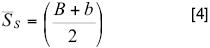
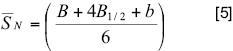
<body><![CDATA[<p align="justify"><font face="verdana" size="2">&nbsp;</font></p>     <p align="justify"><font face="verdana" size="2"><b>Standard sectional methods</b></font></p>     <p align="justify"><font face="verdana" size="2">The generally accepted sectional methods for volume estimation of tree stem segments in the forest measurement literature are the Huber, Smalian, and Newton methods. Following the notation of Chapman and Meyer (1949), for a tree stem segment, of length L, end cross sectional areas, <i>B </i>at the large end, <i>b </i>at the small end, and <i>B<sub>1/2</sub> </i>at the middle, those standard sectional methods can be respectively defined by</font></p>     <p align="center"><font face="verdana" size="2"><img src="/img/revistas/mb/v16n2/a6e3.jpg"></font></p>     <p align="center"><font face="verdana" size="2"><img src="/img/revistas/mb/v16n2/a6e4.jpg"></font></p>     <p align="center"><font face="verdana" size="2"><img src="/img/revistas/mb/v16n2/a6e5.jpg"></font></p>     <p align="justify"><font face="verdana" size="2">Then, <i>V<sub>H</sub> = <img src="/img/revistas/mb/v16n2/a6s2.jpg" ><sub>H</sub>L, V<sub>S</sub> = <img src="/img/revistas/mb/v16n2/a6s2.jpg"><sub>S</sub>L, </i>and <i>V<sub>N</sub> </i>= <i><img src="/img/revistas/mb/v16n2/a6s2.jpg"><sub>N</sub>L, are </i>their corresponding volumes in agreement to equation &#91;2&#93;.</font></p>     <p align="justify"><font face="verdana" size="2">&nbsp;</font></p>     <p align="justify"><font face="verdana" size="2"><b>Definition of systems and parameters for this work</b></font></p>     <p align="justify"><font face="verdana" size="2">Usually, solids of revolution generated by equation &#91;1&#93; are placed in a x <i>y </i>z Cartesian coordinate system with their axis of rotation along the x axis and their tips at the origin (Di&eacute;guez&#150;Aranda et al., 2003). The systems for this work are defined as frustums of length <i>L </i>of those solids of revolution for any positive integer <i>n. </i>The end cross sectional areas will be called here, <i>s </i>for the small end, at <i>x = x<sub>1</sub>, </i>and <i>S </i>for the large end, at <i>x = x<sub>2</sub>. </i>By definition, <i>x<sub>1</sub>&lt;x<sub>2</sub>, </i>then, <i>L = x<sub>2</sub>&#150;x<sub>1</sub>.</i></font></p>     ]]></body>
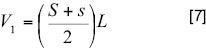
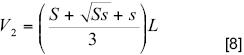
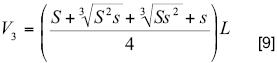
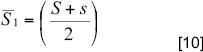
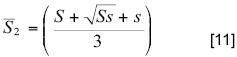
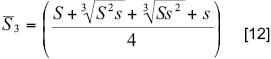
<body><![CDATA[<p align="justify"><font face="verdana" size="2">&nbsp;</font></p>     <p align="justify"><font face="verdana" size="2"><b>Sectional volume equations for the tree stem classical forms</b></font></p>     <p align="justify"><font face="verdana" size="2">The volumes for frustums of solids of revolution generated by equation &#91;1&#93;, for n=0, 1, 2, and 3, as function of end cross sectional areas and length, are</font></p>     <p align="center"><font face="verdana" size="2"><img src="/img/revistas/mb/v16n2/a6e6.jpg"></font></p>     <p align="center"><font face="verdana" size="2"><img src="/img/revistas/mb/v16n2/a6e7.jpg"></font></p>     <p align="center"><font face="verdana" size="2"><img src="/img/revistas/mb/v16n2/a6e8.jpg"></font></p>     <p align="center"><font face="verdana" size="2"><img src="/img/revistas/mb/v16n2/a6e9.jpg"></font></p>     <p align="justify"><font face="verdana" size="2">for  cylinder,   paraboloid,   conoid,   and neiloid, respectively (Graves, 1906).</font></p>     <p align="justify"><font face="verdana" size="2">In agreement to equation &#91;2&#93; <i>S = S<sub>n </sub></i>can be defined for equations &#91;6&#93;&#150;&#91;9&#93;. For cylinder, <i>S = S<sub>0</sub> = S = s. </i>For frustums of paraboloid, conoid and neiloid, their mean cross sectional areas are respectively</font></p>     <p align="center"><font face="verdana" size="2"><img src="/img/revistas/mb/v16n2/a6e10.jpg"></font></p>     ]]></body>
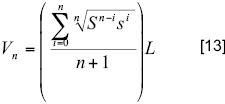
<body><![CDATA[<p align="center"><font face="verdana" size="2"><img src="/img/revistas/mb/v16n2/a6e11.jpg"></font></p>     <p align="center"><font face="verdana" size="2"><img src="/img/revistas/mb/v16n2/a6e12.jpg"></font></p>     <p align="justify"><font face="verdana" size="2">In the following, it will be shown that equations &#91;7&#93;&#150;&#91;9&#93; are particular cases of a general sectional volume equation related to the generating equation &#91;1&#93; for any positive integer. The case <i>n=0 </i>deserves a particular discussion given at the end.</font></p>     <p align="justify"><font face="verdana" size="2">&nbsp;</font></p>     <p align="justify"><font face="verdana" size="2"><b>RESULTS</b></font></p>     <p align="justify"><font face="verdana" size="2"><b>Derivation of a general sectional volume equation for classical geometries of tree stem</b></font></p>     <p align="justify"><font face="verdana" size="2">The main result of this work is shown in the form of a mathematical theorem.</font></p>     <p align="justify"><font face="verdana" size="2"><i>Theorem</i></font></p>     <p align="justify"><font face="verdana" size="2">If <i>V<sub>n</sub> </i>is the volume for a solid of revolution's frustum, of length L, and end cross sectional areas <i>s </i>at <i>x = x<sub>1</sub>, </i>and <i>S </i>at <i>x = x<sub>2</sub>, </i>generated by the equation <i><img src="/img/revistas/mb/v16n2/a6s1.jpg">, </i>where <i>n </i>is a positive integer, then, <i>V<sub>n</sub> </i>can be expressed in the form</font></p>     <p align="center"><font face="verdana" size="2"><img src="/img/revistas/mb/v16n2/a6e13.jpg"></font></p>     ]]></body>
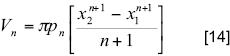
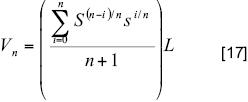
<body><![CDATA[<p align="justify"><font face="verdana" size="2"><i>Proof</i></font></p>     <p align="justify"><font face="verdana" size="2">If the generating function for a solid of revolution is given by <i><img src="/img/revistas/mb/v16n2/a6s1.jpg"></i> then the volume for its frustum from <i>x = x<sub>1</sub> </i>to <i>x = x<sub>2</sub>, </i>given by integral calculus, is</font></p>     <p align="center"><font face="verdana" size="2"><img src="/img/revistas/mb/v16n2/a6e14.jpg"></font></p>     <p align="justify"><font face="verdana" size="2">(Stewart, 2002). The relation</font></p>     <p align="center"><font face="verdana" size="2"><img src="/img/revistas/mb/v16n2/a6e15.jpg"></font></p>     <p align="justify"><font face="verdana" size="2">is well known in the mathematical literature (Spiegel and Moyer, 2007). Given that <i>L = x<sub>2</sub> &#150; x<i><sub>1 </sub></i></i>and, from equation &#91;1&#93;,</font></p>     <p align="center"><font face="verdana" size="2"><img src="/img/revistas/mb/v16n2/a6s3.jpg"></font></p>     <p align="justify"><font face="verdana" size="2">equation &#91;15&#93; takes the form</font></p>     <p align="center"><font face="verdana" size="2"><img src="/img/revistas/mb/v16n2/a6e16.jpg"></font></p>     <p align="justify"><font face="verdana" size="2">Substituting  equation   &#91;16&#93;  in  equation &#91;14&#93;, results</font></p>     ]]></body>
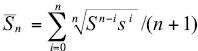
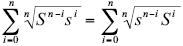
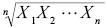
<body><![CDATA[<p align="center"><font face="verdana" size="2"><img src="/img/revistas/mb/v16n2/a6e17.jpg"></font></p>     <p align="justify"><font face="verdana" size="2">which is exactly equation &#91;13&#93;.</font></p>     <p align="justify"><font face="verdana" size="2">&nbsp;</font></p>     <p align="justify"><font face="verdana" size="2"><b>DISCUSSION</b></font></p>     <p align="justify"><font face="verdana" size="2">The general sectional volume equation &#91;13&#93; has been derived for solids of revolution generated by the equation <i><img src="/img/revistas/mb/v16n2/a6s1.jpg"> </i>for any positive integer <i>n. </i>It can be easily shown that, for <i>n =1, 2, </i>and <i>3, </i>the sectional volume equations &#91;7&#93;&#150;&#91;9&#93; for frustums of paraboloid, conoid and neilod, are respectively recovered. Also, for <i>s=0, </i>basal area <i>S, </i>and <i>L=H, </i>their total volumes, <i>SH/(n+1), are </i>obtained. However, as it can be seen in equation &#91;13&#93; a sectional volume equation for the cylinder case <i>n=0 </i>cannot be defined. Nevertheless, it is not necessary because the general equation reduces to the cylinder volume equation when <i>s=S </i>for any <i>n. </i>That condition of cylinder volume recovery seems to be necessary for any sectional volume equation. In a proposal to evaluate various sectional methods to estimate butt log volumes Bruce (1982) takes that condition as a guide to select them.</font></p>     <p align="justify"><font face="verdana" size="2">Let us understand the meaning of equation &#91;13&#93;. In agreement to equation &#91;2&#93; it can be written in the form <i>V<sub>n</sub> = S<sub>n</sub>L </i>where</font></p>     <p align="center"><font face="verdana" size="2"><img src="/img/revistas/mb/v16n2/a6s7.jpg"></font></p>     <p align="justify"><font face="verdana" size="2">should correspond  to a general  mean cross  sectional  area.   In  particular,  for equation &#91;10&#93;, <img src="/img/revistas/mb/v16n2/a6s2.jpg" ><sub>1</sub>, is the arithmetic average of the end cross sectional areas <i>s </i>and <i>S. </i>For equation &#91;11&#93;, <i><img src="/img/revistas/mb/v16n2/a6s2.jpg"><sub>2</sub> </i>is the arithmetic average of end cross sectional areas, <i>S, s, </i>and their geometric mean <i>SS </i>(Uranga&#150;Valencia, 2008). In general, if <i>X<i><sub>1</sub></i>, X<sub>2</sub>, </i>... <i>X<sub>n</sub>, </i>are the possible values taken by a variable <i>X, </i>for a sample of size <i>n, </i>their geometric mean is a measure of central tendency defined by <img src="/img/revistas/mb/v16n2/a6s5.jpg">(Chapman and Meyer, 1949; Van Laar and Ak&ccedil;a, 2007).</font></p>     <p align="justify"><font face="verdana" size="2">The terms <img src="/img/revistas/mb/v16n2/a6s6.jpg"> for i=0,1,2,..., <i>n, </i>represent the geometric mean cross sectional areas for, <i>X<i><i><sub>1</sub></i></i> = X<sub>2</sub> = ... = X<i><i><i><sub>n&#150;i</sub></i></i></i> = S </i>and <i><i>X<i><i><i><sub>n&#150;i+2</sub></i></i></i></i>. <i><i>X<i><i><i><sub>n&#150;i+2</sub></i></i></i></i></i> = <i><i>X<i><i><i><sub>n&#150;i+i </sub></i></i></i></i></i> = X<sub>n</sub> = s. </i>Then, the general mean cross sectional area</font></p>     <p align="center"><font face="verdana" size="2"><img src="/img/revistas/mb/v16n2/a6s7.jpg"></font></p>     ]]></body>
<body><![CDATA[<p align="justify"><font face="verdana" size="2">corresponds to the arithmetic average of those geometric means. Although the problem for this work was not originally defined as of statistical nature it turned on a statistical one whose complete analysis is in progress.</font></p>     <p align="justify"><font face="verdana" size="2">An additional property of equation &#91;13&#93; is that it represents a symmetrical function on <i>s </i>and <i>S, </i>for any <i>n, </i>because of</font></p>     <p align="center"><font face="verdana" size="2"><i><img src="/img/revistas/mb/v16n2/a6s8.jpg"></i></font></p>     <p align="justify"><font face="verdana" size="2">what means that segment volume is independent of its orientation along its axis of rotation. Also, the equations for the standard sectional methods obey that symmetry property. That condition could be another feature to take in account in the proposal of new sectional methods for volume estimation.</font></p>     <p align="justify"><font face="verdana" size="2">The most important contribution of this work is the general sectional volume equation &#91;13&#93; from what known results of the forest measurements field, since more than a century (Graves, 1906), are particular cases.</font></p>     <p align="justify"><font face="verdana" size="2">&nbsp;</font></p>     <p align="justify"><font face="verdana" size="2"><b>ACKNOWLEDGEMENTS</b></font></p>     <p align="justify"><font face="verdana" size="2">The author deeply acknowledges Professor Adrian Goodwin for his helpful suggestions. This work was supported by Coordinaci&oacute;n de la Investigaci&oacute;n Cient&iacute;fica de la Universidad Michoacana de San Nicol&aacute;s de Hidalgo. Morelia Michoac&aacute;n, M&eacute;xico.</font></p>     <p align="justify"><font face="verdana" size="2">&nbsp;</font></p>     <p align="justify"><font face="verdana" size="2"><b>REFERENCES</b></font></p>     ]]></body>
<body><![CDATA[<!-- ref --><p align="justify"><font face="verdana" size="2">Avery, T.E. and Burkhart, H.E. 2002. Forest Measurements. Mc Graw Hill. USA.    &nbsp;&nbsp;&nbsp;&nbsp;&nbsp;&nbsp;&nbsp;&nbsp;[&#160;<a href="javascript:void(0);" onclick="javascript: window.open('/scielo.php?script=sci_nlinks&ref=5162972&pid=S1405-0471201000020000600001&lng=','','width=640,height=500,resizable=yes,scrollbars=1,menubar=yes,');">Links</a>&#160;]<!-- end-ref --></font></p>     <!-- ref --><p align="justify"><font face="verdana" size="2">Brack, C. 1999. Forest Measurement and Modeling &#91;online&#93;. Available from <a href="http://xn-sresassociated-j82h.anu.edu.au/mensuration/volume.htm" target="_blank">sres&#150;associated.anu.edu.au/mensuration/volume.htm</a>.    &nbsp;&nbsp;&nbsp;&nbsp;&nbsp;&nbsp;&nbsp;&nbsp;[&#160;<a href="javascript:void(0);" onclick="javascript: window.open('/scielo.php?script=sci_nlinks&ref=5162974&pid=S1405-0471201000020000600002&lng=','','width=640,height=500,resizable=yes,scrollbars=1,menubar=yes,');">Links</a>&#160;]<!-- end-ref --></font></p>     <!-- ref --><p align="justify"><font face="verdana" size="2">Bruce, D. 1982. Butt Log Volume Estimators. Forest Sci. 28(3):489&#150;503.    &nbsp;&nbsp;&nbsp;&nbsp;&nbsp;&nbsp;&nbsp;&nbsp;[&#160;<a href="javascript:void(0);" onclick="javascript: window.open('/scielo.php?script=sci_nlinks&ref=5162976&pid=S1405-0471201000020000600003&lng=','','width=640,height=500,resizable=yes,scrollbars=1,menubar=yes,');">Links</a>&#160;]<!-- end-ref --></font></p>     <!-- ref --><p align="justify"><font face="verdana" size="2">Chapman, H.H. and Meyer, W.H. 1949. Forest Mensuration. McGraw&#150;Hill. Edition. USA.    &nbsp;&nbsp;&nbsp;&nbsp;&nbsp;&nbsp;&nbsp;&nbsp;[&#160;<a href="javascript:void(0);" onclick="javascript: window.open('/scielo.php?script=sci_nlinks&ref=5162978&pid=S1405-0471201000020000600004&lng=','','width=640,height=500,resizable=yes,scrollbars=1,menubar=yes,');">Links</a>&#160;]<!-- end-ref --></font></p>     <!-- ref --><p align="justify"><font face="verdana" size="2">Dean, T.J. and Long, J.N. 1986. Validity of Constant&#150;stress and Elastic&#150;instability Principles of Stem Formation in <i>Pinus contorta </i>and <i>Trifolium pratense. </i>Annals of Botany. 58:833&#150;840.    &nbsp;&nbsp;&nbsp;&nbsp;&nbsp;&nbsp;&nbsp;&nbsp;[&#160;<a href="javascript:void(0);" onclick="javascript: window.open('/scielo.php?script=sci_nlinks&ref=5162980&pid=S1405-0471201000020000600005&lng=','','width=640,height=500,resizable=yes,scrollbars=1,menubar=yes,');">Links</a>&#160;]<!-- end-ref --></font></p>     ]]></body>
<body><![CDATA[<!-- ref --><p align="justify"><font face="verdana" size="2">Di&eacute;guez&#150;Aranda, U., Barrio&#150;Anta, M., Castedo&#150;Dorado, F., Ru&iacute;z&#150;Gonz&aacute;lez, A.D., &Aacute;lvarez&#150;Taboada, M.F., &Aacute;lvarez&#150;Gonz&aacute;lez, J.G. y Rojo&#150;Albareca, A. 2003. Dendrometr&iacute;a. Mundi&#150;Prensa. Madrid, Espa&ntilde;a.    &nbsp;&nbsp;&nbsp;&nbsp;&nbsp;&nbsp;&nbsp;&nbsp;[&#160;<a href="javascript:void(0);" onclick="javascript: window.open('/scielo.php?script=sci_nlinks&ref=5162982&pid=S1405-0471201000020000600006&lng=','','width=640,height=500,resizable=yes,scrollbars=1,menubar=yes,');">Links</a>&#160;]<!-- end-ref --></font></p>     <!-- ref --><p align="justify"><font face="verdana" size="2">Graves, H.S. 1906. Forest Mensuration. John Wiley &amp; Sons. USA.    &nbsp;&nbsp;&nbsp;&nbsp;&nbsp;&nbsp;&nbsp;&nbsp;[&#160;<a href="javascript:void(0);" onclick="javascript: window.open('/scielo.php?script=sci_nlinks&ref=5162984&pid=S1405-0471201000020000600007&lng=','','width=640,height=500,resizable=yes,scrollbars=1,menubar=yes,');">Links</a>&#160;]<!-- end-ref --></font></p>     <!-- ref --><p align="justify"><font face="verdana" size="2">Inoue, A. 2006. A model for the relationship between form&#150;factors for stem volume and those for stem surface area in coniferous species. J. For. Res. 11:289&#150;294.    &nbsp;&nbsp;&nbsp;&nbsp;&nbsp;&nbsp;&nbsp;&nbsp;[&#160;<a href="javascript:void(0);" onclick="javascript: window.open('/scielo.php?script=sci_nlinks&ref=5162986&pid=S1405-0471201000020000600008&lng=','','width=640,height=500,resizable=yes,scrollbars=1,menubar=yes,');">Links</a>&#160;]<!-- end-ref --></font></p>     <!-- ref --><p align="justify"><font face="verdana" size="2">Larson, P.R. 1963. Stem Form Development of Forest Trees. For. Sci. Mon. 5.    &nbsp;&nbsp;&nbsp;&nbsp;&nbsp;&nbsp;&nbsp;&nbsp;[&#160;<a href="javascript:void(0);" onclick="javascript: window.open('/scielo.php?script=sci_nlinks&ref=5162988&pid=S1405-0471201000020000600009&lng=','','width=640,height=500,resizable=yes,scrollbars=1,menubar=yes,');">Links</a>&#160;]<!-- end-ref --></font></p>     <!-- ref --><p align="justify"><font face="verdana" size="2">McMahon, T 1973. Size and Shape in Biology. Science. 179: 1201&#150;1204.    &nbsp;&nbsp;&nbsp;&nbsp;&nbsp;&nbsp;&nbsp;&nbsp;[&#160;<a href="javascript:void(0);" onclick="javascript: window.open('/scielo.php?script=sci_nlinks&ref=5162990&pid=S1405-0471201000020000600010&lng=','','width=640,height=500,resizable=yes,scrollbars=1,menubar=yes,');">Links</a>&#160;]<!-- end-ref --></font></p>     ]]></body>
<body><![CDATA[<!-- ref --><p align="justify"><font face="verdana" size="2">Spiegel, M.R. and Moyer, R.E. 2007. Algebra Superior. McGraw&#150;Hill. M&eacute;xico.    &nbsp;&nbsp;&nbsp;&nbsp;&nbsp;&nbsp;&nbsp;&nbsp;[&#160;<a href="javascript:void(0);" onclick="javascript: window.open('/scielo.php?script=sci_nlinks&ref=5162992&pid=S1405-0471201000020000600011&lng=','','width=640,height=500,resizable=yes,scrollbars=1,menubar=yes,');">Links</a>&#160;]<!-- end-ref --></font></p>     <!-- ref --><p align="justify"><font face="verdana" size="2">Stewart, J. 2002. C&aacute;lculo Trascendentes Tempranas. Thompson Learning. M&eacute;xico.    &nbsp;&nbsp;&nbsp;&nbsp;&nbsp;&nbsp;&nbsp;&nbsp;[&#160;<a href="javascript:void(0);" onclick="javascript: window.open('/scielo.php?script=sci_nlinks&ref=5162994&pid=S1405-0471201000020000600012&lng=','','width=640,height=500,resizable=yes,scrollbars=1,menubar=yes,');">Links</a>&#160;]<!-- end-ref --></font></p>     <!-- ref --><p align="justify"><font face="verdana" size="2">Uranga&#150;Valencia, L.P 2008. Aplicaci&oacute;n del Modelo C&oacute;nico Segmentado a los Tipos Dendrom&eacute;tricos Cl&aacute;sicos como Funci&oacute;n del N&uacute;mero de Segmentos. M.Sc. thesis, Facultad de Ingenier&iacute;a en Tecnolog&iacute;a de la Madera, Universidad Michoac&aacute;na de San Nicol&aacute;s de Hidalgo, Morelia Michoac&aacute;n, M&eacute;xico.    &nbsp;&nbsp;&nbsp;&nbsp;&nbsp;&nbsp;&nbsp;&nbsp;[&#160;<a href="javascript:void(0);" onclick="javascript: window.open('/scielo.php?script=sci_nlinks&ref=5162996&pid=S1405-0471201000020000600013&lng=','','width=640,height=500,resizable=yes,scrollbars=1,menubar=yes,');">Links</a>&#160;]<!-- end-ref --></font></p>     <!-- ref --><p align="justify"><font face="verdana" size="2">Van Laar, A. and Ak&ccedil;a, A. 2007. Forest Mensuration. Springer. Netherlands.    &nbsp;&nbsp;&nbsp;&nbsp;&nbsp;&nbsp;&nbsp;&nbsp;[&#160;<a href="javascript:void(0);" onclick="javascript: window.open('/scielo.php?script=sci_nlinks&ref=5162998&pid=S1405-0471201000020000600014&lng=','','width=640,height=500,resizable=yes,scrollbars=1,menubar=yes,');">Links</a>&#160;]<!-- end-ref --></font></p>     <!-- ref --><p align="justify"><font face="verdana" size="2">West, P.W. 2004. Tree and Forest Measurement. Springer&#150;Verlag. Berl&iacute;n.    &nbsp;&nbsp;&nbsp;&nbsp;&nbsp;&nbsp;&nbsp;&nbsp;[&#160;<a href="javascript:void(0);" onclick="javascript: window.open('/scielo.php?script=sci_nlinks&ref=5163000&pid=S1405-0471201000020000600015&lng=','','width=640,height=500,resizable=yes,scrollbars=1,menubar=yes,');">Links</a>&#160;]<!-- end-ref --></font></p>     ]]></body>
<body><![CDATA[<!-- ref --><p align="justify"><font face="verdana" size="2">Wood, G.B., Wiant, H. V. Jr., Loy, R.J. and Miles, J.A. 1990. Centroid Sampling: A variant of importance sampling for estimating the volume of sample trees of radiate pine. Forest Ecology and Management. 36:233&#150;243.    &nbsp;&nbsp;&nbsp;&nbsp;&nbsp;&nbsp;&nbsp;&nbsp;[&#160;<a href="javascript:void(0);" onclick="javascript: window.open('/scielo.php?script=sci_nlinks&ref=5163002&pid=S1405-0471201000020000600016&lng=','','width=640,height=500,resizable=yes,scrollbars=1,menubar=yes,');">Links</a>&#160;]<!-- end-ref --></font></p>     <p align="justify"><font face="verdana" size="2">&nbsp;</font></p>     <p align="justify"><font face="verdana" size="2"><b>Nota</b></font></p>     <p align="justify"><font face="verdana" size="2">Este documento se debe citar como: Cruz de Le&oacute;n, G. 2010. A general sectional volume equation for classical geometries of tree stem. <i>Madera y Bosques </i>16(2):89&#150;94.</font></p>      ]]></body><back>
<ref-list>
<ref id="B1">
<nlm-citation citation-type="book">
<person-group person-group-type="author">
<name>
<surname><![CDATA[Avery]]></surname>
<given-names><![CDATA[T.E]]></given-names>
</name>
<name>
<surname><![CDATA[Burkhart]]></surname>
<given-names><![CDATA[H.E]]></given-names>
</name>
</person-group>
<source><![CDATA[Forest Measurements]]></source>
<year>2002</year>
<publisher-name><![CDATA[Mc Graw Hill]]></publisher-name>
</nlm-citation>
</ref>
<ref id="B2">
<nlm-citation citation-type="">
<person-group person-group-type="author">
<name>
<surname><![CDATA[Brack]]></surname>
<given-names><![CDATA[C]]></given-names>
</name>
</person-group>
<source><![CDATA[Forest Measurement and Modeling]]></source>
<year>1999</year>
</nlm-citation>
</ref>
<ref id="B3">
<nlm-citation citation-type="journal">
<person-group person-group-type="author">
<name>
<surname><![CDATA[Bruce]]></surname>
<given-names><![CDATA[D]]></given-names>
</name>
</person-group>
<article-title xml:lang="en"><![CDATA[Butt Log Volume Estimators]]></article-title>
<source><![CDATA[Forest Sci]]></source>
<year>1982</year>
<volume>28</volume>
<numero>3</numero>
<issue>3</issue>
<page-range>489-503</page-range></nlm-citation>
</ref>
<ref id="B4">
<nlm-citation citation-type="book">
<person-group person-group-type="author">
<name>
<surname><![CDATA[Chapman]]></surname>
<given-names><![CDATA[H.H]]></given-names>
</name>
<name>
<surname><![CDATA[Meyer]]></surname>
<given-names><![CDATA[W.H]]></given-names>
</name>
</person-group>
<source><![CDATA[Forest Mensuration]]></source>
<year>1949</year>
<publisher-name><![CDATA[McGraw-Hill]]></publisher-name>
</nlm-citation>
</ref>
<ref id="B5">
<nlm-citation citation-type="journal">
<person-group person-group-type="author">
<name>
<surname><![CDATA[Dean]]></surname>
<given-names><![CDATA[T.J]]></given-names>
</name>
<name>
<surname><![CDATA[Long]]></surname>
<given-names><![CDATA[J.N]]></given-names>
</name>
</person-group>
<article-title xml:lang="en"><![CDATA[Validity of Constant-stress and Elastic-instability Principles of Stem Formation in Pinus contorta and Trifolium pratense]]></article-title>
<source><![CDATA[Annals of Botany]]></source>
<year>1986</year>
<volume>58</volume>
<page-range>833-840</page-range></nlm-citation>
</ref>
<ref id="B6">
<nlm-citation citation-type="book">
<person-group person-group-type="author">
<name>
<surname><![CDATA[Diéguez-Aranda]]></surname>
<given-names><![CDATA[U]]></given-names>
</name>
<name>
<surname><![CDATA[Barrio-Anta]]></surname>
<given-names><![CDATA[M]]></given-names>
</name>
<name>
<surname><![CDATA[Castedo-Dorado]]></surname>
<given-names><![CDATA[F]]></given-names>
</name>
<name>
<surname><![CDATA[Ruíz-González]]></surname>
<given-names><![CDATA[A.D]]></given-names>
</name>
<name>
<surname><![CDATA[Álvarez-Taboada]]></surname>
<given-names><![CDATA[M.F]]></given-names>
</name>
<name>
<surname><![CDATA[Álvarez-González]]></surname>
<given-names><![CDATA[J.G]]></given-names>
</name>
<name>
<surname><![CDATA[Rojo-Albareca]]></surname>
<given-names><![CDATA[A]]></given-names>
</name>
</person-group>
<source><![CDATA[Dendrometría]]></source>
<year>2003</year>
<publisher-loc><![CDATA[Madrid ]]></publisher-loc>
<publisher-name><![CDATA[Mundi-Prensa]]></publisher-name>
</nlm-citation>
</ref>
<ref id="B7">
<nlm-citation citation-type="book">
<person-group person-group-type="author">
<name>
<surname><![CDATA[Graves]]></surname>
<given-names><![CDATA[H.S]]></given-names>
</name>
</person-group>
<source><![CDATA[Forest Mensuration]]></source>
<year>1906</year>
<publisher-name><![CDATA[John Wiley & Sons]]></publisher-name>
</nlm-citation>
</ref>
<ref id="B8">
<nlm-citation citation-type="journal">
<person-group person-group-type="author">
<name>
<surname><![CDATA[Inoue]]></surname>
<given-names><![CDATA[A]]></given-names>
</name>
</person-group>
<article-title xml:lang="en"><![CDATA[A model for the relationship between form-factors for stem volume and those for stem surface area in coniferous species]]></article-title>
<source><![CDATA[J. For. Res]]></source>
<year>2006</year>
<volume>11</volume>
<page-range>289-294</page-range></nlm-citation>
</ref>
<ref id="B9">
<nlm-citation citation-type="journal">
<person-group person-group-type="author">
<name>
<surname><![CDATA[Larson]]></surname>
<given-names><![CDATA[P.R]]></given-names>
</name>
</person-group>
<article-title xml:lang="en"><![CDATA[Stem Form Development of Forest Trees]]></article-title>
<source><![CDATA[For. Sci. Mon]]></source>
<year>1963</year>
<volume>5</volume>
</nlm-citation>
</ref>
<ref id="B10">
<nlm-citation citation-type="journal">
<person-group person-group-type="author">
<name>
<surname><![CDATA[McMahon]]></surname>
<given-names><![CDATA[T]]></given-names>
</name>
</person-group>
<article-title xml:lang="en"><![CDATA[Size and Shape in Biology]]></article-title>
<source><![CDATA[Science]]></source>
<year>1973</year>
<volume>179</volume>
<page-range>1201-1204</page-range></nlm-citation>
</ref>
<ref id="B11">
<nlm-citation citation-type="book">
<person-group person-group-type="author">
<name>
<surname><![CDATA[Spiegel]]></surname>
<given-names><![CDATA[M.R]]></given-names>
</name>
<name>
<surname><![CDATA[Moyer]]></surname>
<given-names><![CDATA[R.E]]></given-names>
</name>
</person-group>
<source><![CDATA[Algebra Superior]]></source>
<year>2007</year>
<publisher-name><![CDATA[McGraw-Hill]]></publisher-name>
</nlm-citation>
</ref>
<ref id="B12">
<nlm-citation citation-type="book">
<person-group person-group-type="author">
<name>
<surname><![CDATA[Stewart]]></surname>
<given-names><![CDATA[J]]></given-names>
</name>
</person-group>
<source><![CDATA[Cálculo Trascendentes Tempranas]]></source>
<year>2002</year>
<publisher-name><![CDATA[Thompson Learning]]></publisher-name>
</nlm-citation>
</ref>
<ref id="B13">
<nlm-citation citation-type="">
<person-group person-group-type="author">
<name>
<surname><![CDATA[Uranga-Valencia]]></surname>
<given-names><![CDATA[L.P]]></given-names>
</name>
</person-group>
<source><![CDATA[Aplicación del Modelo Cónico Segmentado a los Tipos Dendrométricos Clásicos como Función del Número de Segmentos]]></source>
<year>2008</year>
</nlm-citation>
</ref>
<ref id="B14">
<nlm-citation citation-type="book">
<person-group person-group-type="author">
<name>
<surname><![CDATA[Van Laar]]></surname>
<given-names><![CDATA[A]]></given-names>
</name>
<name>
<surname><![CDATA[Akça]]></surname>
<given-names><![CDATA[A]]></given-names>
</name>
</person-group>
<source><![CDATA[Forest Mensuration]]></source>
<year>2007</year>
<publisher-name><![CDATA[Springer]]></publisher-name>
</nlm-citation>
</ref>
<ref id="B15">
<nlm-citation citation-type="book">
<person-group person-group-type="author">
<name>
<surname><![CDATA[West]]></surname>
<given-names><![CDATA[P.W]]></given-names>
</name>
</person-group>
<source><![CDATA[Tree and Forest Measurement]]></source>
<year>2004</year>
<publisher-loc><![CDATA[Berlín ]]></publisher-loc>
<publisher-name><![CDATA[Springer-Verlag]]></publisher-name>
</nlm-citation>
</ref>
<ref id="B16">
<nlm-citation citation-type="journal">
<person-group person-group-type="author">
<name>
<surname><![CDATA[Wood]]></surname>
<given-names><![CDATA[G.B]]></given-names>
</name>
<name>
<surname><![CDATA[Wiant]]></surname>
<given-names><![CDATA[H. V]]></given-names>
</name>
<name>
<surname><![CDATA[Loy]]></surname>
<given-names><![CDATA[R.J]]></given-names>
</name>
<name>
<surname><![CDATA[Miles]]></surname>
<given-names><![CDATA[J.A]]></given-names>
</name>
</person-group>
<article-title xml:lang="en"><![CDATA[Centroid Sampling: A variant of importance sampling for estimating the volume of sample trees of radiate pine]]></article-title>
<source><![CDATA[Forest Ecology and Management]]></source>
<year>1990</year>
<volume>36</volume>
<page-range>233-243</page-range></nlm-citation>
</ref>
</ref-list>
</back>
</article>