<?xml version="1.0" encoding="ISO-8859-1"?><article xmlns:mml="http://www.w3.org/1998/Math/MathML" xmlns:xlink="http://www.w3.org/1999/xlink" xmlns:xsi="http://www.w3.org/2001/XMLSchema-instance">
<front>
<journal-meta>
<journal-id>1026-8774</journal-id>
<journal-title><![CDATA[Revista mexicana de ciencias geológicas]]></journal-title>
<abbrev-journal-title><![CDATA[Rev. mex. cienc. geol]]></abbrev-journal-title>
<issn>1026-8774</issn>
<publisher>
<publisher-name><![CDATA[Universidad Nacional Autónoma de México, Instituto de Geología]]></publisher-name>
</publisher>
</journal-meta>
<article-meta>
<article-id>S1026-87742015000100001</article-id>
<title-group>
<article-title xml:lang="en"><![CDATA[Ostracode and C/N based paleoecological record from Santiaguillo basin of subtropical Mexico over last 27 cal kyr BP]]></article-title>
<article-title xml:lang="es"><![CDATA[Registro paleoecológico basado en ostracodos y C/N de la cuenca de Santiaguillo en la parte subtropical de México durante los últimos ca.27 ka cal AP]]></article-title>
</title-group>
<contrib-group>
<contrib contrib-type="author">
<name>
<surname><![CDATA[Chávez-Lara]]></surname>
<given-names><![CDATA[Claudia M.]]></given-names>
</name>
<xref ref-type="aff" rid="A01"/>
</contrib>
<contrib contrib-type="author">
<name>
<surname><![CDATA[Roy]]></surname>
<given-names><![CDATA[Priyadarsi D.]]></given-names>
</name>
<xref ref-type="aff" rid="A02"/>
</contrib>
<contrib contrib-type="author">
<name>
<surname><![CDATA[Pérez]]></surname>
<given-names><![CDATA[Liseth]]></given-names>
</name>
<xref ref-type="aff" rid="A02"/>
</contrib>
<contrib contrib-type="author">
<name>
<surname><![CDATA[Muthu Sankar]]></surname>
<given-names><![CDATA[Gowrappan]]></given-names>
</name>
<xref ref-type="aff" rid="A03"/>
</contrib>
<contrib contrib-type="author">
<name>
<surname><![CDATA[Lemus Neri]]></surname>
<given-names><![CDATA[Víctor H.]]></given-names>
</name>
<xref ref-type="aff" rid="A04"/>
</contrib>
</contrib-group>
<aff id="A01">
<institution><![CDATA[,Universidad Nacional Autónoma de México Posgrado en Ciencias de la Tierra ]]></institution>
<addr-line><![CDATA[México Distrito Federal]]></addr-line>
<country>México</country>
</aff>
<aff id="A02">
<institution><![CDATA[,Universidad Nacional Autónoma de México Instituto de Geología ]]></institution>
<addr-line><![CDATA[México Distrito Federal]]></addr-line>
<country>México</country>
</aff>
<aff id="A03">
<institution><![CDATA[,French Institute of Pondicherry  ]]></institution>
<addr-line><![CDATA[Puducherry ]]></addr-line>
<country>India</country>
</aff>
<aff id="A04">
<institution><![CDATA[,Universidad Nacional Autónoma de México Unidad de Servicios de Apoyo a la Investigación Facultad de Química]]></institution>
<addr-line><![CDATA[México Distrito Federal]]></addr-line>
<country>México</country>
</aff>
<pub-date pub-type="pub">
<day>00</day>
<month>00</month>
<year>2015</year>
</pub-date>
<pub-date pub-type="epub">
<day>00</day>
<month>00</month>
<year>2015</year>
</pub-date>
<volume>32</volume>
<numero>1</numero>
<fpage>1</fpage>
<lpage>10</lpage>
<copyright-statement/>
<copyright-year/>
<self-uri xlink:href="http://www.scielo.org.mx/scielo.php?script=sci_arttext&amp;pid=S1026-87742015000100001&amp;lng=en&amp;nrm=iso"></self-uri><self-uri xlink:href="http://www.scielo.org.mx/scielo.php?script=sci_abstract&amp;pid=S1026-87742015000100001&amp;lng=en&amp;nrm=iso"></self-uri><self-uri xlink:href="http://www.scielo.org.mx/scielo.php?script=sci_pdf&amp;pid=S1026-87742015000100001&amp;lng=en&amp;nrm=iso"></self-uri><abstract abstract-type="short" xml:lang="en"><p><![CDATA[Changes in ostracode species assemblage suggest presence of oligohaline and mesohaline waters in the Santiaguillo basin of subtropical Mexico over the last ca.27 cal kyr BP. Paleoecological reconstruction is based on the distribution of Limnocythere bradburyi Forester, Eucandona cf. patzcuaro Tressler, Cypridopsis vidua Brady and Limnocythere ceriotuberosa Delorme. Source of organic productivity is inferred from C/N ratios. The basin hosted shallow and oligohaline water during the late glacial (ca.27-19 cal kyr BP) and lacustrine phytoplankton contributed to the organic productivity. However, the water body of Last Glacial Maximum (LGM) was relatively warmer (>13°C) and more diluted compared to the pre-LGM. Increased salinity and reduced lacustrine productivity at ca.19 cal kyr BP marked a shift in the paleoecological conditions. Water body was mesohaline during ca.9.5-4 cal kyr BP and periodic desiccation of the basin possibly caused the absence of ostracode valves in sediments of the last ca.3.5 cal kyr BP. Comparison with other proxy-records from the region indicates that the hydrological variations in different parts of subtropical north and northwestern Mexico were not synchronous during the late Pleistocene and Holocene.]]></p></abstract>
<abstract abstract-type="short" xml:lang="es"><p><![CDATA[Los cambios en el conjunto de especies de ostrácodos sugieren presencia de oligohalina y mesohalina aguas en la cuenca de Santiaguillo ubicado en la parte subtropical de México durante los últimos ca.27 ka cal AP. La reconstrucción paleoecológica se realizó con base en la distribución de Limnocythere bradburyi Forester, Eucandona patzcuaro Tressler, Cypridopsis vidua Brady y Limnocythere ceriotuberosa Delorme. La fuente de la productividad orgánica se infiere a partir de la relación C/N. La cuenca albergó agua somera y oligohalina durante el pasado último glacial (ca. 27-19 ka cal AP) y el fitoplancton lacustre contribuyó a la productividad orgánica. Sin embargo, el cuerpo de agua durante el Último Máximo Glacial (UMG) fue relativamente cálido y más diluido comparado con el pre-UMG. Un incremento en la salinidad y la reducción de productividad lacustre a los ca.19 ka cal AP marcaron un cambio en las condiciones paleoecológicas. El cuerpo de agua fue mesohalino durante ca.9.5-4 ka cal AP y sequías periódicas de la cuenca causaron posiblemente la ausencia de valvas de ostrácodos en los sedimentos de los últimos ca.3.5 ka cal AP. Comparaciones con otros registros de la región indican que las variaciones hidrológicas en diferentes partes de la zona subtropical del norte y noroeste de México no fueron sincrónicas durante el Pleistoceno tardío y Holoceno.]]></p></abstract>
<kwd-group>
<kwd lng="en"><![CDATA[lacustrine ostracodes]]></kwd>
<kwd lng="en"><![CDATA[C/N ratio]]></kwd>
<kwd lng="en"><![CDATA[Paleoecology]]></kwd>
<kwd lng="en"><![CDATA[Late Quaternary]]></kwd>
<kwd lng="en"><![CDATA[Santiaguillo basin]]></kwd>
<kwd lng="en"><![CDATA[Mexico]]></kwd>
<kwd lng="es"><![CDATA[ostrácodos lacustre]]></kwd>
<kwd lng="es"><![CDATA[relación de C/N]]></kwd>
<kwd lng="es"><![CDATA[Paleoecología]]></kwd>
<kwd lng="es"><![CDATA[Cuaternario tardío]]></kwd>
<kwd lng="es"><![CDATA[cuenca de Santiaguillo]]></kwd>
<kwd lng="es"><![CDATA[México]]></kwd>
</kwd-group>
</article-meta>
</front><body><![CDATA[  	    <p align="center"><font face="verdana" size="4"><b>Ostracode and C/N based paleoecological record from Santiaguillo basin of subtropical Mexico over last 27 cal kyr BP</b></font></p>  	    <p align="justify"><font face="verdana" size="2">&nbsp;</font></p>  	    <p align="center"><font face="verdana" size="3"><b>Registro paleoecol&oacute;gico basado en ostracodos y C/N de la cuenca de Santiaguillo en la parte subtropical de M&eacute;xico durante los &uacute;ltimos ca.27 ka cal AP</b></font></p>  	    <p align="justify"><font face="verdana" size="2">&nbsp;</font></p>  	    <p align="center"><font face="verdana" size="2"><b>Claudia M. Ch&aacute;vez&#45;Lara<sup>1</sup>, Priyadarsi D. Roy<sup>2</sup>*, Liseth P&eacute;rez<sup>2</sup>, Gowrappan Muthu Sankar<sup>3</sup>, and V&iacute;ctor H. Lemus Neri<sup>4</sup></b></font></p>  	    <p align="justify"><font face="verdana" size="2">&nbsp;</font></p>  	    <p align="justify"><font face="verdana" size="2"><sup><i>1</i></sup> <i>Posgrado en Ciencias de la Tierra, Universidad Nacional Aut&oacute;noma de M&eacute;xico, Ciudad Universitaria, C.P. 04510, M&eacute;xico DF, M&eacute;xico.</i></font></p>  	    <p align="justify"><font face="verdana" size="2"><i><sup>2</sup> Instituto de Geolog&iacute;a, Universidad Nacional Aut&oacute;noma de M&eacute;xico, Ciudad Universitaria, C.P. 04510, M&eacute;xico D.F., M&eacute;xico.</i> <a href="mailto:roy@geologia.unam.mx">roy@geologia.unam.mx</a>, <a href="mailto:priyadarsi1977@gmail.com">priyadarsi1977@gmail.com</a></font></p>  	    <p align="justify"><font face="verdana" size="2"><i><sup>3</sup> French Institute of Pondicherry, 11 St Louis Street, P.B. 33, Puducherry 605 001, India.</i></font></p>  	    ]]></body>
<body><![CDATA[<p align="justify"><font face="verdana" size="2"><i><sup>4</sup> USAI, Facultad de Qu&iacute;mica, Universidad Nacional Aut&oacute;noma de M&eacute;xico, Ciudad Universitaria, C.P. 04510, M&eacute;xico D.F., M&eacute;xico.</i></font></p>  	    <p align="justify"><font face="verdana" size="2">&nbsp;</font></p>  	    <p align="justify"><font face="verdana" size="2">Manuscript received: April 30, 2014    <br> 	Corrected manuscript received: Nobember 17, 2014    <br> 	Manuscript accepted: November 19, 2014</font></p>  	    <p align="justify"><font face="verdana" size="2">&nbsp;</font></p>  	    <p align="justify"><font face="verdana" size="2"><b>ABSTRACT</b></font></p>  	    <p align="justify"><font face="verdana" size="2">Changes in ostracode species assemblage suggest presence of oligohaline and mesohaline waters in the Santiaguillo basin of subtropical Mexico over the last <i>ca.</i>27 cal kyr BP. Paleoecological reconstruction is based on the distribution of <i>Limnocythere bradburyi</i> Forester, <i>Eucandona cf. patzcuaro</i> Tressler, <i>Cypridopsis vidua</i> Brady and <i>Limnocythere ceriotuberosa</i> Delorme. Source of organic productivity is inferred from C/N ratios. The basin hosted shallow and oligohaline water during the late glacial (<i>ca.</i>27&#150;19 cal kyr BP) </font><font face="verdana" size="2">and lacustrine phytoplankton contributed to the organic productivity. However, the water body of Last Glacial Maximum (LGM) was relatively warmer (&gt;13&#176;C) and more diluted compared to the pre&#45;LGM. Increased salinity and reduced lacustrine productivity at <i>ca.</i>19 cal kyr BP marked a shift in the paleoecological conditions. Water body was mesohaline during <i>ca.</i>9.5&#150;4 cal kyr BP and periodic desiccation of the basin possibly caused the absence of ostracode valves in sediments of the last <i>ca.</i>3.5 cal kyr BP. </font><font face="verdana" size="2">Comparison with other proxy&#45;records from the region indicates that the hydrological variations in different parts of subtropical north and northwestern Mexico were not synchronous during the late Pleistocene and Holocene.</font></p>  	    <p align="justify"><font face="verdana" size="2"><b>Keywords</b>: lacustrine ostracodes; C/N ratio; Paleoecology; Late Quaternary; Santiaguillo basin; Mexico.</font></p>  	    <p align="justify"><font face="verdana" size="2">&nbsp;</font></p>  	    ]]></body>
<body><![CDATA[<p align="justify"><font face="verdana" size="2"><b>RESUMEN</b></font></p>  	    <p align="justify"><font face="verdana" size="2">Los cambios en el conjunto de especies de ostr&aacute;codos sugieren presencia de oligohalina y mesohalina aguas en la cuenca de Santiaguillo ubicado en la parte subtropical de M&eacute;xico durante los &uacute;ltimos <i>ca.</i>27 ka cal AP. La reconstrucci&oacute;n paleoecol&oacute;gica se realiz&oacute; con base en la distribuci&oacute;n de <i>Limnocythere bradburyi</i> Forester, <i>Eucandona patzcuaro</i> Tressler, <i>Cypridopsis vidua</i> Brady y <i>Limnocythere ceriotuberosa</i> Delorme. La fuente de la productividad org&aacute;nica se infiere a partir de la relaci&oacute;n C/N. La cuenca alberg&oacute; agua somera y oligohalina durante el pasado &uacute;ltimo glacial (<i>ca.</i> 27&#150;19 ka cal AP) y el fitoplancton lacustre contribuy&oacute; a la productividad org&aacute;nica. Sin embargo, el cuerpo de agua durante el &Uacute;ltimo M&aacute;ximo Glacial (UMG) fue relativamente c&aacute;lido y m&aacute;s diluido comparado con el pre&#45;UMG. Un incremento en la salinidad y la reducci&oacute;n de productividad lacustre a los <i>ca.</i>19 ka cal AP marcaron un cambio en las condiciones paleoecol&oacute;gicas. El cuerpo de agua fue mesohalino durante <i>ca.</i>9.5&#150;4 ka cal AP y sequ&iacute;as peri&oacute;dicas de la cuenca causaron posiblemente la ausencia de valvas de ostr&aacute;codos en los sedimentos de los &uacute;ltimos <i>ca.</i>3.5 ka cal AP. Comparaciones con otros registros de la regi&oacute;n indican que las variaciones hidrol&oacute;gicas en diferentes partes de la zona subtropical del norte y noroeste de M&eacute;xico no fueron sincr&oacute;nicas durante el Pleistoceno tard&iacute;o y Holoceno.</font></p>  	    <p align="justify"><font face="verdana" size="2"><b>Palabras clave</b>: ostr&aacute;codos lacustre; relaci&oacute;n de C/N; Paleoecolog&iacute;a; Cuaternario tard&iacute;o; cuenca de Santiaguillo; M&eacute;xico.</font></p>  	    <p align="justify"><font face="verdana" size="2">&nbsp;</font></p>  	    <p align="justify"><font face="verdana" size="2"><b>INTRODUCTION</b></font></p>  	    <p align="justify"><font face="verdana" size="2">In the last two decades, the reconstruction of late Quaternary paleoecological and paleoclimatic conditions of the subtropical northern Mexico has received a significant increase in the scientific attention (Urrutia&#45;Fucugauchi <i>et al</i>., 1997; Metcalfe <i>et al</i>., 1997, 2002; Murillo de Nava <i>et al</i>., 1999; Ortega&#45;Guerrero <i>et al</i>., 1999; Palacios&#45;Fest <i>et al</i>., 2002; Lozano&#45;Garc&iacute;a <i>et al</i>., 2002; Holmgren <i>et al</i>., 2003, 2007; Davis, 2003; Caballero <i>et al</i>., 2005; Castiglia and Fawcett, 2006; Ortega&#45;Rosas <i>et al</i>., 2008; Roy <i>et al</i>., 2010, 2012a, 2012b, 2013a, 2013b, 2014a, 2014b). The initial proxy registers and climate models reported humid conditions during the late last glacial and associated them to more winter precipitation. The subtropical high pressure zone in the eastern Pacific displaced southward and increased the frequency of westerly winter storms (COHMAP members, 1988; Manabe and Broccoli, 1985; Kutzbach and Wright, 1985; Kutzbach <i>et al</i>., 1998). Most of the paleoclimatic records suggested the possible absence of summer precipitation in the region (e.g. Thompson and Anderson, 2000).</font></p>  	    <p align="justify"><font face="verdana" size="2">The perception about the late Quaternary climate changed after Holmgren et al. (2006) and Kirby et al. (2006) reported that the influence of summer precipitation was reaching the USA&#45;Mexico borderlands and coastal southwestern USA during different intervals in the last glacial period. Recently, Roy et al. (2013a) reconstructed paleohydrological conditions of the northern part of subtropical Mexico over the last <i>ca.</i> 80 cal kyr BP and hypothesized that the major influence of the winter storms remained in the region located to the north of 29&#176;N latitude. The hydrology of northern Mexico was dominantly controlled by the summer precipitation and the intervals of increased summer precipitation were contemporary to warm interstadials (Roy <i>et al</i>., 2013a). Summer precipitation was less during the Last Glacial Maximum (LGM) and it increased over the deglaciation (Roy <i>et al</i>., 2010; Roy <i>et al</i>., 2012b). During the Pleistocene&#45;Holocene transition, increased summer precipitation led to wetter conditions in the region (Roy <i>et al</i>., 2014a). However, the synthesis of Barron et al. (2012) suggested that the influence of summer precipitation reached different regions during different intervals over the Holocene.</font></p>  	    <p align="justify"><font face="verdana" size="2">Compared to the northern part of subtropical Mexico, the paleoecological and paleohydrological information are scarce from the central and southern parts (<a href="/img/revistas/rmcg/v32n1/a1f1.jpg" target="_blank">Figure 1a</a>). Similarly, most of the proxy&#45;records are based on the geochemical and magnetic properties of lacustrine sediments and the use of ostracodes as a paleoenvironment indicator has not been sufficiently explored. Ostracodes are micro&#45;crustaceans with low&#45;Mg calcite valves (Turpen and Angell, 1971) and are sensible to the environmental and climatic changes. Their abundance and diversity in lacustrine sediments provide important information about the past ecology and physicochemical conditions of the water column (e.g. water chemistry, salinity, conductivity and temperature) (Forester, 1986; P&eacute;rez <i>et al</i>., 2013). The results obtained from previous studies of ostracode paleoecology from the region (i.e. Babicora and Bahia Kino) are promising (Caballero <i>et al</i>., 2005; Palacios&#45;Fest <i>et al</i>., 2002; Ch&aacute;vez&#45;Lara <i>et al</i>., 2012). In this work, we infer the paleoecology of the central&#45;southern part of the subtropical Mexico over the last <i>ca.</i> 27 cal kyr BP by studying the distributions and abundances of fossil ostracode valves in two different sediment profiles from the western margin of Santiaguillo basin (<a href="/img/revistas/rmcg/v32n1/a1f1.jpg" target="_blank">Figure 1b</a>). Productivity is inferred from the concentrations of total organic carbon and the source of productivity is distinguished by the C/N ratio.</font></p>  	    <p align="justify"><font face="verdana" size="2">&nbsp;</font></p>  	    <p align="justify"><font face="verdana" size="2"><b>REGIONAL SETTING</b></font></p>  	    ]]></body>
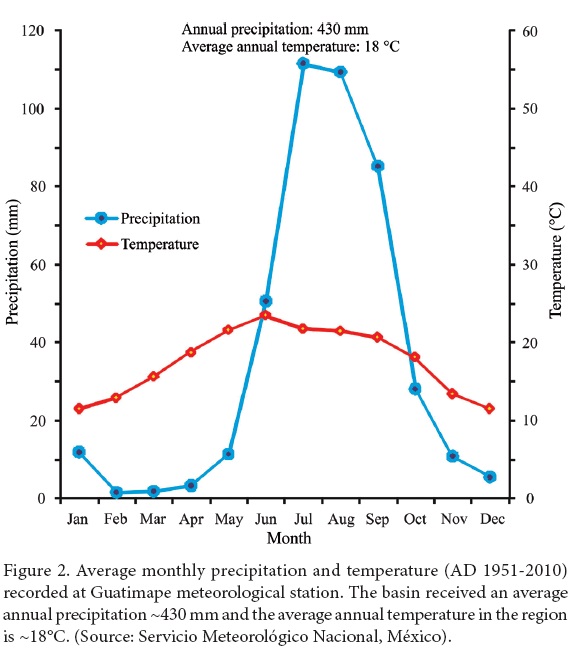
<body><![CDATA[<p align="justify"><font face="verdana" size="2">Subtropical Mexico hosts large parts of Sonora and Chihuahua Deserts. The Santiaguillo basin (24&#186;39'&#150;24&#186;58' N, 104&#186;39'&#150;104&#186;57' W and ~1960 m asl) is located in a NW&#45;SE oriented tectonic basin in the central part of the Chihuahua Desert of Mexico and forms part of the "Basin and Range" sub&#45;province of Sierra Madre Occidental Mountains (<a href="/img/revistas/rmcg/v32n1/a1f1.jpg" target="_blank">Figure 1b</a>). The geology and tectonic evolution of the basin is described by Nieto&#45;Samaniego et al. (2012). The semi&#45;graben was formed between <i>ca.</i>39 and 32 Ma and igneous rocks (rhyolite, ignimbrite and basalt) comprise the geology of the basin. Minor exposures of lacustrine and alluvium deposits and conglomerates are also present in the basin surroundings. The lacustrine basin covers an area of ~2000 km2 and is surrounded in the east and west by ~2500 to 3000 m high hills.</font></p>  	    <p align="justify"><font face="verdana" size="2">The meteorological station at Guatimape (western part of the basin) registered an average annual precipitation of ~430 mm between AD 1951 an 2010 (Servicio Meteorol&oacute;gico Nacional, M&eacute;xico). More than 80% of this annual precipitation occurred during the summer months of June to September as a result of monsoonal circulation and tropical cyclones, whereas the precipitation during winter months of November to March represented less than 10% of the annual rainfall (<a href="#f2">Figure 2</a>). The registered maximum average temperature was ~34&#176;C during June, and minimum temperature reached sub&#45;zero during December&#45;January. According to the classification of K&ouml;ppen, the region represents semi&#45;arid climate with precipitation during the summer (BSk) (Garc&iacute;a, 1973).</font></p>  	    <p align="center"><font face="verdana" size="2"><a name="f2"></a></font></p>  	    <p align="center"><font face="verdana" size="2"><img src="/img/revistas/rmcg/v32n1/a1f2.jpg"></font></p>  	    <p align="justify"><font face="verdana" size="2">&nbsp;</font></p>  	    <p align="justify"><font face="verdana" size="2"><b>MATERIAL AND METHODS</b></font></p>  	    <p align="justify"><font face="verdana" size="2">Sediment samples were collected from two different pits (S1 and S2) at the western margin of the basin (<a href="/img/revistas/rmcg/v32n1/a1f1.jpg" target="_blank">Figure 1b</a>). S1 and S2 pits have depths of 300 cm and 200 cm, respectively (<a href="/img/revistas/rmcg/v32n1/a1f3.jpg" target="_blank">Figure 3</a>). Chronology of the sediment sequence from S1 pit is based on 4 different Accelerator Mass Spectrometry radiocarbon(AMS <sup>14</sup>C) dates on organic carbon present in the bulk sediments. Similarly, the sediment profile of S2 pit is chronologically constrained by 2 different AMS <sup>14</sup>C dates on sediment organic carbon (<a href="/img/revistas/rmcg/v32n1/a1f3.jpg" target="_blank">Figure 3</a>). The <sup>14</sup>C dates were calibrated in Calib 6.0 program using the IntCal09 calibration curve of Reimer et al. (2009) and the values of maximum probability within the 2&#963; range were considered for the reconstruction of age models.</font></p>  	    <p align="justify"><font face="verdana" size="2">A total of 61 samples at an interval of ~5 cm from the S1 pit and 20 different samples at an interval of ~10 cm from S2 pit were processed for the ostracode analysis. Each sample (~10 g) was oven dried and disintegrated by soaking in water for 2&#150;3 days. The samples were washed through two sieves of 74 &#181;m and 177 &#181;m. The sieve residues were oven dried and examined under a Leica stereomicroscope to identify the different species and determine their abundance based on the descriptions provided by Morkhoven (1963), Delorme (1971a, 1971b, 1971c), Forester (1985) and Carre&ntilde;o (1990). Total ostracode abundance in each sample was calculated by adding the number of adult and juvenile valves of all the observed species and is reported as the number of valves in 1 g of dry sediment (valves/g). Adult valves of each species were counted in the dry sediment and presented as relative abundance (in %). The adult valves were extracted and stored in Plummer type microfossil slides. Images of the ostracode valves were taken using a Jeol JSM&#45;5600LV LCM scanning electron microscope.</font></p>  	    <p align="justify"><font face="verdana" size="2">Concentration of total organic carbon (TOC) in the bulk sediments was analyzed in all the samples in a Thermo Scientific HiperTOC solid analyzer after oven drying (50 &#176;C) and powdering the sediments in an agate pestle. Concentration of total carbon (TC) was measured by heating the sample to 980&#176;C and the amount of inorganic carbon (TIC) was measured by acidifying the sediment with 10% H3PO4. Total organic carbon (TOC) content was estimated by subtracting the inorganic carbon (TIC) from total carbon (TC). Concentration of total nitrogen (TN) was measured in 51 samples (31 samples from S1 pit and 20 samples from S2 pit) in a CHNS/O 2400 series II Perkin Elmer elemental analyzer.</font></p>  	    <p align="justify"><font face="verdana" size="2">&nbsp;</font></p>  	    ]]></body>
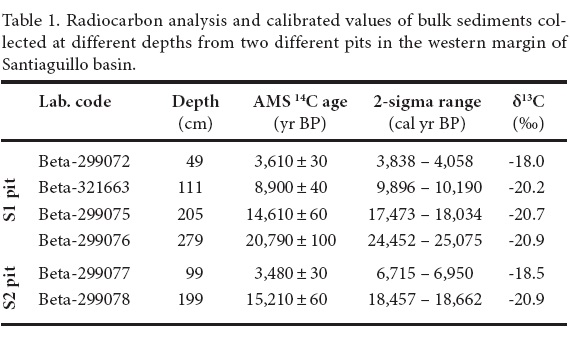
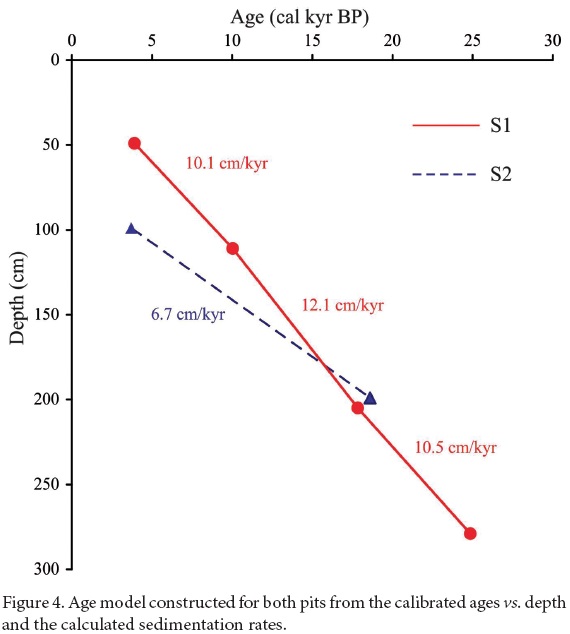
<body><![CDATA[<p align="justify"><font face="verdana" size="2"><b>RESULTS</b></font></p>  	    <p align="justify"><font face="verdana" size="2"><b>Sediment and Chronology</b></font></p>  	    <p align="justify"><font face="verdana" size="2"><a href="/img/revistas/rmcg/v32n1/a1f3.jpg" target="_blank">Figure 3</a> shows the sediment profiles of S1 and S2 pits. Sediments of S1 pit comprise clay and calcareous silt intercalations from 300 to 278 cm depth and massive calcareous silt and silty&#45;sand from 278 to 75 cm depth. Silty&#45;clay and silt intercalations are deposited between 75 and 50 cm. Massive silty&#45;sand with abundant root remnants are present between 50 and 0 cm. Almost 65 cm long vertical desiccation fissures are present at 75 cm depth. In the S2 pit, the sediments are calcareous silt and silty&#45;sand between 200 and 100 cm depth. Almost 10 cm long desiccation fissures were observed at depths of 140 cm and 100 cm. Intercalations of massive silt and silty&#45;clay are present at 100&#150;50 cm and massive silty&#45;sand with abundant root remnants represents the sediments of 50&#150;0 cm depth.</font></p>  	    <p align="justify"><font face="verdana" size="2"><a href="#t1">Table 1</a> presents the <sup>14</sup>C dates and calibrated values in the 2&#963; range. The maximum probability within the 2&#963; range of calibrated age vs. depth plot (<a href="#f4">Figure 4</a>) provides the age models for both profiles. Age model of S1 pit is reconstructed from 4 different radiocarbon dates. The rate of sedimentation varies between 10.1 cm/kyr and 12.1 cm/kyr for sediments deposited during <i>ca.</i> 24.9&#150;3.9 cal kyr BP (279&#150;49 cm). The base of the sequence is assigned an age of <i>ca.</i>27 cal kyr BP by extrapolating the rate of sedimentation (10.5 cm/kyr) calculated between 205 and 279 cm. Sediments between 49 and 205 cm depth are assigned ages by interpolating the sedimentation rates calculated between consecutive <sup>14</sup>C dates. We estimate sedimentation of 12.5 cm/kyr for the upper 49 cm of the sequence by assuming that the surface sediments represent present day. It is similar to the higher side of sedimentation rates calculated for S1 pit. Desiccation fissures at 75 cm depth indicate absence of any water body and dry conditions at the site of S1 pit at <i>ca.</i> 6.5 cal kyr BP.</font></p>  	    <p align="center"><font face="verdana" size="2"><a name="t1"></a></font></p>  	    <p align="center"><font face="verdana" size="2"><img src="/img/revistas/rmcg/v32n1/a1t1.jpg"></font></p> 	    <p align="center"><font face="verdana" size="2"><a name="f4"></a></font></p>         <p align="center"><font face="verdana" size="2"><img src="/img/revistas/rmcg/v32n1/a1f4.jpg"></font></p>  	    <p align="justify"><font face="verdana" size="2">The age model of S2 pit includes 2 different calibrated <sup>14</sup>C dates and assigns <i>ca.</i>19 cal kyr BP to the base. Assuming the surface sediments to represent the present day, a sedimentation rate of 26.7 cm/kyr was estimated for the upper 99 cm of the sequence. Estimated sedimentation rate for upper part of the sediment profile is very different from the sedimentation rate calculated between 199 and 99 cm depths (6.7 cm/kyr). The vertical fissures at 140 cm and 100 cm depths indicate that the site of S2 pit experienced multiple events of desiccation between <i>ca.</i>18.6 and 3.7 cal kyr BP. Lower sedimentation calculated between 199 and 99 cm could be due to the aeolian activity eroding the earlier deposited sediments during the dry intervals and lake desiccation. Due to limitations associated with both the age models, we did not undertake detailed paleoecological reconstruction occurred over last <i>ca.</i>3.9 cal kyr BP in S1 pit and last <i>ca.</i>3.7 cal kyr BP in S2 pit.</font></p>  	    <p align="justify"><font face="verdana" size="2">&nbsp;</font></p>  	    ]]></body>
<body><![CDATA[<p align="justify"><font face="verdana" size="2"><b>Ostracode species assemblages</b></font></p>  	    <p align="justify"><font face="verdana" size="2">The ostracode assemblages comprise 5 species (<a href="/img/revistas/rmcg/v32n1/a1f5.jpg" target="_blank">Figure 5</a>). Except for one, the species were present as adults and juveniles. Low abundance and presence of only juvenile instars of one species precluded an accurate taxonomic identification. The paleoecological inferences are strictly based on the adult counts as the last ostracode moult takes place during the optimal environmental conditions (De Deckker, 2002). Two of the species belong to the genus <i>Limnocythere</i> (<i>L. bradburyi</i> Forester, 1985 and <i>L. ceriotuberosa</i> Delorme, 1967) and the other two are <i>Eucandona cf. patzcuaro</i> Tressler (1954) and <i>Cypridopsis vidua</i> Brady (1868). Most of the shells are well preserved and almost all are covered with authigenically precipitated carbonate minerals. <a href="/img/revistas/rmcg/v32n1/a1f6.jpg" target="_blank">Figures 6</a> and <a href="/img/revistas/rmcg/v32n1/a1f7.jpg" target="_blank">7</a> summarize the total ostracode abundance (valves/g) and the relative abundance of each species (%) in both pits. Based on the variation in total ostracode abundance and relative abundances, S1 profile is divided into 5 different zones and S2 profile is divided into 3 different zones. The zones in both pits have comparable temporal distributions.</font></p>  	    <p align="justify"><font face="verdana" size="2">In the sediments of S1 pit, the total ostracode abundance varies between 0 and 125 valves/g (<a href="/img/revistas/rmcg/v32n1/a1f6.jpg" target="_blank">Figure 6</a>). The juvenile shells are more frequent (up to 102 valves/g) than the adult shells (up to 57 valves/g). <i>L. bradburyi</i> (0&#150;50 valves/g) is the most abundant species and it is followed by <i>E. patzcuaro</i> (0&#150;9 valves/g). Both <i>C. vidua</i> (0&#150;1 valves/g) and <i>L. ceriotuberosa</i> (0&#150;1 valves/g) are the least abundant species. The zones are characterized by different total ostracode abundances and associations.</font></p>  	    <p align="justify"><font face="verdana" size="2">Sediments of zone 5 (300&#150;265 cm, <i>ca.</i> 27&#150;23.5 cal kyr BP) display a total ostracode abundance between 4 and 24 valves/g, and most of them are juveniles (up to 18 valves/g). This zone is characterized by highest species richness (4 species). <i>L. bradburyi</i> and <i>E. patzcuaro</i> constitute 69&#150;100% and up to 31% of the adult ostracodes. Adult shells of <i>L. ceriotuberosa</i> are observed at depths of 299 and 281 cm. Similarly, one adult shell of <i>C. vidua</i> was observed at a depth of 299 cm. Sediments of zone 4 (265&#150;220 cm, <i>ca.</i>23.5&#150;19 cal kyr BP) shows the highest and variable ostracode abundance (8&#150;125 valves/g) and most of them are juveniles (up to 102 valves/g). <i>L. bradburyi</i> and <i>C. patzcuaro</i> constitute 52&#150;92% and up to 47% of the adult ostracodes. <i>C. vidua</i> is present in sediments at depths of 265&#150;225cm. Zone 3 (220&#150;105 cm, <i>ca.</i>19&#150;9.5 cal kyr BP) displays total ostracode abundance between 2 and 113 valves/g. Both adults and juveniles are present in almost equal proportions. <i>L. bradburyi</i> represents 67&#150;100% of the adult shells and <i>E. patzcuaro</i> constitutes up to 33% of the adult ostracodes. Sediments at depths of 185, 165&#150;160 and 125&#150;111 cm contain <i>C. vidua</i>. The depth interval 105&#150;50 cm (<i>ca.</i>9.5&#150;4 cal kyr BP) represents zone 2 and have a total ostracode abundance of 1&#150;15 valves/g. This is monospecific and contains only <i>L. bradburyi</i> (100%). Zone 1 comprises the sediments at depths of 50&#150;0 cm (last <i>ca.</i>4 cal kyr BP) and does not contain ostracodes.</font></p>  	    <p align="justify"><font face="verdana" size="2">The ostracode abundance is lower in the sediments of S2 pit compared to S1. Total ostracode abundance varies between 0 and 38 valves/g (<a href="/img/revistas/rmcg/v32n1/a1f7.jpg" target="_blank">Figure 7</a>). Abundance of adult (up to 17 valves/g) and juvenile shells (up to 19 valves/g) are similar. Sediments of this pit do not contain <i>L. ceriotuberosa</i>, while <i>L. bradburyi</i> (0&#150;17 valves/g) is the most abundant species. The abundances of <i>E. patzcuaro</i> (0&#150;3 valves/g) and <i>C. vidua</i> (0&#150;1 valve/g) are similar.</font></p>  	    <p align="justify"><font face="verdana" size="2">Sediments of zone 3 (200&#150;135 cm, <i>ca.</i>19&#150;9 cal kyr BP) have ostracode abundance of 3&#150;38 valves/g. This zone is characterized by the presence of <i>L. bradburyi, E. patzcuaro</i> and <i>C. vidua. L. bradburyi</i> and <i>E. patzcuaro</i> display relative abundances of 83&#150;100% and of 0&#150;15%, respectively. Adult shells of <i>C. vidua</i> were observed at depths of 200&#150;195 cm and 175&#150;165 cm. Zone 2 (135&#150;85 cm, <i>ca.</i>9&#150;3.5 cal kyr BP) has an ostracode abundance of 3&#150;12 valves/g and is characterized by the absence of <i>C. vidua. L. bradburyi</i> represents 80&#150;100% of the adult shells and <i>E. patzcuaro</i> was observed at depths of 125 cm and 115 cm. Zone 1 comprises sediments deposited at depths of 85&#150;0 cm (last <i>ca.</i>3.5 cal kyr BP) and lacks ostracode valves.</font></p>  	    <p align="justify"><font face="verdana" size="2">&nbsp;</font></p>  	    <p align="justify"><font face="verdana" size="2"><b>Total organic carbon (TOC) and organic carbon/nitrogen (C/N)</b></font></p>  	    <p align="justify"><font face="verdana" size="2">Concentrations of TOC and C/N in bulk sediments from both pits are presented in <a href="/img/revistas/rmcg/v32n1/a1f6.jpg" target="_blank">Figures 6</a> and <a href="/img/revistas/rmcg/v32n1/a1f7.jpg" target="_blank">7</a>. Sediments of S1 pit have TOC of 0.2&#150;1.2%, total nitrogen (TN) of 0.02&#150;0.10% and C/N values between 3.5 and 34 (<a href="/img/revistas/rmcg/v32n1/a1f6.jpg" target="_blank">Figures 6</a>). Sediments rich in TOC generally contained lower number of ostracodes (i.e., 300&#150;255 cm and 50&#150;0 cm). Zones 5 and 4 (<i>ca.</i>27&#150;19 cal kyr BP) have lower and uniform values of C/N (3.5&#150;7). Sediments from zone 3 (<i>ca.</i>19&#150;9.5 cal kyr BP) and zone 2 (<i>ca.</i>9.5&#150;4 cal kyr BP) have higher and variable C/N (7&#150;34). Zone 1 (last <i>ca.</i>4 cal kyr BP) have intermediate C/N values (8&#150;16).</font></p>  	    <p align="justify"><font face="verdana" size="2">Sediments of S2 pit have TOC concentrations of 0&#150;1.0%, total nitrogen contents of 0.09&#150;0.16% and C/N values of 0&#150;10 (<a href="/img/revistas/rmcg/v32n1/a1f7.jpg" target="_blank">Figure 7</a>). TOC abundance is inversely related to total ostracode abundance. Sediments of all the 3 zones have similar values of C/N. Zone 3 (<i>ca.</i>19&#150;9 cal kyr BP) has C/N values between 0 and 10 and zone 2 sediments (<i>ca.</i> 9&#150;3.5 cal kyr BP) are characterized by C/N values of 2&#150;10. Zone 1 sediments (last <i>ca.</i>3.5 cal kyr BP) have C/N values of 1&#150;10.</font></p>  	    ]]></body>
<body><![CDATA[<p align="justify"><font face="verdana" size="2">&nbsp;</font></p>  	    <p align="justify"><font face="verdana" size="2"><b>DISCUSSION</b></font></p>  	    <p align="justify"><font face="verdana" size="2"><b>Paleoecological reconstruction</b></font></p>  	    <p align="justify"><font face="verdana" size="2">Ostracodes preserved in the sediments of Santiaguillo basin tolerate almost similar ranges of temperature (5&#150;32&#176;C) and pH (8&#150;10) (Delorme, 1989; Palacios&#45;Fest, 2007, 2010). It was not possible to reconstruct the water column temperature in the absence of trace element geochemistry of ostracode valves and modern training sets in the area. However, the changing ostracode species assemblages suggest that the water column salinity varied between oligohaline and mesohaline over the last <i>ca.</i> 27 cal kyr BP. The salinity reconstruction is based on the classification proposed by Meisch (2000). Accordingly, the oligohaline waters are characterized by salinity range of 500&#150;5,000 ppm and the mesohaline waters have 5,000&#150;18,000 ppm of salinity. Except for the last <i>ca.</i> 3.5 cal kyr BP, the sediments preserve 4 different ostracode species and <i>L. bradburyi</i> is the most abundant. Forester (1985) identified <i>L. bradburyi</i> in different shallow oligohaline to euhaline lakes from central Mexico. We relate the highest abundance of <i>L. bradburyi</i> to the presence of shallow water bodies at the western margin of Santiaguillo between <i>ca.</i> 27 and 3.5 cal kyr BP. Palacios&#45;Fest (2010) relates the occurrence of <i>E. patzcuaro</i> to intervals of fresh to oligohaline water as a result of increased fresh water inflow into the basin. Similarly, the presence of <i>C. vidua</i> was observed in warm (&gt;13&#176;C) and fresh to oligohaline lakes in southwestern USA (Palacios&#45;Fest, 2010). <i>L. ceriotuberosa</i> tolerates oligohaline to mesohaline conditions in USA and Canada (Delorme, 1971a, 1971b, 1971c; Palacios&#45;Fest, 2007). In the interior plains of Canada, Smith and Delorme (2010) observed that <i>L. ceriotuberosa</i> was present in waters with low dissolved oxygen content (3 mg/L).</font></p>  	    <p align="justify"><font face="verdana" size="2">The paleoecological conditions of Santiaguillo are divided into pre&#45;LGM, LGM and post&#45;LGM. The interpretations are supported by TOC and C/N data. TOC content in bulk sediment reflects the amount of primary productivity (Cohen, 2003) and C/N ratio reflects the contribution of terrestrial vegetation and lacustrine algae on the deposited organic matter (Meyers and Ishiwatari, 1995). Lacustrine algae and terrestrial plants have different contents of nitrogen and the increasing contribution of one of them to the organic matter is reflected by the C/N ratio. Sediment with higher C/N (&gt;10) represents dominant contribution from terrestrial plants and lower C/N (&lt;10) indicates that the organic matter originated from aquatic plants (Talbot and Johannessen, 1992; Meyers and Ishiwatari, 1995; Cohen, 2003).</font></p>  	    <p align="justify"><font face="verdana" size="2">Pre&#45;LGM (<i>ca.</i>27&#150;23.5 cal kyr BP): Sediments of S1 pit (zone 5, 300&#150;265 cm) documented the paleoecological conditions that occurred prior to the last glacial maximum (pre&#45;LGM). The ostracode assemblage suggested presence of shallow water column and oligohaline conditions. Presence of a permanent water body in the western margin of the basin is indicated by lacustrine phytoplankton (C/N&lt;10) dominantly contributing to the organic productivity, as well as the continuous increase in ostracode productivity. Occurrence of both <i>C. vidua</i> and <i>L. ceriotuberosa</i> indicated relatively low salinity at <i>ca.</i>27 cal kyr BP. The absence of <i>C. vidua</i> during rest of the interval suggested a slight increase in salinity in the oligohaline range. <i>L. ceriotuberosa</i> at 299 cm and 281 cm depths represented the intervals of less oxygenated water column (e.g. Smith and Delorme, 2010).</font></p>  	    <p align="justify"><font face="verdana" size="2">LGM (<i>ca.</i>23.5&#150;19 cal kyr BP): Paleoecological condition of the last glacial maximum (LGM) was recorded by the lower part of S1 pit (zone 4, 265&#150;220 cm). Existence of the shallow and permanent water body continued during this interval and the organic productivity was contributed by the lacustrine phytoplankton (i.e. C/N&#8804;10). The ostracode assemblage of <i>L. bradburyi, E. patzcuaro</i> and <i>C. vidua</i> suggested the presence of a warm (&gt;13&#176;C) and more diluted oligohaline water body. Total ostracode abundance was higher at <i>ca.</i>20&#150;19 cal kyr BP (60&#150;125 valves/g) compared to <i>ca.</i>23.5&#150;20 cal kyr BP (8&#150;35 valves/g). The inverse relationship between total ostracode abundance and TOC could be due to the result of ostracode dissolution in an acidic environment formed by the organic carbon decomposition.</font></p>  	    <p align="justify"><font face="verdana" size="2">Post&#45;LGM (last <i>ca.</i>19 cal kyr): Sediments of zone 3 (220&#150;105 cm) and zone 2 (105&#150;50 cm) of S1 pit documented the paleoecological conditions that occurred post the last glacial maximum (post&#45;LGM). This interval was also represented by sediments of zones 3 and 2 (200&#150;85 cm) of S2 pit. Ostracodes of S1 pit represented <i>ca.</i>19&#150;4 cal kyr BP and ostracodes of S2 pit indicated the paleo&#45;hydrochemical characteristics occurred during <i>ca.</i>19&#150;3.5 cal kyr BP. The ostracode assemblages suggested presence of oligohaline to mesohaline water bodies in the western margin.</font></p>  	    <p align="justify"><font face="verdana" size="2">Post <i>ca.</i>19 cal kyr BP, the decreasing abundance of <i>E. patzcuaro</i> and increasing C/N values reflected a shift in the paleoecological conditions. Higher C/N values (&gt;10) indicated that the terrestrial vegetation contributed more to the organic matter as the lacustrine productivity decreased. Gradual reduction in the amount of pluvial discharge into the basin was reflected by the decreasing abundance of <i>E. patzcuaro</i>. More salinity (Na and HCO3&#45;Cl enriched water body) was reflected by an increase in the abundance of <i>L. bradburyi</i> (e.g. Forester, 1985). Absence of both <i>E. patzcuaro</i> and <i>C. vidua</i> in the sediments of <i>ca.</i>13&#150;11.5 cal kyr BP indicated less fresh water inflow into the basin and more salinity (mesohaline) during the Younger Dryas (YD). However, the reappearance of both the species in sediments of the Pleistocene&#45;Holocene transition suggested presence of relatively diluted oligohaline water column. Based on the concentrations of Ti and K in bulk sediments from another core in Santiaguillo, Roy et al. (2014) also identified a humid interval during the Pleistocene&#45;Holocene transition and related it to enhanced summer precipitation in the region. During <i>ca.</i>9.5&#150;4 cal kyr BP, the water body was ephemeral and was possibly present only during the summer months. Ostracode abundance gradually decreased, while the concentration of TOC increased. The occurrence of only <i>L. bradburyi</i> at 111&#150;50 cm depths in S1 pit suggests presence of mesohaline water body in the western margin of the basin. Arid conditions caused enhanced aeolian activity in the surroundings of Santiaguillo during <i>ca.</i> 9.3&#150;4.3 cal kyr BP (Roy <i>et al</i>., 2014a). Similarly, the desiccation fissures at 75 cm depth indicate that the location of S1 pit remained dry for a longer duration at <i>ca.</i>6.5 cal kyr BP.</font></p>  	    <p align="justify"><font face="verdana" size="2">Although both the pits are located in the western margin of the basin, the sediments collected from them have different characteristics. Compared to sediments of S1 pit, the sediments of S2 pit are characterized by lower total ostracode abundance (up to 38 valves/g), C/N relation (&lt;10) and rate of sedimentation (6.7 cm/kyr). Total ostracode abundance (up to 70 valves/g), C/N relation (&gt;10) and sedimentation rate (10.1&#150;12.1 cm/kyr) are higher in sediments of S1 pit. The desiccation fissures at 140 cm and 100 cm depths and lower sedimentation rate suggest that the site of S2 pit experienced multiple events of desiccation and erosion of previously deposited sediments during <i>ca.</i>18.6&#150;3.7 cal kyr BP. The arid intervals might have caused oxidation of organic matter and poor preservation of ostracode valves in S2 pit.</font></p>  	    ]]></body>
<body><![CDATA[<p align="justify"><font face="verdana" size="2">Sediments representing the last <i>ca.</i> 4 cal kyr BP in S1 pit and last <i>ca.</i>3.5 cal kyr BP in S2 pit do not contain ostracodes. Sediments of this interval are relatively coarser (i.e. fine sand) compared to the lower parts (i.e. clay, silt, silty&#45;sand and silty&#45;clay). Over the last <i>ca.</i> 3.5 cal kyr BP, the amount of sediments deposited at the location of S2 pit (99 cm) is almost twice of the sediment deposited at S1 site (&lt;50 cm). This was possibly due to the higher inflow into the site of S2 pit. The difference in the amount of inflow into two different sites in the western margin is also reflected by the C/N values indicating a terrestrial source for the organic matter deposited at S1 pit and lacustrine source for the organic matter deposited at S2 pit.</font></p>  	    <p align="justify"><font face="verdana" size="2">&nbsp;</font></p>  	    <p align="justify"><font face="verdana" size="2"><b>Comparison with regional records</b></font></p>  	    <p align="justify"><font face="verdana" size="2">Comparison of the paleoecological information from Santiaguillo with other paleoclimatic records from northern and northwestern Mexico (see <a href="/img/revistas/rmcg/v32n1/a1f1.jpg" target="_blank">Figure 1a</a> for locations) suggests that the region experienced different climatic and hydrological conditions over the last <i>ca.</i>27 cal kyr BP. Paleohydrological and paleoclimatic information are available from Babicora (Metcalfe <i>et al</i>., 2002; Roy <i>et al</i>., 2012b), El Fresno and Santa Mar&iacute;a (Castiglia and Fawcett, 2006) from Chihuahua, San Felipe (Lozano&#45;Garc&iacute;a<i>et al</i>., 2002; Roy <i>et al</i>., 2010, 2012a) and Chapala (Davis, 2003) from Baja California, Pur&iacute;sima&#45;Iray&#45;Magdalena from Baja California Sur (Murillo de Nava <i>et al</i>., 1999) and Las Cruces from San Luis Potosi (Roy <i>et al</i>., 2013b). Between <i>ca.</i>27 and 19 cal kyr BP, the salinity of Santiaguillo basin was lower compared to the salinity of water column at Babicora. The ostracode species assemblage suggested presence of oligohaline water body at Santiaguillo and oligohaline to mesohaline water bodies at Babicora. Multielement geochemistry of the sediments indicated reduced runoff into Babicora and San Felipe basins (Roy <i>et al</i>., 2010, 2012a, 2012b). During this interval, the vegetation in the surroundings of Babicora comprised Pinus and Picea (Metcalfe <i>et al</i>., 2002) and vegetation in the surroundings of San Felipe basin were Abies, Pinus and Eryngium (Lozano&#45;Garc&iacute;a <i>et al</i>., 2002).</font></p>  	    <p align="justify"><font face="verdana" size="2">Over the last <i>ca.</i>19 cal kyr BP, the runoff into Santiaguillo gradually reduced and the water body became more saline. However, Babicora received more precipitation post <i>ca.</i>18 cal kyr BP (Roy <i>et al</i>., 2013b) and the runoff into San Felipe increased after <i>ca.</i>13 cal kyr BP (Roy <i>et al</i>., 2010). The formation of linear and mega&#45;barchan dunes indicate hot and arid conditions at the Pur&iacute;sima&#45;Iray&#45;Magdalena basin during <i>ca.</i>14&#150;8 kyr BP (Murillo de Nava <i>et al</i>., 1999). During the early to middle Holocene, the Santiaguillo sediments indicated mesohaline conditions (<i>ca.</i>9.5&#150;4 cal kyr BP), enhanced aeolian activity (<i>ca.</i>9.3&#150;4.3 cal kyr BP) and multiple events of desiccation. In general, both Babicora and San Felipe received more runoff over the Holocene. However, Babicora experienced an event of desiccation at <i>ca.</i>3 cal kyr BP and San Felipe sediments documented more aeolian activity at <i>ca.</i>8 cal kyr BP. Laguna El Fresno and Laguna Santa Mar&iacute;a experienced wet conditions and higher lake stands at <i>ca.</i>9.4&#150;9.3 cal kyr BP, <i>ca.</i>7.5&#150;7.2 cal kyr BP and <i>ca.</i>4.9&#150;4.2 cal kyr BP (Castiglia and Fawcett, 2006). The pluvial discharge into Las Cruces was more during <i>ca.</i>8.4&#150;5 cal kyr BP compared to the last <i>ca.</i>5 cal kyr (Roy <i>et al</i>., 2013b). A permanent lake was present in the Chapala basin till <i>ca.</i>8.4 cal kyr BP and dune formation commenced post 7.5 cal kyr BP (Davis, 2003). At Pur&iacute;sima&#45;Iray&#45;Magdalena, the dune activity was stabilized and the present lagoon system was developed at <i>ca.</i>6&#150;5 kyr BP.</font></p>  	    <p align="justify"><font face="verdana" size="2">&nbsp;</font></p>  	    <p align="justify"><font face="verdana" size="2"><b>CONCLUSIONS</b></font></p>  	    <p align="justify"><font face="verdana" size="2">Several multi&#45;proxy studies have attempted to reconstruct the late Pleistocene&#45;Holocene paleoecological and paleoclimatic conditions of subtropical Mexico. However, the information is less from the central and southern parts compared to the northern part. Similarly, ostracodes have received limited attention so far compared to the study of sediment geochemistry and palynology. In the present study, we intend to improve the paleoecological information of the central&#45;southern part of subtropical Mexico by studying the abundances and species associations of 4 different ostracode species in combination with TOC and C/N data in sediments deposited over the last <i>ca.</i>27 cal kyr BP in the Santiaguillo basin. More specifically;</font></p>  	    <p align="justify"><font face="verdana" size="2">Ostracode assemblage consists of 4 species (<i>Limnocythere bradburyi</i>, <i>Eucandona cf. patzcuaro</i>, <i>Cypridopsis vidua</i> and <i>Limnocythere ceriotuberosa</i>) and the highest (125 valves/g) abundance occurred during the LGM.</font></p>  	    <p align="justify"><font face="verdana" size="2">During pre&#45;LGM (<i>ca.</i>27&#150;23.5 cal kyr BP), the western margin of the basin hosted shallow and oligohaline water body and experienced dominant lacustrine productivity. Changes in the abundances of <i>C. vidua</i> and <i>L. ceriotuberosa</i> indicated relatively lower salinity at <i>ca.</i>27 cal kyr BP compared to <i>ca.</i>27&#150;23.5 cal kyr BP.</font></p>  	    ]]></body>
<body><![CDATA[<p align="justify"><font face="verdana" size="2"><i>L. bradburyi, E. patzcuaro</i> and <i>C. vidua</i> suggested presence of warm (&gt;13&#176;C) and more diluted oligohaline water body during the LGM (<i>ca.</i>23.5&#150;19 cal kyr BP).</font></p>  	    <p align="justify"><font face="verdana" size="2">Lower abundance of <i>E. patzcuaro</i> and higher C/N ratio reflected a shift in the paleoecological conditions at <i>ca.</i>19 cal kyr BP. Both the pluvial discharge into the basin and lacustrine productivity decreased. Higher abundance of <i>L. bradburyi</i> suggested that the water column became more saline.</font></p>  	    <p align="justify"><font face="verdana" size="2">The water body was mesohaline during <i>ca.</i>9.5&#150;4 cal kyr BP and the absence of ostracode shells in sediments of last 3.5 cal kyr BP was possibly caused by ephemeral conditions and periodic desiccation.</font></p>  	    <p align="justify"><font face="verdana" size="2">Comparison with other proxy&#45;records from the region suggests that the paleohydrological and paleoclimatic changes occurred over the last <i>ca.</i>27 cal kyr BP in different parts of sub&#45;tropical northern Mexico were not synchronous.</font></p>  	    <p align="justify"><font face="verdana" size="2">&nbsp;</font></p>  	    <p align="justify"><font face="verdana" size="2"><b>ACKNOWLEDGEMENTS</b></font></p>  	    <p align="justify"><font face="verdana" size="2">The data presented in this paper were generated with the financial support from DGAPA&#45;PAPIIT project IN100413. CMCL acknowledges the scholarship from CONACYT for her postgraduate studies. SEM pictures were obtained from the Central Microscopy Laboratory of the Institute of Physics (UNAM). Technical assistance comes from Jos&eacute; Luis S&aacute;nchez Zavala and Nayeli Lopez Balbiaux. Dr. S. Srinivasalu, Fernando Nu&ntilde;ez and David Quiroz participated in the field work. We are thankful to the staff of Her&oacute;ico Cuerpo de Bomberos and Protecci&oacute;n Civil (Durango) for providing assistance and security during the expedition. The comments and suggestions from Angel Baltan&aacute;s and an anonymous reviewer improved the interpretations.</font></p>  	    <p align="justify"><font face="verdana" size="2">&nbsp;</font></p>  	    <p align="justify"><font face="verdana" size="2"><b>REFERENCES</b></font></p>  	    <!-- ref --><p align="justify"><font face="verdana" size="2">Barron, J.A., Metcalfe, S.E., Addison, J.A., 2012, Response of the North American monsoon to regional changes in ocean surface temperature: Paleoceanography, 27, PA3206, doi: 10.1029/2011PA002235.    &nbsp;&nbsp;&nbsp;&nbsp;&nbsp;&nbsp;&nbsp;&nbsp;[&#160;<a href="javascript:void(0);" onclick="javascript: window.open('/scielo.php?script=sci_nlinks&ref=8103574&pid=S1026-8774201500010000100001&lng=','','width=640,height=500,resizable=yes,scrollbars=1,menubar=yes,');">Links</a>&#160;]<!-- end-ref --></font></p>  	    <!-- ref --><p align="justify"><font face="verdana" size="2">Brady, G.S., 1868, A synopsis of the recent british Ostracoda: Intellectual Observer, 12, 110&#45;130.    &nbsp;&nbsp;&nbsp;&nbsp;&nbsp;&nbsp;&nbsp;&nbsp;[&#160;<a href="javascript:void(0);" onclick="javascript: window.open('/scielo.php?script=sci_nlinks&ref=8103576&pid=S1026-8774201500010000100002&lng=','','width=640,height=500,resizable=yes,scrollbars=1,menubar=yes,');">Links</a>&#160;]<!-- end-ref --></font></p>  	    <!-- ref --><p align="justify"><font face="verdana" size="2">Caballero, M., Pe&ntilde;alba, M.C., Mart&iacute;nez, M., Ortega&#45;Guerrero, B., V&aacute;zquez, L., 2005, A Holocene record from a former coastal lagoon in Bah&iacute;a Kino, Gulf of California, Mexico: The Holocene, 15(8), 1236&#45;1244.    &nbsp;&nbsp;&nbsp;&nbsp;&nbsp;&nbsp;&nbsp;&nbsp;[&#160;<a href="javascript:void(0);" onclick="javascript: window.open('/scielo.php?script=sci_nlinks&ref=8103578&pid=S1026-8774201500010000100003&lng=','','width=640,height=500,resizable=yes,scrollbars=1,menubar=yes,');">Links</a>&#160;]<!-- end-ref --></font></p>  	    <!-- ref --><p align="justify"><font face="verdana" size="2">Carre&ntilde;o, A.L., 1990, Ostr&aacute;codos lacustres del paleolago de Texcoco, M&eacute;xico: Revista de la Sociedad Mexicana de Paleontolog&iacute;a, 3(1), 117&#45;129.    &nbsp;&nbsp;&nbsp;&nbsp;&nbsp;&nbsp;&nbsp;&nbsp;[&#160;<a href="javascript:void(0);" onclick="javascript: window.open('/scielo.php?script=sci_nlinks&ref=8103580&pid=S1026-8774201500010000100004&lng=','','width=640,height=500,resizable=yes,scrollbars=1,menubar=yes,');">Links</a>&#160;]<!-- end-ref --></font></p>  	    <!-- ref --><p align="justify"><font face="verdana" size="2">Castiglia, P.J., Fawcett, P.J., 2006, Large Holocene lakes and climate change in the Chihuahuan Desert: Geology, 34(2), 113&#45;116.    &nbsp;&nbsp;&nbsp;&nbsp;&nbsp;&nbsp;&nbsp;&nbsp;[&#160;<a href="javascript:void(0);" onclick="javascript: window.open('/scielo.php?script=sci_nlinks&ref=8103582&pid=S1026-8774201500010000100005&lng=','','width=640,height=500,resizable=yes,scrollbars=1,menubar=yes,');">Links</a>&#160;]<!-- end-ref --></font></p>  	    <!-- ref --><p align="justify"><font face="verdana" size="2">Ch&aacute;vez&#45;Lara, C.M., Roy, P.D., Caballero, M.M., Carre&ntilde;o, A.L., Lakshumanan, C., 2012, Lacustrine ostracodes from the Chihuahuan Desert of Mexico and inferred Late Quaternary paleoecological conditions, Mexico: Revista Mexicana de Ciencias Geol&oacute;gicas, 29(2), 422&#45;431.    &nbsp;&nbsp;&nbsp;&nbsp;&nbsp;&nbsp;&nbsp;&nbsp;[&#160;<a href="javascript:void(0);" onclick="javascript: window.open('/scielo.php?script=sci_nlinks&ref=8103584&pid=S1026-8774201500010000100006&lng=','','width=640,height=500,resizable=yes,scrollbars=1,menubar=yes,');">Links</a>&#160;]<!-- end-ref --></font></p>  	    <!-- ref --><p align="justify"><font face="verdana" size="2">Cohen, S.A., 2003, Paleolimnology: the history and evolution of lake systems, E.U.A.: Oxford University Press, 500 pp.    &nbsp;&nbsp;&nbsp;&nbsp;&nbsp;&nbsp;&nbsp;&nbsp;[&#160;<a href="javascript:void(0);" onclick="javascript: window.open('/scielo.php?script=sci_nlinks&ref=8103586&pid=S1026-8774201500010000100007&lng=','','width=640,height=500,resizable=yes,scrollbars=1,menubar=yes,');">Links</a>&#160;]<!-- end-ref --></font></p>  	    <!-- ref --><p align="justify"><font face="verdana" size="2">COHMAP members, 1988, Climatic change of the past 18,000 years: observations and model simulations: Science, 241, 1043&#45;1052.    &nbsp;&nbsp;&nbsp;&nbsp;&nbsp;&nbsp;&nbsp;&nbsp;[&#160;<a href="javascript:void(0);" onclick="javascript: window.open('/scielo.php?script=sci_nlinks&ref=8103588&pid=S1026-8774201500010000100008&lng=','','width=640,height=500,resizable=yes,scrollbars=1,menubar=yes,');">Links</a>&#160;]<!-- end-ref --></font></p>  	    <!-- ref --><p align="justify"><font face="verdana" size="2">Davis, L.G., 2003, Geoarcheology and geochronology of pluvial Lake Chapala, Baja California, Mexico: Geoarcheology, 18, 205&#45;223.    &nbsp;&nbsp;&nbsp;&nbsp;&nbsp;&nbsp;&nbsp;&nbsp;[&#160;<a href="javascript:void(0);" onclick="javascript: window.open('/scielo.php?script=sci_nlinks&ref=8103590&pid=S1026-8774201500010000100009&lng=','','width=640,height=500,resizable=yes,scrollbars=1,menubar=yes,');">Links</a>&#160;]<!-- end-ref --></font></p>  	    <!-- ref --><p align="justify"><font face="verdana" size="2">De Deckker, P., 2002, Ostracod palaeoecology, <i>in</i> Holmes, J.A., Chivas, A.R. (eds.), The Ostracoda: Applications in Quaternary research: Washington, American Geophysical Union, Geophysical Monograph Series, 131, 121&#45;134.    &nbsp;&nbsp;&nbsp;&nbsp;&nbsp;&nbsp;&nbsp;&nbsp;[&#160;<a href="javascript:void(0);" onclick="javascript: window.open('/scielo.php?script=sci_nlinks&ref=8103592&pid=S1026-8774201500010000100010&lng=','','width=640,height=500,resizable=yes,scrollbars=1,menubar=yes,');">Links</a>&#160;]<!-- end-ref --></font></p>  	    <!-- ref --><p align="justify"><font face="verdana" size="2">Delorme, L.D.., 1967, New freshwater Ostracoda from Saskatchewan, Canada: Canadian Journal of Zoology, 45(3), 357&#45;363, 2 plates.    &nbsp;&nbsp;&nbsp;&nbsp;&nbsp;&nbsp;&nbsp;&nbsp;[&#160;<a href="javascript:void(0);" onclick="javascript: window.open('/scielo.php?script=sci_nlinks&ref=8103594&pid=S1026-8774201500010000100011&lng=','','width=640,height=500,resizable=yes,scrollbars=1,menubar=yes,');">Links</a>&#160;]<!-- end-ref --></font></p>  	    <!-- ref --><p align="justify"><font face="verdana" size="2">Delorme, D.L., 1971a, Freshwater ostracodes of Canada. Part II, Subfamily Cypridopsinae and Herpetocypridinae, and family Cyclocyprididae, Canada: Canadian Journal of Zoology, 48, 253&#45;266.    &nbsp;&nbsp;&nbsp;&nbsp;&nbsp;&nbsp;&nbsp;&nbsp;[&#160;<a href="javascript:void(0);" onclick="javascript: window.open('/scielo.php?script=sci_nlinks&ref=8103596&pid=S1026-8774201500010000100012&lng=','','width=640,height=500,resizable=yes,scrollbars=1,menubar=yes,');">Links</a>&#160;]<!-- end-ref --></font></p>  	    <!-- ref --><p align="justify"><font face="verdana" size="2">Delorme, D.L., 1971b, Freshwater ostracodes of Canada. Part III, Family Candonidae, Canada: Canadian Journal of Zoology, 48, 1099&#45;1127.    &nbsp;&nbsp;&nbsp;&nbsp;&nbsp;&nbsp;&nbsp;&nbsp;[&#160;<a href="javascript:void(0);" onclick="javascript: window.open('/scielo.php?script=sci_nlinks&ref=8103598&pid=S1026-8774201500010000100013&lng=','','width=640,height=500,resizable=yes,scrollbars=1,menubar=yes,');">Links</a>&#160;]<!-- end-ref --></font></p>  	    <!-- ref --><p align="justify"><font face="verdana" size="2">Delorme, D.L., 1971c, Freshwater ostracodes of Canada. Part V, Families Limnocytheridae, Loxoconchidae, Canada: Canadian Journal of Zoology, 49, 43&#45;64.    &nbsp;&nbsp;&nbsp;&nbsp;&nbsp;&nbsp;&nbsp;&nbsp;[&#160;<a href="javascript:void(0);" onclick="javascript: window.open('/scielo.php?script=sci_nlinks&ref=8103600&pid=S1026-8774201500010000100014&lng=','','width=640,height=500,resizable=yes,scrollbars=1,menubar=yes,');">Links</a>&#160;]<!-- end-ref --></font></p>  	    <!-- ref --><p align="justify"><font face="verdana" size="2">Delorme, D.L., 1989, Methods <i>in</i> Quaternary ecology #7: Freshwater ostracodes, Canada: Geoscience Canada, 16, 85&#45;90.    &nbsp;&nbsp;&nbsp;&nbsp;&nbsp;&nbsp;&nbsp;&nbsp;[&#160;<a href="javascript:void(0);" onclick="javascript: window.open('/scielo.php?script=sci_nlinks&ref=8103602&pid=S1026-8774201500010000100015&lng=','','width=640,height=500,resizable=yes,scrollbars=1,menubar=yes,');">Links</a>&#160;]<!-- end-ref --></font></p>  	    <!-- ref --><p align="justify"><font face="verdana" size="2">Forester, R.M., 1985, <i>Limnocythere bradburyi</i> n. sp.: a modern ostracode from central Mexico and a possible Quaternary paleoclimatic indicator: Journal of Paleontology, 59(1), 8&#45;20.    &nbsp;&nbsp;&nbsp;&nbsp;&nbsp;&nbsp;&nbsp;&nbsp;[&#160;<a href="javascript:void(0);" onclick="javascript: window.open('/scielo.php?script=sci_nlinks&ref=8103604&pid=S1026-8774201500010000100016&lng=','','width=640,height=500,resizable=yes,scrollbars=1,menubar=yes,');">Links</a>&#160;]<!-- end-ref --></font></p>  	    <!-- ref --><p align="justify"><font face="verdana" size="2">Forester, R.M., 1986, Determination of the dissolved anion composition of ancient lakes from fossil ostracodes: Geology, 14(9), 796&#45;799.    &nbsp;&nbsp;&nbsp;&nbsp;&nbsp;&nbsp;&nbsp;&nbsp;[&#160;<a href="javascript:void(0);" onclick="javascript: window.open('/scielo.php?script=sci_nlinks&ref=8103606&pid=S1026-8774201500010000100017&lng=','','width=640,height=500,resizable=yes,scrollbars=1,menubar=yes,');">Links</a>&#160;]<!-- end-ref --></font></p>  	    <p align="justify"><font face="verdana" size="2">Garc&iacute;a, A.E., 1973, Modificaciones al Sistema de Clasificaci&oacute;n Clim&aacute;tica de K&ouml;ppen: M&eacute;xico,, Universidad Nacional Aut&oacute;noma de M&eacute;xico, D.F.,Bolet&iacute;n del Instituto de Geograf&iacute;a, 246 pp.</font></p>  	    <!-- ref --><p align="justify"><font face="verdana" size="2">Holmgren, C.A., Pe&ntilde;alba, M.C., Rylander, K.A., Betancourt, J.L., 2003, A 16,000 <sup>14</sup>C yr B.P. packrat midden series from the USA&#45;Mexico Borderlands: Quaternary Research, 60, 319&#45;329.    &nbsp;&nbsp;&nbsp;&nbsp;&nbsp;&nbsp;&nbsp;&nbsp;[&#160;<a href="javascript:void(0);" onclick="javascript: window.open('/scielo.php?script=sci_nlinks&ref=8103609&pid=S1026-8774201500010000100018&lng=','','width=640,height=500,resizable=yes,scrollbars=1,menubar=yes,');">Links</a>&#160;]<!-- end-ref --></font></p>  	    <!-- ref --><p align="justify"><font face="verdana" size="2">Holmgren, C.A., Norris, J., Betancourt, J.L., 2007, Inferences about winter temperatures and summer rains from the late Quaternary record of C4 perennial grasses and C3 desert shrubs in the northern Chihuahuan Desert: Journal of Quaternary Science, 22(2), 141&#45;161.    &nbsp;&nbsp;&nbsp;&nbsp;&nbsp;&nbsp;&nbsp;&nbsp;[&#160;<a href="javascript:void(0);" onclick="javascript: window.open('/scielo.php?script=sci_nlinks&ref=8103611&pid=S1026-8774201500010000100019&lng=','','width=640,height=500,resizable=yes,scrollbars=1,menubar=yes,');">Links</a>&#160;]<!-- end-ref --></font></p>  	    <!-- ref --><p align="justify"><font face="verdana" size="2">Kirby, M.E., Lund, S.P., Bird, B.W., 2006, Mid&#45;Wisconsin sediment record from Baldwing Lake reveals hemispheric climate dynamics (Southern CA, USA): Palaeogeography, Palaeoclimatology, Palaeoecology, 241, 267&#45;283.    &nbsp;&nbsp;&nbsp;&nbsp;&nbsp;&nbsp;&nbsp;&nbsp;[&#160;<a href="javascript:void(0);" onclick="javascript: window.open('/scielo.php?script=sci_nlinks&ref=8103613&pid=S1026-8774201500010000100020&lng=','','width=640,height=500,resizable=yes,scrollbars=1,menubar=yes,');">Links</a>&#160;]<!-- end-ref --></font></p>  	    ]]></body>
<body><![CDATA[<!-- ref --><p align="justify"><font face="verdana" size="2">Kutzbach, J.E., Wright, H.E., 1985, Simulation of the climate of 18,000 yr B.P.: Results for North America/North Atlantic/European Sector: Quaternary Science Reviews, 4, 147&#45;187.    &nbsp;&nbsp;&nbsp;&nbsp;&nbsp;&nbsp;&nbsp;&nbsp;[&#160;<a href="javascript:void(0);" onclick="javascript: window.open('/scielo.php?script=sci_nlinks&ref=8103615&pid=S1026-8774201500010000100021&lng=','','width=640,height=500,resizable=yes,scrollbars=1,menubar=yes,');">Links</a>&#160;]<!-- end-ref --></font></p>  	    <!-- ref --><p align="justify"><font face="verdana" size="2">Kutzbach, J., Gallimore, R., Harrison, S., Behling, P., Selin, R., Laarif, F., 1998, Climate and biome simulations for the past 21,000 yr: Quaternary Science Reviews, 17, 473&#45;506.    &nbsp;&nbsp;&nbsp;&nbsp;&nbsp;&nbsp;&nbsp;&nbsp;[&#160;<a href="javascript:void(0);" onclick="javascript: window.open('/scielo.php?script=sci_nlinks&ref=8103617&pid=S1026-8774201500010000100022&lng=','','width=640,height=500,resizable=yes,scrollbars=1,menubar=yes,');">Links</a>&#160;]<!-- end-ref --></font></p>  	    <!-- ref --><p align="justify"><font face="verdana" size="2">Lozano&#45;Garc&iacute;a, M.S., Ortega&#45;Guerrero, B., Sosa&#45;N&aacute;jera, S., 2002, Mid to Late Wisconsin pollen record of San Felipe basin, Baja California: Quaternary Research, 58, 84&#45;92.    &nbsp;&nbsp;&nbsp;&nbsp;&nbsp;&nbsp;&nbsp;&nbsp;[&#160;<a href="javascript:void(0);" onclick="javascript: window.open('/scielo.php?script=sci_nlinks&ref=8103619&pid=S1026-8774201500010000100023&lng=','','width=640,height=500,resizable=yes,scrollbars=1,menubar=yes,');">Links</a>&#160;]<!-- end-ref --></font></p>  	    <!-- ref --><p align="justify"><font face="verdana" size="2">Manabe, S., Broccoli, A.J., 1985, The influence of continental ice sheet on the climate of an ice age: Journal of Geophysical Research, 90, 2167&#45;2190.    &nbsp;&nbsp;&nbsp;&nbsp;&nbsp;&nbsp;&nbsp;&nbsp;[&#160;<a href="javascript:void(0);" onclick="javascript: window.open('/scielo.php?script=sci_nlinks&ref=8103621&pid=S1026-8774201500010000100024&lng=','','width=640,height=500,resizable=yes,scrollbars=1,menubar=yes,');">Links</a>&#160;]<!-- end-ref --></font></p>  	    <!-- ref --><p align="justify"><font face="verdana" size="2">Meisch, C., 2000, Freshwater Ostracoda of western and central Europe, <i>in</i> Schwoerbel, J. Zwick, P. (eds), S&uuml;&#223;wasserfauna von Mitteleuropa 8(3): Spektrum Akademischer Verlag GmbH, Heidelberg, Berlin, 1&#45;522.    &nbsp;&nbsp;&nbsp;&nbsp;&nbsp;&nbsp;&nbsp;&nbsp;[&#160;<a href="javascript:void(0);" onclick="javascript: window.open('/scielo.php?script=sci_nlinks&ref=8103623&pid=S1026-8774201500010000100025&lng=','','width=640,height=500,resizable=yes,scrollbars=1,menubar=yes,');">Links</a>&#160;]<!-- end-ref --></font></p>  	    ]]></body>
<body><![CDATA[<!-- ref --><p align="justify"><font face="verdana" size="2">Metcalfe, S.E., Bimpson, A., Courtice, A.J., O'Hara, S.L. and Taylor, D.M., 1997, Climate change at the monsson/ Westerly boundary in Northern Mexico: Journal of Paleolimnology, 17, 155&#45;171.    &nbsp;&nbsp;&nbsp;&nbsp;&nbsp;&nbsp;&nbsp;&nbsp;[&#160;<a href="javascript:void(0);" onclick="javascript: window.open('/scielo.php?script=sci_nlinks&ref=8103625&pid=S1026-8774201500010000100026&lng=','','width=640,height=500,resizable=yes,scrollbars=1,menubar=yes,');">Links</a>&#160;]<!-- end-ref --></font></p>  	    <!-- ref --><p align="justify"><font face="verdana" size="2">Metcalfe, S.E., Say, A., Black, S., McCulloch, R. O'Hara, S., 2002, Wet Conditions Turing the Last Glaciation in the Chihuahuan Desert, Alta Babicora basin, Mexico: Quaternary Research, 57, 91&#45;101.    &nbsp;&nbsp;&nbsp;&nbsp;&nbsp;&nbsp;&nbsp;&nbsp;[&#160;<a href="javascript:void(0);" onclick="javascript: window.open('/scielo.php?script=sci_nlinks&ref=8103627&pid=S1026-8774201500010000100027&lng=','','width=640,height=500,resizable=yes,scrollbars=1,menubar=yes,');">Links</a>&#160;]<!-- end-ref --></font></p>  	    <!-- ref --><p align="justify"><font face="verdana" size="2">Meyers, P.A, Ishiwatari, R., 1995, Organic matter accumulation records in lake sediments, <i>in</i> Lerman, A., Imboden, D., Gat J. (eds.) New York: Physics and Chemistry of Lakes: Springer&#45;Verlag, 279&#45;328.    &nbsp;&nbsp;&nbsp;&nbsp;&nbsp;&nbsp;&nbsp;&nbsp;[&#160;<a href="javascript:void(0);" onclick="javascript: window.open('/scielo.php?script=sci_nlinks&ref=8103629&pid=S1026-8774201500010000100028&lng=','','width=640,height=500,resizable=yes,scrollbars=1,menubar=yes,');">Links</a>&#160;]<!-- end-ref --></font></p>  	    <!-- ref --><p align="justify"><font face="verdana" size="2">Morkhoven, F.V., 1963, Post&#45;palaeozoic Ostracoda: Their Morphology, Taxonomy, and Economic Use Vol. II, Generic Descriptions: Elsevier, 478 pp.    &nbsp;&nbsp;&nbsp;&nbsp;&nbsp;&nbsp;&nbsp;&nbsp;[&#160;<a href="javascript:void(0);" onclick="javascript: window.open('/scielo.php?script=sci_nlinks&ref=8103631&pid=S1026-8774201500010000100029&lng=','','width=640,height=500,resizable=yes,scrollbars=1,menubar=yes,');">Links</a>&#160;]<!-- end-ref --></font></p>  	    <!-- ref --><p align="justify"><font face="verdana" size="2">Murillo de Nava, J.M., Gorsline, D.S., Goodfriend, G.A., Vlasov, V.K., Cruz&#45;Orozco, R., 1999, Evidence of Holocene climatic changes from aeolian deposits in Baja California Sur, Mexico: Quaternary International, 56, 141&#45;154.    &nbsp;&nbsp;&nbsp;&nbsp;&nbsp;&nbsp;&nbsp;&nbsp;[&#160;<a href="javascript:void(0);" onclick="javascript: window.open('/scielo.php?script=sci_nlinks&ref=8103633&pid=S1026-8774201500010000100030&lng=','','width=640,height=500,resizable=yes,scrollbars=1,menubar=yes,');">Links</a>&#160;]<!-- end-ref --></font></p>  	    ]]></body>
<body><![CDATA[<!-- ref --><p align="justify"><font face="verdana" size="2">Nieto&#45;Samaniego, A.F., Barajas&#45;Gea, C.I., G&oacute;mez&#45;Gonz&aacute;lez, J.M., Rojas, A., Alaniz&#45;&Aacute;lvarez, S.A., Xu, S., 2012, Geolog&iacute;a, evoluci&oacute;n estructural (Eoceno al actual) y eventos s&iacute;smicos del Graben de Santiaguillo, Durango, M&eacute;xico: Revista Mexicana de Ciencias Geol&oacute;gicas, 19(1), 115&#45;130.    &nbsp;&nbsp;&nbsp;&nbsp;&nbsp;&nbsp;&nbsp;&nbsp;[&#160;<a href="javascript:void(0);" onclick="javascript: window.open('/scielo.php?script=sci_nlinks&ref=8103635&pid=S1026-8774201500010000100031&lng=','','width=640,height=500,resizable=yes,scrollbars=1,menubar=yes,');">Links</a>&#160;]<!-- end-ref --></font></p>  	    <!-- ref --><p align="justify"><font face="verdana" size="2">Ortega&#45;Guerrero, B., Caballero Miranda, M., Lozano Garc&iacute;a, S., De la O Villanueva, M., 1999, Palaeoenvironmental record of the last 70 000 yr in San Felipe basin, Sonora desert, Mexico: preliminary results, M&eacute;xico: Geof&iacute;sica Internacional, 38(3), 1&#45;11.    &nbsp;&nbsp;&nbsp;&nbsp;&nbsp;&nbsp;&nbsp;&nbsp;[&#160;<a href="javascript:void(0);" onclick="javascript: window.open('/scielo.php?script=sci_nlinks&ref=8103637&pid=S1026-8774201500010000100032&lng=','','width=640,height=500,resizable=yes,scrollbars=1,menubar=yes,');">Links</a>&#160;]<!-- end-ref --></font></p>  	    <!-- ref --><p align="justify"><font face="verdana" size="2">Ortega&#45;Rosas, C.I., Pe&ntilde;alba, M.C., Guiot, J., 2008, Holocene altitudinal shifts in vegetation belts and environmental changes in the Sierra Madre Occidental, northwestern Mexico, based on modern and fossil data: Review of Palaeobotany and Palynology, 151, 1&#45;20.    &nbsp;&nbsp;&nbsp;&nbsp;&nbsp;&nbsp;&nbsp;&nbsp;[&#160;<a href="javascript:void(0);" onclick="javascript: window.open('/scielo.php?script=sci_nlinks&ref=8103639&pid=S1026-8774201500010000100033&lng=','','width=640,height=500,resizable=yes,scrollbars=1,menubar=yes,');">Links</a>&#160;]<!-- end-ref --></font></p>  	    <!-- ref --><p align="justify"><font face="verdana" size="2">Palacios&#45;Fest, M.R., 2007, Superfamily Cytheroidea: an assisting tool for identifying ostracode species and their basic ecological requirements: Terra Nostra Earth Sciences Research, LLC and California State University, Poster available online <i>in</i> <a href="http://www.docstoc.com/docs/117353499" target="_blank">www.docstoc.com/docs/117353499</a> and CSUB Department of Physics and Geology.    &nbsp;&nbsp;&nbsp;&nbsp;&nbsp;&nbsp;&nbsp;&nbsp;[&#160;<a href="javascript:void(0);" onclick="javascript: window.open('/scielo.php?script=sci_nlinks&ref=8103641&pid=S1026-8774201500010000100034&lng=','','width=640,height=500,resizable=yes,scrollbars=1,menubar=yes,');">Links</a>&#160;]<!-- end-ref --></font></p>  	    <!-- ref --><p align="justify"><font face="verdana" size="2">Palacios&#45;Fest, M.R., 2010, Late Holocene Paleoenvironmental History of the Upper West Amarillo Creek Valley at Archaeological Site 41PT185/C, Texas, USA, M&eacute;xico: Bolet&iacute;n de la Sociedad Geol&oacute;gica Mexicana, 62(3), 399&#45;436.    &nbsp;&nbsp;&nbsp;&nbsp;&nbsp;&nbsp;&nbsp;&nbsp;[&#160;<a href="javascript:void(0);" onclick="javascript: window.open('/scielo.php?script=sci_nlinks&ref=8103643&pid=S1026-8774201500010000100035&lng=','','width=640,height=500,resizable=yes,scrollbars=1,menubar=yes,');">Links</a>&#160;]<!-- end-ref --></font></p>  	    ]]></body>
<body><![CDATA[<!-- ref --><p align="justify"><font face="verdana" size="2">Palacios&#45;Fest, M.R., Carre&ntilde;o, A.L., Ortega&#45;Ram&iacute;rez, J.R., Alvarado&#45;Vald&eacute;z, G., 2002, A paleoenvironmental reconstruction of Laguna Bab&iacute;cora, Chihuahua, Mexico based on ostracode paleoecology and trace element shell chemistry: Journal of Paleolimnology, 27(2), 185&#45;206.    &nbsp;&nbsp;&nbsp;&nbsp;&nbsp;&nbsp;&nbsp;&nbsp;[&#160;<a href="javascript:void(0);" onclick="javascript: window.open('/scielo.php?script=sci_nlinks&ref=8103645&pid=S1026-8774201500010000100036&lng=','','width=640,height=500,resizable=yes,scrollbars=1,menubar=yes,');">Links</a>&#160;]<!-- end-ref --></font></p>  	    <!-- ref --><p align="justify"><font face="verdana" size="2">P&eacute;rez, L., Lorenschat, J., Massaferro, J., Pailles, C., Sylvestre, F., Hollwedel, W., Brandorff, G.O., Brenner, M., Islebe, G., Lozano, M.S. , Scharf, B., Schwalb, A., 2013, Bioindicators of climate and trophic state in lowland and highland aquatic ecosystems of the northern Neotropics: Revista de Biolog&iacute;a Tropical, 61(2), 603&#45;644.    &nbsp;&nbsp;&nbsp;&nbsp;&nbsp;&nbsp;&nbsp;&nbsp;[&#160;<a href="javascript:void(0);" onclick="javascript: window.open('/scielo.php?script=sci_nlinks&ref=8103647&pid=S1026-8774201500010000100037&lng=','','width=640,height=500,resizable=yes,scrollbars=1,menubar=yes,');">Links</a>&#160;]<!-- end-ref --></font></p>  	    <!-- ref --><p align="justify"><font face="verdana" size="2">Reimer, P.J., Baillie, M.G.L., Bard, E., Bayliss, A., Beck, J.W., Blackwell, P.G., Bronk Ramsey, C., Buck, C.E., Burr, G.S., Edwards, R.L., Friedrich, M., Grootes, P.M., Guilderson, T.P., Hajdas, I., Heaton, T.J., Hogg, A.G., Hughen, K.A., Kaiser, K.F., Kromer, B., McCormac, G., Reimer, R.W., Richards, D.A., Southon, J.R., Talamo, S., Turney, C.S.M., van der Plicht, J., Weyhenmeyer, C., 2009, IntCal09 and Marine09 radiocarbon age calibration curves, 0&#45;50,000 years cal BP: Radiocarbon, 51, 1111&#45;1150.    &nbsp;&nbsp;&nbsp;&nbsp;&nbsp;&nbsp;&nbsp;&nbsp;[&#160;<a href="javascript:void(0);" onclick="javascript: window.open('/scielo.php?script=sci_nlinks&ref=8103649&pid=S1026-8774201500010000100038&lng=','','width=640,height=500,resizable=yes,scrollbars=1,menubar=yes,');">Links</a>&#160;]<!-- end-ref --></font></p>  	    <!-- ref --><p align="justify"><font face="verdana" size="2">Roy, P.D., Caballero, M., Lozano, R., Ortega, B., Lozano, S., Pi, T., Morton, O., 2010, Geochemical record of Late Quaternary paleoclimate from lacustrine sediments of paleo&#45;lake San Felipe, western Sonora Desert, Mexico: Journal of South American Earth Sciences, 29(3), 586&#45;596.    &nbsp;&nbsp;&nbsp;&nbsp;&nbsp;&nbsp;&nbsp;&nbsp;[&#160;<a href="javascript:void(0);" onclick="javascript: window.open('/scielo.php?script=sci_nlinks&ref=8103651&pid=S1026-8774201500010000100039&lng=','','width=640,height=500,resizable=yes,scrollbars=1,menubar=yes,');">Links</a>&#160;]<!-- end-ref --></font></p>  	    <!-- ref --><p align="justify"><font face="verdana" size="2">Roy, P.D., Caballero, M., Lozano, S., Morton, O., Lozano, R., Jonathan, M.P., S&aacute;nchez, J.L., Mac&iacute;as, M.C., 2012a, Provenance of sediments deposited at paleolake San Felipe, western Sonora Desert: implications to regimes of summer and winter precipitation during last 50 cal kyr BP: Journal of Arid Environments, 81, 47&#45;58.    &nbsp;&nbsp;&nbsp;&nbsp;&nbsp;&nbsp;&nbsp;&nbsp;[&#160;<a href="javascript:void(0);" onclick="javascript: window.open('/scielo.php?script=sci_nlinks&ref=8103653&pid=S1026-8774201500010000100040&lng=','','width=640,height=500,resizable=yes,scrollbars=1,menubar=yes,');">Links</a>&#160;]<!-- end-ref --></font></p>  	    ]]></body>
<body><![CDATA[<!-- ref --><p align="justify"><font face="verdana" size="2">Roy, P.D., Jonathan, M.P., P&eacute;rez&#45;Cruz, L.L., S&aacute;nchez&#45;C&oacute;rdoba, M.M., Quiroz&#45;Jim&eacute;nez, J.D., Romero, F.M., 2012b, A millennial&#45;scale late Pleistocene&#45;Holocene palaeoclimatic resgister from western Chihuahua Desert, Mexico: Boreas, 41, 707&#45;717.    &nbsp;&nbsp;&nbsp;&nbsp;&nbsp;&nbsp;&nbsp;&nbsp;[&#160;<a href="javascript:void(0);" onclick="javascript: window.open('/scielo.php?script=sci_nlinks&ref=8103655&pid=S1026-8774201500010000100041&lng=','','width=640,height=500,resizable=yes,scrollbars=1,menubar=yes,');">Links</a>&#160;]<!-- end-ref --></font></p>  	    <!-- ref --><p align="justify"><font face="verdana" size="2">Roy, P.D., Quiroz&#45;Jim&eacute;nez, J.D., P&eacute;rez&#45;Cruz, L.L., Lozano&#45;Garc&iacute;a, S., Metcalfe, S.E., Lozano&#45;Santacruz, R., L&oacute;pez&#45;Balbiaux, N., S&aacute;nchez&#45;Zavala, J.L., Romero, F.M., 2013a, Late Quaternary palaeohydrological conditions in the dry lands of northern Mexico: a summer precipitation proxy record of the last 80 cal kyr BP: Quaternary Science Reviews, 78, 342&#45;354.    &nbsp;&nbsp;&nbsp;&nbsp;&nbsp;&nbsp;&nbsp;&nbsp;[&#160;<a href="javascript:void(0);" onclick="javascript: window.open('/scielo.php?script=sci_nlinks&ref=8103657&pid=S1026-8774201500010000100042&lng=','','width=640,height=500,resizable=yes,scrollbars=1,menubar=yes,');">Links</a>&#160;]<!-- end-ref --></font></p>  	    <!-- ref --><p align="justify"><font face="verdana" size="2">Roy, P.D., Rivero&#45;Navarette, A., Lopez&#45;Balbiaux, N., P&eacute;rez&#45;Cruz, L.L., Metcalfe, S.E., Muthu Sankar, G., S&aacute;nchez&#45;Zavala, J.L., 2013b, A record of Holocene summer&#45;season palaeohydrological changes from the southern margin of Chihuahua Desert (Mexico) and possible forcings: The Holocene, 23, 1105&#45;1114.    &nbsp;&nbsp;&nbsp;&nbsp;&nbsp;&nbsp;&nbsp;&nbsp;[&#160;<a href="javascript:void(0);" onclick="javascript: window.open('/scielo.php?script=sci_nlinks&ref=8103659&pid=S1026-8774201500010000100043&lng=','','width=640,height=500,resizable=yes,scrollbars=1,menubar=yes,');">Links</a>&#160;]<!-- end-ref --></font></p>  	    <!-- ref --><p align="justify"><font face="verdana" size="2">Roy, P.D., Quiroz&#45;Jim&eacute;nez, J.D., Ch&aacute;vez&#45;Lara, C.M., S&aacute;nchez&#45;Zavala, J.L., P&eacute;rez&#45;Cruz, L.L., Muthu Sankar, G., 2014a, Humid Pleistocene&#45;Holocene transition at sub&#45;tropical northern Mexico and possible Gulf of California forcing: Boreas, 43, 577&#45;587.    &nbsp;&nbsp;&nbsp;&nbsp;&nbsp;&nbsp;&nbsp;&nbsp;[&#160;<a href="javascript:void(0);" onclick="javascript: window.open('/scielo.php?script=sci_nlinks&ref=8103661&pid=S1026-8774201500010000100044&lng=','','width=640,height=500,resizable=yes,scrollbars=1,menubar=yes,');">Links</a>&#160;]<!-- end-ref --></font></p>  	    <!-- ref --><p align="justify"><font face="verdana" size="2">Roy, P.D., Charles&#45;Polo, M.P., L&oacute;pez&#45;Balbiaux, N., Pi&#45;Puig, T., MuthuSankar, G., Lozano&#45;Santacruz, R., Lozano&#45;Garc&iacute;a, S., Romero, F.M., 2014b, Last glacial hydrological variations at the southernmargin of sub&#45;tropical North America and a regional Comparison: Journal of Quaternary Science, 29(5), 495&#45;505.    &nbsp;&nbsp;&nbsp;&nbsp;&nbsp;&nbsp;&nbsp;&nbsp;[&#160;<a href="javascript:void(0);" onclick="javascript: window.open('/scielo.php?script=sci_nlinks&ref=8103663&pid=S1026-8774201500010000100045&lng=','','width=640,height=500,resizable=yes,scrollbars=1,menubar=yes,');">Links</a>&#160;]<!-- end-ref --></font></p>  	    ]]></body>
<body><![CDATA[<!-- ref --><p align="justify"><font face="verdana" size="2">Servicio Meteorol&oacute;gico Nacional (SMN), M&eacute;xico. Estaci&oacute;n 10137 Guatimape (DGE) (24&#176;48'25" N., 104&#176;55'19" W., 1,974.0 msnm). Normales Climatol&oacute;gicas 1951&#45;2010. &lt;<a href="http://smn.cna.gob.mx/climatologia/Normales5110/NORMAL10137.TXT" target="_blank">http://smn.cna.gob.mx/climatologia/Normales5110/NORMAL10137.TXT</a>&gt;, August, 2012</font>&nbsp;&nbsp;&nbsp;&nbsp;&nbsp;&nbsp;&nbsp;&nbsp;[&#160;<a href="javascript:void(0);" onclick="javascript: window.open('/scielo.php?script=sci_nlinks&ref=8103665&pid=S1026-8774201500010000100046&lng=','','width=640,height=500,resizable=yes,scrollbars=1,menubar=yes,');">Links</a>&#160;]<!-- end-ref --><!-- ref --><p align="justify"><font face="verdana" size="2">Smith, A.J., Delorme, L.D., 2010, Chapter 19, Ostracoda, <i>in</i> Thorp J.H., Covich A.P. (eds.) Ecology and Classification of North American Freshwater Invertebrates: London, Academic Press, 725&#45;772.    &nbsp;&nbsp;&nbsp;&nbsp;&nbsp;&nbsp;&nbsp;&nbsp;[&#160;<a href="javascript:void(0);" onclick="javascript: window.open('/scielo.php?script=sci_nlinks&ref=8103666&pid=S1026-8774201500010000100047&lng=','','width=640,height=500,resizable=yes,scrollbars=1,menubar=yes,');">Links</a>&#160;]<!-- end-ref --></font></p>  	    <!-- ref --><p align="justify"><font face="verdana" size="2">Talbot, M.R., Johannessen, T., 1992, A high resolution palaeoclimatic record for the last 27,500 years in tropical West Africa from the carbon and nitrogen isotopic composition of lacustrine organic matter: Earth and Planetary Science Letters, 110(1), 23&#45;37.    &nbsp;&nbsp;&nbsp;&nbsp;&nbsp;&nbsp;&nbsp;&nbsp;[&#160;<a href="javascript:void(0);" onclick="javascript: window.open('/scielo.php?script=sci_nlinks&ref=8103668&pid=S1026-8774201500010000100048&lng=','','width=640,height=500,resizable=yes,scrollbars=1,menubar=yes,');">Links</a>&#160;]<!-- end-ref --></font></p>  	    <!-- ref --><p align="justify"><font face="verdana" size="2">Thompson, R.S., Anderson, K.H., 2000, Biomes of western North America at 18,000, 6,000 and 0 14Cyr BP reconstructed from pollen and packrat midden data: Journal of Biogeography, 27, 555&#45;584.    &nbsp;&nbsp;&nbsp;&nbsp;&nbsp;&nbsp;&nbsp;&nbsp;[&#160;<a href="javascript:void(0);" onclick="javascript: window.open('/scielo.php?script=sci_nlinks&ref=8103670&pid=S1026-8774201500010000100049&lng=','','width=640,height=500,resizable=yes,scrollbars=1,menubar=yes,');">Links</a>&#160;]<!-- end-ref --></font></p>  	    <!-- ref --><p align="justify"><font face="verdana" size="2">Tressler, W.L., 1954, Fresh&#45;water Ostracoda from Texas and Mexico: Journal of the Washington Academy of Science, 44, 138&#45;149.    &nbsp;&nbsp;&nbsp;&nbsp;&nbsp;&nbsp;&nbsp;&nbsp;[&#160;<a href="javascript:void(0);" onclick="javascript: window.open('/scielo.php?script=sci_nlinks&ref=8103672&pid=S1026-8774201500010000100050&lng=','','width=640,height=500,resizable=yes,scrollbars=1,menubar=yes,');">Links</a>&#160;]<!-- end-ref --></font></p>  	    <!-- ref --><p align="justify"><font face="verdana" size="2">Turpen, J.B., Angell, R.W., 1971, Aspects of molting and calcification in the ostracod Heterocypris: The Biological Bulletin, 140(2), 331&#45;338.    &nbsp;&nbsp;&nbsp;&nbsp;&nbsp;&nbsp;&nbsp;&nbsp;[&#160;<a href="javascript:void(0);" onclick="javascript: window.open('/scielo.php?script=sci_nlinks&ref=8103674&pid=S1026-8774201500010000100051&lng=','','width=640,height=500,resizable=yes,scrollbars=1,menubar=yes,');">Links</a>&#160;]<!-- end-ref --></font></p>  	    <!-- ref --><p align="justify"><font face="verdana" size="2">Urrutia&#45;Fucugauchi, J., Ortega&#45;Ramirez, J., Cruz&#45;Gatica, R., 1997, Rock magnetic study of late Pleistocene&#45;Holocene sediments from the Babicora lacustrine basin, Chihuahua northern Mexico: Geof&iacute;sica Internacional, 10, 77&#45;86.    &nbsp;&nbsp;&nbsp;&nbsp;&nbsp;&nbsp;&nbsp;&nbsp;[&#160;<a href="javascript:void(0);" onclick="javascript: window.open('/scielo.php?script=sci_nlinks&ref=8103676&pid=S1026-8774201500010000100052&lng=','','width=640,height=500,resizable=yes,scrollbars=1,menubar=yes,');">Links</a>&#160;]<!-- end-ref --></font></p>      ]]></body><back>
<ref-list>
<ref id="B1">
<nlm-citation citation-type="journal">
<person-group person-group-type="author">
<name>
<surname><![CDATA[Barron]]></surname>
<given-names><![CDATA[J.A.]]></given-names>
</name>
<name>
<surname><![CDATA[Metcalfe]]></surname>
<given-names><![CDATA[S.E.]]></given-names>
</name>
<name>
<surname><![CDATA[Addison]]></surname>
<given-names><![CDATA[J.A.]]></given-names>
</name>
</person-group>
<article-title xml:lang="en"><![CDATA[Response of the North American monsoon to regional changes in ocean surface temperature]]></article-title>
<source><![CDATA[Paleoceanography]]></source>
<year>2012</year>
<volume>27</volume>
</nlm-citation>
</ref>
<ref id="B2">
<nlm-citation citation-type="journal">
<person-group person-group-type="author">
<name>
<surname><![CDATA[Brady]]></surname>
<given-names><![CDATA[G.S.]]></given-names>
</name>
</person-group>
<article-title xml:lang="en"><![CDATA[A synopsis of the recent british Ostracoda]]></article-title>
<source><![CDATA[Intellectual Observer]]></source>
<year>1868</year>
<volume>12</volume>
<page-range>110-130</page-range></nlm-citation>
</ref>
<ref id="B3">
<nlm-citation citation-type="journal">
<person-group person-group-type="author">
<name>
<surname><![CDATA[Caballero]]></surname>
<given-names><![CDATA[M.]]></given-names>
</name>
<name>
<surname><![CDATA[Peñalba]]></surname>
<given-names><![CDATA[M.C.]]></given-names>
</name>
<name>
<surname><![CDATA[Martínez]]></surname>
<given-names><![CDATA[M.]]></given-names>
</name>
<name>
<surname><![CDATA[Ortega-Guerrero]]></surname>
<given-names><![CDATA[B.]]></given-names>
</name>
<name>
<surname><![CDATA[Vázquez]]></surname>
<given-names><![CDATA[L.]]></given-names>
</name>
</person-group>
<article-title xml:lang="en"><![CDATA[A Holocene record from a former coastal lagoon in Bahía Kino, Gulf of California, Mexico]]></article-title>
<source><![CDATA[The Holocene]]></source>
<year>2005</year>
<volume>15</volume>
<numero>8</numero>
<issue>8</issue>
<page-range>1236-1244</page-range></nlm-citation>
</ref>
<ref id="B4">
<nlm-citation citation-type="journal">
<person-group person-group-type="author">
<name>
<surname><![CDATA[Carreño]]></surname>
<given-names><![CDATA[A.L.]]></given-names>
</name>
</person-group>
<article-title xml:lang="es"><![CDATA[Ostrácodos lacustres del paleolago de Texcoco, México]]></article-title>
<source><![CDATA[Revista de la Sociedad Mexicana de Paleontología]]></source>
<year>1990</year>
<volume>3</volume>
<numero>1</numero>
<issue>1</issue>
<page-range>117-129</page-range></nlm-citation>
</ref>
<ref id="B5">
<nlm-citation citation-type="journal">
<person-group person-group-type="author">
<name>
<surname><![CDATA[Castiglia]]></surname>
<given-names><![CDATA[P.J.]]></given-names>
</name>
<name>
<surname><![CDATA[Fawcett]]></surname>
<given-names><![CDATA[P.J.]]></given-names>
</name>
</person-group>
<article-title xml:lang="en"><![CDATA[Large Holocene lakes and climate change in the Chihuahuan Desert]]></article-title>
<source><![CDATA[Geology]]></source>
<year>2006</year>
<volume>34</volume>
<numero>2</numero>
<issue>2</issue>
<page-range>113-116</page-range></nlm-citation>
</ref>
<ref id="B6">
<nlm-citation citation-type="journal">
<person-group person-group-type="author">
<name>
<surname><![CDATA[Chávez-Lara]]></surname>
<given-names><![CDATA[C.M.]]></given-names>
</name>
<name>
<surname><![CDATA[Roy]]></surname>
<given-names><![CDATA[P.D.]]></given-names>
</name>
<name>
<surname><![CDATA[Caballero]]></surname>
<given-names><![CDATA[M.M.]]></given-names>
</name>
<name>
<surname><![CDATA[Carreño]]></surname>
<given-names><![CDATA[A.L.]]></given-names>
</name>
<name>
<surname><![CDATA[Lakshumanan]]></surname>
<given-names><![CDATA[C.]]></given-names>
</name>
</person-group>
<article-title xml:lang="en"><![CDATA[Lacustrine ostracodes from the Chihuahuan Desert of Mexico and inferred Late Quaternary paleoecological conditions, Mexico]]></article-title>
<source><![CDATA[Revista Mexicana de Ciencias Geológicas]]></source>
<year>2012</year>
<volume>29</volume><volume>2</volume>
<page-range>422-431</page-range></nlm-citation>
</ref>
<ref id="B7">
<nlm-citation citation-type="book">
<person-group person-group-type="author">
<name>
<surname><![CDATA[Cohen]]></surname>
<given-names><![CDATA[S.A.]]></given-names>
</name>
</person-group>
<source><![CDATA[Paleolimnology: the history and evolution of lake systems]]></source>
<year>2003</year>
<page-range>500</page-range><publisher-name><![CDATA[Oxford University Press]]></publisher-name>
</nlm-citation>
</ref>
<ref id="B8">
<nlm-citation citation-type="journal">
<collab>COHMAP</collab>
<article-title xml:lang="en"><![CDATA[Climatic change of the past 18,000 years: observations and model simulations]]></article-title>
<source><![CDATA[Science]]></source>
<year>1988</year>
<volume>241</volume>
<page-range>1043-1052</page-range></nlm-citation>
</ref>
<ref id="B9">
<nlm-citation citation-type="journal">
<person-group person-group-type="author">
<name>
<surname><![CDATA[Davis]]></surname>
<given-names><![CDATA[L.G.]]></given-names>
</name>
</person-group>
<article-title xml:lang="es"><![CDATA[Geoarcheology and geochronology of pluvial Lake Chapala, Baja California, Mexico]]></article-title>
<source><![CDATA[Geoarcheology]]></source>
<year>2003</year>
<volume>18</volume>
<page-range>205-223</page-range></nlm-citation>
</ref>
<ref id="B10">
<nlm-citation citation-type="book">
<person-group person-group-type="author">
<name>
<surname><![CDATA[De Deckker]]></surname>
<given-names><![CDATA[P.]]></given-names>
</name>
</person-group>
<article-title xml:lang="en"><![CDATA[Ostracod palaeoecology]]></article-title>
<person-group person-group-type="editor">
<name>
<surname><![CDATA[Holmes]]></surname>
<given-names><![CDATA[J.A.]]></given-names>
</name>
<name>
<surname><![CDATA[Chivas]]></surname>
<given-names><![CDATA[A.R.]]></given-names>
</name>
</person-group>
<source><![CDATA[The Ostracoda: Applications in Quaternary research]]></source>
<year>2002</year>
<page-range>121-134</page-range><publisher-loc><![CDATA[^eWashington Washington]]></publisher-loc>
<publisher-name><![CDATA[American Geophysical Union]]></publisher-name>
</nlm-citation>
</ref>
<ref id="B11">
<nlm-citation citation-type="journal">
<person-group person-group-type="author">
<name>
<surname><![CDATA[Delorme]]></surname>
<given-names><![CDATA[L.D.]]></given-names>
</name>
</person-group>
<article-title xml:lang="en"><![CDATA[New freshwater Ostracoda from Saskatchewan, Canada]]></article-title>
<source><![CDATA[Canadian Journal of Zoology]]></source>
<year>1967</year>
<volume>45</volume>
<numero>3</numero>
<issue>3</issue>
<page-range>357-363</page-range></nlm-citation>
</ref>
<ref id="B12">
<nlm-citation citation-type="journal">
<person-group person-group-type="author">
<name>
<surname><![CDATA[Delorme]]></surname>
<given-names><![CDATA[D.L.]]></given-names>
</name>
</person-group>
<article-title xml:lang="en"><![CDATA[Freshwater ostracodes of Canada. Part II, Subfamily Cypridopsinae and Herpetocypridinae, and family Cyclocyprididae, Canada]]></article-title>
<source><![CDATA[Canadian Journal of Zoology]]></source>
<year>1971</year>
<volume>48</volume>
<page-range>253-266</page-range></nlm-citation>
</ref>
<ref id="B13">
<nlm-citation citation-type="journal">
<person-group person-group-type="author">
<name>
<surname><![CDATA[Delorme]]></surname>
<given-names><![CDATA[D.L.]]></given-names>
</name>
</person-group>
<article-title xml:lang="en"><![CDATA[Freshwater ostracodes of Canada. Part III, Family Candonidae, Canada]]></article-title>
<source><![CDATA[Canadian Journal of Zoology]]></source>
<year>1971</year>
<volume>48</volume>
<page-range>1099-1127</page-range></nlm-citation>
</ref>
<ref id="B14">
<nlm-citation citation-type="journal">
<person-group person-group-type="author">
<name>
<surname><![CDATA[Delorme]]></surname>
<given-names><![CDATA[D.L.]]></given-names>
</name>
</person-group>
<article-title xml:lang="en"><![CDATA[Freshwater ostracodes of Canada. Part V, Families Limnocytheridae, Loxoconchidae, Canada]]></article-title>
<source><![CDATA[Canadian Journal of Zoology]]></source>
<year>1971</year>
<volume>49</volume>
<page-range>43-64</page-range></nlm-citation>
</ref>
<ref id="B15">
<nlm-citation citation-type="journal">
<person-group person-group-type="author">
<name>
<surname><![CDATA[Delorme]]></surname>
<given-names><![CDATA[D.L.]]></given-names>
</name>
</person-group>
<article-title xml:lang="en"><![CDATA[Methods in Quaternary ecology #7: Freshwater ostracodes, Canada]]></article-title>
<source><![CDATA[Geoscience Canada]]></source>
<year>1989</year>
<volume>16</volume>
<page-range>85-90</page-range></nlm-citation>
</ref>
<ref id="B16">
<nlm-citation citation-type="journal">
<person-group person-group-type="author">
<name>
<surname><![CDATA[Forester]]></surname>
<given-names><![CDATA[R.M.]]></given-names>
</name>
</person-group>
<article-title xml:lang="en"><![CDATA[Limnocythere bradburyi n. sp.: a modern ostracode from central Mexico and a possible Quaternary paleoclimatic indicator]]></article-title>
<source><![CDATA[Journal of Paleontology]]></source>
<year>1985</year>
<volume>59</volume>
<numero>1</numero>
<issue>1</issue>
<page-range>8-20</page-range></nlm-citation>
</ref>
<ref id="B17">
<nlm-citation citation-type="journal">
<person-group person-group-type="author">
<name>
<surname><![CDATA[Forester]]></surname>
<given-names><![CDATA[R.M.]]></given-names>
</name>
</person-group>
<article-title xml:lang="en"><![CDATA[Determination of the dissolved anion composition of ancient lakes from fossil ostracodes]]></article-title>
<source><![CDATA[Geology]]></source>
<year>1986</year>
<volume>14</volume>
<numero>9</numero>
<issue>9</issue>
<page-range>796-799</page-range></nlm-citation>
</ref>
<ref id="B18">
<nlm-citation citation-type="journal">
<person-group person-group-type="author">
<name>
<surname><![CDATA[Holmgren]]></surname>
<given-names><![CDATA[C.A.]]></given-names>
</name>
<name>
<surname><![CDATA[Peñalba]]></surname>
<given-names><![CDATA[M.C.]]></given-names>
</name>
<name>
<surname><![CDATA[Rylander]]></surname>
<given-names><![CDATA[K.A.]]></given-names>
</name>
<name>
<surname><![CDATA[Betancourt]]></surname>
<given-names><![CDATA[J.L.]]></given-names>
</name>
</person-group>
<article-title xml:lang="en"><![CDATA[A 16,000 14C yr B.P. packrat midden series from the USA-Mexico Borderlands]]></article-title>
<source><![CDATA[Quaternary Research]]></source>
<year>2003</year>
<volume>60</volume>
<page-range>319-329</page-range></nlm-citation>
</ref>
<ref id="B19">
<nlm-citation citation-type="journal">
<person-group person-group-type="author">
<name>
<surname><![CDATA[Holmgren]]></surname>
<given-names><![CDATA[C.A.]]></given-names>
</name>
<name>
<surname><![CDATA[Norris]]></surname>
<given-names><![CDATA[J.]]></given-names>
</name>
<name>
<surname><![CDATA[Betancourt]]></surname>
<given-names><![CDATA[J.L.]]></given-names>
</name>
</person-group>
<article-title xml:lang="en"><![CDATA[Inferences about winter temperatures and summer rains from the late Quaternary record of C4 perennial grasses and C3 desert shrubs in the northern Chihuahuan Desert]]></article-title>
<source><![CDATA[Journal of Quaternary Science]]></source>
<year>2007</year>
<volume>22</volume>
<numero>2</numero>
<issue>2</issue>
<page-range>141-161</page-range></nlm-citation>
</ref>
<ref id="B20">
<nlm-citation citation-type="journal">
<person-group person-group-type="author">
<name>
<surname><![CDATA[Kirby]]></surname>
<given-names><![CDATA[M.E.]]></given-names>
</name>
<name>
<surname><![CDATA[Lund]]></surname>
<given-names><![CDATA[S.P.]]></given-names>
</name>
<name>
<surname><![CDATA[Bird]]></surname>
<given-names><![CDATA[B.W.]]></given-names>
</name>
</person-group>
<article-title xml:lang="en"><![CDATA[Mid-Wisconsin sediment record from Baldwing Lake reveals hemispheric climate dynamics (Southern CA, USA)]]></article-title>
<source><![CDATA[Palaeogeography, Palaeoclimatology, Palaeoecology]]></source>
<year>2006</year>
<volume>241</volume>
<page-range>267-283</page-range></nlm-citation>
</ref>
<ref id="B21">
<nlm-citation citation-type="journal">
<person-group person-group-type="author">
<name>
<surname><![CDATA[Kutzbach]]></surname>
<given-names><![CDATA[J.E.]]></given-names>
</name>
<name>
<surname><![CDATA[Wright]]></surname>
<given-names><![CDATA[H.E.]]></given-names>
</name>
</person-group>
<article-title xml:lang="en"><![CDATA[Simulation of the climate of 18,000 yr B.P.: Results for North America/North Atlantic/European Sector]]></article-title>
<source><![CDATA[Quaternary Science Reviews]]></source>
<year>1985</year>
<volume>4</volume>
<page-range>147-187</page-range></nlm-citation>
</ref>
<ref id="B22">
<nlm-citation citation-type="journal">
<person-group person-group-type="author">
<name>
<surname><![CDATA[Kutzbach]]></surname>
<given-names><![CDATA[J.]]></given-names>
</name>
<name>
<surname><![CDATA[Gallimore]]></surname>
<given-names><![CDATA[R.]]></given-names>
</name>
<name>
<surname><![CDATA[Harrison]]></surname>
<given-names><![CDATA[S.]]></given-names>
</name>
<name>
<surname><![CDATA[Behling]]></surname>
<given-names><![CDATA[P.]]></given-names>
</name>
<name>
<surname><![CDATA[Selin]]></surname>
<given-names><![CDATA[R.]]></given-names>
</name>
<name>
<surname><![CDATA[Laarif]]></surname>
<given-names><![CDATA[F.]]></given-names>
</name>
</person-group>
<article-title xml:lang="en"><![CDATA[Climate and biome simulations for the past 21,000 yr]]></article-title>
<source><![CDATA[Quaternary Science Reviews]]></source>
<year>1998</year>
<volume>17</volume>
<page-range>473-506</page-range></nlm-citation>
</ref>
<ref id="B23">
<nlm-citation citation-type="journal">
<person-group person-group-type="author">
<name>
<surname><![CDATA[Lozano-García]]></surname>
<given-names><![CDATA[M.S.]]></given-names>
</name>
<name>
<surname><![CDATA[Ortega-Guerrero]]></surname>
<given-names><![CDATA[B.]]></given-names>
</name>
<name>
<surname><![CDATA[Sosa-Nájera]]></surname>
<given-names><![CDATA[S.]]></given-names>
</name>
</person-group>
<article-title xml:lang="en"><![CDATA[Mid to Late Wisconsin pollen record of San Felipe basin, Baja California]]></article-title>
<source><![CDATA[Quaternary Research]]></source>
<year>2002</year>
<volume>58</volume>
<page-range>84-92</page-range></nlm-citation>
</ref>
<ref id="B24">
<nlm-citation citation-type="journal">
<person-group person-group-type="author">
<name>
<surname><![CDATA[Manabe]]></surname>
<given-names><![CDATA[S.]]></given-names>
</name>
<name>
<surname><![CDATA[Broccoli]]></surname>
<given-names><![CDATA[A.J.]]></given-names>
</name>
</person-group>
<article-title xml:lang="en"><![CDATA[The influence of continental ice sheet on the climate of an ice age]]></article-title>
<source><![CDATA[Journal of Geophysical Research]]></source>
<year>1985</year>
<volume>90</volume>
<page-range>2167-2190</page-range></nlm-citation>
</ref>
<ref id="B25">
<nlm-citation citation-type="book">
<person-group person-group-type="author">
<name>
<surname><![CDATA[Meisch]]></surname>
<given-names><![CDATA[C.]]></given-names>
</name>
</person-group>
<article-title xml:lang="en"><![CDATA[Freshwater Ostracoda of western and central Europe]]></article-title>
<person-group person-group-type="editor">
<name>
<surname><![CDATA[Schwoerbel]]></surname>
<given-names><![CDATA[J.]]></given-names>
</name>
<name>
<surname><![CDATA[Zwick]]></surname>
<given-names><![CDATA[P.]]></given-names>
</name>
</person-group>
<source><![CDATA[Süßwasserfauna von Mitteleuropa]]></source>
<year>2000</year>
<page-range>1-522</page-range><publisher-loc><![CDATA[HeidelbergBerlin ]]></publisher-loc>
<publisher-name><![CDATA[Spektrum Akademischer Verlag GmbH]]></publisher-name>
</nlm-citation>
</ref>
<ref id="B26">
<nlm-citation citation-type="journal">
<person-group person-group-type="author">
<name>
<surname><![CDATA[Metcalfe]]></surname>
<given-names><![CDATA[S.E.]]></given-names>
</name>
<name>
<surname><![CDATA[Bimpson]]></surname>
<given-names><![CDATA[A.]]></given-names>
</name>
<name>
<surname><![CDATA[Courtice]]></surname>
<given-names><![CDATA[A.J.]]></given-names>
</name>
<name>
<surname><![CDATA[O'Hara]]></surname>
<given-names><![CDATA[S.L.]]></given-names>
</name>
<name>
<surname><![CDATA[Taylor]]></surname>
<given-names><![CDATA[D.M.]]></given-names>
</name>
</person-group>
<article-title xml:lang="en"><![CDATA[Climate change at the monsson/ Westerly boundary in Northern Mexico]]></article-title>
<source><![CDATA[Journal of Paleolimnology]]></source>
<year>1997</year>
<volume>17</volume>
<page-range>155-171</page-range></nlm-citation>
</ref>
<ref id="B27">
<nlm-citation citation-type="journal">
<person-group person-group-type="author">
<name>
<surname><![CDATA[Metcalfe]]></surname>
<given-names><![CDATA[S.E.]]></given-names>
</name>
<name>
<surname><![CDATA[Say]]></surname>
<given-names><![CDATA[A.]]></given-names>
</name>
<name>
<surname><![CDATA[Black]]></surname>
<given-names><![CDATA[S.]]></given-names>
</name>
<name>
<surname><![CDATA[McCulloch]]></surname>
<given-names><![CDATA[R.]]></given-names>
</name>
<name>
<surname><![CDATA[O'Hara]]></surname>
<given-names><![CDATA[S.]]></given-names>
</name>
</person-group>
<article-title xml:lang="en"><![CDATA[Wet Conditions Turing the Last Glaciation in the Chihuahuan Desert, Alta Babicora basin, Mexico]]></article-title>
<source><![CDATA[Quaternary Research]]></source>
<year>2002</year>
<volume>57</volume>
<page-range>91-101</page-range></nlm-citation>
</ref>
<ref id="B28">
<nlm-citation citation-type="book">
<person-group person-group-type="author">
<name>
<surname><![CDATA[Meyers]]></surname>
<given-names><![CDATA[P.A]]></given-names>
</name>
<name>
<surname><![CDATA[Ishiwatari]]></surname>
<given-names><![CDATA[R.]]></given-names>
</name>
</person-group>
<article-title xml:lang="en"><![CDATA[Organic matter accumulation records in lake sediments]]></article-title>
<person-group person-group-type="editor">
<name>
<surname><![CDATA[Lerman]]></surname>
<given-names><![CDATA[A.]]></given-names>
</name>
<name>
<surname><![CDATA[Imboden]]></surname>
<given-names><![CDATA[D.]]></given-names>
</name>
<name>
<surname><![CDATA[Gat]]></surname>
<given-names><![CDATA[J.]]></given-names>
</name>
</person-group>
<source><![CDATA[Physics and Chemistry of Lakes]]></source>
<year>1995</year>
<page-range>279-328</page-range><publisher-loc><![CDATA[New York ]]></publisher-loc>
<publisher-name><![CDATA[Springer-Verlag]]></publisher-name>
</nlm-citation>
</ref>
<ref id="B29">
<nlm-citation citation-type="book">
<person-group person-group-type="author">
<name>
<surname><![CDATA[Morkhoven]]></surname>
<given-names><![CDATA[F.V.]]></given-names>
</name>
</person-group>
<source><![CDATA[Post-palaeozoic Ostracoda: Their Morphology, Taxonomy, and Economic Use Vol. II, Generic Descriptions]]></source>
<year>1963</year>
<page-range>478</page-range><publisher-name><![CDATA[Elsevier]]></publisher-name>
</nlm-citation>
</ref>
<ref id="B30">
<nlm-citation citation-type="journal">
<person-group person-group-type="author">
<name>
<surname><![CDATA[Murillo de Nava]]></surname>
<given-names><![CDATA[J.M.]]></given-names>
</name>
<name>
<surname><![CDATA[Gorsline]]></surname>
<given-names><![CDATA[D.S.]]></given-names>
</name>
<name>
<surname><![CDATA[Goodfriend]]></surname>
<given-names><![CDATA[G.A.]]></given-names>
</name>
<name>
<surname><![CDATA[Vlasov]]></surname>
<given-names><![CDATA[V.K.]]></given-names>
</name>
<name>
<surname><![CDATA[Cruz-Orozco]]></surname>
<given-names><![CDATA[R.]]></given-names>
</name>
</person-group>
<article-title xml:lang="en"><![CDATA[Evidence of Holocene climatic changes from aeolian deposits in Baja California Sur, Mexico]]></article-title>
<source><![CDATA[Quaternary International]]></source>
<year>1999</year>
<volume>56</volume>
<page-range>141-154</page-range></nlm-citation>
</ref>
<ref id="B31">
<nlm-citation citation-type="journal">
<person-group person-group-type="author">
<name>
<surname><![CDATA[Nieto-Samaniego]]></surname>
<given-names><![CDATA[A.F.]]></given-names>
</name>
<name>
<surname><![CDATA[Barajas-Gea]]></surname>
<given-names><![CDATA[C.I.]]></given-names>
</name>
<name>
<surname><![CDATA[Gómez-González]]></surname>
<given-names><![CDATA[J.M.]]></given-names>
</name>
<name>
<surname><![CDATA[Rojas]]></surname>
<given-names><![CDATA[A.]]></given-names>
</name>
<name>
<surname><![CDATA[Alaniz-Álvarez]]></surname>
<given-names><![CDATA[S.A.]]></given-names>
</name>
<name>
<surname><![CDATA[Xu]]></surname>
<given-names><![CDATA[S.]]></given-names>
</name>
</person-group>
<article-title xml:lang="es"><![CDATA[Geología, evolución estructural (Eoceno al actual) y eventos sísmicos del Graben de Santiaguillo, Durango, México]]></article-title>
<source><![CDATA[Revista Mexicana de Ciencias Geológicas]]></source>
<year>2012</year>
<volume>19</volume>
<numero>1</numero>
<issue>1</issue>
<page-range>115-130</page-range></nlm-citation>
</ref>
<ref id="B32">
<nlm-citation citation-type="journal">
<person-group person-group-type="author">
<name>
<surname><![CDATA[Ortega-Guerrero]]></surname>
<given-names><![CDATA[B.]]></given-names>
</name>
<name>
<surname><![CDATA[Caballero Miranda]]></surname>
<given-names><![CDATA[M.]]></given-names>
</name>
<name>
<surname><![CDATA[Lozano García]]></surname>
<given-names><![CDATA[S.]]></given-names>
</name>
<name>
<surname><![CDATA[De la O Villanueva]]></surname>
<given-names><![CDATA[M.]]></given-names>
</name>
</person-group>
<article-title xml:lang="en"><![CDATA[Palaeoenvironmental record of the last 70 000 yr in San Felipe basin, Sonora desert, Mexico: preliminary results, México]]></article-title>
<source><![CDATA[Geofísica Internacional]]></source>
<year>1999</year>
<volume>38</volume>
<numero>3</numero>
<issue>3</issue>
<page-range>1-11</page-range></nlm-citation>
</ref>
<ref id="B33">
<nlm-citation citation-type="journal">
<person-group person-group-type="author">
<name>
<surname><![CDATA[Ortega-Rosas]]></surname>
<given-names><![CDATA[C.I.]]></given-names>
</name>
<name>
<surname><![CDATA[Peñalba]]></surname>
<given-names><![CDATA[M.C.]]></given-names>
</name>
<name>
<surname><![CDATA[Guiot]]></surname>
<given-names><![CDATA[J.]]></given-names>
</name>
</person-group>
<article-title xml:lang="en"><![CDATA[Holocene altitudinal shifts in vegetation belts and environmental changes in the Sierra Madre Occidental, northwestern Mexico, based on modern and fossil data]]></article-title>
<source><![CDATA[Review of Palaeobotany and Palynology]]></source>
<year>2008</year>
<volume>151</volume>
<page-range>1-20</page-range></nlm-citation>
</ref>
<ref id="B34">
<nlm-citation citation-type="book">
<person-group person-group-type="author">
<name>
<surname><![CDATA[Palacios-Fest]]></surname>
<given-names><![CDATA[M.R.]]></given-names>
</name>
</person-group>
<source><![CDATA[Superfamily Cytheroidea: an assisting tool for identifying ostracode species and their basic ecological requirements]]></source>
<year>2007</year>
<publisher-name><![CDATA[Terra Nostra Earth Sciences ResearchLLC and California State UniversityCSUB Department of Physics and Geology]]></publisher-name>
</nlm-citation>
</ref>
<ref id="B35">
<nlm-citation citation-type="journal">
<person-group person-group-type="author">
<name>
<surname><![CDATA[Palacios-Fest]]></surname>
<given-names><![CDATA[M.R.]]></given-names>
</name>
</person-group>
<article-title xml:lang="en"><![CDATA[Late Holocene Paleoenvironmental History of the Upper West Amarillo Creek Valley at Archaeological Site 41PT185/C, Texas, USA, México]]></article-title>
<source><![CDATA[Boletín de la Sociedad Geológica Mexicana]]></source>
<year>2010</year>
<volume>62</volume>
<numero>3</numero>
<issue>3</issue>
<page-range>399-436</page-range></nlm-citation>
</ref>
<ref id="B36">
<nlm-citation citation-type="journal">
<person-group person-group-type="author">
<name>
<surname><![CDATA[Palacios-Fest]]></surname>
<given-names><![CDATA[M.R.]]></given-names>
</name>
<name>
<surname><![CDATA[Carreño]]></surname>
<given-names><![CDATA[A.L.]]></given-names>
</name>
<name>
<surname><![CDATA[Ortega-Ramírez]]></surname>
<given-names><![CDATA[J.R.]]></given-names>
</name>
<name>
<surname><![CDATA[Alvarado-Valdéz]]></surname>
<given-names><![CDATA[G.]]></given-names>
</name>
</person-group>
<article-title xml:lang="en"><![CDATA[A paleoenvironmental reconstruction of Laguna Babícora, Chihuahua, Mexico based on ostracode paleoecology and trace element shell chemistry]]></article-title>
<source><![CDATA[Journal of Paleolimnology]]></source>
<year>2002</year>
<volume>27</volume>
<numero>2</numero>
<issue>2</issue>
<page-range>185-206</page-range></nlm-citation>
</ref>
<ref id="B37">
<nlm-citation citation-type="journal">
<person-group person-group-type="author">
<name>
<surname><![CDATA[Pérez]]></surname>
<given-names><![CDATA[L.]]></given-names>
</name>
<name>
<surname><![CDATA[Lorenschat]]></surname>
<given-names><![CDATA[J.]]></given-names>
</name>
<name>
<surname><![CDATA[Massaferro]]></surname>
<given-names><![CDATA[J.]]></given-names>
</name>
<name>
<surname><![CDATA[Pailles]]></surname>
<given-names><![CDATA[C.]]></given-names>
</name>
<name>
<surname><![CDATA[Sylvestre]]></surname>
<given-names><![CDATA[F.]]></given-names>
</name>
<name>
<surname><![CDATA[Hollwedel]]></surname>
<given-names><![CDATA[W.]]></given-names>
</name>
<name>
<surname><![CDATA[Brandorff]]></surname>
<given-names><![CDATA[G.O.]]></given-names>
</name>
<name>
<surname><![CDATA[Brenner]]></surname>
<given-names><![CDATA[M.]]></given-names>
</name>
<name>
<surname><![CDATA[Islebe]]></surname>
<given-names><![CDATA[G.]]></given-names>
</name>
<name>
<surname><![CDATA[Lozano]]></surname>
<given-names><![CDATA[M.S.]]></given-names>
</name>
<name>
<surname><![CDATA[Scharf]]></surname>
<given-names><![CDATA[B.]]></given-names>
</name>
<name>
<surname><![CDATA[Schwalb]]></surname>
<given-names><![CDATA[A.]]></given-names>
</name>
</person-group>
<article-title xml:lang="en"><![CDATA[Bioindicators of climate and trophic state in lowland and highland aquatic ecosystems of the northern Neotropics]]></article-title>
<source><![CDATA[Revista de Biología Tropical]]></source>
<year>2013</year>
<volume>61</volume>
<numero>2</numero>
<issue>2</issue>
<page-range>603-644</page-range></nlm-citation>
</ref>
<ref id="B38">
<nlm-citation citation-type="journal">
<person-group person-group-type="author">
<name>
<surname><![CDATA[Reimer]]></surname>
<given-names><![CDATA[P.J.]]></given-names>
</name>
<name>
<surname><![CDATA[Baillie]]></surname>
<given-names><![CDATA[M.G.L.]]></given-names>
</name>
<name>
<surname><![CDATA[Bard]]></surname>
<given-names><![CDATA[E.]]></given-names>
</name>
<name>
<surname><![CDATA[Bayliss]]></surname>
<given-names><![CDATA[A.]]></given-names>
</name>
<name>
<surname><![CDATA[Beck]]></surname>
<given-names><![CDATA[J.W.]]></given-names>
</name>
<name>
<surname><![CDATA[Blackwell]]></surname>
<given-names><![CDATA[P.G.]]></given-names>
</name>
<name>
<surname><![CDATA[Bronk Ramsey]]></surname>
<given-names><![CDATA[C.]]></given-names>
</name>
<name>
<surname><![CDATA[Buck]]></surname>
<given-names><![CDATA[C.E.]]></given-names>
</name>
<name>
<surname><![CDATA[Burr]]></surname>
<given-names><![CDATA[G.S.]]></given-names>
</name>
<name>
<surname><![CDATA[Edwards]]></surname>
<given-names><![CDATA[R.L.]]></given-names>
</name>
<name>
<surname><![CDATA[Friedrich]]></surname>
<given-names><![CDATA[M.]]></given-names>
</name>
<name>
<surname><![CDATA[Grootes]]></surname>
<given-names><![CDATA[P.M.]]></given-names>
</name>
<name>
<surname><![CDATA[Guilderson]]></surname>
<given-names><![CDATA[T.P.]]></given-names>
</name>
<name>
<surname><![CDATA[Hajdas]]></surname>
<given-names><![CDATA[I.]]></given-names>
</name>
<name>
<surname><![CDATA[Heaton]]></surname>
<given-names><![CDATA[T.J.]]></given-names>
</name>
<name>
<surname><![CDATA[Hogg]]></surname>
<given-names><![CDATA[A.G.]]></given-names>
</name>
<name>
<surname><![CDATA[Hughen]]></surname>
<given-names><![CDATA[K.A.]]></given-names>
</name>
<name>
<surname><![CDATA[Kaiser]]></surname>
<given-names><![CDATA[K.F.]]></given-names>
</name>
<name>
<surname><![CDATA[Kromer]]></surname>
<given-names><![CDATA[B.]]></given-names>
</name>
<name>
<surname><![CDATA[McCormac]]></surname>
<given-names><![CDATA[G.]]></given-names>
</name>
<name>
<surname><![CDATA[Reimer]]></surname>
<given-names><![CDATA[R.W.]]></given-names>
</name>
<name>
<surname><![CDATA[Richards]]></surname>
<given-names><![CDATA[D.A.]]></given-names>
</name>
<name>
<surname><![CDATA[Southon]]></surname>
<given-names><![CDATA[J.R.]]></given-names>
</name>
<name>
<surname><![CDATA[Talamo]]></surname>
<given-names><![CDATA[S.]]></given-names>
</name>
<name>
<surname><![CDATA[Turney]]></surname>
<given-names><![CDATA[C.S.M.]]></given-names>
</name>
<name>
<surname><![CDATA[van der Plicht]]></surname>
<given-names><![CDATA[J.]]></given-names>
</name>
<name>
<surname><![CDATA[Weyhenmeyer]]></surname>
<given-names><![CDATA[C.]]></given-names>
</name>
</person-group>
<article-title xml:lang="en"><![CDATA[IntCal09 and Marine09 radiocarbon age calibration curves, 0-50,000 years cal BP]]></article-title>
<source><![CDATA[Radiocarbon]]></source>
<year>2009</year>
<volume>51</volume>
<page-range>1111-1150</page-range></nlm-citation>
</ref>
<ref id="B39">
<nlm-citation citation-type="journal">
<person-group person-group-type="author">
<name>
<surname><![CDATA[Roy]]></surname>
<given-names><![CDATA[P.D.]]></given-names>
</name>
<name>
<surname><![CDATA[Caballero]]></surname>
<given-names><![CDATA[M.]]></given-names>
</name>
<name>
<surname><![CDATA[Lozano]]></surname>
<given-names><![CDATA[R.]]></given-names>
</name>
<name>
<surname><![CDATA[Ortega]]></surname>
<given-names><![CDATA[B.]]></given-names>
</name>
<name>
<surname><![CDATA[Lozano]]></surname>
<given-names><![CDATA[S.]]></given-names>
</name>
<name>
<surname><![CDATA[Pi]]></surname>
<given-names><![CDATA[T.]]></given-names>
</name>
<name>
<surname><![CDATA[Morton]]></surname>
<given-names><![CDATA[O.]]></given-names>
</name>
</person-group>
<article-title xml:lang="en"><![CDATA[Geochemical record of Late Quaternary paleoclimate from lacustrine sediments of paleo-lake San Felipe, western Sonora Desert, Mexico]]></article-title>
<source><![CDATA[Journal of South American Earth Sciences]]></source>
<year>2010</year>
<volume>29</volume>
<numero>3</numero>
<issue>3</issue>
<page-range>586-596</page-range></nlm-citation>
</ref>
<ref id="B40">
<nlm-citation citation-type="journal">
<person-group person-group-type="author">
<name>
<surname><![CDATA[Roy]]></surname>
<given-names><![CDATA[P.D.]]></given-names>
</name>
<name>
<surname><![CDATA[Caballero]]></surname>
<given-names><![CDATA[M.]]></given-names>
</name>
<name>
<surname><![CDATA[Lozano]]></surname>
<given-names><![CDATA[S.]]></given-names>
</name>
<name>
<surname><![CDATA[Morton]]></surname>
<given-names><![CDATA[O.]]></given-names>
</name>
<name>
<surname><![CDATA[Lozano]]></surname>
<given-names><![CDATA[R.]]></given-names>
</name>
<name>
<surname><![CDATA[Jonathan]]></surname>
<given-names><![CDATA[M.P.]]></given-names>
</name>
<name>
<surname><![CDATA[Sánchez]]></surname>
<given-names><![CDATA[J.L.]]></given-names>
</name>
<name>
<surname><![CDATA[Macías]]></surname>
<given-names><![CDATA[M.C.]]></given-names>
</name>
</person-group>
<article-title xml:lang="en"><![CDATA[Provenance of sediments deposited at paleolake San Felipe, western Sonora Desert: implications to regimes of summer and winter precipitation during last 50 cal kyr BP]]></article-title>
<source><![CDATA[Journal of Arid Environments]]></source>
<year>2012</year>
<volume>81</volume>
<page-range>47-58</page-range></nlm-citation>
</ref>
<ref id="B41">
<nlm-citation citation-type="journal">
<person-group person-group-type="author">
<name>
<surname><![CDATA[Roy]]></surname>
<given-names><![CDATA[P.D.]]></given-names>
</name>
<name>
<surname><![CDATA[Jonathan]]></surname>
<given-names><![CDATA[M.P.]]></given-names>
</name>
<name>
<surname><![CDATA[Pérez-Cruz]]></surname>
<given-names><![CDATA[L.L.]]></given-names>
</name>
<name>
<surname><![CDATA[Sánchez-Córdoba]]></surname>
<given-names><![CDATA[M.M.]]></given-names>
</name>
<name>
<surname><![CDATA[Quiroz-Jiménez]]></surname>
<given-names><![CDATA[J.D.]]></given-names>
</name>
<name>
<surname><![CDATA[Romero]]></surname>
<given-names><![CDATA[F.M.]]></given-names>
</name>
</person-group>
<article-title xml:lang="en"><![CDATA[A millennial-scale late Pleistocene-Holocene palaeoclimatic resgister from western Chihuahua Desert, Mexico]]></article-title>
<source><![CDATA[Boreas]]></source>
<year>2012</year>
<volume>41</volume>
<page-range>707-717</page-range></nlm-citation>
</ref>
<ref id="B42">
<nlm-citation citation-type="journal">
<person-group person-group-type="author">
<name>
<surname><![CDATA[Roy]]></surname>
<given-names><![CDATA[P.D.]]></given-names>
</name>
<name>
<surname><![CDATA[Quiroz-Jiménez]]></surname>
<given-names><![CDATA[J.D.]]></given-names>
</name>
<name>
<surname><![CDATA[Pérez-Cruz]]></surname>
<given-names><![CDATA[L.L.]]></given-names>
</name>
<name>
<surname><![CDATA[Lozano-García]]></surname>
<given-names><![CDATA[S.]]></given-names>
</name>
<name>
<surname><![CDATA[Metcalfe]]></surname>
<given-names><![CDATA[S.E.]]></given-names>
</name>
<name>
<surname><![CDATA[Lozano-Santacruz]]></surname>
<given-names><![CDATA[R.]]></given-names>
</name>
<name>
<surname><![CDATA[López-Balbiaux]]></surname>
<given-names><![CDATA[N.]]></given-names>
</name>
<name>
<surname><![CDATA[Sánchez-Zavala]]></surname>
<given-names><![CDATA[J.L.]]></given-names>
</name>
<name>
<surname><![CDATA[Romero]]></surname>
<given-names><![CDATA[F.M.]]></given-names>
</name>
</person-group>
<article-title xml:lang="en"><![CDATA[Late Quaternary palaeohydrological conditions in the dry lands of northern Mexico: a summer precipitation proxy record of the last 80 cal kyr BP]]></article-title>
<source><![CDATA[Quaternary Science Reviews]]></source>
<year>2013</year>
<volume>78</volume>
<page-range>342-354</page-range></nlm-citation>
</ref>
<ref id="B43">
<nlm-citation citation-type="journal">
<person-group person-group-type="author">
<name>
<surname><![CDATA[Roy]]></surname>
<given-names><![CDATA[P.D.]]></given-names>
</name>
<name>
<surname><![CDATA[Rivero-Navarette]]></surname>
<given-names><![CDATA[A.]]></given-names>
</name>
<name>
<surname><![CDATA[Lopez-Balbiaux]]></surname>
<given-names><![CDATA[N.]]></given-names>
</name>
<name>
<surname><![CDATA[Pérez-Cruz]]></surname>
<given-names><![CDATA[L.L.]]></given-names>
</name>
<name>
<surname><![CDATA[Metcalfe]]></surname>
<given-names><![CDATA[S.E.]]></given-names>
</name>
<name>
<surname><![CDATA[Muthu Sankar]]></surname>
<given-names><![CDATA[G.]]></given-names>
</name>
<name>
<surname><![CDATA[Sánchez-Zavala]]></surname>
<given-names><![CDATA[J.L.]]></given-names>
</name>
</person-group>
<article-title xml:lang="en"><![CDATA[A record of Holocene summer-season palaeohydrological changes from the southern margin of Chihuahua Desert (Mexico) and possible forcings]]></article-title>
<source><![CDATA[The Holocene]]></source>
<year>2013</year>
<volume>23</volume>
<page-range>1105-1114</page-range></nlm-citation>
</ref>
<ref id="B44">
<nlm-citation citation-type="journal">
<person-group person-group-type="author">
<name>
<surname><![CDATA[Roy]]></surname>
<given-names><![CDATA[P.D.]]></given-names>
</name>
<name>
<surname><![CDATA[Quiroz-Jiménez]]></surname>
<given-names><![CDATA[J.D.]]></given-names>
</name>
<name>
<surname><![CDATA[Chávez-Lara]]></surname>
<given-names><![CDATA[C.M.]]></given-names>
</name>
<name>
<surname><![CDATA[Sánchez-Zavala]]></surname>
<given-names><![CDATA[J.L.]]></given-names>
</name>
<name>
<surname><![CDATA[Pérez-Cruz]]></surname>
<given-names><![CDATA[L.L.]]></given-names>
</name>
<name>
<surname><![CDATA[Muthu Sankar]]></surname>
<given-names><![CDATA[G.]]></given-names>
</name>
</person-group>
<article-title xml:lang="en"><![CDATA[Humid Pleistocene-Holocene transition at sub-tropical northern Mexico and possible Gulf of California forcing]]></article-title>
<source><![CDATA[Boreas]]></source>
<year>2014</year>
<volume>43</volume>
<page-range>577-587</page-range></nlm-citation>
</ref>
<ref id="B45">
<nlm-citation citation-type="journal">
<person-group person-group-type="author">
<name>
<surname><![CDATA[Roy]]></surname>
<given-names><![CDATA[P.D.]]></given-names>
</name>
<name>
<surname><![CDATA[Charles-Polo]]></surname>
<given-names><![CDATA[M.P.]]></given-names>
</name>
<name>
<surname><![CDATA[López-Balbiaux]]></surname>
<given-names><![CDATA[N.]]></given-names>
</name>
<name>
<surname><![CDATA[Pi-Puig]]></surname>
<given-names><![CDATA[T.]]></given-names>
</name>
<name>
<surname><![CDATA[MuthuSankar]]></surname>
<given-names><![CDATA[G.]]></given-names>
</name>
<name>
<surname><![CDATA[Lozano-Santacruz]]></surname>
<given-names><![CDATA[R.]]></given-names>
</name>
<name>
<surname><![CDATA[Lozano-García]]></surname>
<given-names><![CDATA[S.]]></given-names>
</name>
<name>
<surname><![CDATA[Romero]]></surname>
<given-names><![CDATA[F.M.]]></given-names>
</name>
</person-group>
<article-title xml:lang="en"><![CDATA[Last glacial hydrological variations at the southernmargin of sub-tropical North America and a regional Comparison]]></article-title>
<source><![CDATA[Journal of Quaternary Science]]></source>
<year>2014</year>
<volume>29</volume>
<numero>5</numero>
<issue>5</issue>
<page-range>495-505</page-range></nlm-citation>
</ref>
<ref id="B46">
<nlm-citation citation-type="">
<collab>Servicio Meteorológico Nacional</collab>
<source><![CDATA[Estación 10137 Guatimape (DGE) (24°48'25" N., 104°55'19" W., 1,974.0 msnm). Normales Climatológicas 1951-2010]]></source>
<year>Augu</year>
<month>st</month>
<day>, </day>
</nlm-citation>
</ref>
<ref id="B47">
<nlm-citation citation-type="book">
<person-group person-group-type="author">
<name>
<surname><![CDATA[Smith]]></surname>
<given-names><![CDATA[A.J.]]></given-names>
</name>
<name>
<surname><![CDATA[Delorme]]></surname>
<given-names><![CDATA[L.D.]]></given-names>
</name>
</person-group>
<article-title xml:lang="en"><![CDATA[Chapter 19, Ostracoda]]></article-title>
<person-group person-group-type="editor">
<name>
<surname><![CDATA[Thorp]]></surname>
<given-names><![CDATA[J.H.]]></given-names>
</name>
<name>
<surname><![CDATA[Covich]]></surname>
<given-names><![CDATA[A.P.]]></given-names>
</name>
</person-group>
<source><![CDATA[Ecology and Classification of North American Freshwater Invertebrates]]></source>
<year>2010</year>
<page-range>725-772</page-range><publisher-loc><![CDATA[London ]]></publisher-loc>
<publisher-name><![CDATA[Academic Press]]></publisher-name>
</nlm-citation>
</ref>
<ref id="B48">
<nlm-citation citation-type="journal">
<person-group person-group-type="author">
<name>
<surname><![CDATA[Talbot]]></surname>
<given-names><![CDATA[M.R.]]></given-names>
</name>
<name>
<surname><![CDATA[Johannessen]]></surname>
<given-names><![CDATA[T.]]></given-names>
</name>
</person-group>
<article-title xml:lang="en"><![CDATA[A high resolution palaeoclimatic record for the last 27,500 years in tropical West Africa from the carbon and nitrogen isotopic composition of lacustrine organic matter]]></article-title>
<source><![CDATA[Earth and Planetary Science Letters]]></source>
<year>1992</year>
<volume>110</volume>
<numero>1</numero>
<issue>1</issue>
<page-range>23-37</page-range></nlm-citation>
</ref>
<ref id="B49">
<nlm-citation citation-type="journal">
<person-group person-group-type="author">
<name>
<surname><![CDATA[Thompson]]></surname>
<given-names><![CDATA[R.S.]]></given-names>
</name>
<name>
<surname><![CDATA[Anderson]]></surname>
<given-names><![CDATA[K.H.]]></given-names>
</name>
</person-group>
<article-title xml:lang="en"><![CDATA[Biomes of western North America at 18,000, 6,000 and 0 14Cyr BP reconstructed from pollen and packrat midden data]]></article-title>
<source><![CDATA[Journal of Biogeography]]></source>
<year>2000</year>
<volume>27</volume>
<page-range>555-584</page-range></nlm-citation>
</ref>
<ref id="B50">
<nlm-citation citation-type="journal">
<person-group person-group-type="author">
<name>
<surname><![CDATA[Tressler]]></surname>
<given-names><![CDATA[W.L.]]></given-names>
</name>
</person-group>
<article-title xml:lang="en"><![CDATA[Fresh-water Ostracoda from Texas and Mexico]]></article-title>
<source><![CDATA[Journal of the Washington Academy of Science]]></source>
<year>1954</year>
<volume>44</volume>
<page-range>138-149</page-range></nlm-citation>
</ref>
<ref id="B51">
<nlm-citation citation-type="journal">
<person-group person-group-type="author">
<name>
<surname><![CDATA[Turpen]]></surname>
<given-names><![CDATA[J.B.]]></given-names>
</name>
<name>
<surname><![CDATA[Angell]]></surname>
<given-names><![CDATA[R.W.]]></given-names>
</name>
</person-group>
<article-title xml:lang="en"><![CDATA[Aspects of molting and calcification in the ostracod Heterocypris]]></article-title>
<source><![CDATA[The Biological Bulletin]]></source>
<year>1971</year>
<volume>140</volume>
<numero>2</numero>
<issue>2</issue>
<page-range>331-338</page-range></nlm-citation>
</ref>
<ref id="B52">
<nlm-citation citation-type="journal">
<person-group person-group-type="author">
<name>
<surname><![CDATA[Urrutia-Fucugauchi]]></surname>
<given-names><![CDATA[J.]]></given-names>
</name>
<name>
<surname><![CDATA[Ortega-Ramirez]]></surname>
<given-names><![CDATA[J.]]></given-names>
</name>
<name>
<surname><![CDATA[Cruz-Gatica]]></surname>
<given-names><![CDATA[R.]]></given-names>
</name>
</person-group>
<article-title xml:lang="en"><![CDATA[Rock magnetic study of late Pleistocene-Holocene sediments from the Babicora lacustrine basin, Chihuahua northern Mexico]]></article-title>
<source><![CDATA[Geofísica Internacional]]></source>
<year>1997</year>
<volume>10</volume>
<page-range>77-86</page-range></nlm-citation>
</ref>
</ref-list>
</back>
</article>