<?xml version="1.0" encoding="ISO-8859-1"?><article xmlns:mml="http://www.w3.org/1998/Math/MathML" xmlns:xlink="http://www.w3.org/1999/xlink" xmlns:xsi="http://www.w3.org/2001/XMLSchema-instance">
<front>
<journal-meta>
<journal-id>1026-8774</journal-id>
<journal-title><![CDATA[Revista mexicana de ciencias geológicas]]></journal-title>
<abbrev-journal-title><![CDATA[Rev. mex. cienc. geol]]></abbrev-journal-title>
<issn>1026-8774</issn>
<publisher>
<publisher-name><![CDATA[Universidad Nacional Autónoma de México, Instituto de Geología]]></publisher-name>
</publisher>
</journal-meta>
<article-meta>
<article-id>S1026-87742014000200008</article-id>
<title-group>
<article-title xml:lang="en"><![CDATA[Late Pleistocene vertebrates from Touro Passo Creek (Touro Passo Formation), southern Brazil: a review]]></article-title>
<article-title xml:lang="es"><![CDATA[Vertebrados del Pleistoceno Tardío del arroyo Touro Passo (Formación Touro Passo), sur de Brasil: Una revisión]]></article-title>
</title-group>
<contrib-group>
<contrib contrib-type="author">
<name>
<surname><![CDATA[Kerber]]></surname>
<given-names><![CDATA[Leonardo]]></given-names>
</name>
<xref ref-type="aff" rid="A01"/>
</contrib>
<contrib contrib-type="author">
<name>
<surname><![CDATA[Pitana]]></surname>
<given-names><![CDATA[Vanessa Gregis]]></given-names>
</name>
</contrib>
<contrib contrib-type="author">
<name>
<surname><![CDATA[Ribeiro]]></surname>
<given-names><![CDATA[Ana Maria]]></given-names>
</name>
<xref ref-type="aff" rid="A01"/>
</contrib>
<contrib contrib-type="author">
<name>
<surname><![CDATA[Hsiou]]></surname>
<given-names><![CDATA[Annie Schmaltz]]></given-names>
</name>
<xref ref-type="aff" rid="A03"/>
</contrib>
<contrib contrib-type="author">
<name>
<surname><![CDATA[Oliveira]]></surname>
<given-names><![CDATA[Edison V.]]></given-names>
</name>
<xref ref-type="aff" rid="A04"/>
</contrib>
</contrib-group>
<aff id="A01">
<institution><![CDATA[,Universidade Federal do Rio Grande do Sul Programa de Pós-Graduação em Geociências ]]></institution>
<addr-line><![CDATA[Porto Alegre RS]]></addr-line>
<country>Brazil</country>
</aff>
<aff id="A03">
<institution><![CDATA[,Universidade de São Paulo Faculdade de Filosofia, Ciências e Letras de Ribeirão Preto Departamento de Biologia]]></institution>
<addr-line><![CDATA[Ribeirão Preto SP]]></addr-line>
<country>Brazil</country>
</aff>
<aff id="A04">
<institution><![CDATA[,Universidade Federal de Pernambuco Centro de Tecnologia e Geociências Departamento de Geologia]]></institution>
<addr-line><![CDATA[Recife PE]]></addr-line>
<country>Brazil</country>
</aff>
<pub-date pub-type="pub">
<day>00</day>
<month>00</month>
<year>2014</year>
</pub-date>
<pub-date pub-type="epub">
<day>00</day>
<month>00</month>
<year>2014</year>
</pub-date>
<volume>31</volume>
<numero>2</numero>
<fpage>248</fpage>
<lpage>259</lpage>
<copyright-statement/>
<copyright-year/>
<self-uri xlink:href="http://www.scielo.org.mx/scielo.php?script=sci_arttext&amp;pid=S1026-87742014000200008&amp;lng=en&amp;nrm=iso"></self-uri><self-uri xlink:href="http://www.scielo.org.mx/scielo.php?script=sci_abstract&amp;pid=S1026-87742014000200008&amp;lng=en&amp;nrm=iso"></self-uri><self-uri xlink:href="http://www.scielo.org.mx/scielo.php?script=sci_pdf&amp;pid=S1026-87742014000200008&amp;lng=en&amp;nrm=iso"></self-uri><abstract abstract-type="short" xml:lang="en"><p><![CDATA[Touro Passo Creek is one of the most important fossiliferous late Pleistocene localities from southern Brazil. Although fossil vertebrates collected from this locality have been studied since the 1970s, several questions remain open. This paper provides a review of the knowledge on this subject accumulated since the original proposition of the Touro Passo Formation in 1976. The fossil assemblages of Touro Passo Creek show a predominance of mammals, and among them, artiodactyls and cingulates are the most diverse. The available absolute ages indicate that the fine-grained lithological levels (at least) were deposited during humid conditions of the Last Glacial Maximum, within oxygen isotope stages 3 and 2. The mammal assemblages contain a mixture of intertropical and pampean taxa. The large span of time that encompasses the deposition of the Touro Passo Creek beds could have contributed to this faunal mixture.]]></p></abstract>
<abstract abstract-type="short" xml:lang="es"><p><![CDATA[El Arroyo Touro Passo es una de las más importantes localidades con fósiles pleistocénicos del sur de Brasil. Aunque los vertebrados colectados en esta localidad han sido estudiados desde la década de 1970, varias preguntas siguen abiertas. En este trabajo se presenta una revisión del conocimiento acumulado desde la proposición original de la Formación Touro Passo en 1976. Las asociaciones fosilíferas contienen una predominancia de fósiles de mamíferos, y entre estos, los artiodáctilos y cingulados son los más diversos. Las edades absolutas muestran que los niveles litológicos de grano fino (por lo menos) se depositaron durante condiciones más húmedas, en los estadios isotópicos 3 y 2. Los vertebrados muestran una mezcla de afinidades entre taxones de afinidad pampeana e intertropical. El largo intervalo de tiempo en que se depositaron los estratos del Arroyo Touro Passo pudo haber contribuido a esta mezcla de fauna.]]></p></abstract>
<kwd-group>
<kwd lng="en"><![CDATA[mammals]]></kwd>
<kwd lng="en"><![CDATA[middle latitudes]]></kwd>
<kwd lng="en"><![CDATA[Tayassu pecari]]></kwd>
<kwd lng="en"><![CDATA[Quaternary]]></kwd>
<kwd lng="en"><![CDATA[Rio Grande do Sul]]></kwd>
<kwd lng="en"><![CDATA[Brazil]]></kwd>
<kwd lng="es"><![CDATA[mamíferos]]></kwd>
<kwd lng="es"><![CDATA[latitudes medias]]></kwd>
<kwd lng="es"><![CDATA[Tayassu pecari]]></kwd>
<kwd lng="es"><![CDATA[Pleistoceno tardio]]></kwd>
<kwd lng="es"><![CDATA[Cuaternario]]></kwd>
<kwd lng="es"><![CDATA[Rio Grande do Sul]]></kwd>
<kwd lng="es"><![CDATA[Brasil]]></kwd>
</kwd-group>
</article-meta>
</front><body><![CDATA[  	    <p align="center"><font face="verdana" size="4"><b>Late Pleistocene vertebrates from Touro Passo Creek (Touro Passo Formation), southern Brazil: a review</b></font></p> 	    <p align="center">&nbsp;</p> 	    <p align="center"><font face="verdana" size="3"><b>Vertebrados del Pleistoceno Tard&iacute;o del arroyo Touro Passo (Formaci&oacute;n Touro Passo), sur de Brasil: Una revisi&oacute;n</b></font></p>      <p align="center"><font face="verdana" size="2">&nbsp;</font></p>  	    <p align="center"><font face="verdana" size="2"><b>Leonardo Kerber<sup>1*</sup>, Vanessa Gregis Pitana<sup>2</sup>, Ana Maria Ribeiro<sup>1</sup>, Annie Schmaltz Hsiou<sup>3</sup>, and Edison V. Oliveira<sup>4</sup></b></font></p>  	    <p align="justify"><font face="verdana" size="2">&nbsp;</font></p>  	    <p align="justify"><font face="verdana" size="2"><sup>1</sup>&nbsp;<i>Programa de P&oacute;s&#45;Gradua&ccedil;&atilde;o em Geoci&ecirc;ncias da Universidade Federal do Rio Grande do Sul and Se&ccedil;&atilde;o de Paleontologia, Museu de Ci&ecirc;ncias Naturais, Funda&ccedil;&atilde;o Zoobot&acirc;nica do Rio Grande do Sul, Av. Salvador Fran&ccedil;a, 1427, 90690&#45;000, Porto Alegre&#45;RS, Brazil.</i> <i>*</i> <a href="mailto:leonardokerber@gmail.com">leonardokerber@gmail.com</a>.</font></p>      <p align="justify"><font face="verdana" size="2"><sup>2</sup><i>&nbsp;In memoriam.</i></font></p>  	    <p align="justify"><font face="verdana" size="2"><sup>3</sup>&nbsp;<i>Departamento de Biologia, FFCLRP, Universidade de S&atilde;o Paulo; Av. Bandeirantes 3900, Ribeir&atilde;o Preto&#45;SP, Brazil.</i></font></p>      ]]></body>
<body><![CDATA[<p align="justify"><font face="verdana" size="2"><sup>4</sup><i>&nbsp;Departamento de Geologia, Centro de Tecnologia e Geoci&ecirc;ncias, Universidade Federal de Pernambuco, Recife&#45;PE, Brazil.</i></font></p>      <p align="justify"><font face="verdana" size="2">&nbsp;</font></p>  	    <p align="justify"><font face="verdana" size="2">Manuscript received: September 24, 2013    <br> 	Corrected manuscript received: February 11, 2014    <br> 	Manuscript accepted: February 15, 2014</font></p>  	    <p align="justify"><font face="verdana" size="2">&nbsp;</font></p>  	    <p align="justify"><font face="verdana" size="2"><b>ABSTRACT</b></font></p>  	    <p align="justify"><font face="verdana" size="2">Touro Passo Creek is one of the most important fossiliferous late Pleistocene localities from southern Brazil. Although fossil vertebrates collected from this locality have been studied since the 1970s, several questions remain open. This paper provides a review of the knowledge on this subject accumulated since the original proposition of the Touro Passo Formation in 1976. The fossil assemblages of Touro Passo Creek show a predominance of mammals, and among them, artiodactyls and cingulates are the most diverse. The available absolute ages indicate that the fine&#45;grained lithological levels (at least) were deposited during humid conditions of the Last Glacial Maximum, within oxygen isotope stages 3 and 2. The mammal assemblages contain a mixture of intertropical and pampean taxa. The large span of time that encompasses the deposition of the Touro Passo Creek beds could have contributed to this faunal mixture.</font></p>  	    <p align="justify"><font face="verdana" size="2"><b>Key words:</b> mammals; middle latitudes; <i>Tayassu pecari;</i> Quaternary; Rio Grande do Sul; Brazil.</font></p>  	    <p align="justify"><font face="verdana" size="2">&nbsp;</font></p>  	    ]]></body>
<body><![CDATA[<p align="justify"><font face="verdana" size="2"><b>RESUMEN</b></font></p>  	    <p align="justify"><font face="verdana" size="2">El Arroyo Touro Passo es una de las m&aacute;s importantes localidades con f&oacute;siles pleistoc&eacute;nicos del sur de Brasil. Aunque los vertebrados colectados en esta localidad han sido estudiados desde la d&eacute;cada de 1970, varias preguntas siguen abiertas. En este trabajo se presenta una revisi&oacute;n del conocimiento acumulado desde la proposici&oacute;n original de la Formaci&oacute;n Touro Passo en 1976. Las asociaciones fosil&iacute;feras contienen una predominancia de f&oacute;siles de mam&iacute;feros, y entre estos, los artiod&aacute;ctilos y cingulados son los m&aacute;s diversos. Las edades absolutas muestran que los niveles litol&oacute;gicos de grano fino (por lo menos) se depositaron durante condiciones m&aacute;s h&uacute;medas, en los estadios isot&oacute;picos 3 y 2. Los vertebrados muestran una mezcla de afinidades entre taxones de afinidad pampeana e intertropical. El largo intervalo de tiempo en que se depositaron los estratos del Arroyo Touro Passo pudo haber contribuido a esta mezcla de fauna.</font></p>  	    <p align="justify"><font face="verdana" size="2"><b>Palabras clave:</b> mam&iacute;feros; latitudes medias; <i>Tayassu pecari</i>; Pleistoceno tardio; Cuaternario; Rio Grande do Sul; Brasil.</font></p>  	    <p align="justify"><font face="verdana" size="2">&nbsp;</font></p>  	    <p align="justify"><font face="verdana" size="2"><b>INTRODUCTION</b></font></p>  	    <p align="justify"><font face="verdana" size="2">The study of the fossil vertebrates from Touro Passo Creek (TPC) (western region of the State of Rio Grande do Sul, southern Brazil) is very recent when compared with other late Pleistocene localities from South America. The historical background of this research is marked by two periods: the first, during the 1970s and the second during the 1990s up to the present day, when new fieldwork efforts began.</font></p>  	    <p align="justify"><font face="verdana" size="2">The first fieldwork trips to TPC had financial support from the Smithsonian Institute, USA, and FAPERGS&#45;RS, Brazil, during the "Paleo&#45;Indian Research Project," headed by the archeologist Eurico The&oacute;filo Miller, who conducted several expeditions into the western region of the State of Rio Grande do Sul (see Milder, 2000) with the objective of collecting archaeological evidence of the oldest human populations from southern Brazil. The fossils collected on these expeditions were studied by the paleontologist Miguel Bombin with assistance of Carlos de Paula Couto and first mentioned in Bombin (1976), which formally defined the Touro Passo Formation. In that paper, the author presented only a checklist, without additional studies of these fossils (<i>e.g.</i>, collection number, morphological descriptions, taxonomic and systematic relationships, and stratigraphic provenance). The main goal of Bombin (1976) was to propose geological and paleoenvironmental interpretations for the Touro Passo Formation.</font></p>  	    <p align="justify"><font face="verdana" size="2">After this first approach, the knowledge about the vertebrate fauna of TPC did not advance until the early 1990s when a study conducted by Oliveira (1992) summarized the research on the fossiliferous localities of the TPC. Subsequently, several papers have been published on the fossil vertebrates collected along this creek (<i>e.g.</i>, Oliveira, 1996, 1999; Oliveira <i>et al.,</i> 1999; Martins and Oliveira, 2003; Pitana and Ribeiro, 2007; Scherer <i>et al.,</i> 2007, 2009; Hsiou, 2007, 2009; Kerber and Oliveira, 2008a,b; Oliveira and Kerber, 2009; Gasparini <i>et al.,</i> 2009; Ribeiro and Scherer, 2009; Pitana, 2011; Kerber and Ribeiro, 2011; Kerber <i>et al.</i> 2011a, 2011b, in press; Pitana <i>et al.,</i> 2013).</font></p>  	    <p align="justify"><font face="verdana" size="2">It has been proposed that the southern Brazilian (South American middle&#45;latitude) late Pleistocene fauna is from a transitional area with intertropical <i>(sensu</i> Cartelle, 1999) and pampean (Cione and Tonni, 1999) paleobiogeographic influences <i>(e.g.,</i> Oliveira, 1999 among several others). Hence, the correct identification of the material is very important for the understanding of these paleobiogeographic patterns. Today, almost 40 years after the original description of this formation in 1976 by Miguel Bombin, we provide a historical review of the fossil vertebrates from this geologic unit, including new remains, and a discussion about the paleobiogeographic and paleoenvironmental patterns.</font></p>  	    <p align="justify"><font face="verdana" size="2">&nbsp;</font></p>  	    ]]></body>
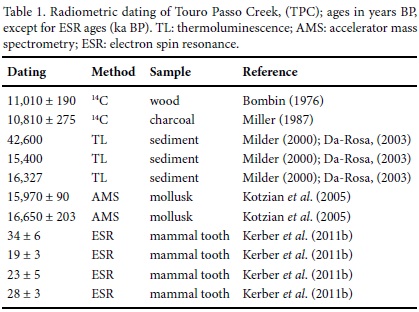
<body><![CDATA[<p align="justify"><font face="verdana" size="2"><b>INSTITUTIONAL ABBREVIATIONS</b></font></p>  	    <p align="justify"><font face="verdana" size="2">MCN&#45;PV, paleovertebrates collection, Museu de Ci&ecirc;ncias Naturais da Funda&ccedil;&atilde;o Zoobot&acirc;nica do Rio Grande do Sul, Porto Alegre; MCPU&#45;PV, paleovertebrates collection, Museu de Ci&ecirc;ncias da Pontif&iacute;cia Universidade Cat&oacute;lica do Rio Grande do Sul, Uruguaiana; MCP, paleo</font><font face="verdana" size="2">vertebrates collection, Museu de Ci&ecirc;ncias da Pontif&iacute;cia Universidade Cat&oacute;lica do Rio Grande do Sul, Porto Alegre; UFSM, paleovertebrates collection, Universidade Federal de Santa Maria, Santa Maria.</font></p>     <p align="justify"><font face="verdana" size="2">&nbsp;</font></p>  	    <p align="justify"><font face="verdana" size="2"><b>GEOLOGICAL SETTING</b></font></p>  	    <p align="justify"><font face="verdana" size="2">The Touro Passo Creek is located in Uruguaiana, State of Rio Grande do Sul, southern Brazil, near to the border with Uruguay and Argentina (<a href="/img/revistas/rmcg/v31n2/a8f1.jpg" target="_blank">Figure 1</a>). This creek is a tributary of the Uruguay River basin and late Pleistocene lithologies are exposed along its margins. Most of the late Pleistocene strata are currently covered by vegetation, so the fossiliferous levels are only exposed in some areas. To date, we are studying six localities where the fossils are more abundant (<a href="/img/revistas/rmcg/v31n2/a8f1.jpg" target="_blank">Figure 1</a>, <a href="#ap1">Appendix A</a>).</font></p>  	    <p align="justify"><font face="verdana" size="2">The lithofacies are represented by conglomeratic facies overlapped by silt and sand levels, both deposited on the basalts of the Serra Geral Formation (<a href="/img/revistas/rmcg/v31n2/a8f2.jpg" target="_blank">Figure 2</a>). Carbonate nodules that represent post&#45;depositional pedogenesis (Bombin, 1976) are found within the sandy and silty strata, but it is not clear yet when they were formed.</font></p>  	    <p align="justify"><font face="verdana" size="2">The available radiometric dates obtained by thermoluminescence (TL) (sediments), <sup>14</sup>C (charcoal), accelerator mass spectrometry (AMS) (mollusks) and electron spin resonance (ESR) (fossil teeth) range from ~42 to ~10 ka BP (Bombin, 1976; Miller, 1987; Milder, 2000; Da&#45;Rosa, 2003; Kotzian <i>et al.,</i> 2005, Kerber <i>et al.,</i> 2011b), and therefore indicate a latest Pleistocene age (<a href="#a8t1">Table 1</a>). The first studies considered the Touro Passo Formation as late Pleistocene&#45;Holocene <i>(e.g.,</i> Bombin, 1976; Oliveira, 1992), but with the increase in absolute ages from this unit, the Touro Passo Formation is now considered exclusively from the latest Pleistocene (Oliveira, 1999). Holocene sedimentary levels (including the so&#45;called "black soils" with an age of ~5 ka; Da&#45;Rosa, 2003) found in TPC (without vertebrate remains) should be considered as a different geologic unit, but this discussion is beyond the scope of this paper.</font></p>  	    <p align="center"><font face="verdana" size="2"><a name="a8t1"></a>    <br> 	<img src="/img/revistas/rmcg/v31n2/a8t1.jpg"></font></p>  	    <p align="justify"><font face="verdana" size="2">The fossil vertebrates from TPC are found isolated or semi&#45;articulated in the silt and sand levels (rarely), with absence of features of time&#45;averaging. These fossils show intense carbonate incrustation. These levels correspond to the Lamitico Member of Bombin (1976). Fossils collected from the conglomeratic levels (Rudaceo Member of Bombin, 1976), originated in channels or point bars, are very fragmented, with features of reworking (abrasion and flat surfaces), and without carbonate incrustation.</font></p>  	    ]]></body>
<body><![CDATA[<p align="justify"><font face="verdana" size="2">&nbsp;</font></p>  	    <p align="justify"><font face="verdana" size="2"><b>SYSTEMATIC PALEONTOLOGY</b></font></p>  	    <p align="center"><font face="verdana" size="2">Mammalia Linnaeus, 1758    <br> 	Xenarthra Cope, 1889    <br> 	Folivora Delsuc <i>et al.,</i> 2001    <br> 	Mylodontidae Gill, 1872</font></p>  	    <p align="justify"><font face="verdana" size="2"><b>Material.</b> MCPU&#45;PV 032, Kerber and Oliveira (2008a).</font></p>  	    <p align="justify"><font face="verdana" size="2"><b>Remarks.</b> Osteoderms of an indeterminate mylodontid were reported from the Barranca Grande locality (Kerber and Oliveira, 2008a). These remains were attributed tentatively to this taxon because they are smaller in size compared to the osteoderms of Megatheriidae (Cartelle and Boh&oacute;rquez, 1986).</font></p>  	    <p align="center"><font face="verdana" size="2"><i>Glossotherium robustum</i> (Owen, 1842)</font></p>  	    <p align="justify"><font face="verdana" size="2"><b>Material.</b> MCN&#45;PV 1452, MCN&#45;PV 1950, MCN&#45;PV 1482, Pitana <i>et</i></font> <font face="verdana" size="2"><i>al.</i> (2013).</font></p>     ]]></body>
<body><![CDATA[<p align="justify"><font face="verdana" size="2"><b>Remarks.</b> Bombin (1976) reported <i>Glossotherium robustum</i> from the Touro Passo Formation in his checklist. Subsequently, Oliveira (1992) described the specimen MCN&#45;PV 1482 (incomplete right tibia) and assigned it to Mylodontidae gen. et sp. indet., because it is morphologically similar to <i>Glossotherium</i> <u>Owen</u>, 1839a and <i>Mylodon</i> <u>Owen</u>, 1840. However, the same specimen was reviewed by Pitana (2011) and attributed to <i>Glossotherium</i> aff. <i>robustum.</i> The specimen MCN&#45;PV 1950 (an incomplete dentary) was described by Pitana (2011) and also assigned to <i>Glossotherium</i> aff. <i>robustum;</i> and a further comparative study confirmed that this material belongs to <i>G. robustum</i> (Pitana <i>et al.,</i> 2013). Therefore, the presence of <i>G. robustum</i> in another late Pleistocene locality of southern Brazil is confirmed on the basis of mandibular and postcranial remains (Pitana <i>et al.,</i> 2013).</font></p>  	    <p align="center"><font face="verdana" size="2">Megatheriidae Gray, 1821</font></p>  	    <p align="justify"><font face="verdana" size="2"><b>Material.</b> The only record of a megatheriid from TPC was proposed by Oliveira <i>et al.</i> (1999), on the basis of a tooth fragment that cannot be assigned to a genus or species. However, this material is currently lost.</font></p>  	    <p align="center"><font face="verdana" size="2">Glyptodontidae Gray, 1869    <br> 	<i>Glyptodon</i> Owen, 1839b</font></p>  	    <p align="justify"><font face="verdana" size="2"><b>Material.</b> MCPU&#45;PV 101, MCPU&#45;PV 158, MCPU&#45;PV 056, Kerber and Oliveira (2008a); MCN&#45;PV 1441, MCN&#45;PV 1442, Oliveira (1992, 1996).</font></p>  	    <p align="justify"><font face="verdana" size="2"><b>Remarks.</b> Glyptodonts from TPC have been described mostly on the basis of isolated osteoderms. The most complete material of Glyptodontidae was a carapace collected by M. Bombin in the 1970s (Bombin, 1976); however, this material is currently lost. <i>Glyptodon</i> sp., <i>Glyptodon clavipes</i> Owen, 1839b, <i>Glyptodon</i> aff. <i>clavipes, Glyptodon</i> aff. <i>reticulatus</i> Owen 1845, and <i>Glyptodon</i> cf. <i>G. reticulatus</i> have been, to date, reported from TPC (Bombin, 1976; Oliveira, 1992, 1996; Kerber and Oliveira, 2008a). On the basis of a few osteoderms from the Barranca Grande locality, <i>Neothoracophorus</i> Ameghino, 1889 (MCPU&#45;PV 224, MCPU&#45;PV 136, MCN&#45;PV 1485) was reported by Oliveira (1992) and subsequently by Kerber and Oliveira (2008a). However, the taxonomic validity of this genus was questioned by Zurita <i>et al.</i> (2009), because the first description of this taxon provided by Ameghino (1889) was based on the size of osteoderms (smaller than other glyptodonts, such as <i>Glyptodon</i> and <i>Panochthus</i> Burmeister, 1866), a flat surface and an elevated central figure, characters observed in juvenile specimens of <i>Glyptodon.</i> Hence, a review of the specimens referred to <i>"Neothoracophorus"</i> from TPC should be carried out.</font></p>  	    <p align="justify"><font face="verdana" size="2">As mentioned above, the taxonomic identification of glyptodonts from TPC is based exclusively on a few osteoderms (<a href="/img/revistas/rmcg/v31n2/a8f3.jpg" target="_blank">Figure 3a</a>). Zurita <i>et al.</i> (2012) stated that most of the taxonomic assignations of <i>Glyptodon</i> specimens to the specific level were carried out on the basis of isolated or fragmentary remains of carapaces. These structures are quite variable and do not allow an accurate taxonomic identification. In addition, Oliveira <i>et al.</i> (2010) reviewed the material of <i>Glyptodon clavipes</i> from northern and northeastern regions of Brazil and concluded that these remains, in fact, belong to the genus <i>Glyptotherium</i> Osborn, 1913. Thus, to avoid major errors in paleobiogeographic, biochronologic and biostratigraphic interpretations, we are using <i>Glyptodon</i> sp. for the specimens previously reported until new material is collected.</font></p>  	    <p align="center"><font face="verdana" size="2"><i>Panochthus</i> Burmeister, 1866</font></p>  	    <p align="justify"><font face="verdana" size="2"><b>Material.</b> MCN&#45;PV 1443, Oliveira (1996); MCPU&#45;PV 059, Kerber and Oliveira (2008a).</font></p>  	    ]]></body>
<body><![CDATA[<p align="justify"><font face="verdana" size="2"><b>Remarks.</b> The scarce material belonging to <i>Panochthus</i> sp. in TPC is represented by a few isolated osteoderms, which revealed external surface with several tubercles and absence of a central figure, typical morphology of <i>Panochthus</i> (Oliveira, 1996; Kerber and Oliveira, 2008a). <i>Panochthus tuberculatus</i> (Owen, 1845) was the only species reported from southern Brazilian Pleistocene beds <i>(e.g.,</i> Paula Couto, 1943; Paula Couto and Souza Cunha, 1965; Bombin, 1976; Ribeiro and Scherer, 2009). However, recently Santos (2014) reported the presence of<i> Panochthus</i> cf. <i>P. greslebini</i> Castellanos, 1942 for the continental shelf of southern Brazil. <i>Panochthus greslebini</i> was also reported for the late Pleistocene of northern Argentina, at similar latitude to that of Rio Grande do Sul (Chimento and Agnolin, 2011)</font></p>  	    <p align="center"><font face="verdana" size="2">Pampatheriidae Paula Couto, 1954    <br> 	<i>Pampatherium</i> Ameghino, 1875 and <i>Holmesina</i> Simpson, 1930</font></p>  	    <p align="justify"><font face="verdana" size="2"><b>Material.</b> <i>Holmesinapaulacoutoi:</i> MCPU&#45;PV 036, Kerber and Oliveira (2008a); <i>P. typum:</i> MCPU&#45;PV 080; MCPU&#45;PV 157, MCPU&#45;PV 1461 1&#45;6, Kerber and Oliveira (2008a); <i>Pampatherium</i> sp.: MCN&#45;PV 1444, MCN&#45;PV 1445, MCN&#45;PV 1446, MCN&#45;PV 1447, MCN&#45;PV 1467, MCN&#45;PV 1480, Oliveira (1996).</font></p>  	    <p align="justify"><font face="verdana" size="2"><b>Remarks.</b> <i>Pampatherium</i> was first reported by Oliveira (1996) and subsequently Kerber and Oliveira (2008a) reported <i>Pampatherium typum</i> (Gervais and Ameghino, 1880) (<a href="/img/revistas/rmcg/v31n2/a8f3.jpg" target="_blank">Figure 3b</a>) and <i>Holmesina paulacoutoi</i> (Cartelle and Boh&oacute;rquez, 1984). Both taxa were identified on the basis of isolated osteoderms.</font></p>  	    <p align="center"><font face="verdana" size="2">Dasypodidae Gray, 1821    <br> 	<i>Propraopus sulcatus</i> (Lund, 1842)</font></p>  	    <p align="justify"><font face="verdana" size="2"><b>Material.</b> <i>Propraopus</i> sp: MCPU&#45;PV 230, Kerber and Oliveira (2008a); <i>Propraopus grandis:</i> MCN&#45;PV 147, Pitana and Ribeiro (2007); <i>Propraopus</i> aff. <i>sulcatus:</i> MCPU&#45;PV 024; MCPU&#45;PV 135, Oliveira and Pereira (2009).</font></p>  	    <p align="justify"><font face="verdana" size="2"><b>Remarks.</b> <i>Propraopus grandis</i> was reported by Oliveira (1996) and Pitana and Ribeiro (2007). Subsequently, Oliveira and Pereira (2009) described osteoderms as <i>P.</i> aff. <i>sulcatus,</i> which, however, were previously assigned to <i>P. grandis.</i> Recently, <i>P. grandis</i> was considered a synonym of <i>P. sulcatus</i> by Castro <i>et al.</i> (2013).</font></p>  	    <p align="center"><font face="verdana" size="2">Carnivora Bowdich 1821</font></p>  	    ]]></body>
<body><![CDATA[<p align="justify"><font face="verdana" size="2"><b>Material.</b> MCPU&#45;PV 138 (Canidae indet.); MCPU&#45;PV 141 (Coprolite), Kerber and Oliveira (2008a).</font></p>  	    <p align="justify"><font face="verdana" size="2"><b>Remarks.</b> Carnivores from TPC are very scarce, with few fossils represented by a fragmented tooth assigned to Canidae indet. and a coprolite tentatively attributed to a large carnivore by Kerber and Oliveira (2008a).</font></p>  	    <p align="center"><font face="verdana" size="2">Cetartiodactyla Montgelard, Catzeflis and Douzery, 1997    <br> 	Tayassuidae Palmer, 1897    <br> 	<i>Catagonus stenocephalus</i> (Lund in Reinhardt, 1880) and    <br> <i>Tayassu pecari</i> (Link, 1795)</font></p>  	    <p align="justify"><font face="verdana" size="2"><b>Material.</b> <i>Catagonus stenocephalus:</i> MCPU&#45;PV 029, Gasparini <i>et al.</i> (2009); <i>Tayassu</i> sp.: MCN&#45;PV 1425, Oliveira (1992); <i>Tayassu pecari:</i> MCN&#45;PV 30107.</font></p>  	    <p align="justify"><font face="verdana" size="2"><b>New remains.</b> New remains of semi&#45;articulated tayassuid were collected during an expedition in 2009 (<a href="/img/revistas/rmcg/v31n2/a8f4.jpg" target="_blank">Figure 4</a>, <a href="#a8t2">Table 2</a>). These remains are represented by a left dentary, with the p2&#45;m3 series plus the canine, a left humerus, a scapula, the head of a femur, two articulated lumbar vertebrae, a sacral vertebra, a fragment of pelvic girdle and other fragmented bones. The specimen is a senile individual, because the occlusal surface of the cheek teeth shows advanced wear and extrusion signs are seen in labial view. These remains were assigned to <i>Tayassu pecari</i> on the basis of a p2 with reduced anterocingulum and p4 with subrectangular outline (Gasparini and Zurita, 2005; Gasparini <i>et al.,</i> 2011).</font></p>  	    <p align="center"><font face="verdana" size="2"><a name="a8t2"></a>    <br> 	<img src="/img/revistas/rmcg/v31n2/a8t2.jpg"></font></p>  	    ]]></body>
<body><![CDATA[<p align="justify"><font face="verdana" size="2"><b>Remarks.</b> Three genera of tayassuids are reported from South America: <i>Platygonus</i> Le Conte, 1848, <i>Catagonus</i> Ameghino, 1904 and <i>Tayassu</i> Fisher, 1814; only the last two genera have extant species (Gasparini, 2011). The new material confirms the presence of <i>T. pecari</i> in TPC, previously reported by Bombin (1976). In addition to this record, Oliveira (1992) reported a fragment of a dentary of <i>Tayassu</i> sp. (<a href="/img/revistas/rmcg/v31n2/a8f3.jpg" target="_blank">Figure 3d</a>). Another interesting specimen of a tayassuid was previously attributed to the <i>"Catagonus</i> group" and subsequently to <i>Tayassu</i> sp. (Martins and Oliveira, 2003; Oliveira, 1999). Recently, Gasparini <i>et al.</i> (2009) attributed it to <i>Catagonus stenocephalus</i> (<a href="/img/revistas/rmcg/v31n2/a8f3.jpg" target="_blank">Figure 3c</a>). Noteworthy, Gasparini <i>et al.</i> (2012) reported the presence of <i>Catagonus wagneri</i> (Rusconi, 1930) in sediments of the Sopas Formation, northern Uruguay.</font></p>  	    <p align="center"><font face="verdana" size="2">Camelidae Gray, 1821    <br> 	<i>Hemiauchenia paradoxa </i>Gervais and Ameghino, 1880,    <br> 	<i>Lama (Vicugna)</i> aff. <i>L. (V.) gracilis</i> (Gervais and Ameghino, 1880)    <br> 	<i>Lama guanicoe</i> (M&uuml;ller, 1776)</font></p>  	    <p align="justify"><font face="verdana" size="2"><b>Material.</b> <i>paradoxa:</i> MCN&#45;PV 1465, MCN&#45;PV 1471, MCN&#45;PV 1474 Oliveira (1992); MCN&#45;PV 1471, MCN&#45;PV 2077, MCN&#45;PV 6946, MCN&#45;PV 1465, MCN&#45;PV 1474b, MCN&#45;PV 1474a, MCN&#45;PV 2159, 6947, MCN&#45;PV 2164a&#45;d, MCN&#45;PV 7927, MCN&#45;PV 1973, MCN&#45;PV 2088, MCN&#45;PV 3334, MCN&#45;PV 1975b, 2082b, MCN&#45;PV 3359, UFSM 11325, MCN&#45;PV 2258a&#45;f, MCN&#45;PV 1975a, 2082a, MCN&#45;PV 3278, MCN&#45;PV 2258g, MCN&#45;PV 1975c, MCN&#45;PV 3309, MCN&#45;PV 1975d, MCN&#45;PV 2079, Scherer <i>et</i> al.(2007); MCPU&#45;PV 039, MCPU&#45;PV 155, Kerber and Oliveira (2008a).</font></p>  	    <p align="justify"><font face="verdana" size="2"><b>Remarks.</b> Camelid remains are the most common fossils from TPC. Recent reviews reported the presence of <i>Hemiauchenia paradoxa, Lama guanicoe</i> and <i>Lama (Vicugna)</i> aff. <i>L. (V.) gracilis</i> (Gervais and Ameghino, 1880) in several late Pleistocene localities from Rio Grande do Sul, including the TPC deposits (Scherer, 2006; Scherer <i>et al.,</i> 2007). The material attributed to these taxa is composed of dental and post&#45;cranial remains. In addition, Kerber and Oliveira (2008a) reported a palatal region with the cheek teeth and a dentary attributed to <i>H. paradoxa</i> (<a href="/img/revistas/rmcg/v31n2/a8f3.jpg" target="_blank">Figures 3e</a>, <a href="/img/revistas/rmcg/v31n2/a8f3.jpg" target="_blank">3f</a>).</font></p> 	    <p align="center"><font face="verdana" size="2">Cervidae Gray, 1821    <br>     <i>Antifer </i>Ameghino, 1889 and <i>Morenelaphus</i> Carette, 1922</font></p>     <p align="justify"><font face="verdana" size="2"><b>Material.</b> <i>Antifer</i> sp.: MCPU&#45;PV 212, MCPU&#45;PV 223, Kerber and Oliveira, (2008a); MCN&#45;PV 1458, Oliveira (1992); MCN&#45;PV 943, MCN&#45;PV 944, Ribeiro and Scherer (2009); <i>Morenelaphus</i> sp.: MCPU&#45;PV 059, Kerber and Oliveira (2008a).</font></p>  	    ]]></body>
<body><![CDATA[<p align="justify"><font face="verdana" size="2"><b>Remarks.</b> Bombin (1976) mentioned the presence of <i>Blastocerus dichotomus</i> Illiger, 1815, <i>Mazama gouazoupira</i> Fischer, 1814, <i>Ozotoceros bezoarticus</i> Linnaeus, 1758 and <i>Morenelaphus brachyceros</i> (Ameghino, 1888). With the exception of <i>Morenelaphus,</i> the presence of the other taxa was not confirmed. Oliveira (1992) reported <i>Blastocerus</i> sp., however, Scherer <i>et al.</i> (2007) assigned to <i>Antifer</i> sp. the specimen referred by Oliveira (1992). Subsequently, Kerber and Oliveira (2008a) reported new remains of <i>Morenelaphus</i> sp. and <i>Antifer</i> sp. The more complete material is a cranial portion with both horns preserved assigned to <i>Antifer</i> sp. (see <a href="/img/revistas/rmcg/v31n2/a8f2.jpg" target="_blank">fig. 2A</a> in Ribeiro and Scherer, 2009).</font></p>  	    <p align="center"><font face="verdana" size="2">Perissodactyla Owen, 1848    <br> 	Equidae Gray, 1821    <br> 	<i>Equus (A.) neogaeus</i> Lund, 1841 and <i>Hippidion</i> Owen, 1869</font></p>  	    <p align="justify"><font face="verdana" size="2"><b>Material.</b> <i>E. (A.) neogaeus:</i> MCPU&#45;PV 208, MCPU&#45;PV 213, Kerber and Oliveira (2008a); MCN&#45;PV 1461, MCN&#45;PV 1463, MCN&#45;PV 2052, MCN&#45;PV 2053, Ribeiro and Scherer (2009). <i>Hippidion</i> sp.: MCN&#45;PV 1460, Oliveira (1992); MCPU&#45;PV 054, Kerber and Oliveira (2008a).</font></p>  	    <p align="justify"><font face="verdana" size="2"><b>Remarks.</b> The specimens of equids from TPC were mentioned by Oliveira (1992), who reported a molariform of <i>Hippidion</i> sp. Subsequently, Kerber and Oliveira (2008a) reported a tarsal and a first phalange (<a href="/img/revistas/rmcg/v31n2/a8f3.jpg" target="_blank">Figure 3g</a>) attributed to <i>E. (A.) neogaeus</i> and a distal phalange assigned to <i>Hippidion</i> sp. Ribeiro and Scherer (2009) mentioned three teeth of <i>E. (A.) neogaeus</i> (see fig. 2D, 2E and 2F in Ribeiro and Scherer, 2009).</font></p>  	    <p align="center"><font face="verdana" size="2">Tapiridae Gray, 1821    <br> 	<i>Tapirus </i>Brisson, 1762    <br> 	<i>Tapirus</i> sp.</font></p>  	    <p align="justify"><font face="verdana" size="2"><b>Material.</b> MCPU&#45;PV 222, Kerber and Oliveira (2008b).</font></p>  	    ]]></body>
<body><![CDATA[<p align="justify"><font face="verdana" size="2"><b>Remarks.</b> Bombin (1976) mentioned <i>T. terrestris</i> (Linnaeus, 1758). Subsequently, Kerber and Oliveira (2008b) described a single fragment of a lower tooth assigned to <i>Tapirus</i> sp. These authors suggested that this tooth may display a more plesiomorphic pattern than that of the living <i>Tapirus terrestris.</i> However, due to the fragmentary state of this material, there are no satisfactory arguments for this interpretation.</font></p>  	    <p align="center"><font face="verdana" size="2">Notoungulata Roth, 1903    <br> 	Toxodontidae Owen, 1845    <br> 	<i>Toxodon</i> Owen, 1837    <br> 	<i>Toxodon</i> sp.</font></p>  	    <p align="justify"><font face="verdana" size="2"><b>Material.</b> MCPU&#45;PV 040, Kerber and Oliveira (2008a).</font></p>  	    <p align="justify"><font face="verdana" size="2"><b>Remarks.</b> The published information on Toxodon from TPC is scarce. Bombin (1976) listed <i>Toxodon platensis</i> Owen, 1837 and subsequently Kerber and Oliveira (2008a) reported an isolated tooth from the Ponte Velha I locality assigned to <i>Toxodon</i> sp. The only toxodontid reported for southern Brazil is <i>T. platensis</i> (Paula Couto, 1943; Lopes <i>et al.,</i> 2001); but in geographic areas next to Rio Grande do Sul, such as the Mesopotamian region and northern Argentina, <i>T. gracilis</i> Gervais and Ameghino, 1880 is also recorded (Mi&ntilde;o&#45;Boilini <i>et al.,</i> 2006; Ferrero, 2009; Ferrero and Noriega, 2009).</font></p>  	    <p align="center"><font face="verdana" size="2">Litopterna, Ameghino, 1889    <br> 	Macraucheniidae Gervais, 1855    <br> 	<i>Macrauchenia patachonica</i> Owen, 1837</font></p>  	    ]]></body>
<body><![CDATA[<p align="justify"><font face="verdana" size="2"><b>Material.</b> MCN&#45;PV 2160, Scherer <i>et al.</i> (2009).</font></p>  	    <p align="justify"><font face="verdana" size="2"><b>Remarks.</b> Material assigned to <i>M. patachonica,</i> represented by a single thoracic vertebra, was recently reported by Scherer <i>et al.</i> (2009). Specimens from Rio Grande do Sul are the only material assigned to <i>M. patachonica</i> in Brazil. Macraucheniids from the intertropical region are assigned to <i>Xenorhinotherium bahiense</i> Cartelle and Lessa, 1988, which is probably closely related to <i>Macraucheniopsis</i> Paula Couto, 1945 from Argentina (Cartelle and Lessa, 1988).</font></p>  	    <p align="center"><font face="verdana" size="2">Proboscidea Illiger, 1811    <br> 	Gomphotheriidae indet.</font></p>  	    <p align="justify"><font face="verdana" size="2"><b>Remarks.</b> Bombin (1976) referred to the presence of <i>Notiomastodon platensis</i> (Ameghino, 1888) in TPC; however, in the review of southern Brazilian proboscideans, Marcon (2008) did not recognize its presence in TPC. Nevertheless, Kerber <i>et al.</i> (2011a) used some teeth fragments of indeterminate Gomphotheriidae in an ESR analysis. Paula Couto (1943) mentioned fossils of mastodonts from Uruguaiana Municipality; however, the exact provenance of this material was not given.</font></p>  	    <p align="center"><font face="verdana" size="2">Rodentia Bowdich, 1821    <br> 	Hydrochoeridae (Gray, 1825) Gill, 1872    <br> 	<i>Hydrochoerus hydrochaeris</i> (Linnaeus, 1766)</font></p>  	    <p align="justify"><font face="verdana" size="2"><b>Material.</b> MCPU&#45;PV 047, MCPU&#45;PV 043, MCN&#45;PV 2072, MCN&#45;PV 9572, MCN&#45;PV 9573, MCN&#45;PV 9574, MCN&#45;PV 1978, MCN&#45;PV 2088, Kerber and Ribeiro (2011); MCP&#45;3076 V, Oliveira (1992).</font></p>  	    <p align="justify"><font face="verdana" size="2"><b>Remarks.</b> This taxon was first referred by Bombin (1976). Later, Oliveira (1992) reported a palatal portion attributed to this taxon. Kerber and Ribeiro (2011) described two skulls (<a href="/img/revistas/rmcg/v31n2/a8f3.jpg" target="_blank">Figure 3i</a>), a dentary, isolated teeth and a fragment of a femur.</font></p>  	    ]]></body>
<body><![CDATA[<p align="center"><font face="verdana" size="2">Caviidae Fischer de Waldheim, 1817    <br> 	<i>Galea</i> Meyen, 1832    <br> 	<i>Galea</i> sp.</font></p>  	    <p align="justify"><font face="verdana" size="2"><b>Material.</b> MCPU&#45;PV 221, Kerber <i>et al.</i> (2011a).</font></p>  	    <p align="justify"><font face="verdana" size="2"><b>Remarks.</b> Material of this taxon, described by Kerber <i>et al.</i> (2011a), is represented by a single dentary with complete cheek teeth (<a href="/img/revistas/rmcg/v31n2/a8f3.jpg" target="_blank">Figure 3j</a>).</font></p>  	    <p align="center"><font face="verdana" size="2">Echimyidae Gray, 1825    <br> 	<i>Myocastor</i> Kerr, 1792    <br> 	<i>Myocastor coypus</i> (Molina, 1782)</font></p>  	    <p align="justify"><font face="verdana" size="2"><b>Material.</b> MCN&#45;PV 9712, Kerber <i>et al.</i> (in press).</font></p>  	    <p align="justify"><font face="verdana" size="2"><b>Remarks.</b> This taxon is represented by a skull recently collected from the <i>"Myocastor"</i> locality (Kerber <i>et al.,</i> in press) (Figure K).</font></p>  	    ]]></body>
<body><![CDATA[<p align="center"><font face="verdana" size="2">Squamata Oppel, 1811,    <br> 	Teiioidea Estes, de Queiroz and Gauthier, 1988    <br> 	Teiidae Gray, 1827    <br> 	Tupinambinae Presch, 1974    <br> 	<i>Tupinambis uruguaianensis</i> Hsiou, 2007</font></p>  	    <p align="justify"><font face="verdana" size="2"><b>Material.</b> MCN&#45;PV 2184 (holotype), Hsiou (2007).</font></p>  	    <p align="justify"><font face="verdana" size="2"><b>Remarks.</b> This lizard was the first extinct squamate described from the late Pleistocene of southern Brazil (Hsiou, 2007). According to Hsiou (2007), <i>Tupinambis uruguaianensis</i> is distinguished from other species of <i>Tupinambis</i> in having an articular bone with a deeply concave ventral margin, an angular process more rounded, proportionally larger and projecting beyond the ventral and posterior adjacent limits, and a very prominent adductor crest, so that the articular bone surface is lateroventrally directed. Recently, Scanferla <i>et al.</i> (2009) questioned the validity of this extinct teiid lizard because <i>T. uruguaianensis</i> shows several similarities to the extant lizards <i>T. merianae</i> Linnaeus, 1758 and <i>T. rufescens</i> (G&uuml;nther, 1871). Thus, Brizuela (2010) conducted a phylogenetic analysis of South American teiids and suggested a review of the taxonomic and systematic affinities of <i>T. uruguaianensis,</i> testing the possibility that this lizard from the Touro Passo Formation represents a large <i>Tupinambis merianae.</i></font></p>  	    <p align="center"><font face="verdana" size="2">Pleurodira Cope, 1864    <br> 	Eupleurodira Gaffney and Meylan, 1988 <i>(sensu    <br></i> Gaffney, Tong and Meylan, 2006)    ]]></body>
<body><![CDATA[<br> 	Cheloides Gray, 1825    <br> 	Chelidae Gray, 1825    <br> 	<i>Hydromedusa</i> Wagler, 1830    <br> 	<i>Hydromedusa tectifera</i> Cope, 1869</font></p>  	    <p align="justify"><font face="verdana" size="2"><b>Material.</b> MCN&#45;PV 1847, MCN&#45;PV 1848, Hsiou (2009).</font></p>  	    <p align="justify"><font face="verdana" size="2"><b>Remarks.</b> First reported by Bombin (1976), the material of <i>Hydromedusa tectifera</i> from TPC was not described or included in a comparative study. However, according to Maciel <i>et al.</i> (1996) and Hsiou (2009), these specimens can be attributed to this taxon.</font></p>  	    <p align="center"><font face="verdana" size="2">Aves Linnaeus, 1758    <br> 	Ciconiformes Bonaparte, 1854    <br> 	Ciconiidae Sundevall, 1836    <br> 	<i>Mycteria</i> Linnaeus, 1758    ]]></body>
<body><![CDATA[<br> 	<i>Mycteria</i> cf. <i>M. americana</i> Linnaeus, 1758</font></p>  	    <p align="justify"><font face="verdana" size="2"><b>Material.</b> MCN&#45;PV 1845, Ribeiro <i>et al.</i> (1995).</font></p>  	    <p align="justify"><font face="verdana" size="2"><b>Remarks.</b> This material was first reported by Ribeiro <i>et al.</i> (1995) and subsequently described by Hsiou (2009). According to Hsiou (2009), the general morphology indicates that the tarsometatarsus (MCN&#45;PV 1845) is that of a ciconiid bird closely related to the extant species <i>Mycteria americana.</i></font></p>  	    <p align="center"><font face="verdana" size="2">Osteichthyes Huxley, 1880</font></p>  	    <p align="justify"><font face="verdana" size="2"><b>Material.</b> MCPU&#45;PV 160.</font></p>  	    <p align="justify"><font face="verdana" size="2"><b>Remarks.</b> Until now, the record of fishes is represented only by some isolated vertebrae from the conglomerate level of the Ponte Velha I locality (<a href="/img/revistas/rmcg/v31n2/a8f3.jpg" target="_blank">Figure      3l</a>).</font></p>  	    <p align="justify"><font face="verdana" size="2">&nbsp;</font></p>  	    <p align="justify"><font face="verdana" size="2"><b>DISCUSSION</b></font></p>  	    <p align="justify"><font face="verdana" size="2">The available palynological data for southern Brazil indicates the predominance of open areas during the latest Pleistocene (Behling and Lichte, 1997; Behling, 2002; Bauermann <i>et al.,</i> 2009 and references therein), which is in agreement with the presence of some caviomorph rodents (Kerber <i>et al.,</i> 2012) and large mammals, such as ground sloths, glyptodonts, ungulates and proboscideans. However, some taxa recorded in TPC, such as <i>Tapirus</i> and <i>Tayassu pecari,</i> indicate the presence of some forested areas in western Rio Grande do Sul, although, the latter has also been recorded from aeolian sediments of the Tezanos Pinto Formation, Santa Fe Province, Argentina (Gasparini <i>et al.,</i> 2011). It is noteworthy that remains of Doedicurini and Sclerocalyptini gliptodonts, which were adapted to arid and cold conditions, are scarce in the Mesopotamian region of Argentina (Noriega <i>et al.,</i> 2004; Carlini <i>et al.,</i> 2004). The same pattern is valid for the TPC deposits, where there are no records of these glyptodontids.</font></p>  	    <p align="justify"><font face="verdana" size="2">Bombin (1975, 1976) suggested the presence of a mosaic environment during the latest Pleistocene of the western region of the State of Rio Grande do Sul, with gallery forests, permanent water bodies and open areas, accompanied by expansions and retractions of each component in response to the climatic oscillations of the late Quaternary. The available TL ages indicate that the Lamitico Member of Bombin (1976) (at least) was deposited during more humid conditions within the oxygen isotope stages 3 and 2. Oliveira (1999) stated that the assemblage found in the Barranca Grande locality <i>(Hydrochoerus hydrochaeris, Mycteria, Tupinambis</i> among others) suggests a wet climate. A new absolute age of about ~36 ka for these sediments (our unpublished information), corresponding to the isotopic stage 3, corroborates that this association is prior to the Last Glacial Maximum (LGM).</font></p>  	    ]]></body>
<body><![CDATA[<p align="justify"><font face="verdana" size="2">The first studies on vertebrates from western Rio Grande do Sul showed that the TPC has similar faunistic content to that observed in the Luj&aacute;n and Sopas formations, Buenos Aires Province and Uruguay, respectively (Bombin, 1975, 1976). Additional studies have shown a closer similarity between western Rio Grande do Sul and the Sopas Formation, and marked differences between TPC and the Luj&auml;n Formation, mainly due to the presence of intertropical (Brazilian) taxa in southern Brazil (<i>e.g.</i>, Oliveira, 1996, 1999), which are absent in the latest Pleistocene of the Buenos Aires Province. Taxa with Brazilian affinities were reported from the Touro Passo Formation, including <i>Hydrochoerus hydrochaeris, Holmesina paulacoutoi, Tapirus</i> sp. and <i>Tayassu pecari,</i> and endemic taxa from the southern South America: <i>Hemiauchenia paradoxa, Macrauchenia patachonica, Morenelaphus, Antifer</i> and <i>Pampatherium typum.</i> The same pattern is repeated in all well&#45;known late Pleistocene localities of similar latitude, such as Chui Creek (Rio Grande do Sul), the Sopas Formation (northern Uruguay) and Torop&iacute;/Yupo&iacute; Formation (Mesopotamia region of Argentina), among others (Ubilla <i>et al.,</i> 2004; Oliveira and Pereira, 2009; Pereira <i>et al.,</i> 2012; Francia <i>et al.,</i> 2012). Another example is in Santiago del Estero Province, Argentina, where Chimento and Agnolin (2011) recorded the presence of the intertropical taxa <i>Holmesina paulacoutoi</i> and <i>Panochthus greslebini.</i> According to Chimento and Agnolin (2011), this geographic area has a faunistic homogeneity with the Argentine Mesopotamia and is not a distinct paleobiogeographic area as suggested by Carlini <i>et al.</i> (2004). The mammalian paleofauna of the Toropi/Yupo&iacute; formations, located in Corrientes Province, Argentina, is quite similar to that of the TPC. To explain the biogeographic affinities of the fauna as whole, a complex scenario has been proposed, with periods of more Chaco&#45;Pampean influence and other periods with more intertropical/tropical influences, including cold and dry periods alternating with wetter climates (Francia <i>et al.,</i> 2012; Erra <i>et al.,</i> 2013). Oliveira and Pereira (2009) proposed three hypotheses to explain this pattern in Chu&iacute; Creek. One of them argued in favor of a large span of time encompassing the sedimentation in the Chu&iacute; Creek, which is now corroborated by recent new absolute ages (Lopes <i>et al.,</i> 2010, 2012). The available radiometric data indicate a relatively wide span of time for the deposition of the sedimentary beds exposed in the TCP, and thus the faunistic assemblage found in these packages could be artificial or "non&#45;analog".</font></p>  	    <p align="justify"><font face="verdana" size="2">A difficulty found in comparing the similarity of the late Pleistocene faunas of southern Brazil and intertropical regions is the lack of well&#45;studied faunas between these geographic areas. The states of Santa Catarina, Paran&aacute;, S&atilde;o Paulo and southern Mato Grosso do Sul, which could supply important information, have been poorly studied. Recent efforts have shown interesting results. Guilardi <i>et al.</i> (2011) and Castro and Langer (2011) studied the Pleistocene mammals from the upper Vale do Ribeira karst area (State of S&atilde;o Paulo) and they concluded that the fauna has a more intertropical influence. In the State of Paran&aacute;, with the exception of <i>Protocyon troglodytes</i> (Lund, 1839), which has an intertropical affinity, the other reported taxa have a wide range (see Silva and Sedor, 2008; Silva <i>et al.,</i> 2012).</font></p>      <p align="justify"><font face="verdana" size="2">&nbsp;</font></p>  	    <p align="justify"><font face="verdana" size="2"><b>CONCLUSIONS</b></font></p>  	    <p align="justify"><font face="verdana" size="2">Since the 1970s, several papers have been published on the fossil vertebrates from TPC. In this review, we can conclude that the knowledge on this site still has several problems, mainly on the specific determination of the taxa. This can be attributed to the fragmentary state of the remains.</font></p>  	    <p align="justify"><font face="verdana" size="2">The checklist of Bombin (1976) has several taxa that were not confirmed in later studies: <i>Scelidotherium leptocephalum</i> Owen, 1840, <i>Mazama gouazoupira, Blastocerus dichotomus, Ozotocerus bezoarticus</i> and <i>Notiomastodon platensis.</i> The material of Sigmodontinae aff. <i>Reithrodon</i> Waterhouse, 1837 reported by Oliveira <i>et al.</i> (1999) for the Ponte Velha I locality was not located; thus, we cannot confirm the presence of this taxon. For this reason, these taxa should be excluded from the faunistic list of TPC.</font></p>  	    <p align="justify"><font face="verdana" size="2">The fossil assemblages of TPC show a predominance of mammals. Among these, the Artiodactyla and Cingulata are the most diverse (<a href="#a8f5">Figure 5</a>).</font></p>  	    <p align="center"><font face="verdana" size="2"><a name="a8f5"></a>    <br> 	<img src="/img/revistas/rmcg/v31n2/a8f5.jpg"></font></p>  	    <p align="justify"><font face="verdana" size="2">The available TL ages indicates that the Lamitico Member (at least) was deposited during humid conditions, within the isotopic stages 3 and 2.</font></p>  	    ]]></body>
<body><![CDATA[<p align="justify"><font face="verdana" size="2">The vertebrates show a mixture of Brazilian and Pampean taxa. The large span of time involved in the deposition of the TPC beds and the climatic oscillations could have contributed to this faunal mixture.</font></p>  	    <p align="justify"><font face="verdana" size="2">Although several points are still unclear, knowledge has been improved in the last few years. For future work, new fieldwork trips should be carried out with the objective of collecting fossils with precise stratigraphic control and absolute dating. This information will contribute to understanding the biostratigraphy and paleoenvironmental evolution during the late Quaternary of the western region of the State of Rio Grande do Sul.</font></p>  	    <p align="justify"><font face="verdana" size="2">&nbsp;</font></p>  	    <p align="justify"><font face="verdana" size="2"><b>ACKNOWLEDGEMENTS</b></font></p>  	    <p align="justify"><font face="verdana" size="2">We would like to express our gratitude to CNPq (Conselho Nacional de Pesquisa e Tecnologia) for financial support as a fellowship of Programa de P&oacute;s&#45;Gradua&ccedil;&atilde;o em Geoci&ecirc;ncias (UFRGS); and project PROSUL (490299/2008&#45;3); Katarzyna Piper for the english review of the manuscript. Thanks also to Sabrina Negr&atilde;o and Rafael Silveira da Rosa, who prepared the material of Tayassuidae; Francisco S. Buchmann, Renato P. Lopes and the editor, for their useful commentaries; A.S.H. thanks Funda&ccedil;&atilde;o de Amparo &agrave; Pesquisa do Estado de S&atilde;o Paulo (FAPESP Proc. No. 2011/14080&#45;0).</font></p>     <p align="justify">&nbsp;</p> 	    <p align="justify"><font face="verdana" size="2"><a name="ap1" id="ap1"></a><b>APPENDIX A</b></font></p> 	    <p align="justify"><font face="verdana" size="2">Uniersal Transverse Mercator (UTM) coordinates of the studied localities in Touro Passo Creek. 1. Ponte Velha II (UTM 511591 m E and 671894 m S); 2. Ponte Velha I (UTM 512588 m E and 6718263 m S); 3. Milton Almeida (UTM 512889 m E and 6717556 m S); 4. Barranca Grande (UTM 513349 m E and 6717057 m S); 5. Myocastor (UTM 515538 m E and 6716615 m S).</font></p> 	    <p align="justify"><font face="verdana" size="2"><b>ADDENDUM</b></font></p> 	    <p align="justify"><font face="verdana" size="2">The fossil vertebrates housed in the Pontif&iacute;cia Universidade Cat&oacute;lica do Rio Grande do Sul, campus Uruguaiana (Uruguaiana) (MCPU-PV) were transferred to the paleontologic collection of the Pontif&iacute;cia Universidade Cat&oacute;lica do Rio Grande do Sul, campus central (Porto Alegre) (MCP).</font></p>     ]]></body>
<body><![CDATA[<p align="justify">&nbsp;</p> 	    <p align="justify"><font size="2" face="verdana"><b>REFERENCES</b></font></p>     <!-- ref --><p align="justify"><font face="verdana" size="2">Ameghino, F., 1875, Notas sobre algunos f&oacute;siles nuevos de la Formaci&oacute;n Pampeana, <i>in</i> Torcelli, J.A. (ed). Obras completas y Correspondencia cient&iacute;fica, 2: Buenos Aires, 11&#45;17.    &nbsp;&nbsp;&nbsp;&nbsp;&nbsp;&nbsp;&nbsp;&nbsp;[&#160;<a href="javascript:void(0);" onclick="javascript: window.open('/scielo.php?script=sci_nlinks&ref=8100010&pid=S1026-8774201400020000800001&lng=','','width=640,height=500,resizable=yes,scrollbars=1,menubar=yes,');">Links</a>&#160;]<!-- end-ref --></font></p>  	    <!-- ref --><p align="justify"><font face="verdana" size="2">Ameghino F., 1888, R&aacute;pidas diagnosis de algunos mam&iacute;feros f&oacute;siles nuevos de la Rep&uacute;blica Argentina: Buenos Aires, Editorial Coni, 17 pp.    &nbsp;&nbsp;&nbsp;&nbsp;&nbsp;&nbsp;&nbsp;&nbsp;[&#160;<a href="javascript:void(0);" onclick="javascript: window.open('/scielo.php?script=sci_nlinks&ref=8100012&pid=S1026-8774201400020000800002&lng=','','width=640,height=500,resizable=yes,scrollbars=1,menubar=yes,');">Links</a>&#160;]<!-- end-ref --></font></p>  	    <!-- ref --><p align="justify"><font face="verdana" size="2">Ameghino, F., 1889, Contribuci&oacute;n al conocimiento de los mam&iacute;feros f&oacute;siles de la Rep&uacute;blica Argentina: C&oacute;rdoba, Academia Nacional de Ciencias de la Rep&uacute;blica Argentina, 6, 1&#45;1027.    &nbsp;&nbsp;&nbsp;&nbsp;&nbsp;&nbsp;&nbsp;&nbsp;[&#160;<a href="javascript:void(0);" onclick="javascript: window.open('/scielo.php?script=sci_nlinks&ref=8100014&pid=S1026-8774201400020000800003&lng=','','width=640,height=500,resizable=yes,scrollbars=1,menubar=yes,');">Links</a>&#160;]<!-- end-ref --></font></p>  	    <!-- ref --><p align="justify"><font face="verdana" size="2">Ameghino F., 1904, Nuevas especies de mam&iacute;feros cret&aacute;ceos y terciarios de la Rep&uacute;blica Argentina: Anales de la Sociedad Cient&iacute;fica Argentina, 58, 1&#45;188.    &nbsp;&nbsp;&nbsp;&nbsp;&nbsp;&nbsp;&nbsp;&nbsp;[&#160;<a href="javascript:void(0);" onclick="javascript: window.open('/scielo.php?script=sci_nlinks&ref=8100016&pid=S1026-8774201400020000800004&lng=','','width=640,height=500,resizable=yes,scrollbars=1,menubar=yes,');">Links</a>&#160;]<!-- end-ref --></font></p>  	    ]]></body>
<body><![CDATA[<!-- ref --><p align="justify"><font face="verdana" size="2">Bauermann, S.G., Behling, H., Macedo, R.B., 2009, Biomas regionais e evolu&ccedil;&atilde;o da paisagem no Rio Grande do Sul com base em paleopalinologia, <i>in,</i> Ribeiro, A.M., Bauermann, S.G., Scherer, C.S. (eds.), Quatern&aacute;rio do Rio Grande do Sul &#45; Integrando Conhecimentos: Monografias da Sociedade Brasileira de Paleontologia, Porto Alegre, 81&#45;93.    &nbsp;&nbsp;&nbsp;&nbsp;&nbsp;&nbsp;&nbsp;&nbsp;[&#160;<a href="javascript:void(0);" onclick="javascript: window.open('/scielo.php?script=sci_nlinks&ref=8100018&pid=S1026-8774201400020000800005&lng=','','width=640,height=500,resizable=yes,scrollbars=1,menubar=yes,');">Links</a>&#160;]<!-- end-ref --></font></p>  	    <!-- ref --><p align="justify"><font face="verdana" size="2">Behling, H., 2002, South and southeast Brazilian grasslands during Quaternary times: a synthesis: Palaeogeography, Palaeoclimatology, Palaeoecology, 177, 19&#45;27.    &nbsp;&nbsp;&nbsp;&nbsp;&nbsp;&nbsp;&nbsp;&nbsp;[&#160;<a href="javascript:void(0);" onclick="javascript: window.open('/scielo.php?script=sci_nlinks&ref=8100020&pid=S1026-8774201400020000800006&lng=','','width=640,height=500,resizable=yes,scrollbars=1,menubar=yes,');">Links</a>&#160;]<!-- end-ref --></font></p>  	    <!-- ref --><p align="justify"><font face="verdana" size="2">Behling, H., Lichte, M., 1997, Evidence of dry and cold climatic conditions at glacial times in tropical southeastern Brazil: Quaternary Research, 48, 348&#45;358.    &nbsp;&nbsp;&nbsp;&nbsp;&nbsp;&nbsp;&nbsp;&nbsp;[&#160;<a href="javascript:void(0);" onclick="javascript: window.open('/scielo.php?script=sci_nlinks&ref=8100022&pid=S1026-8774201400020000800007&lng=','','width=640,height=500,resizable=yes,scrollbars=1,menubar=yes,');">Links</a>&#160;]<!-- end-ref --></font></p>  	    <!-- ref --><p align="justify"><font face="verdana" size="2">Bombin, M., 1975, Afinidade paleoecol&oacute;gica, cronol&oacute;gica e estratigr&aacute;fica do componente de megamam&iacute;feros na biota do Quatern&aacute;rio terminal da Prov&iacute;ncia de Buenos Aires, Uruguai e Rio Grande do Sul (Brasil): Comunica&ccedil;&otilde;es do Museu de Ci&ecirc;ncias da PUCRS, 9, 1&#45;28.    &nbsp;&nbsp;&nbsp;&nbsp;&nbsp;&nbsp;&nbsp;&nbsp;[&#160;<a href="javascript:void(0);" onclick="javascript: window.open('/scielo.php?script=sci_nlinks&ref=8100024&pid=S1026-8774201400020000800008&lng=','','width=640,height=500,resizable=yes,scrollbars=1,menubar=yes,');">Links</a>&#160;]<!-- end-ref --></font></p>  	    <!-- ref --><p align="justify"><font face="verdana" size="2">Bombin, M., 1976, Modelo paleoecol&oacute;gico evolutivo para o Neoquatern&aacute;rio da regiao da Campanha&#45;Oeste do Rio Grande do Sul (Brasil), A Forma&ccedil;ao Touro Passo, seu conte&uacute;do fossil&iacute;fero e a pedog&ecirc;nese p&oacute;s&#45;deposicional: Comunica&ccedil;&ocirc;es do Museu de Ci&ecirc;ncias da PUCRS, 15, 1&#45; 90.    &nbsp;&nbsp;&nbsp;&nbsp;&nbsp;&nbsp;&nbsp;&nbsp;[&#160;<a href="javascript:void(0);" onclick="javascript: window.open('/scielo.php?script=sci_nlinks&ref=8100026&pid=S1026-8774201400020000800009&lng=','','width=640,height=500,resizable=yes,scrollbars=1,menubar=yes,');">Links</a>&#160;]<!-- end-ref --></font></p>  	    ]]></body>
<body><![CDATA[<!-- ref --><p align="justify"><font face="verdana" size="2">Bonaparte, C.L., 1854, Conspectus systematis ornithologiae: Annales des Sciences Naturelles, Paris, Zoologie, 4 (1), 105&#45;152.    &nbsp;&nbsp;&nbsp;&nbsp;&nbsp;&nbsp;&nbsp;&nbsp;[&#160;<a href="javascript:void(0);" onclick="javascript: window.open('/scielo.php?script=sci_nlinks&ref=8100028&pid=S1026-8774201400020000800010&lng=','','width=640,height=500,resizable=yes,scrollbars=1,menubar=yes,');">Links</a>&#160;]<!-- end-ref --></font></p>  	    <!-- ref --><p align="justify"><font face="verdana" size="2">Bowdich, T.E., 1821, An analysis of the natural classifications of Mammalia for the use of students and travelers: Paris, Smith, 115 pp.    &nbsp;&nbsp;&nbsp;&nbsp;&nbsp;&nbsp;&nbsp;&nbsp;[&#160;<a href="javascript:void(0);" onclick="javascript: window.open('/scielo.php?script=sci_nlinks&ref=8100030&pid=S1026-8774201400020000800011&lng=','','width=640,height=500,resizable=yes,scrollbars=1,menubar=yes,');">Links</a>&#160;]<!-- end-ref --></font></p>  	    <!-- ref --><p align="justify"><font face="verdana" size="2">Brisson, M.J., 1762, Regnum animale in classes IX. distributum, sive synopsis methodica sistens generalem animalium distributionem in classes IX, &amp; duarum primarum classium, quadrupedum scilicet &amp; cetaceorum, particularem divisionem in ordines, sectiones, genera &amp; species. Cum brevi cujusque speciei descriptione, citationibus auctorum de iis tractantium, nominibus eis ab ipsis &amp; nationibus impositis, nominibusque vulgaribus: Lugduni Batavorum, Editio altera auctior, 296 pp.    &nbsp;&nbsp;&nbsp;&nbsp;&nbsp;&nbsp;&nbsp;&nbsp;[&#160;<a href="javascript:void(0);" onclick="javascript: window.open('/scielo.php?script=sci_nlinks&ref=8100032&pid=S1026-8774201400020000800012&lng=','','width=640,height=500,resizable=yes,scrollbars=1,menubar=yes,');">Links</a>&#160;]<!-- end-ref --></font></p>  	    <!-- ref --><p align="justify"><font face="verdana" size="2">Brizuela, S., 2010, Los lagartos continentales f&oacute;siles de la Argentina (excepto <i>Iguania):</i> La Plata, Argentina, Faculdad de Ciencias Naturales y Museo Universidad Nacional de La Plata, Doctoral thesis, 408 pp.    &nbsp;&nbsp;&nbsp;&nbsp;&nbsp;&nbsp;&nbsp;&nbsp;[&#160;<a href="javascript:void(0);" onclick="javascript: window.open('/scielo.php?script=sci_nlinks&ref=8100034&pid=S1026-8774201400020000800013&lng=','','width=640,height=500,resizable=yes,scrollbars=1,menubar=yes,');">Links</a>&#160;]<!-- end-ref --></font></p>  	    <!-- ref --><p align="justify"><font face="verdana" size="2">Burmeister, G., 1866, Lista de los mam&iacute;feros f&oacute;siles del terreno diluviano: Anales del Museo P&uacute;blico de Buenos Aires, 1, 121&#45;232.    &nbsp;&nbsp;&nbsp;&nbsp;&nbsp;&nbsp;&nbsp;&nbsp;[&#160;<a href="javascript:void(0);" onclick="javascript: window.open('/scielo.php?script=sci_nlinks&ref=8100036&pid=S1026-8774201400020000800014&lng=','','width=640,height=500,resizable=yes,scrollbars=1,menubar=yes,');">Links</a>&#160;]<!-- end-ref --></font></p>  	    ]]></body>
<body><![CDATA[<!-- ref --><p align="justify"><font face="verdana" size="2">Carette, E., 1922, Cervidos actuates y fosiles de Sud America: Revision de las formas extinguidas Pampeanas: Revista del Museo de La Plata, 26, 393&#45;472.    &nbsp;&nbsp;&nbsp;&nbsp;&nbsp;&nbsp;&nbsp;&nbsp;[&#160;<a href="javascript:void(0);" onclick="javascript: window.open('/scielo.php?script=sci_nlinks&ref=8100038&pid=S1026-8774201400020000800015&lng=','','width=640,height=500,resizable=yes,scrollbars=1,menubar=yes,');">Links</a>&#160;]<!-- end-ref --></font></p>  	    <!-- ref --><p align="justify"><font face="verdana" size="2">Carlini, A.A., Zurita, A.E., Gasparini, G., Noriega, J.L., 2004, Los mam&iacute;feros del Pleistoceno de la Mesopotamia argentina y su relaci&oacute;n con los del Centro Norte de La Argentina, Paraguay, y sur de Bolivia, y los de Sur de Brasil y Oeste de Uruguay: Paleobiogeografia y Paleoambientes: Tucum&aacute;n, Insugeo, Miscel&aacute;nea, 12, 83&#45;90.    &nbsp;&nbsp;&nbsp;&nbsp;&nbsp;&nbsp;&nbsp;&nbsp;[&#160;<a href="javascript:void(0);" onclick="javascript: window.open('/scielo.php?script=sci_nlinks&ref=8100040&pid=S1026-8774201400020000800016&lng=','','width=640,height=500,resizable=yes,scrollbars=1,menubar=yes,');">Links</a>&#160;]<!-- end-ref --></font></p>  	    <!-- ref --><p align="justify"><font face="verdana" size="2">Cartelle, C., 1999, Pleistocene mammals of the Cerrado and Caatinga of Brazil, <i>in</i> Eisenberg, J.F., Redford, K.H. (eds.), Mammals of the Neotropics: The Central Neotropics, vol. 3: Chicago, The University of Chicago Press, 27&#45;46.    &nbsp;&nbsp;&nbsp;&nbsp;&nbsp;&nbsp;&nbsp;&nbsp;[&#160;<a href="javascript:void(0);" onclick="javascript: window.open('/scielo.php?script=sci_nlinks&ref=8100042&pid=S1026-8774201400020000800017&lng=','','width=640,height=500,resizable=yes,scrollbars=1,menubar=yes,');">Links</a>&#160;]<!-- end-ref --></font></p>  	    <!-- ref --><p align="justify"><font face="verdana" size="2">Cartelle, C., Boh&oacute;rquez, G.A., 1984, <i>Pampatherium paulacoutoi,</i> uma nova esp&eacute;cie de tatu gigante da Bahia, Brasil (Edentata, Dasypodidae): Revista Brasileira de Zoologia, 2 (4), 229&#45;254.    &nbsp;&nbsp;&nbsp;&nbsp;&nbsp;&nbsp;&nbsp;&nbsp;[&#160;<a href="javascript:void(0);" onclick="javascript: window.open('/scielo.php?script=sci_nlinks&ref=8100044&pid=S1026-8774201400020000800018&lng=','','width=640,height=500,resizable=yes,scrollbars=1,menubar=yes,');">Links</a>&#160;]<!-- end-ref --></font></p>  	    <!-- ref --><p align="justify"><font face="verdana" size="2">Cartelle, C., Boh&oacute;rquez, G.A., 1986, Presen&ccedil;a de oss&iacute;culos d&eacute;rmicos em <i>Eremotherium lauriidardi</i> (Lund) Cartelle and Boh&oacute;rquez, 1982. (Edentata, Megatheriidae): Iheringia, S&eacute;rie Geologia, 11, 3&#45;8.    &nbsp;&nbsp;&nbsp;&nbsp;&nbsp;&nbsp;&nbsp;&nbsp;[&#160;<a href="javascript:void(0);" onclick="javascript: window.open('/scielo.php?script=sci_nlinks&ref=8100046&pid=S1026-8774201400020000800019&lng=','','width=640,height=500,resizable=yes,scrollbars=1,menubar=yes,');">Links</a>&#160;]<!-- end-ref --></font></p>  	    ]]></body>
<body><![CDATA[<!-- ref --><p align="justify"><font face="verdana" size="2">Cartelle, C., Lessa, G., 1988, Descri&ccedil;&atilde;o de um novo g&ecirc;nero e esp&eacute;cie de Macraucheniidae (Mammalia, Litopterna) do Pleistoceno do Brasil: Paula Coutiana 3, 3&#45;26.    &nbsp;&nbsp;&nbsp;&nbsp;&nbsp;&nbsp;&nbsp;&nbsp;[&#160;<a href="javascript:void(0);" onclick="javascript: window.open('/scielo.php?script=sci_nlinks&ref=8100048&pid=S1026-8774201400020000800020&lng=','','width=640,height=500,resizable=yes,scrollbars=1,menubar=yes,');">Links</a>&#160;]<!-- end-ref --></font></p>  	    <!-- ref --><p align="justify"><font face="verdana" size="2">Cartelle, C.G., Lessa, G., 1989, Presen&ccedil;a de <i>Myocastor coypus</i> (Molina, 1782), Rodentia, Myocastoridae, do Pleistoceno Final&#45;Holoceno, no centro&#45;oeste da Bahia, <i>in</i> Anais, 11<sup>th</sup> Congresso Brasileiro de Paleontologia: Curitiba, 583&#45;591.    &nbsp;&nbsp;&nbsp;&nbsp;&nbsp;&nbsp;&nbsp;&nbsp;[&#160;<a href="javascript:void(0);" onclick="javascript: window.open('/scielo.php?script=sci_nlinks&ref=8100050&pid=S1026-8774201400020000800021&lng=','','width=640,height=500,resizable=yes,scrollbars=1,menubar=yes,');">Links</a>&#160;]<!-- end-ref --></font></p>  	    <!-- ref --><p align="justify"><font face="verdana" size="2">Castellanos, A., 1942, A prop&oacute;sito de los g&eacute;neros <i>Plohophorus, Nopachthus</i> y <i>Panochthus</i> (3a. parte): Publicaciones del Instituto de Fisiograf&iacute;a y Geolog&iacute;a, 3, 413&#45;592.    &nbsp;&nbsp;&nbsp;&nbsp;&nbsp;&nbsp;&nbsp;&nbsp;[&#160;<a href="javascript:void(0);" onclick="javascript: window.open('/scielo.php?script=sci_nlinks&ref=8100052&pid=S1026-8774201400020000800022&lng=','','width=640,height=500,resizable=yes,scrollbars=1,menubar=yes,');">Links</a>&#160;]<!-- end-ref --></font></p>  	    <!-- ref --><p align="justify"><font face="verdana" size="2">Castro, M.C., Langer, M.C., 2011, The mammalian fauna of Abismo Iguatemi, southeastern Brazil: Journal of Cave and Karst Studies, 73 (2), 83&#45;92.    &nbsp;&nbsp;&nbsp;&nbsp;&nbsp;&nbsp;&nbsp;&nbsp;[&#160;<a href="javascript:void(0);" onclick="javascript: window.open('/scielo.php?script=sci_nlinks&ref=8100054&pid=S1026-8774201400020000800023&lng=','','width=640,height=500,resizable=yes,scrollbars=1,menubar=yes,');">Links</a>&#160;]<!-- end-ref --></font></p>  	    <!-- ref --><p align="justify"><font face="verdana" size="2">Castro, M.C., Avilla, L.S., Freitas, M.L., Carlini, A.A., 2013, The armadillo <i>Propraopus sulcatus</i> (Mammalia: Xenarthra) from the late Quaternary of northern Brazil and a revised synonymy with <i>Propraopus grandis:</i> Quaternary International, 317, 80&#45;87.    &nbsp;&nbsp;&nbsp;&nbsp;&nbsp;&nbsp;&nbsp;&nbsp;[&#160;<a href="javascript:void(0);" onclick="javascript: window.open('/scielo.php?script=sci_nlinks&ref=8100056&pid=S1026-8774201400020000800024&lng=','','width=640,height=500,resizable=yes,scrollbars=1,menubar=yes,');">Links</a>&#160;]<!-- end-ref --></font></p>  	    ]]></body>
<body><![CDATA[<!-- ref --><p align="justify"><font face="verdana" size="2">Cione, A.L., Tonni, E.P., 1999, Biostratigraphy and chronological scale of upper&#45;most Cenozoic in the Pampean Area, Argentina: Quaternary of South America and Antarctic Peninsula, 12, 23&#45;51.    &nbsp;&nbsp;&nbsp;&nbsp;&nbsp;&nbsp;&nbsp;&nbsp;[&#160;<a href="javascript:void(0);" onclick="javascript: window.open('/scielo.php?script=sci_nlinks&ref=8100058&pid=S1026-8774201400020000800025&lng=','','width=640,height=500,resizable=yes,scrollbars=1,menubar=yes,');">Links</a>&#160;]<!-- end-ref --></font></p>  	    <!-- ref --><p align="justify"><font face="verdana" size="2">Chimento, N.R., Agnolin, F.L., 2011, Mam&iacute;feros del Pleistoceno superior de Santiago del Estero (Argentina) y sus afinidades paleobiogeogr&aacute;ficas: Pap&eacute;is Avulsos de Zoologia, 51(6), 83&#45;100.    &nbsp;&nbsp;&nbsp;&nbsp;&nbsp;&nbsp;&nbsp;&nbsp;[&#160;<a href="javascript:void(0);" onclick="javascript: window.open('/scielo.php?script=sci_nlinks&ref=8100060&pid=S1026-8774201400020000800026&lng=','','width=640,height=500,resizable=yes,scrollbars=1,menubar=yes,');">Links</a>&#160;]<!-- end-ref --></font></p>  	    <!-- ref --><p align="justify"><font face="verdana" size="2">Cope, E.D., 1864, On the limits and relations of the Raniformes: Proceedings of the Academy of Natural Sciences of Philadelphia, 16, 181&#45;183.    &nbsp;&nbsp;&nbsp;&nbsp;&nbsp;&nbsp;&nbsp;&nbsp;[&#160;<a href="javascript:void(0);" onclick="javascript: window.open('/scielo.php?script=sci_nlinks&ref=8100062&pid=S1026-8774201400020000800027&lng=','','width=640,height=500,resizable=yes,scrollbars=1,menubar=yes,');">Links</a>&#160;]<!-- end-ref --></font></p>  	    <!-- ref --><p align="justify"><font face="verdana" size="2">Cope, E.D., 1869, Sixth contribution to the herpetology of tropical America: Proceedings of the Academy of Natural Sciences of Philadelphia, 20, 305&#45;312.    &nbsp;&nbsp;&nbsp;&nbsp;&nbsp;&nbsp;&nbsp;&nbsp;[&#160;<a href="javascript:void(0);" onclick="javascript: window.open('/scielo.php?script=sci_nlinks&ref=8100064&pid=S1026-8774201400020000800028&lng=','','width=640,height=500,resizable=yes,scrollbars=1,menubar=yes,');">Links</a>&#160;]<!-- end-ref --></font></p>  	    <!-- ref --><p align="justify"><font face="verdana" size="2">Cope, E.D., 1889, The Edentata of North America: The American Naturalist, 23, 657&#45;664.    &nbsp;&nbsp;&nbsp;&nbsp;&nbsp;&nbsp;&nbsp;&nbsp;[&#160;<a href="javascript:void(0);" onclick="javascript: window.open('/scielo.php?script=sci_nlinks&ref=8100066&pid=S1026-8774201400020000800029&lng=','','width=640,height=500,resizable=yes,scrollbars=1,menubar=yes,');">Links</a>&#160;]<!-- end-ref --></font></p>  	    ]]></body>
<body><![CDATA[<!-- ref --><p align="justify"><font face="verdana" size="2">Da&#45;Rosa, A.A.S., 2003, Preliminary correlation of fluvial deposits at the extreme west of Rio Grande do Sul State, southern Brazil, <i>in</i> 3<sup>th</sup> Latin American Congress of Sedimentology, Abstracts, Bel&eacute;m, 243&#45;245.    &nbsp;&nbsp;&nbsp;&nbsp;&nbsp;&nbsp;&nbsp;&nbsp;[&#160;<a href="javascript:void(0);" onclick="javascript: window.open('/scielo.php?script=sci_nlinks&ref=8100068&pid=S1026-8774201400020000800030&lng=','','width=640,height=500,resizable=yes,scrollbars=1,menubar=yes,');">Links</a>&#160;]<!-- end-ref --></font></p>  	    <!-- ref --><p align="justify"><font face="verdana" size="2">Delsuc, F., Catzeflis, F.M., Stanhope, M.J., Douzery, E.J.P., 2001, The evolution of armadillos, anteaters and sloths depicted by nuclear and mitochondrial phylogenies: Implications for the status of the enigmatic fossil <i>Eurotamandua:</i> Proceedings of the Royal Society B, Biological Sciences, 268, 1605&#45;1615.    &nbsp;&nbsp;&nbsp;&nbsp;&nbsp;&nbsp;&nbsp;&nbsp;[&#160;<a href="javascript:void(0);" onclick="javascript: window.open('/scielo.php?script=sci_nlinks&ref=8100070&pid=S1026-8774201400020000800031&lng=','','width=640,height=500,resizable=yes,scrollbars=1,menubar=yes,');">Links</a>&#160;]<!-- end-ref --></font></p>  	    <!-- ref --><p align="justify"><font face="verdana" size="2">Erra, G., Osterrieth, M., Zurita, A.E., Francia, A., Carlini, A.A., 2013, Paleoenvironment of the Torop&iacute; Formation (Upper Pleistocene), Corrientes province (Mesopotamian region, Argentina): A phytolith approach: Quaternary International, 287, 73&#45;82.    &nbsp;&nbsp;&nbsp;&nbsp;&nbsp;&nbsp;&nbsp;&nbsp;[&#160;<a href="javascript:void(0);" onclick="javascript: window.open('/scielo.php?script=sci_nlinks&ref=8100072&pid=S1026-8774201400020000800032&lng=','','width=640,height=500,resizable=yes,scrollbars=1,menubar=yes,');">Links</a>&#160;]<!-- end-ref --></font></p>  	    <!-- ref --><p align="justify"><font face="verdana" size="2">Estes, R., de Queiroz, K., Gauthier, J.A., 1988, Phylogenetic relationships within Squamata, <i>in</i>, Estes, R., Pregill, G. (eds.), <i>Phylogenetic Relationships of the Lizard Families:</i> Stanford, Stanford University Press, 119&#45;281.    &nbsp;&nbsp;&nbsp;&nbsp;&nbsp;&nbsp;&nbsp;&nbsp;[&#160;<a href="javascript:void(0);" onclick="javascript: window.open('/scielo.php?script=sci_nlinks&ref=8100074&pid=S1026-8774201400020000800033&lng=','','width=640,height=500,resizable=yes,scrollbars=1,menubar=yes,');">Links</a>&#160;]<!-- end-ref --></font></p>  	    <!-- ref --><p align="justify"><font face="verdana" size="2">Ferrero, B.S., 2009, Diversidad y evoluci&oacute;n de los mam&iacute;feros del Cuaternario de la provincia de Entre Rios, Argentina, Aspectos bioestratigr&aacute;ficos y paleozoogeogr&aacute;ficos de una fauna particular: La Plata, Argentina, Universidad Nacional de La Plata, Doctoral thesis, 425 pp.    &nbsp;&nbsp;&nbsp;&nbsp;&nbsp;&nbsp;&nbsp;&nbsp;[&#160;<a href="javascript:void(0);" onclick="javascript: window.open('/scielo.php?script=sci_nlinks&ref=8100076&pid=S1026-8774201400020000800034&lng=','','width=640,height=500,resizable=yes,scrollbars=1,menubar=yes,');">Links</a>&#160;]<!-- end-ref --></font></p>  	    ]]></body>
<body><![CDATA[<!-- ref --><p align="justify"><font face="verdana" size="2">Ferrero, B.S., Noriega, J.I., 2009, La paleontologia de vertebrados en el Quaternario de la Prov&iacute;ncia de Entre Rios (Argentina): estado actual y perspectivas, <i>in</i> Ribeiro, A.M., Bauermann, S.G., Scherer, C.S. (eds.), Quatern&agrave;rio do Rio Grande do Sul &#45; Integrando Conhecimentos: Monografias da Sociedade Brasileira de Paleontologia, Porto Alegre, 205&#45;215.    &nbsp;&nbsp;&nbsp;&nbsp;&nbsp;&nbsp;&nbsp;&nbsp;[&#160;<a href="javascript:void(0);" onclick="javascript: window.open('/scielo.php?script=sci_nlinks&ref=8100078&pid=S1026-8774201400020000800035&lng=','','width=640,height=500,resizable=yes,scrollbars=1,menubar=yes,');">Links</a>&#160;]<!-- end-ref --></font></p>  	    <!-- ref --><p align="justify"><font face="verdana" size="2">Fischer, G., 1814, Zoognosia Tabulis Synopticus Illustrata: Pt. III.Nicolai SergeidisVsevolozsky, Moscow, 732 pp.    &nbsp;&nbsp;&nbsp;&nbsp;&nbsp;&nbsp;&nbsp;&nbsp;[&#160;<a href="javascript:void(0);" onclick="javascript: window.open('/scielo.php?script=sci_nlinks&ref=8100080&pid=S1026-8774201400020000800036&lng=','','width=640,height=500,resizable=yes,scrollbars=1,menubar=yes,');">Links</a>&#160;]<!-- end-ref --></font></p>  	    <!-- ref --><p align="justify"><font face="verdana" size="2">Fischer de Waldheim, G., 1817, Adversaria zool&oacute;gica: Memoires de la Soci&eacute;t&eacute; Imp&eacute;riale des Naturalistes du Moscou, 5, 357&#45;428.    &nbsp;&nbsp;&nbsp;&nbsp;&nbsp;&nbsp;&nbsp;&nbsp;[&#160;<a href="javascript:void(0);" onclick="javascript: window.open('/scielo.php?script=sci_nlinks&ref=8100082&pid=S1026-8774201400020000800037&lng=','','width=640,height=500,resizable=yes,scrollbars=1,menubar=yes,');">Links</a>&#160;]<!-- end-ref --></font></p>  	    <!-- ref --><p align="justify"><font face="verdana" size="2">Francia, A., Carlini, A.A., Zurita, A.E., Verzi, D.H., 2012, <i>Galea</i> (Rodentia, Caviidae) in the late Pleistocene of Corrientes Province (Argentina): taxonomic and paleobiogeographic implications: Neues Jahrbuch f&uuml;r Geologie und Pal&auml;ontologie, Abhandlungen, 266 (2), 173&#45;184.    &nbsp;&nbsp;&nbsp;&nbsp;&nbsp;&nbsp;&nbsp;&nbsp;[&#160;<a href="javascript:void(0);" onclick="javascript: window.open('/scielo.php?script=sci_nlinks&ref=8100084&pid=S1026-8774201400020000800038&lng=','','width=640,height=500,resizable=yes,scrollbars=1,menubar=yes,');">Links</a>&#160;]<!-- end-ref --></font></p>  	    <!-- ref --><p align="justify"><font face="verdana" size="2">Gaffney, E.S., Meylan, P.A., 1988, A phylogeny of turtles, <i>in</i>, Benton, M.J. (ed). The phylogeny and classification of tetrapods: Oxford, Clarendon Press, 157&#45;219.    &nbsp;&nbsp;&nbsp;&nbsp;&nbsp;&nbsp;&nbsp;&nbsp;[&#160;<a href="javascript:void(0);" onclick="javascript: window.open('/scielo.php?script=sci_nlinks&ref=8100086&pid=S1026-8774201400020000800039&lng=','','width=640,height=500,resizable=yes,scrollbars=1,menubar=yes,');">Links</a>&#160;]<!-- end-ref --></font></p>  	    ]]></body>
<body><![CDATA[<!-- ref --><p align="justify"><font face="verdana" size="2">Gaffney, E.S., Tong, H., Meylan, P.A., 2006, Evolution of the side&#45;necked turtles: the families Bothremydidae, Euraxemydidae, and Araripemydidae: Bulletin of the American Museum of Natural History, 300, 1&#45;698.    &nbsp;&nbsp;&nbsp;&nbsp;&nbsp;&nbsp;&nbsp;&nbsp;[&#160;<a href="javascript:void(0);" onclick="javascript: window.open('/scielo.php?script=sci_nlinks&ref=8100088&pid=S1026-8774201400020000800040&lng=','','width=640,height=500,resizable=yes,scrollbars=1,menubar=yes,');">Links</a>&#160;]<!-- end-ref --></font></p>  	    <!-- ref --><p align="justify"><font face="verdana" size="2">Gasparini, G.M., 2011, Records and stratigraphic ranges of South American Tayassuidae (Mammalia, Artiodactyla): Journal of Mammalian Evolution, doi. 10.1007/s10914&#45;011&#45;9172&#45;z.    &nbsp;&nbsp;&nbsp;&nbsp;&nbsp;&nbsp;&nbsp;&nbsp;[&#160;<a href="javascript:void(0);" onclick="javascript: window.open('/scielo.php?script=sci_nlinks&ref=8100090&pid=S1026-8774201400020000800041&lng=','','width=640,height=500,resizable=yes,scrollbars=1,menubar=yes,');">Links</a>&#160;]<!-- end-ref --></font></p>  	    <!-- ref --><p align="justify"><font face="verdana" size="2">Gasparini, G.M., Zurita, A.E., 2005, Primero registro f&oacute;ssil de <i>Tayassu pecari</i> (Link) (Mammalia, Artiodactyla) en Argentina: Ameghiniana, 42(2), 473&#45;480.    &nbsp;&nbsp;&nbsp;&nbsp;&nbsp;&nbsp;&nbsp;&nbsp;[&#160;<a href="javascript:void(0);" onclick="javascript: window.open('/scielo.php?script=sci_nlinks&ref=8100092&pid=S1026-8774201400020000800042&lng=','','width=640,height=500,resizable=yes,scrollbars=1,menubar=yes,');">Links</a>&#160;]<!-- end-ref --></font></p>  	    <!-- ref --><p align="justify"><font face="verdana" size="2">Gasparini, G.M., Kerber, L., Oliveira, E.V., 2009, <i>Catagonus stenocephalus</i> (Lund in Reinhardt, 1880) (Mammalia, Tayassuidae) in the Touro Passo Formation (Late Pleistocene), Rio Grande do Sul, Brazil. Taxonomic and palaeoenvironmental comments: Neues Jahrbuch f&uuml;r Geologie und Pal&auml;ontologie, Abhandlungen, 254 (3), 261&#45;273.    &nbsp;&nbsp;&nbsp;&nbsp;&nbsp;&nbsp;&nbsp;&nbsp;[&#160;<a href="javascript:void(0);" onclick="javascript: window.open('/scielo.php?script=sci_nlinks&ref=8100094&pid=S1026-8774201400020000800043&lng=','','width=640,height=500,resizable=yes,scrollbars=1,menubar=yes,');">Links</a>&#160;]<!-- end-ref --></font></p>  	    <!-- ref --><p align="justify"><font face="verdana" size="2">Gasparini, G.M., Ferrero, B.S., Vezzosi, R.I., Brunetto, E., 2011, El registro de <i>Tayassu pecari</i> (Link, 1795) (Artiodactyla, Tayassuidae) en el Pleistoceno Tard&iacute;o de la provincia de Santa Fe, Argentina, Aspectos biogeogr&aacute;ficos y de distribuci&oacute;n de una especie en retracci&oacute;n: Revista Mexicana de Ciencias Geol&oacute;gicas, 28(2), 203&#45;211.    &nbsp;&nbsp;&nbsp;&nbsp;&nbsp;&nbsp;&nbsp;&nbsp;[&#160;<a href="javascript:void(0);" onclick="javascript: window.open('/scielo.php?script=sci_nlinks&ref=8100096&pid=S1026-8774201400020000800044&lng=','','width=640,height=500,resizable=yes,scrollbars=1,menubar=yes,');">Links</a>&#160;]<!-- end-ref --></font></p>  	    ]]></body>
<body><![CDATA[<!-- ref --><p align="justify"><font face="verdana" size="2">Gasparini, G.M., Ubilla, M., Tonni, E.P., 2012, The Chacoan peccary, <i>Catagonus wagneri</i> (Mammalia, Tayassuidae), in the late Pleistocene (northern Uruguay, South America): paleoecological and paleobiogeographic considerations: Historical Biology, 1&#45;13.    &nbsp;&nbsp;&nbsp;&nbsp;&nbsp;&nbsp;&nbsp;&nbsp;[&#160;<a href="javascript:void(0);" onclick="javascript: window.open('/scielo.php?script=sci_nlinks&ref=8100098&pid=S1026-8774201400020000800045&lng=','','width=640,height=500,resizable=yes,scrollbars=1,menubar=yes,');">Links</a>&#160;]<!-- end-ref --></font></p>  	    <!-- ref --><p align="justify"><font face="verdana" size="2">Gervais, P., 1855, Recherches sur les Mammif&egrave;res fossiles de l'Am&eacute;rique m&eacute;ridionale, in Extrait de la Zoologie de l'exp&eacute;dition dans les parties centrales de l'Am&eacute;rique du Sud de Francis de Castelnau: Paris, P. Bertrand, 62 pp.    &nbsp;&nbsp;&nbsp;&nbsp;&nbsp;&nbsp;&nbsp;&nbsp;[&#160;<a href="javascript:void(0);" onclick="javascript: window.open('/scielo.php?script=sci_nlinks&ref=8100100&pid=S1026-8774201400020000800046&lng=','','width=640,height=500,resizable=yes,scrollbars=1,menubar=yes,');">Links</a>&#160;]<!-- end-ref --></font></p>  	    <!-- ref --><p align="justify"><font face="verdana" size="2">Gervais, H., Ameghino, F., 1880, Los mam&iacute;feros f&oacute;siles de America del Sur. Paris&#45;Buenos Aires, F. Savy&#45;Igon Hnos, 225 pp.    &nbsp;&nbsp;&nbsp;&nbsp;&nbsp;&nbsp;&nbsp;&nbsp;[&#160;<a href="javascript:void(0);" onclick="javascript: window.open('/scielo.php?script=sci_nlinks&ref=8100102&pid=S1026-8774201400020000800047&lng=','','width=640,height=500,resizable=yes,scrollbars=1,menubar=yes,');">Links</a>&#160;]<!-- end-ref --></font></p>  	    <!-- ref --><p align="justify"><font face="verdana" size="2">Gill, T., 1872, Arrangement of the families of mammals, with analytical tables: Smithsonian Miscellaneous Collections, 11, 1&#45;98.    &nbsp;&nbsp;&nbsp;&nbsp;&nbsp;&nbsp;&nbsp;&nbsp;[&#160;<a href="javascript:void(0);" onclick="javascript: window.open('/scielo.php?script=sci_nlinks&ref=8100104&pid=S1026-8774201400020000800048&lng=','','width=640,height=500,resizable=yes,scrollbars=1,menubar=yes,');">Links</a>&#160;]<!-- end-ref --></font></p>  	    <!-- ref --><p align="justify"><font face="verdana" size="2">Gray, J.E., 1821, On the natural arrangement of vertebrose animals: London Medical Repository, 15, 296&#45;310.    &nbsp;&nbsp;&nbsp;&nbsp;&nbsp;&nbsp;&nbsp;&nbsp;[&#160;<a href="javascript:void(0);" onclick="javascript: window.open('/scielo.php?script=sci_nlinks&ref=8100106&pid=S1026-8774201400020000800049&lng=','','width=640,height=500,resizable=yes,scrollbars=1,menubar=yes,');">Links</a>&#160;]<!-- end-ref --></font></p>  	    ]]></body>
<body><![CDATA[<!-- ref --><p align="justify"><font face="verdana" size="2">Gray, J.E., 1825, Outline of an attempt at the disposition of the Mammalia into tribes and families with the list of the genera apparently appertaining to each tribe: Annals of Philosophy, 10, 336&#45;344.    &nbsp;&nbsp;&nbsp;&nbsp;&nbsp;&nbsp;&nbsp;&nbsp;[&#160;<a href="javascript:void(0);" onclick="javascript: window.open('/scielo.php?script=sci_nlinks&ref=8100108&pid=S1026-8774201400020000800050&lng=','','width=640,height=500,resizable=yes,scrollbars=1,menubar=yes,');">Links</a>&#160;]<!-- end-ref --></font></p>  	    <!-- ref --><p align="justify"><font face="verdana" size="2">Gray, J.E., 1827, A synopsis of the genera of saurian reptiles, in which some new genera are indicated, and the others reviewed by actual examination: Annals of Philosophy, 2(2), 54&#45;58.    &nbsp;&nbsp;&nbsp;&nbsp;&nbsp;&nbsp;&nbsp;&nbsp;[&#160;<a href="javascript:void(0);" onclick="javascript: window.open('/scielo.php?script=sci_nlinks&ref=8100110&pid=S1026-8774201400020000800051&lng=','','width=640,height=500,resizable=yes,scrollbars=1,menubar=yes,');">Links</a>&#160;]<!-- end-ref --></font></p>  	    <!-- ref --><p align="justify"><font face="verdana" size="2">Gray, J.E., 1869, Catalogue of carnivorous, pachydermatous, and edentate Mammalia in the British Museum: London, British Museum, 398 pp.    &nbsp;&nbsp;&nbsp;&nbsp;&nbsp;&nbsp;&nbsp;&nbsp;[&#160;<a href="javascript:void(0);" onclick="javascript: window.open('/scielo.php?script=sci_nlinks&ref=8100112&pid=S1026-8774201400020000800052&lng=','','width=640,height=500,resizable=yes,scrollbars=1,menubar=yes,');">Links</a>&#160;]<!-- end-ref --></font></p>  	    <!-- ref --><p align="justify"><font face="verdana" size="2">Guilardi, A.M., Fernandes, M.A., Bichuette, E., 2011, Megafauna from the Late Pleistocene&#45;Holocene deposits of the Upper Ribeira karst area, southeast Brazil: Quaternary International, 245, 369&#45;378.    &nbsp;&nbsp;&nbsp;&nbsp;&nbsp;&nbsp;&nbsp;&nbsp;[&#160;<a href="javascript:void(0);" onclick="javascript: window.open('/scielo.php?script=sci_nlinks&ref=8100114&pid=S1026-8774201400020000800053&lng=','','width=640,height=500,resizable=yes,scrollbars=1,menubar=yes,');">Links</a>&#160;]<!-- end-ref --></font></p>  	    <!-- ref --><p align="justify"><font face="verdana" size="2">G&uuml;nther, A., 1871, Description of a new species of <i>Tejus (Tejus rufescens)</i> from Mendoza: <i>Proceedings</i> of the Scientific <i>Meetings</i> of the <i>Zoological Society</i> of <i>London,</i> 541&#45;543.    &nbsp;&nbsp;&nbsp;&nbsp;&nbsp;&nbsp;&nbsp;&nbsp;[&#160;<a href="javascript:void(0);" onclick="javascript: window.open('/scielo.php?script=sci_nlinks&ref=8100116&pid=S1026-8774201400020000800054&lng=','','width=640,height=500,resizable=yes,scrollbars=1,menubar=yes,');">Links</a>&#160;]<!-- end-ref --></font></p>  	    ]]></body>
<body><![CDATA[<!-- ref --><p align="justify"><font face="verdana" size="2">Hsiou, A.S., 2007, A new Teiidae species (Squamata, Scincomorpha) from the Late Pleistocene of Rio Grande do Sul State, Brazil: Revista Brasileira de Paleontologia, 10(3), 181&#45;194.    &nbsp;&nbsp;&nbsp;&nbsp;&nbsp;&nbsp;&nbsp;&nbsp;[&#160;<a href="javascript:void(0);" onclick="javascript: window.open('/scielo.php?script=sci_nlinks&ref=8100118&pid=S1026-8774201400020000800055&lng=','','width=640,height=500,resizable=yes,scrollbars=1,menubar=yes,');">Links</a>&#160;]<!-- end-ref --></font></p>  	    <!-- ref --><p align="justify"><font face="verdana" size="2">Hsiou, A.S., 2009, O registro f&oacute;ssil de r&eacute;pteis e aves no Pleistoceno final do estado do Rio Grande do Sul, Brasil, <i>in</i> Ribeiro, A.M., Bauermann, S.G., Scherer, C.S. (eds.), Quatern&aacute;rio do Rio Grande do Sul &#45; Integrando Conhecimentos: Monografias da Sociedade Brasileira de Paleontologia, Porto Alegre, 143&#45;154.    &nbsp;&nbsp;&nbsp;&nbsp;&nbsp;&nbsp;&nbsp;&nbsp;[&#160;<a href="javascript:void(0);" onclick="javascript: window.open('/scielo.php?script=sci_nlinks&ref=8100120&pid=S1026-8774201400020000800056&lng=','','width=640,height=500,resizable=yes,scrollbars=1,menubar=yes,');">Links</a>&#160;]<!-- end-ref --></font></p>  	    <!-- ref --><p align="justify"><font face="verdana" size="2">Huxley, T.H., 1880, On the application of the laws of evolution to the arrangement of the Vertebrata, and more particularly of the Mammalia: Proceedings of the Zoological Society, London, 43, 649&#45;662.    &nbsp;&nbsp;&nbsp;&nbsp;&nbsp;&nbsp;&nbsp;&nbsp;[&#160;<a href="javascript:void(0);" onclick="javascript: window.open('/scielo.php?script=sci_nlinks&ref=8100122&pid=S1026-8774201400020000800057&lng=','','width=640,height=500,resizable=yes,scrollbars=1,menubar=yes,');">Links</a>&#160;]<!-- end-ref --></font></p>  	    <!-- ref --><p align="justify"><font face="verdana" size="2">Illiger, J.C.W., 1811, Prodromus Systematis Mammalium et Avium, additis terminis zoographicis utriusque classis, eorumque versione Germanica: Berolini, Sumptibus C. Salfeld, 301 pp.    &nbsp;&nbsp;&nbsp;&nbsp;&nbsp;&nbsp;&nbsp;&nbsp;[&#160;<a href="javascript:void(0);" onclick="javascript: window.open('/scielo.php?script=sci_nlinks&ref=8100124&pid=S1026-8774201400020000800058&lng=','','width=640,height=500,resizable=yes,scrollbars=1,menubar=yes,');">Links</a>&#160;]<!-- end-ref --></font></p>  	    <!-- ref --><p align="justify"><font face="verdana" size="2">Illiger, J.C.W., 1815, &Uuml;berblick der S&auml;ugthiere nach ihrer Vertheilung &uuml;ber die Welttheile: Abhandlungen der K&ouml;niglichen Akademie der Wissenschaften zu Berlin, 1804&#45;1811, 39&#45;159.    &nbsp;&nbsp;&nbsp;&nbsp;&nbsp;&nbsp;&nbsp;&nbsp;[&#160;<a href="javascript:void(0);" onclick="javascript: window.open('/scielo.php?script=sci_nlinks&ref=8100126&pid=S1026-8774201400020000800059&lng=','','width=640,height=500,resizable=yes,scrollbars=1,menubar=yes,');">Links</a>&#160;]<!-- end-ref --></font></p>  	    ]]></body>
<body><![CDATA[<!-- ref --><p align="justify"><font face="verdana" size="2">Kerber, L., Oliveira, E., 2008a, F&oacute;sseis de vertebrados da Forma&ccedil;&atilde;o Touro Passo (Pleistoceno Superior), Rio Grande do Sul, Brasil: atualiza&ccedil;&atilde;o dos dados e novas contribui&ccedil;&otilde;es: GAEA &#45; Journal of Geoscience, 4(2), 49&#45;64.    &nbsp;&nbsp;&nbsp;&nbsp;&nbsp;&nbsp;&nbsp;&nbsp;[&#160;<a href="javascript:void(0);" onclick="javascript: window.open('/scielo.php?script=sci_nlinks&ref=8100128&pid=S1026-8774201400020000800060&lng=','','width=640,height=500,resizable=yes,scrollbars=1,menubar=yes,');">Links</a>&#160;]<!-- end-ref --></font></p>      <!-- ref --><p align="justify"><font face="verdana" size="2">Kerber, L., Oliveira, E.V., 2008b, Sobre a presenca de <i>Tapirus</i> (Tapiridae, Perissodactyla) na Forma&ccedil;&atilde;o Touro Passo (Pleistoceno Superior), oeste do Rio Grande do Sul: Biodiversidade Pampeana, 6(1), 9&#45;14.    &nbsp;&nbsp;&nbsp;&nbsp;&nbsp;&nbsp;&nbsp;&nbsp;[&#160;<a href="javascript:void(0);" onclick="javascript: window.open('/scielo.php?script=sci_nlinks&ref=8100130&pid=S1026-8774201400020000800061&lng=','','width=640,height=500,resizable=yes,scrollbars=1,menubar=yes,');">Links</a>&#160;]<!-- end-ref --></font></p>  	    <!-- ref --><p align="justify"><font face="verdana" size="2">Kerber, L., Ribeiro, A.M., 2011, Capybaras (Rodentia, Hystricognathi, Hydrochoeridae) from the late Pleistocene of southern Brazil: Neues Jahrbuch f&uuml;r Geologie und Pal&auml;ontologie, Abhandlungen, 261(1), 1&#45;18.    &nbsp;&nbsp;&nbsp;&nbsp;&nbsp;&nbsp;&nbsp;&nbsp;[&#160;<a href="javascript:void(0);" onclick="javascript: window.open('/scielo.php?script=sci_nlinks&ref=8100132&pid=S1026-8774201400020000800062&lng=','','width=640,height=500,resizable=yes,scrollbars=1,menubar=yes,');">Links</a>&#160;]<!-- end-ref --></font></p>  	    <!-- ref --><p align="justify"><font face="verdana" size="2">Kerber, L., Ribeiro, A. M., Oliveira, E.V., 2011a, The first record of <i>Galea</i> Meyen, 1832 (Rodentia, Hystricognathi, Caviidae) in the late Pleistocene of southern Brazil and its paleobiogeographic implications: Alcheringa, 35, 445&#45;457.    &nbsp;&nbsp;&nbsp;&nbsp;&nbsp;&nbsp;&nbsp;&nbsp;[&#160;<a href="javascript:void(0);" onclick="javascript: window.open('/scielo.php?script=sci_nlinks&ref=8100134&pid=S1026-8774201400020000800063&lng=','','width=640,height=500,resizable=yes,scrollbars=1,menubar=yes,');">Links</a>&#160;]<!-- end-ref --></font></p>  	    <!-- ref --><p align="justify"><font face="verdana" size="2">Kerber, L., Kinoshita, A., Jos&eacute;, F.A., Figueiredo, A.M.G., Oliveira, E.V., Baffa, O., 2011b, Electron Spin Resonance dating of southern Brazilian Pleistocene mammals from Touro Passo Formation, and remarks on the geochronology, fauna and palaeoenvironments: Quaternary International, 245, 201&#45;208.    &nbsp;&nbsp;&nbsp;&nbsp;&nbsp;&nbsp;&nbsp;&nbsp;[&#160;<a href="javascript:void(0);" onclick="javascript: window.open('/scielo.php?script=sci_nlinks&ref=8100136&pid=S1026-8774201400020000800064&lng=','','width=640,height=500,resizable=yes,scrollbars=1,menubar=yes,');">Links</a>&#160;]<!-- end-ref --></font></p>  	    ]]></body>
<body><![CDATA[<!-- ref --><p align="justify"><font face="verdana" size="2">Kerber, L., Lessa, G., Ribeiro, A.M., Cartelle, C., in press, Late Quaternary fossil record of <i>Myocastor</i> Kerr, 1792 (Rodentia: Hystricognathi: Caviomorpha) from Brazil with taxonomical and environmental remarks: Quaternary International, DOI: 10.1016/j.quaint.2013.11.022; &lt;http://dx.doi.org/10.1016/j.quaint.2013.11.022&gt;    &nbsp;&nbsp;&nbsp;&nbsp;&nbsp;&nbsp;&nbsp;&nbsp;[&#160;<a href="javascript:void(0);" onclick="javascript: window.open('/scielo.php?script=sci_nlinks&ref=8100138&pid=S1026-8774201400020000800065&lng=','','width=640,height=500,resizable=yes,scrollbars=1,menubar=yes,');">Links</a>&#160;]<!-- end-ref -->.</font></p>  	    <!-- ref --><p align="justify"><font face="verdana" size="2">Kerber, L., Hadler, P., Ribeiro, A.M., 2012, Late Quaternary caviomorph rodents from southern Brazil: systematics, palebiogeography, faunal turnover and landscape evolution, <i>in</i> 8<sup>th</sup> Simp&oacute;sio Brasileiro de Paleontologia de Vertebrados, Recife, Paleontologia em Destaque &#45; Edi&ccedil;&atilde;o Especial, p. 132.    &nbsp;&nbsp;&nbsp;&nbsp;&nbsp;&nbsp;&nbsp;&nbsp;[&#160;<a href="javascript:void(0);" onclick="javascript: window.open('/scielo.php?script=sci_nlinks&ref=8100140&pid=S1026-8774201400020000800066&lng=','','width=640,height=500,resizable=yes,scrollbars=1,menubar=yes,');">Links</a>&#160;]<!-- end-ref --></font></p>      <!-- ref --><p align="justify"><font face="verdana" size="2">Kerr, R., 1792, The Animal Kingdom, or Zoological System of the Celebrated Sir Charles Linnaeus: J. Murray and Faulder, 644 pp.    &nbsp;&nbsp;&nbsp;&nbsp;&nbsp;&nbsp;&nbsp;&nbsp;[&#160;<a href="javascript:void(0);" onclick="javascript: window.open('/scielo.php?script=sci_nlinks&ref=8100142&pid=S1026-8774201400020000800067&lng=','','width=640,height=500,resizable=yes,scrollbars=1,menubar=yes,');">Links</a>&#160;]<!-- end-ref --></font></p>  	    <!-- ref --><p align="justify"><font face="verdana" size="2">Kotzian, C.B., Sim&otilde;es, M.G., Da&#45;Rosa, A.A.S., Milder, S., 2005, AMS radiocarbon dating of freshwater mollusk shells from the Touro Passo Formation (Pleistocene&#45; Holocene), RS, Brazil, <i>in</i> 6<sup>th</sup> Congresso Latino Americano de Paleontologia, Abstracts, Aracaj&uacute;    &nbsp;&nbsp;&nbsp;&nbsp;&nbsp;&nbsp;&nbsp;&nbsp;[&#160;<a href="javascript:void(0);" onclick="javascript: window.open('/scielo.php?script=sci_nlinks&ref=8100144&pid=S1026-8774201400020000800068&lng=','','width=640,height=500,resizable=yes,scrollbars=1,menubar=yes,');">Links</a>&#160;]<!-- end-ref -->.</font></p>  	    <!-- ref --><p align="justify"><font face="verdana" size="2">Le Conte, J.L., 1848, On <i>Platygonus compressus:</i> a new fossil pachyderm. Memoirs of the American Academy of Arts and Sciences, 3, 257&#45;274.    &nbsp;&nbsp;&nbsp;&nbsp;&nbsp;&nbsp;&nbsp;&nbsp;[&#160;<a href="javascript:void(0);" onclick="javascript: window.open('/scielo.php?script=sci_nlinks&ref=8100146&pid=S1026-8774201400020000800069&lng=','','width=640,height=500,resizable=yes,scrollbars=1,menubar=yes,');">Links</a>&#160;]<!-- end-ref --></font></p>  	    ]]></body>
<body><![CDATA[<!-- ref --><p align="justify"><font face="verdana" size="2">Linnaeus, C., 1758, Systema naturae per regna tria naturae, Vol. I, Regnum Animale: Holmiae, Sweden, L. Salvii, 824 pp.    &nbsp;&nbsp;&nbsp;&nbsp;&nbsp;&nbsp;&nbsp;&nbsp;[&#160;<a href="javascript:void(0);" onclick="javascript: window.open('/scielo.php?script=sci_nlinks&ref=8100148&pid=S1026-8774201400020000800070&lng=','','width=640,height=500,resizable=yes,scrollbars=1,menubar=yes,');">Links</a>&#160;]<!-- end-ref --></font></p>  	    <!-- ref --><p align="justify"><font face="verdana" size="2">Linnaeus, C., 1766, Systema naturae, per regna tria naturae secundum classes, ordines, genera, species cum characteribus differentiis, synomymis, locis: Holmiae, Telfth ed. L. Salvii, 1, 1&#45;533.    &nbsp;&nbsp;&nbsp;&nbsp;&nbsp;&nbsp;&nbsp;&nbsp;[&#160;<a href="javascript:void(0);" onclick="javascript: window.open('/scielo.php?script=sci_nlinks&ref=8100150&pid=S1026-8774201400020000800071&lng=','','width=640,height=500,resizable=yes,scrollbars=1,menubar=yes,');">Links</a>&#160;]<!-- end-ref --></font></p>  	    <!-- ref --><p align="justify"><font face="verdana" size="2">Link, D.H.F., 1795, Beitr&auml;ge zur Naturgeschichte: Rostock and Leipzig, 2, 1&#45;126.    &nbsp;&nbsp;&nbsp;&nbsp;&nbsp;&nbsp;&nbsp;&nbsp;[&#160;<a href="javascript:void(0);" onclick="javascript: window.open('/scielo.php?script=sci_nlinks&ref=8100152&pid=S1026-8774201400020000800072&lng=','','width=640,height=500,resizable=yes,scrollbars=1,menubar=yes,');">Links</a>&#160;]<!-- end-ref --></font></p>  	    <!-- ref --><p align="justify"><font face="verdana" size="2">Lopes, R.P., Buchmann, F.S.C., Caron, F., Itusarry, M.E., 2001., Tafonomia dos f&oacute;sseis de vertebrados (megafauna extinta) encontrados ao longo das barrancas do arroio Chu&iacute; e linha de costa, RS, Brasil: Pesquisas em Geoci&ecirc;ncias, 28 (2), 67&#45;73.    &nbsp;&nbsp;&nbsp;&nbsp;&nbsp;&nbsp;&nbsp;&nbsp;[&#160;<a href="javascript:void(0);" onclick="javascript: window.open('/scielo.php?script=sci_nlinks&ref=8100154&pid=S1026-8774201400020000800073&lng=','','width=640,height=500,resizable=yes,scrollbars=1,menubar=yes,');">Links</a>&#160;]<!-- end-ref --></font></p>  	    <!-- ref --><p align="justify"><font face="verdana" size="2">Lund, P., 1839, Blik paa Brasiliens Dyreverden f&ouml;r Sidste Jordomvaeltning. Anden Afhandling: Pattedyrene: Det Kongelige Danske Videnskabernes Selskbas Naturvidenskabelige og Mathematiske Afhandlinger, 8: 61&#45;144.    &nbsp;&nbsp;&nbsp;&nbsp;&nbsp;&nbsp;&nbsp;&nbsp;[&#160;<a href="javascript:void(0);" onclick="javascript: window.open('/scielo.php?script=sci_nlinks&ref=8100156&pid=S1026-8774201400020000800074&lng=','','width=640,height=500,resizable=yes,scrollbars=1,menubar=yes,');">Links</a>&#160;]<!-- end-ref --></font></p>  	    ]]></body>
<body><![CDATA[<!-- ref --><p align="justify"><font face="verdana" size="2">Lund, P.W., 1841. Tillaeg til de to Sidste Afhandlinger over Brasiliens Dyreverden f&ouml;r Sidste Jordomvaeltning: Det Kongelige Danske Videnskabernes Selskabs naturvidenskabelige og Mathematiske Afhandlinger, 8, 273&#45;296.    &nbsp;&nbsp;&nbsp;&nbsp;&nbsp;&nbsp;&nbsp;&nbsp;[&#160;<a href="javascript:void(0);" onclick="javascript: window.open('/scielo.php?script=sci_nlinks&ref=8100158&pid=S1026-8774201400020000800075&lng=','','width=640,height=500,resizable=yes,scrollbars=1,menubar=yes,');">Links</a>&#160;]<!-- end-ref --></font></p>  	    <!-- ref --><p align="justify"><font face="verdana" size="2">Lund, P.W., 1842, Blik paa Brasiliens Dyreverden f&ouml;r Sidste Jordomvaeltning. Fjerde Afhandling: Forstsaettelse af Pattedyrene: Det Kongelige Danske VidenskabernesSelskabs Naturnvidenskabelige og Mathematiske Afhandlinger, 9, 137&#45;208.    &nbsp;&nbsp;&nbsp;&nbsp;&nbsp;&nbsp;&nbsp;&nbsp;[&#160;<a href="javascript:void(0);" onclick="javascript: window.open('/scielo.php?script=sci_nlinks&ref=8100160&pid=S1026-8774201400020000800076&lng=','','width=640,height=500,resizable=yes,scrollbars=1,menubar=yes,');">Links</a>&#160;]<!-- end-ref --></font></p>  	    <!-- ref --><p align="justify"><font face="verdana" size="2">Lopes, R.P., Kinoshita, A., Figueiredo, A.M.G., Baffa, O., Buchmann, F.S.C., 2010, ESR dating of Pleistocene mammal teeth and its implications for the biostratigraphy and geologic evolution of the Rio Grande do Sul coastal plain, southern Brazil: Quaternary International, 212(2), 213&#45;222.    &nbsp;&nbsp;&nbsp;&nbsp;&nbsp;&nbsp;&nbsp;&nbsp;[&#160;<a href="javascript:void(0);" onclick="javascript: window.open('/scielo.php?script=sci_nlinks&ref=8100162&pid=S1026-8774201400020000800077&lng=','','width=640,height=500,resizable=yes,scrollbars=1,menubar=yes,');">Links</a>&#160;]<!-- end-ref --></font></p>  	    <!-- ref --><p align="justify"><font face="verdana" size="2">Lopes, R.P., Ribeiro, A.M., Dillemburg, S.R., Schultz, C.L., 2012, Late middle to late Pleistocene paleoecology and paleoenvironments in the coastal plain of Rio Grande do Sul State, Southern Brazil, from stable isotopes in fossils of <i>Toxodon</i> and <i>Stegomastodon:</i> Palaeogeography, Palaeoclimatology, Palaeoecology, 369, 385&#45;394.    &nbsp;&nbsp;&nbsp;&nbsp;&nbsp;&nbsp;&nbsp;&nbsp;[&#160;<a href="javascript:void(0);" onclick="javascript: window.open('/scielo.php?script=sci_nlinks&ref=8100164&pid=S1026-8774201400020000800078&lng=','','width=640,height=500,resizable=yes,scrollbars=1,menubar=yes,');">Links</a>&#160;]<!-- end-ref --></font></p>  	    <!-- ref --><p align="justify"><font face="verdana" size="2">Maciel, L., Ribeiro, A.M., Sedor, F., 1996, Considera&ccedil;&otilde;es sobre quel&ocirc;nios f&oacute;sseis do Quatern&aacute;rio do Rio Grande do Sul, Brasil: Ameghiniana, 33(4), 467.    &nbsp;&nbsp;&nbsp;&nbsp;&nbsp;&nbsp;&nbsp;&nbsp;[&#160;<a href="javascript:void(0);" onclick="javascript: window.open('/scielo.php?script=sci_nlinks&ref=8100166&pid=S1026-8774201400020000800079&lng=','','width=640,height=500,resizable=yes,scrollbars=1,menubar=yes,');">Links</a>&#160;]<!-- end-ref --></font></p>  	    ]]></body>
<body><![CDATA[<!-- ref --><p align="justify"><font face="verdana" size="2">Marcon, G.T.G., 2008, Contribui&ccedil;&atilde;o ao estudo dos Proboscidea (Mammalia, Gomphotheriidae) do Quatern&aacute;rio do estado Rio Grande do Sul, Brasil: Revista da Universidade de Guarulhos (Geoci&ecirc;ncias), 7(1), 93&#45;109.    &nbsp;&nbsp;&nbsp;&nbsp;&nbsp;&nbsp;&nbsp;&nbsp;[&#160;<a href="javascript:void(0);" onclick="javascript: window.open('/scielo.php?script=sci_nlinks&ref=8100168&pid=S1026-8774201400020000800080&lng=','','width=640,height=500,resizable=yes,scrollbars=1,menubar=yes,');">Links</a>&#160;]<!-- end-ref --></font></p>      <!-- ref --><p align="justify"><font face="verdana" size="2">Martins, C.M., Oliveira, E.V., 2003, Novo material craniano de <i>Tayassu</i> Fischer, 1814, da Forma&ccedil;&atilde;o Touro Passo (Pleistoceno Superior), Rio Grande do Sul: Biodiversidade Pampeana, 1, 24&#45;34.    &nbsp;&nbsp;&nbsp;&nbsp;&nbsp;&nbsp;&nbsp;&nbsp;[&#160;<a href="javascript:void(0);" onclick="javascript: window.open('/scielo.php?script=sci_nlinks&ref=8100170&pid=S1026-8774201400020000800081&lng=','','width=640,height=500,resizable=yes,scrollbars=1,menubar=yes,');">Links</a>&#160;]<!-- end-ref --></font></p>  	    <!-- ref --><p align="justify"><font face="verdana" size="2">Meyen, F.J.F., 1832, Beitr&auml;ge zur Zoologie, gesammenlt auf seiner Reise um die Erde: Nova Acta Physico&#45;Medica Leopoldino&#45;Carolinae Naturae Curiosorum, 16, 549&#45;610.    &nbsp;&nbsp;&nbsp;&nbsp;&nbsp;&nbsp;&nbsp;&nbsp;[&#160;<a href="javascript:void(0);" onclick="javascript: window.open('/scielo.php?script=sci_nlinks&ref=8100172&pid=S1026-8774201400020000800082&lng=','','width=640,height=500,resizable=yes,scrollbars=1,menubar=yes,');">Links</a>&#160;]<!-- end-ref --></font></p>  	    <!-- ref --><p align="justify"><font face="verdana" size="2">Milder, S.E.S., 2000, Arqueologia do Sudeste do Rio Grande do Sul: Uma perspectiva Geoarqueol&oacute;gica: S&atilde;o Paulo, Brasil, Museu de Arqueologia e Etnologia, Universidade de S&atilde;o Paulo (USP), Doctoral thesis, 172 pp.    &nbsp;&nbsp;&nbsp;&nbsp;&nbsp;&nbsp;&nbsp;&nbsp;[&#160;<a href="javascript:void(0);" onclick="javascript: window.open('/scielo.php?script=sci_nlinks&ref=8100174&pid=S1026-8774201400020000800083&lng=','','width=640,height=500,resizable=yes,scrollbars=1,menubar=yes,');">Links</a>&#160;]<!-- end-ref --></font></p>      <!-- ref --><p align="justify"><font face="verdana" size="2">Miller, E.T., 1987, Pesquisas arqueol&oacute;gicas paleoind&iacute;genas no Brasil Ocidental: Estudios Atacame&ntilde;os, 8, 37&#45;71.    &nbsp;&nbsp;&nbsp;&nbsp;&nbsp;&nbsp;&nbsp;&nbsp;[&#160;<a href="javascript:void(0);" onclick="javascript: window.open('/scielo.php?script=sci_nlinks&ref=8100176&pid=S1026-8774201400020000800084&lng=','','width=640,height=500,resizable=yes,scrollbars=1,menubar=yes,');">Links</a>&#160;]<!-- end-ref --></font></p>  	    ]]></body>
<body><![CDATA[<!-- ref --><p align="justify"><font face="verdana" size="2">Mi&ntilde;o&#45;Boilini, A.R., Cerde&ntilde;o, E., Bond, M., 2006. Revisi&oacute;n del g&eacute;nero <i>Toxodon</i> Owen, 1837 (Notoungulata:Toxodontidae) en el Pleistoceno de las provincias de Corrientes, Chaco y Santa Fe, Argentina: Revista Espa&ntilde;ola de Paleontolog&iacute;a, 21(2), 93&#45;103.    &nbsp;&nbsp;&nbsp;&nbsp;&nbsp;&nbsp;&nbsp;&nbsp;[&#160;<a href="javascript:void(0);" onclick="javascript: window.open('/scielo.php?script=sci_nlinks&ref=8100178&pid=S1026-8774201400020000800085&lng=','','width=640,height=500,resizable=yes,scrollbars=1,menubar=yes,');">Links</a>&#160;]<!-- end-ref --></font></p>  	    <!-- ref --><p align="justify"><font face="verdana" size="2">Molina, G.I., 1782. Saggio sulla storia naturale del Chile: Bologna, Stamperia di. S. Tomnaso d'Aquino, 367 pp.    &nbsp;&nbsp;&nbsp;&nbsp;&nbsp;&nbsp;&nbsp;&nbsp;[&#160;<a href="javascript:void(0);" onclick="javascript: window.open('/scielo.php?script=sci_nlinks&ref=8100180&pid=S1026-8774201400020000800086&lng=','','width=640,height=500,resizable=yes,scrollbars=1,menubar=yes,');">Links</a>&#160;]<!-- end-ref --></font></p>  	    <!-- ref --><p align="justify"><font face="verdana" size="2">Montgelard, C., Catzeflis, F.M., Douzery, E., 1997, Phylogenetic relationships of artiodactyls and cetaceans as deduced from the comparison of cytochrome b and 12S rRna mitochondrial sequences. Molecular Biology and Evolution, 14 (5), 550&#45;559.    &nbsp;&nbsp;&nbsp;&nbsp;&nbsp;&nbsp;&nbsp;&nbsp;[&#160;<a href="javascript:void(0);" onclick="javascript: window.open('/scielo.php?script=sci_nlinks&ref=8100182&pid=S1026-8774201400020000800087&lng=','','width=640,height=500,resizable=yes,scrollbars=1,menubar=yes,');">Links</a>&#160;]<!-- end-ref --></font></p>  	    <!-- ref --><p align="justify"><font face="verdana" size="2">M&uuml;ller, P.L.S., 1776, Des Ritters Carl von Linn&eacute; vollst&auml;ndigen Natursystems Supplements und Register Band &uuml;ber alle sechs Thiele oder Classen des Thierreichs: G.N. Raspe, Nuremberg, 384 pp.    &nbsp;&nbsp;&nbsp;&nbsp;&nbsp;&nbsp;&nbsp;&nbsp;[&#160;<a href="javascript:void(0);" onclick="javascript: window.open('/scielo.php?script=sci_nlinks&ref=8100184&pid=S1026-8774201400020000800088&lng=','','width=640,height=500,resizable=yes,scrollbars=1,menubar=yes,');">Links</a>&#160;]<!-- end-ref --></font></p>  	    <!-- ref --><p align="justify"><font face="verdana" size="2">Noriega, J.I., Carlini, A.A., Tonni, E.P., 2004, Vertebrados del Pleistoceno tard&iacute;o de la cuenca del Arroyo Ensenada (Departamento Diamante, Provinciade Entre R&iacute;os): Tucum&aacute;n, Insugeo, Miscel&aacute;nea, 12, 71&#45;76.    &nbsp;&nbsp;&nbsp;&nbsp;&nbsp;&nbsp;&nbsp;&nbsp;[&#160;<a href="javascript:void(0);" onclick="javascript: window.open('/scielo.php?script=sci_nlinks&ref=8100186&pid=S1026-8774201400020000800089&lng=','','width=640,height=500,resizable=yes,scrollbars=1,menubar=yes,');">Links</a>&#160;]<!-- end-ref --></font></p>  	    ]]></body>
<body><![CDATA[<!-- ref --><p align="justify"><font face="verdana" size="2">Oliveira, E.V., 1992, Mam&iacute;feros f&oacute;sseis do Quatern&aacute;rio do Estado do Rio Grande do Sul, Brasil: Porto Alegre, Brasil, Programa de P&oacute;s Gradua&ccedil;&atilde;o em Geoci&ecirc;ncias, Universidade Federal do Rio Grande do Sul (UFRGS), M. Sc. thesis, 118 pp.    &nbsp;&nbsp;&nbsp;&nbsp;&nbsp;&nbsp;&nbsp;&nbsp;[&#160;<a href="javascript:void(0);" onclick="javascript: window.open('/scielo.php?script=sci_nlinks&ref=8100188&pid=S1026-8774201400020000800090&lng=','','width=640,height=500,resizable=yes,scrollbars=1,menubar=yes,');">Links</a>&#160;]<!-- end-ref --></font></p>      <!-- ref --><p align="justify"><font face="verdana" size="2">Oliveira, E.V., 1996, Mamiferos Xenarthra (Edentata) do Quatern&aacute;rio do Estado do Rio Grande do Sul, Brasil: Ameghiniana, 31 (1), 65&#45;75.    &nbsp;&nbsp;&nbsp;&nbsp;&nbsp;&nbsp;&nbsp;&nbsp;[&#160;<a href="javascript:void(0);" onclick="javascript: window.open('/scielo.php?script=sci_nlinks&ref=8100190&pid=S1026-8774201400020000800091&lng=','','width=640,height=500,resizable=yes,scrollbars=1,menubar=yes,');">Links</a>&#160;]<!-- end-ref --></font></p>  	    <!-- ref --><p align="justify"><font face="verdana" size="2">Oliveira, E.V., 1999, Quaternary vertebrates and climates from southern Brazil: Quaternary of South America and Antarctic Peninsula, 12, 61&#45;73.    &nbsp;&nbsp;&nbsp;&nbsp;&nbsp;&nbsp;&nbsp;&nbsp;[&#160;<a href="javascript:void(0);" onclick="javascript: window.open('/scielo.php?script=sci_nlinks&ref=8100192&pid=S1026-8774201400020000800092&lng=','','width=640,height=500,resizable=yes,scrollbars=1,menubar=yes,');">Links</a>&#160;]<!-- end-ref --></font></p>  	    <!-- ref --><p align="justify"><font face="verdana" size="2">Oliveira, E.V., Kerber, L., 2009, Paleontologia e aspectos geol&oacute;gicos das sucess&otilde;es do final do Ne&oacute;geno no sudoeste do Rio Grande do Sul, Brasil: GAEA &#45;Journal of Geosciences, 5, 21&#45;34.    &nbsp;&nbsp;&nbsp;&nbsp;&nbsp;&nbsp;&nbsp;&nbsp;[&#160;<a href="javascript:void(0);" onclick="javascript: window.open('/scielo.php?script=sci_nlinks&ref=8100194&pid=S1026-8774201400020000800093&lng=','','width=640,height=500,resizable=yes,scrollbars=1,menubar=yes,');">Links</a>&#160;]<!-- end-ref --></font></p>  	    <!-- ref --><p align="justify"><font face="verdana" size="2">Oliveira, E.V., Pereira, J.C., 2009, Intertropical cingulates (Mammalia, Xenarthra) from the Quaternary of southern Brazil: systematic and paleobiogeographical aspects: Revista Brasileira de Paleontologia, 12(3), 167&#45;178.    &nbsp;&nbsp;&nbsp;&nbsp;&nbsp;&nbsp;&nbsp;&nbsp;[&#160;<a href="javascript:void(0);" onclick="javascript: window.open('/scielo.php?script=sci_nlinks&ref=8100196&pid=S1026-8774201400020000800094&lng=','','width=640,height=500,resizable=yes,scrollbars=1,menubar=yes,');">Links</a>&#160;]<!-- end-ref --></font></p>  	    ]]></body>
<body><![CDATA[<!-- ref --><p align="justify"><font face="verdana" size="2">Oliveira, E.V., Leipnitz, Lavina, E.L., Nowatzki, C.H., Dutra, T.L., Fleck, A., 1999, Novos achados de mam&iacute;feros na Localidade Ponte Velha, Forma&ccedil;&atilde;o Touro Passo (Neoquatern&aacute;rio), Oeste do Rio Grande do Sul, <i>in</i> 16<sup>th</sup> Congresso Brasileiro de Paleontologia, Abstracts, Crato, 80&#45;81.    &nbsp;&nbsp;&nbsp;&nbsp;&nbsp;&nbsp;&nbsp;&nbsp;[&#160;<a href="javascript:void(0);" onclick="javascript: window.open('/scielo.php?script=sci_nlinks&ref=8100198&pid=S1026-8774201400020000800095&lng=','','width=640,height=500,resizable=yes,scrollbars=1,menubar=yes,');">Links</a>&#160;]<!-- end-ref --></font></p>  	    <!-- ref --><p align="justify"><font face="verdana" size="2">Oliveira, E.V., Porpino, K.O., Barreto, A.F., 2010, On the presence of <i>Glyptotherium</i> in the Late Pleistocene of Northeastern Brazil, and the status of <i>"Glyptodon"</i> and <i>"Chlamydotherium",</i> Paleobiogeographic implications: Neues Jahrbuch f&uuml;r Geologie und Pal&auml;ontologie, Abhandlungen, 258(3), 353&#45;363.    &nbsp;&nbsp;&nbsp;&nbsp;&nbsp;&nbsp;&nbsp;&nbsp;[&#160;<a href="javascript:void(0);" onclick="javascript: window.open('/scielo.php?script=sci_nlinks&ref=8100200&pid=S1026-8774201400020000800096&lng=','','width=640,height=500,resizable=yes,scrollbars=1,menubar=yes,');">Links</a>&#160;]<!-- end-ref --></font></p>  	    <!-- ref --><p align="justify"><font face="verdana" size="2">Oppel, M. 1811, Die Ordnungen, Familien und Gattungen der Reptilien als Prodom einer Naturgeschichte Derselben: Munich, Joseph Lindauer, 86 pp.    &nbsp;&nbsp;&nbsp;&nbsp;&nbsp;&nbsp;&nbsp;&nbsp;[&#160;<a href="javascript:void(0);" onclick="javascript: window.open('/scielo.php?script=sci_nlinks&ref=8100202&pid=S1026-8774201400020000800097&lng=','','width=640,height=500,resizable=yes,scrollbars=1,menubar=yes,');">Links</a>&#160;]<!-- end-ref --></font></p>  	    <!-- ref --><p align="justify"><font face="verdana" size="2">Osborn, H.F., 1903, <i>Glyptotherium texanum,</i> a new glyptodont from the lower Pleistocene of Texas: Bulletin of the American Museum of Natural History, 19, 491&#45;494.    &nbsp;&nbsp;&nbsp;&nbsp;&nbsp;&nbsp;&nbsp;&nbsp;[&#160;<a href="javascript:void(0);" onclick="javascript: window.open('/scielo.php?script=sci_nlinks&ref=8100204&pid=S1026-8774201400020000800098&lng=','','width=640,height=500,resizable=yes,scrollbars=1,menubar=yes,');">Links</a>&#160;]<!-- end-ref --></font></p>  	    <!-- ref --><p align="justify"><font face="verdana" size="2">Owen, R., 1837, A description of the cranium of the <i>Toxodon platensis,</i> a gigantic extinct mammiferous species, referable by its dentition to the Rodentia, but with affinities to the Pachydermata and the herbivorous Cetacea: Geological Society of London, Proceedings, 2, 541&#45;542.    &nbsp;&nbsp;&nbsp;&nbsp;&nbsp;&nbsp;&nbsp;&nbsp;[&#160;<a href="javascript:void(0);" onclick="javascript: window.open('/scielo.php?script=sci_nlinks&ref=8100206&pid=S1026-8774201400020000800099&lng=','','width=640,height=500,resizable=yes,scrollbars=1,menubar=yes,');">Links</a>&#160;]<!-- end-ref --></font></p>  	    ]]></body>
<body><![CDATA[<!-- ref --><p align="justify"><font face="verdana" size="2">Owen, R., 1839a, Fossil Mammalia, <i>in</i>, Darwin, C.R. (ed.). Zoology of the Voyage of H.M.S Beagle, under the command of Captain Fitz&#45;Roy, during the years 1832 to 1836, 1(2&#45;3), 41&#45;80.    &nbsp;&nbsp;&nbsp;&nbsp;&nbsp;&nbsp;&nbsp;&nbsp;[&#160;<a href="javascript:void(0);" onclick="javascript: window.open('/scielo.php?script=sci_nlinks&ref=8100208&pid=S1026-8774201400020000800100&lng=','','width=640,height=500,resizable=yes,scrollbars=1,menubar=yes,');">Links</a>&#160;]<!-- end-ref --></font></p>  	    <!-- ref --><p align="justify"><font face="verdana" size="2">Owen, R., 1839b, Description of a tooth and part of the skeleton of the <i>Glyptodon,</i> a large quadruped of the edentate order, to which belong the tessellated bony armour figured by Mr. Clift in his memoir on the remains of the <i>Megatherium,</i> brought to England by Sir Woodbine Parish, F. G. S: Proceedings of the Geological Society, London, 3, 108&#45;113.    &nbsp;&nbsp;&nbsp;&nbsp;&nbsp;&nbsp;&nbsp;&nbsp;[&#160;<a href="javascript:void(0);" onclick="javascript: window.open('/scielo.php?script=sci_nlinks&ref=8100210&pid=S1026-8774201400020000800101&lng=','','width=640,height=500,resizable=yes,scrollbars=1,menubar=yes,');">Links</a>&#160;]<!-- end-ref --></font></p>  	    <!-- ref --><p align="justify"><font face="verdana" size="2">Owen, R., 1840, Fossil Mammalia, in, Darwin, C.R. (ed.). Zoology of the Voyage of H.M.S Beagle, under the command of Captain Fitzroy, during the years 1832 to 1836, 1(4), 81&#45;111.    &nbsp;&nbsp;&nbsp;&nbsp;&nbsp;&nbsp;&nbsp;&nbsp;[&#160;<a href="javascript:void(0);" onclick="javascript: window.open('/scielo.php?script=sci_nlinks&ref=8100212&pid=S1026-8774201400020000800102&lng=','','width=640,height=500,resizable=yes,scrollbars=1,menubar=yes,');">Links</a>&#160;]<!-- end-ref --></font></p>  	    <!-- ref --><p align="justify"><font face="verdana" size="2">Owen, R., 1842, Description of the skeleton of an extinct gigantic sloth, <i>Mylodon robustus,</i> Owen, with observations on the osteology, natural affinities, and probable habits of the megatherioid quadruped in general: R. &amp; J. E. Taylor, London, 176 pp.    &nbsp;&nbsp;&nbsp;&nbsp;&nbsp;&nbsp;&nbsp;&nbsp;[&#160;<a href="javascript:void(0);" onclick="javascript: window.open('/scielo.php?script=sci_nlinks&ref=8100214&pid=S1026-8774201400020000800103&lng=','','width=640,height=500,resizable=yes,scrollbars=1,menubar=yes,');">Links</a>&#160;]<!-- end-ref --></font></p>  	    <!-- ref --><p align="justify"><font face="verdana" size="2">Owen, R., 1845, Descriptive and illustrated catalogue of the fossil organic remains of Mammalia and Aves contained in the Museum of the Royal College of Surgeons of England: London, R. &amp; J. E. Taylor, 391 pp.    &nbsp;&nbsp;&nbsp;&nbsp;&nbsp;&nbsp;&nbsp;&nbsp;[&#160;<a href="javascript:void(0);" onclick="javascript: window.open('/scielo.php?script=sci_nlinks&ref=8100216&pid=S1026-8774201400020000800104&lng=','','width=640,height=500,resizable=yes,scrollbars=1,menubar=yes,');">Links</a>&#160;]<!-- end-ref --></font></p>  	    ]]></body>
<body><![CDATA[<!-- ref --><p align="justify"><font face="verdana" size="2">Owen, R., 1848, Description of the teeth and portions of jaws of two extinct anthracotheroid quadrupeds <i>(Hyopotamus vectianus</i> and <i>H. bovinus)</i> discovered by the Marchioness of Hastings in the Eocene deposits of the N.W. coast of the Isle of Wight: with an attempt to develop Cuviers's idea of the classification of Pachyderms by the number of their toes: Quartely journal of the Geological Society of London, 4, 103&#45;141.    &nbsp;&nbsp;&nbsp;&nbsp;&nbsp;&nbsp;&nbsp;&nbsp;[&#160;<a href="javascript:void(0);" onclick="javascript: window.open('/scielo.php?script=sci_nlinks&ref=8100218&pid=S1026-8774201400020000800105&lng=','','width=640,height=500,resizable=yes,scrollbars=1,menubar=yes,');">Links</a>&#160;]<!-- end-ref --></font></p>  	    <!-- ref --><p align="justify"><font face="verdana" size="2">Owen, R., 1869, On fossil remains of Equines from Central and South America referableto <i>Equus conversidens</i> Ow., <i>Equus tau</i> Ow. and <i>Equus arcidens</i> Ow. Philosophical Transactions of the Royal Society of London, 159, 559&#45;573.    &nbsp;&nbsp;&nbsp;&nbsp;&nbsp;&nbsp;&nbsp;&nbsp;[&#160;<a href="javascript:void(0);" onclick="javascript: window.open('/scielo.php?script=sci_nlinks&ref=8100220&pid=S1026-8774201400020000800106&lng=','','width=640,height=500,resizable=yes,scrollbars=1,menubar=yes,');">Links</a>&#160;]<!-- end-ref --></font></p>  	    <!-- ref --><p align="justify"><font face="verdana" size="2">Palmer, T.S., 1897, Notes on the nomenclature of four genera of tropical American mammals: Proceedings of the Biological Society of Washington, 11, 173&#45;174.    &nbsp;&nbsp;&nbsp;&nbsp;&nbsp;&nbsp;&nbsp;&nbsp;[&#160;<a href="javascript:void(0);" onclick="javascript: window.open('/scielo.php?script=sci_nlinks&ref=8100222&pid=S1026-8774201400020000800107&lng=','','width=640,height=500,resizable=yes,scrollbars=1,menubar=yes,');">Links</a>&#160;]<!-- end-ref --></font></p>  	    <!-- ref --><p align="justify"><font face="verdana" size="2">Paula Couto, C., 1943, Vertebrados f&oacute;sseis do Rio Grande do Sul (revis&atilde;o): Porto Alegre, Gr&aacute;fica Thurman, 49 pp.    &nbsp;&nbsp;&nbsp;&nbsp;&nbsp;&nbsp;&nbsp;&nbsp;[&#160;<a href="javascript:void(0);" onclick="javascript: window.open('/scielo.php?script=sci_nlinks&ref=8100224&pid=S1026-8774201400020000800108&lng=','','width=640,height=500,resizable=yes,scrollbars=1,menubar=yes,');">Links</a>&#160;]<!-- end-ref --></font></p>      <!-- ref --><p align="justify"><font face="verdana" size="2">Paula Couto, C., 1945, Sobre um macrauch&eacute;nido gigante <i>Macraucheniopsis</i> gen. nov. del Pampeano inferior de la Argentina. Notas del Museo de La Plata, 10(84): 233&#45;257.    &nbsp;&nbsp;&nbsp;&nbsp;&nbsp;&nbsp;&nbsp;&nbsp;[&#160;<a href="javascript:void(0);" onclick="javascript: window.open('/scielo.php?script=sci_nlinks&ref=8100226&pid=S1026-8774201400020000800109&lng=','','width=640,height=500,resizable=yes,scrollbars=1,menubar=yes,');">Links</a>&#160;]<!-- end-ref --></font></p>  	    ]]></body>
<body><![CDATA[<!-- ref --><p align="justify"><font face="verdana" size="2">Paula Couto, C., 1954, Sobre um gliptodonte do Uruguai e um tatu f&oacute;ssil do Brasil: Notas preliminares e estudos: Rio de Janeiro, Departamento Nacional de Produ&ccedil;&atilde;o Mineral, Divis&atilde;o de Geologia e Mineralogia, 80, 1&#45;10.    &nbsp;&nbsp;&nbsp;&nbsp;&nbsp;&nbsp;&nbsp;&nbsp;[&#160;<a href="javascript:void(0);" onclick="javascript: window.open('/scielo.php?script=sci_nlinks&ref=8100228&pid=S1026-8774201400020000800110&lng=','','width=640,height=500,resizable=yes,scrollbars=1,menubar=yes,');">Links</a>&#160;]<!-- end-ref --></font></p>      <!-- ref --><p align="justify"><font face="verdana" size="2">Paula Couto, C., Souza Cunha, F.L.S., 1965, Nota preliminar sobre o reconhecimento geo&#45;paleontol&oacute;gico do Rio Grande do Sul: Avulso, Boletim da Divis&atilde;o de Geologia e Mineralogia, 40, 49&#45;50.    &nbsp;&nbsp;&nbsp;&nbsp;&nbsp;&nbsp;&nbsp;&nbsp;[&#160;<a href="javascript:void(0);" onclick="javascript: window.open('/scielo.php?script=sci_nlinks&ref=8100230&pid=S1026-8774201400020000800111&lng=','','width=640,height=500,resizable=yes,scrollbars=1,menubar=yes,');">Links</a>&#160;]<!-- end-ref --></font></p>      <!-- ref --><p align="justify"><font face="verdana" size="2">Pereira, J.C., Lopes, R.P., Kerber, L., 2012, New remains of late Pleistocene mammals from the Chu&iacute; Creek, Southern Brazil: Revista Brasileira de Paleontologia, 15(2), 228&#45;239.    &nbsp;&nbsp;&nbsp;&nbsp;&nbsp;&nbsp;&nbsp;&nbsp;[&#160;<a href="javascript:void(0);" onclick="javascript: window.open('/scielo.php?script=sci_nlinks&ref=8100232&pid=S1026-8774201400020000800112&lng=','','width=640,height=500,resizable=yes,scrollbars=1,menubar=yes,');">Links</a>&#160;]<!-- end-ref --></font></p>  	    <!-- ref --><p align="justify"><font face="verdana" size="2">Pitana, V.G., 2011, Estudo do G&ecirc;nero <i>Glossotherium</i> Owen, 1840 (Xenarthra, Tardigrada, Mylodontidae), Pleistoceno do Estado do Rio Grande do Sul, Brasil: Porto Alegre, Brasil, Programa de P&oacute;s Gradua&ccedil;&atilde;o em Geoci&ecirc;ncias, Universidade Federal do Rio Grande do Sul (UFRGS), M. Sc. thesis, 183 pp.    &nbsp;&nbsp;&nbsp;&nbsp;&nbsp;&nbsp;&nbsp;&nbsp;[&#160;<a href="javascript:void(0);" onclick="javascript: window.open('/scielo.php?script=sci_nlinks&ref=8100234&pid=S1026-8774201400020000800113&lng=','','width=640,height=500,resizable=yes,scrollbars=1,menubar=yes,');">Links</a>&#160;]<!-- end-ref --></font></p>  	    <!-- ref --><p align="justify"><font face="verdana" size="2">Pitana, V.G., Ribeiro, A.M., 2007, Novos materiais de <i>Propraopus</i> Ameghino, 1881 (Mammalia, Xenarthra, Cingulata) do Pleistoceno final, Rio Grande do Sul, Brasil: GAEA &#45; Journal of Geoscience, 3(2), 61&#45;67.    &nbsp;&nbsp;&nbsp;&nbsp;&nbsp;&nbsp;&nbsp;&nbsp;[&#160;<a href="javascript:void(0);" onclick="javascript: window.open('/scielo.php?script=sci_nlinks&ref=8100236&pid=S1026-8774201400020000800114&lng=','','width=640,height=500,resizable=yes,scrollbars=1,menubar=yes,');">Links</a>&#160;]<!-- end-ref --></font></p>  	    ]]></body>
<body><![CDATA[<!-- ref --><p align="justify"><font face="verdana" size="2">Pitana, V.G., Esteba, G.I., Ribeiro, A.M., Cartelle, C., 2013, Cranial and dental studies of <i>Glossotherium robustum</i> (Owen, 1842) (Xenarthra: Pilosa: Mylodontidae) from the Pleistocene of southern Brazil: Alcheringa, 37(2), 147&#45;162, doi.org/10.1080/03115518.2012.717463.    &nbsp;&nbsp;&nbsp;&nbsp;&nbsp;&nbsp;&nbsp;&nbsp;[&#160;<a href="javascript:void(0);" onclick="javascript: window.open('/scielo.php?script=sci_nlinks&ref=8100238&pid=S1026-8774201400020000800115&lng=','','width=640,height=500,resizable=yes,scrollbars=1,menubar=yes,');">Links</a>&#160;]<!-- end-ref --></font></p>  	    <!-- ref --><p align="justify"><font face="verdana" size="2">Presch, W., 1974, Evolutionary relationships and biogeography of the macroteiid lizards (Family Teiidae, Subfamily Teiinae): Bulletin of the Southern California Academy of Science, 73, 23&#45;32.    &nbsp;&nbsp;&nbsp;&nbsp;&nbsp;&nbsp;&nbsp;&nbsp;[&#160;<a href="javascript:void(0);" onclick="javascript: window.open('/scielo.php?script=sci_nlinks&ref=8100240&pid=S1026-8774201400020000800116&lng=','','width=640,height=500,resizable=yes,scrollbars=1,menubar=yes,');">Links</a>&#160;]<!-- end-ref --></font></p>  	    <!-- ref --><p align="justify"><font face="verdana" size="2">Reinhardt, J., 1880, De I de brasilianske knoglehuler fundne Navlesvin: Arter. Videnskabelige Meddlelser fra den Naturhistorike Forening I Kjoberhavn, 271&#45;301.    &nbsp;&nbsp;&nbsp;&nbsp;&nbsp;&nbsp;&nbsp;&nbsp;[&#160;<a href="javascript:void(0);" onclick="javascript: window.open('/scielo.php?script=sci_nlinks&ref=8100242&pid=S1026-8774201400020000800117&lng=','','width=640,height=500,resizable=yes,scrollbars=1,menubar=yes,');">Links</a>&#160;]<!-- end-ref --></font></p>  	    <!-- ref --><p align="justify"><font face="verdana" size="2">Ribeiro, A.M., Scherer, C.S., 2009, Mam&iacute;feros do Pleistoceno do Rio Grande do Sul, <i>in</i> Ribeiro, A.M., Bauermann, S.G., Scherer, C.S. (eds.), Quatern&aacute;rio do Rio Grande do Sul &#45; Integrando Conhecimentos: Monografias da Sociedade Brasileira de Paleontologia, Porto Alegre, 171&#45;191.    &nbsp;&nbsp;&nbsp;&nbsp;&nbsp;&nbsp;&nbsp;&nbsp;[&#160;<a href="javascript:void(0);" onclick="javascript: window.open('/scielo.php?script=sci_nlinks&ref=8100244&pid=S1026-8774201400020000800118&lng=','','width=640,height=500,resizable=yes,scrollbars=1,menubar=yes,');">Links</a>&#160;]<!-- end-ref --></font></p>  	    <!-- ref --><p align="justify"><font face="verdana" size="2">Ribeiro, A.M., Alvarenga, H.M., Rosenau, M., 1995, Primeiro registro de ave f&oacute;ssil para a Forma&ccedil;&atilde;o Touro Passo (Pleistoceno superior&#45;Holoceno inferior) do Rio Grande do Sul, <i>in</i> 14<sup>th</sup> Congresso Brasileiro de Paleontologia, Atas: Uberaba, p.107.    &nbsp;&nbsp;&nbsp;&nbsp;&nbsp;&nbsp;&nbsp;&nbsp;[&#160;<a href="javascript:void(0);" onclick="javascript: window.open('/scielo.php?script=sci_nlinks&ref=8100246&pid=S1026-8774201400020000800119&lng=','','width=640,height=500,resizable=yes,scrollbars=1,menubar=yes,');">Links</a>&#160;]<!-- end-ref --></font></p>      ]]></body>
<body><![CDATA[<!-- ref --><p align="justify"><font face="verdana" size="2">Roth S., 1903, Los ungulados sudamericanos: Anales del Museo de La Plata, Secci&oacute;n Paleontol&oacute;gica, 5, 1&#45;36.    &nbsp;&nbsp;&nbsp;&nbsp;&nbsp;&nbsp;&nbsp;&nbsp;[&#160;<a href="javascript:void(0);" onclick="javascript: window.open('/scielo.php?script=sci_nlinks&ref=8100248&pid=S1026-8774201400020000800120&lng=','','width=640,height=500,resizable=yes,scrollbars=1,menubar=yes,');">Links</a>&#160;]<!-- end-ref --></font></p>  	    <!-- ref --><p align="justify"><font face="verdana" size="2">Rusconi, C., 1930, Las especies f&oacute;siles argentinas de pecar&iacute;es y sus relaciones con las del Brasil y Norteam&eacute;rica: Anales del Museo Nacional de Historia Natural "Bernardino Rivadavia," 36, 121&#45;241.    &nbsp;&nbsp;&nbsp;&nbsp;&nbsp;&nbsp;&nbsp;&nbsp;[&#160;<a href="javascript:void(0);" onclick="javascript: window.open('/scielo.php?script=sci_nlinks&ref=8100250&pid=S1026-8774201400020000800121&lng=','','width=640,height=500,resizable=yes,scrollbars=1,menubar=yes,');">Links</a>&#160;]<!-- end-ref --></font></p>  	    <!-- ref --><p align="justify"><font face="verdana" size="2">Santos, J.D.F., 2014, Estudo do g&ecirc;nero <i>Panochthus</i> Burmeiter, 1866 (Xenarthra, Cingulata, Glyptodontidae) do Pleistoceno do Rio Grande do Sul, Brasil: Porto Alegre, Brasil, Programa de P&oacute;s Gradua&ccedil;&atilde;o em Geoci&ecirc;ncias, Universidade Federal do Rio Grande do Sul (UFRGS), M. Sc. thesis, 113 pp.    &nbsp;&nbsp;&nbsp;&nbsp;&nbsp;&nbsp;&nbsp;&nbsp;[&#160;<a href="javascript:void(0);" onclick="javascript: window.open('/scielo.php?script=sci_nlinks&ref=8100252&pid=S1026-8774201400020000800122&lng=','','width=640,height=500,resizable=yes,scrollbars=1,menubar=yes,');">Links</a>&#160;]<!-- end-ref --></font></p>      <!-- ref --><p align="justify"><font face="verdana" size="2">Scanferla, C.A., Agnolin, F., Voglino, D., 2009, <i>Boiruna</i> cf. <i>B. maculata</i> (Ophidia: Colubroides) from the Early to Middle Pleistocene of Argentina, and the effects of Pleistocene extinctions on South American reptiles: South American Journal of Herpetology, 4(3), 259&#45;267.    &nbsp;&nbsp;&nbsp;&nbsp;&nbsp;&nbsp;&nbsp;&nbsp;[&#160;<a href="javascript:void(0);" onclick="javascript: window.open('/scielo.php?script=sci_nlinks&ref=8100254&pid=S1026-8774201400020000800123&lng=','','width=640,height=500,resizable=yes,scrollbars=1,menubar=yes,');">Links</a>&#160;]<!-- end-ref --></font></p>  	    <!-- ref --><p align="justify"><font face="verdana" size="2">Scherer, C.S.S., 2006, Estudo dos Camelidae (Mammalia, Artiodactyla) do Quatern&aacute;rio do Estado do Rio Grande do Sul: Porto Alegre, Brasil, Programa de P&oacute;s Gradua&ccedil;&atilde;o em Geoci&ecirc;ncias, Universidade Federal do Rio Grande do Sul (UFRGS), M. Sc. thesis, 176 pp.    &nbsp;&nbsp;&nbsp;&nbsp;&nbsp;&nbsp;&nbsp;&nbsp;[&#160;<a href="javascript:void(0);" onclick="javascript: window.open('/scielo.php?script=sci_nlinks&ref=8100256&pid=S1026-8774201400020000800124&lng=','','width=640,height=500,resizable=yes,scrollbars=1,menubar=yes,');">Links</a>&#160;]<!-- end-ref --></font></p>      ]]></body>
<body><![CDATA[<!-- ref --><p align="justify"><font face="verdana" size="2">Scherer, C.S.S., Ferigolo, J., Ribeiro, A.M., Cartelle, C.C., 2007, Contribution to the knowledge of <i>Hemiauchenia paradoxa</i> (Artiodactyla, Camelidae) from de Pleistocene of Southern Brazil: Revista Brasileira de Paleontologia, 10(1), 35&#45;52.    &nbsp;&nbsp;&nbsp;&nbsp;&nbsp;&nbsp;&nbsp;&nbsp;[&#160;<a href="javascript:void(0);" onclick="javascript: window.open('/scielo.php?script=sci_nlinks&ref=8100258&pid=S1026-8774201400020000800125&lng=','','width=640,height=500,resizable=yes,scrollbars=1,menubar=yes,');">Links</a>&#160;]<!-- end-ref --></font></p>  	    <!-- ref --><p align="justify"><font face="verdana" size="2">Scherer, C.S., Pitana, V.G., Ribeiro, A.M., 2009, Proterotheriidae and Macrauchenidae (Liptoterna, Mammalia) from the Pleistocene of Rio Grande do Sul State, Brazil: Revista Brasileira de Paleontologia, 12(3), 231&#45;246.    &nbsp;&nbsp;&nbsp;&nbsp;&nbsp;&nbsp;&nbsp;&nbsp;[&#160;<a href="javascript:void(0);" onclick="javascript: window.open('/scielo.php?script=sci_nlinks&ref=8100260&pid=S1026-8774201400020000800126&lng=','','width=640,height=500,resizable=yes,scrollbars=1,menubar=yes,');">Links</a>&#160;]<!-- end-ref --></font></p>  	    <!-- ref --><p align="justify"><font face="verdana" size="2">Silva, D.D., Sedor, F.A., 2008, Mam&iacute;feros pleistoc&ecirc;nicos do Estado do Paran&aacute;, Brasil, <i>in</i> 3<sup>er</sup> Congreso Latinoamericano de Paleontolog&iacute;a de Vertebrados, Libro de Res&uacute;menes, Neuqu&eacute;n, p. 234.    &nbsp;&nbsp;&nbsp;&nbsp;&nbsp;&nbsp;&nbsp;&nbsp;[&#160;<a href="javascript:void(0);" onclick="javascript: window.open('/scielo.php?script=sci_nlinks&ref=8100262&pid=S1026-8774201400020000800127&lng=','','width=640,height=500,resizable=yes,scrollbars=1,menubar=yes,');">Links</a>&#160;]<!-- end-ref --></font></p>  	    <!-- ref --><p align="justify"><font face="verdana" size="2">Silva, D.D., Sedor, F.A., Ribeiro, A.M., 2012, <i>Equus (Amerhippus) neogaeus</i> Lund, 1840 (Perissodactyla, Equidae) no Quatern&aacute;rio do Estado do Paran&aacute;, Brasil: Revista Brasileira de Paleontologia, 15(3), 336&#45;344.    &nbsp;&nbsp;&nbsp;&nbsp;&nbsp;&nbsp;&nbsp;&nbsp;[&#160;<a href="javascript:void(0);" onclick="javascript: window.open('/scielo.php?script=sci_nlinks&ref=8100264&pid=S1026-8774201400020000800128&lng=','','width=640,height=500,resizable=yes,scrollbars=1,menubar=yes,');">Links</a>&#160;]<!-- end-ref --></font></p>  	    <!-- ref --><p align="justify"><font face="verdana" size="2">Simpson, G.G., 1930, <i>Holmesina septentrionalis,</i> extinct giant armadillo de Florida: American Museum Novitates, 422, 1&#45;10.    &nbsp;&nbsp;&nbsp;&nbsp;&nbsp;&nbsp;&nbsp;&nbsp;[&#160;<a href="javascript:void(0);" onclick="javascript: window.open('/scielo.php?script=sci_nlinks&ref=8100266&pid=S1026-8774201400020000800129&lng=','','width=640,height=500,resizable=yes,scrollbars=1,menubar=yes,');">Links</a>&#160;]<!-- end-ref --></font></p>  	    ]]></body>
<body><![CDATA[<!-- ref --><p align="justify"><font face="verdana" size="2">Sundevall, C.J., 1836, Ornithologiskt System: Kungliga Svenska Vetenskapsakademiens Handlingar, 1836, 43&#45;130.    &nbsp;&nbsp;&nbsp;&nbsp;&nbsp;&nbsp;&nbsp;&nbsp;[&#160;<a href="javascript:void(0);" onclick="javascript: window.open('/scielo.php?script=sci_nlinks&ref=8100268&pid=S1026-8774201400020000800130&lng=','','width=640,height=500,resizable=yes,scrollbars=1,menubar=yes,');">Links</a>&#160;]<!-- end-ref --></font></p>  	    <!-- ref --><p align="justify"><font face="verdana" size="2">Ubilla, M., Perea, D., Aguilar, C.G., Lorenzo, N., 2004, Late Pleistocene vertebrates from northern Uruguay: tools for biostratigraphic, climatic and environmental reconstruction: Quaternary International, 114, 129&#45;142.    &nbsp;&nbsp;&nbsp;&nbsp;&nbsp;&nbsp;&nbsp;&nbsp;[&#160;<a href="javascript:void(0);" onclick="javascript: window.open('/scielo.php?script=sci_nlinks&ref=8100270&pid=S1026-8774201400020000800131&lng=','','width=640,height=500,resizable=yes,scrollbars=1,menubar=yes,');">Links</a>&#160;]<!-- end-ref --></font></p>  	    <!-- ref --><p align="justify"><font face="verdana" size="2">Wagler, J.G., 1830, Nat&uuml;rliches System der Amphibien, mit vorangehender Classification der S&auml;ugthiere und V&ouml;gel. J.G: Munich: Cotta'schen Buchhandlung, 354 pp.    &nbsp;&nbsp;&nbsp;&nbsp;&nbsp;&nbsp;&nbsp;&nbsp;[&#160;<a href="javascript:void(0);" onclick="javascript: window.open('/scielo.php?script=sci_nlinks&ref=8100272&pid=S1026-8774201400020000800132&lng=','','width=640,height=500,resizable=yes,scrollbars=1,menubar=yes,');">Links</a>&#160;]<!-- end-ref --></font></p>  	    <!-- ref --><p align="justify"><font face="verdana" size="2">Waterhouse, G.R., 1837, Characters of new species of the genus <i>Mus,</i> from the collection of Mr. Darwin: Proceedings of the Zoological Society of London, 15, 27&#45;32.    &nbsp;&nbsp;&nbsp;&nbsp;&nbsp;&nbsp;&nbsp;&nbsp;[&#160;<a href="javascript:void(0);" onclick="javascript: window.open('/scielo.php?script=sci_nlinks&ref=8100274&pid=S1026-8774201400020000800133&lng=','','width=640,height=500,resizable=yes,scrollbars=1,menubar=yes,');">Links</a>&#160;]<!-- end-ref --></font></p>  	    <!-- ref --><p align="justify"><font face="verdana" size="2">Zurita, A.E., Mi&ntilde;o&#45;Boilini, A.R., Soibelzon, E., Carlini, A.A., 2009, The diversity of Glyptodontidae (Xenarthra, Cingulata) in the Tarija Valley (Bolivia): systematic, biostratigraphic and paleobiogeographic aspects of a particular assemblage: Neues Jahrbuch f&uuml;r Geologie und Pal&auml;ontologie, Abhandlungen, 251, 225&#45;237.    &nbsp;&nbsp;&nbsp;&nbsp;&nbsp;&nbsp;&nbsp;&nbsp;[&#160;<a href="javascript:void(0);" onclick="javascript: window.open('/scielo.php?script=sci_nlinks&ref=8100276&pid=S1026-8774201400020000800134&lng=','','width=640,height=500,resizable=yes,scrollbars=1,menubar=yes,');">Links</a>&#160;]<!-- end-ref --></font></p>  	    ]]></body>
<body><![CDATA[<!-- ref --><p align="justify"><font face="verdana" size="2">Zurita, A.E., Mi&ntilde;o&#45;Boilini, A.R., Francia, A., Arenas&#45;Mosquera, J., 2012, The Pleistocene Glyptodontidae Gray, 1869 (Xenarthra: Cingulata) of Colombia and some considerations about the South American Glyptodontidae: Revista Brasileira de Paleontologia, 15(3), 273&#45;280.    &nbsp;&nbsp;&nbsp;&nbsp;&nbsp;&nbsp;&nbsp;&nbsp;[&#160;<a href="javascript:void(0);" onclick="javascript: window.open('/scielo.php?script=sci_nlinks&ref=8100278&pid=S1026-8774201400020000800135&lng=','','width=640,height=500,resizable=yes,scrollbars=1,menubar=yes,');">Links</a>&#160;]<!-- end-ref --></font></p>      ]]></body><back>
<ref-list>
<ref id="B1">
<nlm-citation citation-type="">
<person-group person-group-type="author">
<name>
<surname><![CDATA[Ameghino]]></surname>
<given-names><![CDATA[F.]]></given-names>
</name>
</person-group>
<article-title xml:lang="es"><![CDATA[Notas sobre algunos fósiles nuevos de la Formación Pampeana]]></article-title>
<person-group person-group-type="editor">
<name>
<surname><![CDATA[Torcelli]]></surname>
<given-names><![CDATA[J.A.]]></given-names>
</name>
</person-group>
<source><![CDATA[Obras completas y Correspondencia científica, 2]]></source>
<year>1875</year>
<page-range>11-17</page-range><publisher-loc><![CDATA[Buenos Aires ]]></publisher-loc>
</nlm-citation>
</ref>
<ref id="B2">
<nlm-citation citation-type="book">
<person-group person-group-type="author">
<name>
<surname><![CDATA[Ameghino]]></surname>
<given-names><![CDATA[F.]]></given-names>
</name>
</person-group>
<source><![CDATA[Rápidas diagnosis de algunos mamíferos fósiles nuevos de la República Argentina]]></source>
<year>1888</year>
<page-range>17</page-range><publisher-loc><![CDATA[Buenos Aires ]]></publisher-loc>
<publisher-name><![CDATA[Editorial Coni]]></publisher-name>
</nlm-citation>
</ref>
<ref id="B3">
<nlm-citation citation-type="book">
<person-group person-group-type="author">
<name>
<surname><![CDATA[Ameghino]]></surname>
<given-names><![CDATA[F.]]></given-names>
</name>
</person-group>
<source><![CDATA[Contribución al conocimiento de los mamíferos fósiles de la República Argentina]]></source>
<year>1889</year>
<volume>6</volume>
<page-range>1-1027</page-range><publisher-loc><![CDATA[Córdoba ]]></publisher-loc>
<publisher-name><![CDATA[Academia Nacional de Ciencias de la República Argentina]]></publisher-name>
</nlm-citation>
</ref>
<ref id="B4">
<nlm-citation citation-type="journal">
<person-group person-group-type="author">
<name>
<surname><![CDATA[Ameghino]]></surname>
<given-names><![CDATA[F.]]></given-names>
</name>
</person-group>
<article-title xml:lang="es"><![CDATA[Nuevas especies de mamíferos cretáceos y terciarios de la República Argentina]]></article-title>
<source><![CDATA[Anales de la Sociedad Científica Argentina]]></source>
<year>1904</year>
<volume>58</volume>
<page-range>1-188</page-range></nlm-citation>
</ref>
<ref id="B5">
<nlm-citation citation-type="">
<person-group person-group-type="author">
<name>
<surname><![CDATA[Bauermann]]></surname>
<given-names><![CDATA[S.G.]]></given-names>
</name>
<name>
<surname><![CDATA[Behling]]></surname>
<given-names><![CDATA[H.]]></given-names>
</name>
<name>
<surname><![CDATA[Macedo]]></surname>
<given-names><![CDATA[R.B.]]></given-names>
</name>
</person-group>
<article-title xml:lang="pt"><![CDATA[Biomas regionais e evolução da paisagem no Rio Grande do Sul com base em paleopalinologia]]></article-title>
<person-group person-group-type="editor">
<name>
<surname><![CDATA[Ribeiro]]></surname>
<given-names><![CDATA[A.M.]]></given-names>
</name>
<name>
<surname><![CDATA[Bauermann]]></surname>
<given-names><![CDATA[S.G.]]></given-names>
</name>
<name>
<surname><![CDATA[Scherer]]></surname>
<given-names><![CDATA[C.S.]]></given-names>
</name>
</person-group>
<source><![CDATA[Quaternário do Rio Grande do Sul - Integrando Conhecimentos]]></source>
<year>2009</year>
<page-range>81-93</page-range><publisher-loc><![CDATA[Porto Alegre ]]></publisher-loc>
</nlm-citation>
</ref>
<ref id="B6">
<nlm-citation citation-type="journal">
<person-group person-group-type="author">
<name>
<surname><![CDATA[Behling]]></surname>
<given-names><![CDATA[H.]]></given-names>
</name>
</person-group>
<article-title xml:lang="en"><![CDATA[South and southeast Brazilian grasslands during Quaternary times: a synthesis]]></article-title>
<source><![CDATA[Palaeogeography, Palaeoclimatology, Palaeoecology]]></source>
<year>2002</year>
<volume>177</volume>
<page-range>19-27</page-range></nlm-citation>
</ref>
<ref id="B7">
<nlm-citation citation-type="journal">
<person-group person-group-type="author">
<name>
<surname><![CDATA[Behling]]></surname>
<given-names><![CDATA[H.]]></given-names>
</name>
<name>
<surname><![CDATA[Lichte]]></surname>
<given-names><![CDATA[M.]]></given-names>
</name>
</person-group>
<article-title xml:lang="en"><![CDATA[Evidence of dry and cold climatic conditions at glacial times in tropical southeastern Brazil]]></article-title>
<source><![CDATA[Quaternary Research]]></source>
<year>1997</year>
<volume>48</volume>
<page-range>348-358</page-range></nlm-citation>
</ref>
<ref id="B8">
<nlm-citation citation-type="journal">
<person-group person-group-type="author">
<name>
<surname><![CDATA[Bombin]]></surname>
<given-names><![CDATA[M.]]></given-names>
</name>
</person-group>
<article-title xml:lang="pt"><![CDATA[Afinidade paleoecológica, cronológica e estratigráfica do componente de megamamíferos na biota do Quaternário terminal da Província de Buenos Aires, Uruguai e Rio Grande do Sul (Brasil)]]></article-title>
<source><![CDATA[Comunicações do Museu de Ciências da PUCRS]]></source>
<year>1975</year>
<volume>9</volume>
<page-range>1-28</page-range></nlm-citation>
</ref>
<ref id="B9">
<nlm-citation citation-type="journal">
<person-group person-group-type="author">
<name>
<surname><![CDATA[Bombin]]></surname>
<given-names><![CDATA[M.]]></given-names>
</name>
</person-group>
<article-title xml:lang="pt"><![CDATA[Modelo paleoecológico evolutivo para o Neoquaternário da regiao da Campanha-Oeste do Rio Grande do Sul (Brasil), A Formaçao Touro Passo, seu conteúdo fossilífero e a pedogênese pós-deposicional]]></article-title>
<source><![CDATA[Comunicaçôes do Museu de Ciências da PUCRS]]></source>
<year>1976</year>
<volume>15</volume>
<page-range>1- 90</page-range></nlm-citation>
</ref>
<ref id="B10">
<nlm-citation citation-type="journal">
<person-group person-group-type="author">
<name>
<surname><![CDATA[Bonaparte]]></surname>
<given-names><![CDATA[C.L.]]></given-names>
</name>
</person-group>
<article-title xml:lang="en"><![CDATA[Conspectus systematis ornithologiae]]></article-title>
<source><![CDATA[Annales des Sciences Naturelles]]></source>
<year>1854</year>
<volume>4</volume>
<numero>1</numero>
<issue>1</issue>
<page-range>105-152</page-range><publisher-loc><![CDATA[Paris ]]></publisher-loc>
</nlm-citation>
</ref>
<ref id="B11">
<nlm-citation citation-type="book">
<person-group person-group-type="author">
<name>
<surname><![CDATA[Bowdich]]></surname>
<given-names><![CDATA[T.E.]]></given-names>
</name>
</person-group>
<source><![CDATA[An analysis of the natural classifications of Mammalia for the use of students and travelers]]></source>
<year>1821</year>
<page-range>115</page-range><publisher-loc><![CDATA[Paris ]]></publisher-loc>
<publisher-name><![CDATA[Smith]]></publisher-name>
</nlm-citation>
</ref>
<ref id="B12">
<nlm-citation citation-type="book">
<person-group person-group-type="author">
<name>
<surname><![CDATA[Brisson]]></surname>
<given-names><![CDATA[M.J.]]></given-names>
</name>
</person-group>
<source><![CDATA[Regnum animale in classes IX. distributum, sive synopsis methodica sistens generalem animalium distributionem in classes IX, & duarum primarum classium, quadrupedum scilicet & cetaceorum, particularem divisionem in ordines, sectiones, genera & species. Cum brevi cujusque speciei descriptione, citationibus auctorum de iis tractantium, nominibus eis ab ipsis & nationibus impositis, nominibusque vulgaribus]]></source>
<year>1762</year>
<page-range>296</page-range><publisher-name><![CDATA[Lugduni Batavorum]]></publisher-name>
</nlm-citation>
</ref>
<ref id="B13">
<nlm-citation citation-type="">
<person-group person-group-type="author">
<name>
<surname><![CDATA[Brizuela]]></surname>
<given-names><![CDATA[S.]]></given-names>
</name>
</person-group>
<source><![CDATA[Los lagartos continentales fósiles de la Argentina (excepto Iguania)]]></source>
<year>2010</year>
<page-range>408</page-range></nlm-citation>
</ref>
<ref id="B14">
<nlm-citation citation-type="journal">
<person-group person-group-type="author">
<name>
<surname><![CDATA[Burmeister]]></surname>
<given-names><![CDATA[G.]]></given-names>
</name>
</person-group>
<article-title xml:lang="es"><![CDATA[Lista de los mamíferos fósiles del terreno diluviano]]></article-title>
<source><![CDATA[Anales del Museo Público de Buenos Aires]]></source>
<year>1866</year>
<volume>1</volume>
<page-range>121-232</page-range></nlm-citation>
</ref>
<ref id="B15">
<nlm-citation citation-type="journal">
<person-group person-group-type="author">
<name>
<surname><![CDATA[Carette]]></surname>
<given-names><![CDATA[E.]]></given-names>
</name>
</person-group>
<article-title xml:lang="es"><![CDATA[Cervidos actuates y fosiles de Sud America: Revision de las formas extinguidas Pampeanas]]></article-title>
<source><![CDATA[Revista del Museo de La Plata]]></source>
<year>1922</year>
<volume>26</volume>
<page-range>393-472</page-range></nlm-citation>
</ref>
<ref id="B16">
<nlm-citation citation-type="journal">
<person-group person-group-type="author">
<name>
<surname><![CDATA[Carlini]]></surname>
<given-names><![CDATA[A.A.]]></given-names>
</name>
<name>
<surname><![CDATA[Zurita]]></surname>
<given-names><![CDATA[A.E.]]></given-names>
</name>
<name>
<surname><![CDATA[Gasparini]]></surname>
<given-names><![CDATA[G.]]></given-names>
</name>
<name>
<surname><![CDATA[Noriega]]></surname>
<given-names><![CDATA[J.L.]]></given-names>
</name>
</person-group>
<article-title xml:lang="es"><![CDATA[Los mamíferos del Pleistoceno de la Mesopotamia argentina y su relación con los del Centro Norte de La Argentina, Paraguay, y sur de Bolivia, y los de Sur de Brasil y Oeste de Uruguay: Paleobiogeografia y Paleoambientes]]></article-title>
<source><![CDATA[Insugeo, Miscelánea]]></source>
<year>2004</year>
<volume>12</volume>
<page-range>83-90</page-range></nlm-citation>
</ref>
<ref id="B17">
<nlm-citation citation-type="book">
<person-group person-group-type="author">
<name>
<surname><![CDATA[Cartelle]]></surname>
<given-names><![CDATA[C.]]></given-names>
</name>
</person-group>
<article-title xml:lang="en"><![CDATA[Pleistocene mammals of the Cerrado and Caatinga of Brazil]]></article-title>
<person-group person-group-type="editor">
<name>
<surname><![CDATA[Eisenberg]]></surname>
<given-names><![CDATA[J.F.]]></given-names>
</name>
<name>
<surname><![CDATA[Redford]]></surname>
<given-names><![CDATA[K.H.]]></given-names>
</name>
</person-group>
<source><![CDATA[Mammals of the Neotropics: The Central Neotropics]]></source>
<year>1999</year>
<volume>3</volume>
<page-range>27-46</page-range><publisher-loc><![CDATA[Chicago ]]></publisher-loc>
<publisher-name><![CDATA[The University of Chicago Press]]></publisher-name>
</nlm-citation>
</ref>
<ref id="B18">
<nlm-citation citation-type="journal">
<person-group person-group-type="author">
<name>
<surname><![CDATA[Cartelle]]></surname>
<given-names><![CDATA[C.]]></given-names>
</name>
<name>
<surname><![CDATA[Bohórquez]]></surname>
<given-names><![CDATA[G.A.]]></given-names>
</name>
</person-group>
<article-title xml:lang="pt"><![CDATA[Pampatherium paulacoutoi, uma nova espécie de tatu gigante da Bahia, Brasil (Edentata, Dasypodidae)]]></article-title>
<source><![CDATA[Revista Brasileira de Zoologia]]></source>
<year>1984</year>
<volume>2</volume>
<numero>4</numero>
<issue>4</issue>
<page-range>229-254</page-range></nlm-citation>
</ref>
<ref id="B19">
<nlm-citation citation-type="journal">
<person-group person-group-type="author">
<name>
<surname><![CDATA[Cartelle]]></surname>
<given-names><![CDATA[C.]]></given-names>
</name>
<name>
<surname><![CDATA[Bohórquez]]></surname>
<given-names><![CDATA[G.A.]]></given-names>
</name>
</person-group>
<article-title xml:lang="pt"><![CDATA[Presença de ossículos dérmicos em Eremotherium lauriidardi (Lund) Cartelle and Bohórquez, 1982. (Edentata, Megatheriidae)]]></article-title>
<source><![CDATA[Iheringia, Série Geologia]]></source>
<year>1986</year>
<volume>11</volume>
<page-range>3-8</page-range></nlm-citation>
</ref>
<ref id="B20">
<nlm-citation citation-type="">
<person-group person-group-type="author">
<name>
<surname><![CDATA[Cartelle]]></surname>
<given-names><![CDATA[C.]]></given-names>
</name>
<name>
<surname><![CDATA[Lessa]]></surname>
<given-names><![CDATA[G.]]></given-names>
</name>
</person-group>
<article-title xml:lang="pt"><![CDATA[Descrição de um novo gênero e espécie de Macraucheniidae (Mammalia, Litopterna) do Pleistoceno do Brasil]]></article-title>
<source><![CDATA[]]></source>
<year>1988</year>
<volume>3</volume>
<page-range>3-26</page-range></nlm-citation>
</ref>
<ref id="B21">
<nlm-citation citation-type="">
<person-group person-group-type="author">
<name>
<surname><![CDATA[Cartelle]]></surname>
<given-names><![CDATA[C.G.]]></given-names>
</name>
<name>
<surname><![CDATA[Lessa]]></surname>
<given-names><![CDATA[G.]]></given-names>
</name>
</person-group>
<article-title xml:lang="pt"><![CDATA[Presença de Myocastor coypus (Molina, 1782), Rodentia, Myocastoridae, do Pleistoceno Final-Holoceno, no centro-oeste da Bahia]]></article-title>
<source><![CDATA[Anais, 11th Congresso Brasileiro de Paleontologia]]></source>
<year>1989</year>
<page-range>583-591</page-range><publisher-loc><![CDATA[Curitiba ]]></publisher-loc>
</nlm-citation>
</ref>
<ref id="B22">
<nlm-citation citation-type="journal">
<person-group person-group-type="author">
<name>
<surname><![CDATA[Castellanos]]></surname>
<given-names><![CDATA[A.]]></given-names>
</name>
</person-group>
<article-title xml:lang="es"><![CDATA[A propósito de los géneros Plohophorus, Nopachthus y Panochthus (3a. parte)]]></article-title>
<source><![CDATA[Publicaciones del Instituto de Fisiografía y Geología]]></source>
<year>1942</year>
<volume>3</volume>
<page-range>413-592</page-range></nlm-citation>
</ref>
<ref id="B23">
<nlm-citation citation-type="journal">
<person-group person-group-type="author">
<name>
<surname><![CDATA[Castro]]></surname>
<given-names><![CDATA[M.C.]]></given-names>
</name>
<name>
<surname><![CDATA[Langer]]></surname>
<given-names><![CDATA[M.C.]]></given-names>
</name>
</person-group>
<article-title xml:lang="en"><![CDATA[The mammalian fauna of Abismo Iguatemi, southeastern Brazil]]></article-title>
<source><![CDATA[Journal of Cave and Karst Studies]]></source>
<year>2011</year>
<volume>73</volume>
<numero>2</numero>
<issue>2</issue>
<page-range>83-92</page-range></nlm-citation>
</ref>
<ref id="B24">
<nlm-citation citation-type="journal">
<person-group person-group-type="author">
<name>
<surname><![CDATA[Castro]]></surname>
<given-names><![CDATA[M.C.]]></given-names>
</name>
<name>
<surname><![CDATA[Avilla]]></surname>
<given-names><![CDATA[L.S.]]></given-names>
</name>
<name>
<surname><![CDATA[Freitas]]></surname>
<given-names><![CDATA[M.L.]]></given-names>
</name>
<name>
<surname><![CDATA[Carlini]]></surname>
<given-names><![CDATA[A.A.]]></given-names>
</name>
</person-group>
<article-title xml:lang="en"><![CDATA[The armadillo Propraopus sulcatus (Mammalia: Xenarthra) from the late Quaternary of northern Brazil and a revised synonymy with Propraopus grandis]]></article-title>
<source><![CDATA[Quaternary International]]></source>
<year>2013</year>
<volume>317</volume>
<page-range>80-87</page-range></nlm-citation>
</ref>
<ref id="B25">
<nlm-citation citation-type="journal">
<person-group person-group-type="author">
<name>
<surname><![CDATA[Cione]]></surname>
<given-names><![CDATA[A.L.]]></given-names>
</name>
<name>
<surname><![CDATA[Tonni]]></surname>
<given-names><![CDATA[E.P.]]></given-names>
</name>
</person-group>
<article-title xml:lang="en"><![CDATA[Biostratigraphy and chronological scale of upper-most Cenozoic in the Pampean Area, Argentina]]></article-title>
<source><![CDATA[Quaternary of South America and Antarctic Peninsula]]></source>
<year>1999</year>
<volume>12</volume>
<page-range>23-51</page-range></nlm-citation>
</ref>
<ref id="B26">
<nlm-citation citation-type="journal">
<person-group person-group-type="author">
<name>
<surname><![CDATA[Chimento]]></surname>
<given-names><![CDATA[N.R.]]></given-names>
</name>
<name>
<surname><![CDATA[Agnolin]]></surname>
<given-names><![CDATA[F.L.]]></given-names>
</name>
</person-group>
<article-title xml:lang="es"><![CDATA[Mamíferos del Pleistoceno superior de Santiago del Estero (Argentina) y sus afinidades paleobiogeográficas]]></article-title>
<source><![CDATA[Papéis Avulsos de Zoologia]]></source>
<year>2011</year>
<volume>51</volume>
<numero>6</numero>
<issue>6</issue>
<page-range>83-100</page-range></nlm-citation>
</ref>
<ref id="B27">
<nlm-citation citation-type="journal">
<person-group person-group-type="author">
<name>
<surname><![CDATA[Cope]]></surname>
<given-names><![CDATA[E.D.]]></given-names>
</name>
</person-group>
<article-title xml:lang="en"><![CDATA[On the limits and relations of the Raniformes]]></article-title>
<source><![CDATA[Proceedings of the Academy of Natural Sciences of Philadelphia]]></source>
<year>1864</year>
<volume>16</volume>
<page-range>181-183</page-range></nlm-citation>
</ref>
<ref id="B28">
<nlm-citation citation-type="journal">
<person-group person-group-type="author">
<name>
<surname><![CDATA[Cope]]></surname>
<given-names><![CDATA[E.D.]]></given-names>
</name>
</person-group>
<article-title xml:lang="en"><![CDATA[Sixth contribution to the herpetology of tropical America]]></article-title>
<source><![CDATA[Proceedings of the Academy of Natural Sciences of Philadelphia]]></source>
<year>1869</year>
<volume>20</volume>
<page-range>305-312</page-range></nlm-citation>
</ref>
<ref id="B29">
<nlm-citation citation-type="journal">
<person-group person-group-type="author">
<name>
<surname><![CDATA[Cope]]></surname>
<given-names><![CDATA[E.D.]]></given-names>
</name>
</person-group>
<article-title xml:lang="en"><![CDATA[The Edentata of North America]]></article-title>
<source><![CDATA[The American Naturalist]]></source>
<year>1889</year>
<volume>23</volume>
<page-range>657-664</page-range></nlm-citation>
</ref>
<ref id="B30">
<nlm-citation citation-type="">
<person-group person-group-type="author">
<name>
<surname><![CDATA[Da-Rosa]]></surname>
<given-names><![CDATA[A.A.S.]]></given-names>
</name>
</person-group>
<article-title xml:lang="en"><![CDATA[Preliminary correlation of fluvial deposits at the extreme west of Rio Grande do Sul State, southern Brazil]]></article-title>
<source><![CDATA[3th Latin American Congress of Sedimentology, Abstracts]]></source>
<year>2003</year>
<page-range>243-245</page-range><publisher-loc><![CDATA[Belém ]]></publisher-loc>
</nlm-citation>
</ref>
<ref id="B31">
<nlm-citation citation-type="journal">
<person-group person-group-type="author">
<name>
<surname><![CDATA[Delsuc]]></surname>
<given-names><![CDATA[F.]]></given-names>
</name>
<name>
<surname><![CDATA[Catzeflis]]></surname>
<given-names><![CDATA[F.M.]]></given-names>
</name>
<name>
<surname><![CDATA[Stanhope]]></surname>
<given-names><![CDATA[M.J.]]></given-names>
</name>
<name>
<surname><![CDATA[Douzery]]></surname>
<given-names><![CDATA[E.J.P.]]></given-names>
</name>
</person-group>
<article-title xml:lang="en"><![CDATA[The evolution of armadillos, anteaters and sloths depicted by nuclear and mitochondrial phylogenies: Implications for the status of the enigmatic fossil Eurotamandua]]></article-title>
<source><![CDATA[Proceedings of the Royal Society B, Biological Sciences]]></source>
<year>2001</year>
<volume>268</volume>
<page-range>1605-1615</page-range></nlm-citation>
</ref>
<ref id="B32">
<nlm-citation citation-type="journal">
<person-group person-group-type="author">
<name>
<surname><![CDATA[Erra]]></surname>
<given-names><![CDATA[G.]]></given-names>
</name>
<name>
<surname><![CDATA[Osterrieth]]></surname>
<given-names><![CDATA[M.]]></given-names>
</name>
<name>
<surname><![CDATA[Zurita]]></surname>
<given-names><![CDATA[A.E.]]></given-names>
</name>
<name>
<surname><![CDATA[Francia]]></surname>
<given-names><![CDATA[A.]]></given-names>
</name>
<name>
<surname><![CDATA[Carlini]]></surname>
<given-names><![CDATA[A.A.]]></given-names>
</name>
</person-group>
<article-title xml:lang="en"><![CDATA[Paleoenvironment of the Toropí Formation (Upper Pleistocene), Corrientes province (Mesopotamian region, Argentina): A phytolith approach]]></article-title>
<source><![CDATA[Quaternary International]]></source>
<year>2013</year>
<volume>287</volume>
<page-range>73-82</page-range></nlm-citation>
</ref>
<ref id="B33">
<nlm-citation citation-type="book">
<person-group person-group-type="author">
<name>
<surname><![CDATA[Estes]]></surname>
<given-names><![CDATA[R.]]></given-names>
</name>
<name>
<surname><![CDATA[de Queiroz]]></surname>
<given-names><![CDATA[K.]]></given-names>
</name>
<name>
<surname><![CDATA[Gauthier]]></surname>
<given-names><![CDATA[J.A.]]></given-names>
</name>
</person-group>
<article-title xml:lang="en"><![CDATA[Phylogenetic relationships within Squamata]]></article-title>
<person-group person-group-type="editor">
<name>
<surname><![CDATA[Estes]]></surname>
<given-names><![CDATA[R.]]></given-names>
</name>
<name>
<surname><![CDATA[Pregill]]></surname>
<given-names><![CDATA[G.]]></given-names>
</name>
</person-group>
<source><![CDATA[Phylogenetic Relationships of the Lizard Families]]></source>
<year>1988</year>
<page-range>119-281</page-range><publisher-loc><![CDATA[Stanford ]]></publisher-loc>
<publisher-name><![CDATA[Stanford University Press]]></publisher-name>
</nlm-citation>
</ref>
<ref id="B34">
<nlm-citation citation-type="">
<person-group person-group-type="author">
<name>
<surname><![CDATA[Ferrero]]></surname>
<given-names><![CDATA[B.S.]]></given-names>
</name>
</person-group>
<source><![CDATA[Diversidad y evolución de los mamíferos del Cuaternario de la provincia de Entre Rios, Argentina, Aspectos bioestratigráficos y paleozoogeográficos de una fauna particular]]></source>
<year>2009</year>
<page-range>425</page-range></nlm-citation>
</ref>
<ref id="B35">
<nlm-citation citation-type="">
<person-group person-group-type="author">
<name>
<surname><![CDATA[Ferrero]]></surname>
<given-names><![CDATA[B.S.]]></given-names>
</name>
<name>
<surname><![CDATA[Noriega]]></surname>
<given-names><![CDATA[J.I.]]></given-names>
</name>
</person-group>
<article-title xml:lang="es"><![CDATA[La paleontologia de vertebrados en el Quaternario de la Província de Entre Rios (Argentina): estado actual y perspectivas]]></article-title>
<person-group person-group-type="editor">
<name>
<surname><![CDATA[Ribeiro]]></surname>
<given-names><![CDATA[A.M.]]></given-names>
</name>
<name>
<surname><![CDATA[Bauermann]]></surname>
<given-names><![CDATA[S.G.]]></given-names>
</name>
<name>
<surname><![CDATA[Scherer]]></surname>
<given-names><![CDATA[C.S.]]></given-names>
</name>
</person-group>
<source><![CDATA[Quaternàrio do Rio Grande do Sul - Integrando Conhecimentos]]></source>
<year>2009</year>
<page-range>205-215</page-range><publisher-loc><![CDATA[Porto Alegre ]]></publisher-loc>
</nlm-citation>
</ref>
<ref id="B36">
<nlm-citation citation-type="book">
<person-group person-group-type="author">
<name>
<surname><![CDATA[Fischer]]></surname>
<given-names><![CDATA[G.]]></given-names>
</name>
</person-group>
<source><![CDATA[Zoognosia Tabulis Synopticus Illustrata]]></source>
<year>1814</year>
<page-range>732</page-range><publisher-loc><![CDATA[Moscow ]]></publisher-loc>
<publisher-name><![CDATA[Nicolai SergeidisVsevolozsky]]></publisher-name>
</nlm-citation>
</ref>
<ref id="B37">
<nlm-citation citation-type="journal">
<person-group person-group-type="author">
<name>
<surname><![CDATA[Fischer de Waldheim]]></surname>
<given-names><![CDATA[G.]]></given-names>
</name>
</person-group>
<article-title xml:lang="es"><![CDATA[Adversaria zoológica]]></article-title>
<source><![CDATA[Memoires de la Société Impériale des Naturalistes du Moscou]]></source>
<year>1817</year>
<volume>5</volume>
<page-range>357-428</page-range></nlm-citation>
</ref>
<ref id="B38">
<nlm-citation citation-type="journal">
<person-group person-group-type="author">
<name>
<surname><![CDATA[Francia]]></surname>
<given-names><![CDATA[A.]]></given-names>
</name>
<name>
<surname><![CDATA[Carlini]]></surname>
<given-names><![CDATA[A.A.]]></given-names>
</name>
<name>
<surname><![CDATA[Zurita]]></surname>
<given-names><![CDATA[A.E.]]></given-names>
</name>
<name>
<surname><![CDATA[Verzi]]></surname>
<given-names><![CDATA[D.H.]]></given-names>
</name>
</person-group>
<article-title xml:lang="en"><![CDATA[Galea (Rodentia, Caviidae) in the late Pleistocene of Corrientes Province (Argentina): taxonomic and paleobiogeographic implications]]></article-title>
<source><![CDATA[Neues Jahrbuch für Geologie und Paläontologie, Abhandlungen]]></source>
<year>2012</year>
<volume>266</volume>
<numero>2</numero>
<issue>2</issue>
<page-range>173-184</page-range></nlm-citation>
</ref>
<ref id="B39">
<nlm-citation citation-type="book">
<person-group person-group-type="author">
<name>
<surname><![CDATA[Gaffney]]></surname>
<given-names><![CDATA[E.S.]]></given-names>
</name>
<name>
<surname><![CDATA[Meylan]]></surname>
<given-names><![CDATA[P.A.]]></given-names>
</name>
</person-group>
<article-title xml:lang="en"><![CDATA[A phylogeny of turtles]]></article-title>
<person-group person-group-type="editor">
<name>
<surname><![CDATA[Benton]]></surname>
<given-names><![CDATA[M.J.]]></given-names>
</name>
</person-group>
<source><![CDATA[The phylogeny and classification of tetrapods]]></source>
<year>1988</year>
<page-range>157-219</page-range><publisher-loc><![CDATA[Oxford ]]></publisher-loc>
<publisher-name><![CDATA[Clarendon Press]]></publisher-name>
</nlm-citation>
</ref>
<ref id="B40">
<nlm-citation citation-type="journal">
<person-group person-group-type="author">
<name>
<surname><![CDATA[Gaffney]]></surname>
<given-names><![CDATA[E.S.]]></given-names>
</name>
<name>
<surname><![CDATA[Tong]]></surname>
<given-names><![CDATA[H.]]></given-names>
</name>
<name>
<surname><![CDATA[Meylan]]></surname>
<given-names><![CDATA[P.A.]]></given-names>
</name>
</person-group>
<article-title xml:lang="en"><![CDATA[Evolution of the side-necked turtles: the families Bothremydidae, Euraxemydidae, and Araripemydidae]]></article-title>
<source><![CDATA[Bulletin of the American Museum of Natural History]]></source>
<year>2006</year>
<volume>300</volume>
<page-range>1-698</page-range></nlm-citation>
</ref>
<ref id="B41">
<nlm-citation citation-type="journal">
<person-group person-group-type="author">
<name>
<surname><![CDATA[Gasparini]]></surname>
<given-names><![CDATA[G.M.]]></given-names>
</name>
</person-group>
<article-title xml:lang="en"><![CDATA[Records and stratigraphic ranges of South American Tayassuidae (Mammalia, Artiodactyla)]]></article-title>
<source><![CDATA[Journal of Mammalian Evolution]]></source>
<year>2011</year>
</nlm-citation>
</ref>
<ref id="B42">
<nlm-citation citation-type="journal">
<person-group person-group-type="author">
<name>
<surname><![CDATA[Gasparini]]></surname>
<given-names><![CDATA[G.M.]]></given-names>
</name>
<name>
<surname><![CDATA[Zurita]]></surname>
<given-names><![CDATA[A.E.]]></given-names>
</name>
</person-group>
<article-title xml:lang="es"><![CDATA[Primero registro fóssil de Tayassu pecari (Link) (Mammalia, Artiodactyla) en Argentina]]></article-title>
<source><![CDATA[Ameghiniana]]></source>
<year>2005</year>
<volume>42</volume>
<numero>2</numero>
<issue>2</issue>
<page-range>473-480</page-range></nlm-citation>
</ref>
<ref id="B43">
<nlm-citation citation-type="journal">
<person-group person-group-type="author">
<name>
<surname><![CDATA[Gasparini]]></surname>
<given-names><![CDATA[G.M.]]></given-names>
</name>
<name>
<surname><![CDATA[Kerber]]></surname>
<given-names><![CDATA[L.]]></given-names>
</name>
<name>
<surname><![CDATA[Oliveira]]></surname>
<given-names><![CDATA[E.V.]]></given-names>
</name>
</person-group>
<article-title xml:lang="en"><![CDATA[Catagonus stenocephalus (Lund in Reinhardt, 1880) (Mammalia, Tayassuidae) in the Touro Passo Formation (Late Pleistocene), Rio Grande do Sul, Brazil. Taxonomic and palaeoenvironmental comments]]></article-title>
<source><![CDATA[Neues Jahrbuch für Geologie und Paläontologie, Abhandlungen]]></source>
<year>2009</year>
<volume>254</volume>
<numero>3</numero>
<issue>3</issue>
<page-range>261-273</page-range></nlm-citation>
</ref>
<ref id="B44">
<nlm-citation citation-type="journal">
<person-group person-group-type="author">
<name>
<surname><![CDATA[Gasparini]]></surname>
<given-names><![CDATA[G.M.]]></given-names>
</name>
<name>
<surname><![CDATA[Ferrero]]></surname>
<given-names><![CDATA[B.S.]]></given-names>
</name>
<name>
<surname><![CDATA[Vezzosi]]></surname>
<given-names><![CDATA[R.I.]]></given-names>
</name>
<name>
<surname><![CDATA[Brunetto]]></surname>
<given-names><![CDATA[E.]]></given-names>
</name>
</person-group>
<article-title xml:lang="es"><![CDATA[El registro de Tayassu pecari (Link, 1795) (Artiodactyla, Tayassuidae) en el Pleistoceno Tardío de la provincia de Santa Fe, Argentina, Aspectos biogeográficos y de distribución de una especie en retracción]]></article-title>
<source><![CDATA[Revista Mexicana de Ciencias Geológicas]]></source>
<year>2011</year>
<volume>28</volume>
<numero>2</numero>
<issue>2</issue>
<page-range>203-211</page-range></nlm-citation>
</ref>
<ref id="B45">
<nlm-citation citation-type="journal">
<person-group person-group-type="author">
<name>
<surname><![CDATA[Gasparini]]></surname>
<given-names><![CDATA[G.M.]]></given-names>
</name>
<name>
<surname><![CDATA[Ubilla]]></surname>
<given-names><![CDATA[M.]]></given-names>
</name>
<name>
<surname><![CDATA[Tonni]]></surname>
<given-names><![CDATA[E.P.]]></given-names>
</name>
</person-group>
<article-title xml:lang="en"><![CDATA[The Chacoan peccary, Catagonus wagneri (Mammalia, Tayassuidae), in the late Pleistocene (northern Uruguay, South America): paleoecological and paleobiogeographic considerations]]></article-title>
<source><![CDATA[Historical Biology]]></source>
<year>2012</year>
<page-range>1-13</page-range></nlm-citation>
</ref>
<ref id="B46">
<nlm-citation citation-type="book">
<person-group person-group-type="author">
<name>
<surname><![CDATA[Gervais]]></surname>
<given-names><![CDATA[P.]]></given-names>
</name>
</person-group>
<source><![CDATA[Recherches sur les Mammifères fossiles de l'Amérique méridionale, in Extrait de la Zoologie de l'expédition dans les parties centrales de l'Amérique du Sud de Francis de Castelnau]]></source>
<year>1855</year>
<page-range>62</page-range><publisher-loc><![CDATA[Paris ]]></publisher-loc>
<publisher-name><![CDATA[P. Bertrand]]></publisher-name>
</nlm-citation>
</ref>
<ref id="B47">
<nlm-citation citation-type="book">
<person-group person-group-type="author">
<name>
<surname><![CDATA[Gervais]]></surname>
<given-names><![CDATA[H.]]></given-names>
</name>
<name>
<surname><![CDATA[Ameghino]]></surname>
<given-names><![CDATA[F.]]></given-names>
</name>
</person-group>
<source><![CDATA[Los mamíferos fósiles de America del Sur]]></source>
<year>1880</year>
<page-range>225</page-range><publisher-loc><![CDATA[ParisBuenos Aires ]]></publisher-loc>
<publisher-name><![CDATA[F. SavyIgon Hnos]]></publisher-name>
</nlm-citation>
</ref>
<ref id="B48">
<nlm-citation citation-type="journal">
<person-group person-group-type="author">
<name>
<surname><![CDATA[Gill]]></surname>
<given-names><![CDATA[T.]]></given-names>
</name>
</person-group>
<article-title xml:lang="en"><![CDATA[Arrangement of the families of mammals, with analytical tables]]></article-title>
<source><![CDATA[Smithsonian Miscellaneous Collections]]></source>
<year>1872</year>
<volume>11</volume>
<page-range>1-98</page-range></nlm-citation>
</ref>
<ref id="B49">
<nlm-citation citation-type="journal">
<person-group person-group-type="author">
<name>
<surname><![CDATA[Gray]]></surname>
<given-names><![CDATA[J.E.]]></given-names>
</name>
</person-group>
<article-title xml:lang="en"><![CDATA[On the natural arrangement of vertebrose animals]]></article-title>
<source><![CDATA[London Medical Repository]]></source>
<year>1821</year>
<volume>15</volume>
<page-range>296-310</page-range></nlm-citation>
</ref>
<ref id="B50">
<nlm-citation citation-type="journal">
<person-group person-group-type="author">
<name>
<surname><![CDATA[Gray]]></surname>
<given-names><![CDATA[J.E.]]></given-names>
</name>
</person-group>
<article-title xml:lang="en"><![CDATA[Outline of an attempt at the disposition of the Mammalia into tribes and families with the list of the genera apparently appertaining to each tribe]]></article-title>
<source><![CDATA[Annals of Philosophy]]></source>
<year>1825</year>
<volume>10</volume>
<page-range>336-344</page-range></nlm-citation>
</ref>
<ref id="B51">
<nlm-citation citation-type="journal">
<person-group person-group-type="author">
<name>
<surname><![CDATA[Gray]]></surname>
<given-names><![CDATA[J.E.]]></given-names>
</name>
</person-group>
<article-title xml:lang="en"><![CDATA[A synopsis of the genera of saurian reptiles, in which some new genera are indicated, and the others reviewed by actual examination]]></article-title>
<source><![CDATA[Annals of Philosophy]]></source>
<year>1827</year>
<volume>2</volume>
<numero>2</numero>
<issue>2</issue>
<page-range>54-58</page-range></nlm-citation>
</ref>
<ref id="B52">
<nlm-citation citation-type="book">
<person-group person-group-type="author">
<name>
<surname><![CDATA[Gray]]></surname>
<given-names><![CDATA[J.E.]]></given-names>
</name>
</person-group>
<source><![CDATA[Catalogue of carnivorous, pachydermatous, and edentate Mammalia in the British Museum]]></source>
<year>1869</year>
<page-range>398</page-range><publisher-loc><![CDATA[London ]]></publisher-loc>
<publisher-name><![CDATA[British Museum]]></publisher-name>
</nlm-citation>
</ref>
<ref id="B53">
<nlm-citation citation-type="journal">
<person-group person-group-type="author">
<name>
<surname><![CDATA[Guilardi]]></surname>
<given-names><![CDATA[A.M.]]></given-names>
</name>
<name>
<surname><![CDATA[Fernandes]]></surname>
<given-names><![CDATA[M.A.]]></given-names>
</name>
<name>
<surname><![CDATA[Bichuette]]></surname>
<given-names><![CDATA[E.]]></given-names>
</name>
</person-group>
<article-title xml:lang="en"><![CDATA[Megafauna from the Late Pleistocene-Holocene deposits of the Upper Ribeira karst area, southeast Brazil]]></article-title>
<source><![CDATA[Quaternary International]]></source>
<year>2011</year>
<volume>245</volume>
<page-range>369-378</page-range></nlm-citation>
</ref>
<ref id="B54">
<nlm-citation citation-type="">
<person-group person-group-type="author">
<name>
<surname><![CDATA[Günther]]></surname>
<given-names><![CDATA[A.]]></given-names>
</name>
</person-group>
<article-title xml:lang="en"><![CDATA[Description of a new species of Tejus (Tejus rufescens) from Mendoza]]></article-title>
<source><![CDATA[Proceedings of the Scientific Meetings of the Zoological Society of London]]></source>
<year>1871</year>
<page-range>541-543</page-range></nlm-citation>
</ref>
<ref id="B55">
<nlm-citation citation-type="journal">
<person-group person-group-type="author">
<name>
<surname><![CDATA[Hsiou]]></surname>
<given-names><![CDATA[A.S.]]></given-names>
</name>
</person-group>
<article-title xml:lang="en"><![CDATA[A new Teiidae species (Squamata, Scincomorpha) from the Late Pleistocene of Rio Grande do Sul State, Brazil]]></article-title>
<source><![CDATA[Revista Brasileira de Paleontologia]]></source>
<year>2007</year>
<volume>10</volume>
<numero>3</numero>
<issue>3</issue>
<page-range>181-194</page-range></nlm-citation>
</ref>
<ref id="B56">
<nlm-citation citation-type="">
<person-group person-group-type="author">
<name>
<surname><![CDATA[Hsiou]]></surname>
<given-names><![CDATA[A.S.]]></given-names>
</name>
</person-group>
<article-title xml:lang="pt"><![CDATA[O registro fóssil de répteis e aves no Pleistoceno final do estado do Rio Grande do Sul, Brasil]]></article-title>
<person-group person-group-type="editor">
<name>
<surname><![CDATA[Ribeiro]]></surname>
<given-names><![CDATA[A.M.]]></given-names>
</name>
<name>
<surname><![CDATA[Bauermann]]></surname>
<given-names><![CDATA[S.G.]]></given-names>
</name>
<name>
<surname><![CDATA[Scherer]]></surname>
<given-names><![CDATA[C.S.]]></given-names>
</name>
</person-group>
<source><![CDATA[Quaternário do Rio Grande do Sul - Integrando Conhecimentos]]></source>
<year>2009</year>
<page-range>143-154</page-range><publisher-loc><![CDATA[Porto Alegre ]]></publisher-loc>
</nlm-citation>
</ref>
<ref id="B57">
<nlm-citation citation-type="journal">
<person-group person-group-type="author">
<name>
<surname><![CDATA[Huxley]]></surname>
<given-names><![CDATA[T.H.]]></given-names>
</name>
</person-group>
<article-title xml:lang="en"><![CDATA[On the application of the laws of evolution to the arrangement of the Vertebrata, and more particularly of the Mammalia]]></article-title>
<source><![CDATA[Proceedings of the Zoological Society, London]]></source>
<year>1880</year>
<volume>43</volume>
<page-range>649-662</page-range></nlm-citation>
</ref>
<ref id="B58">
<nlm-citation citation-type="book">
<person-group person-group-type="author">
<name>
<surname><![CDATA[Illiger]]></surname>
<given-names><![CDATA[J.C.W.]]></given-names>
</name>
</person-group>
<source><![CDATA[Prodromus Systematis Mammalium et Avium, additis terminis zoographicis utriusque classis, eorumque versione Germanica]]></source>
<year>1811</year>
<page-range>301</page-range><publisher-loc><![CDATA[Berolini ]]></publisher-loc>
<publisher-name><![CDATA[Sumptibus C. Salfeld]]></publisher-name>
</nlm-citation>
</ref>
<ref id="B59">
<nlm-citation citation-type="journal">
<person-group person-group-type="author">
<name>
<surname><![CDATA[Illiger]]></surname>
<given-names><![CDATA[J.C.W.]]></given-names>
</name>
</person-group>
<article-title xml:lang="de"><![CDATA[Überblick der Säugthiere nach ihrer Vertheilung über die Welttheile]]></article-title>
<source><![CDATA[Abhandlungen der Königlichen Akademie der Wissenschaften zu Berlin]]></source>
<year>1815</year>
<volume>1804-1811</volume>
<page-range>39-159</page-range></nlm-citation>
</ref>
<ref id="B60">
<nlm-citation citation-type="journal">
<person-group person-group-type="author">
<name>
<surname><![CDATA[Kerber]]></surname>
<given-names><![CDATA[L.]]></given-names>
</name>
<name>
<surname><![CDATA[Oliveira]]></surname>
<given-names><![CDATA[E.]]></given-names>
</name>
</person-group>
<article-title xml:lang="pt"><![CDATA[Fósseis de vertebrados da Formação Touro Passo (Pleistoceno Superior), Rio Grande do Sul, Brasil: atualização dos dados e novas contribuições]]></article-title>
<source><![CDATA[GAEA - Journal of Geoscience]]></source>
<year>2008</year>
<month>a</month>
<volume>4</volume>
<numero>2</numero>
<issue>2</issue>
<page-range>49-64</page-range></nlm-citation>
</ref>
<ref id="B61">
<nlm-citation citation-type="journal">
<person-group person-group-type="author">
<name>
<surname><![CDATA[Kerber]]></surname>
<given-names><![CDATA[L.]]></given-names>
</name>
<name>
<surname><![CDATA[Oliveira]]></surname>
<given-names><![CDATA[E.V.]]></given-names>
</name>
</person-group>
<article-title xml:lang="pt"><![CDATA[obre a presenca de Tapirus (Tapiridae, Perissodactyla) na Formação Touro Passo (Pleistoceno Superior), oeste do Rio Grande do Sul]]></article-title>
<source><![CDATA[Biodiversidade Pampeana]]></source>
<year>2008</year>
<month>b</month>
<volume>6</volume>
<numero>1</numero>
<issue>1</issue>
<page-range>9-14</page-range></nlm-citation>
</ref>
<ref id="B62">
<nlm-citation citation-type="journal">
<person-group person-group-type="author">
<name>
<surname><![CDATA[Kerber]]></surname>
<given-names><![CDATA[L.]]></given-names>
</name>
<name>
<surname><![CDATA[Ribeiro]]></surname>
<given-names><![CDATA[A.M.]]></given-names>
</name>
</person-group>
<article-title xml:lang="en"><![CDATA[Capybaras (Rodentia, Hystricognathi, Hydrochoeridae) from the late Pleistocene of southern Brazil]]></article-title>
<source><![CDATA[Neues Jahrbuch für Geologie und Paläontologie, Abhandlungen]]></source>
<year>2011</year>
<volume>261</volume>
<numero>1</numero>
<issue>1</issue>
<page-range>1-18</page-range></nlm-citation>
</ref>
<ref id="B63">
<nlm-citation citation-type="journal">
<person-group person-group-type="author">
<name>
<surname><![CDATA[Kerber]]></surname>
<given-names><![CDATA[L.]]></given-names>
</name>
<name>
<surname><![CDATA[Ribeiro]]></surname>
<given-names><![CDATA[A. M.]]></given-names>
</name>
<name>
<surname><![CDATA[Oliveira]]></surname>
<given-names><![CDATA[E.V.]]></given-names>
</name>
</person-group>
<article-title xml:lang="en"><![CDATA[The first record of Galea Meyen, 1832 (Rodentia, Hystricognathi, Caviidae) in the late Pleistocene of southern Brazil and its paleobiogeographic implications]]></article-title>
<source><![CDATA[Alcheringa]]></source>
<year>2011</year>
<month>a</month>
<volume>35</volume>
<page-range>445-457</page-range></nlm-citation>
</ref>
<ref id="B64">
<nlm-citation citation-type="journal">
<person-group person-group-type="author">
<name>
<surname><![CDATA[Kerber]]></surname>
<given-names><![CDATA[L.]]></given-names>
</name>
<name>
<surname><![CDATA[Kinoshita]]></surname>
<given-names><![CDATA[A.]]></given-names>
</name>
<name>
<surname><![CDATA[José]]></surname>
<given-names><![CDATA[F.A.]]></given-names>
</name>
<name>
<surname><![CDATA[Figueiredo]]></surname>
<given-names><![CDATA[A.M.G.]]></given-names>
</name>
<name>
<surname><![CDATA[Oliveira]]></surname>
<given-names><![CDATA[E.V.]]></given-names>
</name>
<name>
<surname><![CDATA[Baffa]]></surname>
<given-names><![CDATA[O.]]></given-names>
</name>
</person-group>
<article-title xml:lang="en"><![CDATA[Electron Spin Resonance dating of southern Brazilian Pleistocene mammals from Touro Passo Formation, and remarks on the geochronology, fauna and palaeoenvironments]]></article-title>
<source><![CDATA[Quaternary International]]></source>
<year>2011</year>
<month>b</month>
<volume>245</volume>
<page-range>201-208</page-range></nlm-citation>
</ref>
<ref id="B65">
<nlm-citation citation-type="journal">
<person-group person-group-type="author">
<name>
<surname><![CDATA[Kerber]]></surname>
<given-names><![CDATA[L.]]></given-names>
</name>
<name>
<surname><![CDATA[Lessa]]></surname>
<given-names><![CDATA[G.]]></given-names>
</name>
<name>
<surname><![CDATA[Ribeiro]]></surname>
<given-names><![CDATA[A.M.]]></given-names>
</name>
<name>
<surname><![CDATA[Cartelle]]></surname>
<given-names><![CDATA[C.]]></given-names>
</name>
</person-group>
<article-title xml:lang="en"><![CDATA[Late Quaternary fossil record of Myocastor Kerr, 1792 (Rodentia: Hystricognathi: Caviomorpha) from Brazil with taxonomical and environmental remarks]]></article-title>
<source><![CDATA[Quaternary International]]></source>
<year></year>
</nlm-citation>
</ref>
<ref id="B66">
<nlm-citation citation-type="book">
<person-group person-group-type="author">
<name>
<surname><![CDATA[Kerber]]></surname>
<given-names><![CDATA[L.]]></given-names>
</name>
<name>
<surname><![CDATA[Hadler]]></surname>
<given-names><![CDATA[P.]]></given-names>
</name>
<name>
<surname><![CDATA[Ribeiro]]></surname>
<given-names><![CDATA[A.M.]]></given-names>
</name>
</person-group>
<article-title xml:lang="en"><![CDATA[Late Quaternary caviomorph rodents from southern Brazil: systematics, palebiogeography, faunal turnover and landscape evolution]]></article-title>
<source><![CDATA[8th Simpósio Brasileiro de Paleontologia de Vertebrados]]></source>
<year>2012</year>
<page-range>132</page-range><publisher-loc><![CDATA[Recife ]]></publisher-loc>
<publisher-name><![CDATA[Paleontologia em Destaque]]></publisher-name>
</nlm-citation>
</ref>
<ref id="B67">
<nlm-citation citation-type="book">
<person-group person-group-type="author">
<name>
<surname><![CDATA[Kerr]]></surname>
<given-names><![CDATA[R.]]></given-names>
</name>
</person-group>
<source><![CDATA[The Animal Kingdom, or Zoological System of the Celebrated Sir Charles Linnaeus]]></source>
<year>1792</year>
<page-range>644</page-range><publisher-name><![CDATA[J. Murray and Faulder]]></publisher-name>
</nlm-citation>
</ref>
<ref id="B68">
<nlm-citation citation-type="">
<person-group person-group-type="author">
<name>
<surname><![CDATA[Kotzian]]></surname>
<given-names><![CDATA[C.B.]]></given-names>
</name>
<name>
<surname><![CDATA[Simões]]></surname>
<given-names><![CDATA[M.G.]]></given-names>
</name>
<name>
<surname><![CDATA[Da-Rosa]]></surname>
<given-names><![CDATA[A.A.S.]]></given-names>
</name>
<name>
<surname><![CDATA[Milder]]></surname>
<given-names><![CDATA[S.]]></given-names>
</name>
</person-group>
<article-title xml:lang="en"><![CDATA[AMS radiocarbon dating of freshwater mollusk shells from the Touro Passo Formation (Pleistocene- Holocene), RS, Brazil]]></article-title>
<source><![CDATA[6th Congresso Latino Americano de Paleontologia]]></source>
<year>2005</year>
<publisher-loc><![CDATA[Aracajú ]]></publisher-loc>
</nlm-citation>
</ref>
<ref id="B69">
<nlm-citation citation-type="journal">
<person-group person-group-type="author">
<name>
<surname><![CDATA[Le Conte]]></surname>
<given-names><![CDATA[J.L.]]></given-names>
</name>
</person-group>
<article-title xml:lang="en"><![CDATA[On Platygonus compressus: a new fossil pachyderm]]></article-title>
<source><![CDATA[Memoirs of the American Academy of Arts and Sciences]]></source>
<year>1848</year>
<volume>3</volume>
<page-range>257-274</page-range></nlm-citation>
</ref>
<ref id="B70">
<nlm-citation citation-type="book">
<person-group person-group-type="author">
<name>
<surname><![CDATA[Linnaeus]]></surname>
<given-names><![CDATA[C.]]></given-names>
</name>
</person-group>
<source><![CDATA[Systema naturae per regna tria naturae]]></source>
<year>1758</year>
<volume>I</volume>
<page-range>824</page-range><publisher-loc><![CDATA[Holmiae ]]></publisher-loc>
<publisher-name><![CDATA[Sweden, L. Salvii]]></publisher-name>
</nlm-citation>
</ref>
<ref id="B71">
<nlm-citation citation-type="book">
<person-group person-group-type="author">
<name>
<surname><![CDATA[Linnaeus]]></surname>
<given-names><![CDATA[C.]]></given-names>
</name>
</person-group>
<source><![CDATA[Systema naturae, per regna tria naturae secundum classes, ordines, genera, species cum characteribus differentiis, synomymis, locis]]></source>
<year>1766</year>
<volume>1</volume>
<edition>Telfth</edition>
<page-range>1-533</page-range><publisher-loc><![CDATA[Holmiae ]]></publisher-loc>
<publisher-name><![CDATA[L. Salvii]]></publisher-name>
</nlm-citation>
</ref>
<ref id="B72">
<nlm-citation citation-type="book">
<person-group person-group-type="author">
<name>
<surname><![CDATA[Link]]></surname>
<given-names><![CDATA[D.H.F.]]></given-names>
</name>
</person-group>
<source><![CDATA[Beiträge zur Naturgeschichte]]></source>
<year>1795</year>
<volume>2</volume>
<page-range>1-126</page-range><publisher-name><![CDATA[Rostock and Leipzig]]></publisher-name>
</nlm-citation>
</ref>
<ref id="B73">
<nlm-citation citation-type="journal">
<person-group person-group-type="author">
<name>
<surname><![CDATA[Lopes]]></surname>
<given-names><![CDATA[R.P.]]></given-names>
</name>
<name>
<surname><![CDATA[Buchmann]]></surname>
<given-names><![CDATA[F.S.C.]]></given-names>
</name>
<name>
<surname><![CDATA[Caron]]></surname>
<given-names><![CDATA[F.]]></given-names>
</name>
<name>
<surname><![CDATA[Itusarry]]></surname>
<given-names><![CDATA[M.E.]]></given-names>
</name>
</person-group>
<article-title xml:lang="pt"><![CDATA[Tafonomia dos fósseis de vertebrados (megafauna extinta) encontrados ao longo das barrancas do arroio Chuí e linha de costa, RS, Brasil]]></article-title>
<source><![CDATA[Pesquisas em Geociências]]></source>
<year>2001</year>
<volume>28</volume>
<numero>2</numero>
<issue>2</issue>
<page-range>67-73</page-range></nlm-citation>
</ref>
<ref id="B74">
<nlm-citation citation-type="journal">
<person-group person-group-type="author">
<name>
<surname><![CDATA[Lund]]></surname>
<given-names><![CDATA[P.]]></given-names>
</name>
</person-group>
<article-title xml:lang="zz"><![CDATA[Blik paa Brasiliens Dyreverden för Sidste Jordomvaeltning. Anden Afhandling: Pattedyrene]]></article-title>
<source><![CDATA[Det Kongelige Danske Videnskabernes Selskbas Naturvidenskabelige og Mathematiske Afhandlinger]]></source>
<year>1839</year>
<volume>8</volume>
<page-range>61-144</page-range></nlm-citation>
</ref>
<ref id="B75">
<nlm-citation citation-type="journal">
<person-group person-group-type="author">
<name>
<surname><![CDATA[Lund]]></surname>
<given-names><![CDATA[P.W.]]></given-names>
</name>
</person-group>
<article-title xml:lang="zz"><![CDATA[Tillaeg til de to Sidste Afhandlinger over Brasiliens Dyreverden för Sidste Jordomvaeltning]]></article-title>
<source><![CDATA[Det Kongelige Danske Videnskabernes Selskabs naturvidenskabelige og Mathematiske Afhandlinger]]></source>
<year>1841</year>
<volume>8</volume>
<page-range>273-296</page-range></nlm-citation>
</ref>
<ref id="B76">
<nlm-citation citation-type="journal">
<person-group person-group-type="author">
<name>
<surname><![CDATA[Lund]]></surname>
<given-names><![CDATA[P.W.]]></given-names>
</name>
</person-group>
<article-title xml:lang="zz"><![CDATA[Blik paa Brasiliens Dyreverden för Sidste Jordomvaeltning. Fjerde Afhandling: Forstsaettelse af Pattedyrene]]></article-title>
<source><![CDATA[Det Kongelige Danske VidenskabernesSelskabs Naturnvidenskabelige og Mathematiske Afhandlinger]]></source>
<year>1842</year>
<volume>9</volume>
<page-range>137-208</page-range></nlm-citation>
</ref>
<ref id="B77">
<nlm-citation citation-type="journal">
<person-group person-group-type="author">
<name>
<surname><![CDATA[Lopes]]></surname>
<given-names><![CDATA[R.P.]]></given-names>
</name>
<name>
<surname><![CDATA[Kinoshita]]></surname>
<given-names><![CDATA[A.]]></given-names>
</name>
<name>
<surname><![CDATA[Figueiredo]]></surname>
<given-names><![CDATA[A.M.G.]]></given-names>
</name>
<name>
<surname><![CDATA[Baffa]]></surname>
<given-names><![CDATA[O.]]></given-names>
</name>
<name>
<surname><![CDATA[Buchmann]]></surname>
<given-names><![CDATA[F.S.C.]]></given-names>
</name>
</person-group>
<article-title xml:lang="en"><![CDATA[ESR dating of Pleistocene mammal teeth and its implications for the biostratigraphy and geologic evolution of the Rio Grande do Sul coastal plain, southern Brazil]]></article-title>
<source><![CDATA[Quaternary International]]></source>
<year>2010</year>
<volume>212</volume>
<numero>2</numero>
<issue>2</issue>
<page-range>213-222</page-range></nlm-citation>
</ref>
<ref id="B78">
<nlm-citation citation-type="journal">
<person-group person-group-type="author">
<name>
<surname><![CDATA[Lopes]]></surname>
<given-names><![CDATA[R.P.]]></given-names>
</name>
<name>
<surname><![CDATA[Ribeiro]]></surname>
<given-names><![CDATA[A.M.]]></given-names>
</name>
<name>
<surname><![CDATA[Dillemburg]]></surname>
<given-names><![CDATA[S.R.]]></given-names>
</name>
<name>
<surname><![CDATA[Schultz]]></surname>
<given-names><![CDATA[C.L.]]></given-names>
</name>
</person-group>
<article-title xml:lang="en"><![CDATA[Late middle to late Pleistocene paleoecology and paleoenvironments in the coastal plain of Rio Grande do Sul State, Southern Brazil, from stable isotopes in fossils of Toxodon and Stegomastodon]]></article-title>
<source><![CDATA[Palaeogeography, Palaeoclimatology, Palaeoecology]]></source>
<year>2012</year>
<volume>369</volume>
<page-range>385-394</page-range></nlm-citation>
</ref>
<ref id="B79">
<nlm-citation citation-type="journal">
<person-group person-group-type="author">
<name>
<surname><![CDATA[Maciel]]></surname>
<given-names><![CDATA[L.]]></given-names>
</name>
<name>
<surname><![CDATA[Ribeiro]]></surname>
<given-names><![CDATA[A.M.]]></given-names>
</name>
<name>
<surname><![CDATA[Sedor]]></surname>
<given-names><![CDATA[F.]]></given-names>
</name>
</person-group>
<article-title xml:lang="pt"><![CDATA[Considerações sobre quelônios fósseis do Quaternário do Rio Grande do Sul, Brasil]]></article-title>
<source><![CDATA[Ameghiniana]]></source>
<year>1996</year>
<volume>33</volume>
<numero>4</numero>
<issue>4</issue>
<page-range>467</page-range></nlm-citation>
</ref>
<ref id="B80">
<nlm-citation citation-type="journal">
<person-group person-group-type="author">
<name>
<surname><![CDATA[Marcon]]></surname>
<given-names><![CDATA[G.T.G.]]></given-names>
</name>
</person-group>
<article-title xml:lang="pt"><![CDATA[Contribuição ao estudo dos Proboscidea (Mammalia, Gomphotheriidae) do Quaternário do estado Rio Grande do Sul, Brasil]]></article-title>
<source><![CDATA[Revista da Universidade de Guarulhos (Geociências)]]></source>
<year>2008</year>
<volume>7</volume>
<numero>1</numero>
<issue>1</issue>
<page-range>93-109</page-range></nlm-citation>
</ref>
<ref id="B81">
<nlm-citation citation-type="journal">
<person-group person-group-type="author">
<name>
<surname><![CDATA[Martins]]></surname>
<given-names><![CDATA[C.M.]]></given-names>
</name>
<name>
<surname><![CDATA[Oliveira]]></surname>
<given-names><![CDATA[E.V.]]></given-names>
</name>
</person-group>
<article-title xml:lang="pt"><![CDATA[Novo material craniano de Tayassu Fischer, 1814, da Formação Touro Passo (Pleistoceno Superior), Rio Grande do Sul]]></article-title>
<source><![CDATA[Biodiversidade Pampeana]]></source>
<year>2003</year>
<volume>1</volume>
<page-range>24-34</page-range></nlm-citation>
</ref>
<ref id="B82">
<nlm-citation citation-type="journal">
<person-group person-group-type="author">
<name>
<surname><![CDATA[Meyen]]></surname>
<given-names><![CDATA[F.J.F.]]></given-names>
</name>
</person-group>
<article-title xml:lang="de"><![CDATA[Beiträge zur Zoologie, gesammenlt auf seiner Reise um die Erde]]></article-title>
<source><![CDATA[Nova Acta Physico-Medica Leopoldino-Carolinae Naturae Curiosorum]]></source>
<year>1832</year>
<volume>16</volume>
<page-range>549-610</page-range></nlm-citation>
</ref>
<ref id="B83">
<nlm-citation citation-type="">
<person-group person-group-type="author">
<name>
<surname><![CDATA[Milder]]></surname>
<given-names><![CDATA[S.E.S.]]></given-names>
</name>
</person-group>
<source><![CDATA[Arqueologia do Sudeste do Rio Grande do Sul: Uma perspectiva Geoarqueológica]]></source>
<year>2000</year>
<page-range>172</page-range></nlm-citation>
</ref>
<ref id="B84">
<nlm-citation citation-type="journal">
<person-group person-group-type="author">
<name>
<surname><![CDATA[Miller]]></surname>
<given-names><![CDATA[E.T.]]></given-names>
</name>
</person-group>
<article-title xml:lang="pt"><![CDATA[Pesquisas arqueológicas paleoindígenas no Brasil Ocidental]]></article-title>
<source><![CDATA[Estudios Atacameños]]></source>
<year>1987</year>
<volume>8</volume>
<page-range>37-71</page-range></nlm-citation>
</ref>
<ref id="B85">
<nlm-citation citation-type="journal">
<person-group person-group-type="author">
<name>
<surname><![CDATA[Miño-Boilini]]></surname>
<given-names><![CDATA[A.R.]]></given-names>
</name>
<name>
<surname><![CDATA[Cerdeño]]></surname>
<given-names><![CDATA[E.]]></given-names>
</name>
<name>
<surname><![CDATA[Bond]]></surname>
<given-names><![CDATA[M.]]></given-names>
</name>
</person-group>
<article-title xml:lang="es"><![CDATA[Revisión del género Toxodon Owen, 1837 (Notoungulata:Toxodontidae) en el Pleistoceno de las provincias de Corrientes, Chaco y Santa Fe, Argentina]]></article-title>
<source><![CDATA[Revista Española de Paleontología]]></source>
<year>2006</year>
<volume>21</volume>
<numero>2</numero>
<issue>2</issue>
<page-range>93-103</page-range></nlm-citation>
</ref>
<ref id="B86">
<nlm-citation citation-type="book">
<person-group person-group-type="author">
<name>
<surname><![CDATA[Molina]]></surname>
<given-names><![CDATA[G.I.]]></given-names>
</name>
</person-group>
<source><![CDATA[Saggio sulla storia naturale del Chile]]></source>
<year>1782</year>
<page-range>367</page-range><publisher-loc><![CDATA[Bologna ]]></publisher-loc>
<publisher-name><![CDATA[Stamperia di. S. Tomnaso d'Aquino]]></publisher-name>
</nlm-citation>
</ref>
<ref id="B87">
<nlm-citation citation-type="journal">
<person-group person-group-type="author">
<name>
<surname><![CDATA[Montgelard]]></surname>
<given-names><![CDATA[C.]]></given-names>
</name>
<name>
<surname><![CDATA[Catzeflis]]></surname>
<given-names><![CDATA[F.M.]]></given-names>
</name>
<name>
<surname><![CDATA[Douzery]]></surname>
<given-names><![CDATA[E.]]></given-names>
</name>
</person-group>
<article-title xml:lang="en"><![CDATA[Phylogenetic relationships of artiodactyls and cetaceans as deduced from the comparison of cytochrome b and 12S rRna mitochondrial sequences]]></article-title>
<source><![CDATA[Molecular Biology and Evolution]]></source>
<year>1997</year>
<volume>14</volume>
<numero>5</numero>
<issue>5</issue>
<page-range>550-559</page-range></nlm-citation>
</ref>
<ref id="B88">
<nlm-citation citation-type="book">
<person-group person-group-type="author">
<name>
<surname><![CDATA[Müller]]></surname>
<given-names><![CDATA[P.L.S.]]></given-names>
</name>
</person-group>
<source><![CDATA[Des Ritters Carl von Linné vollständigen Natursystems Supplements und Register Band über alle sechs Thiele oder Classen des Thierreichs]]></source>
<year>1776</year>
<page-range>384</page-range><publisher-loc><![CDATA[Nuremberg ]]></publisher-loc>
<publisher-name><![CDATA[G.N. Raspe]]></publisher-name>
</nlm-citation>
</ref>
<ref id="B89">
<nlm-citation citation-type="journal">
<person-group person-group-type="author">
<name>
<surname><![CDATA[Noriega]]></surname>
<given-names><![CDATA[J.I.]]></given-names>
</name>
<name>
<surname><![CDATA[Carlini]]></surname>
<given-names><![CDATA[A.A.]]></given-names>
</name>
<name>
<surname><![CDATA[Tonni]]></surname>
<given-names><![CDATA[E.P.]]></given-names>
</name>
</person-group>
<article-title xml:lang="es"><![CDATA[Vertebrados del Pleistoceno tardío de la cuenca del Arroyo Ensenada (Departamento Diamante, Provinciade Entre Ríos)]]></article-title>
<source><![CDATA[Insugeo, Miscelánea]]></source>
<year>2004</year>
<volume>12</volume>
<page-range>71-76</page-range></nlm-citation>
</ref>
<ref id="B90">
<nlm-citation citation-type="">
<person-group person-group-type="author">
<name>
<surname><![CDATA[Oliveira]]></surname>
<given-names><![CDATA[E.V.]]></given-names>
</name>
</person-group>
<source><![CDATA[Mamíferos fósseis do Quaternário do Estado do Rio Grande do Sul, Brasil]]></source>
<year>1992</year>
<page-range>118</page-range></nlm-citation>
</ref>
<ref id="B91">
<nlm-citation citation-type="journal">
<person-group person-group-type="author">
<name>
<surname><![CDATA[Oliveira]]></surname>
<given-names><![CDATA[E.V.]]></given-names>
</name>
</person-group>
<article-title xml:lang="pt"><![CDATA[Mamiferos Xenarthra (Edentata) do Quaternário do Estado do Rio Grande do Sul, Brasil]]></article-title>
<source><![CDATA[Ameghiniana]]></source>
<year>1996</year>
<volume>31</volume>
<numero>1</numero>
<issue>1</issue>
<page-range>65-75</page-range></nlm-citation>
</ref>
<ref id="B92">
<nlm-citation citation-type="journal">
<person-group person-group-type="author">
<name>
<surname><![CDATA[Oliveira]]></surname>
<given-names><![CDATA[E.V.]]></given-names>
</name>
</person-group>
<article-title xml:lang="en"><![CDATA[Quaternary vertebrates and climates from southern Brazil]]></article-title>
<source><![CDATA[Quaternary of South America and Antarctic Peninsula]]></source>
<year>1999</year>
<volume>12</volume>
<page-range>61-73</page-range></nlm-citation>
</ref>
<ref id="B93">
<nlm-citation citation-type="journal">
<person-group person-group-type="author">
<name>
<surname><![CDATA[Oliveira]]></surname>
<given-names><![CDATA[E.V.]]></given-names>
</name>
<name>
<surname><![CDATA[Kerber]]></surname>
<given-names><![CDATA[L.]]></given-names>
</name>
</person-group>
<article-title xml:lang="pt"><![CDATA[Paleontologia e aspectos geológicos das sucessões do final do Neógeno no sudoeste do Rio Grande do Sul, Brasil]]></article-title>
<source><![CDATA[GAEA -Journal of Geosciences]]></source>
<year>2009</year>
<volume>5</volume>
<page-range>21-34</page-range></nlm-citation>
</ref>
<ref id="B94">
<nlm-citation citation-type="journal">
<person-group person-group-type="author">
<name>
<surname><![CDATA[Oliveira]]></surname>
<given-names><![CDATA[E.V.]]></given-names>
</name>
<name>
<surname><![CDATA[Pereira]]></surname>
<given-names><![CDATA[J.C.]]></given-names>
</name>
</person-group>
<article-title xml:lang="en"><![CDATA[Intertropical cingulates (Mammalia, Xenarthra) from the Quaternary of southern Brazil: systematic and paleobiogeographical aspects]]></article-title>
<source><![CDATA[Revista Brasileira de Paleontologia]]></source>
<year>2009</year>
<volume>12</volume>
<numero>3</numero>
<issue>3</issue>
<page-range>167-178</page-range></nlm-citation>
</ref>
<ref id="B95">
<nlm-citation citation-type="">
<person-group person-group-type="author">
<name>
<surname><![CDATA[Oliveira]]></surname>
<given-names><![CDATA[E.V.]]></given-names>
</name>
<name>
<surname><![CDATA[Leipnitz]]></surname>
</name>
<name>
<surname><![CDATA[Lavina]]></surname>
<given-names><![CDATA[E.L.]]></given-names>
</name>
<name>
<surname><![CDATA[Nowatzki]]></surname>
<given-names><![CDATA[C.H.]]></given-names>
</name>
<name>
<surname><![CDATA[Dutra]]></surname>
<given-names><![CDATA[T.L.]]></given-names>
</name>
<name>
<surname><![CDATA[Fleck]]></surname>
<given-names><![CDATA[A.]]></given-names>
</name>
</person-group>
<article-title xml:lang="pt"><![CDATA[Novos achados de mamíferos na Localidade Ponte Velha, Formação Touro Passo (Neoquaternário), Oeste do Rio Grande do Sul]]></article-title>
<source><![CDATA[16th Congresso Brasileiro de Paleontologia, Abstracts]]></source>
<year>1999</year>
<page-range>80-81</page-range></nlm-citation>
</ref>
<ref id="B96">
<nlm-citation citation-type="journal">
<person-group person-group-type="author">
<name>
<surname><![CDATA[Oliveira]]></surname>
<given-names><![CDATA[E.V.]]></given-names>
</name>
<name>
<surname><![CDATA[Porpino]]></surname>
<given-names><![CDATA[K.O.]]></given-names>
</name>
<name>
<surname><![CDATA[Barreto]]></surname>
<given-names><![CDATA[A.F.]]></given-names>
</name>
</person-group>
<article-title xml:lang="en"><![CDATA[On the presence of Glyptotherium in the Late Pleistocene of Northeastern Brazil, and the status of "Glyptodon" and "Chlamydotherium", Paleobiogeographic implications]]></article-title>
<source><![CDATA[Neues Jahrbuch für Geologie und Paläontologie, Abhandlungen]]></source>
<year>2010</year>
<volume>258</volume>
<numero>3</numero>
<issue>3</issue>
<page-range>353-363</page-range></nlm-citation>
</ref>
<ref id="B97">
<nlm-citation citation-type="book">
<person-group person-group-type="author">
<name>
<surname><![CDATA[Oppel]]></surname>
<given-names><![CDATA[M.]]></given-names>
</name>
</person-group>
<source><![CDATA[Die Ordnungen, Familien und Gattungen der Reptilien als Prodom einer Naturgeschichte Derselben]]></source>
<year>1811</year>
<page-range>86</page-range><publisher-loc><![CDATA[Munich ]]></publisher-loc>
<publisher-name><![CDATA[Joseph Lindauer]]></publisher-name>
</nlm-citation>
</ref>
<ref id="B98">
<nlm-citation citation-type="journal">
<person-group person-group-type="author">
<name>
<surname><![CDATA[Osborn]]></surname>
<given-names><![CDATA[H.F.]]></given-names>
</name>
</person-group>
<article-title xml:lang="en"><![CDATA[Glyptotherium texanum, a new glyptodont from the lower Pleistocene of Texas]]></article-title>
<source><![CDATA[Bulletin of the American Museum of Natural History]]></source>
<year>1903</year>
<volume>19</volume>
<page-range>491-494</page-range></nlm-citation>
</ref>
<ref id="B99">
<nlm-citation citation-type="journal">
<person-group person-group-type="author">
<name>
<surname><![CDATA[Owen]]></surname>
<given-names><![CDATA[R.]]></given-names>
</name>
</person-group>
<article-title xml:lang="en"><![CDATA[A description of the cranium of the Toxodon platensis, a gigantic extinct mammiferous species, referable by its dentition to the Rodentia, but with affinities to the Pachydermata and the herbivorous Cetacea]]></article-title>
<source><![CDATA[Geological Society of London, Proceedings]]></source>
<year>1837</year>
<volume>2</volume>
<page-range>541-542</page-range></nlm-citation>
</ref>
<ref id="B100">
<nlm-citation citation-type="">
<person-group person-group-type="author">
<name>
<surname><![CDATA[Owen]]></surname>
<given-names><![CDATA[R.]]></given-names>
</name>
</person-group>
<article-title xml:lang="en"><![CDATA[Fossil Mammalia]]></article-title>
<person-group person-group-type="editor">
<name>
<surname><![CDATA[Darwin]]></surname>
<given-names><![CDATA[C.R.]]></given-names>
</name>
</person-group>
<source><![CDATA[Zoology of the Voyage of H.M.S Beagle, under the command of Captain Fitz-Roy, during the years 1832 to 1836]]></source>
<year>1839</year>
<month>a</month>
<volume>1</volume>
<page-range>41-80</page-range></nlm-citation>
</ref>
<ref id="B101">
<nlm-citation citation-type="journal">
<person-group person-group-type="author">
<name>
<surname><![CDATA[Owen]]></surname>
<given-names><![CDATA[R.]]></given-names>
</name>
</person-group>
<article-title xml:lang="en"><![CDATA[Description of a tooth and part of the skeleton of the Glyptodon, a large quadruped of the edentate order, to which belong the tessellated bony armour figured by Mr. Clift in his memoir on the remains of the Megatherium, brought to England by Sir Woodbine Parish, F. G. S]]></article-title>
<source><![CDATA[Proceedings of the Geological Society, London]]></source>
<year>1839</year>
<month>b</month>
<volume>3</volume>
<page-range>108-113</page-range></nlm-citation>
</ref>
<ref id="B102">
<nlm-citation citation-type="">
<person-group person-group-type="author">
<name>
<surname><![CDATA[Owen]]></surname>
<given-names><![CDATA[R.]]></given-names>
</name>
</person-group>
<article-title xml:lang="en"><![CDATA[Fossil Mammalia]]></article-title>
<person-group person-group-type="editor">
<name>
<surname><![CDATA[Darwin]]></surname>
<given-names><![CDATA[C.R.]]></given-names>
</name>
</person-group>
<source><![CDATA[Zoology of the Voyage of H.M.S Beagle, under the command of Captain Fitzroy, during the years 1832 to 1836]]></source>
<year>1840</year>
<volume>1</volume>
<page-range>81-111</page-range></nlm-citation>
</ref>
<ref id="B103">
<nlm-citation citation-type="book">
<person-group person-group-type="author">
<name>
<surname><![CDATA[Owen]]></surname>
<given-names><![CDATA[R.]]></given-names>
</name>
</person-group>
<source><![CDATA[Description of the skeleton of an extinct gigantic sloth, Mylodon robustus, Owen, with observations on the osteology, natural affinities, and probable habits of the megatherioid quadruped in general]]></source>
<year>1842</year>
<page-range>176</page-range><publisher-loc><![CDATA[London ]]></publisher-loc>
<publisher-name><![CDATA[R. & J. E. Taylor]]></publisher-name>
</nlm-citation>
</ref>
<ref id="B104">
<nlm-citation citation-type="book">
<person-group person-group-type="author">
<name>
<surname><![CDATA[Owen]]></surname>
<given-names><![CDATA[R.]]></given-names>
</name>
</person-group>
<source><![CDATA[Descriptive and illustrated catalogue of the fossil organic remains of Mammalia and Aves contained in the Museum of the Royal College of Surgeons of England]]></source>
<year>1845</year>
<page-range>391</page-range><publisher-loc><![CDATA[London ]]></publisher-loc>
<publisher-name><![CDATA[R. & J. E. Taylor]]></publisher-name>
</nlm-citation>
</ref>
<ref id="B105">
<nlm-citation citation-type="journal">
<person-group person-group-type="author">
<name>
<surname><![CDATA[Owen]]></surname>
<given-names><![CDATA[R.]]></given-names>
</name>
</person-group>
<article-title xml:lang="en"><![CDATA[Description of the teeth and portions of jaws of two extinct anthracotheroid quadrupeds (Hyopotamus vectianus and H. bovinus) discovered by the Marchioness of Hastings in the Eocene deposits of the N.W. coast of the Isle of Wight: with an attempt to develop Cuviers's idea of the classification of Pachyderms by the number of their toes]]></article-title>
<source><![CDATA[Quartely journal of the Geological Society of London]]></source>
<year>1848</year>
<volume>4</volume>
<page-range>103-141</page-range></nlm-citation>
</ref>
<ref id="B106">
<nlm-citation citation-type="journal">
<person-group person-group-type="author">
<name>
<surname><![CDATA[Owen]]></surname>
<given-names><![CDATA[R.]]></given-names>
</name>
</person-group>
<article-title xml:lang="en"><![CDATA[On fossil remains of Equines from Central and South America referableto Equus conversidens Ow., Equus tau Ow. and Equus arcidens Ow]]></article-title>
<source><![CDATA[Philosophical Transactions of the Royal Society of London]]></source>
<year>1869</year>
<volume>159</volume>
<page-range>559-573</page-range></nlm-citation>
</ref>
<ref id="B107">
<nlm-citation citation-type="journal">
<person-group person-group-type="author">
<name>
<surname><![CDATA[Palmer]]></surname>
<given-names><![CDATA[T.S.]]></given-names>
</name>
</person-group>
<article-title xml:lang="en"><![CDATA[Notes on the nomenclature of four genera of tropical American mammals]]></article-title>
<source><![CDATA[Proceedings of the Biological Society of Washington]]></source>
<year>1897</year>
<volume>11</volume>
<page-range>173-174</page-range></nlm-citation>
</ref>
<ref id="B108">
<nlm-citation citation-type="book">
<person-group person-group-type="author">
<name>
<surname><![CDATA[Paula Couto]]></surname>
<given-names><![CDATA[C.]]></given-names>
</name>
</person-group>
<source><![CDATA[Vertebrados fósseis do Rio Grande do Sul (revisão)]]></source>
<year>1943</year>
<page-range>49</page-range><publisher-loc><![CDATA[Porto Alegre ]]></publisher-loc>
<publisher-name><![CDATA[Gráfica Thurman]]></publisher-name>
</nlm-citation>
</ref>
<ref id="B109">
<nlm-citation citation-type="journal">
<person-group person-group-type="author">
<name>
<surname><![CDATA[Paula Couto]]></surname>
<given-names><![CDATA[C.]]></given-names>
</name>
</person-group>
<article-title xml:lang="pt"><![CDATA[Sobre um macrauchénido gigante Macraucheniopsis gen. nov. del Pampeano inferior de la Argentina]]></article-title>
<source><![CDATA[Notas del Museo de La Plata]]></source>
<year>1945</year>
<volume>10</volume>
<numero>84</numero>
<issue>84</issue>
<page-range>233-257</page-range></nlm-citation>
</ref>
<ref id="B110">
<nlm-citation citation-type="book">
<person-group person-group-type="author">
<name>
<surname><![CDATA[Paula Couto]]></surname>
<given-names><![CDATA[C.]]></given-names>
</name>
</person-group>
<source><![CDATA[Sobre um gliptodonte do Uruguai e um tatu fóssil do Brasil: Notas preliminares e estudos]]></source>
<year>1954</year>
<page-range>1-10</page-range><publisher-loc><![CDATA[Rio de Janeiro ]]></publisher-loc>
<publisher-name><![CDATA[Departamento Nacional de Produção Mineral, Divisão de Geologia e Mineralogia]]></publisher-name>
</nlm-citation>
</ref>
<ref id="B111">
<nlm-citation citation-type="journal">
<person-group person-group-type="author">
<name>
<surname><![CDATA[Paula Couto]]></surname>
<given-names><![CDATA[C.]]></given-names>
</name>
<name>
<surname><![CDATA[Souza Cunha]]></surname>
<given-names><![CDATA[F.L.S.]]></given-names>
</name>
</person-group>
<article-title xml:lang="pt"><![CDATA[Nota preliminar sobre o reconhecimento geo-paleontológico do Rio Grande do Sul]]></article-title>
<source><![CDATA[Avulso, Boletim da Divisão de Geologia e Mineralogia]]></source>
<year>1965</year>
<volume>40</volume>
<page-range>49-50</page-range></nlm-citation>
</ref>
<ref id="B112">
<nlm-citation citation-type="journal">
<person-group person-group-type="author">
<name>
<surname><![CDATA[Pereira]]></surname>
<given-names><![CDATA[J.C.]]></given-names>
</name>
<name>
<surname><![CDATA[Lopes]]></surname>
<given-names><![CDATA[R.P.]]></given-names>
</name>
<name>
<surname><![CDATA[Kerber]]></surname>
<given-names><![CDATA[L.]]></given-names>
</name>
</person-group>
<article-title xml:lang="en"><![CDATA[New remains of late Pleistocene mammals from the Chuí Creek, Southern Brazil]]></article-title>
<source><![CDATA[Revista Brasileira de Paleontologia]]></source>
<year>2012</year>
<volume>15</volume>
<numero>2</numero>
<issue>2</issue>
<page-range>228-239</page-range></nlm-citation>
</ref>
<ref id="B113">
<nlm-citation citation-type="">
<person-group person-group-type="author">
<name>
<surname><![CDATA[Pitana]]></surname>
<given-names><![CDATA[V.G.]]></given-names>
</name>
</person-group>
<source><![CDATA[Estudo do Gênero Glossotherium Owen, 1840 (Xenarthra, Tardigrada, Mylodontidae), Pleistoceno do Estado do Rio Grande do Sul, Brasil]]></source>
<year>2011</year>
<page-range>183</page-range></nlm-citation>
</ref>
<ref id="B114">
<nlm-citation citation-type="journal">
<person-group person-group-type="author">
<name>
<surname><![CDATA[Pitana]]></surname>
<given-names><![CDATA[V.G.]]></given-names>
</name>
<name>
<surname><![CDATA[Ribeiro]]></surname>
<given-names><![CDATA[A.M.]]></given-names>
</name>
</person-group>
<article-title xml:lang="pt"><![CDATA[Novos materiais de Propraopus Ameghino, 1881 (Mammalia, Xenarthra, Cingulata) do Pleistoceno final, Rio Grande do Sul, Brasil]]></article-title>
<source><![CDATA[GAEA - Journal of Geoscience]]></source>
<year>2007</year>
<volume>3</volume>
<numero>2</numero>
<issue>2</issue>
<page-range>61-67</page-range></nlm-citation>
</ref>
<ref id="B115">
<nlm-citation citation-type="journal">
<person-group person-group-type="author">
<name>
<surname><![CDATA[Pitana]]></surname>
<given-names><![CDATA[V.G.]]></given-names>
</name>
<name>
<surname><![CDATA[Esteba]]></surname>
<given-names><![CDATA[G.I.]]></given-names>
</name>
<name>
<surname><![CDATA[Ribeiro]]></surname>
<given-names><![CDATA[A.M.]]></given-names>
</name>
<name>
<surname><![CDATA[Cartelle]]></surname>
<given-names><![CDATA[C.]]></given-names>
</name>
</person-group>
<article-title xml:lang="en"><![CDATA[Cranial and dental studies of Glossotherium robustum (Owen, 1842) (Xenarthra: Pilosa: Mylodontidae) from the Pleistocene of southern Brazil]]></article-title>
<source><![CDATA[Alcheringa]]></source>
<year>2013</year>
<volume>37</volume>
<numero>2</numero>
<issue>2</issue>
<page-range>147-162</page-range></nlm-citation>
</ref>
<ref id="B116">
<nlm-citation citation-type="journal">
<person-group person-group-type="author">
<name>
<surname><![CDATA[Presch]]></surname>
<given-names><![CDATA[W.]]></given-names>
</name>
</person-group>
<article-title xml:lang="en"><![CDATA[Evolutionary relationships and biogeography of the macroteiid lizards (Family Teiidae, Subfamily Teiinae)]]></article-title>
<source><![CDATA[Bulletin of the Southern California Academy of Science]]></source>
<year>1974</year>
<volume>73</volume>
<page-range>23-32</page-range></nlm-citation>
</ref>
<ref id="B117">
<nlm-citation citation-type="book">
<person-group person-group-type="author">
<name>
<surname><![CDATA[Reinhardt]]></surname>
<given-names><![CDATA[J.]]></given-names>
</name>
</person-group>
<source><![CDATA[De I de brasilianske knoglehuler fundne Navlesvin: Arter]]></source>
<year>1880</year>
<page-range>271-301</page-range><publisher-name><![CDATA[Videnskabelige Meddlelser fra den Naturhistorike Forening I Kjoberhavn]]></publisher-name>
</nlm-citation>
</ref>
<ref id="B118">
<nlm-citation citation-type="">
<person-group person-group-type="author">
<name>
<surname><![CDATA[Ribeiro]]></surname>
<given-names><![CDATA[A.M.]]></given-names>
</name>
<name>
<surname><![CDATA[Scherer]]></surname>
<given-names><![CDATA[C.S.]]></given-names>
</name>
</person-group>
<article-title xml:lang="pt"><![CDATA[Mamíferos do Pleistoceno do Rio Grande do Sul]]></article-title>
<person-group person-group-type="editor">
<name>
<surname><![CDATA[Ribeiro]]></surname>
<given-names><![CDATA[A.M.]]></given-names>
</name>
<name>
<surname><![CDATA[Bauermann]]></surname>
<given-names><![CDATA[S.G.]]></given-names>
</name>
<name>
<surname><![CDATA[Scherer]]></surname>
<given-names><![CDATA[C.S.]]></given-names>
</name>
</person-group>
<source><![CDATA[Quaternário do Rio Grande do Sul - Integrando Conhecimentos]]></source>
<year>2009</year>
<page-range>171-191</page-range><publisher-loc><![CDATA[Porto Alegre ]]></publisher-loc>
</nlm-citation>
</ref>
<ref id="B119">
<nlm-citation citation-type="">
<person-group person-group-type="author">
<name>
<surname><![CDATA[Ribeiro]]></surname>
<given-names><![CDATA[A.M.]]></given-names>
</name>
<name>
<surname><![CDATA[Alvarenga]]></surname>
<given-names><![CDATA[H.M.]]></given-names>
</name>
<name>
<surname><![CDATA[Rosenau]]></surname>
<given-names><![CDATA[M.]]></given-names>
</name>
</person-group>
<article-title xml:lang="pt"><![CDATA[Primeiro registro de ave fóssil para a Formação Touro Passo (Pleistoceno superior-Holoceno inferior) do Rio Grande do Sul]]></article-title>
<source><![CDATA[14th Congresso Brasileiro de Paleontologia, Atas]]></source>
<year>1995</year>
<page-range>107</page-range><publisher-loc><![CDATA[Uberaba ]]></publisher-loc>
</nlm-citation>
</ref>
<ref id="B120">
<nlm-citation citation-type="journal">
<person-group person-group-type="author">
<name>
<surname><![CDATA[Roth]]></surname>
<given-names><![CDATA[S.]]></given-names>
</name>
</person-group>
<article-title xml:lang="es"><![CDATA[Los ungulados sudamericanos]]></article-title>
<source><![CDATA[Anales del Museo de La Plata]]></source>
<year>1903</year>
<volume>5</volume>
<page-range>1-36</page-range></nlm-citation>
</ref>
<ref id="B121">
<nlm-citation citation-type="journal">
<person-group person-group-type="author">
<name>
<surname><![CDATA[Rusconi]]></surname>
<given-names><![CDATA[C.]]></given-names>
</name>
</person-group>
<article-title xml:lang="es"><![CDATA[Las especies fósiles argentinas de pecaríes y sus relaciones con las del Brasil y Norteaméric]]></article-title>
<source><![CDATA[Anales del Museo Nacional de Historia Natural "Bernardino Rivadavia]]></source>
<year>1930</year>
<volume>36</volume>
<page-range>121-241</page-range></nlm-citation>
</ref>
<ref id="B122">
<nlm-citation citation-type="">
<person-group person-group-type="author">
<name>
<surname><![CDATA[Santos]]></surname>
<given-names><![CDATA[J.D.F.]]></given-names>
</name>
</person-group>
<source><![CDATA[Estudo do gênero Panochthus Burmeiter, 1866 (Xenarthra, Cingulata, Glyptodontidae) do Pleistoceno do Rio Grande do Sul, Brasil]]></source>
<year>2014</year>
<page-range>113</page-range></nlm-citation>
</ref>
<ref id="B123">
<nlm-citation citation-type="journal">
<person-group person-group-type="author">
<name>
<surname><![CDATA[Scanferla]]></surname>
<given-names><![CDATA[C.A.]]></given-names>
</name>
<name>
<surname><![CDATA[Agnolin]]></surname>
<given-names><![CDATA[F.]]></given-names>
</name>
<name>
<surname><![CDATA[Voglino]]></surname>
<given-names><![CDATA[D.]]></given-names>
</name>
</person-group>
<article-title xml:lang="en"><![CDATA[Boiruna cf. B. maculata (Ophidia: Colubroides) from the Early to Middle Pleistocene of Argentina, and the effects of Pleistocene extinctions on South American reptiles]]></article-title>
<source><![CDATA[South American Journal of Herpetology]]></source>
<year>2009</year>
<volume>4</volume>
<numero>3</numero>
<issue>3</issue>
<page-range>259-267</page-range></nlm-citation>
</ref>
<ref id="B124">
<nlm-citation citation-type="">
<person-group person-group-type="author">
<name>
<surname><![CDATA[Scherer]]></surname>
<given-names><![CDATA[C.S.S.]]></given-names>
</name>
</person-group>
<source><![CDATA[Estudo dos Camelidae (Mammalia, Artiodactyla) do Quaternário do Estado do Rio Grande do Sul]]></source>
<year>2006</year>
<page-range>176</page-range></nlm-citation>
</ref>
<ref id="B125">
<nlm-citation citation-type="journal">
<person-group person-group-type="author">
<name>
<surname><![CDATA[Scherer]]></surname>
<given-names><![CDATA[C.S.S.]]></given-names>
</name>
<name>
<surname><![CDATA[Ferigolo]]></surname>
<given-names><![CDATA[J.]]></given-names>
</name>
<name>
<surname><![CDATA[Ribeiro]]></surname>
<given-names><![CDATA[A.M.]]></given-names>
</name>
<name>
<surname><![CDATA[Cartelle]]></surname>
<given-names><![CDATA[C.C.]]></given-names>
</name>
</person-group>
<article-title xml:lang="en"><![CDATA[Contribution to the knowledge of Hemiauchenia paradoxa (Artiodactyla, Camelidae) from de Pleistocene of Southern Brazil]]></article-title>
<source><![CDATA[Revista Brasileira de Paleontologia]]></source>
<year>2007</year>
<volume>10</volume>
<numero>1</numero>
<issue>1</issue>
<page-range>35-52</page-range></nlm-citation>
</ref>
<ref id="B126">
<nlm-citation citation-type="journal">
<person-group person-group-type="author">
<name>
<surname><![CDATA[Scherer]]></surname>
<given-names><![CDATA[C.S.]]></given-names>
</name>
<name>
<surname><![CDATA[Pitana]]></surname>
<given-names><![CDATA[V.G.]]></given-names>
</name>
<name>
<surname><![CDATA[Ribeiro]]></surname>
<given-names><![CDATA[A.M.]]></given-names>
</name>
</person-group>
<article-title xml:lang="en"><![CDATA[Proterotheriidae and Macrauchenidae (Liptoterna, Mammalia) from the Pleistocene of Rio Grande do Sul State, Brazil]]></article-title>
<source><![CDATA[Revista Brasileira de Paleontologia]]></source>
<year>2009</year>
<volume>12</volume>
<numero>3</numero>
<issue>3</issue>
<page-range>231-246</page-range></nlm-citation>
</ref>
<ref id="B127">
<nlm-citation citation-type="">
<person-group person-group-type="author">
<name>
<surname><![CDATA[Silva]]></surname>
<given-names><![CDATA[D.D.]]></given-names>
</name>
<name>
<surname><![CDATA[Sedor]]></surname>
<given-names><![CDATA[F.A.]]></given-names>
</name>
</person-group>
<article-title xml:lang="pt"><![CDATA[Mamíferos pleistocênicos do Estado do Paraná, Brasil]]></article-title>
<source><![CDATA[3er Congreso Latinoamericano de Paleontología de Vertebrados, Libro de Resúmenes]]></source>
<year>2008</year>
<page-range>234</page-range><publisher-loc><![CDATA[Neuquén ]]></publisher-loc>
</nlm-citation>
</ref>
<ref id="B128">
<nlm-citation citation-type="journal">
<person-group person-group-type="author">
<name>
<surname><![CDATA[Silva]]></surname>
<given-names><![CDATA[D.D.]]></given-names>
</name>
<name>
<surname><![CDATA[Sedor]]></surname>
<given-names><![CDATA[F.A.]]></given-names>
</name>
<name>
<surname><![CDATA[Ribeiro]]></surname>
<given-names><![CDATA[A.M.]]></given-names>
</name>
</person-group>
<article-title xml:lang="pt"><![CDATA[Equus (Amerhippus) neogaeus Lund, 1840 (Perissodactyla, Equidae) no Quaternário do Estado do Paraná, Brasil]]></article-title>
<source><![CDATA[Revista Brasileira de Paleontologia]]></source>
<year>2012</year>
<volume>15</volume>
<numero>3</numero>
<issue>3</issue>
<page-range>336-344</page-range></nlm-citation>
</ref>
<ref id="B129">
<nlm-citation citation-type="journal">
<person-group person-group-type="author">
<name>
<surname><![CDATA[Simpson]]></surname>
<given-names><![CDATA[G.G.]]></given-names>
</name>
</person-group>
<article-title xml:lang="en"><![CDATA[Holmesina septentrionalis, extinct giant armadillo de Florida]]></article-title>
<source><![CDATA[American Museum Novitates]]></source>
<year>1930</year>
<volume>422</volume>
<page-range>1-10</page-range></nlm-citation>
</ref>
<ref id="B130">
<nlm-citation citation-type="journal">
<person-group person-group-type="author">
<name>
<surname><![CDATA[Sundevall]]></surname>
<given-names><![CDATA[C.J.]]></given-names>
</name>
</person-group>
<article-title xml:lang="sv"><![CDATA[Ornithologiskt System]]></article-title>
<source><![CDATA[Kungliga Svenska Vetenskapsakademiens Handlingar]]></source>
<year>1836</year>
<volume>1836</volume>
<page-range>43-130</page-range></nlm-citation>
</ref>
<ref id="B131">
<nlm-citation citation-type="journal">
<person-group person-group-type="author">
<name>
<surname><![CDATA[Ubilla]]></surname>
<given-names><![CDATA[M.]]></given-names>
</name>
<name>
<surname><![CDATA[Perea]]></surname>
<given-names><![CDATA[D.]]></given-names>
</name>
<name>
<surname><![CDATA[Aguilar]]></surname>
<given-names><![CDATA[C.G.]]></given-names>
</name>
<name>
<surname><![CDATA[Lorenzo]]></surname>
<given-names><![CDATA[N.]]></given-names>
</name>
</person-group>
<article-title xml:lang="en"><![CDATA[Late Pleistocene vertebrates from northern Uruguay: tools for biostratigraphic, climatic and environmental reconstruction]]></article-title>
<source><![CDATA[Quaternary International]]></source>
<year>2004</year>
<volume>114</volume>
<page-range>129-142</page-range></nlm-citation>
</ref>
<ref id="B132">
<nlm-citation citation-type="book">
<person-group person-group-type="author">
<name>
<surname><![CDATA[Wagler]]></surname>
<given-names><![CDATA[J.G.]]></given-names>
</name>
</person-group>
<source><![CDATA[Natürliches System der Amphibien, mit vorangehender Classification der Säugthiere und Vögel. J.G]]></source>
<year>1830</year>
<page-range>354</page-range><publisher-loc><![CDATA[Munich ]]></publisher-loc>
<publisher-name><![CDATA[Cotta'schen Buchhandlung]]></publisher-name>
</nlm-citation>
</ref>
<ref id="B133">
<nlm-citation citation-type="journal">
<person-group person-group-type="author">
<name>
<surname><![CDATA[Waterhouse]]></surname>
<given-names><![CDATA[G.R.]]></given-names>
</name>
</person-group>
<article-title xml:lang="en"><![CDATA[Characters of new species of the genus Mus, from the collection of Mr. Darwin]]></article-title>
<source><![CDATA[Proceedings of the Zoological Society of London]]></source>
<year>1837</year>
<volume>15</volume>
<page-range>27-32</page-range></nlm-citation>
</ref>
<ref id="B134">
<nlm-citation citation-type="journal">
<person-group person-group-type="author">
<name>
<surname><![CDATA[Zurita]]></surname>
<given-names><![CDATA[A.E.]]></given-names>
</name>
<name>
<surname><![CDATA[Miño-Boilini]]></surname>
<given-names><![CDATA[A.R.]]></given-names>
</name>
<name>
<surname><![CDATA[Soibelzon]]></surname>
<given-names><![CDATA[E.]]></given-names>
</name>
<name>
<surname><![CDATA[Carlini]]></surname>
<given-names><![CDATA[A.A.]]></given-names>
</name>
</person-group>
<article-title xml:lang="en"><![CDATA[The diversity of Glyptodontidae (Xenarthra, Cingulata) in the Tarija Valley (Bolivia): systematic, biostratigraphic and paleobiogeographic aspects of a particular assemblage]]></article-title>
<source><![CDATA[Neues Jahrbuch für Geologie und Paläontologie, Abhandlungen]]></source>
<year>2009</year>
<volume>251</volume>
<page-range>225-237</page-range></nlm-citation>
</ref>
<ref id="B135">
<nlm-citation citation-type="journal">
<person-group person-group-type="author">
<name>
<surname><![CDATA[Zurita]]></surname>
<given-names><![CDATA[A.E.]]></given-names>
</name>
<name>
<surname><![CDATA[Miño-Boilini]]></surname>
<given-names><![CDATA[A.R.]]></given-names>
</name>
<name>
<surname><![CDATA[Francia]]></surname>
<given-names><![CDATA[A.]]></given-names>
</name>
<name>
<surname><![CDATA[Arenas-Mosquera]]></surname>
<given-names><![CDATA[J.]]></given-names>
</name>
</person-group>
<article-title xml:lang="en"><![CDATA[The Pleistocene Glyptodontidae Gray, 1869 (Xenarthra: Cingulata) of Colombia and some considerations about the South American Glyptodontidae]]></article-title>
<source><![CDATA[Revista Brasileira de Paleontologia]]></source>
<year>2012</year>
<volume>15</volume>
<numero>3</numero>
<issue>3</issue>
<page-range>273-280</page-range></nlm-citation>
</ref>
</ref-list>
</back>
</article>
