<?xml version="1.0" encoding="ISO-8859-1"?><article xmlns:mml="http://www.w3.org/1998/Math/MathML" xmlns:xlink="http://www.w3.org/1999/xlink" xmlns:xsi="http://www.w3.org/2001/XMLSchema-instance">
<front>
<journal-meta>
<journal-id>1026-8774</journal-id>
<journal-title><![CDATA[Revista mexicana de ciencias geológicas]]></journal-title>
<abbrev-journal-title><![CDATA[Rev. mex. cienc. geol]]></abbrev-journal-title>
<issn>1026-8774</issn>
<publisher>
<publisher-name><![CDATA[Universidad Nacional Autónoma de México, Instituto de Geología]]></publisher-name>
</publisher>
</journal-meta>
<article-meta>
<article-id>S1026-87742014000200006</article-id>
<title-group>
<article-title xml:lang="en"><![CDATA[Study of Cedral Horses and their place in the Mexican Quaternary]]></article-title>
<article-title xml:lang="es"><![CDATA[Estudio de los caballos de Cedral y su lugar en el Cuaternario mexicano]]></article-title>
</title-group>
<contrib-group>
<contrib contrib-type="author">
<name>
<surname><![CDATA[Alberdi]]></surname>
<given-names><![CDATA[María Teresa]]></given-names>
</name>
<xref ref-type="aff" rid="A01"/>
</contrib>
<contrib contrib-type="author">
<name>
<surname><![CDATA[Arroyo-Cabrales]]></surname>
<given-names><![CDATA[Joaquín]]></given-names>
</name>
<xref ref-type="aff" rid="A02"/>
</contrib>
<contrib contrib-type="author">
<name>
<surname><![CDATA[Marín-Leyva]]></surname>
<given-names><![CDATA[Alejandro H.]]></given-names>
</name>
<xref ref-type="aff" rid="A03"/>
</contrib>
<contrib contrib-type="author">
<name>
<surname><![CDATA[Polaco]]></surname>
<given-names><![CDATA[Oscar J.]]></given-names>
</name>
<xref ref-type="aff" rid="A02"/>
</contrib>
</contrib-group>
<aff id="A01">
<institution><![CDATA[,Museo Nacional de Ciencias Naturales Departamento de Paleobiología ]]></institution>
<addr-line><![CDATA[Madrid ]]></addr-line>
<country>España</country>
</aff>
<aff id="A02">
<institution><![CDATA[,Laboratorio de Arqueozoología Maestro Ticul Álvarez Solórzano  ]]></institution>
<addr-line><![CDATA[México D. F.]]></addr-line>
<country>Mexico</country>
</aff>
<aff id="A03">
<institution><![CDATA[,Universidad Michoacana de San Nicolás de Hidalgo  ]]></institution>
<addr-line><![CDATA[Morelia Michoacán]]></addr-line>
<country>Mexico</country>
</aff>
<pub-date pub-type="pub">
<day>00</day>
<month>00</month>
<year>2014</year>
</pub-date>
<pub-date pub-type="epub">
<day>00</day>
<month>00</month>
<year>2014</year>
</pub-date>
<volume>31</volume>
<numero>2</numero>
<fpage>221</fpage>
<lpage>237</lpage>
<copyright-statement/>
<copyright-year/>
<self-uri xlink:href="http://www.scielo.org.mx/scielo.php?script=sci_arttext&amp;pid=S1026-87742014000200006&amp;lng=en&amp;nrm=iso"></self-uri><self-uri xlink:href="http://www.scielo.org.mx/scielo.php?script=sci_abstract&amp;pid=S1026-87742014000200006&amp;lng=en&amp;nrm=iso"></self-uri><self-uri xlink:href="http://www.scielo.org.mx/scielo.php?script=sci_pdf&amp;pid=S1026-87742014000200006&amp;lng=en&amp;nrm=iso"></self-uri><abstract abstract-type="short" xml:lang="en"><p><![CDATA[A detailed study has been undertaken with an unique horse bone deposit at Cedral, San Luis Potosí, central Mexico. Morphological and morphometrical characters are used, as well as bivariate and multivariate statistics for both cranial and postcranial elements, and additional data incorporated for specimens from other Pleistocene Mexican localities. Measurements for most of the studied materials are provided, as well as estimates of body mass for each species. Three species are represented in several Mexican late Pleistocene deposits, coincident with the Rancholabrean Land Mammal Age. All three may have been contemporaneous: a large-sized horse Equus mexicanus Hibbard, 1955 known from the western USA throughout Mexico and Central America; a widespread medium-sized horse Equus conversidens Owen, 1869 occurring in most of North and Central America; and a new small-sized horse Equus cedralensis sp. nov., presently known only from Mexican localities. Recognizing the co-occurrence of three late Pleistocene horse species (genus Equus sp.) in Mexico is important for understanding the diversity and extinction patterns at the time of the early presence of humans in the continent. Additionally, environmental inferences are proposed, but further research is warranted to test those.]]></p></abstract>
<abstract abstract-type="short" xml:lang="es"><p><![CDATA[Se realizó un estudio detallado de un depósito único de huesos de caballo en Cedral, San Luis Potosí, centro de México. Se usaron caracteres morfológicos y morfométricos, así como análisis estadísticos bivariantes y multivariantes de los restos del cráneo y del esqueleto postcraneal y se compararon con restos de otras localidades del Pleistoceno mexicano. Se suministran las medidas del material estudiado así como la estimación de la masa corporal de cada una de las especies. Tres especies de caballo están representadas en varios depósitos del Pleistoceno superior de México, correspondientes a la edad de mamíferos Rancholabreana, los cuales pueden haber sido contemporáneos: un caballo de gran tamaño Equus mexicanus Hibbard, 1955 conocido desde la porción occidental de Estados Unidos de América hasta México y América Central; un caballo de tamaño mediano ampliamente distribuido Equus conversidens Owen, 1869 que se encuentra en la mayor parte de América del Norte y Central; y un nuevo caballo de pequeño tamaño Equus cedralensis sp. nov., conocido hasta ahora sólo en localidades mexicanas. El conocimiento de la presencia conjunta de estas tres especies en el Pleistoceno tardío de México (género Equus sp.) es importante para entender los modelos de diversidad y extinción en los primeros tiempos de la presencia humana en el continente. Adicionalmente, se proponen algunas inferencias ambientales, pero se requerirá de más estudios para ponerlas a prueba.]]></p></abstract>
<kwd-group>
<kwd lng="en"><![CDATA[taxonomy]]></kwd>
<kwd lng="en"><![CDATA[Equus]]></kwd>
<kwd lng="en"><![CDATA[new species]]></kwd>
<kwd lng="en"><![CDATA[Late Pleistocene]]></kwd>
<kwd lng="en"><![CDATA[Mexico]]></kwd>
<kwd lng="en"><![CDATA[Cedral]]></kwd>
<kwd lng="es"><![CDATA[taxonomía]]></kwd>
<kwd lng="es"><![CDATA[Equus]]></kwd>
<kwd lng="es"><![CDATA[especie nueva]]></kwd>
<kwd lng="es"><![CDATA[Pleistoceno Tardío]]></kwd>
<kwd lng="es"><![CDATA[México]]></kwd>
<kwd lng="es"><![CDATA[Cedral]]></kwd>
</kwd-group>
</article-meta>
</front><body><![CDATA[  	    <p align="center"><font face="verdana" size="4"><b>Study of Cedral Horses and their place in the Mexican Quaternary</b></font></p> 	    <p align="center">&nbsp;</p> 	    <p align="center"><font face="verdana" size="3"><b>Estudio de los caballos de Cedral y su lugar en el Cuaternario mexicano</b></font></p>      <p align="center"><font face="verdana" size="2">&nbsp;</font></p>  	    <p align="center"><font face="verdana" size="2"><b>Mar&iacute;a Teresa Alberdi<sup>1</sup>, Joaqu&iacute;n Arroyo&#45;Cabrales<sup>2</sup>, Alejandro H. Mar&iacute;n&#45;Leyva<sup>3</sup>, and Oscar J. Polaco<sup>2&#8224;</sup></b></font></p>  	    <p align="justify"><font face="verdana" size="2">&nbsp;</font></p>  	    <p align="justify"><font face="verdana" size="2"><sup>1</sup><i>&nbsp;Departamento de Paleobiolog&iacute;a, Museo Nacional de Ciencias Naturales, CSIC, Jos&eacute; Guti&eacute;rrez Abascal, 2, 28006 Madrid, Espa&ntilde;a.</i><i>*</i> <a href="mailto:malberdi@mncn.csic.es">malberdi@mncn.csic.es</a></font></p>  	    <p align="justify"><font face="verdana" size="2"><sup>2</sup><i>&nbsp;Laboratorio de Arqueozoolog&iacute;a "M. en C. Ticul &Aacute;lvarez Sol&oacute;rzano", Moneda 16, Col. Centro, 06060 M&eacute;xico, D. F., Mexico.</i></font></p>  	    <p align="justify"><font face="verdana" size="2"><sup>3</sup><i>&nbsp;Universidad Michoacana de San Nicol&aacute;s de Hidalgo, Morelia, Michoac&aacute;n, Mexico.</i></font></p>  	    ]]></body>
<body><![CDATA[<p align="justify"><font face="verdana" size="2">&nbsp;</font></p>  	    <p align="justify"><font face="verdana" size="2">Manuscript received: July 24, 2013    <br> 	Corrected manuscript received: April 11, 2014    <br> 	Manuscript accepted: April 28, 2014</font></p>  	    <p align="justify"><font face="verdana" size="2">&nbsp;</font></p>  	    <p align="justify"><font face="verdana" size="2"><b>ABSTRACT</b></font></p>  	    <p align="justify"><font face="verdana" size="2">A detailed study has been undertaken with an unique horse bone deposit at Cedral, San Luis Potos&iacute;, central Mexico. Morphological and morphometrical characters are used, as well as bivariate and multivariate statistics for both cranial and postcranial elements, and additional data incorporated for specimens from other Pleistocene Mexican localities. Measurements for most of the studied materials are provided, as well as estimates of body mass for each species. Three species are represented in several Mexican late Pleistocene deposits, coincident with the Rancholabrean Land Mammal Age. All three may have been contemporaneous: a large&#45;sized horse <i>Equus mexicanus</i> Hibbard, 1955 known from the western USA throughout Mexico and Central America; a widespread medium&#45;sized horse <i>Equus conversidens</i> Owen, 1869 occurring in most of North and Central America; and a new small&#45;sized horse <i>Equus cedralensis</i> sp. nov., presently known only from Mexican localities. Recognizing the co&#45;occurrence of three late Pleistocene horse species (genus <i>Equus</i> sp.) in Mexico is important for understanding the diversity and extinction patterns at the time of the early presence of humans in the continent. Additionally, environmental inferences are proposed, but further research is warranted to test those.</font></p>  	    <p align="justify"><font face="verdana" size="2"><b>Key words:</b> taxonomy; <i>Equus;</i> new species, Late Pleistocene; Mexico; Cedral.</font></p>  	    <p align="justify"><font face="verdana" size="2">&nbsp;</font></p>  	    <p align="justify"><font face="verdana" size="2"><b>RESUMEN</b></font></p>  	    ]]></body>
<body><![CDATA[<p align="justify"><font face="verdana" size="2">Se realiz&oacute; un estudio detallado de un dep&oacute;sito &uacute;nico de huesos de caballo en Cedral, San Luis Potos&iacute;, centro de M&eacute;xico. Se usaron caracteres morfol&oacute;gicos y morfom&eacute;tricos, as&iacute; como an&aacute;lisis estad&iacute;sticos bivariantes y multivariantes de los restos del cr&aacute;neo y del esqueleto postcraneal y se compararon con restos de otras localidades del Pleistoceno mexicano. Se suministran las medidas del material estudiado as&iacute; como la estimaci&oacute;n de la masa corporal de cada una de las especies. Tres especies de caballo est&aacute;n representadas en varios dep&oacute;sitos del Pleistoceno superior de M&eacute;xico, correspondientes a la edad de mam&iacute;feros Rancholabreana, los cuales pueden haber sido contempor&aacute;neos: un caballo de gran tama&ntilde;o <i>Equus mexicanus</i> Hibbard, 1955 conocido desde la porci&oacute;n occidental de Estados Unidos de Am&eacute;rica hasta M&eacute;xico y Am&eacute;rica Central; un caballo de tama&ntilde;o mediano ampliamente distribuido <i>Equus conversidens</i> Owen, 1869 que se encuentra en la mayor parte de Am&eacute;rica del Norte y Central; y un nuevo caballo de peque&ntilde;o tama&ntilde;o <i>Equus cedralensis</i> sp. nov., conocido hasta ahora s&oacute;lo en localidades mexicanas. El conocimiento de la presencia conjunta de estas tres especies en el Pleistoceno tard&iacute;o de M&eacute;xico (g&eacute;nero <i>Equus</i> sp.) es importante para entender los modelos de diversidad y extinci&oacute;n en los primeros tiempos de la presencia humana en el continente. Adicionalmente, se proponen algunas inferencias ambientales, pero se requerir&aacute; de m&aacute;s estudios para ponerlas a prueba.</font></p>  	    <p align="justify"><font face="verdana" size="2"><b>Palabras clave:</b> taxonom&iacute;a; <i>Equus</i>; especie nueva; Pleistoceno Tard&iacute;o; M&eacute;xico; Cedral.</font></p>  	    <p align="justify"><font face="verdana" size="2">&nbsp;</font></p>  	    <p align="justify"><font face="verdana" size="2"><b>INTRODUCTION</b></font></p>  	    <p align="justify"><font face="verdana" size="2">The family Equidae Gray, 1821 is a monophyletic group first recorded from the Early Eocene of North America. This group shows a remarkable phylogenetic and adaptive radiation from the Miocene to Pleistocene, when the most derived cursorial and grazer types are developed (Simpson, 1951; MacFadden and Hulbert, 1988; MacFadden, 1992). This radiation occurs throughout all continents except Australia.</font></p>  	    <p align="justify"><font face="verdana" size="2">Fossil horse taxonomy has been complicated worldwide, and that is exactly the case for the species occurring in Pleistocene deposits of Mexico. Historically, fossil horse taxonomy in Mexico starts with the occurrence (Owen, 1869) and subsequent description based exclusively on photographs, of two species of fossil horse for the Basin of Mexico, <i>Equus conversidens</i> Owen, 1869 and <i>E.</i> <i>tau</i> Owen, 1869. More than 25 species have been reported from Mexico, including 13 names with type locality occurring in Mexico, most of which were only described based on the occlusal surface variation of the molars, and are currently under the synonymy of other species (see &Aacute;lvarez and Oca&ntilde;a, 1987 for a synthesis of the available information at the time, but also Winans 1985, 1989).</font></p>  	    <p align="justify"><font face="verdana" size="2">Most recent studies include reports on the horse remains from two localities. The first is the Irvingtonian&#45;Rancholabrean Arroyo Cedazo, Aguascalientes, from where some of those 13 names were applied to specimens from the deposit. A detailed study by Reynoso&#45;Rosales and Montellano&#45;Ballesteros (1994), however, has concluded that only one species is present in the deposit, <i>Equus conversidens.</i> They allocate most of the previously reported variation to the species wide variation <i>(contra</i> Schafer and Dalquest, 1991). The other study involves specimens from the Rancholabrean locality at Cedral, San Luis Potos&iacute;. Based on bi&#45; and multivariate analyses, at least two valid species have been recognized, with the possibility of an unnamed third one, assigning the names <i>E.</i> <i>mexicanus</i> Hibbard, 1955 for the large&#45;sized species, and E. <i>conversidens</i> for the medium&#45;sized (Alberdi <i>et al.,</i> 2003). Based on the same specimens studied by Alberdi <i>et al.</i> (2003), but also with others from Arroyo Cedazo and Tequixquiac, and ANOVA analyses, Melgarejo&#45;Dami&aacute;n and Montellano&#45;Ballesteros (2008) support similar conclusions for Cedral specimens. A third study (Pichardo, 2004, 2006) is anecdotal and based mainly on reviewing the available literature from all over the Americas, but mostly focused on a specific region, Valsequillo, Puebla, with the use of restricted data for comparison with literature data. Although a new species is described, the study is poorly supported by the currently available data. Furthermore, both publications are almost identical.</font></p>  	    <p align="justify"><font face="verdana" size="2">Since the former study by our team at Cedral (Alberdi <i>et al.,</i> 2003), we have added large samples from the late Pleistocene Mexican localities: Valsequillo, Arroyo Cedazo, and Tequixquiac. The aim of this paper is to study in detail the taxonomic position of horses from Cedral, setting a standard for Pleistocene horse studies in Mexico.</font></p>  	    <p align="justify"><font face="verdana" size="2">&nbsp;</font></p>  	    <p align="justify"><font face="verdana" size="2"><b>STUDY SITE: GEOGRAPHY AND STRATIGRAPHY</b></font></p>  	    ]]></body>
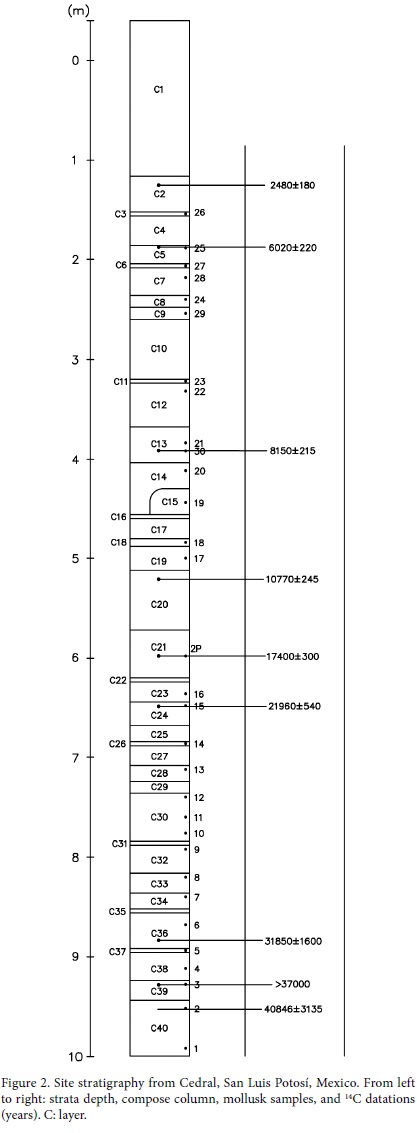
<body><![CDATA[<p align="justify"><font face="verdana" size="2">Rancho La Amapola is located 1.7 km SE of Cedral, San Luis Potos&iacute;, Mexico (<a href="/img/revistas/rmcg/v31n2/a6f1.jpg" target="_blank">Figure 1</a>). It is at 23<sup>o</sup>49'N, 100<sup>o</sup>43'W at an altitude of 1,700 m. In general, the area has several Pleistocene fossiliferous deposits resulting from the presence of now dry springs that used to form a lake in the past, as recently as the XIX Century (Lorenzo and Mirambell, 1986, 1999). The present scrubland vegetation is distinct from the one that existed in the past. Based on the known past fauna, more humidity allowed the existence of a grassland <i>(e.g.,</i> the meadow vole <i>Microtus pennsylvanicus</i> (Ord, 1815) &#45; &Aacute;lvarez and Polaco, 1982; the Columbian mammoth <i>Mammuthus columbi</i> Falconer, 1857&#45; Arroyo&#45;Cabrales <i>et al.,</i> 2003; and the terrestrial mollusks <i>Pupilla syngenes</i> (Pilsbry, 1890a), <i>Grastrocopta pellucida hordeacella</i> (Pilsbry, 1890b), and <i>Helicodiscus singleyanus</i> (Pilsbry, 1890c) &#45;Olivera&#45;Carrasco, 2012), or even a tropical deciduous forest <i>(Tapirus haysii</i> Leidy, 1860 &#45; Arroyo&#45;Cabrales <i>et</i> <i>al.,</i> 1996).</font></p>  	    <p align="justify"><font face="verdana" size="2">From 1977 to 1984, interdisciplinary excavations were undertaken at Rancho La Amapola through the "Endorreic Basins" project under the direction of the personnel of the <i>Departamento de Prehistoria</i> (currently <i>Subdirecci&oacute;n de Laboratorios y Apoyo Acad&eacute;mico,</i> I<i>nstituto Nacional de Antropolog&iacute;a e Historia</i> (INAH)). The project main objective was to learn in depth about human settlements at the site from the late Pleistocene to the Early Holocene with an environmental perspective. Faunal studies were reported either as an overall listing (&Aacute;lvarez and Polaco, 1981) or as specific taxonomic studies (&Aacute;lvarez and Polaco, 1982; Arroyo&#45;Cabrales, 1992; Arroyo&#45;Cabrales <i>et al.,</i> 1996). Recently, a monograph on the site (Mirambell, 2012) had a chapter dedicated to the faunal remains (&Aacute;lvarez <i>et al.,</i> 2012).</font></p>  	    <p align="justify"><font face="verdana" size="2">At the site, several hearths were found, accounting for a 15,000&#45;16,000 year temporal range, the oldest was found in Layer XII, and dated more than 35,000 years BP (37,694 &plusmn; 1,963 years BP, Lorenzo and Mirambell, 1999), the most recent dated at 21,468 &plusmn; 458 years BP (Layer X). Several faunal horizons were found in the deposit. Those layers had abundant and generally split bone remains, mostly isolated and quite disperse. However, a unique large horse bone concentration was uncovered between layers X and XII (<a href="#a6f2">Figure 2</a>).</font></p> 	    <p align="center"><a name="a6f2"></a>    <br>     <img src="/img/revistas/rmcg/v31n2/a6f2.jpg">	</p>      <p align="justify"><font face="verdana" size="2">&nbsp;</font></p>  	    <p align="justify"><font face="verdana" size="2"><b>MATERIAL AND METHODS</b></font></p>  	    <p align="justify"><font face="verdana" size="2">The fossil remains studied belong to the large collection of horse bone remains from Cedral archaeological site (San Luis Potos&iacute;, Mexico) on deposit at the Paleontological Collection (DP&#45;INAH) of the Laboratorio de Arqueozoolog&iacute;a "M. en C. Ticul &Aacute;lvarez Sol&oacute;rzano" Subdirecci&oacute;n de Laboratorios y Apoyo Acad&eacute;mico, INAH in Mexico City. This collection is very rich and contains a good representation of different parts of the skeleton and several remains of horse skulls and jaws. With exception of the medium&#45;sized horse group, the large&#45;sized and small&#45;sized groups are very well represented by long bones belonging to the zeugo&#45; and stylopodium (humeri, radii, femora, tibia), metapodials, phalanges, carpal and tarsal bones, and vertebrae. Skulls and mandibles are scarce and fragmentary. The morphology is similar in the three groups of horses and they significantly vary in size.</font></p>  	    <p align="justify"><font face="verdana" size="2">The skull and maxillary remains with teeth are: one symphysis; eight P2&#45;M3 right and left rows; plus one P2&#45;P4 right, one P3&#45;M2 left, one P4&#45;M3 right, one P3&#45;M1&#45;M3 right, one P3&#45;M3 left, one P2&#45;M2 left, and three P2&#45;M1 right and left, and one juvenile; isolated teeth: eight P2, three right and five left; 31 P3&#45;4,15 right and 16 left; 48 M1&#45;2, 25 right and 23 left; 27 M3,15 right and 12 left; the several upper deciduous or milk teeth and incisors not included in the analyses because they are not significant at the taxonomical level. The mandible remains with teeth are: one symphysis; six mandible fragments with complete lower rows (p2&#45;m3), and two p2&#45;p4, three p3&#45;m3, one p2&#45;m1, and two m1&#45;3 (right and left); and several lower isolated teeth: 34 p2, 16 right and 18 left; 46 p3&#45;4, 31 right and 25 left; 16 m1&#45;2, six right and 10 left; 25 m3, 11 right and 14 left; the lower deciduous teeth and incisors not included in this study (<a href="http://satori.geociencias.unam.mx/31-2/(06)31-2-Alberdi-SupMat-1-2.zip" target="_blank">Appendix 1</a>, electronic supplement).</font></p>  	    <p align="justify"><font face="verdana" size="2">The postcranial skeleton is represented by abundant bones from all of the skeleton elements, generally with very good conservation; several vertebrae and ribs are not included in our analysis because they do not contribute for identification at the taxonomic level. Other bones include: eight scapula fragments, five right and three left; 16 humeri fragments (two complete), six left and four right, plus six without determination; 26 radii fragments (seven complete), 14 left and 11 right, plus one without determination; two oleocranon fragments, one right and one left; 33 magnums, 16 right and 17 left; 46 scaphoids, 29 right and 17 left; 24 lunatum, 11 right and 13 left; 18 pyramidals, six right and 12 left; four trapezoid, one right and three left; nine unciforms, six right and three left; 12 pisiforms, four right and left; among the metacarpals (MC), seven MCII, two right and five left; 24 MCIII (20 complete), 14 right and 10 left; 10 MCIV, five right and five left; five pelvic fragments, only the acetabulum area, one right and four left; 11 femuri fragments (one complete), three right and five left; 29 tibia fragments (three complete), seven right and 15 left, plus seven without determination; one rotula large in size; 25 calcanei fragments (12 completes), 12 right and 13 left, plus 13 without determination; 67 astragali (55 complete), 33 right and 34 left; 31 tarse naviculars, 14 right and 17 left; seven ectocuneiforms, two right and five left; 22 cuboids, nine right and 13 left; among the metatarsals (MT), five MTII, one right and four left; 28 MTIII (25 completes), 14 right and 11 left; 15 MTIV, four right and 11 left; among the phalanges (PH), without distinction between front part and back part, 100 1PHIII (88 complete), 108 2PHIII (91 complete), and 34 3PHIII, mostly incomplete; also 41 proximal sesamoids and four distal sesamoids (<a href="http://satori.geociencias.unam.mx/31-2/(06)31-2-Alberdi-SupMat-1-2.zip" target="_blank">Appendix 2</a>, electronic supplement).</font></p>  	    ]]></body>
<body><![CDATA[<p align="justify"><font face="verdana" size="2">Morphological and morphometric features of the equid dental and skeleton remains from Cedral have been compared with those of <i>Equus</i> remains from several localities. Those remains included in both bivariate and multivariate analyses are Arroyo Cedazo, Aguascalientes (CED) (stored at the Museo de Paleontolog&iacute;a, Instituto de Geolog&iacute;a, Universidad Nacional Aut&oacute;noma de M&eacute;xico (UNAM)); Tequixquiac, State of Mexico (TEQ), stored at DP&#45;INAH, and Museo Geol&oacute;gico del Seminario (Barcelona); Valsequillo, Puebla (VAL) stored at DP&#45;INAH and C&#45;INAH Puebla. The Valsequillo equid remains are from different localities considered as part of the Valsequillo paleontological complex Tepenextec, Caulapan, Zacachimalpa, Tetela, Arenillas, Xochitenango, La Mata, Atepetzingo, and Alseseca.</font></p>  	    <p align="justify"><font face="verdana" size="2">Morphological and morphometrical characters and bivariate and multivariate analyses were executed with the metrical parameters. Those analyses and comparisons were mainly based on teeth and limb bones because they are the most abundant remains for statistical purposes, and with more diagnostic characters. The several maxillae and mandibles were insufficient for statistical analysis. The hypsodonty index was calculated on unworn or only slightly worn teeth (P3&#45;4/p3&#45;4 and M1&#45;2/m1&#45;2) as H/L ratio, where H is the maximal tooth height, and L the maximal length at 1 cm of the base of the crown.</font></p>  	    <p align="justify"><font face="verdana" size="2">Robustness or slenderness index of third metacarpals (MCIII) and metatarsals (MTIII) were calculated as minimal breadth at the middle of the diaphysis versus maximal length (MCIII3 x 100/ MCIII1; MTIII3 x 100/ MTIII1). We added another slenderness index of metapodial in regard to the distal maximal articular breadth (MCIII11 x 100/ MCIII1; MTIII11 x 100/ MTIII1), following Bernor <i>et al.</i> (1990). We also included the body mass estimation, following Alberdi <i>et al.</i> (1995) methodology, using the variable MCIII13 rather than 1PHIII5, due to the large variability of this last variable for this group of horses where the differences between anterior and posterior phalanges are quite strong.</font></p>  	    <p align="justify"><font face="verdana" size="2">Bivariate and multivariate analyses were performed to estimate variation and differences in size and proportions. Metacarpals, metatarsals, astragali, calcanei, first and second phalanges (MCIII, MTIII, AST, CAL, 1PHIII, 2PHIII), the most characteristic bones of the appendicular skeleton. We analysed them using principal component analysis (PCA) to explore and evaluate similarities or differences in size among the <i>Equus</i> remains from Cedral and the Mexican localities in order to assess their relationship with equids from other localities. Then, discriminate analysis (DA) was performed using variable independents all together or Mahalanobis methods on groups previously identified by PCA. This was executed to maximize the separation between the groups already recognized, as well as for evaluating whether the groups differ significantly or not among them. The results of PCA enabled us to group the remains by differences in size, while DA puts out how significant the differences are among three groups.</font></p>  	    <p align="justify"><font face="verdana" size="2">The PCA and DA were performed on 23 MCIII, 40 MTIII, 64 AST, 18CAL, 112 1PHIII, and 118 2PHIII of <i>Equus</i> from Cedral plus the comparative remains from the late Pleistocene Mexican localities. Teeth were not utilized for these analyses because their measures change throughout their life due to their wear, biasing any possible differences that were found. For description, morphological analysis, nomenclature, and measurements, we followed the recommendations of the <i>"Hipparion</i> Conference" (New York, November 1981) (Eisenmann <i>et al.,</i> 1988). All dimensions were taken in millimeters.</font></p>  	    <p align="justify"><font face="verdana" size="2">Calculations were made using SPSS 15.0. For more information about the multivariate analyses see Marcus (1990) and Reyment (1991).</font></p>  	    <p align="justify"><font face="verdana" size="2">&nbsp;</font></p>  	    <p align="justify"><font face="verdana" size="2"><b>RESULTS</b></font></p>  	    <p align="justify"><font face="verdana" size="2"><b>Description</b></font></p>  	    <p align="justify"><font face="verdana" size="2">The remains of fossil equids found in Cedral do not show any significant differences as the main morphological traits of teeth among them. The dimensions and proportions indicate the presence of three groups with similar features, but differences in size, as previously indicated by Alberdi <i>et al.</i> (2003). In regard to limb bones the differences in size are also large, and dimensions and proportions also indicate the presence of three groups with similar features but large differences in size and slenderness. The middle&#45;sized group is poorly represented, while the remains of the larger and smaller&#45;sized groups are very well represented.</font></p>  	    ]]></body>
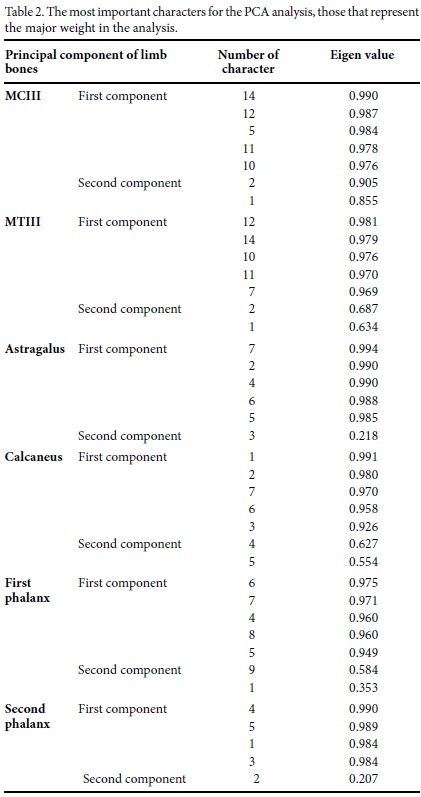
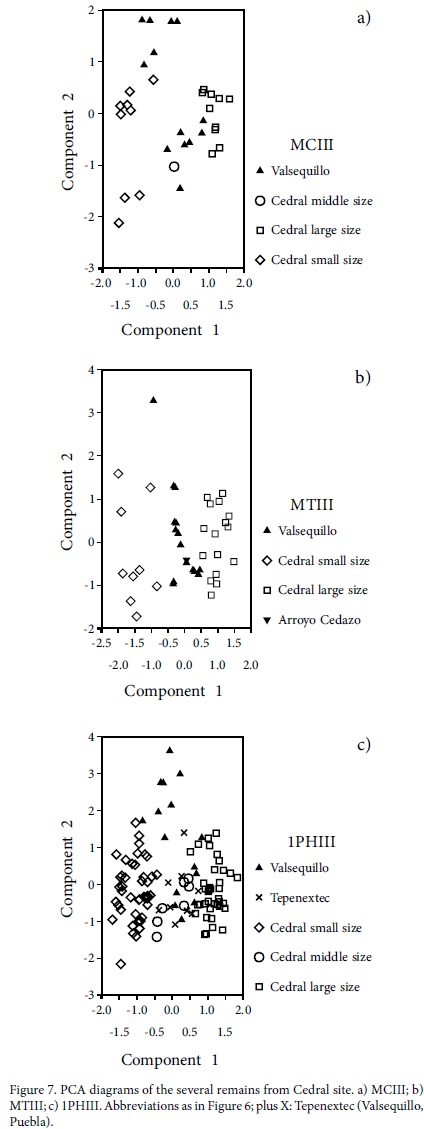
<body><![CDATA[<p align="justify"><font face="verdana" size="2"><b>Morphology and size</b></font></p>  	    <p align="justify"><font face="verdana" size="2">A complete skull is lacking, and all of the teeth have much cement. The main morphological feature of the upper cheek teeth (premolars and molars) is the elongate protocone, more distal than mesial with a slight groove lingual and sub&#45;triangular in shape on P3&#45;P4, with a more elongate subtriangular outline on M1&#45;M2; the pli caballin is generally present (<a href="/img/revistas/rmcg/v31n2/a6f3.jpg" target="_blank">Figure 3</a>). The enamel fossette plications are scarce in general in the three different sizes of horses. Parastyle and mesostyle, in general, are wide in premolars with grooves, and narrow in the molars without grooves. The hypocone is generally open and triangular in shape, with marked distal grooves and slightly marked hypoconal constriction. The grooves are more developed on the unworn teeth and nearly lost on the strongly worn ones. The hypocone is isolated inside the loph on some M3. The hypsodonty index is middle&#45;high, ranging from 2.66 to 3.33 (<img src="/img/revistas/rmcg/v31n2/a6for1.jpg" alt="">=2.94) in large size horses, and from 2.92 to 3.21 (<img src="/img/revistas/rmcg/v31n2/a6for1.jpg">=3.07) in small size horses on P3&#45;4 (no premolar middle in size without wear); on M1&#45;2 (no middle in size without wear) the hypsodonty index ranging from 3.09 to 3.5 (<img src="/img/revistas/rmcg/v31n2/a6for1.jpg" alt="">=3.24) in large size horses and from 2.99 to 4.2 (<img src="/img/revistas/rmcg/v31n2/a6for1.jpg" alt="">=3.47) in small size horses.</font></p>  	    <p align="justify"><font face="verdana" size="2">Those morphological features are observable as well on the occlusal surface of the upper cheek teeth rows. According to the tooth size, right and left rows are: P2&#45;M3 length between 189.5&#45;195 large size, and between 144&#45;148.5 small size; P2&#45;P4 length 94.9&#45;105.0 large size, 77.3&#45;81 middle size, and 63.4&#45;74 small size; M1&#45;M3 length between 85.8&#45;89.3 large size, and 63&#45;68 middle size. There are not remains of a skull (<a href="/img/revistas/rmcg/v31n2/a6t1.jpg" target="_blank">Table 1</a>). Measures of the isolated upper check teeth are in <a href="http://satori.geociencias.unam.mx/31-2/(06)31-2-Alberdi-SupMat-1-2.zip" target="_blank">Appendix 1</a> of the electronic supplement and <a href="/img/revistas/rmcg/v31n2/a6f4.jpg" target="_blank">Figure 4</a>.</font></p>  	    <p align="justify"><font face="verdana" size="2">Several incomplete mandibles and all of the teeth show much cement. The occlusal morphology of the lower premolars and molars is of a <i>caballin</i> type, characterized by an elongate double knot with rounded metaconids and more or less angular outline metastylids, and elongate linguaflexids deeper on molars than on premolars. The ectoflexid on premolars is shallow and does not enter the isthmus, while it is deeper in molars and sometimes it penetrates the isthmus, joining sometimes the linguaflexid in much worn molars. The ectoflexids often show a small pli, better marked in premolars than in molars, and quite evident on the unworn teeth (<a href="/img/revistas/rmcg/v31n2/a6f3.jpg" target="_blank">Figure 3</a>). Premolars are larger than molars. The hypsodonty index, calculated on p3&#45;4 and m1&#45;2 unworn cheek teeth, ranges from 2.54 to 3.3 in p3&#45;4 (<img src="/img/revistas/rmcg/v31n2/a6for1.jpg" alt="">=3.03) large in size, 2.54 middle in size, and 2.94 small in size, and between 2.85 to 3.86 in m1&#45;2 (<img src="/img/revistas/rmcg/v31n2/a6for1.jpg" alt="">=3.48) large in size, 2.85&#45;3.4 (<img src="/img/revistas/rmcg/v31n2/a6for1.jpg" alt="">=3.08) middle in size, and 2.89&#45;3.49 (<img src="/img/revistas/rmcg/v31n2/a6for1.jpg" alt="">=3.19) small in size. These values are consistent with the field of variation of this group. Molars are slightly more hypsodont than premolars, both upper and lower teeth, but no morphological differences among the three groups of horses based on size. Premolars and molars of Cedral mandibles (<a href="/img/revistas/rmcg/v31n2/a6f3.jpg" target="_blank">Figure 3</a>) show the same <i>caballin</i> occlusal morphology as in isolated teeth. The scarce remains of the complete mandibles are characterized by a mandibular corps high and robust and the muzzle short and large. According to their size, the maximal length of p2&#45;m3 varies between 181.5&#45;196.2 for large size, 156.6 for middle size, and 140.2 small size; p2&#45;p4 length between 91.3&#45;104.0 for large size, 83&#45;85.97 for middle size, and 73 for small size; and m1&#45;m3 length between 85.4&#45;93.0 for large size, 73.4 for middle size, and 68.3&#45;69.3 for small size (<a href="/img/revistas/rmcg/v31n2/a6t1.jpg" target="_blank">Table 1</a>). Morphological differences occur in P2/p2 and M3/m3 due to the larger variability of those teeth in equids. Measurements of the isolated lower check teeth are in <a href="http://satori.geociencias.unam.mx/31-2/(06)31-2-Alberdi-SupMat-1-2.zip" target="_blank">Appendix 1</a>.</font></p>  	    <p align="justify"><font face="verdana" size="2">Remains of the appendicular skeleton are well represented, and mostly belong to the larger and smaller sizes (<a href="/img/revistas/rmcg/v31n2/a6f5.jpg" target="_blank">Figure 5</a>), as shown in the multivariate analysis. Fragmentary remains of scapula and pelvis, mostly consisting of glenoid articular surface and acetabulum, respectively, do not provide any sound taxonomic information; complete remains of humerii, radii and ulnae, femuri, tibiae, metapodials, phalanges, carpal and tarsal bones occur. Among other skeleton remains, the most important are metapodials, phalanges, and several carpal and tarsal bones because they play a very important role in the movement and in the transmission of the body weight. The data about the body mass are shown in each group, where the three different sizes are clear. Measurements of the skeleton bones are in <a href="http://satori.geociencias.unam.mx/31-2/(06)31-2-Alberdi-SupMat-1-2.zip" target="_blank">Appendix 2</a> of the electronic supplement.</font></p>  	    <p align="justify"><font face="verdana" size="2"><b>Statistical analysis</b></font></p>  	    <p align="justify"><font face="verdana" size="2">The bivariate analyses of length versus width of the upper (P3&#45;4 and M1&#45;2) and lower (p3&#45;4 and m1&#45;2) cheek teeth at the base of the crown (to 1 cm), as well as length/protocone length ratio in upper teeth and length/double knot (formed by metaconid&#45;metastylid) ratio and length/liguaflexid ratio in lower teeth separate the equid remains from Cedral in three groups of different size. The spatial distribution of these teeth from Cedral overlaps with the comparative remains of El Cedazo, Valsequillo and Tequixquiac remains of large and small size, respectively. The bivariate analyses minimal breadth (near the middle of the bone) on the MCIII and MTIII <i>vs.</i> maximal length on MCIII and MTIII, and distal maximal articular breadth on the MCIII and MTIII <i>vs.</i> maximal length on MCIII and MTIII were done following Bernor <i>et al.</i> (1990) (<a href="/img/revistas/rmcg/v31n2/a6f6.jpg" target="_blank">Figure 6</a>).</font></p>  	    <p align="justify"><font face="verdana" size="2">The PCA of MCIII grouped the different remains from Cedral site in three groups separated by size, along with different individuals from Arroyo Cedazo, Valsequillo and Tequixquiac. The three first components explain 97.6% of the variance. The MTIII PCA results are very similar to those for MCIII, both in grouping two secondary groups in the distribution of the small size remains from the Mexican localities. The three first components explain 96.5% of the variance (<a href="#a5f7">Figure 7</a>). Also, the PCA results for the first and second phalanges of the third digit (1PHIII and 2PHIII) indicate very similar distributions among different groups and their relations with other mexican remains included here for comparison. The three first components explain 97.4% and 99.2% of the variance, respectively (<a href="#a5f7">Figure 7</a>). The astragali and calcanei PCAs show three groups, each clearly differentiated and similar in size relationships to the other bones, the calcanei are not numerous. The three first components explain 98.9% and 97.1% of the variance, respectively. The most important characters for the PCA, those that had the major weights in the analyses, are indicated in <a href="#a6t2">Table 2</a>.</font></p>  	    <p align="center"><font face="verdana" size="2"><a name="a5f7"></a>    <br> 	<img src="/img/revistas/rmcg/v31n2/a6f7.jpg"></font></p>  	    ]]></body>
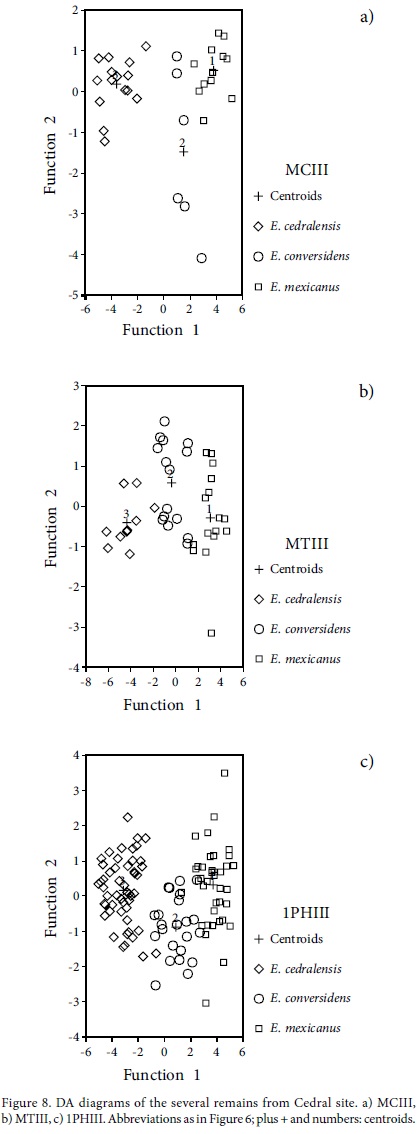
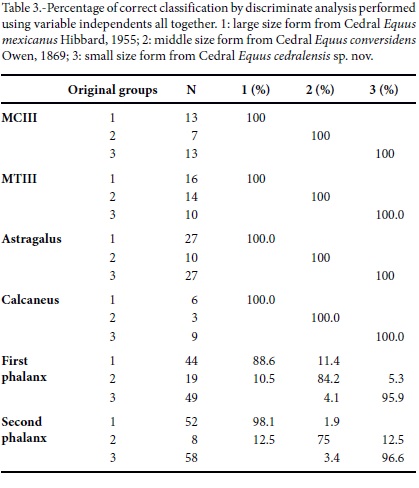
<body><![CDATA[<p align="center"><font face="verdana" size="2"><a name="a6t2"></a>    <br> 	<img src="/img/revistas/rmcg/v31n2/a6t2.jpg"></font></p>  	    <p align="justify"><font face="verdana" size="2">Based on the results of PCA grouping different size associations provides a global view concerning the size of the remains. The remains of different mexican horses are grouped together to execute a discriminant analysis (DA). Specifically, a group occurs with remains of a large size form; a middle size from different localities, which are scarce; and a small size form with a wide variation.</font></p>  	    <p align="justify"><font face="verdana" size="2">The DA results, both by using variable independents all together or Mahalanobis methods, give very similar results. DA MCIII results, based on different groups resulting from the PCA analysis, indicate that a 100.0% and 97.0% of original grouped cases are correctly classified, respectively. Either the small size subgroups are considered separated or joined. The DA MTIII results are the same those for the MCIII, based on the different groups resulting from the PCA analysis, indicating that 100% and 97.5% respectively of original grouped cases are correctly classified. In the Mahalanobis method the large and middle size are 100% correctly classified, and the small size group is correctly classified in 90.0% of original grouped cases (<a href="#a6f8">Figure 8</a>; <a href="#a6t3">Table 3</a>). The 1PHIII DA results, based on different groups resulting from the PCA analysis, indicate a 91.1% and 93.8% of original grouped cases correctly classified, respectively for both methodologies of DA. The small size group is very well classified in 95.9% and 93.9% of the original grouped cases, respectively (<a href="#a6f8">Figure 8</a>; <a href="#a6t3">Table 3</a>). The 2PHIII DA results, based on different group resulting of the PCA analysis, indicate a 95.8% and 94.1% of original grouped cases correctly classified, respectively. The small size group is very well classified in 96.6% and 93.1% respectively of original grouped cases (<a href="#a6f8">Figure 8</a>; <a href="#a6t3">Table 3</a>). The astragali are well classified in 98.4% of the original grouped cases by Mahalanobis method, and 100% by using variable independents together. The middle size and the small size groups are correctly classified in 100% of original grouped cases (<a href="#a6t3">Table 3</a>). The calcanei are very scarce and they are all correctly classified using both methodologies.</font></p>  	    <p align="center"><font face="verdana" size="2"><a name="a6f8" id="a6f8"></a>    <br> 	<img src="/img/revistas/rmcg/v31n2/a6f8.jpg"></font></p>  	    <p align="center"><font face="verdana" size="2"><a name="a6t3"></a>    <br> 	<img src="/img/revistas/rmcg/v31n2/a6t3.jpg"></font></p>  	    <p align="justify"><font face="verdana" size="2">&nbsp;</font></p>  	    <p align="justify"><font face="verdana" size="2"><b>SYSTEMATIC PALAEONTOLOGY</b></font></p>  	    ]]></body>
<body><![CDATA[<p align="justify"><font face="verdana" size="2">The results of the analyses indicate the presence of three horse sizes in the Cedral and other studied localities: one large in size, a second middle in size, overlaps with the remains of <i>Equus conversidens</i> from other late Pleistocene Mexican localities and a third small in size. Those Mexican remains are smaller than other small&#45;size remains of horses that inhabited North America (USA and Canada).</font></p>  	    <p align="center"><font face="verdana" size="2">Order Perissodactyla Owen, 1848    <br> 	Family Equidae Gray, 1821    <br> 	Subfamily Equinae Gray, 1821    <br> 	Tribu Equini Gray, 1821    <br> 	Genus Equus Linnaeus, 1758</font></p>  	    <p align="center"><font face="verdana" size="2"><i>Equus mexicanus</i> Hibbard, 1955    <br> 	(<a href="/img/revistas/rmcg/v31n2/a6f6.jpg" target="_blank">Figures 6</a> to <a href="#a6f8">8</a>)</font></p>  	    <p align="justify"><font face="verdana" size="2">&nbsp;</font></p>  	    <p align="justify"><font face="verdana" size="2"><b>Synonyms.</b> <i>Equus occidentalis</i> Leidy, 1865; <i>Equuspacificus</i> Leidy, 1868; <i>Equus scotti</i> Gidley, 1900</font></p>  	    ]]></body>
<body><![CDATA[<p align="justify"><font face="verdana" size="2"><b>Holotype.</b> Hibbard (1955) described as: a nearly perfect skull lacking the LM3 (No. 48 (HV&#45;3) stored at Museo Nacional de Historia Natural. More recently Carranza&#45;Casta&ntilde;eda and Miller (1987) rediscovered this specimen, mentioned that the skull now has the nasal bones broken and the incisors missing; the specimen is cataloged as IGM4009.</font></p> 	    <p align="justify"><font face="verdana" size="2"><b>Type locality.</b> Tajo de Tequixquiac, Estado de M&eacute;xico.</font></p> 	    <p align="justify"><font face="verdana" size="2"><b>Geographical distribution.</b> <i>E. mexicanus</i> is cited at different localities in Mexico, United States of America and Central America.</font></p>     <p align="justify"><font face="verdana" size="2"><b>Stratigraphic distribution.</b> Rancholabrean local faunas from the Pleistocene.</font></p>      <p align="justify"><font face="verdana" size="2"><b>Age and geographic range.</b> Late Rancholabrean, known from the middle&#45;western United States of America and Central America.</font></p>     <p align="justify"><font face="verdana" size="2"><b>Diagnosis.</b> The skull is large. The basicranial length is greater than 500 mm at the available material. The narial notch is deep and extends over the commissure between P2 and P3. The rostrum is broad, the choanae rather narrow, the posterior palatine foramina are placed opposite the M3. The masseteric ridge is of medium length and curves downward rostrally. The upper cheek teeth are large, with elongate flattened protocones, derived features and average complexly plicate enamel. Lower molars have a shallow ectoflexid on premolars, penetrating the isthmus on m1, m2, and m3 in advance stage of wear. Following Winans (1989), the ratio of length to proximal width is generally less than 5.0 for metacarpals and 6.0 for metatarsals. Metapodials are not stilt&#45;legged. The body mass from MCIII13 is between 354.33 and 532.88 kg and the mean is 456.23 kg.</font></p>      <p align="justify"><font face="verdana" size="2"><b>Study material.</b> See <a href="/img/revistas/rmcg/v31n2/a6t1.jpg" target="_blank">Table 1</a> and <a href="http://satori.geociencias.unam.mx/31-2/(06)31-2-Alberdi-SupMat-1-2.zip" target="_blank">Appendices 1</a> and <a href="http://satori.geociencias.unam.mx/31-2/(06)31-2-Alberdi-SupMat-1-2.zip" target="_blank">2</a> of the electronic supplement.</font></p>  	    <p align="justify"><font face="verdana" size="2"><b>Discussion.</b> The dental morphology from Cedral is very similar to the morphology from the other two identified species, while the size varies significantly. The discriminant analyses indicate that the remains assigned to <i>E. mexicanus</i> are large in size and body mass and also they present a morphological and external anatomical body shape that we indicate above. Hibbard (1955) described and figured E. <i>mexicanus</i> from Tajo de Tequixquiac, State of Mexico, Mexico, differentiated by the skull morphology, mainly by the skull occipital region being pointed out at the bottom, more than any other known Pleistocene or Holocene species; ventrally, the premaxilla is mostly flat in comparison with the bend shown by other species, and included as synonyms to <i>E. excelsus</i> Leidy, 1858 and <i>E. occidentalis</i> Leidy, 1865. The availability of larger series of Pleistocene horse skulls have shown that those characters mentioned by Hibbard (1955) are more common than expected; the same is shown for recent specimens with some characters, like occiput orientation and premaxilla shape, varying with age (Osborn, 1912).</font></p>  	    <p align="justify"><font face="verdana" size="2">Lundelius (1972) mentioned that there are small differences in the lower and upper teeth between <i>E. mexicanus</i> and E. <i>pacificus;</i> one is based on a more complex folding of the fossetes in <i>E. pacificus</i> Leidy, 1868, than in <i>E. mexicanus.</i> This is not a diagnostic character, tooth morphology becomes more and more simpler with wear. Kurt&eacute;n and Anderson (1980) include <i>E. mexicanus</i> as a synonym of <i>E. giganteus</i> Gidley, 1901, and different from <i>E. scotti</i> Gidley, 1900, they consider it may be referred to the subgenus <i>Amerhippus</i> Hoffstetter, 1950. Also, Lundelius (1972) includes <i>E. mexicanus</i> as a synonym of <i>E. pacificus,</i> while Savage (1951) considered it as a <i>nomen nudum.</i></font></p>  	    <p align="justify"><font face="verdana" size="2">Winans (1989) consideres <i>E. mexicanus</i> as a valid species and included it in her <i>E. laurentius</i> group. At present <i>E. laurentius</i> Hay, 1913, is not considered a fossil, some indication that it must be considered as a synonym of horse <i>E. caballus</i> Linnaeus, 1758 (Scott <i>et al.,</i> 2010). <i>E. mexicanus</i> represents the larger end of the prehistoric horse spectrum. Its fossil remains are found in United States, at Rancho La Brea living in grasslands. The western horse is grazer. Some evidence suggests that the species underwent a small, yet significant reduction in body size near the end of the last Ice Age. This change in body size may be the result of changing conditions in both climate and vegetation (Guthrie, 2003).</font></p>  	    ]]></body>
<body><![CDATA[<p align="justify"><font face="verdana" size="2">Dalquest and Schultz (1992) stated that if <i>E. mexicanus</i> and <i>E. scotti</i> are the same species, then <i>E. mexicanus</i> must be the synonym of <i>E. scotti.</i> Azzaroli (1995) proposed <i>E. mexicanus</i> as a synonym of <i>E. pacificus,</i> but later himself (Azzaroli, 1998) considered E. <i>pacificus</i> as a synonym of E. <i>mexicanus</i> (because <i>E. pacificus</i> is also based on a unique tooth), and <i>E. scotti</i> as a synonym of <i>E. excelsus.</i></font></p>  	    <p align="justify"><font face="verdana" size="2">For Azzaroli (1998) the systematic position of <i>E. mexicanus</i> is a puzzle. The peculiar features of the profile and the occipital region have been observed only in species from South America, in E. <i>fraternus</i> Leidy, 1860, and possibly in E. <i>conversidens.</i> Bennett (1980) proposed that the ventral rotation of the occiput was a primitive feature, found in <i>Dinohippus</i> Quinn, 1955. In fact, a strong rotation is shown in Osborn's figure of the type skull of <i>Dinohippus leidyanus</i> Osborn, 1918 <i>(Protohippus leidyanus</i> in the original text: Osborn, 1918, pl.30), but the fossil is deformed. Better preserved skulls of the same species, from Nebraska and from Kansas, show backward sloping paraoccipital processes and lack any trace ofventral rotation of the occiput (Azzaroli, 1998). The specific character of <i>E. mexicanus,</i> out of those from South American and, possibly the North American species of <i>Equus</i> (E. <i>fraternus</i> and <i>E. conversidens),</i> is a derived, not a primitive feature.</font></p>  	    <p align="justify"><font face="verdana" size="2">This discussion clearly shows the diversity of criteria in regard to the large&#45;sized North American horses in more than 100 years, including the complex nomenclatural issues that may be in agreement for some authors and in total disagreement by others. Because of that, it was decided to assign the large&#45;sized Mexican horse remains from Cedral and other localities to <i>E. mexicanus,</i> pending a detailed and exhaustive review of all of the known species of North American Pleistocene horses to define valid and non&#45;valid species, and the relationships among them.</font></p>  	    <p align="center"><font face="verdana" size="2"><i>Equus conversidens</i> Owen, 1869    <br> 	(<a href="/img/revistas/rmcg/v31n2/a6f3.jpg" target="_blank">Figures 3</a> to <a href="#a6f8">8</a>)</font></p>  	    <p align="justify"><font face="verdana" size="2"><b>Holotype.</b> MNM&#45;403, fragmentary right maxilla with all cheek teeth.</font></p>  	    <p align="justify"><font face="verdana" size="2"><b>Type locality.</b> Valley of Mexico, Mexico. Carranza&#45;Casta&ntilde;eda and Miller (1987) rediscovered this specimen, represented by a palate with complete cheek tooth dentition, assigned the catalog number IGM4008.</font></p>  	    <p align="justify"><font face="verdana" size="2"><b>Geographical distribution.</b> North America, Mexico and Central America.</font></p>  	    <p align="justify"><font face="verdana" size="2"><b>Stratigraphic distribution.</b> Pleistocene, probably Rancholabrean.</font></p>  	    <p align="justify"><font face="verdana" size="2"><b>Diagnosis.</b> The skull fragment IGM4008 (Holotype; No. 403 old number) is constituted mostly by the rostral portion, with the maxilla and teeth <i>in situ.</i> Each dental series includes three molars and three premolars. The premolars exceed the true molars in size (pl. LXI, fig. 1; Owen, 1869). The upper cheek teeth are middle in size, with elongate flattened protocones, derived features and average complexly plicate enamel similar to <i>E. mexicanus</i> but smaller in size. Lower molars have similar morphology but smaller in size than <i>E. mexicanus</i> teeth. Following Winans (1989), the ratio of length to proximal width is generally less than 5.0 for metacarpals and 6.0 for metatarsals. Metapodials are not stilt&#45;legged. The body mass from MCIII13 is between 215.63 to 282.52 kg and the mean is 249.08 kg.</font></p>  	    ]]></body>
<body><![CDATA[<p align="justify"><font face="verdana" size="2">Owen (1869) figured an illustration based on a photograph of a specimen lost; Carranza&#45;Casta&ntilde;eda and Miller (1987) reported the rediscovery of the specimen in the collections of the Instituto de Geolog&iacute;a at Universidad Nacional Aaut&oacute;noma de M&eacute;xico; doing so they published a photograph from the ventral portion of the specimen.</font></p>  	    <p align="justify"><font face="verdana" size="2"><b>Study material.</b> See <a href="/img/revistas/rmcg/v31n2/a6t1.jpg" target="_blank">Table 1</a> and <a href="http://satori.geociencias.unam.mx/31-2/(06)31-2-Alberdi-SupMat-1-2.zip" target="_blank">Appendices 1</a> and <a href="http://satori.geociencias.unam.mx/31-2/(06)31-2-Alberdi-SupMat-1-2.zip" target="_blank">2</a> as supplementary information.</font></p>  	    <p align="justify"><font face="verdana" size="2"><b>Discussion.</b> Owen (1869) described the specimen, a portion of the right and left series of grinders, and a considerable part of the intervening bony plate, based on a photograph. Owen (1869) gave the name <i>Equus conversidens</i> to the species because the tooth rows of the type specimen rostrally converge. The specimen was damaged and has been restored, so that the validity of Owen's observation was questioned by some authors (see discussion in Gidley, 1901); facial skull from the late Pleistocene deposits at Barranca del Muerto near Tequixquiac (LACM 308/123900) clearly showed this feature. They proposed that the photograph actually shows two different specimens, each corresponding to one maxillar side with different enamel patterns and molar lengths. Because of this, Gidley (1901) named as the species lectotype the right maxilla. Other than the mentioned convergence, the type specimen not has unique characters and differences between both ramii are within the normal variability for the genus.</font></p>  	    <p align="justify"><font face="verdana" size="2">A rich collection, including practically all the bones of the skeleton but disarticulated, comes from San Josecito Cave, Nuevo Le&oacute;n, Mexico, LACM loc.192. Stock (1953) based his new subspecies <i>E. conversidens leoni</i> Stock, 1953 on these fossils that included two skulls from cave. A third skull comes from Papago Springs Cave, Arizona, and was described by Skinner (1942). All the skulls are broken and largely restored, so that they are not reliable for a definition of the characters of this species. The skull from Barranca del Muerto, although incomplete, is more diagnostic. The strongly tapering snout and the low position and small size of the orbit are close to <i>E. fraternus;</i> however, the pre&#45;orbitale foramen is placed high. Hibbard (1955) considered that <i>E. tau</i> is a synonym of <i>E. conversidens.</i> The description of the <i>leoni</i> subspecies by Stock (1953) indicates that the differences between the type species and this subspecies are minimal or non&#45;existent because they correspond to variable characters.</font></p>  	    <p align="justify"><font face="verdana" size="2">Most authors have agreed with <i>E. conversidens</i> name. Winans (1985) indicates that it must be considered as <i>nomen dubium</i> because the original description uses a non&#45;existent character; in 1989 she includes the subspecies <i>leoni nomen nudum</i> in the <i>E. alaskae;</i> Azzaroli (1995, 1998) in <i>E. francisci</i> Hay, 1915. Our comparative analysis on the skeleton remains indicates that <i>E. conversidens</i> and middle&#45;sized remains from Mexican localities are significantly larger than <i>E. francisci,</i> and do not have stilt&#45;legged metapodials.</font></p>  	    <p align="justify"><font face="verdana" size="2">The nomenclatural position of the medium&#45;size horse with only moderately slender metapodials (ratio of the length to the proximal width of the metacarpal generally less than 5.0 and that of the metatarsal less than 6.0) has been quite complex. Winans (1985) treated <i>E. conversidens</i> as a <i>nomen nudum,</i> it was named solely on the basis of dental characters. The name has been widely used. At times, the name <i>E. alaskae</i> Hay, 1913 has been used in the literature based on the treatment of species groups by Winans (1989).</font></p>  	    <p align="justify"><font face="verdana" size="2">Azzaroli (1998) indicates that the geological range of <i>E. conversidens</i> was Irvingtonian throughout Rancholabrean according to Kurt&eacute;n and Anderson (1980). All of the specimens recorded in that book are of Rancholabrean age, as well as the specimens discussed in this paper. Azzaroli (1995) considers E. <i>fraternus</i> closely related to the South American species of <i>Equus,</i> and (Azzaroli, 1998) also indicated: "Like <i>Equus fraternus, Equus conversidens</i> is closely related to South American horses. It seems however too young to be their direct ancestor." We consider that all horses from the late Pleistocene (Racholabrean or Lujanian) are very similar morphologically, with small differences that correspond to adaptative considerations on the distal appendicular skeleton.</font></p>  	    <p align="justify"><font face="verdana" size="2"><i>Equus nobisi</i> Pichardo, 2004 was described based on a left mandibular fragment from Arenillas, Puebla, currently on deposit at the collection at Centro INAH Puebla (Mexico) as number CRINAHP 1305. The specimen was originally reported by Nobis (1973) as part of Nobis' group II, he related his group I with E. <i>mexicanus</i> and his group III with <i>E.</i> cf. <i>conversidens,</i> but group II was said not to be related to any known species. Pichardo (2004) described the new species, based solely on Nobis (1973) data, but only provided some characters as part of the comparisons between the different species from the site. Pichardo (2008) included this specimen from the greater Valsequillo complex as E. <i>excelsus.</i> Furthermore, Pichardo (2000, 2004, 2006) emphasized the use ofzoogeographic range and econiche preference as valid taxonomic characters, and that those should be given taxonomic weight in species diagnosis. Clearly those concepts are away from current biological tendencies in regard to the species concept (De Queiroz, 2007).</font></p>  	    <p align="justify"><font face="verdana" size="2">We have chosen to retain the name <i>E. conversidens</i> for this medium&#45;sized, extinct horse while acknowledging that Winans (1989) may be nomenclaturally correct. The finding of the specimen (Carranza&#45;Casta&ntilde;eda and Miller, 1987) whose photograph was utilized by Owen (1869) to describe the species, should counteract Winans'proposal.</font></p>  	    <p align="center"><font face="verdana" size="2"><i>Equus cedralensis</i> new species    ]]></body>
<body><![CDATA[<br> 	(<a href="/img/revistas/rmcg/v31n2/a6f3.jpg" target="_blank">Figures 3</a> to <a href="/img/revistas/rmcg/v31n2/a6f9.jpg" target="_blank">9</a>)</font></p>  	    <p align="justify"><font face="verdana" size="2"><b>Holotype.</b> A mandible ramus fragment formed by two specimens: one p2&#45;m3 right row (DP&#45;2675 I&#45;2 15), and a second fragment of the symphysis with the anterior dentition (DP&#45;2674 I&#45;2 8), articulated together and stored at the Paleontological Collection (DP&#45;INAH) of the Laboratorio de Arqueozoolog&iacute;a "M. en C. Ticul &Aacute;lvarez Sol&oacute;rzano" Subdirecci&oacute;n de Laboratorios y Apoyo Acad&eacute;mico, INAH in Mexico City (<a href="/img/revistas/rmcg/v31n2/a6f9.jpg" target="_blank">Figure 9</a>).</font></p>  	    <p align="justify"><font face="verdana" size="2"><b>Paratype series.</b> Fragments of mandible ramii with remains of several teeth, p3&#45;m3 right and left (DP&#45;4577) and several upper row: P2&#45;M2 left (P2 DP&#45;3841, P3&#45;P4 DP&#45;3842, and M1&#45;M2 DP&#45; 3839), and three P2&#45;M1 (DP&#45;3829 left, and DP&#45;3830 and DP&#45;4587 right).</font></p>  	    <p align="justify"><font face="verdana" size="2"><b>Type locality.</b> "Rancho La Amapola" located 1.7 km southeastern from Cedral, San Luis Potos&iacute;, Mexico. Coordinates: 23&deg;49'N, 100&deg;43W, 1700 m a.s.l.</font></p>  	    <p align="justify"><font face="verdana" size="2"><b>Derivation name.</b> From the Cedral locality where the type specimens were found.</font></p>  	    <p align="justify"><font face="verdana" size="2"><b>Geographical distribution.</b> Different late Pleistocene localities inside Mexico, other than Cedral: Valsequillo (Puebla), Tequixquiac (State of Mexico), Arroyo Cedazo (Aguacalientes) and possibly from La Cinta&#45;Portalitos and La Piedad&#45;Santa Ana (Michoac&aacute;n).</font></p>  	    <p align="justify"><font face="verdana" size="2"><b>Stratigraphic distribution.</b> Rancholabrean, late Pleistocene.</font></p>  	    <p align="justify"><font face="verdana" size="2"><b>Diagnosis.</b> One of the smallest North American horse species for late Pleistocene, larger than <i>Equus tau</i> Owen. Although no complete skulls or mandibles, several upper and lower teeth rows (P2/p2&#45;M3/m3), very small in size and some of the mandible rami are almost complete like the holotype. Upper and lower cheek teeth are morphologically very similar to the other horses found at Cedral, but smaller in size. The upper teeth have a protocone elongate more distal than mesially and with a small lingual groove; with styles, parastyle, and mesostyle on premolars wide with a groove and narrow without grooves on molars. The lower teeth have metaconid&#45;metastylid (double knot), rounded or slightly angular, respectively. The ectoflexid is superficial in premolars and molars without crossing the isthmus, only on molars with an advanced wear the ectoflexid are deeper, crosses the isthmus, and could touch the linguaflexid; the linguaflexid is large and more or less U shape. The symphysis has a linear arcade with large canines (a possible male). The body mass is between 91.83 and 169.59 kg, and the mean is 138.41 kg following Alberdi <i>et al.</i> (1995) on the MCIII13. The appendicular skeleton is also small in size with metapodials not stilt&#45;legged, clearly different from the other remains from Cedral and other Mexican localities. In fact, the Mexican new species has metapodials shorter and less slender than both <i>francisci</i> and <i>alaskae.</i></font></p>  	    <p align="justify"><font face="verdana" size="2"><b>Study material.</b> See <a href="/img/revistas/rmcg/v31n2/a6t1.jpg" target="_blank">Table 1</a> and <a href="http://satori.geociencias.unam.mx/31-2/(06)31-2-Alberdi-SupMat-1-2.zip" target="_blank">Appendices 1</a> and <a href="http://satori.geociencias.unam.mx/31-2/(06)31-2-Alberdi-SupMat-1-2.zip" target="_blank">2</a> for supplementary information.</font></p>  	    <p align="justify"><font face="verdana" size="2"><b>Discussion.</b> Data for this horse was compared with the different data for small horses from North America to find the possible relationship with those remains. Winans (1989) proposed as small&#45;sized horses those of <i>E. francisci</i> and E. <i>alaskae</i> groups, the first with stilt&#45;legged metapodial, and the latter with stout&#45;legged. The small horse remains from Mexican localities are smaller than <i>E. francisci</i> and <i>E. alaskae</i> groups; the metapodials are clearly smaller and less slender than those two groups; metacarpals show some overlapping with Winans (1989) <i>E. alaskae</i> (an ongoing study of the North American horses and their comparisons with the specimens shows that both <i>E. francisci</i> and <i>E. alaskae</i> were larger than <i>E. cedralensis</i> sp.nov.). Winans (1985) considers <i>E. francisci</i> as a valid species and included as synonyms <i>E. altidens</i> Quinn, 1957, <i>E. arellanoi</i> Mooser, 1958, <i>E. calobatus</i> Troxell, 1915, <i>E. quinni</i> Slaughter <i>et al.,</i> 1962, and <i>E. zoyatalis</i> Mooser, 1958. Hay (1915) declared <i>E. francisci</i> to be the size of <i>E. tau,</i> but differing from it in having the transverse width of P3&#45;M1 greater than the anteroposterior length. This difference is typical of teeth that are in different stages of wear and does not signify taxonomic difference. Hibbard and Taylor (1960) have <i>E. francisci</i> as a synonym of <i>E. conversidens.</i> Slaughter (1966) suggested an intergradation between <i>E. francisci, E. conversidens, E. lambei</i> Hay, 1917, and <i>E. fraternus.</i> Lundelius and Stevens (1970) presented evidence based on similar specimens found in Texas for maintaining <i>E. francisci</i> as a separate species. The species <i>E. francisci</i> will be maintained because it is the oldest name assigned to the stilt&#45;legged group. If either <i>E. conversidens</i> or <i>E. tau</i> can be shown to be valid and to belong to this group, then those names will take precedence.</font></p>  	    ]]></body>
<body><![CDATA[<p align="justify"><font face="verdana" size="2">In the case of <i>Equus alaskae</i> it was elevated to species rank from <i>E. niobrarensis alaskae</i> Hay, 1913 by Winans (1989), who included within the <i>E. alaskae</i> group as synonyms: <i>E. conversidens leoni, E. lambei</i> and <i>E. niobrarensis alaskae.</i> Winans (1989) referred to <i>E. alaskae</i> group all specimens from San Josecito Cave, Natural Trap Cave, and small horses from Dry Cave. Typical <i>E. niobrarens</i> is larger than E. <i>alaskae</i> with a narrower premaxillae, no clear&#45;cut characters separated these horses from other species.</font></p>  	    <p align="justify"><font face="verdana" size="2">Azzaroli (1998) included <i>E. tau</i> among the synonyms of <i>E. francisci,</i> Hibbard (1955) included E. <i>tau</i> within E. <i>conversidens,</i> Winans (1985) considered <i>E. lambei</i> not a fossil, that it could be a synonym of <i>E.</i> <i>caballus</i> or <i>E. asinus</i> Linnaeus, 1758. Winans(1989) included it as synonyms of E. <i>alaskae</i> group. Dalquest (1979) considered that North American and Mexican species of horses, only valid: <i>E. conversidens</i> and <i>E. tau</i> (includes <i>E. francisci</i> as a synonymous for <i>E. tau).</i> Based on the data for <i>E. tau</i> provided by Mooser and Dalquest (1975) and Dalquest (1977, 1979), dental measurements were smaller than those for <i>E. cedralensis</i> sp. nov. from Cedral, except few molars that overlap. Metapodials for <i>E. cedralensis</i> are much shorter (lenght MCIII = 181&#45;224 mm, MTIII = 233&#45;271 mm) than the same for <i>E. tau</i> (length of MCIII 235 mm, MTIII between 277&#45;285 mm; see <a href="/img/revistas/rmcg/v31n2/a6t4.jpg" target="_blank">Table 4</a>), and less slender. An&#45;ongoing study for reviewing the whole North American late Pleistocene species should be the small&#45;sized species.</font></p>  	    <p align="justify"><font face="verdana" size="2">For the PCA the smallest metapodials split into two subgroups with differences in gracility more considerably noticeable in MCIII than in MTIII. But in DA, these differences between both subgroups are diminished. Vera Eisenmann (personal communications August 4, 2012) deduces from the metapodials small in size the presence of three different horses: the majority of MCIII small in size and two MTIII correspond to <i>E. quinni,</i> three MTIII correspond to <i>E. francisci</i> and only two MCIII correspond to <i>E. cedralensis</i> sp. nov. The metapodi&#45;als identified by V. Eisenmann as <i>E. francisci</i> and <i>E. quinni</i> present in Cedral are shorter than the data that exist in the literature for <i>E. francisci</i> and <i>E. quinni</i> (see Slaughter <i>et al.,</i> 1962; Lundelius and Stevens, 1970). The possible existence of many species of horses in this locality could be surprising. Good representation exists of the majority of the bones in the skeleton and teeth. Only in the metapodials is a large variation while in other bones only three sizes were detected. Average ratios (length, dimension 1, to proximal width, dimension 5) for studied metacarpals and metatarsals are more variable than in <i>E. alaskae</i> and <i>E. francisci</i> (after Winans, 1989), with some specimens closer to <i>E. alaskae</i> and others to <i>E. francisci.</i> The Cedral group is significantly smaller than the remaining horses analysed by Winans (1985, 1989). The <i>francisci</i> group encompasses all horses with stilt&#45;legged metapodials, having a ratio of length to proximal width generally greater than 5.0 for metacarpals and 6.0 for metatarsals (Winans, 1989). The differences between both species are linked to the metapodials being larger and slender in <i>francisci</i> than in <i>alaskae,</i> but both are more slender that the Mexican new species. After Winans (1989) the size range from largest to smallest metapodials is greater in <i>francisci</i> group than that for most other groups. This situation raises the possibility that the group should be subdivided, but until more information becomes available, it is best to support these specimens as a single group.</font></p>  	    <p align="justify"><font face="verdana" size="2">&nbsp;</font></p>  	    <p align="justify"><font face="verdana" size="2"><b>DISCUSSION</b></font></p>  	    <p align="justify"><font face="verdana" size="2">Horse taxonomy is convoluted worldwide and the same is true for Mexican horses. Many species have been described, many of which are currently synonyms of others. Although some studies have tried to assess the actual taxonomic status of the North American Pleistocene horses <i>(e.g.,</i> Azzaroli, 1998; Winans, 1985, 1989), a unique proposal is not yet available.</font></p>  	    <p align="justify"><font face="verdana" size="2">Both PCA and DA assays indicated the presence of three significantly different groups of horses. From the comparative analysis among the Cedral remains with the data of other horse fossil remains from Mexican localities, those three groups were assigned to three different horse species. One group corresponded to remains large in size from Cedral, associated with data of <i>E. mexicanus.</i> We suggested to assign it to <i>E. mexicanus</i> until the taxonomic situation of the <i>Equus</i> species of North America are correctly described and the specimens identified. This form was already reported as <i>E. mexicanus</i> (Alberdi <i>et al.,</i> 2003) and was also found in other late Pleistocene Mexican localities as Valsequillo. A second, rarer group, corresponded to remains middle in size from Cedral associated with other sized specimens as <i>E.</i> <i>conversidens</i> (data of E. Scott transfer to M. Mora in 2006), and from other late Pleistocene Mexican localities. The previous assignation appeared correct (Alberdi <i>et al.,</i> 2003).</font></p>  	    <p align="justify"><font face="verdana" size="2">Finally a third group, small in size, from Cedral and compared with the small sized remains from several Mexican localities. The appendicular skeleton, and specially the distal portions, are clearly smaller than for the other two species. This comparison by PCA and DA of the metapodials remains indicates that Cedral remains are smaller and less slender than other remains studied by Winans (1985, 1989): <i>E. francisci</i> and <i>E. alaskae</i> groups. Dental remains indicate an animal smaller than most of North American small horses known in the literature, the body mass is much reduced (Alberdi <i>et al., in litteris),</i> with the exception of <i>E. tau</i> described by Mooser and Dalquest (1975) and Dalquest (1977, 1979) that is smaller and slender (<a href="/img/revistas/rmcg/v31n2/a6t4.jpg" target="_blank">Table 4</a>). Consequently, we assign a new name to Cedral remains smaller in size than <i>E. alaskae</i> and <i>E. francisci,</i> and less slender than both (metapodials being larger and slender in <i>francisci</i> than in <i>alaskae).</i> Previously, we assigned it to <i>Equus</i> sp. A (Alberdi <i>et al.,</i> 2003), and here we name it as <i>Equus cedralensis</i> sp.nov.</font></p>      <p align="justify"><font face="verdana" size="2">As previously indicated (Alberdi <i>et al.,</i> 2003), <sup>14</sup>C radiocarbon assays for Cedral locality indicates a late Pleistocene age for this site (Lorenzo and Mirambell, 1986), ranging between 37,694 and 21,468 years BP. The morphological analysis indicates a high similarity, both in the teeth as in skeletal remains, among these three groups of horses, but the body mass and size are very variable among these three groups.</font></p>  	    <p align="justify"><font face="verdana" size="2">Also, the morphological differences affecting horses are mostly found in the distal limb bones, being related to environmental conditions, sediment and vegetation types. P&eacute;rez&#45;Crespo <i>et al.</i> (2009) conclude, based on stable isotopes analysis from a Cedral's sample, that <i>E. mexicanus</i> and the Columbian <i>Mammuthus columbi</i> (Falconer, 1857), had a mixed diet, while <i>E. conversidens</i> and another unknown species of <i>Equus</i> had a more restricted C4 diet.</font></p>  	    ]]></body>
<body><![CDATA[<p align="justify"><font face="verdana" size="2">As for the horse remains from other Mexican late Pleistocene localities included in the present study, the applied names are well related to the recognized species at the Cedral locality. At Valsequillo, three horse species are assigned to <i>Equus mexicanus, Equus conversidens,</i> and <i>Equus cedralensis.</i> The scarce remains from Arroyo Cedazo (Aguascalientes, Mexico), housed at the Geology Institute at UNAM, confirmed that they pertained to a single species, <i>E. conversidens;</i> some large and small sizes were also present, the medium&#45;sized is the dominant form, while at Cedral this form is more scarce. Finally, as for the important deposits at Tequixquiac, remains of at least the same three species occur, without bias to any one species.</font></p>  	    <p align="justify"><font face="verdana" size="2">&nbsp;</font></p>  	    <p align="justify"><font face="verdana" size="2"><b>CONCLUSION</b></font></p>  	    <p align="justify"><font face="verdana" size="2">We propose the presence of three distinct horse species in the region near Cedral, San Luis Potos&iacute;, Mexico. Those species show morphological characters quite similar among them, mostly on teeth morphology with a remarkable size difference in measures and body mass.</font></p>  	    <p align="justify"><font face="verdana" size="2">The large and robust species assigned to <i>Equus mexicanus,</i> a medium&#45;sized animal associated to the name <i>E. conversidens,</i> and a small&#45;sized but robust species to which the name <i>E.cedralensis</i> sp. nov. proposed to honor the town where Cedral is.</font></p>  	    <p align="justify"><font face="verdana" size="2">During the study of the large series of Mexican specimens, morphological similarity among the entire American horses from the late Pleistocene, mostly in regard to dental morphology was detected. Also, all of the horses were found at Rancholabrean deposits could be assigned to a time range between 50,000 to 10,500 years BP, the latest surviving period for the horses all over the Americas.</font></p>  	    <p align="justify"><font face="verdana" size="2">&nbsp;</font></p>  	    <p align="justify"><font face="verdana" size="2"><b>ACKNOWLEDGMENTS</b></font></p>  	    <p align="justify"><font face="verdana" size="2">We thank Dr. Mar&iacute;a del Carmen Perrillat for allowing us study specimens under her care at the Colecci&oacute;n de Paleontolog&iacute;a, Insitituto de Geolog&iacute;a, Universidad Nacional Aut&oacute;noma de M&eacute;xico. Also, Antropologist Victor Hugo Valencia allowed studying those materials from Valsequillo housed at Centro INAH Puebla and Luis Via and Sebastian Calzada for the specimens from Tequixquiac stored at Museo Geol&oacute;gico del Seminario de Barcelona. We are grateful to Margarito Mora and Eric Scott for providing data on specimens housed in United States of America collections. Alejandro L&oacute;pez&#45;Jim&eacute;nez provided technical assistance for preparation of photograph illustrations and Maria Teresa Olivera compose stratigraphy figure. The comments of Vera Eisenmann and Darrin Pagnac on a previous version of this article are very insightful to improve the text. We also thank Marisol Montellano and two anonymous reviewers and also the editor, their recommendations to improve this manuscript. Dr. Eileen Johnson kindly reviewed the modified English text for the language issues. This study was possible through the support of the Proyectos de Investigaci&oacute;n conjunta con Iberoam&eacute;rica (Bilateral Agreements CONACYT&#45;CSIC 2001&#45;2002, and 2007&#45;2008) and the projects PB97&#45;1250, BTE2001&#45;1684, CGL2004&#45;00400/BTE, CGL2007&#45;60790/BTE and CGL2010&#45;19116/BOS of the DGICYT, Spain.</font></p>  	    <p align="justify"><font face="verdana" size="2">&nbsp;</font></p>  	    ]]></body>
<body><![CDATA[<p align="justify"><font face="verdana" size="2"><b>SUPPLEMENTARY MATERIAL</b></font></p>  	    <p align="justify"><font face="verdana" size="2">Appendices 1 and 2 can be found at the journal website &lt;<a href="http://rmcg.unam.mx/" target="_blank">http://rmcg.unam.mx/</a>&gt;, in the table of contents of this issue.</font></p>  	    <p align="justify"><font face="verdana" size="2"><i><a href="http://satori.geociencias.unam.mx/31-2/(06)31-2-Alberdi-SupMat-1-2.zip" target="_blank">Appendix 1</a>.</i> Measurements of the isolate teeth from the Cedral site: P2/p2, P3&#45;4/p3&#45;4, M1&#45;2/m1&#45;2, and M3/m3.</font></p>  	    <p align="justify"><font face="verdana" size="2"><i><a href="http://satori.geociencias.unam.mx/31-2/(06)31-2-Alberdi-SupMat-1-2.zip" target="_blank">Appendix 2</a>.</i> Measurements of the different bones from Cedral site. The measurements follow the recommendations of the <i>"Hipparion</i> Conference" New York 1981 (Eisenmann <i>et al.,</i> 1988).</font></p>  	    <p align="justify"><font face="verdana" size="2">&nbsp;</font></p>  	    <p align="justify"><font face="verdana" size="2"><b>REFERENCES</b></font></p>  	    <!-- ref --><p align="justify"><font face="verdana" size="2">Alberdi, M.T., Arroyo&#45;Cabrales, J., Polaco, O.J., 2003, &iquest;Cu&aacute;ntas especies de caballo hubo en una sola localidad del Pleistoceno Mexicano?: Revista Espa&ntilde;ola de Paleontolog&iacute;a, 18, 205&#45;212.    &nbsp;&nbsp;&nbsp;&nbsp;&nbsp;&nbsp;&nbsp;&nbsp;[&#160;<a href="javascript:void(0);" onclick="javascript: window.open('/scielo.php?script=sci_nlinks&ref=8099316&pid=S1026-8774201400020000600001&lng=','','width=640,height=500,resizable=yes,scrollbars=1,menubar=yes,');">Links</a>&#160;]<!-- end-ref --></font></p>  	    <!-- ref --><p align="justify"><font face="verdana" size="2">Alberdi, M.T., Prado, J.L., Ortiz&#45;Jaureguizar, E., 1995, Patterns of body size changes in fossil and living Equini (Perissodactyla): Biological Journal of the Linnean Society, 54, 349&#45;370.    &nbsp;&nbsp;&nbsp;&nbsp;&nbsp;&nbsp;&nbsp;&nbsp;[&#160;<a href="javascript:void(0);" onclick="javascript: window.open('/scielo.php?script=sci_nlinks&ref=8099318&pid=S1026-8774201400020000600002&lng=','','width=640,height=500,resizable=yes,scrollbars=1,menubar=yes,');">Links</a>&#160;]<!-- end-ref --></font></p>  	    ]]></body>
<body><![CDATA[<!-- ref --><p align="justify"><font face="verdana" size="2">&Aacute;lvarez, T., Oca&ntilde;a, A., 1987, Nomenclatura espec&iacute;fica de los Equidae del Pleistoceno de M&eacute;xico: Anales de la Escuela Nacional de Ciencias Biol&oacute;gicas, M&eacute;xico, 31, 125&#45;132.    &nbsp;&nbsp;&nbsp;&nbsp;&nbsp;&nbsp;&nbsp;&nbsp;[&#160;<a href="javascript:void(0);" onclick="javascript: window.open('/scielo.php?script=sci_nlinks&ref=8099320&pid=S1026-8774201400020000600003&lng=','','width=640,height=500,resizable=yes,scrollbars=1,menubar=yes,');">Links</a>&#160;]<!-- end-ref --></font></p>  	    <!-- ref --><p align="justify"><font face="verdana" size="2">&Aacute;lvarez, T., Polaco, O.J., 1981, Anexo 1. Fauna obtenida de las excavaciones realizadas en el sitio Rancho La Amapola &#45; Cedral, S.L.P., <i>in</i> Lorenzo, J.L., Mirambell, L. (eds.), Cedral, S.L.P., M&eacute;xico: Un sitio con presencia humana de m&aacute;s de 30,000 AP: X Congreso de la Uni&oacute;n Internacional de Ciencias Prehist&oacute;ricas y Protohist&oacute;ricas, M&eacute;xico, 123&#45;124.    &nbsp;&nbsp;&nbsp;&nbsp;&nbsp;&nbsp;&nbsp;&nbsp;[&#160;<a href="javascript:void(0);" onclick="javascript: window.open('/scielo.php?script=sci_nlinks&ref=8099322&pid=S1026-8774201400020000600004&lng=','','width=640,height=500,resizable=yes,scrollbars=1,menubar=yes,');">Links</a>&#160;]<!-- end-ref --></font></p>  	    <!-- ref --><p align="justify"><font face="verdana" size="2">&Aacute;lvarez, T., Polaco, O.J., 1982, Restos pleistoc&eacute;nicos de dos especies de <i>Microtus</i> (Rodentia: Muridae), del norte de San Luis Potos&iacute;, M&eacute;xico: Anales de la Escuela Nacional de Ciencias Biol&oacute;gicas, M&eacute;xico, 26, 47&#45;53.    &nbsp;&nbsp;&nbsp;&nbsp;&nbsp;&nbsp;&nbsp;&nbsp;[&#160;<a href="javascript:void(0);" onclick="javascript: window.open('/scielo.php?script=sci_nlinks&ref=8099324&pid=S1026-8774201400020000600005&lng=','','width=640,height=500,resizable=yes,scrollbars=1,menubar=yes,');">Links</a>&#160;]<!-- end-ref --></font></p>  	    <!-- ref --><p align="justify"><font face="verdana" size="2">&Aacute;lvarez, T., Oca&ntilde;a, A., Arroyo&#45;Cabrales, J., 2012, Restos de mam&iacute;feros, <i>in</i> Mirambell, L. (Coord.), Rancho "La Amapola", Cedral, un sitio Arqueol&oacute;gico&#45;Palentol&oacute;gico, Pleistoc&eacute;nico&#45;Holoc&eacute;nico con restos de actividad humana: M&eacute;xico: Instituto Nacional de Antropolog&iacute;a e Historia, 147&#45;194.    &nbsp;&nbsp;&nbsp;&nbsp;&nbsp;&nbsp;&nbsp;&nbsp;[&#160;<a href="javascript:void(0);" onclick="javascript: window.open('/scielo.php?script=sci_nlinks&ref=8099326&pid=S1026-8774201400020000600006&lng=','','width=640,height=500,resizable=yes,scrollbars=1,menubar=yes,');">Links</a>&#160;]<!-- end-ref --></font></p>  	    <!-- ref --><p align="justify"><font face="verdana" size="2">Arroyo&#45;Cabrales, J., 1992, Sinopsis de los Murci&eacute;lagos f&oacute;siles de M&eacute;xico: Revista de la Sociedad Mexicana Paleontol&oacute;gica, 5, 1&#45;14.    &nbsp;&nbsp;&nbsp;&nbsp;&nbsp;&nbsp;&nbsp;&nbsp;[&#160;<a href="javascript:void(0);" onclick="javascript: window.open('/scielo.php?script=sci_nlinks&ref=8099328&pid=S1026-8774201400020000600007&lng=','','width=640,height=500,resizable=yes,scrollbars=1,menubar=yes,');">Links</a>&#160;]<!-- end-ref --></font></p>  	    ]]></body>
<body><![CDATA[<!-- ref --><p align="justify"><font face="verdana" size="2">Arroyo&#45;Cabrales, J., Polaco, O.J., &Aacute;lvarez, T., Johnson, E., 1996, New records of fossil tapir from northeastern M&eacute;xico: Current Research in the Pleistocene, 13, 93&#45;95.    &nbsp;&nbsp;&nbsp;&nbsp;&nbsp;&nbsp;&nbsp;&nbsp;[&#160;<a href="javascript:void(0);" onclick="javascript: window.open('/scielo.php?script=sci_nlinks&ref=8099330&pid=S1026-8774201400020000600008&lng=','','width=640,height=500,resizable=yes,scrollbars=1,menubar=yes,');">Links</a>&#160;]<!-- end-ref --></font></p>  	    <!-- ref --><p align="justify"><font face="verdana" size="2">Arroyo&#45;Cabrales, J., Polaco, O.J., Johnson, E., Guzm&aacute;n, A.F., 2003, The distribution of the genus <i>Mammuthus</i> in Mexico, <i>in</i> Reumer, J.W.F., De Vos, J., Mol, D. (eds.), Advances in mammoth research: Rotterdam, May 16&#45;20 1999, Proceedings of the Second International Mammoth Conference, , Deinsea, 9, 27&#45;39.    &nbsp;&nbsp;&nbsp;&nbsp;&nbsp;&nbsp;&nbsp;&nbsp;[&#160;<a href="javascript:void(0);" onclick="javascript: window.open('/scielo.php?script=sci_nlinks&ref=8099332&pid=S1026-8774201400020000600009&lng=','','width=640,height=500,resizable=yes,scrollbars=1,menubar=yes,');">Links</a>&#160;]<!-- end-ref --></font></p>  	    <!-- ref --><p align="justify"><font face="verdana" size="2">Azzaroli, A., 1995, A Synopsis of the Quaternary species of <i>Equus</i> in North America: Bollettino della Societ&agrave; Paleontologica Italiana, 34, 205&#45;221.    &nbsp;&nbsp;&nbsp;&nbsp;&nbsp;&nbsp;&nbsp;&nbsp;[&#160;<a href="javascript:void(0);" onclick="javascript: window.open('/scielo.php?script=sci_nlinks&ref=8099334&pid=S1026-8774201400020000600010&lng=','','width=640,height=500,resizable=yes,scrollbars=1,menubar=yes,');">Links</a>&#160;]<!-- end-ref --></font></p>  	    <!-- ref --><p align="justify"><font face="verdana" size="2">Azzaroli, A., 1998, The genus <i>Equus</i> in North America &#45; The Pleistocene species: Palaeontographia Italica, 85, 1&#45;60.    &nbsp;&nbsp;&nbsp;&nbsp;&nbsp;&nbsp;&nbsp;&nbsp;[&#160;<a href="javascript:void(0);" onclick="javascript: window.open('/scielo.php?script=sci_nlinks&ref=8099336&pid=S1026-8774201400020000600011&lng=','','width=640,height=500,resizable=yes,scrollbars=1,menubar=yes,');">Links</a>&#160;]<!-- end-ref --></font></p>  	    <!-- ref --><p align="justify"><font face="verdana" size="2">Bennett, D.K., 1980, Stripes do not a Zebra make, Part I: A cladistic analysis of <i>Equus:</i> Systematic Zoology, 29, 272&#45;287.    &nbsp;&nbsp;&nbsp;&nbsp;&nbsp;&nbsp;&nbsp;&nbsp;[&#160;<a href="javascript:void(0);" onclick="javascript: window.open('/scielo.php?script=sci_nlinks&ref=8099338&pid=S1026-8774201400020000600012&lng=','','width=640,height=500,resizable=yes,scrollbars=1,menubar=yes,');">Links</a>&#160;]<!-- end-ref --></font></p>  	    ]]></body>
<body><![CDATA[<!-- ref --><p align="justify"><font face="verdana" size="2">Bernor, R.L., Tobien, H., Woodburne, M.O.,1990, Patterns of Old World Hipparionine evolutionary diversification and biogeographic extension, <i>in</i> Lindsay, E.H., Fahlbusch, V., Mein, P. (eds.), European Neogene Mammal Chronology: Plenum Press, New York, USA, 263&#45;319.    &nbsp;&nbsp;&nbsp;&nbsp;&nbsp;&nbsp;&nbsp;&nbsp;[&#160;<a href="javascript:void(0);" onclick="javascript: window.open('/scielo.php?script=sci_nlinks&ref=8099340&pid=S1026-8774201400020000600013&lng=','','width=640,height=500,resizable=yes,scrollbars=1,menubar=yes,');">Links</a>&#160;]<!-- end-ref --></font></p>  	    <!-- ref --><p align="justify"><font face="verdana" size="2">Carranza&#45;Casta&ntilde;eda, O., Miller, W.E., 1987, Rediscovered type specimens and other important published Pleistocene mammalian fossils from Central Mexico: Journal of Vertebrate Paleontology, 7, 335&#45;341.    &nbsp;&nbsp;&nbsp;&nbsp;&nbsp;&nbsp;&nbsp;&nbsp;[&#160;<a href="javascript:void(0);" onclick="javascript: window.open('/scielo.php?script=sci_nlinks&ref=8099342&pid=S1026-8774201400020000600014&lng=','','width=640,height=500,resizable=yes,scrollbars=1,menubar=yes,');">Links</a>&#160;]<!-- end-ref --></font></p>  	    <!-- ref --><p align="justify"><font face="verdana" size="2">Dalquest, W.W., 1977, <i>Equus tau</i> Owen from the Pleistocene of Mitchell County, Texas: The Texas Journal of Science, 29(1&#45;2), 141.    &nbsp;&nbsp;&nbsp;&nbsp;&nbsp;&nbsp;&nbsp;&nbsp;[&#160;<a href="javascript:void(0);" onclick="javascript: window.open('/scielo.php?script=sci_nlinks&ref=8099344&pid=S1026-8774201400020000600015&lng=','','width=640,height=500,resizable=yes,scrollbars=1,menubar=yes,');">Links</a>&#160;]<!-- end-ref --></font></p>  	    <!-- ref --><p align="justify"><font face="verdana" size="2">Dalquest, W.W., 1979, The Little Horses (Genus <i>Equus)</i> of the Pleistocene of North America: The American Modland Naturalist, 101(1), 241&#45;244.    &nbsp;&nbsp;&nbsp;&nbsp;&nbsp;&nbsp;&nbsp;&nbsp;[&#160;<a href="javascript:void(0);" onclick="javascript: window.open('/scielo.php?script=sci_nlinks&ref=8099346&pid=S1026-8774201400020000600016&lng=','','width=640,height=500,resizable=yes,scrollbars=1,menubar=yes,');">Links</a>&#160;]<!-- end-ref --></font></p>  	    <!-- ref --><p align="justify"><font face="verdana" size="2">Dalquest, W.W., Schultz, G.E., 1992, Ice Age Mammals of Northwestern Texas: Midwestern State University Press, Wichita Falls, Texas, 194&#45;202, 203&#45;219.    &nbsp;&nbsp;&nbsp;&nbsp;&nbsp;&nbsp;&nbsp;&nbsp;[&#160;<a href="javascript:void(0);" onclick="javascript: window.open('/scielo.php?script=sci_nlinks&ref=8099348&pid=S1026-8774201400020000600017&lng=','','width=640,height=500,resizable=yes,scrollbars=1,menubar=yes,');">Links</a>&#160;]<!-- end-ref --></font></p>  	    ]]></body>
<body><![CDATA[<!-- ref --><p align="justify"><font face="verdana" size="2">De Queiroz, K., 2007, Species concepts and species delimitation: Systematic Biology, 56, 879&#45;886.    &nbsp;&nbsp;&nbsp;&nbsp;&nbsp;&nbsp;&nbsp;&nbsp;[&#160;<a href="javascript:void(0);" onclick="javascript: window.open('/scielo.php?script=sci_nlinks&ref=8099350&pid=S1026-8774201400020000600018&lng=','','width=640,height=500,resizable=yes,scrollbars=1,menubar=yes,');">Links</a>&#160;]<!-- end-ref --></font></p>  	    <!-- ref --><p align="justify"><font face="verdana" size="2">Eisenmann, V., Alberdi, M.T., De Giuli,C., Staesche, U., 1988, Collected papers after the "New York International <i>Hipparion</i> Conference, 1981", <i>in</i> Woodburne, M., Sondaar, P. (eds.), Studying fossil horses, 1, Methodology: E. J. Brill, Leiden, 1&#45;72.    &nbsp;&nbsp;&nbsp;&nbsp;&nbsp;&nbsp;&nbsp;&nbsp;[&#160;<a href="javascript:void(0);" onclick="javascript: window.open('/scielo.php?script=sci_nlinks&ref=8099352&pid=S1026-8774201400020000600019&lng=','','width=640,height=500,resizable=yes,scrollbars=1,menubar=yes,');">Links</a>&#160;]<!-- end-ref --></font></p>  	    <!-- ref --><p align="justify"><font face="verdana" size="2">Falconer, H., 1857, On the species of mastodon and elephant occurring in the fossil state in England: The Quarterly Journal of the Geological Society of London, 14, 81&#45;84.    &nbsp;&nbsp;&nbsp;&nbsp;&nbsp;&nbsp;&nbsp;&nbsp;[&#160;<a href="javascript:void(0);" onclick="javascript: window.open('/scielo.php?script=sci_nlinks&ref=8099354&pid=S1026-8774201400020000600020&lng=','','width=640,height=500,resizable=yes,scrollbars=1,menubar=yes,');">Links</a>&#160;]<!-- end-ref --></font></p>  	    <!-- ref --><p align="justify"><font face="verdana" size="2">Gidley, J.W., 1900, A new species of Pleistocene Horse from the Staked Plains of Texas: Bulletin of the American Museum of Natural History, 13, 111&#45;116.    &nbsp;&nbsp;&nbsp;&nbsp;&nbsp;&nbsp;&nbsp;&nbsp;[&#160;<a href="javascript:void(0);" onclick="javascript: window.open('/scielo.php?script=sci_nlinks&ref=8099356&pid=S1026-8774201400020000600021&lng=','','width=640,height=500,resizable=yes,scrollbars=1,menubar=yes,');">Links</a>&#160;]<!-- end-ref --></font></p>  	    <!-- ref --><p align="justify"><font face="verdana" size="2">Gidley, J.W., 1901, Tooth characters and revision of the North American species of the genus <i>Equus:</i> Bulletin of the American Museum of Natural History, 14, 91&#45;141.    &nbsp;&nbsp;&nbsp;&nbsp;&nbsp;&nbsp;&nbsp;&nbsp;[&#160;<a href="javascript:void(0);" onclick="javascript: window.open('/scielo.php?script=sci_nlinks&ref=8099358&pid=S1026-8774201400020000600022&lng=','','width=640,height=500,resizable=yes,scrollbars=1,menubar=yes,');">Links</a>&#160;]<!-- end-ref --></font></p>  	    ]]></body>
<body><![CDATA[<!-- ref --><p align="justify"><font face="verdana" size="2">Gray, J.E., 1821, On the natural arrangement of vertebrose animals: London Medical Repository Review, 15, 296&#45;310.    &nbsp;&nbsp;&nbsp;&nbsp;&nbsp;&nbsp;&nbsp;&nbsp;[&#160;<a href="javascript:void(0);" onclick="javascript: window.open('/scielo.php?script=sci_nlinks&ref=8099360&pid=S1026-8774201400020000600023&lng=','','width=640,height=500,resizable=yes,scrollbars=1,menubar=yes,');">Links</a>&#160;]<!-- end-ref --></font></p>  	    <!-- ref --><p align="justify"><font face="verdana" size="2">Guthrie, R.D., 2003, Rapid body size decline in Alaskan Pleistocene horses before extinction: Nature, 426, 169&#45;171.    &nbsp;&nbsp;&nbsp;&nbsp;&nbsp;&nbsp;&nbsp;&nbsp;[&#160;<a href="javascript:void(0);" onclick="javascript: window.open('/scielo.php?script=sci_nlinks&ref=8099362&pid=S1026-8774201400020000600024&lng=','','width=640,height=500,resizable=yes,scrollbars=1,menubar=yes,');">Links</a>&#160;]<!-- end-ref --></font></p>  	    <!-- ref --><p align="justify"><font face="verdana" size="2">Hay, O.P., 1913, Notes on Some Fossil Horses, with Descriptions of Four New Species: Proceedings of the United States National Museum, 44, 569&#45;594.    &nbsp;&nbsp;&nbsp;&nbsp;&nbsp;&nbsp;&nbsp;&nbsp;[&#160;<a href="javascript:void(0);" onclick="javascript: window.open('/scielo.php?script=sci_nlinks&ref=8099364&pid=S1026-8774201400020000600025&lng=','','width=640,height=500,resizable=yes,scrollbars=1,menubar=yes,');">Links</a>&#160;]<!-- end-ref --></font></p>  	    <!-- ref --><p align="justify"><font face="verdana" size="2">Hay, O.P., 1915, Contribution to the knowledge of the mammals of the Pleistocene of North America: Proceedings of the United States National Museum, 48(2086), 515&#45;575.    &nbsp;&nbsp;&nbsp;&nbsp;&nbsp;&nbsp;&nbsp;&nbsp;[&#160;<a href="javascript:void(0);" onclick="javascript: window.open('/scielo.php?script=sci_nlinks&ref=8099366&pid=S1026-8774201400020000600026&lng=','','width=640,height=500,resizable=yes,scrollbars=1,menubar=yes,');">Links</a>&#160;]<!-- end-ref --></font></p>  	    <!-- ref --><p align="justify"><font face="verdana" size="2">Hay, O.P., 1917, Description of a new species of extinct horse, <i>Equus lambei,</i> from the Pleistocene of Yukon Territory: Proceedings of the Unites States National Museum, 53, 435&#45;443.    &nbsp;&nbsp;&nbsp;&nbsp;&nbsp;&nbsp;&nbsp;&nbsp;[&#160;<a href="javascript:void(0);" onclick="javascript: window.open('/scielo.php?script=sci_nlinks&ref=8099368&pid=S1026-8774201400020000600027&lng=','','width=640,height=500,resizable=yes,scrollbars=1,menubar=yes,');">Links</a>&#160;]<!-- end-ref --></font></p>  	    ]]></body>
<body><![CDATA[<!-- ref --><p align="justify"><font face="verdana" size="2">Hibbard, C.W., 1955, Pleistocene vertebrates from the upper Becerra (Becerra Superior) Formation, Valley of Tequixquiac, Mexico, with notes on others Pleistocene forms: Museum of Paleontology University of Michigan, Ann Arbor, 12, 47&#45;96.    &nbsp;&nbsp;&nbsp;&nbsp;&nbsp;&nbsp;&nbsp;&nbsp;[&#160;<a href="javascript:void(0);" onclick="javascript: window.open('/scielo.php?script=sci_nlinks&ref=8099370&pid=S1026-8774201400020000600028&lng=','','width=640,height=500,resizable=yes,scrollbars=1,menubar=yes,');">Links</a>&#160;]<!-- end-ref --></font></p>  	    <!-- ref --><p align="justify"><font face="verdana" size="2">Hibbard, C.W., Taylor, D.W., 1960, Two late Pleistocene faunas from Southwestern Kansas: University of Michigan, Contributions from the Museum of Paleontology, 16, 1&#45;223.    &nbsp;&nbsp;&nbsp;&nbsp;&nbsp;&nbsp;&nbsp;&nbsp;[&#160;<a href="javascript:void(0);" onclick="javascript: window.open('/scielo.php?script=sci_nlinks&ref=8099372&pid=S1026-8774201400020000600029&lng=','','width=640,height=500,resizable=yes,scrollbars=1,menubar=yes,');">Links</a>&#160;]<!-- end-ref --></font></p>  	    <!-- ref --><p align="justify"><font face="verdana" size="2">Hoffstetter, R., 1950, Algunas observaciones sobre los caballos f&oacute;siles de Am&eacute;rica del Sur <i>Amerhippus</i> gen.nov.: Bolet&iacute;n Infomaciones Cient&iacute;ficas Nacionales, 3, 426&#45;454.    &nbsp;&nbsp;&nbsp;&nbsp;&nbsp;&nbsp;&nbsp;&nbsp;[&#160;<a href="javascript:void(0);" onclick="javascript: window.open('/scielo.php?script=sci_nlinks&ref=8099374&pid=S1026-8774201400020000600030&lng=','','width=640,height=500,resizable=yes,scrollbars=1,menubar=yes,');">Links</a>&#160;]<!-- end-ref --></font></p>  	    <!-- ref --><p align="justify"><font face="verdana" size="2">Kurt&eacute;n, B., Anderson, E., 1980, Mammalian Faunas of the Blancan and Pleistocene: Columbia University Press, 420 pp.    &nbsp;&nbsp;&nbsp;&nbsp;&nbsp;&nbsp;&nbsp;&nbsp;[&#160;<a href="javascript:void(0);" onclick="javascript: window.open('/scielo.php?script=sci_nlinks&ref=8099376&pid=S1026-8774201400020000600031&lng=','','width=640,height=500,resizable=yes,scrollbars=1,menubar=yes,');">Links</a>&#160;]<!-- end-ref --></font></p>  	    <!-- ref --><p align="justify"><font face="verdana" size="2">Leidy, J., 1858, Notice of remains of extinct Vertebrata, from the valley of The Niobrara River, collected during the exploring expedition of 1857, in Nebraska, under the command of Lieut. G.K. Warren, U. S. Top. Eng., by Dr. F.V. Hayden: Proceedings of the Academy of Natural Sciences of Philadelphia, 1858, 20&#45;29.    &nbsp;&nbsp;&nbsp;&nbsp;&nbsp;&nbsp;&nbsp;&nbsp;[&#160;<a href="javascript:void(0);" onclick="javascript: window.open('/scielo.php?script=sci_nlinks&ref=8099378&pid=S1026-8774201400020000600032&lng=','','width=640,height=500,resizable=yes,scrollbars=1,menubar=yes,');">Links</a>&#160;]<!-- end-ref --></font></p>  	    ]]></body>
<body><![CDATA[<!-- ref --><p align="justify"><font face="verdana" size="2">Leidy, J., 1860, Description of vertebrate fossil. Holme's Post&#45;Pliocene Fossils of South Carolina, 99&#45;102.    &nbsp;&nbsp;&nbsp;&nbsp;&nbsp;&nbsp;&nbsp;&nbsp;[&#160;<a href="javascript:void(0);" onclick="javascript: window.open('/scielo.php?script=sci_nlinks&ref=8099380&pid=S1026-8774201400020000600033&lng=','','width=640,height=500,resizable=yes,scrollbars=1,menubar=yes,');">Links</a>&#160;]<!-- end-ref --></font></p>  	    <!-- ref --><p align="justify"><font face="verdana" size="2">Leidy, J., 1865, Bones and teeth of horses from California and Oregon: Proceedings of the Academy of Natural Sciences of Philadelphia, 17, 94.    &nbsp;&nbsp;&nbsp;&nbsp;&nbsp;&nbsp;&nbsp;&nbsp;[&#160;<a href="javascript:void(0);" onclick="javascript: window.open('/scielo.php?script=sci_nlinks&ref=8099382&pid=S1026-8774201400020000600034&lng=','','width=640,height=500,resizable=yes,scrollbars=1,menubar=yes,');">Links</a>&#160;]<!-- end-ref --></font></p>  	    <!-- ref --><p align="justify"><font face="verdana" size="2">Leidy, J., 1868, Notice of some remains of Horses: Proceedings of the Academy of Natural Sciences of Philadelphia, 20, 195.    &nbsp;&nbsp;&nbsp;&nbsp;&nbsp;&nbsp;&nbsp;&nbsp;[&#160;<a href="javascript:void(0);" onclick="javascript: window.open('/scielo.php?script=sci_nlinks&ref=8099384&pid=S1026-8774201400020000600035&lng=','','width=640,height=500,resizable=yes,scrollbars=1,menubar=yes,');">Links</a>&#160;]<!-- end-ref --></font></p>  	    <!-- ref --><p align="justify"><font face="verdana" size="2">Linnaeus, K., 1758, Systema naturae perregna tria naturae, secundum classes, ordines, genera, species cum characteribus, differentiis, synonymis, locis, Editio decima, reformata: Stockholm, Laurentii Salvii, 824 pp.    &nbsp;&nbsp;&nbsp;&nbsp;&nbsp;&nbsp;&nbsp;&nbsp;[&#160;<a href="javascript:void(0);" onclick="javascript: window.open('/scielo.php?script=sci_nlinks&ref=8099386&pid=S1026-8774201400020000600036&lng=','','width=640,height=500,resizable=yes,scrollbars=1,menubar=yes,');">Links</a>&#160;]<!-- end-ref --></font></p>  	    <!-- ref --><p align="justify"><font face="verdana" size="2">Lorenzo, J.L., Mirambell, L.,1986, Preliminary report on archaeological and paleoenvironmental studies in the area of Cedral, San Luis Potos&iacute;, M&eacute;xico, 1977&#45;1980, <i>in</i> Bryan, A.L. (ed.), New evidence for the Pleistocene peopling of the Americas: Center for the Study of the Early Man, University of Maine, Orono, Peopling of the Americas series,107&#45;113.    &nbsp;&nbsp;&nbsp;&nbsp;&nbsp;&nbsp;&nbsp;&nbsp;[&#160;<a href="javascript:void(0);" onclick="javascript: window.open('/scielo.php?script=sci_nlinks&ref=8099388&pid=S1026-8774201400020000600037&lng=','','width=640,height=500,resizable=yes,scrollbars=1,menubar=yes,');">Links</a>&#160;]<!-- end-ref --></font></p>  	    ]]></body>
<body><![CDATA[<!-- ref --><p align="justify"><font face="verdana" size="2">Lorenzo, J.L., Mirambell, L., 1999, The inhabitants of M&eacute;xico during the Upper Pleistocene, <i>in</i> Bonnichsen, R., Turnmire, K.L. (eds.), Ice age peoples of North America. Environments, origins, and adaptations of the First Americans: Center for the Study of the First Americans, Oregon State University Press, Corvallis, 482&#45;496.    &nbsp;&nbsp;&nbsp;&nbsp;&nbsp;&nbsp;&nbsp;&nbsp;[&#160;<a href="javascript:void(0);" onclick="javascript: window.open('/scielo.php?script=sci_nlinks&ref=8099390&pid=S1026-8774201400020000600038&lng=','','width=640,height=500,resizable=yes,scrollbars=1,menubar=yes,');">Links</a>&#160;]<!-- end-ref --></font></p>  	    <!-- ref --><p align="justify"><font face="verdana" size="2">Lundelius, I.L.Jr., 1972, Fossil vertebrates from the late Pleistocene Ingleside Fauna, San Patricio County, Texas: Bureau of Economic Geology, University of Texas, Reports of Investigation, 77, 1&#45;74.    &nbsp;&nbsp;&nbsp;&nbsp;&nbsp;&nbsp;&nbsp;&nbsp;[&#160;<a href="javascript:void(0);" onclick="javascript: window.open('/scielo.php?script=sci_nlinks&ref=8099392&pid=S1026-8774201400020000600039&lng=','','width=640,height=500,resizable=yes,scrollbars=1,menubar=yes,');">Links</a>&#160;]<!-- end-ref --></font></p>  	    <!-- ref --><p align="justify"><font face="verdana" size="2">Lundelius, I.L.Jr., Stevens, M., 1970, <i>"Equus francisi"</i> Hay, A small Stilt&#45;Legged Horse, Middle Pleistocene of Texas: Journal of Paleontology, 44, 148&#45;153.    &nbsp;&nbsp;&nbsp;&nbsp;&nbsp;&nbsp;&nbsp;&nbsp;[&#160;<a href="javascript:void(0);" onclick="javascript: window.open('/scielo.php?script=sci_nlinks&ref=8099394&pid=S1026-8774201400020000600040&lng=','','width=640,height=500,resizable=yes,scrollbars=1,menubar=yes,');">Links</a>&#160;]<!-- end-ref --></font></p>  	    <!-- ref --><p align="justify"><font face="verdana" size="2">Marcus, L.F., 1990, Traditional morphometrics, <i>in</i> Rohlf, F.J., Bookstein, F.L. (eds.), Proceedings of the Michigan Morphometrics Workshop: University of Michigan, Museum of Zoology, Special Publication 2, 78&#45;122.    &nbsp;&nbsp;&nbsp;&nbsp;&nbsp;&nbsp;&nbsp;&nbsp;[&#160;<a href="javascript:void(0);" onclick="javascript: window.open('/scielo.php?script=sci_nlinks&ref=8099396&pid=S1026-8774201400020000600041&lng=','','width=640,height=500,resizable=yes,scrollbars=1,menubar=yes,');">Links</a>&#160;]<!-- end-ref --></font></p>  	    <!-- ref --><p align="justify"><font face="verdana" size="2">MacFadden, B.J., 1992, Fossil Horses. Systematics, Paleobiology, and Evolution of the Family Equidae: Cambridge University Press, 369 pp.    &nbsp;&nbsp;&nbsp;&nbsp;&nbsp;&nbsp;&nbsp;&nbsp;[&#160;<a href="javascript:void(0);" onclick="javascript: window.open('/scielo.php?script=sci_nlinks&ref=8099398&pid=S1026-8774201400020000600042&lng=','','width=640,height=500,resizable=yes,scrollbars=1,menubar=yes,');">Links</a>&#160;]<!-- end-ref --></font></p>  	    ]]></body>
<body><![CDATA[<!-- ref --><p align="justify"><font face="verdana" size="2">MacFadden, B.J., Hulbert, R.C.Jr., 1988, Explosive speciation at the base of the adaptive radiation of Miocene grazing horses: Nature, 336, 466&#45;468.    &nbsp;&nbsp;&nbsp;&nbsp;&nbsp;&nbsp;&nbsp;&nbsp;[&#160;<a href="javascript:void(0);" onclick="javascript: window.open('/scielo.php?script=sci_nlinks&ref=8099400&pid=S1026-8774201400020000600043&lng=','','width=640,height=500,resizable=yes,scrollbars=1,menubar=yes,');">Links</a>&#160;]<!-- end-ref --></font></p>  	    <!-- ref --><p align="justify"><font face="verdana" size="2">Melgarejo&#45;Dami&aacute;n, M.P., Montellano&#45;Ballesteros, M., 2008, Quantitative differentiation of Mexican Pleistocene Horses: Current Research in the Pleistocene, 25, 184&#45;186.    &nbsp;&nbsp;&nbsp;&nbsp;&nbsp;&nbsp;&nbsp;&nbsp;[&#160;<a href="javascript:void(0);" onclick="javascript: window.open('/scielo.php?script=sci_nlinks&ref=8099402&pid=S1026-8774201400020000600044&lng=','','width=640,height=500,resizable=yes,scrollbars=1,menubar=yes,');">Links</a>&#160;]<!-- end-ref --></font></p>  	    <!-- ref --><p align="justify"><font face="verdana" size="2">Mirambell, L., 2012, Rancho "La Amapola", Cedral, un sitio Arqueol&oacute;gico&#45;Palentol&oacute;gico, Pleistoc&eacute;nico&#45;Holoc&eacute;nico con restos de actividad humana: M&eacute;xico: Instituto Nacional de Antropolog&iacute;a e Historia, 320 pp.    &nbsp;&nbsp;&nbsp;&nbsp;&nbsp;&nbsp;&nbsp;&nbsp;[&#160;<a href="javascript:void(0);" onclick="javascript: window.open('/scielo.php?script=sci_nlinks&ref=8099404&pid=S1026-8774201400020000600045&lng=','','width=640,height=500,resizable=yes,scrollbars=1,menubar=yes,');">Links</a>&#160;]<!-- end-ref --></font></p>  	    <!-- ref --><p align="justify"><font face="verdana" size="2">Mooser, O., 1958, La fauna "Cedazo" del Pleistoceno en Aguascalientes: Anales del Instituto de Biolog&iacute;a Mexicano, 29, 409&#45;452.    &nbsp;&nbsp;&nbsp;&nbsp;&nbsp;&nbsp;&nbsp;&nbsp;[&#160;<a href="javascript:void(0);" onclick="javascript: window.open('/scielo.php?script=sci_nlinks&ref=8099406&pid=S1026-8774201400020000600046&lng=','','width=640,height=500,resizable=yes,scrollbars=1,menubar=yes,');">Links</a>&#160;]<!-- end-ref --></font></p>  	    <!-- ref --><p align="justify"><font face="verdana" size="2">Mooser, O., Dalquest, W.W., 1975, Pleistocene mammals from Aguascalientes, Central Mexico: Journal of Mammalogy, 56(4), 781&#45;820.    &nbsp;&nbsp;&nbsp;&nbsp;&nbsp;&nbsp;&nbsp;&nbsp;[&#160;<a href="javascript:void(0);" onclick="javascript: window.open('/scielo.php?script=sci_nlinks&ref=8099408&pid=S1026-8774201400020000600047&lng=','','width=640,height=500,resizable=yes,scrollbars=1,menubar=yes,');">Links</a>&#160;]<!-- end-ref --></font></p>  	    ]]></body>
<body><![CDATA[<!-- ref --><p align="justify"><font face="verdana" size="2">Nobis, G., 1973, Die Equiden reste aus dem Pleistoz&auml;n des Valsequillo (Mexico): Proyecto M&eacute;xico de la Fundaci&oacute;n Alemana para la Investigaci&oacute;n Cient&iacute;fica, 6, 95&#45;108.    &nbsp;&nbsp;&nbsp;&nbsp;&nbsp;&nbsp;&nbsp;&nbsp;[&#160;<a href="javascript:void(0);" onclick="javascript: window.open('/scielo.php?script=sci_nlinks&ref=8099410&pid=S1026-8774201400020000600048&lng=','','width=640,height=500,resizable=yes,scrollbars=1,menubar=yes,');">Links</a>&#160;]<!-- end-ref --></font></p>  	    <!-- ref --><p align="justify"><font face="verdana" size="2">Olivera&#45;Carrasco, M. T., 2012, Moluscos continentalesde Cedral, un sitio del Pleistoceno final de M&eacute;xico, <i>in</i> Mirambell, L. (ed.), Rancho "La Amapola", Cedral, un sitio Arqueol&oacute;gico&#45;Palentol&oacute;gico, Pleistoc&eacute;nico&#45;Holoc&eacute;nico con restos de actividad humana: M&eacute;xico: Instituto Nacional de Antropolog&iacute;a e Historia, 225&#45;283.    &nbsp;&nbsp;&nbsp;&nbsp;&nbsp;&nbsp;&nbsp;&nbsp;[&#160;<a href="javascript:void(0);" onclick="javascript: window.open('/scielo.php?script=sci_nlinks&ref=8099412&pid=S1026-8774201400020000600049&lng=','','width=640,height=500,resizable=yes,scrollbars=1,menubar=yes,');">Links</a>&#160;]<!-- end-ref --></font></p>  	    <!-- ref --><p align="justify"><font face="verdana" size="2">Ord, G., 1815, North American Zoology, <i>in</i> Guthrie, W. (ed.), A new geographical, historical, and commercial grammar: Second edition. Philadelphia, Pennsylvania, Lippincott, 2:1600, 291&#45;361.    &nbsp;&nbsp;&nbsp;&nbsp;&nbsp;&nbsp;&nbsp;&nbsp;[&#160;<a href="javascript:void(0);" onclick="javascript: window.open('/scielo.php?script=sci_nlinks&ref=8099414&pid=S1026-8774201400020000600050&lng=','','width=640,height=500,resizable=yes,scrollbars=1,menubar=yes,');">Links</a>&#160;]<!-- end-ref --></font></p>  	    <!-- ref --><p align="justify"><font face="verdana" size="2">Osborn, H.F., 1912, Craniometry of the Equidae: Memoirs of the American Museum of Natural History, 1(3), 57&#45;100.    &nbsp;&nbsp;&nbsp;&nbsp;&nbsp;&nbsp;&nbsp;&nbsp;[&#160;<a href="javascript:void(0);" onclick="javascript: window.open('/scielo.php?script=sci_nlinks&ref=8099416&pid=S1026-8774201400020000600051&lng=','','width=640,height=500,resizable=yes,scrollbars=1,menubar=yes,');">Links</a>&#160;]<!-- end-ref --></font></p>  	    <!-- ref --><p align="justify"><font face="verdana" size="2">Osborn, H.F., 1918, Equidae of the Oligocene, Miocene, and Pliocene of North America; iconographic type revision: Memoirs of the American Museum of Natural History, 2, 1&#45;330.    &nbsp;&nbsp;&nbsp;&nbsp;&nbsp;&nbsp;&nbsp;&nbsp;[&#160;<a href="javascript:void(0);" onclick="javascript: window.open('/scielo.php?script=sci_nlinks&ref=8099418&pid=S1026-8774201400020000600052&lng=','','width=640,height=500,resizable=yes,scrollbars=1,menubar=yes,');">Links</a>&#160;]<!-- end-ref --></font></p>  	    ]]></body>
<body><![CDATA[<!-- ref --><p align="justify"><font face="verdana" size="2">Owen, R., 1848, Description of the teeth and portions of jaws of two extinct anthracotheroid quadrupeds discovered by the Marchioness of Hastings in the Eocene deposits of the N.W. coast of the Isle of Wight: with an attempt to develop Cuvier's idea of the classification of Pachyderms by the number of their toes: Quarterly Journal Geological Society of London, 4, 103&#45;141.    &nbsp;&nbsp;&nbsp;&nbsp;&nbsp;&nbsp;&nbsp;&nbsp;[&#160;<a href="javascript:void(0);" onclick="javascript: window.open('/scielo.php?script=sci_nlinks&ref=8099420&pid=S1026-8774201400020000600053&lng=','','width=640,height=500,resizable=yes,scrollbars=1,menubar=yes,');">Links</a>&#160;]<!-- end-ref --></font></p>  	    <!-- ref --><p align="justify"><font face="verdana" size="2">Owen, R.,1869, On fossil remains of Equines from Central and South America referable to <i>Equus conversidens</i> Ow., <i>E. tau</i> Ow., and <i>E. arcidens</i> Ow.: Philosophical Transactions of the Royal Society of London, 159, 559&#45;573.    &nbsp;&nbsp;&nbsp;&nbsp;&nbsp;&nbsp;&nbsp;&nbsp;[&#160;<a href="javascript:void(0);" onclick="javascript: window.open('/scielo.php?script=sci_nlinks&ref=8099422&pid=S1026-8774201400020000600054&lng=','','width=640,height=500,resizable=yes,scrollbars=1,menubar=yes,');">Links</a>&#160;]<!-- end-ref --></font></p>  	    <!-- ref --><p align="justify"><font face="verdana" size="2">P&eacute;rez&#45;Crespo, V.A., S&aacute;nchez&#45;Chill&oacute;n, B., Arroyo&#45;Cabrales, J., Alberdi, M.T., Polaco, O.J., Santos&#45;Moreno, A., Benammi, M., Morales&#45;Fuente, P., Cienfuegos&#45;Alvarado, E., 2009, La dieta y el h&aacute;bitat del mamut y los caballos del Pleistoceno tard&iacute;o de Cedral con base en is&oacute;topos estables (&#948;<sup>13</sup>C, &#948;<sup>18</sup>O): Revista Mexicana de Ciencias Geol&oacute;gicas, 26(2), 347&#45;355.    &nbsp;&nbsp;&nbsp;&nbsp;&nbsp;&nbsp;&nbsp;&nbsp;[&#160;<a href="javascript:void(0);" onclick="javascript: window.open('/scielo.php?script=sci_nlinks&ref=8099424&pid=S1026-8774201400020000600055&lng=','','width=640,height=500,resizable=yes,scrollbars=1,menubar=yes,');">Links</a>&#160;]<!-- end-ref --></font></p>  	    <!-- ref --><p align="justify"><font face="verdana" size="2">Pichardo, M., 2000, Valsequillo Biostratigraphy III: Equid Ecospecies in Paleoindian Sites: Anthropologisches Anzeiger, 58, 275&#45;298.    &nbsp;&nbsp;&nbsp;&nbsp;&nbsp;&nbsp;&nbsp;&nbsp;[&#160;<a href="javascript:void(0);" onclick="javascript: window.open('/scielo.php?script=sci_nlinks&ref=8099426&pid=S1026-8774201400020000600056&lng=','','width=640,height=500,resizable=yes,scrollbars=1,menubar=yes,');">Links</a>&#160;]<!-- end-ref --></font></p>  	    <!-- ref --><p align="justify"><font face="verdana" size="2">Pichardo, M., 2004, Review of Horses in Paleoindian Sites of the Americas: Anthropologisches Anzeiger, 62, 11&#45;35.    &nbsp;&nbsp;&nbsp;&nbsp;&nbsp;&nbsp;&nbsp;&nbsp;[&#160;<a href="javascript:void(0);" onclick="javascript: window.open('/scielo.php?script=sci_nlinks&ref=8099428&pid=S1026-8774201400020000600057&lng=','','width=640,height=500,resizable=yes,scrollbars=1,menubar=yes,');">Links</a>&#160;]<!-- end-ref --></font></p>  	    ]]></body>
<body><![CDATA[<!-- ref --><p align="justify"><font face="verdana" size="2">Pichardo, M., 2006, Update of Equids in paleoindean time, <i>in</i> Mashkour, M. (ed.), Equids in Time and Space: Papers in honour of V&eacute;ra Eisenmann: Durham 2002, Proceedings of the 9<sup>th</sup> ICAZ Conference, Oxbow Books, Oxford, 31&#45;48.    &nbsp;&nbsp;&nbsp;&nbsp;&nbsp;&nbsp;&nbsp;&nbsp;[&#160;<a href="javascript:void(0);" onclick="javascript: window.open('/scielo.php?script=sci_nlinks&ref=8099430&pid=S1026-8774201400020000600058&lng=','','width=640,height=500,resizable=yes,scrollbars=1,menubar=yes,');">Links</a>&#160;]<!-- end-ref --></font></p>  	    <!-- ref --><p align="justify"><font face="verdana" size="2">Pichardo, M., 2008, Identification Guide for horses from North American Paleoindian Time: Copyright 2008 Mario Pichardo 27 14th St., W Minneapolis, MN 55403 USA, 41 pp.    &nbsp;&nbsp;&nbsp;&nbsp;&nbsp;&nbsp;&nbsp;&nbsp;[&#160;<a href="javascript:void(0);" onclick="javascript: window.open('/scielo.php?script=sci_nlinks&ref=8099432&pid=S1026-8774201400020000600059&lng=','','width=640,height=500,resizable=yes,scrollbars=1,menubar=yes,');">Links</a>&#160;]<!-- end-ref --></font></p>  	    <!-- ref --><p align="justify"><font face="verdana" size="2">Pilsbry, H.A., 1890a, Two new species of U. S. land shells: The Nautilus, 4(1), 3&#45;4, 4(4), 39.    &nbsp;&nbsp;&nbsp;&nbsp;&nbsp;&nbsp;&nbsp;&nbsp;[&#160;<a href="javascript:void(0);" onclick="javascript: window.open('/scielo.php?script=sci_nlinks&ref=8099434&pid=S1026-8774201400020000600060&lng=','','width=640,height=500,resizable=yes,scrollbars=1,menubar=yes,');">Links</a>&#160;]<!-- end-ref --></font></p>  	    <!-- ref --><p align="justify"><font face="verdana" size="2">Pilsbry, H.A., 1891(1890b), Note on a southern pupa: Proceedings of the Academy of Natural Sciences of Philadelphia, 1890, 44&#45;45.    &nbsp;&nbsp;&nbsp;&nbsp;&nbsp;&nbsp;&nbsp;&nbsp;[&#160;<a href="javascript:void(0);" onclick="javascript: window.open('/scielo.php?script=sci_nlinks&ref=8099436&pid=S1026-8774201400020000600061&lng=','','width=640,height=500,resizable=yes,scrollbars=1,menubar=yes,');">Links</a>&#160;]<!-- end-ref --></font></p>  	    <!-- ref --><p align="justify"><font face="verdana" size="2">Pilsbry, H.A., 1890c (1889), New and little&#45;known american molluscs. No. 1: Proceedings of the Academy of Natural Sciences of Philadelphia, 1889, 81&#45;89.    &nbsp;&nbsp;&nbsp;&nbsp;&nbsp;&nbsp;&nbsp;&nbsp;[&#160;<a href="javascript:void(0);" onclick="javascript: window.open('/scielo.php?script=sci_nlinks&ref=8099438&pid=S1026-8774201400020000600062&lng=','','width=640,height=500,resizable=yes,scrollbars=1,menubar=yes,');">Links</a>&#160;]<!-- end-ref --></font></p>  	    ]]></body>
<body><![CDATA[<!-- ref --><p align="justify"><font face="verdana" size="2">Quinn, J.H., 1955, Miocene Equidae of the Texas Gulf Coastal Plain: Bureau of Economic Geology, The University of Texas, 5516, 5&#45;101.    &nbsp;&nbsp;&nbsp;&nbsp;&nbsp;&nbsp;&nbsp;&nbsp;[&#160;<a href="javascript:void(0);" onclick="javascript: window.open('/scielo.php?script=sci_nlinks&ref=8099440&pid=S1026-8774201400020000600063&lng=','','width=640,height=500,resizable=yes,scrollbars=1,menubar=yes,');">Links</a>&#160;]<!-- end-ref --></font></p>  	    <!-- ref --><p align="justify"><font face="verdana" size="2">Quinn, J.H., 1957, Pleistocene Equidae of Texas: Bureau of Economic Geology. University of Texas, 33, 5&#45;51.    &nbsp;&nbsp;&nbsp;&nbsp;&nbsp;&nbsp;&nbsp;&nbsp;[&#160;<a href="javascript:void(0);" onclick="javascript: window.open('/scielo.php?script=sci_nlinks&ref=8099442&pid=S1026-8774201400020000600064&lng=','','width=640,height=500,resizable=yes,scrollbars=1,menubar=yes,');">Links</a>&#160;]<!-- end-ref --></font></p>  	    <!-- ref --><p align="justify"><font face="verdana" size="2">Reyment, R.A., 1991, Multidimensional paleobiology: Pergamon Press, 416 pp.    &nbsp;&nbsp;&nbsp;&nbsp;&nbsp;&nbsp;&nbsp;&nbsp;[&#160;<a href="javascript:void(0);" onclick="javascript: window.open('/scielo.php?script=sci_nlinks&ref=8099444&pid=S1026-8774201400020000600065&lng=','','width=640,height=500,resizable=yes,scrollbars=1,menubar=yes,');">Links</a>&#160;]<!-- end-ref --></font></p>  	    <!-- ref --><p align="justify"><font face="verdana" size="2">Reynoso&#45;Rosales, V.H., Montellano&#45;Ballesteros, M., 1994, Revisi&oacute;n de los &eacute;quidos de la Fauna Cedazo del Pleistoceno de Aguascalientes, M&eacute;xico: Revista Mexicana de Ciencias Geol&oacute;gicas, 11(1), 87&#45;105.    &nbsp;&nbsp;&nbsp;&nbsp;&nbsp;&nbsp;&nbsp;&nbsp;[&#160;<a href="javascript:void(0);" onclick="javascript: window.open('/scielo.php?script=sci_nlinks&ref=8099446&pid=S1026-8774201400020000600066&lng=','','width=640,height=500,resizable=yes,scrollbars=1,menubar=yes,');">Links</a>&#160;]<!-- end-ref --></font></p>  	    <!-- ref --><p align="justify"><font face="verdana" size="2">Savage, D.E., 1951, Late Cenozoic Vertebrates, San Francisco Bay Region: Bulletin of the Department of Geological Sciences, 28, 215&#45;314.    &nbsp;&nbsp;&nbsp;&nbsp;&nbsp;&nbsp;&nbsp;&nbsp;[&#160;<a href="javascript:void(0);" onclick="javascript: window.open('/scielo.php?script=sci_nlinks&ref=8099448&pid=S1026-8774201400020000600067&lng=','','width=640,height=500,resizable=yes,scrollbars=1,menubar=yes,');">Links</a>&#160;]<!-- end-ref --></font></p>  	    ]]></body>
<body><![CDATA[<!-- ref --><p align="justify"><font face="verdana" size="2">Schafer, T.S., Dalquest, W.W., 1991, Comparison of Dental Characters of Fossil Horses in two Pleistocene Local Faunas: The Texas Journal of Science, 43, 45&#45;49.    &nbsp;&nbsp;&nbsp;&nbsp;&nbsp;&nbsp;&nbsp;&nbsp;[&#160;<a href="javascript:void(0);" onclick="javascript: window.open('/scielo.php?script=sci_nlinks&ref=8099450&pid=S1026-8774201400020000600068&lng=','','width=640,height=500,resizable=yes,scrollbars=1,menubar=yes,');">Links</a>&#160;]<!-- end-ref --></font></p>  	    <!-- ref --><p align="justify"><font face="verdana" size="2">Scott, E., Stafford, T.W.Jr., Graham, R.W., Martin, L.D., 2010, Morphology and Metrics, Isotopes and Dates: Determining the Validity of <i>Equus laurentius</i> Hay, 1913: Journal of Vertebrate Paleontology, 30, 1840&#45;1847.    &nbsp;&nbsp;&nbsp;&nbsp;&nbsp;&nbsp;&nbsp;&nbsp;[&#160;<a href="javascript:void(0);" onclick="javascript: window.open('/scielo.php?script=sci_nlinks&ref=8099452&pid=S1026-8774201400020000600069&lng=','','width=640,height=500,resizable=yes,scrollbars=1,menubar=yes,');">Links</a>&#160;]<!-- end-ref --></font></p>  	    <!-- ref --><p align="justify"><font face="verdana" size="2">Simpson, G.G., 1951, Horses: The Story of the horse Family in the Modern World and through Sixty Million Years of History: Oxford University Press, New York, 247 pp.    &nbsp;&nbsp;&nbsp;&nbsp;&nbsp;&nbsp;&nbsp;&nbsp;[&#160;<a href="javascript:void(0);" onclick="javascript: window.open('/scielo.php?script=sci_nlinks&ref=8099454&pid=S1026-8774201400020000600070&lng=','','width=640,height=500,resizable=yes,scrollbars=1,menubar=yes,');">Links</a>&#160;]<!-- end-ref --></font></p>  	    <!-- ref --><p align="justify"><font face="verdana" size="2">Skinner, M.F., 1942, The fauna of Papago Springs Cave, Arizona, with a study of Stockoceros: Bulletin of the American Museum of Natural History, 80, 143&#45;220.    &nbsp;&nbsp;&nbsp;&nbsp;&nbsp;&nbsp;&nbsp;&nbsp;[&#160;<a href="javascript:void(0);" onclick="javascript: window.open('/scielo.php?script=sci_nlinks&ref=8099456&pid=S1026-8774201400020000600071&lng=','','width=640,height=500,resizable=yes,scrollbars=1,menubar=yes,');">Links</a>&#160;]<!-- end-ref --></font></p>  	    <!-- ref --><p align="justify"><font face="verdana" size="2">Slaughter, B.H., 1966, The Moore Pit Local Fauna; Pleistocene of Texas: Journal of Paleontology, 40, 78&#45;91.    &nbsp;&nbsp;&nbsp;&nbsp;&nbsp;&nbsp;&nbsp;&nbsp;[&#160;<a href="javascript:void(0);" onclick="javascript: window.open('/scielo.php?script=sci_nlinks&ref=8099458&pid=S1026-8774201400020000600072&lng=','','width=640,height=500,resizable=yes,scrollbars=1,menubar=yes,');">Links</a>&#160;]<!-- end-ref --></font></p>  	    ]]></body>
<body><![CDATA[<!-- ref --><p align="justify"><font face="verdana" size="2">Slaughter, B.H., Crook, W.W.Jr., Harris, R.K., Allen, D.C., Seifert, M., 1962, The Hill&#45;Shuler Local Faunas of the Upper Trinity River, Dallas and Denton Counties, Texas: Bureau of Economic Geology, Report of Investigation, 48, 1&#45;71.    &nbsp;&nbsp;&nbsp;&nbsp;&nbsp;&nbsp;&nbsp;&nbsp;[&#160;<a href="javascript:void(0);" onclick="javascript: window.open('/scielo.php?script=sci_nlinks&ref=8099460&pid=S1026-8774201400020000600073&lng=','','width=640,height=500,resizable=yes,scrollbars=1,menubar=yes,');">Links</a>&#160;]<!-- end-ref --></font></p>  	    <!-- ref --><p align="justify"><font face="verdana" size="2">Stock, C., 1953, El Caballo pleistoceno <i>"Equus conversidens leoni"</i> subs. nov. de la cueva de San Josecito, Aramberri, Nuevo Le&oacute;n: Memorias del Congreso Cient&iacute;fico Mexicano, 3, 170&#45;171.    &nbsp;&nbsp;&nbsp;&nbsp;&nbsp;&nbsp;&nbsp;&nbsp;[&#160;<a href="javascript:void(0);" onclick="javascript: window.open('/scielo.php?script=sci_nlinks&ref=8099462&pid=S1026-8774201400020000600074&lng=','','width=640,height=500,resizable=yes,scrollbars=1,menubar=yes,');">Links</a>&#160;]<!-- end-ref --></font></p>  	    <!-- ref --><p align="justify"><font face="verdana" size="2">Troxell, E.L., 1915, The Vertebrate Fossils of Rock Creek, Texas: American Journal Science, 39(234), 613&#45;638.    &nbsp;&nbsp;&nbsp;&nbsp;&nbsp;&nbsp;&nbsp;&nbsp;[&#160;<a href="javascript:void(0);" onclick="javascript: window.open('/scielo.php?script=sci_nlinks&ref=8099464&pid=S1026-8774201400020000600075&lng=','','width=640,height=500,resizable=yes,scrollbars=1,menubar=yes,');">Links</a>&#160;]<!-- end-ref --></font></p>  	    <!-- ref --><p align="justify"><font face="verdana" size="2">Winans, M.C., 1985, Revision of North American fossil species of the genus <i>Equus</i> (Mammalia: Perissodactyla: Equidae): University of Texas, Austin Ph.D. Dissertation, 264 pp.    &nbsp;&nbsp;&nbsp;&nbsp;&nbsp;&nbsp;&nbsp;&nbsp;[&#160;<a href="javascript:void(0);" onclick="javascript: window.open('/scielo.php?script=sci_nlinks&ref=8099466&pid=S1026-8774201400020000600076&lng=','','width=640,height=500,resizable=yes,scrollbars=1,menubar=yes,');">Links</a>&#160;]<!-- end-ref --></font></p>  	    <!-- ref --><p align="justify"><font face="verdana" size="2">Winans, M.C., 1989, A quantitative study of North American fossil species of the genus <i>Equus, in</i> Prothero, D.R., Schoch, R.M. (eds.), The Evolution of Perissodactyls: Oxford, USA, Oxford University Press, 263&#45;297.    &nbsp;&nbsp;&nbsp;&nbsp;&nbsp;&nbsp;&nbsp;&nbsp;[&#160;<a href="javascript:void(0);" onclick="javascript: window.open('/scielo.php?script=sci_nlinks&ref=8099468&pid=S1026-8774201400020000600077&lng=','','width=640,height=500,resizable=yes,scrollbars=1,menubar=yes,');">Links</a>&#160;]<!-- end-ref --></font></p>     ]]></body>
<body><![CDATA[ ]]></body><back>
<ref-list>
<ref id="B1">
<nlm-citation citation-type="journal">
<person-group person-group-type="author">
<name>
<surname><![CDATA[Alberdi]]></surname>
<given-names><![CDATA[M.T.]]></given-names>
</name>
<name>
<surname><![CDATA[Arroyo-Cabrales]]></surname>
<given-names><![CDATA[J.]]></given-names>
</name>
<name>
<surname><![CDATA[Polaco]]></surname>
<given-names><![CDATA[O.J.]]></given-names>
</name>
</person-group>
<article-title xml:lang="es"><![CDATA[¿Cuántas especies de caballo hubo en una sola localidad del Pleistoceno Mexicano?]]></article-title>
<source><![CDATA[Revista Española de Paleontología]]></source>
<year>2003</year>
<volume>18</volume>
<page-range>205-212</page-range></nlm-citation>
</ref>
<ref id="B2">
<nlm-citation citation-type="journal">
<person-group person-group-type="author">
<name>
<surname><![CDATA[Alberdi]]></surname>
<given-names><![CDATA[M.T.]]></given-names>
</name>
<name>
<surname><![CDATA[Prado]]></surname>
<given-names><![CDATA[J.L.]]></given-names>
</name>
<name>
<surname><![CDATA[Ortiz-Jaureguizar]]></surname>
<given-names><![CDATA[E.]]></given-names>
</name>
</person-group>
<article-title xml:lang="en"><![CDATA[Patterns of body size changes in fossil and living Equini (Perissodactyla)]]></article-title>
<source><![CDATA[Biological Journal of the Linnean Society]]></source>
<year>1995</year>
<volume>54</volume>
<page-range>349-370</page-range></nlm-citation>
</ref>
<ref id="B3">
<nlm-citation citation-type="journal">
<person-group person-group-type="author">
<name>
<surname><![CDATA[Álvarez]]></surname>
<given-names><![CDATA[T.]]></given-names>
</name>
<name>
<surname><![CDATA[Ocaña]]></surname>
<given-names><![CDATA[A.]]></given-names>
</name>
</person-group>
<article-title xml:lang="es"><![CDATA[Nomenclatura específica de los Equidae del Pleistoceno de México]]></article-title>
<source><![CDATA[Anales de la Escuela Nacional de Ciencias Biológicas]]></source>
<year>1987</year>
<volume>31</volume>
<page-range>125-132</page-range><publisher-loc><![CDATA[México ]]></publisher-loc>
</nlm-citation>
</ref>
<ref id="B4">
<nlm-citation citation-type="">
<person-group person-group-type="author">
<name>
<surname><![CDATA[Álvarez]]></surname>
<given-names><![CDATA[T.]]></given-names>
</name>
<name>
<surname><![CDATA[Polaco]]></surname>
<given-names><![CDATA[O.J.]]></given-names>
</name>
</person-group>
<article-title xml:lang="es"><![CDATA[Anexo 1. Fauna obtenida de las excavaciones realizadas en el sitio Rancho La Amapola - Cedral, S.L.P.]]></article-title>
<person-group person-group-type="editor">
<name>
<surname><![CDATA[Lorenzo]]></surname>
<given-names><![CDATA[J.L.]]></given-names>
</name>
<name>
<surname><![CDATA[Mirambell]]></surname>
<given-names><![CDATA[L.]]></given-names>
</name>
</person-group>
<source><![CDATA[Cedral, S.L.P., México: Un sitio con presencia humana de más de 30,000 AP: X Congreso de la Unión Internacional de Ciencias Prehistóricas y Protohistóricas]]></source>
<year>1981</year>
<page-range>123-124</page-range><publisher-loc><![CDATA[México ]]></publisher-loc>
</nlm-citation>
</ref>
<ref id="B5">
<nlm-citation citation-type="journal">
<person-group person-group-type="author">
<name>
<surname><![CDATA[Álvarez]]></surname>
<given-names><![CDATA[T.]]></given-names>
</name>
<name>
<surname><![CDATA[Polaco]]></surname>
<given-names><![CDATA[O.J.]]></given-names>
</name>
</person-group>
<article-title xml:lang="es"><![CDATA[Restos pleistocénicos de dos especies de Microtus (Rodentia: Muridae), del norte de San Luis Potosí, México]]></article-title>
<source><![CDATA[Anales de la Escuela Nacional de Ciencias Biológicas]]></source>
<year>1982</year>
<volume>26</volume>
<page-range>47-53</page-range><publisher-loc><![CDATA[México ]]></publisher-loc>
</nlm-citation>
</ref>
<ref id="B6">
<nlm-citation citation-type="book">
<person-group person-group-type="author">
<name>
<surname><![CDATA[Álvarez]]></surname>
<given-names><![CDATA[T.]]></given-names>
</name>
<name>
<surname><![CDATA[Ocaña]]></surname>
<given-names><![CDATA[A.]]></given-names>
</name>
<name>
<surname><![CDATA[Arroyo-Cabrales]]></surname>
<given-names><![CDATA[J.]]></given-names>
</name>
</person-group>
<article-title xml:lang="es"><![CDATA[Restos de mamíferos]]></article-title>
<person-group person-group-type="editor">
<name>
<surname><![CDATA[Mirambell]]></surname>
<given-names><![CDATA[L.]]></given-names>
</name>
</person-group>
<source><![CDATA[Rancho "La Amapola", Cedral, un sitio Arqueológico-Palentológico, Pleistocénico-Holocénico con restos de actividad humana]]></source>
<year>2012</year>
<page-range>147-194</page-range><publisher-loc><![CDATA[México ]]></publisher-loc>
<publisher-name><![CDATA[Instituto Nacional de Antropología e Historia]]></publisher-name>
</nlm-citation>
</ref>
<ref id="B7">
<nlm-citation citation-type="journal">
<person-group person-group-type="author">
<name>
<surname><![CDATA[Arroyo-Cabrales]]></surname>
<given-names><![CDATA[J.]]></given-names>
</name>
</person-group>
<article-title xml:lang="es"><![CDATA[Sinopsis de los Murciélagos fósiles de México]]></article-title>
<source><![CDATA[Revista de la Sociedad Mexicana Paleontológica]]></source>
<year>1992</year>
<volume>5</volume>
<page-range>1-14</page-range></nlm-citation>
</ref>
<ref id="B8">
<nlm-citation citation-type="journal">
<person-group person-group-type="author">
<name>
<surname><![CDATA[Arroyo-Cabrales]]></surname>
<given-names><![CDATA[J.]]></given-names>
</name>
<name>
<surname><![CDATA[Polaco]]></surname>
<given-names><![CDATA[O.J.]]></given-names>
</name>
<name>
<surname><![CDATA[Álvarez]]></surname>
<given-names><![CDATA[T.]]></given-names>
</name>
<name>
<surname><![CDATA[Johnson]]></surname>
<given-names><![CDATA[E.]]></given-names>
</name>
</person-group>
<article-title xml:lang="en"><![CDATA[New records of fossil tapir from northeastern México]]></article-title>
<source><![CDATA[Current Research in the Pleistocene]]></source>
<year>1996</year>
<volume>13</volume>
<page-range>93-95</page-range></nlm-citation>
</ref>
<ref id="B9">
<nlm-citation citation-type="">
<person-group person-group-type="author">
<name>
<surname><![CDATA[Arroyo-Cabrales]]></surname>
<given-names><![CDATA[J.]]></given-names>
</name>
<name>
<surname><![CDATA[Polaco]]></surname>
<given-names><![CDATA[O.J.]]></given-names>
</name>
<name>
<surname><![CDATA[Johnson]]></surname>
<given-names><![CDATA[E.]]></given-names>
</name>
<name>
<surname><![CDATA[Guzmán]]></surname>
<given-names><![CDATA[A.F.]]></given-names>
</name>
</person-group>
<article-title xml:lang="en"><![CDATA[The distribution of the genus Mammuthus in Mexico]]></article-title>
<person-group person-group-type="editor">
<name>
<surname><![CDATA[Reumer]]></surname>
<given-names><![CDATA[J.W.F.]]></given-names>
</name>
<name>
<surname><![CDATA[De Vos]]></surname>
<given-names><![CDATA[J.]]></given-names>
</name>
<name>
<surname><![CDATA[Mol]]></surname>
<given-names><![CDATA[D.]]></given-names>
</name>
</person-group>
<source><![CDATA[Advances in mammoth research: Rotterdam, May 16-20 1999, Proceedings of the Second International Mammoth Conference]]></source>
<year>2003</year>
<page-range>27-39</page-range></nlm-citation>
</ref>
<ref id="B10">
<nlm-citation citation-type="journal">
<person-group person-group-type="author">
<name>
<surname><![CDATA[Azzaroli]]></surname>
<given-names><![CDATA[A.]]></given-names>
</name>
</person-group>
<article-title xml:lang="en"><![CDATA[Synopsis of the Quaternary species of Equus in North America]]></article-title>
<source><![CDATA[Bollettino della Società Paleontologica Italiana]]></source>
<year>1995</year>
<volume>34</volume>
<page-range>205-221</page-range></nlm-citation>
</ref>
<ref id="B11">
<nlm-citation citation-type="journal">
<person-group person-group-type="author">
<name>
<surname><![CDATA[Azzaroli]]></surname>
<given-names><![CDATA[A.]]></given-names>
</name>
</person-group>
<article-title xml:lang="en"><![CDATA[The genus Equus in North America - The Pleistocene species]]></article-title>
<source><![CDATA[Palaeontographia Italica]]></source>
<year>1998</year>
<volume>85</volume>
<page-range>1-60</page-range></nlm-citation>
</ref>
<ref id="B12">
<nlm-citation citation-type="journal">
<person-group person-group-type="author">
<name>
<surname><![CDATA[Bennett]]></surname>
<given-names><![CDATA[D.K.]]></given-names>
</name>
</person-group>
<article-title xml:lang="en"><![CDATA[Stripes do not a Zebra make, Part I: A cladistic analysis of Equus]]></article-title>
<source><![CDATA[Systematic Zoology]]></source>
<year>1980</year>
<volume>29</volume>
<page-range>272-287</page-range></nlm-citation>
</ref>
<ref id="B13">
<nlm-citation citation-type="book">
<person-group person-group-type="author">
<name>
<surname><![CDATA[Bernor]]></surname>
<given-names><![CDATA[R.L.]]></given-names>
</name>
<name>
<surname><![CDATA[Tobien]]></surname>
<given-names><![CDATA[H.]]></given-names>
</name>
<name>
<surname><![CDATA[Woodburne]]></surname>
<given-names><![CDATA[M.O.]]></given-names>
</name>
</person-group>
<article-title xml:lang="en"><![CDATA[Patterns of Old World Hipparionine evolutionary diversification and biogeographic extension]]></article-title>
<person-group person-group-type="editor">
<name>
<surname><![CDATA[Lindsay]]></surname>
<given-names><![CDATA[E.H.]]></given-names>
</name>
<name>
<surname><![CDATA[Fahlbusch]]></surname>
<given-names><![CDATA[V.]]></given-names>
</name>
<name>
<surname><![CDATA[Mein]]></surname>
<given-names><![CDATA[P.]]></given-names>
</name>
</person-group>
<source><![CDATA[European Neogene Mammal Chronology]]></source>
<year>1990</year>
<page-range>263-319</page-range><publisher-loc><![CDATA[New York ]]></publisher-loc>
<publisher-name><![CDATA[Plenum Press]]></publisher-name>
</nlm-citation>
</ref>
<ref id="B14">
<nlm-citation citation-type="journal">
<person-group person-group-type="author">
<name>
<surname><![CDATA[Carranza-Castañeda]]></surname>
<given-names><![CDATA[O.]]></given-names>
</name>
<name>
<surname><![CDATA[Miller]]></surname>
<given-names><![CDATA[W.E.]]></given-names>
</name>
</person-group>
<article-title xml:lang="en"><![CDATA[Rediscovered type specimens and other important published Pleistocene mammalian fossils from Central Mexico]]></article-title>
<source><![CDATA[Journal of Vertebrate Paleontology]]></source>
<year>1987</year>
<volume>7</volume>
<page-range>335-341</page-range></nlm-citation>
</ref>
<ref id="B15">
<nlm-citation citation-type="journal">
<person-group person-group-type="author">
<name>
<surname><![CDATA[Dalquest]]></surname>
<given-names><![CDATA[W.W.]]></given-names>
</name>
</person-group>
<article-title xml:lang="en"><![CDATA[Equus tau Owen from the Pleistocene of Mitchell County, Texas]]></article-title>
<source><![CDATA[The Texas Journal of Science]]></source>
<year>1977</year>
<volume>29</volume>
<numero>1-2</numero>
<issue>1-2</issue>
<page-range>141</page-range></nlm-citation>
</ref>
<ref id="B16">
<nlm-citation citation-type="journal">
<person-group person-group-type="author">
<name>
<surname><![CDATA[Dalquest]]></surname>
<given-names><![CDATA[W.W.]]></given-names>
</name>
</person-group>
<article-title xml:lang="en"><![CDATA[The Little Horses (Genus Equus) of the Pleistocene of North America]]></article-title>
<source><![CDATA[The American Modland Naturalist]]></source>
<year>1979</year>
<volume>101</volume>
<numero>1</numero>
<issue>1</issue>
<page-range>241-244</page-range></nlm-citation>
</ref>
<ref id="B17">
<nlm-citation citation-type="book">
<person-group person-group-type="author">
<name>
<surname><![CDATA[Dalquest]]></surname>
<given-names><![CDATA[W.W.]]></given-names>
</name>
<name>
<surname><![CDATA[Schultz]]></surname>
<given-names><![CDATA[G.E.]]></given-names>
</name>
</person-group>
<source><![CDATA[Ice Age Mammals of Northwestern Texas]]></source>
<year>1992</year>
<page-range>194-202</page-range><publisher-loc><![CDATA[Wichita Falls^eTexas Texas]]></publisher-loc>
<publisher-name><![CDATA[Midwestern State University Press]]></publisher-name>
</nlm-citation>
</ref>
<ref id="B18">
<nlm-citation citation-type="journal">
<person-group person-group-type="author">
<name>
<surname><![CDATA[De Queiroz]]></surname>
<given-names><![CDATA[K.]]></given-names>
</name>
</person-group>
<article-title xml:lang="en"><![CDATA[Species concepts and species delimitation]]></article-title>
<source><![CDATA[Systematic Biology]]></source>
<year>2007</year>
<volume>56</volume>
<page-range>879-886</page-range></nlm-citation>
</ref>
<ref id="B19">
<nlm-citation citation-type="book">
<person-group person-group-type="author">
<name>
<surname><![CDATA[Eisenmann]]></surname>
<given-names><![CDATA[V.]]></given-names>
</name>
<name>
<surname><![CDATA[Alberdi]]></surname>
<given-names><![CDATA[M.T.]]></given-names>
</name>
<name>
<surname><![CDATA[De Giuli]]></surname>
<given-names><![CDATA[C.]]></given-names>
</name>
<name>
<surname><![CDATA[Staesche]]></surname>
<given-names><![CDATA[U.]]></given-names>
</name>
</person-group>
<article-title xml:lang="en"><![CDATA[Collected papers after the "New York International Hipparion Conference, 1981"]]></article-title>
<person-group person-group-type="editor">
<name>
<surname><![CDATA[Woodburne]]></surname>
<given-names><![CDATA[M.]]></given-names>
</name>
<name>
<surname><![CDATA[Sondaar]]></surname>
<given-names><![CDATA[P.]]></given-names>
</name>
</person-group>
<source><![CDATA[Studying fossil horses, 1, Methodology]]></source>
<year>1988</year>
<page-range>1-72</page-range><publisher-loc><![CDATA[Leiden ]]></publisher-loc>
<publisher-name><![CDATA[E. J. Brill]]></publisher-name>
</nlm-citation>
</ref>
<ref id="B20">
<nlm-citation citation-type="journal">
<person-group person-group-type="author">
<name>
<surname><![CDATA[Falconer]]></surname>
<given-names><![CDATA[H.]]></given-names>
</name>
</person-group>
<article-title xml:lang="en"><![CDATA[On the species of mastodon and elephant occurring in the fossil state in England]]></article-title>
<source><![CDATA[The Quarterly Journal of the Geological Society of London]]></source>
<year>1857</year>
<volume>14</volume>
<page-range>81-84</page-range></nlm-citation>
</ref>
<ref id="B21">
<nlm-citation citation-type="journal">
<person-group person-group-type="author">
<name>
<surname><![CDATA[Gidley]]></surname>
<given-names><![CDATA[J.W.]]></given-names>
</name>
</person-group>
<article-title xml:lang="en"><![CDATA[A new species of Pleistocene Horse from the Staked Plains of Texas]]></article-title>
<source><![CDATA[Bulletin of the American Museum of Natural History]]></source>
<year>1900</year>
<volume>13</volume>
<page-range>111-116</page-range></nlm-citation>
</ref>
<ref id="B22">
<nlm-citation citation-type="journal">
<person-group person-group-type="author">
<name>
<surname><![CDATA[Gidley]]></surname>
<given-names><![CDATA[J.W.]]></given-names>
</name>
</person-group>
<article-title xml:lang="en"><![CDATA[Tooth characters and revision of the North American species of the genus Equus]]></article-title>
<source><![CDATA[Bulletin of the American Museum of Natural History]]></source>
<year>1901</year>
<volume>14</volume>
<page-range>91-141</page-range></nlm-citation>
</ref>
<ref id="B23">
<nlm-citation citation-type="journal">
<person-group person-group-type="author">
<name>
<surname><![CDATA[Gray]]></surname>
<given-names><![CDATA[J.E.]]></given-names>
</name>
</person-group>
<article-title xml:lang="en"><![CDATA[On the natural arrangement of vertebrose animals]]></article-title>
<source><![CDATA[London Medical Repository Review]]></source>
<year>1821</year>
<volume>15</volume>
<page-range>296-310</page-range></nlm-citation>
</ref>
<ref id="B24">
<nlm-citation citation-type="journal">
<person-group person-group-type="author">
<name>
<surname><![CDATA[Guthrie]]></surname>
<given-names><![CDATA[R.D.]]></given-names>
</name>
</person-group>
<article-title xml:lang="en"><![CDATA[Rapid body size decline in Alaskan Pleistocene horses before extinction]]></article-title>
<source><![CDATA[Nature]]></source>
<year>2003</year>
<volume>426</volume>
<page-range>169-171</page-range></nlm-citation>
</ref>
<ref id="B25">
<nlm-citation citation-type="journal">
<person-group person-group-type="author">
<name>
<surname><![CDATA[Hay]]></surname>
<given-names><![CDATA[O.P.]]></given-names>
</name>
</person-group>
<article-title xml:lang="en"><![CDATA[Notes on Some Fossil Horses, with Descriptions of Four New Species]]></article-title>
<source><![CDATA[Proceedings of the United States National Museum]]></source>
<year>1913</year>
<volume>44</volume>
<page-range>569-594</page-range></nlm-citation>
</ref>
<ref id="B26">
<nlm-citation citation-type="journal">
<person-group person-group-type="author">
<name>
<surname><![CDATA[Hay]]></surname>
<given-names><![CDATA[O.P.]]></given-names>
</name>
</person-group>
<article-title xml:lang="en"><![CDATA[Contribution to the knowledge of the mammals of the Pleistocene of North America]]></article-title>
<source><![CDATA[Proceedings of the United States National Museum]]></source>
<year>1915</year>
<volume>48</volume>
<numero>2086</numero>
<issue>2086</issue>
<page-range>515-575</page-range></nlm-citation>
</ref>
<ref id="B27">
<nlm-citation citation-type="journal">
<person-group person-group-type="author">
<name>
<surname><![CDATA[Hay]]></surname>
<given-names><![CDATA[O.P.]]></given-names>
</name>
</person-group>
<article-title xml:lang="en"><![CDATA[Description of a new species of extinct horse, Equus lambei, from the Pleistocene of Yukon Territory]]></article-title>
<source><![CDATA[Proceedings of the Unites States National Museum]]></source>
<year>1917</year>
<volume>53</volume>
<page-range>435-443</page-range></nlm-citation>
</ref>
<ref id="B28">
<nlm-citation citation-type="journal">
<person-group person-group-type="author">
<name>
<surname><![CDATA[Hibbard]]></surname>
<given-names><![CDATA[C.W.]]></given-names>
</name>
</person-group>
<article-title xml:lang="en"><![CDATA[Pleistocene vertebrates from the upper Becerra (Becerra Superior) Formation, Valley of Tequixquiac, Mexico, with notes on others Pleistocene forms]]></article-title>
<source><![CDATA[Museum of Paleontology University of Michigan]]></source>
<year>1955</year>
<volume>12</volume>
<page-range>47-96</page-range><publisher-loc><![CDATA[Ann Arbor ]]></publisher-loc>
</nlm-citation>
</ref>
<ref id="B29">
<nlm-citation citation-type="journal">
<person-group person-group-type="author">
<name>
<surname><![CDATA[Hibbard]]></surname>
<given-names><![CDATA[C.W.]]></given-names>
</name>
<name>
<surname><![CDATA[Taylor]]></surname>
<given-names><![CDATA[D.W.]]></given-names>
</name>
</person-group>
<article-title xml:lang="en"><![CDATA[Two late Pleistocene faunas from Southwestern Kansas]]></article-title>
<source><![CDATA[University of Michigan, Contributions from the Museum of Paleontology]]></source>
<year>1960</year>
<volume>16</volume>
<page-range>1-223</page-range></nlm-citation>
</ref>
<ref id="B30">
<nlm-citation citation-type="journal">
<person-group person-group-type="author">
<name>
<surname><![CDATA[Hoffstetter]]></surname>
<given-names><![CDATA[R.]]></given-names>
</name>
</person-group>
<article-title xml:lang="es"><![CDATA[Algunas observaciones sobre los caballos fósiles de América del Sur Amerhippus gen.nov.]]></article-title>
<source><![CDATA[Boletín Infomaciones Científicas Nacionales]]></source>
<year>1950</year>
<volume>3</volume>
<page-range>426-454</page-range></nlm-citation>
</ref>
<ref id="B31">
<nlm-citation citation-type="book">
<person-group person-group-type="author">
<name>
<surname><![CDATA[Kurtén]]></surname>
<given-names><![CDATA[B.]]></given-names>
</name>
<name>
<surname><![CDATA[Anderson]]></surname>
<given-names><![CDATA[E.]]></given-names>
</name>
</person-group>
<source><![CDATA[Mammalian Faunas of the Blancan and Pleistocene]]></source>
<year>1980</year>
<page-range>420</page-range><publisher-name><![CDATA[Columbia University Press]]></publisher-name>
</nlm-citation>
</ref>
<ref id="B32">
<nlm-citation citation-type="journal">
<person-group person-group-type="author">
<name>
<surname><![CDATA[Leidy]]></surname>
<given-names><![CDATA[J.]]></given-names>
</name>
</person-group>
<article-title xml:lang="en"><![CDATA[Notice of remains of extinct Vertebrata, from the valley of The Niobrara River, collected during the exploring expedition of 1857, in Nebraska, under the command of Lieut. G.K. Warren, U. S. Top. Eng., by Dr. F.V. Hayden]]></article-title>
<source><![CDATA[Proceedings of the Academy of Natural Sciences of Philadelphia]]></source>
<year>1858</year>
<volume>1858</volume>
<page-range>20-29</page-range></nlm-citation>
</ref>
<ref id="B33">
<nlm-citation citation-type="">
<person-group person-group-type="author">
<name>
<surname><![CDATA[Leidy]]></surname>
<given-names><![CDATA[J.]]></given-names>
</name>
</person-group>
<source><![CDATA[Description of vertebrate fossil. Holme's Post-Pliocene Fossils of South Carolina]]></source>
<year>1860</year>
<page-range>99-102</page-range></nlm-citation>
</ref>
<ref id="B34">
<nlm-citation citation-type="journal">
<person-group person-group-type="author">
<name>
<surname><![CDATA[Leidy]]></surname>
<given-names><![CDATA[J.]]></given-names>
</name>
</person-group>
<article-title xml:lang="en"><![CDATA[Bones and teeth of horses from California and Oregon]]></article-title>
<source><![CDATA[Proceedings of the Academy of Natural Sciences of Philadelphia]]></source>
<year>1865</year>
<volume>17</volume>
<page-range>94</page-range></nlm-citation>
</ref>
<ref id="B35">
<nlm-citation citation-type="journal">
<person-group person-group-type="author">
<name>
<surname><![CDATA[Leidy]]></surname>
<given-names><![CDATA[J.]]></given-names>
</name>
</person-group>
<article-title xml:lang="en"><![CDATA[Notice of some remains of Horses]]></article-title>
<source><![CDATA[Proceedings of the Academy of Natural Sciences of Philadelphia]]></source>
<year>1868</year>
<volume>20</volume>
<page-range>195</page-range></nlm-citation>
</ref>
<ref id="B36">
<nlm-citation citation-type="book">
<person-group person-group-type="author">
<name>
<surname><![CDATA[Linnaeus]]></surname>
<given-names><![CDATA[K.]]></given-names>
</name>
</person-group>
<source><![CDATA[Systema naturae perregna tria naturae, secundum classes, ordines, genera, species cum characteribus, differentiis, synonymis, locis]]></source>
<year>1758</year>
<edition>decima</edition>
<page-range>824</page-range><publisher-loc><![CDATA[Stockholm ]]></publisher-loc>
<publisher-name><![CDATA[Laurentii Salvii]]></publisher-name>
</nlm-citation>
</ref>
<ref id="B37">
<nlm-citation citation-type="book">
<person-group person-group-type="author">
<name>
<surname><![CDATA[Lorenzo]]></surname>
<given-names><![CDATA[J.L.]]></given-names>
</name>
<name>
<surname><![CDATA[Mirambell]]></surname>
<given-names><![CDATA[L.]]></given-names>
</name>
</person-group>
<article-title xml:lang="en"><![CDATA[Preliminary report on archaeological and paleoenvironmental studies in the area of Cedral, San Luis Potosí, México, 1977-1980]]></article-title>
<person-group person-group-type="editor">
<name>
<surname><![CDATA[Bryan]]></surname>
<given-names><![CDATA[A.L.]]></given-names>
</name>
</person-group>
<source><![CDATA[New evidence for the Pleistocene peopling of the Americas]]></source>
<year>1986</year>
<page-range>107-113</page-range><publisher-loc><![CDATA[Orono ]]></publisher-loc>
<publisher-name><![CDATA[Center for the Study of the Early Man, University of Maine]]></publisher-name>
</nlm-citation>
</ref>
<ref id="B38">
<nlm-citation citation-type="book">
<person-group person-group-type="author">
<name>
<surname><![CDATA[Lorenzo]]></surname>
<given-names><![CDATA[J.L.]]></given-names>
</name>
<name>
<surname><![CDATA[Mirambell]]></surname>
<given-names><![CDATA[L.]]></given-names>
</name>
</person-group>
<article-title xml:lang="en"><![CDATA[The inhabitants of México during the Upper Pleistocene]]></article-title>
<person-group person-group-type="editor">
<name>
<surname><![CDATA[Bonnichsen]]></surname>
<given-names><![CDATA[R.]]></given-names>
</name>
<name>
<surname><![CDATA[Turnmire]]></surname>
<given-names><![CDATA[K.L.]]></given-names>
</name>
</person-group>
<source><![CDATA[Ice age peoples of North America. Environments, origins, and adaptations of the First Americans]]></source>
<year>1999</year>
<page-range>482-496</page-range><publisher-loc><![CDATA[Corvallis ]]></publisher-loc>
<publisher-name><![CDATA[Center for the Study of the First AmericansOregon State University Press]]></publisher-name>
</nlm-citation>
</ref>
<ref id="B39">
<nlm-citation citation-type="book">
<person-group person-group-type="author">
<name>
<surname><![CDATA[Lundelius]]></surname>
<given-names><![CDATA[I.L.Jr.]]></given-names>
</name>
</person-group>
<source><![CDATA[Fossil vertebrates from the late Pleistocene Ingleside Fauna, San Patricio County, Texas]]></source>
<year>1972</year>
<volume>77</volume>
<page-range>1-74</page-range><publisher-name><![CDATA[Bureau of Economic Geology, University of Texas]]></publisher-name>
</nlm-citation>
</ref>
<ref id="B40">
<nlm-citation citation-type="journal">
<person-group person-group-type="author">
<name>
<surname><![CDATA[Lundelius]]></surname>
<given-names><![CDATA[I.L.Jr.]]></given-names>
</name>
<name>
<surname><![CDATA[Stevens]]></surname>
<given-names><![CDATA[M.]]></given-names>
</name>
</person-group>
<article-title xml:lang="en"><![CDATA["Equus francisi" Hay, A small Stilt-Legged Horse, Middle Pleistocene of Texas]]></article-title>
<source><![CDATA[Journal of Paleontology]]></source>
<year>1970</year>
<volume>44</volume>
<page-range>148-153</page-range></nlm-citation>
</ref>
<ref id="B41">
<nlm-citation citation-type="book">
<person-group person-group-type="author">
<name>
<surname><![CDATA[Marcus]]></surname>
<given-names><![CDATA[L.F.]]></given-names>
</name>
</person-group>
<article-title xml:lang="en"><![CDATA[Traditional morphometrics]]></article-title>
<person-group person-group-type="editor">
<name>
<surname><![CDATA[Rohlf]]></surname>
<given-names><![CDATA[F.J.]]></given-names>
</name>
<name>
<surname><![CDATA[Bookstein]]></surname>
<given-names><![CDATA[F.L.]]></given-names>
</name>
</person-group>
<source><![CDATA[Proceedings of the Michigan Morphometrics Workshop]]></source>
<year>1990</year>
<page-range>78-122</page-range><publisher-name><![CDATA[University of MichiganMuseum of Zoology]]></publisher-name>
</nlm-citation>
</ref>
<ref id="B42">
<nlm-citation citation-type="book">
<person-group person-group-type="author">
<name>
<surname><![CDATA[MacFadden]]></surname>
<given-names><![CDATA[B.J.]]></given-names>
</name>
</person-group>
<source><![CDATA[Fossil Horses. Systematics, Paleobiology, and Evolution of the Family Equidae]]></source>
<year>1992</year>
<page-range>369</page-range><publisher-name><![CDATA[Cambridge University Press]]></publisher-name>
</nlm-citation>
</ref>
<ref id="B43">
<nlm-citation citation-type="journal">
<person-group person-group-type="author">
<name>
<surname><![CDATA[MacFadden]]></surname>
<given-names><![CDATA[B.J.]]></given-names>
</name>
<name>
<surname><![CDATA[Hulbert]]></surname>
<given-names><![CDATA[R.C.Jr.]]></given-names>
</name>
</person-group>
<article-title xml:lang="en"><![CDATA[Explosive speciation at the base of the adaptive radiation of Miocene grazing horses]]></article-title>
<source><![CDATA[Nature]]></source>
<year>1988</year>
<volume>336</volume>
<page-range>466-468</page-range></nlm-citation>
</ref>
<ref id="B44">
<nlm-citation citation-type="journal">
<person-group person-group-type="author">
<name>
<surname><![CDATA[Melgarejo-Damián]]></surname>
<given-names><![CDATA[M.P.]]></given-names>
</name>
<name>
<surname><![CDATA[Montellano-Ballesteros]]></surname>
<given-names><![CDATA[M.]]></given-names>
</name>
</person-group>
<article-title xml:lang="en"><![CDATA[Quantitative differentiation of Mexican Pleistocene Horses]]></article-title>
<source><![CDATA[Current Research in the Pleistocene]]></source>
<year>2008</year>
<volume>25</volume>
<page-range>184-186</page-range></nlm-citation>
</ref>
<ref id="B45">
<nlm-citation citation-type="book">
<person-group person-group-type="author">
<name>
<surname><![CDATA[Mirambell]]></surname>
<given-names><![CDATA[L.]]></given-names>
</name>
</person-group>
<source><![CDATA[Rancho "La Amapola", Cedral, un sitio Arqueológico-Palentológico, Pleistocénico-Holocénico con restos de actividad humana]]></source>
<year>2012</year>
<page-range>320</page-range><publisher-loc><![CDATA[México ]]></publisher-loc>
<publisher-name><![CDATA[Instituto Nacional de Antropología e Historia]]></publisher-name>
</nlm-citation>
</ref>
<ref id="B46">
<nlm-citation citation-type="journal">
<person-group person-group-type="author">
<name>
<surname><![CDATA[Mooser]]></surname>
<given-names><![CDATA[O.]]></given-names>
</name>
</person-group>
<article-title xml:lang="es"><![CDATA[La fauna "Cedazo" del Pleistoceno en Aguascalientes]]></article-title>
<source><![CDATA[Anales del Instituto de Biología Mexicano]]></source>
<year>1958</year>
<volume>29</volume>
<page-range>409-452</page-range></nlm-citation>
</ref>
<ref id="B47">
<nlm-citation citation-type="journal">
<person-group person-group-type="author">
<name>
<surname><![CDATA[Mooser]]></surname>
<given-names><![CDATA[O.]]></given-names>
</name>
<name>
<surname><![CDATA[Dalquest]]></surname>
<given-names><![CDATA[W.W.]]></given-names>
</name>
</person-group>
<article-title xml:lang="en"><![CDATA[Pleistocene mammals from Aguascalientes, Central Mexico]]></article-title>
<source><![CDATA[Journal of Mammalogy]]></source>
<year>1975</year>
<volume>56</volume>
<numero>4</numero>
<issue>4</issue>
<page-range>781-820</page-range></nlm-citation>
</ref>
<ref id="B48">
<nlm-citation citation-type="">
<person-group person-group-type="author">
<name>
<surname><![CDATA[Nobis]]></surname>
<given-names><![CDATA[G.]]></given-names>
</name>
</person-group>
<article-title xml:lang="de"><![CDATA[Die Equiden reste aus dem Pleistozän des Valsequillo (Mexico)]]></article-title>
<source><![CDATA[Proyecto México de la Fundación Alemana para la Investigación Científica]]></source>
<year>1973</year>
<volume>6</volume>
<page-range>95-108</page-range></nlm-citation>
</ref>
<ref id="B49">
<nlm-citation citation-type="book">
<person-group person-group-type="author">
<name>
<surname><![CDATA[Olivera-Carrasco]]></surname>
<given-names><![CDATA[M. T.]]></given-names>
</name>
</person-group>
<article-title xml:lang="en"><![CDATA[Moluscos continentalesde Cedral, un sitio del Pleistoceno final de México]]></article-title>
<person-group person-group-type="editor">
<name>
<surname><![CDATA[Mirambell]]></surname>
<given-names><![CDATA[L.]]></given-names>
</name>
</person-group>
<source><![CDATA[Rancho "La Amapola", Cedral, un sitio Arqueológico-Palentológico, Pleistocénico-Holocénico con restos de actividad humana]]></source>
<year>2012</year>
<page-range>225-283</page-range><publisher-loc><![CDATA[México ]]></publisher-loc>
<publisher-name><![CDATA[Instituto Nacional de Antropología e Historia]]></publisher-name>
</nlm-citation>
</ref>
<ref id="B50">
<nlm-citation citation-type="book">
<person-group person-group-type="author">
<name>
<surname><![CDATA[Ord]]></surname>
<given-names><![CDATA[G.]]></given-names>
</name>
</person-group>
<article-title xml:lang="en"><![CDATA[North American Zoology]]></article-title>
<person-group person-group-type="editor">
<name>
<surname><![CDATA[Guthrie]]></surname>
<given-names><![CDATA[W.]]></given-names>
</name>
</person-group>
<source><![CDATA[A new geographical, historical, and commercial grammar]]></source>
<year>1815</year>
<edition>Second</edition>
<page-range>291-361</page-range><publisher-loc><![CDATA[Philadelphia^ePennsylvania Pennsylvania]]></publisher-loc>
<publisher-name><![CDATA[Lippincott]]></publisher-name>
</nlm-citation>
</ref>
<ref id="B51">
<nlm-citation citation-type="journal">
<person-group person-group-type="author">
<name>
<surname><![CDATA[Osborn]]></surname>
<given-names><![CDATA[H.F.]]></given-names>
</name>
</person-group>
<article-title xml:lang="en"><![CDATA[Craniometry of the Equidae]]></article-title>
<source><![CDATA[Memoirs of the American Museum of Natural History]]></source>
<year>1912</year>
<volume>1</volume>
<numero>3</numero>
<issue>3</issue>
<page-range>57-100</page-range></nlm-citation>
</ref>
<ref id="B52">
<nlm-citation citation-type="journal">
<person-group person-group-type="author">
<name>
<surname><![CDATA[Osborn]]></surname>
<given-names><![CDATA[H.F.]]></given-names>
</name>
</person-group>
<article-title xml:lang="en"><![CDATA[Equidae of the Oligocene, Miocene, and Pliocene of North America; iconographic type revision]]></article-title>
<source><![CDATA[Memoirs of the American Museum of Natural History]]></source>
<year>1918</year>
<volume>2</volume>
<page-range>1-330</page-range></nlm-citation>
</ref>
<ref id="B53">
<nlm-citation citation-type="journal">
<person-group person-group-type="author">
<name>
<surname><![CDATA[Owen]]></surname>
<given-names><![CDATA[R.]]></given-names>
</name>
</person-group>
<article-title xml:lang="en"><![CDATA[Description of the teeth and portions of jaws of two extinct anthracotheroid quadrupeds discovered by the Marchioness of Hastings in the Eocene deposits of the N.W. coast of the Isle of Wight: with an attempt to develop Cuvier's idea of the classification of Pachyderms by the number of their toes]]></article-title>
<source><![CDATA[Quarterly Journal Geological Society of London]]></source>
<year>1848</year>
<volume>4</volume>
<page-range>103-141</page-range></nlm-citation>
</ref>
<ref id="B54">
<nlm-citation citation-type="journal">
<person-group person-group-type="author">
<name>
<surname><![CDATA[Owen]]></surname>
<given-names><![CDATA[R.]]></given-names>
</name>
</person-group>
<article-title xml:lang="en"><![CDATA[On fossil remains of Equines from Central and South America referable to Equus conversidens Ow., E. tau Ow., and E. arcidens Ow.]]></article-title>
<source><![CDATA[Philosophical Transactions of the Royal Society of London]]></source>
<year>1869</year>
<volume>159</volume>
<page-range>559-573</page-range></nlm-citation>
</ref>
<ref id="B55">
<nlm-citation citation-type="journal">
<person-group person-group-type="author">
<name>
<surname><![CDATA[Pérez-Crespo]]></surname>
<given-names><![CDATA[V.A.]]></given-names>
</name>
<name>
<surname><![CDATA[Sánchez-Chillón]]></surname>
<given-names><![CDATA[B.]]></given-names>
</name>
<name>
<surname><![CDATA[Arroyo-Cabrales]]></surname>
<given-names><![CDATA[J.]]></given-names>
</name>
<name>
<surname><![CDATA[Alberdi]]></surname>
<given-names><![CDATA[M.T.]]></given-names>
</name>
<name>
<surname><![CDATA[Polaco]]></surname>
<given-names><![CDATA[O.J.]]></given-names>
</name>
<name>
<surname><![CDATA[Santos-Moreno]]></surname>
<given-names><![CDATA[A.]]></given-names>
</name>
<name>
<surname><![CDATA[Benammi]]></surname>
<given-names><![CDATA[M.]]></given-names>
</name>
<name>
<surname><![CDATA[Morales-Fuente]]></surname>
<given-names><![CDATA[P.]]></given-names>
</name>
<name>
<surname><![CDATA[Cienfuegos-Alvarado]]></surname>
<given-names><![CDATA[E.]]></given-names>
</name>
</person-group>
<article-title xml:lang="es"><![CDATA[La dieta y el hábitat del mamut y los caballos del Pleistoceno tardío de Cedral con base en isótopos estables (&#948;13C, &#948;18O)]]></article-title>
<source><![CDATA[Revista Mexicana de Ciencias Geológicas]]></source>
<year>2009</year>
<volume>26</volume>
<numero>2</numero>
<issue>2</issue>
<page-range>347-355</page-range></nlm-citation>
</ref>
<ref id="B56">
<nlm-citation citation-type="journal">
<person-group person-group-type="author">
<name>
<surname><![CDATA[Pichardo]]></surname>
<given-names><![CDATA[M.]]></given-names>
</name>
</person-group>
<article-title xml:lang="en"><![CDATA[Valsequillo Biostratigraphy III: Equid Ecospecies in Paleoindian Sites]]></article-title>
<source><![CDATA[Anthropologisches Anzeiger]]></source>
<year>2000</year>
<volume>58</volume>
<page-range>275-298</page-range></nlm-citation>
</ref>
<ref id="B57">
<nlm-citation citation-type="journal">
<person-group person-group-type="author">
<name>
<surname><![CDATA[Pichardo]]></surname>
<given-names><![CDATA[M.]]></given-names>
</name>
</person-group>
<article-title xml:lang="en"><![CDATA[Review of Horses in Paleoindian Sites of the Americas]]></article-title>
<source><![CDATA[Anthropologisches Anzeiger]]></source>
<year>2004</year>
<volume>62</volume>
<page-range>11-35</page-range></nlm-citation>
</ref>
<ref id="B58">
<nlm-citation citation-type="book">
<person-group person-group-type="author">
<name>
<surname><![CDATA[Pichardo]]></surname>
<given-names><![CDATA[M.]]></given-names>
</name>
</person-group>
<article-title xml:lang="en"><![CDATA[Update of Equids in paleoindean time]]></article-title>
<person-group person-group-type="editor">
<name>
<surname><![CDATA[Mashkour]]></surname>
<given-names><![CDATA[M.]]></given-names>
</name>
</person-group>
<source><![CDATA[Equids in Time and Space: Papers in honour of Véra Eisenmann: Durham 2002, Proceedings of the 9th ICAZ Conference]]></source>
<year>2006</year>
<page-range>31-48</page-range><publisher-loc><![CDATA[Oxford ]]></publisher-loc>
<publisher-name><![CDATA[Oxbow Books]]></publisher-name>
</nlm-citation>
</ref>
<ref id="B59">
<nlm-citation citation-type="">
<person-group person-group-type="author">
<name>
<surname><![CDATA[Pichardo]]></surname>
<given-names><![CDATA[M.]]></given-names>
</name>
</person-group>
<source><![CDATA[Identification Guide for horses from North American Paleoindian Time]]></source>
<year>2008</year>
<page-range>41</page-range><publisher-loc><![CDATA[W Minneapolis^eMN MN]]></publisher-loc>
</nlm-citation>
</ref>
<ref id="B60">
<nlm-citation citation-type="journal">
<person-group person-group-type="author">
<name>
<surname><![CDATA[Pilsbry]]></surname>
<given-names><![CDATA[H.A.]]></given-names>
</name>
</person-group>
<article-title xml:lang="en"><![CDATA[Two new species of U. S. land shells]]></article-title>
<source><![CDATA[The Nautilus]]></source>
<year>1890</year>
<month>a</month>
<volume>4</volume><volume>4</volume>
<numero>1</numero><numero>4</numero>
<issue>1</issue><issue>4</issue>
<page-range>3-4</page-range><page-range>39</page-range></nlm-citation>
</ref>
<ref id="B61">
<nlm-citation citation-type="journal">
<person-group person-group-type="author">
<name>
<surname><![CDATA[Pilsbry]]></surname>
<given-names><![CDATA[H.A.]]></given-names>
</name>
</person-group>
<article-title xml:lang="en"><![CDATA[Note on a southern pupa]]></article-title>
<source><![CDATA[Proceedings of the Academy of Natural Sciences of Philadelphia]]></source>
<year>1891</year>
<volume>1890</volume>
<page-range>44-45</page-range></nlm-citation>
</ref>
<ref id="B62">
<nlm-citation citation-type="journal">
<person-group person-group-type="author">
<name>
<surname><![CDATA[Pilsbry]]></surname>
<given-names><![CDATA[H.A.]]></given-names>
</name>
</person-group>
<article-title xml:lang="en"><![CDATA[New and little-known american molluscs. No. 1]]></article-title>
<source><![CDATA[Proceedings of the Academy of Natural Sciences of Philadelphia]]></source>
<year>1890</year>
<month>c1</month>
<day>88</day>
<page-range>81-89</page-range></nlm-citation>
</ref>
<ref id="B63">
<nlm-citation citation-type="book">
<person-group person-group-type="author">
<name>
<surname><![CDATA[Quinn]]></surname>
<given-names><![CDATA[J.H.]]></given-names>
</name>
</person-group>
<source><![CDATA[Miocene Equidae of the Texas Gulf Coastal Plain]]></source>
<year>1955</year>
<page-range>5-101</page-range><publisher-name><![CDATA[Bureau of Economic Geology, The University of Texas]]></publisher-name>
</nlm-citation>
</ref>
<ref id="B64">
<nlm-citation citation-type="book">
<person-group person-group-type="author">
<name>
<surname><![CDATA[Quinn]]></surname>
<given-names><![CDATA[J.H.]]></given-names>
</name>
</person-group>
<source><![CDATA[Pleistocene Equidae of Texas]]></source>
<year>1957</year>
<volume>33</volume>
<page-range>5-51</page-range><publisher-name><![CDATA[Bureau of Economic Geology. University of Texas]]></publisher-name>
</nlm-citation>
</ref>
<ref id="B65">
<nlm-citation citation-type="book">
<person-group person-group-type="author">
<name>
<surname><![CDATA[Reyment]]></surname>
<given-names><![CDATA[R.A.]]></given-names>
</name>
</person-group>
<source><![CDATA[Multidimensional paleobiology]]></source>
<year>1991</year>
<page-range>416</page-range><publisher-name><![CDATA[Pergamon Press]]></publisher-name>
</nlm-citation>
</ref>
<ref id="B66">
<nlm-citation citation-type="journal">
<person-group person-group-type="author">
<name>
<surname><![CDATA[Reynoso-Rosales]]></surname>
<given-names><![CDATA[V.H.]]></given-names>
</name>
<name>
<surname><![CDATA[Montellano-Ballesteros]]></surname>
<given-names><![CDATA[M.]]></given-names>
</name>
</person-group>
<article-title xml:lang="es"><![CDATA[Revisión de los équidos de la Fauna Cedazo del Pleistoceno de Aguascalientes, México]]></article-title>
<source><![CDATA[Revista Mexicana de Ciencias Geológicas]]></source>
<year>1994</year>
<volume>11</volume>
<numero>1</numero>
<issue>1</issue>
<page-range>87-105</page-range></nlm-citation>
</ref>
<ref id="B67">
<nlm-citation citation-type="journal">
<person-group person-group-type="author">
<name>
<surname><![CDATA[Savage]]></surname>
<given-names><![CDATA[D.E.]]></given-names>
</name>
</person-group>
<article-title xml:lang="en"><![CDATA[Late Cenozoic Vertebrates, San Francisco Bay Region]]></article-title>
<source><![CDATA[Bulletin of the Department of Geological Sciences]]></source>
<year>1951</year>
<volume>28</volume>
<page-range>215-314</page-range></nlm-citation>
</ref>
<ref id="B68">
<nlm-citation citation-type="journal">
<person-group person-group-type="author">
<name>
<surname><![CDATA[Schafer]]></surname>
<given-names><![CDATA[T.S.]]></given-names>
</name>
<name>
<surname><![CDATA[Dalquest]]></surname>
<given-names><![CDATA[W.W.]]></given-names>
</name>
</person-group>
<article-title xml:lang="en"><![CDATA[Comparison of Dental Characters of Fossil Horses in two Pleistocene Local Faunas]]></article-title>
<source><![CDATA[The Texas Journal of Science]]></source>
<year>1991</year>
<volume>43</volume>
<page-range>45-49</page-range></nlm-citation>
</ref>
<ref id="B69">
<nlm-citation citation-type="journal">
<person-group person-group-type="author">
<name>
<surname><![CDATA[Scott]]></surname>
<given-names><![CDATA[E.]]></given-names>
</name>
<name>
<surname><![CDATA[Stafford]]></surname>
<given-names><![CDATA[T.W.Jr.]]></given-names>
</name>
<name>
<surname><![CDATA[Graham]]></surname>
<given-names><![CDATA[R.W.]]></given-names>
</name>
<name>
<surname><![CDATA[Martin]]></surname>
<given-names><![CDATA[L.D.]]></given-names>
</name>
</person-group>
<article-title xml:lang="en"><![CDATA[Morphology and Metrics, Isotopes and Dates: Determining the Validity of Equus laurentius Hay, 1913]]></article-title>
<source><![CDATA[Journal of Vertebrate Paleontology]]></source>
<year>2010</year>
<volume>30</volume>
<page-range>1840-1847</page-range></nlm-citation>
</ref>
<ref id="B70">
<nlm-citation citation-type="book">
<person-group person-group-type="author">
<name>
<surname><![CDATA[Simpson]]></surname>
<given-names><![CDATA[G.G.]]></given-names>
</name>
</person-group>
<source><![CDATA[Horses: The Story of the horse Family in the Modern World and through Sixty Million Years of History]]></source>
<year>1951</year>
<page-range>247</page-range><publisher-loc><![CDATA[New York ]]></publisher-loc>
<publisher-name><![CDATA[Oxford University Press]]></publisher-name>
</nlm-citation>
</ref>
<ref id="B71">
<nlm-citation citation-type="journal">
<person-group person-group-type="author">
<name>
<surname><![CDATA[Skinner]]></surname>
<given-names><![CDATA[M.F.]]></given-names>
</name>
</person-group>
<article-title xml:lang="en"><![CDATA[The fauna of Papago Springs Cave, Arizona, with a study of Stockoceros]]></article-title>
<source><![CDATA[Bulletin of the American Museum of Natural History]]></source>
<year>1942</year>
<volume>80</volume>
<page-range>143-220</page-range></nlm-citation>
</ref>
<ref id="B72">
<nlm-citation citation-type="journal">
<person-group person-group-type="author">
<name>
<surname><![CDATA[Slaughter]]></surname>
<given-names><![CDATA[B.H.]]></given-names>
</name>
</person-group>
<article-title xml:lang="en"><![CDATA[The Moore Pit Local Fauna; Pleistocene of Texas]]></article-title>
<source><![CDATA[Journal of Paleontology]]></source>
<year>1966</year>
<volume>40</volume>
<page-range>78-91</page-range></nlm-citation>
</ref>
<ref id="B73">
<nlm-citation citation-type="book">
<person-group person-group-type="author">
<name>
<surname><![CDATA[Slaughter]]></surname>
<given-names><![CDATA[B.H.]]></given-names>
</name>
<name>
<surname><![CDATA[Crook]]></surname>
<given-names><![CDATA[W.W.Jr.]]></given-names>
</name>
<name>
<surname><![CDATA[Harris]]></surname>
<given-names><![CDATA[R.K.]]></given-names>
</name>
<name>
<surname><![CDATA[Allen]]></surname>
<given-names><![CDATA[D.C.]]></given-names>
</name>
<name>
<surname><![CDATA[Seifert]]></surname>
<given-names><![CDATA[M.]]></given-names>
</name>
</person-group>
<source><![CDATA[The Hill-Shuler Local Faunas of the Upper Trinity River, Dallas and Denton Counties, Texas]]></source>
<year>1962</year>
<volume>48</volume>
<page-range>1-71</page-range><publisher-name><![CDATA[Bureau of Economic Geology]]></publisher-name>
</nlm-citation>
</ref>
<ref id="B74">
<nlm-citation citation-type="">
<person-group person-group-type="author">
<name>
<surname><![CDATA[Stock]]></surname>
<given-names><![CDATA[C.]]></given-names>
</name>
</person-group>
<source><![CDATA[El Caballo pleistoceno "Equus conversidens leoni" subs. nov. de la cueva de San Josecito, Aramberri, Nuevo León: Memorias del Congreso Científico Mexicano]]></source>
<year>1953</year>
<volume>3</volume>
<page-range>170-171</page-range></nlm-citation>
</ref>
<ref id="B75">
<nlm-citation citation-type="journal">
<person-group person-group-type="author">
<name>
<surname><![CDATA[Troxell]]></surname>
<given-names><![CDATA[E.L.]]></given-names>
</name>
</person-group>
<article-title xml:lang="en"><![CDATA[The Vertebrate Fossils of Rock Creek, Texas]]></article-title>
<source><![CDATA[American Journal Science]]></source>
<year>1915</year>
<volume>39</volume>
<numero>234</numero>
<issue>234</issue>
<page-range>613-638</page-range></nlm-citation>
</ref>
<ref id="B76">
<nlm-citation citation-type="">
<person-group person-group-type="author">
<name>
<surname><![CDATA[Winans]]></surname>
<given-names><![CDATA[M.C.]]></given-names>
</name>
</person-group>
<source><![CDATA[Revision of North American fossil species of the genus Equus (Mammalia: Perissodactyla: Equidae)]]></source>
<year>1985</year>
<page-range>264</page-range></nlm-citation>
</ref>
<ref id="B77">
<nlm-citation citation-type="book">
<person-group person-group-type="author">
<name>
<surname><![CDATA[Winans]]></surname>
<given-names><![CDATA[M.C.]]></given-names>
</name>
</person-group>
<article-title xml:lang="en"><![CDATA[A quantitative study of North American fossil species of the genus Equus]]></article-title>
<person-group person-group-type="editor">
<name>
<surname><![CDATA[Prothero]]></surname>
<given-names><![CDATA[D.R.]]></given-names>
</name>
<name>
<surname><![CDATA[Schoch]]></surname>
<given-names><![CDATA[R.M.]]></given-names>
</name>
</person-group>
<source><![CDATA[The Evolution of Perissodactyls]]></source>
<year>1989</year>
<page-range>263-297</page-range><publisher-loc><![CDATA[Oxford ]]></publisher-loc>
<publisher-name><![CDATA[Oxford University Press]]></publisher-name>
</nlm-citation>
</ref>
</ref-list>
</back>
</article>