<?xml version="1.0" encoding="ISO-8859-1"?><article xmlns:mml="http://www.w3.org/1998/Math/MathML" xmlns:xlink="http://www.w3.org/1999/xlink" xmlns:xsi="http://www.w3.org/2001/XMLSchema-instance">
<front>
<journal-meta>
<journal-id>1026-8774</journal-id>
<journal-title><![CDATA[Revista mexicana de ciencias geológicas]]></journal-title>
<abbrev-journal-title><![CDATA[Rev. mex. cienc. geol]]></abbrev-journal-title>
<issn>1026-8774</issn>
<publisher>
<publisher-name><![CDATA[Universidad Nacional Autónoma de México, Instituto de Geología]]></publisher-name>
</publisher>
</journal-meta>
<article-meta>
<article-id>S1026-87742010000300015</article-id>
<title-group>
<article-title xml:lang="en"><![CDATA[The oldest record of Equini (Mammalia: Equidae) from Mexico]]></article-title>
<article-title xml:lang="es"><![CDATA[El registro más antiguo de Equini (Mammalia: Equidae) de México]]></article-title>
</title-group>
<contrib-group>
<contrib contrib-type="author">
<name>
<surname><![CDATA[Bravo-Cuevas]]></surname>
<given-names><![CDATA[Victor M.]]></given-names>
</name>
<xref ref-type="aff" rid="A01"/>
</contrib>
<contrib contrib-type="author">
<name>
<surname><![CDATA[Ferrusquía-Villafranca]]></surname>
<given-names><![CDATA[Ismael]]></given-names>
</name>
<xref ref-type="aff" rid="A02"/>
</contrib>
</contrib-group>
<aff id="A01">
<institution><![CDATA[,Universidad Autónoma del Estado de Hidalgo Area Académica de Biología Museo de Paleontología]]></institution>
<addr-line><![CDATA[Pachuca Hidalgo]]></addr-line>
<country>México</country>
</aff>
<aff id="A02">
<institution><![CDATA[,Universidad Nacional Autónoma de México Instituto de Geología ]]></institution>
<addr-line><![CDATA[México D.F.]]></addr-line>
<country>México</country>
</aff>
<pub-date pub-type="pub">
<day>00</day>
<month>12</month>
<year>2010</year>
</pub-date>
<pub-date pub-type="epub">
<day>00</day>
<month>12</month>
<year>2010</year>
</pub-date>
<volume>27</volume>
<numero>3</numero>
<fpage>593</fpage>
<lpage>602</lpage>
<copyright-statement/>
<copyright-year/>
<self-uri xlink:href="http://www.scielo.org.mx/scielo.php?script=sci_arttext&amp;pid=S1026-87742010000300015&amp;lng=en&amp;nrm=iso"></self-uri><self-uri xlink:href="http://www.scielo.org.mx/scielo.php?script=sci_abstract&amp;pid=S1026-87742010000300015&amp;lng=en&amp;nrm=iso"></self-uri><self-uri xlink:href="http://www.scielo.org.mx/scielo.php?script=sci_pdf&amp;pid=S1026-87742010000300015&amp;lng=en&amp;nrm=iso"></self-uri><abstract abstract-type="short" xml:lang="en"><p><![CDATA[Equine material recovered from the Middle Miocene El Camarón andMatatlán Formations (both K-Ar dated ca. 15 Ma, late Early Barstovian) of Oaxaca, southeastern Mexico, is formally described. It consists of isolated upper and lower cheek teeth, whose occlusal patterns and tooth dimensions closely resemble those of Pliohippus, although no positive specific identification is warranted on this basis. Pliohippus sp. from Oaxaca is contemporary with P. mirabilis (late Early-Late Barstovian of Nebraska, Colorado and Florida), the oldest and most plesiomorphic species of the genus. These facts are very significant on several counts: Biogeographically, the Oaxacanfind extends the Barstovian/Middle Miocene record of Pliohippus from the Northern Great Plains and the Gulf Coast ofthe coterminous United States to southeastern Mexico, some 2000 km and at least 10° latitude degrees apart. Phyletically, it gives additional evidence that the differentiation of Pliohippus occurred during the Early Barstovian at least. Paleoecologically, it shows that Pliohippus could thrive both in temperate and tropical environmental settings, either of which could have been the site of such phyletic differentiation. Finally, Pliohippus sp. from Oaxaca is the oldest record of the tribe Equini in México, antedating by ~6-8 Ma the extensive occurrence of e0uines during the Hemphillian-Blancan of this country.]]></p></abstract>
<abstract abstract-type="short" xml:lang="es"><p><![CDATA[En el presente estudio se describe formalmente el material de equines recuperado de estratos pertenecientes a las formaciones El Camarón y Matatlán (ambas datadas por K-Ar en aproximadamente 15 Ma, parte tardía del Barstoviano Temprano) del Mioceno Medio de Oaxaca en el sureste de México. El material consistió en un conjunto de molariformes superiores e inferiores aislados con un tamaño y patrón oclusal estrechamente cercanos a los del género Pliohippus; sin embargo, la calidad de la muestra disponible imposibilita precisar su identidad específica. El registro oaxaqueño de Pliohippus sp. es contemporáneo a P. mirabilis de la parte más tardía del Barstoviano temprano y Barstoviano tardío de Nebraska, Colorado y Florida; esta última especie es la más plesiomórfica y antigua incluida en el género. Esta evidencia en conjunto es relevante en los siguientes aspectos: Biogeográficamente, el equine oaxaqueño extiende por aproximadamente unos 2000 km y 10° de latitud el registro del género Pliohippus, desde las Grandes Planicies y Planicie Costera del Golfo en Estados Unidos hasta el sureste de México durante el Mioceno Medio (Barstoviano). Filéticamente, proporciona evidencia adicional acerca de la diferenciación de Pliohippus al menos durante el Barstoviano temprano. Paleoecológicamente, el registro oaxaqueño indica que Pliohippus habitó en zonas de Norteamérica templada y Norteamérica tropical, regiones en las cuales potencialmente se presentó la diferenciación filética del género. Finalmente, Pliohippus sp. de Oaxaca se convierte hasta ahora en el representante más antiguo de la Tribu Equini en México, dado que antecede por aproximadamente 6 a 8 Ma al extenso registro de equines del Henfiliano-Blancano del país.]]></p></abstract>
<kwd-group>
<kwd lng="en"><![CDATA[equines]]></kwd>
<kwd lng="en"><![CDATA[Middle Miocene]]></kwd>
<kwd lng="en"><![CDATA[Oaxaca State]]></kwd>
<kwd lng="en"><![CDATA[southeastern Mexico]]></kwd>
<kwd lng="es"><![CDATA[equinos]]></kwd>
<kwd lng="es"><![CDATA[Mioceno Medio]]></kwd>
<kwd lng="es"><![CDATA[Oaxaca]]></kwd>
<kwd lng="es"><![CDATA[sureste de México]]></kwd>
</kwd-group>
</article-meta>
</front><body><![CDATA[ <p align="center"><font face="verdana" size="4"><b>The oldest record of Equini (Mammalia: Equidae) from Mexico</b></font></p>     <p align="center"><font face="verdana" size="2">&nbsp;</font></p>     <p align="center"><font face="verdana" size="3"><b>El registro m&aacute;s antiguo de Equini (Mammalia: Equidae) de M&eacute;xico</b></font></p>     <p align="center"><font face="verdana" size="2">&nbsp;</font></p>     <p align="center"><font face="verdana" size="2"><b>Victor M. Bravo&#150;Cuevas<sup>1</sup>* and Ismael Ferrusqu&iacute;a&#150;Villafranca<sup>2</sup></b></font></p>     <p align="justify"><font face="verdana" size="2">&nbsp;</font></p>     <p align="justify"><font face="verdana" size="2"><i><sup>1 </sup>Museo de Paleontolog&iacute;a, Area Acad&eacute;mica de Biolog&iacute;a, Universidad Aut&oacute;noma del Estado de Hidalgo, Ciudad Universitaria s/n, Carretera Pachuca&#150;Tulancingo km 4.5, CP 42184, Pachuca, Hidalgo, M&eacute;xico. <i>*Correo electr&oacute;nico: </i></i><a href="mailto:vbravo@uaeh.edu.mx">vbravo@uaeh.edu.mx</a></font></p>     <p align="justify"><font face="verdana" size="2"><i><sup>2 </sup>Instituto de Geolog&iacute;a, Universidad Nacional Aut&oacute;noma de M&eacute;xico, Ciudad Universitaria, CP 04510, M&eacute;xico D.F., M&eacute;xico.</i></font></p>     <p align="justify"><font face="verdana" size="2">&nbsp;</font></p>     <p align="justify"><font face="verdana" size="2">Manuscript received: April 21, 2010.    ]]></body>
<body><![CDATA[<br> Corrected manuscript received: September 3, 2010.    <br> Manuscript accepted: September 8, 2010.</font></p>     <p align="justify"><font face="verdana" size="2">&nbsp;</font></p>     <p align="justify"><font face="verdana" size="2"><b>ABSTRACT</b></font></p>     <p align="justify"><font face="verdana" size="2"><i>Equine material recovered from the Middle Miocene El Camar&oacute;n andMatatl&aacute;n Formations (both K&#150;Ar dated ca. 15 Ma, late Early Barstovian) of Oaxaca, southeastern Mexico, is formally described. It consists of isolated upper and lower cheek teeth, whose occlusal patterns and tooth dimensions closely resemble those of Pliohippus, although no positive specific identification is warranted on this basis. Pliohippus sp. from Oaxaca is contemporary with P. mirabilis (late Early&#150;Late Barstovian of Nebraska, Colorado and Florida), the oldest and most plesiomorphic species of the genus. These facts are very significant on several counts: Biogeographically, the Oaxacanfind extends the Barstovian/Middle Miocene record of Pliohippus from the Northern Great Plains and the Gulf Coast ofthe coterminous United States to southeastern Mexico, some 2000 km and at least 10&deg; latitude degrees apart. Phyletically, it gives additional evidence that the differentiation of Pliohippus occurred during the Early Barstovian at least. Paleoecologically, it shows that Pliohippus could thrive both in temperate and tropical environmental settings, either of which could have been the site of such phyletic differentiation. Finally, Pliohippus sp. from Oaxaca is the oldest record of the tribe Equini in M&eacute;xico, antedating by &#126;6&#150;8 Ma the extensive occurrence of e0uines during the Hemphillian&#150;Blancan of this country.</i></font></p>     <p align="justify"><font face="verdana" size="2"><b>Key words: </b><i>equines, Middle Miocene, Oaxaca State, southeastern Mexico.</i></font></p>     <p align="justify"><font face="verdana" size="2">&nbsp;</font></p>     <p align="justify"><font face="verdana" size="2"><b>RESUMEN</b></font></p>     <p align="justify"><font face="verdana" size="2"><i>En el presente estudio se describe formalmente el material de equines recuperado de estratos pertenecientes a las formaciones El Camar&oacute;n y Matatl&aacute;n (ambas datadas por K&#150;Ar en aproximadamente 15 Ma, parte tard&iacute;a del Barstoviano Temprano) del Mioceno Medio de Oaxaca en el sureste de M&eacute;xico. El material consisti&oacute; en un conjunto de molariformes superiores e inferiores aislados con un tama&ntilde;o y patr&oacute;n oclusal estrechamente cercanos a los del g&eacute;nero Pliohippus; sin embargo, la calidad de la muestra disponible imposibilita precisar su identidad espec&iacute;fica. El registro oaxaque&ntilde;o de Pliohippus sp. es contempor&aacute;neo a P. mirabilis de la parte m&aacute;s tard&iacute;a del Barstoviano temprano y Barstoviano tard&iacute;o de Nebraska, Colorado y Florida; esta &uacute;ltima especie es la m&aacute;s plesiom&oacute;rfica y antigua incluida en el g&eacute;nero. Esta evidencia en conjunto es relevante en los siguientes aspectos: Biogeogr&aacute;ficamente, el equine oaxaque&ntilde;o extiende por aproximadamente unos 2000 km y 10&deg; de latitud el registro del g&eacute;nero Pliohippus, desde las Grandes Planicies y Planicie Costera del Golfo en Estados Unidos hasta el sureste de M&eacute;xico durante el Mioceno Medio (Barstoviano). Fil&eacute;ticamente, proporciona evidencia adicional acerca de la diferenciaci&oacute;n de Pliohippus al menos durante el Barstoviano temprano. Paleoecol&oacute;gicamente, el registro oaxaque&ntilde;o indica que Pliohippus habit&oacute; en zonas de Norteam&eacute;rica templada y Norteam&eacute;rica tropical, </i><i>regiones en las cuales potencialmente se present&oacute; la diferenciaci&oacute;n fil&eacute;tica del g&eacute;nero. Finalmente, Pliohippus sp. de Oaxaca se convierte hasta ahora en el representante m&aacute;s antiguo de la Tribu Equini en M&eacute;xico, dado que antecede por aproximadamente 6 a 8 Ma al extenso registro de equines del Henfiliano&#150;Blancano del pa&iacute;s.</i></font></p>     <p align="justify"><font face="verdana" size="2"><b>Palabras clave:</b> <i>equinos, Mioceno Medio, Oaxaca, sureste de M&eacute;xico.</i></font></p>     ]]></body>
<body><![CDATA[<p align="justify"><font face="verdana" size="2">&nbsp;</font></p>     <p align="justify"><font face="verdana" size="2"><b>INTRODUCTION</b></font></p>     <p align="justify"><font face="verdana" size="2">The Equini, a monophyletic lineage of tribal rank, is a group of medium&#150; to large&#150; sized monodactyl&#150;footed horses, whose upper cheek teeth have protocones connected to the protoloph. Tribe Equini includes <i>Equus, </i>the only extant genus of the suborder Hippomorpha <i>sensu </i>McKenna and Bell, 1997 (MacFadden, 1992, 1998). The Equini comprises <i>"Pliohippus" tehonensis, </i>certain species assigned to <i>"Dinohippus" (e.g., "D." leardi, "D." interpolatus, </i>and <i>"D." mexicanus), Parapliohippus, Heteropliohippus, Pliohippus, Astrohippus, Dinohippus, Equus, Onohippidium, </i>and <i>Hippidion </i>(Kelly, 1995, 1998); the last two genera were regarded for a long time as South American endemics, however MacFadden and Skinner (1979) documented their occurrence in North America as well.</font></p>     <p align="justify"><font face="verdana" size="2"><i>Pliohippus </i>was a dominant equine horse during the Middle and Late Miocene of North America, roaming extensively from the California Coastal Ranges, the Great Basin, and the Great Plains, to the Gulf Coastal Plain (MacFadden, 1998). The systematics of <i>Pliohippus </i>has been intensively discussed regarding: (1) the taxonomic and phylogenetic value of the preorbital facial fossa; and (2) the potential importance of <i>Pliohippus </i>as a close relative of <i>Equus </i>(Webb, 1969; MacFadden, 1984, 1986; Azzaroli, 1988; Prado and Alberdi, 1996). To properly assess <i>Pliohippus </i>relative to taxonomic identification of the Oaxacan material, we briefly summarize the historical taxonomy of this genus.</font></p>     <p align="justify"><font face="verdana" size="2">Marsh (1874) erected the Genus <i>Pliohippus </i>to include a partial skeleton from the Early Clarendonian North American Land Mammal Age (NALMA) of Nebraska (Niobrara River area), Great Plains; the genotypic species was named <i>Pliohippus pernix. </i>Later, Osborn (1918) in his iconographic revision of the late Tertiary North American horses described sixteen nominal species of <i>Pliohippus, </i>including two new ones, <i>P. nobilis </i>and <i>P. leidyanus. </i>Stirton (1940) made the next major change, placing most of the Osborn species in the subgenera P. <i>(Pliohippus) </i>and <i>P. (Astrohippus), </i>except the Pliocene&#150;Pleistocene species <i>P. simplicidens </i>and <i>P. cumminsii, </i>now transferred to <i>Equus </i>within the subgenera <i>E. (Plesippus) </i>and <i>E. (Asinus) </i>respectively (Scott, 2004); Stirton (1940) added six nominal species to <i>Pliohippus. </i>Later, Quinn (1955) raised <i>Astrohippus </i>to generic rank.</font></p>     <p align="justify"><font face="verdana" size="2">During the last decades, cladistics played a major role in reassessing phylogenetic relationships not only in fossil horses, but practically in all groups. Within this context, Hulbert (1989, 1993) and Hulbert and MacFadden (1991) regarded <i>Pliohippus </i>as a single anagenetic lineage comprising the three successive species: <i>P. mirabilis </i>from the Late Barstovian NALMA of California, the Gulf Coast, and the Great Plains; <i>P. pernix </i>from the Clarendonian NALMA of the Southern Great Basin and the Great Plains; and <i>P. nobilis </i>from the Early Hemphillian NALMA of the Great Plains (MacFadden, 1998). The other species previously assigned to <i>Pliohippus </i>were either synonymized to any of these three, or were transferred to other genera. Recently, the cladistic analyses of Kelly (1995, 1998) led him to propose that <i>Pliohippus </i>is a monophyletic group that includes <i>Pliohippus pernix </i>(the type species), <i>P. mirabilis, P. nobilis, P. tantalus, P. fossulatus, </i>and <i>P. </i>sp. <i>cf. P. fossulatus </i>from the Clarendonian of California and Texas. Notice that <i>"Pliohippus" tehonensis, </i>although showing some morphological similarities to <i>Pliohippus, </i>can not be formally assigned to this genus, because this results in paraphyly (Kelly, 1998). In summary, it appears that currently, based upon material records from the coterminous United States, <i>Pliohippus </i>is represented by at least five late Neogene species.</font></p>     <p align="justify"><font face="verdana" size="2">The history of this genus in Mexico and Central America is rather limited, and unfolded in consonance with that presented above. A extensive revision (Lance, 1950) of the horses from the Hemphillian of Yep&oacute;mera, Chihuahua, northern Mexico, included two then new species, <i>Pliohippus (Pliohippus) mexicanus </i>and <i>P. (Astrohippus) stockii. </i>MacFadden (1984, 2006) respectively transferred them to the genera <i>Dinohippus </i>and <i>Astrohippus. </i>Working in Central America, Olson and McGrew (1941) described and named <i>Pliohippus hondurensis, </i>a new species from the Early Hemphillian of Honduras. Additional horse material was later described by Webb and Perrigo (1984), who upheld the taxonomic assignment of Olson and McGrew; however, Hulbert (1988) reassigned it to <i>Calippus hondurensis.</i></font></p>     <p align="justify"><font face="verdana" size="2">The Middle Miocene continental strata from Oaxaca, southeastern Mexico, have over the years yielded a very diverse mammal assemblage (cf. Stirton, 1954; Wilson, 1967; Ferrusqu&iacute;a&#150;Villafranca, 1990, 2003; Jim&eacute;nez&#150;Hidalgo <i>et al., </i>2002), of interest on account of its intermediate position between Central America and North America proper. The assemblage includes horses, of which some have already been monographed <i>(cf. </i>Bravo&#150;Cuevas and Ferrusqu&iacute;a&#150;Villafranca, 2006, 2008). The present study describes the equine material from the Matatl&aacute;n and El Camar&oacute;n Formations of Oaxaca, which constitutes the oldest record of this tribe and the first record of <i>Pliohippus </i>from Mexico, and discusses its paleobiological significance.</font></p>     <p align="justify"><font face="verdana" size="2">&nbsp;</font></p>     <p align="justify"><font face="verdana" size="2"><b>MATERIALS AND METHODS</b></font></p>     ]]></body>
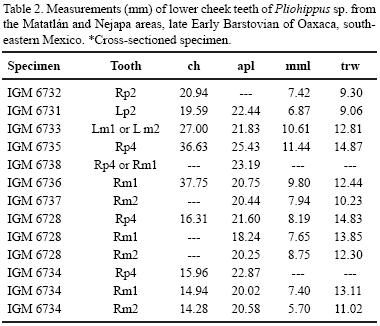
<body><![CDATA[<p align="justify"><font face="verdana" size="2">The equine material from the Middle Miocene of Oaxaca, southeastern Mexico, consists of 15 isolated cheek teeth and three associated dental series; the dental sample is housed at the Colecci&oacute;n Nacional de Paleontolog&iacute;a, Instituto de Geolog&iacute;a, Universidad Nacional Aut&oacute;noma de M&eacute;xico. The dental terminology is that of MacFadden (1984, fig. 4, p. 17). For each cheek tooth, a set of morphological and metric characters of systematic value (MacFadden, 1984; Hulbert, 1988, 1989; Hulbert and MacFadden, 1991; Kelly, 1995, 1998) were evaluated. The dental measurements were taken with a General MG electronic digital caliper with a measuring range 0&#150;150 mm, 0.01 mm of resolution, and 0.003 mm of accuracy. The curvature for each upper cheek teeth (outlined by the mesostyle) was measured following Downs (1961, p. 44&#150;45).</font></p>     <p align="justify"><font face="verdana" size="2">The wear stage for each cheek teeth was established following Kelly (1998, p. 1&#150;2). Because the dental oc&#150;clusal morphology of equid teeth is subject to ontogenetic variation, dental comparison of the Mexican specimens to those of other selected North American pliohippine species was done at equal wear stage; in this instance, some of the studied specimens were cross&#150;sectioned to disclose virtual wear stages.</font></p>     <p align="justify"><font face="verdana" size="2">The taxonomic identity of the Oaxacan dental sample was assessed by comparison with <i>Pliohippus </i>specimens housed in the American Museum of Natural History, New York City, New York; the University of California, Museum of Paleontology, Berkeley, California; and the Florida Museum of Natural History at University of Florida, Gainesville, Florida.</font></p>     <p align="justify"><font face="verdana" size="2">The abbreviations used in this study are as follows: AMNH, American Museum of Natural History; IGM, Colecci&oacute;n Nacional de Paleontolog&iacute;a, Instituto de Geolog&iacute;a, Universidad Nacional Aut&oacute;noma de M&eacute;xico; UCMP, University of California Museum of Paleontology; UF, Vertebrate Paleontology Collection, Florida Museum of Natural History, University of Florida, Gainesville; APL/apl, anteroposterior length upper/lower dentition; CH/ch, me&#150;sostyle crown height upper/metastylid crown height lower dentition; HI, hipsodonty index; L, left; M/m, upper/lower molar; mml, metaconid&#150;metastylid length; P/p, upper/lower premolar; PRL, protocone length; PRW, protocone width; RC, radius of curvature; R, right; TRW/trw, transverse width upper/lower dentition.</font></p>     <p align="justify"><font face="verdana" size="2">&nbsp;</font></p>     <p align="justify"><font face="verdana" size="2"><b>STUDY AREAS AND GEOLOGIC SETTING</b></font></p>     <p align="justify"><font face="verdana" size="2">The fossil localities occur within the Matatl&aacute;n and Nejapa areas in Oaxaca, southeastern Mexico. The Matatl&aacute;n area lies on the eastern part of the Valles Centrales, some 20 km east of Oaxaca City, between 16&deg;50' &#150; 17&deg;00'N and 96&deg;15' &#150; 96&deg;30'W. The Nejapa area is set northwest of the Isthmus of Tehuantepec, roughly midway between the cities of Oaxaca and Tehuantepec, between 16&deg;30&deg; &#150; 16&deg;40'N and 95&deg;55' &#150; 96&deg;10'W (<a href="#f1">Figure 1</a>).</font></p>     <p align="center"><font face="verdana" size="2"><a name="f1"></a></font></p>     <p align="center"><font face="verdana" size="2"><img src="/img/revistas/rmcg/v27n3/a15f1.jpg"></font></p>     <p align="justify"><font face="verdana" size="2">The fossil horse material was recovered from sedimentary sequences that belong to the synorogenic, tuffaceous, fluvio&#150;lacustrine Matatl&aacute;n Formation (Matatl&aacute;n Area) and El Camar&oacute;n Formation (Nejapa Area), both K&#150;Ar dated at &#126;15 Ma (Ferrusqu&iacute;a&#150;Villafranca and McDowell, 1991; Ferrusqu&iacute;a&#150;Villafranca, 1992; Tedford <i>et al., </i>2004). Both the radiometric dates of the rock units and the biogeochronologic range of the known mammal taxa indicate a late Early Barstovian age (Jim&eacute;nez&#150;Hidalgo <i>et al., </i>2002; Ferrusqu&iacute;a&#150;Villafranca, 2003; Tedford <i>et al., </i>2004).</font></p>     ]]></body>
<body><![CDATA[<p align="justify"><font face="verdana" size="2">The Matatl&aacute;n Formation consists of friable to moderately indurated, thin to medium bedded tuffaceous sandstones, sparsely interbedded by felsic tuffs, bentonitic clay and polymictic conglomerate. On the other hand, the El Camar&oacute;n Formation includes friable to moderately indurated tuffaceous siltstone, sandstone and conglomerate (Ferrusqu&iacute;a&#150;Villafranca, 1990, 2002).</font></p>     <p align="justify"><font face="verdana" size="2">&nbsp;</font></p>     <p align="justify"><font face="verdana" size="2"><b>SYSTEMATIC PALEONTOLOGY</b></font></p>     <p align="center"><font face="verdana" size="2">Family Equidae Gray, 1821 </font></p>     <p align="center"><font face="verdana" size="2">Subfamily Equinae Gray, 1821</font></p>     <p align="center"><font face="verdana" size="2">Tribe Equini Gidley, 1907 </font></p>     <p align="center"><font face="verdana" size="2">Genus <i>Pliohippus </i>Marsh, 1874</font></p>     <p align="center"><font face="verdana" size="2"><b><i>Pliohippus sp.</i></b></font></p>     <p align="center"><font face="verdana" size="2"><a href="/img/revistas/rmcg/v27n3/a15f2.jpg" target="_blank">Figures 2</a> and <a href="/img/revistas/rmcg/v27n3/a15f3.jpg" target="_blank">3</a>, <a href="/img/revistas/rmcg/v27n3/a15t1.jpg" target="_blank">Tables 1</a> &#150; <a href="/img/revistas/rmcg/v27n3/a15t3.jpg" target="_blank">3</a></font></p>     <p align="justify"><font face="verdana" size="2"><b>Material examined. </b>Matatl&aacute;n Area: IGM 6721, RP3 or RP4; IGM 6722, RM1; IGM 6723, RM1 or RM2; IGM 6724,&nbsp;LM1 or LM2. Nejapa Area: IGM 7975, RP4; IGM 6725,&nbsp;RP3 or RP4; IGM 6726, RM1 or RM2; IGM 6727, RM2; IGM 6728, right mandibular fragment with p4&#150;m2; IGM 6729, RM2; IGM 6730, LM1; IGM 6731, Lp2; IGM 6732, Rp2; IGM 6733, Lm1 or Lm2; IGM 6734, composite right dental series with p4&#150;m2; IGM 6735, Rp4; IGM 6736, Rm1; IGM 6737, Rm2; IGM 6738, Rp4 or Rm1; IGM 6739, RP4.</font></p>     ]]></body>
<body><![CDATA[<p align="justify"><font face="verdana" size="2"><b>Occurrence. </b>Matatl&aacute;n Fauna and Nejapa Fauna, late Early Barstovian of Oaxaca, southeastern Mexico. </font></p>     <p align="justify"><font face="verdana" size="2"><b>Description. <i>Upper dentition. </i></b>The upper cheek teeth are hypsodont (HI = 1.9), strongly curved (RC from 30 to 40 mm), and covered by a thick layer of cement (&#126;1.5 mm thick). The little worn molar mesostyle crown height is ca. 50 mm (<a href="/img/revistas/rmcg/v27n3/a15t1.jpg" target="_blank">Table 1</a>). The protocone is oval (PRL /PRW ratio of 1.5 &#150; 2.0) and connected to the protoloph along the crown height. The external and internal fossette borders are very simply plicated (<a href="/img/revistas/rmcg/v27n3/a15f2.jpg" target="_blank">Figure 2</a>).</font></p>     <p align="justify"><font face="verdana" size="2">In P3 and P4 the parastyle and mesostyle are rounded and well developed, the metastyle is less evident. The internal fossette margins are very simple plicated, with only a single pli prefossette and a single pli postfossette observed; these plications are shallow and immediately disappear during the early wear stages. The pli protoconule is well developed in early wear, decreasing in size in early moderate wear stages. The pli protoloph is absent and the pli hypostyle is rudimentary. The protocone is oval and connected to the protoloph near the base of the crown. The protocone lingual border is straight and the protocone long axis is set in an anteroposterior direction. The anterior border of the proto&#150;cone is rounded, whereas the posterior border is angular. The pli caballin is simple, small (ca. 2 mm), and non persistent (worn away in early wear stage); only in IGM 6739 is the pli caballin well developed. The hypoconal groove is narrow, open during the early wear stages and closed in early moderate to moderate wear stages. The hypoconal groove commonly forms an isolated lake when it closes.</font></p>     <p align="justify"><font face="verdana" size="2">The molar occlusal pattern is comparable to that of premolars, differing only in the absence of plis caballin. In IGM 6727 (the only M3) the pli caballin is simple, small, and non persistent.</font></p>     <p align="justify"><font face="verdana" size="2"><b><i>Lower dentition. </i></b>The lower cheek teeth are also covered by a thick layer of cement (&#126;1.5 mm thick). The metastylid crown height during early wear stages is <i>ca. </i>40 mm (<a href="#t2">Table 2</a>). The protoconid and hypoconid are rounded to sub&#150;rounded. The metaconid&#150;metastylid complex is expanded, but not elongated (mml of p4 &#8776; 50 % apl). The metaconid and metastylid are rounded and sub&#150;equal in size on the premolars, but the metaconid is larger than the metastylid on molars. The protostylid appears near the crown base as a small anterior cingulid. The linguaflexid is V&#150;shaped in the premolars and U&#150;shaped in the molars. The pli entoflexid is absent. The ectoflexid does not penetrate the isthmus in p2 (i.e., is shallow), but partially penetrates the isthmus in p3 &#150;m2 <i>(i. e.</i>, is moderately deep). The pli caballinid is absent in premolars and molars. The entoconid is rounded, well developed, and well separated to hypoconulid (<a href="/img/revistas/rmcg/v27n3/a15f3.jpg" target="_blank">Figure 3</a>).</font></p>     <p align="center"><font face="verdana" size="2"><a name="t2"></a></font></p>     <p align="center"><font face="verdana" size="2"><img src="/img/revistas/rmcg/v27n3/a15t2.jpg"></font></p>     <p align="justify"><font face="verdana" size="2">&nbsp;</font></p>     <p align="justify"><font face="verdana" size="2"><b>DISCUSSION</b></font></p>     <p align="justify"><font face="verdana" size="2">The oclusal patterns of the Oaxacan cheek teeth are similar to those of <i>Pliohippus </i>in having the following particular suite of characters: (a) hypsodont and strongly curved upper cheek teeth (RC &lt;40 mm); (b) fossettes very simply plicated; (c) unusual single, and non&#150; persistent plis cabal&#150;lin; (d) protocone connected with protoloph throughout the crown height; (e) hypoconal lakes commonly formed with closure of hypoconal grooves; (f) preflexid and postflexid enamel borders simple; (h) moderately deep ectoflexid on premolars; (i) metastylid notably smaller than metaconid on molars (Kelly, 1995, 1998).</font></p>     ]]></body>
<body><![CDATA[<p align="justify"><font face="verdana" size="2">As summarized in <a href="/img/revistas/rmcg/v27n3/a15t3.jpg" target="_blank">Table 3</a>, the Oaxacan cheek teeth differ in several respects from those of other related Middle Miocene horses, including <i>Acritohippus </i>from the Late Hemingfordian of California and Nebraska and the Barstovian of California, Florida, Nebraska, Oregon, Nevada, and Montana; <i>Parapliohippus </i>from the Late Hemingfordian of California; and <i>Heteropliohippus </i>and <i>"Pliohippus " tehonensis, </i>both from the Early Clarendonian of California. The cheek teeth of <i>Acritohippus </i>are distinguished from the Oaxacan cheek teeth by having (a) small mesostyle crown heights (<i>ca.</i> 30 mm), (b) protocones connected to protoloph in early moderate wear, (c) absent hypoconal lake, (d) metaconid and metastylid equal or subequal in size on molars, and (e) ectoflexid that fully penetrates the isthmus on premolars (<a href="/img/revistas/rmcg/v27n3/a15t3.jpg" target="_blank">Table 3</a>). The cheek teeth of <i>Parapliohippus </i>differ from those of the Oaxacan cheek teeth as follows: (a) subhypsodont (CH <i>ca. </i>25 mm),</font></p>     <p align="justify"><font face="verdana" size="2">(b) have a thin layer of cement (this condition is also observed in <i>Heteropliohippus), </i>and (c) ectoflexids that fully penetrate the isthmus on premolars (<a href="/img/revistas/rmcg/v27n3/a15t3.jpg" target="_blank">Table 3</a>). On the other hand, <i>Heteropliohippus </i>and <i>"Pliohippus" tehonensis </i>cheek teeth differ from those of the Oaxacan pliohippine in these features: (a) Moderately curved upper cheek teeth (RC &gt; 40 mm), (b) protocones connected to protoloph in early to early moderate wear, (c) plis caballin commonly present on molars, (d) lack of hypoconal lake on M1&#150;M2, and (e) lower cheek teeth with moderately well developed protostylids (<a href="/img/revistas/rmcg/v27n3/a15t3.jpg" target="_blank">Table 3</a>).</font></p>     <p align="justify"><font face="verdana" size="2">The occlusal pattern of <i>Pliohippus </i>cheek teeth is largely similar across species, so that only a few dental characters actually vary, such as the mesostyle crown height, and the presence/absence of plis caballin. The mesostyle crown height of the Oaxacan cheek teeth (<i>ca. </i>50 mm) is comparable to that of dental specimens referred to <i>P. pernix </i>including UCMP 32253A (LP3 or P4, CH = 48 mm), and UCMP 35454A (RP3 or P4, CH = 50 mm) (Webb, 1969, tab. 18); a similar condition occurs in dental specimens of <i>P. tantalus, </i>such as UCMP 19434 (LP4, CH = 48 mm; Osborn, 1918, fig. 130). The species <i>P. mirabilis </i>and <i>P. fos&#150;sulatus </i>have a similar crown height, whereas <i>P. nobilis </i>is distinguished by having even higher crowned cheek teeth (CH &gt; 58 mm, Kelly, 1998).</font></p>     <p align="justify"><font face="verdana" size="2">The cheek teeth of <i>Pliohippus mirabilis (e.g. </i>LP3 and LP4 of AMNH 9096, a cranium; Osborn, 1918, fig. 88), <i>P. pernix (e.g. </i>right and left P3 and P4 of UCMP 32285, a palate with right and left P3&#150;M3; Webb, 1969, fig. 23), <i>P. nobilis (e.g. </i>LP3 and LP4 of AMNH 2668, a skull fragment with left P3&#150;M3 and right P2&#150;M3; Osborn, 1918, fig. 128), <i>P. tantalus (e.g. </i>LP4, UCMP 19434; Osborn, 1918, fig. 130), and the Oaxacan teeth (IGM 6725, IGM 6721, IGM 6739) each show a single pli caballin; however, the pli caballin is commonly absent in <i>P. fossulatus </i>(Kelly, 1998).</font></p>     <p align="justify"><font face="verdana" size="2">A dental character condition shared by all species of <i>Pliohippus </i>is the hypoconal groove closure in early wear stages (Kelly, 1998, Appendix E). The Oaxacan specimens IGM 6721 and IGM 6725 depart from this general condition, because the hypoconal groove closes in moderate&#150; and late&#150; wear stages respectively. It should be noted that similar conditions are observed in isolated cheek teeth referred to <i>Pliohippus </i>from the Late Barstovian of Florida, such as UF 102101 (RM1 or RM2), UF 102103 (LP3 or LP4), and UF 131909 (LP4). This fact suggests that some Barstovian populations of <i>Pliohippus </i>retained a less&#150;derived timing of hypoconal groove closure condition (see Hulbert and MacFadden, 1991; Kelly, 1995, 1998).</font></p>     <p align="justify"><font face="verdana" size="2">By the same token, the Oaxacan cheek teeth here referred to <i>Pliohippus </i>are lower crowned than those of <i>P. nobilis, </i>and differ from those of <i>P. fossulatus </i>in having more persistent plis caballin; yet their overall occlusal pattern and size range of their teeth readily correspond to those observed in all other species of <i>Pliohippus. </i>This is not surprising given this genus' extremely homogeneous dental morphology, which shifts species recognition/characterization to other features, so that <i>Pliohippus </i>species are mainly distinguished on the dorsal preorbital fossa and/or malar fossae configuration(s) (cf. MacFadden, 1984; Azzaroli, 1988; Kelly, 1995, 1998).</font></p>     <p align="justify"><font face="verdana" size="2">Summing up then, the odontography of Oaxacan cheek teeth closely resembles that of <i>Pliohippus; </i>however, the lack of associated cranial material, and the fact that dental features alone are no longer suitable means to establish species identity within this genus, constrains us to assign the studied cheek teeth suite to <i>Pliohippus </i>sp.</font></p>     <p align="justify"><font face="verdana" size="2">&nbsp;</font></p>     <p align="justify"><font face="verdana" size="2"><b>COMMENTS ON PALEOBIOLOGICAL SIGNIFICANCE</b></font></p>     <p align="justify"><font face="verdana" size="2"><i>Pliohippus mirabilis </i>is regarded as the oldest and morphologically most plesiomorphic species of <i>Pliohippus </i>(Kelly, 1998); it is recorded from the late Early Barstovian&#150;Late Barstovian NALMA (<i>ca. </i>12&#150;15 Ma) of the Great Plains (Nebraska and Colorado), and the Gulf Coastal Plain (Florida; Hulbert and MacFadden, 1991; Kelly, 1998). <i>Pliohippus </i>sp. from the late Early Barstovian <i>(ca. </i>15 Ma) of southeastern Mexico (Oaxaca) is a chrono&#150;correlative of <i>P. mirabilis, </i>in spite of the 2000 km distance and 10&deg; latitude difference that separates their known geographic distributions, thus extending southward by that much the geographic occurrence of <i>Pliohippus </i>in particular, and that of the tribe Equini overall during the Middle Miocene. This fact by itself is quite significant on several grounds. First, it indicates that <i>Pliohippus </i>was able to thrive both in temperate and tropical environmental settings, and so should have been fairly eurytopic rather than stenotopic. In turn, this implies that the phylogenetic differentiation of <i>Pliohippus </i>could have taken place either in temperate or in tropical North America. Our observations also provided additional support that the genus <i>Pliohippus </i>became phylogenetically differentiated by late Early Barstovian NALMA time at least. Biogeographically, <i>Pliohippus </i>sp. from Oaxaca is the southernmost record of Middle Miocene Equini in North America (<a href="/img/revistas/rmcg/v27n3/a15f4.jpg" target="_blank">Figure 4</a>).</font></p>     ]]></body>
<body><![CDATA[<p align="justify"><font face="verdana" size="2">Prior to this report, the Equini from Mexico were known from the Hemphillian and Blancan of several morphotectonic provinces (hitherto MP, Ferrusqu&iacute;a&#150;Villafranca, 1993): <i>Astrohippus stockii </i>and <i>Dinohippus mexicanus </i>have been found in the Chihuahua&#150;Coahuila Plateaus and Ranges MP (= CH&#150;CO) (Yep&oacute;mera, Chih., Lance, 1950; Lindsay, 1984; Lindsay <i>et al., </i>2006; MacFadden, 2006), the Central Plateau MP (= CeP) (San Luis Potos&iacute; and Zacatecas, Carranza&#150;Casta&ntilde;eda, 2006), and the Trans&#150;Mexican Volcanic Belt MP (= TMVB) (Jalisco, Montellano&#150;Ballesteros, 1997; Carranza&#150;Casta&ntilde;eda <i>et al., </i>2002; Guanajuato, cf. Carranza&#150;Casta&ntilde;eda, 2006; Carranza&#150;Casta&ntilde;eda and Ferrusqu&iacute;a&#150;Villafranca, 1978; Carranza&#150;Casta&ntilde;eda and Miller, 1998). <i>"Dinohippus" interpolatus </i>occurs in the TMVB (Jalisco, Guanajuato and Hidalgo, Miller and Carranza&#150;Casta&ntilde;eda, 1984; Carranza&#150;Casta&ntilde;eda, 2006, reported as <i>Dinohippus interpolatus), </i>and <i>Equus (Plesippus) simplicidens </i>(reported as <i>E. (Dolichohippus) simplicidens) </i>from the Blancan of the CH&#150;CO MP, TMVB MP (Carranza&#150;Casta&ntilde;eda, 2006), and the Peninsula de Baja California MP (southern end, Miller, 1980).</font></p>     <p align="justify"><font face="verdana" size="2">The reconnaissance of <i>Pliohippus </i>sp. from Oaxaca geographically extends southward the Equini record from the Trans&#150;Mexican Volcanic Belt to the Sierra Madre del Sur MP, and establishes equines in a tropical environment. Biogeochronology pushes tribe Equini back in time some six Ma, from the Hemphillian to the late Early Barstovian; this is the oldest known equine record of Mexico (<a href="/img/revistas/rmcg/v27n3/a15f5.jpg" target="_blank">Figure 5</a>).</font></p>     <p align="justify"><font face="verdana" size="2">&nbsp;</font></p>     <p align="justify"><font face="verdana" size="2"><b>SUMMARY AND CONCLUSIONS</b></font></p>     <p align="justify"><font face="verdana" size="2">A suite of cheek teeth from the Middle Miocene (late Early Barstovian) Matatl&aacute;n and El Camar&oacute;n Formations<b> </b>of Oaxaca, southeastern Mexico, is formally described and assigned to <i>Pliohippus </i>sp. The Oaxacan equine record is contemporaneous to <i>Pliohippus mirabilis, </i>the geologically oldest and most plesiomorphic species this genus. These facts are very significant on several grounds: Biogeographically, it extends southward some 2,000 km and at least 10&deg; latitude degrees the Middle Miocene range of the Equini from temperate North America (Northern Great Plains and easternmost Gulf Coastal Plain) to tropical North America (southeastern Mexico). Paleoecologically, it shows that <i>Pliohippus </i>could thrive both in temperate and tropical environmental settings. Phylogenetically, it suggests that the differentiation of <i>Pliohippus </i>probably occurred during the Early Barstovian (16&#150;15 Ma), either temperate or tropical North America. Biogeochronologically, it pushes the Mexican Equini record back in time some six m.y. from the Hemphillian to the late Early Barstovian, making it the oldest Equini record of Mexico.</font></p>     <p align="justify"><font face="verdana" size="2">&nbsp;</font></p>     <p align="justify"><font face="verdana" size="2"><b>ACKNOWLEDGMENTS</b></font></p>     <p align="justify"><font face="verdana" size="2">We are indebted to Eric Scott and to the anonymous reviewer for critically reviewing the manuscript, their comments and suggestions greatly improved the present report. The senior author wish express special thanks to Bruce J. MacFadden and Richard C. Hulbert Jr., for their valuable comments on late Neogene horses during his visit to the Florida Museum of Natural History. The visit was supported by the 2003 International Student Travel Grant to Study the Vertebrate Paleontology Collection at the Florida Museum of Natural History. The junior author thanks to the Direcci&oacute;n General de Asuntos de Personal Acad&eacute;mico de la Universidad Nacional Aut&oacute;noma de M&eacute;xico, for supporting field work expenses through Grant PAPIIT IN&#150;115606.</font></p>     <p align="justify"><font face="verdana" size="2">&nbsp;</font></p>     <p align="justify"><font face="verdana" size="2"><b>REFERENCES</b></font></p>     ]]></body>
<body><![CDATA[<!-- ref --><p align="justify"><font face="verdana" size="2">Azzaroli, A., 1988. On the equid genera <i>Dinohippus </i>Quinn 1955 and <i>Pliohippus </i>Marsh 1874: Bolletino della Societa Palaeontologica Italiana, 34, 205&#150;221.    &nbsp;&nbsp;&nbsp;&nbsp;&nbsp;&nbsp;&nbsp;&nbsp;[&#160;<a href="javascript:void(0);" onclick="javascript: window.open('/scielo.php?script=sci_nlinks&ref=8052208&pid=S1026-8774201000030001500001&lng=','','width=640,height=500,resizable=yes,scrollbars=1,menubar=yes,');">Links</a>&#160;]<!-- end-ref --></font></p>     <!-- ref --><p align="justify"><font face="verdana" size="2">Bravo&#150;Cuevas, V.M., Ferrusqu&iacute;a &#150;Villafranca, I., 2006, <i>Merychippus </i>(Mammalia, Perissodactyla, Equidae) from the Middle Miocene of the State of Oaxaca, Southeastern Mexico: Geobios, 39, 771&#150;784.    &nbsp;&nbsp;&nbsp;&nbsp;&nbsp;&nbsp;&nbsp;&nbsp;[&#160;<a href="javascript:void(0);" onclick="javascript: window.open('/scielo.php?script=sci_nlinks&ref=8052210&pid=S1026-8774201000030001500002&lng=','','width=640,height=500,resizable=yes,scrollbars=1,menubar=yes,');">Links</a>&#160;]<!-- end-ref --></font></p>     <!-- ref --><p align="justify"><font face="verdana" size="2">Bravo&#150;Cuevas, V.M., Ferrusqu&iacute;a&#150;Villafranca, I., 2008, <i>Cormohipparion </i>(Mammalia, Perissodactyla, Equidae) from the Middle Miocene of Oaxaca, Southeastern Mexico: Journal of Vertebrate Paleontology, 28(1), 243&#150;250.    &nbsp;&nbsp;&nbsp;&nbsp;&nbsp;&nbsp;&nbsp;&nbsp;[&#160;<a href="javascript:void(0);" onclick="javascript: window.open('/scielo.php?script=sci_nlinks&ref=8052212&pid=S1026-8774201000030001500003&lng=','','width=640,height=500,resizable=yes,scrollbars=1,menubar=yes,');">Links</a>&#160;]<!-- end-ref --></font></p>     <!-- ref --><p align="justify"><font face="verdana" size="2">Carranza&#150;Casta&ntilde;eda, O., 2006, Late Tertiary fossil localities in Central Mexico between 19&deg;&#150;23&deg; N, <i>in </i>Carranza&#150;Casta&ntilde;eda, O., Lindsay, E.H. (eds.), Advances in Late Tertiary Vertebrate Paleontology in Mexico and the Great American Biotic Interchange: M&eacute;xico, D.F., Universidad Nacional Aut&oacute;noma de M&eacute;xico, Instituto de Geolog&iacute;a y Centro de Geociencias, 45&#150;60.    &nbsp;&nbsp;&nbsp;&nbsp;&nbsp;&nbsp;&nbsp;&nbsp;[&#160;<a href="javascript:void(0);" onclick="javascript: window.open('/scielo.php?script=sci_nlinks&ref=8052214&pid=S1026-8774201000030001500004&lng=','','width=640,height=500,resizable=yes,scrollbars=1,menubar=yes,');">Links</a>&#160;]<!-- end-ref --></font></p>     <!-- ref --><p align="justify"><font face="verdana" size="2">Carranza&#150;Casta&ntilde;eda, O., Ferrusquia&#150;Villafranca, I., 1978, Nuevas investigaciones sobre la fauna Rancho el Ocote, Plioceno Medio de Guanajuato, M&eacute;xico, Informe preliminar: Revista del Instituto de Geolog&iacute;a de la Universidad Nacional Aut&oacute;noma de M&eacute;xico, 2(2), 163&#150;168.    &nbsp;&nbsp;&nbsp;&nbsp;&nbsp;&nbsp;&nbsp;&nbsp;[&#160;<a href="javascript:void(0);" onclick="javascript: window.open('/scielo.php?script=sci_nlinks&ref=8052216&pid=S1026-8774201000030001500005&lng=','','width=640,height=500,resizable=yes,scrollbars=1,menubar=yes,');">Links</a>&#160;]<!-- end-ref --></font></p>     ]]></body>
<body><![CDATA[<!-- ref --><p align="justify"><font face="verdana" size="2">Carranza&#150;Casta&ntilde;eda, O., Miller, W.E., 1998, Paleofaunas de vertebrados en las cuencas sedimentarias del Terciario tard&iacute;o de la Faja Volc&aacute;nica Transmexicana, <i>in </i>Carranza&#150;Casta&ntilde;eda, O., C&oacute;rdoba&#150;M&eacute;ndez, O. A. (eds.), Avances en Investigaci&oacute;n, Paleontolog&iacute;a de Vertebrados: Pachuca, Hidalgo, Universidad Aut&oacute;noma del Estado de Hidalgo, Instituto de Investigaciones en Ciencias de la Tierra, Publicaci&oacute;n Especial, 85&#150;95.    &nbsp;&nbsp;&nbsp;&nbsp;&nbsp;&nbsp;&nbsp;&nbsp;[&#160;<a href="javascript:void(0);" onclick="javascript: window.open('/scielo.php?script=sci_nlinks&ref=8052218&pid=S1026-8774201000030001500006&lng=','','width=640,height=500,resizable=yes,scrollbars=1,menubar=yes,');">Links</a>&#160;]<!-- end-ref --></font></p>     <!-- ref --><p align="justify"><font face="verdana" size="2">Carranza&#150;Casta&ntilde;eda, O., Miller, W.E., 2004, Late Tertiary terrestrial mammals from Central Mexico and their relationship to South American inmigrants: Revista Brasileira de Paleontologia, 7(2), 249&#150;261.    &nbsp;&nbsp;&nbsp;&nbsp;&nbsp;&nbsp;&nbsp;&nbsp;[&#160;<a href="javascript:void(0);" onclick="javascript: window.open('/scielo.php?script=sci_nlinks&ref=8052220&pid=S1026-8774201000030001500007&lng=','','width=640,height=500,resizable=yes,scrollbars=1,menubar=yes,');">Links</a>&#160;]<!-- end-ref --></font></p>     <!-- ref --><p align="justify"><font face="verdana" size="2">Carranza&#150;Casta&ntilde;eda, O., Miller, W.E., Kowallis, B., 2002, La Cuenca de Tecolotl&aacute;n, una nueva fauna del Terciario Tard&iacute;o de la Faja Volc&aacute;nica Transmexicana (resumen), i<i>n </i>Reuni&oacute;n Anual de la Uni&oacute;n Geof&iacute;sica Mexicana, Geos (Res&uacute;menes y Programa), 22(2), 331.    &nbsp;&nbsp;&nbsp;&nbsp;&nbsp;&nbsp;&nbsp;&nbsp;[&#160;<a href="javascript:void(0);" onclick="javascript: window.open('/scielo.php?script=sci_nlinks&ref=8052222&pid=S1026-8774201000030001500008&lng=','','width=640,height=500,resizable=yes,scrollbars=1,menubar=yes,');">Links</a>&#160;]<!-- end-ref --></font></p>     <!-- ref --><p align="justify"><font face="verdana" size="2">Downs, T., 1961, A study of variation and evolution in Miocene <i>Merychippus: </i>Contributions in Science, 45, 75.    &nbsp;&nbsp;&nbsp;&nbsp;&nbsp;&nbsp;&nbsp;&nbsp;[&#160;<a href="javascript:void(0);" onclick="javascript: window.open('/scielo.php?script=sci_nlinks&ref=8052224&pid=S1026-8774201000030001500009&lng=','','width=640,height=500,resizable=yes,scrollbars=1,menubar=yes,');">Links</a>&#160;]<!-- end-ref --></font></p>     <!-- ref --><p align="justify"><font face="verdana" size="2">Ferrusqu&iacute;a&#150;Villafranca, I., 1990, Biostratigraphy of the Mexican continental Miocene: Part II, The Southeastern (Oaxacan) faunas: Paleontolog&iacute;a Mexicana, 56, 57&#150;109.    &nbsp;&nbsp;&nbsp;&nbsp;&nbsp;&nbsp;&nbsp;&nbsp;[&#160;<a href="javascript:void(0);" onclick="javascript: window.open('/scielo.php?script=sci_nlinks&ref=8052226&pid=S1026-8774201000030001500010&lng=','','width=640,height=500,resizable=yes,scrollbars=1,menubar=yes,');">Links</a>&#160;]<!-- end-ref --></font></p>     ]]></body>
<body><![CDATA[<!-- ref --><p align="justify"><font face="verdana" size="2">Ferrusqu&iacute;a&#150;Villafranca, I., 1992, Contribuci&oacute;n al conocimiento del Cenozoico en el Sureste de M&eacute;xico y de su relevancia en el entendimiento de la evoluci&oacute;n geol&oacute;gica regional (resumen), <i>in </i>VIII Congreso Geol&oacute;gico Latinoamericano, Salamanca, Espa&ntilde;a: 4,40&#150;44.    &nbsp;&nbsp;&nbsp;&nbsp;&nbsp;&nbsp;&nbsp;&nbsp;[&#160;<a href="javascript:void(0);" onclick="javascript: window.open('/scielo.php?script=sci_nlinks&ref=8052228&pid=S1026-8774201000030001500011&lng=','','width=640,height=500,resizable=yes,scrollbars=1,menubar=yes,');">Links</a>&#160;]<!-- end-ref --></font></p>     <!-- ref --><p align="justify"><font face="verdana" size="2">Ferrusqu&iacute;a&#150;Villafranca, I., 1993, Geology of Mexico: a sinopsis, <i>in </i>Ramamoorthy, T.P., Bye, R., Lot, A., Fa, J. (eds.), Biological Diversity of M&eacute;xico: Origins and Distribution: New York, USA, Oxford University Press, 3&#150;107.    &nbsp;&nbsp;&nbsp;&nbsp;&nbsp;&nbsp;&nbsp;&nbsp;[&#160;<a href="javascript:void(0);" onclick="javascript: window.open('/scielo.php?script=sci_nlinks&ref=8052230&pid=S1026-8774201000030001500012&lng=','','width=640,height=500,resizable=yes,scrollbars=1,menubar=yes,');">Links</a>&#160;]<!-- end-ref --></font></p>     <!-- ref --><p align="justify"><font face="verdana" size="2">Ferrusqu&iacute;a&#150;Villafranca, I., 2002, Contribuci&oacute;n al conocimiento geol&oacute;gico de Oaxaca: El &Aacute;rea Nejapa de Madero, M&eacute;xico: Bolet&iacute;n del Instituto de Geolog&iacute;a de la Universidad Nacional Aut&oacute;noma de M&eacute;xico, 112, 1&#150;110.    &nbsp;&nbsp;&nbsp;&nbsp;&nbsp;&nbsp;&nbsp;&nbsp;[&#160;<a href="javascript:void(0);" onclick="javascript: window.open('/scielo.php?script=sci_nlinks&ref=8052232&pid=S1026-8774201000030001500013&lng=','','width=640,height=500,resizable=yes,scrollbars=1,menubar=yes,');">Links</a>&#160;]<!-- end-ref --></font></p>     <!-- ref --><p align="justify"><font face="verdana" size="2">Ferrusqu&iacute;a&#150;Villafranca, I., 2003, M&eacute;xico's Middle Miocene mammalian assemblages: An overview: American Museum of Natural History Bulletin, 13, 231&#150;347.    &nbsp;&nbsp;&nbsp;&nbsp;&nbsp;&nbsp;&nbsp;&nbsp;[&#160;<a href="javascript:void(0);" onclick="javascript: window.open('/scielo.php?script=sci_nlinks&ref=8052234&pid=S1026-8774201000030001500014&lng=','','width=640,height=500,resizable=yes,scrollbars=1,menubar=yes,');">Links</a>&#160;]<!-- end-ref --></font></p>     <!-- ref --><p align="justify"><font face="verdana" size="2">Ferrusqu&iacute;a&#150;Villafranca, I., McDowell, F. W. 1991, The Cenozoic sequence of selected areas in Southeastern Mexico, its bearing in understanding regional basin development there (resumen), <i>in </i>II Convenci&oacute;n sobre la evoluci&oacute;n geol&oacute;gica de M&eacute;xico, Pachuca, Hidalgo, 1,45&#150;50.    &nbsp;&nbsp;&nbsp;&nbsp;&nbsp;&nbsp;&nbsp;&nbsp;[&#160;<a href="javascript:void(0);" onclick="javascript: window.open('/scielo.php?script=sci_nlinks&ref=8052236&pid=S1026-8774201000030001500015&lng=','','width=640,height=500,resizable=yes,scrollbars=1,menubar=yes,');">Links</a>&#160;]<!-- end-ref --></font></p>     ]]></body>
<body><![CDATA[<!-- ref --><p align="justify"><font face="verdana" size="2">Gidley, J.W., 1907, Revision of the Miocene and Pliocene Equidae of North America: Bulletin of the American Museum of Natural History, 23, 865&#150;934.    &nbsp;&nbsp;&nbsp;&nbsp;&nbsp;&nbsp;&nbsp;&nbsp;[&#160;<a href="javascript:void(0);" onclick="javascript: window.open('/scielo.php?script=sci_nlinks&ref=8052238&pid=S1026-8774201000030001500016&lng=','','width=640,height=500,resizable=yes,scrollbars=1,menubar=yes,');">Links</a>&#160;]<!-- end-ref --></font></p>     <!-- ref --><p align="justify"><font face="verdana" size="2">Gray, J.E., 1821, On the natural arrangement of vertebrose animals: London Medical Repository Review, 15, 296&#150;310.    &nbsp;&nbsp;&nbsp;&nbsp;&nbsp;&nbsp;&nbsp;&nbsp;[&#160;<a href="javascript:void(0);" onclick="javascript: window.open('/scielo.php?script=sci_nlinks&ref=8052240&pid=S1026-8774201000030001500017&lng=','','width=640,height=500,resizable=yes,scrollbars=1,menubar=yes,');">Links</a>&#160;]<!-- end-ref --></font></p>     <!-- ref --><p align="justify"><font face="verdana" size="2">Hulbert, R. C. Jr. , 1988, <i>Calippus </i>and <i>Protohippus </i>(Mammalia, Perissodactyla, Equidae) from the Miocene (Barstovian&#150;Early Hemphillian) of the Gulf Coastal Plain: Florida State Museum Biological Sciences Bulletin, 33, 221&#150;340.    &nbsp;&nbsp;&nbsp;&nbsp;&nbsp;&nbsp;&nbsp;&nbsp;[&#160;<a href="javascript:void(0);" onclick="javascript: window.open('/scielo.php?script=sci_nlinks&ref=8052242&pid=S1026-8774201000030001500018&lng=','','width=640,height=500,resizable=yes,scrollbars=1,menubar=yes,');">Links</a>&#160;]<!-- end-ref --></font></p>     <!-- ref --><p align="justify"><font face="verdana" size="2">Hulbert, R.C. Jr., 1989, Phylogenetic interrelationships and evolution of North American Late Neogene Equinae, <i>in </i>Prothero, D. R., Schoch, R. M. (eds.), The Evolution of Perissodactyla: New York, USA, Oxford University Press, 176&#150;193.    &nbsp;&nbsp;&nbsp;&nbsp;&nbsp;&nbsp;&nbsp;&nbsp;[&#160;<a href="javascript:void(0);" onclick="javascript: window.open('/scielo.php?script=sci_nlinks&ref=8052244&pid=S1026-8774201000030001500019&lng=','','width=640,height=500,resizable=yes,scrollbars=1,menubar=yes,');">Links</a>&#160;]<!-- end-ref --></font></p>     <!-- ref --><p align="justify"><font face="verdana" size="2">Hulbert, R.C. Jr., 1993, Taxonomic evolution in North American Neogene horses (Subfamily Equinae): the rise and fall of an adaptive radiation: Paleobiology, 19, 216&#150;234.    &nbsp;&nbsp;&nbsp;&nbsp;&nbsp;&nbsp;&nbsp;&nbsp;[&#160;<a href="javascript:void(0);" onclick="javascript: window.open('/scielo.php?script=sci_nlinks&ref=8052246&pid=S1026-8774201000030001500020&lng=','','width=640,height=500,resizable=yes,scrollbars=1,menubar=yes,');">Links</a>&#160;]<!-- end-ref --></font></p>     ]]></body>
<body><![CDATA[<!-- ref --><p align="justify"><font face="verdana" size="2">Hulbert, R.C. Jr., MacFadden, B.J. , 1991, Morphological transformation and cladogenesis at the base of the adaptive radiation of Miocene hypsodont horses: American Museum Novitates, 3000, 1&#150;61.    &nbsp;&nbsp;&nbsp;&nbsp;&nbsp;&nbsp;&nbsp;&nbsp;[&#160;<a href="javascript:void(0);" onclick="javascript: window.open('/scielo.php?script=sci_nlinks&ref=8052248&pid=S1026-8774201000030001500021&lng=','','width=640,height=500,resizable=yes,scrollbars=1,menubar=yes,');">Links</a>&#160;]<!-- end-ref --></font></p>     <!-- ref --><p align="justify"><font face="verdana" size="2">Jim&eacute;nez&#150;Hidalgo, E., Ferrusqu&iacute;a&#150;Villafranca, I, Bravo&#150;Cuevas, V.M., 2002, El registro mastofaun&iacute;stico mioc&eacute;nico de M&eacute;xico y sus implicaciones paleobiol&oacute;gicas, <i>in </i>Montellano&#150;Ballesteros, M. , Arroyo&#150;Cabrales, J. (eds.), Avances en los estudios paleomastozool&oacute;gicos: M&eacute;xico, D. F., Instituto Nacional de Antropolog&iacute;a e Historia, 47&#150;58.    &nbsp;&nbsp;&nbsp;&nbsp;&nbsp;&nbsp;&nbsp;&nbsp;[&#160;<a href="javascript:void(0);" onclick="javascript: window.open('/scielo.php?script=sci_nlinks&ref=8052250&pid=S1026-8774201000030001500022&lng=','','width=640,height=500,resizable=yes,scrollbars=1,menubar=yes,');">Links</a>&#160;]<!-- end-ref --></font></p>     <!-- ref --><p align="justify"><font face="verdana" size="2">Kelly, T.S., 1995, New Miocene horses from the Caliente Formation, Cuyama Valley Badlands, California: Contributions in Science, 455, 1&#150;33.    &nbsp;&nbsp;&nbsp;&nbsp;&nbsp;&nbsp;&nbsp;&nbsp;[&#160;<a href="javascript:void(0);" onclick="javascript: window.open('/scielo.php?script=sci_nlinks&ref=8052252&pid=S1026-8774201000030001500023&lng=','','width=640,height=500,resizable=yes,scrollbars=1,menubar=yes,');">Links</a>&#160;]<!-- end-ref --></font></p>     <!-- ref --><p align="justify"><font face="verdana" size="2">Kelly, T.S., 1998, New Middle Miocene equid crania from California and their implications for the phylogeny of the Equini: Contributions in Science, 473, 1&#150;43.    &nbsp;&nbsp;&nbsp;&nbsp;&nbsp;&nbsp;&nbsp;&nbsp;[&#160;<a href="javascript:void(0);" onclick="javascript: window.open('/scielo.php?script=sci_nlinks&ref=8052254&pid=S1026-8774201000030001500024&lng=','','width=640,height=500,resizable=yes,scrollbars=1,menubar=yes,');">Links</a>&#160;]<!-- end-ref --></font></p>     <!-- ref --><p align="justify"><font face="verdana" size="2">Lance, J.F., 1950, Paleontolog&iacute;a y estratigraf&iacute;a del Plioceno de Yep&oacute;mera Estado de Chihuahua. Parte 1: &Eacute;quidos, excepto <i>Neohipparion: </i>Bolet&iacute;n del Instituto de Geolog&iacute;a de la Universidad Nacional Aut&oacute;noma de M&eacute;xico, 54, 1&#150;81.    &nbsp;&nbsp;&nbsp;&nbsp;&nbsp;&nbsp;&nbsp;&nbsp;[&#160;<a href="javascript:void(0);" onclick="javascript: window.open('/scielo.php?script=sci_nlinks&ref=8052256&pid=S1026-8774201000030001500025&lng=','','width=640,height=500,resizable=yes,scrollbars=1,menubar=yes,');">Links</a>&#160;]<!-- end-ref --></font></p>     ]]></body>
<body><![CDATA[<!-- ref --><p align="justify"><font face="verdana" size="2">Lindsay, E.H., 1984, Late Cenozoic mammals from northwestern M&eacute;xico: Journal of Vertebrate Paleontology, 4(2), 208&#150;215.    &nbsp;&nbsp;&nbsp;&nbsp;&nbsp;&nbsp;&nbsp;&nbsp;[&#160;<a href="javascript:void(0);" onclick="javascript: window.open('/scielo.php?script=sci_nlinks&ref=8052258&pid=S1026-8774201000030001500026&lng=','','width=640,height=500,resizable=yes,scrollbars=1,menubar=yes,');">Links</a>&#160;]<!-- end-ref --></font></p>     <!-- ref --><p align="justify"><font face="verdana" size="2">Lindsay, E.H., Jacobs, L.L., Tessman, N.D., 2006, Vertebrate fossils from Yep&oacute;mera, Chihuahua, Mexico, <i>in </i>Carranza&#150;Casta&ntilde;eda, O., Lindsay, E.H. (eds.), Advances in Late Tertiary Vertebrate Paleontology in Mexico and the Great American Biotic Interchange: M&eacute;xico, D.F., Universidad Nacional Aut&oacute;noma de M&eacute;xico, Instituto de Geolog&iacute;a and Centro de Geociencias, 19&#150;32.    &nbsp;&nbsp;&nbsp;&nbsp;&nbsp;&nbsp;&nbsp;&nbsp;[&#160;<a href="javascript:void(0);" onclick="javascript: window.open('/scielo.php?script=sci_nlinks&ref=8052260&pid=S1026-8774201000030001500027&lng=','','width=640,height=500,resizable=yes,scrollbars=1,menubar=yes,');">Links</a>&#160;]<!-- end-ref --></font></p>     <!-- ref --><p align="justify"><font face="verdana" size="2">MacFadden, B.J., 1984, <i>Astrohippus </i>and <i>Dinohippus </i>from the Yep&oacute;mera local Fauna (Hemphillian, Mexico) and implications for the phylogeny of one&#150;toed horses: Journal of Vertebrate Paleontology, 4(2), 273&#150;283.    &nbsp;&nbsp;&nbsp;&nbsp;&nbsp;&nbsp;&nbsp;&nbsp;[&#160;<a href="javascript:void(0);" onclick="javascript: window.open('/scielo.php?script=sci_nlinks&ref=8052262&pid=S1026-8774201000030001500028&lng=','','width=640,height=500,resizable=yes,scrollbars=1,menubar=yes,');">Links</a>&#160;]<!-- end-ref --></font></p>     <!-- ref --><p align="justify"><font face="verdana" size="2">MacFadden, B.J., 1986, Late Miocene monodactyl horses (Mammalia, Equidae) from the Bone Valley Formation of central Florida: Journal of Paleontology, 60, 466&#150;475.    &nbsp;&nbsp;&nbsp;&nbsp;&nbsp;&nbsp;&nbsp;&nbsp;[&#160;<a href="javascript:void(0);" onclick="javascript: window.open('/scielo.php?script=sci_nlinks&ref=8052264&pid=S1026-8774201000030001500029&lng=','','width=640,height=500,resizable=yes,scrollbars=1,menubar=yes,');">Links</a>&#160;]<!-- end-ref --> </font></p>     <!-- ref --><p align="justify"><font face="verdana" size="2">MacFadden, B.J., 1992, Fossil Horses. Systematics, paleobiology and evolution of the Family Equidae: Canada, Cambridge University Press, 369 p.    &nbsp;&nbsp;&nbsp;&nbsp;&nbsp;&nbsp;&nbsp;&nbsp;[&#160;<a href="javascript:void(0);" onclick="javascript: window.open('/scielo.php?script=sci_nlinks&ref=8052266&pid=S1026-8774201000030001500030&lng=','','width=640,height=500,resizable=yes,scrollbars=1,menubar=yes,');">Links</a>&#160;]<!-- end-ref --></font></p>     ]]></body>
<body><![CDATA[<!-- ref --><p align="justify"><font face="verdana" size="2">MacFadden, B.J., 1998, Equidae, <i>in </i>Janis, C. M., Scott, K. M., Jacobs, L. L. (eds.), Evolution of Tertiary Mammals of North America: USA, Cambridge University Press, 537&#150;559.    &nbsp;&nbsp;&nbsp;&nbsp;&nbsp;&nbsp;&nbsp;&nbsp;[&#160;<a href="javascript:void(0);" onclick="javascript: window.open('/scielo.php?script=sci_nlinks&ref=8052268&pid=S1026-8774201000030001500031&lng=','','width=640,height=500,resizable=yes,scrollbars=1,menubar=yes,');">Links</a>&#160;]<!-- end-ref --></font></p>     <!-- ref --><p align="justify"><font face="verdana" size="2">MacFadden, B.J., 2006, Early Pliocene (latest Hemphillian) horses from the Yep&oacute;mera local fauna, Chihuahua, Mexico, <i>in </i>Carranza&#150;Casta&ntilde;eda, O., Lindsay, E.H. (eds.), Advances in Late Tertiary Vertebrate Paleontology in Mexico and the Great American Biotic Interchange: M&eacute;xico, D. F., Universidad Nacional Aut&oacute;noma de M&eacute;xico, Instituto de Geolog&iacute;a y Centro de Geociencias, 33&#150;43.    &nbsp;&nbsp;&nbsp;&nbsp;&nbsp;&nbsp;&nbsp;&nbsp;[&#160;<a href="javascript:void(0);" onclick="javascript: window.open('/scielo.php?script=sci_nlinks&ref=8052270&pid=S1026-8774201000030001500032&lng=','','width=640,height=500,resizable=yes,scrollbars=1,menubar=yes,');">Links</a>&#160;]<!-- end-ref --></font></p>     <!-- ref --><p align="justify"><font face="verdana" size="2">MacFadden, B. J., Skinner, M. F., 1979, Diversification and biogeography of the genus <i>Onohippidium </i>and <i>Hippidion </i>(Mammalia: Equidae): Journal of Vertebrate Paleontology, 17, 199&#150;218.    &nbsp;&nbsp;&nbsp;&nbsp;&nbsp;&nbsp;&nbsp;&nbsp;[&#160;<a href="javascript:void(0);" onclick="javascript: window.open('/scielo.php?script=sci_nlinks&ref=8052272&pid=S1026-8774201000030001500033&lng=','','width=640,height=500,resizable=yes,scrollbars=1,menubar=yes,');">Links</a>&#160;]<!-- end-ref --></font></p>     <!-- ref --><p align="justify"><font face="verdana" size="2">Marsh, O.C., 1874, Notice of new equine mammals from the Tertiary Formation: American Journal of Science, 7, 247&#150;258.    &nbsp;&nbsp;&nbsp;&nbsp;&nbsp;&nbsp;&nbsp;&nbsp;[&#160;<a href="javascript:void(0);" onclick="javascript: window.open('/scielo.php?script=sci_nlinks&ref=8052274&pid=S1026-8774201000030001500034&lng=','','width=640,height=500,resizable=yes,scrollbars=1,menubar=yes,');">Links</a>&#160;]<!-- end-ref --></font></p>     <!-- ref --><p align="justify"><font face="verdana" size="2">McKenna, M.C., Bell, S.K., 1997, Classification of mammals above the species level: New York, USA, Columbia University Press, 631 p.    &nbsp;&nbsp;&nbsp;&nbsp;&nbsp;&nbsp;&nbsp;&nbsp;[&#160;<a href="javascript:void(0);" onclick="javascript: window.open('/scielo.php?script=sci_nlinks&ref=8052276&pid=S1026-8774201000030001500035&lng=','','width=640,height=500,resizable=yes,scrollbars=1,menubar=yes,');">Links</a>&#160;]<!-- end-ref --></font></p>     ]]></body>
<body><![CDATA[<!-- ref --><p align="justify"><font face="verdana" size="2">Miller, W.E., 1980, The Late Pliocene Las Tunas local fauna from southernmost Baja California, M&eacute;xico: Journal of Paleontology, 54 (4), 762&#150;805.    &nbsp;&nbsp;&nbsp;&nbsp;&nbsp;&nbsp;&nbsp;&nbsp;[&#160;<a href="javascript:void(0);" onclick="javascript: window.open('/scielo.php?script=sci_nlinks&ref=8052278&pid=S1026-8774201000030001500036&lng=','','width=640,height=500,resizable=yes,scrollbars=1,menubar=yes,');">Links</a>&#160;]<!-- end-ref --></font></p>     <!-- ref --><p align="justify"><font face="verdana" size="2">Miller, W.E., Carranza&#150;Casta&ntilde;eda, O., 1984, Late Cenozoic mammals from central M&eacute;xico: Journal of Vertebrate Paleontology, 4, 216&#150;236.    &nbsp;&nbsp;&nbsp;&nbsp;&nbsp;&nbsp;&nbsp;&nbsp;[&#160;<a href="javascript:void(0);" onclick="javascript: window.open('/scielo.php?script=sci_nlinks&ref=8052280&pid=S1026-8774201000030001500037&lng=','','width=640,height=500,resizable=yes,scrollbars=1,menubar=yes,');">Links</a>&#160;]<!-- end-ref --></font></p>     <!-- ref --><p align="justify"><font face="verdana" size="2">Montellano&#150;Ballesteros, M., 1997, New vertebrate locality of Hemphillian age in Teocaltiche, Jalisco, M&eacute;xico: Revista Mexicana de Ciencias Geol&oacute;gicas, 14, 84&#150;90.    &nbsp;&nbsp;&nbsp;&nbsp;&nbsp;&nbsp;&nbsp;&nbsp;[&#160;<a href="javascript:void(0);" onclick="javascript: window.open('/scielo.php?script=sci_nlinks&ref=8052282&pid=S1026-8774201000030001500038&lng=','','width=640,height=500,resizable=yes,scrollbars=1,menubar=yes,');">Links</a>&#160;]<!-- end-ref --></font></p>     <!-- ref --><p align="justify"><font face="verdana" size="2">Olson, E.C., McGrew, P.O., 1941, Mammalian fauna from the Pliocene of Honduras: Bulletin of the Geological Society of America, 52, 1219&#150;1244.    &nbsp;&nbsp;&nbsp;&nbsp;&nbsp;&nbsp;&nbsp;&nbsp;[&#160;<a href="javascript:void(0);" onclick="javascript: window.open('/scielo.php?script=sci_nlinks&ref=8052284&pid=S1026-8774201000030001500039&lng=','','width=640,height=500,resizable=yes,scrollbars=1,menubar=yes,');">Links</a>&#160;]<!-- end-ref --></font></p>     <!-- ref --><p align="justify"><font face="verdana" size="2">Osborn, H.F., 1918, Equidae of the Oligocene, Miocene and Pliocene of North America, iconographic type revision: Memoirs of the American Museum of Natural History, 2, 1&#150;217.    &nbsp;&nbsp;&nbsp;&nbsp;&nbsp;&nbsp;&nbsp;&nbsp;[&#160;<a href="javascript:void(0);" onclick="javascript: window.open('/scielo.php?script=sci_nlinks&ref=8052286&pid=S1026-8774201000030001500040&lng=','','width=640,height=500,resizable=yes,scrollbars=1,menubar=yes,');">Links</a>&#160;]<!-- end-ref --></font></p>     ]]></body>
<body><![CDATA[<!-- ref --><p align="justify"><font face="verdana" size="2">Quinn, J.H., 1955, Miocene Equidae of the Texas Gulf Coastal Plain: Bureau Economic Geology University of Texas Publications, 5516, 1&#150;102.    &nbsp;&nbsp;&nbsp;&nbsp;&nbsp;&nbsp;&nbsp;&nbsp;[&#160;<a href="javascript:void(0);" onclick="javascript: window.open('/scielo.php?script=sci_nlinks&ref=8052288&pid=S1026-8774201000030001500041&lng=','','width=640,height=500,resizable=yes,scrollbars=1,menubar=yes,');">Links</a>&#160;]<!-- end-ref --></font></p>     <!-- ref --><p align="justify"><font face="verdana" size="2">Prado, J.L, Alberdi, M. T., 1996, A cladistic analysis of the horses of the tribe Equini: Paleontology, 39, 663&#150;680.    &nbsp;&nbsp;&nbsp;&nbsp;&nbsp;&nbsp;&nbsp;&nbsp;[&#160;<a href="javascript:void(0);" onclick="javascript: window.open('/scielo.php?script=sci_nlinks&ref=8052290&pid=S1026-8774201000030001500042&lng=','','width=640,height=500,resizable=yes,scrollbars=1,menubar=yes,');">Links</a>&#160;]<!-- end-ref --></font></p>     <!-- ref --><p align="justify"><font face="verdana" size="2">Scott, E., 2004, Pliocene and Pleistocene horses from Porcupine Cave, <i>in </i>Barnosky, A. D. (ed.), Biodiversity response to climate change in the Middle Pleistocene: The Porcupine Cave fauna from Colorado: USA, University of California Press, 264&#150;279.    &nbsp;&nbsp;&nbsp;&nbsp;&nbsp;&nbsp;&nbsp;&nbsp;[&#160;<a href="javascript:void(0);" onclick="javascript: window.open('/scielo.php?script=sci_nlinks&ref=8052292&pid=S1026-8774201000030001500043&lng=','','width=640,height=500,resizable=yes,scrollbars=1,menubar=yes,');">Links</a>&#160;]<!-- end-ref --></font></p>     <!-- ref --><p align="justify"><font face="verdana" size="2">Stirton, R.A., 1940, Phylogeny of North American Equidae: Buletin Department Geological Sciences, 25(4), 165&#150;198.    &nbsp;&nbsp;&nbsp;&nbsp;&nbsp;&nbsp;&nbsp;&nbsp;[&#160;<a href="javascript:void(0);" onclick="javascript: window.open('/scielo.php?script=sci_nlinks&ref=8052294&pid=S1026-8774201000030001500044&lng=','','width=640,height=500,resizable=yes,scrollbars=1,menubar=yes,');">Links</a>&#160;]<!-- end-ref --></font></p>     <!-- ref --><p align="justify"><font face="verdana" size="2">Stirton, R.A., 1954, Late Miocene mammals from Oaxaca, Mexico: American Journal of Science, Series 4, 252, 634&#150;638.    &nbsp;&nbsp;&nbsp;&nbsp;&nbsp;&nbsp;&nbsp;&nbsp;[&#160;<a href="javascript:void(0);" onclick="javascript: window.open('/scielo.php?script=sci_nlinks&ref=8052296&pid=S1026-8774201000030001500045&lng=','','width=640,height=500,resizable=yes,scrollbars=1,menubar=yes,');">Links</a>&#160;]<!-- end-ref --></font></p>     ]]></body>
<body><![CDATA[<!-- ref --><p align="justify"><font face="verdana" size="2">Tedford, R.H., Albright III, L.B., Barnosky, A.D., Ferrusqu&iacute;a&#150;Villafranca, I., Hunt, R.M., Storer, J.E., Swisher III, C.C., Voorhies, M.R., Webb, S.D., Whistler, D.P., 2004, Mammalian Biochronology of the Arikareean through Hemphillian interval (Late Oligocene through Early Pliocene Epochs), <i>in </i>Woodburne, M.O. (ed.), Late Cretaceous and Cenozoic Mammals of North America: New York, USA, Columbia University Press, 169&#150;231.    &nbsp;&nbsp;&nbsp;&nbsp;&nbsp;&nbsp;&nbsp;&nbsp;[&#160;<a href="javascript:void(0);" onclick="javascript: window.open('/scielo.php?script=sci_nlinks&ref=8052298&pid=S1026-8774201000030001500046&lng=','','width=640,height=500,resizable=yes,scrollbars=1,menubar=yes,');">Links</a>&#160;]<!-- end-ref --></font></p>     <!-- ref --><p align="justify"><font face="verdana" size="2">Webb, S.D., 1969, The Burge and Minnechaduza Clarendonian mammalian faunas of North&#150;Central Nebraska: University of California Publications Geological Science, 78, 1&#150;191.    &nbsp;&nbsp;&nbsp;&nbsp;&nbsp;&nbsp;&nbsp;&nbsp;[&#160;<a href="javascript:void(0);" onclick="javascript: window.open('/scielo.php?script=sci_nlinks&ref=8052300&pid=S1026-8774201000030001500047&lng=','','width=640,height=500,resizable=yes,scrollbars=1,menubar=yes,');">Links</a>&#160;]<!-- end-ref --></font></p>     <!-- ref --><p align="justify"><font face="verdana" size="2">Webb, S.D., Perrigo, S.C., 1984, Late Cenozoic vertebrates from Honduras and El Salvador: Journal of Vertebrate Paleontology, 4(2), 237&#150;254.    &nbsp;&nbsp;&nbsp;&nbsp;&nbsp;&nbsp;&nbsp;&nbsp;[&#160;<a href="javascript:void(0);" onclick="javascript: window.open('/scielo.php?script=sci_nlinks&ref=8052302&pid=S1026-8774201000030001500048&lng=','','width=640,height=500,resizable=yes,scrollbars=1,menubar=yes,');">Links</a>&#160;]<!-- end-ref --></font></p>     <!-- ref --><p align="justify"><font face="verdana" size="2">Wilson, J.A., 1967, Additions to El Gramal local fauna, Miocene of Oaxaca, Mexico: Bolet&iacute;n de la Sociedad Geol&oacute;gica Mexicana, 30, 1&#150;4.    &nbsp;&nbsp;&nbsp;&nbsp;&nbsp;&nbsp;&nbsp;&nbsp;[&#160;<a href="javascript:void(0);" onclick="javascript: window.open('/scielo.php?script=sci_nlinks&ref=8052304&pid=S1026-8774201000030001500049&lng=','','width=640,height=500,resizable=yes,scrollbars=1,menubar=yes,');">Links</a>&#160;]<!-- end-ref --></font></p>      ]]></body><back>
<ref-list>
<ref id="B1">
<nlm-citation citation-type="journal">
<person-group person-group-type="author">
<name>
<surname><![CDATA[Azzaroli]]></surname>
<given-names><![CDATA[A.]]></given-names>
</name>
</person-group>
<article-title xml:lang="en"><![CDATA[On the equid genera Dinohippus Quinn 1955 and Pliohippus Marsh 1874]]></article-title>
<source><![CDATA[Bolletino della Societa Palaeontologica Italiana]]></source>
<year>1988</year>
<volume>34</volume>
<page-range>205-221</page-range></nlm-citation>
</ref>
<ref id="B2">
<nlm-citation citation-type="journal">
<person-group person-group-type="author">
<name>
<surname><![CDATA[Bravo-Cuevas]]></surname>
<given-names><![CDATA[V.M]]></given-names>
</name>
<name>
<surname><![CDATA[Ferrusquía -Villafranca]]></surname>
<given-names><![CDATA[I]]></given-names>
</name>
</person-group>
<article-title xml:lang="en"><![CDATA[Merychippus (Mammalia, Perissodactyla, Equidae) from the Middle Miocene of the State of Oaxaca, Southeastern Mexico]]></article-title>
<source><![CDATA[Geobios]]></source>
<year>2006</year>
<volume>39</volume>
<page-range>771-784</page-range></nlm-citation>
</ref>
<ref id="B3">
<nlm-citation citation-type="journal">
<person-group person-group-type="author">
<name>
<surname><![CDATA[Bravo-Cuevas]]></surname>
<given-names><![CDATA[V.M]]></given-names>
</name>
<name>
<surname><![CDATA[Ferrusquía-Villafranca]]></surname>
<given-names><![CDATA[I]]></given-names>
</name>
</person-group>
<article-title xml:lang="en"><![CDATA[Cormohipparion (Mammalia, Perissodactyla, Equidae) from the Middle Miocene of Oaxaca, Southeastern Mexico]]></article-title>
<source><![CDATA[Journal of Vertebrate Paleontology]]></source>
<year>2008</year>
<volume>28</volume>
<numero>1</numero>
<issue>1</issue>
<page-range>243-250</page-range></nlm-citation>
</ref>
<ref id="B4">
<nlm-citation citation-type="book">
<person-group person-group-type="author">
<name>
<surname><![CDATA[Carranza-Castañeda]]></surname>
<given-names><![CDATA[O.]]></given-names>
</name>
</person-group>
<article-title xml:lang="en"><![CDATA[Late Tertiary fossil localities in Central Mexico between 19°-23° N]]></article-title>
<person-group person-group-type="editor">
<name>
<surname><![CDATA[Carranza-Castañeda]]></surname>
<given-names><![CDATA[O.]]></given-names>
</name>
<name>
<surname><![CDATA[Lindsay]]></surname>
<given-names><![CDATA[E.H.]]></given-names>
</name>
</person-group>
<source><![CDATA[Advances in Late Tertiary Vertebrate Paleontology in Mexico and the Great American Biotic Interchange]]></source>
<year>2006</year>
<page-range>45-60</page-range><publisher-loc><![CDATA[México^eD.F. D.F.]]></publisher-loc>
<publisher-name><![CDATA[Universidad Nacional Autónoma de México, Instituto de Geología y Centro de Geociencias]]></publisher-name>
</nlm-citation>
</ref>
<ref id="B5">
<nlm-citation citation-type="journal">
<person-group person-group-type="author">
<name>
<surname><![CDATA[Carranza-Castañeda]]></surname>
<given-names><![CDATA[O]]></given-names>
</name>
<name>
<surname><![CDATA[Ferrusquia-Villafranca]]></surname>
<given-names><![CDATA[I]]></given-names>
</name>
</person-group>
<article-title xml:lang="es"><![CDATA[Nuevas investigaciones sobre la fauna Rancho el Ocote, Plioceno Medio de Guanajuato, México, Informe preliminar]]></article-title>
<source><![CDATA[Revista del Instituto de Geología de la Universidad Nacional Autónoma de México]]></source>
<year>1978</year>
<volume>2</volume>
<numero>2</numero>
<issue>2</issue>
<page-range>163-168</page-range></nlm-citation>
</ref>
<ref id="B6">
<nlm-citation citation-type="book">
<person-group person-group-type="author">
<name>
<surname><![CDATA[Carranza-Castañeda]]></surname>
<given-names><![CDATA[O]]></given-names>
</name>
<name>
<surname><![CDATA[Miller]]></surname>
<given-names><![CDATA[W.E]]></given-names>
</name>
</person-group>
<article-title xml:lang="es"><![CDATA[Paleofaunas de vertebrados en las cuencas sedimentarias del Terciario tardío de la Faja Volcánica Transmexicana]]></article-title>
<person-group person-group-type="editor">
<name>
<surname><![CDATA[Carranza-Castañeda]]></surname>
<given-names><![CDATA[O]]></given-names>
</name>
<name>
<surname><![CDATA[Córdoba-Méndez]]></surname>
<given-names><![CDATA[O. A]]></given-names>
</name>
</person-group>
<source><![CDATA[Avances en Investigación, Paleontología de Vertebrados]]></source>
<year>1998</year>
<page-range>85-95</page-range><publisher-loc><![CDATA[Pachuca^eHidalgo Hidalgo]]></publisher-loc>
<publisher-name><![CDATA[Universidad Autónoma del Estado de Hidalgo, Instituto de Investigaciones en Ciencias de la Tierra]]></publisher-name>
</nlm-citation>
</ref>
<ref id="B7">
<nlm-citation citation-type="journal">
<person-group person-group-type="author">
<name>
<surname><![CDATA[Carranza-Castañeda]]></surname>
<given-names><![CDATA[O]]></given-names>
</name>
<name>
<surname><![CDATA[Miller]]></surname>
<given-names><![CDATA[W.E]]></given-names>
</name>
</person-group>
<article-title xml:lang="en"><![CDATA[Late Tertiary terrestrial mammals from Central Mexico and their relationship to South American inmigrants]]></article-title>
<source><![CDATA[Revista Brasileira de Paleontologia]]></source>
<year>2004</year>
<volume>7</volume>
<numero>2</numero>
<issue>2</issue>
<page-range>249-261</page-range></nlm-citation>
</ref>
<ref id="B8">
<nlm-citation citation-type="">
<person-group person-group-type="author">
<name>
<surname><![CDATA[Carranza-Castañeda]]></surname>
<given-names><![CDATA[O.]]></given-names>
</name>
<name>
<surname><![CDATA[Miller]]></surname>
<given-names><![CDATA[W.E.]]></given-names>
</name>
<name>
<surname><![CDATA[Kowallis]]></surname>
<given-names><![CDATA[B.]]></given-names>
</name>
</person-group>
<article-title xml:lang="es"><![CDATA[La Cuenca de Tecolotlán, una nueva fauna del Terciario Tardío de la Faja Volcánica Transmexicana]]></article-title>
<source><![CDATA[Reunión Anual de la Unión Geofísica Mexicana, Geos]]></source>
<year>2002</year>
<volume>22</volume>
<page-range>331</page-range></nlm-citation>
</ref>
<ref id="B9">
<nlm-citation citation-type="journal">
<person-group person-group-type="author">
<name>
<surname><![CDATA[Downs]]></surname>
<given-names><![CDATA[T]]></given-names>
</name>
</person-group>
<article-title xml:lang="en"><![CDATA[A study of variation and evolution in Miocene Merychippus]]></article-title>
<source><![CDATA[Contributions in Science]]></source>
<year>1961</year>
<volume>45</volume>
<page-range>75</page-range></nlm-citation>
</ref>
<ref id="B10">
<nlm-citation citation-type="journal">
<person-group person-group-type="author">
<name>
<surname><![CDATA[Ferrusquía-Villafranca]]></surname>
<given-names><![CDATA[I]]></given-names>
</name>
</person-group>
<article-title xml:lang="en"><![CDATA[Biostratigraphy of the Mexican continental Miocene]]></article-title>
<source><![CDATA[Part II]]></source>
<year>1 99</year>
<month>0</month>
<volume>The Southeastern (Oaxacan) faunas: Paleontología Mexicana</volume>
<page-range>56, 57-109</page-range></nlm-citation>
</ref>
<ref id="B11">
<nlm-citation citation-type="confpro">
<person-group person-group-type="author">
<name>
<surname><![CDATA[Ferrusquía-Villafranca]]></surname>
<given-names><![CDATA[I.]]></given-names>
</name>
</person-group>
<article-title xml:lang="es"><![CDATA[Contribución al conocimiento del Cenozoico en el Sureste de México y de su relevancia en el entendimiento de la evolución geológica regional]]></article-title>
<source><![CDATA[]]></source>
<year>1992</year>
<conf-name><![CDATA[VIII Congreso Geológico Latinoamericano, Salamanca]]></conf-name>
<conf-loc> </conf-loc>
<page-range>40-44</page-range></nlm-citation>
</ref>
<ref id="B12">
<nlm-citation citation-type="book">
<person-group person-group-type="author">
<name>
<surname><![CDATA[Ferrusquía-Villafranca]]></surname>
<given-names><![CDATA[I]]></given-names>
</name>
</person-group>
<article-title xml:lang="en"><![CDATA[Geology of Mexico: a sinopsis]]></article-title>
<person-group person-group-type="editor">
<name>
<surname><![CDATA[Ramamoorthy]]></surname>
<given-names><![CDATA[T.P]]></given-names>
</name>
<name>
<surname><![CDATA[Bye]]></surname>
<given-names><![CDATA[R]]></given-names>
</name>
<name>
<surname><![CDATA[Lot]]></surname>
<given-names><![CDATA[A]]></given-names>
</name>
<name>
<surname><![CDATA[Fa]]></surname>
<given-names><![CDATA[J]]></given-names>
</name>
</person-group>
<source><![CDATA[Biological Diversity of México: Origins and Distribution]]></source>
<year>1993</year>
<page-range>3-107</page-range><publisher-loc><![CDATA[New York ]]></publisher-loc>
<publisher-name><![CDATA[Oxford University Press]]></publisher-name>
</nlm-citation>
</ref>
<ref id="B13">
<nlm-citation citation-type="journal">
<person-group person-group-type="author">
<name>
<surname><![CDATA[Ferrusquía-Villafranca]]></surname>
<given-names><![CDATA[I]]></given-names>
</name>
</person-group>
<article-title xml:lang="es"><![CDATA[Contribución al conocimiento geológico de Oaxaca: El Área Nejapa de Madero, México]]></article-title>
<source><![CDATA[Boletín del Instituto de Geología de la Universidad Nacional Autónoma de México]]></source>
<year>2002</year>
<volume>112</volume>
<page-range>1-110</page-range></nlm-citation>
</ref>
<ref id="B14">
<nlm-citation citation-type="journal">
<person-group person-group-type="author">
<name>
<surname><![CDATA[Ferrusquía-Villafranca]]></surname>
<given-names><![CDATA[I]]></given-names>
</name>
</person-group>
<article-title xml:lang="en"><![CDATA[México's Middle Miocene mammalian assemblages An overview]]></article-title>
<source><![CDATA[American Museum of Natural History Bulletin]]></source>
<year>2003</year>
<volume>13</volume>
<page-range>231-347</page-range></nlm-citation>
</ref>
<ref id="B15">
<nlm-citation citation-type="confpro">
<person-group person-group-type="author">
<name>
<surname><![CDATA[Ferrusquía-Villafranca]]></surname>
<given-names><![CDATA[I.]]></given-names>
</name>
<name>
<surname><![CDATA[McDowell]]></surname>
<given-names><![CDATA[F. W.]]></given-names>
</name>
</person-group>
<article-title xml:lang="en"><![CDATA[The Cenozoic sequence of selected areas in Southeastern Mexico, its bearing in understanding regional basin development there]]></article-title>
<source><![CDATA[]]></source>
<year>1991</year>
<conf-name><![CDATA[II Convención sobre la evolución geológica de México]]></conf-name>
<conf-loc>Pachuca Hidalgo</conf-loc>
<page-range>45-50</page-range></nlm-citation>
</ref>
<ref id="B16">
<nlm-citation citation-type="journal">
<person-group person-group-type="author">
<name>
<surname><![CDATA[Gidley]]></surname>
<given-names><![CDATA[J.W]]></given-names>
</name>
</person-group>
<article-title xml:lang="en"><![CDATA[Revision of the Miocene and Pliocene Equidae of North America]]></article-title>
<source><![CDATA[Bulletin of the American Museum of Natural History]]></source>
<year>1907</year>
<volume>23</volume>
<page-range>865-934</page-range></nlm-citation>
</ref>
<ref id="B17">
<nlm-citation citation-type="book">
<person-group person-group-type="author">
<name>
<surname><![CDATA[Gray]]></surname>
<given-names><![CDATA[J.E.]]></given-names>
</name>
</person-group>
<source><![CDATA[On the natural arrangement of vertebrose animals]]></source>
<year>1821</year>
<page-range>296-310</page-range><publisher-loc><![CDATA[London ]]></publisher-loc>
<publisher-name><![CDATA[Medical Repository Review]]></publisher-name>
</nlm-citation>
</ref>
<ref id="B18">
<nlm-citation citation-type="journal">
<person-group person-group-type="author">
<name>
<surname><![CDATA[Hulbert]]></surname>
<given-names><![CDATA[R. C. Jr.]]></given-names>
</name>
</person-group>
<article-title xml:lang="en"><![CDATA[Calippus and Protohippus (Mammalia, Perissodactyla, Equidae) from the Miocene (Barstovian-Early Hemphillian) of the Gulf Coastal Plain]]></article-title>
<source><![CDATA[Florida State Museum Biological Sciences Bulletin]]></source>
<year>1988</year>
<volume>33</volume>
<page-range>221-340</page-range></nlm-citation>
</ref>
<ref id="B19">
<nlm-citation citation-type="book">
<person-group person-group-type="author">
<name>
<surname><![CDATA[Hulbert]]></surname>
<given-names><![CDATA[R.C. Jr]]></given-names>
</name>
</person-group>
<article-title xml:lang="en"><![CDATA[Phylogenetic interrelationships and evolution of North American Late Neogene Equinae]]></article-title>
<person-group person-group-type="editor">
<name>
<surname><![CDATA[Prothero]]></surname>
<given-names><![CDATA[D. R]]></given-names>
</name>
<name>
<surname><![CDATA[Schoch]]></surname>
<given-names><![CDATA[R. M]]></given-names>
</name>
</person-group>
<source><![CDATA[The Evolution of Perissodactyla]]></source>
<year>1989</year>
<page-range>176-193</page-range><publisher-loc><![CDATA[New York ]]></publisher-loc>
<publisher-name><![CDATA[Oxford University Press]]></publisher-name>
</nlm-citation>
</ref>
<ref id="B20">
<nlm-citation citation-type="journal">
<person-group person-group-type="author">
<name>
<surname><![CDATA[Hulbert]]></surname>
<given-names><![CDATA[R.C. Jr]]></given-names>
</name>
</person-group>
<article-title xml:lang="en"><![CDATA[Taxonomic evolution in North American Neogene horses (Subfamily Equinae): the rise and fall of an adaptive radiation]]></article-title>
<source><![CDATA[Paleobiology]]></source>
<year>1993</year>
<volume>19</volume>
<page-range>216-234</page-range></nlm-citation>
</ref>
<ref id="B21">
<nlm-citation citation-type="journal">
<person-group person-group-type="author">
<name>
<surname><![CDATA[Hulbert]]></surname>
<given-names><![CDATA[R.C. Jr]]></given-names>
</name>
<name>
<surname><![CDATA[MacFadden]]></surname>
<given-names><![CDATA[B.J.]]></given-names>
</name>
</person-group>
<article-title xml:lang="en"><![CDATA[Morphological transformation and cladogenesis at the base of the adaptive radiation of Miocene hypsodont horses]]></article-title>
<source><![CDATA[American Museum Novitates]]></source>
<year>1991</year>
<volume>3000</volume>
<page-range>1-61</page-range></nlm-citation>
</ref>
<ref id="B22">
<nlm-citation citation-type="book">
<person-group person-group-type="author">
<name>
<surname><![CDATA[Jiménez-Hidalgo]]></surname>
<given-names><![CDATA[E.]]></given-names>
</name>
<name>
<surname><![CDATA[Ferrusquía-Villafranca]]></surname>
<given-names><![CDATA[I]]></given-names>
</name>
<name>
<surname><![CDATA[Bravo-Cuevas]]></surname>
<given-names><![CDATA[V.M.]]></given-names>
</name>
</person-group>
<article-title xml:lang="en"><![CDATA[El registro mastofaunístico miocénico de México y sus implicaciones paleobiológicas]]></article-title>
<person-group person-group-type="editor">
<name>
<surname><![CDATA[Montellano-Ballesteros]]></surname>
<given-names><![CDATA[M.]]></given-names>
</name>
<name>
<surname><![CDATA[Arroyo-Cabrales]]></surname>
<given-names><![CDATA[J.]]></given-names>
</name>
</person-group>
<source><![CDATA[.), Avances en los estudios paleomastozoológicos]]></source>
<year>2002</year>
<page-range>47-58</page-range><publisher-loc><![CDATA[México^eD. F. D. F.]]></publisher-loc>
<publisher-name><![CDATA[Instituto Nacional de Antropología e Historia]]></publisher-name>
</nlm-citation>
</ref>
<ref id="B23">
<nlm-citation citation-type="journal">
<person-group person-group-type="author">
<name>
<surname><![CDATA[Kelly]]></surname>
<given-names><![CDATA[T.S]]></given-names>
</name>
</person-group>
<article-title xml:lang="en"><![CDATA[New Miocene horses from the Caliente Formation, Cuyama Valley Badlands, California]]></article-title>
<source><![CDATA[Contributions in Science]]></source>
<year>1995</year>
<volume>455</volume>
<page-range>1-33</page-range></nlm-citation>
</ref>
<ref id="B24">
<nlm-citation citation-type="journal">
<person-group person-group-type="author">
<name>
<surname><![CDATA[Kelly]]></surname>
<given-names><![CDATA[T.S]]></given-names>
</name>
</person-group>
<article-title xml:lang="en"><![CDATA[New Middle Miocene equid crania from California and their implications for the phylogeny of the Equini]]></article-title>
<source><![CDATA[Contributions in Science]]></source>
<year>1998</year>
<volume>473</volume>
<page-range>1-43</page-range></nlm-citation>
</ref>
<ref id="B25">
<nlm-citation citation-type="journal">
<person-group person-group-type="author">
<name>
<surname><![CDATA[Lance]]></surname>
<given-names><![CDATA[J.F]]></given-names>
</name>
</person-group>
<article-title xml:lang="es"><![CDATA[Paleontología y estratigrafía del Plioceno de Yepómera Estado de Chihuahua. Parte 1: Équidos, excepto Neohipparion]]></article-title>
<source><![CDATA[Boletín del Instituto de Geología de la Universidad Nacional Autónoma de México]]></source>
<year>1950</year>
<volume>54</volume>
<page-range>1-81</page-range></nlm-citation>
</ref>
<ref id="B26">
<nlm-citation citation-type="journal">
<person-group person-group-type="author">
<name>
<surname><![CDATA[Lindsay]]></surname>
<given-names><![CDATA[E.H]]></given-names>
</name>
</person-group>
<article-title xml:lang="en"><![CDATA[Late Cenozoic mammals from northwestern México]]></article-title>
<source><![CDATA[Journal of Vertebrate Paleontology]]></source>
<year>1984</year>
<volume>4</volume>
<numero>2</numero>
<issue>2</issue>
<page-range>208-215</page-range></nlm-citation>
</ref>
<ref id="B27">
<nlm-citation citation-type="book">
<person-group person-group-type="author">
<name>
<surname><![CDATA[Lindsay]]></surname>
<given-names><![CDATA[E.H.]]></given-names>
</name>
<name>
<surname><![CDATA[Jacobs]]></surname>
<given-names><![CDATA[L.L.]]></given-names>
</name>
<name>
<surname><![CDATA[Tessman]]></surname>
<given-names><![CDATA[N.D.]]></given-names>
</name>
</person-group>
<article-title xml:lang="en"><![CDATA[Vertebrate fossils from Yepómera, Chihuahua, Mexico]]></article-title>
<person-group person-group-type="editor">
<name>
<surname><![CDATA[Carranza-Castañeda]]></surname>
<given-names><![CDATA[O.]]></given-names>
</name>
<name>
<surname><![CDATA[Lindsay]]></surname>
<given-names><![CDATA[E.H.]]></given-names>
</name>
</person-group>
<source><![CDATA[Advances in Late Tertiary Vertebrate Paleontology in Mexico and the Great American Biotic Interchange]]></source>
<year>2006</year>
<page-range>19-32</page-range><publisher-loc><![CDATA[México^eD.F. D.F.]]></publisher-loc>
<publisher-name><![CDATA[Universidad Nacional Autónoma de México, Instituto de Geología and Centro de Geociencias]]></publisher-name>
</nlm-citation>
</ref>
<ref id="B28">
<nlm-citation citation-type="journal">
<person-group person-group-type="author">
<name>
<surname><![CDATA[MacFadden]]></surname>
<given-names><![CDATA[B.J]]></given-names>
</name>
</person-group>
<article-title xml:lang="en"><![CDATA[Astrohippus and Dinohippus from the Yepómera local Fauna (Hemphillian, Mexico) and implications for the phylogeny of one-toed horses]]></article-title>
<source><![CDATA[Journal of Vertebrate Paleontology]]></source>
<year>1984</year>
<volume>4</volume>
<numero>2</numero>
<issue>2</issue>
<page-range>273-283</page-range></nlm-citation>
</ref>
<ref id="B29">
<nlm-citation citation-type="journal">
<person-group person-group-type="author">
<name>
<surname><![CDATA[MacFadden]]></surname>
<given-names><![CDATA[B.J]]></given-names>
</name>
</person-group>
<article-title xml:lang="en"><![CDATA[Late Miocene monodactyl horses (Mammalia, Equidae) from the Bone Valley Formation of central Florida]]></article-title>
<source><![CDATA[Journal of Paleontology]]></source>
<year>1986</year>
<volume>60</volume>
<page-range>466-475</page-range></nlm-citation>
</ref>
<ref id="B30">
<nlm-citation citation-type="book">
<person-group person-group-type="author">
<name>
<surname><![CDATA[MacFadden]]></surname>
<given-names><![CDATA[B.J.]]></given-names>
</name>
</person-group>
<source><![CDATA[Fossil Horses. Systematics, paleobiology and evolution of the Family Equidae]]></source>
<year>1992</year>
<page-range>369</page-range><publisher-loc><![CDATA[Canada ]]></publisher-loc>
<publisher-name><![CDATA[Cambridge University Press]]></publisher-name>
</nlm-citation>
</ref>
<ref id="B31">
<nlm-citation citation-type="book">
<person-group person-group-type="author">
<name>
<surname><![CDATA[MacFadden]]></surname>
<given-names><![CDATA[B.J]]></given-names>
</name>
</person-group>
<article-title xml:lang="en"><![CDATA[Equidae]]></article-title>
<person-group person-group-type="editor">
<name>
<surname><![CDATA[Janis]]></surname>
<given-names><![CDATA[C. M]]></given-names>
</name>
<name>
<surname><![CDATA[Scott]]></surname>
<given-names><![CDATA[K. M]]></given-names>
</name>
<name>
<surname><![CDATA[Jacobs]]></surname>
<given-names><![CDATA[L. L]]></given-names>
</name>
</person-group>
<source><![CDATA[Evolution of Tertiary Mammals of North America]]></source>
<year>1998</year>
<page-range>537-559</page-range><publisher-name><![CDATA[Cambridge University Press]]></publisher-name>
</nlm-citation>
</ref>
<ref id="B32">
<nlm-citation citation-type="book">
<person-group person-group-type="author">
<name>
<surname><![CDATA[MacFadden]]></surname>
<given-names><![CDATA[B.J.]]></given-names>
</name>
</person-group>
<article-title xml:lang="en"><![CDATA[Early Pliocene (latest Hemphillian) horses from the Yepómera local fauna, Chihuahua, Mexico]]></article-title>
<person-group person-group-type="editor">
<name>
<surname><![CDATA[Carranza-Castañeda]]></surname>
<given-names><![CDATA[O.]]></given-names>
</name>
<name>
<surname><![CDATA[Lindsay]]></surname>
<given-names><![CDATA[E.H.]]></given-names>
</name>
</person-group>
<source><![CDATA[Advances in Late Tertiary Vertebrate Paleontology in Mexico and the Great American Biotic Interchange]]></source>
<year>2006</year>
<page-range>33-43</page-range><publisher-loc><![CDATA[México^eD. F. D. F.]]></publisher-loc>
<publisher-name><![CDATA[Universidad Nacional Autónoma de México, Instituto de Geología y Centro de Geociencias]]></publisher-name>
</nlm-citation>
</ref>
<ref id="B33">
<nlm-citation citation-type="journal">
<person-group person-group-type="author">
<name>
<surname><![CDATA[MacFadden]]></surname>
<given-names><![CDATA[B. J]]></given-names>
</name>
<name>
<surname><![CDATA[Skinner]]></surname>
<given-names><![CDATA[M. F]]></given-names>
</name>
</person-group>
<article-title xml:lang="en"><![CDATA[Diversification and biogeography of the genus Onohippidium and Hippidion (Mammalia]]></article-title>
<source><![CDATA[Equidae): Journal of Vertebrate Paleontology]]></source>
<year>1979</year>
<volume>17</volume>
<page-range>199-218</page-range></nlm-citation>
</ref>
<ref id="B34">
<nlm-citation citation-type="journal">
<person-group person-group-type="author">
<name>
<surname><![CDATA[Marsh]]></surname>
<given-names><![CDATA[O.C]]></given-names>
</name>
</person-group>
<article-title xml:lang="en"><![CDATA[Notice of new equine mammals from the Tertiary Formation]]></article-title>
<source><![CDATA[American Journal of Science]]></source>
<year>1874</year>
<volume>7</volume>
<page-range>247-258</page-range></nlm-citation>
</ref>
<ref id="B35">
<nlm-citation citation-type="book">
<person-group person-group-type="author">
<name>
<surname><![CDATA[McKenna]]></surname>
<given-names><![CDATA[M.C.]]></given-names>
</name>
<name>
<surname><![CDATA[Bell]]></surname>
<given-names><![CDATA[S.K.]]></given-names>
</name>
</person-group>
<source><![CDATA[Classification of mammals above the species level]]></source>
<year>1997</year>
<page-range>631</page-range><publisher-loc><![CDATA[New York ]]></publisher-loc>
<publisher-name><![CDATA[Columbia University Press]]></publisher-name>
</nlm-citation>
</ref>
<ref id="B36">
<nlm-citation citation-type="journal">
<person-group person-group-type="author">
<name>
<surname><![CDATA[Miller]]></surname>
<given-names><![CDATA[W.E]]></given-names>
</name>
</person-group>
<article-title xml:lang="en"><![CDATA[The Late Pliocene Las Tunas local fauna from southernmost Baja California, México]]></article-title>
<source><![CDATA[Journal of Paleontology]]></source>
<year>1980</year>
<volume>54</volume>
<numero>4</numero>
<issue>4</issue>
<page-range>762-805</page-range></nlm-citation>
</ref>
<ref id="B37">
<nlm-citation citation-type="journal">
<person-group person-group-type="author">
<name>
<surname><![CDATA[Miller]]></surname>
<given-names><![CDATA[W.E]]></given-names>
</name>
<name>
<surname><![CDATA[Carranza-Castañeda]]></surname>
<given-names><![CDATA[O]]></given-names>
</name>
</person-group>
<article-title xml:lang="en"><![CDATA[Late Cenozoic mammals from central México]]></article-title>
<source><![CDATA[Journal of Vertebrate Paleontology]]></source>
<year>1984</year>
<volume>4</volume>
<page-range>216-236</page-range></nlm-citation>
</ref>
<ref id="B38">
<nlm-citation citation-type="journal">
<person-group person-group-type="author">
<name>
<surname><![CDATA[Montellano-Ballesteros]]></surname>
<given-names><![CDATA[M]]></given-names>
</name>
</person-group>
<article-title xml:lang="en"><![CDATA[New vertebrate locality of Hemphillian age in Teocaltiche, Jalisco, México]]></article-title>
<source><![CDATA[Revista Mexicana de Ciencias Geológicas]]></source>
<year>1997</year>
<volume>14</volume>
<page-range>84-90</page-range></nlm-citation>
</ref>
<ref id="B39">
<nlm-citation citation-type="journal">
<person-group person-group-type="author">
<name>
<surname><![CDATA[Olson]]></surname>
<given-names><![CDATA[E.C]]></given-names>
</name>
<name>
<surname><![CDATA[McGrew]]></surname>
<given-names><![CDATA[P.O]]></given-names>
</name>
</person-group>
<article-title xml:lang="en"><![CDATA[Mammalian fauna from the Pliocene of Honduras]]></article-title>
<source><![CDATA[Bulletin of the Geological Society of America]]></source>
<year>1941</year>
<volume>52</volume>
<page-range>1219-1244</page-range></nlm-citation>
</ref>
<ref id="B40">
<nlm-citation citation-type="journal">
<person-group person-group-type="author">
<name>
<surname><![CDATA[Osborn]]></surname>
<given-names><![CDATA[H.F]]></given-names>
</name>
</person-group>
<article-title xml:lang="en"><![CDATA[Equidae of the Oligocene, Miocene and Pliocene of North America, iconographic type revision]]></article-title>
<source><![CDATA[Memoirs of the American Museum of Natural History]]></source>
<year>1918</year>
<volume>2</volume>
<page-range>1-217</page-range></nlm-citation>
</ref>
<ref id="B41">
<nlm-citation citation-type="journal">
<person-group person-group-type="author">
<name>
<surname><![CDATA[Quinn]]></surname>
<given-names><![CDATA[J.H]]></given-names>
</name>
</person-group>
<article-title xml:lang="en"><![CDATA[Miocene Equidae of the Texas Gulf Coastal Plain]]></article-title>
<source><![CDATA[Bureau Economic Geology University of Texas Publications]]></source>
<year>1955</year>
<volume>5516</volume>
<page-range>1-102</page-range></nlm-citation>
</ref>
<ref id="B42">
<nlm-citation citation-type="journal">
<person-group person-group-type="author">
<name>
<surname><![CDATA[Prado]]></surname>
<given-names><![CDATA[J.L]]></given-names>
</name>
<name>
<surname><![CDATA[Alberdi]]></surname>
<given-names><![CDATA[M. T.]]></given-names>
</name>
</person-group>
<article-title xml:lang="en"><![CDATA[A cladistic analysis of the horses of the tribe Equini]]></article-title>
<source><![CDATA[Paleontology]]></source>
<year>1996</year>
<volume>39</volume>
<page-range>663-680</page-range></nlm-citation>
</ref>
<ref id="B43">
<nlm-citation citation-type="book">
<person-group person-group-type="author">
<name>
<surname><![CDATA[Scott]]></surname>
<given-names><![CDATA[E]]></given-names>
</name>
</person-group>
<article-title xml:lang="en"><![CDATA[Pliocene and Pleistocene horses from Porcupine Cave]]></article-title>
<person-group person-group-type="editor">
<name>
<surname><![CDATA[Barnosky]]></surname>
<given-names><![CDATA[A. D]]></given-names>
</name>
</person-group>
<source><![CDATA[Biodiversity response to climate change in the Middle Pleistocene: The Porcupine Cave fauna from Colorado]]></source>
<year>2004</year>
<page-range>264-279</page-range><publisher-name><![CDATA[University of California Press]]></publisher-name>
</nlm-citation>
</ref>
<ref id="B44">
<nlm-citation citation-type="journal">
<person-group person-group-type="author">
<name>
<surname><![CDATA[Stirton]]></surname>
<given-names><![CDATA[R.A]]></given-names>
</name>
</person-group>
<article-title xml:lang="en"><![CDATA[Phylogeny of North American Equidae]]></article-title>
<source><![CDATA[Buletin Department Geological Sciences]]></source>
<year>1940</year>
<volume>25</volume>
<numero>4</numero>
<issue>4</issue>
<page-range>165-198</page-range></nlm-citation>
</ref>
<ref id="B45">
<nlm-citation citation-type="journal">
<person-group person-group-type="author">
<name>
<surname><![CDATA[Stirton]]></surname>
<given-names><![CDATA[R.A]]></given-names>
</name>
</person-group>
<article-title xml:lang="en"><![CDATA[Late Miocene mammals from Oaxaca, Mexico]]></article-title>
<source><![CDATA[American Journal of Science]]></source>
<year>1954</year>
<volume>Series 4</volume>
<page-range>252, 634-638</page-range></nlm-citation>
</ref>
<ref id="B46">
<nlm-citation citation-type="book">
<person-group person-group-type="author">
<name>
<surname><![CDATA[Tedford]]></surname>
<given-names><![CDATA[R.H]]></given-names>
</name>
<name>
<surname><![CDATA[Albright III]]></surname>
<given-names><![CDATA[L.B]]></given-names>
</name>
<name>
<surname><![CDATA[Barnosky]]></surname>
<given-names><![CDATA[A.D]]></given-names>
</name>
<name>
<surname><![CDATA[Ferrusquía-Villafranca]]></surname>
<given-names><![CDATA[I]]></given-names>
</name>
<name>
<surname><![CDATA[Hunt]]></surname>
<given-names><![CDATA[R.M]]></given-names>
</name>
<name>
<surname><![CDATA[Storer]]></surname>
<given-names><![CDATA[J.E]]></given-names>
</name>
<name>
<surname><![CDATA[Swisher III]]></surname>
<given-names><![CDATA[C.C]]></given-names>
</name>
<name>
<surname><![CDATA[Voorhies]]></surname>
<given-names><![CDATA[M.R]]></given-names>
</name>
<name>
<surname><![CDATA[Webb]]></surname>
<given-names><![CDATA[S.D]]></given-names>
</name>
<name>
<surname><![CDATA[Whistler]]></surname>
<given-names><![CDATA[D.P]]></given-names>
</name>
</person-group>
<article-title xml:lang="en"><![CDATA[Mammalian Biochronology of the Arikareean through Hemphillian interval (Late Oligocene through Early Pliocene Epochs)]]></article-title>
<person-group person-group-type="editor">
<name>
<surname><![CDATA[Woodburne]]></surname>
<given-names><![CDATA[M.O]]></given-names>
</name>
</person-group>
<source><![CDATA[Late Cretaceous and Cenozoic Mammals of North America]]></source>
<year>2004</year>
<page-range>169-231</page-range><publisher-loc><![CDATA[New York ]]></publisher-loc>
<publisher-name><![CDATA[Columbia University Press]]></publisher-name>
</nlm-citation>
</ref>
<ref id="B47">
<nlm-citation citation-type="journal">
<person-group person-group-type="author">
<name>
<surname><![CDATA[Webb]]></surname>
<given-names><![CDATA[S.D]]></given-names>
</name>
</person-group>
<article-title xml:lang="en"><![CDATA[The Burge and Minnechaduza Clarendonian mammalian faunas of North-Central Nebraska]]></article-title>
<source><![CDATA[University of California Publications Geological Science]]></source>
<year>1969</year>
<volume>78</volume>
<page-range>1-191</page-range></nlm-citation>
</ref>
<ref id="B48">
<nlm-citation citation-type="journal">
<person-group person-group-type="author">
<name>
<surname><![CDATA[Webb]]></surname>
<given-names><![CDATA[S.D]]></given-names>
</name>
<name>
<surname><![CDATA[Perrigo]]></surname>
<given-names><![CDATA[S.C]]></given-names>
</name>
</person-group>
<article-title xml:lang="en"><![CDATA[Late Cenozoic vertebrates from Honduras and El Salvador]]></article-title>
<source><![CDATA[Journal of Vertebrate Paleontology]]></source>
<year>1984</year>
<volume>4</volume>
<numero>2</numero>
<issue>2</issue>
<page-range>237-254</page-range></nlm-citation>
</ref>
<ref id="B49">
<nlm-citation citation-type="journal">
<person-group person-group-type="author">
<name>
<surname><![CDATA[Wilson]]></surname>
<given-names><![CDATA[J.A]]></given-names>
</name>
</person-group>
<article-title xml:lang="en"><![CDATA[Additions to El Gramal local fauna, Miocene of Oaxaca, Mexico]]></article-title>
<source><![CDATA[Boletín de la Sociedad Geológica Mexicana]]></source>
<year>1967</year>
<volume>30</volume>
<page-range>1-4</page-range></nlm-citation>
</ref>
</ref-list>
</back>
</article>