<?xml version="1.0" encoding="ISO-8859-1"?><article xmlns:mml="http://www.w3.org/1998/Math/MathML" xmlns:xlink="http://www.w3.org/1999/xlink" xmlns:xsi="http://www.w3.org/2001/XMLSchema-instance">
<front>
<journal-meta>
<journal-id>1026-8774</journal-id>
<journal-title><![CDATA[Revista mexicana de ciencias geológicas]]></journal-title>
<abbrev-journal-title><![CDATA[Rev. mex. cienc. geol]]></abbrev-journal-title>
<issn>1026-8774</issn>
<publisher>
<publisher-name><![CDATA[Universidad Nacional Autónoma de México, Instituto de Geología]]></publisher-name>
</publisher>
</journal-meta>
<article-meta>
<article-id>S1026-87742010000300009</article-id>
<title-group>
<article-title xml:lang="en"><![CDATA[New SexI tools to evaluate the evolution and anthropic disturbance in geothermal fields: The case of Los Azufres geothermal field, México]]></article-title>
<article-title xml:lang="es"><![CDATA[Nuevas herramientas SexI para evaluar la evolución y perturbación antrópica en campos geotérmicos: El caso del campo geotérmico de Los Azufres, México]]></article-title>
</title-group>
<contrib-group>
<contrib contrib-type="author">
<name>
<surname><![CDATA[Ramajo]]></surname>
<given-names><![CDATA[Hipólita]]></given-names>
</name>
<xref ref-type="aff" rid="A01"/>
</contrib>
<contrib contrib-type="author">
<name>
<surname><![CDATA[Tritlla]]></surname>
<given-names><![CDATA[Jordi]]></given-names>
</name>
<xref ref-type="aff" rid="A04"/>
</contrib>
<contrib contrib-type="author">
<name>
<surname><![CDATA[Levresse]]></surname>
<given-names><![CDATA[Gilles]]></given-names>
</name>
<xref ref-type="aff" rid="A01"/>
</contrib>
<contrib contrib-type="author">
<name>
<surname><![CDATA[Tello-Hinojosa]]></surname>
<given-names><![CDATA[Enrique]]></given-names>
</name>
</contrib>
<contrib contrib-type="author">
<name>
<surname><![CDATA[Ramírez]]></surname>
<given-names><![CDATA[Germán]]></given-names>
</name>
<xref ref-type="aff" rid="A03"/>
</contrib>
<contrib contrib-type="author">
<name>
<surname><![CDATA[Pérez]]></surname>
<given-names><![CDATA[Héctor]]></given-names>
</name>
<xref ref-type="aff" rid="A03"/>
</contrib>
</contrib-group>
<aff id="A01">
<institution><![CDATA[,Universidad Nacional Autónoma de México Centro de Geociencias Campus Juriquilla]]></institution>
<addr-line><![CDATA[Santiago de Querétaro Querátaro]]></addr-line>
<country>México</country>
</aff>
<aff id="A03">
<institution><![CDATA[,Comisión Federal de Electricidad Gerencia de Estudios Geotermoeléctricos ]]></institution>
<addr-line><![CDATA[Morelia Michoacán]]></addr-line>
<country>México</country>
</aff>
<aff id="A04">
<institution><![CDATA[,REPSOL Exploración Executive Managing Direction of Upstream Grupo de Disciplinas Geológicas]]></institution>
<addr-line><![CDATA[ ]]></addr-line>
</aff>
<pub-date pub-type="pub">
<day>00</day>
<month>12</month>
<year>2010</year>
</pub-date>
<pub-date pub-type="epub">
<day>00</day>
<month>12</month>
<year>2010</year>
</pub-date>
<volume>27</volume>
<numero>3</numero>
<fpage>520</fpage>
<lpage>529</lpage>
<copyright-statement/>
<copyright-year/>
<self-uri xlink:href="http://www.scielo.org.mx/scielo.php?script=sci_arttext&amp;pid=S1026-87742010000300009&amp;lng=en&amp;nrm=iso"></self-uri><self-uri xlink:href="http://www.scielo.org.mx/scielo.php?script=sci_abstract&amp;pid=S1026-87742010000300009&amp;lng=en&amp;nrm=iso"></self-uri><self-uri xlink:href="http://www.scielo.org.mx/scielo.php?script=sci_pdf&amp;pid=S1026-87742010000300009&amp;lng=en&amp;nrm=iso"></self-uri><abstract abstract-type="short" xml:lang="en"><p><![CDATA[Lee's classification (Lee, K.C., 1996, Proceedings, Twenty-First Workshop SGP-TR-151 on Geothermal Reservoir Engineering: Stanford, California, Stanford University, 85-92; Lee, K.C., 2001, Geothermics, 30(4), 431-442), based on the specific exergetic index (SExI) has been sparsely used in geological sciences as a way to classify a natural energetic resource. Although useful, it does not take into account the modifications induced to a geothermalfield by human exploitation, where exergy is not controlled anymore by natural-driven variables but by the anthropic ones. In this paper we propose a new way to evaluate the energy-exergy dichotomy, taking into account both geochemical (chlorinity) and anthropic (water flow rate, effective well radius) variables applied to a geothermalfield (Los Azufres) where intensive data has been gathered during the past three decades. This original approach will allow to understand the past and present, as well as to evaluate the future behavior of a geothermal well and to plan a better exploitation strategy that prevents geothermal fluid exhaustion.]]></p></abstract>
<abstract abstract-type="short" xml:lang="es"><p><![CDATA[La clasificación basada en el índice de exergía específica (SExI) propuesta por Lee (Lee, K.C., 1996, Proceedings, Twenty-First Workshop SGP-TR-151 on Geothermal Reservoir Engineering: Stanford, California, Stanford University, 85-92; Lee, K.C., 2001, Geothermics, 30(4), 431-442) ha sido escasamente utilizada en las ciencias geológicas como una manera de clasificar un recurso energético natural. Aunque útil, no toma en cuenta las modificaciones inducidas a un campo geotérmico por la explotación humana, donde ya no se controla la exergía por variables naturales, sino por variables introducidas por procesos antrópicos. En este artículo se propone una nueva manera de evaluar la dicotomía de energía-exergía, teniendo en cuenta variables tanto geoquímicas (clorinidad) como antrópicas (caudal de agua, variables eficaces y radio) aplicadas a un campo geotérmico (Los Azufres) usando datos que han sido recopilados durante las últimas tres décadas. Este enfoque original permite entender el pasado y el presente, así como evaluar el comportamiento futuro de un pozo geotérmico y planificar una mejor estrategia de explotación que impida el agotamiento de fluidos geotermales.]]></p></abstract>
<kwd-group>
<kwd lng="en"><![CDATA[geothermalfields]]></kwd>
<kwd lng="en"><![CDATA[classification]]></kwd>
<kwd lng="en"><![CDATA[exergy]]></kwd>
<kwd lng="en"><![CDATA[flow rate]]></kwd>
<kwd lng="en"><![CDATA[chlorinity]]></kwd>
<kwd lng="en"><![CDATA[anthropic effects]]></kwd>
<kwd lng="en"><![CDATA[Los Azufres]]></kwd>
<kwd lng="en"><![CDATA[Mexico]]></kwd>
<kwd lng="es"><![CDATA[campos geotérmicos]]></kwd>
<kwd lng="es"><![CDATA[clasificación]]></kwd>
<kwd lng="es"><![CDATA[exergía]]></kwd>
<kwd lng="es"><![CDATA[caudal]]></kwd>
<kwd lng="es"><![CDATA[clorinidad]]></kwd>
<kwd lng="es"><![CDATA[efectos antrópicos]]></kwd>
<kwd lng="es"><![CDATA[Los Azufres]]></kwd>
<kwd lng="es"><![CDATA[México]]></kwd>
</kwd-group>
</article-meta>
</front><body><![CDATA[ <p align="center"><font face="verdana" size="4"><b>New SexI tools to evaluate the evolution and anthropic disturbance in geothermal fields: The case of Los Azufres geothermal field, M&eacute;xico</b></font></p>     <p align="center"><font face="verdana" size="2">&nbsp;</font></p>     <p align="center"><font face="verdana" size="3"><b>Nuevas herramientas SexI para evaluar la evoluci&oacute;n y perturbaci&oacute;n antr&oacute;pica en campos geot&eacute;rmicos: El caso del campo geot&eacute;rmico de Los Azufres, M&eacute;xico</b></font></p>     <p align="center"><font face="verdana" size="2">&nbsp;</font></p>     <p align="center"><font face="verdana" size="2"><b>Hip&oacute;lita Ramajo<sup>1</sup>, Jordi Tritlla<sup>1,4</sup>, Gilles Levresse<sup>1</sup>*, Enrique Tello&#150;Hinojosa<sup>2</sup>, Germ&aacute;n Ram&iacute;rez<sup>3</sup>, and H&eacute;ctor P&eacute;rez<sup>3</sup></b></font></p>     <p align="justify"><font face="verdana" size="2">&nbsp;</font></p>     <p align="justify"><font face="verdana" size="2">Manuscript received: April 5, 2010.    <br> Corrected manuscript received: June 11, 2010.    <br> Manuscript accepted: June 23, 2010.</font></p>     <p align="justify"><font face="verdana" size="2">&nbsp;</font></p>     ]]></body>
<body><![CDATA[<p align="justify"><font face="verdana" size="2"><i><sup>1</sup> Universidad Nacional Aut&oacute;noma de M&eacute;xico, Centro de Geociencias, Campus Juriquilla, Blvd. Juriquilla 3001, 76230 Santiago de Quer&eacute;taro, Quer&aacute;taro, M&eacute;xico. <i>*Correo electr&oacute;nico: </i></i><a href="mailto:glevresse@geociencias.unam.mx">glevresse@geociencias.unam.mx</a></font></p>     <p align="justify"><font face="verdana" size="2"><i><sup>2</sup> Melecio Aguilar N&deg; 186, Col. Dr. Miguel Silva, 5818 6Morelia, Michoac&aacute;n, M&eacute;xico. </i></font></p>     <p align="justify"><font face="verdana" size="2"><i><sup>3 </sup>Gerencia de Estudios Geotermoel&eacute;ctricos, Comisi&oacute;n Federal de Electricidad, Alejandro Volta N&deg; 655, Col. Electricistas, 58290 Morelia, Michoac&aacute;n, M&eacute;xico. </i></font></p>     <p align="justify"><font face="verdana" size="2"><i><sup>4</sup> Present address: Grupo de Disciplinas Geol&oacute;gicas, Executive Managing Direction of Upstream, REPSOL Exploraci&oacute;n, Paseo de la Castellana 280, 28046, Madrid, Spain. </i></font></p>     <p align="justify"><font face="verdana" size="2">&nbsp;</font></p>     <p align="justify"><font face="verdana" size="2"><b>ABSTRACT</b></font></p>     <p align="justify"><font face="verdana" size="2"><i>Lee's classification (Lee, K.C., 1996, Proceedings, Twenty&#150;First Workshop SGP&#150;TR&#150;151 on Geothermal Reservoir Engineering: Stanford, California, Stanford University, 85&#150;92; Lee, K.C., 2001, Geothermics, 30(4), 431&#150;442), based on the specific exergetic index (SExI) has been sparsely used in geological sciences as a way to classify a natural energetic resource. Although useful, it does not take into account the modifications induced to a geothermalfield by human exploitation, where exergy is not controlled anymore by natural&#150;driven variables but by the anthropic ones.</i></font></p>     <p align="justify"><font face="verdana" size="2"><i>In this paper we propose a new way to evaluate the energy&#150;exergy dichotomy, taking into account both geochemical (chlorinity) and anthropic (water flow rate, effective well radius) variables applied to a geothermalfield (Los Azufres) where intensive data has been gathered during the past three decades. This original approach will allow to understand the past and present, as well as to evaluate the future behavior of a geothermal well and to plan a better exploitation strategy that prevents geothermal fluid exhaustion.</i></font></p>     <p align="justify"><font face="verdana" size="2"><b>Key words: </b><i>geothermalfields, classification, exergy, flow rate, chlorinity, anthropic effects, Los Azufres, Mexico.</i></font></p>     <p align="justify"><font face="verdana" size="2">&nbsp;</font></p>     ]]></body>
<body><![CDATA[<p align="justify"><font face="verdana" size="2"><b>RESUMEN</b></font></p>     <p align="justify"><font face="verdana" size="2"><i>La clasificaci&oacute;n basada en el &iacute;ndice de exerg&iacute;a espec&iacute;fica (SExI) propuesta por Lee (Lee, K.C., 1996, Proceedings, Twenty&#150;First Workshop SGP&#150;TR&#150;151 on Geothermal Reservoir Engineering: Stanford, California, Stanford University, 85&#150;92; Lee, K.C., 2001, Geothermics, 30(4), 431&#150;442) ha sido escasamente utilizada en las ciencias geol&oacute;gicas como una manera de clasificar un recurso energ&eacute;tico natural. Aunque &uacute;til, no toma en cuenta las modificaciones inducidas a un campo geot&eacute;rmico por la explotaci&oacute;n humana, donde ya no se controla la exerg&iacute;a por variables naturales, sino por variables introducidas por procesos antr&oacute;picos.</i></font></p>     <p align="justify"><font face="verdana" size="2"><i>En este art&iacute;culo se propone una nueva manera de evaluar la dicotom&iacute;a de energ&iacute;a&#150;exerg&iacute;a, teniendo en cuenta variables tanto geoqu&iacute;micas (clorinidad) como antr&oacute;picas (caudal de agua, variables eficaces y radio) aplicadas a un campo geot&eacute;rmico (Los Azufres) usando datos que han sido recopilados durante las &uacute;ltimas tres d&eacute;cadas. Este enfoque original permite entender el pasado y el presente, as&iacute; como evaluar </i><i>el comportamiento futuro de un pozo geot&eacute;rmico y planificar una mejor estrategia de explotaci&oacute;n que impida el agotamiento de fluidos geotermales.</i></font></p>     <p align="justify"><font face="verdana" size="2"><b>Palabras clave:</b> <i>campos geot&eacute;rmicos, clasificaci&oacute;n, exerg&iacute;a, caudal, clorinidad, efectos antr&oacute;picos, Los Azufres, M&eacute;xico.</i></font></p>     <p align="justify"><font face="verdana" size="2">&nbsp;</font></p>     <p align="justify"><font face="verdana" size="2"><b>INTRODUCTION</b></font></p>     <p align="justify"><font face="verdana" size="2">Due to the so&#150;called "oil crisis" that showed up at the beginning of the 2000's, caused by several natural (exhaustion of main oil reservoirs worldwide, scarcity of new oil field discoveries, etc.) and anthropogenic causes ("hunger" for energetic sources from development countries, western countries oil&#150;based societies, international markets speculation, etc.), coupled with the "global warming" discovery effect, provoked that energy&#150;related disciplines received direct pressure from society to develop new sources of energy.</font></p>     <p align="justify"><font face="verdana" size="2">Renewable and non&#150;renewable, geology&#150;related sources of energy received new attention from the scientific and industrial world. Among these, geothermal energy is considered one of the most viable, "quasi&#150;renewable" energetic resources in countries with high geothermal gradients, like Mexico.</font></p>     <p align="justify"><font face="verdana" size="2">Exergy is a tricky term that has been sparsely used in geothermics. As expressed in the second law of thermodynamics, all activity in the universe derives from matter and energy becoming more disorganized. This law can be used to quantify the degree of disorder and defines the work potential of a substance relative to a reference state (Hermann, 2006). When the substance is allowed to interact only with a reservoir in the reference state, this work potential is the exergy of the substance (Keenan, 1951). Then, exergy describes the quality and quantity of energy, <i>i.e., </i>the useful portion of energy. To obtain that exergy for mankind purposes, our reference system must be out of equilibrium with the environment.</font></p>     <p align="justify"><font face="verdana" size="2">Following Hermann (2006), exergy exists in many different types of energy reservoirs, from the chemical potential stored in hydrocarbon bonds to the kinetic energy of the wind, tides or even the rotation of the Earth. Humankind access and extracts exergy from these reservoirs in order to obtain energy services. This term is not in relationship with the ability to exploit a resource, but is a path&#150;independent property, serving as a model for the theoretically extract&#150;able work contained in a resource regardless of geometry, technology and economics.</font></p>     ]]></body>
<body><![CDATA[<p align="justify"><font face="verdana" size="2">Then, exergy is an independent instrument to ascertain the efficiency of the energy conversion and, used in geological sciences, a way to classify a natural energetic resource.</font></p>     <p align="justify"><font face="verdana" size="2"><b>Energy and exergy use in geothermal systems</b></font></p>     <p align="justify"><font face="verdana" size="2">Lindal (1973) was the first to categorize the geothermal fluid according to its temperature range, suggesting their application in every case. Lately, Armstead (1983) proposed that a geothermal field can be considered as a thermal area (temperature gradient greater than 40 &deg;C/km depth) with subsurface permeability which allows the containment of a fluid that can carry deep&#150;seated heat to the surface. Also, he firstly proposed a classification of the geothermal systems using an energetic approach into three categories: (1) semi&#150;thermal fields, producing hot water up to 100 &deg;C at the surface; (2) hyper&#150;thermal wet fields, producing hot water and steam at the surface; and (3) hyper&#150;thermal dry fields, producing dry saturated or superheated steam at the surface.</font></p>     <p align="justify"><font face="verdana" size="2">Other authors (Muffler and Cataldi, 1978; Haenel <i>et al.</i>, 1988; Benderitter and Cormy, 1990; Hochstein, 1990) classified geothermal systems into low, intermediate and high enthalpy resources using their reservoir temperatures.</font></p>     <p align="justify"><font face="verdana" size="2">Lee (1996, 2001) proposed a modification of these temperature&#150;enthalpy classifications, including the pure exergetic concept as previously suggested by Bodvarsson and Eggers (1972). The latter considered exergy as the theoretical amount of mechanical work that can be derived from the heat content of a substance at given initial and end conditions.</font></p>     <p align="justify"><font face="verdana" size="2">Lee (1996, 2001) proposed the calculation of the specific exergy of a geothermal fluid as follows:</font></p>     <p align="center"><font face="verdana" size="2"><img src="/img/revistas/rmcg/v27n3/a9s1.jpg"></font></p>     <p align="justify"><font face="verdana" size="2">where <i>e </i>represents the specific exergy; <i>h </i>is the specific enthalpy of the fluid in kJ/kg; <i>s </i>is the specific entropy of the fluid in kJ/kg&times;K; <i>T </i>is the absolute temperature expressed in Kelvin degrees; and the 0 subscript accounts for the reference condition (triple point of pure water).</font></p>     <p align="justify"><font face="verdana" size="2">Lee (1996) defined an specific exergetic index that he called SExI, to account for the quality of the geothermal resources. The SExI parameter relates the exergy of a particular fluid and the exergy of a saturated steam at 90 bar, with the following equation:</font></p>     <p align="center"><font face="verdana" size="2"><i><img src="/img/revistas/rmcg/v27n3/a9s2.jpg"></i></font></p>     ]]></body>
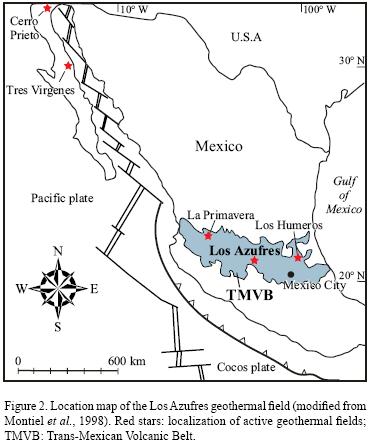
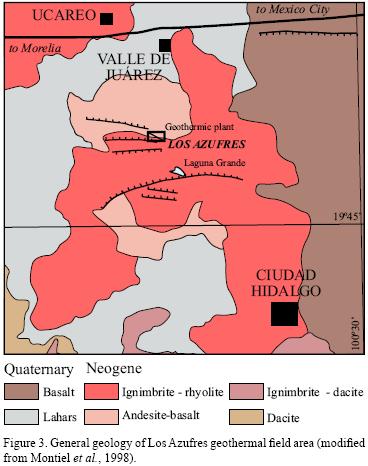
<body><![CDATA[<p align="justify"><font face="verdana" size="2">where <i>h<sub>fluid</sub> </i>is the specific enthalpy of the fluid in kJ/kg; <i>s<sub>fluid </sub></i>is the specific entropy of the fluid in kJ/kg&times;K obtained using a linear regression from the empirical tables presented in Lee (1996); and 1192 is the enthalpy value for pure water saturated with steam at 90 bar (9 Mpa) of pressure at 303 &deg;C. According to Lee (1996), the maximum exergy of a saturated steam pulled out from several geothermal systems throughout the world occurs between 90 and 100 bars of pressure. Although higher exergy values are possible for a superheated steam, it is rarely seen. Hence, the exergy values can be normalized by using the corresponding maximum exergy found (Lee,1996).</font></p>     <p align="justify"><font face="verdana" size="2">Lee (1996, 2001) also proposed an arbitrary criteria to evaluate the capacity of a geothermal fluid to do work, based on the Lindal (1973) diagram. Lee (1996, 2001) proposed as the lower SExI limit the value of a high performance well at Wairakei (New Zealand) that generates electricity at atmospheric pressure, with a corresponding SExI value of 0.5. Therefore, high exergy resources were proposed by Lee (1996, 2001) to have SExI values higher or equal to 0.5, similarly to the "hyperthermal dry field" established by minimum exergy acceptable for direct uses, <i>i.e., </i>the equivalent of a saturated water at atmospheric conditions, with a corresponding SExI value of 0.05, in analogy with the "semithermal field" proposed by Armstead (1983). Hence, medium performance resources have SExI values between 0.05 and 0.5, corresponding to the Armstead (1983) "hyperthermal wet field". Finally, Lee (1996) represented these SExI boundaries as straight lines located at 0.05 and 0.5 (Equation 2) within the Mollier's Diagram (h&#150;s plot) and used the resulting plot as a graphical way to classify geothermal fields (<a href="/img/revistas/rmcg/v27n3/a9f1.jpg" target="_blank">Figure 1</a>).</font></p>     <p align="justify"><font face="verdana" size="2"><b>SExI application</b></font></p>     <p align="justify"><font face="verdana" size="2">Lee (1996, 2001) applied his plot (<a href="/img/revistas/rmcg/v27n3/a9f1.jpg" target="_blank">Figure 1</a>) to classify dry geothermal steam fields, as Larderello (Italy) and the Geysers (USA), as high exergy resources with SExI values greater than 0.5. Similarly, two&#150;phase geothermal fluids with enthalpies above 1600 kJ/kg, as in Ohaaki (New Zealand) and Cerro Prieto (Mexico) geothermal fields, are likely to be high exeigy resources. Those fields with enthalpies between 1600 and 1000 kJ/kg were considered to be of medium exergy, as Wairakei (New Zealand) and Otake (Japan). Finally, those geothermal fields with enthalpies below 1000 kJ/kg must be classified as low exergy resources, such as in Fuzhou (China).</font></p>     <p align="justify"><font face="verdana" size="2">Lately, different authors used the SExI index in an effort to classify other geothermal fields as Ahuachap&aacute;n and Berlin geothermal fields (El Salvador; Quijano, 2000) and the Tuzla geothermal field (Turkey; Baba and Ozgener, 2006).</font></p>     <p align="justify"><font face="verdana" size="2">Quijano (2000) applied the methodology proposed by Lee (1996) to calculate the SExI values at well&#150;head conditions. He used both, the SExI values and the output characteristic curves of the production wells to estimate the efficiency of the geothermal power plants and the extracted thermal energy.</font></p>     <p align="justify"><font face="verdana" size="2">In this paper, we propose a new way to classify and evaluate the energy&#150;exergy dichotomy, using as an example the historical data gathered at the Los Azufres geothermal field (LAGF), in Michoac&aacute;n State (Mexico). In order to do so, we used the calculated reservoir conditions of the geothermal fluid obtained from three representative wells, to gain a clear insight within both the "original" (pristine) and the anthropically disturbed (present day) conditions of the geothermal field. The new diagrams we propose in this paper can be used to improve the energy recovery as well as to avoid both the over&#150;exploitation and the reinjection effects of this natural, quasi&#150;renewable resource.</font></p>     <p align="justify"><font face="verdana" size="2">&nbsp;</font></p>     <p align="justify"><font face="verdana" size="2"><b>GEOLOGICAL SETTINGS AT LOS AZUFRES GEOTHERMAL FIELD</b></font></p>     <p align="justify"><font face="verdana" size="2">Los Azufres geothermal field (LAGF) is located at the Chapala&#150;Cuitzeo central depression (Gardu&ntilde;o and Mahood, 1987). More specifically, this geothermal field is placed within the Sierra San Andr&eacute;s, in the intersection of two main depressions, the Valle Juarez to the north and La Venta depression to the south (Ferrari <i>et al., </i>1991), covering an area of about 42 km<sup>2</sup> (<a href="#f2">Figure 2</a> and <a href="#f3">3</a>).</font></p>     ]]></body>
<body><![CDATA[<p align="center"><font face="verdana" size="2"><a name="f2"></a></font></p>     <p align="center"><font face="verdana" size="2"><img src="/img/revistas/rmcg/v27n3/a9f2.jpg"></font></p>     <p align="center"><font face="verdana" size="2"><a name="f3"></a></font></p>     <p align="center"><font face="verdana" size="2"><img src="/img/revistas/rmcg/v27n3/a9f3.jpg"></font></p>     <p align="justify"><font face="verdana" size="2">The Los Azufres geothermal field is located at around 200 km northwest of Mexico City and 80 km to the east of the city of Morelia (Michoac&aacute;n, Mexico; <a href="#f2">Figure 2</a> and <a href="#f3">3</a>). Geologically, it is placed at the centre of the Trans&#150;Mexican Volcanic Belt (TMVB; Demant and Robin, 1975), a Neogene volcanic arc built on the southern edge of the North American plate (Ferrari <i>et al., </i>1991). It is characterized by the presence of abundant volcanism with a wide range of chemical compositions, from intermediate to silicic rocks with ages spanning from 17 Ma (late Oligocene) to the present. Although the TMVB trend is not parallel to the Middle American Trench, the origin of this volcanic province has been linked to the subduction of the Cocos plate beneath the North American plate (Demant and Robin, 1975) at the rate of approximately 6 cm/y (DeMets <i>et al., </i>1990). An exhaustive description of the local geology can be found in the following papers: Aumento and Guti&eacute;rrez, 1980, Guti&eacute;rrez and Aumento, 1982, Dobson and Mahood, 1995, Gardu&ntilde;o, 1988.</font></p>     <p align="justify"><font face="verdana" size="2">Comisi&oacute;n Federal de Electricidad (Gardu&ntilde;o, 1984) based upon surface geology, alteration distribution and structural controls, proposed that LAGF can be divided into the Northern (NZ) and Southern (SZ) Zones, with a central, non productive zone, accepting "implicitly" a two&#150;reservoir field compartmentalization. Other studies (L&oacute;pez, 1991; Ramajo <i>et al., </i>2007) supported a single reservoir field configuration.</font></p>     <p align="justify"><font face="verdana" size="2">The LAGF central area, in between the North and South Zones, is characterized by an intense hydrothermal alteration (kaolinitzation and silicification) affecting the outcropping volcanic series, forming a blanket several meters thick and suggesting the former existence of a surficial hydrothermal discharge zone. Alteration minerals throughout the field include microcrystalline silica, kaolinite, chlorite, zeolites (chabazite and wairakite), calcite and pyrite, most of them only distinguished by means of XRD methods (Pandarinath <i>et al., </i>2006). This alteration assemblage display a vertical arrangement, roughly correlated with increasing temperatures, with argillitization/silicification at shallow levels, zeolite/calcite formation and sericitization/ chloritization at medium depths and chloritization/epidoti&#150;zation at deeper levels.</font></p>     <p align="justify"><font face="verdana" size="2">The present day active geothermal field is closely related to systems of faults and fractures oriented N&#150;S, NNW&#150;SSE, NE&#150;SW and E&#150;W directions (Gardu&ntilde;o, 1988; L&oacute;pez, 1991).</font></p>     <p align="justify"><font face="verdana" size="2">The geothermal fluid in Los Azufres is represented by a low salinity, NaCl&#150;dominant brine (&#126;0.8 wt. %) and a non&#150;condensable gas fraction, composed mainly by CO2 (between 70 and 99 &deg;%) with minor quantities of H<sub>2</sub>S, N<sub>2</sub>, H<sub>2 </sub>and CH<sub>4</sub> (Verma and Santoyo, 1997). Fluid temperatures at equilibrium, estimated using the Na&#150;K fluid geothermom&#150;eter, range from 230 to 340 &deg;C (Verma and Santoyo, 1997). Head pressures span between 6 to 41 MPa.</font></p>     <p align="justify"><font face="verdana" size="2">Three types of natural springs can be found at LAGF (Verma and Santoyo, 1997):</font></p>     ]]></body>
<body><![CDATA[<p align="justify"><font face="verdana" size="2">1) Sodium&#150;bicarbonated springs of clear surficial origin, from the percolation of meteoric waters.</font></p>     <p align="justify"><font face="verdana" size="2">2) Sodium&#150;chloride&#150;dominated hot springs of deep origin, intimately related with the present&#150;day geothermal fluids.</font></p>     <p align="justify"><font face="verdana" size="2">3) Steam&#150;heated, acid&#150;sulphate spring waters, after the interaction of deep, NaCl&#150;hot, boiling water with perched, surficial waters.</font></p>     <p align="justify"><font face="verdana" size="2">&nbsp;</font></p>     <p align="justify"><font face="verdana" size="2"><b>GEOTHERMICS AT LOS AZUFRES</b></font></p>     <p align="justify"><font face="verdana" size="2">Los Azufres is the second most important geothermal field in Mexico in terms of electricity generation, after the Cerro Prieto geothermal field in Northern Baja California peninsula (<a href="#f2">Figure 2</a>). LAGF was firstly studied during the 50's decade of the last century (Maldonado, 1956). In 1972 interest in LAGF resumed, culminating in 1977 with the completion of the first producer well (Az&#150;001). Between 1979 and 2004, a total of 85 production wells and six injection wells were drilled, while commercial electricity generation began in August 1982. At present, the installed capacity is 188 MW.</font></p>     <p align="justify"><font face="verdana" size="2"><b>SExI revisited at LAGF</b></font></p>     <p align="justify"><font face="verdana" size="2">The SExI concept is a very useful parameter to apply to pristine geothermal systems. Despite that, under dynamic conditions, geothermal fields react changing their thermody&#150;namic and geochemical properties. Usually, these forceful conditions provoke the over&#150;exploitation of the resource and, when the system is re&#150;injected, the geothermal fluid behavior modify the natural state of the geothermal system. Consequently, we decided to apply the SExI index/classification with some modifications in order to look for a way to properly evaluate the anthropic disruption on this geothermal resource. The present work is based on the diary production and geochemical data gathered throughout the period comprised from 1980 until 2004. These data were filtered so as to remove the systematic errors that appeared as cero values in the production variables, for their no physical meaning, and those in the geochemical parameters with an error higher than 10 % in their ionic balance. Once these data were filtered, a program was generated to process monthly and annual statistics for every well involved in the power generation.</font></p>     <p align="justify"><font face="verdana" size="2"><b>Recalculation of the input parameters at reservoir conditions</b></font></p>     <p align="justify"><font face="verdana" size="2">The geochemical variable we use to evaluate the reinjection effect is the chlorine content at reservoir conditions, as this electrolyte behaves very conservatively in crustal environments even though it can be loss in small quantities through boiling as HCl. Chlorinity has been calculated using the equations of Arnorsson <i>et al., </i>(1982) and using the temperatures calculated at reservoir conditions by means of the Na&#150;K geothermometer (Verma and Santoyo, 1997), considering that albite and the K&#150;feldspar assemblage are in equilibrium at a specific temperature:</font></p>     ]]></body>
<body><![CDATA[<p align="center"><font face="verdana" size="2"><i><img src="/img/revistas/rmcg/v27n3/a9s3.jpg"></i></font></p>     <p align="justify"><font face="verdana" size="2">The Na and K concentrations (in ppm) were obtained from the analyses performed on the recovered geothermal fluid. Hence, the Cl (<i>C<sub>R</sub></i>) content can be obtained applying the methodology established (Arnorsson <i>et al., </i>1982):</font></p>     <p align="center"><font face="verdana" size="2"><i><img src="/img/revistas/rmcg/v27n3/a9s4.jpg"></i></font></p>     <p align="justify"><font face="verdana" size="2"><i>X<sup>RC</sup><sub>V</sub> </i> represents the fraction of vapor at reservoir conditions and <i>C<sub>TD</sub> </i>is the concentration of the solute at discharge conditions. <i>X</i><i><sub>V</sub></i><i> </i>is calculated as:</font></p>     <p align="center"><font face="verdana" size="2"><img src="/img/revistas/rmcg/v27n3/a9s5.jpg"></font></p>     <p align="justify"><font face="verdana" size="2">H<sub>0</sub> is the enthalpy measured at separated conditions and <i>H<sub>L</sub> </i>and <i>H<sub>V</sub> </i>are the enthalpies of the liquid and vapor phase calculated at reservoir conditions assuming following (Arnorsson <i>et al., </i>1982):</font></p>     <p align="center"><font face="verdana" size="2"><i><img src="/img/revistas/rmcg/v27n3/a9s6.jpg"></i></font></p>     <p align="justify"><font face="verdana" size="2">and <i>C<sub>TD</sub> </i>is obtained by the following expression:</font></p>     <p align="center"><font face="verdana" size="2"><i><img src="/img/revistas/rmcg/v27n3/a9s7.jpg"></i></font></p>     <p align="justify"><font face="verdana" size="2">where <i>C<sub>L</sub> </i>and <i>C<sub>V</sub> </i>are the concentration of the solute dissolved in the liquid and vapor phase measured and <i>X<sup>DC</sup><sub>V</sub> </i>is the fraction of vapor at discharge conditions; that is:</font></p>     ]]></body>
<body><![CDATA[<p align="center"><font face="verdana" size="2"><i><img src="/img/revistas/rmcg/v27n3/a9s8.jpg"></i></font></p>     <p align="justify"><font face="verdana" size="2">being <i>H<sub>0</sub></i> the enthalpy measured, <i>H<sub>L</sub> </i>the enthalpy calculated at total discharge conditions and <i>L </i>the latent heat.</font></p>     <p align="justify"><font face="verdana" size="2">The production variables considered in this paper are the water flow rate (Q<sub>L</sub>), the effective well radius (D) and the specific enthalpy (h). The LAGF dataset provided by Comisi&oacute;n Federal de Electricidad (1980&#150;2004) presents some gaps in the register (<a href="/img/revistas/rmcg/v27n3/a9t1.jpg" target="_blank">Tables 1</a>, <a href="/img/revistas/rmcg/v27n3/a9t2.jpg" target="_blank">2</a> and <a href="/img/revistas/rmcg/v27n3/a9t3.jpg" target="_blank">3</a>) due to exploitation problems. Besides this irregular register, the amount of data available is enormous, so we decided to use annual average values. Moreover, we normalized the gathered data taking into account the maximum and minimum values registered at LAGF for every variable, considering the following relationship:</font></p>     <p align="center"><font face="verdana" size="2"><i><img src="/img/revistas/rmcg/v27n3/a9s9.jpg"></i></font></p>     <p align="justify"><font face="verdana" size="2">where <i>X<sub>0</sub></i>, <i>X<sub>max</sub> </i>and <i>X<sub>min</sub> </i>are the different measured, maximum and minimum values of each of the parameters.</font></p>     <p align="justify"><font face="verdana" size="2"><b>Plot construction and evaluation</b></font></p>     <p align="justify"><font face="verdana" size="2">According to the criteria exposed by Lee (1996, 2001), the geothermal fluids have been classified within high (H.E.F.), medium (M.E.F) and low (L.E.F.) exergy values. This classification is not very accurate under dynamic conditions, because it makes no difference between natural vapor&#150;producing and over&#150;exploited wells. To evaluate the anthropic disturbance caused by geothermal resource human exploitation, we propose to correlate the SExI parameter with the production (QL, D) and geochemical (chlorinity) parameters.</font></p>     <p align="justify"><font face="verdana" size="2">Then, we propose the use of three different graphic representations:</font></p>     <p align="justify"><font face="verdana" size="2">a)&nbsp;<i>Outlet effect (OE) plot: </i>representing the normalized effective well radius (D/D<sub>max</sub>) versus the SExI evolution (<a href="/img/revistas/rmcg/v27n3/a9f4.jpg" target="_blank">Figures 4b</a>, <a href="/img/revistas/rmcg/v27n3/a9f5.jpg" target="_blank">5b</a> and <a href="/img/revistas/rmcg/v27n3/a9f6.jpg" target="_blank">6b</a>). This plot gives an insight into the exergy behavior of the well during the manipulation of the diameter of the well.</font></p>     <p align="justify"><font face="verdana" size="2">b)&nbsp;<i>Chlorinity effect (CE) plot: </i>representing the normalized chlorine content (Cl<sub>L</sub>/Cl<sub>Lmax</sub>) versus the SExI/Q<sub>L</sub> ratio (<a href="#f3">Figures 3c</a>, <a href="/img/revistas/rmcg/v27n3/a9f4.jpg" target="_blank">4c</a> and <a href="/img/revistas/rmcg/v27n3/a9f5.jpg" target="_blank">5c</a>), constructed to evaluate the effects of both, over&#150;exploitation and fluid re&#150;injection.</font></p>     ]]></body>
<body><![CDATA[<p align="justify"><font face="verdana" size="2">c) <i>Q<sub>L</sub> effect (QE) plot: </i>representing the normalized Q<sub>L </sub>(Q<sub>L</sub>/Q<sub>Lmax</sub>) versus the SExI/Cl ratio (<a href="/img/revistas/rmcg/v27n3/a9f4.jpg" target="_blank">Figures 4d</a>, <a href="/img/revistas/rmcg/v27n3/a9f5.jpg" target="_blank">5d</a> and <a href="/img/revistas/rmcg/v27n3/a9f6.jpg" target="_blank">6d</a>), constructed to depict the evolution of over&#150;exploitation and re&#150;injection effects.</font></p>     <p align="justify"><font face="verdana" size="2">We checked the use of our plots using three carefully characterized set of well data series at LAGF:</font></p>     <p align="justify"><font face="verdana" size="2">1)&nbsp;The Az&#150;062 well, located at South of LAGF that represents a sustainable behavior at LAGF (<a href="/img/revistas/rmcg/v27n3/a9f4.jpg" target="_blank">Figure 4</a>, <a href="/img/revistas/rmcg/v27n3/a9t1.jpg" target="_blank">Table 1</a>).</font></p>     <p align="justify"><font face="verdana" size="2">2)&nbsp;The Az&#150;013, at the North of LAGF, that represents a well clearly over&#150;exploited (<a href="/img/revistas/rmcg/v27n3/a9f5.jpg" target="_blank">Figure 5</a>, <a href="/img/revistas/rmcg/v27n3/a9t2.jpg" target="_blank">Table 2</a>).</font></p>     <p align="justify"><font face="verdana" size="2">3)&nbsp;The Az&#150;002, well at South of LAGF, which is affected by re&#150;injection of the residual geothermal fluid (<a href="/img/revistas/rmcg/v27n3/a9f6.jpg" target="_blank">Figure 6</a>, <a href="/img/revistas/rmcg/v27n3/a9t3.jpg" target="_blank">Table 3</a>).</font></p>     <p align="justify"><font face="verdana" size="2">In order to have a sound set of data to work with, several thousand individual daily measurements, spanning between 1980 and 2004, have been checked, filtered and evaluated (Ramajo <i>et al., </i>2007).</font></p>     <p align="justify"><font face="verdana" size="2">&nbsp;</font></p>     <p align="justify"><font face="verdana" size="2"><b>DISCUSSION</b></font></p>     <p align="justify"><font face="verdana" size="2">Geothermal data (<a href="/img/revistas/rmcg/v27n3/a9f4.jpg" target="_blank">Figures 4a</a>, <a href="/img/revistas/rmcg/v27n3/a9f5.jpg" target="_blank">5a</a> and <a href="/img/revistas/rmcg/v27n3/a9f6.jpg" target="_blank">6a</a>) on Mollier's classic plot (Lee, 1996, 2001) for Az&#150;013 and Az&#150;062 wells fall within the high exergy field (H.E.F.), whereas the fluid extracted from well Az&#150;002 displays a medium exergy pattern (M.E.F.).</font></p>     <p align="justify"><font face="verdana" size="2">The Az&#150;062 well represents a high exergetic fluid that it is not affected by exploitation, with a SExI value of around 60% (<a href="/img/revistas/rmcg/v27n3/a9f4.jpg" target="_blank">Figure 4b</a>), being one of the most constant geothermal wells of the area.</font></p>     ]]></body>
<body><![CDATA[<p align="justify"><font face="verdana" size="2">In contrast, the Az&#150;013 well exhibits three different trends. The first trend occurred between 1980 until 1990, where the well&#150;outlet was less than or equal to 40 % and SExI values fall within the range of 50 to 80 %. The middle trend, between 1990 and 1994, is characterized by a drastic increase in D/D<sub>max</sub> up to 100 %%, to end up with a 60 % of well&#150;outlet. In this period SExI increased from 45 up to 95% of the maximum value assumed by Lee (1996, 2001). Therefore, the fluid produced at Az&#150;013 is, almost all the time, a H.E.F., turning it into a profitable geothermal fluid. Yet, when we use the other (CE and QE) plots (<a href="/img/revistas/rmcg/v27n3/a9f5.jpg" target="_blank">Figures 5c</a> and <a href="/img/revistas/rmcg/v27n3/a9f5.jpg" target="_blank">5d</a>), the an&#150;thropically induced over&#150;exploitation effect becomes evident from 1991 until 1997, where the drastic increase of the outlet provoked on one hand an exergy growth and, on the other hand the sudden drop of the Cl content and Q<sub>L</sub> that gave rise to a boiled&#150;off fluid. So, an exergetically useful fluid in Lee's plot depicts a depletion trend towards the complete exhaustion of the geothermal resource.</font></p>     <p align="justify"><font face="verdana" size="2">Az&#150;002 represents a well affected by re&#150;injection in neighboring Az&#150;007 and Az&#150;008 wells. Following Lee, this well produces a medium exergetic fluid (<a href="/img/revistas/rmcg/v27n3/a9f6.jpg" target="_blank">Figure 6a</a>). <a href="/img/revistas/rmcg/v27n3/a9f6.jpg" target="_blank">Figure 6b</a> indicates a well complex manipulation and subsequent behavior, never reaching the high exergetic fluid field which was the main purpose of such manipulation. As can be seen in the same Figure, trials were made to increment the productivity of the well by first opening (1980&#150;1982) the main valve, resulting in a SExI decrease, and then strangling the well outlet (1982&#150;1986) to recover the initial state. The coupling of opening and reinjection led to a SExI decrease as well as an increase in salinity of the fluid; one can argue that both effects make no sense, as salinity increase can be produced by boiling that triggered the system towards higher SExI values; in this case, this apparent contradiction is due to the reinjection of a boiled&#150;off, higher salinity remnant fluid, recovered at surface from other producing wells. From 1996, re&#150;injected fluid become dominant explaining the constant Cl contents. From 2001, the slight drop in chlorinity is coupled with a dramatic increase in mineral precipitation (in situ observation by Ramajo) and the exhaustion of the geothermal fluid (<a href="/img/revistas/rmcg/v27n3/a9f6.jpg" target="_blank">Figure 6d</a>), leading to the subsequent abandon of the well. In order to recover steam production, another well was drilled nearby Az&#150;002, avoiding the already&#150;sealed preferential paths.</font></p>     <p align="justify"><font face="verdana" size="2">As can be seen, from Lee's SExI classification both Az&#150;062 and Az&#150;013 wells should produce a high exergetic fluid (<a href="/img/revistas/rmcg/v27n3/a9f4.jpg" target="_blank">Figures 4a</a> and <a href="/img/revistas/rmcg/v27n3/a9f5.jpg" target="_blank">5a</a>) and no differences can be drawn between them, even though their exploitation regime and, consequently, their fluid behavior is clearly different (<a href="/img/revistas/rmcg/v27n3/a9f4.jpg" target="_blank">Figures 4b</a> and <a href="/img/revistas/rmcg/v27n3/a9f5.jpg" target="_blank">5b</a>). Az&#150;062 geothermal fluid displays a regular behavior regardless any anthropic manipulation, as compared with the whole LAGF wells, showing null to slight Cl concentration increase (<a href="/img/revistas/rmcg/v27n3/a9f4.jpg" target="_blank">Figure 4b</a>), while flow rate increased (<a href="/img/revistas/rmcg/v27n3/a9f4.jpg" target="_blank">Figure 4d</a>) due to the opening of the well&#150;outlet (<a href="/img/revistas/rmcg/v27n3/a9f4.jpg" target="_blank">Figure 4d</a>). Contrastingly, the Az&#150;013 well never reached a close&#150;to&#150;equilibrium exploitation state as the fluid boils resulting in an anthropic&#150;triggered, unstable H.E.F., as can be seen in <a href="/img/revistas/rmcg/v27n3/a9f5.jpg" target="_blank">Figures 5c</a> and <a href="/img/revistas/rmcg/v27n3/a9f5.jpg" target="_blank">5d</a>, leading to a complete loss of control of the well. This over&#150;exploitation is confirmed by the sudden drop on Cl concentration (<a href="/img/revistas/rmcg/v27n3/a9f5.jpg" target="_blank">Figure 5c</a>) linked to the exhaustion of the liquid phase (<a href="/img/revistas/rmcg/v27n3/a9f5.jpg" target="_blank">Figure 5d</a>). In this case, over&#150;exploitation is associated to a huge opening of the well&#150;outlet that took place in 1993 (<a href="/img/revistas/rmcg/v27n3/a9f5.jpg" target="_blank">Figure 5b</a>), however, there are some cases when the well outlet is not completely opened but the well still experiments over&#150;exploitation as in a memory effect. A probable cause for this is low rock permeability in the vicinity of the well.</font></p>     <p align="justify"><font face="verdana" size="2">&nbsp;</font></p>     <p align="justify"><font face="verdana" size="2"><b>CONCLUSIONS</b></font></p>     <p align="justify"><font face="verdana" size="2">Lee's exergy classification (Lee, 1996, 2001), although useful, does not provide a deep insight into the geothermal fluid itself.</font></p>     <p align="justify"><font face="verdana" size="2">The exergy of a fluid in a mature geothermal field, as LAGF, is not controlled anymore by natural&#150;driven variables but by the anthropic ones. Then, the new discriminating plots we propose in this paper concerning high enthalpy geothermal fields (&gt;100&deg;C) can be applied to: (1) understand the natural behavior of a newly drilled well after production tests, regardless their exergetic characteristics; (2) to understand and characterize the anthropic disturbance originated by continuos exploitation; and (3) to predict the future behavior of a geothermal resource, regardless its history. Thus, this new approach allows us to discriminate among several relevant effects, and to plan a better exploitation strategy that prevents geothermal fluid exhaustion.</font></p>     <p align="justify"><font face="verdana" size="2">&nbsp;</font></p>     <p align="justify"><font face="verdana" size="2"><b>ACKNOWLEDGEMENTS</b></font></p>     <p align="justify"><font face="verdana" size="2">We wish to thank Comisi&oacute;n Federal de Electricidad (CFE), especially Engineers F. Sandoval and Ra&uacute;l Maya, for their support of this project. Funding was provided by a CFE&#150;UNAM research project RAZ&#150;REGGHGL&#150;001/07, CONACYT 49234&#150;F, CONACYT 81584. We sincerely thank Dr. &Aacute;ngel F. Nieto Samaniego and unknown reviewer for their constructive reviews.</font></p>     ]]></body>
<body><![CDATA[<p align="justify"><font face="verdana" size="2">&nbsp;</font></p>     <p align="justify"><font face="verdana" size="2"><b>REFERENCES</b></font></p>     <!-- ref --><p align="justify"><font face="verdana" size="2">Armstead, H.C.H., 1983, Geothermal Energy &#150; Its past, present and future contribution to the energy needs of man: London, E &amp; FN Spon, 404 pp.    &nbsp;&nbsp;&nbsp;&nbsp;&nbsp;&nbsp;&nbsp;&nbsp;[&#160;<a href="javascript:void(0);" onclick="javascript: window.open('/scielo.php?script=sci_nlinks&ref=8054766&pid=S1026-8774201000030000900001&lng=','','width=640,height=500,resizable=yes,scrollbars=1,menubar=yes,');">Links</a>&#160;]<!-- end-ref --></font></p>     <!-- ref --><p align="justify"><font face="verdana" size="2">Arnorsson, S., Sigurdsson, S., Svavarsson, H., 1982, The chemistry of geothermal waters in Iceland, I. Calculation o aqueous speciation from 0&deg; to 370&deg;C: Geochimica et Cosmochimica Acta, 46, 1513&#150;1532.    &nbsp;&nbsp;&nbsp;&nbsp;&nbsp;&nbsp;&nbsp;&nbsp;[&#160;<a href="javascript:void(0);" onclick="javascript: window.open('/scielo.php?script=sci_nlinks&ref=8054768&pid=S1026-8774201000030000900002&lng=','','width=640,height=500,resizable=yes,scrollbars=1,menubar=yes,');">Links</a>&#160;]<!-- end-ref --></font></p>     <!-- ref --><p align="justify"><font face="verdana" size="2">Aumento, F., Guti&eacute;rrez, N.A., 1980, Geocronolog&iacute;a de Los Azufres Michoac&aacute;n, Mexico: Mexico, D.F ,Comisi&oacute;n Federal de Electricidad, ,reporte interno, 3&#150;80, 6 pp.    &nbsp;&nbsp;&nbsp;&nbsp;&nbsp;&nbsp;&nbsp;&nbsp;[&#160;<a href="javascript:void(0);" onclick="javascript: window.open('/scielo.php?script=sci_nlinks&ref=8054770&pid=S1026-8774201000030000900003&lng=','','width=640,height=500,resizable=yes,scrollbars=1,menubar=yes,');">Links</a>&#160;]<!-- end-ref --> </font></p>     <!-- ref --><p align="justify"><font face="verdana" size="2">Baba, A., Ozgener, A., 2006, Hepbasli, Environmental and exergetic aspect of geothermal energy: Energy Sources, 28, 597&#150;609.    &nbsp;&nbsp;&nbsp;&nbsp;&nbsp;&nbsp;&nbsp;&nbsp;[&#160;<a href="javascript:void(0);" onclick="javascript: window.open('/scielo.php?script=sci_nlinks&ref=8054772&pid=S1026-8774201000030000900004&lng=','','width=640,height=500,resizable=yes,scrollbars=1,menubar=yes,');">Links</a>&#160;]<!-- end-ref --> </font></p>     ]]></body>
<body><![CDATA[<!-- ref --><p align="justify"><font face="verdana" size="2">Benderitter, Y., Cormy, G., 1990, Possible approach to geothermal research and relative cost estimate. Small geothermal resources, <i>in: </i>Dickson, M.H., Fanelli, M. (eds.), Small Geothermal Resources: Rome, Italy, UNITAR/UNDP Centre for Small Energy Resources, 61&#150;71.    &nbsp;&nbsp;&nbsp;&nbsp;&nbsp;&nbsp;&nbsp;&nbsp;[&#160;<a href="javascript:void(0);" onclick="javascript: window.open('/scielo.php?script=sci_nlinks&ref=8054774&pid=S1026-8774201000030000900005&lng=','','width=640,height=500,resizable=yes,scrollbars=1,menubar=yes,');">Links</a>&#160;]<!-- end-ref --></font></p>     <!-- ref --><p align="justify"><font face="verdana" size="2">Bodvarsson, G., Eggers, D.E., 1972, The exergy of termal water: Geothermics, 1(3), 93&#150;95.    &nbsp;&nbsp;&nbsp;&nbsp;&nbsp;&nbsp;&nbsp;&nbsp;[&#160;<a href="javascript:void(0);" onclick="javascript: window.open('/scielo.php?script=sci_nlinks&ref=8054776&pid=S1026-8774201000030000900006&lng=','','width=640,height=500,resizable=yes,scrollbars=1,menubar=yes,');">Links</a>&#160;]<!-- end-ref --></font></p>     <!-- ref --><p align="justify"><font face="verdana" size="2">Demant, A., Robin, C., 1975, Las fases del vulcanismo en M&eacute;xico: una s&iacute;ntesis en relaci&oacute;n con la evoluci&oacute;n geodin&aacute;mica desde el Cret&aacute;cico: Revista del Instituto de Geologia Universidad Nacional Aut&oacute;noma de M&eacute;xico, 1, 70&#150;84.    &nbsp;&nbsp;&nbsp;&nbsp;&nbsp;&nbsp;&nbsp;&nbsp;[&#160;<a href="javascript:void(0);" onclick="javascript: window.open('/scielo.php?script=sci_nlinks&ref=8054778&pid=S1026-8774201000030000900007&lng=','','width=640,height=500,resizable=yes,scrollbars=1,menubar=yes,');">Links</a>&#160;]<!-- end-ref --> </font></p>     <!-- ref --><p align="justify"><font face="verdana" size="2">DeMets, C., Gordon, R.G., Argus, D.F., Stein, S., 1990, Current plate motions: Geophysical Journal International, 101(2), 425&#150;478.    &nbsp;&nbsp;&nbsp;&nbsp;&nbsp;&nbsp;&nbsp;&nbsp;[&#160;<a href="javascript:void(0);" onclick="javascript: window.open('/scielo.php?script=sci_nlinks&ref=8054780&pid=S1026-8774201000030000900008&lng=','','width=640,height=500,resizable=yes,scrollbars=1,menubar=yes,');">Links</a>&#160;]<!-- end-ref --> </font></p>     <!-- ref --><p align="justify"><font face="verdana" size="2">Dobson, P.F., Mahood, G.A., 1995, Volcanic stratigraphy of the Los Azufres geothermal area, Mexico: Journal of Volcanic and Geothermal Research 25(3&#150;4), 273&#150;287.    &nbsp;&nbsp;&nbsp;&nbsp;&nbsp;&nbsp;&nbsp;&nbsp;[&#160;<a href="javascript:void(0);" onclick="javascript: window.open('/scielo.php?script=sci_nlinks&ref=8054782&pid=S1026-8774201000030000900009&lng=','','width=640,height=500,resizable=yes,scrollbars=1,menubar=yes,');">Links</a>&#160;]<!-- end-ref --></font></p>     ]]></body>
<body><![CDATA[<!-- ref --><p align="justify"><font face="verdana" size="2">Ferrari, L., Gardu&ntilde;o, V.H., Pasquar&egrave;, L., Tibaldi, A., 1991, Geology of the Los Azufres caldera, Mexico, and its relationship with regional tectonics: Journal of Volcanic and Geothermal Research, 47(1&#150;2), 129&#150;148.    &nbsp;&nbsp;&nbsp;&nbsp;&nbsp;&nbsp;&nbsp;&nbsp;[&#160;<a href="javascript:void(0);" onclick="javascript: window.open('/scielo.php?script=sci_nlinks&ref=8054784&pid=S1026-8774201000030000900010&lng=','','width=640,height=500,resizable=yes,scrollbars=1,menubar=yes,');">Links</a>&#160;]<!-- end-ref --></font></p>     <!-- ref --><p align="justify"><font face="verdana" size="2">Gardu&ntilde;o, V.H., 1988, La caldera de Los Azufres y su relaci&oacute;n con el sistema regional. Revista Mexicana de Geoenerg&iacute;a, 4, 49&#150;61.    &nbsp;&nbsp;&nbsp;&nbsp;&nbsp;&nbsp;&nbsp;&nbsp;[&#160;<a href="javascript:void(0);" onclick="javascript: window.open('/scielo.php?script=sci_nlinks&ref=8054786&pid=S1026-8774201000030000900011&lng=','','width=640,height=500,resizable=yes,scrollbars=1,menubar=yes,');">Links</a>&#160;]<!-- end-ref --></font></p>     <!-- ref --><p align="justify"><font face="verdana" size="2">Gardu&ntilde;o, V.H., Mahood, G.A., 1987, Estudio geol&oacute;gico regional para el modelo conceptual de Los Azufres: M&eacute;xico, Comisi&oacute;n Federal de Electricidad, Reporte interno, 72 pp.    &nbsp;&nbsp;&nbsp;&nbsp;&nbsp;&nbsp;&nbsp;&nbsp;[&#160;<a href="javascript:void(0);" onclick="javascript: window.open('/scielo.php?script=sci_nlinks&ref=8054788&pid=S1026-8774201000030000900012&lng=','','width=640,height=500,resizable=yes,scrollbars=1,menubar=yes,');">Links</a>&#160;]<!-- end-ref --></font></p>     <!-- ref --><p align="justify"><font face="verdana" size="2">Gardu&ntilde;o, V.H., Marti&ntilde;&oacute;n, G., 1984, An&aacute;lisis estructural de la zona sur del campo geot&eacute;rmico de Los Azufres, Michoac&aacute;n: M&eacute;xico, Comisi&oacute;n Federal de Electricidad, reporte interno, 153 pp.    &nbsp;&nbsp;&nbsp;&nbsp;&nbsp;&nbsp;&nbsp;&nbsp;[&#160;<a href="javascript:void(0);" onclick="javascript: window.open('/scielo.php?script=sci_nlinks&ref=8054790&pid=S1026-8774201000030000900013&lng=','','width=640,height=500,resizable=yes,scrollbars=1,menubar=yes,');">Links</a>&#160;]<!-- end-ref --></font></p>     <!-- ref --><p align="justify"><font face="verdana" size="2">Guti&eacute;rrez&#150;N., A., Aumento, F., 1982, The Los Azufres Michoac&aacute;n, Mexico, geothermal field: Journal of Hydrology, 56(1&#150;2), 137&#150;145.    &nbsp;&nbsp;&nbsp;&nbsp;&nbsp;&nbsp;&nbsp;&nbsp;[&#160;<a href="javascript:void(0);" onclick="javascript: window.open('/scielo.php?script=sci_nlinks&ref=8054792&pid=S1026-8774201000030000900014&lng=','','width=640,height=500,resizable=yes,scrollbars=1,menubar=yes,');">Links</a>&#160;]<!-- end-ref --></font></p>     ]]></body>
<body><![CDATA[<!-- ref --><p align="justify"><font face="verdana" size="2">Haenel, R., Rybach, L., Stegena, L., 1988, Fundamentals of geothermics, <i>in </i>Haenel, R., Rybach, L., Stegena, L. (eds.), Handbook of terrestrial heat&#150;flow density determination: Dorchstein, Netherlands, Kluwer Academic, 9&#150;57.    &nbsp;&nbsp;&nbsp;&nbsp;&nbsp;&nbsp;&nbsp;&nbsp;[&#160;<a href="javascript:void(0);" onclick="javascript: window.open('/scielo.php?script=sci_nlinks&ref=8054794&pid=S1026-8774201000030000900015&lng=','','width=640,height=500,resizable=yes,scrollbars=1,menubar=yes,');">Links</a>&#160;]<!-- end-ref --></font></p>     <!-- ref --><p align="justify"><font face="verdana" size="2">Hermann, W.A., 2006, Quantifying global exergy resources: Energy, 31(1&#150;2), 1685&#150;1702.    &nbsp;&nbsp;&nbsp;&nbsp;&nbsp;&nbsp;&nbsp;&nbsp;[&#160;<a href="javascript:void(0);" onclick="javascript: window.open('/scielo.php?script=sci_nlinks&ref=8054796&pid=S1026-8774201000030000900016&lng=','','width=640,height=500,resizable=yes,scrollbars=1,menubar=yes,');">Links</a>&#160;]<!-- end-ref --></font></p>     <!-- ref --><p align="justify"><font face="verdana" size="2">Hochstein, M.P., 1990, Classification and assessment of geothermal resources, <i>in </i>Dickson, M.H., Fanelli, M. (eds.), Small Geothermal Resources: Rome, Italy, UNITAR/UNDP Centre for Small Energy Resources, 31&#150;59.    &nbsp;&nbsp;&nbsp;&nbsp;&nbsp;&nbsp;&nbsp;&nbsp;[&#160;<a href="javascript:void(0);" onclick="javascript: window.open('/scielo.php?script=sci_nlinks&ref=8054798&pid=S1026-8774201000030000900017&lng=','','width=640,height=500,resizable=yes,scrollbars=1,menubar=yes,');">Links</a>&#160;]<!-- end-ref --></font></p>     <!-- ref --><p align="justify"><font face="verdana" size="2">Keenan, J.H., 1951, Availability and irreversibility in thermodynamics: British Journal of Applied Physics, 2, 183&#150;192.    &nbsp;&nbsp;&nbsp;&nbsp;&nbsp;&nbsp;&nbsp;&nbsp;[&#160;<a href="javascript:void(0);" onclick="javascript: window.open('/scielo.php?script=sci_nlinks&ref=8054800&pid=S1026-8774201000030000900018&lng=','','width=640,height=500,resizable=yes,scrollbars=1,menubar=yes,');">Links</a>&#160;]<!-- end-ref --></font></p>     <!-- ref --><p align="justify"><font face="verdana" size="2">Lee, K.C., 1996, Classification of geothermal resources: an engineering approach: Proceedings, Twenty&#150;First Workshop SGP&#150;TR&#150; 151 on Geothermal Reservoir Engineering: Stanford, California, Stanford University, 85&#150;92.    &nbsp;&nbsp;&nbsp;&nbsp;&nbsp;&nbsp;&nbsp;&nbsp;[&#160;<a href="javascript:void(0);" onclick="javascript: window.open('/scielo.php?script=sci_nlinks&ref=8054802&pid=S1026-8774201000030000900019&lng=','','width=640,height=500,resizable=yes,scrollbars=1,menubar=yes,');">Links</a>&#160;]<!-- end-ref --></font></p>     ]]></body>
<body><![CDATA[<!-- ref --><p align="justify"><font face="verdana" size="2">Lee, K.C., 2001, Classification of geothermal resources by exergy: Geothermics, 30(4), 431&#150;442.    &nbsp;&nbsp;&nbsp;&nbsp;&nbsp;&nbsp;&nbsp;&nbsp;[&#160;<a href="javascript:void(0);" onclick="javascript: window.open('/scielo.php?script=sci_nlinks&ref=8054804&pid=S1026-8774201000030000900020&lng=','','width=640,height=500,resizable=yes,scrollbars=1,menubar=yes,');">Links</a>&#160;]<!-- end-ref --></font></p>     <!-- ref --><p align="justify"><font face="verdana" size="2">Lindal, B., 1973, Industrial and Other applications of Geothermal Energy, <i>in </i>Annstead, H.C.H. (ed.), Geothermal Energy, a review of research and development: Paris, UNESCO, Earth Sciences 12, 135&#150;148.    &nbsp;&nbsp;&nbsp;&nbsp;&nbsp;&nbsp;&nbsp;&nbsp;[&#160;<a href="javascript:void(0);" onclick="javascript: window.open('/scielo.php?script=sci_nlinks&ref=8054806&pid=S1026-8774201000030000900021&lng=','','width=640,height=500,resizable=yes,scrollbars=1,menubar=yes,');">Links</a>&#160;]<!-- end-ref --></font></p>     <!-- ref --><p align="justify"><font face="verdana" size="2">L&oacute;pez, H.A., 1991, An&aacute;lisis estructural del campo geot&eacute;rmico de Los Azufres; Interpretaci&oacute;n de datos superficiales y de subsuelo: M&eacute;xico, Comisi&oacute;n Federal de Electricidad, Gerencia de Proyectos Geotermoel&eacute;ctricos, Informe 9/85, 15pp.    &nbsp;&nbsp;&nbsp;&nbsp;&nbsp;&nbsp;&nbsp;&nbsp;[&#160;<a href="javascript:void(0);" onclick="javascript: window.open('/scielo.php?script=sci_nlinks&ref=8054808&pid=S1026-8774201000030000900022&lng=','','width=640,height=500,resizable=yes,scrollbars=1,menubar=yes,');">Links</a>&#160;]<!-- end-ref --></font></p>     <!-- ref --><p align="justify"><font face="verdana" size="2">Maldonado, M., 1956, Volcanismo Terciario y Reciente del Eje Volc&aacute;nico de M&eacute;xico. Formaciones andes&iacute;ticas de las sierras de Las Cruces y Ozumatl&aacute;n. Formaciones bas&aacute;lticas de las sierras de Zit&aacute;cuaro, Morelia, Paracho, y alrededores de Paricutin. Fenomenos post&#150;paroxismales de la sierra de San Andr&eacute;s y el lago de Cuitzeo y estructura e historia del nuevo volc&aacute;n Paricutin: 20th International Geological Congress, Excursion A&#150;15, Mexico, 74 pp.    &nbsp;&nbsp;&nbsp;&nbsp;&nbsp;&nbsp;&nbsp;&nbsp;[&#160;<a href="javascript:void(0);" onclick="javascript: window.open('/scielo.php?script=sci_nlinks&ref=8054810&pid=S1026-8774201000030000900023&lng=','','width=640,height=500,resizable=yes,scrollbars=1,menubar=yes,');">Links</a>&#160;]<!-- end-ref --></font></p>     <!-- ref --><p align="justify"><font face="verdana" size="2">Montiel Escobar, J., Librado Flores, J., Salazar Reyes, J., Bustamente Garcia J., Sanchez Garrido, E., 1998, Carta Geol&oacute;gico&#150;Minera, Morelia E14&#150;1, Michoac&aacute;n, 7, escala 1:250,000: Pachuca, Hidalgo, M&eacute;xico, Consejo de Recursos Minerales, 1 mapa.    &nbsp;&nbsp;&nbsp;&nbsp;&nbsp;&nbsp;&nbsp;&nbsp;[&#160;<a href="javascript:void(0);" onclick="javascript: window.open('/scielo.php?script=sci_nlinks&ref=8054812&pid=S1026-8774201000030000900024&lng=','','width=640,height=500,resizable=yes,scrollbars=1,menubar=yes,');">Links</a>&#160;]<!-- end-ref --></font></p>     ]]></body>
<body><![CDATA[<!-- ref --><p align="justify"><font face="verdana" size="2">Muffler, P., Cataldi, R., 1978, Methods for regional assessment of geother&#150;mal resources: Geothermics, 7(2&#150;4), 53&#150;89.    &nbsp;&nbsp;&nbsp;&nbsp;&nbsp;&nbsp;&nbsp;&nbsp;[&#160;<a href="javascript:void(0);" onclick="javascript: window.open('/scielo.php?script=sci_nlinks&ref=8054814&pid=S1026-8774201000030000900025&lng=','','width=640,height=500,resizable=yes,scrollbars=1,menubar=yes,');">Links</a>&#160;]<!-- end-ref --></font></p>     <!-- ref --><p align="justify"><font face="verdana" size="2">Pandarinath, I.S., Torres&#150;Alvarado, D., Pushparani, E., Verma, E., 2006, X&#150;Ray diffraction analysis of hydrothermal minerals from the Los Azufres Geothermal System, Mexico: International Geology Reviews, 48(2), 174&#150;190.    &nbsp;&nbsp;&nbsp;&nbsp;&nbsp;&nbsp;&nbsp;&nbsp;[&#160;<a href="javascript:void(0);" onclick="javascript: window.open('/scielo.php?script=sci_nlinks&ref=8054816&pid=S1026-8774201000030000900026&lng=','','width=640,height=500,resizable=yes,scrollbars=1,menubar=yes,');">Links</a>&#160;]<!-- end-ref --></font></p>     <!-- ref --><p align="justify"><font face="verdana" size="2">Quijano, J., 2000, Exergy analysis for the Ahuachapan and Berlin Geothermal Fields, El Salvador, <i>in </i>Proceedings of the World Geothermal Congress: Kyushu&#150;Tohoku, Japan, 861&#150;866.    &nbsp;&nbsp;&nbsp;&nbsp;&nbsp;&nbsp;&nbsp;&nbsp;[&#160;<a href="javascript:void(0);" onclick="javascript: window.open('/scielo.php?script=sci_nlinks&ref=8054818&pid=S1026-8774201000030000900027&lng=','','width=640,height=500,resizable=yes,scrollbars=1,menubar=yes,');">Links</a>&#160;]<!-- end-ref --></font></p>     <!-- ref --><p align="justify"><font face="verdana" size="2">Ramajo, H., Tritlla, J., Levresse, G., Origel, G., Tello, E., 2007, Actualizaci&oacute;n del modelo geohidrol&oacute;gico conceptual del campo geot&eacute;rmico de Los Azufres, Michoac&aacute;n: M&eacute;xico, RAZ&#150;REGGHGL&#150;001/07, Comisi&oacute;n Federal de Electricidad, reporte interno, 497 pp.    &nbsp;&nbsp;&nbsp;&nbsp;&nbsp;&nbsp;&nbsp;&nbsp;[&#160;<a href="javascript:void(0);" onclick="javascript: window.open('/scielo.php?script=sci_nlinks&ref=8054820&pid=S1026-8774201000030000900028&lng=','','width=640,height=500,resizable=yes,scrollbars=1,menubar=yes,');">Links</a>&#160;]<!-- end-ref --></font></p>     <!-- ref --><p align="justify"><font face="verdana" size="2">Verma, S.P., Santoyo, E., 1997, New improved equations for Na/K, Na/Li and SiO<sub>2</sub> geothermometers by outliers detection and rejection: Journal of Volcanic and Geothermal Reserch, 79(1&#150;2), 9&#150;23.    &nbsp;&nbsp;&nbsp;&nbsp;&nbsp;&nbsp;&nbsp;&nbsp;[&#160;<a href="javascript:void(0);" onclick="javascript: window.open('/scielo.php?script=sci_nlinks&ref=8054822&pid=S1026-8774201000030000900029&lng=','','width=640,height=500,resizable=yes,scrollbars=1,menubar=yes,');">Links</a>&#160;]<!-- end-ref --></font></p>     ]]></body>
<body><![CDATA[ ]]></body><back>
<ref-list>
<ref id="B1">
<nlm-citation citation-type="book">
<person-group person-group-type="author">
<name>
<surname><![CDATA[Armstead]]></surname>
<given-names><![CDATA[H.C.H.]]></given-names>
</name>
</person-group>
<source><![CDATA[Geothermal Energy - Its past, present and future contribution to the energy needs of man]]></source>
<year>1983</year>
<page-range>404</page-range><publisher-loc><![CDATA[London ]]></publisher-loc>
<publisher-name><![CDATA[E & FN Spon]]></publisher-name>
</nlm-citation>
</ref>
<ref id="B2">
<nlm-citation citation-type="journal">
<person-group person-group-type="author">
<name>
<surname><![CDATA[Arnorsson]]></surname>
<given-names><![CDATA[S]]></given-names>
</name>
<name>
<surname><![CDATA[Sigurdsson]]></surname>
<given-names><![CDATA[S]]></given-names>
</name>
<name>
<surname><![CDATA[Svavarsson]]></surname>
<given-names><![CDATA[H]]></given-names>
</name>
</person-group>
<article-title xml:lang="en"><![CDATA[The chemistry of geothermal waters in Iceland, I. Calculation o aqueous speciation from 0° to 370°C]]></article-title>
<source><![CDATA[Geochimica et Cosmochimica Acta]]></source>
<year>1982</year>
<volume>46</volume>
<page-range>1513-1532</page-range></nlm-citation>
</ref>
<ref id="B3">
<nlm-citation citation-type="book">
<person-group person-group-type="author">
<name>
<surname><![CDATA[Aumento]]></surname>
<given-names><![CDATA[F.]]></given-names>
</name>
<name>
<surname><![CDATA[Gutiérrez]]></surname>
<given-names><![CDATA[N.A.]]></given-names>
</name>
</person-group>
<source><![CDATA[Geocronología de Los Azufres Michoacán, Mexico]]></source>
<year>1980</year>
<page-range>6</page-range><publisher-loc><![CDATA[Mexico^eD.F D.F]]></publisher-loc>
<publisher-name><![CDATA[Comisión Federal de Electricidad]]></publisher-name>
</nlm-citation>
</ref>
<ref id="B4">
<nlm-citation citation-type="journal">
<person-group person-group-type="author">
<name>
<surname><![CDATA[Baba]]></surname>
<given-names><![CDATA[A]]></given-names>
</name>
<name>
<surname><![CDATA[Ozgener]]></surname>
<given-names><![CDATA[A]]></given-names>
</name>
</person-group>
<article-title xml:lang="en"><![CDATA[Hepbasli, Environmental and exergetic aspect of geothermal energy]]></article-title>
<source><![CDATA[Energy Sources]]></source>
<year>2006</year>
<volume>28</volume>
<page-range>597-609</page-range></nlm-citation>
</ref>
<ref id="B5">
<nlm-citation citation-type="book">
<person-group person-group-type="author">
<name>
<surname><![CDATA[Benderitter]]></surname>
<given-names><![CDATA[Y.]]></given-names>
</name>
<name>
<surname><![CDATA[Cormy]]></surname>
<given-names><![CDATA[G.]]></given-names>
</name>
</person-group>
<article-title xml:lang="en"><![CDATA[Possible approach to geothermal research and relative cost estimate. Small geothermal resources]]></article-title>
<person-group person-group-type="editor">
<name>
<surname><![CDATA[Dickson]]></surname>
<given-names><![CDATA[M.H.]]></given-names>
</name>
<name>
<surname><![CDATA[Fanelli]]></surname>
<given-names><![CDATA[M.]]></given-names>
</name>
</person-group>
<source><![CDATA[Small Geothermal Resources]]></source>
<year>1990</year>
<page-range>61-71</page-range><publisher-loc><![CDATA[Rome ]]></publisher-loc>
<publisher-name><![CDATA[UNITARUNDPCentre for Small Energy Resources]]></publisher-name>
</nlm-citation>
</ref>
<ref id="B6">
<nlm-citation citation-type="journal">
<person-group person-group-type="author">
<name>
<surname><![CDATA[Bodvarsson]]></surname>
<given-names><![CDATA[G]]></given-names>
</name>
<name>
<surname><![CDATA[Eggers]]></surname>
<given-names><![CDATA[D.E]]></given-names>
</name>
</person-group>
<article-title xml:lang="en"><![CDATA[The exergy of termal water]]></article-title>
<source><![CDATA[Geothermics]]></source>
<year>1972</year>
<volume>1</volume>
<numero>3</numero>
<issue>3</issue>
<page-range>93-95</page-range></nlm-citation>
</ref>
<ref id="B7">
<nlm-citation citation-type="journal">
<person-group person-group-type="author">
<name>
<surname><![CDATA[Demant]]></surname>
<given-names><![CDATA[A]]></given-names>
</name>
<name>
<surname><![CDATA[Robin]]></surname>
<given-names><![CDATA[C]]></given-names>
</name>
</person-group>
<article-title xml:lang="es"><![CDATA[Las fases del vulcanismo en México una síntesis en relación con la evolución geodinámica desde el Cretácico]]></article-title>
<source><![CDATA[Revista del Instituto de Geologia Universidad Nacional Autónoma de México]]></source>
<year>1975</year>
<volume>1</volume>
<page-range>70-84</page-range></nlm-citation>
</ref>
<ref id="B8">
<nlm-citation citation-type="journal">
<person-group person-group-type="author">
<name>
<surname><![CDATA[DeMets]]></surname>
<given-names><![CDATA[C]]></given-names>
</name>
<name>
<surname><![CDATA[Gordon]]></surname>
<given-names><![CDATA[R.G]]></given-names>
</name>
<name>
<surname><![CDATA[Argus]]></surname>
<given-names><![CDATA[D.F]]></given-names>
</name>
<name>
<surname><![CDATA[Stein]]></surname>
<given-names><![CDATA[S]]></given-names>
</name>
</person-group>
<article-title xml:lang="en"><![CDATA[Current plate motions]]></article-title>
<source><![CDATA[Geophysical Journal International]]></source>
<year>1990</year>
<volume>101</volume>
<numero>2</numero>
<issue>2</issue>
<page-range>425-478</page-range></nlm-citation>
</ref>
<ref id="B9">
<nlm-citation citation-type="journal">
<person-group person-group-type="author">
<name>
<surname><![CDATA[Dobson]]></surname>
<given-names><![CDATA[P.F]]></given-names>
</name>
<name>
<surname><![CDATA[Mahood]]></surname>
<given-names><![CDATA[G.A]]></given-names>
</name>
</person-group>
<article-title xml:lang="en"><![CDATA[Volcanic stratigraphy of the Los Azufres geothermal area, Mexico]]></article-title>
<source><![CDATA[Journal of Volcanic and Geothermal Research]]></source>
<year>1995</year>
<volume>25</volume>
<numero>3-4</numero>
<issue>3-4</issue>
<page-range>273-287</page-range></nlm-citation>
</ref>
<ref id="B10">
<nlm-citation citation-type="journal">
<person-group person-group-type="author">
<name>
<surname><![CDATA[Ferrari]]></surname>
<given-names><![CDATA[L]]></given-names>
</name>
<name>
<surname><![CDATA[Garduño]]></surname>
<given-names><![CDATA[V.H]]></given-names>
</name>
<name>
<surname><![CDATA[Pasquarè]]></surname>
<given-names><![CDATA[L]]></given-names>
</name>
<name>
<surname><![CDATA[Tibaldi]]></surname>
<given-names><![CDATA[A]]></given-names>
</name>
</person-group>
<article-title xml:lang="en"><![CDATA[Geology of the Los Azufres caldera, Mexico, and its relationship with regional tectonics]]></article-title>
<source><![CDATA[Journal of Volcanic and Geothermal Research]]></source>
<year>1991</year>
<volume>47</volume>
<numero>1-2</numero>
<issue>1-2</issue>
<page-range>129-148</page-range></nlm-citation>
</ref>
<ref id="B11">
<nlm-citation citation-type="journal">
<person-group person-group-type="author">
<name>
<surname><![CDATA[Garduño]]></surname>
<given-names><![CDATA[V.H]]></given-names>
</name>
</person-group>
<article-title xml:lang="es"><![CDATA[La caldera de Los Azufres y su relación con el sistema regional]]></article-title>
<source><![CDATA[Revista Mexicana de Geoenergía]]></source>
<year>1988</year>
<volume>4</volume>
<page-range>49-61</page-range></nlm-citation>
</ref>
<ref id="B12">
<nlm-citation citation-type="book">
<person-group person-group-type="author">
<name>
<surname><![CDATA[Garduño]]></surname>
<given-names><![CDATA[V.H.]]></given-names>
</name>
<name>
<surname><![CDATA[Mahood]]></surname>
<given-names><![CDATA[G.A.]]></given-names>
</name>
</person-group>
<source><![CDATA[Estudio geológico regional para el modelo conceptual de Los Azufres]]></source>
<year>1987</year>
<page-range>72</page-range><publisher-loc><![CDATA[México ]]></publisher-loc>
<publisher-name><![CDATA[Comisión Federal de Electricidad]]></publisher-name>
</nlm-citation>
</ref>
<ref id="B13">
<nlm-citation citation-type="book">
<person-group person-group-type="author">
<name>
<surname><![CDATA[Garduño]]></surname>
<given-names><![CDATA[V.H.]]></given-names>
</name>
<name>
<surname><![CDATA[Martiñón]]></surname>
<given-names><![CDATA[G.]]></given-names>
</name>
</person-group>
<source><![CDATA[Análisis estructural de la zona sur del campo geotérmico de Los Azufres, Michoacán]]></source>
<year>1984</year>
<page-range>153</page-range><publisher-loc><![CDATA[México ]]></publisher-loc>
<publisher-name><![CDATA[Comisión Federal de Electricidad]]></publisher-name>
</nlm-citation>
</ref>
<ref id="B14">
<nlm-citation citation-type="journal">
<person-group person-group-type="author">
<name>
<surname><![CDATA[Gutiérrez-N.]]></surname>
<given-names><![CDATA[A]]></given-names>
</name>
<name>
<surname><![CDATA[Aumento]]></surname>
<given-names><![CDATA[F]]></given-names>
</name>
</person-group>
<article-title xml:lang="en"><![CDATA[The Los Azufres Michoacán, Mexico, geothermal field]]></article-title>
<source><![CDATA[Journal of Hydrology]]></source>
<year>1982</year>
<volume>56</volume>
<numero>1-2</numero>
<issue>1-2</issue>
<page-range>137-145</page-range></nlm-citation>
</ref>
<ref id="B15">
<nlm-citation citation-type="book">
<person-group person-group-type="author">
<name>
<surname><![CDATA[Haenel]]></surname>
<given-names><![CDATA[R]]></given-names>
</name>
<name>
<surname><![CDATA[Rybach]]></surname>
<given-names><![CDATA[L]]></given-names>
</name>
<name>
<surname><![CDATA[Stegena]]></surname>
<given-names><![CDATA[L]]></given-names>
</name>
</person-group>
<article-title xml:lang="en"><![CDATA[Fundamentals of geothermics]]></article-title>
<person-group person-group-type="editor">
<name>
<surname><![CDATA[Haenel]]></surname>
<given-names><![CDATA[R]]></given-names>
</name>
<name>
<surname><![CDATA[Rybach]]></surname>
<given-names><![CDATA[L]]></given-names>
</name>
<name>
<surname><![CDATA[Stegena]]></surname>
<given-names><![CDATA[L]]></given-names>
</name>
</person-group>
<source><![CDATA[Handbook of terrestrial heat-flow density determination]]></source>
<year>1988</year>
<page-range>9-57</page-range><publisher-loc><![CDATA[Dorchstein ]]></publisher-loc>
<publisher-name><![CDATA[Kluwer Academic]]></publisher-name>
</nlm-citation>
</ref>
<ref id="B16">
<nlm-citation citation-type="journal">
<person-group person-group-type="author">
<name>
<surname><![CDATA[Hermann]]></surname>
<given-names><![CDATA[W.A]]></given-names>
</name>
</person-group>
<article-title xml:lang="en"><![CDATA[Quantifying global exergy resources]]></article-title>
<source><![CDATA[Energy]]></source>
<year>2006</year>
<volume>31</volume>
<numero>1-2</numero>
<issue>1-2</issue>
<page-range>1685-1702</page-range></nlm-citation>
</ref>
<ref id="B17">
<nlm-citation citation-type="book">
<person-group person-group-type="author">
<name>
<surname><![CDATA[Hochstein]]></surname>
<given-names><![CDATA[M.P]]></given-names>
</name>
</person-group>
<article-title xml:lang="en"><![CDATA[Classification and assessment of geothermal resources]]></article-title>
<person-group person-group-type="editor">
<name>
<surname><![CDATA[Dickson]]></surname>
<given-names><![CDATA[M.H]]></given-names>
</name>
<name>
<surname><![CDATA[Fanelli]]></surname>
<given-names><![CDATA[M]]></given-names>
</name>
</person-group>
<source><![CDATA[Small Geothermal Resources]]></source>
<year>1990</year>
<page-range>31-59</page-range><publisher-loc><![CDATA[Rome ]]></publisher-loc>
<publisher-name><![CDATA[UNITARUNDP Centre for Small Energy Resources]]></publisher-name>
</nlm-citation>
</ref>
<ref id="B18">
<nlm-citation citation-type="journal">
<person-group person-group-type="author">
<name>
<surname><![CDATA[Keenan]]></surname>
<given-names><![CDATA[J.H]]></given-names>
</name>
</person-group>
<article-title xml:lang="en"><![CDATA[Availability and irreversibility in thermodynamics]]></article-title>
<source><![CDATA[British Journal of Applied Physics]]></source>
<year>1951</year>
<volume>2</volume>
<page-range>183-192</page-range></nlm-citation>
</ref>
<ref id="B19">
<nlm-citation citation-type="book">
<person-group person-group-type="author">
<name>
<surname><![CDATA[Lee]]></surname>
<given-names><![CDATA[K.C.]]></given-names>
</name>
</person-group>
<article-title xml:lang="en"><![CDATA[Classification of geothermal resources: an engineering approach]]></article-title>
<source><![CDATA[Proceedings, Twenty-First Workshop SGP-TR- 151 on Geothermal Reservoir Engineering]]></source>
<year>1996</year>
<page-range>85-92</page-range><publisher-loc><![CDATA[Stanford^eCalifornia California]]></publisher-loc>
<publisher-name><![CDATA[Stanford University]]></publisher-name>
</nlm-citation>
</ref>
<ref id="B20">
<nlm-citation citation-type="journal">
<person-group person-group-type="author">
<name>
<surname><![CDATA[Lee]]></surname>
<given-names><![CDATA[K.C]]></given-names>
</name>
</person-group>
<article-title xml:lang="en"><![CDATA[Classification of geothermal resources by exergy]]></article-title>
<source><![CDATA[Geothermics]]></source>
<year>2001</year>
<volume>30</volume>
<numero>4</numero>
<issue>4</issue>
<page-range>431-442</page-range></nlm-citation>
</ref>
<ref id="B21">
<nlm-citation citation-type="book">
<person-group person-group-type="author">
<name>
<surname><![CDATA[Lindal]]></surname>
<given-names><![CDATA[B]]></given-names>
</name>
</person-group>
<article-title xml:lang="en"><![CDATA[Industrial and Other applications of Geothermal Energy]]></article-title>
<person-group person-group-type="editor">
<name>
<surname><![CDATA[Annstead]]></surname>
<given-names><![CDATA[H.C.H]]></given-names>
</name>
</person-group>
<source><![CDATA[Geothermal Energy, a review of research and development]]></source>
<year>1973</year>
<page-range>135-148</page-range><publisher-loc><![CDATA[Paris ]]></publisher-loc>
<publisher-name><![CDATA[UNESCO]]></publisher-name>
</nlm-citation>
</ref>
<ref id="B22">
<nlm-citation citation-type="book">
<person-group person-group-type="author">
<name>
<surname><![CDATA[López]]></surname>
<given-names><![CDATA[H.A.]]></given-names>
</name>
</person-group>
<source><![CDATA[Análisis estructural del campo geotérmico de Los Azufres; Interpretación de datos superficiales y de subsuelo]]></source>
<year>1991</year>
<page-range>15</page-range><publisher-loc><![CDATA[México ]]></publisher-loc>
<publisher-name><![CDATA[Comisión Federal de Electricidad, Gerencia de Proyectos Geotermoeléctricos]]></publisher-name>
</nlm-citation>
</ref>
<ref id="B23">
<nlm-citation citation-type="confpro">
<person-group person-group-type="author">
<name>
<surname><![CDATA[Maldonado]]></surname>
<given-names><![CDATA[M.]]></given-names>
</name>
</person-group>
<article-title xml:lang="es"><![CDATA[Volcanismo Terciario y Reciente del Eje Volcánico de México. Formaciones andesíticas de las sierras de Las Cruces y Ozumatlán. Formaciones basálticas de las sierras de Zitácuaro, Morelia, Paracho, y alrededores de Paricutin. Fenomenos post-paroxismales de la sierra de San Andrés y el lago de Cuitzeo y estructura e historia del nuevo volcán Paricutin]]></article-title>
<source><![CDATA[]]></source>
<year>1956</year>
<conf-name><![CDATA[20 International Geological Congress, Excursion A-15]]></conf-name>
<conf-loc>Mexico </conf-loc>
<page-range>74</page-range></nlm-citation>
</ref>
<ref id="B24">
<nlm-citation citation-type="book">
<person-group person-group-type="author">
<name>
<surname><![CDATA[Montiel Escobar]]></surname>
<given-names><![CDATA[J.]]></given-names>
</name>
<name>
<surname><![CDATA[Librado Flores]]></surname>
<given-names><![CDATA[J.]]></given-names>
</name>
<name>
<surname><![CDATA[Salazar Reyes]]></surname>
<given-names><![CDATA[J.]]></given-names>
</name>
<name>
<surname><![CDATA[Bustamente Garcia]]></surname>
<given-names><![CDATA[J.]]></given-names>
</name>
<name>
<surname><![CDATA[Sanchez Garrido]]></surname>
<given-names><![CDATA[E.]]></given-names>
</name>
</person-group>
<source><![CDATA[Carta Geológico-Minera, Morelia E14-1, Michoacán, 7, escala 1:250,000]]></source>
<year>1998</year>
<publisher-loc><![CDATA[Pachuca^eHidalgo Hidalgo]]></publisher-loc>
<publisher-name><![CDATA[Consejo de Recursos Minerales]]></publisher-name>
</nlm-citation>
</ref>
<ref id="B25">
<nlm-citation citation-type="journal">
<person-group person-group-type="author">
<name>
<surname><![CDATA[Muffler]]></surname>
<given-names><![CDATA[P]]></given-names>
</name>
<name>
<surname><![CDATA[Cataldi]]></surname>
<given-names><![CDATA[R]]></given-names>
</name>
</person-group>
<article-title xml:lang="en"><![CDATA[Methods for regional assessment of geother-mal resources]]></article-title>
<source><![CDATA[Geothermics]]></source>
<year>1978</year>
<volume>7</volume>
<numero>2-4</numero>
<issue>2-4</issue>
<page-range>53-89</page-range></nlm-citation>
</ref>
<ref id="B26">
<nlm-citation citation-type="journal">
<person-group person-group-type="author">
<name>
<surname><![CDATA[Pandarinath]]></surname>
<given-names><![CDATA[I.S]]></given-names>
</name>
<name>
<surname><![CDATA[Torres-Alvarado]]></surname>
<given-names><![CDATA[D]]></given-names>
</name>
<name>
<surname><![CDATA[Pushparani]]></surname>
<given-names><![CDATA[E]]></given-names>
</name>
<name>
<surname><![CDATA[Verma]]></surname>
<given-names><![CDATA[E]]></given-names>
</name>
</person-group>
<article-title xml:lang="en"><![CDATA[X-Ray diffraction analysis of hydrothermal minerals from the Los Azufres Geothermal System, Mexico]]></article-title>
<source><![CDATA[International Geology Reviews]]></source>
<year>2006</year>
<volume>48</volume>
<numero>2</numero>
<issue>2</issue>
<page-range>174-190</page-range></nlm-citation>
</ref>
<ref id="B27">
<nlm-citation citation-type="">
<person-group person-group-type="author">
<name>
<surname><![CDATA[Quijano]]></surname>
<given-names><![CDATA[J.]]></given-names>
</name>
</person-group>
<article-title xml:lang="en"><![CDATA[Exergy analysis for the Ahuachapan and Berlin Geothermal Fields, El Salvador]]></article-title>
<source><![CDATA[Proceedings of the World Geothermal Congress]]></source>
<year>2000</year>
<page-range>861-866</page-range><publisher-loc><![CDATA[KyushuTohoku ]]></publisher-loc>
</nlm-citation>
</ref>
<ref id="B28">
<nlm-citation citation-type="book">
<person-group person-group-type="author">
<name>
<surname><![CDATA[Ramajo]]></surname>
<given-names><![CDATA[H.]]></given-names>
</name>
<name>
<surname><![CDATA[Tritlla]]></surname>
<given-names><![CDATA[J.]]></given-names>
</name>
<name>
<surname><![CDATA[Levresse]]></surname>
<given-names><![CDATA[G.]]></given-names>
</name>
<name>
<surname><![CDATA[Origel]]></surname>
<given-names><![CDATA[G.]]></given-names>
</name>
<name>
<surname><![CDATA[Tello]]></surname>
<given-names><![CDATA[E.]]></given-names>
</name>
</person-group>
<source><![CDATA[Actualización del modelo geohidrológico conceptual del campo geotérmico de Los Azufres, Michoacán]]></source>
<year>2007</year>
<page-range>497</page-range><publisher-loc><![CDATA[México ]]></publisher-loc>
<publisher-name><![CDATA[Comisión Federal de Electricidad]]></publisher-name>
</nlm-citation>
</ref>
<ref id="B29">
<nlm-citation citation-type="journal">
<person-group person-group-type="author">
<name>
<surname><![CDATA[Verma]]></surname>
<given-names><![CDATA[S.P]]></given-names>
</name>
<name>
<surname><![CDATA[Santoyo]]></surname>
<given-names><![CDATA[E]]></given-names>
</name>
</person-group>
<article-title xml:lang="en"><![CDATA[New improved equations for Na/K, Na/Li and SiO2 geothermometers by outliers detection and rejection]]></article-title>
<source><![CDATA[Journal of Volcanic and Geothermal Reserch]]></source>
<year>1997</year>
<volume>79</volume>
<numero>1-2</numero>
<issue>1-2</issue>
<page-range>9-23</page-range></nlm-citation>
</ref>
</ref-list>
</back>
</article>