<?xml version="1.0" encoding="ISO-8859-1"?><article xmlns:mml="http://www.w3.org/1998/Math/MathML" xmlns:xlink="http://www.w3.org/1999/xlink" xmlns:xsi="http://www.w3.org/2001/XMLSchema-instance">
<front>
<journal-meta>
<journal-id>1026-8774</journal-id>
<journal-title><![CDATA[Revista mexicana de ciencias geológicas]]></journal-title>
<abbrev-journal-title><![CDATA[Rev. mex. cienc. geol]]></abbrev-journal-title>
<issn>1026-8774</issn>
<publisher>
<publisher-name><![CDATA[Universidad Nacional Autónoma de México, Instituto de Geología]]></publisher-name>
</publisher>
</journal-meta>
<article-meta>
<article-id>S1026-87742010000300007</article-id>
<title-group>
<article-title xml:lang="en"><![CDATA[Post-Columbian environmental history of Lago Petén Itzá, Guatemala]]></article-title>
<article-title xml:lang="es"><![CDATA[Historia ambiental postcolombiana del Lago Petén Itzá, Guatemala]]></article-title>
</title-group>
<contrib-group>
<contrib contrib-type="author">
<name>
<surname><![CDATA[Pérez]]></surname>
<given-names><![CDATA[Liseth]]></given-names>
</name>
<xref ref-type="aff" rid="A01"/>
</contrib>
<contrib contrib-type="author">
<name>
<surname><![CDATA[Bugja]]></surname>
<given-names><![CDATA[Rita]]></given-names>
</name>
<xref ref-type="aff" rid="A01"/>
</contrib>
<contrib contrib-type="author">
<name>
<surname><![CDATA[Massaferro]]></surname>
<given-names><![CDATA[Julieta]]></given-names>
</name>
<xref ref-type="aff" rid="A02"/>
</contrib>
<contrib contrib-type="author">
<name>
<surname><![CDATA[Steeb]]></surname>
<given-names><![CDATA[Philip]]></given-names>
</name>
<xref ref-type="aff" rid="A01"/>
</contrib>
<contrib contrib-type="author">
<name>
<surname><![CDATA[van Geldern]]></surname>
<given-names><![CDATA[Robert]]></given-names>
</name>
<xref ref-type="aff" rid="A03"/>
</contrib>
<contrib contrib-type="author">
<name>
<surname><![CDATA[Frenzel]]></surname>
<given-names><![CDATA[Peter]]></given-names>
</name>
<xref ref-type="aff" rid="A04"/>
</contrib>
<contrib contrib-type="author">
<name>
<surname><![CDATA[Brenner]]></surname>
<given-names><![CDATA[Mark]]></given-names>
</name>
<xref ref-type="aff" rid="A05"/>
</contrib>
<contrib contrib-type="author">
<name>
<surname><![CDATA[Scharf]]></surname>
<given-names><![CDATA[Burkhard]]></given-names>
</name>
<xref ref-type="aff" rid="A01"/>
</contrib>
<contrib contrib-type="author">
<name>
<surname><![CDATA[Schwalb]]></surname>
<given-names><![CDATA[Antje]]></given-names>
</name>
<xref ref-type="aff" rid="A01"/>
</contrib>
</contrib-group>
<aff id="A01">
<institution><![CDATA[,Technische Universität Braunschweig Institut für Umweltgeologie ]]></institution>
<addr-line><![CDATA[Braunschweig ]]></addr-line>
<country>Germany</country>
</aff>
<aff id="A02">
<institution><![CDATA[,Consejo Nacional de Investigaciones Científicas y Técnicas Consejo Nacional de Investigaciones Científicas y Técnicas Administración de Parques Nacionales]]></institution>
<addr-line><![CDATA[Bariloche ]]></addr-line>
<country>Argentina</country>
</aff>
<aff id="A03">
<institution><![CDATA[,Universität Erlangen Angewandte Geowissenschaften GeoZentrum Nordbayern]]></institution>
<addr-line><![CDATA[Erlangen ]]></addr-line>
<country>Germany</country>
</aff>
<aff id="A04">
<institution><![CDATA[,Universität Jena Institut für Geowissenschaften ]]></institution>
<addr-line><![CDATA[Jena ]]></addr-line>
<country>Germany</country>
</aff>
<aff id="A05">
<institution><![CDATA[,University of Florida Department of Geological Sciences Land Use and Environmental Change Institute]]></institution>
<addr-line><![CDATA[Gainesville Florida]]></addr-line>
<country>USA</country>
</aff>
<pub-date pub-type="pub">
<day>00</day>
<month>12</month>
<year>2010</year>
</pub-date>
<pub-date pub-type="epub">
<day>00</day>
<month>12</month>
<year>2010</year>
</pub-date>
<volume>27</volume>
<numero>3</numero>
<fpage>490</fpage>
<lpage>507</lpage>
<copyright-statement/>
<copyright-year/>
<self-uri xlink:href="http://www.scielo.org.mx/scielo.php?script=sci_arttext&amp;pid=S1026-87742010000300007&amp;lng=en&amp;nrm=iso"></self-uri><self-uri xlink:href="http://www.scielo.org.mx/scielo.php?script=sci_abstract&amp;pid=S1026-87742010000300007&amp;lng=en&amp;nrm=iso"></self-uri><self-uri xlink:href="http://www.scielo.org.mx/scielo.php?script=sci_pdf&amp;pid=S1026-87742010000300007&amp;lng=en&amp;nrm=iso"></self-uri><abstract abstract-type="short" xml:lang="en"><p><![CDATA[Two ~40-cm-long sediment cores, PI-SC-1-10m and PI-SC-2-40m, were recovered at 10 and 40 m water depth, respectively, from Lago Petén Itzá, in the Department of Petén, northern Guatemala. The cores span the last ~525 years of sediment accumulation in the basin. This study explores lake level and trophic state changes that Lago Petén Itzá has experienced since European contact in the early 1500s. We inferred past environmental variability using changes in sediment geochemistry and fluctuations in relative species abundances of ostracode and chironomidfossil assemblages. Changes in concentrations of organic matter (OM), carbonate, total carbon (TC), total nitrogen (TN), C/N ratios, bromine (Br), and faunal relative abundances were used to infer changes in the trophic status of the lake. Cultural eutrophication began in the 1930s, and anthropogenic impact increased significantly after ~1970. Higher linear sedimentation rates, up to 9.1 mm yr¹, began recently. They are attributed to increases in riparian settlement, deforestation and associated land use changes, which led to accelerated soil erosion. An ostracode-based transfer function was applied to assemblages in core PI-SC-1-10m, which enabled us to identify periods when lake level fluctuated. Such historical fluctuations in lake levels were driven primarily by changes in rainfall. Past lake levels can be summarized as follows: (1) fluctuating, high lake levels from ~1550s to the 1730s and from the early 1940s to 2005, and (2) stable, lower lake levels from about 1750 to the early 1900s. Higher relative abundance of the ostracode Physocypria globula and higher rubidium (Rb) concentrations indicate higher lake levels than today. Chironomids also show sharp fluctuations along the cores that could be related to water level changes. The presence of chironomid assemblages Chironomus, Procladius, and Einfeldia from 1960-2000 AD shows high productivity levels. The Lago Petén Itzá sediment record indicates a generally arid Little Ice Age (LIA), with exceptions around 1580 and 1650 when high lake levels similar to those of the 20th century, i.e. ~5 m higher than today, indicate more humid conditions.]]></p></abstract>
<abstract abstract-type="short" xml:lang="es"><p><![CDATA[Dos núcleos de sedimentos PI-SC-1-10m y PI-SC-2-40m de 40 cm de largo fueron extraídos bajo un tirante de agua de 10 y 40 m en el Lago Petén Itzá, Departamento de Petén, en el norte de Guatemala. Los núcleos abarcan los pasados ~525 años de acumulación de sedimentos en el lago. Este estudio explora los cambios en los niveles del lago y cambios en el estado trófico que el Lago Petén Itzá ha sufrido desde el contacto Europeo a inicios del siglo XVI. Hemos inferido la variabilidad ambiental del pasado utilizando cambios en la geoquímica de los sedimentos y en las fluctuaciones de las abundancias relativas de las especies de comunidades de ostrácodos y quironómidos. Cambios en las concentraciones de materia orgánica (MO), carbonato, carbono total (CT), nitrógeno total (NT), bromo (Br), en la proporción C/N y cambios en la abundancia relativa faunística fueron utilizadas para inferir cambios en el estado trófico del lago. La eutroficación cultural inició desde la década de 1930, y el impacto antropogénico ha aumentado significativamente desde ~1970. Una alta tasa de sedimentación linear de hasta 9.1 mm yr¹ ha iniciado recientemente. Esto se atribuye a un incremento en la ocupación ribereña del lago durante las últimas décadas, la cual está asociada a cambios de uso de la tierra y ha llevado a una acelerada deforestación y erosión de los suelos. Una función de transferencia basada en ostrácodos fue aplicada a las comunidades del núcleo PI-SC-1 -10m pudiendo identificar períodos durante los cuales el nivel del lago ha fluctuado unos ~5 m. Estas fluctuaciones históricas en el nivel del lago fueron causadas principalmente por cambios en la precipitación pluvial. Los niveles pasados del lago se resumen de la siguiente forma: (1) niveles altos fluctuantes entre las décadas de 1550 y 1730 y de los primeros años de la década de 1940 a 2005, y (2) niveles bajos estables de 1750 a la década de 1900. Una abundancia relativa alta de Physocypria globula y altas concentraciones de rubidio (Rb) indican niveles del lago más altos a los actuales. Quironómidos indican fluctuaciones a lo largo de los núcleos que pueden estar relacionadas con cambios en los niveles del lago. La presencia de las comunidades de quironómidos Chironomus, Procladius, y Einfeldia de 1960-2000AD indica niveles altos de productividad. El registro sedimentario del Lago Petén Itzá indica en general una árida Pequeña Edad de Hielo (PEH), con excepción de los años alrededor de 1580 y 1650, cuando los niveles del lago fueron altos y similares a los del siglo XX, i.e., unos ~5 m más altos que los actuales, lo que indica condiciones más húmedas.]]></p></abstract>
<kwd-group>
<kwd lng="en"><![CDATA[freshwater ostracodes]]></kwd>
<kwd lng="en"><![CDATA[chironomids]]></kwd>
<kwd lng="en"><![CDATA[lake level]]></kwd>
<kwd lng="en"><![CDATA[geochemistry]]></kwd>
<kwd lng="en"><![CDATA[eutrophication]]></kwd>
<kwd lng="en"><![CDATA[Lago Petén Itzá]]></kwd>
<kwd lng="en"><![CDATA[Guatemala]]></kwd>
<kwd lng="es"><![CDATA[ostrácodos lacustres]]></kwd>
<kwd lng="es"><![CDATA[quironómidos]]></kwd>
<kwd lng="es"><![CDATA[nivel del lago]]></kwd>
<kwd lng="es"><![CDATA[geoquímica]]></kwd>
<kwd lng="es"><![CDATA[eutroficación]]></kwd>
<kwd lng="es"><![CDATA[Lago Petén Itzá]]></kwd>
<kwd lng="es"><![CDATA[Guatemala]]></kwd>
</kwd-group>
</article-meta>
</front><body><![CDATA[ <p align="center"><font face="verdana" size="4"><b>Post&#150;Columbian environmental history of Lago Pet&eacute;n Itz&aacute;, Guatemala</b></font></p>     <p align="center"><font face="verdana" size="2">&nbsp;</font></p>     <p align="center"><font face="verdana" size="3"><b>Historia ambiental postcolombiana del Lago Pet&eacute;n Itz&aacute;, Guatemala</b></font></p>     <p align="center"><font face="verdana" size="2">&nbsp;</font></p>     <p align="center"><font face="verdana" size="2"><b>Liseth P&eacute;rez<sup>1</sup>*, Rita Bugja<sup>1</sup>, Julieta Massaferro<sup>2</sup>, Philip Steeb<sup>1</sup>, Robert van Geldern<sup>3</sup>, Peter Frenzel<sup>4</sup>, Mark Brenner<sup>5</sup>, Burkhard Scharf <sup>1</sup>, and Antje Schwalb<sup>1</sup></b></font></p>     <p align="justify"><font face="verdana" size="2">&nbsp;</font></p>     <p align="justify"><font face="verdana" size="2"><i><sup>1</sup> Institut f&uuml;r Umweltgeologie, Technische Universit&auml;t Braunschweig, Langer Kamp 19c, 38106 Braunschweig, Germany. *Correo electr&oacute;nico: </i><a href="mailto:l.perez@tu-bs.de">l.perez@tu&#150;bs.de</a></font></p>     <p align="justify"><font face="verdana" size="2"><i><sup>2</sup> CENAC&#150;APN, CONICET, San Mar&iacute;n 24, Bariloche, 8400, Argentina. </i></font></p>     <p align="justify"><font face="verdana" size="2"><i><sup>3</sup> GeoZentrum Nordbayern, Angewandte Geowissenschaften, Friedrich&#150;Alexander&#150;Universit&auml;t Erlangen&#150;N&uuml;rnberg, </i><i>90518 Erlangen, Germany.</i></font></p>     <p align="justify"><font face="verdana" size="2"><i><sup>4 </sup>Institut f&uuml;r Geowissenschaften, Friedrich&#150;Schiller&#150;Universit&auml;t Jena, Burgweg 11, 07749, Jena, Germany. </i></font></p>     ]]></body>
<body><![CDATA[<p align="justify"><font face="verdana" size="2"><i><sup>5 </sup>Department of Geological Sciences &amp; Land Use and Environmental Change Institute, University of Florida, Gainesville, Florida, 32611, USA.</i></font></p>     <p align="justify"><font face="verdana" size="2">&nbsp;</font></p>     <p align="justify"><font face="verdana" size="2">Manuscript received: April 6, 2010.     <br> Corrected manuscript received: July 29, 2010.    <br> Manuscript accepted: August 5, 2010.</font></p>     <p align="justify"><font face="verdana" size="2">&nbsp;</font></p>     <p align="justify"><font face="verdana" size="2"><b>ABSTRACT</b></font></p>     <p align="justify"><font face="verdana" size="2"><i>Two &#126;40&#150;cm&#150;long sediment cores, PI&#150;SC&#150;1&#150;10m and PI&#150;SC&#150;2&#150;40m, were recovered at 10 and 40 m water depth, respectively, from Lago Pet&eacute;n Itz&aacute;, in the Department of Pet&eacute;n, northern Guatemala. The cores span the last &#126;525 years of sediment accumulation in the basin. This study explores lake level and trophic state changes that Lago Pet&eacute;n Itz&aacute; has experienced since European contact in the early 1500s. We inferred past environmental variability using changes in sediment geochemistry and fluctuations in relative species abundances of ostracode and chironomidfossil assemblages. Changes in concentrations of organic matter (OM), carbonate, total carbon (TC), total nitrogen (TN), C/N ratios, bromine (Br), and faunal relative abundances were used to infer changes in the trophic status of the lake. Cultural eutrophication began in the 1930s, and anthropogenic impact increased significantly after &#126;1970. Higher linear sedimentation rates, up to 9.1 mm yr<sup>1</sup>, began recently. They are attributed to increases in riparian settlement, deforestation and associated land use changes, which led to accelerated soil erosion. An ostracode&#150;based transfer function was applied to assemblages in core PI&#150;SC&#150;1&#150;10m, which enabled us to identify periods when lake level fluctuated. Such historical fluctuations in lake levels were driven primarily by changes in rainfall. Past lake levels can be summarized as follows: (1) fluctuating, high lake levels from &#126;1550s to the 1730s and from the early 1940s to 2005, and (2) stable, lower lake levels from about 1750 to the early 1900s. Higher relative abundance of the ostracode Physocypria globula and higher rubidium (Rb) concentrations indicate higher lake levels than today. Chironomids also show sharp fluctuations along the cores that could be related to water level changes. The presence of chironomid assemblages Chironomus, Procladius, and Einfeldia from 1960&#150;2000 AD shows high productivity levels. The Lago Pet&eacute;n Itz&aacute; sediment record indicates a generally arid Little Ice Age (LIA), with exceptions around 1580 and 1650 when high lake levels similar to those of the 20<sup>th</sup> century, i.e. &#126;5 m higher than today, indicate more humid conditions.</i></font></p>     <p align="justify"><font face="verdana" size="2"><b>Key words:</b> <i>freshwater ostracodes, chironomids, lake level, geochemistry, eutrophication, Lago Pet&eacute;n Itz&aacute;, Guatemala.</i></font></p>     <p align="justify"><font face="verdana" size="2">&nbsp;</font></p>     ]]></body>
<body><![CDATA[<p align="justify"><font face="verdana" size="2"><b>RESUMEN</b></font></p>     <p align="justify"><font face="verdana" size="2"><i>Dos n&uacute;cleos de sedimentos PI&#150;SC&#150;1&#150;10m y PI&#150;SC&#150;2&#150;40m de 40 cm de largo fueron extra&iacute;dos bajo un tirante de agua de 10 y 40 m en el Lago Pet&eacute;n Itz&aacute;, Departamento de Pet&eacute;n, en el norte de Guatemala. Los n&uacute;cleos abarcan los pasados &#126;525 a&ntilde;os de acumulaci&oacute;n de sedimentos en el lago. Este estudio explora los cambios en los niveles del lago y cambios en el estado tr&oacute;fico que el Lago Pet&eacute;n Itz&aacute; ha sufrido desde el contacto Europeo a inicios del siglo XVI. Hemos inferido la variabilidad ambiental del pasado utilizando cambios en la geoqu&iacute;mica de los sedimentos y en las fluctuaciones de las abundancias relativas de las especies de comunidades de ostr&aacute;codos y quiron&oacute;midos. Cambios en las concentraciones de materia org&aacute;nica (MO), carbonato, carbono total (CT), nitr&oacute;geno total (NT), bromo (Br), en la proporci&oacute;n C/N y cambios en la abundancia relativa faun&iacute;stica fueron utilizadas para inferir cambios en el estado tr&oacute;fico del lago. La eutroficaci&oacute;n cultural inici&oacute; desde la d&eacute;cada de 1930, y el impacto antropog&eacute;nico ha aumentado significativamente desde &#126;1970. Una alta tasa de sedimentaci&oacute;n linear de hasta 9.1 mm yr<sup>1</sup> ha iniciado recientemente. Esto se atribuye a un incremento en la ocupaci&oacute;n ribere&ntilde;a del lago durante las &uacute;ltimas d&eacute;cadas, la cual est&aacute; asociada a cambios de uso de la tierra y ha llevado a una acelerada deforestaci&oacute;n y erosi&oacute;n de los suelos. Una funci&oacute;n de transferencia basada en ostr&aacute;codos fue aplicada a las comunidades del n&uacute;cleo PI&#150;SC&#150;1 &#150;10m pudiendo identificar per&iacute;odos durante los cuales el nivel del lago ha fluctuado unos &#126;5 m. Estas fluctuaciones hist&oacute;ricas en el nivel del lago fueron causadas principalmente por cambios en la precipitaci&oacute;n pluvial. Los niveles pasados del lago se resumen de la siguiente forma: (1) niveles altos fluctuantes entre las d&eacute;cadas de 1550 y 1730 y de los primeros a&ntilde;os de la d&eacute;cada de 1940 a 2005, y (2) niveles bajos estables de 1750 a la d&eacute;cada de 1900. Una abundancia relativa alta de Physocypria globula y altas concentraciones de rubidio (Rb) indican niveles del lago m&aacute;s altos a los actuales.</i></font></p>     <p align="justify"><font face="verdana" size="2"><i>Quiron&oacute;midos indican fluctuaciones a lo largo de los n&uacute;cleos que pueden estar relacionadas con cambios en los niveles del lago. La presencia de las comunidades de quiron&oacute;midos Chironomus, Procladius, y Einfeldia de 1960&#150;2000AD indica niveles altos de productividad. El registro sedimentario del Lago Pet&eacute;n Itz&aacute; indica en general una &aacute;rida Peque&ntilde;a Edad de Hielo (PEH), con excepci&oacute;n de los a&ntilde;os alrededor de 1580 y 1650, cuando los niveles del lago fueron altos y similares a los del siglo XX, i.e., unos &#126;5 m m&aacute;s altos que los actuales, lo que indica condiciones m&aacute;s h&uacute;medas.</i></font></p>     <p align="justify"><font face="verdana" size="2"><b>Palabras clave: </b><i>ostr&aacute;codos lacustres, quiron&oacute;midos, nivel del lago, geoqu&iacute;mica, eutroficaci&oacute;n, Lago Pet&eacute;n Itz&aacute;, Guatemala.</i></font></p>     <p align="justify"><font face="verdana" size="2">&nbsp;</font></p>     <p align="justify"><font face="verdana" size="2"><b>INTRODUCTION</b></font></p>     <p align="justify"><font face="verdana" size="2">Climate change and anthropogenic impacts have affected neotropical freshwater environments in the Maya Lowlands for thousands of years (Curtis <i>et al., </i>1998; Brenner <i>et al., </i>2002; Rosenmeier <i>et al., </i>2002, 2004), making the region especially interesting for paleolimnologists. Paleolimnological studies on the Yucat&aacute;n Peninsula have focused on Holocene (Hodell <i>et al., </i>1995; Curtis <i>et al., </i>1996; Leyden <i>et al., </i>1998) and Pleistocene deposits (Hodell <i>et al.</i>, 2008), with recent special attention on the late deglacial&#150;early Holocene transition (Hillesheim <i>et al., </i>2005). A number of proxy variables have been utilized to infer past climate and environmental changes in the lowland neotropical region, including pollen (Leyden, 1987; Leyden <i>et al., </i>1998; Islebe <i>et al., </i>1996; Wahl <i>et al., </i>2006; Hodell <i>et al., </i>2008), gastropods, foraminifers, ostracodes (Hodell <i>et al., </i>1995, 2005; Curtis <i>et al., </i>1996, 1998; Rosenmeier <i>et al., </i>2002), and diatoms (Rosenmeier <i>et al., </i>2004). The oxygen and carbon isotopic composition of carbonate shells of sedi&#150;mented gastropods, foraminifers and ostracodes can be used to infer past lake productivity and precipitation/evaporation ratios (Brenner <i>et al., </i>2002; Schwalb, 2003).</font></p>     <p align="justify"><font face="verdana" size="2">Ostracodes (Crustacea: Ostracoda) are bivalved crustaceans with low&#150;Mg calcite shells that inhabit a variety of aquatic environments. On death, their shells are deposited and can be well preserved in lacustrine sediments (Smith, 1993; Curtis <i>et al., </i>1998; Holmes, 1998; Dole&#150;Olivier <i>et al., </i>2000). Ostracode taxa have specific ecological requirements and the knowledge of modern ecological requirements can be used to reconstruct past environmental conditions where fossils are found (Forester and Smith, 1994; Schwalb, 2003; Scharf <i>et al., </i>2005). Recent limnological studies in Mesoamerica show that the ostracode fauna is abundant, diverse, and influenced by water depth and associated physico&#150;chemical characteristics (P&eacute;rez <i>et al.</i>, 2010a, 2010b, in press).</font></p>     <p align="justify"><font face="verdana" size="2">Similar to ostracodes and diatoms, chironomids (Insecta: Diptera), or non&#150;biting midges, also respond rapidly to environmental change, making them powerful bioindicators. Chironomids are part of the freshwater, benthic macroinvertebrate fauna. Their larvae have chitinized head capsules, which are deposited and preserved in lake sediments (Massaferro <i>et al.</i>, 2004; Verschuren <i>et al.</i>, 2000). There have been a number of taxonomic and paleolimno&#150;logical studies of chironomids in North America (Heinrichs <i>et al., </i>1999; Little and Smol, 2000; Wooller <i>et al., </i>2004) and South America (Massaferro and Brooks, 2002; Massaferro <i>et al., </i>2005), however, the chironomid fauna of the northern lowland neotropics remains largely unexplored. Only a few taxonomic and ecological studies have been done in Central America and the Caribbean region (Coffman <i>et al.</i>, 1992; Watson and Heyn, 1992; Vinogradova and Riss, 2007; Wooller <i>et al., </i>2007).</font></p>     <p align="justify"><font face="verdana" size="2">Ostracode and chironomid communities react rapidly to climate and environmental changes, making them reliable indicators of past limnological conditions (Mourguiart and Carbonel, 1994). They can be used to infer past water quality and trophic status (Smith, 1993; Nazarova <i>et al., </i>2008), changes in precipitation and sediment lithology (Scharf, 1998; Massaferro and Brooks, 2002), and other characteristics of the water column, including pH, temperature, conductivity, depth (Brooks and Birks, 2004; Mischke <i>et al., </i>2010), and salinity (Heinrichs <i>et al., </i>1999).</font></p>     ]]></body>
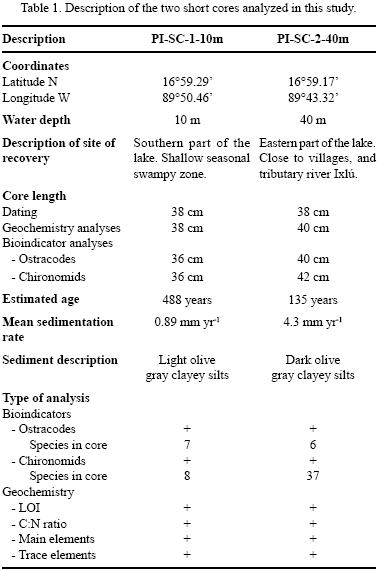
<body><![CDATA[<p align="justify"><font face="verdana" size="2">&nbsp;</font></p>     <p align="justify"><font face="verdana" size="2"><b>STUDY AREA</b></font></p>     <p align="justify"><font face="verdana" size="2">Lago Pet&eacute;n Itz&aacute; lies about 110 m a.s.l., has a surface area &#126;100 km<sup>2</sup>, and a maximum depth &#126;160 m. The lake is located in the Central Pet&eacute;n Lake District of northern Guatemala (16&deg;55'N, 89&deg;50'W) (<a href="/img/revistas/rmcg/v27n3/a7f1.jpg" target="_blank">Figure 1</a>). The Central Pet&eacute;n Lake District is located in the sedimentary basin of the Maya block on the North American plate. The southernmost extent of the Yucat&aacute;n Peninsula is underlain by Cretaceous carbonates (Anselmetti <i>et al., </i>2006). Lago Pet&eacute;n Itz&aacute; is oligo&#150;mesotrophic, but began to experience anthropogenic impacts in the last few decades. Today, lake waters have a dissolved ion concentration of &#126;11 meq L<sup>&#150;1</sup> and are dominated by calcium, magnesium, sulfate, and bicarbonate. A number of studies have explored the lake's morphometry and limnology (Brezonik and Fox, 1974; Deevey <i>et al. </i>1980; Hillesheim <i>et al., </i>2005; Anselmetti <i>et al. </i>2006; MARN&#150;AMPI, 2008; P&eacute;rez <i>et al., </i>2010b).</font></p>     <p align="justify"><font face="verdana" size="2">Following European contact in the early 1500s, human population density in northern Guatemala remained low for centuries. In 1964, the reported population in Pet&eacute;n was &#126;26,720 inhabitants. Thereafter, there was an abrupt increase in population through immigration driven by a government policy that provided land and encouraged settlement in the region (Painter and Durham, 1995; Rosenmeier <i>et al., </i>2004). A census done in 2002 (XI Censo Nacional de Poblaci&oacute;n y VI de Habitaci&oacute;n) reported a total population of 11,237,196 inhabitants in Guatemala, of whom 366,735 lived in Pet&eacute;n. The population of Flores, the riparian capital city of the Department of Pet&eacute;n, was 30,807 (INE, 2002). Population growth in towns around the lake appears to be changing the lake's trophic state.</font></p>     <p align="justify"><font face="verdana" size="2">In addition to eutrophication, documented rapid lake level changes are another challenge for lakeside dwellers. Stage fluctuations in Pet&eacute;n Itz&aacute; have evidently been a part of the lake's history since the late Pleistocene (Anselmetti <i>et al., </i>2006). Recently, high lake level stands have flooded shoreline properties, forcing some residents to abandon their homes. High precipitation is the main cause of increased lake level stands in Lago Pet&eacute;n Itz&aacute;. In June 2008, Pet&eacute;n received heavy rainfall and several towns, including San Benito and Santa Ana, experienced severe flooding that caused temporary evacuation of inhabitants (Escobar, 2008). 1938 was apparently the year of highest annual precipitation (2600 mm) in the last century, and the consequent rise in lake level is commemorated by a plaque on the wall of a building in Flores that indicates the high&#150;water mark. Anecdotal accounts of lake level change for the last century suggest it has ranged by as much as 8 m. There are, however, no published records of lake level change in Pet&eacute;n Itz&aacute; spanning a period longer than three years (MARN&#150;AMPI, 2008). The Instituto Nacional de Vulcanolog&iacute;a, Sismolog&iacute;a, Metereolog&iacute;a e Hidrolog&iacute;a (INSIVUMEH, 1985) reported monthly rainfall and stage change in Lago Pet&eacute;n Itz&aacute; and other regional water bodies for the period 1982&#150;1985. Prior to that time, rainfall and lake level records are even scarcer (Deevey <i>et al., </i>1980). Alternative sources of information are required to reconstruct past lake level and climate history.</font></p>     <p align="justify"><font face="verdana" size="2">Water level changes in lakes are often caused by climate changes, <i>i.e. </i>shifts in the relative amount of precipitation to evaporation. In turn, such alterations in lake level trigger changes in ostracode and chironomid communities. These faunal changes are frequently preserved in lacustrine sediments. Lago Pet&eacute;n Itz&aacute; is a tropical closed&#150;basin lake and its sediment record has proven to be a highly sensitive recorder of changes in the balance between precipitation and evaporation (Hodell <i>et al., </i>2008). In this study, we used faunal changes of ostracode and chironomid assemblages, as well as shifts in geochemistry in sediment cores, to infer past changes in the trophic state and water level in the basin over the past &#126;525 years.</font></p>     <p align="justify"><font face="verdana" size="2">&nbsp;</font></p>     <p align="justify"><font face="verdana" size="2"><b>METHODS</b></font></p>     <p align="justify"><font face="verdana" size="2">Two short sediment cores, PI&#150;SC&#150;1&#150;10m and PI&#150;SC&#150;2&#150;40m, were retrieved from 10 m and 40 m water depth, respectively, in Lago Pet&eacute;n Itz&aacute; (<a href="/img/revistas/rmcg/v27n3/a7f1.jpg" target="_blank">Figure 1</a>). The cores were collected with an UWITEC&#150;gravity corer using 60&#150;cm&#150;long, transparent PVC tubes. Location of collection sites, core lengths, age, sedimentation rates, and variables analyzed are found in <a href="#t1">Table 1</a>. Chironomids and ostracodes were analyzed in both cores. In addition to the cores collected for faunal remains, two parallel cores were retrieved for <sup>210</sup>Pb dating, and another two cores were taken for geochemical analysis. Short cores were sectioned at 2&#150;cm intervals for bioindicator analysis. Short cores taken for geochemical analysis and dating were sectioned at 0.5&#150;cm intervals above 20 cm depth, and at 1&#150;cm intervals below that depth. By doing this we achieved good dating resolution in the upper part of both short cores. An UWITEC core cutter was used for sectioning sediment cores. All samples were packed in Whirl&#150;pack&reg; bags and kept under refrigeration.</font></p>     <p align="center"><font face="verdana" size="2"><a name="t1"></a></font></p>     ]]></body>
<body><![CDATA[<p align="center"><font face="verdana" size="2"><img src="/img/revistas/rmcg/v27n3/a7t1.jpg"></font></p>     <p align="justify"><font face="verdana" size="2">Initial sediment description was made on whole cores. Color, texture, odor and other characteristics were described from sediment samples. Color was determined with a Rock Color Chart (Geological Society of America) with Munsell color chips. M&uuml;ller <i>et al. </i>(2009) reported on the lithologic composition of surface sediments taken along a water&#150;depth transect in Lago Pet&eacute;n Itz&aacute;.</font></p>     <p align="justify"><font face="verdana" size="2">Prior to geochemical and chronological measurements, wet sediment samples were homogenized using a small spatula. Water content was determined by weighing samples before and after oven drying at 105 &deg;C for 24 hours (DIN/18121&#150;1; DIN, 1998). Organic matter, carbonate (CO<sub>2 </sub>weight loss) and non&#150;carbonate inorganic matter (clastics) were measured by loss&#150;on&#150;ignition (LOI) as described in Heiri <i>et al. </i>(2001). Dried samples were pulverized to a fine powder with an electronic ball mill. We used X&#150;ray diffraction (XRD) to determine qualitatively the main minerals in the short core sediments. The elements Fe, Sr, Br, Cu, Zn, Rb, Zr, Y, and Pb were quantified using energy&#150;dispersive X&#150;ray fluorescence (XRF) spectrometry (Cheburkin <i>et al., </i>1997). Zr and Pb could not be determined in core PI&#150;SC&#150;1&#150;10m. Total C, N, and S measurements were made with an elemental analyzer (HEKAtech GmbH, Euro EA 3000) by oxidative combustion at 1000 &deg;C, gas&#150;chromic separation of gases and thermal conductivity detection. Organic carbon and total nitrogen content were used for calculation of C/N ratios in short cores. All geochemical analyses were done at the Institut f&uuml;r Umweltgeologie (IUG), Technische Universit&auml;t Braunschweig, Germany.</font></p>     <p align="justify"><font face="verdana" size="2">For <sup>210</sup>Pb dating, dry, weighed pulverized samples were stored in sealed vials at room temperature for four weeks. Analysis for radioisotopes (<sup>210</sup>Pb, <sup>214</sup>Pb, and <sup>137</sup>Cs) was made by direct gamma spectroscopy using a low&#150;background gamma spectrometer (Ametek ORTEC and Canberra Eurisys) with a high&#150;purity germanium well&#150;detector. Measurements were made at the Geochronologie &amp; Isotopenhydrologie Sektion, Leibniz&#150;Institut f&uuml;r Angewandte Geophysik (LIAG), Hannover, Germany. Unsupported <sup>210</sup>Pb activity was calculated for all measured depths throughout the short cores. The Constant Sedimentation Rate Model (CSR) was used to determine the sediment ages. The model assumes that initial concentration and sedimentation rate are both constant, and no post&#150;depositional mixing occurred (Robbins, 1978; Laissaoui <i>et al., </i>2008). <sup>210</sup>Pb dating can only be applied reliably to date sediments of the last &#126;110 years, thus we calculated in both short cores the mean mass accumulation rate (MAR, kg m<sup>&#150;2</sup> yr<sup>&#150;1</sup>) for the first 100 years and used it to infer ages deeper in the core. MAR was estimated by a linear regression of the log excess <sup>210</sup>Pb activities at each depth against linear accumulated sediment mass/area (kg m<sup>&#150;2</sup>). The anthropogenic radioisotope <sup>137</sup>Cs, which can sometimes be used to identify the 1963 atmospheric bomb&#150;testing peak, was also measured and used as a complementary chronological marker.</font></p>     <p align="justify"><font face="verdana" size="2">We enumerated valves and carapaces of adult os&#150;tracodes in the 2&#150;cm wet sediment slices. Two 1 g (wet) aliquots were separated from each sample. The first aliquot was washed into a small (10 cm diameter), 63 mesh sieve. All ostracodes were separated and counted in this sample. The second aliquot was analyzed for water content, using the same method applied to samples for geochemical analysis. Ostracodes were separated using fine brushes and enumerated in a gridded dish using a Leica MZ 7.5 stereo&#150;microscope. Ostracode abundance is presented as valves or carapaces per dry mass sediment. Identification followed P&eacute;rez <i>et al. </i>(2010a), and paleoenvironmental interpretation relied on modern ostracode ecological data reported by P&eacute;rez <i>et al. </i>(2010b).</font></p>     <p align="justify"><font face="verdana" size="2">Subfossil chironomids were analyzed in wet, 2 cm sediment slices. A small subsample (&lt;3 g) of wet sediment from each sample was deflocculated in 10 % KOH, heated to 70 &deg;C for 10 min, and later heated in water to 90 &deg;C for 20 min. Sediments were then sieved using 212 and 95 &#124;am mesh sieves. A Bogorov sorting tray and fine forceps were used to separate larval chironomid head capsules (HC) from samples. A stereo&#150;microscope with 25&#150;40x magnification was used for identifications. Head capsules were mounted as indicated in Massaferro and Brooks (2002). Given the paucity of literature on chironomids in the lowland Neotropics, most specimens could be identified only to genus level. Ostracode and chironomid stratigraphic diagrams were produced using Grapher 7. Chironomid and ostracode specimens are stored in collections of the authors at the Laboratorio de Biodiversidad, INIBIOMA, Universidad de Comahue, Bariloche, Argentina, and IUG, Technische Universit&auml;t Braunschweig, Germany.</font></p>     <p align="justify"><font face="verdana" size="2">Faunal diversity was calculated in samples from short cores using the Shannon Wiener Index "H" (Krebs, 1989). Modern spatial distribution of species in Lago Pet&eacute;n Itz&aacute; was presented in P&eacute;rez <i>et al. </i>(2010b), and showed a strong relation between ostracode species assemblages and water depth. This relation justified the development of a transfer function to infer water depth and its application to assemblages in the short cores. All samples in the calibration data set were included in the statistical analysis because ostracodes were abundant (&gt;50 valves g<sup>&#150;1</sup>) in sediments. For statistical analysis and the set up of our transfer function, we used the program packages PAST (Hammer <i>et al. </i>2001) and C2 (Juggins, 2003). Water data for comparison with the ostracode samples came from water profiles taken at the deepest point of the lake (17&deg;00'N, 89&deg;51'W) (P&eacute;rez <i>et al.</i>, 2010b). Sediment consistency was represented by three classes drawn from sediment sample description in the field. The modern training set includes seven ostracode species, a water depth range from 0.1 to 160 m (median 20 m), and 23 surface sediment samples. A binomial correlation (BC) model (Wrozyna <i>et al.</i>, 2009; Frenzel <i>et al.</i>, 2010) was used for the reconstruction of water depth in short cores over the last &#126;525 years.</font></p>     <p align="justify"><font face="verdana" size="2">&nbsp;</font></p>     <p align="justify"><font face="verdana" size="2"><b>RESULTS</b></font></p>     <p align="justify"><font face="verdana" size="2"><b>Chronology</b></font></p>     ]]></body>
<body><![CDATA[<p align="justify"><font face="verdana" size="2"><b><i>Core PI&#150;SC&#150;1&#150;10m</i></b></font></p>     <p align="justify"><font face="verdana" size="2">Total <sup>210</sup>Pb activity was 186 Bq kg<sup>&#150;1</sup> in the 0&#150;2 cm section (<a href="/img/revistas/rmcg/v27n3/a7f2.jpg" target="_blank">Figure 2</a>). Maximum activity was found in the 2&#150;4 cm section. Below that, sediments showed a consistent decline in <sup>210</sup>Pb activity with depth. Minimum activity (10 Bq kg<sup>&#150;1</sup>) was reported for the 36&#150;38 cm section. The activity of <sup>214</sup>Pb, <i>i.e. </i>supported <sup>210</sup>Pb activity, ranged from 25 to 9.5 Bq kg<sup>&#150;1</sup>. Unsupported (excess) <sup>210</sup>Pb activity at each level was calculated as the difference between total <sup>210</sup>Pb and <sup>214</sup>Pb activity, and displayed a generally exponential decay with depth. According to the CSR model, the total age of the sediment core is about 525 years, <i>i.e., </i>the date at the base is &#126;1480 AD. The long&#150;term, mean linear sedimentation rate is 0.89 mm yr<sup>&#150;1</sup>. Ages older than 110 years were estimated roughly using the mean mass accumulation rate of the past 100 years. Maximum <sup>137</sup>Cs activity in PI&#150;SC&#150;1&#150;10m (21.6 and 20.5 Bq kg<sup>&#150;1</sup>) occurred at 0.5 and 3 cm in the core, corresponding to <sup>210</sup>Pb dates of 2003 and 1987, respectively.</font></p>     <p align="justify"><font face="verdana" size="2"><b><i>PI&#150;SC&#150;2&#150;40m</i></b></font></p>     <p align="justify"><font face="verdana" size="2">Total <sup>210</sup>Pb activity displayed a maximum value (525 Bq kg<sup>&#150;1</sup>) in the uppermost, 0&#150;2 cm section and declined with depth (<a href="/img/revistas/rmcg/v27n3/a7f2.jpg" target="_blank">Figure 2</a>). The minimum activity (36 Bq kg<sup>&#150;1</sup>) was reported at a depth of 35 cm. The activity of <sup>214</sup>Pb was higher than in PI&#150;SC&#150;1&#150;10m and ranged from 41 to 23 Bq kg<sup>&#150;1</sup>. Unsupported <sup>210</sup>Pb ranged from 484 to 13.5 Bq kg<sup>&#150;1</sup>. The age model indicated a maximum age at 37.5 cm of 119 years (1886) and thus a higher mean linear sedimentation rate (4.3 mm yr<sup>&#150;1</sup>) than in PI&#150;SC&#150;1&#150;10m. Maximum <sup>137</sup>Cs activity in PI&#150;SC&#150;2&#150;40m was 76.8 Bq kg<sup>&#150;1</sup> and was measured at 1 cm depth, corresponding to a <sup>210</sup>Pb date of 2004. There is detectable <sup>137</sup>Cs activity below the level dated to 1954 by <sup>210</sup>Pb (&#126;20 cm core depth), indicating possible transfer of soluble <sup>137</sup>Cs to deeper sediments, which has been documented in other lake sediment profiles (Longmore <i>et al.</i>, 1983; Hermanson, 1990).</font></p>     <p align="justify"><font face="verdana" size="2"><b>Sediment lithology</b></font></p>     <p align="justify"><font face="verdana" size="2">Sediments throughout short core PI&#150;SC&#150;1&#150;10m are homogenous and characterized by light olive&#150;gray silty clays. Two core sections possessed darker sediments, at 0&#150;8.5 cm and 22&#150;24 cm depth (<a href="/img/revistas/rmcg/v27n3/a7f3.jpg" target="_blank">Figure 3a</a>). PI&#150;SC&#150;2&#150;40m was composed of dark olive&#150;gray silty clays. The uppermost 15 cm of the core are slightly darker than the bottom sediments (<a href="/img/revistas/rmcg/v27n3/a7f3.jpg" target="_blank">Figure 3b</a>). Both cores were dominated by inorganic matter (<a href="/img/revistas/rmcg/v27n3/a7f3.jpg" target="_blank">Figures 3a </a>and <a href="/img/revistas/rmcg/v27n3/a7f3.jpg" target="_blank">3b</a>). The highest organic matter (OM) content in cores PI&#150;SC&#150;1&#150;10m and PI&#150;SC&#150;2&#150;40m was at 3 cm depth (<a href="/img/revistas/rmcg/v27n3/a7f3.jpg" target="_blank">Figures 3a</a>, <a href="/img/revistas/rmcg/v27n3/a7f3.jpg" target="_blank">b</a>). OM varied generally from 7.3 to 21.7 % of dry weight in PI&#150;SC&#150;1&#150;10m (<a href="/img/revistas/rmcg/v27n3/a7f3.jpg" target="_blank">Figure 3a</a>) and from 16 to 22.5 % in PI&#150;SC&#150;2&#150;40m (<a href="/img/revistas/rmcg/v27n3/a7f3.jpg" target="_blank">Figure 3b</a>). Short core PI&#150;SC&#150;1&#150;10m displayed an increase in OM and a decrease in the carbonate content in the uppermost 8.5 cm, <i>i.e., </i>since 1944. The highest OM concentration in PI&#150;SC&#150;2&#150;40m (17.8 %) was detected at 27 cm depth. Carbonate content was higher in PI&#150;SC&#150;1&#150;10m (the highest at 31 cm depth, 35.8 %) than in PI&#150;SC&#150;2&#150;40m (<a href="/img/revistas/rmcg/v27n3/a7f3.jpg" target="_blank">Figure 3a</a>). The lowest carbonate content (26.3 %) in PI&#150;SC&#150;1&#150;10m was found at 1 cm depth (<a href="/img/revistas/rmcg/v27n3/a7f3.jpg" target="_blank">Figure 3a</a>), and in PI&#150;SC&#150;2&#150;40m (10.4 %) at 7 cm depth (<a href="/img/revistas/rmcg/v27n3/a7f3.jpg" target="_blank">Figure 3b</a>). Rapid human settlement of Pet&eacute;n beginning &#126;1960, correlates well with the timing of higher OM and lower carbonate content in both short cores. XRD results (not shown) indicated that core PI&#150;SC&#150;1&#150;10m was composed mainly of calcite. Montmorillonite, calcite, dolomite and quartz were detected in core PI&#150;SC&#150;2&#150;40m.</font></p>     <p align="justify"><font face="verdana" size="2"><b>Sediment geochemistry <i>C/N ratio</i></b></font></p>     <p align="justify"><font face="verdana" size="2">Since the early 1930s, total carbon and nitrogen concentrations in Lago Pet&eacute;n Itz&aacute; sediments have been increasing, and the organic carbon/total nitrogen (C/N) ratio has decreased, a trend that is clear since around 1960 (<a href="/img/revistas/rmcg/v27n3/a7f4.jpg" target="_blank">Figure 4a</a>). Total C (organic and inorganic) ranged in PI&#150;SC&#150;1&#150;10 m from 12.1 to 16.7 %, and in PI&#150;SC&#150;2&#150;40 m from 9.4 to 10.4 %. Nitrogen (N) content was low in both cores. Total N in PI&#150;SC&#150;1&#150;10m ranged from 0.2 to 1.0 %, and in PI&#150;SC&#150;2&#150;40m from 0.4 to 0.7 %. Sections II, III, IV, and V (<a href="/img/revistas/rmcg/v27n3/a7f4.jpg" target="_blank">Figure 4a</a>) have lower nitrogen concentrations and higher C/N ratio. Nitrogen concentrations increased at 11, 23, and at 37 cm depth in short core PI&#150;SC&#150;2&#150;40 (<a href="/img/revistas/rmcg/v27n3/a7f4.jpg" target="_blank">Figure 4b</a>). C/N ratio varied throughout PI&#150;SC&#150;1&#150;10m from 13.0 (1 cm deep) to 48.2 (33 cm deep). PI&#150;SC&#150;2&#150;40m had a narrower range of C/N ratio, which fluctuated from 12.0 to 20.3. The highest C/N ratios of this core were identified at 23 and 39 cm (sections III and V, <a href="/img/revistas/rmcg/v27n3/a7f4.jpg" target="_blank">Figure 4b</a>).</font></p>     <p align="justify"><font face="verdana" size="2"><b><i>Major and trace elements</i></b></font></p>     <p align="justify"><font face="verdana" size="2"><i>PI&#150;SC&#150;1&#150;10m. </i>Iron (Fe) concentration varied from 0.50 to 0.58 % (<a href="/img/revistas/rmcg/v27n3/a7f5.jpg" target="_blank">Figure 5a</a>). Maximum values were found at a depth of 23 to 25 cm (section III). Sections II and IV display the lowest values. Strontium (Sr) ranges from 554 to 670 ppm. Sr concentrations started to decrease at 11 cm, <i>i.e., </i>since the early 20<sup>th</sup> century. There has been an increase in bromine (Br) since the 1950s, from 10.5 to 27.5 ppm. The highest concentrations were detected in the uppermost 5 cm, since the mid 1970s. The copper (Cu) profile had highest concentrations at 1 cm (22.8 %, section I, <a href="/img/revistas/rmcg/v27n3/a7f5.jpg" target="_blank">Figure 5a</a>), and from</font></p>     ]]></body>
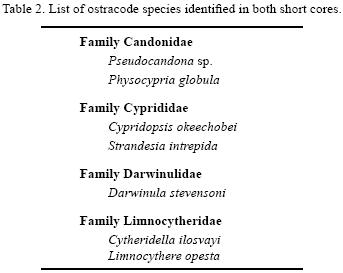
<body><![CDATA[<p align="justify"><font face="verdana" size="2">11 cm to 29 cm (max. conc. 24.2 %, sections II&#150;IV). The zinc (Zn) profile displayed substantial variation, ranging from 1.4 to 20.1 ppm. Peaks in Zn concentration were identified at 1 cm, at 7 cm (section I), at 19 cm (section II), at 27 cm (section III), and at 33 cm depth (section IV). Rubidium (Rb) ranges from 7.8 to 12.0 ppm. The Rb profile displays a slight increase for the last &#126;190 years, <i>i.e.</i>, the uppermost 17 cm. The highest concentration of Rb was present at 1 cm (12.0 ppm). Yttrium (Y) ranged from 0.1 to 1.7 ppm. The maximum value occurred at a sediment depth of 25 cm (1.7 ppm). Another peak was identified at 35 cm (1.0 ppm). Zirconium (Zr) and lead (Pb) concentrations were below the lower limit of detection (LLD).</font></p>     <p align="justify"><font face="verdana" size="2"><i>PI&#150;SC&#150;2&#150;40m. </i>Sections I and III in <a href="/img/revistas/rmcg/v27n3/a7f5.jpg" target="_blank">Figure 5b</a> display the highest values of Fe throughout the core. Concentrations varied from 1.75 to 2.3 %. Br varied from 16.8 to 36.8 ppm and the profile displayed an increase from a depth of 10 cm to the top. The Sr profile exhibited high concentrations in sections II and III. In both cores, Sr was the element that presented the highest concentrations, and in this core it ranged from 262 to 368 ppm. The highest concentration of Cu (54.6 ppm) was found at 37 cm, and the lowest (26.5 ppm) value at 27 cm (<a href="/img/revistas/rmcg/v27n3/a7f5.jpg" target="_blank">Figure 5b</a>). Zn and Rb have comparable profiles, and their concentrations show a slight increase at about 1880 AD. In general, concentrations were high in the upper 10 cm, except for a low Zn value at 3 cm. Zn varied from 36.4 to 63.6 ppm, and Rb from 22.2 to 30.4 ppm. The Y profile fluctuated from 11.7 to 15.8 ppm throughout the short core. Zr varied from 113 to 138 ppm, and Pb from 15.2 to 22.8 ppm. Both elements displayed lowest concentrations at 1 cm. The maximum concentration of Zr was reached at 37 cm and the maximum concentration of Pb at 17 cm.</font></p>     <p align="justify"><font face="verdana" size="2"><b>Bioindicators: Ostracode and chironomid species assemblages</b></font></p>     <p align="justify"><font face="verdana" size="2"><b><i>Ostracodes</i></b></font></p>     <p align="justify"><font face="verdana" size="2">Seven ostracode species were identified in core PI&#150;SC&#150;1&#150;10m (<a href="/img/revistas/rmcg/v27n3/a7f6.jpg" target="_blank">Figure 6a</a>), and six in core PI&#150;SC&#150;2&#150;40m (<a href="#t2">Table 2</a>, <a href="/img/revistas/rmcg/v27n3/a7f6.jpg" target="_blank">Figure 6b</a>). The ostracode fauna consists of some species endemic to the Pet&eacute;n Lake District and the Yucat&aacute;n Peninsula and closely resembles the modern species assemblages from Lago Pet&eacute;n Itz&aacute;. <i>Physocypria globula </i>is a nektonic species, <i>Cypridopsis okeechobei, </i>and <i>Strandesia intrepida </i>are nektobenthic species and <i>Cytheridella ilosvayi, Darwinula stevensoni, Limnocythere opesta, </i>and <i>Pseudocandona </i>sp. are benthic species (P&eacute;rez <i>et al., </i>2010a, in press). Deep&#150;water&#150;core PI&#150;SC&#150;2&#150;40m was not as ostracode&#150;rich as shallow&#150;water&#150;core PI&#150;SC&#150;1&#150;10m, where species abundances and diversities were higher.</font></p>     <p align="center"><font face="verdana" size="2"><a name="t2"></a></font></p>     <p align="center"><font face="verdana" size="2"><img src="/img/revistas/rmcg/v27n3/a7t2.jpg"></font></p>     <p align="justify"><font face="verdana" size="2"><i>PI&#150;SC&#150;1&#150;10m. </i>The dominant species of the core was <i>C. okeechobei, </i>with a relative abundance of 23 to 54 %, and <i>L. opesta </i>(11&#150;39 %). <i>Cytheridella ilosvayi </i>(7&#150;37%), <i>P. globula </i>(2&#150;13 %), <i>D. stevensoni </i>(1&#150;8 %) and <i>Pseudocandona </i>sp. (1&#150;15 %) were also abundant. <i>Strandesia intrepida </i>was the least abundant species (&lt;1%), and was found only in the upper centimeters of the core. Diversity was higher (H= 1.62) in the shallow&#150;water core than in the deep&#150;water core, PI&#150;SC&#150;2&#150;40m (H=0.22). Ostracode diversity and abundance fluctuated throughout the core. Sections I and III (<a href="/img/revistas/rmcg/v27n3/a7f6.jpg" target="_blank">Figure 6a</a>) display peaks of high ostracode diversity. The highest values were reached at 1 and 5 cm, <i>i.e., </i>during the last &#126;30 years. The profile shows an increase in diversity in the upper 10 cm. A period with low abundances was identified from 13 to 19 cm, <i>i.e., </i>&#126;1780&#150;1880 AD. The lowest quantity of valves was reported at 3 cm (814 valves g<sup>&#150;1</sup>, section I, <a href="/img/revistas/rmcg/v27n3/a7f6.jpg" target="_blank">Figure 6a</a>) and 31 cm (298 valves g<sup>&#150;1</sup>, section III, <a href="/img/revistas/rmcg/v27n3/a7f6.jpg" target="_blank">Figure 6a</a>).</font></p>     <p align="justify"><font face="verdana" size="2"><i>PI&#150;SC&#150;2&#150;40m. </i>PI&#150;SC&#150;2&#150;40m was dominated primarily by <i>P. globula, </i>which was the only species present in all sediment samples (sections I&#150;III, <a href="/img/revistas/rmcg/v27n3/a7f6.jpg" target="_blank">Figure 6b</a>). This species has a relative abundance from 95 to 100 % throughout the core. <i>P. globula </i>prefers a water depth of &lt;40 m (P&eacute;rez <i>et al., </i>2010b). Abundance of this species has increased since the early 1990s (9 cm depth), except in the late 1990s when abundance decreased to 228 valves g<sup>&#150;1</sup>. Very high abundance of <i>P. globula </i>is accompanied by low abundance of the other ostracode species, for instance at 3 and 7 cm. <i>Cypridopsis okeechobei, L. opesta, D. stevensoni, </i>and <i>Pseudocandona </i>sp. were less abundant. <i>Cytheridella ilosvayi </i>was found only in the uppermost centimeters (section I, <a href="/img/revistas/rmcg/v27n3/a7f6.jpg" target="_blank">Figure 6b</a>). In general, diversity in the core was low. Depths with higher diversity were identified at 5 cm, from 13 to 17 cm, from 21 to 23 cm, at 31 and at 37 cm. The total number of valves varied from 79 to 856 valves g<sup>&#150;1</sup>.</font></p>     <p align="justify"><font face="verdana" size="2"><b><i>Chironomids</i></b></font></p>     ]]></body>
<body><![CDATA[<p align="justify"><font face="verdana" size="2">Chironomids in both short cores had higher species richness than ostracodes (<a href="#t2">Tables 2</a> and <a href="#t3">3</a>). <a href="#t3">Table 3</a> presents all chironomid taxa found in both short cores. <a href="/img/revistas/rmcg/v27n3/html/a7f7.htm" target="_blank">Figure 7</a> displays only the most dominant species. Total abundances were much lower in PI&#150;SC&#150;1&#150;10m (total counts <u>&lt;</u>10) than in PI&#150;SC&#150;2&#150;40m (total counts <u>&lt;</u>113). Since the minimum reliable number of HC per sample is 50, we are only giving a general description of diversity composition for the PI&#150;SC&#150;1&#150;10m. Five zones (sections I&#150;V, <a href="/img/revistas/rmcg/v27n3/html/a7f7.htm" target="_blank">Figure 7</a>) were distinguished in both short cores. Chironomids were described as morphotypes because the low number of taxonomic characteristics present in the HC is insufficient to make determinations to species level. In several cases, a number or letter was designated along with the genus to identify different morphospecies (<i>e.g. Tanytarsus </i>1A, <i>Cladotanytarsus </i>sp.2).</font></p>     <p align="center"><font face="verdana" size="2"><a name="t3"></a></font></p>     <p align="center"><font face="verdana" size="2"><img src="/img/revistas/rmcg/v27n3/a7t3.jpg"></font></p>     <p align="justify"><font face="verdana" size="2">PI&#150;SC&#150;1&#150;10m was dominated by <i>Ablabesmiya </i>sp. (<u>&lt;</u>100 %), <i>Stempellina </i>sp. and <i>Chironomus </i>sp. (<u>&lt;</u>80 %), followed by <i>Cryptochironomus </i>sp., <i>Tanytarsus </i>D, orthocla&#150;diinae indet., and <i>Parakiefferiella </i>sp. (<u>&lt;</u>40 %, <a href="/img/revistas/rmcg/v27n3/html/a7f7.htm" target="_blank">Figure 7a</a>). <i>Tanytarsus </i>1A was the least abundant species (<u>&lt;</u>16 %). From the bottom to <i>ca. </i>25 cm (section V), a period of a stable abundance was identified. The dominant taxa in section V and III were <i>Ablabesmiya </i>sp., <i>Stempellina </i>sp., <i>Chironomus </i>sp. and <i>Cryptochironomus </i>sp. No chironomids were found at 23, 19, and 7 cm (sections IV, III and II). Chironomids showed a gradual increase in abundance and diversity from 19 to 9 cm (Section III), where abundance dropped sharply. Highest abundance of chironomids was found at 5 cm (13 individuals, section I, <a href="/img/revistas/rmcg/v27n3/html/a7f7.htm" target="_blank">Figure 7a</a>), at 9 cm (7 individuals, section III), and at 21 cm (6 individuals, section III). The uppermost 5 cm of the core showed a species abundance decrease. The abundance of <i>Chironomus </i>sp., and <i>Tanytarsus </i>D showed a slight increase in the uppermost 5 cm, <i>i. e.</i>, since the late 1970s. The profile presents other peaks with higher abundances at 9, 13, 21, 27, 31, and 33 cm.</font></p>     <p align="justify"><font face="verdana" size="2">PI&#150;SC&#150;2&#150;40m (<a href="/img/revistas/rmcg/v27n3/html/a7f7.htm" target="_blank">Figure 7b</a>) possesses 37 chironomid species. Literature regarding chironomid taxonomy in the study area is still scant and thus some specimens could not be identified to species level. Only the most abundant species were included in <a href="/img/revistas/rmcg/v27n3/html/a7f7.htm" target="_blank">Figure 7b</a>. The short core was dominanted by <i>Tanytarsus </i>1A (<u>&lt;</u>67 %), <i>Cladotanytarsus </i>sp. 1 and <i>Cladotanytarsus </i>sp. 2, <i>Stempellina </i>sp., <i>Polypedilum </i>sp., and <i>Coelotanypus/Clinotanypus. </i>Less dominant species (<u>&lt;</u>20 %) were <i>Tanytarsus </i>D, <i>Labrundinia </i>sp., <i>Cryptochironomus </i>sp., <i>Paratanytarsus sp., Ablabesmiya </i>sp. and, <i>Cladopelma </i>sp. The remaining species in the core displayed relative abundances &lt;10%.</font></p>     <p align="justify"><font face="verdana" size="2">From the bottom to <i>ca. </i>31 cm (section V), the assemblage was dominated (&gt;20 %) by <i>Tanytarsus </i>1A, <i>Cladotanytarsus </i>sp. 1, <i>Cladotanytarsus </i>sp. 2, and <i>Stempellina </i>sp. Sections IV and III were mainly dominated by <i>Tanytarsus </i>1A, and <i>Stempellina </i>sp. Highest overall abundance was found at a core depth of 11 cm (113 individuals, section II, <a href="/img/revistas/rmcg/v27n3/html/a7f7.htm" target="_blank">Figure 7b</a>). Section II showed a decrease in the abundance of <i>Stempellina </i>sp, and an increase of <i>Cladotanytarsus </i>sp. 1, and <i>Paratanytarsus </i>sp. At a core depth of 3 cm, no chironomids were found (section I). The upper 2 cm were dominated by <i>Tanytarsus </i>1A, <i>Coelotanypus sp./Clinotanypus </i>sp., and <i>Cladotanytarsus </i>sp. 2. The core showed a relatively stable abundance of chironomids, except for several depths with low concentrations, <i>i.e., </i>23, 31, and 41 cm. Peaks of <i>Chironomus </i>sp. were identified at 7, 15&#150;17 and 33 cm.</font></p>     <p align="justify"><font face="verdana" size="2"><b>Water depth transfer function</b></font></p>     <p align="justify"><font face="verdana" size="2">To develop an ostracode&#150;based transfer function, we selected surface samples with a minimum of 100 ostra&#150;code specimens and used ostracode species dominance, ostracode diversity and total abundance, as well as water depth, organic matter and Ca concentration of the sediment, sediment consistency, and the abundance of gastropods for Canonical Correspondence Analysis (CCA) (M&uuml;ller <i>et al., </i>2009; P&eacute;rez <i>et al., </i>2010). Because O<sub>2</sub> concentration in the water has a very high negative correlation with water depth (Spearman's <i>r </i>= &#150;0.99) we decided to substitute water depth for O<sub>2</sub> concentration in the analysis. Water temperature and chemical data (conductivity, pH, ion concentrations) were excluded from analysis because of their very narrow range along the depth gradient (25.6&#150;27.6 &deg;C; 529&#150;544 uS/cm; pH 8.1&#150;8.5; see Perez <i>et al., </i>2010b). We assumed they are not important in determining ostracode distribution. Two ostracode species were excluded because they occur in less than three samples <i>(Cypretta </i>sp., <i>Heterocypris punctata). </i>The CCA shows that water depth (O2 concentration) is the main factor with a high loading on the first axis, and is significantly linked to organic matter (LOI 550 &deg;C) and the abundance of gastropods. The second axis is linked mainly to sediment consistency (<a href="#t4">Table 4</a>).</font></p>     <p align="center"><font face="verdana" size="2"><a name="t4"></a></font></p>     <p align="center"><font face="verdana" size="2"><img src="/img/revistas/rmcg/v27n3/a7t4.jpg"></font></p>     ]]></body>
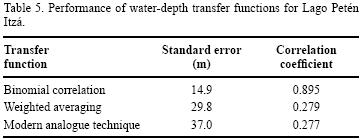
<body><![CDATA[<p align="justify"><font face="verdana" size="2">Three ostracode&#150;based water&#150;depth transfer functions were developed using our training set of recent ostracode data: (1) a binomial correlation (BC) using the program EXCEL <i>(cf. </i>Wrozyna <i>et al.</i>, 2009 and Frenzel <i>et al.</i>, 2010), (2) weighted averaging (WA) with tolerance downweighting using C2 <i>(cf. </i>Juggins 2003), and (3) a modern analogue (MA) technique using weighted three&#150;point correlation of samples. Because the performance of the BC transfer function was the best and only reliable one (<a href="#t5">Table 5</a>), we used this model for later reconstruction. Below, we present the binomial equations that were used to relate water depth to relative abundance for all taxa that displayed high correlation <i>(r) </i>with water depth and contributed significantly to the transfer function <i>(x </i>= water depth in m). The correlation coefficient (r) of the model was validated by "leave one out" cross validation (bootstrapping) (<a href="/img/revistas/rmcg/v27n3/a7f8.jpg" target="_blank">Figure 8</a>). <i>Physocypria globula </i>(%) = &#150;0.002 x<sup>2</sup> + 0.696 <i>x </i>+ 5.517; <i>r </i>= 0.397</font></p>     <p align="justify"><font face="verdana" size="2"><i>Cypridopsis okeechobei </i>(%) = 0.006 x<sup>2</sup> &#150; 0.964 <i>x </i>+ 42.94; <i>r </i>= 0.276</font></p>     <p align="justify"><font face="verdana" size="2"><i>Cytheridella ilosvayi </i>(%) = &#150;0.003 x<sup>2</sup> + 0.353 <i>x </i>+ 12.55; <i>r </i>= 0.183</font></p>     <p align="justify"><font face="verdana" size="2"><i>Strandesia intrepida </i>(%) = &#150;0.039 <i>x </i>+ 1.731; <i>r </i>= 0.172</font></p>     <p align="center"><font face="verdana" size="2"><a name="t5"></a></font></p>     <p align="center"><font face="verdana" size="2"><img src="/img/revistas/rmcg/v27n3/a7t5.jpg"></font></p>     <p align="justify"><font face="verdana" size="2"><b>Water depth reconstruction</b></font></p>     <p align="justify"><font face="verdana" size="2">We applied the transfer function to core PI&#150;SC&#150;1&#150;10m (<a href="#f9">Figure 9</a>). We did not apply it to core PI&#150;SC&#150;2&#150;40m because a "non&#150;modern analogue situation" provided us with unrealistic water depth results. This anomalous result was reproduced by all three models. The reconstructed water depth during the last 500 years is shown in <a href="#f9">Figure 9</a>. Higher lake levels than today were identified in the late 1580s and 1640s. A lower stage characterized the time from about the mid&#150;1700s to the early 20<sup>th</sup> century. Once again, higher lake levels are indicated for the period from the late 1930s to the early 1990s, with the exception of the early 1970s when lake level was low (MARN&#150;AMPI, 2008).</font></p>     <p align="center"><font face="verdana" size="2"><a name="f9"></a></font></p>     <p align="center"><font face="verdana" size="2"><img src="/img/revistas/rmcg/v27n3/a7f9.jpg"></font></p>     ]]></body>
<body><![CDATA[<p align="justify"><font face="verdana" size="2">&nbsp;</font></p>     <p align="justify"><font face="verdana" size="2"><b>DISCUSSION</b></font></p>     <p align="justify"><font face="verdana" size="2"><b>Recent eutrophication (1930s&#150;2005 AD)</b></font></p>     <p align="justify"><font face="verdana" size="2">Geochemical data and bioindicator analyses of short cores PI&#150;SC&#150;1&#150;10m and PI&#150;SC&#150;2&#150;40m revealed that modern cultural eutrophication in Lago Pet&eacute;n Itz&aacute; started in the 20<sup>th </sup>century. Our results confirm the nutrient enrichment in the lake since &#126;1930 AD, reported by Rosenmeier <i>et al. </i>(2004). The previous study used geochemical data and diatoms in a sediment core as indicators for eutrophication, and complements our study based on ostracodes, chironomids, and other geochemical variables.</font></p>     <p align="justify"><font face="verdana" size="2">Loss&#150;on&#150;ignition values in both short cores revealed a slow increase in organic matter concentration and a decrease in carbonate content since the late 1930s, when sediments became slightly darker. Total carbon and nitrogen have also increased since the late 1930s, confirming LOI results. High input of organic matter during the last century may explain the relative decrease in carbonate content. C/N ratios were used to identify the origin of the organic matter (terrestrial versus aquatic) in the lake sediments. Lowest C/N ratios were measured in the uppermost centimeters of the short cores, and suggest a greater relative contribution from phytoplankton. Ratios &lt;10 are typical of algae (Meyers, 1994; Kaushal and Binford, 1999; Vaalgamaa, 2007), whereas higher values indicate some contribution from macrophytes or terrestrial plants. The shallow&#150;water core (PI&#150;SC&#150;1&#150;10m) displayed higher C/N ratios than the deep&#150;water core (PI&#150;SC&#150;2&#150;40m). This is caused by a higher contribution from terrestrial organic matter to these sediments closer to the shoreline. Terrestrial flora is high in carbon&#150;rich support tissues like cellulose and lignin, which leads to relatively higher C/N. PI&#150;SC&#150;2&#150;40m had a higher mean sedimentation rate (4.3 mm yr<sup>&#150;1</sup>) than PI&#150;SC&#150;1&#150;10m (0.9 mm yr<sup>&#150;1</sup>), probably indicating focusing of sediment to the deeper&#150;water site, near the base of the metalimnion. The higher sedimentation rate at the PI&#150;SC&#150;2&#150;40m core site may also be a consequence of proximity to local villages and some sediment load from the R&iacute;o Ixl&uacute;.</font></p>     <p align="justify"><font face="verdana" size="2">Other geochemical data (Fe, Br, Cu, and Zn values) also point to a period of anthropogenic impact in the 20<sup>th </sup>century. Iron concentration was generally low in both short cores (&lt; 2.3 &deg;%). PI&#150;SC&#150;2&#150;40m yielded lower concentrations since the late 1980s. Iron is associated with the inorganic fraction of the sediment (Brenner <i>et al.</i>, 1990), which was likely diluted as primary productivity and organic sedimentation accelerated.</font></p>     <p align="justify"><font face="verdana" size="2">Furthermore, organic matter can alter the redox environment from oxidizing to reducing, at which point reduced ionic species of Fe are released into solution. The presence or high abundance of the chironomid <i>Chironomus </i>sp. in short cores was accompanied by lower iron concentrations, suggesting anoxic environments. <i>Chironomus </i>possess haemoglobin, which allows them to survive under hypoxic conditions (Walker, 1995). This shows that chironomids can be used as indicators for changes in redox conditions. Sections of short core PI&#150;SC&#150;1&#150;10m also displayed lower abundances of chironomids, which we believe are related to allochthonous inputs of sediment. Bromine is generally bound to organic matter, and results of this study suggest it can be used as an indicator of eutrophication. Other studies have shown that Br can be used as an indicator of diatom production (Kerfoot <i>et al., </i>1999). Copper and zinc are two of the best indicators for pollution and urban development. The deep&#150;water core, which was collected closer to villages, had the highest values of Cu and Zn. Zn in aquatic environments comes mainly from industrial effluents, municipal wastewaters, emission from smelting operations and fossil fuel combustion (Vaalgamaa, 2007). Highest zinc concentrations were measured in the uppermost centimeters of both short cores, indicating an increase in anthropogenic influence in recent years. Copper also shows an increase since the late 1930s in short core PI&#150;SC&#150;1&#150;10m. Copper concentration is positively correlated with organic matter content, because like bromine, Cu shows strong affinity to organic matter. Lead values in short core PI&#150;SC&#150;2&#150;40m were low (&lt;23 ppm). According to the Geoaccumulationindex (I<sub>geo</sub>) (M&uuml;ller, 1979), these concentrations correspond to class or degree "0," which is indicative of a lake without Pb pollution. Surface sediments from Lago Pet&eacute;n Itz&aacute; contain &gt;30 ppm Pb (unpublished data), indicating moderate levels of pollution. Fuel combustion and decomposition of organic matter could increase Pb concentration in sediments. Monitoring heavy metal concentrations is important because they are toxic, non&#150;degradable and have serious ecological ramifications in aquatic ecosystems (Jumbe and Nandini, 2009).</font></p>     <p align="justify"><font face="verdana" size="2">We used chironomids to infer changes in trophic status because species exhibit a wide range of environmental optima and tolerances. In Lago Pet&eacute;n Itz&aacute;, opposite to what we expected, the deep&#150;water short core had higher diversity and abundance of chironomids than the shallow&#150;water core, which displayed lower concentrations of organic carbon. Due to the low abundance of chironomids in shallow&#150;water core PI&#150;SC&#150;2&#150;10m, the chironomid interpretation is based on PI&#150;SC&#150;2&#150;40m. The chironomid record of Lago Pet&eacute;n Itz&aacute; shows a gradual increase of abundance from the base of the core up to &#126;10 cm depth (ca. 1980 AD.), when abundance starts to decrease gradually. At <i>ca. </i>30&#150;31 cm, <i>i.e., </i>the late 1910s, a pronounced decrease in chironomid abundance and diversity is recorded. At that time, only a few taxa were present <i>(Polypedilum, Tanytarsus, Stempellina y Cladotanytarsus). </i>This reduction in numbers of taxa and abundance could have been related to water level changes. Although the abundance oscillates along the whole sediment sequence, from 20 cm (early 1960s) to 5 cm (late 1990s), the presence of <i>Chironomus, Procladius, Einfeldia </i>reflects more productive conditions (Brodersen and Quinlan 2006), <i>i.e., </i>higher trophic status in the lake. The overall decrease of chironomid abundance in the uppermost 10 cm could be related either to high levels of eutrophication that impact the fauna negatively, or to rapid input of bulk sediment due to erosion or water level change.</font></p>     <p align="justify"><font face="verdana" size="2">In contrast, ostracode abundance and diversity show an increase during the last &#126;20 years. Ostracodes seem to be correlated with higher organic matter and nutrient availability in the lake. However, it is important to know the upper and lower limits of their tolerance (K&uuml;lk&ouml;yl&uuml;oglu, 2004). There are few studies (Scharf, 1993 ; Mezquita <i>et al.</i>, 1999) about the influence of eutrophication on ostracodes, and thus about their potential as eutrophication indicators. The utility of ostracodes as indicators of eutrophication may be confounded by several factors. For instance, high organic matter content in sediments could lead to low pH and poor preservation of ostracode soft and especially hard parts. <i>Darwinula stevensoni, Physocypria globula </i>and <i>Pseudocandona </i>sp., however, seem to tolerate eutrophication and could be indicative of a change in the trophic condition of Lago Peten Itz&aacute;.</font></p>     <p align="justify"><font face="verdana" size="2">Eutrophication in Lago Pet&eacute;n Itz&aacute; was probably triggered by rapid human immigration into Pet&eacute;n that began &#126;1960. One consequence was a rapid increase in agriculture, fisheries, tourism and deforestation. Before 1960, &gt;85 % of Pet&eacute;n was covered with tropical forest, but by 1990, 40 % of Pet&eacute;n was completely deforested (Painter and Durham, 1995). Human population growth, urbanization, deforestation, changing land use, and other human activities that increase nutrient input rates to the lake, are altering the trophic status of Lago Pet&eacute;n Itz&aacute;, which now is considered oligo&#150;mesotrophic. This is reflected in the declining water clarity of the lake and greater algae abundance in the littoral zone. The human population continues to increase and eutrophication is emerging as a critical issue. Other lakes in Guatemala have also experienced profound anthropogenic impact. Lake Amatitl&aacute;n has received massive amounts of sewage and industrial waste from Guatemala City and is today hypereutrophic. Once pristine Lake Atitl&aacute;n recently experienced large cyanobacteria blooms. Both lakes are important tourist destinations, and declines in water quality threaten to negatively impact the local economies.</font></p>     ]]></body>
<body><![CDATA[<p align="justify"><font face="verdana" size="2"><b>Lake level history of the last 500 years</b></font></p>     <p align="justify"><font face="verdana" size="2"><b><i>High lake levels (1550&#150;1730 and 1940&#150;2005AD)</i></b></font></p>     <p align="justify"><font face="verdana" size="2">The ostracode&#150;based lake level reconstruction revealed two periods characterized by fluctuating, high lake levels (maximum relative lake level of 5 m): (1) about 1550&#150;1730s and (2) about 1940&#150;2005 AD, with the exception of the early 1970s when annual mean precipitation (&#126;1260 mm yr<sup>&#150;1</sup>) and lake level were low (MARN&#150;AMPI, 2008). Our reconstruction does not show this lake level lowering. For ostracode analysis in short cores, we used 2&#150;cm wet sediment slices, which does not provide sufficiently high resolution to capture short&#150;term events (&#126;2 years), and rather indicates general, longer&#150;term changes. Because the standard error is about equal to the amplitude of relative lake level changes indicated by our reconstruction, we cannot estimate exactly the historical relative lake levels. High lake level periods, however, are clear. These inferences are supported by geo&#150;chemical analyses and chironomid species assemblages. Further evidence is provided by maximum relative lake levels of +5 m documented for 1938 (MARN&#150;AMPI, 2008). Kaushal and Binford (1999) reported that C/N in sediments increases after deforestation and land clearance. We identified high C/N ratios, approaching 50, in both cores during the periods &#126;1780&#150;1840, &#150;1940s, and in the early 1980s. These high C/N values are probably related to heavy rains that caused flooding in the area and transported terrestrial organic matter into the lake. Nevertheless, lake level in 1938 was clearly much higher.</font></p>     <p align="justify"><font face="verdana" size="2">Ratios of elements Sr, Rb, and Zr may also provide information about material input into the lake during periods of high precipitation, and thus high lake levels. The strontium profile is negatively related to the profiles for rubidium and zirconium. Rb and Zr are elements originating mainly from silicates. Silicate weathering in the catchment, enhanced by precipitation, could account for higher concentrations of Rb and Zr, and thus lower Sr in sediments. A slight increase in ash content in the uppermost centimeters of the short cores confirms this, and is correlated with a period of high precipitation. Similar conditions prevailed around 1938. According to the Instituto de Sismolog&iacute;a, Vulcanolog&iacute;a, Meteorolog&iacute;a e Hidrolog&iacute;a (INSIVUMEH), 1938 was the year with the highest annual average precipitation during the 20<sup>th</sup> century, and lake level rose &#126;5 m. Short cores displayed peaks in concentration of Rb and Zr at that time, while Sr decreased. Friedman <i>et al. </i>(2000) report similar results in Turkey, where Rb was used as a proxy for wet environments.</font></p>     <p align="justify"><font face="verdana" size="2">Scientists and local inhabitants in Pet&eacute;n observed that levels of Lago Pet&eacute;n Itz&aacute; rose during the last few decades. According to Rice (1997), the rise began after 1976 and was related to increased annual rainfall. Unfortunately, the dramatic rise of the late 1970s to early 1990s is not fully documented by meteorological data. Water level variations in Lago Pet&eacute;n Itz&aacute;, however, appear to have shifted in concert with stage changes in other Pet&eacute;n water bodies such as Sacpuy, San Diego, Perdida, Naranjo and Las Cuaches, strongly suggesting a regional climatic cause for lake&#150;level variations. Deevey <i>et al. </i>(1980) and INSIVUMEH (1985) studied the effect that precipitation has on lake level changes in Lago Pet&eacute;n Itz&aacute; and other aquatic environments in the Pet&eacute;n Lake District. Their findings indicate that water level of Lago Pet&eacute;n Itz&aacute; rises about two months after a period of high precipitation. Regional subsoils are saturated, accounting for the relationship between lake levels and precipitation. When heavy rains occur in the area, there is no capacity to absorb incoming water that enters the system, leading to rapid runoff and flooding.</font></p>     <p align="justify"><font face="verdana" size="2"><b><i>Stable lake levels (1750s&#150;1900s AD)</i></b></font></p>     <p align="justify"><font face="verdana" size="2">Our lake level reconstruction shows that the period from the late 1750s to the early 1900s was characterized by lake levels similar to those of today, probably caused by a relatively dry and cool climate. Rb and Fe concentrations were slightly lower and strontium values higher, suggesting less precipitation than during the periods with high lake levels. Iron is an indicator of erosion of land&#150;derived materials (Haug <i>et al., </i>2001) and low values indicate drier climate. C/N ratios gradually decreased from &#126;45 to 35 indicating less transport of terrestrial organic matter to the lake during this period. Interestingly, ostracode abundance and diversity displayed a sharp decrease in this period, perhaps triggered by lower temperatures. For instance, the ostracodes <i>C. ilosvayi, </i>and <i>C. okeechobei, </i>which prefer warmer waters (P&eacute;rez <i>et al., </i>2010b), displayed a decrease in their abundances during this period.</font></p>     <p align="justify"><font face="verdana" size="2"><b><i>The late Little Ice Age (&#126;1500&#150;1850 AD)</i></b></font></p>     <p align="justify"><font face="verdana" size="2">Short core PI&#150;SC&#150;1&#150;10m contains sediments that were deposited during the late Little Ice Age (LIA; 1500&#150;1850 AD). Additional sediment cores from Lago Pet&eacute;n Itz&aacute; (A. M&uuml;ller, personal communication) and other studies from nearby regions (Haug <i>et al., </i>2001; Hodell <i>et al., </i>2005) suggest that climate in the northern lowland neotropics of Central America during the LIA was dry, probably caused by a more southerly position of the Intertropical Convergence Zone (ITCZ). Our study suggests that the end of the LIA (1750s&#150;1850) was dry, and lake level was consistently low. Ostracode diversity was slightly higher during this period due to the fact that littoral zones generally present higher diversity and abundance of ostracodes. In contrast, the early 1580s and around 1650 were relatively wet and the lake level was high. S<sup>18</sup>O values from ostracode valves in sediment cores from nearby Lake Salpet&eacute;n (Rosenmeier <i>et al., </i>2002) show a slight decrease during these years, thus indicating high lake level and moist conditions. A study in Lago Verde, along the coast of the Gulf of Mexico, Mexico (Lozano&#150;Garc&iacute;a <i>et al., </i>2007) concluded that lake level rose during the 17<sup>th</sup> century. The authors suggested that lake level fluctuations in Lago Verde were a response to solar forcing. Both lakes, Lago Verde and Pet&eacute;n Itz&aacute;, lie in relatively moist areas, with annual mean precipitation of 2500 mm yr<sup>&#150;1</sup> and 1665 mm yr<sup>&#150;1</sup>, respectively. The wet period during the early 1580s and &#150;1650 seem to have been related to an increase in winter precipitation, but reduced summer moisture supply. Drier areas in the northern Yucat&aacute;n Peninsula displayed very dry conditions during these periods, as reflected in enriched S<sup>18</sup>O values in ostracode valves and gastropods extracted from sediments of Aguada X'caamal and Punta Laguna (Hodell <i>et al., </i>2005; 2007).</font></p>     <p align="justify"><font face="verdana" size="2">Yttrium and iron profiles of short core PI&#150;SC&#150;1&#150;10m displayed their highest values at 25 cm (&#150;1680 AD) which coincided with periods of higher precipitation and lake levels. Yttrium concentrations indicate a distant aeolian supply and can be used as a proxy for wind&#150;borne inputs (Minyuk <i>et al., </i>2007).</font></p>     ]]></body>
<body><![CDATA[<p align="justify"><font face="verdana" size="2">&nbsp;</font></p>     <p align="justify"><font face="verdana" size="2"><b>CONCLUSIONS</b></font></p>     <p align="justify"><font face="verdana" size="2">Sediments from Lago Pet&eacute;n Itz&aacute;, Guatemala contain geochemical and biological evidence for recent eutrophication and lake level changes over the last &#150;500 years. An increase in eutrophication since &#150;1930s was identified in shallow&#150; and deep&#150;water sediment cores. Eutrophication during this period was characterized by: (1) higher concentrations of organic matter, and Br values, (2) lower C/N ratios, carbonate content, and Fe values, (3) higher ostracode abundance and diversity, and (4) presence of the high&#150;productivity chironomid taxa <i>Chironomus, Procladius, </i>and <i>Einfeldia </i>from 1960&#150;2000 AD. Increased Cu and Zn concentrations in uppermost deposits reflect a recent increase in anthropogenic impact. The lake level history of Lago Pet&eacute;n Itz&aacute; was reconstructed using changes in the relative abundance of ostracode species, and shifts in Rb, Zr, and Sr concentrations in short core PI&#150;SC&#150;1&#150;10m. Higher lake levels, up to +5 m, from &#150;1550 to the 1730s and from the 1940s to 2005 AD displayed higher Rb and Zr values, lower Sr values, and higher relative abundance of <i>Physocypria globula. </i>The period from &#150;1750 to the early 1900s was a time of lower and more stable lake levels when Sr concentrations were higher. The latter part of the Little Ice Age was characterized mainly by a drier and cooler climate, and low lake levels, with the exception of the late 16<sup>th</sup> century, which had higher lake levels that coincided with higher stands at Lago Salpet&eacute;n, Guatemala and Lago Verde, M&eacute;xico. This suggests an increase in winter precipitation and a more southerly position of the ITCZ. Our multi&#150;proxy sediment core study of past lake level is in agreement with historical flood and meteorological data from the 20<sup>th</sup> century.</font></p>     <p align="justify"><font face="verdana" size="2">&nbsp;</font></p>     <p align="justify"><font face="verdana" size="2"><b>ACKNOWLEDGMENTS</b></font></p>     <p align="justify"><font face="verdana" size="2">We are grateful to the Universidad del Valle de Guatemala (UVG) and Consejo Nacional de &Aacute;reas Protegidas (CONAP) for support provided during the fieldtrip and to the Asociaci&oacute;n de Manejo de la Cuenca Pet&eacute;n Itz&aacute; (AMPI), and Instituto Nacional de Sismolog&iacute;a, Vulcanolog&iacute;a, Metereolog&iacute;a e Hidrolog&iacute;a (INSIVUMEH), Instituto Nacional de Estad&iacute;stica (INE) that kindly provided us with valuable data. Special thanks to Margarita Palmieri, Margaret Dix, Roberto Moreno, and Eleonor de Tott; Ra&uacute;l Calder&oacute;n for his assistance making the maps. Evgenia Vinogradova, Wolfgang Riss, Malte Lorenz and Julia Lorenschat for their help during the field campaigns and laboratory work. Yvonne Hermanns and Benjamin Gilfedder (Technische Universitat Braunschweig) for their assistance during geochemical data interpretation. David Hodell (University of Cambridge), the staff of the laboratory of Geochronologie &amp; Isotopenhydrologie Sektion, Leibniz&#150;Institut f&uuml;r Angewandte Geophysik (LIAG), two anonymous reviewers for detailed comments, and the Deutsche Forschungsgemeinschaft (DFG), which kindly provided funding (Grant Schw 671/3).</font></p>     <p align="justify"><font face="verdana" size="2">&nbsp;</font></p>     <p align="justify"><font face="verdana" size="2"><b>REFERENCES</b></font></p>     <!-- ref --><p align="justify"><font face="verdana" size="2">Anselmetti, F.S., Ariztegui, D., Hodell, D.A., Hillesheim, M.B., Brenner, M., Gilli, A., McKenzie, J.A., Mueller, A.D., 2006, Late Quaternary climate&#150;induced lake level variations in Lake Pet&eacute;n Itz&aacute;, Guatemala, inferred from seismic stratigraphic analysis: Palaeogeography, Palaeoclimatology, Palaeoecology, 230(1&#150;2), 52&#150;69.    &nbsp;&nbsp;&nbsp;&nbsp;&nbsp;&nbsp;&nbsp;&nbsp;[&#160;<a href="javascript:void(0);" onclick="javascript: window.open('/scielo.php?script=sci_nlinks&ref=8054110&pid=S1026-8774201000030000700001&lng=','','width=640,height=500,resizable=yes,scrollbars=1,menubar=yes,');">Links</a>&#160;]<!-- end-ref --></font></p>     ]]></body>
<body><![CDATA[<!-- ref --><p align="justify"><font face="verdana" size="2">Brenner, M., Leyden, B., Binford, M., 1990, Recent sedimentary histories of shallow lakes in the Guatemalan savannas: Journal of Paleolimnology, 4(3), 239&#150;252.    &nbsp;&nbsp;&nbsp;&nbsp;&nbsp;&nbsp;&nbsp;&nbsp;[&#160;<a href="javascript:void(0);" onclick="javascript: window.open('/scielo.php?script=sci_nlinks&ref=8054112&pid=S1026-8774201000030000700002&lng=','','width=640,height=500,resizable=yes,scrollbars=1,menubar=yes,');">Links</a>&#160;]<!-- end-ref --></font></p>     <!-- ref --><p align="justify"><font face="verdana" size="2">Brenner, M., Rosenmeier, M.F., Hodell, D.A., Curtis, J.H., 2002, Paleolimnology of the Maya Lowlands: Long&#150;term perspectives on interactions among climate, environment, and humans: Ancient Mesoamerica, 13(1), 141&#150;157.    &nbsp;&nbsp;&nbsp;&nbsp;&nbsp;&nbsp;&nbsp;&nbsp;[&#160;<a href="javascript:void(0);" onclick="javascript: window.open('/scielo.php?script=sci_nlinks&ref=8054114&pid=S1026-8774201000030000700003&lng=','','width=640,height=500,resizable=yes,scrollbars=1,menubar=yes,');">Links</a>&#160;]<!-- end-ref --></font></p>     <!-- ref --><p align="justify"><font face="verdana" size="2">Brezonik, P., Fox, J., 1974, The limnology of selected Guatemalan lakes: Hydrobiologia, 45(4), 467&#150;487.    &nbsp;&nbsp;&nbsp;&nbsp;&nbsp;&nbsp;&nbsp;&nbsp;[&#160;<a href="javascript:void(0);" onclick="javascript: window.open('/scielo.php?script=sci_nlinks&ref=8054116&pid=S1026-8774201000030000700004&lng=','','width=640,height=500,resizable=yes,scrollbars=1,menubar=yes,');">Links</a>&#160;]<!-- end-ref --></font></p>     <!-- ref --><p align="justify"><font face="verdana" size="2">Brodersen, K., Quinlan, R., 2006, Midges as palaeoindicators of lake productivity, eutrophication and hypolimnetic oxygen: Quaternary Science Reviews, 25(15&#150;15), 1995&#150;2012.    &nbsp;&nbsp;&nbsp;&nbsp;&nbsp;&nbsp;&nbsp;&nbsp;[&#160;<a href="javascript:void(0);" onclick="javascript: window.open('/scielo.php?script=sci_nlinks&ref=8054118&pid=S1026-8774201000030000700005&lng=','','width=640,height=500,resizable=yes,scrollbars=1,menubar=yes,');">Links</a>&#160;]<!-- end-ref --></font></p>     <!-- ref --><p align="justify"><font face="verdana" size="2">Brooks, S.J., Birks, H.J.B., 2004, The dynamics of Chironomidae (Insecta: Diptera) assemblages in response to environmental change during the past 700 years on Svalbard: Journal of Paleolimnology, 31(4), 483&#150;498.    &nbsp;&nbsp;&nbsp;&nbsp;&nbsp;&nbsp;&nbsp;&nbsp;[&#160;<a href="javascript:void(0);" onclick="javascript: window.open('/scielo.php?script=sci_nlinks&ref=8054120&pid=S1026-8774201000030000700006&lng=','','width=640,height=500,resizable=yes,scrollbars=1,menubar=yes,');">Links</a>&#160;]<!-- end-ref --></font></p>     ]]></body>
<body><![CDATA[<!-- ref --><p align="justify"><font face="verdana" size="2">Cheburkin, A.K., Frei, R., Shotyk, W., 1997, An energy&#150;dispersive miniprobe multielement analyzer (EMMA) for direct analysis of trace elements and chemical age dating of single mineral grains: Chemical Geology, 135(1&#150;2), 75&#150;87.    &nbsp;&nbsp;&nbsp;&nbsp;&nbsp;&nbsp;&nbsp;&nbsp;[&#160;<a href="javascript:void(0);" onclick="javascript: window.open('/scielo.php?script=sci_nlinks&ref=8054122&pid=S1026-8774201000030000700007&lng=','','width=640,height=500,resizable=yes,scrollbars=1,menubar=yes,');">Links</a>&#160;]<!-- end-ref --></font></p>     <!-- ref --><p align="justify"><font face="verdana" size="2">Coffman, W.P., De la Rosa, C., Cummins, K.W., Wilzbach, M.A., 1992, Species richness in some neotropical (Costa Rica) and Afrotropical (West Africa) lotic communities of Chironomidae (Diptera): Netherlands Journal of Aquatic Ecology, 26(2&#150;4), 229&#150;237.    &nbsp;&nbsp;&nbsp;&nbsp;&nbsp;&nbsp;&nbsp;&nbsp;[&#160;<a href="javascript:void(0);" onclick="javascript: window.open('/scielo.php?script=sci_nlinks&ref=8054124&pid=S1026-8774201000030000700008&lng=','','width=640,height=500,resizable=yes,scrollbars=1,menubar=yes,');">Links</a>&#160;]<!-- end-ref --></font></p>     <!-- ref --><p align="justify"><font face="verdana" size="2">Curtis, J., Hodell, D., Brenner, M., 1996, Climate variability on the Yucatan Peninsula (Mexico) during the past 3500 years, and implications for Maya cultural evolution: Quaternary Research, 46, 37&#150;47.    &nbsp;&nbsp;&nbsp;&nbsp;&nbsp;&nbsp;&nbsp;&nbsp;[&#160;<a href="javascript:void(0);" onclick="javascript: window.open('/scielo.php?script=sci_nlinks&ref=8054126&pid=S1026-8774201000030000700009&lng=','','width=640,height=500,resizable=yes,scrollbars=1,menubar=yes,');">Links</a>&#160;]<!-- end-ref --></font></p>     <!-- ref --><p align="justify"><font face="verdana" size="2">Curtis, J., Brenner, M., Hodell, D., Balser, R., Islebe, G., Hooghiemstra, H., 1998, A multi&#150;proxy study of Holocene environmental change in the Maya Lowlands of Peten, Guatemala: Journal of Paleolimnology, 19(2), 139&#150;159.    &nbsp;&nbsp;&nbsp;&nbsp;&nbsp;&nbsp;&nbsp;&nbsp;[&#160;<a href="javascript:void(0);" onclick="javascript: window.open('/scielo.php?script=sci_nlinks&ref=8054128&pid=S1026-8774201000030000700010&lng=','','width=640,height=500,resizable=yes,scrollbars=1,menubar=yes,');">Links</a>&#160;]<!-- end-ref --></font></p>     <!-- ref --><p align="justify"><font face="verdana" size="2">Deevey, E.S., Brenner, M., Flannery, M.S., Yezdani, G.H., 1980, Lakes Yaxha and Sacnab, Peten, Guatemala: Limnology and hydrology: Archiv f&uuml;r Hydrogiologie Supplement, 57, 419&#150;460.    &nbsp;&nbsp;&nbsp;&nbsp;&nbsp;&nbsp;&nbsp;&nbsp;[&#160;<a href="javascript:void(0);" onclick="javascript: window.open('/scielo.php?script=sci_nlinks&ref=8054130&pid=S1026-8774201000030000700011&lng=','','width=640,height=500,resizable=yes,scrollbars=1,menubar=yes,');">Links</a>&#160;]<!-- end-ref --></font></p>     ]]></body>
<body><![CDATA[<!-- ref --><p align="justify"><font face="verdana" size="2">Deutsches Institut f&uuml;r Normung (DIN), 1998, DIN/18121&#150;1, Determination of water content of soil by the oven&#150;drying method: Berlin, Deutsches Institut f&uuml;r Normung E.V., Beuth Verlag, 4 pp.    &nbsp;&nbsp;&nbsp;&nbsp;&nbsp;&nbsp;&nbsp;&nbsp;[&#160;<a href="javascript:void(0);" onclick="javascript: window.open('/scielo.php?script=sci_nlinks&ref=8054132&pid=S1026-8774201000030000700012&lng=','','width=640,height=500,resizable=yes,scrollbars=1,menubar=yes,');">Links</a>&#160;]<!-- end-ref --></font></p>     <!-- ref --><p align="justify"><font face="verdana" size="2">Dole&#150;Olivier, M.J., Galassi, D.M.P., Marmonier, P., Chatelliers, M.C., 2000, The biology and ecology of lotic microcrustaceans: Freshwater Biology, 44, 63&#150;91.    &nbsp;&nbsp;&nbsp;&nbsp;&nbsp;&nbsp;&nbsp;&nbsp;[&#160;<a href="javascript:void(0);" onclick="javascript: window.open('/scielo.php?script=sci_nlinks&ref=8054134&pid=S1026-8774201000030000700013&lng=','','width=640,height=500,resizable=yes,scrollbars=1,menubar=yes,');">Links</a>&#160;]<!-- end-ref --></font></p>     <!-- ref --><p align="justify"><font face="verdana" size="2">Escobar, R., 2008, Lluvia no cesa en Pet&eacute;n: Guatemala, Prensa Libre, p. 1.    &nbsp;&nbsp;&nbsp;&nbsp;&nbsp;&nbsp;&nbsp;&nbsp;[&#160;<a href="javascript:void(0);" onclick="javascript: window.open('/scielo.php?script=sci_nlinks&ref=8054136&pid=S1026-8774201000030000700014&lng=','','width=640,height=500,resizable=yes,scrollbars=1,menubar=yes,');">Links</a>&#160;]<!-- end-ref --></font></p>     <!-- ref --><p align="justify"><font face="verdana" size="2">Forester, R.M., Smith, A.J., 1994, Late glacial climate estimates for southern Nevada, the ostracode fossil record: High Level Radioactive Waste Management, 1, 2553&#150;2561.    &nbsp;&nbsp;&nbsp;&nbsp;&nbsp;&nbsp;&nbsp;&nbsp;[&#160;<a href="javascript:void(0);" onclick="javascript: window.open('/scielo.php?script=sci_nlinks&ref=8054138&pid=S1026-8774201000030000700015&lng=','','width=640,height=500,resizable=yes,scrollbars=1,menubar=yes,');">Links</a>&#160;]<!-- end-ref --></font></p>     <!-- ref --><p align="justify"><font face="verdana" size="2">Frenzel, P., Wrozyna, C., Xie, M., Zhu, L., Schwalb, A., 2010, Palaeo&#150;water depth estimation for a 600&#150;years record from Nam Co (Tibet) using an ostracod&#150;based transfer function: Quaternary International, 218(1&#150;2), 157&#150;165.    &nbsp;&nbsp;&nbsp;&nbsp;&nbsp;&nbsp;&nbsp;&nbsp;[&#160;<a href="javascript:void(0);" onclick="javascript: window.open('/scielo.php?script=sci_nlinks&ref=8054140&pid=S1026-8774201000030000700016&lng=','','width=640,height=500,resizable=yes,scrollbars=1,menubar=yes,');">Links</a>&#160;]<!-- end-ref --></font></p>     ]]></body>
<body><![CDATA[<!-- ref --><p align="justify"><font face="verdana" size="2">Friedman, E.S., Sato, Y., Alatas, A., Johnson, C.E., Wilkinson, T.J., Yener, K.A., Lai, B., Jennings, G., Mini, S.M., Alp, E.E., 2000, An x&#150;ray fluorescence study of lake sediments from ancient Turkey using synchrotron radiation: Advances in X&#150;ray Analysis, 42, 151&#150;160.    &nbsp;&nbsp;&nbsp;&nbsp;&nbsp;&nbsp;&nbsp;&nbsp;[&#160;<a href="javascript:void(0);" onclick="javascript: window.open('/scielo.php?script=sci_nlinks&ref=8054142&pid=S1026-8774201000030000700017&lng=','','width=640,height=500,resizable=yes,scrollbars=1,menubar=yes,');">Links</a>&#160;]<!-- end-ref --></font></p>     <!-- ref --><p align="justify"><font face="verdana" size="2">Hammer, &Oslash;., Harper, D.A.T., Ryan, P.D, 2001, PAST: Palaeontological statistics software package for education and data analysis: Palaeontologia Electronica, 4(1), p. 9.    &nbsp;&nbsp;&nbsp;&nbsp;&nbsp;&nbsp;&nbsp;&nbsp;[&#160;<a href="javascript:void(0);" onclick="javascript: window.open('/scielo.php?script=sci_nlinks&ref=8054144&pid=S1026-8774201000030000700018&lng=','','width=640,height=500,resizable=yes,scrollbars=1,menubar=yes,');">Links</a>&#160;]<!-- end-ref --></font></p>     <!-- ref --><p align="justify"><font face="verdana" size="2">Haug, G.H., Hughen, K.A., Sigman, D.M., Peterson, L.C., R&ouml;hl, U., 2001, Southward migration of the Intertropical Convergence Zone through the Holocene: Science, 293, 1304&#150;1308.    &nbsp;&nbsp;&nbsp;&nbsp;&nbsp;&nbsp;&nbsp;&nbsp;[&#160;<a href="javascript:void(0);" onclick="javascript: window.open('/scielo.php?script=sci_nlinks&ref=8054146&pid=S1026-8774201000030000700019&lng=','','width=640,height=500,resizable=yes,scrollbars=1,menubar=yes,');">Links</a>&#160;]<!-- end-ref --></font></p>     <!-- ref --><p align="justify"><font face="verdana" size="2">Heinrichs, M.L., Walker, I.R., Mathewes, R.W., Hebda, R.J., 1999, Holocene chironomid&#150;inferred salinity and paleovegetation reconstruction from Kilpoola lake, British Columbia: Ge&oacute;graphie physique et Quaternaire, 53(2), 211&#150;221.    &nbsp;&nbsp;&nbsp;&nbsp;&nbsp;&nbsp;&nbsp;&nbsp;[&#160;<a href="javascript:void(0);" onclick="javascript: window.open('/scielo.php?script=sci_nlinks&ref=8054148&pid=S1026-8774201000030000700020&lng=','','width=640,height=500,resizable=yes,scrollbars=1,menubar=yes,');">Links</a>&#160;]<!-- end-ref --></font></p>     <!-- ref --><p align="justify"><font face="verdana" size="2">Heiri, O., Lotter, A.F., Lemcke, G., 2001, Loss on ignition as a method for estimating organic and carbonate content in sediments: reproducibility and comparability of results: Journal of Paleolimnology, 25(1), 101&#150;110.    &nbsp;&nbsp;&nbsp;&nbsp;&nbsp;&nbsp;&nbsp;&nbsp;[&#160;<a href="javascript:void(0);" onclick="javascript: window.open('/scielo.php?script=sci_nlinks&ref=8054150&pid=S1026-8774201000030000700021&lng=','','width=640,height=500,resizable=yes,scrollbars=1,menubar=yes,');">Links</a>&#160;]<!-- end-ref --></font></p>     ]]></body>
<body><![CDATA[<!-- ref --><p align="justify"><font face="verdana" size="2">Hermanson, M.H., 1990, <sup>210</sup>Pb and <sup>137</sup>Cs chronology of sediments from small, shallow Arctic lakes: Geochimica et Cosmochimica Acta, 54(5), 1443&#150;1451.    &nbsp;&nbsp;&nbsp;&nbsp;&nbsp;&nbsp;&nbsp;&nbsp;[&#160;<a href="javascript:void(0);" onclick="javascript: window.open('/scielo.php?script=sci_nlinks&ref=8054152&pid=S1026-8774201000030000700022&lng=','','width=640,height=500,resizable=yes,scrollbars=1,menubar=yes,');">Links</a>&#160;]<!-- end-ref --></font></p>     <!-- ref --><p align="justify"><font face="verdana" size="2">Hillesheim, M., Hodell, D., Leyden, B., Brenner, M., Curtis, J., Anselmetti, F., Ariztegui, D., Buck, D., Guilderson, T., Rosenmeier, M., Schnurrenberg, D., 2005, Climate change in lowland Central America during the late deglacial and early Holocene: Journal of Quaternary Science, 20(4), 363&#150;376.    &nbsp;&nbsp;&nbsp;&nbsp;&nbsp;&nbsp;&nbsp;&nbsp;[&#160;<a href="javascript:void(0);" onclick="javascript: window.open('/scielo.php?script=sci_nlinks&ref=8054154&pid=S1026-8774201000030000700023&lng=','','width=640,height=500,resizable=yes,scrollbars=1,menubar=yes,');">Links</a>&#160;]<!-- end-ref --></font></p>     <!-- ref --><p align="justify"><font face="verdana" size="2">Hodell, D.A., Curtis, J.H., Brenner, M., 1995, Possible role of climate in the collapse of Classic Maya civilization: Nature, 375, 391&#150;394.    &nbsp;&nbsp;&nbsp;&nbsp;&nbsp;&nbsp;&nbsp;&nbsp;[&#160;<a href="javascript:void(0);" onclick="javascript: window.open('/scielo.php?script=sci_nlinks&ref=8054156&pid=S1026-8774201000030000700024&lng=','','width=640,height=500,resizable=yes,scrollbars=1,menubar=yes,');">Links</a>&#160;]<!-- end-ref --></font></p>     <!-- ref --><p align="justify"><font face="verdana" size="2">Hodell, D.A., Brenner, M., Curtis, J.H., Medina&#150;Gonz&aacute;lez, R., Chan Can, E.I., Albornaz&#150;Pat, A., Guilderson, T.P., 2005, Climate change on the Yucatan Peninsula during the Little Ice Age: Quaternary Research, 63(2), 109&#150;121.    &nbsp;&nbsp;&nbsp;&nbsp;&nbsp;&nbsp;&nbsp;&nbsp;[&#160;<a href="javascript:void(0);" onclick="javascript: window.open('/scielo.php?script=sci_nlinks&ref=8054158&pid=S1026-8774201000030000700025&lng=','','width=640,height=500,resizable=yes,scrollbars=1,menubar=yes,');">Links</a>&#160;]<!-- end-ref --></font></p>     <!-- ref --><p align="justify"><font face="verdana" size="2">Hodell, D.A., Brenner, M., Curtis, J.H., 2007, Climate and cultural history of the Northeastern Yucatan Peninsula, Quintana Roo, Mexico: Climatic Change, 83(1&#150;2), 215&#150;240.    &nbsp;&nbsp;&nbsp;&nbsp;&nbsp;&nbsp;&nbsp;&nbsp;[&#160;<a href="javascript:void(0);" onclick="javascript: window.open('/scielo.php?script=sci_nlinks&ref=8054160&pid=S1026-8774201000030000700026&lng=','','width=640,height=500,resizable=yes,scrollbars=1,menubar=yes,');">Links</a>&#160;]<!-- end-ref --></font></p>     ]]></body>
<body><![CDATA[<!-- ref --><p align="justify"><font face="verdana" size="2">Hodell, D.A., Anselmetti, F.S., Ariztegui, D., Brenner, M., Curtis, J.H., Gilli, A., Grzesik, D.A., Guilderson, T.J., M&uuml;ller, A.D., Bush, M.B., Correa&#150;Metrio, A., Escobar, J., Kutterolf, S., 2008, An 85&#150;ka record of climate change in lowland Central America: Quaternary Science Reviews, 27(11&#150;12), 1152&#150;1165.    &nbsp;&nbsp;&nbsp;&nbsp;&nbsp;&nbsp;&nbsp;&nbsp;[&#160;<a href="javascript:void(0);" onclick="javascript: window.open('/scielo.php?script=sci_nlinks&ref=8054162&pid=S1026-8774201000030000700027&lng=','','width=640,height=500,resizable=yes,scrollbars=1,menubar=yes,');">Links</a>&#160;]<!-- end-ref --></font></p>     <!-- ref --><p align="justify"><font face="verdana" size="2">Holmes, J., 1998, A late Quaternary ostracod record from Wallywash Great Pond, a Jamaican marl lake: Journal of Paleolimnology, 19(2), 115&#150;128.    &nbsp;&nbsp;&nbsp;&nbsp;&nbsp;&nbsp;&nbsp;&nbsp;[&#160;<a href="javascript:void(0);" onclick="javascript: window.open('/scielo.php?script=sci_nlinks&ref=8054164&pid=S1026-8774201000030000700028&lng=','','width=640,height=500,resizable=yes,scrollbars=1,menubar=yes,');">Links</a>&#160;]<!-- end-ref --></font></p>     <!-- ref --><p align="justify"><font face="verdana" size="2">Instituto de Sismolog&iacute;a, Vulcanolog&iacute;a, Meteorolog&iacute;a e Hidrolog&iacute;a (INSIVUMEH), 1985, Reconocimiento Hidrogeol&oacute;gico de la Cuenca del Lago Pet&eacute;n Itz&aacute;: Guatemala, INSIVUMEH, 115 pp.    &nbsp;&nbsp;&nbsp;&nbsp;&nbsp;&nbsp;&nbsp;&nbsp;[&#160;<a href="javascript:void(0);" onclick="javascript: window.open('/scielo.php?script=sci_nlinks&ref=8054166&pid=S1026-8774201000030000700029&lng=','','width=640,height=500,resizable=yes,scrollbars=1,menubar=yes,');">Links</a>&#160;]<!-- end-ref --></font></p>     <!-- ref --><p align="justify"><font face="verdana" size="2">Instituto Nacional de Estad&iacute;stica (INE), 2002, XI Censo Nacional de Poblaci&oacute;n y VI de Habitaci&oacute;n: Guatemala, Instituto Nacional de Estad&iacute;stica.    &nbsp;&nbsp;&nbsp;&nbsp;&nbsp;&nbsp;&nbsp;&nbsp;[&#160;<a href="javascript:void(0);" onclick="javascript: window.open('/scielo.php?script=sci_nlinks&ref=8054168&pid=S1026-8774201000030000700030&lng=','','width=640,height=500,resizable=yes,scrollbars=1,menubar=yes,');">Links</a>&#160;]<!-- end-ref --></font></p>     <!-- ref --><p align="justify"><font face="verdana" size="2">Islebe, G., Hooghiemstra, H., Brenner, M., Curtis, J.H., Hodell, D., 1996, A Holocene vegetation history from lowland Guatemala: The Holocene, 6(3), 265&#150;271.    &nbsp;&nbsp;&nbsp;&nbsp;&nbsp;&nbsp;&nbsp;&nbsp;[&#160;<a href="javascript:void(0);" onclick="javascript: window.open('/scielo.php?script=sci_nlinks&ref=8054170&pid=S1026-8774201000030000700031&lng=','','width=640,height=500,resizable=yes,scrollbars=1,menubar=yes,');">Links</a>&#160;]<!-- end-ref --></font></p>     ]]></body>
<body><![CDATA[<!-- ref --><p align="justify"><font face="verdana" size="2">Juggins, S., 2003, User guide C2, software for ecological and palaeocological data analysis and visualisation, user guide version 1.3: Newcastle upon Tyne, University of Newcastle, Department of Geography, 69 pp.    &nbsp;&nbsp;&nbsp;&nbsp;&nbsp;&nbsp;&nbsp;&nbsp;[&#160;<a href="javascript:void(0);" onclick="javascript: window.open('/scielo.php?script=sci_nlinks&ref=8054172&pid=S1026-8774201000030000700032&lng=','','width=640,height=500,resizable=yes,scrollbars=1,menubar=yes,');">Links</a>&#160;]<!-- end-ref --></font></p>     <!-- ref --><p align="justify"><font face="verdana" size="2">Jumbe, A.S., Nandini, N., 2009, Heavy metals analysis and sediment quality values in urban lakes: American Journal of Environmental Sciences, 5, 678&#150;687.    &nbsp;&nbsp;&nbsp;&nbsp;&nbsp;&nbsp;&nbsp;&nbsp;[&#160;<a href="javascript:void(0);" onclick="javascript: window.open('/scielo.php?script=sci_nlinks&ref=8054174&pid=S1026-8774201000030000700033&lng=','','width=640,height=500,resizable=yes,scrollbars=1,menubar=yes,');">Links</a>&#160;]<!-- end-ref --></font></p>     <!-- ref --><p align="justify"><font face="verdana" size="2">Kaushal, S., Binford, M.W., 1999, Relationship between C:N ratios of lake sediments, organic matter sources, and historical deforestation in Lake Pleasant, Massachusetts, USA: Journal of Paleolimnology, 22(4), 439&#150;442.    &nbsp;&nbsp;&nbsp;&nbsp;&nbsp;&nbsp;&nbsp;&nbsp;[&#160;<a href="javascript:void(0);" onclick="javascript: window.open('/scielo.php?script=sci_nlinks&ref=8054176&pid=S1026-8774201000030000700034&lng=','','width=640,height=500,resizable=yes,scrollbars=1,menubar=yes,');">Links</a>&#160;]<!-- end-ref --></font></p>     <!-- ref --><p align="justify"><font face="verdana" size="2">Kerfoot, W.C., Robbins, J.A., Weider, L.J., 1999, A new approach to historical reconstruction: combining descriptive and experimental paleolimnology: Limnology and Oceanography, 44(5), 1232&#150;1247.    &nbsp;&nbsp;&nbsp;&nbsp;&nbsp;&nbsp;&nbsp;&nbsp;[&#160;<a href="javascript:void(0);" onclick="javascript: window.open('/scielo.php?script=sci_nlinks&ref=8054178&pid=S1026-8774201000030000700035&lng=','','width=640,height=500,resizable=yes,scrollbars=1,menubar=yes,');">Links</a>&#160;]<!-- end-ref --></font></p>     <!-- ref --><p align="justify"><font face="verdana" size="2">Krebs, C.J., 1989, Ecological Methodology: New York, Harper and Row Publishers, 620 pp.    &nbsp;&nbsp;&nbsp;&nbsp;&nbsp;&nbsp;&nbsp;&nbsp;[&#160;<a href="javascript:void(0);" onclick="javascript: window.open('/scielo.php?script=sci_nlinks&ref=8054180&pid=S1026-8774201000030000700036&lng=','','width=640,height=500,resizable=yes,scrollbars=1,menubar=yes,');">Links</a>&#160;]<!-- end-ref --></font></p>     ]]></body>
<body><![CDATA[<!-- ref --><p align="justify"><font face="verdana" size="2">K&uuml;lk&ouml;yl&uuml;oglu, O., 2004, On the usage of ostracods (Crustacea) as bioindicator species in different aquatic habitats in the Bolu region, Turkey: Ecological Indicators, 4(2), 139&#150;147.    &nbsp;&nbsp;&nbsp;&nbsp;&nbsp;&nbsp;&nbsp;&nbsp;[&#160;<a href="javascript:void(0);" onclick="javascript: window.open('/scielo.php?script=sci_nlinks&ref=8054182&pid=S1026-8774201000030000700037&lng=','','width=640,height=500,resizable=yes,scrollbars=1,menubar=yes,');">Links</a>&#160;]<!-- end-ref --></font></p>     <!-- ref --><p align="justify"><font face="verdana" size="2">Laissaoui, A., Benmansour, M., Ziad, N., Ibn Majah, M., Abril, J.M., Mulsow, S., 2008, Anthropogenic radionuclides in the water column and a sediment core from the Alboran Sea: application to radiometric dating and reconstruction of historical water column radionuclide concentrations: Journal of Paleolimnology, 40(3), 823&#150;833.    &nbsp;&nbsp;&nbsp;&nbsp;&nbsp;&nbsp;&nbsp;&nbsp;[&#160;<a href="javascript:void(0);" onclick="javascript: window.open('/scielo.php?script=sci_nlinks&ref=8054184&pid=S1026-8774201000030000700038&lng=','','width=640,height=500,resizable=yes,scrollbars=1,menubar=yes,');">Links</a>&#160;]<!-- end-ref --></font></p>     <!-- ref --><p align="justify"><font face="verdana" size="2">Leyden, B., 1987, Man and climate in the Maya Lowlands: Quaternary Research, 28(3), 407&#150;414.    &nbsp;&nbsp;&nbsp;&nbsp;&nbsp;&nbsp;&nbsp;&nbsp;[&#160;<a href="javascript:void(0);" onclick="javascript: window.open('/scielo.php?script=sci_nlinks&ref=8054186&pid=S1026-8774201000030000700039&lng=','','width=640,height=500,resizable=yes,scrollbars=1,menubar=yes,');">Links</a>&#160;]<!-- end-ref --></font></p>     <!-- ref --><p align="justify"><font face="verdana" size="2">Leyden, B., Brenner, M., Dahlin, B.H., 1998, Cultural and climatic history of Cob&aacute;, a lowland Maya city in Quintana Roo, Mexico: Quaternary Research, 49(1), 111&#150;122.    &nbsp;&nbsp;&nbsp;&nbsp;&nbsp;&nbsp;&nbsp;&nbsp;[&#160;<a href="javascript:void(0);" onclick="javascript: window.open('/scielo.php?script=sci_nlinks&ref=8054188&pid=S1026-8774201000030000700040&lng=','','width=640,height=500,resizable=yes,scrollbars=1,menubar=yes,');">Links</a>&#160;]<!-- end-ref --></font></p>     <!-- ref --><p align="justify"><font face="verdana" size="2">Little, J.L., Smol, J.P., 2000, Changes in fossil midge (Chironomidae) assemblages in response to cultural activities in a shallow, polymictic lake: Journal of Paleolimnology, 23(2), 207&#150;212.    &nbsp;&nbsp;&nbsp;&nbsp;&nbsp;&nbsp;&nbsp;&nbsp;[&#160;<a href="javascript:void(0);" onclick="javascript: window.open('/scielo.php?script=sci_nlinks&ref=8054190&pid=S1026-8774201000030000700041&lng=','','width=640,height=500,resizable=yes,scrollbars=1,menubar=yes,');">Links</a>&#160;]<!-- end-ref --></font></p>     ]]></body>
<body><![CDATA[<!-- ref --><p align="justify"><font face="verdana" size="2">Longmore, M.E., O'Leary, B.M., Rose, C.W., 1983, Caesium&#150;137 profiles in the sediments of a partial&#150;meromictic lake on Great Sandy Island (Fraser Island), Queensland, Australia: Hydrobiologia, 103(1), 21&#150;27.    &nbsp;&nbsp;&nbsp;&nbsp;&nbsp;&nbsp;&nbsp;&nbsp;[&#160;<a href="javascript:void(0);" onclick="javascript: window.open('/scielo.php?script=sci_nlinks&ref=8054192&pid=S1026-8774201000030000700042&lng=','','width=640,height=500,resizable=yes,scrollbars=1,menubar=yes,');">Links</a>&#160;]<!-- end-ref --></font></p>     <!-- ref --><p align="justify"><font face="verdana" size="2">Lozano&#150;Garc&iacute;a, M.S., Caballero, M., Ortega, B., Rodr&iacute;guez, A., Sosa, S., 2007, Tracing the effects of the Little Ice Age in the tropical lowlands of eastern Mesoamerica: Proceedings of the National Academy of Sciences of the United States of America, 104(41), 16200&#150;16203.    &nbsp;&nbsp;&nbsp;&nbsp;&nbsp;&nbsp;&nbsp;&nbsp;[&#160;<a href="javascript:void(0);" onclick="javascript: window.open('/scielo.php?script=sci_nlinks&ref=8054194&pid=S1026-8774201000030000700043&lng=','','width=640,height=500,resizable=yes,scrollbars=1,menubar=yes,');">Links</a>&#160;]<!-- end-ref --></font></p>     <!-- ref --><p align="justify"><font face="verdana" size="2">Massaferro, J., Brooks, S.J., 2002, Response of chironomids to Late<i> </i>Quaternary environmental change in the Taitao Peninsula, southern Chile: Journal of Quaternary Science, 17(2), 101&#150;111.    &nbsp;&nbsp;&nbsp;&nbsp;&nbsp;&nbsp;&nbsp;&nbsp;[&#160;<a href="javascript:void(0);" onclick="javascript: window.open('/scielo.php?script=sci_nlinks&ref=8054196&pid=S1026-8774201000030000700044&lng=','','width=640,height=500,resizable=yes,scrollbars=1,menubar=yes,');">Links</a>&#160;]<!-- end-ref --></font></p>     <!-- ref --><p align="justify"><font face="verdana" size="2">Massaferro, J., Ribeiro Guevara, S., Rizzo, A., Arrib&eacute;re, M., 2004, Short&#150;term environmental changes in Lake Morenito (41&deg;S, 71&deg;W, Patagonia, Argentina) from analysis of sub&#150;fossil chironomids: Aquatic Conservation, 15(1), 23&#150;30.    &nbsp;&nbsp;&nbsp;&nbsp;&nbsp;&nbsp;&nbsp;&nbsp;[&#160;<a href="javascript:void(0);" onclick="javascript: window.open('/scielo.php?script=sci_nlinks&ref=8054198&pid=S1026-8774201000030000700045&lng=','','width=640,height=500,resizable=yes,scrollbars=1,menubar=yes,');">Links</a>&#160;]<!-- end-ref --></font></p>     <!-- ref --><p align="justify"><font face="verdana" size="2">Massaferro, J., Brooks, S.J., Haberle, S.G., 2005, The dynamics of chironomid assemblages and vegetation during the Late Quaternary at Laguna Facil, Chonos Archipelago, southern Chile: Quaternary Science Reviews, 24(23&#150;24), 2510&#150;2522.    &nbsp;&nbsp;&nbsp;&nbsp;&nbsp;&nbsp;&nbsp;&nbsp;[&#160;<a href="javascript:void(0);" onclick="javascript: window.open('/scielo.php?script=sci_nlinks&ref=8054200&pid=S1026-8774201000030000700046&lng=','','width=640,height=500,resizable=yes,scrollbars=1,menubar=yes,');">Links</a>&#160;]<!-- end-ref --></font></p>     ]]></body>
<body><![CDATA[<!-- ref --><p align="justify"><font face="verdana" size="2">Meyers, P.A., 1994, Preservation of elemental and isotopic source identification of sedimentary organic matter: Chemical Geology, 114(3&#150;4), 289&#150;302.    &nbsp;&nbsp;&nbsp;&nbsp;&nbsp;&nbsp;&nbsp;&nbsp;[&#160;<a href="javascript:void(0);" onclick="javascript: window.open('/scielo.php?script=sci_nlinks&ref=8054202&pid=S1026-8774201000030000700047&lng=','','width=640,height=500,resizable=yes,scrollbars=1,menubar=yes,');">Links</a>&#160;]<!-- end-ref --></font></p>     <!-- ref --><p align="justify"><font face="verdana" size="2">Mezquita, F., Hern&aacute;ndez, R., Rueda, J., 1999, Ecology and distribution of ostracods in a polluted Mediterranean river: Paleogeography, Paleoclimatology, Paleoecology, 148(1), 87&#150;103.    &nbsp;&nbsp;&nbsp;&nbsp;&nbsp;&nbsp;&nbsp;&nbsp;[&#160;<a href="javascript:void(0);" onclick="javascript: window.open('/scielo.php?script=sci_nlinks&ref=8054204&pid=S1026-8774201000030000700048&lng=','','width=640,height=500,resizable=yes,scrollbars=1,menubar=yes,');">Links</a>&#160;]<!-- end-ref --></font></p>     <!-- ref --><p align="justify"><font face="verdana" size="2">Ministerio de Ambiente y Recursos Naturales, Autoridad para el Manejo y Desarrollo Sostenible de la cuenca del Lago Pet&eacute;n Itz&aacute; Guatemala (MARN&#150;AMPI), 2008, L&iacute;nea de Base Territorial para la cuenca del Lago Pet&eacute;n Itz&aacute;: Guatemala, MARN&#150;AMPI, Proyecto GU&#150;T1021, Informe, 256 pp.    &nbsp;&nbsp;&nbsp;&nbsp;&nbsp;&nbsp;&nbsp;&nbsp;[&#160;<a href="javascript:void(0);" onclick="javascript: window.open('/scielo.php?script=sci_nlinks&ref=8054206&pid=S1026-8774201000030000700049&lng=','','width=640,height=500,resizable=yes,scrollbars=1,menubar=yes,');">Links</a>&#160;]<!-- end-ref --></font></p>     <!-- ref --><p align="justify"><font face="verdana" size="2">Minyuk, P.S., Brigham&#150;Grette, J., Melles, M., Borkhodoev, V.Y., Glushkova, O.Y., 2007, Inorganic geochemistry of El'gygytgyn Lake sediments (northeastern Russia) as an indicator of paleoclimatic change for the last 250 kyr: Journal of Paleolimnology, 37(1), 123&#150;133.    &nbsp;&nbsp;&nbsp;&nbsp;&nbsp;&nbsp;&nbsp;&nbsp;[&#160;<a href="javascript:void(0);" onclick="javascript: window.open('/scielo.php?script=sci_nlinks&ref=8054208&pid=S1026-8774201000030000700050&lng=','','width=640,height=500,resizable=yes,scrollbars=1,menubar=yes,');">Links</a>&#160;]<!-- end-ref --></font></p>     <!-- ref --><p align="justify"><font face="verdana" size="2">Mischke, S., Almogi&#150;Labin, A., Ortal, R., Rosenfeld, A., Schwab, M.J., Boomer, I., 2010, Quantitative reconstruction of lake conductivity in the Quaternary of the Near East (Israel) using ostracods: Journal of Paleolimnology, 43(4), 667&#150;688.    &nbsp;&nbsp;&nbsp;&nbsp;&nbsp;&nbsp;&nbsp;&nbsp;[&#160;<a href="javascript:void(0);" onclick="javascript: window.open('/scielo.php?script=sci_nlinks&ref=8054210&pid=S1026-8774201000030000700051&lng=','','width=640,height=500,resizable=yes,scrollbars=1,menubar=yes,');">Links</a>&#160;]<!-- end-ref --></font></p>     ]]></body>
<body><![CDATA[<!-- ref --><p align="justify"><font face="verdana" size="2">Mourguiart, P., Carbonel, P., 1994, A quantitative method of palaeolake&#150;level reconstruction using ostracod assemblages: an example from the Bolivian Altiplano: Hydrobiologia, 288(3), 183&#150;193.    &nbsp;&nbsp;&nbsp;&nbsp;&nbsp;&nbsp;&nbsp;&nbsp;[&#160;<a href="javascript:void(0);" onclick="javascript: window.open('/scielo.php?script=sci_nlinks&ref=8054212&pid=S1026-8774201000030000700052&lng=','','width=640,height=500,resizable=yes,scrollbars=1,menubar=yes,');">Links</a>&#160;]<!-- end-ref --></font></p>     <!-- ref --><p align="justify"><font face="verdana" size="2">M&uuml;ller, G., 1979, Schwermetalle in den Sedimenten des Rheins&#150;Veranderungen seit 1971: Umschau in Wissenschaft und Technik, 79, 778&#150;783.    &nbsp;&nbsp;&nbsp;&nbsp;&nbsp;&nbsp;&nbsp;&nbsp;[&#160;<a href="javascript:void(0);" onclick="javascript: window.open('/scielo.php?script=sci_nlinks&ref=8054214&pid=S1026-8774201000030000700053&lng=','','width=640,height=500,resizable=yes,scrollbars=1,menubar=yes,');">Links</a>&#160;]<!-- end-ref --></font></p>     <!-- ref --><p align="justify"><font face="verdana" size="2">M&uuml;ller, A.D., Islebe, G.A., Hillesheim, M.B., Grzesik, D.A., Anselmetti, F.S., Ariztegui, D., Brenner, M., Curtis, J.H., Hodell, D.A., Venz, K.A., 2009, Climate drying and associated forest decline in the lowlands of northern Guatemala during the late Holocene: Quaternary Research, 71(2), 133&#150;141.    &nbsp;&nbsp;&nbsp;&nbsp;&nbsp;&nbsp;&nbsp;&nbsp;[&#160;<a href="javascript:void(0);" onclick="javascript: window.open('/scielo.php?script=sci_nlinks&ref=8054216&pid=S1026-8774201000030000700054&lng=','','width=640,height=500,resizable=yes,scrollbars=1,menubar=yes,');">Links</a>&#160;]<!-- end-ref --></font></p>     <!-- ref --><p align="justify"><font face="verdana" size="2">Nazarova, L.B., Pestryakova, L.A., Ushnitskaya, L.A., Hubberten, H.W., 2008, Chironomids (Diptera: Chironomidae) in lakes of central Yakutia and their indicative potential for paleoclimatic research: Contemporary Problems of Ecology, 1(3), 335&#150;345.    &nbsp;&nbsp;&nbsp;&nbsp;&nbsp;&nbsp;&nbsp;&nbsp;[&#160;<a href="javascript:void(0);" onclick="javascript: window.open('/scielo.php?script=sci_nlinks&ref=8054218&pid=S1026-8774201000030000700055&lng=','','width=640,height=500,resizable=yes,scrollbars=1,menubar=yes,');">Links</a>&#160;]<!-- end-ref --></font></p>     <!-- ref --><p align="justify"><font face="verdana" size="2">Painter, M., Durham, W.H., 1995, The social causes of environmental destruction in Latin America: Michigan, The University of Michigan Press, 274 pp.    &nbsp;&nbsp;&nbsp;&nbsp;&nbsp;&nbsp;&nbsp;&nbsp;[&#160;<a href="javascript:void(0);" onclick="javascript: window.open('/scielo.php?script=sci_nlinks&ref=8054220&pid=S1026-8774201000030000700056&lng=','','width=640,height=500,resizable=yes,scrollbars=1,menubar=yes,');">Links</a>&#160;]<!-- end-ref --></font></p>     ]]></body>
<body><![CDATA[<!-- ref --><p align="justify"><font face="verdana" size="2">P&eacute;rez, L., Lorenschat, J., Brenner, M., Scharf, B., Schwalb, A., 2010a, Extant freshwater ostracodes (Crustacea: Ostracoda) from Lago Pet&eacute;n Itz&aacute;, Guatemala: Revista de Biolog&iacute;a Tropical, 58(3), 871&#150;895.    &nbsp;&nbsp;&nbsp;&nbsp;&nbsp;&nbsp;&nbsp;&nbsp;[&#160;<a href="javascript:void(0);" onclick="javascript: window.open('/scielo.php?script=sci_nlinks&ref=8054222&pid=S1026-8774201000030000700057&lng=','','width=640,height=500,resizable=yes,scrollbars=1,menubar=yes,');">Links</a>&#160;]<!-- end-ref --></font></p>     <!-- ref --><p align="justify"><font face="verdana" size="2">P&eacute;rez, L., Lorenschat, J., Bugja, R., Brenner, M., Scharf, B., Schwalb, A., 2010b, Distribution, diversity and ecology of modern freshwater ostracodes (Crustacea), and hydrochemical characteristics of Lago Pet&eacute;n Itz&aacute;, Guatemala: Journal of Limnology, 69(1), 146&#150;159.    &nbsp;&nbsp;&nbsp;&nbsp;&nbsp;&nbsp;&nbsp;&nbsp;[&#160;<a href="javascript:void(0);" onclick="javascript: window.open('/scielo.php?script=sci_nlinks&ref=8054224&pid=S1026-8774201000030000700058&lng=','','width=640,height=500,resizable=yes,scrollbars=1,menubar=yes,');">Links</a>&#160;]<!-- end-ref --></font></p>     <!-- ref --><p align="justify"><font face="verdana" size="2">P&eacute;rez, L., Lorenschat, J., Brenner, M., Scharf, B., Schwalb, A., in press, Non&#150;marine ostracodes (Crustacea) of Guatemala, <i>in </i>Cano, E. (ed.), Biodiversidad de Guatemala: Guatemala, Universidad del Valle de Guatemala.    &nbsp;&nbsp;&nbsp;&nbsp;&nbsp;&nbsp;&nbsp;&nbsp;[&#160;<a href="javascript:void(0);" onclick="javascript: window.open('/scielo.php?script=sci_nlinks&ref=8054226&pid=S1026-8774201000030000700059&lng=','','width=640,height=500,resizable=yes,scrollbars=1,menubar=yes,');">Links</a>&#160;]<!-- end-ref --></font></p>     <!-- ref --><p align="justify"><font face="verdana" size="2">Rice, D.S., 1997, Ingenier&iacute;a Hidr&aacute;ulica en el Centro de Pet&eacute;n, Guatemala, <i>in </i>Laporte, J. P., Escobedo, H. (eds.), X Simposio de Investigaciones Arqueol&oacute;gicas y Etnolog&iacute;a, Guatemala, 1996: Guatemala, Museo Nacional de Arqueolog&iacute;a y Etnolog&iacute;a, 581&#150;594.    &nbsp;&nbsp;&nbsp;&nbsp;&nbsp;&nbsp;&nbsp;&nbsp;[&#160;<a href="javascript:void(0);" onclick="javascript: window.open('/scielo.php?script=sci_nlinks&ref=8054228&pid=S1026-8774201000030000700060&lng=','','width=640,height=500,resizable=yes,scrollbars=1,menubar=yes,');">Links</a>&#160;]<!-- end-ref --></font></p>     <!-- ref --><p align="justify"><font face="verdana" size="2">Robbins, J.A., 1978, Geochemical and geophysical applications of radioactive lead isotopes, <i>in </i>Nriago, J.P. (ed.), Biochemistry of lead in the environment: Amsterdam, Elservier, 285&#150;393.    &nbsp;&nbsp;&nbsp;&nbsp;&nbsp;&nbsp;&nbsp;&nbsp;[&#160;<a href="javascript:void(0);" onclick="javascript: window.open('/scielo.php?script=sci_nlinks&ref=8054230&pid=S1026-8774201000030000700061&lng=','','width=640,height=500,resizable=yes,scrollbars=1,menubar=yes,');">Links</a>&#160;]<!-- end-ref --></font></p>     ]]></body>
<body><![CDATA[<!-- ref --><p align="justify"><font face="verdana" size="2">Rosenmeier, M., Hodell, D., Brenner, M., Curtis, J., 2002, A 4000&#150;year lacustrine record of environmental change in the southern Maya Lowlands, Pet&eacute;n, Guatemala: Quaternary Research, 57(2), 183&#150;190.    &nbsp;&nbsp;&nbsp;&nbsp;&nbsp;&nbsp;&nbsp;&nbsp;[&#160;<a href="javascript:void(0);" onclick="javascript: window.open('/scielo.php?script=sci_nlinks&ref=8054232&pid=S1026-8774201000030000700062&lng=','','width=640,height=500,resizable=yes,scrollbars=1,menubar=yes,');">Links</a>&#160;]<!-- end-ref --></font></p>     <!-- ref --><p align="justify"><font face="verdana" size="2">Rosenmeier, M., Brenner, M., Kenney, W.F., Whitmore, T.J., Taylor, C.M., 2004, Recent eutrophication in the southern basin of Lake Pet&eacute;n Itz&aacute;, Guatemala: human impact on a large tropical lake: Hydrobiologia, 511(1), 161&#150;172.    &nbsp;&nbsp;&nbsp;&nbsp;&nbsp;&nbsp;&nbsp;&nbsp;[&#160;<a href="javascript:void(0);" onclick="javascript: window.open('/scielo.php?script=sci_nlinks&ref=8054234&pid=S1026-8774201000030000700063&lng=','','width=640,height=500,resizable=yes,scrollbars=1,menubar=yes,');">Links</a>&#160;]<!-- end-ref --></font></p>     <!-- ref --><p align="justify"><font face="verdana" size="2">Scharf, B., 1993, Ostracoda (Crustacea) from eutrophic and oligotrophic maar lakes of the Eifel (Germany) in the late and post Glacial, <i>in </i>McKenzie, K.G., Jones, P.J. (eds.), Ostracoda in the Earth and Life Sciences: Balkema, Rotterdam, Brookfield, 453&#150;464,    &nbsp;&nbsp;&nbsp;&nbsp;&nbsp;&nbsp;&nbsp;&nbsp;[&#160;<a href="javascript:void(0);" onclick="javascript: window.open('/scielo.php?script=sci_nlinks&ref=8054236&pid=S1026-8774201000030000700064&lng=','','width=640,height=500,resizable=yes,scrollbars=1,menubar=yes,');">Links</a>&#160;]<!-- end-ref --></font></p>     <!-- ref --><p align="justify"><font face="verdana" size="2">Scharf, B., 1998, Eutrophication history of Lake Arendsee (Germany): Paleogeography, Palaeoclimatology, Palaeoecology, 140(1), 85&#150;96.    &nbsp;&nbsp;&nbsp;&nbsp;&nbsp;&nbsp;&nbsp;&nbsp;[&#160;<a href="javascript:void(0);" onclick="javascript: window.open('/scielo.php?script=sci_nlinks&ref=8054238&pid=S1026-8774201000030000700065&lng=','','width=640,height=500,resizable=yes,scrollbars=1,menubar=yes,');">Links</a>&#160;]<!-- end-ref --></font></p>     <!-- ref --><p align="justify"><font face="verdana" size="2">Scharf, B. , Bittmann, F. , Boettger, T. , 2005, Freshwater ostracods (Crustacea) from the Lateglacial site at Miesenheim, Germany, and temperature reconstruction during the Meiendorf Interstadial: Palaeogeography, Palaeoclimatology, Palaeoecology, 225(1&#150;4), 203&#150;215.    &nbsp;&nbsp;&nbsp;&nbsp;&nbsp;&nbsp;&nbsp;&nbsp;[&#160;<a href="javascript:void(0);" onclick="javascript: window.open('/scielo.php?script=sci_nlinks&ref=8054240&pid=S1026-8774201000030000700066&lng=','','width=640,height=500,resizable=yes,scrollbars=1,menubar=yes,');">Links</a>&#160;]<!-- end-ref --></font></p>     ]]></body>
<body><![CDATA[<!-- ref --><p align="justify"><font face="verdana" size="2">Schwalb, A., 2003, Lacustrine ostracodes as stable isotope recorders of late&#150;glacial and Holocene environmental dynamics and climate: Journal of Paleolimnology, 29(3), 256&#150;351.    &nbsp;&nbsp;&nbsp;&nbsp;&nbsp;&nbsp;&nbsp;&nbsp;[&#160;<a href="javascript:void(0);" onclick="javascript: window.open('/scielo.php?script=sci_nlinks&ref=8054242&pid=S1026-8774201000030000700067&lng=','','width=640,height=500,resizable=yes,scrollbars=1,menubar=yes,');">Links</a>&#160;]<!-- end-ref --></font></p>     <!-- ref --><p align="justify"><font face="verdana" size="2">Smith, A., 1993, Lacustrine ostracodes as hydrochemical indicators in lakes of the north&#150;central United States: Journal of Paleolimnology, 8(2), 121&#150;134.    &nbsp;&nbsp;&nbsp;&nbsp;&nbsp;&nbsp;&nbsp;&nbsp;[&#160;<a href="javascript:void(0);" onclick="javascript: window.open('/scielo.php?script=sci_nlinks&ref=8054244&pid=S1026-8774201000030000700068&lng=','','width=640,height=500,resizable=yes,scrollbars=1,menubar=yes,');">Links</a>&#160;]<!-- end-ref --></font></p>     <!-- ref --><p align="justify"><font face="verdana" size="2">Vaalgamaa, S., 2007, The effects of human induced disturbances on the sediment geochemistry of Baltic Sea embayments with a focus on eutrophication history: Finland, University of Helsinki, Ph.D. thesis, 45 pp.    &nbsp;&nbsp;&nbsp;&nbsp;&nbsp;&nbsp;&nbsp;&nbsp;[&#160;<a href="javascript:void(0);" onclick="javascript: window.open('/scielo.php?script=sci_nlinks&ref=8054246&pid=S1026-8774201000030000700069&lng=','','width=640,height=500,resizable=yes,scrollbars=1,menubar=yes,');">Links</a>&#160;]<!-- end-ref --></font></p>     <!-- ref --><p align="justify"><font face="verdana" size="2">Verschuren, D., Laird, K.R., Cumming, B.F., 2000, Rainfall and drought in equatorial east Africa during the past 1,100 years: Nature, 403, 410&#150;141.    &nbsp;&nbsp;&nbsp;&nbsp;&nbsp;&nbsp;&nbsp;&nbsp;[&#160;<a href="javascript:void(0);" onclick="javascript: window.open('/scielo.php?script=sci_nlinks&ref=8054248&pid=S1026-8774201000030000700070&lng=','','width=640,height=500,resizable=yes,scrollbars=1,menubar=yes,');">Links</a>&#160;]<!-- end-ref --></font></p>     <!-- ref --><p align="justify"><font face="verdana" size="2">Vinogradova, E.M., Riss H.W., 2007, Chironomids of the Yucat&aacute;n Peninsula: Chironomus, 20, 32&#150;35.    &nbsp;&nbsp;&nbsp;&nbsp;&nbsp;&nbsp;&nbsp;&nbsp;[&#160;<a href="javascript:void(0);" onclick="javascript: window.open('/scielo.php?script=sci_nlinks&ref=8054250&pid=S1026-8774201000030000700071&lng=','','width=640,height=500,resizable=yes,scrollbars=1,menubar=yes,');">Links</a>&#160;]<!-- end-ref --></font></p>     ]]></body>
<body><![CDATA[<!-- ref --><p align="justify"><font face="verdana" size="2">Wahl, D., Byrne, R., Schreiner, T., Hansen, R, 2006, Holocene vegetation change in the northern Peten and its implications for Maya prehistory: Quaternary Research, 65(3), 380&#150;389.    &nbsp;&nbsp;&nbsp;&nbsp;&nbsp;&nbsp;&nbsp;&nbsp;[&#160;<a href="javascript:void(0);" onclick="javascript: window.open('/scielo.php?script=sci_nlinks&ref=8054252&pid=S1026-8774201000030000700072&lng=','','width=640,height=500,resizable=yes,scrollbars=1,menubar=yes,');">Links</a>&#160;]<!-- end-ref --></font></p>     <!-- ref --><p align="justify"><font face="verdana" size="2">Walker, I.R., 1995, Chironomids as indicators of past environmental change, <i>in </i>Armitage, P., Cranston, P.S., Pinder, L.C.V. (eds.), The Chironomidae: London, Chapman &amp; Hall, 405&#150;422.    &nbsp;&nbsp;&nbsp;&nbsp;&nbsp;&nbsp;&nbsp;&nbsp;[&#160;<a href="javascript:void(0);" onclick="javascript: window.open('/scielo.php?script=sci_nlinks&ref=8054254&pid=S1026-8774201000030000700073&lng=','','width=640,height=500,resizable=yes,scrollbars=1,menubar=yes,');">Links</a>&#160;]<!-- end-ref --></font></p>     <!-- ref --><p align="justify"><font face="verdana" size="2">Watson, C.N., Heyn, M.W., 1992, A preliminary survey of the Chironomidae (Diptera) of Costa Rica, with emphasis on lotic fauna: Netherlands Journal of Aquatic Ecology, 26(2&#150;4), 257&#150;262.    &nbsp;&nbsp;&nbsp;&nbsp;&nbsp;&nbsp;&nbsp;&nbsp;[&#160;<a href="javascript:void(0);" onclick="javascript: window.open('/scielo.php?script=sci_nlinks&ref=8054256&pid=S1026-8774201000030000700074&lng=','','width=640,height=500,resizable=yes,scrollbars=1,menubar=yes,');">Links</a>&#160;]<!-- end-ref --></font></p>     <!-- ref --><p align="justify"><font face="verdana" size="2">Wooller, M.J., Francis, D., Fogel, M.L., Miller, G.H., Walker, I.R., Wolfe, A.P., 2004, Quantitative paleotemperature estimates from 5<sup>18</sup>O of chironomid head capsules preserved in Arctic lake sediments: Journal of Paleolimnology, 31(3), 267&#150;274.    &nbsp;&nbsp;&nbsp;&nbsp;&nbsp;&nbsp;&nbsp;&nbsp;[&#160;<a href="javascript:void(0);" onclick="javascript: window.open('/scielo.php?script=sci_nlinks&ref=8054258&pid=S1026-8774201000030000700075&lng=','','width=640,height=500,resizable=yes,scrollbars=1,menubar=yes,');">Links</a>&#160;]<!-- end-ref --></font></p>     <!-- ref --><p align="justify"><font face="verdana" size="2">Wooller, M.J., Morgan, R., Fowell, S., Behling, H., Fogel, M., 2007, A multiproxy peat record of Holocene mangrove palaeoecology from Twin Cays, Belize: The Holocene, 17(8), 1129&#150;1139.    &nbsp;&nbsp;&nbsp;&nbsp;&nbsp;&nbsp;&nbsp;&nbsp;[&#160;<a href="javascript:void(0);" onclick="javascript: window.open('/scielo.php?script=sci_nlinks&ref=8054260&pid=S1026-8774201000030000700076&lng=','','width=640,height=500,resizable=yes,scrollbars=1,menubar=yes,');">Links</a>&#160;]<!-- end-ref --></font></p>     ]]></body>
<body><![CDATA[<!-- ref --><p align="justify"><font face="verdana" size="2">Wrozyna, C., Frenzel, P., Schwalb, A., Steeb, P., Zhu, L.P., 2009, Water depth related assemblage composition of recent ostracoda in Lake Nam Co, southern Tibetan Plateau: Revista Espa&ntilde;ola de Micropaleontolog&iacute;a, 41, 20.    &nbsp;&nbsp;&nbsp;&nbsp;&nbsp;&nbsp;&nbsp;&nbsp;[&#160;<a href="javascript:void(0);" onclick="javascript: window.open('/scielo.php?script=sci_nlinks&ref=8054262&pid=S1026-8774201000030000700077&lng=','','width=640,height=500,resizable=yes,scrollbars=1,menubar=yes,');">Links</a>&#160;]<!-- end-ref --></font></p>      ]]></body><back>
<ref-list>
<ref id="B1">
<nlm-citation citation-type="journal">
<person-group person-group-type="author">
<name>
<surname><![CDATA[Anselmetti]]></surname>
<given-names><![CDATA[F.S]]></given-names>
</name>
<name>
<surname><![CDATA[Ariztegui]]></surname>
<given-names><![CDATA[D]]></given-names>
</name>
<name>
<surname><![CDATA[Hodell]]></surname>
<given-names><![CDATA[D.A]]></given-names>
</name>
<name>
<surname><![CDATA[Hillesheim]]></surname>
<given-names><![CDATA[M.B]]></given-names>
</name>
<name>
<surname><![CDATA[Brenner]]></surname>
<given-names><![CDATA[M]]></given-names>
</name>
<name>
<surname><![CDATA[Gilli]]></surname>
<given-names><![CDATA[A]]></given-names>
</name>
<name>
<surname><![CDATA[McKenzie]]></surname>
<given-names><![CDATA[J.A]]></given-names>
</name>
<name>
<surname><![CDATA[Mueller]]></surname>
<given-names><![CDATA[A.D]]></given-names>
</name>
</person-group>
<article-title xml:lang="en"><![CDATA[Late Quaternary climate-induced lake level variations in Lake Petén Itzá, Guatemala, inferred from seismic stratigraphic analysis]]></article-title>
<source><![CDATA[Palaeogeography, Palaeoclimatology, Palaeoecology]]></source>
<year>2006</year>
<volume>230</volume>
<numero>1-2</numero>
<issue>1-2</issue>
<page-range>52-69</page-range></nlm-citation>
</ref>
<ref id="B2">
<nlm-citation citation-type="journal">
<person-group person-group-type="author">
<name>
<surname><![CDATA[Brenner]]></surname>
<given-names><![CDATA[M]]></given-names>
</name>
<name>
<surname><![CDATA[Leyden]]></surname>
<given-names><![CDATA[B]]></given-names>
</name>
<name>
<surname><![CDATA[Binford]]></surname>
<given-names><![CDATA[M]]></given-names>
</name>
</person-group>
<article-title xml:lang="en"><![CDATA[Recent sedimentary histories of shallow lakes in the Guatemalan savannas]]></article-title>
<source><![CDATA[Journal of Paleolimnology]]></source>
<year>1990</year>
<volume>4</volume>
<numero>3</numero>
<issue>3</issue>
<page-range>239-252</page-range></nlm-citation>
</ref>
<ref id="B3">
<nlm-citation citation-type="journal">
<person-group person-group-type="author">
<name>
<surname><![CDATA[Brenner]]></surname>
<given-names><![CDATA[M]]></given-names>
</name>
<name>
<surname><![CDATA[Rosenmeier]]></surname>
<given-names><![CDATA[M.F]]></given-names>
</name>
<name>
<surname><![CDATA[Hodell]]></surname>
<given-names><![CDATA[D.A]]></given-names>
</name>
<name>
<surname><![CDATA[Curtis]]></surname>
<given-names><![CDATA[J.H]]></given-names>
</name>
</person-group>
<article-title xml:lang="en"><![CDATA[Paleolimnology of the Maya Lowlands: Long-term perspectives on interactions among climate, environment, and humans:]]></article-title>
<source><![CDATA[Ancient Mesoamerica]]></source>
<year>2002</year>
<volume>13</volume>
<numero>1</numero>
<issue>1</issue>
<page-range>141-157</page-range></nlm-citation>
</ref>
<ref id="B4">
<nlm-citation citation-type="journal">
<person-group person-group-type="author">
<name>
<surname><![CDATA[Brezonik]]></surname>
<given-names><![CDATA[P]]></given-names>
</name>
<name>
<surname><![CDATA[Fox]]></surname>
<given-names><![CDATA[J]]></given-names>
</name>
</person-group>
<article-title xml:lang="en"><![CDATA[The limnology of selected Guatemalan lakes]]></article-title>
<source><![CDATA[Hydrobiologia]]></source>
<year>1974</year>
<volume>45</volume>
<numero>4</numero>
<issue>4</issue>
<page-range>467-487</page-range></nlm-citation>
</ref>
<ref id="B5">
<nlm-citation citation-type="journal">
<person-group person-group-type="author">
<name>
<surname><![CDATA[Brodersen]]></surname>
<given-names><![CDATA[K]]></given-names>
</name>
<name>
<surname><![CDATA[Quinlan]]></surname>
<given-names><![CDATA[R]]></given-names>
</name>
</person-group>
<article-title xml:lang="en"><![CDATA[Midges as palaeoindicators of lake productivity, eutrophication and hypolimnetic oxygen]]></article-title>
<source><![CDATA[Quaternary Science Reviews]]></source>
<year>2006</year>
<volume>25</volume>
<numero>15-15</numero>
<issue>15-15</issue>
<page-range>1995-2012</page-range></nlm-citation>
</ref>
<ref id="B6">
<nlm-citation citation-type="journal">
<person-group person-group-type="author">
<name>
<surname><![CDATA[Brooks]]></surname>
<given-names><![CDATA[S.J]]></given-names>
</name>
<name>
<surname><![CDATA[Birks]]></surname>
<given-names><![CDATA[H.J.B]]></given-names>
</name>
</person-group>
<article-title xml:lang="en"><![CDATA[The dynamics of Chironomidae (Insecta: Diptera) assemblages in response to environmental change during the past 700 years on Svalbard]]></article-title>
<source><![CDATA[Journal of Paleolimnology]]></source>
<year>2004</year>
<volume>31</volume>
<numero>4</numero>
<issue>4</issue>
<page-range>483-498</page-range></nlm-citation>
</ref>
<ref id="B7">
<nlm-citation citation-type="journal">
<person-group person-group-type="author">
<name>
<surname><![CDATA[Cheburkin]]></surname>
<given-names><![CDATA[A.K]]></given-names>
</name>
<name>
<surname><![CDATA[Frei]]></surname>
<given-names><![CDATA[R]]></given-names>
</name>
<name>
<surname><![CDATA[Shotyk]]></surname>
<given-names><![CDATA[W]]></given-names>
</name>
</person-group>
<article-title xml:lang="en"><![CDATA[An energy-dispersive miniprobe multielement analyzer (EMMA) for direct analysis of trace elements and chemical age dating of single mineral grains]]></article-title>
<source><![CDATA[Chemical Geology]]></source>
<year>1997</year>
<volume>135</volume>
<numero>1-2</numero>
<issue>1-2</issue>
<page-range>75-87</page-range></nlm-citation>
</ref>
<ref id="B8">
<nlm-citation citation-type="journal">
<person-group person-group-type="author">
<name>
<surname><![CDATA[Coffman]]></surname>
<given-names><![CDATA[W.P]]></given-names>
</name>
<name>
<surname><![CDATA[De la Rosa]]></surname>
<given-names><![CDATA[C]]></given-names>
</name>
<name>
<surname><![CDATA[Cummins]]></surname>
<given-names><![CDATA[K.W]]></given-names>
</name>
<name>
<surname><![CDATA[Wilzbach]]></surname>
<given-names><![CDATA[M.A]]></given-names>
</name>
</person-group>
<article-title xml:lang="en"><![CDATA[Species richness in some neotropical (Costa Rica) and Afrotropical (West Africa) lotic communities of Chironomidae (Diptera)]]></article-title>
<source><![CDATA[Netherlands Journal of Aquatic Ecology]]></source>
<year>1992</year>
<volume>26</volume>
<numero>2-4</numero>
<issue>2-4</issue>
<page-range>229-237</page-range></nlm-citation>
</ref>
<ref id="B9">
<nlm-citation citation-type="journal">
<person-group person-group-type="author">
<name>
<surname><![CDATA[Curtis]]></surname>
<given-names><![CDATA[J]]></given-names>
</name>
<name>
<surname><![CDATA[Hodell]]></surname>
<given-names><![CDATA[D]]></given-names>
</name>
<name>
<surname><![CDATA[Brenner]]></surname>
<given-names><![CDATA[M]]></given-names>
</name>
</person-group>
<article-title xml:lang="en"><![CDATA[Climate variability on the Yucatan Peninsula (Mexico) during the past 3500 years, and implications for Maya cultural evolution]]></article-title>
<source><![CDATA[Quaternary Research]]></source>
<year>1996</year>
<volume>46</volume>
<page-range>37-47</page-range></nlm-citation>
</ref>
<ref id="B10">
<nlm-citation citation-type="journal">
<person-group person-group-type="author">
<name>
<surname><![CDATA[Curtis]]></surname>
<given-names><![CDATA[J]]></given-names>
</name>
<name>
<surname><![CDATA[Brenner]]></surname>
<given-names><![CDATA[M]]></given-names>
</name>
<name>
<surname><![CDATA[Hodell]]></surname>
<given-names><![CDATA[D]]></given-names>
</name>
<name>
<surname><![CDATA[Balser]]></surname>
<given-names><![CDATA[R]]></given-names>
</name>
<name>
<surname><![CDATA[Islebe]]></surname>
<given-names><![CDATA[G]]></given-names>
</name>
<name>
<surname><![CDATA[Hooghiemstra]]></surname>
<given-names><![CDATA[H]]></given-names>
</name>
</person-group>
<article-title xml:lang="en"><![CDATA[A multi-proxy study of Holocene environmental change in the Maya Lowlands of Peten, Guatemala]]></article-title>
<source><![CDATA[Journal of Paleolimnology]]></source>
<year>1998</year>
<volume>19</volume>
<numero>2</numero>
<issue>2</issue>
<page-range>139-159</page-range></nlm-citation>
</ref>
<ref id="B11">
<nlm-citation citation-type="journal">
<person-group person-group-type="author">
<name>
<surname><![CDATA[Deevey]]></surname>
<given-names><![CDATA[E.S]]></given-names>
</name>
<name>
<surname><![CDATA[Brenner]]></surname>
<given-names><![CDATA[M]]></given-names>
</name>
<name>
<surname><![CDATA[Flannery]]></surname>
<given-names><![CDATA[M.S]]></given-names>
</name>
<name>
<surname><![CDATA[Yezdani]]></surname>
<given-names><![CDATA[G.H]]></given-names>
</name>
</person-group>
<article-title xml:lang="en"><![CDATA[Lakes Yaxha and Sacnab, Peten, Guatemala: Limnology and hydrology]]></article-title>
<source><![CDATA[Archiv für Hydrogiologie Supplement]]></source>
<year>1980</year>
<volume>57</volume>
<page-range>419-460</page-range></nlm-citation>
</ref>
<ref id="B12">
<nlm-citation citation-type="book">
<collab>Deutsches Institut für Normung</collab>
<source><![CDATA[DIN/18121-1, Determination of water content of soil by the oven-drying method]]></source>
<year>1998</year>
<page-range>4</page-range><publisher-loc><![CDATA[Berlin ]]></publisher-loc>
<publisher-name><![CDATA[Deutsches Institut für Normung E.V., Beuth Verlag]]></publisher-name>
</nlm-citation>
</ref>
<ref id="B13">
<nlm-citation citation-type="journal">
<person-group person-group-type="author">
<name>
<surname><![CDATA[Dole-Olivier]]></surname>
<given-names><![CDATA[M.J]]></given-names>
</name>
<name>
<surname><![CDATA[Galassi]]></surname>
<given-names><![CDATA[D.M.P]]></given-names>
</name>
<name>
<surname><![CDATA[Marmonier]]></surname>
<given-names><![CDATA[P]]></given-names>
</name>
<name>
<surname><![CDATA[Chatelliers]]></surname>
<given-names><![CDATA[M.C]]></given-names>
</name>
</person-group>
<article-title xml:lang="en"><![CDATA[The biology and ecology of lotic microcrustaceans]]></article-title>
<source><![CDATA[Freshwater Biology]]></source>
<year>2000</year>
<volume>44</volume>
<page-range>63-91</page-range></nlm-citation>
</ref>
<ref id="B14">
<nlm-citation citation-type="book">
<person-group person-group-type="author">
<name>
<surname><![CDATA[Escobar]]></surname>
<given-names><![CDATA[R.]]></given-names>
</name>
</person-group>
<source><![CDATA[Lluvia no cesa en Petén]]></source>
<year>2008</year>
<page-range>1</page-range><publisher-loc><![CDATA[Guatemala ]]></publisher-loc>
<publisher-name><![CDATA[Prensa Libre]]></publisher-name>
</nlm-citation>
</ref>
<ref id="B15">
<nlm-citation citation-type="journal">
<person-group person-group-type="author">
<name>
<surname><![CDATA[Forester]]></surname>
<given-names><![CDATA[R.M]]></given-names>
</name>
<name>
<surname><![CDATA[Smith]]></surname>
<given-names><![CDATA[A.J]]></given-names>
</name>
</person-group>
<article-title xml:lang="en"><![CDATA[Late glacial climate estimates for southern Nevada, the ostracode fossil record]]></article-title>
<source><![CDATA[High Level Radioactive Waste Management]]></source>
<year>1994</year>
<volume>1</volume>
<page-range>2553-2561</page-range></nlm-citation>
</ref>
<ref id="B16">
<nlm-citation citation-type="journal">
<person-group person-group-type="author">
<name>
<surname><![CDATA[Frenzel]]></surname>
<given-names><![CDATA[P]]></given-names>
</name>
<name>
<surname><![CDATA[Wrozyna]]></surname>
<given-names><![CDATA[C]]></given-names>
</name>
<name>
<surname><![CDATA[Xie]]></surname>
<given-names><![CDATA[M]]></given-names>
</name>
<name>
<surname><![CDATA[Zhu]]></surname>
<given-names><![CDATA[L]]></given-names>
</name>
<name>
<surname><![CDATA[Schwalb]]></surname>
<given-names><![CDATA[A]]></given-names>
</name>
</person-group>
<article-title xml:lang="en"><![CDATA[Palaeo-water depth estimation for a 600-years record from Nam Co (Tibet) using an ostracod-based transfer function]]></article-title>
<source><![CDATA[Quaternary International]]></source>
<year>2010</year>
<volume>218</volume>
<numero>1-2</numero>
<issue>1-2</issue>
<page-range>157-165</page-range></nlm-citation>
</ref>
<ref id="B17">
<nlm-citation citation-type="journal">
<person-group person-group-type="author">
<name>
<surname><![CDATA[Friedman]]></surname>
<given-names><![CDATA[E.S]]></given-names>
</name>
<name>
<surname><![CDATA[Sato]]></surname>
<given-names><![CDATA[Y]]></given-names>
</name>
<name>
<surname><![CDATA[Alatas]]></surname>
<given-names><![CDATA[A]]></given-names>
</name>
<name>
<surname><![CDATA[Johnson]]></surname>
<given-names><![CDATA[C.E]]></given-names>
</name>
<name>
<surname><![CDATA[Wilkinson]]></surname>
<given-names><![CDATA[T.J]]></given-names>
</name>
<name>
<surname><![CDATA[Yener]]></surname>
<given-names><![CDATA[K.A]]></given-names>
</name>
<name>
<surname><![CDATA[Lai]]></surname>
<given-names><![CDATA[B]]></given-names>
</name>
<name>
<surname><![CDATA[Jennings]]></surname>
<given-names><![CDATA[G]]></given-names>
</name>
<name>
<surname><![CDATA[Mini]]></surname>
<given-names><![CDATA[S.M]]></given-names>
</name>
<name>
<surname><![CDATA[Alp]]></surname>
<given-names><![CDATA[E.E]]></given-names>
</name>
</person-group>
<article-title xml:lang="en"><![CDATA[An x-ray fluorescence study of lake sediments from ancient Turkey using synchrotron radiation]]></article-title>
<source><![CDATA[Advances in X-ray Analysis]]></source>
<year>2000</year>
<volume>42</volume>
<page-range>151-160</page-range></nlm-citation>
</ref>
<ref id="B18">
<nlm-citation citation-type="journal">
<person-group person-group-type="author">
<name>
<surname><![CDATA[Hammer]]></surname>
<given-names><![CDATA[Ø.]]></given-names>
</name>
<name>
<surname><![CDATA[Harper]]></surname>
<given-names><![CDATA[D.A.T.]]></given-names>
</name>
<name>
<surname><![CDATA[Ryan]]></surname>
<given-names><![CDATA[P.D]]></given-names>
</name>
</person-group>
<article-title xml:lang="en"><![CDATA[PAST: Palaeontological statistics software package for education and data analysis]]></article-title>
<source><![CDATA[Palaeontologia Electronica]]></source>
<year>2001</year>
<volume>4</volume>
<numero>1</numero>
<issue>1</issue>
<page-range>9</page-range></nlm-citation>
</ref>
<ref id="B19">
<nlm-citation citation-type="journal">
<person-group person-group-type="author">
<name>
<surname><![CDATA[Haug]]></surname>
<given-names><![CDATA[G.H]]></given-names>
</name>
<name>
<surname><![CDATA[Hughen]]></surname>
<given-names><![CDATA[K.A]]></given-names>
</name>
<name>
<surname><![CDATA[Sigman]]></surname>
<given-names><![CDATA[D.M]]></given-names>
</name>
<name>
<surname><![CDATA[Peterson]]></surname>
<given-names><![CDATA[L.C]]></given-names>
</name>
<name>
<surname><![CDATA[Röhl]]></surname>
<given-names><![CDATA[U]]></given-names>
</name>
</person-group>
<article-title xml:lang="en"><![CDATA[Southward migration of the Intertropical Convergence Zone through the Holocene]]></article-title>
<source><![CDATA[Science]]></source>
<year>2001</year>
<volume>293</volume>
<page-range>1304-1308</page-range></nlm-citation>
</ref>
<ref id="B20">
<nlm-citation citation-type="journal">
<person-group person-group-type="author">
<name>
<surname><![CDATA[Heinrichs]]></surname>
<given-names><![CDATA[M.L]]></given-names>
</name>
<name>
<surname><![CDATA[Walker]]></surname>
<given-names><![CDATA[I.R]]></given-names>
</name>
<name>
<surname><![CDATA[Mathewes]]></surname>
<given-names><![CDATA[R.W]]></given-names>
</name>
<name>
<surname><![CDATA[Hebda]]></surname>
<given-names><![CDATA[R.J]]></given-names>
</name>
</person-group>
<article-title xml:lang="en"><![CDATA[Holocene chironomid-inferred salinity and paleovegetation reconstruction from Kilpoola lake, British Columbia]]></article-title>
<source><![CDATA[Geógraphie physique et Quaternaire]]></source>
<year>1999</year>
<volume>53</volume>
<numero>2</numero>
<issue>2</issue>
<page-range>211-221</page-range></nlm-citation>
</ref>
<ref id="B21">
<nlm-citation citation-type="journal">
<person-group person-group-type="author">
<name>
<surname><![CDATA[Heiri]]></surname>
<given-names><![CDATA[O]]></given-names>
</name>
<name>
<surname><![CDATA[Lotter]]></surname>
<given-names><![CDATA[A.F]]></given-names>
</name>
<name>
<surname><![CDATA[Lemcke]]></surname>
<given-names><![CDATA[G]]></given-names>
</name>
</person-group>
<article-title xml:lang="en"><![CDATA[Loss on ignition as a method for estimating organic and carbonate content in sediments]]></article-title>
<source><![CDATA[reproducibility and comparability of results: Journal of Paleolimnology]]></source>
<year>2001</year>
<volume>25</volume>
<numero>1</numero>
<issue>1</issue>
<page-range>101-110</page-range></nlm-citation>
</ref>
<ref id="B22">
<nlm-citation citation-type="journal">
<person-group person-group-type="author">
<name>
<surname><![CDATA[Hermanson]]></surname>
<given-names><![CDATA[M.H]]></given-names>
</name>
</person-group>
<article-title xml:lang="en"><![CDATA[210Pb and 137Cs chronology of sediments from small, shallow Arctic lakes]]></article-title>
<source><![CDATA[Geochimica et Cosmochimica Acta]]></source>
<year>1990</year>
<volume>54</volume>
<numero>5</numero>
<issue>5</issue>
<page-range>1443-1451</page-range></nlm-citation>
</ref>
<ref id="B23">
<nlm-citation citation-type="journal">
<person-group person-group-type="author">
<name>
<surname><![CDATA[Hillesheim]]></surname>
<given-names><![CDATA[M]]></given-names>
</name>
<name>
<surname><![CDATA[Hodell]]></surname>
<given-names><![CDATA[D]]></given-names>
</name>
<name>
<surname><![CDATA[Leyden]]></surname>
<given-names><![CDATA[B]]></given-names>
</name>
<name>
<surname><![CDATA[Brenner]]></surname>
<given-names><![CDATA[M]]></given-names>
</name>
<name>
<surname><![CDATA[Curtis]]></surname>
<given-names><![CDATA[J]]></given-names>
</name>
<name>
<surname><![CDATA[Anselmetti]]></surname>
<given-names><![CDATA[F]]></given-names>
</name>
<name>
<surname><![CDATA[Ariztegui]]></surname>
<given-names><![CDATA[D]]></given-names>
</name>
<name>
<surname><![CDATA[Buck]]></surname>
<given-names><![CDATA[D]]></given-names>
</name>
<name>
<surname><![CDATA[Guilderson]]></surname>
<given-names><![CDATA[T]]></given-names>
</name>
<name>
<surname><![CDATA[Rosenmeier]]></surname>
<given-names><![CDATA[M]]></given-names>
</name>
<name>
<surname><![CDATA[Schnurrenberg]]></surname>
<given-names><![CDATA[D]]></given-names>
</name>
</person-group>
<article-title xml:lang="en"><![CDATA[Climate change in lowland Central America during the late deglacial and early Holocene]]></article-title>
<source><![CDATA[Journal of Quaternary Science]]></source>
<year>2005</year>
<volume>20</volume>
<numero>4</numero>
<issue>4</issue>
<page-range>363-376</page-range></nlm-citation>
</ref>
<ref id="B24">
<nlm-citation citation-type="journal">
<person-group person-group-type="author">
<name>
<surname><![CDATA[Hodell]]></surname>
<given-names><![CDATA[D.A]]></given-names>
</name>
<name>
<surname><![CDATA[Curtis]]></surname>
<given-names><![CDATA[J.H]]></given-names>
</name>
<name>
<surname><![CDATA[Brenner]]></surname>
<given-names><![CDATA[M]]></given-names>
</name>
</person-group>
<article-title xml:lang="en"><![CDATA[Possible role of climate in the collapse of Classic Maya civilization]]></article-title>
<source><![CDATA[Nature]]></source>
<year>1995</year>
<volume>375</volume>
<page-range>391-394</page-range></nlm-citation>
</ref>
<ref id="B25">
<nlm-citation citation-type="journal">
<person-group person-group-type="author">
<name>
<surname><![CDATA[Hodell]]></surname>
<given-names><![CDATA[D.A]]></given-names>
</name>
<name>
<surname><![CDATA[Brenner]]></surname>
<given-names><![CDATA[M]]></given-names>
</name>
<name>
<surname><![CDATA[Curtis]]></surname>
<given-names><![CDATA[J.H]]></given-names>
</name>
<name>
<surname><![CDATA[Medina-González]]></surname>
<given-names><![CDATA[R]]></given-names>
</name>
<name>
<surname><![CDATA[Chan Can]]></surname>
<given-names><![CDATA[E.I]]></given-names>
</name>
<name>
<surname><![CDATA[Albornaz-Pat]]></surname>
<given-names><![CDATA[A]]></given-names>
</name>
<name>
<surname><![CDATA[Guilderson]]></surname>
<given-names><![CDATA[T.P]]></given-names>
</name>
</person-group>
<article-title xml:lang="en"><![CDATA[Climate change on the Yucatan Peninsula during the Little Ice Age]]></article-title>
<source><![CDATA[Quaternary Research]]></source>
<year>2005</year>
<volume>63</volume>
<numero>2</numero>
<issue>2</issue>
<page-range>109-121</page-range></nlm-citation>
</ref>
<ref id="B26">
<nlm-citation citation-type="journal">
<person-group person-group-type="author">
<name>
<surname><![CDATA[Hodell]]></surname>
<given-names><![CDATA[D.A]]></given-names>
</name>
<name>
<surname><![CDATA[Brenner]]></surname>
<given-names><![CDATA[M]]></given-names>
</name>
<name>
<surname><![CDATA[Curtis]]></surname>
<given-names><![CDATA[J.H]]></given-names>
</name>
</person-group>
<article-title xml:lang="en"><![CDATA[Climate and cultural history of the Northeastern Yucatan Peninsula, Quintana Roo, Mexico]]></article-title>
<source><![CDATA[Climatic Change]]></source>
<year>2007</year>
<volume>83</volume>
<numero>1-2</numero>
<issue>1-2</issue>
<page-range>215-240</page-range></nlm-citation>
</ref>
<ref id="B27">
<nlm-citation citation-type="journal">
<person-group person-group-type="author">
<name>
<surname><![CDATA[Hodell]]></surname>
<given-names><![CDATA[D.A]]></given-names>
</name>
<name>
<surname><![CDATA[Anselmetti]]></surname>
<given-names><![CDATA[F.S]]></given-names>
</name>
<name>
<surname><![CDATA[Ariztegui]]></surname>
<given-names><![CDATA[D]]></given-names>
</name>
<name>
<surname><![CDATA[Brenner]]></surname>
<given-names><![CDATA[M]]></given-names>
</name>
<name>
<surname><![CDATA[Curtis]]></surname>
<given-names><![CDATA[J.H]]></given-names>
</name>
<name>
<surname><![CDATA[Gilli]]></surname>
<given-names><![CDATA[A]]></given-names>
</name>
<name>
<surname><![CDATA[Grzesik]]></surname>
<given-names><![CDATA[D.A]]></given-names>
</name>
<name>
<surname><![CDATA[Guilderson]]></surname>
<given-names><![CDATA[T.J]]></given-names>
</name>
<name>
<surname><![CDATA[Müller]]></surname>
<given-names><![CDATA[A.D]]></given-names>
</name>
<name>
<surname><![CDATA[Bush]]></surname>
<given-names><![CDATA[M.B]]></given-names>
</name>
<name>
<surname><![CDATA[Correa-Metrio]]></surname>
<given-names><![CDATA[A]]></given-names>
</name>
<name>
<surname><![CDATA[Escobar]]></surname>
<given-names><![CDATA[J]]></given-names>
</name>
<name>
<surname><![CDATA[Kutterolf]]></surname>
<given-names><![CDATA[S]]></given-names>
</name>
</person-group>
<article-title xml:lang="en"><![CDATA[An 85-ka record of climate change in lowland Central America]]></article-title>
<source><![CDATA[Quaternary Science Reviews]]></source>
<year>2008</year>
<volume>27</volume>
<numero>11-12</numero>
<issue>11-12</issue>
<page-range>1152-1165</page-range></nlm-citation>
</ref>
<ref id="B28">
<nlm-citation citation-type="journal">
<person-group person-group-type="author">
<name>
<surname><![CDATA[Holmes]]></surname>
<given-names><![CDATA[J]]></given-names>
</name>
</person-group>
<article-title xml:lang="en"><![CDATA[A late Quaternary ostracod record from Wallywash Great Pond, a Jamaican marl lake]]></article-title>
<source><![CDATA[Journal of Paleolimnology]]></source>
<year>1998</year>
<volume>19</volume>
<numero>2</numero>
<issue>2</issue>
<page-range>115-128</page-range></nlm-citation>
</ref>
<ref id="B29">
<nlm-citation citation-type="book">
<collab>Instituto de Sismología, Vulcanología, Meteorología e Hidrología</collab>
<source><![CDATA[Reconocimiento Hidrogeológico de la Cuenca del Lago Petén Itzá]]></source>
<year>1985</year>
<page-range>115</page-range><publisher-loc><![CDATA[Guatemala ]]></publisher-loc>
<publisher-name><![CDATA[INSIVUMEH]]></publisher-name>
</nlm-citation>
</ref>
<ref id="B30">
<nlm-citation citation-type="book">
<collab>Instituto Nacional de Estadística</collab>
<source><![CDATA[XI Censo Nacional de Población y VI de Habitación]]></source>
<year>2002</year>
<publisher-loc><![CDATA[Guatemala ]]></publisher-loc>
<publisher-name><![CDATA[Instituto Nacional de Estadística]]></publisher-name>
</nlm-citation>
</ref>
<ref id="B31">
<nlm-citation citation-type="journal">
<person-group person-group-type="author">
<name>
<surname><![CDATA[Islebe]]></surname>
<given-names><![CDATA[G]]></given-names>
</name>
<name>
<surname><![CDATA[Hooghiemstra]]></surname>
<given-names><![CDATA[H]]></given-names>
</name>
<name>
<surname><![CDATA[Brenner]]></surname>
<given-names><![CDATA[M]]></given-names>
</name>
<name>
<surname><![CDATA[Curtis]]></surname>
<given-names><![CDATA[J.H]]></given-names>
</name>
<name>
<surname><![CDATA[Hodell]]></surname>
<given-names><![CDATA[D]]></given-names>
</name>
</person-group>
<article-title xml:lang="en"><![CDATA[A Holocene vegetation history from lowland Guatemala]]></article-title>
<source><![CDATA[The Holocene]]></source>
<year>1996</year>
<volume>6</volume>
<numero>3</numero>
<issue>3</issue>
<page-range>265-271</page-range></nlm-citation>
</ref>
<ref id="B32">
<nlm-citation citation-type="book">
<person-group person-group-type="author">
<name>
<surname><![CDATA[Juggins]]></surname>
<given-names><![CDATA[S.]]></given-names>
</name>
</person-group>
<source><![CDATA[User guide C2, software for ecological and palaeocological data analysis and visualisation, user guide version 1.3]]></source>
<year>2003</year>
<page-range>69</page-range><publisher-name><![CDATA[University of Newcastle, Department of Geography]]></publisher-name>
</nlm-citation>
</ref>
<ref id="B33">
<nlm-citation citation-type="journal">
<person-group person-group-type="author">
<name>
<surname><![CDATA[Jumbe]]></surname>
<given-names><![CDATA[A.S]]></given-names>
</name>
<name>
<surname><![CDATA[Nandini]]></surname>
<given-names><![CDATA[N]]></given-names>
</name>
</person-group>
<article-title xml:lang="en"><![CDATA[Heavy metals analysis and sediment quality values in urban lakes]]></article-title>
<source><![CDATA[American Journal of Environmental Sciences]]></source>
<year>2009</year>
<volume>5</volume>
<page-range>678-687</page-range></nlm-citation>
</ref>
<ref id="B34">
<nlm-citation citation-type="journal">
<person-group person-group-type="author">
<name>
<surname><![CDATA[Kaushal]]></surname>
<given-names><![CDATA[S]]></given-names>
</name>
<name>
<surname><![CDATA[Binford]]></surname>
<given-names><![CDATA[M.W]]></given-names>
</name>
</person-group>
<article-title xml:lang="en"><![CDATA[Relationship between C:N ratios of lake sediments, organic matter sources, and historical deforestation in Lake Pleasant, Massachusetts, USA]]></article-title>
<source><![CDATA[Journal of Paleolimnology]]></source>
<year>1999</year>
<volume>22</volume>
<numero>4</numero>
<issue>4</issue>
<page-range>439-442</page-range></nlm-citation>
</ref>
<ref id="B35">
<nlm-citation citation-type="journal">
<person-group person-group-type="author">
<name>
<surname><![CDATA[Kerfoot]]></surname>
<given-names><![CDATA[W.C]]></given-names>
</name>
<name>
<surname><![CDATA[Robbins]]></surname>
<given-names><![CDATA[J.A]]></given-names>
</name>
<name>
<surname><![CDATA[Weider]]></surname>
<given-names><![CDATA[L.J]]></given-names>
</name>
</person-group>
<article-title xml:lang="en"><![CDATA[A new approach to historical reconstruction: combining descriptive and experimental paleolimnology]]></article-title>
<source><![CDATA[Limnology and Oceanography]]></source>
<year>1999</year>
<volume>44</volume>
<numero>5</numero>
<issue>5</issue>
<page-range>1232-1247</page-range></nlm-citation>
</ref>
<ref id="B36">
<nlm-citation citation-type="book">
<person-group person-group-type="author">
<name>
<surname><![CDATA[Krebs]]></surname>
<given-names><![CDATA[C.J.]]></given-names>
</name>
</person-group>
<source><![CDATA[Ecological Methodology]]></source>
<year>1989</year>
<page-range>620</page-range><publisher-loc><![CDATA[New York ]]></publisher-loc>
<publisher-name><![CDATA[Harper and Row Publishers]]></publisher-name>
</nlm-citation>
</ref>
<ref id="B37">
<nlm-citation citation-type="journal">
<person-group person-group-type="author">
<name>
<surname><![CDATA[Külköylüoglu]]></surname>
<given-names><![CDATA[O]]></given-names>
</name>
</person-group>
<article-title xml:lang="en"><![CDATA[On the usage of ostracods (Crustacea) as bioindicator species in different aquatic habitats in the Bolu region, Turkey]]></article-title>
<source><![CDATA[Ecological Indicators]]></source>
<year>2004</year>
<volume>4</volume>
<numero>2</numero>
<issue>2</issue>
<page-range>139-147</page-range></nlm-citation>
</ref>
<ref id="B38">
<nlm-citation citation-type="journal">
<person-group person-group-type="author">
<name>
<surname><![CDATA[Laissaoui]]></surname>
<given-names><![CDATA[A]]></given-names>
</name>
<name>
<surname><![CDATA[Benmansour]]></surname>
<given-names><![CDATA[M]]></given-names>
</name>
<name>
<surname><![CDATA[Ziad]]></surname>
<given-names><![CDATA[N]]></given-names>
</name>
<name>
<surname><![CDATA[Ibn Majah]]></surname>
<given-names><![CDATA[M]]></given-names>
</name>
<name>
<surname><![CDATA[Abril]]></surname>
<given-names><![CDATA[J.M]]></given-names>
</name>
<name>
<surname><![CDATA[Mulsow]]></surname>
<given-names><![CDATA[S]]></given-names>
</name>
</person-group>
<article-title xml:lang="en"><![CDATA[Anthropogenic radionuclides in the water column and a sediment core from the Alboran Sea application to radiometric dating and reconstruction of historical water column radionuclide concentrations]]></article-title>
<source><![CDATA[Journal of Paleolimnology]]></source>
<year>2008</year>
<volume>40</volume>
<numero>3</numero>
<issue>3</issue>
<page-range>823-833</page-range></nlm-citation>
</ref>
<ref id="B39">
<nlm-citation citation-type="journal">
<person-group person-group-type="author">
<name>
<surname><![CDATA[Leyden]]></surname>
<given-names><![CDATA[B]]></given-names>
</name>
</person-group>
<article-title xml:lang="en"><![CDATA[Man and climate in the Maya Lowlands]]></article-title>
<source><![CDATA[Quaternary Research]]></source>
<year>1987</year>
<volume>28</volume>
<numero>3</numero>
<issue>3</issue>
<page-range>407-414</page-range></nlm-citation>
</ref>
<ref id="B40">
<nlm-citation citation-type="journal">
<person-group person-group-type="author">
<name>
<surname><![CDATA[Leyden]]></surname>
<given-names><![CDATA[B]]></given-names>
</name>
<name>
<surname><![CDATA[Brenner]]></surname>
<given-names><![CDATA[M]]></given-names>
</name>
<name>
<surname><![CDATA[Dahlin]]></surname>
<given-names><![CDATA[B.H]]></given-names>
</name>
</person-group>
<article-title xml:lang="en"><![CDATA[Cultural and climatic history of Cobá, a lowland Maya city in Quintana Roo, Mexico]]></article-title>
<source><![CDATA[Quaternary Research]]></source>
<year>1998</year>
<volume>49</volume>
<numero>1</numero>
<issue>1</issue>
<page-range>111-122</page-range></nlm-citation>
</ref>
<ref id="B41">
<nlm-citation citation-type="journal">
<person-group person-group-type="author">
<name>
<surname><![CDATA[Little]]></surname>
<given-names><![CDATA[J.L]]></given-names>
</name>
<name>
<surname><![CDATA[Smol]]></surname>
<given-names><![CDATA[J.P]]></given-names>
</name>
</person-group>
<article-title xml:lang="en"><![CDATA[Changes in fossil midge (Chironomidae) assemblages in response to cultural activities in a shallow, polymictic lake]]></article-title>
<source><![CDATA[Journal of Paleolimnology]]></source>
<year>2000</year>
<volume>23</volume>
<numero>2</numero>
<issue>2</issue>
<page-range>207-212</page-range></nlm-citation>
</ref>
<ref id="B42">
<nlm-citation citation-type="journal">
<person-group person-group-type="author">
<name>
<surname><![CDATA[Longmore]]></surname>
<given-names><![CDATA[M.E]]></given-names>
</name>
<name>
<surname><![CDATA[O'Leary]]></surname>
<given-names><![CDATA[B.M]]></given-names>
</name>
<name>
<surname><![CDATA[Rose]]></surname>
<given-names><![CDATA[C.W]]></given-names>
</name>
</person-group>
<article-title xml:lang="en"><![CDATA[Caesium-137 profiles in the sediments of a partial-meromictic lake on Great Sandy Island (Fraser Island), Queensland, Australia]]></article-title>
<source><![CDATA[Hydrobiologia]]></source>
<year>1983</year>
<volume>103</volume>
<numero>1</numero>
<issue>1</issue>
<page-range>21-27</page-range></nlm-citation>
</ref>
<ref id="B43">
<nlm-citation citation-type="">
<person-group person-group-type="author">
<name>
<surname><![CDATA[Lozano-García]]></surname>
<given-names><![CDATA[M.S.]]></given-names>
</name>
<name>
<surname><![CDATA[Caballero]]></surname>
<given-names><![CDATA[M.]]></given-names>
</name>
<name>
<surname><![CDATA[Ortega]]></surname>
<given-names><![CDATA[B.]]></given-names>
</name>
<name>
<surname><![CDATA[Rodríguez]]></surname>
<given-names><![CDATA[A.]]></given-names>
</name>
<name>
<surname><![CDATA[Sosa]]></surname>
<given-names><![CDATA[S.]]></given-names>
</name>
</person-group>
<article-title xml:lang="en"><![CDATA[Tracing the effects of the Little Ice Age in the tropical lowlands of eastern Mesoamerica]]></article-title>
<source><![CDATA[Proceedings of the National Academy of Sciences of the United States of America, 104(41)]]></source>
<year>2007</year>
<page-range>16200-16203</page-range></nlm-citation>
</ref>
<ref id="B44">
<nlm-citation citation-type="journal">
<person-group person-group-type="author">
<name>
<surname><![CDATA[Massaferro]]></surname>
<given-names><![CDATA[J]]></given-names>
</name>
<name>
<surname><![CDATA[Brooks]]></surname>
<given-names><![CDATA[S.J]]></given-names>
</name>
</person-group>
<article-title xml:lang="en"><![CDATA[Response of chironomids to Late Quaternary environmental change in the Taitao Peninsula, southern Chile]]></article-title>
<source><![CDATA[Journal of Quaternary Science]]></source>
<year>2002</year>
<volume>17</volume>
<numero>2</numero>
<issue>2</issue>
<page-range>101-111</page-range></nlm-citation>
</ref>
<ref id="B45">
<nlm-citation citation-type="journal">
<person-group person-group-type="author">
<name>
<surname><![CDATA[Massaferro]]></surname>
<given-names><![CDATA[J]]></given-names>
</name>
<name>
<surname><![CDATA[Ribeiro Guevara]]></surname>
<given-names><![CDATA[S]]></given-names>
</name>
<name>
<surname><![CDATA[Rizzo]]></surname>
<given-names><![CDATA[A]]></given-names>
</name>
<name>
<surname><![CDATA[Arribére]]></surname>
<given-names><![CDATA[M]]></given-names>
</name>
</person-group>
<article-title xml:lang="en"><![CDATA[Short-term environmental changes in Lake Morenito (41°S, 71°W, Patagonia, Argentina) from analysis of sub-fossil chironomids]]></article-title>
<source><![CDATA[Aquatic Conservation]]></source>
<year>2004</year>
<volume>15</volume>
<numero>1</numero>
<issue>1</issue>
<page-range>23-30</page-range></nlm-citation>
</ref>
<ref id="B46">
<nlm-citation citation-type="journal">
<person-group person-group-type="author">
<name>
<surname><![CDATA[Massaferro]]></surname>
<given-names><![CDATA[J]]></given-names>
</name>
<name>
<surname><![CDATA[Brooks]]></surname>
<given-names><![CDATA[S.J]]></given-names>
</name>
<name>
<surname><![CDATA[Haberle]]></surname>
<given-names><![CDATA[S.G]]></given-names>
</name>
</person-group>
<article-title xml:lang="en"><![CDATA[The dynamics of chironomid assemblages and vegetation during the Late Quaternary at Laguna Facil, Chonos Archipelago, southern Chile]]></article-title>
<source><![CDATA[Quaternary Science Reviews]]></source>
<year>2005</year>
<volume>24</volume>
<numero>23-24</numero>
<issue>23-24</issue>
<page-range>2510-2522</page-range></nlm-citation>
</ref>
<ref id="B47">
<nlm-citation citation-type="journal">
<person-group person-group-type="author">
<name>
<surname><![CDATA[Meyers]]></surname>
<given-names><![CDATA[P.A]]></given-names>
</name>
</person-group>
<article-title xml:lang="en"><![CDATA[Preservation of elemental and isotopic source identification of sedimentary organic matter]]></article-title>
<source><![CDATA[Chemical Geology]]></source>
<year>1994</year>
<volume>114</volume>
<numero>3-4</numero>
<issue>3-4</issue>
<page-range>289-302</page-range></nlm-citation>
</ref>
<ref id="B48">
<nlm-citation citation-type="journal">
<person-group person-group-type="author">
<name>
<surname><![CDATA[Mezquita]]></surname>
<given-names><![CDATA[F]]></given-names>
</name>
<name>
<surname><![CDATA[Hernández]]></surname>
<given-names><![CDATA[R]]></given-names>
</name>
<name>
<surname><![CDATA[Rueda]]></surname>
<given-names><![CDATA[J]]></given-names>
</name>
</person-group>
<article-title xml:lang="en"><![CDATA[Ecology and distribution of ostracods in a polluted Mediterranean river]]></article-title>
<source><![CDATA[Paleogeography]]></source>
<year>1999</year>
<volume>Paleoclimatology, Paleoecology, 148</volume>
<numero>1</numero>
<issue>1</issue>
<page-range>87-103</page-range></nlm-citation>
</ref>
<ref id="B49">
<nlm-citation citation-type="book">
<collab>Ministerio de Ambiente y Recursos Naturales^dAutoridad para el Manejo y Desarrollo Sostenible de la cuenca del Lago Petén Itzá Guatemala</collab>
<source><![CDATA[Línea de Base Territorial para la cuenca del Lago Petén Itzá]]></source>
<year>2008</year>
<page-range>256</page-range><publisher-loc><![CDATA[Guatemala ]]></publisher-loc>
<publisher-name><![CDATA[MARN-AMPI]]></publisher-name>
</nlm-citation>
</ref>
<ref id="B50">
<nlm-citation citation-type="journal">
<person-group person-group-type="author">
<name>
<surname><![CDATA[Minyuk]]></surname>
<given-names><![CDATA[P.S]]></given-names>
</name>
<name>
<surname><![CDATA[Brigham-Grette]]></surname>
<given-names><![CDATA[J]]></given-names>
</name>
<name>
<surname><![CDATA[Melles]]></surname>
<given-names><![CDATA[M]]></given-names>
</name>
<name>
<surname><![CDATA[Borkhodoev]]></surname>
<given-names><![CDATA[V.Y]]></given-names>
</name>
<name>
<surname><![CDATA[Glushkova]]></surname>
<given-names><![CDATA[O.Y]]></given-names>
</name>
</person-group>
<article-title xml:lang="en"><![CDATA[Inorganic geochemistry of El'gygytgyn Lake sediments (northeastern Russia) as an indicator of paleoclimatic change for the last 250 kyr]]></article-title>
<source><![CDATA[Journal of Paleolimnology]]></source>
<year>2007</year>
<volume>37</volume>
<numero>1</numero>
<issue>1</issue>
<page-range>123-133</page-range></nlm-citation>
</ref>
<ref id="B51">
<nlm-citation citation-type="journal">
<person-group person-group-type="author">
<name>
<surname><![CDATA[Mischke]]></surname>
<given-names><![CDATA[S]]></given-names>
</name>
<name>
<surname><![CDATA[Almogi-Labin]]></surname>
<given-names><![CDATA[A]]></given-names>
</name>
<name>
<surname><![CDATA[Ortal]]></surname>
<given-names><![CDATA[R]]></given-names>
</name>
<name>
<surname><![CDATA[Rosenfeld]]></surname>
<given-names><![CDATA[A]]></given-names>
</name>
<name>
<surname><![CDATA[Schwab]]></surname>
<given-names><![CDATA[M.J]]></given-names>
</name>
<name>
<surname><![CDATA[Boomer]]></surname>
<given-names><![CDATA[I]]></given-names>
</name>
</person-group>
<article-title xml:lang="en"><![CDATA[Quantitative reconstruction of lake conductivity in the Quaternary of the Near East (Israel) using ostracods]]></article-title>
<source><![CDATA[Journal of Paleolimnology]]></source>
<year>2010</year>
<volume>43</volume>
<numero>4</numero>
<issue>4</issue>
<page-range>667-688</page-range></nlm-citation>
</ref>
<ref id="B52">
<nlm-citation citation-type="journal">
<person-group person-group-type="author">
<name>
<surname><![CDATA[Mourguiart]]></surname>
<given-names><![CDATA[P]]></given-names>
</name>
<name>
<surname><![CDATA[Carbonel]]></surname>
<given-names><![CDATA[P]]></given-names>
</name>
</person-group>
<article-title xml:lang="en"><![CDATA[A quantitative method of palaeolake-level reconstruction using ostracod assemblages: an example from the Bolivian Altiplano]]></article-title>
<source><![CDATA[Hydrobiologia]]></source>
<year>1994</year>
<volume>288</volume>
<numero>3</numero>
<issue>3</issue>
<page-range>183-193</page-range></nlm-citation>
</ref>
<ref id="B53">
<nlm-citation citation-type="journal">
<person-group person-group-type="author">
<name>
<surname><![CDATA[Müller]]></surname>
<given-names><![CDATA[G]]></given-names>
</name>
</person-group>
<article-title xml:lang="en"><![CDATA[Schwermetalle in den Sedimenten des Rheins-Veranderungen seit 1971]]></article-title>
<source><![CDATA[Umschau in Wissenschaft und Technik]]></source>
<year>1979</year>
<volume>79</volume>
<page-range>778-783</page-range></nlm-citation>
</ref>
<ref id="B54">
<nlm-citation citation-type="journal">
<person-group person-group-type="author">
<name>
<surname><![CDATA[Müller]]></surname>
<given-names><![CDATA[A.D]]></given-names>
</name>
<name>
<surname><![CDATA[Islebe]]></surname>
<given-names><![CDATA[G.A]]></given-names>
</name>
<name>
<surname><![CDATA[Hillesheim]]></surname>
<given-names><![CDATA[M.B]]></given-names>
</name>
<name>
<surname><![CDATA[Grzesik]]></surname>
<given-names><![CDATA[D.A]]></given-names>
</name>
<name>
<surname><![CDATA[Anselmetti]]></surname>
<given-names><![CDATA[F.S]]></given-names>
</name>
<name>
<surname><![CDATA[Ariztegui]]></surname>
<given-names><![CDATA[D]]></given-names>
</name>
<name>
<surname><![CDATA[Brenner]]></surname>
<given-names><![CDATA[M]]></given-names>
</name>
<name>
<surname><![CDATA[Curtis]]></surname>
<given-names><![CDATA[J.H]]></given-names>
</name>
<name>
<surname><![CDATA[Hodell]]></surname>
<given-names><![CDATA[D.A]]></given-names>
</name>
<name>
<surname><![CDATA[Venz]]></surname>
<given-names><![CDATA[K.A]]></given-names>
</name>
</person-group>
<article-title xml:lang="en"><![CDATA[Climate drying and associated forest decline in the lowlands of northern Guatemala during the late Holocene]]></article-title>
<source><![CDATA[Quaternary Research]]></source>
<year>2009</year>
<volume>71</volume>
<numero>2</numero>
<issue>2</issue>
<page-range>133-141</page-range></nlm-citation>
</ref>
<ref id="B55">
<nlm-citation citation-type="journal">
<person-group person-group-type="author">
<name>
<surname><![CDATA[Nazarova]]></surname>
<given-names><![CDATA[L.B]]></given-names>
</name>
<name>
<surname><![CDATA[Pestryakova]]></surname>
<given-names><![CDATA[L.A]]></given-names>
</name>
<name>
<surname><![CDATA[Ushnitskaya]]></surname>
<given-names><![CDATA[L.A]]></given-names>
</name>
<name>
<surname><![CDATA[Hubberten]]></surname>
<given-names><![CDATA[H.W]]></given-names>
</name>
</person-group>
<article-title xml:lang="en"><![CDATA[Chironomids (Diptera: Chironomidae) in lakes of central Yakutia and their indicative potential for paleoclimatic research]]></article-title>
<source><![CDATA[Contemporary Problems of Ecology]]></source>
<year>2008</year>
<volume>1</volume>
<numero>3</numero>
<issue>3</issue>
<page-range>335-345</page-range></nlm-citation>
</ref>
<ref id="B56">
<nlm-citation citation-type="book">
<person-group person-group-type="author">
<name>
<surname><![CDATA[Painter]]></surname>
<given-names><![CDATA[M.]]></given-names>
</name>
<name>
<surname><![CDATA[Durham]]></surname>
<given-names><![CDATA[W.H.]]></given-names>
</name>
</person-group>
<source><![CDATA[The social causes of environmental destruction in Latin America]]></source>
<year>1995</year>
<page-range>274</page-range><publisher-loc><![CDATA[Michigan ]]></publisher-loc>
<publisher-name><![CDATA[The University of Michigan Press]]></publisher-name>
</nlm-citation>
</ref>
<ref id="B57">
<nlm-citation citation-type="journal">
<person-group person-group-type="author">
<name>
<surname><![CDATA[Pérez]]></surname>
<given-names><![CDATA[L]]></given-names>
</name>
<name>
<surname><![CDATA[Lorenschat]]></surname>
<given-names><![CDATA[J]]></given-names>
</name>
<name>
<surname><![CDATA[Brenner]]></surname>
<given-names><![CDATA[M]]></given-names>
</name>
<name>
<surname><![CDATA[Scharf]]></surname>
<given-names><![CDATA[B]]></given-names>
</name>
<name>
<surname><![CDATA[Schwalb]]></surname>
<given-names><![CDATA[A]]></given-names>
</name>
</person-group>
<article-title xml:lang="en"><![CDATA[Extant freshwater ostracodes (Crustacea: Ostracoda) from Lago Petén Itzá, Guatemala]]></article-title>
<source><![CDATA[Revista de Biología Tropical]]></source>
<year>2010</year>
<month>a</month>
<volume>58</volume>
<numero>3</numero>
<issue>3</issue>
<page-range>871-895</page-range></nlm-citation>
</ref>
<ref id="B58">
<nlm-citation citation-type="journal">
<person-group person-group-type="author">
<name>
<surname><![CDATA[Pérez]]></surname>
<given-names><![CDATA[L]]></given-names>
</name>
<name>
<surname><![CDATA[Lorenschat]]></surname>
<given-names><![CDATA[J]]></given-names>
</name>
<name>
<surname><![CDATA[Bugja]]></surname>
<given-names><![CDATA[R]]></given-names>
</name>
<name>
<surname><![CDATA[Brenner]]></surname>
<given-names><![CDATA[M]]></given-names>
</name>
<name>
<surname><![CDATA[Scharf]]></surname>
<given-names><![CDATA[B]]></given-names>
</name>
<name>
<surname><![CDATA[Schwalb]]></surname>
<given-names><![CDATA[A]]></given-names>
</name>
</person-group>
<article-title xml:lang="en"><![CDATA[Distribution, diversity and ecology of modern freshwater ostracodes (Crustacea), and hydrochemical characteristics of Lago Petén Itzá, Guatemala]]></article-title>
<source><![CDATA[Journal of Limnology]]></source>
<year>2010</year>
<month>b</month>
<volume>69</volume>
<numero>1</numero>
<issue>1</issue>
<page-range>146-159</page-range></nlm-citation>
</ref>
<ref id="B59">
<nlm-citation citation-type="book">
<person-group person-group-type="author">
<name>
<surname><![CDATA[Pérez]]></surname>
<given-names><![CDATA[L]]></given-names>
</name>
<name>
<surname><![CDATA[Lorenschat]]></surname>
<given-names><![CDATA[J]]></given-names>
</name>
<name>
<surname><![CDATA[Brenner]]></surname>
<given-names><![CDATA[M]]></given-names>
</name>
<name>
<surname><![CDATA[Scharf]]></surname>
<given-names><![CDATA[B]]></given-names>
</name>
<name>
<surname><![CDATA[Schwalb]]></surname>
<given-names><![CDATA[A]]></given-names>
</name>
</person-group>
<article-title xml:lang="en"><![CDATA[Non-marine ostracodes (Crustacea) of Guatemala]]></article-title>
<person-group person-group-type="editor">
<name>
<surname><![CDATA[Cano]]></surname>
<given-names><![CDATA[E]]></given-names>
</name>
</person-group>
<source><![CDATA[Biodiversidad de Guatemala]]></source>
<year></year>
<publisher-loc><![CDATA[Guatemala ]]></publisher-loc>
<publisher-name><![CDATA[Universidad del Valle de Guatemala]]></publisher-name>
</nlm-citation>
</ref>
<ref id="B60">
<nlm-citation citation-type="confpro">
<person-group person-group-type="author">
<name>
<surname><![CDATA[Rice]]></surname>
<given-names><![CDATA[D.S]]></given-names>
</name>
</person-group>
<article-title xml:lang="es"><![CDATA[Ingeniería Hidráulica en el Centro de Petén, Guatemala]]></article-title>
<person-group person-group-type="editor">
<name>
<surname><![CDATA[Laporte]]></surname>
<given-names><![CDATA[J. P]]></given-names>
</name>
<name>
<surname><![CDATA[Escobedo]]></surname>
<given-names><![CDATA[H]]></given-names>
</name>
</person-group>
<source><![CDATA[]]></source>
<year>1997</year>
<conf-name><![CDATA[X Simposio de Investigaciones Arqueológicas y Etnología, Guatemala, 1996]]></conf-name>
<conf-loc> </conf-loc>
<page-range>581-594</page-range><publisher-loc><![CDATA[Guatemala ]]></publisher-loc>
<publisher-name><![CDATA[Museo Nacional de Arqueología y Etnología]]></publisher-name>
</nlm-citation>
</ref>
<ref id="B61">
<nlm-citation citation-type="book">
<person-group person-group-type="author">
<name>
<surname><![CDATA[Robbins]]></surname>
<given-names><![CDATA[J.A]]></given-names>
</name>
</person-group>
<article-title xml:lang="en"><![CDATA[Geochemical and geophysical applications of radioactive lead isotopes]]></article-title>
<person-group person-group-type="editor">
<name>
<surname><![CDATA[Nriago]]></surname>
<given-names><![CDATA[J.P]]></given-names>
</name>
</person-group>
<source><![CDATA[Biochemistry of lead in the environment]]></source>
<year>1978</year>
<page-range>285-393</page-range><publisher-loc><![CDATA[Amsterdam ]]></publisher-loc>
<publisher-name><![CDATA[Elservier]]></publisher-name>
</nlm-citation>
</ref>
<ref id="B62">
<nlm-citation citation-type="journal">
<person-group person-group-type="author">
<name>
<surname><![CDATA[Rosenmeier]]></surname>
<given-names><![CDATA[M]]></given-names>
</name>
<name>
<surname><![CDATA[Hodell]]></surname>
<given-names><![CDATA[D]]></given-names>
</name>
<name>
<surname><![CDATA[Brenner]]></surname>
<given-names><![CDATA[M]]></given-names>
</name>
<name>
<surname><![CDATA[Curtis]]></surname>
<given-names><![CDATA[J]]></given-names>
</name>
</person-group>
<article-title xml:lang="en"><![CDATA[A 4000-year lacustrine record of environmental change in the southern Maya Lowlands, Petén, Guatemala]]></article-title>
<source><![CDATA[Quaternary Research]]></source>
<year>2002</year>
<volume>57</volume>
<numero>2</numero>
<issue>2</issue>
<page-range>183-190</page-range></nlm-citation>
</ref>
<ref id="B63">
<nlm-citation citation-type="journal">
<person-group person-group-type="author">
<name>
<surname><![CDATA[Rosenmeier]]></surname>
<given-names><![CDATA[M]]></given-names>
</name>
<name>
<surname><![CDATA[Brenner]]></surname>
<given-names><![CDATA[M]]></given-names>
</name>
<name>
<surname><![CDATA[Kenney]]></surname>
<given-names><![CDATA[W.F]]></given-names>
</name>
<name>
<surname><![CDATA[Whitmore]]></surname>
<given-names><![CDATA[T.J]]></given-names>
</name>
<name>
<surname><![CDATA[Taylor]]></surname>
<given-names><![CDATA[C.M]]></given-names>
</name>
</person-group>
<article-title xml:lang="en"><![CDATA[Recent eutrophication in the southern basin of Lake Petén Itzá, Guatemala]]></article-title>
<source><![CDATA[human impact on a large tropical lake: Hydrobiologia]]></source>
<year>2004</year>
<volume>511</volume>
<numero>1</numero>
<issue>1</issue>
<page-range>161-172</page-range></nlm-citation>
</ref>
<ref id="B64">
<nlm-citation citation-type="book">
<person-group person-group-type="author">
<name>
<surname><![CDATA[Scharf]]></surname>
<given-names><![CDATA[B]]></given-names>
</name>
</person-group>
<article-title xml:lang="en"><![CDATA[Ostracoda (Crustacea) from eutrophic and oligotrophic maar lakes of the Eifel (Germany) in the late and post Glacial]]></article-title>
<person-group person-group-type="editor">
<name>
<surname><![CDATA[McKenzie]]></surname>
<given-names><![CDATA[K.G]]></given-names>
</name>
<name>
<surname><![CDATA[Jones]]></surname>
<given-names><![CDATA[P.J]]></given-names>
</name>
</person-group>
<source><![CDATA[Ostracoda in the Earth and Life Sciences]]></source>
<year>1993</year>
<page-range>453-464</page-range><publisher-loc><![CDATA[Balkema^eRotterdam Rotterdam]]></publisher-loc>
<publisher-name><![CDATA[Brookfield]]></publisher-name>
</nlm-citation>
</ref>
<ref id="B65">
<nlm-citation citation-type="journal">
<person-group person-group-type="author">
<name>
<surname><![CDATA[Scharf]]></surname>
<given-names><![CDATA[B]]></given-names>
</name>
</person-group>
<article-title xml:lang="en"><![CDATA[Eutrophication history of Lake Arendsee (Germany)]]></article-title>
<source><![CDATA[Paleogeography, Palaeoclimatology, Palaeoecology]]></source>
<year>1998</year>
<volume>140</volume>
<numero>1</numero>
<issue>1</issue>
<page-range>85-96</page-range></nlm-citation>
</ref>
<ref id="B66">
<nlm-citation citation-type="journal">
<person-group person-group-type="author">
<name>
<surname><![CDATA[Scharf]]></surname>
<given-names><![CDATA[B.]]></given-names>
</name>
<name>
<surname><![CDATA[Bittmann]]></surname>
<given-names><![CDATA[F.]]></given-names>
</name>
<name>
<surname><![CDATA[Boettger]]></surname>
<given-names><![CDATA[T.]]></given-names>
</name>
</person-group>
<article-title xml:lang="en"><![CDATA[Freshwater ostracods (Crustacea) from the Lateglacial site at Miesenheim, Germany, and temperature reconstruction during the Meiendorf Interstadial]]></article-title>
<source><![CDATA[Palaeogeography, Palaeoclimatology, Palaeoecology]]></source>
<year>2005</year>
<volume>225</volume>
<numero>1-4</numero>
<issue>1-4</issue>
<page-range>203-215</page-range></nlm-citation>
</ref>
<ref id="B67">
<nlm-citation citation-type="journal">
<person-group person-group-type="author">
<name>
<surname><![CDATA[Schwalb]]></surname>
<given-names><![CDATA[A]]></given-names>
</name>
</person-group>
<article-title xml:lang="en"><![CDATA[Lacustrine ostracodes as stable isotope recorders of late-glacial and Holocene environmental dynamics and climate]]></article-title>
<source><![CDATA[Journal of Paleolimnology]]></source>
<year>2003</year>
<volume>29</volume>
<numero>3</numero>
<issue>3</issue>
<page-range>256-351</page-range></nlm-citation>
</ref>
<ref id="B68">
<nlm-citation citation-type="journal">
<person-group person-group-type="author">
<name>
<surname><![CDATA[Smith]]></surname>
<given-names><![CDATA[A]]></given-names>
</name>
</person-group>
<article-title xml:lang="en"><![CDATA[Lacustrine ostracodes as hydrochemical indicators in lakes of the north-central United States]]></article-title>
<source><![CDATA[Journal of Paleolimnology]]></source>
<year>1993</year>
<volume>8</volume>
<numero>2</numero>
<issue>2</issue>
<page-range>121-134</page-range></nlm-citation>
</ref>
<ref id="B69">
<nlm-citation citation-type="">
<person-group person-group-type="author">
<name>
<surname><![CDATA[Vaalgamaa]]></surname>
<given-names><![CDATA[S.]]></given-names>
</name>
</person-group>
<source><![CDATA[The effects of human induced disturbances on the sediment geochemistry of Baltic Sea embayments with a focus on eutrophication history]]></source>
<year>2007</year>
<page-range>45</page-range></nlm-citation>
</ref>
<ref id="B70">
<nlm-citation citation-type="journal">
<person-group person-group-type="author">
<name>
<surname><![CDATA[Verschuren]]></surname>
<given-names><![CDATA[D]]></given-names>
</name>
<name>
<surname><![CDATA[Laird]]></surname>
<given-names><![CDATA[K.R]]></given-names>
</name>
<name>
<surname><![CDATA[Cumming]]></surname>
<given-names><![CDATA[B.F]]></given-names>
</name>
</person-group>
<article-title xml:lang="en"><![CDATA[Rainfall and drought in equatorial east Africa during the past 1,100 years]]></article-title>
<source><![CDATA[Nature]]></source>
<year>2000</year>
<volume>403</volume>
<page-range>410-141</page-range></nlm-citation>
</ref>
<ref id="B71">
<nlm-citation citation-type="journal">
<person-group person-group-type="author">
<name>
<surname><![CDATA[Vinogradova]]></surname>
<given-names><![CDATA[E.M]]></given-names>
</name>
<name>
<surname><![CDATA[Riss]]></surname>
<given-names><![CDATA[H.W.]]></given-names>
</name>
</person-group>
<article-title xml:lang="en"><![CDATA[Chironomids of the Yucatán Peninsula]]></article-title>
<source><![CDATA[Chironomus]]></source>
<year>2007</year>
<volume>20</volume>
<page-range>32-35</page-range></nlm-citation>
</ref>
<ref id="B72">
<nlm-citation citation-type="journal">
<person-group person-group-type="author">
<name>
<surname><![CDATA[Wahl]]></surname>
<given-names><![CDATA[D]]></given-names>
</name>
<name>
<surname><![CDATA[Byrne]]></surname>
<given-names><![CDATA[R]]></given-names>
</name>
<name>
<surname><![CDATA[Schreiner]]></surname>
<given-names><![CDATA[T]]></given-names>
</name>
<name>
<surname><![CDATA[Hansen]]></surname>
<given-names><![CDATA[R]]></given-names>
</name>
</person-group>
<article-title xml:lang="en"><![CDATA[Holocene vegetation change in the northern Peten and its implications for Maya prehistory]]></article-title>
<source><![CDATA[Quaternary Research]]></source>
<year>2006</year>
<volume>65</volume>
<numero>3</numero>
<issue>3</issue>
<page-range>380-389</page-range></nlm-citation>
</ref>
<ref id="B73">
<nlm-citation citation-type="book">
<person-group person-group-type="author">
<name>
<surname><![CDATA[Walker]]></surname>
<given-names><![CDATA[I.R]]></given-names>
</name>
</person-group>
<article-title xml:lang="en"><![CDATA[Chironomids as indicators of past environmental change]]></article-title>
<person-group person-group-type="editor">
<name>
<surname><![CDATA[Armitage]]></surname>
<given-names><![CDATA[P]]></given-names>
</name>
<name>
<surname><![CDATA[Cranston]]></surname>
<given-names><![CDATA[P.S]]></given-names>
</name>
<name>
<surname><![CDATA[Pinder]]></surname>
<given-names><![CDATA[L.C.V]]></given-names>
</name>
</person-group>
<source><![CDATA[The Chironomidae]]></source>
<year>1995</year>
<page-range>405-422</page-range><publisher-loc><![CDATA[London ]]></publisher-loc>
<publisher-name><![CDATA[Chapman & Hall]]></publisher-name>
</nlm-citation>
</ref>
<ref id="B74">
<nlm-citation citation-type="journal">
<person-group person-group-type="author">
<name>
<surname><![CDATA[Watson]]></surname>
<given-names><![CDATA[C.N]]></given-names>
</name>
<name>
<surname><![CDATA[Heyn]]></surname>
<given-names><![CDATA[M.W]]></given-names>
</name>
</person-group>
<article-title xml:lang="en"><![CDATA[A preliminary survey of the Chironomidae (Diptera) of Costa Rica, with emphasis on lotic fauna]]></article-title>
<source><![CDATA[Netherlands Journal of Aquatic Ecology]]></source>
<year>1992</year>
<volume>26</volume>
<numero>2-4</numero>
<issue>2-4</issue>
<page-range>257-262</page-range></nlm-citation>
</ref>
<ref id="B75">
<nlm-citation citation-type="journal">
<person-group person-group-type="author">
<name>
<surname><![CDATA[Wooller]]></surname>
<given-names><![CDATA[M.J]]></given-names>
</name>
<name>
<surname><![CDATA[Francis]]></surname>
<given-names><![CDATA[D]]></given-names>
</name>
<name>
<surname><![CDATA[Fogel]]></surname>
<given-names><![CDATA[M.L]]></given-names>
</name>
<name>
<surname><![CDATA[Miller]]></surname>
<given-names><![CDATA[G.H]]></given-names>
</name>
<name>
<surname><![CDATA[Walker]]></surname>
<given-names><![CDATA[I.R]]></given-names>
</name>
<name>
<surname><![CDATA[Wolfe]]></surname>
<given-names><![CDATA[A.P]]></given-names>
</name>
</person-group>
<article-title xml:lang="en"><![CDATA[Quantitative paleotemperature estimates from 5(18)O of chironomid head capsules preserved in Arctic lake sediments]]></article-title>
<source><![CDATA[Journal of Paleolimnology]]></source>
<year>2004</year>
<volume>31</volume>
<numero>3</numero>
<issue>3</issue>
<page-range>267-274</page-range></nlm-citation>
</ref>
<ref id="B76">
<nlm-citation citation-type="journal">
<person-group person-group-type="author">
<name>
<surname><![CDATA[Wooller]]></surname>
<given-names><![CDATA[M.J]]></given-names>
</name>
<name>
<surname><![CDATA[Morgan]]></surname>
<given-names><![CDATA[R]]></given-names>
</name>
<name>
<surname><![CDATA[Fowell]]></surname>
<given-names><![CDATA[S]]></given-names>
</name>
<name>
<surname><![CDATA[Behling]]></surname>
<given-names><![CDATA[H]]></given-names>
</name>
<name>
<surname><![CDATA[Fogel]]></surname>
<given-names><![CDATA[M]]></given-names>
</name>
</person-group>
<article-title xml:lang="en"><![CDATA[A multiproxy peat record of Holocene mangrove palaeoecology from Twin Cays, Belize]]></article-title>
<source><![CDATA[The Holocene]]></source>
<year>2007</year>
<volume>17</volume>
<numero>8</numero>
<issue>8</issue>
<page-range>1129-1139</page-range></nlm-citation>
</ref>
<ref id="B77">
<nlm-citation citation-type="journal">
<person-group person-group-type="author">
<name>
<surname><![CDATA[Wrozyna]]></surname>
<given-names><![CDATA[C]]></given-names>
</name>
<name>
<surname><![CDATA[Frenzel]]></surname>
<given-names><![CDATA[P]]></given-names>
</name>
<name>
<surname><![CDATA[Schwalb]]></surname>
<given-names><![CDATA[A]]></given-names>
</name>
<name>
<surname><![CDATA[Steeb]]></surname>
<given-names><![CDATA[P]]></given-names>
</name>
<name>
<surname><![CDATA[Zhu]]></surname>
<given-names><![CDATA[L.P]]></given-names>
</name>
</person-group>
<article-title xml:lang="en"><![CDATA[Water depth related assemblage composition of recent ostracoda in Lake Nam Co, southern Tibetan Plateau]]></article-title>
<source><![CDATA[Revista Española de Micropaleontología]]></source>
<year>2009</year>
<volume>41</volume>
<page-range>20</page-range></nlm-citation>
</ref>
</ref-list>
</back>
</article>