<?xml version="1.0" encoding="ISO-8859-1"?><article xmlns:mml="http://www.w3.org/1998/Math/MathML" xmlns:xlink="http://www.w3.org/1999/xlink" xmlns:xsi="http://www.w3.org/2001/XMLSchema-instance">
<front>
<journal-meta>
<journal-id>1026-8774</journal-id>
<journal-title><![CDATA[Revista mexicana de ciencias geológicas]]></journal-title>
<abbrev-journal-title><![CDATA[Rev. mex. cienc. geol]]></abbrev-journal-title>
<issn>1026-8774</issn>
<publisher>
<publisher-name><![CDATA[Universidad Nacional Autónoma de México, Instituto de Geología]]></publisher-name>
</publisher>
</journal-meta>
<article-meta>
<article-id>S1026-87742010000100004</article-id>
<title-group>
<article-title xml:lang="en"><![CDATA[The species of genus Chasicotatus Scillato-Yané (Eutatini, Dasypodidae)]]></article-title>
<article-title xml:lang="es"><![CDATA[Las especies del género Chasicotatus Scillato-Yané (Eutatini, Dasypodidae)]]></article-title>
</title-group>
<contrib-group>
<contrib contrib-type="author">
<name>
<surname><![CDATA[Scillato-Yané]]></surname>
<given-names><![CDATA[Gustavo Juan]]></given-names>
</name>
<xref ref-type="aff" rid="A01"/>
</contrib>
<contrib contrib-type="author">
<name>
<surname><![CDATA[Krmpotic]]></surname>
<given-names><![CDATA[Cecilia Mariana]]></given-names>
</name>
<xref ref-type="aff" rid="A01"/>
</contrib>
<contrib contrib-type="author">
<name>
<surname><![CDATA[Esteban]]></surname>
<given-names><![CDATA[Graciela Irene]]></given-names>
</name>
<xref ref-type="aff" rid="A02"/>
</contrib>
</contrib-group>
<aff id="A01">
<institution><![CDATA[,Consejo Nacional de Investigaciones Científicas y Técnicas  ]]></institution>
<addr-line><![CDATA[La Plata ]]></addr-line>
<country>Argentina</country>
</aff>
<aff id="A02">
<institution><![CDATA[,Instituto Superior de Correlación Geológica (INSUGEO) Facultad de Ciencias Naturales e Instituto Miguel Lillo ]]></institution>
<addr-line><![CDATA[ ]]></addr-line>
</aff>
<pub-date pub-type="pub">
<day>00</day>
<month>04</month>
<year>2010</year>
</pub-date>
<pub-date pub-type="epub">
<day>00</day>
<month>04</month>
<year>2010</year>
</pub-date>
<volume>27</volume>
<numero>1</numero>
<fpage>43</fpage>
<lpage>55</lpage>
<copyright-statement/>
<copyright-year/>
<self-uri xlink:href="http://www.scielo.org.mx/scielo.php?script=sci_arttext&amp;pid=S1026-87742010000100004&amp;lng=en&amp;nrm=iso"></self-uri><self-uri xlink:href="http://www.scielo.org.mx/scielo.php?script=sci_abstract&amp;pid=S1026-87742010000100004&amp;lng=en&amp;nrm=iso"></self-uri><self-uri xlink:href="http://www.scielo.org.mx/scielo.php?script=sci_pdf&amp;pid=S1026-87742010000100004&amp;lng=en&amp;nrm=iso"></self-uri><abstract abstract-type="short" xml:lang="en"><p><![CDATA[Chasicotatus was originally described as a monotypic genus based on Chasicotatus ameghinoi Scillato-Yané, 1979, from the upper member of Arroyo Chasicó Formation (Las Barrancas Member, late Chasicoan). An additional species, Chasicotatus peiranoi , was erected by Esteban and Nasif (1996). This work presents the description of two new species previously recognized but never published by Scillato-Yané (1982), with a study and description of the osteoderm's internal structure from three of four species of the genus. On this basis, the genus is revised and expanded diagnoses are provided for the previously known taxa, so that the species are clearly differentiated by internal and external osteodermal features. The geographical distribution of the species of genus Chasicotatus supports advanced palaeoenvironmental hypotheses previously proposed by different authors.]]></p></abstract>
<abstract abstract-type="short" xml:lang="es"><p><![CDATA[Chasicotatus fue reconocido como un género monotípico, con Chasicotatus ameghinoi Scillato-Yané, 1979, procedente del miembro superior de la Formación Arroyo Chasicó (Miembro Las Barrancas, Chasiquense tardío). Además, posteriormente fue fundada la especie Chasicotatus peiranoi por Esteban y Nasif (1996). En este trabajo se describen dos especies nuevas, previamente reconocidas pero no publicadas por Scillato-Yané (1982) y se desarrolla un estudio y descripción de la estructura interna de los osteodermos de tres de las cuatro especies del género. Sobre esta base se realiza una revisión del género y se amplían las diagnosis de los taxones previamente conocidos, quedando las especies claramente diferenciadas por caracteres externos e internos de los osteodermos. La distribución geográfica de las especies del género Chasicotatus, avala las hipótesis paleoambientales planteadas previamente por distintos autores.]]></p></abstract>
<kwd-group>
<kwd lng="en"><![CDATA[Xenarthra]]></kwd>
<kwd lng="en"><![CDATA[Eutatini]]></kwd>
<kwd lng="en"><![CDATA[Chasicotatus]]></kwd>
<kwd lng="en"><![CDATA[systematic]]></kwd>
<kwd lng="en"><![CDATA[palaeohistology]]></kwd>
<kwd lng="en"><![CDATA[Arroyo Chasicó Formation]]></kwd>
<kwd lng="en"><![CDATA[Argentina]]></kwd>
<kwd lng="es"><![CDATA[Xenarthra]]></kwd>
<kwd lng="es"><![CDATA[Eutatini]]></kwd>
<kwd lng="es"><![CDATA[Chasicotatus]]></kwd>
<kwd lng="es"><![CDATA[sistemática]]></kwd>
<kwd lng="es"><![CDATA[paleohistología]]></kwd>
<kwd lng="es"><![CDATA[Formación Arroyo Chasicó]]></kwd>
<kwd lng="es"><![CDATA[Argentina]]></kwd>
</kwd-group>
</article-meta>
</front><body><![CDATA[ <p align="center"><font face="verdana" size="4"><b>The species of genus <i>Chasicotatus</i> Scillato&#150;Yan&eacute; (Eutatini, Dasypodidae)</b></font></p>     <p align="center"><font face="verdana" size="2">&nbsp;</font></p>     <p align="center"><font face="verdana" size="3"><b>Las especies del g&eacute;nero <i>Chasicotatus</i> Scillato&#150;Yan&eacute; (Eutatini, Dasypodidae) </b></font></p>     <p align="center"><font face="verdana" size="2">&nbsp;</font></p>     <p align="center"><font face="verdana" size="2"><b>Gustavo Juan Scillato&#150;Yan&eacute;<sup>1</sup>, Cecilia Mariana Krmpotic<sup>1</sup>,*, and Graciela Irene Esteban<sup>2</sup></b></font></p>     <p align="justify"><font face="verdana" size="2">&nbsp;</font></p>     <p align="justify"><font face="verdana" size="2"><i><sup>1</sup> Consejo Nacional de Investigaciones Cient&iacute;ficas y T&eacute;cnicas. Divisi&oacute;n Paleontolog&iacute;a de Vertebrados, Museo de La Plata, Paseo del Bosque s/n, 1900, La Plata, Argentina. *E&#150;mail: <a href="mailto:ckrmpotic_pv@fcnym.unlp.edu.ar">ckrmpotic_pv@fcnym.unlp.edu.ar</a>.</i></font></p>     <p align="justify"><font face="verdana" size="2"><i><sup>2</sup> Instituto Superior de Correlaci&oacute;n Geol&oacute;gica (INSUGEO), Facultad de Ciencias Naturales e Instituto Miguel Lillo, Miguel Lillo 205, 4000, San Miguel de Tucum&aacute;n, Argentina.</i></font></p>     <p align="justify"><font face="verdana" size="2">&nbsp;</font></p>     <p align="justify"><font face="verdana" size="2">Manuscript received: October 7, 2009.    ]]></body>
<body><![CDATA[<br> Corrected manuscript received: November 30, 2009.    <br> Manuscript accepted: December 12, 2009.</font></p>     <p align="justify"><font face="verdana" size="2">&nbsp;</font></p>     <p align="justify"><font face="verdana" size="2"><b>ABSTRACT</b></font></p>     <p align="justify"><i><font face="verdana" size="2">Chasicotatus was originally described as a monotypic genus based on Chasicotatus ameghinoi  Scillato&#150;Yan&eacute;, 1979, from the upper member of Arroyo Chasic&oacute; Formation (Las Barrancas Member, late Chasicoan). An additional species, Chasicotatus peiranoi , was erected by Esteban and Nasif (1996). This work presents the description of two new species previously recognized but never published by Scillato&#150;Yan&eacute; (1982), with a study and description of the osteoderm's internal structure from three of four species of the genus. On this basis, the genus is revised and expanded diagnoses are provided for the previously known taxa, so that the species are clearly differentiated by internal and external osteodermal features. The geographical distribution of the species of genus Chasicotatus supports advanced palaeoenvironmental hypotheses previously proposed by different authors.</font></i></p>     <p align="justify"><font face="verdana" size="2"><b>Key words:</b> <i>Xenarthra</i>, <i>Eutatini</i>, <i>Chasicotatus</i>, <i>systematic</i>, <i>palaeohistology</i>, <i>Arroyo Chasic&oacute; Formation</i>, <i>Argentina</i>.</font></p>     <p align="justify"><font face="verdana" size="2">&nbsp;</font></p>     <p align="justify"><font face="verdana" size="2"><b>RESUMEN</b></font></p>     <p align="justify"><i><font face="verdana" size="2">Chasicotatus fue reconocido como un g&eacute;nero monot&iacute;pico, con Chasicotatus ameghinoi  Scillato&#150;Yan&eacute;, 1979, procedente del miembro superior de la Formaci&oacute;n Arroyo Chasic&oacute; (Miembro Las Barrancas, Chasiquense tard&iacute;o). Adem&aacute;s, posteriormente fue fundada la especie Chasicotatus peiranoi  por Esteban y Nasif (1996). En este trabajo se describen dos especies nuevas, previamente reconocidas pero no publicadas por Scillato&#150;Yan&eacute; (1982) y se desarrolla un estudio y descripci&oacute;n de la estructura interna de los osteodermos de tres de las cuatro especies del g&eacute;nero. Sobre esta base se realiza una revisi&oacute;n del g&eacute;nero y se ampl&iacute;an las diagnosis de los taxones previamente conocidos, quedando las especies claramente diferenciadas por caracteres externos e internos de los osteodermos. La distribuci&oacute;n geogr&aacute;fica de las especies del g&eacute;nero Chasicotatus, avala las hip&oacute;tesis paleoambientales planteadas previamente por distintos autores.</font></i></p>     <p align="justify"><font face="verdana" size="2"><b>Palabras clave:</b> <i>Xenarthra</i>, <i>Eutatini</i>, <i>Chasicotatus</i>, <i>sistem&aacute;tica</i>, <i>paleohistolog&iacute;a</i>, <i>Formaci&oacute;n Arroyo Chasic&oacute;</i>, <i>Argentina</i>.</font></p>     ]]></body>
<body><![CDATA[<p align="justify"><font face="verdana" size="2">&nbsp;</font></p>     <p align="justify"><font face="verdana" size="2"><b>INTRODUCTION</b></font></p>     <p align="justify"><font face="verdana" size="2">The tribe Eutatini, included in the subfamily Euphractinae (Scillato&#150;Yan&eacute;, 1980, 1982; McKenna and Bell, 1997), comprises exclusively extinct taxa. This is one of the best represented dasypodid tribes in the stratigraphic units of the Cenozoic in southernmost South America, very frequently found in Argentina (Scillato&#150;Yan&eacute;, 1980; Scillato&#150;Yan&eacute; <i>et al.</i>, 1995) and to a lesser extent in Uruguay (Mones and Francis, 1973; Mones, 1986; Perea&#150;Negreira, 1998; Bostelmann <i>et al.</i>, 2008), Chile (Croft <i>et al.</i>, 2007) and Bolivia (Croft <i>et al.</i>, 2009). In contrast, they have not been recorded in southern Brazil, even though other faunal elements typical of the Pleistocene of the Pampean Region are abundant in that area.</font></p>     <p align="justify"><font face="verdana" size="2">The eutatines had one of the most extreme southern distribution ranges among dasypodids (<i>Stenotatus</i> Ameghino, 1891a and Proeutatus Ameghino 1891b, south of Santa Cruz province) and they evolved the most abundant hair of any dasypodid, probably in connection with the adaptation to colder climates (Scillato&#150;Yan&eacute; <i>et al.</i>, 1995; Carlini <i>et al.</i>, 2005). They are recorded in since the Casamayoran (Barrancan, late Eocene) to Platan (early Holocene). At the locality Gran Barranca Sur, near Colhue&#150;Huapi Lake (Chubut province, Argentina), the diversity and abundance of Eutatini shows a remarkable increase from the Tinguirirican (Carlini <i>et al.</i>, 2004, 2005, 2009). </font></p>     <p align="justify"><font face="verdana" size="2">From late Miocene to early Holocene, the eutatines are represented by the following genera: <i>Chasicotatus</i> (Chasicoan&#150;Huayquerian), <i>Doellotatus</i> Bordas, 1932 (Huayquerian&#150;Vorohuean),<i> Ringueletia</i> Reig, 1958 (Huayquerian&#150;Barrancalobian) and <i>Eutatus</i> Gervais, 1867 (Chapadmalalan&#150;Platan). Eutatus has the largest geographical range in Argentina and is also the taxon most frequent found, followed by <i>Chasicotatus</i>. At present, the records for the tribe in Uruguay comprise the genera <i>Eutatus, Doellotatus</i> and <i>Ringueletia</i> (Mones and Francis, 1973; Perea&#150;Negreira, 1998; Bostelmann <i>et al.</i>, 2008). </font></p>     <p align="justify"><font face="verdana" size="2"><i>Chasicotatus</i> was originally recognized as a monotypic genus: <i>Chasicotatus ameghinoi</i>  Scillato&#150;Yan&eacute;, 1979, from the upper (Las Barrancas Member) of the Arroyo Chasic&oacute; Formation (late Chasicoan). In his doctoral thesis, Scillato&#150;Yan&eacute; (1982) recognized two new species, which are only now being published as part of the present work. Later on, another species was erected for northwestern Argentina (Catamarca province), namely <i>Chasicotatus peiranoi</i>  Esteban and Nasif, 1996, which was later recorded in the southwest of Buenos Aires province (Deschamps, 2005). Likewise, the species <i>Chasicotatus ameghinoi</i>  was also recorded in the provinces of Catamarca (Esteban and Nasif, 1999) and La Pampa (Esteban <i>et al.</i>, 2001, 2003; Urrutia, 2004, Urrutia <i>et al.</i>, 2008). </font></p>     <p align="justify"><font face="verdana" size="2">This work provides a revision of the genus and the description of two new species, which were originally recognized by Scillato&#150;Yan&eacute; (1982), but not subsequently published. In addition, the morphology and the internal structure of osteoderms from three of four species of the genus <i>Chasicotatus</i> is studied in comparison with other Eutatini studied previously.</font></p>     <p align="justify"><font face="verdana" size="2">&nbsp;</font></p>     <p align="justify"><font face="verdana" size="2"><b>ABBREVIATIONS</b></font></p>     <p align="justify"><font face="verdana" size="2">MLP: Divisi&oacute;n de Paleontolog&iacute;a de Vertebrados, Facultad de Ciencias Naturales y Museo de La Plata, Universidad Nacional de La Plata.</font></p>     ]]></body>
<body><![CDATA[<p align="justify"><font face="verdana" size="2">PVL: Paleontolog&iacute;a Vertebrados Lillo, Facultad de Ciencias Naturales e Instituto Miguel Lillo, Universidad Nacional de Tucum&aacute;n.</font></p>     <p align="justify"><font face="verdana" size="2">UNSGH: C&aacute;tedra de Geolog&iacute;a, Universidad Nacional de Sur, Bah&iacute;a Blanca.</font></p>     <p align="justify"><font face="verdana" size="2">&nbsp;</font></p>     <p align="justify"><font face="verdana" size="2"><b>MATERIALS AND METHODS</b></font></p>     <p align="justify"><font face="verdana" size="2"><b>Materials</b></font></p>     <p align="justify"><font face="verdana" size="2"><i>Chasicotatus ameghinoi</i> . Holotype: MLP 76&#150;VI&#150;12&#150;11. Hypodigm: holotype and MLP 28&#150;X&#150;11&#150;43, 28&#150;X&#150;11&#150;64, 30&#150;XII&#150;10&#150;13, 55&#150;IV&#150;28&#150;47, 60&#150;VI&#150;18&#150;67, 60&#150;VI&#150;18&#150;75, 76&#150;VI&#150;12&#150;19, 76&#150;VI&#150;12&#150;26, 76&#150;VI&#150;12&#150;27, 76&#150;VI&#150;12&#150;38, 76&#150;VI&#150;12&#150;58, 76&#150;VI&#150;12&#150;111, 76&#150;VI&#150;12&#150;136, 76&#150;VI&#150;12&#150;137. <i>Chasicotatus peiranoi</i> . Holotype: PVL 4796. Hypodigm: the holotype and UNSGH 57. <i>Chasicotatus powelli</i> n. sp. Holotype: PVL 3212. Paratype: PVL 3213. <i>Chasicotatus spinozai </i>n. sp. Holotype: MLP 69&#150;VIII&#150;4&#150;5.</font></p>     <p align="justify"><font face="verdana" size="2"><b>Methods</b></font></p>     <p align="justify"><font face="verdana" size="2">Practically no endoskeletal remains are known for the genus <i>Chasicotatus</i>. Because of this, the species of this genus have been erected on the basis of variations in the morphological features from the caparace (of the single fairly complete specimen) and articulated or isolated osteoderms. In this work the internal structure of the osteoderms was investigated in order to conduct as thorough as possible an analysis of the previously existing taxa and one of the new species erected here.</font></p>     <p align="justify"><font face="verdana" size="2">Osteoderms were cleaned with 100 volume hydrogen peroxide as 1:10 dilution in distilled water to remove the sediment lodged in pores, foramina and cavities. They were subsequently embedded in colored polyester resin and placed in a vacuum chamber to ensure complete perfusion of the resin. Once the resin solidified, the pieces were progressively ground using a disc metallographic grinder. Digital photographs were taken every 200 &#956; (on average) between grinding stages. The observations were compared with the results of previous histological and palaeohistological works.</font></p>     <p align="justify"><font face="verdana" size="2">The internal structure of mobile osteoderms was only studied in <i>C. ameghinoi</i> because the very few complete mobile osteoderms known for <i>C. powelli</i> n.sp. and <i>C. peiranoi</i> could not be used for palaeohistological sections, and in the case of <i>C. spinozoai</i> n. sp., no osteoderms from that region are preserved. Fixed osteoderms of <i>C. spinozai</i>  n. sp. were not studied because only two of these are known.</font></p>     ]]></body>
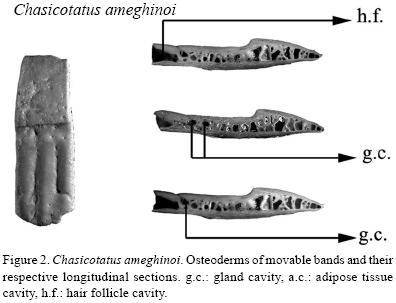
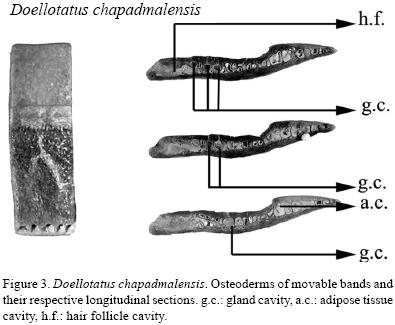
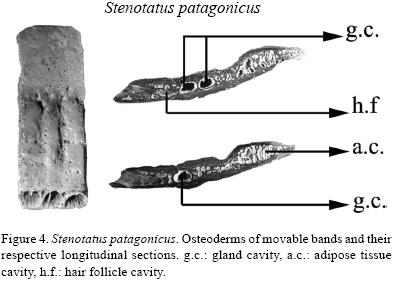
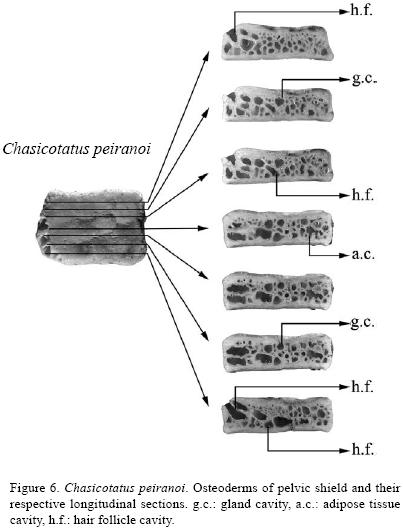
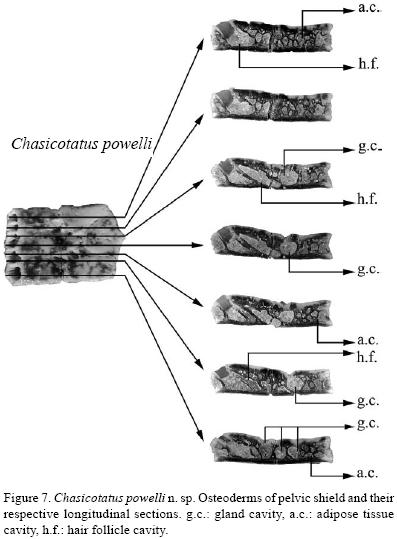
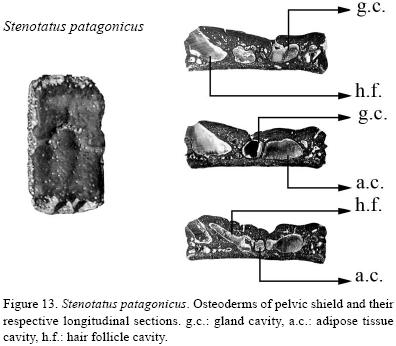
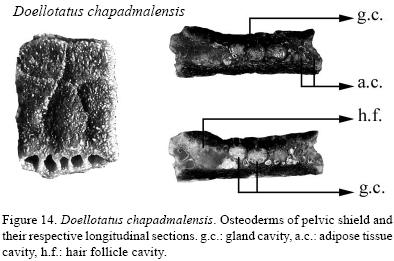
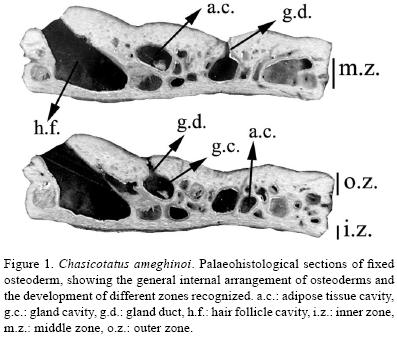
<body><![CDATA[<p align="justify"><font face="verdana" size="2">&nbsp;</font></p>     <p align="justify"><font face="verdana" size="2"><b>PALAEOHISTOLOGY</b></font></p>     <p align="justify"><font face="verdana" size="2"><b>Internal morphology of <i>Chasicotatus</i> osteoderms</b></font></p>     <p align="justify"><font face="verdana" size="2">Palaeohistological sections were made from a mobile osteoderm belonging to <i>Chasicotatus ameghinoi</i>  and fixed osteoderms from <i>C. ameghinoi</i>, <i>C. peiranoi</i> and <i><i>C. powelli</i> </i> n. sp. Morphologically diverse cavities were recognized. In order to make inferences about the type of soft tissues that originally occupied these cavities, they were compared with histological sections from living individuals described in the literature (Fern&aacute;ndez, 1931; Krmpotic <i>et al.</i>, 2005, 2009a; Hill, 2006; Vickaryous and Hall, 2006; Ciancio <i>et al.</i>, 2007), in an attempt to recognize homologous structures (<a href="#f1">Figure 1</a>). </font></p>     <p align="center"><font face="verdana" size="2"><a name="f1"></a></font></p>     <p align="center"><font face="verdana" size="2"><img src="/img/revistas/rmcg/v27n1/a4f1.jpg"></font></p>     <p align="justify"><font face="verdana" size="2">The osteoderms of <i>Chasicotatus</i> show three well&#150;defined zones, in particular a very well developed middle zone (<a href="#f1">Figure 1</a>) that seems to be typical of the Euphractinae, since it occurs in <i>Chaetophractus villosus</i> (Desmarest, 1804) Fitzinger, 1871 (Fern&aacute;ndez, 1931; Krmpotic <i>et al.</i>, 2005, 2009a) and in several eutatine genera, but not in <i>Dasypus</i> Linn&eacute;, 1758 (Dasypodinae) (Hill, 2006; Ciancio <i>et al.</i>, 2007). The Eutatini are hypothesized to have a more developed piliary apparatus compared with the Euphractini, as indicated by the genera <i>Eutatus</i> (Krmpotic <i>et al.</i>, 2007a, 2007b, 2009a, 2009b), <i>Ringueletia</i> (Krmpotic <i>et al.</i>, 2007c), <i>Sadypus</i> Ameghino, 1902 and <i>Meteutatus</i> Ameghino, 1902 (Ciancio and Carlini, 2007), <i>Doellotatus, Stenotatus</i> (Deseadan, late Oligocene&#150;Colloncuran, early middle Miocene) and <i>Chasicotatus</i> in the present work. The greater piliary development is inferred not only from the number of superimposed hair follicles on each palaeohistological section , but also from the extension and total volume occupied by each hair follicle within the osteoderm (<a href="#f1">Figure 1</a>).</font></p>     <p align="justify"><font face="verdana" size="2"><b><i>Chasicotatus ameghinoi</i> </b></font></p>     <p align="justify"><font face="verdana" size="2">The mobile osteoderms of <i>C. ameghinoi</i> (<a href="#f2">Figure 2</a>) have a proportionally less developed middle zone when compared with Doellotatus chapadmalensis Bordas, 1933 (<a href="#f3">Figure 3</a>), and are more similar to <i>Stenotatus patagonicus</i> (Ameghino, 1887) Scott, 1903&#150;1905 (<a href="#f4">Figure 4</a>). The glandular cavities are smaller than those of <i>Doellotatus chapadmalensis</i>, much smaller than those of <i>Stenotatus patagonicus</i>, never more than two per palaeohistological section and with narrow ducts (one duct per glandular cavity). The hair follicle cavities (like the glandular cavities) are located on the posterior half of the ornamented part; the cranial portion (overlapping region) has a middle zone with large cavities that contain adipose tissue, and the outer and inner zones are proportionally thicker than in <i>Doellotatus chapadmalensis</i> and <i>Ringueletia simpsoni</i> (Bordas, 1933) Reig 1958, similar to those of <i>S. patagonicus</i>. The fixed osteoderms of <i>C. ameghinoi</i> (<a href="/img/revistas/rmcg/v27n1/a4f5.jpg" target="_blank">Figure 5</a>) have large glandular cavities, larger than those of <i>C. peiranoi</i> (<a href="#f6">Figure 6</a>), but smaller than those of <i>C. powelli</i> n. sp. (<a href="#f7">Figure 7</a>), never more than two per palaeohistological section; the gland ducts are narrow (one per glandular cavity). The hair follicle cavities are well developed and lodged in a zone that is thicker than the rest of the osteoderm. Analysis of its internal structure shows that this greater thickness is due to the large size of the cavities corresponding to hair follicles and to the presence of a relatively thicker outer zone (<a href="/img/revistas/rmcg/v27n1/a4f5.jpg" target="_blank">Figure 5</a>).</font></p>     <p align="center"><font face="verdana" size="2"><a name="f2"></a></font></p>     ]]></body>
<body><![CDATA[<p align="center"><font face="verdana" size="2"><img src="/img/revistas/rmcg/v27n1/a4f2.jpg"></font></p>     <p align="center"><font face="verdana" size="2"><a name="f3"></a></font></p>     <p align="center"><font face="verdana" size="2"><img src="/img/revistas/rmcg/v27n1/a4f3.jpg"></font></p>     <p align="center"><font face="verdana" size="2"><a name="f4"></a></font></p>     <p align="center"><font face="verdana" size="2"><img src="/img/revistas/rmcg/v27n1/a4f4.jpg"></font></p>     <p align="center"><font face="verdana" size="2"><a name="f6"></a></font></p>     <p align="center"><font face="verdana" size="2"><img src="/img/revistas/rmcg/v27n1/a4f6.jpg"></font></p>     <p align="center"><font face="verdana" size="2"><a name="f7"></a></font></p>     <p align="center"><font face="verdana" size="2"><img src="/img/revistas/rmcg/v27n1/a4f7.jpg"></font></p>     <p align="justify"><font face="verdana" size="2"><b><i>Chasicotatus peiranoi</i> </b></font></p>     ]]></body>
<body><![CDATA[<p align="justify"><font face="verdana" size="2">The fixed osteoderms of <i>C. peiranoi</i> (<a href="#f6">Figure 6</a>) have better developed inner and outer zones than those of <i>C. powelli</i> n. sp., similar to those of <i>C. ameghinoi</i>, and the middle zone is more developed than in the above mentioned species. The glandular cavities are smaller than those of <i>C. ameghinoi</i> and much smaller than those of <i>C. powelli</i> n. sp. They are distributed in the upper half of the thickness of the middle zone, each with a single duct. In the zones where a second row of hair follicles is visible externally, the internal structure shows that these are divided by a bony septum along their entire length. </font></p>     <p align="justify"><font face="verdana" size="2"><i><b>Chasicotatus powelli</b></i><b> n. sp.</b></font></p>     <p align="justify"><font face="verdana" size="2">The internal structure of the fixed osteoderms shows the inner and outer zones are thinner than those of <i>C. ameghinoi</i> and <i>C. peiranoi</i> (<a href="#f7">Figure 7</a>). The glandular cavities are large, larger than those of <i>C. ameghinoi</i>; they may even occupy the entire thickness of the middle zone reaching the inner zone, and possess a single duct. Up to three gland cavities are present per cross&#150;section (unlike the condition in <i>C. ameghinoi</i> and <i>C. peiranoi</i> that have only two).</font></p>     <p align="justify"><font face="verdana" size="2">&nbsp;</font></p>     <p align="justify"><font face="verdana" size="2"><b>SYSTEMATIC PALEONTOLOGY</b></font></p>     <p align="center"><font face="verdana" size="2">Superorder Xenarthra Cope, 1889    <br> Order Cingulata Illiger, 1811    <br> Superfamily Dasypodoidea Gray, 1821    <br> Family Dasypodidae Gray, 1821    <br> Subfamily Euphractinae Pocock, 1924    ]]></body>
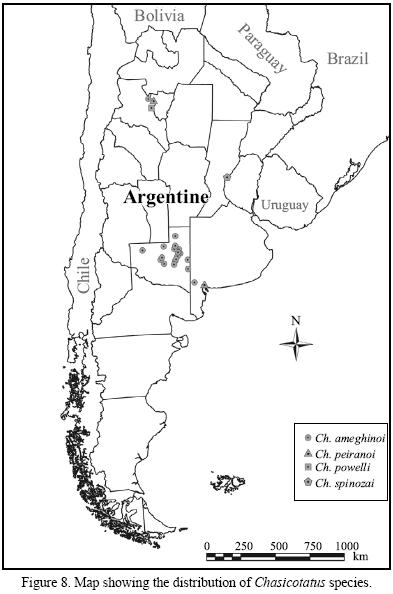
<body><![CDATA[<br> Tribe Eutatini Bordas, 1933</font></p>     <p align="center"><font face="verdana" size="2"><b>Genus <i>Chasicotatus</i> Scillato&#150;Yan&eacute;, 1979</b></font></p>     <p align="justify"><font face="verdana" size="2"><b>Type species.</b> <i>Chasicotatus ameghinoi</i>  Scillato&#150;Yan&eacute;, 1979.</font></p>     <p align="justify"><font face="verdana" size="2"><b>Included species.</b> <i>Chasicotatus peiranoi</i>  Esteban and Nasif, 1996; <i>Chasicotatus powelli</i> n. sp., this paper; <i>Chasicotatus spinozai</i> n. sp., this paper.</font></p>     <p align="justify"><font face="verdana" size="2"><b>Amended diagnosis (Scillato&#150;Yan&eacute;, 1979).</b> Small size, intermediate between that of <i>Zaedyus</i> Ameghino, 1889 and <i>Doellotatus</i>. Osteoderms smooth, not rugose. Mobile osteoderms with a smooth region separating the cranial portion from the caudal portion, and ornamentation similar to that of fixed osteoderms, but without anterior figures; margin posterior to hair foramina much less extended than in <i>Eutatus</i>. Fixed osteoderms with central figure more elongated than in <i>Eutatus </i>and with sharp tips, surrounded by two anterior and two lateral figures at each side; figures globose, separated by deep sulci. Internal structure with up to three superimposed hair follicle cavities per palaeohistological section; conspicuous glandular cavities with narrow gland ducts, one per glandular cavity. </font></p>     <p align="justify"><font face="verdana" size="2"><b>Chronological and stratigraphical distribution.</b> Late Miocene (early Chasicoan&#150;late Huayquerian).</font></p>     <p align="justify"><font face="verdana" size="2"><b>Geographical distribution.</b> Argentina (Buenos Aires, La Pampa, Catamarca and Entre R&iacute;os provinces) (<a href="#f8">Figure 8</a>).</font></p>     <p align="center"><font face="verdana" size="2"><a name="f8"></a></font></p>     <p align="center"><font face="verdana" size="2"><img src="/img/revistas/rmcg/v27n1/a4f8.jpg"></font></p>     <p align="center"><font face="verdana" size="2"><b><i>Chasicotatus ameghinoi</i>  Scillato&#150;Yan&eacute;, 1979</b></font></p>     ]]></body>
<body><![CDATA[<p align="center"><font face="verdana" size="2"><a href="#f2">Figures 2</a>, <a href="/img/revistas/rmcg/v27n1/a4f5.jpg" target="_blank">5</a>, <a href="/img/revistas/rmcg/v27n1/a4f9.jpg" target="_blank">9</a></font></p>     <p align="justify"><font face="verdana" size="2"><b>Holotype.</b> Large portion of the carapace. </font></p>     <p align="justify"><font face="verdana" size="2"><b>Repository.</b> MLP 76&#150;VI&#150;12&#150;11 (<a href="/img/revistas/rmcg/v27n1/a4f9.jpg" target="_blank">Figure 9</a>). Provenance: Chasic&oacute; creek, Villarino Department (Partido), Buenos Aires province; Arroyo Chasic&oacute; Formation, Las Barrancas Member (late Chasicoan, late Miocene).</font></p>     <p align="justify"><font face="verdana" size="2"><b>Hypodigm.</b> The holotype and MLP: 28&#150;X&#150;11&#150;43, 28&#150;X&#150;11&#150;64, 30&#150;XII&#150;10&#150;13, 55&#150;IV&#150;28&#150;47, 60&#150;VI&#150;18&#150;67, 60&#150;VI&#150;18&#150;75, 76&#150;VI&#150;12&#150;19, 76&#150;VI&#150;12&#150;26, 76&#150;VI&#150;12&#150;27, 76&#150;VI&#150;12&#150;38, 76&#150;VI&#150;12&#150;58, 76&#150;VI&#150;12&#150;111, 76&#150;VI&#150;12&#150;136, 76&#150;VI&#150;12&#150;137.</font></p>     <p align="justify"><font face="verdana" size="2"><b>Amended diagnosis (Scillato&#150;Yan&eacute;, 1982).</b> Small size, slightly smaller than that of the remaining species of the genus. Pelvic shield proportionally smaller than in <i>Stenotatus</i>, <i>Doellotatus</i>, and <i>Eutatus</i>. Posterior end of mobile and fixed osteoderms with large hair foramina arranged mediolaterally in a single row as in <i>C. powelli</i> n. sp. Mobile osteoderms with margin posterior to hair foramina more extended than in the other species. Fixed osteoderms with central figure shaped like a narrow elevated keel, both central and peripheral figures more globose than in <i>C. powelli</i> n. sp. and <i>C. peiranoi</i> ; foramina on exposed surface (glandular foramina) as fine punctuations, as in <i>C. peiranoi</i> ; osteoderms thicker posteriorly. Internally the mobile osteoderms have a less developed middle zone than those of <i>Doellotatus chapadmalensis</i>; glandular cavities small, never more than two per palaeohistological section and with narrow ducts (one per glandular cavity), hair follicle cavities (as the glandular cavities) located on the posterior half of the ornamented part and no more than two per palaeohistological section, cranial (overlapping region) portion with thick inner and outer zones, unlike the species of <i>Doellotatus chapadmalensis</i>. Fixed osteoderms with large glandular cavities, larger than those of <i>C. peiranoi</i> , but smaller than those of <i>Chasicotatus powelli</i> n. sp., never more than two per palaeohistological section; well developed hair follicle cavities, lodged in a zone thicker than the rest of the osteoderm. </font></p>     <p align="justify"><font face="verdana" size="2"><b>Chronological and stratigraphic distribution.</b> Late Miocene (early Chasicoan&#150;late Huayquerian).</font></p>     <p align="justify"><font face="verdana" size="2"><b>Geographical distribution.</b> Argentina (Buenos Aires, La Pampa, and Catamarca provinces) (<a href="#f8">Figure 8</a>).</font></p>     <p align="center"><font face="verdana" size="2"><b><i>Chasicotatus peiranoi</i>  Esteban and Nasif, 1996</b></font></p>     <p align="center"><font face="verdana" size="2"><a href="#f6">Figures 6</a> and <a href="/img/revistas/rmcg/v27n1/a4f10.jpg" target="_blank">10</a> </font></p>     <p align="justify"><font face="verdana" size="2"><b>Holotype.</b> 77 fixed osteoderms, five complete mobile osteoderms (11 with missing cranial portion) and numerous fragments of both types, all from a single specimen. </font></p>     ]]></body>
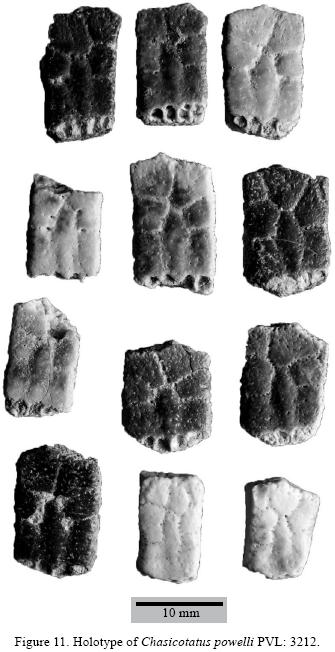
<body><![CDATA[<p align="justify"><font face="verdana" size="2"><b>Repository.</b> PVL 4796. Provenance: Valle del Caj&oacute;n, Department of Santa Mar&iacute;a, Catamarca province, Subsequences IIb and IIc Playa del Zorro Alloformation, Huayquerian, late Miocene. </font></p>     <p align="justify"><font face="verdana" size="2"><b>Hypodigm.</b> The holotype and UNSGH 57.</font></p>     <p align="justify"><font face="verdana" size="2"><b>Amended diagnosis (Esteban and Nasif, 1996).</b> A <i>Chasicotatus</i> species slightly larger than <i>C. ameghinoi</i>, similar in size to <i>C. powelli</i> n. sp and <i>C. spinozai</i>  n sp. Posterior end of the most osteoderms with a double row of hair foramina arranged mediolaterally, the anterior one with 2&#150;4 smaller foramina, and the posterior one with 4 to 5 foramina. Compared with those of <i>C. ameghinoi</i>, the mobile osteoderms are the same length but wider, and they are slightly shorter and broader compared to those of <i>C. powelli</i> n. sp.; central figures oval, with sharp tips, unlike those of <i>C. ameghinoi</i> (not sharp cornered). Fixed osteoderms with central figure broad, sharpened at its tips, less so than in <i>C. ameghinoi</i> and <i>C. spinozai</i>  n. sp.; less convex than in <i>C. ameghinoi</i>. Internally, the inner and outer zones of the osteoderm are more developed than in <i>C. powelli</i> n. sp., similar to those of <i>C. ameghinoi</i>; glandular cavities smaller than those of <i>C. ameghinoi</i> and much smaller than those of <i>C. powelli</i> n. sp., arranged in the upper half of the thickness of the middle zone; in those areas where a second row of hair foramina is evident externally, the internal structure shows that these are divided by a bony septum along their entire length. </font></p>     <p align="justify"><font face="verdana" size="2"><b>Chronological and stratigraphic distribution.</b> Late Miocene (Huayquerian).</font></p>     <p align="justify"><font face="verdana" size="2"><b>Geographical distribution.</b> Argentina (Catamarca and Buenos Aires provinces) (<a href="#f8">Figure 8</a>).</font></p>     <p align="center"><font face="verdana" size="2"><i><b>Chasicotatus powelli</b></i><b> n. sp.</b></font></p>     <p align="center"><font face="verdana" size="2"><a href="#f7">Figures 7</a> and <a href="#f11">11</a></font></p>     <p align="center"><font face="verdana" size="2"><a name="f11"></a></font></p>     <p align="center"><font face="verdana" size="2"><img src="/img/revistas/rmcg/v27n1/a4f11.jpg"></font></p>     <p align="justify"><font face="verdana" size="2"><b>Holotype.</b> 155 fixed osteoderms from the pelvic shield, some of them incomplete, and 20 mobile osteoderms, almost all very fragmented. </font></p>     ]]></body>
<body><![CDATA[<p align="justify"><font face="verdana" size="2"><b>Repository.</b> PVL 3212. Provenance: south from El Molle, El Caj&oacute;n Valley, Santa Mar&iacute;a Department, Catamarca province; Huayquerian, late Miocene. </font></p>     <p align="justify"><font face="verdana" size="2"><b>Paratype.</b> 32 fixed osteoderms from the pelvic shield and left astragalus, same provenance. </font></p>     <p align="justify"><font face="verdana" size="2"><b>Repository.</b> PVL 3213. </font></p>     <p align="justify"><font face="verdana" size="2"><b>Hypodigm.</b> The holotype and paratype.</font></p>     <p align="justify"><font face="verdana" size="2"><i><b>Derivatio nominis.</b></i> In honor of palaeontologist Dr. Jaime Powell.</font></p>     <p align="justify"><font face="verdana" size="2"><b>Amended diagnosis (Scillato&#150; Yan&eacute;, 1982).</b> Size slightly larger than that of <i>C. ameghinoi</i>, similar to that of <i>C. peiranoi</i> . Astragalus with fused ectal and sustentacular facets, as in <i>Eutatus</i>. Posterior end of mobile and fixed osteoderms with large hair foramina arranged mediolaterally in a single row, as in <i>C. ameghinoi</i>; foramina on exposed surface more conspicuous than in the remaining species of the genus, sometimes extending to the sulci that separate peripheral figures from each other. Central figure of mobile osteoderms flatter, narrower and with shallower delimiting sulci than in <i>C. ameghinoi</i>. Fixed osteoderms with subelliptical central figure, less narrow anteriorly and posteriorly than in <i>C. ameghinoi</i>, similar to that of <i>C. peiranoi</i> ; delimiting sulcus shallower than in the remaining species. Internally, the inner and outer zones are thinner than those of <i>C. ameghinoi</i> and <i>C. peiranoi</i> ; large glandular cavities, larger than those of <i>C. ameghinoi</i>; they may even occupy the entire thickness of the middle zone and contact the inner zone; up to three glandular cavities per section (unlike <i>C. ameghinoi</i> and <i>C. peiranoi</i> , which have only two).</font></p>     <p align="justify"><font face="verdana" size="2"><b>Chronological and stratigraphic distribution.</b> Late Miocene (Huayquerian).</font></p>     <p align="justify"><font face="verdana" size="2"><b>Geographical distribution.</b> Argentina (Catamarca province) (<a href="#f8">Figure 8</a>).</font></p>     <p align="center"><font face="verdana" size="2"><i><b>Chasicotatus spinozai</b></i><b> n. sp.</b></font></p>     <p align="center"><font face="verdana" size="2"><a href="#f12">Figure 12</a></font></p>     ]]></body>
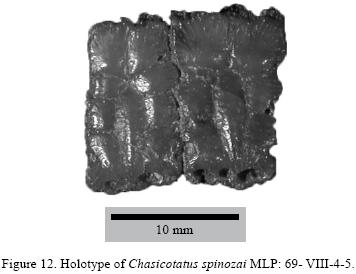
<body><![CDATA[<p align="center"><font face="verdana" size="2"><a name="f12"></a></font></p>     <p align="center"><font face="verdana" size="2"><img src="/img/revistas/rmcg/v27n1/a4f12.jpg"></font></p>     <p align="justify"><font face="verdana" size="2"><b>Derivatio nominis.</b> In honor of Dutch&#150;Jewish philosopher Baruch de Spinoza (1632&#150;1677).</font></p>     <p align="justify"><font face="verdana" size="2"><b>Holotype.</b> Two articulated osteoderms from the pelvic shield. <b>Repository.</b> MLP 69&#150;VIII&#150;4&#150;5. Provenance: Vicinity of Paran&aacute;, Entre R&iacute;os Province, "Ossiferous Conglomerate" of Ituzaing&oacute; Formation, Huayquerian Age, late Miocene.</font></p>     <p align="justify"><font face="verdana" size="2"><b>Amended diagnosis (Scillato&#150; Yan&eacute;, 1982).</b> Size similar to that of <i>C. powelli</i> n. sp. and <i>C. peiranoi</i> . Fixed osteoderms proportionally longer than those of <i>C. ameghinoi</i>. Central figure of fixed osteoderms forming a keel narrower and more prominent than in the remaining species. Sulci delimiting central and peripheral figures deep, more so than in <i>C. powelli</i> n. sp. and <i>C. peiranoi</i> and slightly less so than in <i>C. ameghinoi</i>. Hair follicle foramina much smaller than in the remaining species of the genus. Very noticeable foramina, probably for hair follicles, on both lateral margins of the osteoderms. The foramina on the exposed surface appear as fine punctuations, as in <i>C. ameghinoi</i> and <i>C. peiranoi</i> .</font></p>     <p align="justify"><font face="verdana" size="2"><b>Chronological and stratigraphic distribution.</b> Huayquerian.</font></p>     <p align="justify"><font face="verdana" size="2"><b>Geographical distribution.</b> Argentina (Entre R&iacute;os province).</font></p>     <p align="justify"><font face="verdana" size="2">&nbsp;</font></p>     <p align="justify"><font face="verdana" size="2"><b>GEOGRAPHIC AND STRATIGRAPHIC PROVENANCE OF CHASICOTATUS SPECIES</b></font></p>     <p align="justify"><font face="verdana" size="2"><b>Pampean region</b></font></p>     ]]></body>
<body><![CDATA[<p align="justify"><font face="verdana" size="2">As previously mentioned, <i>Chasicotatus ameghinoi</i>  was originally collected from the Arroyo Chasic&oacute; Formation, Las Barrancas Member, in the southwest of Buenos Aires province, in sediments assignable to the late Miocene. Bondesio <i>et al.</i> (1980) combined the information about the geology of the area with the data provided by fossil mammal findings and divided the Arroyo Chasic&oacute; Formation into two members: Vivero Member and Las Barrancas Member. Fidalgo and Porro (in Bondesio <i>et al.</i>, 1980) stated that the sediments of Las Barrancas Member are sandier and less compact than those of the Vivero Member, although both are generally similar. Within this biostratigraphic scheme, these two members are associated with two different biozones: (1) <i>Chasicotherium rothi</i> Biozone (Tonni <i>et al.</i>, 1998; Cione <i>et al.</i>, 2000), which is the local representative of the Viveran (early Chasicoan), and (2) <i>Chasicotatus ameghinoi</i>  Biozone (Tonni <i>et al.</i>, 1998; Cione <i>et al.</i>, 2000) which represents the Barrancan (late Chasicoan). Both units were deposited during the earliest part of the late Miocene (Tonni <i>et al.</i>, 1998). Z&aacute;rate <i>et al.</i> (2007) made a geological study of the Chasicoan (late Miocene) deposits, recognizing different lithofacies and paleosoils. These authors' lithofacial proposal does not support the lithostratigraphical separation of Arroyo Chasic&oacute; Formation into two members. </font></p>     <p align="justify"><font face="verdana" size="2">Later, <i>C. ameghinoi</i> was reported from the Cerro Azul Formation of Chasicoan&#150;Huayquerian age (late Miocene; Verzi, 1999; Verzi <i>et al.</i>, 2003, 2004; Montalvo <i>et al.</i>, 2005; Verzi <i>et al.</i>, 2008). This Formation outcrops mainly in eastern La Pampa province and western Buenos Aires province (as "Epecu&eacute;n formation" <i>sensu</i> Pascual, 1961; see Linares <i>et al.</i>, 1980 and Goin <i>et al.</i>, 2000). The lithological similarity between the deposits of Cerro Azul Formation and those of Arroyo Chasic&oacute; Formation is very high, and they can only be distinguished when the R&iacute;o Negro Formation occurs between them (Linares <i>et al.</i>, 1980). The first localities of Cerro Azul Formation that yielded remains of <i>Chasicotatus ameghinoi</i>  were Tel&eacute;n, Quehu&eacute;, Loventu&eacute;, Naic&oacute;, Salinas de Hidalgo, Laguna Chillhu&eacute;, Bajo Giuliani and El Guanaco (Esteban <i>et al.</i>, 2001), although additional remains were later found in the localities Caleuf&uacute; (Esteban <i>et al.</i>, 2003) and Cerro La Bota (Urrutia, 2004), all within La Pampa province. According to the most recent biostratigraphic scheme presented by Verzi <i>et al.</i> (2008), <i>Chasicotatus ameghinoi</i>  was recorded in the following Biozones: <i>Chasichimys bonaerense, Chasichimys scagliai, Xenodontomys simpsoni</i> and <i>X. elongatus.</i> Thus, the biochron of the species in this formation extends from the early Chasicoan to the late Huayquerian (early late Miocene), and for this reason Verzi <i>et al.</i> (2008) suggested that the old <i>Chasicotatus ameghinoi</i>  Biozone be changed, since it would not be an exclusive taxon. </font></p>     <p align="justify"><font face="verdana" size="2"><i>Chasicotatus peiranoi</i>  was recorded in the southwest of Buenos Aires province, at the Relleno Sanitario quarry (5 km southeast from Bah&iacute;a Blanca, near the Gr&uuml;nbein township), with late Huayquerian (late Miocene) age (Deschamps, 2005).</font></p>     <p align="justify"><font face="verdana" size="2"><b>Northwestern Argentine</b></font></p>     <p align="justify"><font face="verdana" size="2"><i>Chasicotatus powelli </i>n. sp. and <i>Chasicotatus peiranoi</i>  come from El Caj&oacute;n valley (Catamarca province). In this area, the Tertiary is represented by an assemblage of continental sediments that were originally described and named as El Bols&oacute;n Group (Turner, 1973); in particular, the fossil&#150;bearing strata corresponds to the El Morterito Formation (Turner, 1973). Bossi <i>et al.</i> (1993) studied the sedimentology of the Neogene in this valley and established a new stratigraphic scheme based on alloformations. Within this scheme, the El Monterito Formation would approximately correspond to sequence II of Playa del Zorro Alloformation (Bossi <i>et al.</i>, 1993). Stratigraphically, the <i>Chasicotatus peiranoi</i>  remains come from the sequences IIb and IIc of the latter Alloformation (Esteban and Nasif, 1996). In turn, these sequences would correspond to the Andalhuala Formation, in the Santa Mar&iacute;a Valley (Catamarca province, Bossi <i>et al.</i>, 1993), of Huayquerian Age. </font></p>     <p align="justify"><font face="verdana" size="2">Subsequently, Esteban and Nasif (1999) reported remains of <i>Chasicotatus ameghinoi</i>  from the "A" Member of the Chiquimil Formation, belonging to the Santa Mar&iacute;a Group, at the locality Villavil (Catamarca province), which would be upper Chasicoan (Barrancan) in age.</font></p>     <p align="justify"><font face="verdana" size="2"><b>Mesopotamia</b></font></p>     <p align="justify"><font face="verdana" size="2">As previously mentioned, the remains of <i>Chasicotatus spinozai </i> n. sp. come from the "Mesopotamian" (Ituzaing&oacute; Formation) of the vicinity of Paran&aacute;, Entre R&iacute;os province. The outcroppings of the Ituzaing&oacute; Formation extend from the homonymous city (in Corrientes province) to the north of Paran&aacute; city (Entre R&iacute;os province), along the steep bluffs of the Paran&aacute; River and several tributary rivers and creeks (Cione <i>et al.</i>, 2000; Herbst, 2000; Brandoni, 2005). De Alba (1953) established the type locality of the Ituzaing&oacute; Formation in the vicinity of the town of Ituzaing&oacute;. The fossil vertebrate remains come almost exclusively from the lower levels of that formation, in particular from the basal stratum informally known as "Mesopotamian" or "ossiferous conglomerate" (Frenguelli, 1920, see Cione <i>et al.</i>, 2000), which outcrops discontinuously along the Paran&aacute; river bluffs, from the vicinity of the homonymous city in the south, to the locality Pueblo Brugo in the north (Brandoni, 2005). Cione <i>et al.</i> (2000), on the basis of the vertebrate remains found in the "ossiferous conglomerate" and the existing stratigraphic relationships, proposed a greater affinity with the Huayquerian Age (Tortonian of the International scale), although part of the materials collected could suggest a Chasicoan Age. As in the case of the osteoderms of <i>Chasicotatus spinozai </i> n. sp., most of the collections from Paran&aacute; lack accurate provenance; however, practically all the terrestrial and freshwater vertebrates come from the "ossiferous conglomerate", at the base of the Ituzaing&oacute; Formation (Cione <i>et al.</i>, 2000). In turn, Herbst (2000) considers that the base of the Ituzaing&oacute; Formation is middle&#150;upper Pliocene in age, but it must be taken into account that this author's studies and chronological hypotheses were made for the area of Corrientes, not for Entre R&iacute;os where these fossil vertebrates were found.</font></p>     <p align="justify"><font face="verdana" size="2">&nbsp;</font></p>     <p align="justify"><font face="verdana" size="2"><b>DISCUSSION</b></font></p>     ]]></body>
<body><![CDATA[<p align="justify"><font face="verdana" size="2">The geographic distribution of <i>Chasicotatus</i> is restricted to Argentina, and its chronological range is limited to the early Chasicoan&#150;late Huayquerian (late Miocene). The diverse species are recorded in northwestern Argentina (Catamarca province), Mesopotamia (Entre R&iacute;os province) and the Pampean region (Buenos Aires and La Pampa provinces) (<a href="#f8">Figure 8</a>). </font></p>     <p align="justify"><font face="verdana" size="2">The internal morphology of osteoderms belonging to the different <i>Chasicotatus</i> species is characterized by the presence of glandular cavities of considerable size with very narrow ducts, one per glandular cavity. Within the internal morphological variations exhibited by the different species, it is noteworthy that the osteoderms of <i>Chasicotatus ameghinoi</i>  are most similar to those of <i>Stenotatus patagonicus</i> (<a href="#f13">Figure 13</a>). The fixed osteoderms of both species are thicker at the posterior area due to the implantation of hair follicles and the great depth of the outer zone of compact bone. However, the glandular cavities of <i>Stenotatus patagonicus</i> are much larger than those of <i>C. ameghinoi</i>, with a double duct, and present hair follicles arranged both vertically and horizontally, whereas the hair follicles of genus <i>Chasicotatus</i> are always arranged obliquely. On the other hand, the internal morphology of <i>Chasicotatus powelli </i>n. sp. resembles that of <i>Doellotatus chapadmalensis</i> in the thickness of the inner and outer zones and in the possession of up to three glandular cavities per palaeohistological section; however, the cavities of <i>Chasicotatus powelli </i>n. sp. are larger than those of <i>Doellotatus chapadmalensis</i> (<a href="#f14">Figure 14</a>) and have a single duct per glandular cavity. Of the three <i>Chasicotatus</i> species, <i>Chasicotatus peiranoi</i>  shows the greatest differences compared to the other two species in terms of internal morphology, due to the great development of its middle zone, smaller size of the glandular cavities and arrangement of hair follicles.</font></p>     <p align="center"><font face="verdana" size="2"><a name="f13"></a></font></p>     <p align="center"><font face="verdana" size="2"><img src="/img/revistas/rmcg/v27n1/a4f13.jpg"></font></p>     <p align="center"><font face="verdana" size="2"><a name="f14"></a></font></p>     <p align="center"><font face="verdana" size="2"><img src="/img/revistas/rmcg/v27n1/a4f14.jpg"></font></p>     <p align="justify"><font face="verdana" size="2">&nbsp;</font></p>     <p align="justify"><font face="verdana" size="2"><b>CONCLUSIONS</b></font></p>     <p align="justify"><font face="verdana" size="2">Two new species of this genus are described. These species are characterized using both the traditional criteria based on the external morphology of the osteoderms, and in addition, for the first time for this taxon, palaeohistological sections of the osteoderms were made allowing observation of numerous internal details (glandular cisterns, ducts that connect them to the exterior, insertion of hairs on the posterior margin, etc.).</font></p>     <p align="justify"><font face="verdana" size="2">A major faunal change took place between the pre&#150;Chasicoan and Chasicoan units, and this change is particularly significant in the case of the Xenarthra Cingulata (Scillato&#150;Yan&eacute; and Carlini, 1998). Among the Dasypodidae, all the Eutatini and almost all the "pansantacrucian" Euphractini disappeared in the Chasicoan (Scillato&#150;Yan&eacute; <i>et al.</i>, 1993). For the Eutatini, this change includes the definitive disappearance of <i>Stenotatus</i> and <i>Proeutatus</i> from the fossil record, and the first appearance of <i>Chasicotatus</i>. </font></p>     ]]></body>
<body><![CDATA[<p align="justify"><font face="verdana" size="2"> The geographical distribution of the species of <i>Chasicotatus</i> agrees with the hypothesis for the existence of open habitats during the late Miocene&#150;Pliocene time interval. These habitats would have allowed ample connection between the different geographical regions (Pascual and Bondesio, 1982). Thus, <i>Chasicotatus ameghinoi</i>  is recorded in the provinces of Buenos Aires (Chasicoan&#150;Huayquerian), La Pampa (Huayquerian) and Catamarca (Chasicoan). <i>Chasicotatus peiranoi</i>  is recorded first in the Huayquerian of Catamarca, and is later recognized in Buenos Aires province. On the other hand, during the late Miocene, the records of diverse vertebrates provide evidence for the occurrence of different regional environments between the extended plains, which anticipates the current biogeographical regions (Pascual, 1984). For instance, toward the end of the Southern Plains period, the southern half of the current Argentine territory was divided into two biogeographical units, parallel to each other: one along the east flank of the Andean mountain range and the other more eastwards, along the pre&#150;Paran&aacute; river (Ortiz&#150;Jaureguizar and Cladera, 2006). In general, among the terrestrial vertebrates of the "ossiferous conglomerate" of Ituzaing&oacute; Formation, the xenarthrans and notoungulates indicate that the Mesopotamian area was biogeographically distinct from the Pampean region and from Northwestern Argentina (Scillato&#150;Yan&eacute;, 1975; Cione <i>et al.</i>, 2000). In the area of Paran&aacute;, gallery forests seem to have predominated (Cione <i>et al.</i>, 2000). In this context, only one species of Eutatini is recorded in the "ossiferous conglomerate" (<i>Chasicotatus spinozai </i> n. sp.), and is restricted to that region. This latter species differs from the other three <i>Chasicotatus</i> species by its osteoderm ornamentation, particularly by the presence of hair follicle foramina much smaller than those of the other species of <i>Chasicotatus</i>, which could partly reflect the adaptation of this species to warmer climates.</font></p>     <p align="justify"><font face="verdana" size="2">&nbsp;</font></p>     <p align="justify"><font face="verdana" size="2"><b>ACKNOWLEDGEMENTS</b></font></p>     <p align="justify"><font face="verdana" size="2">The authors wish to express their gratitude to Dr. M. A. Reguero, curator of the Divisi&oacute;n de Paleontolog&iacute;a Vertebrados, MLP, and Dr. J. E. Powell curator of Palentolog&iacute;a Vertebrados Lillo, PVL. To A. A. Carlini for his reviews and helpful suggestions. H. Gregory McDonald and an anonymous reviewer greatly improved the original manuscript through their critical review.</font></p>     <p align="justify"><font face="verdana" size="2">&nbsp;</font></p>     <p align="justify"><font face="verdana" size="2"><b>REFERENCES </b></font></p>     <!-- ref --><p align="justify"><font face="verdana" size="2">Ameghino, F., 1887, Enumeraci&oacute;n sistem&aacute;tica de las especies de mam&iacute;feros f&oacute;siles coleccionados por Carlos Ameghino en los terrenos eocenos de Patagonia Austral y depositados en el Museo de La Plata: Bolet&iacute;n del Museo de La Plata, 1, 1&#150;26.</font>&nbsp;&nbsp;&nbsp;&nbsp;&nbsp;&nbsp;&nbsp;&nbsp;[&#160;<a href="javascript:void(0);" onclick="javascript: window.open('/scielo.php?script=sci_nlinks&ref=8046365&pid=S1026-8774201000010000400001&lng=','','width=640,height=500,resizable=yes,scrollbars=1,menubar=yes,');">Links</a>&#160;]<!-- end-ref --><!-- ref --><p align="justify"><font face="verdana" size="2">Ameghino, F., 1889, Contribuci&oacute;n al conocimiento de los mam&iacute;feros f&oacute;siles de la Rep&uacute;blica Argentina: Actas de la Academia Nacional de Ciencias de C&oacute;rdoba, 6, 1&#150;1028 y Atlas: 98 l&aacute;ms. </font>&nbsp;&nbsp;&nbsp;&nbsp;&nbsp;&nbsp;&nbsp;&nbsp;[&#160;<a href="javascript:void(0);" onclick="javascript: window.open('/scielo.php?script=sci_nlinks&ref=8046366&pid=S1026-8774201000010000400002&lng=','','width=640,height=500,resizable=yes,scrollbars=1,menubar=yes,');">Links</a>&#160;]<!-- end-ref --><!-- ref --><p align="justify"><font face="verdana" size="2">Ameghino, F., 1891a, Mam&iacute;feros y aves f&oacute;siles argentinos. Especies nuevas, adiciones y correcciones: Revista Argentina de Historia Natural, 1, 240&#150;259. </font>&nbsp;&nbsp;&nbsp;&nbsp;&nbsp;&nbsp;&nbsp;&nbsp;[&#160;<a href="javascript:void(0);" onclick="javascript: window.open('/scielo.php?script=sci_nlinks&ref=8046367&pid=S1026-8774201000010000400003&lng=','','width=640,height=500,resizable=yes,scrollbars=1,menubar=yes,');">Links</a>&#160;]<!-- end-ref --><!-- ref --><p align="justify"><font face="verdana" size="2">Ameghino, F., 1891b, Nuevos restos de mam&iacute;feros f&oacute;siles descubiertos por Carlos Ameghino en el Eoceno inferior de Patagonia Austral. Especies nuevas, adiciones y correcciones: Revista Argentina de Historia Natural, 1, 289&#150;237.</font>&nbsp;&nbsp;&nbsp;&nbsp;&nbsp;&nbsp;&nbsp;&nbsp;[&#160;<a href="javascript:void(0);" onclick="javascript: window.open('/scielo.php?script=sci_nlinks&ref=8046368&pid=S1026-8774201000010000400004&lng=','','width=640,height=500,resizable=yes,scrollbars=1,menubar=yes,');">Links</a>&#160;]<!-- end-ref --><!-- ref --><p align="justify"><font face="verdana" size="2">Ameghino, F., 1902, Notices pr&eacute;liminaires sur des mammif&egrave;res nouveaux des terrains cr&eacute;tac&eacute;s de Patagonie: Bolet&iacute;n de la Academia Nacional de Ciencias de C&oacute;rdoba, 17, 5&#150;70. </font>&nbsp;&nbsp;&nbsp;&nbsp;&nbsp;&nbsp;&nbsp;&nbsp;[&#160;<a href="javascript:void(0);" onclick="javascript: window.open('/scielo.php?script=sci_nlinks&ref=8046369&pid=S1026-8774201000010000400005&lng=','','width=640,height=500,resizable=yes,scrollbars=1,menubar=yes,');">Links</a>&#160;]<!-- end-ref --><!-- ref --><p align="justify"><font face="verdana" size="2">Bondesio, P., Laza, J.H., Scillato&#150;Yan&eacute;, G.J., Tonni, E.P., Vucetich, M.G., 1980, Estado actual del conocimiento de los vertebrados de la Formaci&oacute;n Arroyo Chasic&oacute; (Plioceno temprano) de la provincia de Buenos Aires,<i> in</i> II Congreso Argentino de Paleontolog&iacute;a y Bioestratigraf&iacute;a y I Congreso Latinoamericano de Paleontolog&iacute;a, Buenos Aires, Argentina: Actas, 3, 101&#150;127.</font>&nbsp;&nbsp;&nbsp;&nbsp;&nbsp;&nbsp;&nbsp;&nbsp;[&#160;<a href="javascript:void(0);" onclick="javascript: window.open('/scielo.php?script=sci_nlinks&ref=8046370&pid=S1026-8774201000010000400006&lng=','','width=640,height=500,resizable=yes,scrollbars=1,menubar=yes,');">Links</a>&#160;]<!-- end-ref --><!-- ref --><p align="justify"><font face="verdana" size="2">Bordas, A.F., 1932, Proposici&oacute;n de un nuevo g&eacute;nero para <i>Eutatus inornatus</i>: Physis, 11(38), 167&#150;168.</font>&nbsp;&nbsp;&nbsp;&nbsp;&nbsp;&nbsp;&nbsp;&nbsp;[&#160;<a href="javascript:void(0);" onclick="javascript: window.open('/scielo.php?script=sci_nlinks&ref=8046371&pid=S1026-8774201000010000400007&lng=','','width=640,height=500,resizable=yes,scrollbars=1,menubar=yes,');">Links</a>&#160;]<!-- end-ref --><!-- ref --><p align="justify"><font face="verdana" size="2">Bordas, A.F., 1933, Notas sobre los Eutatinae. Nueva subfamilia extinguida de Dasypodidae: Anales del Museo Nacional de Historia Natural, 37, 583&#150;614.</font>&nbsp;&nbsp;&nbsp;&nbsp;&nbsp;&nbsp;&nbsp;&nbsp;[&#160;<a href="javascript:void(0);" onclick="javascript: window.open('/scielo.php?script=sci_nlinks&ref=8046372&pid=S1026-8774201000010000400008&lng=','','width=640,height=500,resizable=yes,scrollbars=1,menubar=yes,');">Links</a>&#160;]<!-- end-ref --><!-- ref --><p align="justify"><font face="verdana" size="2">Bossi, G.E., Muruaga, C.M, Hernando, A., Ahumada, A.L., 1993, Geolog&iacute;a y estratigraf&iacute;a de la cuenca ne&oacute;gena Santa Mar&iacute;a&#150;Hualf&iacute;n (deptos. Santa Mar&iacute;a y Bel&eacute;n, provincia de Catamarca),<i> in</i> 12&deg; Congreso Geol&oacute;gico Argentino y 2&deg; Congreso de Exploraci&oacute;n de Hidrocarburos, Mendoza Argentina: Actas, 2, 156&#150;165.</font>&nbsp;&nbsp;&nbsp;&nbsp;&nbsp;&nbsp;&nbsp;&nbsp;[&#160;<a href="javascript:void(0);" onclick="javascript: window.open('/scielo.php?script=sci_nlinks&ref=8046373&pid=S1026-8774201000010000400009&lng=','','width=640,height=500,resizable=yes,scrollbars=1,menubar=yes,');">Links</a>&#160;]<!-- end-ref --><!-- ref --><p align="justify"><font face="verdana" size="2">Bostelmann, E., Rinderknecht, A., Lecuona, G., 2008, Los Eutatini (Mammalia, Dasypodidae) del Uruguay, <i>in</i> III Congreso Latinoamericano de Paleontolog&iacute;a, Neuqu&eacute;n, Argentina: Actas, p. 28.</font>&nbsp;&nbsp;&nbsp;&nbsp;&nbsp;&nbsp;&nbsp;&nbsp;[&#160;<a href="javascript:void(0);" onclick="javascript: window.open('/scielo.php?script=sci_nlinks&ref=8046374&pid=S1026-8774201000010000400010&lng=','','width=640,height=500,resizable=yes,scrollbars=1,menubar=yes,');">Links</a>&#160;]<!-- end-ref --><!-- ref --><p align="justify"><font face="verdana" size="2">Brandoni, D., 2005, Los Megatheriinae (Xenarthra, Tardigrada) de la Formaci&oacute;n Ituzaing&oacute; (Mioceno Superior&#150;Plioceno) de la provincia de Entre R&iacute;os: Instituto Superior de Correlaci&oacute;n Geol&oacute;gica (INSUGEO), Miscel&aacute;nea, 14, 27&#150;35.</font>&nbsp;&nbsp;&nbsp;&nbsp;&nbsp;&nbsp;&nbsp;&nbsp;[&#160;<a href="javascript:void(0);" onclick="javascript: window.open('/scielo.php?script=sci_nlinks&ref=8046375&pid=S1026-8774201000010000400011&lng=','','width=640,height=500,resizable=yes,scrollbars=1,menubar=yes,');">Links</a>&#160;]<!-- end-ref --><!-- ref --><p align="justify"><font face="verdana" size="2">Carlini, A.A., Ciancio, M.R., Scillato&#150;Yan&eacute;, G.J., 2004, La transici&oacute;n Eoceno&#150;Oligoceno y su manifestaci&oacute;n en la diversidad de los Cingulata (Mammalia, Xenarthra). Inferencias paleoecol&oacute;gicas: Ameghiniana, 41(4), Suplemento, 23&#150;24.</font>&nbsp;&nbsp;&nbsp;&nbsp;&nbsp;&nbsp;&nbsp;&nbsp;[&#160;<a href="javascript:void(0);" onclick="javascript: window.open('/scielo.php?script=sci_nlinks&ref=8046376&pid=S1026-8774201000010000400012&lng=','','width=640,height=500,resizable=yes,scrollbars=1,menubar=yes,');">Links</a>&#160;]<!-- end-ref --><!-- ref --><p align="justify"><font face="verdana" size="2">Carlini, A.A., Ciancio, M.R., Scillato&#150;Yan&eacute;, G.J., 2005, Los Xenarthra de Gran Barranca, m&aacute;s de 20 Ma de historia, <i>in</i> XVI Congreso Geol&oacute;gico Argentino, La Plata, Buenos Aires, Argentina: Actas, IV, 419&#150;424.</font>&nbsp;&nbsp;&nbsp;&nbsp;&nbsp;&nbsp;&nbsp;&nbsp;[&#160;<a href="javascript:void(0);" onclick="javascript: window.open('/scielo.php?script=sci_nlinks&ref=8046377&pid=S1026-8774201000010000400013&lng=','','width=640,height=500,resizable=yes,scrollbars=1,menubar=yes,');">Links</a>&#160;]<!-- end-ref --><!-- ref --><p align="justify"><font face="verdana" size="2">Carlini, A.A., Ciancio, M.R., Flynn, J.J., Scillato&#150;Yan&eacute;, G.J., Wyss, A.R., 2009, The phylogenetic and biostratigraphic significance of new armadillos (Mammalia, Xenarthra, Dasypodidae, Euphractinae) from the Tinguirirican (Early Oligocene) of Chile: Journal of Systematic Palaeontology, 7(4), 489&#150;503.</font>&nbsp;&nbsp;&nbsp;&nbsp;&nbsp;&nbsp;&nbsp;&nbsp;[&#160;<a href="javascript:void(0);" onclick="javascript: window.open('/scielo.php?script=sci_nlinks&ref=8046378&pid=S1026-8774201000010000400014&lng=','','width=640,height=500,resizable=yes,scrollbars=1,menubar=yes,');">Links</a>&#160;]<!-- end-ref --><!-- ref --><p align="justify"><font face="verdana" size="2">Ciancio, M.R., Carlini, A.A., 2007, Morfolog&iacute;a del sistema pil&iacute;fero en Eutatinos (Xentarhra, Dasypodidae) del Oligoceno de Patagonia, <i>in</i> III Congreso de Mastozoolog&iacute;a, Santa Cruz de la Sierra, Bolivia: Res&uacute;menes, p. 49.</font>&nbsp;&nbsp;&nbsp;&nbsp;&nbsp;&nbsp;&nbsp;&nbsp;[&#160;<a href="javascript:void(0);" onclick="javascript: window.open('/scielo.php?script=sci_nlinks&ref=8046379&pid=S1026-8774201000010000400015&lng=','','width=640,height=500,resizable=yes,scrollbars=1,menubar=yes,');">Links</a>&#160;]<!-- end-ref --><!-- ref --><p align="justify"><font face="verdana" size="2">Ciancio, M.R., Krmpotic, C.M., Carlini, A.A., Barbeito, C. 2007, Morfolog&iacute;a interna de los osteodermos Dasypodinae y Eupractinae (Xenarthra, Dasypodidae), <i>in</i> III Congreso de Mastozoolog&iacute;a, Santa Cruz de la Sierra, Bolivia: Res&uacute;menes p. 50.</font>&nbsp;&nbsp;&nbsp;&nbsp;&nbsp;&nbsp;&nbsp;&nbsp;[&#160;<a href="javascript:void(0);" onclick="javascript: window.open('/scielo.php?script=sci_nlinks&ref=8046380&pid=S1026-8774201000010000400016&lng=','','width=640,height=500,resizable=yes,scrollbars=1,menubar=yes,');">Links</a>&#160;]<!-- end-ref --><!-- ref --><p align="justify"><font face="verdana" size="2">Cione, A.L., Azpelicueta, M.M., Bond, M., Carlini, A. A., Casciotta, J., Cozzuol, M., de la Fuente, M., Gasparini, Z., Goin, F.J., Noriega, J.I., Scillato&#150;Yan&eacute;, G.J., Soibelzon, L., Tonni, E.P., Verzi, D.H., Vucetich, M.G, 2000, Miocene Vertebrates from Paran&aacute;, Eastern Argentina: Instituto Superior de Correlaci&oacute;n Geol&oacute;gica (INSUGEO), Serie Correlaci&oacute;n Geol&oacute;gica, 14, 191&#150;237. </font>&nbsp;&nbsp;&nbsp;&nbsp;&nbsp;&nbsp;&nbsp;&nbsp;[&#160;<a href="javascript:void(0);" onclick="javascript: window.open('/scielo.php?script=sci_nlinks&ref=8046381&pid=S1026-8774201000010000400017&lng=','','width=640,height=500,resizable=yes,scrollbars=1,menubar=yes,');">Links</a>&#160;]<!-- end-ref --><!-- ref --><p align="justify"><font face="verdana" size="2">Cope, E.D., 1889, The Edentata of North America: American Naturalist, 23, 657&#150;664.</font>&nbsp;&nbsp;&nbsp;&nbsp;&nbsp;&nbsp;&nbsp;&nbsp;[&#160;<a href="javascript:void(0);" onclick="javascript: window.open('/scielo.php?script=sci_nlinks&ref=8046382&pid=S1026-8774201000010000400018&lng=','','width=640,height=500,resizable=yes,scrollbars=1,menubar=yes,');">Links</a>&#160;]<!-- end-ref --><!-- ref --><p align="justify"><font face="verdana" size="2">Croft, D.A., Flynn, J.J., Wyss, A.R, 2007, A new basal Glytodontid and the other taxa Xenarthra of the early Miocene Chucal fauna, Northern Chile: Journal of Vertebrate Paleontology, 27(4), 781&#150;197.</font>&nbsp;&nbsp;&nbsp;&nbsp;&nbsp;&nbsp;&nbsp;&nbsp;[&#160;<a href="javascript:void(0);" onclick="javascript: window.open('/scielo.php?script=sci_nlinks&ref=8046383&pid=S1026-8774201000010000400019&lng=','','width=640,height=500,resizable=yes,scrollbars=1,menubar=yes,');">Links</a>&#160;]<!-- end-ref --><!-- ref --><p align="justify"><font face="verdana" size="2">Croft, D.A., Anaya, F., Auerbach, D., Garzione, C., MacFadden, B.J., 2009, New data on Miocene Neotropical Provinciality from Cerdas, Bolivia: Journal of Mammal Evolution, 16, 175&#150;198.</font>&nbsp;&nbsp;&nbsp;&nbsp;&nbsp;&nbsp;&nbsp;&nbsp;[&#160;<a href="javascript:void(0);" onclick="javascript: window.open('/scielo.php?script=sci_nlinks&ref=8046384&pid=S1026-8774201000010000400020&lng=','','width=640,height=500,resizable=yes,scrollbars=1,menubar=yes,');">Links</a>&#160;]<!-- end-ref --><!-- ref --><p align="justify"><font face="verdana" size="2">De Alba, E., 1953, Geolog&iacute;a del Alto Paran&aacute;, en relaci&oacute;n con los trabajos de derrocamiento entre Ituzaing&oacute; y Posadas: Revista Asociaci&oacute;n Geol&oacute;gica Argentina, 8(3), 129&#150;161.</font>&nbsp;&nbsp;&nbsp;&nbsp;&nbsp;&nbsp;&nbsp;&nbsp;[&#160;<a href="javascript:void(0);" onclick="javascript: window.open('/scielo.php?script=sci_nlinks&ref=8046385&pid=S1026-8774201000010000400021&lng=','','width=640,height=500,resizable=yes,scrollbars=1,menubar=yes,');">Links</a>&#160;]<!-- end-ref --><!-- ref --><p align="justify"><font face="verdana" size="2">Deschamps, C.M., 2005, Late Cenozoic mammal bio&#150;chronostratigraphy in southwestern Buenos Aires Province, Argentina: Ameghiniana, 42(4), 733&#150;750.</font>&nbsp;&nbsp;&nbsp;&nbsp;&nbsp;&nbsp;&nbsp;&nbsp;[&#160;<a href="javascript:void(0);" onclick="javascript: window.open('/scielo.php?script=sci_nlinks&ref=8046386&pid=S1026-8774201000010000400022&lng=','','width=640,height=500,resizable=yes,scrollbars=1,menubar=yes,');">Links</a>&#160;]<!-- end-ref --><!-- ref --><p align="justify"><font face="verdana" size="2">Desmarest, A.G., 1804, Nouveau dictionnaire d'Histoire naturelle: Paris, Chez Deterville, Tome 24, 1&#150;577.</font>&nbsp;&nbsp;&nbsp;&nbsp;&nbsp;&nbsp;&nbsp;&nbsp;[&#160;<a href="javascript:void(0);" onclick="javascript: window.open('/scielo.php?script=sci_nlinks&ref=8046387&pid=S1026-8774201000010000400023&lng=','','width=640,height=500,resizable=yes,scrollbars=1,menubar=yes,');">Links</a>&#160;]<!-- end-ref --><!-- ref --><p align="justify"><font face="verdana" size="2">Esteban, G.I., Nasif, N.L., 1996, Nuevos Dasypodidae (Mammalia, Xenarthra) del Mioceno Tard&iacute;o del Valle del Caj&oacute;n, Catamarca, Argentina: Ameghiniana, 33(3), 327&#150;334.</font>&nbsp;&nbsp;&nbsp;&nbsp;&nbsp;&nbsp;&nbsp;&nbsp;[&#160;<a href="javascript:void(0);" onclick="javascript: window.open('/scielo.php?script=sci_nlinks&ref=8046388&pid=S1026-8774201000010000400024&lng=','','width=640,height=500,resizable=yes,scrollbars=1,menubar=yes,');">Links</a>&#160;]<!-- end-ref --><!-- ref --><p align="justify"><font face="verdana" size="2">Esteban, G.I., Nasif, N.L., 1999, Mam&iacute;feros f&oacute;siles de la formaci&oacute;n Chiquimil (Mioceno tard&iacute;o), provincia de Catamarca, Argentina. Bioestratigraf&iacute;a: Ameghiniana, 36, Suplemento, p. 11.</font>&nbsp;&nbsp;&nbsp;&nbsp;&nbsp;&nbsp;&nbsp;&nbsp;[&#160;<a href="javascript:void(0);" onclick="javascript: window.open('/scielo.php?script=sci_nlinks&ref=8046389&pid=S1026-8774201000010000400025&lng=','','width=640,height=500,resizable=yes,scrollbars=1,menubar=yes,');">Links</a>&#160;]<!-- end-ref --><!-- ref --><p align="justify"><font face="verdana" size="2">Esteban, G.I., Nasif, N.L., Montalvo, C.I., 2001, Nuevos registros de Dasypodidae (Xenarthra) del Mioceno tard&iacute;o de la provincia de La Pampa, Argentina: Revista Espa&ntilde;ola de Paleontolog&iacute;a, 16(1), 77&#150;87.</font>&nbsp;&nbsp;&nbsp;&nbsp;&nbsp;&nbsp;&nbsp;&nbsp;[&#160;<a href="javascript:void(0);" onclick="javascript: window.open('/scielo.php?script=sci_nlinks&ref=8046390&pid=S1026-8774201000010000400026&lng=','','width=640,height=500,resizable=yes,scrollbars=1,menubar=yes,');">Links</a>&#160;]<!-- end-ref --><!-- ref --><p align="justify"><font face="verdana" size="2">Esteban, G.I., Nasif, N.L, Montalvo, C.I., Visconti, G., 2003, Nuevos registros de Dasypodidae (Xenarthra) en la Formaci&oacute;n Cerro Azul (Mioceno tard&iacute;o) de Caleuf&uacute;, La Pampa, Argentina: Ameghiniana, 40(3), 495&#150;499.</font>&nbsp;&nbsp;&nbsp;&nbsp;&nbsp;&nbsp;&nbsp;&nbsp;[&#160;<a href="javascript:void(0);" onclick="javascript: window.open('/scielo.php?script=sci_nlinks&ref=8046391&pid=S1026-8774201000010000400027&lng=','','width=640,height=500,resizable=yes,scrollbars=1,menubar=yes,');">Links</a>&#160;]<!-- end-ref --><!-- ref --><p align="justify"><font face="verdana" size="2">Fern&aacute;ndez M., 1931, Sobre la anatom&iacute;a microsc&oacute;pica y embriolog&iacute;a de la coraza de <i>Dasypus villosus</i>: Actas de la Academia Nacional de Ciencias de la Republica Argentina, Tomo X, 61&#150; 121.</font>&nbsp;&nbsp;&nbsp;&nbsp;&nbsp;&nbsp;&nbsp;&nbsp;[&#160;<a href="javascript:void(0);" onclick="javascript: window.open('/scielo.php?script=sci_nlinks&ref=8046392&pid=S1026-8774201000010000400028&lng=','','width=640,height=500,resizable=yes,scrollbars=1,menubar=yes,');">Links</a>&#160;]<!-- end-ref --><!-- ref --><p align="justify"><font face="verdana" size="2">Fitzinger, L.J., 1871, Die nat&uuml;rliche Familie der G&uuml;rteltiere (Dasypodes): Sitzungsberichte Mathematisch&#150;Naturwissenschaftliche Klasse der Akademie der Wissenschaften, Wien, 64, 209&#150;276, 329&#150;390.</font>&nbsp;&nbsp;&nbsp;&nbsp;&nbsp;&nbsp;&nbsp;&nbsp;[&#160;<a href="javascript:void(0);" onclick="javascript: window.open('/scielo.php?script=sci_nlinks&ref=8046393&pid=S1026-8774201000010000400029&lng=','','width=640,height=500,resizable=yes,scrollbars=1,menubar=yes,');">Links</a>&#160;]<!-- end-ref --><!-- ref --><p align="justify"><font face="verdana" size="2">Frenguelli, J., 1920, Contribuci&oacute;n al conocimiento de la geolog&iacute;a de Entre R&iacute;os: Bolet&iacute;n de la Academia Nacional de Ciencias de C&oacute;rdoba, 24, 55&#150;256.</font>&nbsp;&nbsp;&nbsp;&nbsp;&nbsp;&nbsp;&nbsp;&nbsp;[&#160;<a href="javascript:void(0);" onclick="javascript: window.open('/scielo.php?script=sci_nlinks&ref=8046394&pid=S1026-8774201000010000400030&lng=','','width=640,height=500,resizable=yes,scrollbars=1,menubar=yes,');">Links</a>&#160;]<!-- end-ref --><!-- ref --><p align="justify"><font face="verdana" size="2">Gervais, P., 1867, Sur une nouvelle colection d'ossementes fossiles de Mammif&egrave;res recueill&eacute; par M. Fr. Seguin dans la Conf&eacute;deration Argentine: Comptes rendus des s&eacute;ances de l' Acad&eacute;mie des Sciences, Paris, 65, 279&#150;282.</font>&nbsp;&nbsp;&nbsp;&nbsp;&nbsp;&nbsp;&nbsp;&nbsp;[&#160;<a href="javascript:void(0);" onclick="javascript: window.open('/scielo.php?script=sci_nlinks&ref=8046395&pid=S1026-8774201000010000400031&lng=','','width=640,height=500,resizable=yes,scrollbars=1,menubar=yes,');">Links</a>&#160;]<!-- end-ref --><!-- ref --><p align="justify"><font face="verdana" size="2">Goin, F.J., Montalvo, C.I., Visconti, G., 2000, Los Marsupiales (Mammalia) del Mioceno Superior de la Formaci&oacute;n Cerro Azul (Provincia de La Pampa, Argentina): Estudios Geol&oacute;gicos, 56, 101&#150;126.</font>&nbsp;&nbsp;&nbsp;&nbsp;&nbsp;&nbsp;&nbsp;&nbsp;[&#160;<a href="javascript:void(0);" onclick="javascript: window.open('/scielo.php?script=sci_nlinks&ref=8046396&pid=S1026-8774201000010000400032&lng=','','width=640,height=500,resizable=yes,scrollbars=1,menubar=yes,');">Links</a>&#160;]<!-- end-ref --><!-- ref --><p align="justify"><font face="verdana" size="2">Gray, J.E., 1821, On the natural arrangement of vertebrose animal: London Medical Repository, 15(1), 296&#150;310.</font>&nbsp;&nbsp;&nbsp;&nbsp;&nbsp;&nbsp;&nbsp;&nbsp;[&#160;<a href="javascript:void(0);" onclick="javascript: window.open('/scielo.php?script=sci_nlinks&ref=8046397&pid=S1026-8774201000010000400033&lng=','','width=640,height=500,resizable=yes,scrollbars=1,menubar=yes,');">Links</a>&#160;]<!-- end-ref --><!-- ref --><p align="justify"><font face="verdana" size="2">Herbst, R., 2000, La Formaci&oacute;n Ituzaing&oacute; (Plioceno). Estratigraf&iacute;a y distribuci&oacute;n: Instituto Superior de Correlaci&oacute;n Geol&oacute;gica (INSUGEO), Serie de Correlaci&oacute;n Geol&oacute;gica, 14, 181&#150;190. </font>&nbsp;&nbsp;&nbsp;&nbsp;&nbsp;&nbsp;&nbsp;&nbsp;[&#160;<a href="javascript:void(0);" onclick="javascript: window.open('/scielo.php?script=sci_nlinks&ref=8046398&pid=S1026-8774201000010000400034&lng=','','width=640,height=500,resizable=yes,scrollbars=1,menubar=yes,');">Links</a>&#160;]<!-- end-ref --><!-- ref --><p align="justify"><font face="verdana" size="2">Hill, R.V., 2006, Comparative anatomy and histology of xenarthran osteoderms: Journal of Morphology, 267, 1441&#150;1460.</font>&nbsp;&nbsp;&nbsp;&nbsp;&nbsp;&nbsp;&nbsp;&nbsp;[&#160;<a href="javascript:void(0);" onclick="javascript: window.open('/scielo.php?script=sci_nlinks&ref=8046399&pid=S1026-8774201000010000400035&lng=','','width=640,height=500,resizable=yes,scrollbars=1,menubar=yes,');">Links</a>&#160;]<!-- end-ref --><!-- ref --><p align="justify"><font face="verdana" size="2">Illiger, C., 1811, Prodromus systematis mammalium et avium; additis terminis zoographicis utriusque classis, eorumque versione germanica: Berlin, C. Salfeld, 301 pp.</font>&nbsp;&nbsp;&nbsp;&nbsp;&nbsp;&nbsp;&nbsp;&nbsp;[&#160;<a href="javascript:void(0);" onclick="javascript: window.open('/scielo.php?script=sci_nlinks&ref=8046400&pid=S1026-8774201000010000400036&lng=','','width=640,height=500,resizable=yes,scrollbars=1,menubar=yes,');">Links</a>&#160;]<!-- end-ref --><!-- ref --><p align="justify"><font face="verdana" size="2">Krmpotic, C.M., Ciancio M.R., Mario R.C., Barbeito C., 2005, Morfolog&iacute;a microsc&oacute;pica de las placas de la coraza de <i>Chaetophractus villosus</i> (Mammalia, Dasypodidae). Su potencial importancia en paleontolog&iacute;a, <i>in</i> XX Jornadas Argentinas de Mastozoolog&iacute;a, Buenos Aires: Sociedad Argentina para el Estudio de los Mam&iacute;feros, Res&uacute;menes, p. 73. </font>&nbsp;&nbsp;&nbsp;&nbsp;&nbsp;&nbsp;&nbsp;&nbsp;[&#160;<a href="javascript:void(0);" onclick="javascript: window.open('/scielo.php?script=sci_nlinks&ref=8046401&pid=S1026-8774201000010000400037&lng=','','width=640,height=500,resizable=yes,scrollbars=1,menubar=yes,');">Links</a>&#160;]<!-- end-ref --><!-- ref --><p align="justify"><font face="verdana" size="2">Krmpotic, C.M., Carlini A.A., Scillato&#150; Yan&eacute; G.J., 2007a, Distribuci&oacute;n estratigr&aacute;fica e identificaci&oacute;n de las especies de <i>Eutatus</i> (Xenarthra, Dasypodidae): Ameghiniana, 44, Suplemento Res&uacute;menes, p. 25.</font>&nbsp;&nbsp;&nbsp;&nbsp;&nbsp;&nbsp;&nbsp;&nbsp;[&#160;<a href="javascript:void(0);" onclick="javascript: window.open('/scielo.php?script=sci_nlinks&ref=8046402&pid=S1026-8774201000010000400038&lng=','','width=640,height=500,resizable=yes,scrollbars=1,menubar=yes,');">Links</a>&#160;]<!-- end-ref --><!-- ref --><p align="justify"><font face="verdana" size="2">Krmpotic, C.M., Carlini, A.A., Scillato&#150; Yan&eacute;, G.J., 2007b, Cambios morfol&oacute;gicos en osteodermos de distintas especies del g&eacute;nero <i>Eutatus</i> (Xenarthra, Dasypodidae), desde el Chapadmalalense (Plioceno medio) hasta el Lujanense (Pleistoceno tard&iacute;o&#150;Holoceno temprano), <i>in</i> Quintas Jornadas Paleontol&oacute;gicas Regionales, Santa Clara del Mar: Provincia de Buenos Aires, Centro de Registro del Patrimonio Arqueol&oacute;gico y Paleontol&oacute;gico, Res&uacute;menes, p. 11.</font>&nbsp;&nbsp;&nbsp;&nbsp;&nbsp;&nbsp;&nbsp;&nbsp;[&#160;<a href="javascript:void(0);" onclick="javascript: window.open('/scielo.php?script=sci_nlinks&ref=8046403&pid=S1026-8774201000010000400039&lng=','','width=640,height=500,resizable=yes,scrollbars=1,menubar=yes,');">Links</a>&#160;]<!-- end-ref --><!-- ref --><p align="justify"><font face="verdana" size="2">Krmpotic, C.M. Carlini, A.A., Scillato&#150; Yan&eacute;, G.J., 2007c, La estructura interna de los osteodermos de <i>Ringueletia simpsoni</i> (Bordas) (Xentarhra, Dasypodidae): Ameghiniana, 44, Suplemento Res&uacute;menes, p. 80.</font>&nbsp;&nbsp;&nbsp;&nbsp;&nbsp;&nbsp;&nbsp;&nbsp;[&#160;<a href="javascript:void(0);" onclick="javascript: window.open('/scielo.php?script=sci_nlinks&ref=8046404&pid=S1026-8774201000010000400040&lng=','','width=640,height=500,resizable=yes,scrollbars=1,menubar=yes,');">Links</a>&#160;]<!-- end-ref --><!-- ref --><p align="justify"><font face="verdana" size="2">Krmpotic, C. M., Ciancio, M. R., Barbeito, C., Mario, R.C., Carlini, A.A., 2009a, Osteoderm Morphology in Recent and Fossil Euphractinae Xenarthrans: Acta Zoologica, 90, 339&#150;351.</font>&nbsp;&nbsp;&nbsp;&nbsp;&nbsp;&nbsp;&nbsp;&nbsp;[&#160;<a href="javascript:void(0);" onclick="javascript: window.open('/scielo.php?script=sci_nlinks&ref=8046405&pid=S1026-8774201000010000400041&lng=','','width=640,height=500,resizable=yes,scrollbars=1,menubar=yes,');">Links</a>&#160;]<!-- end-ref --><!-- ref --><p align="justify"><font face="verdana" size="2">Krmpotic, C.M., Carlini A.A., Scillato&#150;Yan&eacute;, G.J., 2009b, The species of Eutatus (Mammalia, Xenarthra), assessment, morphology and climate: Quaternary International, 210(1&#150;2), 66&#150;75.</font>&nbsp;&nbsp;&nbsp;&nbsp;&nbsp;&nbsp;&nbsp;&nbsp;[&#160;<a href="javascript:void(0);" onclick="javascript: window.open('/scielo.php?script=sci_nlinks&ref=8046406&pid=S1026-8774201000010000400042&lng=','','width=640,height=500,resizable=yes,scrollbars=1,menubar=yes,');">Links</a>&#160;]<!-- end-ref --><!-- ref --><p align="justify"><font face="verdana" size="2">Linares, E., Llamb&iacute;as, E., Latorre, C., 1980, Geolog&iacute;a de la provincia de La Pampa, Rep&uacute;blica Argentina y Geocronolog&iacute;a de sus rocas metam&oacute;rficas y eruptivas: Revista Asociaci&oacute;n Geol&oacute;gica Argentina, 35, 87&#150;146.</font>&nbsp;&nbsp;&nbsp;&nbsp;&nbsp;&nbsp;&nbsp;&nbsp;[&#160;<a href="javascript:void(0);" onclick="javascript: window.open('/scielo.php?script=sci_nlinks&ref=8046407&pid=S1026-8774201000010000400043&lng=','','width=640,height=500,resizable=yes,scrollbars=1,menubar=yes,');">Links</a>&#160;]<!-- end-ref --><!-- ref --><p align="justify"><font face="verdana" size="2">Linn&eacute;, C., 1758, Systema naturae per regna tria naturae, secundum classes, ordines, genera, species, cum characteribus, differentiis, synonymis, locis: Stockholm, Laurentii Salvii, Editio Decima, reformata, 824 pp.</font>&nbsp;&nbsp;&nbsp;&nbsp;&nbsp;&nbsp;&nbsp;&nbsp;[&#160;<a href="javascript:void(0);" onclick="javascript: window.open('/scielo.php?script=sci_nlinks&ref=8046408&pid=S1026-8774201000010000400044&lng=','','width=640,height=500,resizable=yes,scrollbars=1,menubar=yes,');">Links</a>&#160;]<!-- end-ref --><!-- ref --><p align="justify"><font face="verdana" size="2">McKenna, M.C., Bell, S.K., 1997, Classification of Mammals above the Species Level: New York, Columbia University Press, 631 pp.</font>&nbsp;&nbsp;&nbsp;&nbsp;&nbsp;&nbsp;&nbsp;&nbsp;[&#160;<a href="javascript:void(0);" onclick="javascript: window.open('/scielo.php?script=sci_nlinks&ref=8046409&pid=S1026-8774201000010000400045&lng=','','width=640,height=500,resizable=yes,scrollbars=1,menubar=yes,');">Links</a>&#160;]<!-- end-ref --><!-- ref --><p align="justify"><font face="verdana" size="2">Mones, A., 1986, Paleovertebrata Sudamericana. Cat&aacute;logo Sistem&aacute;tico de los Vertebrados f&oacute;siles de Am&eacute;rica del Sur. Parte I. Lista Preliminar y Bibliograf&iacute;a: Courier Forschungsinstitut Senckemberg, 82, 625 pp.</font>&nbsp;&nbsp;&nbsp;&nbsp;&nbsp;&nbsp;&nbsp;&nbsp;[&#160;<a href="javascript:void(0);" onclick="javascript: window.open('/scielo.php?script=sci_nlinks&ref=8046410&pid=S1026-8774201000010000400046&lng=','','width=640,height=500,resizable=yes,scrollbars=1,menubar=yes,');">Links</a>&#160;]<!-- end-ref --><!-- ref --><p align="justify"><font face="verdana" size="2">Mones, A., Francis, J. C., 1973, Lista de los vertebrados f&oacute;siles del Uruguay, II, Mammalia: Comunicaciones Paleontol&oacute;gicas del Museo de Historia Natural de Montevideo, 1(4), 39&#150;97.</font>&nbsp;&nbsp;&nbsp;&nbsp;&nbsp;&nbsp;&nbsp;&nbsp;[&#160;<a href="javascript:void(0);" onclick="javascript: window.open('/scielo.php?script=sci_nlinks&ref=8046411&pid=S1026-8774201000010000400047&lng=','','width=640,height=500,resizable=yes,scrollbars=1,menubar=yes,');">Links</a>&#160;]<!-- end-ref --><!-- ref --><p align="justify"><font face="verdana" size="2">Montalvo, C.I., Verzi, D.H., Deschamps, C.M., 2005, Biochronology and Biostratigraphy of the Upper Miocene of central Argentina: evidence from rodents and taphonomy, <i>in</i> 2nd International Meeting Taphos'05, 4a Reuni&oacute;n de Tafonom&iacute;a y Fosilizaci&oacute;n, Universitat de Barcelona, Abstracts volume, 119&#150;120.</font>&nbsp;&nbsp;&nbsp;&nbsp;&nbsp;&nbsp;&nbsp;&nbsp;[&#160;<a href="javascript:void(0);" onclick="javascript: window.open('/scielo.php?script=sci_nlinks&ref=8046412&pid=S1026-8774201000010000400048&lng=','','width=640,height=500,resizable=yes,scrollbars=1,menubar=yes,');">Links</a>&#160;]<!-- end-ref --><!-- ref --><p align="justify"><font face="verdana" size="2">Ortiz&#150;Jaureguizar, E., Cladera, G.A., 2006, Paleoenvironmental evolution of southern South America during the Cenozoic: Journal of Arid Environments, 66, 498&#150;532.</font>&nbsp;&nbsp;&nbsp;&nbsp;&nbsp;&nbsp;&nbsp;&nbsp;[&#160;<a href="javascript:void(0);" onclick="javascript: window.open('/scielo.php?script=sci_nlinks&ref=8046413&pid=S1026-8774201000010000400049&lng=','','width=640,height=500,resizable=yes,scrollbars=1,menubar=yes,');">Links</a>&#160;]<!-- end-ref --><!-- ref --><p align="justify"><font face="verdana" size="2">Pascual, R. 1961, Un nuevo Cardiomyinae (Rodentia, Caviidae) de la Formaci&oacute;n Arroyo Chasic&oacute; (Plioceno inferior) de la provincia de Buenos Aires: Ameghiniana, 2(4), 61&#150;64.</font>&nbsp;&nbsp;&nbsp;&nbsp;&nbsp;&nbsp;&nbsp;&nbsp;[&#160;<a href="javascript:void(0);" onclick="javascript: window.open('/scielo.php?script=sci_nlinks&ref=8046414&pid=S1026-8774201000010000400050&lng=','','width=640,height=500,resizable=yes,scrollbars=1,menubar=yes,');">Links</a>&#160;]<!-- end-ref --><!-- ref --><p align="justify"><font face="verdana" size="2">Pascual, R., 1984, Late Tertiary mammals of southern South America as indicators of climatic deterioration: Quaternary of South America and Antarctic Peninsula, 2, 1&#150;30.</font>&nbsp;&nbsp;&nbsp;&nbsp;&nbsp;&nbsp;&nbsp;&nbsp;[&#160;<a href="javascript:void(0);" onclick="javascript: window.open('/scielo.php?script=sci_nlinks&ref=8046415&pid=S1026-8774201000010000400051&lng=','','width=640,height=500,resizable=yes,scrollbars=1,menubar=yes,');">Links</a>&#160;]<!-- end-ref --><!-- ref --><p align="justify"><font face="verdana" size="2">Pascual, R., Bondesio, P., 1982, Un roedor Cardiatheriinae (Hydrochoeridae) de la Edad Huayqueriense (Mioceno tard&iacute;o) de La Pampa. Sumario de los ambientes terrestres en la Argentina durante el Mioceno: Ameghiniana, 19, 19&#150;36.</font>&nbsp;&nbsp;&nbsp;&nbsp;&nbsp;&nbsp;&nbsp;&nbsp;[&#160;<a href="javascript:void(0);" onclick="javascript: window.open('/scielo.php?script=sci_nlinks&ref=8046416&pid=S1026-8774201000010000400052&lng=','','width=640,height=500,resizable=yes,scrollbars=1,menubar=yes,');">Links</a>&#160;]<!-- end-ref --><!-- ref --><p align="justify"><font face="verdana" size="2">Perea&#150;Negreira, D., 1998, Xenarthra f&oacute;siles del Uruguay: Distribuci&oacute;n estratigr&aacute;fica; caracterizaci&oacute;n osteol&oacute;gica y sistem&aacute;tica de algunos Tardigrada: Montevideo, Uruguay, Universidad de la Rep&uacute;blica, Facultad de Ciencias, Departamento de Paleontolog&iacute;a, doctoral thesis, 107 pp.</font>&nbsp;&nbsp;&nbsp;&nbsp;&nbsp;&nbsp;&nbsp;&nbsp;[&#160;<a href="javascript:void(0);" onclick="javascript: window.open('/scielo.php?script=sci_nlinks&ref=8046417&pid=S1026-8774201000010000400053&lng=','','width=640,height=500,resizable=yes,scrollbars=1,menubar=yes,');">Links</a>&#160;]<!-- end-ref --><!-- ref --><p align="justify"><font face="verdana" size="2">Pocock, R.I., 1924, The external characters of the South American Edentates: Proceedings of the Zoological Society of London, (2), 983&#150;1031.</font>&nbsp;&nbsp;&nbsp;&nbsp;&nbsp;&nbsp;&nbsp;&nbsp;[&#160;<a href="javascript:void(0);" onclick="javascript: window.open('/scielo.php?script=sci_nlinks&ref=8046418&pid=S1026-8774201000010000400054&lng=','','width=640,height=500,resizable=yes,scrollbars=1,menubar=yes,');">Links</a>&#160;]<!-- end-ref --><!-- ref --><p align="justify"><font face="verdana" size="2">Reig, O.A., 1958, Notas para una actualizaci&oacute;n del conocimiento de la fauna de la Formaci&oacute;n Chapadmalal. I. Lista faun&iacute;stica preliminar: Acta Geol&oacute;gica Lilloana, 11, 241&#150;253.</font>&nbsp;&nbsp;&nbsp;&nbsp;&nbsp;&nbsp;&nbsp;&nbsp;[&#160;<a href="javascript:void(0);" onclick="javascript: window.open('/scielo.php?script=sci_nlinks&ref=8046419&pid=S1026-8774201000010000400055&lng=','','width=640,height=500,resizable=yes,scrollbars=1,menubar=yes,');">Links</a>&#160;]<!-- end-ref --><!-- ref --><p align="justify"><font face="verdana" size="2">Scillato&#150;Yan&eacute;, G.J., 1975, Presencia de <i>Macroeuphractus retusus</i> (Xenarthra, Dasypodidae) en el Plioceno del &Aacute;rea Mesopotamia (Argentina). Su importancia bioestratigr&aacute;fica y paleobiogeogr&aacute;fica: Ameghiniana, 12, 322&#150;328.</font>&nbsp;&nbsp;&nbsp;&nbsp;&nbsp;&nbsp;&nbsp;&nbsp;[&#160;<a href="javascript:void(0);" onclick="javascript: window.open('/scielo.php?script=sci_nlinks&ref=8046420&pid=S1026-8774201000010000400056&lng=','','width=640,height=500,resizable=yes,scrollbars=1,menubar=yes,');">Links</a>&#160;]<!-- end-ref --><!-- ref --><p align="justify"><font face="verdana" size="2">Scillato&#150; Yan&eacute;, G.J., 1979, Notas sobre los Dasypodidae (Mammalia, Xenarthra) del Plioceno del territorio argentino. I. Los restos de Edad Chasiquense (Plioceno inferior) del sur de la provincia de Buenos Aires: Ameghiniana, 14(1&#150;4), 133&#150;144.</font>&nbsp;&nbsp;&nbsp;&nbsp;&nbsp;&nbsp;&nbsp;&nbsp;[&#160;<a href="javascript:void(0);" onclick="javascript: window.open('/scielo.php?script=sci_nlinks&ref=8046421&pid=S1026-8774201000010000400057&lng=','','width=640,height=500,resizable=yes,scrollbars=1,menubar=yes,');">Links</a>&#160;]<!-- end-ref --><!-- ref --><p align="justify"><font face="verdana" size="2">Scillato&#150;Yan&eacute;, G.J., 1980, Cat&aacute;logo de los Dasypodidae f&oacute;siles (Mammalia, Edentata) de la Rep&uacute;blica Argentina, <i>in</i> II Congreso Argentino de Paleontolog&iacute;a y Bioestratigraf&iacute;a y I Congreso Latinoamericano de Paleontolog&iacute;a, Buenos Aires, 1978: Actas, 3, 7&#150;36.</font>&nbsp;&nbsp;&nbsp;&nbsp;&nbsp;&nbsp;&nbsp;&nbsp;[&#160;<a href="javascript:void(0);" onclick="javascript: window.open('/scielo.php?script=sci_nlinks&ref=8046422&pid=S1026-8774201000010000400058&lng=','','width=640,height=500,resizable=yes,scrollbars=1,menubar=yes,');">Links</a>&#160;]<!-- end-ref --><!-- ref --><p align="justify"><font face="verdana" size="2">Scillato&#150;Yan&eacute;, G. J., 1982, Los Dasypodidae (Mammalia, Edentata) del Plioceno y Pleistoceno de la Argentina: La Plata, Argentina, Facultad de Ciencias Naturales y Museo, Universidad Nacional de La Plata, doctoral thesis, 159 pp.</font>&nbsp;&nbsp;&nbsp;&nbsp;&nbsp;&nbsp;&nbsp;&nbsp;[&#160;<a href="javascript:void(0);" onclick="javascript: window.open('/scielo.php?script=sci_nlinks&ref=8046423&pid=S1026-8774201000010000400059&lng=','','width=640,height=500,resizable=yes,scrollbars=1,menubar=yes,');">Links</a>&#160;]<!-- end-ref --><!-- ref --><p align="justify"><font face="verdana" size="2">Scillato&#150;Yan&eacute;, G.J., Carlini, A.A., 1998, Nuevos Xenarthra del Friasense (Mioceno Medio) de Argentina: Stvdia Geologica Salamanticensia, 34, 43&#150;67.</font>&nbsp;&nbsp;&nbsp;&nbsp;&nbsp;&nbsp;&nbsp;&nbsp;[&#160;<a href="javascript:void(0);" onclick="javascript: window.open('/scielo.php?script=sci_nlinks&ref=8046424&pid=S1026-8774201000010000400060&lng=','','width=640,height=500,resizable=yes,scrollbars=1,menubar=yes,');">Links</a>&#160;]<!-- end-ref --><!-- ref --><p align="justify"><font face="verdana" size="2">Scillato&#150;Yan&eacute;, G.J., Carlini A.A., Vizca&iacute;no, S.F., 1993, Los Xenarthra (Mammalia Edentata) del Mioceno medio de Argentina: Ameghiniana, 30(3), 352.</font>&nbsp;&nbsp;&nbsp;&nbsp;&nbsp;&nbsp;&nbsp;&nbsp;[&#160;<a href="javascript:void(0);" onclick="javascript: window.open('/scielo.php?script=sci_nlinks&ref=8046425&pid=S1026-8774201000010000400061&lng=','','width=640,height=500,resizable=yes,scrollbars=1,menubar=yes,');">Links</a>&#160;]<!-- end-ref --><!-- ref --><p align="justify"><font face="verdana" size="2">Scillato&#150;Yan&eacute;, G.J., Carlini, A.A., Vizca&iacute;no, S.F., Ortiz Jaureguizar, E., 1995, Los Xenartros, <i>in</i> Alberdi, M.T., Leone, G., Tonni, E.P. (eds.), Evoluci&oacute;n biol&oacute;gica y clim&aacute;tica de la Regi&oacute;n Pampeana durante los &uacute;ltimos cinco millones de a&ntilde;os. Un ensayo de correlaci&oacute;n con el Mediterr&aacute;neo Occidental: Madrid, Museo Nacional de Ciencias Naturales, Consejo Superior de Investigaciones Cient&iacute;ficas, 181&#150;209.</font>&nbsp;&nbsp;&nbsp;&nbsp;&nbsp;&nbsp;&nbsp;&nbsp;[&#160;<a href="javascript:void(0);" onclick="javascript: window.open('/scielo.php?script=sci_nlinks&ref=8046426&pid=S1026-8774201000010000400062&lng=','','width=640,height=500,resizable=yes,scrollbars=1,menubar=yes,');">Links</a>&#160;]<!-- end-ref --><!-- ref --><p align="justify"><font face="verdana" size="2">Scott, W.B., 1903&#150;1905, Mammalia of the Santa Cruz beds, Part 1. Edentata, <i>in</i> Scott, W.B. (ed.), Reports of the Princeton University expeditions to Patagonia 1896&#150;1899, v. 5: Princeton, The University; Stuttgart, E. Schweizerbart'sche Verlagshandlung, 1&#150;364.</font>&nbsp;&nbsp;&nbsp;&nbsp;&nbsp;&nbsp;&nbsp;&nbsp;[&#160;<a href="javascript:void(0);" onclick="javascript: window.open('/scielo.php?script=sci_nlinks&ref=8046427&pid=S1026-8774201000010000400063&lng=','','width=640,height=500,resizable=yes,scrollbars=1,menubar=yes,');">Links</a>&#160;]<!-- end-ref --><!-- ref --><p align="justify"><font face="verdana" size="2">Tonni, E.P., Scillato Yan&eacute;, G.J., Cione, A.L., Carlini, A.A., 1998, Bioestratigraf&iacute;a del Mioceno continental en el curso inferior del arroyo Chasic&oacute;, provincia de Buenos Aires, <i>in</i> VII Congreso Argentino de Paleontolog&iacute;a y Bioestratigraf&iacute;a, Bah&iacute;a Blanca: Res&uacute;menes, 135.</font>&nbsp;&nbsp;&nbsp;&nbsp;&nbsp;&nbsp;&nbsp;&nbsp;[&#160;<a href="javascript:void(0);" onclick="javascript: window.open('/scielo.php?script=sci_nlinks&ref=8046428&pid=S1026-8774201000010000400064&lng=','','width=640,height=500,resizable=yes,scrollbars=1,menubar=yes,');">Links</a>&#160;]<!-- end-ref --><!-- ref --><p align="justify"><font face="verdana" size="2">Turner, J.C., 1973, Descripci&oacute;n geol&oacute;gica de la Hoja 11d Laguna Blanca: Bolet&iacute;n del Servicio Geol&oacute;gico Nacional, 142, 71p.</font>&nbsp;&nbsp;&nbsp;&nbsp;&nbsp;&nbsp;&nbsp;&nbsp;[&#160;<a href="javascript:void(0);" onclick="javascript: window.open('/scielo.php?script=sci_nlinks&ref=8046429&pid=S1026-8774201000010000400065&lng=','','width=640,height=500,resizable=yes,scrollbars=1,menubar=yes,');">Links</a>&#160;]<!-- end-ref --><!-- ref --><p align="justify"><font face="verdana" size="2">Urrutia, J.J., 2004, Sistem&aacute;tica y distribuci&oacute;n estratigr&aacute;ï¬ca de la Familia Dasypodidae (Xenarthra, Cingulata) en el Mioceno tard&iacute;o de la provincia de La Pampa: La Pampa, Argentina, Facultad de Ciencias Exactas y Naturales, Universidad Nacional de La Pampa, thesis, 100 pp. </font>&nbsp;&nbsp;&nbsp;&nbsp;&nbsp;&nbsp;&nbsp;&nbsp;[&#160;<a href="javascript:void(0);" onclick="javascript: window.open('/scielo.php?script=sci_nlinks&ref=8046430&pid=S1026-8774201000010000400066&lng=','','width=640,height=500,resizable=yes,scrollbars=1,menubar=yes,');">Links</a>&#160;]<!-- end-ref --><!-- ref --><p align="justify"><font face="verdana" size="2">Urrutia, J.J., Montalvo, C.I., Scillato&#150;Yan&eacute;, G.J., 2008, Dasipodidae (Xenarthra, Cingulata) de la Formaci&oacute;n Cerro Azul (Mioceno tard&iacute;o) de la provincia de La Pampa, Argentina: Ameghiniana, 45(2), 289&#150;302.</font>&nbsp;&nbsp;&nbsp;&nbsp;&nbsp;&nbsp;&nbsp;&nbsp;[&#160;<a href="javascript:void(0);" onclick="javascript: window.open('/scielo.php?script=sci_nlinks&ref=8046431&pid=S1026-8774201000010000400067&lng=','','width=640,height=500,resizable=yes,scrollbars=1,menubar=yes,');">Links</a>&#160;]<!-- end-ref --><!-- ref --><p align="justify"><font face="verdana" size="2">Verzi, D.H., 1999, The dental evidence on the differentiation of the ctenomyine rodents (Caviomorpha, Octodontidae, Ctenomyinae): Acta Theriologica, 44, 263&#150;282.</font>&nbsp;&nbsp;&nbsp;&nbsp;&nbsp;&nbsp;&nbsp;&nbsp;[&#160;<a href="javascript:void(0);" onclick="javascript: window.open('/scielo.php?script=sci_nlinks&ref=8046432&pid=S1026-8774201000010000400068&lng=','','width=640,height=500,resizable=yes,scrollbars=1,menubar=yes,');">Links</a>&#160;]<!-- end-ref --><!-- ref --><p align="justify"><font face="verdana" size="2">Verzi, D.H., Montalvo, C.I., Tiranti, S.I., 2003, Un nuevo <i>Xenodontomys</i> (Rodentia, Octodontidae) del Mioceno tard&iacute;o de La Pampa, Argentina. Patr&oacute;n evolutivo y bioestratigraf&iacute;a: Ameghiniana, 40, 229&#150;238.</font>&nbsp;&nbsp;&nbsp;&nbsp;&nbsp;&nbsp;&nbsp;&nbsp;[&#160;<a href="javascript:void(0);" onclick="javascript: window.open('/scielo.php?script=sci_nlinks&ref=8046433&pid=S1026-8774201000010000400069&lng=','','width=640,height=500,resizable=yes,scrollbars=1,menubar=yes,');">Links</a>&#160;]<!-- end-ref --><!-- ref --><p align="justify"><font face="verdana" size="2">Verzi, D.H., Vieytes, E.C., Montalvo, C.I., 2004, Dental evolution in <i>Xenodontomys</i> and first notice on secondary acquisition of radial enamel in rodents (Rodentia, Caviomorpha, Octodontidae): Geobios, 37, 795&#150;806.</font>&nbsp;&nbsp;&nbsp;&nbsp;&nbsp;&nbsp;&nbsp;&nbsp;[&#160;<a href="javascript:void(0);" onclick="javascript: window.open('/scielo.php?script=sci_nlinks&ref=8046434&pid=S1026-8774201000010000400070&lng=','','width=640,height=500,resizable=yes,scrollbars=1,menubar=yes,');">Links</a>&#160;]<!-- end-ref --><!-- ref --><p align="justify"><font face="verdana" size="2">Verzi, D.H., Montalvo, C.I., Deschamps, C.M., 2008, Biostratigraphy and biochronology of the Late Miocene of central Argentina: Evidence from rodents and taphonomy: Geobios, 41, 145&#150;155.</font>&nbsp;&nbsp;&nbsp;&nbsp;&nbsp;&nbsp;&nbsp;&nbsp;[&#160;<a href="javascript:void(0);" onclick="javascript: window.open('/scielo.php?script=sci_nlinks&ref=8046435&pid=S1026-8774201000010000400071&lng=','','width=640,height=500,resizable=yes,scrollbars=1,menubar=yes,');">Links</a>&#160;]<!-- end-ref --><!-- ref --><p align="justify"><font face="verdana" size="2">Vickaryous, M.K., Hall B.K., 2006, Osteoderm morphology and development in the nine&#150;banded armadillo, <i>Dasypus novemcinctus</i> (Mammalia, Xenarthra, Cingulata): Journal of Morphology, 267, 1273&#150;1283.</font>&nbsp;&nbsp;&nbsp;&nbsp;&nbsp;&nbsp;&nbsp;&nbsp;[&#160;<a href="javascript:void(0);" onclick="javascript: window.open('/scielo.php?script=sci_nlinks&ref=8046436&pid=S1026-8774201000010000400072&lng=','','width=640,height=500,resizable=yes,scrollbars=1,menubar=yes,');">Links</a>&#160;]<!-- end-ref --><!-- ref --><p align="justify"><font face="verdana" size="2"> Z&aacute;rate, M.A., Schultz, P.H., Blasi, A., Heil, C., King, J., Hames, W., 2007, Geology and geochronology of type Chasicoan (late Miocene) mammal&#150;bearing deposits of Buenos Aires (Argentina): Journal of South American Earth Sciences, 23, 81&#150;90.</font>&nbsp;&nbsp;&nbsp;&nbsp;&nbsp;&nbsp;&nbsp;&nbsp;[&#160;<a href="javascript:void(0);" onclick="javascript: window.open('/scielo.php?script=sci_nlinks&ref=8046437&pid=S1026-8774201000010000400073&lng=','','width=640,height=500,resizable=yes,scrollbars=1,menubar=yes,');">Links</a>&#160;]<!-- end-ref --> ]]></body><back>
<ref-list>
<ref id="B1">
<nlm-citation citation-type="journal">
<person-group person-group-type="author">
<name>
<surname><![CDATA[Ameghino]]></surname>
<given-names><![CDATA[F.]]></given-names>
</name>
</person-group>
<article-title xml:lang="es"><![CDATA[Enumeración sistemática de las especies de mamíferos fósiles coleccionados por Carlos Ameghino en los terrenos eocenos de Patagonia Austral y depositados en el Museo de La Plata]]></article-title>
<source><![CDATA[Boletín del Museo de La Plata]]></source>
<year>1887</year>
<volume>1</volume>
<page-range>1-26</page-range></nlm-citation>
</ref>
<ref id="B2">
<nlm-citation citation-type="journal">
<person-group person-group-type="author">
<name>
<surname><![CDATA[Ameghino]]></surname>
<given-names><![CDATA[F.]]></given-names>
</name>
</person-group>
<article-title xml:lang="es"><![CDATA[Contribución al conocimiento de los mamíferos fósiles de la República Argentina]]></article-title>
<source><![CDATA[Actas de la Academia Nacional de Ciencias de Córdoba]]></source>
<year>1889</year>
<volume>6</volume>
<page-range>1-1028</page-range></nlm-citation>
</ref>
<ref id="B3">
<nlm-citation citation-type="journal">
<person-group person-group-type="author">
<name>
<surname><![CDATA[Ameghino]]></surname>
<given-names><![CDATA[F.]]></given-names>
</name>
</person-group>
<article-title xml:lang="es"><![CDATA[Mamíferos y aves fósiles argentinos: Especies nuevas, adiciones y correcciones]]></article-title>
<source><![CDATA[Revista Argentina de Historia Natural]]></source>
<year>1891</year>
<volume>1</volume>
<page-range>240-259</page-range></nlm-citation>
</ref>
<ref id="B4">
<nlm-citation citation-type="journal">
<person-group person-group-type="author">
<name>
<surname><![CDATA[Ameghino]]></surname>
<given-names><![CDATA[F]]></given-names>
</name>
</person-group>
<article-title xml:lang="es"><![CDATA[Nuevos restos de mamíferos fósiles descubiertos por Carlos Ameghino en el Eoceno inferior de Patagonia Austral. Especies nuevas, adiciones y correcciones]]></article-title>
<source><![CDATA[Revista Argentina de Historia Natural]]></source>
<year>1891</year>
<volume>1</volume>
<page-range>289-237</page-range></nlm-citation>
</ref>
<ref id="B5">
<nlm-citation citation-type="journal">
<person-group person-group-type="author">
<name>
<surname><![CDATA[Ameghino]]></surname>
<given-names><![CDATA[F]]></given-names>
</name>
</person-group>
<article-title xml:lang="fr"><![CDATA[Notices préliminaires sur des mammifères nouveaux des terrains crétacés de Patagonie]]></article-title>
<source><![CDATA[Boletín de la Academia Nacional de Ciencias de Córdoba]]></source>
<year>1902</year>
<volume>17</volume>
<page-range>5-70</page-range></nlm-citation>
</ref>
<ref id="B6">
<nlm-citation citation-type="confpro">
<person-group person-group-type="author">
<name>
<surname><![CDATA[Bondesio]]></surname>
<given-names><![CDATA[P.]]></given-names>
</name>
<name>
<surname><![CDATA[Laza]]></surname>
<given-names><![CDATA[J.H.]]></given-names>
</name>
<name>
<surname><![CDATA[Scillato-Yané]]></surname>
<given-names><![CDATA[G.J.]]></given-names>
</name>
<name>
<surname><![CDATA[Tonni]]></surname>
<given-names><![CDATA[E.P.]]></given-names>
</name>
<name>
<surname><![CDATA[Vucetich]]></surname>
<given-names><![CDATA[M.G.]]></given-names>
</name>
</person-group>
<article-title xml:lang="es"><![CDATA[Estado actual del conocimiento de los vertebrados de la Formación Arroyo Chasicó (Plioceno temprano) de la provincia de Buenos Aires]]></article-title>
<source><![CDATA[]]></source>
<year>1980</year>
<conf-name><![CDATA[II Congreso Argentino de Paleontología y Bioestratigrafía y I Congreso Latinoamericano de Paleontología]]></conf-name>
<conf-loc>Buenos Aires </conf-loc>
<page-range>101-127</page-range></nlm-citation>
</ref>
<ref id="B7">
<nlm-citation citation-type="journal">
<person-group person-group-type="author">
<name>
<surname><![CDATA[Bordas]]></surname>
<given-names><![CDATA[A.F]]></given-names>
</name>
</person-group>
<article-title xml:lang="es"><![CDATA[Proposición de un nuevo género para Eutatus inornatus]]></article-title>
<source><![CDATA[Physis]]></source>
<year>1932</year>
<volume>11</volume>
<numero>38</numero>
<issue>38</issue>
<page-range>167-168</page-range></nlm-citation>
</ref>
<ref id="B8">
<nlm-citation citation-type="journal">
<person-group person-group-type="author">
<name>
<surname><![CDATA[Bordas]]></surname>
<given-names><![CDATA[A.F]]></given-names>
</name>
</person-group>
<article-title xml:lang="es"><![CDATA[Notas sobre los Eutatinae. Nueva subfamilia extinguida de Dasypodidae]]></article-title>
<source><![CDATA[Anales del Museo Nacional de Historia Natural]]></source>
<year>1933</year>
<volume>37</volume>
<page-range>583-614</page-range></nlm-citation>
</ref>
<ref id="B9">
<nlm-citation citation-type="confpro">
<person-group person-group-type="author">
<name>
<surname><![CDATA[Bossi]]></surname>
<given-names><![CDATA[G.E.]]></given-names>
</name>
<name>
<surname><![CDATA[Muruaga]]></surname>
<given-names><![CDATA[C.M]]></given-names>
</name>
<name>
<surname><![CDATA[Hernando]]></surname>
<given-names><![CDATA[A.]]></given-names>
</name>
<name>
<surname><![CDATA[Ahumada]]></surname>
<given-names><![CDATA[A.L.]]></given-names>
</name>
</person-group>
<article-title xml:lang="es"><![CDATA[Geología y estratigrafía de la cuenca neógena Santa María-Hualfín (deptos. Santa María y Belén, provincia de Catamarca)]]></article-title>
<source><![CDATA[]]></source>
<year>1993</year>
<conf-name><![CDATA[12 Congreso Geológico Argentino y 2° Congreso de Exploración de Hidrocarburos, Mendoza Argentina]]></conf-name>
<conf-loc> </conf-loc>
<page-range>156-165</page-range></nlm-citation>
</ref>
<ref id="B10">
<nlm-citation citation-type="confpro">
<person-group person-group-type="author">
<name>
<surname><![CDATA[Bostelmann]]></surname>
<given-names><![CDATA[E.]]></given-names>
</name>
<name>
<surname><![CDATA[Rinderknecht]]></surname>
<given-names><![CDATA[A.]]></given-names>
</name>
<name>
<surname><![CDATA[Lecuona]]></surname>
<given-names><![CDATA[G.]]></given-names>
</name>
</person-group>
<article-title xml:lang="es"><![CDATA[Los Eutatini (Mammalia, Dasypodidae) del Uruguay]]></article-title>
<source><![CDATA[]]></source>
<year>2008</year>
<conf-name><![CDATA[III Congreso Latinoamericano de Paleontología]]></conf-name>
<conf-loc>Neuquén </conf-loc>
<page-range>28</page-range></nlm-citation>
</ref>
<ref id="B11">
<nlm-citation citation-type="journal">
<person-group person-group-type="author">
<name>
<surname><![CDATA[Brandoni]]></surname>
<given-names><![CDATA[D.]]></given-names>
</name>
</person-group>
<article-title xml:lang="es"><![CDATA[Los Megatheriinae (Xenarthra, Tardigrada) de la Formación Ituzaingó (Mioceno Superior-Plioceno) de la provincia de Entre Ríos]]></article-title>
<source><![CDATA[Instituto Superior de Correlación Geológica (INSUGEO), Miscelánea]]></source>
<year>2005</year>
<volume>14</volume>
<page-range>27-35</page-range></nlm-citation>
</ref>
<ref id="B12">
<nlm-citation citation-type="journal">
<person-group person-group-type="author">
<name>
<surname><![CDATA[Carlini]]></surname>
<given-names><![CDATA[A.A.]]></given-names>
</name>
<name>
<surname><![CDATA[Ciancio]]></surname>
<given-names><![CDATA[M.R.]]></given-names>
</name>
<name>
<surname><![CDATA[Scillato-Yané]]></surname>
<given-names><![CDATA[G.J.]]></given-names>
</name>
</person-group>
<article-title xml:lang="es"><![CDATA[La transición Eoceno-Oligoceno y su manifestación en la diversidad de los Cingulata (Mammalia, Xenarthra). Inferencias paleoecológicas]]></article-title>
<source><![CDATA[Ameghiniana]]></source>
<year>2004</year>
<volume>41</volume>
<numero>4</numero>
<issue>4</issue>
<page-range>23-24</page-range></nlm-citation>
</ref>
<ref id="B13">
<nlm-citation citation-type="confpro">
<person-group person-group-type="author">
<name>
<surname><![CDATA[Carlini]]></surname>
<given-names><![CDATA[A.A.]]></given-names>
</name>
<name>
<surname><![CDATA[Ciancio]]></surname>
<given-names><![CDATA[M.R.]]></given-names>
</name>
<name>
<surname><![CDATA[Scillato-Yané]]></surname>
<given-names><![CDATA[G.J.]]></given-names>
</name>
</person-group>
<article-title xml:lang="es"><![CDATA[Los Xenarthra de Gran Barranca, más de 20 Ma de historia]]></article-title>
<source><![CDATA[]]></source>
<year>2005</year>
<conf-name><![CDATA[XVI Congreso Geológico Argentino]]></conf-name>
<conf-loc>La PlataBuenos Aires </conf-loc>
<page-range>419-424</page-range></nlm-citation>
</ref>
<ref id="B14">
<nlm-citation citation-type="journal">
<person-group person-group-type="author">
<name>
<surname><![CDATA[Carlini]]></surname>
<given-names><![CDATA[A.A.]]></given-names>
</name>
<name>
<surname><![CDATA[Ciancio]]></surname>
<given-names><![CDATA[M.R.]]></given-names>
</name>
<name>
<surname><![CDATA[Flynn]]></surname>
<given-names><![CDATA[J.J.]]></given-names>
</name>
<name>
<surname><![CDATA[Scillato-Yané]]></surname>
<given-names><![CDATA[G.J.]]></given-names>
</name>
<name>
<surname><![CDATA[Wyss]]></surname>
<given-names><![CDATA[A.R.]]></given-names>
</name>
</person-group>
<article-title xml:lang="en"><![CDATA[The phylogenetic and biostratigraphic significance of new armadillos (Mammalia, Xenarthra, Dasypodidae, Euphractinae) from the Tinguirirican (Early Oligocene) of Chile]]></article-title>
<source><![CDATA[Journal of Systematic Palaeontology]]></source>
<year>2009</year>
<volume>7</volume>
<numero>4</numero>
<issue>4</issue>
<page-range>489-503</page-range></nlm-citation>
</ref>
<ref id="B15">
<nlm-citation citation-type="confpro">
<person-group person-group-type="author">
<name>
<surname><![CDATA[Ciancio]]></surname>
<given-names><![CDATA[M.R.]]></given-names>
</name>
<name>
<surname><![CDATA[Carlini]]></surname>
<given-names><![CDATA[A.A.]]></given-names>
</name>
</person-group>
<source><![CDATA[Morfología del sistema pilífero en Eutatinos (Xentarhra, Dasypodidae) del Oligoceno de Patagonia]]></source>
<year>2007</year>
<conf-name><![CDATA[III Congreso de Mastozoología]]></conf-name>
<conf-loc>Santa Cruz de la Sierra </conf-loc>
<page-range>49</page-range></nlm-citation>
</ref>
<ref id="B16">
<nlm-citation citation-type="confpro">
<person-group person-group-type="author">
<name>
<surname><![CDATA[Ciancio]]></surname>
<given-names><![CDATA[M.R.]]></given-names>
</name>
<name>
<surname><![CDATA[Krmpotic]]></surname>
<given-names><![CDATA[C.M.]]></given-names>
</name>
<name>
<surname><![CDATA[Carlini]]></surname>
<given-names><![CDATA[A.A.]]></given-names>
</name>
<name>
<surname><![CDATA[Barbeito]]></surname>
<given-names><![CDATA[C.]]></given-names>
</name>
</person-group>
<source><![CDATA[Morfología interna de los osteodermos Dasypodinae y Eupractinae (Xenarthra, Dasypodidae)]]></source>
<year>2007</year>
<conf-name><![CDATA[III Congreso de Mastozoología]]></conf-name>
<conf-loc>Santa Cruz de la Sierra </conf-loc>
</nlm-citation>
</ref>
<ref id="B17">
<nlm-citation citation-type="journal">
<person-group person-group-type="author">
<name>
<surname><![CDATA[Cione]]></surname>
<given-names><![CDATA[A.L.]]></given-names>
</name>
<name>
<surname><![CDATA[Azpelicueta]]></surname>
<given-names><![CDATA[M.M.]]></given-names>
</name>
<name>
<surname><![CDATA[Bond]]></surname>
<given-names><![CDATA[M.]]></given-names>
</name>
<name>
<surname><![CDATA[Carlini]]></surname>
<given-names><![CDATA[A. A.]]></given-names>
</name>
<name>
<surname><![CDATA[Casciotta]]></surname>
<given-names><![CDATA[J.]]></given-names>
</name>
<name>
<surname><![CDATA[Cozzuol]]></surname>
<given-names><![CDATA[M.]]></given-names>
</name>
<name>
<surname><![CDATA[de la Fuente]]></surname>
<given-names><![CDATA[M.]]></given-names>
</name>
<name>
<surname><![CDATA[Gasparini]]></surname>
<given-names><![CDATA[Z.]]></given-names>
</name>
<name>
<surname><![CDATA[Goin]]></surname>
<given-names><![CDATA[F.J.]]></given-names>
</name>
<name>
<surname><![CDATA[Noriega]]></surname>
<given-names><![CDATA[J.I.]]></given-names>
</name>
<name>
<surname><![CDATA[Scillato-Yané]]></surname>
<given-names><![CDATA[G.J.]]></given-names>
</name>
<name>
<surname><![CDATA[Soibelzon]]></surname>
<given-names><![CDATA[L.]]></given-names>
</name>
<name>
<surname><![CDATA[Tonni]]></surname>
<given-names><![CDATA[E.P.]]></given-names>
</name>
<name>
<surname><![CDATA[Verzi]]></surname>
<given-names><![CDATA[D.H.]]></given-names>
</name>
<name>
<surname><![CDATA[Vucetich]]></surname>
<given-names><![CDATA[M.G]]></given-names>
</name>
</person-group>
<article-title xml:lang="es"><![CDATA[Miocene Vertebrates from Paraná, Eastern Argentina]]></article-title>
<source><![CDATA[Instituto Superior de Correlación Geológica (INSUGEO), Serie Correlación Geológica]]></source>
<year>2000</year>
<volume>14</volume>
<page-range>191-237</page-range></nlm-citation>
</ref>
<ref id="B18">
<nlm-citation citation-type="journal">
<person-group person-group-type="author">
<name>
<surname><![CDATA[Cope]]></surname>
<given-names><![CDATA[E.D]]></given-names>
</name>
</person-group>
<article-title xml:lang="en"><![CDATA[The Edentata of North America]]></article-title>
<source><![CDATA[American Naturalist]]></source>
<year>1889</year>
<volume>23</volume>
<page-range>657-664</page-range></nlm-citation>
</ref>
<ref id="B19">
<nlm-citation citation-type="journal">
<person-group person-group-type="author">
<name>
<surname><![CDATA[Croft]]></surname>
<given-names><![CDATA[D.A]]></given-names>
</name>
<name>
<surname><![CDATA[Flynn]]></surname>
<given-names><![CDATA[J.J]]></given-names>
</name>
<name>
<surname><![CDATA[Wyss]]></surname>
<given-names><![CDATA[A.R]]></given-names>
</name>
</person-group>
<article-title xml:lang="en"><![CDATA[A new basal Glytodontid and the other taxa Xenarthra of the early Miocene Chucal fauna, Northern Chile]]></article-title>
<source><![CDATA[Journal of Vertebrate Paleontology]]></source>
<year>2007</year>
<volume>27</volume>
<numero>4</numero>
<issue>4</issue>
<page-range>781-197</page-range></nlm-citation>
</ref>
<ref id="B20">
<nlm-citation citation-type="journal">
<person-group person-group-type="author">
<name>
<surname><![CDATA[Croft]]></surname>
<given-names><![CDATA[D.A]]></given-names>
</name>
<name>
<surname><![CDATA[Anaya]]></surname>
<given-names><![CDATA[F]]></given-names>
</name>
<name>
<surname><![CDATA[Auerbach]]></surname>
<given-names><![CDATA[D]]></given-names>
</name>
<name>
<surname><![CDATA[Garzione]]></surname>
<given-names><![CDATA[C]]></given-names>
</name>
<name>
<surname><![CDATA[MacFadden]]></surname>
<given-names><![CDATA[B.J]]></given-names>
</name>
</person-group>
<article-title xml:lang="en"><![CDATA[New data on Miocene Neotropical Provinciality from Cerdas, Bolivia]]></article-title>
<source><![CDATA[Journal of Mammal Evolution]]></source>
<year>2009</year>
<volume>16</volume>
<page-range>175-198</page-range></nlm-citation>
</ref>
<ref id="B21">
<nlm-citation citation-type="journal">
<person-group person-group-type="author">
<name>
<surname><![CDATA[De Alba]]></surname>
<given-names><![CDATA[E]]></given-names>
</name>
</person-group>
<article-title xml:lang="es"><![CDATA[Geología del Alto Paraná, en relación con los trabajos de derrocamiento entre Ituzaingó y Posadas]]></article-title>
<source><![CDATA[Revista Asociación Geológica Argentina]]></source>
<year>1953</year>
<volume>8</volume>
<numero>3</numero>
<issue>3</issue>
<page-range>129-161</page-range></nlm-citation>
</ref>
<ref id="B22">
<nlm-citation citation-type="journal">
<person-group person-group-type="author">
<name>
<surname><![CDATA[Deschamps]]></surname>
<given-names><![CDATA[C.M]]></given-names>
</name>
</person-group>
<article-title xml:lang="en"><![CDATA[Late Cenozoic mammal bio-chronostratigraphy in southwestern Buenos Aires Province, Argentina]]></article-title>
<source><![CDATA[Ameghiniana]]></source>
<year>2005</year>
<volume>42</volume>
<numero>4</numero>
<issue>4</issue>
<page-range>733-750</page-range></nlm-citation>
</ref>
<ref id="B23">
<nlm-citation citation-type="book">
<person-group person-group-type="author">
<name>
<surname><![CDATA[Desmarest]]></surname>
<given-names><![CDATA[A.G.]]></given-names>
</name>
</person-group>
<source><![CDATA[Nouveau dictionnaire d'Histoire naturelle]]></source>
<year>1804</year>
<volume>24</volume>
<page-range>1-577</page-range><publisher-loc><![CDATA[Paris ]]></publisher-loc>
<publisher-name><![CDATA[Chez Deterville]]></publisher-name>
</nlm-citation>
</ref>
<ref id="B24">
<nlm-citation citation-type="journal">
<person-group person-group-type="author">
<name>
<surname><![CDATA[Esteban]]></surname>
<given-names><![CDATA[G.I.]]></given-names>
</name>
<name>
<surname><![CDATA[Nasif]]></surname>
<given-names><![CDATA[N.L.]]></given-names>
</name>
</person-group>
<article-title xml:lang="es"><![CDATA[Nuevos Dasypodidae (Mammalia, Xenarthra) del Mioceno Tardío del Valle del Cajón, Catamarca, Argentina]]></article-title>
<source><![CDATA[Ameghiniana]]></source>
<year>1996</year>
<volume>33</volume>
<numero>3</numero>
<issue>3</issue>
<page-range>327-334</page-range></nlm-citation>
</ref>
<ref id="B25">
<nlm-citation citation-type="journal">
<person-group person-group-type="author">
<name>
<surname><![CDATA[Esteban]]></surname>
<given-names><![CDATA[G.I.]]></given-names>
</name>
<name>
<surname><![CDATA[Nasif]]></surname>
<given-names><![CDATA[N.L.]]></given-names>
</name>
</person-group>
<article-title xml:lang="es"><![CDATA[Mamíferos fósiles de la formación Chiquimil (Mioceno tardío), provincia de Catamarca, Argentina. Bioestratigrafía]]></article-title>
<source><![CDATA[Ameghiniana]]></source>
<year>1999</year>
<volume>36</volume>
<numero>^sSuplemento</numero>
<issue>^sSuplemento</issue>
<supplement>Suplemento</supplement>
<page-range>11</page-range></nlm-citation>
</ref>
<ref id="B26">
<nlm-citation citation-type="journal">
<person-group person-group-type="author">
<name>
<surname><![CDATA[Esteban]]></surname>
<given-names><![CDATA[G.I]]></given-names>
</name>
<name>
<surname><![CDATA[Nasif]]></surname>
<given-names><![CDATA[N.L]]></given-names>
</name>
<name>
<surname><![CDATA[Montalvo]]></surname>
<given-names><![CDATA[C.I]]></given-names>
</name>
</person-group>
<article-title xml:lang="es"><![CDATA[Nuevos registros de Dasypodidae (Xenarthra) del Mioceno tardío de la provincia de La Pampa, Argentina]]></article-title>
<source><![CDATA[Revista Española de Paleontología]]></source>
<year>2001</year>
<volume>16</volume>
<numero>1</numero>
<issue>1</issue>
<page-range>77-87</page-range></nlm-citation>
</ref>
<ref id="B27">
<nlm-citation citation-type="journal">
<person-group person-group-type="author">
<name>
<surname><![CDATA[Esteban]]></surname>
<given-names><![CDATA[G.I]]></given-names>
</name>
<name>
<surname><![CDATA[Nasif]]></surname>
<given-names><![CDATA[N.L, Montalvo, C.I]]></given-names>
</name>
<name>
<surname><![CDATA[Visconti]]></surname>
<given-names><![CDATA[G]]></given-names>
</name>
</person-group>
<article-title xml:lang="es"><![CDATA[Nuevos registros de Dasypodidae (Xenarthra) en la Formación Cerro Azul (Mioceno tardío) de Caleufú, La Pampa, Argentina]]></article-title>
<source><![CDATA[Ameghiniana]]></source>
<year>2003</year>
<volume>40</volume>
<numero>3</numero>
<issue>3</issue>
<page-range>495-499</page-range></nlm-citation>
</ref>
<ref id="B28">
<nlm-citation citation-type="">
<person-group person-group-type="author">
<name>
<surname><![CDATA[Fernández]]></surname>
<given-names><![CDATA[M.]]></given-names>
</name>
</person-group>
<source><![CDATA[Sobre la anatomía microscópica y embriología de la coraza de Dasypus villosus]]></source>
<year>1931</year>
<volume>X</volume>
<page-range>61- 121</page-range></nlm-citation>
</ref>
<ref id="B29">
<nlm-citation citation-type="">
<person-group person-group-type="author">
<name>
<surname><![CDATA[Fitzinger]]></surname>
<given-names><![CDATA[L.J.]]></given-names>
</name>
</person-group>
<source><![CDATA[Die natürliche Familie der Gürteltiere (Dasypodes)]]></source>
<year>1871</year>
<page-range>209-276, 329-390</page-range><publisher-loc><![CDATA[Wien ]]></publisher-loc>
</nlm-citation>
</ref>
<ref id="B30">
<nlm-citation citation-type="journal">
<person-group person-group-type="author">
<name>
<surname><![CDATA[Frenguelli]]></surname>
<given-names><![CDATA[J]]></given-names>
</name>
</person-group>
<article-title xml:lang="es"><![CDATA[Contribución al conocimiento de la geología de Entre Ríos]]></article-title>
<source><![CDATA[Boletín de la Academia Nacional de Ciencias de Córdoba]]></source>
<year>1920</year>
<volume>24</volume>
<page-range>55-256</page-range></nlm-citation>
</ref>
<ref id="B31">
<nlm-citation citation-type="journal">
<person-group person-group-type="author">
<name>
<surname><![CDATA[Gervais]]></surname>
<given-names><![CDATA[P]]></given-names>
</name>
</person-group>
<article-title xml:lang="fr"><![CDATA[Sur une nouvelle colection d'ossementes fossiles de Mammifères recueillé par M. Fr. Seguin dans la Conféderation Argentine]]></article-title>
<source><![CDATA[Comptes rendus des séances de l' Académie des Sciences]]></source>
<year>1867</year>
<volume>65</volume>
<page-range>279-282</page-range><publisher-loc><![CDATA[Paris ]]></publisher-loc>
</nlm-citation>
</ref>
<ref id="B32">
<nlm-citation citation-type="journal">
<person-group person-group-type="author">
<name>
<surname><![CDATA[Goin]]></surname>
<given-names><![CDATA[F.J]]></given-names>
</name>
<name>
<surname><![CDATA[Montalvo]]></surname>
<given-names><![CDATA[C.I]]></given-names>
</name>
<name>
<surname><![CDATA[Visconti]]></surname>
<given-names><![CDATA[G]]></given-names>
</name>
</person-group>
<article-title xml:lang="es"><![CDATA[Los Marsupiales (Mammalia) del Mioceno Superior de la Formación Cerro Azul (Provincia de La Pampa, Argentina)]]></article-title>
<source><![CDATA[Estudios Geológicos]]></source>
<year>2000</year>
<volume>56</volume>
<page-range>101-126</page-range></nlm-citation>
</ref>
<ref id="B33">
<nlm-citation citation-type="journal">
<person-group person-group-type="author">
<name>
<surname><![CDATA[Gray]]></surname>
<given-names><![CDATA[J.E]]></given-names>
</name>
</person-group>
<article-title xml:lang="en"><![CDATA[On the natural arrangement of vertebrose animal]]></article-title>
<source><![CDATA[London Medical Repository]]></source>
<year>1821</year>
<volume>15</volume>
<numero>1</numero>
<issue>1</issue>
<page-range>296-310</page-range></nlm-citation>
</ref>
<ref id="B34">
<nlm-citation citation-type="journal">
<person-group person-group-type="author">
<name>
<surname><![CDATA[Herbst]]></surname>
<given-names><![CDATA[R.]]></given-names>
</name>
</person-group>
<article-title xml:lang="es"><![CDATA[La Formación Ituzaingó (Plioceno). Estratigrafía y distribución]]></article-title>
<source><![CDATA[Serie de Correlación Geológica]]></source>
<year>2000</year>
<volume>14</volume>
<page-range>181-190</page-range></nlm-citation>
</ref>
<ref id="B35">
<nlm-citation citation-type="journal">
<person-group person-group-type="author">
<name>
<surname><![CDATA[Hill]]></surname>
<given-names><![CDATA[R.V]]></given-names>
</name>
</person-group>
<article-title xml:lang="en"><![CDATA[Comparative anatomy and histology of xenarthran osteoderms]]></article-title>
<source><![CDATA[Journal of Morphology]]></source>
<year>2006</year>
<volume>267</volume>
<page-range>1441-1460</page-range></nlm-citation>
</ref>
<ref id="B36">
<nlm-citation citation-type="book">
<person-group person-group-type="author">
<name>
<surname><![CDATA[Illiger]]></surname>
<given-names><![CDATA[C.]]></given-names>
</name>
</person-group>
<source><![CDATA[Prodromus systematis mammalium et avium; additis terminis zoographicis utriusque classis, eorumque versione germanica]]></source>
<year>1811</year>
<page-range>301</page-range><publisher-loc><![CDATA[Berlin ]]></publisher-loc>
<publisher-name><![CDATA[C. Salfeld]]></publisher-name>
</nlm-citation>
</ref>
<ref id="B37">
<nlm-citation citation-type="confpro">
<person-group person-group-type="author">
<name>
<surname><![CDATA[Krmpotic]]></surname>
<given-names><![CDATA[C.M.]]></given-names>
</name>
<name>
<surname><![CDATA[Ciancio]]></surname>
<given-names><![CDATA[M.R.]]></given-names>
</name>
<name>
<surname><![CDATA[Mario]]></surname>
<given-names><![CDATA[R.C.]]></given-names>
</name>
<name>
<surname><![CDATA[Barbeito]]></surname>
<given-names><![CDATA[C.]]></given-names>
</name>
</person-group>
<source><![CDATA[Morfología microscópica de las placas de la coraza de Chaetophractus villosus (Mammalia, Dasypodidae): Su potencial importancia en paleontología]]></source>
<year>2005</year>
<conf-name><![CDATA[XX Jornadas Argentinas de Mastozoología]]></conf-name>
<conf-loc>Buenos Aires </conf-loc>
<page-range>73</page-range></nlm-citation>
</ref>
<ref id="B38">
<nlm-citation citation-type="journal">
<person-group person-group-type="author">
<name>
<surname><![CDATA[Krmpotic]]></surname>
<given-names><![CDATA[C.M.]]></given-names>
</name>
<name>
<surname><![CDATA[Carlini]]></surname>
<given-names><![CDATA[A.A.]]></given-names>
</name>
<name>
<surname><![CDATA[Scillato- Yané]]></surname>
<given-names><![CDATA[G.J.]]></given-names>
</name>
</person-group>
<article-title xml:lang="es"><![CDATA[Distribución estratigráfica e identificación de las especies de Eutatus (Xenarthra, Dasypodidae)]]></article-title>
<source><![CDATA[Ameghiniana]]></source>
<year>2007</year>
<volume>44</volume>
<page-range>25</page-range></nlm-citation>
</ref>
<ref id="B39">
<nlm-citation citation-type="confpro">
<person-group person-group-type="author">
<name>
<surname><![CDATA[Krmpotic]]></surname>
<given-names><![CDATA[C.M.]]></given-names>
</name>
<name>
<surname><![CDATA[Carlini]]></surname>
<given-names><![CDATA[A.A.]]></given-names>
</name>
<name>
<surname><![CDATA[Scillato- Yané]]></surname>
<given-names><![CDATA[G.J]]></given-names>
</name>
</person-group>
<article-title xml:lang="es"><![CDATA[Cambios morfológicos en osteodermos de distintas especies del género Eutatus (Xenarthra, Dasypodidae), desde el Chapadmalalense (Plioceno medio) hasta el Lujanense (Pleistoceno tardío-Holoceno temprano)]]></article-title>
<source><![CDATA[]]></source>
<year>2007</year>
<conf-name><![CDATA[Quintas Jornadas Paleontológicas Regionales]]></conf-name>
<conf-loc>Santa Clara del MarProvincia de Buenos Aires </conf-loc>
<page-range>11</page-range></nlm-citation>
</ref>
<ref id="B40">
<nlm-citation citation-type="journal">
<person-group person-group-type="author">
<name>
<surname><![CDATA[Krmpotic]]></surname>
<given-names><![CDATA[C.M.]]></given-names>
</name>
<name>
<surname><![CDATA[Carlini]]></surname>
<given-names><![CDATA[A.A.]]></given-names>
</name>
<name>
<surname><![CDATA[Scillato- Yané]]></surname>
<given-names><![CDATA[G.J]]></given-names>
</name>
</person-group>
<article-title xml:lang="es"><![CDATA[La estructura interna de los osteodermos de Ringueletia simpsoni (Bordas) (Xentarhra, Dasypodidae)]]></article-title>
<source><![CDATA[Ameghiniana]]></source>
<year>2007</year>
<volume>44</volume>
<page-range>80</page-range></nlm-citation>
</ref>
<ref id="B41">
<nlm-citation citation-type="journal">
<person-group person-group-type="author">
<name>
<surname><![CDATA[Krmpotic]]></surname>
<given-names><![CDATA[C. M]]></given-names>
</name>
<name>
<surname><![CDATA[Ciancio]]></surname>
<given-names><![CDATA[M. R]]></given-names>
</name>
<name>
<surname><![CDATA[Barbeito]]></surname>
<given-names><![CDATA[C]]></given-names>
</name>
<name>
<surname><![CDATA[Mario]]></surname>
<given-names><![CDATA[R.C]]></given-names>
</name>
<name>
<surname><![CDATA[Carlini]]></surname>
<given-names><![CDATA[A.A]]></given-names>
</name>
</person-group>
<article-title xml:lang="en"><![CDATA[Osteoderm Morphology in Recent and Fossil Euphractinae Xenarthrans]]></article-title>
<source><![CDATA[Acta Zoologica]]></source>
<year>2009</year>
<volume>90</volume>
<page-range>339-351</page-range></nlm-citation>
</ref>
<ref id="B42">
<nlm-citation citation-type="journal">
<person-group person-group-type="author">
<name>
<surname><![CDATA[Krmpotic]]></surname>
<given-names><![CDATA[C.M]]></given-names>
</name>
<name>
<surname><![CDATA[Carlini]]></surname>
<given-names><![CDATA[A.A.]]></given-names>
</name>
<name>
<surname><![CDATA[Scillato-Yané]]></surname>
<given-names><![CDATA[G.J.]]></given-names>
</name>
</person-group>
<article-title xml:lang="en"><![CDATA[The species of Eutatus (Mammalia, Xenarthra), assessment, morphology and climate]]></article-title>
<source><![CDATA[Quaternary International]]></source>
<year>2009</year>
<month>b</month>
<volume>210</volume>
<numero>1-2</numero>
<issue>1-2</issue>
<page-range>66-75</page-range></nlm-citation>
</ref>
<ref id="B43">
<nlm-citation citation-type="journal">
<person-group person-group-type="author">
<name>
<surname><![CDATA[Linares]]></surname>
<given-names><![CDATA[E]]></given-names>
</name>
<name>
<surname><![CDATA[Llambías]]></surname>
<given-names><![CDATA[E]]></given-names>
</name>
<name>
<surname><![CDATA[Latorre]]></surname>
<given-names><![CDATA[C]]></given-names>
</name>
</person-group>
<article-title xml:lang="es"><![CDATA[Geología de la provincia de La Pampa, República Argentina y Geocronología de sus rocas metamórficas y eruptivas]]></article-title>
<source><![CDATA[Revista Asociación Geológica Argentina]]></source>
<year>1980</year>
<volume>35</volume>
<page-range>87-146</page-range></nlm-citation>
</ref>
<ref id="B44">
<nlm-citation citation-type="book">
<person-group person-group-type="author">
<name>
<surname><![CDATA[Linné]]></surname>
<given-names><![CDATA[C.]]></given-names>
</name>
</person-group>
<source><![CDATA[Systema naturae per regna tria naturae, secundum classes, ordines, genera, species, cum characteribus, differentiis, synonymis, locis]]></source>
<year>1758</year>
<edition>Decima</edition>
<page-range>824</page-range><publisher-loc><![CDATA[Stockholm ]]></publisher-loc>
<publisher-name><![CDATA[Laurentii Salvii]]></publisher-name>
</nlm-citation>
</ref>
<ref id="B45">
<nlm-citation citation-type="book">
<person-group person-group-type="author">
<name>
<surname><![CDATA[McKenna]]></surname>
<given-names><![CDATA[M.C.]]></given-names>
</name>
<name>
<surname><![CDATA[Bell]]></surname>
<given-names><![CDATA[S.K.]]></given-names>
</name>
</person-group>
<source><![CDATA[Classification of Mammals above the Species Level]]></source>
<year>1997</year>
<page-range>631</page-range><publisher-loc><![CDATA[New York ]]></publisher-loc>
<publisher-name><![CDATA[Columbia University Press]]></publisher-name>
</nlm-citation>
</ref>
<ref id="B46">
<nlm-citation citation-type="book">
<person-group person-group-type="author">
<name>
<surname><![CDATA[Mones]]></surname>
<given-names><![CDATA[A.]]></given-names>
</name>
</person-group>
<source><![CDATA[Paleovertebrata Sudamericana: Catálogo Sistemático de los Vertebrados fósiles de América del Sur. Parte I. Lista Preliminar y Bibliografía]]></source>
<year>1986</year>
<volume>82</volume>
<page-range>625</page-range><publisher-name><![CDATA[Courier Forschungsinstitut Senckemberg]]></publisher-name>
</nlm-citation>
</ref>
<ref id="B47">
<nlm-citation citation-type="journal">
<person-group person-group-type="author">
<name>
<surname><![CDATA[Mones]]></surname>
<given-names><![CDATA[A]]></given-names>
</name>
<name>
<surname><![CDATA[Francis]]></surname>
<given-names><![CDATA[J. C]]></given-names>
</name>
</person-group>
<article-title xml:lang="es"><![CDATA[Lista de los vertebrados fósiles del Uruguay, II, Mammalia]]></article-title>
<source><![CDATA[Comunicaciones Paleontológicas del Museo de Historia Natural de Montevideo]]></source>
<year>1973</year>
<volume>1</volume>
<numero>4</numero>
<issue>4</issue>
<page-range>39-97</page-range></nlm-citation>
</ref>
<ref id="B48">
<nlm-citation citation-type="confpro">
<person-group person-group-type="author">
<name>
<surname><![CDATA[Montalvo]]></surname>
<given-names><![CDATA[C.I.]]></given-names>
</name>
<name>
<surname><![CDATA[Verzi]]></surname>
<given-names><![CDATA[D.H.]]></given-names>
</name>
<name>
<surname><![CDATA[Deschamps]]></surname>
<given-names><![CDATA[C.M.]]></given-names>
</name>
</person-group>
<source><![CDATA[Biochronology and Biostratigraphy of the Upper Miocene of central Argentina: evidence from rodents and taphonomy]]></source>
<year>2005</year>
<conf-name><![CDATA[2 International Meeting Taphos'05, 4a Reunión de Tafonomía y Fosilización]]></conf-name>
<conf-loc> </conf-loc>
<page-range>119-120</page-range></nlm-citation>
</ref>
<ref id="B49">
<nlm-citation citation-type="journal">
<person-group person-group-type="author">
<name>
<surname><![CDATA[Ortiz-Jaureguizar]]></surname>
<given-names><![CDATA[E]]></given-names>
</name>
<name>
<surname><![CDATA[Cladera]]></surname>
<given-names><![CDATA[G.A]]></given-names>
</name>
</person-group>
<article-title xml:lang="en"><![CDATA[Paleoenvironmental evolution of southern South America during the Cenozoic]]></article-title>
<source><![CDATA[Journal of Arid Environments]]></source>
<year>2006</year>
<volume>66</volume>
<page-range>498-532</page-range></nlm-citation>
</ref>
<ref id="B50">
<nlm-citation citation-type="journal">
<person-group person-group-type="author">
<name>
<surname><![CDATA[Pascual]]></surname>
<given-names><![CDATA[R.]]></given-names>
</name>
</person-group>
<article-title xml:lang="es"><![CDATA[Un nuevo Cardiomyinae (Rodentia, Caviidae) de la Formación Arroyo Chasicó (Plioceno inferior) de la provincia de Buenos Aires]]></article-title>
<source><![CDATA[Ameghiniana]]></source>
<year>1961</year>
<volume>2</volume>
<numero>4</numero>
<issue>4</issue>
<page-range>61-64</page-range></nlm-citation>
</ref>
<ref id="B51">
<nlm-citation citation-type="journal">
<person-group person-group-type="author">
<name>
<surname><![CDATA[Pascual]]></surname>
<given-names><![CDATA[R]]></given-names>
</name>
</person-group>
<article-title xml:lang="en"><![CDATA[Late Tertiary mammals of southern South America as indicators of climatic deterioration]]></article-title>
<source><![CDATA[Quaternary of South America and Antarctic Peninsula]]></source>
<year>1984</year>
<volume>2</volume>
<page-range>1-30</page-range></nlm-citation>
</ref>
<ref id="B52">
<nlm-citation citation-type="journal">
<person-group person-group-type="author">
<name>
<surname><![CDATA[Pascual]]></surname>
<given-names><![CDATA[R]]></given-names>
</name>
<name>
<surname><![CDATA[Bondesio]]></surname>
<given-names><![CDATA[P]]></given-names>
</name>
</person-group>
<article-title xml:lang="es"><![CDATA[Un roedor Cardiatheriinae (Hydrochoeridae) de la Edad Huayqueriense (Mioceno tardío) de La Pampa. Sumario de los ambientes terrestres en la Argentina durante el Mioceno]]></article-title>
<source><![CDATA[Ameghiniana]]></source>
<year>1982</year>
<volume>19</volume>
<page-range>19-36</page-range></nlm-citation>
</ref>
<ref id="B53">
<nlm-citation citation-type="">
<person-group person-group-type="author">
<name>
<surname><![CDATA[Perea-Negreira]]></surname>
<given-names><![CDATA[D.]]></given-names>
</name>
</person-group>
<source><![CDATA[Xenarthra fósiles del Uruguay: Distribución estratigráfica; caracterización osteológica y sistemática de algunos Tardigrada]]></source>
<year>1998</year>
<page-range>107</page-range></nlm-citation>
</ref>
<ref id="B54">
<nlm-citation citation-type="journal">
<person-group person-group-type="author">
<name>
<surname><![CDATA[Pocock]]></surname>
<given-names><![CDATA[R.I]]></given-names>
</name>
</person-group>
<article-title xml:lang="en"><![CDATA[The external characters of the South American Edentates]]></article-title>
<source><![CDATA[Proceedings of the Zoological Society of London]]></source>
<year>1924</year>
<volume>(2)</volume>
<page-range>983-1031</page-range></nlm-citation>
</ref>
<ref id="B55">
<nlm-citation citation-type="journal">
<person-group person-group-type="author">
<name>
<surname><![CDATA[Reig]]></surname>
<given-names><![CDATA[O.A]]></given-names>
</name>
</person-group>
<article-title xml:lang="es"><![CDATA[Notas para una actualización del conocimiento de la fauna de la Formación Chapadmalal. I. Lista faunística preliminar]]></article-title>
<source><![CDATA[Acta Geológica Lilloana]]></source>
<year>1958</year>
<volume>11</volume>
<page-range>241-253</page-range></nlm-citation>
</ref>
<ref id="B56">
<nlm-citation citation-type="journal">
<person-group person-group-type="author">
<name>
<surname><![CDATA[Scillato-Yané]]></surname>
<given-names><![CDATA[G.J]]></given-names>
</name>
</person-group>
<article-title xml:lang="es"><![CDATA[Presencia de Macroeuphractus retusus (Xenarthra, Dasypodidae) en el Plioceno del Área Mesopotamia (Argentina). Su importancia bioestratigráfica y paleobiogeográfica]]></article-title>
<source><![CDATA[Ameghiniana]]></source>
<year>1975</year>
<volume>12</volume>
<page-range>322-328</page-range></nlm-citation>
</ref>
<ref id="B57">
<nlm-citation citation-type="journal">
<person-group person-group-type="author">
<name>
<surname><![CDATA[Scillato- Yané]]></surname>
<given-names><![CDATA[G.J]]></given-names>
</name>
</person-group>
<article-title xml:lang="es"><![CDATA[Notas sobre los Dasypodidae (Mammalia, Xenarthra) del Plioceno del territorio argentino. I. Los restos de Edad Chasiquense (Plioceno inferior) del sur de la provincia de Buenos Aires]]></article-title>
<source><![CDATA[Ameghiniana]]></source>
<year>1979</year>
<volume>14</volume>
<numero>1-4</numero>
<issue>1-4</issue>
<page-range>133-144</page-range></nlm-citation>
</ref>
<ref id="B58">
<nlm-citation citation-type="confpro">
<person-group person-group-type="author">
<name>
<surname><![CDATA[Scillato-Yané]]></surname>
<given-names><![CDATA[G.J.]]></given-names>
</name>
</person-group>
<article-title xml:lang="es"><![CDATA[Catálogo de los Dasypodidae fósiles (Mammalia, Edentata) de la República Argentina]]></article-title>
<source><![CDATA[]]></source>
<year>1980</year>
<conf-name><![CDATA[II Congreso Argentino de Paleontología y Bioestratigrafía y I Congreso Latinoamericano de Paleontología]]></conf-name>
<conf-date>1978</conf-date>
<conf-loc>Buenos Aires </conf-loc>
<page-range>7-36</page-range></nlm-citation>
</ref>
<ref id="B59">
<nlm-citation citation-type="">
<person-group person-group-type="author">
<name>
<surname><![CDATA[Scillato-Yané]]></surname>
<given-names><![CDATA[G. J.]]></given-names>
</name>
</person-group>
<source><![CDATA[Los Dasypodidae (Mammalia, Edentata) del Plioceno y Pleistoceno de la Argentina]]></source>
<year>1982</year>
<page-range>159</page-range></nlm-citation>
</ref>
<ref id="B60">
<nlm-citation citation-type="journal">
<person-group person-group-type="author">
<name>
<surname><![CDATA[Scillato-Yané]]></surname>
<given-names><![CDATA[G.J]]></given-names>
</name>
<name>
<surname><![CDATA[Carlini]]></surname>
<given-names><![CDATA[A.A]]></given-names>
</name>
</person-group>
<article-title xml:lang="es"><![CDATA[Nuevos Xenarthra del Friasense (Mioceno Medio) de Argentina]]></article-title>
<source><![CDATA[Stvdia Geologica Salamanticensia]]></source>
<year>1998</year>
<volume>34</volume>
<page-range>43-67</page-range></nlm-citation>
</ref>
<ref id="B61">
<nlm-citation citation-type="journal">
<person-group person-group-type="author">
<name>
<surname><![CDATA[Scillato-Yané]]></surname>
<given-names><![CDATA[G.J]]></given-names>
</name>
<name>
<surname><![CDATA[Carlini]]></surname>
<given-names><![CDATA[A.A.]]></given-names>
</name>
<name>
<surname><![CDATA[Vizcaíno]]></surname>
<given-names><![CDATA[S.F.]]></given-names>
</name>
</person-group>
<article-title xml:lang="es"><![CDATA[Los Xenarthra (Mammalia Edentata) del Mioceno medio de Argentina]]></article-title>
<source><![CDATA[Ameghiniana]]></source>
<year>1993</year>
<volume>30</volume>
<numero>3</numero>
<issue>3</issue>
<page-range>352</page-range></nlm-citation>
</ref>
<ref id="B62">
<nlm-citation citation-type="book">
<person-group person-group-type="author">
<name>
<surname><![CDATA[Scillato-Yané]]></surname>
<given-names><![CDATA[G.J.]]></given-names>
</name>
<name>
<surname><![CDATA[Carlini]]></surname>
<given-names><![CDATA[A.A.]]></given-names>
</name>
<name>
<surname><![CDATA[Vizcaíno]]></surname>
<given-names><![CDATA[S.F.]]></given-names>
</name>
<name>
<surname><![CDATA[Ortiz Jaureguizar]]></surname>
<given-names><![CDATA[E.]]></given-names>
</name>
</person-group>
<article-title xml:lang="es"><![CDATA[Los Xenartros]]></article-title>
<person-group person-group-type="editor">
<name>
<surname><![CDATA[Alberdi]]></surname>
<given-names><![CDATA[M.T.]]></given-names>
</name>
<name>
<surname><![CDATA[Leone]]></surname>
<given-names><![CDATA[G.]]></given-names>
</name>
<name>
<surname><![CDATA[Tonni]]></surname>
<given-names><![CDATA[E.P.]]></given-names>
</name>
</person-group>
<source><![CDATA[Evolución biológica y climática de la Región Pampeana durante los últimos cinco millones de años: Un ensayo de correlación con el Mediterráneo Occidental]]></source>
<year>1995</year>
<page-range>181-209</page-range><publisher-loc><![CDATA[Madrid ]]></publisher-loc>
<publisher-name><![CDATA[Museo Nacional de Ciencias NaturalesConsejo Superior de Investigaciones Científicas]]></publisher-name>
</nlm-citation>
</ref>
<ref id="B63">
<nlm-citation citation-type="book">
<person-group person-group-type="author">
<name>
<surname><![CDATA[Scott]]></surname>
<given-names><![CDATA[W.B.]]></given-names>
</name>
</person-group>
<article-title xml:lang="en"><![CDATA[Mammalia of the Santa Cruz beds, Part 1. Edentata]]></article-title>
<person-group person-group-type="editor">
<name>
<surname><![CDATA[Scott]]></surname>
<given-names><![CDATA[W.B.]]></given-names>
</name>
</person-group>
<source><![CDATA[Reports of the Princeton University expeditions to Patagonia 1896-1899]]></source>
<year>1903</year>
<month>-1</month>
<day>90</day>
<volume>5</volume>
<page-range>1-364</page-range><publisher-loc><![CDATA[Princeton ]]></publisher-loc>
<publisher-name><![CDATA[The University; Stuttgart, E. Schweizerbart'sche Verlagshandlung]]></publisher-name>
</nlm-citation>
</ref>
<ref id="B64">
<nlm-citation citation-type="confpro">
<person-group person-group-type="author">
<name>
<surname><![CDATA[Tonni]]></surname>
<given-names><![CDATA[E.P.]]></given-names>
</name>
<name>
<surname><![CDATA[Scillato Yané]]></surname>
<given-names><![CDATA[G.J.]]></given-names>
</name>
<name>
<surname><![CDATA[Cione]]></surname>
<given-names><![CDATA[A.L.]]></given-names>
</name>
<name>
<surname><![CDATA[Carlini]]></surname>
<given-names><![CDATA[A.A.]]></given-names>
</name>
</person-group>
<article-title xml:lang="es"><![CDATA[Bioestratigrafía del Mioceno continental en el curso inferior del arroyo Chasicó, provincia de Buenos Aires]]></article-title>
<source><![CDATA[]]></source>
<year>1998</year>
<conf-name><![CDATA[VII Congreso Argentino de Paleontología y Bioestratigrafía]]></conf-name>
<conf-loc>Bahía Blanca </conf-loc>
<page-range>135</page-range></nlm-citation>
</ref>
<ref id="B65">
<nlm-citation citation-type="journal">
<person-group person-group-type="author">
<name>
<surname><![CDATA[Turner]]></surname>
<given-names><![CDATA[J.C]]></given-names>
</name>
</person-group>
<article-title xml:lang="es"><![CDATA[Descripción geológica de la Hoja 11d Laguna Blanca]]></article-title>
<source><![CDATA[Boletín del Servicio Geológico Nacional]]></source>
<year>1973</year>
<volume>142</volume>
<page-range>71p</page-range></nlm-citation>
</ref>
<ref id="B66">
<nlm-citation citation-type="">
<person-group person-group-type="author">
<name>
<surname><![CDATA[Urrutia]]></surname>
<given-names><![CDATA[J.J.]]></given-names>
</name>
</person-group>
<source><![CDATA[Sistemática y distribución estratigrá&#64257;ca de la Familia Dasypodidae (Xenarthra, Cingulata) en el Mioceno tardío de la provincia de La Pampa]]></source>
<year>2004</year>
<page-range>100</page-range></nlm-citation>
</ref>
<ref id="B67">
<nlm-citation citation-type="journal">
<person-group person-group-type="author">
<name>
<surname><![CDATA[Urrutia]]></surname>
<given-names><![CDATA[J.J]]></given-names>
</name>
<name>
<surname><![CDATA[Montalvo]]></surname>
<given-names><![CDATA[C.I]]></given-names>
</name>
<name>
<surname><![CDATA[Scillato-Yané]]></surname>
<given-names><![CDATA[G.J]]></given-names>
</name>
</person-group>
<article-title xml:lang="es"><![CDATA[Dasipodidae (Xenarthra, Cingulata) de la Formación Cerro Azul (Mioceno tardío) de la provincia de La Pampa, Argentina]]></article-title>
<source><![CDATA[Ameghiniana]]></source>
<year>2008</year>
<volume>45</volume>
<numero>2</numero>
<issue>2</issue>
<page-range>289-302</page-range></nlm-citation>
</ref>
<ref id="B68">
<nlm-citation citation-type="journal">
<person-group person-group-type="author">
<name>
<surname><![CDATA[Verzi]]></surname>
<given-names><![CDATA[D.H]]></given-names>
</name>
</person-group>
<article-title xml:lang="en"><![CDATA[The dental evidence on the differentiation of the ctenomyine rodents (Caviomorpha, Octodontidae, Ctenomyinae)]]></article-title>
<source><![CDATA[Acta Theriologica]]></source>
<year>1999</year>
<volume>44</volume>
<page-range>263-282</page-range></nlm-citation>
</ref>
<ref id="B69">
<nlm-citation citation-type="journal">
<person-group person-group-type="author">
<name>
<surname><![CDATA[Verzi]]></surname>
<given-names><![CDATA[D.H]]></given-names>
</name>
<name>
<surname><![CDATA[Montalvo]]></surname>
<given-names><![CDATA[C.I]]></given-names>
</name>
<name>
<surname><![CDATA[Tiranti]]></surname>
<given-names><![CDATA[S.I]]></given-names>
</name>
</person-group>
<article-title xml:lang="es"><![CDATA[Un nuevo Xenodontomys (Rodentia, Octodontidae) del Mioceno tardío de La Pampa, Argentina. Patrón evolutivo y bioestratigrafía]]></article-title>
<source><![CDATA[Ameghiniana]]></source>
<year>2003</year>
<volume>40</volume>
<page-range>229-238</page-range></nlm-citation>
</ref>
<ref id="B70">
<nlm-citation citation-type="journal">
<person-group person-group-type="author">
<name>
<surname><![CDATA[Verzi]]></surname>
<given-names><![CDATA[D.H]]></given-names>
</name>
<name>
<surname><![CDATA[Vieytes]]></surname>
<given-names><![CDATA[E.C]]></given-names>
</name>
<name>
<surname><![CDATA[Montalvo]]></surname>
<given-names><![CDATA[C.I]]></given-names>
</name>
</person-group>
<article-title xml:lang="en"><![CDATA[Dental evolution in Xenodontomys and first notice on secondary acquisition of radial enamel in rodents (Rodentia, Caviomorpha, Octodontidae)]]></article-title>
<source><![CDATA[Geobios]]></source>
<year>2004</year>
<volume>37</volume>
<page-range>795-806</page-range></nlm-citation>
</ref>
<ref id="B71">
<nlm-citation citation-type="journal">
<person-group person-group-type="author">
<name>
<surname><![CDATA[Verzi]]></surname>
<given-names><![CDATA[D.H.]]></given-names>
</name>
<name>
<surname><![CDATA[Montalvo]]></surname>
<given-names><![CDATA[C.I.]]></given-names>
</name>
<name>
<surname><![CDATA[Deschamps]]></surname>
<given-names><![CDATA[C.M.]]></given-names>
</name>
</person-group>
<article-title xml:lang="en"><![CDATA[Biostratigraphy and biochronology of the Late Miocene of central Argentina: Evidence from rodents and taphonomy]]></article-title>
<source><![CDATA[Geobios]]></source>
<year>2008</year>
<volume>41</volume>
<page-range>145-155</page-range></nlm-citation>
</ref>
<ref id="B72">
<nlm-citation citation-type="journal">
<person-group person-group-type="author">
<name>
<surname><![CDATA[Vickaryous]]></surname>
<given-names><![CDATA[M.K]]></given-names>
</name>
<name>
<surname><![CDATA[Hall]]></surname>
<given-names><![CDATA[B.K.]]></given-names>
</name>
</person-group>
<article-title xml:lang="en"><![CDATA[Osteoderm morphology and development in the nine-banded armadillo, Dasypus novemcinctus (Mammalia, Xenarthra, Cingulata)]]></article-title>
<source><![CDATA[Journal of Morphology]]></source>
<year>2006</year>
<volume>267</volume>
<page-range>1273-1283</page-range></nlm-citation>
</ref>
<ref id="B73">
<nlm-citation citation-type="journal">
<person-group person-group-type="author">
<name>
<surname><![CDATA[Zárate]]></surname>
<given-names><![CDATA[M.A]]></given-names>
</name>
<name>
<surname><![CDATA[Schultz]]></surname>
<given-names><![CDATA[P.H]]></given-names>
</name>
<name>
<surname><![CDATA[Blasi]]></surname>
<given-names><![CDATA[A]]></given-names>
</name>
<name>
<surname><![CDATA[Heil]]></surname>
<given-names><![CDATA[C]]></given-names>
</name>
<name>
<surname><![CDATA[King]]></surname>
<given-names><![CDATA[J]]></given-names>
</name>
<name>
<surname><![CDATA[Hames]]></surname>
<given-names><![CDATA[W]]></given-names>
</name>
</person-group>
<article-title xml:lang="en"><![CDATA[Geology and geochronology of type Chasicoan (late Miocene) mammal-bearing deposits of Buenos Aires (Argentina)]]></article-title>
<source><![CDATA[Journal of South American Earth Sciences]]></source>
<year>2007</year>
<volume>23</volume>
<page-range>81-90</page-range></nlm-citation>
</ref>
</ref-list>
</back>
</article>