<?xml version="1.0" encoding="ISO-8859-1"?><article xmlns:mml="http://www.w3.org/1998/Math/MathML" xmlns:xlink="http://www.w3.org/1999/xlink" xmlns:xsi="http://www.w3.org/2001/XMLSchema-instance">
<front>
<journal-meta>
<journal-id>1026-8774</journal-id>
<journal-title><![CDATA[Revista mexicana de ciencias geológicas]]></journal-title>
<abbrev-journal-title><![CDATA[Rev. mex. cienc. geol]]></abbrev-journal-title>
<issn>1026-8774</issn>
<publisher>
<publisher-name><![CDATA[Universidad Nacional Autónoma de México, Instituto de Geología]]></publisher-name>
</publisher>
</journal-meta>
<article-meta>
<article-id>S1026-87742009000100011</article-id>
<title-group>
<article-title xml:lang="en"><![CDATA[Carboniferous tholeiitic dikes in the Salada unit, Acatlán Complex, southern Mexico: a record of extension on the western margin of Pangea]]></article-title>
<article-title xml:lang="es"><![CDATA[Diques toleíticos del Carbonífero en la unidad Salada, Complejo Acatlán, sur de México: un registro de extensión en el margen occidental de Pangea]]></article-title>
</title-group>
<contrib-group>
<contrib contrib-type="author">
<name>
<surname><![CDATA[Morales-Gámez]]></surname>
<given-names><![CDATA[Miguel]]></given-names>
</name>
<xref ref-type="aff" rid="A01"/>
</contrib>
<contrib contrib-type="author">
<name>
<surname><![CDATA[Keppie]]></surname>
<given-names><![CDATA[J. Duncan]]></given-names>
</name>
<xref ref-type="aff" rid="A02"/>
</contrib>
<contrib contrib-type="author">
<name>
<surname><![CDATA[Dostal]]></surname>
<given-names><![CDATA[Jaroslav]]></given-names>
</name>
<xref ref-type="aff" rid="A03"/>
</contrib>
</contrib-group>
<aff id="A01">
<institution><![CDATA[,Universidad Nacional Autónoma de México Instituto de Geología ]]></institution>
<addr-line><![CDATA[México D.F]]></addr-line>
<country>Mexico</country>
</aff>
<aff id="A02">
<institution><![CDATA[,Universidad Nacional Autónoma de México Instituto de Geología Departamento de Geología Regional]]></institution>
<addr-line><![CDATA[México D.F.]]></addr-line>
<country>Mexico</country>
</aff>
<aff id="A03">
<institution><![CDATA[,St. Mary's University Department of Geology ]]></institution>
<addr-line><![CDATA[Halifax Nova Scotia]]></addr-line>
<country>Canada</country>
</aff>
<pub-date pub-type="pub">
<day>00</day>
<month>04</month>
<year>2009</year>
</pub-date>
<pub-date pub-type="epub">
<day>00</day>
<month>04</month>
<year>2009</year>
</pub-date>
<volume>26</volume>
<numero>1</numero>
<fpage>133</fpage>
<lpage>142</lpage>
<copyright-statement/>
<copyright-year/>
<self-uri xlink:href="http://www.scielo.org.mx/scielo.php?script=sci_arttext&amp;pid=S1026-87742009000100011&amp;lng=en&amp;nrm=iso"></self-uri><self-uri xlink:href="http://www.scielo.org.mx/scielo.php?script=sci_abstract&amp;pid=S1026-87742009000100011&amp;lng=en&amp;nrm=iso"></self-uri><self-uri xlink:href="http://www.scielo.org.mx/scielo.php?script=sci_pdf&amp;pid=S1026-87742009000100011&amp;lng=en&amp;nrm=iso"></self-uri><abstract abstract-type="short" xml:lang="en"><p><![CDATA[A suite of mafic dikes intrudes polydeformed, greenschist facies, metapsammites and metapelites of the Salada unit in the eastern part of the Acatlán Complex, southern Mexico. The age of the dikes is constrained by the youngest detrital zircon in the Salada host rocks (352±3 Ma) and the Early Permian age of the overlying Tecomate formation, which is devoid of such dikes. The mafic rocks are generally composed of amphibole, chlorite, feldspar, epidote and accessory opaque minerals. Their chemistry resembles rift-related tholeiites with ~50 wt.% SiO2 and Mg# ~0.40-0.60. Their chondrite-normalized REE patterns resemble N-type MORB with (La/Sm)n mostly ~0.5-0.6, and their mantle-normalized patterns are relatively flat with no negative Nb anomaly and a low Th/La ratio indicating the absence of both subduction-related fluids and crustal contamination. Their chemistry resembles N-type MORB. Their intrusive relationships with the continentally-derived clastic rocks suggests that they were emplaced in thin continental crust. Shallow-water, Mississippian fauna in the adjacent Oaxaquia terrane, with Mid-Continent (USA) affinities, indicate that Pangea had already amalgamated by this time. In this context, the tholeiitic dikes are inferred to have formed during extension on the western margin of Pangea that was synchronous with extrusion of high-pressure rocks above an active subduction zone.]]></p></abstract>
<abstract abstract-type="short" xml:lang="es"><p><![CDATA[Se estudia una serie de diques máficos que intruyen metapelitas y metapsamitas polideformadas de la unidad Salada y que se hallan en condiciones metamórficas de esquistos verdes. Esta unidad aflora en el sector oriental del complejo Acatlán, en el sur de México. La edad de los diques está limitada por los circones detríticos más jóvenes de las rocas de caja de la unidad Salada (352±3 Ma) y por la edad del Pérmico Temprano de la formación Tecomate sobreyaciente, en la cual no se ha hallado ese tipo de diques. Los diques máficos están compuestos generalmente por anfíbol, clorita, feldespato, epidota y minerales opacos. Su composición geoquímica los clasifica como rocas toleíticas originadas por extensión (rift) con contenidos de sílice en torno al 50% en peso y Mg# entre 40 y 60. Los espectros de tierras raras normalizados a valores condríticos indican que son de tipo N-MORB con (La/Sm)m entre 05 y 0.6, mientras que los espectros normalizados a valores del manto son planos, no presentan anomalía de Nb y tienen una baja relación de Th/La, lo que indica la ausencia tanto de fluidos derivados de procesos de subducción como de contaminación cortical. Su similitud con rocas de tipo N-MORB y su relación de intrusión en rocas clásticas de afinidad continental sugiere que estos diques se emplazaron en una corteza continental adelgazada. La presencia de fauna misisipiense de aguas someras, con afinidad al Mid-Continent (EUA), en el colindante terreno de Oaxaquia indica que Pangea pudo estar amalgamada entonces. De esta manera, se puede inferir que los diques toleíticos se formaron debido a la extensión en el margen occidental de Pangea, que fue coetánea con la exhumación de rocas de alta presión en un ambiente de margen activa.]]></p></abstract>
<kwd-group>
<kwd lng="en"><![CDATA[Acatlán Complex]]></kwd>
<kwd lng="en"><![CDATA[geochemistry]]></kwd>
<kwd lng="en"><![CDATA[Pangea]]></kwd>
<kwd lng="en"><![CDATA[Carboniferous]]></kwd>
<kwd lng="en"><![CDATA[Mexico]]></kwd>
<kwd lng="es"><![CDATA[Complejo Acatlán]]></kwd>
<kwd lng="es"><![CDATA[geoquímica]]></kwd>
<kwd lng="es"><![CDATA[Pangea]]></kwd>
<kwd lng="es"><![CDATA[Carbonífero]]></kwd>
<kwd lng="es"><![CDATA[Mexico]]></kwd>
</kwd-group>
</article-meta>
</front><body><![CDATA[  	    <p align="center"><font face="verdana" size="4"><b>Carboniferous tholeiitic dikes in the Salada unit, Acatl&aacute;n Complex, southern Mexico: a record of extension on the western margin of Pangea</b></font></p> 	    <p align="center"><font face="verdana" size="2">&nbsp;</font></p> 	    <p align="center"><font face="verdana" size="3"><b>Diques tole&iacute;ticos del Carbon&iacute;fero en la unidad Salada, Complejo Acatl&aacute;n, sur de M&eacute;xico: un registro de extensi&oacute;n en el margen occidental de Pangea</b></font></p> 	    <p align="center"><font face="verdana" size="2">&nbsp;</font></p> 	    <p align="center"><font face="verdana" size="2"><b>Miguel Morales&#150;G&aacute;mez<sup>1, 2, *</sup>, J. Duncan Keppie<sup>3</sup>, and Jaroslav Dostal<sup>4</sup></b></font></p> 	    <p align="justify"><font face="verdana" size="2">&nbsp;</font></p> 	    <p align="justify"><font face="verdana" size="2"><i><sup>1 </sup>Posgrado en Ciencias de la Tierra, Instituto de Geolog&iacute;a, Universidad Nacional Aut&oacute;noma de M&eacute;xico, Ciudad Universitaria, Del. Coyoac&aacute;n, 04510 M&eacute;xico D.F., Mexico.</i> <sup>*</sup><a href="mailto:mglmsgz@gmail.com">mglmsgz@gmail.com</a></font></p> 	    <p align="justify"><font face="verdana" size="2"><i><sup>2</sup> Present address: Instituto Tecnol&oacute;gico Superior de Tac&aacute;mbaro, Departamento de Ingenier&iacute;a Geol&oacute;gica, Av. Tecnol&oacute;gico #201, Zona El Gigante. 61650 Tac&aacute;mbaro, Mich., Mexico.</i></font></p> 	    <p align="justify"><font face="verdana" size="2"><i><sup>3 </sup>Departamento de Geolog&iacute;a Regional, Instituto de Geolog&iacute;a, Universidad Nacional Aut&oacute;noma de M&eacute;xico, Ciudad Universitaria, Del. Coyoac&aacute;n, 04510 M&eacute;xico D.F., Mexico.</i></font></p> 	    ]]></body>
<body><![CDATA[<p align="justify"><font face="verdana" size="2"><i><sup>4 </sup>Department of Geology, St. Mary's University, 923 Robie Street, Halifax, Nova Scotia, Canada B3H 3C3.</i></font></p> 	    <p align="justify"><font face="verdana" size="2">&nbsp;</font></p> 	    <p align="justify"><font face="verdana" size="2">Manuscript received: July 31, 2008    <br>     Corrected manuscript received: September 16, 2008    <br>     Manuscript accepted: October 20, 2008</font></p> 	    <p align="justify"><font face="verdana" size="2">&nbsp;</font></p> 	    <p align="justify"><font face="verdana" size="2"><b>ABSTRACT</b></font></p> 	    <p align="justify"><font face="verdana" size="2">A suite of mafic dikes intrudes polydeformed, greenschist facies, metapsammites and metapelites of the Salada unit in the eastern part of the Acatl&aacute;n Complex, southern Mexico. The age of the dikes is constrained by the youngest detrital zircon in the Salada host rocks (352&plusmn;3 Ma) and the Early Permian age of the overlying Tecomate formation, which is devoid of such dikes. The mafic rocks are generally composed of amphibole, chlorite, feldspar, epidote and accessory opaque minerals. Their chemistry resembles rift&#150;related tholeiites with &#126;50 wt.% SiO2 and Mg# &#126;0.40&#150;0.60. Their chondrite&#150;normalized REE patterns resemble N&#150;type MORB with (La/Sm)n mostly &#126;0.5&#150;0.6, and their mantle&#150;normalized patterns are relatively flat with no negative Nb anomaly and a low Th/La ratio indicating the absence of both subduction&#150;related fluids and crustal contamination. Their chemistry resembles N&#150;type MORB. Their intrusive relationships with the continentally&#150;derived clastic rocks suggests that they were emplaced in thin continental crust. Shallow&#150;water, Mississippian fauna in the adjacent Oaxaquia terrane, with Mid&#150;Continent (USA) affinities, indicate that Pangea had already amalgamated by this time. In this context, the tholeiitic dikes are inferred to have formed during extension on the western margin of Pangea that was synchronous with extrusion of high&#150;pressure rocks above an active subduction zone.</font></p> 	    <p align="justify"><font face="verdana" size="2"><b>Key words:</b> Acatl&aacute;n Complex, geochemistry, Pangea, Carboniferous, Mexico.</font></p> 	    <p align="justify"><font face="verdana" size="2">&nbsp;</font></p> 	    ]]></body>
<body><![CDATA[<p align="justify"><font face="verdana" size="2"><b>RESUMEN</b></font></p> 	    <p align="justify"><font face="verdana" size="2">Se estudia una serie de diques m&aacute;ficos que intruyen metapelitas y metapsamitas polideformadas de la unidad Salada y que se hallan en condiciones metam&oacute;rficas de esquistos verdes. Esta unidad aflora en el sector oriental del complejo Acatl&aacute;n, en el sur de M&eacute;xico. La edad de los diques est&aacute; limitada por los circones detr&iacute;ticos m&aacute;s j&oacute;venes de las rocas de caja de la unidad Salada (352&plusmn;3 Ma) y por la edad del P&eacute;rmico Temprano de la formaci&oacute;n Tecomate sobreyaciente, en la cual no se ha hallado ese tipo de diques. Los diques m&aacute;ficos est&aacute;n compuestos generalmente por anf&iacute;bol, clorita, feldespato, epidota y minerales opacos. Su composici&oacute;n geoqu&iacute;mica los clasifica como rocas tole&iacute;ticas originadas por extensi&oacute;n (rift) con contenidos de s&iacute;lice en torno al 50% en peso y Mg# entre 40 y 60. Los espectros de tierras raras normalizados a valores condr&iacute;ticos indican que son de tipo N&#150;MORB con (La/Sm)m entre 05 y 0.6, mientras que los espectros normalizados a valores del manto son planos, no presentan anomal&iacute;a de Nb y tienen una baja relaci&oacute;n de Th/La, lo que indica la ausencia tanto de fluidos derivados de procesos de subducci&oacute;n como de contaminaci&oacute;n cortical. Su similitud con rocas de tipo N&#150;MORB y su relaci&oacute;n de intrusi&oacute;n en rocas cl&aacute;sticas de afinidad continental sugiere que estos diques se emplazaron en una corteza continental adelgazada. La presencia de fauna misisipiense de aguas someras, con afinidad al Mid&#150;Continent (EUA), en el colindante terreno de Oaxaquia indica que Pangea pudo estar amalgamada entonces. De esta manera, se puede inferir que los diques tole&iacute;ticos se formaron debido a la extensi&oacute;n en el margen occidental de Pangea, que fue coet&aacute;nea con la exhumaci&oacute;n de rocas de alta presi&oacute;n en un ambiente de margen activa.</font></p> 	    <p align="justify"><font face="verdana" size="2"><b>Palabras clave:</b> Complejo Acatl&aacute;n, geoqu&iacute;mica, Pangea, Carbon&iacute;fero, Mexico.</font></p> 	    <p align="justify"><font face="verdana" size="2">&nbsp;</font></p> 	    <p align="justify"><font face="verdana" size="2"><b>INTRODUCTION</b></font></p> 	    <p align="justify"><font face="verdana" size="2">The mafic dikes that form the topic of this paper occur in the Xayacatl&aacute;n area within the eastern part of the Acatl&aacute;n Complex, Mixteca terrane (<a href="/img/revistas/rmcg/v26n1/a11f1.jpg" target="_blank">Figure 1</a>). They intrude metapsammites and metapelites that were polydeformed under greenschist facies conditions. They were previously assigned to the Cosoltepec Formation, which was interpreted as a Cambro&#150;Ordovician accretionary prism by Ortega&#150;Guti&eacute;rrez <i>et al.</i> (1999, and references therein). However, the presence of Devonian detrital zircons (youngest detrital zircon age of &#126;376 Ma or &#126;410 Ma youngest population) in the type Cosoltepec Formation led Talavera&#150;Mendoza <i>et al.</i> (2005) and Vega&#150;Granillo <i>et al.</i> (2007) to suggest that the Cosoltepec Formation was deposited as a Devono&#150;Carboniferous passive margin bordering Gondwana and that it was subsequently caught in the collision zone between Gondwana and Laurentia during the amalgamation of Pangea. On the other hand, Keppie <i>et al.</i> (2008a, and references therein) have proposed that the Mixteca terrane lay on the active western margin of Gondwana during the Carboniferous. In an attempt to shed light on the Late Paleozoic tectonic setting of the Mixteca terrane, we present geochemical data for some Carboniferous mafic dikes in the eastern part of the Acatl&aacute;n Complex.</font></p> 	    <p align="justify"><font face="verdana" size="2">&nbsp;</font></p> 	    <p align="justify"><font face="verdana" size="2"><b>GEOLOGICAL SETTING</b></font></p> 	    <p align="justify"><font face="verdana" size="2">The Acatl&aacute;n Complex (Mixteca terrane) is bounded on three sides by faults and shear zones (<a href="/img/revistas/rmcg/v26n1/a11f1.jpg" target="_blank">Figure 1a</a>): 1) along its eastern side the north&#150;trending, Permian, dextral Caltepec fault zone separates it from the &#126;1 Ga Oaxacan Complex (Elias&#150;Herrera and Ortega&#150;Guti&eacute;rrez, 2002), which forms the basement of the Oaxacan (Oaxaquia) terrane (Keppie, 2004); 2) to the south, the east&#150;west, Cenozoic, dextral La Venta&#150;Chacalapa Fault (Tolson, 2007; Solari <i>et al.</i>, 2007) juxtaposes it against the Xolapa terrane; and 3) to the west, the NNE&#150;trending, late Mesozoic&#150;early Cenozoic, westerly&#150;vergent Papalutla thrust places the Acatl&aacute;n Complex on top of the Cretaceous Morelos platform (Cerca <i>et al.</i>, 2007). The northern boundary of the Mixteca terrane is obscured by overlain Mesozoic&#150;Cenozoic rocks of the Mixteca terrrane cover and the Trans&#150;Mexican Volcanic Belt (G&oacute;mez&#150;Tuena <i>et al.</i>, 2007) (<a href="/img/revistas/rmcg/v26n1/a11f1.jpg" target="_blank">Figure 1a</a>). The geological history of the eastern Acatl&aacute;n Complex has recently been summarized by Keppie <i>et al.</i> (2008a) as follows (<a href="/img/revistas/rmcg/v26n1/a11f2.jpg" target="_blank">Figure 2</a>):</font></p> 	    <blockquote> 	      ]]></body>
<body><![CDATA[<p align="justify"><font face="verdana" size="2">1) Ordovician deposition of rift&#150;passive margin clastic rocks and intrusion of a rift&#150;related, bimodal suite of igneous rocks;</font></p> 	      <p align="justify"><font face="verdana" size="2">2) latest Devonian&#150;Carboniferous, polyphase deformation attributed to rapid exhumation of the high pressure (HP) rocks that was synchronous with deposition of sedimentary rocks, including the Salada unit; Mississippian eclogite facies (HP) metamorphism and polyphase deformation;</font></p> 	      <p align="justify"><font face="verdana" size="2">3) Early Permian intrusion of arc&#150;related plutons into periarc sedimentary rocks (including the Tecomate formation) synchronous with low grade polyphase deformation; and</font></p> 	      <p align="justify"><font face="verdana" size="2">4) Late Permian&#150;Triassic deposition of the siliciclastic rocks (Chazumba and Magdalena units) in a foredeep in front of S&#150;vergent thrusts; and</font></p> 	      <p align="justify"><font face="verdana" size="2">5) Jurassic migmatization associated with polyphase deformation of the Chazumba and Magdalena units.</font></p>     </blockquote> 	    <p align="justify"><font face="verdana" size="2">Remapping of the Xayacatl&aacute;n area has distinguished three greenschist facies, clastic units (<a href="/img/revistas/rmcg/v26n1/a11f3.jpg" target="_blank">Figure 3</a>), from west to east (Morales&#150;G&aacute;mez <i>et al.</i>, 2008): 1) the Ordovician Huerta unit composed of polydefomed metapsammites and metapelites; 2) the pre&#150;450 Ma Amate unit consisting of polydeformed meta&#150;arkoses and metapelites; and 3) the Carboniferous Salada unit made up of metapsammites and metapelites cut by mafic dikes. An older limit for the age of the mafic dikes that intrude the Salada unit is provided by the 352&plusmn;3 Ma age of the youngest detrital zircon (Morales&#150;G&aacute;mez <i>et al.</i>, 2008). These dikes do not occur in the overlying, Lower Permian Tecomate formation. A reconnaissance of the geochemical characteristics of mafic rocks associated with the greenschist facies clastic rocks revealed that they are predominantly tholeiitic MORB&#150;type rocks associated with minor alkalic varieties of uncertain age (Keppie <i>et al.</i> 2007). Further research has indicated that the clastic rocks can be assigned to, at least, two different ages: Ordovician (Huerta and Amate units and correaltives) and Carboniferous (Salada unit and correlatives)(Keppie <i>et al.</i>, 2008a; Ramos&#150;Arias <i>et al.</i>, 2008; Morales&#150;G&aacute;mez <i>et al.</i>, 2008; Grodzicki <i>et al.</i>, 2008; Hinojosa&#150;Prieto <i>et al.</i>, 2008). Mafic dikes and flows associated with the Ordovician clastic rocks appear to be continental rift tholeiites formed in a rift&#150;passive margin environment (Keppie <i>et al.</i>, 2008b). The Carboniferous mafic pillow lavas in the western Acatl&aacute;n Complex also have within&#150;plate tholeiitic affinities (Grodzicki <i>et al.</i>, 2008). In order to determine the tectonic environment during the Carboniferous (passive or active margin), the geochemistry of mafic dikes that intrude the Salada unit was undertaken and is presented in this paper.</font></p> 	    <p align="justify"><font face="verdana" size="2">&nbsp;</font></p> 	    <p align="justify"><font face="verdana" size="2"><b>PETROGRAPHY</b></font></p> 	    <p align="justify"><font face="verdana" size="2">Nine geochemical samples of the Salada Unit were collected in the northern part of the area, and one sample from the south (<a href="/img/revistas/rmcg/v26n1/a11f3.jpg" target="_blank">Figure 3</a>). All the samples are from different NNE&#150;trending mafic dikes and display the same structural history as the host rocks. In places, the dikes cut the bedding in the host rocks. In thin section the mafic rocks are composed of amphibole, chlorite, feldspar, epidote and accessory opaque minerals. The metasedimentary rocks are made up of quartz, muscovite, chlorite and accessory opaque minerals. These mineral associations indicate metamorphism under greenschist facies conditions. The fact that the amphiboles are aligned indicates that this metamorphism was synchronous with deformation.</font></p> 	    <p align="justify"><font face="verdana" size="2">&nbsp;</font></p> 	    ]]></body>
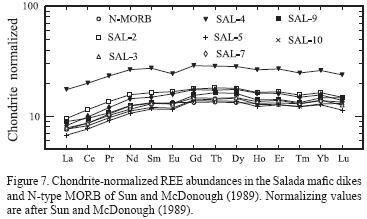
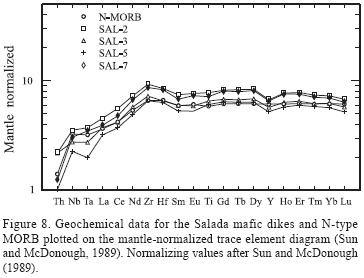
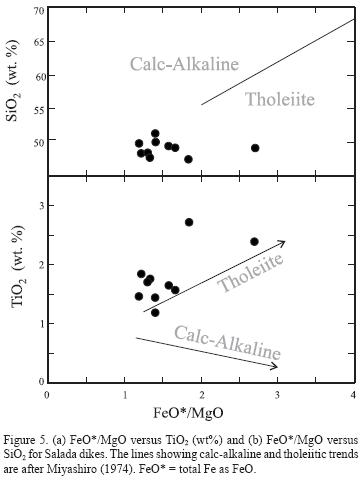
<body><![CDATA[<p align="justify"><font face="verdana" size="2"><b>GEOCHEMISTRY</b></font></p> 	    <p align="justify"><font face="verdana" size="2">Ten samples were analyzed for major and some trace elements (Rb, Sr, Ba, Ga, Zr, Y, Nb, V, Ni, Co and Cr) by X&#150;ray fluorescence spectrometry in the Department of Earth Sciences of University of Ottawa, Canada. Eight representative samples were selected from this set for analysis of other trace elements (rare&#150;earth elements &#91;REE&#93;, Th, Nb, Ta, Zr and Hf) by ICP&#150;MS at the Department of Earth Sciences, Memorial University of Newfoundland. The analytical error of the trace element determinations is 2&#150;10 % and &lt;2% for major elements. Where available, ICP&#150;MS data were preferred because of their better quality at low concentration levels.</font></p> 	    <p align="justify"><font face="verdana" size="2">Analytical results for these rocks are presented in <a href="/img/revistas/rmcg/v26n1/a11t1.jpg" target="_blank">Table 1</a>. The major and trace element compositions of these rocks are similar to those of modern volcanic rocks. This suggests that the rocks are the metamorphic equivalents of such rocks and that they retain, to a large degree, their magmatic composition. Unlike sedimentary rocks, they have high Cr/Th (&gt;400) and low Th/La (&lt;0.1) ratios (Rollinson, 1993), and according to a procedure of Leake (1964), they resemble metamorphosed basalts. The rocks have a composition corresponding to subalkaline basalts (<a href="/img/revistas/rmcg/v26n1/a11f4.jpg" target="_blank">Figure 4</a>) with SiO<sub>2</sub> (volatile&#150;free basis) ranging between 47.5 and 51.5 wt. % and Mg# (=Mg/Mg+Fe<sub>tot</sub>) between 0.40 and 0.60, and display tholeiitic characteristics (<a href="#f5">Figure 5</a>). According to their normative compositions, the rocks are mostly olivine&#150;normative tholeiites. Cr and Ti abundances are typical of rift&#150;related tholeiites (<a href="/img/revistas/rmcg/v26n1/a11f6.jpg" target="_blank">Figure 6</a>). The chondrite&#150;normalized REE patterns of most of the rocks show a minor depletion of light REE (<a href="#f7">Figure 7</a>) and their patterns are similar to N&#150;type MORB with (La/Sm)<sub>n</sub> mostly &#126;0.5&#150;0.6. The absolute concentration of REE varies slightly but the shape of the patterns remains the same: these variations are consistent with low&#150;pressure fractional crystallization. The mantle&#150;normalized trace element patterns of the rocks (<a href="#f8">Figure 8</a>) are relatively flat without a Nb depletion relative to La and Th suggesting that the rocks have not been modified by subduction&#150;related fluids and that the rocks were not significantly contaminated by crustal material. The absence of a Nb anomaly and a low Th/La ratio suggest an asthenospheric source without any suprasubduction imprint or crustal contamination. The high Ti and Cr content also rules out formation in an arc environment. The rocks resemble N&#150;type MORB. The geochemical characteristics suggest that the rocks are either rift&#150;related oceanic basalts or continental tholeiite emplaced in rather thin crust without significant crustal contamination: the latter is most likely as the mafic dikes intrude continentally&#150;derived clastic rocks.</font></p> 	    <p align="center"><font face="verdana" size="2"><a name="f5"></a></font></p> 	    <p align="center"><font face="verdana" size="2"><img src="/img/revistas/rmcg/v26n1/a11f5.jpg"></font></p> 	    <p align="center"><font face="verdana" size="2">&nbsp;</font></p> 	    <p align="center"><font face="verdana" size="2"><a name="f7"></a></font></p> 	    <p align="center"><font face="verdana" size="2"><img src="/img/revistas/rmcg/v26n1/a11f7.jpg"></font></p> 	    <p align="center"><font face="verdana" size="2">&nbsp;</font></p> 	    <p align="center"><font face="verdana" size="2"><a name="f8"></a></font></p> 	    ]]></body>
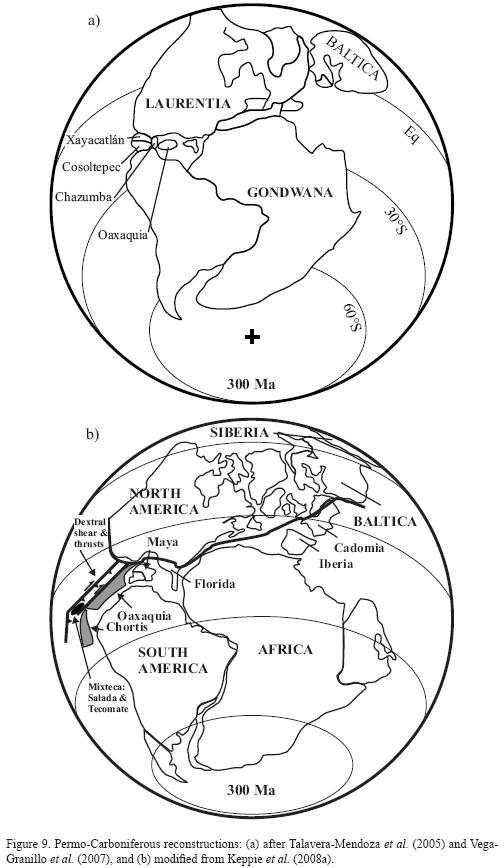
<body><![CDATA[<p align="center"><font face="verdana" size="2"><img src="/img/revistas/rmcg/v26n1/a11f8.jpg"></font></p> 	    <p align="justify"><font face="verdana" size="2">&nbsp;</font></p> 	    <p align="justify"><font face="verdana" size="2"><b>DISCUSSION</b></font></p> 	    <p align="justify"><font face="verdana" size="2">The Carboniferous, rift&#150;related tholeiitic dikes in the Xatacatl&aacute;n area may be correlated with within&#150;plate, rift&#150;related tholeiitic pillow basalts interbedded with clastic metasedimentary rocks (Coatlaco unit) in the western part of the Acatl&aacute;n Complex, which have yielded a 357 &plusmn; 35 Ma detrital zircon age (Grodzicki <i>et al.</i>, 2008). Deposition of the Salada and Coatlaco units was also contemporaneous with deposition of the Patlanoaya Group, which, in turn, was synchronous with exhumation and deformation of high&#150;pressure rocks (Ramos&#150;Arias <i>et al.</i>, 2008), and the earliest deformation of the Salada unit (Morales&#150;G&aacute;mez <i>et al.</i>, in press). This deformation has been related to extrusion of the high&#150;pressure rocks into the upper plate above an active subduction zone (Keppie <i>et al.</i>, 2008a).</font></p> 	    <p align="justify"><font face="verdana" size="2">Talavera&#150;Mendoza <i>et al.</i> (2005) and Vega&#150;Granillo <i>et al.</i> (2007) place the Mixteca terrane in the collisional suture zone between southern Laurentia and Gondwana (<a href="#f9">Figure 9a</a>). That this collision had already taken place by the Mississippian is suggested by the presence of shallow water Mid&#150;Continent (USA) fauna in the Santiago Formation that lies above the &#126;1 Ga Oaxacan Complex in the adjacent Oaxaquia terrane (Navarro&#150;Santillan <i>et al.</i>, 2002). Although the presence of Carboniferous, within&#150;plate, rift&#150;related tholeiites could be explained by gravitational collapse of a collisional orogen, it is inconsistent with paleomagnetic data, which indicate that, in the Permian, the Mixteca terrane lay roughly at its present position relative to Laurentia (Alva&#150;Valdivia <i>et al.</i>, 2002). The latter position places the Mixteca terrane on the Pacific margin of Pangea (<a href="#f9">Figure 9b</a>). On the other hand, Carboniferous rift&#150;related tholeiites synchronous with deformation, and extrusion of high&#150;pressure rocks in an active margin setting, is more consistent with a location along the western margin of Pangea, well south of the Laurentia&#150;Gondwana suture zone (<a href="#f9">Figure 9b</a>) (Elias&#150;Herrera and Ortega&#150;Guti&eacute;rrez, 2002; Keppie <i>et al.</i>, 2008a).</font></p> 	    <p align="center"><font face="verdana" size="2"><a name="f9"></a></font></p> 	    <p align="center"><font face="verdana" size="2"><img src="/img/revistas/rmcg/v26n1/a11f9.jpg"></font></p> 	    <p align="justify"><font face="verdana" size="2">&nbsp;</font></p> 	    <p align="justify"><font face="verdana" size="2"><b>ACKNOWLEDGMENTS</b></font></p> 	    <p align="justify"><font face="verdana" size="2">We would like to acknowledge a PAPIIT grant (IN100108&#150;3) and a CONACyT grant (CB&#150;2005&#150;1: 24894) to JDK and a NSERC discovery grant to JDS that facilitated the fieldwork and chemical analyses. CONACyT contributed to studies for MMG. We are grateful to Dr. J.B. Murphy for detailed reviews that have allowed for improvement of the manuscript.</font></p> 	    ]]></body>
<body><![CDATA[<p align="justify"><font face="verdana" size="2">&nbsp;</font></p> 	    <p align="justify"><font face="verdana" size="2"><b>REFERENCES</b></font></p> 	    <!-- ref --><p align="justify"><font face="verdana" size="2">Alva&#150;Valdivia, L.M., Goguitchaichvli, A., Grajales, M., Flores de Dios, A., Urrutia&#150;Fucugauchi, J., Rosales C., Morales, J., 2002, Further constraints for Permo&#150;Carboniferous magnetostratigraphy: case study of the sedimentary sequence from San Salvador&#150;Patlanoaya (Mexico): Compte Rendus Geoscience, 334, 1&#150;7.</font>&nbsp;&nbsp;&nbsp;&nbsp;&nbsp;&nbsp;&nbsp;&nbsp;[&#160;<a href="javascript:void(0);" onclick="javascript: window.open('/scielo.php?script=sci_nlinks&ref=8031137&pid=S1026-8774200900010001100001&lng=','','width=640,height=500,resizable=yes,scrollbars=1,menubar=yes,');">Links</a>&#160;]<!-- end-ref --> 				    <!-- ref --><p align="justify"><font face="verdana" size="2">Cerca, M., Ferrari, L., Lopez, M., Martiny, B. Iriondo, A., 2007, Late Cretaceous shortening and early Tertiary shearing in the central Sierra Madre del Sur, southern Mexico: Insights into the evolution of the Caribbean&#150;North American plate interaction: Tectonics, 26, TC3007, doi:10.1029/2006TC001981.</font>&nbsp;&nbsp;&nbsp;&nbsp;&nbsp;&nbsp;&nbsp;&nbsp;[&#160;<a href="javascript:void(0);" onclick="javascript: window.open('/scielo.php?script=sci_nlinks&ref=8031139&pid=S1026-8774200900010001100002&lng=','','width=640,height=500,resizable=yes,scrollbars=1,menubar=yes,');">Links</a>&#160;]<!-- end-ref --> 				    <!-- ref --><p align="justify"><font face="verdana" size="2">El&iacute;as&#150;Herrera, M., Ortega&#150;Guti&eacute;rrez, F., 2002, Caltepec fault zone: an Early Permian dextral transpressional boundary between the Proterozoic Oaxacan and Paleozoic Acatl&aacute;n complexes, southern Mexico, and regional implications: Tectonics, 21(3), 10.1029/200TC001278.</font>&nbsp;&nbsp;&nbsp;&nbsp;&nbsp;&nbsp;&nbsp;&nbsp;[&#160;<a href="javascript:void(0);" onclick="javascript: window.open('/scielo.php?script=sci_nlinks&ref=8031141&pid=S1026-8774200900010001100003&lng=','','width=640,height=500,resizable=yes,scrollbars=1,menubar=yes,');">Links</a>&#160;]<!-- end-ref --> 				    <!-- ref --><p align="justify"><font face="verdana" size="2">G&oacute;mez&#150;Tuena, A., Langmuir, C.H., Goldstein, S.L., Straub, S.M., Ortega&#150;Guti&eacute;rrez, F., 2007, Geochemical evidence for slab&#150;melting in the Trans&#150;Mexican Volcanic Belt: Journal of Petrology, 48(3), 537&#150;562.</font>&nbsp;&nbsp;&nbsp;&nbsp;&nbsp;&nbsp;&nbsp;&nbsp;[&#160;<a href="javascript:void(0);" onclick="javascript: window.open('/scielo.php?script=sci_nlinks&ref=8031143&pid=S1026-8774200900010001100004&lng=','','width=640,height=500,resizable=yes,scrollbars=1,menubar=yes,');">Links</a>&#160;]<!-- end-ref --> 				    ]]></body>
<body><![CDATA[<!-- ref --><p align="justify"><font face="verdana" size="2">Grodzicki, K.R., Nance, J.D., Keppie, J.D., Dostal, J., Murphy, J.B., 2008, Structural, geochemical and geochronological analysis of metasedimentary and metavolcanic rocks of the Coatlaco area, Acatl&aacute;n Complex, southern Mexico: Tectonophysics. doi:10.1016/j.tecto.2008.01.016.</font>&nbsp;&nbsp;&nbsp;&nbsp;&nbsp;&nbsp;&nbsp;&nbsp;[&#160;<a href="javascript:void(0);" onclick="javascript: window.open('/scielo.php?script=sci_nlinks&ref=8031145&pid=S1026-8774200900010001100005&lng=','','width=640,height=500,resizable=yes,scrollbars=1,menubar=yes,');">Links</a>&#160;]<!-- end-ref --> 				    <!-- ref --><p align="justify"><font face="verdana" size="2">Hinojosa&#150;Prieto, H.R., Nance, R.D., Keppie, J.D., Dostal, J.V., Ortega&#150;Rivera, A., Lee, J.K.W., 2008, Ordovician and Late Paleozoic&#150;Early Mesozoic tectonothermal history of the La Noria area, northern Acatl&aacute;n Complex, southern Mexico: Record of convergence in the Rheic and paleo&#150;Pacific Oceans: Tectonophysics. doi: 10.1016/j.tecto.2008.06.002</font>&nbsp;&nbsp;&nbsp;&nbsp;&nbsp;&nbsp;&nbsp;&nbsp;[&#160;<a href="javascript:void(0);" onclick="javascript: window.open('/scielo.php?script=sci_nlinks&ref=8031147&pid=S1026-8774200900010001100006&lng=','','width=640,height=500,resizable=yes,scrollbars=1,menubar=yes,');">Links</a>&#160;]<!-- end-ref --> 				    <!-- ref --><p align="justify"><font face="verdana" size="2">Keppie, J.D., 2004, Terranes of Mexico revisited: a 1.3 billion year odyssey: International Geology Review, 46, 765&#150;794.</font>&nbsp;&nbsp;&nbsp;&nbsp;&nbsp;&nbsp;&nbsp;&nbsp;[&#160;<a href="javascript:void(0);" onclick="javascript: window.open('/scielo.php?script=sci_nlinks&ref=8031149&pid=S1026-8774200900010001100007&lng=','','width=640,height=500,resizable=yes,scrollbars=1,menubar=yes,');">Links</a>&#160;]<!-- end-ref --> 				    <!-- ref --><p align="justify"><font face="verdana" size="2">Keppie, J.D., Dostal, J., and Elias&#150;Herrera, M., 2007, Ordovician&#150;Devonian oceanic basalts in the Cosoltepec Formation, Acatl&aacute;n Complex, Mixteca terrane, southern Mexico: vestiges of the Rheic Ocean, <i>in</i> Linnemann, U., Kraft, P., Nance, R.D., Zulauf, G. (eds.), The Geology of Peri&#150;Gondwana: Geological Society of America, Special Paper 423, 477&#150;487.</font>&nbsp;&nbsp;&nbsp;&nbsp;&nbsp;&nbsp;&nbsp;&nbsp;[&#160;<a href="javascript:void(0);" onclick="javascript: window.open('/scielo.php?script=sci_nlinks&ref=8031151&pid=S1026-8774200900010001100008&lng=','','width=640,height=500,resizable=yes,scrollbars=1,menubar=yes,');">Links</a>&#160;]<!-- end-ref --> 				    <!-- ref --><p align="justify"><font face="verdana" size="2">Keppie, J.D., Dostal, J., Murphy, J.B., Nance, R.D., 2008a, Synthesis and tectonic interpretation of the westernmost Paleozoic Variscan orogen in southern Mexico: from rifted Rheic margin to active Pacific margin: Tectonophysics, doi:10.1016/j.tecto.2008.01.012.</font>&nbsp;&nbsp;&nbsp;&nbsp;&nbsp;&nbsp;&nbsp;&nbsp;[&#160;<a href="javascript:void(0);" onclick="javascript: window.open('/scielo.php?script=sci_nlinks&ref=8031153&pid=S1026-8774200900010001100009&lng=','','width=640,height=500,resizable=yes,scrollbars=1,menubar=yes,');">Links</a>&#160;]<!-- end-ref --> 				    ]]></body>
<body><![CDATA[<!-- ref --><p align="justify"><font face="verdana" size="2">Keppie, J.D., Dostal, J., Miller, B.V., Ramos&#150;Arias, M.A., Morales&#150;G&aacute;mez, M., Nance, R.D., Murphy, J.B., Ortega&#150;Rivera, A., Lee, J.W.K., Housh, T., Cooper, P., 2008b, Ordovician&#150;earliest Silurian rift tholeiites in the Acatl&aacute;n Complex, southern Mexico: evidence of rifting on the southern margin of the Rheic Ocean: Tectonophysics, doi:10.1016/j.tecto.2008.01.010.</font>&nbsp;&nbsp;&nbsp;&nbsp;&nbsp;&nbsp;&nbsp;&nbsp;[&#160;<a href="javascript:void(0);" onclick="javascript: window.open('/scielo.php?script=sci_nlinks&ref=8031155&pid=S1026-8774200900010001100010&lng=','','width=640,height=500,resizable=yes,scrollbars=1,menubar=yes,');">Links</a>&#160;]<!-- end-ref --> 				    <!-- ref --><p align="justify"><font face="verdana" size="2">Leake, B.E., 1964, The chemical distinction between ortho&#150; and paraamphibolites: Journal of Petrology, 5, 238&#150;254.</font>&nbsp;&nbsp;&nbsp;&nbsp;&nbsp;&nbsp;&nbsp;&nbsp;[&#160;<a href="javascript:void(0);" onclick="javascript: window.open('/scielo.php?script=sci_nlinks&ref=8031157&pid=S1026-8774200900010001100011&lng=','','width=640,height=500,resizable=yes,scrollbars=1,menubar=yes,');">Links</a>&#160;]<!-- end-ref --> 				    <!-- ref --><p align="justify"><font face="verdana" size="2">Miyashiro, A., 1974, Volcanic rock series in island arcs and active continental margins: American Journal of Science, 274, 321&#150;355.</font>&nbsp;&nbsp;&nbsp;&nbsp;&nbsp;&nbsp;&nbsp;&nbsp;[&#160;<a href="javascript:void(0);" onclick="javascript: window.open('/scielo.php?script=sci_nlinks&ref=8031159&pid=S1026-8774200900010001100012&lng=','','width=640,height=500,resizable=yes,scrollbars=1,menubar=yes,');">Links</a>&#160;]<!-- end-ref --> 				    <!-- ref --><p align="justify"><font face="verdana" size="2">Morales&#150;G&aacute;mez, M., Keppie, J. D., Norman, M., 2008, Ordovician&#150;Silurian rift&#150;passive margin on the Mexican margin of the Rheic Ocean overlain by Permian periarc rocks: evidence from the Acatl&aacute;n Complex, southern Mexico: Tectonophysics. doi:10.1016/j.tecto.2008.01.014.</font>&nbsp;&nbsp;&nbsp;&nbsp;&nbsp;&nbsp;&nbsp;&nbsp;[&#160;<a href="javascript:void(0);" onclick="javascript: window.open('/scielo.php?script=sci_nlinks&ref=8031161&pid=S1026-8774200900010001100013&lng=','','width=640,height=500,resizable=yes,scrollbars=1,menubar=yes,');">Links</a>&#160;]<!-- end-ref --> 				    <!-- ref --><p align="justify"><font face="verdana" size="2">Morales&#150;G&aacute;mez, M., Keppie, J.D., Ortega&#150;Rivera, A., Lee, J.W.K., in press, Paleozoic structures in the Xayacatl&aacute;n area, Acatl&aacute;n Complex, southern Mexico: transtensional rift&#150; and subduction&#150;related deformation along the margin of Oaxaquia: International Geology Review.</font>&nbsp;&nbsp;&nbsp;&nbsp;&nbsp;&nbsp;&nbsp;&nbsp;[&#160;<a href="javascript:void(0);" onclick="javascript: window.open('/scielo.php?script=sci_nlinks&ref=8031163&pid=S1026-8774200900010001100014&lng=','','width=640,height=500,resizable=yes,scrollbars=1,menubar=yes,');">Links</a>&#160;]<!-- end-ref --> 				    ]]></body>
<body><![CDATA[<!-- ref --><p align="justify"><font face="verdana" size="2">Navarro&#150;Santillan, D., Sour&#150;Tovar, F., Centeno&#150;Garc&iacute;a E., 2002, Lower Mississippian (Osagean) brachiopods from the Santiago Formation, Oaxaca, Mexico: stratigraphic and tectonic implications: Journal of South American Earth Sciences, 15(3), 327&#150;336.</font>&nbsp;&nbsp;&nbsp;&nbsp;&nbsp;&nbsp;&nbsp;&nbsp;[&#160;<a href="javascript:void(0);" onclick="javascript: window.open('/scielo.php?script=sci_nlinks&ref=8031165&pid=S1026-8774200900010001100015&lng=','','width=640,height=500,resizable=yes,scrollbars=1,menubar=yes,');">Links</a>&#160;]<!-- end-ref --> 				    <!-- ref --><p align="justify"><font face="verdana" size="2">Ortega&#150;Guti&eacute;rrez, F., El&iacute;as&#150;Herrera, M., Reyes&#150;Salas, M., Mac&iacute;as&#150;Romo, C., L&oacute;pez, R., 1999, Late Ordovician&#150;Early Silurian continental collision orogeny in southern Mexico and its bearing on Gondwana&#150;Laurentia connections: Geology, 27, 719&#150;722.</font>&nbsp;&nbsp;&nbsp;&nbsp;&nbsp;&nbsp;&nbsp;&nbsp;[&#160;<a href="javascript:void(0);" onclick="javascript: window.open('/scielo.php?script=sci_nlinks&ref=8031167&pid=S1026-8774200900010001100016&lng=','','width=640,height=500,resizable=yes,scrollbars=1,menubar=yes,');">Links</a>&#160;]<!-- end-ref --> 				    <!-- ref --><p align="justify"><font face="verdana" size="2">Pearce, J. A., 1975, Basalt geochemistry used to investigate past tectonic settings on Cyprus: Tectonophysics, 25, 41&#150;67.</font>&nbsp;&nbsp;&nbsp;&nbsp;&nbsp;&nbsp;&nbsp;&nbsp;[&#160;<a href="javascript:void(0);" onclick="javascript: window.open('/scielo.php?script=sci_nlinks&ref=8031169&pid=S1026-8774200900010001100017&lng=','','width=640,height=500,resizable=yes,scrollbars=1,menubar=yes,');">Links</a>&#160;]<!-- end-ref --> 				    <!-- ref --><p align="justify"><font face="verdana" size="2">Ramos&#150;Arias, M.A., Keppie, J.D., Ortega&#150;Rivera, A., Lee, J.W.K., 2008, Extensional late Paleozoic deformation on the western margin of Pangea, Patlanoaya area, Acatl&aacute;n Complex, southern Mexico: Tectonophysics, 448, 60&#150;78.</font>&nbsp;&nbsp;&nbsp;&nbsp;&nbsp;&nbsp;&nbsp;&nbsp;[&#160;<a href="javascript:void(0);" onclick="javascript: window.open('/scielo.php?script=sci_nlinks&ref=8031171&pid=S1026-8774200900010001100018&lng=','','width=640,height=500,resizable=yes,scrollbars=1,menubar=yes,');">Links</a>&#160;]<!-- end-ref --> 				    <!-- ref --><p align="justify"><font face="verdana" size="2">Rollinson, H. R., 1993, Using Geochemical Data: Evaluation, Presentation, Interpretation: Longman, UK, 352 p.</font>&nbsp;&nbsp;&nbsp;&nbsp;&nbsp;&nbsp;&nbsp;&nbsp;[&#160;<a href="javascript:void(0);" onclick="javascript: window.open('/scielo.php?script=sci_nlinks&ref=8031173&pid=S1026-8774200900010001100019&lng=','','width=640,height=500,resizable=yes,scrollbars=1,menubar=yes,');">Links</a>&#160;]<!-- end-ref --> 				    ]]></body>
<body><![CDATA[<!-- ref --><p align="justify"><font face="verdana" size="2">Solari, L. A., Torres&#150;de Le&oacute;n, R., Hern&aacute;ndez&#150;Pineda, G., Sol&eacute;, J., Sol&iacute;s&#150;Pichardo, G., Hern&aacute;ndez&#150;Trevi&ntilde;o, T., 2007, Tectonic significance of Cretaceous&#150;Tertiary magmatic and structural evolution of the northern margin of the Xolapa Complex, Tierra Colorada area, southern Mexico: Geological Society of America Bulletin, 119, 1265&#150;1279.</font>&nbsp;&nbsp;&nbsp;&nbsp;&nbsp;&nbsp;&nbsp;&nbsp;[&#160;<a href="javascript:void(0);" onclick="javascript: window.open('/scielo.php?script=sci_nlinks&ref=8031175&pid=S1026-8774200900010001100020&lng=','','width=640,height=500,resizable=yes,scrollbars=1,menubar=yes,');">Links</a>&#160;]<!-- end-ref --> 				    <!-- ref --><p align="justify"><font face="verdana" size="2">Sun, S. S., McDonough, W.F., 1989, Chemical and isotopic systematics of oceanic basalts: implications for mantle composition and processes, <i>in</i> Saunders, A.D., Norry, M.J. (eds.), Magmatism in the Ocean Basins: Geological Society of London, Special Publication 42, 313&#150;345.</font>&nbsp;&nbsp;&nbsp;&nbsp;&nbsp;&nbsp;&nbsp;&nbsp;[&#160;<a href="javascript:void(0);" onclick="javascript: window.open('/scielo.php?script=sci_nlinks&ref=8031177&pid=S1026-8774200900010001100021&lng=','','width=640,height=500,resizable=yes,scrollbars=1,menubar=yes,');">Links</a>&#160;]<!-- end-ref --> 				    <!-- ref --><p align="justify"><font face="verdana" size="2">Talavera&#150;Mendoza, O., Ruiz, J., Gehrels, G. E., Meza&#150;Figueroa, D.M., Vega&#150;Granillo, R., Campa&#150;Uranga, M. F., 2005, U&#150;Pb geochronology of the Acatl&aacute;n Complex and implications for the Paleozoic paleogeography and tectonic evolution of southern Mexico: Earth and Planetary Science Letters, 235, 682&#150;699.</font>&nbsp;&nbsp;&nbsp;&nbsp;&nbsp;&nbsp;&nbsp;&nbsp;[&#160;<a href="javascript:void(0);" onclick="javascript: window.open('/scielo.php?script=sci_nlinks&ref=8031179&pid=S1026-8774200900010001100022&lng=','','width=640,height=500,resizable=yes,scrollbars=1,menubar=yes,');">Links</a>&#160;]<!-- end-ref --> 				    <!-- ref --><p align="justify"><font face="verdana" size="2">Tolson, G., 2007, The Chacalapa fault, southern Oaxaca, Mexico, <i>in</i> Alaniz&#150;&Aacute;lvarez, S.A., Nieto&#150;Samaniego, &Aacute;.F. (eds.), Geology of Mexico: Celebrating the Centenary of the Geological Society of Mexico: Geological Society of America, Special Paper 422, 343&#150;357, doi: 10.1130/2007.2422(12).</font>&nbsp;&nbsp;&nbsp;&nbsp;&nbsp;&nbsp;&nbsp;&nbsp;[&#160;<a href="javascript:void(0);" onclick="javascript: window.open('/scielo.php?script=sci_nlinks&ref=8031181&pid=S1026-8774200900010001100023&lng=','','width=640,height=500,resizable=yes,scrollbars=1,menubar=yes,');">Links</a>&#160;]<!-- end-ref --> 				    <!-- ref --><p align="justify"><font face="verdana" size="2">Vega&#150;Granillo, R., Talavera&#150;Mendoza, O., Meza&#150;Figueroa, D., Ruiz, J., Gehrels, G.E., L&oacute;pez&#150;Mart&iacute;nez, M., de la Cruz&#150;Vargas, J.C., 2007, Pressure&#150;temperature&#150;time evolution of Paleozoic high&#150;pressure rocks of the Acatl&aacute;n Complex (southern Mexico): implications for the evolution of the Iapetus and Rheic Oceans: Geological Society of America Bulletin, 119, 1249&#150;1264.</font>&nbsp;&nbsp;&nbsp;&nbsp;&nbsp;&nbsp;&nbsp;&nbsp;[&#160;<a href="javascript:void(0);" onclick="javascript: window.open('/scielo.php?script=sci_nlinks&ref=8031183&pid=S1026-8774200900010001100024&lng=','','width=640,height=500,resizable=yes,scrollbars=1,menubar=yes,');">Links</a>&#160;]<!-- end-ref --> 				    ]]></body>
<body><![CDATA[<!-- ref --><p align="justify"><font face="verdana" size="2">Winchester, J.A., Floyd, P.A., 1977, Geochemical discrimination of different magma series and their differentiation products using immobile elements: Chemical Geology, 20, 325&#150;343.</font>&nbsp;&nbsp;&nbsp;&nbsp;&nbsp;&nbsp;&nbsp;&nbsp;[&#160;<a href="javascript:void(0);" onclick="javascript: window.open('/scielo.php?script=sci_nlinks&ref=8031185&pid=S1026-8774200900010001100025&lng=','','width=640,height=500,resizable=yes,scrollbars=1,menubar=yes,');">Links</a>&#160;]<!-- end-ref --> ]]></body><back>
<ref-list>
<ref id="B1">
<nlm-citation citation-type="journal">
<person-group person-group-type="author">
<name>
<surname><![CDATA[Alva-Valdivia]]></surname>
<given-names><![CDATA[L.M.]]></given-names>
</name>
<name>
<surname><![CDATA[Goguitchaichvli]]></surname>
<given-names><![CDATA[A.]]></given-names>
</name>
<name>
<surname><![CDATA[Grajales]]></surname>
<given-names><![CDATA[M.]]></given-names>
</name>
<name>
<surname><![CDATA[Flores de Dios]]></surname>
<given-names><![CDATA[A.]]></given-names>
</name>
<name>
<surname><![CDATA[Urrutia-Fucugauchi]]></surname>
<given-names><![CDATA[J.]]></given-names>
</name>
<name>
<surname><![CDATA[Rosales]]></surname>
<given-names><![CDATA[C.]]></given-names>
</name>
<name>
<surname><![CDATA[Morales]]></surname>
<given-names><![CDATA[J.]]></given-names>
</name>
</person-group>
<article-title xml:lang="en"><![CDATA[Further constraints for Permo-Carboniferous magnetostratigraphy: case study of the sedimentary sequence from San Salvador-Patlanoaya (Mexico)]]></article-title>
<source><![CDATA[Compte Rendus Geoscience]]></source>
<year>2002</year>
<volume>334</volume>
<page-range>1-7</page-range></nlm-citation>
</ref>
<ref id="B2">
<nlm-citation citation-type="journal">
<person-group person-group-type="author">
<name>
<surname><![CDATA[Cerca]]></surname>
<given-names><![CDATA[M.]]></given-names>
</name>
<name>
<surname><![CDATA[Ferrari]]></surname>
<given-names><![CDATA[L.]]></given-names>
</name>
<name>
<surname><![CDATA[Lopez]]></surname>
<given-names><![CDATA[M.]]></given-names>
</name>
<name>
<surname><![CDATA[Martiny]]></surname>
<given-names><![CDATA[B.]]></given-names>
</name>
<name>
<surname><![CDATA[Iriondo]]></surname>
<given-names><![CDATA[A.]]></given-names>
</name>
</person-group>
<article-title xml:lang="en"><![CDATA[Late Cretaceous shortening and early Tertiary shearing in the central Sierra Madre del Sur, southern Mexico: Insights into the evolution of the Caribbean-North American plate interaction]]></article-title>
<source><![CDATA[Tectonics]]></source>
<year>2007</year>
<volume>26</volume>
</nlm-citation>
</ref>
<ref id="B3">
<nlm-citation citation-type="journal">
<person-group person-group-type="author">
<name>
<surname><![CDATA[Elías-Herrera]]></surname>
<given-names><![CDATA[M.]]></given-names>
</name>
<name>
<surname><![CDATA[Ortega-Gutiérrez]]></surname>
<given-names><![CDATA[F.]]></given-names>
</name>
</person-group>
<article-title xml:lang="en"><![CDATA[Caltepec fault zone: an Early Permian dextral transpressional boundary between the Proterozoic Oaxacan and Paleozoic Acatlán complexes, southern Mexico, and regional implications]]></article-title>
<source><![CDATA[Tectonics]]></source>
<year>2002</year>
<volume>21</volume>
<numero>3</numero>
<issue>3</issue>
</nlm-citation>
</ref>
<ref id="B4">
<nlm-citation citation-type="journal">
<person-group person-group-type="author">
<name>
<surname><![CDATA[Gómez-Tuena]]></surname>
<given-names><![CDATA[A]]></given-names>
</name>
<name>
<surname><![CDATA[Langmuir]]></surname>
<given-names><![CDATA[C.H]]></given-names>
</name>
<name>
<surname><![CDATA[Goldstein]]></surname>
<given-names><![CDATA[S.L]]></given-names>
</name>
<name>
<surname><![CDATA[Straub]]></surname>
<given-names><![CDATA[S.M]]></given-names>
</name>
<name>
<surname><![CDATA[Ortega-Gutiérrez]]></surname>
<given-names><![CDATA[F]]></given-names>
</name>
</person-group>
<article-title xml:lang="en"><![CDATA[Geochemical evidence for slab-melting in the Trans-Mexican Volcanic Belt]]></article-title>
<source><![CDATA[Journal of Petrology]]></source>
<year>2007</year>
<volume>48</volume>
<numero>3</numero>
<issue>3</issue>
<page-range>537-562</page-range></nlm-citation>
</ref>
<ref id="B5">
<nlm-citation citation-type="journal">
<person-group person-group-type="author">
<name>
<surname><![CDATA[Grodzicki]]></surname>
<given-names><![CDATA[K.R.]]></given-names>
</name>
<name>
<surname><![CDATA[Nance]]></surname>
<given-names><![CDATA[J.D.]]></given-names>
</name>
<name>
<surname><![CDATA[Keppie]]></surname>
<given-names><![CDATA[J.D.]]></given-names>
</name>
<name>
<surname><![CDATA[Dostal]]></surname>
<given-names><![CDATA[J.]]></given-names>
</name>
<name>
<surname><![CDATA[Murphy]]></surname>
<given-names><![CDATA[J.B.]]></given-names>
</name>
</person-group>
<article-title xml:lang="en"><![CDATA[Structural, geochemical and geochronological analysis of metasedimentary and metavolcanic rocks of the Coatlaco area, Acatlán Complex, southern Mexico]]></article-title>
<source><![CDATA[Tectonophysics]]></source>
<year>2008</year>
</nlm-citation>
</ref>
<ref id="B6">
<nlm-citation citation-type="journal">
<person-group person-group-type="author">
<name>
<surname><![CDATA[Hinojosa-Prieto]]></surname>
<given-names><![CDATA[H.R.]]></given-names>
</name>
<name>
<surname><![CDATA[Nance]]></surname>
<given-names><![CDATA[R.D.]]></given-names>
</name>
<name>
<surname><![CDATA[Keppie]]></surname>
<given-names><![CDATA[J.D.]]></given-names>
</name>
<name>
<surname><![CDATA[Dostal]]></surname>
<given-names><![CDATA[J.V.]]></given-names>
</name>
<name>
<surname><![CDATA[Ortega-Rivera]]></surname>
<given-names><![CDATA[A.]]></given-names>
</name>
<name>
<surname><![CDATA[Lee]]></surname>
<given-names><![CDATA[J.K.W.]]></given-names>
</name>
</person-group>
<article-title xml:lang="en"><![CDATA[Ordovician and Late Paleozoic-Early Mesozoic tectonothermal history of the La Noria area, northern Acatlán Complex, southern Mexico: Record of convergence in the Rheic and paleo-Pacific Oceans]]></article-title>
<source><![CDATA[Tectonophysics]]></source>
<year>2008</year>
</nlm-citation>
</ref>
<ref id="B7">
<nlm-citation citation-type="journal">
<person-group person-group-type="author">
<name>
<surname><![CDATA[Keppie]]></surname>
<given-names><![CDATA[J.D.]]></given-names>
</name>
</person-group>
<article-title xml:lang="en"><![CDATA[Terranes of Mexico revisited: a 1.3 billion year odyssey]]></article-title>
<source><![CDATA[International Geology Review]]></source>
<year>2004</year>
<volume>46</volume>
<page-range>765-794</page-range></nlm-citation>
</ref>
<ref id="B8">
<nlm-citation citation-type="journal">
<person-group person-group-type="author">
<name>
<surname><![CDATA[Keppie]]></surname>
<given-names><![CDATA[J.D.]]></given-names>
</name>
<name>
<surname><![CDATA[Dostal]]></surname>
<given-names><![CDATA[J.]]></given-names>
</name>
<name>
<surname><![CDATA[Elias-Herrera]]></surname>
<given-names><![CDATA[M.]]></given-names>
</name>
</person-group>
<article-title xml:lang="en"><![CDATA[Ordovician-Devonian oceanic basalts in the Cosoltepec Formation, Acatlán Complex, Mixteca terrane, southern Mexico: vestiges of the Rheic Ocean]]></article-title>
<person-group person-group-type="editor">
<name>
<surname><![CDATA[Linnemann]]></surname>
<given-names><![CDATA[U.]]></given-names>
</name>
<name>
<surname><![CDATA[Kraft]]></surname>
<given-names><![CDATA[P.]]></given-names>
</name>
<name>
<surname><![CDATA[Nance]]></surname>
<given-names><![CDATA[R.D.]]></given-names>
</name>
<name>
<surname><![CDATA[Zulauf]]></surname>
<given-names><![CDATA[G.]]></given-names>
</name>
</person-group>
<source><![CDATA[Geological Society of AmericaThe Geology of Peri-Gondwana]]></source>
<year>2007</year>
<volume>423</volume>
<numero>^sSpecial Paper</numero>
<issue>^sSpecial Paper</issue>
<supplement>Special Paper</supplement>
<page-range>477-487</page-range></nlm-citation>
</ref>
<ref id="B9">
<nlm-citation citation-type="journal">
<person-group person-group-type="author">
<name>
<surname><![CDATA[Keppie]]></surname>
<given-names><![CDATA[J.D.]]></given-names>
</name>
<name>
<surname><![CDATA[Dostal]]></surname>
<given-names><![CDATA[J.]]></given-names>
</name>
<name>
<surname><![CDATA[Murphy]]></surname>
<given-names><![CDATA[J.B.]]></given-names>
</name>
<name>
<surname><![CDATA[Nance]]></surname>
<given-names><![CDATA[R.D.]]></given-names>
</name>
</person-group>
<article-title xml:lang="en"><![CDATA[Synthesis and tectonic interpretation of the westernmost Paleozoic Variscan orogen in southern Mexico: from rifted Rheic margin to active Pacific margin]]></article-title>
<source><![CDATA[Tectonophysics]]></source>
<year>2008</year>
</nlm-citation>
</ref>
<ref id="B10">
<nlm-citation citation-type="journal">
<person-group person-group-type="author">
<name>
<surname><![CDATA[Keppie]]></surname>
<given-names><![CDATA[J.D.]]></given-names>
</name>
<name>
<surname><![CDATA[Dostal]]></surname>
<given-names><![CDATA[J.]]></given-names>
</name>
<name>
<surname><![CDATA[Miller]]></surname>
<given-names><![CDATA[B.V.]]></given-names>
</name>
<name>
<surname><![CDATA[Ramos-Arias]]></surname>
<given-names><![CDATA[M.A.]]></given-names>
</name>
<name>
<surname><![CDATA[Morales-Gámez]]></surname>
<given-names><![CDATA[M.]]></given-names>
</name>
<name>
<surname><![CDATA[Nance]]></surname>
<given-names><![CDATA[R.D.]]></given-names>
</name>
<name>
<surname><![CDATA[Murphy]]></surname>
<given-names><![CDATA[J.B.]]></given-names>
</name>
<name>
<surname><![CDATA[Ortega-Rivera]]></surname>
<given-names><![CDATA[A.]]></given-names>
</name>
<name>
<surname><![CDATA[Lee]]></surname>
<given-names><![CDATA[J.W.K.]]></given-names>
</name>
<name>
<surname><![CDATA[Housh]]></surname>
<given-names><![CDATA[T.]]></given-names>
</name>
<name>
<surname><![CDATA[Cooper]]></surname>
<given-names><![CDATA[P.]]></given-names>
</name>
</person-group>
<article-title xml:lang="en"><![CDATA[Ordovician-earliest Silurian rift tholeiites in the Acatlán Complex, southern Mexico: evidence of rifting on the southern margin of the Rheic Ocean]]></article-title>
<source><![CDATA[Tectonophysics]]></source>
<year>2008</year>
</nlm-citation>
</ref>
<ref id="B11">
<nlm-citation citation-type="journal">
<person-group person-group-type="author">
<name>
<surname><![CDATA[Leake]]></surname>
<given-names><![CDATA[B.E]]></given-names>
</name>
</person-group>
<article-title xml:lang="en"><![CDATA[The chemical distinction between ortho- and paraamphibolites]]></article-title>
<source><![CDATA[Journal of Petrology]]></source>
<year>1964</year>
<volume>5</volume>
<page-range>238-254</page-range></nlm-citation>
</ref>
<ref id="B12">
<nlm-citation citation-type="journal">
<person-group person-group-type="author">
<name>
<surname><![CDATA[Miyashiro]]></surname>
<given-names><![CDATA[A]]></given-names>
</name>
</person-group>
<article-title xml:lang="en"><![CDATA[Volcanic rock series in island arcs and active continental margins]]></article-title>
<source><![CDATA[American Journal of Science]]></source>
<year>1974</year>
<volume>274</volume>
<page-range>321-355</page-range></nlm-citation>
</ref>
<ref id="B13">
<nlm-citation citation-type="journal">
<person-group person-group-type="author">
<name>
<surname><![CDATA[Morales-Gámez]]></surname>
<given-names><![CDATA[M.]]></given-names>
</name>
<name>
<surname><![CDATA[Keppie]]></surname>
<given-names><![CDATA[J. D.]]></given-names>
</name>
<name>
<surname><![CDATA[Norman]]></surname>
<given-names><![CDATA[M.]]></given-names>
</name>
</person-group>
<article-title xml:lang="en"><![CDATA[Ordovician-Silurian rift-passive margin on the Mexican margin of the Rheic Ocean overlain by Permian periarc rocks: evidence from the Acatlán Complex, southern Mexico]]></article-title>
<source><![CDATA[Tectonophysics]]></source>
<year>2008</year>
</nlm-citation>
</ref>
<ref id="B14">
<nlm-citation citation-type="journal">
<person-group person-group-type="author">
<name>
<surname><![CDATA[Morales-Gámez]]></surname>
<given-names><![CDATA[M.]]></given-names>
</name>
<name>
<surname><![CDATA[Keppie]]></surname>
<given-names><![CDATA[J.D.]]></given-names>
</name>
<name>
<surname><![CDATA[Ortega-Rivera]]></surname>
<given-names><![CDATA[A.]]></given-names>
</name>
<name>
<surname><![CDATA[Lee]]></surname>
<given-names><![CDATA[J.W.K.]]></given-names>
</name>
</person-group>
<article-title xml:lang="en"><![CDATA[Paleozoic structures in the Xayacatlán area, Acatlán Complex, southern Mexico: transtensional rift- and subduction-related deformation along the margin of Oaxaquia]]></article-title>
<source><![CDATA[International Geology Review]]></source>
<year></year>
</nlm-citation>
</ref>
<ref id="B15">
<nlm-citation citation-type="journal">
<person-group person-group-type="author">
<name>
<surname><![CDATA[Navarro-Santillan]]></surname>
<given-names><![CDATA[D.]]></given-names>
</name>
<name>
<surname><![CDATA[Sour-Tovar]]></surname>
<given-names><![CDATA[F.]]></given-names>
</name>
<name>
<surname><![CDATA[Centeno-García]]></surname>
<given-names><![CDATA[E.]]></given-names>
</name>
</person-group>
<article-title xml:lang="en"><![CDATA[Lower Mississippian (Osagean) brachiopods from the Santiago Formation, Oaxaca, Mexico: stratigraphic and tectonic implications]]></article-title>
<source><![CDATA[Journal of South American Earth Sciences]]></source>
<year>2002</year>
<volume>15</volume>
<numero>3</numero>
<issue>3</issue>
<page-range>327-336</page-range></nlm-citation>
</ref>
<ref id="B16">
<nlm-citation citation-type="journal">
<person-group person-group-type="author">
<name>
<surname><![CDATA[Ortega-Gutiérrez]]></surname>
<given-names><![CDATA[F]]></given-names>
</name>
<name>
<surname><![CDATA[Elías-Herrera]]></surname>
<given-names><![CDATA[M]]></given-names>
</name>
<name>
<surname><![CDATA[Reyes-Salas]]></surname>
<given-names><![CDATA[M]]></given-names>
</name>
<name>
<surname><![CDATA[Macías-Romo]]></surname>
<given-names><![CDATA[C]]></given-names>
</name>
<name>
<surname><![CDATA[López]]></surname>
<given-names><![CDATA[R]]></given-names>
</name>
</person-group>
<article-title xml:lang="en"><![CDATA[Late Ordovician-Early Silurian continental collision orogeny in southern Mexico and its bearing on Gondwana-Laurentia connections]]></article-title>
<source><![CDATA[Geology]]></source>
<year>1999</year>
<volume>27</volume>
<page-range>719-722</page-range></nlm-citation>
</ref>
<ref id="B17">
<nlm-citation citation-type="journal">
<person-group person-group-type="author">
<name>
<surname><![CDATA[Pearce]]></surname>
<given-names><![CDATA[J. A]]></given-names>
</name>
</person-group>
<article-title xml:lang="en"><![CDATA[Basalt geochemistry used to investigate past tectonic settings on Cyprus]]></article-title>
<source><![CDATA[Tectonophysics]]></source>
<year>1975</year>
<volume>25</volume>
<page-range>41-67</page-range></nlm-citation>
</ref>
<ref id="B18">
<nlm-citation citation-type="journal">
<person-group person-group-type="author">
<name>
<surname><![CDATA[Ramos-Arias]]></surname>
<given-names><![CDATA[M.A]]></given-names>
</name>
<name>
<surname><![CDATA[Keppie]]></surname>
<given-names><![CDATA[J.D]]></given-names>
</name>
<name>
<surname><![CDATA[Ortega-Rivera]]></surname>
<given-names><![CDATA[A]]></given-names>
</name>
<name>
<surname><![CDATA[Lee]]></surname>
<given-names><![CDATA[J.W.K]]></given-names>
</name>
</person-group>
<article-title xml:lang="en"><![CDATA[Extensional late Paleozoic deformation on the western margin of Pangea, Patlanoaya area, Acatlán Complex, southern Mexico]]></article-title>
<source><![CDATA[Tectonophysics]]></source>
<year>2008</year>
<volume>448</volume>
<page-range>60-78</page-range></nlm-citation>
</ref>
<ref id="B19">
<nlm-citation citation-type="">
<person-group person-group-type="author">
<name>
<surname><![CDATA[Rollinson]]></surname>
<given-names><![CDATA[H. R.]]></given-names>
</name>
</person-group>
<source><![CDATA[Using Geochemical Data: Evaluation, Presentation, Interpretation]]></source>
<year>1993</year>
<page-range>352</page-range><publisher-loc><![CDATA[Longman ]]></publisher-loc>
</nlm-citation>
</ref>
<ref id="B20">
<nlm-citation citation-type="journal">
<person-group person-group-type="author">
<name>
<surname><![CDATA[Solari]]></surname>
<given-names><![CDATA[L. A.]]></given-names>
</name>
<name>
<surname><![CDATA[Torres-de León]]></surname>
<given-names><![CDATA[R.]]></given-names>
</name>
<name>
<surname><![CDATA[Hernández-Pineda]]></surname>
<given-names><![CDATA[G.]]></given-names>
</name>
<name>
<surname><![CDATA[Solé]]></surname>
<given-names><![CDATA[J.]]></given-names>
</name>
<name>
<surname><![CDATA[Solís-Pichardo]]></surname>
<given-names><![CDATA[G.]]></given-names>
</name>
<name>
<surname><![CDATA[Hernández-Treviño]]></surname>
<given-names><![CDATA[T.]]></given-names>
</name>
</person-group>
<article-title xml:lang="en"><![CDATA[Tectonic significance of Cretaceous-Tertiary magmatic and structural evolution of the northern margin of the Xolapa Complex, Tierra Colorada area, southern Mexico]]></article-title>
<source><![CDATA[Geological Society of America Bulletin]]></source>
<year>2007</year>
<volume>119</volume>
<page-range>1265-1279</page-range></nlm-citation>
</ref>
<ref id="B21">
<nlm-citation citation-type="book">
<person-group person-group-type="author">
<name>
<surname><![CDATA[Sun]]></surname>
<given-names><![CDATA[S. S.]]></given-names>
</name>
<name>
<surname><![CDATA[McDonough]]></surname>
<given-names><![CDATA[W.F.]]></given-names>
</name>
</person-group>
<article-title xml:lang="en"><![CDATA[Chemical and isotopic systematics of oceanic basalts: implications for mantle composition and processes]]></article-title>
<person-group person-group-type="editor">
<name>
<surname><![CDATA[Saunders]]></surname>
<given-names><![CDATA[A.D]]></given-names>
</name>
<name>
<surname><![CDATA[Norry]]></surname>
<given-names><![CDATA[M.J]]></given-names>
</name>
</person-group>
<source><![CDATA[Magmatism in the Ocean Basins]]></source>
<year>1989</year>
<volume>42</volume>
<page-range>313-345</page-range><publisher-name><![CDATA[Geological Society of London]]></publisher-name>
</nlm-citation>
</ref>
<ref id="B22">
<nlm-citation citation-type="journal">
<person-group person-group-type="author">
<name>
<surname><![CDATA[Talavera-Mendoza]]></surname>
<given-names><![CDATA[O]]></given-names>
</name>
<name>
<surname><![CDATA[Ruiz]]></surname>
<given-names><![CDATA[J]]></given-names>
</name>
<name>
<surname><![CDATA[Gehrels]]></surname>
<given-names><![CDATA[G. E]]></given-names>
</name>
<name>
<surname><![CDATA[Meza-Figueroa]]></surname>
<given-names><![CDATA[D.M]]></given-names>
</name>
<name>
<surname><![CDATA[Vega-Granillo]]></surname>
<given-names><![CDATA[R]]></given-names>
</name>
<name>
<surname><![CDATA[Campa-Uranga]]></surname>
<given-names><![CDATA[M. F]]></given-names>
</name>
</person-group>
<article-title xml:lang="en"><![CDATA[U-Pb geochronology of the Acatlán Complex and implications for the Paleozoic paleogeography and tectonic evolution of southern Mexico]]></article-title>
<source><![CDATA[Earth and Planetary Science Letters]]></source>
<year>2005</year>
<volume>235</volume>
<page-range>682-699</page-range></nlm-citation>
</ref>
<ref id="B23">
<nlm-citation citation-type="book">
<person-group person-group-type="author">
<name>
<surname><![CDATA[Tolson]]></surname>
<given-names><![CDATA[G.]]></given-names>
</name>
</person-group>
<article-title xml:lang="en"><![CDATA[The Chacalapa fault, southern Oaxaca, Mexico]]></article-title>
<person-group person-group-type="editor">
<name>
<surname><![CDATA[Alaniz-Álvarez]]></surname>
<given-names><![CDATA[S.A.]]></given-names>
</name>
<name>
<surname><![CDATA[Nieto-Samaniego]]></surname>
<given-names><![CDATA[Á.F.]]></given-names>
</name>
</person-group>
<source><![CDATA[Geology of Mexico: Celebrating the Centenary of the Geological Society of Mexico]]></source>
<year>2007</year>
<volume>422</volume>
<page-range>343-357</page-range><publisher-name><![CDATA[Geological Society of America]]></publisher-name>
</nlm-citation>
</ref>
<ref id="B24">
<nlm-citation citation-type="journal">
<person-group person-group-type="author">
<name>
<surname><![CDATA[Vega-Granillo]]></surname>
<given-names><![CDATA[R]]></given-names>
</name>
<name>
<surname><![CDATA[Talavera-Mendoza]]></surname>
<given-names><![CDATA[O]]></given-names>
</name>
<name>
<surname><![CDATA[Meza-Figueroa]]></surname>
<given-names><![CDATA[D.]]></given-names>
</name>
<name>
<surname><![CDATA[Ruiz]]></surname>
<given-names><![CDATA[J.]]></given-names>
</name>
<name>
<surname><![CDATA[Gehrels]]></surname>
<given-names><![CDATA[G.E.]]></given-names>
</name>
<name>
<surname><![CDATA[López-Martínez]]></surname>
<given-names><![CDATA[M.]]></given-names>
</name>
<name>
<surname><![CDATA[de la Cruz-Vargas]]></surname>
<given-names><![CDATA[J.C.]]></given-names>
</name>
</person-group>
<article-title xml:lang="en"><![CDATA[Pressure-temperature-time evolution of Paleozoic high-pressure rocks of the Acatlán Complex (southern Mexico): implications for the evolution of the Iapetus and Rheic Oceans]]></article-title>
<source><![CDATA[Geological Society of America Bulletin]]></source>
<year>2007</year>
<volume>119</volume>
<page-range>1249-1264</page-range></nlm-citation>
</ref>
<ref id="B25">
<nlm-citation citation-type="journal">
<person-group person-group-type="author">
<name>
<surname><![CDATA[Winchester]]></surname>
<given-names><![CDATA[J.A]]></given-names>
</name>
<name>
<surname><![CDATA[Floyd]]></surname>
<given-names><![CDATA[P.A]]></given-names>
</name>
</person-group>
<article-title xml:lang="en"><![CDATA[Geochemical discrimination of different magma series and their differentiation products using immobile elements]]></article-title>
<source><![CDATA[Chemical Geology]]></source>
<year>1977</year>
<volume>20</volume>
<page-range>325-343</page-range></nlm-citation>
</ref>
</ref-list>
</back>
</article>