<?xml version="1.0" encoding="ISO-8859-1"?><article xmlns:mml="http://www.w3.org/1998/Math/MathML" xmlns:xlink="http://www.w3.org/1999/xlink" xmlns:xsi="http://www.w3.org/2001/XMLSchema-instance">
<front>
<journal-meta>
<journal-id>1026-8774</journal-id>
<journal-title><![CDATA[Revista mexicana de ciencias geológicas]]></journal-title>
<abbrev-journal-title><![CDATA[Rev. mex. cienc. geol]]></abbrev-journal-title>
<issn>1026-8774</issn>
<publisher>
<publisher-name><![CDATA[Universidad Nacional Autónoma de México, Instituto de Geología]]></publisher-name>
</publisher>
</journal-meta>
<article-meta>
<article-id>S1026-87742009000100009</article-id>
<title-group>
<article-title xml:lang="en"><![CDATA[Chemical species of chromatite of an industrial landfill in the León valley, Guanajuato, Mexico]]></article-title>
<article-title xml:lang="es"><![CDATA[Especies químicas de cromatita de un relleno industrial en el valle de León, Guanajuato, México]]></article-title>
</title-group>
<contrib-group>
<contrib contrib-type="author">
<name>
<surname><![CDATA[Reyes-Gutiérrez]]></surname>
<given-names><![CDATA[Lázaro Raymundo]]></given-names>
</name>
<xref ref-type="aff" rid="A01"/>
</contrib>
<contrib contrib-type="author">
<name>
<surname><![CDATA[Romero-Guzmán]]></surname>
<given-names><![CDATA[Elizabeth Teresita]]></given-names>
</name>
<xref ref-type="aff" rid="A02"/>
</contrib>
<contrib contrib-type="author">
<name>
<surname><![CDATA[Olmos-Salinas]]></surname>
<given-names><![CDATA[Mildred Guillermina]]></given-names>
</name>
<xref ref-type="aff" rid="A03"/>
</contrib>
<contrib contrib-type="author">
<name>
<surname><![CDATA[Rodríguez-Castillo]]></surname>
<given-names><![CDATA[Ramiro]]></given-names>
</name>
<xref ref-type="aff" rid="A04"/>
</contrib>
</contrib-group>
<aff id="A01">
<institution><![CDATA[,Instituto Potosino de Investigación Científica y Tecnológica (IPICYT) División de Geociencias Aplicadas ]]></institution>
<addr-line><![CDATA[San Luis Potosi S.L.P.]]></addr-line>
<country>Mexico</country>
</aff>
<aff id="A02">
<institution><![CDATA[,Instituto Nacional de Investigaciones Nucleares Departamento de Química, Gerencia de Ciencias Básicas ]]></institution>
<addr-line><![CDATA[ ]]></addr-line>
<country>Mexico</country>
</aff>
<aff id="A03">
<institution><![CDATA[,Universidad Autónoma del Estado de México Facultad de Química ]]></institution>
<addr-line><![CDATA[Toluca Estado de México]]></addr-line>
<country>Mexico</country>
</aff>
<aff id="A04">
<institution><![CDATA[,Universidad Nacional Autónoma de México Instituto de Geofísica Departamento de Recursos Naturales]]></institution>
<addr-line><![CDATA[México D. F.]]></addr-line>
<country>Mexico</country>
</aff>
<pub-date pub-type="pub">
<day>00</day>
<month>04</month>
<year>2009</year>
</pub-date>
<pub-date pub-type="epub">
<day>00</day>
<month>04</month>
<year>2009</year>
</pub-date>
<volume>26</volume>
<numero>1</numero>
<fpage>104</fpage>
<lpage>116</lpage>
<copyright-statement/>
<copyright-year/>
<self-uri xlink:href="http://www.scielo.org.mx/scielo.php?script=sci_arttext&amp;pid=S1026-87742009000100009&amp;lng=en&amp;nrm=iso"></self-uri><self-uri xlink:href="http://www.scielo.org.mx/scielo.php?script=sci_abstract&amp;pid=S1026-87742009000100009&amp;lng=en&amp;nrm=iso"></self-uri><self-uri xlink:href="http://www.scielo.org.mx/scielo.php?script=sci_pdf&amp;pid=S1026-87742009000100009&amp;lng=en&amp;nrm=iso"></self-uri><abstract abstract-type="short" xml:lang="en"><p><![CDATA[Chromium is a commonly identified contaminant in soils and groundwater and is widely used in industries. Disposal of industrial solid wastes can cause health and environmental risks due to the leaching and seepage of Cr(VI) from soil to groundwater. In order to improve remediation strategies and make better predictions about the mobility of contaminants, it is critical to understand the time-dependent metal sorption behavior on soil, as well as the mechanism of the sorption reactions, and the dominant chemical species. This study demonstrates that interfacial reactions (e.g., adsorption, desorption, oxidation or reduction) between chromium and minerals play an important role in the spreading of chromium, and could present preferential pathways for chromium mobility in the subsurface environment. Soil samples were collected in a landfill (source) of chromium wastes and their morphology and predominant chemical species were determined. Column experiments were performed on contaminated silty-clayey sand, using deionized water as eluent. It was found in this study that, after 72 h, more than 80% of sorbed chromium was eluted with deionized water, and the total chromium content in the leachate were higher than the permissible limits for human consumption established by Mexican official norms (0.05 mg/L). The Cr(VI) removal efficiency decreased significantly with time and it was independent of the initial pH, indicating that Cr(VI) was poorly adsorbed. UV-Vis analysis indicated that the oxidation state of chromium was Cr(VI). DRX analysis led to the conclusion that CaCrO4 (chromatite), is the main mineral species of Cr(VI), and is predominant in the range of pH from 7 to 8.5. An important effect is that the sorption presented to the pore scale can have consequences on the regional scale because it can retard the mobility of this pollutant during the dispersion process.]]></p></abstract>
<abstract abstract-type="short" xml:lang="es"><p><![CDATA[El cromo es usado ampliamente en industrias y es un contaminante identificado en suelos y agua subterránea. La disposición de residuos sólidos industriales con niveles de cromo puede provocar riesgos a la salud y al ambiente debido a la lixiviación e infiltración de Cr(VI) hacia el agua subterránea. Para mejorar las estrategias de remediación y entender la movilidad de los contaminantes en el subsuelo, es de suma importancia conocer el comportamiento de la sorción del metal en el suelo con respecto al tiempo de residencia, así como su mecanismo de sorción y la especie química dominante. Este estudio demuestra que las reacciones interfaciales (p.ej., sorción, desorción, oxidación o reducción) entre el cromo y los minerales juegan un papel importante en el transporte del cromo, y puede presentar trayectorias preferenciales para su movilidad en el subsuelo. Se recolectaron muestras de suelo en el interior de un relleno de residuos de Cr(VI) y se determinó su morfología y la especie química predominante. Se realizaron experimentos en columna sobre arena limo-arcillosa contaminada con Cr(VI) empleando agua deionizada como eluyente. En este estudio se encontró que la cantidad de Cr(VI) eluída con agua deionizada fue superior al 80% en un tiempo de 72 h después del contacto con el suelo contaminado, obteniéndose en los luxiviados valores de cromo total mayores al límite permisible para consumo humano establecido en la Norma Oficial Mexicana (0.05 mg/L). La eficiencia de remoción del Cr(VI) disminuye significativamente con el tiempo, es independiente del pH inicial y está en función de la textura del suelo, indicando que el Cr(VI) fue poco adsorbido. Del análisis UV-Vis se concluye que el estado de oxidación del cromo es Cr(VI), el cual predomina en el intervalo de pH de 7 a 8.5. Los resultados por DRX indican que el cromato de calcio (CaCrO4), cromatita, es la principal especie mineralógica de Cr(VI). Un efecto importante es que la sorción que se presenta a la escala de poro puede tener consecuencias en la escala regional en el área de estudio debido a que puede retardar la movilidad de este contaminante en el proceso de dispersión.]]></p></abstract>
<kwd-group>
<kwd lng="en"><![CDATA[chromium]]></kwd>
<kwd lng="en"><![CDATA[mobility]]></kwd>
<kwd lng="en"><![CDATA[contamination]]></kwd>
<kwd lng="en"><![CDATA[chromatite]]></kwd>
<kwd lng="en"><![CDATA[Cr(VI)]]></kwd>
<kwd lng="en"><![CDATA[desorption]]></kwd>
<kwd lng="en"><![CDATA[chemical species]]></kwd>
<kwd lng="en"><![CDATA[León valley]]></kwd>
<kwd lng="en"><![CDATA[Mexico]]></kwd>
<kwd lng="es"><![CDATA[cromo]]></kwd>
<kwd lng="es"><![CDATA[mobilidad]]></kwd>
<kwd lng="es"><![CDATA[contaminación]]></kwd>
<kwd lng="es"><![CDATA[cromatita]]></kwd>
<kwd lng="es"><![CDATA[Cr(VI)]]></kwd>
<kwd lng="es"><![CDATA[desorción]]></kwd>
<kwd lng="es"><![CDATA[especies químicas]]></kwd>
<kwd lng="es"><![CDATA[valle de León]]></kwd>
<kwd lng="es"><![CDATA[México]]></kwd>
</kwd-group>
</article-meta>
</front><body><![CDATA[  				    <p align="center"><font face="verdana" size="4"><b>Chemical species of chromatite of an industrial landfill in the Le&oacute;n valley, Guanajuato, Mexico</b></font></p> 				    <p align="center"><font face="verdana" size="2">&nbsp;</font></p> 				    <p align="center"><font face="verdana" size="3"><b>Especies qu&iacute;micas de cromatita de un relleno industrial en el valle de Le&oacute;n, Guanajuato, M&eacute;xico</b></font></p> 				    <p align="center"><font face="verdana" size="2">&nbsp;</font></p> 				    <p align="center"><font face="verdana" size="2"><b>L&aacute;zaro Raymundo Reyes&#150;Guti&eacute;rrez<sup>1, 2, *</sup>, Elizabeth Teresita Romero&#150;Guzm&aacute;n<sup>3</sup>, Mildred Guillermina Olmos&#150;Salinas<sup>3, 4</sup>, and Ramiro Rodr&iacute;guez&#150;Castillo<sup>5</sup></b></font></p> 				    <p align="justify"><font face="verdana" size="2">&nbsp;</font></p> 				    <p align="justify"><font face="verdana" size="2"><i><sup>1 </sup>Divisi&oacute;n de Geociencias Aplicadas, Instituto Potosino de Investigaci&oacute;n Cient&iacute;fica y Tecnol&oacute;gica (IPICYT), Camino a la Presa San Jos&eacute; 2055, Col. Lomas 4 secci&oacute;n, 78216 San Luis Potosi S.L.P., Mexico. </i><sup>*</sup><a href="mailto:raymundo.reyes@ipicyt.edu.mx">raymundo.reyes@ipicyt.edu.mx</a></font></p> 				    <p align="justify"><font face="verdana" size="2"><i><sup>2 </sup>Centro de Investigaciones en Ciencias de la Tierra, Universidad Aut&oacute;noma del Estado de Hidalgo, Carretera Pachuca&#150;Tulancingo Km. 4.5, Col. Carboneras, 42184, Pachuca de Soto, Hidalgo, Mexico.</i></font></p> 				    <p align="justify"><font face="verdana" size="2"><i><sup>3 </sup>Departamento de Qu&iacute;mica, Gerencia de Ciencias B&aacute;sicas, Instituto Nacional de Investigaciones Nucleares, Carrereta M&eacute;xico&#150;Toluca Km. 36.5, 52045, A.P. 18&#150;1027, Mexico.</i></font></p> 				    ]]></body>
<body><![CDATA[<p align="justify"><font face="verdana" size="2"><i><sup>4 </sup>Facultad de Qu&iacute;mica, Universidad Aut&oacute;noma del Estado de M&eacute;xico, Paseo Tollocan esquina Paseo Col&oacute;n S/N, 50180 Toluca, Estado de M&eacute;xico, Mexico.</i></font></p> 				    <p align="justify"><font face="verdana" size="2"><i><sup>5 </sup>Departamento de Recursos Naturales, Instituto de Geof&iacute;sica, Universidad Nacional Aut&oacute;noma de M&eacute;xico, Ciudad Universitaria, 04510 M&eacute;xico, D. F., Mexico.</i></font></p> 				    <p align="justify"><font face="verdana" size="2">&nbsp;</font></p> 				    <p align="justify"><font face="verdana" size="2">Manuscript received: July 23, 2007    <br> 			    Corrected manuscript received: June 16, 2008    <br> 			    Manuscript accepted: June 22, 2008</font></p> 				    <p align="justify"><font face="verdana" size="2">&nbsp;</font></p> 				    <p align="justify"><font face="verdana" size="2"><b>ABSTRACT</b></font></p> 				    <p align="justify"><font face="verdana" size="2">Chromium is a commonly identified contaminant in soils and groundwater and is widely used in industries. Disposal of industrial solid wastes can cause health and environmental risks due to the leaching and seepage of Cr(VI) from soil to groundwater. In order to improve remediation strategies and make better predictions about the mobility of contaminants, it is critical to understand the time&#150;dependent metal sorption behavior on soil, as well as the mechanism of the sorption reactions, and the dominant chemical species. This study demonstrates that interfacial reactions (<i>e.g.</i>, adsorption, desorption, oxidation or reduction) between chromium and minerals play an important role in the spreading of chromium, and could present preferential pathways for chromium mobility in the subsurface environment. Soil samples were collected in a landfill (source) of chromium wastes and their morphology and predominant chemical species were determined. Column experiments were performed on contaminated silty&#150;clayey sand, using deionized water as eluent. It was found in this study that, after 72 h, more than 80% of sorbed chromium was eluted with deionized water, and the total chromium content in the leachate were higher than the permissible limits for human consumption established by Mexican official norms (0.05 mg/L). The Cr(VI) removal efficiency decreased significantly with time and it was independent of the initial pH, indicating that Cr(VI) was poorly adsorbed. UV&#150;Vis analysis indicated that the oxidation state of chromium was Cr(VI). DRX analysis led to the conclusion that CaCrO<sub>4</sub> (chromatite), is the main mineral species of Cr(VI), and is predominant in the range of pH from 7 to 8.5. An important effect is that the sorption presented to the pore scale can have consequences on the regional scale because it can retard the mobility of this pollutant during the dispersion process.</font></p> 				    <p align="justify"><font face="verdana" size="2"><b>Key words:</b> chromium, mobility, contamination, chromatite, Cr(VI), desorption, chemical species, Le&oacute;n valley, Mexico.</font></p> 				    ]]></body>
<body><![CDATA[<p align="justify"><font face="verdana" size="2">&nbsp;</font></p> 				    <p align="justify"><font face="verdana" size="2"><b>RESUMEN</b></font></p> 				    <p align="justify"><font face="verdana" size="2">El cromo es usado ampliamente en industrias y es un contaminante identificado en suelos y agua subterr&aacute;nea. La disposici&oacute;n de residuos s&oacute;lidos industriales con niveles de cromo puede provocar riesgos a la salud y al ambiente debido a la lixiviaci&oacute;n e infiltraci&oacute;n de Cr(VI) hacia el agua subterr&aacute;nea. Para mejorar las estrategias de remediaci&oacute;n y entender la movilidad de los contaminantes en el subsuelo, es de suma importancia conocer el comportamiento de la sorci&oacute;n del metal en el suelo con respecto al tiempo de residencia, as&iacute; como su mecanismo de sorci&oacute;n y la especie qu&iacute;mica dominante. Este estudio demuestra que las reacciones interfaciales (p.ej., sorci&oacute;n, desorci&oacute;n, oxidaci&oacute;n o reducci&oacute;n) entre el cromo y los minerales juegan un papel importante en el transporte del cromo, y puede presentar trayectorias preferenciales para su movilidad en el subsuelo. Se recolectaron muestras de suelo en el interior de un relleno de residuos de Cr(VI) y se determin&oacute; su morfolog&iacute;a y la especie qu&iacute;mica predominante. Se realizaron experimentos en columna sobre arena limo&#150;arcillosa contaminada con Cr(VI) empleando agua deionizada como eluyente. En este estudio se encontr&oacute; que la cantidad de Cr(VI) elu&iacute;da con agua deionizada fue superior al 80% en un tiempo de 72 h despu&eacute;s del contacto con el suelo contaminado, obteni&eacute;ndose en los luxiviados valores de cromo total mayores al l&iacute;mite permisible para consumo humano establecido en la Norma Oficial Mexicana (0.05 mg/L). La eficiencia de remoci&oacute;n del Cr(VI) disminuye significativamente con el tiempo, es independiente del pH inicial y est&aacute; en funci&oacute;n de la textura del suelo, indicando que el Cr(VI) fue poco adsorbido. Del an&aacute;lisis UV&#150;Vis se concluye que el estado de oxidaci&oacute;n del cromo es Cr(VI), el cual predomina en el intervalo de pH de 7 a 8.5. Los resultados por DRX indican que el cromato de calcio (CaCrO<sub>4</sub>), cromatita, es la principal especie mineral&oacute;gica de Cr(VI). Un efecto importante es que la sorci&oacute;n que se presenta a la escala de poro puede tener consecuencias en la escala regional en el &aacute;rea de estudio debido a que puede retardar la movilidad de este contaminante en el proceso de dispersi&oacute;n.</font></p> 				    <p align="justify"><font face="verdana" size="2"><b>Palabras clave:</b> cromo, mobilidad, contaminaci&oacute;n; cromatita; Cr(VI), desorci&oacute;n, especies qu&iacute;micas, valle de Le&oacute;n, M&eacute;xico.</font></p> 				    <p align="justify"><font face="verdana" size="2">&nbsp;</font></p> 				    <p align="justify"><font face="verdana" size="2"><b>INTRODUCTION </b></font></p> 				    <p align="justify"><font face="verdana" size="2">Chromium occurs naturally at trace levels in most soils and water, but disposal of industrial waste and sewage sludge containing chromium compounds has created a number of contaminated sites. Their determination requires the application of a sufficiently sensitive method, but its specificity has an important role to play in the case of chemical individuals or its selectivity in regard to speciation of a group of compounds, <i>e.g.</i>, valency states or organic chromium complexes (Swietlik, 1998). Background levels correspond to the total concentrations of metals in soil not affected by human activities. These values have been reported by many authors (<i>e.g.</i>, Alloway, 1995; Archer and Hodgson, 1987) and a number of guidelines exist to establish the maximum levels of heavy metals in soils (Council of the European Communities, 1986; U.S. EPA, 1993). Total concentrations of chromium (Cr) in soils range from 9.9 to 121 &micro;g/g (Archer and Hodgson, 1987; ASTM, 2000). Chromium is not present in elemental form and its main source is chromite (FeCr<sub>2</sub>O<sub>4</sub>).</font></p> 				    <p align="justify"><font face="verdana" size="2">There are only a few analytical techniques available that have sufficient sensitivity and selectivity for the direct determination and speciation of trace levels of chromium. Sample pre&#150;treatment techniques, which include analyte element separation and preconcentration, are required in order to determine the low levels of the individual chromium species even when the most sensitive techniques, such as electrothermal atomic absorption spectrometry (ET&#150;AAS), are used. Even though other analytical techniques such as inductively coupled plasma atomic spectrometry (ICP&#150;AS), neutron&#150;activation analysis, electrochemical methods or X&#150;ray fluorescence have been used for this purpose, Atomic Absorption Spectrometry AAS, being a highly selective and element specific technique, is ideally suited for speciation analysis (Sperling <i>et al.</i>, 1992).</font></p> 				    <p align="justify"><font face="verdana" size="2">Chromium has both beneficial and harmful effects on human health (Huffman and Allaway, 1973; Barcel&oacute; <i>et al.</i>, 1993); although Cr(III) is an essential element for human beings and animals, its aqueous concentrations are generally below the US EPA water quality standards of 0.05 mg/L for total chromium because of its low solubility in water. Most of the hexavalent chromium, Cr(VI), compounds are considered toxic and mutagenic because they can produce lung cancer when inhalated and some skin sensibilization problems (Ferguson, 1990; Ewers, 1991; Armienta and Rodr&iacute;guez, 1995; Barceloux, 1999). In the subsurface, Cr(VI) generally exists in the anionic chromate (CrO<sub>4</sub><sup>2</sup>&#150;), (HCrO<sub>4</sub>&#150;) or dichromate (Cr<sub>2</sub>O<sub>7</sub><sup>2</sup>&#150;) forms, which are relatively soluble and mobile, because they are generally not strongly sorbed by most soils, while the Cr(III) usually occurs in soils as hydroxides that coprecipitate with Fe(III) hydroxides or are adsorbed on soil particles, rarely as oxides, silicates or sulphides (Stollenwerk and Grove, 1985; Kozuh, <i>et al.</i>, 2000; Armienta and Qu&egrave;r&egrave;, 2004). Thus, the risk associated with soil and groundwater contamination is high and remediation of soil and groundwater contaminated with Cr(VI) is of critical importance (Armienta and Rodr&iacute;guez, 1995; Wilkin <i>et al.</i>, 2005). It is important to point out that the oxidation state of chromium determines the ecotoxicologic effects on the human. On the other hand, the behavior of chromium in soils depends on various factors, such as the physicochemical properties of soils, the mobility and form of transport of chromium compounds, and the redox reactions which are very important for studying the chromium geochemistry (Palmer and Puls, 1994; Armienta and Qu&egrave;r&egrave;, 2004). The presence of organic matter, Fe(II) and reduced species of sulfur can be responsible for the reduction of Cr(VI) to Cr(III) in natural water, sediments and soils (Kozuh, <i>et al.</i>, 2000; Reyes&#150;Guti&eacute;rrez and Romero&#150;Guzm&aacute;n, 2004).</font></p> 				    <p align="justify"><font face="verdana" size="2">Much research has focused on the remediation of Cr(VI) and several technologies exist for remediation of chromium&#150;contaminated soil and water that fall into five general categories: isolation, immobilization, toxicity reduction, physical separation and extraction. The immobilization approach attempts to reduce the mobility of contaminants by changing the physical or leaching characteristics of the contaminated matrix. Immobilization treatment involves the use of inorganic binders, such as cement, fly ash, lime, slugs, or organic binders, such as bitumen. Among these stabilizing agents, numerous researchers have identified lime, fly ash and Portland cement as the most prominent agents (Catalan <i>et al.</i>, 2002; Dermatas and Meng, 2003; Dermatas and Moon, 2006). Many recent experiments have been performed focusing on the stabilizing properties of various iron amendments (Mench <i>et al.</i>, 2000; Kim <i>et al.</i>, 2003; Warren and Alloway, 2003; Harley <i>et al.</i>, 2004). Niu <i>et al.</i> (2005) studied the removal of Cr(VI) from aqueous solutions by means of metallic iron (Fe&deg;) nanoparticles to transform Cr(VI) to nontoxic Cr(III). Different Fe&deg; types were compared under the same conditions. The authors concluded that the Cr(III) compound Cr(OH)3 would be the final product of Cr(VI) reduction, and that iron nanoparticles are a good choice for the remediation of heavy metals in soils and groundwater. Kostarelos <i>et al.</i> (2006) studied the effects of lime and fly ash to immobilize of Cr(VI) in soil. The Cr(VI) immobilization process studied was effective at pH values around 12, with a corresponding overall stabilization degree between 82.0% and 99.8% of the initial chromium content. Laborda <i>et al.</i> (2007) studied the mobility of chromium in compost with no aggressive reagents (ultrapure water with added nitric acid or potassium hydroxide). Kumpiene <i>et al.</i> (2007) evaluated the effects of pH, oxidizing&#150;reducing potential (Eh), liquid&#150;to&#150;solid ratio, presence of organic matter and microbial activity on the mobility of chromium, copper, arsenic and zinc in zerovalent iron (Fe&deg;)&#150;stabilized soil by applying a 25 factorial experimental design. This last study concluded that, at a pH = 3, the release of these elements occur, whereas the Eh measurements seem to have less influence on the remobilization of As and is insignificant for the other elements studied. However, the initially formed nanoparticles tend to either react rapidly with the surrounding media (<i>e.g.</i>, dissolved oxygen, sulfate or water) or agglomerate rapidly, resulting in the formation of numerous large particles and rapid loss in reactivity. A new process must be found to prepare physically more stable Fe&deg; nanoparticles.</font></p> 				    ]]></body>
<body><![CDATA[<p align="justify"><font face="verdana" size="2">As part of a global research, this work consider the study case of a thin water&#150;table aquifer associated with sand and gravels, which contains a Cr(VI)&#150;contaminanted plume formed by leachate from an industrial landfill (source) for chromium wastes (Armienta y Rodr&iacute;guez, 1995). Although chromium contamination in the studied site can originate from a natural source, <i>e.g.</i>, in situ weathering of rock minerals leading to metal accumulation in soils (Rodr&iacute;guez and Armienta, 1995; Robles and Armienta, 2000; Hern&aacute;ndez&#150;Silva <i>et al.</i>, 2000; Carrillo&#150;Ch&aacute;vez <i>et al.</i>, 2003; Vernay <i>et al.</i>, 2007), the main contributions are derived from waste disposal on the Qu&iacute;mica Central (QC) chromate factory lands, which was established in the Buenavista area in 1970 for the production of chromium salts (Armienta and Rodr&iacute;guez, 1992; Rodr&iacute;guez and Armienta, 1995; Armienta <i>et al.</i>, 1996; Robles and Armienta 2000). During the late 1991, a serious problem of high Cr(VI) concentration in groundwater around QC zone was recognized (Rodr&iacute;guez <i>et al.</i>, 1991).</font></p> 				    <p align="justify"><font face="verdana" size="2">Aquifers in deposits of unconsolidated sand and gravel are excellent groundwater sources for a variety of uses, but such aquifers are also especially vulnerable to contamination. Groundwater remediation in these aquifers is especially complicated because of the specific lateral and vertical variability of the sedimentological facies (Rodr&iacute;guez <i>et al.</i>, 1991; Reyes&#150;Guti&eacute;rrez, 1998; Reyes&#150;Guti&eacute;rrez and Romero&#150;Guzm&aacute;n, 2004). The initial approach to remediation in Buenavista area has involved mass removal of contaminated soils by excavation and of contaminated groundwater by pumping to late 1993. Following initial removal actions, the in situ chemical treatment approach could be undertaken to complete the site and aquifer restoration. Thus, injection of treatment solutions by selected reducing agents (<i>e.g.</i>, water, ferrous sulfate, sodium sulfite, sulfurous acid, sodium sulfide, sodium thiosulfate, zerovalent iron, sulfur dioxide, and hydrogen sulfide) upgradient of the groundwater contaminant plume could be undertaken during pumping (Rodr&iacute;guez <i>et al.</i>, 1991; Reyes&#150;Guti&eacute;rrez, 1998). Transport of the treatment agent through the contaminated aquifer would serve to immobilize residual contamination and thus to accelerate remediation of the aquifer. Treatment of the unsaturated zone could also be conducted simultaneously with groundwater treatment.</font></p> 				    <p align="justify"><font face="verdana" size="2">The primary objective of this study is to identify the mechanism of Cr(VI) mobility in the unsaturated zone of the source. In this work, column tests were carried out to desorb Cr(VI) from the soil samples. The specific objectives of this study were (1) to characterize the morphology and mineralogy of soils; (2) to determine the pH and the Cr(VI) concentration of the aqueous fractions obtained from leaching experiments, as well as the total chromium contents in soil samples; (3) to evaluate the residence time of Cr(VI) in the soil; and finally (4) to identify the chemical species in solution, which will determine the dynamic and potential migration of Cr(VI) toward the aquifer.</font></p> 				    <p align="justify"><font face="verdana" size="2">&nbsp;</font></p> 				    <p align="justify"><font face="verdana" size="2"><b>EXPERIMENTAL</b></font></p> 				    <p align="justify"><font face="verdana" size="2"><b>Site description</b></font></p> 				    <p align="justify"><font face="verdana" size="2">The study area is located in the northeastern part of the R&iacute;o Turbio valley, in central&#150;western Guanajuato State, southwest of Le&oacute;n city and 7 km away from the city San Francisco del Rinc&oacute;n (<a href="/img/revistas/rmcg/v26n1/a9f1.jpg" target="_blank">Figure 1</a>). The study was conducted inside the facilities of the Qu&iacute;mica Central (QC) chromate factory, which is located adjacent to the highway and to the railroad Le&oacute;n&#150;San Francisco del Rinc&oacute;n, and to the river Los G&oacute;mez&#150;Le&oacute;n&#150;Turbio and the northwestern edges of San Germ&aacute;n dam. Also, the lands of the QC are located very close to the urban nucleus of Buenavista. The areas situated to the east, northeast and southeast are used for agricultural purposes, mainly for sorghum and lucerne cultivation. The source of Cr(VI) is a landfill for industrial waste 75 m in length, 25 m width and 6 m depth, located inside the QC facilities.</font></p> 				    <p align="justify"><font face="verdana" size="2">The Cr(VI) leachates derived from the chromium wastes were discharged in a silty sand layer and percolates 3 m towards the water table, initiating the groundwater contamination. The source is located in a shallow aquifer constituted by stratified alluvial material consisting of sand and gravels of variable thickness of approximately 12 to 30 m, with a hydraulic conductivity of 1.27 x 10<sup>&#150;3</sup> m/s, and 35% porosity, that rests on a package of clay of variable thickness (Reyes&#150;Guti&eacute;rrez, 1998). The top of the sand aquifer consists of a local lens of clay with variable thickness located 6 m under the source (Reyes&#150;Guti&eacute;rrez, 1998). The hydraulic gradient in the southwest is about 0.007 and the average groundwater flow velocity ranges from 0.3 to 1.0 m/d (Reyes&#150;Guti&eacute;rrez, 1998).</font></p> 				    <p align="justify"><font face="verdana" size="2">Cr(VI) contamination in the Buenavista area, Le&oacute;n, Guanajuato, is associated with a source situated in vadose zone (unsaturated) soils. Leaching of the contaminant from the vadose zone by infiltration processes subsequently results in contamination of the associated shallow aquifer.</font></p> 				    <p align="justify"><font face="verdana" size="2"><b>Selection of soil samples</b></font></p> 				    ]]></body>
<body><![CDATA[<p align="justify"><font face="verdana" size="2">Four points were selected for sampling in the QC landfill (<a href="/img/revistas/rmcg/v26n1/a9f1.jpg" target="_blank">Figure 1</a>): an unaltered area of 1 m2 was cleaned and a one meter deep hole was drilled. In the vadose zone, a fine to medium textured sediment was collected. Soil profiles, respectively 30, 60 and 100 cm deep were investigated to assess Cr content. Samples of 2 kg were collected into polyethylene bags, transported in an ice pail to the laboratory and stored in a refrigerator at 4 &deg;C in an in situ moisture condition (0 to &#126; 0.1 kPa of water potential). The samples were air dried to retard the activity of Cr(VI) (U.S. EPA, 1996, method 3060A). Besides, a composite sample was prepared by mixing several of the collected samples (100 g), and passing them through a No. 40 mesh to obtain a subsample with a relatively homogeneous particle size; this sample was used in the column experiments.</font></p> 				    <p align="justify"><font face="verdana" size="2"><b>Leaching experiments</b></font></p> 				    <p align="justify"><font face="verdana" size="2">In order to carry out the desorption test, experiments were performed in accordance with the techniques suggested by Cochran (1963) and Reyes&#150;Guti&eacute;rrez and Romero&#150;Guzm&aacute;n (2004). For the leaching experiments, a glass column with 1.5 cm of external diameter and 20 cm in length was packed with 5 g of the composite soil sample. Deionized water was passed through the column, and 10 mL aliquots were collected directly from the column. Seven replicates of the column experiment were carried out and 25 eluted aqueous fractions were collected from each one to determine pH, Cr(VI) and total Cr concentration. In a second experiment, a total of 250 mL of deionized water was eluted through the column for the extraction of Cr(VI); the resulting eluate was air dried and a yellow powder precipitate was obtained. All fractions (contaminated soil, leached soil, precipitate and the leached fractions) were subsequently analyzed.</font></p> 				    <p align="justify"><font face="verdana" size="2">For the quality control of the experiment, 175 samples of the leached fractions were analyzed and the average of the results was used to control and validate the quality of the Cr(VI) analyses. Although the average value was estimated and used for this purpose, no attempt was made to test the initial data for discordant outliers by using the methodology of Verma and Quiroz&#150;Ruiz (2006a, 2006b). The same was true for other calculations of the average values reported in this paper. The average was reported only if the individual measurements were within an error range of 5% (U.S. EPA, 2000).</font></p> 				    <p align="justify"><font face="verdana" size="2"><b>Physicochemical characterization</b></font></p> 				    <p align="justify"><font face="verdana" size="2">The morphology of the soil particles contaminated with chromium, of the leached soil, and of the chromium precipitates were analyzed in a scanning electron microscope Phillips XL&#150;30 at 25 kV. The samples were mounted on an aluminum holder with a carbon conductive tape, and later covered with a gold layer, approximately 200 &Aring; in thickness, in a Denton Vacuum Desk II sputtering system. Prior to scanning, the fresh prepared soil particles were dried at room temperature for a week. In all cases, the images were taken with a backscattered electron detector. The elemental composition of the same samples was determined by Energy Dispersion Spectroscopy (EDS) with an EDAX DX&#150;4 spectrometer; to obtain the X&#150;ray spectra, a count rate of 2000 to 2500 cps, dead times of 25&#150;30 %, and a 150 seconds acquisition time was used.</font></p> 				    <p align="justify"><font face="verdana" size="2">A mineralogical analysis by X&#150;Ray Diffraction (XRD) was performed for the soil contaminated with chromium, the leached soil and the chromium precipitates by using a Siemens D&#150;5000 diffractometer with a copper anode X&#150;ray tube. The K<sub>&#945;</sub> radiation was selected with a diffracted beam monochromator at 25 kV, and the diffraction pattern was collected from 4 to 70 &deg; 2&#952; with a step size of 0.4&#150;0.5&deg; 2&#952; for 50 minutes in order to acquire X&#150;ray patterns with sufficiently high intensities to identify the minerals present. Compounds were identified by comparing with the Joint Committee on Powder Diffraction Standards (JCPDS; Bayliss, 1986) cards in the conventional way.</font></p> 				    <p align="justify"><font face="verdana" size="2">The surface area (m<sup>2</sup>/g) of the soil contaminated with chromium and of the leached soil was determined by the Brunauer, Emmet and Teller (BET) nitrogen adsorption method, with a Micromeritics Gemini 2360. The dry and degassed samples were analyzed using a multipoint adsorption method.</font></p> 				    <p align="justify"><font face="verdana" size="2">Quantitative analysis of the Cr(VI) fractions recovered from the column experiments were obtained by using UV&#150;Vis Spectroscopy. In order to determine the relationship between UV&#150;Vis absorbance and Cr(VI), solutions of K<sub>2</sub>Cr<sub>2</sub>O<sub>7</sub> were prepared at various concentration levels in the range of 0 to 100 mg/L from a stock standard solution of chromium (K<sub>2</sub>Cr<sub>2</sub>O<sub>7</sub>, 500 mg/L). All the chemicals used were analytical grade, and solutions were prepared with deionized water. UV&#150;Vis absorption spectra were obtained with a Perkin&#150;Elmer Lambda 25 UV&#150;Vis spectrophotometer at 540 nm by using 1&#150;cm quartz cells. The calibration and the quantification of the recovered fractions were performed in agreement with the Mexican Norm NMX&#150;AA&#150;044&#150;SCFI&#150;2001 (Kozuh, <i>et al.</i>, 2000; Xia <i>et al.</i>, 2000; Norma Oficial Mexicana, 2001). The method of analysis is based on the redox reaction of 1,5&#150;diphenylcarbazide with Cr(VI) in acidic solution to form the Cr(III)&#150;diphenylcarbazone complex that absorbs electromagnetic energy at 540 nm (Rock <i>et al.</i>, 2001). The Cr(VI) solutions obtained were scanned from 200 to 600 nm to identify the chemical species in aqueous solution. The reproducibility (following the method of Santoyo <i>et al.</i>, 2006) of the column experiments were tested by making seven replicate measurements on each standard and sample solution. For the quantitative analysis of Cr(VI), a calibration curve (y = 0.03x &#150; 0.0407, r = 0.9982) was used, which was obtained by least&#150;squares regression analysis of a linear plot of the peak area as a function of the standard concentrations. A limit of detection (LOD) of 0.1 mg/L was determined for this method, and the linear dynamic range was from 0 to 100 mg/L with a correlation coefficient (r) of 0.9982 (number of calibration points n=10; statistically significant at two&#150;tailed 99% confidence level; Bevington and Robinson, 2003; Verma, 2005).</font></p> 				    <p align="justify"><font face="verdana" size="2">The total concentration of chromium in soil samples of the composites used in each experiment was determined with a VARIAN Spectra&#150;10 Plus Atomic Absorption Spectrometer (AAS) adjusted to a wavelength of 357 nm. The detection limit of chromium by this technique is lower than 5 mg/L. The soil samples contaminated with chromium were prepared in accordance with the Mexican Norm NMX&#150;AA&#150;51&#150;1981 (Norma Oficial Mexicana, 1981; Olmos&#150;Salinas, 2006).</font></p> 				    ]]></body>
<body><![CDATA[<p align="justify"><font face="verdana" size="2">&nbsp;</font></p> 				    <p align="justify"><font face="verdana" size="2"><b>RESULTS AND DISCUSSION</b></font></p> 				    <p align="justify"><font face="verdana" size="2">The soils contaminated with chromium had adherences of intense yellow color due to the presence of Cr(VI) residues deposited on them. The soil particles are of variable size and heterogeneous form; the color of the raw particles was not distinguished because of the high concentration of chromium deposited on their surface. In the column experiments, the color intensity of the soil disminished as the experiment proceeded, indicating that the deionized water was leaching out the adsorbed chromium from the soil particles.</font></p> 				    <p align="justify"><font face="verdana" size="2">The morphologic characteristics of the particles of soil contaminated with chromium are showed in <a href="/img/revistas/rmcg/v26n1/a9f2.jpg" target="_blank">Figure 2</a>; a heterogeneous soil is observed, as well as small grumes adhered to particles of major size, indicating that the material is a heterogeneous powder. The size of the discrete soil particles ranges from 1 &micro;m to 200 &micro;m. Besides, elemental chemical analyses of the material, performed with EDS, indicated that the main constituents of the soil are O, Al, and Si, which are the principal components of aluminosilicates (Sposito, 1989), as well as minor contents of elements such as Na, Mg, K, Ca, Cr, and Fe. The averages in weight % of the element concentration in the soil contaminated with chromium are given in the <a href="/img/revistas/rmcg/v26n1/a9t1.jpg" target="_blank">Table 1</a>.</font></p> 				    <p align="justify"><font face="verdana" size="2">To confirm the removal of the chromium from the soil, a leached soil was analyzed by SEM. <a href="/img/revistas/rmcg/v26n1/a9f3.jpg" target="_blank">Figure 3</a> shows a SEM micrograph of the leached soil, where the soil particles appear as discrete particles whose size could reach the micron scale. This soil presented a very fine texture, with variable grain size and a light brown color. The EDS analysis demonstrated that the process used for desorbing chromium from the soil was effective, as no chromium was detected in the EDS spectra of this soil sample (<a href="/img/revistas/rmcg/v26n1/a9f3.jpg" target="_blank">Figure 3</a>). The leached soil contains mainly elements such as Si, Al, and O, which are the principal components of the aluminosilicates that form the soil, whereas K, Ca, Fe, Na, and Mg are present in minor amounts. The average concentrations of these elements are presented in <a href="/img/revistas/rmcg/v26n1/a9t1.jpg" target="_blank">Table 1</a>.</font></p> 				    <p align="justify"><font face="verdana" size="2">The chromium precipitates obtained from the leached fraction are physically a yellow material, similar to that described by Barceloux (1999), formed by thin layers. <a href="/img/revistas/rmcg/v26n1/a9f4.jpg" target="_blank">Figure 4</a> shows the SEM micrographs of the chromium precipitates; the crystals form hexagonal prisms of variable size. Also, grouped prisms are observed, which grew until they reached a point where the block was deformed. The elemental chemical composition of the desorbed chromium sample consists of Ca and Cr as principal components, as well as O, S, Si, K, and Na as detected by EDS (<a href="/img/revistas/rmcg/v26n1/a9t1.jpg" target="_blank">Table 1</a>).</font></p> 				    <p align="justify"><font face="verdana" size="2">In agreement with the results, the soil can be described by different entities: aggregates, sheets and inorganic particles that were distributed in the bulk materials. The untreated soil particles are enriched in O, Na, Mg, Al, Si, K, Ti, Ca, Cr and Fe. In addition, the O, Na and Mg contents are lower in the soils with chromium, but the Al, Ca, and Fe contents are lower in the leached soils. The average contents of Si and K found in the contaminated soil remain almost unchanged after leaching.</font></p> 				    <p align="justify"><font face="verdana" size="2">On the basis of this comparison, it is interpreted that a competition of the chromate anion (CrO<sub>4</sub><sup>2</sup>&#150;) sorption sites does not exist for Fe (Reyes&#150;Guti&eacute;rrez and Romero&#150;Guzm&aacute;n, 2004). Finally, the observed higher contents of Ca, Cr and O in the chromium precipitates indicate the presence of a chemical compound constituted by these elements, such as CaCrO<sub>4</sub>.</font></p> 				    <p align="justify"><font face="verdana" size="2">The mineralogical analysis by X&#150;ray diffraction (XRD) indicated the formation of chromatite (<a href="/img/revistas/rmcg/v26n1/a9f5.jpg" target="_blank">Figure 5</a>). The diffractogram of the contaminated soil (<a href="/img/revistas/rmcg/v26n1/a9f5.jpg" target="_blank">Figure 5a</a>) shows that the principal minerals found are quartz, SiO<sub>2</sub> (JCPDS card 33&#150;1161), albite (Na, Ca)(Si, Al)<sub>4</sub>O<sub>8</sub> (JCPDS card 20&#150;0554), and chromatite, CaCrO<sub>4</sub> (JCPDS card 8&#150;0458). In the diffractogram it is possible to estimate that the majority of materials present in the soil with chromium are crystalline.</font></p> 				    <p align="justify"><font face="verdana" size="2"><a href="/img/revistas/rmcg/v26n1/a9f5.jpg" target="_blank">Figure 5b</a> shows the diffractogram of the leached soil. These samples have a mineralogical composition of albite (Na, Ca)(Si, Al)<sub>4</sub>O<sub>8</sub> (JCPDS card 20&#150;0554), quartz, SiO<sub>2</sub> (JCPDS card 33&#150;1161), and calcite CaCO3 (JCPDS card 24&#150;0027). It should be noted that no chromatite was identified by XRD in this sample.</font></p> 				    ]]></body>
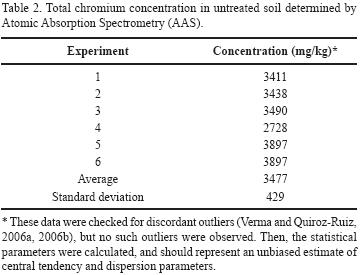
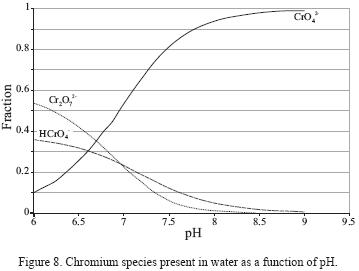
<body><![CDATA[<p align="justify"><font face="verdana" size="2">The X&#150;ray diffractogram of the chromium precipitates (<a href="/img/revistas/rmcg/v26n1/a9f5.jpg" target="_blank">Figure 5c</a>) shows that the main crystalline mineralogical phase is chromatite, CaCrO<sub>4</sub> (JCPDS card 8&#150;0458), identified by the presence of the 24.5, 33.4 and 49.1&deg; 2&#952; peaks. This confirm the presence of chromatite, indicated by the Ca, Cr and O contents determined by EDS in the same sample (<a href="/img/revistas/rmcg/v26n1/a9t1.jpg" target="_blank">Table 1</a>). The same chemical species, chromatite, CaCrO<sub>4</sub>, was reported by Bajda (2005) from soils polluted by electroplating effluents.</font></p> 				    <p align="justify"><font face="verdana" size="2">Surface area determined by the BET method for the soil contaminated with chromium was of 21.0 &plusmn; 0.6 m<sup>2</sup> g<sup>&#150;1</sup>, whereas that of the leached soil was of 70.6 &plusmn; 1.8 m<sup>2</sup>/g. The difference between both soil types (49.6 m<sup>2</sup>/g) indicates that chromium occupied this surface area.</font></p> 				    <p align="justify"><font face="verdana" size="2">The 10 mL aqueous fractions obtained from the column experiments showed variable yellow color intensities; color was more intense in the first eluated samples and diminished in subsequent fractions. The monomeric species provide a yellow color to the water when the Cr(VI) concentration is higher than 1 mg/L, however, the water aquires an orange color when it contains high levels of Cr<sub>2</sub>O<sub>7</sub><sup>2</sup>&#150; (Palmer and Puls, 1994). In this study, the yellow color found in the leachates indicates that the chemical element in aqueous solution is Cr(VI).</font></p> 				    <p align="justify"><font face="verdana" size="2"><a href="/img/revistas/rmcg/v26n1/a9f6.jpg" target="_blank">Figure 6</a> shows the UV&#150;Vis absorption spectra corresponding to the variable Cr(VI) concentrations of 20 eluted fractions obtained from the column experiments. In each experiment, a total of approximately 25 fractions were eluated, but the high Cr(VI) concentrations in the first five eluted fractions caused the saturation of the absorption bands and are thus not showed in the UV&#150;Vis spectra. In the spectra, two main absorption bands for Cr(VI) are observed, with absorption maxima located at wavelengths of 372 nm and 272 nm, as was reported by Xia <i>et al.</i> (2000).</font></p> 				    <p align="justify"><font face="verdana" size="2">The chemical analysis of the soluble fraction by UV&#150;Vis spectrometry (<a href="/img/revistas/rmcg/v26n1/a9f7.jpg" target="_blank">Figure 7</a>) allowed to identify Cr(VI) concentrations between 5 and 1,200 mg/L, which are much higher than the permissible limits for total chromium in drinking water established in the Official Mexican Norm (0.05 mg/L; NOM&#150;127&#150;SSA1&#150;1994 &#150; Norma Oficial Mexicana, 1994).</font></p> 				    <p align="justify"><font face="verdana" size="2">The average Cr(VI) total concentration in the solution was of 2,778 mg/L; this corresponds to the Cr(VI) recovered in the 25 fractions eluated from the column experiments (250 mL) during 27 hours of continuos experiment. When the contaminated soil was saturated with deionized water, the Cr(VI) concentrations in the first recovered fractions were high but rapidly decreased in the subsequent fractions. After 250 ml, Cr(VI) was removed to a concentration of about 5 mg/L (<a href="/img/revistas/rmcg/v26n1/a9f7.jpg" target="_blank">Figure 7</a>). From this plot, it is evident that leaching of Cr(VI) with deionized water did not respond to pH changes and that other mecanism was controlling the sorption process. The observed trend probably suggests that treatment of soil with deionized water results in binding of Cr(VI) through covalent interactions rather than through an ionic bonding, which should be given by ion exchange mechanisms. In this case, a change in pH would not affect the Van der Waals interactions and hence the Cr(VI) behaviour.</font></p> 				    <p align="justify"><font face="verdana" size="2"><a href="#f8">Figure 8</a> shows the distribution chromium species in function of pH in a diagram elaborated for a Cr(VI) concentration of 2,778 mg/L. The diagram shows that above pH = 6.5, the dominant species is CrO<sub>4</sub><sup>2</sup>&#150;. As shown in <a href="/img/revistas/rmcg/v26n1/a9f7.jpg" target="_blank">Figure 7</a>, the pH in all studied fractions (7.0 &#150; 8.5; <a href="/img/revistas/rmcg/v26n1/a9f7.jpg" target="_blank">Figure 7</a>) is higher than this threshold value. Besides, though a certain variation in the pH is observed, it is not reflected in changes in the recovered Cr(VI) concentration.</font></p> 				    <p align="center"><font face="verdana" size="2"><a name="f8"></a></font></p> 				    <p align="center"><font face="verdana" size="2"><img src="/img/revistas/rmcg/v26n1/a9f8.jpg"></font></p> 				    <p align="justify"><font face="verdana" size="2">The analyses indicate that deionized water can remove over 79.89% Cr(VI) from soil. The large percentage of Cr(VI) desorbed can indicate the participation of Van der Waals forces, but it can also be related to the formation of a relatively soluble Cr(VI) compound, such as CaCrO<sub>4</sub>. The Ca<sup>2+</sup> cation and CrO<sub>4</sub><sup>2</sup>&#150; anion were identified as soluble components, and CaCrO<sub>4</sub>, chromatite, was identified by X&#150;ray difraction (<a href="/img/revistas/rmcg/v26n1/a9f5.jpg" target="_blank">Figure 5c</a>) in the precipitate recovered from the leachate. Besides, as noted previously, CrO4<sup>2&#150;</sup> is the dominant Cr(VI) species at the pH values found in the solutions.</font></p> 				    ]]></body>
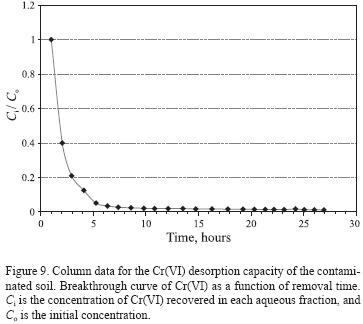
<body><![CDATA[<p align="justify"><font face="verdana" size="2">The mobility of chromium depends on parameters such as the pH, desorption time and volume of deionized water in which the chromium is solvated. The obtained results were plotted in a relative concentration plot (<a href="#f9">Figure 9</a>) that show the chromium recovery for each aliquot as a function of time. The mobility of Cr(VI) disminishes as the volume of added water increases. It should be noted that up to a final volume of 250 mL, the concentration in the recovered fractions did not fall below the maximum permissible limit of 0.05 mg/L for chromium in water, defined by the Official Mexican Norm (NOM&#150;127&#150;SSA1&#150;1994); the lowest concentration recovered after the addition of 250 mL deionized water was of 2.8 mg/L, and thus for later works it is recommended to use a larger volume of deionized water in order to reach the limit established in the norm.</font></p> 				    <p align="center"><font face="verdana" size="2"><a name="f9"></a></font></p> 				    <p align="center"><font face="verdana" size="2"><img src="/img/revistas/rmcg/v26n1/a9f9.jpg"></font></p> 				    <p align="justify"><font face="verdana" size="2">To determine the volume and time at which 50% of the Cr(VI) was separated from the soil, we used breakthrough curves of time versus normalized concentration, C<sub>i</sub> /C<sub>o</sub>, where C<sub>i</sub> is the Cr(VI) concentration recovered in each aqueous fraction, and C<sub>i</sub> is the initial concentration (<a href="#f9">Figure 9</a>). It can be observed that the largest amount of Cr(VI) was leached immediately after the beginning of the leaching process, then the Cr(VI) concentration decreased only slightly and reached low values after a short period, indicating that the Cr(VI) removal rates were significantly slower. The time at which 50 % of Cr(VI) was separated was of 2 hours, which indicates that the chromium present in the soil is soluble in deionized water and is liberated very easily; nevertheless, the separation of Cr(VI) after this time is slower. After about 10 hours, the concentration in the solution approached a constant value. Apparently, there was an initial sorption phase which appeared to be complete after 10 hours. With regard to the volume, it follows a similar behavior: the volume at which 50 % of the Cr(VI) was separated from the soil was of approximately 20 mL.</font></p> 				    <p align="justify"><font face="verdana" size="2">Finally, total chromium concentrations were determined in samples of contaminated soil by AAS, obtaining an average value of 3,477 &plusmn; 429 mg/kg (<a href="#t2">Table 2</a>); the difference between this value and the Cr(VI) analyses correspond to Cr(III). The high total chromium concentration values in the soil are associated with the actual operation of the QC chromate factory. Armienta and Rodr&iacute;guez (1995) reported a total chromium concentration of 1,000 mg/kg for soil samples collected in the same place at a depth of 30 cm. In 1996, Armienta <i>et al.</i> reported an average content of 2,500 mg/kg total chromium in in the various soil fractions. These data and the new analyses reported in this work indicate that the factory continued increasing the disposal of chromium wastes without treatment. The high solubility of Cr(VI) and the action of rain and irrigation, makes leaching of this species to the soil and deeper subsoil layers possible, resulting in aquifer contamination.</font></p> 				    <p align="center"><font face="verdana" size="2"><a name="t2"></a></font></p> 				    <p align="center"><font face="verdana" size="2"><img src="/img/revistas/rmcg/v26n1/a9t2.jpg"></font></p> 				    <p align="justify"><font face="verdana" size="2">In general, the analysis of the Cr(VI) mobility is relevant because it has an important role in groundwater contamination; for this reason it was necessary to identify its state of oxidation, because the Cr leaching from the vadose zone into the groundwater by infiltration processes is dependent of the oxidation state, as well as other parameters that determine its mobility, such as the coefficient of distribution and retardation (not included in this research study), principally.</font></p> 				    <p align="justify"><font face="verdana" size="2">This study indicates a high solubility of Cr(VI); this situation can be favorable for the desorption of Cr(VI) through soil washing, under conditions of uniform flow and operating an extraction well (or a set of extraction wells) so that groundwater contaminated with chromatite can be pumped out for subsequent treatment.</font></p> 				    <p align="justify"><font face="verdana" size="2">&nbsp;</font></p> 				    ]]></body>
<body><![CDATA[<p align="justify"><font face="verdana" size="2"><b>CONCLUSIONS</b></font></p> 				    <p align="justify"><font face="verdana" size="2">On the basis of the results presented in this study, it can be concluded that the Cr(VI) in the source zone exceeds the maximum permissible limit of 0.05 mg/L (NOM&#150;127&#150;SSA1&#150;1994) for water. But, given its high solubility and mobility in the soil, its mobility in the unsaturated zone can be enhanced by applying the scheme of soil washing so that the contaminant can be removed from the system.</font></p> 				    <p align="justify"><font face="verdana" size="2">The Cr(VI) was removed in 80 % with deionized water from the soil contaminated with this metal ion. The elemental chemical composition determined by EDS indicate that the contaminated soil contains Ca, K, Na, S, O, Si, Mg, Fe, and Cr, whereas the leached soil did not have measurable amounts of Cr, and contained low weight % of Na, Mg, Al, Si, and Fe. Finally, the precipitate recovered from leachates is mainly composed of Ca, Cr, and O, which indicates the presence of the mineral species chromatite (CaCrO<sub>4</sub>); this was also verified by XRD.</font></p> 				    <p align="justify"><font face="verdana" size="2">The minerals identified by XRD in the soil contaminated with chromium were quartz, chromatite, and albite; in the leached soil: calcite, albite, quartz; and in the precipitate recovered from leachates: chromatite.</font></p> 				    <p align="justify"><font face="verdana" size="2">Desorption of chromium of the surface of sandy soil particles was determined for a pH between a 7.0 and 8.5. It was found that elution with deionized water was efficient and that pH did not affect the removal efficiency. In agreement to the species distribution graph, CrO<sub>4</sub><sup>2&#150;</sup> is soluble at this pH, which was corroborated by the recovery of chromatite (CaCrO<sub>4</sub> ) precipitates obtained through evaporation of the leachates.</font></p> 				    <p align="justify"><font face="verdana" size="2">The soil contaminated with chromium in the Buenavista area represents at the moment an important source of hexavalent chromium, that can be leached from the unsaturated zone into the groundwater by infiltration processes. In this work, the chromium mobility in the studied soil was tested only with deionized water, but soil tratment with other chemical reagents should be studied. Moreover, because this study is limited and site specific, the effect of additional components found in natural soils (<i>e.g.</i>, organic matter, other clay minerals, etc.) should be considered before clean&#150;up options are evaluated.</font></p> 				    <p align="justify"><font face="verdana" size="2">&nbsp;</font></p> 				    <p align="justify"><font face="verdana" size="2"><b>ACKNOWLEDGEMENTS</b></font></p> 				    <p align="justify"><font face="verdana" size="2">The authors are grateful to Dr. Surendra P. Verma and six anonymous reviewers for the improvement of this paper. We thank Qu&iacute;mica Central de M&eacute;xico for the technical support, to UAEM for financial support through a Project No. 2049/2005 "Evaluaci&oacute;n de la capacidad de sorci&oacute;n/desorci&oacute;n del cromo de un relleno industrial", to Q. Leticia Carapia Morales from Instituto Nacional de Investigaciones Nucleares, and to Katie Keller, Ma. Elizabeth Guzm&aacute;n Keller and Dra. Teresa Orozco for their technical help.</font></p> 				    <p align="justify"><font face="verdana" size="2">&nbsp;</font></p> 				    ]]></body>
<body><![CDATA[<p align="justify"><font face="verdana" size="2"><b>REFERENCES</b></font></p> 				    <!-- ref --><p align="justify"><font face="verdana" size="2">Alloway, B.J., 1995, Heavy Metals in Soils: London, Glasgow, UK, Blackie and Professional, Second edition, 332 p.</font>&nbsp;&nbsp;&nbsp;&nbsp;&nbsp;&nbsp;&nbsp;&nbsp;[&#160;<a href="javascript:void(0);" onclick="javascript: window.open('/scielo.php?script=sci_nlinks&ref=8035231&pid=S1026-8774200900010000900001&lng=','','width=640,height=500,resizable=yes,scrollbars=1,menubar=yes,');">Links</a>&#160;]<!-- end-ref --> 				    <!-- ref --><p align="justify"><font face="verdana" size="2">American Society for Testing and Materials (ASTM), 2000, D6232&#150;00, Standard Guide for Selection of Sampling Equipment for Waste and Contaminated Media Data Collection Activities: West Conshohocken, PA, American Society for Testing and Materials, 28 p.</font>&nbsp;&nbsp;&nbsp;&nbsp;&nbsp;&nbsp;&nbsp;&nbsp;[&#160;<a href="javascript:void(0);" onclick="javascript: window.open('/scielo.php?script=sci_nlinks&ref=8035233&pid=S1026-8774200900010000900002&lng=','','width=640,height=500,resizable=yes,scrollbars=1,menubar=yes,');">Links</a>&#160;]<!-- end-ref --> 				    <!-- ref --><p align="justify"><font face="verdana" size="2">Archer, F.C., Hodgson, I.H., 1987. Total and extractable trace element contents of soils in England and Wales: Journal of Soil Science, 38(3), 421&#150;432.</font>&nbsp;&nbsp;&nbsp;&nbsp;&nbsp;&nbsp;&nbsp;&nbsp;[&#160;<a href="javascript:void(0);" onclick="javascript: window.open('/scielo.php?script=sci_nlinks&ref=8035235&pid=S1026-8774200900010000900003&lng=','','width=640,height=500,resizable=yes,scrollbars=1,menubar=yes,');">Links</a>&#160;]<!-- end-ref --> 				    <!-- ref --><p align="justify"><font face="verdana" size="2">Armienta, M.A., Qu&egrave;r&egrave;, A., 2004, Hydrogeochemical behavior of chromium in the unsaturated zone and in the aquifer of Le&oacute;n Valley, M&eacute;xico: Water, Air &amp; Soil Pollution, 84(1&#150;2), 11&#150;29.</font>&nbsp;&nbsp;&nbsp;&nbsp;&nbsp;&nbsp;&nbsp;&nbsp;[&#160;<a href="javascript:void(0);" onclick="javascript: window.open('/scielo.php?script=sci_nlinks&ref=8035237&pid=S1026-8774200900010000900004&lng=','','width=640,height=500,resizable=yes,scrollbars=1,menubar=yes,');">Links</a>&#160;]<!-- end-ref --> 				    <!-- ref --><p align="justify"><font face="verdana" size="2">Armienta, M.A., Rodr&iacute;guez, R., 1992, Investigaci&oacute;n del impacto ambiental de la dispersi&oacute;n de compuestos de cromo en el &aacute;rea occidental&#150;central del Valle de Le&oacute;n, Gto. M&eacute;xico: Universidad Nacional Aut&oacute;noma de M&eacute;xico, Instituto de Geof&iacute;sica, Departamento de Recursos Naturales, Reporte T&eacute;nico.</font>&nbsp;&nbsp;&nbsp;&nbsp;&nbsp;&nbsp;&nbsp;&nbsp;[&#160;<a href="javascript:void(0);" onclick="javascript: window.open('/scielo.php?script=sci_nlinks&ref=8035239&pid=S1026-8774200900010000900005&lng=','','width=640,height=500,resizable=yes,scrollbars=1,menubar=yes,');">Links</a>&#160;]<!-- end-ref --> 				    <!-- ref --><p align="justify"><font face="verdana" size="2">Armienta, M.A., Rodr&iacute;guez, R., 1995, Environmental Exposure to chromium compounds in the Valley of Le&oacute;n, M&eacute;xico: Environmental Health Perspectivas, 103(1), 47&#150;51.</font>&nbsp;&nbsp;&nbsp;&nbsp;&nbsp;&nbsp;&nbsp;&nbsp;[&#160;<a href="javascript:void(0);" onclick="javascript: window.open('/scielo.php?script=sci_nlinks&ref=8035241&pid=S1026-8774200900010000900006&lng=','','width=640,height=500,resizable=yes,scrollbars=1,menubar=yes,');">Links</a>&#160;]<!-- end-ref --> 				    <!-- ref --><p align="justify"><font face="verdana" size="2">Armienta, M.A., Rodr&iacute;guez, R., Ceniceros, N., Ju&aacute;rez, F., Cruz, O., 1996, Distribution, origin and fate of chromium in soils in Guanajuato, M&eacute;xico: Environmental Pollution, 91(2), 391&#150;397.</font>&nbsp;&nbsp;&nbsp;&nbsp;&nbsp;&nbsp;&nbsp;&nbsp;[&#160;<a href="javascript:void(0);" onclick="javascript: window.open('/scielo.php?script=sci_nlinks&ref=8035243&pid=S1026-8774200900010000900007&lng=','','width=640,height=500,resizable=yes,scrollbars=1,menubar=yes,');">Links</a>&#160;]<!-- end-ref --> 				    <!-- ref --><p align="justify"><font face="verdana" size="2">Bajda, T., 2005, Chromatite CaCrO<sub>4</sub> in soil polluted with electroplating effluents (Zabierzow, Poland): Science of the Total Environment, 336(1&#150;3), 269&#150;274.</font>&nbsp;&nbsp;&nbsp;&nbsp;&nbsp;&nbsp;&nbsp;&nbsp;[&#160;<a href="javascript:void(0);" onclick="javascript: window.open('/scielo.php?script=sci_nlinks&ref=8035245&pid=S1026-8774200900010000900008&lng=','','width=640,height=500,resizable=yes,scrollbars=1,menubar=yes,');">Links</a>&#160;]<!-- end-ref --> 				    <!-- ref --><p align="justify"><font face="verdana" size="2">Barcel&oacute;, J., Poschenrieder, C., V&aacute;zquez, M. D., Guns&eacute;, B., 1993, Beneficial and toxic effects of chromium in plants: solution culture, pot and fields studies, <i>in</i> Vernet, J.P. (ed.), Environmental Contamination: Elsevier, Studies in Environmental Science, 55, pp. 147&#150;169.</font>&nbsp;&nbsp;&nbsp;&nbsp;&nbsp;&nbsp;&nbsp;&nbsp;[&#160;<a href="javascript:void(0);" onclick="javascript: window.open('/scielo.php?script=sci_nlinks&ref=8035247&pid=S1026-8774200900010000900009&lng=','','width=640,height=500,resizable=yes,scrollbars=1,menubar=yes,');">Links</a>&#160;]<!-- end-ref --> 				    <!-- ref --><p align="justify"><font face="verdana" size="2">Barceloux, D.G., 1999, Chromium: Clinical Toxicology, 37(2), 173&#150;194.</font>&nbsp;&nbsp;&nbsp;&nbsp;&nbsp;&nbsp;&nbsp;&nbsp;[&#160;<a href="javascript:void(0);" onclick="javascript: window.open('/scielo.php?script=sci_nlinks&ref=8035249&pid=S1026-8774200900010000900010&lng=','','width=640,height=500,resizable=yes,scrollbars=1,menubar=yes,');">Links</a>&#160;]<!-- end-ref --> 				    <!-- ref --><p align="justify"><font face="verdana" size="2">Bayliss, P., 1986, Mineral Powder Diffraction File Date Book: Swarthmore, PA, Joint Committee on Powder Diffraction Standards (JCPDS).</font>&nbsp;&nbsp;&nbsp;&nbsp;&nbsp;&nbsp;&nbsp;&nbsp;[&#160;<a href="javascript:void(0);" onclick="javascript: window.open('/scielo.php?script=sci_nlinks&ref=8035251&pid=S1026-8774200900010000900011&lng=','','width=640,height=500,resizable=yes,scrollbars=1,menubar=yes,');">Links</a>&#160;]<!-- end-ref --> 				    <!-- ref --><p align="justify"><font face="verdana" size="2">Bevington, P.R., Robinson, D.K., 2003, Data Reduction and Error Analysis for the Physical Sciences: New York, McGraw Hill, 320 p.</font>&nbsp;&nbsp;&nbsp;&nbsp;&nbsp;&nbsp;&nbsp;&nbsp;[&#160;<a href="javascript:void(0);" onclick="javascript: window.open('/scielo.php?script=sci_nlinks&ref=8035253&pid=S1026-8774200900010000900012&lng=','','width=640,height=500,resizable=yes,scrollbars=1,menubar=yes,');">Links</a>&#160;]<!-- end-ref --> 				    <!-- ref --><p align="justify"><font face="verdana" size="2">Carrillo&#150;Ch&aacute;vez, A., Morton&#150;Bermea, O., Gonz&aacute;lez&#150;Partida, E., Rivas&#150;Sol&oacute;rzano, H., Oesler, G., Garc&iacute;a&#150;Meza, V., Hern&aacute;ndez, E., Morales, P., Cienfuegos, E., 2003, Environmental geochemistry of the Guanajuato Mining District, Mexico: Ore Geology Reviews, 23, 277&#150;297.</font>&nbsp;&nbsp;&nbsp;&nbsp;&nbsp;&nbsp;&nbsp;&nbsp;[&#160;<a href="javascript:void(0);" onclick="javascript: window.open('/scielo.php?script=sci_nlinks&ref=8035255&pid=S1026-8774200900010000900013&lng=','','width=640,height=500,resizable=yes,scrollbars=1,menubar=yes,');">Links</a>&#160;]<!-- end-ref --> 				    <!-- ref --><p align="justify"><font face="verdana" size="2">Catalan, L.J.J., Merli&egrave;re, E., Chezick, C., 2002, Study of the physical and chemical mechanisms influencing the long&#150;term environmental stability of natrojarosite waste treated by stabilization/solidification: Journal of Hazardous Materials, B94, 63&#150;88.</font>&nbsp;&nbsp;&nbsp;&nbsp;&nbsp;&nbsp;&nbsp;&nbsp;[&#160;<a href="javascript:void(0);" onclick="javascript: window.open('/scielo.php?script=sci_nlinks&ref=8035257&pid=S1026-8774200900010000900014&lng=','','width=640,height=500,resizable=yes,scrollbars=1,menubar=yes,');">Links</a>&#160;]<!-- end-ref --> 				    <!-- ref --><p align="justify"><font face="verdana" size="2">Cochran, W.G., 1963, Sampling Techniques: New York, USA, John Wiley &amp; Sons, Second edition, 411 p.</font>&nbsp;&nbsp;&nbsp;&nbsp;&nbsp;&nbsp;&nbsp;&nbsp;[&#160;<a href="javascript:void(0);" onclick="javascript: window.open('/scielo.php?script=sci_nlinks&ref=8035259&pid=S1026-8774200900010000900015&lng=','','width=640,height=500,resizable=yes,scrollbars=1,menubar=yes,');">Links</a>&#160;]<!-- end-ref --> 				    <!-- ref --><p align="justify"><font face="verdana" size="2">Council of the European Communities, 1986, Council directive of 12 June 1986 on the protection of the environment, and in the particular of the soil, when sewage sludge is used in agriculture: Official Journal of the European Communities, L181, 6&#150;12.</font>&nbsp;&nbsp;&nbsp;&nbsp;&nbsp;&nbsp;&nbsp;&nbsp;[&#160;<a href="javascript:void(0);" onclick="javascript: window.open('/scielo.php?script=sci_nlinks&ref=8035261&pid=S1026-8774200900010000900016&lng=','','width=640,height=500,resizable=yes,scrollbars=1,menubar=yes,');">Links</a>&#160;]<!-- end-ref --> 				    <!-- ref --><p align="justify"><font face="verdana" size="2">Dermatas, D., Meng, X., 2003, Utilization of fly ash for stabilization/solidification of heavy metal containing soils: Engineering Geology 70(3&#150;4), 377&#150;394.</font>&nbsp;&nbsp;&nbsp;&nbsp;&nbsp;&nbsp;&nbsp;&nbsp;[&#160;<a href="javascript:void(0);" onclick="javascript: window.open('/scielo.php?script=sci_nlinks&ref=8035263&pid=S1026-8774200900010000900017&lng=','','width=640,height=500,resizable=yes,scrollbars=1,menubar=yes,');">Links</a>&#160;]<!-- end-ref --> 				    <!-- ref --><p align="justify"><font face="verdana" size="2">Dermatas, D., Moon, D. H., 2006, Chromium leaching and immobilization in treated soils: Environmental Engineering Science 23(1), 77&#150;87.</font>&nbsp;&nbsp;&nbsp;&nbsp;&nbsp;&nbsp;&nbsp;&nbsp;[&#160;<a href="javascript:void(0);" onclick="javascript: window.open('/scielo.php?script=sci_nlinks&ref=8035265&pid=S1026-8774200900010000900018&lng=','','width=640,height=500,resizable=yes,scrollbars=1,menubar=yes,');">Links</a>&#160;]<!-- end-ref --> 				    <!-- ref --><p align="justify"><font face="verdana" size="2">Ewers, U., 1991, Standards, Guidelines and Legislative Regulations Concerning Metals and their Compounds, <i>in</i> Merian, E.(ed.) Metals and their Compounds in the Environment: Occurrence, analysis and biological relevance: Weinheim, Verlag Chemie (VCH), 687&#150;711.</font>&nbsp;&nbsp;&nbsp;&nbsp;&nbsp;&nbsp;&nbsp;&nbsp;[&#160;<a href="javascript:void(0);" onclick="javascript: window.open('/scielo.php?script=sci_nlinks&ref=8035267&pid=S1026-8774200900010000900019&lng=','','width=640,height=500,resizable=yes,scrollbars=1,menubar=yes,');">Links</a>&#160;]<!-- end-ref --> 				    <!-- ref --><p align="justify"><font face="verdana" size="2">Ferguson, J. E., 1990, The Heavy Elements: Chemistry, Environmental Impact and Health Effects: Oxford, Pergamon Press, 211&#150;212.</font>&nbsp;&nbsp;&nbsp;&nbsp;&nbsp;&nbsp;&nbsp;&nbsp;[&#160;<a href="javascript:void(0);" onclick="javascript: window.open('/scielo.php?script=sci_nlinks&ref=8035269&pid=S1026-8774200900010000900020&lng=','','width=640,height=500,resizable=yes,scrollbars=1,menubar=yes,');">Links</a>&#160;]<!-- end-ref --> 				    <!-- ref --><p align="justify"><font face="verdana" size="2">Harley, W., Edwards, R., Lepp, N.W., 2004, Arsenic and heavy metal mobility in iron oxide&#150;amended contaminated soils as evaluated by short&#150; and long&#150;term leaching tests: Environmental Pollution, 131(3), 495&#150;504.</font>&nbsp;&nbsp;&nbsp;&nbsp;&nbsp;&nbsp;&nbsp;&nbsp;[&#160;<a href="javascript:void(0);" onclick="javascript: window.open('/scielo.php?script=sci_nlinks&ref=8035271&pid=S1026-8774200900010000900021&lng=','','width=640,height=500,resizable=yes,scrollbars=1,menubar=yes,');">Links</a>&#160;]<!-- end-ref --> 				    <!-- ref --><p align="justify"><font face="verdana" size="2">Hern&aacute;ndez&#150;Silva, G., Solorio&#150;Mung&iacute;a, G., Vasallo&#150;Morales, L., Flores&#150;Delgado, L., Maples&#150;Vermeersch, M, Hern&aacute;ndez&#150;Santiago, D., Alcal&aacute;&#150;Mart&iacute;nez, R., 2000, Dispersi&oacute;n de Ni y Cr en sedimentos y suelos superficiales derivados de piroxenitas, serpentinitas y basaltos de la cuenca San Juan de Otates, Estado de Guanajuato, M&eacute;xico: Revista Mexicana de Ciencias Geol&oacute;gicas, 17(2), 125&#150;136.</font>&nbsp;&nbsp;&nbsp;&nbsp;&nbsp;&nbsp;&nbsp;&nbsp;[&#160;<a href="javascript:void(0);" onclick="javascript: window.open('/scielo.php?script=sci_nlinks&ref=8035273&pid=S1026-8774200900010000900022&lng=','','width=640,height=500,resizable=yes,scrollbars=1,menubar=yes,');">Links</a>&#160;]<!-- end-ref --> 				    <!-- ref --><p align="justify"><font face="verdana" size="2">Huffman, E.W.D., Allaway, W.H., 1973, Growth of plants in solution culture containing low levels of chromium: Plant Physiology, 52(1), 72&#150;75.</font>&nbsp;&nbsp;&nbsp;&nbsp;&nbsp;&nbsp;&nbsp;&nbsp;[&#160;<a href="javascript:void(0);" onclick="javascript: window.open('/scielo.php?script=sci_nlinks&ref=8035275&pid=S1026-8774200900010000900023&lng=','','width=640,height=500,resizable=yes,scrollbars=1,menubar=yes,');">Links</a>&#160;]<!-- end-ref --> 				    <!-- ref --><p align="justify"><font face="verdana" size="2">Kim, J&#150;Y., Davis, A.P., Kim, K&#150;W., 2003, Stabilisation of available arsenic in highly contaminated mine tailings using iron: Environmental Science and Technology, 37(1), 189&#150;195.</font>&nbsp;&nbsp;&nbsp;&nbsp;&nbsp;&nbsp;&nbsp;&nbsp;[&#160;<a href="javascript:void(0);" onclick="javascript: window.open('/scielo.php?script=sci_nlinks&ref=8035277&pid=S1026-8774200900010000900024&lng=','','width=640,height=500,resizable=yes,scrollbars=1,menubar=yes,');">Links</a>&#160;]<!-- end-ref --> 				    <!-- ref --><p align="justify"><font face="verdana" size="2">Kostarelos, K., Reale, D., Dermatas, D., Rao, E., Moon, D.H., 2006, Optimum dose of lime and fly ash for treatment of hexavalent chromium&#150;contaminated soil: Water, Air, and Soil Pollution: Focus, 6(1&#150;2), 171&#150;189.</font>&nbsp;&nbsp;&nbsp;&nbsp;&nbsp;&nbsp;&nbsp;&nbsp;[&#160;<a href="javascript:void(0);" onclick="javascript: window.open('/scielo.php?script=sci_nlinks&ref=8035279&pid=S1026-8774200900010000900025&lng=','','width=640,height=500,resizable=yes,scrollbars=1,menubar=yes,');">Links</a>&#160;]<!-- end-ref --> 				    <!-- ref --><p align="justify"><font face="verdana" size="2">Kozuh, N., Stupar, J., Gorenc, B., 2000, Reduction and oxidation processes of chromium in soils: Environmental Science and Technology, 34(1), 112&#150;119.</font>&nbsp;&nbsp;&nbsp;&nbsp;&nbsp;&nbsp;&nbsp;&nbsp;[&#160;<a href="javascript:void(0);" onclick="javascript: window.open('/scielo.php?script=sci_nlinks&ref=8035281&pid=S1026-8774200900010000900026&lng=','','width=640,height=500,resizable=yes,scrollbars=1,menubar=yes,');">Links</a>&#160;]<!-- end-ref --> 				    <!-- ref --><p align="justify"><font face="verdana" size="2">Kumpiene, J., Castillo M.I., Lagerkvist, A.M. , 2007, Evaluation of the critical factors controlling stability of chromium, copper, arsenic and zinc in iron&#150;treated soil: Chemosphere, 67(2), 410&#150;417.</font>&nbsp;&nbsp;&nbsp;&nbsp;&nbsp;&nbsp;&nbsp;&nbsp;[&#160;<a href="javascript:void(0);" onclick="javascript: window.open('/scielo.php?script=sci_nlinks&ref=8035283&pid=S1026-8774200900010000900027&lng=','','width=640,height=500,resizable=yes,scrollbars=1,menubar=yes,');">Links</a>&#160;]<!-- end-ref --> 				    <!-- ref --><p align="justify"><font face="verdana" size="2">Laborda, F., G&oacute;rriz, M.P., Bolea, E., Castillo, J.R., 2007, Mobilization and speciation of chromium in compost: A methodological approach: Science of the Total Environment, 373 (1), 383&#150;390.</font>&nbsp;&nbsp;&nbsp;&nbsp;&nbsp;&nbsp;&nbsp;&nbsp;[&#160;<a href="javascript:void(0);" onclick="javascript: window.open('/scielo.php?script=sci_nlinks&ref=8035285&pid=S1026-8774200900010000900028&lng=','','width=640,height=500,resizable=yes,scrollbars=1,menubar=yes,');">Links</a>&#160;]<!-- end-ref --> 				    <!-- ref --><p align="justify"><font face="verdana" size="2">Mench, M., Vangronsveld, J., Clijsters, H., Lepp, N.W., Edwards, R., 2000, In situ metal immobilisation and phytostabilisation of contaminated soils, <i>in</i> Norman, T., Ba&ntilde;uelos, G. (eds.), Phytoremediation of contaminated soil and Water: Boca Raton, FL, Lewis Publishers, 323&#150;358.</font>&nbsp;&nbsp;&nbsp;&nbsp;&nbsp;&nbsp;&nbsp;&nbsp;[&#160;<a href="javascript:void(0);" onclick="javascript: window.open('/scielo.php?script=sci_nlinks&ref=8035287&pid=S1026-8774200900010000900029&lng=','','width=640,height=500,resizable=yes,scrollbars=1,menubar=yes,');">Links</a>&#160;]<!-- end-ref --> 				    <!-- ref --><p align="justify"><font face="verdana" size="2">Niu, S.F., Liu, Y., Xu, X.H., Lou, Z.H., 2005, Removal of hexavalente chromium from aqueous solution by iron nanoparticles: Journal of Zhejian University, 6B(10), 1022&#150;1027.</font>&nbsp;&nbsp;&nbsp;&nbsp;&nbsp;&nbsp;&nbsp;&nbsp;[&#160;<a href="javascript:void(0);" onclick="javascript: window.open('/scielo.php?script=sci_nlinks&ref=8035289&pid=S1026-8774200900010000900030&lng=','','width=640,height=500,resizable=yes,scrollbars=1,menubar=yes,');">Links</a>&#160;]<!-- end-ref --> 				    <!-- ref --><p align="justify"><font face="verdana" size="2">Norma Oficial Mexicana, 1981, NMX&#150;AA&#150;51&#150;1981, An&aacute;lisis de agua. Determinaci&oacute;n de metales. M&eacute;todo Espectrofotom&eacute;trico de Absorci&oacute;n At&oacute;mica: M&eacute;xico, Secretar&iacute;a de Econom&iacute;a.</font>&nbsp;&nbsp;&nbsp;&nbsp;&nbsp;&nbsp;&nbsp;&nbsp;[&#160;<a href="javascript:void(0);" onclick="javascript: window.open('/scielo.php?script=sci_nlinks&ref=8035291&pid=S1026-8774200900010000900031&lng=','','width=640,height=500,resizable=yes,scrollbars=1,menubar=yes,');">Links</a>&#160;]<!-- end-ref --> 				    <!-- ref --><p align="justify"><font face="verdana" size="2">Norma Oficial Mexicana, 1994, NOM&#150;127&#150;SSA1&#150;1994, Salud ambiental. Agua para uso y consumo humano. L&iacute;mites permisibles de calidad y tratamientos a que debe someterse el agua para su potabilizaci&oacute;n, M&eacute;xico, Secretar&iacute;a de Salud, 7 pp.</font>&nbsp;&nbsp;&nbsp;&nbsp;&nbsp;&nbsp;&nbsp;&nbsp;[&#160;<a href="javascript:void(0);" onclick="javascript: window.open('/scielo.php?script=sci_nlinks&ref=8035293&pid=S1026-8774200900010000900032&lng=','','width=640,height=500,resizable=yes,scrollbars=1,menubar=yes,');">Links</a>&#160;]<!-- end-ref --> 				    <!-- ref --><p align="justify"><font face="verdana" size="2">Norma Oficial Mexicana, 2001, NMX&#150;AA&#150;044&#150;SCFI&#150;2001, An&aacute;lisis de aguas &#150; Determinaci&oacute;n de cromo hexavalente en aguas naturales, potables, residuales y residuales tratadas &#150; M&eacute;todo de prueba: M&eacute;xico, Secretar&iacute;a de Econom&iacute;a, 21 pp.</font>&nbsp;&nbsp;&nbsp;&nbsp;&nbsp;&nbsp;&nbsp;&nbsp;[&#160;<a href="javascript:void(0);" onclick="javascript: window.open('/scielo.php?script=sci_nlinks&ref=8035295&pid=S1026-8774200900010000900033&lng=','','width=640,height=500,resizable=yes,scrollbars=1,menubar=yes,');">Links</a>&#160;]<!-- end-ref --> 				    <!-- ref --><p align="justify"><font face="verdana" size="2">Palmer, C.D., Puls, R.W., 1994, Natural attenuation of hexavalent chromium in groundwater and soils: United States Environmental Protection Agency, EPA Ground Water Issue, EPA/540/5&#150;94/505, 12 pp.</font>&nbsp;&nbsp;&nbsp;&nbsp;&nbsp;&nbsp;&nbsp;&nbsp;[&#160;<a href="javascript:void(0);" onclick="javascript: window.open('/scielo.php?script=sci_nlinks&ref=8035297&pid=S1026-8774200900010000900034&lng=','','width=640,height=500,resizable=yes,scrollbars=1,menubar=yes,');">Links</a>&#160;]<!-- end-ref --> 				    <!-- ref --><p align="justify"><font face="verdana" size="2">Olmos&#150;Salinas, M.G., 2006, Remoci&oacute;n de cromo de un relleno industrial: M&eacute;xico, Universidad Aut&oacute;noma del Estado de M&eacute;xico, Facultad de Qu&iacute;mica, Professional thesis,100 p.</font>&nbsp;&nbsp;&nbsp;&nbsp;&nbsp;&nbsp;&nbsp;&nbsp;[&#160;<a href="javascript:void(0);" onclick="javascript: window.open('/scielo.php?script=sci_nlinks&ref=8035299&pid=S1026-8774200900010000900035&lng=','','width=640,height=500,resizable=yes,scrollbars=1,menubar=yes,');">Links</a>&#160;]<!-- end-ref --> 				    <!-- ref --><p align="justify"><font face="verdana" size="2">Reyes&#150;Guti&eacute;rrez, L.R., 1998, Factores que controlan la dispersi&oacute;n de compuestos de cromo en un acu&iacute;fero de conductividad hidr&aacute;ulica variable: M&eacute;xico, Universidad Nacional Aut&oacute;noma de M&eacute;xico, M. Sc. thesis, 150 p.</font>&nbsp;&nbsp;&nbsp;&nbsp;&nbsp;&nbsp;&nbsp;&nbsp;[&#160;<a href="javascript:void(0);" onclick="javascript: window.open('/scielo.php?script=sci_nlinks&ref=8035301&pid=S1026-8774200900010000900036&lng=','','width=640,height=500,resizable=yes,scrollbars=1,menubar=yes,');">Links</a>&#160;]<!-- end-ref --> 				    <!-- ref --><p align="justify"><font face="verdana" size="2">Reyes&#150;Guti&eacute;rrez, L.R., Romero&#150;Guzm&aacute;n, E. T., 2004, Separaci&oacute;n y an&aacute;lisis de un relleno de residuos de cromo en Le&oacute;n Guanajuato, <i>in</i> Memorias del XVIII Congreso Nacional de Qu&iacute;mica Anal&iacute;tica, Pachuca Hidalgo, M&eacute;xico, 48 p.</font>&nbsp;&nbsp;&nbsp;&nbsp;&nbsp;&nbsp;&nbsp;&nbsp;[&#160;<a href="javascript:void(0);" onclick="javascript: window.open('/scielo.php?script=sci_nlinks&ref=8035303&pid=S1026-8774200900010000900037&lng=','','width=640,height=500,resizable=yes,scrollbars=1,menubar=yes,');">Links</a>&#160;]<!-- end-ref --> 				    <!-- ref --><p align="justify"><font face="verdana" size="2">Reyes&#150;Guti&eacute;rrez, L.R., Cabral, P. A., Romero&#150;Guzm&aacute;n, E.T., 2004, Chromium&#150;iron compounds in contaminated soil studied by EDS, XRD and Mossbauer Spectroscopy (abstract), <i>in</i> Lacame 2004, Ninth Latin American Conference on the Applications of the M&ouml;ssbauer Effect, M&eacute;xico, D.F., septiembre 19&#150;24.</font>&nbsp;&nbsp;&nbsp;&nbsp;&nbsp;&nbsp;&nbsp;&nbsp;[&#160;<a href="javascript:void(0);" onclick="javascript: window.open('/scielo.php?script=sci_nlinks&ref=8035305&pid=S1026-8774200900010000900038&lng=','','width=640,height=500,resizable=yes,scrollbars=1,menubar=yes,');">Links</a>&#160;]<!-- end-ref --> 				    <!-- ref --><p align="justify"><font face="verdana" size="2">Robles, C.J., Armienta, M.A., 2000, Natural chromium contamination of groundwater at Le&oacute;n Valley, M&eacute;xico: Journal of Geochemical Exploration, 68, 167&#150;181.</font>&nbsp;&nbsp;&nbsp;&nbsp;&nbsp;&nbsp;&nbsp;&nbsp;[&#160;<a href="javascript:void(0);" onclick="javascript: window.open('/scielo.php?script=sci_nlinks&ref=8035307&pid=S1026-8774200900010000900039&lng=','','width=640,height=500,resizable=yes,scrollbars=1,menubar=yes,');">Links</a>&#160;]<!-- end-ref --> 				    <!-- ref --><p align="justify"><font face="verdana" size="2">Rock, M.L., Bruce, R.J., Helz, G.R., 2001, Hydrogen peroxide effects on chromium oxidation satet and solubility in tour diverse chromium&#150;enriched soils: Environmental Science and Technology, 35(20), 4054&#150;4059.</font>&nbsp;&nbsp;&nbsp;&nbsp;&nbsp;&nbsp;&nbsp;&nbsp;[&#160;<a href="javascript:void(0);" onclick="javascript: window.open('/scielo.php?script=sci_nlinks&ref=8035309&pid=S1026-8774200900010000900040&lng=','','width=640,height=500,resizable=yes,scrollbars=1,menubar=yes,');">Links</a>&#160;]<!-- end-ref --> 				    <!-- ref --><p align="justify"><font face="verdana" size="2">Rodr&iacute;guez, R., Armienta, M.A., 1995, Groundwater chromium pollution in the R&iacute;o Turbio Valley, M&eacute;xico: Use of pollutants as chemical tracers: Geof&iacute;sica Internacional, 34(4), 417&#150;426.</font>&nbsp;&nbsp;&nbsp;&nbsp;&nbsp;&nbsp;&nbsp;&nbsp;[&#160;<a href="javascript:void(0);" onclick="javascript: window.open('/scielo.php?script=sci_nlinks&ref=8035311&pid=S1026-8774200900010000900041&lng=','','width=640,height=500,resizable=yes,scrollbars=1,menubar=yes,');">Links</a>&#160;]<!-- end-ref --> 				    <!-- ref --><p align="justify"><font face="verdana" size="2">Rodr&iacute;guez, R., Armienta, M. A., Villanueva S., D&iacute;az P., Gonz&aacute;lez T., 1991, Estudio hidrogeoqu&iacute;mico y modelaci&oacute;n matem&aacute;tica del acu&iacute;fero del r&iacute;o Turbio para definir las acciones encaminadas a proteger de contaminantes la fuente de abastecimiento de la Cd. de Le&oacute;n Gto.: Universidad Nacional Aut&oacute;noma de M&eacute;xico, Instituto de Geof&iacute;sica, Comisi&oacute;n Nacional del Agua(CNA)&#150;Secretar&iacute;a de Agricultura y Recursos Hidr&aacute;ulicos (SARH), Reporte T&eacute;cnico II, 140 pp.</font>&nbsp;&nbsp;&nbsp;&nbsp;&nbsp;&nbsp;&nbsp;&nbsp;[&#160;<a href="javascript:void(0);" onclick="javascript: window.open('/scielo.php?script=sci_nlinks&ref=8035313&pid=S1026-8774200900010000900042&lng=','','width=640,height=500,resizable=yes,scrollbars=1,menubar=yes,');">Links</a>&#160;]<!-- end-ref --> 				    <!-- ref --><p align="justify"><font face="verdana" size="2">Santoyo E., Guevara, M., Verma, S.P., 2006, Determination of lanthanides in international geochemical reference materials by reverse&#150;phase high&#150;performance liquid chromatography using error propagation theory to estimate total analysis uncertainties: Journal of Chromatography A, 118(1), 73&#150;81.</font>&nbsp;&nbsp;&nbsp;&nbsp;&nbsp;&nbsp;&nbsp;&nbsp;[&#160;<a href="javascript:void(0);" onclick="javascript: window.open('/scielo.php?script=sci_nlinks&ref=8035315&pid=S1026-8774200900010000900043&lng=','','width=640,height=500,resizable=yes,scrollbars=1,menubar=yes,');">Links</a>&#160;]<!-- end-ref --> 				    <!-- ref --><p align="justify"><font face="verdana" size="2">Sperling M., Yin X., Welz B., 1992, Differential determination of chromium (VI) and total chromium in natural waters using flow injection on&#150;line separation and preconcentration electrothermal atomic absorption spectrometry: Analyst, 117(3), 629&#150;635.</font>&nbsp;&nbsp;&nbsp;&nbsp;&nbsp;&nbsp;&nbsp;&nbsp;[&#160;<a href="javascript:void(0);" onclick="javascript: window.open('/scielo.php?script=sci_nlinks&ref=8035317&pid=S1026-8774200900010000900044&lng=','','width=640,height=500,resizable=yes,scrollbars=1,menubar=yes,');">Links</a>&#160;]<!-- end-ref --> 				    <!-- ref --><p align="justify"><font face="verdana" size="2">Sposito, G., 1989, The Chemical of Soils: New York, Oxford University Press. 304 p.</font>&nbsp;&nbsp;&nbsp;&nbsp;&nbsp;&nbsp;&nbsp;&nbsp;[&#160;<a href="javascript:void(0);" onclick="javascript: window.open('/scielo.php?script=sci_nlinks&ref=8035319&pid=S1026-8774200900010000900045&lng=','','width=640,height=500,resizable=yes,scrollbars=1,menubar=yes,');">Links</a>&#160;]<!-- end-ref --> 				    <!-- ref --><p align="justify"><font face="verdana" size="2">Stollenwerk, K.G., Grove, D.B., 1985, Adsorption and desorption of hexavalente chromium in an alluvial aquifer near Telluride, Colorado: Journal Environmental Quality, 14(1), 150&#150;155.</font>&nbsp;&nbsp;&nbsp;&nbsp;&nbsp;&nbsp;&nbsp;&nbsp;[&#160;<a href="javascript:void(0);" onclick="javascript: window.open('/scielo.php?script=sci_nlinks&ref=8035321&pid=S1026-8774200900010000900046&lng=','','width=640,height=500,resizable=yes,scrollbars=1,menubar=yes,');">Links</a>&#160;]<!-- end-ref --> 				    <!-- ref --><p align="justify"><font face="verdana" size="2">Swietlik, R., 1998, Speciation Analysis of Chromium in Waters: Polish Journal of Environmental Studies, 7(5), 257&#150;266.</font>&nbsp;&nbsp;&nbsp;&nbsp;&nbsp;&nbsp;&nbsp;&nbsp;[&#160;<a href="javascript:void(0);" onclick="javascript: window.open('/scielo.php?script=sci_nlinks&ref=8035323&pid=S1026-8774200900010000900047&lng=','','width=640,height=500,resizable=yes,scrollbars=1,menubar=yes,');">Links</a>&#160;]<!-- end-ref --> 				    <!-- ref --><p align="justify"><font face="verdana" size="2">United States Environmental Protection Agency (U.S. EPA), 1993, Standards for the use or disposal of sewage sludge; Final rules: United States Environmental Protection Agency, 40 CFR Parts 257, 403 and 503, Federal Register 58, 9248&#150;9415.</font>&nbsp;&nbsp;&nbsp;&nbsp;&nbsp;&nbsp;&nbsp;&nbsp;[&#160;<a href="javascript:void(0);" onclick="javascript: window.open('/scielo.php?script=sci_nlinks&ref=8035325&pid=S1026-8774200900010000900048&lng=','','width=640,height=500,resizable=yes,scrollbars=1,menubar=yes,');">Links</a>&#160;]<!-- end-ref --> 				    <!-- ref --><p align="justify"><font face="verdana" size="2">United States Environmental Protection Agency (U.S. EPA), 1996, Soil Screening Guidance: User's Guide: Washington, DC, United States Environmental Protection Agency Office of Solid Waste and Emergency Response, EPA/540/R&#150;96/0180, 178 p.</font>&nbsp;&nbsp;&nbsp;&nbsp;&nbsp;&nbsp;&nbsp;&nbsp;[&#160;<a href="javascript:void(0);" onclick="javascript: window.open('/scielo.php?script=sci_nlinks&ref=8035327&pid=S1026-8774200900010000900049&lng=','','width=640,height=500,resizable=yes,scrollbars=1,menubar=yes,');">Links</a>&#160;]<!-- end-ref --> 				    <!-- ref --><p align="justify"><font face="verdana" size="2">United States Environmental Protection Agency (U.S. EPA), 2000, Guidance for Data Quality Assessment: Practical Methods for Data Analysis (QA/G&#150;9): Washington, DC, United States Environmental Protection Agency, Office of Research and Development, EPA/600/R&#150;96/084, 219 p.</font>&nbsp;&nbsp;&nbsp;&nbsp;&nbsp;&nbsp;&nbsp;&nbsp;[&#160;<a href="javascript:void(0);" onclick="javascript: window.open('/scielo.php?script=sci_nlinks&ref=8035329&pid=S1026-8774200900010000900050&lng=','','width=640,height=500,resizable=yes,scrollbars=1,menubar=yes,');">Links</a>&#160;]<!-- end-ref --> 				    <!-- ref --><p align="justify"><font face="verdana" size="2">Verma, S.P., 2005, Estad&iacute;stica B&aacute;sica para el Manejo de Datos Experimentales; Aplicaci&oacute;n en la Geoqu&iacute;mica (Geoquimiometr&iacute;a): M&eacute;xico, D.F., Universidad Nacional Aut&oacute;noma de M&eacute;xico, 186 p.</font>&nbsp;&nbsp;&nbsp;&nbsp;&nbsp;&nbsp;&nbsp;&nbsp;[&#160;<a href="javascript:void(0);" onclick="javascript: window.open('/scielo.php?script=sci_nlinks&ref=8035331&pid=S1026-8774200900010000900051&lng=','','width=640,height=500,resizable=yes,scrollbars=1,menubar=yes,');">Links</a>&#160;]<!-- end-ref --> 				    <!-- ref --><p align="justify"><font face="verdana" size="2">Verma, S.P., Quiroz&#150;Ruiz, A., 2006a, Critical values for 22 discordancy test variants for outliers in normal samples up to sizes 100, and applications in science and engineering: Revista Mexicana de Ciencias Geol&oacute;gicas, 23(3), 302&#150;319.</font>&nbsp;&nbsp;&nbsp;&nbsp;&nbsp;&nbsp;&nbsp;&nbsp;[&#160;<a href="javascript:void(0);" onclick="javascript: window.open('/scielo.php?script=sci_nlinks&ref=8035333&pid=S1026-8774200900010000900052&lng=','','width=640,height=500,resizable=yes,scrollbars=1,menubar=yes,');">Links</a>&#160;]<!-- end-ref --> 				    <!-- ref --><p align="justify"><font face="verdana" size="2">Verma, S.P., Quiroz&#150;Ruiz, A., 2006b, Critical values for six Dixon tests for outliers in normal samples up to sizes 100, and applications in science and engineering: Revista Mexicana de Ciencias Geol&oacute;gicas, 23(2), 133&#150;161.</font>&nbsp;&nbsp;&nbsp;&nbsp;&nbsp;&nbsp;&nbsp;&nbsp;[&#160;<a href="javascript:void(0);" onclick="javascript: window.open('/scielo.php?script=sci_nlinks&ref=8035335&pid=S1026-8774200900010000900053&lng=','','width=640,height=500,resizable=yes,scrollbars=1,menubar=yes,');">Links</a>&#160;]<!-- end-ref --> 				    <!-- ref --><p align="justify"><font face="verdana" size="2">Vernay, P., Gauthier&#150;Moussard, C., Hitmi A., 2007, Interaction of bioaccumulation of heavy metal chromium with water realtion, mineral nutrition and photosynthesis in developed leaves of Lolium perenne L.: Chemosphere, 68(8), 1563&#150;1575.</font>&nbsp;&nbsp;&nbsp;&nbsp;&nbsp;&nbsp;&nbsp;&nbsp;[&#160;<a href="javascript:void(0);" onclick="javascript: window.open('/scielo.php?script=sci_nlinks&ref=8035337&pid=S1026-8774200900010000900054&lng=','','width=640,height=500,resizable=yes,scrollbars=1,menubar=yes,');">Links</a>&#160;]<!-- end-ref --> 				    <!-- ref --><p align="justify"><font face="verdana" size="2">Warren, G.P., Alloway, B.J., 2003, Reduction of arsenic uptake by lettuce with ferrous sulphate applied to contaminated soil: Journal of Environmental Quality, 32, 767&#150;772.</font>&nbsp;&nbsp;&nbsp;&nbsp;&nbsp;&nbsp;&nbsp;&nbsp;[&#160;<a href="javascript:void(0);" onclick="javascript: window.open('/scielo.php?script=sci_nlinks&ref=8035339&pid=S1026-8774200900010000900055&lng=','','width=640,height=500,resizable=yes,scrollbars=1,menubar=yes,');">Links</a>&#160;]<!-- end-ref --> 				    <!-- ref --><p align="justify"><font face="verdana" size="2">Wilkin R.T., Su C., Ford R.G., Paul C.J., 2005, Chromium removal processes during groundwater remediation by a zerovalent iron permeable reactive barrier: Environmental Science and Technology, 39(12), 4599&#150;4605.</font>&nbsp;&nbsp;&nbsp;&nbsp;&nbsp;&nbsp;&nbsp;&nbsp;[&#160;<a href="javascript:void(0);" onclick="javascript: window.open('/scielo.php?script=sci_nlinks&ref=8035341&pid=S1026-8774200900010000900056&lng=','','width=640,height=500,resizable=yes,scrollbars=1,menubar=yes,');">Links</a>&#160;]<!-- end-ref --> 				    <!-- ref --><p align="justify"><font face="verdana" size="2">Xia, L., Akiyama, E., Frankel, G., McCreery, R., 2000, Storage and release of soluble hexavalente chromium from chromate conversion coatings. Equilibrium aspects of Cr(VI) concentration: Journal of the Electrochemical Society, 147(7), 2556&#150;2562.</font>&nbsp;&nbsp;&nbsp;&nbsp;&nbsp;&nbsp;&nbsp;&nbsp;[&#160;<a href="javascript:void(0);" onclick="javascript: window.open('/scielo.php?script=sci_nlinks&ref=8035343&pid=S1026-8774200900010000900057&lng=','','width=640,height=500,resizable=yes,scrollbars=1,menubar=yes,');">Links</a>&#160;]<!-- end-ref --> ]]></body><back>
<ref-list>
<ref id="B1">
<nlm-citation citation-type="book">
<person-group person-group-type="author">
<name>
<surname><![CDATA[Alloway]]></surname>
<given-names><![CDATA[B.J.]]></given-names>
</name>
</person-group>
<source><![CDATA[Heavy Metals in Soils]]></source>
<year>1995</year>
<edition>Second</edition>
<page-range>332</page-range><publisher-loc><![CDATA[London^eGlasgow Glasgow]]></publisher-loc>
<publisher-name><![CDATA[Blackie and Professional]]></publisher-name>
</nlm-citation>
</ref>
<ref id="B2">
<nlm-citation citation-type="book">
<collab>American Society for Testing and Materials (ASTM)</collab>
<source><![CDATA[D6232-00, Standard Guide for Selection of Sampling Equipment for Waste and Contaminated Media Data Collection Activities]]></source>
<year>2000</year>
<page-range>28</page-range><publisher-loc><![CDATA[West Conshohocken^ePA PA]]></publisher-loc>
<publisher-name><![CDATA[American Society for Testing and Materials]]></publisher-name>
</nlm-citation>
</ref>
<ref id="B3">
<nlm-citation citation-type="journal">
<person-group person-group-type="author">
<name>
<surname><![CDATA[Archer]]></surname>
<given-names><![CDATA[F.C.]]></given-names>
</name>
<name>
<surname><![CDATA[Hodgson]]></surname>
<given-names><![CDATA[I.H.]]></given-names>
</name>
</person-group>
<article-title xml:lang="en"><![CDATA[Total and extractable trace element contents of soils in England and Wales]]></article-title>
<source><![CDATA[Journal of Soil Science]]></source>
<year>1987</year>
<volume>38</volume>
<numero>3</numero>
<issue>3</issue>
<page-range>421-432</page-range></nlm-citation>
</ref>
<ref id="B4">
<nlm-citation citation-type="journal">
<person-group person-group-type="author">
<name>
<surname><![CDATA[Armienta]]></surname>
<given-names><![CDATA[M.A.]]></given-names>
</name>
<name>
<surname><![CDATA[Quèrè]]></surname>
<given-names><![CDATA[A.]]></given-names>
</name>
</person-group>
<article-title xml:lang="en"><![CDATA[Hydrogeochemical behavior of chromium in the unsaturated zone and in the aquifer of León Valley, México]]></article-title>
<source><![CDATA[Water, Air & Soil Pollution]]></source>
<year>2004</year>
<volume>84</volume>
<numero>1-2</numero>
<issue>1-2</issue>
<page-range>11-29</page-range></nlm-citation>
</ref>
<ref id="B5">
<nlm-citation citation-type="book">
<person-group person-group-type="author">
<name>
<surname><![CDATA[Armienta]]></surname>
<given-names><![CDATA[M.A.]]></given-names>
</name>
<name>
<surname><![CDATA[Rodríguez]]></surname>
<given-names><![CDATA[R.]]></given-names>
</name>
</person-group>
<source><![CDATA[Investigación del impacto ambiental de la dispersión de compuestos de cromo en el área occidental-central del Valle de León, Gto. México]]></source>
<year>1992</year>
<publisher-name><![CDATA[Universidad Nacional Autónoma de México, Instituto de Geofísica, Departamento de Recursos Naturales]]></publisher-name>
</nlm-citation>
</ref>
<ref id="B6">
<nlm-citation citation-type="journal">
<person-group person-group-type="author">
<name>
<surname><![CDATA[Armienta]]></surname>
<given-names><![CDATA[M.A]]></given-names>
</name>
<name>
<surname><![CDATA[Rodríguez]]></surname>
<given-names><![CDATA[R]]></given-names>
</name>
</person-group>
<article-title xml:lang="en"><![CDATA[Environmental Exposure to chromium compounds in the Valley of León, México]]></article-title>
<source><![CDATA[Environmental Health Perspectivas]]></source>
<year>1995</year>
<volume>103</volume>
<numero>1</numero>
<issue>1</issue>
<page-range>47-51</page-range></nlm-citation>
</ref>
<ref id="B7">
<nlm-citation citation-type="journal">
<person-group person-group-type="author">
<name>
<surname><![CDATA[Armienta]]></surname>
<given-names><![CDATA[M.A]]></given-names>
</name>
<name>
<surname><![CDATA[Rodríguez]]></surname>
<given-names><![CDATA[R]]></given-names>
</name>
<name>
<surname><![CDATA[Ceniceros]]></surname>
<given-names><![CDATA[N]]></given-names>
</name>
<name>
<surname><![CDATA[Juárez]]></surname>
<given-names><![CDATA[F]]></given-names>
</name>
<name>
<surname><![CDATA[Cruz]]></surname>
<given-names><![CDATA[O]]></given-names>
</name>
</person-group>
<article-title xml:lang="en"><![CDATA[Distribution, origin and fate of chromium in soils in Guanajuato, México]]></article-title>
<source><![CDATA[Environmental Pollution]]></source>
<year>1996</year>
<volume>91</volume>
<numero>2</numero>
<issue>2</issue>
<page-range>391-397</page-range></nlm-citation>
</ref>
<ref id="B8">
<nlm-citation citation-type="journal">
<person-group person-group-type="author">
<name>
<surname><![CDATA[Bajda]]></surname>
<given-names><![CDATA[T.]]></given-names>
</name>
</person-group>
<article-title xml:lang="en"><![CDATA[Chromatite CaCrO4 in soil polluted with electroplating effluents (Zabierzow, Poland)]]></article-title>
<source><![CDATA[Science of the Total Environment]]></source>
<year>2005</year>
<volume>336</volume>
<page-range>1-3</page-range><page-range>269-274</page-range></nlm-citation>
</ref>
<ref id="B9">
<nlm-citation citation-type="book">
<person-group person-group-type="author">
<name>
<surname><![CDATA[Barceló]]></surname>
<given-names><![CDATA[J.]]></given-names>
</name>
<name>
<surname><![CDATA[Poschenrieder]]></surname>
<given-names><![CDATA[C.]]></given-names>
</name>
<name>
<surname><![CDATA[Vázquez]]></surname>
<given-names><![CDATA[M. D.]]></given-names>
</name>
<name>
<surname><![CDATA[Gunsé]]></surname>
<given-names><![CDATA[B.]]></given-names>
</name>
</person-group>
<article-title xml:lang="en"><![CDATA[Beneficial and toxic effects of chromium in plants: solution culture, pot and fields studies]]></article-title>
<person-group person-group-type="editor">
<name>
<surname><![CDATA[Vernet]]></surname>
<given-names><![CDATA[J.P.]]></given-names>
</name>
</person-group>
<source><![CDATA[Environmental Contamination]]></source>
<year>1993</year>
<volume>55</volume>
<page-range>147-169</page-range><publisher-name><![CDATA[ElsevierStudies in Environmental Science]]></publisher-name>
</nlm-citation>
</ref>
<ref id="B10">
<nlm-citation citation-type="journal">
<person-group person-group-type="author">
<name>
<surname><![CDATA[Barceloux]]></surname>
<given-names><![CDATA[D.G]]></given-names>
</name>
</person-group>
<article-title xml:lang="en"><![CDATA[Chromium]]></article-title>
<source><![CDATA[Clinical Toxicology]]></source>
<year>1999</year>
<volume>37</volume>
<numero>2</numero>
<issue>2</issue>
<page-range>173-194</page-range></nlm-citation>
</ref>
<ref id="B11">
<nlm-citation citation-type="book">
<person-group person-group-type="author">
<name>
<surname><![CDATA[Bayliss]]></surname>
<given-names><![CDATA[P.]]></given-names>
</name>
</person-group>
<source><![CDATA[Mineral Powder Diffraction File Date Book]]></source>
<year>1986</year>
<publisher-loc><![CDATA[Swarthmore^ePA PA]]></publisher-loc>
<publisher-name><![CDATA[Joint Committee on Powder Diffraction Standards (JCPDS)]]></publisher-name>
</nlm-citation>
</ref>
<ref id="B12">
<nlm-citation citation-type="book">
<person-group person-group-type="author">
<name>
<surname><![CDATA[Bevington]]></surname>
<given-names><![CDATA[P.R.]]></given-names>
</name>
<name>
<surname><![CDATA[Robinson]]></surname>
<given-names><![CDATA[D.K.]]></given-names>
</name>
</person-group>
<source><![CDATA[Data Reduction and Error Analysis for the Physical Sciences]]></source>
<year>2003</year>
<page-range>320</page-range><publisher-loc><![CDATA[New York ]]></publisher-loc>
<publisher-name><![CDATA[McGraw Hill]]></publisher-name>
</nlm-citation>
</ref>
<ref id="B13">
<nlm-citation citation-type="journal">
<person-group person-group-type="author">
<name>
<surname><![CDATA[Carrillo-Chávez]]></surname>
<given-names><![CDATA[A.]]></given-names>
</name>
<name>
<surname><![CDATA[Morton-Bermea]]></surname>
<given-names><![CDATA[O.]]></given-names>
</name>
<name>
<surname><![CDATA[González-Partida]]></surname>
<given-names><![CDATA[E.]]></given-names>
</name>
<name>
<surname><![CDATA[Rivas-Solórzano]]></surname>
<given-names><![CDATA[H.]]></given-names>
</name>
<name>
<surname><![CDATA[Oesler]]></surname>
<given-names><![CDATA[G.]]></given-names>
</name>
<name>
<surname><![CDATA[García-Meza]]></surname>
<given-names><![CDATA[V]]></given-names>
</name>
<name>
<surname><![CDATA[Hernández]]></surname>
<given-names><![CDATA[E.]]></given-names>
</name>
<name>
<surname><![CDATA[Morales]]></surname>
<given-names><![CDATA[P.]]></given-names>
</name>
<name>
<surname><![CDATA[Cienfuegos]]></surname>
<given-names><![CDATA[E.]]></given-names>
</name>
</person-group>
<article-title xml:lang="en"><![CDATA[Environmental geochemistry of the Guanajuato Mining District, Mexico]]></article-title>
<source><![CDATA[Ore Geology Reviews]]></source>
<year>2003</year>
<volume>23</volume>
<page-range>277-297</page-range></nlm-citation>
</ref>
<ref id="B14">
<nlm-citation citation-type="journal">
<person-group person-group-type="author">
<name>
<surname><![CDATA[Catalan]]></surname>
<given-names><![CDATA[L.J.J.]]></given-names>
</name>
<name>
<surname><![CDATA[Merlière]]></surname>
<given-names><![CDATA[E.]]></given-names>
</name>
<name>
<surname><![CDATA[Chezick]]></surname>
<given-names><![CDATA[C.]]></given-names>
</name>
</person-group>
<article-title xml:lang="en"><![CDATA[Study of the physical and chemical mechanisms influencing the long-term environmental stability of natrojarosite waste treated by stabilization/solidification]]></article-title>
<source><![CDATA[Journal of Hazardous Materials]]></source>
<year>2002</year>
<volume>94</volume>
<page-range>63-88</page-range></nlm-citation>
</ref>
<ref id="B15">
<nlm-citation citation-type="book">
<person-group person-group-type="author">
<name>
<surname><![CDATA[Cochran]]></surname>
<given-names><![CDATA[W.G.]]></given-names>
</name>
</person-group>
<source><![CDATA[Sampling Techniques]]></source>
<year>1963</year>
<edition>Second</edition>
<page-range>411</page-range><publisher-loc><![CDATA[New York ]]></publisher-loc>
<publisher-name><![CDATA[John Wiley & Sons]]></publisher-name>
</nlm-citation>
</ref>
<ref id="B16">
<nlm-citation citation-type="journal">
<collab>Council of the European Communities</collab>
<article-title xml:lang="en"><![CDATA[Council directive of 12 June 1986 on the protection of the environment, and in the particular of the soil, when sewage sludge is used in agriculture]]></article-title>
<source><![CDATA[Official Journal of the European Communities]]></source>
<year>1986</year>
<volume>181</volume>
<page-range>6-12</page-range></nlm-citation>
</ref>
<ref id="B17">
<nlm-citation citation-type="journal">
<person-group person-group-type="author">
<name>
<surname><![CDATA[Dermatas]]></surname>
<given-names><![CDATA[D.]]></given-names>
</name>
<name>
<surname><![CDATA[Meng]]></surname>
<given-names><![CDATA[X.]]></given-names>
</name>
</person-group>
<article-title xml:lang="en"><![CDATA[Utilization of fly ash for stabilization/solidification of heavy metal containing soils]]></article-title>
<source><![CDATA[Engineering Geology]]></source>
<year>2003</year>
<volume>70</volume>
<numero>3-4</numero>
<issue>3-4</issue>
<page-range>377-394</page-range></nlm-citation>
</ref>
<ref id="B18">
<nlm-citation citation-type="journal">
<person-group person-group-type="author">
<name>
<surname><![CDATA[Dermatas]]></surname>
<given-names><![CDATA[D.]]></given-names>
</name>
<name>
<surname><![CDATA[Moon]]></surname>
<given-names><![CDATA[D. H.]]></given-names>
</name>
</person-group>
<article-title xml:lang="en"><![CDATA[Chromium leaching and immobilization in treated soils]]></article-title>
<source><![CDATA[Environmental Engineering Science]]></source>
<year>2006</year>
<volume>23</volume>
<numero>1</numero>
<issue>1</issue>
<page-range>77-87</page-range></nlm-citation>
</ref>
<ref id="B19">
<nlm-citation citation-type="book">
<person-group person-group-type="author">
<name>
<surname><![CDATA[Ewers]]></surname>
<given-names><![CDATA[U.]]></given-names>
</name>
</person-group>
<article-title xml:lang="en"><![CDATA[Standards, Guidelines and Legislative Regulations Concerning Metals and their Compounds]]></article-title>
<person-group person-group-type="editor">
<name>
<surname><![CDATA[Merian]]></surname>
<given-names><![CDATA[E.]]></given-names>
</name>
</person-group>
<source><![CDATA[Metals and their Compounds in the Environment: Occurrence, analysis and biological relevance]]></source>
<year>1991</year>
<page-range>687-711</page-range><publisher-loc><![CDATA[Weinheim ]]></publisher-loc>
<publisher-name><![CDATA[Verlag Chemie (VCH)]]></publisher-name>
</nlm-citation>
</ref>
<ref id="B20">
<nlm-citation citation-type="book">
<person-group person-group-type="author">
<name>
<surname><![CDATA[Ferguson]]></surname>
<given-names><![CDATA[J. E.]]></given-names>
</name>
</person-group>
<source><![CDATA[The Heavy Elements: Chemistry, Environmental Impact and Health Effects]]></source>
<year>1990</year>
<page-range>211-212</page-range><publisher-loc><![CDATA[Oxford ]]></publisher-loc>
<publisher-name><![CDATA[Pergamon Press]]></publisher-name>
</nlm-citation>
</ref>
<ref id="B21">
<nlm-citation citation-type="journal">
<person-group person-group-type="author">
<name>
<surname><![CDATA[Harley]]></surname>
<given-names><![CDATA[W]]></given-names>
</name>
<name>
<surname><![CDATA[Edwards]]></surname>
<given-names><![CDATA[R]]></given-names>
</name>
<name>
<surname><![CDATA[Lepp]]></surname>
<given-names><![CDATA[N.W]]></given-names>
</name>
</person-group>
<article-title xml:lang="en"><![CDATA[Arsenic and heavy metal mobility in iron oxide-amended contaminated soils as evaluated by short- and long-term leaching tests]]></article-title>
<source><![CDATA[Environmental Pollution]]></source>
<year>2004</year>
<volume>131</volume>
<numero>3</numero>
<issue>3</issue>
<page-range>495-504</page-range></nlm-citation>
</ref>
<ref id="B22">
<nlm-citation citation-type="journal">
<person-group person-group-type="author">
<name>
<surname><![CDATA[Hernández-Silva]]></surname>
<given-names><![CDATA[G.]]></given-names>
</name>
<name>
<surname><![CDATA[Solorio-Mungía]]></surname>
<given-names><![CDATA[G.]]></given-names>
</name>
<name>
<surname><![CDATA[Vasallo-Morales]]></surname>
<given-names><![CDATA[L.]]></given-names>
</name>
<name>
<surname><![CDATA[Flores-Delgado]]></surname>
<given-names><![CDATA[L.]]></given-names>
</name>
<name>
<surname><![CDATA[Maples-Vermeersch]]></surname>
<given-names><![CDATA[M]]></given-names>
</name>
<name>
<surname><![CDATA[Hernández-Santiago]]></surname>
<given-names><![CDATA[D.]]></given-names>
</name>
<name>
<surname><![CDATA[Alcalá-Martínez]]></surname>
<given-names><![CDATA[R.]]></given-names>
</name>
</person-group>
<article-title xml:lang="es"><![CDATA[Dispersión de Ni y Cr en sedimentos y suelos superficiales derivados de piroxenitas, serpentinitas y basaltos de la cuenca San Juan de Otates, Estado de Guanajuato, México]]></article-title>
<source><![CDATA[Revista Mexicana de Ciencias Geológicas]]></source>
<year>2000</year>
<volume>17</volume>
<numero>2</numero>
<issue>2</issue>
<page-range>125-136</page-range></nlm-citation>
</ref>
<ref id="B23">
<nlm-citation citation-type="journal">
<person-group person-group-type="author">
<name>
<surname><![CDATA[Huffman]]></surname>
<given-names><![CDATA[E.W.D]]></given-names>
</name>
<name>
<surname><![CDATA[Allaway]]></surname>
<given-names><![CDATA[W.H]]></given-names>
</name>
</person-group>
<article-title xml:lang="en"><![CDATA[Growth of plants in solution culture containing low levels of chromium]]></article-title>
<source><![CDATA[Plant Physiology]]></source>
<year>1973</year>
<volume>52</volume>
<numero>1</numero>
<issue>1</issue>
<page-range>72-75</page-range></nlm-citation>
</ref>
<ref id="B24">
<nlm-citation citation-type="journal">
<person-group person-group-type="author">
<name>
<surname><![CDATA[Kim]]></surname>
<given-names><![CDATA[J-Y]]></given-names>
</name>
<name>
<surname><![CDATA[Davis]]></surname>
<given-names><![CDATA[A.P]]></given-names>
</name>
<name>
<surname><![CDATA[Kim]]></surname>
<given-names><![CDATA[K-W]]></given-names>
</name>
</person-group>
<article-title xml:lang="en"><![CDATA[Stabilisation of available arsenic in highly contaminated mine tailings using iron]]></article-title>
<source><![CDATA[Environmental Science and Technology]]></source>
<year>2003</year>
<volume>37</volume>
<numero>1</numero>
<issue>1</issue>
<page-range>189-195</page-range></nlm-citation>
</ref>
<ref id="B25">
<nlm-citation citation-type="journal">
<person-group person-group-type="author">
<name>
<surname><![CDATA[Kostarelos]]></surname>
<given-names><![CDATA[K.]]></given-names>
</name>
<name>
<surname><![CDATA[Reale]]></surname>
<given-names><![CDATA[D.]]></given-names>
</name>
<name>
<surname><![CDATA[Dermatas]]></surname>
<given-names><![CDATA[D.]]></given-names>
</name>
<name>
<surname><![CDATA[Rao]]></surname>
<given-names><![CDATA[E.]]></given-names>
</name>
<name>
<surname><![CDATA[Moon]]></surname>
<given-names><![CDATA[D.H.]]></given-names>
</name>
</person-group>
<article-title xml:lang="en"><![CDATA[Optimum dose of lime and fly ash for treatment of hexavalent chromium-contaminated soil: Water, Air, and Soil Pollution]]></article-title>
<source><![CDATA[Focus]]></source>
<year>2006</year>
<volume>6</volume>
<numero>1-2</numero>
<issue>1-2</issue>
<page-range>171-189</page-range></nlm-citation>
</ref>
<ref id="B26">
<nlm-citation citation-type="journal">
<person-group person-group-type="author">
<name>
<surname><![CDATA[Kozuh]]></surname>
<given-names><![CDATA[N]]></given-names>
</name>
<name>
<surname><![CDATA[Stupar]]></surname>
<given-names><![CDATA[J]]></given-names>
</name>
<name>
<surname><![CDATA[Gorenc]]></surname>
<given-names><![CDATA[B]]></given-names>
</name>
</person-group>
<article-title xml:lang="en"><![CDATA[Reduction and oxidation processes of chromium in soils]]></article-title>
<source><![CDATA[Environmental Science and Technology]]></source>
<year>2000</year>
<volume>34</volume>
<numero>1</numero>
<issue>1</issue>
<page-range>112-119</page-range></nlm-citation>
</ref>
<ref id="B27">
<nlm-citation citation-type="journal">
<person-group person-group-type="author">
<name>
<surname><![CDATA[Kumpiene]]></surname>
<given-names><![CDATA[J]]></given-names>
</name>
<name>
<surname><![CDATA[Castillo]]></surname>
<given-names><![CDATA[M.I.]]></given-names>
</name>
<name>
<surname><![CDATA[Lagerkvist]]></surname>
<given-names><![CDATA[A.M.]]></given-names>
</name>
</person-group>
<article-title xml:lang="en"><![CDATA[Evaluation of the critical factors controlling stability of chromium, copper, arsenic and zinc in iron-treated soil]]></article-title>
<source><![CDATA[Chemosphere]]></source>
<year>2007</year>
<volume>67</volume>
<numero>2</numero>
<issue>2</issue>
<page-range>410-417</page-range></nlm-citation>
</ref>
<ref id="B28">
<nlm-citation citation-type="journal">
<person-group person-group-type="author">
<name>
<surname><![CDATA[Laborda]]></surname>
<given-names><![CDATA[F.]]></given-names>
</name>
<name>
<surname><![CDATA[Górriz]]></surname>
<given-names><![CDATA[M.P.]]></given-names>
</name>
<name>
<surname><![CDATA[Bolea]]></surname>
<given-names><![CDATA[E.]]></given-names>
</name>
<name>
<surname><![CDATA[Castillo]]></surname>
<given-names><![CDATA[J.R.]]></given-names>
</name>
</person-group>
<article-title xml:lang="en"><![CDATA[Mobilization and speciation of chromium in compost: A methodological approach]]></article-title>
<source><![CDATA[Science of the Total Environment]]></source>
<year>2007</year>
<volume>373</volume>
<numero>1</numero>
<issue>1</issue>
<page-range>383-390</page-range></nlm-citation>
</ref>
<ref id="B29">
<nlm-citation citation-type="book">
<person-group person-group-type="author">
<name>
<surname><![CDATA[Mench]]></surname>
<given-names><![CDATA[M.]]></given-names>
</name>
<name>
<surname><![CDATA[Vangronsveld]]></surname>
<given-names><![CDATA[J.]]></given-names>
</name>
<name>
<surname><![CDATA[Clijsters]]></surname>
<given-names><![CDATA[H.]]></given-names>
</name>
<name>
<surname><![CDATA[Lepp]]></surname>
<given-names><![CDATA[N.W.]]></given-names>
</name>
<name>
<surname><![CDATA[Edwards]]></surname>
<given-names><![CDATA[R.]]></given-names>
</name>
</person-group>
<article-title xml:lang="en"><![CDATA[In situ metal immobilisation and phytostabilisation of contaminated soils]]></article-title>
<person-group person-group-type="editor">
<name>
<surname><![CDATA[Norman]]></surname>
<given-names><![CDATA[T.]]></given-names>
</name>
<name>
<surname><![CDATA[Bañuelos]]></surname>
<given-names><![CDATA[G.]]></given-names>
</name>
</person-group>
<source><![CDATA[Phytoremediation of contaminated soil and Water]]></source>
<year>2000</year>
<page-range>323-358</page-range><publisher-loc><![CDATA[Boca Raton^eFL FL]]></publisher-loc>
<publisher-name><![CDATA[Lewis Publishers]]></publisher-name>
</nlm-citation>
</ref>
<ref id="B30">
<nlm-citation citation-type="journal">
<person-group person-group-type="author">
<name>
<surname><![CDATA[Niu]]></surname>
<given-names><![CDATA[S.F]]></given-names>
</name>
<name>
<surname><![CDATA[Liu]]></surname>
<given-names><![CDATA[Y]]></given-names>
</name>
<name>
<surname><![CDATA[Xu]]></surname>
<given-names><![CDATA[X.H]]></given-names>
</name>
<name>
<surname><![CDATA[Lou]]></surname>
<given-names><![CDATA[Z.H]]></given-names>
</name>
</person-group>
<article-title xml:lang="en"><![CDATA[Removal of hexavalente chromium from aqueous solution by iron nanoparticles]]></article-title>
<source><![CDATA[Journal of Zhejian University]]></source>
<year>2005</year>
<volume>6B</volume>
<numero>10</numero>
<issue>10</issue>
<page-range>1022-1027</page-range></nlm-citation>
</ref>
<ref id="B31">
<nlm-citation citation-type="book">
<collab>Norma Oficial Mexicana</collab>
<source><![CDATA[NMX-AA-51-1981, Análisis de agua. Determinación de metales: Método Espectrofotométrico de Absorción Atómica]]></source>
<year>1981</year>
<publisher-name><![CDATA[Secretaría de Economía]]></publisher-name>
</nlm-citation>
</ref>
<ref id="B32">
<nlm-citation citation-type="book">
<source><![CDATA[Norma Oficial Mexicana, 1994, NOM-127-SSA1-1994, Salud ambiental. Agua para uso y consumo humano. Límites permisibles de calidad y tratamientos a que debe someterse el agua para su potabilización]]></source>
<year></year>
<page-range>7</page-range><publisher-name><![CDATA[Secretaría de Salud]]></publisher-name>
</nlm-citation>
</ref>
<ref id="B33">
<nlm-citation citation-type="book">
<source><![CDATA[Norma Oficial Mexicana, 2001, NMX-AA-044-SCFI-2001, Análisis de aguas - Determinación de cromo hexavalente en aguas naturales, potables, residuales y residuales tratadas - Método de prueba]]></source>
<year></year>
<page-range>21</page-range><publisher-name><![CDATA[Secretaría de Economía]]></publisher-name>
</nlm-citation>
</ref>
<ref id="B34">
<nlm-citation citation-type="book">
<person-group person-group-type="author">
<name>
<surname><![CDATA[Palmer]]></surname>
<given-names><![CDATA[C.D.]]></given-names>
</name>
<name>
<surname><![CDATA[Puls]]></surname>
<given-names><![CDATA[R.W.]]></given-names>
</name>
</person-group>
<source><![CDATA[Natural attenuation of hexavalent chromium in groundwater and soils]]></source>
<year>1994</year>
<page-range>12</page-range><publisher-name><![CDATA[United States Environmental Protection AgencyEPA Ground Water]]></publisher-name>
</nlm-citation>
</ref>
<ref id="B35">
<nlm-citation citation-type="">
<person-group person-group-type="author">
<name>
<surname><![CDATA[Olmos-Salinas]]></surname>
<given-names><![CDATA[M.G.]]></given-names>
</name>
</person-group>
<source><![CDATA[Remoción de cromo de un relleno industrial]]></source>
<year>2006</year>
<page-range>100</page-range></nlm-citation>
</ref>
<ref id="B36">
<nlm-citation citation-type="">
<person-group person-group-type="author">
<name>
<surname><![CDATA[Reyes-Gutiérrez]]></surname>
<given-names><![CDATA[L.R.]]></given-names>
</name>
</person-group>
<source><![CDATA[Factores que controlan la dispersión de compuestos de cromo en un acuífero de conductividad hidráulica variable]]></source>
<year>1998</year>
<page-range>150</page-range></nlm-citation>
</ref>
<ref id="B37">
<nlm-citation citation-type="confpro">
<person-group person-group-type="author">
<name>
<surname><![CDATA[Reyes-Gutiérrez]]></surname>
<given-names><![CDATA[L.R.]]></given-names>
</name>
<name>
<surname><![CDATA[Romero-Guzmán]]></surname>
<given-names><![CDATA[E. T.]]></given-names>
</name>
</person-group>
<article-title xml:lang="es"><![CDATA[Separación y análisis de un relleno de residuos de cromo en León Guanajuato]]></article-title>
<source><![CDATA[]]></source>
<year>2004</year>
<conf-name><![CDATA[XVIII Congreso Nacional de Química Analítica]]></conf-name>
<conf-loc>Pachuca Hidalgo</conf-loc>
<page-range>48</page-range></nlm-citation>
</ref>
<ref id="B38">
<nlm-citation citation-type="confpro">
<person-group person-group-type="author">
<name>
<surname><![CDATA[Reyes-Gutiérrez]]></surname>
<given-names><![CDATA[L.R.]]></given-names>
</name>
<name>
<surname><![CDATA[Cabral]]></surname>
<given-names><![CDATA[P. A.]]></given-names>
</name>
<name>
<surname><![CDATA[Romero-Guzmán]]></surname>
<given-names><![CDATA[E.T.]]></given-names>
</name>
</person-group>
<article-title xml:lang="en"><![CDATA[Chromium-iron compounds in contaminated soil studied by EDS, XRD and Mossbauer Spectroscopy (abstract)]]></article-title>
<source><![CDATA[]]></source>
<year>2004</year>
<conf-name><![CDATA[ Latin American Conference on the Applications of the Mössbauer Effect]]></conf-name>
<conf-date>2004</conf-date>
<conf-loc>México D.F.</conf-loc>
</nlm-citation>
</ref>
<ref id="B39">
<nlm-citation citation-type="journal">
<person-group person-group-type="author">
<name>
<surname><![CDATA[Robles]]></surname>
<given-names><![CDATA[C.J]]></given-names>
</name>
<name>
<surname><![CDATA[Armienta]]></surname>
<given-names><![CDATA[M.A]]></given-names>
</name>
</person-group>
<article-title xml:lang="en"><![CDATA[Natural chromium contamination of groundwater at León Valley, México]]></article-title>
<source><![CDATA[Journal of Geochemical Exploration]]></source>
<year>2000</year>
<volume>68</volume>
<page-range>167-181</page-range></nlm-citation>
</ref>
<ref id="B40">
<nlm-citation citation-type="journal">
<person-group person-group-type="author">
<name>
<surname><![CDATA[Rock]]></surname>
<given-names><![CDATA[M.L]]></given-names>
</name>
<name>
<surname><![CDATA[Bruce]]></surname>
<given-names><![CDATA[R.J]]></given-names>
</name>
<name>
<surname><![CDATA[Helz]]></surname>
<given-names><![CDATA[G.R]]></given-names>
</name>
</person-group>
<article-title xml:lang="en"><![CDATA[Hydrogen peroxide effects on chromium oxidation satet and solubility in tour diverse chromium-enriched soils]]></article-title>
<source><![CDATA[Environmental Science and Technology]]></source>
<year>2001</year>
<volume>35</volume>
<numero>20</numero>
<issue>20</issue>
<page-range>4054-4059</page-range></nlm-citation>
</ref>
<ref id="B41">
<nlm-citation citation-type="journal">
<person-group person-group-type="author">
<name>
<surname><![CDATA[Rodríguez]]></surname>
<given-names><![CDATA[R.]]></given-names>
</name>
<name>
<surname><![CDATA[Armienta]]></surname>
<given-names><![CDATA[M.A.]]></given-names>
</name>
</person-group>
<article-title xml:lang="en"><![CDATA[Groundwater chromium pollution in the Río Turbio Valley, México: Use of pollutants as chemical tracers]]></article-title>
<source><![CDATA[Geofísica Internacional]]></source>
<year>1995</year>
<volume>34</volume>
<numero>4</numero>
<issue>4</issue>
<page-range>417-426</page-range></nlm-citation>
</ref>
<ref id="B42">
<nlm-citation citation-type="book">
<person-group person-group-type="author">
<name>
<surname><![CDATA[Rodríguez]]></surname>
<given-names><![CDATA[R.]]></given-names>
</name>
<name>
<surname><![CDATA[Armienta]]></surname>
<given-names><![CDATA[M. A.]]></given-names>
</name>
<name>
<surname><![CDATA[Villanueva]]></surname>
<given-names><![CDATA[S.]]></given-names>
</name>
<name>
<surname><![CDATA[Díaz]]></surname>
<given-names><![CDATA[P.]]></given-names>
</name>
<name>
<surname><![CDATA[González]]></surname>
<given-names><![CDATA[T.]]></given-names>
</name>
</person-group>
<source><![CDATA[Estudio hidrogeoquímico y modelación matemática del acuífero del río Turbio para definir las acciones encaminadas a proteger de contaminantes la fuente de abastecimiento de la Cd. de León Gto.]]></source>
<year>1991</year>
<volume>II</volume>
<page-range>140</page-range><publisher-name><![CDATA[Universidad Nacional Autónoma de México, Instituto de GeofísicaComisión Nacional del Agua(CNA)Secretaría de Agricultura y Recursos Hidráulicos (SARH)]]></publisher-name>
</nlm-citation>
</ref>
<ref id="B43">
<nlm-citation citation-type="journal">
<person-group person-group-type="author">
<name>
<surname><![CDATA[Santoyo E.]]></surname>
<given-names><![CDATA[Guevara, M]]></given-names>
</name>
<name>
<surname><![CDATA[Verma]]></surname>
<given-names><![CDATA[S.P]]></given-names>
</name>
</person-group>
<article-title xml:lang="en"><![CDATA[Determination of lanthanides in international geochemical reference materials by reverse-phase high-performance liquid chromatography using error propagation theory to estimate total analysis uncertainties]]></article-title>
<source><![CDATA[Journal of Chromatography A]]></source>
<year>2006</year>
<volume>118</volume>
<numero>1</numero>
<issue>1</issue>
<page-range>73-81</page-range></nlm-citation>
</ref>
<ref id="B44">
<nlm-citation citation-type="journal">
<person-group person-group-type="author">
<name>
<surname><![CDATA[Sperling M.]]></surname>
<given-names><![CDATA[Yin X]]></given-names>
</name>
<name>
<surname><![CDATA[Welz]]></surname>
<given-names><![CDATA[B.]]></given-names>
</name>
</person-group>
<article-title xml:lang="en"><![CDATA[Differential determination of chromium (VI) and total chromium in natural waters using flow injection on-line separation and preconcentration electrothermal atomic absorption spectrometry]]></article-title>
<source><![CDATA[Analyst]]></source>
<year>1992</year>
<volume>117</volume>
<numero>3</numero>
<issue>3</issue>
<page-range>629-635</page-range></nlm-citation>
</ref>
<ref id="B45">
<nlm-citation citation-type="book">
<person-group person-group-type="author">
<name>
<surname><![CDATA[Sposito]]></surname>
<given-names><![CDATA[G.]]></given-names>
</name>
</person-group>
<source><![CDATA[The Chemical of Soils]]></source>
<year>1989</year>
<page-range>304</page-range><publisher-loc><![CDATA[New York ]]></publisher-loc>
<publisher-name><![CDATA[Oxford University Press]]></publisher-name>
</nlm-citation>
</ref>
<ref id="B46">
<nlm-citation citation-type="journal">
<person-group person-group-type="author">
<name>
<surname><![CDATA[Stollenwerk]]></surname>
<given-names><![CDATA[K.G]]></given-names>
</name>
<name>
<surname><![CDATA[Grove]]></surname>
<given-names><![CDATA[D.B]]></given-names>
</name>
</person-group>
<article-title xml:lang="en"><![CDATA[Adsorption and desorption of hexavalente chromium in an alluvial aquifer near Telluride, Colorado]]></article-title>
<source><![CDATA[Journal Environmental Quality]]></source>
<year>1985</year>
<volume>14</volume>
<numero>1</numero>
<issue>1</issue>
<page-range>150-155</page-range></nlm-citation>
</ref>
<ref id="B47">
<nlm-citation citation-type="journal">
<person-group person-group-type="author">
<name>
<surname><![CDATA[Swietlik]]></surname>
<given-names><![CDATA[R]]></given-names>
</name>
</person-group>
<article-title xml:lang="en"><![CDATA[Speciation Analysis of Chromium in Waters]]></article-title>
<source><![CDATA[Polish Journal of Environmental Studies]]></source>
<year>1998</year>
<volume>7</volume>
<numero>5</numero>
<issue>5</issue>
<page-range>257-266</page-range></nlm-citation>
</ref>
<ref id="B48">
<nlm-citation citation-type="book">
<collab>United States Environmental Protection Agency (U.S. EPA)</collab>
<source><![CDATA[Standards for the use or disposal of sewage sludge; Final rules]]></source>
<year>1993</year>
<publisher-name><![CDATA[United States Environmental Protection Agency]]></publisher-name>
</nlm-citation>
</ref>
<ref id="B49">
<nlm-citation citation-type="book">
<collab>United States Environmental Protection Agency (U.S. EPA)</collab>
<source><![CDATA[Soil Screening Guidance: User's Guide]]></source>
<year>1996</year>
<publisher-loc><![CDATA[Washington^eDC DC]]></publisher-loc>
<publisher-name><![CDATA[United States Environmental Protection Agency Office of Solid Waste and Emergency Response]]></publisher-name>
</nlm-citation>
</ref>
<ref id="B50">
<nlm-citation citation-type="book">
<collab>United States Environmental Protection Agency (U.S. EPA)</collab>
<source><![CDATA[Guidance for Data Quality Assessment: Practical Methods for Data Analysis (QA/G-9)]]></source>
<year>2000</year>
<page-range>219</page-range><publisher-loc><![CDATA[Washington^eDC DC]]></publisher-loc>
<publisher-name><![CDATA[United States Environmental Protection AgencyOffice of Research and Development]]></publisher-name>
</nlm-citation>
</ref>
<ref id="B51">
<nlm-citation citation-type="book">
<person-group person-group-type="author">
<name>
<surname><![CDATA[Verma]]></surname>
<given-names><![CDATA[S.P.]]></given-names>
</name>
</person-group>
<source><![CDATA[Estadística Básica para el Manejo de Datos Experimentales; Aplicación en la Geoquímica (Geoquimiometría)]]></source>
<year>2005</year>
<page-range>186</page-range><publisher-loc><![CDATA[México^eD.F. D.F.]]></publisher-loc>
<publisher-name><![CDATA[Universidad Nacional Autónoma de México]]></publisher-name>
</nlm-citation>
</ref>
<ref id="B52">
<nlm-citation citation-type="journal">
<person-group person-group-type="author">
<name>
<surname><![CDATA[Verma]]></surname>
<given-names><![CDATA[S.P]]></given-names>
</name>
<name>
<surname><![CDATA[Quiroz-Ruiz]]></surname>
<given-names><![CDATA[A]]></given-names>
</name>
</person-group>
<article-title xml:lang="en"><![CDATA[Critical values for 22 discordancy test variants for outliers in normal samples up to sizes 100, and applications in science and engineering]]></article-title>
<source><![CDATA[Revista Mexicana de Ciencias Geológicas]]></source>
<year>2006</year>
<volume>23</volume>
<numero>3</numero>
<issue>3</issue>
<page-range>302-319</page-range></nlm-citation>
</ref>
<ref id="B53">
<nlm-citation citation-type="journal">
<person-group person-group-type="author">
<name>
<surname><![CDATA[Verma]]></surname>
<given-names><![CDATA[S.P]]></given-names>
</name>
<name>
<surname><![CDATA[Quiroz-Ruiz]]></surname>
<given-names><![CDATA[A]]></given-names>
</name>
</person-group>
<article-title xml:lang="en"><![CDATA[Critical values for six Dixon tests for outliers in normal samples up to sizes 100, and applications in science and engineering]]></article-title>
<source><![CDATA[Revista Mexicana de Ciencias Geológicas]]></source>
<year>2006</year>
<volume>23</volume>
<numero>2</numero>
<issue>2</issue>
<page-range>133-161</page-range></nlm-citation>
</ref>
<ref id="B54">
<nlm-citation citation-type="journal">
<person-group person-group-type="author">
<name>
<surname><![CDATA[Vernay]]></surname>
<given-names><![CDATA[P]]></given-names>
</name>
<name>
<surname><![CDATA[Gauthier-Moussard]]></surname>
<given-names><![CDATA[C]]></given-names>
</name>
<name>
<surname><![CDATA[Hitmi]]></surname>
<given-names><![CDATA[A.]]></given-names>
</name>
</person-group>
<article-title xml:lang="en"><![CDATA[Interaction of bioaccumulation of heavy metal chromium with water realtion, mineral nutrition and photosynthesis in developed leaves of Lolium perenne L.]]></article-title>
<source><![CDATA[Chemosphere]]></source>
<year>2007</year>
<volume>68</volume>
<numero>8</numero>
<issue>8</issue>
<page-range>1563-1575</page-range></nlm-citation>
</ref>
<ref id="B55">
<nlm-citation citation-type="journal">
<person-group person-group-type="author">
<name>
<surname><![CDATA[Warren]]></surname>
<given-names><![CDATA[G.P]]></given-names>
</name>
<name>
<surname><![CDATA[Alloway]]></surname>
<given-names><![CDATA[B.J]]></given-names>
</name>
</person-group>
<article-title xml:lang="en"><![CDATA[Reduction of arsenic uptake by lettuce with ferrous sulphate applied to contaminated soil]]></article-title>
<source><![CDATA[Journal of Environmental Quality]]></source>
<year>2003</year>
<volume>32</volume>
<page-range>767-772</page-range></nlm-citation>
</ref>
<ref id="B56">
<nlm-citation citation-type="journal">
<person-group person-group-type="author">
<name>
<surname><![CDATA[Wilkin R.T.]]></surname>
<given-names><![CDATA[Su C]]></given-names>
</name>
<name>
<surname><![CDATA[Ford R.G.]]></surname>
<given-names><![CDATA[Paul C.J]]></given-names>
</name>
</person-group>
<article-title xml:lang="en"><![CDATA[Chromium removal processes during groundwater remediation by a zerovalent iron permeable reactive barrier]]></article-title>
<source><![CDATA[Environmental Science and Technology]]></source>
<year>2005</year>
<volume>39</volume>
<numero>12</numero>
<issue>12</issue>
<page-range>4599-4605</page-range></nlm-citation>
</ref>
<ref id="B57">
<nlm-citation citation-type="journal">
<person-group person-group-type="author">
<name>
<surname><![CDATA[Xia]]></surname>
<given-names><![CDATA[L]]></given-names>
</name>
<name>
<surname><![CDATA[Akiyama]]></surname>
<given-names><![CDATA[E]]></given-names>
</name>
<name>
<surname><![CDATA[Frankel]]></surname>
<given-names><![CDATA[G]]></given-names>
</name>
<name>
<surname><![CDATA[McCreery]]></surname>
<given-names><![CDATA[R]]></given-names>
</name>
</person-group>
<article-title xml:lang="en"><![CDATA[Storage and release of soluble hexavalente chromium from chromate conversion coatings. Equilibrium aspects of Cr(VI) concentration]]></article-title>
<source><![CDATA[Journal of the Electrochemical Society]]></source>
<year>2000</year>
<volume>147</volume>
<numero>7</numero>
<issue>7</issue>
<page-range>2556-2562</page-range></nlm-citation>
</ref>
</ref-list>
</back>
</article>