<?xml version="1.0" encoding="ISO-8859-1"?><article xmlns:mml="http://www.w3.org/1998/Math/MathML" xmlns:xlink="http://www.w3.org/1999/xlink" xmlns:xsi="http://www.w3.org/2001/XMLSchema-instance">
<front>
<journal-meta>
<journal-id>1026-8774</journal-id>
<journal-title><![CDATA[Revista mexicana de ciencias geológicas]]></journal-title>
<abbrev-journal-title><![CDATA[Rev. mex. cienc. geol]]></abbrev-journal-title>
<issn>1026-8774</issn>
<publisher>
<publisher-name><![CDATA[Universidad Nacional Autónoma de México, Instituto de Geología]]></publisher-name>
</publisher>
</journal-meta>
<article-meta>
<article-id>S1026-87742008000200003</article-id>
<title-group>
<article-title xml:lang="en"><![CDATA[Carbon and oxygen isotope geochemistry of Neoproterozoic limestones of the Shahabad Formation, Bhima basin, Karnataka, southern India]]></article-title>
<article-title xml:lang="es"><![CDATA[Geoquímica de isótopos de carbono y oxígeno de calizas neoproterozoicas de la Formación Shahabad, cuenca de Bhima, Karnataka, sur de la India]]></article-title>
</title-group>
<contrib-group>
<contrib contrib-type="author">
<name>
<surname><![CDATA[Nagarajan]]></surname>
<given-names><![CDATA[Ramasamy]]></given-names>
</name>
<xref ref-type="aff" rid="A02"/>
</contrib>
<contrib contrib-type="author">
<name>
<surname><![CDATA[Sial]]></surname>
<given-names><![CDATA[Alcides N.]]></given-names>
</name>
<xref ref-type="aff" rid="A03"/>
</contrib>
<contrib contrib-type="author">
<name>
<surname><![CDATA[Armstrong-Altrin]]></surname>
<given-names><![CDATA[John S.]]></given-names>
</name>
<xref ref-type="aff" rid="A04"/>
</contrib>
<contrib contrib-type="author">
<name>
<surname><![CDATA[Madhavaraju]]></surname>
<given-names><![CDATA[Jayagopal]]></given-names>
</name>
<xref ref-type="aff" rid="A05"/>
</contrib>
<contrib contrib-type="author">
<name>
<surname><![CDATA[Nagendra]]></surname>
<given-names><![CDATA[Raghavendra]]></given-names>
</name>
<xref ref-type="aff" rid="A01"/>
</contrib>
</contrib-group>
<aff id="A01">
<institution><![CDATA[,Anna University Department of Geology ]]></institution>
<addr-line><![CDATA[ ]]></addr-line>
<country>India</country>
</aff>
<aff id="A02">
<institution><![CDATA[,SASTRA University School of Civil Engineering ]]></institution>
<addr-line><![CDATA[ ]]></addr-line>
<country>India</country>
</aff>
<aff id="A03">
<institution><![CDATA[,Universidade Federal de Pernambuco Departmento de Geologia Laboratório de Isótopos Estáveis (NEG - LABISE)]]></institution>
<addr-line><![CDATA[Recife PE]]></addr-line>
<country>Brazil</country>
</aff>
<aff id="A04">
<institution><![CDATA[,Universidad Autónoma del Estado de Hidalgo Centro de Investigaciones en Ciencias de la Tierra ]]></institution>
<addr-line><![CDATA[Pachuca Hidalgo]]></addr-line>
<country>México</country>
</aff>
<aff id="A05">
<institution><![CDATA[,Universidad Nacional Autónoma de México Instituto de Geología Estación Regional del Noroeste]]></institution>
<addr-line><![CDATA[Hermosillo Sonora]]></addr-line>
<country>México</country>
</aff>
<pub-date pub-type="pub">
<day>00</day>
<month>08</month>
<year>2008</year>
</pub-date>
<pub-date pub-type="epub">
<day>00</day>
<month>08</month>
<year>2008</year>
</pub-date>
<volume>25</volume>
<numero>2</numero>
<fpage>225</fpage>
<lpage>235</lpage>
<copyright-statement/>
<copyright-year/>
<self-uri xlink:href="http://www.scielo.org.mx/scielo.php?script=sci_arttext&amp;pid=S1026-87742008000200003&amp;lng=en&amp;nrm=iso"></self-uri><self-uri xlink:href="http://www.scielo.org.mx/scielo.php?script=sci_abstract&amp;pid=S1026-87742008000200003&amp;lng=en&amp;nrm=iso"></self-uri><self-uri xlink:href="http://www.scielo.org.mx/scielo.php?script=sci_pdf&amp;pid=S1026-87742008000200003&amp;lng=en&amp;nrm=iso"></self-uri><abstract abstract-type="short" xml:lang="en"><p><![CDATA[Petrography, major (including four trace elements), stable isotopes (carbon and oxygen), and 87Sr/86Sr geochemistry of limestones of the Shahabad Formation, Bhima basin, Karnataka, southern India are reported. These limestones show a narrow range of &#948;13C (<img border=0 src="../../../../../img/revistas/rmcg/v25n2/a3s1.jpg">1.34-1.96<img border=0 src="../../../../../img/revistas/rmcg/v25n2/a3s2.jpg">) and &#948;18O (<img border=0 src="../../../../../img/revistas/rmcg/v25n2/a3s1.jpg"> -6.04 to - 7.61 <img border=0 src="../../../../../img/revistas/rmcg/v25n2/a3s2.jpg">) values. The petrographic study reveals the presence of microsparite and micro- and macrostylolites. The &#948;13C and 87Sr/86Sr values indicate that these limestones were deposited during the late Neoproterozoic age and the &#948;18 O values also are very similar to the average Proterozoic carbonate values. Mn and Sr concentrations and low Mn/Sr ratio (<1) together with the stable and radiogenic isotope data suggest that the studied samples are well-preserved or scarcely altered limestones and probably have retained their primary isotopic signatures.]]></p></abstract>
<abstract abstract-type="short" xml:lang="es"><p><![CDATA[En este trabajo se reportan resultados de la geoquímica de isótopos estables (carbono y oxígeno) y de elementos mayores (incluyendo cuatro elementos traza) en las calizas de la Formación de Shahabad, cuenca de Bhima, Karnataka, en India meridional. Las calizas de la cuenca de Bhima muestran un estrecho intervalo de los valores de &#948;13C (<img border=0 src="../../../../../img/revistas/rmcg/v25n2/a3s1.jpg">1.34 a 1.96<img border=0 src="../../../../../img/revistas/rmcg/v25n2/a3s2.jpg">) y &#948;18O (<img border=0 src="../../../../../img/revistas/rmcg/v25n2/a3s1.jpg"> -6.04 a -7.61<img border=0 src="../../../../../img/revistas/rmcg/v25n2/a3s2.jpg">). El estudio petrográfico revela la presencia de dolomía, microesparita y calcita recristalizada con micro y macroestilolitos. Los valores de &#948;13C y 87Sr/86Sr revelan que estas calizas fueron depositadas durante el Neoproterozoico Tardío y los valores de &#948;18O son muy parecidos a los valores promedio de los carbonatos del Proterozoico. Las concentraciones de Mn y Sr y los valores bajos de Mn/Sr (< 1), junto con los datos de isótopos estables y radiogénicos, indican que estas calizas están bien preservadas o escasamente alteradas y probablemente han conservado su firma isotópica primaria.]]></p></abstract>
<kwd-group>
<kwd lng="en"><![CDATA[geochemistry]]></kwd>
<kwd lng="en"><![CDATA[stable isotopes]]></kwd>
<kwd lng="en"><![CDATA[delta oxygen]]></kwd>
<kwd lng="en"><![CDATA[delta carbon]]></kwd>
<kwd lng="en"><![CDATA[strontium isotopes]]></kwd>
<kwd lng="en"><![CDATA[carbonate rocks]]></kwd>
<kwd lng="en"><![CDATA[diagenesis]]></kwd>
<kwd lng="en"><![CDATA[Bhima basin]]></kwd>
<kwd lng="en"><![CDATA[India]]></kwd>
<kwd lng="es"><![CDATA[geoquímica]]></kwd>
<kwd lng="es"><![CDATA[isótopos estables]]></kwd>
<kwd lng="es"><![CDATA[delta oxígeno]]></kwd>
<kwd lng="es"><![CDATA[delta carbono]]></kwd>
<kwd lng="es"><![CDATA[isótopos de estroncio]]></kwd>
<kwd lng="es"><![CDATA[rocas carbonatadas]]></kwd>
<kwd lng="es"><![CDATA[diagénesis]]></kwd>
<kwd lng="es"><![CDATA[cuenca de Bhima]]></kwd>
<kwd lng="es"><![CDATA[India]]></kwd>
</kwd-group>
</article-meta>
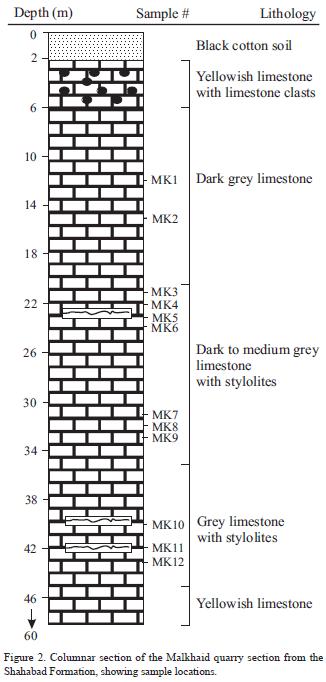
</front><body><![CDATA[ <p align="center"><font face="verdana" size="4"><b>Carbon and oxygen isotope geochemistry of Neoproterozoic limestones of the Shahabad Formation, Bhima basin, Karnataka, southern India</b></font></p>     <p align="justify"><font face="verdana" size="2">&nbsp;</font></p>     <p align="center"><font face="verdana" size="3"><b>Geoqu&iacute;mica de is&oacute;topos de carbono y ox&iacute;geno de calizas neoproterozoicas de la Formaci&oacute;n Shahabad, cuenca de Bhima, Karnataka, sur de la India</b></font></p>     <p align="justify"><font face="verdana" size="2">&nbsp;</font></p>     <p align="center"><font face="verdana" size="2"><b>Ramasamy Nagarajan<sup>1,2</sup>, Alcides N. Sial<sup>3</sup>, John S. Armstrong&#150;Altrin<sup>4,</sup>*, Jayagopal Madhavaraju<sup>5</sup>, and Raghavendra Nagendra<sup>1</sup></b></font></p>     <p align="justify"><font face="verdana" size="2">&nbsp;</font></p>     <p align="justify"><font face="verdana" size="2"><i><sup>1</sup>&nbsp;Department of Geology, Anna University, Chennai&#150;600 025, India.</i></font></p>     <p align="justify"><font face="verdana" size="2"><i><sup>2</sup>&nbsp;Present Address: School of Civil Engineering, SASTRA University, </i><i>Thirumalaisamudram, Thanjavur &#150; 613 402, India.</i></font></p>     <p align="justify"><font face="verdana" size="2"><i><sup>3</sup> N&uacute;cleo de Estudos Geoqu&iacute;micos &#150; Laborat&oacute;rio de Is&oacute;topos Est&aacute;veis (NEG &#150; LABISE), Departmento de Geologia, Universidade Federal de Pernambuco, C.P.7852, Recife, PE, 50670&#150;000 Brazil.</i></font></p>     <p align="justify"><font face="verdana" size="2"><i><sup>4</sup>&nbsp;Universidad Aut&oacute;noma del Estado de Hidalgo, Centro de Investigaciones en Ciencias de la Tierra, Ciudad Universitaria, Carretera Pachuca&#150;Tulancingo Km. 4.5, 42184 Pachuca, Hidalgo, M&eacute;xico. </i><i>* <i><a href="mailto:*john_arms@yahoo.com">john_arms@yahoo.com</a></i></i></font></p>     ]]></body>
<body><![CDATA[<p align="justify"><font face="verdana" size="2"><i><sup>5</sup>&nbsp;Estaci&oacute;n Regional del Noroeste, Instituto de Geolog&iacute;a, Universidad Nacional Aut&oacute;noma de M&eacute;xico, </i><i>Apartado Postal 1039, 83000 Hermosillo, Sonora, M&eacute;xico. </i></font></p>     <p align="justify"><font face="verdana" size="2">&nbsp;</font></p>     <p align="justify"><font face="verdana" size="2">Manuscript received: March 17, 2007     <br>   Corrected manuscript received: January 25, 2008     <br>   Manuscript accepted: January 28, 2008</font></p>     <p align="justify"><font face="verdana" size="2">&nbsp;</font></p>     <p align="justify"><font face="verdana" size="2"><b>ABSTRACT</b></font></p>     <p align="justify"><font face="verdana" size="2">Petrography, major (including four trace elements), stable isotopes (carbon and oxygen), and <sup>87</sup>Sr/86Sr geochemistry of limestones of the Shahabad Formation, Bhima basin, Karnataka, southern India are reported. These limestones show a narrow range of &delta;<sup>13</sup>C (<img src="/img/revistas/rmcg/v25n2/a3s1.jpg">1.34&#150;1.96<img src="/img/revistas/rmcg/v25n2/a3s2.jpg">) and &delta;<sup>18</sup>O (<img src="/img/revistas/rmcg/v25n2/a3s1.jpg"> &#150;6.04 to &#150; 7.61 <img src="/img/revistas/rmcg/v25n2/a3s2.jpg">) values. The petrographic study reveals the presence of microsparite and micro&#150; and macrostylolites. The &delta;<sup>13</sup>C and 87Sr/86Sr values indicate that these limestones were deposited during the late Neoproterozoic age and the &delta;<sup>18 </sup>O values also are very similar to the average Proterozoic carbonate values. Mn and Sr concentrations and low Mn/Sr ratio (&lt;1) together with the stable and radiogenic isotope data suggest that the studied samples are well&#150;preserved or scarcely altered limestones and probably have retained their primary isotopic signatures.</font></p>     <p align="justify"><font face="verdana" size="2"><b>Key words: </b>geochemistry, stable isotopes, delta oxygen, delta carbon, strontium isotopes, carbonate rocks, diagenesis, Bhima basin, India.</font></p>     <p align="justify"><font face="verdana" size="2">&nbsp;</font></p>     ]]></body>
<body><![CDATA[<p align="justify"><font face="verdana" size="2"><b>RESUMEN</b></font></p>     <p align="justify"><font face="verdana" size="2">En este trabajo se reportan resultados de la geoqu&iacute;mica de is&oacute;topos estables (carbono y ox&iacute;geno) y de elementos mayores (incluyendo cuatro elementos traza) en las calizas de la Formaci&oacute;n de Shahabad, cuenca de Bhima, Karnataka, en India meridional. Las calizas de la cuenca de Bhima muestran un estrecho intervalo de los valores de &delta;<sup>13</sup>C (<img src="/img/revistas/rmcg/v25n2/a3s1.jpg">1.34 a 1.96<img src="/img/revistas/rmcg/v25n2/a3s2.jpg">) y &delta;<sup>18</sup>O (<img src="/img/revistas/rmcg/v25n2/a3s1.jpg"> &#150;6.04 a &#150;7.61<img src="/img/revistas/rmcg/v25n2/a3s2.jpg">). El estudio petrogr&aacute;fico revela la presencia de dolom&iacute;a, microesparita y calcita recristalizada con micro y macroestilolitos. Los valores de &delta;<sup>13</sup>C y <sup>87</sup>Sr/<sup>86</sup>Sr revelan que estas calizas fueron depositadas durante el Neoproterozoico Tard&iacute;o y los valores de &delta;<sup>18</sup>O son muy parecidos a los valores promedio de los carbonatos del Proterozoico. Las concentraciones de Mn y Sr y los valores bajos de Mn/Sr (&lt; 1), junto con los datos de is&oacute;topos estables y radiog&eacute;nicos, indican que estas calizas est&aacute;n bien preservadas o escasamente alteradas y probablemente han conservado su firma isot&oacute;pica primaria.</font></p>     <p align="justify"><font face="verdana" size="2"><b>Palabras clave:</b> geoqu&iacute;mica, is&oacute;topos estables, delta ox&iacute;geno, delta carbono, is&oacute;topos de estroncio, rocas carbonatadas, diag&eacute;nesis, cuenca de Bhima, India.</font></p>     <p align="justify"><font face="verdana" size="2">&nbsp;</font></p>     <p align="justify"><font face="verdana" size="2"><b>INTRODUCTION</b></font></p>     <p align="justify"><font face="verdana" size="2">Chemical composition of sedimentary rocks is widely used to delineate specific units of carbonate and clastic strata (Primmer <i>et al., </i>1990). In recent years, much work has been focused on constraining primary <i>&delta;</i><sup>13</sup>C and <i>&delta;</i><sup>18</sup>O signatures of Precambrian carbonate sequences to understand the depositional processes, the evolution of the ocean&#150;atmospheric system, and the interactions of biotic and abiotic processes during the Earth's history (Burdett et al., 1990; <i>Veizer et al., </i>1992a, 1992b; Knoll <i>et al., </i>1995). The temporal <i>&delta;</i><sup>13</sup>C fluctuations of sedimentary carbonates represent secular variations of <i>&delta;</i><sup>13</sup>C in ocean water. Strontium isotope stratigraphy is a reliable and precise tool for stratigraphic correlations and age determinations. If these carbonates precipitate in contact with seawater and remain relatively unaltered by post&#150;depositional events during diagenesis, their strontium content should retain a seawater strontium isotope signature (Banner and Kaufman, 1994; Burke <i>et al., </i>1982; DePaolo and Ingram, 1985). Although extensive isotopic data are available from different parts of the world for Proterozoic sedimentary rocks, only a few studies have been published on samples from the Bhima basin (Sathyanarayan <i>et al., </i>1987; Kumar <i>et al., </i>1997; Kumar <i>et al., </i>1999; Nagarajan, 2003).</font></p>     <p align="justify"><font face="verdana" size="2">In this study, elemental and stable and radiogenic isotope data of limestones from the Malkhaid quarry (named after Malkhaid village) are presented. The quarry of the Malkhaid village (located near the Mulkod and Mudbol villages; <a href="/img/revistas/rmcg/v25n2/a3f1.jpg" target="_blank">Figure 1</a>) belongs to the Shahabad Formation of the Bhima basin. The Malkhaid quarry section was selected for the present study because it is considered as the best exposed vertical section (<img src="/img/revistas/rmcg/v25n2/a3s1.jpg">60 m) in the Shahabad Formation. Our main aim was to test if these limestones have retained their original chemical and isotopic compositions without significant post&#150;depositional changes.</font></p>     <p align="justify"><font face="verdana" size="2">&nbsp;</font></p>     <p align="justify"><font face="verdana" size="2"><b>GEOLOGICAL SETTING</b></font></p>     <p align="justify"><font face="verdana" size="2">Sedimentary formations of the Bhima basin are exposed as an array of narrow, E&#150;W stretching, sygmoidal strips arranged in an en echelon pattern, with a thickness of about 300 m, and extended over an area of 5,000 km<sup>2 </sup>(<a href="/img/revistas/rmcg/v25n2/a3f1.jpg" target="_blank">Figure 1</a>). These sedimentary rocks mainly comprise an alternating sequence of clastic and carbonate rocks (Rao <i>et al., </i>1975; Misra et al., 1987; Kale, 1990; Kale <i>et al., </i>1990; Nagarajan, 2003). The Mesoproterozoic Kaladgi sugergroup and the Neoproterozoic Bhima group overlie the Archean granite&#150;greenstone basement in Karnataka, southern India. The Archean granite&#150;greenstone terrain mainly consists of TTG (tonalite&#150;trondhjemite&#150;granodiorite), popularly known as Peninsular gneisses (Dharwar greenstone belts). The sedimentary rocks of the Mesoproterozoic Kaladgi supergroup and Neoproterozoic Bhima group were deposited on the eroded edges of the Dharwar craton (Kumar and Srinivasan, 2002). The Kaladgi sedimentary basin is exposed E&#150;W for a length of <img src="/img/revistas/rmcg/v25n2/a3s1.jpg">160 km, with a width varying from 40 to 65 km, and covers an area of about 8,000 km<sup>2</sup> to the west of the Bhima basin. The Bhima group is younger than the Kaladgi supergroup, and the Bhima basin rocks have been affected by intense faulting. Major structural faults across the basin define the boundaries of the different sectors (Kale and Peshwa, 1995). As a result of E&#150;W trending faults, the limestones found in the middle part of the basin directly rest on the granitic rocks.</font></p>     ]]></body>
<body><![CDATA[<p align="justify"><font face="verdana" size="2">King (1872) coined the term Bhima Series and divided the sedimentary rocks into Muddebihal sandstones and Talikote limestone. Mahadevan (1947) proposed a new threefold classification: 1) Lower Bhima Series, 2) Middle Bhima Series, and 3) Upper Bhima Series. Later, Rao <i>et al. </i>(1975) assigned the Group status to the sedimentary rocks of the Bhima basin and divided them into five distinct formations: 1) Rabanpalli Formation, 2) Shahabad Formation, 3) Halkal Shale, 4) Katamedavarhalli Formation, and 5) Harwal Shale. Misra <i>et al. </i>(1987) subdivided the Bhima Group into Sedam Subgroup (Rabanpalli Formation and Shahabad Formation) and Andola Subgroup (Halkal Shale, Katamedavarhalli Formation, and Harwal&#150;Gogi Shale). They identified a sedimentation break between the Sedam and Andola subgroups and interpreted it as a paraconformity. Later, Malur and Nagendra (1994) introduced a new name for Shahabad Formation as Kurkunta Formation. Recently, the clastic rocks of the Rabanpalli Formation were studied in detail by Nagarajan <i>et al. </i>(2007a, 2007b). The classification proposed by Rao <i>et al. </i>(1975) has been adopted for the present study. The five formations seem to represent two major cycles of sedimentation. The Rabanpalli and Shahabad Formations form the first cycle whereas the Halkal, Katamedavarhalli and Harwal Formations form the second cycle of sedimentation. Each cycle of sedimentation commenced with an arenaceous facies.</font></p>     <p align="justify"><font face="verdana" size="2">The limestone member is the dominant lithotype of the Bhima basin and is classified under Shahabad and Katamedavarhalli Formations. The Shahabad Formation is exposed in the central and eastern parts of the Bhima basin (16&deg;15' to 17&deg;35' Lat N; 76&deg;15' to 77&deg;30' Long E; <a href="/img/revistas/rmcg/v25n2/a3f1.jpg" target="_blank">Figure 1</a>). The Shahabad limestones can be classified as (1) flaggy, pale blue limestone, (2) blocky, light grey limestone, (3) variegated, bluish green or pink/pale blue limestone, (4) massive, dark/bluish grey limestone, and (5) flaggy, dark grey/bluish grey argillaceous limestone (Rao <i>et al., </i>1975; Malur and Nagendra, 1994). These limestones occupy an area of 2,000 km<sup>2</sup> in the Bhima basin. According to Kale <i>et al. </i>(1990) the vertical thickness of Shahabad Formation is less than 75 m. Representative limestone samples of Malkhaid quarry (60 m depth) were used for this study. The limestone deposits of Malkhaid area (<a href="/img/revistas/rmcg/v25n2/a3f1.jpg" target="_blank">Figure 1</a>) exhibit grey to dark grey and yellowish grey colour. Malkhaid limestones are well exposed near the villages Mulkod and Mudbol. These limestones are classified under the Shahabad Formation, Bhima basin (<a href="/img/revistas/rmcg/v25n2/a3f1.jpg" target="_blank">Figure 1</a>). The well&#150;exposed limestones are quarried by Zuari Cement (private company) for cement manufacturing. The samples were collected from the quarry section, which consists of six 10&#150;m high benches. The vertical profile of the limestone quarry (<a href="#f2">Figure 2</a>) shows a black cotton soil as surface cover, which is underlain by limestone boulders mixed with yellowish and dark grey limestones. The whole limestone section is micritic in nature and varies in color at different depths. Macrostylolites are identified at certain places with increasing depth.</font></p>     <p align="center"><font face="verdana" size="2"><a name="f2"></a></font></p>     <p align="center"><font face="verdana" size="2"><img src="/img/revistas/rmcg/v25n2/a3f2.jpg"></font></p>     <p align="justify"><font face="verdana" size="2">&nbsp;</font></p>     <p align="justify"><font face="verdana" size="2"><b>METHODOLOGY</b></font></p>     <p align="justify"><font face="verdana" size="2">Twelve limestone samples of the Malkhaid quarry (collected perpendicular to the strike at the different stages; <a href="#f2">Figure 2</a>) were analyzed for major and some trace elements in the XRF Laboratory, University of Kentucky. The XRF detection limits for Rb&#150;Sr and Mn&#150;Fe pairs were consistent with the systematic behavior suggested by Verma and Santoyo (2005). Carbon and oxygen isotope analyses were carried out at the Stable Isotope Laboratory (LABISE) of the Federal University of Pernambuco, Brazil.</font></p>     <p align="justify"><font face="verdana" size="2">For carbon and oxygen isotopic determinations, CO<sub>2 </sub>was extracted from powdered carbonates in a high vacuum line after reaction with orthophosphoric acid at 25&deg;C, and cry ogenically cleaned, according to the method described by Craig (1957). CO<sub>2</sub> gas released by this method was analyzed for carbon and oxygen isotopes in a double inlet, triple collector SIRA II mass spectrometer, using the reference gas BSC (Borborema Skarn Calcite), which calibrated against NBS&#150;18, NBS&#150;19, and NBS&#150;20 has a value of &#150;11.28 &plusmn; 0.004 <img src="/img/revistas/rmcg/v25n2/a3s2.jpg">pdb for <i>&delta;</i><sup>18</sup>O and &#150;8.58 &plusmn; 0.02 <img src="/img/revistas/rmcg/v25n2/a3s2.jpg">PDB for <i>&delta;</i><sup>13</sup>C. The results are expressed in the notation <i>&delta;</i><img src="/img/revistas/rmcg/v25n2/a3s2.jpg"> (per mil) in relation to international PDB scale.</font></p>     <p align="justify"><font face="verdana" size="2">Two representative samples were selected for Sr isotope analyses. Limestone samples were leached in 1 N ammonium acetate prior to acid digestion. Sr was separated in 2.5 M HCl using Bio&#150;Rad AG50W X8 200&#150;400 mesh cation exchange resin. Total procedure blank for Sr samples prepared with this method was &lt;200 pg. For mass spectrometry, Sr samples were loaded onto single Ta filaments with 1 N phosphoric acid. Sr samples were analyzed on a VG Sector 54&#150;30 multiple collector mass spectrometer. A <sup>87</sup>Sr intensity of 1V (1 x 10<sup>&#150;11</sup> A) &plusmn; 10% was maintained and the <sup>87</sup>Sr/<sup>86</sup>Sr ratio was corrected for mass fractionation using <sup>87</sup>Sr/<sup>86</sup>Sr = 0.1194 and an exponential law. The VG Sector 54&#150;30 mass spectrometer was operated in the peak&#150;jumping mode with data collected as 15 blocks of 10 ratios. For this instrument, NIST SRM987 gave a value of 0.710260 &plusmn; 11 (1 SD, n = 17). To facilitate comparison of Sr isotopic data from different laboratories we have adjusted the <sup>87</sup>Sr/<sup>86</sup>Sr values of our limestone samples to NIST SRM987 <sup>87</sup>Sr/<sup>86</sup>Sr of 0.710230, following the practice of the Max&#150;Planck Institute, Mainz, Germany (see <i>e.g., </i>the data repository in Verma, 2002).</font></p>     <p align="justify"><font face="verdana" size="2">&nbsp;</font></p>     ]]></body>
<body><![CDATA[<p align="justify"><font face="verdana" size="2"><b>RESULTS </b></font></p>     <p align="justify"><font face="verdana" size="2"><b>Petrography</b></font></p>     <p align="justify"><font face="verdana" size="2">The limestones of Shahabad Formation are micritic (calmicrite) in nature. Stylolites and pressure solution structures are present in the limestones. Some of the pressure solution structures are related to horizontal compressional forces (probably resulting from tectonism). Most of the stylolites have parallel features (<a href="/img/revistas/rmcg/v25n2/a3f3.jpg" target="_blank">Figure 3a&#150;c</a>). The limestones also exhibit crosscutting stylolites and fractures filled by calcite and quartz. Few limestone samples from the top of the section exhibit small grains of saddle dolomite (<a href="/img/revistas/rmcg/v25n2/a3f3.jpg" target="_blank">Figure 3d</a>), which are seen adjacent to stylolites. The limestones also exhibit some mineral grains, which occur along the stylolites (<a href="/img/revistas/rmcg/v25n2/a3f3.jpg" target="_blank">Figure 3e</a>). Limestones of Shahabad Formation show pressure solution and chemical deposition of fibrous void&#150;filling calcite (<a href="/img/revistas/rmcg/v25n2/a3f3.jpg" target="_blank">Figure 3f</a>) on free surfaces of individual crystals and polycrystalline aggregates. Terrigenous particles like quartz and feldspar occur as aggregates and lenses in the inter&#150;laminar areas.</font></p>     <p align="justify"><font face="verdana" size="2"><b>Elemental variations</b></font></p>     <p align="justify"><font face="verdana" size="2">The results of major (in wt. %), four trace elements (in ppm), strontium isotopes, and carbon and oxygen isotopes (<img src="/img/revistas/rmcg/v25n2/a3s2.jpg">) for the Malkhaid quarry section limestones are presented in <a href="/img/revistas/rmcg/v25n2/a3t1.jpg" target="_blank">Table 1</a>. We also report mean values for all elements in these limestone samples without testing if these data represent a normal population and if there are any discordant outliers present. Sample MK11 would probably represent a discordant outlier for SiO<sub>2</sub> and sample MK2 would be for Rb if the method and critical values proposed by Verma and Quiroz&#150;Ruiz (2006a, 2006b) are used for this purpose. Proper handling of discordant outliers would have improved the veracity of mean and standard deviation values, particularly for those parameters that have outlying observations (Verma <i>et al., </i>2008).</font></p>     <p align="justify"><font face="verdana" size="2">The major and trace element variations with depth are shown in <a href="/img/revistas/rmcg/v25n2/a3f4.jpg" target="_blank">Figure 4</a>. The limestones show high content of CaO (<img src="/img/revistas/rmcg/v25n2/a3s1.jpg">41.0&#150;46.4 wt.%; except MK11). The distribution of SiO<sub>2</sub> is reverse to that of CaO (<img src="/img/revistas/rmcg/v25n2/a3s1.jpg">9.18&#150;14.4 wt.%). Other elements like Al<sub>2</sub>O<sub>3</sub> (<img src="/img/revistas/rmcg/v25n2/a3s1.jpg">0.57&#150;1.86 wt.%), K<sub>2</sub>O (<img src="/img/revistas/rmcg/v25n2/a3s1.jpg">0.16&#150;0.41 wt.%), Fe<sub>2</sub>O<sub>3</sub> (<img src="/img/revistas/rmcg/v25n2/a3s1.jpg">0.11&#150;0.93 wt.%), and Na<sub>2</sub>O (<img src="/img/revistas/rmcg/v25n2/a3s1.jpg">0.03&#150;0.04 wt.%) are much lower than the CaO and SiO<sub>2</sub> contents. Na<sub>2</sub>O content is uniform throughout the quarry section (<a href="/img/revistas/rmcg/v25n2/a3f4.jpg" target="_blank">Figure 4</a>). The aluminum concentration is a reasonably good measure of detrital flux (Veizer, 1983). Positive correlations of A1<sub>2</sub>O<sub>3 </sub>with TiO<sub>2</sub>, MgO and Fe<sub>2</sub>O<sub>3</sub> (linear correlation coefficient, r = 0.96, 0.87, and 0.81, respectively; number of samples n = 12) are statistically significant at 99% confidence level (for more details on significance levels and the corresponding critical values, see Verma, 2005) and indicate that these elements are associated with detrital phases. Slight differences in the major element concentrations of the sample MK4 (<a href="/img/revistas/rmcg/v25n2/a3t1.jpg" target="_blank">Table 1</a>) compared to other samples may be due to the presence of clay minerals formed along the stylolitic seams. The limestone samples of this study show very low Mg/Ca ratio (<img src="/img/revistas/rmcg/v25n2/a3s1.jpg">0.005&#150;0.030; <a href="/img/revistas/rmcg/v25n2/a3t1.jpg" target="_blank">Table 1</a>), even though some minor saddle dolomite grains are present in a few samples (<a href="/img/revistas/rmcg/v25n2/a3f3.jpg" target="_blank">Figure 3d</a>). These low values indicate that the studied samples are not dolomitized, because dolomitization would necessarily cause a marked increase in the Mg/Ca ratio of the limestones <i>(e.g., </i>Kaufman <i>et al., </i>1992).</font></p>     <p align="justify"><font face="verdana" size="2">Trace element analyses show that the Ba content (<img src="/img/revistas/rmcg/v25n2/a3s1.jpg">127&#150;5,700 ppm) in the samples is much higher than the Sr (<img src="/img/revistas/rmcg/v25n2/a3s1.jpg">112&#150;350 ppm), Mn (<img src="/img/revistas/rmcg/v25n2/a3s1.jpg">77&#150;125 ppm), and Rb (<img src="/img/revistas/rmcg/v25n2/a3s1.jpg">1&#150;180 ppm) contents. The enrichment of Ba is particularly noted in the samples MK11 (5,700 ppm) and MK9 (2,300 ppm), which show stylolites and veins filled with insoluble residues. The recent shallow marine carbonates have Sr concentrations between 8,000 and 10,000 ppm (Milliman, 1974). The Sr contents of samples in this study (&#150;112&#150;350 ppm) are also much lower than the average value given for lithosphere carbonates (Sr = 610 ppm; Turekian and Wedepohl, 1961). The abnormal enrichment of Rb in sample MK2 (180 ppm; <a href="/img/revistas/rmcg/v25n2/a3t1.jpg" target="_blank">Table 1</a>) may be due to the influx of clay minerals.</font></p>     <p align="justify"><font face="verdana" size="2">The carbon and oxygen isotope values range from 1.34 to 1.96<img src="/img/revistas/rmcg/v25n2/a3s2.jpg"> and &#150;6.04 to &#150;7.61<img src="/img/revistas/rmcg/v25n2/a3s2.jpg">, respectively. Two samples (MK1 and MK8) were analyzed for <sup>87</sup>Sr/<sup>86</sup>Sr (0.70684 and 0.70696, respectively; <a href="/img/revistas/rmcg/v25n2/a3t1.jpg" target="_blank">Table 1</a>).</font></p>     <p align="justify"><font face="verdana" size="2">&nbsp;</font></p>     <p align="justify"><font face="verdana" size="2"><b>DISCUSSION</b></font></p>     ]]></body>
<body><![CDATA[<p align="justify"><font face="verdana" size="2"><b>Identification of primary isotopic signatures</b></font></p>     <p align="justify"><font face="verdana" size="2">Many criteria have been emphasized to assess the degree of post&#150;depositional alteration in carbonate rocks (Hudson, 1977; Veizer <i>et al., </i>1992a; Derry <i>et al., </i>1992; Kaufman and Knoll, 1995). The variations in trace elements have been used as a technique to identify diagenetic alteration <i>(e.g., </i>Brand and Veizer, 1980; Ditchfield <i>et al., </i>1994; Jones <i>et al., </i>1994a, 1994b; Price and Sellwood, 1997; Podlaha <i>et al., </i>1998; Hesselbo <i>et al., </i>2000; Price <i>et al., </i>2000; Jenkyns <i>et al., </i>2002; Grocke <i>et al., </i>2003). These studies suggest that high concentrations of Fe and Mn are mainly associated with negative &delta;<sup>18</sup>O and &delta;<sup>13</sup>C values. During diagenetic alteration by meteoric fluids, Mn may be incorporated and Sr may be expelled from the carbonate system (Brand and Veizer, 1980; Veizer, 1983). Hence, the diagenetic alteration of low&#150;Mg calcite will decrease the Sr content and increase the Mn content (Veizer, 1983). However, such a trend is not observed in the limestones of the Shahabad Formation because the linear correlation coefficient (r) between Mn and Sr (r = &#150;0.16; n=12) is not statistically significant (see Verma, 2005, for statistical significance of r values).</font></p>     <p align="justify"><font face="verdana" size="2">Due to the distinct behavior of Mn and Sr during diagenesis (marine and meteoric) of limestones, Mn/Sr ratio is generally considered as a reliable indicator of the degree of alteration (Jacobsen and Kaufman, 1999). Many studies (Derry <i>et al., </i>1992; Kaufman <i>et al., </i>1992, 1993; Kah et al., 1999) reveal that the limestones with Mn/Sr &lt; 2 generally display unaltered isotopic signature. Furthermore, Jacobsen and Kaufman (1999) proposed a model on the basis of trace elements and stable isotopes, and concluded that the limestones with Mn/Sr &lt;2, &delta;<sup>18</sup>O values from &#150;5 to &#150;10 %o and Sr concentrations between 150 and 2,500 ppm show primary isotopic signatures. In the present study, the Mn/Sr ratios (<img src="/img/revistas/rmcg/v25n2/a3s1.jpg">0.26&#150;0.86), &delta;<sup>18</sup>O values (<img src="/img/revistas/rmcg/v25n2/a3s1.jpg">&#150;7.61 to &#150;6.04<img src="/img/revistas/rmcg/v25n2/a3s2.jpg">), and Sr concentrations (<img src="/img/revistas/rmcg/v25n2/a3s1.jpg">112&#150;350 ppm), fall well within these ranges and indicate the preservation of primary isotopic signatures.</font></p>     <p align="justify"><font face="verdana" size="2">Many studies have shown that carbon isotopic signatures are well preserved in Proterozoic carbonates (Schildlowski <i>et al.,</i> 1975; Knoll <i>et al., </i>1986), because pore spaces are sealed soon after the deposition, which inhibit subsequent fluid&#150;rock interaction and isotopic resetting (Buick <i>et al., </i>1995), but meteoric diagenesis can still alter the primary carbon isotope compositions (Veizer, 1983; Kaufman and Knoll, 1995). Similarly, &delta;<sup>18</sup>O values of carbonate rocks are sensitive diagenetic indicators because the later fluid&#150;rock interactions tend to decrease the primary &delta;<sup>18</sup>O values imparted by seawater (Veizer, 1983). The diagenetic alteration of the primary &delta;<sup>13</sup>C signatures can be identified by the covariance relationship between &delta;<sup>13</sup>C and &delta;<sup>18</sup>O values. A significant positive correlation between &delta;5<sup>13</sup>C and &delta;<sup>18</sup>O values is an indicator of &delta;<sup>13</sup>C alteration (Brasier <i>et al., </i>1996). The lack of a statistically significant positive correlation between &delta;<sup>13</sup>C and 5<sup>18</sup>O values (r=&#150;0.34, n=12; see Verma, 2005 for more details) indicates that diagenetic modification of primary &delta;<sup>13</sup>C values can be excluded. Thus, geochemical parameters such as Mn, Sr and Mn/Sr ratio, and the relationship between &delta;<sup>13</sup>C and &delta;<sup>18</sup>O strongly support that the limestones of the Shahabad Formation (Bhima basin) retained the primary isotopic signature of Neoproterozoic seawater.</font></p>     <p align="justify"><font face="verdana" size="2">&nbsp;</font></p>     <p align="justify"><font face="verdana" size="2"><b>Carbon isotopic composition</b></font></p>     <p align="justify"><font face="verdana" size="2">&delta;<sup>13</sup>C excursions studied worldwide imply that the oceanic environment has affected the carbon reservoir in a basin or on a global scale. Variations in the carbon isotopes of limestones and co&#150;occurring organic matter record secular changes in the burial rate of the carbon phases with increasing &delta;<sup>13</sup>C values (Hayes, 1993). Post&#150;depositional thermal alteration of organic matter often preserves primary carbon isotopic signatures in carbonate phases (Kah <i>et al., </i>1999). Therefore, ancient carbonates commonly retain their primary carbon isotopic compositions (Marshall, 1992; Buick <i>et al., </i>1995; Kaufman and Knoll, 1995; Knoll <i>et al., </i>1995). During transgression, a greater amount of organic matter is stored in the marginal areas, resulting in the enrichment of <sup>13</sup>C, whereas during regressive phases of the sea, the stored organic matter is eroded and oxidized, resulting in <sup>12</sup>C enrichment in the deep ocean (Broecker, 1982).</font></p>     <p align="justify"><font face="verdana" size="2">In an isotopic study of the limestones from the Sedam area of the Shahabad Formation (<a href="/img/revistas/rmcg/v25n2/a3f1.jpg" target="_blank">Figure 1</a>), Kumar <i>et al. </i>(1999) reported &delta;<sup>13</sup>C values ranging from 0%o to 3.7<img src="/img/revistas/rmcg/v25n2/a3s2.jpg">. In another study, Kumar <i>et al. </i>(1997) obtained a range of &delta;<sup>13</sup>C values between 0.89<img src="/img/revistas/rmcg/v25n2/a3s2.jpg"> and 3.59<img src="/img/revistas/rmcg/v25n2/a3s2.jpg"> for the Shahabad Formation and pointed out that the majority of the &delta;<sup>13</sup>C values cluster around 2<img src="/img/revistas/rmcg/v25n2/a3s2.jpg">PDB, except in the basal unit of the Shahabad Formation with a mean value of 3.25<img src="/img/revistas/rmcg/v25n2/a3s2.jpg">PDB. In the present study, the limestone samples show a narrower range of &delta;<sup>13</sup>C values (<img src="/img/revistas/rmcg/v25n2/a3s1.jpg">1.34&#150;1.96 %o) but within the ranges observed by the previous workers. These values are close to the plateau values (2<img src="/img/revistas/rmcg/v25n2/a3s2.jpg">; Kaufman and Knoll, 1995) and are similar to the values obtained for limestone sections in Namibia (Grotzinger <i>et al., </i>1995; Saylor <i>et al., </i>1998) and Canada (Narbonne <i>et al., </i>1994). In this context it is also important to point out that after <i>ca. </i>600 Ma the <sup>13</sup>C values in carbonates remained high (+2 to +4<img src="/img/revistas/rmcg/v25n2/a3s2.jpg">) until the Precambrian&#150;Cambrian boundary (Knoll <i>et al., </i>1986; Fairchild and Spiro, 1987; Lambert <i>et al., </i>1987; Kaufman <i>et al., </i>1991). Afterwords, the <sup>13</sup>C values in lower Cambrian carbonates were close to about &#150;1<img src="/img/revistas/rmcg/v25n2/a3s2.jpg">. These data therefore provide age constraints for limestones of the Shahabad Formation.</font></p>     <p align="justify"><font face="verdana" size="2">&nbsp;</font></p>     <p align="justify"><font face="verdana" size="2"><b>Oxygen isotopic composition</b></font></p>     ]]></body>
<body><![CDATA[<p align="justify"><font face="verdana" size="2">Oxygen isotope studies of carbonate rocks have provided insight into Precambrian seawater chemistry (Perry and Tan, 1972; Veizer <i>et al., </i>1992b). Oxygen isotopic compositions of carbonates are much prone to alteration during diagenesis (Hudson, 1977; Veizer, 1983). The results of this study are plotted in a &delta;<sup>13</sup>C <i>vs. </i>&delta;<sup>18</sup>O (<a href="/img/revistas/rmcg/v25n2/a3f5.jpg" target="_blank">Figure 5</a>) cross plot diagram (Hudson, 1977), in which the Shahabad limestone samples plot in the fields of late cements and marine limestones. The &delta;<sup>18</sup>O of a carbonate precipitated from water depends chiefly on the &delta;<sup>18</sup>O composition and temperature of the water. Increasing lighter (more negative) &delta;<sup>18</sup>O value is connected with decreasing salinity and increasing temperatures (Hudson, 1977). The range of moderately depleted &delta;<sup>18</sup>O values in most limestones is supportive of cementation under mainly burial and/or meteoric conditions rather than by syn&#150;sedimentary marine cements as in many tropical carbonate deposits. The depletion in <sup>18</sup>O observed in geologically older carbonates, commonly ascribed to post&#150;depositional isotope exchange with meteoric waters (Clayton and Degens, 1959; Keith and Weber, 1964; Schidlowski <i>et al., </i>1975), also holds in the case of many Proterozoic carbonate formations. Limestones of the present study show a narrow range of &#150;6.04<img src="/img/revistas/rmcg/v25n2/a3s2.jpg"> to &#150;7.6l<img src="/img/revistas/rmcg/v25n2/a3s2.jpg">, which is comparable to the 'best preserved' &delta;<sup>18</sup>O mean value (&#150;7.5 &plusmn; 2<img src="/img/revistas/rmcg/v25n2/a3s2.jpg">) reported for most of the Proterozoic&#150;Early Cambrian limestones (Brasier <i>et al., </i>1990; Burdett <i>et al., </i>1990; Kaufman <i>et al., </i>1991; Veizer <i>et al., </i>1992a; Hall and Veizer, 1996).</font></p>     <p align="justify"><font face="verdana" size="2">&nbsp;</font></p>     <p align="justify"><font face="verdana" size="2"><b>Strontium isotopic composition</b></font></p>     <p align="justify"><font face="verdana" size="2">The <sup>87</sup>Sr/<sup>86</sup>Sr composition of seawater has been considered as a powerful tool for making correlations and indirect age assignment, reconstruction of global tectonics, and tracing diagenetic processes (Burke <i>et al.</i>, 1982; Veizer, 1989; Banner, 2004; Halverson et al., 2007). 87Sr/86Sr of the modern ocean (0.7092) generally indicates a combination of hydrothermal alteration of the oceanic crust (<img src="/img/revistas/rmcg/v25n2/a3s1.jpg">0.7035) and input from continental weathering (0.7120; Edmond, 1992). The problems in applying strontium isotope stratigraphy to the Cenozoic record become more important for older time periods (Burke <i>et al., </i>1982) and are particularly acute for the Precambrian, where the geological record is less complete or incomplete. However, the limited availability of biostratigraphic inferences and meager radiometric dating on the Precambrian rocks require chemostratigraphic methods to correlate and integrate the incomplete stratigraphic records (Knoll and Walter, 1992; Knoll, 2000). Hence, the Sr&#150;isotope stratigraphy is generally applied to the Proterozoic sedimentary rocks. Limestone samples at depths of 12m (MK1) and 32m (MK8) were analysed for <sup>87</sup>Sr/<sup>86</sup>Sr isotope and yielded values of 0.70684 (MK1) and 0.70696 (MK8). These samples (MK1 and MK8) are very low in Mn/Sr ratio (0.31 and 0.37, respectively) and have positive &delta;<sup>13</sup>C values (1.75%oPDB and 1.85%oPDB respectively). Kumar <i>et al. </i>(2002) noticed that the Upper Vindhyan carbonates are characterized by positive &delta;<sup>13</sup>C values at low <sup>87</sup>Sr/<sup>86</sup>Sr (0.7068 &plusmn; 0.0002), which represent a Neoproterozoic interval of deposition. In general, diagenesis tends to increase <sup>87</sup>Sr/<sup>86</sup>Sr values. Therefore, a very low <sup>87</sup>Sr/<sup>86</sup>Sr value from any horizon can be interpreted as a maximum estimate of original seawater composition (Knoll, 2000). The <sup>87</sup>Sr/<sup>86</sup>Sr values of this study show little variation (0.70684&#150;0.70696). Furthermore, Sr isotopic composition and &delta;<sup>13</sup>C values of the present study are comparable to that of the upper Vindhyan carbonates, which suggests that the limestones of the Shahabad Formation were deposited during the Neoproterozoic age. Finally, the low <sup>87</sup>Sr/<sup>86</sup>Sr, less positive &delta;<sup>13</sup>C values, and low Mn/Sr ratio indicate that the studied samples can be considered as well preserved marine limestones that have retained their primary chemical and isotopic signatures.</font></p>     <p align="justify"><font face="verdana" size="2">&nbsp;</font></p>     <p align="justify"><font face="verdana" size="2"><b>CONCLUSIONS</b></font></p>     <p align="justify"><font face="verdana" size="2">A petrographic study showed the presence of micro&#150;stylolites and siliclastic veins in limestones of the Shahabad Formation. On the basis of chemical and isotopic data, the studied limestone samples are considered as well&#150;preserved limestones.</font></p>     <p align="justify"><font face="verdana" size="2">&nbsp;</font></p>     <p align="justify"><font face="verdana" size="2"><b>ACKNOWLEDGEMENTS</b></font></p>     <p align="justify"><font face="verdana" size="2">The authors thank Dr. Hendry Francis for his assistance in major and trace elements analyses. This manuscript has been greatly improved from indepth reviews by Prof. Yong Il Lee, and Dr. Nallappa Reddy. Our special thanks to Prof. Surendra P. Verma for his innovative ideas and useful suggestions. JSA wishes to express his gratefulness to SEP&#150;PROMEP (Programa de Mejoramiento del Profesorado; Grant No: UAEHGO&#150;PTC&#150;280), CONACYT (Consejo Nacional de Ciencia y Tecnolog&iacute;a; 52574), and PAI (Programa Anual de Investigaci&oacute;n; 69B), Mexico, for financial assistance.</font></p>     ]]></body>
<body><![CDATA[<p align="justify"><font face="verdana" size="2">&nbsp;</font></p>     <p align="justify"><font face="verdana" size="2"><b>REFERENCES</b></font></p>     <!-- ref --><p align="justify"><font face="verdana" size="2">Banner, J.L., 2004, Radiogenic isotopes: systematics and applications to earth surface processes and chemical stratigraphy: Earth Science Reviews, 65(3&#150;4), 141&#150;194.</font>&nbsp;&nbsp;&nbsp;&nbsp;&nbsp;&nbsp;&nbsp;&nbsp;[&#160;<a href="javascript:void(0);" onclick="javascript: window.open('/scielo.php?script=sci_nlinks&ref=8026415&pid=S1026-8774200800020000300001&lng=','','width=640,height=500,resizable=yes,scrollbars=1,menubar=yes,');">Links</a>&#160;]<!-- end-ref --><!-- ref --><p align="justify"><font face="verdana" size="2">Banner, J.L., Kaufman, J., 1994, The isotopic record of ocean chemistry and diagenesis preserved in non&#150;luminescent brachiopods from Mississippian carbonate rocks, Illinois and Missouri: Geologial Society of America Bulletin, 106(8), 1074&#150;1082.</font>&nbsp;&nbsp;&nbsp;&nbsp;&nbsp;&nbsp;&nbsp;&nbsp;[&#160;<a href="javascript:void(0);" onclick="javascript: window.open('/scielo.php?script=sci_nlinks&ref=8026416&pid=S1026-8774200800020000300002&lng=','','width=640,height=500,resizable=yes,scrollbars=1,menubar=yes,');">Links</a>&#160;]<!-- end-ref --><!-- ref --><p align="justify"><font face="verdana" size="2">Brand, U., Veizer, J., 1980, Chemical diagenesis of a multi component carbonate system: 1. Trace elements: Journal of Sedimentary Petrology, 50, 1219&#150;1236.</font>&nbsp;&nbsp;&nbsp;&nbsp;&nbsp;&nbsp;&nbsp;&nbsp;[&#160;<a href="javascript:void(0);" onclick="javascript: window.open('/scielo.php?script=sci_nlinks&ref=8026417&pid=S1026-8774200800020000300003&lng=','','width=640,height=500,resizable=yes,scrollbars=1,menubar=yes,');">Links</a>&#160;]<!-- end-ref --><!-- ref --><p align="justify"><font face="verdana" size="2">Brasier, M.D., Magaritz, M., Corfield, R., Huilin, L., Xiche, W., Lin, O., Zhiwen, J., Hamadi, B., Tinggui, H., Frazier, A.G., 1990, The carbon and oxygen isotope record of the Precambrian&#150;Cambrian boundary interval in China and Iran and their correlation: Geological Magazine, 127 (4), 319&#150;332.</font>&nbsp;&nbsp;&nbsp;&nbsp;&nbsp;&nbsp;&nbsp;&nbsp;[&#160;<a href="javascript:void(0);" onclick="javascript: window.open('/scielo.php?script=sci_nlinks&ref=8026418&pid=S1026-8774200800020000300004&lng=','','width=640,height=500,resizable=yes,scrollbars=1,menubar=yes,');">Links</a>&#160;]<!-- end-ref --><!-- ref --><p align="justify"><font face="verdana" size="2">Brasier, M.D., Shields, G., Kuleshov, V.N., Zhegallo, L.A., 1996, Integrated chemo&#150;and biostratigraphic calibration of early animal evolution: Neoproterozoic&#150;early Cambrian of southwest Mongolia: Geological Magazine, 133(4), 445&#150;485.</font>&nbsp;&nbsp;&nbsp;&nbsp;&nbsp;&nbsp;&nbsp;&nbsp;[&#160;<a href="javascript:void(0);" onclick="javascript: window.open('/scielo.php?script=sci_nlinks&ref=8026419&pid=S1026-8774200800020000300005&lng=','','width=640,height=500,resizable=yes,scrollbars=1,menubar=yes,');">Links</a>&#160;]<!-- end-ref --><!-- ref --><p align="justify"><font face="verdana" size="2">Broecker, W.S., 1982, Glacial to interglacial changes in ocean chemistry: Progress in Oceanography, 11(2), 151&#150;197.</font>&nbsp;&nbsp;&nbsp;&nbsp;&nbsp;&nbsp;&nbsp;&nbsp;[&#160;<a href="javascript:void(0);" onclick="javascript: window.open('/scielo.php?script=sci_nlinks&ref=8026420&pid=S1026-8774200800020000300006&lng=','','width=640,height=500,resizable=yes,scrollbars=1,menubar=yes,');">Links</a>&#160;]<!-- end-ref --><!-- ref --><p align="justify"><font face="verdana" size="2">Buick, R., Marais, D., Knoll, A.H., 1995, Stable isotopic compositions of carbonates from the Mesoproterozoic Bangemall Group, northwestern Australia: Chemical Geology, 123(1&#150;4), 153&#150;171.</font>&nbsp;&nbsp;&nbsp;&nbsp;&nbsp;&nbsp;&nbsp;&nbsp;[&#160;<a href="javascript:void(0);" onclick="javascript: window.open('/scielo.php?script=sci_nlinks&ref=8026421&pid=S1026-8774200800020000300007&lng=','','width=640,height=500,resizable=yes,scrollbars=1,menubar=yes,');">Links</a>&#160;]<!-- end-ref --><!-- ref --><p align="justify"><font face="verdana" size="2">Burdett, J.W., Grotzinger, J.P., Arthur, M.A., 1990, Did major changes in the stable isotope composition of Proterozoic seawater occur?: Geology, 18(3), 227&#150;230.</font>&nbsp;&nbsp;&nbsp;&nbsp;&nbsp;&nbsp;&nbsp;&nbsp;[&#160;<a href="javascript:void(0);" onclick="javascript: window.open('/scielo.php?script=sci_nlinks&ref=8026422&pid=S1026-8774200800020000300008&lng=','','width=640,height=500,resizable=yes,scrollbars=1,menubar=yes,');">Links</a>&#160;]<!-- end-ref --><!-- ref --><p align="justify"><font face="verdana" size="2">Burke, W.H., Denison, R.E., Hetherington, E.A., Koepnick, R.B., Nelson, F.F., Otto, J.B., 1982, Variations of seawater <sup>87</sup>Sr/<sup>86</sup>Sr throughout Phanerozoic time: Geology, 10(10), 516&#150;519.</font>&nbsp;&nbsp;&nbsp;&nbsp;&nbsp;&nbsp;&nbsp;&nbsp;[&#160;<a href="javascript:void(0);" onclick="javascript: window.open('/scielo.php?script=sci_nlinks&ref=8026423&pid=S1026-8774200800020000300009&lng=','','width=640,height=500,resizable=yes,scrollbars=1,menubar=yes,');">Links</a>&#160;]<!-- end-ref --><!-- ref --><p align="justify"><font face="verdana" size="2">Clayton, R.N., Degens, E.T., 1959, Use of carbon isotope analysis of carbonate for differentiating fresh&#150;water and marine sediments: Bulletin of the American Association of Petroleum Geologists, 43, 890&#150;897.</font>&nbsp;&nbsp;&nbsp;&nbsp;&nbsp;&nbsp;&nbsp;&nbsp;[&#160;<a href="javascript:void(0);" onclick="javascript: window.open('/scielo.php?script=sci_nlinks&ref=8026424&pid=S1026-8774200800020000300010&lng=','','width=640,height=500,resizable=yes,scrollbars=1,menubar=yes,');">Links</a>&#160;]<!-- end-ref --><!-- ref --><p align="justify"><font face="verdana" size="2">Craig, H., 1957, Isotope standard for carbon and oxygen and correction factors for mass spectrometry analysis of carbon dioxide: Geochimica et Cosmochimica Acta, 12(1&#150;2), 133&#150;149.</font>&nbsp;&nbsp;&nbsp;&nbsp;&nbsp;&nbsp;&nbsp;&nbsp;[&#160;<a href="javascript:void(0);" onclick="javascript: window.open('/scielo.php?script=sci_nlinks&ref=8026425&pid=S1026-8774200800020000300011&lng=','','width=640,height=500,resizable=yes,scrollbars=1,menubar=yes,');">Links</a>&#160;]<!-- end-ref --><!-- ref --><p align="justify"><font face="verdana" size="2">DePaolo, D.J., Ingram, B.L., 1985, High&#150;resolution stratigraphy with strontium isotopes: Science, 227(4689), 938&#150;941.</font>&nbsp;&nbsp;&nbsp;&nbsp;&nbsp;&nbsp;&nbsp;&nbsp;[&#160;<a href="javascript:void(0);" onclick="javascript: window.open('/scielo.php?script=sci_nlinks&ref=8026426&pid=S1026-8774200800020000300012&lng=','','width=640,height=500,resizable=yes,scrollbars=1,menubar=yes,');">Links</a>&#160;]<!-- end-ref --><!-- ref --><p align="justify"><font face="verdana" size="2">Derry, L.A., Kaufman, A.J., Jacobsen, S.B., 1992, Sedimentary cycling and environmental change in the Late Proterozoic: evidence from stable and radiogenic isotopes: Geochimica et Cosmochimica Acta, 56(3), 1317&#150;1329.</font>&nbsp;&nbsp;&nbsp;&nbsp;&nbsp;&nbsp;&nbsp;&nbsp;[&#160;<a href="javascript:void(0);" onclick="javascript: window.open('/scielo.php?script=sci_nlinks&ref=8026427&pid=S1026-8774200800020000300013&lng=','','width=640,height=500,resizable=yes,scrollbars=1,menubar=yes,');">Links</a>&#160;]<!-- end-ref --><!-- ref --><p align="justify"><font face="verdana" size="2">Ditchfield, P.W., Marshall, J.D., Pirrie, D., 1994, High latitude palaeotemperature variations: New data from the Thithonian to Eocene of James Ross Island, Antarctica: Palaeogeography, Palaeoclimatology, Palaeoecology, 107(1&#150;2), 79&#150;101.</font>&nbsp;&nbsp;&nbsp;&nbsp;&nbsp;&nbsp;&nbsp;&nbsp;[&#160;<a href="javascript:void(0);" onclick="javascript: window.open('/scielo.php?script=sci_nlinks&ref=8026428&pid=S1026-8774200800020000300014&lng=','','width=640,height=500,resizable=yes,scrollbars=1,menubar=yes,');">Links</a>&#160;]<!-- end-ref --><!-- ref --><p align="justify"><font face="verdana" size="2">Edmond, J., 1992, Himalayan tectonics, weathering processes, and strontium isotope record in marine limestones: Science, 258(5088), 1594&#150;1597.</font>&nbsp;&nbsp;&nbsp;&nbsp;&nbsp;&nbsp;&nbsp;&nbsp;[&#160;<a href="javascript:void(0);" onclick="javascript: window.open('/scielo.php?script=sci_nlinks&ref=8026429&pid=S1026-8774200800020000300015&lng=','','width=640,height=500,resizable=yes,scrollbars=1,menubar=yes,');">Links</a>&#160;]<!-- end-ref --><!-- ref --><p align="justify"><font face="verdana" size="2">Fairchild, I.J., Spiro, B., 1987, Petrological and isotopic implications of some contrasting Late Precambrian carbonates, NE Spitsbergen: Sedimentology, 34(6), 973&#150;989.</font>&nbsp;&nbsp;&nbsp;&nbsp;&nbsp;&nbsp;&nbsp;&nbsp;[&#160;<a href="javascript:void(0);" onclick="javascript: window.open('/scielo.php?script=sci_nlinks&ref=8026430&pid=S1026-8774200800020000300016&lng=','','width=640,height=500,resizable=yes,scrollbars=1,menubar=yes,');">Links</a>&#160;]<!-- end-ref --><!-- ref --><p align="justify"><font face="verdana" size="2">Grocke, D.R., Price, G.D., Ruffell, A.H., Mutterlose, J., Baraboshkin, E., 2003, Isotopic evidence for Late Jurassic&#150;Early Cretaceous climate change: Palaeogeography, Palaeoclimatology, Palaeoecology, 202(1&#150;2), 97&#150;118.</font>&nbsp;&nbsp;&nbsp;&nbsp;&nbsp;&nbsp;&nbsp;&nbsp;[&#160;<a href="javascript:void(0);" onclick="javascript: window.open('/scielo.php?script=sci_nlinks&ref=8026431&pid=S1026-8774200800020000300017&lng=','','width=640,height=500,resizable=yes,scrollbars=1,menubar=yes,');">Links</a>&#160;]<!-- end-ref --><!-- ref --><p align="justify"><font face="verdana" size="2">Grotzinger, J.P., Bowring, S.A., Saylor, B.Z., Kaufman, A.J., 1995, Biostratigraphic and geochronologic constraints on early animal evolution: Science, 270(5236), 598&#150;604.</font>&nbsp;&nbsp;&nbsp;&nbsp;&nbsp;&nbsp;&nbsp;&nbsp;[&#160;<a href="javascript:void(0);" onclick="javascript: window.open('/scielo.php?script=sci_nlinks&ref=8026432&pid=S1026-8774200800020000300018&lng=','','width=640,height=500,resizable=yes,scrollbars=1,menubar=yes,');">Links</a>&#160;]<!-- end-ref --><!-- ref --><p align="justify"><font face="verdana" size="2">Hall, S.M., Veizer, J., 1996, Geochemistry of Precambrian carbonates: VII. Belt Supergroup, Montana and Idaho, USA: Geochimica et Cosmochimica Acta, 60(4), 667&#150;677.</font>&nbsp;&nbsp;&nbsp;&nbsp;&nbsp;&nbsp;&nbsp;&nbsp;[&#160;<a href="javascript:void(0);" onclick="javascript: window.open('/scielo.php?script=sci_nlinks&ref=8026433&pid=S1026-8774200800020000300019&lng=','','width=640,height=500,resizable=yes,scrollbars=1,menubar=yes,');">Links</a>&#160;]<!-- end-ref --><!-- ref --><p align="justify"><font face="verdana" size="2">Halverson, G.P., Dud&aacute;s, F.O., Maloof A.C., Bowring, S.A., 2007, Evolution of the <sup>87</sup>Sr/<sup>86</sup>Sr composition of Neoproterozoic sea&#150;water: Palaeogeography, Palaeoclimatology, Palaeoecology, 256(3&#150;4), 103&#150;129.</font>&nbsp;&nbsp;&nbsp;&nbsp;&nbsp;&nbsp;&nbsp;&nbsp;[&#160;<a href="javascript:void(0);" onclick="javascript: window.open('/scielo.php?script=sci_nlinks&ref=8026434&pid=S1026-8774200800020000300020&lng=','','width=640,height=500,resizable=yes,scrollbars=1,menubar=yes,');">Links</a>&#160;]<!-- end-ref --><!-- ref --><p align="justify"><font face="verdana" size="2">Hayes, J.M., 1993, Factors controlling <sup>13</sup>C contents of sedimentary organic compounds: Principles and evidence: Marine Geology, 113(1&#150;2), 111&#150;125.</font>&nbsp;&nbsp;&nbsp;&nbsp;&nbsp;&nbsp;&nbsp;&nbsp;[&#160;<a href="javascript:void(0);" onclick="javascript: window.open('/scielo.php?script=sci_nlinks&ref=8026435&pid=S1026-8774200800020000300021&lng=','','width=640,height=500,resizable=yes,scrollbars=1,menubar=yes,');">Links</a>&#160;]<!-- end-ref --><!-- ref --><p align="justify"><font face="verdana" size="2">Hesselbo, S.P., Meister, C., Grocke, D.r., 2000, A potential global stratotype for the Sinemurian&#150;Pliensbachian boundary (Lower Jurassic), Robin Hood's Bay, UK: ammonite faunas and isotope stratigraphy: Geological Magazine, 137(6), 601&#150;607.</font>&nbsp;&nbsp;&nbsp;&nbsp;&nbsp;&nbsp;&nbsp;&nbsp;[&#160;<a href="javascript:void(0);" onclick="javascript: window.open('/scielo.php?script=sci_nlinks&ref=8026436&pid=S1026-8774200800020000300022&lng=','','width=640,height=500,resizable=yes,scrollbars=1,menubar=yes,');">Links</a>&#160;]<!-- end-ref --><!-- ref --><p align="justify"><font face="verdana" size="2">Hudson, J.D., 1977, Stable isotopes and limestone lithification: Journal of the Geological Society of London, 133(6), 637&#150;660.</font>&nbsp;&nbsp;&nbsp;&nbsp;&nbsp;&nbsp;&nbsp;&nbsp;[&#160;<a href="javascript:void(0);" onclick="javascript: window.open('/scielo.php?script=sci_nlinks&ref=8026437&pid=S1026-8774200800020000300023&lng=','','width=640,height=500,resizable=yes,scrollbars=1,menubar=yes,');">Links</a>&#160;]<!-- end-ref --><!-- ref --><p align="justify"><font face="verdana" size="2">Jacobsen, S.B., Kaufman, A.J., 1999, The Sr, C and O isotopic evolution of Neoproterozoic seawater: Chemical Geology, 161(1&#150;3), 37&#150;57.</font>&nbsp;&nbsp;&nbsp;&nbsp;&nbsp;&nbsp;&nbsp;&nbsp;[&#160;<a href="javascript:void(0);" onclick="javascript: window.open('/scielo.php?script=sci_nlinks&ref=8026438&pid=S1026-8774200800020000300024&lng=','','width=640,height=500,resizable=yes,scrollbars=1,menubar=yes,');">Links</a>&#160;]<!-- end-ref --><!-- ref --><p align="justify"><font face="verdana" size="2">Jenkyns, H.C., Jones, C.E., Grocke, D.R., Hesselbo, S.P., Parkinson, D.N., 2002, Chemostratigraphy of the Jurassic System: applications, limitations and implications for paleoceanography: Journal of the Geological Society of London, 159(4), 351&#150;378.</font>&nbsp;&nbsp;&nbsp;&nbsp;&nbsp;&nbsp;&nbsp;&nbsp;[&#160;<a href="javascript:void(0);" onclick="javascript: window.open('/scielo.php?script=sci_nlinks&ref=8026439&pid=S1026-8774200800020000300025&lng=','','width=640,height=500,resizable=yes,scrollbars=1,menubar=yes,');">Links</a>&#160;]<!-- end-ref --><!-- ref --><p align="justify"><font face="verdana" size="2">Jones, C.E., Jenkyns, H.C., Hesselbo, S.P., 1994a, Strontium isotopes in Early Jurassic Seawater: Geochimica et Cosmochimica Acta, 58(4), 1285&#150;1301.</font>&nbsp;&nbsp;&nbsp;&nbsp;&nbsp;&nbsp;&nbsp;&nbsp;[&#160;<a href="javascript:void(0);" onclick="javascript: window.open('/scielo.php?script=sci_nlinks&ref=8026440&pid=S1026-8774200800020000300026&lng=','','width=640,height=500,resizable=yes,scrollbars=1,menubar=yes,');">Links</a>&#160;]<!-- end-ref --><!-- ref --><p align="justify"><font face="verdana" size="2">Jones, C.E., Jenkyns, H.C., Coe, A.L., Hesselbo, S.P., 1994b, Strontium isotopes in Jurassic and Cretaceous Seawater: Geochimica et Cosmochimica Acta, 58(14), 3061&#150;3074.</font>&nbsp;&nbsp;&nbsp;&nbsp;&nbsp;&nbsp;&nbsp;&nbsp;[&#160;<a href="javascript:void(0);" onclick="javascript: window.open('/scielo.php?script=sci_nlinks&ref=8026441&pid=S1026-8774200800020000300027&lng=','','width=640,height=500,resizable=yes,scrollbars=1,menubar=yes,');">Links</a>&#160;]<!-- end-ref --><!-- ref --><p align="justify"><font face="verdana" size="2">Kah, L.C., Sherman, A.G., Narbonne, G.M., Knoll, A.H., Kaufman, A.J., 1999, 8<sup>13</sup>C stratigraphy of the Proterozoic Bylot supergroup, Baffin Island, Canada: implications for regional lithostratigraphic correlations: Canadian Journal of Earth Sciences, 36(3), 313&#150;332.</font>&nbsp;&nbsp;&nbsp;&nbsp;&nbsp;&nbsp;&nbsp;&nbsp;[&#160;<a href="javascript:void(0);" onclick="javascript: window.open('/scielo.php?script=sci_nlinks&ref=8026442&pid=S1026-8774200800020000300028&lng=','','width=640,height=500,resizable=yes,scrollbars=1,menubar=yes,');">Links</a>&#160;]<!-- end-ref --><!-- ref --><p align="justify"><font face="verdana" size="2">Kale, V.S., 1990, Problems of the Purana Basins, <i>in </i>Tandon, S.K., Gupta, K.R. (eds.), Challenging Areas in Earth Sciences for the Nineties: Memoir Geological Society of India, 18, 77&#150;93.</font>&nbsp;&nbsp;&nbsp;&nbsp;&nbsp;&nbsp;&nbsp;&nbsp;[&#160;<a href="javascript:void(0);" onclick="javascript: window.open('/scielo.php?script=sci_nlinks&ref=8026443&pid=S1026-8774200800020000300029&lng=','','width=640,height=500,resizable=yes,scrollbars=1,menubar=yes,');">Links</a>&#160;]<!-- end-ref --><!-- ref --><p align="justify"><font face="verdana" size="2">Kale, V.S., Peshwa, V.V., 1995, Bhima Basin: Bangalore, Geological Society of India, 142 p.</font>&nbsp;&nbsp;&nbsp;&nbsp;&nbsp;&nbsp;&nbsp;&nbsp;[&#160;<a href="javascript:void(0);" onclick="javascript: window.open('/scielo.php?script=sci_nlinks&ref=8026444&pid=S1026-8774200800020000300030&lng=','','width=640,height=500,resizable=yes,scrollbars=1,menubar=yes,');">Links</a>&#160;]<!-- end-ref --><!-- ref --><p align="justify"><font face="verdana" size="2">Kale, V.S., Mudholkar, A.V., Phansalkar, V.G., Peshwa, V.V., 1990, Stratigraphy of the Bhima Group: Journal of the Palaeontological Society of India, 35, 91&#150;103.</font>&nbsp;&nbsp;&nbsp;&nbsp;&nbsp;&nbsp;&nbsp;&nbsp;[&#160;<a href="javascript:void(0);" onclick="javascript: window.open('/scielo.php?script=sci_nlinks&ref=8026445&pid=S1026-8774200800020000300031&lng=','','width=640,height=500,resizable=yes,scrollbars=1,menubar=yes,');">Links</a>&#160;]<!-- end-ref --><!-- ref --><p align="justify"><font face="verdana" size="2">Kaufman, A.J., Knoll, A.H., 1995, Neoproterozoic variations in the C&#150;isotopic composition of seawater: stratigraphic and biogeochemical implications: Precambrian Research, 73(1&#150;4), 27&#150;49.</font>&nbsp;&nbsp;&nbsp;&nbsp;&nbsp;&nbsp;&nbsp;&nbsp;[&#160;<a href="javascript:void(0);" onclick="javascript: window.open('/scielo.php?script=sci_nlinks&ref=8026446&pid=S1026-8774200800020000300032&lng=','','width=640,height=500,resizable=yes,scrollbars=1,menubar=yes,');">Links</a>&#160;]<!-- end-ref --><!-- ref --><p align="justify"><font face="verdana" size="2">Kaufman, A.J., Heyes, J.M., Knoll, A.H., Germs, G. J. B., 1991, Isotopic compositions of carbonates and organic carbon from upper Proterozoic successions in Namibia: stratigraphic variation and the effects of diagenesis and metamorphism: Precambrian Research, 49(3&#150;4), 301&#150;327.</font>&nbsp;&nbsp;&nbsp;&nbsp;&nbsp;&nbsp;&nbsp;&nbsp;[&#160;<a href="javascript:void(0);" onclick="javascript: window.open('/scielo.php?script=sci_nlinks&ref=8026447&pid=S1026-8774200800020000300033&lng=','','width=640,height=500,resizable=yes,scrollbars=1,menubar=yes,');">Links</a>&#160;]<!-- end-ref --><!-- ref --><p align="justify"><font face="verdana" size="2">Kaufman, A.J., Knoll, A.H., Awramik, S.M., 1992, Biostratigraphic and chemostratigraphic correlation of Neoproterozoic sedimentary successions: Upper Tindir Group, northwestern Canada, as a test case: Geology, 20(2), 181&#150;185.</font>&nbsp;&nbsp;&nbsp;&nbsp;&nbsp;&nbsp;&nbsp;&nbsp;[&#160;<a href="javascript:void(0);" onclick="javascript: window.open('/scielo.php?script=sci_nlinks&ref=8026448&pid=S1026-8774200800020000300034&lng=','','width=640,height=500,resizable=yes,scrollbars=1,menubar=yes,');">Links</a>&#160;]<!-- end-ref --><!-- ref --><p align="justify"><font face="verdana" size="2">Kaufman, A.J., Jacobsen, S.B., Knoll, A.H., 1993, The Vendian record of Sr and C isotopic variations in seawater: Implications for tectonics and paleoclimate: Earth and Planetary Science Letters, 120(3&#150;4), 409&#150;430.</font>&nbsp;&nbsp;&nbsp;&nbsp;&nbsp;&nbsp;&nbsp;&nbsp;[&#160;<a href="javascript:void(0);" onclick="javascript: window.open('/scielo.php?script=sci_nlinks&ref=8026449&pid=S1026-8774200800020000300035&lng=','','width=640,height=500,resizable=yes,scrollbars=1,menubar=yes,');">Links</a>&#160;]<!-- end-ref --><!-- ref --><p align="justify"><font face="verdana" size="2">Keith, M.L., Weber, J.N., 1964, Carbon and oxygen isotopic composition of selected limestones and fossils: Geochimica et Cosmochimica Acta, 28(10&#150;11), 1787&#150;1816.</font>&nbsp;&nbsp;&nbsp;&nbsp;&nbsp;&nbsp;&nbsp;&nbsp;[&#160;<a href="javascript:void(0);" onclick="javascript: window.open('/scielo.php?script=sci_nlinks&ref=8026450&pid=S1026-8774200800020000300036&lng=','','width=640,height=500,resizable=yes,scrollbars=1,menubar=yes,');">Links</a>&#160;]<!-- end-ref --><!-- ref --><p align="justify"><font face="verdana" size="2">King, W., 1872, The Cuddapah and Kurnool formations in Madras Presidency. Memoir. Geological Survey of India, 8(1), 1&#150;346.</font>&nbsp;&nbsp;&nbsp;&nbsp;&nbsp;&nbsp;&nbsp;&nbsp;[&#160;<a href="javascript:void(0);" onclick="javascript: window.open('/scielo.php?script=sci_nlinks&ref=8026451&pid=S1026-8774200800020000300037&lng=','','width=640,height=500,resizable=yes,scrollbars=1,menubar=yes,');">Links</a>&#160;]<!-- end-ref --><!-- ref --><p align="justify"><font face="verdana" size="2">Knoll, A. H., 2000, Learning to tell Neoproterozoic time: Precambrian Research, 100(1&#150;3), 3&#150;20.</font>&nbsp;&nbsp;&nbsp;&nbsp;&nbsp;&nbsp;&nbsp;&nbsp;[&#160;<a href="javascript:void(0);" onclick="javascript: window.open('/scielo.php?script=sci_nlinks&ref=8026452&pid=S1026-8774200800020000300038&lng=','','width=640,height=500,resizable=yes,scrollbars=1,menubar=yes,');">Links</a>&#160;]<!-- end-ref --><!-- ref --><p align="justify"><font face="verdana" size="2">Knoll, A.H., Walter, M.R., 1992, Latest Proterozoic stratigraphy and Earth history: Nature, 356(6371), 673&#150;678.</font>&nbsp;&nbsp;&nbsp;&nbsp;&nbsp;&nbsp;&nbsp;&nbsp;[&#160;<a href="javascript:void(0);" onclick="javascript: window.open('/scielo.php?script=sci_nlinks&ref=8026453&pid=S1026-8774200800020000300039&lng=','','width=640,height=500,resizable=yes,scrollbars=1,menubar=yes,');">Links</a>&#160;]<!-- end-ref --><!-- ref --><p align="justify"><font face="verdana" size="2">Knoll, A.H., Hayes, J.M., Kaufman, A.J., Swett, K., Lambert, I.B., 1986, Secular variations in carbon isotope ratios from upper Proterozoic successions of Svalbard and East Greenland: Nature, 321(6073), 832&#150;838.</font>&nbsp;&nbsp;&nbsp;&nbsp;&nbsp;&nbsp;&nbsp;&nbsp;[&#160;<a href="javascript:void(0);" onclick="javascript: window.open('/scielo.php?script=sci_nlinks&ref=8026454&pid=S1026-8774200800020000300040&lng=','','width=640,height=500,resizable=yes,scrollbars=1,menubar=yes,');">Links</a>&#160;]<!-- end-ref --><!-- ref --><p align="justify"><font face="verdana" size="2">Knoll, A.H., Kaufman, A.J., Semikhatov, M.A., 1995, The carbon isotope composition of Proterozoic carbonates: Riphean successions from northwestern Siberia (Anabar Maasif, Turukhansk uplift): American Journal of Science, 295, 823&#150;850.</font>&nbsp;&nbsp;&nbsp;&nbsp;&nbsp;&nbsp;&nbsp;&nbsp;[&#160;<a href="javascript:void(0);" onclick="javascript: window.open('/scielo.php?script=sci_nlinks&ref=8026455&pid=S1026-8774200800020000300041&lng=','','width=640,height=500,resizable=yes,scrollbars=1,menubar=yes,');">Links</a>&#160;]<!-- end-ref --><!-- ref --><p align="justify"><font face="verdana" size="2">Kumar, B., Das Sharma, S., Shukla, M., Sharma, M., 1999, Chronostratigraphic implication of Carbon and Oxygen isotopic compositions of the Proterozoic Bhima carbonates, southern India: Journal of the Geological Society of India, 53, 593&#150;600.</font>&nbsp;&nbsp;&nbsp;&nbsp;&nbsp;&nbsp;&nbsp;&nbsp;[&#160;<a href="javascript:void(0);" onclick="javascript: window.open('/scielo.php?script=sci_nlinks&ref=8026456&pid=S1026-8774200800020000300042&lng=','','width=640,height=500,resizable=yes,scrollbars=1,menubar=yes,');">Links</a>&#160;]<!-- end-ref --><!-- ref --><p align="justify"><font face="verdana" size="2">Kumar, B., Das Sharma, S., Sreenivas, B., Dayal, A.M., Rao, M.N., Dubey, N., Chawla, B.R., 2002, Carbon, oxygen and strontium isotope geochemistry of Proterozoic carbonate rocks of the Vindhyan Basin, central India: Precambrian Research, 113(1&#150;2), 43&#150;63.</font>&nbsp;&nbsp;&nbsp;&nbsp;&nbsp;&nbsp;&nbsp;&nbsp;[&#160;<a href="javascript:void(0);" onclick="javascript: window.open('/scielo.php?script=sci_nlinks&ref=8026457&pid=S1026-8774200800020000300043&lng=','','width=640,height=500,resizable=yes,scrollbars=1,menubar=yes,');">Links</a>&#160;]<!-- end-ref --><!-- ref --><p align="justify"><font face="verdana" size="2">Kumar, G., Shankar, R., Maithy, P.K., Mathur, V.K., Bhattacharya, S.K., Jain, R.A., 1997, Terminal Proterozoic&#150;Cambrian sequences in India: A review with special reference to Precambrian &#150; Cambrian boundary: The Palaeobotonist, 2, 19&#150;31.</font>&nbsp;&nbsp;&nbsp;&nbsp;&nbsp;&nbsp;&nbsp;&nbsp;[&#160;<a href="javascript:void(0);" onclick="javascript: window.open('/scielo.php?script=sci_nlinks&ref=8026458&pid=S1026-8774200800020000300044&lng=','','width=640,height=500,resizable=yes,scrollbars=1,menubar=yes,');">Links</a>&#160;]<!-- end-ref --><!-- ref --><p align="justify"><font face="verdana" size="2">Kumar, P.S., Srinivasan, R., 2002, Fertility of Late Archaean basement granite in the vicinity of U&#150;mineralised Neoproterozoic Bhima basin, peninsular India: Current Science, 82(5), 571&#150;576.</font>&nbsp;&nbsp;&nbsp;&nbsp;&nbsp;&nbsp;&nbsp;&nbsp;[&#160;<a href="javascript:void(0);" onclick="javascript: window.open('/scielo.php?script=sci_nlinks&ref=8026459&pid=S1026-8774200800020000300045&lng=','','width=640,height=500,resizable=yes,scrollbars=1,menubar=yes,');">Links</a>&#160;]<!-- end-ref --><!-- ref --><p align="justify"><font face="verdana" size="2">Lambert, I.B., Walter, M.R., Wenlong, Z., Songnian, L., Guogan, M., 1987, Palaeoenvironment and carbon isotope stratigraphy of Upper Proterozoic carbonates of the Yangtze platform: Nature, 325(6100), 140&#150;142.</font>&nbsp;&nbsp;&nbsp;&nbsp;&nbsp;&nbsp;&nbsp;&nbsp;[&#160;<a href="javascript:void(0);" onclick="javascript: window.open('/scielo.php?script=sci_nlinks&ref=8026460&pid=S1026-8774200800020000300046&lng=','','width=640,height=500,resizable=yes,scrollbars=1,menubar=yes,');">Links</a>&#160;]<!-- end-ref --><!-- ref --><p align="justify"><font face="verdana" size="2">Mahadevan, C., 1947, The Bhima Series and other rocks of Gulbarga district. Jour. Hyderabad: Geological Survey, 5(1), 1&#150;60.</font>&nbsp;&nbsp;&nbsp;&nbsp;&nbsp;&nbsp;&nbsp;&nbsp;[&#160;<a href="javascript:void(0);" onclick="javascript: window.open('/scielo.php?script=sci_nlinks&ref=8026461&pid=S1026-8774200800020000300047&lng=','','width=640,height=500,resizable=yes,scrollbars=1,menubar=yes,');">Links</a>&#160;]<!-- end-ref --><!-- ref --><p align="justify"><font face="verdana" size="2">Malur, M. N., Nagendra, R., 1994, Lithstratigraphy of the Bhima Basin (Central Part), Karnataka, Southern India: Journal of the Paleontological Society of India, 39, 55&#150;60.</font>&nbsp;&nbsp;&nbsp;&nbsp;&nbsp;&nbsp;&nbsp;&nbsp;[&#160;<a href="javascript:void(0);" onclick="javascript: window.open('/scielo.php?script=sci_nlinks&ref=8026462&pid=S1026-8774200800020000300048&lng=','','width=640,height=500,resizable=yes,scrollbars=1,menubar=yes,');">Links</a>&#160;]<!-- end-ref --><!-- ref --><p align="justify"><font face="verdana" size="2">Marshall, J.D., 1992, Climatic and oceanographic isotopic signals from the carbonate rock record and their preservation: Geological Magazine, 129(2), 143&#150;160.</font>&nbsp;&nbsp;&nbsp;&nbsp;&nbsp;&nbsp;&nbsp;&nbsp;[&#160;<a href="javascript:void(0);" onclick="javascript: window.open('/scielo.php?script=sci_nlinks&ref=8026463&pid=S1026-8774200800020000300049&lng=','','width=640,height=500,resizable=yes,scrollbars=1,menubar=yes,');">Links</a>&#160;]<!-- end-ref --><!-- ref --><p align="justify"><font face="verdana" size="2">Milliman, J.D., 1974, Marine Carbonates: New York, Springer Verlag, 375 p.</font>&nbsp;&nbsp;&nbsp;&nbsp;&nbsp;&nbsp;&nbsp;&nbsp;[&#160;<a href="javascript:void(0);" onclick="javascript: window.open('/scielo.php?script=sci_nlinks&ref=8026464&pid=S1026-8774200800020000300050&lng=','','width=640,height=500,resizable=yes,scrollbars=1,menubar=yes,');">Links</a>&#160;]<!-- end-ref --><!-- ref --><p align="justify"><font face="verdana" size="2">Misra, R.N., Jayaprakash, A.V., Hans, S.K., Sundaram, V., 1987, Bhima Group of Upper Proterozoic &#150; a stratigraphic puzzle: Memoir Geological Society of India, 6, 227&#150; 237.</font>&nbsp;&nbsp;&nbsp;&nbsp;&nbsp;&nbsp;&nbsp;&nbsp;[&#160;<a href="javascript:void(0);" onclick="javascript: window.open('/scielo.php?script=sci_nlinks&ref=8026465&pid=S1026-8774200800020000300051&lng=','','width=640,height=500,resizable=yes,scrollbars=1,menubar=yes,');">Links</a>&#160;]<!-- end-ref --><!-- ref --><p align="justify"><font face="verdana" size="2">Nagarajan, R., 2003, Geochemistry and depositional environment of Neoproterozoic sediments of Bhima basin, Karnataka, South India: Chennai, India, Anna University, Ph.D. Thesis, 292 p.</font>&nbsp;&nbsp;&nbsp;&nbsp;&nbsp;&nbsp;&nbsp;&nbsp;[&#160;<a href="javascript:void(0);" onclick="javascript: window.open('/scielo.php?script=sci_nlinks&ref=8026466&pid=S1026-8774200800020000300052&lng=','','width=640,height=500,resizable=yes,scrollbars=1,menubar=yes,');">Links</a>&#160;]<!-- end-ref --><!-- ref --><p align="justify"><font face="verdana" size="2">Nagarajan, R., Armstrong&#150;Altrin, J.S., Nagendra, R., Madhavaraju, J., Moutte, J., 2007a, Petrography and geochemistry of terrigenous sedimentary rocks in the Neoproterozoic Rabanpalli Formation, Bhima Basin, southern India: Implications for paleoweathering condition, provenance, and source rock composition: Journal of the Geological Society of India, 70(2), 297&#150;312.</font>&nbsp;&nbsp;&nbsp;&nbsp;&nbsp;&nbsp;&nbsp;&nbsp;[&#160;<a href="javascript:void(0);" onclick="javascript: window.open('/scielo.php?script=sci_nlinks&ref=8026467&pid=S1026-8774200800020000300053&lng=','','width=640,height=500,resizable=yes,scrollbars=1,menubar=yes,');">Links</a>&#160;]<!-- end-ref --><!-- ref --><p align="justify"><font face="verdana" size="2">Nagarajan, R., Madhavaraju, J., Nagendra, R., Armstrong&#150;Altrin, J.S., Moutte, J., 2007b, Geochemistry of Neoproterozoic shales of Rabanpalli Formation, Bhima Basin, Northern Karnataka, Southern India: Implications for provenance and paleoredox conditions: Revista Mexicana Ciencias Geol&oacute;gicas, 24(2), 150&#150;160.</font>&nbsp;&nbsp;&nbsp;&nbsp;&nbsp;&nbsp;&nbsp;&nbsp;[&#160;<a href="javascript:void(0);" onclick="javascript: window.open('/scielo.php?script=sci_nlinks&ref=8026468&pid=S1026-8774200800020000300054&lng=','','width=640,height=500,resizable=yes,scrollbars=1,menubar=yes,');">Links</a>&#160;]<!-- end-ref --><!-- ref --><p align="justify"><font face="verdana" size="2">Narbonne, G.M., Kaufman, A.J., Knoll, A.H., 1994, Integrated chemostratigraphy and biostratigraphy of the Windermere Super Group, northwestern Canada: implications for Neoproterozoic correlations and the early evolution of animals: Geological Society of America Bulletin, 106(10), 1281&#150;1292.</font>&nbsp;&nbsp;&nbsp;&nbsp;&nbsp;&nbsp;&nbsp;&nbsp;[&#160;<a href="javascript:void(0);" onclick="javascript: window.open('/scielo.php?script=sci_nlinks&ref=8026469&pid=S1026-8774200800020000300055&lng=','','width=640,height=500,resizable=yes,scrollbars=1,menubar=yes,');">Links</a>&#160;]<!-- end-ref --><!-- ref --><p align="justify"><font face="verdana" size="2">Perry, E.C., Jr. Tan, F.C., 1972, Significance of oxygen and carbon isotope variation in Early Precambrian cherts and carbonate rocks of southern Africa: Geological Society of America Bulletin, 83(3), 647&#150;664.</font>&nbsp;&nbsp;&nbsp;&nbsp;&nbsp;&nbsp;&nbsp;&nbsp;[&#160;<a href="javascript:void(0);" onclick="javascript: window.open('/scielo.php?script=sci_nlinks&ref=8026470&pid=S1026-8774200800020000300056&lng=','','width=640,height=500,resizable=yes,scrollbars=1,menubar=yes,');">Links</a>&#160;]<!-- end-ref --><!-- ref --><p align="justify"><font face="verdana" size="2">Podlaha, O.G., Mutterlos, J., Veizer, J., 1998, Preservation of S<sup>18</sup>O and S<sup>13</sup>C in belemnite rostra from Jurassic/Early Cretaceous successions: American Journal of Science, 298(4), 324&#150;347.</font>&nbsp;&nbsp;&nbsp;&nbsp;&nbsp;&nbsp;&nbsp;&nbsp;[&#160;<a href="javascript:void(0);" onclick="javascript: window.open('/scielo.php?script=sci_nlinks&ref=8026471&pid=S1026-8774200800020000300057&lng=','','width=640,height=500,resizable=yes,scrollbars=1,menubar=yes,');">Links</a>&#160;]<!-- end-ref --><!-- ref --><p align="justify"><font face="verdana" size="2">Price, G.D., Sellwood, B.W., 1997, Warm palaeotemperatures from high Late Jurassic palaeolatitudes (Falkland Plateau): Ecological, environmental or diagenetic controls?: Palaeogeography, Palaeoclimatology, Palaeoecology, 129(3&#150;4), 315&#150;327.</font>&nbsp;&nbsp;&nbsp;&nbsp;&nbsp;&nbsp;&nbsp;&nbsp;[&#160;<a href="javascript:void(0);" onclick="javascript: window.open('/scielo.php?script=sci_nlinks&ref=8026472&pid=S1026-8774200800020000300058&lng=','','width=640,height=500,resizable=yes,scrollbars=1,menubar=yes,');">Links</a>&#160;]<!-- end-ref --><!-- ref --><p align="justify"><font face="verdana" size="2">Price, G.D., Ruffell, A.H., Jones, C.E., Kalin, R.M., Mutterlose, J., 2000, Isotopic evidence for temperature variation during the early Cretaceous (late Ryazanian&#150;mid&#150;Hauterivian): Journal of the Geological Society of London, 157(2), 335&#150;343.</font>&nbsp;&nbsp;&nbsp;&nbsp;&nbsp;&nbsp;&nbsp;&nbsp;[&#160;<a href="javascript:void(0);" onclick="javascript: window.open('/scielo.php?script=sci_nlinks&ref=8026473&pid=S1026-8774200800020000300059&lng=','','width=640,height=500,resizable=yes,scrollbars=1,menubar=yes,');">Links</a>&#160;]<!-- end-ref --><!-- ref --><p align="justify"><font face="verdana" size="2">Primmer, T. J., Kerr, S. A., Myers, K. J., 1990, Feasibility of insitu elemental analysis in mudrocks evaluation: Geological Society of London, Special Publications, 148, 203&#150;210.</font>&nbsp;&nbsp;&nbsp;&nbsp;&nbsp;&nbsp;&nbsp;&nbsp;[&#160;<a href="javascript:void(0);" onclick="javascript: window.open('/scielo.php?script=sci_nlinks&ref=8026474&pid=S1026-8774200800020000300060&lng=','','width=640,height=500,resizable=yes,scrollbars=1,menubar=yes,');">Links</a>&#160;]<!-- end-ref --><!-- ref --><p align="justify"><font face="verdana" size="2">Rao, L.H.J., Rao, C.S., Ramakrishnan, T.L., 1975, Reclassification of the rocks of Bhima basin, Gulburga district, Mysore state: Geological Survey of India, Miscellaneous Publications, 23 (1), 177&#150;184.</font>&nbsp;&nbsp;&nbsp;&nbsp;&nbsp;&nbsp;&nbsp;&nbsp;[&#160;<a href="javascript:void(0);" onclick="javascript: window.open('/scielo.php?script=sci_nlinks&ref=8026475&pid=S1026-8774200800020000300061&lng=','','width=640,height=500,resizable=yes,scrollbars=1,menubar=yes,');">Links</a>&#160;]<!-- end-ref --><!-- ref --><p align="justify"><font face="verdana" size="2">Sathyanarayan, S., Arneth, J.D., Schidlowski, M., 1987, Stable isotope geochemistry of carbonates from the Proterozoic Kaladgi, Badami and Bhima Groups, Karnataka, India: Precambrian Research, 37(2), 147&#150;156.</font>&nbsp;&nbsp;&nbsp;&nbsp;&nbsp;&nbsp;&nbsp;&nbsp;[&#160;<a href="javascript:void(0);" onclick="javascript: window.open('/scielo.php?script=sci_nlinks&ref=8026476&pid=S1026-8774200800020000300062&lng=','','width=640,height=500,resizable=yes,scrollbars=1,menubar=yes,');">Links</a>&#160;]<!-- end-ref --><!-- ref --><p align="justify"><font face="verdana" size="2">Saylor, B.A., Kaufman, A.J., Grotzinger, J.P., Urban, F., 1998, A composite reference section for terminal Proterozoic strata of southern Namibia: Journal of Sedimentary Research, 68(6), 1223&#150;1235.</font>&nbsp;&nbsp;&nbsp;&nbsp;&nbsp;&nbsp;&nbsp;&nbsp;[&#160;<a href="javascript:void(0);" onclick="javascript: window.open('/scielo.php?script=sci_nlinks&ref=8026477&pid=S1026-8774200800020000300063&lng=','','width=640,height=500,resizable=yes,scrollbars=1,menubar=yes,');">Links</a>&#160;]<!-- end-ref --><!-- ref --><p align="justify"><font face="verdana" size="2">Schidlowski, M., Eichmann, R., Junge, C.E., 1975, Precambrian sedimentary carbonates: carbon and oxygen isotope geochemistry and implications for the terrestrial oxygen budget: Precambrian Research, 2(1), 1&#150;69.</font>&nbsp;&nbsp;&nbsp;&nbsp;&nbsp;&nbsp;&nbsp;&nbsp;[&#160;<a href="javascript:void(0);" onclick="javascript: window.open('/scielo.php?script=sci_nlinks&ref=8026478&pid=S1026-8774200800020000300064&lng=','','width=640,height=500,resizable=yes,scrollbars=1,menubar=yes,');">Links</a>&#160;]<!-- end-ref --><!-- ref --><p align="justify"><font face="verdana" size="2">Turekian, K.K., Wedepohl, K.H., 1961, Distribution of elements in some major units of earth's crust: Geological Society of America Bulletin, 72(2), 175&#150;192.</font>&nbsp;&nbsp;&nbsp;&nbsp;&nbsp;&nbsp;&nbsp;&nbsp;[&#160;<a href="javascript:void(0);" onclick="javascript: window.open('/scielo.php?script=sci_nlinks&ref=8026479&pid=S1026-8774200800020000300065&lng=','','width=640,height=500,resizable=yes,scrollbars=1,menubar=yes,');">Links</a>&#160;]<!-- end-ref --><!-- ref --><p align="justify"><font face="verdana" size="2">Veizer, J., 1983, Chemical diagenesis of carbonates; theory and application of trace element technique, in Arthur, M.A., Anderson, T.F., Kaplan, I.R., Veizer, J., Land, L.S. (eds.), Stable Isotopes in Sedimentary Geology: Society of Economic Palaeontologists and Mineralogists, 3&#150;100.</font>&nbsp;&nbsp;&nbsp;&nbsp;&nbsp;&nbsp;&nbsp;&nbsp;[&#160;<a href="javascript:void(0);" onclick="javascript: window.open('/scielo.php?script=sci_nlinks&ref=8026480&pid=S1026-8774200800020000300066&lng=','','width=640,height=500,resizable=yes,scrollbars=1,menubar=yes,');">Links</a>&#160;]<!-- end-ref --><!-- ref --><p align="justify"><font face="verdana" size="2">Veizer, J., 1989, Strontium isotopes in seawater through time: Annual Review of Earth and Planetary Sciences, 17, 141&#150;167.</font>&nbsp;&nbsp;&nbsp;&nbsp;&nbsp;&nbsp;&nbsp;&nbsp;[&#160;<a href="javascript:void(0);" onclick="javascript: window.open('/scielo.php?script=sci_nlinks&ref=8026481&pid=S1026-8774200800020000300067&lng=','','width=640,height=500,resizable=yes,scrollbars=1,menubar=yes,');">Links</a>&#160;]<!-- end-ref --><!-- ref --><p align="justify"><font face="verdana" size="2">Veizer, J., Clayton, R.N., Hinton, R.W., 1992a, Geochemistry of Precambrian carbonates, IV. Early Paleoproterozoic (2.25 &plusmn; 0.25Ga) seawater: Geochimica et Cosmochimica Acta, 56(3), 875&#150;885.</font>&nbsp;&nbsp;&nbsp;&nbsp;&nbsp;&nbsp;&nbsp;&nbsp;[&#160;<a href="javascript:void(0);" onclick="javascript: window.open('/scielo.php?script=sci_nlinks&ref=8026482&pid=S1026-8774200800020000300068&lng=','','width=640,height=500,resizable=yes,scrollbars=1,menubar=yes,');">Links</a>&#160;]<!-- end-ref --><!-- ref --><p align="justify"><font face="verdana" size="2">Veizer, J., Plumb, K.A., Clayton, R.N., Hinton, R.W., Grotzinger, J.P., 1992b, Geochemistry of Precambrian carbonates, V. Late Paleoproterozoic (1.8 &plusmn; 0.25 Ga) seawater: Geochimica et Cosmochimica Acta, 56(6), 2487&#150;2501.</font>&nbsp;&nbsp;&nbsp;&nbsp;&nbsp;&nbsp;&nbsp;&nbsp;[&#160;<a href="javascript:void(0);" onclick="javascript: window.open('/scielo.php?script=sci_nlinks&ref=8026483&pid=S1026-8774200800020000300069&lng=','','width=640,height=500,resizable=yes,scrollbars=1,menubar=yes,');">Links</a>&#160;]<!-- end-ref --><!-- ref --><p align="justify"><font face="verdana" size="2">Verma, S.P., 2002, Absence of Cocos plate subduction&#150;related basic volcanism in southern Mexico: a unique case on Earth?: Geology, 30(12), 1095&#150;1098.</font>&nbsp;&nbsp;&nbsp;&nbsp;&nbsp;&nbsp;&nbsp;&nbsp;[&#160;<a href="javascript:void(0);" onclick="javascript: window.open('/scielo.php?script=sci_nlinks&ref=8026484&pid=S1026-8774200800020000300070&lng=','','width=640,height=500,resizable=yes,scrollbars=1,menubar=yes,');">Links</a>&#160;]<!-- end-ref --><!-- ref --><p align="justify"><font face="verdana" size="2">Verma, S.P., 2005, Estad&iacute;stica B&aacute;sica para el manejo de datos experimentales: Aplicaci&oacute;n en la geoqu&iacute;mica (Geoquimiometr&iacute;a): M&eacute;xico, D.F., Universidad Nacional Aut&oacute;noma de M&eacute;xico, 186 p.</font>&nbsp;&nbsp;&nbsp;&nbsp;&nbsp;&nbsp;&nbsp;&nbsp;[&#160;<a href="javascript:void(0);" onclick="javascript: window.open('/scielo.php?script=sci_nlinks&ref=8026485&pid=S1026-8774200800020000300071&lng=','','width=640,height=500,resizable=yes,scrollbars=1,menubar=yes,');">Links</a>&#160;]<!-- end-ref --><!-- ref --><p align="justify"><font face="verdana" size="2">Verma, S.P., Quiroz&#150;Ruiz, A., 2006a, Critical values for six Dixon tests for outliers in normal samples up to sizes 100, and applications in science and engineering: Revista Mexicana de Ciencias Geol&oacute;gicas, 23(2), 133&#150;161.</font>&nbsp;&nbsp;&nbsp;&nbsp;&nbsp;&nbsp;&nbsp;&nbsp;[&#160;<a href="javascript:void(0);" onclick="javascript: window.open('/scielo.php?script=sci_nlinks&ref=8026486&pid=S1026-8774200800020000300072&lng=','','width=640,height=500,resizable=yes,scrollbars=1,menubar=yes,');">Links</a>&#160;]<!-- end-ref --><!-- ref --><p align="justify"><font face="verdana" size="2">Verma, S.P., Quiroz&#150;Ruiz, A., 2006b, Critical values for 22 discordancy test variants for outliers in normal samples up to sizes 100, and applications in science and engineering: Revista Mexicana de Ciencias Geol&oacute;gicas, 23(3), 302&#150;319.</font>&nbsp;&nbsp;&nbsp;&nbsp;&nbsp;&nbsp;&nbsp;&nbsp;[&#160;<a href="javascript:void(0);" onclick="javascript: window.open('/scielo.php?script=sci_nlinks&ref=8026487&pid=S1026-8774200800020000300073&lng=','','width=640,height=500,resizable=yes,scrollbars=1,menubar=yes,');">Links</a>&#160;]<!-- end-ref --><!-- ref --><p align="justify"><font face="verdana" size="2">Verma, S.P., Santayo, E., 2005, Is odd&#150;even effect reflected in detection limits?: Accreditation and Quality Assurance, 10(4), 144&#150;148.</font>&nbsp;&nbsp;&nbsp;&nbsp;&nbsp;&nbsp;&nbsp;&nbsp;[&#160;<a href="javascript:void(0);" onclick="javascript: window.open('/scielo.php?script=sci_nlinks&ref=8026488&pid=S1026-8774200800020000300074&lng=','','width=640,height=500,resizable=yes,scrollbars=1,menubar=yes,');">Links</a>&#160;]<!-- end-ref --><!-- ref --><p align="justify"><font face="verdana" size="2">Verma, S.P., Quiroz&#150;Ruiz, A., D&iacute;az&#150;Gonz&aacute;lez, L., 2008, Critical values for 33 discordancy test variants for outliers in normal samples up to sizes 1000, and applications in quality control in Earth Sciences: Revista Mexicana de Ciencias Geol&oacute;gicas, 25(1), 82&#150;96.</font>&nbsp;&nbsp;&nbsp;&nbsp;&nbsp;&nbsp;&nbsp;&nbsp;[&#160;<a href="javascript:void(0);" onclick="javascript: window.open('/scielo.php?script=sci_nlinks&ref=8026489&pid=S1026-8774200800020000300075&lng=','','width=640,height=500,resizable=yes,scrollbars=1,menubar=yes,');">Links</a>&#160;]<!-- end-ref --> ]]></body><back>
<ref-list>
<ref id="B1">
<nlm-citation citation-type="journal">
<person-group person-group-type="author">
<name>
<surname><![CDATA[Banner]]></surname>
<given-names><![CDATA[J.L]]></given-names>
</name>
</person-group>
<article-title xml:lang="en"><![CDATA[Radiogenic isotopes]]></article-title>
<source><![CDATA[systematics and applications to earth surface processes and chemical stratigraphy: Earth Science Reviews]]></source>
<year>2004</year>
<volume>65</volume>
<numero>3-4</numero>
<issue>3-4</issue>
<page-range>141-194</page-range></nlm-citation>
</ref>
<ref id="B2">
<nlm-citation citation-type="journal">
<person-group person-group-type="author">
<name>
<surname><![CDATA[Banner]]></surname>
<given-names><![CDATA[J.L]]></given-names>
</name>
<name>
<surname><![CDATA[Kaufman]]></surname>
<given-names><![CDATA[J]]></given-names>
</name>
</person-group>
<article-title xml:lang="en"><![CDATA[The isotopic record of ocean chemistry and diagenesis preserved in non-luminescent brachiopods from Mississippian carbonate rocks, Illinois and Missouri]]></article-title>
<source><![CDATA[Geologial Society of America Bulletin]]></source>
<year>1994</year>
<volume>106</volume>
<numero>8</numero>
<issue>8</issue>
<page-range>1074-1082</page-range></nlm-citation>
</ref>
<ref id="B3">
<nlm-citation citation-type="journal">
<person-group person-group-type="author">
<name>
<surname><![CDATA[Brand]]></surname>
<given-names><![CDATA[U]]></given-names>
</name>
<name>
<surname><![CDATA[Veizer]]></surname>
<given-names><![CDATA[J]]></given-names>
</name>
</person-group>
<article-title xml:lang="en"><![CDATA[Chemical diagenesis of a multi component carbonate system: 1. Trace elements]]></article-title>
<source><![CDATA[Journal of Sedimentary Petrology]]></source>
<year>1980</year>
<volume>50</volume>
<page-range>1219-1236</page-range></nlm-citation>
</ref>
<ref id="B4">
<nlm-citation citation-type="journal">
<person-group person-group-type="author">
<name>
<surname><![CDATA[Brasier]]></surname>
<given-names><![CDATA[M.D]]></given-names>
</name>
<name>
<surname><![CDATA[Magaritz]]></surname>
<given-names><![CDATA[M]]></given-names>
</name>
<name>
<surname><![CDATA[Corfield]]></surname>
<given-names><![CDATA[R]]></given-names>
</name>
<name>
<surname><![CDATA[Huilin]]></surname>
<given-names><![CDATA[L]]></given-names>
</name>
<name>
<surname><![CDATA[Xiche]]></surname>
<given-names><![CDATA[W]]></given-names>
</name>
<name>
<surname><![CDATA[Lin]]></surname>
<given-names><![CDATA[O]]></given-names>
</name>
<name>
<surname><![CDATA[Zhiwen]]></surname>
<given-names><![CDATA[J]]></given-names>
</name>
<name>
<surname><![CDATA[Hamadi]]></surname>
<given-names><![CDATA[B]]></given-names>
</name>
<name>
<surname><![CDATA[Tinggui]]></surname>
<given-names><![CDATA[H]]></given-names>
</name>
<name>
<surname><![CDATA[Frazier]]></surname>
<given-names><![CDATA[A.G]]></given-names>
</name>
</person-group>
<article-title xml:lang="en"><![CDATA[The carbon and oxygen isotope record of the Precambrian-Cambrian boundary interval in China and Iran and their correlation]]></article-title>
<source><![CDATA[Geological Magazine]]></source>
<year>1990</year>
<volume>127</volume>
<numero>4</numero>
<issue>4</issue>
<page-range>319-332</page-range></nlm-citation>
</ref>
<ref id="B5">
<nlm-citation citation-type="journal">
<person-group person-group-type="author">
<name>
<surname><![CDATA[Brasier]]></surname>
<given-names><![CDATA[M.D]]></given-names>
</name>
<name>
<surname><![CDATA[Shields]]></surname>
<given-names><![CDATA[G]]></given-names>
</name>
<name>
<surname><![CDATA[Kuleshov]]></surname>
<given-names><![CDATA[V.N]]></given-names>
</name>
<name>
<surname><![CDATA[Zhegallo]]></surname>
<given-names><![CDATA[L.A]]></given-names>
</name>
</person-group>
<article-title xml:lang="en"><![CDATA[Integrated chemo-and biostratigraphic calibration of early animal evolution]]></article-title>
<source><![CDATA[Neoproterozoic-early Cambrian of southwest Mongolia: Geological Magazine]]></source>
<year>1996</year>
<volume>133</volume>
<numero>4</numero>
<issue>4</issue>
<page-range>445-485</page-range></nlm-citation>
</ref>
<ref id="B6">
<nlm-citation citation-type="journal">
<person-group person-group-type="author">
<name>
<surname><![CDATA[Broecker]]></surname>
<given-names><![CDATA[W.S]]></given-names>
</name>
</person-group>
<article-title xml:lang="en"><![CDATA[Glacial to interglacial changes in ocean chemistry]]></article-title>
<source><![CDATA[Progress in Oceanography]]></source>
<year>1982</year>
<volume>11</volume>
<numero>2</numero>
<issue>2</issue>
<page-range>151-197</page-range></nlm-citation>
</ref>
<ref id="B7">
<nlm-citation citation-type="journal">
<person-group person-group-type="author">
<name>
<surname><![CDATA[Buick]]></surname>
<given-names><![CDATA[R]]></given-names>
</name>
<name>
<surname><![CDATA[Marais]]></surname>
<given-names><![CDATA[D]]></given-names>
</name>
<name>
<surname><![CDATA[Knoll]]></surname>
<given-names><![CDATA[A.H]]></given-names>
</name>
</person-group>
<article-title xml:lang="en"><![CDATA[Stable isotopic compositions of carbonates from the Mesoproterozoic Bangemall Group, northwestern Australia]]></article-title>
<source><![CDATA[Chemical Geology]]></source>
<year>1995</year>
<volume>123</volume>
<numero>1-4</numero>
<issue>1-4</issue>
<page-range>153-171</page-range></nlm-citation>
</ref>
<ref id="B8">
<nlm-citation citation-type="journal">
<person-group person-group-type="author">
<name>
<surname><![CDATA[Burdett]]></surname>
<given-names><![CDATA[J.W]]></given-names>
</name>
<name>
<surname><![CDATA[Grotzinger]]></surname>
<given-names><![CDATA[J.P]]></given-names>
</name>
<name>
<surname><![CDATA[Arthur]]></surname>
<given-names><![CDATA[M.A]]></given-names>
</name>
</person-group>
<article-title xml:lang="en"><![CDATA[Did major changes in the stable isotope composition of Proterozoic seawater occur?]]></article-title>
<source><![CDATA[Geology]]></source>
<year>1990</year>
<volume>18</volume>
<numero>3</numero>
<issue>3</issue>
<page-range>227-230</page-range></nlm-citation>
</ref>
<ref id="B9">
<nlm-citation citation-type="journal">
<person-group person-group-type="author">
<name>
<surname><![CDATA[Burke]]></surname>
<given-names><![CDATA[W.H]]></given-names>
</name>
<name>
<surname><![CDATA[Denison]]></surname>
<given-names><![CDATA[R.E]]></given-names>
</name>
<name>
<surname><![CDATA[Hetherington]]></surname>
<given-names><![CDATA[E.A]]></given-names>
</name>
<name>
<surname><![CDATA[Koepnick]]></surname>
<given-names><![CDATA[R.B]]></given-names>
</name>
<name>
<surname><![CDATA[Nelson]]></surname>
<given-names><![CDATA[F.F]]></given-names>
</name>
<name>
<surname><![CDATA[Otto]]></surname>
<given-names><![CDATA[J.B]]></given-names>
</name>
</person-group>
<article-title xml:lang="en"><![CDATA[Variations of seawater 87Sr/86Sr throughout Phanerozoic time]]></article-title>
<source><![CDATA[Geology]]></source>
<year>1982</year>
<volume>10</volume>
<numero>10</numero>
<issue>10</issue>
<page-range>516-519</page-range></nlm-citation>
</ref>
<ref id="B10">
<nlm-citation citation-type="journal">
<person-group person-group-type="author">
<name>
<surname><![CDATA[Clayton]]></surname>
<given-names><![CDATA[R.N]]></given-names>
</name>
<name>
<surname><![CDATA[Degens]]></surname>
<given-names><![CDATA[E.T]]></given-names>
</name>
</person-group>
<article-title xml:lang="en"><![CDATA[Use of carbon isotope analysis of carbonate for differentiating fresh-water and marine sediments]]></article-title>
<source><![CDATA[Bulletin of the American Association of Petroleum Geologists]]></source>
<year>1959</year>
<volume>43</volume>
<page-range>890-897</page-range></nlm-citation>
</ref>
<ref id="B11">
<nlm-citation citation-type="journal">
<person-group person-group-type="author">
<name>
<surname><![CDATA[Craig]]></surname>
<given-names><![CDATA[H]]></given-names>
</name>
</person-group>
<article-title xml:lang="en"><![CDATA[Isotope standard for carbon and oxygen and correction factors for mass spectrometry analysis of carbon dioxide]]></article-title>
<source><![CDATA[Geochimica et Cosmochimica Acta]]></source>
<year>1957</year>
<volume>12</volume>
<numero>1-2</numero>
<issue>1-2</issue>
<page-range>133-149</page-range></nlm-citation>
</ref>
<ref id="B12">
<nlm-citation citation-type="journal">
<person-group person-group-type="author">
<name>
<surname><![CDATA[DePaolo]]></surname>
<given-names><![CDATA[D.J]]></given-names>
</name>
<name>
<surname><![CDATA[Ingram]]></surname>
<given-names><![CDATA[B.L]]></given-names>
</name>
</person-group>
<article-title xml:lang="en"><![CDATA[High-resolution stratigraphy with strontium isotopes]]></article-title>
<source><![CDATA[Science]]></source>
<year>1985</year>
<volume>227</volume>
<numero>4689</numero>
<issue>4689</issue>
<page-range>938-941</page-range></nlm-citation>
</ref>
<ref id="B13">
<nlm-citation citation-type="journal">
<person-group person-group-type="author">
<name>
<surname><![CDATA[Derry]]></surname>
<given-names><![CDATA[L.A]]></given-names>
</name>
<name>
<surname><![CDATA[Kaufman]]></surname>
<given-names><![CDATA[A.J]]></given-names>
</name>
<name>
<surname><![CDATA[Jacobsen]]></surname>
<given-names><![CDATA[S.B]]></given-names>
</name>
</person-group>
<article-title xml:lang="en"><![CDATA[Sedimentary cycling and environmental change in the Late Proterozoic]]></article-title>
<source><![CDATA[evidence from stable and radiogenic isotopes: Geochimica et Cosmochimica Acta]]></source>
<year>1992</year>
<volume>56</volume>
<numero>3</numero>
<issue>3</issue>
<page-range>1317-1329</page-range></nlm-citation>
</ref>
<ref id="B14">
<nlm-citation citation-type="journal">
<person-group person-group-type="author">
<name>
<surname><![CDATA[Ditchfield]]></surname>
<given-names><![CDATA[P.W]]></given-names>
</name>
<name>
<surname><![CDATA[Marshall]]></surname>
<given-names><![CDATA[J.D]]></given-names>
</name>
<name>
<surname><![CDATA[Pirrie]]></surname>
<given-names><![CDATA[D]]></given-names>
</name>
</person-group>
<article-title xml:lang="en"><![CDATA[High latitude palaeotemperature variations]]></article-title>
<source><![CDATA[New data from the Thithonian to Eocene of James Ross Island]]></source>
<year>1994</year>
<volume>Antarctica: Palaeogeography, Palaeoclimatology, Palaeoecology, 107</volume>
<numero>1-2</numero>
<issue>1-2</issue>
<page-range>79-101</page-range></nlm-citation>
</ref>
<ref id="B15">
<nlm-citation citation-type="journal">
<person-group person-group-type="author">
<name>
<surname><![CDATA[Edmond]]></surname>
<given-names><![CDATA[J]]></given-names>
</name>
</person-group>
<article-title xml:lang="en"><![CDATA[Himalayan tectonics, weathering processes, and strontium isotope record in marine limestones]]></article-title>
<source><![CDATA[Science]]></source>
<year>1992</year>
<volume>258</volume>
<numero>5088</numero>
<issue>5088</issue>
<page-range>1594-1597</page-range></nlm-citation>
</ref>
<ref id="B16">
<nlm-citation citation-type="journal">
<person-group person-group-type="author">
<name>
<surname><![CDATA[Fairchild]]></surname>
<given-names><![CDATA[I.J]]></given-names>
</name>
<name>
<surname><![CDATA[Spiro]]></surname>
<given-names><![CDATA[B]]></given-names>
</name>
</person-group>
<article-title xml:lang="en"><![CDATA[Petrological and isotopic implications of some contrasting Late Precambrian carbonates, NE Spitsbergen]]></article-title>
<source><![CDATA[Sedimentology]]></source>
<year>1987</year>
<volume>34</volume>
<numero>6</numero>
<issue>6</issue>
<page-range>973-989</page-range></nlm-citation>
</ref>
<ref id="B17">
<nlm-citation citation-type="journal">
<person-group person-group-type="author">
<name>
<surname><![CDATA[Grocke]]></surname>
<given-names><![CDATA[D.R]]></given-names>
</name>
<name>
<surname><![CDATA[Price]]></surname>
<given-names><![CDATA[G.D]]></given-names>
</name>
<name>
<surname><![CDATA[Ruffell]]></surname>
<given-names><![CDATA[A.H]]></given-names>
</name>
<name>
<surname><![CDATA[Mutterlose]]></surname>
<given-names><![CDATA[J]]></given-names>
</name>
<name>
<surname><![CDATA[Baraboshkin]]></surname>
<given-names><![CDATA[E]]></given-names>
</name>
</person-group>
<article-title xml:lang="en"><![CDATA[Isotopic evidence for Late Jurassic-Early Cretaceous climate change]]></article-title>
<source><![CDATA[Palaeogeography]]></source>
<year>2003</year>
<volume>Palaeoclimatology, Palaeoecology, 202</volume>
<numero>1-2</numero>
<issue>1-2</issue>
<page-range>97-118</page-range></nlm-citation>
</ref>
<ref id="B18">
<nlm-citation citation-type="journal">
<person-group person-group-type="author">
<name>
<surname><![CDATA[Grotzinger]]></surname>
<given-names><![CDATA[J.P]]></given-names>
</name>
<name>
<surname><![CDATA[Bowring]]></surname>
<given-names><![CDATA[S.A]]></given-names>
</name>
<name>
<surname><![CDATA[Saylor]]></surname>
<given-names><![CDATA[B.Z]]></given-names>
</name>
<name>
<surname><![CDATA[Kaufman]]></surname>
<given-names><![CDATA[A.J]]></given-names>
</name>
</person-group>
<article-title xml:lang="en"><![CDATA[Biostratigraphic and geochronologic constraints on early animal evolution]]></article-title>
<source><![CDATA[Science]]></source>
<year>1995</year>
<volume>270</volume>
<numero>5236</numero>
<issue>5236</issue>
<page-range>598-604</page-range></nlm-citation>
</ref>
<ref id="B19">
<nlm-citation citation-type="journal">
<person-group person-group-type="author">
<name>
<surname><![CDATA[Hall]]></surname>
<given-names><![CDATA[S.M]]></given-names>
</name>
<name>
<surname><![CDATA[Veizer]]></surname>
<given-names><![CDATA[J]]></given-names>
</name>
</person-group>
<article-title xml:lang="en"><![CDATA[Geochemistry of Precambrian carbonates: VII. Belt Supergroup, Montana and Idaho, USA]]></article-title>
<source><![CDATA[Geochimica et Cosmochimica Acta]]></source>
<year>1996</year>
<volume>60</volume>
<numero>4</numero>
<issue>4</issue>
<page-range>667-677</page-range></nlm-citation>
</ref>
<ref id="B20">
<nlm-citation citation-type="journal">
<person-group person-group-type="author">
<name>
<surname><![CDATA[Halverson]]></surname>
<given-names><![CDATA[G.P]]></given-names>
</name>
<name>
<surname><![CDATA[Dudás]]></surname>
<given-names><![CDATA[F.O]]></given-names>
</name>
<name>
<surname><![CDATA[Maloof]]></surname>
<given-names><![CDATA[A.C.]]></given-names>
</name>
<name>
<surname><![CDATA[Bowring]]></surname>
<given-names><![CDATA[S.A.]]></given-names>
</name>
</person-group>
<article-title xml:lang="en"><![CDATA[Evolution of the 87Sr/86Sr composition of Neoproterozoic sea-water]]></article-title>
<source><![CDATA[Palaeogeography]]></source>
<year>2007</year>
<volume>Palaeoclimatology, Palaeoecology, 256</volume>
<numero>3-4</numero>
<issue>3-4</issue>
<page-range>103-129</page-range></nlm-citation>
</ref>
<ref id="B21">
<nlm-citation citation-type="journal">
<person-group person-group-type="author">
<name>
<surname><![CDATA[Hayes]]></surname>
<given-names><![CDATA[J.M]]></given-names>
</name>
</person-group>
<article-title xml:lang="en"><![CDATA[Factors controlling 13C contents of sedimentary organic compounds: Principles and evidence]]></article-title>
<source><![CDATA[Marine Geology]]></source>
<year>1993</year>
<volume>113</volume>
<numero>1-2</numero>
<issue>1-2</issue>
<page-range>111-125</page-range></nlm-citation>
</ref>
<ref id="B22">
<nlm-citation citation-type="journal">
<person-group person-group-type="author">
<name>
<surname><![CDATA[Hesselbo]]></surname>
<given-names><![CDATA[S.P]]></given-names>
</name>
<name>
<surname><![CDATA[Meister]]></surname>
<given-names><![CDATA[C]]></given-names>
</name>
<name>
<surname><![CDATA[Grocke]]></surname>
<given-names><![CDATA[D.r]]></given-names>
</name>
</person-group>
<article-title xml:lang="en"><![CDATA[A potential global stratotype for the Sinemurian-Pliensbachian boundary (Lower Jurassic), Robin Hood's Bay, UK: ammonite faunas and isotope stratigraphy]]></article-title>
<source><![CDATA[Geological Magazine]]></source>
<year>2000</year>
<volume>137</volume>
<numero>6</numero>
<issue>6</issue>
<page-range>601-607</page-range></nlm-citation>
</ref>
<ref id="B23">
<nlm-citation citation-type="journal">
<person-group person-group-type="author">
<name>
<surname><![CDATA[Hudson]]></surname>
<given-names><![CDATA[J.D]]></given-names>
</name>
</person-group>
<article-title xml:lang="en"><![CDATA[Stable isotopes and limestone lithification]]></article-title>
<source><![CDATA[Journal of the Geological Society of London]]></source>
<year>1977</year>
<volume>133</volume>
<numero>6</numero>
<issue>6</issue>
<page-range>637-660</page-range></nlm-citation>
</ref>
<ref id="B24">
<nlm-citation citation-type="journal">
<person-group person-group-type="author">
<name>
<surname><![CDATA[Jacobsen]]></surname>
<given-names><![CDATA[S.B]]></given-names>
</name>
<name>
<surname><![CDATA[Kaufman]]></surname>
<given-names><![CDATA[A.J]]></given-names>
</name>
</person-group>
<article-title xml:lang="en"><![CDATA[The Sr, C and O isotopic evolution of Neoproterozoic seawater]]></article-title>
<source><![CDATA[Chemical Geology]]></source>
<year>1999</year>
<volume>161</volume>
<numero>1-3</numero>
<issue>1-3</issue>
<page-range>37-57</page-range></nlm-citation>
</ref>
<ref id="B25">
<nlm-citation citation-type="journal">
<person-group person-group-type="author">
<name>
<surname><![CDATA[Jenkyns]]></surname>
<given-names><![CDATA[H.C]]></given-names>
</name>
<name>
<surname><![CDATA[Jones]]></surname>
<given-names><![CDATA[C.E]]></given-names>
</name>
<name>
<surname><![CDATA[Grocke]]></surname>
<given-names><![CDATA[D.R]]></given-names>
</name>
<name>
<surname><![CDATA[Hesselbo]]></surname>
<given-names><![CDATA[S.P]]></given-names>
</name>
<name>
<surname><![CDATA[Parkinson]]></surname>
<given-names><![CDATA[D.N]]></given-names>
</name>
</person-group>
<article-title xml:lang="en"><![CDATA[Chemostratigraphy of the Jurassic System: applications, limitations and implications for paleoceanography]]></article-title>
<source><![CDATA[Journal of the Geological Society of London]]></source>
<year>2002</year>
<volume>159</volume>
<numero>4</numero>
<issue>4</issue>
<page-range>351-378</page-range></nlm-citation>
</ref>
<ref id="B26">
<nlm-citation citation-type="journal">
<person-group person-group-type="author">
<name>
<surname><![CDATA[Jones]]></surname>
<given-names><![CDATA[C.E]]></given-names>
</name>
<name>
<surname><![CDATA[Jenkyns]]></surname>
<given-names><![CDATA[H.C]]></given-names>
</name>
<name>
<surname><![CDATA[Hesselbo]]></surname>
<given-names><![CDATA[S.P]]></given-names>
</name>
</person-group>
<article-title xml:lang="en"><![CDATA[Strontium isotopes in Early Jurassic Seawater]]></article-title>
<source><![CDATA[Geochimica et Cosmochimica Acta]]></source>
<year>1994</year>
<month>a</month>
<volume>58</volume>
<numero>4</numero>
<issue>4</issue>
<page-range>1285-1301</page-range></nlm-citation>
</ref>
<ref id="B27">
<nlm-citation citation-type="journal">
<person-group person-group-type="author">
<name>
<surname><![CDATA[Jones]]></surname>
<given-names><![CDATA[C.E]]></given-names>
</name>
<name>
<surname><![CDATA[Jenkyns]]></surname>
<given-names><![CDATA[H.C]]></given-names>
</name>
<name>
<surname><![CDATA[Coe]]></surname>
<given-names><![CDATA[A.L]]></given-names>
</name>
<name>
<surname><![CDATA[Hesselbo]]></surname>
<given-names><![CDATA[S.P]]></given-names>
</name>
</person-group>
<article-title xml:lang="en"><![CDATA[Strontium isotopes in Jurassic and Cretaceous Seawater]]></article-title>
<source><![CDATA[Geochimica et Cosmochimica Acta]]></source>
<year>1994</year>
<month>b</month>
<volume>58</volume>
<numero>14</numero>
<issue>14</issue>
<page-range>3061-3074</page-range></nlm-citation>
</ref>
<ref id="B28">
<nlm-citation citation-type="journal">
<person-group person-group-type="author">
<name>
<surname><![CDATA[Kah]]></surname>
<given-names><![CDATA[L.C]]></given-names>
</name>
<name>
<surname><![CDATA[Sherman]]></surname>
<given-names><![CDATA[A.G]]></given-names>
</name>
<name>
<surname><![CDATA[Narbonne]]></surname>
<given-names><![CDATA[G.M]]></given-names>
</name>
<name>
<surname><![CDATA[Knoll]]></surname>
<given-names><![CDATA[A.H]]></given-names>
</name>
<name>
<surname><![CDATA[Kaufman]]></surname>
<given-names><![CDATA[A.J]]></given-names>
</name>
</person-group>
<article-title xml:lang="en"><![CDATA[8(13)C stratigraphy of the Proterozoic Bylot supergroup, Baffin Island, Canada: implications for regional lithostratigraphic correlations]]></article-title>
<source><![CDATA[Canadian Journal of Earth Sciences]]></source>
<year>1999</year>
<volume>36</volume>
<numero>3</numero>
<issue>3</issue>
<page-range>313-332</page-range></nlm-citation>
</ref>
<ref id="B29">
<nlm-citation citation-type="journal">
<person-group person-group-type="author">
<name>
<surname><![CDATA[Kale]]></surname>
<given-names><![CDATA[V.S.]]></given-names>
</name>
</person-group>
<article-title xml:lang="en"><![CDATA[Problems of the Purana Basins]]></article-title>
<person-group person-group-type="editor">
<name>
<surname><![CDATA[Tandon]]></surname>
<given-names><![CDATA[S.K.]]></given-names>
</name>
<name>
<surname><![CDATA[Gupta]]></surname>
<given-names><![CDATA[K.R.]]></given-names>
</name>
</person-group>
<source><![CDATA[Memoir Geological Society of IndiaChallenging Areas in Earth Sciences for the Nineties]]></source>
<year>1990</year>
<volume>18</volume>
<page-range>77-93</page-range></nlm-citation>
</ref>
<ref id="B30">
<nlm-citation citation-type="book">
<person-group person-group-type="author">
<name>
<surname><![CDATA[Kale]]></surname>
<given-names><![CDATA[V.S.]]></given-names>
</name>
<name>
<surname><![CDATA[Peshwa]]></surname>
<given-names><![CDATA[V.V.]]></given-names>
</name>
</person-group>
<source><![CDATA[Bhima Basin]]></source>
<year>1995</year>
<page-range>142</page-range><publisher-loc><![CDATA[Bangalore ]]></publisher-loc>
<publisher-name><![CDATA[Geological Society of India]]></publisher-name>
</nlm-citation>
</ref>
<ref id="B31">
<nlm-citation citation-type="journal">
<person-group person-group-type="author">
<name>
<surname><![CDATA[Kale]]></surname>
<given-names><![CDATA[V.S]]></given-names>
</name>
<name>
<surname><![CDATA[Mudholkar]]></surname>
<given-names><![CDATA[A.V]]></given-names>
</name>
<name>
<surname><![CDATA[Phansalkar]]></surname>
<given-names><![CDATA[V.G]]></given-names>
</name>
<name>
<surname><![CDATA[Peshwa]]></surname>
<given-names><![CDATA[V.V]]></given-names>
</name>
</person-group>
<article-title xml:lang="en"><![CDATA[Stratigraphy of the Bhima Group]]></article-title>
<source><![CDATA[Journal of the Palaeontological Society of India]]></source>
<year>1990</year>
<volume>35</volume>
<page-range>91-103</page-range></nlm-citation>
</ref>
<ref id="B32">
<nlm-citation citation-type="journal">
<person-group person-group-type="author">
<name>
<surname><![CDATA[Kaufman]]></surname>
<given-names><![CDATA[A.J]]></given-names>
</name>
<name>
<surname><![CDATA[Knoll]]></surname>
<given-names><![CDATA[A.H]]></given-names>
</name>
</person-group>
<article-title xml:lang="en"><![CDATA[Neoproterozoic variations in the C-isotopic composition of seawater]]></article-title>
<source><![CDATA[stratigraphic and biogeochemical implications: Precambrian Research]]></source>
<year>1995</year>
<volume>73</volume>
<numero>1-4</numero>
<issue>1-4</issue>
<page-range>27-49</page-range></nlm-citation>
</ref>
<ref id="B33">
<nlm-citation citation-type="journal">
<person-group person-group-type="author">
<name>
<surname><![CDATA[Kaufman]]></surname>
<given-names><![CDATA[A.J]]></given-names>
</name>
<name>
<surname><![CDATA[Heyes]]></surname>
<given-names><![CDATA[J.M]]></given-names>
</name>
<name>
<surname><![CDATA[Knoll]]></surname>
<given-names><![CDATA[A.H]]></given-names>
</name>
<name>
<surname><![CDATA[Germs]]></surname>
<given-names><![CDATA[G. J. B]]></given-names>
</name>
</person-group>
<article-title xml:lang="en"><![CDATA[Isotopic compositions of carbonates and organic carbon from upper Proterozoic successions in Namibia: stratigraphic variation and the effects of diagenesis and metamorphism]]></article-title>
<source><![CDATA[Precambrian Research]]></source>
<year>1991</year>
<volume>49</volume>
<numero>3-4</numero>
<issue>3-4</issue>
<page-range>301-327</page-range></nlm-citation>
</ref>
<ref id="B34">
<nlm-citation citation-type="journal">
<person-group person-group-type="author">
<name>
<surname><![CDATA[Kaufman]]></surname>
<given-names><![CDATA[A.J]]></given-names>
</name>
<name>
<surname><![CDATA[Knoll]]></surname>
<given-names><![CDATA[A.H]]></given-names>
</name>
<name>
<surname><![CDATA[Awramik]]></surname>
<given-names><![CDATA[S.M]]></given-names>
</name>
</person-group>
<article-title xml:lang="en"><![CDATA[Biostratigraphic and chemostratigraphic correlation of Neoproterozoic sedimentary successions: Upper Tindir Group, northwestern Canada, as a test case]]></article-title>
<source><![CDATA[Geology]]></source>
<year>1992</year>
<volume>20</volume>
<numero>2</numero>
<issue>2</issue>
<page-range>181-185</page-range></nlm-citation>
</ref>
<ref id="B35">
<nlm-citation citation-type="journal">
<person-group person-group-type="author">
<name>
<surname><![CDATA[Kaufman]]></surname>
<given-names><![CDATA[A.J]]></given-names>
</name>
<name>
<surname><![CDATA[Jacobsen]]></surname>
<given-names><![CDATA[S.B]]></given-names>
</name>
<name>
<surname><![CDATA[Knoll]]></surname>
<given-names><![CDATA[A.H]]></given-names>
</name>
</person-group>
<article-title xml:lang="en"><![CDATA[The Vendian record of Sr and C isotopic variations in seawater: Implications for tectonics and paleoclimate]]></article-title>
<source><![CDATA[Earth and Planetary Science Letters]]></source>
<year>1993</year>
<volume>120</volume>
<numero>3-4</numero>
<issue>3-4</issue>
<page-range>409-430</page-range></nlm-citation>
</ref>
<ref id="B36">
<nlm-citation citation-type="journal">
<person-group person-group-type="author">
<name>
<surname><![CDATA[Keith]]></surname>
<given-names><![CDATA[M.L]]></given-names>
</name>
<name>
<surname><![CDATA[Weber]]></surname>
<given-names><![CDATA[J.N]]></given-names>
</name>
</person-group>
<article-title xml:lang="en"><![CDATA[Carbon and oxygen isotopic composition of selected limestones and fossils]]></article-title>
<source><![CDATA[Geochimica et Cosmochimica Acta]]></source>
<year>1964</year>
<volume>28</volume>
<numero>10-11</numero>
<issue>10-11</issue>
<page-range>1787-1816</page-range></nlm-citation>
</ref>
<ref id="B37">
<nlm-citation citation-type="journal">
<person-group person-group-type="author">
<name>
<surname><![CDATA[King]]></surname>
<given-names><![CDATA[W]]></given-names>
</name>
</person-group>
<article-title xml:lang="en"><![CDATA[The Cuddapah and Kurnool formations in Madras Presidency: Memoir]]></article-title>
<source><![CDATA[Geological Survey of India]]></source>
<year>1872</year>
<volume>8</volume>
<numero>1</numero>
<issue>1</issue>
<page-range>1-346</page-range></nlm-citation>
</ref>
<ref id="B38">
<nlm-citation citation-type="journal">
<person-group person-group-type="author">
<name>
<surname><![CDATA[Knoll]]></surname>
<given-names><![CDATA[A. H]]></given-names>
</name>
</person-group>
<article-title xml:lang="en"><![CDATA[Learning to tell Neoproterozoic time]]></article-title>
<source><![CDATA[Precambrian Research]]></source>
<year>2000</year>
<volume>100</volume>
<numero>1-3</numero>
<issue>1-3</issue>
<page-range>3-20</page-range></nlm-citation>
</ref>
<ref id="B39">
<nlm-citation citation-type="journal">
<person-group person-group-type="author">
<name>
<surname><![CDATA[Knoll]]></surname>
<given-names><![CDATA[A.H]]></given-names>
</name>
<name>
<surname><![CDATA[Walter]]></surname>
<given-names><![CDATA[M.R]]></given-names>
</name>
</person-group>
<article-title xml:lang="en"><![CDATA[Latest Proterozoic stratigraphy and Earth history]]></article-title>
<source><![CDATA[Nature]]></source>
<year>1992</year>
<volume>356</volume>
<numero>6371</numero>
<issue>6371</issue>
<page-range>673-678</page-range></nlm-citation>
</ref>
<ref id="B40">
<nlm-citation citation-type="journal">
<person-group person-group-type="author">
<name>
<surname><![CDATA[Knoll]]></surname>
<given-names><![CDATA[A.H]]></given-names>
</name>
<name>
<surname><![CDATA[Hayes]]></surname>
<given-names><![CDATA[J.M]]></given-names>
</name>
<name>
<surname><![CDATA[Kaufman]]></surname>
<given-names><![CDATA[A.J]]></given-names>
</name>
<name>
<surname><![CDATA[Swett]]></surname>
<given-names><![CDATA[K]]></given-names>
</name>
<name>
<surname><![CDATA[Lambert]]></surname>
<given-names><![CDATA[I.B]]></given-names>
</name>
</person-group>
<article-title xml:lang="en"><![CDATA[Secular variations in carbon isotope ratios from upper Proterozoic successions of Svalbard and East Greenland]]></article-title>
<source><![CDATA[Nature]]></source>
<year>1986</year>
<volume>321</volume>
<numero>6073</numero>
<issue>6073</issue>
<page-range>832-838</page-range></nlm-citation>
</ref>
<ref id="B41">
<nlm-citation citation-type="journal">
<person-group person-group-type="author">
<name>
<surname><![CDATA[Knoll]]></surname>
<given-names><![CDATA[A.H]]></given-names>
</name>
<name>
<surname><![CDATA[Kaufman]]></surname>
<given-names><![CDATA[A.J]]></given-names>
</name>
<name>
<surname><![CDATA[Semikhatov]]></surname>
<given-names><![CDATA[M.A]]></given-names>
</name>
</person-group>
<article-title xml:lang="en"><![CDATA[The carbon isotope composition of Proterozoic carbonates: Riphean successions from northwestern Siberia (Anabar Maasif, Turukhansk uplift)]]></article-title>
<source><![CDATA[American Journal of Science]]></source>
<year>1995</year>
<volume>295</volume>
<page-range>823-850</page-range></nlm-citation>
</ref>
<ref id="B42">
<nlm-citation citation-type="journal">
<person-group person-group-type="author">
<name>
<surname><![CDATA[Kumar]]></surname>
<given-names><![CDATA[B]]></given-names>
</name>
<name>
<surname><![CDATA[Das Sharma]]></surname>
<given-names><![CDATA[S]]></given-names>
</name>
<name>
<surname><![CDATA[Shukla]]></surname>
<given-names><![CDATA[M]]></given-names>
</name>
<name>
<surname><![CDATA[Sharma]]></surname>
<given-names><![CDATA[M]]></given-names>
</name>
</person-group>
<article-title xml:lang="en"><![CDATA[Chronostratigraphic implication of Carbon and Oxygen isotopic compositions of the Proterozoic Bhima carbonates, southern India]]></article-title>
<source><![CDATA[Journal of the Geological Society of India]]></source>
<year>1999</year>
<volume>53</volume>
<page-range>593-600</page-range></nlm-citation>
</ref>
<ref id="B43">
<nlm-citation citation-type="journal">
<person-group person-group-type="author">
<name>
<surname><![CDATA[Kumar]]></surname>
<given-names><![CDATA[B]]></given-names>
</name>
<name>
<surname><![CDATA[Das Sharma]]></surname>
<given-names><![CDATA[S]]></given-names>
</name>
<name>
<surname><![CDATA[Sreenivas]]></surname>
<given-names><![CDATA[B]]></given-names>
</name>
<name>
<surname><![CDATA[Dayal]]></surname>
<given-names><![CDATA[A.M]]></given-names>
</name>
<name>
<surname><![CDATA[Rao]]></surname>
<given-names><![CDATA[M.N]]></given-names>
</name>
<name>
<surname><![CDATA[Dubey]]></surname>
<given-names><![CDATA[N]]></given-names>
</name>
<name>
<surname><![CDATA[Chawla]]></surname>
<given-names><![CDATA[B.R]]></given-names>
</name>
</person-group>
<article-title xml:lang="en"><![CDATA[Carbon, oxygen and strontium isotope geochemistry of Proterozoic carbonate rocks of the Vindhyan Basin, central India]]></article-title>
<source><![CDATA[Precambrian Research]]></source>
<year>2002</year>
<volume>113</volume>
<numero>1-2</numero>
<issue>1-2</issue>
<page-range>43-63</page-range></nlm-citation>
</ref>
<ref id="B44">
<nlm-citation citation-type="journal">
<person-group person-group-type="author">
<name>
<surname><![CDATA[Kumar]]></surname>
<given-names><![CDATA[G]]></given-names>
</name>
<name>
<surname><![CDATA[Shankar]]></surname>
<given-names><![CDATA[R]]></given-names>
</name>
<name>
<surname><![CDATA[Maithy]]></surname>
<given-names><![CDATA[P.K]]></given-names>
</name>
<name>
<surname><![CDATA[Mathur]]></surname>
<given-names><![CDATA[V.K]]></given-names>
</name>
<name>
<surname><![CDATA[Bhattacharya]]></surname>
<given-names><![CDATA[S.K]]></given-names>
</name>
<name>
<surname><![CDATA[Jain]]></surname>
<given-names><![CDATA[R.A]]></given-names>
</name>
</person-group>
<article-title xml:lang="en"><![CDATA[Terminal Proterozoic-Cambrian sequences in India: A review with special reference to Precambrian - Cambrian boundary]]></article-title>
<source><![CDATA[The Palaeobotonist]]></source>
<year>1997</year>
<volume>2</volume>
<page-range>19-31</page-range></nlm-citation>
</ref>
<ref id="B45">
<nlm-citation citation-type="journal">
<person-group person-group-type="author">
<name>
<surname><![CDATA[Kumar]]></surname>
<given-names><![CDATA[P.S]]></given-names>
</name>
<name>
<surname><![CDATA[Srinivasan]]></surname>
<given-names><![CDATA[R]]></given-names>
</name>
</person-group>
<article-title xml:lang="en"><![CDATA[Fertility of Late Archaean basement granite in the vicinity of U-mineralised Neoproterozoic Bhima basin, peninsular India]]></article-title>
<source><![CDATA[Current Science]]></source>
<year>2002</year>
<volume>82</volume>
<numero>5</numero>
<issue>5</issue>
<page-range>571-576</page-range></nlm-citation>
</ref>
<ref id="B46">
<nlm-citation citation-type="journal">
<person-group person-group-type="author">
<name>
<surname><![CDATA[Lambert]]></surname>
<given-names><![CDATA[I.B]]></given-names>
</name>
<name>
<surname><![CDATA[Walter]]></surname>
<given-names><![CDATA[M.R]]></given-names>
</name>
<name>
<surname><![CDATA[Wenlong]]></surname>
<given-names><![CDATA[Z]]></given-names>
</name>
<name>
<surname><![CDATA[Songnian]]></surname>
<given-names><![CDATA[L]]></given-names>
</name>
<name>
<surname><![CDATA[Guogan]]></surname>
<given-names><![CDATA[M]]></given-names>
</name>
</person-group>
<article-title xml:lang="en"><![CDATA[Palaeoenvironment and carbon isotope stratigraphy of Upper Proterozoic carbonates of the Yangtze platform]]></article-title>
<source><![CDATA[Nature]]></source>
<year>1987</year>
<volume>325</volume>
<numero>6100</numero>
<issue>6100</issue>
<page-range>140-142</page-range></nlm-citation>
</ref>
<ref id="B47">
<nlm-citation citation-type="journal">
<person-group person-group-type="author">
<name>
<surname><![CDATA[Mahadevan]]></surname>
<given-names><![CDATA[C]]></given-names>
</name>
</person-group>
<article-title xml:lang="en"><![CDATA[The Bhima Series and other rocks of Gulbarga district. Jour. Hyderabad]]></article-title>
<source><![CDATA[Geological Survey]]></source>
<year>1947</year>
<volume>5</volume>
<numero>1</numero>
<issue>1</issue>
<page-range>1-60</page-range></nlm-citation>
</ref>
<ref id="B48">
<nlm-citation citation-type="journal">
<person-group person-group-type="author">
<name>
<surname><![CDATA[Malur]]></surname>
<given-names><![CDATA[M. N]]></given-names>
</name>
<name>
<surname><![CDATA[Nagendra]]></surname>
<given-names><![CDATA[R]]></given-names>
</name>
</person-group>
<article-title xml:lang="en"><![CDATA[Lithstratigraphy of the Bhima Basin (Central Part), Karnataka, Southern India]]></article-title>
<source><![CDATA[Journal of the Paleontological Society of India]]></source>
<year>1994</year>
<volume>39</volume>
<page-range>55-60</page-range></nlm-citation>
</ref>
<ref id="B49">
<nlm-citation citation-type="journal">
<person-group person-group-type="author">
<name>
<surname><![CDATA[Marshall]]></surname>
<given-names><![CDATA[J.D]]></given-names>
</name>
</person-group>
<article-title xml:lang="en"><![CDATA[Climatic and oceanographic isotopic signals from the carbonate rock record and their preservation]]></article-title>
<source><![CDATA[Geological Magazine]]></source>
<year>1992</year>
<volume>129</volume>
<numero>2</numero>
<issue>2</issue>
<page-range>143-160</page-range></nlm-citation>
</ref>
<ref id="B50">
<nlm-citation citation-type="book">
<person-group person-group-type="author">
<name>
<surname><![CDATA[Milliman]]></surname>
<given-names><![CDATA[J.D.]]></given-names>
</name>
</person-group>
<source><![CDATA[Marine Carbonates]]></source>
<year>1974</year>
<page-range>375</page-range><publisher-loc><![CDATA[New York ]]></publisher-loc>
<publisher-name><![CDATA[Springer Verlag]]></publisher-name>
</nlm-citation>
</ref>
<ref id="B51">
<nlm-citation citation-type="journal">
<person-group person-group-type="author">
<name>
<surname><![CDATA[Misra]]></surname>
<given-names><![CDATA[R.N]]></given-names>
</name>
<name>
<surname><![CDATA[Jayaprakash]]></surname>
<given-names><![CDATA[A.V]]></given-names>
</name>
<name>
<surname><![CDATA[Hans]]></surname>
<given-names><![CDATA[S.K]]></given-names>
</name>
<name>
<surname><![CDATA[Sundaram]]></surname>
<given-names><![CDATA[V]]></given-names>
</name>
</person-group>
<article-title xml:lang="en"><![CDATA[Bhima Group of Upper Proterozoic - a stratigraphic puzzle]]></article-title>
<source><![CDATA[Memoir Geological Society of India]]></source>
<year>1987</year>
<volume>6</volume>
<page-range>227- 237</page-range></nlm-citation>
</ref>
<ref id="B52">
<nlm-citation citation-type="">
<person-group person-group-type="author">
<name>
<surname><![CDATA[Nagarajan]]></surname>
<given-names><![CDATA[R]]></given-names>
</name>
</person-group>
<source><![CDATA[Geochemistry and depositional environment of Neoproterozoic sediments of Bhima basin, Karnataka, South India]]></source>
<year>2003</year>
<page-range>292</page-range></nlm-citation>
</ref>
<ref id="B53">
<nlm-citation citation-type="journal">
<person-group person-group-type="author">
<name>
<surname><![CDATA[Nagarajan]]></surname>
<given-names><![CDATA[R]]></given-names>
</name>
<name>
<surname><![CDATA[Armstrong-Altrin]]></surname>
<given-names><![CDATA[J.S]]></given-names>
</name>
<name>
<surname><![CDATA[Nagendra]]></surname>
<given-names><![CDATA[R]]></given-names>
</name>
<name>
<surname><![CDATA[Madhavaraju]]></surname>
<given-names><![CDATA[J]]></given-names>
</name>
<name>
<surname><![CDATA[Moutte]]></surname>
<given-names><![CDATA[J]]></given-names>
</name>
</person-group>
<article-title xml:lang="en"><![CDATA[Petrography and geochemistry of terrigenous sedimentary rocks in the Neoproterozoic Rabanpalli Formation, Bhima Basin, southern India: Implications for paleoweathering condition, provenance, and source rock composition]]></article-title>
<source><![CDATA[Journal of the Geological Society of India]]></source>
<year>2007</year>
<month>a</month>
<volume>70</volume>
<numero>2</numero>
<issue>2</issue>
<page-range>297-312</page-range></nlm-citation>
</ref>
<ref id="B54">
<nlm-citation citation-type="journal">
<person-group person-group-type="author">
<name>
<surname><![CDATA[Nagarajan]]></surname>
<given-names><![CDATA[R]]></given-names>
</name>
<name>
<surname><![CDATA[Madhavaraju]]></surname>
<given-names><![CDATA[J]]></given-names>
</name>
<name>
<surname><![CDATA[Nagendra]]></surname>
<given-names><![CDATA[R]]></given-names>
</name>
<name>
<surname><![CDATA[Armstrong-Altrin]]></surname>
<given-names><![CDATA[J.S]]></given-names>
</name>
<name>
<surname><![CDATA[Moutte]]></surname>
<given-names><![CDATA[J]]></given-names>
</name>
</person-group>
<article-title xml:lang="en"><![CDATA[Geochemistry of Neoproterozoic shales of Rabanpalli Formation, Bhima Basin, Northern Karnataka, Southern India: Implications for provenance and paleoredox conditions]]></article-title>
<source><![CDATA[Revista Mexicana Ciencias Geológicas]]></source>
<year>2007</year>
<month>b</month>
<volume>24</volume>
<numero>2</numero>
<issue>2</issue>
<page-range>150-160</page-range></nlm-citation>
</ref>
<ref id="B55">
<nlm-citation citation-type="journal">
<person-group person-group-type="author">
<name>
<surname><![CDATA[Narbonne]]></surname>
<given-names><![CDATA[G.M]]></given-names>
</name>
<name>
<surname><![CDATA[Kaufman]]></surname>
<given-names><![CDATA[A.J]]></given-names>
</name>
<name>
<surname><![CDATA[Knoll]]></surname>
<given-names><![CDATA[A.H]]></given-names>
</name>
</person-group>
<article-title xml:lang="en"><![CDATA[Integrated chemostratigraphy and biostratigraphy of the Windermere Super Group, northwestern Canada: implications for Neoproterozoic correlations and the early evolution of animals]]></article-title>
<source><![CDATA[Geological Society of America Bulletin]]></source>
<year>1994</year>
<volume>106</volume>
<numero>10</numero>
<issue>10</issue>
<page-range>1281-1292</page-range></nlm-citation>
</ref>
<ref id="B56">
<nlm-citation citation-type="journal">
<person-group person-group-type="author">
<name>
<surname><![CDATA[Perry]]></surname>
<given-names><![CDATA[E.C]]></given-names>
</name>
<name>
<surname><![CDATA[Jr. Tan]]></surname>
<given-names><![CDATA[F.C]]></given-names>
</name>
</person-group>
<article-title xml:lang="en"><![CDATA[Significance of oxygen and carbon isotope variation in Early Precambrian cherts and carbonate rocks of southern Africa]]></article-title>
<source><![CDATA[Geological Society of America Bulletin]]></source>
<year>1972</year>
<volume>83</volume>
<numero>3</numero>
<issue>3</issue>
<page-range>647-664</page-range></nlm-citation>
</ref>
<ref id="B57">
<nlm-citation citation-type="journal">
<person-group person-group-type="author">
<name>
<surname><![CDATA[Podlaha]]></surname>
<given-names><![CDATA[O.G]]></given-names>
</name>
<name>
<surname><![CDATA[Mutterlos]]></surname>
<given-names><![CDATA[J]]></given-names>
</name>
<name>
<surname><![CDATA[Veizer]]></surname>
<given-names><![CDATA[J]]></given-names>
</name>
</person-group>
<article-title xml:lang="en"><![CDATA[Preservation of S 18O and S 13C in belemnite rostra from Jurassic/Early Cretaceous successions]]></article-title>
<source><![CDATA[American Journal of Science]]></source>
<year>1998</year>
<volume>298</volume>
<numero>4</numero>
<issue>4</issue>
<page-range>324-347</page-range></nlm-citation>
</ref>
<ref id="B58">
<nlm-citation citation-type="journal">
<person-group person-group-type="author">
<name>
<surname><![CDATA[Price]]></surname>
<given-names><![CDATA[G.D]]></given-names>
</name>
<name>
<surname><![CDATA[Sellwood]]></surname>
<given-names><![CDATA[B.W]]></given-names>
</name>
</person-group>
<article-title xml:lang="en"><![CDATA[Warm palaeotemperatures from high Late Jurassic palaeolatitudes (Falkland Plateau)]]></article-title>
<source><![CDATA[Palaeogeography, Palaeoclimatology, Palaeoecology]]></source>
<year>1997</year>
<volume>129</volume>
<numero>3-4</numero>
<issue>3-4</issue>
<page-range>315-327</page-range></nlm-citation>
</ref>
<ref id="B59">
<nlm-citation citation-type="journal">
<person-group person-group-type="author">
<name>
<surname><![CDATA[Price]]></surname>
<given-names><![CDATA[G.D]]></given-names>
</name>
<name>
<surname><![CDATA[Ruffell]]></surname>
<given-names><![CDATA[A.H]]></given-names>
</name>
<name>
<surname><![CDATA[Jones]]></surname>
<given-names><![CDATA[C.E]]></given-names>
</name>
<name>
<surname><![CDATA[Kalin]]></surname>
<given-names><![CDATA[R.M]]></given-names>
</name>
<name>
<surname><![CDATA[Mutterlose]]></surname>
<given-names><![CDATA[J]]></given-names>
</name>
</person-group>
<article-title xml:lang="en"><![CDATA[Isotopic evidence for temperature variation during the early Cretaceous (late Ryazanian-mid-Hauterivian)]]></article-title>
<source><![CDATA[Journal of the Geological Society of London]]></source>
<year>2000</year>
<volume>157</volume>
<numero>2</numero>
<issue>2</issue>
<page-range>335-343</page-range></nlm-citation>
</ref>
<ref id="B60">
<nlm-citation citation-type="journal">
<person-group person-group-type="author">
<name>
<surname><![CDATA[Primmer]]></surname>
<given-names><![CDATA[T. J]]></given-names>
</name>
<name>
<surname><![CDATA[Kerr]]></surname>
<given-names><![CDATA[S. A]]></given-names>
</name>
<name>
<surname><![CDATA[Myers]]></surname>
<given-names><![CDATA[K. J]]></given-names>
</name>
</person-group>
<article-title xml:lang="en"><![CDATA[Feasibility of insitu elemental analysis in mudrocks evaluation]]></article-title>
<source><![CDATA[Geological Society of London]]></source>
<year>1990</year>
<numero>148</numero>
<issue>148</issue>
<page-range>203-210</page-range></nlm-citation>
</ref>
<ref id="B61">
<nlm-citation citation-type="journal">
<person-group person-group-type="author">
<name>
<surname><![CDATA[Rao]]></surname>
<given-names><![CDATA[L.H.J]]></given-names>
</name>
<name>
<surname><![CDATA[Rao]]></surname>
<given-names><![CDATA[C.S]]></given-names>
</name>
<name>
<surname><![CDATA[Ramakrishnan]]></surname>
<given-names><![CDATA[T.L]]></given-names>
</name>
</person-group>
<article-title xml:lang="en"><![CDATA[Reclassification of the rocks of Bhima basin, Gulburga district, Mysore state]]></article-title>
<source><![CDATA[Geological Survey of India]]></source>
<year>1975</year>
<volume>Miscellaneous Publications, 23</volume>
<numero>1</numero>
<issue>1</issue>
<page-range>177-184</page-range></nlm-citation>
</ref>
<ref id="B62">
<nlm-citation citation-type="journal">
<person-group person-group-type="author">
<name>
<surname><![CDATA[Sathyanarayan]]></surname>
<given-names><![CDATA[S]]></given-names>
</name>
<name>
<surname><![CDATA[Arneth]]></surname>
<given-names><![CDATA[J.D]]></given-names>
</name>
<name>
<surname><![CDATA[Schidlowski]]></surname>
<given-names><![CDATA[M]]></given-names>
</name>
</person-group>
<article-title xml:lang="en"><![CDATA[Stable isotope geochemistry of carbonates from the Proterozoic Kaladgi, Badami and Bhima Groups, Karnataka, India]]></article-title>
<source><![CDATA[Precambrian Research]]></source>
<year>1987</year>
<volume>37</volume>
<numero>2</numero>
<issue>2</issue>
<page-range>147-156</page-range></nlm-citation>
</ref>
<ref id="B63">
<nlm-citation citation-type="journal">
<person-group person-group-type="author">
<name>
<surname><![CDATA[Saylor]]></surname>
<given-names><![CDATA[B.A]]></given-names>
</name>
<name>
<surname><![CDATA[Kaufman]]></surname>
<given-names><![CDATA[A.J]]></given-names>
</name>
<name>
<surname><![CDATA[Grotzinger]]></surname>
<given-names><![CDATA[J.P]]></given-names>
</name>
<name>
<surname><![CDATA[Urban]]></surname>
<given-names><![CDATA[F]]></given-names>
</name>
</person-group>
<article-title xml:lang="en"><![CDATA[A composite reference section for terminal Proterozoic strata of southern Namibia]]></article-title>
<source><![CDATA[Journal of Sedimentary Research]]></source>
<year>1998</year>
<volume>68</volume>
<numero>6</numero>
<issue>6</issue>
<page-range>1223-1235</page-range></nlm-citation>
</ref>
<ref id="B64">
<nlm-citation citation-type="journal">
<person-group person-group-type="author">
<name>
<surname><![CDATA[Schidlowski]]></surname>
<given-names><![CDATA[M]]></given-names>
</name>
<name>
<surname><![CDATA[Eichmann]]></surname>
<given-names><![CDATA[R]]></given-names>
</name>
<name>
<surname><![CDATA[Junge]]></surname>
<given-names><![CDATA[C.E]]></given-names>
</name>
</person-group>
<article-title xml:lang="en"><![CDATA[Precambrian sedimentary carbonates]]></article-title>
<source><![CDATA[carbon and oxygen isotope geochemistry and implications for the terrestrial oxygen budget: Precambrian Research]]></source>
<year>1975</year>
<volume>2</volume>
<numero>1</numero>
<issue>1</issue>
<page-range>1-69</page-range></nlm-citation>
</ref>
<ref id="B65">
<nlm-citation citation-type="journal">
<person-group person-group-type="author">
<name>
<surname><![CDATA[Turekian]]></surname>
<given-names><![CDATA[K.K]]></given-names>
</name>
<name>
<surname><![CDATA[Wedepohl]]></surname>
<given-names><![CDATA[K.H]]></given-names>
</name>
</person-group>
<article-title xml:lang="en"><![CDATA[Distribution of elements in some major units of earth's crust]]></article-title>
<source><![CDATA[Geological Society of America Bulletin]]></source>
<year>1961</year>
<volume>72</volume>
<numero>2</numero>
<issue>2</issue>
<page-range>175-192</page-range></nlm-citation>
</ref>
<ref id="B66">
<nlm-citation citation-type="book">
<person-group person-group-type="author">
<name>
<surname><![CDATA[Veizer]]></surname>
<given-names><![CDATA[J]]></given-names>
</name>
</person-group>
<article-title xml:lang="en"><![CDATA[Chemical diagenesis of carbonates; theory and application of trace element technique]]></article-title>
<person-group person-group-type="editor">
<name>
<surname><![CDATA[Arthur]]></surname>
<given-names><![CDATA[M.A.]]></given-names>
</name>
<name>
<surname><![CDATA[Anderson]]></surname>
<given-names><![CDATA[T.F.]]></given-names>
</name>
<name>
<surname><![CDATA[Kaplan]]></surname>
<given-names><![CDATA[I.R.]]></given-names>
</name>
<name>
<surname><![CDATA[Veizer]]></surname>
<given-names><![CDATA[J]]></given-names>
</name>
<name>
<surname><![CDATA[Land]]></surname>
<given-names><![CDATA[L.S.]]></given-names>
</name>
</person-group>
<source><![CDATA[Stable Isotopes in Sedimentary Geology]]></source>
<year>1983</year>
<page-range>3-100</page-range><publisher-name><![CDATA[Society of Economic Palaeontologists and Mineralogists]]></publisher-name>
</nlm-citation>
</ref>
<ref id="B67">
<nlm-citation citation-type="journal">
<person-group person-group-type="author">
<name>
<surname><![CDATA[Veizer]]></surname>
<given-names><![CDATA[J]]></given-names>
</name>
</person-group>
<article-title xml:lang="en"><![CDATA[Strontium isotopes in seawater through time]]></article-title>
<source><![CDATA[Annual Review of Earth and Planetary Sciences]]></source>
<year>1989</year>
<volume>17</volume>
<page-range>141-167</page-range></nlm-citation>
</ref>
<ref id="B68">
<nlm-citation citation-type="journal">
<person-group person-group-type="author">
<name>
<surname><![CDATA[Veizer]]></surname>
<given-names><![CDATA[J]]></given-names>
</name>
<name>
<surname><![CDATA[Clayton]]></surname>
<given-names><![CDATA[R.N]]></given-names>
</name>
<name>
<surname><![CDATA[Hinton]]></surname>
<given-names><![CDATA[R.W]]></given-names>
</name>
</person-group>
<article-title xml:lang="en"><![CDATA[Geochemistry of Precambrian carbonates, IV: Early Paleoproterozoic (2.25 ± 0.25Ga) seawater]]></article-title>
<source><![CDATA[Geochimica et Cosmochimica Acta]]></source>
<year>1992</year>
<month>a</month>
<volume>56</volume>
<numero>3</numero>
<issue>3</issue>
<page-range>875-885</page-range></nlm-citation>
</ref>
<ref id="B69">
<nlm-citation citation-type="journal">
<person-group person-group-type="author">
<name>
<surname><![CDATA[Veizer]]></surname>
<given-names><![CDATA[J]]></given-names>
</name>
<name>
<surname><![CDATA[Plumb]]></surname>
<given-names><![CDATA[K.A]]></given-names>
</name>
<name>
<surname><![CDATA[Clayton]]></surname>
<given-names><![CDATA[R.N]]></given-names>
</name>
<name>
<surname><![CDATA[Hinton]]></surname>
<given-names><![CDATA[R.W]]></given-names>
</name>
<name>
<surname><![CDATA[Grotzinger]]></surname>
<given-names><![CDATA[J.P]]></given-names>
</name>
</person-group>
<article-title xml:lang="en"><![CDATA[Geochemistry of Precambrian carbonates, V: Late Paleoproterozoic (1.8 ± 0.25 Ga) seawater]]></article-title>
<source><![CDATA[Geochimica et Cosmochimica Acta]]></source>
<year>1992</year>
<month>b</month>
<volume>56</volume>
<numero>6</numero>
<issue>6</issue>
<page-range>2487-2501</page-range></nlm-citation>
</ref>
<ref id="B70">
<nlm-citation citation-type="journal">
<person-group person-group-type="author">
<name>
<surname><![CDATA[Verma]]></surname>
<given-names><![CDATA[S.P]]></given-names>
</name>
</person-group>
<article-title xml:lang="en"><![CDATA[Absence of Cocos plate subduction-related basic volcanism in southern Mexico: a unique case on Earth?]]></article-title>
<source><![CDATA[Geology]]></source>
<year>2002</year>
<volume>30</volume>
<numero>12</numero>
<issue>12</issue>
<page-range>1095-1098</page-range></nlm-citation>
</ref>
<ref id="B71">
<nlm-citation citation-type="book">
<person-group person-group-type="author">
<name>
<surname><![CDATA[Verma]]></surname>
<given-names><![CDATA[S.P.]]></given-names>
</name>
</person-group>
<source><![CDATA[Estadística Básica para el manejo de datos experimentales: Aplicación en la geoquímica (Geoquimiometría)]]></source>
<year>2005</year>
<page-range>186</page-range><publisher-loc><![CDATA[D.F. ]]></publisher-loc>
<publisher-name><![CDATA[Universidad Nacional Autónoma de México]]></publisher-name>
</nlm-citation>
</ref>
<ref id="B72">
<nlm-citation citation-type="journal">
<person-group person-group-type="author">
<name>
<surname><![CDATA[Verma]]></surname>
<given-names><![CDATA[S.P]]></given-names>
</name>
<name>
<surname><![CDATA[Quiroz-Ruiz]]></surname>
<given-names><![CDATA[A]]></given-names>
</name>
</person-group>
<article-title xml:lang="en"><![CDATA[Critical values for six Dixon tests for outliers in normal samples up to sizes 100, and applications in science and engineering]]></article-title>
<source><![CDATA[Revista Mexicana de Ciencias Geológicas]]></source>
<year>2006</year>
<month>a</month>
<volume>23</volume>
<numero>2</numero>
<issue>2</issue>
<page-range>133-161</page-range></nlm-citation>
</ref>
<ref id="B73">
<nlm-citation citation-type="journal">
<person-group person-group-type="author">
<name>
<surname><![CDATA[Verma]]></surname>
<given-names><![CDATA[S.P]]></given-names>
</name>
<name>
<surname><![CDATA[Quiroz-Ruiz]]></surname>
<given-names><![CDATA[A]]></given-names>
</name>
</person-group>
<article-title xml:lang="en"><![CDATA[Critical values for 22 discordancy test variants for outliers in normal samples up to sizes 100, and applications in science and engineering]]></article-title>
<source><![CDATA[Revista Mexicana de Ciencias Geológicas]]></source>
<year>2006</year>
<month>b</month>
<volume>23</volume>
<numero>3</numero>
<issue>3</issue>
<page-range>302-319</page-range></nlm-citation>
</ref>
<ref id="B74">
<nlm-citation citation-type="journal">
<person-group person-group-type="author">
<name>
<surname><![CDATA[Verma]]></surname>
<given-names><![CDATA[S.P]]></given-names>
</name>
<name>
<surname><![CDATA[Santayo]]></surname>
<given-names><![CDATA[E]]></given-names>
</name>
</person-group>
<article-title xml:lang="en"><![CDATA[Is odd-even effect reflected in detection limits?]]></article-title>
<source><![CDATA[Accreditation and Quality Assurance]]></source>
<year>2005</year>
<volume>10</volume>
<numero>4</numero>
<issue>4</issue>
<page-range>144-148</page-range></nlm-citation>
</ref>
<ref id="B75">
<nlm-citation citation-type="journal">
<person-group person-group-type="author">
<name>
<surname><![CDATA[Verma]]></surname>
<given-names><![CDATA[S.P]]></given-names>
</name>
<name>
<surname><![CDATA[Quiroz-Ruiz]]></surname>
<given-names><![CDATA[A]]></given-names>
</name>
<name>
<surname><![CDATA[Díaz-González]]></surname>
<given-names><![CDATA[L]]></given-names>
</name>
</person-group>
<article-title xml:lang="en"><![CDATA[Critical values for 33 discordancy test variants for outliers in normal samples up to sizes 1000, and applications in quality control in Earth Sciences]]></article-title>
<source><![CDATA[Revista Mexicana de Ciencias Geológicas]]></source>
<year>2008</year>
<volume>25</volume>
<numero>1</numero>
<issue>1</issue>
<page-range>82-96</page-range></nlm-citation>
</ref>
</ref-list>
</back>
</article>