<?xml version="1.0" encoding="ISO-8859-1"?><article xmlns:mml="http://www.w3.org/1998/Math/MathML" xmlns:xlink="http://www.w3.org/1999/xlink" xmlns:xsi="http://www.w3.org/2001/XMLSchema-instance">
<front>
<journal-meta>
<journal-id>1026-8774</journal-id>
<journal-title><![CDATA[Revista mexicana de ciencias geológicas]]></journal-title>
<abbrev-journal-title><![CDATA[Rev. mex. cienc. geol]]></abbrev-journal-title>
<issn>1026-8774</issn>
<publisher>
<publisher-name><![CDATA[Universidad Nacional Autónoma de México, Instituto de Geología]]></publisher-name>
</publisher>
</journal-meta>
<article-meta>
<article-id>S1026-87742007000200010</article-id>
<title-group>
<article-title xml:lang="en"><![CDATA[Soil formation in marine sediments and beach deposits of southern Norway: investigations of soil chronosequences in the Oslofjord region]]></article-title>
<article-title xml:lang="es"><![CDATA[Formación de suelos en sedimentos marinos y depósitos de playa en el sur de Noruega: investigaciones de cronosecuencias de suelos en la región del fiordo de Oslo]]></article-title>
</title-group>
<contrib-group>
<contrib contrib-type="author">
<name>
<surname><![CDATA[Schülli-Maurer]]></surname>
<given-names><![CDATA[Isabelle]]></given-names>
</name>
<xref ref-type="aff" rid="A01"/>
</contrib>
<contrib contrib-type="author">
<name>
<surname><![CDATA[Sauer]]></surname>
<given-names><![CDATA[Daniela]]></given-names>
</name>
<xref ref-type="aff" rid="A01"/>
</contrib>
<contrib contrib-type="author">
<name>
<surname><![CDATA[Stahr]]></surname>
<given-names><![CDATA[Karl]]></given-names>
</name>
<xref ref-type="aff" rid="A01"/>
</contrib>
<contrib contrib-type="author">
<name>
<surname><![CDATA[Sperstad]]></surname>
<given-names><![CDATA[Ragnhild]]></given-names>
</name>
<xref ref-type="aff" rid="A02"/>
</contrib>
<contrib contrib-type="author">
<name>
<surname><![CDATA[Sørensen]]></surname>
<given-names><![CDATA[Rolf]]></given-names>
</name>
<xref ref-type="aff" rid="A03"/>
</contrib>
</contrib-group>
<aff id="A01">
<institution><![CDATA[,University of Hohenheim Institute of Soil Science ]]></institution>
<addr-line><![CDATA[Stuttgart ]]></addr-line>
<country>Germany</country>
</aff>
<aff id="A02">
<institution><![CDATA[,Norwegian Institute of Land Inventory (NIJOS)  ]]></institution>
<addr-line><![CDATA[ ]]></addr-line>
<country>Norway</country>
</aff>
<aff id="A03">
<institution><![CDATA[,Norwegian University of Life Sciences  ]]></institution>
<addr-line><![CDATA[ ]]></addr-line>
<country>Norway</country>
</aff>
<pub-date pub-type="pub">
<day>00</day>
<month>08</month>
<year>2007</year>
</pub-date>
<pub-date pub-type="epub">
<day>00</day>
<month>08</month>
<year>2007</year>
</pub-date>
<volume>24</volume>
<numero>2</numero>
<fpage>237</fpage>
<lpage>246</lpage>
<copyright-statement/>
<copyright-year/>
<self-uri xlink:href="http://www.scielo.org.mx/scielo.php?script=sci_arttext&amp;pid=S1026-87742007000200010&amp;lng=en&amp;nrm=iso"></self-uri><self-uri xlink:href="http://www.scielo.org.mx/scielo.php?script=sci_abstract&amp;pid=S1026-87742007000200010&amp;lng=en&amp;nrm=iso"></self-uri><self-uri xlink:href="http://www.scielo.org.mx/scielo.php?script=sci_pdf&amp;pid=S1026-87742007000200010&amp;lng=en&amp;nrm=iso"></self-uri><abstract abstract-type="short" xml:lang="en"><p><![CDATA[We investigated the development of Albeluvisols and Podzols with time in southern Norway. The Vestfold region at the western shore of the Oslofjord was chosen because it is characterized by continuous glacio-isostatic uplift for the last 12,000 years. Due to the permanent elevation process, no distinct marine terraces have been built, and the age of the sediments continuously increases with distance from the modern coastline. Albeluvisol development was assessed in a soil chronosequence on loamy marine sediments with ages ranging from approximately 1,800 to 10,200 years. The most obvious change during soil development was that after 4,500 - 5,000 years light tongues intruded from the E horizon into the B horizon, and became more pronounced with time. The combined thickness of the A and E-horizons was constant at 40 ± 3 cm in 9 of the 12 profiles and did not change with age. The organic matter content of the A-horizons, the fine silt to coarse silt ratio of the Btg horizons and the Fe o/Fe d ratio all decreased with soil age, whereas the thickness of the organic surface horizon and B horizon, as well as the Fe d/Fe t ratio all increased. Podzol development was investigated in a chronosequence on sandy beach sediments, the ages of the soils ranging from 2,400 to 8,500 years. All soil properties investigated -the organic matter content of the B horizons, clay content, Fe o, Al o, Si o, Fe o/Fe d and Fe d/Fe t - tend to increase with advancing podzolization, and are strongly correlated with soil age. Topsoil pH values decrease with age. The characteristic Bh and Bs horizons had developed after approximately 4,000 years.]]></p></abstract>
<abstract abstract-type="short" xml:lang="es"><p><![CDATA[En este estudio investigamos el desarrollo en el tiempo de Albeluvisoles y Podzoles en el sur de Noruega. Se consideró a la región de Vestfold, en la costa occidental del fiordo de Oslo, dado que esta zona ha estado sujeta a un continuo levantamiento isoestático glacial durante los últimos 12,000 años. Este proceso de levantamiento permanente no ha permitido la formación notable de terrazas marinas y la edad de los sedimentos depositados se incrementa en forma continua en función de la distancia a la línea de costa actual. El desarrollo de Albeluvisoles se evaluó en una cronosecuencia de suelos formados a partir de sedimentos marinos limosos de edades que varían en un intervalo de aproximadamente 1,800 a 10,200 años. El cambio más prominente a lo largo de la evolución de estos suelos ocurrió después de 4,500 a 5,000 años, cuando intrusionan lenguas de coloración clara desde el horizonte E hacia el horizonte B, las cuales se van haciendo más pronunciadas con el tiempo. El espesor combinado de los horizontes A y E se mantuvo constante en 40 ± 3 cm en 9 de los 12 perfiles estudiados y no cambió con el tiempo. Tanto el contenido de materia orgánica de los horizontes A, como la razón entre limos finos y limos gruesos en los horizontes Btg y la razón Fe o/Fe d disminuyeron con la edad del suelo, mientras que el espesor del horizonte orgánico superfcial, el espesor del horizonte B y la razón Fe d/Fe t se incrementaron con el tiempo. El desarrollo de los suelos de tipo Podzol se estudió en una cronosecuencia de suelos desarrollados a partir de depósitos de playa arenosos, cuyas edades varian entre 2,400 y 8,500 años. Todas las propiedades de los suelos -el contenido de materia orgánica en los horizontes B, el contenido de arcilla, Fe o, Al o, Si o, Fe o/Fe d y Fe d/Fe t - tienden a incrementarse al avanzar la podzolización y están fuertemente correlacionadas con la edad del suelo. El pH del suelo superficial disminuye con el tiempo. Los horizontes característicos Bh y Bs se desarrollaron después de aproximadamente 4,000 años.]]></p></abstract>
<kwd-group>
<kwd lng="en"><![CDATA[soil chronosequences]]></kwd>
<kwd lng="en"><![CDATA[marine sediments]]></kwd>
<kwd lng="en"><![CDATA[beach deposits]]></kwd>
<kwd lng="en"><![CDATA[Albeluvisols]]></kwd>
<kwd lng="en"><![CDATA[Podzols]]></kwd>
<kwd lng="en"><![CDATA[Oslofjord]]></kwd>
<kwd lng="en"><![CDATA[Norway]]></kwd>
<kwd lng="es"><![CDATA[cronosecuencias de suelos]]></kwd>
<kwd lng="es"><![CDATA[sedimentos marinos]]></kwd>
<kwd lng="es"><![CDATA[depósitos de playa]]></kwd>
<kwd lng="es"><![CDATA[Albeluvisoles]]></kwd>
<kwd lng="es"><![CDATA[Podzoles]]></kwd>
<kwd lng="es"><![CDATA[fiordo de Oslo]]></kwd>
<kwd lng="es"><![CDATA[Noruega]]></kwd>
</kwd-group>
</article-meta>
</front><body><![CDATA[  				    <p align="justify"><font face="verdana" size="4">Special Section</font></p> 				    <p align="justify"><font face="verdana" size="2">&nbsp;</font></p> 				    <p align="center"><font face="verdana" size="4"><b>Soil formation in marine sediments and beach deposits of southern Norway: investigations of soil chronosequences in the Oslofjord region</b></font></p> 				    <p align="center"><font face="verdana" size="2">&nbsp;</font></p> 				    <p align="center"><font face="verdana" size="3"><b>Formaci&oacute;n de suelos en sedimentos marinos y dep&oacute;sitos de playa en el sur de Noruega: investigaciones de cronosecuencias de suelos en la regi&oacute;n del fiordo de Oslo</b></font></p> 				    <p align="center"><font face="verdana" size="2">&nbsp;</font></p> 				    <p align="center"><font face="verdana" size="2"><b>Isabelle Sch&uuml;lli&#150;Maurer<sup>1,*</sup>, Daniela Sauer<sup>1</sup>, Karl Stahr<sup>1</sup>, Ragnhild Sperstad<sup>2</sup>, and Rolf S&oslash;rensen<sup>3</sup></b></font></p> 				    <p align="justify"><font face="verdana" size="2">&nbsp;</font></p> 				    <p align="justify"><font face="verdana" size="2"><i><sup>1 </sup>Institute of Soil Science, University of Hohenheim, Emil&#150;Wolf&#150;Strasse 27, 70599 Stuttgart, Germany. * <a href="mailto:schuelli@uni-hohenheim.de">schuelli@uni-hohenheim.de</a></i></font></p> 				    ]]></body>
<body><![CDATA[<p align="justify"><font face="verdana" size="2"><i><sup>2 </sup>Norwegian Institute of Land Inventory (NIJOS), Postboks 115, 1431 &Aring;s, Norway.</i></font></p> 				    <p align="justify"><font face="verdana" size="2"><i><sup>3 </sup>Norwegian University of Life Sciences, Postboks 5029, 1432 &Aring;s, Norway.</i></font></p> 				    <p align="justify"><font face="verdana" size="2">&nbsp;</font></p> 				    <p align="justify"><font face="verdana" size="2">Manuscript received: October 5, 2005    <br> 			    Corrected manuscript received: June 6, 2006    <br> 			    Manuscript accepted: October 10, 2006</font></p> 				    <p align="justify"><font face="verdana" size="2">&nbsp;</font></p> 				    <p align="justify"><font face="verdana" size="2"><b>ABSTRACT</b></font></p> 				    <p align="justify"><font face="verdana" size="2">We investigated the development of Albeluvisols and Podzols with time in southern Norway. The Vestfold region at the western shore of the Oslofjord was chosen because it is characterized by continuous glacio&#150;isostatic uplift for the last 12,000 years. Due to the permanent elevation process, no distinct marine terraces have been built, and the age of the sediments continuously increases with distance from the modern coastline. Albeluvisol development was assessed in a soil chronosequence on loamy marine sediments with ages ranging from approximately 1,800 to 10,200 years. The most obvious change during soil development was that after 4,500 &#150; 5,000 years light tongues intruded from the E horizon into the B horizon, and became more pronounced with time. The combined thickness of the A and E&#150;horizons was constant at 40 &plusmn; 3 cm in 9 of the 12 profiles and did not change with age. The organic matter content of the A&#150;horizons, the fine silt to coarse silt ratio of the Btg horizons and the Fe<sub>o</sub>/Fe<sub>d</sub> ratio all decreased with soil age, whereas the thickness of the organic surface horizon and B horizon, as well as the Fe<sub>d</sub>/Fe<sub>t</sub> ratio all increased.</font></p> 				    <p align="justify"><font face="verdana" size="2">Podzol development was investigated in a chronosequence on sandy beach sediments, the ages of the soils ranging from 2,400 to 8,500 years. All soil properties investigated &#150;the organic matter content of the B horizons, clay content, Fe<sub>o</sub>, Al <sub>o</sub>, Si<sub>o</sub>, Fe<sub>o</sub>/Fe<sub>d</sub> and Fe<sub>d</sub>/Fe<sub>t</sub> &#150; tend to increase with advancing podzolization, and are strongly correlated with soil age. Topsoil pH values decrease with age. The characteristic Bh and Bs horizons had developed after approximately 4,000 years.</font></p> 				    ]]></body>
<body><![CDATA[<p align="justify"><font face="verdana" size="2"><b>Key words:</b> soil chronosequences, marine sediments, beach deposits, Albeluvisols, Podzols, Oslofjord, Norway.</font></p> 				    <p align="justify"><font face="verdana" size="2">&nbsp;</font></p> 				    <p align="justify"><font face="verdana" size="2"><b>RESUMEN</b></font></p> 				    <p align="justify"><font face="verdana" size="2">En este estudio investigamos el desarrollo en el tiempo de Albeluvisoles y Podzoles en el sur de Noruega. Se consider&oacute; a la regi&oacute;n de Vestfold, en la costa occidental del fiordo de Oslo, dado que esta zona ha estado sujeta a un continuo levantamiento isoest&aacute;tico glacial durante los &uacute;ltimos 12,000 a&ntilde;os. Este proceso de levantamiento permanente no ha permitido la formaci&oacute;n notable de terrazas marinas y la edad de los sedimentos depositados se incrementa en forma continua en funci&oacute;n de la distancia a la l&iacute;nea de costa actual. El desarrollo de Albeluvisoles se evalu&oacute; en una cronosecuencia de suelos formados a partir de sedimentos marinos limosos de edades que var&iacute;an en un intervalo de aproximadamente 1,800 a 10,200 a&ntilde;os. El cambio m&aacute;s prominente a lo largo de la evoluci&oacute;n de estos suelos ocurri&oacute; despu&eacute;s de 4,500 a 5,000 a&ntilde;os, cuando intrusionan lenguas de coloraci&oacute;n clara desde el horizonte E hacia el horizonte B, las cuales se van haciendo m&aacute;s pronunciadas con el tiempo. El espesor combinado de los horizontes A y E se mantuvo constante en 40 &plusmn; 3 cm en 9 de los 12 perfiles estudiados y no cambi&oacute; con el tiempo. Tanto el contenido de materia org&aacute;nica de los horizontes A, como la raz&oacute;n entre limos finos y limos gruesos en los horizontes Btg y la raz&oacute;n Fe<sub>o</sub>/Fe<sub>d</sub> disminuyeron con la edad del suelo, mientras que el espesor del horizonte org&aacute;nico superfcial, el espesor del horizonte B y la raz&oacute;n Fe<sub>d</sub>/Fe<sub>t</sub> se incrementaron con el tiempo.</font></p> 				    <p align="justify"><font face="verdana" size="2">El desarrollo de los suelos de tipo Podzol se estudi&oacute; en una cronosecuencia de suelos desarrollados a partir de dep&oacute;sitos de playa arenosos, cuyas edades varian entre 2,400 y 8,500 a&ntilde;os. Todas las propiedades de los suelos &#150;el contenido de materia org&aacute;nica en los horizontes B, el contenido de arcilla, Fe<sub>o</sub>, Al<sub>o</sub>, Si<sub>o</sub>, Fe<sub>o</sub>/Fe<sub>d</sub> y Fe<sub>d</sub>/Fe<sub>t</sub> &#150; tienden a incrementarse al avanzar la podzolizaci&oacute;n y est&aacute;n fuertemente correlacionadas con la edad del suelo. El pH del suelo superficial disminuye con el tiempo. Los horizontes caracter&iacute;sticos Bh y Bs se desarrollaron despu&eacute;s de aproximadamente 4,000 a&ntilde;os. </font></p> 				    <p align="justify"><font face="verdana" size="2"><b>Palabras clave:</b> cronosecuencias de suelos, sedimentos marinos, dep&oacute;sitos de playa, Albeluvisoles, Podzoles, fiordo de Oslo, Noruega.</font></p> 				    <p align="justify"><font face="verdana" size="2">&nbsp;</font></p> 				    <p align="justify"><font face="verdana" size="2"><b>INTRODUCTION</b></font></p> 				    <p align="justify"><font face="verdana" size="2">A soil chronosequence consists of soils of different age that have developed on similar parent material and under comparable climatic conditions and vegetation cover (Jenny, 1980; Vreeken, 1975).</font></p> 				    <p align="justify"><font face="verdana" size="2">Vreeken (1975) distinguished pre&#150;incisive, post&#150;incisive and time&#150;transgressive sequences. The soil development of pre&#150;incisive chronosequences starts isochronously and ends at different times. On the contrary, the soil development of post&#150;incisive sequences begins at different times and ceases isochronously. The beginning and ending of time&#150;transgressive sequences are both at different times. These chronosequences can be divided into time transgressive with or without historical overlap. The studied sequences are post&#150;incisive chronosequences.</font></p> 				    ]]></body>
<body><![CDATA[<p align="justify"><font face="verdana" size="2">Vidic and Lobnik (1996) investigated a chronosequence (5,000 years &#150; 1.8 million years) in the Ljubljana basin in Slovenia showing the development of Luvisols. They observed steady conditions in soil development after 980,000 years, when progressive and regressive processes reached an equilibrium.</font></p> 				    <p align="justify"><font face="verdana" size="2">Several investigations on chronosequences have been carried out in North America on soils formed in sandy parent materials which are subjected to podzolization. Singleton and Lavkulich (1987) investigated a chronosequence of very young soils (127&#150;550 years) on beach sands of Vancouver Island. They described chronofunctions of organic matter, oxalate&#150; and dithionite&#150;extractable Fe and Al and of available Ca, Mg and K. A mature Podzol with an E and Bs horizon developed after less than 371 years. Barrett and Schaetzl (1992) examined the podzolization process on sandy terraces of Lake Michigan. The development of a spodic horizon took about 4,000 to 10,000 years. In a further study Barrett (2001) described Podzol development in aeolian sediments at Lake Michigan. In this case, the formation of the spodic Bs&#150;horizon needed more than 5,000 years. In Scandinavia, chronosequences on sandy beach deposits and glacial outwash were established by Mokma <i>et al.</i> (2004). The age of the investigated soils ranged from 230 to 1,800 and 8,300 to 11,300 years. All soils showed E and Bs horizons, and the development of a Podzol took less than 8,300 years. The thickness of the total solum and of the characteristic Podzol horizons increased with time. The comparison of these studies shows that the temporal dynamics of podzolization processes may vary considerably. Most of the differences in the velocity of soil development can be explained by different climate and parent material.</font></p> 				    <p align="justify"><font face="verdana" size="2">Studies of chronosequences in southern Norway are rare. Semmel (1969) investigated Podzol development on three sandy fluvial terraces in northern Scandinavia at heights of 6 m, 16 m and 25&#150;30 m above sea level. The thickness of the E horizon increased from 3 cm in the 6 m terrace to 8 cm in the 25&#150;30 m terrace, and the Bs horizon increased from 8 cm to 48 cm. Mellor (1985, 1987) examined a chronosequence on neoglacial moraine ridges &lt;100&#150;230 years old. All soils showed signs of podzolization. Properties like organic carbon content, cation exchange capacity, exchangeable cations and dithionite and pyrophosphate soluble Fe and Al increased, pH decreased with time. </font></p> 				    <p align="justify"><font face="verdana" size="2">Thus far, no studies have been carried out on the development of Albeluvisols with time. In this work, we present a study of soil chronosequences on marine sediments and beach sands of the Oslofjord region, with special focus on the development of Podzols and Albeluvisols.</font></p> 				    <p align="justify"><font face="verdana" size="2">&nbsp;</font></p> 				    <p align="justify"><font face="verdana" size="2"><b>MATERIALS AND METHODS</b></font></p> 				    <p align="justify"><font face="verdana" size="2"><b>Study Area</b></font></p> 				    <p align="justify"><font face="verdana" size="2">The study area is located in Vestfold, on the western coast of the Oslofjord (<a href="#f1">Figure 1</a>), which is part of the temperate zone. The mean annual temperature of the southern Vestfold region is 6 &deg;C (January: &#150;4 &deg;C; July: 16 &deg;C), and the mean precipitation is 1,000 mm<img src="/img/revistas/rmcg/v24n2/a10s1.jpg">a<sup>&#150;1</sup> (Johansen, 1980). Climate data of Denmark show that the Holocene temperature increased during Preboreal and Boreal and had its maximum in the Atlanticum with a mean July temperature of around 18.5 &deg;C. During Subboreal and Subatlanticum it decreased again (Donner, 1995). Boreal and Subboreal were characterized by dryer conditions, whereas in the Atlanticum and early Subatlanticum the climate was more humid than today.</font></p> 				    <p align="center"><font face="verdana" size="2"><a name="f1"></a> </font></p> 				    <p align="center"><font face="verdana" size="2"><img src="/img/revistas/rmcg/v24n2/a10f1.jpg"></font></p> 				    ]]></body>
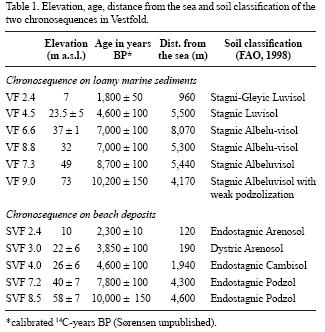
<body><![CDATA[<p align="justify"><font face="verdana" size="2">The region has been characterized by continuous glacio&#150;isostatic uplift for the last 12,000 years. Consequently, no distinct marine terraces have been built, and the age of the land surface increases continuously with elevation. Several sea level curves for different locations within the Oslofjord, based on a large number of radiocarbon dates (Henningsmoen, 1979; S&oslash;rensen, 1999) allowed us to infer the soil age at each location from its elevation above sea level (<a href="#f2">Figure 2</a>).</font></p> 				    <p align="center"><font face="verdana" size="2"><a name="f2"></a> </font></p> 				    <p align="center"><font face="verdana" size="2"><img src="/img/revistas/rmcg/v24n2/a10f2.jpg"></font></p> 				    <p align="justify"><font face="verdana" size="2">The soil parent materials are non&#150;calcareous loamy marine sediments in which Albeluvisols develop and beach sands with podzol formation. The ages of the investigated soils range from 1,800 to 10,200 years BP (loamy marine sediments) and 2,300 to 10,000 years BP (beach sands) (<a href="#t1">Table 1</a>). The bedrock of the Vestfold region consists predominantly of Permian monzonite and latite (Lutro and Nordgulen, 2004). Most of the soils are situated under natural mixed forests. The profiles VF 2.4 and SVF 4.0 are under natural deciduous woodland, whereas VF 7.3 and VF 9.0 are under ca. 20 and 40 years old planted spruce forests.</font></p> 				    <p align="center"><font face="verdana" size="2"><a name="t1"></a></font></p> 				    <p align="center"><font face="verdana" size="2"><img src="/img/revistas/rmcg/v24n2/a10t1.jpg"></font></p> 				    <p align="justify"><font face="verdana" size="2"><b>Field methods</b></font></p> 				    <p align="justify"><font face="verdana" size="2">The sites were chosen on the basis of calibrated 14C&#150;dated sea level curves for southern Vestfold. Soil pits were dug in nearly flat positions under forest showing no evidence of significant anthropogenic influence. Eleven profiles were described according to FAO (1998) and sampled, six on loamy marine sediments (Albeluvisol sequence) and five on beach sands (Podzol sequence). At least one sample was taken from each horizon, and several samples were taken if the thickness was more than 40 cm. We tried to dig the soil pits deep enough to sample the C horizons, but most of the soils on loamy marine sediments did not show unaltered material within 2 m depth, so that only a few C horizon samples were obtained. The depth of the soil pits ranged from 90 to 230 cm. Structure, texture, presence of coarse fragments, rooting depth, moisture and hydromorphic features were determined in the field, and the bulk density class according to Harrach and Vorderbr&uuml;gge (1991), based on aggregate size, accomodation, degree of compaction, penetration resistance and the amount of macropores, was estimated. The complete soil descriptions will be published elsewhere.</font></p> 				    <p align="justify"><font face="verdana" size="2">&nbsp;</font></p> 				    <p align="justify"><font face="verdana" size="2"><b>Laboratory methods</b></font></p> 				    ]]></body>
<body><![CDATA[<p align="justify"><font face="verdana" size="2">The moist colour of the samples was determined by comparison with the Munsell soil colour chart. The aggregates in the air dried samples were carefully smashed and the samples passed through a 2 mm sieve. All analyses were performed on the &lt;2 mm fraction. pH was determined in deionised water using a soil:water ratio of 1:2.5 (Schlichting <i>et al.</i>, 1995). Organic matter content was calculated from carbon contents measured with a C/N&#150;element analyzer by multiplying with 1.724.</font></p> 				    <p align="justify"><font face="verdana" size="2">The sand fractions were separated by sieving, and the silt and clay fractions determined by the pipette method (Schlichting <i>et al.</i>, 1995). Dithionite&#150;soluble Fe (Fe<sub>d</sub>) was measured by atomic absorption spectrometry (AAS) (Schlichting <i>et al.</i>, 1995). Oxalate&#150;extractable Fe (Fe<sub>o</sub>), Al (Al<sub>o</sub>) and Si (Si<sub>o</sub>) were measured by inductive coupled plasma&#150;optical emission spetrometry (ICP&#150;OES). Total amounts of Fe (Fe<sub>t</sub>), Al (Al<sub>t</sub>), Si (Si<sub>t</sub>), Ti (Ti<sub>t</sub>) and Zr (Zr<sub>t</sub>) were analyzed in fused discs by X&#150;ray fluorescence.</font></p> 				    <p align="justify"><font face="verdana" size="2">Chronofunctions for all soil properties and the Ti<sub>t</sub>/Zr<sub>t</sub> ratio were based on mean values for the different horizons, which were weighted according to bulk density and horizon thickness. They were calculated for each profile to the depth of the shallowest profile, 155 cm for the chronosequence on loamy marine sediments, and 90 cm for the chronosequence on beach deposits.</font></p> 				    <p align="justify"><font face="verdana" size="2">The analytical results were used to calculate depth functions and chronofunctions of the soil properties investigated. For the chronofunctions, linear (y = a<img src="/img/revistas/rmcg/v24n2/a10s1.jpg">x + b) or exponential (y = <i>e</i><sup>ax</sup>; y = a<i>e</i><sup>bx</sup>) equations were applied, depending on which model gave the greatest coefficient of determination (R<sup>2</sup>).</font></p> 				    <p align="justify"><font face="verdana" size="2">&nbsp;</font></p> 				    <p align="justify"><font face="verdana" size="2"><b>RESULTS</b></font></p> 				    <p align="justify"><font face="verdana" size="2"><b>Chronosequence on loamy marine sediments</b></font></p> 				    <p align="justify"><font face="verdana" size="2">All soils of the sequence show light coloured E horizons not only caused by clay depletion but mainly by waterlogging as indicated by hydromorphic features (mottles, manganese coatings) in the horizons below. The colour becomes progressively lighter with increasing age of the soils. Between the Ah and E horizons, a Bw horizon develops, which may partly or completely replace the E horizon. With the exception of the two oldest soils, the lower boundary of the E horizon (or Bw horizon developed in former E horizon) is remarkably constant at 40 &plusmn; 3 cm depth. This could be related to the fact that the most extreme and the most frequent temperature changes occur at this depth, leading to differences in physical weathering above and below a 40 cm depth.Such differences may determine the depth of the horizon boundaries, since pedogenic processes tend to follow physical boundaries, if present. The most obvious change during soil development is that light coloured tongues, immerging from the E horizon downwards into the B horizon, developed between 4,500 and 5,000 years and became more strongly pronounced with time.</font></p> 				    <p align="justify"><font face="verdana" size="2">Since perfect homogeneity of sediments is impossible, the degree of heterogeneity has to be determined. For this purpose we used the ratios of Ti<sub>t</sub>/Zr<sub>t</sub> of the weighted means of all horizons. Excluding the oldest soil, Ti/Zr ratios ranging from 20 to 25 give a measure of the degree of chemical heterogeneity of the sediments (<a href="#t2">Table 2</a>).</font></p> 				    <p align="center"><font face="verdana" size="2"><a name="t2"></a></font></p> 				    ]]></body>
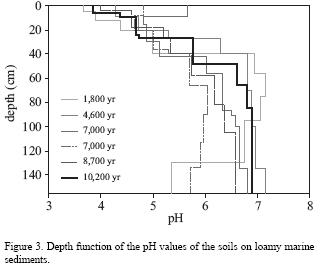
<body><![CDATA[<p align="center"><font face="verdana" size="2"><img src="/img/revistas/rmcg/v24n2/a10t2.jpg"></font></p> 				    <p align="justify"><font face="verdana" size="2">The pH values increase with soil depth, in the youngest soil from 3.7 to 5.4, and in the oldest soil from 3.9 to 6.9 (<a href="#f3">Figure 3</a>). The type of organic surface layer in the younger soils (up to 7,000 years) ranges from mull to moder, and in the older soils between moder and raw humus. There is a slight decrease in the ratio of fine silt to total silt in the Btg&#150;horizons from 0.53 to 0.29 (<a href="#f4">Figure 4</a>).</font></p> 				    <p align="center"><font face="verdana" size="2"><a name="f3"></a></font></p> 				    <p align="center"><font face="verdana" size="2"><img src="/img/revistas/rmcg/v24n2/a10f3.jpg"></font></p> 				    <p align="center"><font face="verdana" size="2"><a name="f4"></a></font></p> 				    <p align="center"><font face="verdana" size="2"><img src="/img/revistas/rmcg/v24n2/a10f4.jpg"></font></p> 				    <p align="justify"><font face="verdana" size="2">The amounts of Fe<sub>d</sub>, Fe, Alo and Si<sub>o</sub> are generally smaller in the A and E horizons than in the Btg, Bg and C horizons. The greatest Al<sub>o</sub> amounts usually occur in the lowest horizons (Bg and C horizons, <a href="/img/revistas/rmcg/v24n2/a10t3.jpg" target="_blank">Table 3</a>). In addition, Fe<sub>o</sub>, Fe<sub>d</sub> and Al<sub>o</sub> contents are increased in almost all Bw horizons, compared to the adjacent horizons. The Si<sub>o</sub> contents also show a weak trend to follow this pattern, but only in the older soils. </font></p> 				    <p align="justify"><font face="verdana" size="2">Usually, the Fe<sub>d</sub>/Fe<sub>t</sub> ratio increases from the A to the Bw horizon and then decreases downwards (<a href="#f5">Figure 5</a>). However, the youngest soil shows a Fe<sub>d</sub>/Fe<sub>t</sub> maximum in the A horizon, and in the 7,000 years old soil VF 8.8 there are maxima in the E and 2Btg2 horizons. The Fe<sub>o</sub>/Fe<sub>d</sub> ratio tends to decrease with profile depth (<a href="#f6">Figure 6</a>), though the Fe<sub>o</sub>/Fe<sub>d</sub> ratio is very large in the Btg2 horizon of the youngest profile. The ratio of Fe<sub>d</sub>/Fe<sub>t</sub> increases with soil age from 0.14 to 0.26, showing a very strong correlation (<a href="#f7">Figure 7</a>). The Fe<sub>o</sub>/Fe<sub>d</sub> ratios do not show any clear trend with time (<a href="#f7">Figure 7</a>). </font></p> 				    <p align="center"><font face="verdana" size="2"><a name="f5"></a></font></p> 				    <p align="center"><font face="verdana" size="2"><img src="/img/revistas/rmcg/v24n2/a10f5.jpg"></font></p> 				    ]]></body>
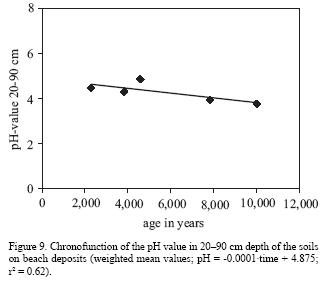
<body><![CDATA[<p align="center"><font face="verdana" size="2"><a name="f6"></a></font></p> 				    <p align="center"><font face="verdana" size="2"><img src="/img/revistas/rmcg/v24n2/a10f6.jpg"></font></p> 				    <p align="center"><font face="verdana" size="2"><a name="f7"></a></font></p> 				    <p align="center"><font face="verdana" size="2"><img src="/img/revistas/rmcg/v24n2/a10f7.jpg"></font></p> 				    <p align="justify"><font face="verdana" size="2">The Btg horizons increase in thickness from 16 cm in the youngest soil to 30 cm and 35 cm in the 4,600 and 7,000 years old soil VF 6.6, and 36 cm in the oldest soil, but decrease to 23 cm in the other 7,000 years old soil VF 8.8, and to 18 cm in the 8,700 years old soil. The depth of the lower boundary of the Btg horizons increases from 56 cm in the youngest to 113 cm in the 7,000 years old soil VF 8.8.</font></p> 				    <p align="justify"><font face="verdana" size="2">&nbsp;</font></p> 				    <p align="justify"><font face="verdana" size="2"><b>Chronosequence on beach deposits</b></font></p> 				    <p align="justify"><font face="verdana" size="2">Evidence for podzolisation first appears in the development of an E horizon between 2,300 and 3,850 years. In soils older than 4,600 years, the Bw horizons have turned into Bhs and Bsw horizons. The 7,800 and 10,000 years old soils show the diagnostic Bs horizon of a mature Podzol.</font></p> 				    <p align="justify"><font face="verdana" size="2">In the case of the soils on beach sands, the Ti<sub>t</sub>/Zr<sub>t</sub> ratios of 9.5 to 13.1 (<a href="#t2">Table 2</a>) can again be used as a measure of the degree of homogeneity of the sediments. </font></p> 				    <p align="justify"><font face="verdana" size="2">The pH&#150;values increase downwards (<a href="#f8">Figure 8</a>). For the pH chronofunction, the weighted mean values of 20&#150;90 cm depth were used, because the pH of the A horizon of the 4,600 years old soil shows some influence from the surface. The mean values decrease with soil age from 4.5 in the youngest soil to 3.8 in the oldest (<a href="#f9">Figure 9</a>).</font></p> 				    ]]></body>
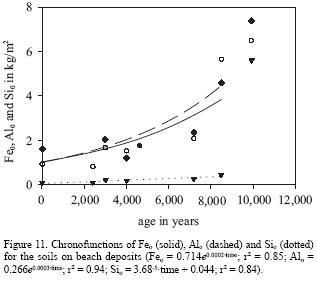
<body><![CDATA[<p align="center"><font face="verdana" size="2"><a name="f8"></a></font></p> 				    <p align="center"><font face="verdana" size="2"><img src="/img/revistas/rmcg/v24n2/a10f8.jpg"></font></p> 				    <p align="center"><font face="verdana" size="2"><a name="f9"></a></font></p> 				    <p align="center"><font face="verdana" size="2"><img src="/img/revistas/rmcg/v24n2/a10f9.jpg"></font></p> 				    <p align="justify"><font face="verdana" size="2">The thickness of the organic surface layer increases with age from 5 cm after 2,300 years to 10 cm after 10,000 years. An exception is the 3,850 years old soil with an organic layer of 9 cm. The amount of humus in the B&#150;horizons increases with time from 2.99 kg<img src="/img/revistas/rmcg/v24n2/a10s1.jpg">m<sup>&#150;2</sup> to 13.32 kg<img src="/img/revistas/rmcg/v24n2/a10s1.jpg">m<sup>&#150;2</sup> (<a href="#f10">Figure 10</a>). The type of organic layer changes from mull in the youngest soil to typical moder, and finally to raw humus&#150;like moder in the oldest.</font></p> 				    <p align="center"><font face="verdana" size="2"><a name="f10"></a></font></p> 				    <p align="center"><font face="verdana" size="2"><img src="/img/revistas/rmcg/v24n2/a10f10.jpg"></font></p> 				    <p align="justify"><font face="verdana" size="2">The amounts of Fe<sub>d</sub>, Fe<sub>o</sub>, Al<sub>o</sub> and Si<sub>o</sub> are greater in the Bh and Bs horizons than in the respective A horizons, but their maxima occur below the Bh/Bs horizons, in the Bg, BC and C horizons (<a href="#t4">Table 4</a>). The weighted mean concentrations of Fe<sub>o</sub>, Al<sub>o</sub> and Si<sub>o</sub> all increase with profile age (<a href="#f11">Figure 11</a>). The amounts of Fe<sub>o</sub> and Al<sub>o</sub> doubled between 3,850 and 4,600 years old soils from 0.89 kg<img src="/img/revistas/rmcg/v24n2/a10s1.jpg">m<sup>&#150;2</sup> to 2.15 kg<img src="/img/revistas/rmcg/v24n2/a10s1.jpg">m<sup>&#150;2</sup> (Fe<sub>o</sub>) and from 0.87 kg<img src="/img/revistas/rmcg/v24n2/a10s1.jpg">m<sup>&#150;2</sup> to 1.72 kg<img src="/img/revistas/rmcg/v24n2/a10s1.jpg">m<sup>&#150;2</sup> (Al<sub>o</sub>). Strong increases also occur in 7,800 and 10,000 years old soils.</font></p> 				    <p align="center"><font face="verdana" size="2"><a name="f11"></a> </font></p> 				    <p align="center"><font face="verdana" size="2"><img src="/img/revistas/rmcg/v24n2/a10f11.jpg"></font></p> 				    ]]></body>
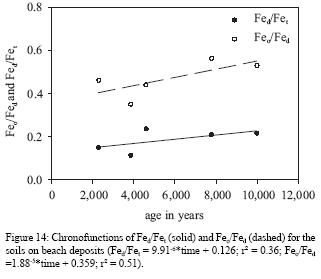
<body><![CDATA[<p align="center"><font face="verdana" size="2"><a name="t4"></a></font></p> 				    <p align="center"><font face="verdana" size="2"><img src="/img/revistas/rmcg/v24n2/a10t4.jpg"></font></p> 				    <p align="justify"><font face="verdana" size="2">The Fe<sub>d</sub>/Fe<sub>t</sub> and Fe<sub>o</sub>/Fe<sub>d</sub> ratios are both larger for B horizons and smaller for A and C horizons (<a href="#f12">Figures 12</a> and <a href="#f13">13</a>). The Fe<sub>d</sub>/Fe<sub>t</sub> ratios (weighted means) increase with soil age from 0.15 to 0.22 (<a href="#f14">Figure 14</a>). The Fe<sub>o</sub>/Fe<sub>d</sub> ratios also increase with age from 0.46 to 0.53 (<a href="#f14">Figure 14</a>).</font></p> 				    <p align="center"><font face="verdana" size="2"><a name="f12"></a></font></p> 				    <p align="center"><font face="verdana" size="2"><img src="/img/revistas/rmcg/v24n2/a10f12.jpg"></font></p> 				    <p align="justify"><font face="verdana" size="2">&nbsp;</font></p> 				    <p align="center"><font face="verdana" size="2"><a name="f13"></a></font></p> 				    <p align="center"><font face="verdana" size="2"><img src="/img/revistas/rmcg/v24n2/a10f13.jpg"></font></p> 				    <p align="center"><font face="verdana" size="2"><a name="f14"></a></font></p> 				    <p align="center"><font face="verdana" size="2"><img src="/img/revistas/rmcg/v24n2/a10f14.jpg"></font></p> 				    ]]></body>
<body><![CDATA[<p align="justify"><font face="verdana" size="2"><b>DISCUSSION</b></font></p> 				    <p align="justify"><font face="verdana" size="2"><b>Chronosequence on loamy marine sediments</b></font></p> 				    <p align="justify"><font face="verdana" size="2">The change in the organic surface layer from mull to moder in soils up to 7,000 years, and to moder and raw humus in the older soils is in accordance with the lower pH values in the topsoil. A slight decrease in the ratio of fine silt to total silt in the Btg horizons indicates <i>in situ</i> weathering of fine silt to clay (Langley&#150;Turnbaugh and Bockheim, 1997).</font></p> 				    <p align="justify"><font face="verdana" size="2">The increased amounts of Fe<sub>d</sub> in the lower horizons are caused by the formation of iron concretions and mottles in the Btg&#150; and Bg&#150;horizons. The great amounts of Fe<sub>o</sub>, Al<sub>o</sub> and Si<sub>o</sub> are attributed to an inhibition of the crystallization process by waterlogging and influence of groundwater in the lower parts of the soils. Formation of organic complexes may prevent crystallization in the Bw horizons, which can explain the higher values of Fe<sub>o</sub> and Al<sub>o</sub> in the Bw horizons of almost all soils. </font></p> 				    <p align="justify"><font face="verdana" size="2">The higher Fe<sub>d</sub>/Fe<sub>t</sub> ratios in the Bw horizons are the result of the formation of iron oxides in these horizons (brunification). The increasing Fe<sub>d</sub>/Fe<sub>t</sub> ratio with soil age shows a strong correlation (R<sup>2</sup>=0.83). This reflects the progressive weathering of Fe&#150;bearing minerals with time. The absence of a clear time trend of Fe<sub>o</sub>/Fe<sub>d</sub> ratios can be explained by other factors (in this case redox processes and organic matter content) having greater impact on the Fe<sub>o</sub>/Fe<sub>d</sub> ratio than the time factor.</font></p> 				    <p align="justify"><font face="verdana" size="2">The thinner Btg horizon in the 7,000 years old soil VF 8.8 and in the 8,700 years old soil is the result of the progressive growth of tongues downwards from the E into the Btg horizons that results in the replacement of the upper part of the Btg horizons by E/Btg horizons.</font></p> 				    <p align="justify"><font face="verdana" size="2">Steady state of soil development (when the sum of progressive and regressive processes equals zero; Johnson and Watson&#150;Stegnar, 1987), as found in the older soils of the Ljubljana Basin (Vidic and Lobnik, 1996), could not be observed. Most of the chronofunctions, like organic matter content of the A horizons and the fine silt/total silt ratio of the Btg horizons, decrease with increasing soil age, whereas the Fe<sub>d</sub>/Fe<sub>t</sub> ratios increase with time.</font></p> 				    <p align="justify"><font face="verdana" size="2">&nbsp;</font></p> 				    <p align="justify"><font face="verdana" size="2"><b>Chronosequence on beach deposits</b></font></p> 				    <p align="justify"><font face="verdana" size="2">The weighted mean values of the pH decrease with soil age. This process is followed by proceeding podzolization. The thickness of the organic surface layer increases with age in the same way as acidification proceeds. The change of the organic layer type from mull in the youngest to raw humus&#150;like moder in the oldest soil reflects the ongoing podzolization and hence reduced biological activity.</font></p> 				    ]]></body>
<body><![CDATA[<p align="justify"><font face="verdana" size="2">The maxima of Fe<sub>d</sub>, Fe<sub>o</sub> and Al<sub>o</sub> in the Bg, BC and C&#150;horizons and minima of Fe<sub>d</sub>, Fe<sub>o</sub> and Al<sub>o</sub> in the E horizon of the 10,000 years old soil are attributed to translocation and precipitation of iron and aluminium oxides. The increase of Fe<sub>o</sub>, Al<sub>o</sub> and Si<sub>o</sub> (weighted mean values) with profile age indicates progressive podzolization. The same trend was observed in soils on beach sands in Canada (Singleton and Lavkulich, 1987). With the appearence of Bhs and Bsw horizons between 3,850 and 4,600 years, the amounts of Fe<sub>o</sub> and Al<sub>o</sub> reached more than double the values in younger soils. There is an increase in thickness of the Bs horizons as well as a strong increase of Fe<sub>o</sub>, Al<sub>o</sub> and Si<sub>o</sub> between 7,800 and 10,000 years. These results agree well with the increase of horizon thickness observed by Semmel (1969) on fluvial terraces in northern Scandinavia.</font></p> 				    <p align="justify"><font face="verdana" size="2">The maxima of Fe<sub>d</sub>/Fe<sub>t</sub> and Fe<sub>o</sub>/Fe<sub>d</sub> in the B horizons indicate translocation of iron from the A into the B horizons and formation of pedogenic iron oxides. The Fe<sub>d</sub>/Fe<sub>t</sub> ratios increase with soil age because of progressive weathering and formation of pedogenic iron oxides, whereas the increase in the Fe<sub>o</sub>/Fe<sub>d</sub> ratios with age is probably related to the formation of organic complexes, which inhibit the crystallization process.</font></p> 				    <p align="justify"><font face="verdana" size="2">In summary, the contents of organic matter, clay, Fe<sub>o</sub> and Al<sub>o</sub> and the Fe<sub>o</sub>/Fe<sub>d</sub> and Fe<sub>d</sub>/Fe<sub>t</sub> ratios increase with soil age, whereas pH decreases. Tamm (1920) estimated that Podzols in Scandinavia developed within 1,000 to 1,500 years. However, in this study, distinct podzolization was first observed in the 3,850 years old soil, and the diagnostic Bs horizon of a mature Podzol did not develop until 7,800 years.</font></p> 				    <p align="justify"><font face="verdana" size="2">&nbsp;</font></p> 				    <p align="justify"><font face="verdana" size="2"><b>CONCLUSIONS</b></font></p> 				    <p align="justify"><font face="verdana" size="2">The chronosequence on marine sediments in southern Norway shows that, in a temperate climate, E and a Bt horizons developed in loamy sediments after approximately 2,000 years. Topsoil acidification intensified with time. Al<sub>o</sub>, Fe<sub>d</sub> and Fet increased until an age of about 7,000 years but decreased with further development. The development from Luvisol to Albeluvisol has taken place after about 4,500 years with the formation of characteristic tongues, which became broader, deeper and more distinct with time.</font></p> 				    <p align="justify"><font face="verdana" size="2">On sandy deposits, which favour podzolization, most of the soil properties investigated (organic matter content of the B&#150;horizons; amounts of Fe<sub>o</sub>, Al<sub>o</sub> and Si<sub>o</sub>; ratios of Fe<sub>o</sub>/Fe<sub>d</sub> and Fe<sub>d</sub>/Fe<sub>t</sub>) increase with time, except for pH, which shows a linear decrease. A Bw horizon has formed after 2,300 years. The process of podzolisation first resulted in the development of an E horizon that appears in profiles between 2,300 and 3,850 years. A mature Podzol developed between 4,600 and 7,800 years. Podzolization in beach sands in the Oslofjord region takes more time than in other parts of Scandinavia or northern America probably because of the milder climate in this area.</font></p> 				    <p align="justify"><font face="verdana" size="2">&nbsp;</font></p> 				    <p align="justify"><font face="verdana" size="2"><b>REFERENCES</b></font></p> 				    <!-- ref --><p align="justify"><font face="verdana" size="2">Barrett, L.R., 2001, A strand plain soil development sequence in northern Michigan, USA: Catena, 44(3), 163&#150;186.</font>&nbsp;&nbsp;&nbsp;&nbsp;&nbsp;&nbsp;&nbsp;&nbsp;[&#160;<a href="javascript:void(0);" onclick="javascript: window.open('/scielo.php?script=sci_nlinks&ref=8015542&pid=S1026-8774200700020001000001&lng=','','width=640,height=500,resizable=yes,scrollbars=1,menubar=yes,');">Links</a>&#160;]<!-- end-ref --> 				    <!-- ref --><p align="justify"><font face="verdana" size="2">Barrett, L.R., Schaetzl, R.J., 1992, An examination of podzolization near Lake Michigan using chronofunctions: Canadian Journal of Soil Science, 72(4), 527&#150;541.</font>&nbsp;&nbsp;&nbsp;&nbsp;&nbsp;&nbsp;&nbsp;&nbsp;[&#160;<a href="javascript:void(0);" onclick="javascript: window.open('/scielo.php?script=sci_nlinks&ref=8015544&pid=S1026-8774200700020001000002&lng=','','width=640,height=500,resizable=yes,scrollbars=1,menubar=yes,');">Links</a>&#160;]<!-- end-ref --> 				    <!-- ref --><p align="justify"><font face="verdana" size="2">Donner, J., 1995, The Quarternary History of Scandinavia: New York, Cambridge University Press, 200 p.</font>&nbsp;&nbsp;&nbsp;&nbsp;&nbsp;&nbsp;&nbsp;&nbsp;[&#160;<a href="javascript:void(0);" onclick="javascript: window.open('/scielo.php?script=sci_nlinks&ref=8015546&pid=S1026-8774200700020001000003&lng=','','width=640,height=500,resizable=yes,scrollbars=1,menubar=yes,');">Links</a>&#160;]<!-- end-ref --> 				    <!-- ref --><p align="justify"><font face="verdana" size="2">Food and Agriculture Organization (FAO), 1998, World Reference Base for Soil Resources: Rome, Food and Agriculture Organization of the United Nations, World Soil Resources Reports, 84, 88 p.</font>&nbsp;&nbsp;&nbsp;&nbsp;&nbsp;&nbsp;&nbsp;&nbsp;[&#160;<a href="javascript:void(0);" onclick="javascript: window.open('/scielo.php?script=sci_nlinks&ref=8015548&pid=S1026-8774200700020001000004&lng=','','width=640,height=500,resizable=yes,scrollbars=1,menubar=yes,');">Links</a>&#160;]<!-- end-ref --> 				    <!-- ref --><p align="justify"><font face="verdana" size="2">Harrach, T., Vorderbr&uuml;gge, T., 1991, Die Wurzelentwicklung von Kulturpflanzen in Beziehung zum Bodentyp und Bodengef&uuml;ge: Berichte &uuml;ber Landwirtschaft, 204, Sonderheft Bodennutzung und Bodenfruchtbarkeit, 2, 69&#150;82.</font>&nbsp;&nbsp;&nbsp;&nbsp;&nbsp;&nbsp;&nbsp;&nbsp;[&#160;<a href="javascript:void(0);" onclick="javascript: window.open('/scielo.php?script=sci_nlinks&ref=8015550&pid=S1026-8774200700020001000005&lng=','','width=640,height=500,resizable=yes,scrollbars=1,menubar=yes,');">Links</a>&#160;]<!-- end-ref --> 				    <!-- ref --><p align="justify"><font face="verdana" size="2">Henningsmoen, K.E., 1979, En karbon&#150;datert strandforskyvningskurve fra s&oslash;ndre Vestfold, <i>in</i> Nydal, R., Westin, S., Hafsten, U., Gulliksen, S. (eds.), Fortiden i s&oslash;kelyset: Trondheim, Universitet Forlag, 239&#150;247.</font>&nbsp;&nbsp;&nbsp;&nbsp;&nbsp;&nbsp;&nbsp;&nbsp;[&#160;<a href="javascript:void(0);" onclick="javascript: window.open('/scielo.php?script=sci_nlinks&ref=8015552&pid=S1026-8774200700020001000006&lng=','','width=640,height=500,resizable=yes,scrollbars=1,menubar=yes,');">Links</a>&#160;]<!-- end-ref --> 				    <!-- ref --><p align="justify"><font face="verdana" size="2">Jenny, H., 1980, The Soil Resource, Origin and behavior: New York, Springer, 377 p.</font>&nbsp;&nbsp;&nbsp;&nbsp;&nbsp;&nbsp;&nbsp;&nbsp;[&#160;<a href="javascript:void(0);" onclick="javascript: window.open('/scielo.php?script=sci_nlinks&ref=8015554&pid=S1026-8774200700020001000007&lng=','','width=640,height=500,resizable=yes,scrollbars=1,menubar=yes,');">Links</a>&#160;]<!-- end-ref --> 				    <!-- ref --><p align="justify"><font face="verdana" size="2">Johansen, S., 1980, V&aelig;r og klima, <i>in</i> M&oslash;ller, W. (ed.), Bygd og by i Norge: Vestfold: Oslo, Gyldendal Norsk Forlag, 152&#150;162.</font>&nbsp;&nbsp;&nbsp;&nbsp;&nbsp;&nbsp;&nbsp;&nbsp;[&#160;<a href="javascript:void(0);" onclick="javascript: window.open('/scielo.php?script=sci_nlinks&ref=8015556&pid=S1026-8774200700020001000008&lng=','','width=640,height=500,resizable=yes,scrollbars=1,menubar=yes,');">Links</a>&#160;]<!-- end-ref --> 				    <!-- ref --><p align="justify"><font face="verdana" size="2">Johnson, D.L., Watson&#150;Stegnar, D., 1987, Evolution model of pedogenesis: Soil Science, 143, 349&#150;366.</font>&nbsp;&nbsp;&nbsp;&nbsp;&nbsp;&nbsp;&nbsp;&nbsp;[&#160;<a href="javascript:void(0);" onclick="javascript: window.open('/scielo.php?script=sci_nlinks&ref=8015558&pid=S1026-8774200700020001000009&lng=','','width=640,height=500,resizable=yes,scrollbars=1,menubar=yes,');">Links</a>&#160;]<!-- end-ref --> 				    <!-- ref --><p align="justify"><font face="verdana" size="2">Langley&#150;Turnbaugh, S.J., Bockheim, J.G., 1997, Time&#150;dependent changes in pedogenic processes on marine terraces in coastal Oregon: Soil Science Society of America Journal, 61, 1428&#150;1440.</font>&nbsp;&nbsp;&nbsp;&nbsp;&nbsp;&nbsp;&nbsp;&nbsp;[&#160;<a href="javascript:void(0);" onclick="javascript: window.open('/scielo.php?script=sci_nlinks&ref=8015560&pid=S1026-8774200700020001000010&lng=','','width=640,height=500,resizable=yes,scrollbars=1,menubar=yes,');">Links</a>&#160;]<!-- end-ref --> 				    <!-- ref --><p align="justify"><font face="verdana" size="2">Lutro, O., Nordgulen, &Oslash;., 2004, Oslofeltet, berggrunnskart M 1:250 000: Trondheim, Norges geologiske unders&oslash;kelse, 1 map.</font>&nbsp;&nbsp;&nbsp;&nbsp;&nbsp;&nbsp;&nbsp;&nbsp;[&#160;<a href="javascript:void(0);" onclick="javascript: window.open('/scielo.php?script=sci_nlinks&ref=8015562&pid=S1026-8774200700020001000011&lng=','','width=640,height=500,resizable=yes,scrollbars=1,menubar=yes,');">Links</a>&#160;]<!-- end-ref --> 				    <!-- ref --><p align="justify"><font face="verdana" size="2">Mellor, A., 1985, Soil chronosequences on neoglacial moraine ridges, Jostedalsbreen and Jotunheimen, southern Norway: a quantiative pedogenic approach, <i>in</i> Richards, K.S., Arnett, R.R., Ellis, S. (eds.), Geomorphology and Soils: London, George, Allen and Unwin, 289&#150;308.</font>&nbsp;&nbsp;&nbsp;&nbsp;&nbsp;&nbsp;&nbsp;&nbsp;[&#160;<a href="javascript:void(0);" onclick="javascript: window.open('/scielo.php?script=sci_nlinks&ref=8015564&pid=S1026-8774200700020001000012&lng=','','width=640,height=500,resizable=yes,scrollbars=1,menubar=yes,');">Links</a>&#160;]<!-- end-ref --> 				    <!-- ref --><p align="justify"><font face="verdana" size="2">Mellor, A., 1987, A pedogenic investigation of some soil chronosequences on neoglacial moraine ridges, southern Norway: examination of soil chemical data using principal components analysis: Catena, 14, 369&#150;381.</font>&nbsp;&nbsp;&nbsp;&nbsp;&nbsp;&nbsp;&nbsp;&nbsp;[&#160;<a href="javascript:void(0);" onclick="javascript: window.open('/scielo.php?script=sci_nlinks&ref=8015566&pid=S1026-8774200700020001000013&lng=','','width=640,height=500,resizable=yes,scrollbars=1,menubar=yes,');">Links</a>&#160;]<!-- end-ref --> 				    <!-- ref --><p align="justify"><font face="verdana" size="2">Mokma, D.L., Yli&#150;Halla, M., Lindqvist, K., 2004, Podzol formation in sandy soils of Finland: Geoderma, 120, 259&#150;272.</font>&nbsp;&nbsp;&nbsp;&nbsp;&nbsp;&nbsp;&nbsp;&nbsp;[&#160;<a href="javascript:void(0);" onclick="javascript: window.open('/scielo.php?script=sci_nlinks&ref=8015568&pid=S1026-8774200700020001000014&lng=','','width=640,height=500,resizable=yes,scrollbars=1,menubar=yes,');">Links</a>&#160;]<!-- end-ref --> 				    <!-- ref --><p align="justify"><font face="verdana" size="2">Schlichting, E., Blume, H.&#150;P., Stahr, K., 1995, Bodenkundliches Praktikum: Berlin, Blackwell Wissenschafts&#150;Verlag, 295 p.</font>&nbsp;&nbsp;&nbsp;&nbsp;&nbsp;&nbsp;&nbsp;&nbsp;[&#160;<a href="javascript:void(0);" onclick="javascript: window.open('/scielo.php?script=sci_nlinks&ref=8015570&pid=S1026-8774200700020001000015&lng=','','width=640,height=500,resizable=yes,scrollbars=1,menubar=yes,');">Links</a>&#160;]<!-- end-ref --> 				    <!-- ref --><p align="justify"><font face="verdana" size="2">Semmel, A., 1969, Verwitterungs&#150; und Abtragungserscheinungen in rezenten Periglazialgebieten (Lappland und Spitzbergen): W&uuml;rzburger Geographische Arbeiten, 26, 82.</font>&nbsp;&nbsp;&nbsp;&nbsp;&nbsp;&nbsp;&nbsp;&nbsp;[&#160;<a href="javascript:void(0);" onclick="javascript: window.open('/scielo.php?script=sci_nlinks&ref=8015572&pid=S1026-8774200700020001000016&lng=','','width=640,height=500,resizable=yes,scrollbars=1,menubar=yes,');">Links</a>&#160;]<!-- end-ref --> 				    <!-- ref --><p align="justify"><font face="verdana" size="2">Singleton, G.A., Lavkulich, L.M., 1987, A soil chronosequence on beach sands, Vancouver Island, British Columbia: Canadian Journal of Soil Science, 67, 795&#150;810.</font>&nbsp;&nbsp;&nbsp;&nbsp;&nbsp;&nbsp;&nbsp;&nbsp;[&#160;<a href="javascript:void(0);" onclick="javascript: window.open('/scielo.php?script=sci_nlinks&ref=8015574&pid=S1026-8774200700020001000017&lng=','','width=640,height=500,resizable=yes,scrollbars=1,menubar=yes,');">Links</a>&#160;]<!-- end-ref --> 				    <!-- ref --><p align="justify"><font face="verdana" size="2">S&oslash;rensen, R., 1999, En 14C datert og dendrokronologisk kalibrert strandforskyvnings&#150;kurve for s&oslash;ndre &Oslash;stfold, S&oslash;r&oslash;st&#150;Norge: AmS&#150;Rapport 12A, Stavanger, 227&#150;242.</font>&nbsp;&nbsp;&nbsp;&nbsp;&nbsp;&nbsp;&nbsp;&nbsp;[&#160;<a href="javascript:void(0);" onclick="javascript: window.open('/scielo.php?script=sci_nlinks&ref=8015576&pid=S1026-8774200700020001000018&lng=','','width=640,height=500,resizable=yes,scrollbars=1,menubar=yes,');">Links</a>&#160;]<!-- end-ref --> 				    <!-- ref --><p align="justify"><font face="verdana" size="2">Tamm, O., 1920, Bodenstudien in der Nordschwedischen Nadelwaldregion: Meddelanden fr&aring;n Statens Skogsfoersoeksanstalt, 17, 49&#150;300.</font>&nbsp;&nbsp;&nbsp;&nbsp;&nbsp;&nbsp;&nbsp;&nbsp;[&#160;<a href="javascript:void(0);" onclick="javascript: window.open('/scielo.php?script=sci_nlinks&ref=8015578&pid=S1026-8774200700020001000019&lng=','','width=640,height=500,resizable=yes,scrollbars=1,menubar=yes,');">Links</a>&#160;]<!-- end-ref --> 				    <!-- ref --><p align="justify"><font face="verdana" size="2">Vidic, N.J., Lobnik, F., 1996, Rates of soil development of the chronosequence in the Ljubeljana Basin, Slovenia: Geoderma, 76, 5&#150;64.</font>&nbsp;&nbsp;&nbsp;&nbsp;&nbsp;&nbsp;&nbsp;&nbsp;[&#160;<a href="javascript:void(0);" onclick="javascript: window.open('/scielo.php?script=sci_nlinks&ref=8015580&pid=S1026-8774200700020001000020&lng=','','width=640,height=500,resizable=yes,scrollbars=1,menubar=yes,');">Links</a>&#160;]<!-- end-ref --> 				    <!-- ref --><p align="justify"><font face="verdana" size="2">Vreeken, W.J., 1975, Principal kinds of chronosequences and their significance in soil History: Journal of Soil Science, 26, 378&#150;394.</font>&nbsp;&nbsp;&nbsp;&nbsp;&nbsp;&nbsp;&nbsp;&nbsp;[&#160;<a href="javascript:void(0);" onclick="javascript: window.open('/scielo.php?script=sci_nlinks&ref=8015582&pid=S1026-8774200700020001000021&lng=','','width=640,height=500,resizable=yes,scrollbars=1,menubar=yes,');">Links</a>&#160;]<!-- end-ref --> ]]></body><back>
<ref-list>
<ref id="B1">
<nlm-citation citation-type="journal">
<person-group person-group-type="author">
<name>
<surname><![CDATA[Barrett]]></surname>
<given-names><![CDATA[L.R]]></given-names>
</name>
</person-group>
<article-title xml:lang="en"><![CDATA[A strand plain soil development sequence in northern Michigan, USA]]></article-title>
<source><![CDATA[Catena]]></source>
<year>2001</year>
<volume>44</volume>
<numero>3</numero>
<issue>3</issue>
<page-range>163-186</page-range></nlm-citation>
</ref>
<ref id="B2">
<nlm-citation citation-type="journal">
<person-group person-group-type="author">
<name>
<surname><![CDATA[Barrett]]></surname>
<given-names><![CDATA[L.R]]></given-names>
</name>
<name>
<surname><![CDATA[Schaetzl]]></surname>
<given-names><![CDATA[R.J]]></given-names>
</name>
</person-group>
<article-title xml:lang="en"><![CDATA[An examination of podzolization near Lake Michigan using chronofunctions]]></article-title>
<source><![CDATA[Canadian Journal of Soil Science]]></source>
<year>1992</year>
<volume>72</volume>
<numero>4</numero>
<issue>4</issue>
<page-range>527-541</page-range></nlm-citation>
</ref>
<ref id="B3">
<nlm-citation citation-type="book">
<person-group person-group-type="author">
<name>
<surname><![CDATA[Donner]]></surname>
<given-names><![CDATA[J]]></given-names>
</name>
</person-group>
<source><![CDATA[The Quarternary History of Scandinavia]]></source>
<year>1995</year>
<page-range>200</page-range><publisher-loc><![CDATA[^eNew York New York]]></publisher-loc>
<publisher-name><![CDATA[Cambridge University Press]]></publisher-name>
</nlm-citation>
</ref>
<ref id="B4">
<nlm-citation citation-type="book">
<collab>Food and Agriculture Organization (FAO)</collab>
<source><![CDATA[World Reference Base for Soil Resources]]></source>
<year>1998</year>
<volume>84</volume>
<page-range>88</page-range><publisher-loc><![CDATA[^eRome Rome]]></publisher-loc>
<publisher-name><![CDATA[Food and Agriculture Organization of the United Nations]]></publisher-name>
</nlm-citation>
</ref>
<ref id="B5">
<nlm-citation citation-type="journal">
<person-group person-group-type="author">
<name>
<surname><![CDATA[Harrach]]></surname>
<given-names><![CDATA[T]]></given-names>
</name>
<name>
<surname><![CDATA[Vorderbrügge]]></surname>
<given-names><![CDATA[T]]></given-names>
</name>
</person-group>
<article-title xml:lang="de"><![CDATA[Die Wurzelentwicklung von Kulturpflanzen in Beziehung zum Bodentyp und Bodengefüge]]></article-title>
<source><![CDATA[Berichte über Landwirtschaft]]></source>
<year>1991</year>
<volume>204</volume><volume>2</volume>
<page-range>69-82</page-range><publisher-name><![CDATA[Sonderheft Bodennutzung und Bodenfruchtbarkeit]]></publisher-name>
</nlm-citation>
</ref>
<ref id="B6">
<nlm-citation citation-type="book">
<person-group person-group-type="author">
<name>
<surname><![CDATA[Henningsmoen]]></surname>
<given-names><![CDATA[K.E.]]></given-names>
</name>
</person-group>
<article-title xml:lang="de"><![CDATA[En karbon-datert strandforskyvningskurve fra søndre Vestfold]]></article-title>
<person-group person-group-type="editor">
<name>
<surname><![CDATA[Nydal]]></surname>
<given-names><![CDATA[R]]></given-names>
</name>
<name>
<surname><![CDATA[Westin]]></surname>
<given-names><![CDATA[S]]></given-names>
</name>
<name>
<surname><![CDATA[Hafsten]]></surname>
<given-names><![CDATA[U]]></given-names>
</name>
<name>
<surname><![CDATA[Gulliksen]]></surname>
<given-names><![CDATA[S]]></given-names>
</name>
</person-group>
<source><![CDATA[Fortiden i søkelyset]]></source>
<year>1979</year>
<page-range>239-247</page-range><publisher-loc><![CDATA[Trondheim ]]></publisher-loc>
<publisher-name><![CDATA[Universitet Forlag]]></publisher-name>
</nlm-citation>
</ref>
<ref id="B7">
<nlm-citation citation-type="book">
<person-group person-group-type="author">
<name>
<surname><![CDATA[Jenny]]></surname>
<given-names><![CDATA[H]]></given-names>
</name>
</person-group>
<source><![CDATA[The Soil Resource, Origin and behavior]]></source>
<year>1980</year>
<page-range>377</page-range><publisher-loc><![CDATA[^eNew York New York]]></publisher-loc>
<publisher-name><![CDATA[Springer]]></publisher-name>
</nlm-citation>
</ref>
<ref id="B8">
<nlm-citation citation-type="book">
<person-group person-group-type="author">
<name>
<surname><![CDATA[Johansen]]></surname>
<given-names><![CDATA[S]]></given-names>
</name>
</person-group>
<article-title xml:lang="de"><![CDATA[Vær og klima]]></article-title>
<person-group person-group-type="editor">
<name>
<surname><![CDATA[Møller]]></surname>
<given-names><![CDATA[W]]></given-names>
</name>
</person-group>
<source><![CDATA[Bygd og by i Norge]]></source>
<year>1980</year>
<page-range>152-162</page-range><publisher-loc><![CDATA[Vestfold^eOslo Oslo]]></publisher-loc>
<publisher-name><![CDATA[Gyldendal Norsk Forlag]]></publisher-name>
</nlm-citation>
</ref>
<ref id="B9">
<nlm-citation citation-type="journal">
<person-group person-group-type="author">
<name>
<surname><![CDATA[Johnson]]></surname>
<given-names><![CDATA[D.L]]></given-names>
</name>
<name>
<surname><![CDATA[Watson-Stegnar]]></surname>
<given-names><![CDATA[D]]></given-names>
</name>
</person-group>
<article-title xml:lang="en"><![CDATA[Evolution model of pedogenesis]]></article-title>
<source><![CDATA[Soil Science]]></source>
<year>1987</year>
<volume>143</volume>
<page-range>349-366</page-range></nlm-citation>
</ref>
<ref id="B10">
<nlm-citation citation-type="journal">
<person-group person-group-type="author">
<name>
<surname><![CDATA[Langley-Turnbaugh]]></surname>
<given-names><![CDATA[S.J]]></given-names>
</name>
<name>
<surname><![CDATA[Bockheim]]></surname>
<given-names><![CDATA[J.G]]></given-names>
</name>
</person-group>
<article-title xml:lang="en"><![CDATA[Time-dependent changes in pedogenic processes on marine terraces in coastal Oregon]]></article-title>
<source><![CDATA[Soil Science Society of America Journal]]></source>
<year>1997</year>
<volume>61</volume>
<page-range>1428-1440</page-range></nlm-citation>
</ref>
<ref id="B11">
<nlm-citation citation-type="book">
<person-group person-group-type="author">
<name>
<surname><![CDATA[Lutro]]></surname>
<given-names><![CDATA[O]]></given-names>
</name>
<name>
<surname><![CDATA[Nordgulen]]></surname>
<given-names><![CDATA[Ø]]></given-names>
</name>
</person-group>
<source><![CDATA[Oslofeltet, berggrunnskart M 1:250 000]]></source>
<year>2004</year>
<publisher-loc><![CDATA[Trondheim ]]></publisher-loc>
<publisher-name><![CDATA[Norges geologiske undersøkelse]]></publisher-name>
</nlm-citation>
</ref>
<ref id="B12">
<nlm-citation citation-type="book">
<person-group person-group-type="author">
<name>
<surname><![CDATA[Mellor]]></surname>
<given-names><![CDATA[A]]></given-names>
</name>
</person-group>
<article-title xml:lang="en"><![CDATA[Soil chronosequences on neoglacial moraine ridges, Jostedalsbreen and Jotunheimen, southern Norway: a quantiative pedogenic approach]]></article-title>
<person-group person-group-type="editor">
<name>
<surname><![CDATA[Richards]]></surname>
<given-names><![CDATA[K.S.]]></given-names>
</name>
<name>
<surname><![CDATA[Arnett]]></surname>
<given-names><![CDATA[R.R.]]></given-names>
</name>
<name>
<surname><![CDATA[Ellis]]></surname>
<given-names><![CDATA[S]]></given-names>
</name>
</person-group>
<source><![CDATA[Geomorphology and Soils]]></source>
<year>1985</year>
<page-range>289-308</page-range><publisher-loc><![CDATA[^eLondon London]]></publisher-loc>
<publisher-name><![CDATA[George, Allen and Unwin]]></publisher-name>
</nlm-citation>
</ref>
<ref id="B13">
<nlm-citation citation-type="journal">
<person-group person-group-type="author">
<name>
<surname><![CDATA[Mellor]]></surname>
<given-names><![CDATA[A]]></given-names>
</name>
</person-group>
<article-title xml:lang="en"><![CDATA[A pedogenic investigation of some soil chronosequences on neoglacial moraine ridges, southern Norway: examination of soil chemical data using principal components analysis]]></article-title>
<source><![CDATA[Catena]]></source>
<year>1987</year>
<volume>14</volume>
<page-range>369-381</page-range></nlm-citation>
</ref>
<ref id="B14">
<nlm-citation citation-type="journal">
<person-group person-group-type="author">
<name>
<surname><![CDATA[Mokma]]></surname>
<given-names><![CDATA[D.L]]></given-names>
</name>
<name>
<surname><![CDATA[Yli-Halla]]></surname>
<given-names><![CDATA[M]]></given-names>
</name>
<name>
<surname><![CDATA[Lindqvist]]></surname>
<given-names><![CDATA[K]]></given-names>
</name>
</person-group>
<article-title xml:lang="en"><![CDATA[Podzol formation in sandy soils of Finland]]></article-title>
<source><![CDATA[Geoderma]]></source>
<year>2004</year>
<volume>120</volume>
<page-range>259-272</page-range></nlm-citation>
</ref>
<ref id="B15">
<nlm-citation citation-type="book">
<person-group person-group-type="author">
<name>
<surname><![CDATA[Schlichting]]></surname>
<given-names><![CDATA[E]]></given-names>
</name>
<name>
<surname><![CDATA[Blume]]></surname>
<given-names><![CDATA[H.-P.]]></given-names>
</name>
<name>
<surname><![CDATA[Stahr]]></surname>
<given-names><![CDATA[K]]></given-names>
</name>
</person-group>
<source><![CDATA[Bodenkundliches Praktikum]]></source>
<year>1995</year>
<page-range>295</page-range><publisher-loc><![CDATA[^eBerlin Berlin]]></publisher-loc>
<publisher-name><![CDATA[Blackwell Wissenschafts-Verlag]]></publisher-name>
</nlm-citation>
</ref>
<ref id="B16">
<nlm-citation citation-type="journal">
<person-group person-group-type="author">
<name>
<surname><![CDATA[Semmel]]></surname>
<given-names><![CDATA[A]]></given-names>
</name>
</person-group>
<article-title xml:lang="de"><![CDATA[Verwitterungs- und Abtragungserscheinungen in rezenten Periglazialgebieten (Lappland und Spitzbergen)]]></article-title>
<source><![CDATA[Würzburger Geographische Arbeiten]]></source>
<year>1969</year>
<volume>26</volume>
<page-range>82</page-range></nlm-citation>
</ref>
<ref id="B17">
<nlm-citation citation-type="journal">
<person-group person-group-type="author">
<name>
<surname><![CDATA[Singleton]]></surname>
<given-names><![CDATA[G.A]]></given-names>
</name>
<name>
<surname><![CDATA[Lavkulich]]></surname>
<given-names><![CDATA[L.M]]></given-names>
</name>
</person-group>
<article-title xml:lang="en"><![CDATA[A soil chronosequence on beach sands, Vancouver Island, British Columbia]]></article-title>
<source><![CDATA[Canadian Journal of Soil Science]]></source>
<year>1987</year>
<volume>67</volume>
<page-range>795-810</page-range></nlm-citation>
</ref>
<ref id="B18">
<nlm-citation citation-type="book">
<person-group person-group-type="author">
<name>
<surname><![CDATA[Sørensen]]></surname>
<given-names><![CDATA[R]]></given-names>
</name>
</person-group>
<source><![CDATA[En 14C datert og dendrokronologisk kalibrert strandforskyvnings-kurve for søndre Østfold, Sørøst-Norge]]></source>
<year>1999</year>
<page-range>227-242</page-range><publisher-name><![CDATA[Stavanger]]></publisher-name>
</nlm-citation>
</ref>
<ref id="B19">
<nlm-citation citation-type="journal">
<person-group person-group-type="author">
<name>
<surname><![CDATA[Tamm]]></surname>
<given-names><![CDATA[O]]></given-names>
</name>
</person-group>
<article-title xml:lang="de"><![CDATA[Bodenstudien in der Nordschwedischen Nadelwaldregion]]></article-title>
<source><![CDATA[Meddelanden från Statens Skogsfoersoeksanstalt]]></source>
<year>1920</year>
<volume>17</volume>
<page-range>49-300</page-range></nlm-citation>
</ref>
<ref id="B20">
<nlm-citation citation-type="journal">
<person-group person-group-type="author">
<name>
<surname><![CDATA[Vidic]]></surname>
<given-names><![CDATA[N.J]]></given-names>
</name>
<name>
<surname><![CDATA[Lobnik]]></surname>
<given-names><![CDATA[F]]></given-names>
</name>
</person-group>
<article-title xml:lang="en"><![CDATA[Rates of soil development of the chronosequence in the Ljubeljana Basin, Slovenia]]></article-title>
<source><![CDATA[Geoderma]]></source>
<year>1996</year>
<volume>76</volume>
<page-range>5-64</page-range></nlm-citation>
</ref>
<ref id="B21">
<nlm-citation citation-type="journal">
<person-group person-group-type="author">
<name>
<surname><![CDATA[Vreeken]]></surname>
<given-names><![CDATA[W.J]]></given-names>
</name>
</person-group>
<article-title xml:lang="en"><![CDATA[Principal kinds of chronosequences and their significance in soil History]]></article-title>
<source><![CDATA[Journal of Soil Science]]></source>
<year>1975</year>
<volume>26</volume>
<page-range>378-394</page-range></nlm-citation>
</ref>
</ref-list>
</back>
</article>