<?xml version="1.0" encoding="ISO-8859-1"?><article xmlns:mml="http://www.w3.org/1998/Math/MathML" xmlns:xlink="http://www.w3.org/1999/xlink" xmlns:xsi="http://www.w3.org/2001/XMLSchema-instance">
<front>
<journal-meta>
<journal-id>1026-8774</journal-id>
<journal-title><![CDATA[Revista mexicana de ciencias geológicas]]></journal-title>
<abbrev-journal-title><![CDATA[Rev. mex. cienc. geol]]></abbrev-journal-title>
<issn>1026-8774</issn>
<publisher>
<publisher-name><![CDATA[Universidad Nacional Autónoma de México, Instituto de Geología]]></publisher-name>
</publisher>
</journal-meta>
<article-meta>
<article-id>S1026-87742006000300004</article-id>
<title-group>
<article-title xml:lang="en"><![CDATA[Taxonomy, stratigraphic distribution and palaeobiogeography of the Early Cretaceous coral genus Holocystis]]></article-title>
</title-group>
<contrib-group>
<contrib contrib-type="author">
<name>
<surname><![CDATA[Hannes]]></surname>
<given-names><![CDATA[Löser]]></given-names>
</name>
<xref ref-type="aff" rid="A01"/>
</contrib>
</contrib-group>
<aff id="A01">
<institution><![CDATA[,Universidad Nacional Autónoma de México Instituto de Geología Estación Regional del Noroeste]]></institution>
<addr-line><![CDATA[Hermosillo Sonora]]></addr-line>
<country>Mexico</country>
</aff>
<pub-date pub-type="pub">
<day>00</day>
<month>00</month>
<year>2006</year>
</pub-date>
<pub-date pub-type="epub">
<day>00</day>
<month>00</month>
<year>2006</year>
</pub-date>
<volume>23</volume>
<numero>3</numero>
<fpage>288</fpage>
<lpage>301</lpage>
<copyright-statement/>
<copyright-year/>
<self-uri xlink:href="http://www.scielo.org.mx/scielo.php?script=sci_arttext&amp;pid=S1026-87742006000300004&amp;lng=en&amp;nrm=iso"></self-uri><self-uri xlink:href="http://www.scielo.org.mx/scielo.php?script=sci_abstract&amp;pid=S1026-87742006000300004&amp;lng=en&amp;nrm=iso"></self-uri><self-uri xlink:href="http://www.scielo.org.mx/scielo.php?script=sci_pdf&amp;pid=S1026-87742006000300004&amp;lng=en&amp;nrm=iso"></self-uri><abstract abstract-type="short" xml:lang="en"><p><![CDATA[The Early Cretaceous Scleractinian coral genus Holocystis Lonsdale, 1849 -first reported for southern England and for a long time believed to be restricted to this region- is easy to recognise but it is also rare. Abundant material from the Late Barremian to Early Albian found in Sonora (Mexico) as -well as the available type material and additional material from Europe and East Africa allowed a systematic revision. Five species are distinguished. One of them -Holocystis nomikosi- is described as a new species. Three species previously described for other genera were assigned to the genus Holocystis and two species formerly assigned to Holocystis were found to belong to other genera. Two genera (Tetracoenia and Nowakocoenia) are considered junior synonyms of Holocystis. The stratigraphic extent of the genus was limited to the range from the Barremian to the Early Albian. Holocystis is nota common coral genus but occurred in a large geographic area comprising the central Tethys, the Caribbean, and even the eastern to south-eastern Tethys. The genus is restricted to sediments with a certain terrigenous input.]]></p></abstract>
<abstract abstract-type="short" xml:lang="es"><p><![CDATA[El género de corales Holocystis Lonsdale. 1849 del Cretácico Temprano fue reportado por primera vez en el sur de Inglaterra y por mucho tiempo se consideró como restringido a esta región. El género es fácil de reconocer pero es un género raro. Abundantes muestras del Barremiano tardío hasta el Albiano temprano encontradas en Sonora (México), así como el material tipoy muestras adicionales de Europa y Africa oriental permitieron una revisión sistemática. Se identifican cinco especies. Una especie -Holocystis nomikosi- se describe como especie nueva. Tres especies originalmente asignadas a otros géneros se reasignan a Holocystis. y dos especies originalmente asignadas a este género pertenecen a otros géneros. Dos géneros (Tetracoenia y Nowakocoenia) son considerados como sinónimos de Holocystis. El rango estratigráfico del género es limitado del Barremiano hasta el Albiano temprano. Holocystis no es un género común de coral, pero se encuentra en un área grande que comprende la región central del mar de Tethys, el mar Caribe y también en le este y sureste del mar de Tethys. El género está casi restringido a sedimentos con una cierta influencia terrigena.]]></p></abstract>
<kwd-group>
<kwd lng="en"><![CDATA[Scleractinia]]></kwd>
<kwd lng="en"><![CDATA[Cretaceous]]></kwd>
<kwd lng="en"><![CDATA[taxonomy]]></kwd>
<kwd lng="en"><![CDATA[corals]]></kwd>
<kwd lng="en"><![CDATA[palaeobiogeography]]></kwd>
<kwd lng="es"><![CDATA[Scleractinia]]></kwd>
<kwd lng="es"><![CDATA[Cretácico]]></kwd>
<kwd lng="es"><![CDATA[taxonomía]]></kwd>
<kwd lng="es"><![CDATA[corales]]></kwd>
<kwd lng="es"><![CDATA[paleobiogeografia]]></kwd>
</kwd-group>
</article-meta>
</front><body><![CDATA[ <p align="justify"><font face="verdana" size="4">Revista mexicana de ciencias geol&oacute;gicas</font></p>     <p align="justify"><font face="verdana" size="2">&nbsp;</font></p>     <p align="center"><font face="verdana" size="4"><b>Taxonomy, stratigraphic distribution and palaeobiogeography of the Early Cretaceous coral genus <i>Holocystis</i></b></font></p>     <p align="center"><font face="verdana" size="2">&nbsp;</font></p>     <p align="center"><font face="verdana" size="2"><b>Hannes L&ouml;ser</b></font></p>     <p align="center"><font face="verdana" size="2">&nbsp;</font></p>     <p align="justify"><font face="verdana" size="2"><i>1 Estaci&oacute;n Regional del Noroeste, Instituto de Geolog&iacute;a, Universidad Nacional Aut&oacute;noma de M&eacute;xico, Apartado Postal 1039, 83000 Hermosillo, Sonora, Mexico.    <br> E&#150;mail:<a href="mailto:loeser@paleotax.de"> loeser@paleotax.de</a></i></font></p>     <p align="justify"><font face="verdana" size="2">&nbsp;</font></p>     <p align="justify"><font face="verdana" size="2">Manuscript received: April 25, 2006    ]]></body>
<body><![CDATA[<br> Corrected manuscript received: August 8, 2006    <br> Manuscript accepted: August 28, 2006</font></p>     <p align="justify"><font face="verdana" size="2">&nbsp;</font></p>     <p align="justify"><font face="verdana" size="2"><b>ABSTRACT</b></font></p>     <p align="justify"><font face="verdana" size="2">The Early Cretaceous Scleractinian coral genus <u>Holocystis</u> Lonsdale, 1849 &#150;first reported for southern England and for a long time believed to be restricted to this region&#150; is easy to recognise but it is also rare. Abundant material from the Late Barremian to Early Albian found in Sonora (Mexico) as &#150;well as the available type material and additional material from Europe and East Africa allowed a systematic revision. Five species are distinguished. One of them <u>&#150;Holocystis nomikosi&#150;</u> is described as a new species. Three species previously described for other genera were assigned to the genus <u>Holocystis</u> and two species formerly assigned to <u>Holocystis</u> were found to belong to other genera. Two genera <u>(Tetracoenia</u> and <u>Nowakocoenia</u>) are considered junior synonyms of<u> Holocystis</u>. The stratigraphic extent of the genus was limited to the range from the Barremian to the Early Albian. <u>Holocystis</u> is nota common coral genus but occurred in a large geographic area comprising the central Tethys, the Caribbean, and even the eastern to south&#150;eastern Tethys. The genus is restricted to sediments with a certain terrigenous input.</font></p>     <p align="justify"><font face="verdana" size="2"><b>Key words:</b> Scleractinia, Cretaceous, taxonomy, corals, palaeobiogeography.</font></p>     <p align="justify"><font face="verdana" size="2">&nbsp;</font></p>     <p align="justify"><font face="verdana" size="2"><b>RESUMEN</b></font></p>     <p align="justify"><font face="verdana" size="2">El g&eacute;nero de corales <u>Holocystis</u> Lonsdale. 1849 del Cret&aacute;cico Temprano fue reportado por primera vez en el sur de Inglaterra y por mucho tiempo se consider&oacute; como restringido a esta regi&oacute;n. El g&eacute;nero es f&aacute;cil de reconocer pero es un g&eacute;nero raro. Abundantes muestras del Barremiano tard&iacute;o hasta el Albiano temprano encontradas en Sonora (M&eacute;xico), as&iacute; como el material tipoy muestras adicionales de Europa y Africa oriental permitieron una revisi&oacute;n sistem&aacute;tica. Se identifican cinco especies. Una especie <u>&#150;Holocystis nomikosi&#150;</u> se describe como especie nueva. Tres especies originalmente asignadas a otros g&eacute;neros se reasignan a <u>Holocystis.</u> y dos especies originalmente asignadas a este g&eacute;nero pertenecen a otros g&eacute;neros. Dos g&eacute;neros <u>(Tetracoenia</u> y <u>Nowakocoenia</u>) son considerados como sin&oacute;nimos de <u>Holocystis</u>. El rango estratigr&aacute;fico del g&eacute;nero es limitado del Barremiano hasta el Albiano temprano. <u>Holocystis</u> no es un g&eacute;nero com&uacute;n de coral, pero se encuentra en un &aacute;rea grande que comprende la regi&oacute;n central del mar de Tethys, el mar Caribe y tambi&eacute;n en le este y sureste del mar de Tethys. El g&eacute;nero est&aacute; casi restringido a sedimentos con una cierta influencia terrigena.</font></p>     <p align="justify"><font face="verdana" size="2"><b>Palabras clave:</b> Scleractinia, Cret&aacute;cico, taxonom&iacute;a, corales, paleobiogeografia.</font></p>     ]]></body>
<body><![CDATA[<p align="justify"><font face="verdana" size="2">&nbsp;</font></p>     <p align="justify"><font face="verdana" size="2"><b>INTRODUCTION</b></font></p>     <p align="justify"><font face="verdana" size="2">The colonial coral genus <i>Holocystis </i>Lonsdale, 1849 is an easily recognisable Early Cretaceous genus owing to its tetrameral septal arrangement. It was first described from the Early Aptian of Southern England, with <i>Cyathophora elegans </i>Lonsdale, 1849 as type species, and is a common coral in the Lower Greensand at the south coast of the Isle of Wight. Five <i>Holocystis </i>species were described subsequently from Lower Cretaceous outcrops in Europe, two of which belong to other genera. Three other species were described under genera different from <i>Holocystis </i>but belong to this genus. Only two species are reported commonly in the literature. Except for the study by Ryder (1927), which is restricted to the type species of the genus, the genus has never been considered in detail. New, previously unreported material mainly from the Late Barremian to Early Albian from Mexico, but also from Spain and Greece and the discovery of a new species demand a taxonomical revision of the genus, and also will allow a better limitation of its stratigraphical extent.</font></p>     <p align="justify"><font face="verdana" size="2">&nbsp;</font></p>     <p align="justify"><font face="verdana" size="2"><b>MATERIAL</b></font></p>     <p align="justify"><font face="verdana" size="2">The material comes from various localities. Most of them are listed, commented and provided with additional references in L&ouml;ser <i>et al. </i>(2005); the locality code is provided in parenthesis after the locality name. Herein, details are only provided if not already reported in that publication.</font></p>     <p align="justify"><font face="verdana" size="2">Azerbaijan, Kubatlinskij rajon, Alikuliushagi (AZ.146); Barremian.</font></p>     <p align="justify"><font face="verdana" size="2">France, D&eacute;pt. Aube, Les Cro&ucirc;tes (F.417). According to d'Orbigny (1851, p. 165), the locality has an Aptian age, which was later specified by Corroy (1925, p. 456) as Early Aptian. An Aptian age is improbable.</font></p>     <p align="justify"><font face="verdana" size="2">France, D&eacute;pt. Yonne, Seignelay. Without stratigraphy mentioned by d'Orbigny (1850, p. 121). Corroy (1925, p. 456) claimed an Early Aptian age, which is improbable according to the geological situation. In this area, which concerns also Les Cro&ucirc;tes, sediments of the Calcaire &agrave; Spatangus (Early Hauterivian, zone <i>of Acanthodiscus radiatus) </i>crop out (F.418).</font></p>     <p align="justify"><font face="verdana" size="2">Germany, Bavaria, Allg&auml;uer Helvetikum, Tiefenbach (D.256); Schrattenkalk, Early Aptian.</font></p>     ]]></body>
<body><![CDATA[<p align="justify"><font face="verdana" size="2">Greece, Viot&iacute;a, Chiarmena SE Aliartos (GR.537); Evangelistria&#150;Schichten, Late Aptian&#150;Early Albian.</font></p>     <p align="justify"><font face="verdana" size="2">Italy, L'Aquila, Abruzzi, Monti d'Ocre, Fossa Cerasetti (1.1734); Late Aptian.</font></p>     <p align="justify"><font face="verdana" size="2">Mexico, Sonora, Municipio Ures, Cerro de Oro; Cerro de Oro Formation (Late Barremian&#150;Early Aptian) and Cerro La Espina Member, Mural Limestone (Early Albian). Corals are found in two different levels in the area of the small village Cerro de Oro: in the Late Barremian&#150;Early Aptian (zone of <i>Palorbitolina lenticularis) </i>of the Cerro de Oro Formation and in the Early Albian of the Cerro La Espina Member, Mural Limestone (both Bisbee Group; Gonz&aacute;lez&#150;Le&oacute;n and Lucas, 1995). Two sample locations are distinguished in the Cerro de Oro Formation (CO4 and BZl) and one sample location in the Cerro La Espina Member (CO5). Lawton <i>et al. </i>(2004) claimed a Middle Albian age in comparable sections for the Cerro La Espina Member, which is not well constrained by biostratigraphic data according to the opinion of this author, and therefore was not applied in this paper.</font></p>     <p align="justify"><font face="verdana" size="2">Poland, Malopolskie, Lanckorona, Jastrzebia (PL. 1170); Grodziszcze Sandstones, Early Aptian.</font></p>     <p align="justify"><font face="verdana" size="2">Poland, Slaskie, Bielsko&#150;Biala, Rudzica (PL.3627); Late Barremian&#150;Early Aptian.</font></p>     <p align="justify"><font face="verdana" size="2">Romania, Suceava, Pojor&icirc;ta area, C&icirc;mpulung&#150;Moldovenesc, Valea Seaca and Valea Izvorul Alb (RO.280, RO.827); Wildflysch, Early Aptian.</font></p>     <p align="justify"><font face="verdana" size="2">Serbia, East Serbia, Zljebine (SM.126); Early Aptian.</font></p>     <p align="justify"><font face="verdana" size="2">Spain, Catalu&ntilde;a, L&eacute;rida, Com. Alt Urgell, Mun. Cabo, Seny&uacute;s section (E.2273); Seny&uacute;s Formation, early Late Aptian.</font></p>     <p align="justify"><font face="verdana" size="2">Spain, Catalu&ntilde;a, L&eacute;rida, Com. Alt Urgell, Mun. Coll de Narg&oacute;, Set Comelles, El Caso section (E.2040); Font Bordonera Formation, latest Aptian.</font></p>     <p align="justify"><font face="verdana" size="2">Spain, Catalu&ntilde;a, L&eacute;rida, Com. La Noguera, Montsec de Rubies, sectionNWLa Cabrua quarry; early Late Aptian. The coral fauna from this locality is still undescribed, but the stratigraphy of the locality was discussed in L&ouml;ser and Decrouez (2000).</font></p>     ]]></body>
<body><![CDATA[<p align="justify"><font face="verdana" size="2">Spain, Murcia, Jumilla, Sierra deSopalmo; Early Aptian The locality is described in Morycowa <i>et al. </i>(2001).</font></p>     <p align="justify"><font face="verdana" size="2">Spain, Tarragona, Catalu&ntilde;a, Com. BaixPened&eacute;s, Mun. Sant Mart&iacute; Sarroca, Can Grau (E.834); Late Aptian.</font></p>     <p align="justify"><font face="verdana" size="2">Tanzania, Tanganyika, Mtwara, Nambawala plateau, Pilepile (EAT. 16); Kiturika member, Late Aptian.</font></p>     <p align="justify"><font face="verdana" size="2">Turkmenistan, Krasnovodskaya oblast, Small Balean (TUR. 137); Early Barremian.</font></p>     <p align="justify"><font face="verdana" size="2">United Kingdom, Isle of Wight, Atherfield (GB.312); Perna Beds, Early Aptian. The locality at the coast has been well known for many years. The localities Atherfield point, coast guard station, Sandown (bay) and Shanklin are close to the type area and of Early Aptian age as well.</font></p>     <p align="justify"><font face="verdana" size="2">&nbsp;</font></p>     <p align="justify"><font face="verdana" size="2"><b>SYSTEMATIC PALAEONTOLOGY</b></font></p>     <p align="justify"><font face="verdana" size="2">The following institutional abbreviations are used: BSP: Bayerische Staatssammlung f&uuml;r Pal&auml;ontologie und Geologie M&uuml;nchen, Germany; ERNO: Universidad Nacional Aut&oacute;noma de M&eacute;xico, Instituto de Geolog&iacute;a, Estaci&oacute;n Regional del Noroeste, Hermosillo, Mexico; GPS: Geologische und Pal&auml;ontologische Sammlung der Universit&auml;t Leipzig, Germany; JCSV: Coll. Salda&ntilde;a&#150;Villodre, San Vicente del Raspeig, Spain; MB: Naturkundemuseum der Humboldt&#150;Universitat Berlin, Germany; MGSB: Museo Geol&oacute;gico del Seminario de Barcelona, Spain; MNHN: </font><font face="verdana" size="2">Mus&eacute;um National d'Histoire Naturelle Paris, France; NHM: The Natural History Museum London, United Kingdom; NHMW: Naturhistorisches Museum Wien, Austria; PU: Museo di Geologia e Paleontolog&iacute;a dell' Universit&agrave; di Torino, Italy; TUM: The Tohoku University Museum, Sendai, Japan; UJ: Jagiellonian University, Instytut Nauk Geologicznych, Krak&oacute;w, Poland.</font></p>     <p align="justify"><font face="verdana" size="2">The following abbreviations are used: c: calicular diameter; ccd: distance of calicular centers; s: number of septa; sc: number of costae; ac: acetate peel; ths: thin section; v = the present author has seen the material belonging to this citation; * = first publication. The term 'cycle' or 'septal cycle' refers to radial elements of equal width and length. The first three cycles are assumed to have formed at the same time (Milne&#150;Edwards 1857, p. 45).</font></p>     <p align="center"><font face="verdana" size="2">Order Scleractinia Bourne, 1900    ]]></body>
<body><![CDATA[<br> Suborder Stylinina Alloiteau, 1952    <br> Family Cyathophoridae Vaughan and Wells, 1943    <br> Genus <i>Holocystis </i>Lonsdale, 1849</font></p>     <p align="justify"><font face="verdana" size="2"><b>Type species. </b><i>Cyathophora elegans </i>Lonsdale, 1849, by monotypy, from the Lower Greensand of Atherfield (Isle of Wight, United Kingdom).</font></p>     <p align="justify"><font face="verdana" size="2"><b>Diagnosis. </b>Massive colonial coral with sub&#150;cerioid or plocoid calicular arrangement. Calices round, well distinguished, separated by a mostly narrow coenosteum. Septa short, regular in four systems and up to three septal cycles. A fourth septal cycle may appear, but is invariably incomplete. Septa are thin, compact, invariably free, and broad in their peripherical part. They do not bear auriculae (small winged ornamentations at the inner septal margin; Gill, 1977). A columella is absent. The endotheca consists of regular tabulae and/or dissepiments. The coenosteum consists of dissepiments.</font></p>     <p align="justify"><font face="verdana" size="2"><b>Synonym. </b><i>Tetracoenia </i>(type species <i>Tetracoenia dupiniana </i>d'Orbigny, 1850, by monotypy). The types of the type species could not be found recently in the collections of the MNHN. D'Orbigny indicated the species from two localities: Early Aptian of Les Cro&ucirc;tes (D&eacute;pt. Aube, France) and from Seignelay (D&eacute;pt. Yonne, France; without stratigraphy). Both villages are in areas where only Early Hauterivian sediments typically yield colonial corals. However, <i>Holocystis </i>could not be found in Museum collections or in the widely exposed sediments of the Early Hauterivian of the Paris Basin. According to the description and illustration given by d'Orbigny (1851), the genus is most likely synonymous with <i>Holocystis. </i>Wery (1954, p. 41) distinguished <i>Holocystis </i>and <i>Tetracoenia </i>by the extent of their coenosteum. This character may vary within one colony and cannot be used to distinguish these genera. Wery (1954) did not note whether or not he had the type material of <i>Tetracoenia dupiniana </i>in hand.</font></p>     <p align="justify"><font face="verdana" size="2"><b>Possible synonym. </b><i>Nowakocoenia </i>Kolodziej and Gedl, 2000 (type species <i>Nowakocoenia cieszynica </i>Kolodziej and Gedl, 2000, by original designation). The authors of the genus distinguished it from <i>Holocystis </i>on the basis of morphological characteristics of wall formation. The character of the wall was described as "ambiguous, however at least in some places of the colony", and they claimed that it had developed prior to the septa. They did not compare their distinctions with <i>Holocystis. </i>It was also claimed that the septal pattern <i>o&iacute; Holocystis </i>was more regular and "different" from that in <i>Nowakocoenia, </i>without going into detail. The septal insertion in <i>Nowakocoenia </i>is indeed not very regular, but neither is it <i>in Holocystis. </i>The main distinguishing feature proposed by the authors of <i>Nowakocoenia </i>&#150;the development of the wall before the septa&#150; is based on thin sections showing strongly reduced septa and the presence of the wall (Kolodziej and Gedl, 2000, figs. 9C, D). The extreme reduction of the septa to small ridges is no exception in genera of the Cyathophoridae and Stylinidae. But it cannot be claimed in such cases that the wall developed first and the septa later. Serial sections beginning from the top of the colony would be needed to support these arguments, but no such sections were provided by the authors of <i>Nowakocoenia. </i>Until such is proven to be the case in the type material of <i>Nowakocoenia cieszynica, </i>it is considered synonymous with <i>Holocystis dupini, </i>and therefore the genus is synonymous with <i>Holocystis.</i></font></p>     <p align="justify"><font face="verdana" size="2"><b>Not regarded as synonyms anymore. </b><i>Cyathocoenia </i>de Fromentel, 1884 non Duncan, 1867 nee Volz, 1896 (type species <i>Cryptocoenia neocomiensis </i>d'Orbigny, 1850, subsequently designated by Wells, 1936) was originally created by de Fromentel (1884, p. 541) as a subgenus <i>o&iacute; Cyathophora. </i>It was included in the synonymy of <i>Holocystis </i>by Wells (1956, p. 375). The lectotype <i>o&iacute; Cryptocoenia neocomiensis </i>(designated by Wells, 1936; MNHN, Coll. d'Orbigny, no. 5274) belongs to <i>Cryptocoenia </i>d'Orbigny, 1849. Therefore <i>Cyathocoenia </i>de Fromentel, 1884 cannot be a junior synonym of <i>Holocystis, </i>but probably of <i>Cryptocoenia </i>or <i>Adelocoenia </i>(which are probably synonymous genera).</font></p>     <p align="justify"><font face="verdana" size="2"><b>Occurrence. </b>The genus occurs in the Boreal and Tethys realms (from Europe to middle Asia and east Africa) and in the Caribbean province (Mexico). It ranges from the Barremian (Azerbaijan and Turkmenistan) to the Early Albian (Greece and Mexico). <i>Holocystis </i>predominantly occurs in siliciclastic deposits or carbonate deposits with an influence of siliciclastic sediments (as lagoonal environments or carbonate ramps). In pure platform carbonates the genus is rare.</font></p>     <p align="justify"><font face="verdana" size="2"><b>Description. </b>Massive sub&#150;cerioid to plocoid corallum with more or less densely arranged calices. Each calice has its own wall. Calicular outline round or slightly quadratic. Septa free, confluent to subconfluent, compact, straight. The septa of the first cycle reach up to 40 percent of the calicular radius but may be longer. They are commonly wedged&#150;shaped. Those of the second cycle are shorter and reach up to 20 percent of the radius. Those of the third cycle are very short, commonly only represented by ridges. The septa do not have auriculae at their inner margins. The septal flanks and the septal upper border are smooth.</font></p>     ]]></body>
<body><![CDATA[<p align="justify"><font face="verdana" size="2">The first and second septal cycles each encompass four septa, the third cycle eight septa, and the fourth up to 16 septa. The last septal cycle may be incomplete. The fourth cycle is in all examined samples incomplete and the maximum number of septa found is 24 (fourth cycle with eight septa). The septa of the different cycles can be easily distinguished by their length and thickness.</font></p>     <p align="justify"><font face="verdana" size="2">The coenosteum consists of the septal costae and dissepiments. It can be strongly reduced. The endotheca is made of tabulae and dissepiments. In some species (such as <i>H. elegans), </i>tabulae predominate, in others (such as <i>H. nomikosi) </i>dissepiments dominate. The wall is parathecal. Columella, pali and synapticulae are absent. The budding of new calices is extracalicular.</font></p>     <p align="justify"><font face="verdana" size="2"><b>Remarks. </b>Lonsdale (1849, p. 83) established the new genus only provisionally and cited the type species still under the genus <i>Cyathophora. </i>Milne&#150;Edwards and Haime (1851, p. lxiv) confirmed the genus and Lonsdale as author. Ryder (1927) considered the ontogenetic stages and the nature of the septal insertation. Observations on the type and additional topotypic material show that the septal insertion is different from the description of Ryder (1927): new calices successively develop the four septa of the first cycle. Four or six septa do not appear at the same time. After the first cycle is completed, the calice gains size, and then the second cycle appears. The third cycle normally appears before the second cycle is completed. Therefore, calices can be found that have reached the average ' adult' calicular diameter with six, eight, ten, 12 or 14 septa.</font></p>     <p align="justify"><font face="verdana" size="2">Ryder (1927) also mentioned the rare existence of a columella. None of the specimens of <i>Holocystis elegans </i>from the type locality, which were observed directly, show any trace of a central calicular structure.</font></p>     <p align="justify"><font face="verdana" size="2"><b>Relationship. </b><i>Holocystis </i>can be considered as a successor of the Late Jurassic and Early Cretaceous <i>Pseudocoenia </i>d'Orbigny, 1850 (sensu d'Orbigny, 1850; L&ouml;ser, 1998b) which shows an octameral symmetry. <i>Holocystis </i>compares also with the genera <i>A delocoenia </i>and <i>Cryptocoenia,</i> which show hexameral symmetry, and with the pentameral <i>Pentacoenia </i>d'Orbigny, 1850.</font></p>     <p align="justify"><font face="verdana" size="2">Scleractinian corals with tetrameral septal symmetry, as in <i>Holocystis, </i>are rare. Besides <i>Holocystis, </i>there is one species of <i>Heterocoenia (Heterocoenia tetrasepta </i>Eguchi, 1951, Aptian of Japan), one species of <i>Stylina (Stylina sucrensis </i>Wells, 1944, Aptian of Venezuela), two &#150;probably synonymous&#150; species of <i>Paronastraea (Paronastraea bassanii </i>(Prever, 1909), and <i>Paronastraea serrata </i>(Prever, 1909), both Late Aptian of Italy), another species of <i>Paronastraea (P. occulta </i>L&ouml;ser, 2006), and finally one still undescribed species of <i>Enallhelia </i>(labelled as <i>Enallhelia rathieri </i>d'Orbigny, 1850; unpublished specimen TUM without number, depository number D21L&#150;L25, Albian of Japan) with a tetrameral symmetry.</font></p>     <p align="justify"><font face="verdana" size="2"><b>Species.</b> So far, six coral species have been assigned to the genus <i>Holocystis (bukowinensis, calzadai, elegans, octolobata, polyspathes, similis; </i>L&ouml;ser <i>et al., </i>2002; Kuzmicheva, 2002). The species are distinguished on the basis of their calicular diameter and the number of septal cycles. Calicular diameters vary between 1.3 and 4.1 mm. Within one colony, there is a maximum variation of 38 per cent between the smallest and the largest calicular diameter; the average of percentual variation is 20 per cent. The distance of the calices shows a higher variation of up to 53 per cent, the average is 22 per cent. The number of septa varies between 4 and 24. The variation of the number of septa within one colony is low: only half of the material included in the calculation shows any variation. In most cases, the number of septa varies in an interval between eight and 16, rarely between four and eight.</font></p>     <p align="justify"><font face="verdana" size="2">In the following synonymy lists, pure quotations of taxa in the literature are mainly suppressed. First, it cannot be proven whether the concerned quotation belongs to the species or not, and second, the data have been already published elsewhere (L&ouml;ser <i>et al., </i>2002). Localities are given only for material that was observed directly, or the description/depiction in the literature allows a sure comparison, and the locality data are precise and reliable.</font></p>     <p align="center"><font face="verdana" size="2"><b>Holocystis ?bukowinensis Volz, 1903    <br> <a href="/img/revistas/rmcg/v23n3/a4f1.jpg" target="_blank">Figures 1a&#150;c</a></b></font></p>     ]]></body>
<body><![CDATA[<blockquote>       <p align="justify"><font face="verdana" size="2">* 1903 <i>Holocystis bukowinensis; </i>Volz, p. 27, pi. 4, figs 14&#150;17.</font></p>       <p align="justify"><font face="verdana" size="2">v 1909 <i>Polytremacis magnicanaliculata; </i>Prever, p. 68, pi. 1, fig. 20, fig. 22 a.</font></p>       <p align="justify"><font face="verdana" size="2">v non 1964 <i>Holocystis bukowinensis </i>Volz; Morycowa, p. 25, pi. 3, fig. 3, pi. 5, fig. 1 &#91;? <i>=Holocystis elegans&#93;.</i></font></p>       <p align="justify"><font face="verdana" size="2">? 1971 <i>Holocystis bukowinensis </i>Volz; Morycowa, p. 44, pi. 6, fig. 4.</font></p>       <p align="justify"><font face="verdana" size="2">. 1981 <i>Holocystis bukowinensis </i>Volz; Turnsek and Mihajlovic, p. 19, pi. 13, figs 5&#150;6.</font></p>       <p align="justify"><font face="verdana" size="2">non 1987 <i>Holocystis bucowinensis </i>Volz; Kuzmicheva, p. 222, pi. 1, fig. 3 <i>&#91;=Holocystis dupini&#93;.</i></font></p>       <p align="justify"><font face="verdana" size="2">non 1988 <i>Holocystis bukowinensis </i>Volz; Kuzmicheva and Aliev, p. 157, pi. 1, fig. 4 <i>&#91;=Holocystis dupini&#93;.</i></font></p>       <p align="justify"><font face="verdana" size="2">v non 1989 <i>Holocystis bukowinensis </i>Volz; Morycowa, p. 61, pi. 19, fig. 2 &#91;? <i>=Holocystis elegans&#93;.</i></font></p>       <p align="justify"><font face="verdana" size="2">non 2002 <i>Holocystis bukowinensis </i>Volz; Kuzmicheva, p. 165, pi. 23, fig. 3 &#91;? <i>=Pentacoenia </i>sp.&#93;.</font></p> </blockquote>     ]]></body>
<body><![CDATA[<p align="justify"><font face="verdana" size="2"><b>Type</b>. The collection of Wilhelm Volz, held at the former Natural History Museum in Breslau (now: Muzeum Geologiczne im. Henryka Teisseyre, Instytut Nauk Geologicznych Uniwersytetu Wroclawskiego, Wroclaw) was almost completely destroyed during the World War II. The type(s) <i>o&iacute; Holocystis bukowinensis </i>must be considered lost, according to A. Pacholska (personal communication, 2002). A neotype has not yet been selected. Topotypical material could not be made available.</font></p>     <p align="justify"><font face="verdana" size="2"><b>Dimensions. </b>Volz (1903, p. 27) c: 1.3&#150;1.5 mm, ccd: 3.0 mm, s: 8, sc: 16; Morycowa (1971, p. 44) c: 1.3&#150;1.7 mm, ccd: 1.5&#150;2.5 mm, s: 16, sc: 16; present material c: 1.2&#150;1.7 mm, ccd: 1.4&#150;2.4 mm, s: (4) 8&#150;10, sc 16.</font></p>     <p align="justify"><font face="verdana" size="2"><b>Description. </b>Small platy colonies with a cerioid appearance, but sub&#150;cerioid structure. The calices are small and have irregular outlines or are quadratic. There are two cycles of septa. The first cycle remains short and reaches only 15 percent of the calicular diameter. Septa of the second cycle are much shorter and reduced to short ridges. The second cycle is in some cases not complete. Endotheca and coenosteum of the material are known only from sample PU 18118. The coenosteum is formed by sub&#150;confluent to confluent costae, up to 16 per calice. The endotheca is made of strong tabulae and thin dissepiments.</font></p>     <p align="justify"><font face="verdana" size="2"><b>Remarks.</b> The characteristics of the species are presently not clearly known due to the circumstance that the type is lost, and material from the type area contradicts with the original description. Unfortunately, the material described by Morycowa (1971, p. 44) cannot be currently found in the UJ collection. Morycowa confirmed (personal communication, 2005) only that the single specimen described by her was small and poorly preserved. The descriptions given by Volz (1903) and Morycowa (1971) differ in the number of septal cycles. If the number of septa reaches 16, <i>H. bukowinensis </i>is close to, perhaps even synonymous with H. <i>dupini, </i>and to the material with eight septa the species name <i>magnicanaliculata </i>must be applied. If the number of septa is eight, the material previously described by Morycowa (1971) might be assigned to <i>H. dupini.</i></font></p>     <p align="justify"><font face="verdana" size="2"><b>Occurrence. </b>Roadcut near Perachorion, NW Levadia (Viotia, Greece), Early Aptian, BSP 2003 XX 5754; section NW La Cabrua quarry (Montsec de Rubies, Com. La Noguera, L&eacute;rida Catalu&ntilde;a, Spain), early Late Aptian, BSP 2003 XX 4200; Fossa Cerasetti, Monti d'Ocre (Abruzzi, L'Aquila, Italy), Late Aptian, PU18118 (holotype of <i>Polytremacis magnicanaliculata).</i></font></p>     <p align="justify"><font face="verdana" size="2"><b>Occurrences according to the literature. </b>Valea Seaca and Valea Izvorul Alb (C&icirc;mpulung&#150;Moldovenesc, Pojor&icirc;ta area, Suceava, Romania), Early Aptian; Zljebine (East Serbia), Early Aptian.</font></p>     <p align="center"><font face="verdana" size="2"><b><i>Holocystis dupini </i>(d'Orbigny, 1850)    <br> emend, de Fromentel, 1861    <br> <a href="/img/revistas/rmcg/v23n3/a4f1.jpg" target="_blank">Figure 1d</a> </b></font></p>     <blockquote>       ]]></body>
<body><![CDATA[<p align="justify"><font face="verdana" size="2">* 1850 <i>Tetracoenia Dupiniana </i>d'Orbigny, p. 121.</font></p>       <p align="justify"><font face="verdana" size="2">. 1851 <i>Tetracoenia Dupiniana; </i>d'Orbigny, p. 166, fig. 303.</font></p>       <p align="justify"><font face="verdana" size="2">. 1861 <i>Holocystis Dupini; </i>de Fromentel, p. 308.</font></p>       <p align="justify"><font face="verdana" size="2">. 1987 <i>Holocystis bucowinensis </i>Volz; Kuzmicheva, p. 222, pi. 1, fig. 3.</font></p>       <p align="justify"><font face="verdana" size="2">. 1988 <i>Holocystis bukowinensis </i>Volz; Kuzmicheva and Aliev, p. 157, pi. 1, fig. 4.</font></p>       <p align="justify"><font face="verdana" size="2">v. 1995 <i>Holocystis calzadai </i>n. sp.; Reig Oriol, p. 8, pi. 1, fig. 1.</font></p>       <p align="justify"><font face="verdana" size="2">2000 <i>Nowakocoenia cieszynica </i>gen. et sp. nov.; Kolodziej and Gedl, p. 187, figs 3, 8&#150;9.</font></p> </blockquote>     <p align="justify"><font face="verdana" size="2"><b>Type.</b> The type material could not be found in the collections of the MNHN.</font></p>     <p align="justify"><font face="verdana" size="2"><b>Dimensions. </b>(d'Orbigny, 1851, p. 166) c: (1.5) 1.7&#150;2.2 mm, ccd: (1.7) 2.0&#150;2.5 (4.0) mm, s: 8&#150;16, sc: 16; other material c: (1.3) 1.5&#150;2.0 (2.2) mm, ccd: 1.7&#150;3.5 mm, s: 16, sc: 16.</font></p>     <p align="justify"><font face="verdana" size="2"><b>Description. </b>Small flat colonies with a sub&#150;cerioid to plocoid appearance. The distance between calices may vary giving a different appearances to the calicular arrangement. Calicular outline circular, in places irregular. Septa straight, free and compact. Three septal cycles are developed, the first reaching <i>ca. </i>40 percent of the calicular diameter, the second reaching up to 20 percent, and the third remaining very short, only marked by vertical ridges in calices. In small calices the third cycle may be absent or incomplete. The length of septa may vary. They are much shorter in specimens described as <i>Nowakocoenia cieszynica. </i>Sixteen costae can be counted. They are non&#150;confluent to sub&#150;confluent, depending on the calicular distance. The endotheca consists of thin tabulae; the exotheca of dissepiments.</font></p>     ]]></body>
<body><![CDATA[<p align="justify"><font face="verdana" size="2"><b>Remarks. </b>D'Orbigny (1850) gave only a very short description. A good illustration is provided in d'Orbigny (1851, p. 166). Since the work of Felix (1914, p. 25), <i>H. dupini </i>is considered a junior synonym of <i>H. elegans. </i>This cannot be confirmed because <i>H dupini </i>has smaller calicular dimensions.</font></p>     <p align="justify"><font face="verdana" size="2">D'Orbigny (1850, p. 121) indicated two localities for the new species: Les Cro&ucirc;tes (D&eacute;pt. Aube, France), and Seignelay (D&eacute;pt. Yonne, France), both without stratigraphical data. An Early Aptian age was claimed subsequently (Corroy, 1925, p. 456). Early Aptian coral&#150;bearing sediments were never confirmed in later literature <i>(e.g.</i>, Chevalier and Masse, 1980) from the Paris Basin. No coral specimen belonging to <i>Holocystis </i>could be found in the collections or during extensive excavations by the author in the D&eacute;pt. Yonne (L&ouml;ser, 2001).</font></p>     <p align="justify"><font face="verdana" size="2">The material described by Kolodziej and Gedl (2000, p. 187) differs from the other material by having a very reduced coenosteum. However, the width of the coenosteum may differ in one and the same colony as it can be recognised for instance in <i>H. nomikosi </i>and might not be a specific character. Additionally, the number of septa is greater; the beginning of a fourth cycle can be observed in <i>Nowakocoenia cieszynica.</i></font></p>     <p align="justify"><font face="verdana" size="2"><b>Occurrence. </b>Can Grau (Mun. Sant Mart&iacute; Sarroca, Com. Baix Pened&eacute;s, Tarragona, Catalu&ntilde;a, Spain), Late Aptian, MGSB 55820 (holotype of <i>Holocystis calzadai); </i>Cerro de Oro (Municipio Ures, Sonora, Mexico), Late Barremian&#150;Early Aptian, ERNO 3032,3023 (from BZl), ERNOL&#150;4378 (from CO4).</font></p>     <p align="justify"><font face="verdana" size="2"><b>Occurrences according to the literature. </b>Small Balean (Krasnovodskaya obi., Turkmenistan), Early Barremian; Alikuliushagi (Kubatlinskij r, Azerbaijan), Barremian; Rudzica (Bielsko&#150;Biala, Slaskie, Poland), Late Barremian&#150;Early Aptian.</font></p>     <p align="center"><font face="verdana" size="2"><b><i>Holocystis elegans </i>(Lonsdale, 1849)    <br>     <a href="/img/revistas/rmcg/v23n3/a4f1.jpg" target="_blank">Figures 1e&#150;g</a></b></font></p>     <blockquote>       <p align="justify"><font face="verdana" size="2"><i>1847 Astreal elegans </i>Fitton, p. 296 &#91;nomen nudum, non <i>Astrea elegans </i>Goldfuss, 1826&#93;.</font></p>       <p align="justify"><font face="verdana" size="2">* v 1849 <i>Cyathophoral elegans; </i>Lonsdale, p. 83, pi. 4, figs 12&#150;15.</font></p>       ]]></body>
<body><![CDATA[<p align="justify"><font face="verdana" size="2">. 1851 <i>Holocystis elegans; </i>Milne&#150;Edwards <i>et al., </i>p. 70, pi. 10, fig. 5.</font></p>       <p align="justify"><font face="verdana" size="2">. 1851 <i>Holocystis elegans; </i>Bronn, p. 143, pi. 29.4, fig.13.</font></p>       <p align="justify"><font face="verdana" size="2">1860 <i>Holocystis elegans; </i>Milne&#150;Edwards, (3), p. 326.</font></p>       <p align="justify"><font face="verdana" size="2">? <i>1861 Holocystis elegans </i>E. H.; Giimbel, p. 566.</font></p>       <p align="justify"><font face="verdana" size="2">. 1879 <i>Holocystis elegans; </i>Nicholson, (1), p. 211, fig. 102</font></p>       <p align="justify"><font face="verdana" size="2"> . 1879 <i>Holocystis elegans; </i>Quenstedt, p. 454, pi. 158, fig. 20.</font></p>       <p align="justify"><font face="verdana" size="2">non 1883 <i>Tetracoenia elegans; </i>de Fromentel, p. 520, pi. 139, fig. 1 <i>&#91;=Actinastrea </i>sp.&#93;.</font></p>       <p align="justify"><font face="verdana" size="2">. 1927 <i>Holocystis elegans </i>(Fitton); Ryder, p. 120, figs 1&#150;9</font></p>       <p align="justify"><font face="verdana" size="2">v ? 1964 <i>Holocystis bukowinensis </i>Volz; Morycowa, p. 25, pl. 3, fig. 3, pi. 5, fig. 1.</font></p>       <p align="justify"><font face="verdana" size="2">v ? 1989 <i>Holocystis bukowinensis </i>Volz; Morycowa, p. 61, pl. 19, fig. 2.</font></p>       ]]></body>
<body><![CDATA[<p align="justify"><font face="verdana" size="2">v non 1998 <i>Holocystis elegans </i>(Lonsdale ,1849); Schollhorn, p. 76, figs 36, pi. 18, figs 4&#150;5, pi. 21, figs 1&#150;3, pi. 27, fig. 1 <i>&#91;=Holocystis octolobata&#93;.</i></font></p>       <p align="justify"><font face="verdana" size="2">v. 2003 <i>Holocystis elegans </i>(Lonsdale, 1849); Baron&#150;Szabo and Gonz&aacute;lez&#150;Le&oacute;n, p. 204, figs 6A&#150;B.</font></p> </blockquote>     <p align="justify"><font face="verdana" size="2"><b>Holotype by monotypy. </b>NHM R. 50224 &#91;46800&#93;, Lower Greensand, Early Aptian, Atherfield (Isle of Wight, United Kingdom).</font></p>     <p align="justify"><font face="verdana" size="2"><b>Dimensions. </b>Holotype c: 2.2&#150;2.8 mm, ccd: 3.0&#150;3.5 mm, s: 8&#150;16, sc: 16; other material c: (2.0) 2.5&#150;3.0 (3.2) mm, ccd: (2.8) 3.0&#150;3.5 (5.0) mm, s: 8&#150;16, sc 16.</font></p>     <p align="justify"><font face="verdana" size="2"><b>Description. </b>Small rounded colonies. In the type locality they are commonly attached to bivalve shells. The colony appears cerioid, but there is a narrow coenosteum. The calicular outline is round, in small calices quadratic. Septa compact, straight and free. They occur in three cycles. The four septa of the first cycle reach up to 40 percent of the calicular radius. Those of the second cycle are much shorter, reaching only up to ten percent of the radius or only being marked by ridges in the calice. Eight septa of the third cycle are only visible as ridges. Sixteen costae are developed. The peritheca is made of dissepiments and the confluent to subconfluent costae. The endotheca consists of very regular tabulae and some dissepiments. Approximately four tabulae occur within two millimetres of vertical section.</font></p>     <p align="justify"><font face="verdana" size="2"><b>Remarks. </b>Lonsdale used Fitton as author of the type species. Although Fitton (1847, p. 296) was the first author to use the <i>name Astrea? elegans, </i>he mentioned only the name. The first description and illustration was given by Lonsdale (1849, p. 83).</font></p>     <p align="justify"><font face="verdana" size="2">Corroy (1925) mentioned the species from various outcrops of the Early Hauterivian and Early Aptian of the Paris Basin, but his collection could not be found, and no material belonging to <i>Holocystis </i>was found from the indicated localities.</font></p>     <p align="justify"><font face="verdana" size="2">The species does not occur at the locality Cerro de la Espina (Sonora, Mexico) as indicated by Baron&#150;Szabo and Gonz&aacute;lez&#150;Le&oacute;n (2003, p. 204). The original sampling list and the material were both in hand and indicate that all <i>Holocystis </i>samples described by Baron&#150;Szabo and Gonz&aacute;lez&#150;Le&oacute;n (2003) are from the locality Cerro de Oro (Sonora, Mexico; sample locality BZ1).</font></p>     <p align="justify"><font face="verdana" size="2">The material mentioned by Giimbel (1861, p. 566) could not be found in the collection of the BSP A recent revision of the corals from the Allgau area (Baron&#150;Szabo, 1997) did not report the occurrence of <i>Holocystis, </i>and also the author's own excavations in the outcrop area did not yield any <i>Holocystis.</i></font></p>     <p align="justify"><font face="verdana" size="2">The material depicted by Morycowa (1964) as <i>Holocystis bukowinensis </i>shows a slightly larger calicular diameter and the beginning of a fourth septal cycle. The largest measured calicular diameter is 4.1 mm, the highest number of septa 24. These values make its assignment even to the species with the largest dimensions <i>(Holocystis elegans) </i>unsure.</font></p>     ]]></body>
<body><![CDATA[<p align="justify"><font face="verdana" size="2"><b>Occurrence. </b>Atherfield (Isle of Wight, United Kingdom), Early Aptian, NHM R. 50224 &#91;46800&#93; (holotype); Atherfield point (Isle of Wight, United Kingdom), Early Aptian, BSP 2003 XX 5431, 6044&#150;6047, GPS FLX 2092; Cerro de Oro (Municipio Ures, Sonora, Mexico), Late Barremian&#150;Early Aptian, ERNO 3018 (from BZ1), ERNO L&#150;4313, L&#150;4317, L&#150;4324 (from CO4); Cerro de Oro (Municipio Ures, Sonora, Mexico), Early Albian, ERNO L&#150;4339, L&#150;4344, L&#150;4345, L&#150;4349, L&#150;4380 (from CO5); Sierra de Sopalmo, Early Aptian (JCSV C3).</font></p>     <p align="justify"><font face="verdana" size="2"><b>Occurrence unsure. </b>Jastrzebia (Lanckorona, Malopolskie, Poland), Early Aptian, UJ 4P nn.</font></p>     <p align="justify"><font face="verdana" size="2"><b>Occurrence according to the literature. </b>Rye, Peasemarsh (Sussex, United Kingdom), Early Aptian; Coast&#150;Guard Station; Atherfield, Redhill cutting; Sandownbay, Shanklin (all Isle of Wight, United Kingdom) Early Aptian.</font></p>     <p align="center"><font face="verdana" size="2"><b>Holocystis octolobata Kuzmicheva, 2002    <br> <a href="/img/revistas/rmcg/v23n3/a4f1.jpg" target="_blank">Figures 1h&#150;i</a></b></font></p>     <blockquote>       <p align="justify"><font face="verdana" size="2">v. 1998 <i>Holocystis elegans </i>(Lonsdale 1849); Schollhorn, p. 76, fig. 36, pi. 18, figs 4&#150;5, pi. 21, figs 1&#150;3, pi. 27, fig. 1.</font></p>       <p align="justify"><font face="verdana" size="2">* 2002 <i>Holocystis octolobata </i>Kuzmicheva, p. 166, pi. 23, figs 4&#150;5.</font></p> </blockquote>     <p align="justify"><font face="verdana" size="2"><b>Type.</b> Holotype PIN 4768/127 (by original designation), Barremian, Akkyr (Turkmenistan).</font></p>     <p align="justify"><font face="verdana" size="2"><b>Dimensions, </b>c: (1.8) 2.2&#150;3.0 (3.2) mm, ccd: 2.5&#150;.0 mm, s: 4&#150;8.</font></p>     ]]></body>
<body><![CDATA[<p align="justify"><font face="verdana" size="2"><b>Description. </b>Small rounded colonies with calices on all sides. Calicular arrangement sub&#150;cerioid to plocoid. The calices have a quadratic form. The compact, straight and free septa appear in two cycles. The septa of the first cycle are long (half of the radius of the calice), those of the second cyle are very short and in some cases hardly recognisable. Eight costae canbe found. The endotheca is well developed and consists of thin tabulae, which are slightly convex. Approximately six tabulae can be counted at a distance of two millimetres in a vertical section. The exotheca consists of dissepiments.</font></p>     <p align="justify"><font face="verdana" size="2"><b>Remarks.</b> The description and illustration differ from each other in Kuzmicheva (2002, p. 166). In the text, the calicular diameter is indicated as 3.0&#150;3.5 mm, the illustrations show a diameter of 2.2&#150;3.0 mm (fig. 4) and 2.8&#150;3.2 mm (fig. 5). It is not clear whether <i>H. octolobata </i>represents an independent species or is synonymous with <i>H. elegans. </i>In its dimensions, it does not differ much from the latter; only the lower number of septa is a clear difference.</font></p>     <p align="justify"><font face="verdana" size="2"><b>Occurrence. </b>Senyus section (Mun. Cabo, Com. AltUrgell, L&eacute;rida, Catalu&ntilde;a, Spain), early Late Aptian, BSP 2003 XX 4052; El Caso section (Set Comelles, Mun. Coll de Narg&oacute;, Com. Alt Urgell, L&eacute;rida, Catalu&ntilde;a, Spain), latest Aptian, BSP 2003 XX 4023.</font></p>     <p align="justify"><font face="verdana" size="2"><b>Occurrence according to the literature. </b>Akkyr (Turkmenistan), Barremian.</font></p>     <p align="center"><font face="verdana" size="2"><b>Holocystis nomikosi sp. nov.    <br> <a href="/img/revistas/rmcg/v23n3/a4f1.jpg" target="_blank">Figures 1j&#150;1</a></b></font></p>     <blockquote>       <p align="justify"><font face="verdana" size="2">v. 1926 <i>Cyathophora </i>sp.; Dietrich, p. 66, pi. 6, fig. 3.</font></p> </blockquote>     <p align="justify"><font face="verdana" size="2"><b>Derivation of name. </b>After D. Nomikos, the owner of the tomato puree company where the type locality is located.</font></p>     <p align="justify"><font face="verdana" size="2"><b>Holotype. </b>BSP 2003 XX 6200.</font></p>     ]]></body>
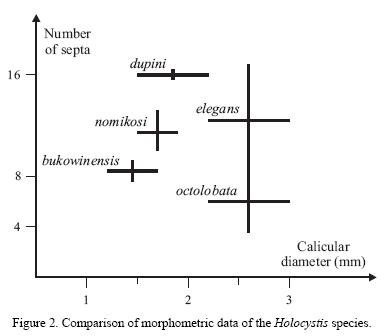
<body><![CDATA[<p align="justify"><font face="verdana" size="2"><b>Paratypes. </b>BSP 2003 XX 6172, 6173, 6199, 6207, 6215.</font></p>     <p align="justify"><font face="verdana" size="2"><b>Type locality. </b>North of the Chiarmena SE Aliartos, on the grounds of the tomato puree company of D.Nomikos, located at the eastern end of Aliartos on the road to Thiva, (Viotia, Greece); WGS84 position Lat 38&deg;22'50" N, Long 23&deg;8'25" E. Evangelistria&#150;conglomerates of Late Aptian&#150;Early Albian age based on the occurrence of the microfossils <i>Pseudocyclammina vasconica, Trocholina aptiensis, Mesorbitolina texana </i>and <i>Simplorbitolina conulus </i>(see L&ouml;ser and Raeder, 1995).</font></p>     <p align="justify"><font face="verdana" size="2"><b>Material. </b>Holotype with two thin sections, and five paratypes from the type locality. One specimen from Tanzania.</font></p>     <p align="justify"><font face="verdana" size="2"><b>Diagnosis. </b><i>Holocystis </i>with a calicular diameter of 1.5&#150;1.9 mm and a number of septa of 10&#150;14. The third cycle is always present, but never completed.</font></p>     <p align="justify"><font face="verdana" size="2"><b>Dimensions, </b>c: 1.5&#150;1.9 (2.0) mm, ccd: 2.0&#150;2.5 (3.2) mm, s: 10&#150;14, sc: 16.</font></p>     <p align="justify"><font face="verdana" size="2"><b>Description. </b>Small rounded colonies (20&#150;30 mm diameter). The calicular arrangement appears cerioid at the outer surface. The thin section shows that each calice has its own wall, and a narrow coenosteum occurs. The outlines of calices are round or slightly quadratic. They are regular in size, but larger calices occur. Septa are thin, straight, free and compact. They appear in three cycles. The first cycle consists of four septa, reaching almost to the centre of the calices <i>(ca. </i>80 per cent of the radius of the calice). The septa have a slightly broader peripherical part, therefore appearing wedge&#150;shaped. Four septa of the second cycle are short <i>(ca. </i>20 per cent of the radius of the calice). The third cycle with up to six septa is only developed as ridges on the inner calicular wall. Normally, only two septa of the third cycle are visible in the calices. There are invariably 16 costae. The coenosteum is made of confluent or subconfluent costae and dissepiments, which extend from the calice. The endotheca consists of tabulae and disspiments. Both are thin, and dissepiments dominate. About six to eight endothecal elements occur in two millimetres of vertical section.</font></p>     <p align="justify"><font face="verdana" size="2"><b>Comparison and remarks. </b><i>H elegans </i>has larger dimensions. <i>H. dupini </i>shows a higher calicular diameter and a completed third cycle, at least in mature calices, whereas the third cycle is in no case complete in the new species. <i>H. bukowinensis </i>is the most similar species, but shows a slightly smaller calicular diameter and a smaller number of septa <a href="#f2">(Figure 2)</a>.</font></p>     <p align="center"><font face="verdana" size="2"><a name="f2"></a></font></p>     <p align="center"><font face="verdana" size="2"><img src="/img/revistas/rmcg/v23n3/a4f2.jpg"></font></p>     <p align="justify"><font face="verdana" size="2">The material described by Dietrich (1926, p. 66) is only well preserved on the surface; the inside is completely recrystallized and does not show any details.</font></p>     ]]></body>
<body><![CDATA[<p align="justify"><font face="verdana" size="2"><b>Occurrence. </b>Pilepile, Nambawala plateau (Mtwara, Tanganyika, Tanzania), Late Aptian, MB K1398; Chiarmena SE Aliartos, Aliartos (Viotia, Greece), Late Aptian&#150;Early Albian, BSP 2003 XX 6172, 6173, 6199, 6200, 6207, 6215.</font></p>     <p align="justify"><font face="verdana" size="2"><b>Stratigraphical range. </b>Late Aptian&#150;Early Albian.</font></p>     <p align="justify"><font face="verdana" size="2"><b>Questionable species</b></font></p>     <p align="justify"><font face="verdana" size="2"><i>Holocystis polyspathes </i>Giimbel, 1861 was only once listed (Giimbel, 1861, p. 566) and not described or depicted afterwards. The type material could not be found at the B SP. The species must be considered <i>nomen nudum. </i>In a recent revision (Baron&#150;Szabo, 1997) of the corals from the Allgau area, <i>Holocystis </i>was not indicated.</font></p>     <p align="justify"><font face="verdana" size="2">The following species were previously or currently assigned to <i>Holocystis, </i>but belong to other genera.</font></p>     <p align="justify"><font face="verdana" size="2">The holotype (by monotypy, NHMW, without number) <i>o&iacute; Holocystis similis </i>Toula, 1877 from Kama (Sveti&#150;Nikola&#150;Balkan, East Serbia) with Early Aptian belongs to the genus <i>Hydnophoraraea.</i></font></p>     <p align="justify"><font face="verdana" size="2">The holotype (by monotypy, NHMW 1998z0054/0001) <i>o&iacute; Holocystis tenuis </i>Toula, 1878 from Vratsa (Vrachanska oblast, Bulgaria) with Late Barremian to Early Aptian was originally assigned to <i>Holocystis, </i>but correctly reassigned to the genus <i>Felixigyra </i>by Masse and Morycowa (1994).</font></p>     <p align="justify"><font face="verdana" size="2">&nbsp;</font></p>     <p align="justify"><font face="verdana" size="2"><b>DISCUSSION</b></font></p>     <p align="justify"><font face="verdana" size="2"><b>Stratigraphical distribution</b></font></p>     ]]></body>
<body><![CDATA[<p align="justify"><font face="verdana" size="2">The genus <i>Holocystis </i>is limited to the Barremian to Early Albian <a href="#f3">(Figure 3)</a>. It appeared with three species in the Barremian, had its maximum of four species in the Late Aptian, and disappeared in the Early Albian, with only two species. The temporal distribution reflects the general abundance of corals in the Cretaceous (L&ouml;ser, 1998a, <a href="/img/revistas/rmcg/v23n3/a4f1.jpg" target="_blank">fig. 1</a>): increasing values until the Early Aptian and a slight drop in the Early Albian. The sudden disappearance of the genus is probably linked to global anoxic events during the Albian. Almost no hermatypic coral faunas are known from the Middle Albian, and numerous genera disappeared together with <i>Holocystis </i>before the Cenomanian (L&ouml;ser, 2005). Middle and Late Albian faunas with corals are less numerous in species and are dominated by solitary, most likely ahermatypic corals. Such faunas are mainly known from Texas (USA; Wells, 1933). Colonial coral faunas from the Middle to Late Albian are known from southern England (Jukes&#150;Browne, 1900), southern India (Stoliczka, 1873), northern Spain (Reitner, 1987) and New Mexico (USA; Turnsek <i>et al., </i>2003). They do not contain <i>Holocystis.</i></font></p>     <p align="center"><font face="verdana" size="2"><i><a name="f3"></a></i></font></p>     <p align="center"><font face="verdana" size="2"><i><img src="/img/revistas/rmcg/v23n3/a4f3.jpg"></i></font></p>     <p align="justify"><font face="verdana" size="2">&nbsp;</font></p>     <p align="justify"><font face="verdana" size="2"><b>Palaeobiogeography</b></font></p>     <p align="justify"><font face="verdana" size="2">The genus is known from only three large regions: the central Tethys, the Caribbean and the southern Tethys <a href="/img/revistas/rmcg/v23n3/a4f4.jpg" target="_blank">(Figure 4)</a>. It is unknown from the Tibetan or Japanese faunas. There is no regular pattern in the palaeobiogeographic distribution of the genus. In the majority of the localities, two species co&#150;occur, but there is no repeating combination pattern that could indicate that those two species are synonymous.</font></p>     <p align="justify"><font face="verdana" size="2">The occurrence <i>o&iacute; Holocystis </i>in the New World seems problematic: it is restricted to two different levels (Late Barremian&#150;Early Aptian Cerro de Oro Formation, Early Albian Cerro La Espina Member) within a geographic distance of less than one kilometre within one locality (Cerro de Oro) in Sonora, Mexico. There are numerous outcrops within the Cerro La Espina Member (Mural Limestone) with various coral faunas, but <i>Holocystis </i>could not be found in any of these faunas. A confusion of samples can be excluded, since samples were also collected recently by the author. Both formations are well distinguished in a tectonically relatively calm region. Between both levels is a succession of clastic sediments with a time span of about five Ma. A local persistence &#150;the only explanation of this phenomenon&#150; of coral species over a relatively long time span is rarely observed due to the rarity of sections with a comparable (coral bearing) facies over such a long time period. Comparable situations where species persisted, although rare elsewhere, are known from the Early and Late Cenomanian (Dixoni zone, Geslinianum zone; L&ouml;ser, 1989) of Germany <i>(Colonicyathusgeinitzi,Mesomorpha minima, Stylohelia gran&uacute;lala), </i>or from the Early and late Late Aptian of Spain (Schollhorn, 1998; cf. <i>Comalia </i>sp., <i>Holocystis elegans). </i>In the latter region, again a <i>Holocystis </i>species persisted over a longer time span in the same region.</font></p>     <p align="justify"><font face="verdana" size="2">&nbsp;</font></p>     <p align="justify"><font face="verdana" size="2"><b>Palaeoecology</b></font></p>     <p align="justify"><font face="verdana" size="2">The genus occurred preferably in a siliclastic or at least siliciclastic&#150;influenced facies type. The type locality of <i>Holocystis elegans, </i>the Perna Beds of the Isle of Wright, is marked by sandstones and sandy clays. Localities in Greece are all in the Evangelistria conglomerates, a clastic sediment with coarse ophiolite pebbles as components. The material from Spain and Mexico occurs in argillaceous limestones. The material from Poland comes from conglomeratic sand stones. The isolated colony from Tanzania shows a pale white colour but no attached sediment, and could therefore come from a carbonate facies. Samples from the same locality, for which an Urgonian facies was claimed by Dietrich (1926), show different matrix, such as limestones and sandstones. The unique specimen from Italy was found in carbonatic sediments. <i>Holocystis </i>can be found in localities poor in species (such as Can Grau in Spain, Atherfield in the United Kingdom) and in localities rich in species, such as the outcrops in Greece, Mexico, Poland, Romania, Serbia or the localities in L&eacute;rida (Spain). Where they occur, coral colonies of the genus are not rare. At least the outcrops in Aliartos (Greece), near Atherfield (United Kinddom), close to Montsec de Rubies (Spain), and in Sonora (Mexico) have yielded numerous specimens, whereas other species are less abundant.</font></p>     ]]></body>
<body><![CDATA[<p align="justify"><font face="verdana" size="2">&nbsp;</font></p>     <p align="justify"><font face="verdana" size="2"><b>Evolution</b></font></p>     <p align="justify"><font face="verdana" size="2">Traditionally, the suborder Stylininais subdivided into three families: Stylinidae d'Orbigny, 1850, Cyathophoridae Vaughan and Wells, 1943, and Agathehidae Beauvais and Beauvais, 1975. Other families based on genera currently assigned to the suborder Stylinina (such as Euheliidae, Pseudocoeniidae, Cladophylliidae, Stylosmiliidae) comprise only one genus, which would not be very helpful for classification. Whereas the Agathehidae differ by their irregular septal symmetry and the formation of the coenos&#150;teum, the Stylinidae and Cyathophoridae are distinguished by the presence or absence of a columella. Auriculae are present in the Stylinidae, but in the Cyathophoridae they are generally (not always) absent. This feature can also be linked to the presence of the columella. Members of the two families also differ in the size of their coenosteum (small in Cyathophoridae, large in Stylinidae), the number of costae (in Stylinidae they are often more numerous) and the wall formation (parathecal in Cyathophoridae, para&#150;septothecal in Stylinidae).</font></p>     <p align="justify"><font face="verdana" size="2">Another concept for distinguishing the two families is put forward in Pandey <i>et al. </i>(2002) but not confirmed by appropriate type material and therefore doubtful. Both families comprise genera that form plocoid corals with a regular septal symmetry, using different systems <i>(Cryptocoenia, Holocystis, Pentacoenia, Pseudocoenia </i>in the Cyathophoridae; <i>A canthocoenia, Enallhelia, Heliocoenia, Stylangia, Stylina </i>in the Stylinidae). In both families, corals may show a tetrameral, pentameral, hexameral, octomeral ordecameral symmetry. Genera within the Cyathophoridae are traditionally distinguished by their symmetry, while in the Stylinidae all plocoid forms are referred to as <i>Enallhelia, Heliocoenia, Stylangia, Stylina, </i>depending on the growth form and the form of the columella. This does not apply, however, to <i>Acanthocoenia, </i>the genus with a columella and a pentameral symmetry.</font></p>     <p align="justify"><font face="verdana" size="2">Cyathophoridae and Stylinidae both originated in the Middle Jurassic (Lathuili&eacute;re, 1989); their plocoid colonies show hexameral, octomeral and decameral symmetries <i>(e.g., </i>Beauvais, 1964). Species older than Early Cretaceous with a tetrameral or pentameral symmetry are unknown in both families. Species with a pentameral symmetry suddenly appeared in both families in the Hauterivian, and those with a tetrameral symmetry in the Barremian <a href="#f5">(Figure 5)</a>. However, this experiment did not last long. In the Albian, the tetrameral and pentameral members disappeared in both families. The octomeral species became moreover extinct in both families at the end of the Aptian. With the exception of the decameral forms, genera showing the same symmetry also died out in both families at the same time. In both families, species with a hexameral symmetry are much more common than species with a septal symmetry not based on six, and pentameral and tetrameral species are few and far between.</font></p>     <p align="center"><font face="verdana" size="2"><a name="f5"></a></font></p>     <p align="center"><font face="verdana" size="2"><img src="/img/revistas/rmcg/v23n3/a4f5.jpg"></font></p>     <p align="justify"><font face="verdana" size="2">The formation of the columella is, at least in the Stylinidae, a constant feature. Though its form may vary within one colony between lamellar and styliform (making the distinction between <i>Heliocoenia </i>and <i>Stylinia </i>a rather vague one), its presence or absence is a stable characteristic. Species of Cyathophoridae and Stylinidae may occur together, but none of them have the same calicular diameter and the same number of septa, differing only in the presence or absence of the columella. The two families are considered two different phylogenetic lines.</font></p>     <p align="justify"><font face="verdana" size="2">The surprising parallelism in the sudden variation of the basic number of septal symmetry in the early Cretaceous Cyathophoridae and Stylinidae is not considered just an experiment but is thought to relate to environmental conditions. The growth form of the colony, the size of the calices, the septal perforation and the formation of pennulae have been thoroughly discussed as being indicators of environmental changes <i>(e.g., </i>Dupraz and Strasser, 2002; Sanders and Baron&#150;Szabo, 2005), but changes in the septal symmetry as a possible reaction have been unknown up to now.</font></p>     <p align="justify"><font face="verdana" size="2">&nbsp;</font></p>     ]]></body>
<body><![CDATA[<p align="justify"><font face="verdana" size="2"><b>ACKNOWLEDGEMENTS</b></font></p>     <p align="justify"><font face="verdana" size="2">I am indebted to the curators of the above listed museums, and university institutes who allowed me to study type material, as well as to Jos&eacute; Carlos Salda&ntilde;a&#150;Villodre (San Vicente del Raspeig) for showing me material from his private collection. Fieldwork in England, France, Greece, and Spain, as well as sample preparation, was supported by DFG projects FL 42/73 and LO 769/2. Fieldwork in Mexico was supported by project PAPIIT DGAPA IN 107803. Carlos Gonz&aacute;lez Le&oacute;n (Hermosillo, Mexico), Elmar Schollhorn (Mascefa, Spain), and Thomas Steuber (Bochum, Germany) introduced me to outcrop areas in Mexico, Spain, and Greece. Many thanks to Elzbieta Morycowa and Bogdan Kolodziej (both Krak&oacute;w) for providing photographs of material from Poland for comparison. Valuable comments by Jacob Leloux (Leiden), Elzbieta Morycowa (Krak&oacute;w) and Dragica Turnsek (Ljubljana) helped to improve the manuscript. For grammatical correction I would like to thank Gregory Webb (Brisbane) very much.</font></p>     <p align="justify"><font face="verdana" size="2">&nbsp;</font></p>     <p align="justify"><font face="verdana" size="2"><b>REFERENCES</b></font></p>     <!-- ref --><p align="justify"><font face="verdana" size="2">Alloiteau, J., 1952, Embranchement des coelent&eacute;r&eacute;s, <i>in </i>Piveteau, J. (ed), Traite de Pal&eacute;ontologie: Paris, Masson, 1, 376&#150;684.</font>&nbsp;&nbsp;&nbsp;&nbsp;&nbsp;&nbsp;&nbsp;&nbsp;[&#160;<a href="javascript:void(0);" onclick="javascript: window.open('/scielo.php?script=sci_nlinks&ref=8012431&pid=S1026-8774200600030000400001&lng=','','width=640,height=500,resizable=yes,scrollbars=1,menubar=yes,');">Links</a>&#160;]<!-- end-ref --><!-- ref --><p align="justify"><font face="verdana" size="2">Baron&#150;Szabo, R.C., 1997, Die Korallenfazies der ostalpinen Kreide (Helvetikum: Allgauer Schrattenkalk; Nordliche Kalkalpen: Brandenberger Gosau) Taxonomie, Palokologie: Zitteliana, 21, 3&#150;97.</font>&nbsp;&nbsp;&nbsp;&nbsp;&nbsp;&nbsp;&nbsp;&nbsp;[&#160;<a href="javascript:void(0);" onclick="javascript: window.open('/scielo.php?script=sci_nlinks&ref=8012432&pid=S1026-8774200600030000400002&lng=','','width=640,height=500,resizable=yes,scrollbars=1,menubar=yes,');">Links</a>&#160;]<!-- end-ref --><!-- ref --><p align="justify"><font face="verdana" size="2">Baron&#150;Szabo, R.C., Gonz&aacute;lez&#150;Le&oacute;n, CM., 2003, Late Aptian&#150;Early Albian corals from the Mural Limestone of the Bisbee Group (Tuape and Cerro de Oro areas), Sonora, Mexico, <i>in </i>Scott, R.W. (ed.) Cretaceous Stratigraphy and Paleoecology, Texas and Mexico: Society for Sedimentary Geology (SEPM)&#150;Gulf Coast Section Foundation, Special Publications in Geology, 1, 187&#150;225.</font>&nbsp;&nbsp;&nbsp;&nbsp;&nbsp;&nbsp;&nbsp;&nbsp;[&#160;<a href="javascript:void(0);" onclick="javascript: window.open('/scielo.php?script=sci_nlinks&ref=8012433&pid=S1026-8774200600030000400003&lng=','','width=640,height=500,resizable=yes,scrollbars=1,menubar=yes,');">Links</a>&#160;]<!-- end-ref --><!-- ref --><p align="justify"><font face="verdana" size="2">Beauvais, L., 1964, Etude stratigraphique et pal&eacute;ontologique des formations a madr&eacute;poraires du Jurassique sup&eacute;rieur du Jura et de l'Est du Bassin de Paris: M&eacute;moires de la Soci&eacute;t&eacute; g&eacute;ologique de France, 43(100), 1&#150;287.</font>&nbsp;&nbsp;&nbsp;&nbsp;&nbsp;&nbsp;&nbsp;&nbsp;[&#160;<a href="javascript:void(0);" onclick="javascript: window.open('/scielo.php?script=sci_nlinks&ref=8012434&pid=S1026-8774200600030000400004&lng=','','width=640,height=500,resizable=yes,scrollbars=1,menubar=yes,');">Links</a>&#160;]<!-- end-ref --><!-- ref --><p align="justify"><font face="verdana" size="2">Beauvais, L., Beauvais, M., 1975, Une nouvelle famille dans le sous&#150;ordre des Stylinida Alloiteau: les Agatheliidae nov. fam. (Madr&eacute;poraires m&eacute;sozoiques): Bulletin de la Soci&eacute;t&eacute; g&eacute;ologique de France, serie 7, 17(4), 576&#150;581.</font>&nbsp;&nbsp;&nbsp;&nbsp;&nbsp;&nbsp;&nbsp;&nbsp;[&#160;<a href="javascript:void(0);" onclick="javascript: window.open('/scielo.php?script=sci_nlinks&ref=8012435&pid=S1026-8774200600030000400005&lng=','','width=640,height=500,resizable=yes,scrollbars=1,menubar=yes,');">Links</a>&#160;]<!-- end-ref --><!-- ref --><p align="justify"><font face="verdana" size="2">Bourne, G.C., 1900, The Anthozoa, <i>in </i>Lankester, R. (ed.), Treatise on Zoology. Part 2: Porifera and Coelenterata: London, A. &amp; C. Black, 59&#150;79.</font>&nbsp;&nbsp;&nbsp;&nbsp;&nbsp;&nbsp;&nbsp;&nbsp;[&#160;<a href="javascript:void(0);" onclick="javascript: window.open('/scielo.php?script=sci_nlinks&ref=8012436&pid=S1026-8774200600030000400006&lng=','','width=640,height=500,resizable=yes,scrollbars=1,menubar=yes,');">Links</a>&#160;]<!-- end-ref --><!-- ref --><p align="justify"><font face="verdana" size="2">Bronn, H.G., 1851, Lethaea geognostica (2, 3:) Meso&#150;Lethaea (5, 4:) Kreide&#150;Gebirge: Stuttgart, Schweizerbart, 412 pp.</font>&nbsp;&nbsp;&nbsp;&nbsp;&nbsp;&nbsp;&nbsp;&nbsp;[&#160;<a href="javascript:void(0);" onclick="javascript: window.open('/scielo.php?script=sci_nlinks&ref=8012437&pid=S1026-8774200600030000400007&lng=','','width=640,height=500,resizable=yes,scrollbars=1,menubar=yes,');">Links</a>&#160;]<!-- end-ref --><!-- ref --><p align="justify"><font face="verdana" size="2">Chevalier, J.&#150;P, Masse, J.P, 1980, Apercu sur les formations r&eacute;cifales en France: Geobios. M&eacute;moire Special, 4, 7&#150;16.</font>&nbsp;&nbsp;&nbsp;&nbsp;&nbsp;&nbsp;&nbsp;&nbsp;[&#160;<a href="javascript:void(0);" onclick="javascript: window.open('/scielo.php?script=sci_nlinks&ref=8012438&pid=S1026-8774200600030000400008&lng=','','width=640,height=500,resizable=yes,scrollbars=1,menubar=yes,');">Links</a>&#160;]<!-- end-ref --><!-- ref --><p align="justify"><font face="verdana" size="2">Corroy, G., 1925, Le N&eacute;ocomien de la bordure ori&eacute;ntale du Bassin de Paris: Bulletin de la Soci&eacute;t&eacute; des Sciences naturelles de Nancy, 2(4), 171&#150;506.</font>&nbsp;&nbsp;&nbsp;&nbsp;&nbsp;&nbsp;&nbsp;&nbsp;[&#160;<a href="javascript:void(0);" onclick="javascript: window.open('/scielo.php?script=sci_nlinks&ref=8012439&pid=S1026-8774200600030000400009&lng=','','width=640,height=500,resizable=yes,scrollbars=1,menubar=yes,');">Links</a>&#160;]<!-- end-ref --><!-- ref --><p align="justify"><font face="verdana" size="2">Dietrich, W.O., 1926, Steinkorallen des Malms und der Unterkreide im s&uuml;dlichen Deutsch&#150;Ostafrika: Palaeontographica, suppl.7(l), 43&#150;62.</font>&nbsp;&nbsp;&nbsp;&nbsp;&nbsp;&nbsp;&nbsp;&nbsp;[&#160;<a href="javascript:void(0);" onclick="javascript: window.open('/scielo.php?script=sci_nlinks&ref=8012440&pid=S1026-8774200600030000400010&lng=','','width=640,height=500,resizable=yes,scrollbars=1,menubar=yes,');">Links</a>&#160;]<!-- end-ref --><!-- ref --><p align="justify"><font face="verdana" size="2">Duncan, P.M., 1867, A monograph of the British fossil corals, ser. 2, 4. Corals from the zones of Ammonites planorbis, angulatus, Bucklandi, obtusus, and raricostatus of the Lower Lias; from the zones of Jamesoni and Henleyi of the middle lias; and from the aviculacontorta zone and the white lias: Palaeontographical Society Monographs, 20, 1&#150;43.</font>&nbsp;&nbsp;&nbsp;&nbsp;&nbsp;&nbsp;&nbsp;&nbsp;[&#160;<a href="javascript:void(0);" onclick="javascript: window.open('/scielo.php?script=sci_nlinks&ref=8012441&pid=S1026-8774200600030000400011&lng=','','width=640,height=500,resizable=yes,scrollbars=1,menubar=yes,');">Links</a>&#160;]<!-- end-ref --><!-- ref --><p align="justify"><font face="verdana" size="2">Dupraz, C, Strasser, A., 2002, Nutritional Modes in Coral &#150;Microbialite Reefs (Jurassic, Oxfordian, Switzerland): Evolution of trophic structure as a response to environmental change: Palaios, 17(5), 449&#150;471.</font>&nbsp;&nbsp;&nbsp;&nbsp;&nbsp;&nbsp;&nbsp;&nbsp;[&#160;<a href="javascript:void(0);" onclick="javascript: window.open('/scielo.php?script=sci_nlinks&ref=8012442&pid=S1026-8774200600030000400012&lng=','','width=640,height=500,resizable=yes,scrollbars=1,menubar=yes,');">Links</a>&#160;]<!-- end-ref --><!-- ref --><p align="justify"><font face="verdana" size="2">Eguchi, M., 1951, Mesozoic hexacorals from Japan: Science Reports of the Tohoku Imperial University, ser. 2, Geology, 24, 1&#150;96.</font>&nbsp;&nbsp;&nbsp;&nbsp;&nbsp;&nbsp;&nbsp;&nbsp;[&#160;<a href="javascript:void(0);" onclick="javascript: window.open('/scielo.php?script=sci_nlinks&ref=8012443&pid=S1026-8774200600030000400013&lng=','','width=640,height=500,resizable=yes,scrollbars=1,menubar=yes,');">Links</a>&#160;]<!-- end-ref --><!-- ref --><p align="justify"><font face="verdana" size="2">Felix, J., 1914, Anthozoa Cret&aacute;cea: Fossilium Catalogus Animalia, 5&#150;7, 1&#150;273.</font>&nbsp;&nbsp;&nbsp;&nbsp;&nbsp;&nbsp;&nbsp;&nbsp;[&#160;<a href="javascript:void(0);" onclick="javascript: window.open('/scielo.php?script=sci_nlinks&ref=8012444&pid=S1026-8774200600030000400014&lng=','','width=640,height=500,resizable=yes,scrollbars=1,menubar=yes,');">Links</a>&#160;]<!-- end-ref --><!-- ref --><p align="justify"><font face="verdana" size="2">Fitton, W.H., 1847, Astratigraphical account ofthe section from Atherfield to Rocken End, on the south&#150;west coast of the Isle of Wight: Quarterly Journal ofthe Geological Society of London, 3, 289&#150;327.</font>&nbsp;&nbsp;&nbsp;&nbsp;&nbsp;&nbsp;&nbsp;&nbsp;[&#160;<a href="javascript:void(0);" onclick="javascript: window.open('/scielo.php?script=sci_nlinks&ref=8012445&pid=S1026-8774200600030000400015&lng=','','width=640,height=500,resizable=yes,scrollbars=1,menubar=yes,');">Links</a>&#160;]<!-- end-ref --><!-- ref --><p align="justify"><font face="verdana" size="2">Fromentel, E. de, 1861, Introduction a l'&eacute;tude des polypiers fossiles: M&eacute;moires de la Soci&eacute;t&eacute; d'&eacute;mulation du Doubs, 5, 1&#150;357.</font>&nbsp;&nbsp;&nbsp;&nbsp;&nbsp;&nbsp;&nbsp;&nbsp;[&#160;<a href="javascript:void(0);" onclick="javascript: window.open('/scielo.php?script=sci_nlinks&ref=8012446&pid=S1026-8774200600030000400016&lng=','','width=640,height=500,resizable=yes,scrollbars=1,menubar=yes,');">Links</a>&#160;]<!-- end-ref --><!-- ref --><p align="justify"><font face="verdana" size="2">Fromentel, E. de, 1883, Zoophytes, terrain cr&eacute;tac&eacute; (12), <i>in </i>d'Orbigny, A. (ed.), Pal&eacute;ontologie francaise: Paris, Victor Masson, t. 8, 513&#150;528.</font>&nbsp;&nbsp;&nbsp;&nbsp;&nbsp;&nbsp;&nbsp;&nbsp;[&#160;<a href="javascript:void(0);" onclick="javascript: window.open('/scielo.php?script=sci_nlinks&ref=8012447&pid=S1026-8774200600030000400017&lng=','','width=640,height=500,resizable=yes,scrollbars=1,menubar=yes,');">Links</a>&#160;]<!-- end-ref --><!-- ref --><p align="justify"><font face="verdana" size="2">Fromentel, E. de, 1884, Zoophytes, terrain cr&eacute;tac&eacute; (13), <i>in </i>d'Orbigny, A. (ed.), Pal&eacute;ontologie francaise: Paris, Victor Masson, t. 8, 529&#150;560.</font>&nbsp;&nbsp;&nbsp;&nbsp;&nbsp;&nbsp;&nbsp;&nbsp;[&#160;<a href="javascript:void(0);" onclick="javascript: window.open('/scielo.php?script=sci_nlinks&ref=8012448&pid=S1026-8774200600030000400018&lng=','','width=640,height=500,resizable=yes,scrollbars=1,menubar=yes,');">Links</a>&#160;]<!-- end-ref --><!-- ref --><p align="justify"><font face="verdana" size="2">Gill, G.A., 1977, Essai de regroupement des Stylinides (hexacoralliaires) d'apr&eacute;s la morphologie des bords internes de leurs septes: M&eacute;moires du Bureau de Recherches G&eacute;ologiques et Mini&eacute;res, 89, 283&#150;295.</font>&nbsp;&nbsp;&nbsp;&nbsp;&nbsp;&nbsp;&nbsp;&nbsp;[&#160;<a href="javascript:void(0);" onclick="javascript: window.open('/scielo.php?script=sci_nlinks&ref=8012449&pid=S1026-8774200600030000400019&lng=','','width=640,height=500,resizable=yes,scrollbars=1,menubar=yes,');">Links</a>&#160;]<!-- end-ref --><!-- ref --><p align="justify"><font face="verdana" size="2">Gonz&aacute;lez&#150;Le&oacute;n, C. M., Lucas, S.G., 1995, Stratigraphy and paleontology ofthe early Cretaceous Cerro de Oro Formation, central Sonora: Geological Society of America, Special Paper, 301, 41&#150;47.</font>&nbsp;&nbsp;&nbsp;&nbsp;&nbsp;&nbsp;&nbsp;&nbsp;[&#160;<a href="javascript:void(0);" onclick="javascript: window.open('/scielo.php?script=sci_nlinks&ref=8012450&pid=S1026-8774200600030000400020&lng=','','width=640,height=500,resizable=yes,scrollbars=1,menubar=yes,');">Links</a>&#160;]<!-- end-ref --><!-- ref --><p align="justify"><font face="verdana" size="2">G&uuml;mbel, C.W., 1861, Geognostische Beschreibung des Bayerischen Alpengebirges und seines Vorlandes, <i>in </i>G&uuml;mbel, C.W. (ed.), Geognostische Beschreibung der Konigreichs Bayern, Abtheilung 1: Gotha, J. Perthes, 950 pp.</font>&nbsp;&nbsp;&nbsp;&nbsp;&nbsp;&nbsp;&nbsp;&nbsp;[&#160;<a href="javascript:void(0);" onclick="javascript: window.open('/scielo.php?script=sci_nlinks&ref=8012451&pid=S1026-8774200600030000400021&lng=','','width=640,height=500,resizable=yes,scrollbars=1,menubar=yes,');">Links</a>&#160;]<!-- end-ref --><!-- ref --><p align="justify"><font face="verdana" size="2">Jukes&#150;Browne, A.J., 1900, The Cretaceous rocks of Britain, 1. The Gault and the Upper Greensand of England: Memoirs of the Geological Survey of the United Kingdom, 1&#150;499.</font>&nbsp;&nbsp;&nbsp;&nbsp;&nbsp;&nbsp;&nbsp;&nbsp;[&#160;<a href="javascript:void(0);" onclick="javascript: window.open('/scielo.php?script=sci_nlinks&ref=8012452&pid=S1026-8774200600030000400022&lng=','','width=640,height=500,resizable=yes,scrollbars=1,menubar=yes,');">Links</a>&#160;]<!-- end-ref --><!-- ref --><p align="justify"><font face="verdana" size="2">Kolodziej, B., Gedl, E., 2000, Nowakocoenia cieszynica gen. et sp. nov. (Scleractinia) and its Barremian&#150;Aptian age based on Dinocysts (Polish Outer Carpathians): Annales Societatis Geologorum Poloniae, 70, 181&#150;192.</font>&nbsp;&nbsp;&nbsp;&nbsp;&nbsp;&nbsp;&nbsp;&nbsp;[&#160;<a href="javascript:void(0);" onclick="javascript: window.open('/scielo.php?script=sci_nlinks&ref=8012453&pid=S1026-8774200600030000400023&lng=','','width=640,height=500,resizable=yes,scrollbars=1,menubar=yes,');">Links</a>&#160;]<!-- end-ref --><!-- ref --><p align="justify"><font face="verdana" size="2">Kuzmicheva, E.I., 1987, Corals from Lower Barremian organogenous buildups in the Malyy Balkhan and Tuarkyr (in Russian), <i>in </i>Amanniyazov, K.N. (ed.), Geologicheskoe stroenie Turkmenistana: Aschabad, Ylum, 217&#150;262.</font>&nbsp;&nbsp;&nbsp;&nbsp;&nbsp;&nbsp;&nbsp;&nbsp;[&#160;<a href="javascript:void(0);" onclick="javascript: window.open('/scielo.php?script=sci_nlinks&ref=8012454&pid=S1026-8774200600030000400024&lng=','','width=640,height=500,resizable=yes,scrollbars=1,menubar=yes,');">Links</a>&#160;]<!-- end-ref --><!-- ref --><p align="justify"><font face="verdana" size="2">Kuzmicheva, E.I., 2002, Skeletal morphology, systematics and evolution of the Scleractinia (in Russian): Trudy Paleontologicheskogo Instituta, 286, 1&#150;211.</font>&nbsp;&nbsp;&nbsp;&nbsp;&nbsp;&nbsp;&nbsp;&nbsp;[&#160;<a href="javascript:void(0);" onclick="javascript: window.open('/scielo.php?script=sci_nlinks&ref=8012455&pid=S1026-8774200600030000400025&lng=','','width=640,height=500,resizable=yes,scrollbars=1,menubar=yes,');">Links</a>&#160;]<!-- end-ref --><!-- ref --><p align="justify"><font face="verdana" size="2">Kuzmicheva, E.I., Aliev, O.B., 1988, Corals (in Russian), <i>in </i>Ali&#150;zade, A.A., Aliev, G. A, Aliev, M.M., Aliiulla, K., Khalilov, A.G.(eds.), Cretaceous fauna of Azerbaijan: Baku, Azerbaijan, Akademiia Nauk Azerbaidzhanskoi SSR, Institut Geologii, 153&#150;184.</font>&nbsp;&nbsp;&nbsp;&nbsp;&nbsp;&nbsp;&nbsp;&nbsp;[&#160;<a href="javascript:void(0);" onclick="javascript: window.open('/scielo.php?script=sci_nlinks&ref=8012456&pid=S1026-8774200600030000400026&lng=','','width=640,height=500,resizable=yes,scrollbars=1,menubar=yes,');">Links</a>&#160;]<!-- end-ref --><!-- ref --><p align="justify"><font face="verdana" size="2">Lathuili&eacute;re, B., 1989, Repertoire objectif des coraux jurassiques: Nancy, Presses universitaires, 76 pp.</font>&nbsp;&nbsp;&nbsp;&nbsp;&nbsp;&nbsp;&nbsp;&nbsp;[&#160;<a href="javascript:void(0);" onclick="javascript: window.open('/scielo.php?script=sci_nlinks&ref=8012457&pid=S1026-8774200600030000400027&lng=','','width=640,height=500,resizable=yes,scrollbars=1,menubar=yes,');">Links</a>&#160;]<!-- end-ref --><!-- ref --><p align="justify"><font face="verdana" size="2">Lawton, T.F., Gonz&aacute;lez&#150;Le&oacute;n, CM., Lucas, S.G., Scott, R.W., 2004, Stratigraphy and sedimentology of the upper Aptian&#150;upper Albian Mural Limestone (Bisbee Group) in northern Sonora, Mexico: Cretaceous Research, 25, 43&#150;60.</font>&nbsp;&nbsp;&nbsp;&nbsp;&nbsp;&nbsp;&nbsp;&nbsp;[&#160;<a href="javascript:void(0);" onclick="javascript: window.open('/scielo.php?script=sci_nlinks&ref=8012458&pid=S1026-8774200600030000400028&lng=','','width=640,height=500,resizable=yes,scrollbars=1,menubar=yes,');">Links</a>&#160;]<!-- end-ref --><!-- ref --><p align="justify"><font face="verdana" size="2">Lonsdale, W., 1849, Notes on fossil Zoophytes found in the deposits described by Dr.Fitton in his Memoir entitled ,,A stratigraphical account of the section from Atherfield to Rocken End": Quarterly Journal of the Geological Society of London, 5, 55&#150;103.</font>&nbsp;&nbsp;&nbsp;&nbsp;&nbsp;&nbsp;&nbsp;&nbsp;[&#160;<a href="javascript:void(0);" onclick="javascript: window.open('/scielo.php?script=sci_nlinks&ref=8012459&pid=S1026-8774200600030000400029&lng=','','width=640,height=500,resizable=yes,scrollbars=1,menubar=yes,');">Links</a>&#160;]<!-- end-ref --><!-- ref --><p align="justify"><font face="verdana" size="2">L&ouml;ser, H., 1989, Die Korallen der sachsischen Oberkreide, 1. Hexacorallia aus dem Cenoman: Abhandlungen des Staatlichen Museums f&uuml;r Mineralogie und Geologie zu Dresden, 36, 88&#150;154.</font>&nbsp;&nbsp;&nbsp;&nbsp;&nbsp;&nbsp;&nbsp;&nbsp;[&#160;<a href="javascript:void(0);" onclick="javascript: window.open('/scielo.php?script=sci_nlinks&ref=8012460&pid=S1026-8774200600030000400030&lng=','','width=640,height=500,resizable=yes,scrollbars=1,menubar=yes,');">Links</a>&#160;]<!-- end-ref --><!-- ref --><p align="justify"><font face="verdana" size="2">L&ouml;ser, H., 1998a, Cretaceous corals &#150;state of knowledge and current research: Zentralblatt f&uuml;r Geologie und Palaontologie, 11/12 (1996), 1475&#150;1485.</font>&nbsp;&nbsp;&nbsp;&nbsp;&nbsp;&nbsp;&nbsp;&nbsp;[&#160;<a href="javascript:void(0);" onclick="javascript: window.open('/scielo.php?script=sci_nlinks&ref=8012461&pid=S1026-8774200600030000400031&lng=','','width=640,height=500,resizable=yes,scrollbars=1,menubar=yes,');">Links</a>&#160;]<!-- end-ref --><!-- ref --><p align="justify"><font face="verdana" size="2">L&ouml;ser, H., 1998b, Adelocoenia versus Pseudocoenia&#150;some rectifications: Fossil Cnidaria &amp; Porifera newsletter, 27(1), 29&#150;32.</font>&nbsp;&nbsp;&nbsp;&nbsp;&nbsp;&nbsp;&nbsp;&nbsp;[&#160;<a href="javascript:void(0);" onclick="javascript: window.open('/scielo.php?script=sci_nlinks&ref=8012462&pid=S1026-8774200600030000400032&lng=','','width=640,height=500,resizable=yes,scrollbars=1,menubar=yes,');">Links</a>&#160;]<!-- end-ref --><!-- ref --><p align="justify"><font face="verdana" size="2">L&ouml;ser, H., 2001, Le site de Valli&eacute;res (d&eacute;partement de l'Aube, France); r&eacute;sultats pr&eacute;liminaires sur des coraux de l'Hauterivien inf&eacute;rieur (Cr&eacute;tac&eacute;): Bulletin annuel de 1'Association g&eacute;ologique de l'Aube, 22, 39&#150;53.</font>&nbsp;&nbsp;&nbsp;&nbsp;&nbsp;&nbsp;&nbsp;&nbsp;[&#160;<a href="javascript:void(0);" onclick="javascript: window.open('/scielo.php?script=sci_nlinks&ref=8012463&pid=S1026-8774200600030000400033&lng=','','width=640,height=500,resizable=yes,scrollbars=1,menubar=yes,');">Links</a>&#160;]<!-- end-ref --><!-- ref --><p align="justify"><font face="verdana" size="2">L&ouml;ser, H., 2005, Stratigraphy of Cretaceous coral genera: Neues Jahrbuch f&uuml;r Geologie und Palaontologie, Abhandlungen, 238, 231&#150;277.</font>&nbsp;&nbsp;&nbsp;&nbsp;&nbsp;&nbsp;&nbsp;&nbsp;[&#160;<a href="javascript:void(0);" onclick="javascript: window.open('/scielo.php?script=sci_nlinks&ref=8012464&pid=S1026-8774200600030000400034&lng=','','width=640,height=500,resizable=yes,scrollbars=1,menubar=yes,');">Links</a>&#160;]<!-- end-ref --><!-- ref --><p align="justify"><font face="verdana" size="2">L&ouml;ser, H., 2006, Morphology, taxonomy and distribution of the Cretaceous coral genus Paronastraea (Barremian&#150;Cenomanian; Scleractinia): Rivista Italiana di Paleontolog&iacute;a e Stratigrafia, 112(1), 131&#150;121.</font>&nbsp;&nbsp;&nbsp;&nbsp;&nbsp;&nbsp;&nbsp;&nbsp;[&#160;<a href="javascript:void(0);" onclick="javascript: window.open('/scielo.php?script=sci_nlinks&ref=8012465&pid=S1026-8774200600030000400035&lng=','','width=640,height=500,resizable=yes,scrollbars=1,menubar=yes,');">Links</a>&#160;]<!-- end-ref --><!-- ref --><p align="justify"><font face="verdana" size="2">L&ouml;ser, H., Decrouez, D., 2000, Stratigraphy of selected Cretaceous coral localities in Northern Spain: Abhandlungen und Berichte f&uuml;r Naturkunde und Vorgeschichte, 21, 63&#150;71.</font>&nbsp;&nbsp;&nbsp;&nbsp;&nbsp;&nbsp;&nbsp;&nbsp;[&#160;<a href="javascript:void(0);" onclick="javascript: window.open('/scielo.php?script=sci_nlinks&ref=8012466&pid=S1026-8774200600030000400036&lng=','','width=640,height=500,resizable=yes,scrollbars=1,menubar=yes,');">Links</a>&#160;]<!-- end-ref --><!-- ref --><p align="justify"><font face="verdana" size="2">L&ouml;ser, H., Raeder, M., 1995, Aptian/Albian coral assemblages of the Helicon Mountains (Boeotia, Greece); palaeontological, palaeoecological and palaeogeographical aspects: Coral Research Bulletin, 4, 37&#150;63.</font>&nbsp;&nbsp;&nbsp;&nbsp;&nbsp;&nbsp;&nbsp;&nbsp;[&#160;<a href="javascript:void(0);" onclick="javascript: window.open('/scielo.php?script=sci_nlinks&ref=8012467&pid=S1026-8774200600030000400037&lng=','','width=640,height=500,resizable=yes,scrollbars=1,menubar=yes,');">Links</a>&#160;]<!-- end-ref --><!-- ref --><p align="justify"><font face="verdana" size="2">L&ouml;ser, H. and 25 co&#150;authors, 2002, List of Citations, <i>in </i>The Catalogue of Cretaceous Corals: Dresden, CPress, 2, 784 p.</font>&nbsp;&nbsp;&nbsp;&nbsp;&nbsp;&nbsp;&nbsp;&nbsp;[&#160;<a href="javascript:void(0);" onclick="javascript: window.open('/scielo.php?script=sci_nlinks&ref=8012468&pid=S1026-8774200600030000400038&lng=','','width=640,height=500,resizable=yes,scrollbars=1,menubar=yes,');">Links</a>&#160;]<!-- end-ref --><!-- ref --><p align="justify"><font face="verdana" size="2">L&ouml;ser, H. and 28 co&#150;authors, 2005, List of Localities, <i>in </i>The Catalogue of Cretaceous Corals: Dresden, CPress, 3, 366.</font>&nbsp;&nbsp;&nbsp;&nbsp;&nbsp;&nbsp;&nbsp;&nbsp;[&#160;<a href="javascript:void(0);" onclick="javascript: window.open('/scielo.php?script=sci_nlinks&ref=8012469&pid=S1026-8774200600030000400039&lng=','','width=640,height=500,resizable=yes,scrollbars=1,menubar=yes,');">Links</a>&#160;]<!-- end-ref --><!-- ref --><p align="justify"><font face="verdana" size="2">Masse, J.P., Morycowa, E., 1994, Les Scl&eacute;ractiniaires hydnophoroides du Cr&eacute;tac&eacute; inf&eacute;rieur (Barr&eacute;mien&#150;Aptien inf&eacute;rieur) de Provence (S.E. de la France). Syst&eacute;matique, stratigraphie etpal&eacute;obiog&eacute;ographie: Geobios, 27(4), 433&#150;448.</font>&nbsp;&nbsp;&nbsp;&nbsp;&nbsp;&nbsp;&nbsp;&nbsp;[&#160;<a href="javascript:void(0);" onclick="javascript: window.open('/scielo.php?script=sci_nlinks&ref=8012470&pid=S1026-8774200600030000400040&lng=','','width=640,height=500,resizable=yes,scrollbars=1,menubar=yes,');">Links</a>&#160;]<!-- end-ref --><!-- ref --><p align="justify"><font face="verdana" size="2">Milne&#150;Edwards, H., 1857, Histoire naturelle des coralliaires ou polypes proprement dits, v. 1, 2: Paris, Librairie Encyclop&eacute;dique de Roret, VIII, v. 1, 326 p., v. 2, 633 p.</font>&nbsp;&nbsp;&nbsp;&nbsp;&nbsp;&nbsp;&nbsp;&nbsp;[&#160;<a href="javascript:void(0);" onclick="javascript: window.open('/scielo.php?script=sci_nlinks&ref=8012471&pid=S1026-8774200600030000400041&lng=','','width=640,height=500,resizable=yes,scrollbars=1,menubar=yes,');">Links</a>&#160;]<!-- end-ref --><!-- ref --><p align="justify"><font face="verdana" size="2">Milne&#150;Edwards, H., 1860, Histoire naturelle des coralliaires ou polypes proprement dits, v.3: Paris, Librairie Encyclop&eacute;dique de Roret, 560 p.</font>&nbsp;&nbsp;&nbsp;&nbsp;&nbsp;&nbsp;&nbsp;&nbsp;[&#160;<a href="javascript:void(0);" onclick="javascript: window.open('/scielo.php?script=sci_nlinks&ref=8012472&pid=S1026-8774200600030000400042&lng=','','width=640,height=500,resizable=yes,scrollbars=1,menubar=yes,');">Links</a>&#160;]<!-- end-ref --><!-- ref --><p align="justify"><font face="verdana" size="2">Milne&#150;Edwards, H., Haime, J., 1851, Amonograph of the British fossil corals, 1. Introduction; Tertiary and Cretaceous: Palaeontographical Society Monographs, 3, i&#150;lxxxv, 1&#150;71.</font>&nbsp;&nbsp;&nbsp;&nbsp;&nbsp;&nbsp;&nbsp;&nbsp;[&#160;<a href="javascript:void(0);" onclick="javascript: window.open('/scielo.php?script=sci_nlinks&ref=8012473&pid=S1026-8774200600030000400043&lng=','','width=640,height=500,resizable=yes,scrollbars=1,menubar=yes,');">Links</a>&#160;]<!-- end-ref --><!-- ref --><p align="justify"><font face="verdana" size="2">Morycowa, E., 1964, Hexacoralla des couches de Grodziszcze (N&eacute;ocomien Carpathes): Acta Palaeontologica Polonica, 9(1), 1&#150;114.</font>&nbsp;&nbsp;&nbsp;&nbsp;&nbsp;&nbsp;&nbsp;&nbsp;[&#160;<a href="javascript:void(0);" onclick="javascript: window.open('/scielo.php?script=sci_nlinks&ref=8012474&pid=S1026-8774200600030000400044&lng=','','width=640,height=500,resizable=yes,scrollbars=1,menubar=yes,');">Links</a>&#160;]<!-- end-ref --><!-- ref --><p align="justify"><font face="verdana" size="2">Morycowa, E., 1971, Hexacorallia et Octocorallia du Cr&eacute;tac&eacute; inf&eacute;rieur de Rarau (Carpathes orientales roumaines): Acta Palaeontologica Polonica, 16(1/2), 1&#150;149.</font>&nbsp;&nbsp;&nbsp;&nbsp;&nbsp;&nbsp;&nbsp;&nbsp;[&#160;<a href="javascript:void(0);" onclick="javascript: window.open('/scielo.php?script=sci_nlinks&ref=8012475&pid=S1026-8774200600030000400045&lng=','','width=640,height=500,resizable=yes,scrollbars=1,menubar=yes,');">Links</a>&#160;]<!-- end-ref --><!-- ref --><p align="justify"><font face="verdana" size="2">Morycowa, E., 1989, Class Anthozoa Ehrenberg, 1834, <i>in </i>Malinowski, L. (ed.), Geology of Poland, 3. Atlas of Guide and Characteristic Fossils, 2c. Mesozoic, Cretaceous: Warszawa, Wydawnictwa Geologiczne, 58&#150;67.</font>&nbsp;&nbsp;&nbsp;&nbsp;&nbsp;&nbsp;&nbsp;&nbsp;[&#160;<a href="javascript:void(0);" onclick="javascript: window.open('/scielo.php?script=sci_nlinks&ref=8012476&pid=S1026-8774200600030000400046&lng=','','width=640,height=500,resizable=yes,scrollbars=1,menubar=yes,');">Links</a>&#160;]<!-- end-ref --><!-- ref --><p align="justify"><font face="verdana" size="2">Morycowa, E., Masse, J.P., Vilas, L., Arias, C, 2001, Montlivaltia multiformis Toula (Scleractinia) from the Aptian of the Prebetic domain (SE Spain): Revista Espa&ntilde;ola de Paleontolog&iacute;a, 16(1), 131&#150;144.</font>&nbsp;&nbsp;&nbsp;&nbsp;&nbsp;&nbsp;&nbsp;&nbsp;[&#160;<a href="javascript:void(0);" onclick="javascript: window.open('/scielo.php?script=sci_nlinks&ref=8012477&pid=S1026-8774200600030000400047&lng=','','width=640,height=500,resizable=yes,scrollbars=1,menubar=yes,');">Links</a>&#160;]<!-- end-ref --><!-- ref --><p align="justify"><font face="verdana" size="2">Nicholson, H.A., 1879, Manual of Palaeontology: Edinburgh, W. Blackwood, 2nd ed., 2 vols.</font>&nbsp;&nbsp;&nbsp;&nbsp;&nbsp;&nbsp;&nbsp;&nbsp;[&#160;<a href="javascript:void(0);" onclick="javascript: window.open('/scielo.php?script=sci_nlinks&ref=8012478&pid=S1026-8774200600030000400048&lng=','','width=640,height=500,resizable=yes,scrollbars=1,menubar=yes,');">Links</a>&#160;]<!-- end-ref --><!-- ref --><p align="justify"><font face="verdana" size="2">Orbigny, A. d', 1849, Note sur les polypiers fossiles: Paris, Masson, 12 p.</font>&nbsp;&nbsp;&nbsp;&nbsp;&nbsp;&nbsp;&nbsp;&nbsp;[&#160;<a href="javascript:void(0);" onclick="javascript: window.open('/scielo.php?script=sci_nlinks&ref=8012479&pid=S1026-8774200600030000400049&lng=','','width=640,height=500,resizable=yes,scrollbars=1,menubar=yes,');">Links</a>&#160;]<!-- end-ref --><!-- ref --><p align="justify"><font face="verdana" size="2">Orbigny, A. d', 1850, Prodrome de Pal&eacute;ontologie stratigraphique universelle des animaux mollusques et rayonn&eacute;s v. 1, 2: Paris, Masson, v. 1, 394 p., v. 2, 428 p.</font>&nbsp;&nbsp;&nbsp;&nbsp;&nbsp;&nbsp;&nbsp;&nbsp;[&#160;<a href="javascript:void(0);" onclick="javascript: window.open('/scielo.php?script=sci_nlinks&ref=8012480&pid=S1026-8774200600030000400050&lng=','','width=640,height=500,resizable=yes,scrollbars=1,menubar=yes,');">Links</a>&#160;]<!-- end-ref --><!-- ref --><p align="justify"><font face="verdana" size="2">Orbigny, A. d', 1851, Cours &eacute;l&eacute;mentaire de Pal&eacute;ontologie, 3. Polypiers ou Zoophytes: Paris, Masson, 189 p.</font>&nbsp;&nbsp;&nbsp;&nbsp;&nbsp;&nbsp;&nbsp;&nbsp;[&#160;<a href="javascript:void(0);" onclick="javascript: window.open('/scielo.php?script=sci_nlinks&ref=8012481&pid=S1026-8774200600030000400051&lng=','','width=640,height=500,resizable=yes,scrollbars=1,menubar=yes,');">Links</a>&#160;]<!-- end-ref --><!-- ref --><p align="justify"><font face="verdana" size="2">Pandey, D.K., Lathuili&eacute;re, B., F&uuml;rsich, ET, Kuldeep, S., 2002, The oldest Jurassic cyathophorid coral (Scleractinia) from siliciclastic environments of the Kachchh Basin, western India: Pal&auml;ontologische Zeitschrift, 76(2), 347&#150;356.</font>&nbsp;&nbsp;&nbsp;&nbsp;&nbsp;&nbsp;&nbsp;&nbsp;[&#160;<a href="javascript:void(0);" onclick="javascript: window.open('/scielo.php?script=sci_nlinks&ref=8012482&pid=S1026-8774200600030000400052&lng=','','width=640,height=500,resizable=yes,scrollbars=1,menubar=yes,');">Links</a>&#160;]<!-- end-ref --><!-- ref --><p align="justify"><font face="verdana" size="2">Prever, P.L., 1909, Anthozoa, <i>in </i>Parona, CE, Crema, C, Prever, P.L. (eds.), La Fauna Coralligena del Cret&aacute;ceo dei Monti d'Ocre neir Abruzzo Aquilano: Rome, R. Comitato geol&oacute;gico del Regno, Memorie per servir&eacute; alia descrizione della carta geol&oacute;gica d'Italia, 5(1), 51&#150;147.</font>&nbsp;&nbsp;&nbsp;&nbsp;&nbsp;&nbsp;&nbsp;&nbsp;[&#160;<a href="javascript:void(0);" onclick="javascript: window.open('/scielo.php?script=sci_nlinks&ref=8012483&pid=S1026-8774200600030000400053&lng=','','width=640,height=500,resizable=yes,scrollbars=1,menubar=yes,');">Links</a>&#160;]<!-- end-ref --><!-- ref --><p align="justify"><font face="verdana" size="2">Quenstedt, F.A., 1879, Petrefactenkunde Deutschlands, 6. Korallen (Rohren&#150; und Sternkorallen), v. 1: Leipzig, Fues Verlag, 624 p.</font>&nbsp;&nbsp;&nbsp;&nbsp;&nbsp;&nbsp;&nbsp;&nbsp;[&#160;<a href="javascript:void(0);" onclick="javascript: window.open('/scielo.php?script=sci_nlinks&ref=8012484&pid=S1026-8774200600030000400054&lng=','','width=640,height=500,resizable=yes,scrollbars=1,menubar=yes,');">Links</a>&#160;]<!-- end-ref --><!-- ref --><p align="justify"><font face="verdana" size="2">Reig Oriol, J., 1995, Madreporarios cret&aacute;cicos: Barcelona, 62 p.</font>&nbsp;&nbsp;&nbsp;&nbsp;&nbsp;&nbsp;&nbsp;&nbsp;[&#160;<a href="javascript:void(0);" onclick="javascript: window.open('/scielo.php?script=sci_nlinks&ref=8012485&pid=S1026-8774200600030000400055&lng=','','width=640,height=500,resizable=yes,scrollbars=1,menubar=yes,');">Links</a>&#160;]<!-- end-ref --><!-- ref --><p align="justify"><font face="verdana" size="2">Reitner, J., 1987, Mikrofazielle, palokologische und palaogeographische Analyse ausgewahlter Vorkommen flachmariner Karbonate im basko&#150;kantabrischen Strike Slip Fault&#150;Becken&#150;System: Documenta naturae, 40, 1&#150;239.</font>&nbsp;&nbsp;&nbsp;&nbsp;&nbsp;&nbsp;&nbsp;&nbsp;[&#160;<a href="javascript:void(0);" onclick="javascript: window.open('/scielo.php?script=sci_nlinks&ref=8012486&pid=S1026-8774200600030000400056&lng=','','width=640,height=500,resizable=yes,scrollbars=1,menubar=yes,');">Links</a>&#160;]<!-- end-ref --><!-- ref --><p align="justify"><font face="verdana" size="2">Ryder, T.A., 1927, The structure and development of Holocystis Ed. and Haime: Geological Magazine, 64, 119&#150;122.</font>&nbsp;&nbsp;&nbsp;&nbsp;&nbsp;&nbsp;&nbsp;&nbsp;[&#160;<a href="javascript:void(0);" onclick="javascript: window.open('/scielo.php?script=sci_nlinks&ref=8012487&pid=S1026-8774200600030000400057&lng=','','width=640,height=500,resizable=yes,scrollbars=1,menubar=yes,');">Links</a>&#160;]<!-- end-ref --><!-- ref --><p align="justify"><font face="verdana" size="2">Sanders, D., Baron&#150;Szabo, R.C., 2005, Scleractinian assemblages under sediment input: their characteristics and relation to the nutrient input concept: Palaeogeography, Palaeoclimatology, Palaeoecology, 216(1/2), 139&#150;181.</font>&nbsp;&nbsp;&nbsp;&nbsp;&nbsp;&nbsp;&nbsp;&nbsp;[&#160;<a href="javascript:void(0);" onclick="javascript: window.open('/scielo.php?script=sci_nlinks&ref=8012488&pid=S1026-8774200600030000400058&lng=','','width=640,height=500,resizable=yes,scrollbars=1,menubar=yes,');">Links</a>&#160;]<!-- end-ref --><!-- ref --><p align="justify"><font face="verdana" size="2">Schollhorn, E., 1998, Geologie und Pal&auml;ontologie des Oberapt im Becken von Organy&agrave; (Nordspanien): Coral Research Bulletin, 6, 1&#150;139.</font>&nbsp;&nbsp;&nbsp;&nbsp;&nbsp;&nbsp;&nbsp;&nbsp;[&#160;<a href="javascript:void(0);" onclick="javascript: window.open('/scielo.php?script=sci_nlinks&ref=8012489&pid=S1026-8774200600030000400059&lng=','','width=640,height=500,resizable=yes,scrollbars=1,menubar=yes,');">Links</a>&#160;]<!-- end-ref --><!-- ref --><p align="justify"><font face="verdana" size="2">Stoliczka, F., 1873, The corals or Anthozoa from the Cretaceous rocks of South India: Palaeontologia Indica, Memoirs of the Geological Survey of India, 8(4/5), 130&#150;202.</font>&nbsp;&nbsp;&nbsp;&nbsp;&nbsp;&nbsp;&nbsp;&nbsp;[&#160;<a href="javascript:void(0);" onclick="javascript: window.open('/scielo.php?script=sci_nlinks&ref=8012490&pid=S1026-8774200600030000400060&lng=','','width=640,height=500,resizable=yes,scrollbars=1,menubar=yes,');">Links</a>&#160;]<!-- end-ref --><!-- ref --><p align="justify"><font face="verdana" size="2">Turnsek, D., Mihajlovic, M., 1981, Lower Cretaceous Cnidarians from eastern Serbia: Razprave Slovenska akademija znanosti in umetnosti, 23(1), 1&#150;54.</font>&nbsp;&nbsp;&nbsp;&nbsp;&nbsp;&nbsp;&nbsp;&nbsp;[&#160;<a href="javascript:void(0);" onclick="javascript: window.open('/scielo.php?script=sci_nlinks&ref=8012491&pid=S1026-8774200600030000400061&lng=','','width=640,height=500,resizable=yes,scrollbars=1,menubar=yes,');">Links</a>&#160;]<!-- end-ref --><!-- ref --><p align="justify"><font face="verdana" size="2">Turnsek, D., LeMone, D.V., Scott, R.W., 2003, Tethyan Albian corals, Cerro de Cristo Rey uplift, Chihuahua and New Mexico, <i>in </i>Scott, R.W. (ed.), Cretaceous Stratigraphy and Paleoecology, Texas and Mexico: Society for Sedimentary Geology (SEPM)&#150;Gulf Coast Section Foundation, Special Publications in Geology, 1, p. 147&#150;185.</font>&nbsp;&nbsp;&nbsp;&nbsp;&nbsp;&nbsp;&nbsp;&nbsp;[&#160;<a href="javascript:void(0);" onclick="javascript: window.open('/scielo.php?script=sci_nlinks&ref=8012492&pid=S1026-8774200600030000400062&lng=','','width=640,height=500,resizable=yes,scrollbars=1,menubar=yes,');">Links</a>&#160;]<!-- end-ref --><!-- ref --><p align="justify"><font face="verdana" size="2">Toula, F., 1877, Geologische Untersuchungen im westlichen Theile des Balkans und der angrenzenden Gebiete, 4. Ein geologisches Profil von Osmanich am Arcer, &uuml;ber den Sveti&#150;Nicola&#150;Balkan, nach Ak&#150;Palanka an der Nisava: Sitzungsberichte der Mathematisch&#150;Naturwissenschaftliche Classe der Kaiserlichen Akademie der Wissenschaften, (1) 75, 465&#150;549.</font>&nbsp;&nbsp;&nbsp;&nbsp;&nbsp;&nbsp;&nbsp;&nbsp;[&#160;<a href="javascript:void(0);" onclick="javascript: window.open('/scielo.php?script=sci_nlinks&ref=8012493&pid=S1026-8774200600030000400063&lng=','','width=640,height=500,resizable=yes,scrollbars=1,menubar=yes,');">Links</a>&#160;]<!-- end-ref --><!-- ref --><p align="justify"><font face="verdana" size="2">Toula, F., 1878, Geologische Untersuchungen im westlichen Theile des Balkans und in den angrenzenden Gebiete, 5. Ein geologisches Profil von Sofia &uuml;ber den Berkovica Balkan nach Bercovar: Sitzungsberichte der Mathematisch&#150;Naturwissenschaftliche Classe der Kaiserlichen Akademie der Wissenschaften, (1) 77, 247&#150;317.</font>&nbsp;&nbsp;&nbsp;&nbsp;&nbsp;&nbsp;&nbsp;&nbsp;[&#160;<a href="javascript:void(0);" onclick="javascript: window.open('/scielo.php?script=sci_nlinks&ref=8012494&pid=S1026-8774200600030000400064&lng=','','width=640,height=500,resizable=yes,scrollbars=1,menubar=yes,');">Links</a>&#160;]<!-- end-ref --><!-- ref --><p align="justify"><font face="verdana" size="2">Vaughan, T.W., Wells, J.W., 1943, Revision ofthe suborders, families and genera of scleractinia: Geological Society of America, Special Paper, 44, 1&#150;363.</font>&nbsp;&nbsp;&nbsp;&nbsp;&nbsp;&nbsp;&nbsp;&nbsp;[&#160;<a href="javascript:void(0);" onclick="javascript: window.open('/scielo.php?script=sci_nlinks&ref=8012495&pid=S1026-8774200600030000400065&lng=','','width=640,height=500,resizable=yes,scrollbars=1,menubar=yes,');">Links</a>&#160;]<!-- end-ref --><!-- ref --><p align="justify"><font face="verdana" size="2">Volz, W., 1896, Die Korallen der Trias monographisch bearbeitet: Palaeontographica, 43, 1&#150;127.</font>&nbsp;&nbsp;&nbsp;&nbsp;&nbsp;&nbsp;&nbsp;&nbsp;[&#160;<a href="javascript:void(0);" onclick="javascript: window.open('/scielo.php?script=sci_nlinks&ref=8012496&pid=S1026-8774200600030000400066&lng=','','width=640,height=500,resizable=yes,scrollbars=1,menubar=yes,');">Links</a>&#160;]<!-- end-ref --><!-- ref --><p align="justify"><font face="verdana" size="2">Volz, W., 1903, &Uuml;ber eine Korallenfauna aus dem Neokom der Bukowina: Beitrage zur Palaontologie und Geologie &Ouml;sterreich&#150;Ungarns und des Orients, 15(1), 9&#150;30.</font>&nbsp;&nbsp;&nbsp;&nbsp;&nbsp;&nbsp;&nbsp;&nbsp;[&#160;<a href="javascript:void(0);" onclick="javascript: window.open('/scielo.php?script=sci_nlinks&ref=8012497&pid=S1026-8774200600030000400067&lng=','','width=640,height=500,resizable=yes,scrollbars=1,menubar=yes,');">Links</a>&#160;]<!-- end-ref --><!-- ref --><p align="justify"><font face="verdana" size="2">Wells, J.W., 1933, Corals of the Cretaceous of the Atlantic and Gulf Costal Plains and W&#150;Interior of the United States: Bulletins of American Paleontology, 18(67), 83&#150;292.</font>&nbsp;&nbsp;&nbsp;&nbsp;&nbsp;&nbsp;&nbsp;&nbsp;[&#160;<a href="javascript:void(0);" onclick="javascript: window.open('/scielo.php?script=sci_nlinks&ref=8012498&pid=S1026-8774200600030000400068&lng=','','width=640,height=500,resizable=yes,scrollbars=1,menubar=yes,');">Links</a>&#160;]<!-- end-ref --><!-- ref --><p align="justify"><font face="verdana" size="2">Wells, J.W., 1944, Cretaceous, Tertiary and Recent corals, a sponge and a alga from Venezuela: Journal of Paleontology, 18, 429&#150;447.</font>&nbsp;&nbsp;&nbsp;&nbsp;&nbsp;&nbsp;&nbsp;&nbsp;[&#160;<a href="javascript:void(0);" onclick="javascript: window.open('/scielo.php?script=sci_nlinks&ref=8012499&pid=S1026-8774200600030000400069&lng=','','width=640,height=500,resizable=yes,scrollbars=1,menubar=yes,');">Links</a>&#160;]<!-- end-ref --><!-- ref --><p align="justify"><font face="verdana" size="2">Wells, J.W., 1936, The nomenclature and type species of some genera of recent and fossil corals: American Journal of Science, 31, 97&#150;134.</font>&nbsp;&nbsp;&nbsp;&nbsp;&nbsp;&nbsp;&nbsp;&nbsp;[&#160;<a href="javascript:void(0);" onclick="javascript: window.open('/scielo.php?script=sci_nlinks&ref=8012500&pid=S1026-8774200600030000400070&lng=','','width=640,height=500,resizable=yes,scrollbars=1,menubar=yes,');">Links</a>&#160;]<!-- end-ref --><!-- ref --><p align="justify"><font face="verdana" size="2">Wells, J.W., 1956, Scleractinia, <i>in </i>Moore, R.C. (ed.), Treatise on Invertebrate Paleontology, F. Coelenterata: Lawrence and Kansas, The University of Kansas and The Geological Society of America, 328&#150;444.&nbsp;</font>&nbsp;&nbsp;&nbsp;&nbsp;&nbsp;&nbsp;&nbsp;&nbsp;[&#160;<a href="javascript:void(0);" onclick="javascript: window.open('/scielo.php?script=sci_nlinks&ref=8012501&pid=S1026-8774200600030000400071&lng=','','width=640,height=500,resizable=yes,scrollbars=1,menubar=yes,');">Links</a>&#160;]<!-- end-ref --><!-- ref --><p align="justify"><font face="verdana" size="2">Wery, G., 1954, Contribution a la revision des Madr&eacute;poraires du N&eacute;ocomien de la Haute&#150;Marne: Dijon, Universit&eacute; de Dijon, Diplome, 97 p.</font>&nbsp;&nbsp;&nbsp;&nbsp;&nbsp;&nbsp;&nbsp;&nbsp;[&#160;<a href="javascript:void(0);" onclick="javascript: window.open('/scielo.php?script=sci_nlinks&ref=8012502&pid=S1026-8774200600030000400072&lng=','','width=640,height=500,resizable=yes,scrollbars=1,menubar=yes,');">Links</a>&#160;]<!-- end-ref --> ]]></body><back>
<ref-list>
<ref id="B1">
<nlm-citation citation-type="book">
<person-group person-group-type="author">
<name>
<surname><![CDATA[Alloiteau]]></surname>
<given-names><![CDATA[J]]></given-names>
</name>
</person-group>
<article-title xml:lang="fr"><![CDATA[Embranchement des coelentérés]]></article-title>
<person-group person-group-type="editor">
<name>
<surname><![CDATA[Piveteau]]></surname>
<given-names><![CDATA[J]]></given-names>
</name>
</person-group>
<source><![CDATA[Traite de Paléontologie]]></source>
<year>1952</year>
<volume>1</volume>
<page-range>376-684</page-range><publisher-loc><![CDATA[Paris ]]></publisher-loc>
<publisher-name><![CDATA[Masson]]></publisher-name>
</nlm-citation>
</ref>
<ref id="B2">
<nlm-citation citation-type="">
<person-group person-group-type="author">
<name>
<surname><![CDATA[Baron-Szabo]]></surname>
<given-names><![CDATA[R.C]]></given-names>
</name>
</person-group>
<source><![CDATA[Die Korallenfazies der ostalpinen Kreide (Helvetikum: Allgauer Schrattenkalk; Nordliche Kalkalpen: Brandenberger Gosau) Taxonomie, Palokologie]]></source>
<year>1997</year>
<volume>21</volume>
<page-range>3-97</page-range></nlm-citation>
</ref>
<ref id="B3">
<nlm-citation citation-type="book">
<person-group person-group-type="author">
<name>
<surname><![CDATA[Baron-Szabo]]></surname>
<given-names><![CDATA[R.C]]></given-names>
</name>
<name>
<surname><![CDATA[González-León]]></surname>
<given-names><![CDATA[CM]]></given-names>
</name>
</person-group>
<article-title xml:lang="en"><![CDATA[Late Aptian-Early Albian corals from the Mural Limestone of the Bisbee Group (Tuape and Cerro de Oro areas), Sonora, Mexico]]></article-title>
<person-group person-group-type="editor">
<name>
<surname><![CDATA[Scott]]></surname>
<given-names><![CDATA[R.W]]></given-names>
</name>
</person-group>
<source><![CDATA[Cretaceous Stratigraphy and Paleoecology, Texas and Mexico]]></source>
<year>2003</year>
<volume>1</volume>
<page-range>187-225</page-range><publisher-name><![CDATA[Society for Sedimentary Geology (SEPM)-Gulf Coast Section Foundation, Special Publications in Geology]]></publisher-name>
</nlm-citation>
</ref>
<ref id="B4">
<nlm-citation citation-type="">
<person-group person-group-type="author">
<name>
<surname><![CDATA[Beauvais]]></surname>
<given-names><![CDATA[L]]></given-names>
</name>
</person-group>
<source><![CDATA[Etude stratigraphique et paléontologique des formations a madréporaires du Jurassique supérieur du Jura et de l'Est du Bassin de Paris]]></source>
<year>1964</year>
<volume>43</volume>
<page-range>1-287</page-range></nlm-citation>
</ref>
<ref id="B5">
<nlm-citation citation-type="">
<person-group person-group-type="author">
<name>
<surname><![CDATA[Beauvais]]></surname>
<given-names><![CDATA[L]]></given-names>
</name>
<name>
<surname><![CDATA[Beauvais]]></surname>
<given-names><![CDATA[M]]></given-names>
</name>
</person-group>
<source><![CDATA[Une nouvelle famille dans le sous-ordre des Stylinida Alloiteau: les Agatheliidae nov. fam. (Madréporaires mésozoiques)]]></source>
<year>1975</year>
<volume>17</volume>
<page-range>576-581</page-range></nlm-citation>
</ref>
<ref id="B6">
<nlm-citation citation-type="book">
<person-group person-group-type="author">
<name>
<surname><![CDATA[Bourne]]></surname>
<given-names><![CDATA[G.C]]></given-names>
</name>
</person-group>
<article-title xml:lang="en"><![CDATA[The Anthozoa]]></article-title>
<person-group person-group-type="editor">
<name>
<surname><![CDATA[Lankester]]></surname>
<given-names><![CDATA[R]]></given-names>
</name>
</person-group>
<source><![CDATA[Treatise on Zoology: Part 2: Porifera and Coelenterata]]></source>
<year>1900</year>
<month>,</month>
<page-range>59-79</page-range><publisher-loc><![CDATA[London ]]></publisher-loc>
<publisher-name><![CDATA[A. & C. Black]]></publisher-name>
</nlm-citation>
</ref>
<ref id="B7">
<nlm-citation citation-type="book">
<person-group person-group-type="author">
<name>
<surname><![CDATA[Bronn]]></surname>
<given-names><![CDATA[H.G]]></given-names>
</name>
</person-group>
<source><![CDATA[Lethaea geognostica (2, 3:) Meso-Lethaea (5, 4:) Kreide-Gebirge]]></source>
<year>1851</year>
<page-range>412</page-range><publisher-loc><![CDATA[Stuttgart ]]></publisher-loc>
<publisher-name><![CDATA[Schweizerbart]]></publisher-name>
</nlm-citation>
</ref>
<ref id="B8">
<nlm-citation citation-type="">
<person-group person-group-type="author">
<name>
<surname><![CDATA[Chevalier]]></surname>
<given-names><![CDATA[J.-P]]></given-names>
</name>
<name>
<surname><![CDATA[Masse]]></surname>
<given-names><![CDATA[J.P]]></given-names>
</name>
</person-group>
<source><![CDATA[Apercu sur les formations récifales en France]]></source>
<year>1980</year>
<volume>4</volume>
<page-range>7-16</page-range></nlm-citation>
</ref>
<ref id="B9">
<nlm-citation citation-type="">
<person-group person-group-type="author">
<name>
<surname><![CDATA[Corroy]]></surname>
<given-names><![CDATA[G]]></given-names>
</name>
</person-group>
<source><![CDATA[Le Néocomien de la bordure oriéntale du Bassin de Paris]]></source>
<year>1925</year>
<volume>2</volume>
<page-range>171-506</page-range></nlm-citation>
</ref>
<ref id="B10">
<nlm-citation citation-type="journal">
<person-group person-group-type="author">
<name>
<surname><![CDATA[Dietrich]]></surname>
<given-names><![CDATA[W.O]]></given-names>
</name>
</person-group>
<article-title xml:lang="de"><![CDATA[Steinkorallen des Malms und der Unterkreide im südlichen Deutsch-Ostafrika]]></article-title>
<source><![CDATA[Palaeontographica]]></source>
<year>1926</year>
<numero>l^s7</numero>
<issue>l^s7</issue>
<supplement>7</supplement>
<page-range>43-62</page-range></nlm-citation>
</ref>
<ref id="B11">
<nlm-citation citation-type="">
<person-group person-group-type="author">
<name>
<surname><![CDATA[Duncan]]></surname>
<given-names><![CDATA[P.M]]></given-names>
</name>
</person-group>
<source><![CDATA[A monograph of the British fossil corals, ser. 2, 4. Corals from the zones of Ammonites planorbis, angulatus, Bucklandi, obtusus, and raricostatus of the Lower Lias: from the zones of Jamesoni and Henleyi of the middle lias; and from the aviculacontorta zone and the white lias]]></source>
<year>1867</year>
<volume>20</volume>
<page-range>1-43</page-range></nlm-citation>
</ref>
<ref id="B12">
<nlm-citation citation-type="">
<person-group person-group-type="author">
<name>
<surname><![CDATA[Dupraz]]></surname>
<given-names><![CDATA[C]]></given-names>
</name>
<name>
<surname><![CDATA[Strasser]]></surname>
<given-names><![CDATA[A]]></given-names>
</name>
</person-group>
<source><![CDATA[Nutritional Modes in Coral -Microbialite Reefs (Jurassic, Oxfordian, Switzerland): Evolution of trophic structure as a response to environmental change]]></source>
<year>2002</year>
<volume>17</volume>
<page-range>449-471</page-range></nlm-citation>
</ref>
<ref id="B13">
<nlm-citation citation-type="book">
<person-group person-group-type="author">
<name>
<surname><![CDATA[Eguchi]]></surname>
<given-names><![CDATA[M]]></given-names>
</name>
</person-group>
<source><![CDATA[Mesozoic hexacorals from Japan]]></source>
<year>1951</year>
<volume>24</volume>
<page-range>1-96</page-range><publisher-name><![CDATA[Science Reports of the Tohoku Imperial University]]></publisher-name>
</nlm-citation>
</ref>
<ref id="B14">
<nlm-citation citation-type="">
<person-group person-group-type="author">
<name>
<surname><![CDATA[Felix]]></surname>
<given-names><![CDATA[J]]></given-names>
</name>
</person-group>
<source><![CDATA[Anthozoa Cretácea: Fossilium Catalogus Animalia]]></source>
<year>1914</year>
<volume>5-7</volume>
<page-range>1-273</page-range></nlm-citation>
</ref>
<ref id="B15">
<nlm-citation citation-type="">
<person-group person-group-type="author">
<name>
<surname><![CDATA[Fitton]]></surname>
<given-names><![CDATA[W.H]]></given-names>
</name>
</person-group>
<source><![CDATA[Astratigraphical account ofthe section from Atherfield to Rocken End, on the south-west coast of the Isle of Wight]]></source>
<year>1847</year>
<volume>3</volume>
<page-range>289-327</page-range></nlm-citation>
</ref>
<ref id="B16">
<nlm-citation citation-type="">
<person-group person-group-type="author">
<name>
<surname><![CDATA[Fromentel]]></surname>
<given-names><![CDATA[E]]></given-names>
</name>
</person-group>
<source><![CDATA[Introduction a l'étude des polypiers fossiles]]></source>
<year>1861</year>
<volume>5</volume>
<page-range>1-357</page-range></nlm-citation>
</ref>
<ref id="B17">
<nlm-citation citation-type="">
<person-group person-group-type="author">
<name>
<surname><![CDATA[Fromentel]]></surname>
<given-names><![CDATA[E]]></given-names>
</name>
</person-group>
<article-title xml:lang="fr"><![CDATA[Zoophytes, terrain crétacé (12)]]></article-title>
<person-group person-group-type="editor">
<name>
<surname><![CDATA[d'Orbigny]]></surname>
<given-names><![CDATA[A]]></given-names>
</name>
</person-group>
<source><![CDATA[Paléontologie francaise]]></source>
<year>1883</year>
<page-range>513-528</page-range><publisher-loc><![CDATA[Paris ]]></publisher-loc>
</nlm-citation>
</ref>
<ref id="B18">
<nlm-citation citation-type="">
<person-group person-group-type="author">
<name>
<surname><![CDATA[Fromentel]]></surname>
<given-names><![CDATA[E]]></given-names>
</name>
</person-group>
<article-title xml:lang="fr"><![CDATA[Zoophytes, terrain crétacé (13)]]></article-title>
<person-group person-group-type="editor">
<name>
<surname><![CDATA[d'Orbigny]]></surname>
<given-names><![CDATA[A]]></given-names>
</name>
</person-group>
<source><![CDATA[Paléontologie francaise]]></source>
<year>1884</year>
<page-range>529-560</page-range><publisher-loc><![CDATA[Paris ]]></publisher-loc>
</nlm-citation>
</ref>
<ref id="B19">
<nlm-citation citation-type="">
<person-group person-group-type="author">
<name>
<surname><![CDATA[Gill]]></surname>
<given-names><![CDATA[G.A]]></given-names>
</name>
</person-group>
<source><![CDATA[Essai de regroupement des Stylinides (hexacoralliaires) d'aprés la morphologie des bords internes de leurs septes]]></source>
<year>1977</year>
<volume>89,</volume>
<page-range>283-295</page-range></nlm-citation>
</ref>
<ref id="B20">
<nlm-citation citation-type="book">
<person-group person-group-type="author">
<name>
<surname><![CDATA[González-León]]></surname>
<given-names><![CDATA[C. M]]></given-names>
</name>
<name>
<surname><![CDATA[Lucas]]></surname>
<given-names><![CDATA[S.G]]></given-names>
</name>
</person-group>
<source><![CDATA[Stratigraphy and paleontology ofthe early Cretaceous Cerro de Oro Formation, central Sonora]]></source>
<year>1995</year>
<volume>301</volume>
<page-range>41-47</page-range><publisher-name><![CDATA[Geological Society of America]]></publisher-name>
</nlm-citation>
</ref>
<ref id="B21">
<nlm-citation citation-type="">
<person-group person-group-type="author">
<name>
<surname><![CDATA[Gümbel]]></surname>
<given-names><![CDATA[C.W]]></given-names>
</name>
</person-group>
<article-title xml:lang="de"><![CDATA[Geognostische Beschreibung des Bayerischen Alpengebirges und seines Vorlandes]]></article-title>
<person-group person-group-type="editor">
<name>
<surname><![CDATA[Gümbel]]></surname>
<given-names><![CDATA[C.W]]></given-names>
</name>
</person-group>
<source><![CDATA[Geognostische Beschreibung der Konigreichs Bayern, Abtheilung 1]]></source>
<year>1861</year>
<page-range>950</page-range><publisher-loc><![CDATA[Gotha ]]></publisher-loc>
</nlm-citation>
</ref>
<ref id="B22">
<nlm-citation citation-type="">
<person-group person-group-type="author">
<name>
<surname><![CDATA[Jukes-Browne]]></surname>
<given-names><![CDATA[A.J]]></given-names>
</name>
</person-group>
<source><![CDATA[The Cretaceous rocks of Britain: 1. The Gault and the Upper Greensand of England]]></source>
<year>1900</year>
<page-range>1-499</page-range></nlm-citation>
</ref>
<ref id="B23">
<nlm-citation citation-type="">
<person-group person-group-type="author">
<name>
<surname><![CDATA[Kolodziej]]></surname>
<given-names><![CDATA[B]]></given-names>
</name>
<name>
<surname><![CDATA[Gedl]]></surname>
<given-names><![CDATA[E]]></given-names>
</name>
</person-group>
<source><![CDATA[Nowakocoenia cieszynica gen. et sp. nov. (Scleractinia) and its Barremian-Aptian age based on Dinocysts (Polish Outer Carpathians)]]></source>
<year>2000</year>
<volume>70</volume>
<page-range>181-192</page-range></nlm-citation>
</ref>
<ref id="B24">
<nlm-citation citation-type="">
<person-group person-group-type="author">
<name>
<surname><![CDATA[Kuzmicheva]]></surname>
<given-names><![CDATA[E.I]]></given-names>
</name>
</person-group>
<article-title xml:lang="en"><![CDATA[Corals from Lower Barremian organogenous buildups in the Malyy Balkhan and Tuarkyr (in Russian)]]></article-title>
<person-group person-group-type="editor">
<name>
<surname><![CDATA[Amanniyazov]]></surname>
<given-names><![CDATA[K.N]]></given-names>
</name>
</person-group>
<source><![CDATA[Geologicheskoe stroenie Turkmenistana]]></source>
<year>1987</year>
<page-range>217-262</page-range><publisher-loc><![CDATA[Aschabad ]]></publisher-loc>
</nlm-citation>
</ref>
<ref id="B25">
<nlm-citation citation-type="book">
<person-group person-group-type="author">
<name>
<surname><![CDATA[Kuzmicheva]]></surname>
<given-names><![CDATA[E.I]]></given-names>
</name>
</person-group>
<source><![CDATA[Skeletal morphology, systematics and evolution of the Scleractinia (in Russian)]]></source>
<year>2002</year>
<volume>286</volume>
<page-range>1-211</page-range><publisher-name><![CDATA[Trudy Paleontologicheskogo Instituta]]></publisher-name>
</nlm-citation>
</ref>
<ref id="B26">
<nlm-citation citation-type="book">
<person-group person-group-type="author">
<name>
<surname><![CDATA[Kuzmicheva]]></surname>
<given-names><![CDATA[E.I]]></given-names>
</name>
<name>
<surname><![CDATA[Aliev]]></surname>
<given-names><![CDATA[O.B]]></given-names>
</name>
</person-group>
<article-title xml:lang="en"><![CDATA[Corals (in Russian)]]></article-title>
<person-group person-group-type="editor">
<name>
<surname><![CDATA[Ali-zade]]></surname>
<given-names><![CDATA[A.A]]></given-names>
</name>
<name>
<surname><![CDATA[Aliev]]></surname>
<given-names><![CDATA[G. A]]></given-names>
</name>
<name>
<surname><![CDATA[Aliev]]></surname>
<given-names><![CDATA[M.M]]></given-names>
</name>
<name>
<surname><![CDATA[Aliiulla]]></surname>
<given-names><![CDATA[K]]></given-names>
</name>
<name>
<surname><![CDATA[Khalilov]]></surname>
<given-names><![CDATA[A.G]]></given-names>
</name>
</person-group>
<source><![CDATA[Cretaceous fauna of Azerbaijan]]></source>
<year>1988</year>
<page-range>153-184</page-range><publisher-loc><![CDATA[Baku ]]></publisher-loc>
<publisher-name><![CDATA[Akademiia Nauk Azerbaidzhanskoi SSR, Institut Geologii]]></publisher-name>
</nlm-citation>
</ref>
<ref id="B27">
<nlm-citation citation-type="book">
<person-group person-group-type="author">
<name>
<surname><![CDATA[Lathuiliére]]></surname>
<given-names><![CDATA[B]]></given-names>
</name>
</person-group>
<source><![CDATA[Repertoire objectif des coraux jurassiques]]></source>
<year>1989</year>
<page-range>76</page-range><publisher-loc><![CDATA[Nancy ]]></publisher-loc>
<publisher-name><![CDATA[Presses universitaires]]></publisher-name>
</nlm-citation>
</ref>
<ref id="B28">
<nlm-citation citation-type="">
<person-group person-group-type="author">
<name>
<surname><![CDATA[Lawton]]></surname>
<given-names><![CDATA[T.F]]></given-names>
</name>
<name>
<surname><![CDATA[González-León]]></surname>
<given-names><![CDATA[CM]]></given-names>
</name>
<name>
<surname><![CDATA[Lucas]]></surname>
<given-names><![CDATA[S.G]]></given-names>
</name>
<name>
<surname><![CDATA[Scott]]></surname>
<given-names><![CDATA[R.W]]></given-names>
</name>
</person-group>
<source><![CDATA[Stratigraphy and sedimentology of the upper Aptian-upper Albian Mural Limestone (Bisbee Group) in northern Sonora, Mexico]]></source>
<year>2004</year>
<volume>25</volume>
<page-range>43-60</page-range></nlm-citation>
</ref>
<ref id="B29">
<nlm-citation citation-type="">
<person-group person-group-type="author">
<name>
<surname><![CDATA[Lonsdale]]></surname>
<given-names><![CDATA[W]]></given-names>
</name>
</person-group>
<source><![CDATA[Notes on fossil Zoophytes found in the deposits described by Dr.Fitton in his Memoir entitled: A stratigraphical account of the section from Atherfield to Rocken End"]]></source>
<year>1849</year>
<volume>5</volume>
<page-range>55-103</page-range></nlm-citation>
</ref>
<ref id="B30">
<nlm-citation citation-type="book">
<person-group person-group-type="author">
<name>
<surname><![CDATA[Löser]]></surname>
<given-names><![CDATA[H]]></given-names>
</name>
</person-group>
<source><![CDATA[Die Korallen der sachsischen Oberkreide: 1. Hexacorallia aus dem Cenoman]]></source>
<year>1989</year>
<volume>36</volume>
<page-range>88-154</page-range><publisher-name><![CDATA[Abhandlungen des Staatlichen Museums für Mineralogie und Geologie zu Dresden]]></publisher-name>
</nlm-citation>
</ref>
<ref id="B31">
<nlm-citation citation-type="book">
<person-group person-group-type="author">
<name>
<surname><![CDATA[Löser]]></surname>
<given-names><![CDATA[H]]></given-names>
</name>
</person-group>
<source><![CDATA[Cretaceous corals -state of knowledge and current research]]></source>
<year>1998</year>
<volume>11/12</volume>
<page-range>1475-1485</page-range><publisher-name><![CDATA[Zentralblatt für Geologie und Palaontologie]]></publisher-name>
</nlm-citation>
</ref>
<ref id="B32">
<nlm-citation citation-type="">
<person-group person-group-type="author">
<name>
<surname><![CDATA[Löser]]></surname>
<given-names><![CDATA[H]]></given-names>
</name>
</person-group>
<source><![CDATA[Adelocoenia versus Pseudocoenia-some rectifications]]></source>
<year>1998</year>
<volume>27</volume>
<page-range>29-32</page-range></nlm-citation>
</ref>
<ref id="B33">
<nlm-citation citation-type="">
<person-group person-group-type="author">
<name>
<surname><![CDATA[Löser]]></surname>
<given-names><![CDATA[H]]></given-names>
</name>
</person-group>
<source><![CDATA[Le site de Valliéres (département de l'Aube, France); résultats préliminaires sur des coraux de l'Hauterivien inférieur (Crétacé)]]></source>
<year>2001</year>
<volume>22</volume>
<page-range>39-53</page-range></nlm-citation>
</ref>
<ref id="B34">
<nlm-citation citation-type="book">
<person-group person-group-type="author">
<name>
<surname><![CDATA[Löser]]></surname>
<given-names><![CDATA[H]]></given-names>
</name>
</person-group>
<source><![CDATA[Stratigraphy of Cretaceous coral genera]]></source>
<year>2005</year>
<volume>238</volume>
<page-range>231-277</page-range><publisher-name><![CDATA[Neues Jahrbuch für Geologie und Palaontologie, Abhandlungen]]></publisher-name>
</nlm-citation>
</ref>
<ref id="B35">
<nlm-citation citation-type="journal">
<person-group person-group-type="author">
<name>
<surname><![CDATA[Löser]]></surname>
<given-names><![CDATA[H]]></given-names>
</name>
</person-group>
<article-title xml:lang="en"><![CDATA[Morphology, taxonomy and distribution of the Cretaceous coral genus Paronastraea (Barremian-Cenomanian; Scleractinia)]]></article-title>
<source><![CDATA[Rivista Italiana di Paleontología e Stratigrafia]]></source>
<year>2006</year>
<volume>112</volume>
<numero>1</numero>
<issue>1</issue>
<page-range>131-121</page-range></nlm-citation>
</ref>
<ref id="B36">
<nlm-citation citation-type="book">
<person-group person-group-type="author">
<name>
<surname><![CDATA[Löser]]></surname>
<given-names><![CDATA[H]]></given-names>
</name>
<name>
<surname><![CDATA[Decrouez]]></surname>
<given-names><![CDATA[D]]></given-names>
</name>
</person-group>
<source><![CDATA[Stratigraphy of selected Cretaceous coral localities in Northern Spain]]></source>
<year>2000</year>
<volume>21</volume>
<page-range>63-71</page-range><publisher-name><![CDATA[Abhandlungen und Berichte für Naturkunde und Vorgeschichte]]></publisher-name>
</nlm-citation>
</ref>
<ref id="B37">
<nlm-citation citation-type="">
<person-group person-group-type="author">
<name>
<surname><![CDATA[Löser]]></surname>
<given-names><![CDATA[H]]></given-names>
</name>
<name>
<surname><![CDATA[Raeder]]></surname>
<given-names><![CDATA[M]]></given-names>
</name>
</person-group>
<source><![CDATA[Aptian/Albian coral assemblages of the Helicon Mountains (Boeotia, Greece): palaeontological, palaeoecological and palaeogeographical aspects]]></source>
<year>1995</year>
<volume>4</volume>
<page-range>37-63</page-range></nlm-citation>
</ref>
<ref id="B38">
<nlm-citation citation-type="">
<person-group person-group-type="author">
<name>
<surname><![CDATA[Löser]]></surname>
<given-names><![CDATA[H]]></given-names>
</name>
</person-group>
<source><![CDATA[The Catalogue of Cretaceous Corals]]></source>
<year>2002</year>
<volume>2</volume>
<page-range>784</page-range></nlm-citation>
</ref>
<ref id="B39">
<nlm-citation citation-type="">
<person-group person-group-type="author">
<name>
<surname><![CDATA[Löser]]></surname>
<given-names><![CDATA[H]]></given-names>
</name>
</person-group>
<source><![CDATA[The Catalogue of Cretaceous Corals]]></source>
<year>2005</year>
<volume>3</volume>
<page-range>366</page-range></nlm-citation>
</ref>
<ref id="B40">
<nlm-citation citation-type="journal">
<person-group person-group-type="author">
<name>
<surname><![CDATA[Masse]]></surname>
<given-names><![CDATA[J.P]]></given-names>
</name>
<name>
<surname><![CDATA[Morycowa]]></surname>
<given-names><![CDATA[E]]></given-names>
</name>
</person-group>
<article-title xml:lang="fr"><![CDATA[Les Scléractiniaires hydnophoroides du Crétacé inférieur (Barrémien-Aptien inférieur) de Provence (S.E. de la France): Systématique, stratigraphie etpaléobiogéographie]]></article-title>
<source><![CDATA[Geobios]]></source>
<year>1994</year>
<volume>27</volume>
<numero>4</numero>
<issue>4</issue>
<page-range>433-448</page-range></nlm-citation>
</ref>
<ref id="B41">
<nlm-citation citation-type="book">
<person-group person-group-type="author">
<name>
<surname><![CDATA[Milne-Edwards]]></surname>
<given-names><![CDATA[H]]></given-names>
</name>
</person-group>
<source><![CDATA[Histoire naturelle des coralliaires ou polypes proprement dits]]></source>
<year>1857</year>
<volume>1, 2</volume><volume>1</volume><volume>2</volume>
<edition>Paris</edition>
<page-range>326</page-range><publisher-name><![CDATA[Librairie Encyclopédique de Roret]]></publisher-name>
</nlm-citation>
</ref>
<ref id="B42">
<nlm-citation citation-type="book">
<person-group person-group-type="author">
<name>
<surname><![CDATA[Milne-Edwards]]></surname>
<given-names><![CDATA[H]]></given-names>
</name>
</person-group>
<source><![CDATA[Histoire naturelle des coralliaires ou polypes proprement dits]]></source>
<year>1860</year>
<volume>3</volume>
<page-range>560</page-range><publisher-loc><![CDATA[Paris ]]></publisher-loc>
<publisher-name><![CDATA[Librairie Encyclopédique de Roret]]></publisher-name>
</nlm-citation>
</ref>
<ref id="B43">
<nlm-citation citation-type="">
<person-group person-group-type="author">
<name>
<surname><![CDATA[Milne-Edwards]]></surname>
<given-names><![CDATA[H]]></given-names>
</name>
<name>
<surname><![CDATA[Haime]]></surname>
<given-names><![CDATA[J]]></given-names>
</name>
</person-group>
<source><![CDATA[Amonograph of the British fossil corals: 1. Introduction; Tertiary and Cretaceous]]></source>
<year>1851</year>
<volume>3</volume>
<page-range>1-71</page-range></nlm-citation>
</ref>
<ref id="B44">
<nlm-citation citation-type="journal">
<person-group person-group-type="author">
<name>
<surname><![CDATA[Morycowa]]></surname>
<given-names><![CDATA[E]]></given-names>
</name>
</person-group>
<article-title xml:lang="fr"><![CDATA[Hexacoralla des couches de Grodziszcze (Néocomien Carpathes)]]></article-title>
<source><![CDATA[Acta Palaeontologica Polonica]]></source>
<year>1964</year>
<volume>9</volume>
<numero>1</numero>
<issue>1</issue>
<page-range>1-114</page-range></nlm-citation>
</ref>
<ref id="B45">
<nlm-citation citation-type="journal">
<person-group person-group-type="author">
<name>
<surname><![CDATA[Morycowa]]></surname>
<given-names><![CDATA[E]]></given-names>
</name>
</person-group>
<article-title xml:lang="fr"><![CDATA[Hexacorallia et Octocorallia du Crétacé inférieur de Rarau (Carpathes orientales roumaines)]]></article-title>
<source><![CDATA[Acta Palaeontologica Polonica]]></source>
<year>1971</year>
<volume>16</volume>
<numero>1/2</numero>
<issue>1/2</issue>
<page-range>1-149</page-range></nlm-citation>
</ref>
<ref id="B46">
<nlm-citation citation-type="book">
<person-group person-group-type="author">
<name>
<surname><![CDATA[Morycowa]]></surname>
<given-names><![CDATA[E]]></given-names>
</name>
</person-group>
<article-title xml:lang="fr"><![CDATA[Class Anthozoa Ehrenberg: 1834]]></article-title>
<person-group person-group-type="editor">
<name>
<surname><![CDATA[Malinowski]]></surname>
<given-names><![CDATA[L]]></given-names>
</name>
</person-group>
<source><![CDATA[Geology of Poland: 3. Atlas of Guide and Characteristic Fossils, 2c. Mesozoic, Cretaceous]]></source>
<year>1989</year>
<page-range>58-67</page-range><publisher-loc><![CDATA[Warszawa ]]></publisher-loc>
<publisher-name><![CDATA[Wydawnictwa Geologiczne]]></publisher-name>
</nlm-citation>
</ref>
<ref id="B47">
<nlm-citation citation-type="journal">
<person-group person-group-type="author">
<name>
<surname><![CDATA[Morycowa]]></surname>
<given-names><![CDATA[E]]></given-names>
</name>
<name>
<surname><![CDATA[Masse]]></surname>
<given-names><![CDATA[J.P]]></given-names>
</name>
<name>
<surname><![CDATA[Vilas]]></surname>
<given-names><![CDATA[L]]></given-names>
</name>
<name>
<surname><![CDATA[Arias]]></surname>
<given-names><![CDATA[C]]></given-names>
</name>
</person-group>
<article-title xml:lang="en"><![CDATA[Montlivaltia multiformis Toula (Scleractinia) from the Aptian of the Prebetic domain (SE Spain)]]></article-title>
<source><![CDATA[Revista Española de Paleontología]]></source>
<year>2001</year>
<volume>16</volume>
<numero>1</numero>
<issue>1</issue>
<page-range>131-144</page-range></nlm-citation>
</ref>
<ref id="B48">
<nlm-citation citation-type="book">
<person-group person-group-type="author">
<name>
<surname><![CDATA[Nicholson]]></surname>
<given-names><![CDATA[H.A]]></given-names>
</name>
</person-group>
<source><![CDATA[Manual of Palaeontology]]></source>
<year>1879</year>
<volume>2</volume>
<edition>2</edition>
<publisher-loc><![CDATA[Edinburgh ]]></publisher-loc>
<publisher-name><![CDATA[W. Blackwood]]></publisher-name>
</nlm-citation>
</ref>
<ref id="B49">
<nlm-citation citation-type="book">
<person-group person-group-type="author">
<name>
<surname><![CDATA[Orbigny]]></surname>
<given-names><![CDATA[A. d']]></given-names>
</name>
</person-group>
<source><![CDATA[Note sur les polypiers fossiles]]></source>
<year>1849</year>
<page-range>12</page-range><publisher-loc><![CDATA[Paris ]]></publisher-loc>
<publisher-name><![CDATA[Masson]]></publisher-name>
</nlm-citation>
</ref>
<ref id="B50">
<nlm-citation citation-type="book">
<person-group person-group-type="author">
<name>
<surname><![CDATA[Orbigny]]></surname>
<given-names><![CDATA[A. d']]></given-names>
</name>
</person-group>
<source><![CDATA[Prodrome de Paléontologie stratigraphique universelle des animaux mollusques et rayonnés]]></source>
<year>1850</year>
<volume>1, 2</volume><volume>1</volume><volume>2</volume>
<page-range>394</page-range><publisher-loc><![CDATA[Paris ]]></publisher-loc>
<publisher-name><![CDATA[Masson]]></publisher-name>
</nlm-citation>
</ref>
<ref id="B51">
<nlm-citation citation-type="book">
<person-group person-group-type="author">
<name>
<surname><![CDATA[Orbigny]]></surname>
<given-names><![CDATA[A. d]]></given-names>
</name>
</person-group>
<source><![CDATA[Cours élémentaire de Paléontologie: 3. Polypiers ou Zoophytes]]></source>
<year>1851</year>
<page-range>189</page-range><publisher-loc><![CDATA[Paris ]]></publisher-loc>
<publisher-name><![CDATA[Masson]]></publisher-name>
</nlm-citation>
</ref>
<ref id="B52">
<nlm-citation citation-type="journal">
<person-group person-group-type="author">
<name>
<surname><![CDATA[Pandey]]></surname>
<given-names><![CDATA[D.K]]></given-names>
</name>
<name>
<surname><![CDATA[Lathuiliére]]></surname>
<given-names><![CDATA[B]]></given-names>
</name>
<name>
<surname><![CDATA[Fürsich]]></surname>
<given-names><![CDATA[ET]]></given-names>
</name>
<name>
<surname><![CDATA[Kuldeep]]></surname>
<given-names><![CDATA[S]]></given-names>
</name>
</person-group>
<article-title xml:lang="en"><![CDATA[The oldest Jurassic cyathophorid coral (Scleractinia) from siliciclastic environments of the Kachchh Basin, western India]]></article-title>
<source><![CDATA[Paläontologische Zeitschrift]]></source>
<year>2002</year>
<volume>76</volume>
<numero>2</numero>
<issue>2</issue>
<page-range>347-356</page-range></nlm-citation>
</ref>
<ref id="B53">
<nlm-citation citation-type="book">
<person-group person-group-type="author">
<name>
<surname><![CDATA[Prever]]></surname>
<given-names><![CDATA[P.L]]></given-names>
</name>
</person-group>
<article-title xml:lang="en"><![CDATA[Anthozoa]]></article-title>
<person-group person-group-type="editor">
<name>
<surname><![CDATA[Parona]]></surname>
<given-names><![CDATA[CE]]></given-names>
</name>
</person-group>
<source><![CDATA[La Fauna Coralligena del Cretáceo dei Monti d'Ocre neir Abruzzo Aquilano]]></source>
<year>1909</year>
<volume>5</volume>
<page-range>51-147</page-range><publisher-loc><![CDATA[Rome ]]></publisher-loc>
<publisher-name><![CDATA[R. Comitato geológico del Regno]]></publisher-name>
</nlm-citation>
</ref>
<ref id="B54">
<nlm-citation citation-type="book">
<person-group person-group-type="author">
<name>
<surname><![CDATA[Quenstedt]]></surname>
<given-names><![CDATA[F.A]]></given-names>
</name>
</person-group>
<source><![CDATA[Petrefactenkunde Deutschlands: 6. Korallen (Rohren- und Sternkorallen)]]></source>
<year>1879</year>
<volume>1</volume>
<page-range>624</page-range><publisher-loc><![CDATA[Leipzig ]]></publisher-loc>
<publisher-name><![CDATA[Fues Verlag]]></publisher-name>
</nlm-citation>
</ref>
<ref id="B55">
<nlm-citation citation-type="">
<person-group person-group-type="author">
<name>
<surname><![CDATA[Reig Oriol]]></surname>
<given-names><![CDATA[J]]></given-names>
</name>
</person-group>
<source><![CDATA[Madreporarios cretácicos]]></source>
<year>1995</year>
<page-range>62</page-range><publisher-loc><![CDATA[Barcelona ]]></publisher-loc>
</nlm-citation>
</ref>
<ref id="B56">
<nlm-citation citation-type="">
<person-group person-group-type="author">
<name>
<surname><![CDATA[Reitner]]></surname>
<given-names><![CDATA[J]]></given-names>
</name>
</person-group>
<source><![CDATA[Mikrofazielle, palokologische und palaogeographische Analyse ausgewahlter Vorkommen flachmariner Karbonate im basko-kantabrischen Strike Slip Fault-Becken-System]]></source>
<year>1987</year>
<volume>40</volume>
<page-range>1-239</page-range></nlm-citation>
</ref>
<ref id="B57">
<nlm-citation citation-type="">
<person-group person-group-type="author">
<name>
<surname><![CDATA[Ryder]]></surname>
<given-names><![CDATA[T.A]]></given-names>
</name>
</person-group>
<source><![CDATA[The structure and development of Holocystis Ed. and Haime]]></source>
<year>1927</year>
<volume>64</volume>
<page-range>119-122</page-range></nlm-citation>
</ref>
<ref id="B58">
<nlm-citation citation-type="">
<person-group person-group-type="author">
<name>
<surname><![CDATA[Sanders]]></surname>
<given-names><![CDATA[D]]></given-names>
</name>
<name>
<surname><![CDATA[Baron-Szabo]]></surname>
<given-names><![CDATA[R.C]]></given-names>
</name>
</person-group>
<source><![CDATA[Scleractinian assemblages under sediment input: their characteristics and relation to the nutrient input concept]]></source>
<year>2005</year>
<volume>216</volume>
<page-range>139-181</page-range></nlm-citation>
</ref>
<ref id="B59">
<nlm-citation citation-type="">
<person-group person-group-type="author">
<name>
<surname><![CDATA[Schollhorn]]></surname>
<given-names><![CDATA[E]]></given-names>
</name>
</person-group>
<source><![CDATA[Geologie und Paläontologie des Oberapt im Becken von Organyà (Nordspanien)]]></source>
<year>1998</year>
<volume>6</volume>
<page-range>1-139</page-range></nlm-citation>
</ref>
<ref id="B60">
<nlm-citation citation-type="book">
<person-group person-group-type="author">
<name>
<surname><![CDATA[Stoliczka]]></surname>
<given-names><![CDATA[F]]></given-names>
</name>
</person-group>
<source><![CDATA[The corals or Anthozoa from the Cretaceous rocks of South India]]></source>
<year>1873</year>
<volume>8</volume>
<page-range>130-202</page-range><publisher-name><![CDATA[Palaeontologia Indica]]></publisher-name>
</nlm-citation>
</ref>
<ref id="B61">
<nlm-citation citation-type="book">
<person-group person-group-type="author">
<name>
<surname><![CDATA[Turnsek]]></surname>
<given-names><![CDATA[D]]></given-names>
</name>
<name>
<surname><![CDATA[Mihajlovic]]></surname>
<given-names><![CDATA[M]]></given-names>
</name>
</person-group>
<source><![CDATA[Lower Cretaceous Cnidarians from eastern Serbia]]></source>
<year>1981</year>
<volume>23</volume>
<page-range>1-54</page-range><publisher-name><![CDATA[Razprave Slovenska akademija znanosti in umetnosti]]></publisher-name>
</nlm-citation>
</ref>
<ref id="B62">
<nlm-citation citation-type="book">
<person-group person-group-type="author">
<name>
<surname><![CDATA[Turnsek]]></surname>
<given-names><![CDATA[D]]></given-names>
</name>
<name>
<surname><![CDATA[LeMone]]></surname>
<given-names><![CDATA[D.V]]></given-names>
</name>
<name>
<surname><![CDATA[Scott]]></surname>
<given-names><![CDATA[R.W]]></given-names>
</name>
</person-group>
<article-title xml:lang="en"><![CDATA[Tethyan Albian corals, Cerro de Cristo Rey uplift, Chihuahua and New Mexico]]></article-title>
<person-group person-group-type="editor">
<name>
<surname><![CDATA[Scott]]></surname>
<given-names><![CDATA[R.W]]></given-names>
</name>
</person-group>
<source><![CDATA[Cretaceous Stratigraphy and Paleoecology, Texas and Mexico]]></source>
<year>2003</year>
<volume>1</volume>
<page-range>147-185</page-range><publisher-name><![CDATA[Society for Sedimentary Geology (SEPM)-Gulf Coast Section Foundation]]></publisher-name>
</nlm-citation>
</ref>
<ref id="B63">
<nlm-citation citation-type="book">
<person-group person-group-type="author">
<name>
<surname><![CDATA[Toula]]></surname>
<given-names><![CDATA[F]]></given-names>
</name>
</person-group>
<source><![CDATA[Geologische Untersuchungen im westlichen Theile des Balkans und der angrenzenden Gebiete: 4. Ein geologisches Profil von Osmanich am Arcer, über den Sveti-Nicola-Balkan, nach Ak-Palanka an der Nisava]]></source>
<year>1877</year>
<volume>1</volume>
<page-range>465-549</page-range><publisher-name><![CDATA[Sitzungsberichte der Mathematisch-Naturwissenschaftliche Classe der Kaiserlichen Akademie der Wissenschaften]]></publisher-name>
</nlm-citation>
</ref>
<ref id="B64">
<nlm-citation citation-type="book">
<person-group person-group-type="author">
<name>
<surname><![CDATA[Toula]]></surname>
<given-names><![CDATA[F]]></given-names>
</name>
</person-group>
<source><![CDATA[Geologische Untersuchungen im westlichen Theile des Balkans und in den angrenzenden Gebiete: 5. Ein geologisches Profil von Sofia über den Berkovica Balkan nach Bercovar]]></source>
<year>1878</year>
<volume>1</volume>
<page-range>247-317</page-range><publisher-name><![CDATA[Sitzungsberichte der Mathematisch-Naturwissenschaftliche Classe der Kaiserlichen Akademie der Wissenschaften]]></publisher-name>
</nlm-citation>
</ref>
<ref id="B65">
<nlm-citation citation-type="book">
<person-group person-group-type="author">
<name>
<surname><![CDATA[Vaughan]]></surname>
<given-names><![CDATA[T.W]]></given-names>
</name>
<name>
<surname><![CDATA[Wells]]></surname>
<given-names><![CDATA[J.W]]></given-names>
</name>
</person-group>
<source><![CDATA[Revision ofthe suborders, families and genera of scleractinia]]></source>
<year>1943</year>
<volume>44</volume>
<page-range>1-363</page-range><publisher-name><![CDATA[Geological Society of America]]></publisher-name>
</nlm-citation>
</ref>
<ref id="B66">
<nlm-citation citation-type="">
<person-group person-group-type="author">
<name>
<surname><![CDATA[Volz]]></surname>
<given-names><![CDATA[W]]></given-names>
</name>
</person-group>
<source><![CDATA[Die Korallen der Trias monographisch bearbeitet]]></source>
<year>1896</year>
<volume>43</volume>
<page-range>1-127</page-range></nlm-citation>
</ref>
<ref id="B67">
<nlm-citation citation-type="book">
<person-group person-group-type="author">
<name>
<surname><![CDATA[Volz]]></surname>
<given-names><![CDATA[W]]></given-names>
</name>
</person-group>
<source><![CDATA[Über eine Korallenfauna aus dem Neokom der Bukowina]]></source>
<year>1903</year>
<volume>15</volume>
<page-range>9-30</page-range><publisher-name><![CDATA[Beitrage zur Palaontologie und Geologie Österreich-Ungarns und des Orients]]></publisher-name>
</nlm-citation>
</ref>
<ref id="B68">
<nlm-citation citation-type="journal">
<person-group person-group-type="author">
<name>
<surname><![CDATA[Wells]]></surname>
<given-names><![CDATA[J.W]]></given-names>
</name>
</person-group>
<article-title xml:lang="en"><![CDATA[Corals of the Cretaceous of the Atlantic and Gulf Costal Plains and W-Interior of the United States]]></article-title>
<source><![CDATA[Bulletins of American Paleontology]]></source>
<year>1933</year>
<volume>18</volume>
<numero>67</numero>
<issue>67</issue>
<page-range>83-292</page-range></nlm-citation>
</ref>
<ref id="B69">
<nlm-citation citation-type="journal">
<person-group person-group-type="author">
<name>
<surname><![CDATA[Wells]]></surname>
<given-names><![CDATA[J.W]]></given-names>
</name>
</person-group>
<article-title xml:lang="en"><![CDATA[Cretaceous, Tertiary and Recent corals, a sponge and a alga from Venezuela]]></article-title>
<source><![CDATA[Journal of Paleontology]]></source>
<year>1944</year>
<numero>18</numero>
<issue>18</issue>
<page-range>429-447</page-range></nlm-citation>
</ref>
<ref id="B70">
<nlm-citation citation-type="journal">
<person-group person-group-type="author">
<name>
<surname><![CDATA[Wells]]></surname>
<given-names><![CDATA[J.W]]></given-names>
</name>
</person-group>
<article-title xml:lang="en"><![CDATA[The nomenclature and type species of some genera of recent and fossil corals]]></article-title>
<source><![CDATA[American Journal of Science]]></source>
<year>1936</year>
<numero>31</numero>
<issue>31</issue>
<page-range>97-134</page-range></nlm-citation>
</ref>
<ref id="B71">
<nlm-citation citation-type="book">
<person-group person-group-type="author">
<name>
<surname><![CDATA[Wells]]></surname>
<given-names><![CDATA[J.W]]></given-names>
</name>
</person-group>
<article-title xml:lang="en"><![CDATA[Scleractinia]]></article-title>
<person-group person-group-type="editor">
<name>
<surname><![CDATA[Moore]]></surname>
<given-names><![CDATA[R.C]]></given-names>
</name>
</person-group>
<source><![CDATA[Treatise on Invertebrate Paleontology, F. Coelenterata]]></source>
<year>1956</year>
<page-range>328-444</page-range><publisher-loc><![CDATA[Lawrence and Kansas ]]></publisher-loc>
<publisher-name><![CDATA[The University of Kansas and The Geological Society of America]]></publisher-name>
</nlm-citation>
</ref>
<ref id="B72">
<nlm-citation citation-type="book">
<person-group person-group-type="author">
<name>
<surname><![CDATA[Wery]]></surname>
<given-names><![CDATA[G]]></given-names>
</name>
</person-group>
<source><![CDATA[Contribution a la revision des Madréporaires du Néocomien de la Haute-Marne]]></source>
<year>1954</year>
<page-range>97</page-range><publisher-loc><![CDATA[Dijon ]]></publisher-loc>
<publisher-name><![CDATA[Université de Dijon]]></publisher-name>
</nlm-citation>
</ref>
</ref-list>
</back>
</article>
