<?xml version="1.0" encoding="ISO-8859-1"?><article xmlns:mml="http://www.w3.org/1998/Math/MathML" xmlns:xlink="http://www.w3.org/1999/xlink" xmlns:xsi="http://www.w3.org/2001/XMLSchema-instance">
<front>
<journal-meta>
<journal-id>0583-7693</journal-id>
<journal-title><![CDATA[Revista de la Sociedad Química de México]]></journal-title>
<abbrev-journal-title><![CDATA[Rev. Soc. Quím. Méx]]></abbrev-journal-title>
<issn>0583-7693</issn>
<publisher>
<publisher-name><![CDATA[Sociedad Química de México A.C.]]></publisher-name>
</publisher>
</journal-meta>
<article-meta>
<article-id>S0583-76932004000400009</article-id>
<title-group>
<article-title xml:lang="en"><![CDATA[Confirmation of the C-17 Stereochemistry of Pentolame by Single Crystal X-ray Analysis of its Monohydrate]]></article-title>
</title-group>
<contrib-group>
<contrib contrib-type="author">
<name>
<surname><![CDATA[Lemini]]></surname>
<given-names><![CDATA[Cristina]]></given-names>
</name>
<xref ref-type="aff" rid="A01"/>
</contrib>
<contrib contrib-type="author">
<name>
<surname><![CDATA[Jaimez]]></surname>
<given-names><![CDATA[Ruth]]></given-names>
</name>
<xref ref-type="aff" rid="A01"/>
</contrib>
<contrib contrib-type="author">
<name>
<surname><![CDATA[Toscano]]></surname>
<given-names><![CDATA[Rubén A.]]></given-names>
</name>
<xref ref-type="aff" rid="A02"/>
</contrib>
</contrib-group>
<aff id="A01">
<institution><![CDATA[,Universidad Nacional Autónoma de México, Facultad de Medicina Departamento de Farmacología]]></institution>
<addr-line><![CDATA[México Distrito Federal]]></addr-line>
<country>México</country>
</aff>
<aff id="A02">
<institution><![CDATA[,Universidad Nacional Autónoma de México, Instituto de Química ]]></institution>
<addr-line><![CDATA[México Distrito Federal]]></addr-line>
<country>México</country>
</aff>
<pub-date pub-type="pub">
<day>00</day>
<month>12</month>
<year>2004</year>
</pub-date>
<pub-date pub-type="epub">
<day>00</day>
<month>12</month>
<year>2004</year>
</pub-date>
<volume>48</volume>
<numero>4</numero>
<fpage>256</fpage>
<lpage>259</lpage>
<copyright-statement/>
<copyright-year/>
<self-uri xlink:href="http://www.scielo.org.mx/scielo.php?script=sci_arttext&amp;pid=S0583-76932004000400009&amp;lng=en&amp;nrm=iso"></self-uri><self-uri xlink:href="http://www.scielo.org.mx/scielo.php?script=sci_abstract&amp;pid=S0583-76932004000400009&amp;lng=en&amp;nrm=iso"></self-uri><self-uri xlink:href="http://www.scielo.org.mx/scielo.php?script=sci_pdf&amp;pid=S0583-76932004000400009&amp;lng=en&amp;nrm=iso"></self-uri><abstract abstract-type="short" xml:lang="en"><p><![CDATA[The molecular and crystal structure of Pentolame, a 17&#946;-aminoestrogen (17&#946;-(5'-hydroxy-1'-pentylamino)-1,3,5(10)-estratrien-3-ol), has been determined by single crystal X-ray diffraction as its monohydrate. The structure was used to determine the absolute configuration of the newly formed stereogenic centre (C17), which could not be established unambiguously by NMR spectroscopy. This study confirms the absolute configuration as 17S by internal reference with the starting material, estrone [(8R,9S,13S,14S)-3-Hydroxyestra-1,3,5(10)-trien-17-one]. Pentolame monohydrate crystallizes in the triclinic system, space group P 1 with Z = 1. The B ring adopts the typical conformation of a distorted 7&#945;,8&#946;-half-chair. In crystal packing, the water molecule plays an essential role joining adjacent infinite chains, made up by head to tail hydrogen bonded steroid molecules.]]></p></abstract>
<abstract abstract-type="short" xml:lang="es"><p><![CDATA[En este trabajo se determinó por difracción de rayos X, la estructura molecular y cristalina del 17&#946;-aminoestrógeno Pentolame. Su estructura se investigó a fin de determinar sin ambigüedades la configuración absoluta del nuevo centro estereogénico (C17) formado durante su obtención. Los resultados obtenidos mediante referencia interna al material de partida, estrona [(8R,9S,13S,14S)-3-Hidroxiestra-1,3,5(10)-trien-17-ona], confirman la asignación 17S hecha en base a los datos de espectroscopía de Resonancia Magnética Nuclear. El monohidrato de pentolame cristaliza en el sistema triclínico, en el grupo espacial P 1 con una molécula por celda. El anillo B de la molécula, adopta la conformación típica 7&#945;,8&#946; de media silla observada en este tipo de esteroides. En el empacado cristalino la molécula de agua desempeña un papel esencial uniendo cadenas infinitas adyacentes, formadas por interacciones de puente de hidrógeno entre la "cabeza" y la "cola" de dos moléculas del esteroide.]]></p></abstract>
<kwd-group>
<kwd lng="en"><![CDATA[Pentolame]]></kwd>
<kwd lng="en"><![CDATA[17-amino-estrogen]]></kwd>
<kwd lng="en"><![CDATA[X-ray analysis]]></kwd>
<kwd lng="es"><![CDATA[Pentolame]]></kwd>
<kwd lng="es"><![CDATA[17-amino estrógeno]]></kwd>
<kwd lng="es"><![CDATA[análisis por rayos X]]></kwd>
</kwd-group>
</article-meta>
</front><body><![CDATA[ <p align="justify"><font face="Verdana" size="4">Investigaci&oacute;n</font></p>     <p align="justify"><font face="Verdana" size="2">&nbsp;</font></p>     <p align="center"><font face="Verdana" size="4"><b>Confirmation of the C&#45;17 Stereochemistry of Pentolame by Single Crystal X&#45;ray Analysis of its Monohydrate</b></font></p>     <p align="justify"><font face="Verdana" size="2">&nbsp;</font></p>     <p align="center"><font face="Verdana" size="2"><b>Cristina Lemini,<sup>1</sup> Ruth Jaimez<sup>1</sup> and Rub&eacute;n A. Toscano<sup>2</sup>*</b></font></p>     <p align="justify"><font face="Verdana" size="2">&nbsp;</font></p>     <p align="justify"><font face="verdana" size="2"><i><sup>1</sup> Departamento de Farmacolog&iacute;a, Facultad de Medicina, Universidad Nacional Aut&oacute;noma de M&eacute;xico. Circuito Interior, Ciudad Universitaria. M&eacute;xico D. F. 04510, M&eacute;xico.</i></font></p>     <p align="justify"><font face="verdana" size="2"><i><sup>2</sup> Instituto de Qu&iacute;mica, Universidad Nacional Aut&oacute;noma de M&eacute;xico. Circuito Exterior, Ciudad Universitaria. Apartado Postal 70&#45;213. M&eacute;xico D. F. 04510, M&eacute;xico.</i> E&#45;mail: <a href="mailto:toscano@servidor.unam.mx">toscano@servidor.unam.mx</a></font></p>     <p align="justify"><font face="Verdana" size="2">&nbsp;</font></p>     <p align="justify"><font face="verdana" size="2">Recibido el 12 de octubre del 2004.    ]]></body>
<body><![CDATA[<br> Aceptado el 9 de noviembre del 2004.</font></p>     <p align="justify"><font face="Verdana" size="2">&nbsp;</font></p>     <p align="justify"><font face="verdana" size="2"><b>Abstract</b></font></p>     <p align="justify"><font face="verdana" size="2">The molecular and crystal structure of Pentolame, a 17&#946;&#45;aminoestrogen (17&#946;&#45;(5'&#45;hydroxy&#45;1'&#45;pentylamino)&#45;1,3,5(10)&#45;estratrien&#45;3&#45;ol), has been determined by single crystal X&#45;ray diffraction as its monohydrate. The structure was used to determine the absolute configuration of the newly formed stereogenic centre (C17), which could not be established unambiguously by NMR spectroscopy. This study confirms the absolute configuration as 17<i>S</i> by internal reference with the starting material, estrone &#91;(8<i>R</i>,9<i>S</i>,13<i>S</i>,14<i>S</i>)&#45;3&#45;Hydroxyestra&#45;1,3,5(10)&#45;trien&#45;17&#45;one&#93;. Pentolame monohydrate crystallizes in the triclinic system, space group <i>P</i> 1 with Z = 1. The B ring adopts the typical conformation of a distorted 7&#945;,8&#946;&#45;half&#45;chair. In crystal packing, the water molecule plays an essential role joining adjacent infinite chains, made up by head to tail hydrogen bonded steroid molecules.</font></p>     <p align="justify"><font face="verdana" size="2"><b>Key words</b>: Pentolame, 17&#45;amino&#45;estrogen, X&#45;ray analysis.</font></p>     <p align="justify"><font face="Verdana" size="2">&nbsp;</font></p>     <p align="justify"><font face="verdana" size="2"><b>Resumen</b></font></p>     <p align="justify"><font face="verdana" size="2">En este trabajo se determin&oacute; por difracci&oacute;n de rayos X, la estructura molecular y cristalina del 17&#946;&#45;aminoestr&oacute;geno Pentolame. Su estructura se investig&oacute; a fin de determinar sin ambig&uuml;edades la configuraci&oacute;n absoluta del nuevo centro estereog&eacute;nico (C17) formado durante su obtenci&oacute;n. Los resultados obtenidos mediante referencia interna al material de partida, estrona &#91;(8<i>R</i>,9<i>S</i>,13<i>S</i>,14<i>S</i>)&#45;3&#45;Hidroxiestra&#45;1,3,5(10)&#45;trien&#45;17&#45;ona&#93;, confirman la asignaci&oacute;n 17<i>S</i> hecha en base a los datos de espectroscop&iacute;a de Resonancia Magn&eacute;tica Nuclear. El monohidrato de pentolame cristaliza en el sistema tricl&iacute;nico, en el grupo espacial <i>P</i> 1 con una mol&eacute;cula por celda. El anillo B de la mol&eacute;cula, adopta la conformaci&oacute;n t&iacute;pica 7&#945;,8&#946; de media silla observada en este tipo de esteroides. En el empacado cristalino la mol&eacute;cula de agua desempe&ntilde;a un papel esencial uniendo cadenas infinitas adyacentes, formadas por interacciones de puente de hidr&oacute;geno entre la "cabeza" y la "cola" de dos mol&eacute;culas del esteroide.</font></p>     <p align="justify"><font face="verdana" size="2"><b>Palabras clave:</b> Pentolame, 17&#45;amino estr&oacute;geno, an&aacute;lisis por rayos X.</font></p>     <p align="justify">&nbsp;</p>     ]]></body>
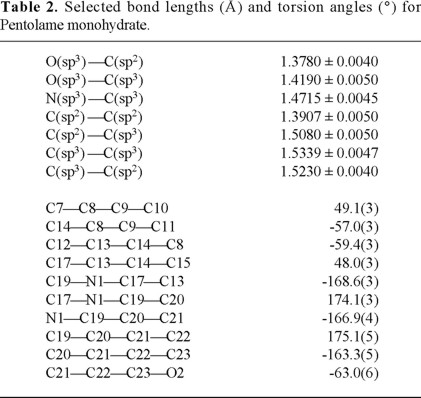
<body><![CDATA[<p align="justify"><font face="verdana" size="2"><i>Dedicado a la memoria del doctor Raymundo Cruz Almanza</i></font></p>     <p align="justify"><font face="Verdana" size="2">&nbsp;</font></p>     <p align="justify"><font face="verdana" size="2"><b>Introduction</b></font></p>     <p align="justify"><font face="verdana" size="2">As part of our studies directed towards the preparation of compounds as alternative therapeutic agents for prostatic cancer, the menopausal syndrome, and estrogenic components of oral contraceptives, we prepared the 17&#946;&#45;aminoestrogen pentolame (<b>1</b>) &#91;17&#946;&#45;(5'&#45;hydroxy&#45;1'&#45;pentylamino)&#45;1,3,5(10)&#45;estratrien&#45;3&#45;ol&#93; (<a href="/img/revistas/rsqm/v48n4/a9f1.jpg" target="_blank">Figure 1</a>). Pentolame produced sustained anticoagulant effects opposite to that showed by estradiol upon blood coagulation in rodents &#91;1&#93;. The estrogenic activity of pentolame on endometrial, pituitary and gonadotropin release &#91;2&#93; is similar to that of estradiol with lower potency. The aim of the present work was to carry out the X&#45;ray analysis of this compound in order to ascertain its molecular structure, to confirm structural assignment made mainly by NMR and to establish unambiguously stereochemical relationships. The crystal structural data presented here will be useful for the improvement of structure&#45;activity studies related to the design of new agonistic and/or antagonistic analogues of sex steroids with tissue specific actions and disease&#45;prevention benefits.</font></p>     <p align="justify"><font face="Verdana" size="2">&nbsp;</font></p>     <p align="justify"><font face="verdana" size="2"><b>Results and Discussion</b></font></p>     <p align="justify"><font face="verdana" size="2">Although the strict and demanding criteria of Flack and Bernardinelli &#91;3&#93; are not met in this study, it confirms the absolute configuration by internal reference to the starting material (estrone). The stereochemistry of the title compound was determined by as (17<i>S</i>)&#45;17&#946;&#45;(5'&#45;hydroxy&#45;1'&#45;pentylamino)&#45;1,3,5(10)&#45;estratrien&#45;3&#45;ol.</font></p>     <p align="justify"><font face="verdana" size="2">All bond lengths and bond angles of the compound correlate well with the average values observed for 1,3,5(10)&#45;estratriene steroids &#91;4&#93;.</font></p>     <p align="justify"><font face="verdana" size="2">The molecule (excluding the axial methyl group and 5'&#45;hydroxy group) may be regarded as being represented by essentially planar surface, lying almost parallel to the (001) crystal face, with the r.m.s, deviations of the atoms from the respective plane being 0.275 &Aring; (1) The molecule is slightly twisted about the long axis, as shown by the angle which has the methyl bond, C13&#151;C18, with the nuclear plane, angle observed <i>3</i>.2 &deg;. The <i>B/C</i> and <i>C/D</i> inter&#45;ring junctions have been flattened from 120&ordm; (for cyclohexane) to around 130 &deg; (<a href="#c2">Table 2</a>), thus producing an overall nuclear length, C3&#151;C16, of 8.978 &Aring; that agrees with the usual slight downward bowing found in steroids.</font></p>     <p align="justify"><font face="verdana" size="2">Nevertheless, the 5&#45;amino&#45;1&#45;pentanol side chain shows an orientational disorder involving the carbon atoms C21 and C22; the major contributor displays an extended conformation except for the hydroxyl group orientation, which is evidently influenced by the hydrogen&#45;bond interactions in the crystal (<i>vide infra</i>).</font></p>     ]]></body>
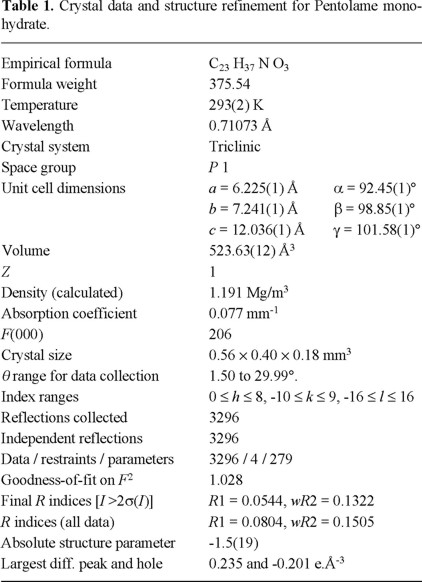
<body><![CDATA[<p align="justify"><font face="verdana" size="2">The A ring shows typical aromatic character with a &#982; electrons delocalization to produce an average bond length of 1.391 &Aring;.</font></p>     <p align="justify"><font face="verdana" size="2">The B ring has a half chair conformation, with C8 lying 0.41 &Aring; above, and C7 0.37 A below the plane of atoms C5, C6, C9 and C10 carbon atoms. The distortion in the B ring is mainly the result of a twist about the C7&#151;C8 bond to accommodate the strong interaction between the aromatic hydrogen atom H(1) and the equatorial hydrogen atom H11B of the C ring; the distance between these two hydrogen is 2.141 &Aring;.</font></p>     <p align="justify"><font face="verdana" size="2">The C ring is in an ideal chair conformation and the D ring of Pentolame has a 13&#946;&#45;envelope conformation.</font></p>     <p align="justify"><font face="verdana" size="2">The crystal packing is illustrated in <a href="/img/revistas/rsqm/v48n4/a9f2.jpg" target="_blank">Fig. 2</a>; it shows a projected view downward <i><b>b</b></i>. The steroid molecules are hydrogen bonded head to tail: O2 . . . O1 (x, y+2, z+1<i>)</i> with O . . . O = 2.790 (4) &Aring; and O&#45;H...O = 174 (5) &deg;, and form infinite chains parallel to <i><b>c</b></i>. The water molecule plays an essential role joining adjacent chains by forming hydrogen bonds with the amino group: O3 . . . N1 (x, y, z&#45;1<i>)</i> with O . . . N = 2.873 (4) &Aring; and O&#45;H...N = 177 (5) &deg;; with the hydroxyl group: O3 . . . O2) (x+2, y&#45;1, z&#45;1<i>)</i> with O . . . O = 2.827 (4) &Aring; and O&#45;H...O = 174 (6) &deg; and with the phenolic hydroxyl group: O(1) . . . O(3)(x, y&#45;1, z<i>)</i> with O . . . O = 2.642 (4) &Aring; and O&#45;H...O = 167 (6)&deg;.</font></p>     <p align="justify"><font face="Verdana" size="2">&nbsp;</font></p>     <p align="justify"><font face="verdana" size="2"><b>Experimental</b></font></p>     <p align="justify"><font face="verdana" size="2">All solvents and reagents were analytical reagent grade and were used without further purification. Estrone was obtained from Syntex, and 5&#45;amino&#45;1&#45;pentanol, and lithium borohydride from Aldrich. Proof of chemical purity was established by normal spectral (IR, NMR, MS) and analytical (TLC, and chemical analysis) techniques. Melting points were determined on an Electrothermal capillary melting point apparatus (Mod 9100), and are uncorrected.</font></p>     <p align="justify"><font face="verdana" size="2">Synthesis of 17&#946;&#45;(5'&#45;Hydroxy&#45;1'&#45;pentylamino)&#45;1,3,5(10)&#45;estratrien&#45;3&#45;ol (pentolame). A mixture of 1.5 g (5.5 mM) of estrone and 1 g (9.7 mM) of 5&#45;amino&#45;1&#45;pentanol and 10 mL of isopropyl ether were heated until dissolution. The solvent was evaporated and the reaction mixture was kept at 80&#45;85 &deg;C for 4 h. It was cooled to room temperature and the solid formed, triturated with acetone (30 mL). The resulting white solid obtained was filtered and dried in vacuum to give 1.87 g (98 % yield) of product, mp 178&#45;180&deg;C. This product (4.5 mM) was dissolved in ethanol (20 mL), and lithium borohydride (1.0 g) was added portion wise over 30 min. The reaction mixture was heated at reflux for 30 min. After cooling the solution with an ice bath, water was added (100 mL); the formed precipitate was filtered, washed thoroughly with water, and dried. Pentolame was crystallized several times from methanol&#45;water by an evaporation method. Its spectroscopic properties were similar to those reported previously &#91;5&#93;. This material was used both, in biological assays &#91;1&#93; and for the crystallographic study.</font></p>     <p align="justify"><font face="verdana" size="2">Crystals suitable for X&#45;ray analysis were grown from methanol&#45;water solution by slow evaporation. The data were collected on a Siemens P4/PC diffractometer &#91;6&#93;, with graphite monochromated Mo&#45;K<i>&aacute;</i>. The accurate unit cell dimensions were obtained by the least&#45;squares method by setting angles of 35 reflections (5&ordm; &lt; &#952; &lt; 12.5&ordm;). The &#952;/2&#952; scan method and a variable scan speed, depending on reflection intensity, were used. Three control reflections were measured after every 97 reflections and showed no systematic changes during data collection. Intensity data were corrected for the Lorentz and polarization effects &#91;6&#93;. The structure was determined by direct methods and refined by the full matrix least&#45;squares method with the SHELXTL program &#91;7&#93;. Refinement was carried on <i>F</i><sup>2</sup> with scattering factors incorporated in SHELXL97. The function &#931;<i>w</i>( |<i>F</i>o |<sup>2</sup> &#45; |<i>F</i>c |<sup>2</sup>)<sup>2</sup> was minimized with w<sup>&#45;1</sup> = &#91;&#963;<sup>2</sup>(F<sub>o</sub>)<sup>2</sup> + (0.0745 P)<sup>2</sup> + 0.80 P&#93;. All non&#45;hydrogen atoms were refined with anisotropic thermal parameters. The coordinates of the hydrogen atoms involved in hydrogen bonds OH&middot; &middot; &middot;O, were found in difference Fourier syntheses and their positional parameters were refined. The coordinates of the other hydrogen atoms were calculated from the geometry and refined as a riding model with their displacement parameters calculated as 1.2 times Ueq that of the carrier carbon atom. The crystallographic data, together with data collection and structure refinement details are listed in <a href="#c1">Table 1</a>. Selected bond lengths and torsion angles for the compound are listed in <a href="#c2">Table 2</a>.</font></p>     <p align="center"><font face="verdana" size="2"><img src="/img/revistas/rsqm/v48n4/a9f3.jpg"></font></p>     ]]></body>
<body><![CDATA[<p align="center"><font face="verdana" size="2"><a name="c1"></a></font></p>     <p align="center"><font face="verdana" size="2"><img src="/img/revistas/rsqm/v48n4/a9c1.jpg"></font></p>     <p align="center"><font face="verdana" size="2"><a name="c2"></a></font></p>     <p align="center"><font face="verdana" size="2"><img src="/img/revistas/rsqm/v48n4/a9c2.jpg"></font></p>     <p align="justify"><font face="verdana" size="2">The displacement ellipsoid representation of the molecule, together with the atomic numbering scheme and the crystal packing, are shown in <a href="/img/revistas/rsqm/v48n4/a9f1.jpg" target="_blank">Figure 1</a>. Additional crystallographic data have been deposited with the Cambridge Crystallographic Data Centre as supplementary publications No CCDC&#45; 252511.</font></p>     <p align="justify"><font face="Verdana" size="2">&nbsp;</font></p>     <p align="justify"><font face="verdana" size="2"><b>Acknowledgement</b></font></p>     <p align="justify"><font face="verdana" size="2">In Memoriam. Raymundo Cruz Almanza will be sorely missed as supervisor, friend, and collaborator. A generation of students and colleagues at all levels benefited from his insightful, thoughtful, and caring interactions.</font></p>     <p align="justify"><font face="Verdana" size="2">&nbsp;</font></p>     <p align="justify"><font face="verdana" size="2"><b>References</b></font></p>     ]]></body>
<body><![CDATA[<!-- ref --><p align="justify"><font face="verdana" size="2">1. Lemus, A. E.; Jaimez, R.; Lemini, C.; Menjivar, M.; Silva, G.; Rubio&#45;P&oacute;o, C.; Valenzuela, F.; Larrea, F. <i>Steroids</i> <b>1998</b>, <i>63</i>, 433&#45;438.    &nbsp;&nbsp;&nbsp;&nbsp;&nbsp;&nbsp;&nbsp;&nbsp;[&#160;<a href="javascript:void(0);" onclick="javascript: window.open('/scielo.php?script=sci_nlinks&ref=6950799&pid=S0583-7693200400040000900001&lng=','','width=640,height=500,resizable=yes,scrollbars=1,menubar=yes,');">Links</a>&#160;]<!-- end-ref --></font></p>     <!-- ref --><p align="justify"><font face="verdana" size="2">2. Jaimez, R.; Cooney, A.; Jackson, K.; Lemus, A. E.; Lemini, C.; Larrea, F. <i>J. Steroid Biochem. Mol. Biol</i>. <b>2001</b>, <i>73</i>, 59&#45;66.    &nbsp;&nbsp;&nbsp;&nbsp;&nbsp;&nbsp;&nbsp;&nbsp;[&#160;<a href="javascript:void(0);" onclick="javascript: window.open('/scielo.php?script=sci_nlinks&ref=6950801&pid=S0583-7693200400040000900002&lng=','','width=640,height=500,resizable=yes,scrollbars=1,menubar=yes,');">Links</a>&#160;]<!-- end-ref --></font></p>     <!-- ref --><p align="justify"><font face="verdana" size="2">3. Flack, H. D.; Bernardinelli, G. <i>J. Appl. Cryst.</i> <b>2000</b>, <i>33</i>, 1143&#45;1148.    &nbsp;&nbsp;&nbsp;&nbsp;&nbsp;&nbsp;&nbsp;&nbsp;[&#160;<a href="javascript:void(0);" onclick="javascript: window.open('/scielo.php?script=sci_nlinks&ref=6950803&pid=S0583-7693200400040000900003&lng=','','width=640,height=500,resizable=yes,scrollbars=1,menubar=yes,');">Links</a>&#160;]<!-- end-ref --></font></p>     <!-- ref --><p align="justify"><font face="verdana" size="2">4. Duax, W. L.; Weeks, C. M.; Rohrer, D. C. <i>Top. Stereochem</i> <b>1976,</b> <i>9</i>, 271&#45;383.    &nbsp;&nbsp;&nbsp;&nbsp;&nbsp;&nbsp;&nbsp;&nbsp;[&#160;<a href="javascript:void(0);" onclick="javascript: window.open('/scielo.php?script=sci_nlinks&ref=6950805&pid=S0583-7693200400040000900004&lng=','','width=640,height=500,resizable=yes,scrollbars=1,menubar=yes,');">Links</a>&#160;]<!-- end-ref --></font></p>     <!-- ref --><p align="justify"><font face="verdana" size="2">5. Lemini, C.; Rubio&#45;Po&oacute;, C.; Silva, G.; Garc&iacute;a&#45;Mondrag&oacute;n, J.; Zavala, E.; Mendoza&#45;Pati&ntilde;o, N.; Castro, D.; Cruz&#45;Almanza, R.; Mandoki, J. J. <i>Steroids</i> <b>1993</b>, <i>58</i>, 457&#45;461.    &nbsp;&nbsp;&nbsp;&nbsp;&nbsp;&nbsp;&nbsp;&nbsp;[&#160;<a href="javascript:void(0);" onclick="javascript: window.open('/scielo.php?script=sci_nlinks&ref=6950807&pid=S0583-7693200400040000900005&lng=','','width=640,height=500,resizable=yes,scrollbars=1,menubar=yes,');">Links</a>&#160;]<!-- end-ref --></font></p>     ]]></body>
<body><![CDATA[<!-- ref --><p align="justify"><font face="verdana" size="2">6. Siemens. <i>XSCANS User's Manual. Version 2.1. Siemens Analytical X&#45;ray Instruments Inc. Madison, Wisconsin, USA</i> <b>1993</b>.    &nbsp;&nbsp;&nbsp;&nbsp;&nbsp;&nbsp;&nbsp;&nbsp;[&#160;<a href="javascript:void(0);" onclick="javascript: window.open('/scielo.php?script=sci_nlinks&ref=6950809&pid=S0583-7693200400040000900006&lng=','','width=640,height=500,resizable=yes,scrollbars=1,menubar=yes,');">Links</a>&#160;]<!-- end-ref --></font></p>     <!-- ref --><p align="justify"><font face="verdana" size="2">7. Sheldrick, G. M. <i>SHELXTL (Version 6.10).</i> Bruker AXS Inc., Madison, Wisconsin, USA <b>2000</b>.    &nbsp;&nbsp;&nbsp;&nbsp;&nbsp;&nbsp;&nbsp;&nbsp;[&#160;<a href="javascript:void(0);" onclick="javascript: window.open('/scielo.php?script=sci_nlinks&ref=6950811&pid=S0583-7693200400040000900007&lng=','','width=640,height=500,resizable=yes,scrollbars=1,menubar=yes,');">Links</a>&#160;]<!-- end-ref --></font></p>      ]]></body><back>
<ref-list>
<ref id="B1">
<label>1</label><nlm-citation citation-type="journal">
<person-group person-group-type="author">
<name>
<surname><![CDATA[Lemus]]></surname>
<given-names><![CDATA[A. E.]]></given-names>
</name>
<name>
<surname><![CDATA[Jaimez]]></surname>
<given-names><![CDATA[R.]]></given-names>
</name>
<name>
<surname><![CDATA[Lemini]]></surname>
<given-names><![CDATA[C.]]></given-names>
</name>
<name>
<surname><![CDATA[Menjivar]]></surname>
<given-names><![CDATA[M.]]></given-names>
</name>
<name>
<surname><![CDATA[Silva]]></surname>
<given-names><![CDATA[G.]]></given-names>
</name>
<name>
<surname><![CDATA[Rubio-Póo]]></surname>
<given-names><![CDATA[C.]]></given-names>
</name>
<name>
<surname><![CDATA[Valenzuela]]></surname>
<given-names><![CDATA[F.]]></given-names>
</name>
<name>
<surname><![CDATA[Larrea]]></surname>
<given-names><![CDATA[F.]]></given-names>
</name>
</person-group>
<source><![CDATA[Steroids]]></source>
<year>1998</year>
<volume>63</volume>
<page-range>433-438</page-range></nlm-citation>
</ref>
<ref id="B2">
<label>2</label><nlm-citation citation-type="journal">
<person-group person-group-type="author">
<name>
<surname><![CDATA[Jaimez]]></surname>
<given-names><![CDATA[R.]]></given-names>
</name>
<name>
<surname><![CDATA[Cooney]]></surname>
<given-names><![CDATA[A]]></given-names>
</name>
<name>
<surname><![CDATA[Jackson]]></surname>
<given-names><![CDATA[K.]]></given-names>
</name>
<name>
<surname><![CDATA[Lemus]]></surname>
<given-names><![CDATA[A. E.]]></given-names>
</name>
<name>
<surname><![CDATA[Lemini]]></surname>
<given-names><![CDATA[C.]]></given-names>
</name>
<name>
<surname><![CDATA[Larrea]]></surname>
<given-names><![CDATA[F.]]></given-names>
</name>
</person-group>
<source><![CDATA[J. Steroid Biochem. Mol. Biol.]]></source>
<year>2001</year>
<volume>73</volume>
<page-range>59-66</page-range></nlm-citation>
</ref>
<ref id="B3">
<label>3</label><nlm-citation citation-type="journal">
<person-group person-group-type="author">
<name>
<surname><![CDATA[Flack]]></surname>
<given-names><![CDATA[H. D.]]></given-names>
</name>
<name>
<surname><![CDATA[Bernardinelli]]></surname>
<given-names><![CDATA[G.]]></given-names>
</name>
</person-group>
<source><![CDATA[J. Appl. Cryst.]]></source>
<year>2000</year>
<volume>33</volume>
<page-range>1143-1148</page-range></nlm-citation>
</ref>
<ref id="B4">
<label>4</label><nlm-citation citation-type="journal">
<person-group person-group-type="author">
<name>
<surname><![CDATA[Duax]]></surname>
<given-names><![CDATA[W. L.]]></given-names>
</name>
<name>
<surname><![CDATA[Weeks]]></surname>
<given-names><![CDATA[C. M.]]></given-names>
</name>
<name>
<surname><![CDATA[Rohrer]]></surname>
<given-names><![CDATA[D. C.]]></given-names>
</name>
</person-group>
<source><![CDATA[Top. Stereochem]]></source>
<year>1976</year>
<volume>9</volume>
<page-range>271-383</page-range></nlm-citation>
</ref>
<ref id="B5">
<label>5</label><nlm-citation citation-type="journal">
<person-group person-group-type="author">
<name>
<surname><![CDATA[Lemini]]></surname>
<given-names><![CDATA[C.]]></given-names>
</name>
<name>
<surname><![CDATA[Rubio-Poó]]></surname>
<given-names><![CDATA[C.]]></given-names>
</name>
<name>
<surname><![CDATA[Silva]]></surname>
<given-names><![CDATA[G.]]></given-names>
</name>
<name>
<surname><![CDATA[García-Mondragón]]></surname>
<given-names><![CDATA[J.]]></given-names>
</name>
<name>
<surname><![CDATA[Zavala]]></surname>
<given-names><![CDATA[E.]]></given-names>
</name>
<name>
<surname><![CDATA[Mendoza-Patiño]]></surname>
<given-names><![CDATA[N.]]></given-names>
</name>
<name>
<surname><![CDATA[Castro]]></surname>
<given-names><![CDATA[D.]]></given-names>
</name>
<name>
<surname><![CDATA[Cruz-Almanza]]></surname>
<given-names><![CDATA[R.]]></given-names>
</name>
<name>
<surname><![CDATA[Mandoki]]></surname>
<given-names><![CDATA[J. J.]]></given-names>
</name>
</person-group>
<source><![CDATA[Steroids]]></source>
<year>1993</year>
<volume>58</volume>
<page-range>457-461</page-range></nlm-citation>
</ref>
<ref id="B6">
<label>6</label><nlm-citation citation-type="book">
<collab>Siemens</collab>
<source><![CDATA[XSCANS User's Manual. Version 2.1]]></source>
<year>1993</year>
<publisher-loc><![CDATA[Madison^eWisconsin Wisconsin]]></publisher-loc>
<publisher-name><![CDATA[Siemens Analytical X-ray Instruments Inc.]]></publisher-name>
</nlm-citation>
</ref>
<ref id="B7">
<label>7</label><nlm-citation citation-type="book">
<person-group person-group-type="author">
<name>
<surname><![CDATA[Sheldrick]]></surname>
<given-names><![CDATA[G. M.]]></given-names>
</name>
</person-group>
<source><![CDATA[SHELXTL (Version 6.10)]]></source>
<year>2000</year>
<publisher-loc><![CDATA[Madison^eWisconsin Wisconsin]]></publisher-loc>
<publisher-name><![CDATA[Bruker AXS Inc.]]></publisher-name>
</nlm-citation>
</ref>
</ref-list>
</back>
</article>