<?xml version="1.0" encoding="ISO-8859-1"?><article xmlns:mml="http://www.w3.org/1998/Math/MathML" xmlns:xlink="http://www.w3.org/1999/xlink" xmlns:xsi="http://www.w3.org/2001/XMLSchema-instance">
<front>
<journal-meta>
<journal-id>0370-5943</journal-id>
<journal-title><![CDATA[Revista latinoamericana de química]]></journal-title>
<abbrev-journal-title><![CDATA[Rev. latinoam. quím]]></abbrev-journal-title>
<issn>0370-5943</issn>
<publisher>
<publisher-name><![CDATA[Laboratorios Mixim S.A.]]></publisher-name>
</publisher>
</journal-meta>
<article-meta>
<article-id>S0370-59432012000200006</article-id>
<title-group>
<article-title xml:lang="en"><![CDATA[Synthesis and preliminary biological evaluation of two new cacalol esters of Naproxen and Ibuprofen]]></article-title>
</title-group>
<contrib-group>
<contrib contrib-type="author">
<name>
<surname><![CDATA[Jiménez-Estrada]]></surname>
<given-names><![CDATA[Manuel]]></given-names>
</name>
<xref ref-type="aff" rid="A01"/>
</contrib>
<contrib contrib-type="author">
<name>
<surname><![CDATA[Reyes]]></surname>
<given-names><![CDATA[Ricardo]]></given-names>
</name>
<xref ref-type="aff" rid="A01"/>
</contrib>
<contrib contrib-type="author">
<name>
<surname><![CDATA[Morales]]></surname>
<given-names><![CDATA[Brenda A.]]></given-names>
</name>
<xref ref-type="aff" rid="A01"/>
</contrib>
<contrib contrib-type="author">
<name>
<surname><![CDATA[Reyes S.]]></surname>
<given-names><![CDATA[Mirna A.]]></given-names>
</name>
<xref ref-type="aff" rid="A01"/>
</contrib>
<contrib contrib-type="author">
<name>
<surname><![CDATA[González de la Parra]]></surname>
<given-names><![CDATA[Mario]]></given-names>
</name>
<xref ref-type="aff" rid="A01"/>
</contrib>
<contrib contrib-type="author">
<name>
<surname><![CDATA[Aumelas]]></surname>
<given-names><![CDATA[André]]></given-names>
</name>
<xref ref-type="aff" rid="A02"/>
</contrib>
<contrib contrib-type="author">
<name>
<surname><![CDATA[Jankowski]]></surname>
<given-names><![CDATA[Christopher K.]]></given-names>
</name>
<xref ref-type="aff" rid="A02"/>
</contrib>
</contrib-group>
<aff id="A01">
<institution><![CDATA[,Universidad Nacional Autónoma de México Instituto de Química ]]></institution>
<addr-line><![CDATA[México D. F.]]></addr-line>
<country>México</country>
</aff>
<aff id="A02">
<institution><![CDATA[,Université de Moncton Departement de Chimie et Biochimie ]]></institution>
<addr-line><![CDATA[Moncton ]]></addr-line>
<country>Canada</country>
</aff>
<pub-date pub-type="pub">
<day>00</day>
<month>00</month>
<year>2012</year>
</pub-date>
<pub-date pub-type="epub">
<day>00</day>
<month>00</month>
<year>2012</year>
</pub-date>
<volume>40</volume>
<numero>2</numero>
<fpage>106</fpage>
<lpage>111</lpage>
<copyright-statement/>
<copyright-year/>
<self-uri xlink:href="http://www.scielo.org.mx/scielo.php?script=sci_arttext&amp;pid=S0370-59432012000200006&amp;lng=en&amp;nrm=iso"></self-uri><self-uri xlink:href="http://www.scielo.org.mx/scielo.php?script=sci_abstract&amp;pid=S0370-59432012000200006&amp;lng=en&amp;nrm=iso"></self-uri><self-uri xlink:href="http://www.scielo.org.mx/scielo.php?script=sci_pdf&amp;pid=S0370-59432012000200006&amp;lng=en&amp;nrm=iso"></self-uri><abstract abstract-type="short" xml:lang="en"><p><![CDATA[The successful synthesis of two propionates Naproxen and Ibuprofen of the tricyclic terpenic phenol cacalol (Naproxen-cacalol and Ibuprofen-cacalol) is reported. Their NMR data, preliminary anti-inflammatory and analgesic evaluations, and molecular modelling are described.]]></p></abstract>
<abstract abstract-type="short" xml:lang="es"><p><![CDATA[Se realizó la síntesis de dos propionatos del fenol triciclico terpenico (Naproxen-cacalol and Ibuprofen-cacalol). Se reportan sus datos de RMN, modelaje molecular y evaluación preliminar de sus propiedades antiinflamatorias y analgésicas.]]></p></abstract>
<kwd-group>
<kwd lng="en"><![CDATA[Anti-inflammatory propionates]]></kwd>
<kwd lng="en"><![CDATA[Cacalol Esters]]></kwd>
<kwd lng="en"><![CDATA[Naproxen and Ibuprofen derivatives]]></kwd>
</kwd-group>
</article-meta>
</front><body><![CDATA[ <p align="center"><font face="verdana" size="4"><b>Synthesis and preliminary biological evaluation of two new cacalol esters of Naproxen and Ibuprofen</b></font></p>              <p align="justify"><font face="verdana" size="2">&nbsp;</font></p>              <p align="center"><font face="verdana" size="2"><b>Manuel Jim&eacute;nez&#45;Estrada*<sup>a</sup>, Ricardo Reyes<sup>a</sup>, Brenda A. Morales<sup>a</sup>, Mirna A. Reyes S.<sup>a</sup>, Mario Gonz&aacute;lez de la Parra<sup>a</sup>, Andr&eacute; Aumelas<sup>b</sup>, and Christopher K. Jankowski<sup>b</sup></b></font></p>              <p align="justify"><font face="verdana" size="2">&nbsp;</font></p>              <p align="justify"><font face="verdana" size="2"><i><sup>a</sup> Instituto de Qu&iacute;mica, Universidad Nacional Aut&oacute;noma de M&eacute;xico, Ciudad Universitaria. Circuito Exterior, 04510, Coyoac&aacute;n, M&eacute;xico D. F., M&eacute;xico.</i></font></p>              <p align="justify"><font face="verdana" size="2"><i><sup>b</sup> Departement de Chimie et Biochimie, Universit&eacute; de Moncton, Moncton, NB, E1A 3E9, Canada.</i> *Corresponding author: <a href="mailto:manueljemex@gmail.com">manueljemex@gmail.com</a>.</font></p>              <p align="justify"><font face="verdana" size="2">&nbsp;</font></p>              <p align="justify"><font face="verdana" size="2">Received June 2012    <br>Accepted October 2012</font></p>              <p align="justify"><font face="verdana" size="2">&nbsp;</font></p>              ]]></body>
<body><![CDATA[<p align="justify"><font face="verdana" size="2"><b>Abstract</b></font></p>              <p align="justify"><font face="verdana" size="2">The successful synthesis of two propionates Naproxen and Ibuprofen of the tricyclic terpenic phenol cacalol (Naproxen&#45;cacalol and Ibuprofen&#45;cacalol) is reported. Their NMR data, preliminary anti&#45;inflammatory and analgesic evaluations, and molecular modelling are described.</font></p>              <p align="justify"><font face="verdana" size="2"><b>Keywords:</b> Anti&#45;inflammatory propionates, Cacalol Esters, Naproxen and Ibuprofen derivatives.</font></p>              <p align="justify"><font face="verdana" size="2">&nbsp;</font></p>              <p align="justify"><font face="verdana" size="2"><b>Resumen</b></font></p>              <p align="justify"><font face="verdana" size="2">Se realiz&oacute; la s&iacute;ntesis de dos propionatos del fenol triciclico terpenico (Naproxen&#45;cacalol and Ibuprofen&#45;cacalol). Se reportan sus datos de RMN, modelaje molecular y evaluaci&oacute;n preliminar de sus propiedades antiinflamatorias y analg&eacute;sicas.</font></p>              <p align="justify"><font face="verdana" size="2">&nbsp;</font></p>              <p align="justify"><font face="verdana" size="2"><b>Introduction</b></font></p>              <p align="justify"><font face="verdana" size="2">The pharmacological treatment of inflammatory process was greatly developed in the last two decades. Most of compounds bearing anti&#45;inflammatory properties with quite different structures were synthesized during this period, and several of their mechanisms of action were elucidated but not without controversies, which however lead to better understanding of their activity. Probably, since the first anti&#45;inflammatory agents (AIA), the salicilates, the linkage between analgesic, anti&#45;inflammatory, and antipyretic properties was studied. The arrival of nonsteroidal anti&#45;inflammatory drugs (NSAID), and progressive abandon of salicilates, and antiinflammatory steroidal (SAID) agents, the retreat of VIO&#45;XX from the market, enabled to advance studies in order to achieve a better use, preparation and application of this class of drugs (Jankowski <i>et al.</i>, 2004). Two generally used NSAlD are: Naproxen (Nap, 2&#45;(6&#45;methoxy&#45;2&#45;naphtyl) propionic acid), and Ibuprofen (lbu, 2&#45;(4&#45;Isobutylphenyl) propionic acid), commonly prescribed for their anti&#45;inflammatory, or analgesic properties. The presence of carboxylic group of propionic acid in both of them is however responsible for their gastrointestinal side effects, which is the most common problem for the acidic drugs of this group, which however could be avoided by esterification. The choice of ester is dependent on the use, and solubility; it could also lead to the substitution by the alcohol residue bearing some physiological properties by itself.</font></p>              <p align="justify"><font face="verdana" size="2">For example, in our previous works, we prepared a series of diastereomeric esters of <b>Naproxen</b> and <b>Ibuprofen</b> after reduction to their corresponding alcohols (Jankowski <i>et al.</i>, 2004). Under hydrolytic conditions, the esters will release the propionic acid during passage through the gastric tract. The corresponding alcohol should produce additional quantities of active acid after the oxidation within the system. In the present paper we synthesized two new esters of Naproxen and Ibuprofen with Cacalol a natural product isolated from <i>Psacalium decompositum</i> A. Gray, a popular plant in Mexican traditional medicine and known as "matarique" (Mart&iacute;nez, 1959).</font></p>              ]]></body>
<body><![CDATA[<p align="justify"><font face="verdana" size="2">This species, also known as <i>Senecio grayanus</i>, Hemsley<i>. Cacalia decompositae</i> A. Gray, and <i>Mesedenia decomposita</i>, belongs to the Asteraceae, and is widely distributed in the States of Sonora, and Chihuahua, Mexico. It is recognized for various medicinal applications, for instance, the roots tincture is used to calm rheumatic pains, neuralgia, and to improve healing of wounds and ulcers; the root decoction is used for the treatment of diabetes, diarrhea, liver congestion, also used as antiseptic, astringent and cathartic (D&iacute;az, 1976). Romo <i>et al</i> (1964) first isolated cacalol, a phenolic compound, as a major constituent from the hexane extract of the roots, and partially characterized it. The structure of compound as a methylated tricyclic cyclohexene furanophenol derivative was finally established by Yuste &amp; Walls (1976) and Soriano <i>et al</i> (1987). More recently, pharmacological studies revealed the antibacterial (Jim&eacute;nez&#45;Estrada <i>et al.</i>, 1992) and anti&#45;inflammatory (Jim&eacute;nez&#45;Estrada <i>et al.</i>, 2006) properties of this compound. Pursuing the studies on the anti&#45;inflammatory and anesthetic propionic acid derivatives in <b>Naproxen</b> and <b>Ibuprofen</b> series, the synthesis of both propionates of cacalol was completed (<b>1a</b> and <b>1b</b>) (<a href="#f1">Fig. 1</a>).</font></p>              <p align="center"><font face="verdana" size="2"><a name="f1"></a></font></p>              <p align="center"><font face="verdana" size="2"><img src="/img/revistas/rlq/v40n2/a6f1.jpg"></font></p>              <p align="justify"><font face="verdana" size="2">It is expected that such phenolic esters will maintain the physiological properties of both constituents, and reduce the gastrointestinal effects. The optimization of esterification conditions is also of some practical interest. The blocking of the carboxylic group with easily removable and quite bulky phenol moiety should prevent both the gastrointestinal irritation, and assure easy release of the anti&#45;inflammatory or analgesic agent into the system.</font></p>              <p align="justify"><font face="verdana" size="2">&nbsp;</font></p>              <p align="justify"><font face="verdana" size="2"><b>Material and methods</b></font></p>              <p align="justify"><font face="verdana" size="2">Reactions and chromatographic fractionation of plant extract were monitored by TLC (Silica Gel, ALUGRAM/SIL G/UV 254), observed under UV light 254, and 365 nm and after spraying the plates with 1.0 % Ce(S0<sub>4</sub>)<sub>2</sub> solution in H<sub>2</sub>S0<sub>4</sub> 2N. Prep. TLC was carried out on chromathoplates (ALUMGRAM SIL 100 G/ uv 254). <sup>1</sup>H and <sup>13</sup>CNMR routine spectra were recorded on a 200, and 300 MHz Varian&#45;Gemini, and a 300 MHz JEOL spectrometer with deuterated solvents, and TMS &#948;=0.0 as internal reference. IR spectra were recorded in a Perkin&#45;Elmer 283B and Nicolet Magna IR TM 750. EI and CI&#45;MS was carried out on a JEOL JMS&#45;AX 5505 HA spectrometer.</font></p>              <p align="justify"><font face="verdana" size="2">Roots and rhizomes of <i>P. decompositum</i> were acquired at the Sonora Herbal Market at Mexico City. A specimen is deposited at IMSSM Herbarium (voucher 11489). (S)&#45;Naproxen and (S)&#45;Ibuprofen were bought from Aldrich Chemicals. Their purity was checked by NMR, and their spectroscopic data were in agreement with data previously reported.</font></p>              <p align="justify"><font face="verdana" size="2"><i>High resolution NMR Spectroscopy</i></font></p>              <p align="justify"><font face="verdana" size="2">NMR 1D experiments were performed using Varian INOVA spectrometer, 300 MHz for proton and 75 MHz for carbon&#45;13, and for 2D experiments Bruker AMX, 600 MHz for proton and 150 MHz for carbon&#45;13 respectively. In all cases the samples recorded at 295 K were prepared in CDCl<sub>3</sub> or in dimethylsulfoxide&#45;d6 ca. 10 % solution at 25 &deg;C. Chemical shifts were refereed to the TMS &#948;= 0.0 ppm and referenced to a residual signal of chloroform at 7.24 ppm.</font></p>              ]]></body>
<body><![CDATA[<p align="justify"><font face="verdana" size="2">Selected 2D experiments were run using standard Varian package of INOVA programs for COSY and NOESY. For HSQC experiments the INOVA program for short range coupling (less than 140 Hz for <sup>1</sup>JCH) was used. The long range proton&#45;carbon experiments (HMBC) were recorded with Varian INOVA pulse program, optimized for long range couplings (<sup>3</sup>JCH=9.0 Hz). DQF&#45;COSY spectrum (Rance <i>et al.</i>, 1983) was collected into 800x1024 data matrix and the TOCSY spectrum was collected with a mixing time of 80 ms (Rance, 1987).</font></p>              <p align="justify"><font face="verdana" size="2">In all experiments, the carrier frequency was set at the centre of the spectrum.</font></p>              <p align="justify"><font face="verdana" size="2">The (1H, 13C)&#45;HSQC experiments (Bodenhausen G, Ruben D. 1980) were recorded with a delay of 3.5 ms (<sub>1</sub>J<sub>CH</sub> =143 Hz) and the (1H, 13C)&#45;HSQC&#45;TOCSY experiment with a mixing time for proton&#45;proton transfer of 80 ms in order to identify the network of one bond and several proton&#45;carbon connectivity, respectively. All data was processed with the XWINNMR software and one zero filling and &#960;/3 phase&#45;shifted sine bell window function were applied in both dimensions before Fourier transform.</font></p>              <p align="justify"><font face="verdana" size="2"><i>General Procedure:</i> Esterification of Naproxen and Ibuprofen by cacalol. Naproxen (115.6 mg: 0.502 mmol) or Ibuprofen (208.2 mg: 1.05 mmol) were placed in a 50 mL round flask (1) and dissolved with thionyl chloride (1.0 mL) and kept under reflux (1.5 h, 50 &deg;C) under anhydrous conditions (CaCl<sub>2</sub> trap), agitation provided by magnetic stirrer. Reaction mixture was allowed to cool to room temperature, and solvent was reduced to minimum by distillation under reduced pressure.</font></p>              <p align="justify"><font face="verdana" size="2"><i>Cacalol</i> (115.8 mg: 0.503 mmol) was placed in other 50 mL round flask (2) with pyridine (6.0 mL). After this period, this solution (round flask, 2) was added to round flask (1), and maintained at reflux during one hour under magnetic stirring. After this time, water was added to the reaction mixture, and which was subsequently extracted with EtOAc. The organic fraction was washed with water until achieving neutral pH, and furtherly dried over Na<sub>2</sub>S0<sub>4</sub>. The solvent was distilled under reduced pressure leading a brown solid. The products mixture was purified by preparative TLC (Silica Gel; Hex&#45;AcOEt 8:2 v/v), obtaining 95.1 mg (42.83 %) of compound <b>1a</b>, or 198.7 mg (50.76 %) of compound <b>1b</b>. Compound <b>1a</b>, brown solid, Rf= 0.63  (Hexane&#45;EtOAc 8:2, v/v). 1a IR (CHCl<sub>3</sub>, cm<sup>&minus;1</sup>): 3008 (C&#45;H aromatic), 2935, 2871, 1454, 1393 (C&#45;H aliphatic), 1753 (C=O), 1606 (C=C aromatic), 1237, 1173 (C&#45;O&#45;C). EI&#45;MS (CH<sub>4</sub>) (70 eV) m/z: 442 &#91;M&#93;<sup>+</sup> (11), 230 &#91;MC<sub>14</sub>H<sub>12</sub>O<sub>2</sub>&#93;<sup>+</sup> (38), 215 &#91;M&#45;C<sub>15</sub>H<sub>15</sub>O<sub>2</sub>&#93;<sup>+</sup> (24), 212 &#91;M&#45;C<sub>15</sub>H<sub>18</sub>O<sub>2</sub>&#93;<sup>+</sup> (100), 185 &#91;M&#45;C<sub>16</sub>H<sub>17</sub>O<sub>3</sub>&#93;<sup>+</sup> (100). <sup>1</sup>HNMR (CDCl<sub>3</sub>, 400 MHz), &#948; (ppm): 7.77 (s, 1H, H&#45;C12&acute;), 7.65&#45;7.69 (m, 2H, HC5&acute; and H&#45;C10&acute;), 7.49 (dd, J=8.5, 1.8 Hz, 1H, H&#45;C4&acute;), 7.18 (s, 1H, H&#45;C12), 7.097.12 (m, 1H, H&#45;C9&acute;), 7.07 (s, 1H, H&#45;C7&acute;), 4.15 (q, J=7.1 Hz, 1H, H&#45;C2&acute;), 3.86 (s, 3H, H&#45;C14&acute;), 3.09&#45;3.13 (m, 1H, H&#45;C4), 2.46 (s, 3H, H&#45;C14), 2.28 (d, J=1.3 Hz, 3H, H&#45;C13), 2.13&#45;2.17 (m, 1H, H&#45;C1), 1.68 (d, J=7.2 Hz, 3H, H&#45;C13&acute;), 1.04 (d, J=7.0 Hz, 3H, H&#45;C15). <sup>13</sup>CNMR (CDCl<sub>3</sub>, 100 MHz), &#948; (ppm): 172.13 (C=O), 157.68 (C8&acute;), 145.21 (C8), 141.40 (C12), 135.38 (C10), 135.32 (C3&acute;), 131.40 (C9), 129.33 (C10&acute;), 129.01 (C11&acute;), 127.03 (C5), 126.66 (C7), 126.52 (C5&acute;), 126.38 (C4&acute;, C12&acute;), 125.06 (C6), 118.94 (C9&acute;), 116.59 (C11), 105.67 (C7&acute;), 55.31 (C14&acute;), 45.44 (C2&acute;), 29.86 (C3), 28.85 (C4), 23.19 (C1), 21.35 (C15), 18.79 (C13&acute;), 16.46 (C2), 14.22 (C14), 11.27 (C13).</font></p>              <p align="justify"><font face="verdana" size="2"><i>Compound</i> <b>1b</b>, beige solid amorphous, 1b Rf= 0.55 (Hexane&#45;EtOAc 8:2, v/v). IR (CHCl<sub>3</sub> cm<sup>&minus;1</sup>): 2953, 2929, 2868, 1454 (C&#45;H aliphatic), 1760 (C&#45;O&#45;ester), 1575 (C=C aromatic). EI&#45;MS (70 ev) m/z: 418 M<sup>+</sup>, 230 (100), 215 (40). <sup>1</sup>HNMR (CDCI<sub>3</sub>, 300 MHz), &#948; (ppm): 7.66 and 7.36 (2bs, 2H, 2CH, C&#45;4&acute;and C&#45;8&acute;), 7.19 (bs, 1H, CH, C&#45;11), 7.14 and 7.17 (2s, 2H, 2CH, C&#45;5&acute;and C&#45;7&acute;), 4.06 (q, J= 7.6 Hz, 1H, CH, C&#45;2&acute;), 3.19 (m, 1H, CH, C&#45;4), 2.52 (s, 3H, CH<sub>3</sub>, C&#45;14), 2.48 (d, J=7.2 Hz, 2H, CH<sub>2</sub>, C&#45;10'), 2.35 (d, J=1.0 Hz, 3H, CH<sub>3</sub>, C&#45;13), 2.21 and 2.44 (m, 2H, CH<sub>2</sub>, C&#45;1), 1.86 (m, 1H, CH, C&#45;11&acute;), 1.69 and 1.67 (2m, 2H, CH<sub>2</sub>, C&#45;3), 1.69 and 1.52 (m, 2H, CH<sub>2</sub>, C&#45;2), 1.67 (d, J= 6.9 Hz, 3H, CH<sub>3</sub>, C&#45;9'), 1.12 (d, J=7.3 Hz, 3H, CH<sub>3</sub>, C&#45;15), 0.91 (d, J=6.45 Hz, 6H, 2CH<sub>3</sub>, C&#45;12' and C&#45;13'); <sup>13</sup>CNMR (CDCl<sub>3</sub>, 75 MHz) &#948; (ppm): 171.90 (C&#45;1&acute;), 146.03 (C&#45;8), 141.38 (C&#45;11), 139.6 (C&#45;6&acute;), 137.04 (C&#45;9), 135.03 (C&#45;5), 131.05 (C&#45;3&acute;), 129.34 (C&#45;5&acute;), 129.30 (C&#45;7&acute;), 127.40 (C&#45; 4&acute; and C&#45;8&acute;), 126.5 (C&#45;7), 125.08 (C&#45;6),122.01 (C&#45;12), 116.08 (C&#45;10), 44.8 (C&#45;10&acute;), 44.05 (C&#45;2&acute;), 30.10 (C&#45;11&acute;), 29.86 (C&#45;3), 28.84 (C&#45;4), 23.06 (C&#45;1), 22.23 (C&#45;12&acute;), 21.33 (C&#45;15), 18.33 (C&#45;13&acute;), 16.41 (C&#45;2), 16.01 (C&#45;9&acute;), 14.21 (C&#45;14), 11.28 (C&#45;13).</font></p>              <p align="justify"><font face="verdana" size="2"><i>Anti&#45;inflammatory activity</i></font></p>              <p align="justify"><font face="verdana" size="2">The anti&#45;inflammatory activity of naproxen&#45;cacalol (<b>1a</b>) and ibuprofen&#45;cacalol (<b>1b</b>) esters was examined with the TPA induced ear edema in mice as previously described (Jim&eacute;nez&#45;Estrada <i>et al.</i>, 2006), using as positive control ketoprophene.</font></p>              <p align="justify"><font face="verdana" size="2"><i>Analgesic activity</i></font></p>              <p align="justify"><font face="verdana" size="2">The analgesic activity of both esters naproxen&#45;cacalol (<b>1a</b>) and ibuprofen&#45;cacalol (<b>1b</b>) were tested using the writhing test in mice as previously developed (Mart&iacute;nez&#45;Vazquez, 1994).</font></p>              ]]></body>
<body><![CDATA[<p align="justify"><font face="verdana" size="2">This experimental model is based on measuring the number of writhes in response to intraperitoneal irritation and pain induced by injection of acetic acid. Both compounds <b>1a</b> and <b>1b</b>, were administered orally (100 mg/Kg) one hour previously to the i.p. administration of 0.1 mL/10 g mice weight of 0.5% acetic acid solution. Immediately afterwards each animal was placed in a acrylic cylinder and the number of writhes were recorded during 20 minutes. Acetylsalicylic acid (250 mg/Kg) was used as the positive control. Reported values are the mean of ten replicates + standard error.</font></p>              <p align="center"><font face="verdana" size="2"><img src="/img/revistas/rlq/v40n2/a6f2.jpg"></font></p>              <p align="justify"><font face="verdana" size="2">&nbsp;</font></p>              <p align="justify"><font face="verdana" size="2"><b>Results and discussion</b></font></p>              <p align="justify"><font face="verdana" size="2">The synthesis of both propionate esters of <b>ketoprophen</b> was successfully accomplished. The yield of synthesis reactions of Nap ester <b>1a</b> and Ibu ester <b>1b</b>, vary from 42 to 50 % of purified esters and showed the expected spectroscopic properties, in particular the NMR. Both of the esters showed analgesic effects when exposed to the writhing test with mice. Naproxen&#45;cacalol (<b>1a</b>) and ibuprofen&#45;cacalol (<b>1b</b>) esters, as well as, acetylsalicylic acid inhibited the frequency of writhes as compared with vehicle in 77.1, 36.4 and 39.2 %, respectively.</font></p>              <p align="justify"><font face="verdana" size="2">However, both of the synthesized esters applied topically did not induced a significant reduction in inflammation as compared with the vehicle control, therefore are devoid of activity at the concentrations (0.1, 0.5, 1.0 mg/ear) tested.</font></p>              <p align="justify"><font face="verdana" size="2">In search of an explanation for the lack of anti&#45;inflammatory activity, the molecular modeling of cacalol Nap and Ibu esters <b>1a</b> and <b>1b</b> complexes with COX&#45;2 type protein was performed using the substrate access channels defined by the MolAxis program as in our previous works performed with different simple anti&#45;inflammatory agents (Jankowski <i>et al</i>, 2004). We concluded that the presence of the large cacalol moiety do not allow the ester to enter the heme cavity, and that the substrate is not reaching even the necessary for binding Arg 121 or 521. In this case then it seems that within the physiological tests framework, as the esters do not undergo the hydrolysis they lack an&#45;tiinflammatory activity, as would occur in the stomach that allow the release of free Nap or Ibu. As far as the cacalol and both propionate derivatives <b>naproxen</b> and <b>ibuprofen</b> activity alone is concerned, when we tried to model their passage through these channels, and they reached the heme pocket without difficulty. The weak cacalol antiinflammatory activity is then justified, as well as, the already proven activity of both propionic acids <b>naproxen</b> and <b>ibuprofen</b>. As a hypothesis, it seems that the absence of more pronounced anti&#45;inflammatory activity is certainly related to the fact that products have some difficulty to reach the heme cavity when having the bulky cacalol moiety attached.</font></p>              <p align="justify"><font face="verdana" size="2">&nbsp;</font></p>              <p align="justify"><font face="verdana" size="2"><b>Conclusion</b></font></p>              <p align="justify"><font face="verdana" size="2">In this study we tried to optimize the anti&#45;inflammatory and analgesic properties of new compounds by coupling them together through ester bonding. The cacalol molecule is accessible from natural sources, both propionate residues are coming from the popular synthetic drugs naproxen and ibuprofen of known stereochemistry. The esterification, which follows the nucleophilic substitution mechanisms cannot modify the absolute configuration of propionate part of such esters in order to modify bioactivity. Although preliminary, the biological tests are promising, as far as the analgesic properties are concerned, probably the longer exposure to the hydrolytically acidic conditions is necessary to release both anti&#45;inflammatory parts of the esters into the system.</font></p>              ]]></body>
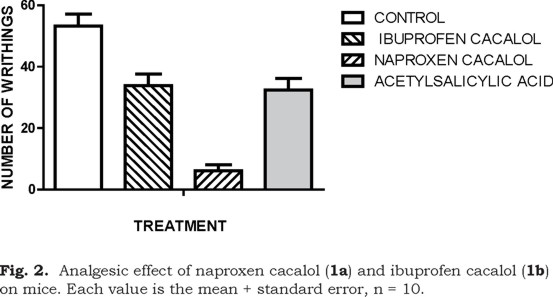
<body><![CDATA[<p align="justify"><font face="verdana" size="2">&nbsp;</font></p>              <p align="justify"><font face="verdana" size="2"><b>Acknowledgments</b></font></p>              <p align="justify"><font face="verdana" size="2">We are indebted to Dr. G. Leclair (University of Moncton) for assistance with molecular modeling.</font></p>              <p align="justify"><font face="verdana" size="2">CONACYT. Project No. 83462.</font></p>              <p align="justify"><font face="verdana" size="2">&nbsp;</font></p>              <p align="justify"><font face="verdana" size="2"><b>References</b></font></p>              <!-- ref --><p align="justify"><font face="verdana" size="2">Bodenhausen, G., Ruben, D. (1980). Natural abundance nitrogen&#45;15 NMR by enhanced heteronuclear spectroscopy. <i>J. Chem. Phys. Lett.</i> <b>69</b>:185&#45;189.    &nbsp;&nbsp;&nbsp;&nbsp;&nbsp;&nbsp;&nbsp;&nbsp;[&#160;<a href="javascript:void(0);" onclick="javascript: window.open('/scielo.php?script=sci_nlinks&ref=7369088&pid=S0370-5943201200020000600001&lng=','','width=640,height=500,resizable=yes,scrollbars=1,menubar=yes,');">Links</a>&#160;]<!-- end-ref --></font></p>              <!-- ref --><p align="justify"><font face="verdana" size="2">D&iacute;az, JL. (1976). <i>Usos de las Plantas Medicinales de M&eacute;xico</i>. Monograf&iacute;as Cient&iacute;ficas ll. Instituto Mexicano para el Estudio de las Plantas Medicinales (IMEPLAM), M&eacute;xico.    &nbsp;&nbsp;&nbsp;&nbsp;&nbsp;&nbsp;&nbsp;&nbsp;[&#160;<a href="javascript:void(0);" onclick="javascript: window.open('/scielo.php?script=sci_nlinks&ref=7369090&pid=S0370-5943201200020000600002&lng=','','width=640,height=500,resizable=yes,scrollbars=1,menubar=yes,');">Links</a>&#160;]<!-- end-ref --></font></p>              ]]></body>
<body><![CDATA[<!-- ref --><p align="justify"><font face="verdana" size="2">Jankowski, C.K., Leclair, G., Aum&egrave;las, A., Gonzalez de la Parra, M., Jimenez&#45;Estrada, M., Tejada, V., Reyes&#45;Chilpa, R., B&egrave;langer, J.M.R., Par&egrave;, J.R.J. (2004). Preliminary study on the synthesis and high&#45;resolution NMR analysis of Naproxen and Ibuprofen esters. <i>Spectroscopy</i> <b>18</b>: 485&#45;500.    &nbsp;&nbsp;&nbsp;&nbsp;&nbsp;&nbsp;&nbsp;&nbsp;[&#160;<a href="javascript:void(0);" onclick="javascript: window.open('/scielo.php?script=sci_nlinks&ref=7369092&pid=S0370-5943201200020000600003&lng=','','width=640,height=500,resizable=yes,scrollbars=1,menubar=yes,');">Links</a>&#160;]<!-- end-ref --></font></p>              <!-- ref --><p align="justify"><font face="verdana" size="2">Jimenez&#45;Estrada, M, Reyes&#45;Chilpa, R., Ram&iacute;rez&#45;Apan, T., Lledias, F., Hansberg, W., Arrieta, D., Alarc&oacute;n Aguilar, F.J. (2006). Anti&#45;inflammatory activity of cacalol and cacalone sesquiterpenes isolated from <i>Psacalium decompositum</i>. <i>J. Ethnopharm.</i> <b>105</b>: 34&#45;38.    &nbsp;&nbsp;&nbsp;&nbsp;&nbsp;&nbsp;&nbsp;&nbsp;[&#160;<a href="javascript:void(0);" onclick="javascript: window.open('/scielo.php?script=sci_nlinks&ref=7369094&pid=S0370-5943201200020000600004&lng=','','width=640,height=500,resizable=yes,scrollbars=1,menubar=yes,');">Links</a>&#160;]<!-- end-ref --></font></p>              <!-- ref --><p align="justify"><font face="verdana" size="2">Jim&eacute;nez&#45;Estrada, M., Lozano, R.C., Vald&eacute;s, M.J., Le&oacute;n, C.J.R. (1992). Actividad antimicrobiana del cacalol y sus derivados. <i>Revista Latinoamericana de Qu&iacute;mica</i>. <b>23</b>/1 y <b>22</b>/4: 14.    &nbsp;&nbsp;&nbsp;&nbsp;&nbsp;&nbsp;&nbsp;&nbsp;[&#160;<a href="javascript:void(0);" onclick="javascript: window.open('/scielo.php?script=sci_nlinks&ref=7369096&pid=S0370-5943201200020000600005&lng=','','width=640,height=500,resizable=yes,scrollbars=1,menubar=yes,');">Links</a>&#160;]<!-- end-ref --></font></p>              <!-- ref --><p align="justify"><font face="verdana" size="2">Mart&iacute;nez, M. (1959). Las Plantas Medicinales de M&eacute;xico. 4th Ed. Ediciones Botas, M&eacute;xico.    &nbsp;&nbsp;&nbsp;&nbsp;&nbsp;&nbsp;&nbsp;&nbsp;[&#160;<a href="javascript:void(0);" onclick="javascript: window.open('/scielo.php?script=sci_nlinks&ref=7369098&pid=S0370-5943201200020000600006&lng=','','width=640,height=500,resizable=yes,scrollbars=1,menubar=yes,');">Links</a>&#160;]<!-- end-ref --></font></p>              <!-- ref --><p align="justify"><font face="verdana" size="2">Mart&iacute;nez&#45;V&aacute;zquez, M., Ram&iacute;rez&#45;Apan, T.O., Aguilar, H., Bye, R. (1996). Analgesic and antipyretic activities of an aqueous extract and of the flavone linarin of <i>Buddleia cordata</i>. <i>Planta Med.</i> <b>62</b>(2): 137&#45;40.    &nbsp;&nbsp;&nbsp;&nbsp;&nbsp;&nbsp;&nbsp;&nbsp;[&#160;<a href="javascript:void(0);" onclick="javascript: window.open('/scielo.php?script=sci_nlinks&ref=7369100&pid=S0370-5943201200020000600007&lng=','','width=640,height=500,resizable=yes,scrollbars=1,menubar=yes,');">Links</a>&#160;]<!-- end-ref --></font></p>              ]]></body>
<body><![CDATA[<!-- ref --><p align="justify"><font face="verdana" size="2">Rance, M., Sorensen, O.W., Bodenhausen, G., Wagner, G., Ernst, K., Wuthrich, R.R. (1983). Improved spectral resolution in COSY 1H NMR Spectra of proteins via double quantum filtering. <i>Biochem. Biophys. Res. Commun.</i> <b>117</b>: 479&#45;85.    &nbsp;&nbsp;&nbsp;&nbsp;&nbsp;&nbsp;&nbsp;&nbsp;[&#160;<a href="javascript:void(0);" onclick="javascript: window.open('/scielo.php?script=sci_nlinks&ref=7369102&pid=S0370-5943201200020000600008&lng=','','width=640,height=500,resizable=yes,scrollbars=1,menubar=yes,');">Links</a>&#160;]<!-- end-ref --></font></p>              <!-- ref --><p align="justify"><font face="verdana" size="2">Rance, M. (1987). Improved techniques for homonuclear rotating&#45;frame and isotropic mixing experiments. <i>J. Magn. Reson</i>. <b>74</b>: 557&#45;564.    &nbsp;&nbsp;&nbsp;&nbsp;&nbsp;&nbsp;&nbsp;&nbsp;[&#160;<a href="javascript:void(0);" onclick="javascript: window.open('/scielo.php?script=sci_nlinks&ref=7369104&pid=S0370-5943201200020000600009&lng=','','width=640,height=500,resizable=yes,scrollbars=1,menubar=yes,');">Links</a>&#160;]<!-- end-ref --></font></p>              <!-- ref --><p align="justify"><font face="verdana" size="2">Romo, J., Joseph&#45;Nathan, P. (1964). The constituents of <i>Cacalia decomposita</i> A. Gray, structures of cacalol and cacalone. <i>Tetrahedron</i> <b>20</b>: 2331.    &nbsp;&nbsp;&nbsp;&nbsp;&nbsp;&nbsp;&nbsp;&nbsp;[&#160;<a href="javascript:void(0);" onclick="javascript: window.open('/scielo.php?script=sci_nlinks&ref=7369106&pid=S0370-5943201200020000600010&lng=','','width=640,height=500,resizable=yes,scrollbars=1,menubar=yes,');">Links</a>&#160;]<!-- end-ref --></font></p>              <!-- ref --><p align="justify"><font face="verdana" size="2">Soriano&#45;Garcia, M., Walls, F, Yuste, F., Barrios, H., Ortiz, B., S&aacute;nchez&#45;Obregon, R., Toscano, R.A., Yuste, F. (1987). Structure and stereochemistry of cacalol methyl ether, a sesquiterpene. <i>Acta Cryst</i>, <b>C43</b>: 1805&#45;1807.    &nbsp;&nbsp;&nbsp;&nbsp;&nbsp;&nbsp;&nbsp;&nbsp;[&#160;<a href="javascript:void(0);" onclick="javascript: window.open('/scielo.php?script=sci_nlinks&ref=7369108&pid=S0370-5943201200020000600011&lng=','','width=640,height=500,resizable=yes,scrollbars=1,menubar=yes,');">Links</a>&#160;]<!-- end-ref --></font></p>              <!-- ref --><p align="justify"><font face="verdana" size="2">Yuste, F. and Walls, F. (1976). Synthesis of (&plusmn;)&#45;cacalol. <i>Aust. J. Chem.</i> <b>29</b>: 2333&#45;2336.    &nbsp;&nbsp;&nbsp;&nbsp;&nbsp;&nbsp;&nbsp;&nbsp;[&#160;<a href="javascript:void(0);" onclick="javascript: window.open('/scielo.php?script=sci_nlinks&ref=7369110&pid=S0370-5943201200020000600012&lng=','','width=640,height=500,resizable=yes,scrollbars=1,menubar=yes,');">Links</a>&#160;]<!-- end-ref --></font></p>     ]]></body>
<body><![CDATA[ ]]></body><back>
<ref-list>
<ref id="B1">
<nlm-citation citation-type="journal">
<person-group person-group-type="author">
<name>
<surname><![CDATA[Bodenhausen]]></surname>
<given-names><![CDATA[G.]]></given-names>
</name>
<name>
<surname><![CDATA[Ruben]]></surname>
<given-names><![CDATA[D.]]></given-names>
</name>
</person-group>
<article-title xml:lang="en"><![CDATA[Natural abundance nitrogen-15 NMR by enhanced heteronuclear spectroscopy]]></article-title>
<source><![CDATA[J. Chem. Phys. Lett]]></source>
<year>1980</year>
<volume>69</volume>
<page-range>185-189</page-range></nlm-citation>
</ref>
<ref id="B2">
<nlm-citation citation-type="book">
<person-group person-group-type="author">
<name>
<surname><![CDATA[Díaz]]></surname>
<given-names><![CDATA[JL.]]></given-names>
</name>
</person-group>
<source><![CDATA[Usos de las Plantas Medicinales de México]]></source>
<year>1976</year>
<publisher-loc><![CDATA[México ]]></publisher-loc>
<publisher-name><![CDATA[Instituto Mexicano para el Estudio de las Plantas Medicinales]]></publisher-name>
</nlm-citation>
</ref>
<ref id="B3">
<nlm-citation citation-type="journal">
<person-group person-group-type="author">
<name>
<surname><![CDATA[Jankowski]]></surname>
<given-names><![CDATA[C.K.]]></given-names>
</name>
<name>
<surname><![CDATA[Leclair]]></surname>
<given-names><![CDATA[G.]]></given-names>
</name>
<name>
<surname><![CDATA[Aumèlas]]></surname>
<given-names><![CDATA[A.]]></given-names>
</name>
<name>
<surname><![CDATA[Gonzalez de la Parra]]></surname>
<given-names><![CDATA[M.]]></given-names>
</name>
<name>
<surname><![CDATA[Jimenez-Estrada]]></surname>
<given-names><![CDATA[M.]]></given-names>
</name>
<name>
<surname><![CDATA[Tejada]]></surname>
<given-names><![CDATA[V.]]></given-names>
</name>
<name>
<surname><![CDATA[Reyes-Chilpa]]></surname>
<given-names><![CDATA[R.]]></given-names>
</name>
<name>
<surname><![CDATA[Bèlanger]]></surname>
<given-names><![CDATA[J.M.R.]]></given-names>
</name>
<name>
<surname><![CDATA[Parè]]></surname>
<given-names><![CDATA[J.R.J.]]></given-names>
</name>
</person-group>
<article-title xml:lang="en"><![CDATA[Preliminary study on the synthesis and high-resolution NMR analysis of Naproxen and Ibuprofen esters]]></article-title>
<source><![CDATA[Spectroscopy]]></source>
<year>2004</year>
<volume>18</volume>
<page-range>485-500</page-range></nlm-citation>
</ref>
<ref id="B4">
<nlm-citation citation-type="journal">
<person-group person-group-type="author">
<name>
<surname><![CDATA[Jimenez-Estrada]]></surname>
<given-names><![CDATA[M]]></given-names>
</name>
<name>
<surname><![CDATA[Reyes-Chilpa]]></surname>
<given-names><![CDATA[R.]]></given-names>
</name>
<name>
<surname><![CDATA[Ramírez-Apan]]></surname>
</name>
<name>
<surname><![CDATA[Lledias]]></surname>
<given-names><![CDATA[F.]]></given-names>
</name>
<name>
<surname><![CDATA[Hansberg]]></surname>
<given-names><![CDATA[W.]]></given-names>
</name>
<name>
<surname><![CDATA[Arrieta]]></surname>
<given-names><![CDATA[D.]]></given-names>
</name>
<name>
<surname><![CDATA[Alarcón Aguilar]]></surname>
<given-names><![CDATA[F.J.]]></given-names>
</name>
</person-group>
<article-title xml:lang="en"><![CDATA[Anti-inflammatory activity of cacalol and cacalone sesquiterpenes isolated from Psacalium decompositum]]></article-title>
<source><![CDATA[J. Ethnopharm]]></source>
<year>2006</year>
<volume>105</volume>
<page-range>34-38</page-range></nlm-citation>
</ref>
<ref id="B5">
<nlm-citation citation-type="journal">
<person-group person-group-type="author">
<name>
<surname><![CDATA[Jiménez-Estrada]]></surname>
<given-names><![CDATA[M.]]></given-names>
</name>
<name>
<surname><![CDATA[Lozano]]></surname>
<given-names><![CDATA[R.C.]]></given-names>
</name>
<name>
<surname><![CDATA[Valdés]]></surname>
<given-names><![CDATA[M.J.]]></given-names>
</name>
<name>
<surname><![CDATA[León]]></surname>
<given-names><![CDATA[C.J.R.]]></given-names>
</name>
</person-group>
<source><![CDATA[Revista Latinoamericana de Química]]></source>
<year>1992</year>
<volume>23</volume><volume>22</volume>
<numero>1</numero><numero>4</numero>
<issue>1</issue><issue>4</issue>
<page-range>14</page-range></nlm-citation>
</ref>
<ref id="B6">
<nlm-citation citation-type="book">
<person-group person-group-type="author">
<name>
<surname><![CDATA[Martínez]]></surname>
<given-names><![CDATA[M.]]></given-names>
</name>
</person-group>
<source><![CDATA[Las Plantas Medicinales de México]]></source>
<year>1959</year>
<edition>4</edition>
<publisher-loc><![CDATA[México ]]></publisher-loc>
<publisher-name><![CDATA[Ediciones Botas]]></publisher-name>
</nlm-citation>
</ref>
<ref id="B7">
<nlm-citation citation-type="journal">
<person-group person-group-type="author">
<name>
<surname><![CDATA[Martínez-Vázquez]]></surname>
<given-names><![CDATA[M.]]></given-names>
</name>
<name>
<surname><![CDATA[Ramírez-Apan]]></surname>
<given-names><![CDATA[T.O.]]></given-names>
</name>
<name>
<surname><![CDATA[Aguilar]]></surname>
<given-names><![CDATA[H.]]></given-names>
</name>
<name>
<surname><![CDATA[Bye]]></surname>
<given-names><![CDATA[R.]]></given-names>
</name>
</person-group>
<article-title xml:lang="en"><![CDATA[Analgesic and antipyretic activities of an aqueous extract and of the flavone linarin of Buddleia cordata]]></article-title>
<source><![CDATA[Planta Med]]></source>
<year>1996</year>
<volume>62</volume>
<numero>2</numero>
<issue>2</issue>
<page-range>137-40</page-range></nlm-citation>
</ref>
<ref id="B8">
<nlm-citation citation-type="journal">
<person-group person-group-type="author">
<name>
<surname><![CDATA[Rance]]></surname>
<given-names><![CDATA[M.]]></given-names>
</name>
<name>
<surname><![CDATA[Sorensen]]></surname>
<given-names><![CDATA[O.W.]]></given-names>
</name>
<name>
<surname><![CDATA[Bodenhausen]]></surname>
<given-names><![CDATA[G.]]></given-names>
</name>
<name>
<surname><![CDATA[Wagner]]></surname>
<given-names><![CDATA[G.]]></given-names>
</name>
<name>
<surname><![CDATA[Ernst]]></surname>
<given-names><![CDATA[K.]]></given-names>
</name>
<name>
<surname><![CDATA[Wuthrich]]></surname>
<given-names><![CDATA[R.R.]]></given-names>
</name>
</person-group>
<article-title xml:lang="en"><![CDATA[Improved spectral resolution in COSY 1H NMR Spectra of proteins via double quantum filtering. Biochem]]></article-title>
<source><![CDATA[Biophys. Res. Commun]]></source>
<year>1983</year>
<volume>117</volume>
<page-range>479-85</page-range></nlm-citation>
</ref>
<ref id="B9">
<nlm-citation citation-type="journal">
<person-group person-group-type="author">
<name>
<surname><![CDATA[Rance]]></surname>
<given-names><![CDATA[M.]]></given-names>
</name>
</person-group>
<source><![CDATA[J. Magn. Reson]]></source>
<year>1987</year>
<volume>74</volume>
<page-range>557-564</page-range></nlm-citation>
</ref>
<ref id="B10">
<nlm-citation citation-type="journal">
<person-group person-group-type="author">
<name>
<surname><![CDATA[Romo]]></surname>
<given-names><![CDATA[J.]]></given-names>
</name>
<name>
<surname><![CDATA[Joseph-Nathan]]></surname>
<given-names><![CDATA[P.]]></given-names>
</name>
</person-group>
<article-title xml:lang="en"><![CDATA[The constituents of Cacalia decomposita A. Gray, structures of cacalol and cacalone]]></article-title>
<source><![CDATA[Tetrahedron]]></source>
<year>1964</year>
<volume>20</volume>
<page-range>2331</page-range></nlm-citation>
</ref>
<ref id="B11">
<nlm-citation citation-type="journal">
<person-group person-group-type="author">
<name>
<surname><![CDATA[Soriano-Garcia]]></surname>
<given-names><![CDATA[M.]]></given-names>
</name>
<name>
<surname><![CDATA[Walls]]></surname>
<given-names><![CDATA[F]]></given-names>
</name>
<name>
<surname><![CDATA[Yuste]]></surname>
<given-names><![CDATA[F.]]></given-names>
</name>
<name>
<surname><![CDATA[Barrios]]></surname>
<given-names><![CDATA[H.]]></given-names>
</name>
<name>
<surname><![CDATA[Ortiz]]></surname>
<given-names><![CDATA[B.]]></given-names>
</name>
<name>
<surname><![CDATA[Sánchez-Obregon]]></surname>
<given-names><![CDATA[R.]]></given-names>
</name>
<name>
<surname><![CDATA[Toscano]]></surname>
<given-names><![CDATA[R.A.]]></given-names>
</name>
<name>
<surname><![CDATA[Yuste]]></surname>
<given-names><![CDATA[F.]]></given-names>
</name>
</person-group>
<article-title xml:lang="en"><![CDATA[Structure and stereochemistry of cacalol methyl ether, a sesquiterpene]]></article-title>
<source><![CDATA[Acta Cryst]]></source>
<year>1987</year>
<volume>C43</volume>
<page-range>1805-1807</page-range></nlm-citation>
</ref>
<ref id="B12">
<nlm-citation citation-type="journal">
<person-group person-group-type="author">
<name>
<surname><![CDATA[Yuste]]></surname>
<given-names><![CDATA[F.]]></given-names>
</name>
<name>
<surname><![CDATA[Walls]]></surname>
<given-names><![CDATA[F.]]></given-names>
</name>
</person-group>
<article-title xml:lang="en"><![CDATA[Synthesis of (±)-cacalol]]></article-title>
<source><![CDATA[Aust. J. Chem]]></source>
<year>1976</year>
<volume>29</volume>
<page-range>2333-2336</page-range></nlm-citation>
</ref>
</ref-list>
</back>
</article>
