<?xml version="1.0" encoding="ISO-8859-1"?><article xmlns:mml="http://www.w3.org/1998/Math/MathML" xmlns:xlink="http://www.w3.org/1999/xlink" xmlns:xsi="http://www.w3.org/2001/XMLSchema-instance">
<front>
<journal-meta>
<journal-id>0370-5943</journal-id>
<journal-title><![CDATA[Revista latinoamericana de química]]></journal-title>
<abbrev-journal-title><![CDATA[Rev. latinoam. quím]]></abbrev-journal-title>
<issn>0370-5943</issn>
<publisher>
<publisher-name><![CDATA[Laboratorios Mixim S.A.]]></publisher-name>
</publisher>
</journal-meta>
<article-meta>
<article-id>S0370-59432012000100002</article-id>
<title-group>
<article-title xml:lang="en"><![CDATA[Chemical composition and antibacterial activity of the essential oil of Monticalia Imbricatifolia Schultz (Asteraceae)]]></article-title>
</title-group>
<contrib-group>
<contrib contrib-type="author">
<name>
<surname><![CDATA[Buitrago]]></surname>
<given-names><![CDATA[Diolimar]]></given-names>
</name>
<xref ref-type="aff" rid="A01"/>
</contrib>
<contrib contrib-type="author">
<name>
<surname><![CDATA[Velasco]]></surname>
<given-names><![CDATA[Judith]]></given-names>
</name>
<xref ref-type="aff" rid="A02"/>
</contrib>
<contrib contrib-type="author">
<name>
<surname><![CDATA[Díaz]]></surname>
<given-names><![CDATA[Tulia]]></given-names>
</name>
<xref ref-type="aff" rid="A03"/>
</contrib>
<contrib contrib-type="author">
<name>
<surname><![CDATA[Morales]]></surname>
<given-names><![CDATA[Antonio]]></given-names>
</name>
<xref ref-type="aff" rid="A01"/>
</contrib>
</contrib-group>
<aff id="A01">
<institution><![CDATA[,Universidad de Los Andes Facultad de Farmacia y Bioanálisis Instituto de Investigaciones]]></institution>
<addr-line><![CDATA[Mérida ]]></addr-line>
<country>Venezuela</country>
</aff>
<aff id="A02">
<institution><![CDATA[,Universidad de Los Andes Facultad de Farmacia y Bioanálisis Departamento de Microbiología y Parasitología]]></institution>
<addr-line><![CDATA[Mérida ]]></addr-line>
<country>Venezuela</country>
</aff>
<aff id="A03">
<institution><![CDATA[,Universidad de Los Andes Facultad de Farmacia y Bioanálisis Departamento de Bioanálisis Clínico]]></institution>
<addr-line><![CDATA[Mérida ]]></addr-line>
<country>Venezuela</country>
</aff>
<pub-date pub-type="pub">
<day>00</day>
<month>00</month>
<year>2012</year>
</pub-date>
<pub-date pub-type="epub">
<day>00</day>
<month>00</month>
<year>2012</year>
</pub-date>
<volume>40</volume>
<numero>1</numero>
<fpage>13</fpage>
<lpage>18</lpage>
<copyright-statement/>
<copyright-year/>
<self-uri xlink:href="http://www.scielo.org.mx/scielo.php?script=sci_arttext&amp;pid=S0370-59432012000100002&amp;lng=en&amp;nrm=iso"></self-uri><self-uri xlink:href="http://www.scielo.org.mx/scielo.php?script=sci_abstract&amp;pid=S0370-59432012000100002&amp;lng=en&amp;nrm=iso"></self-uri><self-uri xlink:href="http://www.scielo.org.mx/scielo.php?script=sci_pdf&amp;pid=S0370-59432012000100002&amp;lng=en&amp;nrm=iso"></self-uri><abstract abstract-type="short" xml:lang="en"><p><![CDATA[Essential oil from fresh aerial parts of Monticalia imbricatifolia Schultz., was isolated by hydrodistillation and analyzed by GC/MS. A yield of 0.18% was obtained. Eleven components were identified by comparison of their mass spectra with the Wiley GC-MS Library data and the retention indices (RI) calculated for every compound. The major components were monoterpenes: &#945;-phellandrene (33.89%), &#946;-phellandrene (19.28%), &#945;-pinene (16.81%) y &#946;-pinene (10.97%). Antibacterial activity of the essential oil of this species was evaluated against Staphylococcus aureus (ATCC 25923), Enterococcus faecalis (ATCC 29212), Escherichia coli (ATCC 25922), Pseudomonas aeruginosa (ATCC 27853) and Klebsiella pneumoniae (ATCC 23357), using the disc diffusion agar method. The results showed the oil is highly effective against all tested bacteria, with minimal inhibitory concentration (MIC) values ranging from 20 to 60 µg/ml.]]></p></abstract>
<abstract abstract-type="short" xml:lang="es"><p><![CDATA[El aceite esencial de las partes aéreas frescas de Monticalia imbricatifolia Schultz., fue aislado por hidrodestilación y analizado por CG/EM. El rendimiento obtenido fue de 0.18%. Once componentes fueron identificados por comparación de sus espectros de masas con los de la Librería Wiley GC-MS y los índices de retención (IR) fueron calculados para cada compuesto. Los componentes mayoritarios fueron los monoterpenos: &#945;-felandreno (33.89%), &#946;-felandreno (19.28%), &#945;-pineno (16.81%) y &#946;-pineno (10.97%). La actividad antibacteriana del aceite esencial de esta especie se evaluó contra Staphylococcus aureus (ATCC 25923), Enterococcus faecalis (ATCC 29212), Escherichia coli (ATCC 25922), Pseudomonas aeruginosa (ATCC 27853) y Klebsiella pneumoniae (ATCC 23357), por el método de difusión en agar con discos. Los resultados demostraron que el aceite fue altamente efectivo contra todas las bacterias probadas, con un intervalo de concentración inhibitoria mínima (CIM) de 20-60 µg/ml.]]></p></abstract>
<kwd-group>
<kwd lng="en"><![CDATA[Monticalia imbricatifolia]]></kwd>
<kwd lng="en"><![CDATA[Asteraceae]]></kwd>
<kwd lng="en"><![CDATA[essential oil]]></kwd>
<kwd lng="en"><![CDATA[antibacterial activity]]></kwd>
<kwd lng="es"><![CDATA[Monticalia imbricatifolia]]></kwd>
<kwd lng="es"><![CDATA[Asteraceae]]></kwd>
<kwd lng="es"><![CDATA[aceite esencial]]></kwd>
<kwd lng="es"><![CDATA[actividad antibacteriana]]></kwd>
</kwd-group>
</article-meta>
</front><body><![CDATA[ <p align="center"><font face="verdana" size="4"><b>Chemical composition and antibacterial activity of the essential oil of <i>Monticalia Imbricatifolia</i> Schultz (Asteraceae)</b></font></p>              <p align="justify"><font face="verdana" size="2">&nbsp;</font></p>              <p align="center"><font face="verdana" size="2"><b>Diolimar Buitrago<sup>a</sup>*, Judith Velasco<sup>b</sup>, Tulia D&iacute;az<sup>c</sup> y Antonio Morales<sup>a</sup></b></font></p>              <p align="justify"><font face="verdana" size="2">&nbsp;</font></p>              <p align="justify"><font face="verdana" size="2"><i><sup>a</sup> Instituto de Investigaciones. Facultad de Farmacia y Bioan&aacute;lisis. Universidad de Los Andes. M&eacute;rida&#45;Venezuela.</i></font></p>              <p align="justify"><font face="verdana" size="2"><i><sup>b</sup> Departamento de Microbiolog&iacute;a y Parasitolog&iacute;a. Facultad de Farmacia y Bioan&aacute;lisis. Universidad de Los Andes. M&eacute;rida&#45;Venezuela.</i></font></p>              <p align="justify"><font face="verdana" size="2"><i><sup>c</sup> Departamento de Bioan&aacute;lisis Cl&iacute;nico. Facultad de Farmacia y Bioan&aacute;lisis. Universidad de Los Andes. M&eacute;rida&#45;Venezuela.</i> Corresponding author: <a href="mailto:diolbui@ula.ve">diolbui@ula.ve</a>.</font></p>              <p align="justify"><font face="verdana" size="2">&nbsp;</font></p>              <p align="justify"><font face="verdana" size="2">Received June 2012    <br>Accepted September 2012</font></p>              ]]></body>
<body><![CDATA[<p align="justify"><font face="verdana" size="2">&nbsp;</font></p>              <p align="justify"><font face="verdana" size="2"><b>Abstract</b></font></p>              <p align="justify"><font face="verdana" size="2">Essential oil from fresh aerial parts of <i>Monticalia imbricatifolia</i> Schultz., was isolated by hydrodistillation and analyzed by GC/MS. A yield of 0.18% was obtained. Eleven components were identified by comparison of their mass spectra with the Wiley GC&#45;MS Library data and the retention indices (RI) calculated for every compound. The major components were monoterpenes: &#945;&#45;phellandrene (33.89%), &#946;&#45;phellandrene (19.28%), &#945;&#45;pinene (16.81%) y &#946;&#45;pinene (10.97%). Antibacterial activity of the essential oil of this species was evaluated against <i>Staphylococcus aureus</i> (ATCC 25923)<i>, Enterococcus faecalis</i> (ATCC 29212), <i>Escherichia coli</i> (ATCC 25922), <i>Pseudomonas aeruginosa</i> (ATCC 27853) and <i>Klebsiella pneumoniae</i> (ATCC 23357), using the disc diffusion agar method. The results showed the oil is highly effective against all tested bacteria, with minimal inhibitory concentration (MIC) values ranging from 20 to 60 &micro;g/ml.</font></p>              <p align="justify"><font face="verdana" size="2"><b>Key words:</b> <i>Monticalia imbricatifolia</i>, Asteraceae, essential oil, antibacterial activity.</font></p>              <p align="justify"><font face="verdana" size="2">&nbsp;</font></p>              <p align="justify"><font face="verdana" size="2"><b>Resumen</b></font></p>              <p align="justify"><font face="verdana" size="2">El aceite esencial de las partes a&eacute;reas frescas de <i>Monticalia imbricatifolia</i> Schultz., fue aislado por hidrodestilaci&oacute;n y analizado por CG/EM. El rendimiento obtenido fue de 0.18%. Once componentes fueron identificados por comparaci&oacute;n de sus espectros de masas con los de la Librer&iacute;a Wiley GC&#45;MS y los &iacute;ndices de retenci&oacute;n (IR) fueron calculados para cada compuesto. Los componentes mayoritarios fueron los monoterpenos: &#945;&#45;felandreno (33.89%), &#946;&#45;felandreno (19.28%), &#945;&#45;pineno (16.81%) y &#946;&#45;pineno (10.97%). La actividad antibacteriana del aceite esencial de esta especie se evalu&oacute; contra <i>Staphylococcus aureus</i> (ATCC 25923)<i>, Enterococcus faecalis</i> (ATCC 29212), <i>Escherichia coli</i> (ATCC 25922), <i>Pseudomonas aeruginosa</i> (ATCC 27853) y <i>Klebsiella pneumoniae</i> (ATCC 23357), por el m&eacute;todo de difusi&oacute;n en agar con discos. Los resultados demostraron que el aceite fue altamente efectivo contra todas las bacterias probadas, con un intervalo de concentraci&oacute;n inhibitoria m&iacute;nima (CIM) de 20&#45;60 &micro;g/ml.</font></p>              <p align="justify"><font face="verdana" size="2"><b>Palabras clave:</b> <i>Monticalia imbricatifolia</i>, Asteraceae, aceite esencial, actividad antibacteriana.</font></p>              <p align="justify"><font face="verdana" size="2">&nbsp;</font></p>              <p align="justify"><font face="verdana" size="2"><b>Introduction</b></font></p>              ]]></body>
<body><![CDATA[<p align="justify"><font face="verdana" size="2">The Asteraceae family comprised about 1500 genera and 25000 species, distributed worldwide (Badillo, 1997). The genus <i>Monticalia</i> belongs to the family Asteraceae, tribe Senecioneae (Aristiguieta, 1964). From Venezuela, 29 species of this genus have been reported (Badillo, 2001). Species of this genus have been used in traditional medicine as antiallergic, hypotensive and to treat alopecia (Gil <i>et al</i>., 2003). Nieves <i>et al</i>., 2010, reported that essential oil of <i>M. imbricatifolia</i> presents low repellent activity against the bites of <i>Lutzomyia migonei</i> in laboratory conditions. Previous investigations of the essential oil of different species of <i>Monticalia</i> have reported a variety of compounds, such as &#945;&#45;pinene, &#946;&#45;pinene, &#945;&#45;longipinene, &#948;&#45;3&#45;carene, cyperene and &#946;&#45;phellandrene found in <i>M. andicola</i> (Baldovino <i>et al</i>., 2009); 1&#45;nonane, &#945;&#45;pinene, germacrene D and &#946;&#45;cedrene reported in <i>M. greenmaniana</i> (C&aacute;rdenas <i>et al</i>., 2012), both species have showed antibacterial activity. In the present study, the composition of the essential oil of <i>Monticalia imbricatifolia</i> Schultz, is reported as well as their antibacterial activity. This species had previously been known as <i>Senecio imbricatifolius</i> (Schultz&#45;Bip&#45;ex Wedd) and is characterized by being a woody, small, branched plant, with tiny leaves, sessile, alternate, imbricate, directly attached to the stem (Badillo, 1997).</font></p>              <p align="justify"><font face="verdana" size="2">&nbsp;</font></p>              <p align="justify"><font face="verdana" size="2"><b>Materials and methods</b></font></p>              <p align="justify"><font face="verdana" size="2"><b>Plant Material</b></font></p>              <p align="justify"><font face="verdana" size="2">Aerial parts of <i>M. imbricatifolia</i>, were collected in the way to Pi&ntilde;ango Paramo, M&eacute;rida State, Venezuela at 2320 m above sea level. Voucher specimen (DBB017) has been deposited in the Faculty of Pharmacy and Bioanalysis MERF Herbarium, University of Los Andes, Venezuela.</font></p>              <p align="justify"><font face="verdana" size="2"><b>Isolation of Essential Oil</b></font></p>              <p align="justify"><font face="verdana" size="2">Fresh leaves (1105 g) were cut into small pieces and subjected to hydrodistillation for 3 h, using a Clevenger&#45;type apparatus. The oil was dried over anhydrous sodium sulphate and stored at 4 &ordm;C.</font></p>              <p align="justify"><font face="verdana" size="2"><b>Gas Chromatography&#45;Mass Spectrometry</b></font></p>              <p align="justify"><font face="verdana" size="2">The oil was analyzed by GC&#45;MS on an Hewlett Packard GC&#45;MS system, Model 5973, fitted with a 30 m long cross&#45;linked 5 % phenylmethyl siloxane (HP&#45;5MS, Hewlett Packard, USA) fused&#45;silica column (0.25 mm diam, film thickness 0.25 mm). The initial oven temperature was 60&deg;C; it was then heated to 280&deg;C at 4&deg;C/min, and the final temperature was maintained for 20 min. The injector and detector temperatures were 200&deg;C and 230&deg;C, respectively. The carrier gas was helium, adjusted to a linear velocity of 34 m/s, the ionization energy 70 eV, and the scan range 40&#45;500 amu at 3.9 scans/s. A Hewlett&#45;Packard ALS injector was used with split ratio 1:100. The injected volume was 1.0 ml of a 2% dilu tion of oil in <i>n</i>&#45;heptane. The identification of the oil components was based using a Wiley MS Data Library (6<sup>th</sup> edn), reference mass spectra from published sources, and retention indices (RI) (Adams, 1995).</font></p>              <p align="justify"><font face="verdana" size="2"><b>Microbiological Analysis Bacterial Strains</b></font></p>              ]]></body>
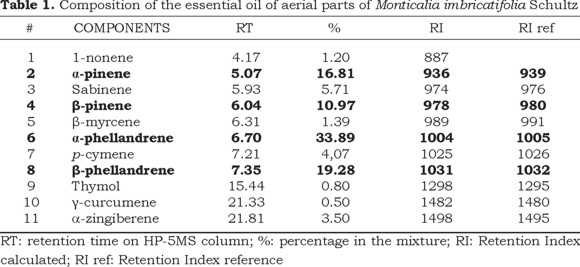
<body><![CDATA[<p align="justify"><font face="verdana" size="2">The microorganisms used were <i>Staphylococcus aureus</i> (ATCC 25923), <i>Enterococcus faecalis</i> (ATCC 29212), <i>Escherichia coli</i> (ATCC 25922), <i>Klebsiella pneumoniae</i> (ATCC 23357) and <i>Pseudomonas aeruginosa</i> (ATCC 27853).</font></p>              <p align="justify"><font face="verdana" size="2"><b>Antimicrobial Method</b></font></p>              <p align="justify"><font face="verdana" size="2">The antimicrobial activity was carried out according to the disc diffusion assay described by Velasco <i>et al</i>., 2007. The strains were maintained in agar at room temperature. Each bacterial inoculum (2.5 ml) was incubated in M&uuml;eller&#45;Hinton broth at 37&ordm;C for 18 hours. The bacterial inoculum was diluted in sterile 0.85% saline to obtain turbidity visually comparable to a McFarland N&ordm; 0.5 standard (10<sup>6&#45;8</sup> CFU/ml). Every inoculum was spread over plates containing M&uuml;eller&#45;Hinton agar and a paper filter disc (6 mm) saturated with 10 &micro;l of essential oil. The plates were left for 30 min at room temperature and then incubated at 37 &ordm;C for 24 h. The inhibitory zone around the disc was measured and expressed in mm. A positive control was also assayed to check the sensitivity of the tested microorganisms using the following antibiotics: Ampicillin&#45;sulbactam&reg; (10 mg/10 mg), Vancomycin&reg; (30 mg), Netilmicin&reg; (30 mg), Aztreonam&reg; (30 mg) and Cefoperazone&reg; (75 mg) (<a href="#c2">Table 2</a>).</font></p>         <p align="center"><font face="verdana" size="2"><a name="c1"></a></font></p>              <p align="center"><font face="verdana" size="2"><img src="/img/revistas/rlq/v40n1/a2c1.jpg"></font></p>              <p align="center"><font face="verdana" size="2"><a name="c2"></a></font></p>              <p align="center"><font face="verdana" size="2"><img src="/img/revistas/rlq/v40n1/a2c2.jpg"></font></p>              <p align="justify"><font face="verdana" size="2">The minimal inhibitory concentration (MIC) was determined only with microorganisms that displayed inhibitory zones. MIC was determined by dilution of the essential oil in dimethyl sulphoxide (DMSO) pipetting 10 &micro;l of each dilution onto a filter paper disc. Dilutions of the oil within a concentration range of 10&#45;120 &micro;g/ml were also carried out. MIC was defined as the lowest concentration that inhibited the visible bacterial growth (CLSI, 2012). A negative control was also included in the test using a filter paper disc saturated with DMSO (10 &micro;l) to check possible activity of this solvent against the bacteria assayed. The experiments were repeated at least twice.</font></p>              <p align="justify"><font face="verdana" size="2">&nbsp;</font></p>              <p align="justify"><font face="verdana" size="2"><b>Results and discussion</b></font></p>              ]]></body>
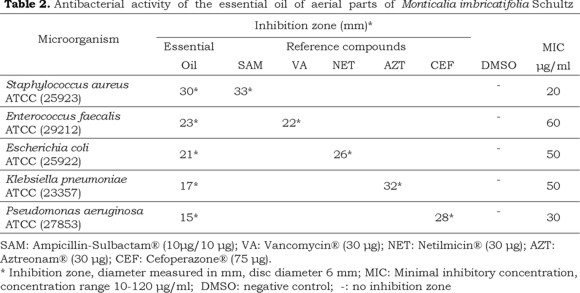
<body><![CDATA[<p align="justify"><font face="verdana" size="2">The essential oil from aerial parts of <i>M. imbricatifolia</i> yielded 0.18 %. GC/MS analyses showed the presence of 11 components. <a href="#c1">Table 1</a> shows the identified components that constitute the 96.92 % of the oil. The major compounds of the oil were &#945;&#45;phellandrene (33.89%), &#946;&#45;phellandrene (19.28%), &#945;&#45;pinene (16.81%) and &#946;&#45;pinene (10.97%), these compounds belong to the monoterpene group.</font></p>              <p align="justify"><font face="verdana" size="2">These results were compared to the oil composition of <i>M. andicola</i> (Baldovino <i>et al</i>., 2009) where the main components were &#945;&#45;pinene, &#946;&#45;pinene and &#946;&#45;phellandrene like <i>M. imbricatifolia</i> but in different proportions; whereas for <i>M. greenmaniana</i> only &#945;&#45;pinene was present in major quantity (C&aacute;rdenas <i>et al</i>., 2012).</font></p>              <p align="justify"><font face="verdana" size="2">Antibacterial activity of essential oil of <i>M. imbricatifolia</i> was evaluated against Gram&#45; positive and Gram&#45;negative bacteria (<a href="#c2">Table 2</a>). The results show that the oil inhibited the development of all the bacteria included in the study, with MIC values of 20&#45;60 &micro;g/ml for the Gram&#45;positive bacteria and 30&#45;50 &micro;g/ml for Gram&#45;negative bacteria. These results demonstrated a broad spectrum of antibacterial activity of the essential oil, reflected in the values of the MIC to low doses, comparable to the concentration of the reference antibiotics.</font></p>              <p align="justify"><font face="verdana" size="2">There are few reports of antimicrobial activity of members of the genus <i>Monticalia</i>, C&aacute;rdenas <i>et al</i>., 2012, reported that leaf essential oil of <i>M. greenmaniana</i> showed broad spectrum of antibacterial activity against the important human pathogenic Gram&#45;positive and Gram&#45;negative bacteria <i>Staphylococcus aureus</i> (ATCC 25923), <i>Enterococcus faecalis</i> (ATCC 19433), <i>Escherichia coli</i> (ATCC 25922), <i>Pseudomonas aeruginosa</i> (ATCC 27853) and <i>Klebsiella pneumoniae</i> (ATCC 25955), with MIC values ranging from 75 to 6000 ppm. On the other hand, has been described antibacterial activity on the essential oil of <i>M. andicola</i> also proving a broad&#45;spectrum (Baldovino <i>et al</i>., 2009).</font></p>              <p align="justify"><font face="verdana" size="2">The activity observed in the present study could be attributed to the major compounds belonging to the monoterpene group since, the literature refers an&#45;tibacterial activity of the &#945;&#45;phellandrene, &#946;&#45;phellandrene, &#945;&#45;pinene and &#946;&#45;pinene in essentials oils of species of different genera (Erazo <i>et al</i>, 2006; Sonboli <i>et</i> al, 2006; Yan&#45;qiu <i>et</i> al, 2008; Baldovino <i>et</i> al, 2009; Mora <i>et al</i>, 2011; Pe&ntilde;a <i>et al</i>, 2012). The mechanism of action is not well known, in this regard, Trombetta <i>et al</i>., 2005, speculate that the antimicrobial effect of monoterpenes, may be due, at least partially, to a perturbation of the lipid fraction of bacterial plasma membranes, resulting in alterations of membrane permeability and in leakage of intracellular materials. Besides being related to physicochemical characteristic of the drugs (such as lipophilicity and water solubility), this effect appears to be dependent on the lipid composition and net surface charge of the bacterial membranes. Furthermore, the drugs might cross the cell membranes, penetrating the interior of the cell and interacting with intracellular sites critically.</font></p>              <p align="justify"><font face="verdana" size="2">The object of this bacteria study cause severe infectious processes in the human and currently, there is an increase in the resistance of these bacteria to the antibiotics of choice (Cornejo <i>et al</i>., 2007; Pe&ntilde;a <i>et al</i>., 2007; Guzm&aacute;n and Lozada, 2007, Cagnacci <i>et al</i>., 2008). At the global level the resistance has become a serious public health problem, in fact, there are resistant strains that cause a large number of diseases (Gonz&aacute;lez and Guzm&aacute;n, 1999). In this sense, the essential oil of <i>M. imbricatifolia</i> represents a source of natural origin for the investigation of new metabolites with antibacterial activity of broad spectrum at low concentrations.</font></p>              <p align="justify"><font face="verdana" size="2">&nbsp;</font></p>              <p align="justify"><font face="verdana" size="2"><b>Conclusion</b></font></p>              <p align="justify"><font face="verdana" size="2">An analysis of the chemical composition of the essential oil of <i>Monticalia imbricatifolia</i> Schultz., revealed 11 compounds, the main compounds belong to the monoterpene group.</font></p>              <p align="justify"><font face="verdana" size="2">The oil showed a broad spectrum of antibacterial activity against the important human pathogenic Gram&#45;positive and Gram&#45;negative bacteria at low concentrations (MIC 20&#45;60 &micro;g/ml).</font></p>              ]]></body>
<body><![CDATA[<p align="justify"><font face="verdana" size="2">&nbsp;</font></p>              <p align="justify"><font face="verdana" size="2"><b>Acknowledgment</b></font></p>              <p align="justify"><font face="verdana" size="2">The authors would like to acknowledge to Dr. Pablo Mel&eacute;ndez Faculty of Pharmacy and Bioanalysis MERF Herbarium, University of Los Andes by the identification of the botanical material and Dr. Alfredo Usubillaga, Faculty of Pharmacy and Bioanalysis, University of Los Andes, Venezuela for helping in performing the analysis of GC/MS.</font></p>              <p align="justify"><font face="verdana" size="2">&nbsp;</font></p>              <p align="justify"><font face="verdana" size="2"><b>References</b></font></p>              <!-- ref --><p align="justify"><font face="verdana" size="2">Adams, R. (1995). Identification of essential oils components by gas chromatography/mass spectroscopy. Allured Publishing Corporation, Carol Stream IL, USA pp: 469.    &nbsp;&nbsp;&nbsp;&nbsp;&nbsp;&nbsp;&nbsp;&nbsp;[&#160;<a href="javascript:void(0);" onclick="javascript: window.open('/scielo.php?script=sci_nlinks&ref=7367740&pid=S0370-5943201200010000200001&lng=','','width=640,height=500,resizable=yes,scrollbars=1,menubar=yes,');">Links</a>&#160;]<!-- end-ref --></font></p>              <!-- ref --><p align="justify"><font face="verdana" size="2">Aristeguieta, L (1964). Flora de Venezuela. Compositae. Instituto Bot&aacute;nico, Caracas&#45;Venezuela pp: 361.    &nbsp;&nbsp;&nbsp;&nbsp;&nbsp;&nbsp;&nbsp;&nbsp;[&#160;<a href="javascript:void(0);" onclick="javascript: window.open('/scielo.php?script=sci_nlinks&ref=7367742&pid=S0370-5943201200010000200002&lng=','','width=640,height=500,resizable=yes,scrollbars=1,menubar=yes,');">Links</a>&#160;]<!-- end-ref --></font></p>              <!-- ref --><p align="justify"><font face="verdana" size="2">Badillo, V (1997). Los G&eacute;neros de las Compositae (Asteraceae) de Venezuela. Clave para su determinaci&oacute;n, <i>Ernstia</i> <b>6 (4)</b>: 51&#45;168.    &nbsp;&nbsp;&nbsp;&nbsp;&nbsp;&nbsp;&nbsp;&nbsp;[&#160;<a href="javascript:void(0);" onclick="javascript: window.open('/scielo.php?script=sci_nlinks&ref=7367744&pid=S0370-5943201200010000200003&lng=','','width=640,height=500,resizable=yes,scrollbars=1,menubar=yes,');">Links</a>&#160;]<!-- end-ref --></font></p>              <!-- ref --><p align="justify"><font face="verdana" size="2">Badillo, V (2001). Lista actualizada de las especies de la familia Compuestas (Asteraceae) de Venezuela, <i>Ernstia</i> <b>11 (3,4)</b>: 166&#45;167.    &nbsp;&nbsp;&nbsp;&nbsp;&nbsp;&nbsp;&nbsp;&nbsp;[&#160;<a href="javascript:void(0);" onclick="javascript: window.open('/scielo.php?script=sci_nlinks&ref=7367746&pid=S0370-5943201200010000200004&lng=','','width=640,height=500,resizable=yes,scrollbars=1,menubar=yes,');">Links</a>&#160;]<!-- end-ref --></font></p>              <!-- ref --><p align="justify"><font face="verdana" size="2">Baldovino, S., Rojas, J., Rojas, LB., Lucena, M., Buitrago, A., Morales, A. (2009). Chemical composition and antibacterial activity of the essential oil of <i>Monticalia andicola</i> (Asteraceae) collected in Venezuela, <i>Nat Prod Commun</i> <b>4 (11)</b>: 1601&#45;1604.    &nbsp;&nbsp;&nbsp;&nbsp;&nbsp;&nbsp;&nbsp;&nbsp;[&#160;<a href="javascript:void(0);" onclick="javascript: window.open('/scielo.php?script=sci_nlinks&ref=7367748&pid=S0370-5943201200010000200005&lng=','','width=640,height=500,resizable=yes,scrollbars=1,menubar=yes,');">Links</a>&#160;]<!-- end-ref --></font></p>              <!-- ref --><p align="justify"><font face="verdana" size="2">Cagnacci, S., Gualco, L., Roveta, S., Mannelli, S., Borgianni, L., Docquier, J D., Dodi, F., Centanaro, M., Debbia, E., Marchese, A., Rossolini, G M. (2008). Bloodstream infections caused by multidrug&#45;resistant <i>Klebsiella pneumoniae</i> producing the carbapenem&#45;hydrolysing VIM&#45;1 metallo&#45;beta&#45;lactamase: first Italian outbreak. <i>J Antimicrob Chemother</i> <b>61(2)</b>: 296&#45;300.    &nbsp;&nbsp;&nbsp;&nbsp;&nbsp;&nbsp;&nbsp;&nbsp;[&#160;<a href="javascript:void(0);" onclick="javascript: window.open('/scielo.php?script=sci_nlinks&ref=7367750&pid=S0370-5943201200010000200006&lng=','','width=640,height=500,resizable=yes,scrollbars=1,menubar=yes,');">Links</a>&#160;]<!-- end-ref --></font></p>              <!-- ref --><p align="justify"><font face="verdana" size="2">C&aacute;rdenas J, Rojas J, Rojas&#45;Fermin L, Lucena M, Buitrago A. (2012). Essential oil composition and antibacterial activity of <i>Monticalia greenmaniana</i> (Asteraceae). <i>Nat Prod Commun</i> <b>7(2)</b>:243&#45;244.    &nbsp;&nbsp;&nbsp;&nbsp;&nbsp;&nbsp;&nbsp;&nbsp;[&#160;<a href="javascript:void(0);" onclick="javascript: window.open('/scielo.php?script=sci_nlinks&ref=7367752&pid=S0370-5943201200010000200007&lng=','','width=640,height=500,resizable=yes,scrollbars=1,menubar=yes,');">Links</a>&#160;]<!-- end-ref --></font></p>              <!-- ref --><p align="justify"><font face="verdana" size="2">CLSI: Clinical and Laboratory Standars Institute (2012). Performance Standards for antimicrobial disk susceptibility tests; Approved Standard&#151;Eleventh Edition. Document M02&#45;A11. Wayne, PA: Clinical and Laboratory Standards Institute.    &nbsp;&nbsp;&nbsp;&nbsp;&nbsp;&nbsp;&nbsp;&nbsp;[&#160;<a href="javascript:void(0);" onclick="javascript: window.open('/scielo.php?script=sci_nlinks&ref=7367754&pid=S0370-5943201200010000200008&lng=','','width=640,height=500,resizable=yes,scrollbars=1,menubar=yes,');">Links</a>&#160;]<!-- end-ref --></font></p>              <!-- ref --><p align="justify"><font face="verdana" size="2">Cornejo&#45;Ju&aacute;rez, P., Vel&aacute;squez&#45;Acosta, C., Sandoval, S., Gordillo, P., Volkow&#45;Fern&aacute;ndez, P. (2007). Patrones de resistencia bacteriana en urocultivos en un hospital oncol&oacute;gico. <i>Salud P&uacute;blica de M&eacute;xico</i>, <b>49 (5)</b>: 330&#45;336.    &nbsp;&nbsp;&nbsp;&nbsp;&nbsp;&nbsp;&nbsp;&nbsp;[&#160;<a href="javascript:void(0);" onclick="javascript: window.open('/scielo.php?script=sci_nlinks&ref=7367756&pid=S0370-5943201200010000200009&lng=','','width=640,height=500,resizable=yes,scrollbars=1,menubar=yes,');">Links</a>&#160;]<!-- end-ref --></font></p>              <!-- ref --><p align="justify"><font face="verdana" size="2">Erazo, S., Delporte, C., Negrete, R., Garc&iacute;a, R., Zald&iacute;var, M., Iturra, G., Caballero, E., L&oacute;pez, J.L., Backhouse, N. (2006). Constituents and biological activities of <i>Schinus polygamus</i>. <i>J Ethnopharmacol</i>, <b>107 (3)</b>: 395&#45;400.    &nbsp;&nbsp;&nbsp;&nbsp;&nbsp;&nbsp;&nbsp;&nbsp;[&#160;<a href="javascript:void(0);" onclick="javascript: window.open('/scielo.php?script=sci_nlinks&ref=7367758&pid=S0370-5943201200010000200010&lng=','','width=640,height=500,resizable=yes,scrollbars=1,menubar=yes,');">Links</a>&#160;]<!-- end-ref --></font></p>              <!-- ref --><p align="justify"><font face="verdana" size="2">Gil, R., Mej&iacute;as, R., Carmona, J., Mej&iacute;as, R., Rodr&iacute;guez, M. (2003). Estudio etnobot&aacute;nico de algunas plantas medicinales expendidas en los herbolarios de M&eacute;rida, Ejido y Tabay (Estado M&eacute;rida &#45; Venezuela). <i>Revista de la Facultad de Farmacia</i>, <b>45 (1)</b>: 69&#45;76.    &nbsp;&nbsp;&nbsp;&nbsp;&nbsp;&nbsp;&nbsp;&nbsp;[&#160;<a href="javascript:void(0);" onclick="javascript: window.open('/scielo.php?script=sci_nlinks&ref=7367760&pid=S0370-5943201200010000200011&lng=','','width=640,height=500,resizable=yes,scrollbars=1,menubar=yes,');">Links</a>&#160;]<!-- end-ref --></font></p>              <!-- ref --><p align="justify"><font face="verdana" size="2">Gonz&aacute;lez&#45;Salvatierra, R., Guzm&aacute;n&#45;Blanco, M. (1999). La resistencia a antimicrobianos en las Am&eacute;ricas. <i>Rev Panam Salud Publica</i>, <b>6 (6)</b>: 437&#45;439.    &nbsp;&nbsp;&nbsp;&nbsp;&nbsp;&nbsp;&nbsp;&nbsp;[&#160;<a href="javascript:void(0);" onclick="javascript: window.open('/scielo.php?script=sci_nlinks&ref=7367762&pid=S0370-5943201200010000200012&lng=','','width=640,height=500,resizable=yes,scrollbars=1,menubar=yes,');">Links</a>&#160;]<!-- end-ref --></font></p>              <!-- ref --><p align="justify"><font face="verdana" size="2">Guzm&aacute;n, M., Lozada, R. (2007). Detecci&oacute;n de <i>Staphylococcus aureus</i> meticilinoresistentes de pacientes con Infecciones nosocomiales y adquiridas en la comunidad. <i>Revista de la Sociedad Venezolana de Microbiolog&iacute;a</i>, <b>27</b>: 45&#45;49.    &nbsp;&nbsp;&nbsp;&nbsp;&nbsp;&nbsp;&nbsp;&nbsp;[&#160;<a href="javascript:void(0);" onclick="javascript: window.open('/scielo.php?script=sci_nlinks&ref=7367764&pid=S0370-5943201200010000200013&lng=','','width=640,height=500,resizable=yes,scrollbars=1,menubar=yes,');">Links</a>&#160;]<!-- end-ref --></font></p>              <!-- ref --><p align="justify"><font face="verdana" size="2">Mora, F., R&iacute;os, N., Rojas, L.B., D&iacute;az, T., Velasco, J., Carmona, J., Silva, B. (2011). Chemical composition and in vitro antibacterial activity of the essential oil of <i>Phthirusa adunca</i> from Venezuelan Andes. <i>Nat Prod Commun</i>, <b>6 (7)</b>: 1051&#45;1053.    &nbsp;&nbsp;&nbsp;&nbsp;&nbsp;&nbsp;&nbsp;&nbsp;[&#160;<a href="javascript:void(0);" onclick="javascript: window.open('/scielo.php?script=sci_nlinks&ref=7367766&pid=S0370-5943201200010000200014&lng=','','width=640,height=500,resizable=yes,scrollbars=1,menubar=yes,');">Links</a>&#160;]<!-- end-ref --></font></p>              <!-- ref --><p align="justify"><font face="verdana" size="2">Nieves, E., Fern&aacute;ndez, J., Lias, J., Rond&oacute;n, M., Brice&ntilde;o, B. (2010). Actividad repelente de aceites esenciales contra las picaduras de <i>Lutzomyia migonei</i> (Diptera: Psychodidae). <i>Rev.</i> <i>Biol.Trop</i>, 58 (4): 1549&#45;1560.    &nbsp;&nbsp;&nbsp;&nbsp;&nbsp;&nbsp;&nbsp;&nbsp;[&#160;<a href="javascript:void(0);" onclick="javascript: window.open('/scielo.php?script=sci_nlinks&ref=7367768&pid=S0370-5943201200010000200015&lng=','','width=640,height=500,resizable=yes,scrollbars=1,menubar=yes,');">Links</a>&#160;]<!-- end-ref --></font></p>              <!-- ref --><p align="justify"><font face="verdana" size="2">Pe&ntilde;a, A., Rojas, L., Aparicio, R., Alarc&oacute;n, L., Baptista, J.G., Velasco, J., Carmona, J., Usubillaga, A. (2012). Chemical composition and antibacterial activity of the essential oil of <i>Espeletia nana</i>. <i>Nat Prod Commun</i>, <b>7(5)</b>: 661&#45;662.    &nbsp;&nbsp;&nbsp;&nbsp;&nbsp;&nbsp;&nbsp;&nbsp;[&#160;<a href="javascript:void(0);" onclick="javascript: window.open('/scielo.php?script=sci_nlinks&ref=7367770&pid=S0370-5943201200010000200016&lng=','','width=640,height=500,resizable=yes,scrollbars=1,menubar=yes,');">Links</a>&#160;]<!-- end-ref --></font></p>              <!-- ref --><p align="justify"><font face="verdana" size="2">Pe&ntilde;a, C., Su&aacute;rez, C., Tubau, F., Gutierrez, O., Dom&iacute;nguez, A., Oliver, A., Pujol, M., Gudiol, F., Ariza, J. (2007). Nosocomial spread of <i>Pseudomonas aeruginosa</i> producing the metallo&#45;beta&#45;lactamase VIM&#45;2 in a Spanish hospital: clinical and epidemiological implications. <i>Clin Microbiol Infect</i>, <b>13 (10)</b>: 1026&#45;1029.    &nbsp;&nbsp;&nbsp;&nbsp;&nbsp;&nbsp;&nbsp;&nbsp;[&#160;<a href="javascript:void(0);" onclick="javascript: window.open('/scielo.php?script=sci_nlinks&ref=7367772&pid=S0370-5943201200010000200017&lng=','','width=640,height=500,resizable=yes,scrollbars=1,menubar=yes,');">Links</a>&#160;]<!-- end-ref --></font></p>              <!-- ref --><p align="justify"><font face="verdana" size="2">Sonboli, A., Babakhani, B., Mehrabian, A.R. (2006). Antimicrobial activity of six constituents of essential oil from <i>Salvia</i>. <i>Z Naturforsch C</i>, <b>61 (3&#45;4)</b>: 160&#45;164.    &nbsp;&nbsp;&nbsp;&nbsp;&nbsp;&nbsp;&nbsp;&nbsp;[&#160;<a href="javascript:void(0);" onclick="javascript: window.open('/scielo.php?script=sci_nlinks&ref=7367774&pid=S0370-5943201200010000200018&lng=','','width=640,height=500,resizable=yes,scrollbars=1,menubar=yes,');">Links</a>&#160;]<!-- end-ref --></font></p>              <!-- ref --><p align="justify"><font face="verdana" size="2">Trombetta, D., Castelli, F., Sarpietro, M., Venuti, V., Cristani, M., Daniele, C., Saija, A., Mazzanti, G., Bisignano, G. (2005). Mechanisms of antibacterial action of three monoterpenes. <i>Antimicrobial Agents and Chemotherapy</i>, <b>49 (6)</b>: 2474&#45;2478.    &nbsp;&nbsp;&nbsp;&nbsp;&nbsp;&nbsp;&nbsp;&nbsp;[&#160;<a href="javascript:void(0);" onclick="javascript: window.open('/scielo.php?script=sci_nlinks&ref=7367776&pid=S0370-5943201200010000200019&lng=','','width=640,height=500,resizable=yes,scrollbars=1,menubar=yes,');">Links</a>&#160;]<!-- end-ref --></font></p>              <!-- ref --><p align="justify"><font face="verdana" size="2">Velasco, J., Rojas, J., Salazar, P., Rodr&iacute;guez, M., D&iacute;az, T., Morales, A, Rond&oacute;n, M. (2007). Antibacterial activity of the essential oil of <i>Lippia oreganoides</i> against multiresistant bacterial strains of nosocomial origin. <i>Nat Prod Commun</i>, <b>2 (1)</b>: 85&#45;88.    &nbsp;&nbsp;&nbsp;&nbsp;&nbsp;&nbsp;&nbsp;&nbsp;[&#160;<a href="javascript:void(0);" onclick="javascript: window.open('/scielo.php?script=sci_nlinks&ref=7367778&pid=S0370-5943201200010000200020&lng=','','width=640,height=500,resizable=yes,scrollbars=1,menubar=yes,');">Links</a>&#160;]<!-- end-ref --></font></p>              <!-- ref --><p align="justify"><font face="verdana" size="2">Yan&#45;qiu, Cui., Xin&#45;hong, Cui., Yi, Zhu., Qun, Zhang., Peng, Nan. (2008). Chemical Composition and Antimicrobial Activity of Volatile Oil of Six Gymnosperm Species Leaves from Shanghai. Bioinformatics and Biomedical Engineering, 2nd International Conference: 4573 &#45; 4577.    &nbsp;&nbsp;&nbsp;&nbsp;&nbsp;&nbsp;&nbsp;&nbsp;[&#160;<a href="javascript:void(0);" onclick="javascript: window.open('/scielo.php?script=sci_nlinks&ref=7367780&pid=S0370-5943201200010000200021&lng=','','width=640,height=500,resizable=yes,scrollbars=1,menubar=yes,');">Links</a>&#160;]<!-- end-ref --></font></p>      ]]></body><back>
<ref-list>
<ref id="B1">
<nlm-citation citation-type="book">
<person-group person-group-type="author">
<name>
<surname><![CDATA[Adams]]></surname>
<given-names><![CDATA[R.]]></given-names>
</name>
</person-group>
<source><![CDATA[Identification of essential oils components by gas chromatography/mass spectroscopy]]></source>
<year>1995</year>
<page-range>469</page-range><publisher-loc><![CDATA[Carol Stream^eIL IL]]></publisher-loc>
<publisher-name><![CDATA[Allured Publishing Corporation]]></publisher-name>
</nlm-citation>
</ref>
<ref id="B2">
<nlm-citation citation-type="book">
<person-group person-group-type="author">
<name>
<surname><![CDATA[Aristeguieta]]></surname>
<given-names><![CDATA[L]]></given-names>
</name>
</person-group>
<source><![CDATA[Flora de Venezuela: Compositae]]></source>
<year>1964</year>
<page-range>361</page-range><publisher-loc><![CDATA[Caracas ]]></publisher-loc>
<publisher-name><![CDATA[Instituto Botánico]]></publisher-name>
</nlm-citation>
</ref>
<ref id="B3">
<nlm-citation citation-type="journal">
<person-group person-group-type="author">
<name>
<surname><![CDATA[Badillo]]></surname>
<given-names><![CDATA[V]]></given-names>
</name>
</person-group>
<article-title xml:lang="es"><![CDATA[Los Géneros de las Compositae (Asteraceae) de Venezuela. Clave para su determinación]]></article-title>
<source><![CDATA[Ernstia]]></source>
<year>1997</year>
<volume>6</volume>
<numero>4</numero>
<issue>4</issue>
<page-range>51-168</page-range></nlm-citation>
</ref>
<ref id="B4">
<nlm-citation citation-type="journal">
<person-group person-group-type="author">
<name>
<surname><![CDATA[Badillo]]></surname>
<given-names><![CDATA[V]]></given-names>
</name>
</person-group>
<article-title xml:lang="es"><![CDATA[Lista actualizada de las especies de la familia Compuestas (Asteraceae) de Venezuela]]></article-title>
<source><![CDATA[Ernstia]]></source>
<year>2001</year>
<volume>11</volume>
<numero>3</numero><numero>4</numero>
<issue>3</issue><issue>4</issue>
<page-range>166-167</page-range></nlm-citation>
</ref>
<ref id="B5">
<nlm-citation citation-type="journal">
<person-group person-group-type="author">
<name>
<surname><![CDATA[Baldovino]]></surname>
<given-names><![CDATA[S.]]></given-names>
</name>
<name>
<surname><![CDATA[Rojas]]></surname>
<given-names><![CDATA[J.]]></given-names>
</name>
<name>
<surname><![CDATA[Rojas]]></surname>
<given-names><![CDATA[LB.]]></given-names>
</name>
<name>
<surname><![CDATA[Lucena]]></surname>
<given-names><![CDATA[M.]]></given-names>
</name>
<name>
<surname><![CDATA[Buitrago]]></surname>
<given-names><![CDATA[A.]]></given-names>
</name>
<name>
<surname><![CDATA[Morales]]></surname>
<given-names><![CDATA[A.]]></given-names>
</name>
</person-group>
<article-title xml:lang="en"><![CDATA[Chemical composition and antibacterial activity of the essential oil of Monticalia andicola (Asteraceae) collected in Venezuela]]></article-title>
<source><![CDATA[Nat Prod Commun]]></source>
<year>2009</year>
<volume>4</volume>
<numero>11</numero>
<issue>11</issue>
<page-range>1601-1604</page-range></nlm-citation>
</ref>
<ref id="B6">
<nlm-citation citation-type="journal">
<person-group person-group-type="author">
<name>
<surname><![CDATA[Cagnacci]]></surname>
<given-names><![CDATA[S.]]></given-names>
</name>
<name>
<surname><![CDATA[Gualco]]></surname>
<given-names><![CDATA[L.]]></given-names>
</name>
<name>
<surname><![CDATA[Roveta]]></surname>
<given-names><![CDATA[S.]]></given-names>
</name>
<name>
<surname><![CDATA[Mannelli]]></surname>
<given-names><![CDATA[S.]]></given-names>
</name>
<name>
<surname><![CDATA[Borgianni]]></surname>
<given-names><![CDATA[L.]]></given-names>
</name>
<name>
<surname><![CDATA[Docquier]]></surname>
<given-names><![CDATA[J D.]]></given-names>
</name>
<name>
<surname><![CDATA[Dodi]]></surname>
<given-names><![CDATA[F.]]></given-names>
</name>
<name>
<surname><![CDATA[Centanaro]]></surname>
<given-names><![CDATA[M.]]></given-names>
</name>
<name>
<surname><![CDATA[Debbia]]></surname>
<given-names><![CDATA[E.]]></given-names>
</name>
<name>
<surname><![CDATA[Marchese]]></surname>
</name>
<name>
<surname><![CDATA[Rossolini]]></surname>
<given-names><![CDATA[G M.]]></given-names>
</name>
</person-group>
<article-title xml:lang="en"><![CDATA[Bloodstream infections caused by multidrug-resistant Klebsiella pneumoniae producing the carbapenem-hydrolysing VIM-1 metallo-beta-lactamase: first Italian outbreak]]></article-title>
<source><![CDATA[J Antimicrob Chemother]]></source>
<year>2008</year>
<volume>61</volume>
<numero>2</numero>
<issue>2</issue>
<page-range>296-300</page-range></nlm-citation>
</ref>
<ref id="B7">
<nlm-citation citation-type="journal">
<person-group person-group-type="author">
<name>
<surname><![CDATA[Cárdenas]]></surname>
<given-names><![CDATA[J]]></given-names>
</name>
<name>
<surname><![CDATA[Rojas]]></surname>
<given-names><![CDATA[J]]></given-names>
</name>
<name>
<surname><![CDATA[Rojas-Fermin]]></surname>
<given-names><![CDATA[L]]></given-names>
</name>
<name>
<surname><![CDATA[Lucena]]></surname>
<given-names><![CDATA[M]]></given-names>
</name>
<name>
<surname><![CDATA[Buitrago]]></surname>
<given-names><![CDATA[A.]]></given-names>
</name>
</person-group>
<article-title xml:lang="en"><![CDATA[Essential oil composition and antibacterial activity of Monticalia greenmaniana (Asteraceae)]]></article-title>
<source><![CDATA[Nat Prod Commun]]></source>
<year>2012</year>
<volume>7</volume>
<numero>2</numero>
<issue>2</issue>
<page-range>243-244</page-range></nlm-citation>
</ref>
<ref id="B8">
<nlm-citation citation-type="book">
<collab>Clinical and Laboratory Standars Institute</collab>
<source><![CDATA[Performance Standards for antimicrobial disk susceptibility tests: Approved Standard-Eleventh Edition]]></source>
<year>2012</year>
<publisher-loc><![CDATA[Wayne ]]></publisher-loc>
<publisher-name><![CDATA[Clinical and Laboratory Standards Institute]]></publisher-name>
</nlm-citation>
</ref>
<ref id="B9">
<nlm-citation citation-type="journal">
<person-group person-group-type="author">
<name>
<surname><![CDATA[Cornejo-Juárez]]></surname>
<given-names><![CDATA[P.]]></given-names>
</name>
<name>
<surname><![CDATA[Velásquez-Acosta]]></surname>
<given-names><![CDATA[C.]]></given-names>
</name>
<name>
<surname><![CDATA[Sandoval]]></surname>
<given-names><![CDATA[S.]]></given-names>
</name>
<name>
<surname><![CDATA[Gordillo]]></surname>
<given-names><![CDATA[P.]]></given-names>
</name>
<name>
<surname><![CDATA[Volkow-Fernández]]></surname>
<given-names><![CDATA[P.]]></given-names>
</name>
</person-group>
<article-title xml:lang="es"><![CDATA[Patrones de resistencia bacteriana en urocultivos en un hospital oncológico]]></article-title>
<source><![CDATA[Salud Pública de México]]></source>
<year>2007</year>
<volume>49</volume>
<numero>5</numero>
<issue>5</issue>
<page-range>330-336</page-range></nlm-citation>
</ref>
<ref id="B10">
<nlm-citation citation-type="journal">
<person-group person-group-type="author">
<name>
<surname><![CDATA[Erazo]]></surname>
<given-names><![CDATA[S.]]></given-names>
</name>
<name>
<surname><![CDATA[Delporte]]></surname>
<given-names><![CDATA[C.]]></given-names>
</name>
<name>
<surname><![CDATA[Negrete]]></surname>
<given-names><![CDATA[R.]]></given-names>
</name>
<name>
<surname><![CDATA[García]]></surname>
<given-names><![CDATA[R.]]></given-names>
</name>
<name>
<surname><![CDATA[Zaldívar]]></surname>
<given-names><![CDATA[M.]]></given-names>
</name>
<name>
<surname><![CDATA[Iturra]]></surname>
<given-names><![CDATA[G.]]></given-names>
</name>
<name>
<surname><![CDATA[Caballero]]></surname>
<given-names><![CDATA[E.]]></given-names>
</name>
<name>
<surname><![CDATA[López]]></surname>
<given-names><![CDATA[J.L.]]></given-names>
</name>
<name>
<surname><![CDATA[Backhouse]]></surname>
<given-names><![CDATA[N.]]></given-names>
</name>
</person-group>
<article-title xml:lang="en"><![CDATA[Constituents and biological activities of Schinus polygamus]]></article-title>
<source><![CDATA[J Ethnopharmacol]]></source>
<year>2006</year>
<volume>107</volume>
<numero>3</numero>
<issue>3</issue>
<page-range>395-400</page-range></nlm-citation>
</ref>
<ref id="B11">
<nlm-citation citation-type="journal">
<person-group person-group-type="author">
<name>
<surname><![CDATA[Gil]]></surname>
<given-names><![CDATA[R.]]></given-names>
</name>
<name>
<surname><![CDATA[Mejías]]></surname>
<given-names><![CDATA[R.]]></given-names>
</name>
<name>
<surname><![CDATA[Carmona]]></surname>
<given-names><![CDATA[J.]]></given-names>
</name>
<name>
<surname><![CDATA[Mejías]]></surname>
<given-names><![CDATA[R.]]></given-names>
</name>
<name>
<surname><![CDATA[Rodríguez]]></surname>
<given-names><![CDATA[M.]]></given-names>
</name>
</person-group>
<article-title xml:lang="es"><![CDATA[Estudio etnobotánico de algunas plantas medicinales expendidas en los herbolarios de Mérida, Ejido y Tabay (Estado Mérida - Venezuela)]]></article-title>
<source><![CDATA[Revista de la Facultad de Farmacia]]></source>
<year>2003</year>
<volume>45</volume>
<numero>1</numero>
<issue>1</issue>
<page-range>69-76</page-range></nlm-citation>
</ref>
<ref id="B12">
<nlm-citation citation-type="journal">
<person-group person-group-type="author">
<name>
<surname><![CDATA[González-Salvatierra]]></surname>
<given-names><![CDATA[R.]]></given-names>
</name>
<name>
<surname><![CDATA[Guzmán-Blanco]]></surname>
<given-names><![CDATA[M.]]></given-names>
</name>
</person-group>
<article-title xml:lang="es"><![CDATA[La resistencia a antimicrobianos en las Américas]]></article-title>
<source><![CDATA[Rev Panam Salud Publica]]></source>
<year>1999</year>
<volume>6</volume>
<numero>6</numero>
<issue>6</issue>
<page-range>437-439</page-range></nlm-citation>
</ref>
<ref id="B13">
<nlm-citation citation-type="journal">
<person-group person-group-type="author">
<name>
<surname><![CDATA[Guzmán]]></surname>
<given-names><![CDATA[M.]]></given-names>
</name>
<name>
<surname><![CDATA[Lozada]]></surname>
<given-names><![CDATA[R.]]></given-names>
</name>
</person-group>
<article-title xml:lang="es"><![CDATA[Detección de Staphylococcus aureus meticilinoresistentes de pacientes con Infecciones nosocomiales y adquiridas en la comunidad]]></article-title>
<source><![CDATA[Revista de la Sociedad Venezolana de Microbiología]]></source>
<year>2007</year>
<volume>27</volume>
<page-range>45-49</page-range></nlm-citation>
</ref>
<ref id="B14">
<nlm-citation citation-type="journal">
<person-group person-group-type="author">
<name>
<surname><![CDATA[Mora]]></surname>
<given-names><![CDATA[F.]]></given-names>
</name>
<name>
<surname><![CDATA[Ríos]]></surname>
<given-names><![CDATA[N.]]></given-names>
</name>
<name>
<surname><![CDATA[Rojas]]></surname>
<given-names><![CDATA[L.B.]]></given-names>
</name>
<name>
<surname><![CDATA[Díaz]]></surname>
<given-names><![CDATA[T.]]></given-names>
</name>
<name>
<surname><![CDATA[Velasco]]></surname>
<given-names><![CDATA[J.]]></given-names>
</name>
<name>
<surname><![CDATA[Carmona]]></surname>
<given-names><![CDATA[J.]]></given-names>
</name>
<name>
<surname><![CDATA[Silva]]></surname>
<given-names><![CDATA[B.]]></given-names>
</name>
</person-group>
<article-title xml:lang="en"><![CDATA[Chemical composition and in vitro antibacterial activity of the essential oil of Phthirusa adunca from Venezuelan Andes]]></article-title>
<source><![CDATA[Nat Prod Commun]]></source>
<year>2011</year>
<volume>6</volume>
<numero>7</numero>
<issue>7</issue>
<page-range>1051-1053</page-range></nlm-citation>
</ref>
<ref id="B15">
<nlm-citation citation-type="journal">
<person-group person-group-type="author">
<name>
<surname><![CDATA[Nieves]]></surname>
<given-names><![CDATA[E.]]></given-names>
</name>
<name>
<surname><![CDATA[Fernández]]></surname>
<given-names><![CDATA[J.]]></given-names>
</name>
<name>
<surname><![CDATA[Lias]]></surname>
<given-names><![CDATA[J.]]></given-names>
</name>
<name>
<surname><![CDATA[Rondón]]></surname>
<given-names><![CDATA[M.]]></given-names>
</name>
<name>
<surname><![CDATA[Briceño]]></surname>
<given-names><![CDATA[B.]]></given-names>
</name>
</person-group>
<article-title xml:lang="es"><![CDATA[Actividad repelente de aceites esenciales contra las picaduras de Lutzomyia migonei (Diptera: Psychodidae)]]></article-title>
<source><![CDATA[Rev. Biol.Trop]]></source>
<year>2010</year>
<volume>58</volume>
<numero>4</numero>
<issue>4</issue>
<page-range>1549-1560</page-range></nlm-citation>
</ref>
<ref id="B16">
<nlm-citation citation-type="journal">
<person-group person-group-type="author">
<name>
<surname><![CDATA[Peña]]></surname>
<given-names><![CDATA[A.]]></given-names>
</name>
<name>
<surname><![CDATA[Rojas]]></surname>
<given-names><![CDATA[L.]]></given-names>
</name>
<name>
<surname><![CDATA[Aparicio]]></surname>
<given-names><![CDATA[R.]]></given-names>
</name>
<name>
<surname><![CDATA[Alarcón]]></surname>
<given-names><![CDATA[L.]]></given-names>
</name>
<name>
<surname><![CDATA[Baptista]]></surname>
<given-names><![CDATA[J.G.]]></given-names>
</name>
<name>
<surname><![CDATA[Velasco]]></surname>
<given-names><![CDATA[J.]]></given-names>
</name>
<name>
<surname><![CDATA[Carmona]]></surname>
<given-names><![CDATA[J.]]></given-names>
</name>
<name>
<surname><![CDATA[Usubillaga]]></surname>
<given-names><![CDATA[A.]]></given-names>
</name>
</person-group>
<article-title xml:lang="en"><![CDATA[Chemical composition and antibacterial activity of the essential oil of Espeletia nana]]></article-title>
<source><![CDATA[Nat Prod Commun]]></source>
<year>2012</year>
<volume>7</volume>
<numero>5</numero>
<issue>5</issue>
<page-range>661-662</page-range></nlm-citation>
</ref>
<ref id="B17">
<nlm-citation citation-type="journal">
<person-group person-group-type="author">
<name>
<surname><![CDATA[Peña]]></surname>
<given-names><![CDATA[C.]]></given-names>
</name>
<name>
<surname><![CDATA[Suárez]]></surname>
<given-names><![CDATA[C.]]></given-names>
</name>
<name>
<surname><![CDATA[Tubau]]></surname>
<given-names><![CDATA[F.]]></given-names>
</name>
<name>
<surname><![CDATA[Gutierrez]]></surname>
<given-names><![CDATA[O.]]></given-names>
</name>
<name>
<surname><![CDATA[Domínguez]]></surname>
<given-names><![CDATA[A.]]></given-names>
</name>
<name>
<surname><![CDATA[Oliver]]></surname>
<given-names><![CDATA[A.]]></given-names>
</name>
<name>
<surname><![CDATA[Pujol]]></surname>
<given-names><![CDATA[M.]]></given-names>
</name>
<name>
<surname><![CDATA[Gudiol]]></surname>
<given-names><![CDATA[F.]]></given-names>
</name>
<name>
<surname><![CDATA[Ariza]]></surname>
<given-names><![CDATA[J.]]></given-names>
</name>
</person-group>
<article-title xml:lang="en"><![CDATA[Nosocomial spread of Pseudomonas aeruginosa producing the metallo-beta-lactamase VIM-2 in a Spanish hospital: clinical and epidemiological implications]]></article-title>
<source><![CDATA[Clin Microbiol Infect]]></source>
<year>2007</year>
<volume>13</volume>
<numero>10</numero>
<issue>10</issue>
<page-range>1026-1029</page-range></nlm-citation>
</ref>
<ref id="B18">
<nlm-citation citation-type="journal">
<person-group person-group-type="author">
<name>
<surname><![CDATA[Sonboli]]></surname>
<given-names><![CDATA[A.]]></given-names>
</name>
<name>
<surname><![CDATA[Babakhani]]></surname>
<given-names><![CDATA[B.]]></given-names>
</name>
<name>
<surname><![CDATA[Mehrabian]]></surname>
<given-names><![CDATA[A.R.]]></given-names>
</name>
</person-group>
<article-title xml:lang="en"><![CDATA[Antimicrobial activity of six constituents of essential oil from Salvia]]></article-title>
<source><![CDATA[Z Naturforsch C]]></source>
<year>2006</year>
<volume>61</volume>
<numero>3</numero><numero>4</numero>
<issue>3</issue><issue>4</issue>
<page-range>160-164</page-range></nlm-citation>
</ref>
<ref id="B19">
<nlm-citation citation-type="journal">
<person-group person-group-type="author">
<name>
<surname><![CDATA[Trombetta]]></surname>
<given-names><![CDATA[D.]]></given-names>
</name>
<name>
<surname><![CDATA[Castelli]]></surname>
<given-names><![CDATA[F.]]></given-names>
</name>
<name>
<surname><![CDATA[Sarpietro]]></surname>
<given-names><![CDATA[M.]]></given-names>
</name>
<name>
<surname><![CDATA[Venuti]]></surname>
<given-names><![CDATA[V.]]></given-names>
</name>
<name>
<surname><![CDATA[Cristani]]></surname>
<given-names><![CDATA[M.]]></given-names>
</name>
<name>
<surname><![CDATA[Daniele]]></surname>
<given-names><![CDATA[C.]]></given-names>
</name>
<name>
<surname><![CDATA[Saija]]></surname>
<given-names><![CDATA[A.]]></given-names>
</name>
<name>
<surname><![CDATA[Mazzanti]]></surname>
<given-names><![CDATA[G.]]></given-names>
</name>
<name>
<surname><![CDATA[Bisignano]]></surname>
<given-names><![CDATA[G.]]></given-names>
</name>
</person-group>
<article-title xml:lang="en"><![CDATA[Mechanisms of antibacterial action of three monoterpenes]]></article-title>
<source><![CDATA[Antimicrobial Agents and Chemotherapy]]></source>
<year>2005</year>
<volume>49</volume>
<numero>6</numero>
<issue>6</issue>
<page-range>2474-2478</page-range></nlm-citation>
</ref>
<ref id="B20">
<nlm-citation citation-type="journal">
<person-group person-group-type="author">
<name>
<surname><![CDATA[Velasco]]></surname>
<given-names><![CDATA[J.]]></given-names>
</name>
<name>
<surname><![CDATA[Rojas]]></surname>
<given-names><![CDATA[J.]]></given-names>
</name>
<name>
<surname><![CDATA[Salazar]]></surname>
<given-names><![CDATA[P.]]></given-names>
</name>
<name>
<surname><![CDATA[Rodríguez]]></surname>
<given-names><![CDATA[M.]]></given-names>
</name>
<name>
<surname><![CDATA[Díaz]]></surname>
<given-names><![CDATA[T.]]></given-names>
</name>
<name>
<surname><![CDATA[Morales]]></surname>
<given-names><![CDATA[A]]></given-names>
</name>
<name>
<surname><![CDATA[Rondón]]></surname>
<given-names><![CDATA[M.]]></given-names>
</name>
</person-group>
<article-title xml:lang="en"><![CDATA[Antibacterial activity of the essential oil of Lippia oreganoides against multiresistant bacterial strains of nosocomial origin]]></article-title>
<source><![CDATA[Nat Prod Commun]]></source>
<year>2007</year>
<volume>2</volume>
<numero>1</numero>
<issue>1</issue>
<page-range>85-88</page-range></nlm-citation>
</ref>
<ref id="B21">
<nlm-citation citation-type="">
<person-group person-group-type="author">
<name>
<surname><![CDATA[Yan-qiu]]></surname>
<given-names><![CDATA[Cui]]></given-names>
</name>
<name>
<surname><![CDATA[Xin-hong]]></surname>
<given-names><![CDATA[Cui]]></given-names>
</name>
<name>
<surname><![CDATA[Yi]]></surname>
<given-names><![CDATA[Zhu]]></given-names>
</name>
<name>
<surname><![CDATA[Qun]]></surname>
<given-names><![CDATA[Zhang]]></given-names>
</name>
<name>
<surname><![CDATA[Peng]]></surname>
<given-names><![CDATA[Nan]]></given-names>
</name>
</person-group>
<article-title xml:lang="en"><![CDATA[Chemical Composition and Antimicrobial Activity of Volatile Oil of Six Gymnosperm Species Leaves from Shanghai]]></article-title>
<source><![CDATA[Bioinformatics and Biomedical Engineering, 2nd International Conference]]></source>
<year>2008</year>
<page-range>4573 - 4577</page-range></nlm-citation>
</ref>
</ref-list>
</back>
</article>