<?xml version="1.0" encoding="ISO-8859-1"?><article xmlns:mml="http://www.w3.org/1998/Math/MathML" xmlns:xlink="http://www.w3.org/1999/xlink" xmlns:xsi="http://www.w3.org/2001/XMLSchema-instance">
<front>
<journal-meta>
<journal-id>0370-5943</journal-id>
<journal-title><![CDATA[Revista latinoamericana de química]]></journal-title>
<abbrev-journal-title><![CDATA[Rev. latinoam. quím]]></abbrev-journal-title>
<issn>0370-5943</issn>
<publisher>
<publisher-name><![CDATA[Laboratorios Mixim S.A.]]></publisher-name>
</publisher>
</journal-meta>
<article-meta>
<article-id>S0370-59432010000300003</article-id>
<title-group>
<article-title xml:lang="en"><![CDATA[Flavonoids from Albizia chinensis of Egypt]]></article-title>
</title-group>
<contrib-group>
<contrib contrib-type="author">
<name>
<surname><![CDATA[Ghaly]]></surname>
<given-names><![CDATA[Neveen S.]]></given-names>
</name>
<xref ref-type="aff" rid="A01"/>
</contrib>
<contrib contrib-type="author">
<name>
<surname><![CDATA[Melek]]></surname>
<given-names><![CDATA[F. R.]]></given-names>
</name>
<xref ref-type="aff" rid="A01"/>
</contrib>
<contrib contrib-type="author">
<name>
<surname><![CDATA[Abdelwahed]]></surname>
<given-names><![CDATA[Nayera A. M.]]></given-names>
</name>
<xref ref-type="aff" rid="A02"/>
</contrib>
</contrib-group>
<aff id="A01">
<institution><![CDATA[,National Research Cenrtre Chemistry of Natural Compounds Department ]]></institution>
<addr-line><![CDATA[Giza ]]></addr-line>
<country>Egypt</country>
</aff>
<aff id="A02">
<institution><![CDATA[,National Research Cenrtre Chemistry of Natural and Microbial Products Department ]]></institution>
<addr-line><![CDATA[Giza ]]></addr-line>
</aff>
<pub-date pub-type="pub">
<day>00</day>
<month>12</month>
<year>2010</year>
</pub-date>
<pub-date pub-type="epub">
<day>00</day>
<month>12</month>
<year>2010</year>
</pub-date>
<volume>38</volume>
<numero>3</numero>
<fpage>153</fpage>
<lpage>158</lpage>
<copyright-statement/>
<copyright-year/>
<self-uri xlink:href="http://www.scielo.org.mx/scielo.php?script=sci_arttext&amp;pid=S0370-59432010000300003&amp;lng=en&amp;nrm=iso"></self-uri><self-uri xlink:href="http://www.scielo.org.mx/scielo.php?script=sci_abstract&amp;pid=S0370-59432010000300003&amp;lng=en&amp;nrm=iso"></self-uri><self-uri xlink:href="http://www.scielo.org.mx/scielo.php?script=sci_pdf&amp;pid=S0370-59432010000300003&amp;lng=en&amp;nrm=iso"></self-uri><abstract abstract-type="short" xml:lang="en"><p><![CDATA[The flavonoids kaempferol-3-O-&#945;-L-rhamnopyranoside, quercetin-3-O-&#945;-L-rhamnopyranoside together with luteolin, kaempferol and quercetin, were isolated from the methanolic extract of the leaves of Albizia chinensis collected from Egypt. Identification of the flavonoid constituents was carried by analysing their spectroscopic data and/or by comparing these data with those reported in the literature. The first three isolates were tested for their antimicrobial activity and the results revealed that the tested compounds exhibited moderate inhibiting activity against gram-positive and gram-negative bacteria while no antifungal activity was observed.]]></p></abstract>
<abstract abstract-type="short" xml:lang="es"><p><![CDATA[Se llevo a cabo el aislamiento de los flavonoides Kaemferol-3-O-&#945;-L-ramnopirano-sida, quercetina-3-O-&#945;-L-ramnopiranosida, luteolina, kaemferol y quercetina, del extracto metanolico de las hojas de Albizia chinensis colectada de Egipto. La identificación de los compuestos se llevo a cabo mediante el análisis espectroscópico. Se valoro la actividad antimicrobiana de los tres primeros compuestos mostrando actividad moderada contra bacterias gram-positivas y gram-negativas. No se observo actividad antifungicida de estos compuestos.]]></p></abstract>
<kwd-group>
<kwd lng="en"><![CDATA[Albizia chinensis]]></kwd>
<kwd lng="en"><![CDATA[Leguminosa]]></kwd>
<kwd lng="en"><![CDATA[flavonoids]]></kwd>
<kwd lng="en"><![CDATA[antimicrobial activity]]></kwd>
<kwd lng="es"><![CDATA[Albizia chinensis]]></kwd>
<kwd lng="es"><![CDATA[Leguminosa]]></kwd>
<kwd lng="es"><![CDATA[flavonoides]]></kwd>
<kwd lng="es"><![CDATA[actividad antimicrobiana]]></kwd>
</kwd-group>
</article-meta>
</front><body><![CDATA[ <p align="center"><font face="verdana" size="4"><b>Flavonoids from <i>Albizia chinensis </i>of Egypt</b></font></p>     <p align="center"><font face="verdana" size="2">&nbsp;</font></p>     <p align="center"><font face="verdana" size="2"><b>Neveen S. Ghaly<sup>1</sup>, F. R. Melek<sup>1</sup>* , Nayera A. M. Abdelwahed<sup>2</sup></b></font></p>     <p align="justify"><font face="verdana" size="2">&nbsp;</font></p>     <p align="justify"><font face="verdana" size="2"><i><sup>1</sup> Chemistry of Natural Compounds Department, National Research Cenrtre, Dokki 12622, Giza, Egypt. </i></font></p>     <p align="justify"><font face="verdana" size="2"><i><sup>2</sup> Chemistry of Natural and Microbial Products Department, National Research Centre, Dokki 12622, Giza.</i></font></p>     <p align="justify"><font face="verdana" size="2">&nbsp;</font></p>     <p align="justify"><font face="verdana" size="2">Received August 2010.    <br> Accepted December 2010.</font></p>     <p align="justify"><font face="verdana" size="2">&nbsp;</font></p>     ]]></body>
<body><![CDATA[<p align="justify"><font face="verdana" size="2"><b>ABSTRACT</b></font></p>     <p align="justify"><font face="verdana" size="2">The flavonoids kaempferol&#150;3&#150;O&#150;&#945;&#150;L&#150;rhamnopyranoside, quercetin&#150;3&#150;O&#150;&#945;&#150;L&#150;rhamnopyranoside together with luteolin, kaempferol and quercetin, were isolated from the methanolic extract of the leaves of <i>Albizia chinensis </i>collected from Egypt. Identification of the flavonoid constituents was carried by analysing their spectroscopic data and/or by comparing these data with those reported in the literature. The first three isolates were tested for their antimicrobial activity and the results revealed that the tested compounds exhibited moderate inhibiting activity against gram&#150;positive and gram&#150;negative bacteria while no antifungal activity was observed.</font></p>     <p align="justify"><font face="verdana" size="2"><b>Key words:</b> <i>Albizia chinensis, </i>Leguminosa, flavonoids, antimicrobial activity.</font></p>     <p align="justify"><font face="verdana" size="2">&nbsp;</font></p>     <p align="justify"><font face="verdana" size="2"><b>RESUMEN</b></font></p>     <p align="justify"><font face="verdana" size="2">Se llevo a cabo el aislamiento de los flavonoides Kaemferol&#150;3&#150;O&#150;&#945;&#150;L&#150;ramnopirano&#150;sida, quercetina&#150;3&#150;O&#150;&#945;&#150;L&#150;ramnopiranosida, luteolina, kaemferol y quercetina, del extracto metanolico de las hojas de <i>Albizia chinensis </i>colectada de Egipto. La identificaci&oacute;n de los compuestos se llevo a cabo mediante el an&aacute;lisis espectrosc&oacute;pico. Se valoro la actividad antimicrobiana de los tres primeros compuestos mostrando actividad moderada contra bacterias gram&#150;positivas y gram&#150;negativas. No se observo actividad antifungicida de estos compuestos.</font></p>     <p align="justify"><font face="verdana" size="2"><b>Palabras clave:</b> <i>Albizia chinensis, </i>Leguminosa, flavonoides, actividad antimicrobiana.</font></p>     <p align="justify"><font face="verdana" size="2">&nbsp;</font></p>     <p align="justify"><font face="verdana" size="2"><b>INTRODUCTION</b></font></p>     <p align="justify"><font face="verdana" size="2">The genus <i>Albizia </i>(Leguminosa) comprises about 150 species widely distributed in Africa and Central and South America. In Africa, several <i>Albizia </i>species are used in folk medicine for the treatment of rheumatism, stomach trouble, cough, diarrhea, wounds and as anthelmintic (Watt and Breyer&#150;brandwijk, 1962). In traditional Chinese medicine, <i>Albizia </i>members are used for the treatment of insominia, irritability, wounds and as antidysentric, antiseptic and antitubercular (Chadha, 1985). Phytochemical studies carried out on plants of genus <i>Albizia, </i>have revealed them as sources of different groups of natural products (triterpenoid saponins, di&#150;terpenoids, lignans and pyridineglycoside). In particular, recently were reported eight compounds isolated from a 95% ethanolic extract from leaves of A. chinensis collected in China (Liu <i>et al., </i>2009). The compounds were identified as quercetin 3'&#150;O&#150;&#946;&#150;D&#150;glu&#150;copyranosyl&#150;3&#150;O&#150;rutinoside, kaempferol 3,7&#150; di&#150;O&#150;&#946;&#150;D&#150;glucopyranoside, rutin, D&#150;pinitol, luteolin 7&#150;O&#150;&#946;&#150;D&#150;glucopyranoside, (+)&#150;lyoniresinol 3&#150;&#945;&#150;O&#150; &#946;&#150;D&#150;glucopyranoside, (&#150;)&#150;lyoniresinol&#150; 3&#150;&#945;&#150;O&#150; &#946; &#150; D&#150;glucopyranoside and syringin.</font></p>     ]]></body>
<body><![CDATA[<p align="justify"><font face="verdana" size="2">As a part of our continuous investigation on secondary metabolites from Albizia species (Melek <i>et al., </i>2007; Miyase <i>et al., </i>2010), we describe in this report the isolation of five flavonoids from the methanolic extract of A. chinensis leaves from Egypt.</font></p>     <p align="justify"><font face="verdana" size="2">&nbsp;</font></p>     <p align="justify"><font face="verdana" size="2"><b>MATERIALS AND METHODS</b></font></p>     <p align="justify"><font face="verdana" size="2"><b>General experimental procedure</b></font></p>     <p align="justify"><font face="verdana" size="2">Column chromatography was run using silica gel 60 (Merck) and Sephadex LH&#150;20 (Sigma). TLC and PTLC were carried out using silica gel (Merck) as stationary phase. Chromatograms were first visualized by observation under UV and then spraying with FeCl3 spray reagent. UV spectra were obtained on a Shimadzu UV&#150;240 spectrometer. NMR spectra were recorded on a JEOL EX 500 MHz and on a Varian GEMINT 200 MHz spectrometers. Chemical shifts were given on 5&#150;scale with TMS as internal standard.</font></p>     <p align="justify"><font face="verdana" size="2"><b>Plant material</b></font></p>     <p align="justify"><font face="verdana" size="2">The leaves of <i>A. chinensis </i>were collected from the zoological garden in Giza, Egypt in June 2009. Plant identification was confirmed by Mrs. T. Labib, head specialist for plant identification in El&#150;Orman public garden, Giza, Egypt. The herbarium voucher specimen was deposited in the Herbarium of NRC (CAIRC).</font></p>     <p align="justify"><font face="verdana" size="2"><b>Extraction and isolation</b></font></p>     <p align="justify"><font face="verdana" size="2">Air&#150;dried and powdered leaves (250g) of <i>A. chinensis </i>were extracted with MeOH (2L x 2) at room temperature. The total alcoholic extract was evaporated to dryness under reduced pressure. The residue (40 g) was suspended in distilled water (500 ml) and successively partitioned with CHCl<sub>3</sub> (500 ml x 2), EtOAc (700 ml x 3) and BuOH (700 ml x 3). Part of EtOAc fraction (3g) was subjected to silica gel column chromatography. The column was eluted first with CHCl<sub>3 </sub>and then a CHCL<sub>3</sub>&#150;MeOH mixture with increasing the amount of MeOH up to 20%. A total of 30 fractions (100 ml each) were collected. The fractions were monitored by TLC using the solvent system CHCL<sub>3</sub>&#150;MeOH (5:1) and examined under UV followed by spraying with FeCl<sub>3</sub> reagent. The fractions eluted with 2&#150;5% MeOH were found to be similar, so they were combined and found to contain a mixture of compounds <b>3&#150;5 </b>after TLC examination. The combined fraction was repeatedly chromatographed on preparative silica gel TLC plates eluted with CHCL<sub>3</sub>&#150;MeOH (5:1). Repeated purification of each component on Sephadex LH&#150;20 column eluted with MeOH, afforded compounds <b>3 </b>(37 mg), <b>4 </b>(29 mg) and <b>5 </b>(33 mg). The fractions eluted from the silica gel column with 6% MeOH, were combined after TLC analysis and contained compound <b>1 </b>as a main component. The combined fraction was repeatedly chromatographed on Sephadex LH&#150;20 column using methanol as eluent to yield compound <b>1 </b>(42 mg). The fractions eluted with 8&#150;20% MeOH were combined and found to contain a mixture of compounds <b>1 </b>and <b>2 </b>after TLC examination. The fraction was subjected to PTLC eluted with CHCl3&#150;MeOH (5:1) to afford <b>2. </b>Repeated purification of <b>2 </b>on Sephadex LH&#150;20 column eluted with MeOH yielded pure <b>2 </b>(26 mg).</font></p>     <p align="justify"><font face="verdana" size="2"><b>Kaempferol&#150;3&#150;O&#150;a&#150;L&#150;rhamnopyranoside (1)</b></font></p>     ]]></body>
<body><![CDATA[<p align="justify"><font face="verdana" size="2">Amorphous yellow powder, UV &#955;<sub>max</sub> nm (MeOH): 265, 340, + NaOMe: 275, 388; +AlCl<sub>3</sub>: 275, 300 sh, 347, 398; + AlCl<sub>3</sub>/HCl: 275, 300sh, 362; + NOAc: 274, 300sh, 362; + NaOAc/H<sub>3</sub>BO<sub>3</sub>: 262, 342. <sup>1</sup>H&#150;NMR (500 MHz, acetone&#150;d<sub>6</sub>) &#948;: 12.67 (1H, s, OH&#150;5), 7.82 (2H, d, <i>J</i>=8.4 Hz, H&#150;2', H&#150;6'), 6.99 (2H, d, <i>J</i>= 8.4 Hz, H&#150;3', H&#150;5'), 6.43 (1H, d, <i>J</i>=2.3Hz, H&#150;8), 6.23 (1H, d, <i>J</i>=2.3 Hz, H&#150;6), 5.49 (1H, d, <i>J</i>=1.5 Hz, H&#150;1'' Rha), 2.29&#150;3.31 (4H, H<sub>2"</sub>&#150;H<sub>5<sub>"</sub></sub>), 0.86 (3H, d, <i>J</i>=5.6 Hz, Me&#150;6"). <sup>13</sup>CNMR (500 MHz, acetone&#150;d<sub>6</sub>) &#948;: 178.5 (C&#150;4), 164.4 (C&#150;7), 162.3 (C&#150;5), 160.2 (C&#150;4'), 157.7 (C&#150;2), 157.2 (C&#150;9), 134.9 (C&#150;3), 130.8 (C&#150;2'), 130.8 (C&#150;6'), 121.5 (C&#150;1'), 115.5 (C&#150;3'), 115.5 (C&#150;5'), 104.9 (C&#150;10), 101.9 (C&#150;1''), 98.8&nbsp;(C&#150;6), 93.7 (C&#150;8), 71.3 (C&#150;4''), 70.7 (C&#150;3''), 70.6 (C&#150;2''), 70.6 (C&#150;5''), 16.9 (C&#150;6'').</font></p>     <p align="justify"><font face="verdana" size="2"><b>Quercetin&#150;3&#150;O&#150;a&#150;L&#150;rhamnopyranoside (2)</b></font></p>     <p align="justify"><font face="verdana" size="2">Amorphous yellow powder, UV &#955;<sub>max</sub> nm (MeOH): 256, 265 sh, 350; +NaOMe: 270, 327, 394; + AlCl<sub>3</sub>: 276, 304 sh, 334, 430; + AlCl<sub>3</sub>/HCl 272, 301 sh, 353, 401; + NaOAc: 271, 322 sh, 372; + NaOAc/H<sub>3</sub>BO<sub>3</sub>: 261, 301 sh, 367. <sup>1</sup>HNMR (500 MHz, acetone&#150;d<sub>6</sub>) &#948;: 12.68 (1H, s, OH&#150;5), 7.46 (1H, d, <i>J</i>=2.3 Hz, H&#150;2'), 7.34 (1H, dd, <i>J</i>=8.4, 2.3Hz, H&#150;6'), 6.95 (1H, d, <i>J</i>=8.4 Hz, H&#150;5'), 6.43 (1H, d, <i>J</i>=2.3 Hz, H&#150;8), 6.22 (1H,d, <i>J</i>= 2.3 Hz, H&#150;6), 5.45 (1H, d, <i>J</i>= 1.5 Hz, H&#150;1" Rha), 3.30&#150;3.32 (4H, H2" &#150; H5"), 0.88 (3H, d, <i>J</i>= 5.6 Hz, Me&#150;6"). 13CNMR (500 MHz, acetone&#150;d6) &#948;: 178.5 (C&#150;4), 164.5 (C&#150;7), 162.3 (C&#150;5), 157.6 (C&#150;2), 157.2 (C&#150;9), 148.5 (C&#150;4'), 145.1 (C&#150;3'), 135.0 (C&#150;3), 121.9 (C&#150;1'), 121.6 (C&#150;6'), 115.9 (C&#150;2'), 115.3 (C&#150;5') 105.0 (C&#150;10), 102.0 (C&#150;1"), 98.7 (C&#150;6), 93.7 (C&#150;8), 71.3 (C&#150;4"), 70.6 (C&#150;2"), 70.5 (C&#150;3"), 70.5 (C&#150;5"), 16.9&nbsp;(C&#150;6").</font></p>     <p align="justify"><font face="verdana" size="2"><b>Luteolin (3)</b></font></p>     <p align="justify"><font face="verdana" size="2">Amorphous yellow powder, UV &#955;<sub>max</sub> nm (MeOH): 254, 268, 349; +NaOMe: 230 sh, 266, 328, 403; +AlCl<sub>3</sub>: 273, 300 sh, 424; +AlCl<sub>3</sub>/HCl: 266 sh, 276, 294 sh, 355, 385; +NaOAc: 269, 384; +NaOAc/H<sub>3</sub>BO<sub>3</sub>: 260, 371. <sup>1</sup>HNMR (500 MHz, acetone&#150;d<sub>6</sub>) &#948;: 12.96 (1H, s, OH&#150;5), 7.46 (1H, d,<i> J</i>=2.3 Hz, H&#150;2'), 7.44 (1H, dd, <i>J</i>=8.4, 2.3 Hz, H&#150;6'), 6.96 (1H, d, <i>J</i>= 8.4 Hz, H&#150;5'), 6.55 (1H, s, H&#150;3), 6.49 (1H, d, <i>J</i>= 2.3Hz, H&#150;8), 6.21 (1H, d, <i>J</i>= 2.3 Hz, H&#150;6). </font></p>     <p align="justify"><font face="verdana" size="2"><b>Kaempferol (4)</b></font></p>     <p align="justify"><font face="verdana" size="2">Amorphous yellow powder, UV &#955;<sub>max</sub> nm (MeOH): 254 sh, 268, 322 sh, 365; +NaOMe: 275, 320, 412; +AlCl<sub>3</sub>: 262 sh, 270, 352, 426; +AlCl<sub>3</sub>/HCl 260, 271, 350, 426; +NaOAc: 275, 300, 385; +NaOAc/H3BO3: 269,&nbsp;295 sh, 320 sh, 370. <sup>1</sup>HNMR (200 MHz, DMSO&#150;d<sub>6</sub>) &#948;: 8.00 (2H, d, <i>J= </i>8.1 Hz, H&#150;2', H&#150;6'), 6.90 (2H, d, <i>J</i>=8.1 Hz, H&#150;3', H&#150;5'), 6.40 (1H, d, <i>J</i>= 2.5 Hz, H&#150;8), 6.21 (1H, d, <i>J= </i>2.5 Hz, H&#150;6). </font></p>     <p align="justify"><font face="verdana" size="2"><b>Quercetin (5)</b></font></p>     <p align="justify"><font face="verdana" size="2">Amorphous yellow powder, UV &#955;<sub>max</sub> nm (MeOH): 258, 266 sh, 299 sh, 360; +NaOMe: 272, 327, 416, +AlCl<sub>3</sub>: 275, 303 sh, 430; +AlCl<sub>3</sub>/HCl: 271, 300, 364 sh, 402; +NaOAc: 270,&nbsp;325, 393; +NaOAc/H<sub>3</sub>BO<sub>3</sub>: 262, 298, 387. <sup>1</sup>HNMR (200 MHz, DMSO&#150;d<sub>6</sub>) &#948;: 7.28 (m, H&#150;6', H&#150;2'), 6.88 (1H, d, <i>J</i>= 8.0 Hz, H&#150;5',6.40 (1H, d, <i>J</i>= 2.5 Hz, H&#150;8), 6.20 (1H, d, <i>J= </i>2.5 Hz, H&#150;6).</font></p>     <p align="justify"><font face="verdana" size="2"><b>General method for acid hydrolysis:</b></font></p>     ]]></body>
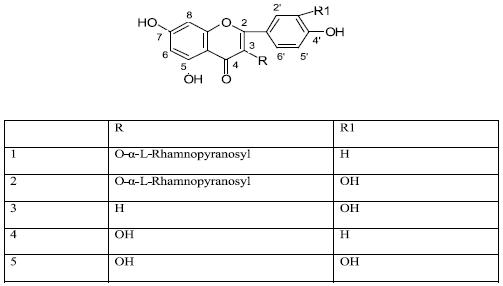
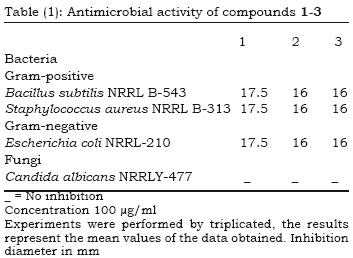
<body><![CDATA[<p align="justify"><font face="verdana" size="2">Each glycoside (2 mg) in 3 ml 2N HCl and 3 ml methanol, was heated at 100&deg;C for 2h. The mixture was left to cool, diluted with H<sub>2</sub>O and extracted twice with ethyl acetate. From the ethyl acetate layer, the aglycone was detected by TLC. The aqueous layer was repeatedly diluted with CH<sub>3</sub>OH and evaporated to dryness. The residue was investigated to detect the sugar L&#150;rham&#150;nose by paper chromatography (PC) using solvent system BAW (n&#150;BuOH&#150;HOAc&#150;H<sub>2</sub>O, 4: 1: 5, top layer). </font></p>     <p align="justify"><font face="verdana" size="2"><b>Antimicrobial activity</b></font></p>     <p align="justify"><font face="verdana" size="2">The antibacterial activity of the tested compounds were carried out against <i>Bacillus subtilis </i>NRRL B&#150;543 and <i>Staphylococcus aureus </i>NRRL B&#150;313 (Gram+ve bacteria) as well as <i>Escherichia coli </i>NRRL B&#150;210 (Gram &#150;ve bacteria) using nutrient agar medium. The antifungal activity of these compounds was also tested against <i>Candida albicans </i>NRRL Y&#150;477 using Sabouraud dextrose agar medium.</font></p>     <p align="justify"><font face="verdana" size="2">&nbsp;</font></p>     <p align="justify"><font face="verdana" size="2"><b>RESULTS AND DISCUSSION</b></font></p>     <p align="justify"><font face="verdana" size="2">As described in the experimental section, from the methanolic extract of A. chinensis leaves, the flavonoids kaempferol 3&#150;O&#150;&#945;&#150;L&#150;rhamnopyranoside <b>(1 </b>), quercetin 3&#150;O&#150;&#945;&#150;L&#150;rhamnopyranoside <b>(2) </b>luteolin <b>(3) </b>kaempferol <b>(4) </b>and quercetin <b>(5), </b>were isolated. The structural identification of the isolates was elucidated by acid hydrolysis, UV, <sup>1</sup>H and <sup>13</sup>CNMR spectroscopic analysis and/or comparison with published data.</font></p>     <p align="justify"><font face="verdana" size="2">Kaempferol 3&#150;O&#150;&#945;&#150;L&#150;rhamnopyranoside <b>(1) </b>was obtained as a yellow powder. The <sup>1</sup>HNMR spectrum of 1 showed one set of <i>meta</i>&#150;coupled aromatic protons at 5 6.23 (1H, d, <i>J</i>=2.3 Hz) and &#948; 6.43 (1H, d, <i>J</i>= 2.3 Hz) and two sets of <i>ortho</i>&#150;coupled aromatic protons at &#948; 7.82 (2H, d, <i>J= </i>8.4 Hz) and &#948; 6.99 (2H, d, <i>J</i>=8.4 Hz). These signals were assigned to H&#150;6, H&#150;8, H&#150;2' and H&#150;6' and H&#150;3' and H&#150;5', respectively, of 4', 5, 7&#150; tri&#150;hydroxy flavonol skeleton. The two doublets at &#948; 5.49 (1H, <i>J</i>= 1.5 Hz, H&#150;1") and &#948; 0.86 (3H, <i>J= </i>5.6 Hz, H&#150;6"), suggested the presence of a rhamnose moiety in the structure of <b>1 </b>(Markham, 1978). The nature of the sugar was confirmed by acid hydrolysis of the glycoside and paper chromatography of the obtained rhamnose against authentic sample. The attachment of the rhamnose moiety to C&#150;3 position of the aglycone was deduced from the two carbon signals at 5 134.9 assigned to C&#150;3 and 5 157.7 due to C&#150;2, in the <sup>13</sup>CNMR spectrum of <b>1</b>. The anomeric center of the rhamnose unit was determined to have a&#150;configuration based on <sup>3</sup><i>J</i><sub>H&#150;1</sub> <sub>H&#150;2</sub> value (1.5 Hz) and the pyra&#150;nose form of the sugar was revealed from its 13CNMR chemical shift values. These values were consistent with those of other flavonol 3&#150;O&#150;rhamnoside. Based on the spectral data and comparison with literature values, 1 was identified as kaempferol 3&#150;O&#150;&#945;&#150;L&#150;rhamnopyranoside.</font></p>     <p align="justify"><font face="verdana" size="2">Quercetin 3&#150;O&#150;&#945;&#150; L&#150;rhamnopyranoside <b>2 </b>(quercitrin) was obtained as a yellow powder. In the <sup>1</sup>HNMR spectrum of <b>2, </b>the presence of signals due to three <i>meta </i>&#150; coupled protons at &#948; 6.22 (1H, d, <i>J</i>=2.3 Hz, H&#150;6), &#948; 6.43 (1H, d, <i>J</i>= 2.3 Hz, H&#150;8) and &#948; 7.46 (1H, d, <i>J</i>= 2.3 Hz, H&#150;2') as well as two ortho&#150;coupled protons at &#948; 6.95 (1H, d, <i>J</i>= 8.4 Hz, H&#150;5') and &#948; 7.34 (1H, dd, <i>J= </i>8.4, 2.3 Hz, H&#150;6') along with carbon signal at &#948; 178.5 (C&#150;4) in the <sup>13</sup>CNMR spectrum, indicated a typical 3', 4', 5, 7&#150; tetrahy&#150;droxyflavonol skeleton. The two doublets in the <sup>1</sup>HNMR spectrum of 2 at &#948; 5.45 (1H, <i>J= </i>1.5 Hz) and &#948; 0.88 (3H, <i>J= </i>5.6 Hz) were assigned to H&#150;1" and H&#150;6" of a rhamnose unit. The <sup>13</sup>CNMR data of <b>2 </b>and the result of acid hydrolysis indicated a&#150;L&#150;rhamnoside. The attachment of the moiety at C&#150;3 position of the aglycone was revealed from the 5 value of C&#150;3 (5 135.0) and that of C&#150;2 (5 157.6) which are similar to the corresponding values of <b>1 </b>. Compound <b>2 </b>was then assigned the structure of quercetin 3&#150;O&#150;&#945;&#150;L&#150;rhamnoside based on the above spectral evidences and comparison with literature values. The flavonoids luteolin <b>(3), </b>kaempferol <b>(4) </b>and quercetin <b>(5) </b>were characterized by comparison of their spectral data with the literature values (Harborne, 1993). Kaempferol was previously isolated from <i>Albizia versicolor </i>(Rukunga &amp; Watermann, 1996) while luteolin was obtained from <i>A. julibrissin </i>(Jung <i>et al., </i>2004). Quercetin 3&#150;O&#150;&#945;&#150;L&#150; rhamnoside was reported also from <i>A. julibrissin </i>( Lau <i>et al., </i>2007). In the case of quercetin and kaempferol 3&#150;O&#150;&#945;&#150;L&#150;rhamnoside, to our knowledge this is the first reported occurrence of these compounds in the genus Albizia.</font></p>     <p align="justify"><font face="verdana" size="2">The activities assigned to the flavonoids identified in this work could explain some of the medicinal properties of <i>Albizia chi&#150;nensis.</i></font></p>     <p align="justify"><font face="verdana" size="2">The antibacterial activity for compounds <b>1&#150;<i>3</i> </b>against the micro&#150;organisms <i>Bacillus subtilis </i>NRRL B&#150;543 and <i>Staphylococcus aureus </i>NRRL B&#150;313 (Gram +ve bacteria) and <i>Escherichia coli </i>NRRL B&#150;210 (Gram &#150;ve bacteria) together with the antifungal activity against <i>Candida albicans </i>NRRL Y&#150;477, were studied using the agar diffusion method (Cruickshank <i>et al., </i>1975). The results (<a href="#t1">Table 1</a>) revealed that, in our experimental conditions, the tested compounds exhibited moderate inhibiting activity against gram&#150;positive and gram&#150;negative bacteria while no antifungal   activity was observed.</font></p>     ]]></body>
<body><![CDATA[<p align="center"><font face="verdana" size="2"><a name="t1"></a></font></p>     <p align="center"><font face="verdana" size="2"><img src="/img/revistas/rlq/v38n3/a3t1.jpg"></font></p>     <p align="center"><font face="verdana" size="2"><img src="/img/revistas/rlq/v38n3/a3f1.jpg"></font></p>     <p align="center"><font face="verdana" size="2">&nbsp;</font></p>     <p align="justify"><font face="verdana" size="2">&nbsp;</font></p>     <p align="justify"><font face="verdana" size="2"><b>REFERENCES</b></font></p>     <!-- ref --><p align="justify"><font face="verdana" size="2">Chadha, Y.R. (1985). The Wealth of India, Raw Materials; Publication and information Directorate Vol.1A. Council of Scientific and Industrial Research, New Delhi, p. 126.    &nbsp;&nbsp;&nbsp;&nbsp;&nbsp;&nbsp;&nbsp;&nbsp;[&#160;<a href="javascript:void(0);" onclick="javascript: window.open('/scielo.php?script=sci_nlinks&ref=7365406&pid=S0370-5943201000030000300001&lng=','','width=640,height=500,resizable=yes,scrollbars=1,menubar=yes,');">Links</a>&#160;]<!-- end-ref --> </font></p>     <!-- ref --><p align="justify"><font face="verdana" size="2">Cruickshank, R., Duguid, J.P., Marmion, B.P., Swain, R.H.A. (1975). Medical Microbiology, 12th Ed. Vol. II Churchill</font>&nbsp;&nbsp;&nbsp;&nbsp;&nbsp;&nbsp;&nbsp;&nbsp;[&#160;<a href="javascript:void(0);" onclick="javascript: window.open('/scielo.php?script=sci_nlinks&ref=7365408&pid=S0370-5943201000030000300002&lng=','','width=640,height=500,resizable=yes,scrollbars=1,menubar=yes,');">Links</a>&#160;]<!-- end-ref --><!-- ref --><p align="justify"><font face="verdana" size="2">Harborne, J.B. (1993). The Flavonoids Advances in Research". Chapman and Hall, London.    &nbsp;&nbsp;&nbsp;&nbsp;&nbsp;&nbsp;&nbsp;&nbsp;[&#160;<a href="javascript:void(0);" onclick="javascript: window.open('/scielo.php?script=sci_nlinks&ref=7365409&pid=S0370-5943201000030000300003&lng=','','width=640,height=500,resizable=yes,scrollbars=1,menubar=yes,');">Links</a>&#160;]<!-- end-ref --></font></p>     <!-- ref --><p align="justify"><font face="verdana" size="2">Jung, M.J., Kang, S.S., Jung, H.A., Kim, G.J., Choi, J.S. (2004) Isolation of flavonoids and a cerebroside from the stem bark of <i>Albizia julibrissin. Archives of Pharmacal Research </i><b>27: </b>593&#150;599.    &nbsp;&nbsp;&nbsp;&nbsp;&nbsp;&nbsp;&nbsp;&nbsp;[&#160;<a href="javascript:void(0);" onclick="javascript: window.open('/scielo.php?script=sci_nlinks&ref=7365411&pid=S0370-5943201000030000300004&lng=','','width=640,height=500,resizable=yes,scrollbars=1,menubar=yes,');">Links</a>&#160;]<!-- end-ref --></font></p>     <!-- ref --><p align="justify"><font face="verdana" size="2">Lau, C.S., Carrier, D.J., Beitle, R.R., Bransby, D.I., Howard, L.R., Lay, J. J.O., Liyanage, R., Clausen, E.C. (2007) Identification and quantification of glycoside flavonoids in the energy crop <i>Albizia julibrissin. Bioresource Technology </i><b>98: </b>429&#150;435.    &nbsp;&nbsp;&nbsp;&nbsp;&nbsp;&nbsp;&nbsp;&nbsp;[&#160;<a href="javascript:void(0);" onclick="javascript: window.open('/scielo.php?script=sci_nlinks&ref=7365413&pid=S0370-5943201000030000300005&lng=','','width=640,height=500,resizable=yes,scrollbars=1,menubar=yes,');">Links</a>&#160;]<!-- end-ref --></font></p>     <!-- ref --><p align="justify"><font face="verdana" size="2">Liu, R., Yu, S., Pei, Y. (2009) Chemical constituents from leaves of <i>Albizia chinensis. Zhongguo Zhong Yao Za Zhi </i><b>34</b>(16): 2063&#150;2066.    &nbsp;&nbsp;&nbsp;&nbsp;&nbsp;&nbsp;&nbsp;&nbsp;[&#160;<a href="javascript:void(0);" onclick="javascript: window.open('/scielo.php?script=sci_nlinks&ref=7365415&pid=S0370-5943201000030000300006&lng=','','width=640,height=500,resizable=yes,scrollbars=1,menubar=yes,');">Links</a>&#160;]<!-- end-ref --> </font></p>     <!-- ref --><p align="justify"><font face="verdana" size="2">Markham, K. R., Ternai, B., Stanley, R., Geiger, H., Mabry, T. J. (1978) Carbon 13 NMR studies of flavonoids &#150;III: Naturally occurring flavonoid glycosides and their acylated derivatives. <i>Tetrahedron </i><b>34: </b>1389&#150;1397.    &nbsp;&nbsp;&nbsp;&nbsp;&nbsp;&nbsp;&nbsp;&nbsp;[&#160;<a href="javascript:void(0);" onclick="javascript: window.open('/scielo.php?script=sci_nlinks&ref=7365417&pid=S0370-5943201000030000300007&lng=','','width=640,height=500,resizable=yes,scrollbars=1,menubar=yes,');">Links</a>&#160;]<!-- end-ref --> </font></p>     <!-- ref --><p align="justify"><font face="verdana" size="2">Melek, F.R., Miyase, T., Ghaly, N.S., Nabil, M. (2007) Triterpenoid saponins with N&#150;acetyl sugar from the bark of <i>Albizia procera. Phytochemistry </i><b>68: </b>1261&#150;1266.    &nbsp;&nbsp;&nbsp;&nbsp;&nbsp;&nbsp;&nbsp;&nbsp;[&#160;<a href="javascript:void(0);" onclick="javascript: window.open('/scielo.php?script=sci_nlinks&ref=7365419&pid=S0370-5943201000030000300008&lng=','','width=640,height=500,resizable=yes,scrollbars=1,menubar=yes,');">Links</a>&#160;]<!-- end-ref --> </font></p>     <!-- ref --><p align="justify"><font face="verdana" size="2">Miyase, T., Melek, F.R., Ghaly, N.S., Warashina, T., El&#150;Kady, M., Nabil, M. (2010) Echinocystic acid   3, 16&#150;O&#150;bisglycosides from <i>Albizia procera. Phytochemistry </i><b>71: </b>1375&#150;1380.    &nbsp;&nbsp;&nbsp;&nbsp;&nbsp;&nbsp;&nbsp;&nbsp;[&#160;<a href="javascript:void(0);" onclick="javascript: window.open('/scielo.php?script=sci_nlinks&ref=7365421&pid=S0370-5943201000030000300009&lng=','','width=640,height=500,resizable=yes,scrollbars=1,menubar=yes,');">Links</a>&#160;]<!-- end-ref --> </font></p>     <!-- ref --><p align="justify"><font face="verdana" size="2">Rukunga, G.M., Waterman, P.G. (1996) Kaempferol glycosides from <i>Albizia versicolor. Bulletin of the Chemical Society of Ethiopia </i><b>10</b>(1), 47&#150;51.    &nbsp;&nbsp;&nbsp;&nbsp;&nbsp;&nbsp;&nbsp;&nbsp;[&#160;<a href="javascript:void(0);" onclick="javascript: window.open('/scielo.php?script=sci_nlinks&ref=7365423&pid=S0370-5943201000030000300010&lng=','','width=640,height=500,resizable=yes,scrollbars=1,menubar=yes,');">Links</a>&#160;]<!-- end-ref --> </font></p>     <!-- ref --><p align="justify"><font face="verdana" size="2">Watt, J.M. Breyer&#150;brandwijk, M.C. (1962). Medicinal and poisonous Plants of South and East Africa. Second ed. Livingstone, Edinburgh, p. 553.    &nbsp;&nbsp;&nbsp;&nbsp;&nbsp;&nbsp;&nbsp;&nbsp;[&#160;<a href="javascript:void(0);" onclick="javascript: window.open('/scielo.php?script=sci_nlinks&ref=7365425&pid=S0370-5943201000030000300011&lng=','','width=640,height=500,resizable=yes,scrollbars=1,menubar=yes,');">Links</a>&#160;]<!-- end-ref --></font></p>      ]]></body><back>
<ref-list>
<ref id="B1">
<nlm-citation citation-type="book">
<person-group person-group-type="author">
<name>
<surname><![CDATA[Chadha]]></surname>
<given-names><![CDATA[Y.R.]]></given-names>
</name>
</person-group>
<source><![CDATA[The Wealth of India, Raw Materials; Publication and information Directorate]]></source>
<year>1985</year>
<volume>1A</volume>
<page-range>126</page-range><publisher-loc><![CDATA[New Delhi ]]></publisher-loc>
<publisher-name><![CDATA[Council of Scientific and Industrial Research]]></publisher-name>
</nlm-citation>
</ref>
<ref id="B2">
<nlm-citation citation-type="book">
<person-group person-group-type="author">
<name>
<surname><![CDATA[Cruickshank]]></surname>
<given-names><![CDATA[R.]]></given-names>
</name>
<name>
<surname><![CDATA[Duguid]]></surname>
<given-names><![CDATA[J.P.]]></given-names>
</name>
<name>
<surname><![CDATA[Marmion]]></surname>
<given-names><![CDATA[B.P.]]></given-names>
</name>
<name>
<surname><![CDATA[Swain]]></surname>
<given-names><![CDATA[R.H.A.]]></given-names>
</name>
</person-group>
<source><![CDATA[Medical Microbiology]]></source>
<year>1975</year>
<volume>II</volume>
<edition>12th</edition>
<publisher-name><![CDATA[Churchill]]></publisher-name>
</nlm-citation>
</ref>
<ref id="B3">
<nlm-citation citation-type="book">
<person-group person-group-type="author">
<name>
<surname><![CDATA[Harborne]]></surname>
<given-names><![CDATA[J.B.]]></given-names>
</name>
</person-group>
<source><![CDATA[The Flavonoids Advances in Research]]></source>
<year>1993</year>
<publisher-loc><![CDATA[London ]]></publisher-loc>
<publisher-name><![CDATA[Chapman and Hall]]></publisher-name>
</nlm-citation>
</ref>
<ref id="B4">
<nlm-citation citation-type="journal">
<person-group person-group-type="author">
<name>
<surname><![CDATA[Jung]]></surname>
<given-names><![CDATA[M.J.]]></given-names>
</name>
<name>
<surname><![CDATA[Kang]]></surname>
<given-names><![CDATA[S.S.]]></given-names>
</name>
<name>
<surname><![CDATA[Jung]]></surname>
<given-names><![CDATA[H.A.]]></given-names>
</name>
<name>
<surname><![CDATA[Kim]]></surname>
<given-names><![CDATA[G.J.]]></given-names>
</name>
<name>
<surname><![CDATA[Choi]]></surname>
<given-names><![CDATA[J.S.]]></given-names>
</name>
</person-group>
<article-title xml:lang="en"><![CDATA[Isolation of flavonoids and a cerebroside from the stem bark of Albizia julibrissin]]></article-title>
<source><![CDATA[Archives of Pharmacal Research]]></source>
<year>2004</year>
<volume>27</volume>
<page-range>593-599</page-range></nlm-citation>
</ref>
<ref id="B5">
<nlm-citation citation-type="journal">
<person-group person-group-type="author">
<name>
<surname><![CDATA[Lau]]></surname>
<given-names><![CDATA[C.S.]]></given-names>
</name>
<name>
<surname><![CDATA[Carrier]]></surname>
<given-names><![CDATA[D.J.]]></given-names>
</name>
<name>
<surname><![CDATA[Beitle]]></surname>
<given-names><![CDATA[R.R.]]></given-names>
</name>
<name>
<surname><![CDATA[Bransby]]></surname>
<given-names><![CDATA[D.I.]]></given-names>
</name>
<name>
<surname><![CDATA[Howard]]></surname>
<given-names><![CDATA[L.R.]]></given-names>
</name>
<name>
<surname><![CDATA[Lay]]></surname>
<given-names><![CDATA[J. J.O.]]></given-names>
</name>
<name>
<surname><![CDATA[Liyanage]]></surname>
<given-names><![CDATA[R.]]></given-names>
</name>
<name>
<surname><![CDATA[Clausen]]></surname>
<given-names><![CDATA[E.C.]]></given-names>
</name>
</person-group>
<article-title xml:lang="en"><![CDATA[Identification and quantification of glycoside flavonoids in the energy crop Albizia julibrissin]]></article-title>
<source><![CDATA[Bioresource Technology]]></source>
<year>2007</year>
<volume>98</volume>
<page-range>429-435</page-range></nlm-citation>
</ref>
<ref id="B6">
<nlm-citation citation-type="journal">
<person-group person-group-type="author">
<name>
<surname><![CDATA[Liu]]></surname>
<given-names><![CDATA[R.]]></given-names>
</name>
<name>
<surname><![CDATA[Yu]]></surname>
<given-names><![CDATA[S.]]></given-names>
</name>
<name>
<surname><![CDATA[Pei]]></surname>
<given-names><![CDATA[Y.]]></given-names>
</name>
</person-group>
<article-title xml:lang="en"><![CDATA[Chemical constituents from leaves of Albizia chinensis]]></article-title>
<source><![CDATA[Zhongguo Zhong Yao Za Zhi]]></source>
<year>2009</year>
<volume>34</volume>
<numero>16</numero>
<issue>16</issue>
<page-range>2063-2066</page-range></nlm-citation>
</ref>
<ref id="B7">
<nlm-citation citation-type="journal">
<person-group person-group-type="author">
<name>
<surname><![CDATA[Markham]]></surname>
<given-names><![CDATA[K. R.]]></given-names>
</name>
<name>
<surname><![CDATA[Ternai]]></surname>
<given-names><![CDATA[B.]]></given-names>
</name>
<name>
<surname><![CDATA[Stanley]]></surname>
<given-names><![CDATA[R.]]></given-names>
</name>
<name>
<surname><![CDATA[Geiger]]></surname>
<given-names><![CDATA[H.]]></given-names>
</name>
<name>
<surname><![CDATA[Mabry]]></surname>
<given-names><![CDATA[T. J.]]></given-names>
</name>
</person-group>
<article-title xml:lang="en"><![CDATA[Carbon 13 NMR studies of flavonoids -III: Naturally occurring flavonoid glycosides and their acylated derivatives]]></article-title>
<source><![CDATA[Tetrahedron]]></source>
<year>1978</year>
<volume>34</volume>
<page-range>1389-1397</page-range></nlm-citation>
</ref>
<ref id="B8">
<nlm-citation citation-type="journal">
<person-group person-group-type="author">
<name>
<surname><![CDATA[Melek]]></surname>
<given-names><![CDATA[F.R.]]></given-names>
</name>
<name>
<surname><![CDATA[Miyase]]></surname>
<given-names><![CDATA[T.]]></given-names>
</name>
<name>
<surname><![CDATA[Ghaly]]></surname>
<given-names><![CDATA[N.S.]]></given-names>
</name>
<name>
<surname><![CDATA[Nabil]]></surname>
<given-names><![CDATA[M.]]></given-names>
</name>
</person-group>
<article-title xml:lang="en"><![CDATA[Triterpenoid saponins with N-acetyl sugar from the bark of Albizia procera]]></article-title>
<source><![CDATA[Phytochemistry]]></source>
<year>2007</year>
<volume>68</volume>
<page-range>1261-1266</page-range></nlm-citation>
</ref>
<ref id="B9">
<nlm-citation citation-type="journal">
<person-group person-group-type="author">
<name>
<surname><![CDATA[Miyase]]></surname>
<given-names><![CDATA[T.]]></given-names>
</name>
<name>
<surname><![CDATA[Melek]]></surname>
<given-names><![CDATA[F.R.]]></given-names>
</name>
<name>
<surname><![CDATA[Ghaly]]></surname>
<given-names><![CDATA[N.S.]]></given-names>
</name>
<name>
<surname><![CDATA[Warashina]]></surname>
<given-names><![CDATA[T.]]></given-names>
</name>
<name>
<surname><![CDATA[El-Kady]]></surname>
<given-names><![CDATA[M.]]></given-names>
</name>
<name>
<surname><![CDATA[Nabil]]></surname>
<given-names><![CDATA[M.]]></given-names>
</name>
</person-group>
<article-title xml:lang="en"><![CDATA[Echinocystic acid 3, 16-O-bisglycosides from Albizia procera]]></article-title>
<source><![CDATA[Phytochemistry]]></source>
<year>2010</year>
<volume>71</volume>
<page-range>1375-1380</page-range></nlm-citation>
</ref>
<ref id="B10">
<nlm-citation citation-type="journal">
<person-group person-group-type="author">
<name>
<surname><![CDATA[Rukunga]]></surname>
<given-names><![CDATA[G.M.]]></given-names>
</name>
<name>
<surname><![CDATA[Waterman]]></surname>
<given-names><![CDATA[P.G.]]></given-names>
</name>
</person-group>
<article-title xml:lang="en"><![CDATA[Kaempferol glycosides from Albizia versicolor]]></article-title>
<source><![CDATA[Bulletin of the Chemical Society of Ethiopia]]></source>
<year>1996</year>
<volume>10</volume>
<numero>1</numero>
<issue>1</issue>
<page-range>47-51</page-range></nlm-citation>
</ref>
<ref id="B11">
<nlm-citation citation-type="book">
<person-group person-group-type="author">
<name>
<surname><![CDATA[Watt]]></surname>
<given-names><![CDATA[J.M.]]></given-names>
</name>
<name>
<surname><![CDATA[Breyer-brandwijk]]></surname>
<given-names><![CDATA[M.C.]]></given-names>
</name>
</person-group>
<source><![CDATA[Medicinal and poisonous Plants of South and East Africa]]></source>
<year>1962</year>
<edition>Second</edition>
<page-range>553</page-range><publisher-loc><![CDATA[Edinburgh ]]></publisher-loc>
<publisher-name><![CDATA[Livingstone]]></publisher-name>
</nlm-citation>
</ref>
</ref-list>
</back>
</article>