<?xml version="1.0" encoding="ISO-8859-1"?><article xmlns:mml="http://www.w3.org/1998/Math/MathML" xmlns:xlink="http://www.w3.org/1999/xlink" xmlns:xsi="http://www.w3.org/2001/XMLSchema-instance">
<front>
<journal-meta>
<journal-id>0188-8897</journal-id>
<journal-title><![CDATA[Hidrobiológica]]></journal-title>
<abbrev-journal-title><![CDATA[Hidrobiológica]]></abbrev-journal-title>
<issn>0188-8897</issn>
<publisher>
<publisher-name><![CDATA[Universidad Autónoma Metropolitana, División de Ciencias Biológicas y de la Salud]]></publisher-name>
</publisher>
</journal-meta>
<article-meta>
<article-id>S0188-88972013000300009</article-id>
<title-group>
<article-title xml:lang="en"><![CDATA[Effects of temperature and salinity during the embryonic period of Chirostoma humboldtianum and Chirostoma riojai (Atherinopsidae) until hatching]]></article-title>
<article-title xml:lang="es"><![CDATA[Efectos de temperatura y salinidad durante el período embrionario de Chirostoma humboldtianum y Chirostoma riojai (Atherinopsidae) hasta la eclosión]]></article-title>
</title-group>
<contrib-group>
<contrib contrib-type="author">
<name>
<surname><![CDATA[Hernández-Rubio]]></surname>
<given-names><![CDATA[María Cecilia]]></given-names>
</name>
<xref ref-type="aff" rid="A01"/>
</contrib>
<contrib contrib-type="author">
<name>
<surname><![CDATA[Figueroa-Lucero]]></surname>
<given-names><![CDATA[Gerardo]]></given-names>
</name>
<xref ref-type="aff" rid="A02"/>
</contrib>
</contrib-group>
<aff id="A01">
<institution><![CDATA[,Instituto Politécnico Nacional Escuela Nacional de Ciencias Biológicas Departamento de Zoología]]></institution>
<addr-line><![CDATA[México D.F.]]></addr-line>
<country>México</country>
</aff>
<aff id="A02">
<institution><![CDATA[,Universidad Autónoma Metropolitana División de Ciencias Biológicas y de la Salud ]]></institution>
<addr-line><![CDATA[México D. F.]]></addr-line>
<country>México</country>
</aff>
<pub-date pub-type="pub">
<day>00</day>
<month>12</month>
<year>2013</year>
</pub-date>
<pub-date pub-type="epub">
<day>00</day>
<month>12</month>
<year>2013</year>
</pub-date>
<volume>23</volume>
<numero>3</numero>
<fpage>365</fpage>
<lpage>373</lpage>
<copyright-statement/>
<copyright-year/>
<self-uri xlink:href="http://www.scielo.org.mx/scielo.php?script=sci_arttext&amp;pid=S0188-88972013000300009&amp;lng=en&amp;nrm=iso"></self-uri><self-uri xlink:href="http://www.scielo.org.mx/scielo.php?script=sci_abstract&amp;pid=S0188-88972013000300009&amp;lng=en&amp;nrm=iso"></self-uri><self-uri xlink:href="http://www.scielo.org.mx/scielo.php?script=sci_pdf&amp;pid=S0188-88972013000300009&amp;lng=en&amp;nrm=iso"></self-uri><abstract abstract-type="short" xml:lang="en"><p><![CDATA[Effects of incubation temperature (18, 20, 22 and 24 °C) and salinity (0, 4, 8, 12, 16, 20 and 24 g/L) on survival, development time and hatching size, during the embryonic period until hatching, of two freshwater endemic Mexican aterinopsids: Chirostoma humboldtianum (Valenciennes, 1835) and Chirostoma riojaiSolórzano and López (1965) were investigated. Embryos of both species did not survive at salinities up to 12 g/L. Hatching percentage was the highest at 22 °C and 0 g/L salinity, in both species (87%) and the lowest at 18° and 4-8 g/L in C. humboldtianum (39.95%) and at 24 °C and 12 g/L in C. riojai(33.23%). Hatching times were inversely proportional to incubation temperature increase; it was 15.5 ± 0.26 days in C. humboldtianum, and 12.4 ± 0.31 days in C. riojai, at 18 °C. At 24 °C, this period was 9.8 ± 0.11 and 7.8 ± 0.24 days, respectively. Hatching size was larger on high temperature and smaller on high salinity. The optimal temperature-salinity combination for hatching size was 24° C and 0 g/L in C. humboldtianum and 24 °C and 4 g/L in C. riojai. There was an interactive effect of temperature and salinity on percentage hatching and on hatching size. Although these species have low salinity tolerance, the use of salt has prophylactic uses for controlling pathogens sensitive to salt. C. humboldtianum and C. riojai are potential candidates for aquaculture for restocking purposes.]]></p></abstract>
<abstract abstract-type="short" xml:lang="es"><p><![CDATA[Los efectos de la temperatura (18, 20, 22 y 24 °C) y la salinidad (0, 4, 8, 12, 16, 20 y 24 g/L), fueron evaluados sobre la sobrevivencia, tiempo de desarrollo y talla de eclosión, de embriones de dos aterinópsidos endémicos dulceacuícolas mexicanos: Chirostoma humboldtianum (Valenciennes, 1835) y Chirostoma riojai Solórzano y López, 1965. Los embriones de ambas especies no sobrevivieron en salinidades superiores a 12 g/L. El mayor porcentaje de eclosión se obtuvo a 22 °C y 0 g/L de salinidad, en ambas especies (87%) y el más bajo a 18 °C y 4-8 g/L en C. humboldtianum (39.95%) y 24 °C y 12 g/L en C. riojai(33.23%). Los tiempos de eclosión disminuyeron conforme el incremento de la temperatura, desde 15.5 ± 0.26 días para C. humboldtianum y 12.4 ± 0.31 días en C. riojai a 18 °C, hasta 9.8 ± 0.11 y 7.8 ± 0.24 días, respectivamente, a 24° C. La talla de eclosión aumento con el incremento de la temperatura y disminuyó con salindades altas. La combinación óptima de temperatura-salinidad para la talla de eclosión fue 24° C-0 g/L en C. humboldtinum y 24 °C-4 g/L en C. riojai. Se presentó un efecto interactivo entre la temperatura y la salinidad en el porcentaje y la talla de eclosión. Aunque estas especies son poco tolerantes a la salinidad, el uso de la sal tiene efectos profilácticos para controlar patógenos sensibles a este. C. humboldtianum y C. riojai, son candidatos potenciales en acuacultura para propósitos de repoblación.]]></p></abstract>
<kwd-group>
<kwd lng="en"><![CDATA[Atherinopsidae]]></kwd>
<kwd lng="en"><![CDATA[embryo]]></kwd>
<kwd lng="en"><![CDATA[silverside]]></kwd>
<kwd lng="en"><![CDATA[survival]]></kwd>
<kwd lng="en"><![CDATA[tolerance]]></kwd>
<kwd lng="es"><![CDATA[Atherinopsidae]]></kwd>
<kwd lng="es"><![CDATA[embrión]]></kwd>
<kwd lng="es"><![CDATA[sobrevivencia]]></kwd>
<kwd lng="es"><![CDATA[tolerancia]]></kwd>
</kwd-group>
</article-meta>
</front><body><![CDATA[ 
	    <p align="justify"><font face="verdana" size="4">Art&iacute;culos</font></p>

	    <p align="justify"><font face="verdana" size="2">&nbsp;</font></p>

	    <p align="center"><font face="verdana" size="4"><b>Effects of temperature and salinity during the embryonic period of</b> <b><i>Chirostoma humboldtianum</i></b> <b>and</b> <b><i>Chirostoma riojai</i> (Atherinopsidae) until hatching</b></font></p>

	    <p align="center"><font face="verdana" size="2">&nbsp;</font></p>

	    <p align="center"><font face="verdana" size="3"><b>Efectos de temperatura y salinidad durante el per&iacute;odo embrionario de</b> <b><i>Chirostoma humboldtianum y Chirostoma</i></b> <b><i>riojai</i> (Atherinopsidae) hasta la eclosi&oacute;n</b></font></p>

	    <p align="center"><font face="verdana" size="2">&nbsp;</font></p>

	    <p align="center"><font face="verdana" size="2"><b>Mar&iacute;a Cecilia Hern&aacute;ndez&#45;Rubio<sup>1</sup> and Gerardo Figueroa&#45;Lucero<sup>2</sup></b></font></p>

	    <p align="justify"><font face="verdana" size="2">&nbsp;</font></p>

	    <p align="justify"><font face="verdana" size="2"><sup><i>1</i></sup><i>Departamento de Zoolog&iacute;a, Escuela Nacional de Ciencias Biol&oacute;gicas. Instituto Polit&eacute;cnico Nacional. Prolongaci&oacute;n</i> <i>de Carpio y Plan de Ayala. Santo Tom&aacute;s. M&eacute;xico, D.F., 11340. M&eacute;xico.</i></font><font face="verdana" size="2"> E&#45;mail: <a href="mailto:cecheru@yahoo.com.mx">cecheru@yahoo.com.mx</a></font></p>

    ]]></body>
<body><![CDATA[<p align="justify"><font face="verdana" size="2"><sup><i>2</i></sup><i>Departamento de Hidrobiolog&iacute;a. DCBS. Universidad Aut&oacute;noma Metropolitana&#45;Iztapalapa.</i> <i>Av. San Rafael Atlixco 186, Colonia Vicentina. M&eacute;xico, D. F., 09340. M&eacute;xico.</i></font></p>

	    <p align="justify"><font face="verdana" size="2">&nbsp;</font></p>

	    <p align="justify"><font face="verdana" size="2">Recibido: 10 de septiembre de 2012.    <br>
	Aceptado: 11 de Julio de 2013.</font></p>

	    <p align="justify"><font face="verdana" size="2">&nbsp;</font></p>

	    <p align="justify"><font face="verdana" size="2"><b>ABSTRACT</b></font></p>

	    <p align="justify"><font face="verdana" size="2">Effects of incubation temperature (18, 20, 22 and 24 &deg;C) and salinity (0, 4, 8, 12, 16, 20 and 24 g/L) on survival, development time and hatching size, during the embryonic period until hatching, of two freshwater endemic Mexican aterinopsids: <i>Chirostoma humboldtianum</i> (Valenciennes, 1835) and <i>Chirostoma riojai</i>Sol&oacute;rzano and L&oacute;pez (1965) were investigated. Embryos of both species did not survive at salinities up to 12 g/L. Hatching percentage was the highest at 22 &deg;C and 0 g/L salinity, in both species (87%) and the lowest at 18&deg; and 4&#45;8 g/L in <i>C. humboldtianum</i> (39.95%) and at 24 &deg;C and 12 g/L in <i>C. riojai</i>(33.23%). Hatching times were inversely proportional to incubation temperature increase; it was 15.5 &plusmn; 0.26 days in <i>C. humboldtianum,</i> and 12.4 &plusmn; 0.31 days in <i>C. riojai,</i> at 18 &deg;C. At 24 &deg;C, this period was 9.8 &plusmn; 0.11 and 7.8 &plusmn; 0.24 days, respectively. Hatching size was larger on high temperature and smaller on high salinity. The optimal temperature&#45;salinity combination for hatching size was 24&deg; C and 0 g/L in <i>C. humboldtianum</i> and 24 &deg;C and 4 g/L in <i>C. riojai.</i> There was an interactive effect of temperature and salinity on percentage hatching and on hatching size. Although these species have low salinity tolerance, the use of salt has prophylactic uses for controlling pathogens sensitive to salt. <i>C. humboldtianum</i> and <i>C. riojai</i> are potential candidates for aquaculture for restocking purposes.</font></p>

	    <p align="justify"><font face="verdana" size="2"><b>Key words:</b> Atherinopsidae, embryo, silverside, survival, tolerance.</font></p>

	    <p align="justify"><font face="verdana" size="2">&nbsp;</font></p>

	    <p align="justify"><font face="verdana" size="2"><b>RESUMEN</b></font></p>

	    ]]></body>
<body><![CDATA[<p align="justify"><font face="verdana" size="2">Los efectos de la temperatura (18, 20, 22 y 24 &deg;C) y la salinidad (0, 4, 8, 12, 16, 20 y 24 g/L), fueron evaluados sobre la sobrevivencia, tiempo de desarrollo y talla de eclosi&oacute;n, de embriones de dos aterin&oacute;psidos end&eacute;micos dulceacu&iacute;colas mexicanos: <i>Chirostoma humboldtianum</i> (Valenciennes, 1835) y <i>Chirostoma riojai</i> Sol&oacute;rzano y L&oacute;pez, 1965. Los embriones de ambas especies no sobrevivieron en salinidades superiores a 12 g/L. El mayor porcentaje de eclosi&oacute;n se obtuvo a 22 &deg;C y 0 g/L de salinidad, en ambas especies (87%) y el m&aacute;s bajo a 18 &deg;C y 4&#45;8 g/L en <i>C. humboldtianum</i> (39.95%) y 24 &deg;C y 12 g/L en <i>C. riojai</i>(33.23%). Los tiempos de eclosi&oacute;n disminuyeron conforme el incremento de la temperatura, desde 15.5 &plusmn; 0.26 d&iacute;as para <i>C. humboldtianum</i> y 12.4 &plusmn; 0.31 d&iacute;as en <i>C. riojai</i> a 18 &deg;C, hasta 9.8 &plusmn; 0.11 y 7.8 &plusmn; 0.24 d&iacute;as, respectivamente, a 24&deg; C. La talla de eclosi&oacute;n aumento con el incremento de la temperatura y disminuy&oacute; con salindades altas. La combinaci&oacute;n &oacute;ptima de temperatura&#45;salinidad para la talla de eclosi&oacute;n fue 24&deg; C&#45;0 g/L en <i>C. humboldtinum</i> y 24 &deg;C&#45;4 g/L en <i>C. riojai.</i> Se present&oacute; un efecto interactivo entre la temperatura y la salinidad en el porcentaje y la talla de eclosi&oacute;n. Aunque estas especies son poco tolerantes a la salinidad, el uso de la sal tiene efectos profil&aacute;cticos para controlar pat&oacute;genos sensibles a este. <i>C. humboldtianum</i> y <i>C. riojai,</i> son candidatos potenciales en acuacultura para prop&oacute;sitos de repoblaci&oacute;n.</font></p>

	    <p align="justify"><font face="verdana" size="2"><b>Palabras clave:</b> Atherinopsidae, embri&oacute;n, sobrevivencia, tolerancia.</font></p>

	    <p align="justify"><font face="verdana" size="2">&nbsp;</font></p>

	    <p align="justify"><font face="verdana" size="2"><b>INTRODUCTION</b></font></p>

	    <p align="justify"><font face="verdana" size="2">Life history of fish has a series of crucial developmental events, which are affected by extrinsic and intrinsic factors. Among the extrinsic factors, temperature is the factor with the greatest effect on development, growth and survival. Temperature effects on embryonic period may have an impact later in life history of fish (Wootton, 1990; Kamler, 1992).</font></p>

	    <p align="justify"><font face="verdana" size="2">Higher temperature values that are within species tolerance interval often induce abnormalities, particularly in the embryonic and larval periods. These abnormalities may affect the efficiency with which both the embryo uses the yolk and how food is used in subsequent developmental periods (Pavlov &amp; Moksness, 1997; Tucker, 1998; Sfakianakis <i>et al.,</i> 2004). Fish development is also associated with changes in temperature. If the temperature tolerance range at which a species can live is wide, it becomes significantly shorter for each stage of development (Nikolsky, 1963). During the endogenous feeding period the only source of energy is the yolk sac; therefore both survival and yolk utilization efficiency define the optimum temperature range (Kamler <i>et al.,</i> 1998).</font></p>

	    <p align="justify"><font face="verdana" size="2">Salinity is another extrinsic factor that also affects fish development. For those species that live in water with fluctuating salinity, or which move between bodies of water with different salinities, salinity acts as a masking factor, influencing osmotic and ionic regulation. It also acts as a directive factor in movement for those species that migrate. In euryhaline species, salinity preferences can change with the physiological and developmental stage fish (Holliday, 1969; Wootton, 1990).</font></p>

	    <p align="justify"><font face="verdana" size="2">Moreover, salinity reduces stress on fish during handling (Haswell &amp;Thorpe, 1982), acts as a prophylactic agent (Altinok &amp; Grizzle, 2001; Figueroa&#45;Lucero <i>et al.,</i> 2004; Hern&aacute;ndez&#45;Rubio <i>et al.,</i> 2006) and increases survival and motility of the sperm, resulting in higher reproductive success (Elofsson <i>et al.,</i> 2003).</font></p>

	    <p align="justify"><font face="verdana" size="2">In this study, it is recognized the genus <i>Chirostoma</i> in agreement to results of Bloom (Bloom <i>et al.,</i> 2009, 2013). Genus <i>Chirostoma</i> Swainson includes endemic species, with a marine common ancestor, that inhabit lentic bodies of the Mesa Central in Mexico, although three taxa, <i>C. jordani</i>Woolman 1894, <i>C. humboldtianum</i> (Valenciennes 1835) and <i>C. mezquital</i> Meek 1904, extend beyond this region (Barbour, 1973; Miller et al., 2005). <i>C. humboldtianum</i> is the species most similar to this ancestor and reaches a length of 200&#45;250 mm; <i>C. riojai</i>Sol&oacute;rzano &amp; L&oacute;pez 1965, is a species with primitive features and reaches a length of 74 mm (Barbour, 1973). These species, like others in this genus, are commercially fished and traditionally consumed in Mexico. They have aquaculture potential; however, the aquaculture success is poor because of the limited knowledge regarding factors, which affect their early development.</font></p>

	    <p align="justify"><font face="verdana" size="2">In recent years, populations of these species have been markedly affected by pollution and habitat alteration (Soto&#45;Galera <i>et al.,</i> 1998; Ford <i>et al.,</i> 2000). In consequence, <i>C. humboldtianum</i> populations are endangered and <i>C. riojai</i> is in risk of extinction (Mexican Official Standard NOM&#45;059&#45;SEMARNAT&#45;2010 ) and it must be considered Critically Endangered because is sensitive to environmental degradation and its range is now less than 10 km<sup>2</sup> and previously contiguous populations are now severely fragmented (Soto&#45;Galera <i>et al.,</i> 2008). This is the first study to examine salinity&#45;tolerance/effects in these species. The aim of this paper was to determine temperature and salinity effects and their combined effects on timing, survival and size at hatching of both species, in order to determine optimum levels of these factors during embryonic period for maximizing free embryos survival.</font></p>

	    ]]></body>
<body><![CDATA[<p align="justify"><font face="verdana" size="2">&nbsp;</font></p>

	    <p align="justify"><font face="verdana" size="2"><b>MATERIALS AND METHODS</b></font></p>

	    <p align="justify"><font face="verdana" size="2">Broodstocks of <i>Chirostoma humboldtianum</i> from Las Tazas dam and broodstocks of <i>C. riojai</i> from San Jacinto dam, both in Mexico State, Mexico, were caught to obtain eggs. Broods of each species were maintained in ponds of 5 m<sup>3</sup>, at 20 &deg;C. <i>C. humboldtianum</i> adults were fed with juveniles of <i>Heterandria</i> sp Agassiz 1853 (Poecilidae) and <i>C. riojai</i> adults were fed with cladoceran <i>Moina macrocopa</i> (Straus, 1820).</font></p>

	    <p align="justify"><font face="verdana" size="2">Eggs were obtained by <i>in vitro</i> fertilization (Hern&aacute;ndez&#45;Rubio <i>et al.,</i> 2006). Broods were anesthetized in benzocaine (8 mg L<sup>&#45;1</sup>). Ova and semen were placed in water at 5 g L<sup>&#45;1</sup> of salinity and 20 &deg;C and were gently mixed for a few minutes. The silverside eggs have filaments to attach to vegetation during natural spawning. These were cut once the perivitelline space had been formed, to avoid proliferation of fungi and bacteria.</font></p>

	    <p align="justify"><font face="verdana" size="2"><b>Experimental design and rearing conditions.</b> Batches of ten eggs, with three replicates, were placed in 250 mL covered glass with filtered water, at each experimental temperature and salinity. The water of each treatment was replaced every third day, until hatching. Each treatment was one combination of the following salinities: 0, 4, 8, 12, 16, 20 and 24 g L<sup>&#45;1</sup> (Sigma, TM) and temperatures: 18, 20, 22 and 24 &deg;C.</font></p>

	    <p align="justify"><font face="verdana" size="2">Under laboratory conditions, both species spawned between 17 and 21 &deg;C; reproduction was not successful at 15 &deg;C (Figueroa&#45;Lucero <i>et al.,</i> 2007); subsequently temperatures rise during <i>C. humboldtianum</i> and <i>C. riojai</i> early development. Therefore, in the present study, the experimental viable temperatures were 18, 20, 22 and 24 &deg;C. With respect to salinity, we chose this range of salinities to test because the salinity tolerance of the eggs in these species is unknown.</font></p>

	    <p align="justify"><font face="verdana" size="2">Age of embryos was estimated from activation, i.e. the moment when water was added to the ova mixed with milt. Every day, mortality and developmental state of embryos were registered. Percentage hatching, incubation time and size at hatching were registered. Developmental stages were defined as described by Balon (1985). The term embryo is applied to fish developing inside the egg and the term free embryo or eleutheroembryo (ELH) to fish after hatching.</font></p>

	    <p align="justify"><font face="verdana" size="2">Values for % hatch (p<sub>ij</sub>) were transformed to the arcsine &radic;p<sub>ij</sub> (angular transformation) before analysis. Homogeneity of variances was verified by Bartlett's test before each analysis (Sokal &amp; Rohlf, 1969) and &#967;<sup>2</sup> was no significant in all cases. Temperature and salinity effects on % hatch, incubation time, and on eleutheroembryos (ELH) notochordal length (NL) at hatching of each species, were evaluated through a two&#45;way full factorial ANOVA, with &#945; = 0.05. Duncan's <i>post hoc</i> multiple range test, for equal sample sizes, was used for comparing all pairs of treatments means following ANOVA analyses with &#945; set at 0.05 (Montgomery, 1991). Regressions of % hatch over temperature were performed by least squares iteration and were fitted to polynomial curves, for each species and regressions of % hatch over salinity were fitted to linear functions, y = a + bx, (y = % hatch and x = salinity) (Sokal &amp; Rohlf, 1969).</font></p>

	    <p align="justify"><font face="verdana" size="2">Developmental time to hatch over temperature was fitted to an exponential function <i>y</i> = a <i>e<sup>xb</sup></i> by least squares iteration, where <i>y</i> represents time in days to hatch, <i>x</i> represents constant temperature (&deg;C), within the optimum range, as reported in Kamler, (1992). Regressions of notochordal length (NL) over temperature and salinity were performed by least squares methods, where y = NL (mm) and x = temperature (&deg;C) or salinity (gL<sup>&#45;1</sup>) (Sokal &amp; Rohlf, 1969).</font></p>

	    <p align="justify"><font face="verdana" size="2">&nbsp;</font></p>

	    ]]></body>
<body><![CDATA[<p align="justify"><font face="verdana" size="2"><b>RESULTS</b></font></p>

	    <p align="justify"><font face="verdana" size="2"><i>Chirostoma humboldtianum</i> ovum has one to four long filaments (mode = 1) and <i>C. riojai</i> ovum has only one long filament. In both species, filaments are in vegetal pole and involve their surface. Eggs are telolecithal, spherical, and pelagic and their chorion is smooth. <i>C. humboldtianum</i> eggs are 1.36 &plusmn; 0.047 mm (n = 100) in diameter and slightly amber colored; <i>C. riojai</i> eggs are transparent and have a diameter 1.24 &plusmn; 0.05 mm (n = 100). Mean egg diameter of each species differed significantly (t, <i>p</i> &lt; 0.05).</font></p>

	    <p align="justify"><font face="verdana" size="2"><b>Percentage of hatching and incubation time.</b> Eggs subjected up to 16 g L<sup>&#45;1</sup> of salinity, died 24 h post&#45;fertilization (division phase) and those in 16 g/L<sup>&#45;1</sup> of salinity died before hatching, in all the temperatures, in both species. The experimental viable salinities were 0, 4, 8 and 12 gL<sup>&#45;1</sup>.</font></p>

	    <p align="justify"><font face="verdana" size="2">Both temperature and salinity had a significant effect on percentage hatching (F<sub>3,32</sub>, <i>p</i> &lt; 0.001, two&#45;way ANOVA, in each species). Duncan tests demonstrated significant differences among treatments and showed an optimal type curve respect to temperature. At hatching, 87% of ELH survived at 22&deg; C in <i>C. humboldtianum</i> and at 20&deg; C in <i>C. riojai.</i> Percentage hatching was inversely proportional to salinity, survival was the highest at 0 gL<sup>&#45;1</sup> (87% in both species) and it was depressed at 4&#45;8 gL<sup>&#45;1</sup> salinity in <i>C. humboldtianum</i> (40%) and at 12 gL<sup>&#45;1</sup> in <i>C. riojai</i> (33%).</font></p>

	    <p align="justify"><font face="verdana" size="2">The interaction between temperature and salinity was also significant (F<sub>9,32</sub>, <i>p</i> &lt; 0.001, two&#45;way ANOVA, in both species) but it explained only 6.3 and 15% of the variance on % hatching, respectively (<a href="/img/revistas/hbio/v23n3/a9f1.jpg" target="_blank">Figs. 1</a>&#45;<a href="/img/revistas/hbio/v23n3/a9f2.jpg" target="_blank">2</a>).</font></p>

	    <p align="justify"><font face="verdana" size="2">Mean time to hatch was inversely proportional to temperature for each species (<a href="/img/revistas/hbio/v23n3/a9f3.jpg" target="_blank">Fig. 3</a>). This period ranged from 15.6 &plusmn; 0.26 (C. <i>humboldtianum)</i> and 12.4 &plusmn; 0.31 (C. <i>riojai)</i> days at 18 &deg;C, to 9.8 &plusmn; 0.11 and 7.8 &plusmn; 0.24 days at 24 &deg;C, respectively. In both species, temperature had the highest effect on mean time to hatch (F<sub>3</sub>, <sub>32</sub>, <i>p</i> &lt; 0.0001, two&#45;way ANOVA). Salinity had a significant effect on time to hatch in <i>C. riojai</i> embryos but explained only 9.5% of the variance. The interaction between factors was significant in mean time to hatch of <i>C. humboldtianum</i> embryos but explained only 2.4% of the variance (F<sub>3</sub>, <sub>32</sub>, <i>p</i> = 0.03).</font></p>

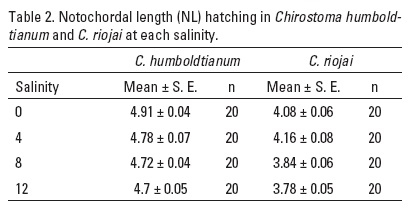
	    <p align="justify"><font face="verdana" size="2"><b>Size at hatching.</b> In both species, higher incubation temperature caused a significantly greater length al hatch (F<sub>3</sub>, <sub>64</sub>, <i>p</i> = 0.003, <i>C. humboldtianum</i> and F<sub>3</sub>, <sub>64</sub>, <i>p</i> &lt; 0.0001, <i>C. riojai,</i> two&#45;way ANOVA) and NL embryos was increased inversely to salinity (F<sub>3</sub>, <sub>64</sub>, <i>p</i> = 0.006, and F<sub>3</sub>, <sub>64</sub>, <i>p</i> &lt; 0.0001, respectively, two&#45;way ANOVA). The interaction between both factors was significant only for <i>C. humboldtianum</i> ELH (F<sub>9</sub>,<sub>64</sub>, <i>p</i> = 0.004, two&#45;way ANOVA) (<a href="#t1">Tables 1</a>&#45;<a href="#t2">2</a>) (<a href="/img/revistas/hbio/v23n3/a9f4.jpg" target="_blank">Figs. 4</a>&#45;<a href="/img/revistas/hbio/v23n3/a9f5.jpg" target="_blank">5</a>).</font></p>

	    <p align="center"><font face="verdana" size="2"><a name="t1"></a></font></p>

	    <p align="center"><font face="verdana" size="2"><img src="/img/revistas/hbio/v23n3/a9t1.jpg"></font></p>

	    <p align="center"><font face="verdana" size="2"><a name="t2"></a></font></p>

	    ]]></body>
<body><![CDATA[<p align="center"><font face="verdana" size="2"><img src="/img/revistas/hbio/v23n3/a9t2.jpg"></font></p>

	    <p align="justify"><font face="verdana" size="2">&nbsp;</font></p>

	    <p align="justify"><font face="verdana" size="2"><b>DISCUSSION</b></font></p>

	    <p align="justify"><font face="verdana" size="2">Temperature is the major extrinsic factor controlling the embryonic period of <i>C. humboldtianum</i> and <i>C. riojai.</i> The first lives in water temperature range between 12&#45;25 &deg;C. The second inhabit in water temperature between 8&#45;24 &deg;C (Figueroa&#45;Lucero <i>et al.,</i> 2003). In environmental natural conditions, both species spawn all year; the first has a maximum in January&#45;April and June&#45;August (Figueroa&#45;Lucero <i>et al,</i> 2007). The second has a maximum from June to September (Figueroa&#45;Lucero <i>et al.,</i> 2003). When the field temperatures increase (march&#45;august), temperatures near shore are higher; it is the place where embryos and larvae live and it is the time when these species are on their early ontogeny (embryonic, larval periods).</font></p>

	    <p align="justify"><font face="verdana" size="2">In laboratory conditions, both species spawned between 17 and 21 &deg;C; reproduction was not successful at 15 &deg;C. Increased temperature resulted in a significantly spawning rate (Figueroa&#45;Lucero <i>et al.,</i> 2007). In the present study, incubation temperature response was adjusted to an optimal type curve, at both the low and high ends (18 and 24 &deg;C) of the temperature range, percentage hatching was lower in both species. These results coincide with the response to this factor for most fish species, at constant temperature. Thermal optima can vary depending on life history and optima for egg incubation may be different from others events during development (Kamler, 1992; Black, 1998).</font></p>

	    <p align="justify"><font face="verdana" size="2">Salinity effects in early development of fish have been studied in several marine and estuarine species (Holliday, 1969; Middaugh <i>et al.,</i> 1986; Phonlor &amp; Sampaio, 1992) but the use of brackish water in freshwater fish culture is not a common practice, despite of cichlids which tolerate a great salinity range (Watanabe <i>et al,</i> 1984), or the coho salmon that tolerate up to 19 g L<sup>&#45;1</sup> of salinity (Otto, 1971).</font></p>

	    <p align="justify"><font face="verdana" size="2">Salinity tolerance can vary in the course of ontogeny. In the osmoregulation, participant hormones and structures are incorporated progressively in the homeostasis of the organism, whose function depends of the environment where it lives and on its development type (Jobling, 1995; Howell <i>et al,</i> 1998).</font></p>

	    <p align="justify"><font face="verdana" size="2"><i>Chirostoma</i> eggs are pelagic, for what they are affected directly by the environmental factors. Sodium ions, in high concentrations, pass over the chorion and they affect osmotic balance, and in salinities up 12 g L<sup>&#45;1</sup>, embryos did not survived. Holliday (1969) points there are high mortalities at specific stages of development as at gastrulation and at hatching as response to salinity. It seems to be an inhibitor of chorionasa production. Besides, there are effects in the incidence and concentration of particular ions, the availability of oxygen (the higher the salinity, the lower the oxygen content of the water) and the specific gravities of different salinities may exert an effect through the different buoyancies that the organisms will show. In <i>Odontesthes bonariensis</i> (Valenciennes 1835) eggs, only 14% of the embryos hatched on 5 gL<sup>&#45;1</sup> of salt (Nardez et al., 1997). In contrast, there are freshwater fish, which survival and hatching are better in brackish water than in freshwater. <i>Abramis brama</i> (Linnaeus 1758), <i>Lucioperca lucioperca</i> (Linnaeus 1758) and <i>Alosa pontica</i> (Eichwald 1838) hatched in salinities of 10&#45;20 gL<sup>&#45;1</sup> of salinity and survival and hatching were better in 2.5 and 5 gL<sup>&#45;1</sup> than in freshwater (Holliday, 1969). Survival and hatching of <i>Odontesthes humensis</i> de Buen 1953 were better in 2&#45;10 gL<sup>&#45;1</sup> of salinity than in freshwater (Sampaio &amp; Phonlor, 1996). In this study, percentage hatching in <i>C. humboldtianum</i> was 80% at 22 &deg;C and 4 gL<sup>&#45;1</sup> of salinity and <i>C. riojai</i> was 83% at 20 &deg;C and 8 gL<sup>&#45;1</sup> of salinity.</font></p>

	    <p align="justify"><font face="verdana" size="2">In the other hand, salinity effect on certain freshwater bacteria and fungi may mean that a slightly enhanced salinity is favorable to developing egg (Holliday, 1969; Sampaio &amp; Phonlor, 1996; Fashina&#45;Bombata &amp; Busari, 2003).</font></p>

	    <p align="justify"><font face="verdana" size="2">Salinity and temperature have interactive effects on development and should be considered together (Howell et al., 1998). These factors acting together produced the lowest percentage hatching at 24 &deg;C and 12 g/L, and the highest at 22 &deg;C and freshwater. This response has been shown in other species. <i>Parophrys vetulus</i> Girard 1854 had the most rapid rate of development to hatching at 25 gL<sup>&#45;1</sup> of salinity and 6&#45;12 &deg;C (Holliday, 1969). <i>Odontesthes bonariensis</i> had a percentage hatching of 46% at 18 &deg;C and 5 gL<sup>&#45;1</sup> of salinity, but results were better (88%) with a reduction of dissolved oxygen (1 mg O<sub>2</sub>.L<sup>&#45;1</sup>) (Nardez <i>et al.,</i> 1997).</font></p>
    ]]></body>
<body><![CDATA[<p align="justify"><font face="verdana" size="2">Likewise, incubation time was inversely proportional to temperature, in both species. The same pattern has been observed in natural conditions (Ware, 1975). The relationship between both temperature and development time was given by an exponential function, as it has been shown in other species, over the restricted range of favorable temperatures. Development time is more prolonged at low temperatures and decreases with increasing temperature. Temperature is the major controlling factor for developmental rate (Kamler, 1992, 1998). Thus, individuals of same species, under different temperatures, reach a development stage at different times (Margalef, 1980).</font></p>

	    <p align="justify"><font face="verdana" size="2">It has been observed that larger free embryos (ELH) hatch from larger eggs and smaller eggs give origin to smaller free embryos (Begon et al., 1985; Wootton, 1990; Pepin, 1991; Rideout <i>et al.,</i> 2005). Within the atherinopsids, <i>C. humboldtianum</i> is a large species that produces larger eggs (1.36 mm) than those of <i>C. riojai</i> (a small species) and their free embryos maintain this same relationship. However, in other species of the family, this condition is not fulfilled. <i>C. estor estor</i>Jordan 1879 is a large species, but its eggs are smaller (1.02&#45;1.16 mm) than those of <i>C. riojai</i>(1.24 mm) and its embryos are larger (4.75 mm) (Estrada, 1991) than those of <i>C. riojai</i>(4 mm). In a close related species to <i>Chirostoma,</i> such as <i>Menidia menidia</i> (Linnaeus 1766) and <i>M. beryllina</i> (Cope, 1867), which have sizes similar to those of <i>C. riojai,</i> the eggs are smaller (1 and 0.8 mm, respectively), but their free embryos are of similar size to those of <i>C. riojai</i>(4 mm) (Wang, 1974).</font></p>

	    <p align="justify"><font face="verdana" size="2">It has been determined that temperature has a direct effect on yolk utilization efficiency, and that this is higher to low temperatures within the tolerance range of the species and consequently produce larger size at hatch (Ojanguren &amp; Bra&ntilde;a, 2003). However, variable results have been obtained in several species (Kamler, 1992). In C. <i>humboldtianum</i> and <i>C. riojai</i> at hatch, NL was reduced with decreased temperature. Similar results have been obtained in other fish species (Kamler, 1992; Pepin <i>et al.,</i> 1997). It has been demonstrated that divergence in NL at hatch is due to incubation temperature effect (Kamler, 1992; Fuiman <i>et al.,</i> 1998; Pepin <i>et al.,</i> 1997; Martell <i>et al.,</i> 2005). Kamler (1992) explains that a higher development Q<sub>10</sub> than metabolic Q<sub>10</sub>, will cause the amount of cumulative energy, expended in metabolic processes, decreases with increasing temperature and the remaining energy will be invested in growth of tissue. On the other hand, in <i>C. humboldtianum</i> and <i>C. riojai,</i> both survival and NL at hatch differing in the degree of temperature dependence; the temperature optimum for survival was lower than the temperature at which the largest ELH were obtained.</font></p>

	    <p align="justify"><font face="verdana" size="2">The differential influence of salinity was manifest in decreased NL at hatch, in higher salinities, in each species. This may be attributed to the non&#45;development of homeostatic mechanism (for salinity adjustment) at this age (Holliday, 1969). A size difference in ELH at hatch, related to salinity has been reported in marine species. <i>Clupea arengus</i> Linnaeus 1758 and <i>Pleuronectes platessa</i> Linnaeus 1758 hatching in salinities of 5&#45;25 gL<sup>&#45;1</sup> were up to 23% longer than those hatching in salinities of 35&#45;55 gL<sup>&#45;1</sup> (Holliday, 1969). Newly hatched striped bass were longer at 5 gL<sup>&#45;1</sup> than at 1 or 10 gL<sup>&#45;1</sup> salinity (Peterson <i>et al.,</i> 1996). A higher salinity produces shorter individuals. This response is not an osmotic effect only. There are several examples of eurihaline animals, which are longer in lower salinities, owing their higher water content (Margalef 1980; Fridman <i>et al.,</i> 2012), however, there are a limited information on salinity tolerance on freshwater fish, specially on the genus <i>Chirostoma.</i></font></p>

	    <p align="justify"><font face="verdana" size="2">There was an interactive effect of temperature and salinity upon body size at hatch in <i>C. humboldtianum</i> ELH, only. However, in both species, free embryo NL at hatching, was longer in higher temperatures and lower salinities.</font></p>

	    <p align="justify"><font face="verdana" size="2">During the endogenous feeding period the only source of energy is yolk, therefore both survival and yolk utilization efficiency define the optimum temperature range (Kamler, 1998). In summary, 20&#45;24 &deg;C and a salinity of 0&#45;8 gL<sup>&#45;1</sup>, proved to be viable for the embryonic period of <i>C. humboldtianum</i> and <i>C. riojai</i> until hatching, based in on the combination of survival and yolk utilization efficiency.</font></p>

	    <p align="justify"><font face="verdana" size="2">The present study identified several attributes of <i>C. humboldtianum</i> and <i>C. riojai</i> embryonic period: high survival potential, shorter incubation time and longer size at hatch, at 20&#45;24 &deg;C in fresh and brackish water (0&#45;8 gL<sup>&#45;1</sup>). Their low tolerance to salinity, it could be useful for controlling pathogens sensitive to salt. These attributes make these species candidates for larval rearing in controlled conditions for restocking purposes.</font></p>

	    <p align="justify"><font face="verdana" size="2">&nbsp;</font></p>

	    <p align="justify"><font face="verdana" size="2"><b>ACKNOWLEDGMENTS</b></font></p>

	    <p align="justify"><font face="verdana" size="2">The authors acknowledge the financial support received from Secretar&iacute;a de Investigaci&oacute;n y Posgrado&#45;IPN (SIP&#45;20111206), CONACyT (130220) and PROMEP (PROMEP&#45;UAM&#45;J&#45;CA&#45;130), Mexico.</font></p>

	    ]]></body>
<body><![CDATA[<p align="justify"><font face="verdana" size="2">&nbsp;</font></p>

	    <p align="justify"><font face="verdana" size="2"><b>REFERENCES</b></font></p>

	    <!-- ref --><p align="justify"><font face="verdana" size="2">Altinok, I. &amp; J. M. Grizzle. 2001. Effects of brackish water on growth, feed conversion and energy absorption efficiency by juvenile euryhaline and freshwater stenohaline fishes. <i>Journal of Fish Biology</i> 59: 1142&#45;1152.    &nbsp;&nbsp;&nbsp;&nbsp;&nbsp;&nbsp;&nbsp;&nbsp;[&#160;<a href="javascript:void(0);" onclick="javascript: window.open('/scielo.php?script=sci_nlinks&ref=4110266&pid=S0188-8897201300030000900001&lng=','','width=640,height=500,resizable=yes,scrollbars=1,menubar=yes,');">Links</a>&#160;]<!-- end-ref --></font></p>

	    <!-- ref --><p align="justify"><font face="verdana" size="2">Balon, E. K. 1985. <i>Early life histories of fishes. New developmental, ecological and evolutionary perspectives.</i> Dr. W Junk Publishers, The Netherlands. 280 p.    &nbsp;&nbsp;&nbsp;&nbsp;&nbsp;&nbsp;&nbsp;&nbsp;[&#160;<a href="javascript:void(0);" onclick="javascript: window.open('/scielo.php?script=sci_nlinks&ref=4110268&pid=S0188-8897201300030000900002&lng=','','width=640,height=500,resizable=yes,scrollbars=1,menubar=yes,');">Links</a>&#160;]<!-- end-ref --></font></p>

	    <!-- ref --><p align="justify"><font face="verdana" size="2">Barbour, C. D. 1973. The systematics and evolution of the genus <i>Chirostoma</i> Swainson (Pisces: Atherinidae). <i>Tulane Studies in Zoology and Botany</i> 18 (3): 97&#45;141.    &nbsp;&nbsp;&nbsp;&nbsp;&nbsp;&nbsp;&nbsp;&nbsp;[&#160;<a href="javascript:void(0);" onclick="javascript: window.open('/scielo.php?script=sci_nlinks&ref=4110270&pid=S0188-8897201300030000900003&lng=','','width=640,height=500,resizable=yes,scrollbars=1,menubar=yes,');">Links</a>&#160;]<!-- end-ref --></font></p>

	    <!-- ref --><p align="justify"><font face="verdana" size="2">Begon, M., J. L. Harper &amp; C. R. Townsend. 1985. <i>Ecology, Individuals, Populations and Communities.</i> Oxford: Blackwell Publishing. 876 p.    &nbsp;&nbsp;&nbsp;&nbsp;&nbsp;&nbsp;&nbsp;&nbsp;[&#160;<a href="javascript:void(0);" onclick="javascript: window.open('/scielo.php?script=sci_nlinks&ref=4110272&pid=S0188-8897201300030000900004&lng=','','width=640,height=500,resizable=yes,scrollbars=1,menubar=yes,');">Links</a>&#160;]<!-- end-ref --></font></p>

	    ]]></body>
<body><![CDATA[<!-- ref --><p align="justify"><font face="verdana" size="2">Black, k. D. 1998. The environmental interactions associated with fish culture. In: Black, K. D. &amp; A. D. Pickering (Eds.). <i>Biology of farmed fish</i> Sheffield Academic Press, London, pp. 284&#45;326.    &nbsp;&nbsp;&nbsp;&nbsp;&nbsp;&nbsp;&nbsp;&nbsp;[&#160;<a href="javascript:void(0);" onclick="javascript: window.open('/scielo.php?script=sci_nlinks&ref=4110274&pid=S0188-8897201300030000900005&lng=','','width=640,height=500,resizable=yes,scrollbars=1,menubar=yes,');">Links</a>&#160;]<!-- end-ref --></font></p>

	    <!-- ref --><p align="justify"><font face="verdana" size="2">Bloom, D. D., K. R. Piller, J. Lyons, &#925;. Mercado&#45;Silva &amp; M. Medina&#45;Nava. 2009. Systematics and biogeography of the silverside Tribe Menidiini (Teleostomi: Atherinopsidae) based on the mitochondrial ND2 gene. <i>Copeia</i> 2: 408&#45;417.    &nbsp;&nbsp;&nbsp;&nbsp;&nbsp;&nbsp;&nbsp;&nbsp;[&#160;<a href="javascript:void(0);" onclick="javascript: window.open('/scielo.php?script=sci_nlinks&ref=4110276&pid=S0188-8897201300030000900006&lng=','','width=640,height=500,resizable=yes,scrollbars=1,menubar=yes,');">Links</a>&#160;]<!-- end-ref --></font></p>

	    <!-- ref --><p align="justify"><font face="verdana" size="2">Bloom, D. D., J. T. Eeir, K. R. Piller &amp; &#925;. R. Lovejoy. 2013. Do freshwater fishes diversify faster than marine fishes? A test using state&#45;dependent diversification analyses and molecular phylogenetics of new world silversides (Atherinopsidae). <i>Evolution</i> 12074: 1&#45;18.    &nbsp;&nbsp;&nbsp;&nbsp;&nbsp;&nbsp;&nbsp;&nbsp;[&#160;<a href="javascript:void(0);" onclick="javascript: window.open('/scielo.php?script=sci_nlinks&ref=4110278&pid=S0188-8897201300030000900007&lng=','','width=640,height=500,resizable=yes,scrollbars=1,menubar=yes,');">Links</a>&#160;]<!-- end-ref --></font></p>

	    <!-- ref --><p align="justify"><font face="verdana" size="2">Elofsson, &#919;., &#914;. G. McAllister, D. E. Kime, I. Mayer &amp; B. Borg. 2003. Long lasting stickleback sperm; is ovarian fluid a key to success in fresh water? <i>Journal of Fish Biology</i> 63: 240&#45;253.    &nbsp;&nbsp;&nbsp;&nbsp;&nbsp;&nbsp;&nbsp;&nbsp;[&#160;<a href="javascript:void(0);" onclick="javascript: window.open('/scielo.php?script=sci_nlinks&ref=4110280&pid=S0188-8897201300030000900008&lng=','','width=640,height=500,resizable=yes,scrollbars=1,menubar=yes,');">Links</a>&#160;]<!-- end-ref --></font></p>

	    <!-- ref --><p align="justify"><font face="verdana" size="2">Estrada&#45;Rodr&iacute;guez, M. C. 1991. Verificaci&oacute;n a nivel experimental de la existencia de h&iacute;bridos entre las especies <i>Chirostoma estor estor</i> y <i>Chirostoma grandocule</i> (Pisces: Atherinidae) del Lago de P&aacute;tzcuaro, Michoac&aacute;n, M&eacute;xico. Tesis Licenciatura. Universidad Michoacana de San Nicol&aacute;s de Hidalgo. M&eacute;xico. 113 p.    &nbsp;&nbsp;&nbsp;&nbsp;&nbsp;&nbsp;&nbsp;&nbsp;[&#160;<a href="javascript:void(0);" onclick="javascript: window.open('/scielo.php?script=sci_nlinks&ref=4110282&pid=S0188-8897201300030000900009&lng=','','width=640,height=500,resizable=yes,scrollbars=1,menubar=yes,');">Links</a>&#160;]<!-- end-ref --></font></p>

	    ]]></body>
<body><![CDATA[<!-- ref --><p align="justify"><font face="verdana" size="2">Fashina&#45;Bombata, &#919;. A. &amp; &#913;. &#925;. Busari. 2003. Influence of salinity on the developmental stages of African catfish <i>Heterobranchus longifilis</i> (Valenciennes, 1840). <i>Aquaculture</i> 224 (1&#45;4): 213&#45;222.    &nbsp;&nbsp;&nbsp;&nbsp;&nbsp;&nbsp;&nbsp;&nbsp;[&#160;<a href="javascript:void(0);" onclick="javascript: window.open('/scielo.php?script=sci_nlinks&ref=4110284&pid=S0188-8897201300030000900010&lng=','','width=640,height=500,resizable=yes,scrollbars=1,menubar=yes,');">Links</a>&#160;]<!-- end-ref --></font></p>

	    <!-- ref --><p align="justify"><font face="verdana" size="2">Figueroa&#45;Lucero, g., J. Paulo&#45;Maya &amp; M. C. Hern&aacute;ndez&#45;Rubio. 2003. Retrospectiva y avances en el conocimiento de la biolog&iacute;a y ecolog&iacute;a de los charales y peces blancos del g&eacute;nero Chirostoma (Atheriniformes: Atherinopsidae) ENCB&#45;IPN. In: Rojas&#45;Carrillo, P. M. &amp; D. Fuentes&#45;Castellanos (Eds.). <i>Historia y avances del cultivo de pescado blanco.</i> SAGARPA&#45;INP, M&eacute;xico, pp. 29&#45;48.    &nbsp;&nbsp;&nbsp;&nbsp;&nbsp;&nbsp;&nbsp;&nbsp;[&#160;<a href="javascript:void(0);" onclick="javascript: window.open('/scielo.php?script=sci_nlinks&ref=4110286&pid=S0188-8897201300030000900011&lng=','','width=640,height=500,resizable=yes,scrollbars=1,menubar=yes,');">Links</a>&#160;]<!-- end-ref --></font></p>

	    <!-- ref --><p align="justify"><font face="verdana" size="2">Figueroa&#45;Lucero, g., O. Meza&#45;Gonz&aacute;lez, M. C. Hern&aacute;ndez&#45;Rubio, I. D. L. &#913;. Barriga&#45;Sosa, &#913;. Rodr&iacute;guez&#45;Canto &amp; J. L. Arredondo&#45;Figueroa. 2004. Growth, survival and mandible development in the larvae of the shortfin silverside <i>Chirostoma humboldtianum</i> (Valenciennes) (Atheriniformes:Atherinopsidae) under laboratory conditions. <i>Aquaculture</i> 242: 689&#45;696.    &nbsp;&nbsp;&nbsp;&nbsp;&nbsp;&nbsp;&nbsp;&nbsp;[&#160;<a href="javascript:void(0);" onclick="javascript: window.open('/scielo.php?script=sci_nlinks&ref=4110288&pid=S0188-8897201300030000900012&lng=','','width=640,height=500,resizable=yes,scrollbars=1,menubar=yes,');">Links</a>&#160;]<!-- end-ref --></font></p>

	    <!-- ref --><p align="justify"><font face="verdana" size="2">Figueroa&#45;Lucero, g., M. C. Hern&aacute;ndez&#45;Rubio &amp; G. Ontiveros L&oacute;pez. 2007. Reproducci&oacute;n en charales y peces blancos. <i>In:</i> Olivera, L. J. I., J. M. T. Jaramillo, H. M. Molina &amp; A. N. P. T&eacute;llez (Eds.). Reproducci&oacute;n y manejo de fauna silvestre 3. <i>UAM&#45;Universidad Veracruzana,</i> M&eacute;xico, pp. 323&#45;336.    &nbsp;&nbsp;&nbsp;&nbsp;&nbsp;&nbsp;&nbsp;&nbsp;[&#160;<a href="javascript:void(0);" onclick="javascript: window.open('/scielo.php?script=sci_nlinks&ref=4110290&pid=S0188-8897201300030000900013&lng=','','width=640,height=500,resizable=yes,scrollbars=1,menubar=yes,');">Links</a>&#160;]<!-- end-ref --></font></p>

	    <!-- ref --><p align="justify"><font face="verdana" size="2">Ford, T. E., R. Ika, J. Shine, L. Lind Davalos &amp; O. Lind. 2000. Trace metal concentrations in <i>Chirostoma</i> sp. from Lake Chapala, Mexico: elevated concentrations of mercury and public health implications. <i>Journal of Environmental Science and Health, Part A</i> 33 (3): 313&#45;325.    &nbsp;&nbsp;&nbsp;&nbsp;&nbsp;&nbsp;&nbsp;&nbsp;[&#160;<a href="javascript:void(0);" onclick="javascript: window.open('/scielo.php?script=sci_nlinks&ref=4110292&pid=S0188-8897201300030000900014&lng=','','width=640,height=500,resizable=yes,scrollbars=1,menubar=yes,');">Links</a>&#160;]<!-- end-ref --></font></p>

	    ]]></body>
<body><![CDATA[<!-- ref --><p align="justify"><font face="verdana" size="2">Fridman, S., J. Bron &amp; K. Rana. 2012. Influence of salinity on embryogenesis, survival, growth and oxygen consumption in embryos and yolk&#45;sac larvae of the Nile tilapia. <i>Aquaculture</i> 334&#45;337: 182&#45;190.    &nbsp;&nbsp;&nbsp;&nbsp;&nbsp;&nbsp;&nbsp;&nbsp;[&#160;<a href="javascript:void(0);" onclick="javascript: window.open('/scielo.php?script=sci_nlinks&ref=4110294&pid=S0188-8897201300030000900015&lng=','','width=640,height=500,resizable=yes,scrollbars=1,menubar=yes,');">Links</a>&#160;]<!-- end-ref --></font></p>

	    <!-- ref --><p align="justify"><font face="verdana" size="2">Fuiman, L. &#913;., K. R. Poling &amp; D. M. Higgs. 1998. Quantifying developmental progress for comparative studies of larval fishes. <i>Copeia</i> 1998: 602&#45;611.    &nbsp;&nbsp;&nbsp;&nbsp;&nbsp;&nbsp;&nbsp;&nbsp;[&#160;<a href="javascript:void(0);" onclick="javascript: window.open('/scielo.php?script=sci_nlinks&ref=4110296&pid=S0188-8897201300030000900016&lng=','','width=640,height=500,resizable=yes,scrollbars=1,menubar=yes,');">Links</a>&#160;]<!-- end-ref --></font></p>

	    <!-- ref --><p align="justify"><font face="verdana" size="2">Haswell, M. S. &amp; G. J. Thorpe. 1982. Millimolar quantities of sodium salts used as prophylaxis during fish hauling. <i>Progressive fish&#45;culture</i> 44 (4): 179&#45;183.    &nbsp;&nbsp;&nbsp;&nbsp;&nbsp;&nbsp;&nbsp;&nbsp;[&#160;<a href="javascript:void(0);" onclick="javascript: window.open('/scielo.php?script=sci_nlinks&ref=4110298&pid=S0188-8897201300030000900017&lng=','','width=640,height=500,resizable=yes,scrollbars=1,menubar=yes,');">Links</a>&#160;]<!-- end-ref --></font></p>

	    <!-- ref --><p align="justify"><font face="verdana" size="2">Hern&aacute;ndez&#45;Rubio, M. C., G. Figueroa&#45;Lucero, I. D. L. &#913;. Barriga&#45;Sosa, J. L. Arredondo&#45;Figueroa &amp; T. Castro&#45;Barrera. 2006. Early development of the shortfin silverside <i>Chirostoma humboldtianum</i> (Valenciennes, 1835) (Atheriniformes:Atherinopsidae). <i>Aquaculture</i> 261: 1440&#45;1446.    &nbsp;&nbsp;&nbsp;&nbsp;&nbsp;&nbsp;&nbsp;&nbsp;[&#160;<a href="javascript:void(0);" onclick="javascript: window.open('/scielo.php?script=sci_nlinks&ref=4110300&pid=S0188-8897201300030000900018&lng=','','width=640,height=500,resizable=yes,scrollbars=1,menubar=yes,');">Links</a>&#160;]<!-- end-ref --></font></p>

	    <!-- ref --><p align="justify"><font face="verdana" size="2">Holliday, F. G. T. 1969. The effects of salinity on the eggs and larvae of teleosts. In: Hoar, W. S. &amp; D. J. Randall (Eds.). <i>Fish physiology,</i> Vol. I. Academic Press, New York &amp; London, pp. 293&#45;309.    &nbsp;&nbsp;&nbsp;&nbsp;&nbsp;&nbsp;&nbsp;&nbsp;[&#160;<a href="javascript:void(0);" onclick="javascript: window.open('/scielo.php?script=sci_nlinks&ref=4110302&pid=S0188-8897201300030000900019&lng=','','width=640,height=500,resizable=yes,scrollbars=1,menubar=yes,');">Links</a>&#160;]<!-- end-ref --></font></p>

	    ]]></body>
<body><![CDATA[<!-- ref --><p align="justify"><font face="verdana" size="2">Howell, &#914;. R., O. J. Day, T. Ellis &amp; S. M. Baynes. 1998. Early life stages of farmed fish. In: Black, K. D. &amp; A. D. Pickering (Eds.) <i>Biology of farmed fish.</i> Sheffield Academic Press, London, pp. 27&#45;66</font>&nbsp;&nbsp;&nbsp;&nbsp;&nbsp;&nbsp;&nbsp;&nbsp;[&#160;<a href="javascript:void(0);" onclick="javascript: window.open('/scielo.php?script=sci_nlinks&ref=4110304&pid=S0188-8897201300030000900020&lng=','','width=640,height=500,resizable=yes,scrollbars=1,menubar=yes,');">Links</a>&#160;]<!-- end-ref --><!-- ref --><p align="justify"><font face="verdana" size="2">Jobling, M. 1995. <i>Environmental biology of fishes.</i> Chapman &amp; Hall. London. 455 p.    &nbsp;&nbsp;&nbsp;&nbsp;&nbsp;&nbsp;&nbsp;&nbsp;[&#160;<a href="javascript:void(0);" onclick="javascript: window.open('/scielo.php?script=sci_nlinks&ref=4110305&pid=S0188-8897201300030000900021&lng=','','width=640,height=500,resizable=yes,scrollbars=1,menubar=yes,');">Links</a>&#160;]<!-- end-ref --></font></p>

	    <!-- ref --><p align="justify"><font face="verdana" size="2">Kamler, E. 1992. <i>Early life history of fish: an energetics approach.</i> Chapman &amp; Hall. London. 267 p.    &nbsp;&nbsp;&nbsp;&nbsp;&nbsp;&nbsp;&nbsp;&nbsp;[&#160;<a href="javascript:void(0);" onclick="javascript: window.open('/scielo.php?script=sci_nlinks&ref=4110307&pid=S0188-8897201300030000900022&lng=','','width=640,height=500,resizable=yes,scrollbars=1,menubar=yes,');">Links</a>&#160;]<!-- end-ref --></font></p>

	    <!-- ref --><p align="justify"><font face="verdana" size="2">Kamler, E., &#919;. Keckeis &amp; E. Bauer&#45;Nemeschkal. 1998. Temperature&#45;induced changes of survival, development and yolk partitioning in <i>Chondrostoma nasus. Journal of Fish Biology</i> 53: 658&#45;682.    &nbsp;&nbsp;&nbsp;&nbsp;&nbsp;&nbsp;&nbsp;&nbsp;[&#160;<a href="javascript:void(0);" onclick="javascript: window.open('/scielo.php?script=sci_nlinks&ref=4110309&pid=S0188-8897201300030000900023&lng=','','width=640,height=500,resizable=yes,scrollbars=1,menubar=yes,');">Links</a>&#160;]<!-- end-ref --></font></p>

	    <!-- ref --><p align="justify"><font face="verdana" size="2">Margalef, R. 1980. <i>Ecolog&iacute;a.</i> Barcelona: Omega. 236 p.    &nbsp;&nbsp;&nbsp;&nbsp;&nbsp;&nbsp;&nbsp;&nbsp;[&#160;<a href="javascript:void(0);" onclick="javascript: window.open('/scielo.php?script=sci_nlinks&ref=4110311&pid=S0188-8897201300030000900024&lng=','','width=640,height=500,resizable=yes,scrollbars=1,menubar=yes,');">Links</a>&#160;]<!-- end-ref --></font></p>

	    <!-- ref --><p align="justify"><font face="verdana" size="2">Martell, D. J., J. D. Kieffer &amp; E. &#913;. Trippel. 2005. Effects of temperature during early life history on embryonic and larval development and growth in haddock. <i>Journal of Fish Biology</i> 66: 1558&#45;1575.    &nbsp;&nbsp;&nbsp;&nbsp;&nbsp;&nbsp;&nbsp;&nbsp;[&#160;<a href="javascript:void(0);" onclick="javascript: window.open('/scielo.php?script=sci_nlinks&ref=4110313&pid=S0188-8897201300030000900025&lng=','','width=640,height=500,resizable=yes,scrollbars=1,menubar=yes,');">Links</a>&#160;]<!-- end-ref --></font></p>

	    <!-- ref --><p align="justify"><font face="verdana" size="2">Middaugh, D. P., M. J. Hemmer &amp; Y. Lamadrid&#45;Rose. 1986. Laboratory spawning cues in <i>Menidia beryllina</i> and <i>M. peninsulae</i> (Pisces: Atherinidae) with notes on survival and growth of larvae at different salinities. <i>Environmental Biology of Fishes</i> 15 (2): 107&#45;117.    &nbsp;&nbsp;&nbsp;&nbsp;&nbsp;&nbsp;&nbsp;&nbsp;[&#160;<a href="javascript:void(0);" onclick="javascript: window.open('/scielo.php?script=sci_nlinks&ref=4110315&pid=S0188-8897201300030000900026&lng=','','width=640,height=500,resizable=yes,scrollbars=1,menubar=yes,');">Links</a>&#160;]<!-- end-ref --></font></p>

	    <!-- ref --><p align="justify"><font face="verdana" size="2">Miller, R. R., W. L. Minckley &amp; S. M. Norris. 2005. <i>Freshwater fishes of M&eacute;xico.</i> The University of Chicago Press. Chicago, 490 p.    &nbsp;&nbsp;&nbsp;&nbsp;&nbsp;&nbsp;&nbsp;&nbsp;[&#160;<a href="javascript:void(0);" onclick="javascript: window.open('/scielo.php?script=sci_nlinks&ref=4110317&pid=S0188-8897201300030000900027&lng=','','width=640,height=500,resizable=yes,scrollbars=1,menubar=yes,');">Links</a>&#160;]<!-- end-ref --></font></p>

	    <!-- ref --><p align="justify"><font face="verdana" size="2">Montgomery, D. C. 1991. <i>Design and analysis of experiments.</i> John Wiley &amp; Sons. New York. 589 p.    &nbsp;&nbsp;&nbsp;&nbsp;&nbsp;&nbsp;&nbsp;&nbsp;[&#160;<a href="javascript:void(0);" onclick="javascript: window.open('/scielo.php?script=sci_nlinks&ref=4110319&pid=S0188-8897201300030000900028&lng=','','width=640,height=500,resizable=yes,scrollbars=1,menubar=yes,');">Links</a>&#160;]<!-- end-ref --></font></p>

	    <!-- ref --><p align="justify"><font face="verdana" size="2">Nardez, S. R., G. Phonlor &amp; L. &#913;. Sampaio. 1997. Shyncronization of the hatching time of the silverside <i>Odontesthes bonariensis</i> (Teleostei: Atherinopsidae) through temperature, salinity, and oxygen stimuli. <i>Arquivos de Biolog&iacute;a e Tecnolog&iacute;a</i> 40 (3): 688&#45;692.    &nbsp;&nbsp;&nbsp;&nbsp;&nbsp;&nbsp;&nbsp;&nbsp;[&#160;<a href="javascript:void(0);" onclick="javascript: window.open('/scielo.php?script=sci_nlinks&ref=4110321&pid=S0188-8897201300030000900029&lng=','','width=640,height=500,resizable=yes,scrollbars=1,menubar=yes,');">Links</a>&#160;]<!-- end-ref --></font></p>

	    <!-- ref --><p align="justify"><font face="verdana" size="2">Nikolsky, G. v. 1963. <i>The ecology of fishes.</i> London &amp; NY: Academic Press, 352 p.    &nbsp;&nbsp;&nbsp;&nbsp;&nbsp;&nbsp;&nbsp;&nbsp;[&#160;<a href="javascript:void(0);" onclick="javascript: window.open('/scielo.php?script=sci_nlinks&ref=4110323&pid=S0188-8897201300030000900030&lng=','','width=640,height=500,resizable=yes,scrollbars=1,menubar=yes,');">Links</a>&#160;]<!-- end-ref --></font></p>

	    <p align="justify"><font face="verdana" size="2">N0M&#45;059&#45;SEMARNAT&#45;2010. 2010. Diario Oficial de la Federaci&oacute;n. SEGOB. M&eacute;xico.</font></p>

	    <!-- ref --><p align="justify"><font face="verdana" size="2">Ojanguren, &#913;. F. &amp; F. Bra&ntilde;a. 2003. Thermal dependence of embryonic growth and development in Brown trout. <i>Journal of Fish Biology</i> 62: 580&#45;590.    &nbsp;&nbsp;&nbsp;&nbsp;&nbsp;&nbsp;&nbsp;&nbsp;[&#160;<a href="javascript:void(0);" onclick="javascript: window.open('/scielo.php?script=sci_nlinks&ref=4110326&pid=S0188-8897201300030000900031&lng=','','width=640,height=500,resizable=yes,scrollbars=1,menubar=yes,');">Links</a>&#160;]<!-- end-ref --></font></p>

	    <!-- ref --><p align="justify"><font face="verdana" size="2">Otto, R. G. 1971. Effects of salinity on the survival and growth of pre&#45;smolt coho salmon <i>(Oncorhynchus kisutch). Journal of Fisheries Research Board of Canada</i> 28: 343&#45;349.    &nbsp;&nbsp;&nbsp;&nbsp;&nbsp;&nbsp;&nbsp;&nbsp;[&#160;<a href="javascript:void(0);" onclick="javascript: window.open('/scielo.php?script=sci_nlinks&ref=4110328&pid=S0188-8897201300030000900032&lng=','','width=640,height=500,resizable=yes,scrollbars=1,menubar=yes,');">Links</a>&#160;]<!-- end-ref --></font></p>

	    <!-- ref --><p align="justify"><font face="verdana" size="2">Pavlov, D. &#913;. &amp; E. Moksness. 1997. Development of the axial skeleton in wolfish <i>Anarhichas lupus</i> (Pisces, Anarhichadidae), at different temperatures. <i>Environmental Biology of Fishes</i> 49: 401&#45;416.    &nbsp;&nbsp;&nbsp;&nbsp;&nbsp;&nbsp;&nbsp;&nbsp;[&#160;<a href="javascript:void(0);" onclick="javascript: window.open('/scielo.php?script=sci_nlinks&ref=4110330&pid=S0188-8897201300030000900033&lng=','','width=640,height=500,resizable=yes,scrollbars=1,menubar=yes,');">Links</a>&#160;]<!-- end-ref --></font></p>

	    <!-- ref --><p align="justify"><font face="verdana" size="2">Pepin, P. 1991. The effect of temperature and size on development and mortality rates of the pelagic early life history stages of marine fish. <i>Canadian Journal of Fisheries and Aquatic Sciences</i> 48: 503&#45;518.    &nbsp;&nbsp;&nbsp;&nbsp;&nbsp;&nbsp;&nbsp;&nbsp;[&#160;<a href="javascript:void(0);" onclick="javascript: window.open('/scielo.php?script=sci_nlinks&ref=4110332&pid=S0188-8897201300030000900034&lng=','','width=640,height=500,resizable=yes,scrollbars=1,menubar=yes,');">Links</a>&#160;]<!-- end-ref --></font></p>

	    ]]></body>
<body><![CDATA[<!-- ref --><p align="justify"><font face="verdana" size="2">Pepin, P., D. C. Orr &amp; J. T. Anderson. 1997. Time to hatch and larval size in relation to temperature and egg size in Atlantic cod <i>(Gadus morhua). Canadian Journal of Fisheries and Aquatic Sciences</i> 54 (Suppl. 1): 2&#45;10.    &nbsp;&nbsp;&nbsp;&nbsp;&nbsp;&nbsp;&nbsp;&nbsp;[&#160;<a href="javascript:void(0);" onclick="javascript: window.open('/scielo.php?script=sci_nlinks&ref=4110334&pid=S0188-8897201300030000900035&lng=','','width=640,height=500,resizable=yes,scrollbars=1,menubar=yes,');">Links</a>&#160;]<!-- end-ref --></font></p>

	    <!-- ref --><p align="justify"><font face="verdana" size="2">Peterson, R. &#919;., D. J. Martin&#45;Robichaud &amp; &#913;. Berge. 1996. Influence of temperature and salinity on length and yolk utilization of striped sea bass larvae. <i>Aquaculture International</i>4: 89&#45;103.    &nbsp;&nbsp;&nbsp;&nbsp;&nbsp;&nbsp;&nbsp;&nbsp;[&#160;<a href="javascript:void(0);" onclick="javascript: window.open('/scielo.php?script=sci_nlinks&ref=4110336&pid=S0188-8897201300030000900036&lng=','','width=640,height=500,resizable=yes,scrollbars=1,menubar=yes,');">Links</a>&#160;]<!-- end-ref --></font></p>

	    <!-- ref --><p align="justify"><font face="verdana" size="2">Phonlor, G. &amp; L. &#913;. Sampaio. 1992. Effect of salinity on growth and survival of <i>Odontesthes argentinensis</i> larvae. <i>Arquivos de Biolog&iacute;a e Tecnolog&iacute;a</i> 35 (1): 153&#45;155.    &nbsp;&nbsp;&nbsp;&nbsp;&nbsp;&nbsp;&nbsp;&nbsp;[&#160;<a href="javascript:void(0);" onclick="javascript: window.open('/scielo.php?script=sci_nlinks&ref=4110338&pid=S0188-8897201300030000900037&lng=','','width=640,height=500,resizable=yes,scrollbars=1,menubar=yes,');">Links</a>&#160;]<!-- end-ref --></font></p>

	    <!-- ref --><p align="justify"><font face="verdana" size="2">Rideout, R. M., E. &#913;. Trippel &amp; M. K. Litvak. 2005. Effects of egg size, food supply and spawning time on early life history success of haddock <i>Melanogrammus aeglefinus. Marine Ecology Progress Series</i> 285: 169&#45;180.    &nbsp;&nbsp;&nbsp;&nbsp;&nbsp;&nbsp;&nbsp;&nbsp;[&#160;<a href="javascript:void(0);" onclick="javascript: window.open('/scielo.php?script=sci_nlinks&ref=4110340&pid=S0188-8897201300030000900038&lng=','','width=640,height=500,resizable=yes,scrollbars=1,menubar=yes,');">Links</a>&#160;]<!-- end-ref --></font></p>

	    <!-- ref --><p align="justify"><font face="verdana" size="2">Sampaio, L. &#913;. &amp; G. Phonlor. 1996. Efectos de la salinidad en huevos y larvas vitelinas de <i>Odontesthes humensis</i> (Teleostei: Atherinidae). In: Silva, A. &amp; G. Merino (Eds.). Acuicultura en Latinoamerica. IX Congreso Latinoamericano. 2&deg; Simposio Avances y perspectivas de la acuacultura en Chile. Univ. Cat&oacute;lica del Norte. Asociaci&oacute;n Latinoamericana de Acuicultura. Coquimbo, Chile. pp. 346&#45;349.    &nbsp;&nbsp;&nbsp;&nbsp;&nbsp;&nbsp;&nbsp;&nbsp;[&#160;<a href="javascript:void(0);" onclick="javascript: window.open('/scielo.php?script=sci_nlinks&ref=4110342&pid=S0188-8897201300030000900039&lng=','','width=640,height=500,resizable=yes,scrollbars=1,menubar=yes,');">Links</a>&#160;]<!-- end-ref --></font></p>

	    ]]></body>
<body><![CDATA[<!-- ref --><p align="justify"><font face="verdana" size="2">Sfakianakis, D. G., G. Koumoundouros, P. Divanach &amp; M. Kentouri. 2004. Os&#45;teological development of the vertebral column and of the fins in <i>Pagellus enythrinus</i> (L. 1758). Temperature effect on the developmental plasticity and morpho&#45;anatomical abnormalities. <i>Aquaculture</i> 232: 407&#45;424.    &nbsp;&nbsp;&nbsp;&nbsp;&nbsp;&nbsp;&nbsp;&nbsp;[&#160;<a href="javascript:void(0);" onclick="javascript: window.open('/scielo.php?script=sci_nlinks&ref=4110344&pid=S0188-8897201300030000900040&lng=','','width=640,height=500,resizable=yes,scrollbars=1,menubar=yes,');">Links</a>&#160;]<!-- end-ref --></font></p>

	    <!-- ref --><p align="justify"><font face="verdana" size="2">Sokal, R. R. &amp; F. J. Rohlf. 1969. <i>Biometry: The principles and practice of statistics in biological research.</i> W. H. Freeman &amp; Co. San Francisco, CA. 778 p.    &nbsp;&nbsp;&nbsp;&nbsp;&nbsp;&nbsp;&nbsp;&nbsp;[&#160;<a href="javascript:void(0);" onclick="javascript: window.open('/scielo.php?script=sci_nlinks&ref=4110346&pid=S0188-8897201300030000900041&lng=','','width=640,height=500,resizable=yes,scrollbars=1,menubar=yes,');">Links</a>&#160;]<!-- end-ref --></font></p>

	    <!-- ref --><p align="justify"><font face="verdana" size="2">Soto&#45;Galera, E., E. D&iacute;az&#45;Pardo, E. L&oacute;pez&#45;L&oacute;pez &amp; J. Lyons. 1998. Fish as indicator of environmental quality in the R&iacute;o Lerma Basin, M&eacute;xico. <i>Journal Aquatic Ecosystem Health Manage</i> 1: 267&#45;276.    &nbsp;&nbsp;&nbsp;&nbsp;&nbsp;&nbsp;&nbsp;&nbsp;[&#160;<a href="javascript:void(0);" onclick="javascript: window.open('/scielo.php?script=sci_nlinks&ref=4110348&pid=S0188-8897201300030000900042&lng=','','width=640,height=500,resizable=yes,scrollbars=1,menubar=yes,');">Links</a>&#160;]<!-- end-ref --></font></p>

	    <!-- ref --><p align="justify"><font face="verdana" size="2">Soto&#45;Galera, E., J. Paulo&#45;Maya &amp; J. Lyons. 2008. Threatened fishes of the world: <i>Chirostoma riojai</i> (Solorzano and L&oacute;pez, 1965) (Atherinopsidae). <i>Environmental Biology of Fishes</i> 83: 343&#45;344.    &nbsp;&nbsp;&nbsp;&nbsp;&nbsp;&nbsp;&nbsp;&nbsp;[&#160;<a href="javascript:void(0);" onclick="javascript: window.open('/scielo.php?script=sci_nlinks&ref=4110350&pid=S0188-8897201300030000900043&lng=','','width=640,height=500,resizable=yes,scrollbars=1,menubar=yes,');">Links</a>&#160;]<!-- end-ref --></font></p>

	    <!-- ref --><p align="justify"><font face="verdana" size="2">Tucker, J. W., Jr. 1998. <i>Marine fish culture.</i> Kluwer Academic Publishers. Boston. 750 pp</font>.    &nbsp;&nbsp;&nbsp;&nbsp;&nbsp;&nbsp;&nbsp;&nbsp;[&#160;<a href="javascript:void(0);" onclick="javascript: window.open('/scielo.php?script=sci_nlinks&ref=4110352&pid=S0188-8897201300030000900044&lng=','','width=640,height=500,resizable=yes,scrollbars=1,menubar=yes,');">Links</a>&#160;]<!-- end-ref --></p>

	    ]]></body>
<body><![CDATA[<!-- ref --><p align="justify"><font face="verdana" size="2">Wang, J. C. S. 1974. Atherinidae&#45;silversides. In: Lippson, A. J. &amp; L. Moran (Eds.). <i>Manual for identification of early development stages of fishes of the Potamac River Estuary.</i> Environmental Technology Center. Baltimore, Maryland, pp. 143&#45;151.    &nbsp;&nbsp;&nbsp;&nbsp;&nbsp;&nbsp;&nbsp;&nbsp;[&#160;<a href="javascript:void(0);" onclick="javascript: window.open('/scielo.php?script=sci_nlinks&ref=4110354&pid=S0188-8897201300030000900045&lng=','','width=640,height=500,resizable=yes,scrollbars=1,menubar=yes,');">Links</a>&#160;]<!-- end-ref --></font></p>

	    <!-- ref --><p align="justify"><font face="verdana" size="2">Ware, D. M. 1975. Relation between egg size growth, and natural mortality of larval fish. <i>Journal Fisheries Resource</i> 32: 2503&#45;2512.    &nbsp;&nbsp;&nbsp;&nbsp;&nbsp;&nbsp;&nbsp;&nbsp;[&#160;<a href="javascript:void(0);" onclick="javascript: window.open('/scielo.php?script=sci_nlinks&ref=4110356&pid=S0188-8897201300030000900046&lng=','','width=640,height=500,resizable=yes,scrollbars=1,menubar=yes,');">Links</a>&#160;]<!-- end-ref --></font></p>

	    <!-- ref --><p align="justify"><font face="verdana" size="2">Watanabe W. O., C. M. Kuo &amp; M. C. Huang. 1984. Experimental rearing of Nile tilapia fry <i>(Oreochromus niloticus)</i> for freshwater culture. ICLARM Technical Report 14. 28 p.    &nbsp;&nbsp;&nbsp;&nbsp;&nbsp;&nbsp;&nbsp;&nbsp;[&#160;<a href="javascript:void(0);" onclick="javascript: window.open('/scielo.php?script=sci_nlinks&ref=4110358&pid=S0188-8897201300030000900047&lng=','','width=640,height=500,resizable=yes,scrollbars=1,menubar=yes,');">Links</a>&#160;]<!-- end-ref --></font></p>

	    <!-- ref --><p align="justify"><font face="verdana" size="2">Wootton R. J. 1990. <i>Ecology of teleost fishes.</i> Chapman &amp; Hall, London. 404 p.    &nbsp;&nbsp;&nbsp;&nbsp;&nbsp;&nbsp;&nbsp;&nbsp;[&#160;<a href="javascript:void(0);" onclick="javascript: window.open('/scielo.php?script=sci_nlinks&ref=4110360&pid=S0188-8897201300030000900048&lng=','','width=640,height=500,resizable=yes,scrollbars=1,menubar=yes,');">Links</a>&#160;]<!-- end-ref --></font></p>
     ]]></body><back>
<ref-list>
<ref id="B1">
<nlm-citation citation-type="journal">
<person-group person-group-type="author">
<name>
<surname><![CDATA[Altinok]]></surname>
<given-names><![CDATA[I.]]></given-names>
</name>
<name>
<surname><![CDATA[Grizzle]]></surname>
<given-names><![CDATA[J. M.]]></given-names>
</name>
</person-group>
<article-title xml:lang="en"><![CDATA[Effects of brackish water on growth, feed conversion and energy absorption efficiency by juvenile euryhaline and freshwater stenohaline fishes]]></article-title>
<source><![CDATA[Journal of Fish Biology]]></source>
<year>2001</year>
<volume>59</volume>
<page-range>1142-1152</page-range></nlm-citation>
</ref>
<ref id="B2">
<nlm-citation citation-type="book">
<person-group person-group-type="author">
<name>
<surname><![CDATA[Balon]]></surname>
<given-names><![CDATA[E. K]]></given-names>
</name>
</person-group>
<source><![CDATA[Early life histories of fishes. New developmental, ecological and evolutionary perspectives]]></source>
<year>1985</year>
<page-range>280</page-range><publisher-name><![CDATA[Dr. W Junk Publishers]]></publisher-name>
</nlm-citation>
</ref>
<ref id="B3">
<nlm-citation citation-type="journal">
<person-group person-group-type="author">
<name>
<surname><![CDATA[Barbour]]></surname>
<given-names><![CDATA[C. D]]></given-names>
</name>
</person-group>
<article-title xml:lang="en"><![CDATA[The systematics and evolution of the genus Chirostoma Swainson (Pisces: Atherinidae)]]></article-title>
<source><![CDATA[Tulane Studies in Zoology and Botany]]></source>
<year>1973</year>
<volume>18</volume>
<numero>3</numero>
<issue>3</issue>
<page-range>97-141</page-range></nlm-citation>
</ref>
<ref id="B4">
<nlm-citation citation-type="book">
<person-group person-group-type="author">
<name>
<surname><![CDATA[Begon]]></surname>
<given-names><![CDATA[M.]]></given-names>
</name>
<name>
<surname><![CDATA[Harper]]></surname>
<given-names><![CDATA[J. L.]]></given-names>
</name>
<name>
<surname><![CDATA[Townsend]]></surname>
<given-names><![CDATA[C. R.]]></given-names>
</name>
</person-group>
<source><![CDATA[Ecology, Individuals, Populations and Communities]]></source>
<year>1985</year>
<page-range>876</page-range><publisher-loc><![CDATA[Oxford ]]></publisher-loc>
<publisher-name><![CDATA[Blackwell Publishing]]></publisher-name>
</nlm-citation>
</ref>
<ref id="B5">
<nlm-citation citation-type="book">
<person-group person-group-type="author">
<name>
<surname><![CDATA[Black]]></surname>
<given-names><![CDATA[k. D.]]></given-names>
</name>
</person-group>
<article-title xml:lang="en"><![CDATA[The environmental interactions associated with fish culture]]></article-title>
<person-group person-group-type="editor">
<name>
<surname><![CDATA[Black]]></surname>
<given-names><![CDATA[K. D.]]></given-names>
</name>
<name>
<surname><![CDATA[Pickering]]></surname>
<given-names><![CDATA[A. D.]]></given-names>
</name>
</person-group>
<source><![CDATA[Biology of farmed fish]]></source>
<year>1998</year>
<page-range>284-326</page-range><publisher-loc><![CDATA[London ]]></publisher-loc>
<publisher-name><![CDATA[Sheffield Academic Press]]></publisher-name>
</nlm-citation>
</ref>
<ref id="B6">
<nlm-citation citation-type="journal">
<person-group person-group-type="author">
<name>
<surname><![CDATA[Bloom]]></surname>
<given-names><![CDATA[D. D.]]></given-names>
</name>
<name>
<surname><![CDATA[Piller]]></surname>
<given-names><![CDATA[K. R.]]></given-names>
</name>
<name>
<surname><![CDATA[Lyons]]></surname>
<given-names><![CDATA[J.]]></given-names>
</name>
<name>
<surname><![CDATA[Mercado-Silva]]></surname>
<given-names><![CDATA[&#925;.]]></given-names>
</name>
<name>
<surname><![CDATA[Medina-Nava]]></surname>
<given-names><![CDATA[M.]]></given-names>
</name>
</person-group>
<article-title xml:lang="en"><![CDATA[Systematics and biogeography of the silverside Tribe Menidiini (Teleostomi: Atherinopsidae) based on the mitochondrial ND2 gene]]></article-title>
<source><![CDATA[Copeia]]></source>
<year>2009</year>
<volume>2</volume>
<page-range>408-417</page-range></nlm-citation>
</ref>
<ref id="B7">
<nlm-citation citation-type="journal">
<person-group person-group-type="author">
<name>
<surname><![CDATA[Bloom]]></surname>
<given-names><![CDATA[D. D.]]></given-names>
</name>
<name>
<surname><![CDATA[Eeir]]></surname>
<given-names><![CDATA[J. T.]]></given-names>
</name>
<name>
<surname><![CDATA[Piller]]></surname>
<given-names><![CDATA[K. R.]]></given-names>
</name>
<name>
<surname><![CDATA[Lovejoy]]></surname>
<given-names><![CDATA[&#925;. R.]]></given-names>
</name>
</person-group>
<article-title xml:lang="en"><![CDATA[Do freshwater fishes diversify faster than marine fishes? A test using state-dependent diversification analyses and molecular phylogenetics of new world silversides (Atherinopsidae)]]></article-title>
<source><![CDATA[Evolution]]></source>
<year>2013</year>
<volume>12074</volume>
<page-range>1-18</page-range></nlm-citation>
</ref>
<ref id="B8">
<nlm-citation citation-type="journal">
<person-group person-group-type="author">
<name>
<surname><![CDATA[Elofsson]]></surname>
<given-names><![CDATA[&#919;.]]></given-names>
</name>
<name>
<surname><![CDATA[McAllister]]></surname>
<given-names><![CDATA[&#914;. G.]]></given-names>
</name>
<name>
<surname><![CDATA[Kime]]></surname>
<given-names><![CDATA[D. E.]]></given-names>
</name>
<name>
<surname><![CDATA[Mayer]]></surname>
<given-names><![CDATA[I.]]></given-names>
</name>
<name>
<surname><![CDATA[Borg]]></surname>
<given-names><![CDATA[B.]]></given-names>
</name>
</person-group>
<article-title xml:lang="en"><![CDATA[Long lasting stickleback sperm; is ovarian fluid a key to success in fresh water?]]></article-title>
<source><![CDATA[Journal of Fish Biology]]></source>
<year>2003</year>
<volume>63</volume>
<page-range>240-253</page-range></nlm-citation>
</ref>
<ref id="B9">
<nlm-citation citation-type="">
<person-group person-group-type="author">
<name>
<surname><![CDATA[Estrada-Rodríguez]]></surname>
<given-names><![CDATA[M. C]]></given-names>
</name>
</person-group>
<source><![CDATA[Verificación a nivel experimental de la existencia de híbridos entre las especies Chirostoma estor estor y Chirostoma grandocule (Pisces: Atherinidae) del Lago de Pátzcuaro, Michoacán, México]]></source>
<year>1991</year>
<page-range>113</page-range></nlm-citation>
</ref>
<ref id="B10">
<nlm-citation citation-type="journal">
<person-group person-group-type="author">
<name>
<surname><![CDATA[Fashina-Bombata]]></surname>
<given-names><![CDATA[&#919;. A.]]></given-names>
</name>
<name>
<surname><![CDATA[Busari]]></surname>
<given-names><![CDATA[&#913;. &#925;.]]></given-names>
</name>
</person-group>
<article-title xml:lang="en"><![CDATA[Influence of salinity on the developmental stages of African catfish Heterobranchus longifilis (Valenciennes, 1840)]]></article-title>
<source><![CDATA[Aquaculture]]></source>
<year>2003</year>
<volume>224</volume>
<numero>1-4</numero>
<issue>1-4</issue>
<page-range>213-222</page-range></nlm-citation>
</ref>
<ref id="B11">
<nlm-citation citation-type="book">
<person-group person-group-type="author">
<name>
<surname><![CDATA[Figueroa-Lucero]]></surname>
<given-names><![CDATA[g.]]></given-names>
</name>
<name>
<surname><![CDATA[Paulo-Maya]]></surname>
<given-names><![CDATA[J.]]></given-names>
</name>
<name>
<surname><![CDATA[Hernández-Rubio]]></surname>
<given-names><![CDATA[M. C.]]></given-names>
</name>
</person-group>
<article-title xml:lang="es"><![CDATA[Retrospectiva y avances en el conocimiento de la biología y ecología de los charales y peces blancos del género Chirostoma (Atheriniformes: Atherinopsidae) ENCB-IPN]]></article-title>
<person-group person-group-type="editor">
<name>
<surname><![CDATA[Rojas-Carrillo]]></surname>
<given-names><![CDATA[P. M.]]></given-names>
</name>
<name>
<surname><![CDATA[Fuentes-Castellanos]]></surname>
<given-names><![CDATA[D.]]></given-names>
</name>
</person-group>
<source><![CDATA[Historia y avances del cultivo de pescado blanco]]></source>
<year>2003</year>
<page-range>29-48</page-range><publisher-loc><![CDATA[México ]]></publisher-loc>
<publisher-name><![CDATA[SAGARPAINP]]></publisher-name>
</nlm-citation>
</ref>
<ref id="B12">
<nlm-citation citation-type="journal">
<person-group person-group-type="author">
<name>
<surname><![CDATA[Figueroa-Lucero]]></surname>
<given-names><![CDATA[g.]]></given-names>
</name>
<name>
<surname><![CDATA[Meza-González]]></surname>
<given-names><![CDATA[O.]]></given-names>
</name>
<name>
<surname><![CDATA[Hernández-Rubio]]></surname>
<given-names><![CDATA[M. C.]]></given-names>
</name>
<name>
<surname><![CDATA[Barriga-Sosa]]></surname>
<given-names><![CDATA[I. D. L. &#913;.]]></given-names>
</name>
<name>
<surname><![CDATA[Rodríguez-Canto]]></surname>
<given-names><![CDATA[&#913;.]]></given-names>
</name>
<name>
<surname><![CDATA[Arredondo-Figueroa]]></surname>
<given-names><![CDATA[J. L.]]></given-names>
</name>
</person-group>
<article-title xml:lang="en"><![CDATA[Growth, survival and mandible development in the larvae of the shortfin silverside Chirostoma humboldtianum (Valenciennes) (Atheriniformes:Atherinopsidae) under laboratory conditions]]></article-title>
<source><![CDATA[Aquaculture]]></source>
<year>2004</year>
<volume>242</volume>
<page-range>689-696</page-range></nlm-citation>
</ref>
<ref id="B13">
<nlm-citation citation-type="book">
<person-group person-group-type="author">
<name>
<surname><![CDATA[Figueroa-Lucero]]></surname>
<given-names><![CDATA[g.]]></given-names>
</name>
<name>
<surname><![CDATA[Hernández-Rubio]]></surname>
<given-names><![CDATA[M. C.]]></given-names>
</name>
<name>
<surname><![CDATA[Ontiveros López]]></surname>
<given-names><![CDATA[G.]]></given-names>
</name>
</person-group>
<article-title xml:lang="es"><![CDATA[Reproducción en charales y peces blancos]]></article-title>
<person-group person-group-type="editor">
<name>
<surname><![CDATA[Olivera]]></surname>
<given-names><![CDATA[L. J. I.]]></given-names>
</name>
<name>
<surname><![CDATA[Jaramillo]]></surname>
<given-names><![CDATA[J. M. T.]]></given-names>
</name>
<name>
<surname><![CDATA[Molina]]></surname>
<given-names><![CDATA[H. M.]]></given-names>
</name>
<name>
<surname><![CDATA[Téllez]]></surname>
<given-names><![CDATA[A. N. P.]]></given-names>
</name>
</person-group>
<source><![CDATA[Reproducción y manejo de fauna silvestre 3]]></source>
<year>2007</year>
<page-range>323-336</page-range><publisher-loc><![CDATA[México ]]></publisher-loc>
<publisher-name><![CDATA[UAMUniversidad Veracruzana]]></publisher-name>
</nlm-citation>
</ref>
<ref id="B14">
<nlm-citation citation-type="journal">
<person-group person-group-type="author">
<name>
<surname><![CDATA[Ford]]></surname>
<given-names><![CDATA[T. E.]]></given-names>
</name>
<name>
<surname><![CDATA[Ika]]></surname>
<given-names><![CDATA[R.]]></given-names>
</name>
<name>
<surname><![CDATA[Shine]]></surname>
<given-names><![CDATA[J.]]></given-names>
</name>
<name>
<surname><![CDATA[Lind Davalos]]></surname>
<given-names><![CDATA[L.]]></given-names>
</name>
<name>
<surname><![CDATA[Lind]]></surname>
<given-names><![CDATA[O.]]></given-names>
</name>
</person-group>
<article-title xml:lang="en"><![CDATA[Trace metal concentrations in Chirostoma sp. from Lake Chapala, Mexico: elevated concentrations of mercury and public health implications]]></article-title>
<source><![CDATA[Journal of Environmental Science and Health, Part A]]></source>
<year>2000</year>
<volume>33</volume>
<numero>3</numero>
<issue>3</issue>
<page-range>313-325</page-range></nlm-citation>
</ref>
<ref id="B15">
<nlm-citation citation-type="journal">
<person-group person-group-type="author">
<name>
<surname><![CDATA[Fridman]]></surname>
<given-names><![CDATA[S.]]></given-names>
</name>
<name>
<surname><![CDATA[Bron]]></surname>
<given-names><![CDATA[J.]]></given-names>
</name>
<name>
<surname><![CDATA[Rana]]></surname>
<given-names><![CDATA[K.]]></given-names>
</name>
</person-group>
<article-title xml:lang="en"><![CDATA[Influence of salinity on embryogenesis, survival, growth and oxygen consumption in embryos and yolk-sac larvae of the Nile tilapia]]></article-title>
<source><![CDATA[Aquaculture]]></source>
<year>2012</year>
<volume>334-337</volume>
<page-range>182-190</page-range></nlm-citation>
</ref>
<ref id="B16">
<nlm-citation citation-type="journal">
<person-group person-group-type="author">
<name>
<surname><![CDATA[Fuiman]]></surname>
<given-names><![CDATA[L. &#913;.]]></given-names>
</name>
<name>
<surname><![CDATA[Poling]]></surname>
<given-names><![CDATA[K. R.]]></given-names>
</name>
<name>
<surname><![CDATA[Higgs]]></surname>
<given-names><![CDATA[D. M.]]></given-names>
</name>
</person-group>
<article-title xml:lang="en"><![CDATA[Quantifying developmental progress for comparative studies of larval fishes]]></article-title>
<source><![CDATA[Copeia]]></source>
<year>1998</year>
<volume>1998</volume>
<page-range>602-611</page-range></nlm-citation>
</ref>
<ref id="B17">
<nlm-citation citation-type="journal">
<person-group person-group-type="author">
<name>
<surname><![CDATA[Haswell]]></surname>
<given-names><![CDATA[M. S.]]></given-names>
</name>
<name>
<surname><![CDATA[Thorpe]]></surname>
<given-names><![CDATA[G. J.]]></given-names>
</name>
</person-group>
<article-title xml:lang="en"><![CDATA[Millimolar quantities of sodium salts used as prophylaxis during fish hauling]]></article-title>
<source><![CDATA[Progressive fish-culture]]></source>
<year>1982</year>
<volume>44</volume>
<numero>4</numero>
<issue>4</issue>
<page-range>179-183</page-range></nlm-citation>
</ref>
<ref id="B18">
<nlm-citation citation-type="journal">
<person-group person-group-type="author">
<name>
<surname><![CDATA[Hernández-Rubio]]></surname>
<given-names><![CDATA[M. C.]]></given-names>
</name>
<name>
<surname><![CDATA[Figueroa-Lucero]]></surname>
<given-names><![CDATA[G.]]></given-names>
</name>
<name>
<surname><![CDATA[Barriga-Sosa]]></surname>
<given-names><![CDATA[I. D. L. &#913;.]]></given-names>
</name>
<name>
<surname><![CDATA[Arredondo-Figueroa]]></surname>
<given-names><![CDATA[J. L.]]></given-names>
</name>
<name>
<surname><![CDATA[Castro-Barrera]]></surname>
<given-names><![CDATA[T.]]></given-names>
</name>
</person-group>
<article-title xml:lang="en"><![CDATA[Early development of the shortfin silverside Chirostoma humboldtianum (Valenciennes, 1835) (Atheriniformes:Atherinopsidae)]]></article-title>
<source><![CDATA[Aquaculture]]></source>
<year>2006</year>
<volume>261</volume>
<page-range>1440-1446</page-range></nlm-citation>
</ref>
<ref id="B19">
<nlm-citation citation-type="book">
<person-group person-group-type="author">
<name>
<surname><![CDATA[Holliday]]></surname>
<given-names><![CDATA[F. G. T]]></given-names>
</name>
</person-group>
<article-title xml:lang="en"><![CDATA[The effects of salinity on the eggs and larvae of teleosts]]></article-title>
<person-group person-group-type="editor">
<name>
<surname><![CDATA[Hoar]]></surname>
<given-names><![CDATA[W. S.]]></given-names>
</name>
<name>
<surname><![CDATA[Randall]]></surname>
<given-names><![CDATA[D. J.]]></given-names>
</name>
</person-group>
<source><![CDATA[Fish physiology]]></source>
<year>1969</year>
<volume>I</volume>
<page-range>293-309</page-range><publisher-loc><![CDATA[New YorkLondon ]]></publisher-loc>
<publisher-name><![CDATA[Academic Press]]></publisher-name>
</nlm-citation>
</ref>
<ref id="B20">
<nlm-citation citation-type="book">
<person-group person-group-type="author">
<name>
<surname><![CDATA[Howell]]></surname>
<given-names><![CDATA[&#914;. R.]]></given-names>
</name>
<name>
<surname><![CDATA[Day]]></surname>
<given-names><![CDATA[O. J.]]></given-names>
</name>
<name>
<surname><![CDATA[Ellis]]></surname>
<given-names><![CDATA[T.]]></given-names>
</name>
<name>
<surname><![CDATA[Baynes]]></surname>
<given-names><![CDATA[S. M.]]></given-names>
</name>
</person-group>
<article-title xml:lang="en"><![CDATA[Early life stages of farmed fish]]></article-title>
<person-group person-group-type="editor">
<name>
<surname><![CDATA[Black]]></surname>
<given-names><![CDATA[K. D.]]></given-names>
</name>
<name>
<surname><![CDATA[Pickering]]></surname>
<given-names><![CDATA[A. D.]]></given-names>
</name>
</person-group>
<source><![CDATA[Biology of farmed fish]]></source>
<year>1998</year>
<page-range>27-66</page-range><publisher-loc><![CDATA[London ]]></publisher-loc>
<publisher-name><![CDATA[Sheffield Academic Press]]></publisher-name>
</nlm-citation>
</ref>
<ref id="B21">
<nlm-citation citation-type="book">
<person-group person-group-type="author">
<name>
<surname><![CDATA[Jobling]]></surname>
<given-names><![CDATA[M]]></given-names>
</name>
</person-group>
<source><![CDATA[Environmental biology of fishes]]></source>
<year>1995</year>
<page-range>455</page-range><publisher-loc><![CDATA[London ]]></publisher-loc>
<publisher-name><![CDATA[Chapman & Hall]]></publisher-name>
</nlm-citation>
</ref>
<ref id="B22">
<nlm-citation citation-type="book">
<person-group person-group-type="author">
<name>
<surname><![CDATA[Kamler]]></surname>
<given-names><![CDATA[E]]></given-names>
</name>
</person-group>
<source><![CDATA[Early life history of fish: an energetics approach]]></source>
<year>1992</year>
<page-range>267</page-range><publisher-loc><![CDATA[London ]]></publisher-loc>
<publisher-name><![CDATA[Chapman & Hall]]></publisher-name>
</nlm-citation>
</ref>
<ref id="B23">
<nlm-citation citation-type="journal">
<person-group person-group-type="author">
<name>
<surname><![CDATA[Kamler]]></surname>
<given-names><![CDATA[E.]]></given-names>
</name>
<name>
<surname><![CDATA[Keckeis]]></surname>
<given-names><![CDATA[.]]></given-names>
</name>
<name>
<surname><![CDATA[Bauer-Nemeschkal]]></surname>
<given-names><![CDATA[E.]]></given-names>
</name>
</person-group>
<article-title xml:lang="en"><![CDATA[Temperature-induced changes of survival, development and yolk partitioning in Chondrostoma nasus]]></article-title>
<source><![CDATA[Journal of Fish Biology]]></source>
<year>1998</year>
<volume>53</volume>
<page-range>658-682</page-range></nlm-citation>
</ref>
<ref id="B24">
<nlm-citation citation-type="book">
<person-group person-group-type="author">
<name>
<surname><![CDATA[Margalef]]></surname>
<given-names><![CDATA[R]]></given-names>
</name>
</person-group>
<source><![CDATA[Ecología]]></source>
<year>1980</year>
<page-range>236</page-range><publisher-loc><![CDATA[Barcelona ]]></publisher-loc>
<publisher-name><![CDATA[Omega]]></publisher-name>
</nlm-citation>
</ref>
<ref id="B25">
<nlm-citation citation-type="journal">
<person-group person-group-type="author">
<name>
<surname><![CDATA[Martell]]></surname>
<given-names><![CDATA[D. J.]]></given-names>
</name>
<name>
<surname><![CDATA[Kieffer]]></surname>
<given-names><![CDATA[J. D.]]></given-names>
</name>
<name>
<surname><![CDATA[Trippel]]></surname>
<given-names><![CDATA[E. &#913;.]]></given-names>
</name>
</person-group>
<article-title xml:lang="en"><![CDATA[Effects of temperature during early life history on embryonic and larval development and growth in haddock]]></article-title>
<source><![CDATA[Journal of Fish Biology]]></source>
<year>2005</year>
<volume>66</volume>
<page-range>1558-1575</page-range></nlm-citation>
</ref>
<ref id="B26">
<nlm-citation citation-type="journal">
<person-group person-group-type="author">
<name>
<surname><![CDATA[Middaugh]]></surname>
<given-names><![CDATA[D. P.]]></given-names>
</name>
<name>
<surname><![CDATA[Hemmer]]></surname>
<given-names><![CDATA[M. J.]]></given-names>
</name>
<name>
<surname><![CDATA[Lamadrid-Rose]]></surname>
<given-names><![CDATA[Y.]]></given-names>
</name>
</person-group>
<article-title xml:lang="en"><![CDATA[Laboratory spawning cues in Menidia beryllina and M. peninsulae (Pisces: Atherinidae) with notes on survival and growth of larvae at different salinities]]></article-title>
<source><![CDATA[Environmental Biology of Fishes]]></source>
<year>1986</year>
<volume>15</volume>
<numero>2</numero>
<issue>2</issue>
<page-range>107-117</page-range></nlm-citation>
</ref>
<ref id="B27">
<nlm-citation citation-type="book">
<person-group person-group-type="author">
<name>
<surname><![CDATA[Miller]]></surname>
<given-names><![CDATA[R. R.]]></given-names>
</name>
<name>
<surname><![CDATA[Minckley]]></surname>
<given-names><![CDATA[W. L.]]></given-names>
</name>
<name>
<surname><![CDATA[Norris]]></surname>
<given-names><![CDATA[S. M.]]></given-names>
</name>
</person-group>
<source><![CDATA[Freshwater fishes of México]]></source>
<year>2005</year>
<page-range>490</page-range><publisher-loc><![CDATA[Chicago ]]></publisher-loc>
<publisher-name><![CDATA[The University of Chicago Press]]></publisher-name>
</nlm-citation>
</ref>
<ref id="B28">
<nlm-citation citation-type="book">
<person-group person-group-type="author">
<name>
<surname><![CDATA[Montgomery]]></surname>
<given-names><![CDATA[D. C]]></given-names>
</name>
</person-group>
<source><![CDATA[Design and analysis of experiments]]></source>
<year>1991</year>
<page-range>589</page-range><publisher-loc><![CDATA[New York ]]></publisher-loc>
<publisher-name><![CDATA[John Wiley & Sons]]></publisher-name>
</nlm-citation>
</ref>
<ref id="B29">
<nlm-citation citation-type="journal">
<person-group person-group-type="author">
<name>
<surname><![CDATA[Nardez]]></surname>
<given-names><![CDATA[S. R.]]></given-names>
</name>
<name>
<surname><![CDATA[Phonlor]]></surname>
<given-names><![CDATA[G.]]></given-names>
</name>
<name>
<surname><![CDATA[Sampaio]]></surname>
<given-names><![CDATA[L. &#913;.]]></given-names>
</name>
</person-group>
<article-title xml:lang="en"><![CDATA[Shyncronization of the hatching time of the silverside Odontesthes bonariensis (Teleostei: Atherinopsidae) through temperature, salinity, and oxygen stimuli]]></article-title>
<source><![CDATA[Arquivos de Biología e Tecnología]]></source>
<year>1997</year>
<volume>40</volume>
<numero>3</numero>
<issue>3</issue>
<page-range>688-692</page-range></nlm-citation>
</ref>
<ref id="B30">
<nlm-citation citation-type="book">
<person-group person-group-type="author">
<name>
<surname><![CDATA[Nikolsky]]></surname>
<given-names><![CDATA[G. v.]]></given-names>
</name>
</person-group>
<source><![CDATA[The ecology of fishes]]></source>
<year>1963</year>
<page-range>352</page-range><publisher-loc><![CDATA[LondonNY ]]></publisher-loc>
<publisher-name><![CDATA[Academic Press]]></publisher-name>
</nlm-citation>
</ref>
<ref id="B31">
<nlm-citation citation-type="journal">
<person-group person-group-type="author">
<name>
<surname><![CDATA[Ojanguren]]></surname>
<given-names><![CDATA[&#913;. F.]]></given-names>
</name>
<name>
<surname><![CDATA[Braña]]></surname>
<given-names><![CDATA[F.]]></given-names>
</name>
</person-group>
<article-title xml:lang="en"><![CDATA[Thermal dependence of embryonic growth and development in Brown trout]]></article-title>
<source><![CDATA[Journal of Fish Biology]]></source>
<year>2003</year>
<volume>62</volume>
<page-range>580-590</page-range></nlm-citation>
</ref>
<ref id="B32">
<nlm-citation citation-type="journal">
<person-group person-group-type="author">
<name>
<surname><![CDATA[Otto]]></surname>
<given-names><![CDATA[R. G]]></given-names>
</name>
</person-group>
<article-title xml:lang="en"><![CDATA[Effects of salinity on the survival and growth of pre-smolt coho salmon (Oncorhynchus kisutch)]]></article-title>
<source><![CDATA[Journal of Fisheries Research Board of Canada]]></source>
<year>1971</year>
<volume>28</volume>
<page-range>343-349</page-range></nlm-citation>
</ref>
<ref id="B33">
<nlm-citation citation-type="journal">
<person-group person-group-type="author">
<name>
<surname><![CDATA[Pavlov]]></surname>
<given-names><![CDATA[D. &#913;.]]></given-names>
</name>
<name>
<surname><![CDATA[Moksness]]></surname>
<given-names><![CDATA[E.]]></given-names>
</name>
</person-group>
<article-title xml:lang="en"><![CDATA[Development of the axial skeleton in wolfish Anarhichas lupus (Pisces, Anarhichadidae), at different temperatures]]></article-title>
<source><![CDATA[Environmental Biology of Fishes]]></source>
<year>1997</year>
<volume>49</volume>
<page-range>401-416</page-range></nlm-citation>
</ref>
<ref id="B34">
<nlm-citation citation-type="journal">
<person-group person-group-type="author">
<name>
<surname><![CDATA[Pepin]]></surname>
<given-names><![CDATA[P]]></given-names>
</name>
</person-group>
<article-title xml:lang="en"><![CDATA[The effect of temperature and size on development and mortality rates of the pelagic early life history stages of marine fish]]></article-title>
<source><![CDATA[Canadian Journal of Fisheries and Aquatic Sciences]]></source>
<year>1991</year>
<volume>48</volume>
<page-range>503-518</page-range></nlm-citation>
</ref>
<ref id="B35">
<nlm-citation citation-type="journal">
<person-group person-group-type="author">
<name>
<surname><![CDATA[Pepin]]></surname>
<given-names><![CDATA[P.]]></given-names>
</name>
<name>
<surname><![CDATA[Orr]]></surname>
<given-names><![CDATA[D. C.]]></given-names>
</name>
<name>
<surname><![CDATA[Anderson]]></surname>
<given-names><![CDATA[J. T.]]></given-names>
</name>
</person-group>
<article-title xml:lang="en"><![CDATA[Time to hatch and larval size in relation to temperature and egg size in Atlantic cod (Gadus morhua)]]></article-title>
<source><![CDATA[Canadian Journal of Fisheries and Aquatic Sciences]]></source>
<year>1997</year>
<volume>54</volume>
<numero>^s1</numero>
<issue>^s1</issue>
<supplement>1</supplement>
<page-range>2-10</page-range></nlm-citation>
</ref>
<ref id="B36">
<nlm-citation citation-type="journal">
<person-group person-group-type="author">
<name>
<surname><![CDATA[Peterson]]></surname>
<given-names><![CDATA[R. &#919;.]]></given-names>
</name>
<name>
<surname><![CDATA[Martin-Robichaud]]></surname>
<given-names><![CDATA[D. J.]]></given-names>
</name>
<name>
<surname><![CDATA[Berge]]></surname>
<given-names><![CDATA[&#913;.]]></given-names>
</name>
</person-group>
<article-title xml:lang="en"><![CDATA[Influence of temperature and salinity on length and yolk utilization of striped sea bass larvae]]></article-title>
<source><![CDATA[Aquaculture International]]></source>
<year>1996</year>
<volume>4</volume>
<page-range>89-103</page-range></nlm-citation>
</ref>
<ref id="B37">
<nlm-citation citation-type="journal">
<person-group person-group-type="author">
<name>
<surname><![CDATA[Phonlor]]></surname>
<given-names><![CDATA[G.]]></given-names>
</name>
<name>
<surname><![CDATA[Sampaio]]></surname>
<given-names><![CDATA[L. &#913;.]]></given-names>
</name>
</person-group>
<article-title xml:lang="en"><![CDATA[Effect of salinity on growth and survival of Odontesthes argentinensis larvae]]></article-title>
<source><![CDATA[Arquivos de Biología e Tecnología]]></source>
<year>1992</year>
<volume>35</volume>
<numero>1</numero>
<issue>1</issue>
<page-range>153-155</page-range></nlm-citation>
</ref>
<ref id="B38">
<nlm-citation citation-type="journal">
<person-group person-group-type="author">
<name>
<surname><![CDATA[Rideout]]></surname>
<given-names><![CDATA[R. M.]]></given-names>
</name>
<name>
<surname><![CDATA[Trippel]]></surname>
<given-names><![CDATA[E. &#913;.]]></given-names>
</name>
<name>
<surname><![CDATA[Litvak]]></surname>
<given-names><![CDATA[M. K.]]></given-names>
</name>
</person-group>
<article-title xml:lang="en"><![CDATA[Effects of egg size, food supply and spawning time on early life history success of haddock Melanogrammus aeglefinus]]></article-title>
<source><![CDATA[Marine Ecology Progress Series]]></source>
<year>2005</year>
<volume>285</volume>
<page-range>169-180</page-range></nlm-citation>
</ref>
<ref id="B39">
<nlm-citation citation-type="book">
<person-group person-group-type="author">
<name>
<surname><![CDATA[Sampaio]]></surname>
<given-names><![CDATA[L. &#913;.]]></given-names>
</name>
<name>
<surname><![CDATA[Phonlor]]></surname>
<given-names><![CDATA[G.]]></given-names>
</name>
</person-group>
<article-title xml:lang="es"><![CDATA[Efectos de la salinidad en huevos y larvas vitelinas de Odontesthes humensis (Teleostei: Atherinidae)]]></article-title>
<person-group person-group-type="editor">
<name>
<surname><![CDATA[Silva]]></surname>
<given-names><![CDATA[A.]]></given-names>
</name>
<name>
<surname><![CDATA[Merino]]></surname>
<given-names><![CDATA[G.]]></given-names>
</name>
</person-group>
<source><![CDATA[Acuicultura en Latinoamerica. IX Congreso Latinoamericano. 2° Simposio Avances y perspectivas de la acuacultura en Chile]]></source>
<year>1996</year>
<page-range>346-349</page-range><publisher-loc><![CDATA[Coquimbo ]]></publisher-loc>
<publisher-name><![CDATA[Univ. Católica del NorteAsociación Latinoamericana de Acuicultura]]></publisher-name>
</nlm-citation>
</ref>
<ref id="B40">
<nlm-citation citation-type="journal">
<person-group person-group-type="author">
<name>
<surname><![CDATA[Sfakianakis]]></surname>
<given-names><![CDATA[D. G.]]></given-names>
</name>
<name>
<surname><![CDATA[Koumoundouros]]></surname>
<given-names><![CDATA[G.]]></given-names>
</name>
<name>
<surname><![CDATA[Divanach]]></surname>
<given-names><![CDATA[P.]]></given-names>
</name>
<name>
<surname><![CDATA[Kentouri]]></surname>
<given-names><![CDATA[M.]]></given-names>
</name>
</person-group>
<article-title xml:lang="en"><![CDATA[Os-teological development of the vertebral column and of the fins in Pagellus enythrinus (L. 1758). Temperature effect on the developmental plasticity and morpho-anatomical abnormalities]]></article-title>
<source><![CDATA[Aquaculture]]></source>
<year>2004</year>
<volume>232</volume>
<page-range>407-424</page-range></nlm-citation>
</ref>
<ref id="B41">
<nlm-citation citation-type="book">
<person-group person-group-type="author">
<name>
<surname><![CDATA[Sokal]]></surname>
<given-names><![CDATA[R. R.]]></given-names>
</name>
<name>
<surname><![CDATA[Rohlf]]></surname>
<given-names><![CDATA[F. J.]]></given-names>
</name>
</person-group>
<source><![CDATA[Biometry: The principles and practice of statistics in biological research]]></source>
<year>1969</year>
<page-range>778</page-range><publisher-loc><![CDATA[San Francisco^eCA CA]]></publisher-loc>
<publisher-name><![CDATA[W. H. Freeman & Co.]]></publisher-name>
</nlm-citation>
</ref>
<ref id="B42">
<nlm-citation citation-type="journal">
<person-group person-group-type="author">
<name>
<surname><![CDATA[Soto-Galera]]></surname>
<given-names><![CDATA[E.]]></given-names>
</name>
<name>
<surname><![CDATA[Díaz-Pardo]]></surname>
<given-names><![CDATA[E.]]></given-names>
</name>
<name>
<surname><![CDATA[López-López]]></surname>
<given-names><![CDATA[E.]]></given-names>
</name>
<name>
<surname><![CDATA[Lyons]]></surname>
<given-names><![CDATA[J.]]></given-names>
</name>
</person-group>
<article-title xml:lang="en"><![CDATA[Fish as indicator of environmental quality in the Río Lerma Basin, México]]></article-title>
<source><![CDATA[Journal Aquatic Ecosystem Health Manage]]></source>
<year>1998</year>
<volume>1</volume>
<page-range>267-276</page-range></nlm-citation>
</ref>
<ref id="B43">
<nlm-citation citation-type="journal">
<person-group person-group-type="author">
<name>
<surname><![CDATA[Soto-Galera]]></surname>
<given-names><![CDATA[E.]]></given-names>
</name>
<name>
<surname><![CDATA[Paulo-Maya]]></surname>
<given-names><![CDATA[J.]]></given-names>
</name>
<name>
<surname><![CDATA[Lyons]]></surname>
<given-names><![CDATA[J.]]></given-names>
</name>
</person-group>
<article-title xml:lang="en"><![CDATA[Threatened fishes of the world: Chirostoma riojai (Solorzano and López, 1965) (Atherinopsidae)]]></article-title>
<source><![CDATA[Environmental Biology of Fishes]]></source>
<year>2008</year>
<volume>83</volume>
<page-range>343-344</page-range></nlm-citation>
</ref>
<ref id="B44">
<nlm-citation citation-type="book">
<person-group person-group-type="author">
<name>
<surname><![CDATA[Tucker]]></surname>
<given-names><![CDATA[J. W.]]></given-names>
</name>
</person-group>
<source><![CDATA[Marine fish culture]]></source>
<year>1998</year>
<page-range>750</page-range><publisher-loc><![CDATA[Boston ]]></publisher-loc>
<publisher-name><![CDATA[Kluwer Academic Publishers]]></publisher-name>
</nlm-citation>
</ref>
<ref id="B45">
<nlm-citation citation-type="book">
<person-group person-group-type="author">
<name>
<surname><![CDATA[Wang]]></surname>
<given-names><![CDATA[J. C. S]]></given-names>
</name>
</person-group>
<article-title xml:lang="en"><![CDATA[Atherinidae-silversides]]></article-title>
<person-group person-group-type="editor">
<name>
<surname><![CDATA[Lippson]]></surname>
<given-names><![CDATA[A. J.]]></given-names>
</name>
<name>
<surname><![CDATA[Moran]]></surname>
<given-names><![CDATA[L.]]></given-names>
</name>
</person-group>
<source><![CDATA[Manual for identification of early development stages of fishes of the Potamac River Estuary]]></source>
<year>1974</year>
<page-range>143-151</page-range><publisher-loc><![CDATA[Baltimore^eMaryland Maryland]]></publisher-loc>
<publisher-name><![CDATA[Environmental Technology Center]]></publisher-name>
</nlm-citation>
</ref>
<ref id="B46">
<nlm-citation citation-type="journal">
<person-group person-group-type="author">
<name>
<surname><![CDATA[Ware]]></surname>
<given-names><![CDATA[D. M]]></given-names>
</name>
</person-group>
<article-title xml:lang="en"><![CDATA[Relation between egg size growth, and natural mortality of larval fish]]></article-title>
<source><![CDATA[Journal Fisheries Resource]]></source>
<year>1975</year>
<volume>32</volume>
<page-range>2503-2512</page-range></nlm-citation>
</ref>
<ref id="B47">
<nlm-citation citation-type="book">
<person-group person-group-type="author">
<name>
<surname><![CDATA[Watanabe]]></surname>
<given-names><![CDATA[W. O.]]></given-names>
</name>
<name>
<surname><![CDATA[Kuo]]></surname>
<given-names><![CDATA[C. M.]]></given-names>
</name>
<name>
<surname><![CDATA[Huang]]></surname>
<given-names><![CDATA[M. C.]]></given-names>
</name>
</person-group>
<source><![CDATA[Experimental rearing of Nile tilapia fry (Oreochromus niloticus) for freshwater culture]]></source>
<year>1984</year>
<page-range>28</page-range><publisher-name><![CDATA[ICLARM Technical Report 14]]></publisher-name>
</nlm-citation>
</ref>
<ref id="B48">
<nlm-citation citation-type="book">
<person-group person-group-type="author">
<name>
<surname><![CDATA[Wootton]]></surname>
<given-names><![CDATA[R. J]]></given-names>
</name>
</person-group>
<source><![CDATA[Ecology of teleost fishes]]></source>
<year>1990</year>
<page-range>404</page-range><publisher-loc><![CDATA[London ]]></publisher-loc>
<publisher-name><![CDATA[Chapman & Hall]]></publisher-name>
</nlm-citation>
</ref>
</ref-list>
</back>
</article>