<?xml version="1.0" encoding="ISO-8859-1"?><article xmlns:mml="http://www.w3.org/1998/Math/MathML" xmlns:xlink="http://www.w3.org/1999/xlink" xmlns:xsi="http://www.w3.org/2001/XMLSchema-instance">
<front>
<journal-meta>
<journal-id>0188-8897</journal-id>
<journal-title><![CDATA[Hidrobiológica]]></journal-title>
<abbrev-journal-title><![CDATA[Hidrobiológica]]></abbrev-journal-title>
<issn>0188-8897</issn>
<publisher>
<publisher-name><![CDATA[Universidad Autónoma Metropolitana, División de Ciencias Biológicas y de la Salud]]></publisher-name>
</publisher>
</journal-meta>
<article-meta>
<article-id>S0188-88972012000200009</article-id>
<title-group>
<article-title xml:lang="en"><![CDATA[Penshell Atrina oldroydii (Bivalvia: Pinnidae) in the Gulf of California]]></article-title>
<article-title xml:lang="es"><![CDATA[El callo de hacha, Atrina oldroydii (Bivalvia: Pinnidae) en el Golfo de California]]></article-title>
</title-group>
<contrib-group>
<contrib contrib-type="author">
<name>
<surname><![CDATA[Leal-Soto]]></surname>
<given-names><![CDATA[Sergio David]]></given-names>
</name>
<xref ref-type="aff" rid="A01"/>
</contrib>
<contrib contrib-type="author">
<name>
<surname><![CDATA[Castro-Longoria]]></surname>
<given-names><![CDATA[Reina]]></given-names>
</name>
<xref ref-type="aff" rid="A01"/>
</contrib>
<contrib contrib-type="author">
<name>
<surname><![CDATA[Barraza-Guardado]]></surname>
<given-names><![CDATA[Ramón Héctor]]></given-names>
</name>
<xref ref-type="aff" rid="A01"/>
</contrib>
<contrib contrib-type="author">
<name>
<surname><![CDATA[Río-Salas]]></surname>
<given-names><![CDATA[Martha María Del]]></given-names>
</name>
<xref ref-type="aff" rid="A01"/>
</contrib>
</contrib-group>
<aff id="A01">
<institution><![CDATA[,Universidad de Sonora Departamento de Investigaciones Científicas y Tecnológicas ]]></institution>
<addr-line><![CDATA[Hermosillo Sonora]]></addr-line>
<country>México</country>
</aff>
<pub-date pub-type="pub">
<day>00</day>
<month>08</month>
<year>2012</year>
</pub-date>
<pub-date pub-type="epub">
<day>00</day>
<month>08</month>
<year>2012</year>
</pub-date>
<volume>22</volume>
<numero>2</numero>
<fpage>185</fpage>
<lpage>188</lpage>
<copyright-statement/>
<copyright-year/>
<self-uri xlink:href="http://www.scielo.org.mx/scielo.php?script=sci_arttext&amp;pid=S0188-88972012000200009&amp;lng=en&amp;nrm=iso"></self-uri><self-uri xlink:href="http://www.scielo.org.mx/scielo.php?script=sci_abstract&amp;pid=S0188-88972012000200009&amp;lng=en&amp;nrm=iso"></self-uri><self-uri xlink:href="http://www.scielo.org.mx/scielo.php?script=sci_pdf&amp;pid=S0188-88972012000200009&amp;lng=en&amp;nrm=iso"></self-uri><abstract abstract-type="short" xml:lang="en"><p><![CDATA[The genus Atrina is a cosmopolitan bivalve mollusk, but the distribution of the different species is probably dependent on ecological characteristics, such as specific habitats.The northern limit of the geographic distribution of the penshell Atrina (S.) oldroydii Dall, 1901 is the Panamic Province in Bahía Magdalena, Baja California Sur, even though it is from San Pedro, California. In this work, we report a new penshell bank of A. oldroydii on muddy substrate at 30-m depth, about 29-km, from Bahía de Kino, Sonora Mexico, at 3 to 14 organisms per m² with maximum length of 319 mm. We concluded that the species encompasses a new record, not previously reported to the inner waters of the Gulf of California.]]></p></abstract>
<abstract abstract-type="short" xml:lang="es"><p><![CDATA[Dentro de los moluscos bivalvos, el genero Atrina es considerado cosmopolita y la distribución de sus diferentes especies probablemente depende de características ecológicas específicas. La distribución del callo de hacha, Atrina (S.) oldroydii Dall 1901, se encuentra dentro de la frontera norteña de la provincia Panámica, hasta Bahía Magdalena en la costa Pacífico de Baja California Sur, aunque también se ha registrado en San Pedro, California. En este trabajo se reporta un nuevo banco de A. oldroydii en sustrato fangoso a profundidades de 30 m, a una distancia de 29 km de Bahía de Kino, Sonora México, con densidades de 3 a 14 organismos por m², y longitud máxima de 319 mm. Se considera un nuevo registro de A. oldroydii dentro del Golfo de California, no reportado previamente.]]></p></abstract>
<kwd-group>
<kwd lng="en"><![CDATA[Atrina oldroydii]]></kwd>
<kwd lng="en"><![CDATA[Gulf of California]]></kwd>
<kwd lng="en"><![CDATA[new record]]></kwd>
<kwd lng="en"><![CDATA[Pinnidae]]></kwd>
<kwd lng="es"><![CDATA[Atrina oldroydii]]></kwd>
<kwd lng="es"><![CDATA[Golfo de California]]></kwd>
<kwd lng="es"><![CDATA[nuevo registro]]></kwd>
<kwd lng="es"><![CDATA[Pinnidae]]></kwd>
</kwd-group>
</article-meta>
</front><body><![CDATA[  	    <p align="justify"><font face="verdana" size="4">Notas</font></p> 	    <p align="justify"><font face="verdana" size="2">&nbsp;</font></p>     <p align="center"><font face="verdana" size="4"><b>Penshell <i>Atrina oldroydii</i> (Bivalvia: Pinnidae) in the Gulf of California</b></font></p>     <p align="center"><font face="verdana" size="2">&nbsp;</font></p>     <p align="center"><font face="verdana" size="3"><b>El callo de hacha, <i>Atrina oldroydii</i> (Bivalvia: Pinnidae) en el Golfo de California</b></font></p>     <p align="center"><font face="verdana" size="2">&nbsp;</font></p>     <p align="center"><font face="verdana" size="2"><b>Sergio David Leal&#45;Soto, Reina Castro&#45;Longoria, Ram&oacute;n H&eacute;ctor Barraza&#45;Guardado and Martha Mar&iacute;a Del R&iacute;o&#45;Salas</b></font></p>     <p align="center"><font face="verdana" size="2">&nbsp;</font></p>     <p align="justify"><font face="verdana" size="2"><i>Universidad de Sonora, Departamento de Investigaciones Cient&iacute;ficas y Tecnol&oacute;gicas. DICTUS, Edificio 7G. Blvd. Luis Donaldo Colosio S/N, e/Sahuaripa y Reforma, Col. Centro, Hermosillo, Sonora, 83000. M&eacute;xico. </i>E&#45;mail: <a href="mailto:rcastro@guayacan.uson.mx">rcastro@guayacan.uson.mx</a></font></p>     ]]></body>
<body><![CDATA[<p align="justify"><font face="verdana" size="2">&nbsp;</font></p>     <p align="justify"><font face="verdana" size="2">Recibido: 27 de octubre de 2010.     <br> Aceptado: 31 de marzo de 2012.</font></p>     <p align="justify"><font face="verdana" size="2">&nbsp;</font></p>      <p align="justify"><font face="verdana" size="2"><b>ABSTRACT</b></font></p>  	    <p align="justify"><font face="verdana" size="2">The genus <i>Atrina</i> is a cosmopolitan bivalve mollusk, but the distribution of the different species is probably dependent on ecological characteristics, such as specific habitats.The northern limit of the geographic distribution of the penshell <i>Atrina</i> (S.) <i>oldroydii</i> Dall, 1901 is the Panamic Province in Bah&iacute;a Magdalena, Baja California Sur, even though it is from San Pedro, California. In this work, we report a new penshell bank of <i>A. oldroydii</i> on muddy substrate at 30&#45;m depth, about 29&#45;km, from Bah&iacute;a de Kino, Sonora Mexico, at 3 to 14 organisms per m<sup>2</sup> with maximum length of 319 mm. We concluded that the species encompasses a new record, not previously reported to the inner waters of the Gulf of California.</font></p>  	    <p align="justify"><font face="verdana" size="2"><b>Key words:</b> <i>Atrina oldroydii,</i> Gulf of California, new record, Pinnidae.</font></p> 	    <p align="justify"><font face="verdana" size="2">&nbsp;</font></p>     <p align="justify"><font face="verdana" size="2"><b>RESUMEN</b></font></p>  	    <p align="justify"><font face="verdana" size="2">Dentro de los moluscos bivalvos, el genero <i>Atrina</i> es considerado cosmopolita y la distribuci&oacute;n de sus diferentes especies probablemente depende de caracter&iacute;sticas ecol&oacute;gicas espec&iacute;ficas. La distribuci&oacute;n del callo de hacha, <i>Atrina</i> (S.) <i>oldroydii</i> Dall 1901, se encuentra dentro de la frontera norte&ntilde;a de la provincia Pan&aacute;mica, hasta Bah&iacute;a Magdalena en la costa Pac&iacute;fico de Baja California Sur, aunque tambi&eacute;n se ha registrado en San Pedro, California. En este trabajo se reporta un nuevo banco de <i>A. oldroydii</i> en sustrato fangoso a profundidades de 30 m, a una distancia de 29 km de Bah&iacute;a de Kino, Sonora M&eacute;xico, con densidades de 3 a 14 organismos por m<sup>2</sup>, y longitud m&aacute;xima de 319 mm. Se considera un nuevo registro de <i>A. oldroydii</i> dentro del Golfo de California, no reportado previamente.</font></p>  	    ]]></body>
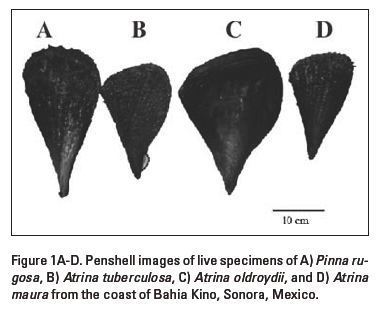
<body><![CDATA[<p align="justify"><font face="verdana" size="2"><b>Palabras clave:</b> <i>Atrina oldroydii,</i> Golfo de California, nuevo registro, Pinnidae.</font></p> 	    <p align="justify"><font face="verdana" size="2">&nbsp;</font></p>     <p align="justify"><font face="verdana" size="2">The Gulf of California is an ecosystem of great marine&#45;mollusk diversity in temperate latitudes. Many studies of these marinefaunal invertebrates have included their distribution, abundance, species composition, and records of new species (Hendrickx <i>et al.,</i> 2007; Zamorano <i>et al.,</i> 2007). In Mexico, the mollusk penshell is of great economic importance along the coasts of the Baja California Peninsula, Sonora, and Sinaloa.</font></p>  	    <p align="justify"><font face="verdana" size="2">Keen (1971), Poutiers (1995), and Coan <i>et al.</i> (2000) describe the importance of the Pinnidae family, including their biology, ecology, and the geographic distribution of the species. <i>Pinna rugosa</i> (Sowerby, 1835) (<a href="#f1">Fig. 1A</a>) from the Gulf of California, to the south of Panama. <i>Atrina (Servatrina) tuberculosa</i> (Sowerby, 1835) (<a href="#f1">Fig. 1B</a>), also known as <i>Pinna tuberculosa,</i> is found from the Gulf of California to Panama and <i>Atrina</i> (S.) <i>maura</i> (Sowerby, 1835) (<a href="#f1">Fig. 1D</a>) from the Baja California Peninsula, including the Gulf of California, to the south of Peru. <i>Atrina</i> (S.) <i>texta</i> Hertlein, Hanna &amp; Strong, 1943, is in San Pedro, California; and from Banco Gorda, Baja California Sur, Mexico, to the Galapagos Islands (Coan <i>et</i> al., 2000).</font></p> 	    <p align="center"><font face="verdana" size="2"><a name="f1"></a></font></p> 	    <p align="center"><font face="verdana" size="2"><img src="/img/revistas/hbio/v22n2/a9f1.jpg"></font></p>     <p align="justify"><font face="verdana" size="2">The species <i>Atrina</i>(S.) <i>oldroydii</i> Dall, 1901 (<a href="#f1">Fig. 1C</a>) is from the outer coast of Baja California Sur, Mexico at Bah&iacute;a Magdalena on the Pacific coast of the Baja California Peninsula (Keen, 1971). For <i>A. oldroydii,</i> Mor&aacute;n&#45;Angulo and Valdez&#45;Pineda (2009) published a new geographic record along the coast of Sinaloa and northern Nayarit. The purpose of our work is to report the distribution of <i>A. oldroydii</i> in the Gulf of California off Sonora, Mexico.</font></p>     <p align="justify"><font face="verdana" size="2">In the last quarter of 2009, shrimp vessels collected <i>A. oldroydii</i> during their fishing activities off the coast of Sonora, which information led hookah divers (HDs) to search the bank. After they found the specimens, the extractions began. When we found the empty shells discarded on beaches of Bah&iacute;a Kino, we called the HDs to help us reach the penshell bank. On board a small boat in November 2009, divers helped us make dives at four different sites. On the bottom, they collected the animals by hand and counted the number in about one m<sup>2</sup> at each dive site. We used a Garmin GPS map76F to determine the locations of the sampling sites. On board we recorded the total length of each organism (n &#61; 141). Live animals (n &#61; 41) were transported to the laboratory to record their biometrics, including the total fresh weight and the adductor muscle weight. In addition, we determined the gender of the specimens by gonad coloration, with the male gonads being whitish gray and purple orange for females. We recorded the type of sediment at each site. The taxonomic classification was according to Keen (1971) and Coan <i>et al.</i> (2000) and the species description was taken from Mor&aacute;n&#45;Angulo and Valdez&#45;Pineda (2009). In addition, for comparison with the other commercial penshells, we include images of the species off the coast of Bah&iacute;a Kino.</font></p>      <p align="justify"><font face="verdana" size="2">The comparison of the penshell specimens demonstrated the differences, showing that <i>A. oldroydii</i> is morphologically different from the other species and that it is the larger of the <i>Atrina</i> mollusks of the Gulf of California (<a href="#f1">Fig. 1A</a>&#45;<a href="#f1">D</a>). According to Coan and Scott (1997) and Coan <i>et al.</i> (2000), its classification is Class: Bivalvia; Superfamily: Pinnoidea Leach, 1819; Family: Pinnidae Leach, 1819; Genus: <i>Atrina J. E.</i> Gray, 1842; Subgenus <i>Servatrina,</i> Iredale, 1939; Species: <i>oldroydii</i> Dall, 1901. Its description is elongate, shell partially nacreous with two muscle scars well&#45;separated. It is triangular, with a groove down the middle inside, which divides the nacreous portion into two lobes. The shell is grayishbrown, smooth, slender, having concentric ring sculptures in the middle portion. The geographic locations of the collection sites are in <a href="#t1">Table 1</a>. The density of the specimens in the substrate was 3 to 14 animals per m<sup>2</sup>. The minimum total length of the collected organisms was 220 mm, with a maximum of 319 mm; of these 44% were between 280 and 299 mm (<a href="/img/revistas/hbio/v22n2/a9f2.jpg" target="_blank">Fig. 2A</a>). The weight of the adductor muscles was 35 to 95 g, with a range of 65 to 75 g for 27% of the sample (<a href="/img/revistas/hbio/v22n2/a9f2.jpg" target="_blank">Fig. 2B</a>).The gender of the animals in the sample was 39% females and 24% males, with 37% undifferentiated. The gender ratio was 6:4 female:male. The temperature and salinity in situ were 19 &deg;C and 35 psu. Including all the three distinct geographic sites of the records of <i>A. oldroydii,</i> the distribution of the species is along the coast of Baja California, Gulf of California, and south in Mexican Pacific waters along the coasts of Sinaloa and Nayarit (<a href="#f3">Fig. 3</a>).</font></p>     <p align="center"><font face="verdana" size="2"><a name="t1"></a></font></p>     ]]></body>
<body><![CDATA[<p align="center"><font face="verdana" size="2"><img src="/img/revistas/hbio/v22n2/a9t1.jpg"></font></p>     <p align="center"><font face="verdana" size="2"><a name="f3"></a></font></p>     <p align="center"><font face="verdana" size="2"><img src="/img/revistas/hbio/v22n2/a9f3.jpg"></font></p>     <p align="justify"><font face="verdana" size="2">Species of the Pinnidae Family live in bays and coastal lagoons on bottoms of sand and limestone at depths of 0.5 to 15 m. The most exploited in the Mexican Pacific are the <i>Pinna rugosa</i> and <i>Atrina maura</i> species (Ahumada&#45;Sempoal <i>et al.,</i> 2002) but there are few studies on these species. Work has been done on their reproduction and population structure in the exploited banks (Ahumada&#45;Sempoal <i>et al.,</i> 2002; &Aacute;ngel&#45;P&eacute;rez <i>et al.,</i> 2007), but studies of the abundance and distribution along the coasts are scarce. The genus <i>Atrina</i> is a cosmopolitan, bivalve mollusk, but the distribution of different species is probably dependent on ecological characteristics, such as specific habitats at depths where it is inaccessible. <i>Atrina</i> and <i>Pinna</i> species exists as metapopulations comprised of small groups of patches of individuals (Idris, 2008) and little is known on the penshell population in Pacific Mexican waters.</font></p>     <p align="justify"><font face="verdana" size="2">After Keen (1971), <i>A. oldroydii</i> was reported along the Pacific coast of the Baja California Peninsula as far south as Bah&iacute;a Magdalena, but its recent location along the southern coast of Sinaloa and northern Nayarit, M&eacute;xico was important and indicated that their range was farther south along the Mexican coast (Mor&aacute;n&#45;Angulo &amp; Valdez&#45;Pineda, 2009). We now report a new location of a penshell bank of <i>A. oldroydii,</i> within the Gulf of California, about 29&#45;km off Bahia Kino, Sonora, Mexico. The maximum distance between the sampled sites was about four kilometers, indicating that there must be other banks of the same species along the coast of the gulf. The species was not found before because of the distance from the coast and they were at more than 30&#45;m depth. The <i>A. oldroydii</i> banks constitute a special muddy habitat far from the coast, as are the banks reported in Sinaloa and Nayarit. All the three distinct geographic sites of the records of <i>A. oldroydii</i> for the species are along the coast of Baja California, Gulf of California, and southern Sinaloa and Nayarit coasts. At present, there are no studies of its biology and ecology at these banks in the Gulf of California, nor any management or conservational plans (Cinti <i>et al.,</i> 2010).</font></p>      <p align="justify"><font face="verdana" size="2">Our data indicated a maximum length not recorded before, but it will be necessary to analyze more samples to confirm the structure of the species. <i>Atrina oldroydii</i> in Nayarit and Sinaloa had shorter lengths, as reported by Mor&aacute;n&#45;Angulo and Valdez&#45;Pineda (2009). Because of the discrete distribution of the species along the Mexican coast, we need more studies on the total abundance, population dynamics, and management plans.</font></p>  	    <p align="justify"><font face="verdana" size="2">Off the coast of Sonora, the commercial penshell species <i>Atrina tuberculosa</i> and <i>Pinna rugosa,</i> and to lesser extent <i>A. maura,</i> are the exploited species south of Canal del Infiernillo near Isla Tibur&oacute;n (Moreno <i>et al.,</i> 2005). At present, <i>A. oldroydii</i> is the principal focus of extraction by hookah divers in Bah&iacute;a de Kino. Because of this, we recommend further research to delimit the species distribution, biology, ecology, and aquaculture potential. Presently, penshells of the Gulf of California, including <i>A. oldroydii,</i> could be vulnerable to uncontrolled human exploitation because as reported, they are found in local discrete banks, probably along most of the Mexican Pacific coasts. Most important is the need for the regulation of extraction methods for the security of the fishermen.</font></p> 	    <p align="justify"><font face="verdana" size="2">&nbsp;</font></p>     <p align="justify"><font face="verdana" size="2"><b>ACKNOWLEDGEMENTS</b></font></p>  	    <p align="justify"><font face="verdana" size="2">Special thanks to the hookah divers from Bah&iacute;a Kino, Sonora, Mexico for their dangerous and disinterested help in collecting the organisms. In memoriam of the men that have died at depth working in the penshell extraction. Thanks to Esteban Fernando F&eacute;lix Pico for the manuscript improvement. Also to Dr. Ellis Glazier for editing the English&#45;language text.</font></p>  	    ]]></body>
<body><![CDATA[<p align="justify"><font face="verdana" size="2">&nbsp;</font></p>      <p align="justify"><font face="verdana" size="2"><b>REFERENCES</b></font></p>  	    <!-- ref --><p align="justify"><font face="verdana" size="2">Ahumada&#45;Sempoal, M. A., S. J. Serrano&#45;Guzm&aacute;n &amp; N. Ruiz. 2002. Abundancia, estructura poblacional y crecimiento de <i>Atrina maura</i> (Bivalvia: Pinnidae) en una laguna costera tropical del Pac&iacute;fico mexicano. <i>Revista de Biolog&iacute;a Tropical</i> 50 (3/4): 1091&#45;1100.    &nbsp;&nbsp;&nbsp;&nbsp;&nbsp;&nbsp;&nbsp;&nbsp;[&#160;<a href="javascript:void(0);" onclick="javascript: window.open('/scielo.php?script=sci_nlinks&ref=4098343&pid=S0188-8897201200020000900001&lng=','','width=640,height=500,resizable=yes,scrollbars=1,menubar=yes,');">Links</a>&#160;]<!-- end-ref --></font></p>      <!-- ref --><p align="justify"><font face="verdana" size="2">&Aacute;ngel&#45;P&eacute;rez, C., S. J. Serrano&#45;Guzm&aacute;n &amp; M. A. Ahumada&#45;Sempoal. 2007. Ciclo reproductivo del molusco <i>Atrina maura</i> (Pterioidea: Pinnidae) en un sistema lagunar costero, al sur del Pac&iacute;fico tropical mexicano. <i>Revista de Biolog&iacute;a Tropical</i> 55 (3/4): 839&#45;852.    &nbsp;&nbsp;&nbsp;&nbsp;&nbsp;&nbsp;&nbsp;&nbsp;[&#160;<a href="javascript:void(0);" onclick="javascript: window.open('/scielo.php?script=sci_nlinks&ref=4098345&pid=S0188-8897201200020000900002&lng=','','width=640,height=500,resizable=yes,scrollbars=1,menubar=yes,');">Links</a>&#160;]<!-- end-ref --></font></p>      <!-- ref --><p align="justify"><font face="verdana" size="2">Cinti, A., W. Shaw &amp; J. Torre. 2010. Insights from the users to improve fisheries performance: Fishers' knowledge and attitudes on fisheries policies in Bahia de Kino, Gulf of California, Mexico. <i>Marine Policy</i> 34:1322&#45;1334</font>&nbsp;&nbsp;&nbsp;&nbsp;&nbsp;&nbsp;&nbsp;&nbsp;[&#160;<a href="javascript:void(0);" onclick="javascript: window.open('/scielo.php?script=sci_nlinks&ref=4098347&pid=S0188-8897201200020000900003&lng=','','width=640,height=500,resizable=yes,scrollbars=1,menubar=yes,');">Links</a>&#160;]<!-- end-ref --><!-- ref --><p align="justify"><font face="verdana" size="2">Coan, E. V. and P. H. Scott. 1997. Checklist of the Marine Bivalves of the Northeastern Pacific Ocean. Santa Barbara Museum of Natural History. Contributions in Science, No. 1, 28 p. Coan, E. V., P. H. Scott &amp; F. R. Bernard. 2000. <i>Bivalves Seashells of Western North America.</i> Santa Barbara Museum of Natural History Monographs number 2.764 p.    &nbsp;&nbsp;&nbsp;&nbsp;&nbsp;&nbsp;&nbsp;&nbsp;[&#160;<a href="javascript:void(0);" onclick="javascript: window.open('/scielo.php?script=sci_nlinks&ref=4098348&pid=S0188-8897201200020000900004&lng=','','width=640,height=500,resizable=yes,scrollbars=1,menubar=yes,');">Links</a>&#160;]<!-- end-ref --></font></p>      <!-- ref --><p align="justify"><font face="verdana" size="2">Hendrickx, M. E., C. R. Brusca, M. C. Cordero &amp; G. Ram&iacute;rez. 2007. Marine and Brackish&#45;water molluscan biodiversity in the Gulf of California, Mexico. <i>Scientia Marina</i> 71 (4): 637&#45;64.    &nbsp;&nbsp;&nbsp;&nbsp;&nbsp;&nbsp;&nbsp;&nbsp;[&#160;<a href="javascript:void(0);" onclick="javascript: window.open('/scielo.php?script=sci_nlinks&ref=4098350&pid=S0188-8897201200020000900005&lng=','','width=640,height=500,resizable=yes,scrollbars=1,menubar=yes,');">Links</a>&#160;]<!-- end-ref --></font></p>  	    <!-- ref --><p align="justify"><font face="verdana" size="2">Idris, M. H., A. Arshad, J. S. B&uuml;jang, S. K. Daud &amp; M. A. Ghaffar. 2008. New Distribution Record of Two Pen Shells (Bivalvia: Pinnidae) from the Seagrass Beds of Sungai Pulai, Johore, Malaysia. <i>Journal of Biological Sciences</i> 8 (5): 882&#45;888.    &nbsp;&nbsp;&nbsp;&nbsp;&nbsp;&nbsp;&nbsp;&nbsp;[&#160;<a href="javascript:void(0);" onclick="javascript: window.open('/scielo.php?script=sci_nlinks&ref=4098352&pid=S0188-8897201200020000900006&lng=','','width=640,height=500,resizable=yes,scrollbars=1,menubar=yes,');">Links</a>&#160;]<!-- end-ref --></font></p>  	    <!-- ref --><p align="justify"><font face="verdana" size="2">Keen, A. M. 1971. <i>Sea Shells of Tropical West America. Marine Mollusks from Baja California to Peru.</i> Stanford, California: Stanford University Press. 1025 p.    &nbsp;&nbsp;&nbsp;&nbsp;&nbsp;&nbsp;&nbsp;&nbsp;[&#160;<a href="javascript:void(0);" onclick="javascript: window.open('/scielo.php?script=sci_nlinks&ref=4098354&pid=S0188-8897201200020000900007&lng=','','width=640,height=500,resizable=yes,scrollbars=1,menubar=yes,');">Links</a>&#160;]<!-- end-ref --></font></p>      <!-- ref --><p align="justify"><font face="verdana" size="2">Moran&#45;Angulo, R. E. &amp; M. C. Valdez&#45;Pineda. 2009. Nuevo registro geogr&aacute;fico del callo de hacha, <i>Atrina oldroydii</i> en el sur de Sinaloa y norte de Nayarit, M&eacute;xico. <i>Ciencia Pesquera</i> 17 (1): 77&#45;79.    &nbsp;&nbsp;&nbsp;&nbsp;&nbsp;&nbsp;&nbsp;&nbsp;[&#160;<a href="javascript:void(0);" onclick="javascript: window.open('/scielo.php?script=sci_nlinks&ref=4098356&pid=S0188-8897201200020000900008&lng=','','width=640,height=500,resizable=yes,scrollbars=1,menubar=yes,');">Links</a>&#160;]<!-- end-ref --></font></p>      <!-- ref --><p align="justify"><font face="verdana" size="2">Moreno, C., J. Torre, L. Bourillon, M. Durazo, A. H. Weaver, R. Barraza &amp; R. Castro. 2005. <i>Estudio y evaluaci&oacute;n de la pesquer&iacute;a de callo de hacha</i> (Atrina tuberculosa,! <i>en la regi&oacute;n de Bah&iacute;a de Kino, Sonora y recomendaciones para su manejo. Comunidad y Biodiversidad,</i> A. C. Reporte interno, 27 p. Available on line: <a href="http://www.cobi.org.mx/publicaciones/cobi_rep_estudio_eval_callo_hacha_0705.pdf" target="_blank">http://www.cobi.org.mx/publicaciones/cobi_rep_estudio_eval_callo_hacha_0705.pdf</a>. (downloaded June 20, 2011).    &nbsp;&nbsp;&nbsp;&nbsp;&nbsp;&nbsp;&nbsp;&nbsp;[&#160;<a href="javascript:void(0);" onclick="javascript: window.open('/scielo.php?script=sci_nlinks&ref=4098358&pid=S0188-8897201200020000900009&lng=','','width=640,height=500,resizable=yes,scrollbars=1,menubar=yes,');">Links</a>&#160;]<!-- end-ref --></font></p>      <!-- ref --><p align="justify"><font face="verdana" size="2">Poutiers, J. M. 1995. Bivalvos. <i>In</i> Fischer, W., F. Krupp, W. Schneider, C. Sommer, K. E. Carpenter &amp; V. H. Niem (Eds.). <i>Gu&iacute;a FAO para la identificaci&oacute;n de especies para los fines de la pesca. Pac&iacute;fico centro&#45;oriental.</i> Organizaci&oacute;n de las Naciones Unidas para la Agricultura y la Alimentaci&oacute;n, Roma 1: pp. 100&#45;222.    &nbsp;&nbsp;&nbsp;&nbsp;&nbsp;&nbsp;&nbsp;&nbsp;[&#160;<a href="javascript:void(0);" onclick="javascript: window.open('/scielo.php?script=sci_nlinks&ref=4098360&pid=S0188-8897201200020000900010&lng=','','width=640,height=500,resizable=yes,scrollbars=1,menubar=yes,');">Links</a>&#160;]<!-- end-ref --></font></p>  	    <!-- ref --><p align="justify"><font face="verdana" size="2">Zamorano, P., M. E. Hendrickx &amp; A. Toledano&#45;Granados. 2007. Nuevos registros geogr&aacute;ficos y batim&eacute;tricos para moluscos de mar profundo en el Golfo de California, M&eacute;xico. <i>Revista Mexicana de Biodiversidad</i> 78: 311&#45; 318.    &nbsp;&nbsp;&nbsp;&nbsp;&nbsp;&nbsp;&nbsp;&nbsp;[&#160;<a href="javascript:void(0);" onclick="javascript: window.open('/scielo.php?script=sci_nlinks&ref=4098362&pid=S0188-8897201200020000900011&lng=','','width=640,height=500,resizable=yes,scrollbars=1,menubar=yes,');">Links</a>&#160;]<!-- end-ref --></font></p>       ]]></body><back>
<ref-list>
<ref id="B1">
<nlm-citation citation-type="journal">
<person-group person-group-type="author">
<name>
<surname><![CDATA[Ahumada-Sempoal]]></surname>
<given-names><![CDATA[M. A.]]></given-names>
</name>
<name>
<surname><![CDATA[Serrano-Guzmán]]></surname>
<given-names><![CDATA[S. J.]]></given-names>
</name>
<name>
<surname><![CDATA[Ruiz]]></surname>
<given-names><![CDATA[N.]]></given-names>
</name>
</person-group>
<article-title xml:lang="es"><![CDATA[Abundancia, estructura poblacional y crecimiento de Atrina maura (Bivalvia: Pinnidae) en una laguna costera tropical del Pacífico mexicano]]></article-title>
<source><![CDATA[Revista de Biología Tropical]]></source>
<year>2002</year>
<volume>50</volume>
<numero>3/4</numero>
<issue>3/4</issue>
<page-range>1091-1100</page-range></nlm-citation>
</ref>
<ref id="B2">
<nlm-citation citation-type="journal">
<person-group person-group-type="author">
<name>
<surname><![CDATA[Ángel-Pérez]]></surname>
<given-names><![CDATA[C.]]></given-names>
</name>
<name>
<surname><![CDATA[Serrano-Guzmán]]></surname>
<given-names><![CDATA[S. J.]]></given-names>
</name>
<name>
<surname><![CDATA[Ahumada-Sempoal]]></surname>
<given-names><![CDATA[M. A.]]></given-names>
</name>
</person-group>
<article-title xml:lang="es"><![CDATA[Ciclo reproductivo del molusco Atrina maura (Pterioidea: Pinnidae) en un sistema lagunar costero, al sur del Pacífico tropical mexicano]]></article-title>
<source><![CDATA[Revista de Biología Tropical]]></source>
<year>2007</year>
<volume>55</volume>
<numero>3/4</numero>
<issue>3/4</issue>
<page-range>839-852</page-range></nlm-citation>
</ref>
<ref id="B3">
<nlm-citation citation-type="journal">
<person-group person-group-type="author">
<name>
<surname><![CDATA[Cinti]]></surname>
<given-names><![CDATA[A]]></given-names>
</name>
<name>
<surname><![CDATA[Shaw]]></surname>
<given-names><![CDATA[W]]></given-names>
</name>
<name>
<surname><![CDATA[Torre]]></surname>
<given-names><![CDATA[J]]></given-names>
</name>
</person-group>
<article-title xml:lang="en"><![CDATA[Insights from the users to improve fisheries performance: Fishers' knowledge and attitudes on fisheries policies in Bahia de Kino, Gulf of California, Mexico]]></article-title>
<source><![CDATA[Marine Policy]]></source>
<year>2010</year>
<volume>34</volume>
<page-range>1322-1334</page-range></nlm-citation>
</ref>
<ref id="B4">
<nlm-citation citation-type="journal">
<person-group person-group-type="author">
<name>
<surname><![CDATA[Coan]]></surname>
<given-names><![CDATA[E. V.]]></given-names>
</name>
<name>
<surname><![CDATA[Scott]]></surname>
<given-names><![CDATA[P. H.]]></given-names>
</name>
</person-group>
<article-title xml:lang="en"><![CDATA[of the Marine Bivalves of the Northeastern Pacific Ocean. Santa Barbara Museum of Natural History]]></article-title>
<person-group person-group-type="editor">
<name>
<surname><![CDATA[Coan]]></surname>
<given-names><![CDATA[E. V.]]></given-names>
</name>
<name>
<surname><![CDATA[Scott]]></surname>
<given-names><![CDATA[P. H.]]></given-names>
</name>
<name>
<surname><![CDATA[Bernard]]></surname>
<given-names><![CDATA[F. R.]]></given-names>
</name>
</person-group>
<source><![CDATA[Contributions in ScienceBivalves Seashells of Western North America. Santa Barbara Museum of Natural History Monographs]]></source>
<year>1997</year>
<month>20</month>
<day>00</day>
<volume>1</volume><volume>2</volume>
<page-range>28</page-range><page-range>764</page-range></nlm-citation>
</ref>
<ref id="B5">
<nlm-citation citation-type="journal">
<person-group person-group-type="author">
<name>
<surname><![CDATA[Hendrickx]]></surname>
<given-names><![CDATA[M. E.]]></given-names>
</name>
<name>
<surname><![CDATA[Brusca]]></surname>
<given-names><![CDATA[C. R.]]></given-names>
</name>
<name>
<surname><![CDATA[Cordero]]></surname>
<given-names><![CDATA[M. C.]]></given-names>
</name>
<name>
<surname><![CDATA[Ramírez]]></surname>
<given-names><![CDATA[G.]]></given-names>
</name>
</person-group>
<article-title xml:lang="en"><![CDATA[Marine and Brackish-water molluscan biodiversity in the Gulf of California, Mexico]]></article-title>
<source><![CDATA[Scientia Marina]]></source>
<year>2007</year>
<volume>71</volume>
<numero>4</numero>
<issue>4</issue>
<page-range>637-64</page-range></nlm-citation>
</ref>
<ref id="B6">
<nlm-citation citation-type="journal">
<person-group person-group-type="author">
<name>
<surname><![CDATA[Idris]]></surname>
<given-names><![CDATA[M. H.]]></given-names>
</name>
<name>
<surname><![CDATA[Arshad]]></surname>
<given-names><![CDATA[A.]]></given-names>
</name>
<name>
<surname><![CDATA[Büjang]]></surname>
<given-names><![CDATA[J. S.]]></given-names>
</name>
<name>
<surname><![CDATA[Daud]]></surname>
<given-names><![CDATA[S. K.]]></given-names>
</name>
<name>
<surname><![CDATA[Ghaffar]]></surname>
<given-names><![CDATA[M. A.]]></given-names>
</name>
</person-group>
<article-title xml:lang="en"><![CDATA[New Distribution Record of Two Pen Shells (Bivalvia: Pinnidae) from the Seagrass Beds of Sungai Pulai, Johore, Malaysia]]></article-title>
<source><![CDATA[Journal of Biological Sciences]]></source>
<year>2008</year>
<volume>8</volume>
<numero>5</numero>
<issue>5</issue>
<page-range>882-888</page-range></nlm-citation>
</ref>
<ref id="B7">
<nlm-citation citation-type="book">
<person-group person-group-type="author">
<name>
<surname><![CDATA[Keen]]></surname>
<given-names><![CDATA[A. M]]></given-names>
</name>
</person-group>
<source><![CDATA[Sea Shells of Tropical West America. Marine Mollusks from Baja California to Peru]]></source>
<year>1971</year>
<page-range>1025</page-range><publisher-loc><![CDATA[Stanford^eCalifornia California]]></publisher-loc>
<publisher-name><![CDATA[Stanford University Press]]></publisher-name>
</nlm-citation>
</ref>
<ref id="B8">
<nlm-citation citation-type="journal">
<person-group person-group-type="author">
<name>
<surname><![CDATA[Moran-Angulo]]></surname>
<given-names><![CDATA[R. E.]]></given-names>
</name>
<name>
<surname><![CDATA[Valdez-Pineda]]></surname>
<given-names><![CDATA[M. C.]]></given-names>
</name>
</person-group>
<article-title xml:lang="es"><![CDATA[Nuevo registro geográfico del callo de hacha, Atrina oldroydii en el sur de Sinaloa y norte de Nayarit, México]]></article-title>
<source><![CDATA[Ciencia Pesquera]]></source>
<year>2009</year>
<volume>17</volume>
<numero>1</numero>
<issue>1</issue>
<page-range>77-79</page-range></nlm-citation>
</ref>
<ref id="B9">
<nlm-citation citation-type="book">
<person-group person-group-type="author">
<name>
<surname><![CDATA[Moreno]]></surname>
<given-names><![CDATA[C.]]></given-names>
</name>
<name>
<surname><![CDATA[Torre]]></surname>
<given-names><![CDATA[J.]]></given-names>
</name>
<name>
<surname><![CDATA[Bourillon]]></surname>
<given-names><![CDATA[L.]]></given-names>
</name>
<name>
<surname><![CDATA[Durazo]]></surname>
<given-names><![CDATA[M.]]></given-names>
</name>
<name>
<surname><![CDATA[Weaver]]></surname>
<given-names><![CDATA[A. H.]]></given-names>
</name>
<name>
<surname><![CDATA[Barraza]]></surname>
<given-names><![CDATA[R.]]></given-names>
</name>
<name>
<surname><![CDATA[Castro]]></surname>
<given-names><![CDATA[R.]]></given-names>
</name>
</person-group>
<source><![CDATA[Estudio y evaluación de la pesquería de callo de hacha (Atrina tuberculosa,! en la región de Bahía de Kino, Sonora y recomendaciones para su manejo]]></source>
<year>2005</year>
<page-range>27</page-range><publisher-name><![CDATA[Comunidad y Biodiversidad]]></publisher-name>
</nlm-citation>
</ref>
<ref id="B10">
<nlm-citation citation-type="book">
<person-group person-group-type="author">
<name>
<surname><![CDATA[Poutiers]]></surname>
<given-names><![CDATA[J. M]]></given-names>
</name>
</person-group>
<article-title xml:lang="en"><![CDATA[Bivalvos]]></article-title>
<person-group person-group-type="editor">
<name>
<surname><![CDATA[Fischer]]></surname>
<given-names><![CDATA[W]]></given-names>
</name>
<name>
<surname><![CDATA[Krupp]]></surname>
<given-names><![CDATA[F]]></given-names>
</name>
<name>
<surname><![CDATA[Schneider]]></surname>
<given-names><![CDATA[W]]></given-names>
</name>
<name>
<surname><![CDATA[Sommer]]></surname>
<given-names><![CDATA[C]]></given-names>
</name>
<name>
<surname><![CDATA[Carpenter]]></surname>
<given-names><![CDATA[K. E.]]></given-names>
</name>
<name>
<surname><![CDATA[Niem]]></surname>
<given-names><![CDATA[V. H.]]></given-names>
</name>
</person-group>
<source><![CDATA[Guía FAO para la identificación de especies para los fines de la pesca. Pacífico centro-oriental]]></source>
<year>1995</year>
<volume>1</volume>
<page-range>100-222</page-range><publisher-loc><![CDATA[Roma ]]></publisher-loc>
<publisher-name><![CDATA[Organización de las Naciones Unidas para la Agricultura y la Alimentación]]></publisher-name>
</nlm-citation>
</ref>
<ref id="B11">
<nlm-citation citation-type="journal">
<person-group person-group-type="author">
<name>
<surname><![CDATA[Zamorano]]></surname>
<given-names><![CDATA[P.]]></given-names>
</name>
<name>
<surname><![CDATA[Hendrickx]]></surname>
<given-names><![CDATA[M. E.]]></given-names>
</name>
<name>
<surname><![CDATA[Toledano-Granados]]></surname>
<given-names><![CDATA[A.]]></given-names>
</name>
</person-group>
<article-title xml:lang="es"><![CDATA[Nuevos registros geográficos y batimétricos para moluscos de mar profundo en el Golfo de California, México]]></article-title>
<source><![CDATA[Revista Mexicana de Biodiversidad]]></source>
<year>2007</year>
<volume>78</volume>
<page-range>311- 318</page-range></nlm-citation>
</ref>
</ref-list>
</back>
</article>
