<?xml version="1.0" encoding="ISO-8859-1"?><article xmlns:mml="http://www.w3.org/1998/Math/MathML" xmlns:xlink="http://www.w3.org/1999/xlink" xmlns:xsi="http://www.w3.org/2001/XMLSchema-instance">
<front>
<journal-meta>
<journal-id>0188-8897</journal-id>
<journal-title><![CDATA[Hidrobiológica]]></journal-title>
<abbrev-journal-title><![CDATA[Hidrobiológica]]></abbrev-journal-title>
<issn>0188-8897</issn>
<publisher>
<publisher-name><![CDATA[Universidad Autónoma Metropolitana, División de Ciencias Biológicas y de la Salud]]></publisher-name>
</publisher>
</journal-meta>
<article-meta>
<article-id>S0188-88972009000300003</article-id>
<title-group>
<article-title xml:lang="en"><![CDATA[Maintenance media for the axolotl Ambystoma mexicanum juveniles (Amphibia: Caudata)]]></article-title>
<article-title xml:lang="es"><![CDATA[Soluciones de mantenimiento de juveniles del ajolote Ambystoma mexicanum (Amphibia: Caudata)]]></article-title>
</title-group>
<contrib-group>
<contrib contrib-type="author">
<name>
<surname><![CDATA[Robles Mendoza]]></surname>
<given-names><![CDATA[Cecilia]]></given-names>
</name>
<xref ref-type="aff" rid="A01"/>
</contrib>
<contrib contrib-type="author">
<name>
<surname><![CDATA[García Basilio]]></surname>
<given-names><![CDATA[Claudia Elizabeth]]></given-names>
</name>
<xref ref-type="aff" rid="A02"/>
</contrib>
<contrib contrib-type="author">
<name>
<surname><![CDATA[Vanegas Pérez]]></surname>
<given-names><![CDATA[Ruth Cecilia]]></given-names>
</name>
<xref ref-type="aff" rid="A01"/>
</contrib>
</contrib-group>
<aff id="A01">
<institution><![CDATA[,Universidad Nacional Autónoma de México Facultad de Ciencias Laboratorio de Ecofisiología]]></institution>
<addr-line><![CDATA[México D. F.]]></addr-line>
<country>México</country>
</aff>
<aff id="A02">
<institution><![CDATA[,Universidad Nacional Autónoma de México Facultad de Ciencias Unidad de Análisis Ambiental]]></institution>
<addr-line><![CDATA[ ]]></addr-line>
</aff>
<pub-date pub-type="pub">
<day>00</day>
<month>12</month>
<year>2009</year>
</pub-date>
<pub-date pub-type="epub">
<day>00</day>
<month>12</month>
<year>2009</year>
</pub-date>
<volume>19</volume>
<numero>3</numero>
<fpage>205</fpage>
<lpage>210</lpage>
<copyright-statement/>
<copyright-year/>
<self-uri xlink:href="http://www.scielo.org.mx/scielo.php?script=sci_arttext&amp;pid=S0188-88972009000300003&amp;lng=en&amp;nrm=iso"></self-uri><self-uri xlink:href="http://www.scielo.org.mx/scielo.php?script=sci_abstract&amp;pid=S0188-88972009000300003&amp;lng=en&amp;nrm=iso"></self-uri><self-uri xlink:href="http://www.scielo.org.mx/scielo.php?script=sci_pdf&amp;pid=S0188-88972009000300003&amp;lng=en&amp;nrm=iso"></self-uri><abstract abstract-type="short" xml:lang="en"><p><![CDATA[Physiological condition and organisms' health which are grown in culture systems depends on several factors including water quality, feeding and density among others. In Mexico, the colonies of the axolotl Ambystoma mexicanum (Shaw), an indigenous amphibian under extinction risk, are maintained under different culture conditions according to the objectives of the colony and the available resources. Particularly, water electrolytic characteristic and ionic and osmotic conditions are the factors with greater variation in the axolotl culture systems. Therefore, it is necessary to standardize the best maintenance conditions to store the germoplasm of the axolotl and to ensure healthy organisms with researching purposes. Thus, the aim of the present study was to evaluate the development and growth of Ambystoma mexicanum larvae reared under different maintenance media, usually used in Mexico for the culture of the species: 1) dechlorinated tap water; 2) dechlorinated tap water enriched with sodium chloride and commercial colloidal solution and 3) Holtfreter's solution reconstructed with dechlorinated tap water. In each experimental condition, 15 larvae on stage 44 (immediately after hatching) were maintained during 21 days and development and growth were weekly recorded. Ionic and osmotic conditions of the external media were routinely registered. The obtained results suggested a better physiological condition of the axolotls maintained on Holtfreter's solution, where the highest growth rate (13 g WW d-1) and the greatest condition factor (0.79) were registered. The use of this solution is recommended due it guarantees the suitable development of early stages of A. mexicanum on culture systems.]]></p></abstract>
<abstract abstract-type="short" xml:lang="es"><p><![CDATA[La condición fisiológica y por lo tanto la salud de los organismos acuáticos depende de varios factores como la calidad del agua de mantenimiento, la alimentación, la densidad, entre otros. En México, las colonias del ajolote Ambystoma mexicanum (Shaw), anfibio endémico y en riesgo de extinción en su hábitat, son mantenidas bajo diferentes condiciones de cultivo de acuerdo con los objetivos de la colonia y los recursos disponibles. Particularmente, las características electrolíticas del agua de mantenimiento y las condiciones iónicas y osmóticas, son los factores que presentan mayor variación entre los diferentes sistemas de cultivo. Por lo tanto, se considera necesario estandarizar las condiciones adecuadas de mantenimiento de los ajolotes para mantener el germoplasma de la especie y para garantizar organismos sanos con fines de investigación. El objetivo del presente estudio fue evaluar el desarrollo y el crecimiento de larvas del ajolote en tres diferentes medios usualmente utilizados en México en el mantenimiento de las colonias del ajolote: agua de la llave libre de cloro, agua de la llave con solución comercial salina y de coloides y solución Holtfreter. Los resultados obtenidos denotan una mejor condición fisiológica de los ajolotes mantenidos en la solución Holtfreter, medio en el cuál registraron la mayor tasa de crecimiento (13 g WW d-1) y un mayor índice de condición (0.79). De acuerdo con estos resultados se propone el uso de la solución Holtfreter para garantizar el adecuado desarrollo de los estadios tempranos de A. mexicanum bajo condiciones de mantenimiento y/o cultivo controlado.]]></p></abstract>
<kwd-group>
<kwd lng="en"><![CDATA[Ambystoma mexicanum]]></kwd>
<kwd lng="en"><![CDATA[maintenance]]></kwd>
<kwd lng="en"><![CDATA[development]]></kwd>
<kwd lng="en"><![CDATA[growth]]></kwd>
<kwd lng="en"><![CDATA[Holtfreter's solution]]></kwd>
<kwd lng="es"><![CDATA[Ambystoma mexicanum]]></kwd>
<kwd lng="es"><![CDATA[mantenimiento]]></kwd>
<kwd lng="es"><![CDATA[desarrollo]]></kwd>
<kwd lng="es"><![CDATA[crecimiento]]></kwd>
<kwd lng="es"><![CDATA[solución de Holtfreter]]></kwd>
</kwd-group>
</article-meta>
</front><body><![CDATA[ <p align="justify"><font face="verdana" size="4">Art&iacute;culos</font></p>     <p align="center"><font face="verdana" size="2">&nbsp;</font></p>     <p align="center"><font face="verdana" size="4"><b>Maintenance media for the axolotl <i>Ambystoma mexicanum </i>juveniles (Amphibia: Caudata)</b></font></p>     <p align="center"><font face="verdana" size="2">&nbsp;</font></p>     <p align="center"><font face="verdana" size="3"><b>Soluciones de mantenimiento de juveniles del ajolote <i>Ambystoma mexicanum </i>(Amphibia: Caudata)</b></font></p>     <p align="center"><font face="verdana" size="2">&nbsp;</font></p>     <p align="center"><font face="verdana" size="2"><b>Cecilia Robles Mendoza<sup>1*</sup>, Claudia Elizabeth Garc&iacute;a Basilio<sup>2 </sup>and Ruth Cecilia Vanegas P&eacute;rez<sup>1</sup></b></font></p>     <p align="justify"><font face="verdana" size="2">&nbsp;</font></p>     <p align="justify"><font face="verdana" size="2"><i><sup>1</sup> Laboratorio de Ecofisiolog&iacute;a, Facultad de Ciencias, UNAM. Ciudad Universitaria, M&eacute;xico D. F. 04510. M&eacute;xico. *E&#150;mail</i>: <a href="mailto:rmc@ciencias.unam.mx">rmc@ciencias.unam.mx</a></font></p>     <p align="justify"><font face="verdana" size="2"><i><sup>2</sup> Unidad de An&aacute;lisis Ambiental, Facultad de Ciencias, UNAM.</i></font></p>     ]]></body>
<body><![CDATA[<p align="justify"><font face="verdana" size="2">&nbsp;</font></p>     <p align="justify"><font face="verdana" size="2">Recibido: 30 de mayo de 2008.    <br> Aceptado: 24 de noviembre de 2009.</font></p>     <p align="justify"><font face="verdana" size="2">&nbsp;</font></p>     <p align="justify"><font face="verdana" size="2"><b>ABSTRACT</b></font></p>     <p align="justify"><font face="verdana" size="2">Physiological condition and organisms' health which are grown in culture systems depends on several factors including water quality, feeding and density among others. In Mexico, the colonies of the axolotl <i>Ambystoma mexicanum </i>(Shaw), an indigenous amphibian under extinction risk, are maintained under different culture conditions according to the objectives of the colony and the available resources. Particularly, water electrolytic characteristic and ionic and osmotic conditions are the factors with greater variation in the axolotl culture systems. Therefore, it is necessary to standardize the best maintenance conditions to store the germoplasm of the axolotl and to ensure healthy organisms with researching purposes. Thus, the aim of the present study was to evaluate the development and growth of <i>Ambystoma mexicanum </i>larvae reared under different maintenance media, usually used in Mexico for the culture of the species: 1) dechlorinated tap water; 2) dechlorinated tap water enriched with sodium chloride and commercial colloidal solution and 3) Holtfreter's solution reconstructed with dechlorinated tap water. In each experimental condition, 15 larvae on stage 44 (immediately after hatching) were maintained during 21 days and development and growth were weekly recorded. Ionic and osmotic conditions of the external media were routinely registered. The obtained results suggested a better physiological condition of the axolotls maintained on Holtfreter's solution, where the highest growth rate (13 g WW d<sup>&#150;1</sup>) and the greatest condition factor (0.79) were registered. The use of this solution is recommended due it guarantees the suitable development of early stages of <i>A. mexicanum </i>on culture systems.</font></p>     <p align="justify"><font face="verdana" size="2"><b>Key words: </b><i>Ambystoma mexicanum</i>, maintenance, development, growth, Holtfreter's solution.</font></p>     <p align="justify"><font face="verdana" size="2">&nbsp;</font></p>     <p align="justify"><font face="verdana" size="2"><b>RESUMEN</b></font></p>     <p align="justify"><font face="verdana" size="2">La condici&oacute;n fisiol&oacute;gica y por lo tanto la salud de los organismos acu&aacute;ticos depende de varios factores como la calidad del agua de mantenimiento, la alimentaci&oacute;n, la densidad, entre otros. En M&eacute;xico, las colonias del ajolote <i>Ambystoma mexicanum </i>(Shaw), anfibio end&eacute;mico y en riesgo de extinci&oacute;n en su h&aacute;bitat, son mantenidas bajo diferentes condiciones de cultivo de acuerdo con los objetivos de la colonia y los recursos disponibles. Particularmente, las caracter&iacute;sticas electrol&iacute;ticas del agua de mantenimiento y las condiciones i&oacute;nicas y osm&oacute;ticas, son los factores que presentan mayor variaci&oacute;n entre los diferentes sistemas de cultivo. Por lo tanto, se considera necesario estandarizar las condiciones adecuadas de mantenimiento de los ajolotes para mantener el germoplasma de la especie y para garantizar organismos sanos con fines de investigaci&oacute;n. El objetivo del presente estudio fue evaluar el desarrollo y el crecimiento de larvas del ajolote en tres diferentes medios usualmente utilizados en M&eacute;xico en el mantenimiento de las colonias del ajolote: agua de la llave libre de cloro, agua de la llave con soluci&oacute;n comercial salina y de coloides y soluci&oacute;n Holtfreter. Los resultados obtenidos denotan una mejor condici&oacute;n fisiol&oacute;gica de los ajolotes mantenidos en la soluci&oacute;n Holtfreter, medio en el cu&aacute;l registraron la mayor tasa de crecimiento (13 g WW d<sup>&#150;1</sup>) y un mayor &iacute;ndice de condici&oacute;n (0.79). De acuerdo con estos resultados se propone el uso de la soluci&oacute;n Holtfreter para garantizar el adecuado desarrollo de los estadios tempranos de <i>A. mexicanum </i>bajo condiciones de mantenimiento y/o cultivo controlado.</font></p>     ]]></body>
<body><![CDATA[<p align="justify"><font face="verdana" size="2"><b>Palabras clave: </b><i>Ambystoma mexicanum</i>, mantenimiento, desarrollo, crecimiento, soluci&oacute;n de Holtfreter.</font></p>     <p align="justify"><font face="verdana" size="2">&nbsp;</font></p>     <p align="justify"><font face="verdana" size="2"><b>INTRODUCTION</b></font></p>     <p align="justify"><font face="verdana" size="2"><i>Ambystoma mexicanum </i>is an endemic amphibian of the central basin of M&eacute;xico including Xochimilco, a wetland nowadays surrounded by M&eacute;xico City. Xochimilco is the remaining lacustrine area of the ancient lakes system in the valley of Mexico which consists of a complex system of canals and artificial islands. Is an important agricultural zone since pre&#150;colonial period. Due to its unique historical, cultural, and ecological features, it was declared in 1987 as a World Heritage Site by UNESCO, and in 2004 as a RAMSAR Site (UNESCO, 2003; RCW, 2007)<i>. </i>However, heavy environmental pressures as biological, physical and chemical stressors have altered quantitatively and qualitatively the water canals contributing to the reduction and extinction of indigenous species as the axolotl (Zambrano <i>et al</i>., 2007; Contreras <i>et al</i>., 2009). For this reason, this species is under special protection by Mexican legislation, in the IUCN Red List is categorized as critically endangered and is included on the appendix II of Convention on International Trade in Endangered Species of wild fauna and flora (DOF, 2002; CITES, 2007; IUCN, 2009). In this scenario, it is necessary to ensure the maintenance of the genetic stock of the species under culture controlled conditions until their re&#150;introduction to its natural habitat can be achieved.</font></p>     <p align="justify"><font face="verdana" size="2">In culture systems the organism's health depends of several factors as water quality, food, density, among others. The maintenance of these factors at levels able to satisfy the physiological requirements of the organisms is necessary for their adequate development, growth and reproduction (Prosser, 1991).</font></p>     <p align="justify"><font face="verdana" size="2">Several studies conducted in fish support the hypothesis that at an isosmotic medium, in which ionic and osmotic gradients between the blood and water are minimum, the energetic costs for osmoregulation is lower, therefore, the energy saved is directed for increasing growth (Laiz&#150;Carri&oacute;n <i>et al.</i>, 2005; Tsuzuki <i>et al</i>., 2007). Likewise, in aquatic amphibians the energetic cost for ionic and osmotic regulation can change the amount of energy available for development and growth (Shoemaker &amp; Nagy, 1977; Hochachka &amp; Somero, 1978; Prosser, 1991). Therefore ionic and osmotic conditions of the external medium are important factors to control during the maintenance of the axolotl under culture systems.</font></p>     <p align="justify"><font face="verdana" size="2">In Mexico, there are several colonies of <i>A. mexicanum </i>maintained under different culture conditions, mainly related with different characteristics of the culture water such as electrolyte quality, ionic and osmotic conditions (Otto, 1998; Maya, 2006). Thus, the aim of the present study was to evaluate the development and growth of <i>Ambystoma mexicanum </i>larvae reared under different maintenance media, usually used for the culture of the species under controlled conditions.</font></p>     <p align="justify"><font face="verdana" size="2">&nbsp;</font></p>     <p align="justify"><font face="verdana" size="2"><b>MATERIALS AND METHODS </b></font></p>     <p align="justify"><font face="verdana" size="2"><b>Origen and maintenance of the organisms. </b>Axolotl eggs (stage 8), corresponding to blastula stage, were obtained from the Laboratorio de Restauraci&oacute;n Ecol&oacute;gica (Instituto de Biolog&iacute;a, UNAM). In order to control and maintain the same variability among the experiments, only one clutch of eggs was considered. The embryos were divided in two aquaria of 4 L and were maintained until hatching (stage 44) in the same conditions of reception: dechlorinated tap water, 20 &deg;C of temperature, 6.40 mg L<sup>&#150;1</sup> of dissolved oxygen and 8.6 &plusmn; 0.2 units of pH; measurements were controlled daily with a Brannan thermometer, an YSI Incorporated oxymeter (Mod. 50B) and a Checker pH meter. Photoperiod was maintained at 16 h daylight and 8 hours darkness and oxygen dissolved was regulated by gently aereation. During the maintenance period water was filtered through biological, carbon and particulate filters as well as ultraviolet irradiation.</font></p>     ]]></body>
<body><![CDATA[<p align="justify"><font face="verdana" size="2">In order to ensure the healthy state of the organisms previous to the tests, daily observations of embryos development of <i>A. mexicanum </i>were made following Bordzilovskaya <i>et al</i>. (1989).</font></p>     <p align="justify"><font face="verdana" size="2"><b>Experimental protocol. </b>Experimental solutions tested corresponded to the main maintenance water solutions used in the axolotl culture systems in Mexico: 1) dechlorinated tap water (DTW); 2) dechlorinated tap water enriched with commercial colloidal solution (87 &#956;L L<sup>&#150;1</sup>) , sodium chloride (0.16 g L<sup>&#150;1</sup>) and iodine&#150;free (Pentabiocare, Biomaa) (SCS) and 3) Holtfreter's solution (HS) reconstructed with dechlorinated tap water (Henning, 1996).</font></p>     <p align="justify"><font face="verdana" size="2">For each experimental group (maintenance solution) 15 larvae on stage 44 (immediately after hatching) were placed in individual aquaria containing 8 L of each test solution. The experiments were carried out in duplicates. During the experimental period of 20 days, water temperature, dissolved oxygen, pH and photoperiod were maintained similar as the maintenance period of axolotl embryos. Ammonia and nitrite were measured weekly through the Indophenol and Sulphanilamide methods, respectively (Rodier, 1981) and were kept under safe levels for the axolotls (less than 0.09 mg N&#150;NH<sub>3</sub>L<sup>&#150;1</sup> and 0.1 mg N&#150;NO<sub>2</sub> L<sup>&#150;1</sup>). Once a week, the 70% of the water volume of the aquaria was exchanged and the experimental solutions replaced; thus static renewal tests were conducted</font></p>     <p align="justify"><font face="verdana" size="2">Axolotl larvae were feed with brine shrimp <i>Artemia </i>sp. nauplii according to their age: 500 nauplii/axolotl for larvae from 1&#150;10 days post hatching (dph) and 1,500 nauplii/axolotl for 11&#150;20 dph larvae.</font></p>     <p align="justify"><font face="verdana" size="2">The electrolytic characteristics of each experimental solution were analyzed. Total concentration of major inorganic ions, Na<sup>+</sup>, K<sup>+</sup> and Cl<sup>&#150;</sup> , were measured with an ions multi&#150;analyzer (Medica Inc.) and the osmotic pressure (mOsm) through a micro&#150;osmometer (The Advanced Inc.).</font></p>     <p align="justify"><font face="verdana" size="2"><b>Organism's performance. </b>To establish the physiological condition of the axolotls maintained in each experimental solution, the development and growth of the organisms was evaluated. To avoid any stress due handling manipulation, the stage of development of the larvae was registered weekly through the identification of limbs development as suggested by Nye <i>et al. </i>(2003). Wet Weight (WW mg) and total length (TL, cm) were evaluated at the beginning (0 days), half (11 days) and at the end (20 days) of the tests and were measured with an analytical balance <i>Sartourius </i>(&plusmn; 0.0005) and a digital vernier micrometer, respectively.</font></p>     <p align="justify"><font face="verdana" size="2">The growth rate (GR, mg WW d<sup>&#150;1</sup>) of axolotl larvae was evaluated through the equation 1, commonly used for fishes (Busacker <i>et al</i>., 1990).</font></p>     <p align="justify"><font face="verdana" size="2">Equation 1:</font></p>     <p align="center"><font face="verdana" size="2"><img src="/img/revistas/hbio/v19n3/a3s1.jpg"></font></p>     <p align="justify"><font face="verdana" size="2">where, &Delta;W is the difference of the initial (W<i>i</i>) and final (W<i>f</i>) axolotl body wet weight (mg WW) and <i>t </i>is the number of days between each two weighing.</font></p>     ]]></body>
<body><![CDATA[<p align="justify"><font face="verdana" size="2">The nutritional state or "well&#150;being" of the axolotls at the end of the experimental period was expressed by the Fulton's condition factor (<i>K</i>) calculated as in equation 2 (Busaker <i>et al.</i>, 1990).</font></p>     <p align="justify"><font face="verdana" size="2">Equation 2:</font></p>     <p align="center"><font face="verdana" size="2"><img src="/img/revistas/hbio/v19n3/a3s2.jpg"></font></p>     <p align="justify"><font face="verdana" size="2">where, WW is the wet weight (mg) and TL is the total length (cm).</font></p>     <p align="justify"><font face="verdana" size="2"><b>Statistical analysis</b>. Statistical differences between experimental groups (physicochemical parameters and axolotl physiological responses) were analyzed by ANOVA test; post&#150;hoc comparisons were made using the Newman Keuls test (Zar, 1984). Statistical was conducted using the Statistica software (StatSoft, Inc., Ver. 1998).</font></p>     <p align="justify"><font face="verdana" size="2">&nbsp;</font></p>     <p align="justify"><font face="verdana" size="2"><b>RESULTS</b></font></p>     <p align="justify"><font face="verdana" size="2"><b>Physicochemical characteristics of the experimental solutions.</b></font></p>     <p align="justify"><font face="verdana" size="2">Temperature, pH and oxygen dissolved recorded in the experimental aquaria did not significantly change during the trial and were similar between the three experimental groups (<i>p </i>&gt;0.05). Nevertheless, as expected, Na<sup>+</sup>, K<sup>+</sup> and Cl<sup>&#150;</sup> levels as well as the osmotic pressure of the Holtfreter's maintenance solution (HS) were higher than the DTW and SCS maintenance solutions (<a href="#t1">Table 1</a>).</font></p>     <p align="center"><font size="2" face="verdana"><a name="t1"></a></font></p>     ]]></body>
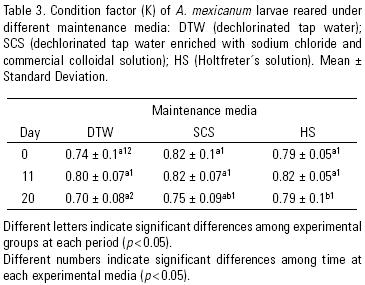
<body><![CDATA[<p align="center"><font size="2" face="verdana"><img src="/img/revistas/hbio/v19n3/a3t1.jpg"></font></p>     <p align="justify"><font face="verdana" size="2"><b>Mortality, development and growth of axolotls. </b>At the end of the tests, mortality of the organisms was similar (10%) within the different treatments (<i>p </i>&gt; 0.05). The development of the larvae reared in the three maintenance media was similar (<i>p </i>&gt; 0.05) and in agreement with the period involved as suggested by Nye <i>et al</i>. (2003). At the half of the experimental period (day 11<sup>th</sup>), all the test organisms were in stages 50 and 51 corresponding when the forelimb digits are developing and the hindlimbs are beginning to emerge; at the end of the trials (day 20<sup>th</sup>), the organisms of the three maintenance media were at stage 54 corresponding when the forelimb is complete and the digits I and II of the hindlimbs are visible.</font></p>     <p align="justify"><font face="verdana" size="2">The effect of the different maintenance media on growth of axolotl larvae is summarized in <a href="/img/revistas/hbio/v19n3/a3t2.jpg" target="_blank">table 2</a>. Larvae growth rate in terms of total length (cm TL d<sup>&#150;1</sup>) was similar between the experimental groups as well as between the evaluation periods (11 and 20 days; <i>p </i>&gt;0.05). However in terms of biomass (mg WW d<sup>&#150;1</sup>), larvae growth reared in HS was 22 and 20% higher (<i>p </i>&lt;0.05) at day 11<sup>th</sup>, and 21 and 54% higher (<i>p </i>&lt;0.05) at day 20<sup>th</sup> than the axolotls reared under DTW and SCS media, respectively. Similarly, final growth rate of the larvae reared in HS was 39 and 40% higher (<i>p </i>&lt;0.05) than the organisms maintained in DTW and SCS media, respectively (<a href="/img/revistas/hbio/v19n3/a3t2.jpg" target="_blank">table 2</a>; <a href="#f1">figure 1</a>).</font></p>     <p align="center"><font size="2" face="verdana"><a name="f1"></a></font></p>     <p align="center"><font size="2" face="verdana"><img src="/img/revistas/hbio/v19n3/a3f1.jpg"></font></p>     <p align="justify"><font face="verdana" size="2">The condition factor of the organisms at the end of the tests was similar between the larvae maintained in SCS and in HS media (<i>p </i>&gt;0.05); nevertheless, in the larvae reared under DTW it was 11% lower than the organisms maintained in HS (<i>p </i>&lt;0.05; <a href="#t3">table 3</a>).</font></p>     <p align="center"><font size="2" face="verdana"><a name="t3"></a></font></p>     <p align="center"><font size="2" face="verdana"><img src="/img/revistas/hbio/v19n3/a3t3.jpg"></font></p>     <p align="justify"><font face="verdana" size="2">&nbsp;</font></p>     <p align="justify"><font face="verdana" size="2"><b>DISCUSSION</b></font></p>     ]]></body>
<body><![CDATA[<p align="justify"><font face="verdana" size="2">The development of the <i>A. mexicanum </i>larvae maintained in the three culture media (DTW, SCS and HS) was similar and in agreement with the time of development reported for the species (Nye <i>et al., </i>2003). Therefore it is possible to suggest that the quality of the solutions did not modify the activity of the thyroid hormone, whose mechanisms are the principal stimuli of the morphologic development of amphibians, and in general of all vertebrates (Uhlenhuth, 1921; Brown, 1997; Smirnov &amp; Vassilieva, 2004). Moreover, the high values of survival (90%) obtained at the end of the tests in the different maintenance media suggest that any of them altered the physiological condition of the larvae of <i>A mexicanum.</i></font></p>     <p align="justify"><font face="verdana" size="2">However, beside the development and survival of the axolotl, the maintenance media had a significant effect on the axolotl's growth in terms of biomass (mg WW d<sup>&#150;1</sup>), although no differences were observed on the total final length of the organisms. This later response can be due to the cannibal behavior of the organisms, mainly in the larval and juvenile stage, although they have an adequate food supply and maintained at a recommended density (Barlow, 1996). It is common that axolotls bite the tail of the other organisms altering the real size of the larvae (Gresens, 2004). To avoid this confusion factor on the axolotl's length, it is recommended for future studies to consider the standard length (distance from the beginning of the mouth to the forelimbs or to cloaca) instead of the total length of the organisms.</font></p>     <p align="justify"><font face="verdana" size="2">In all three maintenance media, the larvae gained 11, 11 and 14 times in weight throughout the 20 days in DTW, SCS and HS tests respectively. However, the rate of growth of 12.6 mg d<sup>&#150;1</sup> in larvae maintained in the Holtfreter's medium was 39 and 40% higher than that of the organisms maintained on DTW and SCS media, denoting e that this maintenance solution favors the increase of biomass. The calculated Fulton's condition factor values also suggest a better condition in organisms maintained in the Holtfreter's medium (K =0.79), whereas the significant reduction of 11% of this index at the end of the tests in larvae reared in DTW suggest an inadequate maintenance media for the axolotl larvae.</font></p>     <p align="justify"><font face="verdana" size="2">Considering that the energetic demand for the amphibian osmoregulation probably is minimum or null at isosmotic conditions or near to it (where the ionic and osmotic gradients between internal and the external medium are minimal), the energetic requirements for maintenance are lowered and the saved energy can be directed to increase growth and to maintain an overall suitable physiological condition as is suggested for fish and another species of amphibians (Gordon &amp; Tucker, 1965; Dennis &amp; Bulger, 1995; Laiz&#150;Carri&oacute;n <i>et al</i>., 2005; Tsuzuki <i>et al</i>., 2007).</font></p>     <p align="justify"><font face="verdana" size="2">Under isosmotic conditions, Hronowski &amp; Armstrong (1977) reported for axolotl larvae external medium levels of Na<sup>+</sup>, K<sup>+</sup>, Ca<sup>2+</sup>, Cl<sup>&#150;</sup> and osmotic pressure of 94.7, 3.0, 1.6, 84.7 mmol L<sup>&#150;1</sup> and 216 mOsm, respectively. Therefore, it can be considered that although the Holtfreter's solution does not represent a condition of isosmoticity for the larvae of <i>A. mexicanum, </i>the energy involved in the osmotic regulations mechanisms is probably reduced in relation with the other two maintenance media (DTW and SCS), leading to growth enhancement and a suitable physiological condition.</font></p>     <p align="justify"><font face="verdana" size="2">According to the results obtained in the present work, we conclude that among the solutions used for the culture of the axolotl <i>Ambystoma mexicanum </i>in Mexico, the Holtfreter's medium guarantees a suitable development and growth of the organisms. Therefore we propose to use this medium in culture systems for both, the maintenance of the genetic stock of the Mexican axolotl and researching purposes.</font></p>     <p align="justify"><font face="verdana" size="2">&nbsp;</font></p>     <p align="justify"><font face="verdana" size="2"><b>ACKNOWLEDGMENTS</b></font></p>     <p align="justify"><font face="verdana" size="2">This research was supported by grants of the Department of Ecology and Natural Resources, Faculty of Sciences, and the Programa de Apoyo a Proyectos para la Innovaci&oacute;n y Mejoramiento de la Ense&ntilde;anza  of the Universidad Nacional Aut&oacute;noma de M&eacute;xico, UNAM (PE 205206). Robles Mendoza Cecilia thanks to the Direcci&oacute;n General de Asuntos del Personal Acad&eacute;mico, UNAM, for the postdoctoral fellowship. We also thank Dr. Luis Zambrano (Institute of Biology, UNAM) for providing the test organisms and Dr. Charles Brown for editing the English&#150;language text.</font></p>     <p align="justify"><font face="verdana" size="2">&nbsp;</font></p>     ]]></body>
<body><![CDATA[<p align="justify"><font face="verdana" size="2"><b>REFERENCES</b></font></p>     <!-- ref --><p align="justify"><font face="verdana" size="2">Barlow, L. 1996. Northcutt lab larval rearing. <i>Axolotl Newsletter</i> 25: 15.</font>&nbsp;&nbsp;&nbsp;&nbsp;&nbsp;&nbsp;&nbsp;&nbsp;[&#160;<a href="javascript:void(0);" onclick="javascript: window.open('/scielo.php?script=sci_nlinks&ref=4079301&pid=S0188-8897200900030000300001&lng=','','width=640,height=500,resizable=yes,scrollbars=1,menubar=yes,');">Links</a>&#160;]<!-- end-ref --><!-- ref --><p align="justify"><font face="verdana" size="2">Bordzilovskaya, N. P., T. A. Detlaff, S. T. Duhon &amp; G. M. Malacinski. 1989. Developmental&#150;stage series of axolotl embryos. <i>In</i>: Armostrong, J. B. &amp; G. M. Malacinsky (Eds.). <i>Developmental biology of the axolotl. </i>Oxford University Press, pp. 201&#150;219.</font>&nbsp;&nbsp;&nbsp;&nbsp;&nbsp;&nbsp;&nbsp;&nbsp;[&#160;<a href="javascript:void(0);" onclick="javascript: window.open('/scielo.php?script=sci_nlinks&ref=4079302&pid=S0188-8897200900030000300002&lng=','','width=640,height=500,resizable=yes,scrollbars=1,menubar=yes,');">Links</a>&#160;]<!-- end-ref --><!-- ref --><p align="justify"><font face="verdana" size="2">Brown, D. D. 1997. The role of thyroid hormone in zebrafish and axolotl development. <i>Proceedings of the Natural Academy of Sciences </i>94: 13011&#150;13016.</font>&nbsp;&nbsp;&nbsp;&nbsp;&nbsp;&nbsp;&nbsp;&nbsp;[&#160;<a href="javascript:void(0);" onclick="javascript: window.open('/scielo.php?script=sci_nlinks&ref=4079303&pid=S0188-8897200900030000300003&lng=','','width=640,height=500,resizable=yes,scrollbars=1,menubar=yes,');">Links</a>&#160;]<!-- end-ref --><!-- ref --><p align="justify"><font face="verdana" size="2">Busacker, G. P. , I. R. Adelman &amp; E. M. Goolish. 1990. Growth. <i>In</i>: Schreck C. B. &amp; P. B. Moyle (Eds.). <i>Methods for fish biology. </i>American Fisheries Society, pp. 363&#150;387.</font>&nbsp;&nbsp;&nbsp;&nbsp;&nbsp;&nbsp;&nbsp;&nbsp;[&#160;<a href="javascript:void(0);" onclick="javascript: window.open('/scielo.php?script=sci_nlinks&ref=4079304&pid=S0188-8897200900030000300004&lng=','','width=640,height=500,resizable=yes,scrollbars=1,menubar=yes,');">Links</a>&#160;]<!-- end-ref --><!-- ref --><p align="justify"><font face="verdana" size="2">CITES&#150;Convention on International Trade in Endangered Species of wild fauna and flora. 2007. <a href="http://www.cites.org/" target="_blank">http://www.cites.org</a>.</font>&nbsp;&nbsp;&nbsp;&nbsp;&nbsp;&nbsp;&nbsp;&nbsp;[&#160;<a href="javascript:void(0);" onclick="javascript: window.open('/scielo.php?script=sci_nlinks&ref=4079305&pid=S0188-8897200900030000300005&lng=','','width=640,height=500,resizable=yes,scrollbars=1,menubar=yes,');">Links</a>&#160;]<!-- end-ref --><!-- ref --><p align="justify"><font face="verdana" size="2">Contreras V., E. Mart&iacute;nez&#150;Meyer, E. Valiente &amp; L. Zambrano. 2009. Recent decline and potential distribution in the last remnant area of the microendemic Mexican axolotl (<i>Ambystoma mexicanum</i>). <i>Biologica Conservation </i>142: 2881&#150;2885.</font>&nbsp;&nbsp;&nbsp;&nbsp;&nbsp;&nbsp;&nbsp;&nbsp;[&#160;<a href="javascript:void(0);" onclick="javascript: window.open('/scielo.php?script=sci_nlinks&ref=4079306&pid=S0188-8897200900030000300006&lng=','','width=640,height=500,resizable=yes,scrollbars=1,menubar=yes,');">Links</a>&#160;]<!-- end-ref --><!-- ref --><p align="justify"><font face="verdana" size="2">Dennis T. E. &amp; A. J. Bulger. 1995. Condition factor and whole&#150;body sodium concentrations in a freshwater fish: Evidence for acidification stress and possible ionoregulatory over&#150;compensation. <i>Water, Air &amp; Soil Pollution </i>85 (2): 377&#150;382.</font>&nbsp;&nbsp;&nbsp;&nbsp;&nbsp;&nbsp;&nbsp;&nbsp;[&#160;<a href="javascript:void(0);" onclick="javascript: window.open('/scielo.php?script=sci_nlinks&ref=4079307&pid=S0188-8897200900030000300007&lng=','','width=640,height=500,resizable=yes,scrollbars=1,menubar=yes,');">Links</a>&#160;]<!-- end-ref --><!-- ref --><p align="justify"><font face="verdana" size="2">DOF&#150;Diario Oficial de la Federaci&oacute;n, 2002. <i>Norma Oficial Mexicana NOM&#150;059&#150;SEMARNAT&#150;2001. Protecci&oacute;n ambiental&#150;Especies nativas de M&eacute;xico de flora y fauna silvestres&#150;Categor&iacute;as de riesgo y especificaciones para su inclusi&oacute;n, exclusi&oacute;n o cambio&#150;Lista de especies en riesgo. </i>Diario Oficial de la Federaci&oacute;n, M&eacute;xico, D. F. March 6.</font>&nbsp;&nbsp;&nbsp;&nbsp;&nbsp;&nbsp;&nbsp;&nbsp;[&#160;<a href="javascript:void(0);" onclick="javascript: window.open('/scielo.php?script=sci_nlinks&ref=4079308&pid=S0188-8897200900030000300008&lng=','','width=640,height=500,resizable=yes,scrollbars=1,menubar=yes,');">Links</a>&#160;]<!-- end-ref --><!-- ref --><p align="justify"><font face="verdana" size="2">Gordon, M. S. &amp; V. A. Tucker. 1965. Osmotic regulation in the tadpoles of the crab&#150;eating frog (<i>Rana cancrivora</i>). <i>Journal of Experimental Biology </i>42: 437&#150;445.</font>&nbsp;&nbsp;&nbsp;&nbsp;&nbsp;&nbsp;&nbsp;&nbsp;[&#160;<a href="javascript:void(0);" onclick="javascript: window.open('/scielo.php?script=sci_nlinks&ref=4079309&pid=S0188-8897200900030000300009&lng=','','width=640,height=500,resizable=yes,scrollbars=1,menubar=yes,');">Links</a>&#160;]<!-- end-ref --><!-- ref --><p align="justify"><font face="verdana" size="2">Gresens, J. 2004. An introduction to the Mexican axolotl (<i>Ambystoma mexicanum</i>). <i>Lab Animal </i>33: 41&#150;46.</font>&nbsp;&nbsp;&nbsp;&nbsp;&nbsp;&nbsp;&nbsp;&nbsp;[&#160;<a href="javascript:void(0);" onclick="javascript: window.open('/scielo.php?script=sci_nlinks&ref=4079310&pid=S0188-8897200900030000300010&lng=','','width=640,height=500,resizable=yes,scrollbars=1,menubar=yes,');">Links</a>&#160;]<!-- end-ref --><!-- ref --><p align="justify"><font face="verdana" size="2">Hennig, A. 1996. Corwin lab axolotl protocols. <i>Axolotl Newsletter </i>25: 10&#150;12.</font>&nbsp;&nbsp;&nbsp;&nbsp;&nbsp;&nbsp;&nbsp;&nbsp;[&#160;<a href="javascript:void(0);" onclick="javascript: window.open('/scielo.php?script=sci_nlinks&ref=4079311&pid=S0188-8897200900030000300011&lng=','','width=640,height=500,resizable=yes,scrollbars=1,menubar=yes,');">Links</a>&#160;]<!-- end-ref --><!-- ref --><p align="justify"><font face="verdana" size="2">Hochachka, P. W. &amp; G. M. Somero. 1978. <i>Strategies of biochemical adaptation</i>. Saunders C., London. 358 p.</font>&nbsp;&nbsp;&nbsp;&nbsp;&nbsp;&nbsp;&nbsp;&nbsp;[&#160;<a href="javascript:void(0);" onclick="javascript: window.open('/scielo.php?script=sci_nlinks&ref=4079312&pid=S0188-8897200900030000300012&lng=','','width=640,height=500,resizable=yes,scrollbars=1,menubar=yes,');">Links</a>&#160;]<!-- end-ref --><!-- ref --><p align="justify"><font face="verdana" size="2">Hronowski, L. &amp; J. B. Armstrong. 1977. Ionic composition of the plasma of <i>Ambystoma mexicanum. Comparative Biochemistry and Physiology </i>58A: 181&#150;183.</font>&nbsp;&nbsp;&nbsp;&nbsp;&nbsp;&nbsp;&nbsp;&nbsp;[&#160;<a href="javascript:void(0);" onclick="javascript: window.open('/scielo.php?script=sci_nlinks&ref=4079313&pid=S0188-8897200900030000300013&lng=','','width=640,height=500,resizable=yes,scrollbars=1,menubar=yes,');">Links</a>&#160;]<!-- end-ref --><!-- ref --><p align="justify"><font face="verdana" size="2">IUCN&#150; International Union for Conservation of Nature. 2009. IUCN Red List of Threatened Species. Version 2009.2. <a href="http://www.iucnredlist.org/" target="_blank">http://www.iucnredlist.org</a>.</font>&nbsp;&nbsp;&nbsp;&nbsp;&nbsp;&nbsp;&nbsp;&nbsp;[&#160;<a href="javascript:void(0);" onclick="javascript: window.open('/scielo.php?script=sci_nlinks&ref=4079314&pid=S0188-8897200900030000300014&lng=','','width=640,height=500,resizable=yes,scrollbars=1,menubar=yes,');">Links</a>&#160;]<!-- end-ref --><!-- ref --><p align="justify"><font face="verdana" size="2">Laiz&#150;Carri&oacute;n, R., S. Sangiao&#150;Alvarellos, J. M. Guzm&aacute;n, M. P. Mart&iacute;n del R&iacute;o, J. L. Soengas &amp; J. M. Mancera. 2005. Growth performance of gilthead sea bream <i>Sparus aurata </i>in different osmotic conditions: implications for osmoregulation and energy metabolism. <i>Aquaculture </i>250: 849&#150;861.</font>&nbsp;&nbsp;&nbsp;&nbsp;&nbsp;&nbsp;&nbsp;&nbsp;[&#160;<a href="javascript:void(0);" onclick="javascript: window.open('/scielo.php?script=sci_nlinks&ref=4079315&pid=S0188-8897200900030000300015&lng=','','width=640,height=500,resizable=yes,scrollbars=1,menubar=yes,');">Links</a>&#160;]<!-- end-ref --><!-- ref --><p align="justify"><font face="verdana" size="2">Maya, M. G. O. 2006. <i>Aspectos de mantenimiento y desarrollo en cautiverio del ajolote mexicano (<b>Ambystoma mexicanum</b>). </i>Tesis de Licenciatura (Biolog&iacute;a), Facultad de Estudios Superiores Iztacala, UNAM, M&eacute;xico. 36 p.</font>&nbsp;&nbsp;&nbsp;&nbsp;&nbsp;&nbsp;&nbsp;&nbsp;[&#160;<a href="javascript:void(0);" onclick="javascript: window.open('/scielo.php?script=sci_nlinks&ref=4079316&pid=S0188-8897200900030000300016&lng=','','width=640,height=500,resizable=yes,scrollbars=1,menubar=yes,');">Links</a>&#160;]<!-- end-ref --><!-- ref --><p align="justify"><font face="verdana" size="2">Nye, H. L., J. A. Cameron, E. A. Chernoff &amp; D. L. Stocum. 2003. Regeneration of the urodele limb: a review. <i>Developmental Dynamics. </i>226: 555&#150;560.</font>&nbsp;&nbsp;&nbsp;&nbsp;&nbsp;&nbsp;&nbsp;&nbsp;[&#160;<a href="javascript:void(0);" onclick="javascript: window.open('/scielo.php?script=sci_nlinks&ref=4079317&pid=S0188-8897200900030000300017&lng=','','width=640,height=500,resizable=yes,scrollbars=1,menubar=yes,');">Links</a>&#160;]<!-- end-ref --><!-- ref --><p align="justify"><font face="verdana" size="2">Otto, P. E. S. 1998. <i>Conservaci&oacute;n del ajolote (<b>Ambystoma mexicanun</b>) mediante su cultivo y siembra en el Parque Ecol&oacute;gico de Xochimilco</i>. Informe final de Proyecto CONABIO, M&eacute;xico, D. F. 34 p. <a href="http://www.conabio.gob.mx/" target="_blank">www.conabio.gob.mx</a></font>&nbsp;&nbsp;&nbsp;&nbsp;&nbsp;&nbsp;&nbsp;&nbsp;[&#160;<a href="javascript:void(0);" onclick="javascript: window.open('/scielo.php?script=sci_nlinks&ref=4079318&pid=S0188-8897200900030000300018&lng=','','width=640,height=500,resizable=yes,scrollbars=1,menubar=yes,');">Links</a>&#160;]<!-- end-ref --><!-- ref --><p align="justify"><font face="verdana" size="2">Prosser, C. l. 1991. <i>Environmental and metabolic animal physiology. </i>Wile&#150;Liss Inc., New York. 578 p.</font>&nbsp;&nbsp;&nbsp;&nbsp;&nbsp;&nbsp;&nbsp;&nbsp;[&#160;<a href="javascript:void(0);" onclick="javascript: window.open('/scielo.php?script=sci_nlinks&ref=4079319&pid=S0188-8897200900030000300019&lng=','','width=640,height=500,resizable=yes,scrollbars=1,menubar=yes,');">Links</a>&#160;]<!-- end-ref --><!-- ref --><p align="justify"><font face="verdana" size="2">RCW&#150;The Ramsar Convention on Wetlands, 2004. <i>The list of wetlands of international importance</i>. <a href="http://www.ramsar.org/pdf/sitelist.pdf" target="_blank">http://www.ramsar.org/sitelist.pdf</a></font>&nbsp;&nbsp;&nbsp;&nbsp;&nbsp;&nbsp;&nbsp;&nbsp;[&#160;<a href="javascript:void(0);" onclick="javascript: window.open('/scielo.php?script=sci_nlinks&ref=4079320&pid=S0188-8897200900030000300020&lng=','','width=640,height=500,resizable=yes,scrollbars=1,menubar=yes,');">Links</a>&#160;]<!-- end-ref --><!-- ref --><p align="justify"><font face="verdana" size="2">Rodier, J. 1981. <i>An&aacute;lisis de la aguas. </i>Omega, Barcelona. 504 p.</font>&nbsp;&nbsp;&nbsp;&nbsp;&nbsp;&nbsp;&nbsp;&nbsp;[&#160;<a href="javascript:void(0);" onclick="javascript: window.open('/scielo.php?script=sci_nlinks&ref=4079321&pid=S0188-8897200900030000300021&lng=','','width=640,height=500,resizable=yes,scrollbars=1,menubar=yes,');">Links</a>&#160;]<!-- end-ref --><!-- ref --><p align="justify"><font face="verdana" size="2">Shoemaker, V. H. &amp; K. A. Nagy. 1977. Osmoregulation in amphibian and reptiles. <i>Annual Review of Physiology </i>39: 449&#150;471.</font>&nbsp;&nbsp;&nbsp;&nbsp;&nbsp;&nbsp;&nbsp;&nbsp;[&#160;<a href="javascript:void(0);" onclick="javascript: window.open('/scielo.php?script=sci_nlinks&ref=4079322&pid=S0188-8897200900030000300022&lng=','','width=640,height=500,resizable=yes,scrollbars=1,menubar=yes,');">Links</a>&#160;]<!-- end-ref --><!-- ref --><p align="justify"><font face="verdana" size="2">Smirnov, S. V. &amp; A. B. Vassilieva. 2004. Characteristic of craniogenesis in the axolotl (<i>Ambystoma mexicanum: </i>Ambystomatidae) and the role of thyroid hormones in its regulation. <i>Dokladi Biological Sciences </i>395: 121&#150;123.</font>&nbsp;&nbsp;&nbsp;&nbsp;&nbsp;&nbsp;&nbsp;&nbsp;[&#160;<a href="javascript:void(0);" onclick="javascript: window.open('/scielo.php?script=sci_nlinks&ref=4079323&pid=S0188-8897200900030000300023&lng=','','width=640,height=500,resizable=yes,scrollbars=1,menubar=yes,');">Links</a>&#160;]<!-- end-ref --><!-- ref --><p align="justify"><font face="verdana" size="2">Tsusuki M. Y., J. K. Sugai, L. C. Maciel, C. J. Francisco &amp; V. R. Cerqueira. 2007. Survival, growth and digestive enzyme activity of juveniles of the fat snook (<i>Centropomus parallelus</i>) reared at different salinities. <i>Aquaculture </i>271: 319&#150;325.</font>&nbsp;&nbsp;&nbsp;&nbsp;&nbsp;&nbsp;&nbsp;&nbsp;[&#160;<a href="javascript:void(0);" onclick="javascript: window.open('/scielo.php?script=sci_nlinks&ref=4079324&pid=S0188-8897200900030000300024&lng=','','width=640,height=500,resizable=yes,scrollbars=1,menubar=yes,');">Links</a>&#160;]<!-- end-ref --><!-- ref --><p align="justify"><font face="verdana" size="2">Uhlenhuth, E. 1921. The internal secretions in growth and development of amphibians. <i>The American Naturalist </i>55: 193&#150;221.</font>&nbsp;&nbsp;&nbsp;&nbsp;&nbsp;&nbsp;&nbsp;&nbsp;[&#160;<a href="javascript:void(0);" onclick="javascript: window.open('/scielo.php?script=sci_nlinks&ref=4079325&pid=S0188-8897200900030000300025&lng=','','width=640,height=500,resizable=yes,scrollbars=1,menubar=yes,');">Links</a>&#160;]<!-- end-ref --><!-- ref --><p align="justify"><font face="verdana" size="2">UNESCO, 2003. <i>World's cultural heritage: Mexican cities</i>. Fondo Editorial de la Pl&aacute;stica Mexicana, UNESCO, M&eacute;xico. 159 p.</font>&nbsp;&nbsp;&nbsp;&nbsp;&nbsp;&nbsp;&nbsp;&nbsp;[&#160;<a href="javascript:void(0);" onclick="javascript: window.open('/scielo.php?script=sci_nlinks&ref=4079326&pid=S0188-8897200900030000300026&lng=','','width=640,height=500,resizable=yes,scrollbars=1,menubar=yes,');">Links</a>&#160;]<!-- end-ref --><!-- ref --><p align="justify"><font face="verdana" size="2">Zambrano, L., E. Vega, L. G. Herrera, E. Prado &amp; V. H. Reynoso. 2007. A population matrix model and population viability analysis to predict the fate of endangered species in highly managed water systems. <i>Animal Conservation </i>10: 297&#150;303.</font>&nbsp;&nbsp;&nbsp;&nbsp;&nbsp;&nbsp;&nbsp;&nbsp;[&#160;<a href="javascript:void(0);" onclick="javascript: window.open('/scielo.php?script=sci_nlinks&ref=4079327&pid=S0188-8897200900030000300027&lng=','','width=640,height=500,resizable=yes,scrollbars=1,menubar=yes,');">Links</a>&#160;]<!-- end-ref --><!-- ref --><p align="justify"><font face="verdana" size="2">Zar, J. H. 1984. <i>Biostatistical analysis</i>. Prentice Hall, New Jersey. 718 p.</font>&nbsp;&nbsp;&nbsp;&nbsp;&nbsp;&nbsp;&nbsp;&nbsp;[&#160;<a href="javascript:void(0);" onclick="javascript: window.open('/scielo.php?script=sci_nlinks&ref=4079328&pid=S0188-8897200900030000300028&lng=','','width=640,height=500,resizable=yes,scrollbars=1,menubar=yes,');">Links</a>&#160;]<!-- end-ref --> ]]></body><back>
<ref-list>
<ref id="B1">
<nlm-citation citation-type="journal">
<person-group person-group-type="author">
<name>
<surname><![CDATA[Barlow]]></surname>
<given-names><![CDATA[L.]]></given-names>
</name>
</person-group>
<article-title xml:lang="en"><![CDATA[Northcutt lab larval rearing]]></article-title>
<source><![CDATA[Axolotl Newsletter]]></source>
<year>1996</year>
<volume>25</volume>
<page-range>15</page-range></nlm-citation>
</ref>
<ref id="B2">
<nlm-citation citation-type="book">
<person-group person-group-type="author">
<name>
<surname><![CDATA[Bordzilovskaya]]></surname>
<given-names><![CDATA[N. P.]]></given-names>
</name>
<name>
<surname><![CDATA[Detlaff]]></surname>
<given-names><![CDATA[T. A.]]></given-names>
</name>
<name>
<surname><![CDATA[Duhon]]></surname>
<given-names><![CDATA[S. T.]]></given-names>
</name>
<name>
<surname><![CDATA[Malacinski]]></surname>
<given-names><![CDATA[G. M.]]></given-names>
</name>
</person-group>
<article-title xml:lang="en"><![CDATA[Developmental-stage series of axolotl embryos]]></article-title>
<person-group person-group-type="editor">
<name>
<surname><![CDATA[Armostrong]]></surname>
<given-names><![CDATA[J. B.]]></given-names>
</name>
<name>
<surname><![CDATA[Malacinsky]]></surname>
<given-names><![CDATA[G. M.]]></given-names>
</name>
</person-group>
<source><![CDATA[Developmental biology of the axolotl]]></source>
<year>1989</year>
<page-range>201-219</page-range><publisher-name><![CDATA[Oxford University Press]]></publisher-name>
</nlm-citation>
</ref>
<ref id="B3">
<nlm-citation citation-type="journal">
<person-group person-group-type="author">
<name>
<surname><![CDATA[Brown]]></surname>
<given-names><![CDATA[D. D.]]></given-names>
</name>
</person-group>
<article-title xml:lang="en"><![CDATA[The role of thyroid hormone in zebrafish and axolotl development]]></article-title>
<source><![CDATA[Proceedings of the Natural Academy of Sciences]]></source>
<year>1997</year>
<volume>94</volume>
<page-range>13011-13016</page-range></nlm-citation>
</ref>
<ref id="B4">
<nlm-citation citation-type="book">
<person-group person-group-type="author">
<name>
<surname><![CDATA[Busacker]]></surname>
<given-names><![CDATA[G. P.]]></given-names>
</name>
<name>
<surname><![CDATA[Adelman]]></surname>
<given-names><![CDATA[I. R.]]></given-names>
</name>
<name>
<surname><![CDATA[Goolish]]></surname>
<given-names><![CDATA[E. M.]]></given-names>
</name>
</person-group>
<article-title xml:lang="en"><![CDATA[Growth]]></article-title>
<person-group person-group-type="editor">
<name>
<surname><![CDATA[Schreck]]></surname>
<given-names><![CDATA[C. B.]]></given-names>
</name>
<name>
<surname><![CDATA[Moyle]]></surname>
<given-names><![CDATA[P. B.]]></given-names>
</name>
</person-group>
<source><![CDATA[Methods for fish biology]]></source>
<year>1990</year>
<page-range>363-387</page-range><publisher-name><![CDATA[American Fisheries Society]]></publisher-name>
</nlm-citation>
</ref>
<ref id="B5">
<nlm-citation citation-type="">
<collab>CITES-Convention on International Trade in Endangered Species of wild fauna and flora</collab>
<source><![CDATA[]]></source>
<year>2007</year>
</nlm-citation>
</ref>
<ref id="B6">
<nlm-citation citation-type="journal">
<person-group person-group-type="author">
<name>
<surname><![CDATA[Contreras]]></surname>
<given-names><![CDATA[V.]]></given-names>
</name>
<name>
<surname><![CDATA[Martínez-Meyer]]></surname>
<given-names><![CDATA[E.]]></given-names>
</name>
<name>
<surname><![CDATA[Valiente]]></surname>
<given-names><![CDATA[E.]]></given-names>
</name>
<name>
<surname><![CDATA[Zambrano]]></surname>
<given-names><![CDATA[L.]]></given-names>
</name>
</person-group>
<article-title xml:lang="en"><![CDATA[Recent decline and potential distribution in the last remnant area of the microendemic Mexican axolotl (Ambystoma mexicanum)]]></article-title>
<source><![CDATA[Biologica Conservation]]></source>
<year>2009</year>
<volume>142</volume>
<page-range>2881-2885</page-range></nlm-citation>
</ref>
<ref id="B7">
<nlm-citation citation-type="journal">
<person-group person-group-type="author">
<name>
<surname><![CDATA[Dennis]]></surname>
<given-names><![CDATA[T. E.]]></given-names>
</name>
<name>
<surname><![CDATA[Bulger]]></surname>
<given-names><![CDATA[A. J.]]></given-names>
</name>
</person-group>
<article-title xml:lang="en"><![CDATA[Condition factor and whole-body sodium concentrations in a freshwater fish: Evidence for acidification stress and possible ionoregulatory over-compensation]]></article-title>
<source><![CDATA[Water, Air & Soil Pollution]]></source>
<year>1995</year>
<volume>85</volume>
<numero>2</numero>
<issue>2</issue>
<page-range>377-382</page-range></nlm-citation>
</ref>
<ref id="B8">
<nlm-citation citation-type="">
<source><![CDATA[DOF-Diario Oficial de la Federación, 2002. Norma Oficial Mexicana NOM-059-SEMARNAT-2001. Protección ambiental-Especies nativas de México de flora y fauna silvestres-Categorías de riesgo y especificaciones para su inclusión, exclusión o cambio-Lista de especies en riesgo. Diario Oficial de la Federación, México, D. F. March 6]]></source>
<year></year>
</nlm-citation>
</ref>
<ref id="B9">
<nlm-citation citation-type="journal">
<person-group person-group-type="author">
<name>
<surname><![CDATA[Gordon]]></surname>
<given-names><![CDATA[M. S.]]></given-names>
</name>
<name>
<surname><![CDATA[Tucker]]></surname>
<given-names><![CDATA[V. A.]]></given-names>
</name>
</person-group>
<article-title xml:lang="en"><![CDATA[Osmotic regulation in the tadpoles of the crab-eating frog (Rana cancrivora)]]></article-title>
<source><![CDATA[Journal of Experimental Biology]]></source>
<year>1965</year>
<volume>42</volume>
<page-range>437-445</page-range></nlm-citation>
</ref>
<ref id="B10">
<nlm-citation citation-type="journal">
<person-group person-group-type="author">
<name>
<surname><![CDATA[Gresens]]></surname>
<given-names><![CDATA[J.]]></given-names>
</name>
</person-group>
<article-title xml:lang="en"><![CDATA[An introduction to the Mexican axolotl (Ambystoma mexicanum)]]></article-title>
<source><![CDATA[Lab Animal]]></source>
<year>2004</year>
<volume>33</volume>
<page-range>41-46</page-range></nlm-citation>
</ref>
<ref id="B11">
<nlm-citation citation-type="journal">
<person-group person-group-type="author">
<name>
<surname><![CDATA[Hennig]]></surname>
<given-names><![CDATA[A.]]></given-names>
</name>
</person-group>
<article-title xml:lang="en"><![CDATA[Corwin lab axolotl protocols]]></article-title>
<source><![CDATA[Axolotl Newsletter]]></source>
<year>1996</year>
<volume>25</volume>
<page-range>10-12</page-range></nlm-citation>
</ref>
<ref id="B12">
<nlm-citation citation-type="book">
<person-group person-group-type="author">
<name>
<surname><![CDATA[Hochachka]]></surname>
<given-names><![CDATA[P. W.]]></given-names>
</name>
<name>
<surname><![CDATA[Somero]]></surname>
<given-names><![CDATA[G. M.]]></given-names>
</name>
</person-group>
<source><![CDATA[Strategies of biochemical adaptation]]></source>
<year>1978</year>
<page-range>358</page-range><publisher-loc><![CDATA[London ]]></publisher-loc>
<publisher-name><![CDATA[Saunders C.]]></publisher-name>
</nlm-citation>
</ref>
<ref id="B13">
<nlm-citation citation-type="journal">
<person-group person-group-type="author">
<name>
<surname><![CDATA[Hronowski]]></surname>
<given-names><![CDATA[L.]]></given-names>
</name>
<name>
<surname><![CDATA[Armstrong]]></surname>
<given-names><![CDATA[J. B.]]></given-names>
</name>
</person-group>
<article-title xml:lang="en"><![CDATA[Ionic composition of the plasma of Ambystoma mexicanum]]></article-title>
<source><![CDATA[Comparative Biochemistry and Physiology]]></source>
<year>1977</year>
<volume>58A</volume>
<page-range>181-183</page-range></nlm-citation>
</ref>
<ref id="B14">
<nlm-citation citation-type="">
<collab>IUCN- International Union for Conservation of Nature</collab>
<source><![CDATA[IUCN Red List of Threatened Species: Version 2009.2]]></source>
<year>2009</year>
</nlm-citation>
</ref>
<ref id="B15">
<nlm-citation citation-type="journal">
<person-group person-group-type="author">
<name>
<surname><![CDATA[Laiz-Carrión]]></surname>
<given-names><![CDATA[R.]]></given-names>
</name>
<name>
<surname><![CDATA[Sangiao-Alvarellos]]></surname>
<given-names><![CDATA[S.]]></given-names>
</name>
<name>
<surname><![CDATA[Guzmán]]></surname>
<given-names><![CDATA[J. M.]]></given-names>
</name>
<name>
<surname><![CDATA[Martín del Río]]></surname>
<given-names><![CDATA[M. P.]]></given-names>
</name>
<name>
<surname><![CDATA[Soengas]]></surname>
<given-names><![CDATA[J. L.]]></given-names>
</name>
<name>
<surname><![CDATA[Mancera]]></surname>
<given-names><![CDATA[J. M.]]></given-names>
</name>
</person-group>
<article-title xml:lang="en"><![CDATA[Growth performance of gilthead sea bream Sparus aurata in different osmotic conditions: implications for osmoregulation and energy metabolism]]></article-title>
<source><![CDATA[Aquaculture]]></source>
<year>2005</year>
<volume>250</volume>
<page-range>849-861</page-range></nlm-citation>
</ref>
<ref id="B16">
<nlm-citation citation-type="">
<person-group person-group-type="author">
<name>
<surname><![CDATA[Maya]]></surname>
<given-names><![CDATA[M. G. O.]]></given-names>
</name>
</person-group>
<source><![CDATA[Aspectos de mantenimiento y desarrollo en cautiverio del ajolote mexicano (Ambystoma mexicanum)]]></source>
<year>2006</year>
<page-range>36</page-range></nlm-citation>
</ref>
<ref id="B17">
<nlm-citation citation-type="journal">
<person-group person-group-type="author">
<name>
<surname><![CDATA[Nye]]></surname>
<given-names><![CDATA[H. L.]]></given-names>
</name>
<name>
<surname><![CDATA[Cameron]]></surname>
<given-names><![CDATA[J. A.]]></given-names>
</name>
<name>
<surname><![CDATA[Chernoff]]></surname>
<given-names><![CDATA[E. A.]]></given-names>
</name>
<name>
<surname><![CDATA[Stocum]]></surname>
<given-names><![CDATA[D. L.]]></given-names>
</name>
</person-group>
<article-title xml:lang="en"><![CDATA[Regeneration of the urodele limb: a review]]></article-title>
<source><![CDATA[Developmental Dynamics]]></source>
<year>2003</year>
<volume>226</volume>
<page-range>555-560</page-range></nlm-citation>
</ref>
<ref id="B18">
<nlm-citation citation-type="book">
<person-group person-group-type="author">
<name>
<surname><![CDATA[Otto]]></surname>
<given-names><![CDATA[P. E. S.]]></given-names>
</name>
</person-group>
<source><![CDATA[Conservación del ajolote (Ambystoma mexicanun) mediante su cultivo y siembra en el Parque Ecológico de Xochimilco]]></source>
<year>1998</year>
<page-range>34</page-range><publisher-loc><![CDATA[México^eD. F. D. F.]]></publisher-loc>
<publisher-name><![CDATA[CONABIO]]></publisher-name>
</nlm-citation>
</ref>
<ref id="B19">
<nlm-citation citation-type="book">
<person-group person-group-type="author">
<name>
<surname><![CDATA[Prosser]]></surname>
<given-names><![CDATA[C. l.]]></given-names>
</name>
</person-group>
<source><![CDATA[Environmental and metabolic animal physiology]]></source>
<year>1991</year>
<page-range>578</page-range><publisher-loc><![CDATA[New York ]]></publisher-loc>
<publisher-name><![CDATA[Wile-Liss Inc.]]></publisher-name>
</nlm-citation>
</ref>
<ref id="B20">
<nlm-citation citation-type="">
<collab>RCW-The Ramsar Convention on Wetlands</collab>
<source><![CDATA[The list of wetlands of international importance]]></source>
<year>2004</year>
</nlm-citation>
</ref>
<ref id="B21">
<nlm-citation citation-type="book">
<person-group person-group-type="author">
<name>
<surname><![CDATA[Rodier]]></surname>
<given-names><![CDATA[J.]]></given-names>
</name>
</person-group>
<source><![CDATA[Análisis de la aguas]]></source>
<year>1981</year>
<page-range>504</page-range><publisher-loc><![CDATA[Barcelona ]]></publisher-loc>
<publisher-name><![CDATA[Omega]]></publisher-name>
</nlm-citation>
</ref>
<ref id="B22">
<nlm-citation citation-type="journal">
<person-group person-group-type="author">
<name>
<surname><![CDATA[Shoemaker]]></surname>
<given-names><![CDATA[V. H.]]></given-names>
</name>
<name>
<surname><![CDATA[Nagy]]></surname>
<given-names><![CDATA[K. A.]]></given-names>
</name>
</person-group>
<article-title xml:lang="en"><![CDATA[Osmoregulation in amphibian and reptiles]]></article-title>
<source><![CDATA[Annual Review of Physiology]]></source>
<year>1977</year>
<volume>39</volume>
<page-range>449-471</page-range></nlm-citation>
</ref>
<ref id="B23">
<nlm-citation citation-type="journal">
<person-group person-group-type="author">
<name>
<surname><![CDATA[Smirnov]]></surname>
<given-names><![CDATA[S. V.]]></given-names>
</name>
<name>
<surname><![CDATA[Vassilieva]]></surname>
<given-names><![CDATA[A. B.]]></given-names>
</name>
</person-group>
<article-title xml:lang="en"><![CDATA[Characteristic of craniogenesis in the axolotl (Ambystoma mexicanum: Ambystomatidae) and the role of thyroid hormones in its regulation]]></article-title>
<source><![CDATA[Dokladi Biological Sciences]]></source>
<year>2004</year>
<volume>395</volume>
<page-range>121-123</page-range></nlm-citation>
</ref>
<ref id="B24">
<nlm-citation citation-type="journal">
<person-group person-group-type="author">
<name>
<surname><![CDATA[Tsusuki]]></surname>
<given-names><![CDATA[M. Y.]]></given-names>
</name>
<name>
<surname><![CDATA[Sugai]]></surname>
<given-names><![CDATA[J. K.]]></given-names>
</name>
<name>
<surname><![CDATA[Maciel]]></surname>
<given-names><![CDATA[L. C.]]></given-names>
</name>
<name>
<surname><![CDATA[Francisco]]></surname>
<given-names><![CDATA[C. J.]]></given-names>
</name>
<name>
<surname><![CDATA[Cerqueira]]></surname>
<given-names><![CDATA[V. R.]]></given-names>
</name>
</person-group>
<article-title xml:lang="en"><![CDATA[Survival, growth and digestive enzyme activity of juveniles of the fat snook (Centropomus parallelus) reared at different salinities]]></article-title>
<source><![CDATA[Aquaculture]]></source>
<year>2007</year>
<volume>271</volume>
<page-range>319-325</page-range></nlm-citation>
</ref>
<ref id="B25">
<nlm-citation citation-type="journal">
<person-group person-group-type="author">
<name>
<surname><![CDATA[Uhlenhuth]]></surname>
<given-names><![CDATA[E.]]></given-names>
</name>
</person-group>
<article-title xml:lang="en"><![CDATA[The internal secretions in growth and development of amphibians]]></article-title>
<source><![CDATA[The American Naturalist]]></source>
<year>1921</year>
<volume>55</volume>
<page-range>193-221</page-range></nlm-citation>
</ref>
<ref id="B26">
<nlm-citation citation-type="book">
<collab>UNESCO</collab>
<source><![CDATA[World's cultural heritage: Mexican cities]]></source>
<year>2003</year>
<page-range>159</page-range><publisher-name><![CDATA[Fondo Editorial de la Plástica MexicanaUNESCO]]></publisher-name>
</nlm-citation>
</ref>
<ref id="B27">
<nlm-citation citation-type="journal">
<person-group person-group-type="author">
<name>
<surname><![CDATA[Zambrano]]></surname>
<given-names><![CDATA[L.]]></given-names>
</name>
<name>
<surname><![CDATA[Vega]]></surname>
<given-names><![CDATA[E.]]></given-names>
</name>
<name>
<surname><![CDATA[Herrera]]></surname>
<given-names><![CDATA[L. G.]]></given-names>
</name>
<name>
<surname><![CDATA[Prado]]></surname>
<given-names><![CDATA[E.]]></given-names>
</name>
<name>
<surname><![CDATA[Reynoso]]></surname>
<given-names><![CDATA[V. H.]]></given-names>
</name>
</person-group>
<article-title xml:lang="en"><![CDATA[A population matrix model and population viability analysis to predict the fate of endangered species in highly managed water systems]]></article-title>
<source><![CDATA[Animal Conservation]]></source>
<year>2007</year>
<volume>10</volume>
<page-range>297-303</page-range></nlm-citation>
</ref>
<ref id="B28">
<nlm-citation citation-type="book">
<person-group person-group-type="author">
<name>
<surname><![CDATA[Zar]]></surname>
<given-names><![CDATA[J. H.]]></given-names>
</name>
</person-group>
<source><![CDATA[Biostatistical analysis]]></source>
<year>1984</year>
<page-range>718</page-range><publisher-loc><![CDATA[^eNew Jersey New Jersey]]></publisher-loc>
<publisher-name><![CDATA[Prentice Hall]]></publisher-name>
</nlm-citation>
</ref>
</ref-list>
</back>
</article>