<?xml version="1.0" encoding="ISO-8859-1"?><article xmlns:mml="http://www.w3.org/1998/Math/MathML" xmlns:xlink="http://www.w3.org/1999/xlink" xmlns:xsi="http://www.w3.org/2001/XMLSchema-instance">
<front>
<journal-meta>
<journal-id>0188-8897</journal-id>
<journal-title><![CDATA[Hidrobiológica]]></journal-title>
<abbrev-journal-title><![CDATA[Hidrobiológica]]></abbrev-journal-title>
<issn>0188-8897</issn>
<publisher>
<publisher-name><![CDATA[Universidad Autónoma Metropolitana, División de Ciencias Biológicas y de la Salud]]></publisher-name>
</publisher>
</journal-meta>
<article-meta>
<article-id>S0188-88972009000200010</article-id>
<title-group>
<article-title xml:lang="en"><![CDATA[Two new species of the genus Notropis Rafinesque, 1817 (Actinopterygii, Cyprinidae) from the Lerma River Basin in Central Mexico]]></article-title>
<article-title xml:lang="es"><![CDATA[Dos nuevas especies del género Notropis Rafinesque, 1817 (Actinopterygii, Cyprinidae), de la cuenca del río Lerma, México central]]></article-title>
</title-group>
<contrib-group>
<contrib contrib-type="author">
<name>
<surname><![CDATA[Domínguez-Domínguez]]></surname>
<given-names><![CDATA[Omar]]></given-names>
</name>
<xref ref-type="aff" rid="A01"/>
</contrib>
<contrib contrib-type="author">
<name>
<surname><![CDATA[Pérez-Rodríguez]]></surname>
<given-names><![CDATA[Rodolfo]]></given-names>
</name>
<xref ref-type="aff" rid="A02"/>
</contrib>
<contrib contrib-type="author">
<name>
<surname><![CDATA[Escalera-Vázque]]></surname>
<given-names><![CDATA[Luis Humberto]]></given-names>
</name>
<xref ref-type="aff" rid="A02"/>
</contrib>
<contrib contrib-type="author">
<name>
<surname><![CDATA[Doadrio]]></surname>
<given-names><![CDATA[Ignacio]]></given-names>
</name>
<xref ref-type="aff" rid="A03"/>
</contrib>
</contrib-group>
<aff id="A01">
<institution><![CDATA[,Universidad Michoacana de San Nicolás de Hidalgo Facultad de Biología Laboratorio de Biología Acuática]]></institution>
<addr-line><![CDATA[Morelia Michoacán]]></addr-line>
<country>México</country>
</aff>
<aff id="A02">
<institution><![CDATA[,Universidad Nacional Autónoma de México  ]]></institution>
<addr-line><![CDATA[México D. F.]]></addr-line>
</aff>
<aff id="A03">
<institution><![CDATA[,Museo Nacional de Ciencias Naturales Departamento de Biodiversidad y Biología Evolutiva ]]></institution>
<addr-line><![CDATA[Madrid ]]></addr-line>
<country>España</country>
</aff>
<pub-date pub-type="pub">
<day>00</day>
<month>08</month>
<year>2009</year>
</pub-date>
<pub-date pub-type="epub">
<day>00</day>
<month>08</month>
<year>2009</year>
</pub-date>
<volume>19</volume>
<numero>2</numero>
<fpage>159</fpage>
<lpage>172</lpage>
<copyright-statement/>
<copyright-year/>
<self-uri xlink:href="http://www.scielo.org.mx/scielo.php?script=sci_arttext&amp;pid=S0188-88972009000200010&amp;lng=en&amp;nrm=iso"></self-uri><self-uri xlink:href="http://www.scielo.org.mx/scielo.php?script=sci_abstract&amp;pid=S0188-88972009000200010&amp;lng=en&amp;nrm=iso"></self-uri><self-uri xlink:href="http://www.scielo.org.mx/scielo.php?script=sci_pdf&amp;pid=S0188-88972009000200010&amp;lng=en&amp;nrm=iso"></self-uri><abstract abstract-type="short" xml:lang="es"><p><![CDATA[Diversos estudios sugieren la existencia de especies no descritas de ciprínidos en el centro de México. Las especies del género Notropis se distribuyen a lo largo del centro de México y regiones adyacentes, algunas especies llegan a cuencas del sur del país. Se han reconocido dos grupos: un clado sureño y uno en la parte central del país. En este último, Notropis calientis fue descrito como un complejo de especies que habita las partes altas de las cuencas donde se distribuyen. Con base en características morfométricas, merísticas y genéticas, se describen dos nuevas especies que emanan del complejo Notropis calientis. Notropis marhabatiensis sp. nov. se diagnostica por presentar: 7, rara vez 8 radios ramificados en la aleta pélvica (vs. 8 rara vez 7 o 9 en las otras especies dentro del complejo N. calientis) y 9 rara vez 8 escamas transversales (vs. 10 rara vez 11 o 9 en N. grandis y N. calientis). Una línea lateral oscura y delgada corre a partir del origen de la aleta pectoral hasta el pedúnculo caudal. Veintiséis posiciones nucleotídicas fijadas en el gen citocromo b. Notropis granáis sp. nov. presenta 6, rara vez 7 radios ramificados en la aleta anal (vs. 7, rara vez 8 o 6 en N. marhabatiensis, N. calientis y N. aulidion y 8, rara vez 7 o 9 en N. calbazas y N. amecae); 42, rara vez 40-41 y 43-45 escamas en una línea lateral (vs. 40 rara vez 37-39 en N. calabazas; 35-36, rara vez 37-39 y 33-34 en N. amecae; 35, rara vez 31-34 y 36 en N. marhabatiensis y N. calientis y 34 rara vez 30-33 y 35 in N. aulidion) y 11, rara vez 10 o 12 branquiespinas en el primer arco branquial. La línea lateral se extiende a partir del origen de la aleta pectoral hasta el origen de la aleta dorsal, con un segmento ligeramente convexo. Los adultos de esta especies son de mayor tamaño (longitud estándar= <img border=0 src="../../../../../img/revistas/hbio/v19n2/a10s1.jpg" > o =  42.6, SD= 4.69) (vs. N. calientis (n=55, <img border=0 src="../../../../../img/revistas/hbio/v19n2/a10s1.jpg" > o =  33.3, SD=3.28) y N. marhabatiensis sp. nov. (n=30, <img border=0 src="../../../../../img/revistas/hbio/v19n2/a10s1.jpg" > o = 30.5, SD=7.57) (F = 16.87; p < 0.001)). Presentan treinta y una posiciones nucleotídicas fijadas en la secuencia del gen mitocondrial citocromo b y cuatro cambios aminoacídicos. Las distancias genéticas entre N. marhabatiensis y otras especies del complejo variaron entre <img border=0 src="../../../../../img/revistas/hbio/v19n2/a10s2.jpg" > o =  6.1% a 7.4%. Para N. granáis fueron de <img border=0 src="../../../../../img/revistas/hbio/v19n2/a10s2.jpg" > o =  6.3% a 8.1%.]]></p></abstract>
<abstract abstract-type="short" xml:lang="en"><p><![CDATA[Prior findings suggest the existence of undescribed species among the cyprinids of central Mexico. Within the genus Notropis distributed across central Mexico and adjacent areas sometimes reaching southern basins, two groups have been recognized: a Southern Mexican clade and a central Mexican clade. Within this last clade, Notropis calientis has been defined as a species complex of four small minnows inhabiting upland areas. Here we describe two new species of this complex based on morphometric, meristic and genetic characters. Notropis marhabatiensis sp. nov. was diagnosed according to the following set of characters: 7, rarely 8, branched pelvic fin rays (vs. 8, rarely 7 or 9, in other species of the N. calientis complex) and 9, rarely 8, scales in a transverse series (vs. 10, rarely 9 or 11 in N.grandis & N. calientis); a dark, narrow lateral stripe running from around the pectoral fin to the caudal peduncle origin; and twenty-six fixed nucleotide positions in the cytochrome b gene. The diagnosis of Notropis grandis sp. nov. was based on: 6, rarely 7, branched fin rays (vs. 7, rarely 6 or 8, in N. marhabatiensis, N. calientis and N. aulidion and 8, rarely 7 or 9, in N. calbazas and N. amecae), 42, rarely 40-41, or 43-45 scales in a lateral series (vs. 40, rarely 37-39, in N. calabazas; 35-36, rarely 37-39, or 33-34 in N. amecae; 35, rarely 31-34, or 36 in N. marhabatiensis and N. calientis and 34, rarely 30-33, or35 in N. aulidion) and 11 rarely 10 or 12 gill rakers in the first arch; a dark lateral stripe widening from approximately the pectoral fin origin to the dorsal fin origin, forming a slightly convex segment; adult animals larger (n=30, <img border=0 src="../../../../../img/revistas/hbio/v19n2/a10s1.jpg" > or = 42.6, SD=4.69) relative to N. calientis (n=55, <img border=0 src="../../../../../img/revistas/hbio/v19n2/a10s1.jpg" > or =  33.3, SD= 3.28) and N. marhabatiensis sp. nov. (n=30, <img border=0 src="../../../../../img/revistas/hbio/v19n2/a10s1.jpg" > or =  30.5, SD=7.57) (F = 16.87; p < 0.001); and finally 31 fixed nucleotide positions in the mitochondrial gene cytochrome b sequence along with four amino acid changes. Calculated genetic distances between the new species and other species of the complex ranged between = 6.1% to 7.4% for N. marhabatiensis and <img border=0 src="../../../../../img/revistas/hbio/v19n2/a10s2.jpg" > or =  6.3% to 8.1% for N. grandis.]]></p></abstract>
<kwd-group>
<kwd lng="es"><![CDATA[Nueva especie]]></kwd>
<kwd lng="es"><![CDATA[Notropis]]></kwd>
<kwd lng="es"><![CDATA[México central]]></kwd>
<kwd lng="es"><![CDATA[Cyprinidae]]></kwd>
<kwd lng="es"><![CDATA[especie en peligro crítico]]></kwd>
<kwd lng="en"><![CDATA[New species]]></kwd>
<kwd lng="en"><![CDATA[Notropis]]></kwd>
<kwd lng="en"><![CDATA[Central Mexico]]></kwd>
<kwd lng="en"><![CDATA[Cyprinidae]]></kwd>
<kwd lng="en"><![CDATA[critically endangered species]]></kwd>
</kwd-group>
</article-meta>
</front><body><![CDATA[ <p align="justify"><font face="verdana" size="4">Art&iacute;culos</font></p>     <p align="center"><font face="verdana" size="2">&nbsp;</font></p>     <p align="center"><font face="verdana" size="4"><b>Two new species of the genus <i>Notropis </i>Rafinesque, 1817 (Actinopterygii, Cyprinidae) from the Lerma River Basin in Central Mexico</b></font></p>     <p align="center"><font face="verdana" size="2">&nbsp;</font></p>     <p align="center"><font face="verdana" size="3"><b>Dos nuevas especies del g&eacute;nero <i>Notropis </i>Rafinesque, 1817 (Actinopterygii, Cyprinidae), de la cuenca del r&iacute;o Lerma, M&eacute;xico central</b></font></p>     <p align="center"><font face="verdana" size="2">&nbsp;</font></p>     <p align="center"><font face="verdana" size="2"><b>Omar Dom&iacute;nguez&#150;Dom&iacute;nguez<sup>1</sup>, Rodolfo P&eacute;rez&#150;Rodr&iacute;guez<sup>2</sup>, Luis Humberto Escalera&#150;V&aacute;zque<sup>2</sup> and Ignacio Doadrio<sup>3</sup></b></font></p>     <p align="justify"><font face="verdana" size="2">&nbsp;</font></p>     <p align="justify"><font face="verdana" size="2"><sup>1</sup><i> Laboratorio de Biolog&iacute;a Acu&aacute;tica, Facultad de Biolog&iacute;a, Universidad Michoacana de San Nicol&aacute;s de Hidalgo, Morelia, Michoac&aacute;n, M&eacute;xico. *E&#150;mail</i>: <a href="mailto:goodeido@yahoo.com.mx">goodeido@yahoo.com.mx</a></font></p>     <p align="justify"><font face="verdana" size="2"><i><sup>2 </sup>Posgrado en Ciencias Biol&oacute;gicas, Universidad Nacional Aut&oacute;noma de M&eacute;xico, D. F., M&eacute;xico </i></font></p>     ]]></body>
<body><![CDATA[<p align="justify"><font face="verdana" size="2"><i><sup>3 </sup>Departamento de Biodiversidad y Biolog&iacute;a Evolutiva, Museo Nacional de Ciencias Naturales, CSIC, Madrid, Espa&ntilde;a.</i></font></p>     <p align="justify"><font face="verdana" size="2">&nbsp;</font></p>     <p align="justify"><font face="verdana" size="2">Recibido: 26 de agosto de 2008.    <br> Aceptado: 30 de junio de 2009.</font></p>     <p align="justify"><font face="verdana" size="2">&nbsp;</font></p>     <p align="justify"><font face="verdana" size="2"><b>RESUMEN</b></font></p>     <p align="justify"><font face="verdana" size="2">Diversos estudios sugieren la existencia de especies no descritas de cipr&iacute;nidos en el centro de M&eacute;xico. Las especies del g&eacute;nero <i>Notropis </i>se distribuyen a lo largo del centro de M&eacute;xico y regiones adyacentes, algunas especies llegan a cuencas del sur del pa&iacute;s. Se han reconocido dos grupos: un clado sure&ntilde;o y uno en la parte central del pa&iacute;s. En este &uacute;ltimo, <i>Notropis calientis fue </i>descrito como un complejo de especies que habita las partes altas de las cuencas donde se distribuyen. Con base en caracter&iacute;sticas morfom&eacute;tricas, mer&iacute;sticas y gen&eacute;ticas, se describen dos nuevas especies que emanan del complejo <i>Notropis calientis. Notropis marhabatiensis sp. </i>nov. se diagnostica por presentar: 7, rara vez 8 radios ramificados en la aleta p&eacute;lvica <i>(vs. </i>8 rara vez 7 o 9 en las otras especies dentro del complejo <i>N. calientis) </i>y 9 rara vez 8 escamas transversales <i>(vs. </i>10 rara vez 11 o 9 en <i>N. grandis y N. calientis). </i>Una l&iacute;nea lateral oscura y delgada corre a partir del origen de la aleta pectoral hasta el ped&uacute;nculo caudal. Veintis&eacute;is posiciones nucleot&iacute;dicas fijadas en el gen citocromo <i>b. Notropis gran&aacute;is </i>sp. nov. presenta 6, rara vez 7 radios ramificados en la aleta anal <i>(vs. </i>7, rara vez 8 o 6 en <i>N. marhabatiensis, N. calientis y N. aulidion y </i>8, rara vez 7 o 9 en <i>N. calbazas y N. amecae); </i>42, rara vez 40&#150;41 y 43&#150;45 escamas en una l&iacute;nea lateral <i>(vs. </i>40 rara vez 37&#150;39 en <i>N. calabazas; </i>35&#150;36, rara vez 37&#150;39 y 33&#150;34 en <i>N. amecae; </i>35, rara vez 31&#150;34 y 36 en <i>N. marhabatiensis y N. calientis y </i>34 rara vez 30&#150;33 y 35 in <i>N. aulidion) </i>y 11, rara vez 10 o 12 branquiespinas en el primer arco branquial. La l&iacute;nea lateral se extiende a partir del origen de la aleta pectoral hasta el origen de la aleta dorsal, con un segmento ligeramente convexo. Los adultos de esta especies son de mayor tama&ntilde;o (longitud est&aacute;ndar= <b><img src="/img/revistas/hbio/v19n2/a10s1.jpg"></b><i>= </i>42.6, SD= 4.69) <i>(vs. N. calientis </i>(n=55, <b><b><img src="/img/revistas/hbio/v19n2/a10s1.jpg"></b><i></i></b><i>= </i>33.3, SD=3.28) y <i>N. marhabatiensis </i>sp. nov. (n=30, <b><b><img src="/img/revistas/hbio/v19n2/a10s1.jpg"></b><i></i></b>=30.5, SD=7.57) (F = 16.87; <i>p &lt; </i>0.001)). Presentan treinta y una posiciones nucleot&iacute;dicas fijadas en la secuencia del gen mitocondrial citocromo <i>b </i>y cuatro cambios aminoac&iacute;dicos. Las distancias gen&eacute;ticas entre <i>N. marhabatiensis </i>y otras especies del complejo variaron entre <img src="/img/revistas/hbio/v19n2/a10s2.jpg"> = 6.1% a 7.4%. Para <i>N. gran&aacute;is </i>fueron de <img src="/img/revistas/hbio/v19n2/a10s2.jpg"> = 6.3% a 8.1%.</font></p>     <p align="justify"><font face="verdana" size="2"><b>Palabras clave: </b>Nueva especie, <i>Notropis, </i>M&eacute;xico central, Cyprinidae, especie en peligro cr&iacute;tico.</font></p>     <p align="justify"><font face="verdana" size="2">&nbsp;</font></p>     <p align="justify"><font face="verdana" size="2"><b>ABSTRACT</b></font></p>     ]]></body>
<body><![CDATA[<p align="justify"><font face="verdana" size="2">Prior findings suggest the existence of undescribed species among the cyprinids of central Mexico. Within the genus <i>Notropis </i>distributed across central Mexico and adjacent areas sometimes reaching southern basins, two groups have been recognized: a Southern Mexican clade and a central Mexican clade. Within this last clade, Notropis <i>calientis </i>has been defined as a species complex of four small minnows inhabiting upland areas. Here we describe two new species of this complex based on morphometric, meristic and genetic characters. <i>Notropis marhabatiensis sp. </i>nov. was diagnosed according to the following set of characters: 7, rarely 8, branched pelvic fin rays <i>(vs. </i>8, rarely 7 or 9, in other species of the <i>N. calientis </i>complex) and 9, rarely 8, scales in a transverse series <i>(vs. </i>10, rarely 9 or 11 in<b> </b><i>N.grandis </i>&amp; <i>N. calientis</i>); a dark, narrow lateral stripe running from around the pectoral fin to the caudal peduncle origin; and twenty&#150;six fixed nucleotide positions in the cytochrome <i>b </i>gene. The diagnosis of <i>Notropis grandis </i>sp. nov. was based on: 6, rarely 7, branched fin rays <i>(vs. </i>7, rarely 6 or 8, in <i>N. marhabatiensis, N. calientis </i>and <i>N. aulidion </i>and 8, rarely 7 or 9, in <i>N. calbazas </i>and <i>N. amecae</i>), 42, rarely 40&#150;41, or 43&#150;45 scales in a lateral series (<i>vs. </i>40, rarely 37&#150;39, in <i>N. calabazas</i>; 35&#150;36, rarely 37&#150;39, or 33&#150;34 in <i>N. amecae</i>; 35, rarely 31&#150;34, or 36 in <i>N. marhabatiensis </i>and <i>N. calientis </i>and 34, rarely 30&#150;33, or35 in <i>N. aulidion</i>) and 11 rarely 10 or 12 gill rakers in the first arch; a dark lateral stripe widening from approximately the pectoral fin origin to the dorsal fin origin, forming a slightly convex segment; adult animals larger (n=30, <img src="/img/revistas/hbio/v19n2/a10s1.jpg">=42.6, SD=4.69) relative to <i>N. calientis </i>(n=55, <img src="/img/revistas/hbio/v19n2/a10s1.jpg">= 33.3, SD= 3.28) and <i>N. marhabatiensis </i>sp. nov. (n=30, <img src="/img/revistas/hbio/v19n2/a10s1.jpg">= 30.5, SD=7.57) (F = 16.87; <i>p </i>&lt; 0.001); and finally 31 fixed nucleotide positions in the mitochondrial gene cytochrome b sequence along with four amino acid changes. Calculated genetic distances between the new species and other species of the complex ranged between <img src="/img/revistas/hbio/v19n2/a10s2.jpg"> = 6.1% to 7.4% for <i>N. marhabatiensis </i>and <img src="/img/revistas/hbio/v19n2/a10s2.jpg"><sub></sub> = 6.3% to 8.1% for <i>N. grandis.</i></font></p>     <p align="justify"><font face="verdana" size="2"><b>Key words: </b>New species, <i>Notropis</i>, Central Mexico, Cyprinidae, critically endangered species.</font></p>     <p align="justify"><font face="verdana" size="2">&nbsp;</font></p>     <p align="justify"><font face="verdana" size="2"><b>INTRODUCTION</b></font></p>     <p align="justify"><font face="verdana" size="2">The central region of Mexico boasts a high diversity and endemicity of its fresh water fishes, attributed to a complex geological and zoogeographic history (Barbour, 1973; Echelle &amp; Echelle, 1984; Dom&iacute;nguez&#150;Dom&iacute;nguez <i>et al., </i>2006). The Central Mexico is the northern limit for some neotropical families of freshwater fishes, whereas it constitutes the southern limit for others of nearctic origin. Thus, the region is a large zone of contact between nearctic and neotropical fish families. Cyprinid species are of nearctic origin, and the southern margin of their distribution range is Central Mexico and adjacent areas, such as the Balsas, Atoyac and Papaloapan river basins. Although cyprinids are among the most diverse group of fishes in the world, this southern limit of North American cyprinids shows less diversity, despite co&#150;distributed fish groups (e.g. Goodeidae and Atherinopsidae) containing a high number of endemic species. The fish fauna of Central Mexico includes three genera of cyprinids, <i>Notropis </i>Rafinesque, 1818, <i>Algansea </i>Girard, 1856 and <i>Yuriria </i>Jordan &amp; Evermann, 1896, totaling 15 species.</font></p>     <p align="justify"><font face="verdana" size="2">Several genetic approaches have revealed the presence of cryptic species among the cyprinids of Central Mexico (Sch&ouml;nhuth &amp; Doadrio, 2003; Sch&ouml;nhuth <i>et al</i>., 2008). Some of these have been recently described (Dom&iacute;nguez&#150;Dom&iacute;nguez <i>et al</i>., 2007). Within the genus <i>Notropis </i>inhabiting the Central Mexico and southern areas two groups have been identified (Sch&ouml;nhuth &amp; Doadrio, 2003) based on complete sequences of the mitochon&#150;drial cytochrome b gene: a Southern Mexican clade, comprising the species <i>Notropis boucardi </i>(G&uuml;nther, 1868), <i>N. moralesi </i>(de Buen, 1955), <i>N. imeldae </i>Cortes, 1968, <i>N. cumingii </i>(G&uuml;nther, 1868) and an undescribed species from Oaxaca; and a Central Mexican clade, including the species <i>N. sallaei </i>(G&uuml;nther, 1868), <i>N. calientis </i>(G&uuml;nther, 1868) and <i>Yuriria alta </i>(Jordan, 1880). In a recent phylo&#150;genetic study by Sch&ouml;nhuth <i>et al</i>. (2008) based on four genes, the genus Yuriria was assigned a basal position with respect to the two <i>Notropis </i>clades (Southern and Central clades). The species <i>N. amecae </i>(Chernoff &amp; Miller, 1986), <i>N. aulidion </i>(Chernoff &amp; Miller, 1986) and <i>N. calabazas </i>(Lyons &amp; Mercado&#150;Silva, 2004) were not included in either study (Sch&ouml;nhuth <i>et al.</i>, 2008).</font></p>     <p align="justify"><font face="verdana" size="2"><i>Notropis calientis </i>has been defined as a species complex by Chernoff and Miller (1986), who described two of its species and portrayed the complex as a group of three small minnows inhabiting upland areas of Central Mexico: <i>N. aulidion</i>, <i>N. amecae </i>and <i>N. calientis</i>. All these species are characterized by their brilliant yellow to golden breeding coloration, small eyes, rela&#150;tively few anal&#150;fin rays and an incomplete pored&#150;lateral line of scales (absent in <i>N. aulidion</i>). More recently, another species has been described, <i>N. calabazas </i>Lyons &amp; Mercado&#150;Silva (2004), from the upper Rio Verde in the P&aacute;nuco River Basin. This species was assigned by the authors to the <i>N. calientis </i>complex because of its reduced number of head and lateral sensory canals, which are also incomplete.</font></p>     <p align="justify"><font face="verdana" size="2">The species of the <i>N. calientis </i>complex mainly inhabit small mountain streams, springs and small spring&#150;fed lakes and their outlets. The four species included so far are highly sensitive to environmental disturbances and their populations are in decline. The species <i>N. aulidion </i>is believed to be extinct, <i>N. amecae </i>(Chernoff &amp; Miller, 1986) is considered very rare and <i>N. calabazas </i>is uncommon. <i>Notropis calientis, </i>on the other hand, is widespread throughout most of the Lerma and Verde de Santiago drainage, the Rio Santa Mar&iacute;a in P&aacute;nuco drainage and the Cuitzeo Lake and its tributaries, although the decline of populations in some drainages has also been reported (Lyons &amp; Mercado&#150;Silva, 2004).</font></p>     <p align="justify"><font face="verdana" size="2">In a recent phylogenetic study of the cyprinids of central Mexico, the populations of <i>Notropis </i>from Zacapu Lake and San Miguel spring showed high genetic divergence with respect to populations of <i>N. calientis </i>and have been proposed as new undescribed taxa (Sch&ouml;nhuth &amp; Doadrio, 2003; Sch&ouml;nhuth <i>et al</i>., 2008). The purpose of this study was to describe two new species within the <i>Notropis calientis </i>complex based on morphologic and genetic characters. These two new species inhabit the Zacapu Lake and San Miguel spring in Central Mexico.</font></p>     <p align="justify"><font face="verdana" size="2">&nbsp;</font></p>     ]]></body>
<body><![CDATA[<p align="justify"><font face="verdana" size="2"><b>MATERIALS AND METHODS</b></font></p>     <p align="justify"><font face="verdana" size="2">The designations of the new species were based on morphological analyses of the type material listed in the species descriptions and the following additional material (see <a href="#t1">Table 1</a> and <a href="/img/revistas/hbio/v19n2/a10f1.jpg" target="_blank">Fig. 1</a>): <i>Notropis calientis, </i>30 specimens, CPUM&#150;1621 (La Paz Dam near the city of Aguascalientes, Verde River drainage, Santiago River Basin, state of Aguascalientes); and <i>N. calientis, </i>25 specimens, CPUM&#150;1622 (La Mintzita Spring near the city of Morelia, Cuitzeo lake drainage, Michoacan).</font></p>     <p align="center"><font face="verdana" size="2"><a name="t1"></a></font></p>     <p align="center"><font face="verdana" size="2"><img src="/img/revistas/hbio/v19n2/a10t1.jpg"></font></p>     <p align="justify"><font face="verdana" size="2">The holotype and paratype series of the two new species were deposited in the Colecci&oacute;n de Peces, Universidad Michoacana de San Nicol&aacute;s de Hidalgo, Morelia, Mexico (CPUM), Colecci&oacute;n Nacional de Peces, Universidad Nacional Aut&oacute;noma de M&eacute;xico (CNP&#150;IBUNAM) and Museo Nacional de Ciencias Naturales de Madrid, Espa&ntilde;a (MNCN).</font></p>     <p align="justify"><font face="verdana" size="2"><b>Morphological analysis. </b>Measurements were performed following Chernoff and Miller (1986), Doadrio <i>et al. </i>(2002) and Dom&iacute;nguez&#150;Dom&iacute;nguez <i>et al. </i>(2007). Nineteen morphometric characters were determined using the computer program ImageTool 3.00, and seven meristic variables were counted with the help of a stereoscopic microscope. The following abbreviations were used for morphometric and meristic characters: SL, standard length; HL, head length; PrOL, preorbital length; ED, eye diameter; PoOL, postorbital length; Hd, head depth; SbP snout to origin of the pectoral fin; SbD, snout to origin of the dorsal fin; SbV, snout to origin of the ventral fin; SbA, snout to origin of the anal fin; DFL, dorsal fin length; PFL, pectoral fin length; VFL, ventral fin length; AFL, anal fin length; ACD, origin of the anal fin to origin of the caudal fin; DCD, origin of the dorsal fin to origin of the caudal fin; BD, body depth; BLD, body least depth; ADD, origin of the anal fin to origin of the dorsal fin (<a href="#f2">Fig. 2</a>). Abbreviations for meristic characters are: C, caudal fin branched rays; D, dorsal fin branched rays; V, ventral fin branched rays; A, anal fin branched rays; SCS, scales in a central series; SLL, scales in a lateral line series; ST, scales in a transverse series according to Kottelat and Phreihof (2007); PS, pored scales; GR, gill rakers.</font></p>     <p align="center"><font size="2" face="verdana"><a name="f2"></a></font></p>     <p align="center"><font size="2" face="verdana"><img src="/img/revistas/hbio/v19n2/a10f2.jpg"></font></p>     <p align="justify"><font face="verdana" size="2">To identify the variables contributing most to the differences between the populations sampled, principal component analyses (PCA) were performed on the meristic and morphometric data collected from all the specimens, using a covariance matrix for the morphometric characters and correlation matrix for meristic characters. The PCA results for the morphometric data (not shown) indicated that all weighted characters on the first principal component (PC I) showed the same sign and were of similar magnitude, suggesting that this axis represents general size&#150;related variation (Jolicoeur &amp; Mosimann, 1960; Humphries <i>et al</i>., 1981; Bookstein <i>et al</i>., 1985). To test the possibility that one of the populations included in the dataset showed a larger size of specimens, as was empirically observed, the dataset was subjected to one way ANOVA and Tukey analysis. Burnaby's method was used to correct for the size effect (Burnaby, 1966; Rohlf &amp; Bookstein, 1987; Doadrio <i>et al</i>., 2002) and all subsequent analyses were conducted on the corrected matrix. A second PCA was undertaken of the morphometric characters and subjected to canonical analysis of variance (CVA) to summarize differences among populations. The statistics package PAST v 1.75b was used for all the tests (Hammer <i>et al.</i>, 2001). Morphometric and meristic characters were analyzed independently.</font></p>     <p align="justify"><font face="verdana" size="2"><b>Genetic analysis. </b>Seven sequences of <i>Notropis </i>(AF469137&#150;AF469143) were obtained from GenBank (see <a href="#t1">Table 1</a>). Six specimens, including those of the type locality of <i>N. calientis </i>and <i>N. amecae </i>and the outgroup <i>N. sallaei</i>, were collected and sequenced (<a href="#t1">Table 1</a> and <a href="/img/revistas/hbio/v19n2/a10f1.jpg" target="_blank">Fig. 1</a>). Sequences were obtained as follows. Total cellular DNA was isolated from tissues by standard protei&#150;nase K and phenol/chloroform extraction procedures (Sambrook <i>et al.</i>, 1989). Two overlapping fragments of the cytochrome <i>b </i>gene (1140 bp) were amplified via polymerase chain reaction (PCR) for each individual DNA sample. The primers used for cytochrome <i>b </i>in all species were those described in Zardoya and Doadrio (1998). The amplification process involved an initial denaturation step at 94&deg;C for 2 min, and 35 cycles performed as follows: dena&#150;turation at 94&deg;C (1 min), aligning at 48&deg;C (1 min), and extension at 72&deg;C (1.45 min), with a final extension of 7 min at 72&deg;C. PCR mixtures were prepared in 25 &micro;l reaction volumes with final concentrations of 0.4 &micro;M of each primer, 0.2 mM of each dNTP, 1.5 mM MgCl2, and 1U of Taq DNA polymerase (Biotools). PCR products were checked on 1.5% agarose gels, and cloned using the pGEM&#150;T vector (Promega) into <i>Escherichia coli </i>JM109. Positive clones were sequenced using the FS&#150;Taq Dye Deoxy Terminator cycle&#150;sequencing kit (Applied Biosystems). DNA sequences of both strands were obtained using M13 universal (forward and reverse) sequencing primers. All samples were sequenced using an Applied Biosystems 3700 DNA sequencer following the manufacturer's instructions. Chromatograms and alignments were visually checked and verified. To obtain the model that best fitted our data we used a Bayesian information criterion implemented in the program Modeltest 3.7 (Posadas &amp; Crandall, 1998). The aligned data were analyzed using the Bayesian inference method in the program Mr. Bayes 3.1.1 (Huelsenbeck &amp; Ronquist, 2001), simulating four Markov chains for 1,000,000 cycles. Based on the GTR model provided by Modeltest, genetic distances (DGTR) between populations of <i>Notropis </i>and the new species were obtained using the program Sequencer 6.1.0 (written by B. Kessing and available at <a href="http://nmg.si.edu/" target="_blank">http://nmg.si.edu/</a>). Accession numbers of the submitted sequences are GQ249850&#150;GQ249856.</font></p>     ]]></body>
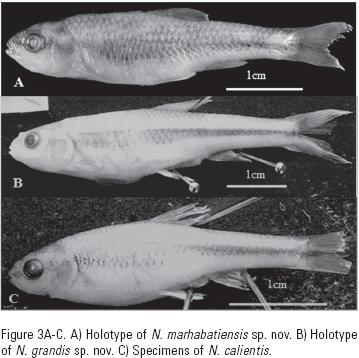
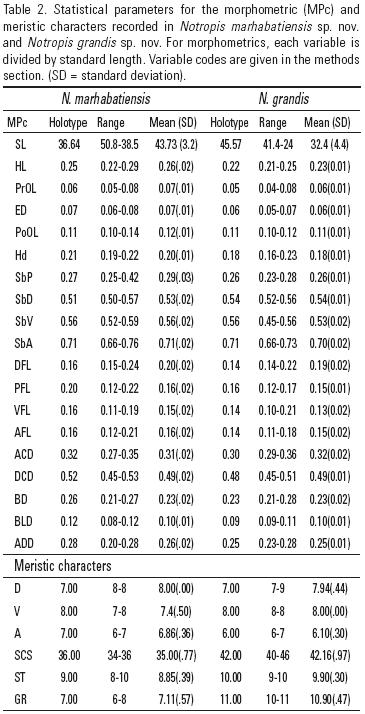
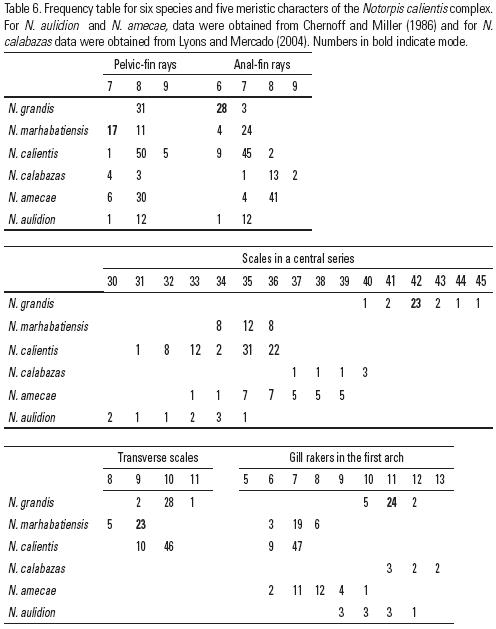
<body><![CDATA[<p align="justify"><font face="verdana" size="2">&nbsp;</font></p>     <p align="justify"><font face="verdana" size="2"><b>RESULTS</b></font></p>     <p align="justify"><font face="verdana" size="2"><b><i>Notropis marhabatiensis </i>sp. nov. </b>(<a href="#f3">Figure 3A</a>, <a href="#t2">Table 2</a>)</font></p>     <p align="center"><font face="verdana" size="2"><a name="f3"></a></font></p>     <p align="center"><font face="verdana" size="2"><img src="/img/revistas/hbio/v19n2/a10f3.jpg"></font></p>     <p align="center"><font face="verdana" size="2"><a name="t2"></a></font></p>     <p align="center"><font face="verdana" size="2"><img src="/img/revistas/hbio/v19n2/a10t2.jpg"></font></p>     <p align="justify"><font face="verdana" size="2">Holotype: MNCN&#150;205640, 36.64 mm SL. Ojo de Agua de San Miguel in Maravatio town, Lerma Basin, Michoacan, Mexico. Geographic coordinates: latitude 19.86667 N, longitude 100.4333 W. Coll. I. Doadrio, E. Gonz&aacute;lez&#150;Luna, A. de Sostoa and O. Dom&iacute;nguez&#150;Dom&iacute;nguez, 6 June 2000.</font></p>     <p align="justify"><font face="verdana" size="2">Paratypes: 14 specimens MNCN&#150;205629&#150;205641; 13 specimens CPUM&#150;2299; 3 specimens CNP&#150;IBUNAM 14622. Same data as holotype.</font></p>     <p align="justify"><font face="verdana" size="2">Diagnosis: <i>Notropis marhabatiensis </i>sp. nov. was diagnosed according to the following combination of characters: 7, rarely 8, branched pelvic fin rays (<i>vs. </i>8 rarely 7 or 9 for the other species of the <i>N. calientis </i>complex; <a href="#t3">Table 3</a>) and 9, rarely 8, scales in a transverse series (<i>vs. </i>10, rarely 9 or 11, in <i>N. grandis </i>and <i>N. calientis</i>). A dark, narrow lateral stripe runs from around the pectoral fin to the origin of the caudal peduncle. Twenty&#150;six fixed nucleotide positions, or autopomorphies, and one amino acid change were observed in the cytochrome <i>b </i>sequence with respect to <i>Notropis </i>sp., <i>N. calientis </i>and <i>N. amecae </i>(<a href="/img/revistas/hbio/v19n2/a10t4.jpg" target="_blank">Table 4</a>). Genetic distances for <i>N. marhabatiensis </i>were: <img src="/img/revistas/hbio/v19n2/a10s2.jpg"> = 6.1% with respect to <i>N. calientis</i>; <img src="/img/revistas/hbio/v19n2/a10s2.jpg"> = 7.4% with respect to <i>N. amecae</i>; and <img src="/img/revistas/hbio/v19n2/a10s2.jpg"> = 7.4% with respect to <i>N. grandis </i>sp. nov. (<a href="#t5">Table 5</a>).</font></p>     ]]></body>
<body><![CDATA[<p align="center"><font face="verdana" size="2"><a name="t3"></a></font></p>     <p align="center"><font face="verdana" size="2"><img src="/img/revistas/hbio/v19n2/a10t3.jpg"></font></p>     <p align="center"><font face="verdana" size="2"><a name="f4"></a></font></p>     <p align="center"><font face="verdana" size="2"><img src="/img/revistas/hbio/v19n2/a10f4.jpg"></font></p>     <p align="center"><font face="verdana" size="2"><a name="t5"></a></font></p>     <p align="center"><font face="verdana" size="2"><img src="/img/revistas/hbio/v19n2/a10t5.jpg"></font></p>     <p align="justify"><font face="verdana" size="2">Description: D= II 7; A= I&#150;II 6 (7); V= I (7)8; GR= 6(7)8; SCS = 34(35)36; ST= (8) 9. As in the other species of the <i>Notropis calientis </i>complex, the lateral line is incomplete and curved, SLL = 0 to 7 pored scales. All morphometric and meristic measurements are provided in <a href="#t2">Table 2</a>. Scales thin, moderately imbricate and deciduous. The body is moderately deep, laterally compressed and elongated. Deepest body section approximately at the origin of the dorsal fin, but its depth is similar in the anterodorsal part of the body, tapering to the posterodorsal portion. Maximum body depth is 3.7&#150;4.9 (<img src="/img/revistas/hbio/v19n2/a10s1.jpg">= 4.34 &plusmn;0.32) times the standard length and minimum body depth 8.5&#150;12.6 (<i><img src="/img/revistas/hbio/v19n2/a10s1.jpg"></i>= 9.6 &plusmn;0.72) times the standard length. Caudal peduncle relatively long, with least depth just before the hypural plate. Distance origin anal fin to origin caudal fin is 2.9&#150;3.6 (<img src="/img/revistas/hbio/v19n2/a10s1.jpg">= 3.2 &plusmn;0.17) times the standard length and origin dorsal fin to origin caudal fin 1.9&#150;2.4 (<img src="/img/revistas/hbio/v19n2/a10s1.jpg">= 2.0 &plusmn;0.08) times the standard length. Head slightly longer than deep, snout rounded to slightly pointed not projecting beyond the upper lip. Head length is 3.5&#150;4.5 (<i><img src="/img/revistas/hbio/v19n2/a10s1.jpg"></i>= 3.9 &plusmn;0.26) times the standard length and head depth 4.6&#150;5.4 (<i><img src="/img/revistas/hbio/v19n2/a10s1.jpg"></i>= 4.9 &plusmn;0.21) times the standard length. Eye centered at halfway head length. Eye diameter is 12.8&#150;16.4 <i><img src="/img/revistas/hbio/v19n2/a10s1.jpg"></i>= 14.7 &plusmn;1.16) times the standard length. Dorsal fin about midway between snout and caudal peduncle at same level or slightly anterior to the ventral fin origin along the same axis. Distance from snout to the dorsal fin origin is 1.7&#150;2 (<i><img src="/img/revistas/hbio/v19n2/a10s1.jpg"></i>= 1.88 &plusmn;0.05) times the standard length and distance snout to ventral fin origin 1.7&#150;1.9 (<img src="/img/revistas/hbio/v19n2/a10s1.jpg">= 1.79 &plusmn;0.06) times the standard length. Pectoral fin length is 4.6&#150;7.6 (<i><img src="/img/revistas/hbio/v19n2/a10s1.jpg"></i>= 6.5 &plusmn;0.94) times the standard length. Dorsal fin length is 4.2&#150;6.6 (<img src="/img/revistas/hbio/v19n2/a10s1.jpg">= 4.9 &plusmn;0.53) times the standard length. Ventral fin length is 5.3&#150;9.1 (<i><img src="/img/revistas/hbio/v19n2/a10s1.jpg"></i>= 6.9 &plusmn;0.94) times the standard length. Anal fin length is 4.7&#150;8.1 (<img src="/img/revistas/hbio/v19n2/a10s1.jpg">= 6.2 &plusmn;0.77) times the standard length. Snout slightly rounded. Mouth terminal to slightly subterminal and oblique. Barbels absent.</font></p>     <p align="justify"><font face="verdana" size="2">Pigmentation pattern: Preserved specimens show a yellowish to light brown coloration of the body. A dark, narrow lateral stripe runs from approximately the origin of the pectoral fin to the caudal peduncle. In the predorsal region, a diffuse elongated spot appears in the middle body portion; in some specimens this spot is made up of a number of smaller spots. These spots occur across most of the body and are more conspicuous at the opercle. Some specimens show a small dark patch at the caudal peduncle and anterior part of the caudal fin. Fine pigmented predorsal stripes in the dorsal region. Upper head pigmented with small dark spots. Interorbital region darkly pigmented. All fins transparent and in some individuals the anal, caudal and dorsal fin show a dark coloration.</font></p>     <p align="justify"><font face="verdana" size="2">Etymology: The name "<i>marhabatiensis</i>" is derived from its type locality, the town of Marhabatio (P'urepecha word of Maravat&iacute;o). The P'urepecha word Marhabatio means beautiful thing or place.</font></p>     <p align="justify"><font face="verdana" size="2">Common name: Maravat&iacute;o shiner.</font></p>     ]]></body>
<body><![CDATA[<p align="justify"><font face="verdana" size="2">Distribution: The type locality of <i>N. marhabatiensis </i>is the San Miguel Spring in the southeast region of Maravatio town in the upper Lerma River drainage, state of Michoacan. The species is only known in the San Miguel Spring (<a href="/img/revistas/hbio/v19n2/a10f1.jpg" target="_blank">Fig. 1</a>).</font></p>     <p align="justify"><font face="verdana" size="2">Remarks: The spring inhabited by <i>N. marhabatiensis </i>is highly degraded and used for recreation purposes. The main pool is arround 2 m deep and 5 m wide. A small outlet stream runs along 200 m and then discharges into the town's (Maravat&iacute;o) waste&#150;water channel. The species is absent from the stream. Fish collected with <i>N. marhabatiensis </i>from the type locality were the native goodeids <i>Girardinichthys multiradiatus </i>(Meek, 1904) and <i>Goodea atripinnis </i>Jordan, 1880, and the introduced fish were the cichlid <i>Oreochromis </i>sp. and the poeciliids <i>Poecilia reticulata </i>Peters, 1859 and <i>Heterandria bimaculata </i>(Heckel, 1848). No vegetation was found around the pool. Within the spring grow aquatic plants of the genus <i>Ceratophyllum</i>. The substrate is composed mainly of sand and gravel with many boulders at the bottom of the pool and mud in the stream.</font></p>     <p align="justify"><font face="verdana" size="2">Conservation status: The species is only known in the type locality, San Miguel Spring, and only a small population was found in surveys conducted in 2000 and 2002. In recent visits to the area (2004 to 2007), the species was not found. This small spring is surrounded by the houses of Maravatio and suffers intense human pressure as a recreation and washing place. The recent introduction of the exotic species <i>P. reticulata, H. bimacu&#150;lata </i>and <i>Oreochromis </i>sp. could explain the possible absence of this species from the spring. Because of its restricted distribution range, recent unsuccessful sampling efforts and threats to the habitat and species in the San Miguel Spring, we consider this species as Critically Endangered according to UICN criteria (CR B&#150;1 b i, iii, iv). Further, according to the Risk Evaluation Method (M&eacute;todo de Evalucai&oacute;n de Riesgo&#150;MER) (S&aacute;nchez <i>et al</i>., 2007), the species should be considered in danger of extinction (14 A,I; B,I; C,I; D,I).</font></p>     <p align="justify"><font face="verdana" size="2"><b><i>Notropis grandis </i>sp. nov. </b>(<a href="#f3">Figure 3B</a>, <a href="#t2">Table 2</a>)</font></p>     <p align="justify"><font face="verdana" size="2">Holotype: CPUM&#150; 2300, 45.57 mm SL. La Angostura, Laguna de Zacapu, Zacapu, Michoacan, Mexico. Geographic coordinates: latitude 19.81667 N, longitude 101.78333 W. Coll. R. P&eacute;rez&#150;Rodr&iacute;guez and R. Rosas&#150;Valdez, 9 June 2005.</font></p>     <p align="justify"><font face="verdana" size="2">Paratypes: 26 specimens CPUM&#150;1623; 5 specimens CNP&#150;IBUNAM 14624; 4 specimens MNCN&#150;262768&#150;262771. Same data as holotype.</font></p>     <p align="justify"><font face="verdana" size="2">Diagnosis: <i>Notropis grandis </i>sp. nov. was diagnosed according to the following combination of characters: 6, rarely 7, branched anal fin rays (<i>vs</i>. 7, rarely 6 or 8, in <i>N. marhabatiensis</i>, <i>N. calientis </i>and <i>N. aulidio </i>and 8, rarely 7 or 9, in <i>N. calbazas </i>and <i>N. amecae</i>), 42, rarely 40&#150;41, or 43&#150;45 scales in a lateral series (<i>vs</i>. 40, rarely 37&#150;39, in <i>N. calabazas</i>; 35&#150;36, rarely 37&#150;39, or 33&#150;34 in <i>N. amecae</i>; 35, rarely 31&#150;34, or 36 in <i>N. marhabatiensis </i>and <i>N. calientis </i>(<a href="#t3">Table 3</a>) and 34, rarely 30&#150;33, or 35 in <i>N. aulidion</i>) and (10) 11 (12) gill rakers in the first arch. A dark lateral stripe widens from approximately the pectoral fin origin to the dorsal fin origin, forming a slightly convex segment. Adult animals large (n =30 , <i><img src="/img/revistas/hbio/v19n2/a10s1.jpg"></i>=42.6, SD =4.69) relative to <i>N. calientis </i>(n =55, <i><img src="/img/revistas/hbio/v19n2/a10s1.jpg"></i>=33.3, SD =3.28) and <i>N. marhabatiensis </i>sp. nov. (n =30, <i><img src="/img/revistas/hbio/v19n2/a10s1.jpg"></i>=30.5, SD =7.57) (F = 16.87; <i>p </i>&lt; 0.001). Twenty&#150;three fixed nucleotide positions, or autopomorphies, and two amino acid changes were observed in the cytochrome <i>b </i>sequence with respect to <i>N. calientis</i>, <i>N. marhabatiensis </i>and <i>N. amecae </i>(<a href="/img/revistas/hbio/v19n2/a10t4.jpg" target="_blank">Table 4</a>). Genetic distances for <i>N. grandis </i>were: <img src="/img/revistas/hbio/v19n2/a10s2.jpg"> = 6.3% with respect to <i>N. calientis</i>; <img src="/img/revistas/hbio/v19n2/a10s2.jpg"> = 8.1% with respect to <i>N. amecae</i>; and <img src="/img/revistas/hbio/v19n2/a10s2.jpg"> = 7.4% with respect to <i>N. marhabatensis </i>sp. nov. (<a href="#t5">Table 5</a>).</font></p>     <p align="justify"><font face="verdana" size="2">Description: D =II 6(7)8; A = I&#150;II (6)7; V = I 8; GR = 10(11)12; SCS =40&#150;41(42)43&#150;45; ST =9(10). All morphometric and meristic measurements are provided in <a href="#t2">Table 2</a>. As in other species of the <i>Notropis calientis </i>complex, the lateral line is incomplete and curved, SLL = 1 to 17 pored scales. Scales thin, moderately imbricate and deciduous. The body is moderately deep, laterally compressed and elongated. Dorsal and ventral profiles moderately arched. Deepest body section approximately midway between the dorsal fin and the occiput.<i> </i>Maximum depth is 3.6&#150;4.8 (<img src="/img/revistas/hbio/v19n2/a10s1.jpg">= 4.5 &plusmn;0.28) times the standard length and minimum body depth 9.2&#150;11.7 (<img src="/img/revistas/hbio/v19n2/a10s1.jpg">= 10.4 &plusmn;0.48) times the standard length. Caudal peduncle relatively long and thick, and narrowest portion of the body occurs just at the end of the caud<i> </i>al peduncle. Distance origin anal fin to origin caudal fin is 2.8&#150;3.4 (<img src="/img/revistas/hbio/v19n2/a10s1.jpg">= 3.1 &plusmn;0.16) times th<i></i>e standard length and origin dorsal fin to origin caudal fin 2&#150;2.2 (<img src="/img/revistas/hbio/v19n2/a10s1.jpg">= 2.1 &plusmn;0.06) times the standard length. Head moderately longer than deep, snout rounded to slightly<i> </i>pointed not projecting beyond the upper lip, head length 4.0&#150;4.7 (<img src="/img/revistas/hbio/v19n2/a10s1.jpg">= 4.3 &plusmn;0.16) times the standard length and head depth 4.4&#150;6.12 (<img src="/img/revistas/hbio/v19n2/a10s1.jpg">= 5.6 &plusmn;0.36) times the standard length. Eye is relatively small and centered at halfway head<i> </i>distance. Eye diameter is 14.4&#150;18.6 (<img src="/img/revistas/hbio/v19n2/a10s1.jpg">= 16.8 &plusmn;1.13) times the standard length. Dorsal fin appears about midway between snout and caudal peduncle at same level or slightly behind the ventral fin origin along the same axis. Distance snout to dorsal fin origin is 1.8&#150;1.9 (<img src="/img/revistas/hbio/v19n2/a10s1.jpg">= 1.86 &plusmn;0 .04) times the standard length and snout to ventral fin origin 1.8&#150;2.2 (<img src="/img/revistas/hbio/v19n2/a10s1.jpg">= 1.9 &plusmn;0.08) times the standard length. Pectoral fin length is 3.5&#150;4.4 (<img src="/img/revistas/hbio/v19n2/a10s1.jpg">= 3.9 &plusmn;0.19) times the standard length. Dorsal fin is 4. 7&#150;7.3 (<img src="/img/revistas/hbio/v19n2/a10s1.jpg">= 5.5 &plusmn;0.76) times the standard length. Pectoral fin is 5.9&#150;8.1 (<img src="/img/revistas/hbio/v19n2/a10s1.jpg">= 6.84 &plusmn;0.55) times the standard length. Ventral length is 4.8&#150;9.83 (<img src="/img/revistas/hbio/v19n2/a10s1.jpg">= 7.6 &plusmn;0.89)<i> </i>times the standard length. Anal fin is 5.7&#150;8.5 (<img src="/img/revistas/hbio/v19n2/a10s1.jpg">= 6.9 &plusmn;0.73) times the standard length. Snout slightly rounded. Mouth is terminal to slightly subterminal and oblique. Barbels absent.</font></p>     <p align="justify"><font face="verdana" size="2">Pigmentation pattern: Preserved specimens show a yellowish to light brown coloration of the body. A dark lateral stripe widens from approximately the origin of the pectoral fin to the dorsal fin origin forming a slightly convex segment; the stripe becomes narrow and more conspicuous in the postdorsal region of the body. The lateral stripe ends in a small dark patch in the caudal peduncle and caudal fin origin. Fine pigment stripes around the base of the dorsal fin. Upper part of the head pigmen&#150;ted. All fins clear and unpigmented.</font></p>     <p align="justify"><font face="verdana" size="2">Etymology: The name "<i>grandis</i>" refers to the larger size of this species relative to the other members of the <i>N. calientis </i>complex.</font></p>     ]]></body>
<body><![CDATA[<p align="justify"><font face="verdana" size="2">Common name: Zacapu shiner.</font></p>     <p align="justify"><font face="verdana" size="2">Distribution: The type locality of <i>N. grandis </i>sp. nov. is Lake Zacapu in the town of Zacapu, Lerma River drainage, state of Michoac&aacute;n. It is only known in the Zacapu Lake and its outlet (<a href="/img/revistas/hbio/v19n2/a10f1.jpg" target="_blank">Fig. 1</a>).</font></p>     <p align="justify"><font face="verdana" size="2">Remarks: The water body is fed by at least 12 large springs that maintain the level of the lake. The water in the spring area is clean and sustains dense vegetation, mainly <i>Potamogeton illinoensis </i>Morong , <i>P. pectinatus </i>Linnaeus, <i>Myriophyllum </i>sp., <i>Sagittaria </i>sp., and <i>Ceratophyllum demersum </i>Linnaeus. The rest of the lake contains turbid water with less vegetation than the spring area. In the zone around the lake, grow <i>Taxodium</i>, <i>Salix</i>, <i>Berula erecta </i>Hudson, <i>Scirpus </i>sp., and <i>Typha latifolia </i>Linnaeus. The introduced <i>Eichhornia crassipes </i>Martius is also found. The fish species found are the goodeids <i>Hubbsina turneri </i>De Buen, 1940, <i>Goodea atripinnis</i>, <i>Xenotoca variata </i>(Bean, 1887), <i>Allotoca zacapuensis </i>Meyer, Radda &amp; Dom&iacute;nguez&#150;Dom&iacute;nguez, 2002, <i>Alloophorus robustus </i>(Bean, 1892), <i>Skiffia lermae </i>Meek, 1902, <i>Zoogoneticus quitzeoensis </i>(Bean, 1898), the poeciliid <i>Poeciliopsis infans </i>(Woolman, 1894), the atheri&#150;nopsid <i>Chirostoma humboltianum </i>(Valenciennes, 1835), the cyprinid <i>Algansea tincella </i>(Valenciennes, 1844), and the introduced cypri&#150;nids <i>Cyprinus carpio </i>G&uuml;ldenst&auml;dt, 1773 and <i>Ctenopharyngodon idella </i>(Valenciennes, 1844).</font></p>     <p align="justify"><font face="verdana" size="2">Conservation status: The species is only known in Lake Zacapu. Although since 2003 the lake forms part of a protected area, the introduction of the exotic carp species <i>Cyprinus carpio </i>and <i>Ctenopharyngodon idella </i>and their parasite <i>Bothriocephalus acheilognathi </i>Yamaguti, 1934 seems to have had a negative impact on <i>N. grandis </i>sp. nov. Indeed, the repercussions of introducing carp species and their parasites on native fish species and their habitats in Mexico have been well documented (Lyons <i>et al</i>., 1998; Soto&#150;Galera <i>et al</i>., 1998; Tapia &amp; Zambrano, 2003; Salgado&#150;Maldonado &amp; Pineda&#150;L&oacute;pez, 2003; Mej&iacute;a&#150;Madrid <i>et al</i>., 2005; Dom&iacute;nguez&#150;Dom&iacute;nguez <i>et al</i>., 2006). The lake's water quality has been affected by a drop in the water table reducing water inflow to the springs that feed the lake. Moreover, at the beginning of the XIX century, drying of the original marshy area (around 15,000 ha) for agricultural purposes reduced the lake to a mere 32 ha (Guzm&aacute;n, 1985). This decrease in the water mass had detrimental effects on the Zacapu Lake population of <i>Zoogoneticus quitzeoensis </i>(Bean, 1898), severely compromising genetic diversity and increasing the extinction risk of its fish populations (Dom&iacute;nguez&#150;Dom&iacute;nguez <i>et al</i>., 2007). According to these events and pending further population and genetic studies, we propose that the new species should be considered Critically Endangered according with the UICN criteria (CR B&#150;1 a i, iii, iv). Under Mexican environmental Law and following the criteria of MER (S&aacute;nchez <i>et al</i>., 2007), the new species should be considered in danger of extinction (14 A,II;B,I; C,II, D,I).</font></p>     <p align="justify"><font face="verdana" size="2">&nbsp;</font></p>     <p align="justify"><font face="verdana" size="2"><b>DISCUSSION</b></font></p>     <p align="justify"><font face="verdana" size="2"><b>Morphometrics. </b>As mentioned above, the specimens of <i>Notropis </i>from Zacapu and Ojo de Agua de San Miguel showed diagnostic meristic and genetic characters differentiating them from their close relatives in the Ameca River (<i>N. amecae</i>), Mezquital River (<i>N. aulidion</i>), P&aacute;nuco River (<i>N. calabazas</i>) and Lerma and Santiago river drainages (<i>N. calientis</i>). Although only two juvenile specimens of <i>N. amecae </i>were included in our genetic analyses and no specimens of <i>N. aulidion </i>and <i>N. calabazas </i>were collected, we obtained some comparative meristic characters from the literature (<a href="#t6">Table 6</a>). Another factor supporting our findings is the biogeographic scenario, since the rivers inhabited by <i>N. aulidion</i>, <i>N calabazas </i>and <i>N. amecae </i>(Mezquital, P&aacute;nuco and Ameca, respectively) constitute a different drainage system and a different biogeographic region from the current habitat of <i>N. calientis</i>, <i>N. grandis </i>sp. nov. and <i>N. marhabatiensis </i>sp. nov. in the Lerma River and Verde River of the Santiago River drainage (Dom&iacute;nguez&#150;Dom&iacute;nguez <i>et al.</i>, 2006).</font></p>     <p align="center"><font face="verdana" size="2"><a name="t6"></a></font></p>     <p align="center"><font face="verdana" size="2"><img src="/img/revistas/hbio/v19n2/a10t6.jpg"></font></p>     <p align="justify"><font face="verdana" size="2">In an exploratory PCA of morphometric measurements, PCI was able to explain 92.46 % of the variance and eigenvectors showed close values with the same sign, suggesting the influence of standard length on the results (Bookstein <i>et al</i>., 1985; Doadrio <i>et al</i>., 2002). Accordingly, the original data matrix was size&#150;corrected following Burnaby's method (Burnaby 1966; Rohlf &amp; Bookstein 1987). Despite the differences found in the PCA and the use of the corrected matrix in subsequent analyses, one way ANOVA and Tukey analysis revealed the species <i>N. grandis </i>to be larger than the other two species examined (<i>N. marhabatiensis </i>and <i>N. calientis</i>). Moreover, according to the mean sizes given by Chernoff and Miller (1989) and Lyons &amp; Mercado&#150;Silva (2005), <i>N. grandis </i>also appears to be larger than <i>N. aulidion</i>, <i>N. amecae </i>and <i>N. calabazas</i>.</font></p>     ]]></body>
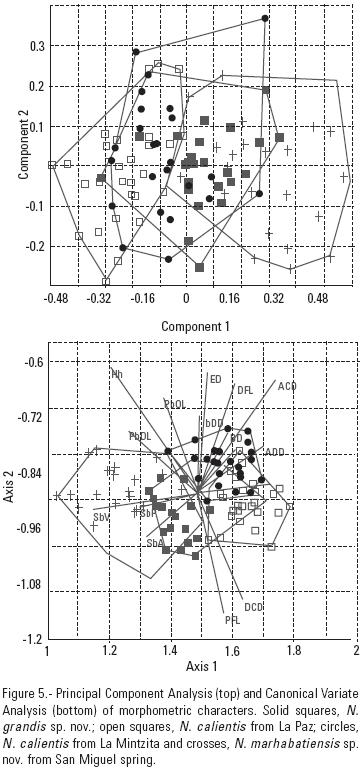
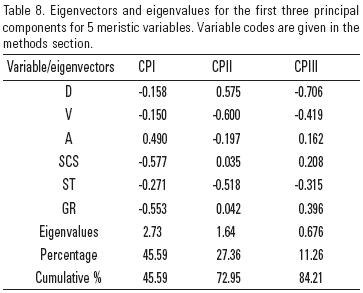
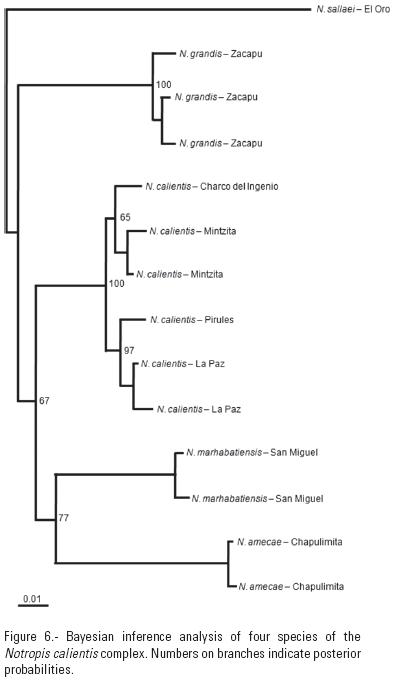
<body><![CDATA[<p align="justify"><font face="verdana" size="2">In a second PCA of morphological characters, PCI accounted for 41.26% of the variance and PCII for a cumulative variance of 53.02%. The characters that contributed most to this variance were PrOL and SbP for PCI and PFL and PVL for PCII (<a href="#t6">Table 6</a>). Variance was more influenced by PCI and no well&#150;defined groups emerged. Neither was there any evidence of diagnostic characters among the three species examined (<i>N. calientis</i>, <i>N. grandis </i>and <i>N. marhabatiensis</i>) (<a href="#f5">Fig. 5A</a>). Although morphology has been largely used to describe fish species, several studies have shown that the morphologic characters of cyprinids may not significantly differ between closely related species, and this seems to be a particular feature of the genus <i>Notropis </i>(Chernoff &amp; Miller, 1986, Lyons &amp; Mercado&#150;Silva, 2005; Dom&iacute;nguez&#150;Dom&iacute;nguez <i>et al</i>., 2007). Moreover, it is widely recognized that phenotypic plasticity depends on habitat conditions and that allometry may affect morphometric characters (Hood &amp; Heins, 2000; Trapani <i>et al</i>., 2005). Thus, other sources of information are needed to identify all the species of the <i>N. calientis </i>complex.</font></p>     <p align="center"><font face="verdana" size="2"><a name="f5" id="f5"></a></font></p>     <p align="center"><font face="verdana" size="2"><img src="/img/revistas/hbio/v19n2/a10f5.jpg"></font></p>     <p align="justify"><font face="verdana" size="2">The additional sources of information used here for species recognition were genetic and meristic characters. In our PCA analysis of meristic characters comparing <i>N. calientis </i>(two populations), <i>N. grandis </i>and <i>N. marhabatiensis</i>, PCI explained 45.59% of the variance, and PCII accounted for a cumulative variance of 72.95%. The characters that most contributed to the variance in PCI were transverse scales, gill rakers and branched anal fin rays, this component clearly separated the species <i>N. grandis </i>from <i>N. calientis </i>and <i>N. marhabatiensis</i>. The variables that contributed most to the variance in PCII were ventral fin rays (<a href="#t8">Table 8</a>) and scales in a transverse series, with this component separating, although not too clearly, the species <i>N. calientis </i>and <i>N. marhabatiensis </i>(<a href="#f5">Fig. 5</a>). With respect to all other species within the <i>N. calientis </i>complex, the frequency tables (<a href="#t6">Table 6</a>) indicate clear differences in <i>N. grandis </i>in terms of its lateral scales and gill rakers in the first arch, whereas <i>N. marhabatiensis </i>differed from other species in terms of its pelvic fin rays.</font></p>     <p align="center"><font face="verdana" size="2"><a name="t8"></a></font></p>     <p align="center"><font face="verdana" size="2"><img src="/img/revistas/hbio/v19n2/a10t8.jpg"></font></p>     <p align="justify"><font face="verdana" size="2"><b>Genetics. </b>Of the characters obtained for the <i>Notropis </i>cytochrome <i>b </i>sequences examined, 163 were variable, and 133 were parsimony informative. Third codon positions were the most informative (106 informative characters) followed by the first codon position (24 characters). Saturation of transition and transversion changes was checked by plotting the absolute number of changes of each codon position against patristic distances. There was no ingroup evidence of saturation at any of the three positions (not shown). The GTR+G model was selected as the model that best fitted the dataset. Rate matrix parameters were: &#150;lnL= 2622.7678; K= 9; AIC= 5263.5356. Base frequencies were: freqA= 0.2634; freqC= 0.2805; freqG= 0.1574; freqT= 0.2987. The proportion of variable sites=0 and gamma distribution shape parameter = 0.1655.</font></p>     <p align="justify"><font face="verdana" size="2">The phylogenetic hypothesis obtained through Bayesian analysis after burning 500 chains (<a href="#f6">Fig. 6</a>) indicated four well&#150;differentiated groups, each representing one of the species analyzed (<i>N. calientis</i>, <i>N. amecae</i>, <i>N. grandis </i>sp. nov. and <i>N. marhabatiensis </i>sp. nov.), although relationships among them were not resolved. This could be the outcome of the long genetic distances found among the species (<a href="#t5">Table 5</a>) with an overall average <img src="/img/revistas/hbio/v19n2/a10s2.jpg">= 5.5%. Since most drainage and several populations within the Lerma&#150;Santiago river system were surveyed, these high genetic differences could be the consequence of ancient isolation of the species in their respective water bodies, and a greater dispersal capacity of <i>N. calientis </i>inhabiting the Cuitzeo Lake and Lerma and Santiago river drainages.</font></p>     <p align="center"><font face="verdana" size="2"><a name="f6"></a></font></p>     <p align="center"><font face="verdana" size="2"><img src="/img/revistas/hbio/v19n2/a10f6.jpg"></font></p>     ]]></body>
<body><![CDATA[<p align="center"><font face="verdana" size="2"><img src="/img/revistas/hbio/v19n2/a10t7.jpg"></font></p>     <p align="justify"><font face="verdana" size="2">The Zacapu Lake seems to have served as a diversification area for other species groups of aquatic fauna, as has been reported for the endemic goodeid <i>Allotoca zacapuensis</i>, the amphibian <i>Ambystoma andersoni </i>(Krebs &amp; Brandon. 1984) and the bivalve <i>Anodonta grandis </i>Say, 1829. However, divergences estimated for <i>N. grandis </i>were significantly greater (<img src="/img/revistas/hbio/v19n2/a10s2.jpg"><sub></sub>= 5.8 to 8.1%) compared to the other three <i>Notropis </i>species, than the divergences observed for <i>A. zacapuensis </i>(D<sub>P</sub> = 2.5 to 2.6%) when compared to their closely related species (Aguilar&#150;Medrano <i>et al</i>., unpublished data), and even greater when compared to those shown by other goodeid population pairs living in<i> </i>Zacapu and contiguous regions; <img src="/img/revistas/hbio/v19n2/a10s2.jpg"><sub></sub> = &lt; 1% for most species (Dom&iacute;nguez&#150;Dom&iacute;nguez, <i>in press</i>). If we consider the molecular clock generally assumed for other cyprinids of 1.05% divergence per million years (Dowling <i>et al</i>., 2002), the cladogenetic event for <i>N. grandis </i>would be dated around 6 Mya, during the upper Miocene (Messinian). This dating significantly exceeds that for the formation of Zacapu Lake, estimated to have occurred in the Upper Pliocene (Demant, 1992).</font></p>     <p align="justify"><font face="verdana" size="2"><i>Notropis marhabatensis </i>sp. nov. is confined to a small spring in the upper Lerma River close to Maravatio city. The biogeographic differences between the upper Lerma and its lower reaches have been widely discussed (see Barbour, 1973; Dom&iacute;nguez&#150;Dom&iacute;nguez <i>et al</i>., 2006) and are supported by the species endemic to this region <i>Algansea barbata </i>Alvarez &amp; Cort&eacute;s, 1964, <i>Girardinichthys multiradiatus </i>and <i>N. sallaei</i>, the sister species of the <i>N. calientis </i>complex (Sch&ouml;nhuth and Doadrio, 2003). This region of the Upper Lerma was distinguished by Barbour (1973) as an ancient Maravatio basin, indicating the formation of an ancient lake in the region. Genetic distances between <i>N. marhabatiensis </i>and the other species of the <i>N. calientis </i>complex<i> </i>were <img src="/img/revistas/hbio/v19n2/a10s2.jpg"><sub></sub> = 6.1 to 7.4%, and its divergence with respect to <i>N. sallaei </i>was in the range D<sub>P</sub> = 8.5 to 10% (Sch&ouml;nhuth and Doadrio, 2003). This information suggests that different events of isolation between and within the upper Lerma and the rest of the Lerma River occurred over 5 Mya. The former would have led to the formation of the <i>N. sallaei </i>species, possible isolated in the ancient Aztl&aacute;n Paleolake <i>ca</i>. 10 Mya, and the latter related to the isolation and formation of <i>N. marhabatiensis </i>in the ancient Maravatio basin (Barbour, 1973) <i>ca</i>. 7 Mya.</font></p>     <p align="justify"><font face="verdana" size="2">Interestingly, the other two native species found in San Miguel Spring (<i>Goodea atripinnis </i>and <i>Girardinichthys multiradiatus</i>) displayed a smaller genetic distance, <img src="/img/revistas/hbio/v19n2/a10s2.jpg"><sub></sub> &lt; 1.5%, with respect to other populations inhabiting contiguous basins (Dom&iacute;nguez&#150;Dom&iacute;nguez <i>et al</i>., in press). This information, and the fact that <i>N. marhabatiensis </i>has only been identified at its type locality, would appear to indicate that the dispersal capacity or capacity to invade new areas of this species is lower than the capacity shown by its sympatric species.</font></p>     <p align="justify"><font face="verdana" size="2">Based on their endemicity and on the threatened nature of the reduced water bodies inhabited by <i>N. grandis </i>and <i>N. marhabatiensis</i>, we recommend the two species are included as endangered in the Norma Oficial Mexicana (Mexican red list).</font></p>     <p align="justify"><font face="verdana" size="2">&nbsp;</font></p>     <p align="justify"><font face="verdana" size="2"><b>ACKNOWLEDGEMENTS</b></font></p>     <p align="justify"><font face="verdana" size="2">The authors thank Adolfo de Sostoa, Hugo Mej&iacute;a and Rogelio Rosas for their help during field trips, Luis Boto for his help and comments and Lourdes Alcaraz and Carlos Pedraza for laboratory work. Part of this research was financed by a grant awarded to OD by Chester Zoo Garden, England and by the project CGL2006&#150;12325/BOS. OD, RP and LE thank the Consejo Nacional de Ciencia y Tecnolog&iacute;a for fellowship awards.</font></p>     <p align="justify"><font face="verdana" size="2">&nbsp;</font></p>     <p align="justify"><font face="verdana" size="2"><b>REFERENCES</b></font></p>     ]]></body>
<body><![CDATA[<!-- ref --><p align="justify"><font face="verdana" size="2">Barbour, C. D. 1973. A biogeographical history of <i>Chirostoma </i>(Pisces: Atherinidae): A species flock from the Mexican Plateau. <i>Copeia</i>: 533&#150;556.</font>&nbsp;&nbsp;&nbsp;&nbsp;&nbsp;&nbsp;&nbsp;&nbsp;[&#160;<a href="javascript:void(0);" onclick="javascript: window.open('/scielo.php?script=sci_nlinks&ref=4077123&pid=S0188-8897200900020001000001&lng=','','width=640,height=500,resizable=yes,scrollbars=1,menubar=yes,');">Links</a>&#160;]<!-- end-ref --><!-- ref --><p align="justify"><font face="verdana" size="2">Bookstein, F. B., B. Chernoff, R. L. Elder, J. M. Humphries, G. Smith &amp; G. strauss. 1985. Morphometrics in Evolutionary Biology. <i>Academy of Natural Sciences of Philadelphia. Special Publication </i>15: 1&#150;277.</font>&nbsp;&nbsp;&nbsp;&nbsp;&nbsp;&nbsp;&nbsp;&nbsp;[&#160;<a href="javascript:void(0);" onclick="javascript: window.open('/scielo.php?script=sci_nlinks&ref=4077124&pid=S0188-8897200900020001000002&lng=','','width=640,height=500,resizable=yes,scrollbars=1,menubar=yes,');">Links</a>&#160;]<!-- end-ref --><!-- ref --><p align="justify"><font face="verdana" size="2">Briolay, J., N. Galtier, R. M. Brito &amp; I. Bouvet. 1998. Molecular phylogeny of Cyprinidae inferred from cytochrome <i>b </i>DNA sequences. <i>Molecular Phylogenetics and Evolution </i>9: 100&#150;108.</font>&nbsp;&nbsp;&nbsp;&nbsp;&nbsp;&nbsp;&nbsp;&nbsp;[&#160;<a href="javascript:void(0);" onclick="javascript: window.open('/scielo.php?script=sci_nlinks&ref=4077125&pid=S0188-8897200900020001000003&lng=','','width=640,height=500,resizable=yes,scrollbars=1,menubar=yes,');">Links</a>&#160;]<!-- end-ref --><!-- ref --><p align="justify"><font face="verdana" size="2">Burnaby, T. P. 1966. Growth&#150;invariant discriminant functions and generalized distances. <i>Biometrics </i>22: 96&#150;110.</font>&nbsp;&nbsp;&nbsp;&nbsp;&nbsp;&nbsp;&nbsp;&nbsp;[&#160;<a href="javascript:void(0);" onclick="javascript: window.open('/scielo.php?script=sci_nlinks&ref=4077126&pid=S0188-8897200900020001000004&lng=','','width=640,height=500,resizable=yes,scrollbars=1,menubar=yes,');">Links</a>&#160;]<!-- end-ref --><!-- ref --><p align="justify"><font face="verdana" size="2">Buth, D. G. 1979. Biochemical systematic of the cyprinid genus <i>Notropis</i>&#150;I. The subgenus <i>Luxilus</i>. <i>Biochemical Systematics and Ecology </i>7: 69&#150;79.</font>&nbsp;&nbsp;&nbsp;&nbsp;&nbsp;&nbsp;&nbsp;&nbsp;[&#160;<a href="javascript:void(0);" onclick="javascript: window.open('/scielo.php?script=sci_nlinks&ref=4077127&pid=S0188-8897200900020001000005&lng=','','width=640,height=500,resizable=yes,scrollbars=1,menubar=yes,');">Links</a>&#160;]<!-- end-ref --><!-- ref --><p align="justify"><font face="verdana" size="2">Cavender T. M. &amp; M. M. Coburn. 1992. Phylogenetic relationships of North American Cyprinidae. <i>In</i>: Mayden, R. L. (Ed). <i>Systematics</i>, <i>historical ecology and North American Freshwater fishes</i>. Stanford University Press, pp. 328&#150;373.</font>&nbsp;&nbsp;&nbsp;&nbsp;&nbsp;&nbsp;&nbsp;&nbsp;[&#160;<a href="javascript:void(0);" onclick="javascript: window.open('/scielo.php?script=sci_nlinks&ref=4077128&pid=S0188-8897200900020001000006&lng=','','width=640,height=500,resizable=yes,scrollbars=1,menubar=yes,');">Links</a>&#160;]<!-- end-ref --><!-- ref --><p align="justify"><font face="verdana" size="2">Coburn M. M. &amp; T. M. Cavender. 1992. Interrelationships of North American cyprinid fishes. <i>In</i>: Mayden R. L, (Eds.). <i>Systematics</i>, <i>historical ecology</i>, <i>and North American freshwater fishes</i>. Stanford University Press, pp. 328&#150;373.</font>&nbsp;&nbsp;&nbsp;&nbsp;&nbsp;&nbsp;&nbsp;&nbsp;[&#160;<a href="javascript:void(0);" onclick="javascript: window.open('/scielo.php?script=sci_nlinks&ref=4077129&pid=S0188-8897200900020001000007&lng=','','width=640,height=500,resizable=yes,scrollbars=1,menubar=yes,');">Links</a>&#160;]<!-- end-ref --><!-- ref --><p align="justify"><font face="verdana" size="2">Chernoff, B. &amp; R. R. Miller. 1986. Fishes of the <i>Notropis calientis </i>complex with a key to the southern shiners of M&eacute;xico. <i>Copeia </i>(1): 170&#150;183.</font>&nbsp;&nbsp;&nbsp;&nbsp;&nbsp;&nbsp;&nbsp;&nbsp;[&#160;<a href="javascript:void(0);" onclick="javascript: window.open('/scielo.php?script=sci_nlinks&ref=4077130&pid=S0188-8897200900020001000008&lng=','','width=640,height=500,resizable=yes,scrollbars=1,menubar=yes,');">Links</a>&#160;]<!-- end-ref --><!-- ref --><p align="justify"><font face="verdana" size="2">Dimmick, W. W. 1987. Phylogenetic relationships of <i>Notropis hubbsi</i>, <i>N. welaka </i>and <i>N. emiliae </i>(Cypriniformes: Cyprinidae). <i>Copeia </i>2: 316&#150;325.</font>&nbsp;&nbsp;&nbsp;&nbsp;&nbsp;&nbsp;&nbsp;&nbsp;[&#160;<a href="javascript:void(0);" onclick="javascript: window.open('/scielo.php?script=sci_nlinks&ref=4077131&pid=S0188-8897200900020001000009&lng=','','width=640,height=500,resizable=yes,scrollbars=1,menubar=yes,');">Links</a>&#160;]<!-- end-ref --><!-- ref --><p align="justify"><font face="verdana" size="2">Doadrio, I., J. A. Carmona &amp; C. Fern&aacute;ndez&#150;Delgado. 2002. Morphometric study of the Iberian <i>Aphanius </i>(Actinopterygii, Cyprinodontiformes), with description of a new species. <i>Folia Zoologica </i>51: 67&#150;79.</font>&nbsp;&nbsp;&nbsp;&nbsp;&nbsp;&nbsp;&nbsp;&nbsp;[&#160;<a href="javascript:void(0);" onclick="javascript: window.open('/scielo.php?script=sci_nlinks&ref=4077132&pid=S0188-8897200900020001000010&lng=','','width=640,height=500,resizable=yes,scrollbars=1,menubar=yes,');">Links</a>&#160;]<!-- end-ref --><!-- ref --><p align="justify"><font face="verdana" size="2">Dom&iacute;nguez&#150;Dom&iacute;nguez, O., I. Doadrio &amp; G. P&eacute;rez&#150;Ponce De Le&oacute;n. 2006. Historical biogeography of some river basins in Central M&eacute;xico evidenced by their goodeine freshwater fishes: a preliminary hypothesis using secondary Brooks parsimony analysis (BPA). <i>Journal of Biogeography </i>33: 1437&#150;1447.</font>&nbsp;&nbsp;&nbsp;&nbsp;&nbsp;&nbsp;&nbsp;&nbsp;[&#160;<a href="javascript:void(0);" onclick="javascript: window.open('/scielo.php?script=sci_nlinks&ref=4077133&pid=S0188-8897200900020001000011&lng=','','width=640,height=500,resizable=yes,scrollbars=1,menubar=yes,');">Links</a>&#160;]<!-- end-ref --><!-- ref --><p align="justify"><font face="verdana" size="2">Dom&iacute;nguez&#150;Dom&iacute;nguez, O., A. Pompa&#150;Dom&iacute;nguez &amp; I. Doadrio. 2007b. A new species of the genus <i>Yuriria </i>Jordan &amp; Evermann, 1896 (Actinopterygii, Cyprinidae) from the Ameca basin of the Central Mexican Plateau. <i>Graellsia </i>2 (63): 259&#150;271.</font>&nbsp;&nbsp;&nbsp;&nbsp;&nbsp;&nbsp;&nbsp;&nbsp;[&#160;<a href="javascript:void(0);" onclick="javascript: window.open('/scielo.php?script=sci_nlinks&ref=4077134&pid=S0188-8897200900020001000012&lng=','','width=640,height=500,resizable=yes,scrollbars=1,menubar=yes,');">Links</a>&#160;]<!-- end-ref --><!-- ref --><p align="justify"><font face="verdana" size="2">Echelle, A. A. &amp; A. F. Echelle. 1984. Evolutionary generics of a "species flock": Atherinid fishes on the Mesa Central of M&eacute;xico. <i>In</i>: Echelle, A.A. &amp; I. Kornfield (Eds.). <i>Evolution of Fish Species Flocks</i>. University of Main at Orono Press, pp. 93&#150;110.</font>&nbsp;&nbsp;&nbsp;&nbsp;&nbsp;&nbsp;&nbsp;&nbsp;[&#160;<a href="javascript:void(0);" onclick="javascript: window.open('/scielo.php?script=sci_nlinks&ref=4077135&pid=S0188-8897200900020001000013&lng=','','width=640,height=500,resizable=yes,scrollbars=1,menubar=yes,');">Links</a>&#160;]<!-- end-ref --><!-- ref --><p align="justify"><font face="verdana" size="2">Gilbert, C. R. &amp; R. M. Bailey. 1972. Systematics and zoogeography of the American cyprinid fish <i>Notropis </i>(<i>Opsopoeodus</i>) <i>emiliae</i>. <i>Occasional Papers of the University of Michigan Museum of Zoology </i>664: 1&#150;33.</font>&nbsp;&nbsp;&nbsp;&nbsp;&nbsp;&nbsp;&nbsp;&nbsp;[&#160;<a href="javascript:void(0);" onclick="javascript: window.open('/scielo.php?script=sci_nlinks&ref=4077136&pid=S0188-8897200900020001000014&lng=','','width=640,height=500,resizable=yes,scrollbars=1,menubar=yes,');">Links</a>&#160;]<!-- end-ref --><!-- ref --><p align="justify"><font face="verdana" size="2">Guzm&aacute;n, A. J. N. 1985. La desecaci&oacute;n de la Ci&eacute;nega de Zacapu: or&iacute;genes y consecuencias. <i>Tzintzun </i>2:26&#150;37.</font>&nbsp;&nbsp;&nbsp;&nbsp;&nbsp;&nbsp;&nbsp;&nbsp;[&#160;<a href="javascript:void(0);" onclick="javascript: window.open('/scielo.php?script=sci_nlinks&ref=4077137&pid=S0188-8897200900020001000015&lng=','','width=640,height=500,resizable=yes,scrollbars=1,menubar=yes,');">Links</a>&#160;]<!-- end-ref --><!-- ref --><p align="justify"><font face="verdana" size="2">Hammer, &Oslash;., D. A. T. Harper, &amp; P. D. Ryan. 2001. PAST: Paleontological Statistics Software Package for Education and Data Analysis. <i>Palaeontologia Electronica </i>4(1):1&#150; 9. <a href="http://palaeo-electronica.org/2001_1/past/issue1_01.htm" target="_blank">http://palaeo&#150;electronica.org/2001_1/past/issue1_01.htm</a></font>&nbsp;&nbsp;&nbsp;&nbsp;&nbsp;&nbsp;&nbsp;&nbsp;[&#160;<a href="javascript:void(0);" onclick="javascript: window.open('/scielo.php?script=sci_nlinks&ref=4077138&pid=S0188-8897200900020001000016&lng=','','width=640,height=500,resizable=yes,scrollbars=1,menubar=yes,');">Links</a>&#160;]<!-- end-ref --><!-- ref --><p align="justify"><font face="verdana" size="2">Hood, C. S. &amp; D. C. Heins. 2000. Ontogeny and Allometry of Body Shape in the Blacktail Shiner, <i>Cyprinella venusta</i>. <i>Copeia </i>2000: 270&#150;275.</font>&nbsp;&nbsp;&nbsp;&nbsp;&nbsp;&nbsp;&nbsp;&nbsp;[&#160;<a href="javascript:void(0);" onclick="javascript: window.open('/scielo.php?script=sci_nlinks&ref=4077139&pid=S0188-8897200900020001000017&lng=','','width=640,height=500,resizable=yes,scrollbars=1,menubar=yes,');">Links</a>&#160;]<!-- end-ref --><!-- ref --><p align="justify"><font face="verdana" size="2">Howes, G. L. 1991. Systematic and biogeography: an overview. <i>In</i>: Winfield, I. J. &amp; J. S Nelson (Eds). <i>Cyprinids fishes: Systematics, biology and exploitation. </i>Chapman and Hall, London, pp: 1&#150;33</font>&nbsp;&nbsp;&nbsp;&nbsp;&nbsp;&nbsp;&nbsp;&nbsp;[&#160;<a href="javascript:void(0);" onclick="javascript: window.open('/scielo.php?script=sci_nlinks&ref=4077140&pid=S0188-8897200900020001000018&lng=','','width=640,height=500,resizable=yes,scrollbars=1,menubar=yes,');">Links</a>&#160;]<!-- end-ref --><!-- ref --><p align="justify"><font face="verdana" size="2">Hubbs, C. L. &amp; R. R. Miller. 1977. Six distinctive cyprinid fish species referred to Dionda inhabiting segments of the Tampico Embayment drainage of M&eacute;xico. <i>San Diego Natural History Transactions </i>18: 267&#150;336.</font>&nbsp;&nbsp;&nbsp;&nbsp;&nbsp;&nbsp;&nbsp;&nbsp;[&#160;<a href="javascript:void(0);" onclick="javascript: window.open('/scielo.php?script=sci_nlinks&ref=4077141&pid=S0188-8897200900020001000019&lng=','','width=640,height=500,resizable=yes,scrollbars=1,menubar=yes,');">Links</a>&#160;]<!-- end-ref --><!-- ref --><p align="justify"><font face="verdana" size="2">Humphries, J. M., F. L. Bookstein, B. Chernoff, G. R. Smith, R. L. Elder &amp; S. G. Poss. 1981. Multivariate discrimination by shape in relation to size. <i>Systematic Zoology </i>30: 291&#150;308.</font>&nbsp;&nbsp;&nbsp;&nbsp;&nbsp;&nbsp;&nbsp;&nbsp;[&#160;<a href="javascript:void(0);" onclick="javascript: window.open('/scielo.php?script=sci_nlinks&ref=4077142&pid=S0188-8897200900020001000020&lng=','','width=640,height=500,resizable=yes,scrollbars=1,menubar=yes,');">Links</a>&#160;]<!-- end-ref --><!-- ref --><p align="justify"><font face="verdana" size="2">Huelsenbeck, J. P. &amp; F. R. Ronquist. 2001. MrBayes: Bayesian inference of phylogeny. <i>Bioinformatics </i>17: 754&#150;755.</font>&nbsp;&nbsp;&nbsp;&nbsp;&nbsp;&nbsp;&nbsp;&nbsp;[&#160;<a href="javascript:void(0);" onclick="javascript: window.open('/scielo.php?script=sci_nlinks&ref=4077143&pid=S0188-8897200900020001000021&lng=','','width=640,height=500,resizable=yes,scrollbars=1,menubar=yes,');">Links</a>&#160;]<!-- end-ref --><!-- ref --><p align="justify"><font face="verdana" size="2">Jolicoeur, P. &amp; J. E. Mosimann. 1960. Size and shape variation in the painted turtle. A principal component analysis. <i>Growth </i>24: 339&#150;354</font>&nbsp;&nbsp;&nbsp;&nbsp;&nbsp;&nbsp;&nbsp;&nbsp;[&#160;<a href="javascript:void(0);" onclick="javascript: window.open('/scielo.php?script=sci_nlinks&ref=4077144&pid=S0188-8897200900020001000022&lng=','','width=640,height=500,resizable=yes,scrollbars=1,menubar=yes,');">Links</a>&#160;]<!-- end-ref --><!-- ref --><p align="justify"><font face="verdana" size="2">Lyons, J., G. Gonz&aacute;lez&#150;Hern&aacute;ndez, E. Soto&#150;Galera &amp; M. Guzm&aacute;n&#150;Arroyo. 1998. Decline of fishes and fisheries in selected drainages of west&#150;central Mexico. <i>Fisheries </i>23: 10&#150;18.</font>&nbsp;&nbsp;&nbsp;&nbsp;&nbsp;&nbsp;&nbsp;&nbsp;[&#160;<a href="javascript:void(0);" onclick="javascript: window.open('/scielo.php?script=sci_nlinks&ref=4077145&pid=S0188-8897200900020001000023&lng=','','width=640,height=500,resizable=yes,scrollbars=1,menubar=yes,');">Links</a>&#160;]<!-- end-ref --><!-- ref --><p align="justify"><font face="verdana" size="2">Lyons J., &amp; N. Mercado&#150;Silva. 2004. <i>Notropis calabazas </i>(Teleostei; Cyprinidae): New Species from the R&iacute;o P&aacute;nuco Basin of Central M&eacute;xico. <i>Copeia </i>4: 868&#150;875.</font>&nbsp;&nbsp;&nbsp;&nbsp;&nbsp;&nbsp;&nbsp;&nbsp;[&#160;<a href="javascript:void(0);" onclick="javascript: window.open('/scielo.php?script=sci_nlinks&ref=4077146&pid=S0188-8897200900020001000024&lng=','','width=640,height=500,resizable=yes,scrollbars=1,menubar=yes,');">Links</a>&#160;]<!-- end-ref --><!-- ref --><p align="justify"><font face="verdana" size="2">Mayden, R. L. 1989. Phylogenetic studies of North American minnows, with emphasis on the genus <i>Cyprinella </i>(Teleostei: Cypriniformes). <i>In: </i>Mengel R.M. &amp; R. F.Johnston (Eds.). <i>Miscellaneous publications of the Museum of Natural History, University of Kansas </i>80: 1&#150;189.</font>&nbsp;&nbsp;&nbsp;&nbsp;&nbsp;&nbsp;&nbsp;&nbsp;[&#160;<a href="javascript:void(0);" onclick="javascript: window.open('/scielo.php?script=sci_nlinks&ref=4077147&pid=S0188-8897200900020001000025&lng=','','width=640,height=500,resizable=yes,scrollbars=1,menubar=yes,');">Links</a>&#160;]<!-- end-ref --><!-- ref --><p align="justify"><font face="verdana" size="2">Mayden, R. L. 1991. Cyprinids of the new world. <i>In: </i>Winfield I.J &amp; J. S Nelson (Eds.). <i>Cyprinid fishes: systematics, biology and exploitation. </i>London: Chapman &amp; Hall, pp. 240&#150;263.</font>&nbsp;&nbsp;&nbsp;&nbsp;&nbsp;&nbsp;&nbsp;&nbsp;[&#160;<a href="javascript:void(0);" onclick="javascript: window.open('/scielo.php?script=sci_nlinks&ref=4077148&pid=S0188-8897200900020001000026&lng=','','width=640,height=500,resizable=yes,scrollbars=1,menubar=yes,');">Links</a>&#160;]<!-- end-ref --><!-- ref --><p align="justify"><font face="verdana" size="2">Mej&iacute;a&#150;Madrid, H. H., O. Dom&iacute;nguez&#150;Dom&iacute;nguez &amp; G. P&eacute;rez&#150;Ponce De Le&oacute;n. 2005. Adult Endohelminth Parasites of Goodeinae (Cyprinodontiformes: Goodeidae) from M&eacute;xico with Biogeographical Considerations. <i>Comparative Parasitology </i>72: 200&#150;211.</font>&nbsp;&nbsp;&nbsp;&nbsp;&nbsp;&nbsp;&nbsp;&nbsp;[&#160;<a href="javascript:void(0);" onclick="javascript: window.open('/scielo.php?script=sci_nlinks&ref=4077149&pid=S0188-8897200900020001000027&lng=','','width=640,height=500,resizable=yes,scrollbars=1,menubar=yes,');">Links</a>&#160;]<!-- end-ref --><!-- ref --><p align="justify"><font face="verdana" size="2">Meyer, M. K., A. C. Radda &amp; O. Dom&iacute;nguez&#150;Dom&iacute;nguez. 2001. Notes on the genera <i>Neoophorus </i>Hubbs &amp; Turner, 1937 and <i>Allotoca </i>Hubbs &amp; Turner, 1937, witha description of a new species of <i>Allotoca </i>from Laguna de Zacapu, Michoacan, Mexico (Teleostei, Cyprinodontiformes, Goodeidae). <i>Annalen aus dem Naturhistorisches Museum Wien </i>103: 453&#150;460.</font>&nbsp;&nbsp;&nbsp;&nbsp;&nbsp;&nbsp;&nbsp;&nbsp;[&#160;<a href="javascript:void(0);" onclick="javascript: window.open('/scielo.php?script=sci_nlinks&ref=4077150&pid=S0188-8897200900020001000028&lng=','','width=640,height=500,resizable=yes,scrollbars=1,menubar=yes,');">Links</a>&#160;]<!-- end-ref --><!-- ref --><p align="justify"><font face="verdana" size="2">P&eacute;rez&#150;Ponce De Le&oacute;n, G. 2003. Biodiversity and biogeographic patterns in the Mesa Central of M&eacute;xico: insights from host&#150;parasite systems. <i>Journal of Parasitology </i>89: 126&#150;133.</font>&nbsp;&nbsp;&nbsp;&nbsp;&nbsp;&nbsp;&nbsp;&nbsp;[&#160;<a href="javascript:void(0);" onclick="javascript: window.open('/scielo.php?script=sci_nlinks&ref=4077151&pid=S0188-8897200900020001000029&lng=','','width=640,height=500,resizable=yes,scrollbars=1,menubar=yes,');">Links</a>&#160;]<!-- end-ref --><!-- ref --><p align="justify"><font face="verdana" size="2">Rohlf, F. J. &amp; F. L. Bookstein. 1987. A comment on shearing as a method for size correction. <i>Systematic Zoology </i>36: 356&#150;367.</font>&nbsp;&nbsp;&nbsp;&nbsp;&nbsp;&nbsp;&nbsp;&nbsp;[&#160;<a href="javascript:void(0);" onclick="javascript: window.open('/scielo.php?script=sci_nlinks&ref=4077152&pid=S0188-8897200900020001000030&lng=','','width=640,height=500,resizable=yes,scrollbars=1,menubar=yes,');">Links</a>&#160;]<!-- end-ref --><!-- ref --><p align="justify"><font face="verdana" size="2">Salgado&#150;Maldonado, G. &amp; R. F. Pineda&#150;L&oacute;pez. 2003. The Asian fish tapeworm <i>Bothriocephalus acheilognathi</i>: a potential threat to native freshwater fish species in M&eacute;xico. <i>Biological Invasions </i>5: 261&#150;268.</font>&nbsp;&nbsp;&nbsp;&nbsp;&nbsp;&nbsp;&nbsp;&nbsp;[&#160;<a href="javascript:void(0);" onclick="javascript: window.open('/scielo.php?script=sci_nlinks&ref=4077153&pid=S0188-8897200900020001000031&lng=','','width=640,height=500,resizable=yes,scrollbars=1,menubar=yes,');">Links</a>&#160;]<!-- end-ref --><!-- ref --><p align="justify"><font face="verdana" size="2">Sambrook, J., E .F. Fritsch &amp; T. Maniatis. 1989. <i>Molecular Cloning: A Laboratory Manual</i>. Cold Spring Harbor Laboratory. New York. 545 p.</font>&nbsp;&nbsp;&nbsp;&nbsp;&nbsp;&nbsp;&nbsp;&nbsp;[&#160;<a href="javascript:void(0);" onclick="javascript: window.open('/scielo.php?script=sci_nlinks&ref=4077154&pid=S0188-8897200900020001000032&lng=','','width=640,height=500,resizable=yes,scrollbars=1,menubar=yes,');">Links</a>&#160;]<!-- end-ref --><!-- ref --><p align="justify"><font face="verdana" size="2">Sch&ouml;nhuth, S. &amp; I. Doadrio. 2003. Phylogenetic relationships of Mexican minnows of the genus <i>Notropis </i>(Actinopterygii, Cyprinidae). <i>Biological Journal of the Linnean Society </i>80: 323&#150;327.</font>&nbsp;&nbsp;&nbsp;&nbsp;&nbsp;&nbsp;&nbsp;&nbsp;[&#160;<a href="javascript:void(0);" onclick="javascript: window.open('/scielo.php?script=sci_nlinks&ref=4077155&pid=S0188-8897200900020001000033&lng=','','width=640,height=500,resizable=yes,scrollbars=1,menubar=yes,');">Links</a>&#160;]<!-- end-ref --><!-- ref --><p align="justify"><font face="verdana" size="2">Sch&ouml;nhuth, S., I. Doadrio, O. Dom&iacute;nguez&#150;Dom&iacute;nguez, D. M. Hillis &amp; R. L. Mayden Molecular evolution of southern North American Cyprinidae (Actinopterygii), with the description of the new genus <i>Tampichthys </i>from central Mexico. <i>Molecular Phylogenetics and Evolution </i>47: 729&#150;756</font>&nbsp;&nbsp;&nbsp;&nbsp;&nbsp;&nbsp;&nbsp;&nbsp;[&#160;<a href="javascript:void(0);" onclick="javascript: window.open('/scielo.php?script=sci_nlinks&ref=4077156&pid=S0188-8897200900020001000034&lng=','','width=640,height=500,resizable=yes,scrollbars=1,menubar=yes,');">Links</a>&#160;]<!-- end-ref --><!-- ref --><p align="justify"><font face="verdana" size="2">Trapani, J., Y. Yamamoto &amp; D. W. Stock. 2005. Ontogenetic transition from unicus<i>pid to multicuspid oral dentition in teleost fish: Astyanax mexicanus</i>, the Mexican tetra (Ostariophysi: Characidae). <i>Zoological Journal of the Linnean Society </i>145: 523&#150;538.</font>&nbsp;&nbsp;&nbsp;&nbsp;&nbsp;&nbsp;&nbsp;&nbsp;[&#160;<a href="javascript:void(0);" onclick="javascript: window.open('/scielo.php?script=sci_nlinks&ref=4077157&pid=S0188-8897200900020001000035&lng=','','width=640,height=500,resizable=yes,scrollbars=1,menubar=yes,');">Links</a>&#160;]<!-- end-ref --><!-- ref --><p align="justify"><font face="verdana" size="2">Zardoya, R. &amp; I. Doadrio. 1998. Phylogenetic relationships of Iberian cyprinids: systematic and biogeographical implications. <i>Proceedings of the Royal Society of London </i>265: 1365&#150;1372.</font>&nbsp;&nbsp;&nbsp;&nbsp;&nbsp;&nbsp;&nbsp;&nbsp;[&#160;<a href="javascript:void(0);" onclick="javascript: window.open('/scielo.php?script=sci_nlinks&ref=4077158&pid=S0188-8897200900020001000036&lng=','','width=640,height=500,resizable=yes,scrollbars=1,menubar=yes,');">Links</a>&#160;]<!-- end-ref --><!-- ref --><p align="justify"><font face="verdana" size="2">Zardoya, R. &amp; I. Doadrio. 1999. Molecular evidence on the evolutionary and biogeographical patterns of European cyprinids. <i>Journal of Molecular Evolution </i>49: 227&#150;237.</font>&nbsp;&nbsp;&nbsp;&nbsp;&nbsp;&nbsp;&nbsp;&nbsp;[&#160;<a href="javascript:void(0);" onclick="javascript: window.open('/scielo.php?script=sci_nlinks&ref=4077159&pid=S0188-8897200900020001000037&lng=','','width=640,height=500,resizable=yes,scrollbars=1,menubar=yes,');">Links</a>&#160;]<!-- end-ref --> ]]></body><back>
<ref-list>
<ref id="B1">
<nlm-citation citation-type="journal">
<person-group person-group-type="author">
<name>
<surname><![CDATA[Barbour]]></surname>
<given-names><![CDATA[C. D.]]></given-names>
</name>
</person-group>
<article-title xml:lang="en"><![CDATA[A biogeographical history of Chirostoma (Pisces: Atherinidae): A species flock from the Mexican Plateau]]></article-title>
<source><![CDATA[Copeia]]></source>
<year>1973</year>
<page-range>533-556</page-range></nlm-citation>
</ref>
<ref id="B2">
<nlm-citation citation-type="journal">
<person-group person-group-type="author">
<name>
<surname><![CDATA[Bookstein]]></surname>
<given-names><![CDATA[F. B.]]></given-names>
</name>
<name>
<surname><![CDATA[Chernoff]]></surname>
<given-names><![CDATA[B.]]></given-names>
</name>
<name>
<surname><![CDATA[Elder]]></surname>
<given-names><![CDATA[R. L.]]></given-names>
</name>
<name>
<surname><![CDATA[Humphries]]></surname>
<given-names><![CDATA[J. M.]]></given-names>
</name>
<name>
<surname><![CDATA[Smith]]></surname>
<given-names><![CDATA[G.]]></given-names>
</name>
<name>
<surname><![CDATA[strauss]]></surname>
<given-names><![CDATA[G.]]></given-names>
</name>
</person-group>
<article-title xml:lang="en"><![CDATA[Morphometrics in Evolutionary Biology: Academy of Natural Sciences of Philadelphia]]></article-title>
<source><![CDATA[Special Publication]]></source>
<year>1985</year>
<volume>15</volume>
<page-range>1-277</page-range></nlm-citation>
</ref>
<ref id="B3">
<nlm-citation citation-type="journal">
<person-group person-group-type="author">
<name>
<surname><![CDATA[Briolay]]></surname>
<given-names><![CDATA[J.]]></given-names>
</name>
<name>
<surname><![CDATA[Galtier]]></surname>
<given-names><![CDATA[N.]]></given-names>
</name>
<name>
<surname><![CDATA[Brito]]></surname>
<given-names><![CDATA[R. M.]]></given-names>
</name>
<name>
<surname><![CDATA[Bouvet]]></surname>
<given-names><![CDATA[I.]]></given-names>
</name>
</person-group>
<article-title xml:lang="en"><![CDATA[Molecular phylogeny of Cyprinidae inferred from cytochrome b DNA sequences]]></article-title>
<source><![CDATA[Molecular Phylogenetics and Evolution]]></source>
<year>1998</year>
<volume>9</volume>
<page-range>100-108</page-range></nlm-citation>
</ref>
<ref id="B4">
<nlm-citation citation-type="journal">
<person-group person-group-type="author">
<name>
<surname><![CDATA[Burnaby]]></surname>
<given-names><![CDATA[T. P.]]></given-names>
</name>
</person-group>
<article-title xml:lang="en"><![CDATA[Growth-invariant discriminant functions and generalized distances]]></article-title>
<source><![CDATA[Biometrics]]></source>
<year>1966</year>
<volume>22</volume>
<page-range>96-110</page-range></nlm-citation>
</ref>
<ref id="B5">
<nlm-citation citation-type="journal">
<person-group person-group-type="author">
<name>
<surname><![CDATA[Buth]]></surname>
<given-names><![CDATA[D. G.]]></given-names>
</name>
</person-group>
<article-title xml:lang="en"><![CDATA[Biochemical systematic of the cyprinid genus Notropis-I: The subgenus Luxilus]]></article-title>
<source><![CDATA[Biochemical Systematics and Ecology]]></source>
<year>1979</year>
<volume>7</volume>
<page-range>69-79</page-range></nlm-citation>
</ref>
<ref id="B6">
<nlm-citation citation-type="book">
<person-group person-group-type="author">
<name>
<surname><![CDATA[Cavender]]></surname>
<given-names><![CDATA[T. M.]]></given-names>
</name>
<name>
<surname><![CDATA[Coburn]]></surname>
<given-names><![CDATA[M. M.]]></given-names>
</name>
</person-group>
<article-title xml:lang="en"><![CDATA[Phylogenetic relationships of North American Cyprinidae]]></article-title>
<person-group person-group-type="editor">
<name>
<surname><![CDATA[Mayden]]></surname>
<given-names><![CDATA[R. L.]]></given-names>
</name>
</person-group>
<source><![CDATA[Systematics, historical ecology and North American Freshwater fishes]]></source>
<year>1992</year>
<page-range>328-373</page-range><publisher-name><![CDATA[Stanford University Press]]></publisher-name>
</nlm-citation>
</ref>
<ref id="B7">
<nlm-citation citation-type="book">
<person-group person-group-type="author">
<name>
<surname><![CDATA[Coburn]]></surname>
<given-names><![CDATA[M. M.]]></given-names>
</name>
<name>
<surname><![CDATA[Cavender]]></surname>
<given-names><![CDATA[T. M.]]></given-names>
</name>
</person-group>
<article-title xml:lang="en"><![CDATA[Interrelationships of North American cyprinid fishes]]></article-title>
<person-group person-group-type="editor">
<name>
<surname><![CDATA[Mayden]]></surname>
<given-names><![CDATA[R. L]]></given-names>
</name>
</person-group>
<source><![CDATA[Systematics, historical ecology, and North American freshwater fishes]]></source>
<year>1992</year>
<page-range>328-373</page-range><publisher-name><![CDATA[Stanford University Press]]></publisher-name>
</nlm-citation>
</ref>
<ref id="B8">
<nlm-citation citation-type="journal">
<person-group person-group-type="author">
<name>
<surname><![CDATA[Chernoff]]></surname>
<given-names><![CDATA[B.]]></given-names>
</name>
<name>
<surname><![CDATA[Miller]]></surname>
<given-names><![CDATA[R. R.]]></given-names>
</name>
</person-group>
<article-title xml:lang="en"><![CDATA[Fishes of the Notropis calientis complex with a key to the southern shiners of México]]></article-title>
<source><![CDATA[Copeia]]></source>
<year>1986</year>
<volume>1</volume>
<page-range>170-183</page-range></nlm-citation>
</ref>
<ref id="B9">
<nlm-citation citation-type="journal">
<person-group person-group-type="author">
<name>
<surname><![CDATA[Dimmick]]></surname>
<given-names><![CDATA[W. W.]]></given-names>
</name>
</person-group>
<article-title xml:lang="en"><![CDATA[Phylogenetic relationships of Notropis hubbsi, N. welaka and N. emiliae (Cypriniformes: Cyprinidae)]]></article-title>
<source><![CDATA[Copeia]]></source>
<year>1987</year>
<volume>2</volume>
<page-range>316-325</page-range></nlm-citation>
</ref>
<ref id="B10">
<nlm-citation citation-type="journal">
<person-group person-group-type="author">
<name>
<surname><![CDATA[Doadrio]]></surname>
<given-names><![CDATA[I.]]></given-names>
</name>
<name>
<surname><![CDATA[Carmona]]></surname>
<given-names><![CDATA[J. A.]]></given-names>
</name>
<name>
<surname><![CDATA[Fernández-Delgado]]></surname>
<given-names><![CDATA[C.]]></given-names>
</name>
</person-group>
<article-title xml:lang="en"><![CDATA[Morphometric study of the Iberian Aphanius (Actinopterygii, Cyprinodontiformes), with description of a new species]]></article-title>
<source><![CDATA[Folia Zoologica]]></source>
<year>2002</year>
<volume>51</volume>
<page-range>67-79</page-range></nlm-citation>
</ref>
<ref id="B11">
<nlm-citation citation-type="journal">
<person-group person-group-type="author">
<name>
<surname><![CDATA[Domínguez-Domínguez]]></surname>
<given-names><![CDATA[O.]]></given-names>
</name>
<name>
<surname><![CDATA[Doadrio]]></surname>
<given-names><![CDATA[I.]]></given-names>
</name>
<name>
<surname><![CDATA[Pérez-Ponce De León]]></surname>
<given-names><![CDATA[G.]]></given-names>
</name>
</person-group>
<article-title xml:lang="en"><![CDATA[Historical biogeography of some river basins in Central México evidenced by their goodeine freshwater fishes: a preliminary hypothesis using secondary Brooks parsimony analysis (BPA)]]></article-title>
<source><![CDATA[Journal of Biogeography]]></source>
<year>2006</year>
<volume>33</volume>
<page-range>1437-1447</page-range></nlm-citation>
</ref>
<ref id="B12">
<nlm-citation citation-type="journal">
<person-group person-group-type="author">
<name>
<surname><![CDATA[Domínguez-Domínguez]]></surname>
<given-names><![CDATA[O.]]></given-names>
</name>
<name>
<surname><![CDATA[Pompa-Domínguez]]></surname>
<given-names><![CDATA[A.]]></given-names>
</name>
<name>
<surname><![CDATA[Doadrio]]></surname>
<given-names><![CDATA[I.]]></given-names>
</name>
</person-group>
<article-title xml:lang="en"><![CDATA[A new species of the genus Yuriria Jordan & Evermann, 1896 (Actinopterygii, Cyprinidae) from the Ameca basin of the Central Mexican Plateau]]></article-title>
<source><![CDATA[Graellsia]]></source>
<year>2007</year>
<volume>2</volume>
<numero>63</numero>
<issue>63</issue>
<page-range>259-271</page-range></nlm-citation>
</ref>
<ref id="B13">
<nlm-citation citation-type="book">
<person-group person-group-type="author">
<name>
<surname><![CDATA[Echelle]]></surname>
<given-names><![CDATA[A. A.]]></given-names>
</name>
<name>
<surname><![CDATA[Echelle]]></surname>
<given-names><![CDATA[A. F.]]></given-names>
</name>
</person-group>
<article-title xml:lang="en"><![CDATA[Evolutionary generics of a "species flock": Atherinid fishes on the Mesa Central of México]]></article-title>
<person-group person-group-type="editor">
<name>
<surname><![CDATA[Echelle]]></surname>
<given-names><![CDATA[A.A.]]></given-names>
</name>
<name>
<surname><![CDATA[Kornfield]]></surname>
<given-names><![CDATA[I.]]></given-names>
</name>
</person-group>
<source><![CDATA[Evolution of Fish Species Flocks]]></source>
<year>1984</year>
<page-range>93-110</page-range><publisher-name><![CDATA[University of Main at Orono Press]]></publisher-name>
</nlm-citation>
</ref>
<ref id="B14">
<nlm-citation citation-type="">
<person-group person-group-type="author">
<name>
<surname><![CDATA[Gilbert]]></surname>
<given-names><![CDATA[C. R.]]></given-names>
</name>
<name>
<surname><![CDATA[Bailey]]></surname>
<given-names><![CDATA[R. M.]]></given-names>
</name>
</person-group>
<source><![CDATA[Systematics and zoogeography of the American cyprinid fish Notropis (Opsopoeodus) emiliae]]></source>
<year>1972</year>
<volume>664</volume>
<page-range>1-33</page-range></nlm-citation>
</ref>
<ref id="B15">
<nlm-citation citation-type="journal">
<person-group person-group-type="author">
<name>
<surname><![CDATA[Guzmán]]></surname>
<given-names><![CDATA[A. J. N.]]></given-names>
</name>
</person-group>
<article-title xml:lang="en"><![CDATA[La desecación de la Ciénega de Zacapu: orígenes y consecuencias]]></article-title>
<source><![CDATA[Tzintzun]]></source>
<year>1985</year>
<volume>2</volume>
<page-range>26-37</page-range></nlm-citation>
</ref>
<ref id="B16">
<nlm-citation citation-type="journal">
<person-group person-group-type="author">
<name>
<surname><![CDATA[Hammer]]></surname>
<given-names><![CDATA[Ø.]]></given-names>
</name>
<name>
<surname><![CDATA[Harper]]></surname>
<given-names><![CDATA[D. A. T.]]></given-names>
</name>
<name>
<surname><![CDATA[Ryan]]></surname>
<given-names><![CDATA[P. D.]]></given-names>
</name>
</person-group>
<article-title xml:lang="en"><![CDATA[PAST: Paleontological Statistics Software Package for Education and Data Analysis]]></article-title>
<source><![CDATA[Palaeontologia Electronica]]></source>
<year>2001</year>
<volume>4</volume>
<numero>1</numero>
<issue>1</issue>
<page-range>1- 9</page-range></nlm-citation>
</ref>
<ref id="B17">
<nlm-citation citation-type="journal">
<person-group person-group-type="author">
<name>
<surname><![CDATA[Hood]]></surname>
<given-names><![CDATA[C. S.]]></given-names>
</name>
<name>
<surname><![CDATA[Heins]]></surname>
<given-names><![CDATA[D. C.]]></given-names>
</name>
</person-group>
<article-title xml:lang="en"><![CDATA[Ontogeny and Allometry of Body Shape in the Blacktail Shiner, Cyprinella venusta]]></article-title>
<source><![CDATA[Copeia]]></source>
<year>2000</year>
<page-range>270-275</page-range></nlm-citation>
</ref>
<ref id="B18">
<nlm-citation citation-type="book">
<person-group person-group-type="author">
<name>
<surname><![CDATA[Howes]]></surname>
<given-names><![CDATA[G. L.]]></given-names>
</name>
</person-group>
<article-title xml:lang="en"><![CDATA[Systematic and biogeography: an overview]]></article-title>
<person-group person-group-type="editor">
<name>
<surname><![CDATA[Winfield]]></surname>
<given-names><![CDATA[I. J.]]></given-names>
</name>
<name>
<surname><![CDATA[Nelson]]></surname>
<given-names><![CDATA[J. S]]></given-names>
</name>
</person-group>
<source><![CDATA[Cyprinids fishes: Systematics, biology and exploitation]]></source>
<year>1991</year>
<page-range>1-33</page-range><publisher-loc><![CDATA[London ]]></publisher-loc>
<publisher-name><![CDATA[Chapman and Hall]]></publisher-name>
</nlm-citation>
</ref>
<ref id="B19">
<nlm-citation citation-type="journal">
<person-group person-group-type="author">
<name>
<surname><![CDATA[Hubbs]]></surname>
<given-names><![CDATA[C. L.]]></given-names>
</name>
<name>
<surname><![CDATA[Miller]]></surname>
<given-names><![CDATA[R. R.]]></given-names>
</name>
</person-group>
<article-title xml:lang="en"><![CDATA[Six distinctive cyprinid fish species referred to Dionda inhabiting segments of the Tampico Embayment drainage of México]]></article-title>
<source><![CDATA[San Diego Natural History Transactions]]></source>
<year>1977</year>
<volume>18</volume>
<page-range>267-336</page-range></nlm-citation>
</ref>
<ref id="B20">
<nlm-citation citation-type="journal">
<person-group person-group-type="author">
<name>
<surname><![CDATA[Humphries]]></surname>
<given-names><![CDATA[J. M.]]></given-names>
</name>
<name>
<surname><![CDATA[Bookstein]]></surname>
<given-names><![CDATA[F. L.]]></given-names>
</name>
<name>
<surname><![CDATA[Chernoff]]></surname>
<given-names><![CDATA[B.]]></given-names>
</name>
<name>
<surname><![CDATA[Smith]]></surname>
<given-names><![CDATA[G. R.]]></given-names>
</name>
<name>
<surname><![CDATA[Elder]]></surname>
<given-names><![CDATA[R. L.]]></given-names>
</name>
<name>
<surname><![CDATA[Poss]]></surname>
<given-names><![CDATA[S. G.]]></given-names>
</name>
</person-group>
<article-title xml:lang="en"><![CDATA[Multivariate discrimination by shape in relation to size]]></article-title>
<source><![CDATA[Systematic Zoology]]></source>
<year>1981</year>
<volume>30</volume>
<page-range>291-308</page-range></nlm-citation>
</ref>
<ref id="B21">
<nlm-citation citation-type="journal">
<person-group person-group-type="author">
<name>
<surname><![CDATA[Huelsenbeck]]></surname>
<given-names><![CDATA[J. P.]]></given-names>
</name>
<name>
<surname><![CDATA[Ronquist]]></surname>
<given-names><![CDATA[F. R.]]></given-names>
</name>
</person-group>
<article-title xml:lang="en"><![CDATA[MrBayes: Bayesian inference of phylogeny]]></article-title>
<source><![CDATA[Bioinformatics]]></source>
<year>2001</year>
<volume>17</volume>
<page-range>754-755</page-range></nlm-citation>
</ref>
<ref id="B22">
<nlm-citation citation-type="journal">
<person-group person-group-type="author">
<name>
<surname><![CDATA[Jolicoeur]]></surname>
<given-names><![CDATA[P.]]></given-names>
</name>
<name>
<surname><![CDATA[Mosimann]]></surname>
<given-names><![CDATA[J. E.]]></given-names>
</name>
</person-group>
<article-title xml:lang="en"><![CDATA[Size and shape variation in the painted turtle: A principal component analysis]]></article-title>
<source><![CDATA[Growth]]></source>
<year>1960</year>
<volume>24</volume>
<page-range>339-354</page-range></nlm-citation>
</ref>
<ref id="B23">
<nlm-citation citation-type="journal">
<person-group person-group-type="author">
<name>
<surname><![CDATA[Lyons]]></surname>
<given-names><![CDATA[J.]]></given-names>
</name>
<name>
<surname><![CDATA[González-Hernández]]></surname>
<given-names><![CDATA[G.]]></given-names>
</name>
<name>
<surname><![CDATA[Soto-Galera]]></surname>
<given-names><![CDATA[E.]]></given-names>
</name>
<name>
<surname><![CDATA[Guzmán-Arroyo]]></surname>
<given-names><![CDATA[M.]]></given-names>
</name>
</person-group>
<article-title xml:lang="en"><![CDATA[Decline of fishes and fisheries in selected drainages of west-central Mexico]]></article-title>
<source><![CDATA[Fisheries]]></source>
<year>1998</year>
<volume>23</volume>
<page-range>10-18</page-range></nlm-citation>
</ref>
<ref id="B24">
<nlm-citation citation-type="journal">
<person-group person-group-type="author">
<name>
<surname><![CDATA[Lyons]]></surname>
<given-names><![CDATA[J.]]></given-names>
</name>
<name>
<surname><![CDATA[Mercado-Silva]]></surname>
<given-names><![CDATA[N.]]></given-names>
</name>
</person-group>
<article-title xml:lang="en"><![CDATA[Notropis calabazas (Teleostei; Cyprinidae): New Species from the Río Pánuco Basin of Central México]]></article-title>
<source><![CDATA[Copeia]]></source>
<year>2004</year>
<volume>4</volume>
<page-range>868-875</page-range></nlm-citation>
</ref>
<ref id="B25">
<nlm-citation citation-type="book">
<person-group person-group-type="author">
<name>
<surname><![CDATA[Mayden]]></surname>
<given-names><![CDATA[R. L.]]></given-names>
</name>
</person-group>
<article-title xml:lang="en"><![CDATA[Phylogenetic studies of North American minnows, with emphasis on the genus Cyprinella (Teleostei: Cypriniformes)]]></article-title>
<person-group person-group-type="editor">
<name>
<surname><![CDATA[Mengel]]></surname>
<given-names><![CDATA[R.M.]]></given-names>
</name>
<name>
<surname><![CDATA[Johnston]]></surname>
<given-names><![CDATA[R. F.]]></given-names>
</name>
</person-group>
<source><![CDATA[Miscellaneous publications of the Museum of Natural History]]></source>
<year>1989</year>
<volume>80</volume>
<page-range>1-189</page-range><publisher-name><![CDATA[University of Kansas]]></publisher-name>
</nlm-citation>
</ref>
<ref id="B26">
<nlm-citation citation-type="book">
<person-group person-group-type="author">
<name>
<surname><![CDATA[Mayden]]></surname>
<given-names><![CDATA[R. L.]]></given-names>
</name>
</person-group>
<article-title xml:lang="en"><![CDATA[Cyprinids of the new world]]></article-title>
<person-group person-group-type="editor">
<name>
<surname><![CDATA[Winfield]]></surname>
<given-names><![CDATA[I.J]]></given-names>
</name>
<name>
<surname><![CDATA[Nelson]]></surname>
<given-names><![CDATA[J. S]]></given-names>
</name>
</person-group>
<source><![CDATA[Cyprinid fishes: systematics, biology and exploitation]]></source>
<year>1991</year>
<page-range>240-263</page-range><publisher-loc><![CDATA[London ]]></publisher-loc>
<publisher-name><![CDATA[Chapman & Hall]]></publisher-name>
</nlm-citation>
</ref>
<ref id="B27">
<nlm-citation citation-type="journal">
<person-group person-group-type="author">
<name>
<surname><![CDATA[Mejía-Madrid]]></surname>
<given-names><![CDATA[H. H.]]></given-names>
</name>
<name>
<surname><![CDATA[Domínguez-Domínguez]]></surname>
<given-names><![CDATA[O.]]></given-names>
</name>
<name>
<surname><![CDATA[Pérez-Ponce De León]]></surname>
<given-names><![CDATA[G.]]></given-names>
</name>
</person-group>
<article-title xml:lang="en"><![CDATA[Adult Endohelminth Parasites of Goodeinae (Cyprinodontiformes: Goodeidae) from México with Biogeographical Considerations]]></article-title>
<source><![CDATA[Comparative Parasitology]]></source>
<year>2005</year>
<volume>72</volume>
<page-range>200-211</page-range></nlm-citation>
</ref>
<ref id="B28">
<nlm-citation citation-type="journal">
<person-group person-group-type="author">
<name>
<surname><![CDATA[Meyer]]></surname>
<given-names><![CDATA[M. K.]]></given-names>
</name>
<name>
<surname><![CDATA[Radda]]></surname>
<given-names><![CDATA[A. C.]]></given-names>
</name>
<name>
<surname><![CDATA[Domínguez-Domínguez]]></surname>
<given-names><![CDATA[O.]]></given-names>
</name>
</person-group>
<article-title xml:lang="en"><![CDATA[Notes on the genera Neoophorus Hubbs & Turner, 1937 and Allotoca Hubbs & Turner, 1937, witha description of a new species of Allotoca from Laguna de Zacapu, Michoacan, Mexico (Teleostei, Cyprinodontiformes, Goodeidae)]]></article-title>
<source><![CDATA[Annalen aus dem Naturhistorisches Museum Wien]]></source>
<year>2001</year>
<volume>103</volume>
<page-range>453-460</page-range></nlm-citation>
</ref>
<ref id="B29">
<nlm-citation citation-type="journal">
<person-group person-group-type="author">
<name>
<surname><![CDATA[Pérez-Ponce De León]]></surname>
<given-names><![CDATA[G.]]></given-names>
</name>
</person-group>
<article-title xml:lang="en"><![CDATA[Biodiversity and biogeographic patterns in the Mesa Central of México: insights from host-parasite systems]]></article-title>
<source><![CDATA[Journal of Parasitology]]></source>
<year>2003</year>
<volume>89</volume>
<page-range>126-133</page-range></nlm-citation>
</ref>
<ref id="B30">
<nlm-citation citation-type="journal">
<person-group person-group-type="author">
<name>
<surname><![CDATA[Rohlf]]></surname>
<given-names><![CDATA[F. J.]]></given-names>
</name>
<name>
<surname><![CDATA[Bookstein]]></surname>
<given-names><![CDATA[F. L.]]></given-names>
</name>
</person-group>
<article-title xml:lang="en"><![CDATA[A comment on shearing as a method for size correction]]></article-title>
<source><![CDATA[Systematic Zoology]]></source>
<year>1987</year>
<volume>36</volume>
<page-range>356-367</page-range></nlm-citation>
</ref>
<ref id="B31">
<nlm-citation citation-type="journal">
<person-group person-group-type="author">
<name>
<surname><![CDATA[Salgado-Maldonado]]></surname>
<given-names><![CDATA[G.]]></given-names>
</name>
<name>
<surname><![CDATA[Pineda-López]]></surname>
<given-names><![CDATA[R. F.]]></given-names>
</name>
</person-group>
<article-title xml:lang="en"><![CDATA[The Asian fish tapeworm Bothriocephalus acheilognathi: a potential threat to native freshwater fish species in México]]></article-title>
<source><![CDATA[Biological Invasions]]></source>
<year>2003</year>
<volume>5</volume>
<page-range>261-268</page-range></nlm-citation>
</ref>
<ref id="B32">
<nlm-citation citation-type="book">
<person-group person-group-type="author">
<name>
<surname><![CDATA[Sambrook]]></surname>
<given-names><![CDATA[J.]]></given-names>
</name>
<name>
<surname><![CDATA[Fritsch]]></surname>
<given-names><![CDATA[E .F.]]></given-names>
</name>
<name>
<surname><![CDATA[Maniatis]]></surname>
<given-names><![CDATA[T.]]></given-names>
</name>
</person-group>
<source><![CDATA[Molecular Cloning: A Laboratory Manual]]></source>
<year>1989</year>
<page-range>545</page-range><publisher-loc><![CDATA[New York ]]></publisher-loc>
<publisher-name><![CDATA[Cold Spring Harbor Laboratory]]></publisher-name>
</nlm-citation>
</ref>
<ref id="B33">
<nlm-citation citation-type="journal">
<person-group person-group-type="author">
<name>
<surname><![CDATA[Schönhuth]]></surname>
<given-names><![CDATA[S.]]></given-names>
</name>
<name>
<surname><![CDATA[Doadrio]]></surname>
<given-names><![CDATA[I.]]></given-names>
</name>
</person-group>
<article-title xml:lang="en"><![CDATA[Phylogenetic relationships of Mexican minnows of the genus Notropis (Actinopterygii, Cyprinidae)]]></article-title>
<source><![CDATA[Biological Journal of the Linnean Society]]></source>
<year>2003</year>
<volume>80</volume>
<page-range>323-327</page-range></nlm-citation>
</ref>
<ref id="B34">
<nlm-citation citation-type="journal">
<person-group person-group-type="author">
<name>
<surname><![CDATA[Schönhuth]]></surname>
<given-names><![CDATA[S.]]></given-names>
</name>
<name>
<surname><![CDATA[Doadrio]]></surname>
<given-names><![CDATA[I.]]></given-names>
</name>
<name>
<surname><![CDATA[Domínguez-Domínguez]]></surname>
<given-names><![CDATA[O.]]></given-names>
</name>
<name>
<surname><![CDATA[Hillis]]></surname>
<given-names><![CDATA[D. M.]]></given-names>
</name>
<name>
<surname><![CDATA[Mayden]]></surname>
<given-names><![CDATA[R. L.]]></given-names>
</name>
</person-group>
<article-title xml:lang="en"><![CDATA[Molecular evolution of southern North American Cyprinidae (Actinopterygii), with the description of the new genus Tampichthys from central Mexico]]></article-title>
<source><![CDATA[Molecular Phylogenetics and Evolution]]></source>
<year></year>
<volume>47</volume>
<page-range>729-756</page-range></nlm-citation>
</ref>
<ref id="B35">
<nlm-citation citation-type="journal">
<person-group person-group-type="author">
<name>
<surname><![CDATA[Trapani]]></surname>
<given-names><![CDATA[J.]]></given-names>
</name>
<name>
<surname><![CDATA[Yamamoto]]></surname>
<given-names><![CDATA[Y.]]></given-names>
</name>
<name>
<surname><![CDATA[Stock]]></surname>
<given-names><![CDATA[D. W.]]></given-names>
</name>
</person-group>
<article-title xml:lang="en"><![CDATA[Ontogenetic transition from unicuspid to multicuspid oral dentition in teleost fish: Astyanax mexicanus, the Mexican tetra (Ostariophysi: Characidae)]]></article-title>
<source><![CDATA[Zoological Journal of the Linnean Society]]></source>
<year>2005</year>
<volume>145</volume>
<page-range>523-538</page-range></nlm-citation>
</ref>
<ref id="B36">
<nlm-citation citation-type="journal">
<person-group person-group-type="author">
<name>
<surname><![CDATA[Zardoya]]></surname>
<given-names><![CDATA[R.]]></given-names>
</name>
<name>
<surname><![CDATA[Doadrio]]></surname>
<given-names><![CDATA[I.]]></given-names>
</name>
</person-group>
<article-title xml:lang="en"><![CDATA[Phylogenetic relationships of Iberian cyprinids: systematic and biogeographical implications]]></article-title>
<source><![CDATA[Proceedings of the Royal Society of London]]></source>
<year>1998</year>
<volume>265</volume>
<page-range>1365-1372</page-range></nlm-citation>
</ref>
<ref id="B37">
<nlm-citation citation-type="journal">
<person-group person-group-type="author">
<name>
<surname><![CDATA[Zardoya]]></surname>
<given-names><![CDATA[R.]]></given-names>
</name>
<name>
<surname><![CDATA[Doadrio]]></surname>
<given-names><![CDATA[I.]]></given-names>
</name>
</person-group>
<article-title xml:lang="en"><![CDATA[Molecular evidence on the evolutionary and biogeographical patterns of European cyprinids]]></article-title>
<source><![CDATA[Journal of Molecular Evolution]]></source>
<year>1999</year>
<volume>49</volume>
<page-range>227-237</page-range></nlm-citation>
</ref>
</ref-list>
</back>
</article>