<?xml version="1.0" encoding="ISO-8859-1"?><article xmlns:mml="http://www.w3.org/1998/Math/MathML" xmlns:xlink="http://www.w3.org/1999/xlink" xmlns:xsi="http://www.w3.org/2001/XMLSchema-instance">
<front>
<journal-meta>
<journal-id>0188-8897</journal-id>
<journal-title><![CDATA[Hidrobiológica]]></journal-title>
<abbrev-journal-title><![CDATA[Hidrobiológica]]></abbrev-journal-title>
<issn>0188-8897</issn>
<publisher>
<publisher-name><![CDATA[Universidad Autónoma Metropolitana, División de Ciencias Biológicas y de la Salud]]></publisher-name>
</publisher>
</journal-meta>
<article-meta>
<article-id>S0188-88972008000100004</article-id>
<title-group>
<article-title xml:lang="en"><![CDATA[Age and growth of the scalloped hammerhead shark, Sphyrna lewini (Griffith & Smith, 1834) from the Southern coast of Sinaloa, México]]></article-title>
<article-title xml:lang="es"><![CDATA[Edad y crecimiento del tiburón martillo, Sphyrna lewini (Griffith & Smith, 1834) de la costa sur de Sinaloa, México]]></article-title>
</title-group>
<contrib-group>
<contrib contrib-type="author">
<name>
<surname><![CDATA[Anislado-Tolentino]]></surname>
<given-names><![CDATA[Vicente]]></given-names>
</name>
<xref ref-type="aff" rid="A01"/>
</contrib>
<contrib contrib-type="author">
<name>
<surname><![CDATA[Gallardo Cabello]]></surname>
<given-names><![CDATA[Manuel]]></given-names>
</name>
<xref ref-type="aff" rid="A02"/>
</contrib>
<contrib contrib-type="author">
<name>
<surname><![CDATA[Amezcua Linares]]></surname>
<given-names><![CDATA[Felipe]]></given-names>
</name>
<xref ref-type="aff" rid="A02"/>
</contrib>
<contrib contrib-type="author">
<name>
<surname><![CDATA[Robinson Mendoza]]></surname>
<given-names><![CDATA[Carlos]]></given-names>
</name>
<xref ref-type="aff" rid="A02"/>
</contrib>
</contrib-group>
<aff id="A01">
<institution><![CDATA[,Universidad Nacional Autónoma de México Postgrado en Ciencias del Mar y Limnología ]]></institution>
<addr-line><![CDATA[ ]]></addr-line>
</aff>
<aff id="A02">
<institution><![CDATA[,Universidad Nacional Autónoma de México Instituto de Ciencias del Mar y Limnología ]]></institution>
<addr-line><![CDATA[ D. F.]]></addr-line>
<country>México</country>
</aff>
<pub-date pub-type="pub">
<day>00</day>
<month>03</month>
<year>2008</year>
</pub-date>
<pub-date pub-type="epub">
<day>00</day>
<month>03</month>
<year>2008</year>
</pub-date>
<volume>18</volume>
<numero>1</numero>
<fpage>31</fpage>
<lpage>40</lpage>
<copyright-statement/>
<copyright-year/>
<self-uri xlink:href="http://www.scielo.org.mx/scielo.php?script=sci_arttext&amp;pid=S0188-88972008000100004&amp;lng=en&amp;nrm=iso"></self-uri><self-uri xlink:href="http://www.scielo.org.mx/scielo.php?script=sci_abstract&amp;pid=S0188-88972008000100004&amp;lng=en&amp;nrm=iso"></self-uri><self-uri xlink:href="http://www.scielo.org.mx/scielo.php?script=sci_pdf&amp;pid=S0188-88972008000100004&amp;lng=en&amp;nrm=iso"></self-uri><abstract abstract-type="short" xml:lang="en"><p><![CDATA[Age and growth for the scalloped hammerhead shark (Sphyrna lewini) were determined from opaque bands (OBs) on postcephalic vertebrae from 109 organisms (44 females, 52 cm to 276 cm total length (TL) and 65 males, 47 cm to 245 cm TL) obtained bimonthly from commercial fisheries off the southern coast of Sinaloa state (23°45'25"N and 106°05'15"W to 21°52'N and 105°54'W) from January 2003 to February 2005. The Bowker test of symmetry and the Index of Average Percent Error, suggest that this ageing method represents an unbiased and precise age assessment. Results show that immediately after birth (in summer), the first OB was formed and in the next winter showed the second OB. Later it was observed that two OBs were formed each year, one during summer and the other during winter, influenced by the sea surface temperature (SST). Based on the comparison of five back-calculation methods, the best methods were Fraser-Lee. The parameters of the von Bertalanffy growth function were, for females: L&#8734; = 376 cm, K = 0.1 year-1, t0 = -1.16 years, b = 3 and W&#8734; = 222 kg; for males: L&#8734;= 364 cm, K = 0.123 year-1, t0 = 1.18 years, b = 3 and W&#8734; = 193 kg. The standard index growth (&#934;') was 4.2 (s = 0.1). According to these results the largest sharks observed, a female of 280 cm TL would be 12.5 years old and a male of 281 cm TL would be 11 years old.]]></p></abstract>
<abstract abstract-type="short" xml:lang="es"><p><![CDATA[Se estimó la edad y el crecimiento del tiburón martillo (Sphyrna lewini) a través de bandas opacas (BOs) en las vértebras postcefálicas de 109 organismos (44 hembras, 52 cm a 276 cm de longitud total (LT) y 65 machos, 47 cm a 245 cm LT) colectados bimensualmente en la pesca comercial en la costa sur del estado de Sinaloa (23°45'25"N y 106°05'15"W a 21°52'N y 105°54'W) de enero 2003 a febrero 2005. La prueba de simetría de Bowker y el índice del error promedio porcentual sugieren que los métodos usados fueron los correctos para determinar la edad. Los resultados muestran que inmediatamente después de nacer (verano) se forma la primera BO y en el siguiente invierno aparece la segunda BO. Posteriormente se forman dos BOs anuales: una en verano y otra en invierno por la influencia de la temperatura superficial del mar (SST). Al comparar cinco diferentes métodos de retrocálculo, se encontró que el mejor método fue el de Fraser-Lee. Los parámetros de la ecuación de crecimiento de von Bertalanffy fueron, para hembras: L&#8734; = 376 cm, K = 0.1 años-1, t0 = -1.16 años, b = 3 and W&#8734; = 222 kg; y para machos: L&#8734; = 364 cm, K = 0.123 años-1, t0 = 1.18 años, b = 3 and W&#8734; = 193 kg. El índice estándar de crecimiento (&#934;') fue 4.2 (s = 0.1). De acuerdo con estos resultados una hembra de 280 cm TL tendría 12.5 años de edad y un macho de 281 cm, 11 años de edad en promedio.]]></p></abstract>
<kwd-group>
<kwd lng="en"><![CDATA[Age]]></kwd>
<kwd lng="en"><![CDATA[growth]]></kwd>
<kwd lng="en"><![CDATA[scalloped hammerhead shark]]></kwd>
<kwd lng="en"><![CDATA[Sphyrna lewini]]></kwd>
<kwd lng="en"><![CDATA[South Sinaloa]]></kwd>
<kwd lng="en"><![CDATA[vertebrae]]></kwd>
<kwd lng="es"><![CDATA[Edad]]></kwd>
<kwd lng="es"><![CDATA[crecimiento]]></kwd>
<kwd lng="es"><![CDATA[tiburón martillo]]></kwd>
<kwd lng="es"><![CDATA[Sphyrna lewini]]></kwd>
<kwd lng="es"><![CDATA[sur de Sinaloa]]></kwd>
<kwd lng="es"><![CDATA[vértebras]]></kwd>
</kwd-group>
</article-meta>
</front><body><![CDATA[ <p align="center"><font face="verdana" size="4"><b>Age and growth of the scalloped hammerhead shark, <i>Sphyrna lewini </i>(Griffith &amp; Smith, 1834) from the Southern coast of Sinaloa, M&eacute;xico</b></font></p>     <p align="center"><font face="verdana" size="2">&nbsp;</font></p>     <p align="center"><font face="verdana" size="3"><b>Edad y crecimiento del tibur&oacute;n martillo, <i>Sphyrna lewini </i>(Griffith &amp; Smith, 1834) de la costa sur de Sinaloa, M&eacute;xico</b></font></p>     <p align="center"><font face="verdana" size="2">&nbsp;</font></p>     <p align="center"><font face="verdana" size="2"><b>Vicente Anislado&#150;Tolentino<sup>1</sup>, Manuel Gallardo Cabello<sup>2</sup>, Felipe Amezcua Linares<sup>2 </sup>and Carlos Robinson Mendoza<sup>2</sup></b></font></p>     <p align="justify"><font face="verdana" size="2">&nbsp;</font></p>     <p align="justify"><font face="verdana" size="2"><i><sup>1 </sup>Postgrado en Ciencias del Mar y Limnolog&iacute;a. Universidad Nacional Aut&oacute;noma de M&eacute;xico E&#150;mail. <a href="mailto:anislado@icmyl.unam.mx">anislado@icmyl.unam.mx</a>.</i></font></p>     <p align="justify"><font face="verdana" size="2"><i><sup>2</sup> Instituto de Ciencias del Mar y Limnolog&iacute;a. Universidad Nacional Aut&oacute;noma de M&eacute;xico, Apartado Postal 70&#150;305, M&eacute;xico D. F. 04510.</i></font></p>     <p align="justify"><font face="verdana" size="2">&nbsp;</font></p>     <p align="justify"><font face="verdana" size="2">Recibido: 30 de marzo de 2007    ]]></body>
<body><![CDATA[<br>    Aceptado: 5 de noviembre de 2007</font></p>     <p align="justify"><font face="verdana" size="2">&nbsp;</font></p>     <p align="justify"><font face="verdana" size="2"><b>ABSTRACT</b></font></p>     <p align="justify"><font face="verdana" size="2">Age and growth for the scalloped hammerhead shark (<i>Sphyrna lewini</i>) were determined from opaque bands (OBs) on postcephalic vertebrae from 109 organisms (44 females, 52 cm to 276 cm total length (TL) and 65 males, 47 cm to 245 cm TL) obtained bimonthly from commercial fisheries off the southern coast of Sinaloa state (23&deg;45'25"N and 106&deg;05'15"W to 21&deg;52'N and 105&deg;54'W) from January 2003 to February 2005. The Bowker test of symmetry and the Index of Average Percent Error, suggest that this ageing method represents an unbiased and precise age assessment. Results show that immediately after birth (in summer), the first OB was formed and in the next winter showed the second OB. Later it was observed that two OBs were formed each year, one during summer and the other during winter, influenced by the sea surface temperature (SST). Based on the comparison of five back&#150;calculation methods, the best methods were Fraser&#150;Lee. The parameters of the von Bertalanffy growth function were, for females: L<sub>&infin;</sub> = 376 cm, K = 0.1 year<sup>&#150;1</sup>, t<sub>0</sub> = &#150;1.16 years, b = 3 and W<sub>&infin;</sub> = 222 kg; for males: L<sub>&infin;</sub>= 364 cm, K = 0.123 year<sup>&#150;1</sup>, t<sub>0</sub> = 1.18 years, b = 3 and W<sub>&infin;</sub> = 193 kg. The standard index growth (&Phi;') was 4.2 (s = 0.1). According to these results the largest sharks observed, a female of 280 cm TL would be 12.5 years old and a male of 281 cm TL would be 11 years old.</font></p>     <p align="justify"><font face="verdana" size="2"><b>Keywords: </b>Age, growth, scalloped hammerhead shark, <i>Sphyrna lewini, </i>South Sinaloa, vertebrae.</font></p>     <p align="justify"><font face="verdana" size="2">&nbsp;</font></p>     <p align="justify"><font face="verdana" size="2"><b>RESUMEN</b></font></p>     <p align="justify"><font face="verdana" size="2">Se estim&oacute; la edad y el crecimiento del tibur&oacute;n martillo (<i>Sphyrna lewini</i>) a trav&eacute;s de bandas opacas (BOs) en las v&eacute;rtebras postcef&aacute;licas de 109 organismos (44 hembras, 52 cm a 276 cm de longitud total (LT) y 65 machos, 47 cm a 245 cm LT) colectados bimensualmente en la pesca comercial en la costa sur del estado de Sinaloa (23&deg;45'25"N y 106&deg;05'15"W a 21&deg;52'N y 105&deg;54'W) de enero 2003 a febrero 2005. La prueba de simetr&iacute;a de Bowker y el &iacute;ndice del error promedio porcentual sugieren que los m&eacute;todos usados fueron los correctos para determinar la edad. Los resultados muestran que inmediatamente despu&eacute;s de nacer (verano) se forma la primera BO y en el siguiente invierno aparece la segunda BO. Posteriormente se forman dos BOs anuales: una en verano y otra en invierno por la influencia de la temperatura superficial del mar (SST). Al comparar cinco diferentes m&eacute;todos de retroc&aacute;lculo, se encontr&oacute; que el mejor m&eacute;todo fue el de Fraser&#150;Lee. Los par&aacute;metros de la ecuaci&oacute;n de crecimiento de von Bertalanffy fueron, para hembras: L<sub>&infin;</sub> = 376 cm, K = 0.1 a&ntilde;os<sup>&#150;1</sup>, t<sub>0</sub> = &#150;1.16 a&ntilde;os, b = 3 and W<sub>&infin;</sub>  = 222 kg; y para machos: L<sub>&infin;</sub>  = 364 cm, K = 0.123 a&ntilde;os<sup>&#150;1</sup>, t<sub>0</sub> = 1.18 a&ntilde;os, b = 3 and W<sub>&infin;</sub>  = 193 kg. El &iacute;ndice est&aacute;ndar de crecimiento (&Phi;') fue 4.2 (s = 0.1). De acuerdo con estos resultados una hembra de 280 cm TL tendr&iacute;a 12.5 a&ntilde;os de edad y un macho de 281 cm, 11 a&ntilde;os de edad en promedio.</font></p>     <p align="justify"><font face="verdana" size="2"><b>Palabras clave: </b>Edad, crecimiento, tibur&oacute;n martillo, <i>Sphyrna lewini, </i>sur de Sinaloa, v&eacute;rtebras.</font></p>     <p align="justify"><font face="verdana" size="2">&nbsp;</font></p>     ]]></body>
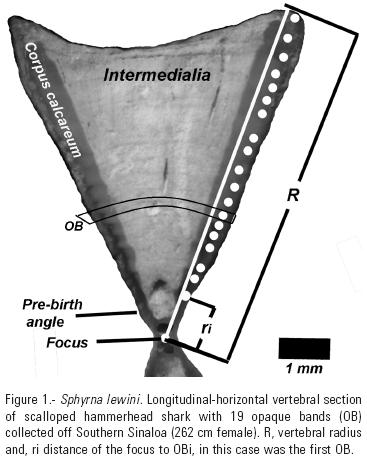
<body><![CDATA[<p align="justify"><font face="verdana" size="2"><b>INTRODUCTION</b></font></p>     <p align="justify"><font face="verdana" size="2">Scalloped hammerhead shark (<i>Sphyrna lewini</i>) is a circumtropical species with moderate fecundity (about 40 pups/ litter, Compagno, 1984). This shark is one member of the fishery assembly along tropical coasts of the world. In different seasons, <i>S. lewini </i>occupies the same environments as other high commercial species such as shrimps, lobsters, snappers, tunas and billfishes (Compagno, 1973; Ruiz &amp; Madrid, 1997). This shark was included during 1999 as one of the twenty most harvested shark species in the world (Castro <i>et al., </i>1999). Along the Pacific coast of Mexico, the scalloped hammerhead shark is commonly caught in artisanal fisheries and it can contribute 70% of the harvested biomass (Ruiz &amp; Madrid, 1997; Anislado&#150;Tolentino &amp; Robinson&#150;Mendoza, 2001).</font></p>     <p align="justify"><font face="verdana" size="2">A few studies have been made of the growth and age of the this shark in the Gulf of Mexico (Holden, 1974; Branstetter, 1987; Piercy <i>et al., </i>2007) and Pacific Ocean (Chen <i>et al., </i>1990; Anislado&#150;Tolentino &amp; Robinson&#150;Mendoza, 2001) in which the parameters of the von Bertalanffy growth equation for this shark were published. Because of this scarce information, this fish has a high uncertainty about its population characteristics (Cort&eacute;s, 2002).</font></p>     <p align="justify"><font face="verdana" size="2">The objective of this study is to determine the parameters of the von Bertalanffy growth equation by reading of the opaque bands (OBs) (growth marks) in the vertebrae edge (<i>Corpus calcareum</i>), increasing the knowledge for this shark's life history.</font></p>     <p align="justify"><font face="verdana" size="2">&nbsp;</font></p>     <p align="justify"><font face="verdana" size="2"><b>MATERIAL AND METHODS</b></font></p>     <p align="justify"><font face="verdana" size="2">From January 2003 to February 2005, 532 individuals (266 females and 266 males) of <i>Sphyrna lewini </i>were collected bimonthly from the commercial captures off the southern coast of Sinaloa (23&deg;45'25"N and 106&deg;05'15"W to 21&deg;52'N and 105&deg;54'W, with an isobath range of 20 to 200 meters), using fishing gear were surface longline, botton longline and botton gillnets. The sea surface temperature (SST, &deg;C) was obtained <i>in situ </i>during the fishing with a Taylor instant&#150;recording thermometer.</font></p>     <p align="justify"><font face="verdana" size="2">Total length (TL) and total weight (TW) of each specimen were taken. TL was measured from the tip of the snout to the tip of the tail, with the tail in the natural position. This measurement was taken along the body midline to a point intersected by a perpendicular dropped from the tip of the upper lobe of the tail (Francis, 2006).</font></p>     <p align="justify"><font face="verdana" size="2">Forty&#150;four females (52&#150; to 276&#150;cm total length (TL) and 65 males (47 &#150; to 245&#150;cm TL) and 40 terminal embryos were selected for the vertebral sample with the fourth and fifth postcephalic vertebra used from each individual. The sample criteria were that all specimens had to be intact when landed, as well completed with head and viscera. Each group of vertebrae was fixed, with a portion of the muscle, in 10% formaldehyde containing borax for 12 days, late was conserved in 70% ethanol.</font></p>     <p align="justify"><font face="verdana" size="2">The technique used to prepare vertebrae for the readings was: (1) rinse with running water for 30 minutes; (2) muscle remotion with knife and vertebrae separation; (3) remotion of the connective tissue with 5% hypochlorite for five minutes to 12 hours depending on size; (4) cut the sections along longitudinal&#150;horizontal plane of the vertebrae with jewelry saw (blade number 000) and polish with 200 to 800 grit wet sandpaper; (Anislado&#150;Tolentino &amp; Robinson&#150;Mendoza, 2001); (5) rinse the section of the different vertebrae from the same specimen with running water and stain with Red Alizarin&#150;S stain (Lamarca, 1966) and the samples were dried for 20 minutes before reading (<a href="#f1">Figure 1</a>).</font></p>     ]]></body>
<body><![CDATA[<p align="center"><font face="verdana" size="2"><a name="f1"></a></font></p>     <p align="center"><font face="verdana" size="2"><img src="/img/revistas/hbio/v18n1/a4f1.jpg"></font></p>     <p align="justify"><font face="verdana" size="2">An opaque band (OB) was defined as a narrow and well&#150;calcified band on the vertebrae edge and continues a long to the <i>intermedialia </i>of the vertebra, appearing after a hyaline band, A band&#150;pair consists of one opaque and one hyaline band (Cailliet <i>et al., </i>1983; Cailliet &amp; Goldmann, 2004, Cailliet <i>et al., </i>2006). The OBs, in all stained samples were counted in each vertebra using a digital image (500% of magnification and 300 dpi) taken with a scanner (Scanjet 6300 HP), with transmitted&#150;light and scale bar of 0.1cm. The counting of the OBs, measure of the vertebral radius (R), from the focus to the distal tip of vertebral edge and, the distances from the focus to each bottom margin of the OB (r<sub>i</sub>) were recorded parallel to the vertebral edge using the freeware Imagen Tools, Version 3 alpha for the image analysis (<a href="http://ddsdx.uthscsa.edu/dig/itdesc.html" target="_blank">http://ddsdx.uthscsa.edu/dig/itdesc.html</a>).</font></p>     <p align="justify"><font face="verdana" size="2">The precision counting analysis was made using three readers: two readers without biological knowledge, and previously trained to recognize opaque bands. All vertebrae were counted one time in blind, randomized trials without knowledge of each specimen's length to prevent reader's bias. The precision of the analysis was validated by using several methods: the percent agreement and percent agreement &plusmn; 1 OB (Goldman, 2004), the index of average percent error (IAPE) (Beamish &amp; Fournier, 1981), the index of precision (D) (Chang, 1982), and the Bowker test of symmetry (Hoening <i>et al., </i>1995).</font></p>     <p align="justify"><font face="verdana" size="2">The seasonal marginal OBs formation was determined using the classification proposed by Ferreira &amp; Vooren (1991): Marginal pre&#150;opaque bands, a broad translucent band; marginal opaque band, a narrow opaque band; and marginal post&#150;opaque bands, a narrow translucent band.</font></p>     <p align="justify"><font face="verdana" size="2">The correlation between the log<sub>e</sub> SST with the formation of the OBs was evaluated by the index of sinusoidal correlation.</font></p>     <p align="justify"><font face="verdana" size="2">Five back&#150;calculation methods were used (Francis, 1990) according to four possible relationships between the vertebra radio (R) and total length (TL): scale&#150;proportional hypothesis (SPH), body&#150;proportional hypothesis (BPH), Fraser&#150;Lee, nonlinear SPH, and nonlinear BPH. In this study, we proposed as the accuracy measure for back&#150;calculation method, the negative log&#150;normal likelihood analysis (<i>L</i>). The criteria used for this proposal has been based on two points (Hilborn &amp; Mangel, 1997; Haddon, 2001):</font></p>     <p align="justify"><font face="verdana" size="2">1. &#150; The data result from back&#150;calculation analysis showed a log&#150;normal distribution for the error (Fukuwaka, 1996)</font></p>     <p align="justify"><font face="verdana" size="2">2. &#150; The minimum value of <i>L </i>shows the best fit, and include the sample size, mean and standard deviation.</font></p>     <p align="justify"><font face="verdana" size="2">The parameters of the von Bertalanffy growth equation were first fitted using the Chapman (1961) and Gulland (1969) method for L<sub>&infin;</sub>. K and t<sub>0</sub> were calculated using the Gulland &amp; Holt's (1959) proposal. These results were refined with the maximum likelihood function (Haddon, 2001).</font></p>     ]]></body>
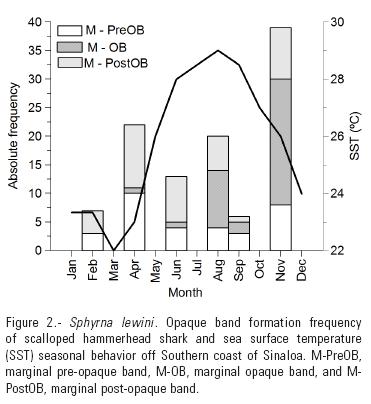
<body><![CDATA[<p align="justify"><font face="verdana" size="2">The squared sum of the residual was used to compare the curves obtained (Chen <i>et al., </i>1991). The standard growth index (&Phi;') (Munro &amp; Pauly, 1983) was estimated.</font></p>     <p align="justify"><font face="verdana" size="2">The relationships between total weight (TW) and TL and with age were examined for females and males. The statistical comparisons were made using the squared sum of the residual to compare the curves obtained (Chen <i>et al., </i>1991).</font></p>     <p align="justify"><font face="verdana" size="2">&nbsp;</font></p>     <p align="justify"><font face="verdana" size="2"><b>RESULTS</b></font></p>     <p align="justify"><font face="verdana" size="2">Of the original 109 samples, only one sample was unreadable and was discarded because of the inconsistencies in the count of the first three OBs. The percent agreement was 79% and percent agreement &plusmn; 1 OB was 97%. The IAPE was 3.7%, the D was 2.8%. The Bowker test of symmetry indicated no systematic disagreement between readers (&chi;<sup>2</sup> = 17.9, <i>d. f. </i>= 24, <i>P = </i>0.81).</font></p>     <p align="justify"><font face="verdana" size="2">The terminal embryos (45 to 55 cm TL) collected during June showed no OB. Nevertheless, a change in the angle of the <i>corpus calcareum </i>was observed (<a href="#f1">Figure 1</a>). The new&#150;borns collected from July to August displayed noticeable OB, including in the larges specimens, with similar narrow. Regarding the seasonal OB formation, two maximum values were found, one during summer (August) and another during winter (November) (<a href="#f2">Figure 2</a>). It was deduced that OBs are formed twice a year. According to the periodicity of OB formations, it is expected that  <i>S. lewinni</i> should have three OB in its first year of life.</font></p>     <p align="center"><font face="verdana" size="2"><a name="f2"></a></font></p>     <p align="center"><font face="verdana" size="2"><img src="/img/revistas/hbio/v18n1/a4f2.jpg"></font></p>     <p align="justify"><font face="verdana" size="2">On the other hand, the correlation index of the sinusoidal curve between the opaque bands with the Log<sub>e</sub> SST was 0.998 (<i>P = </i>0.07) showing an important influence in the formation of the opaque bands. According with the behavior OB formation and the relation SST, we concluded that right after the birth, the first OB forms in August. The second OB forms during November when SST significantly decreased (26&deg;C) and, in the first year of life (August), the hammerhead shark will have the third OB in the vertebrae, when the SST had the highest value (29 &deg;C).</font></p>     <p align="justify"><font face="verdana" size="2">All regression equations used for the different back&#150;calculation methods showed a significant correlation (r<sup>2</sup> &gt; 0.95) indicate that the all relationships were appropriate to five back&#150;calculation methods (<a href="/img/revistas/hbio/v18n1/a4t1.jpg" target="_blank">Table 1</a>). The best estimation for females and males was obtained with Fraser&#150;Lee (<a href="#t2">Table 2</a>).</font></p>     ]]></body>
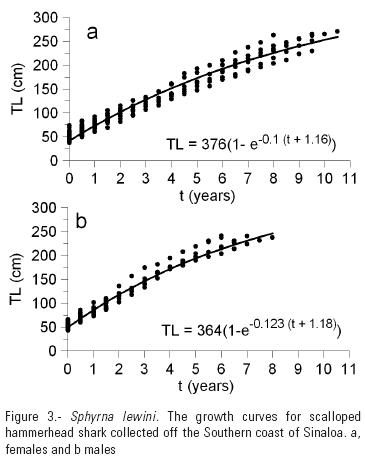
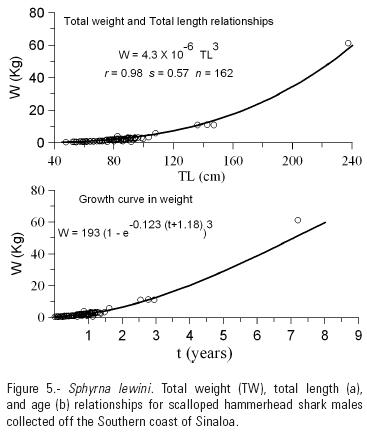
<body><![CDATA[<p align="center"><font face="verdana" size="2"><a name="t2"></a></font></p>     <p align="center"><font face="verdana" size="2"><img src="/img/revistas/hbio/v18n1/a4t2.jpg"></font></p>     <p align="justify"><font face="verdana" size="2">The back&#150;calculation values for the females showed 50% increase in total length and 32% in their second year (<a href="/img/revistas/hbio/v18n1/a4t3.jpg" target="_blank">Table 3</a>). In males, the first year increase was 52% in total length and in the second year, the increase was 41% (<a href="/img/revistas/hbio/v18n1/a4t4.jpg" target="_blank">Table 4</a>).</font></p>     <p align="justify"><font face="verdana" size="2">The parameters estimated for the growth curve were <i>L<sub>&infin;</sub> </i>= 376 &plusmn; 18 cm, K = 0.1 &plusmn; 0.001 year<sup>&#150;1</sup> and t<sub>0</sub> = &#150;1.16 &plusmn; 0.006 years with <i>r = </i>0.98 (<i>P = </i>0.035) for females (<a href="#f3">Figure 3a</a>), and L<sub>&infin;</sub> = 364 &plusmn; 12 cm, K= 0.123 &plusmn; 0.005 year<sup>&#150;1</sup>, and t<sub>0</sub> = &#150;1.18 &plusmn; 0.025 years with <i>r </i>= 0.99 (<i>P = </i>0.003) for males (<a href="#f3">Figure 3b</a>). The equations estimated were a significantly different between sexes (<i>P = </i>2 x 10<sup>&#150;34</sup>). The largest female (280 cm TL) caught during June 2003 was 12.5 years old and the largest male (281 cm TL) 11 years old. In addition, the small mature length was 204 cm TL for a female with mature ova (diameter 3.5cm) and 170cm TL for a male with the clasper tips showing a bruised area due to mating. The ages for these organisms were 6.5 years for the female and four years for the male.</font></p>     <p align="center"><font face="verdana" size="2"><a name="f3"></a></font></p>     <p align="center"><font face="verdana" size="2"><img src="/img/revistas/hbio/v18n1/a4f3.jpg"></font></p>     <p align="justify"><font face="verdana" size="2">The standard growth index (&Phi;') did not show a significant difference between females and males (<i>P = </i>0.9), with a value of 4.2 with s = 0.03.</font></p>     <p align="justify"><font face="verdana" size="2">The total weight length relationship was W = 4.03 x 10&#150;<sup>6</sup>TL<sup>3 </sup>with W<sub>&infin;</sub> = 222 kg for females (<a href="#f4">Figure 4a and 4b</a>) and TW = 4.3 x 10<sup>&#150;6</sup>TL<sup>3</sup> with W<sub>&infin;</sub> = 193 kg formales (<a href="#f5">Figure 5a and 5b</a>). The total weight between the length and age relationship showed a significant difference between sexes (<i>P &lt; </i>0.001).</font></p>     <p align="center"><font face="verdana" size="2"><a name="f4"></a></font></p>     <p align="center"><font face="verdana" size="2"><img src="/img/revistas/hbio/v18n1/a4f4.jpg"></font></p>     ]]></body>
<body><![CDATA[<p align="center"><font face="verdana" size="2"><a name="f5"></a></font></p>     <p align="center"><font face="verdana" size="2"><img src="/img/revistas/hbio/v18n1/a4f5.jpg"></font></p>     <p align="justify"><font face="verdana" size="2">The Bower test of symmetry showed a consistent opaque&#150;band counting. Only Piercy <i>et al. </i>(2007) estimated the percent agreement (69%), percent agreement &plusmn; 1 year (89%) and IAPE (3.2%). Our estimations for these values had no significant difference (79%, 97% and 3.7% respectively).</font></p>     <p align="justify"><font face="verdana" size="2">The appearance of the first opaque band immediately after birth was also reported by Branstetter (1987), Chen <i>et al. </i>(1990), and Anislado&#150;Tolentino &amp; Robinson&#150;Mendoza (2001). This behavior is possible if the food being ingested promotes the momentary retardation of growth until the newborn in response to environmental limiter factors (Phillips, 1969). In the study area, the newborn appeared during August when we observed that the reproductive periods of many marine species occur (i.e. snappers, sea cat&#150;fishes, bass). The majority of these species are the prey of the newborn scalloped hammerhead shark.</font></p>     <p align="justify"><font face="verdana" size="2">As with Chen <i>et al. </i>(1990) and Anislado&#150;Tolentino &amp; Robinson&#150;Mendoza (2001), we found two periods of opaque band formation, but Natanson <i>et al. </i>(2006) suggested that similar behavior proposed for other shark species might be incorrect because there is no validation analysis. Opaque band that forms in summer in adults is probably associated with reproductive behavior and in immature sharks; the opaque band can originate because of the increase in food ingested. During winter, the decreased temperature and rain may cause the scalloped hammerhead to move towards warmer water and cause a delay in the growth rate, as was saw by Klimley (1987) from S. <i>lewini </i>in the Gulf of California. This may also increase the energetic cost for feeding and temperature regulation.</font></p>     <p align="justify"><font face="verdana" size="2">Most back&#150;calculation studies use the Fraser&#150;Lee method (Natanson <i>et al., </i>2002; Carlson <i>et al., </i>2003; Santana &amp; Lessa, 2004). In others, the Dalh&#150;Lea method was used (Branstetter <i>et al., </i>1987; Wintner, 2000; Wintner &amp; Cliff, 1999). Goldman &amp; Musick (2006) evaluated four back&#150;calculation methods for salmon shark (<i>Lamna distropis </i>Hubbs &amp; Follet 1947) using the mean deviation of the curves growth. Fukuwaka (1996) proposed sum of squares of the log&#150;normal for the error for selected the best fit of back&#150;calculation for salmon, in our study, likelihood applied to the individual results was believed to yield a stronger validation because this analysis reduces the bias in the mathematical procedures, because the use of mean, standard deviation and size sample. Our results showed that the back&#150;calculation of Fraser&#150;Lee is the best method for age and growth analysis for sharks.</font></p>     <p align="justify"><font face="verdana" size="2">The lowest values of the growth coefficient (K) was proposed by Holden (1974) and Branstetter (1987) (<a href="/img/revistas/hbio/v18n1/a4t5.jpg" target="_blank">Table 5</a>). Holden's (1974) had an intrinsic and extrinsic bias (Castro &amp; Wourms, 1993; Pratt &amp; Casey 1990; Anislado&#150;Tolentino &amp; Robinson&#150;Mendoza, 2001). Branstetter (1987) did not sample during critical seasons, i.e. summer (mating season) and winter, and included no analysis of the marginal increase or calcification of the vertebra edge, assuming therefore a single annual OB. Chen <i>et al. </i>(1990) from Taiwan waters provided the highest value of the growth coefficient, where the S. <i>lewini are </i>the largest harvest. It is probable that the Taiwan's population of this fish has similar auto&#150;regulation mechanics such as <i>Carcharhinus plumbeus </i>(Sminkey &amp; Musick, 1995). Piercy <i>et al. </i>(2007) estimated the growth curve for this Sphyrnid based on the validated annual ring with a marginal increase and a large sample size. Nevertheless, they found a growth coefficient (K) similar to that of Anislado&#150;Tolentino &amp; Robinson&#150;Mendoza (2001) for males and with our study for males and females.</font></p>     <p align="justify"><font face="verdana" size="2">The mean &Phi;' index from several works on the age and growth studies of this shark (<a href="/img/revistas/hbio/v18n1/a4t5.jpg" target="_blank">Table 5</a>) was 4.1 (<i>s </i>= 0.2, <i>n </i>= 15). The interval limits at the 99% was 3.7 to 4.3, this values exclude the curves growth proposal by Chen <i>et al. </i>(1990). It is necessary to accept Taylor's postulate (1958, 1960) that in the most distant latitudes from Ecuador the species are larger, with higher longevity, lower growth rates and delayed maturity compared to those nearer the Ecuador.</font></p>     <p align="justify"><font face="verdana" size="2">The comparison in weight&#150;length relationships studied for this species in other regions (<a href="/img/revistas/hbio/v18n1/a4t6.jpg" target="_blank">Table 6</a>) showed in pooled sex curves an overestimation in the Kholer <i>et al. </i>(1996) data compared to the relationships proposed by the other authors. For a scalloped hammerhead shark 200 cm TL, Kholer <i>et al. </i>(1996) found 89 kg when the average weight by other authors was 33 kg (<i>s</i> = 3.3 kg). Chen <i>et al. </i>(1990) estimated the lowest weights, and the highest estimations were by Anislado&#150;Tolentino &amp; Robinson&#150;Mendoza (2001) from the Michoac&aacute;n coast, M&eacute;xico. For males, the present study was significantly different from Chen et <i>al. </i>(1990) from Northeastern Taiwan (<i>P = </i>0.03) with lower estimated values.</font></p>     <p align="justify"><font face="verdana" size="2">In the investigations of other sharks, some biological aspects showed differences between close areas. Garrick (1982) wrote of the different populations along a continuous coast showing differences because of the oceanographic barriers and the philopatric behavior. Carlson &amp; Parson (1997) proposed a clinal variation concept in their shark research based on their age and growth investigation of the bonneted hammerhead shark (<i>Sphyrna tiburo </i>Linnaeus, 1758). They found differences between three proximal areas along the northeastern coast from Florida, USA. Lombardi&#150;Carlson <i>et al. </i>(2003) validated these differences in the bonnet hammerhead shark based their reproductive aspects.</font></p>     ]]></body>
<body><![CDATA[<p align="justify"><font face="verdana" size="2">Recently Quattro <i>et al. </i>(2006) and Duncan <i>et al. </i>(2006) have found genetic differences between stocks of this fish in several regions of the world. The first authors found the existence of a cryptic Atlantic haplotype of S. lewini in the north Atlantic near the Gulf of Mexico. Castillo&#150;Olgu&iacute;n (2005) showed that a genetic difference exists between stocks of the mouth of the Gulf of California, the coast of Nayarit state, and the Gulf of Tehuantepec.</font></p>     <p align="justify"><font face="verdana" size="2">The present study adds some key parameters needed for future fishery assessments of <i>Sphyrna lewini from </i>the important fishing area along the Pacific coast of M&eacute;xico. This results support the hypothesis that this species, as other long&#150;lived sea resources, requires conservative management because of its slow growth and its susceptibility to overexploitation (Piercy <i>et al., </i>2007). According with the found results, further research on age, growth and reproduction, done regionally, are necessary to establish regional regulations for the correct management.</font></p>     <p align="justify"><font face="verdana" size="2">&nbsp;</font></p>     <p align="justify"><font face="verdana" size="2"><b>ACKNOWLEDGMENTS</b></font></p>     <p align="justify"><font face="verdana" size="2">The authors acknowledge to Dr. Felipe Galv&aacute;n Maga&ntilde;a and Dr. Oscar Sosa Nishizaki for their commentaries and are grateful to Humberto and Camilo Toledo Renter&iacute;a for their support in the field, and Miguel Villavicencio and Marco A. Beltran, the readers of Opaque Bands. Thanks to Dra. Gloria Vilaclara Fatjo, Director of the Postgrado in Ciencias del Mar y Limnolog&iacute;a, UNAM for logistical support. This study is part of the Doctoral thesis of the first author and was supported by the CONACYT grant Number 170531. Thanks to Dr. Ellis Glazier for editing the English&#150;language text.</font></p>     <p align="justify"><font face="verdana" size="2">&nbsp;</font></p>     <p align="justify"><font face="verdana" size="2"><b>REFERENCES</b></font></p>     <!-- ref --><p align="justify"><font face="verdana" size="2">Anislado&#150;Tolentino V. &amp; C. Robinson&#150;Mendoza. 2001. Age and growth of the scalloped hammerhead shark, <i>Sphyrna lewini </i>(Griffith and Smith, 1834), along the central Pacific coast of Mexico. <i>Ciencias Marinas </i>27 (4):501&#150;520.</font>&nbsp;&nbsp;&nbsp;&nbsp;&nbsp;&nbsp;&nbsp;&nbsp;[&#160;<a href="javascript:void(0);" onclick="javascript: window.open('/scielo.php?script=sci_nlinks&ref=4070071&pid=S0188-8897200800010000400001&lng=','','width=640,height=500,resizable=yes,scrollbars=1,menubar=yes,');">Links</a>&#160;]<!-- end-ref --><!-- ref --><p align="justify"><font face="verdana" size="2">Beamish R. J., &amp; D. A. Fournier. 1981. A method for comparing the precision of a set of age determination. <i>Canadian Journal of Fisheries and Aquatic Sciences 38: </i>982&#150;983.</font>&nbsp;&nbsp;&nbsp;&nbsp;&nbsp;&nbsp;&nbsp;&nbsp;[&#160;<a href="javascript:void(0);" onclick="javascript: window.open('/scielo.php?script=sci_nlinks&ref=4070072&pid=S0188-8897200800010000400002&lng=','','width=640,height=500,resizable=yes,scrollbars=1,menubar=yes,');">Links</a>&#160;]<!-- end-ref --><!-- ref --><p align="justify"><font face="verdana" size="2">Branstetter S. D. 1987. Age, growth and reproductive biology silky shark, <i>Carcharhinus falciformis </i>and scalloped hammerhead, <i>Sphyrna lewini, </i>from the northwestern Gulf of Mexico. <i>Enviromental Biology of Fishes </i>19(3): 161&#150;173.</font>&nbsp;&nbsp;&nbsp;&nbsp;&nbsp;&nbsp;&nbsp;&nbsp;[&#160;<a href="javascript:void(0);" onclick="javascript: window.open('/scielo.php?script=sci_nlinks&ref=4070073&pid=S0188-8897200800010000400003&lng=','','width=640,height=500,resizable=yes,scrollbars=1,menubar=yes,');">Links</a>&#160;]<!-- end-ref --><!-- ref --><p align="justify"><font face="verdana" size="2">Branstetter S. D., J. A. Musick, &amp; J. A. Colvocoresses, 1987. A comparison of the age and growth of the tiger sharks, <i>Galeocerdo cuvieri, </i>from off Virginia and from the Northwestern Gulf of Mexico. <i>Fishery Bulletin </i>85 (2): 269&#150;276.</font>&nbsp;&nbsp;&nbsp;&nbsp;&nbsp;&nbsp;&nbsp;&nbsp;[&#160;<a href="javascript:void(0);" onclick="javascript: window.open('/scielo.php?script=sci_nlinks&ref=4070074&pid=S0188-8897200800010000400004&lng=','','width=640,height=500,resizable=yes,scrollbars=1,menubar=yes,');">Links</a>&#160;]<!-- end-ref --><!-- ref --><p align="justify"><font face="verdana" size="2">Cailliet G. M. &amp; K. J. Goldman, 2004. Age determination and validation in chondrichthyan fishes. <i>In: </i>Carrier J., J. A. Musick, &amp; M. R. Heithaus. (Eds.) <i>Biology of sharks and their relatives; </i>CRC Press LLC, Boca Raton, FL; pp. 399&#150;447.</font>&nbsp;&nbsp;&nbsp;&nbsp;&nbsp;&nbsp;&nbsp;&nbsp;[&#160;<a href="javascript:void(0);" onclick="javascript: window.open('/scielo.php?script=sci_nlinks&ref=4070075&pid=S0188-8897200800010000400005&lng=','','width=640,height=500,resizable=yes,scrollbars=1,menubar=yes,');">Links</a>&#160;]<!-- end-ref --><!-- ref --><p align="justify"><font face="verdana" size="2">Cailliet G. M., L. K. Martin., D. Kusher, P. Wolf. &amp; B. A. Welden, 1983. Techniques for enhancing vertebral bands in age estimation of California elasmobranchs. <i>In: </i>Prince ED, Pulos LM (Eds.) Proceedings international workshop on age determination of oceanic pelagic fishes: tunas, billfishes<b>, </b>sharks. <i>NOAA Tech. Rep. NMFS </i>8, pp. 157&#150;165.</font>&nbsp;&nbsp;&nbsp;&nbsp;&nbsp;&nbsp;&nbsp;&nbsp;[&#160;<a href="javascript:void(0);" onclick="javascript: window.open('/scielo.php?script=sci_nlinks&ref=4070076&pid=S0188-8897200800010000400006&lng=','','width=640,height=500,resizable=yes,scrollbars=1,menubar=yes,');">Links</a>&#160;]<!-- end-ref --><!-- ref --><p align="justify"><font face="verdana" size="2">Cailliet G. M., W. D. Smith, H. F. Mollet. &amp; K. J. Goldman, 2006. Age and growth studies of chondrichthyan fishes: the need for consistency in terminology, verification, validation, and growth function fitting. <i>Environmental Biology of Fishes 77 </i>(3): 211&#150;228.</font>&nbsp;&nbsp;&nbsp;&nbsp;&nbsp;&nbsp;&nbsp;&nbsp;[&#160;<a href="javascript:void(0);" onclick="javascript: window.open('/scielo.php?script=sci_nlinks&ref=4070077&pid=S0188-8897200800010000400007&lng=','','width=640,height=500,resizable=yes,scrollbars=1,menubar=yes,');">Links</a>&#160;]<!-- end-ref --><!-- ref --><p align="justify"><font face="verdana" size="2">Carlson, J. &amp; G. R. Parsons. 1997. Age and growth of the bonnethead shark from northwest Florida with comments on clinal variation. <i>Environmental Biology of Fishes </i>50:331 &#150;341.</font>&nbsp;&nbsp;&nbsp;&nbsp;&nbsp;&nbsp;&nbsp;&nbsp;[&#160;<a href="javascript:void(0);" onclick="javascript: window.open('/scielo.php?script=sci_nlinks&ref=4070078&pid=S0188-8897200800010000400008&lng=','','width=640,height=500,resizable=yes,scrollbars=1,menubar=yes,');">Links</a>&#160;]<!-- end-ref --><!-- ref --><p align="justify"><font face="verdana" size="2">Carlson J. K., E. Cortes &amp; D. M. Bethea. 2003. Life history and population dynamics of the finetooth shark <i>(Carcharhinus isodon) </i>in the northeastern Gulf of Mexico. <i>Fishery Bulletin </i>101:281&#150;292.</font>&nbsp;&nbsp;&nbsp;&nbsp;&nbsp;&nbsp;&nbsp;&nbsp;[&#160;<a href="javascript:void(0);" onclick="javascript: window.open('/scielo.php?script=sci_nlinks&ref=4070079&pid=S0188-8897200800010000400009&lng=','','width=640,height=500,resizable=yes,scrollbars=1,menubar=yes,');">Links</a>&#160;]<!-- end-ref --><!-- ref --><p align="justify"><font face="verdana" size="2">Castillo&#150;Olgu&iacute;n E., 2005. Estructura gen&eacute;tica poblacional de dos especies de tiburones <i>(Carcharhinus falciformis y Sphyrna lewini) </i>del pac&iacute;fico mexicano. Tesis de Maestr&iacute;a en Ciencias Biol&oacute;gicas (Biolog&iacute;a experimental). Facultad de Ciencias. UNAM. 98 p.</font>&nbsp;&nbsp;&nbsp;&nbsp;&nbsp;&nbsp;&nbsp;&nbsp;[&#160;<a href="javascript:void(0);" onclick="javascript: window.open('/scielo.php?script=sci_nlinks&ref=4070080&pid=S0188-8897200800010000400010&lng=','','width=640,height=500,resizable=yes,scrollbars=1,menubar=yes,');">Links</a>&#160;]<!-- end-ref --><!-- ref --><p align="justify"><font face="verdana" size="2">Castro, J. I. &amp; J. P. Wourms. 1993. Reproduction, placentation, and embryonic development of the Atlantic sharpnose shark, <i>Rhizoprionodon terraenovae. Journal of Morphology </i>218: 257&#150;280.</font>&nbsp;&nbsp;&nbsp;&nbsp;&nbsp;&nbsp;&nbsp;&nbsp;[&#160;<a href="javascript:void(0);" onclick="javascript: window.open('/scielo.php?script=sci_nlinks&ref=4070081&pid=S0188-8897200800010000400011&lng=','','width=640,height=500,resizable=yes,scrollbars=1,menubar=yes,');">Links</a>&#160;]<!-- end-ref --><!-- ref --><p align="justify"><font face="verdana" size="2">Castro, J. I., C. M. Woodley &amp; R. L. Brudek. 1999. A preliminary evaluation of the status of shark species. <i>FAO Fish. Technical Papers </i>No. 380: 72 p.</font>&nbsp;&nbsp;&nbsp;&nbsp;&nbsp;&nbsp;&nbsp;&nbsp;[&#160;<a href="javascript:void(0);" onclick="javascript: window.open('/scielo.php?script=sci_nlinks&ref=4070082&pid=S0188-8897200800010000400012&lng=','','width=640,height=500,resizable=yes,scrollbars=1,menubar=yes,');">Links</a>&#160;]<!-- end-ref --><!-- ref --><p align="justify"><font face="verdana" size="2">Chang, W. Y. B. 1982. A statistical method for evaluating the reproducibility of age determination. <i>Canadian Journal of Fishery and Aquatic Science </i>39: 1208&#150;1210.</font>&nbsp;&nbsp;&nbsp;&nbsp;&nbsp;&nbsp;&nbsp;&nbsp;[&#160;<a href="javascript:void(0);" onclick="javascript: window.open('/scielo.php?script=sci_nlinks&ref=4070083&pid=S0188-8897200800010000400013&lng=','','width=640,height=500,resizable=yes,scrollbars=1,menubar=yes,');">Links</a>&#160;]<!-- end-ref --><!-- ref --><p align="justify"><font face="verdana" size="2">Chapman, D. G. 1961. Statistical problems in dynamics of exploited fisheries populations. <i>In: </i>Neyman J. (Ed.), <i>Proc. 4th Berkeley Symp. on Mathematics, Statistics and Probability, </i>Vol. IV. University of California Press, Berkeley, 153&#150;168 pp.</font>&nbsp;&nbsp;&nbsp;&nbsp;&nbsp;&nbsp;&nbsp;&nbsp;[&#160;<a href="javascript:void(0);" onclick="javascript: window.open('/scielo.php?script=sci_nlinks&ref=4070084&pid=S0188-8897200800010000400014&lng=','','width=640,height=500,resizable=yes,scrollbars=1,menubar=yes,');">Links</a>&#160;]<!-- end-ref --><!-- ref --><p align="justify"><font face="verdana" size="2">Chen, C. T. T., C. Leu &amp; N. Ch. Lou. 1990. Age and growth of the scalloped hammerhead shark, <i>Sphyrna lewini, </i>in Northeastern Taiwan waters. <i>Pacific Science </i>44 (2): 15&#150;170.</font>&nbsp;&nbsp;&nbsp;&nbsp;&nbsp;&nbsp;&nbsp;&nbsp;[&#160;<a href="javascript:void(0);" onclick="javascript: window.open('/scielo.php?script=sci_nlinks&ref=4070085&pid=S0188-8897200800010000400015&lng=','','width=640,height=500,resizable=yes,scrollbars=1,menubar=yes,');">Links</a>&#160;]<!-- end-ref --><!-- ref --><p align="justify"><font face="verdana" size="2">Chen, Y. D., A. Jackson &amp; H. H. Harvey. 1991. A comparison of von Bertalanffy and polynomial functions in modeling fish growth data. <i>Canadian Journal Fisheries and Aquatic Sciences </i>49: 1228&#150;1235.</font>&nbsp;&nbsp;&nbsp;&nbsp;&nbsp;&nbsp;&nbsp;&nbsp;[&#160;<a href="javascript:void(0);" onclick="javascript: window.open('/scielo.php?script=sci_nlinks&ref=4070086&pid=S0188-8897200800010000400016&lng=','','width=640,height=500,resizable=yes,scrollbars=1,menubar=yes,');">Links</a>&#160;]<!-- end-ref --><!-- ref --><p align="justify"><font face="verdana" size="2">Clarke, T. A. 1971. The ecology of the scalloped hammerhead shark. <i>Sphyrna lewini, </i>in Hawaii. <i>Pacific Science </i>(25):133&#150;144.</font>&nbsp;&nbsp;&nbsp;&nbsp;&nbsp;&nbsp;&nbsp;&nbsp;[&#160;<a href="javascript:void(0);" onclick="javascript: window.open('/scielo.php?script=sci_nlinks&ref=4070087&pid=S0188-8897200800010000400017&lng=','','width=640,height=500,resizable=yes,scrollbars=1,menubar=yes,');">Links</a>&#160;]<!-- end-ref --><!-- ref --><p align="justify"><font face="verdana" size="2">Compagno, L. J. V. 1973. Interrelationships of living elasmobranchs. <i>In: </i>Greenwood P. H., R. S. Miles, &amp; C. Patterson, (Eds.) <i>Interrelationships of fishes. </i>Academic Press London, 15&#150;61 pp.</font>&nbsp;&nbsp;&nbsp;&nbsp;&nbsp;&nbsp;&nbsp;&nbsp;[&#160;<a href="javascript:void(0);" onclick="javascript: window.open('/scielo.php?script=sci_nlinks&ref=4070088&pid=S0188-8897200800010000400018&lng=','','width=640,height=500,resizable=yes,scrollbars=1,menubar=yes,');">Links</a>&#160;]<!-- end-ref --><!-- ref --><p align="justify"><font face="verdana" size="2">Compagno, L. J. V. 1984. <i>Sharks of the World, an Annoted and Illustrated Catalogue of Sharks Species Known to Date. </i>FAO. Fisheries synopsis 125, 4 (part 4). 655 p.</font>&nbsp;&nbsp;&nbsp;&nbsp;&nbsp;&nbsp;&nbsp;&nbsp;[&#160;<a href="javascript:void(0);" onclick="javascript: window.open('/scielo.php?script=sci_nlinks&ref=4070089&pid=S0188-8897200800010000400019&lng=','','width=640,height=500,resizable=yes,scrollbars=1,menubar=yes,');">Links</a>&#160;]<!-- end-ref --><!-- ref --><p align="justify"><font face="verdana" size="2">Cort&eacute;s, E. 2002. Incorporating uncertainty into demographic modeling: applications to shark populations and their conservation. <i>Conservation Biology </i>16 (4):1048&#150;1062.</font>&nbsp;&nbsp;&nbsp;&nbsp;&nbsp;&nbsp;&nbsp;&nbsp;[&#160;<a href="javascript:void(0);" onclick="javascript: window.open('/scielo.php?script=sci_nlinks&ref=4070090&pid=S0188-8897200800010000400020&lng=','','width=640,height=500,resizable=yes,scrollbars=1,menubar=yes,');">Links</a>&#160;]<!-- end-ref --><!-- ref --><p align="justify"><font face="verdana" size="2">Duncan, K. M., A. P. Martin, B. W. Bowen &amp; H. G. De Couet. 2006. Global phylogeography of the scalloped hammerhead shark <i>(Sphyrna lewini). Molecular Ecology </i>10: 1&#150;13.</font>&nbsp;&nbsp;&nbsp;&nbsp;&nbsp;&nbsp;&nbsp;&nbsp;[&#160;<a href="javascript:void(0);" onclick="javascript: window.open('/scielo.php?script=sci_nlinks&ref=4070091&pid=S0188-8897200800010000400021&lng=','','width=640,height=500,resizable=yes,scrollbars=1,menubar=yes,');">Links</a>&#160;]<!-- end-ref --><!-- ref --><p align="justify"><font face="verdana" size="2">Ferreira, B. P. &amp; C. M. Vooren. 1991. Age, growth, and structure of vertebra in the school shark <i>Galeorhinus galeus </i>(Linnaeus, 1758) from Southern Brazil. <i>Fishery Bulletin </i>89 (1): 19&#150;31.</font>&nbsp;&nbsp;&nbsp;&nbsp;&nbsp;&nbsp;&nbsp;&nbsp;[&#160;<a href="javascript:void(0);" onclick="javascript: window.open('/scielo.php?script=sci_nlinks&ref=4070092&pid=S0188-8897200800010000400022&lng=','','width=640,height=500,resizable=yes,scrollbars=1,menubar=yes,');">Links</a>&#160;]<!-- end-ref --><!-- ref --><p align="justify"><font face="verdana" size="2">Francis, R. I. C. C. 1990. Back&#150;calculation of fish length: a critical review. <i>Journal of Fish Biology 36: </i>883&#150;902.</font>&nbsp;&nbsp;&nbsp;&nbsp;&nbsp;&nbsp;&nbsp;&nbsp;[&#160;<a href="javascript:void(0);" onclick="javascript: window.open('/scielo.php?script=sci_nlinks&ref=4070093&pid=S0188-8897200800010000400023&lng=','','width=640,height=500,resizable=yes,scrollbars=1,menubar=yes,');">Links</a>&#160;]<!-- end-ref --><!-- ref --><p align="justify"><font face="verdana" size="2">Francis, M. P. 2006. Morphometric minefields&#151;towards a measurement standard for chondrichthyan fishes. <i>Environmental Biology of Fishes 77 </i>(3&#150;4): 407&#150;421.</font>&nbsp;&nbsp;&nbsp;&nbsp;&nbsp;&nbsp;&nbsp;&nbsp;[&#160;<a href="javascript:void(0);" onclick="javascript: window.open('/scielo.php?script=sci_nlinks&ref=4070094&pid=S0188-8897200800010000400024&lng=','','width=640,height=500,resizable=yes,scrollbars=1,menubar=yes,');">Links</a>&#160;]<!-- end-ref --><!-- ref --><p align="justify"><font face="verdana" size="2">Fukuwaka M. 1996. Allometric back&#150;calculation of individual growth for chum salmon otolith during early life. <i>Scientific Reports of the Hokkaido Salmon Hatchery </i>50:113&#150;116.</font>&nbsp;&nbsp;&nbsp;&nbsp;&nbsp;&nbsp;&nbsp;&nbsp;[&#160;<a href="javascript:void(0);" onclick="javascript: window.open('/scielo.php?script=sci_nlinks&ref=4070095&pid=S0188-8897200800010000400025&lng=','','width=640,height=500,resizable=yes,scrollbars=1,menubar=yes,');">Links</a>&#160;]<!-- end-ref --><!-- ref --><p align="justify"><font face="verdana" size="2">Garrick, J. A. F. 1982. Sharks of the genus Carcharhinus. <i>NOAA Technical Report. </i>NMFS Circular 445, 194 p.</font>&nbsp;&nbsp;&nbsp;&nbsp;&nbsp;&nbsp;&nbsp;&nbsp;[&#160;<a href="javascript:void(0);" onclick="javascript: window.open('/scielo.php?script=sci_nlinks&ref=4070096&pid=S0188-8897200800010000400026&lng=','','width=640,height=500,resizable=yes,scrollbars=1,menubar=yes,');">Links</a>&#160;]<!-- end-ref --><!-- ref --><p align="justify"><font face="verdana" size="2">Goldman, K. J. 2004. Age and growth of elasmobranch fishes. <i>In. </i>Musick J. A., &amp; R. Bonfil (Eds.) <i>Elasmobranch fisheries management techniques. </i>Singapore: APEC, 97&#150;132 pp.</font>&nbsp;&nbsp;&nbsp;&nbsp;&nbsp;&nbsp;&nbsp;&nbsp;[&#160;<a href="javascript:void(0);" onclick="javascript: window.open('/scielo.php?script=sci_nlinks&ref=4070097&pid=S0188-8897200800010000400027&lng=','','width=640,height=500,resizable=yes,scrollbars=1,menubar=yes,');">Links</a>&#160;]<!-- end-ref --><!-- ref --><p align="justify"><font face="verdana" size="2">Goldman, K. J. &amp; J. A. Musick. 2006. Growth and maturity of salmon shark in the eastern and western North Pacific, with comments on back&#150;calculation methods. <i>Fishery Bulletin </i>104: 278&#150;292.</font>&nbsp;&nbsp;&nbsp;&nbsp;&nbsp;&nbsp;&nbsp;&nbsp;[&#160;<a href="javascript:void(0);" onclick="javascript: window.open('/scielo.php?script=sci_nlinks&ref=4070098&pid=S0188-8897200800010000400028&lng=','','width=640,height=500,resizable=yes,scrollbars=1,menubar=yes,');">Links</a>&#160;]<!-- end-ref --><!-- ref --><p align="justify"><font face="verdana" size="2">Gulland, J. A. 1969. Manual of methods for fish stock assessment. Part 1: Fish population analysis. <i>FAO Manual Fisheries Science. </i>4: 154 pp.</font>&nbsp;&nbsp;&nbsp;&nbsp;&nbsp;&nbsp;&nbsp;&nbsp;[&#160;<a href="javascript:void(0);" onclick="javascript: window.open('/scielo.php?script=sci_nlinks&ref=4070099&pid=S0188-8897200800010000400029&lng=','','width=640,height=500,resizable=yes,scrollbars=1,menubar=yes,');">Links</a>&#160;]<!-- end-ref --><!-- ref --><p align="justify"><font face="verdana" size="2">Gulland, J. A. &amp; S. J. Holt. 1959 Estimation of growth parameters for data at unequal time intervals. <i>Journal Conservation. </i>CIEM, 25(1):47&#150;9.</font>&nbsp;&nbsp;&nbsp;&nbsp;&nbsp;&nbsp;&nbsp;&nbsp;[&#160;<a href="javascript:void(0);" onclick="javascript: window.open('/scielo.php?script=sci_nlinks&ref=4070100&pid=S0188-8897200800010000400030&lng=','','width=640,height=500,resizable=yes,scrollbars=1,menubar=yes,');">Links</a>&#160;]<!-- end-ref --><!-- ref --><p align="justify"><font face="verdana" size="2">Haddon, M. 2001. <i>Modeling and Quantitative Methods in Fisheries. </i>Chapman and Hall/CRC. Florida, 406 p.</font>&nbsp;&nbsp;&nbsp;&nbsp;&nbsp;&nbsp;&nbsp;&nbsp;[&#160;<a href="javascript:void(0);" onclick="javascript: window.open('/scielo.php?script=sci_nlinks&ref=4070101&pid=S0188-8897200800010000400031&lng=','','width=640,height=500,resizable=yes,scrollbars=1,menubar=yes,');">Links</a>&#160;]<!-- end-ref --><!-- ref --><p align="justify"><font face="verdana" size="2">Hilborn, R. &amp; M. Mangel. 1997. <i>The ecological detective. Confronting models with data. </i>Monographs in population biology 28. Pricenton University Press. New Jersey, 315 p.</font>&nbsp;&nbsp;&nbsp;&nbsp;&nbsp;&nbsp;&nbsp;&nbsp;[&#160;<a href="javascript:void(0);" onclick="javascript: window.open('/scielo.php?script=sci_nlinks&ref=4070102&pid=S0188-8897200800010000400032&lng=','','width=640,height=500,resizable=yes,scrollbars=1,menubar=yes,');">Links</a>&#160;]<!-- end-ref --><!-- ref --><p align="justify"><font face="verdana" size="2">Hoening, J. M., M. J. Morgan &amp; C. A. Brown. 1995. Analyzing differences between two age determination methods by test of symmetry. <i>Canadian Journal of Fisheries and Aquatic Sciences </i>52: 364&#150;368.</font>&nbsp;&nbsp;&nbsp;&nbsp;&nbsp;&nbsp;&nbsp;&nbsp;[&#160;<a href="javascript:void(0);" onclick="javascript: window.open('/scielo.php?script=sci_nlinks&ref=4070103&pid=S0188-8897200800010000400033&lng=','','width=640,height=500,resizable=yes,scrollbars=1,menubar=yes,');">Links</a>&#160;]<!-- end-ref --><!-- ref --><p align="justify"><font face="verdana" size="2">Holden, M. J. 1974. Problems in the rational exploitation of elasmobranch populations and some suggested solutions. <i>In: </i>Harden J. F. R. (Ed.) Sea <i>fisheries research. </i>Logos Press, London, 117&#150;137 pp.</font>&nbsp;&nbsp;&nbsp;&nbsp;&nbsp;&nbsp;&nbsp;&nbsp;[&#160;<a href="javascript:void(0);" onclick="javascript: window.open('/scielo.php?script=sci_nlinks&ref=4070104&pid=S0188-8897200800010000400034&lng=','','width=640,height=500,resizable=yes,scrollbars=1,menubar=yes,');">Links</a>&#160;]<!-- end-ref --><!-- ref --><p align="justify"><font face="verdana" size="2">Klimley, A. P. 1987. The determinants of sexual segregation in the scalloped hammerhead shark, <i>S. lewini. Environmental Biology of Fishes </i>18(1): 27&#150;40.</font>&nbsp;&nbsp;&nbsp;&nbsp;&nbsp;&nbsp;&nbsp;&nbsp;[&#160;<a href="javascript:void(0);" onclick="javascript: window.open('/scielo.php?script=sci_nlinks&ref=4070105&pid=S0188-8897200800010000400035&lng=','','width=640,height=500,resizable=yes,scrollbars=1,menubar=yes,');">Links</a>&#160;]<!-- end-ref --><!-- ref --><p align="justify"><font face="verdana" size="2">Kohler, N. H., J. G. Casey &amp; P. A. Turner. 1996. Length&#150;length and length&#150;weight relationships for 13 shark species from the Western North Atlantic. <i>NOAA Technical Memorandum NMFS&#150;NE. </i>110, 26 p.</font>&nbsp;&nbsp;&nbsp;&nbsp;&nbsp;&nbsp;&nbsp;&nbsp;[&#160;<a href="javascript:void(0);" onclick="javascript: window.open('/scielo.php?script=sci_nlinks&ref=4070106&pid=S0188-8897200800010000400036&lng=','','width=640,height=500,resizable=yes,scrollbars=1,menubar=yes,');">Links</a>&#160;]<!-- end-ref --><!-- ref --><p align="justify"><font face="verdana" size="2">LaMarca, M. J. 1966. A simple technique for demonstrating calcified annuli in the vertebrae of large elasmobranchs. <i>Copeia </i>2: 351&#150;352.</font>&nbsp;&nbsp;&nbsp;&nbsp;&nbsp;&nbsp;&nbsp;&nbsp;[&#160;<a href="javascript:void(0);" onclick="javascript: window.open('/scielo.php?script=sci_nlinks&ref=4070107&pid=S0188-8897200800010000400037&lng=','','width=640,height=500,resizable=yes,scrollbars=1,menubar=yes,');">Links</a>&#160;]<!-- end-ref --><!-- ref --><p align="justify"><font face="verdana" size="2">Lombardi&#150;Carlson, L. A., E. Cortes, G. R. Parsons &amp; C. A. Manire. 2003. Latitudinal variation in life&#150;history traits of bonnethead sharks, <i>Shyrna tiburo </i>(carcharhiniformes: Sphyrnidae), from the eastern Gulf of Mexico. <i>Marine and Freshwater Research </i>54:875&#150;883.</font>&nbsp;&nbsp;&nbsp;&nbsp;&nbsp;&nbsp;&nbsp;&nbsp;[&#160;<a href="javascript:void(0);" onclick="javascript: window.open('/scielo.php?script=sci_nlinks&ref=4070108&pid=S0188-8897200800010000400038&lng=','','width=640,height=500,resizable=yes,scrollbars=1,menubar=yes,');">Links</a>&#160;]<!-- end-ref --><!-- ref --><p align="justify"><font face="verdana" size="2">Munro J. L. &amp; D. Pauly. 1983. A simple method for comparing the growth of fishes and invertebrates. <i>Fishbyte </i>1: 5&#150;6.</font>&nbsp;&nbsp;&nbsp;&nbsp;&nbsp;&nbsp;&nbsp;&nbsp;[&#160;<a href="javascript:void(0);" onclick="javascript: window.open('/scielo.php?script=sci_nlinks&ref=4070109&pid=S0188-8897200800010000400039&lng=','','width=640,height=500,resizable=yes,scrollbars=1,menubar=yes,');">Links</a>&#160;]<!-- end-ref --><!-- ref --><p align="justify"><font face="verdana" size="2">Natanson, L. J., J. J. Mello &amp; S. E. Campana. 2002. Validated age and growth of the porbeagle shark, <i>Lamna nasus, </i>in the western North Atlantic Ocean. <i>Fisheries Bulletin </i>100: 266&#150;278.</font>&nbsp;&nbsp;&nbsp;&nbsp;&nbsp;&nbsp;&nbsp;&nbsp;[&#160;<a href="javascript:void(0);" onclick="javascript: window.open('/scielo.php?script=sci_nlinks&ref=4070110&pid=S0188-8897200800010000400040&lng=','','width=640,height=500,resizable=yes,scrollbars=1,menubar=yes,');">Links</a>&#160;]<!-- end-ref --><!-- ref --><p align="justify"><font face="verdana" size="2">Natanson, L. J., N. E. Kohler, D. Ardizzone, G. M. Cailliet, S. P. Witner &amp; H. F. Mollet. 2006. Validated age and growth estimates for the shortfin mako, <i>Isurus oxyrinchus, </i>in the North Atlantic Ocean. <i>Environmental Biology of Fishes 77: </i>307&#150;387.</font>&nbsp;&nbsp;&nbsp;&nbsp;&nbsp;&nbsp;&nbsp;&nbsp;[&#160;<a href="javascript:void(0);" onclick="javascript: window.open('/scielo.php?script=sci_nlinks&ref=4070111&pid=S0188-8897200800010000400041&lng=','','width=640,height=500,resizable=yes,scrollbars=1,menubar=yes,');">Links</a>&#160;]<!-- end-ref --><!-- ref --><p align="justify"><font face="verdana" size="2">Philips, A. M. Jr. 1969. Nutrition, digestion and energy utilization. Vol I. <i>In: </i>Hoar, W. S., D. T. Randall, and J. R. Brett (Eds.) <i>Fish Physiology. </i>Vol. I. Academic Press. N. Y., USA. pp 341 &#150;432.</font>&nbsp;&nbsp;&nbsp;&nbsp;&nbsp;&nbsp;&nbsp;&nbsp;[&#160;<a href="javascript:void(0);" onclick="javascript: window.open('/scielo.php?script=sci_nlinks&ref=4070112&pid=S0188-8897200800010000400042&lng=','','width=640,height=500,resizable=yes,scrollbars=1,menubar=yes,');">Links</a>&#160;]<!-- end-ref --><!-- ref --><p align="justify"><font face="verdana" size="2">Piercy, A. N., J. K. Carlson. &amp; J. A. Sulikowski. 2007. Age and growth of the scalloped hammerhead shark, <i>Sphyrna lewini, </i>in the northwest Atlantic Ocean and Gulf of Mexico. <i>Marine and Freshwater Research </i>58: 34&#150;40.</font>&nbsp;&nbsp;&nbsp;&nbsp;&nbsp;&nbsp;&nbsp;&nbsp;[&#160;<a href="javascript:void(0);" onclick="javascript: window.open('/scielo.php?script=sci_nlinks&ref=4070113&pid=S0188-8897200800010000400043&lng=','','width=640,height=500,resizable=yes,scrollbars=1,menubar=yes,');">Links</a>&#160;]<!-- end-ref --><!-- ref --><p align="justify"><font face="verdana" size="2">Pratt, Jr. H. L., &amp; J. G. Casey. 1990. Shark reproductive strategies as a limiting factor in direct fisheries, with a review of Holden's method of estimating growth&#150;parameter. <i>In: </i>H. L. Pratt Jr., S. H. Gruber &amp; T. Taniuchi (Eds.) <i>Elasmobranchs as living resources: Advances in biology, ecology, systematics and status of fisheries. </i>NOAA. Tech. Rep. NMFS. 90. 97&#150; 108 pp.</font>&nbsp;&nbsp;&nbsp;&nbsp;&nbsp;&nbsp;&nbsp;&nbsp;[&#160;<a href="javascript:void(0);" onclick="javascript: window.open('/scielo.php?script=sci_nlinks&ref=4070114&pid=S0188-8897200800010000400044&lng=','','width=640,height=500,resizable=yes,scrollbars=1,menubar=yes,');">Links</a>&#160;]<!-- end-ref --><!-- ref --><p align="justify"><font face="verdana" size="2">Quattro, J. M., D. S. Stoner, W. B. Driggers, C. A. Anderson, K. A. Priede, E. C. Hoppmann, N. H. Campbell, K. M. Duncan &amp; J. M. Grady. 2006. Genetic evidence of cryptic speciation within hammerhead sharks (Genus <i>Sphyrna</i>).<i> Marine Biology </i>148: 1143&#150;1155.</font>&nbsp;&nbsp;&nbsp;&nbsp;&nbsp;&nbsp;&nbsp;&nbsp;[&#160;<a href="javascript:void(0);" onclick="javascript: window.open('/scielo.php?script=sci_nlinks&ref=4070115&pid=S0188-8897200800010000400045&lng=','','width=640,height=500,resizable=yes,scrollbars=1,menubar=yes,');">Links</a>&#160;]<!-- end-ref --><!-- ref --><p align="justify"><font face="verdana" size="2">Ruiz, L. A. &amp; V. J. Madrid, 1997. An&aacute;lisis comparativo de tres sistemas de pesca artesanal. <i>Regi&oacute;n y Sociedad </i>8 (13&#150;14): 77&#150;97.</font>&nbsp;&nbsp;&nbsp;&nbsp;&nbsp;&nbsp;&nbsp;&nbsp;[&#160;<a href="javascript:void(0);" onclick="javascript: window.open('/scielo.php?script=sci_nlinks&ref=4070116&pid=S0188-8897200800010000400046&lng=','','width=640,height=500,resizable=yes,scrollbars=1,menubar=yes,');">Links</a>&#160;]<!-- end-ref --><!-- ref --><p align="justify"><font face="verdana" size="2">Santana, F. M. &amp; R. Lessa, 2004. Age determination and growth of the night shark (<i>Carcharhinus signatus</i>) off the northeastern Brazilian coast. <i>Fishery Bulletin </i>102: 156&#150;167.</font>&nbsp;&nbsp;&nbsp;&nbsp;&nbsp;&nbsp;&nbsp;&nbsp;[&#160;<a href="javascript:void(0);" onclick="javascript: window.open('/scielo.php?script=sci_nlinks&ref=4070117&pid=S0188-8897200800010000400047&lng=','','width=640,height=500,resizable=yes,scrollbars=1,menubar=yes,');">Links</a>&#160;]<!-- end-ref --><!-- ref --><p align="justify"><font face="verdana" size="2">Sminkey, T. R., &amp; J. A. Musick. 1995. Age and growth of the sandbar shark, <i>Carcharhinus plumbeus </i>before and after population depletion. <i>Copeia </i>4: 871&#150;883.</font>&nbsp;&nbsp;&nbsp;&nbsp;&nbsp;&nbsp;&nbsp;&nbsp;[&#160;<a href="javascript:void(0);" onclick="javascript: window.open('/scielo.php?script=sci_nlinks&ref=4070118&pid=S0188-8897200800010000400048&lng=','','width=640,height=500,resizable=yes,scrollbars=1,menubar=yes,');">Links</a>&#160;]<!-- end-ref --><!-- ref --><p align="justify"><font face="verdana" size="2">Taylor, C. C. 1958. Cod Growth and Temperature. <i>Journal de Conseil International Explorer de Mer 23: </i>366&#150;370.</font>&nbsp;&nbsp;&nbsp;&nbsp;&nbsp;&nbsp;&nbsp;&nbsp;[&#160;<a href="javascript:void(0);" onclick="javascript: window.open('/scielo.php?script=sci_nlinks&ref=4070119&pid=S0188-8897200800010000400049&lng=','','width=640,height=500,resizable=yes,scrollbars=1,menubar=yes,');">Links</a>&#160;]<!-- end-ref --><!-- ref --><p align="justify"><font face="verdana" size="2">Taylor, C. C. 1960. Temperature, growth and mortality of the Pacific cockle. <i>Journal de Conseil International Explorer de Mer </i>23: 366&#150;370.</font>&nbsp;&nbsp;&nbsp;&nbsp;&nbsp;&nbsp;&nbsp;&nbsp;[&#160;<a href="javascript:void(0);" onclick="javascript: window.open('/scielo.php?script=sci_nlinks&ref=4070120&pid=S0188-8897200800010000400050&lng=','','width=640,height=500,resizable=yes,scrollbars=1,menubar=yes,');">Links</a>&#160;]<!-- end-ref --><!-- ref --><p align="justify"><font face="verdana" size="2">Wintner, S. P. 2000. Preliminary study of vertebral growth rings in the Whale Shark, <i>Rhincodon typus, </i>from the east coast of South Africa. <i>Environmental Biology of Fishes </i>59: 441 &#150;451.</font>&nbsp;&nbsp;&nbsp;&nbsp;&nbsp;&nbsp;&nbsp;&nbsp;[&#160;<a href="javascript:void(0);" onclick="javascript: window.open('/scielo.php?script=sci_nlinks&ref=4070121&pid=S0188-8897200800010000400051&lng=','','width=640,height=500,resizable=yes,scrollbars=1,menubar=yes,');">Links</a>&#160;]<!-- end-ref --><!-- ref --><p align="justify"><font face="verdana" size="2">Wintner, S. P. &amp; G. Cliff. 1999. Age and growth determination of the white shark, <i>Carcharodon carcharias, </i>from the east coast of South Africa. <i>Fishery Bulletin 97: </i>153&#150;169.</font>&nbsp;&nbsp;&nbsp;&nbsp;&nbsp;&nbsp;&nbsp;&nbsp;[&#160;<a href="javascript:void(0);" onclick="javascript: window.open('/scielo.php?script=sci_nlinks&ref=4070122&pid=S0188-8897200800010000400052&lng=','','width=640,height=500,resizable=yes,scrollbars=1,menubar=yes,');">Links</a>&#160;]<!-- end-ref --> ]]></body><back>
<ref-list>
<ref id="B1">
<nlm-citation citation-type="journal">
<person-group person-group-type="author">
<name>
<surname><![CDATA[Anislado-Tolentino]]></surname>
<given-names><![CDATA[V]]></given-names>
</name>
<name>
<surname><![CDATA[Robinson-Mendoza]]></surname>
<given-names><![CDATA[C]]></given-names>
</name>
</person-group>
<article-title xml:lang="en"><![CDATA[Age and growth of the scalloped hammerhead shark, Sphyrna lewini (Griffith and Smith, 1834), along the central Pacific coast of Mexico]]></article-title>
<source><![CDATA[Ciencias Marinas]]></source>
<year>2001</year>
<volume>27</volume>
<numero>4</numero>
<issue>4</issue>
<page-range>501-520</page-range></nlm-citation>
</ref>
<ref id="B2">
<nlm-citation citation-type="journal">
<person-group person-group-type="author">
<name>
<surname><![CDATA[Beamish]]></surname>
<given-names><![CDATA[R. J.]]></given-names>
</name>
<name>
<surname><![CDATA[Fournier]]></surname>
<given-names><![CDATA[D. A.]]></given-names>
</name>
</person-group>
<article-title xml:lang="en"><![CDATA[A method for comparing the precision of a set of age determination]]></article-title>
<source><![CDATA[Canadian Journal of Fisheries and Aquatic Sciences]]></source>
<year>1981</year>
<volume>38</volume>
<page-range>982-983</page-range></nlm-citation>
</ref>
<ref id="B3">
<nlm-citation citation-type="journal">
<person-group person-group-type="author">
<name>
<surname><![CDATA[Branstetter]]></surname>
<given-names><![CDATA[S. D.]]></given-names>
</name>
</person-group>
<article-title xml:lang="en"><![CDATA[Age, growth and reproductive biology silky shark, Carcharhinus falciformis and scalloped hammerhead, Sphyrna lewini, from the northwestern Gulf of Mexico]]></article-title>
<source><![CDATA[Enviromental Biology of Fishes]]></source>
<year>1987</year>
<volume>19</volume>
<numero>3</numero>
<issue>3</issue>
<page-range>161-173</page-range></nlm-citation>
</ref>
<ref id="B4">
<nlm-citation citation-type="journal">
<person-group person-group-type="author">
<name>
<surname><![CDATA[Branstetter]]></surname>
<given-names><![CDATA[S. D.]]></given-names>
</name>
<name>
<surname><![CDATA[Musick]]></surname>
<given-names><![CDATA[J. A.]]></given-names>
</name>
<name>
<surname><![CDATA[Colvocoresses]]></surname>
<given-names><![CDATA[J. A.]]></given-names>
</name>
</person-group>
<article-title xml:lang="en"><![CDATA[A comparison of the age and growth of the tiger sharks, Galeocerdo cuvieri, from off Virginia and from the Northwestern Gulf of Mexico]]></article-title>
<source><![CDATA[Fishery Bulletin]]></source>
<year>1987</year>
<volume>85</volume>
<numero>2</numero>
<issue>2</issue>
<page-range>269-276</page-range></nlm-citation>
</ref>
<ref id="B5">
<nlm-citation citation-type="book">
<person-group person-group-type="author">
<name>
<surname><![CDATA[Cailliet]]></surname>
<given-names><![CDATA[G. M.]]></given-names>
</name>
<name>
<surname><![CDATA[Goldman]]></surname>
<given-names><![CDATA[K. J.]]></given-names>
</name>
</person-group>
<article-title xml:lang="en"><![CDATA[Age determination and validation in chondrichthyan fishes]]></article-title>
<person-group person-group-type="editor">
<name>
<surname><![CDATA[Carrier]]></surname>
<given-names><![CDATA[J]]></given-names>
</name>
<name>
<surname><![CDATA[Musick]]></surname>
<given-names><![CDATA[J. A.]]></given-names>
</name>
<name>
<surname><![CDATA[Heithaus]]></surname>
<given-names><![CDATA[M. R.]]></given-names>
</name>
</person-group>
<source><![CDATA[Biology of sharks and their relatives]]></source>
<year>2004</year>
<page-range>399-447</page-range><publisher-loc><![CDATA[Boca Raton^eFL FL]]></publisher-loc>
<publisher-name><![CDATA[CRC Press LLC]]></publisher-name>
</nlm-citation>
</ref>
<ref id="B6">
<nlm-citation citation-type="book">
<person-group person-group-type="author">
<name>
<surname><![CDATA[Cailliet]]></surname>
<given-names><![CDATA[G. M.]]></given-names>
</name>
<name>
<surname><![CDATA[Martin]]></surname>
<given-names><![CDATA[L. K.]]></given-names>
</name>
<name>
<surname><![CDATA[Kusher]]></surname>
<given-names><![CDATA[D]]></given-names>
</name>
<name>
<surname><![CDATA[Wolf]]></surname>
<given-names><![CDATA[P]]></given-names>
</name>
<name>
<surname><![CDATA[Welden]]></surname>
<given-names><![CDATA[B. A.]]></given-names>
</name>
</person-group>
<article-title xml:lang="en"><![CDATA[Techniques for enhancing vertebral bands in age estimation of California elasmobranchs]]></article-title>
<person-group person-group-type="editor">
<name>
<surname><![CDATA[Prince]]></surname>
<given-names><![CDATA[ED]]></given-names>
</name>
<name>
<surname><![CDATA[Pulos]]></surname>
<given-names><![CDATA[LM]]></given-names>
</name>
</person-group>
<source><![CDATA[Proceedings international workshop on age determination of oceanic pelagic fishes: tunas, billfishes, sharks]]></source>
<year>1983</year>
<page-range>157-165</page-range><publisher-name><![CDATA[NOAA Tech. Rep.]]></publisher-name>
</nlm-citation>
</ref>
<ref id="B7">
<nlm-citation citation-type="journal">
<person-group person-group-type="author">
<name>
<surname><![CDATA[Cailliet]]></surname>
<given-names><![CDATA[G. M.]]></given-names>
</name>
<name>
<surname><![CDATA[Smith]]></surname>
<given-names><![CDATA[W. D.]]></given-names>
</name>
<name>
<surname><![CDATA[Mollet]]></surname>
<given-names><![CDATA[H. F.]]></given-names>
</name>
<name>
<surname><![CDATA[Goldman]]></surname>
<given-names><![CDATA[K. J.]]></given-names>
</name>
</person-group>
<article-title xml:lang="en"><![CDATA[Age and growth studies of chondrichthyan fishes: the need for consistency in terminology, verification, validation, and growth function fitting]]></article-title>
<source><![CDATA[Environmental Biology of Fishes]]></source>
<year>2006</year>
<volume>77</volume>
<numero>3</numero>
<issue>3</issue>
<page-range>211-228</page-range></nlm-citation>
</ref>
<ref id="B8">
<nlm-citation citation-type="journal">
<person-group person-group-type="author">
<name>
<surname><![CDATA[Carlson]]></surname>
<given-names><![CDATA[J]]></given-names>
</name>
<name>
<surname><![CDATA[Parsons]]></surname>
<given-names><![CDATA[G. R.]]></given-names>
</name>
</person-group>
<article-title xml:lang="en"><![CDATA[Age and growth of the bonnethead shark from northwest Florida with comments on clinal variation]]></article-title>
<source><![CDATA[Environmental Biology of Fishes]]></source>
<year>1997</year>
<volume>50</volume>
<page-range>331 -341</page-range></nlm-citation>
</ref>
<ref id="B9">
<nlm-citation citation-type="journal">
<person-group person-group-type="author">
<name>
<surname><![CDATA[Carlson]]></surname>
<given-names><![CDATA[J. K.]]></given-names>
</name>
<name>
<surname><![CDATA[Cortes]]></surname>
<given-names><![CDATA[E]]></given-names>
</name>
<name>
<surname><![CDATA[Bethea]]></surname>
<given-names><![CDATA[D. M.]]></given-names>
</name>
</person-group>
<article-title xml:lang="en"><![CDATA[Life history and population dynamics of the finetooth shark (Carcharhinus isodon) in the northeastern Gulf of Mexico]]></article-title>
<source><![CDATA[Fishery Bulletin]]></source>
<year>2003</year>
<volume>101</volume>
<page-range>281-292</page-range></nlm-citation>
</ref>
<ref id="B10">
<nlm-citation citation-type="">
<person-group person-group-type="author">
<name>
<surname><![CDATA[Castillo-Olguín]]></surname>
<given-names><![CDATA[E]]></given-names>
</name>
</person-group>
<source><![CDATA[Estructura genética poblacional de dos especies de tiburones (Carcharhinus falciformis y Sphyrna lewini) del pacífico mexicano]]></source>
<year>2005</year>
<page-range>98</page-range></nlm-citation>
</ref>
<ref id="B11">
<nlm-citation citation-type="journal">
<person-group person-group-type="author">
<name>
<surname><![CDATA[Castro]]></surname>
<given-names><![CDATA[J. I.]]></given-names>
</name>
<name>
<surname><![CDATA[Wourms]]></surname>
<given-names><![CDATA[J. P.]]></given-names>
</name>
</person-group>
<article-title xml:lang="en"><![CDATA[Reproduction, placentation, and embryonic development of the Atlantic sharpnose shark, Rhizoprionodon terraenovae]]></article-title>
<source><![CDATA[Journal of Morphology]]></source>
<year>1993</year>
<volume>218</volume>
<page-range>257-280</page-range></nlm-citation>
</ref>
<ref id="B12">
<nlm-citation citation-type="book">
<person-group person-group-type="author">
<name>
<surname><![CDATA[Castro]]></surname>
<given-names><![CDATA[J. I.]]></given-names>
</name>
<name>
<surname><![CDATA[Woodley]]></surname>
<given-names><![CDATA[C. M.]]></given-names>
</name>
<name>
<surname><![CDATA[Brudek]]></surname>
<given-names><![CDATA[R. L.]]></given-names>
</name>
</person-group>
<source><![CDATA[A preliminary evaluation of the status of shark species]]></source>
<year>1999</year>
<volume>380</volume>
<page-range>72</page-range><publisher-name><![CDATA[FAO Fish]]></publisher-name>
</nlm-citation>
</ref>
<ref id="B13">
<nlm-citation citation-type="journal">
<person-group person-group-type="author">
<name>
<surname><![CDATA[Chang]]></surname>
<given-names><![CDATA[W. Y. B.]]></given-names>
</name>
</person-group>
<article-title xml:lang="en"><![CDATA[A statistical method for evaluating the reproducibility of age determination]]></article-title>
<source><![CDATA[Canadian Journal of Fishery and Aquatic Science]]></source>
<year>1982</year>
<volume>39</volume>
<page-range>1208-1210</page-range></nlm-citation>
</ref>
<ref id="B14">
<nlm-citation citation-type="book">
<person-group person-group-type="author">
<name>
<surname><![CDATA[Chapman]]></surname>
<given-names><![CDATA[D. G.]]></given-names>
</name>
</person-group>
<article-title xml:lang="en"><![CDATA[Statistical problems in dynamics of exploited fisheries populations]]></article-title>
<person-group person-group-type="editor">
<name>
<surname><![CDATA[Neyman]]></surname>
<given-names><![CDATA[J]]></given-names>
</name>
</person-group>
<source><![CDATA[Proc. 4th Berkeley Symp. on Mathematics, Statistics and Probability]]></source>
<year>1961</year>
<volume>IV</volume>
<page-range>153-168</page-range><publisher-loc><![CDATA[Berkeley ]]></publisher-loc>
<publisher-name><![CDATA[University of California Press]]></publisher-name>
</nlm-citation>
</ref>
<ref id="B15">
<nlm-citation citation-type="journal">
<person-group person-group-type="author">
<name>
<surname><![CDATA[Chen]]></surname>
<given-names><![CDATA[C. T.]]></given-names>
</name>
<name>
<surname><![CDATA[Leu]]></surname>
<given-names><![CDATA[T. C.]]></given-names>
</name>
<name>
<surname><![CDATA[Lou]]></surname>
<given-names><![CDATA[N. Ch.]]></given-names>
</name>
</person-group>
<article-title xml:lang="en"><![CDATA[Age and growth of the scalloped hammerhead shark, Sphyrna lewini, in Northeastern Taiwan waters]]></article-title>
<source><![CDATA[Pacific Science]]></source>
<year>1990</year>
<volume>44</volume>
<numero>2</numero>
<issue>2</issue>
<page-range>15-170</page-range></nlm-citation>
</ref>
<ref id="B16">
<nlm-citation citation-type="journal">
<person-group person-group-type="author">
<name>
<surname><![CDATA[Chen]]></surname>
<given-names><![CDATA[Y. D.]]></given-names>
</name>
<name>
<surname><![CDATA[Jackson]]></surname>
<given-names><![CDATA[A]]></given-names>
</name>
<name>
<surname><![CDATA[Harvey]]></surname>
<given-names><![CDATA[H. H.]]></given-names>
</name>
</person-group>
<article-title xml:lang="en"><![CDATA[A comparison of von Bertalanffy and polynomial functions in modeling fish growth data]]></article-title>
<source><![CDATA[Canadian Journal Fisheries and Aquatic Sciences]]></source>
<year>1991</year>
<volume>49</volume>
<page-range>1228-1235</page-range></nlm-citation>
</ref>
<ref id="B17">
<nlm-citation citation-type="journal">
<person-group person-group-type="author">
<name>
<surname><![CDATA[Clarke]]></surname>
<given-names><![CDATA[T. A.]]></given-names>
</name>
</person-group>
<article-title xml:lang="en"><![CDATA[The ecology of the scalloped hammerhead shark. Sphyrna lewini, in Hawaii]]></article-title>
<source><![CDATA[Pacific Science]]></source>
<year>1971</year>
<volume>25</volume>
<page-range>133-144</page-range></nlm-citation>
</ref>
<ref id="B18">
<nlm-citation citation-type="book">
<person-group person-group-type="author">
<name>
<surname><![CDATA[Compagno]]></surname>
<given-names><![CDATA[L. J. V.]]></given-names>
</name>
</person-group>
<article-title xml:lang="en"><![CDATA[Interrelationships of living elasmobranchs]]></article-title>
<person-group person-group-type="editor">
<name>
<surname><![CDATA[Greenwood]]></surname>
<given-names><![CDATA[P. H.]]></given-names>
</name>
<name>
<surname><![CDATA[Miles]]></surname>
<given-names><![CDATA[R. S.]]></given-names>
</name>
<name>
<surname><![CDATA[Patterson]]></surname>
<given-names><![CDATA[C]]></given-names>
</name>
</person-group>
<source><![CDATA[Interrelationships of fishes]]></source>
<year>1973</year>
<page-range>15-61</page-range><publisher-name><![CDATA[Academic Press London]]></publisher-name>
</nlm-citation>
</ref>
<ref id="B19">
<nlm-citation citation-type="book">
<person-group person-group-type="author">
<name>
<surname><![CDATA[Compagno]]></surname>
<given-names><![CDATA[L. J. V.]]></given-names>
</name>
</person-group>
<source><![CDATA[Sharks of the World, an Annoted and Illustrated Catalogue of Sharks Species Known to Date]]></source>
<year>1984</year>
<volume>4</volume>
<page-range>655</page-range><publisher-name><![CDATA[FAO]]></publisher-name>
</nlm-citation>
</ref>
<ref id="B20">
<nlm-citation citation-type="journal">
<person-group person-group-type="author">
<name>
<surname><![CDATA[Cortés]]></surname>
<given-names><![CDATA[E]]></given-names>
</name>
</person-group>
<article-title xml:lang="en"><![CDATA[Incorporating uncertainty into demographic modeling: applications to shark populations and their conservation]]></article-title>
<source><![CDATA[Conservation Biology]]></source>
<year>2002</year>
<volume>16</volume>
<numero>4</numero>
<issue>4</issue>
<page-range>1048-1062</page-range></nlm-citation>
</ref>
<ref id="B21">
<nlm-citation citation-type="journal">
<person-group person-group-type="author">
<name>
<surname><![CDATA[Duncan]]></surname>
<given-names><![CDATA[K. M.]]></given-names>
</name>
<name>
<surname><![CDATA[Martin]]></surname>
<given-names><![CDATA[A. P.]]></given-names>
</name>
<name>
<surname><![CDATA[Bowen]]></surname>
<given-names><![CDATA[B. W.]]></given-names>
</name>
<name>
<surname><![CDATA[De Couet]]></surname>
<given-names><![CDATA[H. G.]]></given-names>
</name>
</person-group>
<article-title xml:lang="en"><![CDATA[Global phylogeography of the scalloped hammerhead shark (Sphyrna lewini)]]></article-title>
<source><![CDATA[Molecular Ecology]]></source>
<year>2006</year>
<volume>10</volume>
<page-range>1-13</page-range></nlm-citation>
</ref>
<ref id="B22">
<nlm-citation citation-type="journal">
<person-group person-group-type="author">
<name>
<surname><![CDATA[Ferreira]]></surname>
<given-names><![CDATA[B. P.]]></given-names>
</name>
<name>
<surname><![CDATA[Vooren]]></surname>
<given-names><![CDATA[C. M.]]></given-names>
</name>
</person-group>
<article-title xml:lang="en"><![CDATA[Age, growth, and structure of vertebra in the school shark Galeorhinus galeus (Linnaeus, 1758) from Southern Brazil]]></article-title>
<source><![CDATA[Fishery Bulletin]]></source>
<year>1991</year>
<volume>89</volume>
<numero>1</numero>
<issue>1</issue>
<page-range>19-31</page-range></nlm-citation>
</ref>
<ref id="B23">
<nlm-citation citation-type="journal">
<person-group person-group-type="author">
<name>
<surname><![CDATA[Francis]]></surname>
<given-names><![CDATA[R. I. C. C.]]></given-names>
</name>
</person-group>
<article-title xml:lang="en"><![CDATA[Back-calculation of fish length: a critical review]]></article-title>
<source><![CDATA[Journal of Fish Biology]]></source>
<year>1990</year>
<volume>36</volume>
<page-range>883-902</page-range></nlm-citation>
</ref>
<ref id="B24">
<nlm-citation citation-type="journal">
<person-group person-group-type="author">
<name>
<surname><![CDATA[Francis]]></surname>
<given-names><![CDATA[M. P.]]></given-names>
</name>
</person-group>
<article-title xml:lang="en"><![CDATA[Morphometric minefields-towards a measurement standard for chondrichthyan fishes]]></article-title>
<source><![CDATA[Environmental Biology of Fishes]]></source>
<year>2006</year>
<volume>77</volume>
<numero>3-4</numero>
<issue>3-4</issue>
<page-range>407-421</page-range></nlm-citation>
</ref>
<ref id="B25">
<nlm-citation citation-type="journal">
<person-group person-group-type="author">
<name>
<surname><![CDATA[Fukuwaka]]></surname>
<given-names><![CDATA[M]]></given-names>
</name>
</person-group>
<article-title xml:lang="en"><![CDATA[Allometric back-calculation of individual growth for chum salmon otolith during early life]]></article-title>
<source><![CDATA[Scientific Reports of the Hokkaido Salmon Hatchery]]></source>
<year>1996</year>
<volume>50</volume>
<page-range>113-116</page-range></nlm-citation>
</ref>
<ref id="B26">
<nlm-citation citation-type="journal">
<person-group person-group-type="author">
<name>
<surname><![CDATA[Garrick]]></surname>
<given-names><![CDATA[J. A. F.]]></given-names>
</name>
</person-group>
<article-title xml:lang="en"><![CDATA[Sharks of the genus Carcharhinus]]></article-title>
<source><![CDATA[NOAA Technical Report]]></source>
<year>1982</year>
<page-range>194</page-range></nlm-citation>
</ref>
<ref id="B27">
<nlm-citation citation-type="book">
<person-group person-group-type="author">
<name>
<surname><![CDATA[Goldman]]></surname>
<given-names><![CDATA[K. J.]]></given-names>
</name>
</person-group>
<article-title xml:lang="en"><![CDATA[Age and growth of elasmobranch fishes]]></article-title>
<person-group person-group-type="editor">
<name>
<surname><![CDATA[Musick]]></surname>
<given-names><![CDATA[J. A.]]></given-names>
</name>
<name>
<surname><![CDATA[Bonfil]]></surname>
<given-names><![CDATA[R]]></given-names>
</name>
</person-group>
<source><![CDATA[Elasmobranch fisheries management techniques]]></source>
<year>2004</year>
<page-range>97-132</page-range><publisher-loc><![CDATA[Singapore ]]></publisher-loc>
<publisher-name><![CDATA[APEC]]></publisher-name>
</nlm-citation>
</ref>
<ref id="B28">
<nlm-citation citation-type="journal">
<person-group person-group-type="author">
<name>
<surname><![CDATA[Goldman]]></surname>
<given-names><![CDATA[K. J.]]></given-names>
</name>
<name>
<surname><![CDATA[Musick]]></surname>
<given-names><![CDATA[J. A.]]></given-names>
</name>
</person-group>
<article-title xml:lang="en"><![CDATA[Growth and maturity of salmon shark in the eastern and western North Pacific, with comments on back-calculation methods]]></article-title>
<source><![CDATA[Fishery Bulletin]]></source>
<year>2006</year>
<volume>104</volume>
<page-range>278-292</page-range></nlm-citation>
</ref>
<ref id="B29">
<nlm-citation citation-type="journal">
<person-group person-group-type="author">
<name>
<surname><![CDATA[Gulland]]></surname>
<given-names><![CDATA[J. A.]]></given-names>
</name>
</person-group>
<article-title xml:lang="en"><![CDATA[Manual of methods for fish stock assessment. Part 1: Fish population analysis]]></article-title>
<source><![CDATA[FAO Manual Fisheries Science]]></source>
<year>1969</year>
<volume>4</volume>
<page-range>154</page-range></nlm-citation>
</ref>
<ref id="B30">
<nlm-citation citation-type="journal">
<person-group person-group-type="author">
<name>
<surname><![CDATA[Gulland]]></surname>
<given-names><![CDATA[J. A.]]></given-names>
</name>
<name>
<surname><![CDATA[Holt]]></surname>
<given-names><![CDATA[S. J.]]></given-names>
</name>
</person-group>
<article-title xml:lang="en"><![CDATA[Estimation of growth parameters for data at unequal time intervals]]></article-title>
<source><![CDATA[Journal Conservation]]></source>
<year>1959</year>
<volume>25</volume>
<page-range>1</page-range><page-range>47-9</page-range><publisher-name><![CDATA[CIEM]]></publisher-name>
</nlm-citation>
</ref>
<ref id="B31">
<nlm-citation citation-type="book">
<person-group person-group-type="author">
<name>
<surname><![CDATA[Haddon]]></surname>
<given-names><![CDATA[M]]></given-names>
</name>
</person-group>
<source><![CDATA[Modeling and Quantitative Methods in Fisheries]]></source>
<year>2001</year>
<page-range>406</page-range><publisher-loc><![CDATA[^eFlorida Florida]]></publisher-loc>
<publisher-name><![CDATA[Chapman and HallCRC]]></publisher-name>
</nlm-citation>
</ref>
<ref id="B32">
<nlm-citation citation-type="book">
<person-group person-group-type="author">
<name>
<surname><![CDATA[Hilborn]]></surname>
<given-names><![CDATA[R]]></given-names>
</name>
<name>
<surname><![CDATA[Mangel]]></surname>
<given-names><![CDATA[M]]></given-names>
</name>
</person-group>
<source><![CDATA[The ecological detective. Confronting models with data]]></source>
<year>1997</year>
<volume>28</volume>
<page-range>315</page-range><publisher-loc><![CDATA[^eNew Jersey New Jersey]]></publisher-loc>
<publisher-name><![CDATA[Pricenton University Press]]></publisher-name>
</nlm-citation>
</ref>
<ref id="B33">
<nlm-citation citation-type="journal">
<person-group person-group-type="author">
<name>
<surname><![CDATA[Hoening]]></surname>
<given-names><![CDATA[J. M.]]></given-names>
</name>
<name>
<surname><![CDATA[Morgan]]></surname>
<given-names><![CDATA[M. J.]]></given-names>
</name>
<name>
<surname><![CDATA[Brown]]></surname>
<given-names><![CDATA[C. A.]]></given-names>
</name>
</person-group>
<article-title xml:lang="en"><![CDATA[Analyzing differences between two age determination methods by test of symmetry]]></article-title>
<source><![CDATA[Canadian Journal of Fisheries and Aquatic Sciences]]></source>
<year>1995</year>
<volume>52</volume>
<page-range>364-368</page-range></nlm-citation>
</ref>
<ref id="B34">
<nlm-citation citation-type="book">
<person-group person-group-type="author">
<name>
<surname><![CDATA[Holden]]></surname>
<given-names><![CDATA[M. J.]]></given-names>
</name>
</person-group>
<article-title xml:lang="en"><![CDATA[Problems in the rational exploitation of elasmobranch populations and some suggested solutions]]></article-title>
<person-group person-group-type="editor">
<name>
<surname><![CDATA[Harden]]></surname>
<given-names><![CDATA[J. F. R.]]></given-names>
</name>
</person-group>
<source><![CDATA[Sea fisheries research]]></source>
<year>1974</year>
<page-range>117-137</page-range><publisher-loc><![CDATA[London ]]></publisher-loc>
<publisher-name><![CDATA[Logos Press]]></publisher-name>
</nlm-citation>
</ref>
<ref id="B35">
<nlm-citation citation-type="journal">
<person-group person-group-type="author">
<name>
<surname><![CDATA[Klimley]]></surname>
<given-names><![CDATA[A. P.]]></given-names>
</name>
</person-group>
<article-title xml:lang="en"><![CDATA[The determinants of sexual segregation in the scalloped hammerhead shark, S. lewini]]></article-title>
<source><![CDATA[Environmental Biology of Fishes]]></source>
<year>1987</year>
<volume>18</volume>
<numero>1</numero>
<issue>1</issue>
<page-range>27-40</page-range></nlm-citation>
</ref>
<ref id="B36">
<nlm-citation citation-type="journal">
<person-group person-group-type="author">
<name>
<surname><![CDATA[Kohler]]></surname>
<given-names><![CDATA[N. H.]]></given-names>
</name>
<name>
<surname><![CDATA[Casey]]></surname>
<given-names><![CDATA[J. G.]]></given-names>
</name>
<name>
<surname><![CDATA[Turner]]></surname>
<given-names><![CDATA[P. A.]]></given-names>
</name>
</person-group>
<article-title xml:lang="en"><![CDATA[Length-length and length-weight relationships for 13 shark species from the Western North Atlantic]]></article-title>
<source><![CDATA[NOAA Technical Memorandum]]></source>
<year>1996</year>
<page-range>26</page-range></nlm-citation>
</ref>
<ref id="B37">
<nlm-citation citation-type="journal">
<person-group person-group-type="author">
<name>
<surname><![CDATA[LaMarca]]></surname>
<given-names><![CDATA[M. J.]]></given-names>
</name>
</person-group>
<article-title xml:lang="en"><![CDATA[A simple technique for demonstrating calcified annuli in the vertebrae of large elasmobranchs]]></article-title>
<source><![CDATA[Copeia]]></source>
<year>1966</year>
<volume>2</volume>
<page-range>351-352</page-range></nlm-citation>
</ref>
<ref id="B38">
<nlm-citation citation-type="journal">
<person-group person-group-type="author">
<name>
<surname><![CDATA[Lombardi-Carlson]]></surname>
<given-names><![CDATA[L. A.]]></given-names>
</name>
<name>
<surname><![CDATA[Cortes]]></surname>
<given-names><![CDATA[E]]></given-names>
</name>
<name>
<surname><![CDATA[Parsons]]></surname>
<given-names><![CDATA[G. R.]]></given-names>
</name>
<name>
<surname><![CDATA[Manire]]></surname>
<given-names><![CDATA[C. A.]]></given-names>
</name>
</person-group>
<article-title xml:lang="en"><![CDATA[Latitudinal variation in life-history traits of bonnethead sharks, Shyrna tiburo (carcharhiniformes: Sphyrnidae), from the eastern Gulf of Mexico]]></article-title>
<source><![CDATA[Marine and Freshwater Research]]></source>
<year>2003</year>
<volume>54</volume>
<page-range>875-883</page-range></nlm-citation>
</ref>
<ref id="B39">
<nlm-citation citation-type="journal">
<person-group person-group-type="author">
<name>
<surname><![CDATA[Munro]]></surname>
<given-names><![CDATA[J. L.]]></given-names>
</name>
<name>
<surname><![CDATA[Pauly]]></surname>
<given-names><![CDATA[D]]></given-names>
</name>
</person-group>
<article-title xml:lang="en"><![CDATA[A simple method for comparing the growth of fishes and invertebrates]]></article-title>
<source><![CDATA[Fishbyte]]></source>
<year>1983</year>
<volume>1</volume>
<page-range>5-6</page-range></nlm-citation>
</ref>
<ref id="B40">
<nlm-citation citation-type="journal">
<person-group person-group-type="author">
<name>
<surname><![CDATA[Natanson]]></surname>
<given-names><![CDATA[L. J.]]></given-names>
</name>
<name>
<surname><![CDATA[Mello]]></surname>
<given-names><![CDATA[J. J.]]></given-names>
</name>
<name>
<surname><![CDATA[Campana]]></surname>
<given-names><![CDATA[S. E.]]></given-names>
</name>
</person-group>
<article-title xml:lang="en"><![CDATA[Validated age and growth of the porbeagle shark, Lamna nasus, in the western North Atlantic Ocean]]></article-title>
<source><![CDATA[Fisheries Bulletin]]></source>
<year>2002</year>
<volume>100</volume>
<page-range>266-278</page-range></nlm-citation>
</ref>
<ref id="B41">
<nlm-citation citation-type="journal">
<person-group person-group-type="author">
<name>
<surname><![CDATA[Natanson]]></surname>
<given-names><![CDATA[L. J.]]></given-names>
</name>
<name>
<surname><![CDATA[Kohler]]></surname>
<given-names><![CDATA[N. E.]]></given-names>
</name>
<name>
<surname><![CDATA[Ardizzone]]></surname>
<given-names><![CDATA[D]]></given-names>
</name>
<name>
<surname><![CDATA[Cailliet]]></surname>
<given-names><![CDATA[G. M.]]></given-names>
</name>
<name>
<surname><![CDATA[Witner]]></surname>
<given-names><![CDATA[S. P.]]></given-names>
</name>
<name>
<surname><![CDATA[Mollet]]></surname>
<given-names><![CDATA[H. F.]]></given-names>
</name>
</person-group>
<article-title xml:lang="en"><![CDATA[Validated age and growth estimates for the shortfin mako, Isurus oxyrinchus, in the North Atlantic Ocean]]></article-title>
<source><![CDATA[Environmental Biology of Fishes]]></source>
<year>2006</year>
<volume>77</volume>
<page-range>307-387</page-range></nlm-citation>
</ref>
<ref id="B42">
<nlm-citation citation-type="book">
<person-group person-group-type="author">
<name>
<surname><![CDATA[A. M. Jr.]]></surname>
<given-names><![CDATA[Philips]]></given-names>
</name>
</person-group>
<article-title xml:lang="en"><![CDATA[Nutrition, digestion and energy utilization. Vol I.]]></article-title>
<person-group person-group-type="editor">
<name>
<surname><![CDATA[Hoar]]></surname>
<given-names><![CDATA[W. S.]]></given-names>
</name>
<name>
<surname><![CDATA[Randall]]></surname>
<given-names><![CDATA[D. T.]]></given-names>
</name>
<name>
<surname><![CDATA[Brett]]></surname>
<given-names><![CDATA[J. R.]]></given-names>
</name>
</person-group>
<source><![CDATA[Fish Physiology]]></source>
<year>1969</year>
<volume>I</volume>
<page-range>341 -432</page-range><publisher-loc><![CDATA[N. Y. ]]></publisher-loc>
<publisher-name><![CDATA[Academic Press]]></publisher-name>
</nlm-citation>
</ref>
<ref id="B43">
<nlm-citation citation-type="journal">
<person-group person-group-type="author">
<name>
<surname><![CDATA[Piercy]]></surname>
<given-names><![CDATA[A. N.]]></given-names>
</name>
<name>
<surname><![CDATA[Carlson]]></surname>
<given-names><![CDATA[J. K.]]></given-names>
</name>
<name>
<surname><![CDATA[Sulikowski]]></surname>
<given-names><![CDATA[J. A.]]></given-names>
</name>
</person-group>
<article-title xml:lang="en"><![CDATA[Age and growth of the scalloped hammerhead shark, Sphyrna lewini, in the northwest Atlantic Ocean and Gulf of Mexico]]></article-title>
<source><![CDATA[Marine and Freshwater Research]]></source>
<year>2007</year>
<volume>58</volume>
<page-range>34-40</page-range></nlm-citation>
</ref>
<ref id="B44">
<nlm-citation citation-type="book">
<person-group person-group-type="author">
<name>
<surname><![CDATA[Pratt, Jr.]]></surname>
<given-names><![CDATA[H. L.]]></given-names>
</name>
<name>
<surname><![CDATA[Casey]]></surname>
<given-names><![CDATA[J. G.]]></given-names>
</name>
</person-group>
<article-title xml:lang="en"><![CDATA[Shark reproductive strategies as a limiting factor in direct fisheries, with a review of Holden's method of estimating growth-parameter]]></article-title>
<person-group person-group-type="editor">
<name>
<surname><![CDATA[Pratt Jr.]]></surname>
<given-names><![CDATA[H. L.]]></given-names>
</name>
<name>
<surname><![CDATA[Gruber]]></surname>
<given-names><![CDATA[S. H.]]></given-names>
</name>
<name>
<surname><![CDATA[Taniuchi]]></surname>
<given-names><![CDATA[T]]></given-names>
</name>
</person-group>
<source><![CDATA[Elasmobranchs as living resources: Advances in biology, ecology, systematics and status of fisheries]]></source>
<year>1990</year>
<page-range>97- 108</page-range><publisher-name><![CDATA[NOAA]]></publisher-name>
</nlm-citation>
</ref>
<ref id="B45">
<nlm-citation citation-type="journal">
<person-group person-group-type="author">
<name>
<surname><![CDATA[Quattro]]></surname>
<given-names><![CDATA[J. M.]]></given-names>
</name>
<name>
<surname><![CDATA[Stoner]]></surname>
<given-names><![CDATA[D. S.]]></given-names>
</name>
<name>
<surname><![CDATA[Driggers]]></surname>
<given-names><![CDATA[W. B.]]></given-names>
</name>
<name>
<surname><![CDATA[Anderson]]></surname>
<given-names><![CDATA[C. A.]]></given-names>
</name>
<name>
<surname><![CDATA[Priede]]></surname>
<given-names><![CDATA[K. A.]]></given-names>
</name>
<name>
<surname><![CDATA[Hoppmann]]></surname>
<given-names><![CDATA[E. C.]]></given-names>
</name>
<name>
<surname><![CDATA[Campbell]]></surname>
<given-names><![CDATA[N. H.]]></given-names>
</name>
<name>
<surname><![CDATA[Duncan]]></surname>
<given-names><![CDATA[K. M.]]></given-names>
</name>
<name>
<surname><![CDATA[Grady]]></surname>
<given-names><![CDATA[J. M.]]></given-names>
</name>
</person-group>
<article-title xml:lang="en"><![CDATA[Genetic evidence of cryptic speciation within hammerhead sharks (Genus Sphyrna)]]></article-title>
<source><![CDATA[Marine Biology]]></source>
<year>2006</year>
<volume>148</volume>
<page-range>1143-1155</page-range></nlm-citation>
</ref>
<ref id="B46">
<nlm-citation citation-type="journal">
<person-group person-group-type="author">
<name>
<surname><![CDATA[Ruiz]]></surname>
<given-names><![CDATA[L. A.]]></given-names>
</name>
<name>
<surname><![CDATA[Madrid]]></surname>
<given-names><![CDATA[V. J.]]></given-names>
</name>
</person-group>
<article-title xml:lang="es"><![CDATA[Análisis comparativo de tres sistemas de pesca artesanal]]></article-title>
<source><![CDATA[Región y Sociedad]]></source>
<year>1997</year>
<volume>8</volume>
<numero>13-14</numero>
<issue>13-14</issue>
<page-range>77-97</page-range></nlm-citation>
</ref>
<ref id="B47">
<nlm-citation citation-type="journal">
<person-group person-group-type="author">
<name>
<surname><![CDATA[Santana]]></surname>
<given-names><![CDATA[F. M.]]></given-names>
</name>
<name>
<surname><![CDATA[Lessa]]></surname>
<given-names><![CDATA[R]]></given-names>
</name>
</person-group>
<article-title xml:lang="en"><![CDATA[Age determination and growth of the night shark (Carcharhinus signatus) off the northeastern Brazilian coast]]></article-title>
<source><![CDATA[Fishery Bulletin]]></source>
<year>2004</year>
<volume>102</volume>
<page-range>156-167</page-range></nlm-citation>
</ref>
<ref id="B48">
<nlm-citation citation-type="journal">
<person-group person-group-type="author">
<name>
<surname><![CDATA[Sminkey]]></surname>
<given-names><![CDATA[T. R.]]></given-names>
</name>
<name>
<surname><![CDATA[Musick]]></surname>
<given-names><![CDATA[J. A.]]></given-names>
</name>
</person-group>
<article-title xml:lang="en"><![CDATA[Age and growth of the sandbar shark, Carcharhinus plumbeus before and after population depletion]]></article-title>
<source><![CDATA[Copeia]]></source>
<year>1995</year>
<volume>4</volume>
<page-range>871-883</page-range></nlm-citation>
</ref>
<ref id="B49">
<nlm-citation citation-type="journal">
<person-group person-group-type="author">
<name>
<surname><![CDATA[Taylor]]></surname>
<given-names><![CDATA[C. C.]]></given-names>
</name>
</person-group>
<article-title xml:lang="en"><![CDATA[Cod Growth and Temperature]]></article-title>
<source><![CDATA[Journal de Conseil International Explorer de Mer]]></source>
<year>1958</year>
<volume>23</volume>
<page-range>366-370</page-range></nlm-citation>
</ref>
<ref id="B50">
<nlm-citation citation-type="journal">
<person-group person-group-type="author">
<name>
<surname><![CDATA[Taylor]]></surname>
<given-names><![CDATA[C. C.]]></given-names>
</name>
</person-group>
<article-title xml:lang="en"><![CDATA[Temperature, growth and mortality of the Pacific cockle]]></article-title>
<source><![CDATA[Journal de Conseil International Explorer de Mer]]></source>
<year>1960</year>
<volume>23</volume>
<page-range>366-370</page-range></nlm-citation>
</ref>
<ref id="B51">
<nlm-citation citation-type="journal">
<person-group person-group-type="author">
<name>
<surname><![CDATA[Wintner]]></surname>
<given-names><![CDATA[S. P.]]></given-names>
</name>
</person-group>
<article-title xml:lang="en"><![CDATA[Preliminary study of vertebral growth rings in the Whale Shark, Rhincodon typus, from the east coast of South Africa]]></article-title>
<source><![CDATA[Environmental Biology of Fishes]]></source>
<year>2000</year>
<volume>59</volume>
<page-range>441 -451</page-range></nlm-citation>
</ref>
<ref id="B52">
<nlm-citation citation-type="journal">
<person-group person-group-type="author">
<name>
<surname><![CDATA[Wintner]]></surname>
<given-names><![CDATA[S. P.]]></given-names>
</name>
<name>
<surname><![CDATA[Cliff]]></surname>
<given-names><![CDATA[G]]></given-names>
</name>
</person-group>
<article-title xml:lang="en"><![CDATA[Age and growth determination of the white shark, Carcharodon carcharias, from the east coast of South Africa]]></article-title>
<source><![CDATA[Fishery Bulletin]]></source>
<year>1999</year>
<volume>97</volume>
<page-range>153-169</page-range></nlm-citation>
</ref>
</ref-list>
</back>
</article>