<?xml version="1.0" encoding="ISO-8859-1"?><article xmlns:mml="http://www.w3.org/1998/Math/MathML" xmlns:xlink="http://www.w3.org/1999/xlink" xmlns:xsi="http://www.w3.org/2001/XMLSchema-instance">
<front>
<journal-meta>
<journal-id>0188-8897</journal-id>
<journal-title><![CDATA[Hidrobiológica]]></journal-title>
<abbrev-journal-title><![CDATA[Hidrobiológica]]></abbrev-journal-title>
<issn>0188-8897</issn>
<publisher>
<publisher-name><![CDATA[Universidad Autónoma Metropolitana, División de Ciencias Biológicas y de la Salud]]></publisher-name>
</publisher>
</journal-meta>
<article-meta>
<article-id>S0188-88972006000100007</article-id>
<title-group>
<article-title xml:lang="en"><![CDATA[Antibiotic and heavy metal resistance of Aeromonas hydrophila isolated from charal (Chirostoma humboldtianum, Valenciannes, 1835)]]></article-title>
<article-title xml:lang="es"><![CDATA[Resistencia a antibióticos y metales pesados en Aeromonas hydrophila aisladas de charal (Chirostoma humboldtianum, Valenciannes, 1835)]]></article-title>
</title-group>
<contrib-group>
<contrib contrib-type="author">
<name>
<surname><![CDATA[Paniagua]]></surname>
<given-names><![CDATA[Gloria Luz]]></given-names>
</name>
<xref ref-type="aff" rid="A01"/>
</contrib>
<contrib contrib-type="author">
<name>
<surname><![CDATA[Monroy]]></surname>
<given-names><![CDATA[Eric]]></given-names>
</name>
<xref ref-type="aff" rid="A01"/>
</contrib>
<contrib contrib-type="author">
<name>
<surname><![CDATA[Perches]]></surname>
<given-names><![CDATA[Magdalena]]></given-names>
</name>
<xref ref-type="aff" rid="A01"/>
</contrib>
<contrib contrib-type="author">
<name>
<surname><![CDATA[Negrete]]></surname>
<given-names><![CDATA[Erasmo]]></given-names>
</name>
<xref ref-type="aff" rid="A01"/>
</contrib>
<contrib contrib-type="author">
<name>
<surname><![CDATA[García]]></surname>
<given-names><![CDATA[Octavio]]></given-names>
</name>
<xref ref-type="aff" rid="A01"/>
</contrib>
<contrib contrib-type="author">
<name>
<surname><![CDATA[Vaca]]></surname>
<given-names><![CDATA[Sergio]]></given-names>
</name>
<xref ref-type="aff" rid="A01"/>
</contrib>
</contrib-group>
<aff id="A01">
<institution><![CDATA[,Universidad Nacional Autónoma de México Facultad de Estudios Superiores Iztacala ]]></institution>
<addr-line><![CDATA[Tlalnepantla Estado de México]]></addr-line>
<country>México</country>
</aff>
<pub-date pub-type="pub">
<day>00</day>
<month>00</month>
<year>2006</year>
</pub-date>
<pub-date pub-type="epub">
<day>00</day>
<month>00</month>
<year>2006</year>
</pub-date>
<volume>16</volume>
<numero>1</numero>
<fpage>75</fpage>
<lpage>79</lpage>
<copyright-statement/>
<copyright-year/>
<self-uri xlink:href="http://www.scielo.org.mx/scielo.php?script=sci_arttext&amp;pid=S0188-88972006000100007&amp;lng=en&amp;nrm=iso"></self-uri><self-uri xlink:href="http://www.scielo.org.mx/scielo.php?script=sci_abstract&amp;pid=S0188-88972006000100007&amp;lng=en&amp;nrm=iso"></self-uri><self-uri xlink:href="http://www.scielo.org.mx/scielo.php?script=sci_pdf&amp;pid=S0188-88972006000100007&amp;lng=en&amp;nrm=iso"></self-uri><abstract abstract-type="short" xml:lang="en"><p><![CDATA[Antibiotic and heavy metal susceptibilities of twenty Aeromonas hydrophila strains, isolated from the gastrointestinal tract of the charal (Chirostoma humboldtianum), an autochthonous Mexican fish, were analyzed. All strains produced &#946;-lactamase and were resistant to penicillin and dicloxacillin, showing single peak for minimum inhibitory concentration (MIC) distributions at 2000-4000 µg/mL and 500-1000 µg/ml, respectively. Ampicillin MIC distribution was bimodal with 20% resistant strains (125-250 µg/ml) and 80% highly resistant ones (500-4000 µg/ml). All strains were susceptible to ceftriaxone (MIC= 3.9 µg/ml) and all but one were susceptible to cefuroxime (3.9 µg/ml and 62.5 µg/ml). All strains had a single MIC distribution pattern for lead (800-3200 µg/ml), and mercury (20 µg/ml) and were considered resistant and susceptible to these ions, respectively. Fifteen percent of the isolates were resistant to arsenite (MIC= 400-800 µg/ml) and all were susceptible to silver (MIC= 1.25-2.5µg/ml), chromate (MIC= 93.5-375 µg/ml), and zinc (MIC=21.25-42.5 µg/ml).]]></p></abstract>
<abstract abstract-type="short" xml:lang="es"><p><![CDATA[Se analizó la susceptibilidad a antibióticos &#946;-lactámicos y a metales pesados en 20 cepas de Aeromonas hydrophila, aisladas del tracto gastrointestinal de charal (Chirostoma humboldtianum), un pez autóctono mexicano. Todas las cepas produjeron &#946;-lactamasa, fueron resistentes a penicilina y dicloxacilina, y presentaron distribuciones unimodales para la concentración mínima inhibitoria (CMI) de 2000-4000 µg/ml y 500-1000 µg/ml, respectivamente. La distribución de la CMI de ampicilina fue bimodal con 20% de cepas resistentes (125-250 µg/ml) y 80% altamente resistentes (500-4000 µg/ml). Todas las cepas fueron sensibles a ceftriaxona (CMI= 3.9 µg/ml) y todas, excepto una, fueron sensibles a cefuroxima (3.9 µg/ml y 62.5µg/ml). Las 20 cepas mostraron distribuciones unimodales de las CMI de plomo (800-3200 µg/ml) y mercurio (20 µg/ml) y fueron consideradas resistentes y sensibles, respectivamente, a estos iones. Quince por ciento de las cepas fueron resistentes a arsenito (CMI= 400-800 µg/ml) y todas fueron sensibles a plata (CMI=1.25-2.5 µg/ml), cromato (CMI=93.5-375 µg/ml) y zinc (CMI= 21.25-42.5 µg/ml).]]></p></abstract>
<kwd-group>
<kwd lng="en"><![CDATA[Aeromonas]]></kwd>
<kwd lng="en"><![CDATA[heavy metal resistance]]></kwd>
<kwd lng="en"><![CDATA[Chirostoma]]></kwd>
<kwd lng="es"><![CDATA[Aeromonas]]></kwd>
<kwd lng="es"><![CDATA[resistencia a metales pesados]]></kwd>
<kwd lng="es"><![CDATA[Chirostoma]]></kwd>
</kwd-group>
</article-meta>
</front><body><![CDATA[ <p align="justify"><font face="Verdana" size="4">Art&iacute;culos</font></p>     <p align="justify"><font face="Verdana" size="2">&nbsp;</font></p>     <p align="center"><font face="verdana" size="4"><b>Antibiotic and heavy metal resistance of <i>Aeromonas hydrophila</i> isolated from charal (<i>Chirostoma humboldtianum</i>, Valenciannes, 1835)</b></font></p>     <p align="justify"><font face="Verdana" size="2">&nbsp;</font></p>     <p align="center"><font face="verdana" size="3"><b>Resistencia a antibi&oacute;ticos y metales pesados en <i>Aeromonas hydrophila</i> aisladas de charal (<i>Chirostoma humboldtianum</i>, Valenciannes, 1835)</b></font></p>     <p align="justify"><font face="Verdana" size="2">&nbsp;</font></p>     <p align="center"><font face="verdana" size="2"><b>Gloria Luz Paniagua, Eric Monroy, Magdalena Perches, Erasmo Negrete, Octavio Garc&iacute;a y Sergio Vaca</b></font></p>     <p align="justify"><font face="Verdana" size="2">&nbsp;</font></p>     <p align="justify"><font face="verdana" size="2"><i>Facultad de Estudios Superiores Iztacala, UNAM. Av. de los Barrios 1, Los Reyes Iztacala, Tlalnepantla 54090, Edo. de M&eacute;xico, M&eacute;xico.</i> E&#45;mail: <a href="mailto:vsergio@servidor.unam.mx">vsergio@servidor.unam.mx</a></font></p>     <p align="justify"><font face="Verdana" size="2">&nbsp;</font></p>     ]]></body>
<body><![CDATA[<p align="justify"><font face="verdana" size="2">Recibido: 27 de mayo de 2005    <br>Aceptado: 24 de octubre de 2005</font></p>     <p align="justify"><font face="Verdana" size="2">&nbsp;</font></p>     <p align="justify"><font face="verdana" size="2"><b>ABSTRACT</b></font></p>     <p align="justify"><font face="verdana" size="2">Antibiotic and heavy metal susceptibilities of twenty <i>Aeromonas hydrophila</i> strains, isolated from the gastrointestinal tract of the charal (<i>Chirostoma humboldtianum</i>), an autochthonous Mexican fish, were analyzed. All strains produced &#946;&#45;lactamase and were resistant to penicillin and dicloxacillin, showing single peak for minimum inhibitory concentration (MIC) distributions at 2000&#45;4000 &micro;g/mL and 500&#45;1000 &micro;g/ml, respectively. Ampicillin MIC distribution was bimodal with 20% resistant strains (125&#45;250 &micro;g/ml) and 80% highly resistant ones (500&#45;4000 &micro;g/ml). All strains were susceptible to ceftriaxone (MIC= 3.9 &micro;g/ml) and all but one were susceptible to cefuroxime (3.9 &micro;g/ml and 62.5 &micro;g/ml). All strains had a single MIC distribution pattern for lead (800&#45;3200 &micro;g/ml), and mercury (20 &micro;g/ml) and were considered resistant and susceptible to these ions, respectively. Fifteen percent of the isolates were resistant to arsenite (MIC= 400&#45;800 &micro;g/ml) and all were susceptible to silver (MIC= 1.25&#45;2.5&micro;g/ml), chromate (MIC= 93.5&#45;375 &micro;g/ml), and zinc (MIC=21.25&#45;42.5 &micro;g/ml).</font></p>     <p align="justify"><font face="verdana" size="2"><b>Key words</b>: <i>Aeromonas</i>, heavy metal resistance, <i>Chirostoma.</i></font></p>     <p align="justify"><font face="Verdana" size="2">&nbsp;</font></p>     <p align="justify"><font face="verdana" size="2"><b>RESUMEN</b></font></p>     <p align="justify"><font face="verdana" size="2">Se analiz&oacute; la susceptibilidad a antibi&oacute;ticos &#946;&#45;lact&aacute;micos y a metales pesados en 20 cepas de <i>Aeromonas hydrophila</i>, aisladas del tracto gastrointestinal de charal (<i>Chirostoma humboldtianum</i>), un pez aut&oacute;ctono mexicano. Todas las cepas produjeron &#946;&#45;lactamasa, fueron resistentes a penicilina y dicloxacilina, y presentaron distribuciones unimodales para la concentraci&oacute;n m&iacute;nima inhibitoria (CMI) de 2000&#45;4000 &micro;g/ml y 500&#45;1000 &micro;g/ml, respectivamente. La distribuci&oacute;n de la CMI de ampicilina fue bimodal con 20% de cepas resistentes (125&#45;250 &micro;g/ml) y 80% altamente resistentes (500&#45;4000 &micro;g/ml). Todas las cepas fueron sensibles a ceftriaxona (CMI= 3.9 &micro;g/ml) y todas, excepto una, fueron sensibles a cefuroxima (3.9 &micro;g/ml y 62.5&micro;g/ml). Las 20 cepas mostraron distribuciones unimodales de las CMI de plomo (800&#45;3200 &micro;g/ml) y mercurio (20 &micro;g/ml) y fueron consideradas resistentes y sensibles, respectivamente, a estos iones. Quince por ciento de las cepas fueron resistentes a arsenito (CMI= 400&#45;800 &micro;g/ml) y todas fueron sensibles a plata (CMI=1.25&#45;2.5 &micro;g/ml), cromato (CMI=93.5&#45;375 &micro;g/ml) y zinc (CMI= 21.25&#45;42.5 &micro;g/ml).</font></p>     <p align="justify"><font face="verdana" size="2"><b>Palabras clave</b>: <i>Aeromonas</i>, resistencia a metales pesados, <i>Chirostoma.</i></font></p>     ]]></body>
<body><![CDATA[<p align="justify"><font face="Verdana" size="2">&nbsp;</font></p>     <p align="justify"><font face="verdana" size="2"><b>INTRODUCTION</b></font></p>     <p align="justify"><font face="verdana" size="2"><i>Aeromonas hydrophila</i> is a Gram negative bacterium widely distributed in freshwater environments (Holmes <i>et al.</i>, 1996). It is a well&#45;known fish (Hazen <i>et al</i>., 1978; Joseph &amp; Carnahan, 1994; Austin &amp; Adams, 1996) and human pathogen (Altwegg &amp; Geiss, 1989). Since some strains of <i>Aeromonas</i> are enteropathogens possessing a range of virulence factors (enterotoxins, cytotoxins, haemolysins, and invasive ability), infected fish may be vehicles of human infection (Cahill, 1990; Kirov, 1993). Antibiotic&#45;resistant <i>A</i>. <i>hydrophila</i> from clinical and environmental sources have been reported (Gosling, 1986; Chang &amp; Bolton, 1987; Koehler &amp; Ashdown, 1993; Yamaguchi <i>et al</i>., 1999; Thayumanavan <i>et al</i>., 2003) and some are heavy metal resistant also (Miranda &amp;Castillo, 1998).</font></p>     <p align="justify"><font face="verdana" size="2"><i>Chirostoma humboldtianum</i> is a Mexican endemic fish belonging to the Atherinopsidae family (Dyer &amp; Chernoff, 1996). It is a wild non&#45;cultivated fish widely consumed in Mexico since long before the Spanish Conquest (Sierra &amp; Sierra, 1977), for which, to our knowledge, there is no microbiological studies published. In this paper we report the isolation of thirty bacterial strains: <i>Aeromonas hydrophila</i> (20), <i>Hafnia alvei</i> (5), <i>Enterobacter cloacae</i> (2), <i>Enterobacter amnigenus</i> (1), <i>Citrobacter freundii</i> (1), and <i>Klebsiella spp</i>. (1) from the charal (<i>Chirostoma humboldtianum</i>) and the <i>A</i>. <i>hydrophila</i> susceptibility to five antibiotics and to six heavy metals.</font></p>     <p align="justify"><font face="Verdana" size="2">&nbsp;</font></p>     <p align="justify"><font face="verdana" size="2"><b>MATERIALS AND METHODS</b></font></p>     <p align="justify"><font face="verdana" size="2"><b>Bacteria isolation and identification</b>. Fifty two fishes were collected during September of year 2000 and March 2001, from the San Felipe Tiacaque freshwater pond at Ixtlahuaca, Edo. de Mexico, Mexico. Fishes were collected in sterile polyethylene bags and brought to the laboratory in an ice chest. Samples were processed within 2 h of collection. Extraction of the intestinal tract content of the fishes was done as suggested in Thoesen (1994). First the excess of mucus was removed by cleaning the ventral surface area using a sterile paper towel, then, a 70% ethanol solution was spread over, and dried with a paper towel. After this, by using sterile surgical scissors and a scalpel, an incision was performed starting from the ventral wall towards the anus. The digestive tract was gently held using sterile forceps. Intestinal content was aseptically swabbed using sterile cotton buds, inoculated into brain hearth infusion broth (BHI, Bioxon, Mexico) and incubated at 25&deg;C for 24 h. Afterwards, aliquots of culture were streaked on eosin methylene blue agar and sheep blood agar (Bioxon, Mexico) and incubated at 25&deg;C for 24 h. Thirty strains were isolated and they were identified as <i>A. hydrophila</i> (20), <i>Hafnia alvei</i> (5), <i>Enterobacter cloacae</i> (2), <i>Enterobacter amnigenus</i> (1), <i>Citrobacter freundii</i> (1), and <i>Klebsiella spp</i>. (1) by the API&#45;20E system (bioM&eacute;rieux, France). <i>Aeromonas hydrophila</i> isolates were selected for further characterization.</font></p>     <p align="justify"><font face="verdana" size="2"><b>MIC of heavy&#45;metals determination</b>. The minimal inhibitory concentration (MIC) of toxic metals in nutrient agar (Bioxon, Mexico) was determined by an agar dilution procedure, as previously described (Vaca <i>et al</i>., 1995). In brief: Each bacterial strain was grown in nutrient broth at 25&deg;C for 24 h with agitation. Cultures were diluted 1:3 in the wells of a Steers replicator and inoculated on nutrient agar plus serial double dilutions of each metal. Ions tested, all from Merck, were as follows: lead &#91;Pb (CH<sub>3</sub>COO) <sub>2</sub>&#93;, chromate (K<sub>2</sub>CrO<sub>4</sub>), zinc (ZnCl<sub>2</sub>), silver &#91;(CH<sub>3</sub>COO)Ag&#93;, mercury (HgCl<sub>2</sub>), and arsenite (NaAsO<sub>2</sub>)&#93;. MIC breakpoints (&micro;g/ml) for considering a bacterial isolate as susceptible (S) or resistant (R) were those reported in Vaca <i>et al.</i> (1995): lead S &lt; 800, R &gt;800; chromate S &lt;750, R &gt;750; mercury S &lt;54, R &gt;54; Nakahara <i>et al</i>. (1977): arsenite S &lt;400, R &gt;400; zinc S &lt;170, R &gt;170; and Gupta <i>et al</i>. (1998): silver S &le; 34, R &gt; 34.</font></p>     <p align="justify"><font face="verdana" size="2"><b>MIC of &#946;&#45;lactams determination</b>. MIC of &#946;&#45;lactam antibiotics were determined in Mueller&#45;Hinton according with the guidelines of the NCCLS (1997). &#946;&#45;lactams tested, all from Sigma&#45;Aldrich, were: ampicillin, penicillin G procainic, dicloxacillin, cefuroxime, and ceftriaxone. Ampicillin plus sulbactam (2:1) was from Glaxo.</font></p>     <p align="justify"><font face="verdana" size="2">MIC breakpoints (&micro;g/ml) for considering a bacterial isolate as susceptible (S) or resistant (R) were those recommended by the NCCLS (1997): penicillin S &le; 0.12, R &ge; 0.25; dicloxacillin, ampicillin, cefuroxime S &le; 8, R &ge; 32; ceftriaxone S &le; 8, R &ge;64.</font></p>     ]]></body>
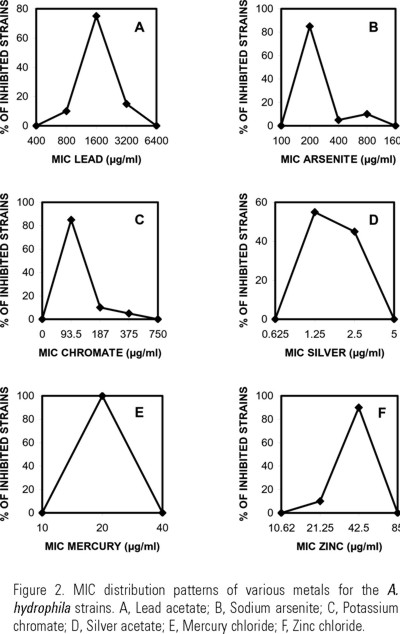
<body><![CDATA[<p align="justify"><font face="verdana" size="2">&#946;&#45;lactamase activity was detected by hydrolysis of the chromogenic cephalosporin nitrocefin (BBL) (O'Callaghan <i>et al</i>., 1972).</font></p>     <p align="justify"><font face="Verdana" size="2">&nbsp;</font></p>     <p align="justify"><font face="verdana" size="2"><b>RESULTS</b></font></p>     <p align="justify"><font face="verdana" size="2">All strains produced &#946;&#45;lactamases and were resistant to penicillin and dicloxacillin, showing single peak MIC distributions at 2000&#45;4000 &micro;g/ml (<a href="#f1">Fig. 1A</a>) and 500&#45;1000 &micro;g/ml (<a href="#f1">Fig. 1C</a>), respectively. Ampicillin MIC distribution was bimodal (<a href="#f1">Fig. 1E</a>) with 20% resistant strains (MIC= 125&#45;250 &micro;g/ml) and 80% highly resistant ones (MIC= 500&#45;4000 &micro;g/ml). Strains showed three distinguishable susceptibilities to the combination ampicillin plus sulbactam (<a href="#f1">Fig. 1B</a>). Thirty percent of the strains had a 3.9 &micro;g/ml ampicillin plus sulbactam MIC (96.7&#45;99.9 % lower than their corresponding ampicillin MIC), whereas 45% of the strains showed a 31.3 &micro;g/ml ampicillin plus sulbactam MIC (87.5&#45;98.4 % lower than their ampicillin MIC) and 25% had a 125&#45;250 &micro;g/ml ampicillin plus sulbactam MIC (75&#45;87.5% lower than their ampicillin MIC). All strains were susceptible to ceftriaxone (<a href="#f1">Fig. 1D</a>) and all but one were susceptible to cefuroxime (<a href="#f1">Fig. 1F</a>).</font></p>     <p align="center"><font face="verdana" size="2"><a name="f1"></a></font></p>     <p align="center"><font face="verdana" size="2"><img src="/img/revistas/hbio/v16n1/a7f1.jpg"></font></p>     <p align="justify"><font face="verdana" size="2">All strains were resistant to lead (MIC=800&#45;3200 &micro;g/ml, <a href="#f2">Fig. 2A</a>) and susceptible to chromate (MIC&le; 375 &micro;g/ml), silver (MIC&le; 2.5 &micro;g/ml), mercury (MIC=20 &micro;g/ml) and zinc (MIC&le; 42.5 &micro;g/ml) (<a href="#f2">Fig. 2 C&#45;F</a>). Susceptibility to arsenite showed a bimodal MIC distribution with a peak of 15% resistant strains (MIC=400&#45;800 &micro;g/ml), and 85% of them susceptible (MIC=200 &micro;g/ml <a href="#f2">Fig. 2B</a>).</font></p>     <p align="center"><font face="verdana" size="2"><a name="f2"></a></font></p>     <p align="center"><font face="verdana" size="2"><img src="/img/revistas/hbio/v16n1/a7f2.jpg"></font></p>     <p align="justify"><font face="Verdana" size="2">&nbsp;</font></p>     ]]></body>
<body><![CDATA[<p align="justify"><font face="verdana" size="2"><b>DISCUSSION</b></font></p>     <p align="justify"><font face="verdana" size="2"><i>Chirostoma humboldtianum</i> is an endemic Mexican fish, widely consumed by low&#45;statuses Mexican people, for which no microbiological studies have been published. We have found that these fishes harbored &#946;&#45;lactamase producer <i>A</i>. <i>hydrophila</i> strains resistant to penicillin, dicloxacillin, and ampicillin (<a href="#f1">Fig. 1 A, C, E</a>). Since ampicillin MIC was 75&#45;99.9% lowered by sulbactam (<a href="#f1">Fig. 1B</a>) these results suggest us that &#946;&#45;lactamases produced by the strains probably are conventional spectrum enzymes, which do not confer resistance to cephalosporins (Payne <i>et al</i>., 1994). This conclusion was further supported by the ceftriaxone and cefuroxime susceptibility of the strains (<a href="#f1">Fig. 1 D, F</a>). These results are similar to those found by Castro&#45;Escarpulli <i>et al</i>. (2003) for 82 <i>Aeromonas</i> spp. strains isolated from frozen tilapia (<i>Oreochromis niloticus niloticus</i>) purchased in local markets of Mexico City; all strains were resistant to penicillin and ampicillin, but sensitive to cefuroxime.</font></p>     <p align="justify"><font face="verdana" size="2">All <i>A. hydrophila</i> strains reported here were resistant to lead, showing a single&#45;peak MIC distribution pattern (800&#45;3200 &micro;g/ml, <a href="#f2">Fig. 2A</a>). This result is in good agreement with similar single&#45;peak MIC distributions for Pb found by Nakahara <i>et al</i>. (1977) in clinical Gram&#45;negative bacterial strains (at 1600&#45;3200 &micro;g/ml) and Vaca <i>et al</i>. (1995) in a group of strains (at 800&#45;1600 &micro;g/ml), mostly Gram&#45;positive, isolated from soil adjacent to a busy traffic high way from Mexico City highly polluted by automobile exhausts containing Pb (9.6&#45;29.3 ppm) derived from gasoline.</font></p>     <p align="justify"><font face="verdana" size="2">The presence of toxic inorganic ions in the environment usually inhibits the exposed microorganisms but may also select variants able to tolerate high concentrations of the ions (Doelman, 1987).</font></p>     <p align="justify"><font face="verdana" size="2">Although in this work concentrations of heavy metals present in the water or in the fishes were not measured, the fact that all <i>A. hydrophyla</i> strains isolated were lead&#45;resistant suggests that bacterial populations present at this pond had been subject to a strong selection by lead&#45;containing pollutants. The mechanisms of bacterial resistance to lead are complex and they are not due to a single point mutation. Lead&#45;resistant bacteria have been isolated from metal polluted soils; resistance is due to the extracellular exclusion (<i>Pseudomonas marginalis</i>), or to the intracellular accumulation (<i>Citrobacter freundii</i>) of the metal (Roane, 1999). ATPases responsible for expulsion of lead have been described in <i>Staphylococcus aureus</i> and <i>Escherichia coli</i> (Rensing <i>et al</i>., 1998). However, the first detailed mechanism of resistance to lead described so far is the one reported for <i>Ralstonia metalliduran</i>s CH34 (formerly <i>Alcaligenes eutrophus</i> CH34) (Borremans <i>et al</i>., 2001). In R. <i>metallidurans</i>, resistance to lead is conferred by the <i>pbr</i> locus, which is an operon, inducible by lead, divergently transcribed that includes five structural and one regulatory gene. The products of these genes participate in the capture, expulsion and intracellular accumulation of lead (Borremans <i>et al</i>., 2001).</font></p>     <p align="justify"><font face="verdana" size="2">Bacterial antibiotic and heavy metal resistance determinants commonly reside on plasmids, and selective pressure for one resistance indirectly leads to selection for the others, as the responsible genes are linked.</font></p>     <p align="justify"><font face="verdana" size="2">Since many low&#45;statuses farmer people consume these fish and usually swim in this freshwater pond, contact with the antibiotic and heavy metal resistant <i>Aeromonas</i> posess an important human health risk. In addition, passage of these bacteria from fish to humans would permit the horizontal gene transfer from <i>Aeromonas</i> to other bacteria harbored by the exposed persons.</font></p>     <p align="justify"><font face="Verdana" size="2">&nbsp;</font></p>     <p align="justify"><font face="verdana" size="2"><b>References</b></font></p>     <!-- ref --><p align="justify"><font face="verdana" size="2">ALTWEGG, M. &amp; H.K. GEISS. 1989. <i>Aeromonas</i> as a human pathogen. <i>Critical Reviews in Microbiology</i> 16: 253&#45;286.    &nbsp;&nbsp;&nbsp;&nbsp;&nbsp;&nbsp;&nbsp;&nbsp;[&#160;<a href="javascript:void(0);" onclick="javascript: window.open('/scielo.php?script=sci_nlinks&ref=4058808&pid=S0188-8897200600010000700001&lng=','','width=640,height=500,resizable=yes,scrollbars=1,menubar=yes,');">Links</a>&#160;]<!-- end-ref --></font></p>     <!-- ref --><p align="justify"><font face="verdana" size="2">AUSTIN, B. &amp; C. ADAMS. 1996. Fish pathogens. <i>In</i>: Austin, B., M. Altwegg, P.J. Gosling, &amp; S. Joseph (Eds.). <i>The genus Aeromonas</i>, John Wiley &amp; Sons, New York, pp. 197&#45;243.    &nbsp;&nbsp;&nbsp;&nbsp;&nbsp;&nbsp;&nbsp;&nbsp;[&#160;<a href="javascript:void(0);" onclick="javascript: window.open('/scielo.php?script=sci_nlinks&ref=4058810&pid=S0188-8897200600010000700002&lng=','','width=640,height=500,resizable=yes,scrollbars=1,menubar=yes,');">Links</a>&#160;]<!-- end-ref --></font></p>     <!-- ref --><p align="justify"><font face="verdana" size="2">BORREMANS, B., J.L HOBMAN, A. PROVOST, N.L. BROWN &amp; D. VAN DER LELIE. 2001. Cloning and functional analysis of the pbr lead resistance determinant of <i>Ralstonia metallidurans</i> CH34. <i>Journal of Bacteriology</i> 183:5651&#45;5658.    &nbsp;&nbsp;&nbsp;&nbsp;&nbsp;&nbsp;&nbsp;&nbsp;[&#160;<a href="javascript:void(0);" onclick="javascript: window.open('/scielo.php?script=sci_nlinks&ref=4058812&pid=S0188-8897200600010000700003&lng=','','width=640,height=500,resizable=yes,scrollbars=1,menubar=yes,');">Links</a>&#160;]<!-- end-ref --></font></p>     <!-- ref --><p align="justify"><font face="verdana" size="2">CAHILL, M.M. 1990. Virulence factors in motile <i>Aeromonas</i> species. <i>Journal of Applied Bacteriology</i> 69: 1&#45;16.    &nbsp;&nbsp;&nbsp;&nbsp;&nbsp;&nbsp;&nbsp;&nbsp;[&#160;<a href="javascript:void(0);" onclick="javascript: window.open('/scielo.php?script=sci_nlinks&ref=4058814&pid=S0188-8897200600010000700004&lng=','','width=640,height=500,resizable=yes,scrollbars=1,menubar=yes,');">Links</a>&#160;]<!-- end-ref --></font></p>     <!-- ref --><p align="justify"><font face="verdana" size="2">CASTRO&#45;ESCARPULLI, G., M.J. FIGUERAS, G. AGUILERA&#45;ARREOLA, L. SOLER, E. FERN&Aacute;NDEZ&#45;REND&Oacute;N, G.O. APARICIO, J. GUARRO &amp; M.R. CHAC&Oacute;N. 2003. Characterization of <i>Aeromonas spp</i>. isolated from frozen fish intended for human consumption in Mexico. <i>International Journal of Food Microbiology</i> 84: 41&#45;49.    &nbsp;&nbsp;&nbsp;&nbsp;&nbsp;&nbsp;&nbsp;&nbsp;[&#160;<a href="javascript:void(0);" onclick="javascript: window.open('/scielo.php?script=sci_nlinks&ref=4058816&pid=S0188-8897200600010000700005&lng=','','width=640,height=500,resizable=yes,scrollbars=1,menubar=yes,');">Links</a>&#160;]<!-- end-ref --></font></p>     <!-- ref --><p align="justify"><font face="verdana" size="2">CHANG, B.J. &amp; S.M. BOLTON. 1987. Plasmids and resistance to antimicrobial agents in <i>Aeromonas sobria</i> and <i>Aeromonas hydrophila</i> clinical isolates. <i>Antimicrobial Agents and Chemotherapy</i> 31: 1281&#45;1282.    &nbsp;&nbsp;&nbsp;&nbsp;&nbsp;&nbsp;&nbsp;&nbsp;[&#160;<a href="javascript:void(0);" onclick="javascript: window.open('/scielo.php?script=sci_nlinks&ref=4058818&pid=S0188-8897200600010000700006&lng=','','width=640,height=500,resizable=yes,scrollbars=1,menubar=yes,');">Links</a>&#160;]<!-- end-ref --></font></p>     <!-- ref --><p align="justify"><font face="verdana" size="2">DOELMAN, P. 1987. Resistance of soil microbial communities to heavy metals. <i>In</i>: Jensen, V., A. Kjoller &amp; L.H. Soresen (Eds.). <i>Microbial Communities in Soil</i>. Elsevier, New York, pp. 369&#45;383.    &nbsp;&nbsp;&nbsp;&nbsp;&nbsp;&nbsp;&nbsp;&nbsp;[&#160;<a href="javascript:void(0);" onclick="javascript: window.open('/scielo.php?script=sci_nlinks&ref=4058820&pid=S0188-8897200600010000700007&lng=','','width=640,height=500,resizable=yes,scrollbars=1,menubar=yes,');">Links</a>&#160;]<!-- end-ref --></font></p>     <!-- ref --><p align="justify"><font face="verdana" size="2">DYER, B.S. &amp; B. CHERNOFF 1996. Phylogenetic relationships among atheriniform fishes (Teleostei:Atherinomorpha). <i>Zoological Journal of the Linnean Society</i> 117: 1&#45;69.    &nbsp;&nbsp;&nbsp;&nbsp;&nbsp;&nbsp;&nbsp;&nbsp;[&#160;<a href="javascript:void(0);" onclick="javascript: window.open('/scielo.php?script=sci_nlinks&ref=4058822&pid=S0188-8897200600010000700008&lng=','','width=640,height=500,resizable=yes,scrollbars=1,menubar=yes,');">Links</a>&#160;]<!-- end-ref --></font></p>     <!-- ref --><p align="justify"><font face="verdana" size="2">GOSLING, P.J. 1986. Biochemical characteristics, enterotoxigenicity and susceptibility to antimicrobial agents of clinical isolates of <i>Aeromonas</i> species encountered in the western region of Saudi Arabia. <i>Journal of Medical Microbiology</i> 22: 51&#45;55.    &nbsp;&nbsp;&nbsp;&nbsp;&nbsp;&nbsp;&nbsp;&nbsp;[&#160;<a href="javascript:void(0);" onclick="javascript: window.open('/scielo.php?script=sci_nlinks&ref=4058824&pid=S0188-8897200600010000700009&lng=','','width=640,height=500,resizable=yes,scrollbars=1,menubar=yes,');">Links</a>&#160;]<!-- end-ref --></font></p>     <!-- ref --><p align="justify"><font face="verdana" size="2">GUPTA, A., M. MAYNES &amp; S. SILVER. 1998. Effects of halides on plasmid&#45;mediated silver resistance in <i>E. coli</i>. <i>Applied and Environmental Microbiology</i> 64: 5042&#45;5045.    &nbsp;&nbsp;&nbsp;&nbsp;&nbsp;&nbsp;&nbsp;&nbsp;[&#160;<a href="javascript:void(0);" onclick="javascript: window.open('/scielo.php?script=sci_nlinks&ref=4058826&pid=S0188-8897200600010000700010&lng=','','width=640,height=500,resizable=yes,scrollbars=1,menubar=yes,');">Links</a>&#160;]<!-- end-ref --></font></p>     <!-- ref --><p align="justify"><font face="verdana" size="2">HAZEN, T.C., C.B. FLIERMANS, R.P. HIRSCH &amp; G.W. ESCH. 1978. Prevalence and distributions of <i>Aeromonas hydrophila</i> in the United States. <i>Applied and Environmental Microbiology</i> 36: 731&#45;738.    &nbsp;&nbsp;&nbsp;&nbsp;&nbsp;&nbsp;&nbsp;&nbsp;[&#160;<a href="javascript:void(0);" onclick="javascript: window.open('/scielo.php?script=sci_nlinks&ref=4058828&pid=S0188-8897200600010000700011&lng=','','width=640,height=500,resizable=yes,scrollbars=1,menubar=yes,');">Links</a>&#160;]<!-- end-ref --></font></p>     <!-- ref --><p align="justify"><font face="verdana" size="2">HOLMES, P., L.M. NICOLLS &amp; D.P. SARTORY. 1996. The ecology of mesophilic <i>Aeromonas</i> in the aquatic environment. In: Austin, B., M. Altwegg, P.J. Gosling &amp; S. Joseph (Eds.) <i>The genus Aeromonas</i>, John Wiley &amp; Sons, New York, pp. 127&#45;150.    &nbsp;&nbsp;&nbsp;&nbsp;&nbsp;&nbsp;&nbsp;&nbsp;[&#160;<a href="javascript:void(0);" onclick="javascript: window.open('/scielo.php?script=sci_nlinks&ref=4058830&pid=S0188-8897200600010000700012&lng=','','width=640,height=500,resizable=yes,scrollbars=1,menubar=yes,');">Links</a>&#160;]<!-- end-ref --></font></p>     <!-- ref --><p align="justify"><font face="verdana" size="2">JOSEPH, S.W. &amp; A. CARNAHAN. 1994. The isolation, identification, and systematics of the motile <i>Aeromonas</i> species. <i>Annual Review of Fish Diseases</i> 4: 315&#45;343.    &nbsp;&nbsp;&nbsp;&nbsp;&nbsp;&nbsp;&nbsp;&nbsp;[&#160;<a href="javascript:void(0);" onclick="javascript: window.open('/scielo.php?script=sci_nlinks&ref=4058832&pid=S0188-8897200600010000700013&lng=','','width=640,height=500,resizable=yes,scrollbars=1,menubar=yes,');">Links</a>&#160;]<!-- end-ref --></font></p>     <!-- ref --><p align="justify"><font face="verdana" size="2">KIROV, S.M. 1993. The public health significance of <i>Aeromonas spp.</i> in foods. <i>International Journal of Food Microbiology</i>. 20: 179&#45;198.    &nbsp;&nbsp;&nbsp;&nbsp;&nbsp;&nbsp;&nbsp;&nbsp;[&#160;<a href="javascript:void(0);" onclick="javascript: window.open('/scielo.php?script=sci_nlinks&ref=4058834&pid=S0188-8897200600010000700014&lng=','','width=640,height=500,resizable=yes,scrollbars=1,menubar=yes,');">Links</a>&#160;]<!-- end-ref --></font></p>     <!-- ref --><p align="justify"><font face="verdana" size="2">KOEHLER, J.M. &amp; L.R. ASHDOWN. 1993. In vitro susceptibilities of tropical strains of <i>Aeromonas</i> species from Queensland, Australia, to 22 antimicrobial agents. <i>Antimicrobial Agents and Chemotherapy</i> 37: 905&#45;907.    &nbsp;&nbsp;&nbsp;&nbsp;&nbsp;&nbsp;&nbsp;&nbsp;[&#160;<a href="javascript:void(0);" onclick="javascript: window.open('/scielo.php?script=sci_nlinks&ref=4058836&pid=S0188-8897200600010000700015&lng=','','width=640,height=500,resizable=yes,scrollbars=1,menubar=yes,');">Links</a>&#160;]<!-- end-ref --></font></p>     <!-- ref --><p align="justify"><font face="verdana" size="2">MIRANDA, C. D. &amp; G. CASTILLO. 1998. Resistance to antibiotic and heavy metals of motile aeromonads from Chilean freshwater. <i>The Science of the Total Environment</i> 224: 167&#45;176.    &nbsp;&nbsp;&nbsp;&nbsp;&nbsp;&nbsp;&nbsp;&nbsp;[&#160;<a href="javascript:void(0);" onclick="javascript: window.open('/scielo.php?script=sci_nlinks&ref=4058838&pid=S0188-8897200600010000700016&lng=','','width=640,height=500,resizable=yes,scrollbars=1,menubar=yes,');">Links</a>&#160;]<!-- end-ref --></font></p>     <!-- ref --><p align="justify"><font face="verdana" size="2">NAKAHARA, H., T. ISHIKAWA, Y. SARAI, I. KONDO &amp; S. MITSUHASHI. 1977. Frequency of heavy&#45;metal resistance in bacteria from inpatients in Japan. <i>Nature</i> 266: 165&#45;167.    &nbsp;&nbsp;&nbsp;&nbsp;&nbsp;&nbsp;&nbsp;&nbsp;[&#160;<a href="javascript:void(0);" onclick="javascript: window.open('/scielo.php?script=sci_nlinks&ref=4058840&pid=S0188-8897200600010000700017&lng=','','width=640,height=500,resizable=yes,scrollbars=1,menubar=yes,');">Links</a>&#160;]<!-- end-ref --></font></p>     <!-- ref --><p align="justify"><font face="verdana" size="2">NATIONAL COMMITTEE FOR CLINICAL LABORATORY STANDARDS. 1997. Performance Standards for Antimicrobial Disc Susceptibility Tests: Approved Standards NCCLS Document M2&#45;A6. Villanova, PA, USA.    &nbsp;&nbsp;&nbsp;&nbsp;&nbsp;&nbsp;&nbsp;&nbsp;[&#160;<a href="javascript:void(0);" onclick="javascript: window.open('/scielo.php?script=sci_nlinks&ref=4058842&pid=S0188-8897200600010000700018&lng=','','width=640,height=500,resizable=yes,scrollbars=1,menubar=yes,');">Links</a>&#160;]<!-- end-ref --></font></p>     <!-- ref --><p align="justify"><font face="verdana" size="2">O'CALLAGHAN, C.H., A. MORRIS, S.M. KIRBY &amp; S.H. SHINGLER. 1972. Novel method for detection of beta&#45;lactamase by using a chromogenic cephalosporin substrate. <i>Antimicrobial Agents and Chemotherapy</i> 1: 283&#45;288.    &nbsp;&nbsp;&nbsp;&nbsp;&nbsp;&nbsp;&nbsp;&nbsp;[&#160;<a href="javascript:void(0);" onclick="javascript: window.open('/scielo.php?script=sci_nlinks&ref=4058844&pid=S0188-8897200600010000700019&lng=','','width=640,height=500,resizable=yes,scrollbars=1,menubar=yes,');">Links</a>&#160;]<!-- end-ref --></font></p>     <!-- ref --><p align="justify"><font face="verdana" size="2">PAYNE, D.J., R. CRAMP, D.J. WINSTANLEY &amp; D.J.C. KNOWLES. 1994. Comparative activities of clavulanic acid, sulbactam, and tazobactam against clinically important &#946;&#45;lactamases. <i>Antimicrobial Agents and Chemotherapy</i> 38: 767&#45;772.    &nbsp;&nbsp;&nbsp;&nbsp;&nbsp;&nbsp;&nbsp;&nbsp;[&#160;<a href="javascript:void(0);" onclick="javascript: window.open('/scielo.php?script=sci_nlinks&ref=4058846&pid=S0188-8897200600010000700020&lng=','','width=640,height=500,resizable=yes,scrollbars=1,menubar=yes,');">Links</a>&#160;]<!-- end-ref --></font></p>     <!-- ref --><p align="justify"><font face="verdana" size="2">RENSING, C., Y. SUN, B. MITRA &amp; B.P. ROSEN. 1998. Pb(II)&#45;translocating P&#45;type ATPases. <i>Journal of Biological Chemistry</i> 273: 32614&#45;32617.    &nbsp;&nbsp;&nbsp;&nbsp;&nbsp;&nbsp;&nbsp;&nbsp;[&#160;<a href="javascript:void(0);" onclick="javascript: window.open('/scielo.php?script=sci_nlinks&ref=4058848&pid=S0188-8897200600010000700021&lng=','','width=640,height=500,resizable=yes,scrollbars=1,menubar=yes,');">Links</a>&#160;]<!-- end-ref --></font></p>     <!-- ref --><p align="justify"><font face="verdana" size="2">ROANE, T.M. 1999. Lead resistance in two isolates from heavy metal&#45;contaminated soils. <i>Microbial Ecology</i> 37: 218&#45;224.    &nbsp;&nbsp;&nbsp;&nbsp;&nbsp;&nbsp;&nbsp;&nbsp;[&#160;<a href="javascript:void(0);" onclick="javascript: window.open('/scielo.php?script=sci_nlinks&ref=4058850&pid=S0188-8897200600010000700022&lng=','','width=640,height=500,resizable=yes,scrollbars=1,menubar=yes,');">Links</a>&#160;]<!-- end-ref --></font></p>     <!-- ref --><p align="justify"><font face="verdana" size="2">SIERRA, C.J. &amp; J. SIERRA. 1977. Rese&ntilde;a hist&oacute;rica de la pesca en M&eacute;xico. Edici&oacute;n del Departamento de Pesca. M&eacute;xico, 99 p.    &nbsp;&nbsp;&nbsp;&nbsp;&nbsp;&nbsp;&nbsp;&nbsp;[&#160;<a href="javascript:void(0);" onclick="javascript: window.open('/scielo.php?script=sci_nlinks&ref=4058852&pid=S0188-8897200600010000700023&lng=','','width=640,height=500,resizable=yes,scrollbars=1,menubar=yes,');">Links</a>&#160;]<!-- end-ref --></font></p>     <!-- ref --><p align="justify"><font face="verdana" size="2">THAYUMANAVAN, T., G. VIVEKANANDHAN, K. SAVITHAMANI, R. SUBASHKUMAR &amp; R. LAKSHMANAPERUMALSAMY. 2003. Incidence of haemolysin&#45;positive and drug&#45;resistant <i>Aeromonas hydrophila</i> in freshly caught finfish and prawn collected from major commercial fishes of coastal South India. <i>FEMS Immunology and Medical Microbiology</i> 36: 41&#45;45.    &nbsp;&nbsp;&nbsp;&nbsp;&nbsp;&nbsp;&nbsp;&nbsp;[&#160;<a href="javascript:void(0);" onclick="javascript: window.open('/scielo.php?script=sci_nlinks&ref=4058854&pid=S0188-8897200600010000700024&lng=','','width=640,height=500,resizable=yes,scrollbars=1,menubar=yes,');">Links</a>&#160;]<!-- end-ref --></font></p>     <!-- ref --><p align="justify"><font face="verdana" size="2">THOESEN, J.C. 1994. <i>Suggested procedures for the detection and identification of certain finfish and shellfish pathogens</i>. Fish Health Section, American Fisheries Society.    &nbsp;&nbsp;&nbsp;&nbsp;&nbsp;&nbsp;&nbsp;&nbsp;[&#160;<a href="javascript:void(0);" onclick="javascript: window.open('/scielo.php?script=sci_nlinks&ref=4058856&pid=S0188-8897200600010000700025&lng=','','width=640,height=500,resizable=yes,scrollbars=1,menubar=yes,');">Links</a>&#160;]<!-- end-ref --></font></p>     <!-- ref --><p align="justify"><font face="verdana" size="2">VACA, S., R. MIRANDA &amp; C. CERVANTES. 1995. Inorganic&#45;ion resistance by bacteria isolated from a Mexico City freeway. <i>Antonie van Leeuwenhoek</i> 67: 333&#45;337.    &nbsp;&nbsp;&nbsp;&nbsp;&nbsp;&nbsp;&nbsp;&nbsp;[&#160;<a href="javascript:void(0);" onclick="javascript: window.open('/scielo.php?script=sci_nlinks&ref=4058858&pid=S0188-8897200600010000700026&lng=','','width=640,height=500,resizable=yes,scrollbars=1,menubar=yes,');">Links</a>&#160;]<!-- end-ref --></font></p>     <!-- ref --><p align="justify"><font face="verdana" size="2">YAMAGUCHI, K., D. MATHAI, D.J. BIEDENBACH, M.T. LEWIS, A.C. GALES &amp; R. JONES. 1999. Evaluation of the in vitro activity of six broad spectrum beta&#45;lactam antimicrobial agents tested against over 2,000 clinical isolates from 22 medical centers in Japan. <i>Diagnostic Microbiology and Infectious Disease</i> 34: 123&#45;134.    &nbsp;&nbsp;&nbsp;&nbsp;&nbsp;&nbsp;&nbsp;&nbsp;[&#160;<a href="javascript:void(0);" onclick="javascript: window.open('/scielo.php?script=sci_nlinks&ref=4058860&pid=S0188-8897200600010000700027&lng=','','width=640,height=500,resizable=yes,scrollbars=1,menubar=yes,');">Links</a>&#160;]<!-- end-ref --></font></p>      ]]></body><back>
<ref-list>
<ref id="B1">
<nlm-citation citation-type="journal">
<person-group person-group-type="author">
<name>
<surname><![CDATA[ALTWEGG]]></surname>
<given-names><![CDATA[M.]]></given-names>
</name>
<name>
<surname><![CDATA[GEISS]]></surname>
<given-names><![CDATA[H.K.]]></given-names>
</name>
</person-group>
<article-title xml:lang="en"><![CDATA[Aeromonas as a human pathogen]]></article-title>
<source><![CDATA[Critical Reviews in Microbiology]]></source>
<year>1989</year>
<volume>16</volume>
<page-range>253-286</page-range></nlm-citation>
</ref>
<ref id="B2">
<nlm-citation citation-type="book">
<person-group person-group-type="author">
<name>
<surname><![CDATA[AUSTIN]]></surname>
<given-names><![CDATA[B.]]></given-names>
</name>
<name>
<surname><![CDATA[ADAMS]]></surname>
<given-names><![CDATA[C.]]></given-names>
</name>
</person-group>
<article-title xml:lang="en"><![CDATA[Fish pathogens]]></article-title>
<person-group person-group-type="editor">
<name>
<surname><![CDATA[Austin]]></surname>
<given-names><![CDATA[B.]]></given-names>
</name>
<name>
<surname><![CDATA[Altwegg]]></surname>
<given-names><![CDATA[M.]]></given-names>
</name>
<name>
<surname><![CDATA[Gosling]]></surname>
<given-names><![CDATA[P.J.]]></given-names>
</name>
<name>
<surname><![CDATA[Joseph]]></surname>
<given-names><![CDATA[S.]]></given-names>
</name>
</person-group>
<source><![CDATA[The genus Aeromonas]]></source>
<year>1996</year>
<page-range>197-243</page-range><publisher-loc><![CDATA[New York ]]></publisher-loc>
<publisher-name><![CDATA[John Wiley & Sons]]></publisher-name>
</nlm-citation>
</ref>
<ref id="B3">
<nlm-citation citation-type="journal">
<person-group person-group-type="author">
<name>
<surname><![CDATA[BORREMANS]]></surname>
<given-names><![CDATA[B.]]></given-names>
</name>
<name>
<surname><![CDATA[HOBMAN]]></surname>
<given-names><![CDATA[J.L]]></given-names>
</name>
<name>
<surname><![CDATA[PROVOST]]></surname>
<given-names><![CDATA[A.]]></given-names>
</name>
<name>
<surname><![CDATA[BROWN]]></surname>
<given-names><![CDATA[N.L.]]></given-names>
</name>
<name>
<surname><![CDATA[VAN DER LELIE]]></surname>
<given-names><![CDATA[D.]]></given-names>
</name>
</person-group>
<article-title xml:lang="en"><![CDATA[Cloning and functional analysis of the pbr lead resistance determinant of Ralstonia metallidurans CH34]]></article-title>
<source><![CDATA[Journal of Bacteriology]]></source>
<year>2001</year>
<volume>183</volume>
<page-range>5651-5658</page-range></nlm-citation>
</ref>
<ref id="B4">
<nlm-citation citation-type="journal">
<person-group person-group-type="author">
<name>
<surname><![CDATA[CAHILL]]></surname>
<given-names><![CDATA[M.M]]></given-names>
</name>
</person-group>
<article-title xml:lang="en"><![CDATA[Virulence factors in motile Aeromonas species]]></article-title>
<source><![CDATA[Journal of Applied Bacteriology]]></source>
<year>1990</year>
<volume>69</volume>
<page-range>1-16</page-range></nlm-citation>
</ref>
<ref id="B5">
<nlm-citation citation-type="journal">
<person-group person-group-type="author">
<name>
<surname><![CDATA[CASTRO-ESCARPULLI]]></surname>
<given-names><![CDATA[G.]]></given-names>
</name>
<name>
<surname><![CDATA[FIGUERAS]]></surname>
<given-names><![CDATA[M.J.]]></given-names>
</name>
<name>
<surname><![CDATA[AGUILERA-ARREOLA]]></surname>
<given-names><![CDATA[G.]]></given-names>
</name>
<name>
<surname><![CDATA[SOLER]]></surname>
<given-names><![CDATA[L.]]></given-names>
</name>
<name>
<surname><![CDATA[FERNÁNDEZ-RENDÓN]]></surname>
<given-names><![CDATA[E.]]></given-names>
</name>
<name>
<surname><![CDATA[APARICIO]]></surname>
<given-names><![CDATA[G.O.]]></given-names>
</name>
<name>
<surname><![CDATA[GUARRO]]></surname>
<given-names><![CDATA[J.]]></given-names>
</name>
<name>
<surname><![CDATA[CHACÓN]]></surname>
<given-names><![CDATA[M.R.]]></given-names>
</name>
</person-group>
<article-title xml:lang="en"><![CDATA[Characterization of Aeromonas spp. isolated from frozen fish intended for human consumption in Mexico]]></article-title>
<source><![CDATA[International Journal of Food Microbiology]]></source>
<year>2003</year>
<volume>84</volume>
<page-range>41-49</page-range></nlm-citation>
</ref>
<ref id="B6">
<nlm-citation citation-type="journal">
<person-group person-group-type="author">
<name>
<surname><![CDATA[CHANG]]></surname>
<given-names><![CDATA[B.J.]]></given-names>
</name>
<name>
<surname><![CDATA[BOLTON]]></surname>
<given-names><![CDATA[S.M.]]></given-names>
</name>
</person-group>
<article-title xml:lang="en"><![CDATA[Plasmids and resistance to antimicrobial agents in Aeromonas sobria and Aeromonas hydrophila clinical isolates]]></article-title>
<source><![CDATA[Antimicrobial Agents and Chemotherapy]]></source>
<year>1987</year>
<volume>31</volume>
<page-range>1281-1282</page-range></nlm-citation>
</ref>
<ref id="B7">
<nlm-citation citation-type="book">
<person-group person-group-type="author">
<name>
<surname><![CDATA[DOELMAN]]></surname>
<given-names><![CDATA[P]]></given-names>
</name>
</person-group>
<article-title xml:lang="en"><![CDATA[Resistance of soil microbial communities to heavy metals]]></article-title>
<person-group person-group-type="editor">
<name>
<surname><![CDATA[Jensen]]></surname>
<given-names><![CDATA[V.]]></given-names>
</name>
<name>
<surname><![CDATA[Kjoller]]></surname>
<given-names><![CDATA[A.]]></given-names>
</name>
<name>
<surname><![CDATA[Soresen]]></surname>
<given-names><![CDATA[L.H.]]></given-names>
</name>
</person-group>
<source><![CDATA[Microbial Communities in Soil]]></source>
<year>1987</year>
<page-range>369-383</page-range><publisher-loc><![CDATA[New York ]]></publisher-loc>
<publisher-name><![CDATA[Elsevier]]></publisher-name>
</nlm-citation>
</ref>
<ref id="B8">
<nlm-citation citation-type="journal">
<person-group person-group-type="author">
<name>
<surname><![CDATA[DYER]]></surname>
<given-names><![CDATA[B.S.]]></given-names>
</name>
<name>
<surname><![CDATA[CHERNOFF]]></surname>
<given-names><![CDATA[B.]]></given-names>
</name>
</person-group>
<article-title xml:lang="en"><![CDATA[Phylogenetic relationships among atheriniform fishes (Teleostei:Atherinomorpha)]]></article-title>
<source><![CDATA[Zoological Journal of the Linnean Society]]></source>
<year>1996</year>
<volume>117</volume>
<page-range>1-69</page-range></nlm-citation>
</ref>
<ref id="B9">
<nlm-citation citation-type="journal">
<person-group person-group-type="author">
<name>
<surname><![CDATA[GOSLING]]></surname>
<given-names><![CDATA[P.J]]></given-names>
</name>
</person-group>
<article-title xml:lang="en"><![CDATA[Biochemical characteristics, enterotoxigenicity and susceptibility to antimicrobial agents of clinical isolates of Aeromonas species encountered in the western region of Saudi Arabia]]></article-title>
<source><![CDATA[Journal of Medical Microbiology]]></source>
<year>1986</year>
<volume>22</volume>
<page-range>51-55</page-range></nlm-citation>
</ref>
<ref id="B10">
<nlm-citation citation-type="journal">
<person-group person-group-type="author">
<name>
<surname><![CDATA[GUPTA]]></surname>
<given-names><![CDATA[A.]]></given-names>
</name>
<name>
<surname><![CDATA[MAYNES]]></surname>
<given-names><![CDATA[M.]]></given-names>
</name>
<name>
<surname><![CDATA[SILVER]]></surname>
<given-names><![CDATA[S.]]></given-names>
</name>
</person-group>
<article-title xml:lang="en"><![CDATA[Effects of halides on plasmid-mediated silver resistance in E. coli]]></article-title>
<source><![CDATA[Applied and Environmental Microbiology]]></source>
<year>1998</year>
<volume>64</volume>
<page-range>5042-5045</page-range></nlm-citation>
</ref>
<ref id="B11">
<nlm-citation citation-type="journal">
<person-group person-group-type="author">
<name>
<surname><![CDATA[HAZEN]]></surname>
<given-names><![CDATA[T.C.]]></given-names>
</name>
<name>
<surname><![CDATA[FLIERMANS]]></surname>
<given-names><![CDATA[C.B.]]></given-names>
</name>
<name>
<surname><![CDATA[HIRSCH]]></surname>
<given-names><![CDATA[R.P.]]></given-names>
</name>
<name>
<surname><![CDATA[ESCH]]></surname>
<given-names><![CDATA[G.W.]]></given-names>
</name>
</person-group>
<article-title xml:lang="en"><![CDATA[Prevalence and distributions of Aeromonas hydrophila in the United States]]></article-title>
<source><![CDATA[Applied and Environmental Microbiology]]></source>
<year>1978</year>
<volume>36</volume>
<page-range>731-738</page-range></nlm-citation>
</ref>
<ref id="B12">
<nlm-citation citation-type="book">
<person-group person-group-type="author">
<name>
<surname><![CDATA[HOLMES]]></surname>
<given-names><![CDATA[P.]]></given-names>
</name>
<name>
<surname><![CDATA[NICOLLS]]></surname>
<given-names><![CDATA[L.M.]]></given-names>
</name>
<name>
<surname><![CDATA[SARTORY]]></surname>
<given-names><![CDATA[D.P.]]></given-names>
</name>
</person-group>
<article-title xml:lang="en"><![CDATA[The ecology of mesophilic Aeromonas in the aquatic environment]]></article-title>
<person-group person-group-type="editor">
<name>
<surname><![CDATA[Austin]]></surname>
<given-names><![CDATA[B.]]></given-names>
</name>
<name>
<surname><![CDATA[Altwegg]]></surname>
<given-names><![CDATA[M.]]></given-names>
</name>
<name>
<surname><![CDATA[Gosling]]></surname>
<given-names><![CDATA[P.J.]]></given-names>
</name>
<name>
<surname><![CDATA[Joseph]]></surname>
<given-names><![CDATA[S.]]></given-names>
</name>
</person-group>
<source><![CDATA[The genus Aeromonas]]></source>
<year>1996</year>
<page-range>127-150</page-range><publisher-loc><![CDATA[New York ]]></publisher-loc>
<publisher-name><![CDATA[John Wiley & Sons]]></publisher-name>
</nlm-citation>
</ref>
<ref id="B13">
<nlm-citation citation-type="journal">
<person-group person-group-type="author">
<name>
<surname><![CDATA[JOSEPH]]></surname>
<given-names><![CDATA[S.W.]]></given-names>
</name>
<name>
<surname><![CDATA[CARNAHAN]]></surname>
<given-names><![CDATA[A.]]></given-names>
</name>
</person-group>
<article-title xml:lang="en"><![CDATA[The isolation, identification, and systematics of the motile Aeromonas species]]></article-title>
<source><![CDATA[Annual Review of Fish Diseases]]></source>
<year>1994</year>
<volume>4</volume>
<page-range>315-343</page-range></nlm-citation>
</ref>
<ref id="B14">
<nlm-citation citation-type="journal">
<person-group person-group-type="author">
<name>
<surname><![CDATA[KIROV]]></surname>
<given-names><![CDATA[S.M]]></given-names>
</name>
</person-group>
<article-title xml:lang="en"><![CDATA[The public health significance of Aeromonas spp. in foods]]></article-title>
<source><![CDATA[International Journal of Food Microbiology.]]></source>
<year>1993</year>
<volume>20</volume>
<page-range>179-198</page-range></nlm-citation>
</ref>
<ref id="B15">
<nlm-citation citation-type="journal">
<person-group person-group-type="author">
<name>
<surname><![CDATA[KOEHLER]]></surname>
<given-names><![CDATA[J.M.]]></given-names>
</name>
<name>
<surname><![CDATA[ASHDOWN]]></surname>
<given-names><![CDATA[L.R.]]></given-names>
</name>
</person-group>
<article-title xml:lang="en"><![CDATA[In vitro susceptibilities of tropical strains of Aeromonas species from Queensland, Australia, to 22 antimicrobial agents]]></article-title>
<source><![CDATA[Antimicrobial Agents and Chemotherapy]]></source>
<year>1993</year>
<volume>37</volume>
<page-range>905-907</page-range></nlm-citation>
</ref>
<ref id="B16">
<nlm-citation citation-type="journal">
<person-group person-group-type="author">
<name>
<surname><![CDATA[MIRANDA]]></surname>
<given-names><![CDATA[C. D.]]></given-names>
</name>
<name>
<surname><![CDATA[CASTILLO]]></surname>
<given-names><![CDATA[G.]]></given-names>
</name>
</person-group>
<article-title xml:lang="en"><![CDATA[Resistance to antibiotic and heavy metals of motile aeromonads from Chilean freshwater]]></article-title>
<source><![CDATA[The Science of the Total Environment]]></source>
<year>1998</year>
<volume>224</volume>
<page-range>167-176</page-range></nlm-citation>
</ref>
<ref id="B17">
<nlm-citation citation-type="journal">
<person-group person-group-type="author">
<name>
<surname><![CDATA[NAKAHARA]]></surname>
<given-names><![CDATA[H.]]></given-names>
</name>
<name>
<surname><![CDATA[ISHIKAWA]]></surname>
<given-names><![CDATA[T.]]></given-names>
</name>
<name>
<surname><![CDATA[SARAI]]></surname>
<given-names><![CDATA[Y.]]></given-names>
</name>
<name>
<surname><![CDATA[KONDO]]></surname>
<given-names><![CDATA[I.]]></given-names>
</name>
<name>
<surname><![CDATA[MITSUHASHI]]></surname>
<given-names><![CDATA[S.]]></given-names>
</name>
</person-group>
<article-title xml:lang="en"><![CDATA[Frequency of heavy-metal resistance in bacteria from inpatients in Japan]]></article-title>
<source><![CDATA[Nature]]></source>
<year>1977</year>
<volume>266</volume>
<page-range>165-167</page-range></nlm-citation>
</ref>
<ref id="B18">
<nlm-citation citation-type="">
<collab>NATIONAL COMMITTEE FOR CLINICAL LABORATORY STANDARDS</collab>
<source><![CDATA[Performance Standards for Antimicrobial Disc Susceptibility Tests: Approved Standards NCCLS Document M2-A6]]></source>
<year>1997</year>
<publisher-loc><![CDATA[Villanova^ePA PA]]></publisher-loc>
</nlm-citation>
</ref>
<ref id="B19">
<nlm-citation citation-type="journal">
<person-group person-group-type="author">
<name>
<surname><![CDATA[O'CALLAGHAN]]></surname>
<given-names><![CDATA[C.H.]]></given-names>
</name>
<name>
<surname><![CDATA[MORRIS]]></surname>
<given-names><![CDATA[A.]]></given-names>
</name>
<name>
<surname><![CDATA[KIRBY]]></surname>
<given-names><![CDATA[S.M.]]></given-names>
</name>
<name>
<surname><![CDATA[SHINGLER]]></surname>
<given-names><![CDATA[S.H.]]></given-names>
</name>
</person-group>
<article-title xml:lang="en"><![CDATA[Novel method for detection of beta-lactamase by using a chromogenic cephalosporin substrate]]></article-title>
<source><![CDATA[Antimicrobial Agents and Chemotherapy]]></source>
<year>1972</year>
<volume>1</volume>
<page-range>283-288</page-range></nlm-citation>
</ref>
<ref id="B20">
<nlm-citation citation-type="journal">
<person-group person-group-type="author">
<name>
<surname><![CDATA[PAYNE]]></surname>
<given-names><![CDATA[D.J.]]></given-names>
</name>
<name>
<surname><![CDATA[CRAMP]]></surname>
<given-names><![CDATA[R.]]></given-names>
</name>
<name>
<surname><![CDATA[WINSTANLEY]]></surname>
<given-names><![CDATA[D.J.]]></given-names>
</name>
<name>
<surname><![CDATA[KNOWLES]]></surname>
<given-names><![CDATA[D.J.C.]]></given-names>
</name>
</person-group>
<article-title xml:lang="en"><![CDATA[Comparative activities of clavulanic acid, sulbactam, and tazobactam against clinically important &#946;-lactamases]]></article-title>
<source><![CDATA[Antimicrobial Agents and Chemotherapy]]></source>
<year>1994</year>
<volume>38</volume>
<page-range>767-772</page-range></nlm-citation>
</ref>
<ref id="B21">
<nlm-citation citation-type="journal">
<person-group person-group-type="author">
<name>
<surname><![CDATA[RENSING]]></surname>
<given-names><![CDATA[C.]]></given-names>
</name>
<name>
<surname><![CDATA[SUN]]></surname>
<given-names><![CDATA[Y.]]></given-names>
</name>
<name>
<surname><![CDATA[MITRA]]></surname>
<given-names><![CDATA[B.]]></given-names>
</name>
<name>
<surname><![CDATA[ROSEN]]></surname>
<given-names><![CDATA[B.P.]]></given-names>
</name>
</person-group>
<article-title xml:lang="en"><![CDATA[Pb(II)-translocating P-type ATPases]]></article-title>
<source><![CDATA[Journal of Biological Chemistry]]></source>
<year>1998</year>
<volume>273</volume>
<page-range>32614-32617</page-range></nlm-citation>
</ref>
<ref id="B22">
<nlm-citation citation-type="journal">
<person-group person-group-type="author">
<name>
<surname><![CDATA[ROANE]]></surname>
<given-names><![CDATA[T.M]]></given-names>
</name>
</person-group>
<article-title xml:lang="en"><![CDATA[Lead resistance in two isolates from heavy metal-contaminated soils]]></article-title>
<source><![CDATA[Microbial Ecology]]></source>
<year>1999</year>
<volume>37</volume>
<page-range>218-224</page-range></nlm-citation>
</ref>
<ref id="B23">
<nlm-citation citation-type="book">
<person-group person-group-type="author">
<name>
<surname><![CDATA[SIERRA]]></surname>
<given-names><![CDATA[C.J.]]></given-names>
</name>
<name>
<surname><![CDATA[SIERRA]]></surname>
<given-names><![CDATA[J.]]></given-names>
</name>
</person-group>
<source><![CDATA[Reseńa histórica de la pesca en México]]></source>
<year>1977</year>
<page-range>99</page-range><publisher-name><![CDATA[Departamento de Pesca]]></publisher-name>
</nlm-citation>
</ref>
<ref id="B24">
<nlm-citation citation-type="journal">
<person-group person-group-type="author">
<name>
<surname><![CDATA[THAYUMANAVAN]]></surname>
<given-names><![CDATA[T.]]></given-names>
</name>
<name>
<surname><![CDATA[VIVEKANANDHAN]]></surname>
<given-names><![CDATA[G.]]></given-names>
</name>
<name>
<surname><![CDATA[SAVITHAMANI]]></surname>
<given-names><![CDATA[K.]]></given-names>
</name>
<name>
<surname><![CDATA[SUBASHKUMAR]]></surname>
<given-names><![CDATA[R.]]></given-names>
</name>
<name>
<surname><![CDATA[LAKSHMANAPERUMALSAMY]]></surname>
<given-names><![CDATA[R.]]></given-names>
</name>
</person-group>
<article-title xml:lang="en"><![CDATA[Incidence of haemolysin-positive and drug-resistant Aeromonas hydrophila in freshly caught finfish and prawn collected from major commercial fishes of coastal South India]]></article-title>
<source><![CDATA[FEMS Immunology and Medical Microbiology]]></source>
<year>2003</year>
<volume>36</volume>
<page-range>41-45</page-range></nlm-citation>
</ref>
<ref id="B25">
<nlm-citation citation-type="book">
<person-group person-group-type="author">
<name>
<surname><![CDATA[THOESEN]]></surname>
<given-names><![CDATA[J.C]]></given-names>
</name>
</person-group>
<source><![CDATA[Suggested procedures for the detection and identification of certain finfish and shellfish pathogens. Fish Health Section]]></source>
<year>1994</year>
<publisher-name><![CDATA[American Fisheries Society]]></publisher-name>
</nlm-citation>
</ref>
<ref id="B26">
<nlm-citation citation-type="journal">
<person-group person-group-type="author">
<name>
<surname><![CDATA[VACA]]></surname>
<given-names><![CDATA[S.]]></given-names>
</name>
<name>
<surname><![CDATA[MIRANDA]]></surname>
<given-names><![CDATA[R.]]></given-names>
</name>
<name>
<surname><![CDATA[CERVANTES]]></surname>
<given-names><![CDATA[C.]]></given-names>
</name>
</person-group>
<article-title xml:lang="en"><![CDATA[Inorganic-ion resistance by bacteria isolated from a Mexico City freeway]]></article-title>
<source><![CDATA[Antonie van Leeuwenhoek]]></source>
<year>1995</year>
<volume>67</volume>
<page-range>333-337</page-range></nlm-citation>
</ref>
<ref id="B27">
<nlm-citation citation-type="journal">
<person-group person-group-type="author">
<name>
<surname><![CDATA[YAMAGUCHI]]></surname>
<given-names><![CDATA[K.]]></given-names>
</name>
<name>
<surname><![CDATA[MATHAI]]></surname>
<given-names><![CDATA[D.]]></given-names>
</name>
<name>
<surname><![CDATA[BIEDENBACH]]></surname>
<given-names><![CDATA[D.J.]]></given-names>
</name>
<name>
<surname><![CDATA[LEWIS]]></surname>
<given-names><![CDATA[M.T.]]></given-names>
</name>
<name>
<surname><![CDATA[GALES]]></surname>
<given-names><![CDATA[A.C.]]></given-names>
</name>
<name>
<surname><![CDATA[JONES]]></surname>
<given-names><![CDATA[R.]]></given-names>
</name>
</person-group>
<article-title xml:lang="en"><![CDATA[Evaluation of the in vitro activity of six broad spectrum beta-lactam antimicrobial agents tested against over 2,000 clinical isolates from 22 medical centers in Japan]]></article-title>
<source><![CDATA[Diagnostic Microbiology and Infectious Disease]]></source>
<year>1999</year>
<volume>34</volume>
<page-range>123-134</page-range></nlm-citation>
</ref>
</ref-list>
</back>
</article>