<?xml version="1.0" encoding="ISO-8859-1"?><article xmlns:mml="http://www.w3.org/1998/Math/MathML" xmlns:xlink="http://www.w3.org/1999/xlink" xmlns:xsi="http://www.w3.org/2001/XMLSchema-instance">
<front>
<journal-meta>
<journal-id>0188-8897</journal-id>
<journal-title><![CDATA[Hidrobiológica]]></journal-title>
<abbrev-journal-title><![CDATA[Hidrobiológica]]></abbrev-journal-title>
<issn>0188-8897</issn>
<publisher>
<publisher-name><![CDATA[Universidad Autónoma Metropolitana, División de Ciencias Biológicas y de la Salud]]></publisher-name>
</publisher>
</journal-meta>
<article-meta>
<article-id>S0188-88972000000200005</article-id>
<title-group>
<article-title xml:lang="en"><![CDATA[Effect of oral treatments of synthetic androgens on sex ratio, survival and growth rates, in three strains of tilapia]]></article-title>
</title-group>
<contrib-group>
<contrib contrib-type="author">
<name>
<surname><![CDATA[Jiménez-Badillo]]></surname>
<given-names><![CDATA[Ma. de Lourdes]]></given-names>
</name>
<xref ref-type="aff" rid="A01"/>
</contrib>
<contrib contrib-type="author">
<name>
<surname><![CDATA[Arredondo-Figueroa]]></surname>
<given-names><![CDATA[José Luis]]></given-names>
</name>
<xref ref-type="aff" rid="A02"/>
</contrib>
</contrib-group>
<aff id="A01">
<institution><![CDATA[,Universidad Veracruzana Centro de Ecología y Pesquerías ]]></institution>
<addr-line><![CDATA[Jalapa Veracruz]]></addr-line>
<country>México</country>
</aff>
<aff id="A02">
<institution><![CDATA[,Universidad Autónoma Metropolitana  ]]></institution>
<addr-line><![CDATA[Iztapalapa Distrito Federal]]></addr-line>
<country>México</country>
</aff>
<pub-date pub-type="pub">
<day>00</day>
<month>00</month>
<year>2000</year>
</pub-date>
<pub-date pub-type="epub">
<day>00</day>
<month>00</month>
<year>2000</year>
</pub-date>
<volume>10</volume>
<numero>2</numero>
<fpage>115</fpage>
<lpage>120</lpage>
<copyright-statement/>
<copyright-year/>
<self-uri xlink:href="http://www.scielo.org.mx/scielo.php?script=sci_arttext&amp;pid=S0188-88972000000200005&amp;lng=en&amp;nrm=iso"></self-uri><self-uri xlink:href="http://www.scielo.org.mx/scielo.php?script=sci_abstract&amp;pid=S0188-88972000000200005&amp;lng=en&amp;nrm=iso"></self-uri><self-uri xlink:href="http://www.scielo.org.mx/scielo.php?script=sci_pdf&amp;pid=S0188-88972000000200005&amp;lng=en&amp;nrm=iso"></self-uri><abstract abstract-type="short" xml:lang="en"><p><![CDATA[The effect of dietary administration of the synthetic androgens 17 &#8733;-methyltestosterone MT (40 mg), fluoxymesterone FM (1 mg) and propinate testosterone PT (50 mg) per kg of feed, on Stirling strain (Oreochromis niloticus, Linnaeus, 1757), Red strain (Oreochromis niloticus, Linnaeus, 1757) and the hybrid Rocky Mountain (Oreochromis niloticus, Linnaeus, 1757 x Oreochromis aureus, Steindachner, 1864) fry, was evaluated during a 30 day trial to induce sex reversal. The most efficient androgen was MT for male ratio (92%), mean percentage survival and specific growth rate. TP was the least efficient (67% male). The percentage of males from FM treatment was 80.6%, but this can be improved when time period or hormone-treated dosage are increased. Thus, the FM androgen could be recommended for a successful sex reversal, instead of MT. The Stirling strain (O. niloticus) had the best results when compared to the other two strains of tilapia.]]></p></abstract>
<abstract abstract-type="short" xml:lang="es"><p><![CDATA[Se probó la efectividad de las hormonas 17 &#8733; metiltestosterona MT (40 mg), fluoximesterona FM (1 mg) y propionato de testosterona PT (50 mg) por kilogramo de alimento para inducir la reversión sexual en alevines de tilapia Oreochromis niloticus variedad Stirling (Linnaeus, 1757), Oreochromis niloticus variedad roja (Linnaeus, 1757) y el híbrido Rocky Mountain (Oreochromis niloticus, Linnaeus, 1757 x Oreochromis aureus, Steindachner, 1864), aplicadas a través del alimento, durante 30 días. La evaluación de la proporción de machos revertidos, el porcentaje de supervivencia y la tasa de crecimiento específico, indicaron que la hormona MT produjo los mejores resultados (92% de machos), seguida por FM (80.6% de machos) y PT cuya efectividad fue muy baja (67% de machos). El efecto de la hormona FM, que se propone como virtual substituto de la MT, mejora notablemente al incrementar el tiempo de tratamiento o la dosis. La línea Oreochromis niloticus variedad Stirling presentó el mayor éxito en la reversión sexual.]]></p></abstract>
<kwd-group>
<kwd lng="en"><![CDATA[sex reversal]]></kwd>
<kwd lng="en"><![CDATA[tilapias]]></kwd>
<kwd lng="en"><![CDATA[steroid hormones]]></kwd>
<kwd lng="en"><![CDATA[synthetic androgens]]></kwd>
<kwd lng="es"><![CDATA[reversión sexual]]></kwd>
<kwd lng="es"><![CDATA[tilapias]]></kwd>
<kwd lng="es"><![CDATA[hormonas esteroides]]></kwd>
<kwd lng="es"><![CDATA[andrógenos sintéticos]]></kwd>
</kwd-group>
</article-meta>
</front><body><![CDATA[ <p align="justify"><font face="Verdana" size="4">Art&iacute;culos</font></p>     <p align="justify"><font face="Verdana" size="2">&nbsp;</font></p>     <p align="center"><font face="verdana" size="4"><b>Effect of oral treatments of synthetic androgens on sex ratio, survival and growth rates, in three strains of tilapia</b></font></p>     <p align="justify"><font face="Verdana" size="2">&nbsp;</font></p>     <p align="center"><font face="verdana" size="2"><b>Ma. de Lourdes Jim&eacute;nez&#45;Badillo<sup>1</sup> and Jos&eacute; Luis Arredondo&#45;Figueroa<sup>2</sup></b></font></p>     <p align="justify"><font face="Verdana" size="2">&nbsp;</font></p>     <p align="justify"><font face="verdana" size="2"><i><sup>1</sup> Centro de Ecolog&iacute;a y Pesquer&iacute;as. Universidad Veracruzana. Carretera Jalapa&#45;Las Trancas km 3.5 Av. Dos Vistas s/n. 91190 Jalapa, Veracruz.</i></font></p>     <p align="justify"><font face="verdana" size="2"><i><sup>2</sup> Planta Experimental de Producci&oacute;n Acu&iacute;cola, Depto. de Hidrobiolog&iacute;a, Universidad Aut&oacute;noma Metropolitana Iztapalapa. Apdo. Postal 55&#45;535, M&eacute;xico, D. F. 09340.</i> E&#45;mail: <a href="mailto:afjl@xanum.uam.mx">afjl@xanum.uam.mx</a></font></p>     <p align="justify"><font face="Verdana" size="2">&nbsp;</font></p>     <p align="justify"><font face="verdana" size="2">Recibido: 6 de diciembre de 1999    ]]></body>
<body><![CDATA[<br>Aceptado: 18 de abril de 2000</font></p>     <p align="justify"><font face="Verdana" size="2">&nbsp;</font></p>     <p align="justify"><font face="verdana" size="2"><b>Abstract</b></font></p>     <p align="justify"><font face="verdana" size="2">The effect of dietary administration of the synthetic androgens 17 &prop;&#150;methyltestosterone MT (40 mg), fluoxymesterone FM (1 mg) and propinate testosterone PT (50 mg) per kg of feed, on Stirling strain (<i>Oreochromis niloticus</i>, Linnaeus, 1757), Red strain (<i>Oreochromis niloticus</i>, Linnaeus, 1757) and the hybrid Rocky Mountain (<i>Oreochromis niloticus</i>, Linnaeus, 1757 <i>x Oreochromis aureus</i>, Steindachner, 1864) fry, was evaluated during a 30 day trial to induce sex reversal. The most efficient androgen was MT for male ratio (92%), mean percentage survival and specific growth rate. TP was the least efficient (67% male). The percentage of males from FM treatment was 80.6%, but this can be improved when time period or hormone&#45;treated dosage are increased. Thus, the FM androgen could be recommended for a successful sex reversal, instead of MT. The Stirling strain (<i>O. niloticus</i>) had the best results when compared to the other two strains of tilapia.</font></p>     <p align="justify"><font face="verdana" size="2"><b>Key words:</b> sex reversal, tilapias, steroid hormones, synthetic androgens.</font></p>     <p align="justify"><font face="Verdana" size="2">&nbsp;</font></p>     <p align="justify"><font face="verdana" size="2"><b>Resumen</b></font></p>     <p align="justify"><font face="verdana" size="2">Se prob&oacute; la efectividad de las hormonas 17 &prop; metiltestosterona MT (40 mg), fluoximesterona FM (1 mg) y propionato de testosterona PT (50 mg) por kilogramo de alimento para inducir la reversi&oacute;n sexual en alevines de tilapia <i>Oreochromis niloticus</i> variedad Stirling (Linnaeus, 1757), <i>Oreochromis niloticus</i> variedad roja (Linnaeus, 1757) y el h&iacute;brido Rocky Mountain (<i>Oreochromis niloticus</i>, Linnaeus, 1757 <i>x Oreochromis aureus</i>, Steindachner, 1864), aplicadas a trav&eacute;s del alimento, durante 30 d&iacute;as. La evaluaci&oacute;n de la proporci&oacute;n de machos revertidos, el porcentaje de supervivencia y la tasa de crecimiento espec&iacute;fico, indicaron que la hormona MT produjo los mejores resultados (92% de machos), seguida por FM (80.6% de machos) y PT cuya efectividad fue muy baja (67% de machos). El efecto de la hormona FM, que se propone como virtual substituto de la MT, mejora notablemente al incrementar el tiempo de tratamiento o la dosis. La l&iacute;nea <i>Oreochromis niloticus</i> variedad Stirling present&oacute; el mayor &eacute;xito en la reversi&oacute;n sexual.</font></p>     <p align="justify"><font face="verdana" size="2"><b>Palabras clave:</b> reversi&oacute;n sexual, tilapias, hormonas esteroides, andr&oacute;genos sint&eacute;ticos.</font></p>     <p align="justify"><font face="Verdana" size="2">&nbsp;</font></p>     ]]></body>
<body><![CDATA[<p align="justify"><font face="verdana" size="2"><b>Introduction</b></font></p>     <p align="justify"><font face="verdana" size="2">A major problem in commercial farms of tilapia species is their tendency to overpopulate ponds. For this reason all&#45;male populations of tilapia are desirable in grow&#45;out ponds to eliminate or reduce reproduction. Among the methods developed to overcome the problem, hormonal sex reversal had been suggested as a possible solution and research in this area has received increased attention. Populations with very high percentages of males can be obtained by administering androgens to sexually undifferentiated tilapia fry (Guerrero, 1975; Tayamen and Shelton, 1978; Owusu&#45;Frimpong and Nijjhar, 1981; Phelps <i>et al</i>., 1992).</font></p>     <p align="justify"><font face="verdana" size="2">In the last twenty years different experiments have been conduced to obtain successful sex reversal of <i>Oreochromis mossambicus</i> and <i>Oreochromis aureus</i>, utilising different kinds of oral synthetic androgens. These include 17 &prop;&#150;ethynyltestosterone (ET) and 1&#150;dehydrotestosterone acetate (DTH) (Clemens and Inslee, 1968; Nakamura, 1975, 1979). These experiments showed that ET and MT are the most potent androgens in inducing males in these species (up to 100% of phenotypic males). Macintosh <i>et al</i>. (1985) demostrated that the anabolic and sex reversal effects of MT on tilapia are proportional to the length of the treatment and the quantity of hormone administered.</font></p>     <p align="justify"><font face="verdana" size="2">Torrans <i>et al</i>. (1988) compared the application of Mibolerone (MI), a synthetic anabolic steroid, for sex&#45;reversal in <i>O. aureus</i>, under two conditions: dissolved in water and included in the feeding diet. The results indicated that immersion in either 1.0 or 0.6 mg/l for five weeks, resulted in an average 82% males and 18% inter&#45;sex, ova&#45;testicular fish, and that the feeding diet containing 1.0 mg/kg of MI gave 85% males, 11 ova&#45;testicular fish and 4% gonadal females. Growth and survival of fry were negatively correlated with MI concentration of the immersion treatments.</font></p>     <p align="justify"><font face="verdana" size="2"><i>O. niloticus</i> phenotypic, all&#45;male, populations were produced when fluoxymesterone (FM) was given at 1, 5 and 25 mg/kg of feed. Fry fed MT at 60 mg/kg of feed and 0.2 mg of FM per kg of feed had a sex ratio of 97.7% and 87.3% phenotypic males, respectively, and no anabolic effect was evident (Phelps <i>et al</i>., 1992).</font></p>     <p align="justify"><font face="verdana" size="2">Kuwaye <i>et al</i>. (1993) suggested that continuous treatment with MT offers considerable advantages over sex reversal in the commercial culture of tilapia <i>O. mossambicus</i>. Overall, the greatest growth was observed in seawaterreared tilapia, which were continuously treated with MT and these fish were 5&#45;7 told larger than freshwater controls. In polyculture conditions the administration of MT consistently and significantly increased the growth of tilapia (by 22%) and carp species.</font></p>     <p align="justify"><font face="verdana" size="2">Ladu and Madara (1994) studied the effects of synthetic (MT) and natural androgens (goat testis) for the production of monosex male <i>O. niloticus</i> and found that the growth rate of fish was higher in experimental treatments than in the control. The best results were obtained with MT&#45;treatment (sex ratio 88% male) in contrast to goat testis&#45;treatment (60% males).</font></p>     <p align="justify"><font face="verdana" size="2">Vera and Mair (1994) evaluated the effect of dietary administration of the androgen MT on the growth and survival of <i>O. niloticus</i> fry. They found that the androgen had no significant effect on growth and survival of dry during the treatment period and produced a mean sex ratio of 98.4% male in ponds and 95.4% in hapas. In a second study at higher stocking densities (3000&#45;5000 fry/m<sup>2</sup>, hormone&#45;treated in hapas increased efficacy of sex&#45;reversal up to 99.4% male, but resulted in decreased growth and survival rates.</font></p>     <p align="justify"><font face="verdana" size="2">Carvalho and Foresti (1996) indicated that the treatment of 30 mg of MT/kg of feed during 40 days demonstrated the most effective in the production of all male <i>O. niloticus</i>. Furthermore, Abucay and Mair (1997) determined the relevance of feeding duration and feed quality in the optimisation of masculinization and feminization treatments of <i>O. niloticus</i> fry by oral application of MT and diethylstilboestrol (DES), respectively.</font></p>     <p align="justify"><font face="verdana" size="2">According to the imformation described above, the synthetic androgens that have been the most consistent for sex reversing tilapia fry are MT and ET. However in some countries, local legislation prohibits the use of these substances for fish production and it is difficult to obtain these androgens in the national market.</font></p>     ]]></body>
<body><![CDATA[<p align="justify"><font face="verdana" size="2">Recently, Desprez and Melard (1998) used 17 &prop; ethynylestradiol treatment on males of <i>O. aureus</i> and produced pseudofemales with a male genotype (ZZ). Crossing these fish with normal males (ZZ), produced male offspring. According to Melard (1995), the multiplication of pseudofemale stock, has the advantage of producing male progenies without the use of steroid treatment, although it would be difficult to obtain 100% male offsprings. Moreover, Mair <i>et al</i>. (1997), generated male genotypes (YY) incorporating estrogens on males of <i>O. niloticus</i>. These proved to be as viable and fertile as normal males (XY) and to sire a mean progeny sex ratio of 95.6 % male.</font></p>     <p align="justify"><font face="verdana" size="2">In order to find new alternatives, we evaluated the effect of dietary administration of three synthetic androgens: 17 &prop; methyltestosterone (MT), fluoxymesterone (FM) and testosterone propionate (PT) on the sex ratio, growth and survival rates of three strains of tilapia fry, on which these hormones have not been previously tested.</font></p>     <p align="justify"><font face="verdana" size="2">FM hormone has the following advantages: it is a product commonly used in human medicine, readily available, it is cheaper than MT and without importation restrictions.</font></p>     <p align="justify"><font face="Verdana" size="2">&nbsp;</font></p>     <p align="justify"><font face="verdana" size="2"><b>Materials and methods</b></font></p>     <p align="justify"><font face="verdana" size="2">The study was conducted in a recirculating&#45;water system with tanks and aquarium facilities at the Panta Experimental de Producci&oacute;n Acu&iacute;cola, Universidad Aut&oacute;noma Metropolitana Iztapalapa, Distrito Federal, M&eacute;xico. For the experiments we use locally available strains of <i>Oreochromis niloticus</i> (one strain Stirling from Temascal, Oaxaca and a Red strain produced in El Clarin, Martinez de la Torre, Veracruz) and a hybrid named Rocky Mountain (<i>O. niloticus x O. aureus</i>) cultured in Zacatepec, Morelos.</font></p>     <p align="justify"><font face="verdana" size="2">The best breeders of each strain (4 females: 1 male) were selected and introduced in a recirculating&#45;water system containing four fiberglass tanks of 0.65 m<sup>3</sup> each one, with control of temperature (28 &deg;C) and aeration. Fry were removed from the mouth of the females. Once the yolk&#45;sac was absorbed, the fry were separated into groups of 50 individuals that were measured and weighed before stocked into 50 litres aquaria, integrated in a recirculating&#45;water system, without contact between control and treatment groups.</font></p>     <p align="justify"><font face="verdana" size="2">The correspondent treatments were orally administered during 30 days to each group of fry and each strain with two replicates. We used commercial food (El Pedregal Silver Cup, for tilapia initiation, containing 52% of protein) mixed with each of the three synthetic androgens: 40 mg of 17 &prop;&#150;methultestosterone (MT), 1 mg of fluoxymesterone (FM) or 50 mg of testosterone propionate (PT) per kg of feed, according to references. A control group for each strain of fish was fed untreated feed. Hormons&#45;treated food was prepared by adding 40 mg of MT or 1 mg of FM to 500 ml of 95% ethanol per kg of feed, following the procedures described by Popma and Green (1990). In the case of PT (liquid presentation with oil as c.b.p.), we used 1 ml (equivalent to 50 mg) in 250 ml vegetable oil, instead of ethanol, prior to be incorporated in the food.</font></p>     <p align="justify"><font face="verdana" size="2">Food was administrated five times a day, as a proportion of 20% biomass, from 10:00 to 18:00, every 2 hrs. Total length and total wet weight per treatment were determined every five days for each group. Specific growth rate was calculated according to Ricker (1975). Survival rate was calculated considering the surviving organisms after 30 days of experimentation.</font></p>     <p align="justify"><font face="verdana" size="2">Water temperature, dissolved oxygen, pH, total alkalinity, total hardness, total ammonia nitrogen, un&#45;ionized ammonia, nitrite, nitrate, total phosphorus and orthophosphates were monitored at the beginning and at the end of the hormone treatment period using a YSI Model 51 and a Hach kit DR/2000.</font></p>     ]]></body>
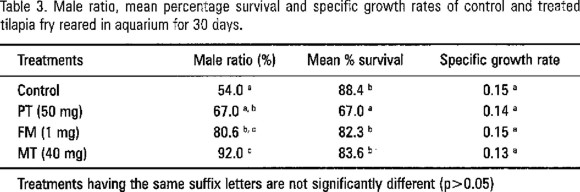
<body><![CDATA[<p align="justify"><font face="verdana" size="2">After 30 days of the hormone treatments, fry were kept in the aquarium, during two of three months more and fed with the same food as the control group (five times a day) until they reached a total length of 7 cm, in order to make the sexed easily. When fishes reaching this size, their gonads were removed with fine forceps, mounted on a glass slide, stained with aceto&#45;carmine in agree with Guerrero and Shelton (1974) and examined under the microscope to verify sex reversal. At this size the oocytes were readily differentiated from spermatogonia.</font></p>     <p align="justify"><font face="verdana" size="2">Statistical analysis with two way ANOVA was conducted and a least significant difference (LSD) test applied according to Zar (1974), using the Statgraphics Program Software version 6.0.</font></p>     <p align="justify"><font face="Verdana" size="2">&nbsp;</font></p>     <p align="justify"><font face="verdana" size="2"><b>Results and discussion</b></font></p>     <p align="justify"><font face="verdana" size="2">Initial lengths and weights of experimental fry treated with different hormones, were not significantly different (p&gt;0.05), suggesting that the initial experimental conditions were similar in all treatments. However, among the different strains of tilapias, differences were significant (p&lt;0.05). The hybrid Rocky Mountain fry had the highest average length and weight at birth (<a href="/img/revistas/hbio/v10n2/a5c1.jpg" target="_blank">Table 1</a>).</font></p>     <p align="justify"><font face="verdana" size="2">The two way ANOVA (<a href="#c2">Table 2</a>), showed no significant differences (p&gt;0.05) in the response of the different strains of tilapia treated with different hormones. However significant differences (p&lt;0.05) were observed in the mean percentage survival and specific growth rates. Moreover, Between androgen and control treatments, the mean percentage males and survival rate were significant (p&lt;0.05), but not the specific growth rate.</font></p>     <p align="center"><font face="verdana" size="2"><a name="c2"></a></font></p>     <p align="center"><font face="verdana" size="2"><img src="/img/revistas/hbio/v10n2/a5c2.jpg"></font></p>     <p align="justify"><font face="verdana" size="2">Hormone&#45;treated and control food were both well accepted by the three strains of tilapia fry, except for TP, which was scarcely consumed due perhaps to the greasy appearance produced by the hormone's solvent (vegetable oil).</font></p>     <p align="justify"><font face="verdana" size="2">Significant differences (p&lt;0.05) were observed between angrogen&#45;treatments, where MT produced the highest male ratio (92%), followed by FM (80.6%) and PT (67%). The control group (54%) also presented significant differences (p&lt;0.05) with respect to the hormone&#45;treatments, which indicates that sex reversal was successful, except for PT (<a href="#c3">Table 3</a>).</font></p>     ]]></body>
<body><![CDATA[<p align="center"><font face="verdana" size="2"><a name="c3"></a></font></p>     <p align="center"><font face="verdana" size="2"><img src="/img/revistas/hbio/v10n2/a5c3.jpg"></font></p>     <p align="justify"><font face="verdana" size="2">This study demonstrates the effectiveness of the MT treatment at a dosage of 40 mg/kg of feed supply during 30 days to produce phenotypic males. Our results agree with those of Guerrero (1975), Hanson <i>et al</i>. (1983), Macintosh <i>et al</i>. (1985), Kuwaye <i>et al</i>. (1993), Ladu and Madara (1994), who demonstrated the effectiveness of MT in other species. However the results obtained with FM also suggest that its performance to induce sex reversal in these strains of tilapia, is highly effective.</font></p>     <p align="justify"><font face="verdana" size="2">The mean percentage survival rate of fry treated with MT, FM and control after the 30 days trial, was not significantly different (p&gt;0.05), which indicates that the hormones do not have a negative effect on the fry. Only PT presented significant difference (p&lt;0.05), which we assumed is due to low consumption of food (<a href="#c3">Table 3</a>).</font></p>     <p align="justify"><font face="verdana" size="2">The specific growth rates of fry were similar in all treatments with non&#45;significative differences between them (p&gt;0.05) (<a href="#c3">Table 3</a>), therefore no anabolic effects was detected. There is a controversy with respect to the induction of an anabolic effect on the fish by androgens, as mentioned by Tayamen and Shelton (1978), Macintosh <i>et al</i>. (1985), Kuwaye <i>et al</i>. (1993), Ladu and Madara (1994). However, our results agreed with Owusu&#45;Frimpong and Nijjhar (1981), Torrans <i>et al</i>. (1988), Phelps <i>et al</i>. (1992) and Vera and Mair (1994) who reported non&#45;significant differences in growth rate between hormone&#45;treated and untreated tilapia fry.</font></p>     <p align="justify"><font face="verdana" size="2">In the three strains of tilapia, we observed that the response to androgens&#45;treatments were similar but the best results were obtained with MT, followed by FM and finally PT. The Stirling strain showed the highest male ratio with the three hormones (<a href="/img/revistas/hbio/v10n2/a5c4.jpg" target="_blank">Table 4a</a>).</font></p>     <p align="justify"><font face="verdana" size="2">The hybrid Rocky Mountain showed the highest survival rate, followed by the Stirling strain (<i>O. niloticus</i>), and non&#45;significant differences (p>0.05) between them (<a href="/img/revistas/hbio/v10n2/a5c4.jpg" target="_blank">Table 4b</a>). In contrast, the Red strain (<i>O. niloticus</i>) showed high mortality and presented significant differences (p&lt;0.05) with respect to the other strains. Regardless of their high commercial value, the Red strain is delicate and requires special treatment.</font></p>     <p align="justify"><font face="verdana" size="2">Significant differences (p&lt;0.05) were also observed between the three strains with respect to specific growth rate. The Stirling strain exhibited the best specific growth rate (<a href="/img/revistas/hbio/v10n2/a5c4.jpg" target="_blank">Table 4b</a>), in the spite of their smallest initial size at birth.</font></p>     <p align="justify"><font face="verdana" size="2">The results of the physicochemical parameters are given in <a href="#c5">Table 5</a>. The average values show that they are adequate for a good growth and high survival of tilapia fry, and they did not have adverse effects on the populations under experimental conditions.</font></p>     <p align="center"><font face="verdana" size="2"><a name="c5"></a></font></p>     ]]></body>
<body><![CDATA[<p align="center"><font face="verdana" size="2"><img src="/img/revistas/hbio/v10n2/a5c5.jpg"></font></p>     <p align="justify"><font face="verdana" size="2">Subsequent experiments using different dosages of hormones demonstrated that when we increased FM from 1 to 5 mg/kg of feed, we obtained 100 % phenotypic males of Rocky Mountain and Red strains. In the other hand, when only times was increased, up to 35 days, a 100 % of phenotypic males of Stirling strain was obtained (Jim&eacute;nez and Arredondo, 2000).</font></p>     <p align="justify"><font face="verdana" size="2">The satisfactory results obtained with Fluoxymesterone, especially for Stirling and Rocky Mountain strains, confirmed that this synthetic androgen could be easily substitute the 17 &prop;&#150;methyltestosterone, besides the advantage of be readily available.</font></p>     <p align="justify"><font face="verdana" size="2">Furthermore, the dosage of PT was not enough to induce sex&#45;reversal in all the strains of tilapia thus we recommend to do more experiments with dosages ranging from 60 to 100 mg PT/kg of feed and with different trial periods (35&#45;60 days). The low proportion of males obtained in PT treatment can be attributed to a scarce consumption of food. Under these circumstances, it is recommended to carry out tests to include PT in food, without losing their organoleptic properties.</font></p>     <p align="justify"><font face="verdana" size="2">Goudie, <i>et al</i>. (1986) evaluated MT in fish tissue distribution and time of elimination, when this androgen is used for sex&#45;reversal. They concluded that no potential health hazard exists for people who eat fish have been fed MT as juveniles. Also, Rothbard <i>et al</i>. (1990), agreed to indicate that hormonal residues do not exist on fish feed with normal food, several previous months to be consumed by humans.</font></p>     <p align="justify"><font face="verdana" size="2">This study demonstrated that MT was the most effective androgen in inducing sex reversal in the three strains of tilapia analyzed. The Stirling strain presented higher male ratio, survival and specific growth rate, thus is the most viable strain to implement with sex reversal in grow&#45;out ponds of commercial farms. Fluoxymesterone hormone us a good alternative to substitute 17 &prop;&#150;methyltestosterone hormone.</font></p>     <p align="justify"><font face="Verdana" size="2">&nbsp;</font></p>     <p align="justify"><font face="verdana" size="2"><b>Acknowledgements</b></font></p>     <p align="justify"><font face="verdana" size="2">We are grateful to Luis Ignacio S&aacute;nchez C&oacute;rdoba, Carlos Alberto Cuenca Soria and Mar&iacute;a Mercedes Silva Paiz for the assistance during the experimental phase; Irene Barriga Sosa for reading and discussing the manuscript. This study was supported by the Universidad Aut&oacute;noma Metropolitana&#45;Iztapalapa (CD. CBS. Session 12.98).</font></p>     <p align="justify"><font face="Verdana" size="2">&nbsp;</font></p>     ]]></body>
<body><![CDATA[<p align="justify"><font face="verdana" size="2"><b>References</b></font></p>     <!-- ref --><p align="justify"><font face="verdana" size="2">Abucay, J. S. and G. C. Mair, 1997. Hormonal sex reversal of tilapias: Implications of hormone treatment application in closed water systems. <i>Aquaculture Research 28</i> (11): 841&#45;845.    &nbsp;&nbsp;&nbsp;&nbsp;&nbsp;&nbsp;&nbsp;&nbsp;[&#160;<a href="javascript:void(0);" onclick="javascript: window.open('/scielo.php?script=sci_nlinks&ref=4030211&pid=S0188-8897200000020000500001&lng=','','width=640,height=500,resizable=yes,scrollbars=1,menubar=yes,');">Links</a>&#160;]<!-- end-ref --></font></p>     <!-- ref --><p align="justify"><font face="verdana" size="2">Carvalho, E. D. and F. Foresti, 1996. Sex reversal in Nile Tilapia, <i>Oreochromis niloticus</i> (Trewavas, 1983) induced by 17&#150;alpha&#150;methyltestosterone: Sex ratio and histological studies on the gonads. <i>Revista Brasileira de Biolog&iacute;a 56</i> (2): 249&#45;262.    &nbsp;&nbsp;&nbsp;&nbsp;&nbsp;&nbsp;&nbsp;&nbsp;[&#160;<a href="javascript:void(0);" onclick="javascript: window.open('/scielo.php?script=sci_nlinks&ref=4030213&pid=S0188-8897200000020000500002&lng=','','width=640,height=500,resizable=yes,scrollbars=1,menubar=yes,');">Links</a>&#160;]<!-- end-ref --></font></p>     <!-- ref --><p align="justify"><font face="verdana" size="2">Clemens, H. P. and T. Inslee, 1968. The production of unisexual broods by <i>Tilapia mossambica</i> sex reversed with methyltestosterone. <i>Transactions of the American Fisheries Society 97</i>: 18&#45;21.    &nbsp;&nbsp;&nbsp;&nbsp;&nbsp;&nbsp;&nbsp;&nbsp;[&#160;<a href="javascript:void(0);" onclick="javascript: window.open('/scielo.php?script=sci_nlinks&ref=4030215&pid=S0188-8897200000020000500003&lng=','','width=640,height=500,resizable=yes,scrollbars=1,menubar=yes,');">Links</a>&#160;]<!-- end-ref --></font></p>     <!-- ref --><p align="justify"><font face="verdana" size="2">Desprez, D. and C. Melard, 1998. Influence of sexual genotype on reproductive traits of females (genotipe WZ) and pseudofemales (genotipe ZZ) in the tilapia <i>Oreochromis aureus. Aquatic Living Resources 11</i>(3): 145&#45;153.    &nbsp;&nbsp;&nbsp;&nbsp;&nbsp;&nbsp;&nbsp;&nbsp;[&#160;<a href="javascript:void(0);" onclick="javascript: window.open('/scielo.php?script=sci_nlinks&ref=4030217&pid=S0188-8897200000020000500004&lng=','','width=640,height=500,resizable=yes,scrollbars=1,menubar=yes,');">Links</a>&#160;]<!-- end-ref --></font></p>     <!-- ref --><p align="justify"><font face="verdana" size="2">Goudie, C. A., W. L. Shelton and N. C. Parker, 1986. Tissue distribution and elimination of radiolabeled methyltestosterone fed to sexually undifferentiated blue tilapia. <i>Aquaculture 58</i>: 215&#45;226.    &nbsp;&nbsp;&nbsp;&nbsp;&nbsp;&nbsp;&nbsp;&nbsp;[&#160;<a href="javascript:void(0);" onclick="javascript: window.open('/scielo.php?script=sci_nlinks&ref=4030219&pid=S0188-8897200000020000500005&lng=','','width=640,height=500,resizable=yes,scrollbars=1,menubar=yes,');">Links</a>&#160;]<!-- end-ref --></font></p>     <!-- ref --><p align="justify"><font face="verdana" size="2">Guerrero, R. D. III., 1975. Use of androgens for the production of all&#45;male <i>Tilapia aurea</i> (Steindachner). <i>Transactions of the American Fisheries Society 2</i>: 342&#45;348.    &nbsp;&nbsp;&nbsp;&nbsp;&nbsp;&nbsp;&nbsp;&nbsp;[&#160;<a href="javascript:void(0);" onclick="javascript: window.open('/scielo.php?script=sci_nlinks&ref=4030221&pid=S0188-8897200000020000500006&lng=','','width=640,height=500,resizable=yes,scrollbars=1,menubar=yes,');">Links</a>&#160;]<!-- end-ref --></font></p>     <!-- ref --><p align="justify"><font face="verdana" size="2">Guerrero, R. D. III, 1979. Use of hormonal steroids for artificial sex reversal of tilapia. <i>Proceedings of India Natural Sciences Academy 45</i>: 512&#45;514.    &nbsp;&nbsp;&nbsp;&nbsp;&nbsp;&nbsp;&nbsp;&nbsp;[&#160;<a href="javascript:void(0);" onclick="javascript: window.open('/scielo.php?script=sci_nlinks&ref=4030223&pid=S0188-8897200000020000500007&lng=','','width=640,height=500,resizable=yes,scrollbars=1,menubar=yes,');">Links</a>&#160;]<!-- end-ref --></font></p>     <!-- ref --><p align="justify"><font face="verdana" size="2">Guerrero, R. D. III and W. L Shelton, 1974. An aceto&#45;carmine squash method for sexing juvenile fishes. <i>Progressive Fish&#45;Culturist 36</i>(1): 56.    &nbsp;&nbsp;&nbsp;&nbsp;&nbsp;&nbsp;&nbsp;&nbsp;[&#160;<a href="javascript:void(0);" onclick="javascript: window.open('/scielo.php?script=sci_nlinks&ref=4030225&pid=S0188-8897200000020000500008&lng=','','width=640,height=500,resizable=yes,scrollbars=1,menubar=yes,');">Links</a>&#160;]<!-- end-ref --></font></p>     <!-- ref --><p align="justify"><font face="verdana" size="2">Hanson, R., R. O. Smitherman, W. L. Shelton and R. A. Dunham, 1983. Growth comparisons of monosex tilapia produced by separation of sexes, hybridization and sex&#45;reversal. pp. 570&#45;579. <i>In:</i> Fishelson and Z. Yaron (Eds.). <i>Proceedings of the International Symposium on Tilapia in Aquaculture</i>, 8&#45;13 May 1983. Nazareth, Israel, Tel&#45;Aviv University.    &nbsp;&nbsp;&nbsp;&nbsp;&nbsp;&nbsp;&nbsp;&nbsp;[&#160;<a href="javascript:void(0);" onclick="javascript: window.open('/scielo.php?script=sci_nlinks&ref=4030227&pid=S0188-8897200000020000500009&lng=','','width=640,height=500,resizable=yes,scrollbars=1,menubar=yes,');">Links</a>&#160;]<!-- end-ref --></font></p>     <!-- ref --><p align="justify"><font face="verdana" size="2">Jim&eacute;nez, B. M. L. and F. J. L. Arredondo, 2000. <i>Manual de t&eacute;cnicas para inducir la reversi&oacute;n sexual en tilapia</i>. Universidad Aut&oacute;noma Metropolitana Unidad Iztapalapa. 37 p. In press.    &nbsp;&nbsp;&nbsp;&nbsp;&nbsp;&nbsp;&nbsp;&nbsp;[&#160;<a href="javascript:void(0);" onclick="javascript: window.open('/scielo.php?script=sci_nlinks&ref=4030229&pid=S0188-8897200000020000500010&lng=','','width=640,height=500,resizable=yes,scrollbars=1,menubar=yes,');">Links</a>&#160;]<!-- end-ref --></font></p>     <!-- ref --><p align="justify"><font face="verdana" size="2">Kuwaye, T. T., D. K. Okimoto, K. S. Shimoda, D. R. Howerton, H. R. Lin, K. T. Pang and E. G. Grau, 1993. Effect of 17&#956; methyltestosterone on the growth of the euryhaline tilapia, <i>Oreochromis mossambicus</i>, in fresh water and in sea water. <i>Aquaculture 113</i>: 137&#45;152.    &nbsp;&nbsp;&nbsp;&nbsp;&nbsp;&nbsp;&nbsp;&nbsp;[&#160;<a href="javascript:void(0);" onclick="javascript: window.open('/scielo.php?script=sci_nlinks&ref=4030231&pid=S0188-8897200000020000500011&lng=','','width=640,height=500,resizable=yes,scrollbars=1,menubar=yes,');">Links</a>&#160;]<!-- end-ref --></font></p>     <!-- ref --><p align="justify"><font face="verdana" size="2">Ladu, L. B. and A. A. Madara, 1994. The use of synthetic and natural androgens for the production of monosex male <i>Oreochromis niloticus</i> (Pisces). <i>Revista Biolog&iacute;a Tropical 42</i>(3): 755&#45;757.    &nbsp;&nbsp;&nbsp;&nbsp;&nbsp;&nbsp;&nbsp;&nbsp;[&#160;<a href="javascript:void(0);" onclick="javascript: window.open('/scielo.php?script=sci_nlinks&ref=4030233&pid=S0188-8897200000020000500012&lng=','','width=640,height=500,resizable=yes,scrollbars=1,menubar=yes,');">Links</a>&#160;]<!-- end-ref --></font></p>     <!-- ref --><p align="justify"><font face="verdana" size="2">Macintosh, D. J., T. J. Varghiese and G. P. Satyanarayana Rao, 1985. Hormonal sex reversal of wild&#45;spawned tilapia in India. <i>Journal of Fisheries Biology 26</i>: 87&#45;94.    &nbsp;&nbsp;&nbsp;&nbsp;&nbsp;&nbsp;&nbsp;&nbsp;[&#160;<a href="javascript:void(0);" onclick="javascript: window.open('/scielo.php?script=sci_nlinks&ref=4030235&pid=S0188-8897200000020000500013&lng=','','width=640,height=500,resizable=yes,scrollbars=1,menubar=yes,');">Links</a>&#160;]<!-- end-ref --></font></p>     <!-- ref --><p align="justify"><font face="verdana" size="2">Mair, G. C., J. S. Abucay, D. O. Skibinski, T. A. Abella and J. A. Beardmore, 1997. Genetic manipulation of sex ratio for the large&#45;scale production of all&#45;male tilapia, <i>Oreochromis niloticus. Canadian Journal of Fisheries and Aquatic Sciences 54</i>(2): 396&#45;404.    &nbsp;&nbsp;&nbsp;&nbsp;&nbsp;&nbsp;&nbsp;&nbsp;[&#160;<a href="javascript:void(0);" onclick="javascript: window.open('/scielo.php?script=sci_nlinks&ref=4030237&pid=S0188-8897200000020000500014&lng=','','width=640,height=500,resizable=yes,scrollbars=1,menubar=yes,');">Links</a>&#160;]<!-- end-ref --></font></p>     <!-- ref --><p align="justify"><font face="verdana" size="2">Melard, C., 1995. Production of a high percentage of male offspring with 17&#150;alpha&#150;ethylnylestriadol sex&#45;reversed <i>Oreochromis aureus</i>. I. Estrogen sex&#45;reversal and production of F2 pseudofemales. <i>Aquaculture 130</i>(1): 25&#45;34.    &nbsp;&nbsp;&nbsp;&nbsp;&nbsp;&nbsp;&nbsp;&nbsp;[&#160;<a href="javascript:void(0);" onclick="javascript: window.open('/scielo.php?script=sci_nlinks&ref=4030239&pid=S0188-8897200000020000500015&lng=','','width=640,height=500,resizable=yes,scrollbars=1,menubar=yes,');">Links</a>&#160;]<!-- end-ref --></font></p>     <!-- ref --><p align="justify"><font face="verdana" size="2">Nakamura, M., 1975. Dosage&#45;dependent changes in the effect of oral administration of methyltestosterone on gonadal sex differentiation in <i>Tilapia mossambica. Bulletin Faculty of Fisheries Hokkaido University 26</i>: 99&#45;108.    &nbsp;&nbsp;&nbsp;&nbsp;&nbsp;&nbsp;&nbsp;&nbsp;[&#160;<a href="javascript:void(0);" onclick="javascript: window.open('/scielo.php?script=sci_nlinks&ref=4030241&pid=S0188-8897200000020000500016&lng=','','width=640,height=500,resizable=yes,scrollbars=1,menubar=yes,');">Links</a>&#160;]<!-- end-ref --></font></p>     <!-- ref --><p align="justify"><font face="verdana" size="2">Owusu&#45;Frimpong, M. and B. Nijjhar, 1981. Induced sex reversal in <i>Tilapia nilotica</i> (Cichlidae) with methyltestosterone. <i>Hydrobiologia 78</i>: 157&#45;160.    &nbsp;&nbsp;&nbsp;&nbsp;&nbsp;&nbsp;&nbsp;&nbsp;[&#160;<a href="javascript:void(0);" onclick="javascript: window.open('/scielo.php?script=sci_nlinks&ref=4030243&pid=S0188-8897200000020000500017&lng=','','width=640,height=500,resizable=yes,scrollbars=1,menubar=yes,');">Links</a>&#160;]<!-- end-ref --></font></p>     <!-- ref --><p align="justify"><font face="verdana" size="2">Phelps, R. P., W. Cole and T. Katz, 1992. Effect of fluoxymesterone on sex ratio and growth of Nile tilapia, <i>Oreochromis niloticus</i> (L.). <i>Aquaculture and Fisheries Management 23</i>: 405&#45;410.    &nbsp;&nbsp;&nbsp;&nbsp;&nbsp;&nbsp;&nbsp;&nbsp;[&#160;<a href="javascript:void(0);" onclick="javascript: window.open('/scielo.php?script=sci_nlinks&ref=4030245&pid=S0188-8897200000020000500018&lng=','','width=640,height=500,resizable=yes,scrollbars=1,menubar=yes,');">Links</a>&#160;]<!-- end-ref --></font></p>     <!-- ref --><p align="justify"><font face="verdana" size="2">Popma, T. J. and B. W. Green, 1990. <i>Aquaculture production manual: sex reversal in tilapia in earthen ponds</i>. Research and Development Series No. 35. International Centre for Aquaculture, Auburn University, Alabama. 15 pp.    &nbsp;&nbsp;&nbsp;&nbsp;&nbsp;&nbsp;&nbsp;&nbsp;[&#160;<a href="javascript:void(0);" onclick="javascript: window.open('/scielo.php?script=sci_nlinks&ref=4030247&pid=S0188-8897200000020000500019&lng=','','width=640,height=500,resizable=yes,scrollbars=1,menubar=yes,');">Links</a>&#160;]<!-- end-ref --></font></p>     <!-- ref --><p align="justify"><font face="verdana" size="2">Ricker, W. E., 1975. Computation and interpretation of biological statistics of fish populations. <i>Bulletin of the Fisheries Research Board of Canada 191</i>: 382 p.    &nbsp;&nbsp;&nbsp;&nbsp;&nbsp;&nbsp;&nbsp;&nbsp;[&#160;<a href="javascript:void(0);" onclick="javascript: window.open('/scielo.php?script=sci_nlinks&ref=4030249&pid=S0188-8897200000020000500020&lng=','','width=640,height=500,resizable=yes,scrollbars=1,menubar=yes,');">Links</a>&#160;]<!-- end-ref --></font></p>     <!-- ref --><p align="justify"><font face="verdana" size="2">Rothbard, S., Y. Zohar, N. Zmora, B. Levavi&#45;Sivan, B. Moav and Z. Yaron, 1990. Clearance of 17 alpha&#150;ethynyltestosterone from muscle of sex&#45;inversed tilapia hybrids treated for growth enhancement with two doses of the androgen. <i>Aquaculture 89</i>: 365&#45;376.    &nbsp;&nbsp;&nbsp;&nbsp;&nbsp;&nbsp;&nbsp;&nbsp;[&#160;<a href="javascript:void(0);" onclick="javascript: window.open('/scielo.php?script=sci_nlinks&ref=4030251&pid=S0188-8897200000020000500021&lng=','','width=640,height=500,resizable=yes,scrollbars=1,menubar=yes,');">Links</a>&#160;]<!-- end-ref --></font></p>     <!-- ref --><p align="justify"><font face="verdana" size="2">Tayamen, M. M. and W. L. Shelton, 1978. Inducement of sex reversal in <i>Sarotherodon niloticus</i> (Linnaeus). <i>Aquaculture 14</i>: 349&#45;354.    &nbsp;&nbsp;&nbsp;&nbsp;&nbsp;&nbsp;&nbsp;&nbsp;[&#160;<a href="javascript:void(0);" onclick="javascript: window.open('/scielo.php?script=sci_nlinks&ref=4030253&pid=S0188-8897200000020000500022&lng=','','width=640,height=500,resizable=yes,scrollbars=1,menubar=yes,');">Links</a>&#160;]<!-- end-ref --></font></p>     <!-- ref --><p align="justify"><font face="verdana" size="2">Torrans, L., F. Meriwether, F. Lowell, B. Wyatt and P. Gwinup, 1988. Sex&#45;reversal of <i>Oreochromis aureus</i> by immersion in Mibolerone, a synthetic steroid. <i>Journal of the World Aquaculture Society 19</i>(3): 97&#45;102.    &nbsp;&nbsp;&nbsp;&nbsp;&nbsp;&nbsp;&nbsp;&nbsp;[&#160;<a href="javascript:void(0);" onclick="javascript: window.open('/scielo.php?script=sci_nlinks&ref=4030255&pid=S0188-8897200000020000500023&lng=','','width=640,height=500,resizable=yes,scrollbars=1,menubar=yes,');">Links</a>&#160;]<!-- end-ref --></font></p>     <!-- ref --><p align="justify"><font face="verdana" size="2">Vera, C. E. and G. C. Mair, 1994. Conditions for effective androgen sex reversal in <i>Oreochromis niloticus</i> (L.). <i>Aquaculture 122</i>: 237&#45;248.    &nbsp;&nbsp;&nbsp;&nbsp;&nbsp;&nbsp;&nbsp;&nbsp;[&#160;<a href="javascript:void(0);" onclick="javascript: window.open('/scielo.php?script=sci_nlinks&ref=4030257&pid=S0188-8897200000020000500024&lng=','','width=640,height=500,resizable=yes,scrollbars=1,menubar=yes,');">Links</a>&#160;]<!-- end-ref --></font></p>     <!-- ref --><p align="justify"><font face="verdana" size="2">Zar, J. H., 1974. <i>Biostatical Analysis</i>. Prentice&#45;Hall, Inc. USA. 620 p.    &nbsp;&nbsp;&nbsp;&nbsp;&nbsp;&nbsp;&nbsp;&nbsp;[&#160;<a href="javascript:void(0);" onclick="javascript: window.open('/scielo.php?script=sci_nlinks&ref=4030259&pid=S0188-8897200000020000500025&lng=','','width=640,height=500,resizable=yes,scrollbars=1,menubar=yes,');">Links</a>&#160;]<!-- end-ref --></font></p>      ]]></body><back>
<ref-list>
<ref id="B1">
<nlm-citation citation-type="journal">
<person-group person-group-type="author">
<name>
<surname><![CDATA[Abucay]]></surname>
<given-names><![CDATA[J. S.]]></given-names>
</name>
<name>
<surname><![CDATA[Mair]]></surname>
<given-names><![CDATA[G. C.]]></given-names>
</name>
</person-group>
<article-title xml:lang="en"><![CDATA[Hormonal sex reversal of tilapias: Implications of hormone treatment application in closed water systems]]></article-title>
<source><![CDATA[Aquaculture Research]]></source>
<year>1997</year>
<volume>28</volume>
<numero>11</numero>
<issue>11</issue>
<page-range>841-845</page-range></nlm-citation>
</ref>
<ref id="B2">
<nlm-citation citation-type="journal">
<person-group person-group-type="author">
<name>
<surname><![CDATA[Carvalho]]></surname>
<given-names><![CDATA[E. D.]]></given-names>
</name>
<name>
<surname><![CDATA[Foresti]]></surname>
<given-names><![CDATA[F.]]></given-names>
</name>
</person-group>
<article-title xml:lang="en"><![CDATA[Sex reversal in Nile Tilapia, Oreochromis niloticus (Trewavas, 1983) induced by 17-alpha-methyltestosterone: Sex ratio and histological studies on the gonads]]></article-title>
<source><![CDATA[Revista Brasileira de Biología]]></source>
<year>1996</year>
<volume>56</volume>
<numero>2</numero>
<issue>2</issue>
<page-range>249-262</page-range></nlm-citation>
</ref>
<ref id="B3">
<nlm-citation citation-type="journal">
<person-group person-group-type="author">
<name>
<surname><![CDATA[Clemens]]></surname>
<given-names><![CDATA[H. P.]]></given-names>
</name>
<name>
<surname><![CDATA[Inslee]]></surname>
<given-names><![CDATA[T.]]></given-names>
</name>
</person-group>
<article-title xml:lang="en"><![CDATA[The production of unisexual broods by Tilapia mossambica sex reversed with methyltestosterone]]></article-title>
<source><![CDATA[Transactions of the American Fisheries Society]]></source>
<year>1968</year>
<volume>97</volume>
<page-range>18-21</page-range></nlm-citation>
</ref>
<ref id="B4">
<nlm-citation citation-type="journal">
<person-group person-group-type="author">
<name>
<surname><![CDATA[Desprez]]></surname>
<given-names><![CDATA[D.]]></given-names>
</name>
<name>
<surname><![CDATA[Melard]]></surname>
<given-names><![CDATA[C.]]></given-names>
</name>
</person-group>
<article-title xml:lang="en"><![CDATA[Influence of sexual genotype on reproductive traits of females (genotipe WZ) and pseudofemales (genotipe ZZ) in the tilapia Oreochromis aureus]]></article-title>
<source><![CDATA[Aquatic Living Resources]]></source>
<year>1998</year>
<volume>11</volume>
<numero>3</numero>
<issue>3</issue>
<page-range>145-153</page-range></nlm-citation>
</ref>
<ref id="B5">
<nlm-citation citation-type="journal">
<person-group person-group-type="author">
<name>
<surname><![CDATA[Goudie]]></surname>
<given-names><![CDATA[C. A.]]></given-names>
</name>
<name>
<surname><![CDATA[Shelton]]></surname>
<given-names><![CDATA[W. L.]]></given-names>
</name>
<name>
<surname><![CDATA[Parker]]></surname>
<given-names><![CDATA[N. C.]]></given-names>
</name>
</person-group>
<article-title xml:lang="en"><![CDATA[Tissue distribution and elimination of radiolabeled methyltestosterone fed to sexually undifferentiated blue tilapia]]></article-title>
<source><![CDATA[Aquaculture]]></source>
<year>1986</year>
<volume>58</volume>
<page-range>215-226</page-range></nlm-citation>
</ref>
<ref id="B6">
<nlm-citation citation-type="journal">
<person-group person-group-type="author">
<name>
<surname><![CDATA[Guerrero]]></surname>
<given-names><![CDATA[R. D. III.]]></given-names>
</name>
</person-group>
<article-title xml:lang="en"><![CDATA[Use of androgens for the production of all-male Tilapia aurea (Steindachner)]]></article-title>
<source><![CDATA[Transactions of the American Fisheries Society]]></source>
<year>1975</year>
<volume>2</volume>
<page-range>342-348</page-range></nlm-citation>
</ref>
<ref id="B7">
<nlm-citation citation-type="journal">
<person-group person-group-type="author">
<name>
<surname><![CDATA[Guerrero]]></surname>
<given-names><![CDATA[R. D. III]]></given-names>
</name>
</person-group>
<article-title xml:lang="en"><![CDATA[Use of hormonal steroids for artificial sex reversal of tilapia]]></article-title>
<source><![CDATA[Proceedings of India Natural Sciences Academy]]></source>
<year>1979</year>
<volume>45</volume>
<page-range>512-514</page-range></nlm-citation>
</ref>
<ref id="B8">
<nlm-citation citation-type="journal">
<person-group person-group-type="author">
<name>
<surname><![CDATA[Guerrero]]></surname>
<given-names><![CDATA[R. D. III]]></given-names>
</name>
<name>
<surname><![CDATA[Shelton]]></surname>
<given-names><![CDATA[W. L]]></given-names>
</name>
</person-group>
<article-title xml:lang="en"><![CDATA[An aceto-carmine squash method for sexing juvenile fishes]]></article-title>
<source><![CDATA[Progressive Fish-Culturist]]></source>
<year>1974</year>
<volume>36</volume>
<numero>1</numero>
<issue>1</issue>
<page-range>56</page-range></nlm-citation>
</ref>
<ref id="B9">
<nlm-citation citation-type="book">
<person-group person-group-type="author">
<name>
<surname><![CDATA[Hanson]]></surname>
<given-names><![CDATA[R.]]></given-names>
</name>
<name>
<surname><![CDATA[Smitherman]]></surname>
<given-names><![CDATA[R. O.]]></given-names>
</name>
<name>
<surname><![CDATA[Shelton]]></surname>
<given-names><![CDATA[W. L.]]></given-names>
</name>
<name>
<surname><![CDATA[Dunham]]></surname>
<given-names><![CDATA[R. A.]]></given-names>
</name>
</person-group>
<article-title xml:lang="en"><![CDATA[Growth comparisons of monosex tilapia produced by separation of sexes, hybridization and sex-reversal. pp. 570-579]]></article-title>
<person-group person-group-type="editor">
<name>
<surname><![CDATA[Fishelson]]></surname>
</name>
<name>
<surname><![CDATA[Yaron]]></surname>
<given-names><![CDATA[Z.]]></given-names>
</name>
</person-group>
<source><![CDATA[Proceedings of the International Symposium on Tilapia in Aquaculture]]></source>
<year>1983</year>
<month>8-</month>
<day>13</day>
<publisher-loc><![CDATA[Nazareth ]]></publisher-loc>
<publisher-name><![CDATA[Tel-Aviv University]]></publisher-name>
</nlm-citation>
</ref>
<ref id="B10">
<nlm-citation citation-type="book">
<person-group person-group-type="author">
<name>
<surname><![CDATA[Jiménez]]></surname>
<given-names><![CDATA[B. M. L.]]></given-names>
</name>
<name>
<surname><![CDATA[Arredondo]]></surname>
<given-names><![CDATA[F. J. L.]]></given-names>
</name>
</person-group>
<source><![CDATA[Manual de técnicas para inducir la reversión sexual en tilapia]]></source>
<year>2000</year>
<page-range>37</page-range><publisher-name><![CDATA[Universidad Autónoma Metropolitana Unidad Iztapalapa]]></publisher-name>
</nlm-citation>
</ref>
<ref id="B11">
<nlm-citation citation-type="journal">
<person-group person-group-type="author">
<name>
<surname><![CDATA[Kuwaye]]></surname>
<given-names><![CDATA[T. T.]]></given-names>
</name>
<name>
<surname><![CDATA[Okimoto]]></surname>
<given-names><![CDATA[D. K.]]></given-names>
</name>
<name>
<surname><![CDATA[Shimoda]]></surname>
<given-names><![CDATA[K. S.]]></given-names>
</name>
<name>
<surname><![CDATA[Howerton]]></surname>
<given-names><![CDATA[D. R.]]></given-names>
</name>
<name>
<surname><![CDATA[Lin]]></surname>
<given-names><![CDATA[H. R.]]></given-names>
</name>
<name>
<surname><![CDATA[Pang]]></surname>
<given-names><![CDATA[K. T.]]></given-names>
</name>
<name>
<surname><![CDATA[Grau]]></surname>
<given-names><![CDATA[E. G.]]></given-names>
</name>
</person-group>
<article-title xml:lang="en"><![CDATA[Effect of 17&#956; methyltestosterone on the growth of the euryhaline tilapia, Oreochromis mossambicus, in fresh water and in sea water]]></article-title>
<source><![CDATA[Aquaculture]]></source>
<year>1993</year>
<volume>113</volume>
<page-range>137-152</page-range></nlm-citation>
</ref>
<ref id="B12">
<nlm-citation citation-type="journal">
<person-group person-group-type="author">
<name>
<surname><![CDATA[Ladu]]></surname>
<given-names><![CDATA[L. B.]]></given-names>
</name>
<name>
<surname><![CDATA[Madara]]></surname>
<given-names><![CDATA[A. A.]]></given-names>
</name>
</person-group>
<article-title xml:lang="en"><![CDATA[The use of synthetic and natural androgens for the production of monosex male Oreochromis niloticus (Pisces)]]></article-title>
<source><![CDATA[Revista Biología Tropical]]></source>
<year>1994</year>
<volume>42</volume>
<numero>3</numero>
<issue>3</issue>
<page-range>755-757</page-range></nlm-citation>
</ref>
<ref id="B13">
<nlm-citation citation-type="journal">
<person-group person-group-type="author">
<name>
<surname><![CDATA[Macintosh]]></surname>
<given-names><![CDATA[D. J.]]></given-names>
</name>
<name>
<surname><![CDATA[Varghiese]]></surname>
<given-names><![CDATA[T. J.]]></given-names>
</name>
<name>
<surname><![CDATA[Satyanarayana Rao]]></surname>
<given-names><![CDATA[G. P.]]></given-names>
</name>
</person-group>
<article-title xml:lang="en"><![CDATA[Hormonal sex reversal of wild-spawned tilapia in India]]></article-title>
<source><![CDATA[Journal of Fisheries Biology]]></source>
<year>1985</year>
<volume>26</volume>
<page-range>87-94</page-range></nlm-citation>
</ref>
<ref id="B14">
<nlm-citation citation-type="journal">
<person-group person-group-type="author">
<name>
<surname><![CDATA[Mair]]></surname>
<given-names><![CDATA[G. C.]]></given-names>
</name>
<name>
<surname><![CDATA[Abucay]]></surname>
<given-names><![CDATA[J. S.]]></given-names>
</name>
<name>
<surname><![CDATA[Skibinski]]></surname>
<given-names><![CDATA[D. O.]]></given-names>
</name>
<name>
<surname><![CDATA[Abella]]></surname>
<given-names><![CDATA[T. A.]]></given-names>
</name>
<name>
<surname><![CDATA[Beardmore]]></surname>
<given-names><![CDATA[J. A.]]></given-names>
</name>
</person-group>
<article-title xml:lang="en"><![CDATA[Genetic manipulation of sex ratio for the large-scale production of all-male tilapia, Oreochromis niloticus]]></article-title>
<source><![CDATA[Canadian Journal of Fisheries and Aquatic Sciences]]></source>
<year>1997</year>
<volume>54</volume>
<numero>2</numero>
<issue>2</issue>
<page-range>396-404</page-range></nlm-citation>
</ref>
<ref id="B15">
<nlm-citation citation-type="journal">
<person-group person-group-type="author">
<name>
<surname><![CDATA[Melard]]></surname>
<given-names><![CDATA[C.]]></given-names>
</name>
</person-group>
<article-title xml:lang="en"><![CDATA[Production of a high percentage of male offspring with 17-alpha-ethylnylestriadol sex-reversed Oreochromis aureus. I. Estrogen sex-reversal and production of F2 pseudofemales]]></article-title>
<source><![CDATA[Aquaculture]]></source>
<year>1995</year>
<volume>130</volume>
<numero>1</numero>
<issue>1</issue>
<page-range>25-34</page-range></nlm-citation>
</ref>
<ref id="B16">
<nlm-citation citation-type="journal">
<person-group person-group-type="author">
<name>
<surname><![CDATA[Nakamura]]></surname>
<given-names><![CDATA[M.]]></given-names>
</name>
</person-group>
<article-title xml:lang="en"><![CDATA[Dosage-dependent changes in the effect of oral administration of methyltestosterone on gonadal sex differentiation in Tilapia mossambica]]></article-title>
<source><![CDATA[Bulletin Faculty of Fisheries Hokkaido University]]></source>
<year>1975</year>
<volume>26</volume>
<page-range>99-108</page-range></nlm-citation>
</ref>
<ref id="B17">
<nlm-citation citation-type="journal">
<person-group person-group-type="author">
<name>
<surname><![CDATA[Owusu-Frimpong]]></surname>
<given-names><![CDATA[M.]]></given-names>
</name>
<name>
<surname><![CDATA[Nijjhar]]></surname>
<given-names><![CDATA[B.]]></given-names>
</name>
</person-group>
<article-title xml:lang="en"><![CDATA[Induced sex reversal in Tilapia nilotica (Cichlidae) with methyltestosterone]]></article-title>
<source><![CDATA[Hydrobiologia]]></source>
<year>1981</year>
<volume>78</volume>
<page-range>157-160</page-range></nlm-citation>
</ref>
<ref id="B18">
<nlm-citation citation-type="journal">
<person-group person-group-type="author">
<name>
<surname><![CDATA[Phelps]]></surname>
<given-names><![CDATA[R. P.]]></given-names>
</name>
<name>
<surname><![CDATA[Cole]]></surname>
<given-names><![CDATA[W.]]></given-names>
</name>
<name>
<surname><![CDATA[Katz]]></surname>
<given-names><![CDATA[T.]]></given-names>
</name>
</person-group>
<article-title xml:lang="en"><![CDATA[Effect of fluoxymesterone on sex ratio and growth of Nile tilapia, Oreochromis niloticus (L.)]]></article-title>
<source><![CDATA[Aquaculture and Fisheries Management]]></source>
<year>1992</year>
<volume>23</volume>
<page-range>405-410</page-range></nlm-citation>
</ref>
<ref id="B19">
<nlm-citation citation-type="book">
<person-group person-group-type="author">
<name>
<surname><![CDATA[Popma]]></surname>
<given-names><![CDATA[T. J.]]></given-names>
</name>
<name>
<surname><![CDATA[Green]]></surname>
<given-names><![CDATA[B. W.]]></given-names>
</name>
</person-group>
<source><![CDATA[Aquaculture production manual: sex reversal in tilapia in earthen ponds]]></source>
<year>1990</year>
<page-range>15</page-range><publisher-loc><![CDATA[Alabama ]]></publisher-loc>
<publisher-name><![CDATA[International Centre for AquacultureAuburn University]]></publisher-name>
</nlm-citation>
</ref>
<ref id="B20">
<nlm-citation citation-type="journal">
<person-group person-group-type="author">
<name>
<surname><![CDATA[Ricker]]></surname>
<given-names><![CDATA[W. E.]]></given-names>
</name>
</person-group>
<article-title xml:lang="en"><![CDATA[Computation and interpretation of biological statistics of fish populations]]></article-title>
<source><![CDATA[Bulletin of the Fisheries Research Board of Canada]]></source>
<year>1975</year>
<volume>191</volume>
<page-range>382 p</page-range></nlm-citation>
</ref>
<ref id="B21">
<nlm-citation citation-type="journal">
<person-group person-group-type="author">
<name>
<surname><![CDATA[Rothbard]]></surname>
<given-names><![CDATA[S.]]></given-names>
</name>
<name>
<surname><![CDATA[Zohar]]></surname>
<given-names><![CDATA[Y.]]></given-names>
</name>
<name>
<surname><![CDATA[Zmora]]></surname>
<given-names><![CDATA[N.]]></given-names>
</name>
<name>
<surname><![CDATA[Levavi-Sivan]]></surname>
<given-names><![CDATA[B.]]></given-names>
</name>
<name>
<surname><![CDATA[Moav]]></surname>
<given-names><![CDATA[B.]]></given-names>
</name>
<name>
<surname><![CDATA[Yaron]]></surname>
<given-names><![CDATA[Z.]]></given-names>
</name>
</person-group>
<article-title xml:lang="en"><![CDATA[Clearance of 17 alpha-ethynyltestosterone from muscle of sex-inversed tilapia hybrids treated for growth enhancement with two doses of the androgen]]></article-title>
<source><![CDATA[Aquaculture]]></source>
<year>1990</year>
<volume>89</volume>
<page-range>365-376</page-range></nlm-citation>
</ref>
<ref id="B22">
<nlm-citation citation-type="journal">
<person-group person-group-type="author">
<name>
<surname><![CDATA[Tayamen]]></surname>
<given-names><![CDATA[M. M.]]></given-names>
</name>
<name>
<surname><![CDATA[Shelton]]></surname>
<given-names><![CDATA[W. L.]]></given-names>
</name>
</person-group>
<article-title xml:lang="en"><![CDATA[Inducement of sex reversal in Sarotherodon niloticus (Linnaeus)]]></article-title>
<source><![CDATA[Aquaculture]]></source>
<year>1978</year>
<volume>14</volume>
<page-range>349-354</page-range></nlm-citation>
</ref>
<ref id="B23">
<nlm-citation citation-type="journal">
<person-group person-group-type="author">
<name>
<surname><![CDATA[Torrans]]></surname>
<given-names><![CDATA[L.]]></given-names>
</name>
<name>
<surname><![CDATA[Meriwether]]></surname>
<given-names><![CDATA[F.]]></given-names>
</name>
<name>
<surname><![CDATA[Lowell]]></surname>
<given-names><![CDATA[F.]]></given-names>
</name>
<name>
<surname><![CDATA[Wyatt]]></surname>
<given-names><![CDATA[B.]]></given-names>
</name>
<name>
<surname><![CDATA[Gwinup]]></surname>
<given-names><![CDATA[P.]]></given-names>
</name>
</person-group>
<article-title xml:lang="en"><![CDATA[Sex-reversal of Oreochromis aureus by immersion in Mibolerone, a synthetic steroid]]></article-title>
<source><![CDATA[Journal of the World Aquaculture Society]]></source>
<year>1988</year>
<volume>19</volume>
<numero>3</numero>
<issue>3</issue>
<page-range>97-102</page-range></nlm-citation>
</ref>
<ref id="B24">
<nlm-citation citation-type="journal">
<person-group person-group-type="author">
<name>
<surname><![CDATA[Vera]]></surname>
<given-names><![CDATA[C. E.]]></given-names>
</name>
<name>
<surname><![CDATA[Mair]]></surname>
<given-names><![CDATA[G. C.]]></given-names>
</name>
</person-group>
<article-title xml:lang="en"><![CDATA[Conditions for effective androgen sex reversal in Oreochromis niloticus (L.)]]></article-title>
<source><![CDATA[Aquaculture]]></source>
<year>1994</year>
<volume>122</volume>
<page-range>237-248</page-range></nlm-citation>
</ref>
<ref id="B25">
<nlm-citation citation-type="book">
<person-group person-group-type="author">
<name>
<surname><![CDATA[Zar]]></surname>
<given-names><![CDATA[J. H.]]></given-names>
</name>
</person-group>
<source><![CDATA[Biostatical Analysis]]></source>
<year>1974</year>
<page-range>620</page-range><publisher-name><![CDATA[Prentice-Hall, Inc.]]></publisher-name>
</nlm-citation>
</ref>
</ref-list>
</back>
</article>