<?xml version="1.0" encoding="ISO-8859-1"?><article xmlns:mml="http://www.w3.org/1998/Math/MathML" xmlns:xlink="http://www.w3.org/1999/xlink" xmlns:xsi="http://www.w3.org/2001/XMLSchema-instance">
<front>
<journal-meta>
<journal-id>0188-4999</journal-id>
<journal-title><![CDATA[Revista internacional de contaminación ambiental]]></journal-title>
<abbrev-journal-title><![CDATA[Rev. Int. Contam. Ambient]]></abbrev-journal-title>
<issn>0188-4999</issn>
<publisher>
<publisher-name><![CDATA[Universidad Nacional Autónoma de México, Instituto de Ciencias de la Atmósfera y Cambio Climático]]></publisher-name>
</publisher>
</journal-meta>
<article-meta>
<article-id>S0188-49992015000400002</article-id>
<title-group>
<article-title xml:lang="en"><![CDATA[Greenhouse gas emissions from a chinampa soil or floating gardens in Mexico]]></article-title>
<article-title xml:lang="es"><![CDATA[Emisión de gases de efecto invernadero de un suelo de chinampa o jardines flotantes en México]]></article-title>
</title-group>
<contrib-group>
<contrib contrib-type="author">
<name>
<surname><![CDATA[Ortiz-Cornejo]]></surname>
<given-names><![CDATA[Nadia Livia]]></given-names>
</name>
<xref ref-type="aff" rid="A01"/>
</contrib>
<contrib contrib-type="author">
<name>
<surname><![CDATA[Luna-Guido]]></surname>
<given-names><![CDATA[Marco]]></given-names>
</name>
<xref ref-type="aff" rid="A02"/>
</contrib>
<contrib contrib-type="author">
<name>
<surname><![CDATA[Rivera-Espinoza]]></surname>
<given-names><![CDATA[Yadira]]></given-names>
</name>
<xref ref-type="aff" rid="A01"/>
</contrib>
<contrib contrib-type="author">
<name>
<surname><![CDATA[Vásquez-Murrieta]]></surname>
<given-names><![CDATA[María Soledad]]></given-names>
</name>
<xref ref-type="aff" rid="A01"/>
</contrib>
<contrib contrib-type="author">
<name>
<surname><![CDATA[Ruíz-Valdiviezo]]></surname>
<given-names><![CDATA[Víctor Manuel]]></given-names>
</name>
<xref ref-type="aff" rid="A03"/>
</contrib>
<contrib contrib-type="author">
<name>
<surname><![CDATA[Dendooven]]></surname>
<given-names><![CDATA[Luc]]></given-names>
</name>
<xref ref-type="aff" rid="A02"/>
</contrib>
</contrib-group>
<aff id="A01">
<institution><![CDATA[,Instituto Politécnico Nacional Escuela Nacional de Ciencias Biológicas ]]></institution>
<addr-line><![CDATA[México Distrito Federal]]></addr-line>
<country>México</country>
</aff>
<aff id="A02">
<institution><![CDATA[,Instituto Politécnico Nacional Centro de Investigación y de Estudios Avanzados Laboratorio de Ecología del Suelo]]></institution>
<addr-line><![CDATA[México Distrito Federal]]></addr-line>
<country>México</country>
</aff>
<aff id="A03">
<institution><![CDATA[,Instituto Tecnológico de Tuxtla Gutiérrez Laboratorio de Biotecnología ]]></institution>
<addr-line><![CDATA[Tuxtla Gutiérrez Chiapas]]></addr-line>
<country>México</country>
</aff>
<pub-date pub-type="pub">
<day>00</day>
<month>00</month>
<year>2015</year>
</pub-date>
<pub-date pub-type="epub">
<day>00</day>
<month>00</month>
<year>2015</year>
</pub-date>
<volume>31</volume>
<numero>4</numero>
<fpage>343</fpage>
<lpage>350</lpage>
<copyright-statement/>
<copyright-year/>
<self-uri xlink:href="http://www.scielo.org.mx/scielo.php?script=sci_arttext&amp;pid=S0188-49992015000400002&amp;lng=en&amp;nrm=iso"></self-uri><self-uri xlink:href="http://www.scielo.org.mx/scielo.php?script=sci_abstract&amp;pid=S0188-49992015000400002&amp;lng=en&amp;nrm=iso"></self-uri><self-uri xlink:href="http://www.scielo.org.mx/scielo.php?script=sci_pdf&amp;pid=S0188-49992015000400002&amp;lng=en&amp;nrm=iso"></self-uri><abstract abstract-type="short" xml:lang="en"><p><![CDATA[Agriculture in chinampas or 'floating gardens', is still found on the south of Mexico City, it is a high yield pre-Columbian cultivation system, which has soils enriched with organic matter. The objective of this research was to determine the greenhouse gas (GHG) emissions from a chinampa soil cultivated with amaranth (Amaranthus hypochondriacus L.), maize (Zea mays L.) or uncultivated. The soil was characterized and fluxes of GHG (CO2, N2O and CH4) were monitored for one year. The chinampa soil was alkaline saline with an organic C content that ranged from 21.7 t/ha in the 0-20 cm layer of the soil cultivated with amaranth to 28.4 t/ha in the 20-40 cm layer of the uncultivated soil. The cumulative GHG emissions (kg CO2-equivalents/ha/y) were 395, 376 and 258 for N2O, and 44, 30 and 26 for CH4 in the uncultivated, amaranth cultivated and maize cultivated soil, respectively. No significant effect of cultivated crop or soil characteristics on GHG emissions over one year was found. In general, N2O contributed 91 % and CH4 9 % to the global warming potential of the GHG. The organic C was high and distributed equally over the soil profile, because it is an anthropic soil.]]></p></abstract>
<abstract abstract-type="short" xml:lang="es"><p><![CDATA[La agricultura en chinampas o "jardines flotantes", todavía la podemos encontrar al sur de la Ciudad de México, este es un sistema de cultivo de alto rendimiento pre-colombino con suelos ricos en materia orgánica. El objetivo de esta investigación fue determinar la emisión de gases de efecto invernadero (GEI) del suelo de chinampas cultivadas con amaranto (Amaranthus hypochondriacus L.), maíz (Zea mays L.) y sin cultivo. Se caracterizó el suelo y se monitorearon los flujos de gases de efecto invernadero (CO2, N2O y CH4) durante un año. El suelo de la chinampa fue salino alcalino con un contenido de C orgánico que varió de 21.7 t/ha en la capa de 0-20 cm del suelo cultivado con amaranto a 28.4 t/ha en la capa de 20-40 cm del suelo sin cultivar. Las emisiones de gases de efecto invernadero acumuladas (kg de CO2 equivalente/ha/año) fueron 395, 376 y 258 para el N2O y 44, 30 y 26 para el CH4, en el suelo sin cultivo, en el cultivado con amaranto y en el cultivado con maíz, respectivamente. No se encontró un efecto significativo del cultivo o de las características del suelo sobre las emisiones de gases de efecto invernadero durante un año. En general, el N2O aportó el 91 % y el CH4 aportó el 9 % del potencial de calentamiento global de los GEI. El C orgánico fue elevado y se distribuye por igual en el perfil del suelo, debido a que es un suelo antrópico.]]></p></abstract>
<kwd-group>
<kwd lng="en"><![CDATA[GHG]]></kwd>
<kwd lng="en"><![CDATA[fluxes of carbon dioxide]]></kwd>
<kwd lng="en"><![CDATA[methane and nitrous oxide]]></kwd>
<kwd lng="en"><![CDATA[global warming potential]]></kwd>
<kwd lng="en"><![CDATA[C sequestration]]></kwd>
<kwd lng="es"><![CDATA[GEI]]></kwd>
<kwd lng="es"><![CDATA[flujos de dióxido de carbono]]></kwd>
<kwd lng="es"><![CDATA[metano y óxido nitroso]]></kwd>
<kwd lng="es"><![CDATA[potencial de calentamiento global]]></kwd>
<kwd lng="es"><![CDATA[secuestro de carbono]]></kwd>
</kwd-group>
</article-meta>
</front><body><![CDATA[  	    <p align="center"><font face="verdana" size="4"><b>Greenhouse gas emissions from a chinampa soil or floating gardens in Mexico</b></font></p>  	    <p align="center"><font face="verdana" size="2">&nbsp;</font></p>  	    <p align="center"><font face="verdana" size="3"><b>Emisi&oacute;n de gases de efecto invernadero de un suelo de chinampa o jardines flotantes en M&eacute;xico</b></font></p>  	    <p align="center"><font face="verdana" size="2">&nbsp;</font></p>  	    <p align="center"><font face="verdana" size="2"><b>Nadia Livia Ortiz&#45;Cornejo<sup>1</sup>, Marco Luna&#45;Guido<sup>2</sup>, Yadira Rivera&#45;Espinoza<sup>1</sup>, Mar&iacute;a Soledad V&aacute;squez&#45;Murrieta<sup>1</sup>*, V&iacute;ctor Manuel Ru&iacute;z&#45;Valdiviezo<sup>3</sup> and Luc Dendooven<sup>2</sup></b></font></p>  	    <p align="center"><font face="verdana" size="2">&nbsp;</font></p>  	    <p align="justify"><font face="verdana" size="2"><sup><i>1</i></sup><i>&nbsp;Escuela Nacional de Ciencias Biol&oacute;gicas, Instituto Polit&eacute;cnico Nacional, Prolongaci&oacute;n de Carpi&oacute; y Plan de Ayala S/N, M&eacute;xico, D.F., M&eacute;xico, C.P. 11340</i> *Corresponding author: <a href="mailto:murrieta@hotmail.com" target="_blank">murrieta@hotmail.com</a></font></p>  	    <p align="justify"><font face="verdana" size="2"><i><sup>2</sup>&nbsp;Laboratorio de Ecolog&iacute;a del Suelo, Centro de Investigaci&oacute;n y de Estudios Avanzados, Instituto Polit&eacute;cnico Nacional. Avenida Instituto Polit&eacute;cnico Nacional 2508, M&eacute;xico D.F., M&eacute;xico, C.P. 07360</i></font></p>  	    <p align="justify"><font face="verdana" size="2"><i><sup>3</sup>&nbsp;Laboratorio de Biotecnolog&iacute;a, Instituto Tecnol&oacute;gico de Tuxtla Guti&eacute;rrez, Carretera Panamericana km 1080, Colonia Juan Crispin, Tuxtla&#45;Guti&eacute;rrez, Chiapas, M&eacute;xico, C. P. 29050</i></font></p>  	    ]]></body>
<body><![CDATA[<p align="justify"><font face="verdana" size="2">&nbsp;</font></p>  	    <p align="justify"><font face="verdana" size="2"><i>Received January 2015;    <br> 	accepted April 2015</i></font></p>  	    <p align="justify"><font face="verdana" size="2">&nbsp;</font></p>  	    <p align="justify"><font face="verdana" size="2"><b>Abstract</b></font></p>  	    <p align="justify"><font face="verdana" size="2">Agriculture in chinampas or 'floating gardens', is still found on the south of Mexico City, it is a high yield pre&#45;Columbian cultivation system, which has soils enriched with organic matter. The objective of this research was to determine the greenhouse gas (GHG) emissions from a chinampa soil cultivated with amaranth (<i>Amaranthus hypochondriacus</i> L.), maize (Zea <i>mays</i> L.) or uncultivated. The soil was characterized and fluxes of GHG (CO<sub>2</sub>, N<sub>2</sub>O and CH<sub>4</sub>) were monitored for one year. The chinampa soil was alkaline saline with an organic C content that ranged from 21.7 t/ha in the 0&#45;20 cm layer of the soil cultivated with amaranth to 28.4 t/ha in the 20&#45;40 cm layer of the uncultivated soil. The cumulative GHG emissions (kg CO<sub>2</sub>&#45;equivalents/ha/y) were 395, 376 and 258 for N<sub>2</sub>O, and 44, 30 and 26 for CH<sub>4</sub> in the uncultivated, amaranth cultivated and maize cultivated soil, respectively. No significant effect of cultivated crop or soil characteristics on GHG emissions over one year was found. In general, N<sub>2</sub>O contributed 91 % and CH<sub>4</sub> 9 % to the global warming potential of the GHG. The organic C was high and distributed equally over the soil profile, because it is an anthropic soil.</font></p>  	    <p align="justify"><font face="verdana" size="2"><b>Key words</b>: GHG, fluxes of carbon dioxide, methane and nitrous oxide, global warming potential, C sequestration.</font></p>  	    <p align="justify"><font face="verdana" size="2">&nbsp;</font></p>  	    <p align="justify"><font face="verdana" size="2"><b>Resumen</b></font></p>  	    <p align="justify"><font face="verdana" size="2">La agricultura en chinampas o "jardines flotantes", todav&iacute;a la podemos encontrar al sur de la Ciudad de M&eacute;xico, este es un sistema de cultivo de alto rendimiento pre&#45;colombino con suelos ricos en materia org&aacute;nica. El objetivo de esta investigaci&oacute;n fue determinar la emisi&oacute;n de gases de efecto invernadero (GEI) del suelo de chinampas cultivadas con amaranto (<i>Amaranthus hypochondriacus</i> L.), ma&iacute;z (<i>Zea mays</i> L.) y sin cultivo. Se caracteriz&oacute; el suelo y se monitorearon los flujos de gases de efecto invernadero (CO<sub>2</sub>, N<sub>2</sub>O y CH<sub>4</sub>) durante un a&ntilde;o. El suelo de la chinampa fue salino alcalino con un contenido de C org&aacute;nico que vari&oacute; de 21.7 t/ha en la capa de 0&#45;20 cm del suelo cultivado con amaranto a 28.4 t/ha en la capa de 20&#45;40 cm del suelo sin cultivar. Las emisiones de gases de efecto invernadero acumuladas (kg de CO<sub>2</sub> equivalente/ha/a&ntilde;o) fueron 395, 376 y 258 para el N<sub>2</sub>O y 44, 30 y 26 para el CH<sub>4</sub>, en el suelo sin cultivo, en el cultivado con amaranto y en el cultivado con ma&iacute;z, respectivamente. No se encontr&oacute; un efecto significativo del cultivo o de las caracter&iacute;sticas del suelo sobre las emisiones de gases de efecto invernadero durante un a&ntilde;o. En general, el N<sub>2</sub>O aport&oacute; el 91 % y el CH<sub>4</sub> aport&oacute; el 9 % del potencial de calentamiento global de los GEI. El C org&aacute;nico fue elevado y se distribuye por igual en el perfil del suelo, debido a que es un suelo antr&oacute;pico.</font></p>  	    ]]></body>
<body><![CDATA[<p align="justify"><font face="verdana" size="2"><b>Palabras clave:</b> GEI, flujos de di&oacute;xido de carbono, metano y &oacute;xido nitroso, potencial de calentamiento global, secuestro de carbono.</font></p>  	    <p align="justify"><font face="verdana" size="2">&nbsp;</font></p>  	    <p align="justify"><font face="verdana" size="2"><b>INTRODUCTION</b></font></p>  	    <p align="justify"><font face="verdana" size="2">In Mexico, Xochimilco's chinampas are also known as floating gardens, they are high yield agricultural systems since pre&#45;Columbian times. They are a system of small plots (500&#45;1000 m<sup>2</sup>) surrounded by channels (Morehart and Frederick 2014). Swamps were reclaimed by digging channels by hand, creating small plots, chinampas are typically narrow, around 4 m wide, but may extend in length up to 400&#45;900 m (Arco and Abrams 2006). Lake sediment was added constantly to the gardens and trees were planted at the borders to strengthen them and to protect the banks from erosion (Leszczynska&#45;Borys and Borys 2010, Morehart 2012). An intensive agricultural system that provided food to Tenochtitlan the whole year was created. Currently, flowers, maize <i>(Zea mays</i> L.), vegetables and amaranth <i>(Amaranthus hypochondriacus</i> L.) are still cultivated there in a more or less traditional way, although more and more modern techniques with extensive use of inorganic fertilizers, pesticides and herbicides prevail (Clauzel 2009).</font></p>  	    <p align="justify"><font face="verdana" size="2">The main contribution to anthropic GHG emissions after the burning of fossil fuels is from agricultural soils. Agriculture contributes up to 30 % of the anthropic GHG emissions that drive climate change (Smith and Gregory 2013). Agricultural activities are responsible for approximately 50 % of the global atmospheric CH<sub>4</sub> emissions and agricultural soils for 75 % of the global N<sub>2</sub>O (Wang <i>et al.</i> 2012). Management practices, such as irrigation, tillage, cropping system, and N fertilization, can alter soil GHG emissions substantially. The GHG are produced as a result of some microbial processes in the soil, but the flux between soil and the atmosphere depends largely on physical factors and soil conditions (Sanford <i>et al.</i> 2012).</font></p>  	    <p align="justify"><font face="verdana" size="2">If the GHG emission occurs in conventional agricultural soils, then it would be expected higher emission from a chinampa soil due to the content of organic matter and humidity that could affect the GHG emission. However, no information exists about how chinampas contribute to global GHG emissions, so the objectives of this research were to characterize a chinampas soil, to monitor the GHG fluxes (CO<sub>2</sub>, CH<sub>4</sub> and N<sub>2</sub>O) for one year from an uncultivated soil and two cultivated soils with maize and amaranth (these two plants were used due to their food and farm importance in the chinampas zone), and also to calculate the global warming potential (GWP) emitted from these systems.</font></p>  	    <p align="justify"><font face="verdana" size="2">&nbsp;</font></p>  	    <p align="justify"><font face="verdana" size="2"><b>MATERIAL AND METHODS</b></font></p>  	    <p align="justify"><font face="verdana" size="2"><b>Experimental site</b></font></p>  	    <p align="justify"><font face="verdana" size="2">The experimental site is located to the south of Mexico City in Xochimilco (19&deg; 16' 27.05'' N, 99&deg; 05' 33'' W) at an altitude of 2240 masl. The climate is temperate with precipitation 600&#45;1000 mm/year mostly from June to October. Mean annual temperature is 16 <sup>o</sup>C. The soils of the chinampas are of anthropic origin.</font></p>  	    ]]></body>
<body><![CDATA[<p align="justify"><font face="verdana" size="2">Recently, the remaining chinampas are fertilized with low&#45;grade sewage and many of the channels have become stagnant and contaminated with garbage and domestic waste runoff. Increasingly, insecticides and chemical fertilizers are being used to cultivate new and "improved" plant varieties (Chapin 1988).</font></p>  	    <p align="justify"><font face="verdana" size="2"><b>Experimental design</b></font></p>  	    <p align="justify"><font face="verdana" size="2">Three plots (6.5 x 28 m) covered mostly with grasses were cultivated with maize, amaranth or left fallow to monitor GHG. A systematic sampling was performed similarly in each plot. Maize and amaranth were planted on beds 40 cm wide with a 60 cm spacing between the rows on July 8<sup>th</sup> 2012 and then harvested in January 2013. The crops were unfertilized and no herbicides or pesticides were applied. Weeds were removed when required and during the dry season, from September 2012 to January 2013 (harvest), once a week, 1.2 L of water from the channel was used to irrigate each plant. The plots with grass were left undisturbed and served as control.</font></p>  	    <p align="justify"><font face="verdana" size="2"><b>Greenhouse gas emissions</b></font></p>  	    <p align="justify"><font face="verdana" size="2">CO<sub>2</sub>, CH<sub>4</sub> and N<sub>2</sub>O fluxes were monitored simultaneously from February 1<sup>st</sup> 2012 to January 28<sup>th</sup> 2013. Three chambers (25 cm length x 20 cm, internal diameter) were placed in the three plots of each treatment. They were designed as reported by Parkin <i>et al.</i> (2003) with a coated top and a sampling port fitted with a butyl rubber stopper. The chambers were inserted 5 cm into the soil. Gas sampling was done between 10:00 and 12:00 h. The covers were placed on the chambers and sealed airtight with Teflon tape. A 15 cm<sup>3</sup> air sample was collected from the PVC chamber at 0, 20, 40 and 60 min after it was closed. The gas in the headspace was mixed by lushing 5 times with the air inside the chamber followed by gas collection for analysis. The 15 cm<sup>3</sup> air sample was injected into 15 cm<sup>3</sup> evacuated vials closed with a butyl rubber stopper and sealed with an aluminium cap pending analysis.</font></p>  	    <p align="justify"><font face="verdana" size="2">The headspace of the vials was analyzed for CO<sub>2</sub>, CH<sub>4</sub> and N<sub>2</sub>O on two Agilent Technologies 4890D gas chromatographs (GC) according to Serrano&#45;Silva <i>et al.</i> (2011).</font></p>  	    <p align="justify"><font face="verdana" size="2"><b>Soil characterization</b></font></p>  	    <p align="justify"><font face="verdana" size="2">Each plot used to measure GHG fluxes was sampled by drilling 20 times the 0&#45;20 cm layer. The soil samples from each plot were pooled (n = 9), sieved separately and characterized. The features measured to the soils were: pH, electrolytic conductivity (EC), water holding capacity (WHC), total N, organic C and soil texture, as described by Serrano&#45;Silva <i>et al.</i> (2011).</font></p>  	    <p align="justify"><font face="verdana" size="2">Additionally, at the onset (February 2012) and end (January 2013) of the GHG monitoring, soil samples were taken from the 0&#45;20, 20&#45;40 and 40&#45;60 cm layers in each plot to determine the total carbon (C<sub>tot</sub>) and bulk density. Calculation of the net GWP was based on Robertson <i>et al.</i> (2000) and Thelen <i>et al.</i> (2010), taking into account soil C sequestration (&#916; soil C GWP), emissions of GHG from the soil (soil N<sub>2</sub>O flux + soil CH<sub>4</sub> flux), emissions of GHG from the fuel used for farming operations (which in this case were not used) (operation GHG flux) and the production of fertilizer and seeds (input GHG flux, were not used). The net GWP was calculated as:</font></p>      <p align="justify"><font face="verdana" size="2">Net GWP = &#916; soil C GWP + soil N<sub>2</sub>O flux + soil CH<sub>4</sub> flux + operation GHG flux + input GHG flux.</font></p>  	    ]]></body>
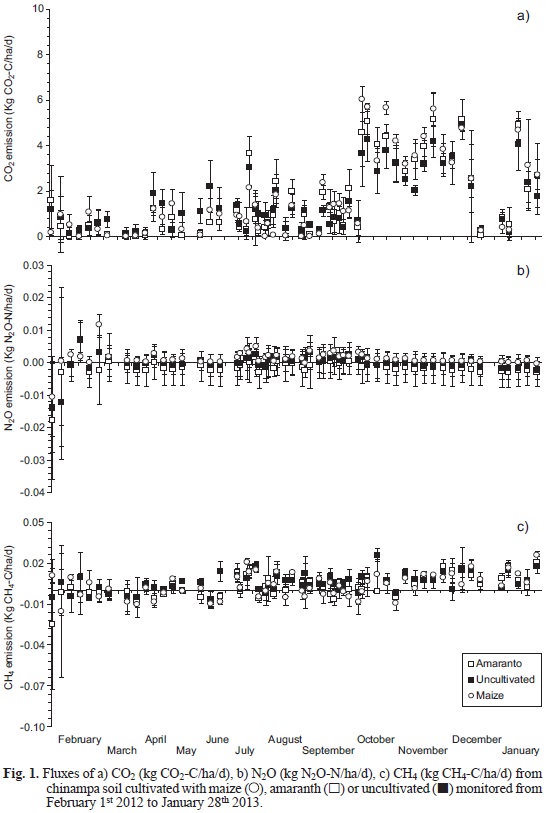
<body><![CDATA[<p align="justify"><font face="verdana" size="2">The overall GWP of the gasses emitted was calculated considering the GWP of 298 and 25 CO<sub>2</sub>&#45;equivalents for N<sub>2</sub>O and CH<sub>4</sub>, respectively (IPCC 2007).</font></p>  	    <p align="justify"><font face="verdana" size="2"><b>Statistical analysis</b></font></p>  	    <p align="justify"><font face="verdana" size="2">Emissions of CO<sub>2</sub>, CH<sub>4</sub> and N<sub>2</sub>O were regressed on elapsed time, i.e. 0, 20, 40 and 60 min, using a linear model forced to pass through the origin, but allowing different slopes (production rates). The sample at time 0 accounted for the atmospheric CO<sub>2</sub>, CH<sub>4</sub> and N<sub>2</sub>O, and was subtracted from the measured values.</font></p>  	    <p align="justify"><font face="verdana" size="2">The C content in the 0&#45;20, 20&#45;40, 40&#45;60 and 0&#45;60 cm layers were subjected to a two&#45;way analysis of variance using Proc GLM (SAS 1989) to test for a significant effect from layer, treatment and their interaction. Significant differences between treatments for CO<sub>2</sub>, CH<sub>4</sub> and N<sub>2</sub>O emission rates were determined using Proc Mixed considering repeated measurements (SAS 1989).</font></p>  	    <p align="justify"><font face="verdana" size="2">The total CO<sub>2</sub>, N<sub>2</sub>O and CH<sub>4</sub> emissions over the one&#45;year period were calculated by linear interpolation of data points between each successive sampling event (Ussiri <i>et al.</i> 2009) and numerical integration of underlying area using the trapezoid rule (Whittaker and Robinson 1967).</font></p>  	    <p align="justify"><font face="verdana" size="2"><b>RESULTS</b></font></p>  	    <p align="justify"><font face="verdana" size="2"><b>Soil characteristics</b></font></p>  	    <p align="justify"><font face="verdana" size="2">The pH of the sandy clay loam soil was alkaline and EC ranged from 2.79 to 6.64 dS/m (<b><a href="/img/revistas/rica/v31n4/a2t1.jpg" target="_blank">Table I</a></b>). The WHC of the soil ranged from 1888 to 2190 g/kg and total N from 5.92 to 6.17 g/kg, while the C<sub>tot</sub> was considered high and ranged from 45.8 to 48.6 g/kg soil. None of the soil characteristics was significantly different between treatments.</font></p>  	    <p align="justify"><font face="verdana" size="2"><b>Greenhouse gas emissions</b></font></p>  	    <p align="justify"><font face="verdana" size="2">The CO<sub>2</sub> emission did not show a clear pattern, but was higher by the end of 2012, and in the beginning of 2013 it ranged from 0.0012 to 6.0306 kg/ha/d (<b><a href="#f1">Fig. 1a</a></b>). The emission of N<sub>2</sub>O was considered low and ranged from &#45;0.0065 to 0.0118 kg/ha/d (<b><a href="#f1">Fig. 1b</a></b>). Sometimes negative values were obtained, i.e. reduction of N<sub>2</sub>O was larger than its production. The emission of N<sub>2</sub>O did not show large changes over time. The emission of CH<sub>4</sub> was low without a clear pattern (<b><a href="#f1">Fig. 1c</a></b>). The flux of CH<sub>4</sub> ranged from &#45;0.0249 to 0.0259 kg/ha/d and was mostly positive, so production prevailed over oxidation. The CO<sub>2</sub>, N<sub>2</sub>O and CH<sub>4</sub> emission rate was not affected significantly by treatment (<b><a href="#t2">Table II</a></b>).</font></p> 	    ]]></body>
<body><![CDATA[<p align="center"><a name="f1"></a></p> 	    <p align="center"><img src="/img/revistas/rica/v31n4/a2f1.jpg"></p> 	    <p align="center"><a name="t2"></a></p> 	    <p align="center"><img src="/img/revistas/rica/v31n4/a2t2.jpg"></p>  	    <p align="justify"><font face="verdana" size="2"><b>Global warming potential of the greenhouse gasses</b> The GWP of N<sub>2</sub>O and that of CH<sub>4</sub> were similar in the different treatments and varied between 258 and 395, and between 26 and 44 kg CO<sub>2</sub>&#45;equivalents/ha/y, respectively (<b><a href="#t3">Table III</a></b>). Consequently the GWP of the GHG was similar in the different treatments.</font></p> 	    <p align="center"><a name="t3"></a></p> 	    <p align="center"><img src="/img/revistas/rica/v31n4/a2t3.jpg"></p>  	    <p align="justify"><font face="verdana" size="2"><b>C content in the soil profile</b></font></p>  	    <p align="justify"><font face="verdana" size="2">The organic C content of the soils ranged from 21.7 t/ha in the 0&#45;20 cm layer of soil cultivated with amaranth to 28.4 t/ha in the 20&#45;40 cm layer of uncultivated soil (<b><a href="#t4">Table IV</a></b>). Soil layer, treatment and their interaction had no significant effect on the soil C content.</font></p> 	    <p align="center"><a name="t4"></a></p> 	    ]]></body>
<body><![CDATA[<p align="center"><img src="/img/revistas/rica/v31n4/a2t4.jpg"></p>  	    <p align="justify"><font face="verdana" size="2">&nbsp;</font></p>  	    <p align="justify"><font face="verdana" size="2"><b>DISCUSSION</b></font></p>  	    <p align="justify"><font face="verdana" size="2"><b>Soil characteristics</b></font></p>  	    <p align="justify"><font face="verdana" size="2">Adverse effects of salinity and alkalinity on plants have been reported (Carrion <i>et al.</i> 2012). The high EC and pH found in the chinampas soil might inhibit growth of certain crops. The chinampas soil has a high organic matter content compared to arable soils of the regions, e.g. 7.2 g C/kg found in soil of Otumba (State of Mexico). Soils with high organic matter content do generally have a good fertility, and crop yields are high (Ball <i>et al.</i> 2007).</font></p>  	    <p align="justify"><font face="verdana" size="2">The constant application of sediment buries the organic material in the deeper soil layers. Consequently, the soil profile was organic rich, but with no clear gradient as normally found in arable soils (<b><a href="#t4">Table IV</a></b>). The values found for C<sub>tot</sub> in the 0&#45;60 cm layer ranged from 73.9 in the maize cultivated soil to 81.7 t C/ha in the uncultivated soil, similar values have been reported in agricultural soils in the region. In the 0&#45;60 cm layer of a conventional tilled soil with wheat and maize crop rotation and removal of residue in the valley of Mexico, the carbon content was 69.7 t C/ha (Dendooven <i>et al.</i> 2012).</font></p>      <p align="justify"><font face="verdana" size="2"><b>Greenhouse gas emissions</b></font></p>  	    <p align="justify"><font face="verdana" size="2">Emissions of CO<sub>2</sub> were generally low in the first half of the year, but tended to increase towards the end of the year (<b><a href="#f1">Fig. 1a</a></b>). During the dry season, i.e. mostly from November to May, channel water is used to irrigate the crops. The channel water is organic rich (Chavarr&iacute;a <i>et al.</i> 2010) and the mineralization of the applied organic material will increase CO<sub>2</sub> emissions.</font></p>      <p align="justify"><font face="verdana" size="2">Mineralization of the organic matter will provide nutrients for the crops, but this will also favour N<sub>2</sub>O emissions, especially when an excess of mineralized N is present (Towprayoon <i>et al.</i> 2005). Additionally, frequent application of channel water will increase emissions of N<sub>2</sub>O as the moisture content increases and denitrification is stimulated (Stewart <i>et al.</i> 2012). Cultivation of crops is also known to increase the emission of N<sub>2</sub>O, as root exudates mineralization might stimulate denitrification (Kettunen <i>et al.</i> 2007).</font></p>  	    <p align="justify"><font face="verdana" size="2">In this study, N<sub>2</sub>O emissions were generally low and occasionally even negative (<b><a href="#f1">Fig. 1b</a></b>). Stewart <i>et al.</i> (2012) suggested that N<sub>2</sub>O uptake can occur at relatively low soil moisture and temperature, and limited soil N. These conditions might be present in the chinampa soil, especially during dry spells in the rainy season.</font></p>  	    ]]></body>
<body><![CDATA[<p align="justify"><font face="verdana" size="2">In the chinampa soil, the CH<sub>4</sub> flux was mostly positive so the production of CH<sub>4</sub> was often larger than its oxidation. The high organic matter content (which stimulates microbial activity and oxygen consumption) and the regular irrigation with channel water, facilitate the creation of anaerobic microsites, and in consequence, methanogenesis.</font></p>  	    <p align="justify"><font face="verdana" size="2">CO<sub>2</sub>, N<sub>2</sub>O and CH<sub>4</sub> fluxes were not affected by crop. Management practices, such as irrigation, tillage and cropping system, as well as characteristics of the soils were similar in the study, so their effect on GHG emissions would be the same in the three treatments. The only different factor between treatments was the cultivated crop. It has to be considered, however, that crops&#45;vegetables&#45;lowers are regularly rotated in chinampa so it is very unlikely that crop will have an effect on GHG emissions.</font></p>  	    <p align="justify"><font face="verdana" size="2"><b>Global warming potential of the greenhouse gases</b></font></p>  	    <p align="justify"><font face="verdana" size="2">N<sub>2</sub>O contributed 91 % to the GWP of the GHG and CH<sub>4</sub> 9 %. N<sub>2</sub>O is often the most important GHG from agricultural systems (Wan <i>et al.</i> 2012). It is only in rice&#45;cultivation that CH<sub>4</sub> emissions are often more important than N<sub>2</sub>O emissions (Horwath 2011). Cultivation of maize or amaranth had no significant effect on the GWP of the GHG. From this study, it can be assumed that the crop will have little effect on the GWP of the GHG emissions.</font></p>  	    <p align="justify"><font face="verdana" size="2">The GWP of the GHG was approximately 400 kg CO<sub>2</sub>&#45;equivalents/ha/y in a conventional agricultural system (tillage, maize monoculture, residue removal) in the valley of Mexico City in the year 2008&#45;2009 and 230 kg CO<sub>2</sub>&#45;equivalents/ha/y in 2009&#45;2010 (Dendooven <i>et al.</i> 2012). The values reported in this study were similar to those found in the arable soil mentioned above.</font></p>  	    <p align="justify"><font face="verdana" size="2">&nbsp;</font></p>  	    <p align="justify"><font face="verdana" size="2"><b>CONCLUSIONS</b></font></p>  	    <p align="justify"><font face="verdana" size="2">It was found that chinampa soils are saline&#45;alkaline, rich in nutrients and organic matter as a result of application of lake sediment and plant residues.</font></p>  	    <p align="justify"><font face="verdana" size="2">N<sub>2</sub>O contributed 91 % and CH<sub>4</sub> 9 % to the GWP of the GHG.</font></p>  	    <p align="justify"><font face="verdana" size="2">The GHG emissions were not affected significantly by cultivated crop or soil characteristics.</font></p>  	    ]]></body>
<body><![CDATA[<p align="justify"><font face="verdana" size="2">The organic C was equally distributed in the soil profile and large amounts of C were sequestered from the atmosphere.</font></p>  	    <p align="justify"><font face="verdana" size="2">&nbsp;</font></p>  	    <p align="justify"><font face="verdana" size="2"><b>ACKNOWLEDGMENTS</b></font></p>  	    <p align="justify"><font face="verdana" size="2">We thank the friendly collaboration of the family Medina, owners of the chinampa where the study was carried out, and CIBAC&#45;UAM Xochimilco for its help in this work. The research was funded by CINVESTAV (Mexico), SIP&#45;IPN 20090076 and 20120068, CONA&#45;CyT project 98042. N.L.O&#45;C, received grant&#45;aided support from the 'Consejo Nacional de Ciencia y Tecnolog&iacute;a' (CONACyT) and BEIFI&#45;IPN. M.S.V.&#45;M. and Y. R&#45;E received grant&#45;aided support of SNI&#45;CONACyT and COFAA and EDI&#45;IPN.</font></p>  	    <p align="justify"><font face="verdana" size="2">&nbsp;</font></p>  	    <p align="justify"><font face="verdana" size="2"><b>REFERENCES</b></font></p>  	    <!-- ref --><p align="justify"><font face="verdana" size="2">Arco L.J. and Abrams E.M. (2006). An essay on energetics: the construction of the Aztec chinampa system. Antiquity 80, 906&#45;918.    &nbsp;&nbsp;&nbsp;&nbsp;&nbsp;&nbsp;&nbsp;&nbsp;[&#160;<a href="javascript:void(0);" onclick="javascript: window.open('/scielo.php?script=sci_nlinks&ref=7238980&pid=S0188-4999201500040000200001&lng=','','width=640,height=500,resizable=yes,scrollbars=1,menubar=yes,');">Links</a>&#160;]<!-- end-ref --></font></p>  	    <!-- ref --><p align="justify"><font face="verdana" size="2">Ball B.C., Watson C.A. and Baddeley J.A. (2007). Soil physical fertility, soil structure and rooting conditions after ploughing organically managed grass/clover swards. Soil Use Manage. 23, 20&#45;27.    &nbsp;&nbsp;&nbsp;&nbsp;&nbsp;&nbsp;&nbsp;&nbsp;[&#160;<a href="javascript:void(0);" onclick="javascript: window.open('/scielo.php?script=sci_nlinks&ref=7238982&pid=S0188-4999201500040000200002&lng=','','width=640,height=500,resizable=yes,scrollbars=1,menubar=yes,');">Links</a>&#160;]<!-- end-ref --></font></p>  	    ]]></body>
<body><![CDATA[<!-- ref --><p align="justify"><font face="verdana" size="2">Carri&oacute;n C., Ponce&#45;De Le&oacute;n C., Cram S., Sommer I., Hern&aacute;ndez M. and Vanegas C. (2012). Potential use of water hyacinth <i>(Eichhornia crassipes)</i> in Xochimilco for metal phytoremediation. Agrociencia 46, 609&#45;620.    &nbsp;&nbsp;&nbsp;&nbsp;&nbsp;&nbsp;&nbsp;&nbsp;[&#160;<a href="javascript:void(0);" onclick="javascript: window.open('/scielo.php?script=sci_nlinks&ref=7238984&pid=S0188-4999201500040000200003&lng=','','width=640,height=500,resizable=yes,scrollbars=1,menubar=yes,');">Links</a>&#160;]<!-- end-ref --></font></p>  	    <!-- ref --><p align="justify"><font face="verdana" size="2">Chapin M. (1988). The seduction of models: Chinampa agriculture in Mexico. Grassroots Dev. 12, 8&#45;17.    &nbsp;&nbsp;&nbsp;&nbsp;&nbsp;&nbsp;&nbsp;&nbsp;[&#160;<a href="javascript:void(0);" onclick="javascript: window.open('/scielo.php?script=sci_nlinks&ref=7238986&pid=S0188-4999201500040000200004&lng=','','width=640,height=500,resizable=yes,scrollbars=1,menubar=yes,');">Links</a>&#160;]<!-- end-ref --></font></p>  	    <!-- ref --><p align="justify"><font face="verdana" size="2">Chavarr&iacute;a A., Gonz&aacute;lez M.C., Dant&aacute;n E. and Cifuentes J. (2010). Evaluaci&oacute;n espacial y temporal de la diversidad de los ascomicetes dulceacu&iacute;colas del canal tur&iacute;stico Santa Cruz, Xochimilco, M&eacute;xico. R. Mex. Biodivers. 81, 733&#45;744.    &nbsp;&nbsp;&nbsp;&nbsp;&nbsp;&nbsp;&nbsp;&nbsp;[&#160;<a href="javascript:void(0);" onclick="javascript: window.open('/scielo.php?script=sci_nlinks&ref=7238988&pid=S0188-4999201500040000200005&lng=','','width=640,height=500,resizable=yes,scrollbars=1,menubar=yes,');">Links</a>&#160;]<!-- end-ref --></font></p>  	    <!-- ref --><p align="justify"><font face="verdana" size="2">Clauzel C. (2009). Between urban pressure and heritage: Which place for agriculture in the Chinampas of Xochimilco (Mexico)?. Cah. Agric. 18, 323&#45;328.    &nbsp;&nbsp;&nbsp;&nbsp;&nbsp;&nbsp;&nbsp;&nbsp;[&#160;<a href="javascript:void(0);" onclick="javascript: window.open('/scielo.php?script=sci_nlinks&ref=7238990&pid=S0188-4999201500040000200006&lng=','','width=640,height=500,resizable=yes,scrollbars=1,menubar=yes,');">Links</a>&#160;]<!-- end-ref --></font></p>  	    <!-- ref --><p align="justify"><font face="verdana" size="2">Dendooven L., Pati&ntilde;o&#45;Z&uacute;&ntilde;iga L., Verhulst N., Luna&#45;Guido M., Marsch R. and Govaerts B. (2012). Global warming potential of agricultural systems with contrasting tillage and residue management in the central highlands of Mexico. Agric. Ecosyst. Environ. 152, 50&#45;58.    &nbsp;&nbsp;&nbsp;&nbsp;&nbsp;&nbsp;&nbsp;&nbsp;[&#160;<a href="javascript:void(0);" onclick="javascript: window.open('/scielo.php?script=sci_nlinks&ref=7238992&pid=S0188-4999201500040000200007&lng=','','width=640,height=500,resizable=yes,scrollbars=1,menubar=yes,');">Links</a>&#160;]<!-- end-ref --></font></p>  	    ]]></body>
<body><![CDATA[<!-- ref --><p align="justify"><font face="verdana" size="2">Horwath W.R. (2011). Greenhouse gas emissions from rice cropping systems. In: Understanding greenhouse gas emissions from agricultural management (L. Guo, A.S. Gunasekara and L.L. Mcconnell, Eds.) ACS Symposium Series 1072, American Chemical Society&#45;Oxford University Press Inc., Washington, D.C., USA, pp. 67&#45;89.    &nbsp;&nbsp;&nbsp;&nbsp;&nbsp;&nbsp;&nbsp;&nbsp;[&#160;<a href="javascript:void(0);" onclick="javascript: window.open('/scielo.php?script=sci_nlinks&ref=7238994&pid=S0188-4999201500040000200008&lng=','','width=640,height=500,resizable=yes,scrollbars=1,menubar=yes,');">Links</a>&#160;]<!-- end-ref --></font></p>  	    <!-- ref --><p align="justify"><font face="verdana" size="2">IPCC (2007). The physical science basis. Summary for Policymakers. Intergovernmental Panel on Climate Change WGI, Fourth Assessment Report, Climate Change. Geneva, Switzerland. &#91;On line&#93;. <a href="http://www.ipcc.ch/pdf/assessment&#45;report/ar4/syr/ar4_syr_sp.pdf" target="_blank">http://www.ipcc.ch/pdf/assessment&#45;report/ar4/syr/ar4_syr_sp.pdf</a>.    &nbsp;&nbsp;&nbsp;&nbsp;&nbsp;&nbsp;&nbsp;&nbsp;[&#160;<a href="javascript:void(0);" onclick="javascript: window.open('/scielo.php?script=sci_nlinks&ref=7238996&pid=S0188-4999201500040000200009&lng=','','width=640,height=500,resizable=yes,scrollbars=1,menubar=yes,');">Links</a>&#160;]<!-- end-ref --></font></p>  	    <!-- ref --><p align="justify"><font face="verdana" size="2">Kettunen R., Saarnio S., Martikainen P.J. and Silvola J. (2007). Can a mixed stand of N<sub>2</sub>&#45;fixing and non&#45;fixing plants restrict N<sub>2</sub>O emissions with increasing CO<sub>2</sub> concentration?. Soil Biol. Biochem. 39, 2538&#45;2546.    &nbsp;&nbsp;&nbsp;&nbsp;&nbsp;&nbsp;&nbsp;&nbsp;[&#160;<a href="javascript:void(0);" onclick="javascript: window.open('/scielo.php?script=sci_nlinks&ref=7238998&pid=S0188-4999201500040000200010&lng=','','width=640,height=500,resizable=yes,scrollbars=1,menubar=yes,');">Links</a>&#160;]<!-- end-ref --></font></p>  	    <!-- ref --><p align="justify"><font face="verdana" size="2">Leszczynska&#45;Borys H. and Borys M.W. (2010). Splendor of Mexican prehispanic gardens. II International conference on landscape and urban horticulture. Acta Hortic. 881, 891&#45;898.    &nbsp;&nbsp;&nbsp;&nbsp;&nbsp;&nbsp;&nbsp;&nbsp;[&#160;<a href="javascript:void(0);" onclick="javascript: window.open('/scielo.php?script=sci_nlinks&ref=7239000&pid=S0188-4999201500040000200011&lng=','','width=640,height=500,resizable=yes,scrollbars=1,menubar=yes,');">Links</a>&#160;]<!-- end-ref --></font></p>  	    <!-- ref --><p align="justify"><font face="verdana" size="2">Morehart C. T. (2012). Mapping ancient chinampa landscapes in the Basin of Mexico: a remote sensing and GIS approach. J. Archaeol. Sci. 39, 2541&#45;2551.    &nbsp;&nbsp;&nbsp;&nbsp;&nbsp;&nbsp;&nbsp;&nbsp;[&#160;<a href="javascript:void(0);" onclick="javascript: window.open('/scielo.php?script=sci_nlinks&ref=7239002&pid=S0188-4999201500040000200012&lng=','','width=640,height=500,resizable=yes,scrollbars=1,menubar=yes,');">Links</a>&#160;]<!-- end-ref --></font></p>  	    ]]></body>
<body><![CDATA[<!-- ref --><p align="justify"><font face="verdana" size="2">Morehart C.T. and Frederick C. (2014). The chronology and collapse of pre&#45;Aztec raised field (chinampa) agriculture in the northern Basin of Mexico. Antiquity 88, 531&#45;548.    &nbsp;&nbsp;&nbsp;&nbsp;&nbsp;&nbsp;&nbsp;&nbsp;[&#160;<a href="javascript:void(0);" onclick="javascript: window.open('/scielo.php?script=sci_nlinks&ref=7239004&pid=S0188-4999201500040000200013&lng=','','width=640,height=500,resizable=yes,scrollbars=1,menubar=yes,');">Links</a>&#160;]<!-- end-ref --></font></p>  	    <!-- ref --><p align="justify"><font face="verdana" size="2">Parkin T., Mosier A., Smith J., Venterea R., Johnson J., Reicosky D., Doyle G., Mccarty G. and Baker J. (2003). Chamber&#45;based trace gas flux measurement protocol, USDA&#45;ARS GRACEnet. USDA, pp. 1&#45;28 &#91;online&#93; <a href="http://www.usmarc.usda.gov/SP2UserFiles/person/31831/2003GRACEnetTraceGasProtocol.pdf" target="_blank">http://www.usmarc.usda.gov/SP2UserFiles/person/31831/2003GRACEnetTraceGasProtocol.pdf</a>.    &nbsp;&nbsp;&nbsp;&nbsp;&nbsp;&nbsp;&nbsp;&nbsp;[&#160;<a href="javascript:void(0);" onclick="javascript: window.open('/scielo.php?script=sci_nlinks&ref=7239006&pid=S0188-4999201500040000200014&lng=','','width=640,height=500,resizable=yes,scrollbars=1,menubar=yes,');">Links</a>&#160;]<!-- end-ref --></font></p>  	    <!-- ref --><p align="justify"><font face="verdana" size="2">Robertson G.P. and Paul E.A., Harwood R.R. (2000). Greenhouse gases in intensive agriculture: contributions of individual gases to the radiative forcing of the atmosphere. Science 289, 1922&#45;1925.    &nbsp;&nbsp;&nbsp;&nbsp;&nbsp;&nbsp;&nbsp;&nbsp;[&#160;<a href="javascript:void(0);" onclick="javascript: window.open('/scielo.php?script=sci_nlinks&ref=7239008&pid=S0188-4999201500040000200015&lng=','','width=640,height=500,resizable=yes,scrollbars=1,menubar=yes,');">Links</a>&#160;]<!-- end-ref --></font></p>  	    <!-- ref --><p align="justify"><font face="verdana" size="2">Sanford R.A., Wagner D.D., Wu Q., Chee&#45;Sanford J.C., Thomas S.H., Cruz&#45;Garc&iacute;a C., Rodr&iacute;guez G., Massol&#45;Dey&aacute; A., Kishore K.K., Kirsti M.R., Konstantinos T.K and Lofflerg F.E. (2012). Unexpected non denitrifier nitrous oxide reductase gene diversity and abundance in soils. Proc. Nat. Acad. Sci. USA 27, 19709&#45;19714.    &nbsp;&nbsp;&nbsp;&nbsp;&nbsp;&nbsp;&nbsp;&nbsp;[&#160;<a href="javascript:void(0);" onclick="javascript: window.open('/scielo.php?script=sci_nlinks&ref=7239010&pid=S0188-4999201500040000200016&lng=','','width=640,height=500,resizable=yes,scrollbars=1,menubar=yes,');">Links</a>&#160;]<!-- end-ref --></font></p>  	    <!-- ref --><p align="justify"><font face="verdana" size="2">SAS (1989). Statistic guide for personal computers. Version 6.04. (Ed.). SAS Institute, Inc., Cary. NC, USA.    &nbsp;&nbsp;&nbsp;&nbsp;&nbsp;&nbsp;&nbsp;&nbsp;[&#160;<a href="javascript:void(0);" onclick="javascript: window.open('/scielo.php?script=sci_nlinks&ref=7239012&pid=S0188-4999201500040000200017&lng=','','width=640,height=500,resizable=yes,scrollbars=1,menubar=yes,');">Links</a>&#160;]<!-- end-ref --></font></p>  	    ]]></body>
<body><![CDATA[<!-- ref --><p align="justify"><font face="verdana" size="2">Serrano&#45;Silva N., Luna&#45;Guido M., Luque&ntilde;o&#45;Fern&aacute;ndez F., Ceballos J.M., Marsch R. and Dendooven L. (2011). Dynamics of carbon and nitrogen and the emission of greenhouse gases in an agricultural soil amended with urea: a laboratory study. Appl. Soil Ecol. 47, 92&#45;97.    &nbsp;&nbsp;&nbsp;&nbsp;&nbsp;&nbsp;&nbsp;&nbsp;[&#160;<a href="javascript:void(0);" onclick="javascript: window.open('/scielo.php?script=sci_nlinks&ref=7239014&pid=S0188-4999201500040000200018&lng=','','width=640,height=500,resizable=yes,scrollbars=1,menubar=yes,');">Links</a>&#160;]<!-- end-ref --></font></p>  	    <!-- ref --><p align="justify"><font face="verdana" size="2">Smith P. and Gregory P.J. (2013). Climate change and sustainable food production. J. Proc. Nutr. Soc. 72, 21&#45;28.    &nbsp;&nbsp;&nbsp;&nbsp;&nbsp;&nbsp;&nbsp;&nbsp;[&#160;<a href="javascript:void(0);" onclick="javascript: window.open('/scielo.php?script=sci_nlinks&ref=7239016&pid=S0188-4999201500040000200019&lng=','','width=640,height=500,resizable=yes,scrollbars=1,menubar=yes,');">Links</a>&#160;]<!-- end-ref --></font></p>  	    <!-- ref --><p align="justify"><font face="verdana" size="2">Stewart K.J., Brummell M.E., Farrell R.E. and Siciliano S.D. (2012). N<sub>2</sub>O flux from plant&#45;soil systems in polar deserts switch between sources and sinks under different light conditions. Soil Biol. Biochem. 48, 69&#45;77.    &nbsp;&nbsp;&nbsp;&nbsp;&nbsp;&nbsp;&nbsp;&nbsp;[&#160;<a href="javascript:void(0);" onclick="javascript: window.open('/scielo.php?script=sci_nlinks&ref=7239018&pid=S0188-4999201500040000200020&lng=','','width=640,height=500,resizable=yes,scrollbars=1,menubar=yes,');">Links</a>&#160;]<!-- end-ref --></font></p>  	    <!-- ref --><p align="justify"><font face="verdana" size="2">Thelen K.D., Fronning B.E., Kravchenko A., Min D.H. and Robertson G.P. (2010). Integrating livestock manure with a corn&#45;soybean bioenergy cropping system improves short&#45;term carbon sequestration rates and net global warming potential. Biomass Bioenerg. 34, 960&#45;966.    &nbsp;&nbsp;&nbsp;&nbsp;&nbsp;&nbsp;&nbsp;&nbsp;[&#160;<a href="javascript:void(0);" onclick="javascript: window.open('/scielo.php?script=sci_nlinks&ref=7239020&pid=S0188-4999201500040000200021&lng=','','width=640,height=500,resizable=yes,scrollbars=1,menubar=yes,');">Links</a>&#160;]<!-- end-ref --></font></p>  	    <!-- ref --><p align="justify"><font face="verdana" size="2">Towprayoon S., Smakgahn K. and Poonkaew S. (2005). Mitigation of methane and nitrous oxide emissions from drained irrigated rice fields. Chemosphere 59, 1547&#45;1556.    &nbsp;&nbsp;&nbsp;&nbsp;&nbsp;&nbsp;&nbsp;&nbsp;[&#160;<a href="javascript:void(0);" onclick="javascript: window.open('/scielo.php?script=sci_nlinks&ref=7239022&pid=S0188-4999201500040000200022&lng=','','width=640,height=500,resizable=yes,scrollbars=1,menubar=yes,');">Links</a>&#160;]<!-- end-ref --></font></p>  	    ]]></body>
<body><![CDATA[<!-- ref --><p align="justify"><font face="verdana" size="2">Ussiri D.A.N., Lal R. and Jarecki M.K. (2009). Nitrous oxide and methane emissions from long&#45;term tillage under a continuous corn cropping system in Ohio. Soil Till. Res. 104, 247&#45;255.    &nbsp;&nbsp;&nbsp;&nbsp;&nbsp;&nbsp;&nbsp;&nbsp;[&#160;<a href="javascript:void(0);" onclick="javascript: window.open('/scielo.php?script=sci_nlinks&ref=7239024&pid=S0188-4999201500040000200023&lng=','','width=640,height=500,resizable=yes,scrollbars=1,menubar=yes,');">Links</a>&#160;]<!-- end-ref --></font></p>  	    <!-- ref --><p align="justify"><font face="verdana" size="2">Wan S., Ward T. L. and Altosaar I. (2012). Strategy and tactics of disarming GHG at the source: N<sub>2</sub>O reductase crops. Trends Biotechnol. 30, 410&#45;425.    &nbsp;&nbsp;&nbsp;&nbsp;&nbsp;&nbsp;&nbsp;&nbsp;[&#160;<a href="javascript:void(0);" onclick="javascript: window.open('/scielo.php?script=sci_nlinks&ref=7239026&pid=S0188-4999201500040000200024&lng=','','width=640,height=500,resizable=yes,scrollbars=1,menubar=yes,');">Links</a>&#160;]<!-- end-ref --></font></p>  	    <!-- ref --><p align="justify"><font face="verdana" size="2">Wang J., Zhang X., Liu Y., Pan X., Liu P., Chen Z., Huang T. and Xiong Z. (2012). Modelling impacts of alternative practices on net global warming potential and greenhouse gas intensity from rice&#45;wheat annual rotation in China. PLoS One 7, e45668.    &nbsp;&nbsp;&nbsp;&nbsp;&nbsp;&nbsp;&nbsp;&nbsp;[&#160;<a href="javascript:void(0);" onclick="javascript: window.open('/scielo.php?script=sci_nlinks&ref=7239028&pid=S0188-4999201500040000200025&lng=','','width=640,height=500,resizable=yes,scrollbars=1,menubar=yes,');">Links</a>&#160;]<!-- end-ref --></font></p>  	    <!-- ref --><p align="justify"><font face="verdana" size="2">Whittaker E.T. and Robinson G. (1967). Trapezoidal and parabolic rules. In: The calculus observations: A treatise on numerical mathematics. 4th ed. Dover, New York, EUA. pp 156&#45;158.    &nbsp;&nbsp;&nbsp;&nbsp;&nbsp;&nbsp;&nbsp;&nbsp;[&#160;<a href="javascript:void(0);" onclick="javascript: window.open('/scielo.php?script=sci_nlinks&ref=7239030&pid=S0188-4999201500040000200026&lng=','','width=640,height=500,resizable=yes,scrollbars=1,menubar=yes,');">Links</a>&#160;]<!-- end-ref --></font></p>      ]]></body><back>
<ref-list>
<ref id="B1">
<nlm-citation citation-type="journal">
<person-group person-group-type="author">
<name>
<surname><![CDATA[Arco]]></surname>
<given-names><![CDATA[L.J.]]></given-names>
</name>
<name>
<surname><![CDATA[Abrams]]></surname>
<given-names><![CDATA[E.M.]]></given-names>
</name>
</person-group>
<article-title xml:lang="en"><![CDATA[An essay on energetics: the construction of the Aztec chinampa system]]></article-title>
<source><![CDATA[Antiquity]]></source>
<year>2006</year>
<volume>80</volume>
<page-range>906-918</page-range></nlm-citation>
</ref>
<ref id="B2">
<nlm-citation citation-type="journal">
<person-group person-group-type="author">
<name>
<surname><![CDATA[Ball]]></surname>
<given-names><![CDATA[B.C.]]></given-names>
</name>
<name>
<surname><![CDATA[Watson]]></surname>
<given-names><![CDATA[C.A.]]></given-names>
</name>
<name>
<surname><![CDATA[Baddeley]]></surname>
<given-names><![CDATA[J.A.]]></given-names>
</name>
</person-group>
<article-title xml:lang="en"><![CDATA[Soil physical fertility, soil structure and rooting conditions after ploughing organically managed grass/clover swards]]></article-title>
<source><![CDATA[Soil Use Manage]]></source>
<year>2007</year>
<volume>23</volume>
<page-range>20-27</page-range></nlm-citation>
</ref>
<ref id="B3">
<nlm-citation citation-type="journal">
<person-group person-group-type="author">
<name>
<surname><![CDATA[Carrión]]></surname>
<given-names><![CDATA[C.]]></given-names>
</name>
<name>
<surname><![CDATA[Ponce-De León]]></surname>
<given-names><![CDATA[C.]]></given-names>
</name>
<name>
<surname><![CDATA[Cram]]></surname>
<given-names><![CDATA[S.]]></given-names>
</name>
<name>
<surname><![CDATA[Sommer]]></surname>
<given-names><![CDATA[I.]]></given-names>
</name>
<name>
<surname><![CDATA[Hernández]]></surname>
<given-names><![CDATA[M.]]></given-names>
</name>
<name>
<surname><![CDATA[Vanegas]]></surname>
<given-names><![CDATA[C.]]></given-names>
</name>
</person-group>
<article-title xml:lang="en"><![CDATA[Potential use of water hyacinth (Eichhornia crassipes) in Xochimilco for metal phytoremediation]]></article-title>
<source><![CDATA[Agrociencia]]></source>
<year>2012</year>
<volume>46</volume>
<page-range>609-620</page-range></nlm-citation>
</ref>
<ref id="B4">
<nlm-citation citation-type="journal">
<person-group person-group-type="author">
<name>
<surname><![CDATA[Chapin]]></surname>
<given-names><![CDATA[M.]]></given-names>
</name>
</person-group>
<article-title xml:lang="en"><![CDATA[The seduction of models: Chinampa agriculture in Mexico]]></article-title>
<source><![CDATA[Grassroots Dev]]></source>
<year>1988</year>
<volume>12</volume>
<page-range>8-17</page-range></nlm-citation>
</ref>
<ref id="B5">
<nlm-citation citation-type="journal">
<person-group person-group-type="author">
<name>
<surname><![CDATA[Chavarría]]></surname>
<given-names><![CDATA[A.]]></given-names>
</name>
<name>
<surname><![CDATA[González]]></surname>
<given-names><![CDATA[M.C.]]></given-names>
</name>
<name>
<surname><![CDATA[Dantán]]></surname>
<given-names><![CDATA[E.]]></given-names>
</name>
<name>
<surname><![CDATA[Cifuentes]]></surname>
<given-names><![CDATA[J.]]></given-names>
</name>
</person-group>
<article-title xml:lang="es"><![CDATA[Evaluación espacial y temporal de la diversidad de los ascomicetes dulceacuícolas del canal turístico Santa Cruz, Xochimilco, México]]></article-title>
<source><![CDATA[R. Mex. Biodivers]]></source>
<year>2010</year>
<volume>81</volume>
<page-range>733-744</page-range></nlm-citation>
</ref>
<ref id="B6">
<nlm-citation citation-type="journal">
<person-group person-group-type="author">
<name>
<surname><![CDATA[Clauzel]]></surname>
<given-names><![CDATA[C.]]></given-names>
</name>
</person-group>
<article-title xml:lang="en"><![CDATA[Between urban pressure and heritage: Which place for agriculture in the Chinampas of Xochimilco (Mexico)?]]></article-title>
<source><![CDATA[Cah. Agric]]></source>
<year>2009</year>
<volume>18</volume>
<page-range>323-328</page-range></nlm-citation>
</ref>
<ref id="B7">
<nlm-citation citation-type="journal">
<person-group person-group-type="author">
<name>
<surname><![CDATA[Dendooven]]></surname>
<given-names><![CDATA[L.]]></given-names>
</name>
<name>
<surname><![CDATA[Patiño-Zúñiga]]></surname>
<given-names><![CDATA[L.]]></given-names>
</name>
<name>
<surname><![CDATA[Verhulst]]></surname>
<given-names><![CDATA[N.]]></given-names>
</name>
<name>
<surname><![CDATA[Luna-Guido]]></surname>
<given-names><![CDATA[M.]]></given-names>
</name>
<name>
<surname><![CDATA[Marsch]]></surname>
<given-names><![CDATA[R.]]></given-names>
</name>
<name>
<surname><![CDATA[Govaerts]]></surname>
<given-names><![CDATA[B.]]></given-names>
</name>
</person-group>
<article-title xml:lang="en"><![CDATA[Global warming potential of agricultural systems with contrasting tillage and residue management in the central highlands of Mexico]]></article-title>
<source><![CDATA[Agric. Ecosyst. Environ]]></source>
<year>2012</year>
<volume>152</volume>
<page-range>50-58</page-range></nlm-citation>
</ref>
<ref id="B8">
<nlm-citation citation-type="book">
<person-group person-group-type="author">
<name>
<surname><![CDATA[Horwath]]></surname>
<given-names><![CDATA[W.R.]]></given-names>
</name>
</person-group>
<article-title xml:lang="en"><![CDATA[Greenhouse gas emissions from rice cropping systems]]></article-title>
<person-group person-group-type="editor">
<name>
<surname><![CDATA[Guo]]></surname>
<given-names><![CDATA[L.]]></given-names>
</name>
<name>
<surname><![CDATA[Gunasekara]]></surname>
<given-names><![CDATA[A.S.]]></given-names>
</name>
<name>
<surname><![CDATA[Mcconnell]]></surname>
<given-names><![CDATA[L.L.]]></given-names>
</name>
</person-group>
<source><![CDATA[Understanding greenhouse gas emissions from agricultural management]]></source>
<year>2011</year>
<page-range>67-89</page-range><publisher-loc><![CDATA[Washington^eD.C. D.C.]]></publisher-loc>
<publisher-name><![CDATA[American Chemical SocietyOxford University Press Inc.]]></publisher-name>
</nlm-citation>
</ref>
<ref id="B9">
<nlm-citation citation-type="book">
<collab>IPCC</collab>
<source><![CDATA[The physical science basis. Summary for Policymakers]]></source>
<year>2007</year>
<publisher-loc><![CDATA[Geneva ]]></publisher-loc>
<publisher-name><![CDATA[Intergovernmental Panel on Climate Change WGI]]></publisher-name>
</nlm-citation>
</ref>
<ref id="B10">
<nlm-citation citation-type="journal">
<person-group person-group-type="author">
<name>
<surname><![CDATA[Kettunen]]></surname>
<given-names><![CDATA[R.]]></given-names>
</name>
<name>
<surname><![CDATA[Saarnio]]></surname>
<given-names><![CDATA[S.]]></given-names>
</name>
<name>
<surname><![CDATA[Martikainen]]></surname>
<given-names><![CDATA[P.J.]]></given-names>
</name>
<name>
<surname><![CDATA[Silvola]]></surname>
<given-names><![CDATA[J.]]></given-names>
</name>
</person-group>
<article-title xml:lang="en"><![CDATA[Can a mixed stand of N2-fixing and non-fixing plants restrict N2O emissions with increasing CO2 concentration?]]></article-title>
<source><![CDATA[Soil Biol. Biochem]]></source>
<year>2007</year>
<volume>39</volume>
<page-range>2538-2546</page-range></nlm-citation>
</ref>
<ref id="B11">
<nlm-citation citation-type="journal">
<person-group person-group-type="author">
<name>
<surname><![CDATA[Leszczynska-Borys]]></surname>
<given-names><![CDATA[H.]]></given-names>
</name>
<name>
<surname><![CDATA[Borys]]></surname>
<given-names><![CDATA[M.W.]]></given-names>
</name>
</person-group>
<article-title xml:lang="en"><![CDATA[Splendor of Mexican prehispanic gardens. II International conference on landscape and urban horticulture]]></article-title>
<source><![CDATA[Acta Hortic]]></source>
<year>2010</year>
<volume>881</volume>
<page-range>891-898</page-range></nlm-citation>
</ref>
<ref id="B12">
<nlm-citation citation-type="journal">
<person-group person-group-type="author">
<name>
<surname><![CDATA[Morehart]]></surname>
<given-names><![CDATA[C. T.]]></given-names>
</name>
</person-group>
<article-title xml:lang="en"><![CDATA[Mapping ancient chinampa landscapes in the Basin of Mexico: a remote sensing and GIS approach]]></article-title>
<source><![CDATA[J. Archaeol. Sci]]></source>
<year>2012</year>
<volume>39</volume>
<page-range>2541-2551</page-range></nlm-citation>
</ref>
<ref id="B13">
<nlm-citation citation-type="journal">
<person-group person-group-type="author">
<name>
<surname><![CDATA[Morehart]]></surname>
<given-names><![CDATA[C.T.]]></given-names>
</name>
<name>
<surname><![CDATA[Frederick]]></surname>
<given-names><![CDATA[C.]]></given-names>
</name>
</person-group>
<article-title xml:lang="en"><![CDATA[The chronology and collapse of pre-Aztec raised field (chinampa) agriculture in the northern Basin of Mexico]]></article-title>
<source><![CDATA[Antiquity]]></source>
<year>2014</year>
<volume>88</volume>
<page-range>531-548</page-range></nlm-citation>
</ref>
<ref id="B14">
<nlm-citation citation-type="book">
<person-group person-group-type="author">
<name>
<surname><![CDATA[Parkin]]></surname>
<given-names><![CDATA[T.]]></given-names>
</name>
<name>
<surname><![CDATA[Mosier]]></surname>
<given-names><![CDATA[A.]]></given-names>
</name>
<name>
<surname><![CDATA[Smith]]></surname>
<given-names><![CDATA[J.]]></given-names>
</name>
<name>
<surname><![CDATA[Venterea]]></surname>
<given-names><![CDATA[R.]]></given-names>
</name>
<name>
<surname><![CDATA[Johnson]]></surname>
<given-names><![CDATA[J.]]></given-names>
</name>
<name>
<surname><![CDATA[Reicosky]]></surname>
<given-names><![CDATA[D.]]></given-names>
</name>
<name>
<surname><![CDATA[Doyle]]></surname>
<given-names><![CDATA[G.]]></given-names>
</name>
<name>
<surname><![CDATA[Mccarty]]></surname>
<given-names><![CDATA[G.]]></given-names>
</name>
<name>
<surname><![CDATA[Baker]]></surname>
<given-names><![CDATA[J.]]></given-names>
</name>
</person-group>
<source><![CDATA[Chamber-based trace gas flux measurement protocol]]></source>
<year>2003</year>
<page-range>1-28</page-range><publisher-name><![CDATA[USDAARS]]></publisher-name>
</nlm-citation>
</ref>
<ref id="B15">
<nlm-citation citation-type="journal">
<person-group person-group-type="author">
<name>
<surname><![CDATA[Robertson]]></surname>
<given-names><![CDATA[G.P.]]></given-names>
</name>
<name>
<surname><![CDATA[Paul]]></surname>
<given-names><![CDATA[E.A.]]></given-names>
</name>
<name>
<surname><![CDATA[Harwood]]></surname>
<given-names><![CDATA[R.R.]]></given-names>
</name>
</person-group>
<article-title xml:lang="en"><![CDATA[Greenhouse gases in intensive agriculture: contributions of individual gases to the radiative forcing of the atmosphere]]></article-title>
<source><![CDATA[Science]]></source>
<year>2000</year>
<volume>289</volume>
<page-range>1922-1925</page-range></nlm-citation>
</ref>
<ref id="B16">
<nlm-citation citation-type="journal">
<person-group person-group-type="author">
<name>
<surname><![CDATA[Sanford]]></surname>
<given-names><![CDATA[R.A.]]></given-names>
</name>
<name>
<surname><![CDATA[Wagner]]></surname>
<given-names><![CDATA[D.D.]]></given-names>
</name>
<name>
<surname><![CDATA[Wu]]></surname>
<given-names><![CDATA[Q.]]></given-names>
</name>
<name>
<surname><![CDATA[Chee-Sanford]]></surname>
<given-names><![CDATA[J.C.]]></given-names>
</name>
<name>
<surname><![CDATA[Thomas]]></surname>
<given-names><![CDATA[S.H.]]></given-names>
</name>
<name>
<surname><![CDATA[Cruz-García]]></surname>
<given-names><![CDATA[C.]]></given-names>
</name>
<name>
<surname><![CDATA[Rodríguez]]></surname>
<given-names><![CDATA[G.]]></given-names>
</name>
<name>
<surname><![CDATA[Massol-Deyá]]></surname>
<given-names><![CDATA[A.]]></given-names>
</name>
<name>
<surname><![CDATA[Kishore]]></surname>
<given-names><![CDATA[K.K.]]></given-names>
</name>
<name>
<surname><![CDATA[Kirsti]]></surname>
<given-names><![CDATA[M.R.]]></given-names>
</name>
<name>
<surname><![CDATA[Konstantinos]]></surname>
<given-names><![CDATA[T.K]]></given-names>
</name>
<name>
<surname><![CDATA[Lofflerg]]></surname>
<given-names><![CDATA[F.E.]]></given-names>
</name>
</person-group>
<article-title xml:lang="en"><![CDATA[Unexpected non denitrifier nitrous oxide reductase gene diversity and abundance in soils]]></article-title>
<source><![CDATA[Proc. Nat. Acad. Sci. USA]]></source>
<year>2012</year>
<volume>27</volume>
<page-range>19709-19714</page-range></nlm-citation>
</ref>
<ref id="B17">
<nlm-citation citation-type="book">
<collab>SAS</collab>
<source><![CDATA[Statistic guide for personal computers. Version 6.04]]></source>
<year>1989</year>
<publisher-loc><![CDATA[Cary^eNC NC]]></publisher-loc>
<publisher-name><![CDATA[SAS Institute, Inc.]]></publisher-name>
</nlm-citation>
</ref>
<ref id="B18">
<nlm-citation citation-type="journal">
<person-group person-group-type="author">
<name>
<surname><![CDATA[Serrano-Silva]]></surname>
<given-names><![CDATA[N.]]></given-names>
</name>
<name>
<surname><![CDATA[Luna-Guido]]></surname>
<given-names><![CDATA[M.]]></given-names>
</name>
<name>
<surname><![CDATA[Luqueño-Fernández]]></surname>
<given-names><![CDATA[F.]]></given-names>
</name>
<name>
<surname><![CDATA[Ceballos]]></surname>
<given-names><![CDATA[J.M.]]></given-names>
</name>
<name>
<surname><![CDATA[Marsch]]></surname>
<given-names><![CDATA[R.]]></given-names>
</name>
<name>
<surname><![CDATA[Dendooven]]></surname>
<given-names><![CDATA[L.]]></given-names>
</name>
</person-group>
<article-title xml:lang="en"><![CDATA[Dynamics of carbon and nitrogen and the emission of greenhouse gases in an agricultural soil amended with urea: a laboratory study]]></article-title>
<source><![CDATA[Appl. Soil Ecol]]></source>
<year>2011</year>
<volume>47</volume>
<page-range>92-97</page-range></nlm-citation>
</ref>
<ref id="B19">
<nlm-citation citation-type="journal">
<person-group person-group-type="author">
<name>
<surname><![CDATA[Smith]]></surname>
<given-names><![CDATA[P.]]></given-names>
</name>
<name>
<surname><![CDATA[Gregory]]></surname>
<given-names><![CDATA[P.J.]]></given-names>
</name>
</person-group>
<article-title xml:lang="en"><![CDATA[Climate change and sustainable food production]]></article-title>
<source><![CDATA[J. Proc. Nutr. Soc]]></source>
<year>2013</year>
<volume>72</volume>
<page-range>21-28</page-range></nlm-citation>
</ref>
<ref id="B20">
<nlm-citation citation-type="journal">
<person-group person-group-type="author">
<name>
<surname><![CDATA[Stewart]]></surname>
<given-names><![CDATA[K.J.]]></given-names>
</name>
<name>
<surname><![CDATA[Brummell]]></surname>
<given-names><![CDATA[M.E.]]></given-names>
</name>
<name>
<surname><![CDATA[Farrell]]></surname>
<given-names><![CDATA[R.E.]]></given-names>
</name>
<name>
<surname><![CDATA[Siciliano]]></surname>
<given-names><![CDATA[S.D.]]></given-names>
</name>
</person-group>
<article-title xml:lang="en"><![CDATA[N2O flux from plant-soil systems in polar deserts switch between sources and sinks under different light conditions]]></article-title>
<source><![CDATA[Soil Biol. Biochem]]></source>
<year>2012</year>
<volume>48</volume>
<page-range>69-77</page-range></nlm-citation>
</ref>
<ref id="B21">
<nlm-citation citation-type="journal">
<person-group person-group-type="author">
<name>
<surname><![CDATA[Thelen]]></surname>
<given-names><![CDATA[K.D.]]></given-names>
</name>
<name>
<surname><![CDATA[Fronning]]></surname>
<given-names><![CDATA[B.E.]]></given-names>
</name>
<name>
<surname><![CDATA[Kravchenko]]></surname>
<given-names><![CDATA[A.]]></given-names>
</name>
<name>
<surname><![CDATA[Min]]></surname>
<given-names><![CDATA[D.H.]]></given-names>
</name>
<name>
<surname><![CDATA[Robertson]]></surname>
<given-names><![CDATA[G.P.]]></given-names>
</name>
</person-group>
<article-title xml:lang="en"><![CDATA[Integrating livestock manure with a corn-soybean bioenergy cropping system improves short-term carbon sequestration rates and net global warming potential]]></article-title>
<source><![CDATA[Biomass Bioenerg]]></source>
<year>2010</year>
<volume>34</volume>
<page-range>960-966</page-range></nlm-citation>
</ref>
<ref id="B22">
<nlm-citation citation-type="journal">
<person-group person-group-type="author">
<name>
<surname><![CDATA[Towprayoon]]></surname>
<given-names><![CDATA[S.]]></given-names>
</name>
<name>
<surname><![CDATA[Smakgahn]]></surname>
<given-names><![CDATA[K.]]></given-names>
</name>
<name>
<surname><![CDATA[Poonkaew]]></surname>
<given-names><![CDATA[S.]]></given-names>
</name>
</person-group>
<article-title xml:lang="en"><![CDATA[Mitigation of methane and nitrous oxide emissions from drained irrigated rice fields]]></article-title>
<source><![CDATA[Chemosphere]]></source>
<year>2005</year>
<volume>59</volume>
<page-range>1547-1556</page-range></nlm-citation>
</ref>
<ref id="B23">
<nlm-citation citation-type="journal">
<person-group person-group-type="author">
<name>
<surname><![CDATA[Ussiri]]></surname>
<given-names><![CDATA[D.A.N.]]></given-names>
</name>
<name>
<surname><![CDATA[Lal]]></surname>
<given-names><![CDATA[R.]]></given-names>
</name>
<name>
<surname><![CDATA[Jarecki]]></surname>
<given-names><![CDATA[M.K.]]></given-names>
</name>
</person-group>
<article-title xml:lang="en"><![CDATA[Nitrous oxide and methane emissions from long-term tillage under a continuous corn cropping system in Ohio]]></article-title>
<source><![CDATA[Soil Till. Res]]></source>
<year>2009</year>
<volume>104</volume>
<page-range>247-255</page-range></nlm-citation>
</ref>
<ref id="B24">
<nlm-citation citation-type="journal">
<person-group person-group-type="author">
<name>
<surname><![CDATA[Wan]]></surname>
<given-names><![CDATA[S.]]></given-names>
</name>
<name>
<surname><![CDATA[Ward]]></surname>
<given-names><![CDATA[T. L.]]></given-names>
</name>
<name>
<surname><![CDATA[Altosaar]]></surname>
<given-names><![CDATA[I.]]></given-names>
</name>
</person-group>
<article-title xml:lang="en"><![CDATA[Strategy and tactics of disarming GHG at the source: N2O reductase crops]]></article-title>
<source><![CDATA[Trends Biotechnol]]></source>
<year>2012</year>
<volume>30</volume>
<page-range>410-425</page-range></nlm-citation>
</ref>
<ref id="B25">
<nlm-citation citation-type="journal">
<person-group person-group-type="author">
<name>
<surname><![CDATA[Wang]]></surname>
<given-names><![CDATA[J.]]></given-names>
</name>
<name>
<surname><![CDATA[Zhang]]></surname>
<given-names><![CDATA[X.]]></given-names>
</name>
<name>
<surname><![CDATA[Liu]]></surname>
<given-names><![CDATA[Y.]]></given-names>
</name>
<name>
<surname><![CDATA[Pan]]></surname>
<given-names><![CDATA[X.]]></given-names>
</name>
<name>
<surname><![CDATA[Liu]]></surname>
<given-names><![CDATA[P.]]></given-names>
</name>
<name>
<surname><![CDATA[Chen]]></surname>
<given-names><![CDATA[Z.]]></given-names>
</name>
<name>
<surname><![CDATA[Huang]]></surname>
<given-names><![CDATA[T.]]></given-names>
</name>
<name>
<surname><![CDATA[Xiong]]></surname>
<given-names><![CDATA[Z.]]></given-names>
</name>
</person-group>
<article-title xml:lang="en"><![CDATA[Modelling impacts of alternative practices on net global warming potential and greenhouse gas intensity from rice-wheat annual rotation in China]]></article-title>
<source><![CDATA[PLoS One]]></source>
<year>2012</year>
<volume>7</volume>
<page-range>e45668</page-range></nlm-citation>
</ref>
<ref id="B26">
<nlm-citation citation-type="">
<person-group person-group-type="author">
<name>
<surname><![CDATA[Whittaker]]></surname>
<given-names><![CDATA[E.T.]]></given-names>
</name>
<name>
<surname><![CDATA[Robinson]]></surname>
<given-names><![CDATA[G.]]></given-names>
</name>
</person-group>
<article-title xml:lang="en"><![CDATA[Trapezoidal and parabolic rules]]></article-title>
<source><![CDATA[The calculus observations: A treatise on numerical mathematics]]></source>
<year>1967</year>
<edition>4th</edition>
<page-range>156-158</page-range><publisher-loc><![CDATA[Dover^eNew York New York]]></publisher-loc>
</nlm-citation>
</ref>
</ref-list>
</back>
</article>
