<?xml version="1.0" encoding="ISO-8859-1"?><article xmlns:mml="http://www.w3.org/1998/Math/MathML" xmlns:xlink="http://www.w3.org/1999/xlink" xmlns:xsi="http://www.w3.org/2001/XMLSchema-instance">
<front>
<journal-meta>
<journal-id>0188-4999</journal-id>
<journal-title><![CDATA[Revista internacional de contaminación ambiental]]></journal-title>
<abbrev-journal-title><![CDATA[Rev. Int. Contam. Ambient]]></abbrev-journal-title>
<issn>0188-4999</issn>
<publisher>
<publisher-name><![CDATA[Universidad Nacional Autónoma de México, Instituto de Ciencias de la Atmósfera y Cambio Climático]]></publisher-name>
</publisher>
</journal-meta>
<article-meta>
<article-id>S0188-49992014000100002</article-id>
<title-group>
<article-title xml:lang="en"><![CDATA[Heavy metals in urban road sediments of the city of Mexicali, Mexico]]></article-title>
<article-title xml:lang="es"><![CDATA[Metales pesados en sedimentos de caminos urbanos de la ciudad de Mexicali, México]]></article-title>
</title-group>
<contrib-group>
<contrib contrib-type="author">
<name>
<surname><![CDATA[MEZA TREJO]]></surname>
<given-names><![CDATA[Lourdes Monserrat]]></given-names>
</name>
<xref ref-type="aff" rid="A01"/>
</contrib>
<contrib contrib-type="author">
<name>
<surname><![CDATA[QUINTERO NUÑEZ]]></surname>
<given-names><![CDATA[Margarito]]></given-names>
</name>
<xref ref-type="aff" rid="A01"/>
</contrib>
<contrib contrib-type="author">
<name>
<surname><![CDATA[VALDEZ SALAS]]></surname>
<given-names><![CDATA[Benjamín]]></given-names>
</name>
<xref ref-type="aff" rid="A01"/>
</contrib>
</contrib-group>
<aff id="A01">
<institution><![CDATA[,Universidad Autónoma de Baja California Facultad de Ingeniería ]]></institution>
<addr-line><![CDATA[ ]]></addr-line>
</aff>
<aff id="A02">
<institution><![CDATA[,Universidad Autónoma de Baja California Instituto de Ingeniería ]]></institution>
<addr-line><![CDATA[ ]]></addr-line>
<country>México</country>
</aff>
<pub-date pub-type="pub">
<day>00</day>
<month>02</month>
<year>2014</year>
</pub-date>
<pub-date pub-type="epub">
<day>00</day>
<month>02</month>
<year>2014</year>
</pub-date>
<volume>30</volume>
<numero>1</numero>
<fpage>15</fpage>
<lpage>26</lpage>
<copyright-statement/>
<copyright-year/>
<self-uri xlink:href="http://www.scielo.org.mx/scielo.php?script=sci_arttext&amp;pid=S0188-49992014000100002&amp;lng=en&amp;nrm=iso"></self-uri><self-uri xlink:href="http://www.scielo.org.mx/scielo.php?script=sci_abstract&amp;pid=S0188-49992014000100002&amp;lng=en&amp;nrm=iso"></self-uri><self-uri xlink:href="http://www.scielo.org.mx/scielo.php?script=sci_pdf&amp;pid=S0188-49992014000100002&amp;lng=en&amp;nrm=iso"></self-uri><abstract abstract-type="short" xml:lang="en"><p><![CDATA[A chemical sediment characterization of urban streets in the city of Mexicali at Baja California, Mexico, was conducted to estimate the most important heavy metals along with PM10 and PM25 emission factors (EF) to evaluate the amount of particulate matter. Sampling was conducted from february to may 2008, following a random statistical design, in 60 sampling sites on a georeferenced map at UTM 11 North. Samples were identified and treated in the laboratory, after undergoing cracking, drying, sieving, and weighing to get less than 75 microns of sediment by using a dry method. Twelve representative samples were selected for chemical characterization using energy dispersive X-rays (EDX) and inductively coupled plasma (ICP). The most significant elements found were zinc (Zn) and lead (Pb) with concentrations ranging from 1 to 15 mg/kg and 11 to 25 mg/kg, respectively, corresponding to the third classification from a reference set of a study by US EPA in 1981-1997. The clay type known as illite was identified in four specific samples.]]></p></abstract>
<abstract abstract-type="short" xml:lang="es"><p><![CDATA[Se llevó a cabo la caracterización química de los sedimentos de las calles urbanas de Mexicali, Baja California, México, para estimar los metales pesados más importantes. Asimismo, se obtuvieron los factores de emisión (FE) de PM10 y PM2.5 que permitieron cuantificar la cantidad de material particulado en la ciudad. El muestreo se realizó de febrero a mayo 2008, tomando como base un diseño estadístico al azar, en 60 sitios localizados en un mapa georeferenciado a UTM 11 Norte. Las muestras fueron evaluadas en el laboratorio, atendiendo los procesos de pulverización, secado, tamizado y pesado para de esa manera obtener sedimentos menores a 70 micrones al utilizar el método seco. Fueron seleccionadas 12 muestras representativas para la caracterización química al usar las técnicas de energía dispersiva de rayos X (EDRX) y plasma inductiva asociada (PIA), mediante las cuales se identificaron los elementos más significativos como el zinc (Zn) y el plomo (Pb) con concentraciones que varían entre 1 y 15 mg/kg y 11 a 25 mg/kg, respectivamente, que corresponden a la tercera clasificación derivada de un estudio llevado a cabo por la agencia de protección ambiental de los EUA (USEPA) en 1981-1997, asimismo se identificó la arcilla tipo illita en cuatro muestras específicas.]]></p></abstract>
<kwd-group>
<kwd lng="en"><![CDATA[heavy metals]]></kwd>
<kwd lng="en"><![CDATA[sediments]]></kwd>
<kwd lng="en"><![CDATA[urban roads and emission factors]]></kwd>
<kwd lng="es"><![CDATA[metales pesados]]></kwd>
<kwd lng="es"><![CDATA[sedimentos]]></kwd>
<kwd lng="es"><![CDATA[calles urbanas y factores de emisión]]></kwd>
</kwd-group>
</article-meta>
</front><body><![CDATA[  	    <p align="center"><font face="verdana" size="4"><b>Heavy metals in urban road sediments of the city of Mexicali, Mexico</b></font></p> 	    <p align="center"><font face="verdana" size="2">&nbsp;</font></p>  	    <p align="center"><font face="verdana" size="3"><b>Metales pesados en sedimentos de caminos urbanos de la ciudad de Mexicali, M&eacute;xico</b></font></p>  	    <p align="center"><font face="verdana" size="2">&nbsp;</font></p>  	    <p align="center"><font face="verdana" size="2"><b>Lourdes Monserrat MEZA TREJO<sup>1</sup>*, Margarito QUINTERO NU&Ntilde;EZ<sup>2</sup> and Benjam&iacute;n VALDEZ SALAS<sup>2</sup></b></font></p>  	    <p align="center"><font face="verdana" size="2">&nbsp;</font></p>  	    <p align="justify"><font face="verdana" size="2"><sup>1</sup> <i>Facultad de Ingenier&iacute;a, Unidad Mexicali, Universidad Aut&oacute;noma de Baja California, M&eacute;xico</i> *Corresponding author; <a href="mailto:montserrat.meza@uabc.edu.mx" target="_blank">montserrat.meza@uabc.edu.mx</a></font></p>  	    <p align="justify"><font face="verdana" size="2"><sup>2</sup> <i>Instituto de Ingenier&iacute;a, Universidad Aut&oacute;noma de Baja California, M&eacute;xico</i></font></p>      <p align="justify"><font face="verdana" size="2">&nbsp;</font></p>  	    ]]></body>
<body><![CDATA[<p align="justify"><font face="verdana" size="2"><i>Recibido septiembre 2012,    <br> 	aceptado diciembre 2013</i></font></p>  	    <p align="justify"><font face="verdana" size="2">&nbsp;</font></p>  	    <p align="justify"><font face="verdana" size="2"><b>ABSTRACT</b></font></p>  	    <p align="justify"><font face="verdana" size="2">A chemical sediment characterization of urban streets in the city of Mexicali at Baja California, Mexico, was conducted to estimate the most important heavy metals along with PM<sub>10</sub> and PM<sub>25</sub> emission factors (EF) to evaluate the amount of particulate matter. Sampling was conducted from february to may 2008, following a random statistical design, in 60 sampling sites on a georeferenced map at UTM 11 North. Samples were identified and treated in the laboratory, after undergoing cracking, drying, sieving, and weighing to get less than 75 microns of sediment by using a dry method. Twelve representative samples were selected for chemical characterization using energy dispersive X&#45;rays (EDX) and inductively coupled plasma (ICP). The most significant elements found were zinc (Zn) and lead (Pb) with concentrations ranging from 1 to 15 mg/kg and 11 to 25 mg/kg, respectively, corresponding to the third classification from a reference set of a study by US EPA in 1981&#45;1997. The clay type known as illite was identified in four specific samples.</font></p>  	    <p align="justify"><font face="verdana" size="2"><b>Key words</b>: heavy metals, sediments, urban roads and emission factors.</font></p>  	    <p align="justify"><font face="verdana" size="2">&nbsp;</font></p>  	    <p align="justify"><font face="verdana" size="2"><b>RESUMEN</b></font></p>  	    <p align="justify"><font face="verdana" size="2">Se llev&oacute; a cabo la caracterizaci&oacute;n qu&iacute;mica de los sedimentos de las calles urbanas de Mexicali, Baja California, M&eacute;xico, para estimar los metales pesados m&aacute;s importantes. Asimismo, se obtuvieron los factores de emisi&oacute;n (FE) de PM10 y PM2.5 que permitieron cuantificar la cantidad de material particulado en la ciudad. El muestreo se realiz&oacute; de febrero a mayo 2008, tomando como base un dise&ntilde;o estad&iacute;stico al azar, en 60 sitios localizados en un mapa georeferenciado a UTM 11 Norte. Las muestras fueron evaluadas en el laboratorio, atendiendo los procesos de pulverizaci&oacute;n, secado, tamizado y pesado para de esa manera obtener sedimentos menores a 70 micrones al utilizar el m&eacute;todo seco. Fueron seleccionadas 12 muestras representativas para la caracterizaci&oacute;n qu&iacute;mica al usar las t&eacute;cnicas de energ&iacute;a dispersiva de rayos X (EDRX) y plasma inductiva asociada (PIA), mediante las cuales se identificaron los elementos m&aacute;s significativos como el zinc (Zn) y el plomo (Pb) con concentraciones que var&iacute;an entre 1 y 15 mg/kg y 11 a 25 mg/kg, respectivamente, que corresponden a la tercera clasificaci&oacute;n derivada de un estudio llevado a cabo por la agencia de protecci&oacute;n ambiental de los EUA (USEPA) en 1981&#45;1997, asimismo se identific&oacute; la arcilla tipo illita en cuatro muestras espec&iacute;ficas.</font></p>  	    <p align="justify"><font face="verdana" size="2"><b>Palabras clave</b>: metales pesados, sedimentos, calles urbanas y factores de emisi&oacute;n.</font></p>  	    ]]></body>
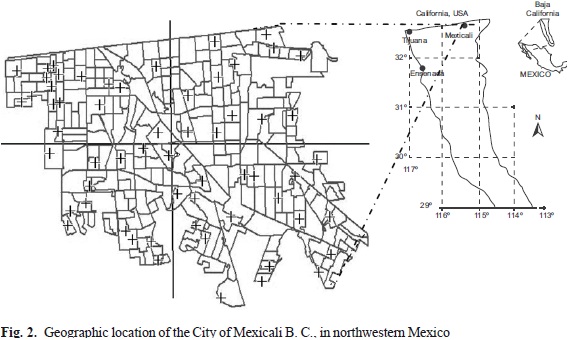
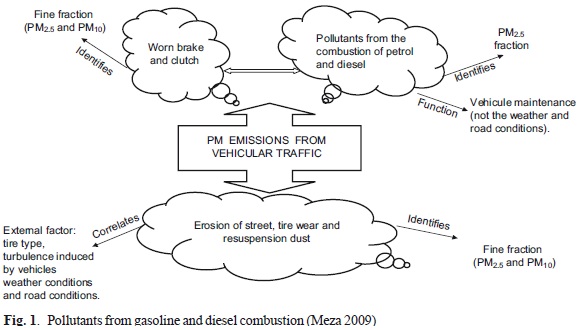
<body><![CDATA[<p align="justify"><font face="verdana" size="2">&nbsp;</font></p>  	    <p align="justify"><font face="verdana" size="2"><b>INTRODUCTION</b></font></p>  	    <p align="justify"><font face="verdana" size="2">Vehicular traffic emissions have been a global concern, since the number of vehicles is increasing rapidly thus creating a threat to humans and the environment. Most studies are based on the underlying regulation for particle emission and gases from exhaust pipes that can be of great concern as they are emitted directly into the environment.</font></p>  	    <p align="justify"><font face="verdana" size="2">There are also emissions originating from tire wear, lubricant leakage on urban roads, and particles produced by the mechanical deterioration from vehicle moving parts, which are considered the main polluting sources for the environment. This together with dust from roads caused by vehicular traffic is considered by some researchers (Abu&#45;Allaban 2003, Hassan <i>et al.</i> 2006, Ketzel <i>et al.</i> 2007, William <i>et al.</i> 2008, Goosens and Buck 2009, Malkoc <i>et al.</i> 2010, Zafra <i>et al.</i> 2011) as being a result of indirect emissions from the road, tires and wake turbulence, as shown in <b><a href="#f1">figure 1</a>.</b></font></p>  	    <p align="center"><font face="verdana" size="2"><a name="f1"></a></font></p>  	    <p align="center"><font face="verdana" size="2"><img src="/img/revistas/rica/v30n1/a2f1.jpg"></font></p>  	    <p align="justify"><font face="verdana" size="2">According to research conducted in several countries like Venezuela (Machado 2008), Spain (Zafra <i>et al.</i> 2007, 2011) Italy (Imperato <i>et al.</i> 2003), Jordan (Hassan <i>et al.</i> 2006) and Turkey (Malkoc <i>et al.</i> 2010), heavy metals are found as a result of the mechanical action of the vehicles on urban roads, either by the interaction of tires with the road surface or the wear of the brake and clutch.</font></p>  	    <p align="justify"><font face="verdana" size="2">This particulate matter (PM) is continuously resuspended by the effect of vehicular traffic due to wake turbulence and wind speed, thus producing an unequal distribution of the PM in the environment, giving rise to an emission factor (EF). This EF is expressed as the mass of particles in a unit area as a result of vehicle kilometer traveling (VKT, g/km), (Etyemezian <i>et al.</i> 2003, USEPA 2006) and helps to estimate the PM on the roadways.</font></p>  	    <p align="justify"><font face="verdana" size="2">Nowadays, there are European and American models to estimate the independent parameters of the EF where independent variables are the same, i.e., percentage of sediment load, speed, weight and type of vehicle and weather conditions (wind speed and direction and air temperature). The process in which variables are measured is what makes them different and characteristic of the site. Therefore, EF values are not similar, because they sometimes do not exceed 1 kg/VKT, whereas in some desert regions the value is above 10 kg /VKT (Meza <i>et al.</i> 2010).</font></p>  	    <p align="justify"><font face="verdana" size="2">The city of Mexicali, Baja California is located in the Sonora desert, which is exposed to Santa Ana winds and has a great deal of dust particles in the air, derived from the soil which covers hundreds of acres with a white blanket of dust from agricultural activities and wind erosion; in addition to the emissions caused by local activities. The PM deposited on urban roads is pulverized by the mechanical action of vehicles and then resuspended leaving wake turbulence that is associated with the PM having an aerodynamic diameter of 10 microns (PM<sub>10</sub>) and 2.5 microns (PM<sub>2.5</sub>).</font></p>  	    ]]></body>
<body><![CDATA[<p align="justify"><font face="verdana" size="2">Records show that since 1997, Mexicali has been exceeding the maximum limit of PM<sub>10</sub> (120 Lim/m<sup>3</sup>) for 20 days according to NOM&#45;025&#45;SSA (2005), which was the first year when formal measurement of air quality monitoring stations in the city began. These violations increased by over 40 days from 2000 to 2006. The information was obtained from the Air Quality System (AQS) data base of the USEPA and from Zuk <i>et al.</i> (2007), reporting 43 days of exceedences in 2005. As a result, Mexicali occupies the first place amongst the US&#45;Mexico border cities in relation to reference pollutants such as PM<sub>10</sub>. Based on the latter, we will present a characterization study of sediments collected at different sites of several urban streets in the city of Mexicali, B.C., where estimated PM<sub>10</sub> and PM<sub>2.5</sub> emission factors showed that use of motor vehicles on city roads are a major source of pollution.</font></p>  	    <p align="justify"><font face="verdana" size="2">&nbsp;</font></p>  	    <p align="justify"><font face="verdana" size="2"><b>MATERIALS AND METHOD</b></font></p>  	    <p align="justify"><font face="verdana" size="2"><b>Study area</b></font></p>  	    <p align="justify"><font face="verdana" size="2">Mexicali is located in northwestern Mexico (32&deg; 40' N, 115&deg; 27' W), in the state of Baja California <b>(<a href="#f2">Fig. 2</a>)</b> bordering in the north with the state of California. It presents important climatic contrasts since the recorded summer temperatures reach 52 &deg;C; whereas in the winter the minimum temperatures range around 0 &deg;C. The average temperature during the year is 25 &deg;C. It has an average annual rainfall of 75 mm. During the summer there is a predominance of winds from the southeast and from the northwest in winter (Quintero 2004, Garc&iacute;a <i>et al.</i> 2007,).</font></p>  	    <p align="center"><font face="verdana" size="2"><a name="f2"></a></font></p>  	    <p align="center"><font face="verdana" size="2"><img src="/img/revistas/rica/v30n1/a2f2.jpg"></font></p>  	    <p align="justify"><font face="verdana" size="2"><b>Design and field work</b></font></p>  	    <p align="justify"><font face="verdana" size="2">Considering a population size (N) of 266 basic geostatistical areas (BGA) of the city of Mexicali and by applying an equation for sample size (n) (Carrillo 1999, de la Torre 2002) we found that n=30 BGA. By following a randomized block design these 30 sites were distributed on a georeferenced map to UTM 11 North to be sampled (Meza <i>et al.</i> 2010). Based on the selection of four areas, northwest (NW), northeast (NE), southwest (SW) and southeast (SE) and previous work (INE 1999, Mendoza 2007, Osornio 2011) the points were identified as shown in <b><a href="/img/revistas/rica/v30n1/a2f3.jpg" target="_blank">figure 3</a>.</b> We followed the sampling technique known as Appendices C1, USEPA, AP&#45;42, as criteria for where and how samples should be collected (USEPA 1993a).</font></p>  	    <p align="justify"><font face="verdana" size="2">Sampling started in february 2008. It was carried out twice a week and ended in May 2008. This sampling was done using a geographic positioning system (GPS) as a means to identify the site of sediment collection.</font></p>  	    ]]></body>
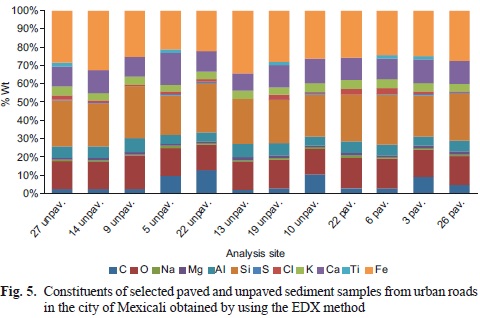
<body><![CDATA[<p align="justify"><font face="verdana" size="2"><b>2.3 Laboratory work (dry and wet)</b></font></p>  	    <p align="justify"><font face="verdana" size="2">Two types of samples were processed following the flow chart shown in <b><a href="/img/revistas/rica/v30n1/a2f4.jpg" target="_blank">figure 4</a>.</b> The procedure details are explained as follows:</font></p>  	    <p align="justify"><font face="verdana" size="2">The first sample was collected on site and identified as wet, to carry out the physical characterization, i.e., the determination of soil texture, following the Bouyoucos densimeter method (ASTM No. 152 and NOM&#45;021&#45;RECNAT&#45;2000).</font></p>  	    <p align="justify"><font face="verdana" size="2">For the second sample, the Appendix C.2., USEPA, AP&#45;42 technique (USEPA 1993b) was used to obtain the load and percentage of sediment less than 75 microns in paved and unpaved roads. This technique consists of a series of steps starting with the quartering of the sample, followed by drying, sifting and weighing. The objective was to obtain sediment smaller than 75 microns, which was afterwards identified as dry.</font></p>  	    <p align="justify"><font face="verdana" size="2">Twelve samples were selected and subsequently treated (less than &lt;75&#956;m) from several sites which were representative of the study area, based on the working tool designed (GPS). The goal was the chemical characterization of samples, using both the dry and wet techniques.</font></p>  	    <p align="justify"><font face="verdana" size="2">The analytical dry method used was the dispersive electron X&#45;ray spectroscopy (EDX), which resulted in an initial characterization of the general constituents of the type of soil in the region, shown in <b><a href="#f5">figure 5</a>.</b> The second analysis known as wet method focused on the characterization of heavy metals contained in clay from the monitoring sites. Afterwards, there was a digestion of the samples using the EPA technique (USEPA 1996) and the method of inductive coupled plasma (ICP), as shown in <b><a href="#f6">figure 6</a>.</b></font></p>  	    <p align="center"><font face="verdana" size="2"><a name="f5"></a></font></p>  	    <p align="center"><font face="verdana" size="2"><img src="/img/revistas/rica/v30n1/a2f5.jpg"></font></p>  	    <p align="center"><font face="verdana" size="2"><a name="f6"></a></font></p>  	    <p align="center"><font face="verdana" size="2"><img src="/img/revistas/rica/v30n1/a2f6.jpg"></font></p>  	    ]]></body>
<body><![CDATA[<p align="justify"><font face="verdana" size="2">The equipment for ICP analysis was a Thermo Fisher ICAP6500, which is a coupled plasma emission spectrometer. Specimens were carefully pre&#45;treated in order to obtain a sample solution (particle size less than 75 &#956;m previously dried and sieved) in aqua regia &#91;diluted nitric acid (HNO<sub>3</sub>)&#93; for the digestion of heavy metals according to 3050 B (USEPA 1996) heated at 95 &deg;C and then filtered, to obtain an aqueous solutions to be analyzed by ICP.</font></p>  	    <p align="justify"><font face="verdana" size="2">&nbsp;</font></p>  	    <p align="justify"><font face="verdana" size="2"><b>RESULTS</b></font></p>  	    <p align="justify"><font face="verdana" size="2">The treatment of samples using the dry method was core for the work carried out in the laboratory and the chemical characterization utilizing the EDX method, which helped to identify the elements from the selected area <b>(<a href="#f5">Fig. 5</a>).</b> The analysis resulted in the semi&#45;quantitative elemental composition of elements according to soil type in the study area; the most important are Al, Fe, Si, Mg and K, reported as percent by weight of elements in the sample (% Wt).</font></p>  	    <p align="justify"><font face="verdana" size="2">An analysis of <b><a href="#f5">figure 5</a></b> shows derived salty soils, with high levels of iron, with the possibility of formation of crystals such as Fex(SOx)x, NaCl, as well as a high presence of aluminum and silica, and the potential formation of magnesium (Mg) or potassium (K) aluminate. The presence of inorganic compounds is related to the characteristics of the types of soils and clays. For unpaved roads a sandy clay loam was found and for paved roads a sandy loam, in accordance with the soil classification triangle by texture of the United States Department of Agriculture (Schaetzl 2005).</font></p>  	    <p align="justify"><font face="verdana" size="2">In order to analyze the samples we used the EDX method resulting in the presence of potassium associated with illite &#91;(K, H<sub>3</sub>O) Al<sub>2</sub>Si<sub>3</sub>AlO<sub>10</sub>&#40;OH&#41;<sub>2</sub>&#93;, which was confirmed in a second analysis of four samples tested. This type of clay may not be considered a pollutant, but the identification of other elements that affect human health and the environment, such as heavy metals, is considered important as there are standards regulating hazardous risks, which should be taken into account.</font></p>  	    <p align="justify"><font face="verdana" size="2">A method that helps to learn what kind of contaminants might be present on the roads is the ICP method, and it was used for the identification of heavy metals that have some effects on health such as Pb, Hg, Zn and Cd (Machado 2007).</font></p>  	    <p align="justify"><font face="verdana" size="2"><b><a href="#f6">Figure 6</a></b> shows the results from the sites of the selected samples, under the following decreasing order Al&gt; Fe&gt; Pb&gt; Zn&gt; Cu&gt; Bi&gt; Ni&gt; Ag&gt; Cd. The presence of the first two elements is characteristic of the type of soil, as discussed in the previous paragraph and the other elements may be contributions from anthropogenic sources.</font></p>  	    <p align="justify"><font face="verdana" size="2">Based on these results the elements selected for analysis were in order of importance Pb&gt; Zn&gt; Cu <b>(<a href="#f7">Fig. 7</a>).</b> There is a particular interest on the effects of these elements on health and its potential effect in the community.</font></p>  	    <p align="center"><font face="verdana" size="2"><a name="f7"></a></font></p>  	    ]]></body>
<body><![CDATA[<p align="center"><font face="verdana" size="2"><img src="/img/revistas/rica/v30n1/a2f7.jpg"></font></p>  	    <p align="justify"><font face="verdana" size="2">Malkoc <i>et al.</i> (2010) have conducted a number of studies attempting to determine the sources of heavy metals in roadside soils and they found that Pb, Zn, and Cu largely come from traffic pollution, whereas Ni is correlated to naturally occurring sources, Cd originates from industrial contaminants, and Cr found in roadside soil is associated with atmospheric deposition.</font></p>  	    <p align="justify"><font face="verdana" size="2">Furthermore, some metals, such as Cd, Cu, Ni, Pb, and Zn, were found to exacerbate various diseases due to a rapid increase in their environmental concentrations attributable to urbanization and several road sites with high concentration of Pb, Zn and Cu are associated with trolley transportation (Imperato <i>et al.</i> 2003, Machado <i>et al.</i> 2007, Zafra <i>et al.</i> 2011 and Xiao&#45;san <i>et al.</i> 2012) ) but in Mexicali it is related to passenger trucks or trucks larger than three axles, which are characteristic of the vehicular fleet used by the manufacturing and industrial sector.</font></p>  	    <p align="justify"><font face="verdana" size="2">&nbsp;</font></p>  	    <p align="justify"><font face="verdana" size="2"><b>DISCUSSION</b></font></p>  	    <p align="justify"><font face="verdana" size="2">Data from previous research (Meza <i>et al.</i> 2010) carried out in Mexicali produced the following emission factors: 0.923 kg/km PM<sub>10</sub> and 0.734 kg/km PM<sub>2.5</sub> (VKT) on paved roads and 2.33 kg/km PM<sub>2.5</sub> (VKT) and 0.58 kg/km PM<sub>10</sub> (VKT) on unpaved roads. The results were taken as mean products, which gave opportunity to identify a normal distribution, and later a Spearman correlation analysis was carried out that would provide a direct link between significant values as it is subsequently described.</font></p>  	    <p align="justify"><font face="verdana" size="2"><b>Analysis by Spearman correlation</b></font></p>  	    <p align="justify"><font face="verdana" size="2">The EF associated to PM<sub>10</sub> and PM<sub>2.5</sub> were a direct correlation of 0.89 for paved roads, which sets a precedent to reconsider the following correlation of inorganic elements found in the samples analyzed for both values. <b><a href="/img/revistas/rica/v30n1/a2t1.jpg" target="_blank">Table I</a>,</b> shows an inverse correlation of aluminum (Al) versus lead (Pb) and zinc (Zn) with &#45;0.7527 and &#45;0.7308 values, respectively. It also highlights the significant value of the correlation of Pb and Zn, equal to 0.7692.</font></p>  	    <p align="justify"><font face="verdana" size="2"><b><a href="/img/revistas/rica/v30n1/a2t1.jpg" target="_blank">Table I</a></b> also presents other significant correlations (values listed in bold) as is the case of silver (Ag) with bismuth (Bi) and zinc (Zn), along with cadmium (Cd) and nickel (Ni). Nevertheless our attention focused on Pb and Zn for their effects on health in certain countries that count with urban soil content standards in this subject (Machado <i>et al.</i> 2007, 2010, Zafra <i>et al.</i> 2007).</font></p>  	    <p align="justify"><font face="verdana" size="2"><b><a href="#f8">Figure 8 (a)</a></b> and <b><a href="#f8">(b)</a></b> show the tendencies for Al vs. Pb and Zn. In order to correlate Al with heavy metals (Pb and Zn), the analysis was based on the fact that the sampling site was identified as being sandy clay loam or clay type. In previous research (El&#45;Hasan <i>et al.</i> 2006), Al was classified as an immovable element. Hence, it indicates that the greater amount of aluminum, the lower content of Pb and Zn.</font></p>  	    ]]></body>
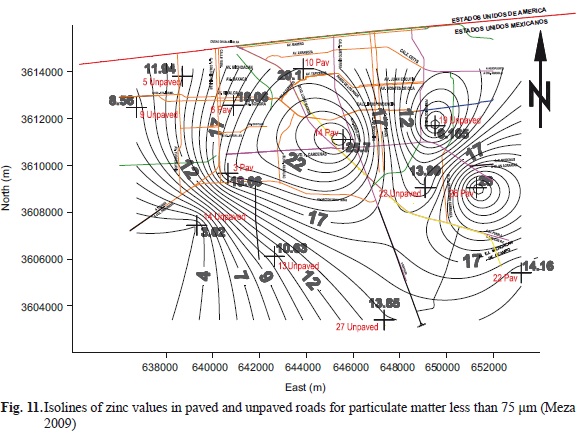
<body><![CDATA[<p align="center"><font face="verdana" size="2"><a name="f8"></a></font></p>  	    <p align="center"><font face="verdana" size="2"><img src="/img/revistas/rica/v30n1/a2f8.jpg"></font></p>  	    <p align="justify"><font face="verdana" size="2">Also, the Zn/Pb correlation is significant because the characteristics in some images that were obtained from the semi&#45;quantitative analysis by EDX, as shown in <b><a href="#f9">figure 9</a>,</b> may be due to the presence of Zn (silver color) and Pb (gray color) for Site 19 <b>(<a href="#f11">Fig 11</a>)</b> which was not paved.</font></p>  	    <p align="center"><font face="verdana" size="2"><a name="f9"></a></font></p>  	    <p align="center"><font face="verdana" size="2"><img src="/img/revistas/rica/v30n1/a2f9.jpg"></font></p>  	    <p align="justify"><font face="verdana" size="2"><b><a href="#f10">Figure 10</a></b> shows significant heavy metals such as zinc (a), and lead (b), which become relevant based on their concentrations and observing the standards. The graph of lead is always above the standard <b>(<a href="#f10">Fig. 10a</a>)</b> and zinc just in the last two urban roads <b>(<a href="#f10">Fig. 10b</a>).</b></font></p>  	    <p align="center"><font face="verdana" size="2"><a name="f10"></a></font></p>  	    <p align="center"><font face="verdana" size="2"><img src="/img/revistas/rica/v30n1/a2f10.jpg"></font></p>  	    <p align="center"><font face="verdana" size="2"><a name="f11"></a></font></p>  	    <p align="center"><font face="verdana" size="2"><img src="/img/revistas/rica/v30n1/a2f11.jpg"></font></p>  	    ]]></body>
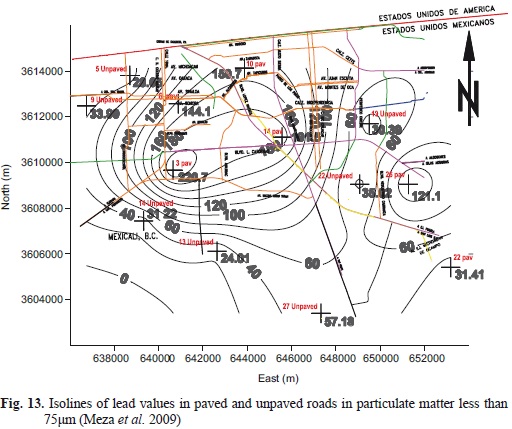
<body><![CDATA[<p align="justify"><font face="verdana" size="2">In the case of copper it was not possible to compare it with a standard on urban soils as there is no one reported in the literature. In addition to this, the correlation was not significant for Cu in <b><a href="/img/revistas/rica/v30n1/a2t1.jpg" target="_blank">table I</a>.</b> However, Machado (2007) considered that copper is important because it is attributed mainly to vehicular traffic on the city roads, therefore more research should be done in this subjet.</font></p>  	    <p align="justify"><font face="verdana" size="2">Osornio <i>et al.</i> (2011) identified elements such as Cu and Zn in PM<sub>10</sub> and PM<sub>2.5</sub> using a high volume sampler and soil samples in the periphery of the samplers in the city and rural areas of Mexicali that were classified as being of anthropogenic origen, but Pb was not detected.</font></p>  	    <p align="justify"><font face="verdana" size="2"><b>Heavy metals at a spatial level</b></font></p>  	    <p align="justify"><font face="verdana" size="2">Another way of observing the behavior of concentration values of heavy metals identified was by means of a spatial analysis based on the work tool selected, where the sampling sites were taken using the UTM coordinates (x, y). The coordinate (z) represents the concentration of metals identified on a single base, which were analyzed using the wet ICP method.</font></p>  	    <p align="justify"><font face="verdana" size="2">Afterwards, the information was organized in an Excel 2007 table with three columns, supported by the Surfer tool. The kriging interpolation option was utilized, which is based on the result of the chemical analysis of the compound samples of the analyzed sites. Two graphs were obtained <b>(<a href="#f12">Figs. 12</a></b> and <b><a href="#f13">13</a>)</b> and were superposed on a map of the city of Mexicali.</font></p>  	    <p align="center"><font face="verdana" size="2"><a name="f12"></a></font></p>  	    <p align="center"><font face="verdana" size="2"><img src="/img/revistas/rica/v30n1/a2f12.jpg"></font></p>  	    <p align="center"><font face="verdana" size="2"><a name="f13"></a></font></p>  	    <p align="center"><font face="verdana" size="2"><img src="/img/revistas/rica/v30n1/a2f13.jpg"></font></p>  	    <p align="justify"><font face="verdana" size="2"><b><a href="#f11">Figures 11</a></b> and <b><a href="#f12">12</a></b> show the values of metal concentrations (Zn and Cu), spatially distributed. When wind direction is taken into consideration, it is possible to identify areas with high concentrations of these heavy metals; where the highest values are associated to the south&#45;east part of the city, disregarding the central area, close to an air quality monitoring station.</font></p>  	    ]]></body>
<body><![CDATA[<p align="justify"><font face="verdana" size="2">Regarding copper <b>(<a href="#f12">Fig. 12</a>)</b> there was also a high concentration peak found in the heavy traffic area, in addition to the drag of dust deposited by the wind direction predominantly from the north. This is due to the fact that the sampling moment corresponds to the months of April and May.</font></p>  	    <p align="justify"><font face="verdana" size="2">The latter relates to a study by Osornio <i>et al.</i> (2011) where soil samples were taken on the roads near the north&#45;east and the south&#45;east sites for inoculation of live cells in the laboratory to see the effect of composition on the potential generation of cancer, that may be caused by particulate matter taken from soil samples. The presence of copper and zinc in the Osornio's soil samples can be compared with those of points 14 and 22 located in paved roads tested. With regards to zinc <b>(<a href="#f11">Fig. 11</a>),</b> points 27 (unpaved) and 26 (paved) can be taken as an example of a high value, since they are above existing standard, 11.25 mg/kg (Machado <i>et al.</i> 2007)</font></p>  	    <p align="justify"><font face="verdana" size="2"><b><a href="#f13">Figure 13</a></b> highlights the presence of lead, where some studies have linked it to tire wear, brake and clutch. The highest concentrations are in the center of the city of Mexicali which represents sampling point 14, with associated concentrations of 180 mg / kg of lead in soil. This is in a way explainable as in the south&#45;east and north&#45;east parts of the city there are more vehicles per day. In samples collected from the outskirts of the city, lower concentrations of Pb were found.</font></p>  	    <p align="justify"><font face="verdana" size="2">The above charts show a future line of research on the importance of mechanical maintenance of vehicles, which indicates that not only particulate matter emissions from tailpipes, but also indirect emissions that have been studied (tire wear, brake wear, etc.) in some regions of North America, Europe and recently in Mexico, are important to consider (Meza <i>et al.</i> 2009).</font></p>  	    <p align="justify"><font face="verdana" size="2">&nbsp;</font></p>  	    <p align="justify"><font face="verdana" size="2"><b>CONCLUSIONS</b></font></p>  	    <p align="justify"><font face="verdana" size="2">1. On paved roads EF values for PM<sub>10</sub> kept a close relationship to the EF for PM<sub>25</sub> with a Spearman correlation of0.9235. Periodic maintenance and cleaning on main roads in the city, counteract the accumulation of fine particulate matter.</font></p>  	    <p align="justify"><font face="verdana" size="2">2. In four samples selected in the area under research, illite type clay was identified, which was analyzed by the EDX method. This compound is considered hazardous to health, as it has a very large surface area as a substrate and works as a carrier of heavy metals and inorganic elements. The most significant findings in relation to heavy metals were the relationship amongst Al, Pb and Zn, and for other metals there was a significant affinity of Ag with Bi and Zn along with Cd with Pb and Ni. This supports the argument of heavy metals found as a result of the mechanical action of the vehicles on urban roads.</font></p>  	    <p align="justify"><font face="verdana" size="2">3. After the digestion of sediments process in the four areas selected in the study zone, all of them were analyzed by using the ICP, resulting in a comparative concentration values which were above the limits of international standards established by EPA.</font></p>  	    <p align="justify"><font face="verdana" size="2">4. Vehicles may contribute to air pollution, apart from fuel combustion or from the traveling along the streets of the city, derived from the wear of the components such as the breaking system (Zn, Cu, Cr, Ni and Mn), tires (Pb) and clutch (Cu, Zn, Cd, Sb, Ba, and Pb), which are very important for their effects on health.</font></p>  	    ]]></body>
<body><![CDATA[<p align="justify"><font face="verdana" size="2">&nbsp;</font></p>  	    <p align="justify"><font face="verdana" size="2"><b>REFERENCES</b></font></p>  	    <!-- ref --><p align="justify"><font face="verdana" size="2">Abu&#45;Allaban M., Gilles J.A., Gertler A.W., Clayton R. and Proffit D. (2003). Tailpipe, resuspended road dust, and brake&#45;wear Emission Factors from on road vehicles. Atmos. Environ. 37, 5283&#45;5293.    &nbsp;&nbsp;&nbsp;&nbsp;&nbsp;&nbsp;&nbsp;&nbsp;[&#160;<a href="javascript:void(0);" onclick="javascript: window.open('/scielo.php?script=sci_nlinks&ref=7225754&pid=S0188-4999201400010000200001&lng=','','width=640,height=500,resizable=yes,scrollbars=1,menubar=yes,');">Links</a>&#160;]<!-- end-ref --></font></p>  	    <!-- ref --><p align="justify"><font face="verdana" size="2">De la Torre C. (2002). Metodolog&iacute;a de la Investigaci&oacute;n. Mc. Graw Hill, M&eacute;xico, D.F., pp. 141&#45;160.    &nbsp;&nbsp;&nbsp;&nbsp;&nbsp;&nbsp;&nbsp;&nbsp;[&#160;<a href="javascript:void(0);" onclick="javascript: window.open('/scielo.php?script=sci_nlinks&ref=7225756&pid=S0188-4999201400010000200002&lng=','','width=640,height=500,resizable=yes,scrollbars=1,menubar=yes,');">Links</a>&#160;]<!-- end-ref --></font></p>  	    <!-- ref --><p align="justify"><font face="verdana" size="2">El&#45;Hasan T., Batarseh M., Al&#45;Omari H., Anf Ziadat, El&#45;Alali A., Al&#45;Naser F., Berdanier B.W. and Jiries A. (2006). The distribution of heavy metal in urban street dust of Karak City Jordan. Soil &amp; Sediment Contam. 15, 357&#45;365.    &nbsp;&nbsp;&nbsp;&nbsp;&nbsp;&nbsp;&nbsp;&nbsp;[&#160;<a href="javascript:void(0);" onclick="javascript: window.open('/scielo.php?script=sci_nlinks&ref=7225758&pid=S0188-4999201400010000200003&lng=','','width=640,height=500,resizable=yes,scrollbars=1,menubar=yes,');">Links</a>&#160;]<!-- end-ref --></font></p>  	    <!-- ref --><p align="justify"><font face="verdana" size="2">Garc&iacute;a C.O.R., Jauregui O.E., Toudert Z.V. and Tejeda M.A. (2007). Detection of the urban heat island in Mexicali B.C., Mexicali B. C., Mexico and its relationship with land use. Atm&oacute;sfera 2, 111&#45;131.    &nbsp;&nbsp;&nbsp;&nbsp;&nbsp;&nbsp;&nbsp;&nbsp;[&#160;<a href="javascript:void(0);" onclick="javascript: window.open('/scielo.php?script=sci_nlinks&ref=7225760&pid=S0188-4999201400010000200004&lng=','','width=640,height=500,resizable=yes,scrollbars=1,menubar=yes,');">Links</a>&#160;]<!-- end-ref --></font></p>  	    ]]></body>
<body><![CDATA[<!-- ref --><p align="justify"><font face="verdana" size="2">Goossens D. y B. Buck. (2009). Dust emission by off road driving: Experiments on 17 arid soil types, Nevada, USA, Geomorphology, 107, 118&#45;138.    &nbsp;&nbsp;&nbsp;&nbsp;&nbsp;&nbsp;&nbsp;&nbsp;[&#160;<a href="javascript:void(0);" onclick="javascript: window.open('/scielo.php?script=sci_nlinks&ref=7225762&pid=S0188-4999201400010000200005&lng=','','width=640,height=500,resizable=yes,scrollbars=1,menubar=yes,');">Links</a>&#160;]<!-- end-ref --></font></p>  	    <!-- ref --><p align="justify"><font face="verdana" size="2">Imperato M., Adamo P., Naimo D., Arienzo M., Stanzione D. and Violante P. (2003). Spatial distribution of heavy metals in urban soils of Naples city (Italy), Environ. Pollut. 124, 247&#45;256.    &nbsp;&nbsp;&nbsp;&nbsp;&nbsp;&nbsp;&nbsp;&nbsp;[&#160;<a href="javascript:void(0);" onclick="javascript: window.open('/scielo.php?script=sci_nlinks&ref=7225764&pid=S0188-4999201400010000200006&lng=','','width=640,height=500,resizable=yes,scrollbars=1,menubar=yes,');">Links</a>&#160;]<!-- end-ref --></font></p>  	    <!-- ref --><p align="justify"><font face="verdana" size="2">Ketzel M., Omstedt G., Johansson C., During I., Pojola Mia, Oettl D., Gidhagen L., Wahlin P., Lohmeyer A., Haakana M. and Berkowicz R. (2007). Estimation and validation of PM<sub>25</sub>/PM<sub>10</sub> exhaust and non&#45;exhaust emission factors for practical street pollution modelling, Atmos. Environ. 41, 9370&#45;9385.    &nbsp;&nbsp;&nbsp;&nbsp;&nbsp;&nbsp;&nbsp;&nbsp;[&#160;<a href="javascript:void(0);" onclick="javascript: window.open('/scielo.php?script=sci_nlinks&ref=7225766&pid=S0188-4999201400010000200007&lng=','','width=640,height=500,resizable=yes,scrollbars=1,menubar=yes,');">Links</a>&#160;]<!-- end-ref --></font></p>  	    <!-- ref --><p align="justify"><font face="verdana" size="2">Machado A., Garcia N., Garcia C., Acosta L., Cordoba A., Linares M., Giraldoth D. and Vazquez H. (2007). Metal pollution (Pb, Zn, Ni and Cr) in air, road and soil sediment in a high traffic area, Int. J. Environ. Pollut. 24, 171&#45;182.    &nbsp;&nbsp;&nbsp;&nbsp;&nbsp;&nbsp;&nbsp;&nbsp;[&#160;<a href="javascript:void(0);" onclick="javascript: window.open('/scielo.php?script=sci_nlinks&ref=7225768&pid=S0188-4999201400010000200008&lng=','','width=640,height=500,resizable=yes,scrollbars=1,menubar=yes,');">Links</a>&#160;]<!-- end-ref --></font></p>  	    <!-- ref --><p align="justify"><font face="verdana" size="2">Semra M., Yazici B. and Koparalt S. (2010). Assessment the levels of heavy metal pollution in roadside soil of Eskisehir, Turkey. Environ. Toxicol. Chem. 29, 2720&#45;2725.    &nbsp;&nbsp;&nbsp;&nbsp;&nbsp;&nbsp;&nbsp;&nbsp;[&#160;<a href="javascript:void(0);" onclick="javascript: window.open('/scielo.php?script=sci_nlinks&ref=7225770&pid=S0188-4999201400010000200009&lng=','','width=640,height=500,resizable=yes,scrollbars=1,menubar=yes,');">Links</a>&#160;]<!-- end-ref --></font></p>  	    ]]></body>
<body><![CDATA[<!-- ref --><p align="justify"><font face="verdana" size="2">Meza T.L. and Quintero N.M. (2007). "Methodology for the calculation and emissions of particulate matter PM<sub>10</sub> and PM<sub>25</sub>: Case Study "paved and unpaved pathways of the City of Mexicali, " El Segundo Coloquio de Graduados, editor Ojeda, B. S. UABC Mexicali, BC, 330&#45;339.    &nbsp;&nbsp;&nbsp;&nbsp;&nbsp;&nbsp;&nbsp;&nbsp;[&#160;<a href="javascript:void(0);" onclick="javascript: window.open('/scielo.php?script=sci_nlinks&ref=7225772&pid=S0188-4999201400010000200010&lng=','','width=640,height=500,resizable=yes,scrollbars=1,menubar=yes,');">Links</a>&#160;]<!-- end-ref --></font></p>  	    <!-- ref --><p align="justify"><font face="verdana" size="2">Meza T.L, Quintero N.M, Garc&iacute;a C.R. and Ram&iacute;rez J. (2009). Estimated emission factors for PM<sub>10</sub> and PM<sub>2.5</sub> in urban roads in Mexicali, Baja California, Mexico. CIT, 21, 45&#45;56.    &nbsp;&nbsp;&nbsp;&nbsp;&nbsp;&nbsp;&nbsp;&nbsp;[&#160;<a href="javascript:void(0);" onclick="javascript: window.open('/scielo.php?script=sci_nlinks&ref=7225774&pid=S0188-4999201400010000200011&lng=','','width=640,height=500,resizable=yes,scrollbars=1,menubar=yes,');">Links</a>&#160;]<!-- end-ref --></font></p>  	    <!-- ref --><p align="justify"><font face="verdana" size="2">Quintero M. and Sweedler A. (2004). Air quality evaluation in the Mexicali and Imperial Valleys as an element for an outreach program. In: Imperial&#45;Mexicali Valleys: Development and Environment of the U.S.Mexican Border Region (K. Collins, P. Ganster, C. Mason, E. S&aacute;nchez L&oacute;pez and L.M. Quintero&#45;N&uacute;&ntilde;ez, Eds.), San Diego State University Press, pp. 263&#45;279.    &nbsp;&nbsp;&nbsp;&nbsp;&nbsp;&nbsp;&nbsp;&nbsp;[&#160;<a href="javascript:void(0);" onclick="javascript: window.open('/scielo.php?script=sci_nlinks&ref=7225776&pid=S0188-4999201400010000200012&lng=','','width=640,height=500,resizable=yes,scrollbars=1,menubar=yes,');">Links</a>&#160;]<!-- end-ref --></font></p>  	    <!-- ref --><p align="justify"><font face="verdana" size="2">Osornio&#45;Vargas A.R., Serrano J., Rojas&#45;Bracho L., Miranda J., Garc&iacute;a&#45;Cuellar C., Reyna C.M.A., Flores G., Zuk M., Quintero&#45;N&uacute;&ntilde;ez M. V&aacute;zquez I., S&aacute;nchez&#45;P&eacute;rez Y., L&oacute;pez T. and Rosas I. (2011). In vitro biological effects of airborne PM2.5 and PM10 from a semi&#45;desert city on the Mexico&#45;US border. Chemosphere 83, 618&#45;626.    &nbsp;&nbsp;&nbsp;&nbsp;&nbsp;&nbsp;&nbsp;&nbsp;[&#160;<a href="javascript:void(0);" onclick="javascript: window.open('/scielo.php?script=sci_nlinks&ref=7225778&pid=S0188-4999201400010000200013&lng=','','width=640,height=500,resizable=yes,scrollbars=1,menubar=yes,');">Links</a>&#160;]<!-- end-ref --></font></p>  	    <!-- ref --><p align="justify"><font face="verdana" size="2">Schaetzl R. and Sharon A. (2005). Soils genesis and geo&#45;morphology. Cambridge, 827 pp.    &nbsp;&nbsp;&nbsp;&nbsp;&nbsp;&nbsp;&nbsp;&nbsp;[&#160;<a href="javascript:void(0);" onclick="javascript: window.open('/scielo.php?script=sci_nlinks&ref=7225780&pid=S0188-4999201400010000200014&lng=','','width=640,height=500,resizable=yes,scrollbars=1,menubar=yes,');">Links</a>&#160;]<!-- end-ref --></font></p>  	    ]]></body>
<body><![CDATA[<!-- ref --><p align="justify"><font face="verdana" size="2">USEPA (1993a). AP42. Volume I, chapter 13, appendix C1, Procedures for sampling surface/ bulk dust loading samples. United States Environmental Protection Agency. 5th ed. On line: <a href="http://www.epa.gov/ttn/chief/ap42/appendix/app&#45;c1.pdf" target="_blank">http://www.epa.gov/ttn/chief/ap42/appendix/app&#45;c1.pdf</a>. Accessed 09/02/2013.    &nbsp;&nbsp;&nbsp;&nbsp;&nbsp;&nbsp;&nbsp;&nbsp;[&#160;<a href="javascript:void(0);" onclick="javascript: window.open('/scielo.php?script=sci_nlinks&ref=7225782&pid=S0188-4999201400010000200015&lng=','','width=640,height=500,resizable=yes,scrollbars=1,menubar=yes,');">Links</a>&#160;]<!-- end-ref --></font></p>  	    <!-- ref --><p align="justify"><font face="verdana" size="2">USEPA (1993b). AP42. Volume I, chapter 13, appendix C2, Procedures for sampling surface/ bulk dust loading samples. United States Environmental Protection Agency. 5th ed. On line: <a href="http://www.epa.gov/ttn/chief/ap42/appendix/app&#45;c2.pdf" target="_blank">http://www.epa.gov/ttn/chief/ap42/appendix/app&#45;c2.pdf</a>. Accessed 09/02/2013.    &nbsp;&nbsp;&nbsp;&nbsp;&nbsp;&nbsp;&nbsp;&nbsp;[&#160;<a href="javascript:void(0);" onclick="javascript: window.open('/scielo.php?script=sci_nlinks&ref=7225784&pid=S0188-4999201400010000200016&lng=','','width=640,height=500,resizable=yes,scrollbars=1,menubar=yes,');">Links</a>&#160;]<!-- end-ref --></font></p>  	    <!-- ref --><p align="justify"><font face="verdana" size="2">USEPA (1996). Method 3050B, Acid digestion of sediments, sludge and soil. United States Environmental Protection Agency. On line: <a href="http://www.epa.gov/osw/hazard/testmethods/sw846/pdfs/3050b.pdf" target="_blank">http://www.epa.gov/osw/hazard/testmethods/sw846/pdfs/3050b.pdf</a>. Accessed 12/06/2013.    &nbsp;&nbsp;&nbsp;&nbsp;&nbsp;&nbsp;&nbsp;&nbsp;[&#160;<a href="javascript:void(0);" onclick="javascript: window.open('/scielo.php?script=sci_nlinks&ref=7225786&pid=S0188-4999201400010000200017&lng=','','width=640,height=500,resizable=yes,scrollbars=1,menubar=yes,');">Links</a>&#160;]<!-- end-ref --></font></p>  	    <!-- ref --><p align="justify"><font face="verdana" size="2">USEPA (2006). AP&#45;42. Miscellaneous sources. Volume I, chapter 13. United States Environmental Protection Agency. 5th ed. On line: <a href="http://www.epa.gov/ttn/chief/ap42/ch13/index.html" target="_blank">http://www.epa.gov/ttn/chief/ap42/ch13/index.html</a>. Accessed 08/31/2009.    &nbsp;&nbsp;&nbsp;&nbsp;&nbsp;&nbsp;&nbsp;&nbsp;[&#160;<a href="javascript:void(0);" onclick="javascript: window.open('/scielo.php?script=sci_nlinks&ref=7225788&pid=S0188-4999201400010000200018&lng=','','width=640,height=500,resizable=yes,scrollbars=1,menubar=yes,');">Links</a>&#160;]<!-- end-ref --></font></p>  	    <!-- ref --><p align="justify"><font face="verdana" size="2">William D.S., Shukla M. K. and Ross J. (2008). Particulate matter emission by a vehicle running on unpaved road. Atmos. Environ. 42, 3899&#45;3905.    &nbsp;&nbsp;&nbsp;&nbsp;&nbsp;&nbsp;&nbsp;&nbsp;[&#160;<a href="javascript:void(0);" onclick="javascript: window.open('/scielo.php?script=sci_nlinks&ref=7225790&pid=S0188-4999201400010000200019&lng=','','width=640,height=500,resizable=yes,scrollbars=1,menubar=yes,');">Links</a>&#160;]<!-- end-ref --></font></p>  	    ]]></body>
<body><![CDATA[<!-- ref --><p align="justify"><font face="verdana" size="2">Xiao&#45;san L., Shen Y., Yong&#45;guan Z. and Xiang&#45;dong L. (2012). Trace metal contamination in urban soils of China. Sci. Total Environ. 421&#45;422.    &nbsp;&nbsp;&nbsp;&nbsp;&nbsp;&nbsp;&nbsp;&nbsp;[&#160;<a href="javascript:void(0);" onclick="javascript: window.open('/scielo.php?script=sci_nlinks&ref=7225792&pid=S0188-4999201400010000200020&lng=','','width=640,height=500,resizable=yes,scrollbars=1,menubar=yes,');">Links</a>&#160;]<!-- end-ref --></font></p>  	    <!-- ref --><p align="justify"><font face="verdana" size="2">Zafra M.C.A., Gonz&aacute;lez J.T. and Tejero M.J.I. (2007). Contaminaci&oacute;n por escorrent&iacute;a superficial urbana: metales pesados acumulados sobre la superficie de una v&iacute;a. Rev. Ing. e Invest. 27, 4&#45;10.    &nbsp;&nbsp;&nbsp;&nbsp;&nbsp;&nbsp;&nbsp;&nbsp;[&#160;<a href="javascript:void(0);" onclick="javascript: window.open('/scielo.php?script=sci_nlinks&ref=7225794&pid=S0188-4999201400010000200021&lng=','','width=640,height=500,resizable=yes,scrollbars=1,menubar=yes,');">Links</a>&#160;]<!-- end-ref --></font></p>  	    <!-- ref --><p align="justify"><font face="verdana" size="2">Zafra C.A., Temprano J. and Tejero M.J.M. (2011). Distribution of the concentration of heavy metals associated with the sediment particles accumulated on road surfaces. Environ. Technol. 32, 997&#45;1008.    &nbsp;&nbsp;&nbsp;&nbsp;&nbsp;&nbsp;&nbsp;&nbsp;[&#160;<a href="javascript:void(0);" onclick="javascript: window.open('/scielo.php?script=sci_nlinks&ref=7225796&pid=S0188-4999201400010000200022&lng=','','width=640,height=500,resizable=yes,scrollbars=1,menubar=yes,');">Links</a>&#160;]<!-- end-ref --></font></p>      ]]></body><back>
<ref-list>
<ref id="B1">
<nlm-citation citation-type="journal">
<person-group person-group-type="author">
<name>
<surname><![CDATA[Abu-Allaban]]></surname>
<given-names><![CDATA[M.]]></given-names>
</name>
<name>
<surname><![CDATA[Gilles]]></surname>
<given-names><![CDATA[J.A.]]></given-names>
</name>
<name>
<surname><![CDATA[Gertler]]></surname>
<given-names><![CDATA[A.W.]]></given-names>
</name>
<name>
<surname><![CDATA[Clayton]]></surname>
<given-names><![CDATA[R.]]></given-names>
</name>
<name>
<surname><![CDATA[Proffit]]></surname>
<given-names><![CDATA[D.]]></given-names>
</name>
</person-group>
<article-title xml:lang="en"><![CDATA[Tailpipe, resuspended road dust, and brake-wear Emission Factors from on road vehicles]]></article-title>
<source><![CDATA[Atmos. Environ]]></source>
<year>2003</year>
<volume>37</volume>
<page-range>5283-5293</page-range></nlm-citation>
</ref>
<ref id="B2">
<nlm-citation citation-type="book">
<person-group person-group-type="author">
<name>
<surname><![CDATA[De la Torre]]></surname>
<given-names><![CDATA[C.]]></given-names>
</name>
</person-group>
<source><![CDATA[Metodología de la Investigación]]></source>
<year>2002</year>
<page-range>141-160</page-range><publisher-loc><![CDATA[México^eD.F. D.F.]]></publisher-loc>
<publisher-name><![CDATA[Mc. Graw Hill]]></publisher-name>
</nlm-citation>
</ref>
<ref id="B3">
<nlm-citation citation-type="journal">
<person-group person-group-type="author">
<name>
<surname><![CDATA[El-Hasan]]></surname>
<given-names><![CDATA[T.]]></given-names>
</name>
<name>
<surname><![CDATA[Batarseh]]></surname>
<given-names><![CDATA[M.]]></given-names>
</name>
<name>
<surname><![CDATA[Al-Omari]]></surname>
<given-names><![CDATA[H.]]></given-names>
</name>
<name>
<surname><![CDATA[Ziadat]]></surname>
<given-names><![CDATA[Anf]]></given-names>
</name>
<name>
<surname><![CDATA[El-Alali]]></surname>
<given-names><![CDATA[A.]]></given-names>
</name>
<name>
<surname><![CDATA[Al-Naser]]></surname>
<given-names><![CDATA[F.]]></given-names>
</name>
<name>
<surname><![CDATA[Berdanier]]></surname>
<given-names><![CDATA[B.W.]]></given-names>
</name>
<name>
<surname><![CDATA[Jiries]]></surname>
<given-names><![CDATA[A.]]></given-names>
</name>
</person-group>
<article-title xml:lang="en"><![CDATA[The distribution of heavy metal in urban street dust of Karak City Jordan]]></article-title>
<source><![CDATA[Soil & Sediment Contam.]]></source>
<year>2006</year>
<volume>15</volume>
<page-range>357-365</page-range></nlm-citation>
</ref>
<ref id="B4">
<nlm-citation citation-type="journal">
<person-group person-group-type="author">
<name>
<surname><![CDATA[García]]></surname>
<given-names><![CDATA[C.O.R.]]></given-names>
</name>
<name>
<surname><![CDATA[Jauregui]]></surname>
<given-names><![CDATA[O.E.]]></given-names>
</name>
<name>
<surname><![CDATA[Toudert]]></surname>
<given-names><![CDATA[Z.V.]]></given-names>
</name>
<name>
<surname><![CDATA[Tejeda]]></surname>
<given-names><![CDATA[M.A.]]></given-names>
</name>
</person-group>
<article-title xml:lang="en"><![CDATA[Detection of the urban heat island in Mexicali B.C., Mexicali B. C., Mexico and its relationship with land use]]></article-title>
<source><![CDATA[Atmósfera]]></source>
<year>2007</year>
<volume>2</volume>
<page-range>111-131</page-range></nlm-citation>
</ref>
<ref id="B5">
<nlm-citation citation-type="journal">
<person-group person-group-type="author">
<name>
<surname><![CDATA[Goossens]]></surname>
<given-names><![CDATA[D.]]></given-names>
</name>
<name>
<surname><![CDATA[Buck.]]></surname>
<given-names><![CDATA[B.]]></given-names>
</name>
</person-group>
<article-title xml:lang="en"><![CDATA[). Dust emission by off road driving: Experiments on 17 arid soil types, Nevada, USA,]]></article-title>
<source><![CDATA[Geomorphology]]></source>
<year>2009</year>
<volume>107</volume>
<page-range>118-138</page-range></nlm-citation>
</ref>
<ref id="B6">
<nlm-citation citation-type="journal">
<person-group person-group-type="author">
<name>
<surname><![CDATA[Imperato]]></surname>
<given-names><![CDATA[M.]]></given-names>
</name>
<name>
<surname><![CDATA[Adamo]]></surname>
<given-names><![CDATA[P.]]></given-names>
</name>
<name>
<surname><![CDATA[Naimo]]></surname>
<given-names><![CDATA[D.]]></given-names>
</name>
<name>
<surname><![CDATA[Arienzo]]></surname>
<given-names><![CDATA[M.]]></given-names>
</name>
<name>
<surname><![CDATA[Stanzione]]></surname>
<given-names><![CDATA[D.]]></given-names>
</name>
<name>
<surname><![CDATA[Violante]]></surname>
<given-names><![CDATA[P.]]></given-names>
</name>
</person-group>
<article-title xml:lang="en"><![CDATA[Spatial distribution of heavy metals in urban soils of Naples city (Italy), Environ]]></article-title>
<source><![CDATA[Pollut]]></source>
<year>2003</year>
<volume>124</volume>
<page-range>247-256</page-range></nlm-citation>
</ref>
<ref id="B7">
<nlm-citation citation-type="journal">
<person-group person-group-type="author">
<name>
<surname><![CDATA[Ketzel]]></surname>
<given-names><![CDATA[M.]]></given-names>
</name>
<name>
<surname><![CDATA[Omstedt]]></surname>
<given-names><![CDATA[G.]]></given-names>
</name>
<name>
<surname><![CDATA[Johansson]]></surname>
<given-names><![CDATA[C.]]></given-names>
</name>
<name>
<surname><![CDATA[During]]></surname>
<given-names><![CDATA[I.]]></given-names>
</name>
<name>
<surname><![CDATA[Pojola]]></surname>
<given-names><![CDATA[Mia]]></given-names>
</name>
<name>
<surname><![CDATA[Oettl]]></surname>
<given-names><![CDATA[D.]]></given-names>
</name>
<name>
<surname><![CDATA[Gidhagen]]></surname>
<given-names><![CDATA[L.]]></given-names>
</name>
<name>
<surname><![CDATA[Wahlin]]></surname>
<given-names><![CDATA[P.]]></given-names>
</name>
<name>
<surname><![CDATA[Lohmeyer]]></surname>
<given-names><![CDATA[A.]]></given-names>
</name>
<name>
<surname><![CDATA[Haakana]]></surname>
<given-names><![CDATA[M.]]></given-names>
</name>
<name>
<surname><![CDATA[Berkowicz]]></surname>
<given-names><![CDATA[R.]]></given-names>
</name>
</person-group>
<article-title xml:lang="en"><![CDATA[Estimation and validation of PM25/PM10 exhaust and non-exhaust emission factors for practical street pollution modelling, Atmos]]></article-title>
<source><![CDATA[Environ]]></source>
<year>2007</year>
<volume>41</volume>
<page-range>9370-9385</page-range></nlm-citation>
</ref>
<ref id="B8">
<nlm-citation citation-type="journal">
<person-group person-group-type="author">
<name>
<surname><![CDATA[Machado]]></surname>
<given-names><![CDATA[A.]]></given-names>
</name>
<name>
<surname><![CDATA[Garcia]]></surname>
<given-names><![CDATA[N.]]></given-names>
</name>
<name>
<surname><![CDATA[Garcia]]></surname>
<given-names><![CDATA[C.]]></given-names>
</name>
<name>
<surname><![CDATA[Acosta]]></surname>
<given-names><![CDATA[L.]]></given-names>
</name>
<name>
<surname><![CDATA[Cordoba]]></surname>
<given-names><![CDATA[A.]]></given-names>
</name>
<name>
<surname><![CDATA[Linares]]></surname>
<given-names><![CDATA[M.]]></given-names>
</name>
<name>
<surname><![CDATA[Giraldoth]]></surname>
<given-names><![CDATA[D.]]></given-names>
</name>
<name>
<surname><![CDATA[Vazquez]]></surname>
<given-names><![CDATA[H.]]></given-names>
</name>
</person-group>
<article-title xml:lang="en"><![CDATA[Metal pollution (Pb, Zn, Ni and Cr) in air, road and soil sediment in a high traffic area]]></article-title>
<source><![CDATA[Int. J. Environ. Pollut]]></source>
<year>2007</year>
<volume>24</volume>
<page-range>171-182</page-range></nlm-citation>
</ref>
<ref id="B9">
<nlm-citation citation-type="journal">
<person-group person-group-type="author">
<name>
<surname><![CDATA[Semra]]></surname>
<given-names><![CDATA[M.]]></given-names>
</name>
<name>
<surname><![CDATA[Yazici]]></surname>
<given-names><![CDATA[B.]]></given-names>
</name>
<name>
<surname><![CDATA[Koparalt]]></surname>
<given-names><![CDATA[S.]]></given-names>
</name>
</person-group>
<article-title xml:lang="en"><![CDATA[Assessment the levels of heavy metal pollution in roadside soil of Eskisehir, Turkey]]></article-title>
<source><![CDATA[Environ. Toxicol. Chem]]></source>
<year>2010</year>
<volume>29</volume>
<page-range>2720-2725</page-range></nlm-citation>
</ref>
<ref id="B10">
<nlm-citation citation-type="book">
<person-group person-group-type="author">
<name>
<surname><![CDATA[Meza]]></surname>
<given-names><![CDATA[T.L.]]></given-names>
</name>
<name>
<surname><![CDATA[Quintero]]></surname>
<given-names><![CDATA[N.M.]]></given-names>
</name>
</person-group>
<source><![CDATA["Methodology for the calculation and emissions of particulate matter PM10 and PM25: Case Study "paved and unpaved pathways of the City of Mexicali: El Segundo Coloquio de Graduados]]></source>
<year>2007</year>
<page-range>330-339</page-range><publisher-loc><![CDATA[Mexicali^eBC BC]]></publisher-loc>
<publisher-name><![CDATA[UABC]]></publisher-name>
</nlm-citation>
</ref>
<ref id="B11">
<nlm-citation citation-type="journal">
<person-group person-group-type="author">
<name>
<surname><![CDATA[Meza]]></surname>
<given-names><![CDATA[T.L]]></given-names>
</name>
<name>
<surname><![CDATA[Quintero]]></surname>
<given-names><![CDATA[N.M]]></given-names>
</name>
<name>
<surname><![CDATA[García]]></surname>
<given-names><![CDATA[C.R.]]></given-names>
</name>
<name>
<surname><![CDATA[Ramírez]]></surname>
<given-names><![CDATA[J.]]></given-names>
</name>
</person-group>
<article-title xml:lang="en"><![CDATA[Estimated emission factors for PM10 and PM2.5 in urban roads in Mexicali, Baja California, Mexico]]></article-title>
<source><![CDATA[CIT]]></source>
<year>2009</year>
<volume>21</volume>
<page-range>45-56</page-range></nlm-citation>
</ref>
<ref id="B12">
<nlm-citation citation-type="book">
<person-group person-group-type="author">
<name>
<surname><![CDATA[Quintero]]></surname>
<given-names><![CDATA[M.]]></given-names>
</name>
<name>
<surname><![CDATA[Sweedler]]></surname>
<given-names><![CDATA[A.]]></given-names>
</name>
</person-group>
<article-title xml:lang="en"><![CDATA[Air quality evaluation in the Mexicali and Imperial Valleys as an element for an outreach program]]></article-title>
<person-group person-group-type="editor">
<name>
<surname><![CDATA[Collins]]></surname>
<given-names><![CDATA[K.]]></given-names>
</name>
<name>
<surname><![CDATA[Ganster]]></surname>
<given-names><![CDATA[P.]]></given-names>
</name>
<name>
<surname><![CDATA[Mason]]></surname>
<given-names><![CDATA[C.]]></given-names>
</name>
<name>
<surname><![CDATA[Sánchez López]]></surname>
<given-names><![CDATA[E.]]></given-names>
</name>
<name>
<surname><![CDATA[Quintero-Núñez]]></surname>
<given-names><![CDATA[L.M.]]></given-names>
</name>
</person-group>
<source><![CDATA[Imperial-Mexicali Valleys: Development and Environment of the U.S.Mexican Border Region]]></source>
<year>2004</year>
<page-range>263-279</page-range><publisher-name><![CDATA[San Diego State University Press]]></publisher-name>
</nlm-citation>
</ref>
<ref id="B13">
<nlm-citation citation-type="journal">
<person-group person-group-type="author">
<name>
<surname><![CDATA[Osornio-Vargas]]></surname>
<given-names><![CDATA[A.R.]]></given-names>
</name>
<name>
<surname><![CDATA[Serrano]]></surname>
<given-names><![CDATA[J.]]></given-names>
</name>
<name>
<surname><![CDATA[Rojas-Bracho]]></surname>
<given-names><![CDATA[L.]]></given-names>
</name>
<name>
<surname><![CDATA[Miranda]]></surname>
<given-names><![CDATA[J.]]></given-names>
</name>
<name>
<surname><![CDATA[García-Cuellar]]></surname>
<given-names><![CDATA[C.]]></given-names>
</name>
<name>
<surname><![CDATA[Reyna]]></surname>
<given-names><![CDATA[C.M.A.]]></given-names>
</name>
<name>
<surname><![CDATA[Flores]]></surname>
<given-names><![CDATA[G.]]></given-names>
</name>
<name>
<surname><![CDATA[Zuk]]></surname>
<given-names><![CDATA[M.]]></given-names>
</name>
<name>
<surname><![CDATA[Quintero-Núñez M. Vázquez]]></surname>
<given-names><![CDATA[I.]]></given-names>
</name>
<name>
<surname><![CDATA[Sánchez-Pérez]]></surname>
<given-names><![CDATA[Y.]]></given-names>
</name>
<name>
<surname><![CDATA[López]]></surname>
<given-names><![CDATA[T.]]></given-names>
</name>
<name>
<surname><![CDATA[Rosas]]></surname>
<given-names><![CDATA[I.]]></given-names>
</name>
</person-group>
<article-title xml:lang="en"><![CDATA[In vitro biological effects of airborne PM2.5 and PM10 from a semi-desert city on the Mexico-US border]]></article-title>
<source><![CDATA[Chemosphere]]></source>
<year>2011</year>
<volume>83</volume>
<page-range>618-626</page-range></nlm-citation>
</ref>
<ref id="B14">
<nlm-citation citation-type="">
<person-group person-group-type="author">
<name>
<surname><![CDATA[Schaetzl]]></surname>
<given-names><![CDATA[R.]]></given-names>
</name>
<name>
<surname><![CDATA[Sharon]]></surname>
<given-names><![CDATA[A.]]></given-names>
</name>
</person-group>
<source><![CDATA[Soils genesis and geo-morphology]]></source>
<year>2005</year>
<page-range>827</page-range><publisher-loc><![CDATA[Cambridge ]]></publisher-loc>
</nlm-citation>
</ref>
<ref id="B15">
<nlm-citation citation-type="book">
<collab>USEPA</collab>
<source><![CDATA[AP42]]></source>
<year>1993</year>
<volume>I</volume>
<edition>5</edition>
<publisher-name><![CDATA[United States Environmental Protection Agency]]></publisher-name>
</nlm-citation>
</ref>
<ref id="B16">
<nlm-citation citation-type="book">
<collab>USEPA</collab>
<source><![CDATA[AP42]]></source>
<year>1993</year>
<volume>I</volume>
<edition>5</edition>
<publisher-name><![CDATA[United States Environmental Protection Agency]]></publisher-name>
</nlm-citation>
</ref>
<ref id="B17">
<nlm-citation citation-type="book">
<collab>USEPA</collab>
<source><![CDATA[Method 3050B, Acid digestion of sediments, sludge and soil]]></source>
<year>1996</year>
<publisher-name><![CDATA[United States Environmental Protection Agency]]></publisher-name>
</nlm-citation>
</ref>
<ref id="B18">
<nlm-citation citation-type="book">
<collab>USEPA</collab>
<source><![CDATA[AP-42. Miscellaneous sources]]></source>
<year>2006</year>
<volume>I</volume>
<edition>5</edition>
<publisher-name><![CDATA[United States Environmental Protection Agency]]></publisher-name>
</nlm-citation>
</ref>
<ref id="B19">
<nlm-citation citation-type="journal">
<person-group person-group-type="author">
<name>
<surname><![CDATA[William]]></surname>
<given-names><![CDATA[D.S.]]></given-names>
</name>
<name>
<surname><![CDATA[Shukla]]></surname>
<given-names><![CDATA[M. K.]]></given-names>
</name>
<name>
<surname><![CDATA[Ross]]></surname>
<given-names><![CDATA[J.]]></given-names>
</name>
</person-group>
<article-title xml:lang="en"><![CDATA[Particulate matter emission by a vehicle running on unpaved road]]></article-title>
<source><![CDATA[Atmos. Environ]]></source>
<year>2008</year>
<volume>42</volume>
<page-range>3899-3905</page-range></nlm-citation>
</ref>
<ref id="B20">
<nlm-citation citation-type="journal">
<person-group person-group-type="author">
<name>
<surname><![CDATA[Xiao-san]]></surname>
<given-names><![CDATA[L.]]></given-names>
</name>
<name>
<surname><![CDATA[Shen]]></surname>
<given-names><![CDATA[Y.]]></given-names>
</name>
<name>
<surname><![CDATA[Yong-guan]]></surname>
<given-names><![CDATA[Z.]]></given-names>
</name>
<name>
<surname><![CDATA[Xiang-dong]]></surname>
<given-names><![CDATA[L.]]></given-names>
</name>
</person-group>
<article-title xml:lang="en"><![CDATA[Trace metal contamination in urban soils of China]]></article-title>
<source><![CDATA[Sci. Total Environ.]]></source>
<year>2012</year>
<page-range>421-422</page-range></nlm-citation>
</ref>
<ref id="B21">
<nlm-citation citation-type="journal">
<person-group person-group-type="author">
<name>
<surname><![CDATA[Zafra]]></surname>
<given-names><![CDATA[M.C.A.]]></given-names>
</name>
<name>
<surname><![CDATA[González]]></surname>
<given-names><![CDATA[J.T.]]></given-names>
</name>
<name>
<surname><![CDATA[Tejero]]></surname>
<given-names><![CDATA[M.J.I.]]></given-names>
</name>
</person-group>
<article-title xml:lang="es"><![CDATA[Contaminación por escorrentía superficial urbana: metales pesados acumulados sobre la superficie de una vía]]></article-title>
<source><![CDATA[Rev. Ing. e Invest]]></source>
<year>2007</year>
<volume>27</volume>
<page-range>4-10</page-range></nlm-citation>
</ref>
<ref id="B22">
<nlm-citation citation-type="journal">
<person-group person-group-type="author">
<name>
<surname><![CDATA[Zafra]]></surname>
<given-names><![CDATA[C.A.]]></given-names>
</name>
<name>
<surname><![CDATA[Temprano]]></surname>
<given-names><![CDATA[J.]]></given-names>
</name>
<name>
<surname><![CDATA[Tejero]]></surname>
<given-names><![CDATA[M.J.M.]]></given-names>
</name>
</person-group>
<article-title xml:lang="en"><![CDATA[Distribution of the concentration of heavy metals associated with the sediment particles accumulated on road surfaces]]></article-title>
<source><![CDATA[Environ. Technol]]></source>
<year>2011</year>
<volume>32</volume>
<page-range>997-1008</page-range></nlm-citation>
</ref>
</ref-list>
</back>
</article>