<?xml version="1.0" encoding="ISO-8859-1"?><article xmlns:mml="http://www.w3.org/1998/Math/MathML" xmlns:xlink="http://www.w3.org/1999/xlink" xmlns:xsi="http://www.w3.org/2001/XMLSchema-instance">
<front>
<journal-meta>
<journal-id>0187-7380</journal-id>
<journal-title><![CDATA[Revista fitotecnia mexicana]]></journal-title>
<abbrev-journal-title><![CDATA[Rev. fitotec. mex]]></abbrev-journal-title>
<issn>0187-7380</issn>
<publisher>
<publisher-name><![CDATA[Sociedad Mexicana de Fitogenética A.C.]]></publisher-name>
</publisher>
</journal-meta>
<article-meta>
<article-id>S0187-73802013000300007</article-id>
<title-group>
<article-title xml:lang="en"><![CDATA[Control of Lasiodiplodia theobromae, the causal agent of dieback of sapote mamey [Pouteria sapota (Jacq.) H. E. Moore and Stearn] grafts in México]]></article-title>
<article-title xml:lang="es"><![CDATA[Control de Lasiodiplodia theobromae, agente causal de la muerte descendente de injertos de zapote mamey [Pouteria sapota (Jacq.) H. E. Moore y Stearn] en México]]></article-title>
</title-group>
<contrib-group>
<contrib contrib-type="author">
<name>
<surname><![CDATA[Tovar Pedraza]]></surname>
<given-names><![CDATA[Juan M.]]></given-names>
</name>
<xref ref-type="aff" rid="A01"/>
</contrib>
<contrib contrib-type="author">
<name>
<surname><![CDATA[Mora Aguilera]]></surname>
<given-names><![CDATA[José A.]]></given-names>
</name>
<xref ref-type="aff" rid="A01"/>
</contrib>
<contrib contrib-type="author">
<name>
<surname><![CDATA[Nava Díaz]]></surname>
<given-names><![CDATA[Cristian]]></given-names>
</name>
<xref ref-type="aff" rid="A01"/>
</contrib>
<contrib contrib-type="author">
<name>
<surname><![CDATA[Téliz Ortiz]]></surname>
<given-names><![CDATA[Daniel]]></given-names>
</name>
<xref ref-type="aff" rid="A01"/>
</contrib>
<contrib contrib-type="author">
<name>
<surname><![CDATA[Villegas Monter]]></surname>
<given-names><![CDATA[Ángel]]></given-names>
</name>
<xref ref-type="aff" rid="A02"/>
</contrib>
<contrib contrib-type="author">
<name>
<surname><![CDATA[Leyva Mir]]></surname>
<given-names><![CDATA[Santos G.]]></given-names>
</name>
<xref ref-type="aff" rid="A03"/>
</contrib>
</contrib-group>
<aff id="A01">
<institution><![CDATA[,Colegio de Postgraduados  ]]></institution>
<addr-line><![CDATA[Texcoco Estado de México]]></addr-line>
</aff>
<aff id="A02">
<institution><![CDATA[,Colegio de Postgraduados  ]]></institution>
<addr-line><![CDATA[Texcoco Estado de México]]></addr-line>
</aff>
<aff id="A03">
<institution><![CDATA[,Universidad Autónoma Chapingo Departamento de Parasitología Agrícola ]]></institution>
<addr-line><![CDATA[Chapingo Estado de México]]></addr-line>
</aff>
<pub-date pub-type="pub">
<day>00</day>
<month>09</month>
<year>2013</year>
</pub-date>
<pub-date pub-type="epub">
<day>00</day>
<month>09</month>
<year>2013</year>
</pub-date>
<volume>36</volume>
<numero>3</numero>
<fpage>233</fpage>
<lpage>238</lpage>
<copyright-statement/>
<copyright-year/>
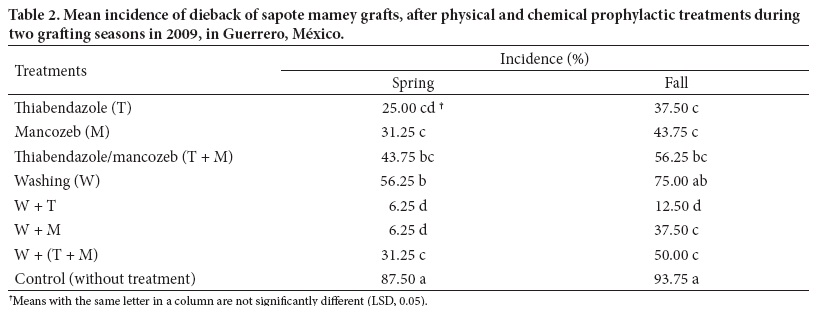
<self-uri xlink:href="http://www.scielo.org.mx/scielo.php?script=sci_arttext&amp;pid=S0187-73802013000300007&amp;lng=en&amp;nrm=iso"></self-uri><self-uri xlink:href="http://www.scielo.org.mx/scielo.php?script=sci_abstract&amp;pid=S0187-73802013000300007&amp;lng=en&amp;nrm=iso"></self-uri><self-uri xlink:href="http://www.scielo.org.mx/scielo.php?script=sci_pdf&amp;pid=S0187-73802013000300007&amp;lng=en&amp;nrm=iso"></self-uri><abstract abstract-type="short" xml:lang="en"><p><![CDATA[Dieback of sapote mamey [Pouteria sapota (Jacq.) H. E. Moore and Stearn] grafts caused by Lasiodiplodia theobromae significantly reduces the success of grafting in Mexican nurseries. Semi-commercial tests were conducted in a sapote mamey nursery during two grafting seasons to evaluate the effectiveness of a physical treatment (washing) and three chemical treatments (fungicide dip) on scions. Washing reduced disease incidence up to 31 %, whereas chemical treatment reduced it up to 62 %. The combination of washing and thiabendazole dip resulted in an incidence decrease of 81 %. Twelve other fungicides were screened in vitro to evaluate mycelial growth inhibition of L. theobromae. The pre-formulated mix of cyprodinil + fludioxinil was the most effective fungicide with EC50 value of 0.0043 µg mL-1, followed by pyraclostrobin + boscalid, prochloraz and tebuconazole with EC50 values < 0.1 µg mL-1, and iprodione and thiabendazole with EC50 values < 1.0 µg mL-1. This study provides novel information about strategies for controlling L. theobromae infection during the grafting process of sapote mamey and it also showed the effectiveness of several fungicides under in vitro conditions for controlling this plant pathogenic fungus.]]></p></abstract>
<abstract abstract-type="short" xml:lang="es"><p><![CDATA[La muerte descendente de varetas injertadas de zapote mamey [Pou-teria sapota (Jacq.) H. E. Moore y Stearn] causada por Lasiodiplodia theobromae reduce significativamente el prendimiento de injertos en viveros en México. Se realizaron pruebas semi-comerciales en un vivero de zapote mamey durante dos épocas de injerto para evaluar la efectividad de tratamientos físicos (lavado) y químicos (inmersión en fungicida) en varetas de este frutal. El lavado disminuyó la incidencia de la enfermedad hasta 31 %, mientras que, el tratamiento químico la redujo hasta en 62 %. La combinación del lavado con thiabendazole abatió la incidencia hasta 81 %. Otros doce fungicidas se evaluaron in vitro para inhibir el crecimiento micelial de L. theobromae. La mezcla pre-formulada de cyprodinil + fludioxinil fue el fungicida más efectivo con valores de EC50 = 0.0043 µg mL-1, seguido por pyraclostrobin + boscalid, prochloraz y tebuconazole con EC50 < 0.1 µg mL-1, e iprodione y thiabendazole con valores EC50 < 1.0 µg mL-1. Este estudio provee información novedosa sobre estrategias para controlar a L. theobromae durante el proceso de injerto de zapote mamey, además de mostrar la efectividad in vitro de varios fungicidas para el control de este hongo fitopatógeno.]]></p></abstract>
<kwd-group>
<kwd lng="en"><![CDATA[Pouteria sapota]]></kwd>
<kwd lng="en"><![CDATA[Lasiodiplodia theobromae]]></kwd>
<kwd lng="en"><![CDATA[fungicides]]></kwd>
<kwd lng="en"><![CDATA[nursery]]></kwd>
<kwd lng="en"><![CDATA[propagation]]></kwd>
<kwd lng="es"><![CDATA[Pouteria sapota]]></kwd>
<kwd lng="es"><![CDATA[Lasiodiplodia theobromae]]></kwd>
<kwd lng="es"><![CDATA[fungicidas]]></kwd>
<kwd lng="es"><![CDATA[vivero]]></kwd>
<kwd lng="es"><![CDATA[propagación]]></kwd>
</kwd-group>
</article-meta>
</front><body><![CDATA[  	    <p align="justify"><font face="verdana" size="4">Art&iacute;culo cient&iacute;fico</font></p>  	    <p align="justify"><font face="verdana" size="2">&nbsp;</font></p>  	    <p align="center"><font face="verdana" size="4"><b>Control of <i>Lasiodiplodia theobromae</i>, the causal agent of dieback of sapote mamey &#91;<i>Pouteria sapota</i> (Jacq.) H. E. Moore and Stearn&#93; grafts in M&eacute;xico</b></font></p>  	    <p align="justify"><font face="verdana" size="2">&nbsp;</font></p>  	    <p align="center"><font face="verdana" size="3"><b>Control de <i>Lasiodiplodia theobromae</i>, agente causal de la muerte descendente de injertos de zapote mamey &#91;<i>Pouteria sapota</i> (Jacq.) H. E. Moore y Stearn&#93; en M&eacute;xico</b></font></p>  	    <p align="justify"><font face="verdana" size="2">&nbsp;</font></p>  	    <p align="center"><font face="verdana" size="2"><b>Juan M. Tovar Pedraza<sup>1</sup>*, Jos&eacute; A. Mora Aguilera<sup>1</sup>, Cristian Nava D&iacute;az<sup>1</sup>, Daniel T&eacute;liz Ortiz<sup>1</sup>, &Aacute;ngel Villegas Monter<sup>2</sup> y Santos G. Leyva Mir<sup>3</sup></b></font></p>  	    <p align="justify"><font face="verdana" size="2">&nbsp;</font></p>  	    <p align="justify"><font face="verdana" size="2"><sup><i>1</i></sup><i>Postgrado en Fitopatolog&iacute;a Campus Montecillo, Colegio de Postgraduados. Km 36.5 Carretera M&eacute;xico&#45;Texcoco. 56230, Montecillo, Texcoco, Estado de M&eacute;xico. * Autor para correspondencia </i>(<a href="mailto:jmtovar@colpos.mx">jmtovar@colpos.mx</a>)</font></p>      ]]></body>
<body><![CDATA[<p align="justify"><font face="verdana" size="2"><i><sup>2</sup>Postgrado en Fruticultura, Campus Montecillo, Colegio de Postgraduados. Km 36.5 Carretera M&eacute;xico&#45;Texcoco. 56230, Montecillo, Texcoco, Estado de M&eacute;xico.</i></font></p>  	    <p align="justify"><font face="verdana" size="2"><i><sup>3</sup>Departamento de Parasitolog&iacute;a Agr&iacute;cola, Universidad Aut&oacute;noma Chapingo. Km 38.5 Carretera M&eacute;xico&#45;Texcoco. 56230, Chapingo, Texcoco, Estado de M&eacute;xico.</i></font></p>  	    <p align="justify"><font face="verdana" size="2">&nbsp;</font></p>  	    <p align="justify"><font face="verdana" size="2">Recibido: 29 de Noviembre del 2012    <br> 	Aceptado: 15 de Abril del 2013</font></p>  	    <p align="justify"><font face="verdana" size="2">&nbsp;</font></p>  	    <p align="justify"><font face="verdana" size="2"><b>Abstract</b></font></p>  	    <p align="justify"><font face="verdana" size="2">Dieback of sapote mamey <i>&#91;Pouteria sapota</i> (Jacq.) H. E. Moore and Stearn&#93; grafts caused by <i>Lasiodiplodia theobromae</i> significantly reduces the success of grafting in Mexican nurseries. Semi&#45;commercial tests were conducted in a sapote mamey nursery during two grafting seasons to evaluate the effectiveness of a physical treatment (washing) and three chemical treatments (fungicide dip) on scions. Washing reduced disease incidence up to 31 %, whereas chemical treatment reduced it up to 62 %. The combination of washing and thiabendazole dip resulted in an incidence decrease of 81 %. Twelve other fungicides were screened <i>in vitro</i> to evaluate mycelial growth inhibition of <i>L. theobromae.</i> The pre&#45;formulated mix of cyprodinil + fludioxinil was the most effective fungicide with EC<sub>50</sub> value of 0.0043  &micro;g mL<sup>&#45;1</sup>, followed by pyraclostrobin + boscalid, prochloraz and tebuconazole with EC<sub>50</sub> values &lt; 0.1 &micro;g mL<sup>&#45;1</sup>, and iprodione and thiabendazole with EC<sub>50</sub> values &lt; 1.0 &micro;g mL<sup>&#45;1</sup>. This study provides novel information about strategies for controlling <i>L. theobromae</i> infection during the grafting process of sapote mamey and it also showed the effectiveness of several fungicides under <i>in vitro</i> conditions for controlling this plant pathogenic fungus.</font></p>      <p align="justify"><font face="verdana" size="2"><b>Key words:</b> <i>Pouteria sapota, Lasiodiplodia theobromae,</i> fungicides, nursery, propagation.</font></p>  	    <p align="justify"><font face="verdana" size="2">&nbsp;</font></p>  	    ]]></body>
<body><![CDATA[<p align="justify"><font face="verdana" size="2"><b>Resumen</b></font></p>  	    <p align="justify"><font face="verdana" size="2">La muerte descendente de varetas injertadas de zapote mamey <i>&#91;Pou&#45;teria sapota</i> (Jacq.) H. E. Moore y Stearn&#93; causada por <i>Lasiodiplodia theobromae</i> reduce significativamente el prendimiento de injertos en viveros en M&eacute;xico. Se realizaron pruebas semi&#45;comerciales en un vivero de zapote mamey durante dos &eacute;pocas de injerto para evaluar la efectividad de tratamientos f&iacute;sicos (lavado) y qu&iacute;micos (inmersi&oacute;n en fungicida) en varetas de este frutal. El lavado disminuy&oacute; la incidencia de la enfermedad hasta 31 %, mientras que, el tratamiento qu&iacute;mico la redujo hasta en 62 %. La combinaci&oacute;n del lavado con thiabendazole abati&oacute; la incidencia hasta 81 %. Otros doce fungicidas se evaluaron <i>in vitro</i> para inhibir el crecimiento micelial de <i>L. theobromae.</i> La mezcla pre&#45;formulada de cyprodinil + fludioxinil fue el fungicida m&aacute;s efectivo con valores de EC<sub>50</sub> = 0.0043 &micro;g mL<sup>&#45;1</sup>, seguido por pyraclostrobin + boscalid, prochloraz y tebuconazole con EC<sub>50</sub> &lt; 0.1 &micro;g mL<sup>&#45;1</sup>, e iprodione y thiabendazole con valores EC<sub>50</sub> &lt; 1.0 &micro;g mL<sup>&#45;1</sup>. Este estudio provee informaci&oacute;n novedosa sobre estrategias para controlar a <i>L. theobromae</i> durante el proceso de injerto de zapote mamey, adem&aacute;s de mostrar la efectividad <i>in vitro</i> de varios fungicidas para el control de este hongo fitopat&oacute;geno.</font></p>      <p align="justify"><font face="verdana" size="2"><b>Palabras clave:</b> <i>Pouteria sapota, Lasiodiplodia theobromae,</i> fungicidas, vivero, propagaci&oacute;n.</font></p>  	    <p align="justify"><font face="verdana" size="2">&nbsp;</font></p>  	    <p align="justify"><font face="verdana" size="2"><b>INTRODUCTION</b></font></p>  	    <p align="justify"><font face="verdana" size="2"><i>Lasiodiplodia theobromae</i> (Pat.) Griff. &amp; Maubl. (syn. <i>Bot&#45;ryodiplodia theobromae</i> Pat.) the anamorphic stage of <i>Bot&#45;ryosphaeria rhodina</i> (Berk. &amp; M.A. Curtis) Arx, is widely distributed in tropical and subtropical regions and has been associated with approximately 500 hosts. It induces diseases such as dieback, root rot, fruit rot, blights, gummosis, stem necrosis, leaf spot and witches' broom disease (Punithalingam, 1980). The major industrial crops and fruit trees in which it has been found causing pre&#45;harvest (dieback and gummosis) and/or post&#45;harvest (fruit rot) diseases are: avocado <i>(Persea americana</i> Mill.) (Darvas and Kotze, 1987), soursop <i>(Annona muricata</i> L.) (Ponte, 1985), cocoa <i>(Theobroma cacao</i> L.) (Mbenoun <i>et al.,</i> 2008), citrus <i>(Citrus</i> spp.) (Adisa and Obinyereokwu, 1988), coconut <i>(Cocos nucifera</i> L.) (Correia and Costa, 2005), guava <i>(Psidium guajava</i> L.) (Cardoso <i>et al.,</i> 2002), mango <i>(Mangifera indica</i> L.) (Meah <i>et al.,</i> 1991), papaya <i>(Caricapapaya</i> L.) (Wang <i>et al.,</i> 2007), grapevine <i>(Vitis vinifera</i> L.) (Bester <i>et al.,</i> 2007) and sapote mamey <i>(Pouteria sapota</i> (Jacq.) H. E. Moore and Stearn) (Bautista <i>et al.,</i> 2002; G&oacute;mez <i>et al.,</i> 2009; V&aacute;squez <i>et al.,</i> 2009). This fungus has also been associated with die&#45;back and necrosis at the grafting site of cashew <i>(Anacardium occidentale</i> L.) (Freire <i>et al.,</i> 2002), guava (Cardoso <i>et al.,</i> 2002), citrus (Davis <i>et al.,</i> 1987), grapevine (Aroca <i>et al.,</i> 2008) and sapote mamey (Tovar <i>et al.,</i> 2012).</font></p>  	    <p align="justify"><font face="verdana" size="2">Incidence of <i>L. theobromae</i> induced dieback of sapote mamey grafts during grafting is high (&gt; 70 %) in Mexico (Tovar <i>et al.,</i> 2012), however, there is no information regarding physical or chemical treatment of vegetative material used in grafting of this fruit.</font></p>  	    <p align="justify"><font face="verdana" size="2">Fungicides have become the most important means of controlling fungal pathogens. Several <i>in vitro</i> tests have determined the sensitivity of <i>L. theobromae</i> to fungicides (Bester <i>et al.,</i> 2007; Da Silva <i>et al.,</i> 2012), however, there are no reports of <i>in vitro</i> tests for the control of <i>L. theobromae</i> isolates obtained from sapote mamey.</font></p>  	    <p align="justify"><font face="verdana" size="2">Based on this information, this study evaluated the potential effect of fungicide dip (chemical treatment) and washing of scions (prophylactic physical treatment) to prevent graft infection by <i>L. theobromae</i> during vegetative propagation of sapote mamey and to determine the <i>in vitro</i> effectiveness of a range of fungicides to inhibit mycelial growth of <i>L. theobromae.</i></font></p>  	    <p align="justify"><font face="verdana" size="2">&nbsp;</font></p>  	    ]]></body>
<body><![CDATA[<p align="justify"><font face="verdana" size="2"><b>MATERIALS AND METHODS</b></font>	</p>     <p align="justify"><font face="verdana" size="2"><b>Nursery tests</b></font></p>  	    <p align="justify"><font face="verdana" size="2">Chemical and physical prophylactic treatments were conducted during two grafting seasons (Spring and Fall 2009) in a commercial nursery of sapote mamey located in Alpoyeca, Guerrero, M&eacute;xico, using naturally infected scions. Rootstocks were grown from seeds of freshly harvested fruits. Conventional practices of nutrition and irrigation were applied until plants reached 80 cm in height and a minimum of 2 cm in diameter over a period of 10 to 12 months. The experimental shoots (straight, 25 cm long, without physical damage and with several dormant buds and mature leaves) were collected from the tree "El Mexicano", a 20&#45;years&#45;old selection. The scions collected during March and October 2009, were manually defoliated. A total of 256 sapote mamey scions were grafted by the veneer grafting technique as recommended by Villegas and Mora (2008).</font></p>  	    <p align="justify"><font face="verdana" size="2">Scions were washed by prophylactic physical treatment with a natural fiber and water with the aim to remove dead tissue (pubescence) and organic residues. Water excess was removed with blotting paper; washed scions were allowed to air dry for 15 min and then grafted.</font></p>  	    <p align="justify"><font face="verdana" size="2">The prophylactic chemical treatment was dipping scions in the fungicide suspension for 15 min. The following fungicides were tested: thiabendazole (600 mg L<sup>&#45;1</sup>), mancozeb (800 mg L<sup>&#45;1</sup>), and thiabendazole + mancozeb (600 mg L<sup>&#45;1</sup> + 800 mg L<sup>&#45;1</sup>). Excess fungicide suspension was removed with blotteing paper, and treated scions were allowed to air dry for 15 min before grafting.</font></p>  	    <p align="justify"><font face="verdana" size="2">Washing prior to application of each of the three fungicide dips was performed to determine the interaction between both groups of treatments. Control scions were neither washed nor dipped into the fungicide suspension. The experimental design consisted of four randomized blocks. Each block contained eight treatments. Each treatment was applied on 4 scions. In the whole experiment, each treatment was applied to 16 scions.</font></p>  	    <p align="justify"><font face="verdana" size="2">All grafts were covered with clear plastic bags to avoid dehydration. Grafted plants were maintained under 75 &#45; 80 % shade cloth, and inspected every week for disease development. The effect of washing and fungicide dip was assessed 30 d after grafting. Diseased grafted plants for each treatment were taken to the laboratory to confirm the presence of <i>L. theobromae.</i> Incidence of diseased grafts for each treatment was calculated with the following equation: <i>Ii</i> = &#931;ni / Ni; where, <i>Ii</i> = incidence of diseased grafts at the moment I; <i>ni</i> = number of diseased grafts at the moment I; <i>Ni</i> = total population of grafted plants for each treatment.</font></p>  	    <p align="justify"><font face="verdana" size="2">&nbsp;</font></p>  	    <p align="justify"><font face="verdana" size="2"><b><i>In vitro</i> test</b></font></p>  	    <p align="justify"><font face="verdana" size="2"><i>Lasiodiplodia theobromae</i> isolate (GenBank Accession No. JQ245975) used in <i>in vitro</i> screening tests was obtained from a commercial nursery of sapote mamey grafted plants that showed necrosis in the graft union and dieback of scions (Tovar <i>et al.,</i> 2012). This isolate is maintained at the culture collection of the herbarium "CMPH" (Accession No. CB007) at Colegio de Postgraduados, Campus Montecillo, Texcoco, Estado de M&eacute;xico, M&eacute;xico.</font></p>  	    ]]></body>
<body><![CDATA[<p align="justify"><font face="verdana" size="2">Seven systemic and five contact fungicides, representing ten different chemical groups, were selected for the <i>in vitro</i> mycelial growth inhibition tests (<a href="/img/revistas/rfm/v36n3/a7t1.jpg" target="_blank">Table 1</a>).</font></p>  	    <p align="justify"><font face="verdana" size="2">Fungicide stock solutions (1000 &micro;g mL<sup>&#45;1</sup>) were made using sterile distilled water. Aliquots of stock solutions were incorporated into autoclaved potato&#45;dextrose&#45;agar (PDA) (BD Bioxon&reg;, Becton Dickinson, USA) when the medium was at 45 to 50 &deg;C to provide concentrations of 0.1, 1, 10 and 100 &micro;g mL<sup>&#45;1</sup>. The pre&#45;formulated mix of cyprodinil + fludioxonil was tested at 0.001, 0.005, 0.01, 0.05, and 0.1 (g &micro;l<sup>&#45;1</sup>. PDA without fungicide was used as control. Approximately 20 &micro;l of fungicide&#45;amended medium was poured into Petri dishes. Mycelial plugs (5 mm in diameter) obtained from the margins of actively growing culture (4 days&#45;old) of <i>L. theobromae</i> on PDA were transferred to the fungicide&#45;amended plates. Four replicates were used per fungicide concentration. Plates were incubated at 28 &deg;C and the diameter of radial mycelial growth of each colony was measured perpendicularly twice every 24 h for 3 d. The complete experiment was repeated twice.</font></p>  	    <p align="justify"><font face="verdana" size="2">&nbsp;</font></p>  	    <p align="justify"><font face="verdana" size="2"><b>Statistical analysis</b></font></p>  	    <p align="justify"><font face="verdana" size="2">Incidence data of the nursery trials were transformed to arcsine values before the analysis to normalize the variances. Data were subjected to analysis of variance (ANOVA) using SAS (Statistical Analysis System, version 9.1, SAS Institute Cary, NC). Treatment means were compared using the least significant difference (LSD) test (P &#8804; 0.05). Data from each grafting season were analyzed separately.</font></p>  	    <p align="justify"><font face="verdana" size="2">Inhibition of mycelial growth for each fungicide concentration of the <i>in vitro</i> tests was calculated as a percentage with respect to the control treatment (un&#45;amended PDA). Percentages of mycelial growth inhibition were converted to Probits and plotted against log<sub>10</sub> values of the fungicide concentration. Probit regression analysis was used to calculate the effective concentration values that inhibited mycelial growth by 50 %. EC<sub>50</sub> values were processed by an ANOVA performed with the General Linear Model (GLM) of SAS and treatment means were separated using the least significant difference (LSD) value at P &#8804; 0.05.</font></p>  	    <p align="justify"><font face="verdana" size="2">&nbsp;</font></p>  	    <p align="justify"><font face="verdana" size="2"><b>RESULTS AND DISCUSSION</b></font>	</p>     <p align="justify"><font face="verdana" size="2"><b>Nursery tests</b></font></p>  	    <p align="justify"><font face="verdana" size="2">Washing significantly reduced dieback incidence of grafts during the spring season but not during the fall, as compared to the control (<a href="/img/revistas/rfm/v36n3/a7t2.jpg" target="_blank">Table 2</a>). In spring, disease incidence decreased from 87.50 % of the control to 56.25 % of the washed scions (a reduction of 31 %), while in fall the corresponding incidence reduction only was of 18 %. This result was probably related to a higher concentration of inoculum during the fall season, as it was shown by V&aacute;squez <i>et al.</i> (2009) who found that the highest concentration of conidia in the air was captured in volumetric traps during the fall seasons from 2007 to 2009 in Alpoyeca, Guerrero.</font></p>  	    ]]></body>
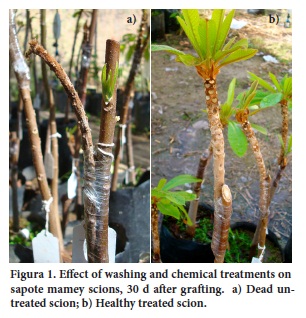
<body><![CDATA[<p align="justify"><font face="verdana" size="2">According to Tovar <i>et al.</i> (2012), <i>L. theobromae</i> inoculum is located in the cortex and trichomes of sapote mamey scions; thus, it is presumed that treatment by washing removed the fungal inoculum present on the scions. Hot water treatment is effective in reducing or eradicating the inoculum source of fungal pathogens that cause diseases in grapevine nurseries (Edwards <i>et al.,</i> 2004; Halleen <i>et al.,</i> 2007).</font></p>  	    <p align="justify"><font face="verdana" size="2">No significant difference was detected among chemical treatments. However, all chemical treatments significantly reduce disease incidence with values ranging from 37 to 62 % compared to the control during both grafting seasons, respectively (<a href="/img/revistas/rfm/v36n3/a7t2.jpg" target="_blank">Table 2</a> and <a href="#f1">Figure 1</a>). Retief <i>et al.</i> (2006) and Gramaje <i>et al.</i> (2009) showed that dipping of material in fungicide suspension eliminates the inoculum source from the surface and/or decreases superficial fungal growth during the graft union process in grapevine nurseries. No phytotoxicity symptoms were observed with any of the fungicides tested.</font></p>  	    <p align="center"><font face="verdana" size="2"><a name="f1"></a></font></p>  	    <p align="center"><font face="verdana" size="2"><img src="/img/revistas/rfm/v36n3/a7f1.jpg"></font></p>  	    <p align="justify"><font face="verdana" size="2">The combination of physical and chemical treatments reduced the disease incidence up to 81 %, compared with the untreated control scions during both seasons (<a href="/img/revistas/rfm/v36n3/a7t2.jpg">Table 2</a>). These results coincide with reports by Halleen <i>et al.</i> (2007) in grapevine propagating material, in which the reduction of disease incidence was more consistent in the propagating material that received the combination of physical and chemical treatments. Our results support the statement that an integrated management program is most effective in reducing the incidence of diseases caused by fungal pathogens that penetrate during the grafting process (Fourie and Halleen, 2005, 2006).</font></p>  	    <p align="justify"><font face="verdana" size="2">We observed mycelial growth and conidia of <i>L. theobromae</i> on the stem cortex, and presumably, it only penetrated through deep and extensive wounds, such as the ones made to scions and rootstocks during the grafting process. However, the inoculum was effectively removed by washing and by treating with the fungicide dip, especially with thiabendazole. These findings suggest that the combination of washing and chemical treatments should be recommended to prevent infections by <i>L. theobromae</i> in grafts and increase the success of young plants established in sapote mamey orchards.</font></p>  	    <p align="justify"><font face="verdana" size="2">&nbsp;</font></p>  	    <p align="justify"><font face="verdana" size="2"><b><i>In vitro</i> test</b></font></p>  	    <p align="justify"><font face="verdana" size="2"><b>Mycelial growth assay.</b> The pre&#45;formulated mix of cyprodinil + fludioxinil was the most effective fungicide in reducing mycelial growth with EC<sub>50</sub> value= 0.0043 &micro;g mL<sup>&#45;1</sup> (<a href="/img/revistas/rfm/v36n3/a7t3.jpg" target="_blank">Table 3</a>). Similarity, Wang <i>et al.</i> (2007) found that the mix of cyprodinil + fludioxinil inhibited mycelial growth of <i>L. theobromae</i> isolates from papaya to EC<sub>50</sub> = 0.0073 &micro;g mL<sup>&#45;1</sup>.</font></p>      <p align="justify"><font face="verdana" size="2">The EC<sub>50</sub> values of pyraclostrobin + boscalid, prochloraz, and tebuconazole ranged from 0.014 to 0.048 &micro;g mL<sup>&#45;1</sup>, followed by iprodione and thiabendazole (EC<sub>50</sub> = 0.335 to 0.430 (g &micro;l<sup>&#45;1</sup>). Wang <i>et al.</i> (2007) found prochloraz, iprodione, and tebuconazole as the most effective fungicides to inhibit mycelial growth of <i>L. theobromae</i> isolates from papaya with EC<sub>50</sub> &lt; 1 &micro;g mL<sup>&#45;1</sup>. In contrast, Da Silva <i>et al.</i> (2012) indicated that thiabendazole, prochloraz, and tebuconazole were effective with EC<sub>50</sub> values &gt; 1 &micro;g mL<sup>&#45;1</sup>; however, their isolates were obtained from papaya orchards subjected to several fungicide applications. Bester <i>et al.</i> (2007) reported that prochloraz and tebuconazole at low EC<sub>50</sub>&lt; 0.6 &micro;g mL<sup>&#45;1</sup>) inhibited mycelial growth of <i>L. theobromae</i> isolates from grapevines, while kresoximmetyl, iprodione and pyrimethanil were ineffective. Our results coincide with this report, except for iprodione, which, in this study, was observed to be effective with an EC<sub>50</sub> value = 0.335 &micro;g mL<sup>&#45;1</sup>.</font></p>  	    ]]></body>
<body><![CDATA[<p align="justify"><font face="verdana" size="2">In this <i>in vitro</i> test, systemic fungicides were effective at low concentrations because our <i>L. theobromae</i> isolate had not been previously exposed to selection pressure by fungicide application in sapote mamey nurseries or orchards. Most of the contact fungicides (captan, chlorothalonil, copper hydroxide, and mancozeb) inhibited mycelial growth with EC<sub>50</sub> values &gt; 7 &micro;g mL<sup>&#45;1</sup> as reported by Khanzada <i>et al.</i> (2005) and Gud and Raut (2008) in tests with isolates from mango.</font></p>  	    <p align="justify"><font face="verdana" size="2">We selected contact and systemic fungicides from different chemical groups, because the fungicide application programs that prevent pathogen populations from developing fungicide resistance are based on the rotation and/ or combination of two action types (Denman <i>et al.,</i> 2004).</font></p>  	    <p align="justify"><font face="verdana" size="2">Cyprodinil + fludioxinil, pyraclostrobin + boscalid, prochloraz, tebuconazole and iprodione showed high effectiveness against <i>L. theobromae</i> and should be evaluated in additional trials in sapote mamey nurseries to confirm their efficacy in the field.</font></p>  	    <p align="justify"><font face="verdana" size="2">&nbsp;</font></p>  	    <p align="justify"><font face="verdana" size="2"><b>CONCLUSIONS</b></font></p>  	    <p align="justify"><font face="verdana" size="2">The combination of washing with water and fungicide dip was effective to prevent infections by <i>L. theobromae</i> during the grafting process of sapote mamey. Cyprodinil + fludioxinil, pyraclostrobin + boscalid, prochloraz, tebuconazole and iprodione effectively inhibited mycelial growth of <i>L. theobromae in vitro.</i></font></p>  	    <p align="justify"><font face="verdana" size="2">&nbsp;</font></p>  	    <p align="justify"><font face="verdana" size="2"><b>ACKNOWLEDGMENTS</b></font></p>  	    <p align="justify"><font face="verdana" size="2">This research was financially supported by Fundaci&oacute;n Produce de Guerrero, M&eacute;xico (Project PM 1731). The authors gratefully acknowledge Dr. Luciano Mart&iacute;nez Bola&ntilde;os and M.Sc. Lauro Soto Rojas for their helpful suggestions in the statistical analysis.</font></p>  	    <p align="justify"><font face="verdana" size="2">&nbsp;</font></p>  	    ]]></body>
<body><![CDATA[<p align="justify"><font face="verdana" size="2"><b>BIBLIOGRAPHY</b></font></p>  	    <!-- ref --><p align="justify"><font face="verdana" size="2"><b>Adisa V A, O A Obinyereokwu (1998)</b> Studies on the latent infection of <i>Botryodiplodia theobromae</i> Pat. on <i>Citrus sinensis</i> (Li.) Osbeck fruit. Mycopathologia 102:165&#45;167.    &nbsp;&nbsp;&nbsp;&nbsp;&nbsp;&nbsp;&nbsp;&nbsp;[&#160;<a href="javascript:void(0);" onclick="javascript: window.open('/scielo.php?script=sci_nlinks&ref=7092546&pid=S0187-7380201300030000700001&lng=','','width=640,height=500,resizable=yes,scrollbars=1,menubar=yes,');">Links</a>&#160;]<!-- end-ref --></font></p>  	    <!-- ref --><p align="justify"><font face="verdana" size="2"><b>Aroca A, R Raposo, D Gramaje, J Armengol, S Martos, J Luque (2008)</b> First report of <i>Lasiodiplodia theobromae</i> on rootstocks mother grapevines in Spain. Plant Dis. 92:832.    &nbsp;&nbsp;&nbsp;&nbsp;&nbsp;&nbsp;&nbsp;&nbsp;[&#160;<a href="javascript:void(0);" onclick="javascript: window.open('/scielo.php?script=sci_nlinks&ref=7092548&pid=S0187-7380201300030000700002&lng=','','width=640,height=500,resizable=yes,scrollbars=1,menubar=yes,');">Links</a>&#160;]<!-- end-ref --></font></p>  	    <!-- ref --><p align="justify"><font face="verdana" size="2"><b>Bautista B S, J C D&iacute;az P, L L Barrera N (2002)</b> Postharvest fungal rots of sapote mamey <i>Pouteria sapota</i> H. E. Moore &amp; Stearn. Postharv. Biol. &amp; Technol. 24:197&#45;200.    &nbsp;&nbsp;&nbsp;&nbsp;&nbsp;&nbsp;&nbsp;&nbsp;[&#160;<a href="javascript:void(0);" onclick="javascript: window.open('/scielo.php?script=sci_nlinks&ref=7092550&pid=S0187-7380201300030000700003&lng=','','width=640,height=500,resizable=yes,scrollbars=1,menubar=yes,');">Links</a>&#160;]<!-- end-ref --></font></p>  	    <!-- ref --><p align="justify"><font face="verdana" size="2"><b>Bester W, P W Crous, P H Fourie (2007)</b> Evaluation of fungicides as potential grapevine pruning wound protectants against <i>Botryosphaeria</i> species. Austral. Plant Pathol. 36:73&#45;77.    &nbsp;&nbsp;&nbsp;&nbsp;&nbsp;&nbsp;&nbsp;&nbsp;[&#160;<a href="javascript:void(0);" onclick="javascript: window.open('/scielo.php?script=sci_nlinks&ref=7092552&pid=S0187-7380201300030000700004&lng=','','width=640,height=500,resizable=yes,scrollbars=1,menubar=yes,');">Links</a>&#160;]<!-- end-ref --></font></p>  	    <!-- ref --><p align="justify"><font face="verdana" size="2"><b>Cardoso J E, C M Maia, M N G Pesso (2002)</b> Occurrence of <i>Pestalotiopsis psidii</i> and <i>Lasiodiplodia theobromae</i> causing stem rot of guava plants in the State of Cear&aacute;, Brazil. Fitopatol. Brasil. 27:320.    &nbsp;&nbsp;&nbsp;&nbsp;&nbsp;&nbsp;&nbsp;&nbsp;[&#160;<a href="javascript:void(0);" onclick="javascript: window.open('/scielo.php?script=sci_nlinks&ref=7092554&pid=S0187-7380201300030000700005&lng=','','width=640,height=500,resizable=yes,scrollbars=1,menubar=yes,');">Links</a>&#160;]<!-- end-ref --></font></p>  	    <!-- ref --><p align="justify"><font face="verdana" size="2"><b>Correia M S, J L S Costa (2005)</b> Dispers&atilde;o anem&oacute;fila do fungo <i>Lasiodiplodia theobromae</i> em planta&ccedil;&otilde;es de coqueiro. Fitopatol. Brasil. 30:150&#45;154.    &nbsp;&nbsp;&nbsp;&nbsp;&nbsp;&nbsp;&nbsp;&nbsp;[&#160;<a href="javascript:void(0);" onclick="javascript: window.open('/scielo.php?script=sci_nlinks&ref=7092556&pid=S0187-7380201300030000700006&lng=','','width=640,height=500,resizable=yes,scrollbars=1,menubar=yes,');">Links</a>&#160;]<!-- end-ref --></font></p>  	    <!-- ref --><p align="justify"><font face="verdana" size="2"><b>Da Silva P A V, R B Martins, S J Michereff, M B Da Silva, M P S C&aacute;mara (2012)</b> Sensitivity of <i>Lasiodiplodia theobromae</i> from Brazilian papaya orchards to MBC and DMI fungicides. Eur. J. Plant Pathol. 132:489&#45;498.    &nbsp;&nbsp;&nbsp;&nbsp;&nbsp;&nbsp;&nbsp;&nbsp;[&#160;<a href="javascript:void(0);" onclick="javascript: window.open('/scielo.php?script=sci_nlinks&ref=7092558&pid=S0187-7380201300030000700007&lng=','','width=640,height=500,resizable=yes,scrollbars=1,menubar=yes,');">Links</a>&#160;]<!-- end-ref --></font></p>  	    <!-- ref --><p align="justify"><font face="verdana" size="2"><b>Darvas J M, J M Kotze (1987)</b> Fungi associated with pre&#45; and postharvest diseases of avocado fruit at Westfalia, South Africa. Phytophylactica 19:83&#45;85.    &nbsp;&nbsp;&nbsp;&nbsp;&nbsp;&nbsp;&nbsp;&nbsp;[&#160;<a href="javascript:void(0);" onclick="javascript: window.open('/scielo.php?script=sci_nlinks&ref=7092560&pid=S0187-7380201300030000700008&lng=','','width=640,height=500,resizable=yes,scrollbars=1,menubar=yes,');">Links</a>&#160;]<!-- end-ref --></font></p>  	    <!-- ref --><p align="justify"><font face="verdana" size="2"><b>Davis R M, C J Farrald, D Davila (1987)</b> Botryodiplodia trunk lesions in Texas citrus. Plant Dis. 71:848&#45;849.    &nbsp;&nbsp;&nbsp;&nbsp;&nbsp;&nbsp;&nbsp;&nbsp;[&#160;<a href="javascript:void(0);" onclick="javascript: window.open('/scielo.php?script=sci_nlinks&ref=7092562&pid=S0187-7380201300030000700009&lng=','','width=640,height=500,resizable=yes,scrollbars=1,menubar=yes,');">Links</a>&#160;]<!-- end-ref --></font></p>  	    <!-- ref --><p align="justify"><font face="verdana" size="2"><b>Denman S, P W Crous, A Sadie, M J Wingfield (2004)</b> Evaluation of fungicides for the control of <i>Botryosphaeria protearum</i> on <i>Protea magnifica</i> in the Western Cape Province of South Africa. Austral. Plant Pathol. 33:97&#45;102.    &nbsp;&nbsp;&nbsp;&nbsp;&nbsp;&nbsp;&nbsp;&nbsp;[&#160;<a href="javascript:void(0);" onclick="javascript: window.open('/scielo.php?script=sci_nlinks&ref=7092564&pid=S0187-7380201300030000700010&lng=','','width=640,height=500,resizable=yes,scrollbars=1,menubar=yes,');">Links</a>&#160;]<!-- end-ref --></font></p>  	    <!-- ref --><p align="justify"><font face="verdana" size="2"><b>Edwards J, I G Pascoe, S Salib, N Laukart (2004)</b> Hot treatment of grapevine cuttings reduces incidence of <i>Phaeomoniella chlamydospora</i> in young vines. Phytopathol. Med. 43: 158&#45;159.    &nbsp;&nbsp;&nbsp;&nbsp;&nbsp;&nbsp;&nbsp;&nbsp;[&#160;<a href="javascript:void(0);" onclick="javascript: window.open('/scielo.php?script=sci_nlinks&ref=7092566&pid=S0187-7380201300030000700011&lng=','','width=640,height=500,resizable=yes,scrollbars=1,menubar=yes,');">Links</a>&#160;]<!-- end-ref --></font></p>  	    <!-- ref --><p align="justify"><font face="verdana" size="2"><b>Fourie P H, F Halleen (2005)</b> Integrated strategies for proactive management of grapevine trunk diseases in nurseries. Phytopathol. Med. 44:111.    &nbsp;&nbsp;&nbsp;&nbsp;&nbsp;&nbsp;&nbsp;&nbsp;[&#160;<a href="javascript:void(0);" onclick="javascript: window.open('/scielo.php?script=sci_nlinks&ref=7092568&pid=S0187-7380201300030000700012&lng=','','width=640,height=500,resizable=yes,scrollbars=1,menubar=yes,');">Links</a>&#160;]<!-- end-ref --></font></p>  	    <!-- ref --><p align="justify"><font face="verdana" size="2"><b>Fourie P H, F Halleen (2006)</b> Chemical and biological protection of grapevine propagation material from trunk disease pathogens. Eur. J. Plant Pathol. 116:255&#45;265.    &nbsp;&nbsp;&nbsp;&nbsp;&nbsp;&nbsp;&nbsp;&nbsp;[&#160;<a href="javascript:void(0);" onclick="javascript: window.open('/scielo.php?script=sci_nlinks&ref=7092570&pid=S0187-7380201300030000700013&lng=','','width=640,height=500,resizable=yes,scrollbars=1,menubar=yes,');">Links</a>&#160;]<!-- end-ref --></font></p>  	    <!-- ref --><p align="justify"><font face="verdana" size="2"><b>Freire F C O, J E Cardoso, A A dos Santos, F M P Viana (2002)</b> Diseases of cashew nut plants <i>(Anacardium occidentale</i> L.) in Brazil. Crop Prot. 21:489&#45;494.    &nbsp;&nbsp;&nbsp;&nbsp;&nbsp;&nbsp;&nbsp;&nbsp;[&#160;<a href="javascript:void(0);" onclick="javascript: window.open('/scielo.php?script=sci_nlinks&ref=7092572&pid=S0187-7380201300030000700014&lng=','','width=640,height=500,resizable=yes,scrollbars=1,menubar=yes,');">Links</a>&#160;]<!-- end-ref --></font></p>  	    <!-- ref --><p align="justify"><font face="verdana" size="2"><b>G&oacute;mez J R, D Nieto A, D T&eacute;liz O, J A Mora A, M T Mart&iacute;nez D, M Vargas H (2009)</b> Manejo postcosecha y hongos asociados a la pudrici&oacute;n del fruto de zapote mamey <i>(Pouteria sapota)</i> en Guerrero, M&eacute;xico. Agrociencia 43:37&#45;48.    &nbsp;&nbsp;&nbsp;&nbsp;&nbsp;&nbsp;&nbsp;&nbsp;[&#160;<a href="javascript:void(0);" onclick="javascript: window.open('/scielo.php?script=sci_nlinks&ref=7092574&pid=S0187-7380201300030000700015&lng=','','width=640,height=500,resizable=yes,scrollbars=1,menubar=yes,');">Links</a>&#160;]<!-- end-ref --></font></p>  	    <!-- ref --><p align="justify"><font face="verdana" size="2"><b>Gramaje D, A Aroca, R Raposo, J Garc&iacute;a J, J Armengol (2009)</b> Evaluation of fungicides to control Petri disease pathogens in the grapevine propagation process. Crop Prot. 28:1091&#45;1097.    &nbsp;&nbsp;&nbsp;&nbsp;&nbsp;&nbsp;&nbsp;&nbsp;[&#160;<a href="javascript:void(0);" onclick="javascript: window.open('/scielo.php?script=sci_nlinks&ref=7092576&pid=S0187-7380201300030000700016&lng=','','width=640,height=500,resizable=yes,scrollbars=1,menubar=yes,');">Links</a>&#160;]<!-- end-ref --></font></p>  	    <!-- ref --><p align="justify"><font face="verdana" size="2"><b>Gud M A, S P Raut (2008)</b> Control of mango anthracnose and stem&#45;end rot fungi by fungicides and bio&#45;agents. J. Mahar. Agric. Univ. 33:120&#45;122.    &nbsp;&nbsp;&nbsp;&nbsp;&nbsp;&nbsp;&nbsp;&nbsp;[&#160;<a href="javascript:void(0);" onclick="javascript: window.open('/scielo.php?script=sci_nlinks&ref=7092578&pid=S0187-7380201300030000700017&lng=','','width=640,height=500,resizable=yes,scrollbars=1,menubar=yes,');">Links</a>&#160;]<!-- end-ref --></font></p>  	    <!-- ref --><p align="justify"><font face="verdana" size="2"><b>Halleen F, P H Fourie, P W Crous (2007)</b> Control of black foot disease in grapevine nurseries. Plant Pathol. 56:637&#45;645.    &nbsp;&nbsp;&nbsp;&nbsp;&nbsp;&nbsp;&nbsp;&nbsp;[&#160;<a href="javascript:void(0);" onclick="javascript: window.open('/scielo.php?script=sci_nlinks&ref=7092580&pid=S0187-7380201300030000700018&lng=','','width=640,height=500,resizable=yes,scrollbars=1,menubar=yes,');">Links</a>&#160;]<!-- end-ref --></font></p>  	    <!-- ref --><p align="justify"><font face="verdana" size="2"><b>Khanzada A M, A M Lodhi, S Shaazad (2005)</b> Chemical control of <i>Lasiodiplodia theobromae,</i> the causal agent of mango decline in Sidh. Pakistan J. Bot. 37:1023&#45;1030.    &nbsp;&nbsp;&nbsp;&nbsp;&nbsp;&nbsp;&nbsp;&nbsp;[&#160;<a href="javascript:void(0);" onclick="javascript: window.open('/scielo.php?script=sci_nlinks&ref=7092582&pid=S0187-7380201300030000700019&lng=','','width=640,height=500,resizable=yes,scrollbars=1,menubar=yes,');">Links</a>&#160;]<!-- end-ref --></font></p>  	    <!-- ref --><p align="justify"><font face="verdana" size="2"><b>Mbenoun M, Z E H Momo, G Samuels, A F Nsouga, S Nyasse (2008)</b> Dieback due to <i>Lasiodiplodia theobromae,</i> a new constraint to cocoa production in Cameroon. Plant Pathol. 57:381.    &nbsp;&nbsp;&nbsp;&nbsp;&nbsp;&nbsp;&nbsp;&nbsp;[&#160;<a href="javascript:void(0);" onclick="javascript: window.open('/scielo.php?script=sci_nlinks&ref=7092584&pid=S0187-7380201300030000700020&lng=','','width=640,height=500,resizable=yes,scrollbars=1,menubar=yes,');">Links</a>&#160;]<!-- end-ref --></font></p>  	    <!-- ref --><p align="justify"><font face="verdana" size="2"><b>Meah M B, R A Plumbley, M J Jeger (1991)</b> Growth and infectivity of <i>Botryodiplodia theobromae</i> causing stemend rot of mango. Mycol. Res. 95:405&#45;408.    &nbsp;&nbsp;&nbsp;&nbsp;&nbsp;&nbsp;&nbsp;&nbsp;[&#160;<a href="javascript:void(0);" onclick="javascript: window.open('/scielo.php?script=sci_nlinks&ref=7092586&pid=S0187-7380201300030000700021&lng=','','width=640,height=500,resizable=yes,scrollbars=1,menubar=yes,');">Links</a>&#160;]<!-- end-ref --></font></p>  	    <!-- ref --><p align="justify"><font face="verdana" size="2"><b>Ponte J J (1985)</b> Uma nova doenca da ateira e da gravioleira, causada por <i>Botryodiplodia theobromae.</i> Fitopatol. Brasil. 10:689&#45;691.    &nbsp;&nbsp;&nbsp;&nbsp;&nbsp;&nbsp;&nbsp;&nbsp;[&#160;<a href="javascript:void(0);" onclick="javascript: window.open('/scielo.php?script=sci_nlinks&ref=7092588&pid=S0187-7380201300030000700022&lng=','','width=640,height=500,resizable=yes,scrollbars=1,menubar=yes,');">Links</a>&#160;]<!-- end-ref --></font></p>  	    <!-- ref --><p align="justify"><font face="verdana" size="2"><b>Punithalingam E (1980)</b> Plant diseases attributed to <i>Botryodiplodia theobromae</i> Pat. J. Cramer, Vaduz. Biblio. Mycol. 71:1&#45;123.    &nbsp;&nbsp;&nbsp;&nbsp;&nbsp;&nbsp;&nbsp;&nbsp;[&#160;<a href="javascript:void(0);" onclick="javascript: window.open('/scielo.php?script=sci_nlinks&ref=7092590&pid=S0187-7380201300030000700023&lng=','','width=640,height=500,resizable=yes,scrollbars=1,menubar=yes,');">Links</a>&#160;]<!-- end-ref --></font></p>  	    <!-- ref --><p align="justify"><font face="verdana" size="2"><b>Retief E, A Mcleod, P H Fourie (2006)</b> Potential inoculum sources of <i>Phaeomoniella chlamydospora</i> in South African grapevine nurseries. Eur. J. Plant Pathol. 115:331&#45;339.    &nbsp;&nbsp;&nbsp;&nbsp;&nbsp;&nbsp;&nbsp;&nbsp;[&#160;<a href="javascript:void(0);" onclick="javascript: window.open('/scielo.php?script=sci_nlinks&ref=7092592&pid=S0187-7380201300030000700024&lng=','','width=640,height=500,resizable=yes,scrollbars=1,menubar=yes,');">Links</a>&#160;]<!-- end-ref --></font></p>  	    <!-- ref --><p align="justify"><font face="verdana" size="2"><b>Tovar P J M, J A Mora A, C Nava D, D T&eacute;liz O, G Valdovinos P, A Villegas M, J Hern&aacute;ndez M (2012)</b> Identification, pathogenicity, and histopathology of <i>Lasiodiplodia theobromae</i> on mamey sapote grafts in Guerrero, Mexico. Agrociencia 46:146&#45;161.    &nbsp;&nbsp;&nbsp;&nbsp;&nbsp;&nbsp;&nbsp;&nbsp;[&#160;<a href="javascript:void(0);" onclick="javascript: window.open('/scielo.php?script=sci_nlinks&ref=7092594&pid=S0187-7380201300030000700025&lng=','','width=640,height=500,resizable=yes,scrollbars=1,menubar=yes,');">Links</a>&#160;]<!-- end-ref --></font></p>  	    <!-- ref --><p align="justify"><font face="verdana" size="2"><b>V&aacute;squez L A, J A Mora A, E C&aacute;rdenas S, D. T&eacute;liz O (2009)</b> Etiolog&iacute;a e histopatolog&iacute;a de la muerte descendente de &aacute;rboles de mamey <i>(Pouteria sapota</i> (Jacq.) H. E. Moore and Stearn) en Guerrero, M&eacute;xico. Agrociencia 43:717&#45;728.    &nbsp;&nbsp;&nbsp;&nbsp;&nbsp;&nbsp;&nbsp;&nbsp;[&#160;<a href="javascript:void(0);" onclick="javascript: window.open('/scielo.php?script=sci_nlinks&ref=7092596&pid=S0187-7380201300030000700026&lng=','','width=640,height=500,resizable=yes,scrollbars=1,menubar=yes,');">Links</a>&#160;]<!-- end-ref --></font></p>  	    <!-- ref --><p align="justify"><font face="verdana" size="2"><b>Villegas M A, J A Mora A (2008)</b> Propagaci&oacute;n vegetativa del zapote mamey. <i>In:</i> El Zapote Mamey en M&eacute;xico: Avances de Investigaci&oacute;n. I Alia T, A Villegas M, V L&oacute;pez M, M Andrade R, C M Acosta D, O G Villegas T, D Guill&eacute;n S (eds). Universidad Aut&oacute;noma del Estado de Morelos. Morelos, M&eacute;xico. pp:1&#45;16.    &nbsp;&nbsp;&nbsp;&nbsp;&nbsp;&nbsp;&nbsp;&nbsp;[&#160;<a href="javascript:void(0);" onclick="javascript: window.open('/scielo.php?script=sci_nlinks&ref=7092598&pid=S0187-7380201300030000700027&lng=','','width=640,height=500,resizable=yes,scrollbars=1,menubar=yes,');">Links</a>&#160;]<!-- end-ref --></font></p>  	    <!-- ref --><p align="justify"><font face="verdana" size="2"><b>Wang H L, P H Chen, H F Ni, R S Chen (2007)</b> Physiological characterization and screen of control chemicals for <i>Lasiodiplodia theobromae</i> of papaya. Plant Pathol. Bull. 16:71&#45;77.    &nbsp;&nbsp;&nbsp;&nbsp;&nbsp;&nbsp;&nbsp;&nbsp;[&#160;<a href="javascript:void(0);" onclick="javascript: window.open('/scielo.php?script=sci_nlinks&ref=7092600&pid=S0187-7380201300030000700028&lng=','','width=640,height=500,resizable=yes,scrollbars=1,menubar=yes,');">Links</a>&#160;]<!-- end-ref --></font></p>      ]]></body><back>
<ref-list>
<ref id="B1">
<nlm-citation citation-type="journal">
<person-group person-group-type="author">
<name>
<surname><![CDATA[Adisa]]></surname>
<given-names><![CDATA[V A]]></given-names>
</name>
<name>
<surname><![CDATA[Obinyereokwu]]></surname>
<given-names><![CDATA[O A]]></given-names>
</name>
</person-group>
<article-title xml:lang="en"><![CDATA[Studies on the latent infection of Botryodiplodia theobromae Pat. on Citrus sinensis (Li.) Osbeck fruit]]></article-title>
<source><![CDATA[Mycopathologia]]></source>
<year>1998</year>
<volume>102</volume>
<page-range>165-167</page-range></nlm-citation>
</ref>
<ref id="B2">
<nlm-citation citation-type="journal">
<person-group person-group-type="author">
<name>
<surname><![CDATA[Aroca]]></surname>
<given-names><![CDATA[A]]></given-names>
</name>
<name>
<surname><![CDATA[Raposo]]></surname>
<given-names><![CDATA[R]]></given-names>
</name>
<name>
<surname><![CDATA[Gramaje]]></surname>
<given-names><![CDATA[D]]></given-names>
</name>
<name>
<surname><![CDATA[Armengol]]></surname>
<given-names><![CDATA[J]]></given-names>
</name>
<name>
<surname><![CDATA[Martos]]></surname>
<given-names><![CDATA[S]]></given-names>
</name>
<name>
<surname><![CDATA[Luque]]></surname>
<given-names><![CDATA[J]]></given-names>
</name>
</person-group>
<article-title xml:lang="en"><![CDATA[First report of Lasiodiplodia theobromae on rootstocks mother grapevines in Spain]]></article-title>
<source><![CDATA[Plant Dis.]]></source>
<year>2008</year>
<volume>92</volume>
<page-range>832</page-range></nlm-citation>
</ref>
<ref id="B3">
<nlm-citation citation-type="journal">
<person-group person-group-type="author">
<name>
<surname><![CDATA[Bautista]]></surname>
<given-names><![CDATA[B S]]></given-names>
</name>
<name>
<surname><![CDATA[J C Díaz]]></surname>
<given-names><![CDATA[P]]></given-names>
</name>
<name>
<surname><![CDATA[L L Barrera]]></surname>
<given-names><![CDATA[N]]></given-names>
</name>
</person-group>
<article-title xml:lang="en"><![CDATA[Postharvest fungal rots of sapote mamey Pouteria sapota H. E. Moore & Stearn. Postharv]]></article-title>
<source><![CDATA[Biol. & Technol.]]></source>
<year>2002</year>
<volume>24</volume>
<page-range>197-200</page-range></nlm-citation>
</ref>
<ref id="B4">
<nlm-citation citation-type="journal">
<person-group person-group-type="author">
<name>
<surname><![CDATA[Bester]]></surname>
<given-names><![CDATA[W]]></given-names>
</name>
<name>
<surname><![CDATA[Crous]]></surname>
<given-names><![CDATA[P W]]></given-names>
</name>
<name>
<surname><![CDATA[Fourie]]></surname>
<given-names><![CDATA[P H]]></given-names>
</name>
</person-group>
<article-title xml:lang="en"><![CDATA[Evaluation of fungicides as potential grapevine pruning wound protectants against Botryosphaeria species]]></article-title>
<source><![CDATA[Austral. Plant Pathol.]]></source>
<year>2007</year>
<volume>36</volume>
<page-range>73-77</page-range></nlm-citation>
</ref>
<ref id="B5">
<nlm-citation citation-type="journal">
<person-group person-group-type="author">
<name>
<surname><![CDATA[Cardoso]]></surname>
<given-names><![CDATA[J E]]></given-names>
</name>
<name>
<surname><![CDATA[Maia]]></surname>
<given-names><![CDATA[C M]]></given-names>
</name>
<name>
<surname><![CDATA[Pesso]]></surname>
<given-names><![CDATA[M N G]]></given-names>
</name>
</person-group>
<article-title xml:lang="en"><![CDATA[Occurrence of Pestalotiopsis psidii and Lasiodiplodia theobromae causing stem rot of guava plants in the State of Ceará, Brazil]]></article-title>
<source><![CDATA[Fitopatol. Brasil.]]></source>
<year>2002</year>
<volume>27</volume>
<page-range>320</page-range></nlm-citation>
</ref>
<ref id="B6">
<nlm-citation citation-type="journal">
<person-group person-group-type="author">
<name>
<surname><![CDATA[Correia]]></surname>
<given-names><![CDATA[M S]]></given-names>
</name>
<name>
<surname><![CDATA[Costa]]></surname>
<given-names><![CDATA[J L S]]></given-names>
</name>
</person-group>
<article-title xml:lang="pt"><![CDATA[Dispersão anemófila do fungo Lasiodiplodia theobromae em plantações de coqueiro]]></article-title>
<source><![CDATA[Fitopatol. Brasil.]]></source>
<year>2005</year>
<volume>30</volume>
<page-range>150-154</page-range></nlm-citation>
</ref>
<ref id="B7">
<nlm-citation citation-type="journal">
<person-group person-group-type="author">
<name>
<surname><![CDATA[Da Silva]]></surname>
<given-names><![CDATA[P A V]]></given-names>
</name>
<name>
<surname><![CDATA[Martins]]></surname>
<given-names><![CDATA[R B]]></given-names>
</name>
<name>
<surname><![CDATA[Michereff]]></surname>
<given-names><![CDATA[S J]]></given-names>
</name>
<name>
<surname><![CDATA[Da Silva]]></surname>
<given-names><![CDATA[M B]]></given-names>
</name>
<name>
<surname><![CDATA[Cámara]]></surname>
<given-names><![CDATA[M P S]]></given-names>
</name>
</person-group>
<article-title xml:lang="en"><![CDATA[Sensitivity of Lasiodiplodia theobromae from Brazilian papaya orchards to MBC and DMI fungicides]]></article-title>
<source><![CDATA[Eur. J. Plant Pathol.]]></source>
<year>2012</year>
<volume>132</volume>
<page-range>489-498</page-range></nlm-citation>
</ref>
<ref id="B8">
<nlm-citation citation-type="journal">
<person-group person-group-type="author">
<name>
<surname><![CDATA[Darvas]]></surname>
<given-names><![CDATA[J M]]></given-names>
</name>
<name>
<surname><![CDATA[Kotze]]></surname>
<given-names><![CDATA[J M]]></given-names>
</name>
</person-group>
<article-title xml:lang="en"><![CDATA[Fungi associated with pre- and postharvest diseases of avocado fruit at Westfalia, South Africa]]></article-title>
<source><![CDATA[Phytophylactica]]></source>
<year>1987</year>
<volume>19</volume>
<page-range>83-85</page-range></nlm-citation>
</ref>
<ref id="B9">
<nlm-citation citation-type="journal">
<person-group person-group-type="author">
<name>
<surname><![CDATA[Davis]]></surname>
<given-names><![CDATA[R M]]></given-names>
</name>
<name>
<surname><![CDATA[Farrald]]></surname>
<given-names><![CDATA[C J]]></given-names>
</name>
<name>
<surname><![CDATA[Davila]]></surname>
<given-names><![CDATA[D]]></given-names>
</name>
</person-group>
<article-title xml:lang="en"><![CDATA[Botryodiplodia trunk lesions in Texas citrus]]></article-title>
<source><![CDATA[Plant Dis.]]></source>
<year>1987</year>
<volume>71</volume>
<page-range>848-849</page-range></nlm-citation>
</ref>
<ref id="B10">
<nlm-citation citation-type="journal">
<person-group person-group-type="author">
<name>
<surname><![CDATA[Denman]]></surname>
<given-names><![CDATA[S]]></given-names>
</name>
<name>
<surname><![CDATA[Crous]]></surname>
<given-names><![CDATA[P W]]></given-names>
</name>
<name>
<surname><![CDATA[Sadie]]></surname>
<given-names><![CDATA[A]]></given-names>
</name>
<name>
<surname><![CDATA[Wingfield]]></surname>
<given-names><![CDATA[M J]]></given-names>
</name>
</person-group>
<article-title xml:lang="en"><![CDATA[Evaluation of fungicides for the control of Botryosphaeria protearum on Protea magnifica in the Western Cape Province of South Africa]]></article-title>
<source><![CDATA[Austral. Plant Pathol.]]></source>
<year>2004</year>
<volume>33</volume>
<page-range>97-102</page-range></nlm-citation>
</ref>
<ref id="B11">
<nlm-citation citation-type="journal">
<person-group person-group-type="author">
<name>
<surname><![CDATA[Edwards]]></surname>
<given-names><![CDATA[J]]></given-names>
</name>
<name>
<surname><![CDATA[Pascoe]]></surname>
<given-names><![CDATA[I G]]></given-names>
</name>
<name>
<surname><![CDATA[Salib]]></surname>
<given-names><![CDATA[S]]></given-names>
</name>
<name>
<surname><![CDATA[Laukart]]></surname>
<given-names><![CDATA[N]]></given-names>
</name>
</person-group>
<article-title xml:lang="en"><![CDATA[Hot treatment of grapevine cuttings reduces incidence of Phaeomoniella chlamydospora in young vines]]></article-title>
<source><![CDATA[Phytopathol. Med.]]></source>
<year>2004</year>
<volume>43</volume>
<page-range>158-159</page-range></nlm-citation>
</ref>
<ref id="B12">
<nlm-citation citation-type="journal">
<person-group person-group-type="author">
<name>
<surname><![CDATA[Fourie]]></surname>
<given-names><![CDATA[P H]]></given-names>
</name>
<name>
<surname><![CDATA[Halleen]]></surname>
<given-names><![CDATA[F]]></given-names>
</name>
</person-group>
<article-title xml:lang="en"><![CDATA[Integrated strategies for proactive management of grapevine trunk diseases in nurseries]]></article-title>
<source><![CDATA[Phytopathol. Med.]]></source>
<year>2005</year>
<volume>44</volume>
<page-range>111</page-range></nlm-citation>
</ref>
<ref id="B13">
<nlm-citation citation-type="journal">
<person-group person-group-type="author">
<name>
<surname><![CDATA[Fourie]]></surname>
<given-names><![CDATA[P H]]></given-names>
</name>
<name>
<surname><![CDATA[Halleen]]></surname>
<given-names><![CDATA[F]]></given-names>
</name>
</person-group>
<article-title xml:lang="en"><![CDATA[Chemical and biological protection of grapevine propagation material from trunk disease pathogens]]></article-title>
<source><![CDATA[Eur. J. Plant Pathol.]]></source>
<year>2006</year>
<volume>116</volume>
<page-range>255-265</page-range></nlm-citation>
</ref>
<ref id="B14">
<nlm-citation citation-type="journal">
<person-group person-group-type="author">
<name>
<surname><![CDATA[Freire]]></surname>
<given-names><![CDATA[F C O]]></given-names>
</name>
<name>
<surname><![CDATA[Cardoso]]></surname>
<given-names><![CDATA[J E]]></given-names>
</name>
<name>
<surname><![CDATA[dos Santos]]></surname>
<given-names><![CDATA[A A]]></given-names>
</name>
<name>
<surname><![CDATA[Viana]]></surname>
<given-names><![CDATA[F M P]]></given-names>
</name>
</person-group>
<article-title xml:lang="en"><![CDATA[Diseases of cashew nut plants (Anacardium occidentale L.) in Brazil]]></article-title>
<source><![CDATA[Crop Prot.]]></source>
<year>2002</year>
<volume>21</volume>
<page-range>489-494</page-range></nlm-citation>
</ref>
<ref id="B15">
<nlm-citation citation-type="journal">
<person-group person-group-type="author">
<name>
<surname><![CDATA[Gómez]]></surname>
<given-names><![CDATA[J R]]></given-names>
</name>
<name>
<surname><![CDATA[D Nieto]]></surname>
<given-names><![CDATA[A]]></given-names>
</name>
<name>
<surname><![CDATA[D Téliz]]></surname>
<given-names><![CDATA[O]]></given-names>
</name>
<name>
<surname><![CDATA[J A Mora]]></surname>
<given-names><![CDATA[A]]></given-names>
</name>
<name>
<surname><![CDATA[M T Martínez]]></surname>
<given-names><![CDATA[D]]></given-names>
</name>
<name>
<surname><![CDATA[M Vargas]]></surname>
<given-names><![CDATA[H]]></given-names>
</name>
</person-group>
<article-title xml:lang="es"><![CDATA[Manejo postcosecha y hongos asociados a la pudrición del fruto de zapote mamey (Pouteria sapota) en Guerrero, México]]></article-title>
<source><![CDATA[Agrociencia]]></source>
<year>2009</year>
<volume>43</volume>
<page-range>37-48</page-range></nlm-citation>
</ref>
<ref id="B16">
<nlm-citation citation-type="journal">
<person-group person-group-type="author">
<name>
<surname><![CDATA[Gramaje]]></surname>
<given-names><![CDATA[D]]></given-names>
</name>
<name>
<surname><![CDATA[Aroca]]></surname>
<given-names><![CDATA[A]]></given-names>
</name>
<name>
<surname><![CDATA[Raposo]]></surname>
<given-names><![CDATA[R]]></given-names>
</name>
<name>
<surname><![CDATA[J García]]></surname>
<given-names><![CDATA[J]]></given-names>
</name>
<name>
<surname><![CDATA[Armengol]]></surname>
<given-names><![CDATA[J]]></given-names>
</name>
</person-group>
<article-title xml:lang="en"><![CDATA[Evaluation of fungicides to control Petri disease pathogens in the grapevine propagation process]]></article-title>
<source><![CDATA[Crop Prot.]]></source>
<year>2009</year>
<volume>28</volume>
<page-range>1091-1097</page-range></nlm-citation>
</ref>
<ref id="B17">
<nlm-citation citation-type="journal">
<person-group person-group-type="author">
<name>
<surname><![CDATA[Gud]]></surname>
<given-names><![CDATA[M A]]></given-names>
</name>
<name>
<surname><![CDATA[Raut]]></surname>
<given-names><![CDATA[S P]]></given-names>
</name>
</person-group>
<article-title xml:lang="en"><![CDATA[Control of mango anthracnose and stem-end rot fungi by fungicides and bio-agents]]></article-title>
<source><![CDATA[J. Mahar. Agric. Univ.]]></source>
<year>2008</year>
<volume>33</volume>
<page-range>120-122</page-range></nlm-citation>
</ref>
<ref id="B18">
<nlm-citation citation-type="journal">
<person-group person-group-type="author">
<name>
<surname><![CDATA[Halleen]]></surname>
<given-names><![CDATA[F]]></given-names>
</name>
<name>
<surname><![CDATA[Fourie]]></surname>
<given-names><![CDATA[P H]]></given-names>
</name>
<name>
<surname><![CDATA[Crous]]></surname>
<given-names><![CDATA[P W]]></given-names>
</name>
</person-group>
<article-title xml:lang="en"><![CDATA[Control of black foot disease in grapevine nurseries]]></article-title>
<source><![CDATA[Plant Pathol.]]></source>
<year>2007</year>
<volume>56</volume>
<page-range>637-645</page-range></nlm-citation>
</ref>
<ref id="B19">
<nlm-citation citation-type="journal">
<person-group person-group-type="author">
<name>
<surname><![CDATA[Khanzada]]></surname>
<given-names><![CDATA[A M]]></given-names>
</name>
<name>
<surname><![CDATA[Lodhi]]></surname>
<given-names><![CDATA[A M]]></given-names>
</name>
<name>
<surname><![CDATA[Shaazad]]></surname>
<given-names><![CDATA[S]]></given-names>
</name>
</person-group>
<article-title xml:lang="en"><![CDATA[Chemical control of Lasiodiplodia theobromae, the causal agent of mango decline in Sidh]]></article-title>
<source><![CDATA[Pakistan J. Bot.]]></source>
<year>2005</year>
<volume>37</volume>
<page-range>1023-1030</page-range></nlm-citation>
</ref>
<ref id="B20">
<nlm-citation citation-type="journal">
<person-group person-group-type="author">
<name>
<surname><![CDATA[Mbenoun]]></surname>
<given-names><![CDATA[M]]></given-names>
</name>
<name>
<surname><![CDATA[Momo]]></surname>
<given-names><![CDATA[Z E H]]></given-names>
</name>
<name>
<surname><![CDATA[Samuels]]></surname>
<given-names><![CDATA[G]]></given-names>
</name>
<name>
<surname><![CDATA[Nsouga]]></surname>
<given-names><![CDATA[A F]]></given-names>
</name>
<name>
<surname><![CDATA[Nyasse]]></surname>
<given-names><![CDATA[S]]></given-names>
</name>
</person-group>
<article-title xml:lang="en"><![CDATA[Dieback due to Lasiodiplodia theobromae, a new constraint to cocoa production in Cameroon]]></article-title>
<source><![CDATA[Plant Pathol.]]></source>
<year>2008</year>
<volume>57</volume>
<page-range>381</page-range></nlm-citation>
</ref>
<ref id="B21">
<nlm-citation citation-type="journal">
<person-group person-group-type="author">
<name>
<surname><![CDATA[Meah]]></surname>
<given-names><![CDATA[M B]]></given-names>
</name>
<name>
<surname><![CDATA[Plumbley]]></surname>
<given-names><![CDATA[R A]]></given-names>
</name>
<name>
<surname><![CDATA[Jeger]]></surname>
<given-names><![CDATA[M J]]></given-names>
</name>
</person-group>
<article-title xml:lang="en"><![CDATA[Growth and infectivity of Botryodiplodia theobromae causing stemend rot of mango]]></article-title>
<source><![CDATA[Mycol. Res.]]></source>
<year>1991</year>
<volume>95</volume>
<page-range>405-408</page-range></nlm-citation>
</ref>
<ref id="B22">
<nlm-citation citation-type="journal">
<person-group person-group-type="author">
<name>
<surname><![CDATA[Ponte]]></surname>
<given-names><![CDATA[J J]]></given-names>
</name>
</person-group>
<article-title xml:lang="pt"><![CDATA[Uma nova doenca da ateira e da gravioleira, causada por Botryodiplodia theobromae]]></article-title>
<source><![CDATA[Fitopatol. Brasil.]]></source>
<year>1985</year>
<volume>10</volume>
<page-range>689-691</page-range></nlm-citation>
</ref>
<ref id="B23">
<nlm-citation citation-type="journal">
<person-group person-group-type="author">
<name>
<surname><![CDATA[Punithalingam]]></surname>
<given-names><![CDATA[E]]></given-names>
</name>
</person-group>
<article-title xml:lang="en"><![CDATA[Plant diseases attributed to Botryodiplodia theobromae Pat]]></article-title>
<source><![CDATA[J. Cramer, Vaduz. Biblio. Mycol.]]></source>
<year>1980</year>
<volume>71</volume>
<page-range>1-123</page-range></nlm-citation>
</ref>
<ref id="B24">
<nlm-citation citation-type="journal">
<person-group person-group-type="author">
<name>
<surname><![CDATA[Retief]]></surname>
<given-names><![CDATA[E]]></given-names>
</name>
<name>
<surname><![CDATA[Mcleod]]></surname>
<given-names><![CDATA[A]]></given-names>
</name>
<name>
<surname><![CDATA[Fourie]]></surname>
<given-names><![CDATA[P H]]></given-names>
</name>
</person-group>
<article-title xml:lang="en"><![CDATA[Potential inoculum sources of Phaeomoniella chlamydospora in South African grapevine nurseries]]></article-title>
<source><![CDATA[Eur. J. Plant Pathol.]]></source>
<year>2006</year>
<volume>115</volume>
<page-range>331-339</page-range></nlm-citation>
</ref>
<ref id="B25">
<nlm-citation citation-type="journal">
<person-group person-group-type="author">
<name>
<surname><![CDATA[Tovar]]></surname>
<given-names><![CDATA[P J M]]></given-names>
</name>
<name>
<surname><![CDATA[Mora A]]></surname>
<given-names><![CDATA[J A]]></given-names>
</name>
<name>
<surname><![CDATA[Nava D]]></surname>
<given-names><![CDATA[C]]></given-names>
</name>
<name>
<surname><![CDATA[Téliz O]]></surname>
<given-names><![CDATA[D]]></given-names>
</name>
<name>
<surname><![CDATA[Valdovinos P]]></surname>
<given-names><![CDATA[G]]></given-names>
</name>
<name>
<surname><![CDATA[Villegas M]]></surname>
<given-names><![CDATA[A]]></given-names>
</name>
<name>
<surname><![CDATA[Hernández M]]></surname>
<given-names><![CDATA[J]]></given-names>
</name>
</person-group>
<article-title xml:lang="en"><![CDATA[Identification, pathogenicity, and histopathology of Lasiodiplodia theobromae on mamey sapote grafts in Guerrero, Mexico]]></article-title>
<source><![CDATA[Agrociencia]]></source>
<year>2012</year>
<volume>46</volume>
<page-range>146-161</page-range></nlm-citation>
</ref>
<ref id="B26">
<nlm-citation citation-type="journal">
<person-group person-group-type="author">
<name>
<surname><![CDATA[Vásquez]]></surname>
<given-names><![CDATA[L A]]></given-names>
</name>
<name>
<surname><![CDATA[J A Mora]]></surname>
<given-names><![CDATA[A]]></given-names>
</name>
<name>
<surname><![CDATA[E Cárdenas]]></surname>
<given-names><![CDATA[S]]></given-names>
</name>
<name>
<surname><![CDATA[D. Téliz]]></surname>
<given-names><![CDATA[O]]></given-names>
</name>
</person-group>
<article-title xml:lang="es"><![CDATA[Etiología e histopatología de la muerte descendente de árboles de mamey (Pouteria sapota (Jacq.) H. E. Moore and Stearn) en Guerrero, México]]></article-title>
<source><![CDATA[Agrociencia]]></source>
<year>2009</year>
<volume>43</volume>
<page-range>717-728</page-range></nlm-citation>
</ref>
<ref id="B27">
<nlm-citation citation-type="book">
<person-group person-group-type="author">
<name>
<surname><![CDATA[Villegas]]></surname>
<given-names><![CDATA[M A]]></given-names>
</name>
<name>
<surname><![CDATA[Mora A]]></surname>
<given-names><![CDATA[J A]]></given-names>
</name>
</person-group>
<article-title xml:lang="es"><![CDATA[Propagación vegetativa del zapote mamey]]></article-title>
<person-group person-group-type="editor">
<name>
<surname><![CDATA[Alia T]]></surname>
<given-names><![CDATA[I]]></given-names>
</name>
<name>
<surname><![CDATA[Villegas M]]></surname>
<given-names><![CDATA[A]]></given-names>
</name>
<name>
<surname><![CDATA[López M]]></surname>
<given-names><![CDATA[V]]></given-names>
</name>
<name>
<surname><![CDATA[Andrade R]]></surname>
<given-names><![CDATA[M]]></given-names>
</name>
<name>
<surname><![CDATA[Acosta D]]></surname>
<given-names><![CDATA[C M]]></given-names>
</name>
<name>
<surname><![CDATA[Villegas T]]></surname>
<given-names><![CDATA[O G]]></given-names>
</name>
<name>
<surname><![CDATA[Guillén S]]></surname>
<given-names><![CDATA[D]]></given-names>
</name>
</person-group>
<source><![CDATA[El Zapote Mamey en México: Avances de Investigación]]></source>
<year>2008</year>
<page-range>1-16</page-range><publisher-loc><![CDATA[^eMorelos Morelos]]></publisher-loc>
<publisher-name><![CDATA[Universidad Autónoma del Estado de Morelos]]></publisher-name>
</nlm-citation>
</ref>
<ref id="B28">
<nlm-citation citation-type="journal">
<person-group person-group-type="author">
<name>
<surname><![CDATA[Wang]]></surname>
<given-names><![CDATA[H L]]></given-names>
</name>
<name>
<surname><![CDATA[Chen]]></surname>
<given-names><![CDATA[P H]]></given-names>
</name>
<name>
<surname><![CDATA[Ni]]></surname>
<given-names><![CDATA[H F]]></given-names>
</name>
<name>
<surname><![CDATA[Chen]]></surname>
<given-names><![CDATA[R S]]></given-names>
</name>
</person-group>
<article-title xml:lang="en"><![CDATA[Physiological characterization and screen of control chemicals for Lasiodiplodia theobromae of papaya]]></article-title>
<source><![CDATA[Plant Pathol. Bull.]]></source>
<year>2007</year>
<volume>16</volume>
<page-range>71-77</page-range></nlm-citation>
</ref>
</ref-list>
</back>
</article>