<?xml version="1.0" encoding="ISO-8859-1"?><article xmlns:mml="http://www.w3.org/1998/Math/MathML" xmlns:xlink="http://www.w3.org/1999/xlink" xmlns:xsi="http://www.w3.org/2001/XMLSchema-instance">
<front>
<journal-meta>
<journal-id>0187-7380</journal-id>
<journal-title><![CDATA[Revista fitotecnia mexicana]]></journal-title>
<abbrev-journal-title><![CDATA[Rev. fitotec. mex]]></abbrev-journal-title>
<issn>0187-7380</issn>
<publisher>
<publisher-name><![CDATA[Sociedad Mexicana de Fitogenética A.C.]]></publisher-name>
</publisher>
</journal-meta>
<article-meta>
<article-id>S0187-73802011000100005</article-id>
<title-group>
<article-title xml:lang="en"><![CDATA[Genetic variation among Pinus patula populations along an altitudinal gradient. Two environment nursery tests]]></article-title>
<article-title xml:lang="es"><![CDATA[Variación genética entre poblaciones de Pinus patula en un gradiente altitudinal. Ensayo de vivero en dos ambientes]]></article-title>
</title-group>
<contrib-group>
<contrib contrib-type="author">
<name>
<surname><![CDATA[Sáenz-Romero]]></surname>
<given-names><![CDATA[Cuauhtémoc]]></given-names>
</name>
<xref ref-type="aff" rid="A01"/>
</contrib>
<contrib contrib-type="author">
<name>
<surname><![CDATA[Ruiz-Talonia]]></surname>
<given-names><![CDATA[Lorena F.]]></given-names>
</name>
<xref ref-type="aff" rid="A01"/>
</contrib>
<contrib contrib-type="author">
<name>
<surname><![CDATA[Beaulieu]]></surname>
<given-names><![CDATA[Jean]]></given-names>
</name>
<xref ref-type="aff" rid="A02"/>
</contrib>
<contrib contrib-type="author">
<name>
<surname><![CDATA[Sánchez-Vargas]]></surname>
<given-names><![CDATA[Nahum M.]]></given-names>
</name>
<xref ref-type="aff" rid="A01"/>
</contrib>
<contrib contrib-type="author">
<name>
<surname><![CDATA[Rehfeldt]]></surname>
<given-names><![CDATA[Gerald E.]]></given-names>
</name>
<xref ref-type="aff" rid="A03"/>
</contrib>
</contrib-group>
<aff id="A01">
<institution><![CDATA[,Universidad Michoacana de San Nicolás de Hidalgo Instituto de Investigaciones Agropecuarias y Forestales ]]></institution>
<addr-line><![CDATA[Tarímbaro Michoacán]]></addr-line>
<country>México</country>
</aff>
<aff id="A02">
<institution><![CDATA[,Centre Canadien sur la Fibre de Bois  ]]></institution>
<addr-line><![CDATA[Québec ]]></addr-line>
<country>Canada</country>
</aff>
<aff id="A03">
<institution><![CDATA[,USDA Forest Service Rocky Mountain Research Station ]]></institution>
<addr-line><![CDATA[ Idaho]]></addr-line>
<country>USA</country>
</aff>
<pub-date pub-type="pub">
<day>00</day>
<month>03</month>
<year>2011</year>
</pub-date>
<pub-date pub-type="epub">
<day>00</day>
<month>03</month>
<year>2011</year>
</pub-date>
<volume>34</volume>
<numero>1</numero>
<fpage>19</fpage>
<lpage>25</lpage>
<copyright-statement/>
<copyright-year/>
<self-uri xlink:href="http://www.scielo.org.mx/scielo.php?script=sci_arttext&amp;pid=S0187-73802011000100005&amp;lng=en&amp;nrm=iso"></self-uri><self-uri xlink:href="http://www.scielo.org.mx/scielo.php?script=sci_abstract&amp;pid=S0187-73802011000100005&amp;lng=en&amp;nrm=iso"></self-uri><self-uri xlink:href="http://www.scielo.org.mx/scielo.php?script=sci_pdf&amp;pid=S0187-73802011000100005&amp;lng=en&amp;nrm=iso"></self-uri><abstract abstract-type="short" xml:lang="en"><p><![CDATA[Aiming to determine if there is genetic differentiation among Pinus patula Schiede et Chamizo populations along an altitudinal gradient and for quantifying the genotype × environment interaction, 13 Pinus patula populations were sampled from forests of the Native Indian Community of Ixtlán de Juárez, Oaxaca, state of México, along an altitudinal gradient (2400 m to 3000 m), cones being collected on groups of trees on every 50 m of altitudinal step). Seedlings were grown in tree pots in two different environments: a shadehouse located at Ixtlán de Juárez, and in a greenhouse and then in a shadehouse situated at Quebec, Canada. Total seedling height was measured at 6-months of age in both locations. Results indicated that populations differed significantly (P = 0.025), but there was no significant genotype × environment interaction (P = 0.426; B type genetic correlation = 0.93). Population from 2650 m (middle altitude) exhibited the best height. Although not definitive, our study suggests the presence of a weak altitudinal pattern of variation in seedling height, where populations originating of mid-altitudes exhibit the highest growth potential while populations from the upper and lower altitudinal extremes exhibit the lowest growth potential.]]></p></abstract>
<abstract abstract-type="short" xml:lang="es"><p><![CDATA[Con el objetivo de determinar si existe diferenciación genética entre poblaciones de Pinus patula Schiede et Chamizo a lo largo de un gradiente altitudinal y de cuantificar la interacción genotipo × ambiente, 13 poblaciones de Pinus patula se muestrearon en bosques de la Comunidad Indígena de Ixtlán de Juárez, Estado de Oaxaca, México, a lo largo de un gradiente altitudinal (2400 m a 3000 m, mediante colecta de conos en grupos de árboles por cada 50 m de intervalo altitudinal). Las plántulas crecieron en contenedores rígidos en dos ambientes diferentes: una casa de sombra en Ixtlán de Juárez, y en un invernadero y después en una casa de sombra situada en Quebec, Canadá. La altura total de plántula fue medida a los seis meses de edad en ambas localidades. Los resultados indicaron que las poblaciones difieren significativamente (P = 0.025), pero que no hay interacción genotipo × ambiente (P = 0.426; Correlación genética tipo B = 0.93). La población de 2650 m (altitud media) exhibió el mejor crecimiento en altura. Si bien no de manera definitiva, este estudio sugiere la presencia de un débil patrón altitudinal de variación en altura de planta, en donde las poblaciones originadas de altitudes intermedias exhiben el potencial de crecimiento más alto y las poblaciones de los extremos altitudinales superior e inferior, exhiben el potencial más bajo.]]></p></abstract>
<kwd-group>
<kwd lng="en"><![CDATA[Pinus patula]]></kwd>
<kwd lng="en"><![CDATA[genotype × environment interaction]]></kwd>
<kwd lng="en"><![CDATA[commercial plantations]]></kwd>
<kwd lng="en"><![CDATA[provenances]]></kwd>
<kwd lng="en"><![CDATA[altitudinal genetic variation]]></kwd>
<kwd lng="es"><![CDATA[Pinus patula]]></kwd>
<kwd lng="es"><![CDATA[interacción genotipo × ambiente]]></kwd>
<kwd lng="es"><![CDATA[plantaciones comerciales]]></kwd>
<kwd lng="es"><![CDATA[procedencias]]></kwd>
<kwd lng="es"><![CDATA[variación genética altitudinal]]></kwd>
</kwd-group>
</article-meta>
</front><body><![CDATA[  	    <p align="justify"><font face="verdana" size="4">Art&iacute;culos Cient&iacute;ficos</font></p>  	    <p align="center"><font face="verdana" size="2">&nbsp;</font></p>  	    <p align="center"><font face="verdana" size="4"><b>Genetic variation among <i>Pinus patula</i> populations along an altitudinal gradient. Two environment nursery tests</b></font></p>  	    <p align="center"><font face="verdana" size="2">&nbsp;</font></p>  	    <p align="center"><font face="verdana" size="3"><b>Variaci&oacute;n gen&eacute;tica entre poblaciones de <i>Pinus patula</i> en un gradiente altitudinal. Ensayo de vivero en dos ambientes</b></font></p>  	    <p align="center"><font face="verdana" size="2">&nbsp;</font></p>  	    <p align="center"><font face="verdana" size="2"><b>Cuauht&eacute;moc S&aacute;enz&#150;Romero<sup>1*</sup>, Lorena F. Ruiz&#150;Talonia<sup>1</sup>, Jean Beaulieu<sup>2</sup>, Nahum M. S&aacute;nchez&#150;Vargas<sup>1</sup> and Gerald E. Rehfeldt<sup>3</sup></b></font></p>  	    <p align="justify"><font face="verdana" size="2">&nbsp;</font></p>  	    <p align="justify"><font face="verdana" size="2"><sup><i>1</i></sup> <i>Instituto de Investigaciones Agropecuarias y Forestales, Universidad Michoacana de San Nicol&aacute;s de Hidalgo (IIAF&#150;UMSNH). Km 9.5 Carretera Morelia&#150;Zinap&eacute;cuaro. 58880, Tar&iacute;mbaro, Michoac&aacute;n, M&eacute;xico. Tel: +(52)(443) 334&#150;0475 ext. 118, Fax ext. 200.</i></font> <font face="verdana" size="2"><i>*Autor para correspondencia</i> (<a href="mailto:csaenzromero@gmail.com">csaenzromero@gmail.com</a>).</font></p>  	    ]]></body>
<body><![CDATA[<p align="justify"><font face="verdana" size="2"><i><sup>2</sup> Centre Canadien sur la Fibre de Bois, Service Canadien des For&ecirc;ts, Ressources Naturelles Canada. 1055 rue du P.E.P.S.10380, Succ. Sainte&#150;Foy, Qu&eacute;bec QC, G1V 4C7, Canada.</i></font></p>  	    <p align="justify"><font face="verdana" size="2"><i><sup>3</sup> Forestry Sciences Laboratory, Rocky Mountain Research Station, USDA Forest Service, 1221 S. Main, 83843, Moscow, Idaho USA. </i></font></p>  	    <p align="justify"><font face="verdana" size="2">&nbsp;</font></p>  	    <p align="justify"><font face="verdana" size="2">Recibido: 09 de Marzo del 2010.    <br> 	Aceptado: 23 de Marzo del 2011.</font></p>  	    <p align="justify"><font face="verdana" size="2">&nbsp;</font></p>  	    <p align="justify"><font face="verdana" size="2"><b>Abstract</b></font></p>      <p align="justify"><font face="verdana" size="2">Aiming to determine if there is genetic differentiation among <i>Pinus patula</i> Schiede <i>et</i> Chamizo populations along an altitudinal gradient and for quantifying the genotype &times; environment interaction, 13 <i>Pinus patula</i> populations were sampled from forests of the Native Indian Community of Ixtl&aacute;n de Ju&aacute;rez, Oaxaca, state of M&eacute;xico, along an altitudinal gradient (2400 m to 3000 m), cones being collected on groups of trees on every 50 m of altitudinal step). Seedlings were grown in tree pots in two different environments: a shadehouse located at Ixtl&aacute;n de Ju&aacute;rez, and in a greenhouse and then in a shadehouse situated at Quebec, Canada. Total seedling height was measured at 6&#150;months of age in both locations. Results indicated that populations differed significantly (P = 0.025), but there was no significant genotype &times; environment interaction (P = 0.426; B type genetic correlation = 0.93). Population from 2650 m (middle altitude) exhibited the best height. Although not definitive, our study suggests the presence of a weak altitudinal pattern of variation in seedling height, where populations originating of mid&#150;altitudes exhibit the highest growth potential while populations from the upper and lower altitudinal extremes exhibit the lowest growth potential.</font></p>  	    <p align="justify"><font face="verdana" size="2"><b>Key works:</b> <i>Pinus patula,</i> genotype &times; environment interaction, commercial plantations, provenances, altitudinal genetic variation.</font></p>      <p align="justify"><font face="verdana" size="2">&nbsp;</font></p>  	    ]]></body>
<body><![CDATA[<p align="justify"><font face="verdana" size="2"><b>Resumen</b></font></p>  	    <p align="justify"><font face="verdana" size="2">Con el objetivo de determinar si existe diferenciaci&oacute;n gen&eacute;tica entre poblaciones de <i>Pinus patula</i> Schiede <i>et</i> Chamizo a lo largo de un gradiente altitudinal y de cuantificar la interacci&oacute;n genotipo &times; ambiente, 13 poblaciones de <i>Pinus patula</i> se muestrearon en bosques de la Comunidad Ind&iacute;gena de Ixtl&aacute;n de Ju&aacute;rez, Estado de Oaxaca, M&eacute;xico, a lo largo de un gradiente altitudinal (2400 m a 3000 m, mediante colecta de conos en grupos de &aacute;rboles por cada 50 m de intervalo altitudinal). Las pl&aacute;ntulas crecieron en contenedores r&iacute;gidos en dos ambientes diferentes: una casa de sombra en Ixtl&aacute;n de Ju&aacute;rez, y en un invernadero y despu&eacute;s en una casa de sombra situada en Quebec, Canad&aacute;. La altura total de pl&aacute;ntula fue medida a los seis meses de edad en ambas localidades. Los resultados indicaron que las poblaciones difieren significativamente (P = 0.025), pero que no hay interacci&oacute;n genotipo &times; ambiente (P = 0.426; Correlaci&oacute;n gen&eacute;tica tipo B = 0.93). La poblaci&oacute;n de 2650 m (altitud media) exhibi&oacute; el mejor crecimiento en altura. Si bien no de manera definitiva, este estudio sugiere la presencia de un d&eacute;bil patr&oacute;n altitudinal de variaci&oacute;n en altura de planta, en donde las poblaciones originadas de altitudes intermedias exhiben el potencial de crecimiento m&aacute;s alto y las poblaciones de los extremos altitudinales superior e inferior, exhiben el potencial m&aacute;s bajo.</font></p>  	    <p align="justify"><font face="verdana" size="2"><b>Palabras clave:</b> <i>Pinus patula,</i> interacci&oacute;n genotipo &times; ambiente, plantaciones comerciales, procedencias, variaci&oacute;n gen&eacute;tica altitudinal.</font></p>  	    <p align="justify"><font face="verdana" size="2">&nbsp;</font></p>  	    <p align="justify"><font face="verdana" size="2"><b>INTRODUCTION</b></font></p>  	    <p align="justify"><font face="verdana" size="2"><i>Pinus patula</i> Schiede <i>et</i> Chamizo is one of the most productive pine species native to M&eacute;xico. Its straight stem form, wood of moderate density, low extractives content, long tracheids, high fiber coarseness, low lignin content and high growth rate, confer to this species a very high potential value to be grown as intensively managed plantations in the country (Dvorak <i>et al.,</i> 2000; Vel&aacute;zquez&#150;Mart&iacute;nez <i>et al.,</i> 2004), as well as for ecological restoration of degraded sites in the regions where it is naturally distributed. Additionally, this species has been planted extensively as an exotic in southern and western Africa and in western South America (Dvorak <i>et al.,</i> 2000).</font></p>  	    <p align="justify"><font face="verdana" size="2">Selection of the best provenances for intensive plantations is relevant for the Forestry Office of the Native Indian Community of Ixtl&aacute;n de Ju&aacute;rez, located in the north of Oaxaca State, southern M&eacute;xico. This community conducts certified sustainable forest management (Mart&iacute;nez&#150;Guzm&aacute;n and Col&iacute;n&#150;Castillo, 2003), in a pine&#150;oak forest were the most productive species among the dominant pines is <i>P. patula</i> (Dvorak <i>et al.</i> , 2000). Early selection offers a possibility to shorten breeding cycles and to save resources by reducing the number of provenances and families to be tested in the field (Zobel and Talbert, 1992; Viveros&#150;Viveros <i>et al.,</i> 2005) . However, the efficiency of early selection depends on the strength of age&#150;age correlations (Lambeth <i>et al.,</i> 1983; Adams <i>et al.,</i> 2001).</font></p>  	    <p align="justify"><font face="verdana" size="2">Conifer populations may often differentiate genetically along altitudinal gradients in response to differential selection pressures (Rehfeldt, 1991; Rehfeldt <i>et al.,</i> 1999). The understanding of such patterning of genetic variation is needed to delineate seed and seedlings transfer guidelines to match genotypes with planting sites that will allow them for best performance under contemporary and future climates (Saenz&#150;Romero <i>et al.,</i> 2006).</font></p>  	    <p align="justify"><font face="verdana" size="2">The objectives of this study were: (1) To determine whether there is genetic differentiation for plant height among <i>P. patula</i> populations along an altitudinal gradient; (2) To determine whether there is genotype &times; environment interaction; and (3) To generate information that could be used later to calculate age&#150;age correlations.</font></p>  	    <p align="justify"><font face="verdana" size="2">&nbsp;</font></p>  	    ]]></body>
<body><![CDATA[<p align="justify"><font face="verdana" size="2"><b>MATERIALS AND METHODS</b></font></p>  	    <p align="justify"><font face="verdana" size="2">Wind&#150;pollinated cones were collected from 11 randomly selected trees from each of 13 <i>Pinus patula</i> natural stands distributed along an altitudinal transect from 2400 to 3000 m of altitude, in the forests of the Native Indian Community of Ixtl&aacute;n de Ju&aacute;rez, state of Oaxaca, M&eacute;xico. Sampled stands were separated by an altitudinal interval of approximately 50 m. Hereafter, the group of trees on which cones were collected in each stand, is named populations while the geographic location of the population is called provenance (<a href="#t1">Table 1</a>). Trees within populations were selected randomly in order to have a good representation of the genetic variability of each population, and to avoid bias toward trees with superior phenotypes (regarding commercial traits). Seeds were manually extracted from the cones of each tree and then bulked by provenance. Seeds were stored at 4 &deg;C until they were ready for germination.</font></p>  	    <p align="center"><font face="verdana" size="2"><a name="t1"></a></font></p>  	    <p align="center"><font face="verdana" size="2"><img src="/img/revistas/rfm/v34n1/a5t1.jpg"></font></p>  	    <p align="justify"><font face="verdana" size="2">In order to determine whether there is genotype &times; environment interaction, a provenance test was established at two locations: (a) The forest nursery of the Native Indian Community of Ixtl&aacute;n de Ju&aacute;rez (17&deg; 19' 50" LN, 96&deg; 29' 14" LW, 2030 masl, annual average temperature of 16.8 &deg;C, and annual average precipitation of 964 mm), to which we will hereafter refer as "Ixtl&aacute;n"; and (b) The research facilities of the Laurentian Forestry Centre of Natural Resources of Canada, Quebec City, Quebec, Canada (46&deg; 47' LN, 71&deg; 17' LW, 27 masl, annual average temperature of 5.0 &deg;C, and annual average precipitation of 1173 mm), to which we will refer as "Quebec".</font></p>  	    <p align="justify"><font face="verdana" size="2">At both locations seedlings were grown following locally standard procedures to promote a healthy development. In Quebec, seedlings stayed in the greenhouse longer than usual in comparison to local species, to prevent damage by Spring cold temperatures. Culture of the seedlings was done according to the following schedule in each location:</font></p>  	    <p align="justify"><font face="verdana" size="2"><b>For the Quebec test</b></font></p>  	    <p align="justify"><font face="verdana" size="2">1) Seeds were washed with running tap water for 48 h, stratified for 17 d at 4 &deg;C and sowed on 11&#150;12 April, 2007, in 320 cm<sup>3</sup> containers filled with a mix of Farfarf&reg;'s peat&#150;moss and Holiday&reg;'s vermiculite (168 L of peat&#150;moss per 8.6 kg of vermiculite). Seeds were covered with a 0.5 cm layer of inert silicate, to avoid washing out of the seed by irrigation.</font></p>  	    <p align="justify"><font face="verdana" size="2">2) Seedlings were arranged in a randomized complete block design with 18 blocks, where each provenance was represented by a three&#150;seedling row plot. One border row per block as well as two extra blocks containing surplus seedlings were placed as protection rows for reducing the border effects on the experimental material.</font></p>  	    <p align="justify"><font face="verdana" size="2">3) Seedlings were grown during four months in a greenhouse; temperature of 24 &deg;C during the day and 18 to 20 &deg;C during the night; cycles of 16 h of light and 8 h of darkness; watering and fertilization was applied as needed.</font></p>  	    ]]></body>
<body><![CDATA[<p align="justify"><font face="verdana" size="2">4) Four months old seedlings were transferred to an outdoor shadehouse in August 2007, to promote bud setting, maintaining the initial experimental design.</font></p>  	    <p align="justify"><font face="verdana" size="2"><b>For the Ixtl&aacute;n test</b></font></p>  	    <p align="justify"><font face="verdana" size="2">1) Seeds were sowed on 21&#150;22 November, 2007, in 380 cm<sup>3</sup> containers filled with a mixture peat&#150;moss, vermiculite and agrolite (50:25:25).</font></p>  	    <p align="justify"><font face="verdana" size="2">2) Seedlings were arranged in a randomized complete block design with three blocks, and within a block each provenance was represented by 49 seedlings&#150;square plot. Containers with surplus seedlings were placed around the experimental layout to serve as protection rows of reducing border effects.</font></p>  	    <p align="justify"><font face="verdana" size="2">3) Seedlings were grown for six months inside a shadehouse at the nursery; watering and fertilization was applied as needed.</font></p>  	    <p align="justify"><font face="verdana" size="2">Although the experimental design for both test sites are notoriously different in number of seedlings per plot (47 seedlings at Ixtl&aacute;n and 3 at Quebec), note that such difference is partially compensated by an opposite relation of number of blocks (3 blocks at Ixtl&aacute;n and 18 at Quebec). Thus, the total initial number of seedlings that represented each provenance in each test site was: 147 at Ixtl&aacute;n and 54 seedlings at Quebec. We consider these sample sizes large enough to have a robust estimation of the variance among provenances within test sites, particularly considering that environmental conditions at Quebec were more controlled than at Ixtl&aacute;n.</font></p>  	    <p align="justify"><font face="verdana" size="2">Seedling total height was measured at both locations when seedlings were 6&#150;months&#150;old (October 2007 at Quebec, May 2008 at Ixtl&aacute;n).</font></p>  	    <p align="justify"><font face="verdana" size="2">In order to test the significance of variation between locations, among populations, and the interaction population &times; location (that can be interpreted as genotype &times; environment interaction), an analysis of variance was conducted using PROC GLM of SAS (SAS Institute, 1999), with the following full model:</font></p>  	    <p align="center"><font face="verdana" size="2"><img src="/img/revistas/rfm/v34n1/a5e1.jpg"></font></p>  	    <p align="justify"><font face="verdana" size="2">Where <i>Y<sub>ijkl</sub></i> = observation on the <i>l<sup>th</sup></i> seedling (Ixtl&aacute;n: <i>l</i> = 1, 2, 49; Quebec: <i>l</i> = 1, 2, or 3) of the <i>k<sup>th</sup></i> block (Ixtl&aacute;n: <i>k</i> = 1, 2 or 3; Quebec: <i>k</i> = 1, 2, 24) of the <i>j<sup>th</sup></i> population <i>(j</i> = 1, 13) of the <i>i<sup>th</sup></i> location (i = 1 or 2); &micro;= overall mean; <i>&#955;<sub>i</sub></i> = fixed effect of the <i>i<sup>th</sup></i> location <i>(i</i> = 1 or 2); <i>p<sub>j</sub></i> = random effect of the <i>j<sup>th</sup></i> population, assuming that <i>p<sub>i</sub></i> is an observation from a normal distribution with mean zero and variance <i>&#963;<sup>2</sup>p;</i> <i>b<sub>k</sub></i> = random effect of <i>k<sup>th</sup></i> block nested in the <i>i<sup>th</sup></i> location, assuming that <i>b<sub>k</sub></i> ~ N(0, &#963;<i><sup>2</sup>k)</i>; <i>u<sub>ij</sub></i> = random effect due to the interaction of location <i>i</i> with population <i>j,</i> assuming that <i>u<sub>ij</sub></i> ~ N(0, &#963;<i><sup>2</sup></i>u); <i>v<sub>ijk</sub></i> = random effect due to the interaction of population <i>j</i> with block <i>k</i> at location <i>i,</i> assuming that <i>v<sub>ijl</sub></i> ~ N(0, &#963;<i><sup>2</sup>v);</i> and <i>e<sub>ijkl</sub></i> = random error term associated with the <i>l<sup>th</sup></i> seedling of the provenance <i>j</i> in the location <i>i</i> and measured in the block <i>k,</i> assuming that <i>e<sub>ijkl</sub></i> ~ N(0, &#963;<i><sup>2</sup>e).</i></font></p>  	    ]]></body>
<body><![CDATA[<p align="justify"><font face="verdana" size="2">The relative magnitude of the genotype &times; environment interaction was evaluated as type B genetic correlation (rB; Burdon, 1977) submitting standardized data to analysis of variance using Eqn. 1 (Isik <i>et al.,</i> 2000) with the following formula:</font></p>  	    <p align="center"><font face="verdana" size="2"><img src="/img/revistas/rfm/v34n1/a5e2.jpg"></font></p>  	    <p align="justify"><font face="verdana" size="2">In order to test the significance of variation among populations for each location, data collected on each location were also submitted separately to analysis of variance using the following reduced model:</font></p>  	    <p align="center"><font face="verdana" size="2"><img src="/img/revistas/rfm/v34n1/a5e3.jpg"></font></p>  	    <p align="justify"><font face="verdana" size="2">Where <i>Y<sub>jkl</sub></i> = observation on the <i>l<sup>th</sup></i> seedling of the <i>k<sup>h</sup></i> block of the <i>j<sup>th</sup></i> population; &micro; = overall mean; <i>p<sub>j</sub></i> = random effect of the <i>j<sup>th</sup></i> population, assuming that <i>p<sub>i</sub></i> is an observation from a normal distribution with mean zero and variance &#963;<i><sup>2</sup>p;</i> <i>b<sub>k</sub></i> = random effect of <i>k<sup>th</sup></i> block, assuming that <i>b<sub>k</sub></i> ~ N(0, &#963;<i><sup>2</sup>k);</i> <i>v<sub>jk</sub></i> = random effect due to the interaction of population <i>j</i> with block <i>k,</i> assuming that <i>v<sub>ijl</sub></i> ~ N(0, &#963;<i><sup>2</sup>v);</i> and <i>e<sub>jkl</sub></i> = random error term associated with the <i>l<sup>th</sup></i> seedling of the provenance <i>j</i> measured in the block <i>k,</i> assuming that <i>e<sub>jkl</sub></i> ~ N(0, &#963;<i><sup>2</sup>e).</i></font></p>  	    <p align="justify"><font face="verdana" size="2">Contribution to total variance of each variance component was estimated using Proc VARCOMP of SAS, with the REML Method (SAS Institute, 1999). To test for altitudinal patterns of genetic variation among populations, least square means by population were regressed on provenance altitude using PROC REG of SAS (SAS Institute, 1999).</font></p>  	    <p align="justify"><font face="verdana" size="2">&nbsp;</font></p>  	    <p align="justify"><font face="verdana" size="2"><b>RESULTS AND DISCUSSION</b></font></p>  	    <p align="justify"><font face="verdana" size="2"><b>Differences between locations</b></font></p>  	    <p align="justify"><font face="verdana" size="2">Overall, seedling average height across provenances was three times larger at Quebec (407.9 &plusmn; 7.0 mm) than at Ixtl&aacute;n (134.7 &plusmn; 5.7 mm) (<a href="#f1">Figure 1</a>), a difference that was significant (P &lt; 0.0001; <a href="#t2">Table 2</a>). It seems that the growing conditions in the greenhouse located at Quebec favoured growth in seedling height as compared with outdoor climate at the forest nursery in Ixtl&aacute;n, where the average monthly temperatures were around 15 &deg;C between November and February. Also, the type of substrate, amount of light and water, temperature and fertilization regime which varied between locations could have positively influenced seedling growth in the Quebec greenhouse.</font></p>  	    ]]></body>
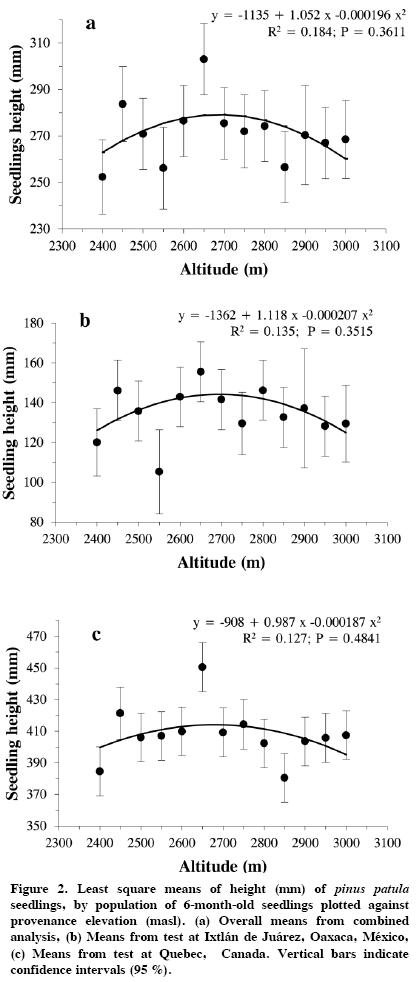
<body><![CDATA[<p align="center"><font face="verdana" size="2"><a name="f1"></a></font></p>  	    <p align="center"><font face="verdana" size="2"><img src="/img/revistas/rfm/v34n1/a5f1.jpg"></font></p>  	    <p align="center"><font face="verdana" size="2"><a name="t2"></a></font></p>  	    <p align="center"><font face="verdana" size="2"><img src="/img/revistas/rfm/v34n1/a5t2.jpg"></font></p>  	    <p align="justify"><font face="verdana" size="2"><b>Differences among populations</b></font></p>  	    <p align="justify"><font face="verdana" size="2">Significant differences among populations were detected in the combined (both sites, Eqn. 1) datasets analysis (P = 0.025; <a href="#t2">Table 2</a>). Similar results were obtained when data from each location were analyzed separately (Eqn. 3), that is P = 0.0325 and P &lt; 0.0001 for Ixtl&aacute;n and Quebec, respectively (<a href="/img/revistas/rfm/v34n1/a5t3.jpg" target="_blank">Table 3</a>). Populations explained 5.8 % of the total phenotypic variation when data of both locations were combined (<a href="#t2">Table 2</a>), and 5.6 and 5.3 % for Ixtl&aacute;n and Quebec, respectively when an analysis by location was conducted (<a href="/img/revistas/rfm/v34n1/a5t3.jpg" target="_blank">Table 3</a>).</font></p>  	    <p align="justify"><font face="verdana" size="2">The population &times; location interaction was not significant (P = 0.426; <a href="#t2">Table 2</a>). The best population at Ixtl&aacute;n was also the best at Quebec, and some of the worst populations at Ixtl&aacute;n were also the worst at Quebec (<a href="#f1">Figure 1</a>). Variation due to blocks was significant in the combined analysis (P &lt; 0.0001; <a href="#t2">Table 2</a>), and was significant for the test at Quebec (P &lt; 0.0001) but not for the test at Ixtl&aacute;n (<a href="/img/revistas/rfm/v34n1/a5t3.jpg" target="_blank">Table 3</a>).</font></p>  	    <p align="justify"><font face="verdana" size="2">The multiple means comparison test (Least Significant Difference, P &le; 0.05; <a href="/img/revistas/rfm/v34n1/a5t4.jpg" target="_blank">Table 4</a>) and the plotting of population means against provenance altitude, revealed that the population originated at 2650 m of altitude was the one of best growth for seedling height, in both the combined analysis (<a href="#f2">Figure 2a</a>) and on the analysis by site (<a href="#f2">Figures 2b and 2c</a>). The superiority of this population was more evident at the Quebec test (<a href="#f2">Figure 2c</a>).</font></p>  	    <p align="center"><font face="verdana" size="2"><a name="f2"></a></font></p>  	    <p align="center"><font face="verdana" size="2"><img src="/img/revistas/rfm/v34n1/a5f2.jpg"></font></p>  	    ]]></body>
<body><![CDATA[<p align="justify"><font face="verdana" size="2">Regression analysis of overall population means against altitude of the provenances indicates that, although weak, there is a trend where populations originated at mid&#150;altitude have a slightly higher growth potential (expressed as larger total seedling height) than those populations originated from both altitudinal extremes (upper and lower). However, such trend was not found significant (quadratic model, R<sup>2</sup> = 0.159; P = 0.421; <a href="#f2">Figure 2a</a>). The pattern was not significant either (Ixtl&aacute;n: R<sup>2</sup> = 0.132; P = 0.492; <a href="#f1">Figure 1b</a>; Quebec: R<sup>2</sup> = 0.127; P = 0.508; <a href="#f2">Figure 2c</a>) in the single site analysis.</font></p>  	    <p align="justify"><font face="verdana" size="2">The lack of significant genotype &times; environment interaction, and the fact that the population originated at 2650 m of altitude was by far the best population at the two locations tested, is an indication that genotypes were phenotypically stable (Karlsson <i>et al.,</i> 2001; S&aacute;nchez&#150;Vargas <i>et al.,</i> 2004; Koo <i>et al.,</i> 2007). This is confirmed by the high value of type B genetic correlation (rB = 0.93). High values of type B genetic correlations have been used as indicators of low genetic &times; environment interaction, as it was found when breeding regions for <i>Pinus brutia</i> (Isik <i>et al.,</i> 2000), were compared where the type B genetic correlation across sites was considered relatively high.</font></p>  	    <p align="justify"><font face="verdana" size="2">The weak tendency for seedlings from mid&#150;altitudinal populations to be taller, is similar to the one found for <i>Pinus pseudostrobus</i> in common garden tests conducted at two contrasting locations (Morelia, Michoac&aacute;n, M&eacute;xico and Moscow, Idaho, USA) (Sa&eacute;nz&#150;Romero <i>et al.,</i> Com. pers.<sup><a href="#notas">1</a></sup>), where mid&#150;altitudinal population produced taller seedlings although such trend was not statistically significant. Other species have shown this pattern more clearly: populations from mid&#150;altitude showed the best growth at 6 years&#150;old seedlings of <i>Pinus brutia</i> (Isik and Kara, 1997); <i>P. oocarpa</i> populations from middle&#150;low altitudes exhibited the best basal diameter at 6 months (S&aacute;enz&#150;Romero <i>et a&iacute;.,</i> 2004) and the largest seedling height at 2.5 years of age (S&aacute;enz&#150;Romero <i>et a&iacute;.,</i> 2006).</font></p>  	    <p align="justify"><font face="verdana" size="2">There are indications that <i>P. patu&iacute;a</i> populations from lower altitudes grow more than populations from higher altitudes; however, those results come from studies where provenances of different altitudes came also from different latitudes (Salazar&#150;Garc&iacute;a <i>et al</i>., 1999; Dvorak et al<i>.</i> , 2000), thus making difficult to establish clearly how much of the genetic variation among populations is associated with the altitudinal origin, because it would be needed to study several provenances from different altitudes and similar latitudes. An ongoing field test of the same set of <i>P. patu&iacute;a</i> populations as those used in the present study, was recently established on two contrasting altitudes in the forest of Ixtl&aacute;n de Ju&aacute;rez, Oaxaca. Hence, in a few years it will be possible to confirm whether population stability is maintained over time, and if the altitudinal pattern that was reported here would be expressed at later ages.</font></p>  	    <p align="justify"><font face="verdana" size="2">&nbsp;</font></p>  	    <p align="justify"><font face="verdana" size="2"><b>CONCLUSIONS</b></font></p>  	    <p align="justify"><font face="verdana" size="2">There was significant genetic differentiation among populations of 6&#150;months&#150;old seedlings for total height. However there was not a significant genotype &times; environment interaction (rB = 0.93). The population sampled at 2650 m of altitude (middle) had the largest value of total seedling height.</font></p>  	    <p align="justify"><font face="verdana" size="2">A weak altitudinal pattern was found where populations originating from middle altitudes exhibited the highest growth potential and populations from the upper and lower altitudinal extremes exhibited lower growth potential.</font></p>  	    <p align="justify"><font face="verdana" size="2">&nbsp;</font></p>  	    <p align="justify"><font face="verdana" size="2"><b>ACKNOWLEDGEMENTS</b></font></p>  	    ]]></body>
<body><![CDATA[<p align="justify"><font face="verdana" size="2">Financial support was provided to CSR by the joint Forestry Research Fund between the Mexican Council of Science and Technology (CONACYT) and the Mexican National Forestry Commission (CONAFOR, grant 2005&#150;C02&#150;14783). Funding for a sabbatical year was provided by the Natural Resources Canada (NRCan) and CONACYT (fellowship 75831). For their help in seed collection we thank to Antonio Plancarte, Julio Ruiz, Samuel Ram&iacute;rez, Mauro and Eduardo Aquino, and Mayolo Ruiz from the Native Indian Community of Ixtl&aacute;n de Ju&aacute;rez, Oaxaca; to Rodrigo Niniz for helping in seed extraction and to V&iacute;ctor Hugo Cambr&oacute;n for helping on graph design, both from UMSNH. Experiment at Quebec was possible thanks to Daniel Plourde, Eric Dussault, Audrey Lachance, Gabriel Pilote from NRCan. Three anonymous reviewers significantly contributed to improve the manuscript.</font></p> 	    <p align="justify">&nbsp;</p>      <p align="justify"><font face="verdana" size="2"><b>BIBLIOGRAPHY</b></font></p>  	    <!-- ref --><p align="justify"><font face="verdana" size="2"><b>Adams W T, S N Aitken, D G Joyce, G T Howe, J J Vargas&#150;Hern&aacute;ndez (2001)</b> Evaluating efficacy of early testing for stem growth in coastal Douglas&#150;fir. Silvae Genet. 50:167&#150;175.    &nbsp;&nbsp;&nbsp;&nbsp;&nbsp;&nbsp;&nbsp;&nbsp;[&#160;<a href="javascript:void(0);" onclick="javascript: window.open('/scielo.php?script=sci_nlinks&ref=7073983&pid=S0187-7380201100010000500001&lng=','','width=640,height=500,resizable=yes,scrollbars=1,menubar=yes,');">Links</a>&#160;]<!-- end-ref --></font></p>  	    <!-- ref --><p align="justify"><font face="verdana" size="2"><b>Burdon R D (1977)</b> Genetic correlation as a concept for studying genotype&#150;environment interaction in forest tree breeding. Silvae Genet. 26:168&#150;175.    &nbsp;&nbsp;&nbsp;&nbsp;&nbsp;&nbsp;&nbsp;&nbsp;[&#160;<a href="javascript:void(0);" onclick="javascript: window.open('/scielo.php?script=sci_nlinks&ref=7073985&pid=S0187-7380201100010000500002&lng=','','width=640,height=500,resizable=yes,scrollbars=1,menubar=yes,');">Links</a>&#160;]<!-- end-ref --></font></p>  	    <!-- ref --><p align="justify"><font face="verdana" size="2"><b>Dvorak W S, G R Hodge, J E Kietzka, F Malan, L F Osorio, T K Stangen (2000)</b> <i>Pinus patula. In:</i> Conservation and Testing of Tropical and Subtropical Forest Tree Species by the CAMCORE Cooperative. CAMCORE Cooperative (ed). North Carolina State University, Raleigh, NC. pp:149&#150;173.    &nbsp;&nbsp;&nbsp;&nbsp;&nbsp;&nbsp;&nbsp;&nbsp;[&#160;<a href="javascript:void(0);" onclick="javascript: window.open('/scielo.php?script=sci_nlinks&ref=7073987&pid=S0187-7380201100010000500003&lng=','','width=640,height=500,resizable=yes,scrollbars=1,menubar=yes,');">Links</a>&#160;]<!-- end-ref --></font></p>  	    <!-- ref --><p align="justify"><font face="verdana" size="2"><b>Isik K, N Kara (1997)</b> Altitudinal variation in <i>Pinus brutia</i> Ten. and its implication in genetic conservation and seed transfers in southern Turkey. Silvae Genet. 46:113&#150;120.    &nbsp;&nbsp;&nbsp;&nbsp;&nbsp;&nbsp;&nbsp;&nbsp;[&#160;<a href="javascript:void(0);" onclick="javascript: window.open('/scielo.php?script=sci_nlinks&ref=7073989&pid=S0187-7380201100010000500004&lng=','','width=640,height=500,resizable=yes,scrollbars=1,menubar=yes,');">Links</a>&#160;]<!-- end-ref --></font></p>  	    <!-- ref --><p align="justify"><font face="verdana" size="2"><b>Isik K, F L Keskin, S E McKeand (2000)</b> Provenance variation and provenance&#150;site interaction in <i>Pinus brutia</i> Ten.: Consequences of defining breeding zones. Silvae Genet. 49:213&#150;223.    &nbsp;&nbsp;&nbsp;&nbsp;&nbsp;&nbsp;&nbsp;&nbsp;[&#160;<a href="javascript:void(0);" onclick="javascript: window.open('/scielo.php?script=sci_nlinks&ref=7073991&pid=S0187-7380201100010000500005&lng=','','width=640,height=500,resizable=yes,scrollbars=1,menubar=yes,');">Links</a>&#160;]<!-- end-ref --></font></p>  	    <!-- ref --><p align="justify"><font face="verdana" size="2"><b>Karlsson B, H Wellendorf, H Roulund, M Werner (2001)</b> Genotype &times; trial interaction and stability across sites in 11 combined provenance and clone experiments with <i>Picea abies</i> in Denmark and Sweden. Can. J. For. Res. 31:1826&#150;1836.    &nbsp;&nbsp;&nbsp;&nbsp;&nbsp;&nbsp;&nbsp;&nbsp;[&#160;<a href="javascript:void(0);" onclick="javascript: window.open('/scielo.php?script=sci_nlinks&ref=7073993&pid=S0187-7380201100010000500006&lng=','','width=640,height=500,resizable=yes,scrollbars=1,menubar=yes,');">Links</a>&#160;]<!-- end-ref --></font></p>  	    <!-- ref --><p align="justify"><font face="verdana" size="2"><b>Koo Y B, J K Yeo, K S Woo, T S Kim (2007)</b> Selection of superior clones by stability analysis of growth performance in <i>Populus</i> <i>davidiana</i> Dode at age 12. Silvae Genet. 56:93&#150;101.    &nbsp;&nbsp;&nbsp;&nbsp;&nbsp;&nbsp;&nbsp;&nbsp;[&#160;<a href="javascript:void(0);" onclick="javascript: window.open('/scielo.php?script=sci_nlinks&ref=7073995&pid=S0187-7380201100010000500007&lng=','','width=640,height=500,resizable=yes,scrollbars=1,menubar=yes,');">Links</a>&#160;]<!-- end-ref --></font></p>  	    <!-- ref --><p align="justify"><font face="verdana" size="2"><b>Lambeth C C, J P van Buijtenen, S D Duke, R B McCullough (1983)</b> Early selection is effective in 20&#150;year&#150;old genetic tests of loblolly pine. Silvae Gen. 32:210&#150;215.    &nbsp;&nbsp;&nbsp;&nbsp;&nbsp;&nbsp;&nbsp;&nbsp;[&#160;<a href="javascript:void(0);" onclick="javascript: window.open('/scielo.php?script=sci_nlinks&ref=7073997&pid=S0187-7380201100010000500008&lng=','','width=640,height=500,resizable=yes,scrollbars=1,menubar=yes,');">Links</a>&#160;]<!-- end-ref --></font></p>  	    <!-- ref --><p align="justify"><font face="verdana" size="2"><b>Mart&iacute;nez&#150;Guzm&aacute;n A, S Col&iacute;n&#150;Castillo (2003)</b> La certificaci&oacute;n ambiental de los bosques en M&eacute;xico: reporte preliminar. Gaceta Ecol. 67:45&#150;60.    &nbsp;&nbsp;&nbsp;&nbsp;&nbsp;&nbsp;&nbsp;&nbsp;[&#160;<a href="javascript:void(0);" onclick="javascript: window.open('/scielo.php?script=sci_nlinks&ref=7073999&pid=S0187-7380201100010000500009&lng=','','width=640,height=500,resizable=yes,scrollbars=1,menubar=yes,');">Links</a>&#160;]<!-- end-ref --></font></p>  	    <!-- ref --><p align="justify"><font face="verdana" size="2"><b>Rehfeldt G E (1991)</b> A model of genetic variation for <i>Pinus ponderosa</i> in the Inland Northwest (USA): applications in gene resource management. Can. J. For. Res. 21:1491&#150;1500.    &nbsp;&nbsp;&nbsp;&nbsp;&nbsp;&nbsp;&nbsp;&nbsp;[&#160;<a href="javascript:void(0);" onclick="javascript: window.open('/scielo.php?script=sci_nlinks&ref=7074001&pid=S0187-7380201100010000500010&lng=','','width=640,height=500,resizable=yes,scrollbars=1,menubar=yes,');">Links</a>&#160;]<!-- end-ref --></font></p>  	    <!-- ref --><p align="justify"><font face="verdana" size="2"><b>Rehfeldt G E, C C</b> <b>Ying,</b> <b>D L</b> <b>Spittlehouse,</b> <b>D A Jr</b> <b>Hamilton (1999)</b> Genetic responses to climate in <i>Pinus contorta:</i> niche breadth, climate change, and reforestation. Ecol. Monog. 69: 375&#150;407.    &nbsp;&nbsp;&nbsp;&nbsp;&nbsp;&nbsp;&nbsp;&nbsp;[&#160;<a href="javascript:void(0);" onclick="javascript: window.open('/scielo.php?script=sci_nlinks&ref=7074003&pid=S0187-7380201100010000500011&lng=','','width=640,height=500,resizable=yes,scrollbars=1,menubar=yes,');">Links</a>&#160;]<!-- end-ref --></font></p>  	    <!-- ref --><p align="justify"><font face="verdana" size="2"><b>S&aacute;enz&#150;Romero C, H Viveros&#150;Viveros, R Guzm&aacute;n&#150;Reyna (2004)</b> Altitudinal genetic variation among <i>Pinus oocarpa</i> populations on Michoac&aacute;n, western M&eacute;xico. Preliminary results from a nursery test. For. Genet. 11:343&#150;349.    &nbsp;&nbsp;&nbsp;&nbsp;&nbsp;&nbsp;&nbsp;&nbsp;[&#160;<a href="javascript:void(0);" onclick="javascript: window.open('/scielo.php?script=sci_nlinks&ref=7074005&pid=S0187-7380201100010000500012&lng=','','width=640,height=500,resizable=yes,scrollbars=1,menubar=yes,');">Links</a>&#160;]<!-- end-ref --></font></p>  	    <!-- ref --><p align="justify"><font face="verdana" size="2"><b>S&aacute;enz&#150;Romero C, R Guzm&aacute;n&#150;Reyna, G E Rehfeldt (2006)</b> Altitudinal genetic variation among <i>Pinus oocarpa</i> populations in Michoac&aacute;n, M&eacute;xico; implications for seed zoning, conservation of forest genetic resources, tree breeding and global warming. For. Ecol. Manage. 229:340&#150;350.    &nbsp;&nbsp;&nbsp;&nbsp;&nbsp;&nbsp;&nbsp;&nbsp;[&#160;<a href="javascript:void(0);" onclick="javascript: window.open('/scielo.php?script=sci_nlinks&ref=7074007&pid=S0187-7380201100010000500013&lng=','','width=640,height=500,resizable=yes,scrollbars=1,menubar=yes,');">Links</a>&#160;]<!-- end-ref --></font></p>  	    <!-- ref --><p align="justify"><font face="verdana" size="2"><b>S&aacute;nchez&#150;Vargas N M, J J Vargas&#150;Hern&aacute;ndez, L M Ruiz&#150;Posadas, J L&oacute;pez&#150;Upton (2004)</b> Repeatability of genetic parameters in a clonal test of <i>Euca&iacute;yptus urophy&iacute;&iacute;a</i> S. T. Blake in Southeastern M&eacute;xico. Agrociencia 38:465&#150;475.    &nbsp;&nbsp;&nbsp;&nbsp;&nbsp;&nbsp;&nbsp;&nbsp;[&#160;<a href="javascript:void(0);" onclick="javascript: window.open('/scielo.php?script=sci_nlinks&ref=7074009&pid=S0187-7380201100010000500014&lng=','','width=640,height=500,resizable=yes,scrollbars=1,menubar=yes,');">Links</a>&#160;]<!-- end-ref --></font></p>  	    <!-- ref --><p align="justify"><font face="verdana" size="2"><b>SAS Institute (1999)</b> SAS/STAT User Guide. Version 8. SAS Institute Inc. Cary, N C. 3rd ed. 3809 p.    &nbsp;&nbsp;&nbsp;&nbsp;&nbsp;&nbsp;&nbsp;&nbsp;[&#160;<a href="javascript:void(0);" onclick="javascript: window.open('/scielo.php?script=sci_nlinks&ref=7074011&pid=S0187-7380201100010000500015&lng=','','width=640,height=500,resizable=yes,scrollbars=1,menubar=yes,');">Links</a>&#160;]<!-- end-ref --></font></p>  	    <!-- ref --><p align="justify"><font face="verdana" size="2"><b>Vel&aacute;zquez&#150;Mart&iacute;nez A, G Angeles&#150;P&eacute;rez, T Llanderal&#150;Ocampo, A R Rom&aacute;n&#150;Jim&eacute;nez, V Reyes&#150;Hern&aacute;ndez (2004)</b> Monograf&iacute;a de <i>Pinus patu&iacute;a.</i> Comisi&oacute;n Nacional Forestal, M&eacute;xico.    &nbsp;&nbsp;&nbsp;&nbsp;&nbsp;&nbsp;&nbsp;&nbsp;[&#160;<a href="javascript:void(0);" onclick="javascript: window.open('/scielo.php?script=sci_nlinks&ref=7074013&pid=S0187-7380201100010000500016&lng=','','width=640,height=500,resizable=yes,scrollbars=1,menubar=yes,');">Links</a>&#160;]<!-- end-ref --></font></p>  	    <!-- ref --><p align="justify"><font face="verdana" size="2"><b>Viveros&#150;Viveros H, C S&aacute;enz&#150;Romero, R Guzm&aacute;n&#150;Reyna (2005)</b> Genetic control of <i>Pinus oocarpa</i> seedlings growth traits in the nursery. Rev. Fitotec. Mex. 28:333&#150;338.    &nbsp;&nbsp;&nbsp;&nbsp;&nbsp;&nbsp;&nbsp;&nbsp;[&#160;<a href="javascript:void(0);" onclick="javascript: window.open('/scielo.php?script=sci_nlinks&ref=7074015&pid=S0187-7380201100010000500017&lng=','','width=640,height=500,resizable=yes,scrollbars=1,menubar=yes,');">Links</a>&#160;]<!-- end-ref --></font></p>  	    <!-- ref --><p align="justify"><font face="verdana" size="2"><b>Zobel B J, J T Talbert (1992)</b> T&eacute;cnicas de Mejoramiento Gen&eacute;tico de &Aacute;rboles Forestales. Ed. Limusa. M&eacute;xico, D. F. 545 p.    &nbsp;&nbsp;&nbsp;&nbsp;&nbsp;&nbsp;&nbsp;&nbsp;[&#160;<a href="javascript:void(0);" onclick="javascript: window.open('/scielo.php?script=sci_nlinks&ref=7074017&pid=S0187-7380201100010000500018&lng=','','width=640,height=500,resizable=yes,scrollbars=1,menubar=yes,');">Links</a>&#160;]<!-- end-ref --></font></p>  	    <p align="justify"><font face="verdana" size="2">&nbsp;</font></p>  	    ]]></body>
<body><![CDATA[<p align="justify"><font face="verdana" size="2"><b><a name="notas"></a>NOTA</b></font></p>  	    <p align="justify"><font face="verdana" size="2"><sup>1</sup> <b>S&aacute;enz&#150;Romero C, G E Rehfeldt, J C Soto&#150;Correa, S Aguilar&#150;Aguilar,V Zamarripa&#150;Morales, J L&oacute;pez&#150;Upton (2005)</b> Variaci&oacute;n gen&eacute;tica altitudinal entre poblaciones de <i>Pinus pseudostrobus</i>. An&aacute;lisis preliminar de una prueba en dos localidades en casas de sombra. Memorias del VII Congreso Mexicano de Recursos Naturales. Soc. Mex. de Recursos Naturales. Chihuahua, Chih., 26&#150;28 octubre 2005. pp:384&#150;349.</font></p>      ]]></body><back>
<ref-list>
<ref id="B1">
<nlm-citation citation-type="journal">
<person-group person-group-type="author">
<name>
<surname><![CDATA[Adams]]></surname>
<given-names><![CDATA[W T]]></given-names>
</name>
<name>
<surname><![CDATA[Aitken]]></surname>
<given-names><![CDATA[S N]]></given-names>
</name>
<name>
<surname><![CDATA[Joyce]]></surname>
<given-names><![CDATA[D G]]></given-names>
</name>
<name>
<surname><![CDATA[Howe]]></surname>
<given-names><![CDATA[G T]]></given-names>
</name>
<name>
<surname><![CDATA[Vargas-Hernández]]></surname>
<given-names><![CDATA[J J]]></given-names>
</name>
</person-group>
<article-title xml:lang="en"><![CDATA[Evaluating efficacy of early testing for stem growth in coastal Douglas-fir]]></article-title>
<source><![CDATA[Silvae Genet.]]></source>
<year>2001</year>
<volume>50</volume>
<page-range>167-175</page-range></nlm-citation>
</ref>
<ref id="B2">
<nlm-citation citation-type="journal">
<person-group person-group-type="author">
<name>
<surname><![CDATA[Burdon]]></surname>
<given-names><![CDATA[R D]]></given-names>
</name>
</person-group>
<article-title xml:lang="en"><![CDATA[Genetic correlation as a concept for studying genotype-environment interaction in forest tree breeding]]></article-title>
<source><![CDATA[Silvae Genet.]]></source>
<year>1977</year>
<volume>26</volume>
<page-range>168-175</page-range></nlm-citation>
</ref>
<ref id="B3">
<nlm-citation citation-type="book">
<person-group person-group-type="author">
<name>
<surname><![CDATA[Dvorak]]></surname>
<given-names><![CDATA[W S]]></given-names>
</name>
<name>
<surname><![CDATA[Hodge]]></surname>
<given-names><![CDATA[G R]]></given-names>
</name>
<name>
<surname><![CDATA[Kietzka]]></surname>
<given-names><![CDATA[J E]]></given-names>
</name>
<name>
<surname><![CDATA[Malan]]></surname>
<given-names><![CDATA[F]]></given-names>
</name>
<name>
<surname><![CDATA[Osorio]]></surname>
<given-names><![CDATA[L F]]></given-names>
</name>
<name>
<surname><![CDATA[Stangen]]></surname>
<given-names><![CDATA[T K]]></given-names>
</name>
</person-group>
<article-title xml:lang="en"><![CDATA[Pinus patula]]></article-title>
<collab>CAMCORE Cooperative</collab>
<source><![CDATA[Conservation and Testing of Tropical and Subtropical Forest Tree Species by the CAMCORE Cooperative]]></source>
<year>2000</year>
<page-range>149-173</page-range><publisher-loc><![CDATA[Raleigh^eNC NC]]></publisher-loc>
<publisher-name><![CDATA[North Carolina State University]]></publisher-name>
</nlm-citation>
</ref>
<ref id="B4">
<nlm-citation citation-type="journal">
<person-group person-group-type="author">
<name>
<surname><![CDATA[Isik]]></surname>
<given-names><![CDATA[K]]></given-names>
</name>
<name>
<surname><![CDATA[Kara]]></surname>
<given-names><![CDATA[N]]></given-names>
</name>
</person-group>
<article-title xml:lang="en"><![CDATA[Altitudinal variation in Pinus brutia Ten. and its implication in genetic conservation and seed transfers in southern Turkey]]></article-title>
<source><![CDATA[Silvae Genet.]]></source>
<year>1997</year>
<volume>46</volume>
<page-range>113-120</page-range></nlm-citation>
</ref>
<ref id="B5">
<nlm-citation citation-type="journal">
<person-group person-group-type="author">
<name>
<surname><![CDATA[Isik]]></surname>
<given-names><![CDATA[K]]></given-names>
</name>
<name>
<surname><![CDATA[Keskin]]></surname>
<given-names><![CDATA[F L]]></given-names>
</name>
<name>
<surname><![CDATA[McKeand]]></surname>
<given-names><![CDATA[S E]]></given-names>
</name>
</person-group>
<article-title xml:lang="en"><![CDATA[Provenance variation and provenance-site interaction in Pinus brutia Ten.: Consequences of defining breeding zones]]></article-title>
<source><![CDATA[Silvae Genet.]]></source>
<year>2000</year>
<volume>49</volume>
<page-range>213-223</page-range></nlm-citation>
</ref>
<ref id="B6">
<nlm-citation citation-type="journal">
<person-group person-group-type="author">
<name>
<surname><![CDATA[Karlsson]]></surname>
<given-names><![CDATA[B]]></given-names>
</name>
<name>
<surname><![CDATA[Wellendorf]]></surname>
<given-names><![CDATA[H]]></given-names>
</name>
<name>
<surname><![CDATA[Roulund]]></surname>
<given-names><![CDATA[H]]></given-names>
</name>
<name>
<surname><![CDATA[Werner]]></surname>
<given-names><![CDATA[M]]></given-names>
</name>
</person-group>
<article-title xml:lang="en"><![CDATA[Genotype × trial interaction and stability across sites in 11 combined provenance and clone experiments with Picea abies in Denmark and Sweden]]></article-title>
<source><![CDATA[Can. J. For. Res.]]></source>
<year>2001</year>
<volume>31</volume>
<page-range>1826-1836</page-range></nlm-citation>
</ref>
<ref id="B7">
<nlm-citation citation-type="journal">
<person-group person-group-type="author">
<name>
<surname><![CDATA[Koo]]></surname>
<given-names><![CDATA[Y B]]></given-names>
</name>
<name>
<surname><![CDATA[Yeo]]></surname>
<given-names><![CDATA[J K]]></given-names>
</name>
<name>
<surname><![CDATA[Woo]]></surname>
<given-names><![CDATA[K S]]></given-names>
</name>
<name>
<surname><![CDATA[Kim]]></surname>
<given-names><![CDATA[T S]]></given-names>
</name>
</person-group>
<article-title xml:lang="en"><![CDATA[Selection of superior clones by stability analysis of growth performance in Populus davidiana Dode at age 12]]></article-title>
<source><![CDATA[Silvae Genet.]]></source>
<year>2007</year>
<volume>56</volume>
<page-range>93-101</page-range></nlm-citation>
</ref>
<ref id="B8">
<nlm-citation citation-type="journal">
<person-group person-group-type="author">
<name>
<surname><![CDATA[Lambeth]]></surname>
<given-names><![CDATA[C C]]></given-names>
</name>
<name>
<surname><![CDATA[van Buijtenen]]></surname>
<given-names><![CDATA[J P]]></given-names>
</name>
<name>
<surname><![CDATA[Duke]]></surname>
<given-names><![CDATA[S D]]></given-names>
</name>
<name>
<surname><![CDATA[McCullough]]></surname>
<given-names><![CDATA[R B]]></given-names>
</name>
</person-group>
<article-title xml:lang="en"><![CDATA[Early selection is effective in 20-year-old genetic tests of loblolly pine]]></article-title>
<source><![CDATA[Silvae Gen.]]></source>
<year>1983</year>
<volume>32</volume>
<page-range>210-215</page-range></nlm-citation>
</ref>
<ref id="B9">
<nlm-citation citation-type="journal">
<person-group person-group-type="author">
<name>
<surname><![CDATA[Martínez-Guzmán]]></surname>
<given-names><![CDATA[A]]></given-names>
</name>
<name>
<surname><![CDATA[Colín-Castillo]]></surname>
<given-names><![CDATA[S]]></given-names>
</name>
</person-group>
<article-title xml:lang="es"><![CDATA[La certificación ambiental de los bosques en México: reporte preliminar]]></article-title>
<source><![CDATA[Gaceta Ecol.]]></source>
<year>2003</year>
<volume>67</volume>
<page-range>45-60</page-range></nlm-citation>
</ref>
<ref id="B10">
<nlm-citation citation-type="journal">
<person-group person-group-type="author">
<name>
<surname><![CDATA[Rehfeldt]]></surname>
<given-names><![CDATA[G E]]></given-names>
</name>
</person-group>
<article-title xml:lang="en"><![CDATA[A model of genetic variation for Pinus ponderosa in the Inland Northwest (USA): applications in gene resource management]]></article-title>
<source><![CDATA[Can. J. For. Res.]]></source>
<year>1991</year>
<volume>21</volume>
<page-range>1491-1500</page-range></nlm-citation>
</ref>
<ref id="B11">
<nlm-citation citation-type="journal">
<person-group person-group-type="author">
<name>
<surname><![CDATA[Rehfeldt]]></surname>
<given-names><![CDATA[G E]]></given-names>
</name>
<name>
<surname><![CDATA[Ying]]></surname>
<given-names><![CDATA[C C]]></given-names>
</name>
<name>
<surname><![CDATA[Spittlehouse]]></surname>
<given-names><![CDATA[D L]]></given-names>
</name>
<name>
<surname><![CDATA[Jr Hamilton]]></surname>
<given-names><![CDATA[D A]]></given-names>
</name>
</person-group>
<article-title xml:lang="en"><![CDATA[Genetic responses to climate in Pinus contorta: niche breadth, climate change, and reforestation]]></article-title>
<source><![CDATA[Ecol. Monog.]]></source>
<year>1999</year>
<volume>69</volume>
<page-range>375-407</page-range></nlm-citation>
</ref>
<ref id="B12">
<nlm-citation citation-type="journal">
<person-group person-group-type="author">
<name>
<surname><![CDATA[Sáenz-Romero]]></surname>
<given-names><![CDATA[C]]></given-names>
</name>
<name>
<surname><![CDATA[Viveros-Viveros]]></surname>
<given-names><![CDATA[H]]></given-names>
</name>
<name>
<surname><![CDATA[Guzmán-Reyna]]></surname>
<given-names><![CDATA[R]]></given-names>
</name>
</person-group>
<article-title xml:lang="en"><![CDATA[Altitudinal genetic variation among Pinus oocarpa populations on Michoacán, western México. Preliminary results from a nursery test.]]></article-title>
<source><![CDATA[For. Genet.]]></source>
<year>2004</year>
<volume>11</volume>
<page-range>343-349</page-range></nlm-citation>
</ref>
<ref id="B13">
<nlm-citation citation-type="journal">
<person-group person-group-type="author">
<name>
<surname><![CDATA[Sáenz-Romero]]></surname>
<given-names><![CDATA[C]]></given-names>
</name>
<name>
<surname><![CDATA[Guzmán-Reyna]]></surname>
<given-names><![CDATA[R]]></given-names>
</name>
<name>
<surname><![CDATA[Rehfeldt]]></surname>
<given-names><![CDATA[G E]]></given-names>
</name>
</person-group>
<article-title xml:lang="en"><![CDATA[Altitudinal genetic variation among Pinus oocarpa populations in Michoacán, México; implications for seed zoning, conservation of forest genetic resources, tree breeding and global warming]]></article-title>
<source><![CDATA[For. Ecol. Manage.]]></source>
<year>2006</year>
<volume>229</volume>
<page-range>340-350</page-range></nlm-citation>
</ref>
<ref id="B14">
<nlm-citation citation-type="journal">
<person-group person-group-type="author">
<name>
<surname><![CDATA[Sánchez-Vargas]]></surname>
<given-names><![CDATA[N M]]></given-names>
</name>
<name>
<surname><![CDATA[Vargas-Hernández]]></surname>
<given-names><![CDATA[J J]]></given-names>
</name>
<name>
<surname><![CDATA[Ruiz-Posadas]]></surname>
<given-names><![CDATA[L M]]></given-names>
</name>
<name>
<surname><![CDATA[López-Upton]]></surname>
<given-names><![CDATA[J]]></given-names>
</name>
</person-group>
<article-title xml:lang="en"><![CDATA[Repeatability of genetic parameters in a clonal test of Eucaíyptus urophyíía S. T. Blake in Southeastern México]]></article-title>
<source><![CDATA[Agrociencia]]></source>
<year>2004</year>
<volume>38</volume>
<page-range>465-475</page-range></nlm-citation>
</ref>
<ref id="B15">
<nlm-citation citation-type="book">
<collab>SAS Institute</collab>
<source><![CDATA[SAS/STAT User Guide. Version 8]]></source>
<year>1999</year>
<edition>3rd</edition>
<page-range>3809</page-range><publisher-loc><![CDATA[Cary^eN C. N C.]]></publisher-loc>
<publisher-name><![CDATA[SAS Institute Inc.]]></publisher-name>
</nlm-citation>
</ref>
<ref id="B16">
<nlm-citation citation-type="book">
<person-group person-group-type="author">
<name>
<surname><![CDATA[Velázquez-Martínez]]></surname>
<given-names><![CDATA[A]]></given-names>
</name>
<name>
<surname><![CDATA[Angeles-Pérez]]></surname>
<given-names><![CDATA[G]]></given-names>
</name>
<name>
<surname><![CDATA[Llanderal-Ocampo]]></surname>
<given-names><![CDATA[T]]></given-names>
</name>
<name>
<surname><![CDATA[Román-Jiménez]]></surname>
<given-names><![CDATA[A R]]></given-names>
</name>
<name>
<surname><![CDATA[Reyes-Hernández]]></surname>
<given-names><![CDATA[V]]></given-names>
</name>
</person-group>
<source><![CDATA[Monografía de Pinus patuía]]></source>
<year>2004</year>
<publisher-name><![CDATA[Comisión Nacional Forestal]]></publisher-name>
</nlm-citation>
</ref>
<ref id="B17">
<nlm-citation citation-type="journal">
<person-group person-group-type="author">
<name>
<surname><![CDATA[Viveros-Viveros]]></surname>
<given-names><![CDATA[H]]></given-names>
</name>
<name>
<surname><![CDATA[Sáenz-Romero]]></surname>
<given-names><![CDATA[C]]></given-names>
</name>
<name>
<surname><![CDATA[Guzmán-Reyna]]></surname>
<given-names><![CDATA[R]]></given-names>
</name>
</person-group>
<article-title xml:lang="en"><![CDATA[Genetic control of Pinus oocarpa seedlings growth traits in the nursery]]></article-title>
<source><![CDATA[Rev. Fitotec. Mex.]]></source>
<year>2005</year>
<volume>28</volume>
<page-range>333-338</page-range></nlm-citation>
</ref>
<ref id="B18">
<nlm-citation citation-type="book">
<person-group person-group-type="author">
<name>
<surname><![CDATA[Zobel]]></surname>
<given-names><![CDATA[B J]]></given-names>
</name>
<name>
<surname><![CDATA[Talbert]]></surname>
<given-names><![CDATA[J T]]></given-names>
</name>
</person-group>
<source><![CDATA[Técnicas de Mejoramiento Genético de Árboles Forestales]]></source>
<year>1992</year>
<page-range>545</page-range><publisher-loc><![CDATA[México^eD. F. D. F.]]></publisher-loc>
<publisher-name><![CDATA[Ed. Limusa]]></publisher-name>
</nlm-citation>
</ref>
</ref-list>
</back>
</article>