<?xml version="1.0" encoding="ISO-8859-1"?><article xmlns:mml="http://www.w3.org/1998/Math/MathML" xmlns:xlink="http://www.w3.org/1999/xlink" xmlns:xsi="http://www.w3.org/2001/XMLSchema-instance">
<front>
<journal-meta>
<journal-id>0187-7380</journal-id>
<journal-title><![CDATA[Revista fitotecnia mexicana]]></journal-title>
<abbrev-journal-title><![CDATA[Rev. fitotec. mex]]></abbrev-journal-title>
<issn>0187-7380</issn>
<publisher>
<publisher-name><![CDATA[Sociedad Mexicana de Fitogenética A.C.]]></publisher-name>
</publisher>
</journal-meta>
<article-meta>
<article-id>S0187-73802009000100005</article-id>
<title-group>
<article-title xml:lang="en"><![CDATA[Sugars and alcoholic byproducts from henequen (Agave fourcroydes) as influenced by plant age and climate]]></article-title>
<article-title xml:lang="es"><![CDATA[Azúcares y subproductos alcohólicos de henequén (Agave fourcroydes) en función de la edad de la planta y el clima]]></article-title>
</title-group>
<contrib-group>
<contrib contrib-type="author">
<name>
<surname><![CDATA[Rendón-Salcido]]></surname>
<given-names><![CDATA[Luis A.]]></given-names>
</name>
<xref ref-type="aff" rid="A02"/>
</contrib>
<contrib contrib-type="author">
<name>
<surname><![CDATA[Colunga-GarcíaMarín]]></surname>
<given-names><![CDATA[Patricia]]></given-names>
</name>
<xref ref-type="aff" rid="A01"/>
</contrib>
<contrib contrib-type="author">
<name>
<surname><![CDATA[Barahona-Pérez]]></surname>
<given-names><![CDATA[Luis F.]]></given-names>
</name>
<xref ref-type="aff" rid="A01"/>
</contrib>
<contrib contrib-type="author">
<name>
<surname><![CDATA[Pimienta-Barrios]]></surname>
<given-names><![CDATA[Eulogio]]></given-names>
</name>
<xref ref-type="aff" rid="A02"/>
</contrib>
<contrib contrib-type="author">
<name>
<surname><![CDATA[Magdub-Méndez]]></surname>
<given-names><![CDATA[Abdo]]></given-names>
</name>
<xref ref-type="aff" rid="A01"/>
</contrib>
<contrib contrib-type="author">
<name>
<surname><![CDATA[Larqué-Saavedra]]></surname>
<given-names><![CDATA[Alfonso]]></given-names>
</name>
<xref ref-type="aff" rid="A01"/>
</contrib>
</contrib-group>
<aff id="A01">
<institution><![CDATA[,Centro de Investigación Científica de Yucatán  ]]></institution>
<addr-line><![CDATA[Mérida Yucatán]]></addr-line>
<country>México</country>
</aff>
<aff id="A02">
<institution><![CDATA[,Universidad de Guadalajara Centro Universitario de Ciencias Biológicas y Agropecuarias ]]></institution>
<addr-line><![CDATA[Zapopan Jalisco]]></addr-line>
<country>México</country>
</aff>
<pub-date pub-type="pub">
<day>00</day>
<month>03</month>
<year>2009</year>
</pub-date>
<pub-date pub-type="epub">
<day>00</day>
<month>03</month>
<year>2009</year>
</pub-date>
<volume>32</volume>
<numero>1</numero>
<fpage>39</fpage>
<lpage>44</lpage>
<copyright-statement/>
<copyright-year/>
<self-uri xlink:href="http://www.scielo.org.mx/scielo.php?script=sci_arttext&amp;pid=S0187-73802009000100005&amp;lng=en&amp;nrm=iso"></self-uri><self-uri xlink:href="http://www.scielo.org.mx/scielo.php?script=sci_abstract&amp;pid=S0187-73802009000100005&amp;lng=en&amp;nrm=iso"></self-uri><self-uri xlink:href="http://www.scielo.org.mx/scielo.php?script=sci_pdf&amp;pid=S0187-73802009000100005&amp;lng=en&amp;nrm=iso"></self-uri><abstract abstract-type="short" xml:lang="en"><p><![CDATA[Henequen (Agave fourcroydes Lem.) is a well known fiber producing plant cultivated in the Yucatán península in México. Recent studies revealed that the stem locally known as "piña" is a reservoir of non structural carbohydrates, which may be fermented to produce an alcoholic spirit similar to mezcal and tequila. In this work we determined the effect of plant age and climatic conditions through the year on sugars and alcohol production. "Piñas" from 5, 8, 15, 18 and 19 year-old plants were harvested in the spring and autumn dry seasons, as well as in the rainy season of one single year. "Piñas" fresh weight varied from 5.2 to 6.7 kg. Harvested "piñas" were cut into small pieces and cooked, followed by pressing to extract their juice; then the juice was fermented with Kluyveromyces marxianus native yeast isolated from henequen, and distilled to ob-tain two alcoholic products: "ordinary" (monodistilled) and "white" (bidistilled). Results showed that 19 year-old plants yielded the high-est volume of ordinary alcohol production (159 mL per liter of juice). "Piñas" harvested in the dry spring season produced greater quantities of "ordinary" alcohol than those harvested during the dry autumn and in the rainy seasons.]]></p></abstract>
<abstract abstract-type="short" xml:lang="es"><p><![CDATA[El henequén (Agave fourcroydes Lem.) es una conocida planta productora de fibra cultivada en la península de Yucatán en México. Estudios recientes revelaron que el tallo localmente conocido como "piña" es una reserva de hidratos de carbono no estructurales que puede ser fermentado para producir un alcohol similar al tequila y al mezcal. En este trabajo se determinó el efecto de la edad de la planta y las condiciones climáticas a lo largo del año en el contenido de azúcares y producción de alcohol. "Piñas" de plantas de 5, 8, 15, 18 y 19 años de edad, fueron cosechadas en la estación seca de la primavera, en las estaciones de lluvias del verano y la temprana estación seca del otoño, de un año. El peso fresco de las "piñas" varió de 5.2 a 6.7 kg. Las "piñas" cosechadas se cortaron en pequeños trozos y se cocieron, y después se presionaron para extraer su jugo; el jugo resultante se fermentó con Kluyveromyces marxianus, una levadura nativa aislada del henequén, y se destiló para obtener dos productos alcohólicos: "ordinario" (monodestilado) y "blanco" (bidestilado). Los resultados mostraron que las plantas de rendimiento más alto son las de 19 años de edad, en cuanto a volumen de producción de alcohol ordinario (159 mL por litro de jugo). Las "piñas" cosechadas en la estación seca de la primavera del año produjeron mayores cantidades de alcohol ordinario que las cosechadas durante la estación lluviosa del verano y que las de sequía temprana del otoño.]]></p></abstract>
<kwd-group>
<kwd lng="en"><![CDATA[Agave fourcroydes]]></kwd>
<kwd lng="en"><![CDATA["piña"]]></kwd>
<kwd lng="en"><![CDATA[sugars]]></kwd>
<kwd lng="en"><![CDATA[alcohol]]></kwd>
<kwd lng="es"><![CDATA[Agave fourcroydes]]></kwd>
<kwd lng="es"><![CDATA[piña]]></kwd>
<kwd lng="es"><![CDATA[azúcares]]></kwd>
<kwd lng="es"><![CDATA[alcohol]]></kwd>
</kwd-group>
</article-meta>
</front><body><![CDATA[  	    <p align="justify"><font face="verdana" size="4">Articulos cientificos</font></p>  	    <p align="justify"><font face="verdana" size="2">&nbsp;</font></p>  	    <p align="center"><font face="verdana" size="4"><b>Sugars and alcoholic byproducts from henequen (<i>Agave fourcroydes</i>) as influenced by plant age and climate</b></font></p>  	    <p align="center"><font face="verdana" size="2">&nbsp;</font></p>  	    <p align="center"><font face="verdana" size="3"><b>Az&uacute;cares y subproductos alcoh&oacute;licos de henequ&eacute;n (<i>Agave fourcroydes</i>) en funci&oacute;n de la edad de la planta y el clima</b></font></p>  	    <p align="center"><font face="verdana" size="2">&nbsp;</font></p>  	    <p align="center"><font face="verdana" size="2"><b>Luis A. Rend&oacute;n&#45;Salcido<sup>2</sup>, Patricia Colunga&#45;Garc&iacute;aMar&iacute;n<sup>1</sup>, Luis F. Barahona&#45;P&eacute;rez<sup>1</sup>, Eulogio Pimienta&#45;Barrios<sup>2</sup>, Abdo Magdub&#45;M&eacute;ndez<sup>1</sup> y Alfonso Larqu&eacute;&#45;Saavedra<sup>1</sup>*</b></font></p>  	    <p align="justify"><font face="verdana" size="2">&nbsp;</font></p>  	    <p align="justify"><font face="verdana" size="2"><i><sup>1</sup> Centro de Investigaci&oacute;n Cient&iacute;fica de Yucat&aacute;n. Calle 43 No. 130. Col Chuburn&aacute; de Hidalgo. 97200, M&eacute;rida, Yucat&aacute;n. M&eacute;xico. Phone: (999) 942&#45;8330, Fax (999) 981&#45;3900. </i>*Corresponding author (<a href="mailto:larque@cicy.mx">larque@cicy.mx</a>)</font></p>      ]]></body>
<body><![CDATA[<p align="justify"><font face="verdana" size="2"><i><sup>2</sup> Centro Universitario de Ciencias Biol&oacute;gicas y Agropecuarias, Universidad de Guadalajara. Carr. Km. 15.5 Guadalajara&#45;Nogales. Predio las Agujas, Mpio. de Zapopan, Jalisco, M&eacute;xico.</i></font></p>  	    <p align="justify"><font face="verdana" size="2">&nbsp;</font></p>  	    <p align="justify"><font face="verdana" size="2">Recibido: 15 de Noviembre del 2007.    <br> 	Aceptado: 8 de Agosto del 2008.</font></p>  	    <p align="justify"><font face="verdana" size="2">&nbsp;</font></p>  	    <p align="justify"><font face="verdana" size="2"><b>ABSTRACT</b></font></p>  	    <p align="justify"><font face="verdana" size="2">Henequen (<i>Agave fourcroydes</i> Lem.) is a well known fiber producing plant cultivated in the Yucat&aacute;n pen&iacute;nsula in M&eacute;xico. Recent studies revealed that the stem locally known as "pi&ntilde;a" is a reservoir of non structural carbohydrates, which may be fermented to produce an alcoholic spirit similar to mezcal and tequila. In this work we determined the effect of plant age and climatic conditions through the year on sugars and alcohol production. "Pi&ntilde;as" from 5, 8, 15, 18 and 19 year&#45;old plants were harvested in the spring and autumn dry seasons, as well as in the rainy season of one single year. "Pi&ntilde;as" fresh weight varied from 5.2 to 6.7 kg. Harvested "pi&ntilde;as" were cut into small pieces and cooked, followed by pressing to extract their juice; then the juice was fermented with <i>Kluyveromyces marxianus</i> native yeast isolated from henequen, and distilled to ob&#45;tain two alcoholic products: "ordinary" (monodistilled) and "white" (bidistilled). Results showed that 19 year&#45;old plants yielded the high&#45;est volume of ordinary alcohol production (159 mL per liter of juice). "Pi&ntilde;as" harvested in the dry spring season produced greater quantities of "ordinary" alcohol than those harvested during the dry autumn and in the rainy seasons.</font></p>  	    <p align="justify"><font face="verdana" size="2"><b>Key words:</b> <i>Agave fourcroydes,</i> "pi&ntilde;a", sugars, alcohol.</font></p>  	    <p align="justify"><font face="verdana" size="2">&nbsp;</font></p>  	    <p align="justify"><font face="verdana" size="2"><b>RESUMEN</b></font></p>  	    ]]></body>
<body><![CDATA[<p align="justify"><font face="verdana" size="2">El henequ&eacute;n (<i>Agave fourcroydes</i> Lem.) es una conocida planta productora de fibra cultivada en la pen&iacute;nsula de Yucat&aacute;n en M&eacute;xico. Estudios recientes revelaron que el tallo localmente conocido como "pi&ntilde;a" es una reserva de hidratos de carbono no estructurales que puede ser fermentado para producir un alcohol similar al tequila y al mezcal. En este trabajo se determin&oacute; el efecto de la edad de la planta y las condiciones clim&aacute;ticas a lo largo del a&ntilde;o en el contenido de az&uacute;cares y producci&oacute;n de alcohol. "Pi&ntilde;as" de plantas de 5, 8, 15, 18 y 19 a&ntilde;os de edad, fueron cosechadas en la estaci&oacute;n seca de la primavera, en las estaciones de lluvias del verano y la temprana estaci&oacute;n seca del oto&ntilde;o, de un a&ntilde;o. El peso fresco de las "pi&ntilde;as" vari&oacute; de 5.2 a 6.7 kg. Las "pi&ntilde;as" cosechadas se cortaron en peque&ntilde;os trozos y se cocieron, y despu&eacute;s se presionaron para extraer su jugo; el jugo resultante se ferment&oacute; con <i>Kluyveromyces marxianus,</i> una levadura nativa aislada del henequ&eacute;n, y se destil&oacute; para obtener dos productos alcoh&oacute;licos: "ordinario" (monodestilado) y "blanco" (bidestilado). Los resultados mostraron que las plantas de rendimiento m&aacute;s alto son las de 19 a&ntilde;os de edad, en cuanto a volumen de producci&oacute;n de alcohol ordinario (159 mL por litro de jugo). Las "pi&ntilde;as" cosechadas en la estaci&oacute;n seca de la primavera del a&ntilde;o produjeron mayores cantidades de alcohol ordinario que las cosechadas durante la estaci&oacute;n lluviosa del verano y que las de sequ&iacute;a temprana del oto&ntilde;o.</font></p>  	    <p align="justify"><font face="verdana" size="2"><b>Palabras clave:</b> <i>Agave fourcroydes,</i> pi&ntilde;a, az&uacute;cares, alcohol.</font></p>  	    <p align="justify"><font face="verdana" size="2">&nbsp;</font></p>  	    <p align="justify"><font face="verdana" size="2"><b>INTRODUCTION</b></font></p>  	    <p align="justify"><font face="verdana" size="2">Henequen (<i>Agave fourcroydes</i> Lem.) is a well known fiber producing agave that grows in the Yucat&aacute;n pen&iacute;nsula in M&eacute;xico. It thrives in shallow infertile soil conditions and its leaves are harvested for fiber production. Leaf harvest usually starts four years after planting and continues over a period of 20 years (Guerrero and Dzib, 1983), after which leaf size begins to decrease as vegetative growth declines and the plant gets ready for flower production. Regularly, a great proportion of the carbohydrates produced by the leaves are allocated to fiber formation following a metabolic pathway not fully described yet, although some of the carbohydrates are stored in the stem. Metabolism translocation and accumulation of carbohydrates in henequen has not been widely studied to date.</font></p>  	    <p align="justify"><font face="verdana" size="2">Data from other agave species have shown that carbohydrates accumulated in the stem can be hydrolyzed and fermented to produce spirits such as tequila and mezcal (Tello&#45;Balderas and Garc&iacute;a&#45;Moya, 1985; Cede&ntilde;o and Alvarez&#45;Jacobs, 2000; Ramales&#45;Osorio and Barrag&aacute;n&#45;R&aacute;mirez, 2002). The henequen juice obtained from the leaves usually varies from 10.2 to 11.5 &deg;Brix, containing 64 g L<sup>&#45;1</sup> of carbohydrates of which 25 g L<sup>&#45;1</sup> are reducing sugars mostly fructose and glucose, and sucrose as a non reducing sugar (Ayora&#45;C&aacute;mara, 1986; Barahona&#45;P&eacute;rez, 1987, Personal comm.<sup><a href="#notas">1</a></sup>). On the other hand, the agave stem (locally named "pi&ntilde;a") is an important reservoir of non structural sugars, such as inulin (Aspinall and Gupta, 1959; Wang and Nobel, 1998; Cede&ntilde;o and Alvarez&#45;Jacobs, 2000; L&oacute;pez <i>et al.,</i> 2003; G&oacute;mez&#45;Ayala <i>et al.,</i> 2004). When hydrolyzed these polymers yield mainly fructose, glucose and sucrose, which represent between 24 to 27% of the total carbohydrates content. The juice obtained from the henequen "pi&ntilde;a" varies from 9 to 14 &deg;Brix.</font></p>  	    <p align="justify"><font face="verdana" size="2">Carbohydrates are produced via photosynthesis, and seasonal variations in climatic factors affect the net carbon gain in photosynthetic organs, as well as the movement of such photoassimilates to storage organs of economic importance (Nobel <i>et al.,</i> 1998; Pimienta&#45;Barrios <i>et al.,</i> 2001). For instance, net CO<sub>2</sub> uptake in <i>Agave tequilana</i> is severely reduced by temperatures over 35 &deg;C, while fresh day/night temperatures of 24/14 &deg;C increased substantially both the net CO<sub>2</sub> uptake and the accumulation of sugars in the stem (Nobel <i>et al.,</i> 1998). Fresh cli&#45;mates increase sugars production in agaves growing under optimal soil moisture condition (Pimienta&#45;Barrios <i>et al.,</i> 2001). Early ecophysiological studies on <i>Agave fourcroydes</i> have shown that its daily net CO<sub>2</sub> assimilation rate varies from 250 to 350 mmol m<sup>&#45;2</sup> d<sup>&#45;1</sup> under photosynthetic photon fluxes oscillating from 10 to 20 mol m<sup>&#45;2</sup> d<sup>&#45;1</sup> and day/night temperatures of 30/20 &deg;C (Nobel, 1985).</font></p>  	    <p align="justify"><font face="verdana" size="2">Recent work done in our lab demonstrated that spirits can be obtained from the henequen "pi&ntilde;as", as it happens in other wild and cultivated agaves (Nobel, 1994), in addition to leaf fibers, thus increasing their agronomical value. However, the effects of climate on both alcohol and sugars production have not been studied. Therefore, the aim of this study was to determine the effects of plant age and seasonal climatic variations on the carbohydrates accumulation in the "pi&ntilde;as" of <i>A. fourcroydes,</i> and their subsequent conversion to alcohol. We postulated that the sugar content in the stem will be affected by climate and plant age, so that fresh seasonal temperatures will promote carbon gain production in aged plants, and consequently the accumulation of sugars in their stems.</font></p>  	    <p align="justify"><font face="verdana" size="2">&nbsp;</font></p>  	    <p align="justify"><font face="verdana" size="2"><b>MATERIALS AND METHODS</b></font></p>  	    ]]></body>
<body><![CDATA[<p align="justify"><font face="verdana" size="2">A henequen plantation located in San Antonio Temax, Motul, Yucat&aacute;n, M&eacute;xico was selected for the present study. The plot is located 8 masl where plants thrive on a stony rendzines and litosol soil slightly alkaline with pH between 7.3 to 8 (Duch, 1988; Duch, 1991). Climatological data for this site, from 1961 to 2004, were studied to define the harvest periods for the present study. The harvest periods selected were: 1) November&#45;December (autumn dry season), 2) March&#45;April (spring dry season), and 3) July&#45;August (summer rainy season). A selection of 5, 8, 15, 18 and 19 year&#45;old henequen plants was available in the plantation; therefore groups of 15 plants of each age were marked for subsequent work. A fully randomized experimental design was used; the factorial levels were five plant ages and three climatic periods, with three replications. The means test used was DMS (P &lt; 0.05). Data were analyzed using the Statgraphic 5.1 software.</font></p>  	    <p align="justify"><font face="verdana" size="2">Three plants were harvested during each climatic period by removing their leaves. The "pi&ntilde;as" fresh weight and axial length were recorded; thereafter, they were cut into pieces and cooked in an autoclave at 1 kg cm<sup>&#45;2</sup> pressure for 4 h. The cooked "pi&ntilde;as" were pressed to collect their juice, which was adjusted with water to 12 &deg;Brix for subsequent fermentation.</font></p>  	    <p align="justify"><font face="verdana" size="2">Ammonium sulphate (NH<sub>4</sub>) <sub>2</sub>SO<sub>4</sub> at 1.5 g L<sup>&#45;1</sup> of juice was added to the juice as a nitrogen source and maintained at 30 &plusmn; 2 &deg;C in darkness, as suggested by our own patent (CICY, 2004). Once the temperature was reached, 100 mL L<sup>.&#45;1</sup> (3.5 x 10<sup>7</sup> yeasts mL<sup>&#45;1</sup>) of the CICY KI (<i>Kluyveromyces marxianus</i>) yeast were added for fermenting the juice. After a fermentation period of 48&#45;72 h, an initial distillation was carried out at temperatures ranging from 65 to 98 &deg;C; the resulting alcohol was denominated "ordinary". This product was then subjected to a second distillation at temperatures between 75 and 85 &deg;C and this alcohol was named "white".</font></p>  	    <p align="justify"><font face="verdana" size="2">Throughout the process total soluble solids (TSS) of the soluble solution were recorded using a Westover RHB32 refractometer. Reducing sugars were estimated in the cooked juice using the 3, 4&#45;dinitrosalicylic acid (DNS) method reported by Sumner (1921) and modified by Castillo (1992; Personal comm.<sup><a href="#notas">2</a></sup>), as follows: 1.5 mL of DNS were added to samples of 0.5 mL of juice, and placed in a water bath until boiling for 15 min, and afterwards left to reach room temperature. Eight milliliters of distilled water were added and read at 550 nm in a spectrophotometer Barnstead SP&#45;830. Each determination was done on three replicates.</font></p>  	    <p align="justify"><font face="verdana" size="2">The ethanol present in the first and second distilled products was estimated using the potassium dichromate assay by Williams (1950) adapted by Castillo (1992, Op. cited) as follows: 2 mL of potassium dichromate solution were added to samples of 1 mL of distilled product, mixed and left to rest for 10 min; then 5 mL of distilled water were added to each sample and read at 585 nm. Each determination was done in three replicates.</font></p>  	    <p align="justify"><font face="verdana" size="2">&nbsp;</font></p>  	    <p align="justify"><font face="verdana" size="2"><b>RESULTS AND DISCUSSION</b></font></p>  	    <p align="justify"><font face="verdana" size="2"><b>"Pi&ntilde;a" fresh weight and juice production</b></font></p>  	    <p align="justify"><font face="verdana" size="2">"Pi&ntilde;a" fresh weight varied according to age from 5.2 to 6.7 kg (<a href="#c1">Table 1</a>), and across seasons it varied from 5.8 to 6.3 kg/pi&ntilde;a (<a href="#c2">Table 2</a>). No statistical differences were observed between plant ages nor in stem fresh weight across the seasons.</font></p>          <p align="center"><font face="verdana" size="2"><a name="c1"></a></font></p> 	    ]]></body>
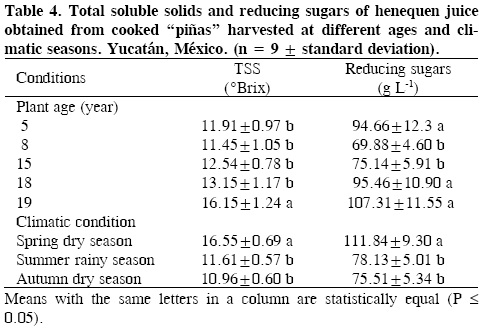
<body><![CDATA[<p align="center"><font face="verdana" size="2"><img src="/img/revistas/rfm/v32n1/a5c1.jpg"></font></p>         <p align="center"><font face="verdana" size="2"><a name="c2"></a></font></p> 	    <p align="center"><font face="verdana" size="2"><img src="/img/revistas/rfm/v32n1/a5c2.jpg"></font></p>     <p align="justify"><font face="verdana" size="2"><b>Volume of the juice</b></font></p>  	    <p align="justify"><font face="verdana" size="2">The juice volume obtained from cooked "pi&ntilde;as" of different ages showed significant differences (<a href="#c1">Table 1</a>).</font></p>  	    <p align="justify"><font face="verdana" size="2">"Pi&ntilde;as" 5 to 8 years&#45;old produced 3.0 L/pi&ntilde;a, while 15 to 19 year&#45;old "pi&ntilde;as" showed a reduction in juice content; this reduction varied from 15.3 to 33.9 % compared to the youngest "pi&ntilde;as". The harvest time also affected the final volume of juice collected from the cooked "pi&ntilde;as"; "pi&ntilde;as" collected in the dry spring period yielded 2.6 L/pi&ntilde;a, while in the summer rainy period the volume of juice increased over 30.7 % and diminished to 15.3 % in the autumn dry season, with respect to the spring dry season (<a href="#c2">Table 2</a>).</font></p>  	    <p align="justify"><font face="verdana" size="2"><b>Total soluble solutes content (&deg;Brix)</b></font></p>  	    <p align="justify"><font face="verdana" size="2">Plant age had a significant effect on the total soluble solids content in the "pi&ntilde;as" of henequen, since values varied from 11.7 &deg;Brix in 8 year&#45;old plants to 15.2 in 19 year&#45;old plants. The highest soluble solutes content was recorded in those uncooked "pi&ntilde;as" harvested during the spring dry season with values of 17.4 &deg;Brix, and the lowest values (9.7 &deg;Brix) were recorded in "pi&ntilde;as" collected in the autumn rainy season (<a href="#c3">Table 3</a>). In the cooked juice the soluble solutes also varied significantly through plant ages (<a href="#c4">Table 4</a>); the highest values (16.1 &deg;Brix ) were observed in 19 year&#45;old "pi&ntilde;as" and the lowest in those from the 5, 8, 15 and 18 year&#45;old plants, which had 18.5 to 29.1 % less than the 19 year&#45;old "pi&ntilde;as". The climatic conditions prior to harvesting also had a significant effect on the soluble solutes content of the cooked "pi&ntilde;a" juice. The juice from the spring dry season had values of 16.5 &deg;Brix, which decreased by 30 % in the summer rainy season and by 33.8 % in the early autumn dry season. These data show that the highest TSS increased with age (up to 19 year&#45;old plants), and are also increased by dry conditions.</font></p>     <p align="center"><font face="verdana" size="2"><a name="c3"></a></font></p> 	    <p align="center"><font face="verdana" size="2"><img src="/img/revistas/rfm/v32n1/a5c3.jpg"></font></p>         ]]></body>
<body><![CDATA[<p align="center"><font face="verdana" size="2"><a name="c4"></a></font></p> 	    <p align="center"><font face="verdana" size="2"><img src="/img/revistas/rfm/v32n1/a5c4.jpg"></font></p>     <p align="justify"><font face="verdana" size="2"><b>Reducing sugars content</b></font></p>  	    <p align="justify"><font face="verdana" size="2">Their content in the juice of cooked "pi&ntilde;as" varied with plant age, since "pi&ntilde;as" from 19, 18 and 5 years&#45;old plants had the highest values (107.3 to 94.6 g L<sup>&#45;1</sup>) compared to the 8 and 15 years&#45;old "pi&ntilde;as" which had 21 to 35 % lesser content (<a href="#c4">Table 4</a>). The reducing sugars were also affected by the prevailing climatic conditions because their highest content was found during the dry spring period with 112 g L<sup>&#45;1</sup>, whereas in the summer rainy season their content became diminished by 30 % and by 32% in the autumn dry season.</font></p>  	    <p align="justify"><font face="verdana" size="2"><b>Distilled "ordinary" and "white" alcohol production</b></font></p>  	    <p align="justify"><font face="verdana" size="2">The volume of the "ordinary" alcohol obtained from the juice of cooked "pi&ntilde;as" varied (P &#8804; 0.05) among plant ages (<a href="/img/revistas/rfm/v32n1/a5c5.jpg" target="_blank">Table 5</a>). The 19 years&#45;old "pi&ntilde;as" produced as much as 159 mL of ordinary alcohol, whereas the 8 years&#45;old plants produced only 28 mL per liter of juice. A similar pattern was obtained for the "white" alcohol pro&#45;duction also; the 19 years&#45;old "pi&ntilde;as" produced as much as 108.1 mL of "white" alcohol per liter of "ordinary" alcohol, while the 8 years&#45;old plants produced 56.8 mL per liter.</font></p>  	    <p align="justify"><font face="verdana" size="2">Regarding the effect of climatic conditions on the production of both "ordinary" and "white" alcohols, the early autumn rainy season harvest rendered the highest values for "ordinary" alcohol (114 mL per liter of juice) whereas and the summer rainy period showed the lowest with 49.3 mL per liter of juice (<a href="/img/revistas/rfm/v32n1/a5c6.jpg" target="_blank">Table 6</a>). For "white" alcohol production, the best season was the spring dry season harvest with 138 mL per liter, and the lowest volume (14.0 mL per liter) was attained in the early autumn dry season.</font></p>  	    <p align="justify"><font face="verdana" size="2">The ethanol contents in the "ordinary" and "white" alcohols collected were not affected (P &#8804; 0.05) by plant age, although the 5 years&#45;old "pi&ntilde;as" rendered from 15 to 35 % more ethanol than older "pi&ntilde;as" (<a href="/img/revistas/rfm/v32n1/a5c5.jpg" target="_blank">Table 5</a>). The climatic conditions prior to harvest had a significant effect (P &#8804; 0.05) on the ethanol content. The spring dry season harvest showed ethanol contents of 282.5 g L<sup>&#45;1</sup> of "ordinary" alcohol and 524.5 g L<sup>&#45;1</sup> of "white" alcohol (<a href="/img/revistas/rfm/v32n1/a5c6.jpg" target="_blank">Table 6</a>). The lowest values were obtained from "pi&ntilde;as" harvested in the autumn dry season with 131.7 g of ethanol per liter of "ordinary" alcohol and 251.2 g of ethanol per liter of "white" alcohol (<a href="/img/revistas/rfm/v32n1/a5c5.jpg" target="_blank">Table 5</a>).</font></p>      <p align="justify"><font face="verdana" size="2">We postulated that the content of sugars in the stem will be affected by the climate and plant age. Our observations showed that climate has a greater effect on sugars accumulation in the stems ("pi&ntilde;as") of <i>A. fourcroydes</i> than plant age. Our observations revealed that age has less effect on the other variables studied than the climatic season of harvest. For instance, the total soluble solids (&deg;Brix) content recorded in "pi&ntilde;as" showed slight differences as the plant aged, whereas "pi&ntilde;as" collected in the dry season regularly had higher values of &deg;Brix than those harvested in the rainy seasons, possibly because soil dryness reduced tissue water content so that solutes become more concentrated in the "pi&ntilde;a" tissues. In contrast with other cultivated agave species, the henequen "pi&ntilde;as" do not increase in size and weight as in A. tequilana, where the weight of the "pi&ntilde;a" increased with age (Valenzuela&#45;Zapata, 1985; Nobel, 1994).</font></p>  	    <p align="justify"><font face="verdana" size="2">It has been proposed and demonstrated that henequen can be cultivated not only for fibers but also for alcohol spirit. The "pi&ntilde;a" of henequen, however, differs from those agaves used only for alcoholic spirits, such as tequila and mezcal. In henequen the leaves are constantly harvested for fiber production, thereby reducing the photosynthetic surface, and consequently reducing the production of the sugars used for growth and ultimately stored in the stem, which may be used for further processing such as alcohol production. The removal of at least 25&#45;30 leaves per year during the life of the plant continues for about 20 years and probably affects the amount and quality of the stored sugars since some of then were used for fiber synthesis. Such synthesis should be an interesting research line that might facilitate an understanding of structural carbohydrates metabolism.</font></p>  	    ]]></body>
<body><![CDATA[<p align="justify"><font face="verdana" size="2">However, we found a positive relation between plant age and both TSS and sugar content when these variables are evaluated in the juice of cooked "pi&ntilde;as. Older plants had higher concentrations of soluble solids measured in &deg;Brix, than younger plants; similarly, older plants (18 and 19 years) had higher contents of reducing sugars than the younger ones. Other agaves, such as <i>A. tequilana,</i> are harvested when the "pi&ntilde;as" have their greatest content of reducing sugars, which regularly occurs when plants are over eight years old, just before flowering (Cede&ntilde;o and Alvarez&#45;Jacobs, 2000; Valenzuela&#45;Zapata, 1985). In henequen the volume of juice obtained from cooked "pi&ntilde;as" is highest in older plants harvested in the rainy sea&#45;son, a fact that may be caused by the increase in water availability because of rains.</font></p>  	    <p align="justify"><font face="verdana" size="2">As it was mentioned above, the cooked juice from the "pi&ntilde;as" was fermented and the production of distilled alcohol spirit measured. In the dry season the older plants yielded a greater volume of "ordinary" or "white" distilled alcohol than the younger plants harvested in the rainy season. Ethanol content in the "ordinary" distilled alcohol varied from 203 to 244 g L<sup>&#45;1</sup> of juice, values which are close to those recorded for <i>A. tequilana</i> (Prado, 2004). Here again the age of the plant did not affect the ethanol content of the "ordinary" distilled alcohol; however, this content was affected by the climatic conditions, particularly when water was available in the environment during the autumn dry season. The highest values of ethanol in "white" distilled alcohol were found in the spring dry season (508 g per liter of "ordinary" alcohol equivalent to 63 % of the volume), at any age of the plant. The smallest white alcohol values (200 to 400 g L<sup>&#45;1</sup>) were found in the "pi&ntilde;as" harvested in any the two summer rainy seasons or autumn dry season (Summer and Autumn). Our data indicates that 1.6 to 3.9 kg of "pi&ntilde;a" are needed to produce one liter of juice which in turn produces from 90 to 114 mL of alcohol after fermentation.</font></p>  	    <p align="justify"><font face="verdana" size="2">Our observations suggest that the nonstructural carbohydrates produced by <i>A. fourcroydes</i> and stored in their stems, can be fermented to produce an alcoholic spirit, in addition to the agronomical use, thereby increasing the economical importance of this plant for the sustainable agriculture in Yucat&aacute;n, M&eacute;xico.</font></p>  	    <p align="justify"><font face="verdana" size="2">We concluded that climate has a greater effect on sugars accumulation in the stems (pi&ntilde;as) of <i>A. fourcroydes</i> than plant age. However, both the total soluble solids and the sugars contents in the juice of cooked "pi&ntilde;as" increased with plant age, since older plants had higher concentrations of soluble solids (measured in &deg;Brix), than younger plants.</font></p>  	    <p align="justify"><font face="verdana" size="2">Juice from cooked "pi&ntilde;as"of older plants yield greater volumens of "ordinary" or "white" distilled alcohol than younger plants harvested in the rainy seasons. The dry spring periods of the year favor the accumulation of sugars; hence more alcohol may be produced in this season than in any of the other two rainy seasons tested. In fact, henequen plants over 15 years old produce larger amounts of alcohol compared to younger plants.</font></p>  	    <p align="justify"><font face="verdana" size="2">&nbsp;</font></p>  	    <p align="justify"><font face="verdana" size="2"><b>ACKNOWLEDGEMENTS</b></font></p>  	    <p align="justify"><font face="verdana" size="2">To CONACyT (grant 17037) for the economic support to carry out the present research work and the doctoral studies formation of the first author, and to Silvia Vergara Yoisura for helping with the of the manuscript preparation.</font></p>  	    <p align="justify"><font face="verdana" size="2">&nbsp;</font></p>  	    <p align="justify"><font face="verdana" size="2"><b>BIBLIOGRAPHY</b></font></p>  	    ]]></body>
<body><![CDATA[<!-- ref --><p align="justify"><font face="verdana" size="2"><b>Aspinall G O, P C Gupta (1959)</b> The structure of the fructosan from <i>Agave veracruz</i> Mill. J. Am. Chem. Soc. 81:718&#45;722.    &nbsp;&nbsp;&nbsp;&nbsp;&nbsp;&nbsp;&nbsp;&nbsp;[&#160;<a href="javascript:void(0);" onclick="javascript: window.open('/scielo.php?script=sci_nlinks&ref=7058684&pid=S0187-7380200900010000500001&lng=','','width=640,height=500,resizable=yes,scrollbars=1,menubar=yes,');">Links</a>&#160;]<!-- end-ref --></font></p>  	    <!-- ref --><p align="justify"><font face="verdana" size="2"><b>Ayora&#45;C&aacute;mara M E (1986)</b> Determinaci&oacute;n de las principales caracter&iacute;sticas f&iacute;sicas y qu&iacute;micas del jugo fresco de henequ&eacute;n <i>(Agave fourcroydes).</i> Gesti&oacute;n Tecnol&oacute;gica 4:7&#45;12.    &nbsp;&nbsp;&nbsp;&nbsp;&nbsp;&nbsp;&nbsp;&nbsp;[&#160;<a href="javascript:void(0);" onclick="javascript: window.open('/scielo.php?script=sci_nlinks&ref=7058686&pid=S0187-7380200900010000500002&lng=','','width=640,height=500,resizable=yes,scrollbars=1,menubar=yes,');">Links</a>&#160;]<!-- end-ref --></font></p>  	    <!-- ref --><p align="justify"><font face="verdana" size="2"><b>Cede&ntilde;o M C, J Alvarez&#45;Jacobs (2000)</b> Tequila Production from Agave. <i>In:</i> Murtagh &amp; Associates (ed). The Alcohol Textbook. 3rd ed. Nottingham University Press. pp:223&#45;243.    &nbsp;&nbsp;&nbsp;&nbsp;&nbsp;&nbsp;&nbsp;&nbsp;[&#160;<a href="javascript:void(0);" onclick="javascript: window.open('/scielo.php?script=sci_nlinks&ref=7058688&pid=S0187-7380200900010000500003&lng=','','width=640,height=500,resizable=yes,scrollbars=1,menubar=yes,');">Links</a>&#160;]<!-- end-ref --></font></p>  	    <!-- ref --><p align="justify"><font face="verdana" size="2"><b>Duch G J (1988)</b> La Conformaci&oacute;n Territorial del Estado de Yucat&aacute;n. Universidad Aut&oacute;noma de Chapingo. Estado de M&eacute;xico. M&eacute;xico. 180 p.    &nbsp;&nbsp;&nbsp;&nbsp;&nbsp;&nbsp;&nbsp;&nbsp;[&#160;<a href="javascript:void(0);" onclick="javascript: window.open('/scielo.php?script=sci_nlinks&ref=7058690&pid=S0187-7380200900010000500004&lng=','','width=640,height=500,resizable=yes,scrollbars=1,menubar=yes,');">Links</a>&#160;]<!-- end-ref --></font></p>  	    <!-- ref --><p align="justify"><font face="verdana" size="2"><b>Duch G J (1991)</b> Fisiograf&iacute;a del Estado de Yucat&aacute;n, su Relaci&oacute;n con la Agricultura. Universidad Aut&oacute;noma de Chapingo. Estado de M&eacute;xico. M&eacute;xico. 223 p.    &nbsp;&nbsp;&nbsp;&nbsp;&nbsp;&nbsp;&nbsp;&nbsp;[&#160;<a href="javascript:void(0);" onclick="javascript: window.open('/scielo.php?script=sci_nlinks&ref=7058692&pid=S0187-7380200900010000500005&lng=','','width=640,height=500,resizable=yes,scrollbars=1,menubar=yes,');">Links</a>&#160;]<!-- end-ref --></font></p>  	    ]]></body>
<body><![CDATA[<!-- ref --><p align="justify"><font face="verdana" size="2"><b>G&oacute;mez&#45;Ayala R C, C Jacques, J A Ram&iacute;rez&#45;de Le&oacute;n (2004)</b> Extracci&oacute;n de la inulina y az&uacute;cares del agave con m&eacute;todos qu&iacute;micos. Revista Salud P&uacute;blica y Nutrici&oacute;n (RESPYN) No. 1. Ed. Especial. Disponible en: <a href="http://www.uanl.mx/publicaciones/respyn/especiales/ee-1-2005/51.htlm" target="_blank">www.uanl.mx/publicaciones/respyn/especiales/ee&#45;1&#45;2005/51.htlm</a> (Diciembre de 2006).    &nbsp;&nbsp;&nbsp;&nbsp;&nbsp;&nbsp;&nbsp;&nbsp;[&#160;<a href="javascript:void(0);" onclick="javascript: window.open('/scielo.php?script=sci_nlinks&ref=7058694&pid=S0187-7380200900010000500006&lng=','','width=640,height=500,resizable=yes,scrollbars=1,menubar=yes,');">Links</a>&#160;]<!-- end-ref --></font></p>  	    <!-- ref --><p align="justify"><font face="verdana" size="2"><b>Guerrero M R, E R Dzib (1983)</b> Gu&iacute;a para el Cultivo del Henequ&eacute;n en Plantaci&oacute;n Definitiva. Folleto para Productores No. 7. INIA&#45;CIAPY. M&eacute;rida, Yucat&aacute;n, M&eacute;xico. 16 p.    &nbsp;&nbsp;&nbsp;&nbsp;&nbsp;&nbsp;&nbsp;&nbsp;[&#160;<a href="javascript:void(0);" onclick="javascript: window.open('/scielo.php?script=sci_nlinks&ref=7058696&pid=S0187-7380200900010000500007&lng=','','width=640,height=500,resizable=yes,scrollbars=1,menubar=yes,');">Links</a>&#160;]<!-- end-ref --></font></p>  	    <!-- ref --><p align="justify"><font face="verdana" size="2"><b>L&oacute;pez M G, N A Mancilla&#45;Margalli, G Mendoza&#45;D&iacute;az (2003)</b> Molecular structures of fructans from <i>Agave tequilana</i> Weber var. azul. J. Agric. Food Chem. 51:7835&#45;7840.    &nbsp;&nbsp;&nbsp;&nbsp;&nbsp;&nbsp;&nbsp;&nbsp;[&#160;<a href="javascript:void(0);" onclick="javascript: window.open('/scielo.php?script=sci_nlinks&ref=7058698&pid=S0187-7380200900010000500008&lng=','','width=640,height=500,resizable=yes,scrollbars=1,menubar=yes,');">Links</a>&#160;]<!-- end-ref --></font></p>  	    <!-- ref --><p align="justify"><font face="verdana" size="2"><b>Nobel P S (1985)</b> PAR, water and temperature limitations on the productivity of cultivated <i>Agave fourcroydes</i> (henequen). J. Appl. Ecol. 22:157&#45;173.    &nbsp;&nbsp;&nbsp;&nbsp;&nbsp;&nbsp;&nbsp;&nbsp;[&#160;<a href="javascript:void(0);" onclick="javascript: window.open('/scielo.php?script=sci_nlinks&ref=7058700&pid=S0187-7380200900010000500009&lng=','','width=640,height=500,resizable=yes,scrollbars=1,menubar=yes,');">Links</a>&#160;]<!-- end-ref --></font></p>  	    <!-- ref --><p align="justify"><font face="verdana" size="2"><b>Nobel P S (1994)</b> Remarkable Agaves and Cacti. Cambridge University Press. New York. 166 p.    &nbsp;&nbsp;&nbsp;&nbsp;&nbsp;&nbsp;&nbsp;&nbsp;[&#160;<a href="javascript:void(0);" onclick="javascript: window.open('/scielo.php?script=sci_nlinks&ref=7058702&pid=S0187-7380200900010000500010&lng=','','width=640,height=500,resizable=yes,scrollbars=1,menubar=yes,');">Links</a>&#160;]<!-- end-ref --></font></p>  	    ]]></body>
<body><![CDATA[<!-- ref --><p align="justify"><font face="verdana" size="2"><b>Nobel P S, M Casta&ntilde;eda, G North, E Pimienta&#45;Barrios, A Ruiz (1998)</b> Temperature influences on leaf CO<sub>2</sub> exchange, cell viability and cultivation range for <i>Agave tequilana.</i> J. Arid En&#45;viron. 39:1&#45;9.    &nbsp;&nbsp;&nbsp;&nbsp;&nbsp;&nbsp;&nbsp;&nbsp;[&#160;<a href="javascript:void(0);" onclick="javascript: window.open('/scielo.php?script=sci_nlinks&ref=7058704&pid=S0187-7380200900010000500011&lng=','','width=640,height=500,resizable=yes,scrollbars=1,menubar=yes,');">Links</a>&#160;]<!-- end-ref --></font></p>  	    <!-- ref --><p align="justify"><font face="verdana" size="2"><b>Pimienta&#45;Barrios E, C Robles&#45;Murgu&iacute;a, P S Nobel (2001)</b> Net CO<sub>2</sub> uptake for <i>Agave tequilana</i> in a warm and a temperate environment. Biotropica 33:312&#45;318.    &nbsp;&nbsp;&nbsp;&nbsp;&nbsp;&nbsp;&nbsp;&nbsp;[&#160;<a href="javascript:void(0);" onclick="javascript: window.open('/scielo.php?script=sci_nlinks&ref=7058706&pid=S0187-7380200900010000500012&lng=','','width=640,height=500,resizable=yes,scrollbars=1,menubar=yes,');">Links</a>&#160;]<!-- end-ref --></font></p>  	    <!-- ref --><p align="justify"><font face="verdana" size="2"><b>Prado R R (2004)</b> Destilaci&oacute;n. <i>In:</i> Ciencia y Tecnolog&iacute;a del Tequila, Avances y Perspectivas. CIATEJ. Guadalajara, Jalisco, M&eacute;xico. pp:123&#45;168.    &nbsp;&nbsp;&nbsp;&nbsp;&nbsp;&nbsp;&nbsp;&nbsp;[&#160;<a href="javascript:void(0);" onclick="javascript: window.open('/scielo.php?script=sci_nlinks&ref=7058708&pid=S0187-7380200900010000500013&lng=','','width=640,height=500,resizable=yes,scrollbars=1,menubar=yes,');">Links</a>&#160;]<!-- end-ref --></font></p>  	    <!-- ref --><p align="justify"><font face="verdana" size="2"><b>Ramales&#45;Osorio M C, M L Barrag&aacute;n&#45;R&aacute;mirez (2002)</b> La industria del mezcal y la econom&iacute;a oaxaque&ntilde;a. Observatorio de la Econom&iacute;a Latinoamericana. Disponible en: <a href="http://www.eumed.net/cursecon/ecolat/mx/" target="_blank">http://www.eumed.net/cursecon/ecolat/mx/</a> (Diciembre de 2006).    &nbsp;&nbsp;&nbsp;&nbsp;&nbsp;&nbsp;&nbsp;&nbsp;[&#160;<a href="javascript:void(0);" onclick="javascript: window.open('/scielo.php?script=sci_nlinks&ref=7058710&pid=S0187-7380200900010000500014&lng=','','width=640,height=500,resizable=yes,scrollbars=1,menubar=yes,');">Links</a>&#160;]<!-- end-ref --></font></p>  	    <!-- ref --><p align="justify"><font face="verdana" size="2"><b>Tello&#45;Balderas J J, E Garc&iacute;a&#45;Moya (1985)</b> The mezcal industry in the altiplano potosino&#45;zacatecano of north&#45;central Mexico. Desert Plant 7:81&#45;88.    &nbsp;&nbsp;&nbsp;&nbsp;&nbsp;&nbsp;&nbsp;&nbsp;[&#160;<a href="javascript:void(0);" onclick="javascript: window.open('/scielo.php?script=sci_nlinks&ref=7058712&pid=S0187-7380200900010000500015&lng=','','width=640,height=500,resizable=yes,scrollbars=1,menubar=yes,');">Links</a>&#160;]<!-- end-ref --></font></p>  	    ]]></body>
<body><![CDATA[<!-- ref --><p align="justify"><font face="verdana" size="2"><b>Valenzuela&#45;Zapata A G (1985)</b> The tequila industry in Jalisco, Mexico. Desert Plant 7:65&#45;70.    &nbsp;&nbsp;&nbsp;&nbsp;&nbsp;&nbsp;&nbsp;&nbsp;[&#160;<a href="javascript:void(0);" onclick="javascript: window.open('/scielo.php?script=sci_nlinks&ref=7058714&pid=S0187-7380200900010000500016&lng=','','width=640,height=500,resizable=yes,scrollbars=1,menubar=yes,');">Links</a>&#160;]<!-- end-ref --></font></p>  	    <!-- ref --><p align="justify"><font face="verdana" size="2"><b>Wang N, P S Nobel (1998)</b> Phloem transport of fructans in the crassu&#45;lacean acid metabolism species <i>Agave deserti.</i> Plant Physiol. 116:709&#45;714.    &nbsp;&nbsp;&nbsp;&nbsp;&nbsp;&nbsp;&nbsp;&nbsp;[&#160;<a href="javascript:void(0);" onclick="javascript: window.open('/scielo.php?script=sci_nlinks&ref=7058716&pid=S0187-7380200900010000500017&lng=','','width=640,height=500,resizable=yes,scrollbars=1,menubar=yes,');">Links</a>&#160;]<!-- end-ref --></font></p>  	    <p align="justify"><font face="verdana" size="2">&nbsp;</font></p>  	    <p align="justify"><font face="verdana" size="2"><b><a name="notas"></a>NOTAS</b></font></p>  	    <p align="justify"><font face="verdana" size="2"><b><sup>1</sup> Barahona P L F (1987)</b> Determinaci&oacute;n de los az&uacute;cares presentes en el jugo de henequ&eacute;n <i>(Agave fourcroydes)</i> y su variaci&oacute;n en el proceso de fermentaci&oacute;n. Tesis de licenciatura de Ingeniero Industrial en Qu&iacute;mica. Instituto Tecnol&oacute;gico de M&eacute;rida. M&eacute;rida, Yucat&aacute;n, M&eacute;xico. 90 p.</font></p>  	    <p align="justify"><font face="verdana" size="2"><b><sup>2 </sup>Castillo V A (1992)</b> Comparaci&oacute;n de diferentes fuentes de nutrientes para el crecimiento y fermentaci&oacute;n de <i>Saccharomyces cerevisiae</i> en melaza de ca&ntilde;a. Tesis de Licenciatura de Qu&iacute;mico Farmacobi&oacute;logo. Facultad de Ciencias Qu&iacute;micas. Universidad de Guadalajara. Guadalajara, Jalisco, M&eacute;xico. pp:1&#45;42.</font></p>      ]]></body><back>
<ref-list>
<ref id="B1">
<nlm-citation citation-type="journal">
<person-group person-group-type="author">
<name>
<surname><![CDATA[Aspinall]]></surname>
<given-names><![CDATA[G O]]></given-names>
</name>
<name>
<surname><![CDATA[Gupta]]></surname>
<given-names><![CDATA[P C]]></given-names>
</name>
</person-group>
<article-title xml:lang="en"><![CDATA[The structure of the fructosan from Agave veracruz Mill]]></article-title>
<source><![CDATA[J. Am. Chem. Soc.]]></source>
<year>1959</year>
<volume>81</volume>
<page-range>718-722</page-range></nlm-citation>
</ref>
<ref id="B2">
<nlm-citation citation-type="journal">
<person-group person-group-type="author">
<name>
<surname><![CDATA[Ayora-Cámara]]></surname>
<given-names><![CDATA[M E]]></given-names>
</name>
</person-group>
<article-title xml:lang="en"><![CDATA[Determinación de las principales características físicas y químicas del jugo fresco de henequén (Agave fourcroydes)]]></article-title>
<source><![CDATA[Gestión Tecnológica]]></source>
<year>1986</year>
<volume>4</volume>
<page-range>7-12</page-range></nlm-citation>
</ref>
<ref id="B3">
<nlm-citation citation-type="book">
<person-group person-group-type="author">
<name>
<surname><![CDATA[Cedeño]]></surname>
<given-names><![CDATA[M C]]></given-names>
</name>
<name>
<surname><![CDATA[Alvarez-Jacobs]]></surname>
<given-names><![CDATA[J]]></given-names>
</name>
</person-group>
<article-title xml:lang="en"><![CDATA[Tequila Production from Agave]]></article-title>
<source><![CDATA[The Alcohol Textbook]]></source>
<year>2000</year>
<edition>3</edition>
<page-range>223-243</page-range><publisher-name><![CDATA[Murtagh & AssociatesNottingham University Press]]></publisher-name>
</nlm-citation>
</ref>
<ref id="B4">
<nlm-citation citation-type="book">
<person-group person-group-type="author">
<name>
<surname><![CDATA[Duch]]></surname>
<given-names><![CDATA[G J]]></given-names>
</name>
</person-group>
<source><![CDATA[La Conformación Territorial del Estado de Yucatán]]></source>
<year>1988</year>
<page-range>180</page-range><publisher-loc><![CDATA[^eEstado de México Estado de México]]></publisher-loc>
<publisher-name><![CDATA[Universidad Autónoma de Chapingo]]></publisher-name>
</nlm-citation>
</ref>
<ref id="B5">
<nlm-citation citation-type="book">
<person-group person-group-type="author">
<name>
<surname><![CDATA[Duch]]></surname>
<given-names><![CDATA[G J]]></given-names>
</name>
</person-group>
<source><![CDATA[Fisiografía del Estado de Yucatán, su Relación con la Agricultura]]></source>
<year>1991</year>
<page-range>223</page-range><publisher-loc><![CDATA[^eEstado de México Estado de México]]></publisher-loc>
<publisher-name><![CDATA[Universidad Autónoma de Chapingo]]></publisher-name>
</nlm-citation>
</ref>
<ref id="B6">
<nlm-citation citation-type="journal">
<person-group person-group-type="author">
<name>
<surname><![CDATA[Gómez-Ayala]]></surname>
<given-names><![CDATA[R C]]></given-names>
</name>
<name>
<surname><![CDATA[Jacques]]></surname>
<given-names><![CDATA[C]]></given-names>
</name>
<name>
<surname><![CDATA[Ramírez-de León]]></surname>
<given-names><![CDATA[J A]]></given-names>
</name>
</person-group>
<article-title xml:lang="es"><![CDATA[Extracción de la inulina y azúcares del agave con métodos químicos]]></article-title>
<source><![CDATA[Revista Salud Pública y Nutrición]]></source>
<year>2004</year>
<month>Di</month>
<day>ci</day>
<numero>1</numero>
<issue>1</issue>
</nlm-citation>
</ref>
<ref id="B7">
<nlm-citation citation-type="book">
<person-group person-group-type="author">
<name>
<surname><![CDATA[Guerrero]]></surname>
<given-names><![CDATA[M R]]></given-names>
</name>
<name>
<surname><![CDATA[Dzib]]></surname>
<given-names><![CDATA[E R]]></given-names>
</name>
</person-group>
<source><![CDATA[Guía para el Cultivo del Henequén en Plantación Definitiva]]></source>
<year>1983</year>
<page-range>16</page-range><publisher-loc><![CDATA[Mérida^eYucatán Yucatán]]></publisher-loc>
<publisher-name><![CDATA[INIA-CIAPY]]></publisher-name>
</nlm-citation>
</ref>
<ref id="B8">
<nlm-citation citation-type="journal">
<person-group person-group-type="author">
<name>
<surname><![CDATA[López]]></surname>
<given-names><![CDATA[M G]]></given-names>
</name>
<name>
<surname><![CDATA[Mancilla-Margalli]]></surname>
<given-names><![CDATA[N A]]></given-names>
</name>
<name>
<surname><![CDATA[Mendoza-Díaz]]></surname>
<given-names><![CDATA[G]]></given-names>
</name>
</person-group>
<article-title xml:lang="en"><![CDATA[Molecular structures of fructans from Agave tequilana Weber var. azul]]></article-title>
<source><![CDATA[J. Agric. Food Chem.]]></source>
<year>2003</year>
<volume>51</volume>
<page-range>7835-7840</page-range></nlm-citation>
</ref>
<ref id="B9">
<nlm-citation citation-type="journal">
<person-group person-group-type="author">
<name>
<surname><![CDATA[Nobel]]></surname>
<given-names><![CDATA[P S]]></given-names>
</name>
</person-group>
<article-title xml:lang="en"><![CDATA[PAR, water and temperature limitations on the productivity of cultivated Agave fourcroydes (henequen)]]></article-title>
<source><![CDATA[J. Appl. Ecol.]]></source>
<year>1985</year>
<volume>22</volume>
<page-range>157-173</page-range></nlm-citation>
</ref>
<ref id="B10">
<nlm-citation citation-type="book">
<person-group person-group-type="author">
<name>
<surname><![CDATA[Nobel]]></surname>
<given-names><![CDATA[P S]]></given-names>
</name>
</person-group>
<source><![CDATA[Remarkable Agaves and Cacti]]></source>
<year>1994</year>
<page-range>166</page-range><publisher-loc><![CDATA[New York ]]></publisher-loc>
<publisher-name><![CDATA[Cambridge University Press]]></publisher-name>
</nlm-citation>
</ref>
<ref id="B11">
<nlm-citation citation-type="journal">
<person-group person-group-type="author">
<name>
<surname><![CDATA[Nobel]]></surname>
<given-names><![CDATA[P S]]></given-names>
</name>
<name>
<surname><![CDATA[Castañeda]]></surname>
<given-names><![CDATA[M]]></given-names>
</name>
<name>
<surname><![CDATA[North]]></surname>
<given-names><![CDATA[G]]></given-names>
</name>
<name>
<surname><![CDATA[Pimienta-Barrios]]></surname>
<given-names><![CDATA[E]]></given-names>
</name>
<name>
<surname><![CDATA[Ruiz]]></surname>
<given-names><![CDATA[A]]></given-names>
</name>
</person-group>
<article-title xml:lang="en"><![CDATA[Temperature influences on leaf CO2 exchange, cell viability and cultivation range for Agave tequilana]]></article-title>
<source><![CDATA[J. Arid En-viron.]]></source>
<year>1998</year>
<volume>39</volume>
<page-range>1-9</page-range></nlm-citation>
</ref>
<ref id="B12">
<nlm-citation citation-type="journal">
<person-group person-group-type="author">
<name>
<surname><![CDATA[Pimienta-Barrios]]></surname>
<given-names><![CDATA[E]]></given-names>
</name>
<name>
<surname><![CDATA[Robles-Murguía]]></surname>
<given-names><![CDATA[C]]></given-names>
</name>
<name>
<surname><![CDATA[Nobel]]></surname>
<given-names><![CDATA[P S]]></given-names>
</name>
</person-group>
<article-title xml:lang="en"><![CDATA[Net CO2 uptake for Agave tequilana in a warm and a temperate environment]]></article-title>
<source><![CDATA[Biotropica]]></source>
<year>2001</year>
<volume>33</volume>
<page-range>312-318</page-range></nlm-citation>
</ref>
<ref id="B13">
<nlm-citation citation-type="book">
<person-group person-group-type="author">
<name>
<surname><![CDATA[Prado]]></surname>
<given-names><![CDATA[R R]]></given-names>
</name>
</person-group>
<article-title xml:lang="es"><![CDATA[Destilación]]></article-title>
<source><![CDATA[Ciencia y Tecnología del Tequila, Avances y Perspectivas]]></source>
<year>2004</year>
<page-range>123-168</page-range><publisher-loc><![CDATA[Guadalajara^eJalisco Jalisco]]></publisher-loc>
<publisher-name><![CDATA[CIATEJ]]></publisher-name>
</nlm-citation>
</ref>
<ref id="B14">
<nlm-citation citation-type="book">
<person-group person-group-type="author">
<name>
<surname><![CDATA[Ramales-Osorio]]></surname>
<given-names><![CDATA[M C]]></given-names>
</name>
<name>
<surname><![CDATA[Barragán-Rámirez]]></surname>
<given-names><![CDATA[M L]]></given-names>
</name>
</person-group>
<source><![CDATA[La industria del mezcal y la economía oaxaqueña]]></source>
<year>2002</year>
<month>Di</month>
<day>ci</day>
<publisher-name><![CDATA[Observatorio de la Economía Latinoamericana]]></publisher-name>
</nlm-citation>
</ref>
<ref id="B15">
<nlm-citation citation-type="journal">
<person-group person-group-type="author">
<name>
<surname><![CDATA[Tello-Balderas]]></surname>
<given-names><![CDATA[J J]]></given-names>
</name>
<name>
<surname><![CDATA[García-Moya]]></surname>
<given-names><![CDATA[E]]></given-names>
</name>
</person-group>
<article-title xml:lang="en"><![CDATA[The mezcal industry in the altiplano potosino-zacatecano of north-central Mexico]]></article-title>
<source><![CDATA[Desert Plant]]></source>
<year>1985</year>
<volume>7</volume>
<page-range>81-88</page-range></nlm-citation>
</ref>
<ref id="B16">
<nlm-citation citation-type="journal">
<person-group person-group-type="author">
<name>
<surname><![CDATA[Valenzuela-Zapata]]></surname>
<given-names><![CDATA[A G]]></given-names>
</name>
</person-group>
<article-title xml:lang="en"><![CDATA[The tequila industry in Jalisco, Mexico]]></article-title>
<source><![CDATA[Desert Plant]]></source>
<year>1985</year>
<volume>7</volume>
<page-range>65-70</page-range></nlm-citation>
</ref>
<ref id="B17">
<nlm-citation citation-type="journal">
<person-group person-group-type="author">
<name>
<surname><![CDATA[Wang]]></surname>
<given-names><![CDATA[N]]></given-names>
</name>
<name>
<surname><![CDATA[Nobel]]></surname>
<given-names><![CDATA[P S]]></given-names>
</name>
</person-group>
<article-title xml:lang="en"><![CDATA[Phloem transport of fructans in the crassu-lacean acid metabolism species Agave deserti]]></article-title>
<source><![CDATA[Plant Physiol.]]></source>
<year>1998</year>
<volume>116</volume>
<page-range>709-714</page-range></nlm-citation>
</ref>
</ref-list>
</back>
</article>