<?xml version="1.0" encoding="ISO-8859-1"?><article xmlns:mml="http://www.w3.org/1998/Math/MathML" xmlns:xlink="http://www.w3.org/1999/xlink" xmlns:xsi="http://www.w3.org/2001/XMLSchema-instance">
<front>
<journal-meta>
<journal-id>0187-7151</journal-id>
<journal-title><![CDATA[Acta botánica mexicana]]></journal-title>
<abbrev-journal-title><![CDATA[Act. Bot. Mex]]></abbrev-journal-title>
<issn>0187-7151</issn>
<publisher>
<publisher-name><![CDATA[Instituto de Ecología A.C., Centro Regional del Bajío]]></publisher-name>
</publisher>
</journal-meta>
<article-meta>
<article-id>S0187-71512016000100004</article-id>
<title-group>
<article-title xml:lang="en"><![CDATA[Pollen profile of propolis produced on the eastern edge of the Sonoran Desert in central Sonora, Mexico]]></article-title>
<article-title xml:lang="es"><![CDATA[Perfil de polen del propóleos producidos en el borde oriental del Desierto de Sonora en el centro de Sonora, México]]></article-title>
</title-group>
<contrib-group>
<contrib contrib-type="author">
<name>
<surname><![CDATA[Vargas-Sánchez]]></surname>
<given-names><![CDATA[Rey David]]></given-names>
</name>
<xref ref-type="aff" rid="A01"/>
</contrib>
<contrib contrib-type="author">
<name>
<surname><![CDATA[Peñalba-Garmendia]]></surname>
<given-names><![CDATA[María Cristina]]></given-names>
</name>
<xref ref-type="aff" rid="A02"/>
</contrib>
<contrib contrib-type="author">
<name>
<surname><![CDATA[Sánchez-Escalante]]></surname>
<given-names><![CDATA[José Jesús]]></given-names>
</name>
<xref ref-type="aff" rid="A02"/>
</contrib>
<contrib contrib-type="author">
<name>
<surname><![CDATA[Torrescano-Urrutia]]></surname>
<given-names><![CDATA[Gastón Ramón]]></given-names>
</name>
<xref ref-type="aff" rid="A01"/>
</contrib>
<contrib contrib-type="author">
<name>
<surname><![CDATA[Sánchez-Escalante]]></surname>
<given-names><![CDATA[Armida]]></given-names>
</name>
<xref ref-type="aff" rid="A01"/>
</contrib>
</contrib-group>
<aff id="A01">
<institution><![CDATA[,Centro de Investigación en Alimentación y Desarrollo, A.C.  ]]></institution>
<addr-line><![CDATA[Hermosillo Sonora]]></addr-line>
<country>México</country>
</aff>
<aff id="A02">
<institution><![CDATA[,Universidad de Sonora  ]]></institution>
<addr-line><![CDATA[Hermosillo Sonora]]></addr-line>
<country>México</country>
</aff>
<pub-date pub-type="pub">
<day>00</day>
<month>00</month>
<year>2016</year>
</pub-date>
<pub-date pub-type="epub">
<day>00</day>
<month>00</month>
<year>2016</year>
</pub-date>
<numero>114</numero>
<fpage>69</fpage>
<lpage>85</lpage>
<copyright-statement/>
<copyright-year/>
<self-uri xlink:href="http://www.scielo.org.mx/scielo.php?script=sci_arttext&amp;pid=S0187-71512016000100004&amp;lng=en&amp;nrm=iso"></self-uri><self-uri xlink:href="http://www.scielo.org.mx/scielo.php?script=sci_abstract&amp;pid=S0187-71512016000100004&amp;lng=en&amp;nrm=iso"></self-uri><self-uri xlink:href="http://www.scielo.org.mx/scielo.php?script=sci_pdf&amp;pid=S0187-71512016000100004&amp;lng=en&amp;nrm=iso"></self-uri><abstract abstract-type="short" xml:lang="en"><p><![CDATA[Eight propolis samples from the eastern edge of the Sonoran Desert were collected at two sites (Pueblo de Álamos and Rancho Viejo, located at Ures, Sonora, Mexico) during two seasons of the year (winter and summer, 2012 and 2013) and analyzed using palynological methods in order to determine which plants were visited by bees in order to collect raw material (resins, wax and pollen) to form propolis. The pollen analysis identified a total of 42 pollen types. Six samples of propolis were bifloral (summer and winter samples) and two multifloral (winter). Mimosa distachya var. laxiflora and Prosopis velutina were considered characteristic pollen types, composing 15 to 45% of total pollen sums.]]></p></abstract>
<abstract abstract-type="short" xml:lang="es"><p><![CDATA[Se colectaron ocho muestras de propóleos de la región oriental del Desierto Sonorense en dos sitios (Pueblo de Álamos y Rancho Viejo, ubicados en Ures, Sonora, México) durante dos épocas del año (invierno y verano, 2012 y 2013) y fueron analizadas utilizando métodos palinológicos con el fin de determinar qué plantas fueron visitadas por las abejas para recolectar materia prima (resina, cera y polen) para formar los propóleos. El análisis polínico identificó un total de 42 tipos de polen. Seis muestras de propóleos fueron biflorales (muestras de verano e invierno) y dos multiflorales (muestras de invierno). Mimosa distachya var. laxiflora y Prosopis velutina fueron considerados los tipos polínicos característicos, con 15 a 45% de los conjuntos polínicos totales.]]></p></abstract>
<kwd-group>
<kwd lng="en"><![CDATA[botanical origin]]></kwd>
<kwd lng="en"><![CDATA[pollen analysis]]></kwd>
<kwd lng="en"><![CDATA[propolis]]></kwd>
<kwd lng="en"><![CDATA[Sonora-Mexico]]></kwd>
<kwd lng="es"><![CDATA[análisis de polen]]></kwd>
<kwd lng="es"><![CDATA[origen botánico]]></kwd>
<kwd lng="es"><![CDATA[propóleos]]></kwd>
<kwd lng="es"><![CDATA[Sonora-México]]></kwd>
</kwd-group>
</article-meta>
</front><body><![CDATA[  	    <p align="center"><font face="verdana" size="4"><b>Pollen profile of propolis produced on the eastern edge of the Sonoran Desert in central Sonora, Mexico</b></font></p>  	    <p>&nbsp;</p>  	    <p align="center"><font face="verdana" size="3"><b>Perfil de polen del prop&oacute;leos producidos en el borde oriental del Desierto de Sonora en el centro de Sonora, M&eacute;xico</b></font></p>  	    <p>&nbsp;</p>  	    <p align="center"><font face="verdana" size="2"><b>Rey David Vargas&#45;S&aacute;nchez<b><sup>1</sup></b>, Mar&iacute;a Cristina Pe&ntilde;alba&#45;Garmendia<sup lang="en&#45;US"><b><sup>2</sup></b>,</sup> Jos&eacute; Jes&uacute;s S&aacute;nchez&#45;Escalante<b><sup>2</sup></b>, Gast&oacute;n Ram&oacute;n Torrescano&#45;Urrutia<b><sup>1</sup></b> and Armida S&aacute;nchez&#45;Escalante<b><sup>1,3</sup></b></b></font></p>  	    <p>&nbsp;</p>  	    <p align="justify"><font face="verdana" size="2"><sup><i>1</i></sup> <i>Centro de Investigaci&oacute;n en Alimentaci&oacute;n y Desarrollo, A.C. (CIAD), carretera a la Victoria km 0.6, 83000 Hermosillo, Sonora, M&eacute;xico.</i></font></p>  	    <p align="justify"><font face="verdana" size="2"><i><sup><i>2</i></sup> Universidad de Sonora (UNISON), Blvd. Luis Encinas y Rosales s/n, 83000 Hermosillo, Sonora, M&eacute;xico.</i></font></p>  	    <p align="justify"><font face="verdana" size="2"><i><sup><i>3</i></sup> Autor para la correspondencia:</i> <a href="mailto:armida&#151;sanchez@ciad.mx">armida&#45;sanchez@ciad.mx</a>.</font></p>  	    ]]></body>
<body><![CDATA[<p>&nbsp;</p>  	    <p align="justify"><font face="verdana" size="2">Recibido en mayo de 2015.    <br> 	Aceptado en septiembre de 2015.</font></p>  	    <p>&nbsp;</p>  	    <p align="justify"><font face="verdana" size="2"><b>ABSTRACT</b></font></p>  	    <p align="justify"><font face="verdana" size="2">Eight propolis samples from the eastern edge of the Sonoran Desert were collected at two sites (Pueblo de &Aacute;lamos and Rancho Viejo, located at Ures, Sonora, Mexico) during two seasons of the year (winter and summer, 2012 and 2013) and analyzed using palynological methods in order to determine which plants were visited by bees in order to collect raw material (resins, wax and pollen) to form propolis. The pollen analysis identified a total of 42 pollen types. Six samples of propolis were bifloral (summer and winter samples) and two multifloral (winter). <i>Mimosa distachya</i> var<i>. laxiflora</i> and <i>Prosopis velutina</i> were considered characteristic pollen types, composing 15 to 45% of total pollen sums.</font></p>  	    <p align="justify"><font face="verdana" size="2"><b>Key words:</b> botanical origin, pollen analysis, propolis, Sonora&#45;Mexico.</font></p>  	    <p>&nbsp;</p>  	    <p align="justify"><font face="verdana" size="2"><b>RESUMEN</b></font></p>  	    <p align="justify"><font face="verdana" size="2">Se colectaron ocho muestras de prop&oacute;leos de la regi&oacute;n oriental del Desierto Sonorense en dos sitios (Pueblo de &Aacute;lamos y Rancho Viejo, ubicados en Ures, Sonora, M&eacute;xico) durante dos &eacute;pocas del a&ntilde;o (invierno y verano, 2012 y 2013) y fueron analizadas utilizando m&eacute;todos palinol&oacute;gicos con el fin de determinar qu&eacute; plantas fueron visitadas por las abejas para recolectar materia prima (resina, cera y polen) para formar los prop&oacute;leos. El an&aacute;lisis pol&iacute;nico identific&oacute; un total de 42 tipos de polen. Seis muestras de prop&oacute;leos fueron biflorales (muestras de verano e invierno) y dos multiflorales (muestras de invierno). <i>Mimosa</i> <i>distachya</i> var. <i>laxiflora</i> y <i>Prosopis</i> <i>velutina</i> fueron considerados los tipos pol&iacute;nicos caracter&iacute;sticos, con 15 a 45% de los conjuntos pol&iacute;nicos totales.</font></p>  	    ]]></body>
<body><![CDATA[<p align="justify"><font face="verdana" size="2"><b>Palabras clave:</b> an&aacute;lisis de polen, origen bot&aacute;nico, prop&oacute;leos, Sonora&#45;M&eacute;xico.</font></p>  	    <p>&nbsp;</p>  	    <p align="justify"><font face="verdana" size="2"><b>INTRODUCTION</b></font></p>  	    <p align="justify"><font face="verdana" size="2">Propolis, a resinous and adhesive natural substance produced by honeybees (<i>Apis mellifera</i>), has been used most recently as a health food and additive in functional foods, although it has served as a folk medicine for thousands of years. Previous studies have shown that propolis may have numerous beneficial attributes, including antioxidant, antibacterial, antiviral, antifungal and anticancer properties (Farr&eacute; et al., 2004; Vargas&#45;S&aacute;nchez et al., 2013). The different properties were mainly attributed to phytochemicals such as flavonoids and phenolic acids, which form the major components of resin found in propolis samples, where overall, propolis is composed of resins (50%), waxes (30%), volatile essential oils (10%), organic and inorganic chemical compounds (5%) and pollen (5%) (Farr&eacute; et al., 2004). It is well accepted that the chemical composition and properties of propolis greatly depend on the species of honeybee, season, method of harvesting and type of vegetation present in the geographical region (Farr&eacute; et al., 2004; Pe&ntilde;a, 2008). Therefore, it is important to understand by means of pollen identification which species are important for the production of propolis in beekeeping, as this can potentially contribute to a more effective distribution of beehives (Santos, 2011; Silva et al., 2013).</font></p>  	    <p align="justify"><font face="verdana" size="2">The presence of pollen in sediments from Polish propolis was reported by Warakomska and Maciejewicz (1992), who found that the most abundantly identified pollen came from plants of the Brassicaceae family, mainly <i>Brassica</i>, <i>Sinapis</i> and <i>Raphanus</i>, amounting to 9&#45;33% of the total pollen content. <i>Salix</i> pollen was present in all samples (6&#45;16%), including lesser amounts of pollen from <i>Centaurea</i> and <i>Trifolium pratense</i>. Montenegro et al. (2004) identified various kinds of Chilean propolis based on botanical sourcing, including propolis from <i>Escallonia pulverulenta</i>, <i>Nothofagus dombeyi</i>, <i>Mentha pulegium</i>, <i>Eucalyptus</i> and <i>Salix</i>, among other pollen types. In another investigation in Brazil, Barth and Pinto da Luz (2009) evaluated the presence of pollen grains in seven samples of Brazilian red propolis, collected from the northeastern coastal region of Brazil. The presence of <i>Schinus</i> pollen grains was characteristic of the reddish propolis sediments. Recently, Matos et al. (2014) determined the pollen spectrum and levels of total phenolic compounds in propolis samples produced by <i>Apis</i> <i>mellifera</i> L. (Apidae), collected from Bahia, Brazil. They found 59 pollen types in the samples, with the Fabaceae family being the most representative. Therefore, the aforementioned studies were able to characterize the regional vegetation from which the propolis was obtained.</font></p>  	    <p align="justify"><font face="verdana" size="2">The first investigation of Sonoran propolis (Vel&aacute;zquez et al. 2007) addressed the antibacterial (minimum inhibitory concentration, MIC) and antioxidant (free&#45;radical scavenging, FRS) activities of propolis collected from three different areas. Propolis extracts showed strong antibacterial (mainly gram&#45;positive bacteria at 100 &#181;g/mL) and antioxidant activity (&gt;80% at 100 &#181;g/mL), which were mainly attributed to the presence of flavonoids. Therefore, the authors recommended this natural bee product for use in clinical applications. S&aacute;nchez&#45;Escalante et al. (2009) evaluated the antioxidant effect of propolis (produced in the same geographical area) in beef patties, used as a natural preservative. The results suggest that propolis is a strong natural antioxidant, which can be used in fresh meat products to extend shelf life. There are numerous reports in the literature that indicate that active compounds in propolis (mainly organic acids and flavonoids) have antioxidant and antimicrobial properties due to their ability to sequester free radicals, act as substrate for radicals such as superoxide and hydroxyl as well as perform metallic ion chelation. Specifically, the antimicrobial mechanism involves the inhibition of nucleic acids (DNA and RNA) and the degradation of cytoplasmic membranes (Vargas&#45;S&aacute;nchez et al., 2014).</font></p>  	    <p align="justify"><font face="verdana" size="2">However, no detailed studies of pollen analysis exist for the region of Sonora. The aim of this study was to evaluate the pollen composition of Sonoran propolis obtained from the central Sonoran apicultural production area (Ures, Sonora) and to determine its relationship with the regional vegetation and the effect of seasonality on frequency and amount of pollen loads.</font></p>  	    <p>&nbsp;</p>  	    <p align="justify"><font face="verdana" size="2"><b>MATERIAL AND METHODS</b></font></p>  	    <p align="justify"><font face="verdana" size="2"><b>Samples and study sites</b></font></p>  	    ]]></body>
<body><![CDATA[<p align="justify"><font face="verdana" size="2">Propolis samples were collected during two seasons of the year: winter (W; propolis samples from the period of August 2012 &#45; March 2013) and summer (S; propolis samples from the March 2013 to August 2013 period). The sampling sites were located at "Pueblo de &Aacute;lamos" (PA; 29&deg;8'51.36" N, 110&deg;7'26" W; 636 m a.s.l.) and "Rancho Viejo" (RV, 29&deg;7'19.72"N, 110&deg;16'58.35" W; 476 m a.s.l.) within the Ures municipality of central Sonora, Mexico. Both localities present desert climate characteristics, although in terms of annual rainfall, the local climate may be defined as semi&#45;arid (INEGI, 2012). Annual average temperature and rainfall oscillate from 20 to 22 <i>&deg;</i>C and 400 to 500 mm respectively. Seasonality is pronounced and defined by the dominant summer monsoon precipitations (Brito&#45;Castillo et al., 2010; INEGI, 2012; Servicio Meteorol&oacute;gico Nacional, 2012, 2013). Sampling sites are surrounded by foothills of thornscrub, dominated by Fabaceae species (Mart&iacute;nez&#45;Yr&iacute;zar et al., 2010). Eight propolis samples (PAW12, PAW13, PAS12, PAS13, RVW12, RVW13, RVS12, RVS13) were collected from 15 hives per sampling site during four consecutive seasons. Vegetation surveys were conducted in different seasons within 300 m of each propolis collection site in order to form a list of plants. The flowering seasons of the taxa of the plant list were determined based on published references (Felger et al., 2001, 2013; Hodgson, 2001; Turner et al., 2005).</font></p>  	    <p align="justify"><font face="verdana" size="2"><b>Botanical nomenclature</b></font></p>  	    <p align="justify"><font face="verdana" size="2">Plant classification follows SEINet thesaurus (2015).</font></p>  	    <p align="justify"><font face="verdana" size="2"><b>Palynological analysis</b></font></p>  	    <p align="justify"><font face="verdana" size="2">For pollen extraction, propolis samples (0.5 g) were diluted with 1 mL ethanol and centrifuged at 4000 rpm for 10 min. After cleaning the samples, pollen grains were further dehydrated in glacial acetic acid and prepared for melissopalynological analysis using the acetolysis method (Erdtman, 1960). This consisted of boiling in a water bath (92 &deg;C/10 min) with a mixture of acetic anhydride &#45; sulphuric acid (9:1) and subsequently centrifuging and decanting the supernatant. Slides were mounted with glycerin and sealed with nail polish.</font></p>  	    <p align="justify"><font face="verdana" size="2">All samples were observed using an optical microscope (Olympus CX31) at x200, x400 and x1000. To determine the frequency classes, 500 pollen grains were counted from each sample. Pollen types were assigned to four percentage classes, as determined by Barth (2004): predominant pollen (&gt;45%), secondary pollen (15 to 45%), important minor pollen (3 to 15%) and minor pollen (&lt;3%). Pollen slides from the pollen reference collection of the Department of Scientific and Technological Research, Sonora University (UNISON) in Sonora, Mexico and published a pollen atlas (Roubik and Moreno, 1991) were used to identify the pollen grains, in addition to the identification of pollen grains based on plant species collected from the sampling areas.</font></p>  	    <p align="justify"><font face="verdana" size="2"><b>Statistical analysis</b></font></p>  	    <p align="justify"><font face="verdana" size="2">All data were submitted to an analysis of variance (ANOVA) with a post&#45;hoc determination using Tukey's test. A Detrended correspondence analysis (DCA) and a Pearson's correlation coefficient (<i>r</i>) were applied to examine the correlation between all the variables. The level of significance was set at <i>P</i> &lt;0.05 (Software package, SPSS version 21; and PAST&#45;Palaeontological statistics version 3.07).</font></p>  	    <p>&nbsp;</p>  	    <p align="justify"><font face="verdana" size="2"><b>RESULTS</b></font></p>  	    ]]></body>
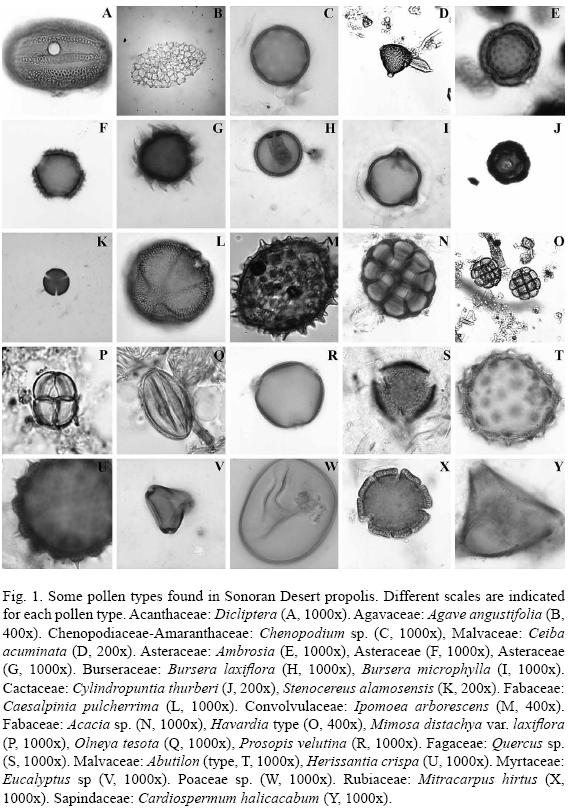
<body><![CDATA[<p align="justify"><font face="verdana" size="2"><b>Botanical origin of central Sonoran propolis</b></font></p>  	    <p align="justify"><font face="verdana" size="2">The vegetation of the sampling zones was dominated by subtropical species (<a href="/img/revistas/abm/n114/a4t1.jpg" target="_blank">Table 1</a>), mainly from the Fabaceae (18.5%), Cactaceae (10.2%), Malvaceae (8.3%) and Asteraceae (6.5%) families. Pollen analysis showed a diversity of pollen types in the studied propolis samples. A total of 42 pollen types (<a href="/img/revistas/abm/n114/a4t2.jpg" target="_blank">Table 2</a>) belonging to 22 families were identified; some of the principal pollen types are illustrated in <a href="#f1">Fig. 1</a>. The families with the highest pollen frequencies (&gt;15%, &lt;45%) were Fabaceae, Asteraceae, Burseraceae, Chenopodiaceae&#45;Amaranthaceae and Zygophyllaceae. The highest pollen concentrations were identified in the summer propolis samples, corresponding to <i>Mimosa distachya</i> var<i>. laxiflora</i> (PAS12, 37%; PAS13, 41.6%) in Pueblo de &Aacute;lamos and <i>Prosopis velutina</i> (RVS12, 23.1%; RVS13, 29.2%) in Rancho Viejo. A reduction in the frequencies of these pollen types was found for propolis samples produced during the winter, both at Pueblo de &Aacute;lamos (<i>Mimosa distachya</i> var<i>. laxiflora</i>; PAW12, 18.7%; PAW13, 19.4%) and Rancho Viejo (<i>Prosopis velutina</i>; RVW12, 13.3%; RVW13, 16.7%). According to these samples, six bifloral (15 to 45% pollen frequencies: PAW12, PAS12, PAS13, RVW13, RVS12 and RVS13) and two multifloral (&lt;15% pollen frequencies: RVW12 and PAW13) propolis samples were recorded, distributed among both regions.</font></p>  	    <p align="center"><font face="verdana" size="2"><a name="f1"></a></font></p>  	    <p align="center"><font face="verdana" size="2"><img src="/img/revistas/abm/n114/a4f1.jpg"></font></p>  	    <p align="justify"><font face="verdana" size="2"><b>Relationship between propolis samples of different origin</b></font></p>  	    <p align="justify"><font face="verdana" size="2">In order to evaluate the differences among propolis samples collected from different sites and seasons, a multivariate analysis (detrended correspondence analyses, DCA) was performed (<a href="#f2s">Fig. 2</a>). The ordination of samples and pollen source based on the two first axes (Axis 1 and Axis 2) of the DCA indicate that analyzed propolis were separated seasonally (summer samples left direction and winter samples clockwise), and slightly geographically. Most pollen types are clearly grouped by families and <i>Prosopis</i> pollen was significantly closer to propolis samples collected in both study sites (<i>P</i> &lt;0.05). Also, propolis samples from PA are clearly more grouped at the top left than RV, mainly in summer. As a result, this was also observed for summer propolis samples from PA (<a href="/img/revistas/abm/n114/a4t2.jpg" target="_blank">Table 2</a>), which showed high levels of <i>Mimosa,</i> while summer propolis from RV showed a high content of <i>Prosopis</i> pollen (<i>P</i> &lt;0.05), which corresponds to differences in the local vegetation (<i>Mimosa</i> is more abundant in the thornscrub foothills of PA and <i>Prosopis</i> in the riparian vegetation of RV). Additionally, <i>Mimosa</i> has more intense flowering periods in summer and <i>Prosopis</i> in the spring<i>,</i> although both plants flower from spring to late summer.</font></p>  	    <p align="center"><font face="verdana" size="2"><a name="f2s"></a></font></p>  	    <p align="center"><font face="verdana" size="2"><a href="/img/revistas/abm/n114/a4f2b.jpg" target="_blank"><img src="/img/revistas/abm/n114/a4f2s.jpg"></a></font></p>  	    <p align="center"><font face="verdana" size="2"><a href="/img/revistas/abm/n114/a4f2b.jpg" target="_blank">click para aumentar</a></font></p>  	    <p align="justify"><font face="verdana" size="2">Statistical correlation analyses carried out in order to compare the relationship between the measured meteorological parameters (temperature and rainfall) and the most important pollen types (<i>Mimosa distachya</i> var. <i>laxiflora</i> and <i>Prosopis velutina</i>) showed significant association (<i>P</i> &lt;0.05) between temperature, rainfall and pollen content (<a href="#t3">Table 3</a>).</font></p>  	    ]]></body>
<body><![CDATA[<p align="center"><font face="verdana" size="2"><a name="t3"></a></font></p>  	    <p align="center"><font face="verdana" size="2"><img src="/img/revistas/abm/n114/a4t3.jpg"></font></p>  	    <p>&nbsp;</p>  	    <p align="justify"><font face="verdana" size="2"><b>DISCUSSION</b></font></p>  	    <p align="justify"><font face="verdana" size="2">Sonoran Desert scrub and foothill thornscrub cover much of northwestern Mexico, with numerous trees belonging to the Fabaceae family (Robinson, 1898). Fabaceae is an important family of flowering plants known to be the most visited sources for honey, wax and propolis production in tropical regions (Almaraz&#45;Abarca et al., 2007) and is made up of herbaceous plants, shrubs and trees, thereby significantly imprinting the landscape.</font></p>  	    <p align="justify"><font face="verdana" size="2">The genus <i>Mimosa</i>, which includes <i>Mimosa distachya</i> var<i>. laxiflora</i> (catclaw), is a plant of the Leguminosae (Fabaceae) <i>Mimosoideae</i> subfamily and is native to Northern and Southern America (Robinson, 1898). In Mexico it is mainly distributed in the region of northern Mexico corresponding to the states of Baja California, Chihuahua, Sinaloa and Sonora and in southern Mexico in Colima, Jalisco, Michoac&aacute;n, Nayarit and Yucat&aacute;n (Molina&#45;Freaner et al., 2010; Instituto de Biolog&iacute;a, 2010). Many species of mimosas are economically and socially important, as they are used for reforestation, timber production and medicinal purposes, as well as their ability to fix nitrogen. Flowers of several <i>Mimosa</i> species are also a major source of nectar for honey production (Simon et al., 2011). The genus <i>Prosopis</i>, which includes <i>Prosopis</i> <i>velutina</i> (mesquite), is also found within the family Fabaceae, subfamily Mimosoideae, and is native to the Asian, African and American continents. The genus includes 44 species distributed in arid and semiarid regions (Burkart, 1976; Palacios, 2006). In Mexico it has a wide distribution and is found along the Pacific coast, from the states of Michoac&aacute;n to Oaxaca, in the Gulf of Mexico in Nuevo Le&oacute;n, Tamaulipas and northern Veracruz and throughout the central region of the country (Gallegos&#45;Infante et al., 2013). Mesquite is an important plant species due to its high potential for nitrogen fixation in very dry areas and during drought seasons, and it provides shelter and food to humans and many species of animals that feed on its leaves, fruits nectar and pollen (Almaraz&#45;Abarca et al., 2007).</font></p>  	    <p align="justify"><font face="verdana" size="2">The pollen content in propolis samples can have different origins, and the frequency of the type of pollen can be indicative of the plant species used by honeybees to make the propolis (Silva et al., 2013). The results obtained for Sonoran Desert propolis showed that the most predominant pollen types belonged to the most abundant plant sources in the region (Asteraceae, Malvaceae, Cactaceae and Fabaceae families), and the minor pollen types were obtained from minor plant sources. In all propolis samples the most frequent pollen types were <i>Mimosa distachya</i> var. <i>laxiflora</i> and <i>Prosopis velutina</i>, which is in agreement with the central Sonoran honey studies carried out by Rivero&#45;Montes (2000) and Burboa&#45;Zazueta (2004).</font></p>  	    <p align="justify"><font face="verdana" size="2">In another investigation, Mohamed and Afaf (2004) reported that the botanical origin of propolis samples from Sudan (Alfaki Hashim, Khartoum State and Al Abbasia, South Kordofan State) came from the following plant families: Mimosaceae, Malvaceae and Caesalpiniaceae. These were the most frequent pollen families (more than 50 grains were found) in Alfaki Hashim, and Mimosaceae was most abundant in the Al Abbasia region. Regarding propolis samples from Al Abbasia, the following, all belonging to the Fabaceae family, were considered to be dominant pollen sources (16&#45;45% of total content): <i>Mimosa</i> <i>pigra</i>, <i>Mimosa</i> sp. and <i>Acacia</i> sp. However, in other geographical regions, different taxa are identified in propolis samples. For example, Pulido&#45;Avila et al. (1998) evaluated the pollen content of a propolis sample from Capilla de Milpillas and Telpatitlan de Morelos (Jalisco, Mexico) to evaluate which plants were used by bees to collect resins. Pollen analysis revealed a total of 30 pollen types, and <i>Eucalyptus</i> sp. (35.2%) and <i>Fraxinus</i> sp. (19.9%) were the main genera from which the honeybees obtained the resins. Other minor pollen types (&lt;15%) were Compositae (five pollen types), <i>Quercus</i>, <i>Dicliptera</i>, <i>Bursera</i>, <i>Citrus</i>, <i>Mimosa</i> and <i>Ipomoea</i> sp., among others. In the same way, Montenegro et al. (2000) revealed that the botanical origin of Chilean propolis is <i>Eucalyptus</i>. However, the <i>Eucalyptus</i> pollen frequencies (&lt;2%) reported in our work for the central Sonoran region do not reflect those of previous studies. In several regions of Brazil, Santos et al. (2011) established the plant origin of propolis samples, indicating that most representative pollen types for all samples were <i>Schinus</i>, <i>Vernonia</i>, <i>Diclenia</i>, <i>Hyptis</i>, <i>Myrcia</i>, <i>Weinmannia</i>, <i>Baccharis</i> and <i>Eucalyptus</i>. In contrast, Moreira et al. (2008) discovered an important contribution of different pollen components such as <i>Pinus</i> sp. (0&#45;15%), <i>Castanea sativa</i> (0&#45;45%), <i>Populus tremula</i> (30&#45;50%) and others (some of them with less than 5%) in propolis from Portugal (Bornes and Fund&atilde;o regions).</font></p>  	    <p align="justify"><font face="verdana" size="2">The above mentioned results show that bees produce propolis from surrounding vegetation, which includes different taxa according to the region, although similar ecosystems may provide taxonomically comparable propolis sources. Pollen content depends on plant diversity at a local and regional scale, and these studies confirm the importance of identifying the pollen content, geographical origin and collection season of propolis samples for their subsequent categorization and identification.</font></p>  	    <p align="justify"><font face="verdana" size="2">The slight statistically supported geographical separation of the samples was expected since the flora of both studied regions is similar. Otherwise, the high correlation found between propolis samples and their pollen content (floral origin) coincides with Barth and da Luz (2009), who found a strong correlation between propolis samples and pollen sources, which were considered to be the main characteristic component of propolis samples. Results have also shown that flowering species react differentially to temperature and water stress (meteorological conditions), which can subsequently affect the pollen composition (Rasmussen, 2002) of propolis, thereby explaining the yearly differences in propolis samples.</font></p>  	    ]]></body>
<body><![CDATA[<p>&nbsp;</p>  	    <p align="justify"><font face="verdana" size="2"><b>CONCLUSIONS</b></font></p>  	    <p align="justify"><font face="verdana" size="2">Six propolis samples were found to be bifloral (i.e. pollen types had secondary percentages, 15&#45;45%), and two were multifloral (&lt;15%). The multifloral propolis samples were collected in winter. In total, 22 plant families and 42 species, or pollen types, were found in eight propolis samples. The Fabaceae family was dominant (&gt;45%) in both regions and during both seasons. Pollen from <i>Mimosa distachya</i> var. <i>laxiflora</i> and <i>Prosopis velutina</i> were the most representative, and this fact can be explained by the abundance of these plants in the thorn scrub foothills and desert scrub surrounding the beehives, as well as the high level of pollen production by these plants during the second harvesting period (summer), indicating that these are the most frequently visited by bees. The multivariate analysis was helpful in identifying the geographical and seasonal differentiation of the propolis samples, particularly those containing high frequencies of <i>Mimosa</i> and <i>Prosopis</i> pollen. In addition, the results of this study provide a list of plants from which the bees could obtain raw material to form propolis: these plants are the key to determining the geographical origin and characteristics of Sonoran propolis.</font></p>  	    <p>&nbsp;</p>  	    <p align="justify"><font face="verdana" size="2"><b>ACKNOWLEDGMENTS</b></font></p>  	    <p align="justify"><font face="verdana" size="2">We thank all the bee&#45;keepers for allowing us to study their beehives. We also thank Livier Zavala&#45;C&aacute;rdenas and Gerardo Reyna&#45;Ca&ntilde;ez for their technical support and academic assistance.</font></p>  	    <p>&nbsp;</p>  	    <p align="justify"><font face="verdana" size="2"><b>LITERATURE CITED</b></font></p>  	    <!-- ref --><p align="justify"><font face="verdana" size="2">Almaraz&#45;Abarca, N., M. da Gra&#231;a&#45;Campos, J. A. &Aacute;vila&#45;Reyes, N. Naranjo&#45;Jim&eacute;nez, J. Herrera&#45;Corral and L. Gonz&aacute;lez&#45;Valdez. 2007. Antioxidant activity of polyphenolic extract of monofloral honeybee&#45;collected pollen from mesquite (<i>Prosopis juliflora</i>, Leguminosae). J. Food Comp. Anal. 20: 119&#45;124.    &nbsp;&nbsp;&nbsp;&nbsp;&nbsp;&nbsp;&nbsp;&nbsp;[&#160;<a href="javascript:void(0);" onclick="javascript: window.open('/scielo.php?script=sci_nlinks&ref=061069&pid=S0187-7151201600010000400001&lng=','','width=640,height=500,resizable=yes,scrollbars=1,menubar=yes,');">Links</a>&#160;]<!-- end-ref --></font></p>  	    ]]></body>
<body><![CDATA[<!-- ref --><p align="justify"><font face="verdana" size="2">Barth, O. M. 2004. Melissopalynology in Brazil: a review of pollen analysis of honeys, propolis and pollen loads of bees. Scientia Agric. 61: 342&#45;350.    &nbsp;&nbsp;&nbsp;&nbsp;&nbsp;&nbsp;&nbsp;&nbsp;[&#160;<a href="javascript:void(0);" onclick="javascript: window.open('/scielo.php?script=sci_nlinks&ref=061071&pid=S0187-7151201600010000400002&lng=','','width=640,height=500,resizable=yes,scrollbars=1,menubar=yes,');">Links</a>&#160;]<!-- end-ref --></font></p>  	    <!-- ref --><p align="justify"><font face="verdana" size="2">Barth, O. M. and C. F. P. da Luz. 2009. Palynological analysis of Brazilian red propolis samples. J. Apic. Res. 48: 181.    &nbsp;&nbsp;&nbsp;&nbsp;&nbsp;&nbsp;&nbsp;&nbsp;[&#160;<a href="javascript:void(0);" onclick="javascript: window.open('/scielo.php?script=sci_nlinks&ref=061073&pid=S0187-7151201600010000400003&lng=','','width=640,height=500,resizable=yes,scrollbars=1,menubar=yes,');">Links</a>&#160;]<!-- end-ref --></font></p>  	    <!-- ref --><p align="justify"><font face="verdana" size="2">Brito&#45;Castillo, L., M. A. Crimmins and S. C. C. D&iacute;az. 2010. Clima. In: Molina&#45;Freaner, F. E. and T. R. Van&#45;Devender (eds.). Diversidad biol&oacute;gica de Sonora. Universidad Nacional Aut&oacute;noma de M&eacute;xico. M&eacute;xico, D.F. Mexico. pp. 73&#45;96.    &nbsp;&nbsp;&nbsp;&nbsp;&nbsp;&nbsp;&nbsp;&nbsp;[&#160;<a href="javascript:void(0);" onclick="javascript: window.open('/scielo.php?script=sci_nlinks&ref=061075&pid=S0187-7151201600010000400004&lng=','','width=640,height=500,resizable=yes,scrollbars=1,menubar=yes,');">Links</a>&#160;]<!-- end-ref --></font></p>  	    <!-- ref --><p align="justify"><font face="verdana" size="2">Burboa&#45;Zazueta, M. G. 2004. Identificaci&oacute;n y caracterizaci&oacute;n de compuestos fen&oacute;licos presentes en la miel de mezquite (<i>Prosopis</i> sp.) y palo fierro (<i>Olneya</i> <i>tesota</i>): marcadores qu&iacute;micos del origen bot&aacute;nico. PhD thesis. Centro de Investigaci&oacute;n en Alimentaci&oacute;n y Desarrollo, A.C., Hermosillo, Mexico. 133 pp.    &nbsp;&nbsp;&nbsp;&nbsp;&nbsp;&nbsp;&nbsp;&nbsp;[&#160;<a href="javascript:void(0);" onclick="javascript: window.open('/scielo.php?script=sci_nlinks&ref=061077&pid=S0187-7151201600010000400005&lng=','','width=640,height=500,resizable=yes,scrollbars=1,menubar=yes,');">Links</a>&#160;]<!-- end-ref --></font></p>  	    <!-- ref --><p align="justify"><font face="verdana" size="2">Burkart, A. 1976. A monograph of the genus <i>Prosopis</i> (Leguminosae subfam. Mimosoideae). J. Arnold Arbor. 57: 219&#45;249.    &nbsp;&nbsp;&nbsp;&nbsp;&nbsp;&nbsp;&nbsp;&nbsp;[&#160;<a href="javascript:void(0);" onclick="javascript: window.open('/scielo.php?script=sci_nlinks&ref=061079&pid=S0187-7151201600010000400006&lng=','','width=640,height=500,resizable=yes,scrollbars=1,menubar=yes,');">Links</a>&#160;]<!-- end-ref --></font></p>  	    ]]></body>
<body><![CDATA[<!-- ref --><p align="justify"><font face="verdana" size="2">Erdtman, G. 1960. The acetolysis method: A revised description. Svensk Bot. Tidskr. 54: 561&#45;564.    &nbsp;&nbsp;&nbsp;&nbsp;&nbsp;&nbsp;&nbsp;&nbsp;[&#160;<a href="javascript:void(0);" onclick="javascript: window.open('/scielo.php?script=sci_nlinks&ref=061081&pid=S0187-7151201600010000400007&lng=','','width=640,height=500,resizable=yes,scrollbars=1,menubar=yes,');">Links</a>&#160;]<!-- end-ref --></font></p>  	    <!-- ref --><p align="justify"><font face="verdana" size="2">Farr&eacute;, R., I. Frasquet and A. S&aacute;nchez. 2004. El propolis y la salud. Ars. Pharma. 45: 21&#45;43.    &nbsp;&nbsp;&nbsp;&nbsp;&nbsp;&nbsp;&nbsp;&nbsp;[&#160;<a href="javascript:void(0);" onclick="javascript: window.open('/scielo.php?script=sci_nlinks&ref=061083&pid=S0187-7151201600010000400008&lng=','','width=640,height=500,resizable=yes,scrollbars=1,menubar=yes,');">Links</a>&#160;]<!-- end-ref --></font></p>  	    <!-- ref --><p align="justify"><font face="verdana" size="2">Felger, R. S., M. B. Johnson and M. F. Wilson. 2001. The trees of Sonora, Mexico. Oxford University Press. New York, USA. 400 pp.    &nbsp;&nbsp;&nbsp;&nbsp;&nbsp;&nbsp;&nbsp;&nbsp;[&#160;<a href="javascript:void(0);" onclick="javascript: window.open('/scielo.php?script=sci_nlinks&ref=061085&pid=S0187-7151201600010000400009&lng=','','width=640,height=500,resizable=yes,scrollbars=1,menubar=yes,');">Links</a>&#160;]<!-- end-ref --></font></p>  	    <!-- ref --><p align="justify"><font face="verdana" size="2">Felger, R. S., B. T. Wilder and H. Romero&#45;Morales. 2013. Plant life of a Desert Archipelago: Flora of the Sonoran Islands in the Gulf of California, Mexico. University of Arizona Press. Tucson, USA. 748 pp.    &nbsp;&nbsp;&nbsp;&nbsp;&nbsp;&nbsp;&nbsp;&nbsp;[&#160;<a href="javascript:void(0);" onclick="javascript: window.open('/scielo.php?script=sci_nlinks&ref=061087&pid=S0187-7151201600010000400010&lng=','','width=640,height=500,resizable=yes,scrollbars=1,menubar=yes,');">Links</a>&#160;]<!-- end-ref --></font></p>  	    <!-- ref --><p align="justify"><font face="verdana" size="2">Gallegos&#45;Infante, J. A., N. E. Rocha&#45;Guzm&aacute;n, R. F. Gonz&aacute;lez&#45;Laredo and M. A. Garc&iacute;a&#45;Casas. 2013. Efecto del procesamiento t&eacute;rmico sobre la capacidad antioxidante de pinole a base de vainas de mezquite (<i>Prosopis</i> <i>laevigata</i>). CyTA&#45;J. Food. 11: 162&#45;170.    &nbsp;&nbsp;&nbsp;&nbsp;&nbsp;&nbsp;&nbsp;&nbsp;[&#160;<a href="javascript:void(0);" onclick="javascript: window.open('/scielo.php?script=sci_nlinks&ref=061089&pid=S0187-7151201600010000400011&lng=','','width=640,height=500,resizable=yes,scrollbars=1,menubar=yes,');">Links</a>&#160;]<!-- end-ref --></font></p>  	    ]]></body>
<body><![CDATA[<!-- ref --><p align="justify"><font face="verdana" size="2">Hodgson, W. C. 2001. Food plants of the Sonoran Desert. University of Arizona Press. Tucson, USA. 313 pp.    &nbsp;&nbsp;&nbsp;&nbsp;&nbsp;&nbsp;&nbsp;&nbsp;[&#160;<a href="javascript:void(0);" onclick="javascript: window.open('/scielo.php?script=sci_nlinks&ref=061091&pid=S0187-7151201600010000400012&lng=','','width=640,height=500,resizable=yes,scrollbars=1,menubar=yes,');">Links</a>&#160;]<!-- end-ref --></font></p>  	    <!-- ref --><p align="justify"><font face="verdana" size="2">INEGI. 2012. Clima. Instituto Nacional de Estad&iacute;stica y Geograf&iacute;a. Available in: <a href="http://www.oeidrus&#151;sonora.gob.mx/documentos/Geografia/HISTORIA%20Y%20GEO/URES.pdf" target="_blank">http://www.oeidrus&#45;sonora.gob.mx/documentos/Geografia/HISTORIA%20Y%20GEO/URES.pdf</a>.    &nbsp;&nbsp;&nbsp;&nbsp;&nbsp;&nbsp;&nbsp;&nbsp;[&#160;<a href="javascript:void(0);" onclick="javascript: window.open('/scielo.php?script=sci_nlinks&ref=061093&pid=S0187-7151201600010000400013&lng=','','width=640,height=500,resizable=yes,scrollbars=1,menubar=yes,');">Links</a>&#160;]<!-- end-ref --></font></p>  	    <!-- ref --><p align="justify"><font face="verdana" size="2">Instituto de Biolog&iacute;a. 2010. Colecciones biol&oacute;gicas: "<i>Mimosa distachya</i> var<i>. distachya &#45; IBUNAM: MEXU: PVsn1263</i>". UNIBIO: Colecciones Biol&oacute;gicas. Instituto de Biolog&iacute;a, Universidad Nacional Aut&oacute;noma de M&eacute;xico. Available in: <a href="http://unibio.unam.mx/collections/specimens/urn/IBUNAM:MEXU:PVsn1263" target="_blank">http://unibio.unam.mx/collections/specimens/urn/IBUNAM:MEXU:PVsn1263</a>. Accesed: 5 may 2015.    &nbsp;&nbsp;&nbsp;&nbsp;&nbsp;&nbsp;&nbsp;&nbsp;[&#160;<a href="javascript:void(0);" onclick="javascript: window.open('/scielo.php?script=sci_nlinks&ref=061095&pid=S0187-7151201600010000400014&lng=','','width=640,height=500,resizable=yes,scrollbars=1,menubar=yes,');">Links</a>&#160;]<!-- end-ref --></font></p>  	    <!-- ref --><p align="justify"><font face="verdana" size="2">Mart&iacute;nez&#45;Yr&iacute;zar, A., R. S. Felger and A. B&uacute;rquez. 2010. Los ecosistemas terrestres: un diverso capital natural. In: Molina&#45;Freaner, F. E. and T. R. Van&#45;Devender (eds.). Diversidad biol&oacute;gica de Sonora. Universidad Nacional Aut&oacute;noma de M&eacute;xico. M&eacute;xico, D.F, Mexico. pp. 129&#45;156.    &nbsp;&nbsp;&nbsp;&nbsp;&nbsp;&nbsp;&nbsp;&nbsp;[&#160;<a href="javascript:void(0);" onclick="javascript: window.open('/scielo.php?script=sci_nlinks&ref=061097&pid=S0187-7151201600010000400015&lng=','','width=640,height=500,resizable=yes,scrollbars=1,menubar=yes,');">Links</a>&#160;]<!-- end-ref --></font></p>  	    <!-- ref --><p align="justify"><font face="verdana" size="2">Matos, V. R., S. M. Alencar and F. A. R. Santos. 2014. Pollen types and levels of phenolic compounds in propolis produced by <i>Apis mellifera</i> L. (Apidae) in an area of the semiarid region of Bahia, Brazil. Anais Acad. Bras. Ci. 86: 407&#45;418.    &nbsp;&nbsp;&nbsp;&nbsp;&nbsp;&nbsp;&nbsp;&nbsp;[&#160;<a href="javascript:void(0);" onclick="javascript: window.open('/scielo.php?script=sci_nlinks&ref=061099&pid=S0187-7151201600010000400016&lng=','','width=640,height=500,resizable=yes,scrollbars=1,menubar=yes,');">Links</a>&#160;]<!-- end-ref --></font></p>  	    ]]></body>
<body><![CDATA[<!-- ref --><p align="justify"><font face="verdana" size="2">Mohamed, S. A. E. S. and M. E. S. Afaf. 2004. Botanical origin of the Sudanese propolis in central areas. University of Kentucky<i>.</i> J. Agric. Sci. 12: 9 pp.    &nbsp;&nbsp;&nbsp;&nbsp;&nbsp;&nbsp;&nbsp;&nbsp;[&#160;<a href="javascript:void(0);" onclick="javascript: window.open('/scielo.php?script=sci_nlinks&ref=061101&pid=S0187-7151201600010000400017&lng=','','width=640,height=500,resizable=yes,scrollbars=1,menubar=yes,');">Links</a>&#160;]<!-- end-ref --></font></p>  	    <!-- ref --><p align="justify"><font face="verdana" size="2">Molina&#45;Freaner, F. E. and T. R. Van&#45;Devender (eds.). 2010. Diversidad biol&oacute;gica de Sonora. Universidad Nacional Aut&oacute;noma de M&eacute;xico. M&eacute;xico, D.F. Mexico. 500 pp.    &nbsp;&nbsp;&nbsp;&nbsp;&nbsp;&nbsp;&nbsp;&nbsp;[&#160;<a href="javascript:void(0);" onclick="javascript: window.open('/scielo.php?script=sci_nlinks&ref=061103&pid=S0187-7151201600010000400018&lng=','','width=640,height=500,resizable=yes,scrollbars=1,menubar=yes,');">Links</a>&#160;]<!-- end-ref --></font></p>  	    <!-- ref --><p align="justify"><font face="verdana" size="2">Montenegro, G., B. Timmermann, R. Pe&ntilde;a, A. Mujica and G. &Aacute;vila. 2000. Pollen grains and vegetative structures in propolis as indicators of potential drugs in Chilean plants. Int. J. Exp. Bot. 66: 15&#45;23.    &nbsp;&nbsp;&nbsp;&nbsp;&nbsp;&nbsp;&nbsp;&nbsp;[&#160;<a href="javascript:void(0);" onclick="javascript: window.open('/scielo.php?script=sci_nlinks&ref=061105&pid=S0187-7151201600010000400019&lng=','','width=640,height=500,resizable=yes,scrollbars=1,menubar=yes,');">Links</a>&#160;]<!-- end-ref --></font></p>  	    <!-- ref --><p align="justify"><font face="verdana" size="2">Montenegro, G., A. M. Mujica, R. C. Pe&ntilde;a, M. G&oacute;mez, I. Serey and B. M. Timmermann. 2004. Similitude pattern and botanical origin of the Chilean propolis. Phyton 53: 145&#45;153.    &nbsp;&nbsp;&nbsp;&nbsp;&nbsp;&nbsp;&nbsp;&nbsp;[&#160;<a href="javascript:void(0);" onclick="javascript: window.open('/scielo.php?script=sci_nlinks&ref=061107&pid=S0187-7151201600010000400020&lng=','','width=640,height=500,resizable=yes,scrollbars=1,menubar=yes,');">Links</a>&#160;]<!-- end-ref --></font></p>  	    <!-- ref --><p align="justify"><font face="verdana" size="2">Moreira, L., L. G. Dias, J. A. Pereira and L. Estevinho. 2008. Antioxidant properties, total phenols and pollen analysis of propolis samples from Portugal. Food Chem. Tox. 46: 3482&#45;3485.    &nbsp;&nbsp;&nbsp;&nbsp;&nbsp;&nbsp;&nbsp;&nbsp;[&#160;<a href="javascript:void(0);" onclick="javascript: window.open('/scielo.php?script=sci_nlinks&ref=061109&pid=S0187-7151201600010000400021&lng=','','width=640,height=500,resizable=yes,scrollbars=1,menubar=yes,');">Links</a>&#160;]<!-- end-ref --></font></p>  	    ]]></body>
<body><![CDATA[<!-- ref --><p align="justify"><font face="verdana" size="2">Palacios, R. A. 2006. Los mezquites mexicanos: biodiversidad y distribuci&oacute;n geogr&aacute;fica. Bol. Soc. Arg. Bot. 41(1&#45;2): 99&#45;121.    &nbsp;&nbsp;&nbsp;&nbsp;&nbsp;&nbsp;&nbsp;&nbsp;[&#160;<a href="javascript:void(0);" onclick="javascript: window.open('/scielo.php?script=sci_nlinks&ref=061111&pid=S0187-7151201600010000400022&lng=','','width=640,height=500,resizable=yes,scrollbars=1,menubar=yes,');">Links</a>&#160;]<!-- end-ref --></font></p>  	    <!-- ref --><p align="justify"><font face="verdana" size="2">Pe&ntilde;a, R. C. 2008. Propolis standardization: a chemical and biological review. Cienc. Inv. Agr. 35: 11&#45;20.    &nbsp;&nbsp;&nbsp;&nbsp;&nbsp;&nbsp;&nbsp;&nbsp;[&#160;<a href="javascript:void(0);" onclick="javascript: window.open('/scielo.php?script=sci_nlinks&ref=061113&pid=S0187-7151201600010000400023&lng=','','width=640,height=500,resizable=yes,scrollbars=1,menubar=yes,');">Links</a>&#160;]<!-- end-ref --></font></p>  	    <!-- ref --><p align="justify"><font face="verdana" size="2">Pulido&#45;&Aacute;vila, M. G. and Jim&eacute;nez&#45;Reyes. 1998. Contenido de granos de polen de una muestra de prop&oacute;leo. Bolet&iacute;n, IBUG 5(1&#45;3): 493&#45;504.    &nbsp;&nbsp;&nbsp;&nbsp;&nbsp;&nbsp;&nbsp;&nbsp;[&#160;<a href="javascript:void(0);" onclick="javascript: window.open('/scielo.php?script=sci_nlinks&ref=061115&pid=S0187-7151201600010000400024&lng=','','width=640,height=500,resizable=yes,scrollbars=1,menubar=yes,');">Links</a>&#160;]<!-- end-ref --></font></p>  	    <!-- ref --><p align="justify"><font face="verdana" size="2">Rasmussen, A. 2002. The effects of climate change on the birch pollen season in Denmark. Aerobiol. 18: 253&#45;265.    &nbsp;&nbsp;&nbsp;&nbsp;&nbsp;&nbsp;&nbsp;&nbsp;[&#160;<a href="javascript:void(0);" onclick="javascript: window.open('/scielo.php?script=sci_nlinks&ref=061117&pid=S0187-7151201600010000400025&lng=','','width=640,height=500,resizable=yes,scrollbars=1,menubar=yes,');">Links</a>&#160;]<!-- end-ref --></font></p>  	    <!-- ref --><p align="justify"><font face="verdana" size="2">Rivero&#45;Montes, L. K. 2000. An&aacute;lisis f&iacute;sico&#45;qu&iacute;mico y caracterizaci&oacute;n pol&iacute;nica de miel de abeja en la regi&oacute;n central de Sonora. BSc. Thesis. Universidad de Sonora. Hermosillo, Mexico. 126 pp.    &nbsp;&nbsp;&nbsp;&nbsp;&nbsp;&nbsp;&nbsp;&nbsp;[&#160;<a href="javascript:void(0);" onclick="javascript: window.open('/scielo.php?script=sci_nlinks&ref=061119&pid=S0187-7151201600010000400026&lng=','','width=640,height=500,resizable=yes,scrollbars=1,menubar=yes,');">Links</a>&#160;]<!-- end-ref --></font></p>  	    ]]></body>
<body><![CDATA[<!-- ref --><p align="justify"><font face="verdana" size="2">Robinson, B. L. 1898. Revision of the North American and Mexican species of <i>Mimosa</i>. Contr. Gray Herb. Harvard Univ. 13: 305&#45;331.    &nbsp;&nbsp;&nbsp;&nbsp;&nbsp;&nbsp;&nbsp;&nbsp;[&#160;<a href="javascript:void(0);" onclick="javascript: window.open('/scielo.php?script=sci_nlinks&ref=061121&pid=S0187-7151201600010000400027&lng=','','width=640,height=500,resizable=yes,scrollbars=1,menubar=yes,');">Links</a>&#160;]<!-- end-ref --></font></p>  	    <!-- ref --><p align="justify"><font face="verdana" size="2">Roubik, D. W. and Moreno, P. 1991. Pollen and spores of Barro Colorado Island &#91;Panama&#93;.Monographs in Systematic Botany from the Missouri Botanical Garden, 36..Missouri Botanical Garden. St. Louis, MO. USA. iv + 270 pp.    &nbsp;&nbsp;&nbsp;&nbsp;&nbsp;&nbsp;&nbsp;&nbsp;[&#160;<a href="javascript:void(0);" onclick="javascript: window.open('/scielo.php?script=sci_nlinks&ref=061123&pid=S0187-7151201600010000400028&lng=','','width=640,height=500,resizable=yes,scrollbars=1,menubar=yes,');">Links</a>&#160;]<!-- end-ref --></font></p>  	    <!-- ref --><p align="justify"><font face="verdana" size="2">S&aacute;nchez&#45;Escalante, A., R. D. Vargas&#45;S&aacute;nchez, M. Valenzuela, M. A. de la Rosa, G. Torrescano and J. P. Camou. 2009. Evaluation of antioxidant activity of propolis produced in northwest of Mexico for fresh beef patties. Presented at 2009 Annual Meeting of the Institute of Food Technologists. Book abstract 027&#45;31. Anaheim, USA.    &nbsp;&nbsp;&nbsp;&nbsp;&nbsp;&nbsp;&nbsp;&nbsp;[&#160;<a href="javascript:void(0);" onclick="javascript: window.open('/scielo.php?script=sci_nlinks&ref=061125&pid=S0187-7151201600010000400029&lng=','','width=640,height=500,resizable=yes,scrollbars=1,menubar=yes,');">Links</a>&#160;]<!-- end-ref --></font></p>  	    <!-- ref --><p align="justify"><font face="verdana" size="2">Santos, F. A. R. 2011. Identifica&#231;&atilde;o bot&acirc;nica do p&oacute;len ap&iacute;cola. Magistra 23: 5&#45;9.    &nbsp;&nbsp;&nbsp;&nbsp;&nbsp;&nbsp;&nbsp;&nbsp;[&#160;<a href="javascript:void(0);" onclick="javascript: window.open('/scielo.php?script=sci_nlinks&ref=061127&pid=S0187-7151201600010000400030&lng=','','width=640,height=500,resizable=yes,scrollbars=1,menubar=yes,');">Links</a>&#160;]<!-- end-ref --></font></p>  	    <!-- ref --><p align="justify"><font face="verdana" size="2">SEINet. 2015. Pollen profile of Sonoran Desert propolis produced in central Sonora, Mexico. Hermosillo, Mexico. Available in: <a href="http://swbiodiversity.org/seinet/checklists/checklist.php?cl=3497&amp;emode=0" target="_blank">http://swbiodiversity.org/seinet/checklists/checklist.php?cl=3497&amp;emode=0</a>. Accessed: 5 may 2015.    &nbsp;&nbsp;&nbsp;&nbsp;&nbsp;&nbsp;&nbsp;&nbsp;[&#160;<a href="javascript:void(0);" onclick="javascript: window.open('/scielo.php?script=sci_nlinks&ref=061129&pid=S0187-7151201600010000400031&lng=','','width=640,height=500,resizable=yes,scrollbars=1,menubar=yes,');">Links</a>&#160;]<!-- end-ref --></font></p>  	    ]]></body>
<body><![CDATA[<!-- ref --><p align="justify"><font face="verdana" size="2">Servicio Meteorol&oacute;gico Nacional. 2012. Reporte del clima en M&eacute;xico 2012. Servicio Meteorol&oacute;gico Nacional. M&eacute;xico, D.F., Mexico. 23 pp.    &nbsp;&nbsp;&nbsp;&nbsp;&nbsp;&nbsp;&nbsp;&nbsp;[&#160;<a href="javascript:void(0);" onclick="javascript: window.open('/scielo.php?script=sci_nlinks&ref=061131&pid=S0187-7151201600010000400032&lng=','','width=640,height=500,resizable=yes,scrollbars=1,menubar=yes,');">Links</a>&#160;]<!-- end-ref --></font></p>  	    <!-- ref --><p align="justify"><font face="verdana" size="2">Servicio Meteorol&oacute;gico Nacional. 2013. Reporte del clima en M&eacute;xico 2013. Servicio Meteorol&oacute;gico Nacional. M&eacute;xico, D.F., Mexico. 23 pp.    &nbsp;&nbsp;&nbsp;&nbsp;&nbsp;&nbsp;&nbsp;&nbsp;[&#160;<a href="javascript:void(0);" onclick="javascript: window.open('/scielo.php?script=sci_nlinks&ref=061133&pid=S0187-7151201600010000400033&lng=','','width=640,height=500,resizable=yes,scrollbars=1,menubar=yes,');">Links</a>&#160;]<!-- end-ref --></font></p>  	    <!-- ref --><p align="justify"><font face="verdana" size="2">Silva, C. R. B. D., T. Putarov and R. D. O Orsi. 2013. Pollen spectrum of propolis samples from S&atilde;o Paulo State, Brazil. Acta Scientiarum<i>.</i> Anim. Sci. 35: 297&#45;300.    &nbsp;&nbsp;&nbsp;&nbsp;&nbsp;&nbsp;&nbsp;&nbsp;[&#160;<a href="javascript:void(0);" onclick="javascript: window.open('/scielo.php?script=sci_nlinks&ref=061135&pid=S0187-7151201600010000400034&lng=','','width=640,height=500,resizable=yes,scrollbars=1,menubar=yes,');">Links</a>&#160;]<!-- end-ref --></font></p>  	    <!-- ref --><p align="justify"><font face="verdana" size="2">Simon, M. F., R. Grether, L. P. de Queiroz, T. E. S&auml;rkinen, V. F. Dutra and C. E. Hughes. 2011. The evolutionary history of <i>Mimosa</i> (Leguminosae): toward a phylogeny of the sensitive plants. Amer. J. Bot. 98: 1201&#45;1221.    &nbsp;&nbsp;&nbsp;&nbsp;&nbsp;&nbsp;&nbsp;&nbsp;[&#160;<a href="javascript:void(0);" onclick="javascript: window.open('/scielo.php?script=sci_nlinks&ref=061137&pid=S0187-7151201600010000400035&lng=','','width=640,height=500,resizable=yes,scrollbars=1,menubar=yes,');">Links</a>&#160;]<!-- end-ref --></font></p>  	    <!-- ref --><p align="justify"><font face="verdana" size="2">SPSS Statistics. 2012. Statistical Package for the Social Sciences. SPSS Statistics. Chicago, USA.    &nbsp;&nbsp;&nbsp;&nbsp;&nbsp;&nbsp;&nbsp;&nbsp;[&#160;<a href="javascript:void(0);" onclick="javascript: window.open('/scielo.php?script=sci_nlinks&ref=061139&pid=S0187-7151201600010000400036&lng=','','width=640,height=500,resizable=yes,scrollbars=1,menubar=yes,');">Links</a>&#160;]<!-- end-ref --></font></p>  	    ]]></body>
<body><![CDATA[<!-- ref --><p align="justify"><font face="verdana" size="2">Turner, R. M., J. E. Bowers and T. L. Burgess. 2005. Sonoran Desert plants: an ecological atlas. University of Arizona Press, Tucson, USA. 504 pp.    &nbsp;&nbsp;&nbsp;&nbsp;&nbsp;&nbsp;&nbsp;&nbsp;[&#160;<a href="javascript:void(0);" onclick="javascript: window.open('/scielo.php?script=sci_nlinks&ref=061141&pid=S0187-7151201600010000400037&lng=','','width=640,height=500,resizable=yes,scrollbars=1,menubar=yes,');">Links</a>&#160;]<!-- end-ref --></font></p>  	    <!-- ref --><p align="justify"><font face="verdana" size="2">Vargas&#45;S&aacute;nchez, R. D., G. R. Torrescano&#45;Urrutia and A. S&aacute;nchez&#45;Escalante. 2013. El prop&oacute;leos: conservador potencial para la industria alimentaria. Interciencia 38: 705&#45;711.    &nbsp;&nbsp;&nbsp;&nbsp;&nbsp;&nbsp;&nbsp;&nbsp;[&#160;<a href="javascript:void(0);" onclick="javascript: window.open('/scielo.php?script=sci_nlinks&ref=061143&pid=S0187-7151201600010000400038&lng=','','width=640,height=500,resizable=yes,scrollbars=1,menubar=yes,');">Links</a>&#160;]<!-- end-ref --></font></p>  	    <!-- ref --><p align="justify"><font face="verdana" size="2">Vargas&#45;S&aacute;nchez, R. D., G. R. Torrescano&#45;Urrutia, A. M. Mendoza&#45;Wilson, B. Vallejo&#45;Galland, E. Acedo&#45;F&eacute;lix, J. J. S&aacute;nchez&#45;Escalante, M. C. Pe&ntilde;alba&#45;Garmendia and A. S&aacute;nchez&#45;Escalante. 2014. Mechanisms involved in antioxidant and antibacterial activity of propolis. Biotecnia 16: 32&#45;37.    &nbsp;&nbsp;&nbsp;&nbsp;&nbsp;&nbsp;&nbsp;&nbsp;[&#160;<a href="javascript:void(0);" onclick="javascript: window.open('/scielo.php?script=sci_nlinks&ref=061145&pid=S0187-7151201600010000400039&lng=','','width=640,height=500,resizable=yes,scrollbars=1,menubar=yes,');">Links</a>&#160;]<!-- end-ref --></font></p>  	    <!-- ref --><p align="justify"><font face="verdana" size="2">Vel&aacute;zquez, C., M. Navarro, A. Acosta, A. Angulo, Z. Dom&iacute;nguez, R. Robles, R. Robles&#45;Zepeda, E. Lugo, F. M. Goycoolea, E. F. Vel&aacute;zquez, H. Astiazaran and J. Hern&aacute;ndez. 2007. Antibacterial and free&#45;radical scavenging activities of Sonoran propolis. J. Appl. Microbiol. 103: 1747&#45;1756.    &nbsp;&nbsp;&nbsp;&nbsp;&nbsp;&nbsp;&nbsp;&nbsp;[&#160;<a href="javascript:void(0);" onclick="javascript: window.open('/scielo.php?script=sci_nlinks&ref=061147&pid=S0187-7151201600010000400040&lng=','','width=640,height=500,resizable=yes,scrollbars=1,menubar=yes,');">Links</a>&#160;]<!-- end-ref --></font></p>  	    <!-- ref --><p align="justify"><font face="verdana" size="2">Warakomska, Z. and W. Maciejewicz. 1992. Microscopic analysis of propolis from Polish regions. Apidol. 23: 277&#45;283.    &nbsp;&nbsp;&nbsp;&nbsp;&nbsp;&nbsp;&nbsp;&nbsp;[&#160;<a href="javascript:void(0);" onclick="javascript: window.open('/scielo.php?script=sci_nlinks&ref=061149&pid=S0187-7151201600010000400041&lng=','','width=640,height=500,resizable=yes,scrollbars=1,menubar=yes,');">Links</a>&#160;]<!-- end-ref --></font></p>     ]]></body>
<body><![CDATA[ ]]></body><back>
<ref-list>
<ref id="B1">
<nlm-citation citation-type="journal">
<person-group person-group-type="author">
<name>
<surname><![CDATA[Almaraz-Abarca]]></surname>
<given-names><![CDATA[N.]]></given-names>
</name>
<name>
<surname><![CDATA[da Graça-Campos]]></surname>
<given-names><![CDATA[M.]]></given-names>
</name>
<name>
<surname><![CDATA[Ávila-Reyes]]></surname>
<given-names><![CDATA[J. A.]]></given-names>
</name>
<name>
<surname><![CDATA[Naranjo-Jiménez]]></surname>
<given-names><![CDATA[N.]]></given-names>
</name>
<name>
<surname><![CDATA[Herrera-Corral]]></surname>
<given-names><![CDATA[J.]]></given-names>
</name>
<name>
<surname><![CDATA[González-Valdez]]></surname>
<given-names><![CDATA[L.]]></given-names>
</name>
</person-group>
<article-title xml:lang="en"><![CDATA[Antioxidant activity of polyphenolic extract of monofloral honeybee-collected pollen from mesquite (Prosopis juliflora, Leguminosae)]]></article-title>
<source><![CDATA[J. Food Comp. Anal.]]></source>
<year>2007</year>
<volume>20</volume>
<page-range>119-124</page-range></nlm-citation>
</ref>
<ref id="B2">
<nlm-citation citation-type="journal">
<person-group person-group-type="author">
<name>
<surname><![CDATA[Barth]]></surname>
<given-names><![CDATA[O. M]]></given-names>
</name>
</person-group>
<article-title xml:lang="en"><![CDATA[Melissopalynology in Brazil: a review of pollen analysis of honeys, propolis and pollen loads of bees]]></article-title>
<source><![CDATA[Scientia Agric.]]></source>
<year>2004</year>
<volume>61</volume>
<page-range>342-350</page-range></nlm-citation>
</ref>
<ref id="B3">
<nlm-citation citation-type="journal">
<person-group person-group-type="author">
<name>
<surname><![CDATA[Barth]]></surname>
<given-names><![CDATA[O. M.]]></given-names>
</name>
<name>
<surname><![CDATA[da Luz]]></surname>
<given-names><![CDATA[C. F. P.]]></given-names>
</name>
</person-group>
<article-title xml:lang="en"><![CDATA[Palynological analysis of Brazilian red propolis samples]]></article-title>
<source><![CDATA[J. Apic. Res.]]></source>
<year>2009</year>
<volume>48</volume>
<page-range>181</page-range></nlm-citation>
</ref>
<ref id="B4">
<nlm-citation citation-type="book">
<person-group person-group-type="author">
<name>
<surname><![CDATA[Brito-Castillo]]></surname>
<given-names><![CDATA[L.]]></given-names>
</name>
<name>
<surname><![CDATA[Crimmins]]></surname>
<given-names><![CDATA[M. A.]]></given-names>
</name>
<name>
<surname><![CDATA[Díaz]]></surname>
<given-names><![CDATA[S. C. C.]]></given-names>
</name>
</person-group>
<article-title xml:lang="es"><![CDATA[Clima]]></article-title>
<person-group person-group-type="editor">
<name>
<surname><![CDATA[Molina-Freaner]]></surname>
<given-names><![CDATA[F. E.]]></given-names>
</name>
<name>
<surname><![CDATA[Van-Devender]]></surname>
<given-names><![CDATA[T. R.]]></given-names>
</name>
</person-group>
<source><![CDATA[Diversidad biológica de Sonora]]></source>
<year>2010</year>
<page-range>73-96</page-range><publisher-loc><![CDATA[México^eD.F. D.F.]]></publisher-loc>
<publisher-name><![CDATA[Universidad Nacional Autónoma de México]]></publisher-name>
</nlm-citation>
</ref>
<ref id="B5">
<nlm-citation citation-type="">
<person-group person-group-type="author">
<name>
<surname><![CDATA[Burboa-Zazueta]]></surname>
<given-names><![CDATA[M. G]]></given-names>
</name>
</person-group>
<source><![CDATA[Identificación y caracterización de compuestos fenólicos presentes en la miel de mezquite (Prosopis sp.) y palo fierro (Olneya tesota): marcadores químicos del origen botánico]]></source>
<year>2004</year>
<page-range>133</page-range></nlm-citation>
</ref>
<ref id="B6">
<nlm-citation citation-type="journal">
<person-group person-group-type="author">
<name>
<surname><![CDATA[Burkart]]></surname>
<given-names><![CDATA[A]]></given-names>
</name>
</person-group>
<article-title xml:lang="en"><![CDATA[A monograph of the genus Prosopis (Leguminosae subfam. Mimosoideae)]]></article-title>
<source><![CDATA[J. Arnold Arbor.]]></source>
<year>1976</year>
<volume>57</volume>
<page-range>219-249</page-range></nlm-citation>
</ref>
<ref id="B7">
<nlm-citation citation-type="journal">
<person-group person-group-type="author">
<name>
<surname><![CDATA[Erdtman]]></surname>
<given-names><![CDATA[G]]></given-names>
</name>
</person-group>
<article-title xml:lang="en"><![CDATA[The acetolysis method: A revised description]]></article-title>
<source><![CDATA[Svensk Bot. Tidskr.]]></source>
<year>1960</year>
<volume>54</volume>
<page-range>561-564</page-range></nlm-citation>
</ref>
<ref id="B8">
<nlm-citation citation-type="journal">
<person-group person-group-type="author">
<name>
<surname><![CDATA[Farré]]></surname>
<given-names><![CDATA[R.]]></given-names>
</name>
<name>
<surname><![CDATA[Frasquet]]></surname>
<given-names><![CDATA[I.]]></given-names>
</name>
<name>
<surname><![CDATA[Sánchez]]></surname>
<given-names><![CDATA[A.]]></given-names>
</name>
</person-group>
<article-title xml:lang="es"><![CDATA[El propolis y la salud]]></article-title>
<source><![CDATA[Ars. Pharma.]]></source>
<year>2004</year>
<volume>45</volume>
<page-range>21-43</page-range></nlm-citation>
</ref>
<ref id="B9">
<nlm-citation citation-type="book">
<person-group person-group-type="author">
<name>
<surname><![CDATA[Felger]]></surname>
<given-names><![CDATA[R. S.]]></given-names>
</name>
<name>
<surname><![CDATA[Johnson]]></surname>
<given-names><![CDATA[M. B.]]></given-names>
</name>
<name>
<surname><![CDATA[Wilson]]></surname>
<given-names><![CDATA[M. F.]]></given-names>
</name>
</person-group>
<source><![CDATA[The trees of Sonora, Mexico]]></source>
<year>2001</year>
<page-range>400</page-range><publisher-loc><![CDATA[New York ]]></publisher-loc>
<publisher-name><![CDATA[Oxford University Press]]></publisher-name>
</nlm-citation>
</ref>
<ref id="B10">
<nlm-citation citation-type="book">
<person-group person-group-type="author">
<name>
<surname><![CDATA[Felger]]></surname>
<given-names><![CDATA[R. S.]]></given-names>
</name>
<name>
<surname><![CDATA[Wilder]]></surname>
<given-names><![CDATA[B. T.]]></given-names>
</name>
<name>
<surname><![CDATA[Romero-Morales]]></surname>
<given-names><![CDATA[H.]]></given-names>
</name>
</person-group>
<source><![CDATA[Plant life of a Desert Archipelago: Flora of the Sonoran Islands in the Gulf of California, Mexico]]></source>
<year>2013</year>
<page-range>748</page-range><publisher-loc><![CDATA[Tucson ]]></publisher-loc>
<publisher-name><![CDATA[University of Arizona Press]]></publisher-name>
</nlm-citation>
</ref>
<ref id="B11">
<nlm-citation citation-type="journal">
<person-group person-group-type="author">
<name>
<surname><![CDATA[Gallegos-Infante]]></surname>
<given-names><![CDATA[J. A.]]></given-names>
</name>
<name>
<surname><![CDATA[Rocha-Guzmán]]></surname>
<given-names><![CDATA[N. E.]]></given-names>
</name>
<name>
<surname><![CDATA[González-Laredo]]></surname>
<given-names><![CDATA[R. F.]]></given-names>
</name>
<name>
<surname><![CDATA[García-Casas]]></surname>
<given-names><![CDATA[M. A.]]></given-names>
</name>
</person-group>
<article-title xml:lang="es"><![CDATA[Efecto del procesamiento térmico sobre la capacidad antioxidante de pinole a base de vainas de mezquite (Prosopis laevigata)]]></article-title>
<source><![CDATA[CyTA-J. Food.]]></source>
<year>2013</year>
<volume>11</volume>
<page-range>162-170</page-range></nlm-citation>
</ref>
<ref id="B12">
<nlm-citation citation-type="book">
<person-group person-group-type="author">
<name>
<surname><![CDATA[Hodgson]]></surname>
<given-names><![CDATA[W. C]]></given-names>
</name>
</person-group>
<source><![CDATA[Food plants of the Sonoran Desert]]></source>
<year>2001</year>
<page-range>313</page-range><publisher-loc><![CDATA[Tucson ]]></publisher-loc>
<publisher-name><![CDATA[University of Arizona Press]]></publisher-name>
</nlm-citation>
</ref>
<ref id="B13">
<nlm-citation citation-type="book">
<collab>INEGI</collab>
<source><![CDATA[Clima]]></source>
<year>2012</year>
<publisher-name><![CDATA[Instituto Nacional de Estadística y Geografía]]></publisher-name>
</nlm-citation>
</ref>
<ref id="B14">
<nlm-citation citation-type="book">
<collab>Instituto de Biología</collab>
<source><![CDATA[Colecciones biológicas: "Mimosa distachya var. distachya - IBUNAM: MEXU: PVsn1263"]]></source>
<year>2010</year>
<publisher-name><![CDATA[Instituto de BiologíaUniversidad Nacional Autónoma de México]]></publisher-name>
</nlm-citation>
</ref>
<ref id="B15">
<nlm-citation citation-type="book">
<person-group person-group-type="author">
<name>
<surname><![CDATA[Martínez-Yrízar]]></surname>
<given-names><![CDATA[A.]]></given-names>
</name>
<name>
<surname><![CDATA[Felger]]></surname>
<given-names><![CDATA[R. S.]]></given-names>
</name>
<name>
<surname><![CDATA[Búrquez]]></surname>
<given-names><![CDATA[A.]]></given-names>
</name>
</person-group>
<article-title xml:lang="es"><![CDATA[Los ecosistemas terrestres: un diverso capital natural]]></article-title>
<person-group person-group-type="editor">
<name>
<surname><![CDATA[Molina-Freaner]]></surname>
<given-names><![CDATA[F. E.]]></given-names>
</name>
<name>
<surname><![CDATA[Van-Devender]]></surname>
<given-names><![CDATA[T. R.]]></given-names>
</name>
</person-group>
<source><![CDATA[Diversidad biológica de Sonora]]></source>
<year>2010</year>
<page-range>129-156</page-range><publisher-loc><![CDATA[México^eD.F D.F]]></publisher-loc>
<publisher-name><![CDATA[Universidad Nacional Autónoma de México]]></publisher-name>
</nlm-citation>
</ref>
<ref id="B16">
<nlm-citation citation-type="journal">
<person-group person-group-type="author">
<name>
<surname><![CDATA[Matos]]></surname>
<given-names><![CDATA[V. R.]]></given-names>
</name>
<name>
<surname><![CDATA[Alencar]]></surname>
<given-names><![CDATA[S. M.]]></given-names>
</name>
<name>
<surname><![CDATA[Santos]]></surname>
<given-names><![CDATA[F. A. R.]]></given-names>
</name>
</person-group>
<article-title xml:lang="en"><![CDATA[Pollen types and levels of phenolic compounds in propolis produced by Apis mellifera L. (Apidae) in an area of the semiarid region of Bahia, Brazil]]></article-title>
<source><![CDATA[Anais Acad. Bras. Ci.]]></source>
<year>2014</year>
<volume>86</volume>
<page-range>407-418</page-range></nlm-citation>
</ref>
<ref id="B17">
<nlm-citation citation-type="journal">
<person-group person-group-type="author">
<name>
<surname><![CDATA[Mohamed]]></surname>
<given-names><![CDATA[S. A. E. S.]]></given-names>
</name>
<name>
<surname><![CDATA[Afaf]]></surname>
<given-names><![CDATA[M. E. S.]]></given-names>
</name>
</person-group>
<article-title xml:lang="en"><![CDATA[Botanical origin of the Sudanese propolis in central areas. University of Kentucky]]></article-title>
<source><![CDATA[J. Agric. Sci.]]></source>
<year>2004</year>
<volume>12</volume>
<page-range>9 pp</page-range></nlm-citation>
</ref>
<ref id="B18">
<nlm-citation citation-type="book">
<person-group person-group-type="author">
<name>
<surname><![CDATA[Molina-Freaner]]></surname>
<given-names><![CDATA[F. E.]]></given-names>
</name>
<name>
<surname><![CDATA[Van-Devender]]></surname>
<given-names><![CDATA[T. R.]]></given-names>
</name>
</person-group>
<source><![CDATA[Diversidad biológica de Sonora]]></source>
<year>2010</year>
<page-range>500</page-range><publisher-loc><![CDATA[México^eD.F. D.F.]]></publisher-loc>
<publisher-name><![CDATA[Universidad Nacional Autónoma de México]]></publisher-name>
</nlm-citation>
</ref>
<ref id="B19">
<nlm-citation citation-type="journal">
<person-group person-group-type="author">
<name>
<surname><![CDATA[Montenegro]]></surname>
<given-names><![CDATA[G.]]></given-names>
</name>
<name>
<surname><![CDATA[Timmermann]]></surname>
<given-names><![CDATA[B.]]></given-names>
</name>
<name>
<surname><![CDATA[Peña]]></surname>
<given-names><![CDATA[R.]]></given-names>
</name>
<name>
<surname><![CDATA[Mujica]]></surname>
<given-names><![CDATA[A.]]></given-names>
</name>
<name>
<surname><![CDATA[Ávila]]></surname>
<given-names><![CDATA[G.]]></given-names>
</name>
</person-group>
<article-title xml:lang="en"><![CDATA[Pollen grains and vegetative structures in propolis as indicators of potential drugs in Chilean plants]]></article-title>
<source><![CDATA[Int. J. Exp. Bot.]]></source>
<year>2000</year>
<volume>66</volume>
<page-range>15-23</page-range></nlm-citation>
</ref>
<ref id="B20">
<nlm-citation citation-type="journal">
<person-group person-group-type="author">
<name>
<surname><![CDATA[Montenegro]]></surname>
<given-names><![CDATA[G.]]></given-names>
</name>
<name>
<surname><![CDATA[Mujica]]></surname>
<given-names><![CDATA[A. M.]]></given-names>
</name>
<name>
<surname><![CDATA[Peña]]></surname>
<given-names><![CDATA[R. C.]]></given-names>
</name>
<name>
<surname><![CDATA[Gómez]]></surname>
<given-names><![CDATA[M.]]></given-names>
</name>
<name>
<surname><![CDATA[Serey]]></surname>
<given-names><![CDATA[I.]]></given-names>
</name>
<name>
<surname><![CDATA[Timmermann]]></surname>
<given-names><![CDATA[B. M.]]></given-names>
</name>
</person-group>
<article-title xml:lang="en"><![CDATA[Similitude pattern and botanical origin of the Chilean propolis]]></article-title>
<source><![CDATA[Phyton]]></source>
<year>2004</year>
<volume>53</volume>
<page-range>145-153</page-range></nlm-citation>
</ref>
<ref id="B21">
<nlm-citation citation-type="journal">
<person-group person-group-type="author">
<name>
<surname><![CDATA[Moreira]]></surname>
<given-names><![CDATA[L.]]></given-names>
</name>
<name>
<surname><![CDATA[Dias]]></surname>
<given-names><![CDATA[L. G.]]></given-names>
</name>
<name>
<surname><![CDATA[Pereira]]></surname>
<given-names><![CDATA[J. A.]]></given-names>
</name>
<name>
<surname><![CDATA[Estevinho]]></surname>
<given-names><![CDATA[L.]]></given-names>
</name>
</person-group>
<article-title xml:lang="en"><![CDATA[Antioxidant properties, total phenols and pollen analysis of propolis samples from Portugal]]></article-title>
<source><![CDATA[Food Chem. Tox.]]></source>
<year>2008</year>
<volume>46</volume>
<page-range>3482-3485</page-range></nlm-citation>
</ref>
<ref id="B22">
<nlm-citation citation-type="journal">
<person-group person-group-type="author">
<name>
<surname><![CDATA[Palacios]]></surname>
<given-names><![CDATA[R. A]]></given-names>
</name>
</person-group>
<article-title xml:lang="es"><![CDATA[Los mezquites mexicanos: biodiversidad y distribución geográfica]]></article-title>
<source><![CDATA[Bol. Soc. Arg. Bot.]]></source>
<year>2006</year>
<volume>41</volume>
<numero>1</numero><numero>2</numero>
<issue>1</issue><issue>2</issue>
<page-range>99-121</page-range></nlm-citation>
</ref>
<ref id="B23">
<nlm-citation citation-type="journal">
<person-group person-group-type="author">
<name>
<surname><![CDATA[Peña]]></surname>
<given-names><![CDATA[R. C]]></given-names>
</name>
</person-group>
<article-title xml:lang="en"><![CDATA[Propolis standardization: a chemical and biological review]]></article-title>
<source><![CDATA[Cienc. Inv. Agr.]]></source>
<year>2008</year>
<volume>35</volume>
<page-range>11-20</page-range></nlm-citation>
</ref>
<ref id="B24">
<nlm-citation citation-type="journal">
<person-group person-group-type="author">
<name>
<surname><![CDATA[Pulido-Ávila]]></surname>
<given-names><![CDATA[M. G.]]></given-names>
</name>
<name>
<surname><![CDATA[Jiménez-Reyes]]></surname>
</name>
</person-group>
<article-title xml:lang="es"><![CDATA[Contenido de granos de polen de una muestra de propóleo]]></article-title>
<source><![CDATA[Boletín, IBUG]]></source>
<year>1998</year>
<volume>5</volume>
<numero>1</numero><numero>3</numero>
<issue>1</issue><issue>3</issue>
<page-range>493-504</page-range></nlm-citation>
</ref>
<ref id="B25">
<nlm-citation citation-type="journal">
<person-group person-group-type="author">
<name>
<surname><![CDATA[Rasmussen]]></surname>
<given-names><![CDATA[A]]></given-names>
</name>
</person-group>
<article-title xml:lang="en"><![CDATA[The effects of climate change on the birch pollen season in Denmark]]></article-title>
<source><![CDATA[Aerobiol.]]></source>
<year>2002</year>
<volume>18</volume>
<page-range>253-265</page-range></nlm-citation>
</ref>
<ref id="B26">
<nlm-citation citation-type="">
<person-group person-group-type="author">
<name>
<surname><![CDATA[Rivero-Montes]]></surname>
<given-names><![CDATA[L. K]]></given-names>
</name>
</person-group>
<source><![CDATA[Análisis físico-químico y caracterización polínica de miel de abeja en la región central de Sonora]]></source>
<year>2000</year>
<page-range>126</page-range></nlm-citation>
</ref>
<ref id="B27">
<nlm-citation citation-type="journal">
<person-group person-group-type="author">
<name>
<surname><![CDATA[Robinson]]></surname>
<given-names><![CDATA[B. L]]></given-names>
</name>
</person-group>
<article-title xml:lang="en"><![CDATA[Revision of the North American and Mexican species of Mimosa]]></article-title>
<source><![CDATA[Contr. Gray Herb. Harvard Univ.]]></source>
<year>1898</year>
<volume>13</volume>
<page-range>305-331</page-range></nlm-citation>
</ref>
<ref id="B28">
<nlm-citation citation-type="">
<person-group person-group-type="author">
<name>
<surname><![CDATA[Roubik]]></surname>
<given-names><![CDATA[D. W.]]></given-names>
</name>
<name>
<surname><![CDATA[Moreno]]></surname>
<given-names><![CDATA[P]]></given-names>
</name>
</person-group>
<source><![CDATA[Pollen and spores of Barro Colorado Island [Panama].Monographs in Systematic Botany from the Missouri Botanical Garden, 36..Missouri Botanical Garden]]></source>
<year>1991</year>
<page-range>270</page-range><publisher-loc><![CDATA[St. Louis^eMO. MO.]]></publisher-loc>
</nlm-citation>
</ref>
<ref id="B29">
<nlm-citation citation-type="">
<person-group person-group-type="author">
<name>
<surname><![CDATA[Sánchez-Escalante]]></surname>
<given-names><![CDATA[A.]]></given-names>
</name>
<name>
<surname><![CDATA[Vargas-Sánchez]]></surname>
<given-names><![CDATA[R. D.]]></given-names>
</name>
<name>
<surname><![CDATA[Valenzuela]]></surname>
<given-names><![CDATA[M.]]></given-names>
</name>
<name>
<surname><![CDATA[de la Rosa]]></surname>
<given-names><![CDATA[M. A.]]></given-names>
</name>
<name>
<surname><![CDATA[Torrescano]]></surname>
<given-names><![CDATA[G.]]></given-names>
</name>
<name>
<surname><![CDATA[Camou]]></surname>
<given-names><![CDATA[J. P.]]></given-names>
</name>
</person-group>
<article-title xml:lang="en"><![CDATA[Evaluation of antioxidant activity of propolis produced in northwest of Mexico for fresh beef patties]]></article-title>
<source><![CDATA[2009 Annual Meeting of the Institute of Food Technologists]]></source>
<year>2009</year>
<publisher-loc><![CDATA[Anaheim ]]></publisher-loc>
</nlm-citation>
</ref>
<ref id="B30">
<nlm-citation citation-type="journal">
<person-group person-group-type="author">
<name>
<surname><![CDATA[Santos]]></surname>
<given-names><![CDATA[F. A. R]]></given-names>
</name>
</person-group>
<article-title xml:lang="pt"><![CDATA[Identificação botânica do pólen apícola]]></article-title>
<source><![CDATA[Magistra]]></source>
<year>2011</year>
<volume>23</volume>
<page-range>5-9</page-range></nlm-citation>
</ref>
<ref id="B31">
<nlm-citation citation-type="">
<collab>SEINet</collab>
<source><![CDATA[Pollen profile of Sonoran Desert propolis produced in central Sonora, Mexico]]></source>
<year>2015</year>
<publisher-loc><![CDATA[Hermosillo ]]></publisher-loc>
</nlm-citation>
</ref>
<ref id="B32">
<nlm-citation citation-type="book">
<collab>Servicio Meteorológico Nacional</collab>
<source><![CDATA[Reporte del clima en México 2012]]></source>
<year>2012</year>
<page-range>23</page-range><publisher-loc><![CDATA[México^eD.F. D.F.]]></publisher-loc>
<publisher-name><![CDATA[Servicio Meteorológico Nacional]]></publisher-name>
</nlm-citation>
</ref>
<ref id="B33">
<nlm-citation citation-type="book">
<collab>Servicio Meteorológico Nacional</collab>
<source><![CDATA[Reporte del clima en México 2013]]></source>
<year>2013</year>
<page-range>23</page-range><publisher-loc><![CDATA[México^eD.F. D.F.]]></publisher-loc>
<publisher-name><![CDATA[Servicio Meteorológico Nacional]]></publisher-name>
</nlm-citation>
</ref>
<ref id="B34">
<nlm-citation citation-type="journal">
<person-group person-group-type="author">
<name>
<surname><![CDATA[Silva]]></surname>
<given-names><![CDATA[C. R. B. D.]]></given-names>
</name>
<name>
<surname><![CDATA[Putarov]]></surname>
<given-names><![CDATA[T.]]></given-names>
</name>
<name>
<surname><![CDATA[Orsi]]></surname>
<given-names><![CDATA[R. D. O]]></given-names>
</name>
</person-group>
<article-title xml:lang="en"><![CDATA[Pollen spectrum of propolis samples from São Paulo State, Brazil]]></article-title>
<source><![CDATA[Acta Scientiarum. Anim. Sci.]]></source>
<year>2013</year>
<volume>35</volume>
<page-range>297-300</page-range></nlm-citation>
</ref>
<ref id="B35">
<nlm-citation citation-type="journal">
<person-group person-group-type="author">
<name>
<surname><![CDATA[Simon]]></surname>
<given-names><![CDATA[M. F.]]></given-names>
</name>
<name>
<surname><![CDATA[Grether]]></surname>
<given-names><![CDATA[R.]]></given-names>
</name>
<name>
<surname><![CDATA[de Queiroz]]></surname>
<given-names><![CDATA[L. P.]]></given-names>
</name>
<name>
<surname><![CDATA[Särkinen]]></surname>
<given-names><![CDATA[T. E.]]></given-names>
</name>
<name>
<surname><![CDATA[Dutra]]></surname>
<given-names><![CDATA[V. F.]]></given-names>
</name>
<name>
<surname><![CDATA[Hughes]]></surname>
<given-names><![CDATA[C. E.]]></given-names>
</name>
</person-group>
<article-title xml:lang="en"><![CDATA[The evolutionary history of Mimosa (Leguminosae): toward a phylogeny of the sensitive plants]]></article-title>
<source><![CDATA[Amer. J. Bot.]]></source>
<year>2011</year>
<volume>98</volume>
<page-range>1201-1221</page-range></nlm-citation>
</ref>
<ref id="B36">
<nlm-citation citation-type="book">
<collab>SPSS Statistics</collab>
<source><![CDATA[Statistical Package for the Social Sciences]]></source>
<year>2012</year>
<publisher-loc><![CDATA[Chicago ]]></publisher-loc>
<publisher-name><![CDATA[SPSS Statistics]]></publisher-name>
</nlm-citation>
</ref>
<ref id="B37">
<nlm-citation citation-type="book">
<person-group person-group-type="author">
<name>
<surname><![CDATA[Turner]]></surname>
<given-names><![CDATA[R. M.]]></given-names>
</name>
<name>
<surname><![CDATA[Bowers]]></surname>
<given-names><![CDATA[J. E.]]></given-names>
</name>
<name>
<surname><![CDATA[Burgess]]></surname>
<given-names><![CDATA[T. L.]]></given-names>
</name>
</person-group>
<source><![CDATA[Sonoran Desert plants: an ecological atlas]]></source>
<year>2005</year>
<page-range>504</page-range><publisher-loc><![CDATA[Tucson ]]></publisher-loc>
<publisher-name><![CDATA[University of Arizona Press]]></publisher-name>
</nlm-citation>
</ref>
<ref id="B38">
<nlm-citation citation-type="journal">
<person-group person-group-type="author">
<name>
<surname><![CDATA[Vargas-Sánchez]]></surname>
<given-names><![CDATA[R. D.]]></given-names>
</name>
<name>
<surname><![CDATA[Torrescano-Urrutia]]></surname>
<given-names><![CDATA[G. R.]]></given-names>
</name>
<name>
<surname><![CDATA[Sánchez-Escalante]]></surname>
<given-names><![CDATA[A.]]></given-names>
</name>
</person-group>
<article-title xml:lang="es"><![CDATA[El propóleos: conservador potencial para la industria alimentaria]]></article-title>
<source><![CDATA[Interciencia]]></source>
<year>2013</year>
<volume>38</volume>
<page-range>705-711</page-range></nlm-citation>
</ref>
<ref id="B39">
<nlm-citation citation-type="journal">
<person-group person-group-type="author">
<name>
<surname><![CDATA[Vargas-Sánchez]]></surname>
<given-names><![CDATA[R. D.]]></given-names>
</name>
<name>
<surname><![CDATA[Torrescano-Urrutia]]></surname>
<given-names><![CDATA[G. R.]]></given-names>
</name>
<name>
<surname><![CDATA[Mendoza-Wilson]]></surname>
<given-names><![CDATA[A. M.]]></given-names>
</name>
<name>
<surname><![CDATA[Vallejo-Galland]]></surname>
<given-names><![CDATA[B.]]></given-names>
</name>
<name>
<surname><![CDATA[Acedo-Félix]]></surname>
<given-names><![CDATA[E.]]></given-names>
</name>
<name>
<surname><![CDATA[Sánchez-Escalante]]></surname>
<given-names><![CDATA[J. J.]]></given-names>
</name>
<name>
<surname><![CDATA[Peñalba-Garmendia]]></surname>
<given-names><![CDATA[M. C.]]></given-names>
</name>
<name>
<surname><![CDATA[Sánchez-Escalante]]></surname>
<given-names><![CDATA[A.]]></given-names>
</name>
</person-group>
<article-title xml:lang="en"><![CDATA[Mechanisms involved in antioxidant and antibacterial activity of propolis]]></article-title>
<source><![CDATA[Biotecnia]]></source>
<year>2014</year>
<volume>16</volume>
<page-range>32-37</page-range></nlm-citation>
</ref>
<ref id="B40">
<nlm-citation citation-type="journal">
<person-group person-group-type="author">
<name>
<surname><![CDATA[Velázquez]]></surname>
<given-names><![CDATA[C.]]></given-names>
</name>
<name>
<surname><![CDATA[Navarro]]></surname>
<given-names><![CDATA[M.]]></given-names>
</name>
<name>
<surname><![CDATA[Acosta]]></surname>
<given-names><![CDATA[A.]]></given-names>
</name>
<name>
<surname><![CDATA[Angulo]]></surname>
<given-names><![CDATA[A.]]></given-names>
</name>
<name>
<surname><![CDATA[Domínguez]]></surname>
<given-names><![CDATA[Z.]]></given-names>
</name>
<name>
<surname><![CDATA[Robles]]></surname>
<given-names><![CDATA[R.]]></given-names>
</name>
<name>
<surname><![CDATA[Robles-Zepeda]]></surname>
<given-names><![CDATA[R.]]></given-names>
</name>
<name>
<surname><![CDATA[Lugo]]></surname>
<given-names><![CDATA[E.]]></given-names>
</name>
<name>
<surname><![CDATA[Goycoolea]]></surname>
<given-names><![CDATA[F. M.]]></given-names>
</name>
<name>
<surname><![CDATA[Velázquez]]></surname>
<given-names><![CDATA[E. F.]]></given-names>
</name>
<name>
<surname><![CDATA[Astiazaran]]></surname>
<given-names><![CDATA[H.]]></given-names>
</name>
<name>
<surname><![CDATA[Hernández]]></surname>
<given-names><![CDATA[J.]]></given-names>
</name>
</person-group>
<article-title xml:lang="en"><![CDATA[Antibacterial and free-radical scavenging activities of Sonoran propolis]]></article-title>
<source><![CDATA[J. Appl. Microbiol.]]></source>
<year>2007</year>
<volume>103</volume>
<page-range>1747-1756</page-range></nlm-citation>
</ref>
<ref id="B41">
<nlm-citation citation-type="journal">
<person-group person-group-type="author">
<name>
<surname><![CDATA[Warakomska]]></surname>
<given-names><![CDATA[Z.]]></given-names>
</name>
<name>
<surname><![CDATA[Maciejewicz]]></surname>
<given-names><![CDATA[W.]]></given-names>
</name>
</person-group>
<article-title xml:lang="en"><![CDATA[Microscopic analysis of propolis from Polish regions]]></article-title>
<source><![CDATA[Apidol.]]></source>
<year>1992</year>
<volume>23</volume>
<page-range>277-283</page-range></nlm-citation>
</ref>
</ref-list>
</back>
</article>
