<?xml version="1.0" encoding="ISO-8859-1"?><article xmlns:mml="http://www.w3.org/1998/Math/MathML" xmlns:xlink="http://www.w3.org/1999/xlink" xmlns:xsi="http://www.w3.org/2001/XMLSchema-instance">
<front>
<journal-meta>
<journal-id>0187-7151</journal-id>
<journal-title><![CDATA[Acta botánica mexicana]]></journal-title>
<abbrev-journal-title><![CDATA[Act. Bot. Mex]]></abbrev-journal-title>
<issn>0187-7151</issn>
<publisher>
<publisher-name><![CDATA[Instituto de Ecología A.C., Centro Regional del Bajío]]></publisher-name>
</publisher>
</journal-meta>
<article-meta>
<article-id>S0187-71512015000100006</article-id>
<title-group>
<article-title xml:lang="en"><![CDATA[Phenotypic variability and seed yield of Jatropha curcas L. Introducen to Tunisia]]></article-title>
<article-title xml:lang="es"><![CDATA[Variación fenotípica y rendimiento de Jatropha curcas L. introducida a Túnez]]></article-title>
</title-group>
<contrib-group>
<contrib contrib-type="author">
<name>
<surname><![CDATA[Saadaoui]]></surname>
<given-names><![CDATA[Ezzeddine]]></given-names>
</name>
<xref ref-type="aff" rid="A01"/>
</contrib>
<contrib contrib-type="author">
<name>
<surname><![CDATA[Martín]]></surname>
<given-names><![CDATA[José Javier]]></given-names>
</name>
<xref ref-type="aff" rid="A02"/>
</contrib>
<contrib contrib-type="author">
<name>
<surname><![CDATA[Bouazizi]]></surname>
<given-names><![CDATA[Rebeh]]></given-names>
</name>
<xref ref-type="aff" rid="A01"/>
</contrib>
<contrib contrib-type="author">
<name>
<surname><![CDATA[Ben Romdhane]]></surname>
<given-names><![CDATA[Chokri]]></given-names>
</name>
<xref ref-type="aff" rid="A01"/>
</contrib>
<contrib contrib-type="author">
<name>
<surname><![CDATA[Grira]]></surname>
<given-names><![CDATA[Mohamed]]></given-names>
</name>
<xref ref-type="aff" rid="A03"/>
</contrib>
<contrib contrib-type="author">
<name>
<surname><![CDATA[Abdelkabir]]></surname>
<given-names><![CDATA[Saad]]></given-names>
</name>
<xref ref-type="aff" rid="A03"/>
</contrib>
<contrib contrib-type="author">
<name>
<surname><![CDATA[Larbi Khouja]]></surname>
<given-names><![CDATA[Med]]></given-names>
</name>
<xref ref-type="aff" rid="A04"/>
</contrib>
<contrib contrib-type="author">
<name>
<surname><![CDATA[Cervantes]]></surname>
<given-names><![CDATA[Emilio]]></given-names>
</name>
<xref ref-type="aff" rid="A02"/>
</contrib>
</contrib-group>
<aff id="A01">
<institution><![CDATA[,University of Carthage National Institute of Research in Rural Engineering, Waters and Forest Regional Station of Gabès-Laboratory of Management and Valorization of Forest Resources]]></institution>
<addr-line><![CDATA[ ]]></addr-line>
<country>Tunisia</country>
</aff>
<aff id="A02">
<institution><![CDATA[,Consejo Superior de Investigaciones Científicas Instituto de Recursos Naturales y Agrobiología de Salamanca ]]></institution>
<addr-line><![CDATA[Salamanca ]]></addr-line>
<country>España</country>
</aff>
<aff id="A03">
<institution><![CDATA[,Regional Commission for Agricultural Development Laboratory of Ecology ]]></institution>
<addr-line><![CDATA[Gabès ]]></addr-line>
<country>Tunisia</country>
</aff>
<aff id="A04">
<institution><![CDATA[,University of Carthage Laboratory of Ecology ]]></institution>
<addr-line><![CDATA[ ]]></addr-line>
<country>Tunisia</country>
</aff>
<pub-date pub-type="pub">
<day>00</day>
<month>00</month>
<year>2015</year>
</pub-date>
<pub-date pub-type="epub">
<day>00</day>
<month>00</month>
<year>2015</year>
</pub-date>
<numero>110</numero>
<fpage>119</fpage>
<lpage>134</lpage>
<copyright-statement/>
<copyright-year/>
<self-uri xlink:href="http://www.scielo.org.mx/scielo.php?script=sci_arttext&amp;pid=S0187-71512015000100006&amp;lng=en&amp;nrm=iso"></self-uri><self-uri xlink:href="http://www.scielo.org.mx/scielo.php?script=sci_abstract&amp;pid=S0187-71512015000100006&amp;lng=en&amp;nrm=iso"></self-uri><self-uri xlink:href="http://www.scielo.org.mx/scielo.php?script=sci_pdf&amp;pid=S0187-71512015000100006&amp;lng=en&amp;nrm=iso"></self-uri><abstract abstract-type="short" xml:lang="en"><p><![CDATA[Eight accessions of Jatropha curcas (six American and two African) were sown in the south of Tunisia (Gabès) to study its agricultural properties and development under local semi-arid conditions. Traits observed included general aspects of plant development (plant height, canopy circumference, number of nodes and seed yield); leaf characteristics (petiole length, limb length, limb width and foliar surface); and seed traits (size and shape). Morphological analysis of seeds included seed image area, perimeter, length/width ratio, circularity index and J index. This index reflects the similarity of seed images with an ellipse showing differences in seed shape between accessions. Jatropha curcas genotypes introduced in Tunisia are polymorphic, their seed yield is low and variable between genotypes. Seed morphology analysis gave an indication in relation with the productivity in some of the accessions. The comparative agronomic studies are crucial before early selection.]]></p></abstract>
<abstract abstract-type="short" xml:lang="es"><p><![CDATA[Se sembraron en el sur de Túnez (Gabès) semillas de ocho accesiones de Jatropha curcas (seis americanas y dos africanas) para estudiar sus propiedades agrícolas y desarrollo en condiciones locales semiáridas. Los caracteres observados incluyen aspectos generales del desarrollo de planta (altura, circunferencia del follaje, número de nodos y producción de semillas); características de las hojas (longitud del peciolo, longitud del limbo, anchura del limbo y superficie foliar); y caracteres de la semilla (tamaño y forma). El análisis morfológico de las semillas incluyó el área de las imágenes, el perímetro, la relación longitud/anchura, el índice de circularidad y el índice J. Este índice refleja la semejanza de las imágenes de cada semilla con una elipse mostrando diferencias en la forma de las mismas entre accesiones. Los genotipos de J. curcas introducidos en Túnez son polimórficos, su producción de semilla es baja y variable entre genotipos. El análisis morfológico de las semillas da una idea en relación con la producción en algunas de las accesiones. Estudios agronómicos comparativos son cruciales antes de la selección.]]></p></abstract>
<kwd-group>
<kwd lng="en"><![CDATA[diversity]]></kwd>
<kwd lng="en"><![CDATA[morphology of Jatropha curcas]]></kwd>
<kwd lng="en"><![CDATA[seed shape]]></kwd>
<kwd lng="en"><![CDATA[seed yield]]></kwd>
<kwd lng="en"><![CDATA[Tunisia]]></kwd>
<kwd lng="es"><![CDATA[diversidad]]></kwd>
<kwd lng="es"><![CDATA[forma de la semilla]]></kwd>
<kwd lng="es"><![CDATA[morfología de Jatropha curca]]></kwd>
<kwd lng="es"><![CDATA[rendimiento]]></kwd>
<kwd lng="es"><![CDATA[Túnez]]></kwd>
</kwd-group>
</article-meta>
</front><body><![CDATA[  	    <p align="center"><font face="verdana" size="4"><b>Phenotypic variability and seed yield of <i>Jatropha curcas</i> L. Introducen to Tunisia</b></font></p>     <p align="center">&nbsp;</p>     	    <p align="center"><font face="verdana" size="3"><b>Variaci&oacute;n fenot&iacute;pica y rendimiento de <i>Jatropha curcas</i> L. introducida a T&uacute;nez</b></font></p>     <p align="center">&nbsp;</p> 	    <p align="center"><font face="verdana" size="2"><b>Ezzeddine Saadaoui<sup>1</sup>, Jos&eacute; Javier Mart&iacute;n<sup>2</sup>, Rebeh Bouazizi<sup>1</sup>, Chokri Ben Romdhane<sup>1</sup>, Mohamed Grira<sup>3</sup>, Saad Abdelkabir<sup>3</sup>, Med Larbi Khouja<sup>4</sup> and Emilio Cervantes<sup>2,5</sup></b><sup></sup></font></p>     <p align="center">&nbsp;</p>     <p align="justify"><font face="verdana" size="2"><sup> <i>1 </i></sup><i>University of Carthage, Regional Station of Gab&egrave;s&#45;Laboratory of Management and Valorization of Forest Resources, National Institute of Research in Rural Engineering, Waters and Forests (INRGREF), Tunisia.</i></font></p>  	    <p align="justify"><font face="verdana" size="2"><sup><i>2</i></sup><i> Instituto de Recursos Naturales y Agrobiolog&iacute;a de Salamanca, Consejo Superior de Investigaciones Cient&iacute;ficas, Apartado 257, Salamanca, Spain.</i></font></p>  	    <p align="justify"><font face="verdana" size="2"><sup><i>3</i></sup><i> Regional Commission for Agricultural Development, Gab&egrave;s, Tunisia.</i></font></p>  	    ]]></body>
<body><![CDATA[<p align="justify"><font face="verdana" size="2"><sup><i>4</i></sup><i> University of Carthage, Laboratory of Ecology (INRGREF), Tunisia.</i></font></p>  	    <p align="justify"><font face="verdana" size="2"><sup><i>5</i></sup><i> Author for correspondence:</i> <a href="mailto:ecervant@usal.es">ecervant@usal.es</a></font></p> 	    <p align="justify">&nbsp;</p> 	    <p align="justify"><font face="verdana" size="2">Recibido en agosto de 2012.    <br>Aceptado en septiembre de 2014.</font></p> 	    <p align="justify">&nbsp;</p> 	    <p align="justify"><font face="verdana" size="2"><b>ABSTRACT</b></font></p>  	    <p align="justify"><font face="verdana" size="2">Eight accessions of <i>Jatropha curcas</i> (six American and two African) were sown in the south of Tunisia (Gab&egrave;s) to study its agricultural properties and development under local semi&#45;arid conditions. Traits observed included general aspects of plant development (plant height, canopy circumference, number of nodes and seed yield); leaf characteristics (petiole length, limb length, limb width and foliar surface); and seed traits (size and shape). Morphological analysis of seeds included seed image area, perimeter, length/width ratio, circularity index and J index. This index reflects the similarity of seed images with an ellipse showing differences in seed shape between accessions. <i>Jatropha curcas</i> genotypes introduced in Tunisia are polymorphic, their seed yield is low and variable between genotypes. Seed morphology analysis gave an indication in relation with the productivity in some of the accessions. The comparative agronomic studies are crucial before early selection.</font></p>  	    <p align="justify"><font face="verdana" size="2"><b>Key words:</b> diversity, morphology of <i>Jatropha curcas</i>, seed shape, seed yield, Tunisia.</font></p>     <p align="justify">&nbsp;</p>  	    ]]></body>
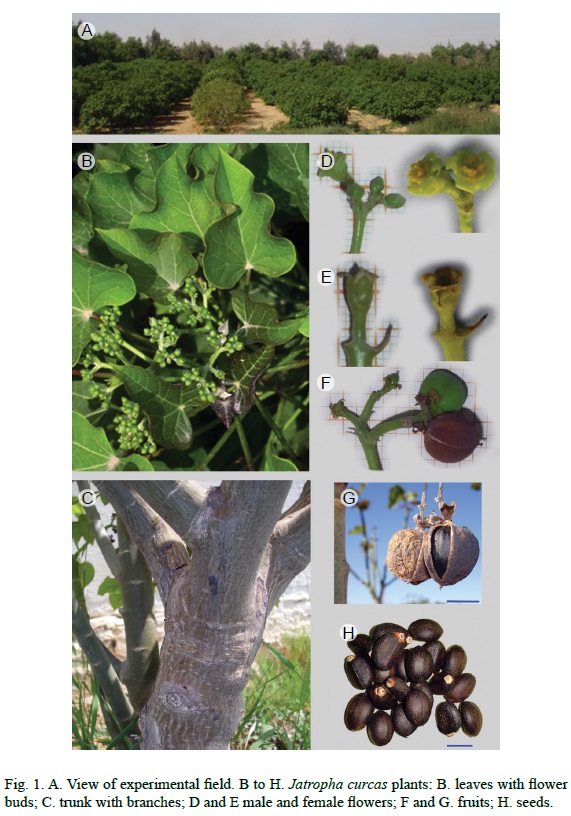
<body><![CDATA[<p align="justify"><font face="verdana" size="2"><b>RESUMEN</b></font></p>  	    <p align="justify"><font face="verdana" size="2">Se sembraron en el sur de T&uacute;nez (Gab&egrave;s) semillas de ocho accesiones de <i>Jatropha curcas</i> (seis americanas y dos africanas) para estudiar sus propiedades agr&iacute;colas y desarrollo en condiciones locales semi&aacute;ridas. Los caracteres observados incluyen aspectos generales del desarrollo de planta (altura, circunferencia del follaje, n&uacute;mero de nodos y producci&oacute;n de semillas); caracter&iacute;sticas de las hojas (longitud del peciolo, longitud del limbo, anchura del limbo y superficie foliar); y caracteres de la semilla (tama&ntilde;o y forma). El an&aacute;lisis morfol&oacute;gico de las semillas incluy&oacute; el &aacute;rea de las im&aacute;genes, el per&iacute;metro, la relaci&oacute;n longitud/anchura, el &iacute;ndice de circularidad y el &iacute;ndice J. Este &iacute;ndice refleja la semejanza de las im&aacute;genes de cada semilla con una elipse mostrando diferencias en la forma de las mismas entre accesiones. Los genotipos de <i>J. curcas</i> introducidos en T&uacute;nez son polim&oacute;rficos, su producci&oacute;n de semilla es baja y variable entre genotipos. El an&aacute;lisis morfol&oacute;gico de las semillas da una idea en relaci&oacute;n con la producci&oacute;n en algunas de las accesiones. Estudios agron&oacute;micos comparativos son cruciales antes de la selecci&oacute;n.</font></p>  	    <p align="justify"><font face="verdana" size="2"><b>Palabras clave:</b> diversidad, forma de la semilla, morfolog&iacute;a de <i>Jatropha curca</i>, rendimiento, T&uacute;nez.</font></p>     <p align="justify">&nbsp;</p>  	    <p align="justify"><font face="verdana" size="2"><b>INTRODUCTION</b></font></p>  	    <p align="justify"><font face="verdana" size="2"><i>Jatropha curcas</i> L. (Physic nut) is a perennial, monoecious, deciduous, stem&#45;succulent shrub belonging to the family Euphorbiaceae. It has a smooth bark, sturdy branches, and thick papery leaves (<a href="#f1">Fig. 1</a>). The leaves are 8 to 18 cm wide, shiny and glabrous, with exiguous and pilose stipules. The petiole is 10&#45;16 cm long. The inflorescence is monoecious. The fruit is a capsule, 3&#45;4 cm long and 2.5&#45;3.0 cm wide. The seeds, 1.5&#45;2.0 cm long and 1.0&#45;1.2 cm wide, are elliptical and black. Dormancy is induced by fluctuations in rainfall and temperature/light. The branches contain latex. It has well&#45;developed roots; normally five roots are formed from seedlings, one central and four peripheral. A tap root is not usually formed by vegetative propagation (Heller, 1996; Ye et al., 2009).</font></p> 	    <p align="center"><a name="f1"></a></p>  	    <p align="center"><img src="/img/revistas/abm/n110/a6f1.jpg"></p>     <p align="justify">&nbsp;</p>     <p align="justify"><font face="verdana" size="2">The genus <i>Jatropha</i> includes 175 species in the world (Dehgan and Webster, 1976; Ye et al., 2009). The center of diversity of <i>Jatropha</i> is the Mesoamerican region (Mexico and Central America), which is illustrated by the fact that more than 100 out of 175 species of <i>Jatropha</i> are native to that region. There are 41 native species in Mexico, of which 31 are strictly endemic (Jim&eacute;nez and Vega, 2011). Several species of <i>Jatropha</i> are native to South America (Ovando&#45;Medina et al., 2011a). <i>Jatropha curcas</i> is native of Belize, Costa Rica, El Salvador, Guatemala, Honduras, Mexico, Nicaragua and Panama, and widely present throughout Central America, Africa and Asia, where it is grown as a hedge plant (Basha et al., 2009; Subramanyam et al., 2009; Ovando&#45;Medina et al., 2011a).</font></p>  	    ]]></body>
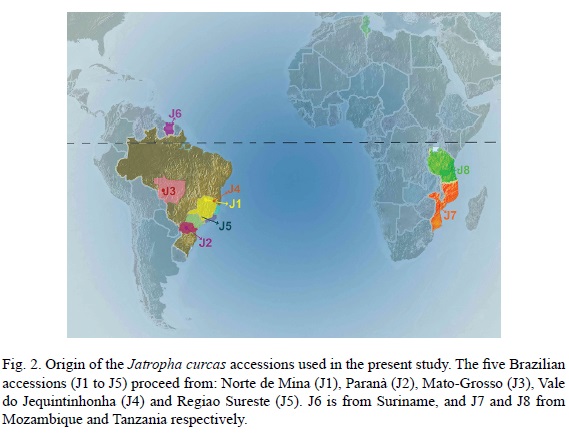
<body><![CDATA[<p align="justify"><font face="verdana" size="2"><i>Jatropha curcas</i> is a polymorph species with variations reported in tree architecture, plant height, number of fruits, seed dimensions (length, width, lateral diameter) and seed weight (Das et al., 2010; Rafii et al., 2012; Xu et al., 2012; Guan et al., 2013). With respect to molecular markers, the level of variation is different in localities. In America, where <i>J. curcas</i> is autochthonous, molecular analysis revealed high genetic variation (Ovando&#45;Medina et al., 2011b; He, 2011; Brasileiro et al., 2013; Salvador&#45;Figueroa et al., 2014). In contrast, assessment of <i>J. curcas</i> germplasm, using molecular markers in Asia and Africa, indicated low genotypic diversity and close clustering of accessions from both regions indicating a common ancestor (Basha and Sujatha, 2007; Singh et al., 2010; Zhang et al., 2011; Xu et al., 2012). This narrow level of variation has been attributed to the small number of introductions and their vegetative propagation (Khurana&#45;Kaul et al., 2012).</font></p>  	    <p align="justify"><font face="verdana" size="2"><i>Jatropha curcas</i> has mainly evolved for xerophytic adaptation and is naturalized in the seasonally dry tropics, particularly in the southern hemisphere where there is no severe and prolonged frost (Xu et al., 2012). It grows well with 600 mm of rainfall per year or more. Deficit irrigation and salinity stress significantly reduced the growth and leaf development of greenhouse&#45;grown <i>Jatropha</i> plants (Niu et al., 2012).</font></p>  	    <p align="justify"><font face="verdana" size="2">Conventional agriculture uses seeds and cuttings for its propagation, but <i>J. curcas</i> is amenable for <i>in vitro</i> propagation (Kumar et al., 2011). The planting of this species was motivated by the belief that it grows easily with minimal management requirements, but soil restoration and water conservation techniques improve the growth and survival rates on degraded soils (Kagam&egrave;bga et al., 2011; Iiyama et al., 2012). In plantation, spacing was the important factor along with the cutting management program for long time cultivation (Srinophakun et al., 2011). Thus, the productivity of <i>J. curcas</i> varies with genotypes, varieties and ecological conditions (Sosa&#45;Segura et al<i>.,</i> 2012).</font></p>  	    <p align="justify"><font face="verdana" size="2"><i>Jatropha curcas</i> has acquired global interest and significant economic importance for its seed oil which can be converted to biodiesel, and is emerging as an alternative to petro&#45;diesel (Sosa&#45;Segura et al., 2012; Guan et al., 2013). Seeds contain about 30&#45;65% oil (Nzikou et al., 2009; Basha et al., 2009; He, 2011).</font></p>  	    <p align="justify"><font face="verdana" size="2">Data concerning seed yield in <i>Jatropha curcas</i> are heterogeneous. In Mexico it ranged from 0.2 to 12 tons per hectare, depending on production conditions (Francis et al., 2005) while in Thailand, one year old plants produced 318 g seeds x plant<sup>&#45;1</sup> (794 kg per hectare; Heller, 1996). In India, in a study involving sixteen genotypes, three year old plants produced from 34 to 196 g seeds &#215; plant<sup>&#45;1</sup> (Das et al., 2010). Rao et al. (2008) reported yields of more than 2 kg of dry seed per five year old plant in Central India. In Egyptian deserts, <i>Jatropha</i> trees, irrigated with primary treated municipal wastewater, produced 2 tons seed &#215; 4000 m<sup>&#45;2</sup> (Tewfik et al., 2012). In general, yield is related with the age of the plants and thus, studies on grain yield need to include plants of certain age.</font></p>  	    <p align="justify"><font face="verdana" size="2">Recently, eight <i>J. curcas</i> accessions were introduced to Tunisia with the aim of studying the possibility of <i>Jatropha</i> culture and exploitation. Experimental sites are installed from North to South to estimate differences between accessions or environments relative to their development and productivity. This study aims to determine the morphological variation between eight germplasm accessions of <i>J. curcas,</i> grown under the same environmental conditions in the experimental Dissa site in the region of Gab&egrave;s (South of Tunisia), and to analyze diversity in plant development, seed morphology and seed yield<i>.</i> This work will contribute to identify agronomic traits of interest and to select germplasm accessions which are better adapted to local environmental conditions.</font></p>     <p align="justify">&nbsp;</p>  	    <p align="justify"><font face="verdana" size="2"><b>MATERIALS AND METHODS</b></font></p>  	    <p align="justify"><font face="verdana" size="2">Plant material</font></p>  	    <p align="justify"><font face="verdana" size="2">Eight <i>Jatropha curcas</i> accessions were introduced to Tunisia from four countries: Brazil, Suriname, Mozambique and Tanzania (<a href="#f2">Fig. 2</a>).</font></p>  	    ]]></body>
<body><![CDATA[<p align="center"><a name="f2"></a></p> 	    <p align="center"><img src="/img/revistas/abm/n110/a6f2.jpg"></p> 	    <p align="center">&nbsp;</p>     <p align="justify"><font face="verdana" size="2">Experimental site</font></p>  	    <p align="justify"><font face="verdana" size="2">This study was conducted at the Dissa experimental station (Gab&egrave;s, Tunisia; 33&#176;54' N and 10&#176;02' E; <a href="#f1">Fig. 1A</a>), in an area of 1000 m<sup>2</sup>, at an altitude of approximately 44 meters. This region belongs to the lower semi&#45;arid bioclimate; mean annual rainfall averages 130 mm, average annual Potential Evapo&#45;Transpiration (PET) is about 1400 mm. The annual average temperature is 24.5 &#176;C, maximum and minimum temperatures are 34 &#176;C and 12.8 &#176;C, respectively. The soil is calcimagnesic with 15&#45;35% of gypsum (CaSO<sub>4</sub>2H<sub>2</sub>O) at depths of 50&#45;100 cm and 15% of Calcium carbonate (CaCO<sub>3</sub>). The soil texture was drained and sandy; 85% sand, 10% clay and 5% silt. PH is 7.7 and electric conductivity EC = 2.2 mS/cm.</font></p>  	    <p align="justify"><font face="verdana" size="2">Water of irrigation</font></p>  	    <p align="justify"><font face="verdana" size="2">Plants were irrigated with treated wastewater, characterized by pH = 6.9, EC = 4.670 mS/cm, COD (Chemical Oxygen Demand) = 168 mgO<sub>2</sub>/l and BOD5 (Biochemical Oxygen Demand) = 40 mg O<sub>2</sub>/l. The rate of Cl<sup>&#45;</sup>, Ca<sup>++</sup>, Mg<sup>++</sup> and SO<sub>4</sub><sup>2&#45;</sup>of treated wastewater is 39.4, 0.44, 0.32 and 450 mg &#215; l<sup>&#45;1</sup> respectively. The quantity and frequency of irrigation were of 50 l &#215; week<sup>&#45;1</sup> for a surface of 3 m<sup>2</sup>.</font></p>  	    <p align="justify"><font face="verdana" size="2">Experimental protocol, development and yield of plants</font></p>  	    <p align="justify"><font face="verdana" size="2">Seedlings (25 per accession) were planted in March 2008. The experiment was conducted in a randomized block with 40 plants per plot, and 5 replicates. Each accession is represented by five plants in each plot. The spacing was 2 m x 3 m. Plant height (PH) was measured for each individual every year (2008&#45;2013) and canopy circumference (CC) was measured in 2012. Mature fruits were harvested in the three periods of fruit maturity: August 2011, August and November 2012, and January and August 2013. Seeds obtained were weighed by electronic balance (SCALTEC SBA 41) for each plant (e = 0.1 g).</font></p>  	    <p align="justify"><font face="verdana" size="2">Morphological parameters</font></p>  	    ]]></body>
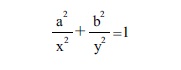
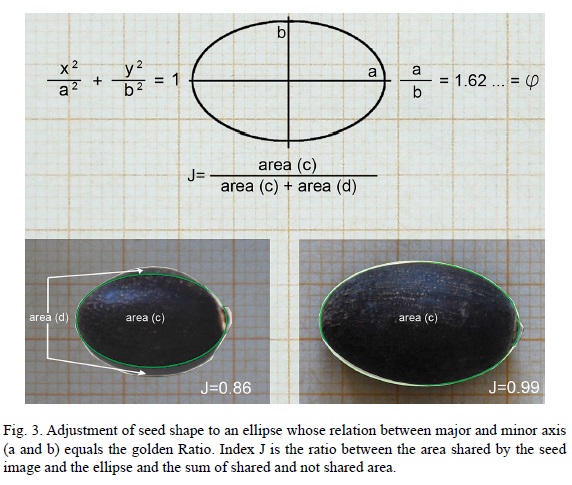
<body><![CDATA[<p align="justify"><font face="verdana" size="2">Petiole length (PL), limb length (LL) and limb width (LW) were measured by graduated ruler (e = 1 mm). Foliar surface (FS) was measured by a digital planimeter, with 0.1 cm<sup>2</sup> resolution and 0.2% precision. Measurements where mean values of five repetitions. Number of nodes (NN) was counted on five branches of 20 cm.</font></p>  	    <p align="justify"><font face="verdana" size="2">Seed morphology</font></p>  	    <p align="justify"><font face="verdana" size="2">Seeds were placed in graph paper over a flat surface, oriented with their micropile to the right side and photographed with a Nikon D60 camera adapted in a tripod. Forty seeds per accession where used to a total of 320 images. Five measurements in relation with morphology where obtained from each image: area, perimeter, length/width, circularity index and J index.</font></p>  	    <p align="justify"><font face="verdana" size="2">Circularity index (Schwartz, 1980) is a measure of the similarity of a plane figure to a circle given by</font></p>  	    <p align="center"><img src="/img/revistas/abm/n110/a6fr1.jpg"></p>  	    <p align="justify"><font face="verdana" size="2">it ranges from 0 to 1 giving the value of 1 for circles.</font></p>  	    <p align="justify"><font face="verdana" size="2">An ellipse can be defined as the locus of all points that satisfy the equation</font></p>  	    <p align="center"><img src="/img/revistas/abm/n110/a6fr2.jpg"></p>  	    <p align="justify"><font face="verdana" size="2">where (x, y) are the coordinates of any point on the ellipse, and (a, b) are the radius on the <i>x</i> and <i>y</i> axes respectively.</font></p>  	    <p align="justify"><font face="verdana" size="2">Seed images of <i>Jatropha curcas</i> were adjusted to an ellipse whose relation between the major and minor axes (a and b) equals the Golden Ratio (1.618). The J index was defined previously for quantification of <i>Arabidopsis</i> seed shape in comparison to a cardioid (Cervantes et al., 2010), and is used here to measure the adjustment of seed shape to the ellipse. To obtain the J index, composed images containing an ellipse and the seed (<a href="#f3">Fig. 3</a>) were elaborated for each seed with the software image Photoshop CS5.1 (Adobe). Area quantification was done with Image J (Java Image Processing Program).</font></p>     ]]></body>
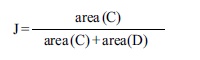
<body><![CDATA[<p align="center"><a name="f3"></a></p>     <p align="center"><img src="/img/revistas/abm/n110/a6f3.jpg"></p>     <p align="center">&nbsp;</p>  	    <p align="justify"><font face="verdana" size="2">Quantification of the adjustment was done in each seed as a proportion between the areas in two regions: the common region in the ellipse and the seed image (area C), and the sum of total regions of both images, the seed and the ellipse (<a href="#f3">Fig. 3</a>). The index of adjustment (J index) is defined by:</font></p>     <p align="center"><img src="/img/revistas/abm/n110/a6fr3.jpg"></p>  	    <p align="justify"><font face="verdana" size="2">where area (C) represents the common region and area (D) the regions not shared. Note that J index ranges between 0 and 1, and decreases when the size of the non&#45;shared region grows. It equals 1 when ellipse and seed image areas coincide, i.e., area (D) is zero. J Index was calculated for a total of 320 seeds (40 seeds per each of eight accessions).</font></p>  	    <p align="justify"><font face="verdana" size="2">Statistical analysis</font></p>  	    <p align="justify"><font face="verdana" size="2">For the eight morphological traits, the effect of the accessions was determined by the analysis of variance (ANOVA). The comparison of the averages was realized by using the test of Student&#45;Newman&#45;Keuls (&#945; = 0.05). The statistical analysis also included the elaboration of a matrix of coefficient of simple linear correlation between variables. The statistical analyses were made with the software SAS 9.1 (Anonymous, 1992).</font></p>  	    <p align="justify"><font face="verdana" size="2">For seed morphology ANOVA was used for the comparison between different groups, post&#45;hoc analysis was carried out using Tukey test (samples of similar sizes) and the analysis was done with SPSS 11.5.</font></p>  	    <p>&nbsp;</p> 	    ]]></body>
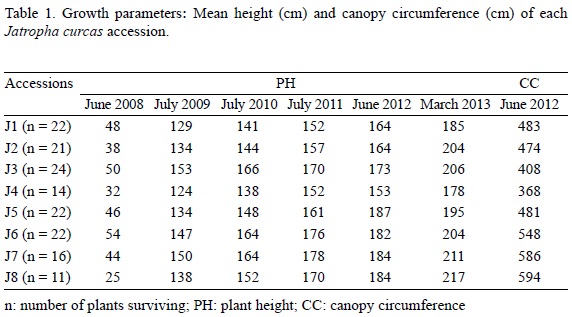
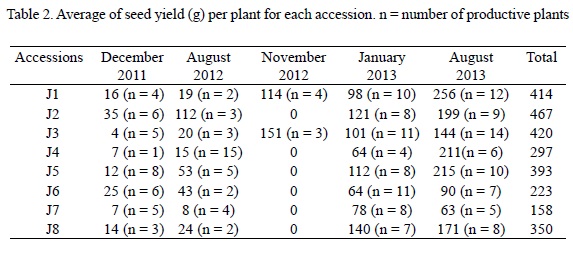
<body><![CDATA[<p align="justify"><font face="verdana" size="2"><b>RESULTS</b></font></p>  	    <p align="justify"><font face="verdana" size="2">Plant development and seed yield</font></p>  	    <p align="justify"><font face="verdana" size="2">The number of seedlings surviving varied from 11 (J8) to 24 (J3) <a href="#t1">(Table 1</a>). After five years, mean plant height oscillated between 178 cm for J4 (Vale do Jequintinhonha) and 217 cm for J8 (Tanzanian accession) (<a href="#t1">Table 1</a>). Canopy circumference (<a href="#t1">Table 1</a>) oscillated between 368 (J4), and 594 cm, with higher values in the two African accessions (Mozambique, J7 and Tanzania, J8). Plants from Tanzania where higher and had larger canopy circumferences.</font></p>  	    <p align="center"><a name="t1"></a></p> 	    <p align="center"><img src="/img/revistas/abm/n110/a6t1.jpg"></p> 	    <p align="center">&nbsp;</p>     <p align="justify"><font face="verdana" size="2">Plants from all accessions shed their leaves from December to April; the first leaves and flowers appeared in May. Seed production occurred in three periods: summer, autumn and winter. Seed yield was important in summer and winter, and limited in autumn. Only two Brazilian accessions (Norte de Mina, J1; and Mato&#45;Grosso, J3), were productive in this season with 114 and 151 g of seeds, respectively (<a href="#t2">Table 2</a>). Seed production was variable in the two other periods. In summer, the highest value was of 256 g (J1), and the lowest of 63 g (J7). In winter, the highest values were 140 g (J8) and the lowest ones of 64 g (J4). In total, Brazilian plants from Paran&agrave; (J2) had higher seed yield (467 g), and plants from Mozambique (J7) the lowest (158 g). Yield increased along the years of culture (<a href="#t2">Table 2</a>).</font></p>     <p align="center"><a name="t2" id="t2"></a></p>     <p align="center"><img src="/img/revistas/abm/n110/a6t2.jpg"></p>     <p align="center">&nbsp;</p>  	    ]]></body>
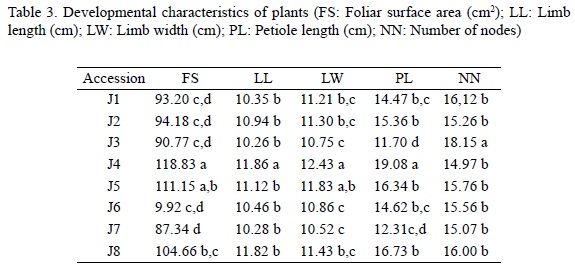
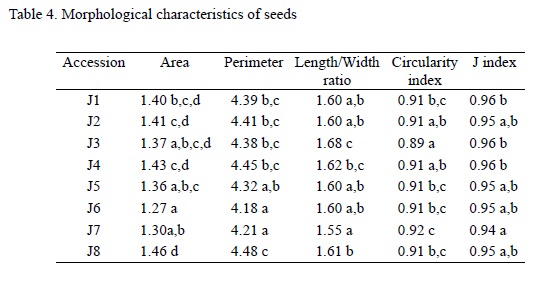
<body><![CDATA[<p align="justify"><font face="verdana" size="2">Positive correlation was found between plant height and canopy circumference (r<sup>2</sup> = 0.87), total yield and yield of last harvest (August, 2013; r<sup>2</sup> = 0.76), plant height and seed yield in winter (0.56), and canopy circumference and seed yield in summer (0.51) and in winter (0.62).</font></p>     <p align="justify"><font face="verdana" size="2">Morphological variability</font></p>  	    <p align="justify"><font face="verdana" size="2">Analysis of variance revealed high morphological variability with a significant (p &lt; 0.05) effect of accession for all five characters under study (FS, LL, LW, PL, NN). The number of groups obtained in ANOVA differs according to the character considered (<a href="#t3">Table 3</a>). For the parameters of the leaf, J4 forms an isolated group with higher values of LL and PL; and together with J5, both have higher values of LW and FS. All foliar parameters are lower for J7 and J3. The highest number of nods is observed for J3, and lowest for J4 (<a href="#t3">Table 3</a>).</font></p>  	    <p align="center"><a name="t3"></a></p> 	    <p align="center"><img src="/img/revistas/abm/n110/a6t3.jpg"></p> 	    <p align="center">&nbsp;</p> 	    <p align="justify"><font face="verdana" size="2">Significant (p &lt; 0.05) positive correlations were found between all leaf magnitudes (leaf surface (FS), leaf length (LL), leaf width (LW) and petiole length (PL).</font></p>  	    <p align="justify"><font face="verdana" size="2">Seed morphology</font></p>  	    <p align="justify"><font face="verdana" size="2">Area and perimeter were lower in seed populations obtained from Suriname (J6) and Mozambique (J7) and higher in seed populations from Tanzania (J8). Length to width ratio was lower in J7 and higher in J3. Correspondingly, circularity index values were lower in J3 and higher in J7. <a href="#t4">Table 4</a> summarizes the results obtained for seed morphology.</font></p> 	    <p align="center"><a name="t4"></a></p> 	    ]]></body>
<body><![CDATA[<p align="center"><img src="/img/revistas/abm/n110/a6t4.jpg"></p> 	    <p align="center">&nbsp;</p>  	    <p align="justify"><font face="verdana" size="2">Seed shapes of <i>Jatropha curcas</i> adjust well to an ellipse whose relation between major and minor axes (a and b) equals the Golden Ratio (<a href="#f3">Fig. 3</a>). The J index oscillates between 0.86 and 0.99 (mean value is 0.95). Mean values are lower in J7 and higher in J1, J3 and J4.</font></p>     <p align="justify"><font face="verdana" size="2">A negative correlation was found, as expected, between length to width ratio and circularity index (r<sup>2</sup> = &#45;0.97). Positive correlations were found between length to width ratio and J index (r<sup>2</sup> = 0.76).</font></p>     <p align="justify">&nbsp;</p>  	    <p align="justify"><font face="verdana" size="2"><b>DISCUSSION</b></font></p>  	    <p align="justify"><font face="verdana" size="2">Yield obtained from the eight <i>Jatropha curcas</i> accessions used in this study was moderate or low in relationship to other published results as reported in the introduction. This may be due to the high latitude of the experimental site (33&#176;54' N), whereas the reported limit for cultivation of this species is of 30&#176; N (Anonymous, 2010). A cold winter season with temperature ranges below the optimum may be an important factor limiting seed production. Reduced seed yield may be a consequence of the climatic conditions during seed formation; high temperature and low moisture in summer and cold in winter, temperature being an important factor in growth and productivity of <i>J. curcas</i> (Maes et al., 2009). Nevertheless, grain yield increased with age of the plants, as shown by the correlation found between yield of the last harvest (August, 2013) and total yield, and further increases in yield may be expected in successive seasons.</font></p>  	    <p align="justify"><font face="verdana" size="2">The eight <i>J. curcas</i> accessions showed high phenotypic diversity, this result joins that obtained in America (Ovando&#45;Medina et al., 2011b; He, 2011; Brasileiro et al., 2013), China, India and Philippines (Gohil and Pandya, 2009; Vijayanand et al., 2009; Das et al., 2010; Zapico et al., 2011; Guan et al., 2013). However, high morphological variability does not always reflect high genotypic variability. Xu et al. (2012) showed that high phenotypic diversity in most cases was not associated with genotypic diversity, indicating a strong influence for environment. It appears that the environment or particular genotype&#45;environment combinations have predominant roles in the morphological variation among accessions (Ovando&#45;Medina et al., 2011a; Rafii et al., 2012). Our results show high variability in foliar traits, in particular leaf surface. Plant height and seed yield are also different between accessions, this result due probably to genetic&#45;environmental interaction (Heller, 1996). Epigenetics also plays an important role in the variability of <i>Jatropha</i> (Yi et al., 2010).</font></p>  	    <p align="justify"><font face="verdana" size="2">Previous reports using unique varieties present a relation between seed yield and agronomic traits like foliar surface, plant height, number of nodes per branch, and others (Gohil and Pandya, 2009; Rafii et al., 2012; Brasileiro et al., 2013). For example, Sun et al. (2012) identified a total of 28 QTLs (quantitative trait loci) underlying the growth and seed yield traits in <i>Jatropha</i> and showed a significant correlation between phenotypic traits and total seed weight. Plant height, stem diameter, branch number, female flower number and fruit number were suggested to be key factors for seed yields. Rafii et al. (2012) showed the important heredity of plant height and indicated that the genetic component was high (&gt; 50%) for seed yield per plant, fruit &#215; plant<sup>&#45;1</sup> and flowering bunches &#215; plant<sup>&#45;1</sup>. Brasileiro et al<i>.</i> (2013) used plant height for indirect selection in populations of the physic nut in order to obtain superior genotypes. Our data obtained with plants of eight different accessions grown during five years do not support the existence of general correlations between any of the considered morphological traits and grain yield. Plants in this experiment proceed from diverse origins and thus, genotype&#45;environment interactions are multiple and may result in a lack of general correlation between any particular morphological character of the plants and yield, a property that may well be observed when considering a unique variety or accession on its own. In addition, the morphological traits were measured in a season previous to the increase in grain yield that took place in the last harvest of August 2013.</font></p>  	    <p align="justify"><font face="verdana" size="2">The images of <i>Jatropha curcas</i> seeds adjust well to an ellipse, whose relation between major and minor axis equals the Golden Ratio. Differences between accessions were found in seed size and shape, showing a trend where larger seeds had also higher values of J index and lower circularity index. Our results suggest a relationship between seed yield , size and shape. Seeds from the accessions J6 and J7 (Suriname and Mozambique respectively), that presented the lowest yield in the last seasons, were smaller and more circular, and their shape adjusted less well to an ellipse (lower J index values). The observed association between reduced yield and seed morphological traits opens the possibility for the development of tests addressed to evaluate the quality of seed lots, based on morphological properties of seeds. Seed shape analysis is simple to perform and may provide an indication on the condition of the seed stocks in relation to yield. This may contribute to germplasm selection for agronomical applications.</font></p>  	    ]]></body>
<body><![CDATA[<p align="justify"><font face="verdana" size="2">The introduction of <i>J. curcas</i> is a complex project; the programmes launched in Brazil, Nicaragua and India for introduction of <i>J. curcas</i> for varied purposes met with limited success due to the wide gap in potential and actual yields. The species has not been improved for productivity and most of the projects relied on naturally occurring unadapted populations, which are a result of the few initial introductions (Basha and Sujatha, 2007). Thus, <i>Jatropha curcas</i> is not common in Mediterranean regions with arid and semi&#45;arid climates; plantations in these regions hold the risk of low productivity or irrigation requirement. Also, plantations in regions with frost risk hold the risk of damage due to frost (Maes et al<i>.,</i> 2009). However, the high phenotypic variability and the difference in productivity represented a good potential for early selection. Proposed future research in this species comprises the description of introduced genotypes, the study of the physiological behavior and the improvement of seed yield and oil productivity.</font></p>     <p align="justify">&nbsp;</p>  	    <p align="justify"><font face="verdana" size="2"><b>LITERATURE CITED</b></font></p>  	    <!-- ref --><p align="justify"><font face="verdana" size="2">Anonymous. 2010. <i>Jatropha</i>: A small holder bioenergy crop. ICM 8: 27&#45;53.    &nbsp;&nbsp;&nbsp;&nbsp;&nbsp;&nbsp;&nbsp;&nbsp;[&#160;<a href="javascript:void(0);" onclick="javascript: window.open('/scielo.php?script=sci_nlinks&ref=055986&pid=S0187-7151201500010000600001&lng=','','width=640,height=500,resizable=yes,scrollbars=1,menubar=yes,');">Links</a>&#160;]<!-- end-ref --></font></p>  	    <!-- ref --><p align="justify"><font face="verdana" size="2">Basha, S. D. and M. Sujatha. 2007. Inter and intra&#45;population variability of <i>Jatropha curcas</i> (L.) characterized by RAPD and ISSR markers and development of population&#45;specific SCAR markers. Euphytica 156: 375&#45;386.    &nbsp;&nbsp;&nbsp;&nbsp;&nbsp;&nbsp;&nbsp;&nbsp;[&#160;<a href="javascript:void(0);" onclick="javascript: window.open('/scielo.php?script=sci_nlinks&ref=055988&pid=S0187-7151201500010000600002&lng=','','width=640,height=500,resizable=yes,scrollbars=1,menubar=yes,');">Links</a>&#160;]<!-- end-ref --></font></p>  	    <!-- ref --><p align="justify"><font face="verdana" size="2">Basha, S. D., G. Francis, H. P. S. Makkar, K. Becker and M. Sujatha. 2009. A comparative study of biochemical traits and molecular markers for assessment of genetic relationships between <i>Jatropha curcas</i> L. germplasm from different countries. Plant Sci. 176: 812&#45;823.    &nbsp;&nbsp;&nbsp;&nbsp;&nbsp;&nbsp;&nbsp;&nbsp;[&#160;<a href="javascript:void(0);" onclick="javascript: window.open('/scielo.php?script=sci_nlinks&ref=055990&pid=S0187-7151201500010000600003&lng=','','width=640,height=500,resizable=yes,scrollbars=1,menubar=yes,');">Links</a>&#160;]<!-- end-ref --></font></p>  	    <!-- ref --><p align="justify"><font face="verdana" size="2">Brasileiro, B. P., S. A. Silva, D. R. Souza, P. A. Santos, R. S. Oliveira and D. H. Lyra. 2013. Genetic diversity and selection gain in the physic nut (<i>Jatropha curcas</i>). Genet. Mol. Res 12(3): 2341&#45;2350.    &nbsp;&nbsp;&nbsp;&nbsp;&nbsp;&nbsp;&nbsp;&nbsp;[&#160;<a href="javascript:void(0);" onclick="javascript: window.open('/scielo.php?script=sci_nlinks&ref=055992&pid=S0187-7151201500010000600004&lng=','','width=640,height=500,resizable=yes,scrollbars=1,menubar=yes,');">Links</a>&#160;]<!-- end-ref --></font></p>  	    <!-- ref --><p align="justify"><font face="verdana" size="2">Cervantes E., J. J. Mart&iacute;n, R. Ardanuy, J. G. de Diego and A. Tocino. 2010. Modeling the <i>Arabidopsis</i> seed shape by a cardioid: efficacy of the adjustment with a scale change with factor equal to the Golden Ratio and analysis of seed shape in ethylene mutants. J. Plant Physiol. 167: 408&#45;410. doi:10.1016/j.jplph.2009.09.013</font>&nbsp;&nbsp;&nbsp;&nbsp;&nbsp;&nbsp;&nbsp;&nbsp;[&#160;<a href="javascript:void(0);" onclick="javascript: window.open('/scielo.php?script=sci_nlinks&ref=055994&pid=S0187-7151201500010000600005&lng=','','width=640,height=500,resizable=yes,scrollbars=1,menubar=yes,');">Links</a>&#160;]<!-- end-ref --><!-- ref --><p align="justify"><font face="verdana" size="2">Das, S, R. C. Misra, A. K. Mahapatra, B. P. Gantayat and R. K. Pattnaik. 2010. Genetic variability, character association and path analysis in <i>Jatropha curcas.</i> World Appl. Sci. J. 8(11): 1304&#45;1308.    &nbsp;&nbsp;&nbsp;&nbsp;&nbsp;&nbsp;&nbsp;&nbsp;[&#160;<a href="javascript:void(0);" onclick="javascript: window.open('/scielo.php?script=sci_nlinks&ref=055995&pid=S0187-7151201500010000600006&lng=','','width=640,height=500,resizable=yes,scrollbars=1,menubar=yes,');">Links</a>&#160;]<!-- end-ref --></font></p>  	    <!-- ref --><p align="justify"><font face="verdana" size="2">Dehgan, B. and G. Webster. 1979. Morphology and infrageneric relationships of the genus <i>Jatropha</i> (Euphorbiaceae). Univ. Cal. Publ. Bot. 74: 1&#45;73 + 33 plates.    &nbsp;&nbsp;&nbsp;&nbsp;&nbsp;&nbsp;&nbsp;&nbsp;[&#160;<a href="javascript:void(0);" onclick="javascript: window.open('/scielo.php?script=sci_nlinks&ref=055997&pid=S0187-7151201500010000600007&lng=','','width=640,height=500,resizable=yes,scrollbars=1,menubar=yes,');">Links</a>&#160;]<!-- end-ref --></font></p>  	    <!-- ref --><p align="justify"><font face="verdana" size="2">Francis, G., R. Edinger and K. Becker. 2005. A concept for simultaneous wasteland reclamation fuel production, and socio&#45;economic development in degraded areas in India, potential and perspectives of <i>Jatropha</i> plantations. Nat. Resour. Forum 29(1): 12&#45;24.    &nbsp;&nbsp;&nbsp;&nbsp;&nbsp;&nbsp;&nbsp;&nbsp;[&#160;<a href="javascript:void(0);" onclick="javascript: window.open('/scielo.php?script=sci_nlinks&ref=055999&pid=S0187-7151201500010000600008&lng=','','width=640,height=500,resizable=yes,scrollbars=1,menubar=yes,');">Links</a>&#160;]<!-- end-ref --></font></p>  	    <!-- ref --><p align="justify"><font face="verdana" size="2">Gohil, R. H. and J. B. Pandya. 2009. Genetic evaluation of <i>Jatropha</i> (<i>Jatropha curcas</i> Linn.) genotypes. J. Agric. Res<i>.</i> 47(3): 221&#45;228.    &nbsp;&nbsp;&nbsp;&nbsp;&nbsp;&nbsp;&nbsp;&nbsp;[&#160;<a href="javascript:void(0);" onclick="javascript: window.open('/scielo.php?script=sci_nlinks&ref=056001&pid=S0187-7151201500010000600009&lng=','','width=640,height=500,resizable=yes,scrollbars=1,menubar=yes,');">Links</a>&#160;]<!-- end-ref --></font></p>  	    ]]></body>
<body><![CDATA[<!-- ref --><p align="justify"><font face="verdana" size="2">Guan, J., H. Yu, J. Zhang, R. Yang and Y&#45;H. Fan. 2013. Study on seed morphology and genetic diversity of <i>Jatropha curcas</i> L. from different provenances. Afr. J. Food Sci. Technol. 5(2): 169&#45;173.    &nbsp;&nbsp;&nbsp;&nbsp;&nbsp;&nbsp;&nbsp;&nbsp;[&#160;<a href="javascript:void(0);" onclick="javascript: window.open('/scielo.php?script=sci_nlinks&ref=056003&pid=S0187-7151201500010000600010&lng=','','width=640,height=500,resizable=yes,scrollbars=1,menubar=yes,');">Links</a>&#160;]<!-- end-ref --></font></p>  	    <!-- ref --><p align="justify"><font face="verdana" size="2">He, W. 2011. Biochemical and genetic analyses of <i>Jatropha curcas</i> L. Seed composition. PhD Thesis. University of York. York, UK. 149 pp.    &nbsp;&nbsp;&nbsp;&nbsp;&nbsp;&nbsp;&nbsp;&nbsp;[&#160;<a href="javascript:void(0);" onclick="javascript: window.open('/scielo.php?script=sci_nlinks&ref=056005&pid=S0187-7151201500010000600011&lng=','','width=640,height=500,resizable=yes,scrollbars=1,menubar=yes,');">Links</a>&#160;]<!-- end-ref --></font></p>  	    <!-- ref --><p align="justify"><font face="verdana" size="2">Heller, J. 1996. Physic Nut &#45; <i>Jatropha curcas</i> L. Promoting the conservation and use of underutilized and neglected crops. 1. International Plant Genetic Resources Institute. Rome, Italy. Available from: URL: <a href="http://www.ipgri.cgiar.org/publications/pdf/161.pdf" target="_blank">http://www.ipgri.cgiar.org/publications/pdf/161.pdf</a>.    &nbsp;&nbsp;&nbsp;&nbsp;&nbsp;&nbsp;&nbsp;&nbsp;[&#160;<a href="javascript:void(0);" onclick="javascript: window.open('/scielo.php?script=sci_nlinks&ref=056007&pid=S0187-7151201500010000600012&lng=','','width=640,height=500,resizable=yes,scrollbars=1,menubar=yes,');">Links</a>&#160;]<!-- end-ref --></font></p>  	    <!-- ref --><p align="justify"><font face="verdana" size="2">Iiyama, M., D. Newman, C. Munster, M. Nyabenge, G. W. Sileshi, V. Moraa, J. Onchieku, J. G. Mowo and R. Nadass. 2012. Productivity of <i>Jatropha curcas</i> under small holder farm conditions in Kenya. Agroforest. Syst. 87: 729&#45;746.    &nbsp;&nbsp;&nbsp;&nbsp;&nbsp;&nbsp;&nbsp;&nbsp;[&#160;<a href="javascript:void(0);" onclick="javascript: window.open('/scielo.php?script=sci_nlinks&ref=056009&pid=S0187-7151201500010000600013&lng=','','width=640,height=500,resizable=yes,scrollbars=1,menubar=yes,');">Links</a>&#160;]<!-- end-ref --></font></p>  	    <!-- ref --><p align="justify"><font face="verdana" size="2">Jim&eacute;nez Ram&iacute;rez, J. and K. Vega Flores. 2011. <i>Jatropha mirandana</i> (Euphorbiaceae), especie nueva de la cuenca oriental del r&iacute;o Balsas de los estados de Guerrero y Puebla, M&eacute;xico. Novon 21(2): 192&#45;195.    &nbsp;&nbsp;&nbsp;&nbsp;&nbsp;&nbsp;&nbsp;&nbsp;[&#160;<a href="javascript:void(0);" onclick="javascript: window.open('/scielo.php?script=sci_nlinks&ref=056011&pid=S0187-7151201500010000600014&lng=','','width=640,height=500,resizable=yes,scrollbars=1,menubar=yes,');">Links</a>&#160;]<!-- end-ref --></font></p>  	    ]]></body>
<body><![CDATA[<!-- ref --><p align="justify"><font face="verdana" size="2">Kagam&egrave;bga, W. F., A. Thiombiano, S. Traor&eacute;, R. Zougmor&eacute; and J. I. Boussim. 2011. Survival and growth responses of <i>Jatropha curcas</i> L. to three restoration techniques on degraded soils in Burkina Faso. Ann. For. Res. 54(2): 171&#45;184.    &nbsp;&nbsp;&nbsp;&nbsp;&nbsp;&nbsp;&nbsp;&nbsp;[&#160;<a href="javascript:void(0);" onclick="javascript: window.open('/scielo.php?script=sci_nlinks&ref=056013&pid=S0187-7151201500010000600015&lng=','','width=640,height=500,resizable=yes,scrollbars=1,menubar=yes,');">Links</a>&#160;]<!-- end-ref --></font></p>  	    <!-- ref --><p align="justify"><font face="verdana" size="2">Khurana&#45;Kaul, V., S. Kachhwaha and S. L. Kothari. 2012. Characterization of genetic diversity in <i>Jatropha curcas</i> L. germplasm using RAPD and ISSR markers. Indian J. Biotechnol. 11: 54&#45;61.    &nbsp;&nbsp;&nbsp;&nbsp;&nbsp;&nbsp;&nbsp;&nbsp;[&#160;<a href="javascript:void(0);" onclick="javascript: window.open('/scielo.php?script=sci_nlinks&ref=056015&pid=S0187-7151201500010000600016&lng=','','width=640,height=500,resizable=yes,scrollbars=1,menubar=yes,');">Links</a>&#160;]<!-- end-ref --></font></p>  	    <!-- ref --><p align="justify"><font face="verdana" size="2">Kumar, N., K. G. V. Anand and M. P. Reddy. 2011. Plant regeneration of non&#45;toxic <i>Jatropha curcas</i>&#45;impacts of plant growth regulators, source and type of explants. J. Plant Biochem. Biotechnol<i>.</i> 20(1): 125&#45;133.    &nbsp;&nbsp;&nbsp;&nbsp;&nbsp;&nbsp;&nbsp;&nbsp;[&#160;<a href="javascript:void(0);" onclick="javascript: window.open('/scielo.php?script=sci_nlinks&ref=056017&pid=S0187-7151201500010000600017&lng=','','width=640,height=500,resizable=yes,scrollbars=1,menubar=yes,');">Links</a>&#160;]<!-- end-ref --></font></p>  	    <!-- ref --><p align="justify"><font face="verdana" size="2">Maes, W. H., A. Trabucco, W. M. J. Achten and B. Muys. 2009. Climatic growing conditions of <i>Jatropha curcas</i> L. Biomass Bioenerg. 33: 1481&#45;1485.    &nbsp;&nbsp;&nbsp;&nbsp;&nbsp;&nbsp;&nbsp;&nbsp;[&#160;<a href="javascript:void(0);" onclick="javascript: window.open('/scielo.php?script=sci_nlinks&ref=056019&pid=S0187-7151201500010000600018&lng=','','width=640,height=500,resizable=yes,scrollbars=1,menubar=yes,');">Links</a>&#160;]<!-- end-ref --></font></p>  	    <!-- ref --><p align="justify"><font face="verdana" size="2">Niu, G., D. Rodriguez, M. Mendoza, J. Jifon, G. Ganjeguntel. 2012. Responses of <i>Jatropha curcas</i> to salt and drought stresses. International Journal of Agronomy IJA, Article ID 632026, 7 pages. doi:10.1155/2012/632026</font>&nbsp;&nbsp;&nbsp;&nbsp;&nbsp;&nbsp;&nbsp;&nbsp;[&#160;<a href="javascript:void(0);" onclick="javascript: window.open('/scielo.php?script=sci_nlinks&ref=056021&pid=S0187-7151201500010000600019&lng=','','width=640,height=500,resizable=yes,scrollbars=1,menubar=yes,');">Links</a>&#160;]<!-- end-ref --><!-- ref --><p align="justify"><font face="verdana" size="2">Nzikou, J. M., L. Matos, F. Mbemba, C. B. Ndangui, N. P. G. Pambou&#45;Tobi, A. Kimbonguila, Th. Silou, M. Linder and S. Desobry. 2009. Characteristics and composition of <i>Jatropha curcas</i> oils, variety Congo&#45;Brazzaville. Res. J. Appl. Sci. Eng. Tech. 1(3): 154&#45;159.    &nbsp;&nbsp;&nbsp;&nbsp;&nbsp;&nbsp;&nbsp;&nbsp;[&#160;<a href="javascript:void(0);" onclick="javascript: window.open('/scielo.php?script=sci_nlinks&ref=056022&pid=S0187-7151201500010000600020&lng=','','width=640,height=500,resizable=yes,scrollbars=1,menubar=yes,');">Links</a>&#160;]<!-- end-ref --></font></p>  	    <!-- ref --><p align="justify"><font face="verdana" size="2">Ovando&#45;Medina, I., F. J. Espinosa&#45;Garc&iacute;a, J. S. N&uacute;&ntilde;ez&#45;Farf&aacute;n and M. Salvador&#45;Figueroa, M. 2011a. State of the art of genetic diversity research in <i>Jatropha curcas.</i> Sci. Res. Essays 6(8): 1709&#45;1719.    &nbsp;&nbsp;&nbsp;&nbsp;&nbsp;&nbsp;&nbsp;&nbsp;[&#160;<a href="javascript:void(0);" onclick="javascript: window.open('/scielo.php?script=sci_nlinks&ref=056024&pid=S0187-7151201500010000600021&lng=','','width=640,height=500,resizable=yes,scrollbars=1,menubar=yes,');">Links</a>&#160;]<!-- end-ref --></font></p>  	    <!-- ref --><p align="justify"><font face="verdana" size="2">Ovando&#45;Medina, I., A. S&aacute;nchez&#45;Guti&eacute;rrez, L. Adriano&#45;Anaya, F. Espinosa&#45;Garc&iacute;a, J. N&uacute;&ntilde;ez&#45;Farf&aacute;n and M. Salvador&#45;Figueroa. 2011b. Genetic diversity in <i>Jatropha curcas</i> populations in the State of Chiapas, Mexico. Diversity 3: 641&#45;659.    &nbsp;&nbsp;&nbsp;&nbsp;&nbsp;&nbsp;&nbsp;&nbsp;[&#160;<a href="javascript:void(0);" onclick="javascript: window.open('/scielo.php?script=sci_nlinks&ref=056026&pid=S0187-7151201500010000600022&lng=','','width=640,height=500,resizable=yes,scrollbars=1,menubar=yes,');">Links</a>&#160;]<!-- end-ref --></font></p>  	    <!-- ref --><p align="justify"><font face="verdana" size="2">Rafii, M. Y., I. W. Arolu, M. H. A. Omar and M. A. Latif. 2012. Genetic variation and heritability estimation in <i>Jatropha curcas</i> L. population for seed yield and vegetative traits. J. Med. Plants Res. 6(11): 2178&#45;2183.    &nbsp;&nbsp;&nbsp;&nbsp;&nbsp;&nbsp;&nbsp;&nbsp;[&#160;<a href="javascript:void(0);" onclick="javascript: window.open('/scielo.php?script=sci_nlinks&ref=056028&pid=S0187-7151201500010000600023&lng=','','width=640,height=500,resizable=yes,scrollbars=1,menubar=yes,');">Links</a>&#160;]<!-- end-ref --></font></p>  	    <!-- ref --><p align="justify"><font face="verdana" size="2">Rao, G. R., G. R. Korwar, A. K. Shanker and Y. S. Ramakrishna. 2008. Genetic associations, variability and diversity in seed characters, growth, reproductive phenology and yield in <i>Jatropha curcas</i> (L.) accessions. Trees Struct. Funct. 22(5): 697&#45;709.    &nbsp;&nbsp;&nbsp;&nbsp;&nbsp;&nbsp;&nbsp;&nbsp;[&#160;<a href="javascript:void(0);" onclick="javascript: window.open('/scielo.php?script=sci_nlinks&ref=056030&pid=S0187-7151201500010000600024&lng=','','width=640,height=500,resizable=yes,scrollbars=1,menubar=yes,');">Links</a>&#160;]<!-- end-ref --></font></p>  	    <!-- ref --><p align="justify"><font face="verdana" size="2">Salvador&#45;Figueroa M., J. Maga&ntilde;a&#45;Ramos, J. A. V&aacute;zquez&#45;Ovando, M. L. Adriano&#45;Anaya and I. Ovando&#45;Medina. 2014. Genetic diversity and structure of <i>Jatropha curcas</i> L. in its centre of origin. Plant Genet. Resour.&#45;Charact. Util. 150: 1&#45;10. doi:10.1017/S1479262114000550</font>&nbsp;&nbsp;&nbsp;&nbsp;&nbsp;&nbsp;&nbsp;&nbsp;[&#160;<a href="javascript:void(0);" onclick="javascript: window.open('/scielo.php?script=sci_nlinks&ref=056032&pid=S0187-7151201500010000600025&lng=','','width=640,height=500,resizable=yes,scrollbars=1,menubar=yes,');">Links</a>&#160;]<!-- end-ref --><!-- ref --><p align="justify"><font face="verdana" size="2">Schwartz, H. 1980. Two&#45;dimensional feature&#45;shape indices. Mikroskopie (Wien) 37(Suppl): 64&#45;67.    &nbsp;&nbsp;&nbsp;&nbsp;&nbsp;&nbsp;&nbsp;&nbsp;[&#160;<a href="javascript:void(0);" onclick="javascript: window.open('/scielo.php?script=sci_nlinks&ref=056033&pid=S0187-7151201500010000600026&lng=','','width=640,height=500,resizable=yes,scrollbars=1,menubar=yes,');">Links</a>&#160;]<!-- end-ref --></font></p>  	    <!-- ref --><p align="justify"><font face="verdana" size="2">Singh, L. P., S. Singh, S. P. Mishra and S. K. Bhatia. 2010. Molecular characterization of Genetic Diversity in <i>Jatropha curcas</i>. Genes, Genomes, Genomics 4(1): 1&#45;8.    &nbsp;&nbsp;&nbsp;&nbsp;&nbsp;&nbsp;&nbsp;&nbsp;[&#160;<a href="javascript:void(0);" onclick="javascript: window.open('/scielo.php?script=sci_nlinks&ref=056035&pid=S0187-7151201500010000600027&lng=','','width=640,height=500,resizable=yes,scrollbars=1,menubar=yes,');">Links</a>&#160;]<!-- end-ref --></font></p>  	    <!-- ref --><p align="justify"><font face="verdana" size="2">Sosa&#45;Segura, M. P., M. A. Angulo&#45;Escalante, J. B. Valdez&#45;Torres, J. B. Heredia, T. Osuna&#45;Enciso, R. Allende&#45;Molar and B. D. Oomah. 2012. Phenology, productivity, and chemical characterization of <i>Jatropha curcas</i> L. as tool for selecting non&#45;toxic elite germplasm. African J. Biotech. 11(93): 15988&#45;15993.    &nbsp;&nbsp;&nbsp;&nbsp;&nbsp;&nbsp;&nbsp;&nbsp;[&#160;<a href="javascript:void(0);" onclick="javascript: window.open('/scielo.php?script=sci_nlinks&ref=056037&pid=S0187-7151201500010000600028&lng=','','width=640,height=500,resizable=yes,scrollbars=1,menubar=yes,');">Links</a>&#160;]<!-- end-ref --></font></p>  	    <!-- ref --><p align="justify"><font face="verdana" size="2">Srinophakun, P., A. Saimaneerat, I. Sooksathan, N. Visarathanon, S. Malaipan, K. Charernsom and W. Chongrattanameteekul. 2011. Integrated research on <i>Jatropha Curcas</i> plantation management. World Renewable Energy Congress &#045; Sweden. 8&#045;13 May. Link&ouml;ping, Sweden. <a href="http://dx.doi.org/10.3384/ecp11057232" target="_blank">http://dx.doi.org/10.3384/ecp11057232</a> (accessed 11/4/2014).    &nbsp;&nbsp;&nbsp;&nbsp;&nbsp;&nbsp;&nbsp;&nbsp;[&#160;<a href="javascript:void(0);" onclick="javascript: window.open('/scielo.php?script=sci_nlinks&ref=056039&pid=S0187-7151201500010000600029&lng=','','width=640,height=500,resizable=yes,scrollbars=1,menubar=yes,');">Links</a>&#160;]<!-- end-ref --></font></p>      <!-- ref --><p align="justify"><font face="verdana" size="2">Subramanyam, K. D. Muralidhararao and N. Devanna. 2009. Genetic diversity assessment of wild and cultivated varieties of <i>Jatropha curcas</i> (L.) in India by RAPD analysis. Afr. J. Biotech. 8(9): 1900&#45;1910.    &nbsp;&nbsp;&nbsp;&nbsp;&nbsp;&nbsp;&nbsp;&nbsp;[&#160;<a href="javascript:void(0);" onclick="javascript: window.open('/scielo.php?script=sci_nlinks&ref=056041&pid=S0187-7151201500010000600030&lng=','','width=640,height=500,resizable=yes,scrollbars=1,menubar=yes,');">Links</a>&#160;]<!-- end-ref --></font></p>  	    ]]></body>
<body><![CDATA[<!-- ref --><p align="justify"><font face="verdana" size="2">Sun, F., P. Liu, J. Ye, L. C. Lo, S. Cao, L. Li, G. H. Yue and C. M. Wang. 2012. An approach for <i>Jatropha</i> improvement using pleiotropic QTLs regulating plant growth and seed yield. Biotechnol. Biofuels. 5: 42. doi: 10.1186/1754&#45;6834&#45;5&#45;42.    &nbsp;&nbsp;&nbsp;&nbsp;&nbsp;&nbsp;&nbsp;&nbsp;[&#160;<a href="javascript:void(0);" onclick="javascript: window.open('/scielo.php?script=sci_nlinks&ref=056043&pid=S0187-7151201500010000600031&lng=','','width=640,height=500,resizable=yes,scrollbars=1,menubar=yes,');">Links</a>&#160;]<!-- end-ref --></font></p>  	    <!-- ref --><p align="justify"><font face="verdana" size="2">Tewfik, S. R., S. I. Hawash, N. K. Atteya, G. I. El Diwani and I. H. Farag. 2012. Techno&#45;economic appraisal of biodiesel from <i>Jatropha curcas</i>: An Egyptian case study. J. Agric. Sci. Technol. B 2(3B): 287&#45;297.    &nbsp;&nbsp;&nbsp;&nbsp;&nbsp;&nbsp;&nbsp;&nbsp;[&#160;<a href="javascript:void(0);" onclick="javascript: window.open('/scielo.php?script=sci_nlinks&ref=056045&pid=S0187-7151201500010000600032&lng=','','width=640,height=500,resizable=yes,scrollbars=1,menubar=yes,');">Links</a>&#160;]<!-- end-ref --></font></p>  	    <!-- ref --><p align="justify"><font face="verdana" size="2">Vijayanand, V., N. Senthil, S. Vellaikumar and M. Paramathma. 2009. Genetic diversity of Indian <i>Jatropha</i> species as revealed by morphological and ISSR markers. J. Crop Sci. Biotech. 12(3): 115&#45;120.    &nbsp;&nbsp;&nbsp;&nbsp;&nbsp;&nbsp;&nbsp;&nbsp;[&#160;<a href="javascript:void(0);" onclick="javascript: window.open('/scielo.php?script=sci_nlinks&ref=056047&pid=S0187-7151201500010000600033&lng=','','width=640,height=500,resizable=yes,scrollbars=1,menubar=yes,');">Links</a>&#160;]<!-- end-ref --></font></p>  	    <!-- ref --><p align="justify"><font face="verdana" size="2">Xu, W, S. Mulpuri and A. Liu. 2012. Genetic diversity in the <i>Jatropha</i> genus and its potential application. CAB Reviews 7(59): 1&#45;15. doi: 10.1079/PAVSNNR20127059</font>&nbsp;&nbsp;&nbsp;&nbsp;&nbsp;&nbsp;&nbsp;&nbsp;[&#160;<a href="javascript:void(0);" onclick="javascript: window.open('/scielo.php?script=sci_nlinks&ref=056049&pid=S0187-7151201500010000600034&lng=','','width=640,height=500,resizable=yes,scrollbars=1,menubar=yes,');">Links</a>&#160;]<!-- end-ref --><!-- ref --><p align="justify"><font face="verdana" size="2">Ye, M., C. Li, G. Francis and H. P. S. Makkar. 2009. Current situation and prospects of <i>Jatropha curcas</i> as a multipurpose tree in China. Agroforest. Syst. 76: 487&#45;497.    &nbsp;&nbsp;&nbsp;&nbsp;&nbsp;&nbsp;&nbsp;&nbsp;[&#160;<a href="javascript:void(0);" onclick="javascript: window.open('/scielo.php?script=sci_nlinks&ref=056050&pid=S0187-7151201500010000600035&lng=','','width=640,height=500,resizable=yes,scrollbars=1,menubar=yes,');">Links</a>&#160;]<!-- end-ref --></font></p>  	    <!-- ref --><p align="justify"><font face="verdana" size="2">Yi, C., S. Zhang, X. Liu, H. TN Bui and Yan Hong. 2010. Does epigenetic polymorphism contribute to phenotypic variances in <i>Jatropha curcas</i> L.? BMC Plant Biol. (10): 259. doi:10.1186/1471&#45;2229&#45;10&#45;259</font>&nbsp;&nbsp;&nbsp;&nbsp;&nbsp;&nbsp;&nbsp;&nbsp;[&#160;<a href="javascript:void(0);" onclick="javascript: window.open('/scielo.php?script=sci_nlinks&ref=056052&pid=S0187-7151201500010000600036&lng=','','width=640,height=500,resizable=yes,scrollbars=1,menubar=yes,');">Links</a>&#160;]<!-- end-ref --><!-- ref --><p align="justify"><font face="verdana" size="2">Zapico, F. L., S. K. Nival, C. H. Aguilar and M. N. Eroy. 2011. Phenotypic diversity of <i>Jatropha curcas</i> L. from diverse origins. J. Agric. Sci. Technol. 5(2): 215&#45;219.    &nbsp;&nbsp;&nbsp;&nbsp;&nbsp;&nbsp;&nbsp;&nbsp;[&#160;<a href="javascript:void(0);" onclick="javascript: window.open('/scielo.php?script=sci_nlinks&ref=056053&pid=S0187-7151201500010000600037&lng=','','width=640,height=500,resizable=yes,scrollbars=1,menubar=yes,');">Links</a>&#160;]<!-- end-ref --></font></p>  	    <!-- ref --><p align="justify"><font face="verdana" size="2">Zhang, Z., X. Guo, B. Liu, L. Tang and F. Chen. 2011. Genetic diversity and genetic relationship of <i>Jatropha curcas</i> between China and Southeast Asian revealed by amplified fragment length polymorphisms. Afr. J. Biotech 10(15): 2825&#45;2832. doi: 10.5897/AJB10.838</font>&nbsp;&nbsp;&nbsp;&nbsp;&nbsp;&nbsp;&nbsp;&nbsp;[&#160;<a href="javascript:void(0);" onclick="javascript: window.open('/scielo.php?script=sci_nlinks&ref=056055&pid=S0187-7151201500010000600038&lng=','','width=640,height=500,resizable=yes,scrollbars=1,menubar=yes,');">Links</a>&#160;]<!-- end-ref --> ]]></body><back>
<ref-list>
<ref id="B1">
<nlm-citation citation-type="journal">
<collab>Anonymous</collab>
<article-title xml:lang="en"><![CDATA[Jatropha: A small holder bioenergy crop]]></article-title>
<source><![CDATA[ICM]]></source>
<year>2010</year>
<volume>8</volume>
<page-range>27-53</page-range></nlm-citation>
</ref>
<ref id="B2">
<nlm-citation citation-type="journal">
<person-group person-group-type="author">
<name>
<surname><![CDATA[Basha]]></surname>
<given-names><![CDATA[S. D.]]></given-names>
</name>
<name>
<surname><![CDATA[Sujatha]]></surname>
<given-names><![CDATA[M.]]></given-names>
</name>
</person-group>
<article-title xml:lang="en"><![CDATA[Inter and intra-population variability of Jatropha curcas (L.) characterized by RAPD and ISSR markers and development of population-specific SCAR markers]]></article-title>
<source><![CDATA[Euphytica]]></source>
<year>2007</year>
<volume>156</volume>
<page-range>375-386</page-range></nlm-citation>
</ref>
<ref id="B3">
<nlm-citation citation-type="journal">
<person-group person-group-type="author">
<name>
<surname><![CDATA[Basha]]></surname>
<given-names><![CDATA[S. D.]]></given-names>
</name>
<name>
<surname><![CDATA[Francis]]></surname>
<given-names><![CDATA[G.]]></given-names>
</name>
<name>
<surname><![CDATA[Makkar]]></surname>
<given-names><![CDATA[H. P. S.]]></given-names>
</name>
<name>
<surname><![CDATA[Becker]]></surname>
<given-names><![CDATA[K.]]></given-names>
</name>
<name>
<surname><![CDATA[Sujatha]]></surname>
<given-names><![CDATA[M.]]></given-names>
</name>
</person-group>
<article-title xml:lang="en"><![CDATA[A comparative study of biochemical traits and molecular markers for assessment of genetic relationships between Jatropha curcas L. germplasm from different countries]]></article-title>
<source><![CDATA[Plant Sci.]]></source>
<year>2009</year>
<volume>176</volume>
<page-range>812-823</page-range></nlm-citation>
</ref>
<ref id="B4">
<nlm-citation citation-type="journal">
<person-group person-group-type="author">
<name>
<surname><![CDATA[Brasileiro]]></surname>
<given-names><![CDATA[B. P.]]></given-names>
</name>
<name>
<surname><![CDATA[Silva]]></surname>
<given-names><![CDATA[S. A.]]></given-names>
</name>
<name>
<surname><![CDATA[Souza]]></surname>
<given-names><![CDATA[D. R.]]></given-names>
</name>
<name>
<surname><![CDATA[Santos]]></surname>
<given-names><![CDATA[P. A.]]></given-names>
</name>
<name>
<surname><![CDATA[Oliveira]]></surname>
<given-names><![CDATA[R. S.]]></given-names>
</name>
<name>
<surname><![CDATA[Lyra]]></surname>
<given-names><![CDATA[D. H.]]></given-names>
</name>
</person-group>
<article-title xml:lang="en"><![CDATA[Genetic diversity and selection gain in the physic nut (Jatropha curcas)]]></article-title>
<source><![CDATA[Genet. Mol. Res]]></source>
<year>2013</year>
<volume>12</volume>
<numero>3</numero>
<issue>3</issue>
<page-range>2341-2350</page-range></nlm-citation>
</ref>
<ref id="B5">
<nlm-citation citation-type="journal">
<person-group person-group-type="author">
<name>
<surname><![CDATA[Cervantes]]></surname>
<given-names><![CDATA[E.]]></given-names>
</name>
<name>
<surname><![CDATA[Martín]]></surname>
<given-names><![CDATA[J. J.]]></given-names>
</name>
<name>
<surname><![CDATA[Ardanuy]]></surname>
<given-names><![CDATA[R.]]></given-names>
</name>
<name>
<surname><![CDATA[de Diego]]></surname>
<given-names><![CDATA[J. G.]]></given-names>
</name>
<name>
<surname><![CDATA[Tocino]]></surname>
<given-names><![CDATA[A.]]></given-names>
</name>
</person-group>
<article-title xml:lang="en"><![CDATA[Modeling the Arabidopsis seed shape by a cardioid: efficacy of the adjustment with a scale change with factor equal to the Golden Ratio and analysis of seed shape in ethylene mutants]]></article-title>
<source><![CDATA[J. Plant Physiol]]></source>
<year>2010</year>
<volume>167</volume>
<page-range>408-410</page-range></nlm-citation>
</ref>
<ref id="B6">
<nlm-citation citation-type="journal">
<person-group person-group-type="author">
<name>
<surname><![CDATA[Das]]></surname>
<given-names><![CDATA[S]]></given-names>
</name>
<name>
<surname><![CDATA[Misra]]></surname>
<given-names><![CDATA[R. C.]]></given-names>
</name>
<name>
<surname><![CDATA[Mahapatra]]></surname>
<given-names><![CDATA[A. K.]]></given-names>
</name>
<name>
<surname><![CDATA[Gantayat]]></surname>
<given-names><![CDATA[B. P.]]></given-names>
</name>
<name>
<surname><![CDATA[Pattnaik]]></surname>
<given-names><![CDATA[R. K.]]></given-names>
</name>
</person-group>
<article-title xml:lang="en"><![CDATA[Genetic variability, character association and path analysis]]></article-title>
<source><![CDATA[Jatropha curcas. World Appl. Sci. J.]]></source>
<year>2010</year>
<volume>8</volume>
<numero>11</numero>
<issue>11</issue>
<page-range>1304-1308</page-range></nlm-citation>
</ref>
<ref id="B7">
<nlm-citation citation-type="journal">
<person-group person-group-type="author">
<name>
<surname><![CDATA[Dehgan]]></surname>
<given-names><![CDATA[B.]]></given-names>
</name>
<name>
<surname><![CDATA[Webster]]></surname>
<given-names><![CDATA[G.]]></given-names>
</name>
</person-group>
<article-title xml:lang="en"><![CDATA[Morphology and infrageneric relationships of the genus Jatropha (Euphorbiaceae)]]></article-title>
<source><![CDATA[Univ. Cal. Publ. Bot.]]></source>
<year>1979</year>
<volume>74</volume>
<numero>1</numero>
<issue>1</issue>
</nlm-citation>
</ref>
<ref id="B8">
<nlm-citation citation-type="journal">
<person-group person-group-type="author">
<name>
<surname><![CDATA[Francis]]></surname>
<given-names><![CDATA[G.]]></given-names>
</name>
<name>
<surname><![CDATA[Edinger]]></surname>
<given-names><![CDATA[R.]]></given-names>
</name>
<name>
<surname><![CDATA[Becker]]></surname>
<given-names><![CDATA[K.]]></given-names>
</name>
</person-group>
<article-title xml:lang="en"><![CDATA[A concept for simultaneous wasteland reclamation fuel production, and socio-economic development in degraded areas in India, potential and perspectives of Jatropha plantations]]></article-title>
<source><![CDATA[Nat. Resour. Forum]]></source>
<year>2005</year>
<volume>29</volume>
<numero>1</numero>
<issue>1</issue>
<page-range>12-24</page-range></nlm-citation>
</ref>
<ref id="B9">
<nlm-citation citation-type="journal">
<person-group person-group-type="author">
<name>
<surname><![CDATA[Gohil]]></surname>
<given-names><![CDATA[R. H.]]></given-names>
</name>
<name>
<surname><![CDATA[Pandya]]></surname>
<given-names><![CDATA[J. B.]]></given-names>
</name>
</person-group>
<article-title xml:lang="en"><![CDATA[Genetic evaluation of Jatropha (Jatropha curcas Linn.) genotypes]]></article-title>
<source><![CDATA[J. Agric. Res.]]></source>
<year>2009</year>
<volume>47</volume>
<numero>3</numero>
<issue>3</issue>
<page-range>221-228</page-range></nlm-citation>
</ref>
<ref id="B10">
<nlm-citation citation-type="journal">
<person-group person-group-type="author">
<name>
<surname><![CDATA[Guan]]></surname>
<given-names><![CDATA[J.]]></given-names>
</name>
<name>
<surname><![CDATA[Yu]]></surname>
<given-names><![CDATA[H.]]></given-names>
</name>
<name>
<surname><![CDATA[Zhang]]></surname>
<given-names><![CDATA[J.]]></given-names>
</name>
<name>
<surname><![CDATA[Yang]]></surname>
<given-names><![CDATA[R.]]></given-names>
</name>
<name>
<surname><![CDATA[Fan]]></surname>
<given-names><![CDATA[Y-H.]]></given-names>
</name>
</person-group>
<article-title xml:lang="en"><![CDATA[Study on seed morphology and genetic diversity of Jatropha curcas L. from different provenances]]></article-title>
<source><![CDATA[Afr. J. Food Sci. Technol.]]></source>
<year>2013</year>
<volume>5</volume>
<numero>2</numero>
<issue>2</issue>
<page-range>169-173</page-range></nlm-citation>
</ref>
<ref id="B11">
<nlm-citation citation-type="">
<person-group person-group-type="author">
<name>
<surname><![CDATA[He]]></surname>
<given-names><![CDATA[W.]]></given-names>
</name>
</person-group>
<source><![CDATA[Biochemical and genetic analyses of Jatropha curcas L. Seed composition]]></source>
<year>2011</year>
<page-range>149</page-range></nlm-citation>
</ref>
<ref id="B12">
<nlm-citation citation-type="book">
<person-group person-group-type="author">
<name>
<surname><![CDATA[Heller]]></surname>
<given-names><![CDATA[J.]]></given-names>
</name>
</person-group>
<source><![CDATA[Physic Nut - Jatropha curcas L. Promoting the conservation and use of underutilized and neglected crops.]]></source>
<year>1996</year>
<publisher-loc><![CDATA[Rome ]]></publisher-loc>
<publisher-name><![CDATA[International Plant Genetic Resources Institute]]></publisher-name>
</nlm-citation>
</ref>
<ref id="B13">
<nlm-citation citation-type="journal">
<person-group person-group-type="author">
<name>
<surname><![CDATA[Iiyama]]></surname>
<given-names><![CDATA[M.]]></given-names>
</name>
<name>
<surname><![CDATA[Newman]]></surname>
<given-names><![CDATA[D.]]></given-names>
</name>
<name>
<surname><![CDATA[Munster]]></surname>
<given-names><![CDATA[C.]]></given-names>
</name>
<name>
<surname><![CDATA[Nyabenge]]></surname>
<given-names><![CDATA[M.]]></given-names>
</name>
<name>
<surname><![CDATA[Sileshi]]></surname>
<given-names><![CDATA[G. W.]]></given-names>
</name>
<name>
<surname><![CDATA[Moraa]]></surname>
<given-names><![CDATA[V.]]></given-names>
</name>
<name>
<surname><![CDATA[Onchieku]]></surname>
<given-names><![CDATA[J.]]></given-names>
</name>
<name>
<surname><![CDATA[Mowo]]></surname>
<given-names><![CDATA[J. G.]]></given-names>
</name>
<name>
<surname><![CDATA[Nadass]]></surname>
<given-names><![CDATA[R.]]></given-names>
</name>
</person-group>
<article-title xml:lang="en"><![CDATA[Productivity of Jatropha curcas under small holder farm conditions in Kenya]]></article-title>
<source><![CDATA[Agroforest. Syst.]]></source>
<year>2012</year>
<volume>87</volume>
<page-range>729-746</page-range></nlm-citation>
</ref>
<ref id="B14">
<nlm-citation citation-type="journal">
<person-group person-group-type="author">
<name>
<surname><![CDATA[Jiménez Ramírez]]></surname>
<given-names><![CDATA[J.]]></given-names>
</name>
<name>
<surname><![CDATA[Vega Flores]]></surname>
<given-names><![CDATA[K.]]></given-names>
</name>
</person-group>
<article-title xml:lang="es"><![CDATA[Jatropha mirandana (Euphorbiaceae), especie nueva de la cuenca oriental del río Balsas de los estados de Guerrero y Puebla, México]]></article-title>
<source><![CDATA[Novon]]></source>
<year>2011</year>
<volume>21</volume>
<numero>2</numero>
<issue>2</issue>
<page-range>192-195</page-range></nlm-citation>
</ref>
<ref id="B15">
<nlm-citation citation-type="journal">
<person-group person-group-type="author">
<name>
<surname><![CDATA[Kagamèbga]]></surname>
<given-names><![CDATA[W. F.]]></given-names>
</name>
<name>
<surname><![CDATA[Thiombiano]]></surname>
<given-names><![CDATA[A.]]></given-names>
</name>
<name>
<surname><![CDATA[Traoré]]></surname>
<given-names><![CDATA[S.]]></given-names>
</name>
<name>
<surname><![CDATA[Zougmoré]]></surname>
<given-names><![CDATA[R.]]></given-names>
</name>
<name>
<surname><![CDATA[Boussim]]></surname>
<given-names><![CDATA[J. I.]]></given-names>
</name>
</person-group>
<article-title xml:lang="en"><![CDATA[Survival and growth responses of Jatropha curcas L. to three restoration techniques on degraded soils in Burkina Faso]]></article-title>
<source><![CDATA[Ann. For. Res.]]></source>
<year>2011</year>
<volume>54</volume>
<numero>2</numero>
<issue>2</issue>
<page-range>171-184</page-range></nlm-citation>
</ref>
<ref id="B16">
<nlm-citation citation-type="journal">
<person-group person-group-type="author">
<name>
<surname><![CDATA[Khurana-Kaul]]></surname>
<given-names><![CDATA[V.]]></given-names>
</name>
<name>
<surname><![CDATA[Kachhwaha]]></surname>
<given-names><![CDATA[S.]]></given-names>
</name>
<name>
<surname><![CDATA[Kothari]]></surname>
<given-names><![CDATA[S. L.]]></given-names>
</name>
</person-group>
<article-title xml:lang="en"><![CDATA[Characterization of genetic diversity in Jatropha curcas L. germplasm using RAPD and ISSR markers]]></article-title>
<source><![CDATA[Indian J. Biotechnol]]></source>
<year>2012</year>
<volume>11</volume>
<page-range>54-61</page-range></nlm-citation>
</ref>
<ref id="B17">
<nlm-citation citation-type="journal">
<person-group person-group-type="author">
<name>
<surname><![CDATA[Kumar]]></surname>
<given-names><![CDATA[N.]]></given-names>
</name>
<name>
<surname><![CDATA[Anand]]></surname>
<given-names><![CDATA[K. G. V.]]></given-names>
</name>
<name>
<surname><![CDATA[Reddy]]></surname>
<given-names><![CDATA[M. P.]]></given-names>
</name>
</person-group>
<article-title xml:lang="en"><![CDATA[Plant regeneration of non-toxic Jatropha curcas-impacts of plant growth regulators, source and type of explants]]></article-title>
<source><![CDATA[J. Plant Biochem. Biotechnol]]></source>
<year>2011</year>
<volume>20</volume>
<numero>1</numero>
<issue>1</issue>
<page-range>125-133</page-range></nlm-citation>
</ref>
<ref id="B18">
<nlm-citation citation-type="journal">
<person-group person-group-type="author">
<name>
<surname><![CDATA[Maes]]></surname>
<given-names><![CDATA[W. H.]]></given-names>
</name>
<name>
<surname><![CDATA[Trabucco]]></surname>
<given-names><![CDATA[A.]]></given-names>
</name>
<name>
<surname><![CDATA[Achten]]></surname>
<given-names><![CDATA[W. M. J.]]></given-names>
</name>
<name>
<surname><![CDATA[Muys]]></surname>
<given-names><![CDATA[B.]]></given-names>
</name>
</person-group>
<source><![CDATA[L. Biomass Bioenerg]]></source>
<year>2009</year>
<volume>33</volume>
<page-range>1481-1485</page-range></nlm-citation>
</ref>
<ref id="B19">
<nlm-citation citation-type="">
<person-group person-group-type="author">
<name>
<surname><![CDATA[Niu]]></surname>
<given-names><![CDATA[G.]]></given-names>
</name>
<name>
<surname><![CDATA[Rodriguez]]></surname>
<given-names><![CDATA[D.]]></given-names>
</name>
<name>
<surname><![CDATA[Mendoza]]></surname>
<given-names><![CDATA[M.]]></given-names>
</name>
<name>
<surname><![CDATA[Jifon]]></surname>
<given-names><![CDATA[J.]]></given-names>
</name>
<name>
<surname><![CDATA[Ganjeguntel]]></surname>
<given-names><![CDATA[G.]]></given-names>
</name>
</person-group>
<article-title xml:lang="en"><![CDATA[Responses of Jatropha curcas to salt and drought stresses]]></article-title>
<collab>International Journal of Agronomy IJA</collab>
<source><![CDATA[]]></source>
<year>2012</year>
<page-range>7 pages</page-range></nlm-citation>
</ref>
<ref id="B20">
<nlm-citation citation-type="journal">
<person-group person-group-type="author">
<name>
<surname><![CDATA[Nzikou]]></surname>
<given-names><![CDATA[J. M.]]></given-names>
</name>
<name>
<surname><![CDATA[Matos]]></surname>
<given-names><![CDATA[L.]]></given-names>
</name>
<name>
<surname><![CDATA[Mbemba]]></surname>
<given-names><![CDATA[F.]]></given-names>
</name>
<name>
<surname><![CDATA[Ndangui]]></surname>
<given-names><![CDATA[C. B.]]></given-names>
</name>
<name>
<surname><![CDATA[Pambou-Tobi]]></surname>
<given-names><![CDATA[N. P. G.]]></given-names>
</name>
<name>
<surname><![CDATA[Kimbonguila]]></surname>
<given-names><![CDATA[A.]]></given-names>
</name>
<name>
<surname><![CDATA[Silou]]></surname>
<given-names><![CDATA[Th.]]></given-names>
</name>
<name>
<surname><![CDATA[Linder]]></surname>
<given-names><![CDATA[M.]]></given-names>
</name>
<name>
<surname><![CDATA[Desobry]]></surname>
<given-names><![CDATA[S.]]></given-names>
</name>
</person-group>
<article-title xml:lang="en"><![CDATA[Characteristics and composition of Jatropha curcas oils, variety Congo-Brazzaville]]></article-title>
<source><![CDATA[Res. J. Appl. Sci. Eng. Tech.]]></source>
<year>2009</year>
<volume>1</volume>
<numero>3</numero>
<issue>3</issue>
<page-range>154-159</page-range></nlm-citation>
</ref>
<ref id="B21">
<nlm-citation citation-type="journal">
<person-group person-group-type="author">
<name>
<surname><![CDATA[Ovando-Medina]]></surname>
<given-names><![CDATA[I.]]></given-names>
</name>
<name>
<surname><![CDATA[Espinosa-García]]></surname>
<given-names><![CDATA[F. J.]]></given-names>
</name>
<name>
<surname><![CDATA[Núñez-Farfán]]></surname>
<given-names><![CDATA[J. S.]]></given-names>
</name>
<name>
<surname><![CDATA[Salvador-Figueroa, M.]]></surname>
<given-names><![CDATA[M.]]></given-names>
</name>
</person-group>
<article-title xml:lang="en"><![CDATA[State of the art of genetic diversity research in Jatropha curcas]]></article-title>
<source><![CDATA[Sci. Res. Essays]]></source>
<year>2011</year>
<volume>6</volume>
<numero>8</numero>
<issue>8</issue>
<page-range>1709-1719</page-range></nlm-citation>
</ref>
<ref id="B22">
<nlm-citation citation-type="journal">
<person-group person-group-type="author">
<name>
<surname><![CDATA[Ovando-Medina]]></surname>
<given-names><![CDATA[I.]]></given-names>
</name>
<name>
<surname><![CDATA[Sánchez-Gutiérrez]]></surname>
<given-names><![CDATA[A.]]></given-names>
</name>
<name>
<surname><![CDATA[Adriano-Anaya]]></surname>
<given-names><![CDATA[L.]]></given-names>
</name>
<name>
<surname><![CDATA[Espinosa-García]]></surname>
<given-names><![CDATA[F.]]></given-names>
</name>
<name>
<surname><![CDATA[Núñez-Farfán]]></surname>
<given-names><![CDATA[J.]]></given-names>
</name>
<name>
<surname><![CDATA[Salvador-Figueroa]]></surname>
<given-names><![CDATA[M.]]></given-names>
</name>
</person-group>
<article-title xml:lang="en"><![CDATA[Genetic diversity in Jatropha curcas populations in the State of Chiapas, Mexico]]></article-title>
<source><![CDATA[Diversity]]></source>
<year>2011</year>
<volume>3</volume>
<page-range>641-659</page-range></nlm-citation>
</ref>
<ref id="B23">
<nlm-citation citation-type="journal">
<person-group person-group-type="author">
<name>
<surname><![CDATA[Rafii]]></surname>
<given-names><![CDATA[M.]]></given-names>
</name>
<name>
<surname><![CDATA[Arolu]]></surname>
<given-names><![CDATA[I. W.]]></given-names>
</name>
<name>
<surname><![CDATA[Omar]]></surname>
<given-names><![CDATA[M. H. A.]]></given-names>
</name>
<name>
<surname><![CDATA[Latif]]></surname>
<given-names><![CDATA[M. A.]]></given-names>
</name>
</person-group>
<article-title xml:lang="en"><![CDATA[Genetic variation and heritability estimation in Jatropha curcas L. population for seed yield and vegetative traits]]></article-title>
<source><![CDATA[J. Med. Plants Res.]]></source>
<year>2012</year>
<volume>6</volume>
<numero>11</numero>
<issue>11</issue>
<page-range>2178-2183</page-range></nlm-citation>
</ref>
<ref id="B24">
<nlm-citation citation-type="journal">
<person-group person-group-type="author">
<name>
<surname><![CDATA[Rao]]></surname>
<given-names><![CDATA[G. R.]]></given-names>
</name>
<name>
<surname><![CDATA[Korwar]]></surname>
<given-names><![CDATA[G. R.]]></given-names>
</name>
<name>
<surname><![CDATA[Shanker]]></surname>
<given-names><![CDATA[A. K.]]></given-names>
</name>
<name>
<surname><![CDATA[Ramakrishna]]></surname>
<given-names><![CDATA[Y. S.]]></given-names>
</name>
</person-group>
<article-title xml:lang="en"><![CDATA[Genetic associations, variability and diversity in seed characters, growth, reproductive phenology and yield in Jatropha curcas (L.) accessions]]></article-title>
<source><![CDATA[Trees Struct. Funct.]]></source>
<year>2008</year>
<volume>22</volume>
<numero>5</numero>
<issue>5</issue>
<page-range>697-709</page-range></nlm-citation>
</ref>
<ref id="B25">
<nlm-citation citation-type="journal">
<person-group person-group-type="author">
<name>
<surname><![CDATA[Salvador-Figueroa]]></surname>
<given-names><![CDATA[M.]]></given-names>
</name>
<name>
<surname><![CDATA[Magaña-Ramos]]></surname>
<given-names><![CDATA[J.]]></given-names>
</name>
<name>
<surname><![CDATA[Vázquez-Ovando]]></surname>
<given-names><![CDATA[J. A.]]></given-names>
</name>
<name>
<surname><![CDATA[Adriano-Anaya]]></surname>
<given-names><![CDATA[M. L.]]></given-names>
</name>
<name>
<surname><![CDATA[Ovando-Medina]]></surname>
<given-names><![CDATA[I.]]></given-names>
</name>
</person-group>
<article-title xml:lang="en"><![CDATA[Genetic diversity and structure of Jatropha curcas L. in its centre of origin]]></article-title>
<source><![CDATA[Plant Genet. Resour.-Charact. Util.]]></source>
<year>2014</year>
<volume>150</volume>
<page-range>1-10</page-range></nlm-citation>
</ref>
<ref id="B26">
<nlm-citation citation-type="journal">
<person-group person-group-type="author">
<name>
<surname><![CDATA[Schwartz]]></surname>
<given-names><![CDATA[H.]]></given-names>
</name>
</person-group>
<article-title xml:lang="en"><![CDATA[Two-dimensional feature-shape indices]]></article-title>
<source><![CDATA[Mikroskopie (Wien)]]></source>
<year>1980</year>
<numero>^s37</numero>
<issue>^s37</issue>
<supplement>37</supplement>
<page-range>64-67</page-range></nlm-citation>
</ref>
<ref id="B27">
<nlm-citation citation-type="journal">
<person-group person-group-type="author">
<name>
<surname><![CDATA[Singh]]></surname>
<given-names><![CDATA[L. P.]]></given-names>
</name>
<name>
<surname><![CDATA[Singh]]></surname>
<given-names><![CDATA[S.]]></given-names>
</name>
<name>
<surname><![CDATA[Mishra]]></surname>
<given-names><![CDATA[S. P.]]></given-names>
</name>
<name>
<surname><![CDATA[Bhatia]]></surname>
<given-names><![CDATA[S. K.]]></given-names>
</name>
</person-group>
<source><![CDATA[Genes, Genomes, Genomics]]></source>
<year>2010</year>
<volume>4</volume>
<numero>1</numero>
<issue>1</issue>
<page-range>1-8</page-range></nlm-citation>
</ref>
<ref id="B28">
<nlm-citation citation-type="journal">
<person-group person-group-type="author">
<name>
<surname><![CDATA[Sosa-Segura]]></surname>
<given-names><![CDATA[M. P.]]></given-names>
</name>
<name>
<surname><![CDATA[Angulo-Escalante]]></surname>
<given-names><![CDATA[M. A.]]></given-names>
</name>
<name>
<surname><![CDATA[Valdez-Torres]]></surname>
<given-names><![CDATA[J. B.]]></given-names>
</name>
<name>
<surname><![CDATA[Heredia]]></surname>
<given-names><![CDATA[J. B.]]></given-names>
</name>
<name>
<surname><![CDATA[Osuna-Enciso]]></surname>
<given-names><![CDATA[T.]]></given-names>
</name>
<name>
<surname><![CDATA[Allende-Molar]]></surname>
<given-names><![CDATA[R.]]></given-names>
</name>
<name>
<surname><![CDATA[Oomah]]></surname>
<given-names><![CDATA[B. D.]]></given-names>
</name>
</person-group>
<article-title xml:lang="en"><![CDATA[Phenology, productivity, and chemical characterization of Jatropha curcas L. as tool for selecting non-toxic elite germplasm]]></article-title>
<source><![CDATA[African J. Biotech.]]></source>
<year>2012</year>
<volume>11</volume>
<numero>93</numero>
<issue>93</issue>
<page-range>15988-15993</page-range></nlm-citation>
</ref>
<ref id="B29">
<nlm-citation citation-type="book">
<person-group person-group-type="author">
<name>
<surname><![CDATA[Srinophakun]]></surname>
<given-names><![CDATA[P.]]></given-names>
</name>
<name>
<surname><![CDATA[Saimaneerat]]></surname>
<given-names><![CDATA[A.]]></given-names>
</name>
<name>
<surname><![CDATA[Sooksathan]]></surname>
<given-names><![CDATA[I.]]></given-names>
</name>
<name>
<surname><![CDATA[Visarathanon]]></surname>
<given-names><![CDATA[N.]]></given-names>
</name>
<name>
<surname><![CDATA[Malaipan]]></surname>
<given-names><![CDATA[S.]]></given-names>
</name>
<name>
<surname><![CDATA[Charernsom]]></surname>
<given-names><![CDATA[K.]]></given-names>
</name>
<name>
<surname><![CDATA[Chongrattanameteekul]]></surname>
<given-names><![CDATA[W.]]></given-names>
</name>
</person-group>
<source><![CDATA[Integrated research on Jatropha Curcas plantation management]]></source>
<year>2011</year>
<publisher-loc><![CDATA[Linköping ]]></publisher-loc>
<publisher-name><![CDATA[World Renewable Energy Congress]]></publisher-name>
</nlm-citation>
</ref>
<ref id="B30">
<nlm-citation citation-type="journal">
<person-group person-group-type="author">
<name>
<surname><![CDATA[Subramanyam]]></surname>
<given-names><![CDATA[K.]]></given-names>
</name>
<name>
<surname><![CDATA[Muralidhararao]]></surname>
<given-names><![CDATA[D.]]></given-names>
</name>
<name>
<surname><![CDATA[Devanna]]></surname>
<given-names><![CDATA[N.]]></given-names>
</name>
</person-group>
<article-title xml:lang="en"><![CDATA[Genetic diversity assessment of wild and cultivated varieties of Jatropha curcas (L.) in India by RAPD analysis]]></article-title>
<source><![CDATA[Afr. J. Biotech.]]></source>
<year>2009</year>
<volume>8</volume>
<numero>9</numero>
<issue>9</issue>
<page-range>1900-1910</page-range></nlm-citation>
</ref>
<ref id="B31">
<nlm-citation citation-type="journal">
<person-group person-group-type="author">
<name>
<surname><![CDATA[Sun]]></surname>
<given-names><![CDATA[F.]]></given-names>
</name>
<name>
<surname><![CDATA[Liu]]></surname>
<given-names><![CDATA[P.]]></given-names>
</name>
<name>
<surname><![CDATA[Ye]]></surname>
<given-names><![CDATA[J.]]></given-names>
</name>
<name>
<surname><![CDATA[Lo]]></surname>
<given-names><![CDATA[L. C.]]></given-names>
</name>
<name>
<surname><![CDATA[Cao]]></surname>
<given-names><![CDATA[S.]]></given-names>
</name>
<name>
<surname><![CDATA[Li]]></surname>
<given-names><![CDATA[L.]]></given-names>
</name>
<name>
<surname><![CDATA[Yue]]></surname>
<given-names><![CDATA[G. H.]]></given-names>
</name>
<name>
<surname><![CDATA[Wang]]></surname>
<given-names><![CDATA[C. M.]]></given-names>
</name>
</person-group>
<article-title xml:lang="en"><![CDATA[An approach for Jatropha improvement using pleiotropic QTLs regulating plant growth and seed yield]]></article-title>
<source><![CDATA[Biotechnol. Biofuels]]></source>
<year>2012</year>
<volume>5</volume>
<numero>42</numero>
<issue>42</issue>
</nlm-citation>
</ref>
<ref id="B32">
<nlm-citation citation-type="journal">
<person-group person-group-type="author">
<name>
<surname><![CDATA[Tewfik]]></surname>
<given-names><![CDATA[S. R.]]></given-names>
</name>
<name>
<surname><![CDATA[Hawash]]></surname>
<given-names><![CDATA[S. I.]]></given-names>
</name>
<name>
<surname><![CDATA[Atteya]]></surname>
<given-names><![CDATA[N. K.]]></given-names>
</name>
<name>
<surname><![CDATA[El Diwani]]></surname>
<given-names><![CDATA[G. I.]]></given-names>
</name>
<name>
<surname><![CDATA[Farag]]></surname>
<given-names><![CDATA[I. H.]]></given-names>
</name>
</person-group>
<article-title xml:lang="en"><![CDATA[Techno-economic appraisal of biodiesel from Jatropha curcas: An Egyptian case study]]></article-title>
<source><![CDATA[J. Agric. Sci. Technol.]]></source>
<year>2012</year>
<volume>B 2</volume>
<numero>3B</numero>
<issue>3B</issue>
<page-range>287-297</page-range></nlm-citation>
</ref>
<ref id="B33">
<nlm-citation citation-type="journal">
<person-group person-group-type="author">
<name>
<surname><![CDATA[Vijayanand]]></surname>
<given-names><![CDATA[V.]]></given-names>
</name>
<name>
<surname><![CDATA[Senthil]]></surname>
<given-names><![CDATA[N.]]></given-names>
</name>
<name>
<surname><![CDATA[Vellaikumar]]></surname>
<given-names><![CDATA[S.]]></given-names>
</name>
<name>
<surname><![CDATA[Paramathma]]></surname>
<given-names><![CDATA[M.]]></given-names>
</name>
</person-group>
<article-title xml:lang="en"><![CDATA[Genetic diversity of Indian Jatropha species as revealed by morphological and ISSR markers]]></article-title>
<source><![CDATA[J. Crop Sci. Biotech.]]></source>
<year>2009</year>
<volume>12</volume>
<numero>3</numero>
<issue>3</issue>
<page-range>115-120</page-range></nlm-citation>
</ref>
<ref id="B34">
<nlm-citation citation-type="journal">
<person-group person-group-type="author">
<name>
<surname><![CDATA[Xu]]></surname>
<given-names><![CDATA[W]]></given-names>
</name>
<name>
<surname><![CDATA[Mulpuri]]></surname>
<given-names><![CDATA[S.]]></given-names>
</name>
<name>
<surname><![CDATA[Liu]]></surname>
<given-names><![CDATA[A.]]></given-names>
</name>
</person-group>
<article-title xml:lang="en"><![CDATA[Genetic diversity in the Jatropha genus and its potential application]]></article-title>
<source><![CDATA[CAB Reviews]]></source>
<year>2012</year>
<volume>7</volume>
<numero>59</numero>
<issue>59</issue>
<page-range>1-15</page-range></nlm-citation>
</ref>
<ref id="B35">
<nlm-citation citation-type="journal">
<person-group person-group-type="author">
<name>
<surname><![CDATA[Ye]]></surname>
<given-names><![CDATA[M.]]></given-names>
</name>
<name>
<surname><![CDATA[Li]]></surname>
<given-names><![CDATA[C.]]></given-names>
</name>
<name>
<surname><![CDATA[Francis]]></surname>
<given-names><![CDATA[G.]]></given-names>
</name>
<name>
<surname><![CDATA[Makkar]]></surname>
<given-names><![CDATA[H. P. S.]]></given-names>
</name>
</person-group>
<article-title xml:lang="en"><![CDATA[Current situation and prospects of Jatropha curcas as a multipurpose tree in China]]></article-title>
<source><![CDATA[Agroforest. Syst.]]></source>
<year>2009</year>
<volume>76</volume>
<page-range>487-497</page-range></nlm-citation>
</ref>
<ref id="B36">
<nlm-citation citation-type="journal">
<person-group person-group-type="author">
<name>
<surname><![CDATA[Yi]]></surname>
<given-names><![CDATA[C.]]></given-names>
</name>
<name>
<surname><![CDATA[Zhang]]></surname>
<given-names><![CDATA[S.]]></given-names>
</name>
<name>
<surname><![CDATA[Liu]]></surname>
<given-names><![CDATA[X.]]></given-names>
</name>
<name>
<surname><![CDATA[TN Bui]]></surname>
<given-names><![CDATA[H.]]></given-names>
</name>
<name>
<surname><![CDATA[Hong]]></surname>
<given-names><![CDATA[Yan]]></given-names>
</name>
</person-group>
<article-title xml:lang="en"><![CDATA[Does epigenetic polymorphism contribute to phenotypic variances in Jatropha curcas L.?]]></article-title>
<source><![CDATA[BMC Plant Biol.]]></source>
<year>2010</year>
<volume>10</volume>
<page-range>259</page-range></nlm-citation>
</ref>
<ref id="B37">
<nlm-citation citation-type="journal">
<person-group person-group-type="author">
<name>
<surname><![CDATA[Zapico]]></surname>
<given-names><![CDATA[F. L.]]></given-names>
</name>
<name>
<surname><![CDATA[Nival]]></surname>
<given-names><![CDATA[S. K.]]></given-names>
</name>
<name>
<surname><![CDATA[Aguilar]]></surname>
<given-names><![CDATA[C. H.]]></given-names>
</name>
<name>
<surname><![CDATA[Eroy]]></surname>
<given-names><![CDATA[M. N.]]></given-names>
</name>
</person-group>
<article-title xml:lang="en"><![CDATA[Phenotypic diversity of Jatropha curcas L. from diverse origins]]></article-title>
<source><![CDATA[J. Agric. Sci. Technol.]]></source>
<year>2011</year>
<volume>5</volume>
<numero>2</numero>
<issue>2</issue>
<page-range>215-219</page-range></nlm-citation>
</ref>
<ref id="B38">
<nlm-citation citation-type="journal">
<person-group person-group-type="author">
<name>
<surname><![CDATA[Zhang]]></surname>
<given-names><![CDATA[Z.]]></given-names>
</name>
<name>
<surname><![CDATA[Guo]]></surname>
<given-names><![CDATA[X.]]></given-names>
</name>
<name>
<surname><![CDATA[Liu]]></surname>
<given-names><![CDATA[B.]]></given-names>
</name>
<name>
<surname><![CDATA[Tang]]></surname>
<given-names><![CDATA[L.]]></given-names>
</name>
<name>
<surname><![CDATA[Chen]]></surname>
<given-names><![CDATA[F.]]></given-names>
</name>
</person-group>
<article-title xml:lang="en"><![CDATA[Genetic diversity and genetic relationship of Jatropha curcas between China and Southeast Asian revealed by amplified fragment length polymorphisms]]></article-title>
<source><![CDATA[Afr. J. Biotech]]></source>
<year>2011</year>
<volume>10</volume>
<numero>15</numero>
<issue>15</issue>
<page-range>2825-2832</page-range></nlm-citation>
</ref>
</ref-list>
</back>
</article>