<?xml version="1.0" encoding="ISO-8859-1"?><article xmlns:mml="http://www.w3.org/1998/Math/MathML" xmlns:xlink="http://www.w3.org/1999/xlink" xmlns:xsi="http://www.w3.org/2001/XMLSchema-instance">
<front>
<journal-meta>
<journal-id>0187-7151</journal-id>
<journal-title><![CDATA[Acta botánica mexicana]]></journal-title>
<abbrev-journal-title><![CDATA[Act. Bot. Mex]]></abbrev-journal-title>
<issn>0187-7151</issn>
<publisher>
<publisher-name><![CDATA[Instituto de Ecología A.C., Centro Regional del Bajío]]></publisher-name>
</publisher>
</journal-meta>
<article-meta>
<article-id>S0187-71512014000400004</article-id>
<title-group>
<article-title xml:lang="en"><![CDATA[Potentially useful flora from the tropical rainforest in central Veracruz, Mexico: considerations for their conservation]]></article-title>
<article-title xml:lang="es"><![CDATA[Flora potencialmente útil de la selva tropical en la parte central de Veracruz, México: consideraciones para su conservación]]></article-title>
</title-group>
<contrib-group>
<contrib contrib-type="author">
<name>
<surname><![CDATA[Burgos-Hernández]]></surname>
<given-names><![CDATA[Mireya]]></given-names>
</name>
<xref ref-type="aff" rid="A01"/>
</contrib>
<contrib contrib-type="author">
<name>
<surname><![CDATA[Castillo-Campos]]></surname>
<given-names><![CDATA[Gonzalo]]></given-names>
</name>
<xref ref-type="aff" rid="A01"/>
</contrib>
<contrib contrib-type="author">
<name>
<surname><![CDATA[Vergara Tenorio]]></surname>
<given-names><![CDATA[María del Carmen]]></given-names>
</name>
<xref ref-type="aff" rid="A02"/>
</contrib>
</contrib-group>
<aff id="A01">
<institution><![CDATA[,Instituto de Ecología A.C. Red de Biodiversidad y Sistemática ]]></institution>
<addr-line><![CDATA[Xalapa Veracruz]]></addr-line>
<country>México</country>
</aff>
<aff id="A02">
<institution><![CDATA[,Universidad Veracruzana Centro de Investigaciones Tropicales ]]></institution>
<addr-line><![CDATA[Xalapa Veracruz]]></addr-line>
<country>México</country>
</aff>
<pub-date pub-type="pub">
<day>00</day>
<month>00</month>
<year>2014</year>
</pub-date>
<pub-date pub-type="epub">
<day>00</day>
<month>00</month>
<year>2014</year>
</pub-date>
<numero>109</numero>
<fpage>55</fpage>
<lpage>77</lpage>
<copyright-statement/>
<copyright-year/>
<self-uri xlink:href="http://www.scielo.org.mx/scielo.php?script=sci_arttext&amp;pid=S0187-71512014000400004&amp;lng=en&amp;nrm=iso"></self-uri><self-uri xlink:href="http://www.scielo.org.mx/scielo.php?script=sci_abstract&amp;pid=S0187-71512014000400004&amp;lng=en&amp;nrm=iso"></self-uri><self-uri xlink:href="http://www.scielo.org.mx/scielo.php?script=sci_pdf&amp;pid=S0187-71512014000400004&amp;lng=en&amp;nrm=iso"></self-uri><abstract abstract-type="short" xml:lang="en"><p><![CDATA[Tropical rainforests have been a valuable source of resources for human kind. However, this ecosystem is disappearing at an alarming rate, with only isolated fragments remaining in inaccessible zones and showing high probability of disappearing. The aim of this study was to identify tropical rainforest plant species with potential for human use in the central region of Veracruz, Mexico. A floristic inventory was compiled of rainforest fragments and secondary vegetation using the plotting method. The total area sampled was 5600 m². Using the equation Clench model, the proportion of species inventoried was assessed. This was 85% (tq = 0.85) for the rainforest and 90% (tq = 0.9) for the secondary vegetation. A total of 338 species, 210 genera and 89 families were recorded. Using semi-structured interviews with locals, a list of useful plants was drawn up and it was found that people recognized and used 47% of the species inventoried. Additionally, contingency tables and the Spearman correlation test were performed to determine the differences in knowledge and use of the vegetation among villages, as well as in the gender and age group of the respondents. Nevertheless, we found no significant differences (P>0.05). The use value (UV) was calculated to analyze the use of flora. in order to assess the relationship between the UV and their ecological importance, the index of adjusted ecological importance value (AEIV) was obtained. We detected that the most used species are not necessarily those of greater ecological importance. The potentially useful flora was defined based on a literature research, in situ interviews, as well as on their visual and morphological characteristics. According to the data, more than 50% of the inventoried species are potentially useful, mainly as ornamental and medicinal ones, and they provide new economic alternatives for the local people with a minimum impact on the rainforest.]]></p></abstract>
<abstract abstract-type="short" xml:lang="es"><p><![CDATA[Las selvas tropicales perennifolias representan una fuente de recursos valiosos para la humanidad. Sin embargo, están desapareciendo a una velocidad alarmante, quedando solo fragmentos aislados localizados en zonas de difícil acceso y próximos a desaparecer. El objetivo de este estudio fue identificar las especies vegetales de la selva mediana perennifolia con características potenciales de uso en la región central del estado de Veracruz, México. Para ello se realizó un levantamiento florístico en fragmentos de selva y vegetación secundaria usando el método de muestreo por cuadros. El área total muestreada fue de 5600 m². Mediante la ecuación del modelo de Clench, se evaluó la proporción de especies inventariadas, la cual fue de 80% (tq = 0.8) para la selva y 90% (tq = 0.9) para la vegetación secundaria. Se registró un total de 338 especies, 210 géneros y 89 familias. A través de entrevistas semiestructuradas, se generó un listado de las plantas útiles y se encontró que la población conoce y usa 47% de estas especies. Se realizaron tablas de contingencia y un análisis de correlación de Spearman para determinar las diferencias entre el conocimiento y uso de la vegetación en las localidades, así como entre el género y el grupo de edad de los entrevistados. Sin embargo, no se hallaron diferencias significativas (P>0.05). Para analizar el uso de la flora, se calculó el valor de uso (UV) y para evaluar la relación entre el valor de uso de las especies y su importancia ecológica, se obtuvo el índice ajustado de valor de importancia ecológica (AEIV). Con ello se detectó que las plantas más usadas no son necesariamente las de mayor importancia ecológica. La flora potencialmente útil fue definida con base en la revisión bibliográfica, las entrevistas y a sus características visuales y morfológicas. De acuerdo con los datos obtenidos, más de 50% de las especies inventariadas poseen este valor, principalmente como ornamentales y medicinales, y proporcionan nuevas alternativas económicas para los pobladores locales con un mínimo de destrucción de la selva tropical.]]></p></abstract>
<kwd-group>
<kwd lng="en"><![CDATA[conservation]]></kwd>
<kwd lng="en"><![CDATA[ethnobotany]]></kwd>
<kwd lng="en"><![CDATA[Mexico]]></kwd>
<kwd lng="en"><![CDATA[potentially useful flora]]></kwd>
<kwd lng="en"><![CDATA[rainforest]]></kwd>
<kwd lng="en"><![CDATA[secondary vegetation]]></kwd>
<kwd lng="es"><![CDATA[conservación]]></kwd>
<kwd lng="es"><![CDATA[etnobotánica]]></kwd>
<kwd lng="es"><![CDATA[flora potencialmente útil]]></kwd>
<kwd lng="es"><![CDATA[México]]></kwd>
<kwd lng="es"><![CDATA[selva tropical]]></kwd>
<kwd lng="es"><![CDATA[vegetación secundaria]]></kwd>
</kwd-group>
</article-meta>
</front><body><![CDATA[  	    <p align="center"><font face="verdana" size="4"><b>Potentially useful flora from the tropical rainforest in central Veracruz, Mexico: considerations for their conservation</b></font></p>  	    <p>&nbsp;</p>  	    <p align="center"><font face="verdana" size="3"><b>Flora potencialmente &uacute;til de la selva tropical en la parte central de Veracruz, M&eacute;xico: consideraciones para su conservaci&oacute;n</b></font></p>  	    <p>&nbsp;</p>  	    <p align="center"><font face="verdana" size="2"><b>Mireya Burgos&#45;Hern&aacute;ndez<sup>1,3</sup>, Gonzalo Castillo&#45;Campos<sup>1</sup> and Mar&iacute;a del Carmen Vergara Tenorio<sup>2</sup></b></font></p>  	    <p>&nbsp;</p>  	    <p align="justify"><font face="verdana" size="2"><sup><i>1</i></sup> <i>Instituto de Ecolog&iacute;a A. C., Red de Biodiversidad y Sistem&aacute;tica, Carretera antigua a Coatepec 351, El Haya, 91070 Xalapa, Veracruz, M&eacute;xico.</i></font></p>  	    <p align="justify"><font face="verdana" size="2"><sup><i>2</i></sup> <i>Universidad Veracruzana, Centro de Investigaciones Tropicales, Ex&#45;Hacienda Lucas Mart&iacute;n, Privada de Araucarias s/n. Col. Periodistas, 91019 Xalapa, Veracruz, M&eacute;xico.</i></font></p>  	    <p align="justify"><font face="verdana" size="2"><sup><i>3</i></sup> <i>Author for correspondence:</i> <a href="mailto:mireya_bh14@hotmail.com">mireya_bh14@hotmail.com</a></font></p>  	    ]]></body>
<body><![CDATA[<p>&nbsp;</p>  	    <p align="justify"><font face="verdana" size="2">Recibido en agosto de 2013.    <br> Aceptado en agosto de 2014.</font></p>  	    <p>&nbsp;</p>  	    <p align="justify"><font face="verdana" size="2"><b>ABSTRACT</b></font></p>  	    <p align="justify"><font face="verdana" size="2">Tropical rainforests have been a valuable source of resources for human kind. However, this ecosystem is disappearing at an alarming rate, with only isolated fragments remaining in inaccessible zones and showing high probability of disappearing. The aim of this study was to identify tropical rainforest plant species with potential for human use in the central region of Veracruz, Mexico. A floristic inventory was compiled of rainforest fragments and secondary vegetation using the plotting method. The total area sampled was 5600 m<sup>2</sup>. Using the equation Clench model, the proportion of species inventoried was assessed. This was 85% (<i>tq</i> = 0.85) for the rainforest and 90% (<i>tq</i> = 0.9) for the secondary vegetation. A total of 338 species, 210 genera and 89 families were recorded. Using semi&#45;structured interviews with locals, a list of useful plants was drawn up and it was found that people recognized and used 47% of the species inventoried. Additionally, contingency tables and the Spearman correlation test were performed to determine the differences in knowledge and use of the vegetation among villages, as well as in the gender and age group of the respondents. Nevertheless, we found no significant differences (<i>P</i>&gt;0.05). The use value (UV) was calculated to analyze the use of flora. in order to assess the relationship between the UV and their ecological importance, the index of adjusted ecological importance value (AEIV) was obtained. We detected that the most used species are not necessarily those of greater ecological importance. The potentially useful flora was defined based on a literature research, <i>in situ</i> interviews, as well as on their visual and morphological characteristics. According to the data, more than 50% of the inventoried species are potentially useful, mainly as ornamental and medicinal ones, and they provide new economic alternatives for the local people with a minimum impact on the rainforest.</font></p>  	    <p align="justify"><font face="verdana" size="2"><b>Key words:</b> conservation, ethnobotany, Mexico, potentially useful flora, rainforest, secondary vegetation.</font></p>  	    <p>&nbsp;</p>  	    <p align="justify"><font face="verdana" size="2"><b>RESUMEN</b></font></p>  	    <p align="justify"><font face="verdana" size="2">Las selvas tropicales perennifolias representan una fuente de recursos valiosos para la humanidad. Sin embargo, est&aacute;n desapareciendo a una velocidad alarmante, quedando solo fragmentos aislados localizados en zonas de dif&iacute;cil acceso y pr&oacute;ximos a desaparecer. El objetivo de este estudio fue identificar las especies vegetales de la selva mediana perennifolia con caracter&iacute;sticas potenciales de uso en la regi&oacute;n central del estado de Veracruz, M&eacute;xico. Para ello se realiz&oacute; un levantamiento flor&iacute;stico en fragmentos de selva y vegetaci&oacute;n secundaria usando el m&eacute;todo de muestreo por cuadros. El &aacute;rea total muestreada fue de 5600 m<sup>2</sup>. Mediante la ecuaci&oacute;n del modelo de Clench, se evalu&oacute; la proporci&oacute;n de especies inventariadas, la cual fue de 80% (<i>tq</i> = 0.8) para la selva y 90% (<i>tq</i> = 0.9) para la vegetaci&oacute;n secundaria. Se registr&oacute; un total de 338 especies, 210 g&eacute;neros y 89 familias. A trav&eacute;s de entrevistas semiestructuradas, se gener&oacute; un listado de las plantas &uacute;tiles y se encontr&oacute; que la poblaci&oacute;n conoce y usa 47% de estas especies. Se realizaron tablas de contingencia y un an&aacute;lisis de correlaci&oacute;n de Spearman para determinar las diferencias entre el conocimiento y uso de la vegetaci&oacute;n en las localidades, as&iacute; como entre el g&eacute;nero y el grupo de edad de los entrevistados. Sin embargo, no se hallaron diferencias significativas (<i>P</i>&gt;0.05). Para analizar el uso de la flora, se calcul&oacute; el valor de uso (UV) y para evaluar la relaci&oacute;n entre el valor de uso de las especies y su importancia ecol&oacute;gica, se obtuvo el &iacute;ndice ajustado de valor de importancia ecol&oacute;gica (AEIV). Con ello se detect&oacute; que las plantas m&aacute;s usadas no son necesariamente las de mayor importancia ecol&oacute;gica. La flora potencialmente &uacute;til fue definida con base en la revisi&oacute;n bibliogr&aacute;fica, las entrevistas y a sus caracter&iacute;sticas visuales y morfol&oacute;gicas. De acuerdo con los datos obtenidos, m&aacute;s de 50% de las especies inventariadas poseen este valor, principalmente como ornamentales y medicinales, y proporcionan nuevas alternativas econ&oacute;micas para los pobladores locales con un m&iacute;nimo de destrucci&oacute;n de la selva tropical.</font></p>  	    ]]></body>
<body><![CDATA[<p align="justify"><font face="verdana" size="2"><b>Palabras clave:</b> conservaci&oacute;n, etnobot&aacute;nica, flora potencialmente &uacute;til, M&eacute;xico, selva tropical, vegetaci&oacute;n secundaria.</font></p>  	    <p>&nbsp;</p>  	    <p align="justify"><font face="verdana" size="2"><b>INTRODUCTION</b></font></p>  	    <p align="justify"><font face="verdana" size="2">Tropical forests are the most diverse and productive forests on the planet (D&iacute;az&#45;Gallegos et al., 2010). Nevertheless, they are quickly disappearing and many humid tropical regions are currently characterized by the presence of isolated and inaccessible rainforest fragments (Guevara and Lira&#45;Noriega, 2004; D&iacute;az&#45;Gallegos et al., 2010). One of the immediate consequences of fragmentation is a decrease in habitat availability and the loss of biodiversity. Throughout history, ecosystem disturbances are tied to their use and available technology to harvest trees and attain land management (Bawa et al., 2004). The tropical forest provides many resources that people use and need. However, vegetation management has focused mainly on exploiting timber, with little concern for the different species and their benefits (Steffan&#45;Dewenter et al., 2007). In rural areas of tropical regions, plant resource management includes taking advantage of the timber and non&#45;forest timber products, crop production and livestock. Traditional or non&#45;forest timber use of the forest consists of generally collecting plant material (e.g. seeds, flowers, fruits, leaves, roots, bark, latex, resins and other non&#45;wood plant parts or products) for self&#45;consumption (Ticktin, 2004; Shackleton and Shackleton, 2004; Mirjam et al., 2005). In some regions, these resources are commercialized and constitute the single source of income, so they represent an important part of the family budget at certain times of the year (Delvaux et al., 2009).</font></p>  	    <p align="justify"><font face="verdana" size="2">Particularly in Mexico, where only about 10% of its territory is humid, most of which was covered by tropical rainforest, it is estimated that there were originally about 22 million hectares of this ecosystem. Nowadays, this figure hardly reaches 800,000 ha. The remains of the current Mexican rainforest are scattered throughout the Lacandon region, the Chimalapas, in the states of Oaxaca and Veracruz (Anonymous, 2007). The last state mentioned has been known for maintaining the highest deforestation rates in the country. The tropical forest used to cover 65% of its surface, but now, this area has been reduced to only 3% of its territory, mainly due to anthropogenic activities (Anonymous, 2007).</font></p>  	    <p align="justify"><font face="verdana" size="2">In this context, the municipality of Atzalan, located in central Veracruz, is a good example of the situation described above. The area covered by rainforest has been dramatically reduced here in the last 12 years, with only small fragments remaining (Burgos&#45;Hern&aacute;ndez, 2007). These fragments are the only remaining areas of rainforest in this region of the State, therefore, their conservation is paramount.</font></p>  	    <p align="justify"><font face="verdana" size="2">For the Atzalan municipality, floristic studies and particularly studies of plant resources are scarce, highlighting the need for research to offer alternatives of use and management of plant resources and also to contribute to the knowledge, conservation and sustainable use of tropical rainforests. This is the first study that analyses the current and the potential use of plant species present in the fragments of rainforest and secondary vegetation in the central region of the State of Veracruz, Mexico. The aims of this study were: (1) to document people's knowledge, use and management of local plant resources, and (2) to identify plant species with biological and commercial potential features for their use, to add value to the rainforest fragments in order to counter the threat from destructive land uses such as logging and cattle ranching in Veracruz, Mexico.</font></p>  	    <p>&nbsp;</p>  	    <p align="justify"><font face="verdana" size="2"><b>METHODS</b></font></p>  	    <p align="justify"><font face="verdana" size="2">Study site</font></p>  	    ]]></body>
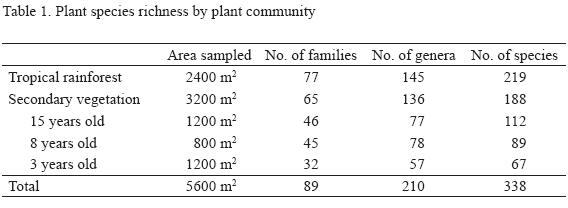
<body><![CDATA[<p align="justify"><font face="verdana" size="2">The only rainforest fragments recorded in the central region of the State of Veracruz are located in the municipality of Atzalan, at the "Sierra de Chiconquiaco" (Mountain Range at 19&#176;53'20" N, 97&#176;03'08" W and 19&#176;52'20" N, 97&#176;02'15" W), where the altitude ranges from 56 to 1799 m (<a href="#f1">Fig. 1</a>). Atzalan has several types of vegetation ecosystems, among the most notable is the tropical rainforest, however, it has been highly perturbed by human activities and it heavily endangered.</font></p>  	    <p align="center"><font face="verdana" size="2"><a name="f1"></a></font></p>  	    <p align="center"><font face="verdana" size="2"><img src="/img/revistas/abm/n109/a4f1.jpg"></font></p>  	    <p align="justify"><font face="verdana" size="2">This study was carried out in two rainforest fragments (35 ha and 15 ha) separated by the San Pedro River and surrounded by pastures, secondary vegetation and crops. The fragments are located between 600 and 800 m of altitude, among "San Pedro Altepepan", "La Vega del R&iacute;o San Pedro" and "El Quimite" villages.</font></p>  	    <p align="justify">&nbsp;</p> 	    <p align="justify"><font face="verdana" size="2">Description of the localities</font></p>      <p align="justify"><font face="verdana" size="2">La Vega del R&iacute;o San Pedro is located at 19&#176;52'31" N and 97&#176;03'20" W, and at an altitude of 630 m. Its population is 216 (96 women and 120 men), all are native residents from the region. The land is privately owned. San Pedro Altepepan is located at 19&#176;53'44" N and 97&#176;02'15" W, and at an altitude of 764 m. Its population is 312 inhabitants (146 women and 166 men). El Quimite is nearby, at 19&#176;52'55" N and 97&#176;02'00" W, at 876 m. Its population is 335 inhabitants (157 women and 178 men).</font></p>  	    <p align="justify"><font face="verdana" size="2">The land in the last two villages functions under the <i>ejido</i> system (communal land under the perpetual stewardship of rural people for agricultural activities). Eighty and sixty percent of the inhabitants are originally from San Pedro and El Quimite, respectively, while the others come from other communities.</font></p>  	    <p align="justify"><font face="verdana" size="2">In La Vega there are no public health services, so the inhabitants use traditional medicine to treat and cure illnesses. Another characteristic of this village is that the road to the nearest urban zone is in poor conditions, making access difficult. More than 90% of the homes are built of wood and there is no municipal wastewater drainage or drinking water services. The situation is different in San Pedro and El Quimite where there are health clinics and a greater dependence on allopathic medicine. Thus, the knowledge of traditional concepts and practices has changed, as modern medicine offers a greater number of treatments for illnesses. In many cases, traditional medicine has been almost completely replaced by allopathic medicine. Additionally, the road between these two villages and the nearest urban centers is better than that of La Vega, resulting in more road traffic.</font></p>  	    <p align="justify"><font face="verdana" size="2">Agriculture is the main economic activity in these localities. Corn, beans and coffee are the main crops, followed by bananas. Although most of the crops are for self&#45;consumption, part of the production is sold commercially. It is notable that 90% of the people interviewed depend entirely on their farm and farm products for their survival. However, considering the limited opportunities for making a living in the countryside, many of the inhabitants migrate, which results in a loss of interest and knowledge regarding plant resources.</font></p>  	    ]]></body>
<body><![CDATA[<p align="justify"><font face="verdana" size="2">Plant species inventory</font></p>  	    <p align="justify"><font face="verdana" size="2">The sampling area was determined by using maps, aerial orthophotos and field surveys to identify the location of tropical rainforest fragments and the surrounding secondary vegetation areas. We selected the only two fragments of tropical rainforest with no apparent human disturbance, along with three patches of secondary vegetation at different stages of regeneration (3, 8 and 15 years after abandonment according to the local people and vegetation composition) in order to evaluate vegetation use by the local inhabitants at its different stages. After this, we contacted the municipal authorities and community inhabitants to obtain permission to carry out the project. The sampling method by plot was used to assess the flora (Castillo&#45;Campos et al., 2008). Twelve 100 m<sup>2</sup> (10 &#215; 10 m) plots were set up in each forest fragment and regeneration stages of secondary vegetation to inventory the trees and shrubs. Within each plot, three 4 m<sup>2</sup> (2 &#215; 2 m) plots were randomly placed for sampling the herbaceous plants. In the 8&#45;year&#45;old patch of secondary vegetation, there were only eight plots due to its small size. The total area sampled was 5600 m<sup>2</sup>. To determine the proportion of inventoried species richness according to sampling effort, we used the following equation of the Clench model (Guevara and Dirzo, 1998): <i>tq</i> = q/(b(1 &#45; q)), where: q = Sn/(a/b) (a = growth rate of new species; b = parameter related to the shape of the curve; Sn = probability of finding a species). b = parameter related to the shape of the curve (Jim&eacute;nez&#45;Valverde and Hortal, 2003). Considering that the calculation of the inventoried portion of the total of the species in one zone must be greater than 70%, a proportion of 80% was considered for this study (<i>tq</i> = 0.8).</font></p>  	    <p align="justify"><font face="verdana" size="2">Each plant species within the plots was identified and its canopy cover was recorded. Plant canopy was measured using the cover&#45;abundance scale of Braun&#45;Blanquet modified by van der Maarel (1979) that includes the following categories according to the percentage of coverage: 1 (1&#45;3 individuals and less than 5% coverage), 2 (4&#45;10 individuals and less than 5%), 3 (more than 10 individuals and less than 5% ), 4 (less than 5% and not abundant), 5 (5&#45;12.5%), 6 (12.6&#45;25%), 7 (25.1&#45;50%), 8 (50.1&#45;75%), 9 (75.1&#45;100 %). One individual from each species was sampled as voucher specimen. Vouchers are deposited at the herbarium XAL of the Instituto de Ecolog&iacute;a A. C.</font></p> 	    <p align="justify">&nbsp;</p>      <p align="justify"><font face="verdana" size="2">Ethnobotanical analysis</font></p>  	    <p align="justify"><font face="verdana" size="2">To understand the socio&#45;economic background of informants and to identify the value and management of the rainforest from the perspective of the local population, as well as the current and potential use of the floristic resources, we completed 10 semi&#45;structured interviews in each village, 30 in total. The interviews consisted of 38 questions and were focused on socio&#45;demographic information, conservation and tropical forest values (esthetic, economical and environmental), knowledge and management of plant resources. Respondents were 15 men and 15 women, ranging from 32 to 90 years old. The interviewees living close to the rainforest fragments are mainly farmers and were referred to us by the local authorities as land owners. The sample is non&#45;statistical. However, the number of interviews was set up by using Bertaux's (1993) sample saturation criterion (i.e., when people do not provide new data and the information is repeated, it is considered that sufficient and representative data have been collected). The data obtained were subjected to a qualitative analysis to determine patterns of plant use and general points of view on this matter. Additionally, contingency tables (<i>&#967;</i><sup>2</sup> test) were carried out to identify differences in knowledge of useful flora and the use of flora among villages, men and women and the age of the interviewees. In the last case, the participants were divided according to age into the following groups: 31&#45;50, 51&#45;70 and 71&#45;100 years. Furthermore, Spearman's rank correlation test was used to assess the correlation between age groups and their knowledge of plants.</font></p>  	    <p align="justify"><font face="verdana" size="2">Moreover, to analyze the use of the flora, the "Use Value" (UV) was calculated, using the method of summary of uses (S&aacute;nchez et al., 2001), where each category of use is assigned a value of one (1). So, the UV for a species is the number of uses and categories mentioned by the people. We defined thirteen categories of use: condiment, construction, food, forage, fuel, handicrafts, medicinal, ornamental, production, ritual, timber, tool making and others.</font></p>  	    <p align="justify"><font face="verdana" size="2">In order to evaluate the relationship between the UV of the species and their ecological importance, we calculated an index of adjusted ecological importance value (AEIV), using the importance value index suggested by Lamprecht (1990) and modified for the purposes of this study. The AEIV is the sum of the relative frequency values (number of plots in which a species is recorded / the sum of all frequencies &#215; 100) and cover (the sum of all the cover values for a species / the sum of the cover values for all species &#215; 100). The data collected were analyzed with Kendall's correlation (<i>P</i> &lt; 0.05) using the program R 2.6.1.</font></p> 	    <p align="justify">&nbsp;</p>      <p align="justify"><font face="verdana" size="2">Potentially useful flora</font></p>  	    ]]></body>
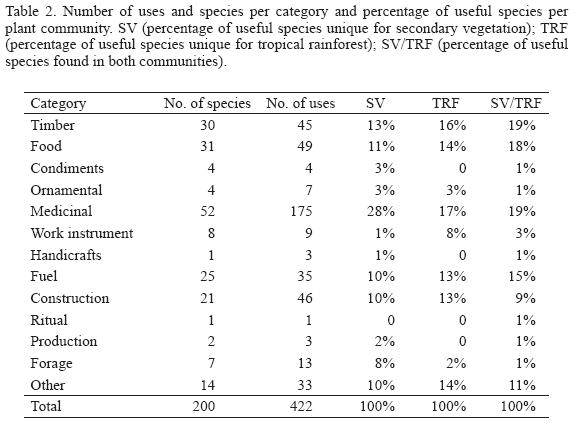
<body><![CDATA[<p align="justify"><font face="verdana" size="2">Potentially useful species are those plants which by their morphological characteristics (e. g. flower color, height, shape, fruits, etc.) might be useful in the diverse activities carried out by people and that have not yet been discovered by the local population. Other potentially useful plants include those species which current or potential use has been reported in the literature, but which have not been documented as such locally.</font></p>  	    <p align="justify"><font face="verdana" size="2">To identify potential flora, a thorough literature search was performed, focusing on the uses recorded for the species in our inventory. These species and their uses were checked against those mentioned by the interviewees to avoid duplicating entries. For some of the species included in the list of useful local plants, the uses mentioned in the literature were different from those mentioned by the local inhabitants; these were considered potentially useful and they were included in the final list of useful species.</font></p>  	    <p align="justify"><font face="verdana" size="2">From the species in the inventory which were missing any record of their use either in the literature or by the local population, species with potential as ornamental, live fences and shade plants were selected. These categories were chosen based on the opinion of respondents, appealing economical attraction for them, as well as visual aspects and plant morphology. The potential ornamental value was determined based on an analysis of the morphological and anatomical description of each plant, using the parameters proposed by Leszczy&ntilde;ska&#45;Borys (1990): shape and structure (architecture) of the entire plant, foliage, flowers and fruit. To identify the species with potential as living fences or shade plants, the criteria used were: woody, mainly trees with structures that favor the presence of wildlife (i.e., fruit, flowers, etc.), not toxic to livestock, as well as their growth and stem regeneration.</font></p>  	    <p>&nbsp;</p>  	    <p align="justify"><font face="verdana" size="2"><b>RESULTS AND DISCUSSION</b></font></p>  	    <p align="justify"><font face="verdana" size="2">Plant species inventory</font></p>  	    <p align="justify"><font face="verdana" size="2">We recorded 338 species belonging to 210 genera and 89 families over a total sampling area of 0.56 ha (<a href="#t1">Table 1</a>). Of this number, 117 species were exclusive of the rainforest, 109 of the secondary vegetation areas, and the remaining 112 occur in both plant communities.</font></p>  	    <p align="center"><font face="verdana" size="2"><a name="t1"></a></font></p>  	    <p align="center"><font face="verdana" size="2"><img src="/img/revistas/abm/n109/a4t1.jpg"></font></p>  	    <p align="justify"><font face="verdana" size="2">The tropical rainforest is home to the largest number of species, genera and families. For this type of vegetation 85% of the flora (<i>tq</i> = 0.85) was inventoried according to the equation of species proportion. For the secondary vegetation areas, a total of the 90% (<i>tq</i> = 0.9) of the plant species was inventoried in the three states of regeneration of the vegetation.</font></p>  	    ]]></body>
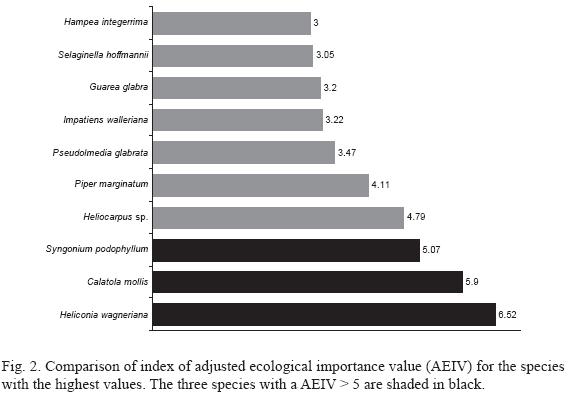
<body><![CDATA[<p align="justify"><font face="verdana" size="2">The total number of species recorded is higher, compared to that reported for the Lacandona region by Levy et al. (2000). These authors recorded a total of 757 species in 5.7 ha (144 plots, each 400 m<sup>2</sup>) regarding tropical rainforest and secondary vegetation areas at different stages of regeneration and using a similar methodology. On a smaller area, in this study, we recorded a 40% of the flora reported for the Lacandona region by Levy et al. (2000). This does not only shows the high plant species richness that is still found in the fragments of the Atzalan rainforest (<a href="#t1">Table 1</a>), but also in the secondary vegetation &#150;at least under the prevailing conditions in this region&#150; and their potential for the conservation of tropical plant diversity.</font></p> 	    <p align="justify">&nbsp;</p>      <p align="justify"><font face="verdana" size="2">Ethnobotanical analysis</font></p>  	    <p align="justify"><font face="verdana" size="2">Local use of the flora. A total of 160 useful plants, known locally, were recorded. These represent 47% of the flora inventoried, belonging to 123 genera and 67 families, and emphasizing the family Piperaceae as the most dominant one. According to G&oacute;mez&#45;Pompa (1966) and Scott et al. (2008), some species of this family are commonly used as ornamentals plants (mainly <i>Peperomia</i>), they are also used in traditional medicine, and as condiments (e.g., several species of <i>Piper</i>, with <i>P. auritum</i> as the most common). Four hundred and twenty two different uses in total were identified and grouped into 13 different categories (<a href="#t2">Table 2</a>). The medicine category had the highest number of species and uses. Many of these species may potentially be incorporated in pharmaceutical industry (Balick and Mendelsohn, 1992). So, these species may represent a new source of income, compatible with the rainforest conservation.</font></p>  	    <p align="center"><font face="verdana" size="2"><a name="t2"></a></font></p>  	    <p align="center"><font face="verdana" size="2"><img src="/img/revistas/abm/n109/a4t2.jpg"></font></p>  	    <p align="justify"><font face="verdana" size="2">Regarding the origin of products, the rainforest is the main provider of wood (16%), food (14%), fuel and construction material (13%). Secondary vegetation areas mainly provide medicinal products (28%) and forage (8%). The timber species used for food and fuel are found in both environments (<a href="#t2">Table 2</a>).</font></p>  	    <p align="justify"><font face="verdana" size="2">Twelve species had a high use value (UV = 4 and 5) and these were found in both, the rainforest and the secondary vegetation. The species with high use values are mainly used as timber and fuel, while those with a lower UV are mostly used as medicinal or food.</font></p>  	    <p align="justify"><font face="verdana" size="2">Ten species scored high (i.e. &gt; 3) using the index of adjusted ecological importance value (AEIV), and, from these, <i>Heliconia wagneriana</i>, <i>Calatola mollis</i> and <i>Syngonium podophyllum</i> had values greater than 5 (<a href="#f2">Fig. 2</a>). These three species are widely spread, the first one, in secondary vegetation areas, the second in rainforest fragments, whereas <i>S. podophyllum</i> occurs in both plant communities. However, only <i>H. wagneriana</i> was recorded for local use, with a low score use value (UV = 1). Finally, the most used species are not necessarily those with the greatest ecological importance. Kendall's rank analysis indicated that there was no correlation between the AEIV and UV of species (<i>z</i> = 1.68, <i>P</i> = 0.09154).</font></p>  	    <p align="center"><font face="verdana" size="2"><a name="f2"></a></font></p>  	    ]]></body>
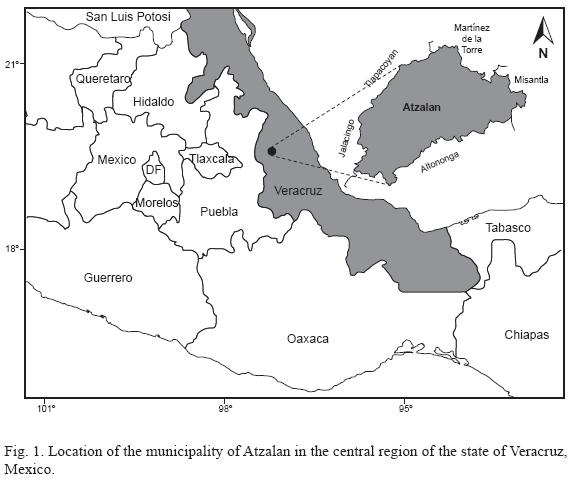
<body><![CDATA[<p align="center"><font face="verdana" size="2"><img src="/img/revistas/abm/n109/a4f2.jpg"></font></p>  	    <p align="justify"><font face="verdana" size="2">Galeano (2000) and Mar&iacute;n&#45;Corba et al. (2005) state that the UV can reflect a greater number of records by the interviewees than the true use value of a species. Thus the UV would be measuring multi&#45;use species more than their true value to the community. This represents a bias, as it occurs with the medicinal or the timber species which although there are only a few of them and they have a low use value (1), they are very important to the local population owing to their specific use. In this context, it is possible to distinguish the following terms:</font></p>  	    <blockquote> 		    <p align="justify"><font face="verdana" size="2">a) Degree of usefulness of one species or species multi&#45;use, this is the number of uses of a species regardless of their quality or importance to people, which would actually measure the use value. For example: <i>Magnolia mexicana</i> (UV = 4)<i>,</i> which is used not only as timber, but also as food, medicine and as a condiment.</font></p>  		    <p align="justify"><font face="verdana" size="2">b) Importance of the species or use value. This is the real value of a species, because although a species might have a single use, it is of paramount importance for the local population. This applies to <i>Oecopetalum mexicanum</i>, which even though its UV is low (1), it has a great importance in the families' diet.</font></p>  		    <p align="justify"><font face="verdana" size="2">c) Species use. Examples are many of the timber species, which in spite of their poor quality and the low durability are still used because of their availability and abundance, given the scarcity of higher quality species which could be used instead.</font></p> 	</blockquote>  	    <p align="justify"><font face="verdana" size="2">The first two terms are not determined by the abundance, frequency or availability of the species, but by the quality of the product and, where applicable, the number of uses and products that can be obtained from them. Particularly, the adoption of the term of importance of the species allows us to consider multiple uses, quality and the actual transcendence of species in people's subsistence.</font></p>  	    <p align="justify"><font face="verdana" size="2">As for life forms, the trees and herbaceous are the most used plants at 35% each. In the rainforest, useful tree species are as numerous as the herbaceous ones, while in secondary vegetation areas, the useful herbaceous are more numerous than useful trees. This is consistent with data reported by different studies about the plants in Mexico (Aguilar et al., 1994; Shackleton and Shackleton, 2004; Levy et al., 2006). This proportion may be a result of occurrence frequency of these biological forms in nature. Additionally, it is also likely that this outcome is related to the high number of species of the Fabaceae and Asteraceae families. According to Caballero et al. (1998) and more recently to Thomas et al. (2009), the useful species of these two families are probably more numerous than in any other botanical family.</font></p>  	    <p align="justify"><font face="verdana" size="2">Local knowledge of useful plants. From the 160 useful species identified, residents at La Vega use 100% of them, 98% of them in El Quimite, and 90% in San Pedro (no significant difference: <i>&#967;</i><sup>2</sup> = 0.442, 2 d.f., <i>P</i> = 0.8017). Overall, there was no significant difference between genders and their knowledge of the number of useful plants (<i>&#967;</i><sup>2</sup> = 4.499, 2 d.f., <i>P</i> = 0.1054). However, certain patterns were identified in La Vega as well as in El Quimite, where the men interviewed seemed to be more knowledgeable regarding the number and uses of plants than women. This is understandable if we consider that men know more about timber species, while women know more about medicinal plants. These differences have been partly explained as a consequence of the sexual division of labor in traditional societies (M&uuml;ller&#45;Schwarze, 2006). In this sense, Cadena Vargas et al. (2006) observed that a smaller number of species was reported by women than by men. In San Pedro, women had more knowledge of the useful species. This could be due to the constant male migration; according to <i>in situ</i> observation and interviewees, in San Pedro, there has been an increase in activities carried out by women in both, the field and also at home. Therefore, they have greater knowledge of local flora.</font></p>  	    <p align="justify"><font face="verdana" size="2">Moreover, it is important to notice that during the study, local people mentioned that the lack of access to secondary school, high school and college causes migration of young people, looking for opportunities of a better education, thus adopting the urban lifestyle and its practices. Alba (2004) states that those who go to work in the cities become more involved in the outside world and tend to give up some of the customs of their home community and traditional production techniques when they join the transnational job market. Over time, these patterns make people replace their traditions, and consequently knowledge and local traditions are getting lost (Namo, 2003).</font></p>  	    ]]></body>
<body><![CDATA[<p align="justify"><font face="verdana" size="2">Regarding the effect of the age of the interviewees, there were no significant differences and correlation between the interviewee's age groups and their knowledge of the useful flora (<i>&#967;</i><sup>2</sup> = 1.22, 2 d.f., <i>P</i> = 0.5429; Spearman, r = 0.024, <i>P</i> = 0.85). However, and again, we identified that older inhabitants are much more familiar with a larger number of useful species than their younger counterparts. Of the 30 interviews, three people ranging between 71 to 100 years old mentioned 68 useful plants on average (&#177;25.4), 13 people ranging 51 to 70 years old mentioned 54 species (&#177;25.3) and 14 people ranging 31 to 50 years old mentioned 51 species (&#177;20.9). These results match with those of Cadena Vargas et al. (2006) who found that the mean number of useful species known by age groups was greater among the older inhabitants. This confirms the assertion of Phillips and Gentry (1993) and Case et al. (2005), who mention that most of the traditional knowledge is based on older people&#180;s experience. However, in our study, the lack of differences among groups may indicate that age is not the only factor that affects knowledge of useful local flora. One possible explanation for this is that people not originally from the area are not as familiarized with the useful species as those who have lived there all their lives.</font></p>  	    <p align="justify"><font face="verdana" size="2">Given the results of our observations, it is possible to say that out of the three villages studied, La Vega has the most knowledgeable population in regards of the flora, its uses and values. One of the reasons supporting this assertion is that the limited communication between this and other villages has in a way, favored the population in preserving this knowledge. This supports the hypothesis of Levy et al. (1997) and Case et al. (2005) that local knowledge of botany increases with increasing geographic isolation, as does the preservation of traditional knowledge of botany. Thus, it is in the more isolated sites where the flora is used more frequently and intensively, as indicated by our results. Paradoxically, La Vega is the village most likely to lose its rainforest since 90% of the inhabitants think that it is necessary to cut down part of the rainforest to make way for orchards. This idea is a direct reflection of the precarious economic situation of this village. Although they recognize the importance of the rainforest, the economic pressure makes the deforestation necessary, in order for them to be able to plant and harvest crops, thus improving their economic situation. Ecological and social changes produced by economic and technological change have resulted in a profound transformation in the value assigned to plants (Case et al., 2005; Quinlan and Quinlan, 2007).</font></p>  	    <p align="justify"><font face="verdana" size="2">It is necessary to emphasize that we are in no way suggesting that rural communities should be deprived of education opportunities, or remain isolated from urban areas, but rather the opposite; we would like to see a different approach towards education, where local knowledge is valued and younger generations are encouraged to preserve it, as they also learn and apply scientific principles. This would contribute to the rational use of the environment and the continued stewardship of traditional knowledge and practices.</font></p>  	    <p align="justify"><font face="verdana" size="2">Potentially useful plants. From the literature, a total of 40 potentially useful species were identified. Added to the 160 locally used species, this gives a total of 200 species with at least one use recorded. These 200 species belong to 148 genera and 69 families (<a href="/img/revistas/abm/n109/html/a4appendix.html" target="_blank">Appendix</a>), which represent 59% of the flora we inventoried. The Piperaceae family was the best represented, with 13 species, followed by Asteraceae and Euphorbiaceae, with 11 and nine species respectively, and Fabaceae (six). The most frequent genera were <i>Piper</i> (eight species) and <i>Tillandsia</i> (five). Of the 200 useful species, 39 of them had potential uses not previously recorded in literature: 19 of them as ornamentals, 22 as living fences and nine for crop shade.</font></p>  	    <p align="justify"><font face="verdana" size="2">Of the 160 locally known useful species, 60% have other uses in addition to those mentioned by the interviewees, and these species were therefore considered potentially useful to the local population. There was no use associated with 38% of the inventoried flora in the literature or even by the interviewees. Of this subset of the flora, 18 species are potentially useful as ornamentals, living fences and shade plants. These plants belong to 13 genera and 10 families, of which the family Araceae had the most representatives.</font></p>  	    <p align="justify"><font face="verdana" size="2">The enormous ornamental potential of the flora recorded is noteworthy and, once its reproductive efficiency and propagation mechanisms are known, these species could be considered for domestication and introduction into the market for commercialization. Ibarra et al. (1997), Mej&iacute;a and Espinosa et al. (2003), Ram&iacute;rez (2005), Corona Nava&#45;Esparza and Chimal (2006), Rend&oacute;n (2007) and Munguia&#45;Lino et al. (2010) present a clear case of the importance of phytogenetic resources in Mexico, and particularly of cultivated ornamentals, cultivated native species and those with potential for cultivation. Only in the Tuxtla region 12.4% of all flowering plant species are orchids, with a highly value in the market (Ibarra et al., 1997). Rzedowski (1995) states that Mexico produces around 40 ornamental species for which there is worldwide demand, and that 300 ornamental species are planted in public and family gardens, as well as along the streets of Mexico, although they do not appear in any horticultural catalog. There are an estimated 1,000 ornamental Mexican species being used and a further 1,000 with potential for use, resulting in a total of 2,000 cultivated ornamental species (Rzedowski, 1995). Mexico, not surprisingly, is therefore characterized as a country that makes ample use of its ornamental resources. However, the national inventory has not yet been finished and the state of conservation of the flora has not yet been evaluated satisfactorily.</font></p>  	    <p align="justify"><font face="verdana" size="2">We recorded 27 species with the potential to be used as living fences. In the State of Veracruz, Avenda&ntilde;o and Acosta (2000) recorded 218 species of vascular plants with this use. Of these, 9% are introduced and 88% of them have other uses as well; the trees were the most used life form and the legumes the best represented family. Those species are also commonly used for other important purposes such as food, forage, medicine, ornamentation, construction, fuel and for beekeeping (Avenda&ntilde;o and Acosta, 2000; Pinto&#45;Ruiz et al., 2010). In this study, several of the species proposed as living fences and crop shade are mainly used for timber and food. The incorporation of the potentially useful species of the rainforest into local productive systems is now crucial in order to ensure their use and conservation in the long term.</font></p>  	    <p>&nbsp;</p>  	    <p align="justify"><font face="verdana" size="2"><b>ACKNOWLEDGEMENTS</b></font></p>  	    <p align="justify"><font face="verdana" size="2">We extend our thanks to the people of San Pedro, La Vega and El Quimite for their collaboration and support during this project. We are grateful to Javier Laborde Doval&iacute; for his comments on the manuscript, Roger Guevara Hern&aacute;ndez for his assisted with the statistical analysis and Javier Barrientos Villalobos for support in image editing. Arturo G&oacute;mez Pompa sowed the first seed of this research.. We thank Lamberto Arag&oacute;n Axomulco, Jes&uacute;s Pale Pale and Julia Hern&aacute;ndez Villa for helping with the field work. We extend our thanks to Kristyna Baloghova and Salvador Guerra to revise the English of the manuscript.</font></p>  	    ]]></body>
<body><![CDATA[<p>&nbsp;</p>  	    <p align="justify"><font face="verdana" size="2"><b>LITERATURE CITED</b></font></p>  	    <!-- ref --><p align="justify"><font face="verdana" size="2">Alba, F. 2004. El Tratado de Libre Comercio, la migraci&oacute;n y las pol&iacute;ticas migratorias. In: Casares, R. and H. Sorbazo (eds.). Diez a&ntilde;os del TLCAN en M&eacute;xico, una perspectiva anal&iacute;tica. Fondo de Cultura Econ&oacute;mica. Mexico, D.F., Mexico. pp. 215&#45;242.    &nbsp;&nbsp;&nbsp;&nbsp;&nbsp;&nbsp;&nbsp;&nbsp;[&#160;<a href="javascript:void(0);" onclick="javascript: window.open('/scielo.php?script=sci_nlinks&ref=053998&pid=S0187-7151201400040000400001&lng=','','width=640,height=500,resizable=yes,scrollbars=1,menubar=yes,');">Links</a>&#160;]<!-- end-ref --></font></p>  	    <!-- ref --><p align="justify"><font face="verdana" size="2">Aguilar, A., J. R. Camacho, S. Chino, P. Jacquez and M. E. L&oacute;pez. 1994. Herbario medicinal del IMSS. Informaci&oacute;n etnobot&aacute;nica. Instituto Mexicano del Seguro Social. Mexico, D.F., Mexico. 253 pp.    &nbsp;&nbsp;&nbsp;&nbsp;&nbsp;&nbsp;&nbsp;&nbsp;[&#160;<a href="javascript:void(0);" onclick="javascript: window.open('/scielo.php?script=sci_nlinks&ref=054000&pid=S0187-7151201400040000400002&lng=','','width=640,height=500,resizable=yes,scrollbars=1,menubar=yes,');">Links</a>&#160;]<!-- end-ref --></font></p>  	    <!-- ref --><p align="justify"><font face="verdana" size="2">Anonymous, 2007. Secretar&iacute;a de Medio Ambiente y Recursos Naturales. <a href="http://www.semarnat.gob.mx/Pages/Inicio.aspx" target="_blank">http://www.semarnat.gob.mx/Pages/Inicio.aspx</a></font>&nbsp;&nbsp;&nbsp;&nbsp;&nbsp;&nbsp;&nbsp;&nbsp;[&#160;<a href="javascript:void(0);" onclick="javascript: window.open('/scielo.php?script=sci_nlinks&ref=054002&pid=S0187-7151201400040000400003&lng=','','width=640,height=500,resizable=yes,scrollbars=1,menubar=yes,');">Links</a>&#160;]<!-- end-ref --><!-- ref --><p align="justify"><font face="verdana" size="2">Avenda&ntilde;o, S. and I. Acosta. 2000. Plantas utilizadas como cercas vivas en el estado de Veracruz. Madera y Bosques 6: 55&#45;71.    &nbsp;&nbsp;&nbsp;&nbsp;&nbsp;&nbsp;&nbsp;&nbsp;[&#160;<a href="javascript:void(0);" onclick="javascript: window.open('/scielo.php?script=sci_nlinks&ref=054003&pid=S0187-7151201400040000400004&lng=','','width=640,height=500,resizable=yes,scrollbars=1,menubar=yes,');">Links</a>&#160;]<!-- end-ref --></font></p>  	    <!-- ref --><p align="justify"><font face="verdana" size="2">Balick, M. J. and R. Mendelsohn. 1992. Assessing the economic value of traditional medicines from tropical rain forest. Conserv. Biol. 6: 128&#45;130</font>&nbsp;&nbsp;&nbsp;&nbsp;&nbsp;&nbsp;&nbsp;&nbsp;[&#160;<a href="javascript:void(0);" onclick="javascript: window.open('/scielo.php?script=sci_nlinks&ref=054005&pid=S0187-7151201400040000400005&lng=','','width=640,height=500,resizable=yes,scrollbars=1,menubar=yes,');">Links</a>&#160;]<!-- end-ref --><!-- ref --><p align="justify"><font face="verdana" size="2">Bawa, K. S., W. J. Kress, M. N. Nadkarni and S. Lele. 2004. Beyond paradise&#45;meeting the challenges in tropical biology in the 21<sup>st</sup> century. Biotropica 36: 437&#45;446.    &nbsp;&nbsp;&nbsp;&nbsp;&nbsp;&nbsp;&nbsp;&nbsp;[&#160;<a href="javascript:void(0);" onclick="javascript: window.open('/scielo.php?script=sci_nlinks&ref=054006&pid=S0187-7151201400040000400006&lng=','','width=640,height=500,resizable=yes,scrollbars=1,menubar=yes,');">Links</a>&#160;]<!-- end-ref --></font></p>  	    <!-- ref --><p align="justify"><font face="verdana" size="2">Bertaux, D. 1993. Los relatos de vida en el an&aacute;lisis social. In: Aceves Lozano, J. (ed.). Historial y fuente oral. Instituto de Investigaciones Dr. Jos&eacute; Maria Mora&#45;Universidad Nacional Aut&oacute;noma de M&eacute;xico. Mexico, D.F., Mexico. pp. 136&#45;148.    &nbsp;&nbsp;&nbsp;&nbsp;&nbsp;&nbsp;&nbsp;&nbsp;[&#160;<a href="javascript:void(0);" onclick="javascript: window.open('/scielo.php?script=sci_nlinks&ref=054008&pid=S0187-7151201400040000400007&lng=','','width=640,height=500,resizable=yes,scrollbars=1,menubar=yes,');">Links</a>&#160;]<!-- end-ref --></font></p>  	    <!-- ref --><p align="justify"><font face="verdana" size="2">Burgos&#45;Hern&aacute;ndez, M. 2007. Comparaci&oacute;n de la riqueza de especies de flora vascular en dos unidades del paisaje en el municipio de Atzalan, Veracruz. Thesis. Universidad Aut&oacute;noma Metropolitana. Unidad Xochimilco. Mexico, D.F. Mexico. 44 pp.    &nbsp;&nbsp;&nbsp;&nbsp;&nbsp;&nbsp;&nbsp;&nbsp;[&#160;<a href="javascript:void(0);" onclick="javascript: window.open('/scielo.php?script=sci_nlinks&ref=054010&pid=S0187-7151201400040000400008&lng=','','width=640,height=500,resizable=yes,scrollbars=1,menubar=yes,');">Links</a>&#160;]<!-- end-ref --></font></p>  	    <!-- ref --><p align="justify"><font face="verdana" size="2">Caballero, J., A. Casas, L. Cortes and C. Mapes. 1998. Patrones en el conocimiento, uso y manejo de las plantas en pueblos ind&iacute;genas de M&eacute;xico. Estudios Atacame&ntilde;os 16: 181&#45;195.    &nbsp;&nbsp;&nbsp;&nbsp;&nbsp;&nbsp;&nbsp;&nbsp;[&#160;<a href="javascript:void(0);" onclick="javascript: window.open('/scielo.php?script=sci_nlinks&ref=054012&pid=S0187-7151201400040000400009&lng=','','width=640,height=500,resizable=yes,scrollbars=1,menubar=yes,');">Links</a>&#160;]<!-- end-ref --></font></p>  	    <!-- ref --><p align="justify"><font face="verdana" size="2">Cadena Vargas, C., M. D&iacute;azgranados Cadelo, and H. Bernal Malag&oacute;n. 2006. Plantas &uacute;tiles para la elaboraci&oacute;n de artesan&iacute;as de la comunidad ind&iacute;gena monifue amena (Amazonas, Colombia). Universitas Scientiarum 12: 97&#45;116.    &nbsp;&nbsp;&nbsp;&nbsp;&nbsp;&nbsp;&nbsp;&nbsp;[&#160;<a href="javascript:void(0);" onclick="javascript: window.open('/scielo.php?script=sci_nlinks&ref=054014&pid=S0187-7151201400040000400010&lng=','','width=640,height=500,resizable=yes,scrollbars=1,menubar=yes,');">Links</a>&#160;]<!-- end-ref --></font></p>  	    ]]></body>
<body><![CDATA[<!-- ref --><p align="justify"><font face="verdana" size="2">Case, J. R., G. F. Paulli and D. D. Soejarto. 2005. Factors in maintaining indigenous knowledge among ethnic communities of Manus Island. Econ. Bot. 59: 356&#45;365.    &nbsp;&nbsp;&nbsp;&nbsp;&nbsp;&nbsp;&nbsp;&nbsp;[&#160;<a href="javascript:void(0);" onclick="javascript: window.open('/scielo.php?script=sci_nlinks&ref=054016&pid=S0187-7151201400040000400011&lng=','','width=640,height=500,resizable=yes,scrollbars=1,menubar=yes,');">Links</a>&#160;]<!-- end-ref --></font></p>  	    <!-- ref --><p align="justify"><font face="verdana" size="2">Castillo&#45;Campos, G., G. Halffter and C. E. Moreno. 2008. Primary and secondary vegetation patches as contributors to floristic diversity in a tropical deciduous forest landscape. Biodivers. Conserv. 17: 1701&#45;1714.    &nbsp;&nbsp;&nbsp;&nbsp;&nbsp;&nbsp;&nbsp;&nbsp;[&#160;<a href="javascript:void(0);" onclick="javascript: window.open('/scielo.php?script=sci_nlinks&ref=054018&pid=S0187-7151201400040000400012&lng=','','width=640,height=500,resizable=yes,scrollbars=1,menubar=yes,');">Links</a>&#160;]<!-- end-ref --></font></p>  	    <!-- ref --><p align="justify"><font face="verdana" size="2">Corona Nava&#45;Esparza, V. and H. A. Chimal. 2006. Plantas mexicanas con potencial ornamental. Universidad Aut&oacute;noma Metropolitana, Divisi&oacute;n de Ciencias Biol&oacute;gicas de la Salud, Serie Acad&eacute;micos CBS 60. Mexico, D.F. Mexico. 626 pp.    &nbsp;&nbsp;&nbsp;&nbsp;&nbsp;&nbsp;&nbsp;&nbsp;[&#160;<a href="javascript:void(0);" onclick="javascript: window.open('/scielo.php?script=sci_nlinks&ref=054020&pid=S0187-7151201400040000400013&lng=','','width=640,height=500,resizable=yes,scrollbars=1,menubar=yes,');">Links</a>&#160;]<!-- end-ref --></font></p>  	    <!-- ref --><p align="justify"><font face="verdana" size="2">Cronquist, A. 1988. The evolution and classification of flowering plants. The New York Botanical Garden. New York, USA. 1968 pp.    &nbsp;&nbsp;&nbsp;&nbsp;&nbsp;&nbsp;&nbsp;&nbsp;[&#160;<a href="javascript:void(0);" onclick="javascript: window.open('/scielo.php?script=sci_nlinks&ref=054022&pid=S0187-7151201400040000400014&lng=','','width=640,height=500,resizable=yes,scrollbars=1,menubar=yes,');">Links</a>&#160;]<!-- end-ref --></font></p>  	    <!-- ref --><p align="justify"><font face="verdana" size="2">D&iacute;az&#45;Gallegos, J. R., M. Jean&#45;Fran&#231;ois and A. Vel&aacute;zquez. 2010. Trends of tropical deforestation in Southeast Mexico. Singap. J. Trop. Geo. 31: 180&#45;196.    &nbsp;&nbsp;&nbsp;&nbsp;&nbsp;&nbsp;&nbsp;&nbsp;[&#160;<a href="javascript:void(0);" onclick="javascript: window.open('/scielo.php?script=sci_nlinks&ref=054024&pid=S0187-7151201400040000400015&lng=','','width=640,height=500,resizable=yes,scrollbars=1,menubar=yes,');">Links</a>&#160;]<!-- end-ref --></font></p>  	    ]]></body>
<body><![CDATA[<!-- ref --><p align="justify"><font face="verdana" size="2">Delvaux, C., B. Sinsin, F. Darchambeau and P. Van Damme. 2009. Recovery from bark harvesting of 12 medicinal tree species in Benin, West Africa. J. App. Ecol. 46: 703&#45;712.    &nbsp;&nbsp;&nbsp;&nbsp;&nbsp;&nbsp;&nbsp;&nbsp;[&#160;<a href="javascript:void(0);" onclick="javascript: window.open('/scielo.php?script=sci_nlinks&ref=054026&pid=S0187-7151201400040000400016&lng=','','width=640,height=500,resizable=yes,scrollbars=1,menubar=yes,');">Links</a>&#160;]<!-- end-ref --></font></p>  	    <!-- ref --><p align="justify"><font face="verdana" size="2">Espejo&#45;Serna, A., A. R. L&oacute;pez&#45;Ferrari and I. Ram&iacute;rez&#45;Morillo. 2005. Bromeliaceae. Fasc&iacute;culo 136. In: Sosa, V. &amp; A. G&oacute;mez&#45;Pompa (eds.). Flora de Veracruz, Instituto de Ecolog&iacute;a, A.C. Xalapa, Mexico. pp. 307.    &nbsp;&nbsp;&nbsp;&nbsp;&nbsp;&nbsp;&nbsp;&nbsp;[&#160;<a href="javascript:void(0);" onclick="javascript: window.open('/scielo.php?script=sci_nlinks&ref=054028&pid=S0187-7151201400040000400017&lng=','','width=640,height=500,resizable=yes,scrollbars=1,menubar=yes,');">Links</a>&#160;]<!-- end-ref --></font></p>  	    <!-- ref --><p align="justify"><font face="verdana" size="2">Espinosa, F. A., R. H. Gonz&aacute;lez and M. J. Mej&iacute;a. 2003. La comercializaci&oacute;n de plantas en peligro de extinci&oacute;n. In: Mej&iacute;a M. J. and F. A. Espinosa (eds.). Plantas nativas de M&eacute;xico con potencial ornamental. Universidad Aut&oacute;noma de Chapingo. Estado de Mexico, Mexico. pp. 199&#45;217.    &nbsp;&nbsp;&nbsp;&nbsp;&nbsp;&nbsp;&nbsp;&nbsp;[&#160;<a href="javascript:void(0);" onclick="javascript: window.open('/scielo.php?script=sci_nlinks&ref=054030&pid=S0187-7151201400040000400018&lng=','','width=640,height=500,resizable=yes,scrollbars=1,menubar=yes,');">Links</a>&#160;]<!-- end-ref --></font></p>  	    <!-- ref --><p align="justify"><font face="verdana" size="2">Galeano, G. 2000. Forest use at the Pacific Coast of Choco, Colombia: a quantitative approach. Econ. Bot. 54: 358&#45;376.    &nbsp;&nbsp;&nbsp;&nbsp;&nbsp;&nbsp;&nbsp;&nbsp;[&#160;<a href="javascript:void(0);" onclick="javascript: window.open('/scielo.php?script=sci_nlinks&ref=054032&pid=S0187-7151201400040000400019&lng=','','width=640,height=500,resizable=yes,scrollbars=1,menubar=yes,');">Links</a>&#160;]<!-- end-ref --></font></p>  	    <!-- ref --><p align="justify"><font face="verdana" size="2">G&oacute;mez&#45;Pompa, A. 1966. Estudios bot&aacute;nicos en la regi&oacute;n Misantla, Veracruz. Instituto Mexicano de Recursos Naturales Renovables. Mexico, D.F., Mexico. 173 pp.    &nbsp;&nbsp;&nbsp;&nbsp;&nbsp;&nbsp;&nbsp;&nbsp;[&#160;<a href="javascript:void(0);" onclick="javascript: window.open('/scielo.php?script=sci_nlinks&ref=054034&pid=S0187-7151201400040000400020&lng=','','width=640,height=500,resizable=yes,scrollbars=1,menubar=yes,');">Links</a>&#160;]<!-- end-ref --></font></p>  	    ]]></body>
<body><![CDATA[<!-- ref --><p align="justify"><font face="verdana" size="2">Guevara, R. and R. Dirzo. 1998. A rapid method for the assessment of the macromycota. The fungal community of an evergreen cloud forest as an example. Can. J. Bot. 76(4): 596&#45;601.    &nbsp;&nbsp;&nbsp;&nbsp;&nbsp;&nbsp;&nbsp;&nbsp;[&#160;<a href="javascript:void(0);" onclick="javascript: window.open('/scielo.php?script=sci_nlinks&ref=054036&pid=S0187-7151201400040000400021&lng=','','width=640,height=500,resizable=yes,scrollbars=1,menubar=yes,');">Links</a>&#160;]<!-- end-ref --></font></p>  	    <!-- ref --><p align="justify"><font face="verdana" size="2">Guevara, S. and A. Lira&#45;Noriega. 2004. De los pastos de la selva a la selva de los pastos: la introducci&oacute;n de la ganader&iacute;a en M&eacute;xico. Pastos 34: 109&#45;150.    &nbsp;&nbsp;&nbsp;&nbsp;&nbsp;&nbsp;&nbsp;&nbsp;[&#160;<a href="javascript:void(0);" onclick="javascript: window.open('/scielo.php?script=sci_nlinks&ref=054038&pid=S0187-7151201400040000400022&lng=','','width=640,height=500,resizable=yes,scrollbars=1,menubar=yes,');">Links</a>&#160;]<!-- end-ref --></font></p>  	    <!-- ref --><p align="justify"><font face="verdana" size="2">Ibarra&#45;Manr&iacute;quez, G., M. Ricker, G. Angeles, S. Sinaca and M. A. Sinaca. 1997. Useful plants of the Los Tuxtlas rain forest (Veracruz, M&eacute;xico): considerations of their market potential. Econ. Bot. 51: 362&#45;376.    &nbsp;&nbsp;&nbsp;&nbsp;&nbsp;&nbsp;&nbsp;&nbsp;[&#160;<a href="javascript:void(0);" onclick="javascript: window.open('/scielo.php?script=sci_nlinks&ref=054040&pid=S0187-7151201400040000400023&lng=','','width=640,height=500,resizable=yes,scrollbars=1,menubar=yes,');">Links</a>&#160;]<!-- end-ref --></font></p>  	    <!-- ref --><p align="justify"><font face="verdana" size="2">Jim&eacute;nez&#45;Valverde, A. and J. Hortal. 2003. Las curvas de acumulaci&oacute;n de especies y la necesidad de evaluar la calidad de los inventarios biol&oacute;gicos. Rev. Ib&eacute;. Aracnol. 8:151&#45;161.    &nbsp;&nbsp;&nbsp;&nbsp;&nbsp;&nbsp;&nbsp;&nbsp;[&#160;<a href="javascript:void(0);" onclick="javascript: window.open('/scielo.php?script=sci_nlinks&ref=054042&pid=S0187-7151201400040000400024&lng=','','width=640,height=500,resizable=yes,scrollbars=1,menubar=yes,');">Links</a>&#160;]<!-- end-ref --></font></p>  	    <!-- ref --><p align="justify"><font face="verdana" size="2">Lamprecht, H. 1990. Silvicultura en los tr&oacute;picos. Los ecosistemas forestales en los bosques tropicales y sus especies arb&oacute;reas, posibilidades y m&eacute;todos para un aprovechamiento sostenido. Eschborn, GTZ. Rossdorf, Germany. 335 pp.    &nbsp;&nbsp;&nbsp;&nbsp;&nbsp;&nbsp;&nbsp;&nbsp;[&#160;<a href="javascript:void(0);" onclick="javascript: window.open('/scielo.php?script=sci_nlinks&ref=054044&pid=S0187-7151201400040000400025&lng=','','width=640,height=500,resizable=yes,scrollbars=1,menubar=yes,');">Links</a>&#160;]<!-- end-ref --></font></p>  	    ]]></body>
<body><![CDATA[<!-- ref --><p align="justify"><font face="verdana" size="2">Leszczy&ntilde;ska&#45;Borys, H. 1990. Introducci&oacute;n a la horticultura ornamental. Universidad Popular Aut&oacute;noma del Estado de Puebla. Escuela de Fitotecnia. Puebla, Mexico. 42 pp.    &nbsp;&nbsp;&nbsp;&nbsp;&nbsp;&nbsp;&nbsp;&nbsp;[&#160;<a href="javascript:void(0);" onclick="javascript: window.open('/scielo.php?script=sci_nlinks&ref=054046&pid=S0187-7151201400040000400026&lng=','','width=640,height=500,resizable=yes,scrollbars=1,menubar=yes,');">Links</a>&#160;]<!-- end-ref --></font></p>  	    <!-- ref --><p align="justify"><font face="verdana" size="2">Levy, A., A. D. Brown, H. R. Grau and A. Grau. 1997. Local knowledge and the use of plants in rural communities in the montane forest of northwestern Argentina. Managing fragile ecosystems in the Andes. Mt. Res. Dev. 17: 263&#45;271.    &nbsp;&nbsp;&nbsp;&nbsp;&nbsp;&nbsp;&nbsp;&nbsp;[&#160;<a href="javascript:void(0);" onclick="javascript: window.open('/scielo.php?script=sci_nlinks&ref=054048&pid=S0187-7151201400040000400027&lng=','','width=640,height=500,resizable=yes,scrollbars=1,menubar=yes,');">Links</a>&#160;]<!-- end-ref --></font></p>  	    <!-- ref --><p align="justify"><font face="verdana" size="2">Levy, S. I., F. A. Dur&aacute;n and C. D. S&aacute;nchez. 2000. Contribuci&oacute;n al conocimiento de la flora &uacute;til de la selva Lacandona. Conservaci&oacute;n Internacional M&eacute;xico A. C. Tuxtla Guti&eacute;rrez, Mexico. 32 pp.    &nbsp;&nbsp;&nbsp;&nbsp;&nbsp;&nbsp;&nbsp;&nbsp;[&#160;<a href="javascript:void(0);" onclick="javascript: window.open('/scielo.php?script=sci_nlinks&ref=054050&pid=S0187-7151201400040000400028&lng=','','width=640,height=500,resizable=yes,scrollbars=1,menubar=yes,');">Links</a>&#160;]<!-- end-ref --></font></p>  	    <!-- ref --><p align="justify"><font face="verdana" size="2">Levy, S. I., J. R. Aguirre Rivera, J. D. Garc&iacute;a P&eacute;rez and M. M. Mart&iacute;nez Romero. 2006. Aspectos flor&iacute;sticos de Lacanh&aacute; Chansayab, Selva Lacandona, Chiapas. Act. Bot. Mex. 77: 69&#45;98</font>&nbsp;&nbsp;&nbsp;&nbsp;&nbsp;&nbsp;&nbsp;&nbsp;[&#160;<a href="javascript:void(0);" onclick="javascript: window.open('/scielo.php?script=sci_nlinks&ref=054052&pid=S0187-7151201400040000400029&lng=','','width=640,height=500,resizable=yes,scrollbars=1,menubar=yes,');">Links</a>&#160;]<!-- end-ref --><!-- ref --><p align="justify"><font face="verdana" size="2">Mar&iacute;n&#45;Corba, C., D. C&aacute;rdenas&#45;L&oacute;pez and S. Su&aacute;rez&#45;Su&aacute;rez. 2005. Utilidad del valor de uso en etnobot&aacute;nica. Estudio en el Departamento de Putumayo (Colombia). Caldasia 27(1): 89&#45;101.    &nbsp;&nbsp;&nbsp;&nbsp;&nbsp;&nbsp;&nbsp;&nbsp;[&#160;<a href="javascript:void(0);" onclick="javascript: window.open('/scielo.php?script=sci_nlinks&ref=054053&pid=S0187-7151201400040000400030&lng=','','width=640,height=500,resizable=yes,scrollbars=1,menubar=yes,');">Links</a>&#160;]<!-- end-ref --></font></p>  	    <!-- ref --><p align="justify"><font face="verdana" size="2">Mej&iacute;a, M. J. and F. A. Espinosa. 2003. Plantas nativas de M&eacute;xico con potencial ornamental. Universidad Aut&oacute;noma de Chihuahua. Chihuahua, Mexico. 217 pp.    &nbsp;&nbsp;&nbsp;&nbsp;&nbsp;&nbsp;&nbsp;&nbsp;[&#160;<a href="javascript:void(0);" onclick="javascript: window.open('/scielo.php?script=sci_nlinks&ref=054055&pid=S0187-7151201400040000400031&lng=','','width=640,height=500,resizable=yes,scrollbars=1,menubar=yes,');">Links</a>&#160;]<!-- end-ref --></font></p>  	    <!-- ref --><p align="justify"><font face="verdana" size="2">Mickel, J. T. and A. R. Smith. 2004. The Pteridophytes of Mexico. Memoirs of the New York Botanical Garden Press. Vol. 88. New York, U.S.A. 1054 pp.    &nbsp;&nbsp;&nbsp;&nbsp;&nbsp;&nbsp;&nbsp;&nbsp;[&#160;<a href="javascript:void(0);" onclick="javascript: window.open('/scielo.php?script=sci_nlinks&ref=054057&pid=S0187-7151201400040000400032&lng=','','width=640,height=500,resizable=yes,scrollbars=1,menubar=yes,');">Links</a>&#160;]<!-- end-ref --></font></p>  	    <!-- ref --><p align="justify"><font face="verdana" size="2">Mirjam, A. F., Ros&#45;Tonen and K. F. Wiersum. 2005. The scope for improving rural livelihoods through non&#45;timber forest products: an evolving research agenda. Forests, Trees and Livelihoods 15: 129&#45;148.    &nbsp;&nbsp;&nbsp;&nbsp;&nbsp;&nbsp;&nbsp;&nbsp;[&#160;<a href="javascript:void(0);" onclick="javascript: window.open('/scielo.php?script=sci_nlinks&ref=054059&pid=S0187-7151201400040000400033&lng=','','width=640,height=500,resizable=yes,scrollbars=1,menubar=yes,');">Links</a>&#160;]<!-- end-ref --></font></p>  	    <!-- ref --><p align="justify"><font face="verdana" size="2">M&uuml;ller&#45;Schwarze, N. K. 2006. Knowledge and categorization as adaptations to life in Panama in the twenty&#45;first century. Econ. Bot. 60: 321&#45;334.    &nbsp;&nbsp;&nbsp;&nbsp;&nbsp;&nbsp;&nbsp;&nbsp;[&#160;<a href="javascript:void(0);" onclick="javascript: window.open('/scielo.php?script=sci_nlinks&ref=054061&pid=S0187-7151201400040000400034&lng=','','width=640,height=500,resizable=yes,scrollbars=1,menubar=yes,');">Links</a>&#160;]<!-- end-ref --></font></p>  	    <!-- ref --><p align="justify"><font face="verdana" size="2">Mungu&iacute;a&#45;Lino, G., L. M. V&aacute;zquez&#45;Garc&iacute;a and J. A. L&oacute;pez&#45;Sandoval. 2010. Plantas silvestres ornamentales comercializadas en los mercados de la flor de Tenalcingo y Jamaica, M&eacute;xico. Polibot&aacute;nica 29: 281&#45;308.    &nbsp;&nbsp;&nbsp;&nbsp;&nbsp;&nbsp;&nbsp;&nbsp;[&#160;<a href="javascript:void(0);" onclick="javascript: window.open('/scielo.php?script=sci_nlinks&ref=054063&pid=S0187-7151201400040000400035&lng=','','width=640,height=500,resizable=yes,scrollbars=1,menubar=yes,');">Links</a>&#160;]<!-- end-ref --></font></p>  	    <!-- ref --><p align="justify"><font face="verdana" size="2">Namo, M. G. 2003. Nuevas propuestas para la gesti&oacute;n educativa. Modelo de gesti&oacute;n para la satisfacci&oacute;n de las necesidades b&aacute;sicas de aprendizaje. Direcci&oacute;n General de Materiales y M&eacute;todos Educativos de la Subsecretaria de Educaci&oacute;n B&aacute;sica y Normal. Secretar&iacute;a de Educaci&oacute;n P&uacute;blica. Mexico, D.F. Mexico. 119 pp.    &nbsp;&nbsp;&nbsp;&nbsp;&nbsp;&nbsp;&nbsp;&nbsp;[&#160;<a href="javascript:void(0);" onclick="javascript: window.open('/scielo.php?script=sci_nlinks&ref=054065&pid=S0187-7151201400040000400036&lng=','','width=640,height=500,resizable=yes,scrollbars=1,menubar=yes,');">Links</a>&#160;]<!-- end-ref --></font></p>  	    <!-- ref --><p align="justify"><font face="verdana" size="2">Phillips, O. and A. H. Gentry. 1993. The useful plants of Tambopata, Per&uacute;: I. Statistical hypothesis tests with a new quantitative technique. Econ. Bot. 47(19): 15&#45;32.    &nbsp;&nbsp;&nbsp;&nbsp;&nbsp;&nbsp;&nbsp;&nbsp;[&#160;<a href="javascript:void(0);" onclick="javascript: window.open('/scielo.php?script=sci_nlinks&ref=054067&pid=S0187-7151201400040000400037&lng=','','width=640,height=500,resizable=yes,scrollbars=1,menubar=yes,');">Links</a>&#160;]<!-- end-ref --></font></p>  	    <!-- ref --><p align="justify"><font face="verdana" size="2">Pinto&#45;Ruiz, R., D. Hern&aacute;ndez, H. G&oacute;mez, M.A. Cobos, R. Quiroga and D. Pezo 2010. &Aacute;rboles forrajeros de tres regiones ganaderas de Chiapas, M&eacute;xico: usos y caracter&iacute;sticas nutricionales. Universidad y Ciencia 26: 19&#45;31.    &nbsp;&nbsp;&nbsp;&nbsp;&nbsp;&nbsp;&nbsp;&nbsp;[&#160;<a href="javascript:void(0);" onclick="javascript: window.open('/scielo.php?script=sci_nlinks&ref=054069&pid=S0187-7151201400040000400038&lng=','','width=640,height=500,resizable=yes,scrollbars=1,menubar=yes,');">Links</a>&#160;]<!-- end-ref --></font></p>  	    <!-- ref --><p align="justify"><font face="verdana" size="2">Quinlan, M. B. and R. J. Quinlan. 2007. Modernization and medicinal plant knowledge in a Caribbean horticultural village. Med. Anthropol. Q. 21(2): 169&#45;192.    &nbsp;&nbsp;&nbsp;&nbsp;&nbsp;&nbsp;&nbsp;&nbsp;[&#160;<a href="javascript:void(0);" onclick="javascript: window.open('/scielo.php?script=sci_nlinks&ref=054071&pid=S0187-7151201400040000400039&lng=','','width=640,height=500,resizable=yes,scrollbars=1,menubar=yes,');">Links</a>&#160;]<!-- end-ref --></font></p>  	    <!-- ref --><p align="justify"><font face="verdana" size="2">Ram&iacute;rez, H. S. G. 2005. Las Acanthaceae de Tabasco y su potencial como plantas ornamentales. Thesis. Universidad Ju&aacute;rez Aut&oacute;noma de Tabasco. Tabasco, Mexico. 119 pp.    &nbsp;&nbsp;&nbsp;&nbsp;&nbsp;&nbsp;&nbsp;&nbsp;[&#160;<a href="javascript:void(0);" onclick="javascript: window.open('/scielo.php?script=sci_nlinks&ref=054073&pid=S0187-7151201400040000400040&lng=','','width=640,height=500,resizable=yes,scrollbars=1,menubar=yes,');">Links</a>&#160;]<!-- end-ref --></font></p>  	    <!-- ref --><p align="justify"><font face="verdana" size="2">Rend&oacute;n, A. 2007. Plantas con potencial uso ornamental del Estado de Morelos. Thesis. Escuela Nacional de Ciencias Biol&oacute;gicas del Instituto Polit&eacute;cnico Nacional. Mexico, D.F., Mexico. 240 pp.    &nbsp;&nbsp;&nbsp;&nbsp;&nbsp;&nbsp;&nbsp;&nbsp;[&#160;<a href="javascript:void(0);" onclick="javascript: window.open('/scielo.php?script=sci_nlinks&ref=054075&pid=S0187-7151201400040000400041&lng=','','width=640,height=500,resizable=yes,scrollbars=1,menubar=yes,');">Links</a>&#160;]<!-- end-ref --></font></p>  	    <!-- ref --><p align="justify"><font face="verdana" size="2">Rzedowski, J. 1995. Aspectos de las plantas ornamentales de M&eacute;xico. Revista Chapingo. Serie Horticultura 1: 5&#45;7.    &nbsp;&nbsp;&nbsp;&nbsp;&nbsp;&nbsp;&nbsp;&nbsp;[&#160;<a href="javascript:void(0);" onclick="javascript: window.open('/scielo.php?script=sci_nlinks&ref=054077&pid=S0187-7151201400040000400042&lng=','','width=640,height=500,resizable=yes,scrollbars=1,menubar=yes,');">Links</a>&#160;]<!-- end-ref --></font></p>  	    <!-- ref --><p align="justify"><font face="verdana" size="2">S&aacute;nchez, M., A. Duque, P. Mira&ntilde;a, E. Mira&ntilde;a and J. Mira&ntilde;a. 2001. Valoraci&oacute;n del uso no comercial del bosque. M&eacute;todos en etnobot&aacute;nica cuantitativa. In: Duivenvoorden, J., H. Balslev, J. Cavelier, C. Grandez, H. Tuomisto and R. Valencia (eds.). Evaluaci&oacute;n de recursos vegetales no maderables en la Amazonia noroccidental. Universiteit van Amsterdam. Amsterdam, The Netherlands. pp. 179&#45;224.    &nbsp;&nbsp;&nbsp;&nbsp;&nbsp;&nbsp;&nbsp;&nbsp;[&#160;<a href="javascript:void(0);" onclick="javascript: window.open('/scielo.php?script=sci_nlinks&ref=054079&pid=S0187-7151201400040000400043&lng=','','width=640,height=500,resizable=yes,scrollbars=1,menubar=yes,');">Links</a>&#160;]<!-- end-ref --></font></p>  	    <!-- ref --><p align="justify"><font face="verdana" size="2">Scott, I. M., H. R. Jensen, B. J .R. Philog&egrave;ne and J. T. Arnason. 2008. A review of <i>Piper</i> spp. (Piperaceae) phytochemistry, insecticidal activity and mode of action. Phytochem. Rev. 7: 65&#45;75.    &nbsp;&nbsp;&nbsp;&nbsp;&nbsp;&nbsp;&nbsp;&nbsp;[&#160;<a href="javascript:void(0);" onclick="javascript: window.open('/scielo.php?script=sci_nlinks&ref=054081&pid=S0187-7151201400040000400044&lng=','','width=640,height=500,resizable=yes,scrollbars=1,menubar=yes,');">Links</a>&#160;]<!-- end-ref --></font></p>  	    <!-- ref --><p align="justify"><font face="verdana" size="2">Shackleton, C. M. and S. E. Shackleton. 2004. The importance of non&#45;timber forest products in rural livelihood security and as safety nets: a review of evidence from South Africa. S. Afr. J. Sci. 100: 658&#45;664.    &nbsp;&nbsp;&nbsp;&nbsp;&nbsp;&nbsp;&nbsp;&nbsp;[&#160;<a href="javascript:void(0);" onclick="javascript: window.open('/scielo.php?script=sci_nlinks&ref=054083&pid=S0187-7151201400040000400045&lng=','','width=640,height=500,resizable=yes,scrollbars=1,menubar=yes,');">Links</a>&#160;]<!-- end-ref --></font></p>  	    <!-- ref --><p align="justify"><font face="verdana" size="2">Sosa, V. and A. G&oacute;mez&#45;Pompa (comps.). 1994. Lista Flor&iacute;stica. Fasc&iacute;culo 82. In: Sosa, V. and A. G&oacute;mez&#45;Pompa (eds.). Flora de Veracruz. Instituto de Ecolog&iacute;a, A.C., Xalapa, Mexico. pp. 245.    &nbsp;&nbsp;&nbsp;&nbsp;&nbsp;&nbsp;&nbsp;&nbsp;[&#160;<a href="javascript:void(0);" onclick="javascript: window.open('/scielo.php?script=sci_nlinks&ref=054085&pid=S0187-7151201400040000400046&lng=','','width=640,height=500,resizable=yes,scrollbars=1,menubar=yes,');">Links</a>&#160;]<!-- end-ref --></font></p>  	    <!-- ref --><p align="justify"><font face="verdana" size="2">Steffan&#45;Dewenter, M. Kessler, J. Barkmann, M. M. Bos, D. Buchori, S. Erasmi, H. Faust, G. Gerold, K. Glenk, S. R. Gradstein, E. Guhardja, M. Harteveld, D. Hertel, P. Ho, M. Kappas, S. K. Hler, C. L., M. Maertens, R. Marggraf, S. Migge&#45;Kleian, J. Mogea, R. Pitopang, M. Schaefer, S. Schwarze, S. G. Sporn, A. Steingrebe, S. S. Tjitrosoedirdjo, S. Tjitrosoemito, A. Twele, R. Weber, L. Woltmann, M. Zeller and T. Tscharntke. 2007. Tradeoffs between income, biodiversity, and ecosystem functioning during tropical rainforest conversion and agroforestry intensification. PNAS 104: 4973&#45;4978.    &nbsp;&nbsp;&nbsp;&nbsp;&nbsp;&nbsp;&nbsp;&nbsp;[&#160;<a href="javascript:void(0);" onclick="javascript: window.open('/scielo.php?script=sci_nlinks&ref=054087&pid=S0187-7151201400040000400047&lng=','','width=640,height=500,resizable=yes,scrollbars=1,menubar=yes,');">Links</a>&#160;]<!-- end-ref --></font></p>  	    <!-- ref --><p align="justify"><font face="verdana" size="2">Thomas, E., I. Vandebroekb, S. Sancac and P. V. Dammea. 2009. Cultural significance of medicinal plant families and species among Quechua. J. Ethnopharmacol. 122: 60&#45;67.    &nbsp;&nbsp;&nbsp;&nbsp;&nbsp;&nbsp;&nbsp;&nbsp;[&#160;<a href="javascript:void(0);" onclick="javascript: window.open('/scielo.php?script=sci_nlinks&ref=054089&pid=S0187-7151201400040000400048&lng=','','width=640,height=500,resizable=yes,scrollbars=1,menubar=yes,');">Links</a>&#160;]<!-- end-ref --></font></p>  	    <!-- ref --><p align="justify"><font face="verdana" size="2">Ticktin, J. 2004. The ecological implications of harvesting non&#45;timber forest products. J. Appl. Ecol. 41: 11&#45;21.    &nbsp;&nbsp;&nbsp;&nbsp;&nbsp;&nbsp;&nbsp;&nbsp;[&#160;<a href="javascript:void(0);" onclick="javascript: window.open('/scielo.php?script=sci_nlinks&ref=054091&pid=S0187-7151201400040000400049&lng=','','width=640,height=500,resizable=yes,scrollbars=1,menubar=yes,');">Links</a>&#160;]<!-- end-ref --></font></p>  	    <!-- ref --><p align="justify"><font face="verdana" size="2">van der Maarel, E. 1979. Transformation of cover&#45;abundance values in phytosociology and its effects on community similarity. Vegetatio 39: 97&#45;114.    &nbsp;&nbsp;&nbsp;&nbsp;&nbsp;&nbsp;&nbsp;&nbsp;[&#160;<a href="javascript:void(0);" onclick="javascript: window.open('/scielo.php?script=sci_nlinks&ref=054093&pid=S0187-7151201400040000400050&lng=','','width=640,height=500,resizable=yes,scrollbars=1,menubar=yes,');">Links</a>&#160;]<!-- end-ref --></font></p>      ]]></body><back>
<ref-list>
<ref id="B1">
<nlm-citation citation-type="book">
<person-group person-group-type="author">
<name>
<surname><![CDATA[Alba]]></surname>
<given-names><![CDATA[F.]]></given-names>
</name>
</person-group>
<article-title xml:lang="es"><![CDATA[El Tratado de Libre Comercio, la migración y las políticas migratorias]]></article-title>
<person-group person-group-type="editor">
<name>
<surname><![CDATA[Casares]]></surname>
<given-names><![CDATA[R.]]></given-names>
</name>
<name>
<surname><![CDATA[Sorbazo]]></surname>
<given-names><![CDATA[H.]]></given-names>
</name>
</person-group>
<source><![CDATA[Diez años del TLCAN en México, una perspectiva analítica]]></source>
<year>2004</year>
<page-range>215-242</page-range><publisher-loc><![CDATA[Mexico^eD.F. D.F.]]></publisher-loc>
<publisher-name><![CDATA[Fondo de Cultura Económica]]></publisher-name>
</nlm-citation>
</ref>
<ref id="B2">
<nlm-citation citation-type="book">
<person-group person-group-type="author">
<name>
<surname><![CDATA[Aguilar]]></surname>
<given-names><![CDATA[A.]]></given-names>
</name>
<name>
<surname><![CDATA[Camacho]]></surname>
<given-names><![CDATA[J. R.]]></given-names>
</name>
<name>
<surname><![CDATA[Chino]]></surname>
<given-names><![CDATA[S.]]></given-names>
</name>
<name>
<surname><![CDATA[Jacquez]]></surname>
<given-names><![CDATA[P.]]></given-names>
</name>
<name>
<surname><![CDATA[López]]></surname>
<given-names><![CDATA[M. E.]]></given-names>
</name>
</person-group>
<source><![CDATA[Herbario medicinal del IMSS. Información etnobotánica]]></source>
<year>1994</year>
<page-range>253</page-range><publisher-loc><![CDATA[Mexico^eD.F. D.F.]]></publisher-loc>
<publisher-name><![CDATA[Instituto Mexicano del Seguro Social]]></publisher-name>
</nlm-citation>
</ref>
<ref id="B3">
<nlm-citation citation-type="">
<person-group person-group-type="author">
<name>
</name>
<name>
</name>
</person-group>
<source><![CDATA[Secretaría de Medio Ambiente y Recursos Naturales]]></source>
<year>2007</year>
</nlm-citation>
</ref>
<ref id="B4">
<nlm-citation citation-type="journal">
<person-group person-group-type="author">
<name>
<surname><![CDATA[Avendaño]]></surname>
<given-names><![CDATA[S.]]></given-names>
</name>
<name>
<surname><![CDATA[Acosta]]></surname>
<given-names><![CDATA[I.]]></given-names>
</name>
</person-group>
<article-title xml:lang="es"><![CDATA[Plantas utilizadas como cercas vivas en el estado de Veracruz]]></article-title>
<source><![CDATA[Madera y Bosques]]></source>
<year>2000</year>
<volume>6</volume>
<page-range>55-71</page-range></nlm-citation>
</ref>
<ref id="B5">
<nlm-citation citation-type="journal">
<person-group person-group-type="author">
<name>
<surname><![CDATA[Balick]]></surname>
<given-names><![CDATA[M. J.]]></given-names>
</name>
<name>
<surname><![CDATA[Mendelsohn]]></surname>
<given-names><![CDATA[R.]]></given-names>
</name>
</person-group>
<article-title xml:lang="en"><![CDATA[Assessing the economic value of traditional medicines from tropical rain forest]]></article-title>
<source><![CDATA[Conserv. Biol.]]></source>
<year>1992</year>
<volume>6</volume>
<page-range>128-130</page-range></nlm-citation>
</ref>
<ref id="B6">
<nlm-citation citation-type="journal">
<person-group person-group-type="author">
<name>
<surname><![CDATA[Bawa]]></surname>
<given-names><![CDATA[K. S.]]></given-names>
</name>
<name>
<surname><![CDATA[Kress]]></surname>
<given-names><![CDATA[W. J.]]></given-names>
</name>
<name>
<surname><![CDATA[Nadkarni]]></surname>
<given-names><![CDATA[M. N.]]></given-names>
</name>
<name>
<surname><![CDATA[Lele]]></surname>
<given-names><![CDATA[S.]]></given-names>
</name>
</person-group>
<article-title xml:lang="en"><![CDATA[Beyond paradise-meeting the challenges in tropical biology in the 21st century]]></article-title>
<source><![CDATA[Biotropica]]></source>
<year>2004</year>
<volume>36</volume>
<page-range>437-446</page-range></nlm-citation>
</ref>
<ref id="B7">
<nlm-citation citation-type="book">
<person-group person-group-type="author">
<name>
<surname><![CDATA[Bertaux]]></surname>
<given-names><![CDATA[D.]]></given-names>
</name>
</person-group>
<article-title xml:lang="es"><![CDATA[Los relatos de vida en el análisis social]]></article-title>
<person-group person-group-type="editor">
<name>
<surname><![CDATA[Aceves Lozano]]></surname>
<given-names><![CDATA[J]]></given-names>
</name>
</person-group>
<source><![CDATA[Historial y fuente oral]]></source>
<year>1993</year>
<page-range>136-148</page-range><publisher-loc><![CDATA[Mexico^eD.F. D.F.]]></publisher-loc>
<publisher-name><![CDATA[Instituto de Investigaciones Dr. José Maria MoraUniversidad Nacional Autónoma de México]]></publisher-name>
</nlm-citation>
</ref>
<ref id="B8">
<nlm-citation citation-type="book">
<person-group person-group-type="author">
<name>
<surname><![CDATA[Burgos-Hernández]]></surname>
<given-names><![CDATA[M.]]></given-names>
</name>
</person-group>
<source><![CDATA[Comparación de la riqueza de especies de flora vascular en dos unidades del paisaje en el municipio de Atzalan, Veracruz]]></source>
<year>2007</year>
<page-range>44</page-range><publisher-loc><![CDATA[Mexico^eD.F. D.F.]]></publisher-loc>
<publisher-name><![CDATA[Universidad Autónoma Metropolitana. Unidad Xochimilco]]></publisher-name>
</nlm-citation>
</ref>
<ref id="B9">
<nlm-citation citation-type="journal">
<person-group person-group-type="author">
<name>
<surname><![CDATA[Caballero]]></surname>
<given-names><![CDATA[J.]]></given-names>
</name>
<name>
<surname><![CDATA[Casas]]></surname>
<given-names><![CDATA[A.]]></given-names>
</name>
<name>
<surname><![CDATA[Cortes]]></surname>
<given-names><![CDATA[L.]]></given-names>
</name>
<name>
<surname><![CDATA[Mapes]]></surname>
<given-names><![CDATA[C.]]></given-names>
</name>
</person-group>
<article-title xml:lang="es"><![CDATA[Patrones en el conocimiento, uso y manejo de las plantas en pueblos indígenas de México]]></article-title>
<source><![CDATA[Estudios Atacameños]]></source>
<year>1998</year>
<volume>16</volume>
<page-range>181-195</page-range></nlm-citation>
</ref>
<ref id="B10">
<nlm-citation citation-type="journal">
<person-group person-group-type="author">
<name>
<surname><![CDATA[Cadena Vargas]]></surname>
<given-names><![CDATA[C.]]></given-names>
</name>
<name>
<surname><![CDATA[Díazgranados Cadelo]]></surname>
<given-names><![CDATA[M.]]></given-names>
</name>
<name>
<surname><![CDATA[Bernal Malagón]]></surname>
<given-names><![CDATA[H.]]></given-names>
</name>
</person-group>
<article-title xml:lang="es"><![CDATA[Plantas útiles para la elaboración de artesanías de la comunidad indígena monifue amena (Amazonas, Colombia)]]></article-title>
<source><![CDATA[Universitas Scientiarum]]></source>
<year>2006</year>
<volume>12</volume>
<page-range>97-116</page-range></nlm-citation>
</ref>
<ref id="B11">
<nlm-citation citation-type="journal">
<person-group person-group-type="author">
<name>
<surname><![CDATA[Case]]></surname>
<given-names><![CDATA[J. R.]]></given-names>
</name>
<name>
<surname><![CDATA[Paulli]]></surname>
<given-names><![CDATA[G. F.]]></given-names>
</name>
<name>
<surname><![CDATA[Soejarto]]></surname>
<given-names><![CDATA[D. D.]]></given-names>
</name>
</person-group>
<article-title xml:lang="en"><![CDATA[Factors in maintaining indigenous knowledge among ethnic communities of Manus Island]]></article-title>
<source><![CDATA[Econ. Bot.]]></source>
<year>2005</year>
<volume>59</volume>
<page-range>356-365</page-range></nlm-citation>
</ref>
<ref id="B12">
<nlm-citation citation-type="journal">
<person-group person-group-type="author">
<name>
<surname><![CDATA[Castillo-Campos]]></surname>
<given-names><![CDATA[G.]]></given-names>
</name>
<name>
<surname><![CDATA[Halffter]]></surname>
<given-names><![CDATA[G.]]></given-names>
</name>
<name>
<surname><![CDATA[Moreno]]></surname>
<given-names><![CDATA[C. E.]]></given-names>
</name>
</person-group>
<article-title xml:lang="en"><![CDATA[Primary and secondary vegetation patches as contributors to floristic diversity in a tropical deciduous forest landscape]]></article-title>
<source><![CDATA[Biodivers. Conserv.]]></source>
<year>2008</year>
<volume>17</volume>
<page-range>1701-1714</page-range></nlm-citation>
</ref>
<ref id="B13">
<nlm-citation citation-type="book">
<person-group person-group-type="author">
<name>
<surname><![CDATA[Corona Nava-Esparza]]></surname>
<given-names><![CDATA[V.]]></given-names>
</name>
<name>
<surname><![CDATA[Chimal]]></surname>
<given-names><![CDATA[H. A.]]></given-names>
</name>
</person-group>
<source><![CDATA[Plantas mexicanas con potencial ornamental]]></source>
<year>2006</year>
<page-range>626</page-range><publisher-loc><![CDATA[Mexico^eD.F. D.F.]]></publisher-loc>
<publisher-name><![CDATA[Universidad Autónoma Metropolitana, División de Ciencias Biológicas de la Salud]]></publisher-name>
</nlm-citation>
</ref>
<ref id="B14">
<nlm-citation citation-type="book">
<person-group person-group-type="author">
<name>
<surname><![CDATA[Cronquist]]></surname>
<given-names><![CDATA[A.]]></given-names>
</name>
</person-group>
<source><![CDATA[The evolution and classification of flowering plants]]></source>
<year>1988</year>
<page-range>1968</page-range><publisher-loc><![CDATA[New York ]]></publisher-loc>
<publisher-name><![CDATA[The New York Botanical Garden]]></publisher-name>
</nlm-citation>
</ref>
<ref id="B15">
<nlm-citation citation-type="journal">
<person-group person-group-type="author">
<name>
<surname><![CDATA[Díaz-Gallegos]]></surname>
<given-names><![CDATA[J. R.]]></given-names>
</name>
<name>
<surname><![CDATA[Jean-François]]></surname>
<given-names><![CDATA[M.]]></given-names>
</name>
<name>
<surname><![CDATA[Velázquez]]></surname>
<given-names><![CDATA[A.]]></given-names>
</name>
</person-group>
<article-title xml:lang="en"><![CDATA[Trends of tropical deforestation in Southeast Mexico]]></article-title>
<source><![CDATA[Singap. J. Trop. Geo.]]></source>
<year>2010</year>
<volume>31</volume>
<page-range>180-196</page-range></nlm-citation>
</ref>
<ref id="B16">
<nlm-citation citation-type="journal">
<person-group person-group-type="author">
<name>
<surname><![CDATA[Delvaux]]></surname>
<given-names><![CDATA[C.]]></given-names>
</name>
<name>
<surname><![CDATA[Sinsin]]></surname>
<given-names><![CDATA[B.]]></given-names>
</name>
<name>
<surname><![CDATA[Darchambeau]]></surname>
<given-names><![CDATA[F.]]></given-names>
</name>
<name>
<surname><![CDATA[Van Damme]]></surname>
<given-names><![CDATA[P.]]></given-names>
</name>
</person-group>
<article-title xml:lang="en"><![CDATA[Recovery from bark harvesting of 12 medicinal tree species in Benin, West Africa]]></article-title>
<source><![CDATA[J. App. Ecol.]]></source>
<year>2009</year>
<volume>46</volume>
<page-range>703-712</page-range></nlm-citation>
</ref>
<ref id="B17">
<nlm-citation citation-type="book">
<person-group person-group-type="author">
<name>
<surname><![CDATA[Espejo-Serna]]></surname>
<given-names><![CDATA[A.]]></given-names>
</name>
<name>
<surname><![CDATA[López-Ferrari]]></surname>
<given-names><![CDATA[A. R.]]></given-names>
</name>
<name>
<surname><![CDATA[Ramírez-Morillo]]></surname>
<given-names><![CDATA[I.]]></given-names>
</name>
</person-group>
<article-title xml:lang="es"><![CDATA[Bromeliaceae. Fascículo 136]]></article-title>
<person-group person-group-type="editor">
<name>
<surname><![CDATA[Sosa]]></surname>
<given-names><![CDATA[V.]]></given-names>
</name>
<name>
<surname><![CDATA[Gómez-Pompa]]></surname>
<given-names><![CDATA[A.]]></given-names>
</name>
</person-group>
<source><![CDATA[Flora de Veracruz]]></source>
<year>2005</year>
<page-range>307</page-range><publisher-loc><![CDATA[Xalapa ]]></publisher-loc>
<publisher-name><![CDATA[Instituto de Ecología, A.C.]]></publisher-name>
</nlm-citation>
</ref>
<ref id="B18">
<nlm-citation citation-type="book">
<person-group person-group-type="author">
<name>
<surname><![CDATA[Espinosa]]></surname>
<given-names><![CDATA[F. A.]]></given-names>
</name>
<name>
<surname><![CDATA[González]]></surname>
<given-names><![CDATA[R. H.]]></given-names>
</name>
<name>
<surname><![CDATA[Mejía]]></surname>
<given-names><![CDATA[M. J.]]></given-names>
</name>
</person-group>
<article-title xml:lang="es"><![CDATA[La comercialización de plantas en peligro de extinción]]></article-title>
<person-group person-group-type="editor">
<name>
<surname><![CDATA[Mejía]]></surname>
<given-names><![CDATA[M. J.]]></given-names>
</name>
<name>
<surname><![CDATA[Espinosa]]></surname>
<given-names><![CDATA[F. A.]]></given-names>
</name>
</person-group>
<source><![CDATA[Plantas nativas de México con potencial ornamental]]></source>
<year>2003</year>
<page-range>199-217</page-range><publisher-loc><![CDATA[^eEstado de Mexico Estado de Mexico]]></publisher-loc>
<publisher-name><![CDATA[Universidad Autónoma de Chapingo]]></publisher-name>
</nlm-citation>
</ref>
<ref id="B19">
<nlm-citation citation-type="journal">
<person-group person-group-type="author">
<name>
<surname><![CDATA[Galeano]]></surname>
<given-names><![CDATA[G.]]></given-names>
</name>
</person-group>
<article-title xml:lang="en"><![CDATA[Forest use at the Pacific Coast of Choco, Colombia: a quantitative approach]]></article-title>
<source><![CDATA[Econ. Bot.]]></source>
<year>2000</year>
<volume>54</volume>
<page-range>358-376</page-range></nlm-citation>
</ref>
<ref id="B20">
<nlm-citation citation-type="book">
<person-group person-group-type="author">
<name>
<surname><![CDATA[Gómez-Pompa]]></surname>
<given-names><![CDATA[A.]]></given-names>
</name>
</person-group>
<source><![CDATA[Estudios botánicos en la región Misantla, Veracruz]]></source>
<year>1966</year>
<page-range>173</page-range><publisher-loc><![CDATA[Mexico^eD.F. D.F.]]></publisher-loc>
<publisher-name><![CDATA[Instituto Mexicano de Recursos Naturales Renovables]]></publisher-name>
</nlm-citation>
</ref>
<ref id="B21">
<nlm-citation citation-type="journal">
<person-group person-group-type="author">
<name>
<surname><![CDATA[Guevara]]></surname>
<given-names><![CDATA[R.]]></given-names>
</name>
<name>
<surname><![CDATA[Dirzo]]></surname>
<given-names><![CDATA[R.]]></given-names>
</name>
</person-group>
<article-title xml:lang="en"><![CDATA[A rapid method for the assessment of the macromycota. The fungal community of an evergreen cloud forest as an example]]></article-title>
<source><![CDATA[Can. J. Bot.]]></source>
<year>1998</year>
<volume>76</volume>
<numero>4</numero>
<issue>4</issue>
<page-range>596-601</page-range></nlm-citation>
</ref>
<ref id="B22">
<nlm-citation citation-type="journal">
<person-group person-group-type="author">
<name>
<surname><![CDATA[Guevara]]></surname>
<given-names><![CDATA[S.]]></given-names>
</name>
<name>
<surname><![CDATA[Lira-Noriega]]></surname>
<given-names><![CDATA[A.]]></given-names>
</name>
</person-group>
<article-title xml:lang="es"><![CDATA[De los pastos de la selva a la selva de los pastos: la introducción de la ganadería en México]]></article-title>
<source><![CDATA[Pastos]]></source>
<year>2004</year>
<volume>34</volume>
<page-range>109-150</page-range></nlm-citation>
</ref>
<ref id="B23">
<nlm-citation citation-type="journal">
<person-group person-group-type="author">
<name>
<surname><![CDATA[Ibarra-Manríquez]]></surname>
<given-names><![CDATA[G.]]></given-names>
</name>
<name>
<surname><![CDATA[Ricker]]></surname>
<given-names><![CDATA[M.]]></given-names>
</name>
<name>
<surname><![CDATA[Angeles]]></surname>
<given-names><![CDATA[G.]]></given-names>
</name>
<name>
<surname><![CDATA[Sinaca]]></surname>
<given-names><![CDATA[S.]]></given-names>
</name>
<name>
<surname><![CDATA[Sinaca]]></surname>
<given-names><![CDATA[M. A.]]></given-names>
</name>
</person-group>
<article-title xml:lang="en"><![CDATA[Useful plants of the Los Tuxtlas rain forest (Veracruz, México): considerations of their market potential]]></article-title>
<source><![CDATA[Econ. Bot.]]></source>
<year>1997</year>
<volume>51</volume>
<page-range>362-376</page-range></nlm-citation>
</ref>
<ref id="B24">
<nlm-citation citation-type="journal">
<person-group person-group-type="author">
<name>
<surname><![CDATA[Jiménez-Valverde]]></surname>
<given-names><![CDATA[A.]]></given-names>
</name>
<name>
<surname><![CDATA[Hortal]]></surname>
<given-names><![CDATA[J.]]></given-names>
</name>
</person-group>
<article-title xml:lang="es"><![CDATA[Las curvas de acumulación de especies y la necesidad de evaluar la calidad de los inventarios biológicos]]></article-title>
<source><![CDATA[Rev. Ibé. Aracnol.]]></source>
<year>2003</year>
<volume>8</volume>
<page-range>151-161</page-range></nlm-citation>
</ref>
<ref id="B25">
<nlm-citation citation-type="book">
<person-group person-group-type="author">
<name>
<surname><![CDATA[Lamprecht]]></surname>
<given-names><![CDATA[H.]]></given-names>
</name>
</person-group>
<source><![CDATA[Silvicultura en los trópicos. Los ecosistemas forestales en los bosques tropicales y sus especies arbóreas, posibilidades y métodos para un aprovechamiento sostenido]]></source>
<year>1990</year>
<page-range>335</page-range><publisher-loc><![CDATA[EschbornRossdorf ]]></publisher-loc>
<publisher-name><![CDATA[GTZ]]></publisher-name>
</nlm-citation>
</ref>
<ref id="B26">
<nlm-citation citation-type="book">
<person-group person-group-type="author">
<name>
<surname><![CDATA[Leszczyñska-Borys]]></surname>
<given-names><![CDATA[H.]]></given-names>
</name>
</person-group>
<source><![CDATA[Introducción a la horticultura ornamental]]></source>
<year>1990</year>
<page-range>42</page-range><publisher-loc><![CDATA[Puebla ]]></publisher-loc>
<publisher-name><![CDATA[Universidad Popular Autónoma del Estado de PueblaEscuela de Fitotecnia]]></publisher-name>
</nlm-citation>
</ref>
<ref id="B27">
<nlm-citation citation-type="journal">
<person-group person-group-type="author">
<name>
<surname><![CDATA[Levy]]></surname>
<given-names><![CDATA[A.]]></given-names>
</name>
<name>
<surname><![CDATA[Brown]]></surname>
<given-names><![CDATA[A. D.]]></given-names>
</name>
<name>
<surname><![CDATA[Grau]]></surname>
<given-names><![CDATA[H. R.]]></given-names>
</name>
<name>
<surname><![CDATA[Grau]]></surname>
<given-names><![CDATA[A.]]></given-names>
</name>
</person-group>
<article-title xml:lang="en"><![CDATA[Local knowledge and the use of plants in rural communities in the montane forest of northwestern Argentina. Managing fragile ecosystems in the Andes]]></article-title>
<source><![CDATA[Mt. Res. Dev.]]></source>
<year>1997</year>
<volume>17</volume>
<page-range>263-271</page-range></nlm-citation>
</ref>
<ref id="B28">
<nlm-citation citation-type="book">
<person-group person-group-type="author">
<name>
<surname><![CDATA[Levy]]></surname>
<given-names><![CDATA[S. I.]]></given-names>
</name>
<name>
<surname><![CDATA[Durán]]></surname>
<given-names><![CDATA[F. A.]]></given-names>
</name>
<name>
<surname><![CDATA[Sánchez]]></surname>
<given-names><![CDATA[C. D.]]></given-names>
</name>
</person-group>
<source><![CDATA[Contribución al conocimiento de la flora útil de la selva Lacandona]]></source>
<year>2000</year>
<page-range>32</page-range><publisher-loc><![CDATA[Tuxtla Gutiérrez ]]></publisher-loc>
<publisher-name><![CDATA[Conservación Internacional México A. C.]]></publisher-name>
</nlm-citation>
</ref>
<ref id="B29">
<nlm-citation citation-type="journal">
<person-group person-group-type="author">
<name>
<surname><![CDATA[Levy]]></surname>
<given-names><![CDATA[S. I.]]></given-names>
</name>
<name>
<surname><![CDATA[Aguirre Rivera]]></surname>
<given-names><![CDATA[J. R.]]></given-names>
</name>
<name>
<surname><![CDATA[García Pérez]]></surname>
<given-names><![CDATA[J. D.]]></given-names>
</name>
<name>
<surname><![CDATA[Martínez Romero]]></surname>
<given-names><![CDATA[M. M.]]></given-names>
</name>
</person-group>
<article-title xml:lang="es"><![CDATA[Aspectos florísticos de Lacanhá Chansayab, Selva Lacandona, Chiapas]]></article-title>
<source><![CDATA[Act. Bot. Mex.]]></source>
<year>2006</year>
<volume>77</volume>
<page-range>69-98</page-range></nlm-citation>
</ref>
<ref id="B30">
<nlm-citation citation-type="journal">
<person-group person-group-type="author">
<name>
<surname><![CDATA[Marín-Corba]]></surname>
<given-names><![CDATA[C.]]></given-names>
</name>
<name>
<surname><![CDATA[Cárdenas-López]]></surname>
<given-names><![CDATA[D.]]></given-names>
</name>
<name>
<surname><![CDATA[Suárez-Suárez]]></surname>
<given-names><![CDATA[S.]]></given-names>
</name>
</person-group>
<article-title xml:lang="es"><![CDATA[Utilidad del valor de uso en etnobotánica. Estudio en el Departamento de Putumayo (Colombia)]]></article-title>
<source><![CDATA[Caldasia]]></source>
<year>2005</year>
<volume>27</volume>
<numero>1</numero>
<issue>1</issue>
<page-range>89-101</page-range></nlm-citation>
</ref>
<ref id="B31">
<nlm-citation citation-type="book">
<person-group person-group-type="author">
<name>
<surname><![CDATA[Mejía]]></surname>
<given-names><![CDATA[M. J.]]></given-names>
</name>
<name>
<surname><![CDATA[Espinosa]]></surname>
<given-names><![CDATA[F. A.]]></given-names>
</name>
</person-group>
<source><![CDATA[Plantas nativas de México con potencial ornamental]]></source>
<year>2003</year>
<page-range>217</page-range><publisher-loc><![CDATA[Chihuahua ]]></publisher-loc>
<publisher-name><![CDATA[Universidad Autónoma de Chihuahua]]></publisher-name>
</nlm-citation>
</ref>
<ref id="B32">
<nlm-citation citation-type="book">
<person-group person-group-type="author">
<name>
<surname><![CDATA[Mickel]]></surname>
<given-names><![CDATA[J. T.]]></given-names>
</name>
<name>
<surname><![CDATA[Smith]]></surname>
<given-names><![CDATA[A. R.]]></given-names>
</name>
</person-group>
<source><![CDATA[The Pteridophytes of Mexico]]></source>
<year>2004</year>
<volume>88</volume>
<page-range>1054</page-range><publisher-loc><![CDATA[New York ]]></publisher-loc>
<publisher-name><![CDATA[Memoirs of the New York Botanical Garden Press]]></publisher-name>
</nlm-citation>
</ref>
<ref id="B33">
<nlm-citation citation-type="journal">
<person-group person-group-type="author">
<name>
<surname><![CDATA[Ros-Tonen]]></surname>
<given-names><![CDATA[Mirjam, A. F.]]></given-names>
</name>
<name>
<surname><![CDATA[Wiersum]]></surname>
<given-names><![CDATA[K. F.]]></given-names>
</name>
</person-group>
<article-title xml:lang="en"><![CDATA[The scope for improving rural livelihoods through non-timber forest products: an evolving research agenda]]></article-title>
<source><![CDATA[Forests, Trees and Livelihoods]]></source>
<year>2005</year>
<volume>15</volume>
<page-range>129-148</page-range></nlm-citation>
</ref>
<ref id="B34">
<nlm-citation citation-type="journal">
<person-group person-group-type="author">
<name>
<surname><![CDATA[Müller-Schwarze]]></surname>
<given-names><![CDATA[N. K.]]></given-names>
</name>
</person-group>
<article-title xml:lang="en"><![CDATA[Knowledge and categorization as adaptations to life in Panama in the twenty-first century]]></article-title>
<source><![CDATA[Econ. Bot.]]></source>
<year>2006</year>
<volume>60</volume>
<page-range>321-334</page-range></nlm-citation>
</ref>
<ref id="B35">
<nlm-citation citation-type="journal">
<person-group person-group-type="author">
<name>
<surname><![CDATA[Munguía-Lino]]></surname>
<given-names><![CDATA[G.]]></given-names>
</name>
<name>
<surname><![CDATA[Vázquez-García]]></surname>
<given-names><![CDATA[L. M.]]></given-names>
</name>
<name>
<surname><![CDATA[López-Sandoval]]></surname>
<given-names><![CDATA[J. A.]]></given-names>
</name>
</person-group>
<article-title xml:lang="es"><![CDATA[Plantas silvestres ornamentales comercializadas en los mercados de la flor de Tenalcingo y Jamaica, México]]></article-title>
<source><![CDATA[]Polibotánica]]></source>
<year>2010</year>
<volume>29</volume>
<page-range>281-308</page-range></nlm-citation>
</ref>
<ref id="B36">
<nlm-citation citation-type="book">
<person-group person-group-type="author">
<name>
<surname><![CDATA[Namo]]></surname>
<given-names><![CDATA[M. G]]></given-names>
</name>
</person-group>
<source><![CDATA[Nuevas propuestas para la gestión educativa. Modelo de gestión para la satisfacción de las necesidades básicas de aprendizaje]]></source>
<year>2003</year>
<page-range>119</page-range><publisher-loc><![CDATA[Mexico^eD.F. D.F.]]></publisher-loc>
<publisher-name><![CDATA[Dirección General de Materiales y Métodos Educativos de la Subsecretaria de Educación Básica y Normal. Secretaría de Educación Pública]]></publisher-name>
</nlm-citation>
</ref>
<ref id="B37">
<nlm-citation citation-type="journal">
<person-group person-group-type="author">
<name>
<surname><![CDATA[Phillips]]></surname>
<given-names><![CDATA[O.]]></given-names>
</name>
<name>
<surname><![CDATA[Gentry]]></surname>
<given-names><![CDATA[A. H.]]></given-names>
</name>
</person-group>
<article-title xml:lang="en"><![CDATA[The useful plants of Tambopata, Perú: I. Statistical hypothesis tests with a new quantitative technique]]></article-title>
<source><![CDATA[Econ. Bot.]]></source>
<year>1993</year>
<volume>47</volume>
<numero>19</numero>
<issue>19</issue>
<page-range>15-32</page-range></nlm-citation>
</ref>
<ref id="B38">
<nlm-citation citation-type="journal">
<person-group person-group-type="author">
<name>
<surname><![CDATA[Pinto-Ruiz]]></surname>
<given-names><![CDATA[R.]]></given-names>
</name>
<name>
<surname><![CDATA[Hernández]]></surname>
<given-names><![CDATA[D.]]></given-names>
</name>
<name>
<surname><![CDATA[Gómez]]></surname>
<given-names><![CDATA[H.]]></given-names>
</name>
<name>
<surname><![CDATA[Cobos]]></surname>
<given-names><![CDATA[M.A.]]></given-names>
</name>
<name>
<surname><![CDATA[Quiroga]]></surname>
<given-names><![CDATA[R.]]></given-names>
</name>
<name>
<surname><![CDATA[Pezo]]></surname>
<given-names><![CDATA[D.]]></given-names>
</name>
</person-group>
<article-title xml:lang="es"><![CDATA[Árboles forrajeros de tres regiones ganaderas de Chiapas, México: usos y características nutricionales]]></article-title>
<source><![CDATA[Universidad y Ciencia]]></source>
<year>2010</year>
<volume>26</volume>
<page-range>19-31</page-range></nlm-citation>
</ref>
<ref id="B39">
<nlm-citation citation-type="journal">
<person-group person-group-type="author">
<name>
<surname><![CDATA[Quinlan]]></surname>
<given-names><![CDATA[M. B.]]></given-names>
</name>
<name>
<surname><![CDATA[Quinlan]]></surname>
<given-names><![CDATA[R. J.]]></given-names>
</name>
</person-group>
<article-title xml:lang="en"><![CDATA[Modernization and medicinal plant knowledge in a Caribbean horticultural village]]></article-title>
<source><![CDATA[Med. Anthropol. Q.]]></source>
<year>2007</year>
<volume>21</volume>
<numero>2</numero>
<issue>2</issue>
<page-range>169-192</page-range></nlm-citation>
</ref>
<ref id="B40">
<nlm-citation citation-type="book">
<person-group person-group-type="author">
<name>
<surname><![CDATA[Ramírez]]></surname>
<given-names><![CDATA[H. S. G.]]></given-names>
</name>
</person-group>
<source><![CDATA[Las Acanthaceae de Tabasco y su potencial como plantas ornamentales]]></source>
<year>2005</year>
<page-range>119</page-range><publisher-loc><![CDATA[^eTabasco Tabasco]]></publisher-loc>
<publisher-name><![CDATA[Universidad Juárez Autónoma de Tabasco]]></publisher-name>
</nlm-citation>
</ref>
<ref id="B41">
<nlm-citation citation-type="book">
<person-group person-group-type="author">
<name>
<surname><![CDATA[Rendón]]></surname>
<given-names><![CDATA[A.]]></given-names>
</name>
</person-group>
<source><![CDATA[Plantas con potencial uso ornamental del Estado de Morelos]]></source>
<year>2007</year>
<page-range>240</page-range><publisher-loc><![CDATA[Mexico^eD.F. D.F.]]></publisher-loc>
<publisher-name><![CDATA[Escuela Nacional de Ciencias Biológicas del Instituto Politécnico Nacional]]></publisher-name>
</nlm-citation>
</ref>
<ref id="B42">
<nlm-citation citation-type="journal">
<person-group person-group-type="author">
<name>
<surname><![CDATA[Rzedowski]]></surname>
<given-names><![CDATA[J.]]></given-names>
</name>
</person-group>
<article-title xml:lang="es"><![CDATA[Aspectos de las plantas ornamentales de México]]></article-title>
<source><![CDATA[Revista Chapingo. Serie Horticultura]]></source>
<year>1995</year>
<volume>1</volume>
<page-range>5-7</page-range></nlm-citation>
</ref>
<ref id="B43">
<nlm-citation citation-type="book">
<person-group person-group-type="author">
<name>
<surname><![CDATA[Sánchez]]></surname>
<given-names><![CDATA[M.]]></given-names>
</name>
<name>
<surname><![CDATA[Duque]]></surname>
<given-names><![CDATA[A.]]></given-names>
</name>
<name>
<surname><![CDATA[Miraña]]></surname>
<given-names><![CDATA[P.]]></given-names>
</name>
<name>
<surname><![CDATA[Miraña]]></surname>
<given-names><![CDATA[E.]]></given-names>
</name>
<name>
<surname><![CDATA[Miraña]]></surname>
<given-names><![CDATA[J.]]></given-names>
</name>
</person-group>
<article-title xml:lang="es"><![CDATA[Valoración del uso no comercial del bosque. Métodos en etnobotánica cuantitativa]]></article-title>
<person-group person-group-type="editor">
<name>
<surname><![CDATA[Duivenvoorden]]></surname>
<given-names><![CDATA[J.]]></given-names>
</name>
<name>
<surname><![CDATA[Balslev]]></surname>
<given-names><![CDATA[H.]]></given-names>
</name>
<name>
<surname><![CDATA[Cavelier]]></surname>
<given-names><![CDATA[J.]]></given-names>
</name>
<name>
<surname><![CDATA[Grandez]]></surname>
<given-names><![CDATA[C.]]></given-names>
</name>
<name>
<surname><![CDATA[Tuomisto]]></surname>
<given-names><![CDATA[H.]]></given-names>
</name>
<name>
<surname><![CDATA[Valencia]]></surname>
<given-names><![CDATA[R.]]></given-names>
</name>
</person-group>
<source><![CDATA[Evaluación de recursos vegetales no maderables en la Amazonia noroccidental]]></source>
<year>2001</year>
<page-range>179-224</page-range><publisher-loc><![CDATA[Amsterdam ]]></publisher-loc>
<publisher-name><![CDATA[Universiteit van Amsterdam]]></publisher-name>
</nlm-citation>
</ref>
<ref id="B44">
<nlm-citation citation-type="journal">
<person-group person-group-type="author">
<name>
<surname><![CDATA[Scott]]></surname>
<given-names><![CDATA[I. M.]]></given-names>
</name>
<name>
<surname><![CDATA[Jensen]]></surname>
<given-names><![CDATA[H. R.]]></given-names>
</name>
<name>
<surname><![CDATA[Philogène]]></surname>
<given-names><![CDATA[B. J .R.]]></given-names>
</name>
<name>
<surname><![CDATA[Arnason]]></surname>
<given-names><![CDATA[J. T.]]></given-names>
</name>
</person-group>
<article-title xml:lang="en"><![CDATA[A review of Piper spp. (Piperaceae) phytochemistry, insecticidal activity and mode of action]]></article-title>
<source><![CDATA[Phytochem. Rev.]]></source>
<year>2008</year>
<volume>7</volume>
<page-range>65-75</page-range></nlm-citation>
</ref>
<ref id="B45">
<nlm-citation citation-type="journal">
<person-group person-group-type="author">
<name>
<surname><![CDATA[Shackleton]]></surname>
<given-names><![CDATA[C. M.]]></given-names>
</name>
<name>
<surname><![CDATA[Shackleton]]></surname>
<given-names><![CDATA[S. E.]]></given-names>
</name>
</person-group>
<article-title xml:lang="en"><![CDATA[The importance of non-timber forest products in rural livelihood security and as safety nets: a review of evidence from South Africa]]></article-title>
<source><![CDATA[S. Afr. J. Sci.]]></source>
<year>2004</year>
<volume>100</volume>
<page-range>658-664</page-range></nlm-citation>
</ref>
<ref id="B46">
<nlm-citation citation-type="book">
<person-group person-group-type="author">
<name>
<surname><![CDATA[Sosa]]></surname>
<given-names><![CDATA[V.]]></given-names>
</name>
<name>
<surname><![CDATA[Gómez-Pompa]]></surname>
<given-names><![CDATA[A.]]></given-names>
</name>
</person-group>
<article-title xml:lang="es"><![CDATA[Lista Florística. Fascículo 82]]></article-title>
<person-group person-group-type="editor">
<name>
<surname><![CDATA[Sosa]]></surname>
<given-names><![CDATA[V.]]></given-names>
</name>
<name>
<surname><![CDATA[Gómez-Pompa]]></surname>
<given-names><![CDATA[A.]]></given-names>
</name>
</person-group>
<source><![CDATA[Flora de Veracruz]]></source>
<year>1994</year>
<page-range>245</page-range><publisher-loc><![CDATA[Xalapa ]]></publisher-loc>
<publisher-name><![CDATA[Instituto de Ecología, A.C.]]></publisher-name>
</nlm-citation>
</ref>
<ref id="B47">
<nlm-citation citation-type="journal">
<person-group person-group-type="author">
<name>
<surname><![CDATA[Steffan-Dewenter]]></surname>
</name>
<name>
<surname><![CDATA[Kessler]]></surname>
<given-names><![CDATA[M.]]></given-names>
</name>
<name>
<surname><![CDATA[Barkmann]]></surname>
<given-names><![CDATA[J.]]></given-names>
</name>
<name>
<surname><![CDATA[Bos]]></surname>
<given-names><![CDATA[M. M.]]></given-names>
</name>
<name>
<surname><![CDATA[Buchori]]></surname>
<given-names><![CDATA[D.]]></given-names>
</name>
<name>
<surname><![CDATA[Erasmi]]></surname>
<given-names><![CDATA[S.]]></given-names>
</name>
<name>
<surname><![CDATA[Faust]]></surname>
<given-names><![CDATA[H.]]></given-names>
</name>
<name>
<surname><![CDATA[Gerold]]></surname>
<given-names><![CDATA[G.]]></given-names>
</name>
<name>
<surname><![CDATA[Glenk]]></surname>
<given-names><![CDATA[K.]]></given-names>
</name>
<name>
<surname><![CDATA[Gradstein]]></surname>
<given-names><![CDATA[S. R.]]></given-names>
</name>
<name>
<surname><![CDATA[Guhardja]]></surname>
<given-names><![CDATA[E.]]></given-names>
</name>
<name>
<surname><![CDATA[Harteveld]]></surname>
<given-names><![CDATA[M.]]></given-names>
</name>
<name>
<surname><![CDATA[Hertel]]></surname>
<given-names><![CDATA[D.]]></given-names>
</name>
<name>
<surname><![CDATA[Ho]]></surname>
<given-names><![CDATA[P.]]></given-names>
</name>
<name>
<surname><![CDATA[Kappas]]></surname>
<given-names><![CDATA[M.]]></given-names>
</name>
<name>
<surname><![CDATA[Hler]]></surname>
<given-names><![CDATA[S. K.]]></given-names>
</name>
<name>
<surname><![CDATA[L.]]></surname>
<given-names><![CDATA[C.]]></given-names>
</name>
<name>
<surname><![CDATA[Maertens]]></surname>
<given-names><![CDATA[M.]]></given-names>
</name>
<name>
<surname><![CDATA[Marggraf]]></surname>
<given-names><![CDATA[R.]]></given-names>
</name>
<name>
<surname><![CDATA[Migge-Kleian]]></surname>
<given-names><![CDATA[S.]]></given-names>
</name>
<name>
<surname><![CDATA[Mogea]]></surname>
<given-names><![CDATA[J.]]></given-names>
</name>
<name>
<surname><![CDATA[Pitopang]]></surname>
<given-names><![CDATA[R.]]></given-names>
</name>
<name>
<surname><![CDATA[Schaefer]]></surname>
<given-names><![CDATA[M.]]></given-names>
</name>
<name>
<surname><![CDATA[Schwarze]]></surname>
<given-names><![CDATA[S.]]></given-names>
</name>
<name>
<surname><![CDATA[Sporn]]></surname>
<given-names><![CDATA[S. G.]]></given-names>
</name>
<name>
<surname><![CDATA[Steingrebe]]></surname>
<given-names><![CDATA[A.]]></given-names>
</name>
<name>
<surname><![CDATA[Tjitrosoedirdjo]]></surname>
<given-names><![CDATA[S. S.]]></given-names>
</name>
<name>
<surname><![CDATA[Tjitrosoemito]]></surname>
<given-names><![CDATA[S.]]></given-names>
</name>
<name>
<surname><![CDATA[Twele]]></surname>
<given-names><![CDATA[A.]]></given-names>
</name>
<name>
<surname><![CDATA[Weber]]></surname>
<given-names><![CDATA[R.]]></given-names>
</name>
<name>
<surname><![CDATA[Woltmann]]></surname>
<given-names><![CDATA[L.]]></given-names>
</name>
<name>
<surname><![CDATA[Zeller]]></surname>
<given-names><![CDATA[M.]]></given-names>
</name>
<name>
<surname><![CDATA[Tscharntke]]></surname>
<given-names><![CDATA[T.]]></given-names>
</name>
</person-group>
<article-title xml:lang="en"><![CDATA[Tradeoffs between income, biodiversity, and ecosystem functioning during tropical rainforest conversion and agroforestry intensification]]></article-title>
<source><![CDATA[PNAS]]></source>
<year>2007</year>
<volume>104</volume>
<page-range>4973-4978</page-range></nlm-citation>
</ref>
<ref id="B48">
<nlm-citation citation-type="journal">
<person-group person-group-type="author">
<name>
<surname><![CDATA[Thomas]]></surname>
<given-names><![CDATA[E.]]></given-names>
</name>
<name>
<surname><![CDATA[Vandebroekb]]></surname>
<given-names><![CDATA[I.]]></given-names>
</name>
<name>
<surname><![CDATA[Sancac]]></surname>
<given-names><![CDATA[S.]]></given-names>
</name>
<name>
<surname><![CDATA[Dammea]]></surname>
<given-names><![CDATA[P. V.]]></given-names>
</name>
</person-group>
<article-title xml:lang="en"><![CDATA[Cultural significance of medicinal plant families and species among Quechua]]></article-title>
<source><![CDATA[J. Ethnopharmacol.]]></source>
<year>2009</year>
<volume>122</volume>
<page-range>60-67</page-range></nlm-citation>
</ref>
<ref id="B49">
<nlm-citation citation-type="journal">
<person-group person-group-type="author">
<name>
<surname><![CDATA[Ticktin]]></surname>
<given-names><![CDATA[J.]]></given-names>
</name>
</person-group>
<article-title xml:lang="en"><![CDATA[The ecological implications of harvesting non-timber forest products]]></article-title>
<source><![CDATA[J. Appl. Ecol.]]></source>
<year>2004</year>
<volume>41</volume>
<page-range>11-21</page-range></nlm-citation>
</ref>
<ref id="B50">
<nlm-citation citation-type="journal">
<person-group person-group-type="author">
<name>
<surname><![CDATA[van der Maarel]]></surname>
<given-names><![CDATA[E.]]></given-names>
</name>
</person-group>
<article-title xml:lang="en"><![CDATA[Transformation of cover-abundance values in phytosociology and its effects on community similarity]]></article-title>
<source><![CDATA[Vegetatio]]></source>
<year>1979</year>
<volume>39</volume>
<page-range>97-114</page-range></nlm-citation>
</ref>
</ref-list>
</back>
</article>