<?xml version="1.0" encoding="ISO-8859-1"?><article xmlns:mml="http://www.w3.org/1998/Math/MathML" xmlns:xlink="http://www.w3.org/1999/xlink" xmlns:xsi="http://www.w3.org/2001/XMLSchema-instance">
<front>
<journal-meta>
<journal-id>0187-7151</journal-id>
<journal-title><![CDATA[Acta botánica mexicana]]></journal-title>
<abbrev-journal-title><![CDATA[Act. Bot. Mex]]></abbrev-journal-title>
<issn>0187-7151</issn>
<publisher>
<publisher-name><![CDATA[Instituto de Ecología A.C., Centro Regional del Bajío]]></publisher-name>
</publisher>
</journal-meta>
<article-meta>
<article-id>S0187-71512010000300001</article-id>
<title-group>
<article-title xml:lang="en"><![CDATA[Hypoxis colliculata (Hypoxidaceae), a new species from Mexico and a key to the American species with black seeds]]></article-title>
<article-title xml:lang="es"><![CDATA[Hypoxis colliculata (Hypoxidaceae), una nueva especie de México, y clave para las especies americanas con semillas negras]]></article-title>
</title-group>
<contrib-group>
<contrib contrib-type="author">
<name>
<surname><![CDATA[Sánchez-Ken]]></surname>
<given-names><![CDATA[J. Gabriel]]></given-names>
</name>
<xref ref-type="aff" rid="A01"/>
</contrib>
</contrib-group>
<aff id="A01">
<institution><![CDATA[,Universidad Nacional Autónoma de México Instituto de Biología Departamento de Botánica]]></institution>
<addr-line><![CDATA[México D.F.]]></addr-line>
<country>México</country>
</aff>
<pub-date pub-type="pub">
<day>00</day>
<month>07</month>
<year>2010</year>
</pub-date>
<pub-date pub-type="epub">
<day>00</day>
<month>07</month>
<year>2010</year>
</pub-date>
<numero>92</numero>
<fpage>1</fpage>
<lpage>9</lpage>
<copyright-statement/>
<copyright-year/>
<self-uri xlink:href="http://www.scielo.org.mx/scielo.php?script=sci_arttext&amp;pid=S0187-71512010000300001&amp;lng=en&amp;nrm=iso"></self-uri><self-uri xlink:href="http://www.scielo.org.mx/scielo.php?script=sci_abstract&amp;pid=S0187-71512010000300001&amp;lng=en&amp;nrm=iso"></self-uri><self-uri xlink:href="http://www.scielo.org.mx/scielo.php?script=sci_pdf&amp;pid=S0187-71512010000300001&amp;lng=en&amp;nrm=iso"></self-uri><abstract abstract-type="short" xml:lang="en"><p><![CDATA[A new species, Hypoxis colliculata from Oaxaca and Chiapas, México is presented here. It belongs to the group with black seeds and is separated from the other species by the colliculate sculpturing of the seeds.]]></p></abstract>
<abstract abstract-type="short" xml:lang="es"><p><![CDATA[Se propone como nueva a Hypoxis colliculata, planta de Oaxaca y Chiapas, México. La especie se separa de las otras del grupo caracterizado por semillas negras en la ornamentación bulada de estas últimas.]]></p></abstract>
<kwd-group>
<kwd lng="en"><![CDATA[black seeds]]></kwd>
<kwd lng="en"><![CDATA[colliculate]]></kwd>
<kwd lng="en"><![CDATA[Chiapas]]></kwd>
<kwd lng="en"><![CDATA[Hypoxidaceae]]></kwd>
<kwd lng="en"><![CDATA[Hypoxis colliculata]]></kwd>
<kwd lng="en"><![CDATA[Mexico]]></kwd>
<kwd lng="en"><![CDATA[Oaxaca]]></kwd>
<kwd lng="en"><![CDATA[ornamentation]]></kwd>
<kwd lng="es"><![CDATA[bulada]]></kwd>
<kwd lng="es"><![CDATA[Chiapas]]></kwd>
<kwd lng="es"><![CDATA[Hypoxidaceae]]></kwd>
<kwd lng="es"><![CDATA[Hypoxis colliculata]]></kwd>
<kwd lng="es"><![CDATA[México]]></kwd>
<kwd lng="es"><![CDATA[Oaxaca]]></kwd>
<kwd lng="es"><![CDATA[ornamentación]]></kwd>
<kwd lng="es"><![CDATA[semillas negras]]></kwd>
</kwd-group>
</article-meta>
</front><body><![CDATA[ <p align="center"><font face="verdana" size="4"><b><i>Hypoxis colliculata </i>(Hypoxidaceae), a new species from Mexico and a key to the American species with black seeds</b></font></p>     <p align="center"><font face="verdana" size="2">&nbsp;</font></p>     <p align="center"><font face="verdana" size="3"><b><i>Hypoxis colliculata </i>(Hypoxidaceae), una nueva especie de M&eacute;xico, y clave para las especies americanas con semillas negras </b></font></p>     <p align="justify"><font face="verdana" size="2">&nbsp;</font></p>     <p align="center"><font face="verdana" size="2"><b>J. Gabriel S&aacute;nchez&#150;Ken </b></font></p>     <p align="justify"><font face="verdana" size="2">&nbsp;</font></p>     <p align="justify"><font face="verdana" size="2"><i>Universidad Nacional Aut&oacute;noma de M&eacute;xico, Instituto de Biolog&iacute;a, Departamento de Bot&aacute;nica, 04510 M&eacute;xico, D.F. M&eacute;xico.</i> <a href="mailto:sanchezken@ibiologia.unam.mx">sanchezken@ibiologia.unam.mx</a></font></p>     <p align="justify"><font face="verdana" size="2">&nbsp;</font></p>     <p align="justify"><font face="verdana" size="2">Recibido en noviembre de 2009    <br>   Aceptado en abril de 2010</font></p>     ]]></body>
<body><![CDATA[<p align="justify"><font face="verdana" size="2">&nbsp;</font></p>     <p align="justify"><font face="verdana" size="2"><b>ABSTRACT</b></font></p>     <p align="justify"><font face="verdana" size="2">A new species, <i>Hypoxis colliculata </i>from Oaxaca and Chiapas, M&eacute;xico is presented here. It belongs to the group with black seeds and is separated from the other species by the colliculate sculpturing of the seeds.</font></p>     <p align="justify"><font face="verdana" size="2"><b>Key words:</b> black seeds, colliculate, Chiapas, Hypoxidaceae, <i>Hypoxis colliculata</i>, Mexico, Oaxaca, ornamentation.</font></p>     <p align="justify"><font face="verdana" size="2">&nbsp;</font></p>     <p align="justify"><font face="verdana" size="2"><b>RESUMEN</b></font></p>     <p align="justify"><font face="verdana" size="2">Se propone como nueva a <i>Hypoxis colliculata</i>, planta de Oaxaca y Chiapas, M&eacute;xico. La especie se separa de las otras del grupo caracterizado por semillas negras en la ornamentaci&oacute;n bulada de estas &uacute;ltimas.</font></p>     <p align="justify"><font face="verdana" size="2"><b>Palabras clave:</b> bulada, Chiapas, Hypoxidaceae, <i>Hypoxis colliculata</i>, M&eacute;xico, Oaxaca, ornamentaci&oacute;n, semillas negras.</font></p>     <p align="justify"><font face="verdana" size="2">&nbsp;</font></p>     <p align="justify"><font face="verdana" size="2">The Hypoxidaceae R. Br. are a small family within the order Asparagales and together with other small families conform the sister group to the Orchidaceae, based on molecular and morphological data (Dahlgren et al., 1985; Rudall et al., 1998; An&oacute;nimo, 2003; Davis et al., 2004). In older classifications, Hypoxidaceae genera were classifed within other families such as Amaryllidaceae J.St.&#150;Hil. or Liliaceae Juss. (Baker, 1878; Cronquist, 1981). The family includes from seven to nine genera with approximately 200 species worldwide (Govaerts, 2009), found mostly in the southern hemisphere of the Old World and in North America.</font></p>     ]]></body>
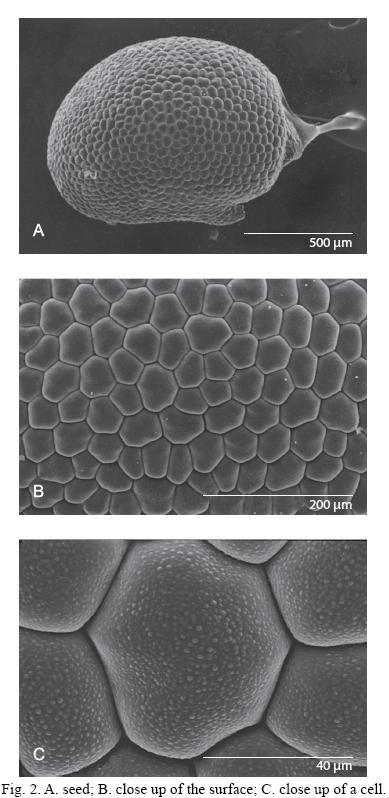
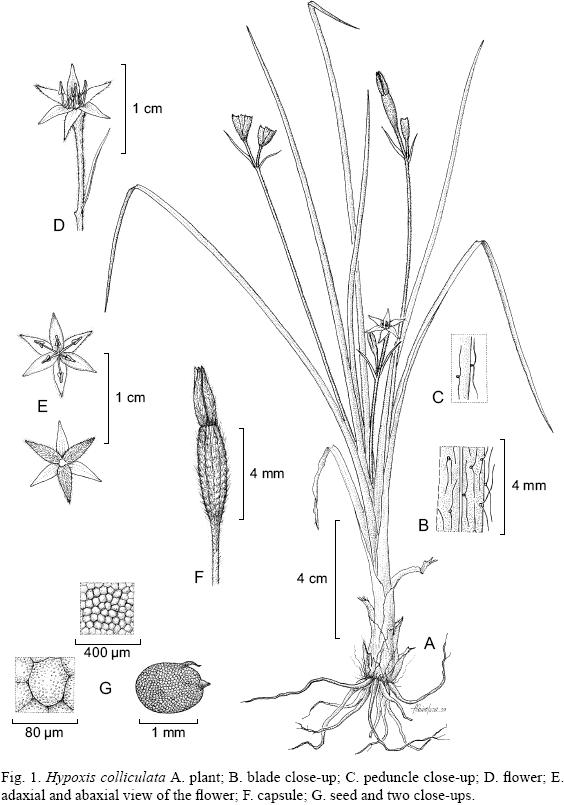
<body><![CDATA[<p align="justify"><font face="verdana" size="2">The genus <i>Hypoxis </i>L. is the most diverse in the family with approximately 80&#150;90 species distributed worldwide (Govaerts, 2007). There are several centers of diversity for the genus, with these found in Africa, Australia and Southeast Asia as well as the Americas. In the Americas there are about 15 species, with 13 located in the North American continent (Govaerts, 2009). The diversity in Mexico varies between seven and ten species depending on the authors. One of the first works that included the Mexican species was that of Brackett (1923), who reported seven species, three of them new at that time in Mexico. Later, McVaugh (1989) considered four species for the Novo&#150;Galician region, with one new species and synonymized two of Brackett's species. More recently, checklists report nine species for Mexico (Espejo &amp; L&oacute;pez, 1996; Villase&ntilde;or, 2004; Govaerts, 2007).</font></p>     <p align="justify"><font face="verdana" size="2">Apparently the circumscription of the genus does not have problems, but at the species level is a different matter. Some authors such as Brackett (1923) and McVaugh (1989) gave more importance to seed sculpturing; whereas Herndon (1992) and Nesom (1993) considered that the correlations between measurements of floral characters or other structures were also good diagnostic characters. Other vegetative or reproductive characters are diagnostic in defining some species such as the filiform leaf blades of <i>H. juncea </i>Sm. (Herndon, 1992) or the membranaceous tunic of the corm of <i>H. decumbens </i>L. (Huft, 1994); or the lack of sculpturing in the smooth seeds of <i>H. lucens </i>McVaugh (McVaugh, 1989). Nonetheless, in many other species vegetative and even reproductive (measurements of flowers and fruits) characters overlap, and therefore they cannot be diagnostic.</font></p>     <p align="justify"><font face="verdana" size="2">More recent studies of Wiland&#150;Szymanska (2001, 2006) in African <i>Hypoxis </i>show that Brackett's appreciation of the morphology of the seeds was in the right direction to resolve the taxonomy of the species, although she stated that some type of seed sculpturing are present in more than one species.</font></p>     <p align="justify"><font face="verdana" size="2">As a result of a revision of the family Hypoxidaceae for the Flora of the Tehuacan &#150; Cuicatlan Valley, I found the following new species and also the necessity to review the Mexican <i>Hypoxis </i>due to the lack of understanding of their taxonomy.</font></p>     <p align="justify"><font face="verdana" size="2"><b>Hypoxis colliculata </b>S&aacute;nchez&#150;Ken sp. nov. <a href="#f1">Figs. 1</a>, <a href="#f2">2</a>.</font></p>     <p align="center"><font face="verdana" size="2"><a name="f1"></a></font></p>     <p align="center"><font face="verdana" size="2"><img src="/img/revistas/abm/n92/a1f1.jpg"></font></p>     <p align="center"><font face="verdana" size="2">&nbsp;</font></p>     <p align="center"><font face="verdana" size="2"><a name="f2"></a></font></p>     <p align="center"><font face="verdana" size="2"><img src="/img/revistas/abm/n92/a1f2.jpg"></font></p>     ]]></body>
<body><![CDATA[<p align="justify"><font face="verdana" size="2">Cormi tunica membranacea, 1&#150;2 vaginis aphyllis, plerumque fibris ad 1 cm longis, rectis vel flexuosis; foliorum laminae (4&#150;)10&#150;50 cm longae, 1.7&#150;4 mm latae, lineares, 10&#150;17&#150;nervatae, sparsim pubescentes; scapi 1&#150;3, 4&#150;18 cm longi, 1&#150;2 floribus per scapum; pedicelli longitudine flores et bracteas fere aequantes; bracteae florales 1&#150;2 per florem; tepala 3&#150;8(&#150;10) mm longa, 1&#150;2.5 mm lata, illa seriei interioris leviter breviora, lanceolato&#150;linearia, 5&#150;8&#150;nervata; antherae 0.9&#150;1.5 mm longae; semina 1.1&#150;1.3 mm longa, 0.8&#150;0.85 mm diam, oblongo&#150;elliptica, nigra, nitida, superficie colliculata vel strumosa, cellulis 4&#150;7&#150;gonis, heteromorphis, heterodiametralibus, magnitudine variabili, 27 x 50 ad 44 x 55 &micro;m, arcte dispositis, truncatis vel leviter curvatis, non exfoliantibus, non iridiscentibus.</font></p>     <p align="justify"><font face="verdana" size="2">Corms 1.2&#150;2 cm long, 0.5&#150;1.1 cm wide, membranaceous tunic with 1&#150;2 sheaths with no blades or the uppermost with a reduced blade up to 8 cm long, usually with short fibers up to 1 cm long, these curve, straight to flexuous, rhizome with white flesh, the outer part with packs of raphides; foliar sheaths included in the tunic, glabrous to sparsely pilose toward the apex, the trichomes 2&#150;branched; blades (4&#150;)10&#150;50 cm long, 1.7&#150;4 mm wide, linear, 10&#150;17&#150;nerved including first to third order nerves, midnerve projected abaxially, pilose, 2&#150;4 lateral nerves projected abaxially, both surfaces sparsely pilose mostly towards the margins, density of hairs decreasing toward the apex, the hairs 2&#150;branched; inflorescence a cyme; scapes 1&#150;3, 4&#150;18 cm long, flattened and glabrescent below, more densely pilose above, the hairs 2&#150;branched, 1&#150;2 flowers per scape; pedicels 1&#150;9 mm long, densely pilose, the hairs 2&#150;branched; floral bracts 0.25&#150;1.1 cm long, ca. 0.2&#150;0.3 mm wide, 1&#150;2 per flower, with few hairs on the nerves; outer tepals 3&#150;8(&#150;10) mm long, 1&#150;2.5 mm wide, lanceolate&#150;linear, abaxially scarcely to densely pilose, usually with a tuft of hairs at the apex, the hairs 2&#150;branched, adaxially glabrous, 5&#150;8&#150;nerved; inner tepals 3.4&#150;7 mm long, 1.3&#150;2.4 mm wide, glabrous on both surfaces, rarely with 3 lines of hairs below, the hairs 2&#150;branched, 5&#150;7&#150;nerved; anthers 0.9&#150;1.5 mm long, filaments 1&#150;3 mm long; capsule 1.1&#150;1.3 cm long, 2.5&#150;3.5 mm wide, oblong&#150;elliptic, sparsely to densely pilose, the hairs 2&#150;branched; seeds 1.1&#150;1.3 mm long, 0.8&#150;0.85 mm diameter, oblong&#150;elliptic, black, bright, surface colliculate or strumose, cells oblong&#150;elliptic (<a href="#f2">Fig. 2</a>), 27 &times; 50 to 44 &times; 55 &micro;m, not infated or slightly so, short, heterodiametric, more or less homogeneous, anticlinal walls irregular and curved, compactly arranged, not exfoliative, not iridescent.</font></p>     <p align="justify"><font face="verdana" size="2">Type: Mexico, Oaxaca, distrito Nochixtl&aacute;n, municipio San Miguel Chicahua, 8 km al NO de Amatl&aacute;n, camino a Apoala, bosque de <i>Quercus, </i>2440 m, <i>A. Garc&iacute;a&#150;Mendoza, S. Franco &amp; A. Casta&ntilde;eda 7121 </i>(holotype: MEXU; isotype: US&#150;3437652).</font></p>     <p align="justify"><font face="verdana" size="2">Paratypes. Chiapas, municipio San Crist&oacute;bal de las Casas, Valle to E of Las Casas, along brook on bank, 20.IV.45, <i>E.J. Alexander 1174 </i>(MEXU); cultivated slope in barrio Custital in San Crist&oacute;bal de las Casas, 7200 ft, 21.VI.66, <i>R.M. Laughlin 1357 </i>(MEXU); municipio Teopisca, 2 km al N de la Laguna Chamula, carretera Teopisca &#150; Comit&aacute;n, 1110 m s.n.m., bosque de <i>Pinus&#150;Quercus&#150;Juniperus</i>, suelo calizo, 5.VIII.89, <i>A. Garc&iacute;a&#150;Mendoza &amp; E. Mart&iacute;nez 4226 </i>(MEXU). Oaxaca, distrito Nochixtl&aacute;n, 7 km al N de Amatl&aacute;n, 2350 m s.n.m., bosque de encinos, suelo pedregoso, 14.VII.86, <i>A. Garc&iacute;a&#150;Mendoza y F. M&eacute;rida 2623 </i>(MEXU); distrito Teposcolula, 1.5 km al NO de Teposcolula, en la intersecci&oacute;n del camino a Yucunama y San Andr&eacute;s Lagunas, 2370 m s.n.m., pinar, suelo calizo, 9.VII.81, <i>A. Garc&iacute;a&#150;Mendoza 447a</i>, <i>447b </i>(MEXU); 4 km al N de Guadalupe Tix&aacute;, sobre el camino a San Andr&eacute;s Lagunas, 2260 m s.n.m., zona deflorestada a orilla de bosque de pino, suelo calizo, 15.VII.86, <i>A. Garc&iacute;a&#150;Mendoza y F. M&eacute;rida 2674 </i>(MEXU).</font></p>     <p align="justify"><font face="verdana" size="2">Distribution, habitat and phenology. This new species is restricted to Mexico in the states of Chiapas and Oaxaca. It is found in oak florest and pine with <i>Juniperus </i>florest, on calcareous soils, at elevations between 1110 to 2440 m. It flowers and fruits from April to August.</font></p>     <p align="justify"><font face="verdana" size="2">&nbsp;</font></p>     <p align="justify"><font face="verdana" size="2"><b>DISCUSSION</b></font></p>     <p align="justify"><font face="verdana" size="2"><i>Hypoxis colliculata </i>belongs to the group of species that have black, usually shiny seeds, with no exfoliative or loose cuticle (McVaugh, 1989; Herndon, 1992; Zona et al., 2009). In the Americas, eight out of the 15 species have black seeds. At the moment, four types of seed sculpturing can be recognized, such as smooth (<i>H. lucens</i>), muricate or muriculate (<i>H. hirsuta </i>(L.) Coville, and <i>H. pulchella </i>Nesom), papillate or colliculate, Brackett (1923) called these rounded pebbling or tall papillae (<i>H. decumbens, H. juncea, H. rigida </i>Chapm., and <i>H. tepicencis </i>Brackett), and colliculate or strumose surfaces (new species). So far, none of the species in this group shows iridescence or exfoliation of the cuticle. In <i>H</i>. <i>lucens </i>and <i>H. hirsuta </i>the surface of the cells or papillae is smooth, whereas in the rest of the species the surface has tiny warts (<a href="#f2">Fig. 2C</a>). The warts may be small and short like in <i>H. colliculata </i>or elongated as in <i>H. decumbens. </i>In the new species <i>H. colliculata </i>the seeds bear a colliculate surface, the cells are small, heterodiametric, more or less homogeneous in size, compactly arranged, not infated or very slightly so (<a href="#f2">Figs. 2A and 2B</a>). Winland&#150;Szyma&#324;ska (2001) used the term "colliculate with fat papillae"; which would be something like a mixture of the terms colliculate and tessellate (Harris &amp; Harris, 2001).</font></p>     <p align="justify"><font face="verdana" size="2">The new species <i>H. colliculata </i>is easily separated from the species that have seeds with smooth, muricate, muriculate, papillate or colliculate with infated cells surfaces. Based on the characters of the seeds, the species is more closely related to <i>H. colliculata </i>are <i>H. decumbens</i>, <i>H. rigida</i>, <i>H. juncea</i>, and <i>H. tepicensis, </i>in all these species the cells of the epidermis are more isodiametric, larger and homogeneous in shape and size, and of course they are infated.</font></p>     <p align="justify"><font face="verdana" size="2">Other characters that may help to separate the new species are the presence of fibers at the base of the corm. However this character may be difficult to observe on incomplete specimen collected without the crown of fibers. It can be suggested that age of the plant may also influence the presence of the fibers, but this needs to be confrmed.</font></p>     ]]></body>
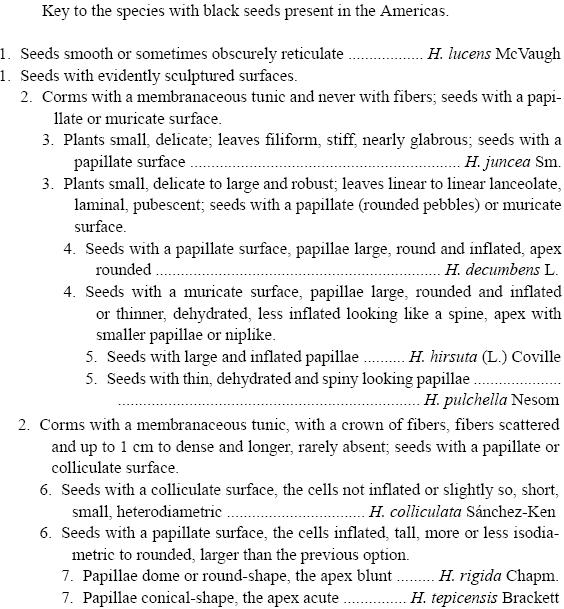
<body><![CDATA[<p align="justify"><font face="verdana" size="2">Due to the lack of an updated key of <i>Hypoxis </i>for the Americas, here I present a key to the species that have black seeds. These species are found mainly from United States to Mexico, with <i>H. decumbens </i>extending from Mexico to Central and South America as well as to the Caribbean.</font></p>     <p align="center"><font face="verdana" size="2"><img src="/img/revistas/abm/n92/a1c1.jpg"></font></p>     <p align="center"><font face="verdana" size="2">&nbsp;</font></p>     <p align="justify"><font face="verdana" size="2"><b>ACKNOWLEDGMENTS</b></font></p>     <p align="justify"><font face="verdana" size="2">I would like to thank F. Chiang C. for the Latin translation of the description of the new species, R. Medina L. for her comments on the manuscript. Many thanks are extended to A. Luna for the illustration and M. B. Mendoza G. for the scanning electronic microscope (SEM) images.</font></p>     <p align="justify"><font face="verdana" size="2">&nbsp;</font></p>     <p align="justify"><font face="verdana" size="2"><b>LITERATURE CITED</b></font></p>     <!-- ref --><p align="justify"><font face="verdana" size="2">Anonymous. 2003. An update of the Angiosperm Phylogeny Group classification for orders and families of flowering plants: Angiosperm Phylogeny Group II. Bot. J. Linn. Soc. 141: 399&#150;436.</font>&nbsp;&nbsp;&nbsp;&nbsp;&nbsp;&nbsp;&nbsp;&nbsp;[&#160;<a href="javascript:void(0);" onclick="javascript: window.open('/scielo.php?script=sci_nlinks&ref=030277&pid=S0187-7151201000030000100001&lng=','','width=640,height=500,resizable=yes,scrollbars=1,menubar=yes,');">Links</a>&#160;]<!-- end-ref --><!-- ref --><p align="justify"><font face="verdana" size="2">Baker, J. G. 1878. A synopsis of Hypoxidaceae. J. Linn. Soc. 17: 93&#150;126.</font>&nbsp;&nbsp;&nbsp;&nbsp;&nbsp;&nbsp;&nbsp;&nbsp;[&#160;<a href="javascript:void(0);" onclick="javascript: window.open('/scielo.php?script=sci_nlinks&ref=030278&pid=S0187-7151201000030000100002&lng=','','width=640,height=500,resizable=yes,scrollbars=1,menubar=yes,');">Links</a>&#160;]<!-- end-ref --><!-- ref --><p align="justify"><font face="verdana" size="2">Brackett, A. 1923. Revision of the American species of <i>Hypoxis</i>. Rhodora 25: 120&#150;147, 151&#150;163.</font>&nbsp;&nbsp;&nbsp;&nbsp;&nbsp;&nbsp;&nbsp;&nbsp;[&#160;<a href="javascript:void(0);" onclick="javascript: window.open('/scielo.php?script=sci_nlinks&ref=030279&pid=S0187-7151201000030000100003&lng=','','width=640,height=500,resizable=yes,scrollbars=1,menubar=yes,');">Links</a>&#160;]<!-- end-ref --><!-- ref --><p align="justify"><font face="verdana" size="2">Cronquist, A. 1981. An integrated system of classification of flowering plants. Columbia University Press, New York. 1262 pp.</font>&nbsp;&nbsp;&nbsp;&nbsp;&nbsp;&nbsp;&nbsp;&nbsp;[&#160;<a href="javascript:void(0);" onclick="javascript: window.open('/scielo.php?script=sci_nlinks&ref=030280&pid=S0187-7151201000030000100004&lng=','','width=640,height=500,resizable=yes,scrollbars=1,menubar=yes,');">Links</a>&#160;]<!-- end-ref --><!-- ref --><p align="justify"><font face="verdana" size="2">Dahlgren, R. M. T., H. T. Clifford &amp; P. F. Yeo. 1985. The families of the Monocotyledons. Springer&#150;Verlag. Berlin. 520 pp.</font>&nbsp;&nbsp;&nbsp;&nbsp;&nbsp;&nbsp;&nbsp;&nbsp;[&#160;<a href="javascript:void(0);" onclick="javascript: window.open('/scielo.php?script=sci_nlinks&ref=030281&pid=S0187-7151201000030000100005&lng=','','width=640,height=500,resizable=yes,scrollbars=1,menubar=yes,');">Links</a>&#160;]<!-- end-ref --><!-- ref --><p align="justify"><font face="verdana" size="2">Davis, J. I., S. W. Stevenson, G. Peterson, O. Seberg, L. M. Campbell, J. V. Freudenstein, D. H. Goldman, C. R. Hardy, F. A. Michelangeli, M. P. Simmons, C. D. Specht, F. Vergara&#150;Silva &amp; M. Gandolfo. 2004. A phylogeny of the monocots, as inferred from <i>rbcL </i>and <i>atpA </i>sequence variation, and a comparison of methods for calculating jackknife and bootstrap values. Syst. Bot. 29(3): 467&#150;510.</font>&nbsp;&nbsp;&nbsp;&nbsp;&nbsp;&nbsp;&nbsp;&nbsp;[&#160;<a href="javascript:void(0);" onclick="javascript: window.open('/scielo.php?script=sci_nlinks&ref=030282&pid=S0187-7151201000030000100006&lng=','','width=640,height=500,resizable=yes,scrollbars=1,menubar=yes,');">Links</a>&#160;]<!-- end-ref --><!-- ref --><p align="justify"><font face="verdana" size="2">Espejo S., A. &amp; A. R. L&oacute;pez F. 1996. Las monocotiled&oacute;neas mexicanas. Una sinopsis flor&iacute;stica. Parte V. Consejo Nacional de la Flora de M&eacute;xico, A.C., Universidad Aut&oacute;noma Metropolitana Iztapalapa, Comisi&oacute;n Nacional para el Conocimiento y Uso de la Biodiversidad. M&eacute;xico, D.F. 116 pp.</font>&nbsp;&nbsp;&nbsp;&nbsp;&nbsp;&nbsp;&nbsp;&nbsp;[&#160;<a href="javascript:void(0);" onclick="javascript: window.open('/scielo.php?script=sci_nlinks&ref=030283&pid=S0187-7151201000030000100007&lng=','','width=640,height=500,resizable=yes,scrollbars=1,menubar=yes,');">Links</a>&#160;]<!-- end-ref --><!-- ref --><p align="justify"><font face="verdana" size="2">Harris, J.G. &amp; M.W. Harris. 2001. Plant identification terminology. Utah: Spring Lake Publishing. 206 pp.</font>&nbsp;&nbsp;&nbsp;&nbsp;&nbsp;&nbsp;&nbsp;&nbsp;[&#160;<a href="javascript:void(0);" onclick="javascript: window.open('/scielo.php?script=sci_nlinks&ref=030284&pid=S0187-7151201000030000100008&lng=','','width=640,height=500,resizable=yes,scrollbars=1,menubar=yes,');">Links</a>&#160;]<!-- end-ref --><!-- ref --><p align="justify"><font face="verdana" size="2">Herndon, A. 1992. The genus <i>Hypoxis </i>(Hypoxidaceae) in Florida. Florida Scient. 55: 45&#150;55.</font>&nbsp;&nbsp;&nbsp;&nbsp;&nbsp;&nbsp;&nbsp;&nbsp;[&#160;<a href="javascript:void(0);" onclick="javascript: window.open('/scielo.php?script=sci_nlinks&ref=030285&pid=S0187-7151201000030000100009&lng=','','width=640,height=500,resizable=yes,scrollbars=1,menubar=yes,');">Links</a>&#160;]<!-- end-ref --><!-- ref --><p align="justify"><font face="verdana" size="2">Huft, J. J. 1994. Hypoxidaceae L. In: Davidse, G., M. Sousa S. &amp; A. O. Charter (eds.). Flora Mesoamericana. Vol. 6. Alismataceae a Cyperaceae. Universidad Aut&oacute;noma Nacional de M&eacute;xico. M&eacute;xico, D.F. pp. 51&#150;53.</font>&nbsp;&nbsp;&nbsp;&nbsp;&nbsp;&nbsp;&nbsp;&nbsp;[&#160;<a href="javascript:void(0);" onclick="javascript: window.open('/scielo.php?script=sci_nlinks&ref=030286&pid=S0187-7151201000030000100010&lng=','','width=640,height=500,resizable=yes,scrollbars=1,menubar=yes,');">Links</a>&#160;]<!-- end-ref --><!-- ref --><p align="justify"><font face="verdana" size="2">Govaerts, R. 2007. World checklist of Hypoxidaceae. The Board of Trustees of the Royal Botanic Gardens, Kew. Published on the Internet <a href="http://www.kew.org/wcsp/monocots" target="_blank">http://www.kew.org/wcsp/monocots</a> accessed/23 Sep 2009.</font>&nbsp;&nbsp;&nbsp;&nbsp;&nbsp;&nbsp;&nbsp;&nbsp;[&#160;<a href="javascript:void(0);" onclick="javascript: window.open('/scielo.php?script=sci_nlinks&ref=030287&pid=S0187-7151201000030000100011&lng=','','width=640,height=500,resizable=yes,scrollbars=1,menubar=yes,');">Links</a>&#160;]<!-- end-ref --><!-- ref --><p align="justify"><font face="verdana" size="2">McVaugh, R. 1989. <i>Hypoxis </i>L. In<i>: </i>Anderson, W. R. (ed.). Flora Novo&#150;Galiciana. Vol. 15. Bromeliaceae to Dioscoreaceae. University of Michigan Herbarium. Ann Arbor. pp. 219 &#150;227.</font>&nbsp;&nbsp;&nbsp;&nbsp;&nbsp;&nbsp;&nbsp;&nbsp;[&#160;<a href="javascript:void(0);" onclick="javascript: window.open('/scielo.php?script=sci_nlinks&ref=030288&pid=S0187-7151201000030000100012&lng=','','width=640,height=500,resizable=yes,scrollbars=1,menubar=yes,');">Links</a>&#160;]<!-- end-ref --><!-- ref --><p align="justify"><font face="verdana" size="2">Nesom, G. L. 1993. A new species and new variety of <i>Hypoxis </i>(Hypoxidaceae) from northeastern Mexico. Phytologia 75(5): 377&#150;381.</font>&nbsp;&nbsp;&nbsp;&nbsp;&nbsp;&nbsp;&nbsp;&nbsp;[&#160;<a href="javascript:void(0);" onclick="javascript: window.open('/scielo.php?script=sci_nlinks&ref=030289&pid=S0187-7151201000030000100013&lng=','','width=640,height=500,resizable=yes,scrollbars=1,menubar=yes,');">Links</a>&#160;]<!-- end-ref --><!-- ref --><p align="justify"><font face="verdana" size="2">Rudall, P. J., M. W. Chase, D. F. Cutler, J. Rusby &amp; A. Y. de Bruijn. 1998 Anatomical and molecular systematics of Asteliaceae and Hypoxidaceae. Bot. J. Linn. Soc. 127: 1&#150; 42.</font>&nbsp;&nbsp;&nbsp;&nbsp;&nbsp;&nbsp;&nbsp;&nbsp;[&#160;<a href="javascript:void(0);" onclick="javascript: window.open('/scielo.php?script=sci_nlinks&ref=030290&pid=S0187-7151201000030000100014&lng=','','width=640,height=500,resizable=yes,scrollbars=1,menubar=yes,');">Links</a>&#160;]<!-- end-ref --><!-- ref --><p align="justify"><font face="verdana" size="2">Villase&ntilde;or, J. L. 2004. Los g&eacute;neros de plantas vasculares de M&eacute;xico. Bol. Soc. Bot. M&eacute;xico 75: 105&#150;135.</font>&nbsp;&nbsp;&nbsp;&nbsp;&nbsp;&nbsp;&nbsp;&nbsp;[&#160;<a href="javascript:void(0);" onclick="javascript: window.open('/scielo.php?script=sci_nlinks&ref=030291&pid=S0187-7151201000030000100015&lng=','','width=640,height=500,resizable=yes,scrollbars=1,menubar=yes,');">Links</a>&#160;]<!-- end-ref --><!-- ref --><p align="justify"><font face="verdana" size="2">Wiland&#150;Szymanska, J. 2001. The genus <i>Hypoxis </i>(Hypoxidaceae) in Central Africa. Ann. Missouri Bot. Gard. 88(2): 302&#150;350.</font>&nbsp;&nbsp;&nbsp;&nbsp;&nbsp;&nbsp;&nbsp;&nbsp;[&#160;<a href="javascript:void(0);" onclick="javascript: window.open('/scielo.php?script=sci_nlinks&ref=030292&pid=S0187-7151201000030000100016&lng=','','width=640,height=500,resizable=yes,scrollbars=1,menubar=yes,');">Links</a>&#160;]<!-- end-ref --><!-- ref --><p align="justify"><font face="verdana" size="2">Wiland&#150;Szymanska, J. 2006. Morphological variability of seeds in East African species of the genus <i>Hypoxis </i>L. (Hypoxidaceae). Biod. Res. Conserv. 1&#150;2: 31&#150;33.</font>&nbsp;&nbsp;&nbsp;&nbsp;&nbsp;&nbsp;&nbsp;&nbsp;[&#160;<a href="javascript:void(0);" onclick="javascript: window.open('/scielo.php?script=sci_nlinks&ref=030293&pid=S0187-7151201000030000100017&lng=','','width=640,height=500,resizable=yes,scrollbars=1,menubar=yes,');">Links</a>&#160;]<!-- end-ref --><!-- ref --><p align="justify"><font face="verdana" size="2">Zona, S., J. Prince. G. Halder, R. Schwartz &amp; R. Vargas. 2009. A seed atlas of <i>Hypoxis </i>from Eastern North America. J. Torrey Bot. Soc<i>. </i>136(1): 26&#150;32.</font>&nbsp;&nbsp;&nbsp;&nbsp;&nbsp;&nbsp;&nbsp;&nbsp;[&#160;<a href="javascript:void(0);" onclick="javascript: window.open('/scielo.php?script=sci_nlinks&ref=030294&pid=S0187-7151201000030000100018&lng=','','width=640,height=500,resizable=yes,scrollbars=1,menubar=yes,');">Links</a>&#160;]<!-- end-ref --> ]]></body><back>
<ref-list>
<ref id="B1">
<nlm-citation citation-type="journal">
<person-group person-group-type="author">
<name>
</name>
<name>
</name>
</person-group>
<article-title xml:lang="en"><![CDATA[An update of the Angiosperm Phylogeny Group classification for orders and families of flowering plants: Angiosperm Phylogeny Group II.]]></article-title>
<source><![CDATA[Bot. J. Linn. Soc.]]></source>
<year>2003</year>
<volume>141</volume>
<page-range>399-436</page-range></nlm-citation>
</ref>
<ref id="B2">
<nlm-citation citation-type="journal">
<person-group person-group-type="author">
<name>
<surname><![CDATA[Baker]]></surname>
<given-names><![CDATA[J. G.]]></given-names>
</name>
</person-group>
<article-title xml:lang="en"><![CDATA[A synopsis of Hypoxidaceae]]></article-title>
<source><![CDATA[J. Linn. Soc.]]></source>
<year>1878</year>
<volume>17</volume>
<page-range>93-126</page-range></nlm-citation>
</ref>
<ref id="B3">
<nlm-citation citation-type="journal">
<person-group person-group-type="author">
<name>
<surname><![CDATA[Brackett]]></surname>
<given-names><![CDATA[A.]]></given-names>
</name>
</person-group>
<article-title xml:lang="en"><![CDATA[Revision of the American species of Hypoxis]]></article-title>
<source><![CDATA[Rhodora]]></source>
<year>1923</year>
<volume>25</volume>
<page-range>120-147, 151-163</page-range></nlm-citation>
</ref>
<ref id="B4">
<nlm-citation citation-type="book">
<person-group person-group-type="author">
<name>
<surname><![CDATA[Cronquist]]></surname>
<given-names><![CDATA[A.]]></given-names>
</name>
</person-group>
<source><![CDATA[An integrated system of classification of flowering plants]]></source>
<year>1981</year>
<page-range>1262</page-range><publisher-loc><![CDATA[New York ]]></publisher-loc>
<publisher-name><![CDATA[Columbia University Press]]></publisher-name>
</nlm-citation>
</ref>
<ref id="B5">
<nlm-citation citation-type="book">
<person-group person-group-type="author">
<name>
<surname><![CDATA[Dahlgren]]></surname>
<given-names><![CDATA[R. M. T.]]></given-names>
</name>
<name>
<surname><![CDATA[Clifford]]></surname>
<given-names><![CDATA[H. T.]]></given-names>
</name>
<name>
<surname><![CDATA[Yeo]]></surname>
<given-names><![CDATA[P. F.]]></given-names>
</name>
</person-group>
<source><![CDATA[The families of the Monocotyledons]]></source>
<year>1985</year>
<page-range>520</page-range><publisher-loc><![CDATA[Berlin ]]></publisher-loc>
<publisher-name><![CDATA[Springer-Verlag]]></publisher-name>
</nlm-citation>
</ref>
<ref id="B6">
<nlm-citation citation-type="journal">
<person-group person-group-type="author">
<name>
<surname><![CDATA[Davis]]></surname>
<given-names><![CDATA[J. I.]]></given-names>
</name>
<name>
<surname><![CDATA[Stevenson]]></surname>
<given-names><![CDATA[S. W.]]></given-names>
</name>
<name>
<surname><![CDATA[Peterson]]></surname>
<given-names><![CDATA[G.]]></given-names>
</name>
<name>
<surname><![CDATA[Seberg]]></surname>
<given-names><![CDATA[O.]]></given-names>
</name>
<name>
<surname><![CDATA[Campbell]]></surname>
<given-names><![CDATA[L. M.]]></given-names>
</name>
<name>
<surname><![CDATA[Freudenstein]]></surname>
<given-names><![CDATA[J. V.]]></given-names>
</name>
<name>
<surname><![CDATA[Goldman]]></surname>
<given-names><![CDATA[D. H.]]></given-names>
</name>
<name>
<surname><![CDATA[Hardy]]></surname>
<given-names><![CDATA[C. R.]]></given-names>
</name>
<name>
<surname><![CDATA[Michelangeli]]></surname>
<given-names><![CDATA[F. A.]]></given-names>
</name>
<name>
<surname><![CDATA[Simmons]]></surname>
<given-names><![CDATA[M. P.]]></given-names>
</name>
<name>
<surname><![CDATA[Specht]]></surname>
<given-names><![CDATA[C. D.]]></given-names>
</name>
<name>
<surname><![CDATA[Vergara-Silva]]></surname>
<given-names><![CDATA[F.]]></given-names>
</name>
<name>
<surname><![CDATA[Gandolfo]]></surname>
<given-names><![CDATA[M.]]></given-names>
</name>
</person-group>
<article-title xml:lang="en"><![CDATA[A phylogeny of the monocots, as inferred from rbcL and atpA sequence variation, and a comparison of methods for calculating jackknife and bootstrap values]]></article-title>
<source><![CDATA[Syst. Bot.]]></source>
<year>2004</year>
<volume>29</volume>
<numero>3</numero>
<issue>3</issue>
<page-range>467-510</page-range></nlm-citation>
</ref>
<ref id="B7">
<nlm-citation citation-type="book">
<person-group person-group-type="author">
<name>
<surname><![CDATA[Espejo]]></surname>
<given-names><![CDATA[S., A.]]></given-names>
</name>
<name>
<surname><![CDATA[López F.]]></surname>
<given-names><![CDATA[A. R.]]></given-names>
</name>
</person-group>
<source><![CDATA[Las monocotiledóneas mexicanas: Una sinopsis florística. Parte V]]></source>
<year>1996</year>
<page-range>116</page-range><publisher-loc><![CDATA[México^eD.F. D.F.]]></publisher-loc>
<publisher-name><![CDATA[Consejo Nacional de la Flora de México, A.C.Universidad Autónoma Metropolitana IztapalapaComisión Nacional para el Conocimiento y Uso de la Biodiversidad]]></publisher-name>
</nlm-citation>
</ref>
<ref id="B8">
<nlm-citation citation-type="book">
<person-group person-group-type="author">
<name>
<surname><![CDATA[Harris]]></surname>
<given-names><![CDATA[J.G.]]></given-names>
</name>
<name>
<surname><![CDATA[Harris]]></surname>
<given-names><![CDATA[M.W.]]></given-names>
</name>
</person-group>
<source><![CDATA[Plant identification terminology]]></source>
<year>2001</year>
<page-range>206</page-range><publisher-loc><![CDATA[Utah ]]></publisher-loc>
<publisher-name><![CDATA[Spring Lake Publishing]]></publisher-name>
</nlm-citation>
</ref>
<ref id="B9">
<nlm-citation citation-type="journal">
<person-group person-group-type="author">
<name>
<surname><![CDATA[Herndon]]></surname>
<given-names><![CDATA[A.]]></given-names>
</name>
</person-group>
<article-title xml:lang="en"><![CDATA[The genus Hypoxis (Hypoxidaceae) in Florida]]></article-title>
<source><![CDATA[Florida Scient.]]></source>
<year>1992</year>
<volume>55</volume>
<page-range>45-55</page-range></nlm-citation>
</ref>
<ref id="B10">
<nlm-citation citation-type="book">
<person-group person-group-type="author">
<name>
<surname><![CDATA[Huft]]></surname>
<given-names><![CDATA[J. J.]]></given-names>
</name>
</person-group>
<article-title xml:lang="es"><![CDATA[Hypoxidaceae L.]]></article-title>
<person-group person-group-type="editor">
<name>
<surname><![CDATA[Davidse]]></surname>
<given-names><![CDATA[G.]]></given-names>
</name>
<name>
<surname><![CDATA[Sousa S.]]></surname>
<given-names><![CDATA[M.]]></given-names>
</name>
<name>
<surname><![CDATA[Charter]]></surname>
<given-names><![CDATA[A. O.]]></given-names>
</name>
</person-group>
<source><![CDATA[Flora Mesoamericana]]></source>
<year>1994</year>
<volume>6</volume>
<page-range>51-53</page-range><publisher-loc><![CDATA[México^eD.F. D.F.]]></publisher-loc>
<publisher-name><![CDATA[Universidad Autónoma Nacional de México]]></publisher-name>
</nlm-citation>
</ref>
<ref id="B11">
<nlm-citation citation-type="book">
<person-group person-group-type="author">
<name>
<surname><![CDATA[Govaerts]]></surname>
<given-names><![CDATA[R.]]></given-names>
</name>
</person-group>
<source><![CDATA[World checklist of Hypoxidaceae]]></source>
<year>2007</year>
<publisher-name><![CDATA[The Board of Trustees of the Royal Botanic Gardens, Kew]]></publisher-name>
</nlm-citation>
</ref>
<ref id="B12">
<nlm-citation citation-type="book">
<person-group person-group-type="author">
<name>
<surname><![CDATA[McVaugh]]></surname>
<given-names><![CDATA[R.]]></given-names>
</name>
</person-group>
<article-title xml:lang="en"><![CDATA[Hypoxis L.]]></article-title>
<person-group person-group-type="editor">
<name>
<surname><![CDATA[Anderson]]></surname>
<given-names><![CDATA[W. R.]]></given-names>
</name>
</person-group>
<source><![CDATA[Flora Novo-Galiciana. Vol. 15.: Bromeliaceae to Dioscoreaceae]]></source>
<year>1989</year>
<page-range>219 -227</page-range><publisher-loc><![CDATA[Ann Arbor ]]></publisher-loc>
<publisher-name><![CDATA[University of Michigan Herbarium]]></publisher-name>
</nlm-citation>
</ref>
<ref id="B13">
<nlm-citation citation-type="journal">
<person-group person-group-type="author">
<name>
<surname><![CDATA[Nesom]]></surname>
<given-names><![CDATA[G. L.]]></given-names>
</name>
</person-group>
<article-title xml:lang="en"><![CDATA[A new species and new variety of Hypoxis (Hypoxidaceae) from northeastern Mexico]]></article-title>
<source><![CDATA[Phytologia]]></source>
<year>1993</year>
<volume>75</volume>
<numero>5</numero>
<issue>5</issue>
<page-range>377-381</page-range></nlm-citation>
</ref>
<ref id="B14">
<nlm-citation citation-type="journal">
<person-group person-group-type="author">
<name>
<surname><![CDATA[Rudall]]></surname>
<given-names><![CDATA[P. J.]]></given-names>
</name>
<name>
<surname><![CDATA[Chase]]></surname>
<given-names><![CDATA[M. W.]]></given-names>
</name>
<name>
<surname><![CDATA[Cutler]]></surname>
<given-names><![CDATA[D. F.]]></given-names>
</name>
<name>
<surname><![CDATA[Rusby]]></surname>
<given-names><![CDATA[J.]]></given-names>
</name>
<name>
<surname><![CDATA[de Bruijn]]></surname>
<given-names><![CDATA[A. Y.]]></given-names>
</name>
</person-group>
<article-title xml:lang="en"><![CDATA[Anatomical and molecular systematics of Asteliaceae and Hypoxidaceae]]></article-title>
<source><![CDATA[Bot. J. Linn. Soc.]]></source>
<year>1998</year>
<volume>127</volume>
<page-range>1- 42</page-range></nlm-citation>
</ref>
<ref id="B15">
<nlm-citation citation-type="journal">
<person-group person-group-type="author">
<name>
<surname><![CDATA[Villaseñor]]></surname>
<given-names><![CDATA[J. L.]]></given-names>
</name>
</person-group>
<article-title xml:lang="es"><![CDATA[Los géneros de plantas vasculares de México]]></article-title>
<source><![CDATA[Bol. Soc. Bot. México]]></source>
<year>2004</year>
<volume>75</volume>
<page-range>105-135</page-range></nlm-citation>
</ref>
<ref id="B16">
<nlm-citation citation-type="journal">
<person-group person-group-type="author">
<name>
<surname><![CDATA[Wiland-Szymanska]]></surname>
<given-names><![CDATA[J.]]></given-names>
</name>
</person-group>
<article-title xml:lang="en"><![CDATA[The genus Hypoxis (Hypoxidaceae) in Central Africa.]]></article-title>
<source><![CDATA[Ann. Missouri Bot. Gard.]]></source>
<year>2001</year>
<volume>88</volume>
<numero>2</numero>
<issue>2</issue>
<page-range>302-350</page-range></nlm-citation>
</ref>
<ref id="B17">
<nlm-citation citation-type="journal">
<person-group person-group-type="author">
<name>
<surname><![CDATA[Wiland-Szymanska]]></surname>
<given-names><![CDATA[J.]]></given-names>
</name>
</person-group>
<article-title xml:lang="en"><![CDATA[Morphological variability of seeds in East African species of the genus Hypoxis L. (Hypoxidaceae)]]></article-title>
<source><![CDATA[Biod. Res. Conserv.]]></source>
<year>2006</year>
<volume>1-2</volume>
<page-range>31-33</page-range></nlm-citation>
</ref>
<ref id="B18">
<nlm-citation citation-type="journal">
<person-group person-group-type="author">
<name>
<surname><![CDATA[Zona]]></surname>
<given-names><![CDATA[S.]]></given-names>
</name>
<name>
<surname><![CDATA[Prince]]></surname>
<given-names><![CDATA[J.]]></given-names>
</name>
<name>
<surname><![CDATA[Halder]]></surname>
<given-names><![CDATA[G.]]></given-names>
</name>
<name>
<surname><![CDATA[Schwartz]]></surname>
<given-names><![CDATA[R.]]></given-names>
</name>
<name>
<surname><![CDATA[Vargas]]></surname>
<given-names><![CDATA[R.]]></given-names>
</name>
</person-group>
<article-title xml:lang="en"><![CDATA[A seed atlas of Hypoxis from Eastern North America]]></article-title>
<source><![CDATA[J. Torrey Bot. Soc.]]></source>
<year>2009</year>
<volume>136</volume>
<numero>1</numero>
<issue>1</issue>
<page-range>26-32</page-range></nlm-citation>
</ref>
</ref-list>
</back>
</article>