<?xml version="1.0" encoding="ISO-8859-1"?><article xmlns:mml="http://www.w3.org/1998/Math/MathML" xmlns:xlink="http://www.w3.org/1999/xlink" xmlns:xsi="http://www.w3.org/2001/XMLSchema-instance">
<front>
<journal-meta>
<journal-id>0187-7151</journal-id>
<journal-title><![CDATA[Acta botánica mexicana]]></journal-title>
<abbrev-journal-title><![CDATA[Act. Bot. Mex]]></abbrev-journal-title>
<issn>0187-7151</issn>
<publisher>
<publisher-name><![CDATA[Instituto de Ecología A.C., Centro Regional del Bajío]]></publisher-name>
</publisher>
</journal-meta>
<article-meta>
<article-id>S0187-71512007000100002</article-id>
<title-group>
<article-title xml:lang="en"><![CDATA[Culm anatomy of Bouteloua and relatives (Gramineae: Chloridoideae: Boutelouinae)]]></article-title>
<article-title xml:lang="es"><![CDATA[Anatomía del tallo de Bouteloua y géneros relacionados (Gramineae: Chloridoideae: Boutelouinae]]></article-title>
</title-group>
<contrib-group>
<contrib contrib-type="author">
<name>
<surname><![CDATA[Siqueiros-Delgado]]></surname>
<given-names><![CDATA[Ma. Elena]]></given-names>
</name>
<xref ref-type="aff" rid="A01"/>
</contrib>
</contrib-group>
<aff id="A01">
<institution><![CDATA[,Universidad Autónoma de Aguascalientes Departamento de Biología Centro de Ciencias Básicas]]></institution>
<addr-line><![CDATA[Aguascalientes ]]></addr-line>
<country>México</country>
</aff>
<pub-date pub-type="pub">
<day>00</day>
<month>00</month>
<year>2007</year>
</pub-date>
<pub-date pub-type="epub">
<day>00</day>
<month>00</month>
<year>2007</year>
</pub-date>
<numero>78</numero>
<fpage>39</fpage>
<lpage>54</lpage>
<copyright-statement/>
<copyright-year/>
<self-uri xlink:href="http://www.scielo.org.mx/scielo.php?script=sci_arttext&amp;pid=S0187-71512007000100002&amp;lng=en&amp;nrm=iso"></self-uri><self-uri xlink:href="http://www.scielo.org.mx/scielo.php?script=sci_abstract&amp;pid=S0187-71512007000100002&amp;lng=en&amp;nrm=iso"></self-uri><self-uri xlink:href="http://www.scielo.org.mx/scielo.php?script=sci_pdf&amp;pid=S0187-71512007000100002&amp;lng=en&amp;nrm=iso"></self-uri><abstract abstract-type="short" xml:lang="en"><p><![CDATA[Transverse sections of mature flowering culms of Boutelouinae were analyzed to explore the usefulness of the culm anatomy to assess phylogenetic relationships. Fifty-five taxa were surveyed from the field and greenhouse collections. Although leaf anatomy in Boutelouinae has been shown to possess systematic utility, culm anatomy has been very little explored. In the Boutelouinae, only few traits of the culm middle internodal region with phylogenetic value, were found. Kranz structures (cells and radial chlorenchyma), number and position of the vascular bundles, and sclerenchyma girders are some culm anatomy characters that can be useful for inferring relationships at higher levels (family, tribes, genera). Culm anatomy suggests close relationships between B. eriopoda and B. eriostachya, and between B. ramosa and B. breviseta, and supports the inclusion of the satellite genera into Bouteloua. The Kranz structures and chloroplast shape appear to be the most variable features of this region of the culm.]]></p></abstract>
<abstract abstract-type="short" xml:lang="es"><p><![CDATA[Se analizaron cortes transversales de la región media del tallo de 55 taxa de Boutelouinae, con el fin de explorar la utilidad de sus caracteres en el conocimiento de las relaciones filogenéticas del grupo. A pesar de que los caracteres anatómicos de hoja han mostrado ser útiles para inferir relaciones filogenéticas, el examen microscópico del culmo no revela la existencia de muchos rasgos informativos del aspecto evolutivo. Atributos como las estructuras Kranz, el número y posición de los haces vasculares y los anillos de esclerénquima pueden ser caracteres útiles para inferir relaciones filogenéticas a nivel de familia, tribu o género. La anatomía de tallo sugiere una estrecha relación entre B. eriopoda y B. eriostachya, así como entre B. ramosa y B. breviseta, además apoya la inclusión de los géneros satélites dentro de Bouteloua. Las estructuras Kranz y la forma de los cloroplastos parecen ser los caracteres mas variables de esta región del tallo.]]></p></abstract>
<kwd-group>
<kwd lng="en"><![CDATA[anatomy]]></kwd>
<kwd lng="en"><![CDATA[Bouteloua]]></kwd>
<kwd lng="en"><![CDATA[culm]]></kwd>
<kwd lng="en"><![CDATA[Gramineae]]></kwd>
<kwd lng="es"><![CDATA[anatomía]]></kwd>
<kwd lng="es"><![CDATA[Bouteloua]]></kwd>
<kwd lng="es"><![CDATA[culmo]]></kwd>
<kwd lng="es"><![CDATA[Gramineae]]></kwd>
</kwd-group>
</article-meta>
</front><body><![CDATA[ <p align="center"><font face="verdana" size="4"><b>Culm anatomy of <i>Bouteloua </i>and relatives (Gramineae: Chloridoideae: Boutelouinae)</b></font></p>         <p align="center">&nbsp;</p>         <p align="center"><font face="verdana" size="3"><b>Anatom&iacute;a del tallo de <i>Bouteloua</i> y g&eacute;neros relacionados (Gramineae: Chloridoideae: Boutelouinae)</b></font></p>              <p align="justify"><font face="verdana" size="2">&nbsp;</font></p>          <p align="center"><font face="verdana" size="2"><b>Ma. Elena Siqueiros&#45;Delgado</b></font></p>              <p align="justify"><font face="verdana" size="2">&nbsp;</font></p>              <p align="justify"><font face="verdana" size="2"><i>Universidad Aut&oacute;noma de Aguascalientes Centro de Ciencias B&aacute;sicas, Departamento de Biolog&iacute;a, Av. Universidad 940, 20100 Aguascalientes, M&eacute;xico.</i> <a href="mailto:masiquei@correo.uaa.mx">masiquei@correo.uaa.mx</a>.</font></p>              <p align="justify"><font face="verdana" size="2">&nbsp;</font></p>              <p align="justify"><font face="verdana" size="2">Recibido en diciembre de 2004.    <br>     Aceptado en agosto de 2006.</font></p>              ]]></body>
<body><![CDATA[<p align="justify"><font face="verdana" size="2">&nbsp;</font></p>              <p align="justify"><font face="verdana" size="2"><b>ABSTRACT</b></font></p>              <p align="justify"><font face="verdana" size="2">Transverse sections of mature flowering culms of Boutelouinae were analyzed to explore the usefulness of the culm anatomy to assess phylogenetic relationships. Fifty&#45;five taxa were surveyed from the field and greenhouse collections. Although leaf anatomy in Boutelouinae has been shown to possess systematic utility, culm anatomy has been very little explored. In the Boutelouinae, only few traits of the culm middle internodal region with phylogenetic value, were found. Kranz structures (cells and radial chlorenchyma), number and position of the vascular bundles, and sclerenchyma girders are some culm anatomy characters that can be useful for inferring relationships at higher levels (family, tribes, genera). Culm anatomy suggests close relationships between <i>B. eriopoda</i> and <i>B. eriostachya,</i> and between <i>B. ramosa</i> and <i>B. breviseta,</i> and supports the inclusion of the satellite genera into <i>Bouteloua.</i> The Kranz structures and chloroplast shape appear to be the most variable features of this region of the culm.</font></p>              <p align="justify"><font face="verdana" size="2"><b>Key words:</b> anatomy, <i>Bouteloua,</i> culm, Gramineae.</font></p>              <p align="justify"><font face="verdana" size="2">&nbsp;</font></p>              <p align="justify"><font face="verdana" size="2"><b>RESUMEN</b></font></p>              <p align="justify"><font face="verdana" size="2">Se analizaron cortes transversales de la regi&oacute;n media del tallo de 55 taxa de Boutelouinae, con el fin de explorar la utilidad de sus caracteres en el conocimiento de las relaciones filogen&eacute;ticas del grupo. A pesar de que los caracteres anat&oacute;micos de hoja han mostrado ser &uacute;tiles para inferir relaciones filogen&eacute;ticas, el examen microsc&oacute;pico del culmo no revela la existencia de muchos rasgos informativos del aspecto evolutivo. Atributos como las estructuras Kranz, el n&uacute;mero y posici&oacute;n de los haces vasculares y los anillos de escler&eacute;nquima pueden ser caracteres &uacute;tiles para inferir relaciones filogen&eacute;ticas a nivel de familia, tribu o g&eacute;nero. La anatom&iacute;a de tallo sugiere una estrecha relaci&oacute;n entre <i>B. eriopoda </i>y <i>B. eriostachya,</i> as&iacute; como entre <i>B. ramosa</i> y <i>B. breviseta,</i> adem&aacute;s apoya la inclusi&oacute;n de los g&eacute;neros sat&eacute;lites dentro de <i>Bouteloua.</i> Las estructuras Kranz y la forma de los cloroplastos parecen ser los caracteres mas variables de esta regi&oacute;n del tallo.</font></p>              <p align="justify"><font face="verdana" size="2"><b>Palabras clave:</b> anatom&iacute;a, <i>Bouteloua,</i> culmo, Gramineae.</font></p>              <p align="justify"><font face="verdana" size="2">&nbsp;</font></p>              <p align="justify"><font face="verdana" size="2"><b>INTRODUCTION</b></font></p>              ]]></body>
<body><![CDATA[<p align="justify"><font face="verdana" size="2">Boutelouineae (Gramineae: Chloridoideae) comprise seven genera: <i>Aego&#45;pogon, Bouteloua, Hilaria, Melanocenchrus, Neobouteloua, Pleuraphis,</i> and <i>Schaffnerella</i> (Columbus, 1999a). This subtribe is characterized by one or more non&#45;digitate inflorescence branches, usually one or more reduced florets, and three&#45;nerved lemmas, each nerve usually terminating in a lobe and/or awn (Columbus, 1996), and its culm anatomy corresponds to the Chloridoideae type (Auquier and Somers, 1967). Most representatives of Boutelouinae are natives of American grasslands (except <i>Melanocenchrus</i> from Africa), typically occur in arid or semiarid environments, and their value as forage grass is remarkable. Boutelouinae possess C<sub>4</sub> photosynthesis pathway with the associated characteristic Kranz anatomy (Hattersley and Watson, 1975). Most Boutelouinae have NAD&#45;ME (nicotinamide adenine dinucleo&#45;tide co&#45;factor to malic enzyme) biochemial pathway, characterized by XyMS+ (mestome present), centripetal chloroplast with granna, an even Kranz bundle sheath outline and suberised lamella. Some taxa, however, posses PCK (phosphoenolpyruvate carboxykinase), characterized by XyMS+ and centrifugal chloroplasts with granna and an uneven outline. XyMS+ are structural traits characteristic of arid conditions (Prendergast et al., 1987).</font></p>              <p align="justify"><font face="verdana" size="2"><i>Bouteloua</i> is the largest genus with 57 species (Columbus, 1999a), followed by <i>Hilaria</i> (9), <i>Aegopogon</i> (3), <i>Melanocenchrus</i> (3), <i>Neobouteloua</i> (1), <i>Pleuraphis</i> (3), and <i>Schaffnerella</i> (1) (Clayton and Renvoize, 1989). Gould (1980), based on morphology and cytology, recognized 39 species in two subgenera, <i>Bouteloua</i> and <i>Chondrosium.</i> Based on molecular evidence, Columbus et al. (1998, 2000) and Columbus (1999a), redefined the genus showing that the two subgenera are not monophyletic, and including into <i>Bouteloua</i> most of its diclinous relatives <i>(Buchloe, Buchlomimus, Cathestecum, Cyclostachya, Griffitsochloa, Opizia, Pentarrhaphis, Pringleochloa</i> and <i>Soderstromia),</i> rendering the genus as monophyletic. These satellite genera were segregated because of their diclinous reproductive system (Reeder, 1969). However, molecular data show that they are members of the <i>Bouteloua</i> clade.</font></p>              <p align="justify"><font face="verdana" size="2">Leaf anatomy has proved to be a good phylogenetic tool for grass systematics. Many researchers have succeeded in using leaf anatomy to circumscribe species and infer phylogenies (Breakwell, 1914; Brown, 1958, 1975, 1977; Cerros&#45;Tlatilpa, 1999; Columbus, 1996; Ellis, 1987; Fisher, 1939; Morden and Hatch, 1987; S&aacute;nchez, 1971). Columbus (1996) evidences the usefulness of leaf anatomy to infer phylogenies in the subtribe Boutelouinae. Based on micromorphology and leaf blade anatomy, he proposed the non&#45;monophyly of <i>Bouteloua</i> and <i>Chondrosium,</i> the exclusion of <i>B. juncea</i> from the <i>Bouteloua curtipendula</i> complex, and the close relationship between <i>B. eriopoda</i> and <i>B. aristidoides,</i> which later were supported by molecular data (Columbus et al., 1998; Columbus et al., 2000; Siqueiros, 2001).</font></p>              <p align="justify"><font face="verdana" size="2">Except in bamboos (Agrasar and Rodr&iacute;guez, 2002; Grosor and Liese, 1971; Liese 1980, 1998; Londo&ntilde;o et al., 2002; Sekar and Balasubramanian, 1994; Yao et al., 2002), culm anatomy in grasses, has been little explored regarding to the usefulness of its characters in phylogenetics (Cenci et al., 1984; Gasser et al., 1994; Ramos et al., 2002; Siqueiros and Herrera, 1996). Ramos et al. (2002) found that the most important variations in the culm components in <i>Bromus aleuticus</i> Trin. ex Ness are the cortical and medular parenchyma, the development and position of the vascular bundles, and the development of the sclerenchyma ring associated with these bundles. Siqueiros and Herrera (1996) found similar results, and pointed out that culm anatomy at the epinodal culm region in <i>Bouteloua</i> has restricted phylogenetic value. In <i>Dasyochoa, Blepharidachne,</i> and <i>Munroa,</i> however, culm anatomy has shown to be useful to differentiate groups at subfamily or tribal rank (S&aacute;nchez, 1983a, 1983b, 1984). In Boutelouinae, culm anatomy corresponds to Chloridoideae type (Auquier and Somers, 1967), and according to De Wet (1960) and Metcalfe (1960), its value in phylogenetics is limited.</font></p>              <p align="justify"><font face="verdana" size="2">Some anatomical characters that have been used in phylogenetic studies are: Kranz sheath (vascular bundle outer sheath), patterns in vascular bundles (Cerros&#45;Tlatilpa, 1999; Columbus, 1996), sclerenchyma patterns (Siqueiros and Herrera, 1996), position and form of the chloroplasts (Columbus, 1996), shape and position of bulliform cells (Cerros&#45;Tlatilpa, 1999; Columbus, 1996). Columbus (1996) pointed out that Kranz sheath is the most useful leaf anatomical character to infer common ancestry in Boutelouinae. In culm anatomy, however, the Kranz cells do not form an outer sheath as in the leaf. The bundle sheath is incomplete, forming an arc external to the vascular bundles. Kranz arc, radial chlorenchyma, culm outline, and chloroplast shape and position, are some of the culm anatomical features suggested to be useful for inferring phylogenies (Siqueiros and Herrera, 1996).</font></p>              <p align="justify"><font face="verdana" size="2">The goal in this study was to characterize the culm anatomy of <i>Bouteloua</i> and relatives and to determine its value in phylogenetics.</font></p>              <p align="justify"><font face="verdana" size="2">&nbsp;</font></p>              <p align="justify"><font face="verdana" size="2"><b>MATERIALS AND METHODS</b></font></p>              <p align="justify"><font face="verdana" size="2">Transverse sections of mature flowering culms were obtained from the middle part of the first internode below the inflorescence. This region is usually devoid of leaf sheath. Samples were obtained from plants collected directly in the field or in the RSABG greenhouse. Most field collections were provided by J. T. Columbus, therefore, his collection number is indicated, unless otherwise. Four genera, including 55 taxa within Boutelouinae were surveyed. In addition, permanent slides from the epinodal culm region (above the node) of 49 taxa of Boutelouinae were surveyed in order to examine the chloroplast shape in young tissues. Mature tissue slides of <i>Bouteloua dactyloides, B. johnstonii, B. megapotamica, B. vaneedenii, Melanocenchrus</i> spp., <i>Neobouteloua</i> spp., and <i>Schaffnerella gracilis</i> were not obtained due to collecting and technical difficulties. For widely distributed species three or more samples from different geographical locations were studied, while for endemic or restricted taxa such as <i>B. pedicellata,</i> and <i>B. reflexa,</i> only one sample was studied (<a href="/img/revistas/abm/n78/html/a2apendice.html" target="_blank">Appendix</a>).</font></p>          <p align="justify"><font face="verdana" size="2">Samples were fixed in FPA and desilicificated with hydroxyfluoric acid. Tissues were dehydrated in ethanol series of 2 hs each (Ruzin, 1993) and embedded in paraplast. Before sectioning, the blocks were exposed and soaked in softening solution (Schmid and Turner, 1977), then rinsed in acetic acid. The tissues were sectioned and stained following Sharman (1943) protocol. The slides and the specimens are deposited at Rancho Santa Ana Botanic Garden, Claremont CA. Analyzed characters are shown in <a href="#t1">Table 1</a>.</font></p>              ]]></body>
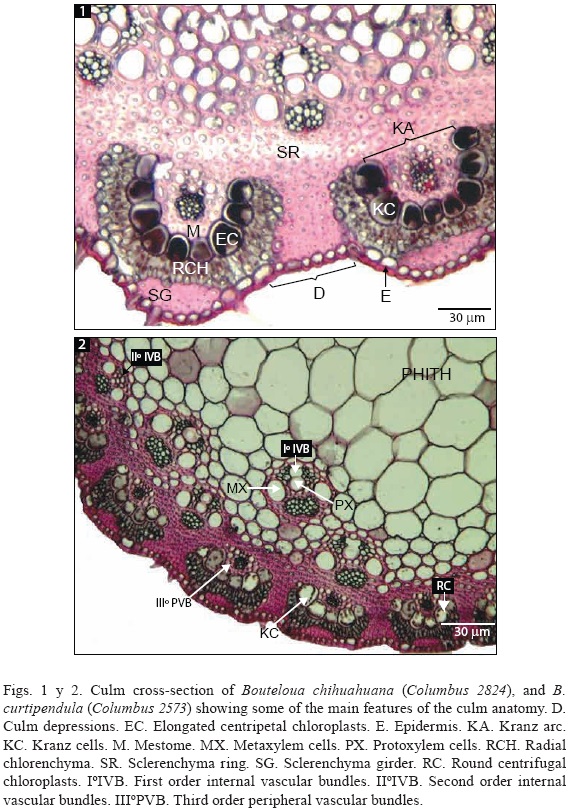
<body><![CDATA[<p align="center"><font face="verdana" size="2"><a name="t1"></a></font></p>              <p align="center"><font face="verdana" size="2"><img src="/img/revistas/abm/n78/a2t1.jpg"></font></p>              <p align="justify"><font face="verdana" size="2">&nbsp;</font></p>              <p align="justify"><font face="verdana" size="2"><b>RESULTS</b></font></p>              <p align="justify"><font face="verdana" size="2">The analyses of the middle internode region of the flowering mature culms show a similar anatomical pattern in most Boutelouinae. However, variation among some taxa was observed. A brief description of the tissues and their position in the culm, the anatomical patterns of the genera, and the relationships among taxa inferred from culm anatomy is provided.</font></p>              <p align="justify"><font face="verdana" size="2"><b>Tissues description in Boutelouinae</b></font></p>              <p align="justify"><font face="verdana" size="2">Epidermis. The single&#45;layered epidermis is composed of round to square cells surrounded by a cutin layer. Trichomes, stomata and silica bodies are usually present (<a href="#f1">Fig. 1e</a>).</font></p>              <p align="center"><font face="verdana" size="2"><a name="f1"></a></font></p>              <p align="center"><font face="verdana" size="2"><img src="/img/revistas/abm/n78/a2f1.jpg"></font></p>              <p align="justify"><font face="verdana" size="2">Sclerenchyma. Cells with thick secondary walls and a small lumen, are observed. They form a subepidermal ring variable in thickness (<a href="#f1">Fig. 1sr</a>), and interrupted by peripheral vascular bundles (PVB). In cross&#45;section outline, sclerenchyma forms a girder, usually yielding conspicuous crests (<a href="#f1">Fig. 1sg</a>).</font></p>              ]]></body>
<body><![CDATA[<p align="justify"><font face="verdana" size="2">Parenchyma. Parenchymatous cells are thin walled, and can be tubular or iso&#45;diametric, forming the radial chlorenchyma and the culm pith. Radial chlorenchyma cells are usually small, tubular, and perpendicular to the epidermis surface, following the curvature of the Kranz arc (<a href="#f1">Fig. 1rch</a>). The culm pith is located in the center of the culm, and it is constituted by large, isodiametric, thin walled, rounded cells (<a href="#f1">Fig. 2</a>). Sometimes internal vascular bundles (IVB) are embedded within the pith.</font></p>              <p align="justify"><font face="verdana" size="2">Kranz cells. In leaves, Kranz cells form a perivascular bundle sheath. However, in culms this bundle sheath is incomplete, giving an aspect of arc or crown, variable in size and number of cells. This incomplete bundle sheath is called Kranz arc (<a href="#f1">Fig. 1ka</a>). Kranz arc curvature varies from almost straight (<a href="#f3">Fig. 6ka</a>) (<a href="#f3">3</a>, <a href="#f3">4</a> and <a href="#f3">5</a>) to half circle (<a href="#f1">Figs. 1</a>, <a href="#f3">4</a>) or horseshoe (<a href="#f3">Fig. 7</a>), always bordered by radial chlorenchyma. Kranz cells may be regular to irregular, even to uneven, and their shape can vary from round to oval (<a href="#f1">Fig. 2kc</a>), square or trapezoid (<a href="#f1">Fig. 1kc</a>). The cells number is usually correlated with its size. According to our observations, Kranz cells are found only on the exposed mature zone of the internode and they hold elongate or round chloroplasts.</font></p>              <p align="center"><font face="verdana" size="2"><a name="f3"></a></font></p>              <p align="center"><font face="verdana" size="2"><img src="/img/revistas/abm/n78/a2f3.jpg"></font></p>              <p align="justify"><font face="verdana" size="2">Mestome. It is formed by small, thick walled cells, similar to the scleren&#45;chyma, surrounding the vascular bundles and occurring usually in a single layer. Mestome cells constitute the internal bundle sheath, and their size and shape are variable (<a href="#f1">Fig. 1m</a>).</font></p>              <p align="justify"><font face="verdana" size="2">Vascular bundles. The vascular bundles are peripheral (PVB) or internal (IVB), and can be I&deg; (proto and metaxylem cells well developed &#91;<a href="#f1">Fig. 2mx</a>, px&#93;), II&deg; (only metaxylem cells developed), or (inconspicuous proto and metaxylem cells) order (Ellis, 1976; Fig. 2). The peripheral vascular bundles are associated to Kranz cells, and most of them are order. The IVB are I&deg; order or II&deg; order, and are organized in one to three concentric circles. The number of PVB, as well as IVB is variable.</font></p>              <p align="justify"><font face="verdana" size="2"><b>Patterns of culm anatomy in Boutelouinae</b></font></p>              <p align="justify"><font face="verdana" size="2"><i>Aegopogon.</i> Culms are round to oval in cross&#45;section, with a smoothly undulate outline (<a href="#f3">Fig. 3</a>). Small and round epidermis cells are observed. The ones adjacent to radial chlorenchyma are larger than the rest of epidermis cells. Silica bodies and stomata are present. The sclerenchyma ring is formed by three to five layers of cells with evident lumen and surrounding 11 PVB in <i>A. cenchroides,</i> and one or none in <i>A. tenellus.</i> The Kranz arc is slightly curved with six to eight round, uneven cells with round chloroplasts. Sclerenchyma girder is missing. Seven to 17 IVB are embedded in the parenchymatous pith in two concentric circles, the outermost are II&deg; and the internal ones are I&deg; (<a href="#f3">Fig. 3</a>).</font></p>              <p align="justify"><font face="verdana" size="2"><i>Bouteloua.</i> Culms are round to oval in cross&#45;section, with a smooth to strongly undulate outline (<a href="#f3">Fig. 4</a>). The epidermis cells usually are small, round, and regular to irregular. Some taxa, however, display larger, square, and regular cells <i>(B. eriopoda</i> &#91;<a href="#f3">Fig. 5e</a>&#93;). Trichomes, stomata and silica bodies are always present. The subepidermal zone displays a continuous sclerenchymatous ring (<a href="#f3">Fig. 6sr</a>), 3 to 15 cells thick, interrupted by PVB with associated Kranz structures (Kranz cells and radial chlorenchyma). The sclerenchymatous ring completely surrounds the PVB and joins the IVB by their apexes. The PVB are usually II&deg; and their number ranges from 6 to 40. In undulated cross&#45;sections PVB usually alternate with the culm depressions (<a href="#f3">Fig. 4d</a>), however, in <i>B. eriopoda</i> and <i>B. eriostachya,</i> PVB are opposite to culm depressions (<a href="#f3">Fig. 5d</a>). Each PVB holds up an arc of Kranz cells of variable size, shape, curvature, and number. Some taxa show from 4 to 10 small, round, and uneven Kranz cells (B. <i>curtipendula</i> complex &#91;<a href="#t1">Table 1</a>, <a href="#f1">Fig. 2kc</a>&#93;); other show large square to oval, uniform cells (B. <i>chihuahuana, B. eriopoda, B. hirsuta,</i> and <i>B. ramosa</i> &#91;<a href="#f1">Figs. 1kc</a>, <a href="#f3">5</a>, <a href="#f3">4</a>, and <a href="#f3">7</a>, respectively&#93;). The number of Kranz cells varies from 3 to 12 (usually 4 to 7), and the arc curvature varies from almost straight (B. <i>aristidoides</i> &#91;<a href="#f3">Fig. 6ka</a>&#93; and the <i>B. curtipendula</i> complex taxa &#91;<a href="#f1">Fig. 2</a>&#93;) to half circle (B. <i>chihuahuana</i> &#91;Fig. 1ka&#93;, <i>B. hirsuta</i> &#91;<a href="#f3">Fig. 4</a>&#93;), or horseshoe (B. <i>ramosa</i> &#91;<a href="#f3">Fig. 7</a>&#93;). The chloroplasts of the Kranz cells are elongated (most <i>Bouteloua</i> taxa &#91;<a href="#f1">Fig. 1ec</a>, <a href="#f3">7 ec</a>, <a href="#f9">11ec</a>&#93;) or round (B. <i>curtipendula</i> complex &#91;<a href="#f1">Fig. 2rc</a>&#93;). The radial chlorenchyma is variable in shape, always following the Kranz arc curvature (<a href="#f1">Fig. 1</a>, <a href="#f3">6rch</a>). Frequently, it possesses a depression in the central part, which is filled by the scleren&#45;chyma girder (Fig. 1sg). The IVB vary from 12 to 40, and they are arranged in one to three concentric circles.</font></p>              <p align="justify"><font face="verdana" size="2"><i>Hilaria.</i> The culm is a half circle in cross&#45;section, with a slightly to evidently undulated surface (<a href="#f9">Fig. 9</a>). Small epidermal cells with thick cutin layer, silica cells, trichomes, and stomata are present. The sclerenchyma ring is formed by five layers of compact cells, surrounding eight to 13 PVB distributed mostly along the curved side. Kranz arc is slightly curved, formed by four to six round, uneven cells with round chloroplasts. Radial chlorenchyma is conspicuous, bordering the Kranz cells. Eleven to 17 I&deg; order IVB in two concentric circles are found.</font></p>              ]]></body>
<body><![CDATA[<p align="center"><font face="verdana" size="2"><a name="f9"></a></font></p>              <p align="center"><font face="verdana" size="2"><img src="/img/revistas/abm/n78/a2f9.jpg"></font></p>              <p align="justify"><font face="verdana" size="2"><i>Pleuraphis.</i> The culm is round to slightly oval, with an undulated margin in cross&#45;section (<a href="#f9">Fig. 10</a>). Epidermal cells are round and small. Silica cells, trichomes and stomata are present. Below the epidermis, there is a parenchyma ring of two or three layers (<a href="#f9">Fig. 10pr</a>), interrupted by 17 to 24 PVB. Under the parenchyma ring, the sclerenchyma ring is located (<a href="#f9">Fig. 10sr</a>). The Kranz arc is conspicuously curved in a half circle, with seven to eight squared, compact cells with elongate chloroplasts. Twenty&#45;two I&deg; order IVB, in two concentric circles are found. The most external ones are attached on their apexes to the scherenchyma ring.</font></p>              <p align="justify"><font face="verdana" size="2"><b>Relationships among taxa inferred by culm anatomy</b></font></p>              <p align="justify"><font face="verdana" size="2">Although culm anatomy characters have restricted value to infer phylogenetic relationships, several culm features may provide evidence of common ancestry. Most of the Boutelouinae taxa share a similar culm anatomy pattern. Undulated outline, sclerenchyma ring with PVB within, Kranz cells forming an arc, and IVB embedded in parenchymatic pith are the constant characters of this group (<a href="#f1">Fig. 1</a>). Some related species, however, display few traits that allow inference of relationships. From all culm anatomy characters studied (Table 2), the Kranz structures (cells and radial chlorenchyma &#91;<a href="#f1">Figs. 1kc</a>, <a href="#f1">rch</a>&#93;) and sclerenchyma ring (<a href="#f1">Fig. 1sr</a>) apparently are the most useful. The Kranz cells, when mature, are the most conspicuous elements on the culm anatomy. The size, shape and uniformity of Kranz cells, the curvature the Kranz arc, the shape and size of radial chlorenchyma, the sclerenchyma girders and the position of sclerenchyma ring are the most variable traits. Also, the chloroplast shape of the Kranz cells may be an important trait for inferring relationships at higher taxonomical levels.</font></p>              <p align="justify"><font face="verdana" size="2">The taxa of the <i>B. curtipendula</i> complex display a pattern somewhat different from most of the remaining Boutelouinae. It shows a slightly curved Kranz arc with 4 to 8 round and irregular cells, and an inconspicuous to evident sclerenchyma girder (<a href="#f1">Fig. 2</a>). However, the most compelling features that define the group is the presence of round, small, peripheral and centrifugal chloroplasts in the Kranz cells (<a href="#f1">Fig. 2rc</a>). Centripetal chloroplasts are typical of NAD&#45;ME type, and centrifugal ones are observed in NADP&#45;ME type and some species of PCK type (Pendergast et al., 1987). Small, centrifugal chloroplasts plus other structural traits in leaves (suberized lamella, uneven bundle sheath) have been associated to PCK pathway of C<sub>4</sub> photosynthesis (Hattersley and Watson, 1975). The PCK pathway has been documented in <i>B. curtipendula</i> (Guti&eacute;rrez et al., 1974; Prendergast et al., 1987), and in <i>Hilaria belangeri</i> (Brown, 1977). Chapman and Peat (1992) pointed out that <i>B. curtipendula</i> may have both PCK and NAD&#45;ME C<sub>4</sub> photosynthetic mechanisms, however, Prendergast et al. (1987) state that <i>B. curtipendula,</i> may be biochemically and structurally intermediate between NAD&#45;ME/PCK, since this species, unlike the "classical" PCK species (Hattersley and Browning, 1981), lacks suberized lamella and uneven bundle sheath outline. It has been suggested that PCK type species evolved from NAD&#45;ME type (Hattersely and Watson, 1992; and Clayton and Renvoize, 1989). Columbus et al. (1998, 2000), based on molecular data, showed that <i>Aegopogon, Hilaria</i> and <i>B. curtipendula</i> do not descend from the same most recent ancestor, suggesting that chloroplast shape evolved independently from different NAD&#45;ME ancestors. Although it has not been previously proposed, the rest of the taxa of the <i>B. curtipendula</i> complex (<a href="/img/revistas/abm/n78/html/a2apendice.html" target="_blank">Appendix</a>) likely exhibit the same photosynthesis pathway, since they share the same chloroplast features.</font></p>              <p align="justify"><font face="verdana" size="2">Gould and Kapadia (1964) recognized 12 species in the <i>B. curtipendula</i> complex (<a href="/img/revistas/abm/n78/html/a2apendice.html" target="_blank">Appendix</a>). Columbus (1996) based on leaf anatomy and micromorphology, pointed out that <i>B. juncea</i> was not a member of the complex. Molecular data (Columbus et al., 1998; Columbus et al., 2000; Siqueiros, 2001) further support the exclusion of <i>B. juncea</i> from the <i>B. curtipendula</i> complex. Elongated centripetal chlo&#45;roplasts of the Kranz cells, supports the exclusion of <i>B. juncea</i> from the complex (<a href="#f9">Fig. 11ec</a>).</font></p>              <p align="justify"><font face="verdana" size="2">Except taxa of the <i>B. curtipendula</i> complex, most <i>Bouteloua</i> species, typically display elongated centripetal chloroplasts in leaves and culms. Noteworthy is the presence of round, peripheral chloroplasts in the culm Kranz cells in <i>B. americana (Worthington 22775), B. barbata (2289), B. breviseta (2280</i> &#91;<a href="#f9">Fig. 13rc</a>&#93;, 2908), <i>B. dimorpha (2373, 2593, 2647), B. nervata (2343), B. radicosa (2341, 2462), B. ramosa (2807</i> &#91;<a href="#f9">Fig. 8rc</a>&#93;, <i>2846), B. repens (2332, 2425), B. simplex (2579</i> &#91;<a href="#f9">Fig. 14rc</a>&#93;), and <i>B. williamsii (2357),</i> which typically display elongate and centripetal chloroplasts. Several populations of <i>B. repens</i> complex, sister group of <i>B. curtipendula</i> complex (Columbus et al., 1998), exhibit round chloroplasts, rather than elongated ones in culm Kranz cells. In fact, several taxa in Boutelouinae possess round chloroplasts in juvenile stages of culm development, while the culm Kranz cells are not well differentiated yet (<a href="#f9">Figs. 13</a>, <a href="#f9">14rc</a>). This could indicate that round chloroplasts may be the ancestral shape in Boutelouinae, which later in their evolution have changed to elongate in the NAD&#45;ME type in most taxa.</font></p>              <p align="justify"><font face="verdana" size="2"><i>Bouteloua eriopoda</i> and <i>B. eriostachya</i> share the same unique pattern, particularly with respect to the position of the PVB, which are opposite to the culm depressions. Also, the Kranz arc is nearly straight, formed by oval to rectangular and regular cells. The radial chlorenchyma is conspicuous, and lies along the upper surface of the arc, not bordering the sides of the ending cells, as found in the other taxa (<a href="#f3">Fig. 6</a>). Anatomical, molecular, and morphological evidence (Columbus, 1996; Columbus et al., 1998; and Columbus, 1999b, respectively) show that <i>B. eriopoda</i> and <i>B. eriostachya</i> are closely related. In fact, Swallen (1939) recognized them as a single species.</font></p>              <p align="justify"><font face="verdana" size="2">Columbus et al. (1998) and Columbus (1999b), show evidence of a close relationship among <i>B. eriopoda, B. eriostachya, B. annua</i> and <i>B. aristidoides.</i> Similarities between <i>B. eriopoda</i> and <i>B. eriostachya,</i> and also between <i>B. annua</i> and <i>B. aristidoides</i> were found, but not between the two pairs of clades. The clade <i>B. eriopoda&#45;B. eriostachya</i> differs from <i>B. annua&#45;B. aristidoides</i> clade in the presence of highest number of PVB, the shape of radial chlorenchyma, and by the absence of sclerenchyma girder. <i>Bouteloua aristidoides</i> and <i>B. quiriegoensis</i> also share a similar pattern, with square and regular cells, forming nearly a straight arc (<a href="#f3">Figs. 6</a> and <a href="#f9">12</a>, respectively). <i>Bouteloua hirsuta</i> displays similar features; however, it differs in its Kranz arc, which is conspicuously curved (<a href="#f3">Fig. 4</a>). In the Boutelouinae phylogeny (Columbus et al., 1998, 2000), these taxa are closely related forming sister clades.</font></p>              ]]></body>
<body><![CDATA[<p align="justify"><font face="verdana" size="2"><i>Bouteloua ramosa</i> and <i>B. breviseta</i> share also similar features in culm anatomy, particularly with respect to Kranz structures. The most distinct feature characterizing these two species is an angular Kranz arc with large and elongated cells, bordered by an angular radial chlorenchyma (<a href="#f9">Fig. 7</a>). <i>Bouteloua ramosa</i> differs in its horseshoe shaped arc, while <i>B. breviseta</i> has a less curved arc. Both also share round chloroplasts in immature developmental stages (<a href="#f9">Fig. 8</a>, <a href="#f9">13rc</a>). <i>Bouteloua ramosa</i> and <i>B. breviseta</i> have been suggested to be closely related to <i>B. chasei</i> and <i>B. karwinskii,</i> however, the two latter do not exhibit the angular arc, and their Kranz cells are rounded but not elongated.</font></p>              <p align="justify"><font face="verdana" size="2">Culm anatomy also supports the inclusion of the satellite genera <i>(Buchloe, Buchlomimus, Cathestecum, Cyclostachya, Griffitsochloa, Opizia, Pentarrhaphis, Pringleochloa</i> and <i>Soderstromia)</i> within <i>Bouteloua</i> (Columbus, 1999a), as all of them posses almost the same basic anatomical pattern of <i>Bouteloua.</i></font></p>              <p align="justify"><font face="verdana" size="2">&nbsp;</font></p>              <p align="justify"><font face="verdana" size="2"><b>CONCLUSIONS</b></font></p>              <p align="justify"><font face="verdana" size="2">Although culm anatomy does not display the same degree of variation as leaf anatomy does, there are several culm anatomy characters that can be useful for inferring relationships at higher levels (family, tribes, genera). The most important phylogenetic culm anatomy features are Kranz structures (cells and radial chlor&#45;enchyma), number and position of the vascular bundles, and sclerenchyma girders. <i>Bouteloua eriopoda</i> and <i>B. eriostachya</i> share similar anatomical structure, as <i>B. breviseta</i> and <i>B. ramosa</i> do. Culm anatomy also supports the inclusion of satellite genera in <i>Bouteloua.</i> In general culm anatomy has valuable, but a restricted systematic value.</font></p>              <p align="justify"><font face="verdana" size="2">&nbsp;</font></p>              <p align="justify"><font face="verdana" size="2"><b>ACKNOWLEDGMENTS</b></font></p>              <p align="justify"><font face="verdana" size="2">This study was funded by Rancho Santa Ana Botanic Garden. I thank J. Travis Columbus for his support, advice, and allowing me to use his plant material, J. Mark Porter kindly reviewed the first draft of this paper. Especially, I want to thank Rosa Cerros&#45;Tlatilpa for her pertinent suggestions to the manuscript, for helping me with the pictures editing, and for her friendship.</font></p>              <p align="justify"><font face="verdana" size="2">&nbsp;</font></p>              <p align="justify"><font face="verdana" size="2"><b>LITERATURE CITED</b></font></p>              ]]></body>
<body><![CDATA[<!-- ref --><p align="justify"><font face="verdana" size="2">Agrasar, Z. E. R. D. and M. F. Rodr&iacute;guez. 2002. Cauline anatomy of native woody bamboos in Argentina and neighboring areas: epidermis. Bot. J. Linn. Soc. 138(1): 45&#45;55.    &nbsp;&nbsp;&nbsp;&nbsp;&nbsp;&nbsp;&nbsp;&nbsp;[&#160;<a href="javascript:void(0);" onclick="javascript: window.open('/scielo.php?script=sci_nlinks&ref=019057&pid=S0187-7151200700010000200001&lng=','','width=640,height=500,resizable=yes,scrollbars=1,menubar=yes,');">Links</a>&#160;]<!-- end-ref --></font></p>              <!-- ref --><p align="justify"><font face="verdana" size="2">Auquier, P. and Y. Somers. 1967. Recherches histotaxonomiques sur le chaume des Poaceae. Bull. Soc. Roy. Bot. Belgique 100: 95&#45;140.    &nbsp;&nbsp;&nbsp;&nbsp;&nbsp;&nbsp;&nbsp;&nbsp;[&#160;<a href="javascript:void(0);" onclick="javascript: window.open('/scielo.php?script=sci_nlinks&ref=019059&pid=S0187-7151200700010000200002&lng=','','width=640,height=500,resizable=yes,scrollbars=1,menubar=yes,');">Links</a>&#160;]<!-- end-ref --> </font></p>              <!-- ref --><p align="justify"><font face="verdana" size="2">Breakwell, E. 1914. A study of the leaf&#45;anatomy of some native species of the genus <i>Andropogon.</i> Proc. Linn. Soc. New South Wales ser. 2, 39: 385&#45;394.    &nbsp;&nbsp;&nbsp;&nbsp;&nbsp;&nbsp;&nbsp;&nbsp;[&#160;<a href="javascript:void(0);" onclick="javascript: window.open('/scielo.php?script=sci_nlinks&ref=019061&pid=S0187-7151200700010000200003&lng=','','width=640,height=500,resizable=yes,scrollbars=1,menubar=yes,');">Links</a>&#160;]<!-- end-ref --></font></p>              <!-- ref --><p align="justify"><font face="verdana" size="2">Brown, W. V. 1958. Leaf anatomy in grass systematics. Bot. Gaz. 119: 170&#45;178.    &nbsp;&nbsp;&nbsp;&nbsp;&nbsp;&nbsp;&nbsp;&nbsp;[&#160;<a href="javascript:void(0);" onclick="javascript: window.open('/scielo.php?script=sci_nlinks&ref=019063&pid=S0187-7151200700010000200004&lng=','','width=640,height=500,resizable=yes,scrollbars=1,menubar=yes,');">Links</a>&#160;]<!-- end-ref --></font></p>              <!-- ref --><p align="justify"><font face="verdana" size="2">Brown, W. V. 1975. Variations in anatomy, associations, and origins of Kranz tissue. Amer. J. Bot. 62: 395&#45;402.    &nbsp;&nbsp;&nbsp;&nbsp;&nbsp;&nbsp;&nbsp;&nbsp;[&#160;<a href="javascript:void(0);" onclick="javascript: window.open('/scielo.php?script=sci_nlinks&ref=019065&pid=S0187-7151200700010000200005&lng=','','width=640,height=500,resizable=yes,scrollbars=1,menubar=yes,');">Links</a>&#160;]<!-- end-ref --></font></p>              ]]></body>
<body><![CDATA[<!-- ref --><p align="justify"><font face="verdana" size="2">Brown, W. V. 1977. The Kranz syndrome and its subtypes in grass systematics. Mem. Torr. Bot. Club 23: 1&#45;97.    &nbsp;&nbsp;&nbsp;&nbsp;&nbsp;&nbsp;&nbsp;&nbsp;[&#160;<a href="javascript:void(0);" onclick="javascript: window.open('/scielo.php?script=sci_nlinks&ref=019067&pid=S0187-7151200700010000200006&lng=','','width=640,height=500,resizable=yes,scrollbars=1,menubar=yes,');">Links</a>&#160;]<!-- end-ref --></font></p>              <!-- ref --><p align="justify"><font face="verdana" size="2">Cenci, C. A., S. Grando and S. Ceccarelli. 1984. Culm anatomy in barley <i>(Hordeum vulgare). </i>Can. J. Bot. 62: 2023&#45;2027.    &nbsp;&nbsp;&nbsp;&nbsp;&nbsp;&nbsp;&nbsp;&nbsp;[&#160;<a href="javascript:void(0);" onclick="javascript: window.open('/scielo.php?script=sci_nlinks&ref=019069&pid=S0187-7151200700010000200007&lng=','','width=640,height=500,resizable=yes,scrollbars=1,menubar=yes,');">Links</a>&#160;]<!-- end-ref --></font></p>              <!-- ref --><p align="justify"><font face="verdana" size="2">Cerros&#45;Tlatilpa, R. 1999. Estudio sistem&aacute;tico del g&eacute;nero <i>Chloris</i> Sw. en M&eacute;xico. Tesis de Maestr&iacute;a en Ciencias. Facultad de Ciencias, Universidad Nacional Aut&oacute;noma de M&eacute;xico. M&eacute;xico, D.F. 165 pp.    &nbsp;&nbsp;&nbsp;&nbsp;&nbsp;&nbsp;&nbsp;&nbsp;[&#160;<a href="javascript:void(0);" onclick="javascript: window.open('/scielo.php?script=sci_nlinks&ref=019071&pid=S0187-7151200700010000200008&lng=','','width=640,height=500,resizable=yes,scrollbars=1,menubar=yes,');">Links</a>&#160;]<!-- end-ref --></font></p>              <!-- ref --><p align="justify"><font face="verdana" size="2">Chapman, G. P. and W. E. Peat. 1992. An introduction to the grasses (including bamboos and cereals). CAB International. Wallingfore. 111 pp.    &nbsp;&nbsp;&nbsp;&nbsp;&nbsp;&nbsp;&nbsp;&nbsp;[&#160;<a href="javascript:void(0);" onclick="javascript: window.open('/scielo.php?script=sci_nlinks&ref=019073&pid=S0187-7151200700010000200009&lng=','','width=640,height=500,resizable=yes,scrollbars=1,menubar=yes,');">Links</a>&#160;]<!-- end-ref --></font></p>              <!-- ref --><p align="justify"><font face="verdana" size="2">Clayton, W. D. and S. A. Renvoize. 1989. Genera graminum&#45;grasses of the world. Her Majesty's Stationary Office. London. 389 pp.    &nbsp;&nbsp;&nbsp;&nbsp;&nbsp;&nbsp;&nbsp;&nbsp;[&#160;<a href="javascript:void(0);" onclick="javascript: window.open('/scielo.php?script=sci_nlinks&ref=019075&pid=S0187-7151200700010000200010&lng=','','width=640,height=500,resizable=yes,scrollbars=1,menubar=yes,');">Links</a>&#160;]<!-- end-ref --> </font></p>              ]]></body>
<body><![CDATA[<!-- ref --><p align="justify"><font face="verdana" size="2">Columbus, J. T. 1996. Lemma micromorphology, leaf anatomy, and phylogenetics of <i>Bouteloua, Hilaria,</i> and relatives (Gramineae: Chloridoideae: Boutelouinae). Ph. D dissertation. University of California. Berkeley. 258 pp.    &nbsp;&nbsp;&nbsp;&nbsp;&nbsp;&nbsp;&nbsp;&nbsp;[&#160;<a href="javascript:void(0);" onclick="javascript: window.open('/scielo.php?script=sci_nlinks&ref=019077&pid=S0187-7151200700010000200011&lng=','','width=640,height=500,resizable=yes,scrollbars=1,menubar=yes,');">Links</a>&#160;]<!-- end-ref --></font></p>              <!-- ref --><p align="justify"><font face="verdana" size="2">Columbus, J. T. 1999a. An expanded circumscription of <i>Bouteloua</i> (Gramineae: Chloridoideae): New combinations and names. Aliso 18(1): 61&#45;65.    &nbsp;&nbsp;&nbsp;&nbsp;&nbsp;&nbsp;&nbsp;&nbsp;[&#160;<a href="javascript:void(0);" onclick="javascript: window.open('/scielo.php?script=sci_nlinks&ref=019079&pid=S0187-7151200700010000200012&lng=','','width=640,height=500,resizable=yes,scrollbars=1,menubar=yes,');">Links</a>&#160;]<!-- end-ref --></font></p>              <!-- ref --><p align="justify"><font face="verdana" size="2">Columbus, J. T. 1999b. Morphology and leaf anatomy suggest a close relationship between <i>Bouteloua aristidoides</i> and <i>B. (Chondrosium) eriopoda</i> (Gramineae: Chloridoideae). Syst. Bot. 23(4): 467&#45;478.    &nbsp;&nbsp;&nbsp;&nbsp;&nbsp;&nbsp;&nbsp;&nbsp;[&#160;<a href="javascript:void(0);" onclick="javascript: window.open('/scielo.php?script=sci_nlinks&ref=019081&pid=S0187-7151200700010000200013&lng=','','width=640,height=500,resizable=yes,scrollbars=1,menubar=yes,');">Links</a>&#160;]<!-- end-ref --></font></p>              <!-- ref --><p align="justify"><font face="verdana" size="2">Columbus, J. T., M. S. Kinney, R. Pant and M. E. Siqueiros. 1998. Cladistic parsimony analysis of internal transcribed spacer region (nrDNA) sequences of <i>Bouteloua</i> and relatives (Gramineae: Chloridoideae). Aliso 7(2): 99&#45;130.    &nbsp;&nbsp;&nbsp;&nbsp;&nbsp;&nbsp;&nbsp;&nbsp;[&#160;<a href="javascript:void(0);" onclick="javascript: window.open('/scielo.php?script=sci_nlinks&ref=019083&pid=S0187-7151200700010000200014&lng=','','width=640,height=500,resizable=yes,scrollbars=1,menubar=yes,');">Links</a>&#160;]<!-- end-ref --></font></p>              <!-- ref --><p align="justify"><font face="verdana" size="2">Columbus, J. T., M. S. Kinney, M. E. Siqueiros and J. M. Porter. 2000. Phylogenetics of <i>Bouteloua</i> and relatives (Gramineae: Chloridoideae): Cladistic parsimony analysis of internal transcribed spacer (nrDNA) and trnL&#45;F (cpDNA) sequences. In: Jacobs, S. W. L. and J. Everett (eds.). Grasses: systematics and evolution. CSIRO Publishing, Victoria. pp. 189&#45;194.    &nbsp;&nbsp;&nbsp;&nbsp;&nbsp;&nbsp;&nbsp;&nbsp;[&#160;<a href="javascript:void(0);" onclick="javascript: window.open('/scielo.php?script=sci_nlinks&ref=019085&pid=S0187-7151200700010000200015&lng=','','width=640,height=500,resizable=yes,scrollbars=1,menubar=yes,');">Links</a>&#160;]<!-- end-ref --></font></p>              ]]></body>
<body><![CDATA[<!-- ref --><p align="justify"><font face="verdana" size="2">De Wet, J. M. 1960. Culm anatomy in relation to taxonomy. Bothalia 7: 311.    &nbsp;&nbsp;&nbsp;&nbsp;&nbsp;&nbsp;&nbsp;&nbsp;[&#160;<a href="javascript:void(0);" onclick="javascript: window.open('/scielo.php?script=sci_nlinks&ref=019087&pid=S0187-7151200700010000200016&lng=','','width=640,height=500,resizable=yes,scrollbars=1,menubar=yes,');">Links</a>&#160;]<!-- end-ref --></font></p>              <!-- ref --><p align="justify"><font face="verdana" size="2">Ellis, R. P. 1976. A procedure for standardizing comparative leaf anatomy in the Poaceae. I. The leaf&#45;blade as viewed in transverse section. Bothalia 12: 65&#45;109.    &nbsp;&nbsp;&nbsp;&nbsp;&nbsp;&nbsp;&nbsp;&nbsp;[&#160;<a href="javascript:void(0);" onclick="javascript: window.open('/scielo.php?script=sci_nlinks&ref=019089&pid=S0187-7151200700010000200017&lng=','','width=640,height=500,resizable=yes,scrollbars=1,menubar=yes,');">Links</a>&#160;]<!-- end-ref --></font></p>              <!-- ref --><p align="justify"><font face="verdana" size="2">Ellis, R. P. 1987. A review of comparative leaf blade anatomy in the systematics of the Poaceae: The past twenty&#45;five years. In: Soderstrom, T. R., K. W. Hilu, C. S. Campbell and M. E. Barkworth (eds.). Grass systematics and evolution. Smithsonian Institution Press, Washington, D.C. pp. 3&#45;10.    &nbsp;&nbsp;&nbsp;&nbsp;&nbsp;&nbsp;&nbsp;&nbsp;[&#160;<a href="javascript:void(0);" onclick="javascript: window.open('/scielo.php?script=sci_nlinks&ref=019091&pid=S0187-7151200700010000200018&lng=','','width=640,height=500,resizable=yes,scrollbars=1,menubar=yes,');">Links</a>&#160;]<!-- end-ref --></font></p>              <!-- ref --><p align="justify"><font face="verdana" size="2">Fisher, B. S. 1939. A contribution to the leaf anatomy of Natal grasses, Series I: <i>Chloris</i> Sw., and <i>Eustachys</i> Desv. Ann. Natal Mus. 90: 245&#45;267.    &nbsp;&nbsp;&nbsp;&nbsp;&nbsp;&nbsp;&nbsp;&nbsp;[&#160;<a href="javascript:void(0);" onclick="javascript: window.open('/scielo.php?script=sci_nlinks&ref=019093&pid=S0187-7151200700010000200019&lng=','','width=640,height=500,resizable=yes,scrollbars=1,menubar=yes,');">Links</a>&#160;]<!-- end-ref --></font></p>              <!-- ref --><p align="justify"><font face="verdana" size="2">Gasser, M., A. C. Vegetti and J. A. Tivano. 1994. Anatom&iacute;a de las estructuras foliares y caulinares en v&aacute;stagos reproductivos de <i>Eleusine indica</i> (L.) Gaertner y <i>E. tristachya</i> (Lam.) Lam. Res&uacute;menes VI Congreso Latinoamericano de Bot&aacute;nica. Mar del Plata. p. 39.    &nbsp;&nbsp;&nbsp;&nbsp;&nbsp;&nbsp;&nbsp;&nbsp;[&#160;<a href="javascript:void(0);" onclick="javascript: window.open('/scielo.php?script=sci_nlinks&ref=019095&pid=S0187-7151200700010000200020&lng=','','width=640,height=500,resizable=yes,scrollbars=1,menubar=yes,');">Links</a>&#160;]<!-- end-ref --></font></p>              ]]></body>
<body><![CDATA[<!-- ref --><p align="justify"><font face="verdana" size="2">Gould, F. W. 1980. The genus <i>Bouteloua</i> (Poaceae). Ann. Mo. Bot. Gard. 66: 348&#45;416.    &nbsp;&nbsp;&nbsp;&nbsp;&nbsp;&nbsp;&nbsp;&nbsp;[&#160;<a href="javascript:void(0);" onclick="javascript: window.open('/scielo.php?script=sci_nlinks&ref=019097&pid=S0187-7151200700010000200021&lng=','','width=640,height=500,resizable=yes,scrollbars=1,menubar=yes,');">Links</a>&#160;]<!-- end-ref --></font></p>              <!-- ref --><p align="justify"><font face="verdana" size="2">Gould, F. W. and Z. J. Kapadia. 1964. Biosystematic studies in the <i>Bouteloua curtipendula</i> complex. II. Taxonomy. Brittonia 16: 182&#45;207.    &nbsp;&nbsp;&nbsp;&nbsp;&nbsp;&nbsp;&nbsp;&nbsp;[&#160;<a href="javascript:void(0);" onclick="javascript: window.open('/scielo.php?script=sci_nlinks&ref=019099&pid=S0187-7151200700010000200022&lng=','','width=640,height=500,resizable=yes,scrollbars=1,menubar=yes,');">Links</a>&#160;]<!-- end-ref --> </font></p>              <!-- ref --><p align="justify"><font face="verdana" size="2">Grosor, D. and W. Liese. 1971. On the anatomy of Asian bamboos, with special reference to their vascular bundles. Wood Science and Technology 5: 290&#45;312.    &nbsp;&nbsp;&nbsp;&nbsp;&nbsp;&nbsp;&nbsp;&nbsp;[&#160;<a href="javascript:void(0);" onclick="javascript: window.open('/scielo.php?script=sci_nlinks&ref=019101&pid=S0187-7151200700010000200023&lng=','','width=640,height=500,resizable=yes,scrollbars=1,menubar=yes,');">Links</a>&#160;]<!-- end-ref --></font></p>              <!-- ref --><p align="justify"><font face="verdana" size="2">Guti&eacute;rrez, V. M., V. E. Gracen and G. E. Edwards. 1974. Biochemical and cytological relationships in C<sub>4</sub> plants. Planta 119: 279&#45;300.    &nbsp;&nbsp;&nbsp;&nbsp;&nbsp;&nbsp;&nbsp;&nbsp;[&#160;<a href="javascript:void(0);" onclick="javascript: window.open('/scielo.php?script=sci_nlinks&ref=019103&pid=S0187-7151200700010000200024&lng=','','width=640,height=500,resizable=yes,scrollbars=1,menubar=yes,');">Links</a>&#160;]<!-- end-ref --> </font></p>              <!-- ref --><p align="justify"><font face="verdana" size="2">Hattersley, P. W. and A. J. Browning. 1981. Ocurrence of the suberized lamella in leaves of grasses of different photosynthetic types. I. In parenchymatous bundle sheaths and PCR ("Kranz") sheaths. Protoplasma 109: 371&#45;401.    &nbsp;&nbsp;&nbsp;&nbsp;&nbsp;&nbsp;&nbsp;&nbsp;[&#160;<a href="javascript:void(0);" onclick="javascript: window.open('/scielo.php?script=sci_nlinks&ref=019105&pid=S0187-7151200700010000200025&lng=','','width=640,height=500,resizable=yes,scrollbars=1,menubar=yes,');">Links</a>&#160;]<!-- end-ref --></font></p>              ]]></body>
<body><![CDATA[<!-- ref --><p align="justify"><font face="verdana" size="2">Hattersley, P. W. and L. Watson. 1975. Anatomical parameters for predicting photosynthetic pathways of grass leaves: The "maximum lateral cell count" and the "maximum cell distant count". Phytomorph. 25: 225&#45;333.    &nbsp;&nbsp;&nbsp;&nbsp;&nbsp;&nbsp;&nbsp;&nbsp;[&#160;<a href="javascript:void(0);" onclick="javascript: window.open('/scielo.php?script=sci_nlinks&ref=019107&pid=S0187-7151200700010000200026&lng=','','width=640,height=500,resizable=yes,scrollbars=1,menubar=yes,');">Links</a>&#160;]<!-- end-ref --></font></p>              <!-- ref --><p align="justify"><font face="verdana" size="2">Hattersley, P. W. and L. Watson. 1992. Diversification of photosynthesis. In: Chapman, G. P. (ed.). Grass evolution and domestication. Cambridge Univ. Press, Cambridge. pp. 38&#45;116.    &nbsp;&nbsp;&nbsp;&nbsp;&nbsp;&nbsp;&nbsp;&nbsp;[&#160;<a href="javascript:void(0);" onclick="javascript: window.open('/scielo.php?script=sci_nlinks&ref=019109&pid=S0187-7151200700010000200027&lng=','','width=640,height=500,resizable=yes,scrollbars=1,menubar=yes,');">Links</a>&#160;]<!-- end-ref --></font></p>              <!-- ref --><p align="justify"><font face="verdana" size="2">Liese, W. 1980. Anatomy of bamboo. In: Lessard, G. and A. Chovinard (eds). Bamboo Research in Asia. Proceedings of a workshop held in Singapore. pp. 161&#45;164.    &nbsp;&nbsp;&nbsp;&nbsp;&nbsp;&nbsp;&nbsp;&nbsp;[&#160;<a href="javascript:void(0);" onclick="javascript: window.open('/scielo.php?script=sci_nlinks&ref=019111&pid=S0187-7151200700010000200028&lng=','','width=640,height=500,resizable=yes,scrollbars=1,menubar=yes,');">Links</a>&#160;]<!-- end-ref --></font></p>              <!-- ref --><p align="justify"><font face="verdana" size="2">Liese, W. 1998. The anatomy of bamboo culms. Technical Report 18. International Network for Bamboo and Rattan. Beijing. 204 pp.    &nbsp;&nbsp;&nbsp;&nbsp;&nbsp;&nbsp;&nbsp;&nbsp;[&#160;<a href="javascript:void(0);" onclick="javascript: window.open('/scielo.php?script=sci_nlinks&ref=019113&pid=S0187-7151200700010000200029&lng=','','width=640,height=500,resizable=yes,scrollbars=1,menubar=yes,');">Links</a>&#160;]<!-- end-ref --> </font></p>              <!-- ref --><p align="justify"><font face="verdana" size="2">Londo&ntilde;o, X., G. C. Camayo, N. M. Ria&ntilde;o and Y. L&oacute;pez. 2002. Characterization of the anatomy of <i>Guadua angustifolia</i> (Poaceae: Bambusoideae) culms. J. Amer. Bamboo Soc. 16(1): 18&#45;31.    &nbsp;&nbsp;&nbsp;&nbsp;&nbsp;&nbsp;&nbsp;&nbsp;[&#160;<a href="javascript:void(0);" onclick="javascript: window.open('/scielo.php?script=sci_nlinks&ref=019115&pid=S0187-7151200700010000200030&lng=','','width=640,height=500,resizable=yes,scrollbars=1,menubar=yes,');">Links</a>&#160;]<!-- end-ref --></font></p>              ]]></body>
<body><![CDATA[<!-- ref --><p align="justify"><font face="verdana" size="2">Metcalf, C. R. 1960. Anatomy of the monocotyledons. I. Gramineae. Clarendon Press. Oxford. 731 pp.    &nbsp;&nbsp;&nbsp;&nbsp;&nbsp;&nbsp;&nbsp;&nbsp;[&#160;<a href="javascript:void(0);" onclick="javascript: window.open('/scielo.php?script=sci_nlinks&ref=019117&pid=S0187-7151200700010000200031&lng=','','width=640,height=500,resizable=yes,scrollbars=1,menubar=yes,');">Links</a>&#160;]<!-- end-ref --></font></p>              <!-- ref --><p align="justify"><font face="verdana" size="2">Morden, C. W. and S. Hatch. 1987. Anatomical study of the <i>Muhlenbergia repens</i> complex (Poaceae: Chloridoideae: Eragrostoideae). Sida 12: 347&#45;359.    &nbsp;&nbsp;&nbsp;&nbsp;&nbsp;&nbsp;&nbsp;&nbsp;[&#160;<a href="javascript:void(0);" onclick="javascript: window.open('/scielo.php?script=sci_nlinks&ref=019119&pid=S0187-7151200700010000200032&lng=','','width=640,height=500,resizable=yes,scrollbars=1,menubar=yes,');">Links</a>&#160;]<!-- end-ref --></font></p>              <!-- ref --><p align="justify"><font face="verdana" size="2">Prendergast, H. D. V., P. W. Hattersley and N. E. Sotne. 1987. New structural/Biochemical associations in leaf blades of C<sub>4</sub> grasses (Poaceae). Australian J. Plant Physiol. 14: 403&#45;420.    &nbsp;&nbsp;&nbsp;&nbsp;&nbsp;&nbsp;&nbsp;&nbsp;[&#160;<a href="javascript:void(0);" onclick="javascript: window.open('/scielo.php?script=sci_nlinks&ref=019121&pid=S0187-7151200700010000200033&lng=','','width=640,height=500,resizable=yes,scrollbars=1,menubar=yes,');">Links</a>&#160;]<!-- end-ref --></font></p>              <!-- ref --><p align="justify"><font face="verdana" size="2">Ramos, J. C., J. C. Tivano and A. C. Veguetti. 2002. Estudio anat&oacute;mico de v&aacute;stagos reproductivos en <i>Bromus auleticus</i> Trin. ex Nees (Poaceae). Gayana Bot. 59(2): 5160.    &nbsp;&nbsp;&nbsp;&nbsp;&nbsp;&nbsp;&nbsp;&nbsp;[&#160;<a href="javascript:void(0);" onclick="javascript: window.open('/scielo.php?script=sci_nlinks&ref=019123&pid=S0187-7151200700010000200034&lng=','','width=640,height=500,resizable=yes,scrollbars=1,menubar=yes,');">Links</a>&#160;]<!-- end-ref --></font></p>              <!-- ref --><p align="justify"><font face="verdana" size="2">Reeder, J. R. 1969. Las gram&iacute;neas dioicas de M&eacute;xico. Bol. Soc. Bot. M&eacute;x. 30: 121&#45;126.    &nbsp;&nbsp;&nbsp;&nbsp;&nbsp;&nbsp;&nbsp;&nbsp;[&#160;<a href="javascript:void(0);" onclick="javascript: window.open('/scielo.php?script=sci_nlinks&ref=019125&pid=S0187-7151200700010000200035&lng=','','width=640,height=500,resizable=yes,scrollbars=1,menubar=yes,');">Links</a>&#160;]<!-- end-ref --></font></p>              ]]></body>
<body><![CDATA[<!-- ref --><p align="justify"><font face="verdana" size="2">Ruzin, S. 1993. Plant michrotechnique. NSF Center of Plant Development Biology, University of California. Berkeley. 82 pp.    &nbsp;&nbsp;&nbsp;&nbsp;&nbsp;&nbsp;&nbsp;&nbsp;[&#160;<a href="javascript:void(0);" onclick="javascript: window.open('/scielo.php?script=sci_nlinks&ref=019127&pid=S0187-7151200700010000200036&lng=','','width=640,height=500,resizable=yes,scrollbars=1,menubar=yes,');">Links</a>&#160;]<!-- end-ref --></font></p>              <!-- ref --><p align="justify"><font face="verdana" size="2">S&aacute;nchez, E. 1971. Anatom&iacute;a foliar de las Chloridoideae (Gramineae) argentinas. Kurtziana 6: 103&#45;218.    &nbsp;&nbsp;&nbsp;&nbsp;&nbsp;&nbsp;&nbsp;&nbsp;[&#160;<a href="javascript:void(0);" onclick="javascript: window.open('/scielo.php?script=sci_nlinks&ref=019129&pid=S0187-7151200700010000200037&lng=','','width=640,height=500,resizable=yes,scrollbars=1,menubar=yes,');">Links</a>&#160;]<!-- end-ref --></font></p>              <!-- ref --><p align="justify"><font face="verdana" size="2">S&aacute;nchez, E. 1983a. Estudios anat&oacute;micos en <i>Blepharidachne</i> Hackel (Poaceae, Eragrostidoideae, Eragrostae). Rev. Museo Arg. Cs. Nat. "Bernardino Rivadavia" 6(3): 73.    &nbsp;&nbsp;&nbsp;&nbsp;&nbsp;&nbsp;&nbsp;&nbsp;[&#160;<a href="javascript:void(0);" onclick="javascript: window.open('/scielo.php?script=sci_nlinks&ref=019131&pid=S0187-7151200700010000200038&lng=','','width=640,height=500,resizable=yes,scrollbars=1,menubar=yes,');">Links</a>&#160;]<!-- end-ref --></font></p>              <!-- ref --><p align="justify"><font face="verdana" size="2">S&aacute;nchez, E. 1983b. <i>Dasyochloa</i> Willdenow ex Rydberg (Poaceae) g&eacute;nero monot&iacute;pico de Norteam&eacute;rica. Lilloa 361&#45;131.    &nbsp;&nbsp;&nbsp;&nbsp;&nbsp;&nbsp;&nbsp;&nbsp;[&#160;<a href="javascript:void(0);" onclick="javascript: window.open('/scielo.php?script=sci_nlinks&ref=019133&pid=S0187-7151200700010000200039&lng=','','width=640,height=500,resizable=yes,scrollbars=1,menubar=yes,');">Links</a>&#160;]<!-- end-ref --></font></p>              <!-- ref --><p align="justify"><font face="verdana" size="2">S&aacute;nchez, E. 1984. Estudios anat&oacute;micos en el g&eacute;nero <i>Munroa</i> (Poaceae, Chlorideae, Eragrostidae). Darwiniana 25(1&#45;4): 43.    &nbsp;&nbsp;&nbsp;&nbsp;&nbsp;&nbsp;&nbsp;&nbsp;[&#160;<a href="javascript:void(0);" onclick="javascript: window.open('/scielo.php?script=sci_nlinks&ref=019135&pid=S0187-7151200700010000200040&lng=','','width=640,height=500,resizable=yes,scrollbars=1,menubar=yes,');">Links</a>&#160;]<!-- end-ref --></font></p>              ]]></body>
<body><![CDATA[<!-- ref --><p align="justify"><font face="verdana" size="2">Schmid, R. and M. D. Turner. 1977. Contrad 70, an effective softener of herbarium material for anatomical study. Taxon 26: 551&#45;552.    &nbsp;&nbsp;&nbsp;&nbsp;&nbsp;&nbsp;&nbsp;&nbsp;[&#160;<a href="javascript:void(0);" onclick="javascript: window.open('/scielo.php?script=sci_nlinks&ref=019137&pid=S0187-7151200700010000200041&lng=','','width=640,height=500,resizable=yes,scrollbars=1,menubar=yes,');">Links</a>&#160;]<!-- end-ref --> </font></p>              <!-- ref --><p align="justify"><font face="verdana" size="2"> Sekar, T. and A. Balasubramanian. 1994. Culm anatomy of <i>Guadua</i> and its systematic position. BIC&#45; India Bull. 4(1&#45;2): 6&#45;9.    &nbsp;&nbsp;&nbsp;&nbsp;&nbsp;&nbsp;&nbsp;&nbsp;[&#160;<a href="javascript:void(0);" onclick="javascript: window.open('/scielo.php?script=sci_nlinks&ref=019139&pid=S0187-7151200700010000200042&lng=','','width=640,height=500,resizable=yes,scrollbars=1,menubar=yes,');">Links</a>&#160;]<!-- end-ref --></font></p>              <!-- ref --><p align="justify"><font face="verdana" size="2">Sharman, B. C. 1943. Tannic acid and iron alum with safranin and orange G in studies of the shoot apex. Stain Technol. 3: 105&#45;111.    &nbsp;&nbsp;&nbsp;&nbsp;&nbsp;&nbsp;&nbsp;&nbsp;[&#160;<a href="javascript:void(0);" onclick="javascript: window.open('/scielo.php?script=sci_nlinks&ref=019141&pid=S0187-7151200700010000200043&lng=','','width=640,height=500,resizable=yes,scrollbars=1,menubar=yes,');">Links</a>&#160;]<!-- end-ref --> </font></p>              <!-- ref --><p align="justify"><font face="verdana" size="2">Siqueiros, M. E. 2001. Phylogenetics of the <i>Bouteloua curtipendula</i> complex (Gramineae: Chloridoideae). Ph. D. dissertation. Claremont Graduate University. Claremont, CA. 141 pp.    &nbsp;&nbsp;&nbsp;&nbsp;&nbsp;&nbsp;&nbsp;&nbsp;[&#160;<a href="javascript:void(0);" onclick="javascript: window.open('/scielo.php?script=sci_nlinks&ref=019143&pid=S0187-7151200700010000200044&lng=','','width=640,height=500,resizable=yes,scrollbars=1,menubar=yes,');">Links</a>&#160;]<!-- end-ref --></font></p>              <!-- ref --><p align="justify"><font face="verdana" size="2">Siqueiros, M. E. and Y. Herrera. 1996. Taxonomic value of the culm anatomical characters in the species of <i>Bouteloua</i> Lagasca (Poaceae: Eragrostoideae). Phytologia 81(2): 124&#45;141.    &nbsp;&nbsp;&nbsp;&nbsp;&nbsp;&nbsp;&nbsp;&nbsp;[&#160;<a href="javascript:void(0);" onclick="javascript: window.open('/scielo.php?script=sci_nlinks&ref=019145&pid=S0187-7151200700010000200045&lng=','','width=640,height=500,resizable=yes,scrollbars=1,menubar=yes,');">Links</a>&#160;]<!-- end-ref --></font></p>              ]]></body>
<body><![CDATA[<!-- ref --><p align="justify"><font face="verdana" size="2">Swallen, J. R. 1939. Chlorideae. North American Flora. Vol. 17. New York Botanical Garden. New York. pp. 579&#45;638.    &nbsp;&nbsp;&nbsp;&nbsp;&nbsp;&nbsp;&nbsp;&nbsp;[&#160;<a href="javascript:void(0);" onclick="javascript: window.open('/scielo.php?script=sci_nlinks&ref=019147&pid=S0187-7151200700010000200046&lng=','','width=640,height=500,resizable=yes,scrollbars=1,menubar=yes,');">Links</a>&#160;]<!-- end-ref --></font></p>              <!-- ref --><p align="justify"><font face="verdana" size="2">Yao, X., T. M. Yi, N. X. Ma, Y. F. Wang and Y. Li. 2002. Bamboo culm anatomy of China. Science Press. Beijing. 187 pp.    &nbsp;&nbsp;&nbsp;&nbsp;&nbsp;&nbsp;&nbsp;&nbsp;[&#160;<a href="javascript:void(0);" onclick="javascript: window.open('/scielo.php?script=sci_nlinks&ref=019149&pid=S0187-7151200700010000200047&lng=','','width=640,height=500,resizable=yes,scrollbars=1,menubar=yes,');">Links</a>&#160;]<!-- end-ref --></font></p>      ]]></body><back>
<ref-list>
<ref id="B1">
<nlm-citation citation-type="journal">
<person-group person-group-type="author">
<name>
<surname><![CDATA[Agrasar]]></surname>
<given-names><![CDATA[Z. E. R. D.]]></given-names>
</name>
<name>
<surname><![CDATA[Rodríguez]]></surname>
<given-names><![CDATA[M. F.]]></given-names>
</name>
</person-group>
<article-title xml:lang="en"><![CDATA[Cauline anatomy of native woody bamboos in Argentina and neighboring areas: epidermis]]></article-title>
<source><![CDATA[Bot. J. Linn. Soc.]]></source>
<year>2002</year>
<volume>138</volume>
<numero>1</numero>
<issue>1</issue>
<page-range>45-55</page-range></nlm-citation>
</ref>
<ref id="B2">
<nlm-citation citation-type="journal">
<person-group person-group-type="author">
<name>
<surname><![CDATA[Auquier]]></surname>
<given-names><![CDATA[P.]]></given-names>
</name>
<name>
<surname><![CDATA[Somers]]></surname>
<given-names><![CDATA[Y.]]></given-names>
</name>
</person-group>
<article-title xml:lang="fr"><![CDATA[Recherches histotaxonomiques sur le chaume des Poaceae]]></article-title>
<source><![CDATA[Bull. Soc. Roy. Bot. Belgique]]></source>
<year>1967</year>
<volume>100</volume>
<page-range>95-140</page-range></nlm-citation>
</ref>
<ref id="B3">
<nlm-citation citation-type="journal">
<person-group person-group-type="author">
<name>
<surname><![CDATA[Breakwell]]></surname>
<given-names><![CDATA[E]]></given-names>
</name>
</person-group>
<article-title xml:lang="en"><![CDATA[A study of the leaf-anatomy of some native species of the genus Andropogon]]></article-title>
<source><![CDATA[Proc. Linn. Soc.]]></source>
<year>1914</year>
<volume>2</volume><volume>39</volume>
<page-range>385-394</page-range><publisher-name><![CDATA[New South Wales ser]]></publisher-name>
</nlm-citation>
</ref>
<ref id="B4">
<nlm-citation citation-type="journal">
<person-group person-group-type="author">
<name>
<surname><![CDATA[Brown]]></surname>
<given-names><![CDATA[W. V]]></given-names>
</name>
</person-group>
<article-title xml:lang="en"><![CDATA[Leaf anatomy in grass systematics]]></article-title>
<source><![CDATA[Bot. Gaz.]]></source>
<year>1958</year>
<volume>119</volume>
<page-range>170-178</page-range></nlm-citation>
</ref>
<ref id="B5">
<nlm-citation citation-type="journal">
<person-group person-group-type="author">
<name>
<surname><![CDATA[Brown]]></surname>
<given-names><![CDATA[W. V]]></given-names>
</name>
</person-group>
<article-title xml:lang="en"><![CDATA[Variations in anatomy, associations, and origins of Kranz tissue]]></article-title>
<source><![CDATA[Amer. J. Bot.]]></source>
<year>1975</year>
<volume>62</volume>
<page-range>395-402</page-range></nlm-citation>
</ref>
<ref id="B6">
<nlm-citation citation-type="journal">
<person-group person-group-type="author">
<name>
<surname><![CDATA[Brown]]></surname>
<given-names><![CDATA[W. V]]></given-names>
</name>
</person-group>
<article-title xml:lang="en"><![CDATA[The Kranz syndrome and its subtypes in grass systematics]]></article-title>
<source><![CDATA[Mem. Torr. Bot. Club]]></source>
<year>1977</year>
<volume>23</volume>
<page-range>1-97</page-range></nlm-citation>
</ref>
<ref id="B7">
<nlm-citation citation-type="journal">
<person-group person-group-type="author">
<name>
<surname><![CDATA[Cenci]]></surname>
<given-names><![CDATA[C. A.]]></given-names>
</name>
<name>
<surname><![CDATA[Grando]]></surname>
<given-names><![CDATA[S.]]></given-names>
</name>
<name>
<surname><![CDATA[Ceccarelli]]></surname>
<given-names><![CDATA[S.]]></given-names>
</name>
</person-group>
<article-title xml:lang="en"><![CDATA[Culm anatomy in barley (Hordeum vulgare)]]></article-title>
<source><![CDATA[Can. J. Bot.]]></source>
<year>1984</year>
<volume>62</volume>
<page-range>2023-2027</page-range></nlm-citation>
</ref>
<ref id="B8">
<nlm-citation citation-type="">
<person-group person-group-type="author">
<name>
<surname><![CDATA[Cerros-Tlatilpa]]></surname>
<given-names><![CDATA[r]]></given-names>
</name>
</person-group>
<article-title xml:lang="es"><![CDATA[Estudio sistemático del género Chloris Sw]]></article-title>
<source><![CDATA[]]></source>
<year>1999</year>
<page-range>165</page-range></nlm-citation>
</ref>
<ref id="B9">
<nlm-citation citation-type="book">
<person-group person-group-type="author">
<name>
<surname><![CDATA[Chapman]]></surname>
<given-names><![CDATA[G. P.]]></given-names>
</name>
<name>
<surname><![CDATA[Peat]]></surname>
<given-names><![CDATA[W. E.]]></given-names>
</name>
</person-group>
<source><![CDATA[An introduction to the grasses (including bamboos and cereals)]]></source>
<year>1992</year>
<page-range>111</page-range><publisher-loc><![CDATA[Wallingfore ]]></publisher-loc>
<publisher-name><![CDATA[CAB International]]></publisher-name>
</nlm-citation>
</ref>
<ref id="B10">
<nlm-citation citation-type="book">
<person-group person-group-type="author">
<name>
<surname><![CDATA[Clayton]]></surname>
<given-names><![CDATA[W. D.]]></given-names>
</name>
<name>
<surname><![CDATA[Renvoize]]></surname>
<given-names><![CDATA[S. A.]]></given-names>
</name>
</person-group>
<source><![CDATA[Genera graminum-grasses of the world]]></source>
<year>1989</year>
<page-range>389</page-range><publisher-loc><![CDATA[London ]]></publisher-loc>
<publisher-name><![CDATA[Her Majesty's Stationary Office]]></publisher-name>
</nlm-citation>
</ref>
<ref id="B11">
<nlm-citation citation-type="">
<person-group person-group-type="author">
<name>
<surname><![CDATA[Columbus]]></surname>
<given-names><![CDATA[J. T]]></given-names>
</name>
</person-group>
<source><![CDATA[Lemma micromorphology, leaf anatomy, and phylogenetics of Bouteloua, Hilaria, and relatives (Gramineae: Chloridoideae: Boutelouinae)]]></source>
<year>1996</year>
<page-range>258</page-range></nlm-citation>
</ref>
<ref id="B12">
<nlm-citation citation-type="journal">
<person-group person-group-type="author">
<name>
<surname><![CDATA[Columbus]]></surname>
<given-names><![CDATA[J. T]]></given-names>
</name>
</person-group>
<article-title xml:lang="en"><![CDATA[An expanded circumscription of Bouteloua (Gramineae: Chloridoideae): New combinations and names]]></article-title>
<source><![CDATA[Aliso]]></source>
<year>1999</year>
<volume>18</volume>
<numero>1</numero>
<issue>1</issue>
<page-range>61-65</page-range></nlm-citation>
</ref>
<ref id="B13">
<nlm-citation citation-type="journal">
<person-group person-group-type="author">
<name>
<surname><![CDATA[Columbus]]></surname>
<given-names><![CDATA[J. T]]></given-names>
</name>
</person-group>
<article-title xml:lang="en"><![CDATA[Morphology and leaf anatomy suggest a close relationship between Bouteloua aristidoides and B. (Chondrosium) eriopoda (Gramineae: Chloridoideae)]]></article-title>
<source><![CDATA[Syst. Bot.]]></source>
<year>1999</year>
<volume>23</volume>
<numero>4</numero>
<issue>4</issue>
<page-range>467-478</page-range></nlm-citation>
</ref>
<ref id="B14">
<nlm-citation citation-type="journal">
<person-group person-group-type="author">
<name>
<surname><![CDATA[Columbus]]></surname>
<given-names><![CDATA[J. T.]]></given-names>
</name>
<name>
<surname><![CDATA[Kinney]]></surname>
<given-names><![CDATA[M. S.]]></given-names>
</name>
<name>
<surname><![CDATA[Pant]]></surname>
<given-names><![CDATA[R.]]></given-names>
</name>
<name>
<surname><![CDATA[Siqueiros]]></surname>
<given-names><![CDATA[M. E.]]></given-names>
</name>
</person-group>
<article-title xml:lang="en"><![CDATA[Cladistic parsimony analysis of internal transcribed spacer region (nrDNA) sequences of Bouteloua and relatives (Gramineae: Chloridoideae)]]></article-title>
<source><![CDATA[Aliso]]></source>
<year>1998</year>
<volume>7</volume>
<numero>2</numero>
<issue>2</issue>
<page-range>99-130</page-range></nlm-citation>
</ref>
<ref id="B15">
<nlm-citation citation-type="book">
<person-group person-group-type="author">
<name>
<surname><![CDATA[Columbus]]></surname>
<given-names><![CDATA[J. T.]]></given-names>
</name>
<name>
<surname><![CDATA[Kinney]]></surname>
<given-names><![CDATA[M. S.]]></given-names>
</name>
<name>
<surname><![CDATA[Siqueiros]]></surname>
<given-names><![CDATA[M. E.]]></given-names>
</name>
<name>
<surname><![CDATA[Porter]]></surname>
<given-names><![CDATA[J. M.]]></given-names>
</name>
</person-group>
<article-title xml:lang="es"><![CDATA[Phylogenetics of Bouteloua and relatives (Gramineae: Chloridoideae): Cladistic parsimony analysis of internal transcribed spacer (nrDNA) and trnL-F (cpDNA) sequences]]></article-title>
<person-group person-group-type="editor">
<name>
<surname><![CDATA[Jacobs]]></surname>
<given-names><![CDATA[S. W. L.]]></given-names>
</name>
<name>
<surname><![CDATA[Everett]]></surname>
<given-names><![CDATA[J.]]></given-names>
</name>
</person-group>
<source><![CDATA[Grasses: systematics and evolution]]></source>
<year>2000</year>
<page-range>189-194</page-range><publisher-loc><![CDATA[Victoria ]]></publisher-loc>
<publisher-name><![CDATA[CSIRO Publishing]]></publisher-name>
</nlm-citation>
</ref>
<ref id="B16">
<nlm-citation citation-type="journal">
<person-group person-group-type="author">
<name>
<surname><![CDATA[De Wet]]></surname>
<given-names><![CDATA[J. M]]></given-names>
</name>
</person-group>
<article-title xml:lang="en"><![CDATA[Culm anatomy in relation to taxonomy]]></article-title>
<source><![CDATA[Bothalia]]></source>
<year>1960</year>
<volume>7</volume>
<page-range>311</page-range></nlm-citation>
</ref>
<ref id="B17">
<nlm-citation citation-type="journal">
<person-group person-group-type="author">
<name>
<surname><![CDATA[Ellis]]></surname>
<given-names><![CDATA[R. P]]></given-names>
</name>
</person-group>
<article-title xml:lang="en"><![CDATA[A procedure for standardizing comparative leaf anatomy in the Poaceae]]></article-title>
<source><![CDATA[Bothalia]]></source>
<year>1976</year>
<volume>12</volume>
<page-range>65-109</page-range></nlm-citation>
</ref>
<ref id="B18">
<nlm-citation citation-type="book">
<person-group person-group-type="author">
<name>
<surname><![CDATA[Ellis]]></surname>
<given-names><![CDATA[R. P]]></given-names>
</name>
</person-group>
<article-title xml:lang="en"><![CDATA[A review of comparative leaf blade anatomy in the systematics of the Poaceae: The past twenty-five years]]></article-title>
<person-group person-group-type="editor">
<name>
<surname><![CDATA[Soderstrom]]></surname>
<given-names><![CDATA[T. R.]]></given-names>
</name>
<name>
<surname><![CDATA[Hilu]]></surname>
<given-names><![CDATA[K. W.]]></given-names>
</name>
<name>
<surname><![CDATA[Campbell]]></surname>
<given-names><![CDATA[C. S.]]></given-names>
</name>
<name>
<surname><![CDATA[Barkworth]]></surname>
<given-names><![CDATA[M. E.]]></given-names>
</name>
</person-group>
<source><![CDATA[Grass systematics and evolution]]></source>
<year>1987</year>
<page-range>3-10</page-range><publisher-loc><![CDATA[Washington^eD.C. D.C.]]></publisher-loc>
<publisher-name><![CDATA[Smithsonian Institution Press]]></publisher-name>
</nlm-citation>
</ref>
<ref id="B19">
<nlm-citation citation-type="journal">
<person-group person-group-type="author">
<name>
<surname><![CDATA[Fisher]]></surname>
<given-names><![CDATA[B. S]]></given-names>
</name>
</person-group>
<article-title xml:lang="en"><![CDATA[A contribution to the leaf anatomy of Natal grasses, Series I: Chloris Sw., and Eustachys Desv]]></article-title>
<source><![CDATA[Ann. Natal Mus.]]></source>
<year>1939</year>
<volume>90</volume>
<page-range>245-267</page-range></nlm-citation>
</ref>
<ref id="B20">
<nlm-citation citation-type="">
<person-group person-group-type="author">
<name>
<surname><![CDATA[Gasser]]></surname>
<given-names><![CDATA[M.]]></given-names>
</name>
<name>
<surname><![CDATA[Vegetti]]></surname>
<given-names><![CDATA[A. C.]]></given-names>
</name>
<name>
<surname><![CDATA[Tivano]]></surname>
<given-names><![CDATA[J. A.]]></given-names>
</name>
</person-group>
<article-title xml:lang="es"><![CDATA[Anatomía de las estructuras foliares y caulinares en vástagos reproductivos de Eleusine indica (L.) Gaertner y E. tristachya (Lam.) Lam]]></article-title>
<source><![CDATA[VI Congreso Latinoamericano de Botánica]]></source>
<year>1994</year>
<page-range>39</page-range><publisher-loc><![CDATA[Mar del Plata ]]></publisher-loc>
</nlm-citation>
</ref>
<ref id="B21">
<nlm-citation citation-type="journal">
<person-group person-group-type="author">
<name>
<surname><![CDATA[Gould]]></surname>
<given-names><![CDATA[F. W]]></given-names>
</name>
</person-group>
<article-title xml:lang="en"><![CDATA[The genus Bouteloua (Poaceae)]]></article-title>
<source><![CDATA[Ann. Mo. Bot. Gard.]]></source>
<year>1980</year>
<volume>66</volume>
<page-range>348-416</page-range></nlm-citation>
</ref>
<ref id="B22">
<nlm-citation citation-type="journal">
<person-group person-group-type="author">
<name>
<surname><![CDATA[Gould]]></surname>
<given-names><![CDATA[F. W.]]></given-names>
</name>
<name>
<surname><![CDATA[Kapadia]]></surname>
<given-names><![CDATA[Z. J.]]></given-names>
</name>
</person-group>
<article-title xml:lang="en"><![CDATA[Biosystematic studies in the Bouteloua curtipendula complex. II]]></article-title>
<source><![CDATA[Taxonomy. Brittonia]]></source>
<year>1964</year>
<volume>16</volume>
<page-range>182-207</page-range></nlm-citation>
</ref>
<ref id="B23">
<nlm-citation citation-type="journal">
<person-group person-group-type="author">
<name>
<surname><![CDATA[Grosor]]></surname>
<given-names><![CDATA[D.]]></given-names>
</name>
<name>
<surname><![CDATA[Liese]]></surname>
<given-names><![CDATA[W.]]></given-names>
</name>
</person-group>
<article-title xml:lang="en"><![CDATA[On the anatomy of Asian bamboos, with special reference to their vascular bundles]]></article-title>
<source><![CDATA[Wood Science and Technology]]></source>
<year>1971</year>
<volume>5</volume>
<page-range>290-312</page-range></nlm-citation>
</ref>
<ref id="B24">
<nlm-citation citation-type="journal">
<person-group person-group-type="author">
<name>
<surname><![CDATA[Gutiérrez]]></surname>
<given-names><![CDATA[V. M.]]></given-names>
</name>
<name>
<surname><![CDATA[Gracen]]></surname>
<given-names><![CDATA[V. E.]]></given-names>
</name>
<name>
<surname><![CDATA[Edwards]]></surname>
<given-names><![CDATA[G. E.]]></given-names>
</name>
</person-group>
<article-title xml:lang="en"><![CDATA[Biochemical and cytological relationships in C4 plants]]></article-title>
<source><![CDATA[Planta]]></source>
<year>1974</year>
<volume>119</volume>
<page-range>279-300</page-range></nlm-citation>
</ref>
<ref id="B25">
<nlm-citation citation-type="journal">
<person-group person-group-type="author">
<name>
<surname><![CDATA[Hattersley]]></surname>
<given-names><![CDATA[P. W.]]></given-names>
</name>
<name>
<surname><![CDATA[Browning]]></surname>
<given-names><![CDATA[A. J.]]></given-names>
</name>
</person-group>
<article-title xml:lang="en"><![CDATA[Ocurrence of the suberized lamella in leaves of grasses of different photosynthetic types. I. In parenchymatous bundle sheaths and PCR ("Kranz") sheaths]]></article-title>
<source><![CDATA[Protoplasma]]></source>
<year>1981</year>
<volume>109</volume>
<page-range>371-401</page-range></nlm-citation>
</ref>
<ref id="B26">
<nlm-citation citation-type="journal">
<person-group person-group-type="author">
<name>
<surname><![CDATA[Hattersley]]></surname>
<given-names><![CDATA[P. W.]]></given-names>
</name>
<name>
<surname><![CDATA[Watson]]></surname>
<given-names><![CDATA[L.]]></given-names>
</name>
</person-group>
<article-title xml:lang="en"><![CDATA[Anatomical parameters for predicting photosynthetic pathways of grass leaves: The "maximum lateral cell count" and the "maximum cell distant count"]]></article-title>
<source><![CDATA[Phytomorph.]]></source>
<year>1975</year>
<volume>25</volume>
<page-range>225-333</page-range></nlm-citation>
</ref>
<ref id="B27">
<nlm-citation citation-type="book">
<person-group person-group-type="author">
<name>
<surname><![CDATA[Hattersley]]></surname>
<given-names><![CDATA[P. W.]]></given-names>
</name>
<name>
<surname><![CDATA[Watson]]></surname>
<given-names><![CDATA[L.]]></given-names>
</name>
</person-group>
<article-title xml:lang="en"><![CDATA[Diversification of photosynthesis]]></article-title>
<person-group person-group-type="editor">
<name>
<surname><![CDATA[Chapman]]></surname>
<given-names><![CDATA[G. P]]></given-names>
</name>
</person-group>
<source><![CDATA[Grass evolution and domestication]]></source>
<year>1992</year>
<page-range>38-116</page-range><publisher-loc><![CDATA[Cambridge ]]></publisher-loc>
<publisher-name><![CDATA[Cambridge Univ. Press]]></publisher-name>
</nlm-citation>
</ref>
<ref id="B28">
<nlm-citation citation-type="book">
<person-group person-group-type="author">
<name>
<surname><![CDATA[Liese]]></surname>
<given-names><![CDATA[W]]></given-names>
</name>
</person-group>
<article-title xml:lang="es"><![CDATA[Anatomy of bamboo]]></article-title>
<person-group person-group-type="editor">
<name>
<surname><![CDATA[Lessard]]></surname>
<given-names><![CDATA[G.]]></given-names>
</name>
<name>
<surname><![CDATA[Chovinard]]></surname>
<given-names><![CDATA[A.]]></given-names>
</name>
</person-group>
<source><![CDATA[Bamboo Research in Asia]]></source>
<year>1980</year>
<page-range>161-164</page-range><publisher-name><![CDATA[Proceedings of a workshop held in Singapore]]></publisher-name>
</nlm-citation>
</ref>
<ref id="B29">
<nlm-citation citation-type="book">
<person-group person-group-type="author">
<name>
<surname><![CDATA[Liese]]></surname>
<given-names><![CDATA[W]]></given-names>
</name>
</person-group>
<source><![CDATA[The anatomy of bamboo culms]]></source>
<year>1998</year>
<page-range>204</page-range><publisher-loc><![CDATA[Beijing ]]></publisher-loc>
<publisher-name><![CDATA[International Network for Bamboo and Rattan]]></publisher-name>
</nlm-citation>
</ref>
<ref id="B30">
<nlm-citation citation-type="journal">
<person-group person-group-type="author">
<name>
<surname><![CDATA[Londoño]]></surname>
<given-names><![CDATA[X.]]></given-names>
</name>
<name>
<surname><![CDATA[Camayo]]></surname>
<given-names><![CDATA[G. C.]]></given-names>
</name>
<name>
<surname><![CDATA[Riaño]]></surname>
<given-names><![CDATA[N. M.]]></given-names>
</name>
<name>
<surname><![CDATA[López]]></surname>
<given-names><![CDATA[Y.]]></given-names>
</name>
</person-group>
<article-title xml:lang="en"><![CDATA[Characterization of the anatomy of Guadua angustifolia (Poaceae: Bambusoideae) culms]]></article-title>
<source><![CDATA[J. Amer. Bamboo Soc.]]></source>
<year>2002</year>
<volume>16</volume>
<numero>1</numero>
<issue>1</issue>
<page-range>18-31</page-range></nlm-citation>
</ref>
<ref id="B31">
<nlm-citation citation-type="book">
<person-group person-group-type="author">
<name>
<surname><![CDATA[Metcalf]]></surname>
<given-names><![CDATA[C. R]]></given-names>
</name>
</person-group>
<source><![CDATA[Anatomy of the monocotyledons. I. Gramineae]]></source>
<year>1960</year>
<page-range>731</page-range><publisher-loc><![CDATA[Oxford ]]></publisher-loc>
<publisher-name><![CDATA[Clarendon Press]]></publisher-name>
</nlm-citation>
</ref>
<ref id="B32">
<nlm-citation citation-type="journal">
<person-group person-group-type="author">
<name>
<surname><![CDATA[Morden]]></surname>
<given-names><![CDATA[C. W.]]></given-names>
</name>
<name>
<surname><![CDATA[Hatch]]></surname>
<given-names><![CDATA[S.]]></given-names>
</name>
</person-group>
<article-title xml:lang="en"><![CDATA[Anatomical study of the Muhlenbergia repens complex (Poaceae: Chloridoideae: Eragrostoideae)]]></article-title>
<source><![CDATA[Sida]]></source>
<year>1987</year>
<volume>12</volume>
<page-range>347-359</page-range></nlm-citation>
</ref>
<ref id="B33">
<nlm-citation citation-type="journal">
<person-group person-group-type="author">
<name>
<surname><![CDATA[Prendergast]]></surname>
<given-names><![CDATA[H. D. V.]]></given-names>
</name>
<name>
<surname><![CDATA[Hattersley]]></surname>
<given-names><![CDATA[P. W.]]></given-names>
</name>
<name>
<surname><![CDATA[Sotne]]></surname>
<given-names><![CDATA[N. E.]]></given-names>
</name>
</person-group>
<article-title xml:lang="en"><![CDATA[New structural/Biochemical associations in leaf blades of C4 grasses (Poaceae). Australian]]></article-title>
<source><![CDATA[J. Plant Physiol.]]></source>
<year>1987</year>
<volume>14</volume>
<page-range>403-420</page-range></nlm-citation>
</ref>
<ref id="B34">
<nlm-citation citation-type="journal">
<person-group person-group-type="author">
<name>
<surname><![CDATA[Ramos]]></surname>
<given-names><![CDATA[J. C.]]></given-names>
</name>
<name>
<surname><![CDATA[Tivano]]></surname>
<given-names><![CDATA[J. C.]]></given-names>
</name>
<name>
<surname><![CDATA[Veguetti]]></surname>
<given-names><![CDATA[A. C.]]></given-names>
</name>
</person-group>
<article-title xml:lang="es"><![CDATA[Estudio anatómico de vástagos reproductivos en Bromus auleticus Trin. ex Nees (Poaceae)]]></article-title>
<source><![CDATA[Gayana Bot.]]></source>
<year>2002</year>
<volume>59</volume>
<numero>2</numero>
<issue>2</issue>
<page-range>5160</page-range></nlm-citation>
</ref>
<ref id="B35">
<nlm-citation citation-type="journal">
<person-group person-group-type="author">
<name>
<surname><![CDATA[Reeder]]></surname>
<given-names><![CDATA[J. R]]></given-names>
</name>
</person-group>
<article-title xml:lang="es"><![CDATA[Las gramíneas dioicas de México]]></article-title>
<source><![CDATA[Bol. Soc. Bot. Méx.]]></source>
<year>1969</year>
<volume>30</volume>
<page-range>121-126</page-range></nlm-citation>
</ref>
<ref id="B36">
<nlm-citation citation-type="book">
<person-group person-group-type="author">
<name>
<surname><![CDATA[Ruzin]]></surname>
<given-names><![CDATA[S]]></given-names>
</name>
</person-group>
<source><![CDATA[Plant michrotechnique]]></source>
<year>1993</year>
<page-range>82</page-range><publisher-loc><![CDATA[Berkeley ]]></publisher-loc>
<publisher-name><![CDATA[NSF Center of Plant Development Biology, University of California]]></publisher-name>
</nlm-citation>
</ref>
<ref id="B37">
<nlm-citation citation-type="journal">
<person-group person-group-type="author">
<name>
<surname><![CDATA[Sánchez]]></surname>
<given-names><![CDATA[E]]></given-names>
</name>
</person-group>
<article-title xml:lang="es"><![CDATA[Anatomía foliar de las Chloridoideae (Gramineae) argentinas]]></article-title>
<source><![CDATA[Kurtziana]]></source>
<year>1971</year>
<volume>6</volume>
<page-range>103-218</page-range></nlm-citation>
</ref>
<ref id="B38">
<nlm-citation citation-type="journal">
<person-group person-group-type="author">
<name>
<surname><![CDATA[Sánchez]]></surname>
<given-names><![CDATA[E]]></given-names>
</name>
</person-group>
<article-title xml:lang="es"><![CDATA[Estudios anatómicos en Blepharidachne Hackel (Poaceae, Eragrostidoideae, Eragrostae)]]></article-title>
<source><![CDATA[Rev. Museo Arg. Cs. Nat. "Bernardino Rivadavia"]]></source>
<year>1983</year>
<volume>6</volume>
<numero>3</numero>
<issue>3</issue>
<page-range>73</page-range></nlm-citation>
</ref>
<ref id="B39">
<nlm-citation citation-type="journal">
<person-group person-group-type="author">
<name>
<surname><![CDATA[Sánchez]]></surname>
<given-names><![CDATA[E]]></given-names>
</name>
</person-group>
<article-title xml:lang="es"><![CDATA[Dasyochloa Willdenow ex Rydberg (Poaceae) género monotípico de Norteamérica]]></article-title>
<source><![CDATA[Lilloa]]></source>
<year>1983</year>
<page-range>361-131</page-range></nlm-citation>
</ref>
<ref id="B40">
<nlm-citation citation-type="journal">
<person-group person-group-type="author">
<name>
<surname><![CDATA[Sánchez]]></surname>
<given-names><![CDATA[E]]></given-names>
</name>
</person-group>
<article-title xml:lang="es"><![CDATA[Estudios anatómicos en el género Munroa (Poaceae, Chlorideae, Eragrostidae)]]></article-title>
<source><![CDATA[Darwiniana]]></source>
<year>1984</year>
<volume>25</volume><volume>1-4</volume>
<page-range>43</page-range></nlm-citation>
</ref>
<ref id="B41">
<nlm-citation citation-type="journal">
<person-group person-group-type="author">
<name>
<surname><![CDATA[Schmid]]></surname>
<given-names><![CDATA[R.]]></given-names>
</name>
<name>
<surname><![CDATA[Turner]]></surname>
<given-names><![CDATA[M. D.]]></given-names>
</name>
</person-group>
<article-title xml:lang="en"><![CDATA[Contrad 70, an effective softener of herbarium material for anatomical study]]></article-title>
<source><![CDATA[Taxon]]></source>
<year>1977</year>
<volume>26</volume>
<page-range>551-552</page-range></nlm-citation>
</ref>
<ref id="B42">
<nlm-citation citation-type="journal">
<person-group person-group-type="author">
<name>
<surname><![CDATA[Sekar]]></surname>
<given-names><![CDATA[T.]]></given-names>
</name>
<name>
<surname><![CDATA[Balasubramanian]]></surname>
<given-names><![CDATA[A.]]></given-names>
</name>
</person-group>
<article-title xml:lang="en"><![CDATA[Culm anatomy of Guadua and its systematic position]]></article-title>
<source><![CDATA[BIC- India Bull. 4]]></source>
<year>1994</year>
<volume>1-2</volume>
<page-range>6-9</page-range></nlm-citation>
</ref>
<ref id="B43">
<nlm-citation citation-type="journal">
<person-group person-group-type="author">
<name>
<surname><![CDATA[Sharman]]></surname>
<given-names><![CDATA[B. C]]></given-names>
</name>
</person-group>
<article-title xml:lang="en"><![CDATA[Tannic acid and iron alum with safranin and orange G in studies of the shoot apex]]></article-title>
<source><![CDATA[Stain Technol.]]></source>
<year>1943</year>
<volume>3</volume>
<page-range>105-111</page-range></nlm-citation>
</ref>
<ref id="B44">
<nlm-citation citation-type="">
<person-group person-group-type="author">
<name>
<surname><![CDATA[Siqueiros]]></surname>
<given-names><![CDATA[M. E]]></given-names>
</name>
</person-group>
<source><![CDATA[Phylogenetics of the Bouteloua curtipendula complex (Gramineae: Chloridoideae)]]></source>
<year>2001</year>
<page-range>141</page-range></nlm-citation>
</ref>
<ref id="B45">
<nlm-citation citation-type="journal">
<person-group person-group-type="author">
<name>
<surname><![CDATA[Siqueiros]]></surname>
<given-names><![CDATA[M. E.]]></given-names>
</name>
<name>
<surname><![CDATA[Herrera]]></surname>
<given-names><![CDATA[Y.]]></given-names>
</name>
</person-group>
<article-title xml:lang="en"><![CDATA[Taxonomic value of the culm anatomical characters in the species of Bouteloua Lagasca (Poaceae: Eragrostoideae)]]></article-title>
<source><![CDATA[Phytologia]]></source>
<year>1996</year>
<volume>81</volume>
<numero>2</numero>
<issue>2</issue>
<page-range>124-141</page-range></nlm-citation>
</ref>
<ref id="B46">
<nlm-citation citation-type="journal">
<person-group person-group-type="author">
<name>
<surname><![CDATA[Swallen]]></surname>
<given-names><![CDATA[J. R]]></given-names>
</name>
</person-group>
<article-title xml:lang="en"><![CDATA[Chlorideae]]></article-title>
<source><![CDATA[North American Flora]]></source>
<year>1939</year>
<volume>17</volume>
<page-range>579-638</page-range><publisher-loc><![CDATA[New York ]]></publisher-loc>
<publisher-name><![CDATA[New York Botanical Garden]]></publisher-name>
</nlm-citation>
</ref>
<ref id="B47">
<nlm-citation citation-type="book">
<person-group person-group-type="author">
<name>
<surname><![CDATA[Yao]]></surname>
<given-names><![CDATA[X.]]></given-names>
</name>
<name>
<surname><![CDATA[Yi]]></surname>
<given-names><![CDATA[T. M.]]></given-names>
</name>
<name>
<surname><![CDATA[Ma]]></surname>
<given-names><![CDATA[N. X.]]></given-names>
</name>
<name>
<surname><![CDATA[Wang]]></surname>
<given-names><![CDATA[Y. F.]]></given-names>
</name>
<name>
<surname><![CDATA[Li]]></surname>
<given-names><![CDATA[Y.]]></given-names>
</name>
</person-group>
<source><![CDATA[Bamboo culm anatomy of China]]></source>
<year>2002</year>
<page-range>187</page-range><publisher-loc><![CDATA[Beijing ]]></publisher-loc>
<publisher-name><![CDATA[Science Press]]></publisher-name>
</nlm-citation>
</ref>
</ref-list>
</back>
</article>