<?xml version="1.0" encoding="ISO-8859-1"?><article xmlns:mml="http://www.w3.org/1998/Math/MathML" xmlns:xlink="http://www.w3.org/1999/xlink" xmlns:xsi="http://www.w3.org/2001/XMLSchema-instance">
<front>
<journal-meta>
<journal-id>0187-6236</journal-id>
<journal-title><![CDATA[Atmósfera]]></journal-title>
<abbrev-journal-title><![CDATA[Atmósfera]]></abbrev-journal-title>
<issn>0187-6236</issn>
<publisher>
<publisher-name><![CDATA[Universidad Nacional Autónoma de México, Instituto de Ciencias de la Atmósfera y Cambio Climático]]></publisher-name>
</publisher>
</journal-meta>
<article-meta>
<article-id>S0187-62362014000200008</article-id>
<title-group>
<article-title xml:lang="en"><![CDATA[The influence of the Tula, Hidalgo complex on the air quality of the Mexico City Metropolitan Area]]></article-title>
</title-group>
<contrib-group>
<contrib contrib-type="author">
<name>
<surname><![CDATA[GARCÍA-ESCALANTE]]></surname>
<given-names><![CDATA[JENNIFER SANDRA]]></given-names>
</name>
<xref ref-type="aff" rid="A01"/>
</contrib>
<contrib contrib-type="author">
<name>
<surname><![CDATA[GARCÍA-REYNOSO]]></surname>
<given-names><![CDATA[JOSÉ AGUSTÍN]]></given-names>
</name>
</contrib>
<contrib contrib-type="author">
<name>
<surname><![CDATA[JAZCILEVICH-DIAMANT]]></surname>
<given-names><![CDATA[ARÓN]]></given-names>
</name>
</contrib>
<contrib contrib-type="author">
<name>
<surname><![CDATA[RUIZ-SUÁREZ]]></surname>
<given-names><![CDATA[LUIS GERARDO]]></given-names>
</name>
</contrib>
</contrib-group>
<aff id="A01">
<institution><![CDATA[,Universidad Nacional Autónoma de México Centro de Ciencias de la Atmósfera ]]></institution>
<addr-line><![CDATA[México D.F.]]></addr-line>
</aff>
<pub-date pub-type="pub">
<day>00</day>
<month>04</month>
<year>2014</year>
</pub-date>
<pub-date pub-type="epub">
<day>00</day>
<month>04</month>
<year>2014</year>
</pub-date>
<volume>27</volume>
<numero>2</numero>
<fpage>215</fpage>
<lpage>225</lpage>
<copyright-statement/>
<copyright-year/>
<self-uri xlink:href="http://www.scielo.org.mx/scielo.php?script=sci_arttext&amp;pid=S0187-62362014000200008&amp;lng=en&amp;nrm=iso"></self-uri><self-uri xlink:href="http://www.scielo.org.mx/scielo.php?script=sci_abstract&amp;pid=S0187-62362014000200008&amp;lng=en&amp;nrm=iso"></self-uri><self-uri xlink:href="http://www.scielo.org.mx/scielo.php?script=sci_pdf&amp;pid=S0187-62362014000200008&amp;lng=en&amp;nrm=iso"></self-uri><abstract abstract-type="short" xml:lang="es"><p><![CDATA[Se utilizó un modelo de calidad del aire para analizar las emisiones provenientes de la refinería de Petróleos Mexicanos (Pemex) "Miguel Hidalgo" y la planta termoeléctrica "Francisco Pérez Ríos" de la Comisión Federal de Electricidad (CFE) localizadas en la ciudad de Tula, Hidalgo. La finalidad fue identificar la influencia de estas emisiones en la composición atmosférica de la Zona Metropolitana del Valle de México (ZMVM). El modelo utilizado acopla la meteorología y la química necesarias para la realización del estudio de impacto. Se llevó a cabo la simulación de dos escenarios que comprenden el periodo del 20 al 28 de octubre de 2008: un "escenario base" con las emisiones reales del complejo industrial y un "escenario de reducción" alternativo que supone una disminución del 40% en las emisiones de NOx, SO2 y compuestos orgánicos volátiles (COV) del complejo industrial. Los resultados del modelo se cotejaron con mediciones en superficie de la Red Automática de Monitoreo Atmosférico y se observó que en ciertas condiciones meteorológicas las emisiones del sector industrial sí influyen en la calidad del aire de la ZMVM. El escenario de reducción fue efectivo para simular una disminución en la concentración de SO2 en las inmediaciones de la zona industrial e igualmente para el Valle de México; sin embargo, esta misma reducción en COV y NOx no logró disminuir la concentración de ozono en la ZMVM.]]></p></abstract>
<abstract abstract-type="short" xml:lang="en"><p><![CDATA[Using an air quality model, this study shows how emissions from the "Miguel Hidalgo" refinery of Petróleos Mexicanos (Pemex) and the thermoelectric plant "Francisco Pérez Ríos" of the Comisión Federal de Electricidad (CFE, Federal Electricity Commission) in Tula, Hidalgo influence the atmosphere of the Mexico City Metropolitan Area (MCMA). The model couples meteorology and chemistry. The weather scenario encompasses the period from October 20-28, 2005. Two scenarios are compared: the first assumes a 40% reduction in emissions of NOx, SO2 and volatile organic compounds (VOCs) from the Tula complex (reduction scenario), and the second considers the scenario without reduction (baseline scenario). The model is compared with measurements of the Red Automática de Monitoreo Atmosférico (Automatic Environmental Monitoring Network). We observe that under certain weather conditions, the energy sector of Tula, Hidalgo affects the air quality in the MCMA. The reduction scenario is effective in reducing SO2 concentrations; however, despite a 40% decrease in the emissions of ozone precursors, their concentrations in the MCMA did not decrease.]]></p></abstract>
<kwd-group>
<kwd lng="en"><![CDATA[Air quality modeling]]></kwd>
<kwd lng="en"><![CDATA[Mexico City]]></kwd>
<kwd lng="en"><![CDATA[Mexico's energy sector]]></kwd>
</kwd-group>
</article-meta>
</front><body><![CDATA[  	    <p align="center"><font face="verdana" size="4"><b>The influence of the Tula, Hidalgo complex on the air quality of the Mexico</b> <b>City Metropolitan Area</b></font></p>  	    <p align="center"><font face="verdana" size="2">&nbsp;</font></p>  	    <p align="center"><font face="verdana" size="2"><b>JENNIFER SANDRA GARC&Iacute;A&#45;ESCALANTE, JOS&Eacute; AGUST&Iacute;N GARC&Iacute;A&#45;REYNOSO, AR&Oacute;N JAZCILEVICH&#45;DIAMANT and LUIS GERARDO RUIZ&#45;SU&Aacute;REZ</b></font></p>  	    <p align="center"><font face="verdana" size="2"><i>Centro de Ciencias de la Atm&oacute;sfera, Universidad Nacional Aut&oacute;noma de M&eacute;xico, Circuito de la Investigaci&oacute;n Cient&iacute;fica s/n, Ciudad Universitaria, 04510 M&eacute;xico, D.F. </i></font><font face="verdana" size="2">Corresponding author: J. S. Garc&iacute;a&#45;Escalante; e&#45;mail: <a href="mailto:jennifer@atmosfera.unam.mx" target="_blank">jennifer@atmosfera.unam.mx</a></font></p>     <p align="center"><font face="verdana" size="2">&nbsp;</font></p>  	    <p align="center"><font face="verdana" size="2">Received July 29, 2013; accepted March 10, 2014</font></p>  	    <p align="justify"><font face="verdana" size="2"><b>RESUMEN</b></font></p>  	    <p align="justify"><font face="verdana" size="2">Se utiliz&oacute; un modelo de calidad del aire para analizar las emisiones provenientes de la refiner&iacute;a de Petr&oacute;leos Mexicanos (Pemex) "Miguel Hidalgo" y la planta termoel&eacute;ctrica "Francisco P&eacute;rez R&iacute;os" de la Comisi&oacute;n Federal de Electricidad (CFE) localizadas en la ciudad de Tula, Hidalgo. La finalidad fue identificar la influencia de estas emisiones en la composici&oacute;n atmosf&eacute;rica de la Zona Metropolitana del Valle de M&eacute;xico (ZMVM). El modelo utilizado acopla la meteorolog&iacute;a y la qu&iacute;mica necesarias para la realizaci&oacute;n del estudio de impacto. Se llev&oacute; a cabo la simulaci&oacute;n de dos escenarios que comprenden el periodo del 20 al 28 de octubre de 2008: un "escenario base" con las emisiones reales del complejo industrial y un "escenario de reducci&oacute;n" alternativo que supone una disminuci&oacute;n del 40% en las emisiones de NO<sub>x</sub>, SO<sub>2</sub> y compuestos org&aacute;nicos vol&aacute;tiles (COV) del complejo industrial. Los resultados del modelo se cotejaron con mediciones en superficie de la Red Autom&aacute;tica de Monitoreo Atmosf&eacute;rico y se observ&oacute; que en ciertas condiciones meteorol&oacute;gicas las emisiones del sector industrial s&iacute; influyen en la calidad del aire de la ZMVM. El escenario de reducci&oacute;n fue efectivo para simular una disminuci&oacute;n en la concentraci&oacute;n de SO<sub>2</sub> en las inmediaciones de la zona industrial e igualmente para el Valle de M&eacute;xico; sin embargo, esta misma reducci&oacute;n en COV y NO<sub>x</sub> no logr&oacute; disminuir la concentraci&oacute;n de ozono en la ZMVM.</font></p>  	    <p align="justify"><font face="verdana" size="2">&nbsp;</font></p>  	    ]]></body>
<body><![CDATA[<p align="justify"><font face="verdana" size="2"><b>ABSTRACT</b></font></p>  	    <p align="justify"><font face="verdana" size="2">Using an air quality model, this study shows how emissions from the "Miguel Hidalgo" refinery of Petr&oacute;leos Mexicanos (Pemex) and the thermoelectric plant "Francisco P&eacute;rez R&iacute;os" of the Comisi&oacute;n Federal de Electricidad (CFE, Federal Electricity Commission) in Tula, Hidalgo influence the atmosphere of the Mexico City Metropolitan Area (MCMA). The model couples meteorology and chemistry. The weather scenario encompasses the period from October 20&#45;28, 2005. Two scenarios are compared: the first assumes a 40% reduction in emissions of NO<sub>x</sub>, SO<sub>2</sub> and volatile organic compounds (VOCs) from the Tula complex (reduction scenario), and the second considers the scenario without reduction (baseline scenario). The model is compared with measurements of the Red Autom&aacute;tica de Monitoreo Atmosf&eacute;rico (Automatic Environmental Monitoring Network). We observe that under certain weather conditions, the energy sector of Tula, Hidalgo affects the air quality in the MCMA. The reduction scenario is effective in reducing SO<sub>2</sub> concentrations; however, despite a 40% decrease in the emissions of ozone precursors, their concentrations in the MCMA did not decrease.</font></p>  	    <p align="justify"><font face="verdana" size="2"><b>Keywords:</b> Air quality modeling, Mexico City, Mexico's energy sector.</font></p>  	    <p align="justify"><font face="verdana" size="2">&nbsp;</font></p>  	    <p align="justify"><font face="verdana" size="2"><b>1. Introduction</b></font></p>  	    <p align="justify"><font face="verdana" size="2">The Tula industrial complex (TC) is located approximately 87 km northwest of Mexico City in the state of Hidalgo. The prevailing winds in the center of Mexico are northern during the months of September and October, so the Mexico City Metropolitan Area (MCMA), which includes Mexico City, is located downwind. Thus, 20 million inhabitants may be affected by the dispersion of emissions from this complex into the atmosphere.</font></p>  	    <p align="justify"><font face="verdana" size="2">The TC comprises two industrial centers: the refinery Miguel Hidalgo of Petr&oacute;leos Mexicanos (Pemex), the second largest in the country, which processes approximately 279 000 barrels of oil per day (Pemex, 2013), and the thermoelectric power plant Francisco P&eacute;rez R&iacute;os of the Comisi&oacute;n Federal de Electricidad (CFE, Federal Electricity Commission), which operates on a dual and combined cycle. The CFE plant is the fifth largest generation plant in the country (CEPAL&#45;Semarnat, 2004) with an installed capacity of 1882 MW and generation of 10 210 GWh/yr. The plant uses fuel oil containing 2.6%&#45;4% sulfur by weight, which generates high emissions of pollutants. According to the emissions inventory of 2002 for the state of Hidalgo (CEE, 2002), this thermoelectric plant emits 150 700 tons/ yr of SO<sub>2</sub> and 16 361 tons/yr of nitrogen oxides, while the PEMEX plant emits 173 428 tons/yr of dioxide sulfur and 16 937 tons/yr of nitrogen oxides.</font></p>  	    <p align="justify"><font face="verdana" size="2">Previous works by authors such as Cabrera (2008) have established TC emissions through remote sensing, while their local impact has been studied by Sosa <i>et al.</i> (2006) and de Foy <i>et al.</i> (2009). In this paper, we extend the scope of atmospheric modeling to the center of the country and incorporate photochemical phenomena, using the Multiscale Chemistry Climate Model (MCCM) (Grell <i>et al.,</i> 2000). This model can reproduce the spatial distribution of pollutants concentrations on a complex orographic area, such as the center of Mexico, and it includes sources of anthropogenic and biogenic emissions (Jazcilevich <i>et al.,</i> 2005). A scenario is chosen for the modeling with the required conditions for the transport of air pollutants from the TC to the Valley of Mexico. Concentration levels of SO<sub>2</sub> NO<sub>x</sub> and O<sub>3</sub> are obtained with a spatial resolution of 3 km and a temporal resolution of 10 min in the center of Mexico. Thus, the impact of the TC emissions in the Valley of Mexico can be determined, and their effect on the air quality of this area can be determined by reducing the TC emissions in the model.</font></p>  	    <p align="justify"><font face="verdana" size="2">It is therefore important to establish whether the TC emissions are transported to the Valley of Mexico, and which areas and how many people are affected. With this information, the importance of the TC emissions can be measured relative to other sources that affect the atmosphere in the Valley of Mexico, and the relevance of pollution control policies for the complex can also be established.</font></p>  	    <p align="justify"><font face="verdana" size="2">&nbsp;</font></p>  	    ]]></body>
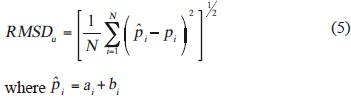
<body><![CDATA[<p align="justify"><font face="verdana" size="2"><b>2. Methods</b></font></p>  	    <p align="justify"><font face="verdana" size="2">The MCCM combines atmospheric photochemistry and meteorological modules, including gas phase chemistry, and anthropogenic and biogenic emissions, which are calculated based on data of land use, surface temperature, and radiation. The weather portion of the MCCM is based on the MM5, a fifth generation mesoscale model from the National Centers for Atmospheric Research/Pennsylvania State University (NCAR/Penn State) (Grell <i>et al.,</i> 1994).</font></p>  	    <p align="justify"><font face="verdana" size="2">The MM5 includes multiple nesting capability, non&#45;hydrostatic dynamics (Dudhia, 1993), and data assimilation in four dimensions (Strauffer and Seaman, 1994). It also simultaneously calculates meteorological and chemical changes in the domain, and generates time&#45;dependent, three&#45;dimensional distributions of the major organic and inorganic species relevant to the formation of oxidants such as O<sub>3</sub>. One advantage of the online coupling of meteorology and chemistry is that it provides consistent results without data interpolation, contrasting to the uncoupled models for chemistry and transport. The system is used for prognosis and diagnosis; therefore, different modeling scenarios can be presented and their results analyzed. Finally, the output data are visualized with post&#45;processor graphics such as GRADS (Forkel and Garc&iacute;a, 2003).</font></p>  	    <p align="justify"><font face="verdana" size="2">To use the MCCM anthropogenic point emission, area and linear sources are localized, and their corresponding contributions are measured. For this reason, we used databases from the Secretar&iacute;a de Medio Ambiente y Recursos Naturales (Secretariat of Environment and Natural Resources) (SINE, 2003), the Gobierno del Distrito Federal (Federal District Government) (SMA&#45;DF, 2000), and the Universidad Nacional Aut&oacute;noma de M&eacute;xico (UNAM, National Autonomous University of Mexico) (Jazcilevich <i>et al.,</i> 2005). Information from the Red Autom&aacute;tica de Monitoreo Atmosf&eacute;rico (RAMA, Automatic Environmental Monitoring Network) (SMA, 2009) is used for comparison of the meteorological and air quality variables. Effective heights from the chimneys are determined by their physical height plus the elevation that the plume reaches at the chimney outlet, according to Briggs' formulation that allows the determination of the rise of the smoke column (Wark <i>et al.,</i> 1990).</font></p>  	    <p align="justify"><font face="verdana" size="2"><i>2.1 Metrics for verification of the air quality model</i> To verify the fidelity of the model, the baseline scenario is compared with surface measurements from the using basic statistics. Standard deviations calculated from the data predicted by the model for a variable <i>(a<sub>p</sub>)</i> and the observed standard deviations (cr<sub>o</sub>) are given by Eqs. (1) and (2):</font></p>  	    <p align="center"><font face="verdana" size="2"><img src="/img/revistas/atm/v27n2/a8e1.jpg"></font></p>  	    <p align="center"><font face="verdana" size="2"><img src="/img/revistas/atm/v27n2/a8e2.jpg"></font></p>  	    <p align="justify"><font face="verdana" size="2">&nbsp;</font></p>  	    <p align="justify"><font face="verdana" size="2">where <i>N</i> refers to the number of monitoring locations or points, and <i>pi</i> and <i>oi</i> are hourly average values for each monitoring station or point predicted by the model and observed, respectively.</font></p>  	    <p align="justify"><font face="verdana" size="2">The root mean square difference (RMSD) of the mean differences between the predicted values <i>p<sub>i</sub></i> and observed <i>o<sub>i</sub></i> are also calculated with the following formula (Willmott, 1981):</font></p>  	    ]]></body>
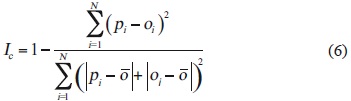
<body><![CDATA[<p align="center"><font face="verdana" size="2"><img src="/img/revistas/atm/v27n2/a8e3.jpg"></font></p>  	    <p align="justify"><font face="verdana" size="2">With these statistical indicators, the level of accuracy of the model can be determined. The accuracy is considered high if the standard deviation of the prediction data is similar to the standard deviation of the observed data.</font></p>  	    <p align="justify"><font face="verdana" size="2">The RMSD (Eq. 3) is decomposed into the following:</font></p>  	    <p align="justify"><font face="verdana" size="2">1. Systematic root mean square deviations (RMSDs) between measured and modeled values as shown in Eq. (4):</font></p>  	    <p align="center"><font face="verdana" size="2"><img src="/img/revistas/atm/v27n2/a8e4.jpg"></font></p>  	    <p align="justify"><font face="verdana" size="2">2. Unsystematic root mean square deviation (RMSDu) between measured and modeled values:</font></p>  	    <p align="center"><font face="verdana" size="2"><img src="/img/revistas/atm/v27n2/a8e5.jpg"></font></p>  	    <p align="justify"><font face="verdana" size="2">In this formula <i>a</i> and <i>b</i> are the intercept and slope, respectively, of the least squares linear regression between <i>p</i> and <i>o.</i> The RMSDs (Eq. 4) are a measure of the systematic error in the prediction model, while RMSDu (Eq. 5) describes the nonlinear discrepancy between the prediction and the observed data, which can be interpreted as a measure of accuracy.</font></p>  	    <p align="justify"><font face="verdana" size="2">For a metric that allows verification of the model, the index of agreement <i>I<sub>c</sub></i> (Willmot <i>et al.,</i> 1985) is defined by the following equation:</font></p>  	    <p align="center"><font face="verdana" size="2"><img src="/img/revistas/atm/v27n2/a8e6.jpg"></font></p>  	    ]]></body>
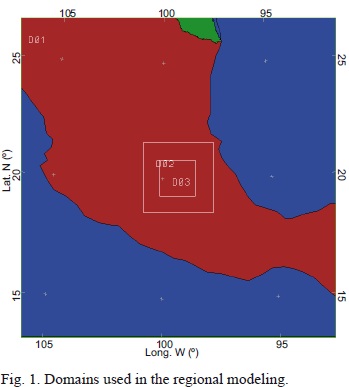
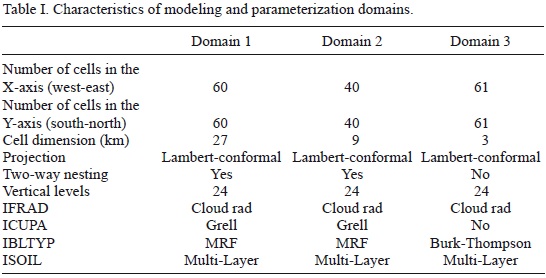
<body><![CDATA[<p align="justify"><font face="verdana" size="2">This index compares the outputs of the prediction values with the observed values. The possible range for this index is 0 to 1, with a value of 1 representing perfect agreement.</font></p>  	    <p align="justify"><font face="verdana" size="2">In case of the wind directions the index of similarity is used.</font></p>  	    <p align="center"><font face="verdana" size="2"><img src="/img/revistas/atm/v27n2/a8e7.jpg"></font></p>  	    <p align="justify"><font face="verdana" size="2">This index compares the wind directions of the prediction values with the observed values. The possible range for this index is 0 to 1. A value of 1 represents parallel vectors with same direction, 0.5 perpendicular vectors, and 0 stands for parallel vectors in opposite direction.</font></p>  	    <p align="justify"><font face="verdana" size="2"><i>2.2 Nesting strategy</i></font></p>  	    <p align="justify"><font face="verdana" size="2">The multiple&#45;nesting strategy employed consists of three domains that include most of Mexico and the region of influence of the TC, as shown in <a href="#f1">Figure 1</a>. The center of the domains is located at 20.055&deg; N, 99.278&deg; W. Domain 1 has a resolution of 27 km, domain 2 has a resolution of 9 km, and domain 3 has a resolution of 3 km. Domain 3 covers the region of the TC and the Valley of Mexico, where the base and emission control scenarios are held.</font></p>  	    <p align="center"><font face="verdana" size="2"><a name="f1"></a></font></p>  	    <p align="center"><font face="verdana" size="2"><img src="/img/revistas/atm/v27n2/a8f1.jpg"></font></p>  	    <p align="justify"><font face="verdana" size="2">The MCCM has the ability to model the nested domains in a bidirectional manner; that is, the meteorological data between the higher and lower domains is feedbacked. Thus, bidirectional modeling is used for domains 1 and 2, but unidirectional modeling is employed for the transportation of pollutants in domain 3.</font></p>  	    <p align="justify"><font face="verdana" size="2">A description of the domains is shown in <a href="#t1">Table I</a>. The three domains have 24 vertical layers. The radiation scheme (IFRAD) considers long and short waves. The cumulus parameterization is the Grell (ICUPA), used in domains 1 and 2. Turbulence schemes (IBLTYP) for the boundary layer are the medium range forecast of Hong and Pan (1996) for domains 1 and 2, and Burk and Thompson (1989) for domain 3. For the land surface temperature (ISOIL) scheme, a five&#45;layer model is employed for moisture diffusion (Grell <i>et al.,</i> 2000).</font></p>  	    ]]></body>
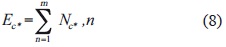
<body><![CDATA[<p align="center"><font face="verdana" size="2"><a name="t1"></a></font></p>  	    <p align="center"><font face="verdana" size="2"><img src="/img/revistas/atm/v27n2/a8t1.jpg"></font></p>  	    <p align="justify"><font face="verdana" size="2"><i>2.3 Scenarios, extension, severity and potential exposure</i></font></p>  	    <p align="justify"><font face="verdana" size="2">Two scenarios are proposed: base and emission control. The base scenario is the current state, and the control scenario considers a 40% reduction in emissions of SO<sub>2</sub>, NOx, CO, and VOCs in the TC region. The control scenario is based on the fact that the refinery and thermoelectric plant can achieve those reductions by applying new technologies in a relatively short period of time. For example, the power plant could switch to a cleaner fuel such as natural gas.</font></p>  	    <p align="justify"><font face="verdana" size="2">To quantify the effect of the scenarios with gas criteria reductions and to make an objective comparative study, three metrics are used: extension (Ec*), severity (S), and integrated potential exposure of the population (Y) (Georgopoulos <i>et al.,</i> 1997). The evaluation of the scenarios is performed by comparing these metrics, which are briefly described below.</font></p>  	    <p align="justify"><font face="verdana" size="2">Ec*: Sums the mesh elements that have exceeded the pollution standards for each gas during the episode. The formula for its calculation is as follows:</font></p>  	    <p align="center"><font face="verdana" size="2"><img src="/img/revistas/atm/v27n2/a8e8.jpg"></font></p>  	    <p align="justify"><font face="verdana" size="2">where <i>Nc*</i> is the number of cells in excess of concentration level <i>c*</i> during hour <i>n,</i> and <i>m</i> is the duration of the episode in hours.</font></p>  	    <p align="justify"><font face="verdana" size="2">This metric indicates the spatial extent of an episode in terms of the total number of grid cells with high pollutant values during a period.</font></p>  	    <p align="justify"><font face="verdana" size="2">S: Sums the times that the concentration of a criteria gas has exceeded the environmental standard. It is calculated as follows:</font></p>  	    ]]></body>
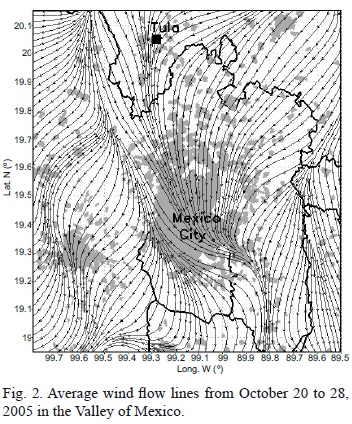
<body><![CDATA[<p align="center"><font face="verdana" size="2"><img src="/img/revistas/atm/v27n2/a8e9.jpg"></font></p>  	    <p align="center"><font face="verdana" size="2"><img src="/img/revistas/atm/v27n2/a8e10.jpg"></font></p>  	    <p align="justify"><font face="verdana" size="2"><i>C<sub>i,j</sub></i> is the concentration in the cell with coordinates and <i>c*</i> can be equal to the current standard level or another value of concern. The units <i>C<sub>i,j</sub></i> correspond to the same units of the gas criteria chosen for comparison.</font></p>  	    <p align="justify"><font face="verdana" size="2">Thus, the strategy effectiveness is a measure of the improvement of air quality in response to changes in emissions due to the controls applied. This gives a direct relation between the change in a given metric and a defined emissions reduction, and can be an indicator of the efficacy of the control strategy.</font></p>  	    <p align="justify"><font face="verdana" size="2">&#936;: Quantifies the extent of exposure in time and space, incorporating the size of the population potentially exposed to unhealthy levels of pollutant criteria. It is calculated using the following equation:</font></p>  	    <p align="center"><font face="verdana" size="2"><img src="/img/revistas/atm/v27n2/a8e11.jpg"></font></p>  	    <p align="justify"><font face="verdana" size="2">where <i>&#982;<sub>ijn</sub></i> is the population for the cell with coordinates <i>i,j</i> during hour n; C<sub>jn</sub> is the concentration of cell <i>i,j</i> during hour n; To<sub>max</sub> is the maximum population in the study region; and <i>m</i> is the number of hours in the study period (Georgopolus <i>et al.,</i> 1997).</font></p>  	    <p align="justify"><font face="verdana" size="2"><i>2.4 Modeling period and meteorological data</i></font></p>  	    <p align="justify"><font face="verdana" size="2">Meteorological data for the region of the modeling domains is obtained from the North American Regional Reanalysis (NARR) database for 2005. The data are provided every three hours with a resolution of 32 km.</font></p>  	    <p align="justify"><font face="verdana" size="2">The modeling period from October 20&#45;28, 2005 was chosen because the winds during this period come from the TC region to the Valley of Mexico. <a href="#f2">Figure 2</a> shows the average wind direction during October 2005. The surface flow lines demonstrate the relationship between the TC and the Valley of Mexico. This conclusion agrees with information from the <i>Informe climatol&oacute;gico ambiental del Valle de M&eacute;xico</i> (Climatological and environmental report of the Valley of Mexico 2005) (SMA, 2006).</font></p>  	    ]]></body>
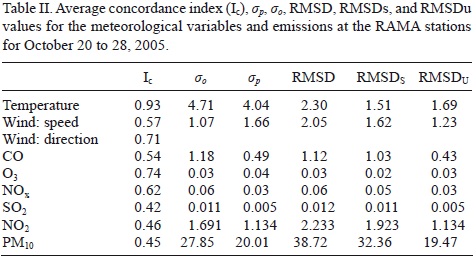
<body><![CDATA[<p align="center"><font face="verdana" size="2"><a name="f2"></a></font></p>  	    <p align="center"><font face="verdana" size="2"><img src="/img/revistas/atm/v27n2/a8f2.jpg"></font></p>  	    <p align="justify"><font face="verdana" size="2"><b>3. Results</b></font></p>  	    <p align="justify"><font face="verdana" size="2"><a href="/img/revistas/atm/v27n2/a8f3.jpg" target="_blank">Figure 3</a> shows an example of the time comparison of temperature, wind magnitude, and pollutant criteria concentrations that were measured and modeled at the surface at the ENEP&#45;Acatl&aacute;n (EAC) and Tlalnepantla (TLA) stations. The same comparison was also performed for the other 16 stations of the RAMA. The discontinuities indicate lack of data, and time is shown in local times.</font></p>  	    <p align="justify"><font face="verdana" size="2">As shown, the model acceptably describes the temperatures in the study region. Regarding SO<sub>2</sub> concentrations, sub&#45; and overestimates are observed in the concentrations obtained by the model in certain periods because there are undeclared sources or the timing is unknown for the corresponding inventory.</font></p>  	    <p align="justify"><font face="verdana" size="2"><i>3.1&nbsp;Statistical analysis of the modeling results</i></font></p>  	    <p align="justify"><font face="verdana" size="2">We performed a basic statistical analysis described in subsection 2.1 Metrics for verification of the air quality model.</font></p>  	    <p align="justify"><font face="verdana" size="2">The model has an I<sub>c</sub> concordance greater than 0.9 (where 1 is the perfect agreement) for temperature in all stations. For wind direction, the Ic ranged between 0.6 and 0.8. For wind speed, the I<sub>c</sub> values were greater than 0.6 in the northeast stations, as shown in <a href="#t2">table II</a>.</font></p>  	    <p align="center"><font face="verdana" size="2"><a name="t2"></a></font></p>  	    <p align="center"><font face="verdana" size="2"><img src="/img/revistas/atm/v27n2/a8t2.jpg"></font></p>  	    ]]></body>
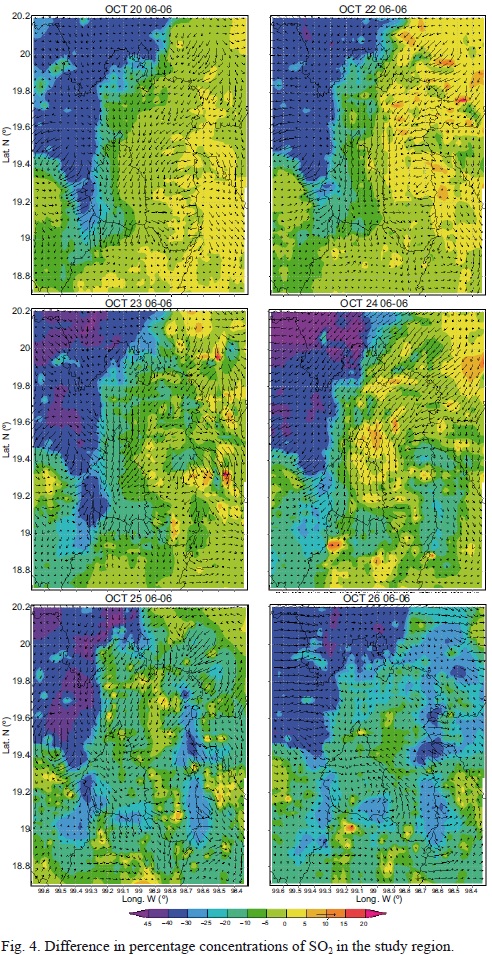
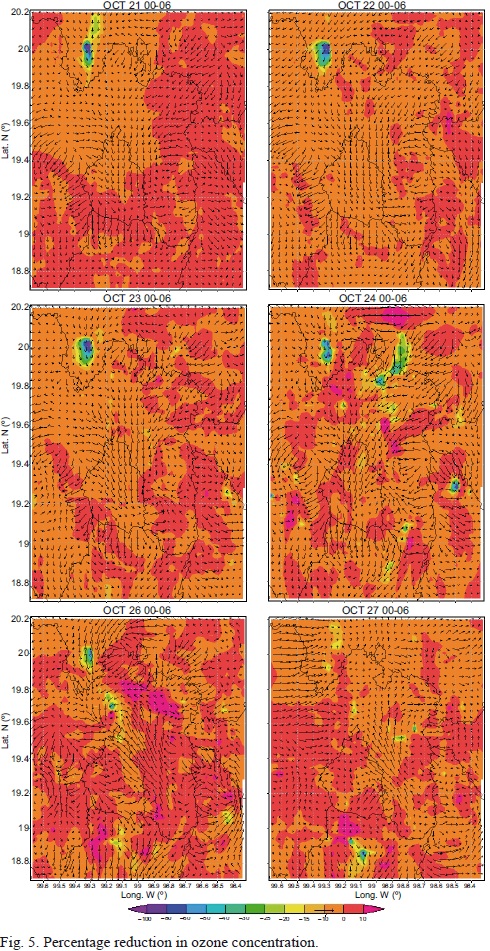
<body><![CDATA[<p align="justify"><font face="verdana" size="2">Regarding O<sub>3</sub>, in most stations the I<sub>c</sub> obtained was greater than 0.7. With respect to NO<sub>2</sub>, SO<sub>2</sub>, and PM<sub>10</sub>, there was an underestimation in our results due to lack of information from sources in the inventory, as previously described. The model does not consider PM<sub>10</sub> emissions from soils, which is an important source of this material (Molina <i>et al.,</i> 2010). At some stations, the I<sub>c</sub> was lower than 0.5. However, as shown in <a href="/img/revistas/atm/v27n2/a8f3.jpg" target="_blank">Figure 3</a>, the model follows the concentrations time profiles.</font></p>  	    <p align="justify"><font face="verdana" size="2"><i>3.2&nbsp;Spatial distribution of SO<sub>2</sub> concentrations by the reduction scenario</i></font></p>  	    <p align="justify"><font face="verdana" size="2"><i>3.2.1 Sulfur dioxide (SO<sub>2</sub>)</i></font></p>  	    <p align="justify"><font face="verdana" size="2">By using the MCCM model, SO<sub>2</sub> concentrations were obtained for both the base case scenario and the scenario for a 40% emissions reduction in the TC. The study region includes the MCMA and parts of the states of Tlaxcala, Morelos, and Hidalgo. The differences in percentages for the superficial concentrations are illustrated in <a href="#f4">Figure 4</a>, where the maps show a 40% reduction in SO<sub>2</sub> emissions accounts for a decrease of 40% in concentrations around the TC and approximately 10% in the MCMA.</font></p>  	    <p align="center"><font face="verdana" size="2"><a name="f4"></a></font></p>  	    <p align="center"><font face="verdana" size="2"><img src="/img/revistas/atm/v27n2/a8f4.jpg"></font></p>  	    <p align="justify"><font face="verdana" size="2"><i>3.2.2 Ozone (O<sub>3</sub>)</i></font></p>  	    <p align="justify"><font face="verdana" size="2">Maps of the percentage difference in ozone concentrations with a 40% reduction of NO<sub>x</sub> and HC's in the TC are shown in <a href="#f5">Figure 5</a>. There is a reduction close to the source of up to 100% of ozone, but for the rest of the region, including large areas within the MCMA, an increase of up to 10% can be observed. This increase is due to the nonlinearity of the photochemical processes.</font></p>  	    <p align="center"><font face="verdana" size="2"><a name="f5"></a></font></p>  	    <p align="center"><font face="verdana" size="2"><img src="/img/revistas/atm/v27n2/a8f5.jpg"></font></p>  	    ]]></body>
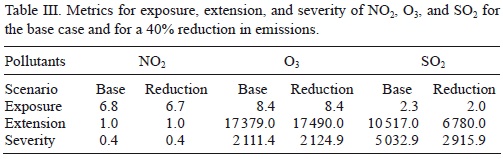
<body><![CDATA[<p align="justify"><font face="verdana" size="2"><i>3.3 Metrics for evaluation of scenarios</i> To compare the base and emission reduction scenarios, the metrics for exposure, extension, and severity are evaluated. The results are presented in <a href="#t3">Table III</a> for NO<sub>2</sub>, O<sub>3</sub>, and SO<sub>2</sub>.</font></p>  	    <p align="center"><font face="verdana" size="2"><a name="t3"></a></font></p>  	    <p align="center"><font face="verdana" size="2"><img src="/img/revistas/atm/v27n2/a8t3.jpg"></font></p>  	    <p align="justify"><font face="verdana" size="2">For NO<sub>2</sub> and O<sub>3</sub> there is no significant difference in the metrics for the base and the reduction scenarios. However, there is a decrease for SO<sub>2</sub> in the metrics of exposure, extension, and severity of 13, 35 and 42%, respectively.</font></p>  	    <p align="justify"><font face="verdana" size="2">&nbsp;</font></p>  	    <p align="justify"><font face="verdana" size="2"><b>4. Conclusions and discussion</b></font></p>  	    <p align="justify"><font face="verdana" size="2">Photochemical modeling shows that the TC influences the air quality in the MCMA. This mainly occurs during September and October.</font></p>  	    <p align="justify"><font face="verdana" size="2">With a 40% reduction in SO<sub>2</sub> emissions, corresponding decreases in the metrics for exposure, extension, and severity of 13, 35, and 42% are obtained in the MCMA, respectively. However, for the O3 metrics, a 40% reduction in NO<sub>2</sub> and HC produces a small increase in the MCMA concentrations in the emission reduction scenario compared with the baseline scenario. This result indicates that a decrease in ozone precursors in the TC does not necessarily translate to a reduction in ozone concentrations in the MCMA because of the non&#45;linearity effects of photochemistry. Policies for pollution reduction should consider this effect. Previous works on the MCMA showed that the atmosphere is hydrocarbons&#45;sensitive, therefore a reduction on NO<sub>X</sub>, can induce an increment on ozone (Garc&iacute;a <i>et al.</i>, 2009; Tie <i>et al.</i>, 2007).</font></p>  	    <p align="justify"><font face="verdana" size="2">We also find that the inventory of SO<sub>2</sub>, NO<sub>X</sub> and maybe PM emissions needs to be improved. The MCCM underestimates these concentrations, but it was able to follow the patterns of temporal variations. There are sources of this pollutant that are not declared or are not well identified, especially in the northern part of the Valley of Mexico.</font></p>  	    <p align="justify"><font face="verdana" size="2">&nbsp;</font></p>  	    ]]></body>
<body><![CDATA[<p align="justify"><font face="verdana" size="2"><b>Acknowledgements</b></font></p>  	    <p align="justify"><font face="verdana" size="2">We acknowledge the Secretar&iacute;a del Medio Ambiente del Distrito Federal (Secretariat of the Environment of the Federal District) for providing data from RAMA stations in the MCMA.</font></p>  	    <p align="justify"><font face="verdana" size="2">&nbsp;</font></p>  	    <p align="justify"><font face="verdana" size="2"><b>References</b></font></p>  	    <!-- ref --><p align="justify"><font face="verdana" size="2">Burk S. D. and William T. Thompson, 1989. A vertically nested regional numerical weather prediction model with second&#45;order closure physics. <i>Mon. Wea. Rev.</i> <b>111,</b> 2305&#45;2324.    &nbsp;&nbsp;&nbsp;&nbsp;&nbsp;&nbsp;&nbsp;&nbsp;[&#160;<a href="javascript:void(0);" onclick="javascript: window.open('/scielo.php?script=sci_nlinks&ref=1299934&pid=S0187-6236201400020000800001&lng=','','width=640,height=500,resizable=yes,scrollbars=1,menubar=yes,');">Links</a>&#160;]<!-- end-ref --></font></p>  	    <!-- ref --><p align="justify"><font face="verdana" size="2">Cabrera F. C., 2008. Evaluaci&oacute;n de un modelo de dispersi&oacute;n de contaminantes atmosf&eacute;ricos con la t&eacute;cnica espectrosc&oacute;pica DOAS pasiva. M.Sc. thesis. Centro de Ciencias de la Atm&oacute;sfera, Universidad Nacional Aut&oacute;noma de M&eacute;xico, 73 pp.    &nbsp;&nbsp;&nbsp;&nbsp;&nbsp;&nbsp;&nbsp;&nbsp;[&#160;<a href="javascript:void(0);" onclick="javascript: window.open('/scielo.php?script=sci_nlinks&ref=1299936&pid=S0187-6236201400020000800002&lng=','','width=640,height=500,resizable=yes,scrollbars=1,menubar=yes,');">Links</a>&#160;]<!-- end-ref --></font></p>  	    <!-- ref --><p align="justify"><font face="verdana" size="2">CEE, 2002. Inventario de emisiones del estado de Hidalgo. Consejo Estatal de Ecolog&iacute;a. Available at: <a href="http://www.ine.gob.mx/descargas/calaire/rt3_gob_edo_hgo.pdf" target="_blank">http://www.ine.gob.mx/descargas/calaire/rt3_gob_edo_hgo.pdf</a> (last accesed on May 27, 2013).    &nbsp;&nbsp;&nbsp;&nbsp;&nbsp;&nbsp;&nbsp;&nbsp;[&#160;<a href="javascript:void(0);" onclick="javascript: window.open('/scielo.php?script=sci_nlinks&ref=1299938&pid=S0187-6236201400020000800003&lng=','','width=640,height=500,resizable=yes,scrollbars=1,menubar=yes,');">Links</a>&#160;]<!-- end-ref --></font></p>  	    ]]></body>
<body><![CDATA[<!-- ref --><p align="justify"><font face="verdana" size="2">CEPAL&#45;Semarnat, 2004. Evaluaci&oacute;n de las externalidades ambientales de la generaci&oacute;n termoel&eacute;ctrica en M&eacute;xico. Report. Comisi&oacute;n Econ&oacute;mica para Am&eacute;rica Latina, Secretar&iacute;a de Medio Ambiente y Recursos Naturales, Mexico, 59 pp.    &nbsp;&nbsp;&nbsp;&nbsp;&nbsp;&nbsp;&nbsp;&nbsp;[&#160;<a href="javascript:void(0);" onclick="javascript: window.open('/scielo.php?script=sci_nlinks&ref=1299940&pid=S0187-6236201400020000800004&lng=','','width=640,height=500,resizable=yes,scrollbars=1,menubar=yes,');">Links</a>&#160;]<!-- end-ref --></font></p>  	    <!-- ref --><p align="justify"><font face="verdana" size="2">De Foy B., N. A. Krotkov, N. Bei, S. C. Herndon, L. G. Huey, A. P. Mart&iacute;nez, L. G. Ruiz&#45;Su&aacute;rez, E. C. Wood, M. Zavala and L. T. Molina, 2009. Hit from both sides: tracking industrial and volcanic plumes in Mexico City with surface measurements and OMI SO<sub>2</sub> retrievals during the MILAGRO field campaign. <i>Atmos. Chem. Phys.</i> <b>9,</b> 9599&#45;9617.    &nbsp;&nbsp;&nbsp;&nbsp;&nbsp;&nbsp;&nbsp;&nbsp;[&#160;<a href="javascript:void(0);" onclick="javascript: window.open('/scielo.php?script=sci_nlinks&ref=1299942&pid=S0187-6236201400020000800005&lng=','','width=640,height=500,resizable=yes,scrollbars=1,menubar=yes,');">Links</a>&#160;]<!-- end-ref --></font></p>  	    <!-- ref --><p align="justify"><font face="verdana" size="2">Dudhia J., 1993. A nonhydrostatic version of the Penn State/NCAR mesoscale model: Validation tests and simulation of an Atlantic cyclone and cold front. <i>Mon. Wea. Rev.</i> <b>121,</b> 1492&#45;1513.    &nbsp;&nbsp;&nbsp;&nbsp;&nbsp;&nbsp;&nbsp;&nbsp;[&#160;<a href="javascript:void(0);" onclick="javascript: window.open('/scielo.php?script=sci_nlinks&ref=1299944&pid=S0187-6236201400020000800006&lng=','','width=640,height=500,resizable=yes,scrollbars=1,menubar=yes,');">Links</a>&#160;]<!-- end-ref --></font></p>  	    <!-- ref --><p align="justify"><font face="verdana" size="2">Forkel R. and A. Garc&iacute;a, 2003. Manual del Multiscale Climatic Chemistry Model (MCCM). Available at: <a href="http://www.ine.gob.mx/descargas/calaire/rep_fin_proy_mccm.pdf" target="_blank">http://www.ine.gob.mx/descargas/calaire/rep_fin_proy_mccm.pdf</a> (last accessed on May 27, 2013).    &nbsp;&nbsp;&nbsp;&nbsp;&nbsp;&nbsp;&nbsp;&nbsp;[&#160;<a href="javascript:void(0);" onclick="javascript: window.open('/scielo.php?script=sci_nlinks&ref=1299946&pid=S0187-6236201400020000800007&lng=','','width=640,height=500,resizable=yes,scrollbars=1,menubar=yes,');">Links</a>&#160;]<!-- end-ref --></font></p>  	    <!-- ref --><p align="justify"><font face="verdana" size="2">Garc&iacute;a&#45;Ruiz J., A. Jazcilevich&#45;Diamant, L. G. Ruiz&#45;Su&aacute;rez, R. Torres&#45;Jard&oacute;n, L. M. Su&aacute;rez and S. N. Res&eacute;ndiz, 2009. Ozone weekend effect analysis in Mexico City. <i>Atm&oacute;sfera</i> <b>22,</b> 281&#45;297.    &nbsp;&nbsp;&nbsp;&nbsp;&nbsp;&nbsp;&nbsp;&nbsp;[&#160;<a href="javascript:void(0);" onclick="javascript: window.open('/scielo.php?script=sci_nlinks&ref=1299948&pid=S0187-6236201400020000800008&lng=','','width=640,height=500,resizable=yes,scrollbars=1,menubar=yes,');">Links</a>&#160;]<!-- end-ref --></font></p>  	    ]]></body>
<body><![CDATA[<!-- ref --><p align="justify"><font face="verdana" size="2">Georgopoulos P. G., S. Arunachalam and S. Wang, 1997. Alternative metrics for assessing the relative effectiveness of NO<sub>x</sub> and VOC emission reductions in controlling ground&#45;level ozone. <i>J. Air Waste Manage.</i> <b>41,</b> 383&#45;850.    &nbsp;&nbsp;&nbsp;&nbsp;&nbsp;&nbsp;&nbsp;&nbsp;[&#160;<a href="javascript:void(0);" onclick="javascript: window.open('/scielo.php?script=sci_nlinks&ref=1299950&pid=S0187-6236201400020000800009&lng=','','width=640,height=500,resizable=yes,scrollbars=1,menubar=yes,');">Links</a>&#160;]<!-- end-ref --></font></p>  	    <!-- ref --><p align="justify"><font face="verdana" size="2">Grell G. A., J. Dudhia and D. R. Stauffer, 1994. A description of the fifth&#45;generation Penn State/NCAR mesoscale model (MM5). NCAR Tech Note TN&#45;398SRT. National Center for Atmospheric Research, Boulder, Colorado, 122 pp.    &nbsp;&nbsp;&nbsp;&nbsp;&nbsp;&nbsp;&nbsp;&nbsp;[&#160;<a href="javascript:void(0);" onclick="javascript: window.open('/scielo.php?script=sci_nlinks&ref=1299952&pid=S0187-6236201400020000800010&lng=','','width=640,height=500,resizable=yes,scrollbars=1,menubar=yes,');">Links</a>&#160;]<!-- end-ref --></font></p>  	    <!-- ref --><p align="justify"><font face="verdana" size="2">Grell G. A., S. Emeis, W. R. Stockwell, T. Schoenemeyer, R. Forkel, J. Michalakes, R. Knoche and W. Seidl, 2000. Application of a multiscale, coupled MM5/ chemistry model to the complex terrain of the VOTALP valley campaign. <i>Atmos. Environ.</i> <b>34,</b> 1435&#45;1453.    &nbsp;&nbsp;&nbsp;&nbsp;&nbsp;&nbsp;&nbsp;&nbsp;[&#160;<a href="javascript:void(0);" onclick="javascript: window.open('/scielo.php?script=sci_nlinks&ref=1299954&pid=S0187-6236201400020000800011&lng=','','width=640,height=500,resizable=yes,scrollbars=1,menubar=yes,');">Links</a>&#160;]<!-- end-ref --></font></p>  	    <!-- ref --><p align="justify"><font face="verdana" size="2">Hong S.&#45;Y. and H&#45;L. Pan, 1996. Nonlocal boundary layer vertical diffusion in a medium&#45; range forecast model. <i>Mon. Wea. Rev.</i> <b>124,</b> 2322&#45;2339.    &nbsp;&nbsp;&nbsp;&nbsp;&nbsp;&nbsp;&nbsp;&nbsp;[&#160;<a href="javascript:void(0);" onclick="javascript: window.open('/scielo.php?script=sci_nlinks&ref=1299956&pid=S0187-6236201400020000800012&lng=','','width=640,height=500,resizable=yes,scrollbars=1,menubar=yes,');">Links</a>&#160;]<!-- end-ref --></font></p>  	    <!-- ref --><p align="justify"><font face="verdana" size="2">Jazcilevich&#45;Diamant A., A. Garc&iacute;a&#45;Ruiz and E. Caetano, 2005. Locally induced surface air confluence by complex terrain and its effects on air pollution in the Valley of Mexico. <i>Atmos. Environ.</i> <b>39,</b> 5481&#45;5489.    &nbsp;&nbsp;&nbsp;&nbsp;&nbsp;&nbsp;&nbsp;&nbsp;[&#160;<a href="javascript:void(0);" onclick="javascript: window.open('/scielo.php?script=sci_nlinks&ref=1299958&pid=S0187-6236201400020000800013&lng=','','width=640,height=500,resizable=yes,scrollbars=1,menubar=yes,');">Links</a>&#160;]<!-- end-ref --></font></p>  	    ]]></body>
<body><![CDATA[<!-- ref --><p align="justify"><font face="verdana" size="2">Molina L.T., S. Madronich, J. S. Gaffney, E. Apel, B. de Foy, J. Fast, R. Ferrare, S. Herndon, J. L. Jim&eacute;nez, B. Lamb, A. R. Osornio&#45;Vargas, P. Russel, J. J. Shauer, P. S. Stevens, R. Volkamer and M Zavala., 2010. An overview of the MILAGRO 2006 Campaign: Mexico City emissions and their transport and transformation. <i>Atmos. Chem. Phys.</i> <b>10,</b> 8697&#45;8760.    &nbsp;&nbsp;&nbsp;&nbsp;&nbsp;&nbsp;&nbsp;&nbsp;[&#160;<a href="javascript:void(0);" onclick="javascript: window.open('/scielo.php?script=sci_nlinks&ref=1299960&pid=S0187-6236201400020000800014&lng=','','width=640,height=500,resizable=yes,scrollbars=1,menubar=yes,');">Links</a>&#160;]<!-- end-ref --></font></p>  	    <!-- ref --><p align="justify"><font face="verdana" size="2">Pemex, 2013. Segundo informe trimestral 2013. Petr&oacute;leos Mexicanos, M&eacute;xico.    &nbsp;&nbsp;&nbsp;&nbsp;&nbsp;&nbsp;&nbsp;&nbsp;[&#160;<a href="javascript:void(0);" onclick="javascript: window.open('/scielo.php?script=sci_nlinks&ref=1299962&pid=S0187-6236201400020000800015&lng=','','width=640,height=500,resizable=yes,scrollbars=1,menubar=yes,');">Links</a>&#160;]<!-- end-ref --></font></p>  	    <!-- ref --><p align="justify"><font face="verdana" size="2">SINE, 2003. Inventario: fuentes fijas&#45;1999&#45;INEM&#45;Hidalgo (por establecimiento). Disponible en: <a href="http://aplicaciones.semarnat.gob.mx/sine/" target="_blank">http://aplicaciones.semarnat.gob.mx/sine/</a> (last accessed May 28, 2013).    &nbsp;&nbsp;&nbsp;&nbsp;&nbsp;&nbsp;&nbsp;&nbsp;[&#160;<a href="javascript:void(0);" onclick="javascript: window.open('/scielo.php?script=sci_nlinks&ref=1299964&pid=S0187-6236201400020000800016&lng=','','width=640,height=500,resizable=yes,scrollbars=1,menubar=yes,');">Links</a>&#160;]<!-- end-ref --></font></p>  	    <!-- ref --><p align="justify"><font face="verdana" size="2">SMA&#45;DF, 2000. Inventario de Emisiones de la Zona Metropolitana del Valle de M&eacute;xico, 1998. Secretar&iacute;a de Medio Ambiente del Distrito Federal, Mexico, 225 pp. Available at: <a href="http://www.sma.df.gob.mx/sma/links/download/archivos/inventario_de_emisiones_1998.pdf" target="_blank">http://www.sma.df.gob.mx/sma/links/download/archivos/inventario_de_emisiones_1998.pdf</a> (last accessed on May 27, 2013).    &nbsp;&nbsp;&nbsp;&nbsp;&nbsp;&nbsp;&nbsp;&nbsp;[&#160;<a href="javascript:void(0);" onclick="javascript: window.open('/scielo.php?script=sci_nlinks&ref=1299966&pid=S0187-6236201400020000800017&lng=','','width=640,height=500,resizable=yes,scrollbars=1,menubar=yes,');">Links</a>&#160;]<!-- end-ref --></font></p>  	    <!-- ref --><p align="justify"><font face="verdana" size="2">SMA, 2006. Informe climatol&oacute;gico ambiental del Valle de M&eacute;xico 2005. Secretar&iacute;a de Medio Ambiente del Distrito Federal. Informe. Mexico, 198 pp. Available at: <a href="http://148.243.232.112/sma/links/download/biblioteca/flippingbooks/informe_anual_climatologico_2005/" target="_blank">http://148.243.232.112/sma/links/download/biblioteca/flippingbooks/informe_anual_climatologico_2005/</a> (last accessed on May 27, 2013).    &nbsp;&nbsp;&nbsp;&nbsp;&nbsp;&nbsp;&nbsp;&nbsp;[&#160;<a href="javascript:void(0);" onclick="javascript: window.open('/scielo.php?script=sci_nlinks&ref=1299968&pid=S0187-6236201400020000800018&lng=','','width=640,height=500,resizable=yes,scrollbars=1,menubar=yes,');">Links</a>&#160;]<!-- end-ref --></font></p>  	    ]]></body>
<body><![CDATA[<!-- ref --><p align="justify"><font face="verdana" size="2">SMA, 2009. Red Autom&aacute;tica de Monitoreo Atmosf&eacute;rico. Secretar&iacute;a de Medio Ambiente del Distrito Federal, Mexico. Available at: <a href="http://www.sedema.df.gob.mx/sedema/" target="_blank">http://www.sedema.df.gob.mx/sedema/</a> (last accessed on November 17, 2009).    &nbsp;&nbsp;&nbsp;&nbsp;&nbsp;&nbsp;&nbsp;&nbsp;[&#160;<a href="javascript:void(0);" onclick="javascript: window.open('/scielo.php?script=sci_nlinks&ref=1299970&pid=S0187-6236201400020000800019&lng=','','width=640,height=500,resizable=yes,scrollbars=1,menubar=yes,');">Links</a>&#160;]<!-- end-ref --></font></p>  	    <!-- ref --><p align="justify"><font face="verdana" size="2">Sosa G., C. Rivera&#45;C&aacute;rdenas y F. Ortega&#45;L&oacute;pez, 2006. Medici&oacute;n del flujo de emisiones totales de S0<sub>2</sub> y NO<sub>2</sub> generadas por fuentes urbanas e industriales mediante detecci&oacute;n remota. <i>Tecnolog&iacute;a, Ciencia, Educaci&oacute;n</i> <b>21,</b> 103&#45;109.    &nbsp;&nbsp;&nbsp;&nbsp;&nbsp;&nbsp;&nbsp;&nbsp;[&#160;<a href="javascript:void(0);" onclick="javascript: window.open('/scielo.php?script=sci_nlinks&ref=1299972&pid=S0187-6236201400020000800020&lng=','','width=640,height=500,resizable=yes,scrollbars=1,menubar=yes,');">Links</a>&#160;]<!-- end-ref --></font></p>  	    <!-- ref --><p align="justify"><font face="verdana" size="2">Sosa G., E. Vega, E. Gonz&aacute;lez&#45;Avalos, V. Mora and D. L&oacute;pez&#45;Veneroni, 2013. Air pollutant characterization in Tula industrial corridor, central Mexico, during the MILAGRO study. <i>BioMed Research International</i> 2013, art. no. 521728, <a href="http://dx.doi.org/10.1155/2013/521728" target="_blank">http://dx.doi.org/10.1155/2013/521728</a>.    &nbsp;&nbsp;&nbsp;&nbsp;&nbsp;&nbsp;&nbsp;&nbsp;[&#160;<a href="javascript:void(0);" onclick="javascript: window.open('/scielo.php?script=sci_nlinks&ref=1299974&pid=S0187-6236201400020000800021&lng=','','width=640,height=500,resizable=yes,scrollbars=1,menubar=yes,');">Links</a>&#160;]<!-- end-ref --></font></p>  	    <!-- ref --><p align="justify"><font face="verdana" size="2">Strauffer D. R. and M. L. Seaman, 1994. Multiscale four&#45;dimensional data assimilation. <i>J. App.Meteorol.</i> <b>33,</b> 416&#45;434.    &nbsp;&nbsp;&nbsp;&nbsp;&nbsp;&nbsp;&nbsp;&nbsp;[&#160;<a href="javascript:void(0);" onclick="javascript: window.open('/scielo.php?script=sci_nlinks&ref=1299976&pid=S0187-6236201400020000800022&lng=','','width=640,height=500,resizable=yes,scrollbars=1,menubar=yes,');">Links</a>&#160;]<!-- end-ref --></font></p>  	    <!-- ref --><p align="justify"><font face="verdana" size="2">Tie X., S. Madronich, L. Guohui, Y. Zhuming, Z. Renyi, A. R. Garc&iacute;a, J. Lee&#45;Taylor and L. Yubao, 2007. Characterizations of chemical oxidants in Mexico City: A regional chemical dynamical model (WRF&#45;Chem) study. <i>Atmos. Environ.</i> <b>41,</b> 1989&#45;2008.    &nbsp;&nbsp;&nbsp;&nbsp;&nbsp;&nbsp;&nbsp;&nbsp;[&#160;<a href="javascript:void(0);" onclick="javascript: window.open('/scielo.php?script=sci_nlinks&ref=1299978&pid=S0187-6236201400020000800023&lng=','','width=640,height=500,resizable=yes,scrollbars=1,menubar=yes,');">Links</a>&#160;]<!-- end-ref --></font></p>  	    ]]></body>
<body><![CDATA[<!-- ref --><p align="justify"><font face="verdana" size="2">Wark K. and F. C. Warner, 1990. Contaminaci&oacute;n del aire. Origen y control. 1&ordf; ed. Limusa, Mexico, 650 pp.    &nbsp;&nbsp;&nbsp;&nbsp;&nbsp;&nbsp;&nbsp;&nbsp;[&#160;<a href="javascript:void(0);" onclick="javascript: window.open('/scielo.php?script=sci_nlinks&ref=1299980&pid=S0187-6236201400020000800024&lng=','','width=640,height=500,resizable=yes,scrollbars=1,menubar=yes,');">Links</a>&#160;]<!-- end-ref --></font></p>  	    <!-- ref --><p align="justify"><font face="verdana" size="2">Willmott C. J., 1981. On the validation of models. <i>Phys.</i> <i>Geogr.</i> <b>2,</b> 184&#45;194.    &nbsp;&nbsp;&nbsp;&nbsp;&nbsp;&nbsp;&nbsp;&nbsp;[&#160;<a href="javascript:void(0);" onclick="javascript: window.open('/scielo.php?script=sci_nlinks&ref=1299982&pid=S0187-6236201400020000800025&lng=','','width=640,height=500,resizable=yes,scrollbars=1,menubar=yes,');">Links</a>&#160;]<!-- end-ref --></font></p>  	    <!-- ref --><p align="justify"><font face="verdana" size="2">Willmott C. J., S. G. Ackleson, R. E. Davis, J. J. Feddema, K. M. Klink, D. R. Legates, J. O'Donnell and M. C. Rowe, 1985. Statistics for the evaluation and comparison of models. <i>J. Geophys. Res.</i> <b>90,</b> 8995&#45;9005.    &nbsp;&nbsp;&nbsp;&nbsp;&nbsp;&nbsp;&nbsp;&nbsp;[&#160;<a href="javascript:void(0);" onclick="javascript: window.open('/scielo.php?script=sci_nlinks&ref=1299984&pid=S0187-6236201400020000800026&lng=','','width=640,height=500,resizable=yes,scrollbars=1,menubar=yes,');">Links</a>&#160;]<!-- end-ref --></font></p>      ]]></body><back>
<ref-list>
<ref id="B1">
<nlm-citation citation-type="journal">
<person-group person-group-type="author">
<name>
<surname><![CDATA[Burk]]></surname>
<given-names><![CDATA[S. D.]]></given-names>
</name>
<name>
<surname><![CDATA[Thompson]]></surname>
<given-names><![CDATA[William T.]]></given-names>
</name>
</person-group>
<article-title xml:lang="en"><![CDATA[A vertically nested regional numerical weather prediction model with second-order closure physics]]></article-title>
<source><![CDATA[Mon. Wea. Rev.]]></source>
<year>1989</year>
<volume>111</volume>
<page-range>2305-2324</page-range></nlm-citation>
</ref>
<ref id="B2">
<nlm-citation citation-type="">
<person-group person-group-type="author">
<name>
<surname><![CDATA[Cabrera]]></surname>
<given-names><![CDATA[F. C.]]></given-names>
</name>
</person-group>
<source><![CDATA[Evaluación de un modelo de dispersión de contaminantes atmosféricos con la técnica espectroscópica DOAS pasiva]]></source>
<year>2008</year>
<page-range>73</page-range></nlm-citation>
</ref>
<ref id="B3">
<nlm-citation citation-type="book">
<collab>CEE</collab>
<source><![CDATA[Inventario de emisiones del estado de Hidalgo]]></source>
<year>2002</year>
<publisher-name><![CDATA[Consejo Estatal de Ecología]]></publisher-name>
</nlm-citation>
</ref>
<ref id="B4">
<nlm-citation citation-type="book">
<collab>CEPAL</collab>
<collab>Semarnat</collab>
<source><![CDATA[Evaluación de las externalidades ambientales de la generación termoeléctrica en México]]></source>
<year>2004</year>
<page-range>59</page-range><publisher-name><![CDATA[Comisión Económica para América LatinaSecretaría de Medio Ambiente y Recursos Naturales]]></publisher-name>
</nlm-citation>
</ref>
<ref id="B5">
<nlm-citation citation-type="journal">
<person-group person-group-type="author">
<name>
<surname><![CDATA[De Foy]]></surname>
<given-names><![CDATA[B.]]></given-names>
</name>
<name>
<surname><![CDATA[Krotkov]]></surname>
<given-names><![CDATA[N. A.]]></given-names>
</name>
<name>
<surname><![CDATA[Bei]]></surname>
<given-names><![CDATA[N.]]></given-names>
</name>
<name>
<surname><![CDATA[Herndon]]></surname>
<given-names><![CDATA[S. C.]]></given-names>
</name>
<name>
<surname><![CDATA[Huey]]></surname>
<given-names><![CDATA[L. G.]]></given-names>
</name>
<name>
<surname><![CDATA[Martínez]]></surname>
<given-names><![CDATA[A. P.]]></given-names>
</name>
<name>
<surname><![CDATA[Ruiz-Suárez]]></surname>
<given-names><![CDATA[L. G.]]></given-names>
</name>
<name>
<surname><![CDATA[Wood]]></surname>
<given-names><![CDATA[E. C.]]></given-names>
</name>
</person-group>
<article-title xml:lang="en"><![CDATA[Hit from both sides: tracking industrial and volcanic plumes in Mexico City with surface measurements and OMI SO2 retrievals during the MILAGRO field campaign]]></article-title>
<source><![CDATA[Atmos. Chem. Phys.]]></source>
<year>2009</year>
<volume>9</volume>
<page-range>9599-9617</page-range></nlm-citation>
</ref>
<ref id="B6">
<nlm-citation citation-type="journal">
<person-group person-group-type="author">
<name>
<surname><![CDATA[Dudhia]]></surname>
<given-names><![CDATA[J.]]></given-names>
</name>
</person-group>
<article-title xml:lang="en"><![CDATA[A nonhydrostatic version of the Penn State/NCAR mesoscale model: Validation tests and simulation of an Atlantic cyclone and cold front]]></article-title>
<source><![CDATA[Mon. Wea. Rev.]]></source>
<year>1993</year>
<volume>121</volume>
<page-range>1492-1513</page-range></nlm-citation>
</ref>
<ref id="B7">
<nlm-citation citation-type="">
<person-group person-group-type="author">
<name>
<surname><![CDATA[Forkel]]></surname>
<given-names><![CDATA[R.]]></given-names>
</name>
<name>
<surname><![CDATA[García]]></surname>
<given-names><![CDATA[A.]]></given-names>
</name>
</person-group>
<source><![CDATA[Manual del Multiscale Climatic Chemistry Model (MCCM)]]></source>
<year>2003</year>
</nlm-citation>
</ref>
<ref id="B8">
<nlm-citation citation-type="journal">
<person-group person-group-type="author">
<name>
<surname><![CDATA[García-Ruiz]]></surname>
<given-names><![CDATA[J.]]></given-names>
</name>
<name>
<surname><![CDATA[Jazcilevich-Diamant]]></surname>
<given-names><![CDATA[A.]]></given-names>
</name>
<name>
<surname><![CDATA[Ruiz-Suárez]]></surname>
<given-names><![CDATA[L. G.]]></given-names>
</name>
<name>
<surname><![CDATA[Torres-Jardón]]></surname>
<given-names><![CDATA[R.]]></given-names>
</name>
<name>
<surname><![CDATA[Suárez]]></surname>
<given-names><![CDATA[L. M.]]></given-names>
</name>
<name>
<surname><![CDATA[Reséndiz]]></surname>
<given-names><![CDATA[S. N.]]></given-names>
</name>
</person-group>
<article-title xml:lang="en"><![CDATA[Ozone weekend effect analysis in Mexico City]]></article-title>
<source><![CDATA[Atmósfera]]></source>
<year>2009</year>
<volume>22</volume>
<page-range>281-297</page-range></nlm-citation>
</ref>
<ref id="B9">
<nlm-citation citation-type="journal">
<person-group person-group-type="author">
<name>
<surname><![CDATA[Georgopoulos]]></surname>
<given-names><![CDATA[P. G.]]></given-names>
</name>
<name>
<surname><![CDATA[Arunachalam]]></surname>
<given-names><![CDATA[S.]]></given-names>
</name>
<name>
<surname><![CDATA[Wang]]></surname>
<given-names><![CDATA[S.]]></given-names>
</name>
</person-group>
<article-title xml:lang="en"><![CDATA[Alternative metrics for assessing the relative effectiveness of NOx and VOC emission reductions in controlling ground-level ozone]]></article-title>
<source><![CDATA[J. Air Waste Manage.]]></source>
<year>1997</year>
<volume>41</volume>
<page-range>383-</page-range></nlm-citation>
</ref>
<ref id="B10">
<nlm-citation citation-type="book">
<person-group person-group-type="author">
<name>
<surname><![CDATA[Grell]]></surname>
<given-names><![CDATA[G. A.]]></given-names>
</name>
<name>
<surname><![CDATA[Dudhia]]></surname>
<given-names><![CDATA[J.]]></given-names>
</name>
<name>
<surname><![CDATA[Stauffer]]></surname>
<given-names><![CDATA[D. R.]]></given-names>
</name>
</person-group>
<source><![CDATA[A description of the fifth-generation Penn State/NCAR mesoscale model (MM5)]]></source>
<year>1994</year>
<page-range>122</page-range><publisher-loc><![CDATA[Boulder^eColorado Colorado]]></publisher-loc>
<publisher-name><![CDATA[National Center for Atmospheric Research]]></publisher-name>
</nlm-citation>
</ref>
<ref id="B11">
<nlm-citation citation-type="journal">
<person-group person-group-type="author">
<name>
<surname><![CDATA[Grell]]></surname>
<given-names><![CDATA[G. A.]]></given-names>
</name>
<name>
<surname><![CDATA[Emeis]]></surname>
<given-names><![CDATA[S.]]></given-names>
</name>
<name>
<surname><![CDATA[Stockwell]]></surname>
<given-names><![CDATA[W. R.]]></given-names>
</name>
<name>
<surname><![CDATA[Schoenemeyer]]></surname>
<given-names><![CDATA[T.]]></given-names>
</name>
<name>
<surname><![CDATA[Forkel]]></surname>
<given-names><![CDATA[R.]]></given-names>
</name>
<name>
<surname><![CDATA[Michalakes]]></surname>
<given-names><![CDATA[J.]]></given-names>
</name>
<name>
<surname><![CDATA[Knoche]]></surname>
<given-names><![CDATA[R.]]></given-names>
</name>
<name>
<surname><![CDATA[Seidl]]></surname>
<given-names><![CDATA[W.]]></given-names>
</name>
</person-group>
<article-title xml:lang="en"><![CDATA[Application of a multiscale, coupled MM5/ chemistry model to the complex terrain of the VOTALP valley campaign]]></article-title>
<source><![CDATA[Atmos. Environ.]]></source>
<year>2000</year>
<volume>34</volume>
<page-range>1435-1453</page-range></nlm-citation>
</ref>
<ref id="B12">
<nlm-citation citation-type="journal">
<person-group person-group-type="author">
<name>
<surname><![CDATA[Hong]]></surname>
<given-names><![CDATA[S.-Y.]]></given-names>
</name>
<name>
<surname><![CDATA[Pan]]></surname>
<given-names><![CDATA[H-L.]]></given-names>
</name>
</person-group>
<article-title xml:lang="en"><![CDATA[Nonlocal boundary layer vertical diffusion in a medium- range forecast model]]></article-title>
<source><![CDATA[Mon. Wea. Rev.]]></source>
<year>1996</year>
<volume>124</volume>
<page-range>2322-2339</page-range></nlm-citation>
</ref>
<ref id="B13">
<nlm-citation citation-type="journal">
<person-group person-group-type="author">
<name>
<surname><![CDATA[Jazcilevich-Diamant]]></surname>
<given-names><![CDATA[A.]]></given-names>
</name>
<name>
<surname><![CDATA[García-Ruiz]]></surname>
<given-names><![CDATA[A.]]></given-names>
</name>
<name>
<surname><![CDATA[Caetano]]></surname>
<given-names><![CDATA[E.]]></given-names>
</name>
</person-group>
<article-title xml:lang="en"><![CDATA[Locally induced surface air confluence by complex terrain and its effects on air pollution in the Valley of Mexico]]></article-title>
<source><![CDATA[Atmos. Environ.]]></source>
<year>2005</year>
<volume>39</volume>
<page-range>5481-5489</page-range></nlm-citation>
</ref>
<ref id="B14">
<nlm-citation citation-type="journal">
<person-group person-group-type="author">
<name>
<surname><![CDATA[Molina]]></surname>
<given-names><![CDATA[L.T.]]></given-names>
</name>
<name>
<surname><![CDATA[Madronich]]></surname>
<given-names><![CDATA[S.]]></given-names>
</name>
<name>
<surname><![CDATA[Gaffney]]></surname>
<given-names><![CDATA[J. S.]]></given-names>
</name>
<name>
<surname><![CDATA[Apel]]></surname>
<given-names><![CDATA[E.]]></given-names>
</name>
<name>
<surname><![CDATA[de Foy]]></surname>
<given-names><![CDATA[B.]]></given-names>
</name>
<name>
<surname><![CDATA[Fast]]></surname>
<given-names><![CDATA[J.]]></given-names>
</name>
<name>
<surname><![CDATA[Ferrare]]></surname>
<given-names><![CDATA[R.]]></given-names>
</name>
<name>
<surname><![CDATA[Herndon]]></surname>
<given-names><![CDATA[S.]]></given-names>
</name>
<name>
<surname><![CDATA[Jiménez]]></surname>
<given-names><![CDATA[J. L.]]></given-names>
</name>
<name>
<surname><![CDATA[Lamb]]></surname>
<given-names><![CDATA[B.]]></given-names>
</name>
<name>
<surname><![CDATA[Osornio-Vargas]]></surname>
<given-names><![CDATA[A. R.]]></given-names>
</name>
<name>
<surname><![CDATA[Russel]]></surname>
<given-names><![CDATA[P.]]></given-names>
</name>
<name>
<surname><![CDATA[Shauer]]></surname>
<given-names><![CDATA[J. J.]]></given-names>
</name>
<name>
<surname><![CDATA[Stevens]]></surname>
<given-names><![CDATA[P. S.]]></given-names>
</name>
<name>
<surname><![CDATA[Volkamer]]></surname>
<given-names><![CDATA[R.]]></given-names>
</name>
<name>
<surname><![CDATA[Zavala]]></surname>
<given-names><![CDATA[M]]></given-names>
</name>
</person-group>
<article-title xml:lang="en"><![CDATA[An overview of the MILAGRO 2006 Campaign: Mexico City emissions and their transport and transformation]]></article-title>
<source><![CDATA[Atmos. Chem. Phys.]]></source>
<year>2010</year>
<volume>10</volume>
<page-range>8697-8760</page-range></nlm-citation>
</ref>
<ref id="B15">
<nlm-citation citation-type="book">
<collab>Pemex</collab>
<source><![CDATA[Segundo informe trimestral 2013]]></source>
<year>2013</year>
<publisher-name><![CDATA[Petróleos Mexicanos]]></publisher-name>
</nlm-citation>
</ref>
<ref id="B16">
<nlm-citation citation-type="">
<collab>SINE</collab>
<source><![CDATA[Inventario: fuentes fijas-1999-INEM-Hidalgo (por establecimiento)]]></source>
<year>2003</year>
</nlm-citation>
</ref>
<ref id="B17">
<nlm-citation citation-type="book">
<collab>SMA^dDF</collab>
<source><![CDATA[Inventario de Emisiones de la Zona Metropolitana del Valle de México, 1998]]></source>
<year>2000</year>
<page-range>225</page-range><publisher-name><![CDATA[Secretaría de Medio Ambiente del Distrito Federal]]></publisher-name>
</nlm-citation>
</ref>
<ref id="B18">
<nlm-citation citation-type="book">
<collab>SMA</collab>
<source><![CDATA[Informe climatológico ambiental del Valle de México 2005]]></source>
<year>2006</year>
<page-range>198</page-range><publisher-name><![CDATA[Secretaría de Medio Ambiente del Distrito Federal]]></publisher-name>
</nlm-citation>
</ref>
<ref id="B19">
<nlm-citation citation-type="book">
<collab>SMA</collab>
<source><![CDATA[Red Automática de Monitoreo Atmosférico]]></source>
<year>2009</year>
<publisher-name><![CDATA[Secretaría de Medio Ambiente del Distrito Federal]]></publisher-name>
</nlm-citation>
</ref>
<ref id="B20">
<nlm-citation citation-type="journal">
<person-group person-group-type="author">
<name>
<surname><![CDATA[Ortega-López]]></surname>
<given-names><![CDATA[F.]]></given-names>
</name>
</person-group>
<article-title xml:lang="es"><![CDATA[Medición del flujo de emisiones totales de S0(2) y NO2 generadas por fuentes urbanas e industriales mediante detección remota]]></article-title>
<source><![CDATA[Tecnología, Ciencia, Educación]]></source>
<year>2006</year>
<volume>21</volume>
<page-range>103-109</page-range></nlm-citation>
</ref>
<ref id="B21">
<nlm-citation citation-type="journal">
<person-group person-group-type="author">
<name>
<surname><![CDATA[Sosa]]></surname>
<given-names><![CDATA[G.]]></given-names>
</name>
<name>
<surname><![CDATA[Vega]]></surname>
<given-names><![CDATA[E.]]></given-names>
</name>
<name>
<surname><![CDATA[González-Avalos]]></surname>
<given-names><![CDATA[E.]]></given-names>
</name>
<name>
<surname><![CDATA[Mora]]></surname>
<given-names><![CDATA[V.]]></given-names>
</name>
<name>
<surname><![CDATA[López-Veneroni]]></surname>
<given-names><![CDATA[D.]]></given-names>
</name>
</person-group>
<article-title xml:lang="en"><![CDATA[Air pollutant characterization in Tula industrial corridor, central Mexico, during the MILAGRO study]]></article-title>
<source><![CDATA[BioMed Research International]]></source>
<year>2013</year>
<month>20</month>
<day>13</day>
</nlm-citation>
</ref>
<ref id="B22">
<nlm-citation citation-type="journal">
<person-group person-group-type="author">
<name>
<surname><![CDATA[Strauffer]]></surname>
<given-names><![CDATA[D. R.]]></given-names>
</name>
<name>
<surname><![CDATA[Seaman]]></surname>
<given-names><![CDATA[M. L.]]></given-names>
</name>
</person-group>
<article-title xml:lang="en"><![CDATA[Multiscale four-dimensional data assimilation]]></article-title>
<source><![CDATA[J. App.Meteorol.]]></source>
<year>1994</year>
<volume>33</volume>
<page-range>416-434</page-range></nlm-citation>
</ref>
<ref id="B23">
<nlm-citation citation-type="journal">
<person-group person-group-type="author">
<name>
<surname><![CDATA[Tie]]></surname>
<given-names><![CDATA[X.]]></given-names>
</name>
<name>
<surname><![CDATA[Madronich]]></surname>
<given-names><![CDATA[S.]]></given-names>
</name>
<name>
<surname><![CDATA[Guohui]]></surname>
<given-names><![CDATA[L.]]></given-names>
</name>
<name>
<surname><![CDATA[Zhuming]]></surname>
<given-names><![CDATA[Y.]]></given-names>
</name>
<name>
<surname><![CDATA[Renyi]]></surname>
<given-names><![CDATA[Z.]]></given-names>
</name>
<name>
<surname><![CDATA[García]]></surname>
<given-names><![CDATA[A. R.]]></given-names>
</name>
<name>
<surname><![CDATA[Lee-Taylor]]></surname>
<given-names><![CDATA[J.]]></given-names>
</name>
<name>
<surname><![CDATA[Yubao]]></surname>
<given-names><![CDATA[L.]]></given-names>
</name>
</person-group>
<article-title xml:lang="en"><![CDATA[Characterizations of chemical oxidants in Mexico City: A regional chemical dynamical model (WRF-Chem) study]]></article-title>
<source><![CDATA[Atmos. Environ.]]></source>
<year>2007</year>
<volume>41</volume>
<page-range>1989-2008</page-range></nlm-citation>
</ref>
<ref id="B24">
<nlm-citation citation-type="book">
<person-group person-group-type="author">
<name>
<surname><![CDATA[Wark]]></surname>
<given-names><![CDATA[K.]]></given-names>
</name>
<name>
<surname><![CDATA[Warner]]></surname>
<given-names><![CDATA[F. C.]]></given-names>
</name>
</person-group>
<source><![CDATA[Contaminación del aire. Origen y control]]></source>
<year>1990</year>
<edition>1</edition>
<page-range>650</page-range><publisher-name><![CDATA[Limusa]]></publisher-name>
</nlm-citation>
</ref>
<ref id="B25">
<nlm-citation citation-type="journal">
<person-group person-group-type="author">
<name>
<surname><![CDATA[Willmott]]></surname>
<given-names><![CDATA[C. J.]]></given-names>
</name>
</person-group>
<article-title xml:lang="en"><![CDATA[On the validation of mode]]></article-title>
<source><![CDATA[Phys. Geogr.]]></source>
<year>1981</year>
<volume>2</volume>
<page-range>184-194</page-range></nlm-citation>
</ref>
<ref id="B26">
<nlm-citation citation-type="journal">
<person-group person-group-type="author">
<name>
<surname><![CDATA[Willmott]]></surname>
<given-names><![CDATA[C. J.]]></given-names>
</name>
<name>
<surname><![CDATA[Ackleson]]></surname>
<given-names><![CDATA[S. G.]]></given-names>
</name>
<name>
<surname><![CDATA[Davis]]></surname>
<given-names><![CDATA[R. E.]]></given-names>
</name>
<name>
<surname><![CDATA[Feddema]]></surname>
<given-names><![CDATA[J. J.]]></given-names>
</name>
<name>
<surname><![CDATA[Klink]]></surname>
<given-names><![CDATA[K. M.]]></given-names>
</name>
<name>
<surname><![CDATA[Legates]]></surname>
<given-names><![CDATA[D. R.]]></given-names>
</name>
<name>
<surname><![CDATA[O'Donnell]]></surname>
<given-names><![CDATA[J.]]></given-names>
</name>
<name>
<surname><![CDATA[Rowe]]></surname>
<given-names><![CDATA[M. C.]]></given-names>
</name>
</person-group>
<article-title xml:lang="en"><![CDATA[Statistics for the evaluation and comparison of models]]></article-title>
<source><![CDATA[J. Geophys. Res.]]></source>
<year>1985</year>
<volume>90</volume>
<page-range>8995-9005</page-range></nlm-citation>
</ref>
</ref-list>
</back>
</article>