<?xml version="1.0" encoding="ISO-8859-1"?><article xmlns:mml="http://www.w3.org/1998/Math/MathML" xmlns:xlink="http://www.w3.org/1999/xlink" xmlns:xsi="http://www.w3.org/2001/XMLSchema-instance">
<front>
<journal-meta>
<journal-id>0187-6236</journal-id>
<journal-title><![CDATA[Atmósfera]]></journal-title>
<abbrev-journal-title><![CDATA[Atmósfera]]></abbrev-journal-title>
<issn>0187-6236</issn>
<publisher>
<publisher-name><![CDATA[Universidad Nacional Autónoma de México, Instituto de Ciencias de la Atmósfera y Cambio Climático]]></publisher-name>
</publisher>
</journal-meta>
<article-meta>
<article-id>S0187-62362006000100002</article-id>
<title-group>
<article-title xml:lang="en"><![CDATA[Main periodicities of the minimum extreme temperature of three stations near the Mexican Pacific coast]]></article-title>
</title-group>
<contrib-group>
<contrib contrib-type="author">
<name>
<surname><![CDATA[MENDOZA]]></surname>
<given-names><![CDATA[B.]]></given-names>
</name>
<xref ref-type="aff" rid="A01"/>
</contrib>
<contrib contrib-type="author">
<name>
<surname><![CDATA[MARAVILLA]]></surname>
<given-names><![CDATA[D.]]></given-names>
</name>
<xref ref-type="aff" rid="A01"/>
</contrib>
<contrib contrib-type="author">
<name>
<surname><![CDATA[JÁUREGUI]]></surname>
<given-names><![CDATA[E.]]></given-names>
</name>
</contrib>
</contrib-group>
<aff id="A01">
<institution><![CDATA[,Universidad Nacional Autónoma de México Instituto de Geofísica ]]></institution>
<addr-line><![CDATA[D. F. México]]></addr-line>
</aff>
<aff id="A02">
<institution><![CDATA[,Universidad Nacional Autónoma de México Centro de Ciencias de la Atmósfera ]]></institution>
<addr-line><![CDATA[D. F. ]]></addr-line>
<country>México</country>
</aff>
<pub-date pub-type="pub">
<day>01</day>
<month>01</month>
<year>2006</year>
</pub-date>
<pub-date pub-type="epub">
<day>01</day>
<month>01</month>
<year>2006</year>
</pub-date>
<volume>19</volume>
<numero>1</numero>
<fpage>9</fpage>
<lpage>22</lpage>
<copyright-statement/>
<copyright-year/>
<self-uri xlink:href="http://www.scielo.org.mx/scielo.php?script=sci_arttext&amp;pid=S0187-62362006000100002&amp;lng=en&amp;nrm=iso"></self-uri><self-uri xlink:href="http://www.scielo.org.mx/scielo.php?script=sci_abstract&amp;pid=S0187-62362006000100002&amp;lng=en&amp;nrm=iso"></self-uri><self-uri xlink:href="http://www.scielo.org.mx/scielo.php?script=sci_pdf&amp;pid=S0187-62362006000100002&amp;lng=en&amp;nrm=iso"></self-uri><abstract abstract-type="short" xml:lang="es"><p><![CDATA[Se analizan espectralmente tres series de temperatura mínima extrema de las estaciones meteorológicas localizadas en o cerca de la costa del Pacífico mexicano: Acapulco, Comitán y Manzanillo. Las series tienen una longitud de 41 años, abarcando los años de 1941 a 1981. Del análisis se observa que existe una periodicidad cuasi-quinquenal significativa en los espectros de Comitán y Manzanillo, Acapulco también presenta una periodicidad cercana a los 5 años si se toman en cuenta las incertidumbres. Este pico espectral pudiera estar relacionado con eventos fuertes de El Niño o bien con la actividad solar. Las otras periodicidades encontradas tal vez están asociadas con fenómenos tales como la oscilación cuasi-bienal o El Niño, o bien con fenómenos solares. Aunado a esto, los resultados del análisis de coherencia espectral entre la temperatura y la Oscilación del Sur, considerada un proxy de El Niño, y del número de manchas solares, usado como proxy de actividad solar, indican que las estaciones cerca del océano son influenciadas principalmente por la Oscilación del Sur, mientras que la estación más alejada de la costa está influenciada tanto por El Niño como por la actividad solar]]></p></abstract>
<abstract abstract-type="short" xml:lang="en"><p><![CDATA[Three minimum extreme temperature series from meteorological stations located in or near the Mexican Pacific coast, Acapulco, Comitán and Manzanillo, are spectrally analyzed. The series cover a period from 1941 to 1981. The spectral analysis indicates that a significant quasiquinquenial periodicity (&#732;5 yrs) is present in Comitán and Manzanillo, even more, Acapulco also shows a frequency &#732;5yr if the uncertainties are taken into account. This spectral peak can be considered either as related to solar activity or to strong El Niño events. The remaining periodicities can be associated to meteorological phenomena like El Niño and the quasi-biennial oscillation or to some solar activity phenomena. Furthermore, the behavior deduced from a coherence spectra analysis between the temperature and the Southern Oscillation Index, considered as a proxy of El Niño, and sunspot number, considered as a proxy of solar activity, indicates that the stations closer to the ocean might be more influenced by El Niño than by solar activity, while the station inland has both influences]]></p></abstract>
<kwd-group>
<kwd lng="en"><![CDATA[Minimum extreme temperature]]></kwd>
<kwd lng="en"><![CDATA[Mexican Pacific coast]]></kwd>
<kwd lng="en"><![CDATA[solar activity]]></kwd>
</kwd-group>
</article-meta>
</front><body><![CDATA[ <p align="center"><font face="verdana" size="4"><b>Main periodicities of the minimum extreme temperature of three    <br> stations near the Mexican Pacific coast</b></font></p>     <p align="center"><font face="verdana" size="2">&nbsp;</font></p>     <p align="center"><font face="verdana" size="2">B. MENDOZA, D. MARAVILLA    <br>   <i>Instituto de Geof&iacute;sica, Universidad Nacional Aut&oacute;noma de M&eacute;xico,    <br> Circuito Exterior, Ciudad Universitaria, M&eacute;xico, D. F. 04510, M&eacute;xico    <br> Corresponding author: B. Mendoza; e&#150;mail: <a href="mailto:blanca@geofisica.unam.mx">blanca@geofisica.unam.mx</a></i></font></p>     <p align="center"><font face="verdana" size="2">E. J&Aacute;UREGUI    <br>   <i>Centro de Ciencias de la Atm&oacute;sfera, Universidad Nacional Aut&oacute;noma de M&eacute;xico    <br> Circuito Exterior, Ciudad Universitaria, M&eacute;xico, D. F.  04510, M&eacute;xico</i></font></p>     ]]></body>
<body><![CDATA[<p align="center"><font face="verdana" size="2">&nbsp;</font></p>     <p align="center"><font face="verdana" size="2">Received November 26, 2004; accepted September 20, 2005</font></p>     <p align="center"><font face="verdana" size="2">&nbsp;</font></p>     <p align="justify"><font face="verdana" size="2"><b>RESUMEN</b></font></p>     <p align="justify"><font face="verdana" size="2">Se analizan espectralmente tres series de temperatura m&iacute;nima extrema de las estaciones meteorol&oacute;gicas localizadas en o cerca de la costa del Pac&iacute;fico mexicano: Acapulco, Comit&aacute;n y Manzanillo. Las series tienen una longitud de 41 a&ntilde;os, abarcando los a&ntilde;os de 1941 a 1981. Del an&aacute;lisis se observa que existe una periodicidad cuasi&#150;quinquenal significativa en los espectros de Comit&aacute;n y Manzanillo, Acapulco tambi&eacute;n presenta una periodicidad cercana a los 5 a&ntilde;os si se toman en cuenta las incertidumbres. Este pico espectral pudiera estar relacionado con eventos fuertes de El Ni&ntilde;o o bien con la actividad solar. Las otras periodicidades encontradas tal vez est&aacute;n asociadas con fen&oacute;menos tales como la oscilaci&oacute;n cuasi&#150;bienal o El Ni&ntilde;o, o bien con fen&oacute;menos solares. Aunado a esto, los resultados del an&aacute;lisis de coherencia espectral entre la temperatura y la Oscilaci&oacute;n del Sur, considerada un proxy de El Ni&ntilde;o, y del n&uacute;mero de manchas solares, usado como proxy de actividad solar, indican que las estaciones cerca del oc&eacute;ano son influenciadas principalmente por la Oscilaci&oacute;n del Sur, mientras que la estaci&oacute;n m&aacute;s alejada de la costa est&aacute; influenciada tanto por El Ni&ntilde;o como por la actividad solar.</font></p>     <p align="justify"><font face="verdana" size="2">&nbsp;</font></p>     <p align="justify"><font face="verdana" size="2"><b>ABSTRACT</b></font></p>     <p align="justify"><font face="verdana" size="2">Three minimum extreme temperature series from meteorological stations located in or near the Mexican Pacific coast, Acapulco, Comit&aacute;n and Manzanillo, are spectrally analyzed. The series cover a period from 1941 to 1981. The spectral analysis indicates that a significant quasiquinquenial periodicity (&tilde;5 yrs) is present in Comit&aacute;n and Manzanillo, even more, Acapulco also shows a frequency &tilde;5yr if the uncertainties are taken into account. This spectral peak can be considered either as related to solar activity or to strong El Ni&ntilde;o events. The remaining periodicities can be associated to meteorological phenomena like El Ni&ntilde;o and the quasi&#150;biennial oscillation or to some solar activity phenomena. Furthermore, the behavior deduced from a coherence spectra analysis between the temperature and the Southern Oscillation Index, considered as a proxy of El Ni&ntilde;o, and sunspot number, considered as a proxy of solar activity, indicates that the stations closer to the ocean might be more influenced by El Ni&ntilde;o than by solar activity, while the station inland has both influences.</font></p>     <p align="justify"><font face="verdana" size="2"><b>Key words:</b> Minimum extreme temperature; Mexican Pacific coast; solar activity.</font></p>     <p align="justify"><font face="verdana" size="2">&nbsp;</font></p>     ]]></body>
<body><![CDATA[<p align="justify"><font face="verdana" size="2"><b>1. Introduction</b></font></p>     <p align="justify"><font face="verdana" size="2">The Sun is the fundamental source of energy that drives the Earth's climate and sustains life; its variability certainly has a profound impact on our planet. In the last century systematic studies on the relationship between solar activity and climate have been carried out using long&#150;term data bases of meteorological, climatological and solar parameters.</font></p>     <p align="justify"><font face="verdana" size="2">There is evidence that variations in large&#150;scale patterns of atmospheric circulation and atmosphere&#150;ocean interactions occur on the order of decades to centuries. Recent examples of decadal scale variations are the changing conditions in the north Pacific atmosphere and ocean (e. g. Trenberth and Hurrel, 1994); in the Atlantic Ocean, decadal&#150;scale variations in the North Atlantic Oscillation have been detected (Hurrell, 1995); other decadal signals appear in the changes in zonal versus meridional circulation over North America (e. g. Granger, 1984). Furthermore, sunspot number and data of the sea surface temperature along 1870&#150;1980 for the Pacific, Atlantic and Indian oceans and the global mean sea surface temperature show similar long&#150;term variations (Reid, 2000).</font></p>     <p align="justify"><font face="verdana" size="2">Estimations of the global warming in the 20<sup>th</sup> Century indicate a mean increase of the composite air and surface temperature of 0.6 &plusmn; 0.2 &deg;C (IPCC TAR, 2001). Generally this increase has been attributed to the anthropogenic activity; however research on this area indicates that the solar variability plays a major role in this problem (e.g. Lean <i>et al</i>., 1995; Crowley, 2000; Cubach and Voss, 2000; Marsh and Svensmark, 2000; Shindell <i>et al</i>., 2001; Solanki and Krivova, 2003; Ram&iacute;rez <i>et al</i>., 2004). Higher up in the atmosphere, a clear influence of the 11&#150;yr solar cycle is found in the temperature and height of the stratosphere at &tilde;30km and below (e.g. van Loon and Labitzke, 2000).</font></p>     <p align="justify"><font face="verdana" size="2">In M&eacute;xico, temperature records are available from late 18<sup>th</sup> Century and of both, temperature and precipitation from early 19<sup>th</sup> Century; some research has been done concerning these data (see review by J&aacute;uregui, 1996). Klaus (1973) observed a high correlation of mean annual temperature between Puebla and central Europe; based on this result he reconstructed temperature fluctuations in Puebla since 1760. Wall&eacute;n (1955) wrote the first study on long&#150;term precipitation trends in M&eacute;xico, and later studies such as those of S&aacute;nchez and Kutzbach (1974), Klaus and J&aacute;uregui (1975) and Byrne <i>et al</i>. (1982) have dealt with rainfall and climate variability in M&eacute;xico. Nevertheless, no attempt has been made to study these data in the context of their possible association with solar activity.</font></p>     <p align="justify"><font face="verdana" size="2">Recently Mendoza <i>et al</i>. (2001) and Maravilla <i>et al</i>. (2004) analyzed minimum extreme temperature data of central and northern M&eacute;xico finding some evidence of solar signals, particularly those identified in sunspot numbers, magnetic solar cycle, cosmic ray fluxes and geomagnetic activity. Also meteorological signals possibly related to El Ni&ntilde;o and the QBO were present.</font></p>     <p align="justify"><font face="verdana" size="2">The purpose of this paper is to analyze extreme minimum temperature records from three meteorological stations located on or near the coast of M&eacute;xico. Facing the Pacific Ocean south of parallel 19&deg; N, the stations are Acapulco, Manzanillo and Comit&aacute;n, and their location is shown in <a href="/img/revistas/atm/v19n1/a02f1.jpg" target="_blank">Figure 1</a>. Using the Maximum Entropy Method of spectral analysis, as in Mendoza <i>et al</i>. (2001) and Maravilla <i>et al</i>. (2004), in this work an attempt is also made to show that the temperature series from southern M&eacute;xico are somehow related to solar activity signals.</font></p>     <p align="justify"><font face="verdana" size="2">&nbsp;</font></p>     <p align="justify"><font face="verdana" size="2"><b>2. Area of study and climate</b></font></p>     <p align="justify"><font face="verdana" size="2">Although there are several meteorological stations along the Mexican Pacific coast, according to the needs of the present work, most of them either have relatively short time spans of data or present long interrumptions. Of all these stations only three show adequate long&#150;term data series.</font></p>     ]]></body>
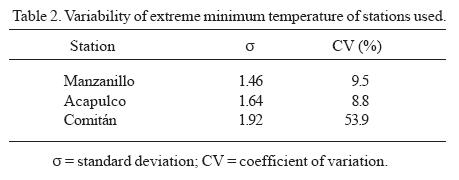
<body><![CDATA[<p align="justify"><font face="verdana" size="2">The climatological stations used in this study are located in extreme southern M&eacute;xico: two on the coast, one on the west end of the region (Manzanillo, Lat. 19&deg;03' N, Long. 104&deg; 17' W, 8 m above sea level) and the other further to the east (Acapulco, Lat. 16&deg;50' N, Long. 99&deg;56' W, 28 m above sea level); the third station, Comit&aacute;n (Lat. 16&deg;15' N, Long. 92&deg;08' W, 1530 m above sea level), is located on an inland valley in mountainous terrain on the Sierra Madre del Sur which runs in an east&#150;southeast direction parallel to the coast facing the Pacific Ocean <a href="/img/revistas/atm/v19n1/a02f1.jpg" target="_blank">(Fig. 1)</a>. The three stations lie on a latitudinal band covering from 16&deg; N to about 19&deg; N. The southern region of M&eacute;xico is under the influence of the moist air from both the Pacific Ocean and the Caribbean Sea, bringing abundant precipitation ranging from 1036 mm/yr in Comit&aacute;n to 1411 mm/yrs in Acapulco <a href="/img/revistas/atm/v19n1/a02t1.jpg" target="_blank">(Table 1)</a>. During the wet season the region is subjected to the arrival of tropical storms and hurricanes. One of these intense storms (category 5) struck the sea port of Manzanillo with powerful winds and high storm surges in 1959 (J&aacute;uregui, 2003). During the semester centered in winter (November&#150;April) the region is alternatively under the influence of the arrival of modified cold polar air masses from North America. The cold&#150;front passages produce cloudiness, rain and a marked drop in temperature, especially in the Chiapas state and eastern Oaxaca. On the elevated valleys of Chiapas, temperatures may drop to freezing as is the case of Comit&aacute;n located at an elevation of 1530 masl <a href="/img/revistas/atm/v19n1/a02t1.jpg" target="_blank">(Table 1)</a>.</font></p>     <p align="justify"><font face="verdana" size="2">Variability of temperature depends on the descent of minimum temperatures. Variability is least in regions influenced by the ocean as is the case of the stations (Manzanillo and Acapulco) located on the coast <a href="#t2">(Table 2)</a>. Contrasting with these two, the third station used (Comit&aacute;n) located in an elevated inland valley, distant 180 km from the coast and more exposed to the direct impact of the Nortes, shows a large minimum temperature variability as expressed by the coefficient of variation (CV) in <a href="#t2">Table 2</a>. Furthermore, Manzanillo and Acapulco have a correlation coefficient for the time series of 0.59, while between Acapulco and Comit&aacute;n and Comit&aacute;n and Manzanillo this coefficient is lower than 0.50.</font></p>     <p align="center"><font face="verdana" size="2"><a name="t2"></a></font></p>     <p align="center"><font face="verdana" size="2"><img src="/img/revistas/atm/v19n1/a02t2.jpg"></font></p>     <p align="justify"><font face="verdana" size="2">As noted by Hill (1969) the most obvious causes for major fluctuations of temperature in the winter climate of M&eacute;xico are the average drop of temperature caused by a cold front passage that is about 6 &deg;C in northern M&eacute;xico, while the corresponding temperature fall in the south of the country is about 3 &deg;C. Cold fronts are most frequent across eastern M&eacute;xico but they arrive much weakened due to the mountain barrier effect on the west and south western coastal regions facing the Pacific where the temperature drop at a frontal passage is less noticeable.</font></p>     <p align="justify"><font face="verdana" size="2">&nbsp;</font></p>     <p align="justify"><font face="verdana" size="2"><b>3. Data and methods</b></font></p>     <p align="justify"><font face="verdana" size="2">Synoptically, the minimum extreme temperature is related to the deep intrusions of polar air into the tropics. Flohn (1985) has noted that long&#150;term fluctuations of temperature and precipitation are associated with changes in the frequency of extreme weather events. Moreover, such events often occur in groups of consecutive years. As the minimum extreme temperature is an extreme event, it can throw light on extreme phenomena, such as the influence of solar activity on temperature.</font></p>     <p align="justify"><font face="verdana" size="2">Long&#150;term series of monthly extreme minimum temperature for three different stations in the Mexican Pacific coast are analyzed in this study. The monthly minimum extreme temperature is that of the day, within a month, with the lowest recorded temperature. The time series cover a period of 41 years from January 1941 to December 1981.</font></p>     <p align="justify"><font face="verdana" size="2">The series are spectrally analyzed using the Maximum Entropy Method (MEM) (Burg, 1972). This method requires the existence of long data series. In order to compute the power spectral density (PSD) and study the periodicities, the time series were smoothed by taking 7&#150;month running means. All series were filtered using a low&#150;band filter (0, 1. 1yr) in order to look for solar signals.</font></p>     ]]></body>
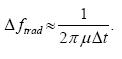
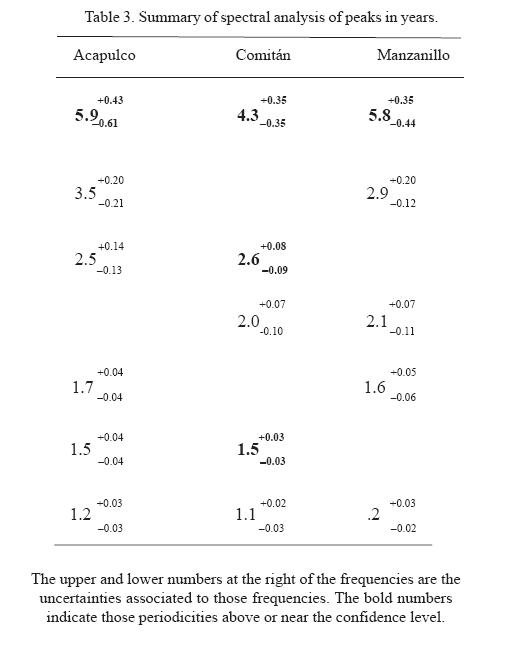
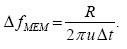
<body><![CDATA[<p align="justify"><font face="verdana" size="2">It is well known that the MEM gives better spectral resolution than other traditional methods (e .g. periodogram). What is more difficult is to quantify the actual resolution. Marple (1982) proposed the approximation:</font></p>     <p align="justify"><font face="verdana" size="2"><img src="/img/revistas/atm/v19n1/a02e1.jpg"></font></p>     <p align="justify"><font face="verdana" size="2">Where <img src="/img/revistas/atm/v19n1/a02s1.jpg"> is the normalized resolution and m is the process order, SNR is the signal to noise ratio and <i>&Delta;t</i> is the sample time interval. This approximation depends on the SNR which is unknown in most of the "real" problems. In our case we have <i>&Delta;t</i>=l month, 480 data points and we use a MEM of order of 120, then: <i>&Delta;f<sub>MEM</sub>&asymp;6.128x10<sup>&#150;10</sup></i> SNR<i><sup>&#150;0.31</sup></i>. In order to obtain a better idea about the resolution we compare <i>&Delta;f<sub>MEM</sub></i> with the traditional spectral resolution:</font></p>     <p align="justify"><font face="verdana" size="2"><img src="/img/revistas/atm/v19n1/a02e2.jpg"></font></p>     <p align="justify"><font face="verdana" size="2">where <i>&Delta;t'</i> is <i>n&Delta;t</i> and <i>n</i> is the number of data points. In this case <i>&Delta;f<sub>trad</sub>&asymp;8xl0<sup>&#150;10</sup> Hz</i> and <i>&Delta;f<sub>MEM</sub>&asymp;&Delta;f<sub>trad </sub></i>for a value <i>SNR&asymp;&#150;2DB</i> and the resolution is much better for higher values of SNR. <i>&Delta;f<sub>trad</sub></i>  is approximately 3.5 times <i>&Delta;f<sub>MEM</sub></i> for a <i>SNR=&#150;20DB</i>. Then, we can use <i>&Delta;f<sub>trad</sub>=8xl0<sup>&#150;10</sup> Hz</i> as our spectral resolution.</font></p>     <p align="justify"><font face="verdana" size="2">In this work an approximation of the level of confidence of the spectral density was obtained creating a noise time series (NTS) from the original data by mixing its values randomly. We obtain the MEM power spectral density of the NTS and repeat the process fifty times. The noise level is then the mean of all the NTS&#150;PSD. The dashed horizontal lines in <a href="/img/revistas/atm/v19n1/a02f2.jpg" target="_blank">Figure 2</a> show the 68% level of confidence estimated by this procedure. This method is frequency dependent and is more representative of the confidence levels at higher frequencies, underestimating the errors at low frequencies. Nonetheless, as we shall see below, our results show that the low frequency peaks are always well above the calculated confidence levels, thus their existence is beyond doubt.</font></p>     <p align="justify"><font face="verdana" size="2">The uncertainty of the spectral peaks shown in <a href="#t3">Table 3</a> corresponds to the peak full width at half maximum assuming that the peaks have a Gaussian shape. Note that an advantage of the MEM is the sharpness of the spectral peaks.</font></p>     <p align="center"><font face="verdana" size="2"><a name="t3"></a></font></p>     <p align="center"><font face="verdana" size="2"><img src="/img/revistas/atm/v19n1/a02t3.jpg"></font></p>     <p align="justify"><font face="verdana" size="2">Finally, in order to identify frequency bands, time intervals and phase with which two time series are covarying, we use the wavelet squared coherence (Torrence and Webster, 1999; Grinsted <i>et al</i>., 2004). Only coherences of 0.5 or larger appear in the corresponding figures, however, we shall discuss mainly those frequencies that are at the 95% confidence level. The arrows in the coherence spectra show the phase between the phenomena, arrows at 0&deg; (horizontal right) indicate that both phenomena are in phase and arrows at 180&deg; (horizontal left) indicate that they are in anti&#150;phase; arrows at 90&deg; and 270&deg; (vertical up and down respectively) indicate in general an out of phase situation.</font></p>     ]]></body>
<body><![CDATA[<p align="justify"><font face="verdana" size="2">We would like to point out that the wavelet coherence is specially useful in highlighting the time and frequency intervals where two phenomena have a strong interaction.</font></p>     <p align="justify"><font face="verdana" size="2">&nbsp;</font></p>     <p align="justify"><font face="verdana" size="2"><b>4. Results and discussion</b></font></p>     <p align="justify"><font face="verdana" size="2"><a href="/img/revistas/atm/v19n1/a02f2.jpg" target="_blank">Figure 2a</a> shows the PSD for the Manzanillo series, in <a href="/img/revistas/atm/v19n1/a02f2.jpg" target="_blank">Figure 2b</a> appears the spectral analysis for the Acapulco data and <a href="/img/revistas/atm/v19n1/a02f2.jpg" target="_blank">Figure 2c</a> presents the Comit&aacute;n series. The periodicities of the spectral peaks appear in the plots in units of years. In <a href="#t3">Table 3</a> we present a summary of the periodicities found from our calculations. The peaks are arranged by descending periodicities and we discuss only those above the confidence level, indicated in bold numbers in <a href="#t3">Table 3</a>. Also we must keep in mind the associated uncertainties. We would like to point out that in associating the spectral peaks to one phenomenon we are only suggesting a possible connection.</font></p>     <p align="justify"><font face="verdana" size="2"><a href="/img/revistas/atm/v19n1/a02f2.jpg" target="_blank">Figure 2</a> and <a href="#t3">Table 3</a> indxicate that the three stations have as significant peak a quasiquinnquenial periodicity (peaks &tilde; 5 yrs). Moreover, Comit&aacute;n has significant peaks at 2.6 and 1.5 yrs. The Comit&aacute;n peak at 2.6 yrs coincides with the Acapulco peak at 2.5 yrs taking into account the uncertainties, however the Acapulco peak is not significant. No meteorological phenomena seems to be associated to the 1.5 yrs peak of Comit&aacute;n, however this periodicity is very prominent in coronal holes (Maravilla <i>et al</i>., 2001) cosmic ray fluxes (Vald&eacute;s&#150;Galicia <i>et al</i>., 1996) and sudden storm commencements (Mendoza <i>et al</i>., 1999). The Comit&aacute;n peak at 2.6 yrs could be related to the QBO.</font></p>     <p align="justify"><font face="verdana" size="2">The quasiquinquenial peaks could be either a harmonic of the 11 yrs solar cycle or could be related to strong El Ni&ntilde;o events (Enfield, 1992), which is particularly expected because along the Mexican Pacific coast El Ni&ntilde;o is occurring. Peaks at longer periodicities cannot be taken into account due to the relatively short length of the series.</font></p>     <p align="justify"><font face="verdana" size="2"><a href="/img/revistas/atm/v19n1/a02f3.jpg" target="_blank">Figure 3a</a> shows the coherence spectra between the temperature in Manzanillo and the Southern Oscillation Index (SOI) as a proxy of El Ni&ntilde;o phenomenon. <a href="/img/revistas/atm/v19n1/a02f3.jpg" target="_blank">Figure 3b</a> presents the coherence spectra between the temperature in Manzanillo and the sunspot number as a proxy of solar activity. The coherence with the SOI is very strong for the periods of 6 and 12 years; with the two phenomena in anti&#150;phase and out of phase respectively. For solar activity the coherence is less clear than for the SOI and is present around three frequencies: 1, 1.8 and 5 yrs; as the direction of the arrows indicate, for these frequencies the two involved phenomena are out of phase.</font></p>     <p align="justify"><font face="verdana" size="2"><a href="/img/revistas/atm/v19n1/a02f4.jpg" target="_blank">Figure 4a</a> shows the coherence spectra between the temperature in Acapulco and the SOI as a proxy of El Ni&ntilde;o phenomenon. <a href="/img/revistas/atm/v19n1/a02f4.jpg" target="_blank">Figure 4b</a> presents the coherence spectra between the temperature in Acapulco and the sunspot number as a proxy of solar activity. The coherence with the SOI is very strong for the frequency of 6 yrs, with the two phenomena in anti&#150;phase. For solar activity the coherence is again less clear than for the SOI and is present around three frequencies: 1, 5.5 and 12 yrs, as the direction of the arrows indicate, for these frequencies the two involved phenomena are out of phase.</font></p>     <p align="justify"><font face="verdana" size="2"><a href="/img/revistas/atm/v19n1/a02f5.jpg" target="_blank">Figure 5a</a> shows the coherence spectra between the temperature in Comit&aacute;n and the SOI as a proxy of El Ni&ntilde;o phenomenon. <a href="/img/revistas/atm/v19n1/a02f5.jpg" target="_blank">Figure 5b</a> presents the coherence spectra between the temperature in Comit&aacute;n and the sunspot number as a proxy of solar activity. The coherence with the SOI is present for the frequencies of 2, 4 and 10 yrs, with the two phenomena out of phase, in anti&#150;phase and in phase respectively. For solar activity the coherence is clearer than for the SOI and is present around two frequencies: 1 and 8 yrs; as the direction of the arrows indicate, for these frequencies the two involved phenomena are out of phase and in anti&#150;phase respectively.</font></p>     <p align="justify"><font face="verdana" size="2">&nbsp;</font></p>     ]]></body>
<body><![CDATA[<p align="justify"><font face="verdana" size="2"><b>5. Conclusions</b></font></p>     <p align="justify"><font face="verdana" size="2">The spectral analysis of the minimum extreme temperature in the Mexican Pacific coast shows a significant common quasiquinquenial signal in two of the three stations analyzed, Manzanillo and Comit&aacute;n, although Acapulco presents a peak near the 5 yrs periodicity if the uncertainties are taking into account. This peak may be associated to various manifestations of solar activity or to strong El Ni&ntilde;o events.</font></p>     <p align="justify"><font face="verdana" size="2">The significant frequency of &tilde;2.6 yrs presented in the Comit&aacute;n series can be associated to the QBO.</font></p>     <p align="justify"><font face="verdana" size="2">No meteorological phenomena seems to be associated to the significant frequency &tilde;1.5 yrs in Comit&aacute;n, however this periodicity is very prominent in coronal holes (Maravilla <i>et al</i>., 2001) cosmic ray fluxes (Vald&eacute;s&#150;Galicia <i>et al</i>., 1996) and sudden storm commencements (Mendoza <i>et al</i>., 1999).</font></p>     <p align="justify"><font face="verdana" size="2">Although peaks that could be associated with El Ni&ntilde;o are evident, none of them is significant.</font></p>     <p align="justify"><font face="verdana" size="2">The coherence study between the temperature in Manzanillo and Acapulco shows a clear coincidence with the SOI at frequencies of around 6 years and with the two phenomena in antiphase. A less clear association with sunspot numbers is evident. For Comit&aacute;n we have the SOI and the sunspots coinciding equally with the temperature at quasi decadal frequencies and in phase with the SOI and in anti&#150;phase with the sunspots.</font></p>     <p align="justify"><font face="verdana" size="2">The behavior described above indicates that the stations closer to the ocean are more influenced by El Ni&ntilde;o than by solar activity, while the station inland (Comit&aacute;n) has both influences.</font></p>     <p align="justify"><font face="verdana" size="2">&nbsp;</font></p>     <p align="justify"><font face="verdana" size="2"><b>Acknowledgements</b></font></p>     <p align="justify"><font face="verdana" size="2">This work was partially supported by DGAPA&#150;UNAM and CONACyT Grants IN 104203&#150;3 and 33321&#150;E, respectively. The authors are grateful to M. Casasola for collecting and digitizing the temperature data and to A. Estrada for drawing the map.</font></p>     ]]></body>
<body><![CDATA[<p align="justify"><font face="verdana" size="2">&nbsp;</font></p>     <p align="justify"><font face="verdana" size="2"><b>References</b></font></p>     <!-- ref --><p align="justify"><font face="verdana" size="2">Burg J. P., 1972. The relationship between maximum entropy spectra and maximum likehood spectra. <i>Geophys</i>. <b>37</b>, 375&#150;376.</font>&nbsp;&nbsp;&nbsp;&nbsp;&nbsp;&nbsp;&nbsp;&nbsp;[&#160;<a href="javascript:void(0);" onclick="javascript: window.open('/scielo.php?script=sci_nlinks&ref=1259943&pid=S0187-6236200600010000200001&lng=','','width=640,height=500,resizable=yes,scrollbars=1,menubar=yes,');">Links</a>&#160;]<!-- end-ref --><!-- ref --><p align="justify"><font face="verdana" size="2">Byrne R., O. Granger, and J. Monteverdi, 1982. Rainfall trends on the margins of the subtropical deserts. <i>Quart. Res</i>. <b>17</b>, 14&#150;25.</font>&nbsp;&nbsp;&nbsp;&nbsp;&nbsp;&nbsp;&nbsp;&nbsp;[&#160;<a href="javascript:void(0);" onclick="javascript: window.open('/scielo.php?script=sci_nlinks&ref=1259944&pid=S0187-6236200600010000200002&lng=','','width=640,height=500,resizable=yes,scrollbars=1,menubar=yes,');">Links</a>&#160;]<!-- end-ref --><!-- ref --><p align="justify"><font face="verdana" size="2">Crowley T. J., 2000. Causes of climate change over the past 1000 years. <i>Science</i> <b>289</b>, 270&#150;277.</font>&nbsp;&nbsp;&nbsp;&nbsp;&nbsp;&nbsp;&nbsp;&nbsp;[&#160;<a href="javascript:void(0);" onclick="javascript: window.open('/scielo.php?script=sci_nlinks&ref=1259945&pid=S0187-6236200600010000200003&lng=','','width=640,height=500,resizable=yes,scrollbars=1,menubar=yes,');">Links</a>&#160;]<!-- end-ref --><!-- ref --><p align="justify"><font face="verdana" size="2">Cubash, U., and R. Voss, 2000. The influence of total solar irradiance on climate. <i>Space Sc. Rev</i>. <b>94</b>, 185&#150;198.</font>&nbsp;&nbsp;&nbsp;&nbsp;&nbsp;&nbsp;&nbsp;&nbsp;[&#160;<a href="javascript:void(0);" onclick="javascript: window.open('/scielo.php?script=sci_nlinks&ref=1259946&pid=S0187-6236200600010000200004&lng=','','width=640,height=500,resizable=yes,scrollbars=1,menubar=yes,');">Links</a>&#160;]<!-- end-ref --><!-- ref --><p align="justify"><font face="verdana" size="2">Enfield D. B., 1992. Historical and prehistorical overview of <i>El Ni&ntilde;o/Southern Oscillation. In: El Ni&ntilde;o, historical and paleoclimatic aspects of the southern oscillation</i>, (H. F. D&iacute;az and V. Markgraf, Eds.), Cambridge Univ. Press, pp. 95&#150;117.</font>&nbsp;&nbsp;&nbsp;&nbsp;&nbsp;&nbsp;&nbsp;&nbsp;[&#160;<a href="javascript:void(0);" onclick="javascript: window.open('/scielo.php?script=sci_nlinks&ref=1259947&pid=S0187-6236200600010000200005&lng=','','width=640,height=500,resizable=yes,scrollbars=1,menubar=yes,');">Links</a>&#160;]<!-- end-ref --><!-- ref --><p align="justify"><font face="verdana" size="2">Flohn H., 1985. Short&#150;term climatic fluctuation and their economic role. In: <i>Climate and history, studies in past climates and their impact on man</i>. (T. M. L. Wigley, M. J. Ingram, and G. Farmer Eds.), Cambridge Univ. Press, pp. 310&#150;318.</font>&nbsp;&nbsp;&nbsp;&nbsp;&nbsp;&nbsp;&nbsp;&nbsp;[&#160;<a href="javascript:void(0);" onclick="javascript: window.open('/scielo.php?script=sci_nlinks&ref=1259948&pid=S0187-6236200600010000200006&lng=','','width=640,height=500,resizable=yes,scrollbars=1,menubar=yes,');">Links</a>&#160;]<!-- end-ref --><!-- ref --><p align="justify"><font face="verdana" size="2">Garc&iacute;a E., 1973. <i>Los climas de M&eacute;xico</i>, Instituto de Geograf&iacute;a, UNAM, M&eacute;xico, 74 pp.</font>&nbsp;&nbsp;&nbsp;&nbsp;&nbsp;&nbsp;&nbsp;&nbsp;[&#160;<a href="javascript:void(0);" onclick="javascript: window.open('/scielo.php?script=sci_nlinks&ref=1259949&pid=S0187-6236200600010000200007&lng=','','width=640,height=500,resizable=yes,scrollbars=1,menubar=yes,');">Links</a>&#160;]<!-- end-ref --><!-- ref --><p align="justify"><font face="verdana" size="2">Granger O. E., 1984. Twentieth&#150;century climate anomaly patterns over the southwestern United States. <i>Physical Geography</i> <b>5</b>, 164&#150;185.</font>&nbsp;&nbsp;&nbsp;&nbsp;&nbsp;&nbsp;&nbsp;&nbsp;[&#160;<a href="javascript:void(0);" onclick="javascript: window.open('/scielo.php?script=sci_nlinks&ref=1259950&pid=S0187-6236200600010000200008&lng=','','width=640,height=500,resizable=yes,scrollbars=1,menubar=yes,');">Links</a>&#160;]<!-- end-ref --><!-- ref --><p align="justify"><font face="verdana" size="2">Grinsted A., J. Moore, and S. Jevrejera, 2004. Application of the cross wavelet transform and wavelet coherence to geophysical time series. <i>Nonlinear Processes in Geophysics</i> <b>11</b>, 561&#150;566.</font>&nbsp;&nbsp;&nbsp;&nbsp;&nbsp;&nbsp;&nbsp;&nbsp;[&#160;<a href="javascript:void(0);" onclick="javascript: window.open('/scielo.php?script=sci_nlinks&ref=1259951&pid=S0187-6236200600010000200009&lng=','','width=640,height=500,resizable=yes,scrollbars=1,menubar=yes,');">Links</a>&#160;]<!-- end-ref --><!-- ref --><p align="justify"><font face="verdana" size="2">Hill J., 1969. Temperature variability and synoptic cold fronts in the winter climate of M&eacute;xico. Climatological Res. Series N&deg; 4, McGill University Montreal, 70 pp.</font>&nbsp;&nbsp;&nbsp;&nbsp;&nbsp;&nbsp;&nbsp;&nbsp;[&#160;<a href="javascript:void(0);" onclick="javascript: window.open('/scielo.php?script=sci_nlinks&ref=1259952&pid=S0187-6236200600010000200010&lng=','','width=640,height=500,resizable=yes,scrollbars=1,menubar=yes,');">Links</a>&#160;]<!-- end-ref --><!-- ref --><p align="justify"><font face="verdana" size="2">Hurrell J. W., 1995. Decadal trends in the North Atlantic Oscillation: regional temperatures and precipitation. <i>Science</i> <b>269</b>, 676&#150;679.</font>&nbsp;&nbsp;&nbsp;&nbsp;&nbsp;&nbsp;&nbsp;&nbsp;[&#160;<a href="javascript:void(0);" onclick="javascript: window.open('/scielo.php?script=sci_nlinks&ref=1259953&pid=S0187-6236200600010000200011&lng=','','width=640,height=500,resizable=yes,scrollbars=1,menubar=yes,');">Links</a>&#160;]<!-- end-ref --><!-- ref --><p align="justify"><font face="verdana" size="2">IPCC TAR (Intergovernmental Panel on Climate Change, Third Assessment Report 2001), 2001. Climate Change 2001: The scientific basis, J. T. Houghton, Y. Ding, D. J. Giggs, M. Noguer, P. J. van der Linden, X. Dai, K. Maskell, and C. A. Johnson, Cambrige Univ. Press.</font>&nbsp;&nbsp;&nbsp;&nbsp;&nbsp;&nbsp;&nbsp;&nbsp;[&#160;<a href="javascript:void(0);" onclick="javascript: window.open('/scielo.php?script=sci_nlinks&ref=1259954&pid=S0187-6236200600010000200012&lng=','','width=640,height=500,resizable=yes,scrollbars=1,menubar=yes,');">Links</a>&#160;]<!-- end-ref --><!-- ref --><p align="justify"><font face="verdana" size="2">J&aacute;uregui E., 1997. Climate change in M&eacute;xico during the historical and instrumented periods. <i>Quat. Int</i>. <b>43&#150;44</b>, 7&#150;17.</font>&nbsp;&nbsp;&nbsp;&nbsp;&nbsp;&nbsp;&nbsp;&nbsp;[&#160;<a href="javascript:void(0);" onclick="javascript: window.open('/scielo.php?script=sci_nlinks&ref=1259955&pid=S0187-6236200600010000200013&lng=','','width=640,height=500,resizable=yes,scrollbars=1,menubar=yes,');">Links</a>&#160;]<!-- end-ref --><!-- ref --><p align="justify"><font face="verdana" size="2">J&aacute;uregui E., 2003. Climatology of landfalling hurricanes and tropical storms in M&eacute;xico. <i>Atm&oacute;sfera</i> <b>16</b>, 193&#150;204.</font>&nbsp;&nbsp;&nbsp;&nbsp;&nbsp;&nbsp;&nbsp;&nbsp;[&#160;<a href="javascript:void(0);" onclick="javascript: window.open('/scielo.php?script=sci_nlinks&ref=1259956&pid=S0187-6236200600010000200014&lng=','','width=640,height=500,resizable=yes,scrollbars=1,menubar=yes,');">Links</a>&#160;]<!-- end-ref --><!-- ref --><p align="justify"><font face="verdana" size="2">Klaus D., 1973. Inversiones de aire polar en M&eacute;xico. <i>Geof&iacute;s. Int</i>. <b>13</b>, 99&#150;143.</font>&nbsp;&nbsp;&nbsp;&nbsp;&nbsp;&nbsp;&nbsp;&nbsp;[&#160;<a href="javascript:void(0);" onclick="javascript: window.open('/scielo.php?script=sci_nlinks&ref=1259957&pid=S0187-6236200600010000200015&lng=','','width=640,height=500,resizable=yes,scrollbars=1,menubar=yes,');">Links</a>&#160;]<!-- end-ref --><!-- ref --><p align="justify"><font face="verdana" size="2">Klaus D., and E. J&aacute;uregui, 1976. Some aspects of climate fluctuations in M&eacute;xico in relation to drought. <i>Geof&iacute;s. Int</i>. <b>16</b>, 45&#150;62.</font>&nbsp;&nbsp;&nbsp;&nbsp;&nbsp;&nbsp;&nbsp;&nbsp;[&#160;<a href="javascript:void(0);" onclick="javascript: window.open('/scielo.php?script=sci_nlinks&ref=1259958&pid=S0187-6236200600010000200016&lng=','','width=640,height=500,resizable=yes,scrollbars=1,menubar=yes,');">Links</a>&#160;]<!-- end-ref --><!-- ref --><p align="justify"><font face="verdana" size="2">Lean J., J. Beer, and R. Bradley, 1995. Reconstruction of solar irradiance since 1610: Implications for climate change. <i>Geophys. Res. Lett</i>. <b>22</b>, 3195&#150;3198.</font>&nbsp;&nbsp;&nbsp;&nbsp;&nbsp;&nbsp;&nbsp;&nbsp;[&#160;<a href="javascript:void(0);" onclick="javascript: window.open('/scielo.php?script=sci_nlinks&ref=1259959&pid=S0187-6236200600010000200017&lng=','','width=640,height=500,resizable=yes,scrollbars=1,menubar=yes,');">Links</a>&#160;]<!-- end-ref --><!-- ref --><p align="justify"><font face="verdana" size="2">Maravilla D., A. Lara, J. F. Vald&eacute;s&#150;Galicia and B. Mendoza, 2001. An analysis of polar coronal hole evolution: relations to other solar phenomena and heliospheric consequences. <i>Solar Physics </i><b>203</b>, 27&#150;38.</font>&nbsp;&nbsp;&nbsp;&nbsp;&nbsp;&nbsp;&nbsp;&nbsp;[&#160;<a href="javascript:void(0);" onclick="javascript: window.open('/scielo.php?script=sci_nlinks&ref=1259960&pid=S0187-6236200600010000200018&lng=','','width=640,height=500,resizable=yes,scrollbars=1,menubar=yes,');">Links</a>&#160;]<!-- end-ref --><!-- ref --><p align="justify"><font face="verdana" size="2">Maravilla D., B. Mendoza, E. J&aacute;uregui and A. Lara, 2004. The main periodicities in the minimum extreme temperature in northern Mexico and their relation with solar variability. <i>Advances in Space Res</i>., in press.</font>&nbsp;&nbsp;&nbsp;&nbsp;&nbsp;&nbsp;&nbsp;&nbsp;[&#160;<a href="javascript:void(0);" onclick="javascript: window.open('/scielo.php?script=sci_nlinks&ref=1259961&pid=S0187-6236200600010000200019&lng=','','width=640,height=500,resizable=yes,scrollbars=1,menubar=yes,');">Links</a>&#160;]<!-- end-ref --><!-- ref --><p align="justify"><font face="verdana" size="2">Marple S. L., 1982. Frequency resolution of Fourier and maximum entropy spectral estimates. <i>Geophysics</i> <b>47</b>, 1303&#150;1307.</font>&nbsp;&nbsp;&nbsp;&nbsp;&nbsp;&nbsp;&nbsp;&nbsp;[&#160;<a href="javascript:void(0);" onclick="javascript: window.open('/scielo.php?script=sci_nlinks&ref=1259962&pid=S0187-6236200600010000200020&lng=','','width=640,height=500,resizable=yes,scrollbars=1,menubar=yes,');">Links</a>&#160;]<!-- end-ref --><!-- ref --><p align="justify"><font face="verdana" size="2">Mars, N. D. and H. Svensmark, 2000. Low cloud properties influenced by cosmic rays. <i>Physical. Review Letters</i> <b>85</b>, 5004&#150;5007.</font>&nbsp;&nbsp;&nbsp;&nbsp;&nbsp;&nbsp;&nbsp;&nbsp;[&#160;<a href="javascript:void(0);" onclick="javascript: window.open('/scielo.php?script=sci_nlinks&ref=1259963&pid=S0187-6236200600010000200021&lng=','','width=640,height=500,resizable=yes,scrollbars=1,menubar=yes,');">Links</a>&#160;]<!-- end-ref --><!-- ref --><p align="justify"><font face="verdana" size="2">Mendoza B., A. Lara., D. Maravilla and J. F. Vald&eacute;s&#150;Galicia, 1999. Magnetic flux emergence and geomagnetic activity, a close correlation. <i>Solar Physics</i> <b>112</b>, 405&#150;416.</font>&nbsp;&nbsp;&nbsp;&nbsp;&nbsp;&nbsp;&nbsp;&nbsp;[&#160;<a href="javascript:void(0);" onclick="javascript: window.open('/scielo.php?script=sci_nlinks&ref=1259964&pid=S0187-6236200600010000200022&lng=','','width=640,height=500,resizable=yes,scrollbars=1,menubar=yes,');">Links</a>&#160;]<!-- end-ref --><!-- ref --><p align="justify"><font face="verdana" size="2">Mendoza B., A. Lara, D. Maravilla and E. J&aacute;uregui, 2001. Temperature variability in central M&eacute;xico and its possible association to solar activity. <i>J. Atmos. Solar&#150;Terrestrial Phys</i>. <b>63</b>, 1891&#150;1900.</font>&nbsp;&nbsp;&nbsp;&nbsp;&nbsp;&nbsp;&nbsp;&nbsp;[&#160;<a href="javascript:void(0);" onclick="javascript: window.open('/scielo.php?script=sci_nlinks&ref=1259965&pid=S0187-6236200600010000200023&lng=','','width=640,height=500,resizable=yes,scrollbars=1,menubar=yes,');">Links</a>&#160;]<!-- end-ref --><!-- ref --><p align="justify"><font face="verdana" size="2">Ram&iacute;rez J., B. Mendoza, V. Mendoza and J. Adem, 2004. Modelling the effect of an assumed cosmic ray&#150;modulated global cloud cover on the terrestrial surface temperature. <i>J. Atmos. Solar&#150;Terrestrial Phys</i>., in press.</font>&nbsp;&nbsp;&nbsp;&nbsp;&nbsp;&nbsp;&nbsp;&nbsp;[&#160;<a href="javascript:void(0);" onclick="javascript: window.open('/scielo.php?script=sci_nlinks&ref=1259966&pid=S0187-6236200600010000200024&lng=','','width=640,height=500,resizable=yes,scrollbars=1,menubar=yes,');">Links</a>&#160;]<!-- end-ref --><!-- ref --><p align="justify"><font face="verdana" size="2">Reid G. C., 2000. Solar variability and the Earth's climate: introduction and overview. <i>Space Science Review</i> <b>94</b>, 1&#150;11.</font>&nbsp;&nbsp;&nbsp;&nbsp;&nbsp;&nbsp;&nbsp;&nbsp;[&#160;<a href="javascript:void(0);" onclick="javascript: window.open('/scielo.php?script=sci_nlinks&ref=1259967&pid=S0187-6236200600010000200025&lng=','','width=640,height=500,resizable=yes,scrollbars=1,menubar=yes,');">Links</a>&#160;]<!-- end-ref --><!-- ref --><p align="justify"><font face="verdana" size="2">S&aacute;nchez W. and J. Kutzbach, 1974. Climate of the American Tropics in the 1960s. <i>Quart. Res.</i> <b>4</b>, 128&#150;135.</font>&nbsp;&nbsp;&nbsp;&nbsp;&nbsp;&nbsp;&nbsp;&nbsp;[&#160;<a href="javascript:void(0);" onclick="javascript: window.open('/scielo.php?script=sci_nlinks&ref=1259968&pid=S0187-6236200600010000200026&lng=','','width=640,height=500,resizable=yes,scrollbars=1,menubar=yes,');">Links</a>&#160;]<!-- end-ref --><!-- ref --><p align="justify"><font face="verdana" size="2">Shindell D. T., G. A. Schmidt, M. E. Mann, D. Rind and A. Waple, 2001. Solar forcing of regional climate change during the Maunder minimum. <i>Science</i> <b>294</b>, 2149&#150;2152.</font>&nbsp;&nbsp;&nbsp;&nbsp;&nbsp;&nbsp;&nbsp;&nbsp;[&#160;<a href="javascript:void(0);" onclick="javascript: window.open('/scielo.php?script=sci_nlinks&ref=1259969&pid=S0187-6236200600010000200027&lng=','','width=640,height=500,resizable=yes,scrollbars=1,menubar=yes,');">Links</a>&#160;]<!-- end-ref --><!-- ref --><p align="justify"><font face="verdana" size="2">Solanky S. K. and N. A. Krivova, 2003. Can solar variability explain global warming since 1970? <i>J. Geophys. Res</i>. <b>108</b>, 1200&#150;1207.</font>&nbsp;&nbsp;&nbsp;&nbsp;&nbsp;&nbsp;&nbsp;&nbsp;[&#160;<a href="javascript:void(0);" onclick="javascript: window.open('/scielo.php?script=sci_nlinks&ref=1259970&pid=S0187-6236200600010000200028&lng=','','width=640,height=500,resizable=yes,scrollbars=1,menubar=yes,');">Links</a>&#160;]<!-- end-ref --><!-- ref --><p align="justify"><font face="verdana" size="2">Soto C. and E. J&aacute;uregui, 1965.<i> Isotermas extremas e &iacute;ndice de aridez en la Rep&uacute;blica Mexicana</i>, Instituto de Geograf&iacute;a, UNAM, M&eacute;xico. 31 p.</font>&nbsp;&nbsp;&nbsp;&nbsp;&nbsp;&nbsp;&nbsp;&nbsp;[&#160;<a href="javascript:void(0);" onclick="javascript: window.open('/scielo.php?script=sci_nlinks&ref=1259971&pid=S0187-6236200600010000200029&lng=','','width=640,height=500,resizable=yes,scrollbars=1,menubar=yes,');">Links</a>&#160;]<!-- end-ref --><!-- ref --><p align="justify"><font face="verdana" size="2">Torrence C. and P. Webster, 1999. Interdecadal Changes in the ENSO&#150;Monsoon System.<i> J. Clim</i>. <b>12</b>, 2679&#150;2690.</font>&nbsp;&nbsp;&nbsp;&nbsp;&nbsp;&nbsp;&nbsp;&nbsp;[&#160;<a href="javascript:void(0);" onclick="javascript: window.open('/scielo.php?script=sci_nlinks&ref=1259972&pid=S0187-6236200600010000200030&lng=','','width=640,height=500,resizable=yes,scrollbars=1,menubar=yes,');">Links</a>&#160;]<!-- end-ref --><!-- ref --><p align="justify"><font face="verdana" size="2">Trenberth K. E. and J. W. Hurrell, 1994. Decadal atmospheric&#150;ocean variations in the Pacific. <i>Clim. Dyn</i>. <b>9</b>, 303&#150;319.</font>&nbsp;&nbsp;&nbsp;&nbsp;&nbsp;&nbsp;&nbsp;&nbsp;[&#160;<a href="javascript:void(0);" onclick="javascript: window.open('/scielo.php?script=sci_nlinks&ref=1259973&pid=S0187-6236200600010000200031&lng=','','width=640,height=500,resizable=yes,scrollbars=1,menubar=yes,');">Links</a>&#160;]<!-- end-ref --><!-- ref --><p align="justify"><font face="verdana" size="2">Vald&eacute;s&#150;Galicia J. F., R. P&eacute;rez&#150;Enr&iacute;quez and J. A. Otaola, 1997. The cosmic ray 1.68&#150;year variation: A clue to understand the nature of the solar cycle? <i>Solar Physics</i> <b>167</b>, 409&#150;417.</font>&nbsp;&nbsp;&nbsp;&nbsp;&nbsp;&nbsp;&nbsp;&nbsp;[&#160;<a href="javascript:void(0);" onclick="javascript: window.open('/scielo.php?script=sci_nlinks&ref=1259974&pid=S0187-6236200600010000200032&lng=','','width=640,height=500,resizable=yes,scrollbars=1,menubar=yes,');">Links</a>&#160;]<!-- end-ref --><!-- ref --><p align="justify"><font face="verdana" size="2">Van Loon H. and K. Labitzke, 2000. The influence of the 11&#150;year solar cycle on the stratosphere below 30 km: a review. <i>Space Sci. Rev</i>. <b>94</b>, 259&#150;278.</font>&nbsp;&nbsp;&nbsp;&nbsp;&nbsp;&nbsp;&nbsp;&nbsp;[&#160;<a href="javascript:void(0);" onclick="javascript: window.open('/scielo.php?script=sci_nlinks&ref=1259975&pid=S0187-6236200600010000200033&lng=','','width=640,height=500,resizable=yes,scrollbars=1,menubar=yes,');">Links</a>&#160;]<!-- end-ref --><!-- ref --><p align="justify"><font face="verdana" size="2">Wall&eacute;n C. C., 1955. Some characteristics of precipitation in Mexico. <i>Geografiska Annaler</i> <b>37</b>, 51&#150;85.</font>&nbsp;&nbsp;&nbsp;&nbsp;&nbsp;&nbsp;&nbsp;&nbsp;[&#160;<a href="javascript:void(0);" onclick="javascript: window.open('/scielo.php?script=sci_nlinks&ref=1259976&pid=S0187-6236200600010000200034&lng=','','width=640,height=500,resizable=yes,scrollbars=1,menubar=yes,');">Links</a>&#160;]<!-- end-ref --> ]]></body><back>
<ref-list>
<ref id="B1">
<nlm-citation citation-type="journal">
<person-group person-group-type="author">
<name>
<surname><![CDATA[Burg]]></surname>
<given-names><![CDATA[J. P.]]></given-names>
</name>
</person-group>
<article-title xml:lang="en"><![CDATA[The relationship between maximum entropy spectra and maximum likehood spectra]]></article-title>
<source><![CDATA[Geophys.]]></source>
<year>1972</year>
<numero>37</numero>
<issue>37</issue>
<page-range>375-376</page-range></nlm-citation>
</ref>
<ref id="B2">
<nlm-citation citation-type="journal">
<person-group person-group-type="author">
<name>
<surname><![CDATA[Byrne]]></surname>
<given-names><![CDATA[R.]]></given-names>
</name>
<name>
<surname><![CDATA[Granger]]></surname>
<given-names><![CDATA[O.]]></given-names>
</name>
<name>
<surname><![CDATA[Monteverdi]]></surname>
<given-names><![CDATA[J.]]></given-names>
</name>
</person-group>
<article-title xml:lang="en"><![CDATA[Rainfall trends on the margins of the subtropical deserts]]></article-title>
<source><![CDATA[Quart. Res.]]></source>
<year>1982</year>
<numero>17</numero>
<issue>17</issue>
<page-range>14-25</page-range></nlm-citation>
</ref>
<ref id="B3">
<nlm-citation citation-type="journal">
<person-group person-group-type="author">
<name>
<surname><![CDATA[Crowley]]></surname>
<given-names><![CDATA[T. J.]]></given-names>
</name>
</person-group>
<article-title xml:lang="en"><![CDATA[Causes of climate change over the past 1000 years]]></article-title>
<source><![CDATA[Science]]></source>
<year>2000</year>
<numero>289</numero>
<issue>289</issue>
<page-range>270-277</page-range></nlm-citation>
</ref>
<ref id="B4">
<nlm-citation citation-type="journal">
<person-group person-group-type="author">
<name>
<surname><![CDATA[Cubash]]></surname>
<given-names><![CDATA[U.]]></given-names>
</name>
<name>
<surname><![CDATA[Voss]]></surname>
<given-names><![CDATA[R.]]></given-names>
</name>
</person-group>
<article-title xml:lang="en"><![CDATA[The influence of total solar irradiance on climate]]></article-title>
<source><![CDATA[Space Sc. Rev.]]></source>
<year>2000</year>
<numero>94</numero>
<issue>94</issue>
<page-range>185-198</page-range></nlm-citation>
</ref>
<ref id="B5">
<nlm-citation citation-type="book">
<person-group person-group-type="author">
<name>
<surname><![CDATA[Enfield]]></surname>
<given-names><![CDATA[D. B.]]></given-names>
</name>
</person-group>
<article-title xml:lang="en"><![CDATA[Historical and prehistorical overview of El Niño/Southern Oscillation]]></article-title>
<person-group person-group-type="editor">
<name>
<surname><![CDATA[Díaz]]></surname>
<given-names><![CDATA[H. F.]]></given-names>
</name>
<name>
<surname><![CDATA[Markgraf]]></surname>
<given-names><![CDATA[V.]]></given-names>
</name>
</person-group>
<source><![CDATA[El Niño, historical and paleoclimatic aspects of the southern oscillation]]></source>
<year>1992</year>
<page-range>95-117</page-range><publisher-name><![CDATA[Cambridge Univ. Press]]></publisher-name>
</nlm-citation>
</ref>
<ref id="B6">
<nlm-citation citation-type="book">
<person-group person-group-type="author">
<name>
<surname><![CDATA[Flohn]]></surname>
<given-names><![CDATA[H.]]></given-names>
</name>
</person-group>
<article-title xml:lang="en"><![CDATA[Short-term climatic fluctuation and their economic role]]></article-title>
<person-group person-group-type="editor">
<name>
<surname><![CDATA[Wigley]]></surname>
<given-names><![CDATA[T. M. L.]]></given-names>
</name>
<name>
<surname><![CDATA[Ingram]]></surname>
<given-names><![CDATA[M. J.]]></given-names>
</name>
<name>
<surname><![CDATA[Farmer]]></surname>
<given-names><![CDATA[G.]]></given-names>
</name>
</person-group>
<source><![CDATA[Climate and history, studies in past climates and their impact on man]]></source>
<year>1985</year>
<page-range>310-318</page-range><publisher-name><![CDATA[Cambridge Univ. Press]]></publisher-name>
</nlm-citation>
</ref>
<ref id="B7">
<nlm-citation citation-type="book">
<person-group person-group-type="author">
<name>
<surname><![CDATA[García]]></surname>
<given-names><![CDATA[E.]]></given-names>
</name>
</person-group>
<source><![CDATA[Los climas de México]]></source>
<year>1973</year>
<page-range>74</page-range><publisher-name><![CDATA[Instituto de Geografía, UNAM]]></publisher-name>
</nlm-citation>
</ref>
<ref id="B8">
<nlm-citation citation-type="journal">
<person-group person-group-type="author">
<name>
<surname><![CDATA[Granger]]></surname>
<given-names><![CDATA[O. E.]]></given-names>
</name>
</person-group>
<article-title xml:lang="en"><![CDATA[Twentieth-century climate anomaly patterns over the southwestern United States]]></article-title>
<source><![CDATA[Physical Geography]]></source>
<year>1984</year>
<numero>5</numero>
<issue>5</issue>
<page-range>164-185</page-range></nlm-citation>
</ref>
<ref id="B9">
<nlm-citation citation-type="journal">
<person-group person-group-type="author">
<name>
<surname><![CDATA[Grinsted]]></surname>
<given-names><![CDATA[A.]]></given-names>
</name>
<name>
<surname><![CDATA[Moore]]></surname>
<given-names><![CDATA[J.]]></given-names>
</name>
<name>
<surname><![CDATA[Jevrejera]]></surname>
<given-names><![CDATA[S.]]></given-names>
</name>
</person-group>
<article-title xml:lang="en"><![CDATA[Application of the cross wavelet transform and wavelet coherence to geophysical time series]]></article-title>
<source><![CDATA[Nonlinear Processes in Geophysics]]></source>
<year>2004</year>
<numero>11</numero>
<issue>11</issue>
<page-range>561-566</page-range></nlm-citation>
</ref>
<ref id="B10">
<nlm-citation citation-type="journal">
<person-group person-group-type="author">
<name>
<surname><![CDATA[Hill]]></surname>
<given-names><![CDATA[J.]]></given-names>
</name>
</person-group>
<article-title xml:lang="en"><![CDATA[Temperature variability and synoptic cold fronts in the winter climate of México]]></article-title>
<source><![CDATA[Climatological Res. Series]]></source>
<year>1969</year>
<numero>4</numero>
<issue>4</issue>
<page-range>70</page-range><publisher-name><![CDATA[McGill University Montreal]]></publisher-name>
</nlm-citation>
</ref>
<ref id="B11">
<nlm-citation citation-type="journal">
<person-group person-group-type="author">
<name>
<surname><![CDATA[Hurrell]]></surname>
<given-names><![CDATA[J. W.]]></given-names>
</name>
</person-group>
<article-title xml:lang="en"><![CDATA[Decadal trends in the North Atlantic Oscillation: regional temperatures and precipitation]]></article-title>
<source><![CDATA[Science]]></source>
<year>1995</year>
<numero>269</numero>
<issue>269</issue>
<page-range>676-679</page-range></nlm-citation>
</ref>
<ref id="B12">
<nlm-citation citation-type="book">
<person-group person-group-type="author">
<name>
<surname><![CDATA[Houghton]]></surname>
<given-names><![CDATA[J. T.]]></given-names>
</name>
<name>
<surname><![CDATA[Ding]]></surname>
<given-names><![CDATA[Y.]]></given-names>
</name>
<name>
<surname><![CDATA[Giggs]]></surname>
<given-names><![CDATA[D. J.]]></given-names>
</name>
<name>
<surname><![CDATA[Noguer]]></surname>
<given-names><![CDATA[M.]]></given-names>
</name>
<name>
<surname><![CDATA[van der Linden]]></surname>
<given-names><![CDATA[P. J.]]></given-names>
</name>
<name>
<surname><![CDATA[Dai]]></surname>
<given-names><![CDATA[X.]]></given-names>
</name>
<name>
<surname><![CDATA[Maskell]]></surname>
<given-names><![CDATA[K.]]></given-names>
</name>
<name>
<surname><![CDATA[Johnson]]></surname>
<given-names><![CDATA[C. A.]]></given-names>
</name>
</person-group>
<source><![CDATA[IPCC TAR (Intergovernmental Panel on Climate Change, Third Assessment Report 2001), 2001. Climate Change 2001: The scientific basis]]></source>
<year></year>
<publisher-name><![CDATA[Cambrige Univ. Press]]></publisher-name>
</nlm-citation>
</ref>
<ref id="B13">
<nlm-citation citation-type="journal">
<person-group person-group-type="author">
<name>
<surname><![CDATA[Jáuregui]]></surname>
<given-names><![CDATA[E.]]></given-names>
</name>
</person-group>
<article-title xml:lang="en"><![CDATA[Climate change in México during the historical and instrumented periods]]></article-title>
<source><![CDATA[Quat. Int.]]></source>
<year>1997</year>
<numero>43-44</numero>
<issue>43-44</issue>
<page-range>7-17</page-range></nlm-citation>
</ref>
<ref id="B14">
<nlm-citation citation-type="journal">
<person-group person-group-type="author">
<name>
<surname><![CDATA[Jáuregui]]></surname>
<given-names><![CDATA[E.]]></given-names>
</name>
</person-group>
<article-title xml:lang="en"><![CDATA[Climatology of landfalling hurricanes and tropical storms in México]]></article-title>
<source><![CDATA[Atmósfera]]></source>
<year>2003</year>
<numero>16</numero>
<issue>16</issue>
<page-range>193-204</page-range></nlm-citation>
</ref>
<ref id="B15">
<nlm-citation citation-type="journal">
<person-group person-group-type="author">
<name>
<surname><![CDATA[Klaus]]></surname>
<given-names><![CDATA[D.]]></given-names>
</name>
</person-group>
<article-title xml:lang="es"><![CDATA[Inversiones de aire polar en México]]></article-title>
<source><![CDATA[Geofís. Int.]]></source>
<year>1973</year>
<numero>13</numero>
<issue>13</issue>
<page-range>99-143</page-range></nlm-citation>
</ref>
<ref id="B16">
<nlm-citation citation-type="journal">
<person-group person-group-type="author">
<name>
<surname><![CDATA[Klaus]]></surname>
<given-names><![CDATA[D.]]></given-names>
</name>
<name>
<surname><![CDATA[Jáuregui]]></surname>
<given-names><![CDATA[E.]]></given-names>
</name>
</person-group>
<article-title xml:lang="en"><![CDATA[Some aspects of climate fluctuations in México in relation to drought]]></article-title>
<source><![CDATA[Geofís. Int.]]></source>
<year>1976</year>
<numero>16</numero>
<issue>16</issue>
<page-range>45-62</page-range></nlm-citation>
</ref>
<ref id="B17">
<nlm-citation citation-type="journal">
<person-group person-group-type="author">
<name>
<surname><![CDATA[Lean]]></surname>
<given-names><![CDATA[J.]]></given-names>
</name>
<name>
<surname><![CDATA[Beer]]></surname>
<given-names><![CDATA[J.]]></given-names>
</name>
<name>
<surname><![CDATA[Bradley]]></surname>
<given-names><![CDATA[R.]]></given-names>
</name>
</person-group>
<article-title xml:lang="en"><![CDATA[Reconstruction of solar irradiance since 1610: Implications for climate change]]></article-title>
<source><![CDATA[Geophys. Res. Lett.]]></source>
<year>1995</year>
<numero>22</numero>
<issue>22</issue>
<page-range>3195-3198</page-range></nlm-citation>
</ref>
<ref id="B18">
<nlm-citation citation-type="journal">
<person-group person-group-type="author">
<name>
<surname><![CDATA[Maravilla]]></surname>
<given-names><![CDATA[D.]]></given-names>
</name>
<name>
<surname><![CDATA[Lara]]></surname>
<given-names><![CDATA[A.]]></given-names>
</name>
<name>
<surname><![CDATA[Valdés-Galicia]]></surname>
<given-names><![CDATA[J. F.]]></given-names>
</name>
<name>
<surname><![CDATA[Mendoza]]></surname>
<given-names><![CDATA[B.]]></given-names>
</name>
</person-group>
<article-title xml:lang="en"><![CDATA[An analysis of polar coronal hole evolution: relations to other solar phenomena and heliospheric consequences]]></article-title>
<source><![CDATA[Solar Physics]]></source>
<year>2001</year>
<numero>203</numero>
<issue>203</issue>
<page-range>27-38</page-range></nlm-citation>
</ref>
<ref id="B19">
<nlm-citation citation-type="journal">
<person-group person-group-type="author">
<name>
<surname><![CDATA[Maravilla]]></surname>
<given-names><![CDATA[D.]]></given-names>
</name>
<name>
<surname><![CDATA[Mendoza]]></surname>
<given-names><![CDATA[B.]]></given-names>
</name>
<name>
<surname><![CDATA[Jáuregui]]></surname>
<given-names><![CDATA[E.]]></given-names>
</name>
<name>
<surname><![CDATA[Lara]]></surname>
<given-names><![CDATA[A.]]></given-names>
</name>
</person-group>
<article-title xml:lang="en"><![CDATA[The main periodicities in the minimum extreme temperature in northern Mexico and their relation with solar variability]]></article-title>
<source><![CDATA[Advances in Space Res.]]></source>
<year>2004</year>
</nlm-citation>
</ref>
<ref id="B20">
<nlm-citation citation-type="journal">
<person-group person-group-type="author">
<name>
<surname><![CDATA[Marple]]></surname>
<given-names><![CDATA[S. L.]]></given-names>
</name>
</person-group>
<article-title xml:lang="en"><![CDATA[Frequency resolution of Fourier and maximum entropy spectral estimates]]></article-title>
<source><![CDATA[Geophysics]]></source>
<year>1982</year>
<numero>47</numero>
<issue>47</issue>
<page-range>1303-1307</page-range></nlm-citation>
</ref>
<ref id="B21">
<nlm-citation citation-type="journal">
<person-group person-group-type="author">
<name>
<surname><![CDATA[Mars]]></surname>
<given-names><![CDATA[N. D.]]></given-names>
</name>
<name>
<surname><![CDATA[Svensmark]]></surname>
<given-names><![CDATA[H.]]></given-names>
</name>
</person-group>
<article-title xml:lang="en"><![CDATA[Low cloud properties influenced by cosmic rays]]></article-title>
<source><![CDATA[Physical. Review Letters]]></source>
<year>2000</year>
<numero>85</numero>
<issue>85</issue>
<page-range>5004-5007</page-range></nlm-citation>
</ref>
<ref id="B22">
<nlm-citation citation-type="journal">
<person-group person-group-type="author">
<name>
<surname><![CDATA[Mendoza]]></surname>
<given-names><![CDATA[B.]]></given-names>
</name>
<name>
<surname><![CDATA[Lara]]></surname>
<given-names><![CDATA[A.]]></given-names>
</name>
<name>
<surname><![CDATA[Maravilla]]></surname>
<given-names><![CDATA[D.]]></given-names>
</name>
<name>
<surname><![CDATA[Valdés-Galicia]]></surname>
<given-names><![CDATA[J. F.]]></given-names>
</name>
</person-group>
<article-title xml:lang="en"><![CDATA[Magnetic flux emergence and geomagnetic activity, a close correlation]]></article-title>
<source><![CDATA[Solar Physics]]></source>
<year>1999</year>
<numero>112</numero>
<issue>112</issue>
<page-range>405-416</page-range></nlm-citation>
</ref>
<ref id="B23">
<nlm-citation citation-type="journal">
<person-group person-group-type="author">
<name>
<surname><![CDATA[Mendoza]]></surname>
<given-names><![CDATA[B.]]></given-names>
</name>
<name>
<surname><![CDATA[Lara]]></surname>
<given-names><![CDATA[A.]]></given-names>
</name>
<name>
<surname><![CDATA[Maravilla]]></surname>
<given-names><![CDATA[D.]]></given-names>
</name>
<name>
<surname><![CDATA[Jáuregui]]></surname>
<given-names><![CDATA[E.]]></given-names>
</name>
</person-group>
<article-title xml:lang="en"><![CDATA[Temperature variability in central México and its possible association to solar activity]]></article-title>
<source><![CDATA[J. Atmos. Solar-Terrestrial Phys.]]></source>
<year>2001</year>
<numero>63</numero>
<issue>63</issue>
<page-range>1891-1900</page-range></nlm-citation>
</ref>
<ref id="B24">
<nlm-citation citation-type="journal">
<person-group person-group-type="author">
<name>
<surname><![CDATA[Ramírez]]></surname>
<given-names><![CDATA[J.]]></given-names>
</name>
<name>
<surname><![CDATA[Mendoza]]></surname>
<given-names><![CDATA[B.]]></given-names>
</name>
<name>
<surname><![CDATA[Mendoza]]></surname>
<given-names><![CDATA[V.]]></given-names>
</name>
<name>
<surname><![CDATA[Adem]]></surname>
<given-names><![CDATA[J.]]></given-names>
</name>
</person-group>
<article-title xml:lang="en"><![CDATA[Modelling the effect of an assumed cosmic ray-modulated global cloud cover on the terrestrial surface temperature]]></article-title>
<source><![CDATA[J. Atmos. Solar-Terrestrial Phys.]]></source>
<year>2004</year>
</nlm-citation>
</ref>
<ref id="B25">
<nlm-citation citation-type="journal">
<person-group person-group-type="author">
<name>
<surname><![CDATA[Reid]]></surname>
<given-names><![CDATA[G. C.]]></given-names>
</name>
</person-group>
<article-title xml:lang="en"><![CDATA[Solar variability and the Earth's climate: introduction and overview]]></article-title>
<source><![CDATA[Space Science Review]]></source>
<year>2000</year>
<numero>94</numero>
<issue>94</issue>
<page-range>1-11</page-range></nlm-citation>
</ref>
<ref id="B26">
<nlm-citation citation-type="journal">
<person-group person-group-type="author">
<name>
<surname><![CDATA[Sánchez]]></surname>
<given-names><![CDATA[W.]]></given-names>
</name>
<name>
<surname><![CDATA[Kutzbach]]></surname>
<given-names><![CDATA[J.]]></given-names>
</name>
</person-group>
<article-title xml:lang="en"><![CDATA[Climate of the American Tropics in the 1960s]]></article-title>
<source><![CDATA[Quart. Res.]]></source>
<year>1974</year>
<numero>4</numero>
<issue>4</issue>
<page-range>128-135</page-range></nlm-citation>
</ref>
<ref id="B27">
<nlm-citation citation-type="journal">
<person-group person-group-type="author">
<name>
<surname><![CDATA[Shindell]]></surname>
<given-names><![CDATA[D. T.]]></given-names>
</name>
<name>
<surname><![CDATA[Schmidt]]></surname>
<given-names><![CDATA[G. A.]]></given-names>
</name>
<name>
<surname><![CDATA[Mann]]></surname>
<given-names><![CDATA[M. E.]]></given-names>
</name>
<name>
<surname><![CDATA[Rind]]></surname>
<given-names><![CDATA[D.]]></given-names>
</name>
<name>
<surname><![CDATA[Waple]]></surname>
<given-names><![CDATA[A.]]></given-names>
</name>
</person-group>
<article-title xml:lang="en"><![CDATA[Solar forcing of regional climate change during the Maunder minimum]]></article-title>
<source><![CDATA[Science]]></source>
<year>2001</year>
<numero>294</numero>
<issue>294</issue>
<page-range>2149-2152</page-range></nlm-citation>
</ref>
<ref id="B28">
<nlm-citation citation-type="journal">
<person-group person-group-type="author">
<name>
<surname><![CDATA[Solanky]]></surname>
<given-names><![CDATA[S. K.]]></given-names>
</name>
<name>
<surname><![CDATA[Krivova]]></surname>
<given-names><![CDATA[N. A.]]></given-names>
</name>
</person-group>
<article-title xml:lang="en"><![CDATA[Can solar variability explain global warming since 1970?]]></article-title>
<source><![CDATA[J. Geophys. Res.]]></source>
<year>2003</year>
<numero>108</numero>
<issue>108</issue>
<page-range>1200-1207</page-range></nlm-citation>
</ref>
<ref id="B29">
<nlm-citation citation-type="book">
<person-group person-group-type="author">
<name>
<surname><![CDATA[Soto]]></surname>
<given-names><![CDATA[C.]]></given-names>
</name>
<name>
<surname><![CDATA[Jáuregui]]></surname>
<given-names><![CDATA[E.]]></given-names>
</name>
</person-group>
<source><![CDATA[Isotermas extremas e índice de aridez en la República Mexicana]]></source>
<year>1965</year>
<page-range>31</page-range><publisher-name><![CDATA[Instituto de Geografía, UNAM]]></publisher-name>
</nlm-citation>
</ref>
<ref id="B30">
<nlm-citation citation-type="journal">
<person-group person-group-type="author">
<name>
<surname><![CDATA[Torrence]]></surname>
<given-names><![CDATA[C.]]></given-names>
</name>
<name>
<surname><![CDATA[Webster]]></surname>
<given-names><![CDATA[P.]]></given-names>
</name>
</person-group>
<article-title xml:lang="en"><![CDATA[Interdecadal Changes in the ENSO-Monsoon System]]></article-title>
<source><![CDATA[J. Clim.]]></source>
<year>1999</year>
<numero>12</numero>
<issue>12</issue>
<page-range>2679-2690</page-range></nlm-citation>
</ref>
<ref id="B31">
<nlm-citation citation-type="journal">
<person-group person-group-type="author">
<name>
<surname><![CDATA[Trenberth]]></surname>
<given-names><![CDATA[K. E.]]></given-names>
</name>
<name>
<surname><![CDATA[Hurrell]]></surname>
<given-names><![CDATA[J. W.]]></given-names>
</name>
</person-group>
<article-title xml:lang="en"><![CDATA[Decadal atmospheric-ocean variations in the Pacific]]></article-title>
<source><![CDATA[Clim. Dyn.]]></source>
<year>1994</year>
<numero>9</numero>
<issue>9</issue>
<page-range>303-319</page-range></nlm-citation>
</ref>
<ref id="B32">
<nlm-citation citation-type="journal">
<person-group person-group-type="author">
<name>
<surname><![CDATA[Valdés-Galicia]]></surname>
<given-names><![CDATA[J. F.]]></given-names>
</name>
<name>
<surname><![CDATA[Pérez-Enríquez]]></surname>
<given-names><![CDATA[R.]]></given-names>
</name>
<name>
<surname><![CDATA[Otaola]]></surname>
<given-names><![CDATA[J. A.]]></given-names>
</name>
</person-group>
<article-title xml:lang="en"><![CDATA[The cosmic ray 1.68-year variation: A clue to understand the nature of the solar cycle?]]></article-title>
<source><![CDATA[Solar Physics]]></source>
<year>1997</year>
<numero>167</numero>
<issue>167</issue>
<page-range>409-417</page-range></nlm-citation>
</ref>
<ref id="B33">
<nlm-citation citation-type="journal">
<person-group person-group-type="author">
<name>
<surname><![CDATA[Van Loon]]></surname>
<given-names><![CDATA[H.]]></given-names>
</name>
<name>
<surname><![CDATA[Labitzke]]></surname>
<given-names><![CDATA[K.]]></given-names>
</name>
</person-group>
<article-title xml:lang="en"><![CDATA[The influence of the 11-year solar cycle on the stratosphere below 30 km: a review]]></article-title>
<source><![CDATA[Space Sci. Rev.]]></source>
<year>2000</year>
<numero>94</numero>
<issue>94</issue>
<page-range>259-278</page-range></nlm-citation>
</ref>
<ref id="B34">
<nlm-citation citation-type="journal">
<person-group person-group-type="author">
<name>
<surname><![CDATA[Wallén]]></surname>
<given-names><![CDATA[C. C.]]></given-names>
</name>
</person-group>
<article-title xml:lang="en"><![CDATA[Some characteristics of precipitation in Mexico]]></article-title>
<source><![CDATA[Geografiska Annaler]]></source>
<year>1955</year>
<numero>37</numero>
<issue>37</issue>
<page-range>51-85</page-range></nlm-citation>
</ref>
</ref-list>
</back>
</article>