<?xml version="1.0" encoding="ISO-8859-1"?><article xmlns:mml="http://www.w3.org/1998/Math/MathML" xmlns:xlink="http://www.w3.org/1999/xlink" xmlns:xsi="http://www.w3.org/2001/XMLSchema-instance">
<front>
<journal-meta>
<journal-id>0187-6236</journal-id>
<journal-title><![CDATA[Atmósfera]]></journal-title>
<abbrev-journal-title><![CDATA[Atmósfera]]></abbrev-journal-title>
<issn>0187-6236</issn>
<publisher>
<publisher-name><![CDATA[Universidad Nacional Autónoma de México, Instituto de Ciencias de la Atmósfera y Cambio Climático]]></publisher-name>
</publisher>
</journal-meta>
<article-meta>
<article-id>S0187-62362004000200004</article-id>
<title-group>
<article-title xml:lang="en"><![CDATA[On the multiple-cell thermohaline circulation]]></article-title>
</title-group>
<contrib-group>
<contrib contrib-type="author">
<name>
<surname><![CDATA[Bulgakov]]></surname>
<given-names><![CDATA[S. N.]]></given-names>
</name>
<xref ref-type="aff" rid="A01"/>
</contrib>
<contrib contrib-type="author">
<name>
<surname><![CDATA[Skiba]]></surname>
<given-names><![CDATA[Yu. N.]]></given-names>
</name>
<xref ref-type="aff" rid="A02"/>
</contrib>
</contrib-group>
<aff id="A01">
<institution><![CDATA[,Universidad de Guadalajara Instituto de Astronomía y Meteorología ]]></institution>
<addr-line><![CDATA[Guadalajara Jalisco]]></addr-line>
<country>México</country>
</aff>
<aff id="A02">
<institution><![CDATA[,UNAM Centro de Ciencias de la Atmósfera ]]></institution>
<addr-line><![CDATA[México DF ]]></addr-line>
<country>México</country>
</aff>
<pub-date pub-type="pub">
<day>01</day>
<month>04</month>
<year>2004</year>
</pub-date>
<pub-date pub-type="epub">
<day>01</day>
<month>04</month>
<year>2004</year>
</pub-date>
<volume>17</volume>
<numero>2</numero>
<fpage>115</fpage>
<lpage>125</lpage>
<copyright-statement/>
<copyright-year/>
<self-uri xlink:href="http://www.scielo.org.mx/scielo.php?script=sci_arttext&amp;pid=S0187-62362004000200004&amp;lng=en&amp;nrm=iso"></self-uri><self-uri xlink:href="http://www.scielo.org.mx/scielo.php?script=sci_abstract&amp;pid=S0187-62362004000200004&amp;lng=en&amp;nrm=iso"></self-uri><self-uri xlink:href="http://www.scielo.org.mx/scielo.php?script=sci_pdf&amp;pid=S0187-62362004000200004&amp;lng=en&amp;nrm=iso"></self-uri><abstract abstract-type="short" xml:lang="es"><p><![CDATA[El modelo clásico de circulación termohalina de Stommel (1961) predice la existencia de dos modos de movi-miento del océano para un sistema polo-ecuador: el modo térmico de una celda y el modo halino de una celda. En contraste, los experimentos de laboratorio realizados recientemente con el fin de reproducir este modelo conceptual dan tres estados estacionarios en el espacio de control de los parámetros del modelo: el modo térmico en dos capas, el modo halino en dos capas y un estado híbrido de tres capas. Se aplicó un modelo teórico bidimensional para investigar la formación de celdas múltiples. La solución del orden más bajo analizada usando el método de expansión sugiere la razón de aspecto como un parámetro pequeño. Se demuestra que una asimetría en la distribución vertical de la temperatura y la salinidad es responsable de la formación de una circulación termohalina con celdas múltiples.]]></p></abstract>
<abstract abstract-type="short" xml:lang="en"><p><![CDATA[The classic Stommel (1961) model of thermohaline circulation has predicted the existence of two modes of ocean motion for the pole-equator system. These are, one-cell thermal and one-cell saline modes. In contrast, the laboratory experiments conducted recently to duplicate this conceptual model have found three steady states in the control space of the model parameters: a two-layer thermal mode, a two-layer saline mode, and a three-layer hybrid state. A two-dimensional theoretical model is applied to investigate the multiple-cell formation. The lowest order solution is analysed using an expansion method and suggesting the aspect ratio as a small parameter. It is shown that asymmetry of vertical distribution between temperature and salinity is responsible for forming the multiple-cell thermohaline circulation.]]></p></abstract>
<kwd-group>
<kwd lng="en"><![CDATA[Thermohaline circulation]]></kwd>
<kwd lng="en"><![CDATA[theoretical and laboratory modelling]]></kwd>
</kwd-group>
</article-meta>
</front><body><![CDATA[ <p align="justify"><font face="verdana" size="4"><b>On the multiple-cell thermohaline circulation</b></font></p>     <p align="justify"><font face="verdana" size="2">&nbsp;</font></p>     <p align="justify"><font face="verdana" size="2"><i>S. N. Bulgakov*</i></font></p>     <p align="justify"><font face="verdana" size="2"><i>Yu. N. Skiba**</i></font></p>     <p align="justify">&nbsp;</p>     <p align="justify"><font face="verdana" size="2">*Instituto de Astronom&iacute;a y Meteorolog&iacute;a, Universidad de Guadalajara    <br>   Av. Vallarta 2602, Sector Ju&aacute;rez, C.P. 44130, Guadalajara, Jalisco, M&eacute;xico    <br>   Corresponding author    <br>   E-mail: <a href="mailto:sbulgako@cencar.udg.mx">sbulgako@cencar.udg.mx</a></font></p>     <p align="justify"><font face="verdana" size="2">**Centro de Ciencias de la Atm&oacute;sfera, UNAM    ]]></body>
<body><![CDATA[<br> Circuito Exterior, Ciudad Universitaria, C.P. 04510, M&eacute;xico DF, M&eacute;xico</font></p>     <p align="justify"><font face="verdana" size="2">&nbsp;</font></p>     <p align="justify"><font face="verdana" size="2">Received: September 8, 2003    <br> Accepted: February 4, 2004</font></p>     <p align="justify"><font face="verdana" size="2">&nbsp;</font></p>     <p align="center"><font face="verdana" size="2"><b>RESUMEN</b></font></p>     <p align="justify"><font face="verdana" size="2">El modelo cl&aacute;sico de circulaci&oacute;n termohalina de Stommel (1961) predice la existencia de dos modos de movi-miento del oc&eacute;ano para un sistema polo-ecuador: el modo t&eacute;rmico de una celda y el modo halino de una celda. En contraste, los experimentos de laboratorio realizados recientemente con el fin de reproducir este modelo conceptual dan tres estados estacionarios en el espacio de control de los par&aacute;metros del modelo: el modo t&eacute;rmico en dos capas, el modo halino en dos capas y un estado h&iacute;brido de tres capas. Se aplic&oacute; un modelo te&oacute;rico bidimensional para investigar la formaci&oacute;n de celdas m&uacute;ltiples. La soluci&oacute;n del orden m&aacute;s bajo analizada usando el m&eacute;todo de expansi&oacute;n sugiere la raz&oacute;n de aspecto como un par&aacute;metro peque&ntilde;o. Se demuestra que una asimetr&iacute;a en la distribuci&oacute;n vertical de la temperatura y la salinidad es responsable de la formaci&oacute;n de una circulaci&oacute;n termohalina con celdas m&uacute;ltiples.</font></p>     <p align="justify">&nbsp;</p>     <p align="center"><font face="verdana" size="2"><b>ABSTRACT</b></font></p>     <p align="justify"><font face="verdana" size="2">The classic Stommel (1961) model of thermohaline circulation has predicted the existence of two modes of ocean motion for the pole-equator system. These are, one-cell thermal and one-cell saline modes. In contrast, the laboratory experiments conducted recently to duplicate this conceptual model have found three steady states in the control space of the model parameters: a two-layer thermal mode, a two-layer saline mode, and a three-layer hybrid state. A two-dimensional theoretical model is applied to investigate the multiple-cell formation. The lowest order solution is analysed using an expansion method and suggesting the aspect ratio as a small parameter. It is shown that asymmetry of vertical distribution between temperature and salinity is responsible for forming the multiple-cell thermohaline circulation.</font></p>     ]]></body>
<body><![CDATA[<p align="justify"><font face="verdana" size="2"><b>Key words:</b> Thermohaline circulation, theoretical and laboratory modelling</font></p>     <p align="justify"><font face="verdana" size="2">&nbsp;</font></p>     <p align="justify"><font face="verdana" size="2"><b>1.&nbsp;Introduction</b></font></p>     <p align="justify"><font face="verdana" size="2">In the famous Stommel's model (Stommel, 1961) two steady states of thermohaline circulation (THC) were predicted for the pole-equator system. One state is characterised by dominating the temperature for the density difference and creating one cell of water movement with water rising at the equator and sinking at the pole (T-mode). The second one (S-mode), is dominated by the salinity force, providing one cell characterised by opposing vertical circulation.</font></p>     <p align="justify"><font face="verdana" size="2">Further theoretical studies of this problem, including the box models (Rooth, 1982), the 2-D theoretical (Marotzke <i>et al.</i>, 1988), global oceanic general circulation (Bryan, 1986) and coupled ocean-atmosphere (Manabe and Stouffer, 1988) models, have confirmed the existence of two principal modes of THC. The third steady state (as pole-to-pole asymmetric one-cell circulation) was found for the pole-equator-pole system (see reviews by Welander, 1986; Marotzke, 1993; Whitehead, 1995; Dijkstra, 2001). Various transient states of THC were noted in the numerical calculations. In particular, a multiple-cell circulation was achieved during the cycle of flow oscillations in the numerical calculations by Quon and Ghil (1995) with the imposed non-monotonic (asymmetric) boundary conditions.</font></p>     <p align="justify"><font face="verdana" size="2">Laboratory studies of the doubly driven flows of THC were recently carried out by Whitehead <i>et al.</i> (2003), Bulgakov and Skiba (2003). Various experimental apparatus were applied to duplicate the conceptual Stommel's box model. The primary finding was that these experiments have not only produced an anticipated two-layer circulation typical for the one-cell modes of THC. In addition, the laboratory runs have revealed an existence of a steady 3-layer flow system, so-called hybrid (H3) states. That is, two-cell circulation was achieved <a href="/img/revistas/atm/v17n2/a04f1.jpg" target="_blank">(Fig. 1)</a> for the surface and bottom forcing experiments in the control space of the salt-to-heat buoyancy ratio <img src="/img/revistas/atm/v17n2/a04s1.jpg"> and height-to-length aspect ratio <img src="/img/revistas/atm/v17n2/a04s2.jpg">.</font></p>     <p align="justify"><font face="verdana" size="2">Presently, we have applied the 2-dimensional theoretical model proposed by Cessi and Young (1992) to give an interpretation of these phenomena as observed in the laboratory runs.</font></p>     <p align="justify"><font face="verdana" size="2">&nbsp;</font></p>     <p align="justify"><font face="verdana" size="2"><b>2.&nbsp;2-D formulation</b></font></p>     <p align="justify"><font face="verdana" size="2">The two-dimensional formulation of the problem of the zonally averaged meridional circulation driven by thermohaline forcing was done by Cessi and Young (1992) in dimensionless form as:</font></p>     ]]></body>
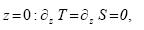
<body><![CDATA[<p align="justify"><font face="verdana" size="2"><img src="/img/revistas/atm/v17n2/a04e1.jpg">...............................(1)</font></p>     <p align="justify"><font face="verdana" size="2"><img src="/img/revistas/atm/v17n2/a04e2.jpg">..................................................................(2)</font></p>     <p align="justify"><font face="verdana" size="2"><img src="/img/revistas/atm/v17n2/a04e3.jpg">............................................................(3)</font></p>     <p align="justify"><font face="verdana" size="2">where <img src="/img/revistas/atm/v17n2/a04s3.jpg"> is stream function <img src="/img/revistas/atm/v17n2/a04s4.jpg">, Tis temperature, Sis salinity, <img src="/img/revistas/atm/v17n2/a04s5.jpg"> is the Prandtl number, <img src="/img/revistas/atm/v17n2/a04s6.jpg"> is the Lewis number or diffusivity ratio, <img src="/img/revistas/atm/v17n2/a04s7.jpg"> is the heightto-length aspect ratio or wave number, <img src="/img/revistas/atm/v17n2/a04s8.jpg"> is the Laplacian operator, <img src="/img/revistas/atm/v17n2/a04s9.jpg"> is kinematic viscosity, <img src="/img/revistas/atm/v17n2/a04s10.jpg"> and <img src="/img/revistas/atm/v17n2/a04s11.jpg"> are the coefficients of heat and salt diffusivities respectively.</font></p>     <p align="justify"><font face="verdana" size="2">Forcing in a rectangular ocean basin <img src="/img/revistas/atm/v17n2/a04s12.jpg"> is provided by the mixed boundary conditions for temperature and salinity, specifying the temperature and the salinity flux at the ocean surface. At the bottom and on the sides of the ocean both the temperature and salinity fluxes vanish, as follows:</font></p>     <p align="justify"><font face="verdana" size="2"><img src="/img/revistas/atm/v17n2/a04e4.jpg">.................................(4)</font></p>     <p align="justify"><font face="verdana" size="2"><img src="/img/revistas/atm/v17n2/a04e5.jpg">....................................................(5)</font></p>     <p align="justify"><font face="verdana" size="2"><img src="/img/revistas/atm/v17n2/a04e6.jpg">..................................................(6)</font></p>     <p align="justify"><font face="verdana" size="2">The non-homogeneous boundary conditions imposed at the surface for the temperature and salinity fields are supposed to be in equatorially symmetric form proposed by Thual and McWilliams (1992). Because mechanical forcing has been neglected, the boundary conditions for the stream function are homogeneous at all boundaries.</font></p>     <p align="justify"><font face="verdana" size="2">Thus, the problem contains five dimensionless parameters: <img src="/img/revistas/atm/v17n2/a04s13.jpg"> and <img src="/img/revistas/atm/v17n2/a04s14.jpg">. Here, <img src="/img/revistas/atm/v17n2/a04s15.jpg"> and <img src="/img/revistas/atm/v17n2/a04s16.jpg"> are parameters characterising the magnitudes of the temperature and salt flux forcing related as <img src="/img/revistas/atm/v17n2/a04s17.jpg">. In such a case the temperature and salinity contribution to the density field should be of the same order (<img src="/img/revistas/atm/v17n2/a04s18.jpg">, see below the Results section) in contrast to Cessi and Young (1992) suggesting that it should be when <img src="/img/revistas/atm/v17n2/a04s19.jpg">.</font></p>     ]]></body>
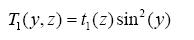
<body><![CDATA[<p align="justify"><font face="verdana" size="2">The solvability of the problem (l)-(6) was investigated by Cessi and Young (1992). It was noted that this problem could be examined analytically using the expansion method for all the variables and suggesting e as a small parameter.</font></p>     <p align="justify"><font face="verdana" size="2">Collecting terms of the same order, the following lowest order problem could be determined:</font></p>     <p align="justify"><font face="verdana" size="2"><img src="/img/revistas/atm/v17n2/a04e7.jpg">.................................................................................(7)</font></p>     <p align="justify"><font face="verdana" size="2"><img src="/img/revistas/atm/v17n2/a04e8.jpg">..................................................................................(8)</font></p>     <p align="justify"><font face="verdana" size="2"><img src="/img/revistas/atm/v17n2/a04e9.jpg">..................................................................(9)</font></p>     <p align="justify"><font face="verdana" size="2"><img src="/img/revistas/atm/v17n2/a04e10.jpg">...................................(10)</font></p>     <p align="justify"><font face="verdana" size="2"><img src="/img/revistas/atm/v17n2/a04e11.jpg">.............................................(11)</font></p>     <p align="justify"><font face="verdana" size="2"><img src="/img/revistas/atm/v17n2/a04e12.jpg">........................................(12)</font></p>     <p align="justify"><font face="verdana" size="2">The fixed-temperature boundary condition determines the zero-order temperature while the salinity <img src="/img/revistas/atm/v17n2/a04s20.jpg"> is undetermined at this order. The choice of <img src="/img/revistas/atm/v17n2/a04s21.jpg"> can be argued by saying that temperature diffusion is faster, and salinity evolution is started just in the third order problem. Then, the corresponding zero-order solution can be expressed analytically:</font></p>     <p align="justify"><font face="verdana" size="2"><img src="/img/revistas/atm/v17n2/a04e13.jpg">.....................................(13)</font></p>     ]]></body>
<body><![CDATA[<p align="justify"><font face="verdana" size="2">where</font></p>     <p align="justify"><font face="verdana" size="2"><img src="/img/revistas/atm/v17n2/a04e14.jpg">.........................................................(14)</font></p>     <p align="justify"><font face="verdana" size="2">The first order problem</font></p>     <p align="justify"><font face="verdana" size="2"><img src="/img/revistas/atm/v17n2/a04e15.jpg">...............................................(15)</font></p>     <p align="justify"><font face="verdana" size="2"><img src="/img/revistas/atm/v17n2/a04e16.jpg">.......................................................(16)</font></p>     <p align="justify"><font face="verdana" size="2"><img src="/img/revistas/atm/v17n2/a04e17.jpg">.................................................(17)</font></p>     <p align="justify"><font face="verdana" size="2">has the zero conditions at all the boundaries</font></p>     <p align="justify"><font face="verdana" size="2"><img src="/img/revistas/atm/v17n2/a04e18.jpg">.............................................(18)</font></p>     <p align="justify"><font face="verdana" size="2"><img src="/img/revistas/atm/v17n2/a04e19.jpg">...........................................(19)</font></p>     <p align="justify"><font face="verdana" size="2"><img src="/img/revistas/atm/v17n2/a04e20.jpg">......................................(20)</font></p>     ]]></body>
<body><![CDATA[<p align="justify"><font face="verdana" size="2">and its solution is searched as</font></p>     <p align="justify"><font face="verdana" size="2"><img src="/img/revistas/atm/v17n2/a04e21.jpg">........................................................(21)</font></p>     <p align="justify"><font face="verdana" size="2">where</font></p>     <p align="justify"><font face="verdana" size="2"><img src="/img/revistas/atm/v17n2/a04e22.jpg">...........................................(22)</font></p>     <p align="justify"><font face="verdana" size="2">The salinity field <img src="/img/revistas/atm/v17n2/a04s22.jpg"> is undetermined as well, and</font></p>     <p align="justify"><font face="verdana" size="2"><img src="/img/revistas/atm/v17n2/a04e23.jpg">..........................................................(23)</font></p>     <p align="justify"><font face="verdana" size="2">where</font></p>     <p align="justify"><font face="verdana" size="2"><img src="/img/revistas/atm/v17n2/a04e24.jpg">...........(24)</font></p>     <p align="justify"><font face="verdana" size="2">The second order problem</font></p>     <p align="justify"><font face="verdana" size="2"><img src="/img/revistas/atm/v17n2/a04e25.jpg">.....................................................(25)</font></p>     ]]></body>
<body><![CDATA[<p align="justify"><font face="verdana" size="2"><img src="/img/revistas/atm/v17n2/a04e26a.jpg">....................................(26)</font></p>     <p align="justify"><font face="verdana" size="2"><img src="/img/revistas/atm/v17n2/a04e26b.jpg"></font></p>     <p align="justify"><font face="verdana" size="2"><img src="/img/revistas/atm/v17n2/a04e27.jpg">.......................................................................................(27)</font></p>     <p align="justify"><font face="verdana" size="2">allows further analytical progress for the small amplitudes of external forcing parameters <img src="/img/revistas/atm/v17n2/a04s23.jpg"> by neglecting the non-linear advection terms in equations (25) and (27). This problem with the boundary conditions (where non-zero salt flux appears)</font></p>     <p align="justify"><font face="verdana" size="2"><img src="/img/revistas/atm/v17n2/a04e28.jpg">.................................................(28)</font></p>     <p align="justify"><font face="verdana" size="2"><img src="/img/revistas/atm/v17n2/a04e29.jpg">...................................................................(29)</font></p>     <p align="justify"><font face="verdana" size="2"><img src="/img/revistas/atm/v17n2/a04e30.jpg">..............................................................(30)</font></p>     <p align="justify"><font face="verdana" size="2">has the following diffusion dominated solution</font></p>     <p align="justify"><font face="verdana" size="2"><img src="/img/revistas/atm/v17n2/a04e31.jpg">..................................................................................(31)</font></p>     <p align="justify"><font face="verdana" size="2"><img src="/img/revistas/atm/v17n2/a04e32.jpg">....................................................................................(32)</font></p>     ]]></body>
<body><![CDATA[<p align="justify"><font face="verdana" size="2"><img src="/img/revistas/atm/v17n2/a04e33.jpg">......................................................................................(33)</font></p>     <p align="justify"><font face="verdana" size="2">where</font></p>     <p align="justify"><font face="verdana" size="2"><img src="/img/revistas/atm/v17n2/a04e34.jpg">.........................................................(34)</font></p>     <p align="justify"><font face="verdana" size="2">&nbsp;</font></p>     <p align="justify"><font face="verdana" size="2"><b>3. Results</b></font></p>     <p align="justify"><font face="verdana" size="2">Contours of the temperature <img src="/img/revistas/atm/v17n2/a04s24.jpg"> and salinity <img src="/img/revistas/atm/v17n2/a04s25.jpg"> are displayed in <a href="/img/revistas/atm/v17n2/a04f2.jpg" target="_blank">Figure 2</a> forthe equal external forcing parameters <img src="/img/revistas/atm/v17n2/a04s26.jpg">. Here we have chosen <img src="/img/revistas/atm/v17n2/a04s27.jpg"> to match the laboratory conditions. As the 1-order solution for temperature is negligible in comparison with the other two terms for the diffusion dominated regime, the shape functions for the temperature and salinity could be expressed as <img src="/img/revistas/atm/v17n2/a04s28.jpg"> and <img src="/img/revistas/atm/v17n2/a04s29.jpg"> respectively. Their vertical structures are visible in <a href="/img/revistas/atm/v17n2/a04f3.jpg" target="_blank">Figure 3</a> (curves 1 and 2). In this case, temperature effect evidently dominates over the salinity flux through all the depths.</font></p>     <p align="justify"><font face="verdana" size="2">When the solution for salt is changed by a factor of 6 <a href="/img/revistas/atm/v17n2/a04f3.jpg" target="_blank">(curve 3 in Fig. 3)</a>, i.e. <img src="/img/revistas/atm/v17n2/a04s30.jpg">, this produces a two-cell flow in the vertical direction with the salinity driven motion near the surface, and with the thermal cell of circulation near the bottom. The stream function <img src="/img/revistas/atm/v17n2/a04s31.jpg"> distribution as multiple-cell circulation is shown in <a href="/img/revistas/atm/v17n2/a04f4.jpg" target="_blank">Figure 4</a> when <img src="/img/revistas/atm/v17n2/a04s32.jpg"> and <img src="/img/revistas/atm/v17n2/a04s33.jpg">. The latter case (<img src="/img/revistas/atm/v17n2/a04s33.jpg">) corresponds to real sea water condition and reflects well an inclination of the zero-circulation line observed in the laboratory experiments under the surface forcing <a href="/img/revistas/atm/v17n2/a04f1.jpg" target="_blank">(Fig. la)</a>.</font></p>     <p align="justify"><font face="verdana" size="2">Solution of the problem for the bottom forcing could be obtained in a similar manner. It is evident that in such a case two-cell circulation is opposite to the flow patterns under the surface forcing. That is, the salinity driven circulation is achieved near the bottom, whereas the thermally driven motion prevails in the upper semiplane (for comparison see <a href="/img/revistas/atm/v17n2/a04f1.jpg" target="_blank">Fig. lb</a>).</font></p>     <p align="justify"><font face="verdana" size="2">The interval of the multiple cell circulation <img src="/img/revistas/atm/v17n2/a04s34.jpg">, for both solutions under the surface and bottom forcing, is close to that observed in the laboratory conditions (Bulgakov and Skiba, 2003). As is visible from <a href="/img/revistas/atm/v17n2/a04f5.jpg" target="_blank">Figure 5</a>, the lower <img src="/img/revistas/atm/v17n2/a04s35.jpg"> and higher <img src="/img/revistas/atm/v17n2/a04s36.jpg"> values of the salt flux amplitude produce one-cell thermal and saline circulation correspondingly.</font></p>     <p align="justify"><font face="verdana" size="2">It should be noted that the problem</font></p>     ]]></body>

<body><![CDATA[<p align="justify"><font face="verdana" size="2"><img src="/img/revistas/atm/v17n2/a04e35.jpg">..........................................................(35)</font></p>     <p align="justify"><font face="verdana" size="2"><img src="/img/revistas/atm/v17n2/a04e36.jpg">.................................(36)</font></p>     <p align="justify"><font face="verdana" size="2"><img src="/img/revistas/atm/v17n2/a04e37.jpg">......................................................(37)</font></p>     <p align="justify"><font face="verdana" size="2"><img src="/img/revistas/atm/v17n2/a04e38.jpg">...............................................(38)</font></p>     <p align="justify"><font face="verdana" size="2">has an analytical solution</font></p>     <p align="justify"><font face="verdana" size="2"><img src="/img/revistas/atm/v17n2/a04e39.jpg">..........................................................(39)</font></p>     <p align="justify"><font face="verdana" size="2"><img src="/img/revistas/atm/v17n2/a04e40.jpg">...........................(40)</font></p>     <p align="justify"><font face="verdana" size="2">Equation (35) differ from (2)-(3) mainly by the absence of Jacobian operators describing differences between the temperature- and salinity-driven circulation. In such a way diffusion of the temperature and salinity is achieved in a similar manner. Thus, the shape functions have the same form. Here the three-layer circulation does not exist, and transitions between T- and S-modes occur directly. This means that asymmetry between the temperature and salinity shape functions (or different ways of temperature and salinity intrusion) is crucial to form the multiple-cell THC.</font></p>     <p align="justify"><font face="verdana" size="2">&nbsp;</font></p>     <p align="justify"><font face="verdana" size="2"><b>4. Discussion and conclusions</b></font></p>     ]]></body>
<body><![CDATA[<p align="justify"><font face="verdana" size="2">Two steady states of THC were predicted by Stommel (1961) forthe pole-equator system near the state of equilibrium, which represent one-cell thermal driven and one-cell saline driven water motion.</font></p>     <p align="justify"><font face="verdana" size="2">Quon and Ghil (1995) have paid attention to the multiple-cell formation in their numerical experiments. When they applied non-monotonic (asymmetric about the centre of the pole-equator-pole system) boundary conditions for the temperature and salt flux, the four cells were prominent during the cycle of flow oscillations (see Fig. 8g from Quon and Ghil (1995)).</font></p>     <p align="justify"><font face="verdana" size="2">The laboratory experiments carried out recently (Whitehead <i>et al.</i> 2003; Bulgakov and Skiba, 2003) to duplicate the Stommel's theory have shown that both one- and two-cell THC could be achieved as the steady states. That is, a three-layer current structure was observed in the laboratory runs when the buoyancy ratio was close to a unity <img src="/img/revistas/atm/v17n2/a04s37.jpg">. To give an interpretation of the phenomena observed, we have applied 2-D theoretical model proposed by Cessi and Young (1992).</font></p>     <p align="justify"><font face="verdana" size="2">In this model, the external forcing for the pole-equator-pole system is provided by the mixed boundary conditions forthe temperature and salinity in equatorially symmetric form. The solution of the problem was analysed with the expansion method by using the aspect ratio (<img src="/img/revistas/atm/v17n2/a04s38.jpg">) as a small parameter. We assumed that for small amplitudes of the external forcing parameters, diffusion dominates at the lowest-order balance, and the temperature diffusion is faster than the salinity one <img src="/img/revistas/atm/v17n2/a04s39.jpg">. In this case, the problems arising at the three first lower orders could be examined analytically.</font></p>     <p align="justify"><font face="verdana" size="2">The results have shown that these assumptions eliminate the one-to-one correspondence between the temperature and salinity vertical distributions, destroying their symmetry and forming the multiple-cell THC. On the contrary, when temperature and salinity profiles are identical, it is evident that hybrid 3-layer circulation does not exist.</font></p>     <p align="justify"><font face="verdana" size="2">It is well known that the salinity and temperature fields in the ocean are not uniform in the vertical, even to a rough approximation. The different dynamics of the heat and salt transport was documented in the laboratory experiments (Whitehead <i>et al.</i>, 2003; Bulgakov and Skiba, 2003) as well. The temperature-salinity symmetry was probably destroyed by the non-monotonic boundary conditions in the numerical experiments by Quon and Ghil (1995) where multiple-cell THC appeared. Therefore, we argue that asymmetry in the vertical distributions of the temperature and salinity is a necessary condition for the multiple-cell phenomena to occur.</font></p>     <p align="justify"><font face="verdana" size="2">&nbsp;</font></p>     <p align="justify"><font face="verdana" size="2"><b>Acknowledgments</b></font></p>     <p align="justify"><font face="verdana" size="2">The study was funded by CONACyT (Mexico) for project 32499-T and by SNI (Mexican System of Investigators) grants 19198 and 14539.</font></p>     <p align="justify"><font face="verdana" size="2">&nbsp;</font></p>     ]]></body>
<body><![CDATA[<p align="justify"><font face="verdana" size="2"><b>References</b></font></p>     <!-- ref --><p align="justify"><font face="verdana" size="2">Bryan, F, 1986. High-latitude salinity effects and interhemispheric thermohaline circulations. <i>Nature</i> <b>323</b>,301-304.</font>&nbsp;&nbsp;&nbsp;&nbsp;&nbsp;&nbsp;&nbsp;&nbsp;[&#160;<a href="javascript:void(0);" onclick="javascript: window.open('/scielo.php?script=sci_nlinks&ref=1255908&pid=S0187-6236200400020000400001&lng=','','width=640,height=500,resizable=yes,scrollbars=1,menubar=yes,');">Links</a>&#160;]<!-- end-ref --><!-- ref --><p align="justify"><font face="verdana" size="2">Bulgakov, S.N. and Yu.N. Skiba, 2003. Are transitions abrupt in Stommel's thermohaline box model? <i>Atm&oacute;sfera</i> <b>16</b>(4), 205-229.</font>&nbsp;&nbsp;&nbsp;&nbsp;&nbsp;&nbsp;&nbsp;&nbsp;[&#160;<a href="javascript:void(0);" onclick="javascript: window.open('/scielo.php?script=sci_nlinks&ref=1255909&pid=S0187-6236200400020000400002&lng=','','width=640,height=500,resizable=yes,scrollbars=1,menubar=yes,');">Links</a>&#160;]<!-- end-ref --><!-- ref --><p align="justify"><font face="verdana" size="2">Cessi, P. and W.R. Young, 1992. Multiple equilibria in two-dimensional thermohaline circulation. <i>Journal of Fluid Mechanics</i> <b>241</b>, 291-309.</font>&nbsp;&nbsp;&nbsp;&nbsp;&nbsp;&nbsp;&nbsp;&nbsp;[&#160;<a href="javascript:void(0);" onclick="javascript: window.open('/scielo.php?script=sci_nlinks&ref=1255910&pid=S0187-6236200400020000400003&lng=','','width=640,height=500,resizable=yes,scrollbars=1,menubar=yes,');">Links</a>&#160;]<!-- end-ref --><!-- ref --><p align="justify"><font face="verdana" size="2">Dijkstra, H.A., 2001. Nonlinear physical oceanography: A dynamical systems approach to the large scale ocean circulation and El Ni&ntilde;o. <i>Atmospheric and Oceanographic Sciences Library</i> <b>22</b>, Kluwer, 480 pp.</font>&nbsp;&nbsp;&nbsp;&nbsp;&nbsp;&nbsp;&nbsp;&nbsp;[&#160;<a href="javascript:void(0);" onclick="javascript: window.open('/scielo.php?script=sci_nlinks&ref=1255911&pid=S0187-6236200400020000400004&lng=','','width=640,height=500,resizable=yes,scrollbars=1,menubar=yes,');">Links</a>&#160;]<!-- end-ref --><!-- ref --><p align="justify"><font face="verdana" size="2">Manabe, S. and R.J. Stouffer, 1988. Two stable equilibria of a coupled ocean-atmosphere model. <i>Climate Dynamics</i> <b>1</b>, 841-866.</font>&nbsp;&nbsp;&nbsp;&nbsp;&nbsp;&nbsp;&nbsp;&nbsp;[&#160;<a href="javascript:void(0);" onclick="javascript: window.open('/scielo.php?script=sci_nlinks&ref=1255912&pid=S0187-6236200400020000400005&lng=','','width=640,height=500,resizable=yes,scrollbars=1,menubar=yes,');">Links</a>&#160;]<!-- end-ref --><!-- ref --><p align="justify"><font face="verdana" size="2">Marotzke J., P. Welander and J. Willebrandt, 1988. Instability and multiple steady states in a meridional-plan model of the thermohaline circulation. <i>Tellus</i> <b>40A</b>, 162-172.</font>&nbsp;&nbsp;&nbsp;&nbsp;&nbsp;&nbsp;&nbsp;&nbsp;[&#160;<a href="javascript:void(0);" onclick="javascript: window.open('/scielo.php?script=sci_nlinks&ref=1255913&pid=S0187-6236200400020000400006&lng=','','width=640,height=500,resizable=yes,scrollbars=1,menubar=yes,');">Links</a>&#160;]<!-- end-ref --><!-- ref --><p align="justify"><font face="verdana" size="2">Marotzke, J., 1993. Ocean models in climate problems. In: <i>Ocean Processes in Climate Dynamics: Global and Mediterranean examples</i> Malanotte-Rizzoli P. and A.R. Robinson (eds.), Kluwer Academic Publ., pp. 79-109.</font>&nbsp;&nbsp;&nbsp;&nbsp;&nbsp;&nbsp;&nbsp;&nbsp;[&#160;<a href="javascript:void(0);" onclick="javascript: window.open('/scielo.php?script=sci_nlinks&ref=1255914&pid=S0187-6236200400020000400007&lng=','','width=640,height=500,resizable=yes,scrollbars=1,menubar=yes,');">Links</a>&#160;]<!-- end-ref --><!-- ref --><p align="justify"><font face="verdana" size="2">Quon, C. and M. Ghil, 1992. Multiple equilibria in thermosolutal convection due to salt-flux boundary conditions. <i>Journal of Fluid Mechanics</i> <b>245</b>, 449-484.</font>&nbsp;&nbsp;&nbsp;&nbsp;&nbsp;&nbsp;&nbsp;&nbsp;[&#160;<a href="javascript:void(0);" onclick="javascript: window.open('/scielo.php?script=sci_nlinks&ref=1255915&pid=S0187-6236200400020000400008&lng=','','width=640,height=500,resizable=yes,scrollbars=1,menubar=yes,');">Links</a>&#160;]<!-- end-ref --><!-- ref --><p align="justify"><font face="verdana" size="2">Quon, C. and M. Ghil, 1995. Multiple equilibria and stable oscillations in thermosolutal convection at small aspect ratio. <i>Journal of Fluid Mechanics</i> <b>291</b>, 33-56.</font>&nbsp;&nbsp;&nbsp;&nbsp;&nbsp;&nbsp;&nbsp;&nbsp;[&#160;<a href="javascript:void(0);" onclick="javascript: window.open('/scielo.php?script=sci_nlinks&ref=1255916&pid=S0187-6236200400020000400009&lng=','','width=640,height=500,resizable=yes,scrollbars=1,menubar=yes,');">Links</a>&#160;]<!-- end-ref --><!-- ref --><p align="justify"><font face="verdana" size="2">Rooth, C, 1982. Hydrology and ocean circulation. <i>Progress in Oceanography</i> <b>11</b>, 131-149.</font>&nbsp;&nbsp;&nbsp;&nbsp;&nbsp;&nbsp;&nbsp;&nbsp;[&#160;<a href="javascript:void(0);" onclick="javascript: window.open('/scielo.php?script=sci_nlinks&ref=1255917&pid=S0187-6236200400020000400010&lng=','','width=640,height=500,resizable=yes,scrollbars=1,menubar=yes,');">Links</a>&#160;]<!-- end-ref --><!-- ref --><p align="justify"><font face="verdana" size="2">Stommel, H., 1961. Thermohaline convection with two stable regimes of flow. <i>Tellus</i> <b>13</b>(2), 224-230.</font>&nbsp;&nbsp;&nbsp;&nbsp;&nbsp;&nbsp;&nbsp;&nbsp;[&#160;<a href="javascript:void(0);" onclick="javascript: window.open('/scielo.php?script=sci_nlinks&ref=1255918&pid=S0187-6236200400020000400011&lng=','','width=640,height=500,resizable=yes,scrollbars=1,menubar=yes,');">Links</a>&#160;]<!-- end-ref --><!-- ref --><p align="justify"><font face="verdana" size="2">Thual, O. and J.C. McWilliams, 1992. The catastrophe structure of thermohaline convection in a two-dimensional fluid model and a comparison with low-order box models. <i>Geophysical and Astrophysical Fluid Dynamics</i> <b>64</b>, 67-95.</font>&nbsp;&nbsp;&nbsp;&nbsp;&nbsp;&nbsp;&nbsp;&nbsp;[&#160;<a href="javascript:void(0);" onclick="javascript: window.open('/scielo.php?script=sci_nlinks&ref=1255919&pid=S0187-6236200400020000400012&lng=','','width=640,height=500,resizable=yes,scrollbars=1,menubar=yes,');">Links</a>&#160;]<!-- end-ref --><!-- ref --><p align="justify"><font face="verdana" size="2">Welander, P., 1986. Thermohaline effects in the ocean circulation and related simple models. In: <i>Large scale transport processes in Oceans and Atmosphere</i>. Willebrand J. and D.L.T. Anderson (eds.), Reidel, pp. 163-200.</font>&nbsp;&nbsp;&nbsp;&nbsp;&nbsp;&nbsp;&nbsp;&nbsp;[&#160;<a href="javascript:void(0);" onclick="javascript: window.open('/scielo.php?script=sci_nlinks&ref=1255920&pid=S0187-6236200400020000400013&lng=','','width=640,height=500,resizable=yes,scrollbars=1,menubar=yes,');">Links</a>&#160;]<!-- end-ref --><!-- ref --><p align="justify"><font face="verdana" size="2">Whitehead, J. A., 1995. Thermohaline ocean processes and models. <i>Annual Reviews in Fluid Mechanics</i> <b>27</b>,89-113.</font>&nbsp;&nbsp;&nbsp;&nbsp;&nbsp;&nbsp;&nbsp;&nbsp;[&#160;<a href="javascript:void(0);" onclick="javascript: window.open('/scielo.php?script=sci_nlinks&ref=1255921&pid=S0187-6236200400020000400014&lng=','','width=640,height=500,resizable=yes,scrollbars=1,menubar=yes,');">Links</a>&#160;]<!-- end-ref --><!-- ref --><p align="justify"><font face="verdana" size="2">Whitehead, J. A., M.L. Timmermans, W.G. Lawson, S.N. Bulgakov, A.Z. Martinez, J.M. Almaguer, and J. Salzig, 2003. Laboratory studies of a thermally and/or salinity driven flows with partial mixing. Part 1. Stommel transitions and multiple flow states. <i>Journal of Geophysical Research</i>  - <i>Oceans</i> <b>108</b>(C2), 3036, doi:10.1029/2001JC000902.</font>&nbsp;&nbsp;&nbsp;&nbsp;&nbsp;&nbsp;&nbsp;&nbsp;[&#160;<a href="javascript:void(0);" onclick="javascript: window.open('/scielo.php?script=sci_nlinks&ref=1255922&pid=S0187-6236200400020000400015&lng=','','width=640,height=500,resizable=yes,scrollbars=1,menubar=yes,');">Links</a>&#160;]<!-- end-ref --> ]]></body><back>
<ref-list>
<ref id="B1">
<nlm-citation citation-type="journal">
<person-group person-group-type="author">
<name>
<surname><![CDATA[Bryan]]></surname>
<given-names><![CDATA[F]]></given-names>
</name>
</person-group>
<article-title xml:lang="en"><![CDATA[High-latitude salinity effects and interhemispheric thermohaline circulations]]></article-title>
<source><![CDATA[Nature]]></source>
<year>1986</year>
<numero>323</numero>
<issue>323</issue>
<page-range>301-304</page-range></nlm-citation>
</ref>
<ref id="B2">
<nlm-citation citation-type="journal">
<person-group person-group-type="author">
<name>
<surname><![CDATA[Bulgakov]]></surname>
<given-names><![CDATA[S.N.]]></given-names>
</name>
<name>
<surname><![CDATA[Skiba]]></surname>
<given-names><![CDATA[Yu.N.]]></given-names>
</name>
</person-group>
<article-title xml:lang="en"><![CDATA[Are transitions abrupt in Stommel's thermohaline box model?]]></article-title>
<source><![CDATA[Atmósfera]]></source>
<year>2003</year>
<volume>16</volume>
<numero>4</numero>
<issue>4</issue>
<page-range>205-229</page-range></nlm-citation>
</ref>
<ref id="B3">
<nlm-citation citation-type="journal">
<person-group person-group-type="author">
<name>
<surname><![CDATA[Cessi]]></surname>
<given-names><![CDATA[P]]></given-names>
</name>
<name>
<surname><![CDATA[Young]]></surname>
<given-names><![CDATA[W.R.]]></given-names>
</name>
</person-group>
<article-title xml:lang="en"><![CDATA[Multiple equilibria in two-dimensional thermohaline circulation]]></article-title>
<source><![CDATA[Journal of Fluid Mechanics]]></source>
<year>1992</year>
<numero>241</numero>
<issue>241</issue>
<page-range>291-309</page-range></nlm-citation>
</ref>
<ref id="B4">
<nlm-citation citation-type="journal">
<person-group person-group-type="author">
<name>
<surname><![CDATA[Dijkstra]]></surname>
<given-names><![CDATA[H.A.]]></given-names>
</name>
</person-group>
<article-title xml:lang="en"><![CDATA[Nonlinear physical oceanography: A dynamical systems approach to the large scale ocean circulation and El Niño]]></article-title>
<source><![CDATA[Atmospheric and Oceanographic Sciences Library]]></source>
<year>2001</year>
<numero>22</numero>
<issue>22</issue>
<page-range>480</page-range><publisher-name><![CDATA[Kluwer]]></publisher-name>
</nlm-citation>
</ref>
<ref id="B5">
<nlm-citation citation-type="journal">
<person-group person-group-type="author">
<name>
<surname><![CDATA[Manabe]]></surname>
<given-names><![CDATA[S.]]></given-names>
</name>
<name>
<surname><![CDATA[Stouffer]]></surname>
<given-names><![CDATA[R.J.]]></given-names>
</name>
</person-group>
<article-title xml:lang="en"><![CDATA[Two stable equilibria of a coupled ocean-atmosphere model]]></article-title>
<source><![CDATA[Climate Dynamics]]></source>
<year>1988</year>
<numero>1</numero>
<issue>1</issue>
<page-range>841-866</page-range></nlm-citation>
</ref>
<ref id="B6">
<nlm-citation citation-type="journal">
<person-group person-group-type="author">
<name>
<surname><![CDATA[Marotzke]]></surname>
<given-names><![CDATA[J.]]></given-names>
</name>
<name>
<surname><![CDATA[Welander]]></surname>
<given-names><![CDATA[P.]]></given-names>
</name>
<name>
<surname><![CDATA[Willebrandt]]></surname>
<given-names><![CDATA[J.]]></given-names>
</name>
</person-group>
<article-title xml:lang="en"><![CDATA[Instability and multiple steady states in a meridional-plan model of the thermohaline circulation]]></article-title>
<source><![CDATA[Tellus]]></source>
<year>1988</year>
<numero>40A</numero>
<issue>40A</issue>
<page-range>162-</page-range></nlm-citation>
</ref>
<ref id="B7">
<nlm-citation citation-type="book">
<person-group person-group-type="author">
<name>
<surname><![CDATA[Marotzke]]></surname>
<given-names><![CDATA[J.]]></given-names>
</name>
</person-group>
<article-title xml:lang="en"><![CDATA[Ocean models in climate problems]]></article-title>
<person-group person-group-type="editor">
<name>
<surname><![CDATA[Malanotte-Rizzoli]]></surname>
<given-names><![CDATA[P.]]></given-names>
</name>
<name>
<surname><![CDATA[Robinson]]></surname>
<given-names><![CDATA[A.R.]]></given-names>
</name>
</person-group>
<source><![CDATA[Ocean Processes in Climate Dynamics: Global and Mediterranean examples]]></source>
<year>1993</year>
<page-range>79-109</page-range><publisher-name><![CDATA[Kluwer Academic Publ.]]></publisher-name>
</nlm-citation>
</ref>
<ref id="B8">
<nlm-citation citation-type="journal">
<person-group person-group-type="author">
<name>
<surname><![CDATA[Quon]]></surname>
<given-names><![CDATA[C.]]></given-names>
</name>
<name>
<surname><![CDATA[Ghil]]></surname>
<given-names><![CDATA[M.]]></given-names>
</name>
</person-group>
<article-title xml:lang="en"><![CDATA[Multiple equilibria in thermosolutal convection due to salt-flux boundary conditions]]></article-title>
<source><![CDATA[Journal of Fluid Mechanics]]></source>
<year>1992</year>
<numero>245</numero>
<issue>245</issue>
<page-range>449-484</page-range></nlm-citation>
</ref>
<ref id="B9">
<nlm-citation citation-type="journal">
<person-group person-group-type="author">
<name>
<surname><![CDATA[Quon]]></surname>
<given-names><![CDATA[C.]]></given-names>
</name>
<name>
<surname><![CDATA[Ghil]]></surname>
<given-names><![CDATA[M.]]></given-names>
</name>
</person-group>
<article-title xml:lang="en"><![CDATA[Multiple equilibria and stable oscillations in thermosolutal convection at small aspect ratio]]></article-title>
<source><![CDATA[Journal of Fluid Mechanics]]></source>
<year>1995</year>
<numero>291</numero>
<issue>291</issue>
<page-range>33-56</page-range></nlm-citation>
</ref>
<ref id="B10">
<nlm-citation citation-type="journal">
<person-group person-group-type="author">
<name>
<surname><![CDATA[Rooth]]></surname>
<given-names><![CDATA[C]]></given-names>
</name>
</person-group>
<article-title xml:lang="en"><![CDATA[Hydrology and ocean circulation]]></article-title>
<source><![CDATA[Progress in Oceanography]]></source>
<year>1982</year>
<numero>11</numero>
<issue>11</issue>
<page-range>131-149</page-range></nlm-citation>
</ref>
<ref id="B11">
<nlm-citation citation-type="journal">
<person-group person-group-type="author">
<name>
<surname><![CDATA[Stommel]]></surname>
<given-names><![CDATA[H.]]></given-names>
</name>
</person-group>
<article-title xml:lang="en"><![CDATA[Thermohaline convection with two stable regimes of flow]]></article-title>
<source><![CDATA[Tellus]]></source>
<year>1961</year>
<volume>13</volume>
<numero>2</numero>
<issue>2</issue>
<page-range>224-230</page-range></nlm-citation>
</ref>
<ref id="B12">
<nlm-citation citation-type="journal">
<person-group person-group-type="author">
<name>
<surname><![CDATA[Thual]]></surname>
<given-names><![CDATA[O.]]></given-names>
</name>
<name>
<surname><![CDATA[McWilliams]]></surname>
<given-names><![CDATA[J.C.]]></given-names>
</name>
</person-group>
<article-title xml:lang="en"><![CDATA[The catastrophe structure of thermohaline convection in a two-dimensional fluid model and a comparison with low-order box models]]></article-title>
<source><![CDATA[Geophysical and Astrophysical Fluid Dynamics]]></source>
<year>1992</year>
<numero>64</numero>
<issue>64</issue>
<page-range>67-95</page-range></nlm-citation>
</ref>
<ref id="B13">
<nlm-citation citation-type="book">
<person-group person-group-type="author">
<name>
<surname><![CDATA[Welander]]></surname>
<given-names><![CDATA[P.]]></given-names>
</name>
</person-group>
<article-title xml:lang="en"><![CDATA[Thermohaline effects in the ocean circulation and related simple models]]></article-title>
<person-group person-group-type="editor">
<name>
<surname><![CDATA[Willebrand]]></surname>
<given-names><![CDATA[J.]]></given-names>
</name>
<name>
<surname><![CDATA[Anderson]]></surname>
<given-names><![CDATA[D.L.T.]]></given-names>
</name>
</person-group>
<source><![CDATA[Large scale transport processes in Oceans and Atmosphere]]></source>
<year>1986</year>
<page-range>163-200</page-range><publisher-name><![CDATA[Reidel]]></publisher-name>
</nlm-citation>
</ref>
<ref id="B14">
<nlm-citation citation-type="journal">
<person-group person-group-type="author">
<name>
<surname><![CDATA[Whitehead]]></surname>
<given-names><![CDATA[J. A.]]></given-names>
</name>
</person-group>
<article-title xml:lang="en"><![CDATA[Thermohaline ocean processes and models]]></article-title>
<source><![CDATA[Annual Reviews in Fluid Mechanics]]></source>
<year>1995</year>
<numero>27</numero>
<issue>27</issue>
<page-range>89-113</page-range></nlm-citation>
</ref>
<ref id="B15">
<nlm-citation citation-type="journal">
<person-group person-group-type="author">
<name>
<surname><![CDATA[Whitehead]]></surname>
<given-names><![CDATA[J. A.]]></given-names>
</name>
<name>
<surname><![CDATA[Timmermans]]></surname>
<given-names><![CDATA[M.L.]]></given-names>
</name>
<name>
<surname><![CDATA[Lawson]]></surname>
<given-names><![CDATA[W.G.]]></given-names>
</name>
<name>
<surname><![CDATA[Bulgakov]]></surname>
<given-names><![CDATA[S.N.]]></given-names>
</name>
<name>
<surname><![CDATA[Martinez]]></surname>
<given-names><![CDATA[A.Z.]]></given-names>
</name>
<name>
<surname><![CDATA[Almaguer]]></surname>
<given-names><![CDATA[J.M.]]></given-names>
</name>
<name>
<surname><![CDATA[Salzig]]></surname>
<given-names><![CDATA[J.]]></given-names>
</name>
</person-group>
<article-title xml:lang="en"><![CDATA[Laboratory studies of a thermally and/or salinity driven flows with partial mixing: Part 1. Stommel transitions and multiple flow states]]></article-title>
<source><![CDATA[Journal of Geophysical Research - Oceans]]></source>
<year>2003</year>
<volume>108</volume>
<numero>C2</numero>
<issue>C2</issue>
</nlm-citation>
</ref>
</ref-list>
</back>
</article>