<?xml version="1.0" encoding="ISO-8859-1"?><article xmlns:mml="http://www.w3.org/1998/Math/MathML" xmlns:xlink="http://www.w3.org/1999/xlink" xmlns:xsi="http://www.w3.org/2001/XMLSchema-instance">
<front>
<journal-meta>
<journal-id>0187-6236</journal-id>
<journal-title><![CDATA[Atmósfera]]></journal-title>
<abbrev-journal-title><![CDATA[Atmósfera]]></abbrev-journal-title>
<issn>0187-6236</issn>
<publisher>
<publisher-name><![CDATA[Universidad Nacional Autónoma de México, Instituto de Ciencias de la Atmósfera y Cambio Climático]]></publisher-name>
</publisher>
</journal-meta>
<article-meta>
<article-id>S0187-62362003000300002</article-id>
<title-group>
<article-title xml:lang="en"><![CDATA[Interannual variability of relative angular momentum in the Northern Hemisphere and its relationship with the North Atlantic oscillation and the Arctic oscillation]]></article-title>
</title-group>
<contrib-group>
<contrib contrib-type="author">
<name>
<surname><![CDATA[de la Torre]]></surname>
<given-names><![CDATA[Laura]]></given-names>
</name>
<xref ref-type="aff" rid="A01"/>
</contrib>
<contrib contrib-type="author">
<name>
<surname><![CDATA[Gimeno]]></surname>
<given-names><![CDATA[Luis]]></given-names>
</name>
<xref ref-type="aff" rid="A01"/>
</contrib>
<contrib contrib-type="author">
<name>
<surname><![CDATA[Ribera]]></surname>
<given-names><![CDATA[Pedro]]></given-names>
</name>
<xref ref-type="aff" rid="A01"/>
</contrib>
<contrib contrib-type="author">
<name>
<surname><![CDATA[Gallego]]></surname>
<given-names><![CDATA[David]]></given-names>
</name>
<xref ref-type="aff" rid="A02"/>
</contrib>
<contrib contrib-type="author">
<name>
<surname><![CDATA[García]]></surname>
<given-names><![CDATA[Ricardo]]></given-names>
</name>
<xref ref-type="aff" rid="A02"/>
</contrib>
<contrib contrib-type="author">
<name>
<surname><![CDATA[Hernández]]></surname>
<given-names><![CDATA[Emiliano]]></given-names>
</name>
<xref ref-type="aff" rid="A02"/>
</contrib>
</contrib-group>
<aff id="A01">
<institution><![CDATA[,Universidad de Vigo Departamento de Física Aplicada ]]></institution>
<addr-line><![CDATA[Ourense Pontevedra]]></addr-line>
<country>España</country>
</aff>
<aff id="A02">
<institution><![CDATA[,Universidad Complutense de Madrid Departamento de Física de la Atmósfera ]]></institution>
<addr-line><![CDATA[Madrid ]]></addr-line>
<country>España</country>
</aff>
<pub-date pub-type="pub">
<day>00</day>
<month>00</month>
<year>2003</year>
</pub-date>
<pub-date pub-type="epub">
<day>00</day>
<month>00</month>
<year>2003</year>
</pub-date>
<volume>16</volume>
<numero>3</numero>
<fpage>149</fpage>
<lpage>156</lpage>
<copyright-statement/>
<copyright-year/>
<self-uri xlink:href="http://www.scielo.org.mx/scielo.php?script=sci_arttext&amp;pid=S0187-62362003000300002&amp;lng=en&amp;nrm=iso"></self-uri><self-uri xlink:href="http://www.scielo.org.mx/scielo.php?script=sci_abstract&amp;pid=S0187-62362003000300002&amp;lng=en&amp;nrm=iso"></self-uri><self-uri xlink:href="http://www.scielo.org.mx/scielo.php?script=sci_pdf&amp;pid=S0187-62362003000300002&amp;lng=en&amp;nrm=iso"></self-uri><abstract abstract-type="short" xml:lang="es"><p><![CDATA[Se calculó el momento angular relativo (MAR) desde 500 hPa hasta 200 hPa y de la latitud 55° N a 90° N para el periodo 1958-1998. En este estudio se utilizaron datos del re-análisis NCAR-NCEP, y su principal objetivo fue encontrar una medida anual para compararla con la oscilación ártica (OA) y con la oscilación del Pacífico del Norte (OPN). Las correlaciones entre el MAR y la OA fueron mayores que las observadas entre el MAR y la OPN, y los análisis espectrales mostraron una banda común significativa de oscilación cercana a los ocho años.]]></p></abstract>
<abstract abstract-type="short" xml:lang="en"><p><![CDATA[The relative angular momentum (RAM) from 500 hPa to 200 hPa and from 55° N to 90 °N was computed for the 1958-1998 period. NCAR-NCEP reanalysis data were used in this study, whose main purpose was to find an annual measurement to compare with the Arctic Oscillation (AO) and the North Atlantic Oscillation (NAO). Annual values of RAM exhibited a clear positive trend consistent with positive trends found in AO and NAO. The correlations between RAM and AO were higher than those between RAM and NAO and the spectral analysis showed a common significant band of oscillation ca. to eight years.]]></p></abstract>
<kwd-group>
<kwd lng="en"><![CDATA[Variability]]></kwd>
<kwd lng="en"><![CDATA[angular momentum]]></kwd>
<kwd lng="en"><![CDATA[North Atlantic and Artic oscillations]]></kwd>
</kwd-group>
</article-meta>
</front><body><![CDATA[ <p align="center"><font face="verdana" size="4"><b>Interannual variability of relative angular momentum in the Northern Hemisphere and its relationship with the North Atlantic oscillation and the Arctic oscillation</b></font></p>              <p align="justify"><font face="verdana" size="2">&nbsp;</font></p>             <p align="center"><font face="verdana" size="2"><b>Laura de la Torre, Luis Gimeno, Pedro Ribera </b></font></p>         <p align="center"><font face="verdana" size="2"><i>Departamento de F&iacute;sica Aplicada, Universidad de Vigo, Ourense, Espa&ntilde;a. </i>Corresponding author: Luis Gimeno; e&#45;mail: <a href="mailto:l.gimeno@uvigo.es">l.gimeno@uvigo.es</a>.</font></p>         <p align="center">&nbsp;</p>         <p align="center"><font face="verdana" size="2"><b>David Gallego, Ricardo Garc&iacute;aand Emiliano Hern&aacute;ndez</b></font></p>         <p align="center"><font face="verdana" size="2">&nbsp;</font><font face="verdana" size="2"><i>Departamento de F&iacute;sica de la Atm&oacute;sfera, Universidad Complutense, Madrid, Espa&ntilde;a.</i></font></p>     <p align="justify"><font face="verdana" size="2">&nbsp;</font></p>             <p align="center"><font face="verdana" size="2">Received February 27, 2002; accepted April 30, 2003.</font></p>         <p align="justify"><font face="verdana" size="2">&nbsp;</font></p>             ]]></body>
<body><![CDATA[<p align="justify"><font face="verdana" size="2"><b>RESUMEN</b></font></p>             <p align="justify"><font face="verdana" size="2">Se calcul&oacute; el momento angular relativo (MAR) desde 500 hPa hasta 200 hPa y de la latitud 55&deg; N a 90&deg; N para el periodo 1958&#45;1998. En este estudio se utilizaron datos del re&#45;an&aacute;lisis NCAR&#45;NCEP, y su principal objetivo fue encontrar una medida anual para compararla con la oscilaci&oacute;n &aacute;rtica (OA) y con la oscilaci&oacute;n del Pac&iacute;fico del Norte (OPN). Las correlaciones entre el MAR y la OA fueron mayores que las observadas entre el MAR y la OPN, y los an&aacute;lisis espectrales mostraron una banda com&uacute;n significativa de oscilaci&oacute;n cercana a los ocho a&ntilde;os.</font></p>              <p align="justify"><font face="verdana" size="2">&nbsp;</font></p>              <p align="justify"><font face="verdana" size="2"><b>ABSTRACT</b></font></p>              <p align="justify"><font face="verdana" size="2">The relative angular momentum (RAM) from 500 hPa to 200 hPa and from 55&deg; N to 90 &deg;N was computed for the 1958&#45;1998 period. NCAR&#45;NCEP reanalysis data were used in this study, whose main purpose was to find an annual measurement to compare with the Arctic Oscillation (AO) and the North Atlantic Oscillation (NAO). Annual values of RAM exhibited a clear positive trend consistent with positive trends found in AO and NAO. The correlations between RAM and AO were higher than those between RAM and NAO and the spectral analysis showed a common significant band of oscillation ca. to eight years.</font></p>              <p align="justify"><font face="verdana" size="2"><b>Key words:</b> Variability, angular momentum, North Atlantic and Artic oscillations.</font></p>              <p align="justify"><font face="verdana" size="2">&nbsp;</font></p>              <p align="justify"><font face="verdana" size="2"><b>1. Introduction</b></font></p>              <p align="justify"><font face="verdana" size="2">When analyzing the sea level pressure (SLP) field at a global scale through the Empirical Orthogonal Function technique (EOF) (von Storch, 1984) Thompson and Wallace (1998) called the leading function the Arctic Oscillation (AO). The AO is a seesaw of atmospheric pressure between the area over the Pole and a latitudinal ring passing over Southern Alaska and Central Europe, and a subtropical area center passing over the Azores. The North Atlantic Oscillation (NAO) is also defined as a seesaw of pressure, but restricted to the North Atlantic Region. It was first identified by sir Gilbert Walker (Walker, 1924; Walker and Bliss, 1932) and was regarded as the most important mode of variability over the North Atlantic region until the introduction of AO.</font></p>              <p align="justify"><font face="verdana" size="2">AO resembles the NAO, but with a zone&#45;wise symmetric distribution and having the center of action over the polar cap and not on the Atlantic region. The similarities are so evident that many scientists agree with Wallace (2000), who considers both as the same phenomenon. However it is not yet clear which of the two paradigms (annular mode &#45;AO&#45; or regional mode &#45;NAO&#45;) defines the phenomenon better (Kerr, 1999). According to Thompson and Wallace (2000) and Thompson <i>et al.</i> (2000) NAO is a regional expression of the Northern Hemisphere annular mode. However there are different evidences that question the annular paradigm: the lack of an apparent link between Atlantic and Pacific sectors (Deser, 2000), the lack of symmetry in the geopotential patterns using SVD (Singular Value Decomposition) analysis (Perlwitz and Graf, 2001) and the fact that AO does not reflect the correlations between pressure variability at its centers of action (Ambaum <i>et al.,</i> 2001).</font></p>              ]]></body>
<body><![CDATA[<p align="justify"><font face="verdana" size="2">A very interesting finding is the fact that there has been a significant positive trend in the AO/ NAO since the 60's, whose magnitude has no precedent in the observational and even the paleoclimate records. This change is associated with cooling over the Northwestern Atlantic and warming over the Eurasian landmass. It accounts for much of the warming trend observed in this region, whereas when the whole hemisphere is considered, AO/NAO accounts for 30% of the temperature trend (Hurrell, 1996; Thompson <i>et al.,</i> 2000). Several causes have been suggested for the observed change in the AO/NAO, such as the increasing of greenhouse gas concentrations (Fyfe <i>et al.,</i> 1999) and stratospheric ozone depletion (Volodin and Galin, 1999), while unforced variability remains a possibility (Wunsch, 1999). It seems that the latter is responsible of other regional changes such as stronger westerlies in the whole troposphere (Thompson and Wallace, 2000), changes in precipitation patterns into the Eurasian continent (Hurrell, 1995), changes in the storm tracks and intensity over the Atlantic (Hurrell, 1995a) or changes in the blocking frequency (Nakamura, 1996).</font></p>              <p align="justify"><font face="verdana" size="2">One of the common effects of NAO and AO is their influence on zonal wind anomalies. When AO is in positive phase (pressure drops over the polar cap and rises over the latitudes of the Azores) or NAO is in positive phase (pressure drops over Iceland and rises over the Azores) westerly winds northwards of 45&deg; N become stronger. The maximum anomaly is centered near 55&#45;57&deg; N in the lower troposphere and near 65&deg; N in the upper troposphere. A measurement of this anomaly of the westerlies at a planetary scale is the anomaly of the relative atmospheric angular momentum (RAM) from 500 hPa to 200 hPa and from 55&deg; N to 90&deg; N (RAM 500&#45;200, 55&#45;90). RAM is due to zonal winds and varies seasonally by as much as 100%, essentially doubling between the Northern Hemisphere summer and winter due to the strong annual cycle of the jet stream in that hemisphere.</font></p>              <p align="justify"><font face="verdana" size="2">The advantages of using RAM as a climate diagnosis tool lies in its relationship with important climate features such as blocking and storm track since its related to the zonal character of the circulation index. Low (high) RAM values would imply an increase (decrease) of the blocking frecuency. With high RAM conditions in winter, cyclones are more frecuent in the central eastern North Atlantic and northern North Pacific, whereas with low RAM they are more frecuent in the Mediterranean and mid&#45;latitudes of the North Pacific. Anticyclones tend to shift from ocean to mid&#45;continent areas, and from middle to higher latitudes as the RAM goes from high to low values (Bradbury, 1958).</font></p>              <p align="justify"><font face="verdana" size="2">&nbsp;</font></p>              <p align="justify"><font face="verdana" size="2"><b>2.&nbsp;Data analysis</b></font></p>              <p align="justify"><font face="verdana" size="2">Zonal wind (u) data at 850, 500 and 200 hPa levels for the 41 years from 1958 to 1998 from the National Centers for Environmental Prediction&#45;National Center for Atmospheric Research (NCEP&#45;NCAR) reanalysis have been used (Kalnay <i>et al.,</i> 1996).</font></p>              <p align="justify"><font face="verdana" size="2">The reanalysis results in fields of atmospheric data for the 1958&#45;present period. It provides daily mean atmospheric data with global coverage. The wind, geopotential height, vertical motion, temperature, and specific humidity on multiple levels have a horizontal resolution of 2.5&deg; &times; 2.5&deg;, that is the one used in the study. Daily values of RAM(500&#45;200, 55&#45;90) were computed according to the following expression: monthly, seasonal and annual means were constructed from daily means. For annual values, anomalies for the 1958&#45;1998 period were calculated. The NAO index was computed as the normalized pressure difference between Lisbon (Portugal) and Stykkisholmur (Iceland) (Hurrell, 1995), and the AO index was defined as the associated time series of the leading empirical orthogonal function of the sea level pressure field or of the zonally symmetric geopotential height or zonal wind fields based on NCEP/NCAR reanalysis (Thompson <i>et al.,</i> 2000; Wallace, 2000)</font></p>              <p align="justify"><font face="verdana" size="2">The study comprises three parts. First, the correlations of both wintertime AO and NAO indices with RAM are analyzed. Then, to detect trends, linear regressions of the three series are computed. Finally, spectral analysis of RAM (500&#45;200, 55&#45;90) winter, AO winter and NAO winter series are computed to look for the time domains where the three series are more concordant, which includes wavelet analysis and spectral Fourier analysis. It must be noted that the main purpose of this paper lies not in detecting trends, but in comparing the behaviour of the three series.</font></p>              <p align="justify"><font face="verdana" size="2">&nbsp;</font></p>            <p align="justify"><font face="verdana" size="2"><b>3.&nbsp;Results</b></font></p>            ]]></body>
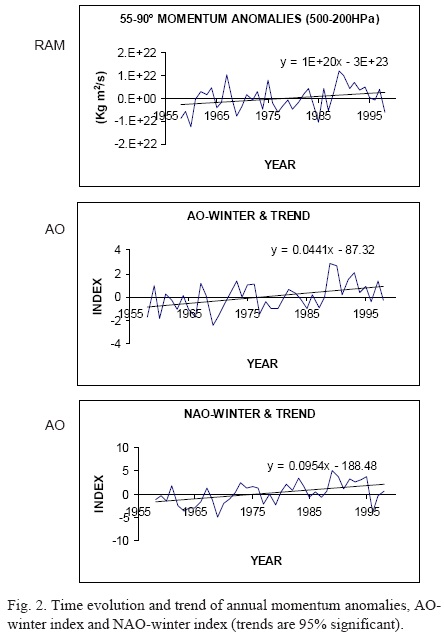
<body><![CDATA[<p align="justify"><font face="verdana" size="2"><a href="#f1">Figure 1a</a> shows the geographical distribution of RAM annual means. The maximum momentum belts are found around 55&deg; N latitude, both in the 850&#45;500 hPa and in the 500&#45;200 hPa layers. Maximum correlation between AO index and cap momentum anomalies (<a href="#f1">Fig. 1b</a>) was obtained for 50&#45;90&deg; N and 55&#45;90&deg; N latitude caps. 80&#45;90&deg; N and 85&#45;90&deg; N latitude caps did not show significant correlations. Correlation coefficients between NAO and momentum caps (<a href="#f1">Fig. 1c</a>) reached a maximum at 25&#45;30&deg; N and kept constant up to 55&deg; N. Caps northern than 70&deg;N did not show significant correlation. Correlations with AO were always higher than with NAO (in every cap and level).</font></p>              <p align="center"><font face="verdana" size="2"><a name="f1"></a></font></p>             <p align="center"><font face="verdana" size="2"><img src="/img/revistas/atm/v16n3/a2f1.jpg"></font></p>             <p align="justify"><font face="verdana" size="2">Correlations between RAM (500&#45;200, 55&#45;90) annual anomalies for the whole cap and by 60&deg; longitude sectors vs. AO (<a href="#t1">Table 1</a>) reached a maximum (0.74) in the 120&#45;180&deg; E sector and they were higher than 0.5 for all the sectors. Correlations with NAO were similar to the ones reached with AO only for 0&#45;120&deg; W, although they were all around 0.5 except in the 120&#45;180&deg;W sector (0.21). This minimum is the only not significant correlation.</font></p>             <p align="center"><font face="verdana" size="2"><a name="t1"></a></font></p>             <p align="center"><font face="verdana" size="2"><img src="/img/revistas/atm/v16n3/a2t1.jpg"></font></p>             <p align="justify"><font face="verdana" size="2">The fact that correlations between sectors are very low (Deser, 2000) does not deny the annular paradigm. Moreover, the fact that, despite its local character, the NAO time series is correlated with an hemispheric magnitude (atmospheric angular momentum) supports the annular paradigm, as it make us think that its influence is not limited to the North Atlantic region, but is more zone&#45;wise extended.</font></p>         <p align="justify"><font face="verdana" size="2">The yearly evolution of NAO winter, AO winter, and annual momentum anomalies (<a href="#f2">Fig. 2</a>) showed some common features: a) There are significant positive trends caused by the anomalous positive values from the early 80's, which are consequent with previous studies (Hurrell, 1995; Abarca del Rio, 1999; Rosen and Salstein, 2000), b) values are exclusively positive for the 1988&#45;1995 period, and c) they have very similar maximum and minimum peaks (i.e., max. 1967, 1973, 1989).</font></p>              <p align="center"><font face="verdana" size="2"><a name="f2"></a></font></p>              <p align="center"><font face="verdana" size="2"><img src="/img/revistas/atm/v16n3/a2f2.jpg"></font></p>              ]]></body>
<body><![CDATA[<p align="justify"><font face="verdana" size="2">In order to look for common oscillation periods, Fourier spectral analysis and wavelet analysis (Torrence and Compo, 1998) of AO and NAO winter indices and of momentum winter means were computed. They show a common significant oscillation band centered in 8&#45;9 years. This result agrees with Pozo&#45;Vazquez <i>et al.</i> (2001), who found in NAO a quasi&#45;periodic oscillation, with a period between 6&#45;10 years and maximum amplitude of eight years during the 1842&#45;1868 and 1964&#45;1994 periods. The interpretation of this result must be cautious due to the length of the series (41 years) as compared with the width of the identified band.</font></p>             <p align="justify"><font face="verdana" size="2">These analyses also locate a common oscillation band centered in 20 years. This band is even less significant; only two cycles could be detected in our series.</font></p>              <p align="justify"><font face="verdana" size="2">&nbsp;</font></p>              <p align="justify"><font face="verdana" size="2"><b>4. Conclusions</b></font></p>              <p align="justify"><font face="verdana" size="2">This paper tries to contribute to the debate about the variability modes in the Northern Hemisphere that began with the definition of the AO by Thompson and Wallace (1998). The relative angular momentum from 500 hPa to 200 hPa, from 55&deg; N to 90&deg; N was chosen as a diagnostic tool to analyse annular modes of climate variability because it allows us to show how zone&#45;wise symmetric circulation anomalies actually are. According to this, RAM should be a good indicator of annular character of the main mode of climate variability in the Northern Hemisphere: the Artic Oscillation/ North Atlantic Oscillation.</font></p>              <p align="justify"><font face="verdana" size="2">RAM correlations with NAO and AO are good, but higher with the latter in every sector, cap and level. Correlations with NAO imply that its influence is not limited to the North Atlantic region, but it is more zone&#45;wise extended. This can support the annular paradigm. It must also be pointed out that although the six sectors listed in <a href="#t1">Table 1</a> are geometrically equal, their contribution to RAM is different. Most of the variance of the zonal mean velocity field comes from the local contribution in the two jet exit regions over the eastern North Pacific and the North Atlantic. As long as these two sectors are not correlated, the usefulness of the AO paradigm remains questionable.</font></p>              <p align="justify"><font face="verdana" size="2">&nbsp;</font></p>              <p align="justify"><font face="verdana" size="2"><b>Acknowledgements</b></font></p>              <p align="justify"><font face="verdana" size="2">Wavelet software was provided by C. Torrence and G. Compo, and is available at URL: <a href="http://paos.colorado.edu/research/wavelets/" target="_blank">http://paos.colorado.edu/research/wavelets/</a></font></p>              <p align="justify"><font face="verdana" size="2">&nbsp;</font></p>              ]]></body>
<body><![CDATA[<p align="justify"><font face="verdana" size="2"><b>References</b></font></p>              <!-- ref --><p align="justify"><font face="verdana" size="2">Abarca del R&iacute;o, R., 1999. The influence of global warming in Earth rotation speed. <i>Ann. Geophys</i> <b>17,</b> 806&#45;811.    &nbsp;&nbsp;&nbsp;&nbsp;&nbsp;&nbsp;&nbsp;&nbsp;[&#160;<a href="javascript:void(0);" onclick="javascript: window.open('/scielo.php?script=sci_nlinks&ref=1253719&pid=S0187-6236200300030000200001&lng=','','width=640,height=500,resizable=yes,scrollbars=1,menubar=yes,');">Links</a>&#160;]<!-- end-ref --></font></p>              <!-- ref --><p align="justify"><font face="verdana" size="2">Ambaum, M. H. P., B. J. Hoskings and D. B. Stephenson, 2001. Arctic Oscillation or North Atlantic Oscillation. <i>J. Clim,</i> <b>14,</b> 3495&#45;3507.    &nbsp;&nbsp;&nbsp;&nbsp;&nbsp;&nbsp;&nbsp;&nbsp;[&#160;<a href="javascript:void(0);" onclick="javascript: window.open('/scielo.php?script=sci_nlinks&ref=1253721&pid=S0187-6236200300030000200002&lng=','','width=640,height=500,resizable=yes,scrollbars=1,menubar=yes,');">Links</a>&#160;]<!-- end-ref --></font></p>              <!-- ref --><p align="justify"><font face="verdana" size="2">Bradbury, D. L., 1958. On the behaviour patterns of the cyclones and anticyclones as related to zonal index. <i>Sci.,</i> <b>44,</b> 2310&#45;2323</font>&nbsp;&nbsp;&nbsp;&nbsp;&nbsp;&nbsp;&nbsp;&nbsp;[&#160;<a href="javascript:void(0);" onclick="javascript: window.open('/scielo.php?script=sci_nlinks&ref=1253723&pid=S0187-6236200300030000200003&lng=','','width=640,height=500,resizable=yes,scrollbars=1,menubar=yes,');">Links</a>&#160;]<!-- end-ref --><!-- ref --><p align="justify"><font face="verdana" size="2">Deser, C., 2000. On the teleconnectivity of the "Arctic Oscillation". <i>Geophys. Res. Lett.,</i> <b>19,</b> 779&#45;782.    &nbsp;&nbsp;&nbsp;&nbsp;&nbsp;&nbsp;&nbsp;&nbsp;[&#160;<a href="javascript:void(0);" onclick="javascript: window.open('/scielo.php?script=sci_nlinks&ref=1253724&pid=S0187-6236200300030000200004&lng=','','width=640,height=500,resizable=yes,scrollbars=1,menubar=yes,');">Links</a>&#160;]<!-- end-ref --></font></p>              <!-- ref --><p align="justify"><font face="verdana" size="2">Fyfe, J. C., G. J. Boer and G. M. Flato, 1999. The Arctic and Antarctic Oscillations and their projected changes under global warming. <i>Geophys. Res. Lett.,</i> <b>26,</b> 1601&#45;1604.    &nbsp;&nbsp;&nbsp;&nbsp;&nbsp;&nbsp;&nbsp;&nbsp;[&#160;<a href="javascript:void(0);" onclick="javascript: window.open('/scielo.php?script=sci_nlinks&ref=1253726&pid=S0187-6236200300030000200005&lng=','','width=640,height=500,resizable=yes,scrollbars=1,menubar=yes,');">Links</a>&#160;]<!-- end-ref --></font></p>              ]]></body>
<body><![CDATA[<!-- ref --><p align="justify"><font face="verdana" size="2">Hurrell, J. W., 1995. Decadal trends in the North Atlantic Oscillation regional temperatures and precipitation. <i>Science,</i> <b>269,</b> 676&#45;679.    &nbsp;&nbsp;&nbsp;&nbsp;&nbsp;&nbsp;&nbsp;&nbsp;[&#160;<a href="javascript:void(0);" onclick="javascript: window.open('/scielo.php?script=sci_nlinks&ref=1253728&pid=S0187-6236200300030000200006&lng=','','width=640,height=500,resizable=yes,scrollbars=1,menubar=yes,');">Links</a>&#160;]<!-- end-ref --></font></p>              <!-- ref --><p align="justify"><font face="verdana" size="2">Hurrell, J. W., 1995a. Transient eddy forcing of the rotational flow during northern winter. <i>Journal of Atmospheric Science,</i> <b>52,</b> 2286&#45;2301.    &nbsp;&nbsp;&nbsp;&nbsp;&nbsp;&nbsp;&nbsp;&nbsp;[&#160;<a href="javascript:void(0);" onclick="javascript: window.open('/scielo.php?script=sci_nlinks&ref=1253730&pid=S0187-6236200300030000200007&lng=','','width=640,height=500,resizable=yes,scrollbars=1,menubar=yes,');">Links</a>&#160;]<!-- end-ref --></font></p>              <!-- ref --><p align="justify"><font face="verdana" size="2">Hurrell, J.W., 1996. Influence of variations in extratropical wintertime teleconnections on Northern Hemisphere temperatures. <i>Geophys. Res. Lett.,</i> <b>23,</b> 665&#45;668.    &nbsp;&nbsp;&nbsp;&nbsp;&nbsp;&nbsp;&nbsp;&nbsp;[&#160;<a href="javascript:void(0);" onclick="javascript: window.open('/scielo.php?script=sci_nlinks&ref=1253732&pid=S0187-6236200300030000200008&lng=','','width=640,height=500,resizable=yes,scrollbars=1,menubar=yes,');">Links</a>&#160;]<!-- end-ref --></font></p>              <!-- ref --><p align="justify"><font face="verdana" size="2">Kalnay, E. <i>et al.,</i> 1996. The NCEP/NCAR 40&#45;year reanalysis project. <i>Bull. Amer. Met. Soc,</i> <b>77, </b>437&#45;471.    &nbsp;&nbsp;&nbsp;&nbsp;&nbsp;&nbsp;&nbsp;&nbsp;[&#160;<a href="javascript:void(0);" onclick="javascript: window.open('/scielo.php?script=sci_nlinks&ref=1253734&pid=S0187-6236200300030000200009&lng=','','width=640,height=500,resizable=yes,scrollbars=1,menubar=yes,');">Links</a>&#160;]<!-- end-ref --></font></p>              <!-- ref --><p align="justify"><font face="verdana" size="2">Kerr, R. A., 1999. A new force in high&#45;latitude climate. <i>Science,</i> <b>284,</b> 241&#45;242.    &nbsp;&nbsp;&nbsp;&nbsp;&nbsp;&nbsp;&nbsp;&nbsp;[&#160;<a href="javascript:void(0);" onclick="javascript: window.open('/scielo.php?script=sci_nlinks&ref=1253736&pid=S0187-6236200300030000200010&lng=','','width=640,height=500,resizable=yes,scrollbars=1,menubar=yes,');">Links</a>&#160;]<!-- end-ref --></font></p>              ]]></body>
<body><![CDATA[<!-- ref --><p align="justify"><font face="verdana" size="2">Nakamura, H., 1996. Year&#45;to&#45;year and interdecadal variability in the activity of intraseasonal fluctuations in the Northern Hemisphere wintertime circulation. <i>Theor. Appl. Climatol.,</i> <b>55,</b> 19&#45;32.    &nbsp;&nbsp;&nbsp;&nbsp;&nbsp;&nbsp;&nbsp;&nbsp;[&#160;<a href="javascript:void(0);" onclick="javascript: window.open('/scielo.php?script=sci_nlinks&ref=1253738&pid=S0187-6236200300030000200011&lng=','','width=640,height=500,resizable=yes,scrollbars=1,menubar=yes,');">Links</a>&#160;]<!-- end-ref --></font></p>              <!-- ref --><p align="justify"><font face="verdana" size="2">Perlwitz, J. and H. F. Graf, 2001. The variability of the horizontal circulation in the troposphere and stratosphere &#45; A comparison. <i>Theor. Appl. Climat.,</i> <b>69,</b> 149&#45;161.    &nbsp;&nbsp;&nbsp;&nbsp;&nbsp;&nbsp;&nbsp;&nbsp;[&#160;<a href="javascript:void(0);" onclick="javascript: window.open('/scielo.php?script=sci_nlinks&ref=1253740&pid=S0187-6236200300030000200012&lng=','','width=640,height=500,resizable=yes,scrollbars=1,menubar=yes,');">Links</a>&#160;]<!-- end-ref --></font></p>              <!-- ref --><p align="justify"><font face="verdana" size="2">Pozo&#45;V&aacute;zquez <i>et al.,</i> 2001. A study of NAO variability and its possible non&#45;linear influences on European surface temperature. <i>Climate Dynamics,</i> <b>17,</b> 701&#45;715.    &nbsp;&nbsp;&nbsp;&nbsp;&nbsp;&nbsp;&nbsp;&nbsp;[&#160;<a href="javascript:void(0);" onclick="javascript: window.open('/scielo.php?script=sci_nlinks&ref=1253742&pid=S0187-6236200300030000200013&lng=','','width=640,height=500,resizable=yes,scrollbars=1,menubar=yes,');">Links</a>&#160;]<!-- end-ref --></font></p>              <!-- ref --><p align="justify"><font face="verdana" size="2">Rosen, R. D. and D. A. Salstein, 2000. Multidecadal signals in the interannual variability of atmospheric angular momentum. <i>Climate. Dynamics,</i> <b>16,</b> 693&#45;700.    &nbsp;&nbsp;&nbsp;&nbsp;&nbsp;&nbsp;&nbsp;&nbsp;[&#160;<a href="javascript:void(0);" onclick="javascript: window.open('/scielo.php?script=sci_nlinks&ref=1253744&pid=S0187-6236200300030000200014&lng=','','width=640,height=500,resizable=yes,scrollbars=1,menubar=yes,');">Links</a>&#160;]<!-- end-ref --></font></p>              <!-- ref --><p align="justify"><font face="verdana" size="2">Thompson, D. W. J. and J. M. Wallace, 1998. The arctic oscillation signature in the wintertime geopotential height and temperature fields. <i>Geophys. Res. Lett.,</i> <b>25,</b> 1297&#45;1300.    &nbsp;&nbsp;&nbsp;&nbsp;&nbsp;&nbsp;&nbsp;&nbsp;[&#160;<a href="javascript:void(0);" onclick="javascript: window.open('/scielo.php?script=sci_nlinks&ref=1253746&pid=S0187-6236200300030000200015&lng=','','width=640,height=500,resizable=yes,scrollbars=1,menubar=yes,');">Links</a>&#160;]<!-- end-ref --></font></p>              ]]></body>
<body><![CDATA[<!-- ref --><p align="justify"><font face="verdana" size="2">Thompson, D. W. J. and J. M. Wallace, 2000. Annual modes in the extratropical circulation Part I: month&#45;to&#45;month variability. <i>J. Clim.,</i> <b>13,</b> 1000&#45;1016.    &nbsp;&nbsp;&nbsp;&nbsp;&nbsp;&nbsp;&nbsp;&nbsp;[&#160;<a href="javascript:void(0);" onclick="javascript: window.open('/scielo.php?script=sci_nlinks&ref=1253748&pid=S0187-6236200300030000200016&lng=','','width=640,height=500,resizable=yes,scrollbars=1,menubar=yes,');">Links</a>&#160;]<!-- end-ref --></font></p>              <!-- ref --><p align="justify"><font face="verdana" size="2">Thompson, D. W. J., J. M. Wallace and G. C. Hegerl, 2000. Annual modes in the extratropical circulation Part II: trends. <i>J. Clim.,</i> <b>13,</b> 1018&#45;1036.    &nbsp;&nbsp;&nbsp;&nbsp;&nbsp;&nbsp;&nbsp;&nbsp;[&#160;<a href="javascript:void(0);" onclick="javascript: window.open('/scielo.php?script=sci_nlinks&ref=1253750&pid=S0187-6236200300030000200017&lng=','','width=640,height=500,resizable=yes,scrollbars=1,menubar=yes,');">Links</a>&#160;]<!-- end-ref --></font></p>              <!-- ref --><p align="justify"><font face="verdana" size="2">Torrence, C. and G. P. Compo, 1998. A Practical Guide to Wavelet Analysis. <i>Bull. Amer. Meteor. Soc.,</i> <b>79,</b> 61&#45;78.    &nbsp;&nbsp;&nbsp;&nbsp;&nbsp;&nbsp;&nbsp;&nbsp;[&#160;<a href="javascript:void(0);" onclick="javascript: window.open('/scielo.php?script=sci_nlinks&ref=1253752&pid=S0187-6236200300030000200018&lng=','','width=640,height=500,resizable=yes,scrollbars=1,menubar=yes,');">Links</a>&#160;]<!-- end-ref --></font></p>              <!-- ref --><p align="justify"><font face="verdana" size="2">Volodin, E. M. and V. Y. Galin, 1999. Interpretation of winter warming on Northern Hemisphere continents in 1977&#45;94. <i>J. Clim.,</i> <b>12,</b> 2947&#45;2955.    &nbsp;&nbsp;&nbsp;&nbsp;&nbsp;&nbsp;&nbsp;&nbsp;[&#160;<a href="javascript:void(0);" onclick="javascript: window.open('/scielo.php?script=sci_nlinks&ref=1253754&pid=S0187-6236200300030000200019&lng=','','width=640,height=500,resizable=yes,scrollbars=1,menubar=yes,');">Links</a>&#160;]<!-- end-ref --></font></p>              <!-- ref --><p align="justify"><font face="verdana" size="2">von Storch, H. and G. Hannosch&ouml;ck, 1984. Comment on Empirical Orthogonal Function Analysis of wind vectors over the tropical Pacific region. <i>Bull. Am. Met. Soc.,</i> <b>65,</b> 162.    &nbsp;&nbsp;&nbsp;&nbsp;&nbsp;&nbsp;&nbsp;&nbsp;[&#160;<a href="javascript:void(0);" onclick="javascript: window.open('/scielo.php?script=sci_nlinks&ref=1253756&pid=S0187-6236200300030000200020&lng=','','width=640,height=500,resizable=yes,scrollbars=1,menubar=yes,');">Links</a>&#160;]<!-- end-ref --></font></p>              ]]></body>
<body><![CDATA[<!-- ref --><p align="justify"><font face="verdana" size="2">Wallace, J. M., 2000. North Atlantic Oscillation/Northern Hemisphere annular mode One phenomenon two paradigms. <i>Q. J. Roy. Met. Soc.,</i> <b>126,</b> 791&#45;806.    &nbsp;&nbsp;&nbsp;&nbsp;&nbsp;&nbsp;&nbsp;&nbsp;[&#160;<a href="javascript:void(0);" onclick="javascript: window.open('/scielo.php?script=sci_nlinks&ref=1253758&pid=S0187-6236200300030000200021&lng=','','width=640,height=500,resizable=yes,scrollbars=1,menubar=yes,');">Links</a>&#160;]<!-- end-ref --></font></p>              <!-- ref --><p align="justify"><font face="verdana" size="2">Walker, G. T., 1924. Correlations in seasonal variations of weather. <i>IX. Mtn. Ind. Meteor. Dept.,</i> <b>24,</b> 275&#45;332.    &nbsp;&nbsp;&nbsp;&nbsp;&nbsp;&nbsp;&nbsp;&nbsp;[&#160;<a href="javascript:void(0);" onclick="javascript: window.open('/scielo.php?script=sci_nlinks&ref=1253760&pid=S0187-6236200300030000200022&lng=','','width=640,height=500,resizable=yes,scrollbars=1,menubar=yes,');">Links</a>&#160;]<!-- end-ref --></font></p>              <!-- ref --><p align="justify"><font face="verdana" size="2">Walker, G. T. and E. W. Bliss, 1932. World Weather. <i>V. Metn. Roy. Meteor. Soc.</i> <b>4,</b> 53&#45;82.    &nbsp;&nbsp;&nbsp;&nbsp;&nbsp;&nbsp;&nbsp;&nbsp;[&#160;<a href="javascript:void(0);" onclick="javascript: window.open('/scielo.php?script=sci_nlinks&ref=1253762&pid=S0187-6236200300030000200023&lng=','','width=640,height=500,resizable=yes,scrollbars=1,menubar=yes,');">Links</a>&#160;]<!-- end-ref --></font></p>              <!-- ref --><p align="justify"><font face="verdana" size="2">Wunsch, C., 1999. The interpretation of short climate records with comments on the North Atlantic and Southern Oscillations. <i>Bull. Am. Meteorol. Soc.,</i> <b>80,</b> 245&#45;255.    &nbsp;&nbsp;&nbsp;&nbsp;&nbsp;&nbsp;&nbsp;&nbsp;[&#160;<a href="javascript:void(0);" onclick="javascript: window.open('/scielo.php?script=sci_nlinks&ref=1253764&pid=S0187-6236200300030000200024&lng=','','width=640,height=500,resizable=yes,scrollbars=1,menubar=yes,');">Links</a>&#160;]<!-- end-ref --></font></p>      ]]></body><back>
<ref-list>
<ref id="B1">
<nlm-citation citation-type="journal">
<person-group person-group-type="author">
<name>
<surname><![CDATA[Abarca del Río]]></surname>
<given-names><![CDATA[R.]]></given-names>
</name>
</person-group>
<article-title xml:lang="en"><![CDATA[The influence of global warming in Earth rotation speed]]></article-title>
<source><![CDATA[Ann. Geophys]]></source>
<year>1999</year>
<volume>17</volume>
<page-range>806-811</page-range></nlm-citation>
</ref>
<ref id="B2">
<nlm-citation citation-type="journal">
<person-group person-group-type="author">
<name>
<surname><![CDATA[Ambaum]]></surname>
<given-names><![CDATA[M. H. P.]]></given-names>
</name>
<name>
<surname><![CDATA[Hoskings]]></surname>
<given-names><![CDATA[B. J.]]></given-names>
</name>
<name>
<surname><![CDATA[Stephenson]]></surname>
<given-names><![CDATA[D. B.]]></given-names>
</name>
</person-group>
<article-title xml:lang="en"><![CDATA[Arctic Oscillation or North Atlantic Oscillation]]></article-title>
<source><![CDATA[J. Clim]]></source>
<year>2001</year>
<volume>14</volume>
<page-range>3495-3507</page-range></nlm-citation>
</ref>
<ref id="B3">
<nlm-citation citation-type="journal">
<person-group person-group-type="author">
<name>
<surname><![CDATA[Bradbury]]></surname>
<given-names><![CDATA[D. L.]]></given-names>
</name>
</person-group>
<article-title xml:lang="en"><![CDATA[On the behaviour patterns of the cyclones and anticyclones as related to zonal index]]></article-title>
<source><![CDATA[Sci.]]></source>
<year>1958</year>
<volume>44</volume>
<page-range>2310-2323</page-range></nlm-citation>
</ref>
<ref id="B4">
<nlm-citation citation-type="journal">
<person-group person-group-type="author">
<name>
<surname><![CDATA[Deser]]></surname>
<given-names><![CDATA[C.]]></given-names>
</name>
</person-group>
<article-title xml:lang="en"><![CDATA[On the teleconnectivity of the "Arctic Oscillation"]]></article-title>
<source><![CDATA[Geophys. Res. Lett.]]></source>
<year>2000</year>
<volume>19</volume>
<page-range>779-782</page-range></nlm-citation>
</ref>
<ref id="B5">
<nlm-citation citation-type="journal">
<person-group person-group-type="author">
<name>
<surname><![CDATA[Fyfe]]></surname>
<given-names><![CDATA[J. C.]]></given-names>
</name>
<name>
<surname><![CDATA[Boer]]></surname>
<given-names><![CDATA[G. J.]]></given-names>
</name>
<name>
<surname><![CDATA[Flato]]></surname>
<given-names><![CDATA[G. M.]]></given-names>
</name>
</person-group>
<article-title xml:lang="en"><![CDATA[The Arctic and Antarctic Oscillations and their projected changes under global warming]]></article-title>
<source><![CDATA[Geophys. Res. Lett.]]></source>
<year>1999</year>
<volume>26</volume>
<page-range>1601-1604</page-range></nlm-citation>
</ref>
<ref id="B6">
<nlm-citation citation-type="journal">
<person-group person-group-type="author">
<name>
<surname><![CDATA[Hurrell]]></surname>
<given-names><![CDATA[J. W.]]></given-names>
</name>
</person-group>
<article-title xml:lang="en"><![CDATA[Decadal trends in the North Atlantic Oscillation regional temperatures and precipitation]]></article-title>
<source><![CDATA[Science]]></source>
<year>1995</year>
<volume>269</volume>
<page-range>676-679</page-range></nlm-citation>
</ref>
<ref id="B7">
<nlm-citation citation-type="journal">
<person-group person-group-type="author">
<name>
<surname><![CDATA[Hurrell]]></surname>
<given-names><![CDATA[J. W.]]></given-names>
</name>
</person-group>
<article-title xml:lang="en"><![CDATA[Transient eddy forcing of the rotational flow during northern winter]]></article-title>
<source><![CDATA[Journal of Atmospheric Science]]></source>
<year>1995</year>
<volume>52</volume>
<page-range>2286-2301</page-range></nlm-citation>
</ref>
<ref id="B8">
<nlm-citation citation-type="journal">
<person-group person-group-type="author">
<name>
<surname><![CDATA[Hurrell]]></surname>
<given-names><![CDATA[J.W.]]></given-names>
</name>
</person-group>
<article-title xml:lang="en"><![CDATA[Influence of variations in extratropical wintertime teleconnections on Northern Hemisphere temperatures]]></article-title>
<source><![CDATA[Geophys. Res. Lett.]]></source>
<year>1996</year>
<volume>23</volume>
<page-range>665-668</page-range></nlm-citation>
</ref>
<ref id="B9">
<nlm-citation citation-type="journal">
<person-group person-group-type="author">
<name>
<surname><![CDATA[Kalnay]]></surname>
<given-names><![CDATA[E.]]></given-names>
</name>
</person-group>
<article-title xml:lang="en"><![CDATA[The NCEP/NCAR 40-year reanalysis project]]></article-title>
<source><![CDATA[Bull. Amer. Met. Soc]]></source>
<year>1996</year>
<volume>77</volume>
<page-range>437-471</page-range></nlm-citation>
</ref>
<ref id="B10">
<nlm-citation citation-type="journal">
<person-group person-group-type="author">
<name>
<surname><![CDATA[Kerr]]></surname>
<given-names><![CDATA[R. A.]]></given-names>
</name>
</person-group>
<article-title xml:lang="en"><![CDATA[A new force in high-latitude climate]]></article-title>
<source><![CDATA[Science]]></source>
<year>1999</year>
<volume>284</volume>
<page-range>241-242</page-range></nlm-citation>
</ref>
<ref id="B11">
<nlm-citation citation-type="journal">
<person-group person-group-type="author">
<name>
<surname><![CDATA[Nakamura]]></surname>
<given-names><![CDATA[H.]]></given-names>
</name>
</person-group>
<article-title xml:lang="en"><![CDATA[Year-to-year and interdecadal variability in the activity of intraseasonal fluctuations in the Northern Hemisphere wintertime circulation]]></article-title>
<source><![CDATA[Theor. Appl. Climatol.]]></source>
<year>1996</year>
<volume>55</volume>
<page-range>19-32</page-range></nlm-citation>
</ref>
<ref id="B12">
<nlm-citation citation-type="journal">
<person-group person-group-type="author">
<name>
<surname><![CDATA[Perlwitz]]></surname>
<given-names><![CDATA[J.]]></given-names>
</name>
<name>
<surname><![CDATA[Graf]]></surname>
<given-names><![CDATA[H. F.]]></given-names>
</name>
</person-group>
<article-title xml:lang="en"><![CDATA[The variability of the horizontal circulation in the troposphere and stratosphere - A comparison]]></article-title>
<source><![CDATA[Theor. Appl. Climat.]]></source>
<year>2001</year>
<volume>69</volume>
<page-range>149-161</page-range></nlm-citation>
</ref>
<ref id="B13">
<nlm-citation citation-type="journal">
<person-group person-group-type="author">
<name>
<surname><![CDATA[Pozo-Vázquez]]></surname>
</name>
</person-group>
<article-title xml:lang="en"><![CDATA[A study of NAO variability and its possible non-linear influences on European surface temperature]]></article-title>
<source><![CDATA[Climate Dynamics]]></source>
<year>2001</year>
<volume>17</volume>
<page-range>701-715</page-range></nlm-citation>
</ref>
<ref id="B14">
<nlm-citation citation-type="journal">
<person-group person-group-type="author">
<name>
<surname><![CDATA[Rosen]]></surname>
<given-names><![CDATA[R. D.]]></given-names>
</name>
<name>
<surname><![CDATA[Salstein]]></surname>
<given-names><![CDATA[D. A.]]></given-names>
</name>
</person-group>
<article-title xml:lang="en"><![CDATA[Multidecadal signals in the interannual variability of atmospheric angular momentum]]></article-title>
<source><![CDATA[Climate. Dynamics]]></source>
<year>2000</year>
<volume>16</volume>
<page-range>693-700</page-range></nlm-citation>
</ref>
<ref id="B15">
<nlm-citation citation-type="journal">
<person-group person-group-type="author">
<name>
<surname><![CDATA[Thompson]]></surname>
<given-names><![CDATA[D. W. J.]]></given-names>
</name>
<name>
<surname><![CDATA[Wallace]]></surname>
<given-names><![CDATA[J. M.]]></given-names>
</name>
</person-group>
<article-title xml:lang="en"><![CDATA[The arctic oscillation signature in the wintertime geopotential height and temperature fields]]></article-title>
<source><![CDATA[Geophys. Res. Lett.]]></source>
<year>1998</year>
<volume>25</volume>
<page-range>1297-1300</page-range></nlm-citation>
</ref>
<ref id="B16">
<nlm-citation citation-type="journal">
<person-group person-group-type="author">
<name>
<surname><![CDATA[Thompson]]></surname>
<given-names><![CDATA[D. W. J.]]></given-names>
</name>
<name>
<surname><![CDATA[Wallace]]></surname>
<given-names><![CDATA[J. M.]]></given-names>
</name>
</person-group>
<article-title xml:lang="en"><![CDATA[Annual modes in the extratropical circulation Part I: month-to-month variability]]></article-title>
<source><![CDATA[J. Clim.]]></source>
<year>2000</year>
<volume>13</volume>
<page-range>1000-1016</page-range></nlm-citation>
</ref>
<ref id="B17">
<nlm-citation citation-type="journal">
<person-group person-group-type="author">
<name>
<surname><![CDATA[Thompson]]></surname>
<given-names><![CDATA[D. W. J.]]></given-names>
</name>
<name>
<surname><![CDATA[Wallace]]></surname>
<given-names><![CDATA[J. M.]]></given-names>
</name>
<name>
<surname><![CDATA[Hegerl]]></surname>
<given-names><![CDATA[G. C.]]></given-names>
</name>
</person-group>
<article-title xml:lang="en"><![CDATA[Annual modes in the extratropical circulation Part II: trends]]></article-title>
<source><![CDATA[J. Clim.]]></source>
<year>2000</year>
<volume>13</volume>
<page-range>1018-1036</page-range></nlm-citation>
</ref>
<ref id="B18">
<nlm-citation citation-type="journal">
<person-group person-group-type="author">
<name>
<surname><![CDATA[Torrence]]></surname>
<given-names><![CDATA[C.]]></given-names>
</name>
<name>
<surname><![CDATA[Compo]]></surname>
<given-names><![CDATA[G. P.]]></given-names>
</name>
</person-group>
<article-title xml:lang="en"><![CDATA[A Practical Guide to Wavelet Analysis]]></article-title>
<source><![CDATA[Bull. Amer. Meteor. Soc.]]></source>
<year>1998</year>
<volume>79</volume>
<page-range>61-78</page-range></nlm-citation>
</ref>
<ref id="B19">
<nlm-citation citation-type="journal">
<person-group person-group-type="author">
<name>
<surname><![CDATA[Volodin]]></surname>
<given-names><![CDATA[E. M.]]></given-names>
</name>
<name>
<surname><![CDATA[Galin]]></surname>
<given-names><![CDATA[V. Y.]]></given-names>
</name>
</person-group>
<article-title xml:lang="en"><![CDATA[Interpretation of winter warming on Northern Hemisphere continents in 1977-94]]></article-title>
<source><![CDATA[J. Clim.]]></source>
<year>1999</year>
<volume>12</volume>
<page-range>2947-2955</page-range></nlm-citation>
</ref>
<ref id="B20">
<nlm-citation citation-type="journal">
<person-group person-group-type="author">
<name>
<surname><![CDATA[von Storch]]></surname>
<given-names><![CDATA[H.]]></given-names>
</name>
<name>
<surname><![CDATA[Hannoschöck]]></surname>
<given-names><![CDATA[G.]]></given-names>
</name>
</person-group>
<article-title xml:lang="en"><![CDATA[Comment on Empirical Orthogonal Function Analysis of wind vectors over the tropical Pacific region]]></article-title>
<source><![CDATA[Bull. Am. Met. Soc.]]></source>
<year>1984</year>
<volume>65</volume>
<page-range>162</page-range></nlm-citation>
</ref>
<ref id="B21">
<nlm-citation citation-type="journal">
<person-group person-group-type="author">
<name>
<surname><![CDATA[Wallace]]></surname>
<given-names><![CDATA[J. M.]]></given-names>
</name>
</person-group>
<article-title xml:lang="en"><![CDATA[North Atlantic Oscillation/Northern Hemisphere annular mode One phenomenon two paradigms]]></article-title>
<source><![CDATA[Q. J. Roy. Met. Soc.]]></source>
<year>2000</year>
<volume>126</volume>
<page-range>791-806</page-range></nlm-citation>
</ref>
<ref id="B22">
<nlm-citation citation-type="journal">
<person-group person-group-type="author">
<name>
<surname><![CDATA[Walker]]></surname>
<given-names><![CDATA[G. T.]]></given-names>
</name>
</person-group>
<article-title xml:lang="en"><![CDATA[Correlations in seasonal variations of weather]]></article-title>
<source><![CDATA[IX. Mtn. Ind. Meteor. Dept.]]></source>
<year>1924</year>
<volume>24</volume>
<page-range>275-332</page-range></nlm-citation>
</ref>
<ref id="B23">
<nlm-citation citation-type="journal">
<person-group person-group-type="author">
<name>
<surname><![CDATA[Walker]]></surname>
<given-names><![CDATA[G. T.]]></given-names>
</name>
<name>
<surname><![CDATA[Bliss]]></surname>
<given-names><![CDATA[E. W.]]></given-names>
</name>
</person-group>
<article-title xml:lang="en"><![CDATA[World Weather]]></article-title>
<source><![CDATA[V. Metn. Roy. Meteor. Soc.]]></source>
<year>1932</year>
<volume>4</volume>
<page-range>53-82</page-range></nlm-citation>
</ref>
<ref id="B24">
<nlm-citation citation-type="journal">
<person-group person-group-type="author">
<name>
<surname><![CDATA[Wunsch]]></surname>
<given-names><![CDATA[C.]]></given-names>
</name>
</person-group>
<article-title xml:lang="en"><![CDATA[The interpretation of short climate records with comments on the North Atlantic and Southern Oscillations]]></article-title>
<source><![CDATA[Bull. Am. Meteorol. Soc.]]></source>
<year>1999</year>
<volume>80</volume>
<page-range>245-255</page-range></nlm-citation>
</ref>
</ref-list>
</back>
</article>