<?xml version="1.0" encoding="ISO-8859-1"?><article xmlns:mml="http://www.w3.org/1998/Math/MathML" xmlns:xlink="http://www.w3.org/1999/xlink" xmlns:xsi="http://www.w3.org/2001/XMLSchema-instance">
<front>
<journal-meta>
<journal-id>0185-4534</journal-id>
<journal-title><![CDATA[Revista mexicana de análisis de la conducta]]></journal-title>
<abbrev-journal-title><![CDATA[Rev. mex. anál. conducta]]></abbrev-journal-title>
<issn>0185-4534</issn>
<publisher>
<publisher-name><![CDATA[Sociedad Mexicana de Análisis de la Conducta]]></publisher-name>
</publisher>
</journal-meta>
<article-meta>
<article-id>S0185-45342011000300005</article-id>
<title-group>
<article-title xml:lang="en"><![CDATA[Defensive performance as a modulator of biased play calling in collegiate American-Rules Football]]></article-title>
<article-title xml:lang="es"><![CDATA[Desempeño defensivo como un modulador del sesgo en la selección de jugadas en el Football Americano Colegial]]></article-title>
</title-group>
<contrib-group>
<contrib contrib-type="author">
<name>
<surname><![CDATA[Reed]]></surname>
<given-names><![CDATA[Derek D.]]></given-names>
</name>
<xref ref-type="aff" rid="A01"/>
</contrib>
<contrib contrib-type="author">
<name>
<surname><![CDATA[Skoch]]></surname>
<given-names><![CDATA[Johnmarc J.]]></given-names>
</name>
<xref ref-type="aff" rid="A01"/>
</contrib>
<contrib contrib-type="author">
<name>
<surname><![CDATA[Kaplan]]></surname>
<given-names><![CDATA[Brent A.]]></given-names>
</name>
<xref ref-type="aff" rid="A01"/>
</contrib>
<contrib contrib-type="author">
<name>
<surname><![CDATA[Brozyna]]></surname>
<given-names><![CDATA[Gary A.]]></given-names>
</name>
<xref ref-type="aff" rid="A01"/>
</contrib>
</contrib-group>
<aff id="A01">
<institution><![CDATA[,University of Kansas Department of Applied Behavioral Science ]]></institution>
<addr-line><![CDATA[ ]]></addr-line>
</aff>
<pub-date pub-type="pub">
<day>00</day>
<month>00</month>
<year>2011</year>
</pub-date>
<pub-date pub-type="epub">
<day>00</day>
<month>00</month>
<year>2011</year>
</pub-date>
<volume>37</volume>
<numero>3</numero>
<fpage>51</fpage>
<lpage>57</lpage>
<copyright-statement/>
<copyright-year/>
<self-uri xlink:href="http://www.scielo.org.mx/scielo.php?script=sci_arttext&amp;pid=S0185-45342011000300005&amp;lng=en&amp;nrm=iso"></self-uri><self-uri xlink:href="http://www.scielo.org.mx/scielo.php?script=sci_abstract&amp;pid=S0185-45342011000300005&amp;lng=en&amp;nrm=iso"></self-uri><self-uri xlink:href="http://www.scielo.org.mx/scielo.php?script=sci_pdf&amp;pid=S0185-45342011000300005&amp;lng=en&amp;nrm=iso"></self-uri><abstract abstract-type="short" xml:lang="en"><p><![CDATA[The present study sought to replicate and extend previous research on matching in American-rules football in an effort to identify possible explanations for biased play calling. In particular, we demonstrate a relation between defensive performance and bias (quantified via the generalized matching equation [GME]) in opponents' play calling. Specifically, against good pass/rush defenses, opponents demonstrated a bias away from the defenses' strengths. We conclude with a discussion on the importance of translating matching theory and the explanatory utility of the bias parameter in the GME.]]></p></abstract>
<abstract abstract-type="short" xml:lang="es"><p><![CDATA[En el presente estudio se buscó replicar y extender investigaciones previas sobre igualación en el Football Americano en un esfuerzo por identificar posibles explicaciones para el sesgo en la selección de las jugadas. En particular, demostramos una relación entre el desempeño defensivo y el sesgo (cuantificada mediante la ecuación de igualación generalizada [EIG]) de la selección de jugadas de los oponentes. Específicamente, en contra de buenas defensas de pase/carrera, los oponentes demostraron un sesgo contrario a la fortaleza de la defensa. Concluimos con una discusión sobre la importancia de aplicar la teoría de la igualación y de la utilidad explicativa del parámetro del sesgo en la EIG.]]></p></abstract>
<kwd-group>
<kwd lng="en"><![CDATA[choice]]></kwd>
<kwd lng="en"><![CDATA[football]]></kwd>
<kwd lng="en"><![CDATA[generalized matching equation]]></kwd>
<kwd lng="en"><![CDATA[matching law]]></kwd>
<kwd lng="en"><![CDATA[sports]]></kwd>
<kwd lng="es"><![CDATA[elección]]></kwd>
<kwd lng="es"><![CDATA[football]]></kwd>
<kwd lng="es"><![CDATA[ecuación de igualación generalizada]]></kwd>
<kwd lng="es"><![CDATA[ley de igualación]]></kwd>
<kwd lng="es"><![CDATA[deportes]]></kwd>
</kwd-group>
</article-meta>
</front><body><![CDATA[  	    <p align="center"><font face="verdana" size="4"><b>Defensive performance as a modulator of biased play calling in collegiate American&#45;Rules Football</b></font></p>  	    <p align="justify"><font face="verdana" size="2">&nbsp;</font></p>  	    <p align="center"><font face="verdana" size="3"><b>Desempe&ntilde;o defensivo como un modulador del sesgo en la selecci&oacute;n de jugadas en el Football Americano Colegial</b></font></p>  	    <p align="justify"><font face="verdana" size="2">&nbsp;</font></p>  	    <p align="center"><font face="verdana" size="2"><b>Derek D. Reed, Johnmarc J. Skoch, Brent A. Kaplan, and Gary A. Brozyna</b><a href="#notas">*</a></font></p>  	    <p align="justify"><font face="verdana" size="2">&nbsp;</font></p>  	    <p align="justify"><font face="verdana" size="2"><i>University of Kansas, Department of Applied Behavioral Science.</i></font></p>  	    <p align="justify"><font face="verdana" size="2">&nbsp;</font></p>  	    <p align="justify"><font face="verdana" size="2"><b>Correspondence concerning this article should be addressed to:</b>    ]]></body>
<body><![CDATA[<br> 	<i>Derek D. Reed,    <br> 	Department of Applied Behavioral Science,     <br> 	University of Kansas,    <br> 	4001 Dole Human Development Center,     <br> 	1000 Sunnyside Avenue, Lawrence, KS 66045&#45;7555.    <br> 	E&#45;mail:</i> <a href="mailto:dreed@ku.edu">dreed@ku.edu</a>.</font></p>  	    <p align="justify"><font face="verdana" size="2">&nbsp;</font></p>  	    <p align="justify"><font face="verdana" size="2">Received: December 4, 2011    <br> 	Final acceptance: December 28, 2011</font></p>  	    <p align="justify"><font face="verdana" size="2">&nbsp;</font></p>  	    ]]></body>
<body><![CDATA[<p align="justify"><font face="verdana" size="2"><b>Abstract</b></font></p>  	    <p align="justify"><font face="verdana" size="2">The present study sought to replicate and extend previous research on matching in American&#45;rules football in an effort to identify possible explanations for biased play calling. In particular, we demonstrate a relation between defensive performance and bias (quantified via the generalized matching equation &#91;GME&#93;) in opponents' play calling. Specifically, against good pass/rush defenses, opponents demonstrated a bias away from the defenses' strengths. We conclude with a discussion on the importance of translating matching theory and the explanatory utility of the bias parameter in the GME.</font></p>  	    <p align="justify"><font face="verdana" size="2"><b>Keywords:</b> choice, football, generalized matching equation, matching law, sports.</font></p>  	    <p align="justify"><font face="verdana" size="2">&nbsp;</font></p>  	    <p align="justify"><font face="verdana" size="2"><b>Resumen</b></font></p>  	    <p align="justify"><font face="verdana" size="2">En el presente estudio se busc&oacute; replicar y extender investigaciones previas sobre igualaci&oacute;n en el Football Americano en un esfuerzo por identificar posibles explicaciones para el sesgo en la selecci&oacute;n de las jugadas. En particular, demostramos una relaci&oacute;n entre el desempe&ntilde;o defensivo y el sesgo (cuantificada mediante la ecuaci&oacute;n de igualaci&oacute;n generalizada &#91;EIG&#93;) de la selecci&oacute;n de jugadas de los oponentes. Espec&iacute;ficamente, en contra de buenas defensas de pase/carrera, los oponentes demostraron un sesgo contrario a la fortaleza de la defensa. Concluimos con una discusi&oacute;n sobre la importancia de aplicar la teor&iacute;a de la igualaci&oacute;n y de la utilidad explicativa del par&aacute;metro del sesgo en la EIG.</font></p>  	    <p align="justify"><font face="verdana" size="2"><b>Palabras clave:</b> elecci&oacute;n, football, ecuaci&oacute;n de igualaci&oacute;n generalizada, ley de igualaci&oacute;n, deportes.</font></p>  	    <p align="justify"><font face="verdana" size="2">&nbsp;</font></p>  	    <p align="justify"><font face="verdana" size="2">In one form of scientific translation, principles and processes observed in the basic laboratory are investigated in less stringently controlled "natural" environments (i.e., basic&#45;to&#45;applied unidirectional translation). Such translation permits the researcher to understand how findings from nonhuman basic studies generalize to human populations and to model behaviors that occur in undisturbed human settings (Mace &amp; Critchfield, 2010). This approach to scholarship is crucial to the advancement of any science. In behavior analysis, the translation of the matching law (Herrnstein, 1970) outside of the operant lab has been regarded as one of the most promising advances of our field (McDowell, 1988). One area that is ripe for such translation using the matching law has been sports. The advantages to using sports for such translation are (a) the availability of large data sets (e.g., box scores and game/season summaries and statistics are readily available on sports websites), (b) the relative degree of control afforded by game play and rules, despite being an undisturbed &#45; from a behavior&#45;analytic research perspective &#45; natural environment, and (c) the ease of quantifying behavior and related reinforcers (see Reed, 2011). In sum, by using sports as a trans&#45;lational conduit, researchers can quantitatively model the degree to which matching theory generalizes from non&#45;human basic studies to everyday human events.</font></p>  	    <p align="justify"><font face="verdana" size="2">The investigation of matching in sports has provided some of the most robust evidence for the generalizability of matching theory to undisturbed human environments. For example, Vollmer and Bourret (2000) demonstrated that a men's and a women's college basketball teams' 2&#45; and 3&#45;point shot selections conformed to matching theory. These findings subsequently have been replicated with professional basketball players (Alferink, Critchfield, Hitt, &amp; Higgins, 2009). Likewise, Reed, Critchfield, and Martens (2006) demonstrated that matching theory also could describe offensive play calling in college and professional American Rules football. Stilling and Critchfield (2010) subsequently demonstrated how contextual variables could modulate football teams' offensive play&#45;calling matching, providing evidence that matching is influenced by situation&#45;specific considerations in natural settings. The present study extended that analysis by examining the degree to which American college football teams' offensive play calling can be described as a function of opponents' defensive aggregate performance &#45; rather than the game play situations examined by Stilling and Critchfield &#45; via the generalized matching equation (GME; Baum, 1974).</font></p>  	    ]]></body>
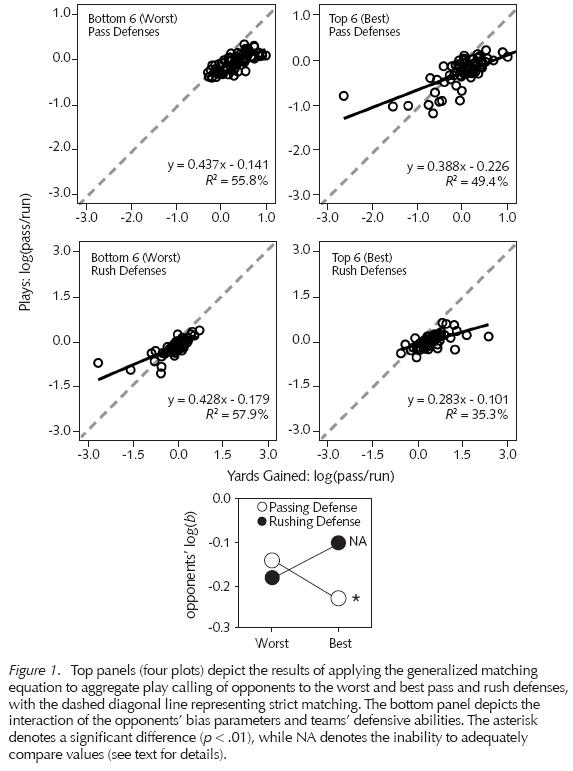
<body><![CDATA[<p align="justify"><font face="verdana" size="2">&nbsp;</font></p>  	    <p align="justify"><font face="verdana" size="2"><b>Method</b></font></p>  	    <p align="justify"><font face="verdana" size="2">Game&#45;by&#45;game offensive data (specifically, end of game summaries) were drawn from <a href="http://www.espn.com" target="_blank">http://www.espn.com</a> for the opponents to the six best and six worst pass and rush defenses in the National Collegiate Athletic Association (NCAA) Football Bowl Subdivisions (FBS; Division 1&#45;A) for the 2009 football season. With 120 teams in the FBS, the top and bottom six teams constitute the top and bottom 5<sup>th</sup> percentiles. The NCAA was targeted specifically for analysis because of the wide range of variability in defensive performance afforded by the large league size (relative to the professional National Football League, which consists of only 32 teams).</font></p>  	    <p align="justify"><font face="verdana" size="2">Rankings for defenses were obtained from <a href="http://www.espn.com" target="_blank">http://www.espn.com</a><i>,</i> and were derived by the number of pass or rush yards each team's opponents obtained versus that respective team's defense (i.e., fewer yards implies a better defense). From these rankings, no team was listed as both a top pass and rush defense (i.e., top 5<sup>th</sup> percentile in both). For the worst defenses, only one team (Washington State University) was ranked in both the bottom six pass and rush defenses. Data from bowl games were excluded, ensuring that each team analyzed had 12 data points (one per game). Nine teams were randomly selected to analyze agreement between the source and the rater (i.e., the data input by the researcher). Agreement (defined as the exact match between the numbers input by the researcher and those that appeared on the source website) was &gt; 98%. Discrepancies (all mistypes; e.g., "25" instead of "255") were corrected to match the source.</font></p>  	    <p align="justify"><font face="verdana" size="2">&nbsp;</font></p>  	    <p align="justify"><font face="verdana" size="2"><b>Results and Discussion</b></font></p>  	    <p align="justify"><font face="verdana" size="2">Rush and pass data were analyzed using procedures identical to those described in Reed et al. (2006). Specifically, the GME was used to examine the degree to which opponents' offensive data were biased as a function of the best (top 5<sup>th</sup> percentile) and worst (bottom 5<sup>th</sup> percentile) defenses. The GME states that:</font></p>  	    <p align="center"><font face="verdana" size="2"><img src="/img/revistas/rmac/v37n3/a5e1.jpg"></font></p>  	    <p align="justify"><font face="verdana" size="2">where <i>B</i> represents the behavior of interest, and <i>R</i> represents the reinforcement associated with each behavior. Parameters <i>a</i> and <i>b</i> represent, respectively, sensitivity to reinforcement (slope of the best fit line) and bias (y&#45;intercept), respectively. Thus, for the sake of this analysis, data were analyzed such that:</font></p>  	    <p align="center"><font face="verdana" size="2"><img src="/img/revistas/rmac/v37n3/a5e2.jpg"></font></p>  	    ]]></body>
<body><![CDATA[<p align="justify"><font face="verdana" size="2">With this use of the GME, a bias greater or less than zero indicates, respectively, biases (i.e., preferences) toward passing or rushing. Note that the bias parameter describes a behavioral preference that cannot be accounted for by reinforcement (see Baum, 1974). Thus, these analyses focused on relative differences in bias between opponents' passing and rushing play&#45;calling distributions against top and bottom ranked defenses. Should a bias be found towards rushing or passing the ball, this preference cannot be solely explained by the yards gained for either play type.</font></p>  	    <p align="justify"><font face="verdana" size="2">The data in <a href="#f1">Figure 1</a> (top and middle panels) show that <i>R<sup>2</sup></i> values ranged from .353 to .579. These values are substantially lower than those previously reported by Reed et al. (2006) and Stilling and Critchfield (2010), perhaps because these previous studies used within&#45;offenses analyses. That is, these previous studies reviewed aggregate data from individual teams/leagues. By contrast, the present of opponents' offensive data represent a novel approach to matching analyses in football, which may explain the relatively low <i>R<sup>2</sup></i> values. Nevertheless, accounting for half of the variance in an undisturbed natural environment across multiple unrelated teams suggests that the GME provides an adequate description of the relation between offensive play calling and yards gained for passing or rushing. Notwithstanding these considerations, an <i>R<sup>2</sup></i> value of .353 is particularly low, suggesting that the GME provides an inadequate description of the behavior&#45;reinforcement relations for offenses against the best rush defenses. The same logic may be applied to understanding the relatively low sensitivity to reinforcement parameters.</font></p>  	    <p align="center"><font face="verdana" size="2"><a name="f1"></a></font></p>  	    <p align="center"><font face="verdana" size="2"><img src="/img/revistas/rmac/v37n3/a5f1.jpg"></font></p>  	    <p align="justify"><font face="verdana" size="2">The parameter of interest in the present investigation was the bias parameter (the y&#45;intercept; log b) of the GME. Although these data replicate previous findings that no groups featured an explicit bias for passing (bias &gt; 0), the relative differences in bias across opponents to the top and bottom pass/rush defenses support intuitive hypotheses; that is, if the defenses were relatively skilled in preventing a play type, the opponents demonstrated a relative preference towards the other play type. In other words, the bias parameter relatively favored rushes against good pass defenses relative to poor pass defenses (and vice versa). To conduct these analyses, we used an ANCOVA procedure in GraphPad Prism 5.0 (see Motulsky &amp; Christopoulos, 2004) to compare the slopes and intercepts of the best&#45;fit lines (from linear regression). In this procedure, slopes are first compared to determine if the slope parameter is shared between data sets (i.e., best and worst defenses with respect to passing and rushing). If the sensitivity to reinforcement parameters (i.e., slopes) are indistinguishable across data sets (in this case, opponents to either the best or the worst defenses), the biases (i.e., the y&#45;inter&#45;cepts) may be compared statistically. For the pass defenses, sensitivity to reinforcement parameters for opponents of either the best or worst defenses were indistinguishable (F &#91;1, 139&#93; = .40, <i>p</i> = .53), permitting an analysis of difference in bias. As predicted, opponents' biases were significantly different (F &#91;1, 140&#93; = 8.84, <i>p</i> &lt; .001) in the hypothesized direction; against the best pass defenses, opponents demonstrated a relative bias towards rushing. For rush defenses, the slopes were not shared, (F &#91;1, 136&#93; = 5.05, <i>p</i> = .02), so a statistical analysis of bias differences was not appropriate.</font></p>  	    <p align="justify"><font face="verdana" size="2">Nevertheless, the relative difference in the bias parameter was nearly identical for pass and rush defenses (.085 and .078, respectively). Similar to the pass defenses, relative biases were in the hypothesized directions (i.e., against the best rush defenses, opponents demonstrated a relative bias towards passing). The lower panel of Figure 1 provides a visual depiction of these interactions.</font></p>  	    <p align="justify"><font face="verdana" size="2">In sum, these results suggest that, similar to Stilling and Critchfield's (2010) findings, understanding the modulating factors in matching relations involving human behavior in natural settings can contribute to explicating the environmental variables associated with such behavior. In particular, we provide further evidence that the matching relation is a robust one, even outside of controlled experimental settings. These findings provide further evidence of the generalizability of matching to human populations engaged in complex behavior.</font></p>  	    <p align="justify"><font face="verdana" size="2">The results also pose important questions to be addressed via bidirectional scientific translation (i.e., basic&#45;to&#45;applied and applied&#45;back&#45;to&#45;basic translation; see Mace &amp; Critchfield, 2010). These questions form some limitations of the research. For example, we have identified a relation between defensive performance and bias, but such a finding cannot speak to the variables that are functionally controlling these relations. Moreover, was the information of a team's ranking prior to the game the precipitating factor in biasing responding within the game? Alternatively, could there have been a qualitative difference in the opponents (e.g., knowledge of size, speed, height, of defensive squads) that biased responding during game play? Experimentally demonstrating the controlling variables in matching relations represents a much&#45;needed extension of this form of research &#45; the absence of which is a limitation of the present study. Such experimental analyses will better elucidate the determinants of moment&#45;to&#45;moment fluctuations in choice, rather than relying on molar analyses of large aggregated data sets; the use of such is a second limitation to the current study. A third limitation of this study is the assumption that the "organisms" whose behavior is of interest was an aggregation of different offensive coordinators, each of which likely has differing play calling philosophies and approaches, reinforcement histories, etc. Future research could address these limitations by studying behavior during simulated events (e.g., video game playing) in which participants are placed in the role of the offensive coordinator, while subsequently controlling factors such as defensive abilities, sizes, etc. In such simulations, researchers may be afforded the opportunity to conduct reversals or well&#45;controlled parametric analyses. The degree to which the statistical differences between bias parameters relative to defensive performance influences game play or affects offensive success remains unknown. Despite these limitations, this extension of Stilling and Critchfield's research provides evidence that matching is a complex phenomenon modulated by molar factors beyond those occurring within any single game.</font></p>  	    <p align="justify"><font face="verdana" size="2">&nbsp;</font></p>  	    <p align="justify"><font face="verdana" size="2"><b>References</b></font></p>  	    ]]></body>
<body><![CDATA[<!-- ref --><p align="justify"><font face="verdana" size="2">Alferink, L. A., Critchfield, T. S., Hitt, J. L., &amp; Higgins, W. J. (2009). Generality of the matching law as a descriptor of shot selection in basketball. <i>Journal of Applied Behavior Analysis, 42,</i> 595&#45;608. doi:10.1901/jaba.2009.42&#45;595.    &nbsp;&nbsp;&nbsp;&nbsp;&nbsp;&nbsp;&nbsp;&nbsp;[&#160;<a href="javascript:void(0);" onclick="javascript: window.open('/scielo.php?script=sci_nlinks&ref=7396910&pid=S0185-4534201100030000500001&lng=','','width=640,height=500,resizable=yes,scrollbars=1,menubar=yes,');">Links</a>&#160;]<!-- end-ref --></font></p>  	    <!-- ref --><p align="justify"><font face="verdana" size="2">Baum, W. M. (1974). On two types of deviations from the matching law: Bias and undermatching. <i>Journal of the Experimental Analysis of Behavior, 22,</i> 231&#45;242. doi:10.1901/jeab.1974.22&#45;231.    &nbsp;&nbsp;&nbsp;&nbsp;&nbsp;&nbsp;&nbsp;&nbsp;[&#160;<a href="javascript:void(0);" onclick="javascript: window.open('/scielo.php?script=sci_nlinks&ref=7396912&pid=S0185-4534201100030000500002&lng=','','width=640,height=500,resizable=yes,scrollbars=1,menubar=yes,');">Links</a>&#160;]<!-- end-ref --></font></p>  	    <!-- ref --><p align="justify"><font face="verdana" size="2">Herrnstein, R. J. (1970). On the law of effect. <i>Journal of the Experimental Analysis of Behavior, 13,</i> 243&#45;266. doi:10.1901/jeab.1970.13&#45;243.    &nbsp;&nbsp;&nbsp;&nbsp;&nbsp;&nbsp;&nbsp;&nbsp;[&#160;<a href="javascript:void(0);" onclick="javascript: window.open('/scielo.php?script=sci_nlinks&ref=7396914&pid=S0185-4534201100030000500003&lng=','','width=640,height=500,resizable=yes,scrollbars=1,menubar=yes,');">Links</a>&#160;]<!-- end-ref --></font></p>  	    <!-- ref --><p align="justify"><font face="verdana" size="2">Mace, F. C., &amp; Critchfield, T. S. (2010). Translational research in behavior analysis: Historical traditions and imperative for the future. <i>Journal of the Experimental Analysis of Behavior, 93,</i> 293&#45;312. doi:10.1901/jeab.2010.93&#45;293.    &nbsp;&nbsp;&nbsp;&nbsp;&nbsp;&nbsp;&nbsp;&nbsp;[&#160;<a href="javascript:void(0);" onclick="javascript: window.open('/scielo.php?script=sci_nlinks&ref=7396916&pid=S0185-4534201100030000500004&lng=','','width=640,height=500,resizable=yes,scrollbars=1,menubar=yes,');">Links</a>&#160;]<!-- end-ref --></font></p>  	    <!-- ref --><p align="justify"><font face="verdana" size="2">McDowell, J. J. (1988). Matching theory in natural human environments. <i>The Behavior Analyst, 11,</i> 95&#45;109.    &nbsp;&nbsp;&nbsp;&nbsp;&nbsp;&nbsp;&nbsp;&nbsp;[&#160;<a href="javascript:void(0);" onclick="javascript: window.open('/scielo.php?script=sci_nlinks&ref=7396918&pid=S0185-4534201100030000500005&lng=','','width=640,height=500,resizable=yes,scrollbars=1,menubar=yes,');">Links</a>&#160;]<!-- end-ref --></font></p>  	    ]]></body>
<body><![CDATA[<!-- ref --><p align="justify"><font face="verdana" size="2">Motulsky, H., &amp; Christopoulos, A. (2004). <i>Fitting models to biological data using linear and nonlinear regression: A practical guide to curve fitting.</i> New York, NY: Oxford University Press.    &nbsp;&nbsp;&nbsp;&nbsp;&nbsp;&nbsp;&nbsp;&nbsp;[&#160;<a href="javascript:void(0);" onclick="javascript: window.open('/scielo.php?script=sci_nlinks&ref=7396920&pid=S0185-4534201100030000500006&lng=','','width=640,height=500,resizable=yes,scrollbars=1,menubar=yes,');">Links</a>&#160;]<!-- end-ref --></font></p>  	    <!-- ref --><p align="justify"><font face="verdana" size="2">Reed, D. D. (2011). Quantitative analyses of sports. In J. K. Luiselli &amp; D. D. Reed (Eds.), <i>Behavioral sport psychology: Evidence&#45;based approaches to performance enhancement</i> (pp. 43&#45;59). New York: Springer.    &nbsp;&nbsp;&nbsp;&nbsp;&nbsp;&nbsp;&nbsp;&nbsp;[&#160;<a href="javascript:void(0);" onclick="javascript: window.open('/scielo.php?script=sci_nlinks&ref=7396922&pid=S0185-4534201100030000500007&lng=','','width=640,height=500,resizable=yes,scrollbars=1,menubar=yes,');">Links</a>&#160;]<!-- end-ref --></font></p>  	    <!-- ref --><p align="justify"><font face="verdana" size="2">Reed, D. D., Critchfield, T. S., &amp; Martens, B. K. (2006). The generalized matching law in elite sport competition: Football play calling as operant choice. <i>Journal of Applied Behavior Analysis, 39,</i> 281&#45;297. doi:10.1901/jaba.2006.146&#45;05.    &nbsp;&nbsp;&nbsp;&nbsp;&nbsp;&nbsp;&nbsp;&nbsp;[&#160;<a href="javascript:void(0);" onclick="javascript: window.open('/scielo.php?script=sci_nlinks&ref=7396924&pid=S0185-4534201100030000500008&lng=','','width=640,height=500,resizable=yes,scrollbars=1,menubar=yes,');">Links</a>&#160;]<!-- end-ref --></font></p>  	    <!-- ref --><p align="justify"><font face="verdana" size="2">Stilling, S. T., &amp; Critchfield, T. S. (2010). The matching relation and situation&#45;specific bias modulation in professional football play selection. <i>Journal of the Experimental Analysis of Behavior, 93,</i> 435&#45;452. doi:10.1901/jeab.2010.93&#45;435.    &nbsp;&nbsp;&nbsp;&nbsp;&nbsp;&nbsp;&nbsp;&nbsp;[&#160;<a href="javascript:void(0);" onclick="javascript: window.open('/scielo.php?script=sci_nlinks&ref=7396926&pid=S0185-4534201100030000500009&lng=','','width=640,height=500,resizable=yes,scrollbars=1,menubar=yes,');">Links</a>&#160;]<!-- end-ref --></font></p>  	    <!-- ref --><p align="justify"><font face="verdana" size="2">Vollmer, T. R., &amp; Bourret, J. (2000). An application of the matching law to evaluate the allocation of two&#45; and three&#45;point shots by college basketball players. <i>Journal of Applied Behavior Analysis, 33,</i> 137&#45;150. doi:10.1901/jaba.2000.33&#45;137.    &nbsp;&nbsp;&nbsp;&nbsp;&nbsp;&nbsp;&nbsp;&nbsp;[&#160;<a href="javascript:void(0);" onclick="javascript: window.open('/scielo.php?script=sci_nlinks&ref=7396928&pid=S0185-4534201100030000500010&lng=','','width=640,height=500,resizable=yes,scrollbars=1,menubar=yes,');">Links</a>&#160;]<!-- end-ref --></font></p>  	    ]]></body>
<body><![CDATA[<p align="justify"><font face="verdana" size="2">&nbsp;</font></p>  	    <p align="justify"><font face="verdana" size="2"><a name="notas"></a><b>NOTA</b></font></p>  	    <p align="justify"><font face="verdana" size="2">* The authors acknowledge the contributions of Jake Richardson to this project.</font></p>      ]]></body><back>
<ref-list>
<ref id="B1">
<nlm-citation citation-type="journal">
<person-group person-group-type="author">
<name>
<surname><![CDATA[Alferink]]></surname>
<given-names><![CDATA[L. A.]]></given-names>
</name>
<name>
<surname><![CDATA[Critchfield]]></surname>
<given-names><![CDATA[T. S.]]></given-names>
</name>
<name>
<surname><![CDATA[Hitt]]></surname>
<given-names><![CDATA[J. L.]]></given-names>
</name>
<name>
<surname><![CDATA[Higgins]]></surname>
<given-names><![CDATA[W. J.]]></given-names>
</name>
</person-group>
<article-title xml:lang="en"><![CDATA[Generality of the matching law as a descriptor of shot selection in basketball]]></article-title>
<source><![CDATA[Journal of Applied Behavior Analysis]]></source>
<year>2009</year>
<volume>42</volume>
<page-range>595-608</page-range></nlm-citation>
</ref>
<ref id="B2">
<nlm-citation citation-type="journal">
<person-group person-group-type="author">
<name>
<surname><![CDATA[Baum]]></surname>
<given-names><![CDATA[W. M.]]></given-names>
</name>
</person-group>
<article-title xml:lang="en"><![CDATA[On two types of deviations from the matching law: Bias and undermatching]]></article-title>
<source><![CDATA[Journal of the Experimental Analysis of Behavior]]></source>
<year>1974</year>
<volume>22</volume>
<page-range>231-242</page-range></nlm-citation>
</ref>
<ref id="B3">
<nlm-citation citation-type="journal">
<person-group person-group-type="author">
<name>
<surname><![CDATA[Herrnstein]]></surname>
<given-names><![CDATA[R. J.]]></given-names>
</name>
</person-group>
<article-title xml:lang="en"><![CDATA[On the law of effect]]></article-title>
<source><![CDATA[Journal of the Experimental Analysis of Behavior]]></source>
<year>1970</year>
<volume>13</volume>
<page-range>243-266</page-range></nlm-citation>
</ref>
<ref id="B4">
<nlm-citation citation-type="journal">
<person-group person-group-type="author">
<name>
<surname><![CDATA[Mace]]></surname>
<given-names><![CDATA[F. C.]]></given-names>
</name>
<name>
<surname><![CDATA[Critchfield]]></surname>
<given-names><![CDATA[T. S.]]></given-names>
</name>
</person-group>
<article-title xml:lang="en"><![CDATA[Translational research in behavior analysis: Historical traditions and imperative for the future]]></article-title>
<source><![CDATA[Journal of the Experimental Analysis of Behavior]]></source>
<year>2010</year>
<volume>93</volume>
<page-range>293-312</page-range></nlm-citation>
</ref>
<ref id="B5">
<nlm-citation citation-type="journal">
<person-group person-group-type="author">
<name>
<surname><![CDATA[McDowell]]></surname>
<given-names><![CDATA[J. J.]]></given-names>
</name>
</person-group>
<article-title xml:lang="en"><![CDATA[Matching theory in natural human environments]]></article-title>
<source><![CDATA[The Behavior Analyst]]></source>
<year>1988</year>
<volume>11</volume>
<page-range>95-109</page-range></nlm-citation>
</ref>
<ref id="B6">
<nlm-citation citation-type="book">
<person-group person-group-type="author">
<name>
<surname><![CDATA[Motulsky]]></surname>
<given-names><![CDATA[H.]]></given-names>
</name>
<name>
<surname><![CDATA[Christopoulos]]></surname>
<given-names><![CDATA[A.]]></given-names>
</name>
</person-group>
<source><![CDATA[Fitting models to biological data using linear and nonlinear regression: A practical guide to curve fitting.]]></source>
<year>2004</year>
<publisher-loc><![CDATA[New York^eNY NY]]></publisher-loc>
<publisher-name><![CDATA[Oxford University Press.]]></publisher-name>
</nlm-citation>
</ref>
<ref id="B7">
<nlm-citation citation-type="book">
<person-group person-group-type="author">
<name>
<surname><![CDATA[Reed]]></surname>
<given-names><![CDATA[D. D.]]></given-names>
</name>
</person-group>
<article-title xml:lang="en"><![CDATA[Quantitative analyses of sports]]></article-title>
<person-group person-group-type="editor">
<name>
<surname><![CDATA[Luiselli]]></surname>
<given-names><![CDATA[J. K.]]></given-names>
</name>
<name>
<surname><![CDATA[Reed]]></surname>
<given-names><![CDATA[D. D.]]></given-names>
</name>
</person-group>
<source><![CDATA[Behavioral sport psychology: Evidence-based approaches to performance enhancement]]></source>
<year>2011</year>
<page-range>43-59</page-range><publisher-loc><![CDATA[New York ]]></publisher-loc>
<publisher-name><![CDATA[Springer]]></publisher-name>
</nlm-citation>
</ref>
<ref id="B8">
<nlm-citation citation-type="journal">
<person-group person-group-type="author">
<name>
<surname><![CDATA[Reed]]></surname>
<given-names><![CDATA[D. D.]]></given-names>
</name>
<name>
<surname><![CDATA[Critchfield]]></surname>
<given-names><![CDATA[T. S.]]></given-names>
</name>
<name>
<surname><![CDATA[Martens]]></surname>
<given-names><![CDATA[B. K.]]></given-names>
</name>
</person-group>
<article-title xml:lang="en"><![CDATA[The generalized matching law in elite sport competition: Football play calling as operant choice]]></article-title>
<source><![CDATA[Journal of Applied Behavior Analysis]]></source>
<year>2006</year>
<volume>39</volume>
<page-range>281-297</page-range></nlm-citation>
</ref>
<ref id="B9">
<nlm-citation citation-type="journal">
<person-group person-group-type="author">
<name>
<surname><![CDATA[Stilling]]></surname>
<given-names><![CDATA[S. T.]]></given-names>
</name>
<name>
<surname><![CDATA[Critchfield]]></surname>
<given-names><![CDATA[T. S.]]></given-names>
</name>
</person-group>
<article-title xml:lang="en"><![CDATA[The matching relation and situation-specific bias modulation in professional football play selection]]></article-title>
<source><![CDATA[Journal of the Experimental Analysis of Behavior]]></source>
<year>2010</year>
<volume>93</volume>
<page-range>435-452</page-range></nlm-citation>
</ref>
<ref id="B10">
<nlm-citation citation-type="journal">
<person-group person-group-type="author">
<name>
<surname><![CDATA[Vollmer]]></surname>
<given-names><![CDATA[T. R.]]></given-names>
</name>
<name>
<surname><![CDATA[Bourret]]></surname>
<given-names><![CDATA[J.]]></given-names>
</name>
</person-group>
<article-title xml:lang="en"><![CDATA[An application of the matching law to evaluate the allocation of two- and three-point shots by college basketball players]]></article-title>
<source><![CDATA[Journal of Applied Behavior Analysis]]></source>
<year>2000</year>
<volume>33</volume>
<page-range>137-150</page-range></nlm-citation>
</ref>
</ref-list>
</back>
</article>