<?xml version="1.0" encoding="ISO-8859-1"?><article xmlns:mml="http://www.w3.org/1998/Math/MathML" xmlns:xlink="http://www.w3.org/1999/xlink" xmlns:xsi="http://www.w3.org/2001/XMLSchema-instance">
<front>
<journal-meta>
<journal-id>0185-3880</journal-id>
<journal-title><![CDATA[Ciencias marinas]]></journal-title>
<abbrev-journal-title><![CDATA[Cienc. mar]]></abbrev-journal-title>
<issn>0185-3880</issn>
<publisher>
<publisher-name><![CDATA[Universidad Autónoma de Baja California, Instituto de Investigaciones Oceanológicas]]></publisher-name>
</publisher>
</journal-meta>
<article-meta>
<article-id>S0185-38802007000300007</article-id>
<title-group>
<article-title xml:lang="es"><![CDATA[La "extinción de Stilostomella" durante el Pleistoceno medio frente a la costa norte de Chile (25°S)]]></article-title>
<article-title xml:lang="en"><![CDATA[Mid-Pleistocene"Stilostomella extinction event" off northern Chile (25°S)]]></article-title>
</title-group>
<contrib-group>
<contrib contrib-type="author">
<name>
<surname><![CDATA[Núñez-Ricardo]]></surname>
<given-names><![CDATA[S]]></given-names>
</name>
<xref ref-type="aff" rid="A01"/>
</contrib>
<contrib contrib-type="author">
<name>
<surname><![CDATA[Marchant]]></surname>
<given-names><![CDATA[M]]></given-names>
</name>
<xref ref-type="aff" rid="A03"/>
</contrib>
<contrib contrib-type="author">
<name>
<surname><![CDATA[Hayward]]></surname>
<given-names><![CDATA[B]]></given-names>
</name>
<xref ref-type="aff" rid="A04"/>
</contrib>
<contrib contrib-type="author">
<name>
<surname><![CDATA[Hebbeln]]></surname>
<given-names><![CDATA[D]]></given-names>
</name>
<xref ref-type="aff" rid="A05"/>
</contrib>
</contrib-group>
<aff id="A01">
<institution><![CDATA[,Universidad de Concepción  ]]></institution>
<addr-line><![CDATA[Concepción ]]></addr-line>
<country>Chile</country>
</aff>
<aff id="A03">
<institution><![CDATA[,Universidad de Concepción Department of Zoology ]]></institution>
<addr-line><![CDATA[Concepción ]]></addr-line>
<country>Chile</country>
</aff>
<aff id="A04">
<institution><![CDATA[,Geomarine Research  ]]></institution>
<addr-line><![CDATA[Auckland Central Auckland]]></addr-line>
<country>Nueva Zelanda</country>
</aff>
<aff id="A05">
<institution><![CDATA[,Bremen University  ]]></institution>
<addr-line><![CDATA[Bremen ]]></addr-line>
<country>Alemania</country>
</aff>
<pub-date pub-type="pub">
<day>00</day>
<month>00</month>
<year>2007</year>
</pub-date>
<pub-date pub-type="epub">
<day>00</day>
<month>00</month>
<year>2007</year>
</pub-date>
<volume>33</volume>
<numero>3</numero>
<fpage>301</fpage>
<lpage>309</lpage>
<copyright-statement/>
<copyright-year/>
<self-uri xlink:href="http://www.scielo.org.mx/scielo.php?script=sci_arttext&amp;pid=S0185-38802007000300007&amp;lng=en&amp;nrm=iso"></self-uri><self-uri xlink:href="http://www.scielo.org.mx/scielo.php?script=sci_abstract&amp;pid=S0185-38802007000300007&amp;lng=en&amp;nrm=iso"></self-uri><self-uri xlink:href="http://www.scielo.org.mx/scielo.php?script=sci_pdf&amp;pid=S0185-38802007000300007&amp;lng=en&amp;nrm=iso"></self-uri><abstract abstract-type="short" xml:lang="es"><p><![CDATA[Usando muestras de sedimentos del testigo GeoB 3388-1 de la dorsal de Iquique, norte de Chile (25°S), reportamos la última fecha de aparición (UFA) de siete especies del grupo extinto Stilostomella. La extinción de Stilostomella, el más grande recambio de foraminíferos bentónicos de aguas profundas, ha sido documentada en trabajos previos para el Pacífico sudoriental (PSO) y es ampliada por nuestro trabajo como evidencia cualitativa de este evento. La extinción de Stilostomella involucra la desaparición de especies elongadas de las familias Nodosariidae, Pleurostomellidae y Stilostomellidae. La UFA de Myllostomella sp. Hayward 2002 (518 cm, 0.79 ma) del testigo GeoB 3388-1 es similar a un registro previo para el PSO, pero es anterior a reportes a nivel mundial (0.65-0.57 ma), por lo que se concluye que el momento de extinción en el PSO fue diferente al ocurrido en los océanos Atlántico y Pacífico sudoccidental. La UFA de Myllostomella sp. coincide con el incremento en &#948;13C y CaCO3, sugiriendo cambios en la disponibilidad de nutrientes y la circulación del PSO durante la Transición del Pleistoceno Medio. El mecanismo causal preciso de la extinción del grupo Stilostomella (enfriamiento, incremento en la oxigenación de las aguas de fondo, cambios en el suministro de alimento) permanece sin resolverse.]]></p></abstract>
<abstract abstract-type="short" xml:lang="en"><p><![CDATA[Based on sediment samples from core site GeoB 3388-1 from the Iquique Ridge off northern Chile (25°S), we report the last appearance datum (LAD) of seven species that belong to the Stilostomella extinction group. The Stilostomella extinction was the last major turnover in deep-sea benthic foraminifera. It is documented in previous works for the southeastern Pacific (SEP) and is extended here by our results, giving further qualitative indication of this important extinction event. The Stilostomella extinction involves the disappearance of elongate species presenting cribrate (Chrysalogonium), slit lunate, hooded with two teeth (Pleurostomellidae), or secondarily toothed and necked (Stilostomellidae) apertures. The LAD of Myllostomella sp. Hayward 2002 (518 cm, 0.79 Ma) in core GeoB 3388-1 is remarkably consistent with a previous record for the SEP, but is prior to other previous worldwide reports (0.65-0.57 myr); thus, we conclude that the timing of the SEP extinction was different from that in the Atlantic Ocean and southwestern Pacific. Additionally, the LAD of Myllostomella sp. corresponds to an increase in both benthic &#948;13C and CaCO3 content, suggesting that a profound change in nutrient availability and circulation occurred in the SEP during the Mid-Pleistocene Transition. The precise mechanistic cause of the Stilostomella extinction (cooling, increased oxygenation of bottom waters, changes in food supply) is yet to be resolved.]]></p></abstract>
<kwd-group>
<kwd lng="es"><![CDATA[grupo Stilostomella]]></kwd>
<kwd lng="es"><![CDATA[Pleistoceno]]></kwd>
<kwd lng="es"><![CDATA[foraminíferos de aguas profundas]]></kwd>
<kwd lng="es"><![CDATA[Pacífico sudoriental]]></kwd>
<kwd lng="es"><![CDATA[Chile]]></kwd>
<kwd lng="en"><![CDATA[Stilostomella group]]></kwd>
<kwd lng="en"><![CDATA[Pleistocene]]></kwd>
<kwd lng="en"><![CDATA[deep-sea benthic foraminifera]]></kwd>
<kwd lng="en"><![CDATA[southeastern Pacific]]></kwd>
<kwd lng="en"><![CDATA[Chile]]></kwd>
</kwd-group>
</article-meta>
</front><body><![CDATA[ <p align="justify"><font face="verdana" size="4">Nota de investigaci&oacute;n</font></p>              <p align="justify"><font face="verdana" size="2">&nbsp;</font></p>              <p align="center"><font face="verdana" size="4"><b>La "extinci&oacute;n de <i>Stilostomella</i>" durante el Pleistoceno medio frente a la costa norte de Chile (25&deg;S) </b></font></p>         <p align="justify"><font face="verdana" size="2">&nbsp;</font></p>         <p align="center"><font face="verdana" size="3"><b>Mid&#45;Pleistocene "<i>Stilostomella</i> extinction event" off northern Chile (25&deg;S) </b></font></p>         <p align="justify"><font face="verdana" size="2">&nbsp;</font></p>         <p align="center"><font face="verdana" size="2"><b>S N&uacute;&ntilde;ez&#45;Ricardo<sup>1,2</sup>, M Marchant<sup>3</sup>, B Hayward<sup>4</sup>, D Hebbeln<sup>5</sup></b></font></p>         <p align="justify"><font face="verdana" size="2">&nbsp;</font></p>         <p align="justify"><font face="verdana" size="2"><sup><i>1</i></sup><i> Graduate Program in Oceanography, Department of Oceanography, University of Concepci&oacute;n, Casilla 160&#45;C, Concepci&oacute;n, Chile. E&#45;mail:</i> <a href="mailto:snunez@udec.cl">snunez@udec.cl</a>.</font></p>         <p align="justify"><font face="verdana" size="2"><sup><i>2</i></sup><i> Center for Oceanographic Research in the eastern South Pacific, Chile (COPAS).</i></font></p>              ]]></body>
<body><![CDATA[<p align="justify"><font face="verdana" size="2"><sup><i>3</i></sup><i> Department of Zoology, University of Concepci&oacute;n, P.O. Box 160&#45;C, Concepci&oacute;n, Chile.</i></font></p>              <p align="justify"><font face="verdana" size="2"><sup><i>4</i></sup><i> GeoMarine Research, 49 Swainston Rd, St Johns, Auckland, New Zealand.</i></font></p>              <p align="justify"><font face="verdana" size="2"><sup><i>5</i></sup><i> Research Center Ocean Margins, Bremen University, D&#45;28334 Bremen, Germany.</i></font></p>              <p align="justify"><font face="verdana" size="2">&nbsp;</font></p>         <p align="justify"><font face="verdana" size="2">Recibido en diciembre de 2006;     <br>     Aceptado en mayo de 2007</font></p>         <p align="justify"><font face="verdana" size="2">&nbsp;</font></p>         <p align="justify"><font face="verdana" size="2"><b>Resumen</b></font></p>         <p align="justify"><font face="verdana" size="2">Usando muestras de sedimentos del testigo GeoB 3388&#45;1 de la dorsal de Iquique, norte de Chile (25&deg;S), reportamos la &uacute;ltima fecha de aparici&oacute;n (UFA) de siete especies del grupo extinto <i>Stilostomella.</i> La extinci&oacute;n de <i>Stilostomella,</i> el m&aacute;s grande recambio de foramin&iacute;feros bent&oacute;nicos de aguas profundas, ha sido documentada en trabajos previos para el Pac&iacute;fico sudoriental (PSO) y es ampliada por nuestro trabajo como evidencia cualitativa de este evento. La extinci&oacute;n de <i>Stilostomella</i> involucra la desaparici&oacute;n de especies elongadas de las familias Nodosariidae, Pleurostomellidae y Stilostomellidae. La UFA de <i>Myllostomella</i> sp. Hayward 2002 (518 cm, 0.79 ma) del testigo GeoB 3388&#45;1 es similar a un registro previo para el PSO, pero es anterior a reportes a nivel mundial (0.65&#45;0.57 ma), por lo que se concluye que el momento de extinci&oacute;n en el PSO fue diferente al ocurrido en los oc&eacute;anos Atl&aacute;ntico y Pac&iacute;fico sudoccidental. La UFA de <i>Myllostomella</i> sp. coincide con el incremento en &#948;<sup>13</sup>C y CaCO<sub>3</sub>, sugiriendo cambios en la disponibilidad de nutrientes y la circulaci&oacute;n del PSO durante la Transici&oacute;n del Pleistoceno Medio. El mecanismo causal preciso de la extinci&oacute;n del grupo <i>Stilostomella</i> (enfriamiento, incremento en la oxigenaci&oacute;n de las aguas de fondo, cambios en el suministro de alimento) permanece sin resolverse.</font></p>              <p align="justify"><font face="verdana" size="2"><b>Palabras clave:</b> grupo <i>Stilostomella,</i> Pleistoceno, foramin&iacute;feros de aguas profundas, Pac&iacute;fico sudoriental, Chile. </font></p>         ]]></body>
<body><![CDATA[<p align="justify"><font face="verdana" size="2">&nbsp;</font></p>         <p align="justify"><font face="verdana" size="2"><b>Abstract</b></font></p>         <p align="justify"><font face="verdana" size="2">Based on sediment samples from core site GeoB 3388&#45;1 from the Iquique Ridge off northern Chile (25&deg;S), we report the last appearance datum (LAD) of seven species that belong to the <i>Stilostomella</i> extinction group. The <i>Stilostomella</i> extinction was the last major turnover in deep&#45;sea benthic foraminifera. It is documented in previous works for the southeastern Pacific (SEP) and is extended here by our results, giving further qualitative indication of this important extinction event. The <i>Stilostomella</i> extinction involves the disappearance of elongate species presenting cribrate <i>(Chrysalogonium),</i> slit lunate, hooded with two teeth (Pleurostomellidae), or secondarily toothed and necked (Stilostomellidae) apertures. The LAD of <i>Myllostomella</i> sp. Hayward 2002 (518 cm, 0.79 Ma) in core GeoB 3388&#45;1 is remarkably consistent with a previous record for the SEP, but is prior to other previous worldwide reports (0.65&#45;0.57 myr); thus, we conclude that the timing of the SEP extinction was different from that in the Atlantic Ocean and southwestern Pacific. Additionally, the LAD of <i>Myllostomella</i> sp. corresponds to an increase in both benthic &#948;<sup>13</sup>C and CaCO<sub>3</sub> content, suggesting that a profound change in nutrient availability and circulation occurred in the SEP during the Mid&#45;Pleistocene Transition. The precise mechanistic cause of the <i>Stilostomella</i> extinction (cooling, increased oxygenation of bottom waters, changes in food supply) is yet to be resolved.</font></p>              <p align="justify"><font face="verdana" size="2"><b>Key words:</b> <i>Stilostomella</i> group, Pleistocene, deep&#45;sea benthic foraminifera, southeastern Pacific, Chile.</font></p>              <p align="justify"><font face="verdana" size="2">&nbsp;</font></p>         <p align="justify"><font face="verdana" size="2"><b>Introducci&oacute;n</b></font></p>         <p align="justify"><font face="verdana" size="2"><i>Transici&oacute;n del Pleistoceno Medio</i></font></p>              <p align="justify"><font face="verdana" size="2">El cambio en la variabilidad clim&aacute;tica durante el Cuaternario medio de un modo dominado por oblicuidad a uno dominado por excentricidad, fechado alrededor de 0.9 ma y conocido como la Revoluci&oacute;n del Pleistoceno Medio (Berger y Jansen 1994) o la Transici&oacute;n del Pleistoceno Medio (TPM, Raymo <i>et al.</i> 1997), representa uno de los grandes enigmas de la investigaci&oacute;n Cuaternaria (e.g., Ruddiman 2003). Se caracteriza por una prolongaci&oacute;n e intensificaci&oacute;n marcada de ciclos clim&aacute;ticos glaciales e interglaciales entre 900 y 650 ka. A pesar del cambio pronunciado en la respuesta del sistema de la Tierra evidenciado en los registros paleoclim&aacute;ticos, las caracter&iacute;sticas de la frecuencia y amplitud de los par&aacute;metros orbitales que causan cambios clim&aacute;ticos globales a largo plazo, tales como la excentricidad (&#126;100 ka), la oblicuidad (&#126;41 ka) y la precesi&oacute;n (&#126;21 y &#126;19 ka), no var&iacute;an durante la TPM (Berger <i>et al.</i> 2005). Esto sugiere que la causa del cambio durante la TPM es interno m&aacute;s que externo al sistema clim&aacute;tico global, y muestra el papel de los <i>"feedbacks"</i> (o mecanismos de retroalimentaci&oacute;n) en los ciclos glaciales e interglaciales en la amplificaci&oacute;n del forzamiento d&eacute;bil de la insolaci&oacute;n (Imbrie <i>et al.</i> 1993). No obstante, a&uacute;n no se entiende completamente ni existe una buena explicaci&oacute;n del mecanismo de este cambio clim&aacute;tico durante la TPM (ver revisi&oacute;n de Ruddiman 2003).</font></p>              <p align="justify"><font face="verdana" size="2"><i>Extinci&oacute;n de foramin&iacute;feros bent&oacute;nicos durante el Pleistoceno medio</i></font></p>              <p align="justify"><font face="verdana" size="2">La extinci&oacute;n durante la TPM de foramin&iacute;feros bent&oacute;nicos de aguas profundas con conchas elongadas, cilindricas, uni&#45;seriales y multiseriales, y con aberturas con car&aacute;cteristicas muy espec&iacute;ficas (e.g., peque&ntilde;as y redondas, dentadas, cribadas o en forma de media luna), tales como <i>Orthomorphina, Pleurostomella, Siphonodosaria</i> y <i>Stilostomella,</i> se conoce como la "extinci&oacute;n de <i>Stilostomella"</i> (por la desaparici&oacute;n de la familia Stilostomellidae durante ese tiempo; Weinholz y Lutze 1989) y hasta recientemente ha recibido poca atenci&oacute;n cient&iacute;fica. Este evento de extinci&oacute;n fue identificado por primera vez en el Oc&eacute;ano Atl&aacute;ntico, donde se registr&oacute; la desaparici&oacute;n de diez especies de foramin&iacute;feros bent&oacute;nicos de seis g&eacute;neros cerca de la inversi&oacute;n magn&eacute;tica Brunhes/Matuyama (B/M) entre 1.0 y 0.6 ma (Lutze 1979, Caralp 1985, Thomas 1987, Weinholz y Lutze 1989, Sch&ouml;nfeld 1996). Las extinciones sucedieron de 0.1 a 0.2 ma antes, a profundidades mayores a 3000 m y en latitudes meridionales (Weinholz y Lutze 1989, Sch&ouml;nfeld 1996). La extinci&oacute;n de <i>Stilostomella</i> es un evento estratigr&aacute;fico de utilidad global cerca de la frontera B/M: e.g., en el Oc&eacute;ano &Iacute;ndico (Gupta 1993, Kawagata <i>et al.</i> 2006), el Atl&aacute;ntico Norte (Caralp 1985, Kawagata <i>et al.</i> 2005), el Mar Caribe (Hayward <i>et al.</i> 2006), el Atl&aacute;ntico Sur (O'Neill <i>et al.</i> en prensa), el Pac&iacute;fico noroccidental (Keller 1980, Kaiho 1992, Jian <i>et al.</i> 2000, Hess y Kuhnt 2005, Kawagata <i>et al.</i> en prensa), el Pac&iacute;fico Sur central (Sch&ouml;nfeld 1995), el Pac&iacute;fico sudoriental (Sch&ouml;nfeld y Spiegler 1995) y el Pac&iacute;fico sudoccidental (Hayward 2001, 2002). Estos estudios tambi&eacute;n documentaron una disminuci&oacute;n significativa en la abundancia de los g&eacute;neros elongados, <i>Pleurostomella</i> y varios nodos&aacute;ridos a partir del Pleistoceno temprano en el Pac&iacute;fico Sur central (Sch&ouml;nfeld 1995) y el Atl&aacute;ntico (Caralp 1985, Thomas 1987). Sch&ouml;nfeld (1996) realiz&oacute; una revisi&oacute;n de la extinci&oacute;n de <i>Stilostomella</i> durante el Pleistoceno medio con base en registros globales e indic&oacute; que la desaparici&oacute;n de los espec&iacute;menes de mayor tama&ntilde;o (&gt;150 &#956;m) ocurri&oacute; entre 1.0 y 0.6 ma (predominantemente de 0.8 a 0.7 ma) con un ritmo muy variable. M&aacute;s recientemente, varios estudios (Hayward 2001, 2002; Hayward y Kawagata 2005; Hayward <i>et al.</i> 2006; Kawagata <i>et al.</i> 2005, 2006, 2007; O'Neill <i>et al.</i> en prensa) han mostrado que la transici&oacute;n clim&aacute;tica del Plioceno tard&iacute;o al Pleistoceno medio (3.0&#45;0.55 ma) result&oacute; ser un intervalo de mucho recambio con la extinci&oacute;n de 96 especies y 19 g&eacute;neros (&gt;63 &#956;m) de foramin&iacute;feros bent&oacute;nicos elongados y cil&iacute;ndricos (de las familias Stilostomellidae, Pleurostomellidae y Nodosariidae). La mayor&iacute;a (76 especies) desaparecieron durante la TPM (1.20.55 ma), con el tiempo de extinci&oacute;n final de este grupo normalmente entre 0.7 y 0.55 ma. Aunque no se extinguieron todos los nodos&aacute;ridos, la mayor&iacute;a de los taxones elongados uniseriales en aguas profundas desaparecieron o decrecieron considerablemente en abundancia (e.g., Hayward 2002).</font></p>              ]]></body>
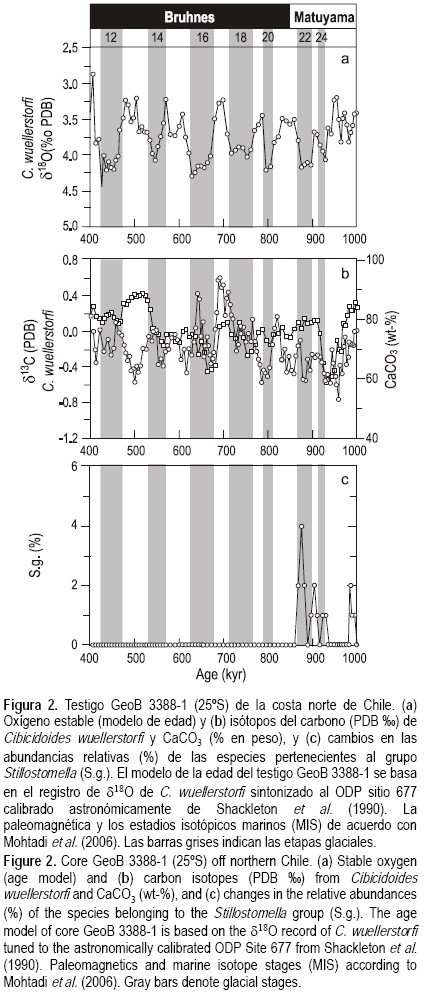
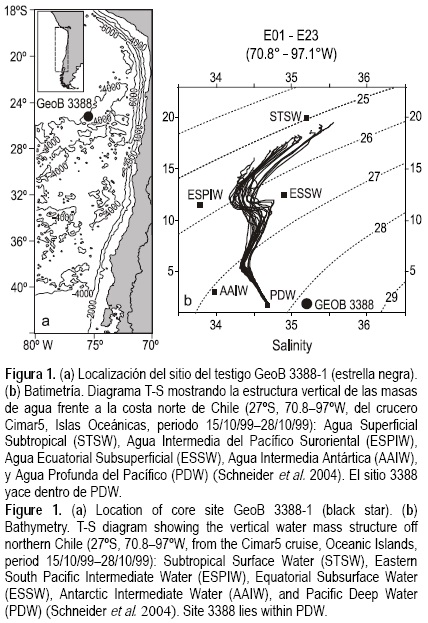
<body><![CDATA[<p align="justify"><font face="verdana" size="2">A&uacute;n no se entiende bien el significado paleoceanogr&aacute;fico de la extinci&oacute;n de <i>Stilostomella,</i> aunque se ha especulado que se relaciona con el enfriamiento glacial total y una mayor ventilaci&oacute;n de las aguas profundas, o con cambios r&aacute;pidos en el suministro de alimentos. El objetivo de este trabajo fue documentar, con mayor detalle, las extinciones de foramin&iacute;feros bent&oacute;nicos de aguas profundas en el Pac&iacute;fico sudoriental usando un testigo fechado de la dorsal de Iquique, frente a la costa norte de Chile (&#126;25&deg;S), debajo del Agua Profunda del Pac&iacute;fico (APP), un &aacute;rea donde se han realizado procos estudios sobre la escala de tiempo de la evoluci&oacute;n Cuaternaria.</font></p>              <p align="justify"><font face="verdana" size="2">&nbsp;</font></p>         <p align="justify"><font face="verdana" size="2"><b>Material y m&eacute;todos</b></font></p>         <p align="justify"><font face="verdana" size="2"><i>Sitio de estudio</i></font></p>              <p align="justify"><font face="verdana" size="2">El testigo de sedimento GeoB 3388&#45;1 fue obtenido bajo las aguas superficiales de la Corriente Per&uacute;&#45;Chile. Esta corriente, la Corriente de Frontera Oriental m&aacute;s larga, se deriva de la bifurcaci&oacute;n de la Corriente Circumpolar Ant&aacute;rtica entre 40&deg;S y 45&deg;S, y se mueve hacia el norte a lo largo de la costa de Sudam&eacute;rica hasta unirse a &#126;5&deg;S con la Corriente Ecuatorial del Sur que fluye hacia el oeste (<a href="#f1">fig. 1a</a>). El Oc&eacute;ano Pac&iacute;fico sudoriental tiene una rica estructura de masas de agua, con aguas que se originan en el Pac&iacute;fico ecuatorial y subtropical al norte y en el Oc&eacute;ano Sur al sur. El Agua Superficial Subtropical de alta salinidad se forma al sur de &#126;5&deg;S y al norte del Frente Subtropical, donde la evaporaci&oacute;n excede la precipitaci&oacute;n (Stramma <i>et al.</i> 1995). Una capa somera de salinidad m&iacute;nima aparece por debajo del Agua Superficial Subtropical (e.g., Reid 1973) y por arriba del Agua Ecuatorial Subsuperficial, de alta salinidad y bajo contenido de ox&iacute;geno, de la Corriente Submarina Gunther que fluye hacia el sur entre 100 y 400 m de profundidad sobre la plataforma y el talud continental frente a la costa central y norte de Chile (Toggweiler <i>et al.</i> 1991). Otra masa de agua m&aacute;s profunda es el Agua Intermedia Ant&aacute;rtica, caracterizada por baja salinidad y alto contenido de ox&iacute;geno, la cual fluye hacia el ecuador entre profundidades de 400 y 1200 m. Por debajo de &eacute;sta prevalece el Agua Profunda del Pac&iacute;fico, que fluye lentamente hacia el sur (<a href="#f1">fig. 1b</a>). Una buena parte de la exportaci&oacute;n de fosfatos y nitratos en el Pac&iacute;fico ocurre en esta &uacute;ltima masa de agua (Wunsch <i>et al.</i> 1983).</font></p>              <p align="center"><font face="verdana" size="2"><a name="f1"></a></font></p>         <p align="center"><font face="verdana" size="2"><img src="/img/revistas/ciemar/v33n3/a7f1.jpg"></font></p>         <p align="justify"><font face="verdana" size="2">El testigo GeoB 3388&#45;1 fue recolectado de la dorsal de Iquique (25&deg;13.2' S, 75&deg;31.5' W, 3558 m de profundidad del agua, 722 cm de largo) durante el crucero CHIPAL (SO&#45;102) a bordo del B/O <i>Sonne</i> en 1995 (Hebbeln <i>et al.</i> 1995, <a href="#f1">fig. 1a</a>). Dos muestras de 10 cm<sup>3</sup> fueron tomadas cada 5 cmy liofilizadas. Se realizaron conteos de todos los foramin&iacute;feros bent&oacute;nicos elongados (&gt;150 &#956;m) en las muestras compactadas de sedimento abarcando el &uacute;ltimo mill&oacute;n de a&ntilde;os, enfoc&aacute;ndose aqu&iacute; s&oacute;lo en el periodo de 1.0 a 0.5 ma AP. Se midi&oacute; la composici&oacute;n de los is&oacute;topos de carbono y del ox&iacute;geno estable de las conchas del foramin&iacute;fero bent&oacute;nico <i>Cibicidoides wuellerstorfi</i> con un espectr&oacute;metro de masas Finnigan MAT 251 (datos tomados de Mohtadi <i>et al.</i> 2006). Para cada medici&oacute;n se seleccionaron 20 conchas individuales (&gt;212 &#956;m). El modelo de edad del testigo GeoB 3388&#45;1 est&aacute; basado en el registro de los is&oacute;topos de ox&iacute;geno estable de <i>C. wuellerstorfi</i> sintonizado al sitio 677 del Programa de Perforaci&oacute;n en el Oc&eacute;ano (ODP por sus siglas en ingl&eacute;s) (Shackleton <i>et al.</i> 1990), el cual es sustentado por an&aacute;lisis paleomagn&eacute;ticos (Mohtadi <i>et al.</i> 2006) (<a href="#f2">fig. 2a</a>). Con base en el modelo de edad, se calcularon las tasas de sedimentaci&oacute;n (TS) lineales para cada edad a partir de la diferencia: TS = D2 &#45; D1/A2 &#45; A1, donde D1/A1 y D2/A2 son la menor/mayor profundidad/edad (cm ka<sup>&#45;1</sup>), respectivamente. Finalmente, para determinar el contenido de carbono org&aacute;nico total (COT), 25 mg del material de muestra triturado fueron descalcificados con HCl 6 N, secados sobre una hornilla a 80&deg;C y medidos en un analizador elemental Heraeus&#45;CHN de acuerdo con M&uuml;ller <i>et al.</i> (1994). El contenido de carbono total (CT) se obtuvo de muestras no tratadas. El contenido de carbonato fue calculado a partir de la diferencia entre los contenidos de CT y COT: CaCO<sub>3</sub> = (TC &#45; TOC) &times; 8.33 (<a href="#f2">fig. 2b</a>).</font></p>         <p align="center"><font face="verdana" size="2"><a name="f2"></a></font></p>         <p align="center"><font face="verdana" size="2"><img src="/img/revistas/ciemar/v33n3/a7f2.jpg"></font></p>         ]]></body>
<body><![CDATA[<p align="justify"><font face="verdana" size="2">&nbsp;</font></p>         <p align="justify"><font face="verdana" size="2"><b>Resultados</b></font></p>         <p align="justify"><font face="verdana" size="2">En el sitio GeoB 3388&#45;1, por lo menos siete especies desaparecieron durante la TMP (grupo <i>Stilostomella;</i> <a href="#f2">figs. 2c</a>, <a href="/img/revistas/ciemar/v33n3/a7f3.jpg" target="_blank">3</a>), incluyendo un miembro de la familia Pleurostomellidae, el foramin&iacute;fero biserial <i>Pleurostomella pleurostomella</i> (Silvestri 1904) (678 cm, 1.0 ma), y todos los miembros de la familia Stilostomellidae: las formas elongadas uniseriales de <i>Myllostomella</i> sp. Hayward 2002 (518 cm, 0.795 ma), <i>Myllostomella costai</i> (Schwager 1866) (588 cm, 0.91 ma), <i>Myllostomella hyugaensis</i> (Ishizaki 1943) (598 cm, 0.92 ma), <i>Siphonodosaria sagrinensis</i> (Bagg 1912) (558 y 583 cm, 0.87 y 0.9 ma), y <i>Siphonodosaria spinea</i> (Cushman 1939) (588 cm, 0.87 ma).</font></p>              <p align="justify"><font face="verdana" size="2">El modelo de edad del testigo GeoB 3388&#45;1 se bas&oacute; en el registro de is&oacute;topos de ox&iacute;geno estable del foramin&iacute;fero bent&oacute;nico <i>C. wuellerstorfi,</i> el cual es sustentado por an&aacute;lisis paleo&#45;magn&eacute;ticos (Mohtadi <i>et al.</i> 2006). El testigo GeoB 3388&#45;1 se remonta a &#45;1.03 ma AP (<a href="#f2">fig. 2a</a>). Por tanto, se pueden observar valores de &#948;<sup>18</sup>O m&aacute;s pesados/ligeros durante los ciclos glaciales/interglaciales (intervalos de 3.4 a 44/2.9 a 4.2, respectivamente), los cuales est&aacute;n relacionados con un mayor/ menor volumen de hielo. Las tasas de sedimentaci&oacute;n variaron entre 0.3 y 1.2 cm ka<sup>&#45;1</sup>, con una media de 0.75 cm ka<sup>&#45;1</sup>, correspondiendo a una resoluci&oacute;n de muestra promedio de 6&#45;7 ka. En general, los valores de &#948;<sup>13</sup>C m&aacute;s ligeros de <i>C. wuellerstorfi</i> (&#948;<sup>13</sup>C) caracterizan los sedimentos depositados entre 0.97 y 0.60 ma (i.e., estadios isot&oacute;picos marinos (MIS por sus siglas en ingl&eacute;s) 21&#45;15), seguidos por un incremento notable durante el MIS 13 interglacial, simult&aacute;neamente con un incremento en el contenido de CaCO3 (<a href="#f2">fig. 2b</a>). A escala glacial/ interglacial, en general se obervan valores de &#948;<sup>13</sup>C m&aacute;s ligeros/ pesados (intervalos de &#45;0.8 a 0.2/3.4 a 4.4, respectivamente), lo que indica un mayor/menor contenido de nutrientes, respectivamente.</font></p>              <p align="justify"><font face="verdana" size="2">&nbsp;</font></p>         <p align="justify"><font face="verdana" size="2"><b>Discusi&oacute;n</b></font></p>         <p align="justify"><font face="verdana" size="2">Los foramin&iacute;feros bent&oacute;nicos generalmente tienen tasas de recambio faunal relativamente lentas seg&uacute;n la estabilidad relativa del ambiente de aguas profundas (McKinney 1987), con varios episodios de mayor intercambio, el &uacute;ltimo de los cuales fue durante la TPM. En el testigo de este estudio, se relacion&oacute; este &uacute;ltimo episodio de mayor extinci&oacute;n global con la &uacute;ltima fecha de aparici&oacute;n (UFA) de siete especies pertenecientes al grupo <i>Stilostomella: Myllostomella</i> sp., <i>M.costai, M. hyugaensis, Siphonodosaria sagrinensis, S. spinea</i> y <i>Pleurostomella pleurostomella.</i> Estas especies fueron documentadas en trabajos previos (Hayward 2001, 2002; Hayward <i>et al.</i> 2006; Kawagata <i>et al.</i> 2006, y respectivas referencias), lo que sugiere que sus extinciones fueron eventos mundiales.</font></p>              <p align="justify"><font face="verdana" size="2">La desaparici&oacute;n de las especies del grupo <i>Stilostomella</i> ha sido registrada a nivel mundial. La UFA menor (0.8 ma) del testigo GeoB 3388&#45;1 est&aacute; dentro del intervalo ya documentado (1.0 a 0.6 ma; Weinholz y Lutze 1989; Sch&oacute;nfeld 1996; Hayward 2001, 2002; Hayward <i>et al.</i> 2006). De manera interesante, en otro reporte se indica que la extinci&oacute;n de <i>Stilostomella</i> en el Pac&iacute;fico sudoriental (ODP sitio 861, 45&deg;51' S, 75&deg;41' W, 1652 m de profundidad del agua) sucedi&oacute; m&aacute;s temprano (1.3 ma) que en otras partes de los oc&eacute;anos mundiales (1 a 0.6 ma) (Gavriloff 2006) y tambi&eacute;n cae dentro del intervalo documentado para la extinci&oacute;n de <i>Stilostomella.</i></font></p>              <p align="justify"><font face="verdana" size="2">Entre las causas de los resultados de nuestro reporte anterior sobre la UFA del grupo <i>Stilostomella</i> se encuentran: la fracci&oacute;n del tama&ntilde;o utilizada (&gt;150 &#956;m en vez de &gt;63 &#956;m, Hayward 2001) y los cambios en las propiedades de la masa de agua (en realidad APP) que ba&ntilde;&oacute; nuestro testigo GeoB 3388&#45;1 (3.5 km de profundidad).</font></p>              <p align="justify"><font face="verdana" size="2">En otros trabajos se ha resaltado la importancia de los cambios en las masas de agua con relaci&oacute;n a la extinci&oacute;n del grupo <i>Stilostomella.</i> Kawagata <i>et al.</i> (2005) relacionaron la desaparici&oacute;n m&aacute;s temprana en el sitio 758 del Oc&eacute;ano &Iacute;ndico (2925 m), en comparaci&oacute;n con el sitio m&aacute;s somero 722 (2045 m), con cambios oceanogr&aacute;ficos ocurridos antes en masas de agua profundas (e.g., agua de fondo de origen Ant&aacute;rtico) que en masas de agua intermedias (e.g., Agua Intermedia Glacial del Atl&aacute;ntico Norte). Asimismo, Hayward (2001) sugiri&oacute; que la desaparici&oacute;n de las formas elongadas uniseriales est&aacute; relacionada con masas de agua m&aacute;s fr&iacute;as y probablemente m&aacute;s oxigenadas, lo cual indica cambios en la circulaci&oacute;n del agua profunda. Los cambios en las masas de agua afectan el suministro y la calidad del alimento de los foramin&iacute;foros bent&oacute;nicos. Se ha sugerido que las especies que pertenecen al grupo <i>Stilostomella</i> estaban bien adaptadas a condiciones de alto flujo de carbono/bajo contenido de ox&iacute;geno. Con base en nuestros datos, se puede observar que a escala glacial/interglacial existen cambios en los valores de &#948;<sup>13</sup>C que se han asociado con cambios en el reservorio de carbono (Mohtadi <i>et al.</i> 2006), probablemente el contenido de nutrientes (con valores m&aacute;s ligeros/pesados indicando m&aacute;s/menos nutrientes). No obstante, de 1 a 0.5 ma el contenido medio de carbono org&aacute;nico en el sedimento del testigo GeoB 3388&#45;1 es constante y bajo (&lt;0.5%), lo que sugiere un desfase entre la se&ntilde;al de &#948;<sup>13</sup>C como marcador de nutrientes y la preservaci&oacute;n del carbono org&aacute;nico en nuestros sedimentos. El periodo de la extinci&oacute;n mundial del grupo <i>Stilostomella</i> se caracteriza por un bajo contenido de CaCO3 en el sitio de nuestro testigo en comparaci&oacute;n con otros valores documentados, especialmente del MIS 15 al MIS 13 (<a href="#f2">fig. 2b</a>). Se han asociado los cambios en la preservaci&oacute;n de carbonatos durante la TPM con los cambios en la intensidad de la formaci&oacute;n del agua profunda del Atl&aacute;ntico Norte, as&iacute; como con el crecimiento de s&aacute;banas de hielo en los &uacute;ltimos 0.9 ma (MIS 22) (Schmieder <i>et al.</i> 2000). Estos resultados confirman el acontecimiento de cambios importantes en los flujos de carbono y las condiciones qu&iacute;micas de los carbonates frente a la costa norte de Chile durante la TPM. Como el carbono org&aacute;nico de nuestro testigo GeoB 3388&#45;1 no cambia a lo largo del periodo y con base en los datos disponibles, relacionamos las causas de la extinci&oacute;n discutidas m&aacute;s con el ox&iacute;geno que con la disponibilidad de alimento.</font></p>              ]]></body>
<body><![CDATA[<p align="justify"><font face="verdana" size="2">&nbsp;</font></p>         <p align="justify"><font face="verdana" size="2"><b>Agradecimientos</b></font></p>         <p align="justify"><font face="verdana" size="2">Este trabajo fue apoyado por los programas de becas DAAD y MCESUP/UCO&#45;0002, el Centro de Investigaci&oacute;n Oceanogr&aacute;fica en el Pac&iacute;fico Suroriental (FONDAP&#45;COPAS Proyecto No. 150100007), la Comisi&oacute;n Nacional Chilena de Ciencia y Tecnolog&iacute;a (FONDECYT No. 1040968), y la Secretar&iacute;a Federal de Educaci&oacute;n e Investigaci&oacute;n de Alemania (BMBF) a trav&eacute;s de financiamiento del proyecto CHIPAL y el crucero a bordo del B/O <i>Sonne</i> (SO&#45;102). Agradecemos al capitan y la tripulaci&oacute;n del B/O <i>Sonne</i> sus esfuerzos y apoyo durante el crucero, as&iacute; como a M Segl y B Meyer&#45;Schack su apoyo en las mediciones de los is&oacute;topos estables.</font></p>              <p align="justify"><font face="verdana" size="2">Traducido al espa&ntilde;ol por Christine Harris.</font></p>              <p align="justify"><font face="verdana" size="2">&nbsp;</font></p>         <p align="justify"><font face="verdana" size="2"><b>Referencias</b></font></p>         <!-- ref --><p align="justify"><font face="verdana" size="2">Bagg RM Jr. 1912. Pliocene and Pleistocene foraminifera from Southern California. Bull. US Geol. Surv. 513: 1&#45;153.    &nbsp;&nbsp;&nbsp;&nbsp;&nbsp;&nbsp;&nbsp;&nbsp;[&#160;<a href="javascript:void(0);" onclick="javascript: window.open('/scielo.php?script=sci_nlinks&ref=1904477&pid=S0185-3880200700030000700001&lng=','','width=640,height=500,resizable=yes,scrollbars=1,menubar=yes,');">Links</a>&#160;]<!-- end-ref --></font></p>              <!-- ref --><p align="justify"><font face="verdana" size="2">Berger A, M&eacute;lice JL, Loutre MF. 2005. On the origin of the 100&#45;kyr cycles in the astronomical forcing. Paleoceanography 20: doi:10.1029/2005PA001173.    &nbsp;&nbsp;&nbsp;&nbsp;&nbsp;&nbsp;&nbsp;&nbsp;[&#160;<a href="javascript:void(0);" onclick="javascript: window.open('/scielo.php?script=sci_nlinks&ref=1904479&pid=S0185-3880200700030000700002&lng=','','width=640,height=500,resizable=yes,scrollbars=1,menubar=yes,');">Links</a>&#160;]<!-- end-ref --></font></p>              ]]></body>
<body><![CDATA[<!-- ref --><p align="justify"><font face="verdana" size="2">Berger WH, Jansen E. 1994. Mid&#45;Pleistocene shift: The Nansen connection. Geophys. Monogr. 84: 295&#45;311.    &nbsp;&nbsp;&nbsp;&nbsp;&nbsp;&nbsp;&nbsp;&nbsp;[&#160;<a href="javascript:void(0);" onclick="javascript: window.open('/scielo.php?script=sci_nlinks&ref=1904481&pid=S0185-3880200700030000700003&lng=','','width=640,height=500,resizable=yes,scrollbars=1,menubar=yes,');">Links</a>&#160;]<!-- end-ref --></font></p>              <!-- ref --><p align="justify"><font face="verdana" size="2">Caralp MH. 1985. Quaternary calcareous benthic foraminifers, Leg 80. In: De Graciansky PC <i>et al.</i> (eds.), Initial Reports of the Deep Sea Drilling Project. US Government Printing Office, Washington DC, pp. 725&#45;755.    &nbsp;&nbsp;&nbsp;&nbsp;&nbsp;&nbsp;&nbsp;&nbsp;[&#160;<a href="javascript:void(0);" onclick="javascript: window.open('/scielo.php?script=sci_nlinks&ref=1904483&pid=S0185-3880200700030000700004&lng=','','width=640,height=500,resizable=yes,scrollbars=1,menubar=yes,');">Links</a>&#160;]<!-- end-ref --></font></p>              <!-- ref --><p align="justify"><font face="verdana" size="2">Cushman JA. 1939. Eocene foraminifera from submarine cores off the eastern coast of North America. Contrib. Cushman Lab. Foraminifer. Res. 15: 49&#45;76.    &nbsp;&nbsp;&nbsp;&nbsp;&nbsp;&nbsp;&nbsp;&nbsp;[&#160;<a href="javascript:void(0);" onclick="javascript: window.open('/scielo.php?script=sci_nlinks&ref=1904485&pid=S0185-3880200700030000700005&lng=','','width=640,height=500,resizable=yes,scrollbars=1,menubar=yes,');">Links</a>&#160;]<!-- end-ref --> </font></p>         <!-- ref --><p align="justify"><font face="verdana" size="2">Gavriloff I. 2006. The mid&#45;Pleistocene <i>Stilostomella</i> extinction event in the southeast Pacific Ocean: A review. Anu. Inst. Geocien., UFRJ ISSN 0101&#45;9759, 29 : 490&#45;491.    &nbsp;&nbsp;&nbsp;&nbsp;&nbsp;&nbsp;&nbsp;&nbsp;[&#160;<a href="javascript:void(0);" onclick="javascript: window.open('/scielo.php?script=sci_nlinks&ref=1904487&pid=S0185-3880200700030000700006&lng=','','width=640,height=500,resizable=yes,scrollbars=1,menubar=yes,');">Links</a>&#160;]<!-- end-ref --> </font></p>         <!-- ref --><p align="justify"><font face="verdana" size="2">Gupta AK. 1993. Biostratigraphic vs. paleoceaonographic importance of <i>Stilostomella lepidula</i> (Schwager) in the Indian Ocean. Micropaleontology 39: 47&#45;52.    &nbsp;&nbsp;&nbsp;&nbsp;&nbsp;&nbsp;&nbsp;&nbsp;[&#160;<a href="javascript:void(0);" onclick="javascript: window.open('/scielo.php?script=sci_nlinks&ref=1904489&pid=S0185-3880200700030000700007&lng=','','width=640,height=500,resizable=yes,scrollbars=1,menubar=yes,');">Links</a>&#160;]<!-- end-ref --> </font></p>         ]]></body>
<body><![CDATA[<!-- ref --><p align="justify"><font face="verdana" size="2">Hayward BW. 2001. Global deep&#45;sea extinctions during the Pleistocene ice&#45;ages. Geology 29: 599&#45;602.    &nbsp;&nbsp;&nbsp;&nbsp;&nbsp;&nbsp;&nbsp;&nbsp;[&#160;<a href="javascript:void(0);" onclick="javascript: window.open('/scielo.php?script=sci_nlinks&ref=1904491&pid=S0185-3880200700030000700008&lng=','','width=640,height=500,resizable=yes,scrollbars=1,menubar=yes,');">Links</a>&#160;]<!-- end-ref --> </font></p>         <!-- ref --><p align="justify"><font face="verdana" size="2">Hayward BW. 2002. Late Pliocene to middle Pleistocene extinctions of deep&#45;sea benthic foraminifera <i>("Stilostomella</i> extinction") in the Southwest Pacific. J. Foraminifer. Res. 32: 274&#45;306.    &nbsp;&nbsp;&nbsp;&nbsp;&nbsp;&nbsp;&nbsp;&nbsp;[&#160;<a href="javascript:void(0);" onclick="javascript: window.open('/scielo.php?script=sci_nlinks&ref=1904493&pid=S0185-3880200700030000700009&lng=','','width=640,height=500,resizable=yes,scrollbars=1,menubar=yes,');">Links</a>&#160;]<!-- end-ref --> </font></p>         <!-- ref --><p align="justify"><font face="verdana" size="2">Hayward BW, Kawagata S. 2005. Extinct foraminifera figured in Brady's Challenger Report. J. Micropalaeontol. 24: 171&#45;175.    &nbsp;&nbsp;&nbsp;&nbsp;&nbsp;&nbsp;&nbsp;&nbsp;[&#160;<a href="javascript:void(0);" onclick="javascript: window.open('/scielo.php?script=sci_nlinks&ref=1904495&pid=S0185-3880200700030000700010&lng=','','width=640,height=500,resizable=yes,scrollbars=1,menubar=yes,');">Links</a>&#160;]<!-- end-ref --> </font></p>         <!-- ref --><p align="justify"><font face="verdana" size="2">Hayward BW, Kawagata S, Grenfell HR, Droxler AW, Shearer, M. 2006. Mid&#45;Pleistocene extinction of bathyal benthic foraminifera in the Caribbean Sea. Micropaleontology 52: 53&#45;73.    &nbsp;&nbsp;&nbsp;&nbsp;&nbsp;&nbsp;&nbsp;&nbsp;[&#160;<a href="javascript:void(0);" onclick="javascript: window.open('/scielo.php?script=sci_nlinks&ref=1904497&pid=S0185-3880200700030000700011&lng=','','width=640,height=500,resizable=yes,scrollbars=1,menubar=yes,');">Links</a>&#160;]<!-- end-ref --></font></p>         <!-- ref --><p align="justify"><font face="verdana" size="2">Hebbeln D. <i>et al.</i> 1995. Report and preliminary results of SONNE Cruise SO 102, Valparaiso&#45;Valparaiso, 95. pp. 1&#45;134.    &nbsp;&nbsp;&nbsp;&nbsp;&nbsp;&nbsp;&nbsp;&nbsp;[&#160;<a href="javascript:void(0);" onclick="javascript: window.open('/scielo.php?script=sci_nlinks&ref=1904499&pid=S0185-3880200700030000700012&lng=','','width=640,height=500,resizable=yes,scrollbars=1,menubar=yes,');">Links</a>&#160;]<!-- end-ref --></font></p>              ]]></body>
<body><![CDATA[<!-- ref --><p align="justify"><font face="verdana" size="2">Hess S, Kuhnt W. 2005. Neogene and Quaternary paleoceanographic changes in the southern South China Sea (Site 1143): The benthic foraminiferal record. Mar. Micropaleontol. 54: 63&#45;87.    &nbsp;&nbsp;&nbsp;&nbsp;&nbsp;&nbsp;&nbsp;&nbsp;[&#160;<a href="javascript:void(0);" onclick="javascript: window.open('/scielo.php?script=sci_nlinks&ref=1904501&pid=S0185-3880200700030000700013&lng=','','width=640,height=500,resizable=yes,scrollbars=1,menubar=yes,');">Links</a>&#160;]<!-- end-ref --></font></p>              <!-- ref --><p align="justify"><font face="verdana" size="2">Imbrie J, Berger A, Boyle EA, Clemens SC, Duffy A, Howard WR, Kukla G, Kutzbach J, Martinson DG, McIntyre A, Mix AC, Molfino B, Morley JJ, Peterson LC, Pisias NG, Prell WL, Raymo ME, Shackleton NJ, Toggweiler JR. 1993. On the structure and origin of major glaciation cycles. 2. The 100,000&#45;year cycle. Paleoceanography 8: 699&#45;735.    &nbsp;&nbsp;&nbsp;&nbsp;&nbsp;&nbsp;&nbsp;&nbsp;[&#160;<a href="javascript:void(0);" onclick="javascript: window.open('/scielo.php?script=sci_nlinks&ref=1904503&pid=S0185-3880200700030000700014&lng=','','width=640,height=500,resizable=yes,scrollbars=1,menubar=yes,');">Links</a>&#160;]<!-- end-ref --></font></p>              <!-- ref --><p align="justify"><font face="verdana" size="2">Ishizaki K. 1943. On the species of <i>Ellipsonodosaria</i> from Japan. Trans. Nat. Hist. Soc. Taiwan 33: 678&#45;689.    &nbsp;&nbsp;&nbsp;&nbsp;&nbsp;&nbsp;&nbsp;&nbsp;[&#160;<a href="javascript:void(0);" onclick="javascript: window.open('/scielo.php?script=sci_nlinks&ref=1904505&pid=S0185-3880200700030000700015&lng=','','width=640,height=500,resizable=yes,scrollbars=1,menubar=yes,');">Links</a>&#160;]<!-- end-ref --></font></p>              <!-- ref --><p align="justify"><font face="verdana" size="2">Jian Z, Wang P, Chen M&#45;P, Zhao Q, Buhring C, Laj C, Lin H&#45;L, Pflaumann U, Bian Y, Wang R, Cheng X. 2000. Foraminiferal response to major Pleistocene paleoceanographic changes in the southern China Sea. Paleoceanography 15: 229&#45;243.    &nbsp;&nbsp;&nbsp;&nbsp;&nbsp;&nbsp;&nbsp;&nbsp;[&#160;<a href="javascript:void(0);" onclick="javascript: window.open('/scielo.php?script=sci_nlinks&ref=1904507&pid=S0185-3880200700030000700016&lng=','','width=640,height=500,resizable=yes,scrollbars=1,menubar=yes,');">Links</a>&#160;]<!-- end-ref --></font></p>              <!-- ref --><p align="justify"><font face="verdana" size="2">Kaiho K. 1992. Eocene to Quaternary benthic foraminifers and paleobathymetry of the Izu&#45;Bonin Arc, Legs 125 and 126. In: Taylor B <i>et al.</i> (eds.), Proceedings of the Ocean Drilling Program, Scientific Results. College Station, Texas, pp. 285&#45;310.    &nbsp;&nbsp;&nbsp;&nbsp;&nbsp;&nbsp;&nbsp;&nbsp;[&#160;<a href="javascript:void(0);" onclick="javascript: window.open('/scielo.php?script=sci_nlinks&ref=1904509&pid=S0185-3880200700030000700017&lng=','','width=640,height=500,resizable=yes,scrollbars=1,menubar=yes,');">Links</a>&#160;]<!-- end-ref --></font></p>              ]]></body>
<body><![CDATA[<!-- ref --><p align="justify"><font face="verdana" size="2">Kawagata S, Hayward BW, Grenfell, HR, Sabaa AT. 2005. Mid&#45;Pleistocene extinction of deep&#45;sea foraminifera in the North Atlantic Gateway (ODP Sites 980 and 982). Palaeogeogr. Palaeoclimatol. Palaeoecol. 221: 267&#45;291.    &nbsp;&nbsp;&nbsp;&nbsp;&nbsp;&nbsp;&nbsp;&nbsp;[&#160;<a href="javascript:void(0);" onclick="javascript: window.open('/scielo.php?script=sci_nlinks&ref=1904511&pid=S0185-3880200700030000700018&lng=','','width=640,height=500,resizable=yes,scrollbars=1,menubar=yes,');">Links</a>&#160;]<!-- end-ref --></font></p>              <!-- ref --><p align="justify"><font face="verdana" size="2">Kawagata S, Hayward BW, Gupta AK. 2006. Benthic foraminiferal extinctions linked to late Pliocene&#45;Pleistocene deep&#45;sea circulation changes in the northern Indian Ocean (ODP Sites 722 and 758). Mar. Micropaleontol. 58: 219&#45;242.    &nbsp;&nbsp;&nbsp;&nbsp;&nbsp;&nbsp;&nbsp;&nbsp;[&#160;<a href="javascript:void(0);" onclick="javascript: window.open('/scielo.php?script=sci_nlinks&ref=1904513&pid=S0185-3880200700030000700019&lng=','','width=640,height=500,resizable=yes,scrollbars=1,menubar=yes,');">Links</a>&#160;]<!-- end-ref --></font></p>              <!-- ref --><p align="justify"><font face="verdana" size="2">Kawagata S, Hayward BW, Kuhnt W. Extinction of deep&#45;sea foraminifera as a result of Pliocene&#45;Pleistocene deep&#45;sea circulation changes in the South China Sea (ODP Sites 1143 and 1146). Quaternary. Sci. Rev. 26: 808&#45;827.    &nbsp;&nbsp;&nbsp;&nbsp;&nbsp;&nbsp;&nbsp;&nbsp;[&#160;<a href="javascript:void(0);" onclick="javascript: window.open('/scielo.php?script=sci_nlinks&ref=1904515&pid=S0185-3880200700030000700020&lng=','','width=640,height=500,resizable=yes,scrollbars=1,menubar=yes,');">Links</a>&#160;]<!-- end-ref --></font></p>              <!-- ref --><p align="justify"><font face="verdana" size="2">Keller G. 1980. Benthic foraminifers and paleobathymetry of the Japan Trench area, Leg 57, Deep Sea Drilling Project. In: Von Huene R <i>et al.</i> (eds.), Initial Reports of the Deep Sea Drilling Project. US Government Printing Office, Washington DC, pp. 835&#45;865.    &nbsp;&nbsp;&nbsp;&nbsp;&nbsp;&nbsp;&nbsp;&nbsp;[&#160;<a href="javascript:void(0);" onclick="javascript: window.open('/scielo.php?script=sci_nlinks&ref=1904517&pid=S0185-3880200700030000700021&lng=','','width=640,height=500,resizable=yes,scrollbars=1,menubar=yes,');">Links</a>&#160;]<!-- end-ref --></font></p>              <!-- ref --><p align="justify"><font face="verdana" size="2">Lutze GF. 1979. Benthic foraminifera at Site 397: Fluctuations and ranges in the Quaternary. In: Von Rad U <i>et al.</i> (eds.), Initial Reports of the Ocean Drilling Program. Vol. 47. US Government Printing Office, Washington DC, pp. 419&#45; 431.    &nbsp;&nbsp;&nbsp;&nbsp;&nbsp;&nbsp;&nbsp;&nbsp;[&#160;<a href="javascript:void(0);" onclick="javascript: window.open('/scielo.php?script=sci_nlinks&ref=1904519&pid=S0185-3880200700030000700022&lng=','','width=640,height=500,resizable=yes,scrollbars=1,menubar=yes,');">Links</a>&#160;]<!-- end-ref --></font></p>              ]]></body>
<body><![CDATA[<!-- ref --><p align="justify"><font face="verdana" size="2">McKinney ML. 1987. Taxonomic selectivity and continuous variation in mass and background extinctions of marine taxa. Nature 325: 143&#45;145.    &nbsp;&nbsp;&nbsp;&nbsp;&nbsp;&nbsp;&nbsp;&nbsp;[&#160;<a href="javascript:void(0);" onclick="javascript: window.open('/scielo.php?script=sci_nlinks&ref=1904521&pid=S0185-3880200700030000700023&lng=','','width=640,height=500,resizable=yes,scrollbars=1,menubar=yes,');">Links</a>&#160;]<!-- end-ref --></font></p>              <!-- ref --><p align="justify"><font face="verdana" size="2">Mohtadi M, Hebbeln D, N&uuml;nez&#45;Ricardo S, Lange CB. 2006. El Ninolike pattern in the Pacific during marine isotope stages (MIS) 13 and 11. Paleoceanography 21: PA1015, doi:10.1029/2005PA001190.    &nbsp;&nbsp;&nbsp;&nbsp;&nbsp;&nbsp;&nbsp;&nbsp;[&#160;<a href="javascript:void(0);" onclick="javascript: window.open('/scielo.php?script=sci_nlinks&ref=1904523&pid=S0185-3880200700030000700024&lng=','','width=640,height=500,resizable=yes,scrollbars=1,menubar=yes,');">Links</a>&#160;]<!-- end-ref --></font></p>              <!-- ref --><p align="justify"><font face="verdana" size="2">M&uuml;ller PJ, Schneider R, Ruhland G. 1994. Late Quaternary PCO<sub>2</sub> variations in the Angola Current: Evidence from organic carbon &#948;<sup>13</sup>C and alkenone temperature. In: Zahn R, Pedersen TF, Kaminski MA, Labeyrie L. (eds.), Carbon Cycling in the Glacial Ocean: Constraints on the Ocean's Role in Global Change. NATO ASI Ser., Springer&#45;Verlag, New York, Vol. I, pp. 343&#45;366.    &nbsp;&nbsp;&nbsp;&nbsp;&nbsp;&nbsp;&nbsp;&nbsp;[&#160;<a href="javascript:void(0);" onclick="javascript: window.open('/scielo.php?script=sci_nlinks&ref=1904525&pid=S0185-3880200700030000700025&lng=','','width=640,height=500,resizable=yes,scrollbars=1,menubar=yes,');">Links</a>&#160;]<!-- end-ref --></font></p>              <!-- ref --><p align="justify"><font face="verdana" size="2">O'Neill TA, Hayward BW, Kawagata S, Sabaa AT, Grenfell HR. Pleistocene extinctions of deep&#45;sea foraminifera: The South Atlantic record. J. Palaeontology (in press).    &nbsp;&nbsp;&nbsp;&nbsp;&nbsp;&nbsp;&nbsp;&nbsp;[&#160;<a href="javascript:void(0);" onclick="javascript: window.open('/scielo.php?script=sci_nlinks&ref=1904527&pid=S0185-3880200700030000700026&lng=','','width=640,height=500,resizable=yes,scrollbars=1,menubar=yes,');">Links</a>&#160;]<!-- end-ref --> </font></p>         <!-- ref --><p align="justify"><font face="verdana" size="2">Palmer DK, Berm&uuml;dez PJ. 1936. An Oligocene foraminiferal fauna from Cuba. Mem. Soc. Cubana Hist. Nat. Felipe Poey 10: 227&#45;271.    &nbsp;&nbsp;&nbsp;&nbsp;&nbsp;&nbsp;&nbsp;&nbsp;[&#160;<a href="javascript:void(0);" onclick="javascript: window.open('/scielo.php?script=sci_nlinks&ref=1904529&pid=S0185-3880200700030000700027&lng=','','width=640,height=500,resizable=yes,scrollbars=1,menubar=yes,');">Links</a>&#160;]<!-- end-ref --></font></p>         ]]></body>
<body><![CDATA[<!-- ref --><p align="justify"><font face="verdana" size="2">Raymo ME, Oppo DW, Curry W. 1997. The mid&#45;Pleistocene climate transition: A deep sea carbon isotopic perspective. Paleoceanography 12: 546&#45;559.    &nbsp;&nbsp;&nbsp;&nbsp;&nbsp;&nbsp;&nbsp;&nbsp;[&#160;<a href="javascript:void(0);" onclick="javascript: window.open('/scielo.php?script=sci_nlinks&ref=1904531&pid=S0185-3880200700030000700028&lng=','','width=640,height=500,resizable=yes,scrollbars=1,menubar=yes,');">Links</a>&#160;]<!-- end-ref --></font></p>              <!-- ref --><p align="justify"><font face="verdana" size="2">Reid JL. 1973. The shallow salinity minima of the Pacific Ocean. Deep&#45;Sea Res. 20: 51&#45;68.    &nbsp;&nbsp;&nbsp;&nbsp;&nbsp;&nbsp;&nbsp;&nbsp;[&#160;<a href="javascript:void(0);" onclick="javascript: window.open('/scielo.php?script=sci_nlinks&ref=1904533&pid=S0185-3880200700030000700029&lng=','','width=640,height=500,resizable=yes,scrollbars=1,menubar=yes,');">Links</a>&#160;]<!-- end-ref --></font></p>              <!-- ref --><p align="justify"><font face="verdana" size="2">Ruddiman WF. 2003. Orbital insolation, ice volume, and greenhouse gases. Quatern. Sci. Rev. 22: 1597&#45;1629.    &nbsp;&nbsp;&nbsp;&nbsp;&nbsp;&nbsp;&nbsp;&nbsp;[&#160;<a href="javascript:void(0);" onclick="javascript: window.open('/scielo.php?script=sci_nlinks&ref=1904535&pid=S0185-3880200700030000700030&lng=','','width=640,height=500,resizable=yes,scrollbars=1,menubar=yes,');">Links</a>&#160;]<!-- end-ref --></font></p>              <!-- ref --><p align="justify"><font face="verdana" size="2">Schmieder F, von Dobeneck T, Bleil U. 2000. The mid&#45;Pleistocene climate transition as documented in the deep South Atlantic Ocean: Initiation, interim state and terminal event. Earth Planet. Sci. Lett. 179: 539&#45;549.    &nbsp;&nbsp;&nbsp;&nbsp;&nbsp;&nbsp;&nbsp;&nbsp;[&#160;<a href="javascript:void(0);" onclick="javascript: window.open('/scielo.php?script=sci_nlinks&ref=1904537&pid=S0185-3880200700030000700031&lng=','','width=640,height=500,resizable=yes,scrollbars=1,menubar=yes,');">Links</a>&#160;]<!-- end-ref --></font></p>              <!-- ref --><p align="justify"><font face="verdana" size="2">Schneider W, Fuenzalida R, Garc&eacute;s J. 2004. Corrientes marinas y masas de agua. In: Werlinger C (eds.), Biolog&iacute;a Marina y Oceanograf&iacute;a: Conceptos y Procesos. Vol. 1. Universidad de Concepci&oacute;n, Chile, pp. 177&#45;194.    &nbsp;&nbsp;&nbsp;&nbsp;&nbsp;&nbsp;&nbsp;&nbsp;[&#160;<a href="javascript:void(0);" onclick="javascript: window.open('/scielo.php?script=sci_nlinks&ref=1904539&pid=S0185-3880200700030000700032&lng=','','width=640,height=500,resizable=yes,scrollbars=1,menubar=yes,');">Links</a>&#160;]<!-- end-ref --></font></p>              ]]></body>
<body><![CDATA[<!-- ref --><p align="justify"><font face="verdana" size="2">Sch&ouml;nfeld J. 1995. Biostratigraphy and assemblage composition of benthic foraminifera from the Manihiki Plateau, southwestern tropical Pacific. J. Micropalaeontol. 14: 165&#45;175.    &nbsp;&nbsp;&nbsp;&nbsp;&nbsp;&nbsp;&nbsp;&nbsp;[&#160;<a href="javascript:void(0);" onclick="javascript: window.open('/scielo.php?script=sci_nlinks&ref=1904541&pid=S0185-3880200700030000700033&lng=','','width=640,height=500,resizable=yes,scrollbars=1,menubar=yes,');">Links</a>&#160;]<!-- end-ref --></font></p>              <!-- ref --><p align="justify"><font face="verdana" size="2">Sch&ouml;nfeld J. 1996. The <i>"Stilostomella</i> Extinction": Structure and dynamics of the last turn&#45;over in deep&#45;sea benthic foraminiferal assemblages. In: Moguielvsky EA, Whatley R (eds.), Microfossils and Oceanic Environments. Aberystwyth Press, Wales, pp. 27&#45;37.    &nbsp;&nbsp;&nbsp;&nbsp;&nbsp;&nbsp;&nbsp;&nbsp;[&#160;<a href="javascript:void(0);" onclick="javascript: window.open('/scielo.php?script=sci_nlinks&ref=1904543&pid=S0185-3880200700030000700034&lng=','','width=640,height=500,resizable=yes,scrollbars=1,menubar=yes,');">Links</a>&#160;]<!-- end-ref --></font></p>              <!-- ref --><p align="justify"><font face="verdana" size="2">Sch&ouml;nfeld J, Spiegler D. 1995. Benthic foraminiferal biostratigraphy of Site 861, Chile Triple Junction, Southeastern Pacific. In: Lewis SD <i>et al.</i> (eds.), Proceedings of the Ocean Drilling Program: Scientific Results. Vol. 141. College Station, Texas, pp. 213&#45; 224.    &nbsp;&nbsp;&nbsp;&nbsp;&nbsp;&nbsp;&nbsp;&nbsp;[&#160;<a href="javascript:void(0);" onclick="javascript: window.open('/scielo.php?script=sci_nlinks&ref=1904545&pid=S0185-3880200700030000700035&lng=','','width=640,height=500,resizable=yes,scrollbars=1,menubar=yes,');">Links</a>&#160;]<!-- end-ref --></font></p>              <!-- ref --><p align="justify"><font face="verdana" size="2">Schwager C. 1866. Fossile Foraminiferen von Kar Nicobar: Novara Expeditions. Geol. Theil. 2: 187&#45;268.    &nbsp;&nbsp;&nbsp;&nbsp;&nbsp;&nbsp;&nbsp;&nbsp;[&#160;<a href="javascript:void(0);" onclick="javascript: window.open('/scielo.php?script=sci_nlinks&ref=1904547&pid=S0185-3880200700030000700036&lng=','','width=640,height=500,resizable=yes,scrollbars=1,menubar=yes,');">Links</a>&#160;]<!-- end-ref --></font></p>              <!-- ref --><p align="justify"><font face="verdana" size="2">Shackleton NJ, Berger A, Peltier WR. 1990. An alternative astronomical calibration of the lower Pleistocene timescale based on ODP Site 677. Trans. R. Soc. Edinb. Earth Sci. 81: 251&#45;261.    &nbsp;&nbsp;&nbsp;&nbsp;&nbsp;&nbsp;&nbsp;&nbsp;[&#160;<a href="javascript:void(0);" onclick="javascript: window.open('/scielo.php?script=sci_nlinks&ref=1904549&pid=S0185-3880200700030000700037&lng=','','width=640,height=500,resizable=yes,scrollbars=1,menubar=yes,');">Links</a>&#160;]<!-- end-ref --></font></p>              ]]></body>
<body><![CDATA[<!-- ref --><p align="justify"><font face="verdana" size="2">Silvestri O. 1904. Forme nuove o poco conosciute di Protozoi miocenici piemontesi. Atti Accad. Sci. Torino (1903&#45;1904) 39: 415.    &nbsp;&nbsp;&nbsp;&nbsp;&nbsp;&nbsp;&nbsp;&nbsp;[&#160;<a href="javascript:void(0);" onclick="javascript: window.open('/scielo.php?script=sci_nlinks&ref=1904551&pid=S0185-3880200700030000700038&lng=','','width=640,height=500,resizable=yes,scrollbars=1,menubar=yes,');">Links</a>&#160;]<!-- end-ref --></font></p>              <!-- ref --><p align="justify"><font face="verdana" size="2">Stramma L, Peterson RG, Tomczak M. 1995. The South Pacific Current. J. Phys. Oceanogr. 25: 77&#45; 91.    &nbsp;&nbsp;&nbsp;&nbsp;&nbsp;&nbsp;&nbsp;&nbsp;[&#160;<a href="javascript:void(0);" onclick="javascript: window.open('/scielo.php?script=sci_nlinks&ref=1904553&pid=S0185-3880200700030000700039&lng=','','width=640,height=500,resizable=yes,scrollbars=1,menubar=yes,');">Links</a>&#160;]<!-- end-ref --></font></p>              <!-- ref --><p align="justify"><font face="verdana" size="2">Thomas E. 1987. Late Oligocene to Recent deep&#45;sea benthic foraminifera from the central equatorial Pacific Ocean. In: Ruddiman WF <i>et al.</i> (eds.), Initial Reports of the Deep Sea Drilling Project. Vol. 94. US Government Printing Office, Washington DC, pp. 997&#45;1032.    &nbsp;&nbsp;&nbsp;&nbsp;&nbsp;&nbsp;&nbsp;&nbsp;[&#160;<a href="javascript:void(0);" onclick="javascript: window.open('/scielo.php?script=sci_nlinks&ref=1904555&pid=S0185-3880200700030000700040&lng=','','width=640,height=500,resizable=yes,scrollbars=1,menubar=yes,');">Links</a>&#160;]<!-- end-ref --></font></p>              <!-- ref --><p align="justify"><font face="verdana" size="2">Toggweiler JR, Dixon K, Broecker WS. 1991. The Peru upwelling and the ventilation of the South Pacific thermocline. J. Geophys. Res. 20: 467&#45;497.    &nbsp;&nbsp;&nbsp;&nbsp;&nbsp;&nbsp;&nbsp;&nbsp;[&#160;<a href="javascript:void(0);" onclick="javascript: window.open('/scielo.php?script=sci_nlinks&ref=1904557&pid=S0185-3880200700030000700041&lng=','','width=640,height=500,resizable=yes,scrollbars=1,menubar=yes,');">Links</a>&#160;]<!-- end-ref --></font></p>              <!-- ref --><p align="justify"><font face="verdana" size="2">Weinholz P, Lutze GF. 1989. The <i>Stilostomella</i> extinction. In: Ruddiman WF <i>et al.</i> (eds.), Proceedings of the Ocean Drilling Program: Scientific Results. College Station, Texas, pp. 113&#45;117.    &nbsp;&nbsp;&nbsp;&nbsp;&nbsp;&nbsp;&nbsp;&nbsp;[&#160;<a href="javascript:void(0);" onclick="javascript: window.open('/scielo.php?script=sci_nlinks&ref=1904559&pid=S0185-3880200700030000700042&lng=','','width=640,height=500,resizable=yes,scrollbars=1,menubar=yes,');">Links</a>&#160;]<!-- end-ref --></font></p>              ]]></body>
<body><![CDATA[<!-- ref --><p align="justify"><font face="verdana" size="2">Wunsch C, Hu DX, Grant B. 1983. Mass, heat, salt, and nutrient fluxes in the South Pacific Ocean. J. Phys. Oceanogr. 13: 725&#45;753.    &nbsp;&nbsp;&nbsp;&nbsp;&nbsp;&nbsp;&nbsp;&nbsp;[&#160;<a href="javascript:void(0);" onclick="javascript: window.open('/scielo.php?script=sci_nlinks&ref=1904561&pid=S0185-3880200700030000700043&lng=','','width=640,height=500,resizable=yes,scrollbars=1,menubar=yes,');">Links</a>&#160;]<!-- end-ref --></font></p>       ]]></body><back>
<ref-list>
<ref id="B1">
<nlm-citation citation-type="journal">
<person-group person-group-type="author">
<name>
<surname><![CDATA[Bagg]]></surname>
<given-names><![CDATA[RM Jr]]></given-names>
</name>
</person-group>
<article-title xml:lang="en"><![CDATA[Pliocene and Pleistocene foraminifera from Southern California]]></article-title>
<source><![CDATA[Bull. US Geol. Surv.]]></source>
<year>1912</year>
<volume>513</volume>
<page-range>1-153</page-range></nlm-citation>
</ref>
<ref id="B2">
<nlm-citation citation-type="journal">
<person-group person-group-type="author">
<name>
<surname><![CDATA[Berger]]></surname>
<given-names><![CDATA[A]]></given-names>
</name>
<name>
<surname><![CDATA[Mélice]]></surname>
<given-names><![CDATA[JL]]></given-names>
</name>
<name>
<surname><![CDATA[Loutre]]></surname>
<given-names><![CDATA[MF]]></given-names>
</name>
</person-group>
<article-title xml:lang="en"><![CDATA[On the origin of the 100-kyr cycles in the astronomical forcing]]></article-title>
<source><![CDATA[Paleoceanography]]></source>
<year>2005</year>
<volume>20</volume>
</nlm-citation>
</ref>
<ref id="B3">
<nlm-citation citation-type="journal">
<person-group person-group-type="author">
<name>
<surname><![CDATA[Berger]]></surname>
<given-names><![CDATA[WH]]></given-names>
</name>
<name>
<surname><![CDATA[Jansen]]></surname>
<given-names><![CDATA[E]]></given-names>
</name>
</person-group>
<article-title xml:lang="en"><![CDATA[Mid-Pleistocene shift: The Nansen connection]]></article-title>
<source><![CDATA[Geophys. Monogr.]]></source>
<year>1994</year>
<volume>84</volume>
<page-range>295-311</page-range></nlm-citation>
</ref>
<ref id="B4">
<nlm-citation citation-type="book">
<person-group person-group-type="author">
<name>
<surname><![CDATA[Caralp]]></surname>
<given-names><![CDATA[MH]]></given-names>
</name>
</person-group>
<article-title xml:lang="en"><![CDATA[Quaternary calcareous benthic foraminifers, Leg 80]]></article-title>
<person-group person-group-type="editor">
<name>
<surname><![CDATA[De Graciansky]]></surname>
<given-names><![CDATA[PC]]></given-names>
</name>
</person-group>
<source><![CDATA[Initial Reports of the Deep Sea Drilling Project]]></source>
<year>1985</year>
<page-range>725-755</page-range><publisher-loc><![CDATA[Washington DC ]]></publisher-loc>
<publisher-name><![CDATA[US Government Printing Office]]></publisher-name>
</nlm-citation>
</ref>
<ref id="B5">
<nlm-citation citation-type="journal">
<person-group person-group-type="author">
<name>
<surname><![CDATA[Cushman]]></surname>
<given-names><![CDATA[JA]]></given-names>
</name>
</person-group>
<article-title xml:lang="en"><![CDATA[Eocene foraminifera from submarine cores off the eastern coast of North America]]></article-title>
<source><![CDATA[Contrib. Cushman Lab. Foraminifer. Res.]]></source>
<year>1939</year>
<volume>15</volume>
<page-range>49-76</page-range></nlm-citation>
</ref>
<ref id="B6">
<nlm-citation citation-type="journal">
<person-group person-group-type="author">
<name>
<surname><![CDATA[Gavriloff]]></surname>
<given-names><![CDATA[I]]></given-names>
</name>
</person-group>
<article-title xml:lang="en"><![CDATA[The mid-Pleistocene Stilostomella extinction event in the southeast Pacific Ocean: A review]]></article-title>
<source><![CDATA[Anu. Inst. Geocien.]]></source>
<year>2006</year>
<volume>29</volume>
<page-range>490-491</page-range><publisher-name><![CDATA[UFRJ]]></publisher-name>
</nlm-citation>
</ref>
<ref id="B7">
<nlm-citation citation-type="journal">
<person-group person-group-type="author">
<name>
<surname><![CDATA[Gupta]]></surname>
<given-names><![CDATA[AK]]></given-names>
</name>
</person-group>
<article-title xml:lang="en"><![CDATA[Biostratigraphic vs. paleoceaonographic importance of Stilostomella lepidula (Schwager) in the Indian Ocean]]></article-title>
<source><![CDATA[Micropaleontology]]></source>
<year>1993</year>
<volume>39</volume>
<page-range>47-52</page-range></nlm-citation>
</ref>
<ref id="B8">
<nlm-citation citation-type="journal">
<person-group person-group-type="author">
<name>
<surname><![CDATA[Hayward]]></surname>
<given-names><![CDATA[BW]]></given-names>
</name>
</person-group>
<article-title xml:lang="en"><![CDATA[Global deep-sea extinctions during the Pleistocene ice-ages]]></article-title>
<source><![CDATA[Geology]]></source>
<year>2001</year>
<volume>29</volume>
<page-range>599-602</page-range></nlm-citation>
</ref>
<ref id="B9">
<nlm-citation citation-type="journal">
<person-group person-group-type="author">
<name>
<surname><![CDATA[Hayward]]></surname>
<given-names><![CDATA[BW]]></given-names>
</name>
</person-group>
<article-title xml:lang="en"><![CDATA[Late Pliocene to middle Pleistocene extinctions of deep-sea benthic foraminifera ("Stilostomella extinction") in the Southwest Pacific]]></article-title>
<source><![CDATA[J. Foraminifer. Res.]]></source>
<year>2002</year>
<volume>32</volume>
<page-range>274-306</page-range></nlm-citation>
</ref>
<ref id="B10">
<nlm-citation citation-type="journal">
<person-group person-group-type="author">
<name>
<surname><![CDATA[Hayward]]></surname>
<given-names><![CDATA[BW]]></given-names>
</name>
<name>
<surname><![CDATA[Kawagata]]></surname>
<given-names><![CDATA[S]]></given-names>
</name>
</person-group>
<article-title xml:lang="en"><![CDATA[Extinct foraminifera figured in Brady's Challenger Report]]></article-title>
<source><![CDATA[J. Micropalaeontol.]]></source>
<year>2005</year>
<volume>24</volume>
<page-range>171-175</page-range></nlm-citation>
</ref>
<ref id="B11">
<nlm-citation citation-type="journal">
<person-group person-group-type="author">
<name>
<surname><![CDATA[Hayward]]></surname>
<given-names><![CDATA[BW]]></given-names>
</name>
<name>
<surname><![CDATA[Kawagata]]></surname>
<given-names><![CDATA[S]]></given-names>
</name>
<name>
<surname><![CDATA[Grenfell]]></surname>
<given-names><![CDATA[HR]]></given-names>
</name>
<name>
<surname><![CDATA[Droxler]]></surname>
<given-names><![CDATA[AW]]></given-names>
</name>
<name>
<surname><![CDATA[Shearer]]></surname>
<given-names><![CDATA[M]]></given-names>
</name>
</person-group>
<article-title xml:lang="en"><![CDATA[Mid-Pleistocene extinction of bathyal benthic foraminifera in the Caribbean Sea]]></article-title>
<source><![CDATA[Micropaleontology]]></source>
<year>2006</year>
<volume>52</volume>
<page-range>53-73</page-range></nlm-citation>
</ref>
<ref id="B12">
<nlm-citation citation-type="">
<person-group person-group-type="author">
<name>
<surname><![CDATA[Hebbeln]]></surname>
<given-names><![CDATA[D]]></given-names>
</name>
</person-group>
<source><![CDATA[Report and preliminary results of SONNE Cruise SO 102]]></source>
<year>1995</year>
<volume>95</volume>
<page-range>1-134</page-range><publisher-loc><![CDATA[Valparaiso ]]></publisher-loc>
</nlm-citation>
</ref>
<ref id="B13">
<nlm-citation citation-type="journal">
<person-group person-group-type="author">
<name>
<surname><![CDATA[Hess]]></surname>
<given-names><![CDATA[S]]></given-names>
</name>
<name>
<surname><![CDATA[Kuhnt]]></surname>
<given-names><![CDATA[W]]></given-names>
</name>
</person-group>
<article-title xml:lang="en"><![CDATA[Neogene and Quaternary paleoceanographic changes in the southern South China Sea (Site 1143): The benthic foraminiferal record]]></article-title>
<source><![CDATA[Mar. Micropaleontol.]]></source>
<year>2005</year>
<volume>54</volume>
<page-range>63-87</page-range></nlm-citation>
</ref>
<ref id="B14">
<nlm-citation citation-type="journal">
<person-group person-group-type="author">
<name>
<surname><![CDATA[Imbrie]]></surname>
<given-names><![CDATA[J]]></given-names>
</name>
<name>
<surname><![CDATA[Berger]]></surname>
<given-names><![CDATA[A]]></given-names>
</name>
<name>
<surname><![CDATA[Boyle]]></surname>
<given-names><![CDATA[EA]]></given-names>
</name>
<name>
<surname><![CDATA[Clemens]]></surname>
<given-names><![CDATA[SC]]></given-names>
</name>
<name>
<surname><![CDATA[Duffy]]></surname>
<given-names><![CDATA[A]]></given-names>
</name>
<name>
<surname><![CDATA[Howard]]></surname>
<given-names><![CDATA[WR]]></given-names>
</name>
<name>
<surname><![CDATA[Kukla]]></surname>
<given-names><![CDATA[G]]></given-names>
</name>
<name>
<surname><![CDATA[Kutzbach]]></surname>
<given-names><![CDATA[J]]></given-names>
</name>
<name>
<surname><![CDATA[Martinson]]></surname>
<given-names><![CDATA[DG]]></given-names>
</name>
<name>
<surname><![CDATA[McIntyre]]></surname>
<given-names><![CDATA[A]]></given-names>
</name>
<name>
<surname><![CDATA[Mix]]></surname>
<given-names><![CDATA[AC]]></given-names>
</name>
<name>
<surname><![CDATA[Molfino]]></surname>
<given-names><![CDATA[B]]></given-names>
</name>
<name>
<surname><![CDATA[Morley]]></surname>
<given-names><![CDATA[JJ]]></given-names>
</name>
<name>
<surname><![CDATA[Peterson]]></surname>
<given-names><![CDATA[LC]]></given-names>
</name>
<name>
<surname><![CDATA[Pisias]]></surname>
<given-names><![CDATA[NG]]></given-names>
</name>
<name>
<surname><![CDATA[Prell]]></surname>
<given-names><![CDATA[WL]]></given-names>
</name>
<name>
<surname><![CDATA[Raymo]]></surname>
<given-names><![CDATA[ME]]></given-names>
</name>
<name>
<surname><![CDATA[Shackleton]]></surname>
<given-names><![CDATA[NJ]]></given-names>
</name>
<name>
<surname><![CDATA[Toggweiler]]></surname>
<given-names><![CDATA[JR]]></given-names>
</name>
</person-group>
<article-title xml:lang="en"><![CDATA[On the structure and origin of major glaciation cycles. 2. The 100,000-year cycle]]></article-title>
<source><![CDATA[Paleoceanography]]></source>
<year>1993</year>
<volume>8</volume>
<page-range>699-735</page-range></nlm-citation>
</ref>
<ref id="B15">
<nlm-citation citation-type="journal">
<person-group person-group-type="author">
<name>
<surname><![CDATA[Ishizaki]]></surname>
<given-names><![CDATA[K]]></given-names>
</name>
</person-group>
<article-title xml:lang="en"><![CDATA[On the species of Ellipsonodosaria from Japan]]></article-title>
<source><![CDATA[Trans. Nat. Hist. Soc. Taiwan]]></source>
<year>1943</year>
<volume>33</volume>
<page-range>678-689</page-range></nlm-citation>
</ref>
<ref id="B16">
<nlm-citation citation-type="journal">
<person-group person-group-type="author">
<name>
<surname><![CDATA[Jian]]></surname>
<given-names><![CDATA[Z]]></given-names>
</name>
<name>
<surname><![CDATA[Wang]]></surname>
<given-names><![CDATA[P]]></given-names>
</name>
<name>
<surname><![CDATA[Chen]]></surname>
<given-names><![CDATA[M-P]]></given-names>
</name>
<name>
<surname><![CDATA[Zhao]]></surname>
<given-names><![CDATA[Q]]></given-names>
</name>
<name>
<surname><![CDATA[Buhring]]></surname>
<given-names><![CDATA[C]]></given-names>
</name>
<name>
<surname><![CDATA[Laj]]></surname>
<given-names><![CDATA[C]]></given-names>
</name>
<name>
<surname><![CDATA[Lin]]></surname>
<given-names><![CDATA[H-L]]></given-names>
</name>
<name>
<surname><![CDATA[Pflaumann]]></surname>
<given-names><![CDATA[U]]></given-names>
</name>
<name>
<surname><![CDATA[Bian]]></surname>
<given-names><![CDATA[Y]]></given-names>
</name>
<name>
<surname><![CDATA[Wang]]></surname>
<given-names><![CDATA[R]]></given-names>
</name>
<name>
<surname><![CDATA[Cheng]]></surname>
<given-names><![CDATA[X]]></given-names>
</name>
</person-group>
<article-title xml:lang="en"><![CDATA[Foraminiferal response to major Pleistocene paleoceanographic changes in the southern China Sea]]></article-title>
<source><![CDATA[Paleoceanography]]></source>
<year>2000</year>
<volume>15</volume>
<page-range>229-243</page-range></nlm-citation>
</ref>
<ref id="B17">
<nlm-citation citation-type="book">
<person-group person-group-type="author">
<name>
<surname><![CDATA[Kaiho]]></surname>
<given-names><![CDATA[K]]></given-names>
</name>
</person-group>
<article-title xml:lang="en"><![CDATA[Eocene to Quaternary benthic foraminifers and paleobathymetry of the Izu-Bonin Arc, Legs 125 and 126]]></article-title>
<person-group person-group-type="editor">
<name>
<surname><![CDATA[Taylor]]></surname>
<given-names><![CDATA[B]]></given-names>
</name>
</person-group>
<source><![CDATA[Proceedings of the Ocean Drilling Program, Scientific Results]]></source>
<year>1992</year>
<page-range>285-310</page-range><publisher-loc><![CDATA[Texas ]]></publisher-loc>
<publisher-name><![CDATA[College Station]]></publisher-name>
</nlm-citation>
</ref>
<ref id="B18">
<nlm-citation citation-type="journal">
<person-group person-group-type="author">
<name>
<surname><![CDATA[Kawagata]]></surname>
<given-names><![CDATA[S]]></given-names>
</name>
<name>
<surname><![CDATA[Hayward]]></surname>
<given-names><![CDATA[BW]]></given-names>
</name>
<name>
<surname><![CDATA[Grenfell]]></surname>
<given-names><![CDATA[HR]]></given-names>
</name>
<name>
<surname><![CDATA[Sabaa]]></surname>
<given-names><![CDATA[AT]]></given-names>
</name>
</person-group>
<article-title xml:lang="en"><![CDATA[Mid-Pleistocene extinction of deep-sea foraminifera in the North Atlantic Gateway (ODP Sites 980 and 982)]]></article-title>
<source><![CDATA[Palaeogeogr. Palaeoclimatol. Palaeoecol.]]></source>
<year>2005</year>
<volume>221</volume>
<page-range>267-291</page-range></nlm-citation>
</ref>
<ref id="B19">
<nlm-citation citation-type="journal">
<person-group person-group-type="author">
<name>
<surname><![CDATA[Kawagata]]></surname>
<given-names><![CDATA[S]]></given-names>
</name>
<name>
<surname><![CDATA[Hayward]]></surname>
<given-names><![CDATA[BW]]></given-names>
</name>
<name>
<surname><![CDATA[Gupta]]></surname>
<given-names><![CDATA[AK]]></given-names>
</name>
</person-group>
<article-title xml:lang="en"><![CDATA[Benthic foraminiferal extinctions linked to late Pliocene-Pleistocene deep-sea circulation changes in the northern Indian Ocean (ODP Sites 722 and 758)]]></article-title>
<source><![CDATA[Mar. Micropaleontol.]]></source>
<year>2006</year>
<volume>58</volume>
<page-range>219-242</page-range></nlm-citation>
</ref>
<ref id="B20">
<nlm-citation citation-type="journal">
<person-group person-group-type="author">
<name>
<surname><![CDATA[Kawagata]]></surname>
<given-names><![CDATA[S]]></given-names>
</name>
<name>
<surname><![CDATA[Hayward]]></surname>
<given-names><![CDATA[BW]]></given-names>
</name>
<name>
<surname><![CDATA[Kuhnt]]></surname>
<given-names><![CDATA[W]]></given-names>
</name>
</person-group>
<article-title xml:lang="en"><![CDATA[Extinction of deep-sea foraminifera as a result of Pliocene-Pleistocene deep-sea circulation changes in the South China Sea (ODP Sites 1143 and 1146)]]></article-title>
<source><![CDATA[Quaternary. Sci. Rev.]]></source>
<year></year>
<volume>26</volume>
<page-range>808-827</page-range></nlm-citation>
</ref>
<ref id="B21">
<nlm-citation citation-type="book">
<person-group person-group-type="author">
<name>
<surname><![CDATA[Keller]]></surname>
<given-names><![CDATA[G]]></given-names>
</name>
</person-group>
<article-title xml:lang="en"><![CDATA[Benthic foraminifers and paleobathymetry of the Japan Trench area, Leg 57, Deep Sea Drilling Project]]></article-title>
<person-group person-group-type="editor">
<name>
<surname><![CDATA[Von Huene]]></surname>
<given-names><![CDATA[R]]></given-names>
</name>
</person-group>
<source><![CDATA[Initial Reports of the Deep Sea Drilling Project]]></source>
<year>1980</year>
<page-range>835-865</page-range><publisher-loc><![CDATA[Washington DC ]]></publisher-loc>
<publisher-name><![CDATA[US Government Printing Office]]></publisher-name>
</nlm-citation>
</ref>
<ref id="B22">
<nlm-citation citation-type="book">
<person-group person-group-type="author">
<name>
<surname><![CDATA[Lutze]]></surname>
<given-names><![CDATA[GF]]></given-names>
</name>
</person-group>
<article-title xml:lang="en"><![CDATA[Benthic foraminifera at Site 397: Fluctuations and ranges in the Quaternary]]></article-title>
<person-group person-group-type="editor">
<name>
<surname><![CDATA[Von Rad]]></surname>
<given-names><![CDATA[U]]></given-names>
</name>
</person-group>
<source><![CDATA[Initial Reports of the Ocean Drilling Program]]></source>
<year>1979</year>
<volume>47</volume>
<page-range>419- 431</page-range><publisher-loc><![CDATA[Washington DC ]]></publisher-loc>
<publisher-name><![CDATA[US Government Printing Office]]></publisher-name>
</nlm-citation>
</ref>
<ref id="B23">
<nlm-citation citation-type="journal">
<person-group person-group-type="author">
<name>
<surname><![CDATA[McKinney]]></surname>
<given-names><![CDATA[ML]]></given-names>
</name>
</person-group>
<article-title xml:lang="en"><![CDATA[Taxonomic selectivity and continuous variation in mass and background extinctions of marine taxa]]></article-title>
<source><![CDATA[Nature]]></source>
<year>1987</year>
<volume>325</volume>
<page-range>143-145</page-range></nlm-citation>
</ref>
<ref id="B24">
<nlm-citation citation-type="journal">
<person-group person-group-type="author">
<name>
<surname><![CDATA[Mohtadi]]></surname>
<given-names><![CDATA[M]]></given-names>
</name>
<name>
<surname><![CDATA[Hebbeln]]></surname>
<given-names><![CDATA[D]]></given-names>
</name>
<name>
<surname><![CDATA[Nünez-Ricardo]]></surname>
<given-names><![CDATA[S]]></given-names>
</name>
<name>
<surname><![CDATA[Lange]]></surname>
<given-names><![CDATA[CB]]></given-names>
</name>
</person-group>
<article-title xml:lang="en"><![CDATA[El Ninolike pattern in the Pacific during marine isotope stages (MIS) 13 and 11]]></article-title>
<source><![CDATA[Paleoceanography]]></source>
<year>2006</year>
<volume>21</volume>
<page-range>1015</page-range></nlm-citation>
</ref>
<ref id="B25">
<nlm-citation citation-type="book">
<person-group person-group-type="author">
<name>
<surname><![CDATA[Müller]]></surname>
<given-names><![CDATA[PJ]]></given-names>
</name>
<name>
<surname><![CDATA[Schneider]]></surname>
<given-names><![CDATA[R]]></given-names>
</name>
<name>
<surname><![CDATA[Ruhland]]></surname>
<given-names><![CDATA[G]]></given-names>
</name>
</person-group>
<article-title xml:lang="en"><![CDATA[Late Quaternary PCO2 variations in the Angola Current: Evidence from organic carbon &#948;13C and alkenone temperature]]></article-title>
<person-group person-group-type="editor">
<name>
<surname><![CDATA[Zahn]]></surname>
<given-names><![CDATA[R]]></given-names>
</name>
<name>
<surname><![CDATA[Pedersen]]></surname>
<given-names><![CDATA[TF]]></given-names>
</name>
<name>
<surname><![CDATA[Kaminski]]></surname>
<given-names><![CDATA[MA]]></given-names>
</name>
<name>
<surname><![CDATA[Labeyrie]]></surname>
<given-names><![CDATA[L]]></given-names>
</name>
</person-group>
<source><![CDATA[Carbon Cycling in the Glacial Ocean: Constraints on the Ocean's Role in Global Change. NATO ASI Ser.]]></source>
<year>1994</year>
<volume>I</volume>
<page-range>343-366</page-range><publisher-loc><![CDATA[New York ]]></publisher-loc>
<publisher-name><![CDATA[Springer-Verlag]]></publisher-name>
</nlm-citation>
</ref>
<ref id="B26">
<nlm-citation citation-type="book">
<person-group person-group-type="author">
<name>
<surname><![CDATA[O'Neill]]></surname>
<given-names><![CDATA[TA]]></given-names>
</name>
<name>
<surname><![CDATA[Hayward]]></surname>
<given-names><![CDATA[BW]]></given-names>
</name>
<name>
<surname><![CDATA[Kawagata]]></surname>
<given-names><![CDATA[S]]></given-names>
</name>
<name>
<surname><![CDATA[Sabaa]]></surname>
<given-names><![CDATA[AT]]></given-names>
</name>
<name>
<surname><![CDATA[Grenfell]]></surname>
<given-names><![CDATA[HR]]></given-names>
</name>
</person-group>
<source><![CDATA[Pleistocene extinctions of deep-sea foraminifera: The South Atlantic record]]></source>
<year></year>
<publisher-name><![CDATA[J. Palaeontology]]></publisher-name>
</nlm-citation>
</ref>
<ref id="B27">
<nlm-citation citation-type="journal">
<person-group person-group-type="author">
<name>
<surname><![CDATA[Palmer]]></surname>
<given-names><![CDATA[DK]]></given-names>
</name>
<name>
<surname><![CDATA[Bermüdez]]></surname>
<given-names><![CDATA[PJ]]></given-names>
</name>
</person-group>
<article-title xml:lang="en"><![CDATA[An Oligocene foraminiferal fauna from Cuba]]></article-title>
<source><![CDATA[Mem. Soc. Cubana Hist. Nat. Felipe Poey]]></source>
<year>1936</year>
<volume>10</volume>
<page-range>227-271</page-range></nlm-citation>
</ref>
<ref id="B28">
<nlm-citation citation-type="journal">
<person-group person-group-type="author">
<name>
<surname><![CDATA[Raymo]]></surname>
<given-names><![CDATA[ME]]></given-names>
</name>
<name>
<surname><![CDATA[Oppo]]></surname>
<given-names><![CDATA[DW]]></given-names>
</name>
<name>
<surname><![CDATA[Curry]]></surname>
<given-names><![CDATA[W]]></given-names>
</name>
</person-group>
<article-title xml:lang="en"><![CDATA[The mid-Pleistocene climate transition: A deep sea carbon isotopic perspective]]></article-title>
<source><![CDATA[Paleoceanography]]></source>
<year>1997</year>
<volume>12</volume>
<page-range>546-559</page-range></nlm-citation>
</ref>
<ref id="B29">
<nlm-citation citation-type="journal">
<person-group person-group-type="author">
<name>
<surname><![CDATA[Reid]]></surname>
<given-names><![CDATA[JL]]></given-names>
</name>
</person-group>
<article-title xml:lang="en"><![CDATA[The shallow salinity minima of the Pacific Ocean]]></article-title>
<source><![CDATA[Deep-Sea Res.]]></source>
<year>1973</year>
<volume>20</volume>
<page-range>51-68</page-range></nlm-citation>
</ref>
<ref id="B30">
<nlm-citation citation-type="journal">
<person-group person-group-type="author">
<name>
<surname><![CDATA[Ruddiman]]></surname>
<given-names><![CDATA[WF]]></given-names>
</name>
</person-group>
<article-title xml:lang="en"><![CDATA[Orbital insolation, ice volume, and greenhouse gases]]></article-title>
<source><![CDATA[Quatern. Sci. Rev.]]></source>
<year>2003</year>
<volume>22</volume>
<page-range>1597-1629</page-range></nlm-citation>
</ref>
<ref id="B31">
<nlm-citation citation-type="journal">
<person-group person-group-type="author">
<name>
<surname><![CDATA[Schmieder]]></surname>
<given-names><![CDATA[F]]></given-names>
</name>
<name>
<surname><![CDATA[von Dobeneck]]></surname>
<given-names><![CDATA[T]]></given-names>
</name>
<name>
<surname><![CDATA[Bleil]]></surname>
<given-names><![CDATA[U]]></given-names>
</name>
</person-group>
<article-title xml:lang="en"><![CDATA[The mid-Pleistocene climate transition as documented in the deep South Atlantic Ocean: Initiation, interim state and terminal event]]></article-title>
<source><![CDATA[Earth Planet. Sci. Lett.]]></source>
<year>2000</year>
<volume>179</volume>
<page-range>539-549</page-range></nlm-citation>
</ref>
<ref id="B32">
<nlm-citation citation-type="book">
<person-group person-group-type="author">
<name>
<surname><![CDATA[Schneider]]></surname>
<given-names><![CDATA[W]]></given-names>
</name>
<name>
<surname><![CDATA[Fuenzalida]]></surname>
<given-names><![CDATA[R]]></given-names>
</name>
<name>
<surname><![CDATA[Garcés]]></surname>
<given-names><![CDATA[J]]></given-names>
</name>
</person-group>
<article-title xml:lang="es"><![CDATA[Corrientes marinas y masas de agua]]></article-title>
<person-group person-group-type="editor">
<name>
<surname><![CDATA[Werlinger]]></surname>
<given-names><![CDATA[C]]></given-names>
</name>
</person-group>
<source><![CDATA[Biología Marina y Oceanografía: Conceptos y Procesos]]></source>
<year>2004</year>
<volume>1</volume>
<page-range>177-194</page-range><publisher-name><![CDATA[Universidad de Concepción]]></publisher-name>
</nlm-citation>
</ref>
<ref id="B33">
<nlm-citation citation-type="journal">
<person-group person-group-type="author">
<name>
<surname><![CDATA[Schönfeld]]></surname>
<given-names><![CDATA[J]]></given-names>
</name>
</person-group>
<article-title xml:lang="en"><![CDATA[Biostratigraphy and assemblage composition of benthic foraminifera from the Manihiki Plateau, southwestern tropical Pacific]]></article-title>
<source><![CDATA[J. Micropalaeontol.]]></source>
<year>1995</year>
<volume>14</volume>
<page-range>165-175</page-range></nlm-citation>
</ref>
<ref id="B34">
<nlm-citation citation-type="book">
<person-group person-group-type="author">
<name>
<surname><![CDATA[Schönfeld]]></surname>
<given-names><![CDATA[J]]></given-names>
</name>
</person-group>
<article-title xml:lang="en"><![CDATA[The "Stilostomella Extinction": Structure and dynamics of the last turn-over in deep-sea benthic foraminiferal assemblages]]></article-title>
<person-group person-group-type="editor">
<name>
<surname><![CDATA[Moguielvsky]]></surname>
<given-names><![CDATA[EA]]></given-names>
</name>
<name>
<surname><![CDATA[Whatley]]></surname>
<given-names><![CDATA[R]]></given-names>
</name>
</person-group>
<source><![CDATA[Microfossils and Oceanic Environments]]></source>
<year>1996</year>
<page-range>27-37</page-range><publisher-loc><![CDATA[Wales ]]></publisher-loc>
<publisher-name><![CDATA[Aberystwyth Press]]></publisher-name>
</nlm-citation>
</ref>
<ref id="B35">
<nlm-citation citation-type="book">
<person-group person-group-type="author">
<name>
<surname><![CDATA[Schönfeld]]></surname>
<given-names><![CDATA[J]]></given-names>
</name>
<name>
<surname><![CDATA[Spiegler]]></surname>
<given-names><![CDATA[D]]></given-names>
</name>
</person-group>
<article-title xml:lang="en"><![CDATA[Benthic foraminiferal biostratigraphy of Site 861, Chile Triple Junction, Southeastern Pacific]]></article-title>
<person-group person-group-type="editor">
<name>
<surname><![CDATA[Lewis]]></surname>
<given-names><![CDATA[SD]]></given-names>
</name>
</person-group>
<source><![CDATA[Proceedings of the Ocean Drilling Program: Scientific Results]]></source>
<year>1995</year>
<volume>141</volume>
<page-range>213- 224</page-range><publisher-loc><![CDATA[Texas ]]></publisher-loc>
<publisher-name><![CDATA[College Station]]></publisher-name>
</nlm-citation>
</ref>
<ref id="B36">
<nlm-citation citation-type="journal">
<person-group person-group-type="author">
<name>
<surname><![CDATA[Schwager]]></surname>
<given-names><![CDATA[C]]></given-names>
</name>
</person-group>
<article-title xml:lang="en"><![CDATA[Fossile Foraminiferen von Kar Nicobar: Novara Expeditions]]></article-title>
<source><![CDATA[Geol. Theil.]]></source>
<year>1866</year>
<volume>2</volume>
<page-range>187-268</page-range></nlm-citation>
</ref>
<ref id="B37">
<nlm-citation citation-type="journal">
<person-group person-group-type="author">
<name>
<surname><![CDATA[Shackleton]]></surname>
<given-names><![CDATA[NJ]]></given-names>
</name>
<name>
<surname><![CDATA[Berger]]></surname>
<given-names><![CDATA[A]]></given-names>
</name>
<name>
<surname><![CDATA[Peltier]]></surname>
<given-names><![CDATA[WR]]></given-names>
</name>
</person-group>
<article-title xml:lang="en"><![CDATA[An alternative astronomical calibration of the lower Pleistocene timescale based on ODP Site 677]]></article-title>
<source><![CDATA[Trans. R. Soc. Edinb. Earth Sci.]]></source>
<year>1990</year>
<volume>81</volume>
<page-range>251-261</page-range></nlm-citation>
</ref>
<ref id="B38">
<nlm-citation citation-type="journal">
<person-group person-group-type="author">
<name>
<surname><![CDATA[Silvestri]]></surname>
<given-names><![CDATA[O]]></given-names>
</name>
</person-group>
<article-title xml:lang="en"><![CDATA[Forme nuove o poco conosciute di Protozoi miocenici piemontesi]]></article-title>
<source><![CDATA[Atti Accad. Sci. Torino (1903-1904)]]></source>
<year>1904</year>
<volume>39</volume>
<page-range>415</page-range></nlm-citation>
</ref>
<ref id="B39">
<nlm-citation citation-type="journal">
<person-group person-group-type="author">
<name>
<surname><![CDATA[Stramma]]></surname>
<given-names><![CDATA[L]]></given-names>
</name>
<name>
<surname><![CDATA[Peterson]]></surname>
<given-names><![CDATA[RG]]></given-names>
</name>
<name>
<surname><![CDATA[Tomczak]]></surname>
<given-names><![CDATA[M]]></given-names>
</name>
</person-group>
<article-title xml:lang="en"><![CDATA[The South Pacific Current]]></article-title>
<source><![CDATA[J. Phys. Oceanogr.]]></source>
<year>1995</year>
<volume>25</volume>
<page-range>77- 91</page-range></nlm-citation>
</ref>
<ref id="B40">
<nlm-citation citation-type="book">
<person-group person-group-type="author">
<name>
<surname><![CDATA[Thomas]]></surname>
<given-names><![CDATA[E]]></given-names>
</name>
</person-group>
<article-title xml:lang="en"><![CDATA[Late Oligocene to Recent deep-sea benthic foraminifera from the central equatorial Pacific Ocean]]></article-title>
<person-group person-group-type="editor">
<name>
<surname><![CDATA[Ruddiman]]></surname>
<given-names><![CDATA[WF]]></given-names>
</name>
</person-group>
<source><![CDATA[Initial Reports of the Deep Sea Drilling Project]]></source>
<year>1987</year>
<volume>94</volume>
<page-range>997-1032</page-range><publisher-loc><![CDATA[Washington DC ]]></publisher-loc>
<publisher-name><![CDATA[US Government Printing Office]]></publisher-name>
</nlm-citation>
</ref>
<ref id="B41">
<nlm-citation citation-type="journal">
<person-group person-group-type="author">
<name>
<surname><![CDATA[Toggweiler]]></surname>
<given-names><![CDATA[JR]]></given-names>
</name>
<name>
<surname><![CDATA[Dixon]]></surname>
<given-names><![CDATA[K]]></given-names>
</name>
<name>
<surname><![CDATA[Broecker]]></surname>
<given-names><![CDATA[WS]]></given-names>
</name>
</person-group>
<article-title xml:lang="en"><![CDATA[The Peru upwelling and the ventilation of the South Pacific thermocline]]></article-title>
<source><![CDATA[J. Geophys. Res.]]></source>
<year>1991</year>
<volume>20</volume>
<page-range>467-497</page-range></nlm-citation>
</ref>
<ref id="B42">
<nlm-citation citation-type="book">
<person-group person-group-type="author">
<name>
<surname><![CDATA[Weinholz]]></surname>
<given-names><![CDATA[P]]></given-names>
</name>
<name>
<surname><![CDATA[Lutze]]></surname>
<given-names><![CDATA[GF]]></given-names>
</name>
</person-group>
<article-title xml:lang="en"><![CDATA[The Stilostomella extinction]]></article-title>
<person-group person-group-type="editor">
<name>
<surname><![CDATA[Ruddiman]]></surname>
<given-names><![CDATA[WF]]></given-names>
</name>
</person-group>
<source><![CDATA[Proceedings of the Ocean Drilling Program: Scientific Results]]></source>
<year>1989</year>
<page-range>113-117</page-range><publisher-loc><![CDATA[Texas ]]></publisher-loc>
<publisher-name><![CDATA[College Station]]></publisher-name>
</nlm-citation>
</ref>
<ref id="B43">
<nlm-citation citation-type="journal">
<person-group person-group-type="author">
<name>
<surname><![CDATA[Wunsch]]></surname>
<given-names><![CDATA[C]]></given-names>
</name>
<name>
<surname><![CDATA[Hu]]></surname>
<given-names><![CDATA[DX]]></given-names>
</name>
<name>
<surname><![CDATA[Grant]]></surname>
<given-names><![CDATA[B]]></given-names>
</name>
</person-group>
<article-title xml:lang="en"><![CDATA[Mass, heat, salt, and nutrient fluxes in the South Pacific Ocean]]></article-title>
<source><![CDATA[J. Phys. Oceanogr.]]></source>
<year>1983</year>
<volume>13</volume>
<page-range>725-753</page-range></nlm-citation>
</ref>
</ref-list>
</back>
</article>