<?xml version="1.0" encoding="ISO-8859-1"?><article xmlns:mml="http://www.w3.org/1998/Math/MathML" xmlns:xlink="http://www.w3.org/1999/xlink" xmlns:xsi="http://www.w3.org/2001/XMLSchema-instance">
<front>
<journal-meta>
<journal-id>0185-3880</journal-id>
<journal-title><![CDATA[Ciencias marinas]]></journal-title>
<abbrev-journal-title><![CDATA[Cienc. mar]]></abbrev-journal-title>
<issn>0185-3880</issn>
<publisher>
<publisher-name><![CDATA[Universidad Autónoma de Baja California, Instituto de Investigaciones Oceanológicas]]></publisher-name>
</publisher>
</journal-meta>
<article-meta>
<article-id>S0185-38802005000100005</article-id>
<title-group>
<article-title xml:lang="en"><![CDATA[Assessing the potential toxicity of marine sediments found in petroleum industry areas: A new approach based on responses of postlarval shrimp]]></article-title>
<article-title xml:lang="es"><![CDATA[Evaluación del potencial de toxicidad de sedimentos marinos en áreas de la industria petrolera: Un nuevo método basado en respuestas de postlarvas de camarones]]></article-title>
</title-group>
<contrib-group>
<contrib contrib-type="author">
<name>
<surname><![CDATA[Evangelista]]></surname>
<given-names><![CDATA[A.J.A.]]></given-names>
</name>
<xref ref-type="aff" rid="A01"/>
</contrib>
<contrib contrib-type="author">
<name>
<surname><![CDATA[Nascimento]]></surname>
<given-names><![CDATA[I.A.]]></given-names>
</name>
<xref ref-type="aff" rid="A01"/>
</contrib>
<contrib contrib-type="author">
<name>
<surname><![CDATA[Pereira]]></surname>
<given-names><![CDATA[S.A.]]></given-names>
</name>
<xref ref-type="aff" rid="A01"/>
</contrib>
<contrib contrib-type="author">
<name>
<surname><![CDATA[Lopes]]></surname>
<given-names><![CDATA[M.B.N.L.]]></given-names>
</name>
<xref ref-type="aff" rid="A01"/>
</contrib>
<contrib contrib-type="author">
<name>
<surname><![CDATA[Martins]]></surname>
<given-names><![CDATA[L.K.P.]]></given-names>
</name>
<xref ref-type="aff" rid="A01"/>
</contrib>
<contrib contrib-type="author">
<name>
<surname><![CDATA[Fillmann]]></surname>
<given-names><![CDATA[G.]]></given-names>
</name>
<xref ref-type="aff" rid="A02"/>
</contrib>
</contrib-group>
<aff id="A01">
<institution><![CDATA[,Universidade Federal da Bahia Instituto de Biologia Faculdade de Tecnología e Ciencias]]></institution>
<addr-line><![CDATA[Salvador Bahia]]></addr-line>
<country>Brasil</country>
</aff>
<aff id="A02">
<institution><![CDATA[,Fundacao Universidade do Rio Grande  ]]></institution>
<addr-line><![CDATA[Rio Grande Rio Grande do Sul]]></addr-line>
<country>Brasil</country>
</aff>
<aff id="A03">
<institution><![CDATA[,Plymouth Marine Laboratory  ]]></institution>
<addr-line><![CDATA[Plymouth Devon]]></addr-line>
<country>Reino Unido</country>
</aff>
<pub-date pub-type="pub">
<day>00</day>
<month>00</month>
<year>2005</year>
</pub-date>
<pub-date pub-type="epub">
<day>00</day>
<month>00</month>
<year>2005</year>
</pub-date>
<volume>31</volume>
<numero>1a</numero>
<fpage>43</fpage>
<lpage>55</lpage>
<copyright-statement/>
<copyright-year/>
<self-uri xlink:href="http://www.scielo.org.mx/scielo.php?script=sci_arttext&amp;pid=S0185-38802005000100005&amp;lng=en&amp;nrm=iso"></self-uri><self-uri xlink:href="http://www.scielo.org.mx/scielo.php?script=sci_abstract&amp;pid=S0185-38802005000100005&amp;lng=en&amp;nrm=iso"></self-uri><self-uri xlink:href="http://www.scielo.org.mx/scielo.php?script=sci_pdf&amp;pid=S0185-38802005000100005&amp;lng=en&amp;nrm=iso"></self-uri><abstract abstract-type="short" xml:lang="en"><p><![CDATA[In this study we tested the toxicity of bulk sediment from the northeastern area of Todos os Santos Bay, Bahia, Brazil, to evaluate environmental impact induced by 50 years of exposure to the local petroleum industry (Petrobras). Sediment samples were collected during one year, at three-month intervals, from four sites in areas of oil extraction (Ilha das Fontes, station 4), transportation (Ilhas de Madre de Deus and Pati, stations 2 and 3) and refinement (RELAM, station 1). Two reference stations (5 and 6) were located outside the petroleum influence area, to the south of the bay. Static bioassays were conducted for 96 h, using 7-8 day old Litopenaeus vannamei postlarvae (PL). The assays were conducted in 2.5 L plastic jars containing 200 g of surface (1 cm deep) bulk sediment covered by 2 L of dilution water (filtered seawater, 28 ppt salinity, 27 + 2°C and DO under saturation). Fifteen exposed PL in each jar were fed daily on 60 recently hatched Artemia salina nauplii. Physico-chemical parameters were monitored. Mortality and dry weight gain were taken as end-points. The PL mortality data obtained for sediment from the Petrobras stations in comparison to the data from the reference stations were not significantly different (P > 0.05); however, the dry weight gain showed significant differences among stations. A maximum value was reached at station 5 (reference area) and a minimum at station 1 (RELAM refinery). Stations 2 and 3 in petroleum transportation areas did not show significant differences (P > 0.05). To evaluate the sensitivity of this bulk-sediment test in detecting contaminant effects generated by the petroleum industry, the toxicity data were considered in terms of the hydrocarbon levels analyzed in sediments from the same Petrobras areas and in one of the control areas, located outside the bay. The results support the assumption that the bulk-sediment bioassay on penaeid PL is a suitable methodology not only to distinguish between impacted and relatively unperturbed environments, but also to separate the different degrees of impact among areas subjected to petroleum industry activities in the coastal environment.]]></p></abstract>
<abstract abstract-type="short" xml:lang="es"><p><![CDATA[Se evaluó la toxicidad de sedimentos del área del noreste de la Bahía de Todos os Santos, Bahía, Brasil, para evaluar el impacto ambiental inducido por 50 años de actividad industrial petrolera (Petrobras). Se recolectaron muestras de sedimento durante un año, con intervalos de tres meses, en cuatro sitios relacionados con áreas de extracción (Ilha das Fontes, estación 4), transporte (Ilhas de Madre de Deus y Pati, estaciones 2 y 3) y refinación del petróleo (RELAM, estación 1). Dos estaciones de referencia (5 y 6) se localizaron fuera del área de influencia del petróleo, al sur de la bahía. Se llevaron a cabo bioensayos estáticos por 96 h, usando postlarvas (PL) de Lytopenaeus vannamei con 7 a 8 días de desarrollo. El ensayo fue realizado en contenedores con 200 g de sedimento superficial (1 cm de profundidad) y 2 L de agua (agua de mar filtrada, 28 ppm de salinidad, 27 ± 2°C y DO bajo saturación). Se alimentaron 15 PL en los contenedores diariamente con 60 nauplios de Artemia salina. Se monitorearon parámetros químicos. La mortalidad y la ganancia en peso seco fueron tomadas como parámetros de validación (end point). Los datos de mortalidad obtenidos de los sedimentos de las estaciones de Petrobras no mostraron diferencias significativas, en comparación con las estaciones de referencia; sin embargo, la ganancia en peso seco mostró diferencias significativas entre estaciones. El valor máximo se alcanzó en la estación 1 (refinería RELAM). Las estaciones 2 y 3 de las áreas de transporte de petróleo no mostraron diferencias significativas. Para evaluar la sensibilidad de la prueba del sedimento para detectar contaminación por la industria petrolera, los datos de toxicidad fueron considerados en términos de niveles de hidrocarburos analizados en dichos sedimentos en las áreas de Petrobras y una de las áreas de control, localizada fuera de la bahía. Los resultados indican que el ensayo de sedimentos con PL de peneidos es una metodología adecuada, no sólo para distinguir entre los medios impactados y relativamente no perturbados, sino también para separar los diferentes grados de impacto entre áreas sujetas a actividades de la industria petrolera en el ambiente costero.]]></p></abstract>
<kwd-group>
<kwd lng="en"><![CDATA[bulk sediment]]></kwd>
<kwd lng="en"><![CDATA[biomonitoring]]></kwd>
<kwd lng="en"><![CDATA[penaeid PL bioassay]]></kwd>
<kwd lng="en"><![CDATA[petroleum impact]]></kwd>
<kwd lng="en"><![CDATA[hydrocarbon levels]]></kwd>
<kwd lng="es"><![CDATA[sedimento marino]]></kwd>
<kwd lng="es"><![CDATA[biomonitoreo]]></kwd>
<kwd lng="es"><![CDATA[bioensayo con postlarvas de peneidos]]></kwd>
<kwd lng="es"><![CDATA[impacto por petróleo]]></kwd>
<kwd lng="es"><![CDATA[niveles de hidrocarburos]]></kwd>
</kwd-group>
</article-meta>
</front><body><![CDATA[  	    <p align="justify"><font face="verdana" size="4">Art&iacute;culos</font></p>  	    <p>&nbsp;</p>  	    <p align="center"><font face="verdana" size="4"><b>Assessing the potential toxicity of marine sediments found in petroleum industry areas: A new approach based on responses of postlarval shrimp</b></font></p>  	    <p>&nbsp;</p>  	    <p align="center"><font face="verdana" size="3"><b>Evaluaci&oacute;n del potencial de toxicidad de sedimentos marinos en &aacute;reas de la industria petrolera: Un nuevo m&eacute;todo basado en respuestas de postlarvas de camarones</b></font></p>  	    <p>&nbsp;</p>  	    <p align="center"><font face="verdana" size="2"><b>A.J.A. Evangelista<sup>1</sup>, I.A. Nascimento<sup>1*</sup>, S.A. Pereira<sup>1</sup>, M.B.N.L. Lopes<sup>1</sup>, L.K.P. Martins<sup>1</sup> and G. Fillmann<sup>2,3</sup></b></font></p>  	    <p>&nbsp;</p>  	    <p align="justify"><font face="verdana" size="2"><sup><i>1</i></sup> <i>Lab. de Bio Marinha e Biomonitoramento, IBIO&#45;UFBA Campus Universit&aacute;rio de Ondina Salvador, BA, 40170&#45;290, Brazil Faculdade de Tecnolog&iacute;a e Ciencias &#45; FTC *</i> E&#45;mail: <a href="mailto:iracema@ftc.br">iracema@ftc.br</a>, <a href="mailto:iraceman@ufba.br">iraceman@ufba.br</a></font></p>  	    ]]></body>
<body><![CDATA[<p align="justify"><font face="verdana" size="2"><i><sup>2</sup> Fundacao Universidade do Rio Grande Depto. de Oceanografia C.P. 474 Rio Grande, RS, 96201&#45;900, Brazil.</i></font></p>  	    <p align="justify"><font face="verdana" size="2"><i><sup>3</sup> Plymouth Marine Laboratory Prospect Place West Hoe, Plymouth, PL1 3DH, UK.</i></font></p>  	    <p>&nbsp;</p>  	    <p align="justify"><font face="verdana" size="2">Recibido en mayo de 2004;    <br> 	aceptado en agosto de 2004.</font></p>  	    <p>&nbsp;</p>  	    <p align="justify"><font face="verdana" size="2"><b>Abstract</b></font></p>  	    <p align="justify"><font face="verdana" size="2">In this study we tested the toxicity of bulk sediment from the northeastern area of Todos os Santos Bay, Bahia, Brazil, to evaluate environmental impact induced by 50 years of exposure to the local petroleum industry (Petrobras). Sediment samples were collected during one year, at three&#45;month intervals, from four sites in areas of oil extraction (Ilha das Fontes, station 4), transportation (Ilhas de Madre de Deus and Pati, stations 2 and 3) and refinement (RELAM, station 1). Two reference stations (5 and 6) were located outside the petroleum influence area, to the south of the bay. Static bioassays were conducted for 96 h, using 7&#45;8 day old <i>Litopenaeus vannamei</i> postlarvae (PL). The assays were conducted in 2.5 L plastic jars containing 200 g of surface (1 cm deep) bulk sediment covered by 2 L of dilution water (filtered seawater, 28 ppt salinity, 27 + 2&deg;C and DO under saturation). Fifteen exposed PL in each jar were fed daily on 60 recently hatched <i>Artemia salina</i> nauplii. Physico&#45;chemical parameters were monitored. Mortality and dry weight gain were taken as end&#45;points. The PL mortality data obtained for sediment from the Petrobras stations in comparison to the data from the reference stations were not significantly different <i>(P</i> &gt; 0.05); however, the dry weight gain showed significant differences among stations. A maximum value was reached at station 5 (reference area) and a minimum at station 1 (RELAM refinery). Stations 2 and 3 in petroleum transportation areas did not show significant differences (P &gt; 0.05). To evaluate the sensitivity of this bulk&#45;sediment test in detecting contaminant effects generated by the petroleum industry, the toxicity data were considered in terms of the hydrocarbon levels analyzed in sediments from the same Petrobras areas and in one of the control areas, located outside the bay. The results support the assumption that the bulk&#45;sediment bioassay on penaeid PL is a suitable methodology not only to distinguish between impacted and relatively unperturbed environments, but also to separate the different degrees of impact among areas subjected to petroleum industry activities in the coastal environment.</font></p>  	    <p align="justify"><font face="verdana" size="2"><b>Key words:</b> bulk sediment, biomonitoring, penaeid PL bioassay, petroleum impact, hydrocarbon levels.</font></p>  	    <p>&nbsp;</p>  	    ]]></body>
<body><![CDATA[<p align="justify"><font face="verdana" size="2"><b>Resumen</b></font></p>  	    <p align="justify"><font face="verdana" size="2">Se evalu&oacute; la toxicidad de sedimentos del &aacute;rea del noreste de la Bah&iacute;a de Todos os Santos, Bah&iacute;a, Brasil, para evaluar el impacto ambiental inducido por 50 a&ntilde;os de actividad industrial petrolera (Petrobras). Se recolectaron muestras de sedimento durante un a&ntilde;o, con intervalos de tres meses, en cuatro sitios relacionados con &aacute;reas de extracci&oacute;n (Ilha das Fontes, estaci&oacute;n 4), transporte (Ilhas de Madre de Deus y Pati, estaciones 2 y 3) y refinaci&oacute;n del petr&oacute;leo (RELAM, estaci&oacute;n 1). Dos estaciones de referencia (5 y 6) se localizaron fuera del &aacute;rea de influencia del petr&oacute;leo, al sur de la bah&iacute;a. Se llevaron a cabo bioensayos est&aacute;ticos por 96 h, usando postlarvas (PL) de <i>Lytopenaeus vannamei</i> con 7 a 8 d&iacute;as de desarrollo. El ensayo fue realizado en contenedores con 200 g de sedimento superficial (1 cm de profundidad) y 2 L de agua (agua de mar filtrada, 28 ppm de salinidad, 27 &plusmn; 2&deg;C y DO bajo saturaci&oacute;n). Se alimentaron 15 PL en los contenedores diariamente con 60 nauplios de <i>Artemia salina.</i> Se monitorearon par&aacute;metros qu&iacute;micos. La mortalidad y la ganancia en peso seco fueron tomadas como par&aacute;metros de validaci&oacute;n <i>(end point).</i> Los datos de mortalidad obtenidos de los sedimentos de las estaciones de Petrobras no mostraron diferencias significativas, en comparaci&oacute;n con las estaciones de referencia; sin embargo, la ganancia en peso seco mostr&oacute; diferencias significativas entre estaciones. El valor m&aacute;ximo se alcanz&oacute; en la estaci&oacute;n 1 (refiner&iacute;a RELAM). Las estaciones 2 y 3 de las &aacute;reas de transporte de petr&oacute;leo no mostraron diferencias significativas. Para evaluar la sensibilidad de la prueba del sedimento para detectar contaminaci&oacute;n por la industria petrolera, los datos de toxicidad fueron considerados en t&eacute;rminos de niveles de hidrocarburos analizados en dichos sedimentos en las &aacute;reas de Petrobras y una de las &aacute;reas de control, localizada fuera de la bah&iacute;a. Los resultados indican que el ensayo de sedimentos con PL de peneidos es una metodolog&iacute;a adecuada, no s&oacute;lo para distinguir entre los medios impactados y relativamente no perturbados, sino tambi&eacute;n para separar los diferentes grados de impacto entre &aacute;reas sujetas a actividades de la industria petrolera en el ambiente costero.</font></p>  	    <p align="justify"><font face="verdana" size="2"><b>Palabras clave:</b> sedimento marino, biomonitoreo, bioensayo con postlarvas de peneidos, impacto por petr&oacute;leo, niveles de hidrocarburos.</font></p>  	    <p>&nbsp;</p>  	    <p align="justify"><font face="verdana" size="2"><b>Introduction</b></font></p>  	    <p align="justify"><font face="verdana" size="2">Todos os Santos Bay, one of the biggest bays in the world, is an estuarine complex bordered by extensive mangroves; however, it is characterized mainly by oceanic conditions (Nascimento <i>et al.,</i> 2000a, 2000b). The intensive water circulation permits high levels of water recycling within the bay, except at some stagnant points along its borders. As shown by Nascimento <i>et al.</i> (2000a), this water exchange does not totally prevent sediment toxicity in some areas of petroleum industry activity.</font></p>  	    <p align="justify"><font face="verdana" size="2">The Brazilian Petroleum Company (Petrobras) started its activities in the northestern area of Todos os Santos Bay, Bahia, Brazil (38&deg;37'30" W, 12&deg;52'30" S), 50 years ago. It was not until the late 1990s, however, that an environmental diagnosis of the area was first carried out. The study involved a socio&#45;economic, chemical, benthic and ecotoxicological survey to define the extent of the possible impacts generated by the industry (Peso&#45;Aguiar and Almeida, 1996; da Silva <i>et al.,</i> 1997), but did not include bulk&#45;sediment toxicity testing.</font></p>  	    <p align="justify"><font face="verdana" size="2">Sediments are recognized as sinks and sources of contaminants in aquatic ecosystems (Nipper <i>et al.,</i> 1998), especially in mudflat areas, and their analysis can indicate long&#45;term effects of low pollution levels. Nevertheless, the ecological consequence of marine sediment contamination is still difficult to demonstrate (Roper <i>et al.,</i> 1988; Cairns <i>et al.,</i> 1992), as is the interpretation of bulk&#45;sediment toxicity test results in terms of ecological significance.</font></p>  	    <p align="justify"><font face="verdana" size="2">It has been argued that to assess potential ecological impacts of pollutant contamination, the use of sensitive, local benthic species in toxicity tests can provide results which can be more accurately transferred to actual field conditions (Environment Canada, 1994, 1995). Penaeid shrimps are considered among the most sensitive estuarine crustaceans for toxicity tests (Cripe, 1994). Penaeid postlarvae (PL), after reaching the stage of PL7, develop a burrowing behaviour, making them particularly suitable for bulk&#45;sediment testing. The tests, based on early&#45;life stages, involve end&#45;points that have ecological significance since they reflect population recruitment (McKim, 1985).</font></p>  	    <p align="justify"><font face="verdana" size="2">Based on the above considerations, the objectives of this study are three&#45;fold: (1) to evaluate, based on a new and complimentary approach, the environmental impact induced by 50 years of exposure to the local petroleum industry; (2) to associate PL responses with the presence of petroleum hydrocarbons in sediments; and (3) to assess the possibility of predicting benthic effects by using bulk sediment as the source of contamination and penaeid PL as indicator organisms.</font></p>  	    ]]></body>
<body><![CDATA[<p>&nbsp;</p>  	    <p align="justify"><font face="verdana" size="2"><b>Materials and methods</b></font></p>  	    <p align="justify"><font face="verdana" size="2">Sediment samples (oxic layer, 1 cm deep) were collected during low tide from intertidal mudflats, 50 cm above the water line. The samples were collected using a SS spatula and transported to the laboratory in ice boxes (4&deg;C). Sediment for the chemical analysis was well mixed and kept frozen until analysis. For the bioassays, sampling was carried out at three&#45;month intervals, at six sites, while for the chemical analysis, samples were taken at six&#45;month intervals during the dry and rainy seasons. Four of these sites are areas with petroleum activity, including oil extraction (station 4), transportation lane (station 2), transport terminal (station 3) and refinery (station 1), and are located, respectively, at Ilha das Fontes (12&deg;43' S, 32&deg;38' W), Ilha de Pati, Ilha de Madre de Deus (12&deg;43' S, 32&deg;37' W) and Mataripe (RELAM; 12&deg;43' S; 38&deg;34' W). Two other sites (stations 5 and 6), free from the influence of the petroleum industry, were used as reference stations for the bioassays. Station 5 is located near the entrance of the bay, in the channel between the mainland and Itaparica Island. The chemical analysis only considered Madre Deus Island as a transportation area and one control station outside the bay (Barra dos Carvalhos; 13&deg;39' S, 38&deg;57' W).</font></p>  	    <p align="justify"><font face="verdana" size="2">For the bioassays, the sediment samples were placed in plastic boxes, homogenized and kept under refrigeration for 48 h prior to the toxicity test. After being homogenized in the laboratory, subsamples of 200 g were taken for bulk&#45;sediment static bioassays, conducted for 96 h, using 7&#45;8 day old <i>Litopenaeus vannamei</i> PL. The assays were carried out in three replicated 2.5&#45;L plastic jars containing 200 g of surface sediment, covered by 2 L of the laboratory dilution water (filtered seawater, collected from a control station, with salinity of 28 ppt). Previously, sediment samples from all stations were comparatively analyzed for particle&#45;size distribution, measured by wet sieving and pipette analysis (Folk, 1968). No significant differences (P &gt; 0.05) were found among stations. The same sediment from reference station 5 was used as control after being treated in accordance with general procedures recommended by Environment Canada (1995). In order to free it from organic matter, the sediment was washed with distilled water, dried at 105&deg;C and treated with 10 vol H2O2 at a temperature of 60&deg;C for 3 h, and boiled for 20 min three times in distilled water; decanting was carried out for 1 h and the supernatant discarded at each interval.</font></p>  	    <p align="justify"><font face="verdana" size="2">The bulk&#45;sediment toxicity was assessed using survival and dry weight gain by shrimp PL, obtained from a commercial cultivation farm (Maricultura da Bahia S/A). All the PL were the same age (7&#45;8 days old) and, in order to minimize genetic interference of different strains in the test results, they were taken from a pool (n = 6) of females. One sample of 50 PL was randomly taken for dry weight determination on the first day of the test. The remaining PL were randomly distributed in replicated jars at a density of 15 per vial. Penaeid PL exposed in jars were fed twice daily (in the morning and afternoon) on 60 recently hatched <i>Artemia salina</i> nauplii.</font></p>  	    <p align="justify"><font face="verdana" size="2">Physico&#45;chemical parameters such as salinity, T&deg;C, pH, dissolved oxygen (DO) and ammonia were monitored at the beginning, two days later and at the end of the test period. The PL were maintained throughout the entire test period in seawater of 28 ppt, at 27 + 2&deg;C, under oxygen saturation. The DO never dropped below 6.2 mg L<sup>&#45;1</sup> and the pH was 8.1 + 0.4. The unionized ammonia (minimum of 0.017 to a maximum of 0.193 mg L<sup>&#45;1</sup>) values were considered normal for this type of sediment.</font></p>  	    <p align="justify"><font face="verdana" size="2">Tests were terminated by sieving the contents from each jar through a 500 mesh net and counting the live and dead organisms. Missing animals were considered dead. The live organisms were then washed in distilled water and dried for dry weight determination. For correction, the mortality results were expressed as a percentage of net risk calculated by Abbott's formula (Finney, 1971), based on the control sediment effects. The data were checked for normality, arc&#45;sin transformed and analyzed by ANOVA, followed by multiple comparison tests (SNK).</font></p>  	    <p align="justify"><font face="verdana" size="2">Replicate test results were comparatively analyzed within each sampling period but they varied considerably. The linear transformation formula X' = (X&#45;X<sub>min</sub>)/(X<sub>max</sub>&#45;X<sub>min</sub>) employed by Gower (1971) to standardize the characters used in his general similarity coefficient was used to reduce these variations. The results calculated according to the above formula ranged from 0.0 for minimum response to 1.0 for maximum response. Values for the same sampling station were then reduced to a single mean value that was classified on a qualitative scale of relative toxicity: 0.00&#45;0.15 = relatively non&#45;impacted, &gt;0.15&#45;0.30 = minimum impact, &gt;0.30&#45;0.60 = medium impact and &gt;0.60&#45;1.00 = maximum impact. The dry weight data were treated the same way; however, the relative scale of toxicity was inverted, since a higher gain in dry weight should correspond to better environmental conditions.</font></p>  	    <p align="justify"><font face="verdana" size="2">Total carbon analysis in sediment samples was determined using a Carlo Erba NA&#45;1500 Elemental Analyzer, following the methodology described by Verardo <i>et al.</i> (1990).</font></p>  	    <p align="justify"><font face="verdana" size="2">Aliphatic and aromatic hydrocarbon analysis was carried out using a technique described by Readman <i>et al.</i> (2002). Briefly, the sediments were freeze&#45;dried and dry/wet ratios were determined. Each sediment sample (10&#45;20 g) was spiked with internal standard: C18&#45;1 (for the aliphatic hydrocarbon fraction) and 9,10&#45;dihydroanthracene (for the aromatic hydrocarbon fraction). The samples were Soxhlet extracted for 16 h into hexano/dichloromethane (250 mL). The extract was then concentrated down to a few milliliters using rotary evaporation followed by a gentle nitrogen "blow down". Sulfur was removed by shaking the extracts with copper turnings until the metal surface remained shiny. Extractable organic matter was determined gravimetrically.</font></p>  	    ]]></body>
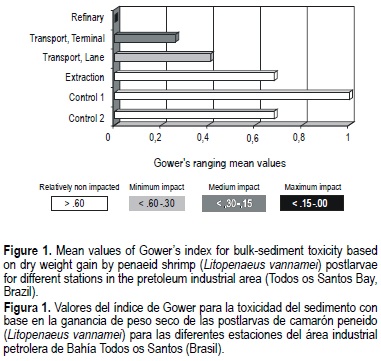
<body><![CDATA[<p align="justify"><font face="verdana" size="2">Clean&#45;up and fractionation was performed by passing the extract through a silica/alumina column (silica and alumina were activated at 200&deg;C for 4 h and then partially deactivated with 5% water). Elution was performed using 25 mL of hexane to yield the first fraction (which contains the aliphatic hydrocarbons); then 30 mL of hexane/dichloromethane (90:10) was combined with 20 mL of hexane/dichloromethane (50:50) to obtain the polycyclic aromatic hydrocarbons (PAHs).</font></p>  	    <p align="justify"><font face="verdana" size="2">Fractions were then analyzed by gas chromatography using a Hewlett Packard HP5890 series II with a flame ionization detector. The capillary column used was a DB&#45;5MS (J&amp;W Scientific, Folsom, CA, USA) with fused silica (crosslinked 5%&#45;phenyl/95%&#45;dimethylpolysiloxane, 30 m length, 0.25 mm i.d., 0.25 &#181;m film thickness). The temperature was programmed from 40&deg;C to 60&deg;C at 40&deg;C min<sup>&#45;1</sup>, from 60&deg;C to 300&deg;C at 5&deg;C min<sup>&#45;1</sup> and subsequently maintained at 300&deg;C for 20 min. Injector and detector temperatures were set at 40&deg;C and 300&deg;C, respectively. Helium was used as carrier gas at a flow of 1.2 mL min<sup>&#45;1</sup>. Confirmation of peak identification was obtained for selected extracts using gas chromatography with mass spectrometric detection (Hewlett&#45;Packard 5889B MS "Engine"). Appropriate blanks and reference material IAEA&#45;357 were analyzed simultaneously with each batch.</font></p>      <p>&nbsp;</p>  	    <p align="justify"><font face="verdana" size="2"><b>Results and discussion</b></font></p>  	    <p align="justify"><font face="verdana" size="2">The mortality rates of shrimp PL shown by the toxicity tests conducted on the bulk sediment are presented in <a href="/img/revistas/ciemar/v31n1a/a5t1.jpg" target="_blank">table 1</a>; each value represents one sampling period. There were no significant <i>(P</i> &gt; 0.05) differences among stations. The relative comparison made by the SNK test showed a large variation in the mortality rate (%) among stations and periods. In general, the mortality rate varied between 1.77% and 28.19%, considering all the sampling periods; however, it did not show a consistent pattern of relative toxicity between stations. Consequently, for this kind of short&#45;term test, the mortality rate was not considered a suitable end&#45;point to discriminate among stations.</font></p>  	    <p align="justify"><font face="verdana" size="2">In contrast, the dry weight gain data showed significant differences among stations (<a href="/img/revistas/ciemar/v31n1a/a5t2.jpg" target="_blank">table 2</a>) when analyzed jointly. A maximum average value was obtained at station 5 (reference 1) and a minimum at station 1 (RELAM refinery). The values of dry weight gain ranged from 0.17 to 0.58 g, including all the stations and periods (<a href="/img/revistas/ciemar/v31n1a/a5t2.jpg" target="_blank">table 2</a>). For stations associated with petroleum transportation (stations 2 and 3), the data did not show significant differences <i>(P</i> &gt; 0.05) between themselves. Gower's index applied to the net risk values of dry weight gain (<a href="#f1">fig. 1</a>) clearly showed that this end&#45;point can discriminate areas with different degrees of impact.</font></p>  	    <p align="center"><font face="verdana" size="2"><a name="f1"></a></font></p>  	    <p align="center"><font face="verdana" size="2"><img src="/img/revistas/ciemar/v31n1a/a5f1.jpg"></font></p>  	    <p align="justify"><font face="verdana" size="2">In many pollution studies, benthic communities have been shown to be affected along well&#45;established contamination gradients (Pearson and Rosenberg, 1978; Carr <i>et al.,</i> 1996; Nascimento <i>et al.,</i> 1998); however, this kind of survey is expensive and time&#45;consuming, and thus unlikely to be possible for the majority of routine programs (Gray <i>et al.,</i> 1988). An ecotoxicity test using bulk sediment as substrate, a sensitive species and one relevant end&#45;point would be expected to provide more useful information (ASTM, 1993, 1994) to distinguish impacted from non&#45;impacted areas, but it is especially difficult to detect the effects of pollutant contamination when the level of sediment contamination is low as determined for the sediments used in this bioassay. This explains why the mortality rate, taken as an end&#45;point, failed to show differences among the studied sites. Nevertheless, a gain in dry weight (a sublethal effect), even whilst not showing significant variations among stations during some of the considered periods, was able, when all the data were analyzed together, to discriminate impacted stations (1, 2 and 3) from control stations. This result shows that the test is a good procedure for assessing sediment quality.</font></p>  	    <p align="justify"><font face="verdana" size="2">The results found using Gower's coefficient (<a href="#f1">fig. 1</a>) showed that station 1, where the Landulfo Alves refinery is located, suffered maximum impact in relation to reference station 1. Station 2 (transport terminal) was considered to suffer medium impact, while station 3 (transport lane) was considered to suffer minimum impact on the same relative scale. Sediment from station 4 (extraction) did not show detrimental effects to <i>L. vannamei</i> PL.</font></p>  	    ]]></body>
<body><![CDATA[<p align="justify"><font face="verdana" size="2">This qualitative scale, based on the means of ranged values, has an important limitation. When significant differences exist among stations, the most impacted ones will consistently yield high values (near 1.0), while the least impacted stations will yield low values (near 0.0) regardless of the absolute degree of impact. The scale is, therefore, relative to the specific study. The ranged values are more consistent than the original net risk values, but are inappropriate for parametric ANOVA comparisons.</font></p>  	    <p align="justify"><font face="verdana" size="2">A non&#45;parametric analysis based on ranks (Friedman's test) provided the significance of the differences between means and proved the ranking obtained by Gower's coefficient. Apart from the non&#45;toxic site (extraction area at station 4), these results were confirmed by other toxicity tests (Nascimento <i>et al.</i> , 2000a), using other species as bioindicators and other materials as substrates, such as pore water and transient surface water, from the same sampling stations. The integration of the data from toxicological assays (Nascimento <i>et al.,</i> 2000a) using acute mortality of brine shrimp nauplii, and chronic abnormalities of sea&#45;urchin and mangrove oyster larvae permitted a single multispecies ordination of the study sites. Tests with the sediment pore water revealed maximum impact (toxicity) at stations 1 (refinery) and 4 (extraction). Stations 2 and 3 (transport terminal and transport lane) revealed medium impact, and station 5 (reference 1) minimum impact when compared with reference station 6 (control station 2) on a qualitative scale (Nascimento, 1996; Nascimento <i>et al.,</i> 1998). These results were also confirmed by other biological studies, based on benthic community responses (Peso&#45;Aguiar and Almeida, 1996).</font></p>  	    <p align="justify"><font face="verdana" size="2">The sediments in the study sites were mostly muddy or sandy mud. Total organic carbon varied from 0.3% to 5.2%. The highest value was found at the control site. Twenty&#45;seven individual aliphatic hydrocarbons <i>(n</i>&#45;C12 to C36) and twenty&#45;four PAHs were analyzed (<a href="/img/revistas/ciemar/v31n1a/a5t3.jpg" target="_blank">tables 3</a>, <a href="/img/revistas/ciemar/v31n1a/a5t4.jpg" target="_blank">4</a>).</font></p>  	    <p align="justify"><font face="verdana" size="2">For the dry season, the total aliphatic concentration values were 37.0 mg g<sup>&#45;1</sup> (dry wt) at the reference site, 33.4 mg g<sup>&#45;1</sup> (dry wt) at Madre de Deus (transport lane), 43.8 mg g<sup>&#45;1</sup> (dry wt) at RLAM (refinery site) and 184.6 mg g<sup>&#45;1</sup> (dry wt) at Ilha das Fontes (oil extraction site). For the rainy season, the concentration values of total aliphatics were 43.0, 58.9, 91.5 and 399.6 mg g<sup>&#45;1</sup> (dry wt), respectively, for the reference site (lowest value in terms of organic carbon), Madre de Deus, Ilha das Fontes and RLAM (refinery). These levels indicate comparatively little contamination. Organic&#45;rich marine sediments may contain up to 100 ng g<sup>&#45;1</sup> of "total" aliphatic hydrocarbons, but concentrations higher than these are usually associated with petroleum inputs (Volkman <i>et al.,</i> 1992; Bouloubassi and Saliot, 1993). Compared with other regions of the world (Readman <i>et al.,</i> 2002), the lower levels are comparable to those encountered in places where hydrocarbon contamination was considered relatively low, whereas the higher levels are comparable to those reported for locations known to be chronically contaminated by oil, for example, Odessa, in the Black Sea (110&#45;310 &micro;g g<sup>&#45;1</sup> dry wt), Hong Kong (60646 &micro;g g<sup>&#45;1</sup> dry wt) and the New York Bight (35&#45;2900 &micro;g g<sup>&#45;1</sup> dry wt).</font></p>  	    <p align="justify"><font face="verdana" size="2">In general, the presence of an unresolved complex mixture (UCM) in aliphatic hydrocarbon chromatograms is considered to be associated with degraded or weathered petroleum residues (Farrington and Tripp, 1977; Le Dr&eacute;au <i>et al.,</i> 1997). Ratios of unresolved to resolved (U/R) &gt;4 confirm the widespread presence of important petroleum&#45;related residues (Mazurek and Simoneit, 1984; Lipiatou and Saliot, 1991). In the oil related sites, the UCM was by far the major component of the "total" sedimentary aliphatic hydrocarbons. UCM concentrations varied from 32to 386 &micro;g g<sup>&#45;1</sup> dry wt, which accounted for 84&#45;97% of the "total" aliphatic hydrocarbons (<a href="/img/revistas/ciemar/v31n1a/a5t3.jpg" target="_blank">table 3</a>). The U/R ratio ranged from 5.4 to 27 (<a href="/img/revistas/ciemar/v31n1a/a5t3.jpg" target="_blank">table 3</a>), indicating chronic petroleum contributions to these sediments, particularly for the refinery site. On the other hand, at the control site, UCM concentrations were 14 and 23 &micro;g g<sup>&#45;1</sup> (dry wt), accounting for 38% and 53% of the "total" aliphatic hydrocarbons (dry and rainy seasons, respectively) (<a href="/img/revistas/ciemar/v31n1a/a5t3.jpg" target="_blank">table 3</a>). The U/R ratio was about 1, indicating low chronic petroleum contributions to these sediments.</font></p>  	    <p align="justify"><font face="verdana" size="2">Pristane (C19) and phytane (C20) are common isoprenoids detected in coastal marine sediments. They are often considered good indicators of petroleum contamination. As a rule, a high ratio of pristane to phytane or the predominance of a single isoprenoid (such as pristane) indicate a biogenic source (UNEP/IOC/IAEA, 1992). The pristane to phytane ratios in the sediments were =1 in most of the oil related sites (except for the extraction during the dry season), reflecting contamination originated from petroleum. The highest pristane to phytane ratios (&gt;2.0) were recorded at the reference site, reflecting biogenic origins.</font></p>  	    <p align="justify"><font face="verdana" size="2">Concentrations of "total" PAHs (the sum of 24 parental and alkylated compounds) in sediments of the oil related sites ranged from 440 to 777 ng g<sup>&#45;1</sup> (dry wt) and from 96 to 310 ng g<sup>&#45;1</sup> (dry wt) for the dry and rainy seasons, respectively (<a href="/img/revistas/ciemar/v31n1a/a5t4.jpg" target="_blank">table 4</a>). These concentrations are comparable to moderately polluted locations worldwide (Readman <i>et al.,</i> 2002). Conversely, the concentration observed for the reference site (rainy season) was lower than 50 ng g<sup>&#45;1</sup> (dry wt), which is a typical concentration for locations distant from extensive anthropogenic activities (Baumard <i>et al.,</i> 1998a). The dry season, however, showed a slightly higher value (83 ng g<sup>&#45;1</sup> dry wt) (<a href="/img/revistas/ciemar/v31n1a/a5t4.jpg" target="_blank">table 4</a>).</font></p>  	    <p align="justify"><font face="verdana" size="2">Concentrations of aromatic UCM ranged from 4518 to 63719 ng g<sup>&#45;1</sup> (dry wt) and from 7528 to 55167 ng g<sup>&#45;1</sup> (dry wt) for the dry and rainy seasons, respectively, which accounted for 73&#45;96% of the "total" aromatic hydrocarbons (<a href="/img/revistas/ciemar/v31n1a/a5t4.jpg" target="_blank">table 4</a>) and 11&#45;38% of the "total" (aromatic + aliphatic) hydrocarbons. Conversely, values were lower than 3250 ng g<sup>&#45;1</sup> (dry wt) for the reference site, accounting for less than 62% of the "total" aromatic hydrocarbons, and 0.6% (dry) and 6.7% (rainy) of the "total" (aromatic + aliphatic) hydrocarbons.</font></p>  	    <p align="justify"><font face="verdana" size="2">Among several chemical contaminants, the pollution caused by hydrocarbons is of the greatest concern. This is due to the carcinogenicity and therathogenicity of the highest molecular weight compounds and the toxicity of the most soluble compounds (Baumard <i>et al.,</i> 1998a, 1998b). The significance of contamination by hydrocarbons has been recognized considering the hydrophobic nature of most of these compounds (Neff, 1979; Hellow <i>et al.,</i> 1993; Djomo <i>et al.,</i> 1996; Baumard <i>et al.,</i> 1999a, 1999b).</font></p>  	    <p align="justify"><font face="verdana" size="2">Total PAH levels found for the bulk surficial sediment from the Petrobras sampling locations are below the concentrations proposed by MacDonald <i>et al.</i> (1996) as able to affect the biota; however, due to their characteristic of being bound to organic substrates, it has been proven that hydrocarbons may cause adverse biological effects even though quality criteria are not exceeded (NRC, 1989). The lower shrimp PL dry weight gain provides evidence of a chronic deleterious effect on shrimp PL, which denotes a physiological alteration. This response indicates that the whole&#45;sediment toxicity test on <i>L. vannamei</i> PL is a sensitive tool to discriminate among impacted and non&#45;impacted areas.</font></p>  	    ]]></body>
<body><![CDATA[<p align="justify"><font face="verdana" size="2">In short, the test for determining sediment quality, using bulk sediment as substrate, <i>L. vannamei</i> PL as species test and the dry weight gain as an end&#45;point, was able to discriminate between impacted and non&#45;impacted areas at Todos os Santos Bay (Brazil), where the petroleum industry prevails. The test results indicate that the impact of the petroleum industry has a chronic effect, since the weight gain of shrimp PL, taken as an end&#45;point, succeeded in discriminating between impacted and reference stations, even though the chemical concentrations of PAHs did not exceed quality criteria.</font></p>  	    <p>&nbsp;</p>  	    <p align="justify"><font face="verdana" size="2"><b>Acknowledgements</b></font></p>  	    <p align="justify"><font face="verdana" size="2">This research was financed by Petrobras and by the Brazilian Research Council's (CNPQ) northeast program for research and postgraduate study. All experiments were carried out in accordance with national and institutional guidelines for animal welfare.</font></p>  	    <p>&nbsp;</p>  	    <p align="justify"><font face="verdana" size="2"><b>References</b></font></p>  	    <!-- ref --><p align="justify"><font face="verdana" size="2">ASTM (American Society for Testing and Materials) (1993). Standard guide for designing biological tests with sediments. E 1525&#45;93. In: Annual Book of ASTM Standards, Vol 11.4, Philadelphia, pp. 1339&#45;1351.    &nbsp;&nbsp;&nbsp;&nbsp;&nbsp;&nbsp;&nbsp;&nbsp;[&#160;<a href="javascript:void(0);" onclick="javascript: window.open('/scielo.php?script=sci_nlinks&ref=1881511&pid=S0185-3880200500010000500001&lng=','','width=640,height=500,resizable=yes,scrollbars=1,menubar=yes,');">Links</a>&#160;]<!-- end-ref --></font></p>  	    <!-- ref --><p align="justify"><font face="verdana" size="2">ASTM (American Society for Testing and Materials) (1994). Standard guide for conducting 10&#45;day static sediment toxicity tests with marine and estuarine amphipods. E 1367&#45;92. In: Annual Book of ASTM Standards, Vol. 11.4, Philadelphia, pp. 1138&#45;1163.    &nbsp;&nbsp;&nbsp;&nbsp;&nbsp;&nbsp;&nbsp;&nbsp;[&#160;<a href="javascript:void(0);" onclick="javascript: window.open('/scielo.php?script=sci_nlinks&ref=1881513&pid=S0185-3880200500010000500002&lng=','','width=640,height=500,resizable=yes,scrollbars=1,menubar=yes,');">Links</a>&#160;]<!-- end-ref --></font></p>  	    ]]></body>
<body><![CDATA[<!-- ref --><p align="justify"><font face="verdana" size="2">Baumard, P., Budzinski, H., Garrigues, P., Sorbe, J.C., Burgeot, T. and Bellocq, J. (1998a). Concentrations of PAHs (polycyclic aromatic hydrocarbons) in various marine organisms in relation to those in sediments and to trophic level. Mar. Pollut. Bull., 36(12): 951&#45;960</font>&nbsp;&nbsp;&nbsp;&nbsp;&nbsp;&nbsp;&nbsp;&nbsp;[&#160;<a href="javascript:void(0);" onclick="javascript: window.open('/scielo.php?script=sci_nlinks&ref=1881515&pid=S0185-3880200500010000500003&lng=','','width=640,height=500,resizable=yes,scrollbars=1,menubar=yes,');">Links</a>&#160;]<!-- end-ref --><!-- ref --><p align="justify"><font face="verdana" size="2">Baumard, P., Budzinski, H., Mchin, Q., Garrigues, P., Burgeot, T and Bellocq, J. (1998b). Origin and bioavailability of PAHs in the Mediterranean Sea from mussel and sediment records. Estuar. Coast. Shelf Sci., 47: 77&#45;90.    &nbsp;&nbsp;&nbsp;&nbsp;&nbsp;&nbsp;&nbsp;&nbsp;[&#160;<a href="javascript:void(0);" onclick="javascript: window.open('/scielo.php?script=sci_nlinks&ref=1881516&pid=S0185-3880200500010000500004&lng=','','width=640,height=500,resizable=yes,scrollbars=1,menubar=yes,');">Links</a>&#160;]<!-- end-ref --></font></p>  	    <!-- ref --><p align="justify"><font face="verdana" size="2">Baumard, P., Budzinski, H., Garrigues, P., Narbonne, J.F., Burgeot, T., Michel, X. and Bellocq, J. (1999a). Polycyclic aromatic hydrocarbon (PAH) burden of mussels <i>(Mytilus</i> sp.) in different marine environments in relation with sediment PAH contamination, and biovailability. Mar. Environ. Res., 47: 415&#45;439.    &nbsp;&nbsp;&nbsp;&nbsp;&nbsp;&nbsp;&nbsp;&nbsp;[&#160;<a href="javascript:void(0);" onclick="javascript: window.open('/scielo.php?script=sci_nlinks&ref=1881518&pid=S0185-3880200500010000500005&lng=','','width=640,height=500,resizable=yes,scrollbars=1,menubar=yes,');">Links</a>&#160;]<!-- end-ref --></font></p>  	    <!-- ref --><p align="justify"><font face="verdana" size="2">Baumard, P., Budzinski, H., Garrigues, P., Dizer, H. and Hansen, P.D. (1999b). Polycyclic aromatic hydrocarbons in recent sediments and mussels <i>(Mytilus edulis)</i> from the western Baltic Sea: Occurrence, bioavailability and seasonal variations. Mar. Environ. Res., 47: 17&#45;47.    &nbsp;&nbsp;&nbsp;&nbsp;&nbsp;&nbsp;&nbsp;&nbsp;[&#160;<a href="javascript:void(0);" onclick="javascript: window.open('/scielo.php?script=sci_nlinks&ref=1881520&pid=S0185-3880200500010000500006&lng=','','width=640,height=500,resizable=yes,scrollbars=1,menubar=yes,');">Links</a>&#160;]<!-- end-ref --></font></p>  	    <!-- ref --><p align="justify"><font face="verdana" size="2">Bouloubassi, I. and Saliot, A. (1993). Investigation of anthropogenic and natural organic inputs in estuarine sediments using hydrocarbon markers (NAH, LAB, PAH). Oceanol. Acta, 16: 145&#45;161.    &nbsp;&nbsp;&nbsp;&nbsp;&nbsp;&nbsp;&nbsp;&nbsp;[&#160;<a href="javascript:void(0);" onclick="javascript: window.open('/scielo.php?script=sci_nlinks&ref=1881522&pid=S0185-3880200500010000500007&lng=','','width=640,height=500,resizable=yes,scrollbars=1,menubar=yes,');">Links</a>&#160;]<!-- end-ref --></font></p>  	    <!-- ref --><p align="justify"><font face="verdana" size="2">Cairns, J.J., Niederlehner, B.R. and Smith, E.P. (1992). The emergence of functional attributes as endpoints in ecotoxicology. In: G.A. Burton Jr. (ed.), Sediment Toxicity Assessment. Lewis, Boca Raton, Florida, pp. 111&#45;128.    &nbsp;&nbsp;&nbsp;&nbsp;&nbsp;&nbsp;&nbsp;&nbsp;[&#160;<a href="javascript:void(0);" onclick="javascript: window.open('/scielo.php?script=sci_nlinks&ref=1881524&pid=S0185-3880200500010000500008&lng=','','width=640,height=500,resizable=yes,scrollbars=1,menubar=yes,');">Links</a>&#160;]<!-- end-ref --></font></p>  	    <!-- ref --><p align="justify"><font face="verdana" size="2">Carr, R., Long, E., Windom, H., Chapman, D., Thursby, G., Sloane, G. and Wolfe D. (1996). Sediment quality assessment studies of Tampa Bay, Florida. Environ. Toxicol. Chem., 15: 1218&#45;1231.    &nbsp;&nbsp;&nbsp;&nbsp;&nbsp;&nbsp;&nbsp;&nbsp;[&#160;<a href="javascript:void(0);" onclick="javascript: window.open('/scielo.php?script=sci_nlinks&ref=1881526&pid=S0185-3880200500010000500009&lng=','','width=640,height=500,resizable=yes,scrollbars=1,menubar=yes,');">Links</a>&#160;]<!-- end-ref --></font></p>  	    <!-- ref --><p align="justify"><font face="verdana" size="2">Cripe, G. (1994). Comparative acute toxicities of several pesticides and metals to <i>Mysidopsis babia</i> and postlarval <i>Penaeus duorarum.</i> Environ. Toxicol. Chem., 13: 1867&#45;1872.    &nbsp;&nbsp;&nbsp;&nbsp;&nbsp;&nbsp;&nbsp;&nbsp;[&#160;<a href="javascript:void(0);" onclick="javascript: window.open('/scielo.php?script=sci_nlinks&ref=1881528&pid=S0185-3880200500010000500010&lng=','','width=640,height=500,resizable=yes,scrollbars=1,menubar=yes,');">Links</a>&#160;]<!-- end-ref --></font></p>  	    <!-- ref --><p align="justify"><font face="verdana" size="2">Da Silva, E.M., Peso&#45;Aguiar, M.C., Navarro, M. de F.T. and Chastinet, C. de B. e A. (1997). Impact of petroleum pollution on aquatic coastal ecosystems in Brazil. Environ. Toxicol. Chem., 16(1): 112&#45;118.    &nbsp;&nbsp;&nbsp;&nbsp;&nbsp;&nbsp;&nbsp;&nbsp;[&#160;<a href="javascript:void(0);" onclick="javascript: window.open('/scielo.php?script=sci_nlinks&ref=1881530&pid=S0185-3880200500010000500011&lng=','','width=640,height=500,resizable=yes,scrollbars=1,menubar=yes,');">Links</a>&#160;]<!-- end-ref --></font></p>  	    <!-- ref --><p align="justify"><font face="verdana" size="2">Djomo, J.E., Garrigues, P., and Narbonne, J.F. (1996). Uptake and depuration of polycyclic aromatic hydrocarbons from sediment by the zebrafish <i>(Bracydanio rerio).</i> Environ. Toxicol. Chem., 15: 1177&#45;1181.    &nbsp;&nbsp;&nbsp;&nbsp;&nbsp;&nbsp;&nbsp;&nbsp;[&#160;<a href="javascript:void(0);" onclick="javascript: window.open('/scielo.php?script=sci_nlinks&ref=1881532&pid=S0185-3880200500010000500012&lng=','','width=640,height=500,resizable=yes,scrollbars=1,menubar=yes,');">Links</a>&#160;]<!-- end-ref --></font></p>  	    <!-- ref --><p align="justify"><font face="verdana" size="2">Environment Canada (1994). Guidance Document on Collection and Preparation of Sediments for Physicochemical Characterisation and Biological Testing. Environmental Protection Series 1/RM/ 29, 132 pp.    &nbsp;&nbsp;&nbsp;&nbsp;&nbsp;&nbsp;&nbsp;&nbsp;[&#160;<a href="javascript:void(0);" onclick="javascript: window.open('/scielo.php?script=sci_nlinks&ref=1881534&pid=S0185-3880200500010000500013&lng=','','width=640,height=500,resizable=yes,scrollbars=1,menubar=yes,');">Links</a>&#160;]<!-- end-ref --></font></p>  	    <!-- ref --><p align="justify"><font face="verdana" size="2">Environment Canada (1995). Guidance Document on Measurement of Toxicity Test Precision using Control Sediment Spiked with a Reference Toxicant. Environmental Protection Series 1/RM/30, 56pp.    &nbsp;&nbsp;&nbsp;&nbsp;&nbsp;&nbsp;&nbsp;&nbsp;[&#160;<a href="javascript:void(0);" onclick="javascript: window.open('/scielo.php?script=sci_nlinks&ref=1881536&pid=S0185-3880200500010000500014&lng=','','width=640,height=500,resizable=yes,scrollbars=1,menubar=yes,');">Links</a>&#160;]<!-- end-ref --></font></p>  	    <!-- ref --><p align="justify"><font face="verdana" size="2">Farrington, J.W. and Tripp, B.W. (1977). Hydrocarbons in western North Atlantic surface sediments. Geochim. Cosmochim. Acta, 41: 1627&#45;1641.    &nbsp;&nbsp;&nbsp;&nbsp;&nbsp;&nbsp;&nbsp;&nbsp;[&#160;<a href="javascript:void(0);" onclick="javascript: window.open('/scielo.php?script=sci_nlinks&ref=1881538&pid=S0185-3880200500010000500015&lng=','','width=640,height=500,resizable=yes,scrollbars=1,menubar=yes,');">Links</a>&#160;]<!-- end-ref --></font></p>  	    <!-- ref --><p align="justify"><font face="verdana" size="2">Finney, D.J. (1971). Probit Analysis. 3rd ed. Cambridge Univ. Press, Cambridge, 333 pp.    &nbsp;&nbsp;&nbsp;&nbsp;&nbsp;&nbsp;&nbsp;&nbsp;[&#160;<a href="javascript:void(0);" onclick="javascript: window.open('/scielo.php?script=sci_nlinks&ref=1881540&pid=S0185-3880200500010000500016&lng=','','width=640,height=500,resizable=yes,scrollbars=1,menubar=yes,');">Links</a>&#160;]<!-- end-ref --></font></p>  	    <!-- ref --><p align="justify"><font face="verdana" size="2">Folk, R. (1968). Petrology of Sedimentary Rocks. Hemphill, Austin.    &nbsp;&nbsp;&nbsp;&nbsp;&nbsp;&nbsp;&nbsp;&nbsp;[&#160;<a href="javascript:void(0);" onclick="javascript: window.open('/scielo.php?script=sci_nlinks&ref=1881542&pid=S0185-3880200500010000500017&lng=','','width=640,height=500,resizable=yes,scrollbars=1,menubar=yes,');">Links</a>&#160;]<!-- end-ref --></font></p>  	    <!-- ref --><p align="justify"><font face="verdana" size="2">Gray, J., Aschan, M., Carr, M., Clarke, K., Green, R., Pearson, T., Rosenberg, R. and Warwick, R. (1988). Analysis of community attributes of the benthic macrofauna of Frierfjord/Langesundfjord and in a mesocosm experiment. Mar. Ecol. Prog. Ser., 46: 151&#45;165.    &nbsp;&nbsp;&nbsp;&nbsp;&nbsp;&nbsp;&nbsp;&nbsp;[&#160;<a href="javascript:void(0);" onclick="javascript: window.open('/scielo.php?script=sci_nlinks&ref=1881544&pid=S0185-3880200500010000500018&lng=','','width=640,height=500,resizable=yes,scrollbars=1,menubar=yes,');">Links</a>&#160;]<!-- end-ref --></font></p>      <!-- ref --><p align="justify"><font face="verdana" size="2">Gower, J.C. (1971). A general coefficient of similarity and some of its properties. Biometrics, 27: 857&#45;871.    &nbsp;&nbsp;&nbsp;&nbsp;&nbsp;&nbsp;&nbsp;&nbsp;[&#160;<a href="javascript:void(0);" onclick="javascript: window.open('/scielo.php?script=sci_nlinks&ref=1881546&pid=S0185-3880200500010000500019&lng=','','width=640,height=500,resizable=yes,scrollbars=1,menubar=yes,');">Links</a>&#160;]<!-- end-ref --></font></p>  	    <!-- ref --><p align="justify"><font face="verdana" size="2">Hellow, J., Upshall, C., Payne, J.F., Naidu, S. and Paranjape, M.M. (1993). Total unsaturated compounds and polycyclic aromatic hydrocarbons in molluscs collected from waters around New Foundland. Arch. Environ. Contam. Toxicol., 24: 249&#45;257.    &nbsp;&nbsp;&nbsp;&nbsp;&nbsp;&nbsp;&nbsp;&nbsp;[&#160;<a href="javascript:void(0);" onclick="javascript: window.open('/scielo.php?script=sci_nlinks&ref=1881548&pid=S0185-3880200500010000500020&lng=','','width=640,height=500,resizable=yes,scrollbars=1,menubar=yes,');">Links</a>&#160;]<!-- end-ref --></font></p>  	    <!-- ref --><p align="justify"><font face="verdana" size="2">Le Dr&eacute;au, Y., Jacquot, F., Doumenq, P., Guiliano, M., Bertrand, J.C. and Mille, G. (1997). Hydrocarbon balance of a site which had been highly and chronically contaminated by petroleum wastes of a refinery (from 1956 to 1992). Mar. Pollut. Bull., 34: 456&#45;468.    &nbsp;&nbsp;&nbsp;&nbsp;&nbsp;&nbsp;&nbsp;&nbsp;[&#160;<a href="javascript:void(0);" onclick="javascript: window.open('/scielo.php?script=sci_nlinks&ref=1881550&pid=S0185-3880200500010000500021&lng=','','width=640,height=500,resizable=yes,scrollbars=1,menubar=yes,');">Links</a>&#160;]<!-- end-ref --></font></p>  	    <!-- ref --><p align="justify"><font face="verdana" size="2">Lipiatou, E. and Saliot, A. (1991). Hydrocarbon contamination of the Rhone delta and western Mediterranean. Mar. Pollut. Bull., 22: 297&#45;3.    &nbsp;&nbsp;&nbsp;&nbsp;&nbsp;&nbsp;&nbsp;&nbsp;[&#160;<a href="javascript:void(0);" onclick="javascript: window.open('/scielo.php?script=sci_nlinks&ref=1881552&pid=S0185-3880200500010000500022&lng=','','width=640,height=500,resizable=yes,scrollbars=1,menubar=yes,');">Links</a>&#160;]<!-- end-ref --></font></p>  	    <!-- ref --><p align="justify"><font face="verdana" size="2">Mazurek, M.A. and Simoneit, B.R.T. (1984). Characterization of biogenic and petroleum&#45;derived organic matter in aerosols over remote rural and urban areas. In: L.H. Keith (ed.), Identification and Analysis of Organic Pollutants in Air. Ann Arbor Science, Butterworth, Boston, pp. 353&#45;370.    &nbsp;&nbsp;&nbsp;&nbsp;&nbsp;&nbsp;&nbsp;&nbsp;[&#160;<a href="javascript:void(0);" onclick="javascript: window.open('/scielo.php?script=sci_nlinks&ref=1881554&pid=S0185-3880200500010000500023&lng=','','width=640,height=500,resizable=yes,scrollbars=1,menubar=yes,');">Links</a>&#160;]<!-- end-ref --></font></p>  	    <!-- ref --><p align="justify"><font face="verdana" size="2">MacDonald, D.D., Carr, R.S., Calder, F.D., Long, E.R. and Ingersoll, C.G. (1996). Development and evaluation of sediment quality guidelines for Florida coastal waters. Ecotoxicology, 5: 253&#45;278.    &nbsp;&nbsp;&nbsp;&nbsp;&nbsp;&nbsp;&nbsp;&nbsp;[&#160;<a href="javascript:void(0);" onclick="javascript: window.open('/scielo.php?script=sci_nlinks&ref=1881556&pid=S0185-3880200500010000500024&lng=','','width=640,height=500,resizable=yes,scrollbars=1,menubar=yes,');">Links</a>&#160;]<!-- end-ref --></font></p>  	    <!-- ref --><p align="justify"><font face="verdana" size="2">McKim, J.M. (1985). Early life stage toxicity tests. Chapter 3. In: G.M. Rand and S.R. Petrocelli (eds.), Fundamentals of Aquatic Toxicology. Hemisphere Publ. Corp., New York, pp. 58&#45;95.    &nbsp;&nbsp;&nbsp;&nbsp;&nbsp;&nbsp;&nbsp;&nbsp;[&#160;<a href="javascript:void(0);" onclick="javascript: window.open('/scielo.php?script=sci_nlinks&ref=1881558&pid=S0185-3880200500010000500025&lng=','','width=640,height=500,resizable=yes,scrollbars=1,menubar=yes,');">Links</a>&#160;]<!-- end-ref --></font></p>  	    <!-- ref --><p align="justify"><font face="verdana" size="2">Nascimento, I.A. (1996). Relat&oacute;rio do subprojeto "Testes Ecotoxicol&oacute;gicos" do programa de Monitoramento dos Ecosistemas ao norte da Ba&iacute;a de Todos os Santos, Conv&ecirc;nio Petrobr&aacute;s/UFBA, July 1996. Conv&ecirc;nio PETROBRAS/UFBA. Contracts 220.2.045.93&#45;5 and 220.2.051.94&#45;8. 80 pp.    &nbsp;&nbsp;&nbsp;&nbsp;&nbsp;&nbsp;&nbsp;&nbsp;[&#160;<a href="javascript:void(0);" onclick="javascript: window.open('/scielo.php?script=sci_nlinks&ref=1881560&pid=S0185-3880200500010000500026&lng=','','width=640,height=500,resizable=yes,scrollbars=1,menubar=yes,');">Links</a>&#160;]<!-- end-ref --></font></p>      <!-- ref --><p align="justify"><font face="verdana" size="2">Nascimento, I.A., Pereira, S.A., Smith, D.H. and Evangelista, A.J.A. (1998). Testes ecotoxicol&oacute;gicos usados para avalia&ccedil;&atilde;o de impacto ambiental resultante da extra&ccedil;&atilde;o e refino de petr&oacute;leo na Bahia de Todos os Santos, Bahia, Brasil. Trab. Oceanogr. Univ. Fed. Pe., 26(1): 135&#45;143.    &nbsp;&nbsp;&nbsp;&nbsp;&nbsp;&nbsp;&nbsp;&nbsp;[&#160;<a href="javascript:void(0);" onclick="javascript: window.open('/scielo.php?script=sci_nlinks&ref=1881562&pid=S0185-3880200500010000500027&lng=','','width=640,height=500,resizable=yes,scrollbars=1,menubar=yes,');">Links</a>&#160;]<!-- end-ref --></font></p>  	    <!-- ref --><p align="justify"><font face="verdana" size="2">Nascimento, I.A, Smith, D.H., Pereira, S.A., Sampaio de Ara&uacute;jo, M.M. and Mariani, A.M. (2000a). Integration of varying responses of different organisms to water and sediment quality at sites impacted and not impacted by the petroleum industry. In: State of Brazilian Aquatic Ecosystem Health. J. Aquat. Ecosyst. Health Manage. (Canad), Spec. issue, 3(4): 485&#45;197.    &nbsp;&nbsp;&nbsp;&nbsp;&nbsp;&nbsp;&nbsp;&nbsp;[&#160;<a href="javascript:void(0);" onclick="javascript: window.open('/scielo.php?script=sci_nlinks&ref=1881564&pid=S0185-3880200500010000500028&lng=','','width=640,height=500,resizable=yes,scrollbars=1,menubar=yes,');">Links</a>&#160;]<!-- end-ref --></font></p>  	    <!-- ref --><p align="justify"><font face="verdana" size="2">Nascimento, I.A., Smith, D.H., Gomes, M.G.S., Santos, G.V. and Pereira, S.A. (2000b). Ecotoxicological diagnosis of Aratu Bay, Bahia, Brazil: A new approach to validate a reactive short&#45;term toxicity end&#45;point by comparison with intertidal benthic activity. In: State of Brazilian Aquatic Ecosystem. J. Aquat. Ecosyst. Health Manage. (Canada), Spec. issue, 3(4): 449&#45;458.    &nbsp;&nbsp;&nbsp;&nbsp;&nbsp;&nbsp;&nbsp;&nbsp;[&#160;<a href="javascript:void(0);" onclick="javascript: window.open('/scielo.php?script=sci_nlinks&ref=1881566&pid=S0185-3880200500010000500029&lng=','','width=640,height=500,resizable=yes,scrollbars=1,menubar=yes,');">Links</a>&#160;]<!-- end-ref --></font></p>  	    <!-- ref --><p align="justify"><font face="verdana" size="2">Nipper, M.G., Roper, D.S., Williams, E.K., Martin, M.L., Van Dam, L.F. and Mills, G.N. (1998). Sediment toxicity and benthic communities and mildly contaminated mudflats. Environ. Toxicol. Chem., 17(3): 502&#45;510.    &nbsp;&nbsp;&nbsp;&nbsp;&nbsp;&nbsp;&nbsp;&nbsp;[&#160;<a href="javascript:void(0);" onclick="javascript: window.open('/scielo.php?script=sci_nlinks&ref=1881568&pid=S0185-3880200500010000500030&lng=','','width=640,height=500,resizable=yes,scrollbars=1,menubar=yes,');">Links</a>&#160;]<!-- end-ref --></font></p>  	    <!-- ref --><p align="justify"><font face="verdana" size="2">NRC. (1989). Contaminated Marine Sediments &#45; Assessment and Remediation. National Research Council. National Academic Press, 493 pp.    &nbsp;&nbsp;&nbsp;&nbsp;&nbsp;&nbsp;&nbsp;&nbsp;[&#160;<a href="javascript:void(0);" onclick="javascript: window.open('/scielo.php?script=sci_nlinks&ref=1881570&pid=S0185-3880200500010000500031&lng=','','width=640,height=500,resizable=yes,scrollbars=1,menubar=yes,');">Links</a>&#160;]<!-- end-ref --></font></p>  	    <!-- ref --><p align="justify"><font face="verdana" size="2">Neff, J.M. (1979). Policyclic aromatic hydrocarbons in the aquatic environment: Sources, fates and biological effects. Applied Science Publishers Ltd., Essex, England. 262 pp.    &nbsp;&nbsp;&nbsp;&nbsp;&nbsp;&nbsp;&nbsp;&nbsp;[&#160;<a href="javascript:void(0);" onclick="javascript: window.open('/scielo.php?script=sci_nlinks&ref=1881572&pid=S0185-3880200500010000500032&lng=','','width=640,height=500,resizable=yes,scrollbars=1,menubar=yes,');">Links</a>&#160;]<!-- end-ref --></font></p>  	    <!-- ref --><p align="justify"><font face="verdana" size="2">Pearson, T. and Rosenberg, R. (1978). Macrobenthic succession in relation to organic enrichment pollution of the marine environment. Oceanogr. Mar. Biol. Ann. Rev., 16: 229&#45;311.    &nbsp;&nbsp;&nbsp;&nbsp;&nbsp;&nbsp;&nbsp;&nbsp;[&#160;<a href="javascript:void(0);" onclick="javascript: window.open('/scielo.php?script=sci_nlinks&ref=1881574&pid=S0185-3880200500010000500033&lng=','','width=640,height=500,resizable=yes,scrollbars=1,menubar=yes,');">Links</a>&#160;]<!-- end-ref --></font></p>  	    <!-- ref --><p align="justify"><font face="verdana" size="2">Peso&#45;Aguiar, M.C. and Almeida, V.G. (1996). Relat&oacute;rio Final do Programa de Monitoramento dos Ecosistemas ao Norte da Ba&iacute;a de Todos os Santos. Convenio PETROBRAS/UFBA. Contracts 220.2.045.93&#45;5 and 220.2.051.94&#45;8. 80 pp.    &nbsp;&nbsp;&nbsp;&nbsp;&nbsp;&nbsp;&nbsp;&nbsp;[&#160;<a href="javascript:void(0);" onclick="javascript: window.open('/scielo.php?script=sci_nlinks&ref=1881576&pid=S0185-3880200500010000500034&lng=','','width=640,height=500,resizable=yes,scrollbars=1,menubar=yes,');">Links</a>&#160;]<!-- end-ref --></font></p>  	    <!-- ref --><p align="justify"><font face="verdana" size="2">Readman, J.W., Fillmann, G., Tolosa, I., Bartocci, J., Villeneuve, J.P., Catinni, C. and Mee, L.D. (2002). Hydrocarbon residues in sediments from the Black Sea. Mar. Pollut. Bull., 44(1): 48&#45;62.    &nbsp;&nbsp;&nbsp;&nbsp;&nbsp;&nbsp;&nbsp;&nbsp;[&#160;<a href="javascript:void(0);" onclick="javascript: window.open('/scielo.php?script=sci_nlinks&ref=1881578&pid=S0185-3880200500010000500035&lng=','','width=640,height=500,resizable=yes,scrollbars=1,menubar=yes,');">Links</a>&#160;]<!-- end-ref --></font></p>  	    <!-- ref --><p align="justify"><font face="verdana" size="2">Riebel, P.N. and Percy, J.A. (1991). Acute toxicity of petroleum hydrocarbons to the Arctic shallow&#45;water mysid, <i>Mysis oculata</i> (Fabricius). Sarsia, 75: 223&#45;232.    &nbsp;&nbsp;&nbsp;&nbsp;&nbsp;&nbsp;&nbsp;&nbsp;[&#160;<a href="javascript:void(0);" onclick="javascript: window.open('/scielo.php?script=sci_nlinks&ref=1881580&pid=S0185-3880200500010000500036&lng=','','width=640,height=500,resizable=yes,scrollbars=1,menubar=yes,');">Links</a>&#160;]<!-- end-ref --></font></p>  	    <!-- ref --><p align="justify"><font face="verdana" size="2">Roper, D., Thrush, S. and Smith, D.H. (1988). The influence of runoff on intertidal mudflat benthic communities. Mar. Environ. Res., 26: 1&#45;18.    &nbsp;&nbsp;&nbsp;&nbsp;&nbsp;&nbsp;&nbsp;&nbsp;[&#160;<a href="javascript:void(0);" onclick="javascript: window.open('/scielo.php?script=sci_nlinks&ref=1881582&pid=S0185-3880200500010000500037&lng=','','width=640,height=500,resizable=yes,scrollbars=1,menubar=yes,');">Links</a>&#160;]<!-- end-ref --></font></p>  	    <!-- ref --><p align="justify"><font face="verdana" size="2">UNEP/IOC/IAEA. 1992. Determination of petroleum hydrocarbons in sediments. Reference methods for marine pollution studies. No. 20. UNEP, Monaco, 75 pp.    &nbsp;&nbsp;&nbsp;&nbsp;&nbsp;&nbsp;&nbsp;&nbsp;[&#160;<a href="javascript:void(0);" onclick="javascript: window.open('/scielo.php?script=sci_nlinks&ref=1881584&pid=S0185-3880200500010000500038&lng=','','width=640,height=500,resizable=yes,scrollbars=1,menubar=yes,');">Links</a>&#160;]<!-- end-ref --></font></p>  	    <!-- ref --><p align="justify"><font face="verdana" size="2">Verardo, D.J., Froelich, P.N. and McIntyre, A. (1990). Determination of organic carbon and nitrogen in marine sediments using Carlo Erba NA&#45;1500 Analyser. Deep&#45;Sea Res., 37(1): 157&#45;165.    &nbsp;&nbsp;&nbsp;&nbsp;&nbsp;&nbsp;&nbsp;&nbsp;[&#160;<a href="javascript:void(0);" onclick="javascript: window.open('/scielo.php?script=sci_nlinks&ref=1881586&pid=S0185-3880200500010000500039&lng=','','width=640,height=500,resizable=yes,scrollbars=1,menubar=yes,');">Links</a>&#160;]<!-- end-ref --></font></p>  	    <!-- ref --><p align="justify"><font face="verdana" size="2">Volkman, J.K., Holdsworth, D.G., Neill, G.P. and Bavor Jr., H.J. (1992). Identification of natural, anthropogenic and petroleum hydrocarbons in aquatic sediments. Sci. Total Environ., 112: 203&#45;219.    &nbsp;&nbsp;&nbsp;&nbsp;&nbsp;&nbsp;&nbsp;&nbsp;[&#160;<a href="javascript:void(0);" onclick="javascript: window.open('/scielo.php?script=sci_nlinks&ref=1881588&pid=S0185-3880200500010000500040&lng=','','width=640,height=500,resizable=yes,scrollbars=1,menubar=yes,');">Links</a>&#160;]<!-- end-ref --></font></p>      ]]></body><back>
<ref-list>
<ref id="B1">
<nlm-citation citation-type="">
<collab>American Society for Testing and Materials</collab>
<article-title xml:lang="en"><![CDATA[Standard guide for designing biological tests with sediments. E 1525-93]]></article-title>
<source><![CDATA[Annual Book of ASTM Standards]]></source>
<year>1993</year>
<volume>11.4</volume>
<page-range>1339-1351</page-range><publisher-loc><![CDATA[Philadelphia ]]></publisher-loc>
</nlm-citation>
</ref>
<ref id="B2">
<nlm-citation citation-type="">
<collab>American Society for Testing and Materials</collab>
<article-title xml:lang="en"><![CDATA[Standard guide for conducting 10-day static sediment toxicity tests with marine and estuarine amphipods. E 1367-92]]></article-title>
<source><![CDATA[Annual Book of ASTM Standards]]></source>
<year>1994</year>
<volume>11.4</volume>
<page-range>1138-1163</page-range><publisher-loc><![CDATA[Philadelphia ]]></publisher-loc>
</nlm-citation>
</ref>
<ref id="B3">
<nlm-citation citation-type="journal">
<person-group person-group-type="author">
<name>
<surname><![CDATA[Baumard]]></surname>
<given-names><![CDATA[P.]]></given-names>
</name>
<name>
<surname><![CDATA[Budzinski]]></surname>
<given-names><![CDATA[H.]]></given-names>
</name>
<name>
<surname><![CDATA[Garrigues]]></surname>
<given-names><![CDATA[P.]]></given-names>
</name>
<name>
<surname><![CDATA[Sorbe]]></surname>
<given-names><![CDATA[J.C.]]></given-names>
</name>
<name>
<surname><![CDATA[Burgeot]]></surname>
<given-names><![CDATA[T.]]></given-names>
</name>
<name>
<surname><![CDATA[Bellocq]]></surname>
<given-names><![CDATA[J.]]></given-names>
</name>
</person-group>
<article-title xml:lang="en"><![CDATA[Concentrations of PAHs (polycyclic aromatic hydrocarbons) in various marine organisms in relation to those in sediments and to trophic level]]></article-title>
<source><![CDATA[Mar. Pollut. Bull.]]></source>
<year>1998</year>
<volume>36</volume>
<numero>12</numero>
<issue>12</issue>
<page-range>951-960</page-range></nlm-citation>
</ref>
<ref id="B4">
<nlm-citation citation-type="journal">
<person-group person-group-type="author">
<name>
<surname><![CDATA[Baumard]]></surname>
<given-names><![CDATA[P.]]></given-names>
</name>
<name>
<surname><![CDATA[Budzinski]]></surname>
<given-names><![CDATA[H.]]></given-names>
</name>
<name>
<surname><![CDATA[Mchin]]></surname>
<given-names><![CDATA[Q.]]></given-names>
</name>
<name>
<surname><![CDATA[Garrigues]]></surname>
<given-names><![CDATA[P.]]></given-names>
</name>
<name>
<surname><![CDATA[Burgeot]]></surname>
<given-names><![CDATA[T]]></given-names>
</name>
<name>
<surname><![CDATA[Bellocq]]></surname>
<given-names><![CDATA[J.]]></given-names>
</name>
</person-group>
<article-title xml:lang="en"><![CDATA[Origin and bioavailability of PAHs in the Mediterranean Sea from mussel and sediment records]]></article-title>
<source><![CDATA[Estuar. Coast. Shelf Sci.]]></source>
<year>1998</year>
<volume>47</volume>
<page-range>77-90</page-range></nlm-citation>
</ref>
<ref id="B5">
<nlm-citation citation-type="journal">
<person-group person-group-type="author">
<name>
<surname><![CDATA[Baumard]]></surname>
<given-names><![CDATA[P.]]></given-names>
</name>
<name>
<surname><![CDATA[Budzinski]]></surname>
<given-names><![CDATA[H.]]></given-names>
</name>
<name>
<surname><![CDATA[Garrigues]]></surname>
<given-names><![CDATA[P.]]></given-names>
</name>
<name>
<surname><![CDATA[Narbonne]]></surname>
<given-names><![CDATA[J.F.]]></given-names>
</name>
<name>
<surname><![CDATA[Burgeot]]></surname>
<given-names><![CDATA[T.]]></given-names>
</name>
<name>
<surname><![CDATA[Michel]]></surname>
<given-names><![CDATA[X.]]></given-names>
</name>
<name>
<surname><![CDATA[Bellocq]]></surname>
<given-names><![CDATA[J.]]></given-names>
</name>
</person-group>
<article-title xml:lang="en"><![CDATA[Polycyclic aromatic hydrocarbon (PAH) burden of mussels (Mytilus sp.) in different marine environments in relation with sediment PAH contamination, and biovailability]]></article-title>
<source><![CDATA[Mar. Environ. Res.]]></source>
<year>1999</year>
<volume>47</volume>
<page-range>415-439</page-range></nlm-citation>
</ref>
<ref id="B6">
<nlm-citation citation-type="journal">
<person-group person-group-type="author">
<name>
<surname><![CDATA[Baumard]]></surname>
<given-names><![CDATA[P.]]></given-names>
</name>
<name>
<surname><![CDATA[Budzinski]]></surname>
<given-names><![CDATA[H.]]></given-names>
</name>
<name>
<surname><![CDATA[Garrigues]]></surname>
<given-names><![CDATA[P.]]></given-names>
</name>
<name>
<surname><![CDATA[Dizer]]></surname>
<given-names><![CDATA[H.]]></given-names>
</name>
<name>
<surname><![CDATA[Hansen]]></surname>
<given-names><![CDATA[P.D.]]></given-names>
</name>
</person-group>
<article-title xml:lang="en"><![CDATA[Polycyclic aromatic hydrocarbons in recent sediments and mussels (Mytilus edulis) from the western Baltic Sea: Occurrence, bioavailability and seasonal variations]]></article-title>
<source><![CDATA[Mar. Environ. Res.]]></source>
<year>1999</year>
<volume>47</volume>
<page-range>17-47</page-range></nlm-citation>
</ref>
<ref id="B7">
<nlm-citation citation-type="journal">
<person-group person-group-type="author">
<name>
<surname><![CDATA[Bouloubassi]]></surname>
<given-names><![CDATA[I.]]></given-names>
</name>
<name>
<surname><![CDATA[Saliot]]></surname>
<given-names><![CDATA[A.]]></given-names>
</name>
</person-group>
<article-title xml:lang="en"><![CDATA[Investigation of anthropogenic and natural organic inputs in estuarine sediments using hydrocarbon markers (NAH, LAB, PAH)]]></article-title>
<source><![CDATA[Oceanol. Acta]]></source>
<year>1993</year>
<volume>16</volume>
<page-range>145-161</page-range></nlm-citation>
</ref>
<ref id="B8">
<nlm-citation citation-type="book">
<person-group person-group-type="author">
<name>
<surname><![CDATA[Cairns]]></surname>
<given-names><![CDATA[J.J.]]></given-names>
</name>
<name>
<surname><![CDATA[Niederlehner]]></surname>
<given-names><![CDATA[B.R.]]></given-names>
</name>
<name>
<surname><![CDATA[Smith]]></surname>
<given-names><![CDATA[E.P.]]></given-names>
</name>
</person-group>
<article-title xml:lang="en"><![CDATA[The emergence of functional attributes as endpoints in ecotoxicology]]></article-title>
<person-group person-group-type="editor">
<name>
<surname><![CDATA[Burton Jr.]]></surname>
<given-names><![CDATA[G.A.]]></given-names>
</name>
</person-group>
<source><![CDATA[Sediment Toxicity Assessment]]></source>
<year>1992</year>
<page-range>111-128</page-range><publisher-loc><![CDATA[Boca Raton^eFlorida Florida]]></publisher-loc>
<publisher-name><![CDATA[Lewis]]></publisher-name>
</nlm-citation>
</ref>
<ref id="B9">
<nlm-citation citation-type="journal">
<person-group person-group-type="author">
<name>
<surname><![CDATA[Carr]]></surname>
<given-names><![CDATA[R.]]></given-names>
</name>
<name>
<surname><![CDATA[Long]]></surname>
<given-names><![CDATA[E.]]></given-names>
</name>
<name>
<surname><![CDATA[Windom]]></surname>
<given-names><![CDATA[H.]]></given-names>
</name>
<name>
<surname><![CDATA[Chapman]]></surname>
<given-names><![CDATA[D.]]></given-names>
</name>
<name>
<surname><![CDATA[Thursby]]></surname>
<given-names><![CDATA[G.]]></given-names>
</name>
<name>
<surname><![CDATA[Sloane]]></surname>
<given-names><![CDATA[G.]]></given-names>
</name>
<name>
<surname><![CDATA[Wolfe]]></surname>
<given-names><![CDATA[D.]]></given-names>
</name>
</person-group>
<article-title xml:lang="en"><![CDATA[Sediment quality assessment studies of Tampa Bay, Florida]]></article-title>
<source><![CDATA[Environ. Toxicol. Chem.]]></source>
<year>1996</year>
<volume>15</volume>
<page-range>1218-1231</page-range></nlm-citation>
</ref>
<ref id="B10">
<nlm-citation citation-type="journal">
<person-group person-group-type="author">
<name>
<surname><![CDATA[Cripe]]></surname>
<given-names><![CDATA[G.]]></given-names>
</name>
</person-group>
<article-title xml:lang="en"><![CDATA[Comparative acute toxicities of several pesticides and metals to Mysidopsis babia and postlarval Penaeus duorarum]]></article-title>
<source><![CDATA[Environ. Toxicol. Chem.]]></source>
<year>1994</year>
<volume>13</volume>
<page-range>1867-1872</page-range></nlm-citation>
</ref>
<ref id="B11">
<nlm-citation citation-type="journal">
<person-group person-group-type="author">
<name>
<surname><![CDATA[Da Silva]]></surname>
<given-names><![CDATA[E.M.]]></given-names>
</name>
<name>
<surname><![CDATA[Peso-Aguiar]]></surname>
<given-names><![CDATA[M.C.]]></given-names>
</name>
<name>
<surname><![CDATA[Navarro]]></surname>
<given-names><![CDATA[M. de F.T.]]></given-names>
</name>
<name>
<surname><![CDATA[Chastinet]]></surname>
<given-names><![CDATA[C. de B. e A.]]></given-names>
</name>
</person-group>
<article-title xml:lang="en"><![CDATA[Impact of petroleum pollution on aquatic coastal ecosystems in Brazil]]></article-title>
<source><![CDATA[Environ. Toxicol. Chem.]]></source>
<year>1997</year>
<volume>16</volume>
<numero>1</numero>
<issue>1</issue>
<page-range>112-118</page-range></nlm-citation>
</ref>
<ref id="B12">
<nlm-citation citation-type="journal">
<person-group person-group-type="author">
<name>
<surname><![CDATA[Djomo]]></surname>
<given-names><![CDATA[J.E.]]></given-names>
</name>
<name>
<surname><![CDATA[Garrigues]]></surname>
<given-names><![CDATA[P.]]></given-names>
</name>
<name>
<surname><![CDATA[Narbonne]]></surname>
<given-names><![CDATA[J.F.]]></given-names>
</name>
</person-group>
<article-title xml:lang="en"><![CDATA[Uptake and depuration of polycyclic aromatic hydrocarbons from sediment by the zebrafish (Bracydanio rerio)]]></article-title>
<source><![CDATA[Environ. Toxicol. Chem.]]></source>
<year>1996</year>
<volume>15</volume>
<page-range>1177-1181</page-range></nlm-citation>
</ref>
<ref id="B13">
<nlm-citation citation-type="">
<collab>Environment Canada</collab>
<source><![CDATA[Guidance Document on Collection and Preparation of Sediments for Physicochemical Characterisation and Biological Testing]]></source>
<year>1994</year>
<page-range>132</page-range></nlm-citation>
</ref>
<ref id="B14">
<nlm-citation citation-type="">
<collab>Environment Canada</collab>
<source><![CDATA[Guidance Document on Measurement of Toxicity Test Precision using Control Sediment Spiked with a Reference Toxicant]]></source>
<year>1995</year>
<page-range>56</page-range></nlm-citation>
</ref>
<ref id="B15">
<nlm-citation citation-type="journal">
<person-group person-group-type="author">
<name>
<surname><![CDATA[Farrington]]></surname>
<given-names><![CDATA[J.W.]]></given-names>
</name>
<name>
<surname><![CDATA[Tripp]]></surname>
<given-names><![CDATA[B.W.]]></given-names>
</name>
</person-group>
<article-title xml:lang="en"><![CDATA[Hydrocarbons in western North Atlantic surface sediments]]></article-title>
<source><![CDATA[Geochim. Cosmochim. Acta]]></source>
<year>1977</year>
<volume>41</volume>
<page-range>1627-1641</page-range></nlm-citation>
</ref>
<ref id="B16">
<nlm-citation citation-type="book">
<person-group person-group-type="author">
<name>
<surname><![CDATA[Finney]]></surname>
<given-names><![CDATA[D.J.]]></given-names>
</name>
</person-group>
<source><![CDATA[Probit Analysis]]></source>
<year>1971</year>
<edition>3rd</edition>
<page-range>333</page-range><publisher-loc><![CDATA[Cambridge ]]></publisher-loc>
<publisher-name><![CDATA[Cambridge Univ. Press]]></publisher-name>
</nlm-citation>
</ref>
<ref id="B17">
<nlm-citation citation-type="book">
<person-group person-group-type="author">
<name>
<surname><![CDATA[Folk]]></surname>
<given-names><![CDATA[R.]]></given-names>
</name>
</person-group>
<source><![CDATA[Petrology of Sedimentary Rocks]]></source>
<year>1968</year>
<publisher-loc><![CDATA[Austin ]]></publisher-loc>
<publisher-name><![CDATA[Hemphill]]></publisher-name>
</nlm-citation>
</ref>
<ref id="B18">
<nlm-citation citation-type="journal">
<person-group person-group-type="author">
<name>
<surname><![CDATA[Gray]]></surname>
<given-names><![CDATA[J.]]></given-names>
</name>
<name>
<surname><![CDATA[Aschan]]></surname>
<given-names><![CDATA[M.]]></given-names>
</name>
<name>
<surname><![CDATA[Carr]]></surname>
<given-names><![CDATA[M.]]></given-names>
</name>
<name>
<surname><![CDATA[Clarke]]></surname>
<given-names><![CDATA[K.]]></given-names>
</name>
<name>
<surname><![CDATA[Green]]></surname>
<given-names><![CDATA[R.]]></given-names>
</name>
<name>
<surname><![CDATA[Pearson]]></surname>
<given-names><![CDATA[T.]]></given-names>
</name>
<name>
<surname><![CDATA[Rosenberg]]></surname>
<given-names><![CDATA[R.]]></given-names>
</name>
<name>
<surname><![CDATA[Warwick]]></surname>
<given-names><![CDATA[R.]]></given-names>
</name>
</person-group>
<article-title xml:lang="en"><![CDATA[Analysis of community attributes of the benthic macrofauna of Frierfjord/Langesundfjord and in a mesocosm experiment]]></article-title>
<source><![CDATA[Mar. Ecol. Prog. Ser.]]></source>
<year>1988</year>
<volume>46</volume>
<page-range>151-165</page-range></nlm-citation>
</ref>
<ref id="B19">
<nlm-citation citation-type="journal">
<person-group person-group-type="author">
<name>
<surname><![CDATA[Gower]]></surname>
<given-names><![CDATA[J.C.]]></given-names>
</name>
</person-group>
<article-title xml:lang="en"><![CDATA[A general coefficient of similarity and some of its properties]]></article-title>
<source><![CDATA[Biometrics]]></source>
<year>1971</year>
<volume>27</volume>
<page-range>857-871</page-range></nlm-citation>
</ref>
<ref id="B20">
<nlm-citation citation-type="journal">
<person-group person-group-type="author">
<name>
<surname><![CDATA[Hellow]]></surname>
<given-names><![CDATA[J.]]></given-names>
</name>
<name>
<surname><![CDATA[Upshall]]></surname>
<given-names><![CDATA[C.]]></given-names>
</name>
<name>
<surname><![CDATA[Payne]]></surname>
<given-names><![CDATA[J.F.]]></given-names>
</name>
<name>
<surname><![CDATA[Naidu]]></surname>
<given-names><![CDATA[S.]]></given-names>
</name>
<name>
<surname><![CDATA[Paranjape]]></surname>
<given-names><![CDATA[M.M.]]></given-names>
</name>
</person-group>
<article-title xml:lang="en"><![CDATA[Total unsaturated compounds and polycyclic aromatic hydrocarbons in molluscs collected from waters around New Foundland]]></article-title>
<source><![CDATA[Arch. Environ. Contam. Toxicol.]]></source>
<year>1993</year>
<volume>24</volume>
<page-range>249-257</page-range></nlm-citation>
</ref>
<ref id="B21">
<nlm-citation citation-type="journal">
<person-group person-group-type="author">
<name>
<surname><![CDATA[Le Dréau]]></surname>
<given-names><![CDATA[Y.]]></given-names>
</name>
<name>
<surname><![CDATA[Jacquot]]></surname>
<given-names><![CDATA[F.]]></given-names>
</name>
<name>
<surname><![CDATA[Doumenq]]></surname>
<given-names><![CDATA[P.]]></given-names>
</name>
<name>
<surname><![CDATA[Guiliano]]></surname>
<given-names><![CDATA[M.]]></given-names>
</name>
<name>
<surname><![CDATA[Bertrand]]></surname>
<given-names><![CDATA[J.C.]]></given-names>
</name>
<name>
<surname><![CDATA[Mille]]></surname>
<given-names><![CDATA[G.]]></given-names>
</name>
</person-group>
<article-title xml:lang="en"><![CDATA[Hydrocarbon balance of a site which had been highly and chronically contaminated by petroleum wastes of a refinery (from 1956 to 1992)]]></article-title>
<source><![CDATA[Mar. Pollut. Bull.]]></source>
<year>1997</year>
<volume>34</volume>
<page-range>456-468</page-range></nlm-citation>
</ref>
<ref id="B22">
<nlm-citation citation-type="journal">
<person-group person-group-type="author">
<name>
<surname><![CDATA[Lipiatou]]></surname>
<given-names><![CDATA[E.]]></given-names>
</name>
<name>
<surname><![CDATA[Saliot]]></surname>
<given-names><![CDATA[A.]]></given-names>
</name>
</person-group>
<article-title xml:lang="en"><![CDATA[Hydrocarbon contamination of the Rhone delta and western Mediterranean]]></article-title>
<source><![CDATA[Mar. Pollut. Bull.]]></source>
<year>1991</year>
<volume>22</volume>
<page-range>297-3</page-range></nlm-citation>
</ref>
<ref id="B23">
<nlm-citation citation-type="book">
<person-group person-group-type="author">
<name>
<surname><![CDATA[Mazurek]]></surname>
<given-names><![CDATA[M.A.]]></given-names>
</name>
<name>
<surname><![CDATA[Simoneit]]></surname>
<given-names><![CDATA[B.R.T.]]></given-names>
</name>
</person-group>
<article-title xml:lang="en"><![CDATA[Characterization of biogenic and petroleum-derived organic matter in aerosols over remote rural and urban areas]]></article-title>
<person-group person-group-type="editor">
<name>
<surname><![CDATA[Keith]]></surname>
<given-names><![CDATA[L.H.]]></given-names>
</name>
</person-group>
<source><![CDATA[Identification and Analysis of Organic Pollutants in Air]]></source>
<year>1984</year>
<page-range>353-370</page-range><publisher-loc><![CDATA[Butterworth^eBoston Boston]]></publisher-loc>
<publisher-name><![CDATA[Ann Arbor Science]]></publisher-name>
</nlm-citation>
</ref>
<ref id="B24">
<nlm-citation citation-type="journal">
<person-group person-group-type="author">
<name>
<surname><![CDATA[MacDonald]]></surname>
<given-names><![CDATA[D.D.]]></given-names>
</name>
<name>
<surname><![CDATA[Carr]]></surname>
<given-names><![CDATA[R.S.]]></given-names>
</name>
<name>
<surname><![CDATA[Calder]]></surname>
<given-names><![CDATA[F.D.]]></given-names>
</name>
<name>
<surname><![CDATA[Long]]></surname>
<given-names><![CDATA[E.R.]]></given-names>
</name>
<name>
<surname><![CDATA[Ingersoll]]></surname>
<given-names><![CDATA[C.G.]]></given-names>
</name>
</person-group>
<article-title xml:lang="en"><![CDATA[Development and evaluation of sediment quality guidelines for Florida coastal waters]]></article-title>
<source><![CDATA[Ecotoxicology]]></source>
<year>1996</year>
<volume>5</volume>
<page-range>253-278</page-range></nlm-citation>
</ref>
<ref id="B25">
<nlm-citation citation-type="book">
<person-group person-group-type="author">
<name>
<surname><![CDATA[McKim]]></surname>
<given-names><![CDATA[J.M.]]></given-names>
</name>
</person-group>
<article-title xml:lang="en"><![CDATA[Early life stage toxicity tests. Chapter 3]]></article-title>
<person-group person-group-type="editor">
<name>
<surname><![CDATA[Rand]]></surname>
<given-names><![CDATA[G.M.]]></given-names>
</name>
<name>
<surname><![CDATA[Petrocelli]]></surname>
<given-names><![CDATA[S.R.]]></given-names>
</name>
</person-group>
<source><![CDATA[Fundamentals of Aquatic Toxicology]]></source>
<year>1985</year>
<page-range>58-95</page-range><publisher-loc><![CDATA[New York ]]></publisher-loc>
<publisher-name><![CDATA[Hemisphere Publ. Corp.]]></publisher-name>
</nlm-citation>
</ref>
<ref id="B26">
<nlm-citation citation-type="book">
<person-group person-group-type="author">
<name>
<surname><![CDATA[Nascimento]]></surname>
<given-names><![CDATA[I.A.]]></given-names>
</name>
</person-group>
<source><![CDATA[Relatório do subprojeto "Testes Ecotoxicológicos" do programa de Monitoramento dos Ecosistemas ao norte da Baía de Todos os Santos, Convênio Petrobrás/UFBA, July 1996]]></source>
<year>1996</year>
<page-range>80</page-range><publisher-name><![CDATA[PETROBRASUFBA]]></publisher-name>
</nlm-citation>
</ref>
<ref id="B27">
<nlm-citation citation-type="journal">
<person-group person-group-type="author">
<name>
<surname><![CDATA[Nascimento]]></surname>
<given-names><![CDATA[I.A.]]></given-names>
</name>
<name>
<surname><![CDATA[Pereira]]></surname>
<given-names><![CDATA[S.A.]]></given-names>
</name>
<name>
<surname><![CDATA[Smith]]></surname>
<given-names><![CDATA[D.H.]]></given-names>
</name>
<name>
<surname><![CDATA[Evangelista]]></surname>
<given-names><![CDATA[A.J.A.]]></given-names>
</name>
</person-group>
<article-title xml:lang="pt"><![CDATA[Testes ecotoxicológicos usados para avaliação de impacto ambiental resultante da extração e refino de petróleo na Bahia de Todos os Santos, Bahia, Brasil]]></article-title>
<source><![CDATA[Trab. Oceanogr. Univ. Fed. Pe.]]></source>
<year>1998</year>
<volume>26</volume>
<numero>1</numero>
<issue>1</issue>
<page-range>135-143</page-range></nlm-citation>
</ref>
<ref id="B28">
<nlm-citation citation-type="journal">
<person-group person-group-type="author">
<name>
<surname><![CDATA[Nascimento]]></surname>
<given-names><![CDATA[I.A]]></given-names>
</name>
<name>
<surname><![CDATA[Smith]]></surname>
<given-names><![CDATA[D.H.]]></given-names>
</name>
<name>
<surname><![CDATA[Pereira]]></surname>
<given-names><![CDATA[S.A.]]></given-names>
</name>
<name>
<surname><![CDATA[Sampaio de Araújo]]></surname>
<given-names><![CDATA[M.M.]]></given-names>
</name>
<name>
<surname><![CDATA[Mariani]]></surname>
<given-names><![CDATA[A.M.]]></given-names>
</name>
</person-group>
<article-title xml:lang="en"><![CDATA[Integration of varying responses of different organisms to water and sediment quality at sites impacted and not impacted by the petroleum industry. In: State of Brazilian Aquatic Ecosystem Health]]></article-title>
<source><![CDATA[J. Aquat. Ecosyst. Health Manage.]]></source>
<year>2000</year>
<volume>3</volume>
<numero>4</numero>
<issue>4</issue>
<page-range>485-197</page-range></nlm-citation>
</ref>
<ref id="B29">
<nlm-citation citation-type="journal">
<person-group person-group-type="author">
<name>
<surname><![CDATA[Nascimento]]></surname>
<given-names><![CDATA[I.A.]]></given-names>
</name>
<name>
<surname><![CDATA[Smith]]></surname>
<given-names><![CDATA[D.H.]]></given-names>
</name>
<name>
<surname><![CDATA[Gomes]]></surname>
<given-names><![CDATA[M.G.S.]]></given-names>
</name>
<name>
<surname><![CDATA[Santos]]></surname>
<given-names><![CDATA[G.V.]]></given-names>
</name>
<name>
<surname><![CDATA[Pereira]]></surname>
<given-names><![CDATA[S.A.]]></given-names>
</name>
</person-group>
<article-title xml:lang="en"><![CDATA[Ecotoxicological diagnosis of Aratu Bay, Bahia, Brazil: A new approach to validate a reactive short-term toxicity end-point by comparison with intertidal benthic activity]]></article-title>
<source><![CDATA[J. Aquat. Ecosyst. Health Manage.]]></source>
<year>2000</year>
<volume>3</volume>
<numero>4</numero>
<issue>4</issue>
<page-range>449-458</page-range></nlm-citation>
</ref>
<ref id="B30">
<nlm-citation citation-type="journal">
<person-group person-group-type="author">
<name>
<surname><![CDATA[Nipper]]></surname>
<given-names><![CDATA[M.G.]]></given-names>
</name>
<name>
<surname><![CDATA[Roper]]></surname>
<given-names><![CDATA[D.S.]]></given-names>
</name>
<name>
<surname><![CDATA[Williams]]></surname>
<given-names><![CDATA[E.K.]]></given-names>
</name>
<name>
<surname><![CDATA[Martin]]></surname>
<given-names><![CDATA[M.L.]]></given-names>
</name>
<name>
<surname><![CDATA[Van Dam]]></surname>
<given-names><![CDATA[L.F.]]></given-names>
</name>
<name>
<surname><![CDATA[Mills]]></surname>
<given-names><![CDATA[G.N.]]></given-names>
</name>
</person-group>
<source><![CDATA[Environ. Toxicol. Chem.]]></source>
<year>1998</year>
<volume>17</volume>
<numero>3</numero>
<issue>3</issue>
<page-range>502-510</page-range></nlm-citation>
</ref>
<ref id="B31">
<nlm-citation citation-type="book">
<collab>NRC</collab>
<source><![CDATA[Contaminated Marine Sediments - Assessment and Remediation. National Research Council]]></source>
<year>1989</year>
<page-range>493</page-range><publisher-name><![CDATA[National Academic Press]]></publisher-name>
</nlm-citation>
</ref>
<ref id="B32">
<nlm-citation citation-type="book">
<person-group person-group-type="author">
<name>
<surname><![CDATA[Neff]]></surname>
<given-names><![CDATA[J.M.]]></given-names>
</name>
</person-group>
<source><![CDATA[Policyclic aromatic hydrocarbons in the aquatic environment: Sources, fates and biological effects]]></source>
<year>1979</year>
<page-range>262</page-range><publisher-loc><![CDATA[Essex ]]></publisher-loc>
<publisher-name><![CDATA[Applied Science Publishers Ltd.]]></publisher-name>
</nlm-citation>
</ref>
<ref id="B33">
<nlm-citation citation-type="journal">
<person-group person-group-type="author">
<name>
<surname><![CDATA[Pearson]]></surname>
<given-names><![CDATA[T.]]></given-names>
</name>
<name>
<surname><![CDATA[Rosenberg]]></surname>
<given-names><![CDATA[R.]]></given-names>
</name>
</person-group>
<article-title xml:lang="en"><![CDATA[Macrobenthic succession in relation to organic enrichment pollution of the marine environment]]></article-title>
<source><![CDATA[Oceanogr. Mar. Biol. Ann. Rev.]]></source>
<year>1978</year>
<volume>16</volume>
<page-range>229-311</page-range></nlm-citation>
</ref>
<ref id="B34">
<nlm-citation citation-type="book">
<person-group person-group-type="author">
<name>
<surname><![CDATA[Peso-Aguiar]]></surname>
<given-names><![CDATA[M.C.]]></given-names>
</name>
<name>
<surname><![CDATA[Almeida]]></surname>
<given-names><![CDATA[V.G.]]></given-names>
</name>
</person-group>
<source><![CDATA[Relatório Final do Programa de Monitoramento dos Ecosistemas ao Norte da Baía de Todos os Santos]]></source>
<year>1996</year>
<page-range>80</page-range><publisher-name><![CDATA[PETROBRASUFBA]]></publisher-name>
</nlm-citation>
</ref>
<ref id="B35">
<nlm-citation citation-type="journal">
<person-group person-group-type="author">
<name>
<surname><![CDATA[Readman]]></surname>
<given-names><![CDATA[J.W.]]></given-names>
</name>
<name>
<surname><![CDATA[Fillmann]]></surname>
<given-names><![CDATA[G.]]></given-names>
</name>
<name>
<surname><![CDATA[Tolosa]]></surname>
<given-names><![CDATA[I.]]></given-names>
</name>
<name>
<surname><![CDATA[Bartocci]]></surname>
<given-names><![CDATA[J.]]></given-names>
</name>
<name>
<surname><![CDATA[Villeneuve]]></surname>
<given-names><![CDATA[J.P.]]></given-names>
</name>
<name>
<surname><![CDATA[Catinni]]></surname>
<given-names><![CDATA[C.]]></given-names>
</name>
<name>
<surname><![CDATA[Mee]]></surname>
<given-names><![CDATA[L.D.]]></given-names>
</name>
</person-group>
<article-title xml:lang="en"><![CDATA[Hydrocarbon residues in sediments from the Black Sea]]></article-title>
<source><![CDATA[Mar. Pollut. Bull.]]></source>
<year>2002</year>
<volume>44</volume>
<numero>1</numero>
<issue>1</issue>
<page-range>48-62</page-range></nlm-citation>
</ref>
<ref id="B36">
<nlm-citation citation-type="journal">
<person-group person-group-type="author">
<name>
<surname><![CDATA[Riebel]]></surname>
<given-names><![CDATA[P.N.]]></given-names>
</name>
<name>
<surname><![CDATA[Percy]]></surname>
<given-names><![CDATA[J.A.]]></given-names>
</name>
</person-group>
<article-title xml:lang="en"><![CDATA[Acute toxicity of petroleum hydrocarbons to the Arctic shallow-water mysid, Mysis oculata (Fabricius)]]></article-title>
<source><![CDATA[Sarsia]]></source>
<year>1991</year>
<volume>75</volume>
<page-range>223-232</page-range></nlm-citation>
</ref>
<ref id="B37">
<nlm-citation citation-type="journal">
<person-group person-group-type="author">
<name>
<surname><![CDATA[Roper]]></surname>
<given-names><![CDATA[D.]]></given-names>
</name>
<name>
<surname><![CDATA[Thrush]]></surname>
<given-names><![CDATA[S.]]></given-names>
</name>
<name>
<surname><![CDATA[Smith]]></surname>
<given-names><![CDATA[D.H.]]></given-names>
</name>
</person-group>
<article-title xml:lang="en"><![CDATA[The influence of runoff on intertidal mudflat benthic communities]]></article-title>
<source><![CDATA[Mar. Environ. Res.]]></source>
<year>1988</year>
<volume>26</volume>
<page-range>1-18</page-range></nlm-citation>
</ref>
<ref id="B38">
<nlm-citation citation-type="book">
<collab>UNEP</collab>
<collab>IOC</collab>
<collab>IAEA</collab>
<source><![CDATA[Determination of petroleum hydrocarbons in sediments]]></source>
<year>1992</year>
<page-range>75</page-range><publisher-loc><![CDATA[Monaco ]]></publisher-loc>
<publisher-name><![CDATA[UNEP]]></publisher-name>
</nlm-citation>
</ref>
<ref id="B39">
<nlm-citation citation-type="journal">
<person-group person-group-type="author">
<name>
<surname><![CDATA[Verardo]]></surname>
<given-names><![CDATA[D.J.]]></given-names>
</name>
<name>
<surname><![CDATA[Froelich]]></surname>
<given-names><![CDATA[P.N.]]></given-names>
</name>
<name>
<surname><![CDATA[McIntyre]]></surname>
<given-names><![CDATA[A.]]></given-names>
</name>
</person-group>
<article-title xml:lang="en"><![CDATA[Determination of organic carbon and nitrogen in marine sediments using Carlo Erba NA-1500 Analyser]]></article-title>
<source><![CDATA[Deep-Sea Res.]]></source>
<year>1990</year>
<volume>37</volume>
<numero>1</numero>
<issue>1</issue>
<page-range>157-165</page-range></nlm-citation>
</ref>
<ref id="B40">
<nlm-citation citation-type="journal">
<person-group person-group-type="author">
<name>
<surname><![CDATA[Volkman]]></surname>
<given-names><![CDATA[J.K.]]></given-names>
</name>
<name>
<surname><![CDATA[Holdsworth]]></surname>
<given-names><![CDATA[D.G.]]></given-names>
</name>
<name>
<surname><![CDATA[Neill]]></surname>
<given-names><![CDATA[G.P.]]></given-names>
</name>
<name>
<surname><![CDATA[Bavor Jr.]]></surname>
<given-names><![CDATA[H.J.]]></given-names>
</name>
</person-group>
<article-title xml:lang="en"><![CDATA[Identification of natural, anthropogenic and petroleum hydrocarbons in aquatic sediments]]></article-title>
<source><![CDATA[Sci. Total Environ.]]></source>
<year>1992</year>
<volume>112</volume>
<page-range>203-219</page-range></nlm-citation>
</ref>
</ref-list>
</back>
</article>
