<?xml version="1.0" encoding="ISO-8859-1"?><article xmlns:mml="http://www.w3.org/1998/Math/MathML" xmlns:xlink="http://www.w3.org/1999/xlink" xmlns:xsi="http://www.w3.org/2001/XMLSchema-instance">
<front>
<journal-meta>
<journal-id>0185-3325</journal-id>
<journal-title><![CDATA[Salud mental]]></journal-title>
<abbrev-journal-title><![CDATA[Salud Ment]]></abbrev-journal-title>
<issn>0185-3325</issn>
<publisher>
<publisher-name><![CDATA[Instituto Nacional de Psiquiatría Ramón de la Fuente Muñiz]]></publisher-name>
</publisher>
</journal-meta>
<article-meta>
<article-id>S0185-33252014000200007</article-id>
<title-group>
<article-title xml:lang="en"><![CDATA[Thyroid status in lithium-treated bipolar disorder patients: An one-year follow-up study]]></article-title>
<article-title xml:lang="es"><![CDATA[Estudio de un año de seguimiento del estado de la tiroides en pacientes con trastorno bipolar tratados con litio]]></article-title>
</title-group>
<contrib-group>
<contrib contrib-type="author">
<name>
<surname><![CDATA[Cantürk]]></surname>
<given-names><![CDATA[Gülsüm]]></given-names>
</name>
<xref ref-type="aff" rid="A01"/>
</contrib>
<contrib contrib-type="author">
<name>
<surname><![CDATA[Fistikci]]></surname>
<given-names><![CDATA[Nurhan]]></given-names>
</name>
<xref ref-type="aff" rid="A01"/>
</contrib>
<contrib contrib-type="author">
<name>
<surname><![CDATA[Saatcioglu]]></surname>
<given-names><![CDATA[Omer]]></given-names>
</name>
<xref ref-type="aff" rid="A01"/>
</contrib>
<contrib contrib-type="author">
<name>
<surname><![CDATA[Erten]]></surname>
<given-names><![CDATA[Evrim]]></given-names>
</name>
<xref ref-type="aff" rid="A01"/>
</contrib>
<contrib contrib-type="author">
<name>
<surname><![CDATA[Öner]]></surname>
<given-names><![CDATA[Seda]]></given-names>
</name>
<xref ref-type="aff" rid="A01"/>
</contrib>
<contrib contrib-type="author">
<name>
<surname><![CDATA[Turan]]></surname>
<given-names><![CDATA[Nurten]]></given-names>
</name>
<xref ref-type="aff" rid="A02"/>
</contrib>
</contrib-group>
<aff id="A01">
<institution><![CDATA[,Bakirkoy Research and Training Hospital for Psychiatry, Neurology and Neurosurgery  ]]></institution>
<addr-line><![CDATA[Istambul ]]></addr-line>
<country>Turkey</country>
</aff>
<aff id="A02">
<institution><![CDATA[,Bakirkoy Dr. Sadi Konuk Research and Training Hospital  ]]></institution>
<addr-line><![CDATA[Istambul ]]></addr-line>
<country>Turkey</country>
</aff>
<pub-date pub-type="pub">
<day>00</day>
<month>04</month>
<year>2014</year>
</pub-date>
<pub-date pub-type="epub">
<day>00</day>
<month>04</month>
<year>2014</year>
</pub-date>
<volume>37</volume>
<numero>2</numero>
<fpage>139</fpage>
<lpage>144</lpage>
<copyright-statement/>
<copyright-year/>
<self-uri xlink:href="http://www.scielo.org.mx/scielo.php?script=sci_arttext&amp;pid=S0185-33252014000200007&amp;lng=en&amp;nrm=iso"></self-uri><self-uri xlink:href="http://www.scielo.org.mx/scielo.php?script=sci_abstract&amp;pid=S0185-33252014000200007&amp;lng=en&amp;nrm=iso"></self-uri><self-uri xlink:href="http://www.scielo.org.mx/scielo.php?script=sci_pdf&amp;pid=S0185-33252014000200007&amp;lng=en&amp;nrm=iso"></self-uri><abstract abstract-type="short" xml:lang="en"><p><![CDATA[Objective In this follow-up study, the hormonal changes were determined in bipolar euthyroid patients who were treated with lithium for the duration of one year. Method For the study, 23 bipolar I disorder patients without any axis I co-morbidity were consecutively selected and followed up for one year. All patients were compared with 25 age- and sex-matched healthy controls in terms of thyroid hormone levels and thyroid volumes. The Sociodemographic and Clinical Characteristics Data Form, Hamilton Depression Rating Scale (HAM-D), Young Mania Rating Scale (YMRS), Structured Clinical Interview for DSM-IV Axis I Disorders (SCID-I and SCID-I/NP) were administered. Initial thyroid hormone levels and thyroid volumes were measured in the patients and controls. Patient and control groups were compared at baseline for thyroid volumes. Patients' lithium levels were measured at baseline, they were re-examined at six months for thyroid hormones, and at the first year for thyroid hormones and lithium levels. Results Thyroid hormone levels changed in no patients during the follow-up period. Thyroid hormone levels were measured within the normal range. No correlation was found between the final TSH levels and duration of illness, duration of lithium treatment, initial thyroid volumes, and the initial TSH levels. Conclusions Lithium can safely be used in bipolar patients who were already receiving this treatment before and not developed any thyroid problem for a substantial period.]]></p></abstract>
<abstract abstract-type="short" xml:lang="es"><p><![CDATA[En este estudio de seguimiento se determinarán los cambios hormonales que se producen en pacientes eutiroideos con trastorno bipolar en tratamiento con litio durante un periodo de un año. Método Para el estudio se seleccionaron de forma consecutiva 23 pacientes con trastorno bipolar tipo I sin prevalencia concomitante de otros trastornos del eje I, y fueron seguidos durante un año. En todos los pacientes se compararon los niveles de las hormonas tiroideas y el volumen de la glándula tiroides con las del grupo control sano pareado por sexo y compuesto de sujetos de 25 años de edad. La evaluación se hizo por medio de: una hoja de datos de las características sociodemográficas y clínicas, la Escala de Valoración de Hamilton para la Evaluación de la Depresión (HDRS), la Escala de Young para la Evaluación de la Manía (YMRS), Entrevistas clínicas estructuradas para los trastornos del eje I del DSM-IV (SCID-I y SCID-I/NP). A los pacientes y al grupo control se les midieron los niveles iniciales de las hormonas tiroideas y el volumen de la glándula tiroides, a la vez que se les comparó la línea base del volumen de la glándula tiroides. Al inicio del estudio se determinó la línea base de los niveles de litio en los pacientes. Al sexto mes, se reexaminaron las hormonas tiroideas y, al cabo del primer año, los niveles hormonales tiroideos y de litio. Resultados Los niveles de las hormonas tiroideas no sufrieron cambios en ningún paciente durante todo el seguimiento. Dichos niveles se midieron dentro de los intervalos normales. No se detectó ninguna correlación entre los niveles de TSH y la duración de la enfermedad, ni con la duración del tratamiento con litio, ni entre los volúmenes iniciales de las glándulas tiroideas con los niveles iniciales de TSH. Conclusión El litio puede administrarse con seguridad en pacientes bipolares que se hayan sometido antes a este tratamiento, y a los cuales no les produzca problemas tiroideos durante un periodo significativo de tiempo.]]></p></abstract>
<kwd-group>
<kwd lng="en"><![CDATA[Lithium]]></kwd>
<kwd lng="en"><![CDATA[thyroid gland]]></kwd>
<kwd lng="en"><![CDATA[bipolar disorder]]></kwd>
<kwd lng="es"><![CDATA[Litio]]></kwd>
<kwd lng="es"><![CDATA[glándula tiroides]]></kwd>
<kwd lng="es"><![CDATA[trastorno bipolar]]></kwd>
</kwd-group>
</article-meta>
</front><body><![CDATA[ 
	    <p align="justify"><font face="verdana" size="4">Art&iacute;culo original</font></p>

	    <p align="center"><font face="verdana" size="2">&nbsp;</font></p>

	    <p align="center"><font face="verdana" size="4"><b>Thyroid status in lithium&#45;treated bipolar disorder patients: An one&#45;year follow&#45;up study</b></font></p>

	    <p align="center"><font face="verdana" size="2">&nbsp;</font></p>
    
        <p align="center"><font face="verdana" size="3"><b>Estudio de un a&ntilde;o de seguimiento del estado de la tiroides en pacientes con trastorno bipolar tratados con litio</b></font></p>

    <p align="center"><font face="verdana" size="2">&nbsp;</font></p>

	    <p align="center"><font face="verdana" size="2"><b>G&uuml;ls&uuml;m Cant&uuml;rk,<sup>1</sup> Nurhan Fistikci,<sup>1</sup> Omer Saatcioglu,<sup>1</sup> Evrim Erten,<sup>1</sup> Seda &Ouml;ner,<sup>1</sup> Nurten Turan<sup>2</sup></b></font></p>

	    <p align="justify"><font face="verdana" size="2">&nbsp;</font></p>

	    <p align="justify"><font face="verdana" size="2"><sup><i>1</i></sup><i> Bakirkoy Research and Training Hospital for Psychiatry, Neurology and Neurosurgery. Istambul, Turkey.</i></font></p>

	    ]]></body>
<body><![CDATA[<p align="justify"><font face="verdana" size="2"><i><sup>2</sup> Bakirkoy Dr. Sadi Konuk Research and Training Hospital. Istambul, Turkey.</i></font></p>

	    <p align="justify"><font face="verdana" size="2">&nbsp;</font></p>

	    <p align="justify"><font face="verdana" size="2"><b>Correspondence:</b>    <br>
    <i>Nurhan Fistikci.    <br>
	Bakirk&ouml;y Prof. Dr. Mazhar Osman Ruh Sa&#287;li&#287;i ve Sinir Hastaliklari     <br>
	E.A. Hastanesi 34147 Bakirk&ouml;y/Istanbul    <br>
	Gsm: + 90 533 526 13 66.    <br>
	Fax: +90 212 409 15 95.    <br>
	E&#45;mail:</i> <a href="mailto:nurhanfistikci@gmail.com">nurhanfistikci@gmail.com</a></font></p>

    <p align="justify"><font face="verdana" size="2">&nbsp;</font></p>

	    ]]></body>
<body><![CDATA[<p align="justify"><font face="verdana" size="2">Recibido: 4 de agosto de 2013.    <br>
	Aceptado: 10 de enero de 2014.</font></p>

	    <p align="justify"><font face="verdana" size="2">&nbsp;</font></p>

	    <p align="justify"><font face="verdana" size="2"><b>ABSTRACT</b></font></p>

	    <p align="justify"><font face="verdana" size="2"><b>Objective</b></font></p>

	    <p align="justify"><font face="verdana" size="2">In this follow&#45;up study, the hormonal changes were determined in bipolar euthyroid patients who were treated with lithium for the duration of one year.</font></p>

	    <p align="justify"><font face="verdana" size="2"><b>Method</b></font></p>

	    <p align="justify"><font face="verdana" size="2">For the study, 23 bipolar I disorder patients without any axis I co&#45;morbidity were consecutively selected and followed up for one year. All patients were compared with 25 age&#45; and sex&#45;matched healthy controls in terms of thyroid hormone levels and thyroid volumes. The Sociodemographic and Clinical Characteristics Data Form, Hamilton Depression Rating Scale (HAM&#45;D), Young Mania Rating Scale (YMRS), Structured Clinical Interview for DSM&#45;IV Axis I Disorders (SCID&#45;I and SCID&#45;I/NP) were administered. Initial thyroid hormone levels and thyroid volumes were measured in the patients and controls. Patient and control groups were compared at baseline for thyroid volumes. Patients' lithium levels were measured at baseline, they were re&#45;examined at six months for thyroid hormones, and at the first year for thyroid hormones and lithium levels.</font></p>

	    <p align="justify"><font face="verdana" size="2"><b>Results</b></font></p>

	    <p align="justify"><font face="verdana" size="2">Thyroid hormone levels changed in no patients during the follow&#45;up period. Thyroid hormone levels were measured within the normal range. No correlation was found between the final TSH levels and duration of illness, duration of lithium treatment, initial thyroid volumes, and the initial TSH levels.</font></p>

	    ]]></body>
<body><![CDATA[<p align="justify"><font face="verdana" size="2"><b>Conclusions</b></font></p>

	    <p align="justify"><font face="verdana" size="2">Lithium can safely be used in bipolar patients who were already receiving this treatment before and not developed any thyroid problem for a substantial period.</font></p>

	    <p align="justify"><font face="verdana" size="2"><b>Key words:</b> Lithium, thyroid gland, bipolar disorder.</font></p>

	    <p align="justify"><font face="verdana" size="2">&nbsp;</font></p>

	    <p align="justify"><font face="verdana" size="2"><b>RESUMEN</b></font></p>

	    <p align="justify"><font face="verdana" size="2"><b>Objetivo</b></font></p>

	    <p align="justify"><font face="verdana" size="2">En este estudio de seguimiento se determinar&aacute;n los cambios hormonales que se producen en pacientes eutiroideos con trastorno bipolar en tratamiento con litio durante un periodo de un a&ntilde;o.</font></p>

	    <p align="justify"><font face="verdana" size="2"><b>M&eacute;todo</b></font></p>

	    <p align="justify"><font face="verdana" size="2">Para el estudio se seleccionaron de forma consecutiva 23 pacientes con trastorno bipolar tipo I sin prevalencia concomitante de otros trastornos del eje I, y fueron seguidos durante un a&ntilde;o. En todos los pacientes se compararon los niveles de las hormonas tiroideas y el volumen de la gl&aacute;ndula tiroides con las del grupo control sano pareado por sexo y compuesto de sujetos de 25 a&ntilde;os de edad. La evaluaci&oacute;n se hizo por medio de: una hoja de datos de las caracter&iacute;sticas sociodemogr&aacute;ficas y cl&iacute;nicas, la Escala de Valoraci&oacute;n de Hamilton para la Evaluaci&oacute;n de la Depresi&oacute;n (HDRS), la Escala de Young para la Evaluaci&oacute;n de la Man&iacute;a (YMRS), Entrevistas cl&iacute;nicas estructuradas para los trastornos del eje I del DSM&#45;IV (SCID&#45;I y SCID&#45;I/NP). A los pacientes y al grupo control se les midieron los niveles iniciales de las hormonas tiroideas y el volumen de la gl&aacute;ndula tiroides, a la vez que se les compar&oacute; la l&iacute;nea base del volumen de la gl&aacute;ndula tiroides. Al inicio del estudio se determin&oacute; la l&iacute;nea base de los niveles de litio en los pacientes. Al sexto mes, se reexaminaron las hormonas tiroideas y, al cabo del primer a&ntilde;o, los niveles hormonales tiroideos y de litio.</font></p>

	    <p align="justify"><font face="verdana" size="2"><b>Resultados</b></font></p>

	    ]]></body>
<body><![CDATA[<p align="justify"><font face="verdana" size="2">Los niveles de las hormonas tiroideas no sufrieron cambios en ning&uacute;n paciente durante todo el seguimiento. Dichos niveles se midieron dentro de los intervalos normales. No se detect&oacute; ninguna correlaci&oacute;n entre los niveles de TSH y la duraci&oacute;n de la enfermedad, ni con la duraci&oacute;n del tratamiento con litio, ni entre los vol&uacute;menes iniciales de las gl&aacute;ndulas tiroideas con los niveles iniciales de TSH.</font></p>

	    <p align="justify"><font face="verdana" size="2"><b>Conclusi&oacute;n</b></font></p>

	    <p align="justify"><font face="verdana" size="2">El litio puede administrarse con seguridad en pacientes bipolares que se hayan sometido antes a este tratamiento, y a los cuales no les produzca problemas tiroideos durante un periodo significativo de tiempo.</font></p>

	    <p align="justify"><font face="verdana" size="2"><b>Palabras clave:</b> Litio, gl&aacute;ndula tiroides, trastorno bipolar.</font></p>

	    <p align="justify"><font face="verdana" size="2">&nbsp;</font></p>

	    <p align="justify"><font face="verdana" size="2"><b>INTRODUCTION</b></font></p>

	    <p align="justify"><font face="verdana" size="2">Lithium was shown to affect thyroid functions in cell cultures, experimental animals and studies conducted with volunteers and patients.<sup>1</sup> Benign, diffuse, non&#45;toxic goiter is reported in ratios varying between 3.8&#45;51%.<sup>2&#45;8</sup> While goiter may develop after a couple of weeks of lithium use, it may also develop after long years.<sup>9,10</sup> Thyroid functions are within normal ranges in most of the patients receiving lithium therapy. Its effect on thyroid functions is within a large spectrum varying between asymptomatic conditions which can only be detected with laboratory tests and hypothyroidism.<sup>11&#45;14</sup> Although lithium is reported to lead to subclinical or clinical hypothyroidism, rare cases with hyperthyroidism and even thyrotoxicosis have also been reported in literature.<sup>15,16</sup></font></p>

	    <p align="justify"><font face="verdana" size="2">In the study of &Ouml;zsoy et al.,<sup>17</sup> comparing lithium&#45;naive and lithium&#45;treated bipolar patients and healthy controls, they reported that volume increase and thyroid hormone changes were more common in lithium&#45;treated group and recommended thyroid ultrasonography before starting lithium therapy and on follow&#45;up of patients. It is recommended to measure free T3, T4,TSH and thyroid volumes at the beginning of therapy and re&#45;examine them at every six months.<sup>18&#45;21</sup> Similarly, Bauer et al. reported that palpation is not sufficient for detection of goiter and thyroid ultrasonography must be obtained before therapy and on follow&#45;up.<sup>22</sup> It is also recommended to monitor thyroid volume changes with thyroid ultrasonography when goiter is detected during lithium therapy.<sup>23</sup></font></p>

	    <p align="justify"><font face="verdana" size="2">In this study, lithium&#45;treated euthyroid patients with bipolar disorder were followed up for one year and lithium and hormone levels were recorded. It was detected whether patients developed thyroid disorders or hormonal changes in one year of follow&#45;up period.</font></p>

	    <p align="justify"><font face="verdana" size="2">&nbsp;</font></p>

	    ]]></body>
<body><![CDATA[<p align="justify"><font face="verdana" size="2"><b>METHOD</b></font></p>

	    <p align="justify"><font face="verdana" size="2"><b>Participants</b></font></p>

	    <p align="justify"><font face="verdana" size="2">Twenty&#45;three patients who were being followed up with diagnosis of type I bipolar disorder according to DSM&#45;IV diagnostic criteria were consecutively enrolled in the study. Control group consisted of 25 subjects who met the criteria of the study. Bipolar patients who were euthymic for at least eight weeks (YMRS&lt;5, HAM&#45;D&lt;7), whose two lithium levels measured within the recent six months were normal (0.6&#45;1.2 meq/l) were included in the study. Five out of 30 patients and six out of 31 controls were excluded from the study as they were detected to have a thyroid nodule on thyroid ultrasonography.</font></p>

	    <p align="justify"><font face="verdana" size="2">Patients were included if they had baseline free thyroxine (fT4), free triiodothyronine (fT3), and Thyroid&#45;stimulating hormone (TSH) values at normal limits (TSH: 0.35 &#45; 4.94 uIU/ml; fT3: 1.71 &#45; 3.71 pgr/mL; fT4: 0.70 &#45; 1.48 ng/dL). Patients who had educational or lingual problems interfering with diagnostic psychiatric interview, who had any neurodegenerative diseases, dementia, mental retardation, seizures, cerebral tumor or cerebrovascular diseases, head trauma leading to unconsciousness, endocrino&#45;logic diseases, any concurrent axis I diagnosis, diagnosis of alcohol and/or substance addiction, who had contraindications for ultrasonography (a significant wound scar or tissue defect interfering with or limiting mild extension of the neck and acoustic permeability), pregnancy, abnormal fT3, fT4, TSH values, thyroid nodule, mass or abnormal vascularization on ultrasonography were excluded from the study.</font></p>

	    <p align="justify"><font face="verdana" size="2">Control group consisted of individuals aged between 18&#45;65 years, who had normal fT3, fT4, TSH values, who had the similar criteria with patient group.</font></p>

	    <p align="justify"><font face="verdana" size="2">Thyroid function tests (fT3, fT4, TSH) of patient and control groups were examined in the same laboratory and subjects who had normal values were included in the study. Presence of axis I disorders or whether there was an additional diagnosis or was not determined using SCID&#45;I prepared for patients and healthy controls. fT3, fT4, TSH, thyroid volumes and lithium levels were measured at the beginning of the study. Thyroid hormone levels and thyroid volumes of patient and control groups were compared at the beginning of the study. fT3, fT4, TSH, lithium levels were re&#45;examined at six months and one year. Ethics committee approval was obtained and written informed consent was obtained from the participants.</font></p>

	    <p align="justify"><font face="verdana" size="2"><b>Measurements</b></font></p>

	    <p align="justify"><font face="verdana" size="2"><i>Scales</i></font></p>

	    <p align="justify"><font face="verdana" size="2">Sociodemographic and Clinical Characteristics Data Form: This semi&#45;structured form prepared by the researchers considering study characteristics and inquiring sociodemo&#45;graphic and clinical characteristics included gender, age, marital status, educational status, occupational status, level of income, age of bipolar disorder onset, drug use, family history of psychiatric diseases.</font></p>

	    <p align="justify"><font face="verdana" size="2">Hamilton Depression Rating Scale (HAM&#45;D) is a scale developed by Hamilton in order to evaluate depression severity in patients diagnosed with depression and filled out by the reviewer. Its Turkish reliability and validity study was done by Akdemir et al.<sup>24</sup></font></p>

	    ]]></body>
<body><![CDATA[<p align="justify"><font face="verdana" size="2">Young Mania Rating Scale (YMRS) is a scale developed by Young et al. in 1978 in order to measure severity and alteration of manic condition and is filled out by the reviewer. It consists of a total of 11 items. Its validity and reliability study was done by Karada&#287; et al. in our country.<sup>25</sup></font></p>

	    <blockquote>
		    <p align="justify"><font face="verdana" size="2">&bull; <i>Structured Clinical Interview for DSM&#45;IV Axis I Disorders</i> <i>(SCID&#45;I and SCID&#45;I/NP):</i></font></p>

		    <blockquote>
		      <p align="justify"><font face="verdana" size="2"><i>&#45; SCID&#45;I:</i> A structured interview developed to facilitate DSM&#45;IV axis I diagnoses.<sup>26</sup> The Turkish reliability and validity study was conducted by &Ccedil;orap&ccedil;io&#287;lu et al.<sup>27</sup></font></p>
		      <p align="justify"><font face="verdana" size="2"><i>&#45; SCID&#45;I/NP:</i> A semi&#45;structured clinical interview tool developed to exclude DSM&#45;III&#45;R diagnoses.<sup>28</sup> The Turkish adaptation was conducted by Sorias et al.<sup>29</sup></font></p>
	  </blockquote>

		    <p align="justify"><font face="verdana" size="2">&bull; <i>Thyroid ultrasonography:</i> Thyroid ultrasonography of the subjects was done by the same radiologist using VFX 9&#45;4 multi&#45;D matrix probe of Siemens Acuson Antares (Siemens, USA) device. Central frequency was adjusted as 7 mHz in the probe of which frequency interval is 4&#45;9 mHz and transverse and antero&#45;posterior length on axial plane and cranio&#45;caudal length on sagittal plane were measured with an electronic ruler.</font></p>
	</blockquote>

    <p align="justify"><font face="verdana" size="2"><i>Statistical analysis</i></font></p>

	    <p align="justify"><font face="verdana" size="2">Statistical analysis of the study was done using SPSS 14.0 package program. Descriptive methods (frequency, median, standard deviation) were used for statistical evaluation of data and cui&#45;square test was used for assessment of associations between categorical variables. Mann Whitney U test was used for comparison of non&#45;parametric measurements, Friedman test was used for significance level of change of repeated measurements and Spearman's correlation analysis was used for analysis of factors which could affect TSH value at the end of one year of follow up.</font></p>

	    <p align="justify"><font face="verdana" size="2">&nbsp;</font></p>

	    ]]></body>
<body><![CDATA[<p align="justify"><font face="verdana" size="2"><b>RESULTS</b></font></p>

	    <p align="justify"><font face="verdana" size="2">Patients with bipolar disorder who had been euthymic for at least eight weeks and whose at least two plasma lithium levels were found within normal ranges (0.6&#45;1.2 mEq/L) during recent six months were included in the study. Five out of 28 patients were excluded from the study as thyroid nodule was detected on thyroid ultrasonography.</font></p>

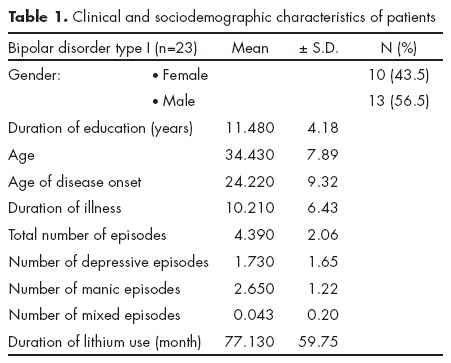
	    <p align="justify"><font face="verdana" size="2">Of the patients, 10 (43.5%) were female and 13 (56.5%) were male and mean age was 34.43 &plusmn; 7.89 years. Mean duration of education was 11.48 &plusmn; 4.18 years. Of control group, 11 (44%) were female and 14 (56%) were male. A significant difference was not detected between groups in terms of gender distribution (&#967;<sup>2</sup>=0.01; p=0.60). Mean age of control group was 33.6 &plusmn; 6.69 years. A statistically significant difference was not detected between groups in terms of mean age (z=&#45;0.50; p=0.61). Patients had been using lithium for average 77.13 &plusmn; 59.75 months. Clinical and sociodemographic characteristics of patients are shown in <a href="#t1">table 1</a>.</font></p>

	    <p align="center"><font face="verdana" size="2"><a name="t1"></a></font></p>

	    <p align="center"><font face="verdana" size="2"><img src="/img/revistas/sm/v37n2/a7t1.jpg"></font></p>

	    <p align="justify"><font face="verdana" size="2">Of the patients, 30.4% (n=7) were using only lithium, 56.5% (n=13) were using antipsychotics in addition to lithium, 13% (n=3) were using the combination of lithium, anti&#45;psychotics and antidepressants.</font></p>

	    <p align="justify"><font face="verdana" size="2">Mean TSH level of bipolar patients was 2.10 &plusmn; 0.98 and mean TSH level of control group was 1.83 &plusmn; 0.97. A statistically significant difference was not found when TSH levels of bipolar patients were compared with control group (z=&#45;1.17; p=0.24). Mean fT4 values of patient and control groups were 1.00 &plusmn; 0.10 and 1.11 &plusmn; 0.09, respectively. Mean fT3 of patient groups were compared.</font></p>

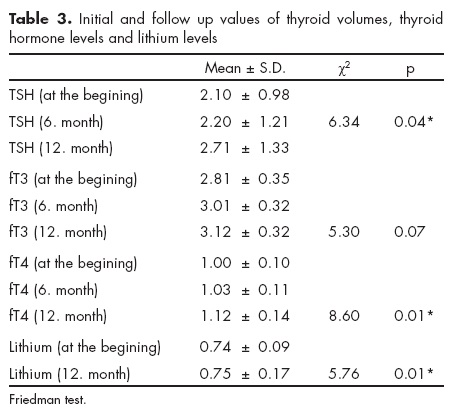
	    <p align="justify"><font face="verdana" size="2">All volumes except right sagittal diameter (z=&#45;1.28; p=0.19) and left sagittal diameter (z=&#45;0.56; p=0.55) were detected to be greater in bipolar patients (p&lt;0.05). Comparison of initial thyroid volumes of patient and control groups is summarized in <a href="/img/revistas/sm/v37n2/a7t2.jpg" target="_blank">table 2</a>. Euthyroid status change occurred in no patients; ft3, ft4 and TSH were within normal ranges. No patients discontinued lithium therapy and they came for controls regularly. Change in TSH levels at the beginning of the study (2.10 &plusmn; 0.98), at six months (2.20 &plusmn; 1.21) and at the first year (2.71 &plusmn; 1.33) was found statistically significant (&#967;<sup>2</sup>=6.34; p=0.04). A significant difference was detected between lithium levels measured at the beginning of the study (0.74+0.09) and after one year (0.75 &plusmn; 0.17). Lithium levels measured after one year were found higher (&#967;<sup>2</sup>=5.76; p=0.01). Thyroid hormone levels at the beginning, initial and follow&#45;up levels of lithium are given in <a href="#t3">table 3</a>.</font></p>

	    <p align="center"><font face="verdana" size="2"><a name="t3"></a></font></p>

	    <p align="center"><font face="verdana" size="2"><img src="/img/revistas/sm/v37n2/a7t3.jpg"></font></p>

	    ]]></body>
<body><![CDATA[<p align="justify"><font face="verdana" size="2">A significant correlation was not detected between the final TSH value and duration of disease, duration of lithium use, thyroid volumes on ultrasonography, initial TSH value and lithium level (p&gt;0.05) (<a href="#t4">table 4</a>).</font></p>

	    <p align="center"><font face="verdana" size="2"><a name="t4"></a></font></p>

	    <p align="center"><font face="verdana" size="2"><img src="/img/revistas/sm/v37n2/a7t4.jpg"></font></p>

	    <p align="justify"><font face="verdana" size="2">&nbsp;</font></p>

	    <p align="justify"><font face="verdana" size="2"><b>DISCUSSION</b></font></p>

	    <p align="justify"><font face="verdana" size="2">In this study, thyroid hormones did not change in the course of lithium therapy in euthyroid patients with bipolar I disorder who were using lithium and who were in remission. Euthyroid status did not change in one year follow&#45;up although the patients were using lithium regularly. Thyroid volume of patients was significantly greater than healthy controls at the beginning of the study. There was not a significant difference between initial TSH values of both groups, but fT3 and fT4 values of bipolar patients were significantly lower than those of controls. Plasma lithium level and TSH values were significantly elevated at the end of one year follow&#45;up although they stayed within normal values. Lithium use is known to reduce synthesis and release of thyroid hormone.<sup>30</sup> Initial low fT3 and fT4 levels may be associated with lithium use in bipolar patients. fT4 level was found to be lower in lithium&#45;treated bipolar patients compared to healthy controls in a study.<sup>31</sup> In a 15&#45;year follow&#45;up study of Bocchetta et al., yearly hypothyroidism ratio was found at 1.5% in lithium&#45;treated bipolar patients.<sup>32</sup> No patients developed hypothyroidism in our study. Ezzaher et al. found TSH values of bipolar I patients higher than healthy controls. Hy&#45;pothyroidism was found in the ratio of 28.5% in that study.<sup>33</sup> Under the light of our findings, it may be suggested that lithium treatment is safe in patients who stayed euthyroid when using lithium and treatment may be continued by doing required tests.</font></p>

	    <p align="justify"><font face="verdana" size="2">Increased thyroid volume on ultrasonography is an expected finding in patients who have been using lithium for a long time.<sup>17,30,34&#45;36</sup> Bauer et al. reported that thyroid enlargement that cannot be detected by palpation may be detected with ultrasonography and they recommended regular ultra&#45;sonography examinations.<sup>22</sup> An association was not found between thyroid volumes and hypothyroidism in lithium&#45;treated bipolar patients in a study.<sup>31</sup> In our study, the final TSH value and initial thyroid diameters, duration of lithium therapy and total duration of disease were not associated. Significance of thyroid diameter increases may be understood with follow&#45;up studies with longer duration.</font></p>

	    <p align="justify"><font face="verdana" size="2">Bauer et al. found that TSH values were higher in bipolar patients who did not receive thyroid hormone replacement compared to healthy controls.<sup>22</sup> Zhang et al. found that TSH levels increased with time in lithium&#45;treated patients.<sup>37</sup> In our study, TSH levels tended to elevate in one&#45;year follow&#45;up and this elevation was not found to be correlated with lithium level. Increase in TSH levels indicates the significance of follow&#45;up of this parameter although it stayed within normal ranges.</font></p>

	    <p align="justify"><font face="verdana" size="2">Five out of 28 subjects in patient group were excluded from the study as thyroid nodule was detected on thyroid ultrasonography. It is not possible to detect the relationship between lithium therapy and thyroid nodules due to the small number of patients. However, we may suggest that thyroid nodule may be detected in lithium&#45;treated patients and care must be taken.</font></p>

	    <p align="justify"><font face="verdana" size="2">The small number of patients and the relatively short duration of the follow&#45;up are the major limitations of our study. Nutrition&#45;related confounding factors like iodine consumption were not studied in the study. It would not be proper to generalize this to all lithium&#45;treated patients as lithium&#45;treated euthyroid patients were analyzed in our study. Psychotropic drugs beside lithium may be a confounding factor.</font></p>

	    ]]></body>
<body><![CDATA[<p align="justify"><font face="verdana" size="2">In conclusion, lithium use may lead to an increase in thyroid volumes although the patients are euthyroid. Thyroid volumes were not found to be related with TSH levels one year later in our study. According to these results, it may be considered that lithium may be used safely in euthyroid patients if required tests are performed.</font></p>

	    <p align="justify"><font face="verdana" size="2">&nbsp;</font></p>

	    <p align="justify"><font face="verdana" size="2"><b>REFERENCES</b></font></p>

	    <!-- ref --><p align="justify"><font face="verdana" size="2">1. Boccheta A, Loviselli A. Lithium treatment and thyroid abnormalities. Clinical Practice Epidemiology Mental Health 2006;2:23.    &nbsp;&nbsp;&nbsp;&nbsp;&nbsp;&nbsp;&nbsp;&nbsp;[&#160;<a href="javascript:void(0);" onclick="javascript: window.open('/scielo.php?script=sci_nlinks&ref=9101147&pid=S0185-3325201400020000700001&lng=','','width=640,height=500,resizable=yes,scrollbars=1,menubar=yes,');">Links</a>&#160;]<!-- end-ref --></font></p>

	    <!-- ref --><p align="justify"><font face="verdana" size="2">2. Sadock BJ, Sadock VA. Comprehensive textbook of psychiatry. Vol. 2, 7th edition Philadelphia: Lippincott Williams Wilkins; 2000.    &nbsp;&nbsp;&nbsp;&nbsp;&nbsp;&nbsp;&nbsp;&nbsp;[&#160;<a href="javascript:void(0);" onclick="javascript: window.open('/scielo.php?script=sci_nlinks&ref=9101149&pid=S0185-3325201400020000700002&lng=','','width=640,height=500,resizable=yes,scrollbars=1,menubar=yes,');">Links</a>&#160;]<!-- end-ref --></font></p>

	    <!-- ref --><p align="justify"><font face="verdana" size="2">3. Deodhar SD, Sing B, Pathak MC, Sharan P et al. Thyroid functions in lithium&#45;treated psychiatric patients. Biol Trace Element Res 1998;67:151.    &nbsp;&nbsp;&nbsp;&nbsp;&nbsp;&nbsp;&nbsp;&nbsp;[&#160;<a href="javascript:void(0);" onclick="javascript: window.open('/scielo.php?script=sci_nlinks&ref=9101151&pid=S0185-3325201400020000700003&lng=','','width=640,height=500,resizable=yes,scrollbars=1,menubar=yes,');">Links</a>&#160;]<!-- end-ref --></font></p>

	    <!-- ref --><p align="justify"><font face="verdana" size="2">4. Perrild H, Hegedus L, Baastrup PC, Kayser L et al. Thyroid function and ultrasonically determined thyroid size in patients receiving longterm lithium treatment. Am J Psychiatry 1990;147:1518.    &nbsp;&nbsp;&nbsp;&nbsp;&nbsp;&nbsp;&nbsp;&nbsp;[&#160;<a href="javascript:void(0);" onclick="javascript: window.open('/scielo.php?script=sci_nlinks&ref=9101153&pid=S0185-3325201400020000700004&lng=','','width=640,height=500,resizable=yes,scrollbars=1,menubar=yes,');">Links</a>&#160;]<!-- end-ref --></font></p>

	    <!-- ref --><p align="justify"><font face="verdana" size="2">5. Bocchetta A, Bernardi F, Pedditzi M, Loviselli A et al. Thyroid abnormalities during lithium treatment. Acta Psychiatr Scand 1991;83(3):193&#45;8.    &nbsp;&nbsp;&nbsp;&nbsp;&nbsp;&nbsp;&nbsp;&nbsp;[&#160;<a href="javascript:void(0);" onclick="javascript: window.open('/scielo.php?script=sci_nlinks&ref=9101155&pid=S0185-3325201400020000700005&lng=','','width=640,height=500,resizable=yes,scrollbars=1,menubar=yes,');">Links</a>&#160;]<!-- end-ref --></font></p>

	    <!-- ref --><p align="justify"><font face="verdana" size="2">6. Lee S, Chow CC, Wing YK, Shek CC. Thyroid abnormalities during chronic lithium treatment in Hong Kong Chinese: a controlled study. J Affect Disord 1992;26:173&#45;178.    &nbsp;&nbsp;&nbsp;&nbsp;&nbsp;&nbsp;&nbsp;&nbsp;[&#160;<a href="javascript:void(0);" onclick="javascript: window.open('/scielo.php?script=sci_nlinks&ref=9101157&pid=S0185-3325201400020000700006&lng=','','width=640,height=500,resizable=yes,scrollbars=1,menubar=yes,');">Links</a>&#160;]<!-- end-ref --></font></p>

	    <!-- ref --><p align="justify"><font face="verdana" size="2">7. Bochetta A, Cherchi A, Loviselli A, Mossa P et al. Six&#45;yearfollow&#45; up of thyroid function during lithium treatment. Acta Psychiatr Scand 1996;94:45&#45;48.    &nbsp;&nbsp;&nbsp;&nbsp;&nbsp;&nbsp;&nbsp;&nbsp;[&#160;<a href="javascript:void(0);" onclick="javascript: window.open('/scielo.php?script=sci_nlinks&ref=9101159&pid=S0185-3325201400020000700007&lng=','','width=640,height=500,resizable=yes,scrollbars=1,menubar=yes,');">Links</a>&#160;]<!-- end-ref --></font></p>

	    <!-- ref --><p align="justify"><font face="verdana" size="2">8. Loviselli A, Bocchetta A, Mossa P, Velluzzi F et al. Value of thyroid echography in the long&#45;term follow&#45;up of lithium&#45;treated patients. Neuropsychobiology 1997;36(1):37&#45;41.    &nbsp;&nbsp;&nbsp;&nbsp;&nbsp;&nbsp;&nbsp;&nbsp;[&#160;<a href="javascript:void(0);" onclick="javascript: window.open('/scielo.php?script=sci_nlinks&ref=9101161&pid=S0185-3325201400020000700008&lng=','','width=640,height=500,resizable=yes,scrollbars=1,menubar=yes,');">Links</a>&#160;]<!-- end-ref --></font></p>

	    <!-- ref --><p align="justify"><font face="verdana" size="2">9. Livingstone C, Rampes H. Lithium: A review of its metabolic adverse effects. J Psychopharmacol 2006;20:347&#45;355.    &nbsp;&nbsp;&nbsp;&nbsp;&nbsp;&nbsp;&nbsp;&nbsp;[&#160;<a href="javascript:void(0);" onclick="javascript: window.open('/scielo.php?script=sci_nlinks&ref=9101163&pid=S0185-3325201400020000700009&lng=','','width=640,height=500,resizable=yes,scrollbars=1,menubar=yes,');">Links</a>&#160;]<!-- end-ref --></font></p>

	    <!-- ref --><p align="justify"><font face="verdana" size="2">10. Ahmadi&#45;Abhari SA, Ghaeli P, Fahimi F, Esfahanian F et al. Risk factors of thyroid abnormalities in bipolar patients receiving lithium: a case control study. BMC Psychiatry 2003;3:4.    &nbsp;&nbsp;&nbsp;&nbsp;&nbsp;&nbsp;&nbsp;&nbsp;[&#160;<a href="javascript:void(0);" onclick="javascript: window.open('/scielo.php?script=sci_nlinks&ref=9101165&pid=S0185-3325201400020000700010&lng=','','width=640,height=500,resizable=yes,scrollbars=1,menubar=yes,');">Links</a>&#160;]<!-- end-ref --></font></p>

	    <!-- ref --><p align="justify"><font face="verdana" size="2">11. Schoenberg M, Ts'O TOT, Meisel AN. Graves' Disease manifesting after maintenance lithium. The J Nerv Ment Disease 1979;167(9):575&#45;77.    &nbsp;&nbsp;&nbsp;&nbsp;&nbsp;&nbsp;&nbsp;&nbsp;[&#160;<a href="javascript:void(0);" onclick="javascript: window.open('/scielo.php?script=sci_nlinks&ref=9101167&pid=S0185-3325201400020000700011&lng=','','width=640,height=500,resizable=yes,scrollbars=1,menubar=yes,');">Links</a>&#160;]<!-- end-ref --></font></p>

	    <!-- ref --><p align="justify"><font face="verdana" size="2">12. Reisberg B, Gershon S. Side effects associated with lithium therapy. Arch Gen Psychiatry 1979;36:879&#45;87.    &nbsp;&nbsp;&nbsp;&nbsp;&nbsp;&nbsp;&nbsp;&nbsp;[&#160;<a href="javascript:void(0);" onclick="javascript: window.open('/scielo.php?script=sci_nlinks&ref=9101169&pid=S0185-3325201400020000700012&lng=','','width=640,height=500,resizable=yes,scrollbars=1,menubar=yes,');">Links</a>&#160;]<!-- end-ref --></font></p>

	    <!-- ref --><p align="justify"><font face="verdana" size="2">13. Pohl R, Berchou R, Gupta BK. Case report: Lithium induced hypothyroidism and thyroiditis. Biol Psychiat 1979;14(5):835&#45;37.    &nbsp;&nbsp;&nbsp;&nbsp;&nbsp;&nbsp;&nbsp;&nbsp;[&#160;<a href="javascript:void(0);" onclick="javascript: window.open('/scielo.php?script=sci_nlinks&ref=9101171&pid=S0185-3325201400020000700013&lng=','','width=640,height=500,resizable=yes,scrollbars=1,menubar=yes,');">Links</a>&#160;]<!-- end-ref --></font></p>

	    <!-- ref --><p align="justify"><font face="verdana" size="2">14. Transbol I, Christiansen C, Baastrup PC. Endocrine effects of lithium. Primay Hypothyroidism, its prevalence in long term treated patients. Acta Endocrinologica 1978;87:579&#45;67.    &nbsp;&nbsp;&nbsp;&nbsp;&nbsp;&nbsp;&nbsp;&nbsp;[&#160;<a href="javascript:void(0);" onclick="javascript: window.open('/scielo.php?script=sci_nlinks&ref=9101173&pid=S0185-3325201400020000700014&lng=','','width=640,height=500,resizable=yes,scrollbars=1,menubar=yes,');">Links</a>&#160;]<!-- end-ref --></font></p>

	    <!-- ref --><p align="justify"><font face="verdana" size="2">15. Kirov G. Thyroid disorders in lithum&#45;treated patients. J Affect Disord 1998;50:33.    &nbsp;&nbsp;&nbsp;&nbsp;&nbsp;&nbsp;&nbsp;&nbsp;[&#160;<a href="javascript:void(0);" onclick="javascript: window.open('/scielo.php?script=sci_nlinks&ref=9101175&pid=S0185-3325201400020000700015&lng=','','width=640,height=500,resizable=yes,scrollbars=1,menubar=yes,');">Links</a>&#160;]<!-- end-ref --></font></p>

	    <!-- ref --><p align="justify"><font face="verdana" size="2">16. Chow CC, Lee S, Shek CC, Wing YK et al. Lithium&#45;associated transient thyrotoxicosis in 4 chinese woman with autoimmune thyroiditis. Aust N Z J Psychiatry 1993;27:246.    &nbsp;&nbsp;&nbsp;&nbsp;&nbsp;&nbsp;&nbsp;&nbsp;[&#160;<a href="javascript:void(0);" onclick="javascript: window.open('/scielo.php?script=sci_nlinks&ref=9101177&pid=S0185-3325201400020000700016&lng=','','width=640,height=500,resizable=yes,scrollbars=1,menubar=yes,');">Links</a>&#160;]<!-- end-ref --></font></p>

	    <!-- ref --><p align="justify"><font face="verdana" size="2">17. Ozsoy S, Mavili E, Aydin M, Turan T et al. Ultrasonically determined thyroid volume and thyroid functions in lithium&#45;na&iuml;ve and lithium&#45;treated patients with bipolar disorder: a cross&#45;sectional and longitudinal study. Human Psychopharmacology Clinical Experimental 2010;25(2):174&#45;178.    &nbsp;&nbsp;&nbsp;&nbsp;&nbsp;&nbsp;&nbsp;&nbsp;[&#160;<a href="javascript:void(0);" onclick="javascript: window.open('/scielo.php?script=sci_nlinks&ref=9101179&pid=S0185-3325201400020000700017&lng=','','width=640,height=500,resizable=yes,scrollbars=1,menubar=yes,');">Links</a>&#160;]<!-- end-ref --></font></p>

	    <!-- ref --><p align="justify"><font face="verdana" size="2">18. Bernstein JG. Drug therapy in psychiatry. 3rd ed., Massachusetts: Aimes Mirror Company; 1995.    &nbsp;&nbsp;&nbsp;&nbsp;&nbsp;&nbsp;&nbsp;&nbsp;[&#160;<a href="javascript:void(0);" onclick="javascript: window.open('/scielo.php?script=sci_nlinks&ref=9101181&pid=S0185-3325201400020000700018&lng=','','width=640,height=500,resizable=yes,scrollbars=1,menubar=yes,');">Links</a>&#160;]<!-- end-ref --></font></p>

	    <!-- ref --><p align="justify"><font face="verdana" size="2">19. Tu&#287;lular I. Psikiyatride &#304;la&ccedil; Kullanimi. 1. Baski, Drug use in psychiatry, 1. edition, &#304;n &#304;zmir. Turkish: Ege &Uuml;niversitesi Basimevi; 1991; pp. 257&#45;298.    &nbsp;&nbsp;&nbsp;&nbsp;&nbsp;&nbsp;&nbsp;&nbsp;[&#160;<a href="javascript:void(0);" onclick="javascript: window.open('/scielo.php?script=sci_nlinks&ref=9101183&pid=S0185-3325201400020000700019&lng=','','width=640,height=500,resizable=yes,scrollbars=1,menubar=yes,');">Links</a>&#160;]<!-- end-ref --></font></p>

    <!-- ref --><p align="justify"><font face="verdana" size="2">20. Y&uuml;ksel NY, K&ouml;ro&#287;lu E. Klinik Uygulamali Psikofarmakoloji. 1. Baski, Clinical Psychopharmacology. 1. Edition. Ankara, Turkish: Hekimler Yayin Birligi; 1991; pp. 160&#45;190.    &nbsp;&nbsp;&nbsp;&nbsp;&nbsp;&nbsp;&nbsp;&nbsp;[&#160;<a href="javascript:void(0);" onclick="javascript: window.open('/scielo.php?script=sci_nlinks&ref=9101185&pid=S0185-3325201400020000700020&lng=','','width=640,height=500,resizable=yes,scrollbars=1,menubar=yes,');">Links</a>&#160;]<!-- end-ref --></font></p>

    <!-- ref --><p align="justify"><font face="verdana" size="2">21. Vahip S. Mood stabilizers: Lithium, carbamazepine, valproate G&uuml;le&ccedil; C., K&ouml;ro&#287;lu E., Psikiyatri Temel Kitabi. Cilt 2, 1. Baski, Ankara, Turkish: Hekimler Yayin Birligi; 1998; p. 995.    &nbsp;&nbsp;&nbsp;&nbsp;&nbsp;&nbsp;&nbsp;&nbsp;[&#160;<a href="javascript:void(0);" onclick="javascript: window.open('/scielo.php?script=sci_nlinks&ref=9101187&pid=S0185-3325201400020000700021&lng=','','width=640,height=500,resizable=yes,scrollbars=1,menubar=yes,');">Links</a>&#160;]<!-- end-ref --></font></p>

    <!-- ref --><p align="justify"><font face="verdana" size="2">22. Bauer M, Blumentritt H, Finke R, Schlattmann P et al. Using ultrasonography to determine thyroid size and prevalence of goiter in lithium&#45;treated patients with affective disorders. J affect Disord 2007;04(1&#45;3):45&#45;51.    &nbsp;&nbsp;&nbsp;&nbsp;&nbsp;&nbsp;&nbsp;&nbsp;[&#160;<a href="javascript:void(0);" onclick="javascript: window.open('/scielo.php?script=sci_nlinks&ref=9101189&pid=S0185-3325201400020000700022&lng=','','width=640,height=500,resizable=yes,scrollbars=1,menubar=yes,');">Links</a>&#160;]<!-- end-ref --></font></p>

	    <!-- ref --><p align="justify"><font face="verdana" size="2">23. Schiemann U, Hengst K. Thyroid echogenicity in manic&#45;depressive patients receiving lithium therapy. J Affect Disord 2002;70:85&#45;90.    &nbsp;&nbsp;&nbsp;&nbsp;&nbsp;&nbsp;&nbsp;&nbsp;[&#160;<a href="javascript:void(0);" onclick="javascript: window.open('/scielo.php?script=sci_nlinks&ref=9101191&pid=S0185-3325201400020000700023&lng=','','width=640,height=500,resizable=yes,scrollbars=1,menubar=yes,');">Links</a>&#160;]<!-- end-ref --></font></p>

	    <!-- ref --><p align="justify"><font face="verdana" size="2">24. Akdemir A, &Ouml;rsel S, Da&#287; &#304;, Turkcapar H et al. Validity, reliability and clinical use of Hamilton depression rating scale. Psikiyatri Psikoloji Psikofarmakoloji Dergisi (&#304;n Turkish) 1996;4:251&#45;9.    &nbsp;&nbsp;&nbsp;&nbsp;&nbsp;&nbsp;&nbsp;&nbsp;[&#160;<a href="javascript:void(0);" onclick="javascript: window.open('/scielo.php?script=sci_nlinks&ref=9101193&pid=S0185-3325201400020000700024&lng=','','width=640,height=500,resizable=yes,scrollbars=1,menubar=yes,');">Links</a>&#160;]<!-- end-ref --></font></p>

    <!-- ref --><p align="justify"><font face="verdana" size="2">25. Karada&#287; F, Oral ET, Aran Yal&ccedil;in F, Erten E. Validity and reliability of Young Mania Rating Scale in Turkey. T&uuml;rk Psikiyatri Dergisi (&iacute;n Turkish) 2002;13:107&#45;114.    &nbsp;&nbsp;&nbsp;&nbsp;&nbsp;&nbsp;&nbsp;&nbsp;[&#160;<a href="javascript:void(0);" onclick="javascript: window.open('/scielo.php?script=sci_nlinks&ref=9101195&pid=S0185-3325201400020000700025&lng=','','width=640,height=500,resizable=yes,scrollbars=1,menubar=yes,');">Links</a>&#160;]<!-- end-ref --></font></p>

	    <!-- ref --><p align="justify"><font face="verdana" size="2">26. First MB, Spitzer RL, Gibbon M, Williams JBW. Structured clinical interview for DSM&#45;IV axis I disorders &#45;clinical version (SCID&#45;CV). Washington, DC: American Psychiatric Press; 1997.    &nbsp;&nbsp;&nbsp;&nbsp;&nbsp;&nbsp;&nbsp;&nbsp;[&#160;<a href="javascript:void(0);" onclick="javascript: window.open('/scielo.php?script=sci_nlinks&ref=9101197&pid=S0185-3325201400020000700026&lng=','','width=640,height=500,resizable=yes,scrollbars=1,menubar=yes,');">Links</a>&#160;]<!-- end-ref --></font></p>

	    <!-- ref --><p align="justify"><font face="verdana" size="2">27 &Ccedil;orap&ccedil;io&#287;lu A, Aydemir &Ouml;, Yildiz M, Esen A et al. Structured clinical interview for DSM&#45;IV axis I disorders &#45;clinical version (SCID&#45;CV) in Turkish version: Study of reliability. &#304;la&ccedil; ve Tedavi Dergisi (in Turkish) 1999;12:233&#45;236).    &nbsp;&nbsp;&nbsp;&nbsp;&nbsp;&nbsp;&nbsp;&nbsp;[&#160;<a href="javascript:void(0);" onclick="javascript: window.open('/scielo.php?script=sci_nlinks&ref=9101199&pid=S0185-3325201400020000700027&lng=','','width=640,height=500,resizable=yes,scrollbars=1,menubar=yes,');">Links</a>&#160;]<!-- end-ref --></font></p>

    <!-- ref --><p align="justify"><font face="verdana" size="2">28. Spitzer RL, Williams JBW, Gibbon M, First M. Structured clinical interview for DSM&#45;III&#45;R, non&#45;patient edition (SCID&#45;NP, Version 1.0). Washington DC: American Psychiatric Press; 1990.    &nbsp;&nbsp;&nbsp;&nbsp;&nbsp;&nbsp;&nbsp;&nbsp;[&#160;<a href="javascript:void(0);" onclick="javascript: window.open('/scielo.php?script=sci_nlinks&ref=9101201&pid=S0185-3325201400020000700028&lng=','','width=640,height=500,resizable=yes,scrollbars=1,menubar=yes,');">Links</a>&#160;]<!-- end-ref --></font></p>

	    <!-- ref --><p align="justify"><font face="verdana" size="2">29. Sorias S, Saygili R, Elbi H. Turkish version of structured clinical interview for DSM&#45;III&#45;R, non&#45;patient edition (SCID&#45;NP, Version 1.0), (in Turkish). Bornova: Ege &Uuml;niversitesi Basimevi; 1990;    &nbsp;&nbsp;&nbsp;&nbsp;&nbsp;&nbsp;&nbsp;&nbsp;[&#160;<a href="javascript:void(0);" onclick="javascript: window.open('/scielo.php?script=sci_nlinks&ref=9101203&pid=S0185-3325201400020000700029&lng=','','width=640,height=500,resizable=yes,scrollbars=1,menubar=yes,');">Links</a>&#160;]<!-- end-ref --></font></p>

	    <!-- ref --><p align="justify"><font face="verdana" size="2">30. Kibirige D, Luzinda K, Ssekitoleko R. Spectrum of lithium induced thyroid abnormalities: a current perspective. Thyroid Res 2013;6(1):3.    &nbsp;&nbsp;&nbsp;&nbsp;&nbsp;&nbsp;&nbsp;&nbsp;[&#160;<a href="javascript:void(0);" onclick="javascript: window.open('/scielo.php?script=sci_nlinks&ref=9101205&pid=S0185-3325201400020000700030&lng=','','width=640,height=500,resizable=yes,scrollbars=1,menubar=yes,');">Links</a>&#160;]<!-- end-ref --></font></p>

	    <!-- ref --><p align="justify"><font face="verdana" size="2">31. Ozpoyraz N, Tamam L, Kulan E. Thyroid abnormalities in lithiumtreated patients. Adv Ther 2002;19(4):176&#45;84.    &nbsp;&nbsp;&nbsp;&nbsp;&nbsp;&nbsp;&nbsp;&nbsp;[&#160;<a href="javascript:void(0);" onclick="javascript: window.open('/scielo.php?script=sci_nlinks&ref=9101207&pid=S0185-3325201400020000700031&lng=','','width=640,height=500,resizable=yes,scrollbars=1,menubar=yes,');">Links</a>&#160;]<!-- end-ref --></font></p>

	    <!-- ref --><p align="justify"><font face="verdana" size="2">32. Bocchetta A, Cocco F, Velluzzi F, Del Zompo M et al. Fifteen&#45;year follow&#45;up of thyroid function in lithium patients. J Endocrinol Invest 2007;30(5):363&#45;366.    &nbsp;&nbsp;&nbsp;&nbsp;&nbsp;&nbsp;&nbsp;&nbsp;[&#160;<a href="javascript:void(0);" onclick="javascript: window.open('/scielo.php?script=sci_nlinks&ref=9101209&pid=S0185-3325201400020000700032&lng=','','width=640,height=500,resizable=yes,scrollbars=1,menubar=yes,');">Links</a>&#160;]<!-- end-ref --></font></p>

	    <!-- ref --><p align="justify"><font face="verdana" size="2">33. Ezzaher A, Haj Mouhamed D, Mechri A, Neffati F et al. Thyroid function and lipid profile in bipolar I patients. Asian J Psychiatr 2011;4(2):139&#45;43.    &nbsp;&nbsp;&nbsp;&nbsp;&nbsp;&nbsp;&nbsp;&nbsp;[&#160;<a href="javascript:void(0);" onclick="javascript: window.open('/scielo.php?script=sci_nlinks&ref=9101211&pid=S0185-3325201400020000700033&lng=','','width=640,height=500,resizable=yes,scrollbars=1,menubar=yes,');">Links</a>&#160;]<!-- end-ref --></font></p>

	    <!-- ref --><p align="justify"><font face="verdana" size="2">34. Bou Khalil R, Richa S. Thyroid adverse effects of psychotropic drugs: a review. Clin Neuropharmacol 2011; 34(6):248&#45;255.    &nbsp;&nbsp;&nbsp;&nbsp;&nbsp;&nbsp;&nbsp;&nbsp;[&#160;<a href="javascript:void(0);" onclick="javascript: window.open('/scielo.php?script=sci_nlinks&ref=9101213&pid=S0185-3325201400020000700034&lng=','','width=640,height=500,resizable=yes,scrollbars=1,menubar=yes,');">Links</a>&#160;]<!-- end-ref --></font></p>

	    <!-- ref --><p align="justify"><font face="verdana" size="2">35. Gau CS, Chang CJ, Tsai FJ, Chao PF et al. Association between mood stabilizers and hypothyroidism in patients with bipolar disorders: a nested, matched case&#45;control study. Bipolar Disord 2010;12(3):253&#45;263.    &nbsp;&nbsp;&nbsp;&nbsp;&nbsp;&nbsp;&nbsp;&nbsp;[&#160;<a href="javascript:void(0);" onclick="javascript: window.open('/scielo.php?script=sci_nlinks&ref=9101215&pid=S0185-3325201400020000700035&lng=','','width=640,height=500,resizable=yes,scrollbars=1,menubar=yes,');">Links</a>&#160;]<!-- end-ref --></font></p>

	    <!-- ref --><p align="justify"><font face="verdana" size="2">36. Lazarus JH. Lithium and thyroid. Best Pract Res Clin Endocrinol Metab 2009;23(6):723&#45;733.    &nbsp;&nbsp;&nbsp;&nbsp;&nbsp;&nbsp;&nbsp;&nbsp;[&#160;<a href="javascript:void(0);" onclick="javascript: window.open('/scielo.php?script=sci_nlinks&ref=9101217&pid=S0185-3325201400020000700036&lng=','','width=640,height=500,resizable=yes,scrollbars=1,menubar=yes,');">Links</a>&#160;]<!-- end-ref --></font></p>

	    <!-- ref --><p align="justify"><font face="verdana" size="2">37. Zhang ZJ, Qiang L, Kang WH, Tan QR et al. Differences in hypo&#45;thyroidism between lithium&#45;free and &#45;treated patients with bipolar disorders. Life Sci 2006;78(7):771&#45;6.    &nbsp;&nbsp;&nbsp;&nbsp;&nbsp;&nbsp;&nbsp;&nbsp;[&#160;<a href="javascript:void(0);" onclick="javascript: window.open('/scielo.php?script=sci_nlinks&ref=9101219&pid=S0185-3325201400020000700037&lng=','','width=640,height=500,resizable=yes,scrollbars=1,menubar=yes,');">Links</a>&#160;]<!-- end-ref --></font></p>

	    <p align="justify"><font face="verdana" size="2">&nbsp;</font></p>

	    <p align="center"><font face="verdana" size="2"><b>Declaration of conflict interest: None</b></font></p>
     ]]></body><back>
<ref-list>
<ref id="B1">
<label>1</label><nlm-citation citation-type="journal">
<person-group person-group-type="author">
<name>
<surname><![CDATA[Boccheta]]></surname>
<given-names><![CDATA[A]]></given-names>
</name>
<name>
<surname><![CDATA[Loviselli]]></surname>
<given-names><![CDATA[A]]></given-names>
</name>
</person-group>
<article-title xml:lang="en"><![CDATA[Lithium treatment and thyroid abnormalities]]></article-title>
<source><![CDATA[Clinical Practice Epidemiology Mental Health]]></source>
<year>2006</year>
<volume>2</volume>
<page-range>23</page-range></nlm-citation>
</ref>
<ref id="B2">
<label>2</label><nlm-citation citation-type="book">
<person-group person-group-type="author">
<name>
<surname><![CDATA[Sadock]]></surname>
<given-names><![CDATA[BJ]]></given-names>
</name>
<name>
<surname><![CDATA[Sadock]]></surname>
<given-names><![CDATA[VA]]></given-names>
</name>
</person-group>
<source><![CDATA[Comprehensive textbook of psychiatry]]></source>
<year>2000</year>
<volume>2</volume>
<edition>7</edition>
<publisher-loc><![CDATA[Philadelphia ]]></publisher-loc>
<publisher-name><![CDATA[Lippincott Williams Wilkins]]></publisher-name>
</nlm-citation>
</ref>
<ref id="B3">
<label>3</label><nlm-citation citation-type="journal">
<person-group person-group-type="author">
<name>
<surname><![CDATA[Deodhar]]></surname>
<given-names><![CDATA[SD]]></given-names>
</name>
<name>
<surname><![CDATA[Sing]]></surname>
<given-names><![CDATA[B]]></given-names>
</name>
<name>
<surname><![CDATA[Pathak]]></surname>
<given-names><![CDATA[MC]]></given-names>
</name>
<name>
<surname><![CDATA[Sharan]]></surname>
<given-names><![CDATA[P]]></given-names>
</name>
</person-group>
<article-title xml:lang="en"><![CDATA[Thyroid functions in lithium-treated psychiatric patients]]></article-title>
<source><![CDATA[Biol Trace Element Res]]></source>
<year>1998</year>
<volume>67</volume>
<page-range>151</page-range></nlm-citation>
</ref>
<ref id="B4">
<label>4</label><nlm-citation citation-type="journal">
<person-group person-group-type="author">
<name>
<surname><![CDATA[Perrild]]></surname>
<given-names><![CDATA[H]]></given-names>
</name>
<name>
<surname><![CDATA[Hegedus]]></surname>
<given-names><![CDATA[L]]></given-names>
</name>
<name>
<surname><![CDATA[Baastrup]]></surname>
<given-names><![CDATA[PC]]></given-names>
</name>
<name>
<surname><![CDATA[Kayser]]></surname>
<given-names><![CDATA[L]]></given-names>
</name>
</person-group>
<article-title xml:lang="en"><![CDATA[Thyroid function and ultrasonically determined thyroid size in patients receiving longterm lithium treatment]]></article-title>
<source><![CDATA[Am J Psychiatry]]></source>
<year>1990</year>
<volume>147</volume>
<page-range>1518</page-range></nlm-citation>
</ref>
<ref id="B5">
<label>5</label><nlm-citation citation-type="journal">
<person-group person-group-type="author">
<name>
<surname><![CDATA[Bocchetta]]></surname>
<given-names><![CDATA[A]]></given-names>
</name>
<name>
<surname><![CDATA[Bernardi]]></surname>
<given-names><![CDATA[F]]></given-names>
</name>
<name>
<surname><![CDATA[Pedditzi]]></surname>
<given-names><![CDATA[M]]></given-names>
</name>
<name>
<surname><![CDATA[Loviselli]]></surname>
<given-names><![CDATA[A]]></given-names>
</name>
</person-group>
<article-title xml:lang="en"><![CDATA[Thyroid abnormalities during lithium treatment]]></article-title>
<source><![CDATA[Acta Psychiatr Scand]]></source>
<year>1991</year>
<volume>83</volume>
<numero>3</numero>
<issue>3</issue>
<page-range>193-8</page-range></nlm-citation>
</ref>
<ref id="B6">
<label>6</label><nlm-citation citation-type="journal">
<person-group person-group-type="author">
<name>
<surname><![CDATA[Lee]]></surname>
<given-names><![CDATA[S]]></given-names>
</name>
<name>
<surname><![CDATA[Chow]]></surname>
<given-names><![CDATA[CC]]></given-names>
</name>
<name>
<surname><![CDATA[Wing]]></surname>
<given-names><![CDATA[YK]]></given-names>
</name>
<name>
<surname><![CDATA[Shek]]></surname>
<given-names><![CDATA[CC]]></given-names>
</name>
</person-group>
<article-title xml:lang="en"><![CDATA[Thyroid abnormalities during chronic lithium treatment in Hong Kong Chinese: a controlled study]]></article-title>
<source><![CDATA[J Affect Disord]]></source>
<year>1992</year>
<volume>26</volume>
<page-range>173-178</page-range></nlm-citation>
</ref>
<ref id="B7">
<label>7</label><nlm-citation citation-type="journal">
<person-group person-group-type="author">
<name>
<surname><![CDATA[Bochetta]]></surname>
<given-names><![CDATA[A]]></given-names>
</name>
<name>
<surname><![CDATA[Cherchi]]></surname>
<given-names><![CDATA[A]]></given-names>
</name>
<name>
<surname><![CDATA[Loviselli]]></surname>
<given-names><![CDATA[A]]></given-names>
</name>
<name>
<surname><![CDATA[Mossa]]></surname>
<given-names><![CDATA[P]]></given-names>
</name>
</person-group>
<article-title xml:lang="en"><![CDATA[Six-yearfollow- up of thyroid function during lithium treatment]]></article-title>
<source><![CDATA[Acta Psychiatr Scand]]></source>
<year>1996</year>
<volume>94</volume>
<page-range>45-48</page-range></nlm-citation>
</ref>
<ref id="B8">
<label>8</label><nlm-citation citation-type="journal">
<person-group person-group-type="author">
<name>
<surname><![CDATA[Loviselli]]></surname>
<given-names><![CDATA[A]]></given-names>
</name>
<name>
<surname><![CDATA[Bocchetta]]></surname>
<given-names><![CDATA[A]]></given-names>
</name>
<name>
<surname><![CDATA[Mossa]]></surname>
<given-names><![CDATA[P]]></given-names>
</name>
<name>
<surname><![CDATA[Velluzzi]]></surname>
<given-names><![CDATA[F]]></given-names>
</name>
</person-group>
<article-title xml:lang="en"><![CDATA[Value of thyroid echography in the long-term follow-up of lithium-treated patients]]></article-title>
<source><![CDATA[Neuropsychobiology]]></source>
<year>1997</year>
<volume>36</volume>
<numero>1</numero>
<issue>1</issue>
<page-range>37-41</page-range></nlm-citation>
</ref>
<ref id="B9">
<label>9</label><nlm-citation citation-type="journal">
<person-group person-group-type="author">
<name>
<surname><![CDATA[Livingstone]]></surname>
<given-names><![CDATA[C]]></given-names>
</name>
<name>
<surname><![CDATA[Rampes]]></surname>
<given-names><![CDATA[H]]></given-names>
</name>
</person-group>
<article-title xml:lang="en"><![CDATA[Lithium: A review of its metabolic adverse effects]]></article-title>
<source><![CDATA[J Psychopharmacol]]></source>
<year>2006</year>
<volume>20</volume>
<page-range>347-355</page-range></nlm-citation>
</ref>
<ref id="B10">
<label>10</label><nlm-citation citation-type="journal">
<person-group person-group-type="author">
<name>
<surname><![CDATA[Ahmadi-Abhari]]></surname>
<given-names><![CDATA[SA]]></given-names>
</name>
<name>
<surname><![CDATA[Ghaeli]]></surname>
<given-names><![CDATA[P]]></given-names>
</name>
<name>
<surname><![CDATA[Fahimi]]></surname>
<given-names><![CDATA[F]]></given-names>
</name>
<name>
<surname><![CDATA[Esfahanian]]></surname>
<given-names><![CDATA[F]]></given-names>
</name>
</person-group>
<article-title xml:lang="en"><![CDATA[Risk factors of thyroid abnormalities in bipolar patients receiving lithium: a case control study]]></article-title>
<source><![CDATA[BMC Psychiatry]]></source>
<year>2003</year>
<volume>3</volume>
<page-range>4</page-range></nlm-citation>
</ref>
<ref id="B11">
<label>11</label><nlm-citation citation-type="journal">
<person-group person-group-type="author">
<name>
<surname><![CDATA[Schoenberg]]></surname>
<given-names><![CDATA[M]]></given-names>
</name>
<name>
<surname><![CDATA[Ts'O]]></surname>
<given-names><![CDATA[TOT]]></given-names>
</name>
<name>
<surname><![CDATA[Meisel]]></surname>
<given-names><![CDATA[AN]]></given-names>
</name>
</person-group>
<article-title xml:lang="en"><![CDATA[Graves' Disease manifesting after maintenance lithium]]></article-title>
<source><![CDATA[The J Nerv Ment Disease]]></source>
<year>1979</year>
<volume>167</volume>
<numero>9</numero>
<issue>9</issue>
<page-range>575-77</page-range></nlm-citation>
</ref>
<ref id="B12">
<label>12</label><nlm-citation citation-type="journal">
<person-group person-group-type="author">
<name>
<surname><![CDATA[Reisberg]]></surname>
<given-names><![CDATA[B]]></given-names>
</name>
<name>
<surname><![CDATA[Gershon]]></surname>
<given-names><![CDATA[S]]></given-names>
</name>
</person-group>
<article-title xml:lang="en"><![CDATA[Side effects associated with lithium therapy]]></article-title>
<source><![CDATA[Arch Gen Psychiatry]]></source>
<year>1979</year>
<volume>36</volume>
<page-range>879-87</page-range></nlm-citation>
</ref>
<ref id="B13">
<label>13</label><nlm-citation citation-type="journal">
<person-group person-group-type="author">
<name>
<surname><![CDATA[Pohl]]></surname>
<given-names><![CDATA[R]]></given-names>
</name>
<name>
<surname><![CDATA[Berchou]]></surname>
<given-names><![CDATA[R]]></given-names>
</name>
<name>
<surname><![CDATA[Gupta]]></surname>
<given-names><![CDATA[BK]]></given-names>
</name>
</person-group>
<article-title xml:lang="en"><![CDATA[Case report: Lithium induced hypothyroidism and thyroiditis]]></article-title>
<source><![CDATA[Biol Psychiat]]></source>
<year>1979</year>
<volume>14</volume>
<numero>5</numero>
<issue>5</issue>
<page-range>835-37</page-range></nlm-citation>
</ref>
<ref id="B14">
<label>14</label><nlm-citation citation-type="journal">
<person-group person-group-type="author">
<name>
<surname><![CDATA[Transbol]]></surname>
<given-names><![CDATA[I]]></given-names>
</name>
<name>
<surname><![CDATA[Christiansen]]></surname>
<given-names><![CDATA[C]]></given-names>
</name>
<name>
<surname><![CDATA[Baastrup]]></surname>
<given-names><![CDATA[PC]]></given-names>
</name>
</person-group>
<article-title xml:lang="en"><![CDATA[Endocrine effects of lithium. Primay Hypothyroidism, its prevalence in long term treated patients]]></article-title>
<source><![CDATA[Acta Endocrinologica]]></source>
<year>1978</year>
<volume>87</volume>
<page-range>579-67</page-range></nlm-citation>
</ref>
<ref id="B15">
<label>15</label><nlm-citation citation-type="journal">
<person-group person-group-type="author">
<name>
<surname><![CDATA[Kirov]]></surname>
<given-names><![CDATA[G]]></given-names>
</name>
</person-group>
<article-title xml:lang="en"><![CDATA[Thyroid disorders in lithum-treated patients]]></article-title>
<source><![CDATA[J Affect Disord]]></source>
<year>1998</year>
<volume>50</volume>
<page-range>33</page-range></nlm-citation>
</ref>
<ref id="B16">
<label>16</label><nlm-citation citation-type="journal">
<person-group person-group-type="author">
<name>
<surname><![CDATA[Chow]]></surname>
<given-names><![CDATA[CC]]></given-names>
</name>
<name>
<surname><![CDATA[Lee]]></surname>
<given-names><![CDATA[S]]></given-names>
</name>
<name>
<surname><![CDATA[Shek]]></surname>
<given-names><![CDATA[CC]]></given-names>
</name>
<name>
<surname><![CDATA[Wing]]></surname>
<given-names><![CDATA[YK]]></given-names>
</name>
</person-group>
<article-title xml:lang="en"><![CDATA[Lithium-associated transient thyrotoxicosis in 4 chinese woman with autoimmune thyroiditis]]></article-title>
<source><![CDATA[Aust N Z J Psychiatry]]></source>
<year>1993</year>
<volume>27</volume>
<page-range>246</page-range></nlm-citation>
</ref>
<ref id="B17">
<label>17</label><nlm-citation citation-type="journal">
<person-group person-group-type="author">
<name>
<surname><![CDATA[Ozsoy]]></surname>
<given-names><![CDATA[S]]></given-names>
</name>
<name>
<surname><![CDATA[Mavili]]></surname>
<given-names><![CDATA[E]]></given-names>
</name>
<name>
<surname><![CDATA[Aydin]]></surname>
<given-names><![CDATA[M]]></given-names>
</name>
<name>
<surname><![CDATA[Turan]]></surname>
<given-names><![CDATA[T]]></given-names>
</name>
</person-group>
<article-title xml:lang="en"><![CDATA[Ultrasonically determined thyroid volume and thyroid functions in lithium-naïve and lithium-treated patients with bipolar disorder: a cross-sectional and longitudinal study]]></article-title>
<source><![CDATA[Human Psychopharmacology Clinical Experimental]]></source>
<year>2010</year>
<volume>25</volume>
<numero>2</numero>
<issue>2</issue>
<page-range>174-178</page-range></nlm-citation>
</ref>
<ref id="B18">
<label>18</label><nlm-citation citation-type="book">
<person-group person-group-type="author">
<name>
<surname><![CDATA[Bernstein]]></surname>
<given-names><![CDATA[JG]]></given-names>
</name>
</person-group>
<source><![CDATA[Drug therapy in psychiatry]]></source>
<year>1995</year>
<edition>3</edition>
<publisher-loc><![CDATA[Massachusetts ]]></publisher-loc>
<publisher-name><![CDATA[Aimes Mirror Company]]></publisher-name>
</nlm-citation>
</ref>
<ref id="B19">
<label>19</label><nlm-citation citation-type="book">
<person-group person-group-type="author">
<name>
<surname><![CDATA[Tu&#287;lular]]></surname>
<given-names><![CDATA[I]]></given-names>
</name>
</person-group>
<source><![CDATA[Psikiyatride &#304;laç Kullanimi. 1. Baski, Drug use in psychiatry]]></source>
<year>1991</year>
<edition>1</edition>
<publisher-loc><![CDATA[&#304;n &#304;zmir ]]></publisher-loc>
<publisher-name><![CDATA[Ege Üniversitesi Basimevi]]></publisher-name>
</nlm-citation>
</ref>
<ref id="B20">
<label>20</label><nlm-citation citation-type="book">
<person-group person-group-type="author">
<name>
<surname><![CDATA[Yüksel]]></surname>
<given-names><![CDATA[NY]]></given-names>
</name>
<name>
<surname><![CDATA[Köro&#287;lu]]></surname>
<given-names><![CDATA[E]]></given-names>
</name>
</person-group>
<source><![CDATA[Klinik Uygulamali Psikofarmakoloji. 1. Baski, Clinical Psychopharmacology]]></source>
<year>1991</year>
<edition>1</edition>
<page-range>160-190</page-range><publisher-loc><![CDATA[Ankara ]]></publisher-loc>
<publisher-name><![CDATA[Hekimler Yayin Birligi]]></publisher-name>
</nlm-citation>
</ref>
<ref id="B21">
<label>21</label><nlm-citation citation-type="book">
<person-group person-group-type="author">
<name>
<surname><![CDATA[Vahip]]></surname>
<given-names><![CDATA[S]]></given-names>
</name>
</person-group>
<source><![CDATA[Mood stabilizers: Lithium, carbamazepine, valproate Güleç C., Köro&#287;lu E., Psikiyatri Temel Kitabi. Cilt 2, 1. Baski]]></source>
<year>1998</year>
<page-range>995</page-range><publisher-loc><![CDATA[Ankara ]]></publisher-loc>
<publisher-name><![CDATA[Hekimler Yayin Birligi]]></publisher-name>
</nlm-citation>
</ref>
<ref id="B22">
<label>22</label><nlm-citation citation-type="journal">
<person-group person-group-type="author">
<name>
<surname><![CDATA[Bauer]]></surname>
<given-names><![CDATA[M]]></given-names>
</name>
<name>
<surname><![CDATA[Blumentritt]]></surname>
<given-names><![CDATA[H]]></given-names>
</name>
<name>
<surname><![CDATA[Finke]]></surname>
<given-names><![CDATA[R]]></given-names>
</name>
<name>
<surname><![CDATA[Schlattmann]]></surname>
<given-names><![CDATA[P]]></given-names>
</name>
</person-group>
<article-title xml:lang="en"><![CDATA[Using ultrasonography to determine thyroid size and prevalence of goiter in lithium-treated patients with affective disorders]]></article-title>
<source><![CDATA[J affect Disord]]></source>
<year>2007</year>
<volume>04</volume>
<numero>1</numero><numero>3</numero>
<issue>1</issue><issue>3</issue>
<page-range>45-51</page-range></nlm-citation>
</ref>
<ref id="B23">
<label>23</label><nlm-citation citation-type="journal">
<person-group person-group-type="author">
<name>
<surname><![CDATA[Schiemann]]></surname>
<given-names><![CDATA[U]]></given-names>
</name>
<name>
<surname><![CDATA[Hengst]]></surname>
<given-names><![CDATA[K]]></given-names>
</name>
</person-group>
<article-title xml:lang="en"><![CDATA[Thyroid echogenicity in manic-depressive patients receiving lithium therapy]]></article-title>
<source><![CDATA[J Affect Disord]]></source>
<year>2002</year>
<volume>70</volume>
<page-range>85-90</page-range></nlm-citation>
</ref>
<ref id="B24">
<label>24</label><nlm-citation citation-type="journal">
<person-group person-group-type="author">
<name>
<surname><![CDATA[Akdemir]]></surname>
<given-names><![CDATA[A]]></given-names>
</name>
<name>
<surname><![CDATA[Örsel]]></surname>
<given-names><![CDATA[S]]></given-names>
</name>
<name>
<surname><![CDATA[Da&#287;]]></surname>
<given-names><![CDATA[&#304;]]></given-names>
</name>
<name>
<surname><![CDATA[Turkcapar]]></surname>
<given-names><![CDATA[H]]></given-names>
</name>
</person-group>
<article-title xml:lang="en"><![CDATA[Validity, reliability and clinical use of Hamilton depression rating scale]]></article-title>
<source><![CDATA[Psikiyatri Psikoloji Psikofarmakoloji Dergisi (&#304;n Turkish)]]></source>
<year>1996</year>
<volume>4</volume>
<page-range>251-9</page-range></nlm-citation>
</ref>
<ref id="B25">
<label>25</label><nlm-citation citation-type="journal">
<person-group person-group-type="author">
<name>
<surname><![CDATA[Karada&#287;]]></surname>
<given-names><![CDATA[F]]></given-names>
</name>
<name>
<surname><![CDATA[Oral]]></surname>
<given-names><![CDATA[ET]]></given-names>
</name>
<name>
<surname><![CDATA[Aran Yalçin]]></surname>
<given-names><![CDATA[F]]></given-names>
</name>
<name>
<surname><![CDATA[Erten]]></surname>
<given-names><![CDATA[E]]></given-names>
</name>
</person-group>
<article-title xml:lang="en"><![CDATA[Validity and reliability of Young Mania Rating Scale in Turkey]]></article-title>
<source><![CDATA[Türk Psikiyatri Dergisi (ín Turkish)]]></source>
<year>2002</year>
<volume>13</volume>
<page-range>107-114</page-range></nlm-citation>
</ref>
<ref id="B26">
<label>26</label><nlm-citation citation-type="book">
<person-group person-group-type="author">
<name>
<surname><![CDATA[First]]></surname>
<given-names><![CDATA[MB]]></given-names>
</name>
<name>
<surname><![CDATA[Spitzer]]></surname>
<given-names><![CDATA[RL]]></given-names>
</name>
<name>
<surname><![CDATA[Gibbon]]></surname>
<given-names><![CDATA[M]]></given-names>
</name>
<name>
<surname><![CDATA[Williams]]></surname>
<given-names><![CDATA[JBW]]></given-names>
</name>
</person-group>
<source><![CDATA[Structured clinical interview for DSM-IV axis I disorders -clinical version (SCID-CV)]]></source>
<year>1997</year>
<publisher-loc><![CDATA[Washington ]]></publisher-loc>
<publisher-name><![CDATA[American Psychiatric Press]]></publisher-name>
</nlm-citation>
</ref>
<ref id="B27">
<label>27</label><nlm-citation citation-type="journal">
<person-group person-group-type="author">
<name>
<surname><![CDATA[Çorapçio&#287;lu]]></surname>
<given-names><![CDATA[A]]></given-names>
</name>
<name>
<surname><![CDATA[Aydemir]]></surname>
<given-names><![CDATA[Ö]]></given-names>
</name>
<name>
<surname><![CDATA[Yildiz]]></surname>
<given-names><![CDATA[M]]></given-names>
</name>
<name>
<surname><![CDATA[Esen]]></surname>
<given-names><![CDATA[A]]></given-names>
</name>
</person-group>
<article-title xml:lang="en"><![CDATA[Structured clinical interview for DSM-IV axis I disorders -clinical version (SCID-CV) in Turkish version: Study of reliability]]></article-title>
<source><![CDATA[&#304;laç ve Tedavi Dergisi (in Turkish)]]></source>
<year>1999</year>
<volume>12</volume>
<page-range>233-236</page-range></nlm-citation>
</ref>
<ref id="B28">
<label>28</label><nlm-citation citation-type="book">
<person-group person-group-type="author">
<name>
<surname><![CDATA[Spitzer]]></surname>
<given-names><![CDATA[RL]]></given-names>
</name>
<name>
<surname><![CDATA[Williams]]></surname>
<given-names><![CDATA[JBW]]></given-names>
</name>
<name>
<surname><![CDATA[Gibbon]]></surname>
<given-names><![CDATA[M]]></given-names>
</name>
<name>
<surname><![CDATA[First]]></surname>
<given-names><![CDATA[M]]></given-names>
</name>
</person-group>
<source><![CDATA[Structured clinical interview for DSM-III-R, non-patient edition (SCID-NP, Version 1.0)]]></source>
<year>1990</year>
<publisher-loc><![CDATA[Washington^eDC DC]]></publisher-loc>
<publisher-name><![CDATA[American Psychiatric Press]]></publisher-name>
</nlm-citation>
</ref>
<ref id="B29">
<label>29</label><nlm-citation citation-type="book">
<person-group person-group-type="author">
<name>
<surname><![CDATA[Sorias]]></surname>
<given-names><![CDATA[S]]></given-names>
</name>
<name>
<surname><![CDATA[Saygili]]></surname>
<given-names><![CDATA[R]]></given-names>
</name>
<name>
<surname><![CDATA[Elbi]]></surname>
<given-names><![CDATA[H]]></given-names>
</name>
</person-group>
<source><![CDATA[Turkish version of structured clinical interview for DSM-III-R, non-patient edition (SCID-NP, Version 1.0), (in Turkish)]]></source>
<year>1990</year>
<publisher-loc><![CDATA[Bornova ]]></publisher-loc>
<publisher-name><![CDATA[Ege Üniversitesi Basimevi]]></publisher-name>
</nlm-citation>
</ref>
<ref id="B30">
<label>30</label><nlm-citation citation-type="journal">
<person-group person-group-type="author">
<name>
<surname><![CDATA[Kibirige]]></surname>
<given-names><![CDATA[D]]></given-names>
</name>
<name>
<surname><![CDATA[Luzinda]]></surname>
<given-names><![CDATA[K]]></given-names>
</name>
<name>
<surname><![CDATA[Ssekitoleko]]></surname>
<given-names><![CDATA[R]]></given-names>
</name>
</person-group>
<article-title xml:lang="en"><![CDATA[Spectrum of lithium induced thyroid abnormalities: a current perspective]]></article-title>
<source><![CDATA[Thyroid Res]]></source>
<year>2013</year>
<volume>6</volume>
<numero>1</numero>
<issue>1</issue>
<page-range>3</page-range></nlm-citation>
</ref>
<ref id="B31">
<label>31</label><nlm-citation citation-type="journal">
<person-group person-group-type="author">
<name>
<surname><![CDATA[Ozpoyraz]]></surname>
<given-names><![CDATA[N]]></given-names>
</name>
<name>
<surname><![CDATA[Tamam]]></surname>
<given-names><![CDATA[L]]></given-names>
</name>
<name>
<surname><![CDATA[Kulan]]></surname>
<given-names><![CDATA[E]]></given-names>
</name>
</person-group>
<article-title xml:lang="en"><![CDATA[Thyroid abnormalities in lithiumtreated patients]]></article-title>
<source><![CDATA[Adv Ther]]></source>
<year>2002</year>
<volume>19</volume>
<numero>4</numero>
<issue>4</issue>
<page-range>176-84</page-range></nlm-citation>
</ref>
<ref id="B32">
<label>32</label><nlm-citation citation-type="journal">
<person-group person-group-type="author">
<name>
<surname><![CDATA[Bocchetta]]></surname>
<given-names><![CDATA[A]]></given-names>
</name>
<name>
<surname><![CDATA[Cocco]]></surname>
<given-names><![CDATA[F]]></given-names>
</name>
<name>
<surname><![CDATA[Velluzzi]]></surname>
<given-names><![CDATA[F]]></given-names>
</name>
<name>
<surname><![CDATA[Del Zompo]]></surname>
<given-names><![CDATA[M]]></given-names>
</name>
</person-group>
<article-title xml:lang="en"><![CDATA[Fifteen-year follow-up of thyroid function in lithium patients]]></article-title>
<source><![CDATA[J Endocrinol Invest]]></source>
<year>2007</year>
<volume>30</volume>
<numero>5</numero>
<issue>5</issue>
<page-range>363-366</page-range></nlm-citation>
</ref>
<ref id="B33">
<label>33</label><nlm-citation citation-type="journal">
<person-group person-group-type="author">
<name>
<surname><![CDATA[Ezzaher]]></surname>
<given-names><![CDATA[A]]></given-names>
</name>
<name>
<surname><![CDATA[Haj Mouhamed]]></surname>
<given-names><![CDATA[D]]></given-names>
</name>
<name>
<surname><![CDATA[Mechri]]></surname>
<given-names><![CDATA[A]]></given-names>
</name>
<name>
<surname><![CDATA[Neffati]]></surname>
<given-names><![CDATA[F]]></given-names>
</name>
</person-group>
<article-title xml:lang="en"><![CDATA[Thyroid function and lipid profile in bipolar I patients]]></article-title>
<source><![CDATA[Asian J Psychiatr]]></source>
<year>2011</year>
<volume>4</volume>
<numero>2</numero>
<issue>2</issue>
<page-range>139-43</page-range></nlm-citation>
</ref>
<ref id="B34">
<label>34</label><nlm-citation citation-type="journal">
<person-group person-group-type="author">
<name>
<surname><![CDATA[Bou Khalil]]></surname>
<given-names><![CDATA[R]]></given-names>
</name>
<name>
<surname><![CDATA[Richa]]></surname>
<given-names><![CDATA[S]]></given-names>
</name>
</person-group>
<article-title xml:lang="en"><![CDATA[Thyroid adverse effects of psychotropic drugs: a review]]></article-title>
<source><![CDATA[Clin Neuropharmacol]]></source>
<year>2011</year>
<volume>34(6)</volume>
<page-range>248-255</page-range></nlm-citation>
</ref>
<ref id="B35">
<label>35</label><nlm-citation citation-type="journal">
<person-group person-group-type="author">
<name>
<surname><![CDATA[Gau]]></surname>
<given-names><![CDATA[CS]]></given-names>
</name>
<name>
<surname><![CDATA[Chang]]></surname>
<given-names><![CDATA[CJ]]></given-names>
</name>
<name>
<surname><![CDATA[Tsai]]></surname>
<given-names><![CDATA[FJ]]></given-names>
</name>
<name>
<surname><![CDATA[Chao]]></surname>
<given-names><![CDATA[PF]]></given-names>
</name>
</person-group>
<article-title xml:lang="en"><![CDATA[Association between mood stabilizers and hypothyroidism in patients with bipolar disorders: a nested, matched case-control study]]></article-title>
<source><![CDATA[Bipolar Disord]]></source>
<year>2010</year>
<volume>12</volume>
<numero>3</numero>
<issue>3</issue>
<page-range>253-263</page-range></nlm-citation>
</ref>
<ref id="B36">
<label>36</label><nlm-citation citation-type="journal">
<person-group person-group-type="author">
<name>
<surname><![CDATA[Lazarus]]></surname>
<given-names><![CDATA[JH]]></given-names>
</name>
</person-group>
<article-title xml:lang="en"><![CDATA[Lithium and thyroid]]></article-title>
<source><![CDATA[Best Pract Res Clin Endocrinol Metab]]></source>
<year>2009</year>
<volume>23</volume>
<numero>6</numero>
<issue>6</issue>
<page-range>723-733</page-range></nlm-citation>
</ref>
<ref id="B37">
<label>37</label><nlm-citation citation-type="journal">
<person-group person-group-type="author">
<name>
<surname><![CDATA[Zhang]]></surname>
<given-names><![CDATA[ZJ]]></given-names>
</name>
<name>
<surname><![CDATA[Qiang]]></surname>
<given-names><![CDATA[L]]></given-names>
</name>
<name>
<surname><![CDATA[Kang]]></surname>
<given-names><![CDATA[WH]]></given-names>
</name>
<name>
<surname><![CDATA[Tan]]></surname>
<given-names><![CDATA[QR]]></given-names>
</name>
</person-group>
<article-title xml:lang="en"><![CDATA[Differences in hypo-thyroidism between lithium-free and -treated patients with bipolar disorders]]></article-title>
<source><![CDATA[Life Sci]]></source>
<year>2006</year>
<volume>78</volume>
<numero>7</numero>
<issue>7</issue>
<page-range>771-6</page-range></nlm-citation>
</ref>
</ref-list>
</back>
</article>