<?xml version="1.0" encoding="ISO-8859-1"?><article xmlns:mml="http://www.w3.org/1998/Math/MathML" xmlns:xlink="http://www.w3.org/1999/xlink" xmlns:xsi="http://www.w3.org/2001/XMLSchema-instance">
<front>
<journal-meta>
<journal-id>0185-3325</journal-id>
<journal-title><![CDATA[Salud mental]]></journal-title>
<abbrev-journal-title><![CDATA[Salud Ment]]></abbrev-journal-title>
<issn>0185-3325</issn>
<publisher>
<publisher-name><![CDATA[Instituto Nacional de Psiquiatría Ramón de la Fuente Muñiz]]></publisher-name>
</publisher>
</journal-meta>
<article-meta>
<article-id>S0185-33252010000400006</article-id>
<title-group>
<article-title xml:lang="es"><![CDATA[Estandarización de la Figura de Taylor en población mexicana]]></article-title>
<article-title xml:lang="en"><![CDATA[Taylor's Figure Standardization on Mexican population]]></article-title>
</title-group>
<contrib-group>
<contrib contrib-type="author">
<name>
<surname><![CDATA[Galindo y Villa Molina]]></surname>
<given-names><![CDATA[Gabriela]]></given-names>
</name>
<xref ref-type="aff" rid="A01"/>
</contrib>
<contrib contrib-type="author">
<name>
<surname><![CDATA[Balderas Cruz]]></surname>
<given-names><![CDATA[María Esther]]></given-names>
</name>
<xref ref-type="aff" rid="A02"/>
</contrib>
<contrib contrib-type="author">
<name>
<surname><![CDATA[Salvador Cruz]]></surname>
<given-names><![CDATA[Judith]]></given-names>
</name>
<xref ref-type="aff" rid="A03"/>
</contrib>
<contrib contrib-type="author">
<name>
<surname><![CDATA[Reyes Zamorano]]></surname>
<given-names><![CDATA[Ernesto]]></given-names>
</name>
<xref ref-type="aff" rid="A02"/>
</contrib>
</contrib-group>
<aff id="A01">
<institution><![CDATA[,Centro de Neurorehabilitación Ángeles  ]]></institution>
<addr-line><![CDATA[ ]]></addr-line>
</aff>
<aff id="A02">
<institution><![CDATA[,Instituto Nacional de Psiquiatría Ramón de la Fuente  ]]></institution>
<addr-line><![CDATA[ ]]></addr-line>
</aff>
<aff id="A03">
<institution><![CDATA[,Universidad Nacional Autónoma de México (UNAM) Facultad de Estudios Superiores (FES) Unidad Zaragoza]]></institution>
<addr-line><![CDATA[ ]]></addr-line>
</aff>
<pub-date pub-type="pub">
<day>00</day>
<month>08</month>
<year>2010</year>
</pub-date>
<pub-date pub-type="epub">
<day>00</day>
<month>08</month>
<year>2010</year>
</pub-date>
<volume>33</volume>
<numero>4</numero>
<fpage>341</fpage>
<lpage>345</lpage>
<copyright-statement/>
<copyright-year/>
<self-uri xlink:href="http://www.scielo.org.mx/scielo.php?script=sci_arttext&amp;pid=S0185-33252010000400006&amp;lng=en&amp;nrm=iso"></self-uri><self-uri xlink:href="http://www.scielo.org.mx/scielo.php?script=sci_abstract&amp;pid=S0185-33252010000400006&amp;lng=en&amp;nrm=iso"></self-uri><self-uri xlink:href="http://www.scielo.org.mx/scielo.php?script=sci_pdf&amp;pid=S0185-33252010000400006&amp;lng=en&amp;nrm=iso"></self-uri><abstract abstract-type="short" xml:lang="en"><p><![CDATA[In order to perform a neuropsychologycal evaluation, the clinician may use several instruments; nevertheless, most of them have been designed for use on populations with very different social and cultural backgrounds from that of Mexico. This makes the research on the standardization of methods of evaluation for Mexican population a very important task for both clinical and research settings. Normative data obtained from Mexican population is necessary because it provides the clinician that works with Mexican patients with a reference framework that allows him or her to correctly classify a particular behavior of an individual as normal or abnormal and thus make specific evaluations and cooperate in diagnostic. Researchers interested on cognitive functioning also require qualitative and quantitative equivalent instruments that may allow them to objectively evaluate the efficacy of short-time interventions as in a pre- and post-treatment experimental designs; and it is precisely for this reason that Taylor's figure was developed. Taylor's figure (TF) was originally designed as an alternative to Rey-Osterrieth's complex figure (ROCF), in order to use it in test-retest situations. Similar to ROCF, Taylor's figure has two modalities: copy and memory. The former evaluates constructional praxia, while the latter measures immediate recalling. Parallel tests, that is, different tests that evaluate the same variables, are useful because they reduce the measurement error involved in applying the task twice to the same person (i.e. learning), thus increasing the validity of follow up evaluations of cognitive functioning. <<Constructional praxia&gt;&gt; refers to the ability for organizing and articulating several parts that lead to a whole. It's a voluntary movement directed towards the end of building upon different elements, through the use of instruments or tools. Constructional praxia is the bond that brings together motor organization and viso-spatial perception in order to accomplish behavior. Evaluation of both of these functions is important because they are commonly affected in psychiatric and neurological disorders; examples of this are the reported failures in using adequate organization strategies in patients with anorexia nervosa. These patients also remember significantly less information in immediate recalling. Another example of failures in processes evaluated by TF are patients with obsessive-compulsive disorder whom also present deficits in the implementation of organizing strategies and recall information very poorly. The goal of this work was to obtain normative data on TF for the Mexican population. In order to accomplish this, we applied the test to a sample of 2100 healthy participants between 9 and 15 years old. Each age group consisted of 150 males and 150 females selected at random from different schools in Mexico City and the surrounding State of Mexico. In order to screen out individuals that may present psychiatric or neurological disorders that may influence the test results, subject's parents had to complete a brief questionary designed by the authors for this puorpose. Each application was realized individually by a trained professional and a three minute interval was left in every case between the copy and the memory modalities. Another goal of this study was to enable the use of TF as a parallel test of evaluation to ROCF, which could be useful on clinical and research settings. Because of this, criteria for sample size and sample selection were the same designed and used for the 1996 standardization of the ROCF by Galindo et al. It is important to note that, since Galindo et al. considered the application and scoring methods designed by Osterrieth for ROCF incomplete, they redesigned them to include an operational definition of the measured variables and a systematic analysis of the possible attributes of each of the 18 perceptual units. Galindo et al. designed a new application protocol and both a qualitative and a quantitative procedure for scoring the ROCF that reported high inter-evaluator reliability. For this study, the Galindo et al. methodology was adapted to TF. Average and standard deviation of total scores for both copy and memory were calculated for each age group. The discriminative power of each component of the figure was tested by comparing, through an independent sample t test, the score obtained on it by the group with the 27% lower scores of the sample with the group with the 27% highest. The 18 perceptual units showed a high discriminative power in both modalities: copy (t = 84.64; p<0.001) and memory (t = 82.79; p<0.001). The reliability of the test was calculated using Cronbach's alpha (.76 for the copy and .75 for the memory). Finally, frequency distribution of total scores, for both modalities, showed a normal distribution. The relation of age and test execution was different for each modality. While the total score of the copy modality evidently increases with age, this happens in the memory modality only to a point. Visual examination of the distribution of total memory score and age shows that older groups present a slight decrement compared to their younger counterparts. However this decrement has also been described by other authors. A further line of research on the qualitative and quantitative similarities of both Taylor's and Rey-Osterrieth's Complex Figures is suggested; so both tests can be used on test-retest research on evaluation of cognitive functioning.]]></p></abstract>
<abstract abstract-type="short" xml:lang="es"><p><![CDATA[Dentro del ámbito neuropsicológico existe una serie de instrumentos de evaluación que en su mayoría han sido diseñados en un contexto sociocultural diferente al nuestro, por lo que es importante contar con pruebas neuropsicológicas estandarizadas en sujetos mexicanos. Desde esta perspectiva, los datos de una población normativa nos permiten tener un marco de referencia para comparar y establecer diagnósticos diferenciales dentro de la práctica clínica. Asimismo, dentro del ámbito de la investigación se requieren instrumentos que en teoría sean equivalentes en cuanto a la función que evalúan para llevar un seguimiento sobre el funcionamiento cognoscitivo de una población en particular a lo largo del tiempo. La Figura de Taylor se diseñó como una alternativa a la Figura Compleja de Rey-Osterrieth para aplicarla en situaciones de test-retest. Consta de dos modalidades: una de copia que evalúa la praxia de construcción y otra de memoria inmediata. El término <<praxia constructiva se refiere a la actividad de poner en relación, o articular entre sí, las partes para componer un todo&gt;&gt;. Es decir, es un movimiento voluntario dirigido que tiene el fin de armar o construir diferentes elementos a través del uso de instrumentos o herramientas. La praxia constructiva vincula un componente de organización motora con la percepción visoespacial y como resultado de este vínculo se ejecuta el movimiento. Con el objetivo de estandarizar la Figura de Taylor, se aplicó la prueba a una muestra compuesta por 2100 sujetos mexicanos dentro de un rango de edad de nueve a 15 años. Los parámetros para la selección y tamaño de la muestra, así como los criterios que se siguieron para la aplicación y calificación de la prueba, fueron los mismos que diseñaron y utilizaron Galindo et al., para la estandarización de la Figura Compleja de Rey-Osterrieth. Por cada grupo de edad se calcularon, tanto para la copia como para la memoria, las medias y desviaciones estándar. El análisis de la discriminación de reactivos se realizó comparando las medias de cada reactivo de 27% de los sujetos con las calificaciones más altas y las de 27% de aquellos que obtuvieron las calificaciones más bajas. Las 18 unidades preceptuales mostraron un alto poder discriminativo, en la modalidad de copia t (84.64) p<.001 y en la memoria t (82.79) p<.001. La distribución de los puntajes obtenidos en la muestra pone de manifiesto que existe un patrón de normalidad en ambas modalidades de la figura.]]></p></abstract>
<kwd-group>
<kwd lng="en"><![CDATA[Taylor's figure standardization]]></kwd>
<kwd lng="en"><![CDATA[neuropsychology]]></kwd>
<kwd lng="en"><![CDATA[constructional praxia]]></kwd>
<kwd lng="en"><![CDATA[immediate memory]]></kwd>
<kwd lng="es"><![CDATA[Estandarización]]></kwd>
<kwd lng="es"><![CDATA[Figura de Taylor]]></kwd>
<kwd lng="es"><![CDATA[neuropsicología]]></kwd>
<kwd lng="es"><![CDATA[praxia de construcción]]></kwd>
<kwd lng="es"><![CDATA[memoria inmediata]]></kwd>
</kwd-group>
</article-meta>
</front><body><![CDATA[ <p align="justify"><font face="verdana" size="4">Art&iacute;culo original</font></p>     <p align="center"><font face="verdana" size="2">&nbsp;</font></p>     <p align="center"><font face="verdana" size="4"><b>Estandarizaci&oacute;n de la Figura de Taylor en poblaci&oacute;n mexicana</b></font></p>     <p align="center"><font face="verdana" size="2">&nbsp;</font></p>     <p align="center"><font face="verdana" size="3"><b>Taylor's Figure Standardization on Mexican population</b></font></p>     <p align="center"><font face="verdana" size="2">&nbsp;</font></p>     <p align="center"><font face="verdana" size="2"><b>Gabriela Galindo y Villa Molina,<sup>1</sup> Mar&iacute;a Esther Balderas Cruz,<sup>2</sup> Judith Salvador Cruz,<sup>3 </sup>Ernesto Reyes Zamorano<sup>2</sup></b></font></p>     <p align="justify"><font face="verdana" size="2">&nbsp;</font></p>     <p align="justify"><font face="verdana" size="2"><i><sup>1</sup> Centro de Neurorehabilitaci&oacute;n &Aacute;ngeles.</i></font></p>     <p align="justify"><font face="verdana" size="2"><i><sup>2</sup> Instituto Nacional de Psiquiatr&iacute;a Ram&oacute;n de la Fuente.</i></font></p>     ]]></body>
<body><![CDATA[<p align="justify"><font face="verdana" size="2"><i><sup>3</sup> Coordinadora de la Residencia en Neuropsicolog&iacute;a Cl&iacute;nica. FES Zaragoza. UNAM.</i></font></p>     <p align="justify"><font face="verdana" size="2">&nbsp;</font></p>     <p align="justify"><font face="verdana" size="2"><b>Correspondencia:</b>    <br>   Mar&iacute;a Esther Balderas Cruz. INPRF.    <br>   Calz. M&eacute;xico&#150;Xochimilco 101,    <br>   San Lorenzo Huipulco, Tlalpan,    <br>   14370 M&eacute;xico, DF.    <br>   Tel&eacute;fono: 41605336.    <br>   E.mail <a href="mailto:esther@imp.edu.mx">esther@imp.edu.mx</a></font></p>     <p align="justify"><font face="verdana" size="2">&nbsp;</font></p>     ]]></body>
<body><![CDATA[<p align="justify"><font face="verdana" size="2">Recibido: 12 de abril de 2010.    <br>   Aceptado: 21 de junio de 2010.</font></p>     <p align="justify"><font face="verdana" size="2">&nbsp;</font></p>     <p align="justify"><font face="verdana" size="2"><b>Abstract</b></font></p>     <p align="justify"><font face="verdana" size="2">In order to perform a neuropsychologycal evaluation, the clinician may use several instruments; nevertheless, most of them have been designed for use on populations with very different social and cultural backgrounds from that of Mexico. This makes the research on the standardization of methods of evaluation for Mexican population a very important task for both clinical and research settings.</font></p>     <p align="justify"><font face="verdana" size="2">Normative data obtained from Mexican population is necessary because it provides the clinician that works with Mexican patients with a reference framework that allows him or her to correctly classify a particular behavior of an individual as normal or abnormal and thus make specific evaluations and cooperate in diagnostic.</font></p>     <p align="justify"><font face="verdana" size="2">Researchers interested on cognitive functioning also require qualitative and quantitative equivalent instruments that may allow them to objectively evaluate the efficacy of short&#150;time interventions as in a pre&#150; and post&#150;treatment experimental designs; and it is precisely for this reason that Taylor's figure was developed.</font></p>     <p align="justify"><font face="verdana" size="2">Taylor's figure (TF) was originally designed as an alternative to Rey&#150;Osterrieth's complex figure (ROCF), in order to use it in test&#150;retest situations. Similar to ROCF, Taylor's figure has two modalities: copy and memory. The former evaluates constructional praxia, while the latter measures immediate recalling.</font></p>     <p align="justify"><font face="verdana" size="2">Parallel tests, that is, different tests that evaluate the same variables, are useful because they reduce the measurement error involved in applying the task twice to the same person (i.e. learning), thus increasing the validity of follow up evaluations of cognitive functioning.</font></p>     <p align="justify"><font face="verdana" size="2">&lt;&lt;Constructional praxia&gt;&gt; refers to the ability for organizing and articulating several parts that lead to a whole. It's a voluntary movement directed towards the end of building upon different elements, through the use of instruments or tools. Constructional praxia is the bond that brings together motor organization and viso&#150;spatial perception in order to accomplish behavior.</font></p>     ]]></body>
<body><![CDATA[<p align="justify"><font face="verdana" size="2">Evaluation of both of these functions is important because they are commonly affected in psychiatric and neurological disorders; examples of this are the reported failures in using adequate organization strategies in patients with anorexia nervosa. These patients also remember significantly less information in immediate recalling.</font></p>     <p align="justify"><font face="verdana" size="2">Another example of failures in processes evaluated by TF are patients with obsessive&#150;compulsive disorder whom also present deficits in the implementation of organizing strategies and recall information very poorly.</font></p>     <p align="justify"><font face="verdana" size="2">The goal of this work was to obtain normative data on TF for the Mexican population. In order to accomplish this, we applied the test to a sample of 2100 healthy participants between 9 and 15 years old. Each age group consisted of 150 males and 150 females selected at random from different schools in Mexico City and the surrounding State of Mexico.</font></p>     <p align="justify"><font face="verdana" size="2">In order to screen out individuals that may present psychiatric or neurological disorders that may influence the test results, subject's parents had to complete a brief questionary designed by the authors for this puorpose.</font></p>     <p align="justify"><font face="verdana" size="2">Each application was realized individually by a trained professional and a three minute interval was left in every case between the copy and the memory modalities.</font></p>     <p align="justify"><font face="verdana" size="2">Another goal of this study was to enable the use of TF as a parallel test of evaluation to ROCF, which could be useful on clinical and research settings. Because of this, criteria for sample size and sample selection were the same designed and used for the 1996 standardization of the ROCF by Galindo et al.</font></p>     <p align="justify"><font face="verdana" size="2">It is important to note that, since Galindo et al. considered the application and scoring methods designed by Osterrieth for ROCF incomplete, they redesigned them to include an operational definition of the measured variables and a systematic analysis of the possible attributes of each of the 18 perceptual units.</font></p>     <p align="justify"><font face="verdana" size="2">Galindo et al. designed a new application protocol and both a qualitative and a quantitative procedure for scoring the ROCF that reported high inter&#150;evaluator reliability. For this study, the Galindo et al. methodology was adapted to TF.</font></p>     <p align="justify"><font face="verdana" size="2">Average and standard deviation of total scores for both copy and memory were calculated for each age group.</font></p>     <p align="justify"><font face="verdana" size="2">The discriminative power of each component of the figure was tested by comparing, through an independent sample t test, the score obtained on it by the group with the 27% lower scores of the sample with the group with the 27% highest. The 18 perceptual units showed a high discriminative power in both modalities: copy (t = 84.64; p&lt;0.001) and memory (t = 82.79; p&lt;0.001).</font></p>     ]]></body>
<body><![CDATA[<p align="justify"><font face="verdana" size="2">The reliability of the test was calculated using Cronbach's alpha (.76 for the copy and .75 for the memory).</font></p>     <p align="justify"><font face="verdana" size="2">Finally, frequency distribution of total scores, for both modalities, showed a normal distribution.</font></p>     <p align="justify"><font face="verdana" size="2">The relation of age and test execution was different for each modality. While the total score of the copy modality evidently increases with age, this happens in the memory modality only to a point. Visual examination of the distribution of total memory score and age shows that older groups present a slight decrement compared to their younger counterparts. However this decrement has also been described by other authors.</font></p>     <p align="justify"><font face="verdana" size="2">A further line of research on the qualitative and quantitative similarities of both Taylor's and Rey&#150;Osterrieth's Complex Figures is suggested; so both tests can be used on test&#150;retest research on evaluation of cognitive functioning.</font></p>     <p align="justify"><font face="verdana" size="2"><b>Key words:</b> Taylor's figure standardization, neuropsychology, constructional praxia, immediate memory.</font></p>     <p align="justify"><font face="verdana" size="2">&nbsp;</font></p>     <p align="justify"><font face="verdana" size="2"><b>Resumen</b></font></p>     <p align="justify"><font face="verdana" size="2">Dentro del &aacute;mbito neuropsicol&oacute;gico existe una serie de instrumentos de evaluaci&oacute;n que en su mayor&iacute;a han sido dise&ntilde;ados en un contexto sociocultural diferente al nuestro, por lo que es importante contar con pruebas neuropsicol&oacute;gicas estandarizadas en sujetos mexicanos.</font></p>     <p align="justify"><font face="verdana" size="2">Desde esta perspectiva, los datos de una poblaci&oacute;n normativa nos permiten tener un marco de referencia para comparar y establecer diagn&oacute;sticos diferenciales dentro de la pr&aacute;ctica cl&iacute;nica. Asimismo, dentro del &aacute;mbito de la investigaci&oacute;n se requieren instrumentos que en teor&iacute;a sean equivalentes en cuanto a la funci&oacute;n que eval&uacute;an para llevar un seguimiento sobre el funcionamiento cognoscitivo de una poblaci&oacute;n en particular a lo largo del tiempo.</font></p>     <p align="justify"><font face="verdana" size="2">La Figura de Taylor se dise&ntilde;&oacute; como una alternativa a la Figura Compleja de Rey&#150;Osterrieth para aplicarla en situaciones de <i>test&#150;retest. </i>Consta de dos modalidades: una de copia que eval&uacute;a la praxia de construcci&oacute;n y otra de memoria inmediata.</font></p>     ]]></body>
<body><![CDATA[<p align="justify"><font face="verdana" size="2">El t&eacute;rmino &lt;&lt;praxia constructiva se refiere a la actividad de poner en relaci&oacute;n, o articular entre s&iacute;, las partes para componer un todo&gt;&gt;. Es decir, es un movimiento voluntario dirigido que tiene el fin de armar o construir diferentes elementos a trav&eacute;s del uso de instrumentos o herramientas. La praxia constructiva vincula un componente de organizaci&oacute;n motora con la percepci&oacute;n visoespacial y como resultado de este v&iacute;nculo se ejecuta el movimiento.</font></p>     <p align="justify"><font face="verdana" size="2">Con el objetivo de estandarizar la Figura de Taylor, se aplic&oacute; la prueba a una muestra compuesta por 2100 sujetos mexicanos dentro de un rango de edad de nueve a 15 a&ntilde;os.</font></p>     <p align="justify"><font face="verdana" size="2">Los par&aacute;metros para la selecci&oacute;n y tama&ntilde;o de la muestra, as&iacute; como los criterios que se siguieron para la aplicaci&oacute;n y calificaci&oacute;n de la prueba, fueron los mismos que dise&ntilde;aron y utilizaron Galindo et al., para la estandarizaci&oacute;n de la Figura Compleja de Rey&#150;Osterrieth.</font></p>     <p align="justify"><font face="verdana" size="2">Por cada grupo de edad se calcularon, tanto para la copia como para la memoria, las medias y desviaciones est&aacute;ndar.</font></p>     <p align="justify"><font face="verdana" size="2">El an&aacute;lisis de la discriminaci&oacute;n de reactivos se realiz&oacute; comparando las medias de cada reactivo de 27% de los sujetos con las calificaciones m&aacute;s altas y las de 27% de aquellos que obtuvieron las calificaciones m&aacute;s bajas. Las 18 unidades preceptuales mostraron un alto poder discriminativo, en la modalidad de copia t (84.64) p&lt;.001 y en la memoria t (82.79) p&lt;.001.</font></p>     <p align="justify"><font face="verdana" size="2">La distribuci&oacute;n de los puntajes obtenidos en la muestra pone de manifiesto que existe un patr&oacute;n de normalidad en ambas modalidades de la figura.</font></p>     <p align="justify"><font face="verdana" size="2"><b>Palabras clave:</b> Estandarizaci&oacute;n, Figura de Taylor, neuropsicolog&iacute;a, praxia de construcci&oacute;n, memoria inmediata.</font></p>     <p align="justify"><font face="verdana" size="2">&nbsp;</font></p>     <p align="justify"><font face="verdana" size="2"><b>INTRODUCCI&Oacute;N</b></font></p>     <p align="justify"><font face="verdana" size="2">Dentro del &aacute;mbito neuropsicol&oacute;gico existe una serie de instrumentos de evaluaci&oacute;n que en su mayor&iacute;a han sido dise&ntilde;ados en el extranjero, por lo que es importante contar con pruebas neuropsicol&oacute;gicas estandarizadas en sujetos mexicanos.<sup>1</sup></font></p>     ]]></body>
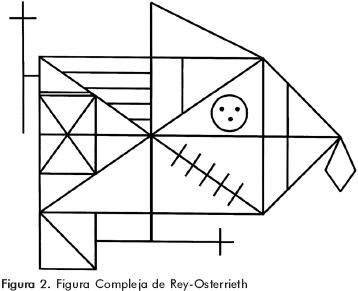
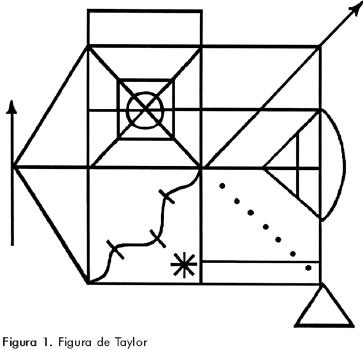
<body><![CDATA[<p align="justify"><font face="verdana" size="2">Desde esta perspectiva, obtener datos de una poblaci&oacute;n sana nos permite tener un marco de referencia para establecer un punto de comparaci&oacute;n tanto en el &aacute;mbito cl&iacute;nico como en el de investigaci&oacute;n.</font></p>     <p align="justify"><font face="verdana" size="2">La figura de Taylor (<a href="#f1">figura 1</a>) se dise&ntilde;&oacute; como una alternativa a la Figura Compleja de Rey&#150;Osterrieth (FCR&#150;O) (<a href="#f2">figura 2</a>) para aplicarla en situaciones de re&#150;test.<sup>2</sup></font></p>     <p align="center"><font face="verdana" size="2"><a name="f1"></a></font></p>     <p align="center"><font face="verdana" size="2"><img src="/img/revistas/sm/v33n4/a6f1.jpg"></font></p>     <p align="center"><font face="verdana" size="2"><a name="f2"></a></font></p>     <p align="center"><font face="verdana" size="2"><img src="/img/revistas/sm/v33n4/a6f2.jpg"></font></p>     <p align="justify"><font face="verdana" size="2">Ambas figuras eval&uacute;an dos de las funciones cognoscitivas que frecuentemente se hayan alteradas en los pacientes que padecen alg&uacute;n trastorno neurol&oacute;gico o bien psiqui&aacute;trico: la praxia de construcci&oacute;n y la memoria visual inmediata.<sup>3</sup></font></p>     <p align="justify"><font face="verdana" size="2">Por citar s&oacute;lo algunos casos, se ha reportado en la poblaci&oacute;n psiqui&aacute;trica que pacientes con anorexia nerviosa presentan fallas para usar estrategias de organizaci&oacute;n y recuerdan significativamente menos informaci&oacute;n en la memoria inmediata.<sup>4</sup> Asimismo, pacientes con trastorno obsesivo compulsivo tienen dificultades para generar y aplicar de manera espont&aacute;nea estrategias de organizaci&oacute;n, as&iacute; como un pobre recuerdo libre despu&eacute;s de un tiempo.<sup>5&#150;11</sup></font></p>     <p align="justify"><font face="verdana" size="2">Tambi&eacute;n en el &aacute;mbito de la investigaci&oacute;n se requieren instrumentos equivalentes en cuanto a la funci&oacute;n cognitiva que eval&uacute;an, con el prop&oacute;sito de disminuir las fuentes de invalidaci&oacute;n interna y externa de los dise&ntilde;os pre&#150;test&#150;post&#150;test.</font></p>     <p align="justify"><font face="verdana" size="2">El objetivo de esta investigaci&oacute;n es evaluar la ejecuci&oacute;n de los sujetos de nueve a 15 a&ntilde;os para obtener las medias y desviaciones est&aacute;ndar de la poblaci&oacute;n en sus dos modalidades de evaluaci&oacute;n: copia y memoria.</font></p>     ]]></body>
<body><![CDATA[<p align="justify"><font face="verdana" size="2">El presente estudio es el resultado del trabajo que inicio un grupo de investigadores, Galindo et al., en el Instituto Nacional de Psiquiatr&iacute;a Ram&oacute;n de la Fuente Mu&ntilde;iz con el estudio piloto de la FCR&#150;O, a partir del cual se establecieron los par&aacute;metros para la selecci&oacute;n y tama&ntilde;o de la muestra utilizada para la estandarizaci&oacute;n de la FCR&#150;O y la Figura de Taylor<sup>2</sup>. Asimismo, se dise&ntilde;&oacute; tambi&eacute;n un nuevo procedimiento para calificar ambas figuras, debido a que el propuesto originalmente por Osterrieth<sup>12</sup> no contaba con una definici&oacute;n operacional de las variables a medir, ni con un an&aacute;lisis sistematizado de cada uno de los posibles atributos de las 18 unidades perceptivas. Una vez dise&ntilde;ado el m&eacute;todo de evaluaci&oacute;n cualitativo y cuantitativo de la prueba, se report&oacute; un alto &iacute;ndice de confiabilidad interevaluadores.<sup>1</sup></font></p>     <p align="justify"><font face="verdana" size="2">&nbsp;</font></p>     <p align="justify"><font face="verdana" size="2"><b>M&Eacute;TODO</b></font></p>     <p align="justify"><font face="verdana" size="2"><b>Sujetos</b></font></p>     <p align="justify"><font face="verdana" size="2">La muestra se compone de 2100 sujetos dentro de un rango de edad de nueve a 15 a&ntilde;os. Cada grupo de edad estuvo formado por 150 sujetos del sexo masculino y 150 del sexo femenino, haciendo un total de 300 (<a href="#c1">cuadro 1</a>).</font></p>     <p align="center"><font face="verdana" size="2"><a name="c1"></a></font></p>     <p align="center"><font face="verdana" size="2"><img src="/img/revistas/sm/v33n4/a6c1.jpg"></font></p>     <p align="justify"><font face="verdana" size="2">La selecci&oacute;n de la muestra se obtuvo de diferentes escuelas del Distrito Federal y del Estado de M&eacute;xico, llev&aacute;ndose a cabo un muestreo aleatorio simple.</font></p>     <p align="justify"><font face="verdana" size="2">Posterior a esto, se aplic&oacute; a todos los sujetos un cuestionario dise&ntilde;ado para eliminar a aquellos que presentaran trastornos neurol&oacute;gicos y/o bien psiqui&aacute;tricos.</font></p>     <p align="justify"><font face="verdana" size="2">El tipo de muestreo, as&iacute; como los criterios de inclusi&oacute;n y exclusi&oacute;n para seleccionar a los sujetos, siguieron los mismos par&aacute;metros que se tomaron en cuenta para la estandarizaci&oacute;n en M&eacute;xico de la FCR&#150;O.<sup>13</sup></font></p>     ]]></body>
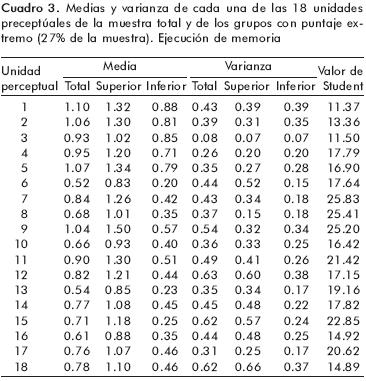
<body><![CDATA[<p align="justify"><font face="verdana" size="2">La administraci&oacute;n de la prueba se realiz&oacute; de manera individual y se aplicaron los ensayos de copia y memoria, esta &uacute;ltima con un intervalo de tres minutos.</font></p>     <p align="justify"><font face="verdana" size="2">Como se mencion&oacute;, el formato de aplicaci&oacute;n y el m&eacute;todo de calificaci&oacute;n que se usaron siguieron los mismos criterios que dise&ntilde;aron Galindo et al. para la FCR&#150;O.</font></p>     <p align="justify"><font face="verdana" size="2">&nbsp;</font></p>     <p align="justify"><font face="verdana" size="2"><b>RESULTADOS</b></font></p>     <p align="justify"><font face="verdana" size="2">El an&aacute;lisis de la discriminaci&oacute;n de reactivos se realiz&oacute; comparando las medias de cada reactivo de 27% de los sujetos con las calificaciones m&aacute;s altas y las de 27% de aquellos que obtuvieron las calificaciones m&aacute;s bajas. Las 18 unidades preceptuales mostraron un alto poder discriminativo, en la modalidad de copia t (84.64) p&lt;.001 y en la memoria t (82.79), p&lt;.001 (<a href="#c2">cuadros 2</a> y <a href="#c3">3</a>).</font></p>     <p align="center"><font face="verdana" size="2"><a name="c2"></a></font></p>     <p align="center"><font face="verdana" size="2"><img src="/img/revistas/sm/v33n4/a6c2.jpg"></font></p>     <p align="center"><font face="verdana" size="2"><a name="c3"></a></font></p>     <p align="center"><font face="verdana" size="2"><img src="/img/revistas/sm/v33n4/a6c3.jpg"></font></p>     <p align="justify"><font face="verdana" size="2">El c&aacute;lculo de la confiabilidad, mediante el coeficiente alfa de Cronbach, arroj&oacute; un valor de .76 para la copia y de .75 para la memoria.</font></p>     ]]></body>
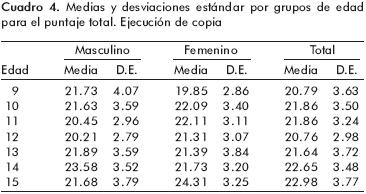
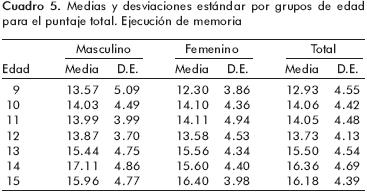
<body><![CDATA[<p align="justify"><font face="verdana" size="2">La <a href="#g1">gr&aacute;fica 1</a> muestra la distribuci&oacute;n de frecuencias de los 2100 sujetos para ambas modalidades.</font></p>     <p align="center"><font face="verdana" size="2"><a name="g1"></a></font></p>     <p align="center"><font face="verdana" size="2"><img src="/img/revistas/sm/v33n4/a6g1.jpg"></font></p>     <p align="justify"><font face="verdana" size="2">Los <a href="#c4">cuadros 4</a> y <a href="#c5">5</a> muestran las medias y desviaciones est&aacute;ndar obtenidas por cada grupo de edad y sexo, para la modalidad de copia y de memoria, respectivamente.</font></p>     <p align="center"><font face="verdana" size="2"><a name="c4"></a></font></p>     <p align="center"><font face="verdana" size="2"><img src="/img/revistas/sm/v33n4/a6c4.jpg"></font></p>     <p align="center"><font face="verdana" size="2"><a name="c5"></a></font></p>     <p align="center"><font face="verdana" size="2"><img src="/img/revistas/sm/v33n4/a6c5.jpg"></font></p>     <p align="justify"><font face="verdana" size="2">&nbsp;</font></p>     <p align="justify"><font face="verdana" size="2"><b>DISCUSI&Oacute;N</b></font></p>     ]]></body>
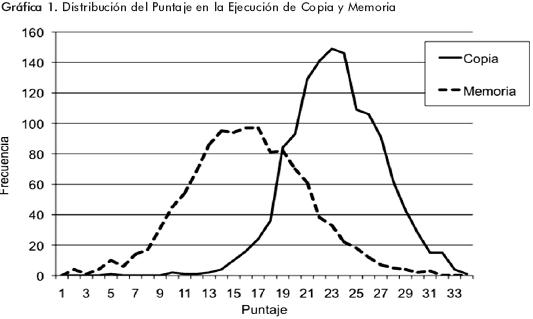
<body><![CDATA[<p align="justify"><font face="verdana" size="2">La distribuci&oacute;n de los puntajes obtenidos en la muestra pone de manifiesto que existe un patr&oacute;n de normalidad en ambas modalidades de la figura.</font></p>     <p align="justify"><font face="verdana" size="2">La curva obtenida refleja el incremento de la capacidad de respuesta de los individuos conforme avanza la edad, mientras que en el caso de la memoria, si bien en un inicio los sujetos cuentan con mayor capacidad de recuerdo, en un cierto punto, a mayor edad, se aprecia un decremento en el puntaje del ensayo de memoria, como lo describen otros autores.<sup>14,15</sup></font></p>     <p align="justify"><font face="verdana" size="2">&nbsp;</font></p>     <p align="justify"><font face="verdana" size="2"><b>REFERENCIAS</b></font></p>     <!-- ref --><p align="justify"><font face="verdana" size="2">1. Galindo VM, Cort&eacute;s S, Salvador C. Dise&ntilde;o de un nuevo procedimiento para calificar la Prueba de la Figura Compleja de Rey: confiabilidad inter&#150;evaluadores. Salud Mental 1996;19(2):1&#150;6.    &nbsp;&nbsp;&nbsp;&nbsp;&nbsp;&nbsp;&nbsp;&nbsp;[&#160;<a href="javascript:void(0);" onclick="javascript: window.open('/scielo.php?script=sci_nlinks&ref=9048887&pid=S0185-3325201000040000600001&lng=','','width=640,height=500,resizable=yes,scrollbars=1,menubar=yes,');">Links</a>&#160;]<!-- end-ref --></font></p>     <!-- ref --><p align="justify"><font face="verdana" size="2">2. Galindo VM, Cort&eacute;s S, Salvador C, R&iacute;os B et al. Fase piloto hacia la estandarizaci&oacute;n de la Figura Compleja de Rey&#150;Osterrieth. Salud Mental 1992;5(4):21&#150;27.    &nbsp;&nbsp;&nbsp;&nbsp;&nbsp;&nbsp;&nbsp;&nbsp;[&#160;<a href="javascript:void(0);" onclick="javascript: window.open('/scielo.php?script=sci_nlinks&ref=9048889&pid=S0185-3325201000040000600002&lng=','','width=640,height=500,resizable=yes,scrollbars=1,menubar=yes,');">Links</a>&#160;]<!-- end-ref --></font></p>     <!-- ref --><p align="justify"><font face="verdana" size="2">3. Luria AR. El cerebro en acci&oacute;n. M&eacute;xico: Roca; 1989</font>&nbsp;&nbsp;&nbsp;&nbsp;&nbsp;&nbsp;&nbsp;&nbsp;[&#160;<a href="javascript:void(0);" onclick="javascript: window.open('/scielo.php?script=sci_nlinks&ref=9048891&pid=S0185-3325201000040000600003&lng=','','width=640,height=500,resizable=yes,scrollbars=1,menubar=yes,');">Links</a>&#160;]<!-- end-ref --><!-- ref --><p align="justify"><font face="verdana" size="2">4. Sherman BJ, Savage CR, Eddy KT, Blais MA et al. Strategic memory in adults with anorexia nervosa: are there similarities to obsessive compulsive spectrum disorders? Int J Eat Disord 2006;39(6):468&#150;76.    &nbsp;&nbsp;&nbsp;&nbsp;&nbsp;&nbsp;&nbsp;&nbsp;[&#160;<a href="javascript:void(0);" onclick="javascript: window.open('/scielo.php?script=sci_nlinks&ref=9048892&pid=S0185-3325201000040000600004&lng=','','width=640,height=500,resizable=yes,scrollbars=1,menubar=yes,');">Links</a>&#160;]<!-- end-ref --></font></p>     <!-- ref --><p align="justify"><font face="verdana" size="2">5. Boldrini M, Del Pace L, Placidi GPA, Keilp J et al. Selective cognitive deficits in obsessive&#150;compulsive disorder compared to panic disorder with agoraphobia. Acta Psychiatr Scand 2005;111(2):150&#150;158.    &nbsp;&nbsp;&nbsp;&nbsp;&nbsp;&nbsp;&nbsp;&nbsp;[&#160;<a href="javascript:void(0);" onclick="javascript: window.open('/scielo.php?script=sci_nlinks&ref=9048894&pid=S0185-3325201000040000600005&lng=','','width=640,height=500,resizable=yes,scrollbars=1,menubar=yes,');">Links</a>&#160;]<!-- end-ref --></font></p>     <!-- ref --><p align="justify"><font face="verdana" size="2">6. Chamberlain SR, Blackwell AD, Fineberg NA, Robbins TW et al. The neuropsychology of obsessive compulsive disorder: the importance of failures in cognitive and behavioral inhibition as candidate endophenotypic markers. Neuroscience Biobehavioral Reviews 2005;29:399&#150;419.    &nbsp;&nbsp;&nbsp;&nbsp;&nbsp;&nbsp;&nbsp;&nbsp;[&#160;<a href="javascript:void(0);" onclick="javascript: window.open('/scielo.php?script=sci_nlinks&ref=9048896&pid=S0185-3325201000040000600006&lng=','','width=640,height=500,resizable=yes,scrollbars=1,menubar=yes,');">Links</a>&#160;]<!-- end-ref --></font></p>     <!-- ref --><p align="justify"><font face="verdana" size="2">7. Lacerda AL, Dalgalarrondo P, Caetano D, Haas GL et al. Neuropsychological performance and regional cerebral blood flow in obsessive&#150;compulsive disorder. Progress Neuropsychopharmacology Biological Psychiatry 2003;27(4):657&#150;665.    &nbsp;&nbsp;&nbsp;&nbsp;&nbsp;&nbsp;&nbsp;&nbsp;[&#160;<a href="javascript:void(0);" onclick="javascript: window.open('/scielo.php?script=sci_nlinks&ref=9048898&pid=S0185-3325201000040000600007&lng=','','width=640,height=500,resizable=yes,scrollbars=1,menubar=yes,');">Links</a>&#160;]<!-- end-ref --></font></p>     <!-- ref --><p align="justify"><font face="verdana" size="2">8. Penades R, Catal&aacute;n R, Andr&eacute;s S, Salamero M et al. Executive function and nonverbal memory in obsessive&#150;compulsive disorder. Psychiatry Research 2005;133(1):81&#150;90.    &nbsp;&nbsp;&nbsp;&nbsp;&nbsp;&nbsp;&nbsp;&nbsp;[&#160;<a href="javascript:void(0);" onclick="javascript: window.open('/scielo.php?script=sci_nlinks&ref=9048900&pid=S0185-3325201000040000600008&lng=','','width=640,height=500,resizable=yes,scrollbars=1,menubar=yes,');">Links</a>&#160;]<!-- end-ref --></font></p>     <!-- ref --><p align="justify"><font face="verdana" size="2">9. Roth RM, Baribeau J, Milovan DL, O'Connor K et al. Procedural and declarative memory in obsessive&#150;compulsive disorder. J International Neuropsychology Society 2004;10(5):647&#150;654.    &nbsp;&nbsp;&nbsp;&nbsp;&nbsp;&nbsp;&nbsp;&nbsp;[&#160;<a href="javascript:void(0);" onclick="javascript: window.open('/scielo.php?script=sci_nlinks&ref=9048902&pid=S0185-3325201000040000600009&lng=','','width=640,height=500,resizable=yes,scrollbars=1,menubar=yes,');">Links</a>&#160;]<!-- end-ref --></font></p>     <!-- ref --><p align="justify"><font face="verdana" size="2">10. Roth RM, Baribeau J, Milovan DL, O'Connor K et al. Speed and accuracy on tests of executive function in obsessive&#150;compulsive disorder. Brain Cognition 2004;54(3):263&#150;265.    &nbsp;&nbsp;&nbsp;&nbsp;&nbsp;&nbsp;&nbsp;&nbsp;[&#160;<a href="javascript:void(0);" onclick="javascript: window.open('/scielo.php?script=sci_nlinks&ref=9048904&pid=S0185-3325201000040000600010&lng=','','width=640,height=500,resizable=yes,scrollbars=1,menubar=yes,');">Links</a>&#160;]<!-- end-ref --></font></p>     <!-- ref --><p align="justify"><font face="verdana" size="2">11. Roth RM, Milovan DL, Baribeau J, O'Connor K et al. Organizational strategy use in obsessive&#150;compulsive disorder. Psychiatry Research 2004;128(3):267&#150;272.    &nbsp;&nbsp;&nbsp;&nbsp;&nbsp;&nbsp;&nbsp;&nbsp;[&#160;<a href="javascript:void(0);" onclick="javascript: window.open('/scielo.php?script=sci_nlinks&ref=9048906&pid=S0185-3325201000040000600011&lng=','','width=640,height=500,resizable=yes,scrollbars=1,menubar=yes,');">Links</a>&#160;]<!-- end-ref --></font></p>     <!-- ref --><p align="justify"><font face="verdana" size="2">12. Osterrieth PA. Le test du copie d'une figue complexe. Archives Psychologie 1944;30:206&#150;356.    &nbsp;&nbsp;&nbsp;&nbsp;&nbsp;&nbsp;&nbsp;&nbsp;[&#160;<a href="javascript:void(0);" onclick="javascript: window.open('/scielo.php?script=sci_nlinks&ref=9048908&pid=S0185-3325201000040000600012&lng=','','width=640,height=500,resizable=yes,scrollbars=1,menubar=yes,');">Links</a>&#160;]<!-- end-ref --></font></p>     <!-- ref --><p align="justify"><font face="verdana" size="2">13. Cort&eacute;s S, Galindo VM, Salvador C. La figura compleja de Rey: propiedades psicom&eacute;tricas. Salud Mental 1996;19(3):42&#150;48.    &nbsp;&nbsp;&nbsp;&nbsp;&nbsp;&nbsp;&nbsp;&nbsp;[&#160;<a href="javascript:void(0);" onclick="javascript: window.open('/scielo.php?script=sci_nlinks&ref=9048910&pid=S0185-3325201000040000600013&lng=','','width=640,height=500,resizable=yes,scrollbars=1,menubar=yes,');">Links</a>&#160;]<!-- end-ref --></font></p>     <!-- ref --><p align="justify"><font face="verdana" size="2">14. Gagnon M, Awad N, Mertens VB, Messier C. Comparing the Rey and Taylor Complex Figures: A test&#150;retest study in young and older adults. J Clinical Experimental Neuropsychology 2003;25(6):878&#150;890.    &nbsp;&nbsp;&nbsp;&nbsp;&nbsp;&nbsp;&nbsp;&nbsp;[&#160;<a href="javascript:void(0);" onclick="javascript: window.open('/scielo.php?script=sci_nlinks&ref=9048912&pid=S0185-3325201000040000600014&lng=','','width=640,height=500,resizable=yes,scrollbars=1,menubar=yes,');">Links</a>&#160;]<!-- end-ref --></font></p>     <!-- ref --><p align="justify"><font face="verdana" size="2">15. Tombaugh TN, Faulkner P, Hubley AM. Effects of age on the Rey&#150;Osterrieth and Taylor Complex Figures: Test&#150;retest data using in intentional learning paradigm. J Clinical Experimental Neuropsychology 1992;14(5): 647&#150;661.    &nbsp;&nbsp;&nbsp;&nbsp;&nbsp;&nbsp;&nbsp;&nbsp;[&#160;<a href="javascript:void(0);" onclick="javascript: window.open('/scielo.php?script=sci_nlinks&ref=9048914&pid=S0185-3325201000040000600015&lng=','','width=640,height=500,resizable=yes,scrollbars=1,menubar=yes,');">Links</a>&#160;]<!-- end-ref --></font></p>     <p align="justify"><font face="verdana" size="2">&nbsp;</font></p>     <p align="justify"><font face="verdana" size="2"><b>NOTA</b></font></p>     <p align="justify"><font face="verdana" size="2">Art&iacute;culo sin conflicto de intereses.</font></p>      ]]></body><back>
<ref-list>
<ref id="B1">
<label>1</label><nlm-citation citation-type="journal">
<person-group person-group-type="author">
<name>
<surname><![CDATA[Galindo]]></surname>
<given-names><![CDATA[VM]]></given-names>
</name>
<name>
<surname><![CDATA[Cortés]]></surname>
<given-names><![CDATA[S]]></given-names>
</name>
<name>
<surname><![CDATA[Salvador]]></surname>
<given-names><![CDATA[C.]]></given-names>
</name>
</person-group>
<article-title xml:lang="es"><![CDATA[Diseño de un nuevo procedimiento para calificar la Prueba de la Figura Compleja de Rey: confiabilidad inter-evaluadores]]></article-title>
<source><![CDATA[Salud Mental]]></source>
<year>1996</year>
<volume>19</volume>
<numero>2</numero>
<issue>2</issue>
<page-range>1-6</page-range></nlm-citation>
</ref>
<ref id="B2">
<label>2</label><nlm-citation citation-type="journal">
<person-group person-group-type="author">
<name>
<surname><![CDATA[Galindo]]></surname>
<given-names><![CDATA[VM]]></given-names>
</name>
<name>
<surname><![CDATA[Cortés]]></surname>
<given-names><![CDATA[S]]></given-names>
</name>
<name>
<surname><![CDATA[Salvador]]></surname>
<given-names><![CDATA[C]]></given-names>
</name>
<name>
<surname><![CDATA[Ríos]]></surname>
<given-names><![CDATA[B]]></given-names>
</name>
</person-group>
<article-title xml:lang="es"><![CDATA[Fase piloto hacia la estandarización de la Figura Compleja de Rey-Osterrieth]]></article-title>
<source><![CDATA[Salud Mental]]></source>
<year>1992</year>
<volume>5</volume>
<numero>4</numero>
<issue>4</issue>
<page-range>21-27</page-range></nlm-citation>
</ref>
<ref id="B3">
<label>3</label><nlm-citation citation-type="book">
<person-group person-group-type="author">
<name>
<surname><![CDATA[Luria]]></surname>
<given-names><![CDATA[AR.]]></given-names>
</name>
</person-group>
<source><![CDATA[El cerebro en acción]]></source>
<year>1989</year>
<publisher-name><![CDATA[Roca]]></publisher-name>
</nlm-citation>
</ref>
<ref id="B4">
<label>4</label><nlm-citation citation-type="journal">
<person-group person-group-type="author">
<name>
<surname><![CDATA[Sherman]]></surname>
<given-names><![CDATA[BJ]]></given-names>
</name>
<name>
<surname><![CDATA[Savage]]></surname>
<given-names><![CDATA[CR]]></given-names>
</name>
<name>
<surname><![CDATA[Eddy]]></surname>
<given-names><![CDATA[KT]]></given-names>
</name>
<name>
<surname><![CDATA[Blais]]></surname>
<given-names><![CDATA[MA]]></given-names>
</name>
</person-group>
<article-title xml:lang="en"><![CDATA[Strategic memory in adults with anorexia nervosa: are there similarities to obsessive compulsive spectrum disorders?]]></article-title>
<source><![CDATA[Int J Eat Disord]]></source>
<year>2006</year>
<volume>39</volume>
<numero>6</numero>
<issue>6</issue>
<page-range>468-76</page-range></nlm-citation>
</ref>
<ref id="B5">
<label>5</label><nlm-citation citation-type="journal">
<person-group person-group-type="author">
<name>
<surname><![CDATA[Boldrini]]></surname>
<given-names><![CDATA[M]]></given-names>
</name>
<name>
<surname><![CDATA[Del Pace]]></surname>
<given-names><![CDATA[L]]></given-names>
</name>
<name>
<surname><![CDATA[Placidi]]></surname>
<given-names><![CDATA[GPA]]></given-names>
</name>
<name>
<surname><![CDATA[Keilp]]></surname>
<given-names><![CDATA[J]]></given-names>
</name>
</person-group>
<article-title xml:lang="en"><![CDATA[Selective cognitive deficits in obsessive-compulsive disorder compared to panic disorder with agoraphobia]]></article-title>
<source><![CDATA[Acta Psychiatr Scand]]></source>
<year>2005</year>
<volume>111</volume>
<numero>2</numero>
<issue>2</issue>
<page-range>150-158</page-range></nlm-citation>
</ref>
<ref id="B6">
<label>6</label><nlm-citation citation-type="journal">
<person-group person-group-type="author">
<name>
<surname><![CDATA[Chamberlain]]></surname>
<given-names><![CDATA[SR]]></given-names>
</name>
<name>
<surname><![CDATA[Blackwell]]></surname>
<given-names><![CDATA[AD]]></given-names>
</name>
<name>
<surname><![CDATA[Fineberg]]></surname>
<given-names><![CDATA[NA]]></given-names>
</name>
<name>
<surname><![CDATA[Robbins]]></surname>
<given-names><![CDATA[TW]]></given-names>
</name>
</person-group>
<article-title xml:lang="en"><![CDATA[The neuropsychology of obsessive compulsive disorder: the importance of failures in cognitive and behavioral inhibition as candidate endophenotypic markers]]></article-title>
<source><![CDATA[Neuroscience Biobehavioral Reviews]]></source>
<year>2005</year>
<volume>29</volume>
<page-range>399-419</page-range></nlm-citation>
</ref>
<ref id="B7">
<label>7</label><nlm-citation citation-type="journal">
<person-group person-group-type="author">
<name>
<surname><![CDATA[Lacerda]]></surname>
<given-names><![CDATA[AL]]></given-names>
</name>
<name>
<surname><![CDATA[Dalgalarrondo]]></surname>
<given-names><![CDATA[P]]></given-names>
</name>
<name>
<surname><![CDATA[Caetano]]></surname>
<given-names><![CDATA[D]]></given-names>
</name>
<name>
<surname><![CDATA[Haas]]></surname>
<given-names><![CDATA[GL]]></given-names>
</name>
</person-group>
<article-title xml:lang="en"><![CDATA[Neuropsychological performance and regional cerebral blood flow in obsessive-compulsive disorder]]></article-title>
<source><![CDATA[Progress Neuropsychopharmacology Biological Psychiatry]]></source>
<year>2003</year>
<volume>27</volume>
<numero>4</numero>
<issue>4</issue>
<page-range>657-665</page-range></nlm-citation>
</ref>
<ref id="B8">
<label>8</label><nlm-citation citation-type="journal">
<person-group person-group-type="author">
<name>
<surname><![CDATA[Penades]]></surname>
<given-names><![CDATA[R]]></given-names>
</name>
<name>
<surname><![CDATA[Catalán]]></surname>
<given-names><![CDATA[R]]></given-names>
</name>
<name>
<surname><![CDATA[Andrés]]></surname>
<given-names><![CDATA[S]]></given-names>
</name>
<name>
<surname><![CDATA[Salamero]]></surname>
<given-names><![CDATA[M]]></given-names>
</name>
</person-group>
<article-title xml:lang="en"><![CDATA[Executive function and nonverbal memory in obsessive-compulsive disorder]]></article-title>
<source><![CDATA[Psychiatry Research]]></source>
<year>2005</year>
<volume>133</volume>
<numero>1</numero>
<issue>1</issue>
<page-range>81-90</page-range></nlm-citation>
</ref>
<ref id="B9">
<label>9</label><nlm-citation citation-type="journal">
<person-group person-group-type="author">
<name>
<surname><![CDATA[Roth]]></surname>
<given-names><![CDATA[RM]]></given-names>
</name>
<name>
<surname><![CDATA[Baribeau]]></surname>
<given-names><![CDATA[J]]></given-names>
</name>
<name>
<surname><![CDATA[Milovan]]></surname>
<given-names><![CDATA[DL]]></given-names>
</name>
<name>
<surname><![CDATA[O'Connor]]></surname>
<given-names><![CDATA[K]]></given-names>
</name>
</person-group>
<article-title xml:lang="en"><![CDATA[Procedural and declarative memory in obsessive-compulsive disorder]]></article-title>
<source><![CDATA[J International Neuropsychology Society]]></source>
<year>2004</year>
<volume>10</volume>
<numero>5</numero>
<issue>5</issue>
<page-range>647-654</page-range></nlm-citation>
</ref>
<ref id="B10">
<label>10</label><nlm-citation citation-type="journal">
<person-group person-group-type="author">
<name>
<surname><![CDATA[Roth]]></surname>
<given-names><![CDATA[RM]]></given-names>
</name>
<name>
<surname><![CDATA[Baribeau]]></surname>
<given-names><![CDATA[J]]></given-names>
</name>
<name>
<surname><![CDATA[Milovan]]></surname>
<given-names><![CDATA[DL]]></given-names>
</name>
<name>
<surname><![CDATA[O'Connor]]></surname>
<given-names><![CDATA[K]]></given-names>
</name>
</person-group>
<article-title xml:lang="en"><![CDATA[Speed and accuracy on tests of executive function in obsessive-compulsive disorder]]></article-title>
<source><![CDATA[Brain Cognition]]></source>
<year>2004</year>
<volume>54</volume>
<numero>3</numero>
<issue>3</issue>
<page-range>263-265</page-range></nlm-citation>
</ref>
<ref id="B11">
<label>11</label><nlm-citation citation-type="journal">
<person-group person-group-type="author">
<name>
<surname><![CDATA[Roth]]></surname>
<given-names><![CDATA[RM]]></given-names>
</name>
<name>
<surname><![CDATA[Milovan]]></surname>
<given-names><![CDATA[DL]]></given-names>
</name>
<name>
<surname><![CDATA[Baribeau]]></surname>
<given-names><![CDATA[J]]></given-names>
</name>
<name>
<surname><![CDATA[O'Connor]]></surname>
<given-names><![CDATA[K]]></given-names>
</name>
</person-group>
<article-title xml:lang="en"><![CDATA[Organizational strategy use in obsessive-compulsive disorder]]></article-title>
<source><![CDATA[Psychiatry Research]]></source>
<year>2004</year>
<volume>128</volume>
<numero>3</numero>
<issue>3</issue>
<page-range>267-272</page-range></nlm-citation>
</ref>
<ref id="B12">
<label>12</label><nlm-citation citation-type="journal">
<person-group person-group-type="author">
<name>
<surname><![CDATA[Osterrieth]]></surname>
<given-names><![CDATA[PA.]]></given-names>
</name>
</person-group>
<article-title xml:lang="fr"><![CDATA[Le test du copie d'une figue complexe]]></article-title>
<source><![CDATA[Archives Psychologie]]></source>
<year>1944</year>
<volume>30</volume>
<page-range>206-356</page-range></nlm-citation>
</ref>
<ref id="B13">
<label>13</label><nlm-citation citation-type="journal">
<person-group person-group-type="author">
<name>
<surname><![CDATA[Cortés]]></surname>
<given-names><![CDATA[S]]></given-names>
</name>
<name>
<surname><![CDATA[Galindo]]></surname>
<given-names><![CDATA[VM]]></given-names>
</name>
<name>
<surname><![CDATA[Salvador]]></surname>
<given-names><![CDATA[C.]]></given-names>
</name>
</person-group>
<article-title xml:lang="es"><![CDATA[La figura compleja de Rey: propiedades psicométricas]]></article-title>
<source><![CDATA[Salud Mental]]></source>
<year>1996</year>
<volume>19</volume>
<numero>3</numero>
<issue>3</issue>
<page-range>42-48</page-range></nlm-citation>
</ref>
<ref id="B14">
<label>14</label><nlm-citation citation-type="journal">
<person-group person-group-type="author">
<name>
<surname><![CDATA[Gagnon]]></surname>
<given-names><![CDATA[M]]></given-names>
</name>
<name>
<surname><![CDATA[Awad]]></surname>
<given-names><![CDATA[N]]></given-names>
</name>
<name>
<surname><![CDATA[Mertens]]></surname>
<given-names><![CDATA[VB]]></given-names>
</name>
<name>
<surname><![CDATA[Messier]]></surname>
<given-names><![CDATA[C.]]></given-names>
</name>
</person-group>
<article-title xml:lang="en"><![CDATA[Comparing the Rey and Taylor Complex Figures: A test-retest study in young and older adults]]></article-title>
<source><![CDATA[J Clinical Experimental Neuropsychology]]></source>
<year>2003</year>
<volume>25</volume>
<numero>6</numero>
<issue>6</issue>
<page-range>878-890</page-range></nlm-citation>
</ref>
<ref id="B15">
<label>15</label><nlm-citation citation-type="journal">
<person-group person-group-type="author">
<name>
<surname><![CDATA[Tombaugh]]></surname>
<given-names><![CDATA[TN]]></given-names>
</name>
<name>
<surname><![CDATA[Faulkner]]></surname>
<given-names><![CDATA[P]]></given-names>
</name>
<name>
<surname><![CDATA[Hubley]]></surname>
<given-names><![CDATA[AM.]]></given-names>
</name>
</person-group>
<article-title xml:lang="en"><![CDATA[Effects of age on the Rey-Osterrieth and Taylor Complex Figures: Test-retest data using in intentional learning paradigm]]></article-title>
<source><![CDATA[J Clinical Experimental Neuropsychology]]></source>
<year>1992</year>
<volume>14</volume>
<numero>5</numero>
<issue>5</issue>
<page-range>647-661</page-range></nlm-citation>
</ref>
</ref-list>
</back>
</article>