<?xml version="1.0" encoding="ISO-8859-1"?><article xmlns:mml="http://www.w3.org/1998/Math/MathML" xmlns:xlink="http://www.w3.org/1999/xlink" xmlns:xsi="http://www.w3.org/2001/XMLSchema-instance">
<front>
<journal-meta>
<journal-id>0185-1667</journal-id>
<journal-title><![CDATA[Investigación económica]]></journal-title>
<abbrev-journal-title><![CDATA[Inv. Econ]]></abbrev-journal-title>
<issn>0185-1667</issn>
<publisher>
<publisher-name><![CDATA[Universidad Nacional Autónoma de México, Facultad de Economía]]></publisher-name>
</publisher>
</journal-meta>
<article-meta>
<article-id>S0185-16672010000200004</article-id>
<title-group>
<article-title xml:lang="en"><![CDATA[Fall in the Indian population after the arrival of the Spaniards. Diseases or exploitation?]]></article-title>
<article-title xml:lang="es"><![CDATA[Decrecimiento de la población indígena durante la colonización española. ¿Enfermedad o explotación?]]></article-title>
</title-group>
<contrib-group>
<contrib contrib-type="author">
<name>
<surname><![CDATA[Moreno Okuno]]></surname>
<given-names><![CDATA[Alejandro Tatsuo]]></given-names>
</name>
<xref ref-type="aff" rid="A01"/>
</contrib>
<contrib contrib-type="author">
<name>
<surname><![CDATA[Ventosa-Santaulària]]></surname>
<given-names><![CDATA[Daniel]]></given-names>
</name>
<xref ref-type="aff" rid="A01"/>
</contrib>
</contrib-group>
<aff id="A01">
<institution><![CDATA[,University of Guanajuato  ]]></institution>
<addr-line><![CDATA[ ]]></addr-line>
<country>Mexico</country>
</aff>
<pub-date pub-type="pub">
<day>00</day>
<month>06</month>
<year>2010</year>
</pub-date>
<pub-date pub-type="epub">
<day>00</day>
<month>06</month>
<year>2010</year>
</pub-date>
<volume>69</volume>
<numero>272</numero>
<fpage>87</fpage>
<lpage>104</lpage>
<copyright-statement/>
<copyright-year/>
<self-uri xlink:href="http://www.scielo.org.mx/scielo.php?script=sci_arttext&amp;pid=S0185-16672010000200004&amp;lng=en&amp;nrm=iso"></self-uri><self-uri xlink:href="http://www.scielo.org.mx/scielo.php?script=sci_abstract&amp;pid=S0185-16672010000200004&amp;lng=en&amp;nrm=iso"></self-uri><self-uri xlink:href="http://www.scielo.org.mx/scielo.php?script=sci_pdf&amp;pid=S0185-16672010000200004&amp;lng=en&amp;nrm=iso"></self-uri><abstract abstract-type="short" xml:lang="en"><p><![CDATA[The fall of the Indian population in America following the Spanish conquest is one of the most debated issues in American history. Historians are divided. Some argue that it was the product of the epidemics brought by the Spanish with them. Others argue that it was the result of the mistreatment by the conquerors and the over-exploitation of the Indians. In this article we provide evidence concerning this issue by using the wages that free-workers earned. This wage can be considered as an approximation to the standard of life of the Indians. If the fall in the population was due to diseases, we would expect to see an increase in the standard of life of survivors, as they benefited from a labor shortage and the best available lands become available. But if it was due to the mistreatment and over exploitation, we would expect to see a lower standard of life than before the conquest, insufficient to maintain a stable population.]]></p></abstract>
<abstract abstract-type="short" xml:lang="es"><p><![CDATA[El decrecimiento de la población indígena en América ocurrido después de la conquista Española ha sido una de las cuestiones más debatidas de la historia del continente. Los historiadores se encuentran divididos; por un lado unos argumentan que el decrecimiento poblacional fue causado por las epidemias traídas de Europa mientras que, por otro lado se considera que dicho decrecimiento fue provocado por la sobreexplotación laboral y el maltrato infligidos a los indígenas por los conquistadores. En este artículo proveemos evidencia respecto a esta cuestión al estudiar los salarios que los trabajadores libres obtenían. Lo anterior puede considerarse una aproximación al nivel de vida de los indígenas. Si el decrecimiento poblacional se debió a enfermedades, podríamos esperar observar un incremento en la calidad de vida de los supervivientes, siendo éstos beneficiados por la escasez del mercado laboral y pudiendo explotar las mejores tierras disponibles. En caso de ser la sobreexplotación la causa del decrecimiento poblacional, podríamos entonces esperar una disminución de los estándares de vida con respecto a los que imperaban antes de la conquista, insuficientes para mantener estable la población.]]></p></abstract>
<kwd-group>
<kwd lng="en"><![CDATA[disease]]></kwd>
<kwd lng="en"><![CDATA[over-exploitation]]></kwd>
<kwd lng="en"><![CDATA[encomienda]]></kwd>
<kwd lng="en"><![CDATA[wage]]></kwd>
<kwd lng="es"><![CDATA[enfermedad]]></kwd>
<kwd lng="es"><![CDATA[sobre-explotación]]></kwd>
<kwd lng="es"><![CDATA[encomienda]]></kwd>
<kwd lng="es"><![CDATA[salario]]></kwd>
</kwd-group>
</article-meta>
</front><body><![CDATA[ <p align="center"><font face="verdana" size="4"><b>Fall in the Indian population after the arrival of the Spaniards. Diseases or exploitation?</b></font></p>     <p align="justify"><font face="verdana" size="2">&nbsp;</font></p>     <p align="center"><font face="verdana" size="3"> <b>Decrecimiento de la poblaci&oacute;n ind&iacute;gena durante la colonizaci&oacute;n espa&ntilde;ola. &iquest;Enfermedad o explotaci&oacute;n?</b></font></p>     <p align="justify"><font face="verdana" size="2">&nbsp;</font></p>     <p align="center"><font face="verdana" size="2"><b>Alejandro Tatsuo Moreno Okuno and Daniel Ventosa&#150;Santaul&agrave;ria<a href="#notas">*</a> </b></font></p>     <p align="justify"><font face="verdana" size="2">&nbsp;</font></p>     <p align="justify"><font face="verdana" size="2"><i>University of Guanajuato, Mexico,</i> <a href="mailto:atatsuo@hotmail.com">atatsuo@hotmail.com</a> <i>and</i> <a href="mailto:daniel@ventosa-santaularia.com">daniel@ventosa&#150;santaularia.com</a><i>, respectively.</i></font></p>     <p align="justify"><font face="verdana" size="2">&nbsp;</font></p>     <p align="justify"><font face="verdana" size="2">Received January 2009.    <br> Accepted September 2009.</font></p>     ]]></body>
<body><![CDATA[<p align="justify"><font face="verdana" size="2">&nbsp;</font></p>     <p align="justify"><font face="verdana" size="2"><b>Abstract</b></font></p>     <p align="justify"><font face="verdana" size="2">The fall of the Indian population in America following the Spanish conquest is one of the most debated issues in American history. Historians are divided. Some argue that it was the product of the epidemics brought by the Spanish with them. Others argue that it was the result of the mistreatment by the conquerors and the over&#150;exploitation of the Indians. In this article we provide evidence concerning this issue by using the wages that free&#150;workers earned. This wage can be considered as an approximation to the standard of life of the Indians. If the fall in the population was due to diseases, we would expect to see an increase in the standard of life of survivors, as they benefited from a labor shortage and the best available lands become available. But if it was due to the mistreatment and over exploitation, we would expect to see a lower standard of life than before the conquest, insufficient to maintain a stable population.</font></p>     <p align="justify"><font face="verdana" size="2"><b>Key words: </b>disease, over&#150;exploitation, encomienda, wage. </font></p>     <p align="justify"><font face="verdana" size="2"><b>Classification JEL:<a href="#notas">**</a> </b>N36</font></p>     <p align="justify"><font face="verdana" size="2">&nbsp;</font></p>     <p align="justify"><font face="verdana" size="2"><b>Resumen</b></font></p>     <p align="justify"><font face="verdana" size="2">El decrecimiento de la poblaci&oacute;n ind&iacute;gena en Am&eacute;rica ocurrido despu&eacute;s de la conquista Espa&ntilde;ola ha sido una de las cuestiones m&aacute;s debatidas de la historia del continente. Los historiadores se encuentran divididos; por un lado unos argumentan que el decrecimiento poblacional fue causado por las epidemias tra&iacute;das de Europa mientras que, por otro lado se considera que dicho decrecimiento fue provocado por la sobreexplotaci&oacute;n laboral y el maltrato infligidos a los ind&iacute;genas por los conquistadores. En este art&iacute;culo proveemos evidencia respecto a esta cuesti&oacute;n al estudiar los salarios que los trabajadores libres obten&iacute;an. Lo anterior puede considerarse una aproximaci&oacute;n al nivel de vida de los ind&iacute;genas. Si el decrecimiento poblacional se debi&oacute; a enfermedades, podr&iacute;amos esperar observar un incremento en la calidad de vida de los supervivientes, siendo &eacute;stos beneficiados por la escasez del mercado laboral y pudiendo explotar las mejores tierras disponibles. En caso de ser la sobreexplotaci&oacute;n la causa del decrecimiento poblacional, podr&iacute;amos entonces esperar una disminuci&oacute;n de los est&aacute;ndares de vida con respecto a los que imperaban antes de la conquista, insuficientes para mantener estable la poblaci&oacute;n.</font></p>     <p align="justify"><font face="verdana" size="2"><b>Palabras clave: </b>enfermedad, sobre&#150;explotaci&oacute;n, encomienda, salario.</font></p>     <p align="justify"><font face="verdana" size="2">&nbsp;</font></p>     ]]></body>
<body><![CDATA[<p align="right"><font face="verdana" size="2"><i>The men who had fought their battles against the    <br> Moors turned soldiers of fortune and followed    <br> the sailors across the sea to seek out new infidels and    <br> blaze a trail of murder and heroism that is unique    <br> in the history of European peoples. Their lust    <br> for gold was infinite, their religious fervor genuine.    <br> </i>Hammond Innes (1969)</font></p>     <p align="justify"><font face="verdana" size="2">&nbsp;</font></p>     <p align="justify"><font face="verdana" size="2"><b>INTRODUCTION</b></font></p>     <p align="justify"><font face="verdana" size="2">In 1492, the same year that Christopher Columbus discovered America, the last Muslim stronghold in Spain was taken. Spain emerged then as the most important defender of the catholic faith in the world. At the same time, because of the continuous military campaigns, the Spanish Crown had an immense economic deficit (D&iacute;az L&oacute;pez 1994:25). In these circumstances, the discovery, conquest and colonization of America helped to attain a double goal, to fight for the Catholic religion and to obtain new financial resources.</font></p>     ]]></body>
<body><![CDATA[<p align="justify"><font face="verdana" size="2">Nevertheless, the Crown did not have the resources to invest in this enterprise and so, it permitted the exploration and the conquest to be undertaken by entrepreneurs, who in return for the right of the exploitation of the wealth of the New World had an obligation to give the Crown a fifth part of it and to evangelize the natives.</font></p>     <p align="justify"><font face="verdana" size="2">The conquerors were soldiers; many of them had fought in the wars against the Moors. The leaders emerged from the lesser nobility (hidalgos) and saw in the conquest of America an opportunity to make fortune and glory. To their side came those who were displaced by the war and sought shelter (D&iacute;az L&oacute;pez 1994:31). The Conquest was financed by merchants who previewed a lucrative investment and were willing to risk their fortune. Therefore, the conquerors were motivated by economic decisions directed toward a single goal, to increase as much as possible their wealth.</font></p>     <p align="justify"><font face="verdana" size="2">When the Spaniards arrived in America, they found densely populated lands. The relationship established between the Spaniards and the Indians was very different than the one that emerged several centuries later between the slaves and their owners on the cotton plantations in the south of the United States. The most important difference lies in the relative high number of Indians compared to the number of Spaniards. The first impressions from the Conquerors concerning the native population can be summarized in an anonymous memorial (1496) of a trip companion of Columbus, who declared the Indians to be "infinite" in number (Cook and Borah 1971:380).</font></p>     <p align="justify"><font face="verdana" size="2">In 1492, with the discovery of the island La Hispaniola,<sup><a href="#notas">1</a></sup> Columbus had contact with the first great concentration of Indians. Although there is no consensus of the initial population,<sup><a href="#notas">2</a></sup> the available counts suggest more than one million inhabitants (Cook and Borah 1971:387). Two decades later, the population decreased in such a magnitude, that Indians from nearby islands were "imported" to La Hispaniola in order to repopulate it.<sup><a href="#notas">3</a></sup></font></p>     <p align="justify"><font face="verdana" size="2">The Spaniards required labor force able to work in the mining, agriculture and ranching activities. After conquering the Antilles, the first labor institution introduced was the encomienda. An encomienda concedes the right to use the work<sup><a href="#notas">4</a></sup> of the Indians without granting the property neither of the Indians nor their land (Garcia Rivera 1998:2). Christopher Columbus made the first distribution of natives.<sup><a href="#notas">5</a></sup> This was usual under the feudal system of Spain; nevertheless the Crown did not want to permit the establishment of feudal nobility in the New World, and therefore it enacted restrictions on the size and duration of the encomiendas.<sup><a href="#notas">6</a></sup></font></p>     <p align="justify"><font face="verdana" size="2">In 1519 the conquerors had contact with the civilizations of central Mexico, the most densely populated area in America. In 1521, with the fall of Mexico&#150;Tenochtitlan, a few hundred Spaniards won control over an enormous number of Indians: 508 conquerors against a population of millions.<sup><a href="#notas">7</a></sup> In Mexico, after the fall of Mexico&#150;Tenochtitlan, Cort&eacute;s established encomiendas for his soldiers. Although slavery was not allowed, it was accepted in the case of cannibals, war prisoners and delinquents. Nevertheless, it existed beyond these limits.<sup><a href="#notas">8</a></sup></font></p>     <p align="justify"><font face="verdana" size="2">At the same time, free labor coexisted. Those Spaniards who arrived after the distribution of the encomiendas were forced to offer a wage in order to attract workers.</font></p>     <p align="justify"><font face="verdana" size="2">The Indians were legally free individuals under the rule of the Spanish Crown.<sup><a href="#notas">9</a></sup> Royal laws were constantly enacted to protect them. Nevertheless, Spain was far away and such laws where violated at the convenience of the Spaniards living in America.</font></p>     <p align="justify"><font face="verdana" size="2">By paraphrasing R. Edminster (1967:133&#150;135): "The Spanish in Mexico were more fortunate than their English counterparts on the Atlantic coast of North America in that they found an ample labor force &#91;...&#93; and hence did not have to bring large numbers of settlers from the homeland in order to enjoy the fruits of conquest". As Simpson (1950) advances, the Spanish Crown established the encomienda in order to (i) ensure that the Spanish residents could be maintained, and; (ii) obtain an exportable surplus of goods usable in Europe for the benefit of the homeland. Simpson's definition of the encomienda is a "delegation of the royal power to collect tribute from, and to use the personal services of the King's vassals (the Indians)" This mechanism enacted 'de facto' forced labor was constantly revised and modified in order to improve the conditions of the indigeneous population, but never to the extreme of annihilating "the foundations of its wealth in the Indies &#91;Simpson, p. xi&#93;"</font></p>     <p align="justify"><font face="verdana" size="2">Yeager (1995: 842) considers that: "When the Spaniards conquered the New World, they resorted to a form of native labor organization called the encomienda. The encomienda differed from slavery in that the Crown imposed inheritance, trading, and relocation restrictions on Encomenderos. Such restrictions cost the Crown revenue by providing incentives for colonists to deplete more quickly the stock of native labor and by keeping native labor in areas of low&#150;revenue productivity. This loss of revenue makes the Crown's preference for the encomienda curious. The Crown opted for the encomienda, however, to secure its rule and to satisfy an ideological bias against slavery.  &#91;...&#93;  Property rights over Indian labor were restricted in three ways. First, Indians were not owned by Encomenderos; they could not be bought, sold, or rented to others. Second, Encomenderos were forbidden inheritance rights. encomiendas did not automatically transfer to future generations. They would revert to the Crown upon the death of the second&#150;generation Encomendero, to be kept by the Crown or given to another Spaniard. Third, Indians could not be relocated from their proximate geographical area. The Encomenderos were only given a right to the labor, not the land. These restrictions on trading, inheritance, and relocation distinguished Indians in encomiendas from slaves." Furthermore, Yeager suggests that depopulation would follow from the Spanish Crown curious decision on to hold encomiendas as the vehicle to obtain a benefit from the Indies: "The Spanish Crown's preference for the encomienda is curious because it lowered the Crown's revenue compared to alternative forms of labor organization such as slavery. Property&#150;rights restrictions over Indian labor reduced the Crown's revenue in three ways. First, inheritance restrictions provided encomenderos with incentives to destroy more quickly the human capital because any bequeath motive was absent. This resulted in lower intertemporal output due to higher Indian depopulation ratios &#91;...&#93;."</font></p>     ]]></body>
<body><![CDATA[<p align="justify"><font face="verdana" size="2">Since the very beginning of the discovery of America, the Spaniards settled in the vicinity of Indian communities. First, they focused on the stocks of precious metals. Then they looked for labor and the zones where the metals could be extracted.<sup><a href="#notas">10</a></sup> The most important cities founded by Spanish were in the zones with the largest Indian populations (Robinson <i>et al., </i>2002:20).</font></p>     <p align="justify"><font face="verdana" size="2">Although the Indians represented the main factor of production, the Spanish economy was not based on the preservation of the Indian population. During the wars of conquest, it appears as if they did not consider the Indians as a valuable asset. This is indicated by the fact that diseases were often spread intentionally by Spaniard soldiers to ease the conquests (Le Cl&eacute;zio 1988:34). Even after the wars, the Spaniards greatly abused the Indian workers and imposed heavy duties on them.</font></p>     <p align="justify"><font face="verdana" size="2">&nbsp;</font></p>     <p align="justify"><font face="verdana" size="2"><b>CAN WE KNOW IF THE FALL IN THE INDIAN POPULATION WAS DUE TO DISEASES OK OVER&#150;EXPLOITATION?</b></font></p>     <p align="justify"><font face="verdana" size="2">An early modern population estimation in Central Mexico in the sixteenth century can be found in Cook and Simpson (1948). The authors obtained evidence of a catastrophic depopulation (in accordance to many Spanish missionaries); in particular, they found that there were abrupt plunges around the decades of 1540, 1570, and 1590 due to epidemics; the population decreased steadily and in 1607 it represented a merely one fifth of that of 1519. Later studies of these authors (see Cook and Borah 1960, for example) further explore the causes of the depopulation &#91;spread of grazing animals, and soil erosion, for example&#93;. The abrupt fall in the population of the Native American population in the sixteenth&#150;century and early seventeenth century has been one of the most debated issues of American history. Sempat Assadourian (1989) considers that the estimation of sixteenth An dine and Mesoamerican populations remains controversial, in particular at the arrival of the Spaniards. Nevertheless, the dense population in both regions as well as its catastrophic decline are nowadays widely accepted. Two different arguments have been advanced to explain this phenomenon. The first argument is that the decline was due to the epidemics brought by the Spaniards and that the native population had no defense against these.<sup><a href="#notas">11</a> </sup>R.E. Christ (1951:75&#150;76), based in Cook and Simpson (1948), considers that: "The disruption of the Indian way of life and the unaccustomed work in the mines and on the plantations were no doubt significant factors, but a large part of the decrease was in all probability due to deaths from the diseases brought by the conquistadores, such as measles and smallpox, to which the Indians had not acquired immunity. Adame (2000:155&#150;156) resumed the epidemics occurred along the XVI Century:</font></p>     <blockquote>       <p align="justify"><font face="verdana" size="2">1. 1519&#150;1523: smallpox, typhoid, dysentery &#91;pandemic&#93;.</font></p>       <p align="justify"><font face="verdana" size="2">2. 1531&#150;1533: measles, smallpox, chicken pox, typhus &#91;major epidemic&#93;.</font></p>       <p align="justify"><font face="verdana" size="2">3. 1538&#150;1540: varicella syphilis, plague, smallpox, typhus, measles, typhoid, influenza, yellow fever &#91;epidemic&#93;.</font></p>       <p align="justify"><font face="verdana" size="2">4. 1545&#150;1548: mumps, typhus &#91;pandemic&#93;.</font></p>       ]]></body>
<body><![CDATA[<p align="justify"><font face="verdana" size="2">5. 1575&#150;1581: syphilis, thyphoid cocolixtli, matlaz&aacute;huatl &#91;pandemic&#93;.</font></p>       <p align="justify"><font face="verdana" size="2">6. 1592&#150;1593: measles, mumps, typhus, syphilis.</font></p>       <p align="justify"><font face="verdana" size="2">7. Many outbreaks &#91;1555; 1558&#150;1559; 1561; 1562&#150;64; 1566; 1587&#150;1588; 1590; 1595&#150;1597; 1598&#150;1599&#93;: smallpox, typhus, measles, whooping cough, pleurisy, scabies, hepatitis, dysentery, influenza.</font></p> </blockquote>     <p align="justify"><font face="verdana" size="2">McNeil (1998) argues that european diseases brought to America by the Spaniards played a fundamental role in the conquest of Mexico. It seems to be the author's conviction that epidemic diseases affect decisively the fate of civilizations. In words of McNeil (1998:19&#150;20): "As everyone knows, hernando Cortez, starting off with fewer than six hundred men, conquered the aztec Empire, whose subjects numbered millions. How could such a tiny handful prevail? How indeed? All the familiar explanations seemed inadequate. If Montezuma and his friends first thought the Spaniards were gods, experience soon showed otherwise. If horses and gunpowder were amazing and terrible on the first encounter, armed clashes soon revealed the limitations of horseflesh and of the very primitive guns the Spaniards had at their disposal. Cortez's skill in finding allies among the Indian peoples of Mexico and rallying them against the Aztecs was certainly important, but most of his Indian allies committed themselves to the Spanish side only when they had reason to think Cortez would win &#91;...&#93; The inherent attraction of European civilization and some undeniable technical superiorities the Spaniards had at their command do not seem enough to explain the wholesale apostasy from older Indian patterns of life and belief" (in his discussion of epidemics, Mcneil distinguishes between microparasitism of decease organisms (organisms such as viruses, bacteria, or multi&#150;celled creatures "that find a source of food in human tissues" living within the body of a host) and macroparasitism &#91;such as lions and wolves in the ancient times, prior to super&#150;predators human beings. Cannibals can be considered as macroparasitism; men are nowadays the most dangerous predator of men; in words of Thomas Hobbes:<sup><a href="#notas">12</a></sup> <i>Homo homini lupus </i>(one man to another is a wolf)&#93;.</font></p>     <p align="justify"><font face="verdana" size="2">The second argument of the decrease in the population states that the death toll was due to the mistreatment of the Indians and their over&#150;exploitation. Sempat Assadourian (1989) advances many factors contributing to the population decline besides that of epidemics. In particular he mentions the possibility of a fertility rate decline due to drastic changes in the economic organization of the societies (before the arrival of the Spaniards there is evidence that indians had access to their own parcel and that there was an institutional mechanism for collecting and redistributing food) and considers that it is not possible to evaluate the epidemics&#150;impact factor. He also argues that economic causes of the population decline as well as their interaction with the demographic critical situation should also be considered in the elucidation of this matter.<sup><a href="#notas">13</a></sup> Borah (1951) suggests that the critical demographic situation induced the Crown (1568) to reinforce that system (undertaken by the viceroys Toledo and Enr&iacute;quez in Peru and New Spain, respectively) in order to obtain greater benefits from the American Colonies.</font></p>     <p align="justify"><font face="verdana" size="2">The truth is that both arguments are right, to some extent. The epidemics and the mistreatment together were key factors of the demographic catastrophe. The previous arguments should make clear that the origins of the demographic catastrophe in Central Mexico during the sixteenth Century can be found in both, an unfair labor Spaniard rule as well as in the European epidemics brought by the Spaniards.<sup><a href="#notas">14</a></sup> However, the relevant question is to what extent each of these causes contributed to the decline.</font></p>     <p align="justify"><font face="verdana" size="2">On the one side, we know that the survivors of regions affected by deseases had a better standard of life, because they could exploit the best available land and benefit from the labor shortage.<sup><a href="#notas">15</a></sup> Therefore, if the fall in the population was due to diseases we would expect to see higher wages after the conquest than before it; income should have increased as the population declined.</font></p>     <p align="justify"><font face="verdana" size="2">On the other side, if the fall in population was due to over&#150;exploitation we would expect conditions of life to be lower than those existing before the conquest; and this should also be reflected in wages.</font></p>     <p align="justify"><font face="verdana" size="2">In this section, we propose a method to find out which argument better explains the fall in the population by examining the behavior of real wages of that period in Mexico. Although free labor was not an important sector of the population until the late sixteenth century, it can be considered as an adequate approximation of the life conditions of the rest of the workers. Given that many Indians that worked for a wage also belonged to an encomienda or lived in lands property of the Crown, it is reasonable to suppose that the conditions were similar.</font></p>     <p align="justify"><font face="verdana" size="2">&nbsp;</font></p>     ]]></body>
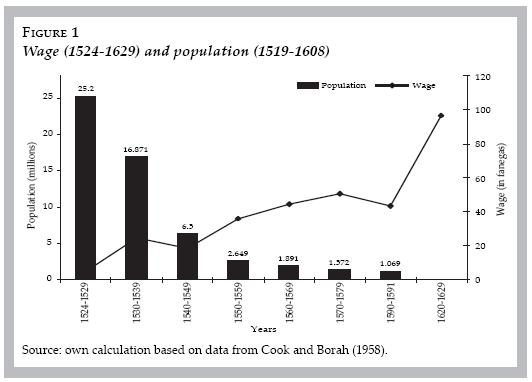
<body><![CDATA[<p align="justify"><font face="verdana" size="2"><b>THE DATA</b></font></p>     <p align="justify"><font face="verdana" size="2">The data for the price of labor and maize are from Cook and Borah (1958), and the price of labor for the second decade of the seventh century is from Bannon (1966). Both authors rely on information concerning tributes paid by the Indians in specie and sold to the highest bidder in public auctions conducted by the royal treasury officials; several official documents state the price of these commodities. Our estimations are based only on the prices of two commodities: the price of free labor and the price of maize. The maize was by far the most important food in the Indian diet. The figure for the tribute per person is based on a standard quota of one peso and half fanega<sup><a href="#notas">16</a></sup> of maize paid by the ordinary tributary under a reform of the mid&#150;sixteenth century. In the 1590's, the tribute was increased by half peso of royal service. There is not a common figure for the previous years, mainly because part of the tribute of the Indians was paid to the Encomenders and therefore there was not a common tribute. We suppose that, for those years, the Indians had to pay the same amount of tribute as in the years where data are available.</font></p>     <p align="justify"><font face="verdana" size="2">The figures are volatile â€”even for a single yearâ€”. This is probably due to the harvest conditions. For some years there is a total lack of data, whilst for others there is plenty of information. In order to be more confident about our estimations of the prices, we group information in decades, averaging all the prices available for each one.</font></p>     <p align="justify"><font face="verdana" size="2"><b>BEHAVIOR OF WAGES</b></font></p>     <p align="justify"><font face="verdana" size="2">As we can see in <a href="#t1">table 1</a>, real wages increased strongly during the period 1524&#150;1629. Although the price of maize increased threefold in the period, the wage was increased by a factor of 48. For the period 1524&#150;1529 we only have one observation. Even if we exclude this observation, because it is an exceptional period of wars of conquest, we still have an increase in real wages as high as 300&#150;400 per cent. This behavior of prices is consistent with both explanations of the fall in population.</font></p>     <p align="center"><font face="verdana" size="2"><a name="t1"></a></font></p>     <p align="center"><font face="verdana" size="2"><img src="/img/revistas/ineco/v69n272/a4t1.jpg"></font></p>     <p align="justify"><font face="verdana" size="2">Nevertheless, the increase in the real wage is too high. This is in sharp contrast with the common belief that the Indians have always lived at the level of subsistence. There are two alternatives: (i) the initial wage in the first decades after the conquest was high enough to sustain the level of subsistence and increased several times that level or; (ii) the initial wage was too low to sustain the level of subsistence and increased until it was high enough to sustain the level of subsistence.</font></p>     <p align="center"><font face="verdana" size="2"><img src="/img/revistas/ineco/v69n272/a4f1.jpg"></font></p>     <p align="justify"><font face="verdana" size="2">&nbsp;</font></p>     ]]></body>
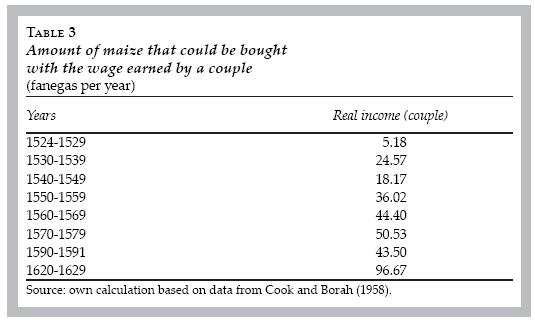
<body><![CDATA[<p align="justify"><font face="verdana" size="2"><b>THE MINIMUM WAGE OF SUBSISTENCE</b></font></p>     <p align="justify"><font face="verdana" size="2">In order to define the real wage in such away that it becomes meaningful, we calculate the minimum wages of a couple required to sustain themselves as well as a certain number of children. This is done throughout the computation of minimum wages that satisfy the energy requirements of the Indians.<sup><a href="#notas">17</a></sup> Cook and Borah (1979) estimated the necessary amount of calories needed by the Indians in the years preceding the conquest, in accordance with their size, weight and physical activities.<sup><a href="#notas">18</a></sup> Given that the intensity of their work probably increased after the conquest, this is a good measure of the minimum energy consumption required. The authors estimated that the average number of calories needed to survive was 2 635 for men, 2 105 for women and 1 270 for children.<sup><a href="#notas">19</a></sup> For the amount of calories of one fanega of maize, we use R. Hassig (1985) estimation: 182 400 calories per fanega of maize.</font></p>     <p align="justify"><font face="verdana" size="2">In order to calculate the wage needed to satisfy these requirements, we have to take into account: (i) the amount of tribute the Indians had to pay to the Spaniards and; (ii) the tenth of their income that they had to give to the Church.<sup><a href="#notas">20</a></sup></font></p>     <p align="justify"><font face="verdana" size="2">We assume that the Indians had to spend 30% of their income to buy commodities other than maize.<sup><a href="#notas">21</a></sup> This expenditure can be understood as the consumption of clothes, wood to cook tortillas, medicines,<sup><a href="#notas">22</a></sup> housing, among others.</font></p>     <p align="justify"><font face="verdana" size="2">The period under analysis is characterized by an important increase in prices, a consequence of the discoveries of gold and silver. Therefore, it is necessary to work with real wages. In order to achieve this goal, we transform the wage in number of fanegas of maize that could be bought.</font></p>     <p align="justify"><font face="verdana" size="2"><a href="#t2">Table 2</a> shows the wage in fanegas that a couple had to earn in order to satisfy the required energy levels for survival. The wage varies from decade to decade because the tribute, initially fixed in 8 reales per year, was systematically eroded by inflation. Therefore, the real tribute began to decrease over time, even with the increase of 4 reales after the 1590's.</font></p>     <p align="center"><font face="verdana" size="2"><a name="t2"></a></font></p>     <p align="center"><font face="verdana" size="2"><img src="/img/revistas/ineco/v69n272/a4t2.jpg"></font></p>     <p align="justify"><font face="verdana" size="2">As we can see from <a href="#t2">tables 2</a> and <a href="#t3">3</a>, the real wage that one worker earned in the year 1524 was not even enough to maintain his survival energy requirements. As we have seen, this was an exceptional era of wars and disorder. In the following decades (1530s and 1540s) the real wage was enough to sustain the worker, but not another member of his family. Butwhy would a free worker accept a wage that is not enough to sustain his family? The answer is that he had no other option. The other labor institutions (slavery and encomienda<sup><a href="#notas">23</a></sup>) offered him even worse conditions.</font></p>     <p align="center"><font face="verdana" size="2"><a name="t3"></a></font></p>     ]]></body>
<body><![CDATA[<p align="center"><font face="verdana" size="2"><img src="/img/revistas/ineco/v69n272/a4t3.jpg"></font></p>     <p align="justify"><font face="verdana" size="2">In order to sustain a family, women could contribute to the income, but only in a limited way. This is due to the household activities<sup><a href="#notas">24</a></sup> required from them. Therefore, we suppose that the potential income earned by women was half that of the men. This is consistent with the tribute system that compelled women to be paid half of that paid to men.</font></p>     <p align="justify"><font face="verdana" size="2">The real income of a couple was not enough to sustain the minimum requirements of calories for one family with one child until the 1550s. Given that the standard of life before the conquest was enough to sustain a stable population, this result is inconsistent with the fall in the Indian population due to epidemics brought by the Spanish. If that was the case, the conditions of life for the survivors would have been better than before, because previously there were more people consuming the same resources. Therefore, the level of conditions deteriorated after the conquest, which is consistent with the theory that the Indian population fell because of the over&#150;exploitation (<a href="#f2">figure 2</a>).</font></p>     <p align="center"><font face="verdana" size="2"><a name="f2"></a></font></p>     <p align="center"><font face="verdana" size="2"><img src="/img/revistas/ineco/v69n272/a4f2.jpg"></font></p>     <p align="justify"><font face="verdana" size="2">With the increase in the income, families were able to support more and more children. After the 1560s income was enough to support six children, but the population was still falling, although at a lesser rate, as we can see from <a href="#t4">table 4</a>.</font></p>     <p align="center"><font face="verdana" size="2"><a name="t4"></a></font></p>     <p align="center"><font face="verdana" size="2"><img src="/img/revistas/ineco/v69n272/a4t4.jpg"></font></p>     <p align="justify"><font face="verdana" size="2">The population did not stop falling until the second decade of the sixteenth century when the real wage had increased much more than the necessary to sustain a family. Therefore, this evidence suggests that the fall in population after the decade of 1560 is better explained by the epidemics (<a href="#f3">figure 3</a>).</font></p>     <p align="center"><font face="verdana" size="2"><a name="f3"></a></font></p>     ]]></body>
<body><![CDATA[<p align="center"><font face="verdana" size="2"><img src="/img/revistas/ineco/v69n272/a4f3.jpg"></font></p>     <p align="justify"><font face="verdana" size="2">Nevertheless, we must be careful with the last conclusion. There are two sources of potential problems: (i) the income of subsistence that we are considering is too low, and/or (ii) we are overestimating the income that a family was able to earn. In both cases, we would establish an incorrect break&#150;even point, earlier than the correct one. For example, if we exclude the income of women, the real income would not be enough to sustain more than two children until the beginning of the seventeenth century. To make a more definite conclusion about this matter, more research about the income of subsistence and the wage of women is thus necessary.</font></p>     <p align="justify"><font face="verdana" size="2">&nbsp;</font></p>     <p align="justify"><font face="verdana" size="2"><b>CONCLUDING REMARKS</b></font></p>     <p align="justify"><font face="verdana" size="2">The analysis of the real wages of Central Mexico shows that free workers did not receive enough income to obtain the energy requirements needed to ensure the survival of a family until the decade of the 1560s, that is, 40 years after the Conquest. Once the wages became high enough, they allowed families to sustain more and more children. If we generalize this result to the rest of the Mexican society of the sixteenth Century, we have reasons to suspect that the conditions of life decreased with the conquest and this caused the subsequent fall in the population. Although the diseases brought by the Spaniards killed many, it appears that these epidemics were not the dominant factor until the 1560s. After that, the wage was enough to sustain a family and diseases best explain the fall in the population.</font></p>     <p align="justify"><font face="verdana" size="2">&nbsp;</font></p>     <p align="justify"><font face="verdana" size="2"><b>REFERENCES</b></font></p>     <!-- ref --><p align="justify"><font face="verdana" size="2">Adame, C., M.A., <i>La Conquista de M&eacute;xico en la Mundializaci&oacute;n Epid&eacute;mica, </i>M&eacute;xico, Ediciones Taller Abierto, 2000.    &nbsp;&nbsp;&nbsp;&nbsp;&nbsp;&nbsp;&nbsp;&nbsp;[&#160;<a href="javascript:void(0);" onclick="javascript: window.open('/scielo.php?script=sci_nlinks&ref=4541804&pid=S0185-1667201000020000400001&lng=','','width=640,height=500,resizable=yes,scrollbars=1,menubar=yes,');">Links</a>&#160;]<!-- end-ref --></font></p>     <!-- ref --><p align="justify"><font face="verdana" size="2">Bannon, J.F., <i>Indian labor in the Spanish Indies: was there another solution?, </i>Boston, Ed. Heath, 1966.    &nbsp;&nbsp;&nbsp;&nbsp;&nbsp;&nbsp;&nbsp;&nbsp;[&#160;<a href="javascript:void(0);" onclick="javascript: window.open('/scielo.php?script=sci_nlinks&ref=4541806&pid=S0185-1667201000020000400002&lng=','','width=640,height=500,resizable=yes,scrollbars=1,menubar=yes,');">Links</a>&#160;]<!-- end-ref --></font></p>     <!-- ref --><p align="justify"><font face="verdana" size="2">Borah, W.W., "New Spain's Century of depression", <i>Iberoamericana, </i>no. 35, 1951.    &nbsp;&nbsp;&nbsp;&nbsp;&nbsp;&nbsp;&nbsp;&nbsp;[&#160;<a href="javascript:void(0);" onclick="javascript: window.open('/scielo.php?script=sci_nlinks&ref=4541808&pid=S0185-1667201000020000400003&lng=','','width=640,height=500,resizable=yes,scrollbars=1,menubar=yes,');">Links</a>&#160;]<!-- end-ref --> </font></p>     <!-- ref --><p align="justify"><font face="verdana" size="2">Christ, R.E., "The population of Central Mexico in the sixteenth Century", <i>Journal of Economic History, </i>vol. 11, no. 1, 1951, pp. 75&#150;76.    &nbsp;&nbsp;&nbsp;&nbsp;&nbsp;&nbsp;&nbsp;&nbsp;[&#160;<a href="javascript:void(0);" onclick="javascript: window.open('/scielo.php?script=sci_nlinks&ref=4541810&pid=S0185-1667201000020000400004&lng=','','width=640,height=500,resizable=yes,scrollbars=1,menubar=yes,');">Links</a>&#160;]<!-- end-ref --></font></p>     <!-- ref --><p align="justify"><font face="verdana" size="2">Cook, S.F. and W.W. Borah, <i>Price Trends of Some Basic Commodities in Central Mexico, 1531 &#150;1570, </i>Berkeley and Los Angeles, University of California Press, 1958.    &nbsp;&nbsp;&nbsp;&nbsp;&nbsp;&nbsp;&nbsp;&nbsp;[&#160;<a href="javascript:void(0);" onclick="javascript: window.open('/scielo.php?script=sci_nlinks&ref=4541812&pid=S0185-1667201000020000400005&lng=','','width=640,height=500,resizable=yes,scrollbars=1,menubar=yes,');">Links</a>&#160;]<!-- end-ref --></font></p>     <!-- ref --><p align="justify"><font face="verdana" size="2">&#150;&#150;&#150;&#150;&#150;&#150;&#150;&#150;&#150;&#150;, <i>The Indian population of central Mexico, 1531 &#150;1610, </i>Los Angeles, California, University of California Press, 1960.    &nbsp;&nbsp;&nbsp;&nbsp;&nbsp;&nbsp;&nbsp;&nbsp;[&#160;<a href="javascript:void(0);" onclick="javascript: window.open('/scielo.php?script=sci_nlinks&ref=4541814&pid=S0185-1667201000020000400006&lng=','','width=640,height=500,resizable=yes,scrollbars=1,menubar=yes,');">Links</a>&#160;]<!-- end-ref --></font></p>     <!-- ref --><p align="justify"><font face="verdana" size="2">&#150;&#150;&#150;&#150;&#150;&#150;&#150;&#150;&#150;&#150;, <i>Essays in Population History: Mexico and the Caribbean, Volume One, </i>Berkeley and Los Angeles, University of California Press, 1971.    &nbsp;&nbsp;&nbsp;&nbsp;&nbsp;&nbsp;&nbsp;&nbsp;[&#160;<a href="javascript:void(0);" onclick="javascript: window.open('/scielo.php?script=sci_nlinks&ref=4541816&pid=S0185-1667201000020000400007&lng=','','width=640,height=500,resizable=yes,scrollbars=1,menubar=yes,');">Links</a>&#160;]<!-- end-ref --></font></p>     <!-- ref --><p align="justify"><font face="verdana" size="2">&#150;&#150;&#150;&#150;&#150;&#150;&#150;&#150;&#150;&#150;, <i>Essays in Population History: Mexico and California, Volume Three, </i>Berkeley and Los Angeles, University of California Press, 1979.    &nbsp;&nbsp;&nbsp;&nbsp;&nbsp;&nbsp;&nbsp;&nbsp;[&#160;<a href="javascript:void(0);" onclick="javascript: window.open('/scielo.php?script=sci_nlinks&ref=4541818&pid=S0185-1667201000020000400008&lng=','','width=640,height=500,resizable=yes,scrollbars=1,menubar=yes,');">Links</a>&#160;]<!-- end-ref --></font></p>     <!-- ref --><p align="justify"><font face="verdana" size="2">Cook, S.F. and L.B. Simpson, <i>The Population of Central Mexico in the Sixteenth Century, </i>Los Angeles, California, University of California Press, 1948.    &nbsp;&nbsp;&nbsp;&nbsp;&nbsp;&nbsp;&nbsp;&nbsp;[&#160;<a href="javascript:void(0);" onclick="javascript: window.open('/scielo.php?script=sci_nlinks&ref=4541820&pid=S0185-1667201000020000400009&lng=','','width=640,height=500,resizable=yes,scrollbars=1,menubar=yes,');">Links</a>&#160;]<!-- end-ref --></font></p>     <!-- ref --><p align="justify"><font face="verdana" size="2">Diaz L&oacute;pez, Zamira, <i>Oro, Sociedad y Econom&iacute;a. El sistema colonial en la Gobernaci&oacute;n de Popayan, 1533&#150;1733, </i>Bogot&aacute;, Banco de la Rep&uacute;blica, 1994.    &nbsp;&nbsp;&nbsp;&nbsp;&nbsp;&nbsp;&nbsp;&nbsp;[&#160;<a href="javascript:void(0);" onclick="javascript: window.open('/scielo.php?script=sci_nlinks&ref=4541822&pid=S0185-1667201000020000400010&lng=','','width=640,height=500,resizable=yes,scrollbars=1,menubar=yes,');">Links</a>&#160;]<!-- end-ref --></font></p>     <!-- ref --><p align="justify"><font face="verdana" size="2">Edminster, R., "The encomienda in New Spain: the beginning of Spanish Mexico", <i>The Journal of Economic History, </i>vol. 27, no. 1, 1967, pp. 133&#150;135.    &nbsp;&nbsp;&nbsp;&nbsp;&nbsp;&nbsp;&nbsp;&nbsp;[&#160;<a href="javascript:void(0);" onclick="javascript: window.open('/scielo.php?script=sci_nlinks&ref=4541824&pid=S0185-1667201000020000400011&lng=','','width=640,height=500,resizable=yes,scrollbars=1,menubar=yes,');">Links</a>&#160;]<!-- end-ref --></font></p>     <!-- ref --><p align="justify"><font face="verdana" size="2">Garc&iacute;a Rivera, R.E., <i>An&aacute;lisis Institucional del Primer Sistema Laboral en la Nueva Espa&ntilde;a: la Encomienda, </i>Thesis, M&eacute;xico, Instituto Tecnol&oacute;gico Aut&oacute;nomo de M&eacute;xico (ITAM), 1998.    &nbsp;&nbsp;&nbsp;&nbsp;&nbsp;&nbsp;&nbsp;&nbsp;[&#160;<a href="javascript:void(0);" onclick="javascript: window.open('/scielo.php?script=sci_nlinks&ref=4541826&pid=S0185-1667201000020000400012&lng=','','width=640,height=500,resizable=yes,scrollbars=1,menubar=yes,');">Links</a>&#160;]<!-- end-ref --></font></p>     <!-- ref --><p align="justify"><font face="verdana" size="2">Gibson, Ch., <i>Aztecs Under Spanish Rule, </i>Stanford, Stanford University Press, 1964.    &nbsp;&nbsp;&nbsp;&nbsp;&nbsp;&nbsp;&nbsp;&nbsp;[&#160;<a href="javascript:void(0);" onclick="javascript: window.open('/scielo.php?script=sci_nlinks&ref=4541828&pid=S0185-1667201000020000400013&lng=','','width=640,height=500,resizable=yes,scrollbars=1,menubar=yes,');">Links</a>&#160;]<!-- end-ref --></font></p>     <!-- ref --><p align="justify"><font face="verdana" size="2">Hassig, R., Trade, <i>Tribute and Transportation: the sixteenth century political economy of the Valley of Mexico, </i>Oklahoma, University of Oklahoma Press, 1985.    &nbsp;&nbsp;&nbsp;&nbsp;&nbsp;&nbsp;&nbsp;&nbsp;[&#160;<a href="javascript:void(0);" onclick="javascript: window.open('/scielo.php?script=sci_nlinks&ref=4541830&pid=S0185-1667201000020000400014&lng=','','width=640,height=500,resizable=yes,scrollbars=1,menubar=yes,');">Links</a>&#160;]<!-- end-ref --></font></p>     <!-- ref --><p align="justify"><font face="verdana" size="2">Innes, H., <i>The Conquistadores, </i>New York, Edited by Alfred A. Knopf, 1969.    &nbsp;&nbsp;&nbsp;&nbsp;&nbsp;&nbsp;&nbsp;&nbsp;[&#160;<a href="javascript:void(0);" onclick="javascript: window.open('/scielo.php?script=sci_nlinks&ref=4541832&pid=S0185-1667201000020000400015&lng=','','width=640,height=500,resizable=yes,scrollbars=1,menubar=yes,');">Links</a>&#160;]<!-- end-ref --></font></p>     <!-- ref --><p align="justify"><font face="verdana" size="2">Kroeber, A.L., <i>Cultural and Natural Areas of Native North America, </i>Los Angeles, California, University of California Press, 1963.    &nbsp;&nbsp;&nbsp;&nbsp;&nbsp;&nbsp;&nbsp;&nbsp;[&#160;<a href="javascript:void(0);" onclick="javascript: window.open('/scielo.php?script=sci_nlinks&ref=4541834&pid=S0185-1667201000020000400016&lng=','','width=640,height=500,resizable=yes,scrollbars=1,menubar=yes,');">Links</a>&#160;]<!-- end-ref --></font></p>     <!-- ref --><p align="justify"><font face="verdana" size="2">Le Cl&eacute;zio, J.M.G., <i>The Mexican Dream, </i>Chicago, The University of Chicago Press, 1988 (Translated by Teresa Lavender Fagan).    &nbsp;&nbsp;&nbsp;&nbsp;&nbsp;&nbsp;&nbsp;&nbsp;[&#160;<a href="javascript:void(0);" onclick="javascript: window.open('/scielo.php?script=sci_nlinks&ref=4541836&pid=S0185-1667201000020000400017&lng=','','width=640,height=500,resizable=yes,scrollbars=1,menubar=yes,');">Links</a>&#160;]<!-- end-ref --></font></p>     <!-- ref --><p align="justify"><font face="verdana" size="2">Livi&#150;Bacci, M., <i>A Concise History of World Population, </i>United States, Ed. Blackwell Publishers, 1997.    &nbsp;&nbsp;&nbsp;&nbsp;&nbsp;&nbsp;&nbsp;&nbsp;[&#160;<a href="javascript:void(0);" onclick="javascript: window.open('/scielo.php?script=sci_nlinks&ref=4541838&pid=S0185-1667201000020000400018&lng=','','width=640,height=500,resizable=yes,scrollbars=1,menubar=yes,');">Links</a>&#160;]<!-- end-ref --></font></p>     <!-- ref --><p align="justify"><font face="verdana" size="2">McNeil, W.H., <i>Plagues and People, </i>United States, Anchor books Editions, 1998.    &nbsp;&nbsp;&nbsp;&nbsp;&nbsp;&nbsp;&nbsp;&nbsp;[&#160;<a href="javascript:void(0);" onclick="javascript: window.open('/scielo.php?script=sci_nlinks&ref=4541840&pid=S0185-1667201000020000400019&lng=','','width=640,height=500,resizable=yes,scrollbars=1,menubar=yes,');">Links</a>&#160;]<!-- end-ref --> </font></p>     <!-- ref --><p align="justify"><font face="verdana" size="2">Radell, D.R., <i>The Indian Slave Trade And Population of Nicaragua during the Sixteenth Century, </i>Wisconsin, University of Wisconsin Press, 1992.    &nbsp;&nbsp;&nbsp;&nbsp;&nbsp;&nbsp;&nbsp;&nbsp;[&#160;<a href="javascript:void(0);" onclick="javascript: window.open('/scielo.php?script=sci_nlinks&ref=4541842&pid=S0185-1667201000020000400020&lng=','','width=640,height=500,resizable=yes,scrollbars=1,menubar=yes,');">Links</a>&#160;]<!-- end-ref --></font></p>     <!-- ref --><p align="justify"><font face="verdana" size="2">Robinson, D.A.; S. Johnson and D. Acemoglu, "Reversal of fortune: geography and institutions in the making of the modern world income distribution", <i>The Quarterly Journal of Economics, </i>vol. 117, no. 4, 2002, pp. 1231&#150;1294.    &nbsp;&nbsp;&nbsp;&nbsp;&nbsp;&nbsp;&nbsp;&nbsp;[&#160;<a href="javascript:void(0);" onclick="javascript: window.open('/scielo.php?script=sci_nlinks&ref=4541844&pid=S0185-1667201000020000400021&lng=','','width=640,height=500,resizable=yes,scrollbars=1,menubar=yes,');">Links</a>&#160;]<!-- end-ref --></font></p>     <!-- ref --><p align="justify"><font face="verdana" size="2">Sempat Assadourian, C., "La despoblaci&oacute;n ind&iacute;gena en Per&uacute; y Nueva Espa&ntilde;a durante el siglo XVI y la formaci&oacute;n de la econom&iacute;a colonial", <i>Historia Mexicana, </i>vol. 38, no. 3, 1989, pp. 419&#150;453.    &nbsp;&nbsp;&nbsp;&nbsp;&nbsp;&nbsp;&nbsp;&nbsp;[&#160;<a href="javascript:void(0);" onclick="javascript: window.open('/scielo.php?script=sci_nlinks&ref=4541846&pid=S0185-1667201000020000400022&lng=','','width=640,height=500,resizable=yes,scrollbars=1,menubar=yes,');">Links</a>&#160;]<!-- end-ref --></font></p>     <!-- ref --><p align="justify"><font face="verdana" size="2">Simpson, L.B., <i>The Encomienda in New Spain: the beginning of Spanish Mexico, </i>Los Angeles, California, University of California Press, 1950.    &nbsp;&nbsp;&nbsp;&nbsp;&nbsp;&nbsp;&nbsp;&nbsp;[&#160;<a href="javascript:void(0);" onclick="javascript: window.open('/scielo.php?script=sci_nlinks&ref=4541848&pid=S0185-1667201000020000400023&lng=','','width=640,height=500,resizable=yes,scrollbars=1,menubar=yes,');">Links</a>&#160;]<!-- end-ref --></font></p>     <!-- ref --><p align="justify"><font face="verdana" size="2">Yeager, T.J., "Encomienda or Slavery? The Spanish Crown's choice of labor organization in sixteenth Century Spanish America", <i>The Journal of Economic History, </i>vol. 55, no. 4, 1995, pp. 842&#150;859.    &nbsp;&nbsp;&nbsp;&nbsp;&nbsp;&nbsp;&nbsp;&nbsp;[&#160;<a href="javascript:void(0);" onclick="javascript: window.open('/scielo.php?script=sci_nlinks&ref=4541850&pid=S0185-1667201000020000400024&lng=','','width=640,height=500,resizable=yes,scrollbars=1,menubar=yes,');">Links</a>&#160;]<!-- end-ref --></font></p>     <p align="justify"><font face="verdana" size="2">&nbsp;</font></p>     <p align="justify"><font face="verdana" size="2"><a name="notas"></a><b>NOTAS</b></font></p>     <p align="justify"><font face="verdana" size="2">* The authors thank two anonymous reviewers for constructive comments and suggestions. Any remaining errors are solely ours.</font></p>     <p align="justify"><font face="verdana" size="2">** JEL: Journal of Economic Literature&#150;Econlit.</font></p>     <p align="justify"><font face="verdana" size="2"><sup>1</sup> Now this island is occupied by the Republic of Haiti and the Dominican Republic.</font></p>     ]]></body>
<body><![CDATA[<p align="justify"><font face="verdana" size="2"><sup>2</sup> The calculations go from 60 000 to 5 000 000 inhabitants.</font></p>     <p align="justify"><font face="verdana" size="2"><sup>3</sup> The native population of La Hispaniola was reduced to a few hundred inhabitants.</font></p>     <p align="justify"><font face="verdana" size="2"><sup>4</sup> The Indians had the obligation to work a certain number of days each year or to pay a tribute.</font></p>     <p align="justify"><font face="verdana" size="2"><sup>5</sup> In the island La Hispaniola, 1 014 Spanish where granted with Indians. The almirant Diego Colon was instructed to distribute 100 indians amonsgst the Royal officers; 60 to the married Spaniards and 30 to the farmers (Cook and Borah 1971:384).</font></p>     <p align="justify"><font face="verdana" size="2"><sup>6</sup> Garc&iacute;a Rivera (1998) argues that this restriction only caused a climate of uncertainty. The fact that the encomenders would loose their encomiendas after two or three generations, promoted incentives to over&#150;exploit the Indians.</font></p>     <p align="justify"><font face="verdana" size="2"><sup>7</sup> The researchers disagree about the population of central Mexico, while Cook and Borah (1958) estimated 25.2 millions inhabitants; Kroeber (1963) estimated only 3.3 millions, the majority of whom was under the domination of the Mexicas (Aztecs).</font></p>     <p align="justify"><font face="verdana" size="2"><sup>8</sup> Radell (1992) argues that between 1527 and 1548 between 450 000 and 500 000 Indians were shipped from Nicaragua to Panama and Peru as Slaves.</font></p>     <p align="justify"><font face="verdana" size="2"><sup>9</sup> A Royal cedule stating that the Indians where free vassals of the Crown was enactedon June 20th, 1500.</font></p>     <p align="justify"><font face="verdana" size="2"><sup>10</sup> As an example, the gold of California, the main deposit of gold of the Spanish colonies, was never discoverd by the Spaniards, probably because there were not located close to an important settlement of Indians who knew its location.</font></p>     <p align="justify"><font face="verdana" size="2"><sup>11</sup> According to Sempat Assadourian (1989) the currently predominant idea of a demographic catastrophe due to epidemics can be traced back to Borah (1951).</font></p>     ]]></body>
<body><![CDATA[<p align="justify"><font face="verdana" size="2"><sup>12</sup> Attributed to Tito Marcio Plauto (254 a.C.&#150;184 a.C.) <i>in Asinaria.</i></font></p>     <p align="justify"><font face="verdana" size="2"><sup>13</sup> Yeager (1995) convincingly explains the reasons of the Spanish Crown to impose the rather inefficient and unfair labor system of encomiendas that might cause, at least partially, the population decline.</font></p>     <p align="justify"><font face="verdana" size="2"><sup>14</sup> The distinction (as well as the interaction) between both hypotheses remains therefore difficult and elusive, mainly because of scarce and incomplete data.</font></p>     <p align="justify"><font face="verdana" size="2"><sup>15</sup> This happened in Europe with the Black Death (Livi&#150;Bacci 1997:54).</font></p>     <p align="justify"><font face="verdana" size="2"><sup>16</sup> The fanega is an Indian measure of weigth that is equal to two loads that an Indian carrier could carry and is equivalent to 46 kilograms (101.4 pounds).</font></p>     <p align="justify"><font face="verdana" size="2"><sup>17</sup> The energy requirements will be measured in calories; 1 calorie equals 4.184 Joules.</font></p>     <p align="justify"><font face="verdana" size="2"><sup>18</sup> Their estimations are based on the following figures: 159 centimeters in height, 53.6 kilograms in weight and 6 hours of hard work, 9 hours of light activities and 9 hours of sleep and 290 days of work at year for an average man; 147 centimeters in height, 49.6 kilograms in weight and two hours of hard work, 13 hours of light activities and 9 hours of sleep and 290 days of work at year for and average woman; and 108 centimeters in height, 17.6 kilograms in weigth, 14 hours of light activities and 10 hours of sleep for an average children of 6 years.</font></p>     <p align="justify"><font face="verdana" size="2"><sup>19</sup> They estimate a lower amount of calories if the Indian were not perfoming any activity: 1 425 for a man, 1 235 for a woman and 869 calories for a child.</font></p>     <p align="justify"><font face="verdana" size="2"><sup>20</sup> In order to fulfill the ecclesiastical obligations, the wages were paid on Sundays (Gibson 1964:99).</font></p>     <p align="justify"><font face="verdana" size="2"><sup>21</sup> The maize was not only the most important input in the Indian diet, but also the cheapest, and therefore is reasonable to consider this commodity as the one that the Indians would depend on in case they were earning the wage of subsistence.</font></p>     ]]></body>
<body><![CDATA[<p align="justify"><font face="verdana" size="2"><sup>22</sup> Although the Indians did not use European medicine, they had a great knowledge in herbaria, which probably had a cost.</font></p>     <p align="justify"><font face="verdana" size="2"><sup>23</sup> The encomienda was blamed by the religious as the institution that caused the steep decline of the Indian population.</font></p>     <p align="justify"><font face="verdana" size="2"><sup>24</sup> The Indian diet was based on tortillas. Preparing tortillas is extraordinarily time&#150;consuming and requieres a considerable effort. This task was usually performed by women.</font></p>      ]]></body><back>
<ref-list>
<ref id="B1">
<nlm-citation citation-type="book">
<person-group person-group-type="author">
<name>
<surname><![CDATA[Adame, C]]></surname>
<given-names><![CDATA[M.A]]></given-names>
</name>
</person-group>
<source><![CDATA[La Conquista de México en la Mundialización Epidémica]]></source>
<year>2000</year>
<publisher-name><![CDATA[Ediciones Taller Abierto]]></publisher-name>
</nlm-citation>
</ref>
<ref id="B2">
<nlm-citation citation-type="book">
<person-group person-group-type="author">
<name>
<surname><![CDATA[Bannon]]></surname>
<given-names><![CDATA[J.F]]></given-names>
</name>
</person-group>
<source><![CDATA[Indian labor in the Spanish Indies: was there another solution?]]></source>
<year>1966</year>
<publisher-loc><![CDATA[Boston ]]></publisher-loc>
<publisher-name><![CDATA[Ed. Heath]]></publisher-name>
</nlm-citation>
</ref>
<ref id="B3">
<nlm-citation citation-type="journal">
<person-group person-group-type="author">
<name>
<surname><![CDATA[Borah]]></surname>
<given-names><![CDATA[W.W]]></given-names>
</name>
</person-group>
<article-title xml:lang="en"><![CDATA["New Spain's Century of depression"]]></article-title>
<source><![CDATA[Iberoamericana]]></source>
<year>1951</year>
<numero>35</numero>
<issue>35</issue>
</nlm-citation>
</ref>
<ref id="B4">
<nlm-citation citation-type="journal">
<person-group person-group-type="author">
<name>
<surname><![CDATA[Christ]]></surname>
<given-names><![CDATA[R.E]]></given-names>
</name>
</person-group>
<article-title xml:lang="en"><![CDATA["The population of Central Mexico in the sixteenth Century"]]></article-title>
<source><![CDATA[Journal of Economic History]]></source>
<year>1951</year>
<volume>11</volume>
<numero>1</numero>
<issue>1</issue>
<page-range>75-76</page-range></nlm-citation>
</ref>
<ref id="B5">
<nlm-citation citation-type="book">
<person-group person-group-type="author">
<name>
<surname><![CDATA[Cook]]></surname>
<given-names><![CDATA[S.F]]></given-names>
</name>
<name>
<surname><![CDATA[Borah]]></surname>
<given-names><![CDATA[W.W]]></given-names>
</name>
</person-group>
<source><![CDATA[Price Trends of Some Basic Commodities in Central Mexico, 1531 -1570]]></source>
<year>1958</year>
<publisher-loc><![CDATA[BerkeleyLos Angeles ]]></publisher-loc>
<publisher-name><![CDATA[University of California Press]]></publisher-name>
</nlm-citation>
</ref>
<ref id="B6">
<nlm-citation citation-type="book">
<person-group person-group-type="author">
<name>
<surname><![CDATA[Cook]]></surname>
<given-names><![CDATA[S.F]]></given-names>
</name>
</person-group>
<person-group person-group-type="editor">
<name>
</name>
</person-group>
<source><![CDATA[The Indian population of central Mexico, 1531 -1610]]></source>
<year>1960</year>
<publisher-loc><![CDATA[Los Angeles^eCalifornia California]]></publisher-loc>
<publisher-name><![CDATA[University of California Press]]></publisher-name>
</nlm-citation>
</ref>
<ref id="B7">
<nlm-citation citation-type="book">
<person-group person-group-type="author">
<name>
<surname><![CDATA[Cook]]></surname>
<given-names><![CDATA[S.F]]></given-names>
</name>
</person-group>
<person-group person-group-type="editor">
<name>
</name>
</person-group>
<source><![CDATA[Essays in Population History: Mexico and the Caribbean, Volume One]]></source>
<year>1971</year>
<publisher-loc><![CDATA[BerkeleyLos Angeles ]]></publisher-loc>
<publisher-name><![CDATA[University of California Press]]></publisher-name>
</nlm-citation>
</ref>
<ref id="B8">
<nlm-citation citation-type="book">
<person-group person-group-type="author">
<name>
<surname><![CDATA[Cook]]></surname>
<given-names><![CDATA[S.F]]></given-names>
</name>
</person-group>
<person-group person-group-type="editor">
<name>
</name>
</person-group>
<source><![CDATA[Essays in Population History: Mexico and California, Volume Three]]></source>
<year>1979</year>
<publisher-loc><![CDATA[BerkeleyLos Angeles ]]></publisher-loc>
<publisher-name><![CDATA[University of California Press]]></publisher-name>
</nlm-citation>
</ref>
<ref id="B9">
<nlm-citation citation-type="book">
<person-group person-group-type="author">
<name>
<surname><![CDATA[Cook]]></surname>
<given-names><![CDATA[S.F]]></given-names>
</name>
<name>
<surname><![CDATA[Simpson]]></surname>
<given-names><![CDATA[L.B]]></given-names>
</name>
</person-group>
<source><![CDATA[The Population of Central Mexico in the Sixteenth Century]]></source>
<year>1948</year>
<publisher-loc><![CDATA[Los Angeles^eCalifornia California]]></publisher-loc>
<publisher-name><![CDATA[University of California Press]]></publisher-name>
</nlm-citation>
</ref>
<ref id="B10">
<nlm-citation citation-type="book">
<person-group person-group-type="author">
<name>
<surname><![CDATA[Diaz López]]></surname>
<given-names><![CDATA[Zamira]]></given-names>
</name>
</person-group>
<source><![CDATA[Oro, Sociedad y Economía. El sistema colonial en la Gobernación de Popayan, 1533-1733]]></source>
<year>1994</year>
<publisher-loc><![CDATA[Bogotá ]]></publisher-loc>
<publisher-name><![CDATA[Banco de la República]]></publisher-name>
</nlm-citation>
</ref>
<ref id="B11">
<nlm-citation citation-type="journal">
<person-group person-group-type="author">
<name>
<surname><![CDATA[Edminster]]></surname>
<given-names><![CDATA[R]]></given-names>
</name>
</person-group>
<article-title xml:lang="en"><![CDATA["The encomienda in New Spain: the beginning of Spanish Mexico"]]></article-title>
<source><![CDATA[The Journal of Economic History]]></source>
<year>1967</year>
<volume>27</volume>
<numero>1</numero>
<issue>1</issue>
<page-range>133-135</page-range></nlm-citation>
</ref>
<ref id="B12">
<nlm-citation citation-type="">
<person-group person-group-type="author">
<name>
<surname><![CDATA[García Rivera]]></surname>
<given-names><![CDATA[R.E]]></given-names>
</name>
</person-group>
<source><![CDATA[Análisis Institucional del Primer Sistema Laboral en la Nueva España: la Encomienda]]></source>
<year></year>
</nlm-citation>
</ref>
<ref id="B13">
<nlm-citation citation-type="book">
<person-group person-group-type="author">
<name>
<surname><![CDATA[Gibson]]></surname>
<given-names><![CDATA[Ch]]></given-names>
</name>
</person-group>
<source><![CDATA[Aztecs Under Spanish Rule]]></source>
<year>1964</year>
<publisher-loc><![CDATA[Stanford ]]></publisher-loc>
<publisher-name><![CDATA[Stanford University Press]]></publisher-name>
</nlm-citation>
</ref>
<ref id="B14">
<nlm-citation citation-type="book">
<person-group person-group-type="author">
<name>
<surname><![CDATA[Hassig]]></surname>
<given-names><![CDATA[R]]></given-names>
</name>
</person-group>
<source><![CDATA[Trade, Tribute and Transportation: the sixteenth century political economy of the Valley of Mexico]]></source>
<year>1985</year>
<publisher-loc><![CDATA[Oklahoma ]]></publisher-loc>
<publisher-name><![CDATA[University of Oklahoma Press]]></publisher-name>
</nlm-citation>
</ref>
<ref id="B15">
<nlm-citation citation-type="">
<person-group person-group-type="author">
<name>
<surname><![CDATA[Innes]]></surname>
<given-names><![CDATA[H]]></given-names>
</name>
<name>
<surname><![CDATA[Knopf]]></surname>
<given-names><![CDATA[Alfred A]]></given-names>
</name>
</person-group>
<source><![CDATA[The Conquistadores]]></source>
<year>1969</year>
<publisher-loc><![CDATA[New York ]]></publisher-loc>
</nlm-citation>
</ref>
<ref id="B16">
<nlm-citation citation-type="book">
<person-group person-group-type="author">
<name>
<surname><![CDATA[Kroeber]]></surname>
<given-names><![CDATA[A.L]]></given-names>
</name>
</person-group>
<source><![CDATA[Cultural and Natural Areas of Native North America]]></source>
<year>1963</year>
<publisher-loc><![CDATA[Los Angeles^eCalifornia California]]></publisher-loc>
<publisher-name><![CDATA[University of California Press]]></publisher-name>
</nlm-citation>
</ref>
<ref id="B17">
<nlm-citation citation-type="book">
<person-group person-group-type="author">
<name>
<surname><![CDATA[Le Clézio]]></surname>
<given-names><![CDATA[J.M.G]]></given-names>
</name>
</person-group>
<source><![CDATA[The Mexican Dream]]></source>
<year>1988</year>
<publisher-loc><![CDATA[Chicago ]]></publisher-loc>
<publisher-name><![CDATA[The University of Chicago Press]]></publisher-name>
</nlm-citation>
</ref>
<ref id="B18">
<nlm-citation citation-type="book">
<person-group person-group-type="author">
<name>
<surname><![CDATA[Livi-Bacci]]></surname>
<given-names><![CDATA[M]]></given-names>
</name>
</person-group>
<source><![CDATA[A Concise History of World Population]]></source>
<year>1997</year>
<publisher-name><![CDATA[Ed. Blackwell Publishers]]></publisher-name>
</nlm-citation>
</ref>
<ref id="B19">
<nlm-citation citation-type="book">
<person-group person-group-type="author">
<name>
<surname><![CDATA[McNeil]]></surname>
<given-names><![CDATA[W.H]]></given-names>
</name>
</person-group>
<source><![CDATA[Plagues and People]]></source>
<year>1998</year>
<publisher-name><![CDATA[Anchor books Editions]]></publisher-name>
</nlm-citation>
</ref>
<ref id="B20">
<nlm-citation citation-type="book">
<person-group person-group-type="author">
<name>
<surname><![CDATA[Radell]]></surname>
<given-names><![CDATA[D.R]]></given-names>
</name>
</person-group>
<source><![CDATA[The Indian Slave Trade And Population of Nicaragua during the Sixteenth Century]]></source>
<year>1992</year>
<publisher-loc><![CDATA[Wisconsin ]]></publisher-loc>
<publisher-name><![CDATA[University of Wisconsin Press]]></publisher-name>
</nlm-citation>
</ref>
<ref id="B21">
<nlm-citation citation-type="journal">
<person-group person-group-type="author">
<name>
<surname><![CDATA[Robinson]]></surname>
<given-names><![CDATA[D.A]]></given-names>
</name>
<name>
<surname><![CDATA[Johnson]]></surname>
<given-names><![CDATA[S]]></given-names>
</name>
<name>
<surname><![CDATA[Acemoglu]]></surname>
<given-names><![CDATA[D]]></given-names>
</name>
</person-group>
<article-title xml:lang="en"><![CDATA["Reversal of fortune: geography and institutions in the making of the modern world income distribution"]]></article-title>
<source><![CDATA[The Quarterly Journal of Economics]]></source>
<year>2002</year>
<volume>117</volume>
<numero>4</numero>
<issue>4</issue>
<page-range>1231-1294</page-range></nlm-citation>
</ref>
<ref id="B22">
<nlm-citation citation-type="journal">
<person-group person-group-type="author">
<name>
<surname><![CDATA[Sempat Assadourian]]></surname>
<given-names><![CDATA[C]]></given-names>
</name>
</person-group>
<article-title xml:lang="es"><![CDATA["La despoblación indígena en Perú y Nueva España durante el siglo XVI y la formación de la economía colonial"]]></article-title>
<source><![CDATA[Historia Mexicana]]></source>
<year>1989</year>
<volume>38</volume>
<numero>3</numero>
<issue>3</issue>
<page-range>419-453</page-range></nlm-citation>
</ref>
<ref id="B23">
<nlm-citation citation-type="book">
<person-group person-group-type="author">
<name>
<surname><![CDATA[Simpson]]></surname>
<given-names><![CDATA[L.B]]></given-names>
</name>
</person-group>
<source><![CDATA[The Encomienda in New Spain: the beginning of Spanish Mexico]]></source>
<year>1950</year>
<publisher-loc><![CDATA[Los Angeles^eCalifornia California]]></publisher-loc>
<publisher-name><![CDATA[University of California Press]]></publisher-name>
</nlm-citation>
</ref>
<ref id="B24">
<nlm-citation citation-type="journal">
<person-group person-group-type="author">
<name>
<surname><![CDATA[Yeager]]></surname>
<given-names><![CDATA[T.J]]></given-names>
</name>
</person-group>
<article-title xml:lang="en"><![CDATA[Encomienda or Slavery? The Spanish Crown's choice of labor organization in sixteenth Century Spanish America"]]></article-title>
<source><![CDATA[The Journal of Economic History]]></source>
<year>1995</year>
<volume>55</volume>
<numero>4</numero>
<issue>4</issue>
<page-range>842-859</page-range></nlm-citation>
</ref>
</ref-list>
</back>
</article>