<?xml version="1.0" encoding="ISO-8859-1"?><article xmlns:mml="http://www.w3.org/1998/Math/MathML" xmlns:xlink="http://www.w3.org/1999/xlink" xmlns:xsi="http://www.w3.org/2001/XMLSchema-instance">
<front>
<journal-meta>
<journal-id>0065-1737</journal-id>
<journal-title><![CDATA[Acta zoológica mexicana]]></journal-title>
<abbrev-journal-title><![CDATA[Acta Zool. Mex]]></abbrev-journal-title>
<issn>0065-1737</issn>
<publisher>
<publisher-name><![CDATA[Instituto de Ecología A.C.]]></publisher-name>
</publisher>
</journal-meta>
<article-meta>
<article-id>S0065-17372011000300024</article-id>
<title-group>
<article-title xml:lang="en"><![CDATA[New records of tayra (Eira barbara Linnaeus 1758) in Puebla, Central Mexico]]></article-title>
<article-title xml:lang="es"><![CDATA[Nuevos registros de tayra (Eira barbara Linnaeus 1758) en Puebla, centro de México]]></article-title>
</title-group>
<contrib-group>
<contrib contrib-type="author">
<name>
<surname><![CDATA[Ramírez Bravo]]></surname>
<given-names><![CDATA[O. E.]]></given-names>
</name>
<xref ref-type="aff" rid="A01"/>
</contrib>
</contrib-group>
<aff id="A01">
<institution><![CDATA[,Universidad de las Américas, Puebla Departamento de Ciencias Químico-Biológicas ]]></institution>
<addr-line><![CDATA[Cholula Puebla]]></addr-line>
<country>México</country>
</aff>
<pub-date pub-type="pub">
<day>00</day>
<month>12</month>
<year>2011</year>
</pub-date>
<pub-date pub-type="epub">
<day>00</day>
<month>12</month>
<year>2011</year>
</pub-date>
<volume>27</volume>
<numero>3</numero>
<fpage>883</fpage>
<lpage>886</lpage>
<copyright-statement/>
<copyright-year/>
<self-uri xlink:href="http://www.scielo.org.mx/scielo.php?script=sci_arttext&amp;pid=S0065-17372011000300024&amp;lng=en&amp;nrm=iso"></self-uri><self-uri xlink:href="http://www.scielo.org.mx/scielo.php?script=sci_abstract&amp;pid=S0065-17372011000300024&amp;lng=en&amp;nrm=iso"></self-uri><self-uri xlink:href="http://www.scielo.org.mx/scielo.php?script=sci_pdf&amp;pid=S0065-17372011000300024&amp;lng=en&amp;nrm=iso"></self-uri><abstract abstract-type="short" xml:lang="es"><p><![CDATA[En la siguiente nota se presentan dos nuevos reportes de tayra (Eira barbara) obtenidos en la Sierra Norte de Puebla.]]></p></abstract>
</article-meta>
</front><body><![CDATA[  	    <p align="justify"><font face="verdana" size="4">Nota Cient&iacute;fica</font></p>  	    <p align="justify"><font face="verdana" size="2">&nbsp;</font></p>  	    <p align="center"><font face="verdana" size="4"><b>New records of tayra (<i>Eira barbara</i> Linnaeus 1758) in Puebla, Central Mexico</b></font></p>  	    <p align="justify"><font face="verdana" size="2">&nbsp;</font></p>  	    <p align="center"><font face="verdana" size="3"><b>Nuevos registros de tayra (<i>Eira barbara</i> Linnaeus 1758) en Puebla, centro de M&eacute;xico</b></font></p>  	    <p align="justify"><font face="verdana" size="2">&nbsp;</font></p>  	    <p align="center"><font face="verdana" size="2"><b>Ram&iacute;rez Bravo, O. E.</b></font></p>  	    <p align="justify"><font face="verdana" size="2">&nbsp;</font></p>  	    <p align="justify"><font face="verdana" size="2"><i>Departamento de Ciencias Qu&iacute;mico&#45;Biol&oacute;gicas, Universidad de las Am&eacute;ricas, Puebla, Santa Catarina M&aacute;rtir sin n&uacute;mero, Cholula, Puebla, M&eacute;xico. Durrell Institute for Conservation Ecology, Marlowe Building, University of Kent, Canterbury, Kent, CT2 7NR, England</i> &lt;<a href="mailto:ermex02@yahoo.com">ermex02@yahoo.com</a>&gt;</font></p>  	    ]]></body>
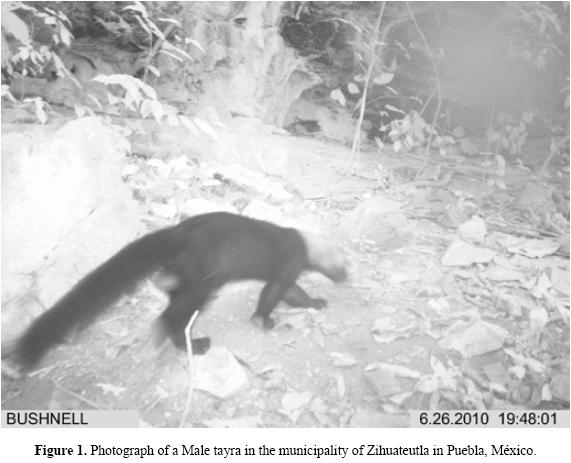
<body><![CDATA[<p align="justify"><font face="verdana" size="2">&nbsp;</font></p>  	    <p align="justify"><font face="verdana" size="2">Recibido: 04/04/2011    <br> 	Aceptado: 20/06/2011</font></p>  	    <p align="justify"><font face="verdana" size="2">&nbsp;</font></p>  	    <p align="justify"><font face="verdana" size="2"><b>RESUMEN</b></font></p>  	    <p align="justify"><font face="verdana" size="2">En la siguiente nota se presentan dos nuevos reportes de tayra (<i>Eira barbara</i>) obtenidos en la Sierra Norte de Puebla.</font></p>  	    <p align="justify"><font face="verdana" size="2">&nbsp;</font></p>  	    <p align="justify"><font face="verdana" size="2">The tayra (<i>Eira barbara Linnaeus 1758</i>) is considered as one of the carnivore species least studied in North and Central America (L&oacute;pez Gonz&aacute;lez &amp; Aceves Lara 2007). Its distribution extends from Mexico to Argentina but, in some countries its distributions is not defined. In Mexico it is considered as endangered (NOM&#45;059&#45;2010, SEMARNAT. 2010) despite it has been reported in several states in the west in Sinaloa (Hall 1981) and in the east in states such as Veracruz (Presley 2000, Dias 2005), San Luis Potos&iacute; (Dalquest 1953), Tamaulipas (Hall 1981) and Quer&eacute;taro (L&oacute;pez Gonz&aacute;lez &amp; Aceves Lara 2007). For Puebla, it was reported without geographical reference by Lopez&#45;Wilchis and Lopez&#45;Jardines (1999) however most of the museum records date before 1970 (Wieczorek 2001). A sight record of the species was obtained in the southeastern part of the state in the locality of Coxcatl&aacute;n de Osorio (Ram&iacute;rez&#45;Pulido <i>et al</i>. 2005). There are no further records of the species, thus, it&acute;s presence wasn&acute;t confirmed recently in the Sierra Norte. Here, we report a recent record of Tayra and image of this species for the first time in the state of Puebla.</font></p>  	    <p align="justify"><font face="verdana" size="2">We obtained the picture while conducting camera trapping for the project "The Jaguar in Puebla: Presence and Human Relations" in the Natural Protected Area of the Hidrologic Basin of the Necaxa River. The study area is located in northern Puebla, encompassing an area of 5,709.82 km<sup>2</sup> which include 55 municipalities. The methodology includes interviews with hunters and tanneries in different communities. Also, camera trapping is used by placing one or two camera traps per site and rotating them every month along the different areas (Ram&iacute;rez&#45;Bravo 2010). The picture was taken by a Camera trap (Bushnell Trophy; Kansas, United States) set during the month of June 2010 at a height of 40 &#45;50 cm along a trail in a canyon with tropical rainforest with mahogany and red cedar among others and patches of coffee plantations, beside the Necaxa River near the community of Telolotla in the municipality of Zihuateutla (UTM coordinates: 2230864 N / 598387 E). A photographic record of an adult male tayra (<i>Eira barbara</i>) as it can be determined by the exposed testicles; was obtained at 19:48 hours on June 26 of 2010 near a cliff ridge at 480 m elevation (<a href="#f1">Fig. 1</a>). This corresponds with the patterns observed previously of the species being present below 1200 m and active in the late afternoon (Presley 2000). During the same season we captured other species like armadillo (<i>Dasypus novemcinctus</i>), raccoon (<i>Procyon lotor</i>) and coati (<i>Nasua narica</i>).</font></p>  	    <p align="center"><font face="verdana" size="2"><a name="f1"></a></font></p>  	    ]]></body>
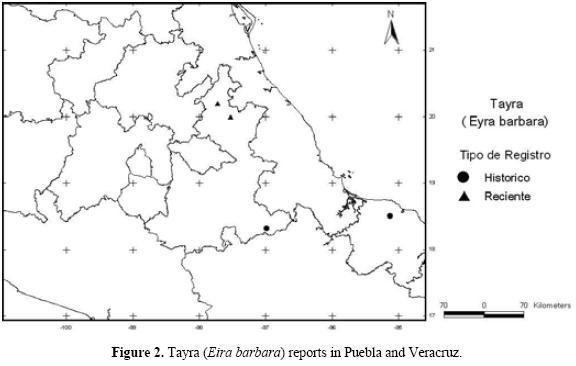
<body><![CDATA[<p align="center"><font face="verdana" size="2"><img src="/img/revistas/azm/v27n3/a24f1.jpg"></font></p>  	    <p align="justify"><font face="verdana" size="2">Additionally we found a specimen (a mounted skin) in the region of Zapotitlan de Mendez (2212264 N / 634494) in the northern part of the state. The individual was a sub&#45;adult female hunted approximately 5 years ago (circa 2005). The person declared that the species is common in the area and that he mounted a male approximately 20 years ago (circa 1990).</font></p>  	    <p align="justify"><font face="verdana" size="2">These records indicate the possibility of an extant population along the Northern Mountainous range of Puebla. However there is no clear information about connectivity with populations in nearby states (<a href="#f2">Fig. 2</a>). Thus, it is necessary to develop a specific project for the species in the area as it is necessary to provide a more detailed distribution of the species along the Sierra Norte.</font></p>  	    <p align="center"><font face="verdana" size="2"><a name="f2"></a></font></p>  	    <p align="center"><font face="verdana" size="2"><img src="/img/revistas/azm/v27n3/a24f2.jpg"></font></p>  	    <p align="justify"><font face="verdana" size="2">&nbsp;</font></p>  	    <p align="justify"><font face="verdana" size="2"><b>ACKNOWLEDGEMENTS</b></font></p>  	    <p align="justify"><font face="verdana" size="2">I would like to thank to Panthera Foundation who supported us with a grant for the project: "The Jaguar in the state of Puebla, Central Mexico: Presence, Conservation and Human Relations", to the Universidad de las Americas for the facilities provided, ANP Cuenca R&iacute;o Necaxa, and the private reserve Kolijke for all its support.</font></p>  	    <p align="justify"><font face="verdana" size="2">&nbsp;</font></p>  	    <p align="justify"><font face="verdana" size="2"><b>REFERENCES</b></font></p>  	    ]]></body>
<body><![CDATA[<!-- ref --><p align="justify"><font face="verdana" size="2"><b>Dallquest, W. W.</b> 1953. Mammals of the Mexican state of San Luis Potosi. <i>Louisiana State University Studies, Biological Series,</i> 1: 1&#150;229.    &nbsp;&nbsp;&nbsp;&nbsp;&nbsp;&nbsp;&nbsp;&nbsp;[&#160;<a href="javascript:void(0);" onclick="javascript: window.open('/scielo.php?script=sci_nlinks&ref=384634&pid=S0065-1737201100030002400001&lng=','','width=640,height=500,resizable=yes,scrollbars=1,menubar=yes,');">Links</a>&#160;]<!-- end-ref --></font></p>  	    <!-- ref --><p align="justify"><font face="verdana" size="2"><b>Dias, P. A. D.</b> 2005. Observations of parturition in the Mexican mantled howler monkeys (<i>Allouatta palliata</i>) in the island of Agaltepec, Veracruz state, Mexico. <i>American. Journal of Primatology,</i> 65: 93&#45;98.    &nbsp;&nbsp;&nbsp;&nbsp;&nbsp;&nbsp;&nbsp;&nbsp;[&#160;<a href="javascript:void(0);" onclick="javascript: window.open('/scielo.php?script=sci_nlinks&ref=384636&pid=S0065-1737201100030002400002&lng=','','width=640,height=500,resizable=yes,scrollbars=1,menubar=yes,');">Links</a>&#160;]<!-- end-ref --></font></p>  	    <!-- ref --><p align="justify"><font face="verdana" size="2"><b>Hall, E. R.</b> 1981. <i>The mammals of North America</i>. 2nd edition. Volume 2. John Wiley &amp; Sons, New York.    &nbsp;&nbsp;&nbsp;&nbsp;&nbsp;&nbsp;&nbsp;&nbsp;[&#160;<a href="javascript:void(0);" onclick="javascript: window.open('/scielo.php?script=sci_nlinks&ref=384638&pid=S0065-1737201100030002400003&lng=','','width=640,height=500,resizable=yes,scrollbars=1,menubar=yes,');">Links</a>&#160;]<!-- end-ref --></font></p>  	    <!-- ref --><p align="justify"><font face="verdana" size="2"><b>L&oacute;pez&#45;Gonz&aacute;lez, C. A. &amp; D. R. Aceves Lara.</b> 2007. Noteworthy record of the Tayra (Carnivora: Mustelidae: <i>Eira barbara</i>) in the Sierra Gorda biosphere reserve, Quer&eacute;taro, M&eacute;xico. <i>Western North American Naturalist</i>, 67: 150&#45;151.    &nbsp;&nbsp;&nbsp;&nbsp;&nbsp;&nbsp;&nbsp;&nbsp;[&#160;<a href="javascript:void(0);" onclick="javascript: window.open('/scielo.php?script=sci_nlinks&ref=384640&pid=S0065-1737201100030002400004&lng=','','width=640,height=500,resizable=yes,scrollbars=1,menubar=yes,');">Links</a>&#160;]<!-- end-ref --></font></p>  	    <!-- ref --><p align="justify"><font face="verdana" size="2"><b>L&oacute;pez&#45;Wilchis, R. &amp; J. L&oacute;pez Jardines.</b> 1998. <i>Los mam&iacute;feros de M&eacute;xico depositados en colecciones</i> <i>de Estados Unidos y Canad&aacute;</i>. Universidad Aut&oacute;noma Metropolitana, Unidad Iztapalapa, 323 pp.    &nbsp;&nbsp;&nbsp;&nbsp;&nbsp;&nbsp;&nbsp;&nbsp;[&#160;<a href="javascript:void(0);" onclick="javascript: window.open('/scielo.php?script=sci_nlinks&ref=384642&pid=S0065-1737201100030002400005&lng=','','width=640,height=500,resizable=yes,scrollbars=1,menubar=yes,');">Links</a>&#160;]<!-- end-ref --></font></p>  	    ]]></body>
<body><![CDATA[<!-- ref --><p align="justify"><font face="verdana" size="2"><b>Presley, S. J.</b> 2000. <i>Eira barbara</i>. <i>Mammalian Species,</i> 636: 1&#45;6.    &nbsp;&nbsp;&nbsp;&nbsp;&nbsp;&nbsp;&nbsp;&nbsp;[&#160;<a href="javascript:void(0);" onclick="javascript: window.open('/scielo.php?script=sci_nlinks&ref=384644&pid=S0065-1737201100030002400006&lng=','','width=640,height=500,resizable=yes,scrollbars=1,menubar=yes,');">Links</a>&#160;]<!-- end-ref --></font></p>  	    <!-- ref --><p align="justify"><font face="verdana" size="2"><b>Ram&iacute;rez&#45;Bravo, O. E.</b> 2010. <i>El Jaguar en Puebla: presencia, distribuci&oacute;n, relaci&oacute;n con el hombre y</i> <i>conservaci&oacute;n. 2&ordm;. Reporte Octubre 2009&#45;Octubre 2010</i>. Universidad de las Am&eacute;ricas. University of Kent. National Geographic. Panthera. 68p.    &nbsp;&nbsp;&nbsp;&nbsp;&nbsp;&nbsp;&nbsp;&nbsp;[&#160;<a href="javascript:void(0);" onclick="javascript: window.open('/scielo.php?script=sci_nlinks&ref=384646&pid=S0065-1737201100030002400007&lng=','','width=640,height=500,resizable=yes,scrollbars=1,menubar=yes,');">Links</a>&#160;]<!-- end-ref --></font></p>  	    <!-- ref --><p align="justify"><font face="verdana" size="2"><b>Ram&iacute;rez Pulido J., N. Gonz&aacute;lez&#45;Ruiz &amp; H. H. Genoways.</b> 2005. Carnivores from the Mexican state of Puebla: distribution, taxonomy and conservation. <i>Mastozoolog&iacute;a Neotropical,</i> 12: 37&#45;52.    &nbsp;&nbsp;&nbsp;&nbsp;&nbsp;&nbsp;&nbsp;&nbsp;[&#160;<a href="javascript:void(0);" onclick="javascript: window.open('/scielo.php?script=sci_nlinks&ref=384648&pid=S0065-1737201100030002400008&lng=','','width=640,height=500,resizable=yes,scrollbars=1,menubar=yes,');">Links</a>&#160;]<!-- end-ref --></font></p>  	    <!-- ref --><p align="justify"><font face="verdana" size="2"><b>Wieczorek J.</b> 2001. <i>Mammal Network Information System (MaNIS)</i>. University of California, Berkeley. <a href="http://manisnet.org/manis/index.html" target="_blank">http://manisnet.org/manis/index.html</a> (consulted: March11, 2011).    &nbsp;&nbsp;&nbsp;&nbsp;&nbsp;&nbsp;&nbsp;&nbsp;[&#160;<a href="javascript:void(0);" onclick="javascript: window.open('/scielo.php?script=sci_nlinks&ref=384650&pid=S0065-1737201100030002400009&lng=','','width=640,height=500,resizable=yes,scrollbars=1,menubar=yes,');">Links</a>&#160;]<!-- end-ref --></font></p>      ]]></body><back>
<ref-list>
<ref id="B1">
<nlm-citation citation-type="journal">
<person-group person-group-type="author">
<name>
<surname><![CDATA[Dallquest]]></surname>
<given-names><![CDATA[W. W]]></given-names>
</name>
</person-group>
<article-title xml:lang="en"><![CDATA[Mammals of the Mexican state of San Luis Potosi]]></article-title>
<source><![CDATA[Louisiana State University Studies, Biological Series]]></source>
<year>1953</year>
<volume>1</volume>
<page-range>1-229</page-range></nlm-citation>
</ref>
<ref id="B2">
<nlm-citation citation-type="journal">
<person-group person-group-type="author">
<name>
<surname><![CDATA[Dias]]></surname>
<given-names><![CDATA[P. A. D]]></given-names>
</name>
</person-group>
<article-title xml:lang="en"><![CDATA[Observations of parturition in the Mexican mantled howler monkeys (Allouatta palliata) in the island of Agaltepec, Veracruz state, Mexico]]></article-title>
<source><![CDATA[American. Journal of Primatology]]></source>
<year>2005</year>
<volume>65</volume>
<page-range>93-98</page-range></nlm-citation>
</ref>
<ref id="B3">
<nlm-citation citation-type="book">
<person-group person-group-type="author">
<name>
<surname><![CDATA[Hall]]></surname>
<given-names><![CDATA[E. R]]></given-names>
</name>
</person-group>
<source><![CDATA[The mammals of North America]]></source>
<year>1981</year>
<volume>2</volume>
<edition>2</edition>
<publisher-loc><![CDATA[New York ]]></publisher-loc>
<publisher-name><![CDATA[John Wiley & Sons]]></publisher-name>
</nlm-citation>
</ref>
<ref id="B4">
<nlm-citation citation-type="journal">
<person-group person-group-type="author">
<name>
<surname><![CDATA[López-González]]></surname>
<given-names><![CDATA[C. A.]]></given-names>
</name>
<name>
<surname><![CDATA[Aceves Lara]]></surname>
<given-names><![CDATA[D. R.]]></given-names>
</name>
</person-group>
<article-title xml:lang="en"><![CDATA[Noteworthy record of the Tayra (Carnivora: Mustelidae: Eira barbara) in the Sierra Gorda biosphere reserve, Querétaro, México]]></article-title>
<source><![CDATA[Western North American Naturalist]]></source>
<year>2007</year>
<volume>67</volume>
<page-range>150-151</page-range></nlm-citation>
</ref>
<ref id="B5">
<nlm-citation citation-type="book">
<person-group person-group-type="author">
<name>
<surname><![CDATA[López-Wilchis]]></surname>
<given-names><![CDATA[R.]]></given-names>
</name>
<name>
<surname><![CDATA[López Jardines]]></surname>
<given-names><![CDATA[J.]]></given-names>
</name>
</person-group>
<source><![CDATA[Los mamíferos de México depositados en colecciones de Estados Unidos y Canadá]]></source>
<year>1998</year>
<page-range>323</page-range><publisher-name><![CDATA[Universidad Autónoma Metropolitana]]></publisher-name>
</nlm-citation>
</ref>
<ref id="B6">
<nlm-citation citation-type="journal">
<person-group person-group-type="author">
<name>
<surname><![CDATA[Presley]]></surname>
<given-names><![CDATA[S. J]]></given-names>
</name>
</person-group>
<article-title xml:lang="la"><![CDATA[Eira barbara]]></article-title>
<source><![CDATA[Mammalian Species]]></source>
<year>2000</year>
<volume>636</volume>
<page-range>1-6</page-range></nlm-citation>
</ref>
<ref id="B7">
<nlm-citation citation-type="book">
<person-group person-group-type="author">
<name>
<surname><![CDATA[Ramírez-Bravo]]></surname>
<given-names><![CDATA[O. E]]></given-names>
</name>
</person-group>
<source><![CDATA[El Jaguar en Puebla: presencia, distribución, relación con el hombre y conservación]]></source>
<year>2010</year>
<page-range>68</page-range><publisher-name><![CDATA[Universidad de las AméricasUniversity of KentNational GeographicPanthera]]></publisher-name>
</nlm-citation>
</ref>
<ref id="B8">
<nlm-citation citation-type="journal">
<person-group person-group-type="author">
<name>
<surname><![CDATA[Ramírez Pulido]]></surname>
<given-names><![CDATA[J.]]></given-names>
</name>
<name>
<surname><![CDATA[González-Ruiz]]></surname>
<given-names><![CDATA[N.]]></given-names>
</name>
<name>
<surname><![CDATA[Genoways]]></surname>
<given-names><![CDATA[H. H.]]></given-names>
</name>
</person-group>
<article-title xml:lang="en"><![CDATA[Carnivores from the Mexican state of Puebla: distribution, taxonomy and conservation]]></article-title>
<source><![CDATA[Mastozoología Neotropical]]></source>
<year>2005</year>
<volume>12</volume>
<page-range>37-52</page-range></nlm-citation>
</ref>
<ref id="B9">
<nlm-citation citation-type="book">
<person-group person-group-type="author">
<name>
<surname><![CDATA[Wieczorek]]></surname>
<given-names><![CDATA[J]]></given-names>
</name>
</person-group>
<source><![CDATA[Mammal Network Information System (MaNIS)]]></source>
<year>2001</year>
<publisher-loc><![CDATA[Berkeley ]]></publisher-loc>
<publisher-name><![CDATA[University of California]]></publisher-name>
</nlm-citation>
</ref>
</ref-list>
</back>
</article>