<?xml version="1.0" encoding="ISO-8859-1"?><article xmlns:mml="http://www.w3.org/1998/Math/MathML" xmlns:xlink="http://www.w3.org/1999/xlink" xmlns:xsi="http://www.w3.org/2001/XMLSchema-instance">
<front>
<journal-meta>
<journal-id>0065-1737</journal-id>
<journal-title><![CDATA[Acta zoológica mexicana]]></journal-title>
<abbrev-journal-title><![CDATA[Acta Zool. Mex]]></abbrev-journal-title>
<issn>0065-1737</issn>
<publisher>
<publisher-name><![CDATA[Instituto de Ecología A.C.]]></publisher-name>
</publisher>
</journal-meta>
<article-meta>
<article-id>S0065-17372011000200021</article-id>
<title-group>
<article-title xml:lang="en"><![CDATA[Avocado seed moth, Stenoma catenifer Walsingham (Lepidoptera: Elachistidae) in Queretaro, México]]></article-title>
<article-title xml:lang="es"><![CDATA[La palomilla barrenadora del aguacate Stenoma catenifer Walsingham (Lepidoptera: Elachistidae) en Querétaro, México]]></article-title>
</title-group>
<contrib-group>
<contrib contrib-type="author">
<name>
<surname><![CDATA[PALACIOS TORRES]]></surname>
<given-names><![CDATA[Rogelio E.]]></given-names>
</name>
<xref ref-type="aff" rid="A01"/>
</contrib>
<contrib contrib-type="author">
<name>
<surname><![CDATA[RAMÍREZ DEL ANGEL]]></surname>
<given-names><![CDATA[Martín]]></given-names>
</name>
<xref ref-type="aff" rid="A01"/>
</contrib>
<contrib contrib-type="author">
<name>
<surname><![CDATA[URIBE GONZÁLEZ]]></surname>
<given-names><![CDATA[Eliseo]]></given-names>
</name>
<xref ref-type="aff" rid="A02"/>
</contrib>
<contrib contrib-type="author">
<name>
<surname><![CDATA[GRANADOS ESCAMILLA]]></surname>
<given-names><![CDATA[Dionicio F.]]></given-names>
</name>
<xref ref-type="aff" rid="A02"/>
</contrib>
<contrib contrib-type="author">
<name>
<surname><![CDATA[ROMERO CASTAÑEDA]]></surname>
<given-names><![CDATA[Jonathan E.]]></given-names>
</name>
<xref ref-type="aff" rid="A02"/>
</contrib>
<contrib contrib-type="author">
<name>
<surname><![CDATA[VALDEZ CARRASCO]]></surname>
<given-names><![CDATA[Jorge M.]]></given-names>
</name>
<xref ref-type="aff" rid="A03"/>
</contrib>
</contrib-group>
<aff id="A01">
<institution><![CDATA[,Dirección General de Sanidad Vegetal  ]]></institution>
<addr-line><![CDATA[ ]]></addr-line>
<country>México</country>
</aff>
<aff id="A02">
<institution><![CDATA[,Comité Estatal de Sanidad Vegetal de Querétaro, A.C.  ]]></institution>
<addr-line><![CDATA[ Querétaro]]></addr-line>
<country>México</country>
</aff>
<aff id="A03">
<institution><![CDATA[,Colegio de Postgraduados Campus Montecillo ]]></institution>
<addr-line><![CDATA[Texcoco Estado de México]]></addr-line>
<country>México</country>
</aff>
<pub-date pub-type="pub">
<day>00</day>
<month>08</month>
<year>2011</year>
</pub-date>
<pub-date pub-type="epub">
<day>00</day>
<month>08</month>
<year>2011</year>
</pub-date>
<volume>27</volume>
<numero>2</numero>
<fpage>501</fpage>
<lpage>504</lpage>
<copyright-statement/>
<copyright-year/>
<self-uri xlink:href="http://www.scielo.org.mx/scielo.php?script=sci_arttext&amp;pid=S0065-17372011000200021&amp;lng=en&amp;nrm=iso"></self-uri><self-uri xlink:href="http://www.scielo.org.mx/scielo.php?script=sci_abstract&amp;pid=S0065-17372011000200021&amp;lng=en&amp;nrm=iso"></self-uri><self-uri xlink:href="http://www.scielo.org.mx/scielo.php?script=sci_pdf&amp;pid=S0065-17372011000200021&amp;lng=en&amp;nrm=iso"></self-uri><abstract abstract-type="short" xml:lang="en"><p><![CDATA[The avocado seed moth, Stenoma catenifer Walsingham, is recorded for the first time in the State of Queretaro, Mexico. Aspects about its habits and behavior are described.]]></p></abstract>
</article-meta>
</front><body><![CDATA[ <p align="justify"><font face="verdana" size="4">Notas cient&iacute;ficas</font></p>     <p align="justify"><font face="verdana" size="4">&nbsp;</font></p>     <p align="center"><font face="verdana" size="4"><b>Avocado seed moth, <i>Stenoma catenifer </i>Walsingham (Lepidoptera: Elachistidae) in Queretaro, M&eacute;xico</b></font></p>     <p align="center"><font face="verdana" size="2">&nbsp;</font></p>     <p align="center"><font face="verdana" size="3"><b>La palomilla barrenadora del aguacate <i>Stenoma catenifer </i>Walsingham (Lepidoptera: Elachistidae) en Quer&eacute;taro, M&eacute;xico</b></font></p>     <p align="center"><font face="verdana" size="2">&nbsp;</font></p>     <p align="center"><font face="verdana" size="2"><b>Rogelio E. PALACIOS TORRES,<sup>1</sup> Mart&iacute;n RAM&Iacute;REZ DEL ANGEL,<sup>1 </sup>Eliseo URIBE GONZ&Aacute;LEZ,<sup>2</sup> Dionicio F. GRANADOS ESCAMILLA,<sup>2 </sup>Jonathan E. ROMERO CASTA&Ntilde;EDA<sup>2</sup> &amp; Jorge M. VALDEZ CARRASCO<sup>3</sup></b></font></p>     <p align="justify"><font face="verdana" size="2">&nbsp;</font></p>     <p align="justify"><font face="verdana" size="2"><i><sup>1 </sup>Direcci&oacute;n General de Sanidad Vegetal. Guillermo P&eacute;rez Valenzuela # 127 Col. Del Carmen Delegaci&oacute;n Coyoac&aacute;n, C. P. 04100, M&eacute;xico. E&#150;mail: </i><a href="mailto:palaciost@colpos.mx">palaciost@colpos.mx</a>.</font></p>     <p align="justify"><font face="verdana" size="2"><i><sup>2</sup> Comit&eacute; Estatal de Sanidad Vegetal de Quer&eacute;taro, A.C. Calamanda de Ju&aacute;rez, El Marques, Quer&eacute;taro. Autopista M&eacute;xico&#150;Quer&eacute;taro Km 186.8, C.P. 76247, Quer&eacute;taro, M&eacute;xico. E&#150;mail: </i><a href="mailto:euribe@cesaveq.org.mx">euribe@cesaveq.org.mx</a>.</font></p>     ]]></body>
<body><![CDATA[<p align="justify"><font face="verdana" size="2"><i><sup>3</sup> Colegio de Postgraduados, Campus Montecillo, Fitosanidad Entomolg&iacute;a y Acarolog&iacute;a, Km.36.5 carr. M&eacute;xico&#150;Texcoco C.P. 56230, Montecillo, Texcoco, Estado de M&eacute;xico, M&eacute;xico.</i></font></p>     <p align="justify"><font face="verdana" size="2">&nbsp;</font></p>     <p align="justify"><font face="verdana" size="2">Recibido: 18/11/2010.    <br> Aceptado: 02/02/2011.</font></p>     <p align="justify"><font face="verdana" size="2">&nbsp;</font></p>     <p align="justify"><font face="verdana" size="2"><b>ABSTRACT</b></font></p>     <p align="justify"><font face="verdana" size="2">The avocado seed moth, <i>Stenoma catenifer </i>Walsingham, is recorded for the first time in the State of Queretaro, Mexico. Aspects about its habits and behavior are described.</font></p>     <p align="justify"><font face="verdana" size="2">&nbsp;</font></p>     <p align="justify"><font face="verdana" size="2">Documented knowledge on the avocado seed moth, <i>S. catenifer, </i>begins with its taxonomic description with specimens from Coatepeque, Guatemala, and Volcan de Chiriqui, Panama, at the beginning of the past century (Walsingham 1909). This document also includes specimens collected from Presidio, Mexico. Various other documents make reference to several aspects of this species in Mexico, such as, its morphological description, the damage that it causes in avocado fruits, habits and behavior, geographical distribution, and control measures (Mendez 1961, Garcia <i>et al. </i>1967, Acevedo <i>et </i>al.1972, Comision Nacional de Fruticultura 1973). The geographical distribution of this moth in Mexico includes the States of Chiapas, Colima, Guerrero, Nuevo Leon, Oaxaca, Tamaulipas, and Veracruz (Acevedo <i>et al. </i>1972). Wolfenbarger &amp; Colburn (1979) observed avocado fruits infested with <i>S. catenifer </i>in Mexico, but they did not specify the exact location of their observations.</font></p>     <p align="justify"><font face="verdana" size="2">Surveys were conducted in <i>Persea americana </i>Miller plantations in the communities of San Francisco Gatos, Santiago Azoguez, San Juan Tetla, El Platano, San Sebastian, Puerto de la Garita, and El Naranjo, all within the municipality of San Joaquin, Queretaro (20.95041&deg; to 21.04832 north latitude, 99.46355&deg; to 99.6318&deg; west longitude, height 900 to 1600 meters above sea level), from April, 2008 to February, 2009, and during July 25<sup>th</sup> to August 6<sup>th</sup>, 2008, 1525 fruits from 239 avocado trees were sampled, 50 fruits were selected, which showed symptoms of larvae presence, and 22 larvae were extracted and preserved in 70% alcohol. Likewise, 25 avocado seeds with evident larvae damage were taken and placed in 1 L transparent plastic containers, with sand at the bottom and covered with organza cloth; nine pupae were obtained, and 14 adults emerged. The biological material was determined using figures of larvae, pupae, male genitalia and adults of <i>S. catenifer </i>published by the Comision Nacional de Fruticultura (1973), and some specimens were deposited in the Entomological Collection of the Colegio de Postgraduados (CEAM), Montecillo, Texcoco, State of Mexico and the remainder material placed in the main authors collection.</font></p>     ]]></body>
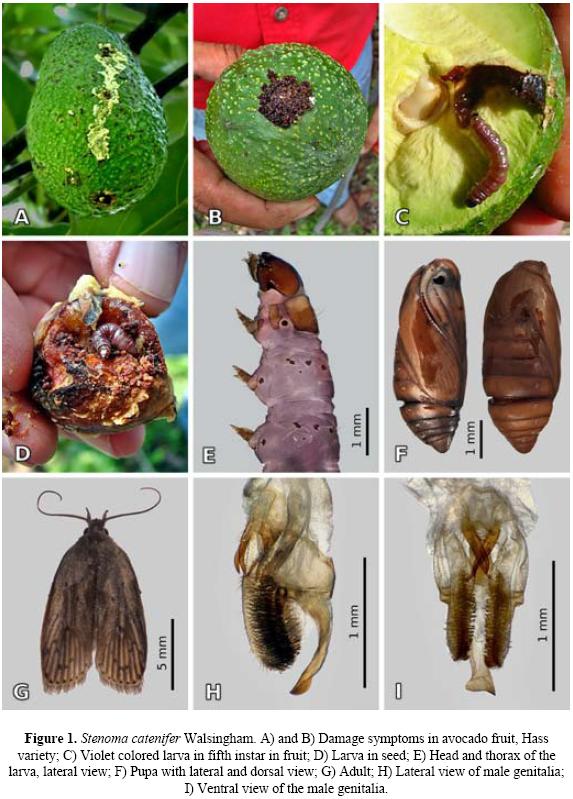
<body><![CDATA[<p align="justify"><font face="verdana" size="2">Infestations in the region begin for both varieties (Fuerte and Hass) in May and carry on until November, while in the Hass variety, the presence of larvae can be seen until January in abandoned trees. The damage caused by the larvae of this insect, to the avocado fruit shows a whitish exudate (<a href="#f1">Fig. 1A</a>) and/or a mound of frass from the larvae (<a href="#f1">Fig. 1B</a>). A total of 5 larvae were observed in a single infested fruit (<a href="#f1">Figs. 1C</a> and <a href="#f1">1D</a>). The infestation percentages ranged from 33.3% to 80.9 % in the Hass variety observed from July 25<sup>th</sup> to August 6<sup>th</sup>, in all seven communities. The pupal stage of the insect occurs 1 to 2 cm deep in the ground; the pupae present a dorsal incision between the abdominal segments IV and V, which is prolonged transversally, and seven pairs of abdominal spiracles (<a href="#f1">Fig. 1F</a>). The adult insects (<a href="#f1">Fig. 1G</a>) have nocturnal habits, and were not seen naturally during the field surveys. The male genitalia present a pair of harpago; with a horn like structure on its basal part and the presence of abundant setae resembling a brush on its superior part. The aedeagus is long and chitinized on its distal part. The uncus is a curved and sclerotized structure, which starts narrowing from the mid part to its end (<a href="#f1">Fig. 1H</a> and <a href="#f1">1I</a>). Furthermore, zones infested with this pest have important physical barriers, due to orography of the Sierra Gorda, with hills over 2500 m around the orchards. On the other hand, larvae and pupae dispersion from fruit mobilization to distant places is not probable, since the production of these orchards with infestations of insect borers is locally use, as swine fodder, and reduced amounts to local markets. This reduces the risk of spreading the pest.</font></p>     <p align="center"><font face="verdana" size="2"><a name="f1"></a></font></p>     <p align="center"><font face="verdana" size="2"><img src="/img/revistas/azm/v27n2/a21f1.jpg"></font></p>     <p align="justify"><font face="verdana" size="2">&nbsp;</font></p>     <p align="justify"><font face="verdana" size="2"><b>ACKNOWLEDGEMENTS</b></font></p>     <p align="justify"><font face="verdana" size="2">The main author would like to thank Jos&eacute; Adalberto Barocio for allowing us to use his photographs (B and D) and is grateful to Adriano V&aacute;squez Chan for his suggestions made to the final writing of the manuscript.</font></p>     <p align="justify"><font face="verdana" size="2">&nbsp;</font></p>     <p align="justify"><font face="verdana" size="2"><b>LITERATURE CITED</b></font></p>     <!-- ref --><p align="justify"><font face="verdana" size="2"><b>Acevedo J., E., J. T. V&aacute;zquez G. &amp; C. Sosa M. </b>1972. Estudios sobre el barrenador del hueso y pulpa del aguacate <i>Stenoma catenifer </i>Walsinghan (Lepidoptera: Stenomidae). <i>Agrociencia. </i>Serie D, 9: 17&#150;24.    &nbsp;&nbsp;&nbsp;&nbsp;&nbsp;&nbsp;&nbsp;&nbsp;[&#160;<a href="javascript:void(0);" onclick="javascript: window.open('/scielo.php?script=sci_nlinks&ref=381381&pid=S0065-1737201100020002100001&lng=','','width=640,height=500,resizable=yes,scrollbars=1,menubar=yes,');">Links</a>&#160;]<!-- end-ref --></font></p>     ]]></body>
<body><![CDATA[<!-- ref --><p align="justify"><font face="verdana" size="2"><b>Comisi&oacute;n Nacional de Fruticultura. </b>1973. El barrenador del hueso y la pulpa del aguacate. SAG/M&eacute;xico, Folleto Num. 14. 109 pp.    &nbsp;&nbsp;&nbsp;&nbsp;&nbsp;&nbsp;&nbsp;&nbsp;[&#160;<a href="javascript:void(0);" onclick="javascript: window.open('/scielo.php?script=sci_nlinks&ref=381383&pid=S0065-1737201100020002100002&lng=','','width=640,height=500,resizable=yes,scrollbars=1,menubar=yes,');">Links</a>&#160;]<!-- end-ref --> </font></p>     <!-- ref --><p align="justify"><font face="verdana" size="2"><b>Garc&iacute;a A., M., M. M&eacute;ndez V &amp; A. Morales G. </b>1967. El Aguacatero: Plagas y Enfermedades. <i>Fitofilo, </i>56: 5&#150;30.    &nbsp;&nbsp;&nbsp;&nbsp;&nbsp;&nbsp;&nbsp;&nbsp;[&#160;<a href="javascript:void(0);" onclick="javascript: window.open('/scielo.php?script=sci_nlinks&ref=381385&pid=S0065-1737201100020002100003&lng=','','width=640,height=500,resizable=yes,scrollbars=1,menubar=yes,');">Links</a>&#160;]<!-- end-ref --></font></p>     <!-- ref --><p align="justify"><font face="verdana" size="2"><b>M&eacute;ndez V, M. </b>1961. Medidas Pr&aacute;cticas para Combatir los "Barrenadores" del Hueso del Aguacate. <i>Fitofilo, </i>31: 4&#150;7.    &nbsp;&nbsp;&nbsp;&nbsp;&nbsp;&nbsp;&nbsp;&nbsp;[&#160;<a href="javascript:void(0);" onclick="javascript: window.open('/scielo.php?script=sci_nlinks&ref=381387&pid=S0065-1737201100020002100004&lng=','','width=640,height=500,resizable=yes,scrollbars=1,menubar=yes,');">Links</a>&#160;]<!-- end-ref --></font></p>     <!-- ref --><p align="justify"><font face="verdana" size="2"><b>Walshingham, L. </b>1909. <i>Biologia Centrali&#150;Americana, </i>INSECTA, Lepidoptera&#150;Heterocera. Vol. 4: 168&#150;169.    &nbsp;&nbsp;&nbsp;&nbsp;&nbsp;&nbsp;&nbsp;&nbsp;[&#160;<a href="javascript:void(0);" onclick="javascript: window.open('/scielo.php?script=sci_nlinks&ref=381389&pid=S0065-1737201100020002100005&lng=','','width=640,height=500,resizable=yes,scrollbars=1,menubar=yes,');">Links</a>&#160;]<!-- end-ref --></font></p>     <!-- ref --><p align="justify"><font face="verdana" size="2"><b>Wolfenbarger, D. O &amp; B. Colburn. </b>1979. The <i>Stenoma catenifer, </i>a serious avocado pest. <i>Proceedings of the Florida State Horticultural Society, </i>92: 275.    &nbsp;&nbsp;&nbsp;&nbsp;&nbsp;&nbsp;&nbsp;&nbsp;[&#160;<a href="javascript:void(0);" onclick="javascript: window.open('/scielo.php?script=sci_nlinks&ref=381391&pid=S0065-1737201100020002100006&lng=','','width=640,height=500,resizable=yes,scrollbars=1,menubar=yes,');">Links</a>&#160;]<!-- end-ref --></font></p>     ]]></body>
<body><![CDATA[ ]]></body><back>
<ref-list>
<ref id="B1">
<nlm-citation citation-type="journal">
<person-group person-group-type="author">
<name>
<surname><![CDATA[Acevedo J.]]></surname>
<given-names><![CDATA[E.]]></given-names>
</name>
<name>
<surname><![CDATA[Vázquez G.]]></surname>
<given-names><![CDATA[J. T.]]></given-names>
</name>
<name>
<surname><![CDATA[Sosa M]]></surname>
<given-names><![CDATA[C.]]></given-names>
</name>
</person-group>
<article-title xml:lang="es"><![CDATA[Estudios sobre el barrenador del hueso y pulpa del aguacate Stenoma catenifer Walsinghan (Lepidoptera: Stenomidae)]]></article-title>
<source><![CDATA[Agrociencia. Serie D]]></source>
<year>1972</year>
<volume>9</volume>
<page-range>17-24</page-range></nlm-citation>
</ref>
<ref id="B2">
<nlm-citation citation-type="book">
<collab>Comisión Nacional de Fruticultura</collab>
<source><![CDATA[El barrenador del hueso y la pulpa del aguacate]]></source>
<year>1973</year>
<volume>14</volume>
<page-range>109</page-range><publisher-name><![CDATA[SAG]]></publisher-name>
</nlm-citation>
</ref>
<ref id="B3">
<nlm-citation citation-type="journal">
<person-group person-group-type="author">
<name>
<surname><![CDATA[García A.]]></surname>
<given-names><![CDATA[M.]]></given-names>
</name>
<name>
<surname><![CDATA[Méndez V]]></surname>
<given-names><![CDATA[M.]]></given-names>
</name>
<name>
<surname><![CDATA[Morales G]]></surname>
<given-names><![CDATA[A.]]></given-names>
</name>
</person-group>
<article-title xml:lang="es"><![CDATA[El Aguacatero: Plagas y Enfermedades]]></article-title>
<source><![CDATA[Fitofilo]]></source>
<year>1967</year>
<volume>56</volume>
<page-range>5-30</page-range></nlm-citation>
</ref>
<ref id="B4">
<nlm-citation citation-type="journal">
<person-group person-group-type="author">
<name>
<surname><![CDATA[Méndez V]]></surname>
<given-names><![CDATA[M]]></given-names>
</name>
</person-group>
<article-title xml:lang="es"><![CDATA[Medidas Prácticas para Combatir los "Barrenadores" del Hueso del Aguacate]]></article-title>
<source><![CDATA[Fitofilo]]></source>
<year>1961</year>
<volume>31</volume>
<page-range>4-7</page-range></nlm-citation>
</ref>
<ref id="B5">
<nlm-citation citation-type="journal">
<person-group person-group-type="author">
<name>
<surname><![CDATA[Walshingham]]></surname>
<given-names><![CDATA[L]]></given-names>
</name>
</person-group>
<article-title xml:lang="es"><![CDATA[Biologia Centrali-Americana, INSECTA]]></article-title>
<source><![CDATA[Lepidoptera-Heterocera]]></source>
<year>1909</year>
<volume>4</volume>
<page-range>168-169</page-range></nlm-citation>
</ref>
<ref id="B6">
<nlm-citation citation-type="journal">
<person-group person-group-type="author">
<name>
<surname><![CDATA[Wolfenbarger]]></surname>
<given-names><![CDATA[D. O]]></given-names>
</name>
<name>
<surname><![CDATA[Colburn]]></surname>
<given-names><![CDATA[B.]]></given-names>
</name>
</person-group>
<article-title xml:lang="en"><![CDATA[The Stenoma catenifer, a serious avocado pest]]></article-title>
<source><![CDATA[Proceedings of the Florida State Horticultural Society]]></source>
<year>1979</year>
<volume>92</volume>
<page-range>275</page-range></nlm-citation>
</ref>
</ref-list>
</back>
</article>
