<?xml version="1.0" encoding="ISO-8859-1"?><article xmlns:mml="http://www.w3.org/1998/Math/MathML" xmlns:xlink="http://www.w3.org/1999/xlink" xmlns:xsi="http://www.w3.org/2001/XMLSchema-instance">
<front>
<journal-meta>
<journal-id>0065-1737</journal-id>
<journal-title><![CDATA[Acta zoológica mexicana]]></journal-title>
<abbrev-journal-title><![CDATA[Acta Zool. Mex]]></abbrev-journal-title>
<issn>0065-1737</issn>
<publisher>
<publisher-name><![CDATA[Instituto de Ecología A.C.]]></publisher-name>
</publisher>
</journal-meta>
<article-meta>
<article-id>S0065-17372003000300008</article-id>
<title-group>
<article-title xml:lang="en"><![CDATA[Proculus, giant Latin-American passalids: revision, Phylogeny and Biogeography]]></article-title>
</title-group>
<contrib-group>
<contrib contrib-type="author">
<name>
<surname><![CDATA[Schuster]]></surname>
<given-names><![CDATA[Jack C.]]></given-names>
</name>
<xref ref-type="aff" rid="A01"/>
</contrib>
<contrib contrib-type="author">
<name>
<surname><![CDATA[Cano]]></surname>
<given-names><![CDATA[Enio B.]]></given-names>
</name>
<xref ref-type="aff" rid="A01"/>
</contrib>
<contrib contrib-type="author">
<name>
<surname><![CDATA[Reyes-Castillo]]></surname>
<given-names><![CDATA[Pedro]]></given-names>
</name>
<xref ref-type="aff" rid="A01"/>
</contrib>
</contrib-group>
<aff id="A01">
<institution><![CDATA[,Universidad del Valle de Guatemala Laboratorio de Entomología Sistemática ]]></institution>
<addr-line><![CDATA[Ciudad de Guatemala ]]></addr-line>
<country>Guatemala</country>
</aff>
<aff id="A02">
<institution><![CDATA[,Instituto de Ecología,A.C  ]]></institution>
<addr-line><![CDATA[Jalapa Veracruz]]></addr-line>
<country>México</country>
</aff>
<pub-date pub-type="pub">
<day>00</day>
<month>00</month>
<year>2003</year>
</pub-date>
<pub-date pub-type="epub">
<day>00</day>
<month>00</month>
<year>2003</year>
</pub-date>
<numero>90</numero>
<fpage>281</fpage>
<lpage>306</lpage>
<copyright-statement/>
<copyright-year/>
<self-uri xlink:href="http://www.scielo.org.mx/scielo.php?script=sci_arttext&amp;pid=S0065-17372003000300008&amp;lng=en&amp;nrm=iso"></self-uri><self-uri xlink:href="http://www.scielo.org.mx/scielo.php?script=sci_abstract&amp;pid=S0065-17372003000300008&amp;lng=en&amp;nrm=iso"></self-uri><self-uri xlink:href="http://www.scielo.org.mx/scielo.php?script=sci_pdf&amp;pid=S0065-17372003000300008&amp;lng=en&amp;nrm=iso"></self-uri><abstract abstract-type="short" xml:lang="es"><p><![CDATA[El género Proculus y sus cinco especies conocidas son redescritas, además se describe Proculus jicaquei sp. nov. Son sinonimizados: P. beckeri Zang, 1905 (syn. nov.) y P. densipennis Casey, 1914 (syn. nov.) con P. opacipennis (Thompson, 1857); P. mandibularis Casey, 1914 (syn. nov.) con P. burmeisteri Kuwert, 1891; y P. kraatzi Kuwert, 1898 (syn. nov.) y P. magister Casey, 1897 (syn. nov.) con P. mniszechi Kaup, 1868. Se incluyen claves de los adultos y las larvas, e información biogeográfica sobre cada especie. El género se distribuye desde México hasta Colombia. Proculus mniszechi es parapátrica con P. burmeisteri, aunque son parcialmente simpátridas, en la Sierra de las Minas, Sierra de Santa Cruz y Sierra de los Cuchumatanes de Guatemala, P. mniszechi se encuentra en un tipo de bosque mesófilo por arriba de los 1500 m y P. opacipennis se encuentra en otro tipo de bosque mesófilo por abajo de los 1500 m. Proculus opacipennis tiene una relación similar con P. opacus en la Sierra de los Cuchumatanes, donde P. opacus aparentemente reemplaza a P. mniszechi. Proculus goryi (Melly, 1833) se encuentra en la cadena de volcanes de la costa pacífica de Guatemala y Chiapas, México. Proculus jicaquei sp. nov. unicamente es conocida de una localidad de las montañas al noroeste de Yoro, Honduras. La hipótesis filogenética muestra que P. jicaquei está más relacionada con P. goryi, estas dos especies forman el clado hermano de todas las otras especies de Proculus. En tanto que P. mniszechi y P. burmeisteri son taxa hermanos, como por su parte lo son P. opacus y P. opacipennis.]]></p></abstract>
<abstract abstract-type="short" xml:lang="en"><p><![CDATA[The genus and its five known species are redescribed and P. jicaquei sp. nov. is described. Synonymies include P. beckeri Zang, 1905 with P. opacipennis (Thompson, 1857) (new synonymy), P. mandibularis Casey, 1914 with P. burmeisteri Kuwert, 1891 (new synonymy), P. magister Casey, 1897 with P. mniszechi Kaup, 1868 (new synonymy), P. densipennis Casey, 1914 with P. opacipennis (Thompson, 1857) (new synonymy), and P. kraatzi Kuwert, 1898 with P. mniszechi Kaup, 1868 (new synonymy). We include a phylogenetic analysis, keys for larvae and adults, and biogeographic information for each species. The genus occurs from Mexico to Colombia. Proculus mniszechi is parapatric with P. burmeisteri and partially sympatric with P. opacipennis in Sierra de las Minas, Sierra de Santa Cruz and Cuchumatan Mountains; P. mniszechi occurs in a type of cloud forest above 1500 m altitude, whereas P. opacipennis occurs in another cloud forest type below 1500 m. Proculus opacipennis has a similar relation with P. opacus Kuwert 1891 in the Cuchumatan Mountains, where P. opacus apparently replaces P. mniszechi. Proculus goryi (Melly, 1833) occurs in the volcanic chain of the Pacific coast of Guatemala and Chiapas, Mexico. Proculus jicaquei sp. nov. is known only from the mountains northwest of Yoro, Honduras. Phylogenetic hypothesis shows that P. jicaquei is most closely to P. goryi, these two taxa form a sister clade to all other Proculus species. Proculus mniszechi and P. burmeisteri are sister taxa, as are P. opacus and P. opacipennis.]]></p></abstract>
<kwd-group>
<kwd lng="es"><![CDATA[Taxonomía]]></kwd>
<kwd lng="es"><![CDATA[Passalidae]]></kwd>
<kwd lng="es"><![CDATA[Proculus]]></kwd>
<kwd lng="es"><![CDATA[análisis filogenético]]></kwd>
<kwd lng="en"><![CDATA[Taxonomy]]></kwd>
<kwd lng="en"><![CDATA[Passalidae]]></kwd>
<kwd lng="en"><![CDATA[Proculus]]></kwd>
<kwd lng="en"><![CDATA[phylogenetic analysis]]></kwd>
</kwd-group>
</article-meta>
</front><body><![CDATA[ <p align="justify"><font face="Verdana" size="4">Art&iacute;culo</font></p>     <p align="justify"><font face="Verdana" size="2">&nbsp;</font></p>     <p align="center"><font face="verdana" size="4"><b><i>Proculus</i>, giant Latin&#45;American passalids: revision, Phylogeny and Biogeography</b></font></p>     <p align="justify"><font face="Verdana" size="2">&nbsp;</font></p>     <p align="center"><font face="verdana" size="2"><b>Jack C. Schuster<sup>1</sup>, Enio B. Cano<sup>1</sup> and Pedro Reyes&#45;Castillo<sup>2</sup></b></font></p>     <p align="justify"><font face="Verdana" size="2">&nbsp;</font></p>     <p align="justify"><font face="verdana" size="2"><i><sup>1</sup> Laboratorio de Entomolog&iacute;a Sistem&aacute;tica, Universidad del Valle de Guatemala, Apdo. Postal 82, 01901 Guatemala, GUATEMALA.</i></font></p>     <p align="justify"><font face="verdana" size="2"><i><sup>2</sup> Instituto de Ecolog&iacute;a, A.C., Apdo. Postal 63, 91000 Xalapa, Veracruz, M&Eacute;XICO.</i></font></p>     <p align="justify"><font face="Verdana" size="2">&nbsp;</font></p>     <p align="justify"><font face="verdana" size="2">Recibido: 20 de agosto 2002    ]]></body>
<body><![CDATA[<br> Aceptado: 18 de junio 2003</font></p>     <p align="justify"><font face="Verdana" size="2">&nbsp;</font></p>     <p align="justify"><font face="verdana" size="2"><b>Resumen</b></font></p>     <p align="justify"><font face="verdana" size="2">El g&eacute;nero <i>Proculus</i> y sus cinco especies conocidas son redescritas, adem&aacute;s se describe <i>Proculus jicaquei</i> sp. nov. Son sinonimizados: <i>P. beckeri</i> Zang, 1905 (syn. nov.) y <i>P. densipennis</i> Casey, 1914 (syn. nov.) con <i>P. opacipennis</i> (Thompson, 1857); <i>P. mandibularis</i> Casey, 1914 (syn. nov.) con <i>P. burmeisteri</i> Kuwert, 1891; y <i>P. kraatzi</i> Kuwert, 1898 (syn. nov.) y <i>P. magister</i> Casey, 1897 (syn. nov.) con <i>P. mniszechi</i> Kaup, 1868. Se incluyen claves de los adultos y las larvas, e informaci&oacute;n biogeogr&aacute;fica sobre cada especie. El g&eacute;nero se distribuye desde M&eacute;xico hasta Colombia. <i>Proculus mniszechi</i> es parap&aacute;trica con <i>P. burmeisteri</i>, aunque son parcialmente simp&aacute;tridas, en la Sierra de las Minas, Sierra de Santa Cruz y Sierra de los Cuchumatanes de Guatemala, <i>P. mniszechi</i> se encuentra en un tipo de bosque mes&oacute;filo por arriba de los 1500 m y <i>P. opacipennis</i> se encuentra en otro tipo de bosque mes&oacute;filo por abajo de los 1500 m. <i>Proculus opacipennis</i> tiene una relaci&oacute;n similar con <i>P. opacus</i> en la Sierra de los Cuchumatanes, donde <i>P. opacus</i> aparentemente reemplaza a <i>P. mniszechi</i>. <i>Proculus goryi</i> (Melly, 1833) se encuentra en la cadena de volcanes de la costa pac&iacute;fica de Guatemala y Chiapas, M&eacute;xico. <i>Proculus jicaquei</i> sp. nov. unicamente es conocida de una localidad de las monta&ntilde;as al noroeste de Yoro, Honduras. La hip&oacute;tesis filogen&eacute;tica muestra que <i>P. jicaquei</i> est&aacute; m&aacute;s relacionada con <i>P. goryi</i>, estas dos especies forman el clado hermano de todas las otras especies de <i>Proculus</i>. En tanto que <i>P. mniszechi</i> y <i>P. burmeisteri</i> son taxa hermanos, como por su parte lo son <i>P. opacus</i> y <i>P. opacipennis.</i></font></p>     <p align="justify"><font face="verdana" size="2"><b>Palabras clave:</b> Taxonom&iacute;a, Passalidae, <i>Proculus</i>, an&aacute;lisis filogen&eacute;tico.</font></p>     <p align="justify"><font face="Verdana" size="2">&nbsp;</font></p>     <p align="justify"><font face="verdana" size="2"><b>Abstract</b></font></p>     <p align="justify"><font face="verdana" size="2">The genus and its five known species are redescribed and <i>P. jicaquei</i> sp. nov. is described. Synonymies include <i>P. beckeri</i> Zang, 1905 with <i>P. opacipennis</i> (Thompson, 1857) (new synonymy)<i>, P. mandibularis</i> Casey, 1914 with </font><font face="verdana" size="2"><i>P. burmeisteri</i> Kuwert, 1891 (new synonymy), <i>P. magister</i> Casey, 1897 with <i>P. mniszechi</i> Kaup, 1868 (new synonymy), <i>P. densipennis</i> Casey, 1914 with <i>P. opacipennis</i> (Thompson, 1857) (new synonymy), and <i>P. kraatzi</i> Kuwert, 1898 with <i>P. mniszechi</i> Kaup, 1868 (new synonymy). We include a phylogenetic analysis, keys for larvae and adults, and biogeographic information for each species. The genus occurs from Mexico to Colombia. <i>Proculus mniszechi</i> is parapatric with <i>P. burmeisteri</i> and partially sympatric with <i>P. opacipennis</i> in Sierra de las Minas, Sierra de Santa Cruz and Cuchumatan Mountains; <i>P. mniszechi</i> occurs in a type of cloud forest above 1500 m altitude, whereas <i>P. opacipennis</i> occurs in another cloud forest type below 1500 m. <i>Proculus opacipennis</i> has a similar relation with <i>P. opacus</i> Kuwert 1891 in the Cuchumatan Mountains, where <i>P. opacus</i> apparently replaces <i>P. mniszechi. Proculus goryi</i> (Melly, 1833) occurs in the volcanic chain of the Pacific coast of Guatemala and Chiapas, Mexico. <i>Proculus jicaquei</i> sp. nov. is known only from the mountains northwest of Yoro, Honduras. Phylogenetic hypothesis shows that <i>P. jicaquei</i> is most closely to <i>P. goryi</i>, these two taxa form a sister clade to all other <i>Proculus</i> species. <i>Proculus mniszechi</i> and <i>P. burmeisteri</i> are sister taxa, as are <i>P. opacus</i> and <i>P. opacipennis.</i></font></p>     <p align="justify"><font face="verdana" size="2"><b>Key words:</b> Taxonomy, Passalidae, <i>Proculus</i>, phylogenetic analysis.</font></p>     <p align="justify"><font face="Verdana" size="2">&nbsp;</font></p>     ]]></body>
<body><![CDATA[<p align="justify"><font face="verdana" size="2"><b>Introduction</b></font></p>     <p align="justify"><font face="verdana" size="2"><i>Proculus</i> Kaup, 1868, is a distinctive genus of Passalidae (<a href="#f1">Fig. 1</a>). Its large size (31&#45;80 mm length), wide antennal lamellae, ovate elytra and reduced eyes readily make distinguish it from all other passalids. It has been cited from Mexico (Veracruz) to northern South America (Colombia). Considering several synonymies and a new species, described herein, we include six species in the genus. We present a comparative description of each of these species, a key to their identification (adults and larvae), and discuss their phylogeny and biogeography.</font></p>     <p align="center"><font face="verdana" size="2"><a name="f1"></a></font></p>     <p align="center"><font face="verdana" size="2"><img src="/img/revistas/azm/n90/a8f1.jpg"></font></p>     <p align="justify"><font face="Verdana" size="2">&nbsp;</font></p>     <p align="justify"><font face="verdana" size="2"><b>Methods</b></font></p>     <p align="justify"><font face="verdana" size="2">We examined 584 adult specimens deposited in the Arthropod Collection at the Universidad del Valle de Guatemala (UVGC) and the Colecci&oacute;n Entomol&oacute;gica at the Instituto de Ecolog&iacute;a (IEXA) as well as from: Colecciones Zool&oacute;gicas de Referencia, Universidad de San Carlos de Guatemala (USCG); Colecci&oacute;n Nacional de Insectos, Instituto de Biolog&iacute;a, Universidad Nacional Aut&oacute;noma de M&eacute;xico (CNIN); Museo de Historia Natural de la Ciudad de M&eacute;xico (MHNM); private collections of Jorge J. Hendrichs (JHSC), Benigno G&oacute;mez (BGGC) and Miguel Agel Mor&oacute;n (MAM), Mexico; Museu de Zoologia, Universidade de S&atilde;o Paulo, Brazil (MZSP); Museum National d'Histoire Naturelle (MNHN), Paris, France; Mus&eacute;um d'Historie Naturelle Gen&egrave;ve, Switzerland (MHNG); National Museum of Natural History, Leiden, Netherlands (NMNH); Deutsches Entomologisches Institut (DEI) of Eberswalde, Germany; and at the U.S.A: the Los Angeles County Museum of Natural History (LACM); United States National Museum (USNM), Washington, D.C., Carnegie Museum (ICCM), Pittsburg, and the American Museum of Natural History (AMNH), New York. Most of the specimens were collected by us or our students. Concerning the material examined for each species, we indicate in parentheses the number of individuals and the abbreviation for the collection to which it belongs (following those of Arnett and Samuelson &#91;1969&#93; where possible) except for those from UVGC.</font></p>     <p align="justify"><font face="verdana" size="2">Types associated with all names described under <i>Proculus</i> and <i>Cyphoproculus</i> were examined. Measurements were taken with a vernier. Measurements of the mandibular angle of <i>Proculus opacus</i> and <i>P. opacipennis</i> were taken with a protractor, aligning the vertical axis with the line of the mandible base to measure the curvature (<a href="#f4">Figs. 4c, d</a>), in ventral side. Boxplot was obtained using SPSS 9.0 (1999).</font></p>     <p align="justify"><font face="verdana" size="2">Phylogenetic relationships among the six species of <i>Proculus</i> were analyzed using PAUP version 4.0b10 (Swofford 2002). Adult and larval external characters formed the basis of this analysis (<a href="/img/revistas/azm/n90/a8t1.jpg" target="_blank">Tables 1</a> and <a href="/img/revistas/azm/n90/a8t2.jpg" target="_blank">2</a>). In the absence of revisionary works, for character polarization we chose <i>Veturius platyrhinus</i> (Westwood) as the outgroup. We consider this species to be representative of primitve <i>Veturius</i> and to be a member of a genus closely related to <i>Proculus</i>. We obtained a single most parsimonious tree using heuristic search methods. Both ACCTRAN and DELTRAN optimizations were used. Characters 19 and 20 are multistate and linearly ordered (012), all others are unordered. Most characters we select are stable under examination of large series of speciemens, nevertheless characters 2 and 3, present some variation in a few specimens.</font></p>     <p align="justify"><font face="verdana" size="2"><i><b>PROCULUS</b></i> <b>KAUP, 1868</b></font></p>     ]]></body>
<body><![CDATA[<p align="justify"><font face="verdana" size="2"><i>Proculus</i> Kaup 1868: 8&#45;9. Type species <i>Passalus goryi</i> Melly 1833 (designated by Gravely 1918). Kaup 1871: 5, 9, 65, 118. Bates 1886: 3. Kuwert 1890: 1; 1891: 192; 1896: 210, 224, pl. 5 fig. 29; 1898: 177&#45;178 (key to species). Arrow 1904: 733, 750 (stridulation). Sharp 1904:274 (stridulation). Casey 1914: 374. Gravely 1918: 9, 10, 32, 33, 42, 125 (synonymy). Hincks: 1933: 10, 11 (flightlessness). Luederwaldt 1934: 4, 6. Hincks &amp; Dibb 1935: 30&#45;31. Blackwelder 1944: 191. Hincks &amp; Dibb 1958: 12. Johnston 1959: 124. Reyes&#45;Castillo 1970: 10, 19, 26, 52, 55, 57, 87, 98, 154&#45;158, 222. Virkki &amp; Reyes&#45;Castillo 1972: 62 (phylogeny). Reyes&#45;Castillo &amp; Halffter 1978: 225&#45;226 (biogeography). Schuster &amp; Summers 1978: 299 (mites). Schuster &amp; Reyes&#45;Castillo 1981: 88, 108 (larvae). Reyes&#45;Castillo1982: 1389, 1390, 1396 (biogeography). Quintero &amp; Reyes&#45;Castillo 1983: 6 (larvae). Reyes&#45;Castillo1985: 295, 296, 300 (biogeography). Reyes&#45;Castillo, Fonseca &amp; Castillo 1987: 65 (biogeography). Schuster &amp; Reyes&#45;Castillo 1990: 6 (taxonomic affinities). Schuster 1992b: 361, 365, 367, 368 (larvae); 1993a: 119; 1993b: 55, 58&#45;59. Padilla &amp; Schuster 1994: 2, 4&#45;5. Serrano, Gali&aacute;n &amp; Reyes&#45;Castillo 1998: 163 (karyotype). Delgado, P&eacute;rez &amp; Blackaller 2000: 72.</font></p>     <p align="justify"><font face="verdana" size="2"><i>Cyphoproculus</i> Kuwert 1896: 224, pl. 5 fig. 30. Type species <i>Proculus mniszechi</i> Kaup, 1868. Kuwert 1898: 178&#45;179 (key to species).</font></p>     <p align="justify"><font face="verdana" size="2"><b>Etymology</b>. <i>Proculus</i>, a noble Roman surname.</font></p>     <p align="justify"><font face="verdana" size="2"><b>Description</b>. Head: anterior border of labrum almost straight, slightly concave, or slightly bisinuate. Clypeus declivous, anterior border thin with anterior angles rounded and little developed. External tubercles lacking. Frontoclypeal suture between internal tubercles lacking (except partially present in <i>P. jicaquei</i> and some specimens of <i>P. mniszechi</i> from eastern Sierra de los Cuchumatanes). Frontal fossae glabrous, frontal ridges lightly present or absent, internal tubercles present and rounded. Median frontal structure (MFS) of "marginatus" type (Reyes&#45;Castillo 1970). Supraorbital ridges swollen, eyes reduced. Ligula unidentate, often eroded in old specimens. Mentum lobes with lateral depressions poorly marked. Hypostomal process wide, separated from labium. Apex of mandibles bidentate, internal teeth of equal size on each mandible, with the basal teeth larger and bidentate. In mature specimens, the basal teeth often worn, appearing as tubercles at the base of anterior tooth. Antennal lamellae wide, width of segment more than 4 times length (see figure 22 in Reyes&#45;Castillo 1970). Thorax: Pronotum large quadrate, more than 1/2 the length of the elytra; anterior corners right&#45;angled; marginal groove narrow, impunctate; lateral fossae marked with few to no setae. Scutellum with small punctate setae. Prosternal process rhomboidal. Mesosternum without lateral depressions. Mesepimera pubescent. Metasternal disk delimited partially or totally by setose punctation; marginal groove weak, narrow, almost linear. Elytra: Humeri pubescent, epipleura glabrous or pubescent extremely anteriorly. Striae notable with fine to moderate punctation. Interstriae always wider than striae. Elytra oval, strongly interlocked along interfacing edge. Wings: Reduced and coriaceous. Legs: Tarsi short. Ventral face of profemur with marginal groove anteriorly. Apical spur of protibia with sharp point slightly directed down. Longitudinal dorsal ridge of mesotibia low and hair brush not dense. Mesotibiae and metatibiae with small spine or spines on external border. Abdomen: Marginal groove of last sternite complete.</font></p>     <p align="justify"><font face="verdana" size="2"><b>Diagnosis Larvae</b>. The larvae are easily separated from other passalid by their great size (head width of third instars: 8.0&#45;11.6 mm) and the lack of tergal setae on, at least, tergites 1&#45;6. Anal ring setae and raster setae are similar, but there are al least 19 and perhaps as many as 33. The raster has many stout setae 0.4&#45;0.7 mm long. Sternite AV9 has 3&#45;4 pair of setae. The abdominal sternites are covered with short (0.05&#45;0.1 mm) stout setae (Schuster &amp; Reyes&#45;Castillo 1981).</font></p>     <p align="justify"><font face="verdana" size="2"><b>Affinities</b>. <i>Proculus</i>, together with <i>Verres, Veturius</i> and <i>Publius</i> is thought to represent a single phyletic lineage (Virkki &amp; Reyes&#45;Castillo 1972). On the basis of the aedeagus, <i>Proculus</i> appears most closely related to the <i>Publius&#45;Veturius</i> complex (basal piece not fused to lateral lobes).</font></p>     <p align="justify"><font face="verdana" size="2"><b>Species</b>. We consider <i>Proculus</i> to include the next six species: <i>Proculus mniszechi</i> Kaup, 1868; <i>P. burmeisteri</i> Kuwert, 1891; <i>P. opacipennis</i> (Thompson, 1857); <i>P. opacus</i> Kuwert, 1891; <i>P. goryi</i> (Melly, 1833), and <i>P. jicaquei</i> Schuster, Cano y Reyes&#45;Castillo, sp. nov.</font></p>     <p align="justify"><font face="verdana" size="2">The synonymies of <i>P. densipennis</i> with <i>P. opacipennis</i> and <i>P. magister</i> with <i>P. mniszechi</i> were formerly proposed by Johnston (1959, see article 15.1 ICZN 1999); nevertheless, they were conditionally proposed, pending review of the holotypes. We reviewed Thompson's and Kaup's holotypes and are in agreement with Johnston.</font></p>     <p align="center"><font face="verdana" size="2"><img src="/img/revistas/azm/n90/a8c1.jpg"></font></p>     <p align="center"><font face="verdana" size="2"><img src="/img/revistas/azm/n90/a8c2.jpg"></font></p>     ]]></body>
<body><![CDATA[<p align="justify"><font face="verdana" size="2"><i><b>Proculus mniszechi</b></i> Kaup, 1868    <br> </font><font face="verdana" size="2"><a href="#f1">Figures 1</a>, <a href="#f2">2c</a>, <a href="#f4">4a</a>, <a href="#f5">5a</a>, <a href="#f6">6</a>, <a href="#f7">7</a></font></p>     <p align="center"><font face="verdana" size="2"><a name="f2"></a></font></p>     <p align="center"><font face="verdana" size="2"><img src="/img/revistas/azm/n90/a8f2.jpg"></font></p>     <p align="justify"><font face="verdana" size="2"><i>Proculus mniszechi</i> Kaup 1868: 11&#45;12. Holotype at MNHN, Par&iacute;s. Type locality: Guatemala. Kaup 1871: 67&#45;69, 118; Bates 1886: 3&#45;4; Kuwert 1891: 192; Arrow 1907: 450; Heyne &amp; Taschenberg 1908: 58; Sharp &amp; Muir 1912 (aedeagus); Casey 1914: 374 (<i>mneszechi</i>, typographical error). Gravely 1918: 10, 43 (mislabeled specimen from Ecuador); Hincks &amp; Dibb 1935: 31; Van Doesburg 1942: 330; Blackwelder 1944: 191; Johnston 1959: 124&#45;126; Reyes&#45;Castillo 1970: 156, 158; Schuster &amp; Summers 1978: 301, 381, 384 (mites); Mor&oacute;n 1984: 46&#45;47; Schuster 1985: 166; Rosario &amp; Hunter 1988: 131 (mites); Schuster 1992a: 288, 289, 291; 1992b: 361; Cano 1994: 33 (aedeagus); Padilla &amp; Schuster 1994: 1&#45;5 (mites); Schuster &amp; Schuster 1997: 264, 265; Schuster, Cano &amp; Cardona 2000: 200.</font></p>     <p align="justify"><font face="verdana" size="2"><i>Cyphoproculus mniszechi</i>: Kuwert 1898: 179.</font></p>     <p align="justify"><font face="verdana" size="2"><i>Cyphoproculus kraatzi</i> Kuwert 1898: 178. Type at MNHN, Par&iacute;s. Type locality: Colombia. <b>(New synonymy)</b>.</font></p>     <p align="justify"><font face="verdana" size="2"><i>Proculus kraatzi:</i> Hincks &amp; Dibb 1935: 31; Blackwelder 1944: 191; Reyes&#45;Castillo 1970: 156; Van Doesburg 1942:330.</font></p>     <p align="justify"><font face="verdana" size="2"><i>Proculus magister</i> Casey 1897: 641&#45;642. Holotype at USNM. Type locality: San Pedro Sula, Honduras; Casey 1914: 374; Hincks &amp; Dibb 1935: 31; Blackwelder 1944: 191; Johnston 1959: 124&#45;125 (conditionally proposed synonymy). <b>(New synonymy)</b>.</font></p>     <p align="justify"><font face="verdana" size="2"><i>Passalus goryi</i> Melly <i>sensu</i> Thompson 1857: 421, clarified by Kaup 1868:11&#45;12.</font></p>     ]]></body>
<body><![CDATA[<p align="justify"><font face="verdana" size="2"><b>Description</b>. Head: anterior border of labrum concave, anterior angles rounded. Frontoclypeal suture generally lacking between internal tubercles but superficially completely marked in some specimens from the Sierra de los Cuchumatanes. Frontal ridges absent or present, internal tubercles present and distinct. Median frontal structure (MFS) with short center horn, apex not free; lacking setae on each side of horn. Ligula between insertions of labial palpi, wide, concave or flat, lacking medial setae, anteriorly triangular; surface shiny. Lateral lobes of mentum with longitudinal central tumosity or ridge; center of mentum anteriorly triangular and unilobate (some specimens with indentation). Last segment of labial palpus large, 1/2 or slightly more than 1/2 length of second segment. Dorsal mandibular tooth small to medium, with acute angle in lateral view (<a href="#f2">Fig 2c</a>), aspect of mandibles in ventral view rounded, external part of mandible with ventral keel. Thorax: Pronotum shiny and smooth, lateral fossae lacking setae and punctation. Scutellum with small punctate setae. Mesosternum with setae on posterior sides, mesosternellum moderately setose posteriorly. Metasternal disk delimited partially or totally by setose punctation, marginal groove narrow. Elytra: Shiny and smooth; elytral striae marked with superficial and weak punctation. Setae presents only on humeri and anterior margin. Legs: Mesotibiae with two (sometimes three) spines on external border (one in some old specimens). </font></p>     <p align="justify"><font face="verdana" size="2">Dimensions: (mm) (n = 18). Total length 53.95&#45;79.30, <img src="/img/revistas/azm/n90/a8e1.jpg"> = 66.44; elytral length 28.75&#45;39.20, <img src="/img/revistas/azm/n90/a8e1.jpg"> = 34.07; pronotal length 13.00&#45;22.35, <img src="/img/revistas/azm/n90/a8e1.jpg"> = 17.71; pronotal width 19.00&#45;29.10, <img src="/img/revistas/azm/n90/a8e1.jpg"> = 23.83; elytral width 18.95&#45;28.65, <img src="/img/revistas/azm/n90/a8e1.jpg"> = 23.89; head width 16.00&#45;23.00, <img src="/img/revistas/azm/n90/a8e1.jpg"> = 19.54.</font></p>     <p align="justify"><font face="verdana" size="2"><b>Material Examined</b>. 146 specimens and 3 in pieces.</font></p>     <p align="justify"><font face="verdana" size="2">Holotype: <i>mniszechi</i> Kaup, <i>Passalus goryi</i> Th. nec Melly, Guatimala (sic), Ex Musaeo J. Thompson (MNHN). Holotype: <i>kraatzi</i> Kuw., Colombie, Ex Musaeo A. Kuwert 1894 (MNHN). Holotype: <i>Proculus magister</i> Casey 1897 (USNM).</font></p>     <p align="justify"><font face="verdana" size="2">GUATEMALA: Izabal, Sierra de Caral, 18 VI 1991, E. Smith &amp; J. Monz&oacute;n, &gt;1300 m (1). Izabal, Los Amates, Cerro Nylon, above San Antonio, 8&#45;11 IV 1990, J.C. Schuster, # WIp&#45;2, 1200 m (1). Alta Verapaz, Tucur&uacute;, Chelemh&aacute;, 25 III 1989, J. Monz&oacute;n (7). Same data but 18 V 1994, J. Qui&ntilde;onez, 2100 m (1). Same data but VI 1989, F. Herrera. Same data but Monta&ntilde;a Yalijux, 20 IV 1994, J. Qui&ntilde;onez (1). Same data but Mt. Yalijux, 23 III 1989 G. Ibarra, 2000&#45;2300 m (1). Alta Verapaz, Rocja&#45;Nao Tactic, 15 II 1975, 1525 m (1). Alta Verapaz, Rocja, VI 1976, 1525 m, E. Welling, col. (4, MAM). Tactic, Alta Verapaz, IV 1976, &gt;1400 m, E.C. Welling, leg. (2, IEXA). Rocja, IV 1976, E. Welling, leg., <i>Proculus mniszechi</i> Kaup, Reyes&#45;Castillo, det. 1984 (16, IEXA). Baja Verapaz, Purulh&aacute;, Biotopo del Quetzal, 28 VI 1993, M. Caal (1). Same data but 11 IV 1990, collector unknown (1). Same data but 29 IV 2001, S. Hidalgo (1). Baja Verapaz, Purulh&aacute;, 17 VI 1992, crossing the highway, R. P&eacute;rez (1). Baja Verapaz, S. of Purulh&aacute;, 9 V 1976, Km. 152 rd, J.C. Schuster, # DT 1,2, 1640 m (2). Baja Verapaz, nr. Purulh&aacute;, walking, # DZ&#45;59, 27 IV 1986, E. Klanderud (1). Baja Verapaz, nr. Purulh&aacute;, 6 VIII 1984, # FSI&#45;4, J.C.S. (4). Baja Verapaz, nr. Purulh&aacute;, km 150, 23&#45;24 VI 1980, # MEa, J.C.S., 1570 m (1). Baja Verapaz, Purulh&aacute;, 23 V 1981, S. Dur&aacute;n (1). Baja Verapaz, 3 Km E. of Chilasc&oacute;, 13 IX 1981, J.C. Schuster, # OKG&#45;12, 1930 m (4). Baja Verapaz, La Uni&oacute;n Barrios, Cerro Verde, IX 2000, A. Higueros (1). Baja Verapaz, Purulh&aacute;, 28 III 1993, H. Casta&ntilde;eda, 1500 m (6). Purulh&aacute;, Baja Verapaz, V 1976, 1500 m, E.C. Welling, leg. (2, IEXA). Purulh&aacute;, 30 VIII 1956, R. Adlington, <i>Proculus mniszechi</i> Kaup, Reyes&#45;Castillo, det. 1972 (1, IEXA). Baja Verapaz, Fca. Luisiana, 22 VI 1993, walking, J. Skinner, 2300 m (1). Baja Verapaz, Senah&uacute;, 25 VI 1985, P. P&eacute;rez, walking on ground 11:00 hrs. (1). Baja Verapaz, 8 VIII 1991, C. Mayorga, col. (1, CNIN). Baleu, Prov. Verapaz, 28 VI 1966, E. Welling, col. (2, IEXA). Same data but, 19 VIII 1966 (1, IEXA). Zacapa, above Jones, 16&#45;18 IV 1992, J.C. Schuster, # WOo, 1910 m (1). Zacapa, above La Uni&oacute;n, 14 VIII 1993, J. Monz&oacute;n (6). Zacapa, La Uni&oacute;n, 10 V 1992, H. Casta&ntilde;eda, 1500 m (1). Zacapa, La Uni&oacute;n, 26 VI 1992, H. Casta&ntilde;eda (1). Same data but 26 VI 1993 (3). Same data but 22&#45;23 VIII 1992, J. MacVean (1). Zacapa, La Uni&oacute;n, 28 III 1988, J.C.Schuster, # UX&#45;7, 1475 m (1). Same data but # UZ&#45;1,2, 1570 m (2). Same data but # UX&#45;5,6 (3). Quich&eacute;, Uspant&aacute;n, monta&ntilde;a al norte de Laj Chimel, VII 1998, 2000 m, bosque nuboso, R. Pinula (3). Same data but, 2100 m, VII 1998, E. Cano &amp; J. Monz&oacute;n (3). Same data but 8&#45;16 VIII 1996, J. Monz&oacute;n (2). Same data but VII 1996 (1 in pieces). Same data but 1600&#45;2100 m, 20 VII 1997, bosque nuboso, E.Cano &amp; A. Villegas (2). Same data but Cuatro Chorros, 1500 m, VIII 1998, J. Monz&oacute;n (1). Quich&eacute;, Uspant&aacute;n, Macalajau 14 XI 1996, 1530 m. M. Acevedo (1). Quich&eacute;, Uspant&aacute;n, aldea Laguna Danta, 31 V 1998, ex bosque nuboso, E. Cano (2 elytra). Paris Museum, Guatemala, Dept. de Chiquimula, 600 a 1000 m alt., R. Gu&eacute;rin, 1900 (1, MNHN). <i>Passalus mniszechi</i> Kaup, Guatemala, <i>Passalus goryi</i> Melly, ile de Carmen (1, MNHN). Guatemala, Sammlung G. Schneider, Musemsverin, <i>Proculus mniszechi</i> Kaup, Reyes&#45;Castillo, det. 1974, compare au type par Reyes&#45;Castillo, I 1975 (1, IEXA). Museum Paris, Guatemala, env. Guatemala, R. Gu&eacute;rin 1908, <i>Proculus mniszechi</i> Kaup, Reyes&#45;Castillo, det. 1972 (1, IEXA). Coll. R.I.Sc.N.B. Guatemala, LeMoult vendit (1, IEXA). Guatemala Sall&eacute;, col. <i>Proculus mniszechi</i> Kaup, apud Sall&eacute;, H.W. Bates, Biol. Cent Amer. (1) (MNHN). <i>mniszechi</i>, Guatemala, <i>Proculus mniszechi</i> Kaup, apud Sall&eacute;, H.W. Bates, Biol. Cent Amer. (1, MNHN). Guatemala (1, MNHN). <i>Proculus mniszechi</i> K., Guatemala, Guatemala, <i>Proculus mniszechi</i> Kaup (1) (MNHN). <i>Proculus mniszechi</i>, Guatemala, Ex Musaeo Felder (3, MNHN). Paris Museum, Guatemala, R. Gu&eacute;rin, 1900 (2, MNHN). Guatemala (1). Guatemala, Collection d'Bonvouloir (1, MNHN). <i>mniszechi</i>, Guatemala (1, MNHN). HONDURAS: San Pedro Sula, El Merend&oacute;n Park, 1500 m, 8 VIII 1980, R. Lehman (1). "Nonfried Coll. Sammlung G. Schneider Museumsverein" (1). "Honduras, Coll. Nonfried" (1, IEXA). "Honduras", 1579 (1). "<i>Proculus mniszechi</i> Kaup, Honduras" (1, MNHN). OTHERS: "Sr. Bocourt, 1865, Exp. Fr. Scient. de Mex." (2, MNHN). "Mexico", Chevrolat Coll. Bought may (1, NMNH)<i>"Proculus mniszechi</i> Kaup, Nicaragua, 64/7661" (1, MNHN). "Central America" (1, MNHN). "Venezuela" (6, MNHN). Unknown locality: "Ex Musaeo J. Thompson" (2, MNHN). "<i>kraatzi</i> Kuw., Ex Musaeo A. Kuwert 1894" (1, MNHN). 190, 2412/65 (1, MNHN). Collection Mniszech (2, MNHN). Collection Mniszech, Ex Musaeo van Lansberge (7, MNHN). Ex Musaeo A. Kuwert 1894 (3, MNHN). (1, IEXA). Coll. Carl Schuchardt, Seckenberg Museum, <i>Proculus mniszechi</i> Kaup, P. Pereira det. 1964 (1, MZSP).</font></p>     <p align="justify"><font face="verdana" size="2"><b>Biogeography</b>. This species occurs commonly in cloud forests between 1500 and 2300 m altitude from west of the R&iacute;o Chixoy near Macalajau in Guatemala through the Sierra de Cham&aacute; and the Sierra de las Minas to the Sierra del Merend&oacute;n (Espiritu Santo) in Guatemala and the Sierra del Gallinero of Honduras (<a href="#f7">Fig. 7</a>). Isolated records cite the species from Belize (Bates 1888, cited as British Honduras), Costa Rica (Alfaro 1935, cited from "las monta&ntilde;as h&uacute;medas de Carrillo"), Colombia (Kuwert 1891), and Ecuador (Gravely 1918). The record of Colombia includes the type for <i>P. kraatzi</i> (Kuwert 1898). Kuwert (1891: 192) cites this species from Colombia and Guatemala; in Kuwert (1898: 179) he cites only Guatemala and describes the Colombian specimen as <i>kraatzi</i> 1898: 178. Ecuador is cited originally by Gravely (1918); and van Doesburg apparently copied this without reference to specimens, as did subsequent authors that we have mentioned. Specimens labeled "Nicaragua" and "Venezuela" in the Paris museum are probably errors in labeling (pers. comm., S. Boucher 1994). Interestingly, there are no <i>Proculus</i> among the thousands of passalid specimens in the collection of the Instituto Nacional de Biodiversidad in Costa Rica. Data of specimens labeled "Mexico" in the Leiden Museum and Exp. Fr. Scient. de Mex. in Paris Museum, must be confirmed.</font></p>     <p align="justify"><font face="verdana" size="2">Casey (1897: 640) claims that the specimens he studied were collected "in the vicinity of San Pedro Sula, Honduras, on the Atlantic slope", surely the place from which he described <i>Proculus magister</i> as confirmed by Johnston (1959: 125).</font></p>     <p align="justify"><font face="verdana" size="2">An interesting genetic study utilizing RAPD&#45;PCR showed three populations of <i>P. mniszechi</i> in the Sierra de las Minas to be essentially identical, but differing from a disjunct population near La Union, Zacapa (Villatoro 1997). These differences may reflect recent isolation events as result of the dry and hot Motagua Valley, that has existed since the end of the Pleistocene.</font></p>     <p align="justify"><font face="verdana" size="2"><i><b>Proculus burmeisteri</b></i> Kuwert, 1891    <br> </font><font face="verdana" size="2"><a href="#f2">Figures 2a</a>, <a href="#f4">4b</a>, <a href="#f5">5b</a>, <a href="#f6">6</a>, <a href="#f7">7</a></font></p>     ]]></body>
<body><![CDATA[<p align="justify"><font face="verdana" size="2"><i>Proculus burmeisteri</i> Kuwert 1891: 192. Holotype at MNHN, Par&iacute;s. Type locality: Guatemala?. Casey 1914: 374; Hincks &amp; Dibb 1935: 31; Blackwelder 1944: 191; Reyes&#45;Castillo 1970: 156; Schuster 1985: 165, 166; 1992a: 288, 289; Schuster 1992b: 361; Padilla &amp; Schuster 1994: 1&#45;5 (mites); Schuster &amp; Schuster 1997: 264.</font></p>     <p align="justify"><font face="verdana" size="2"><i>Cyphoproculus burmeisteri</i>: Kuwert, 1898: 178.</font></p>     <p align="justify"><font face="verdana" size="2"><i>Proculus mandibularis</i> Casey 1914: 374. Holotype at USNM. Type locality: San Pedro Sula, Honduras. Hincks &amp; Dibb 1935: 31; Blackwelder 1944: 191; Johnston 1959: 124&#45;126; Reyes&#45;Castillo 1970: 156. (<b>New synonymy</b>)</font></p>     <p align="justify"><font face="verdana" size="2"><i>Proculus mniszechi</i> Kaup <i>sensu</i> Casey 1897: 641, 642.</font></p>     <p align="justify"><font face="verdana" size="2"><b>Description</b>. Head: anterior border of labrum concave, anterior angles rounded. Frontoclypeal suture lacking between internal tubercles. Frontal ridges absent, internal tubercles small, distinct. Median frontal structure (MFS) with short center horn with apex not free, lacking setae on each side of horn. Ligula between insertions of labial palpi, wide and concave, flat or divided by a keel or a moderately deeply longitudinal sulcus, with punctured setae at center; surface shiny, anteriorly trapezoidal, apex acute. Lateral lobe of mentum with longitudinal central tumosity or ridge, center of mentum anteriorly triangular with unilobate apex but with a little indentation. Last segment of labial palpi large, less than 1/2 of length of second segment. Dorsal mandibular tooth large, with acute angle in lateral view (<a href="#f2">Fig. 2a</a>), external aspect of mandibles in ventral view rounded, external part of mandible with ventral keel. Thorax: Pronotum shiny and smooth, lateral fossae without setae and punctation. Scutellum with abundant small punctate setae. Mesosternum with setae on posterior sides and mesosternellum. Metasternal disk delimited partially or totally by setose punctation, marginal groove narrow. Elytra: Shiny and smooth; elytral striae marked with superficial and weakly punctation. Setae present only on humeri and anterior margin. Legs: Mesotibiae with two (sometimes one) spines on external border.</font></p>     <p align="justify"><font face="verdana" size="2">Dimensions (mm) (n = 5). Total length 63.35&#45;73.20, <img src="/img/revistas/azm/n90/a8e1.jpg"> = 67.61; elytral length 31.45&#45;38.00, <img src="/img/revistas/azm/n90/a8e1.jpg"> = 34.58; pronotal length 15.80&#45;20.90, <img src="/img/revistas/azm/n90/a8e1.jpg"> = 17.88; pronotal width 22.00&#45;27.50, <img src="/img/revistas/azm/n90/a8e1.jpg"> = 24.03; elytral width 22.55&#45;27.40, <img src="/img/revistas/azm/n90/a8e1.jpg"> = 24.48; head width 18.20&#45;21.65, <img src="/img/revistas/azm/n90/a8e1.jpg"> = 19.52.</font></p>     <p align="justify"><font face="verdana" size="2"><b>Material Examined</b>. 24 specimens.</font></p>     <p align="justify"><font face="verdana" size="2">Holotype: <i>burmeisteri</i> Kuw. Guatem. Ex Musaeo A. Kuwert, 1894 (MNHN). Holotype: <i>Proculus mandibularis</i> Casey 1914 (US).</font></p>     <p align="justify"><font face="verdana" size="2">HONDURAS: Ocotepeque Dept., El Portillo Mtn., 14 IV 1981, J.C.Schuster, 1900 m. (7, one specimen lived five years in captivity). Same data but 31 III 1980, # LQ&#45;1, J.C.S., 1810 m. (1). Same data but 2VII 1985, # TK&#45;15, 1900 m. (1). Same data but 13&#45;14 IV 1981, # NJ3, J.C. Schuster (1). Ocotepeque, monta&ntilde;a El Portillo, 13 IV 1981, 1900 m, cloud forest, J.C. Schuster, col. (2%%, IEXA). Ocotepeque, El Portillo, 13 IV 1981, 1800 m, bosque nebular, J.C. Schuster, col., XXII<sub>2</sub> (3, IEXA). Santa B&aacute;rbara, 1750 m, VIII 1995, Th. Porion (4). Lempira, Corquin, Cerros de Celaque, 1800, 17 VII 1999, J. Monz&oacute;n (2). GUATEMALA: Chiquimula, Esquipulas, mountain east of El Pedregal and Chanmagua, near Honduran border on the Sierra del Gallinero, XII&#45;1999, 1800 m, coffee plantations mixed with cloud forest, J. Monz&oacute;n (2).</font></p>     <p align="justify"><font face="verdana" size="2"><b>Biogeography</b>. This species is definitely known from north of Nuevo Ocotepeque, between 1810 and 1900 m altitude, and from Santa Barbara Mtn. west of Lake Yojoa (<a href="#f7">Fig. 7</a>). Although the type cites Guatemala with a question mark, we have seen two specimens collected near the Honduras border, from Chiquimula Dept. in Guatemala (<a href="#f7">Fig. 7</a>). The type locality in the original description (Casey 1914) of <i>P. mandibularis</i>, though cited from San Pedro Sula, seems illogical to us, far to the north of other known specimens and in the range of <i>P. mniszechi.</i></font></p>     ]]></body>
<body><![CDATA[<p align="justify"><font face="verdana" size="2"><i><b>Proculus opacipennis</b></i> (Thompson), 1857    <br> </font><font face="verdana" size="2"><a href="#f2">Figures 2a</a>, <a href="#f3">3</a>, <a href="#f4">4d</a>, <a href="#f5">5d</a>, <a href="#f6">6</a>, <a href="#f7">7</a></font></p>     <p align="center"><font face="verdana" size="2"><a name="f3"></a></font></p>     <p align="center"><font face="verdana" size="2"><img src="/img/revistas/azm/n90/a8f3.jpg"></font></p>     <p align="center"><font face="verdana" size="2"><a name="f4"></a></font></p>     <p align="center"><font face="verdana" size="2"><img src="/img/revistas/azm/n90/a8f4.jpg"></font></p>     <p align="center"><font face="verdana" size="2"><a name="f5"></a></font></p>     <p align="center"><font face="verdana" size="2"><img src="/img/revistas/azm/n90/a8f5.jpg"></font></p>     <p align="center"><font face="verdana" size="2"><a name="f6"></a></font></p>     <p align="center"><font face="verdana" size="2"><img src="/img/revistas/azm/n90/a8f6.jpg"></font></p>     ]]></body>
<body><![CDATA[<p align="center"><font face="verdana" size="2"><a name="f7"></a></font></p>     <p align="center"><font face="verdana" size="2"><img src="/img/revistas/azm/n90/a8f7.jpg"></font></p>     <p align="justify"><font face="verdana" size="2"><i>Passalus opacipennis</i> Thompson 1857: 420&#45;421. Holotype at MNHN, Par&iacute;s. Type locality: Guatemala.</font></p>     <p align="justify"><font face="verdana" size="2"><i>Proculus opacipennis</i>: Kaup 1868: 13; 1871: 68&#45;69, 118; Bates 1886: 3&#45;4; Kuwert 1891: 192; 1898: 177; Heyne &amp; Taschenberg 1908: 58; Sharp &amp; Muir 1912: 579; Casey 1914: 375; Gravely 1918: 43 (mislabeled specimen from Ecuador); Hincks &amp; Dibb 1935: 31; Van Doesburg 1942:330; Blackwelder 1944: 191; Johnston 1959: 124; Reyes&#45;Castillo 1970: 156&#45;158; Schuster &amp; Summers 1978: 341, 382, 384; Reyes&#45;Castillo &amp; Jarman 1980: 265; Schuster &amp; Reyes&#45;Castillo 1981: 108&#45;109; Schuster 1985: 165, 166; 1992a: 288, 289, 290; Padilla &amp; Schuster 1994: 1&#45;5 (mites); Cano 1994: 33 (aedeagus); Schuster &amp; Schuster 1997: 265; Schuster, Cano &amp; Cardona 2000: 200.</font></p>     <p align="justify"><font face="verdana" size="2"><i>Proculus beckeri</i> Zang 1905: 315. Holotype with seven labels: Syntypus/ Mex/ Beckeri Zg, D.E.Z. 1905. p.315, Typus!! (hand written)/Mex/Zang det/Coll. Kraatz/Coll. DEI Eberswalde. This is the holotype and we have labeled it as such. Type locality: Mexico: Chiapas: Salto de Agua (locality data from Zang 1905, not on the holotype). Casey 1914: 375; Hincks &amp; Dibb 1935: 31; Blackwelder 1944: 191; Johnston 1959: 124; Reyes&#45;Castillo 1970: 156&#45;158; Schuster 1985: 166; 1992a: 289; Padilla &amp; Schuster 1994: 4. <b>(New synonymy)</b>.</font></p>     <p align="justify"><font face="verdana" size="2"><i>Proculus densipennis</i> Casey 1914: 374&#45;375. Holotype at USNM. Type locality: Chiquimutilla (<i>sic</i>), Guatemala. Hincks &amp; Dibb 1935: 31; Blackwelder 1944: 191. Johnston 1959: 124 (conditionally proposed synonymy). <b>(New synonymy)</b>.</font></p>     <p align="justify"><font face="verdana" size="2"><i>Proculus opacus</i> Kuwert <i>sensu</i> Schuster, 1992a: 288, 289.</font></p>     <p align="justify"><font face="verdana" size="2"><i>Proculus opacipennis</i> (in part): Schuster, 1992a: 287.</font></p>     <p align="justify"><font face="verdana" size="2"><b>Description</b>. Head: anterior border of labrum thin, slightly bisinuate to nearly straight, anterior angles rounded. Frontoclypeal suture between internal tubercles lacking. Frontal ridges poorly marked to almost absent, internal tubercles small to very small, distinct. Median frontal structure (MFS) with central horn, short, apically rounded and not free; lacking setae on each side of horn. Ligula between insertions of labial palpi narrow and deeply divided by longitudinal sulcus, anteriorly triangular, apex acute; surface shiny. Lateral lobes of mentum flat; center of mentum anteriorly bilobate with or without punctured setae. Last segment of labial palpus large, 1/2 or more than 1/2 length of length second segment. Dorsal mandibular tooth large, with acute angle in lateral view (<a href="#f2">Fig. 2a</a>); aspect of mandibles in ventral view rounded (<a href="#f3">Fig. 3b</a>); external part of mandible lacking ventral keel. Thorax: Pronotum opalescent and smooth (some specimens with bluish cast), lateral fossae lacking setae and punctation. Scutellum with small punctate setae. Mesosternum with setae on posterior sides and mesosternellum. Metasternal disk delimited partially or totally by setose punctation, marginal groove narrow. Elytra: Opaque and strongly grooved; elytral striae marked with fine punctation; interstriae covered with annular closed (to reticulated) micropunctation, only visible at great magnification. Setae present in anterior margin of all interstriae, and abundant on humeri. Interstria VIII with setae from the humerus to the first 1/6 of the elytron to slightly past the middle; interstria IX with setae at or slightly past middle; interstria X with setae from humerus to posterior apex. Legs: Mesotibiae with two (occasionally one, three or four) spines on external border.</font></p>     <p align="justify"><font face="verdana" size="2">Dimensions (mm) (n = 18). Total length 52.25&#45;68.95, <img src="/img/revistas/azm/n90/a8e1.jpg"> = 60.86; elytral length 29.00&#45;33.50, <img src="/img/revistas/azm/n90/a8e1.jpg"> = 31.67; pronotal length 14.60&#45;19.95, <img src="/img/revistas/azm/n90/a8e1.jpg"> = 17.13; pronotal width 20.00&#45;25.80, <img src="/img/revistas/azm/n90/a8e1.jpg"> = 22.26; elytral width 19.50&#45;25.70, <img src="/img/revistas/azm/n90/a8e1.jpg"> = 22.63; head width 16.20&#45;19.00, <img src="/img/revistas/azm/n90/a8e1.jpg"> = 17.20.</font></p>     ]]></body>
<body><![CDATA[<p align="justify"><font face="verdana" size="2"><b>Material Examined</b>. 100 specimens.</font></p>     <p align="justify"><font face="verdana" size="2">Holotype: <i>P. opacipennis</i> Thomps, type, Guatemala, Ex Musaeo J. Thompson (MNHN). Holotype: <i>Proculus beckeri</i>, Zang (Syntypus), Typus!!, Mex, Zang det., Coll. Kraatz. Coll. DEI in Eberswalde, Germany. Holotype: <i>Proculus densipennis</i> Casey 1914 (USNM).</font></p>     <p align="justify"><font face="verdana" size="2">GUATEMALA: Alta Verapaz, Sierra de Santa Cruz, Sex&aacute;n, V 1989, J. Monz&oacute;n (6). Alta Verapaz, 1976, G. Kramer (1 specimen lived 4 years in captivity). Alta Verapaz, Finca Seact&eacute;, Coban, II 1976, G. Kramer, col. (1%, IEXA). Same data but Carch&aacute;, II 1976, Kramer (1&amp;, IEXA). Senahu, Vera Paz, Champion, H.W. Bates, Biol. Cent. Amer. (1, MNHN). Izabal, Cerro San Gil, VII 1993, J, Monz&oacute;n (1%, IEXA). Izabal, Puerto Barrios, Cerro San Gil, VII 1993, J. Monz&oacute;n (11). Same data but 17 VII 1989, J. Bucklin, 600&#45;700 m snm (1). Same data but 9 VII 1990, S. Marshall, 950 m. (1). Same data but H. Casta&ntilde;eda, no date, 990 m. (1). Same data but VI 1993, J. Monz&oacute;n (2). Same data but 16 V 1993 (4). Sto. Tomas de Castilla, Cerro San Gil, 18 V 1993, H. Casta&ntilde;eda, col., 950 m (1%, IEXA). Same data but XI 1993, <i>Proculus opacus</i>, det. J. Schuster (1&amp;, IEXA). Izabal, nr. R&iacute;o Zarco Grande, above El Arenal, # EER&#45;C, 11&#45;20 V 1993, E. Cano, 1000&#45;1500 m snm (18). Same data but #EER&#45;C, 11&#45;20 IV 1993, Col. Enio Cano (1%, 1&amp;, IEXA). Izabal, El Estor, Fca. Semuc, II 1989, J. Monz&oacute;n, 900 m. (1). Izabal, Cemococh, Semuc, 17 VI 1987, J. Monz&oacute;n (1). Izabal, Las Escobas, 10 I 1991, J. Monz&oacute;n (2). Zacapa, Gual&aacute;n, above El Arenal, Fca. La Providencia, 9&#45;10 V 1993, 1495 m. (5). Zacapa, N. of Gual&aacute;n, Fca. Valle Verde, 7 VI 1985, # TE 1,2, 920 m J.C.Schuster (2). Same date but, #TE&#45;1, broad leaf wet forest (1, IEXA). &iquest;FGT, 4822 (1). Quich&eacute;, Uspant&aacute;n, vertiente norte de la monta&ntilde;a al norte de Laj Chimel, 8&#45;16 VIII 1996, J. Monz&oacute;n, near 1500 m (2). "opacipennis Thoms Guatem., Ex Musaeo A. Kuwert", no other data (1, MNHN). "Guatemala, <i>Proculus opacipennis</i> Thoms. H.W. Bates, Biol. Cent. Amer." (1, MNHN). "Guatemala, Ex Musaeo Thorey" (1, MNHN). "Guatemala, <i>Proculus opacipennis</i>, Guatemala" (1, MNHN). "Guatemala, <i>Passalus opacipennis</i>" (1, IEXA). "<i>Proculus opacipennis</i>, Guatemala, Ex. Musaeo Felder" (1, MNHN). Same data but <i>Proculus opacipennis</i> (Thompson), Reyes&#45;Castillo. Det. 1971 (1, IEXA). "Guatemala" (3, MNHN). Same data but <i>Proculus opacipennis</i> (Thompson), Reyes&#45;Castillo, det. 1981 (1). Same data but <i>Proculus opacipennis</i> (Thompson), Reyes&#45;Castillo, det. 1972 (1, IEXA). "Guatemala" (1, MNHN). "171, <i>Proculus opacipennis</i> Thoms., Guatemala" (1, MNHN). "Guatemala, Le Moult vendit, Coll. R.I.Sc.N.B., <i>Proculus opacipennis</i> Thoms" (1, IEXA). MEXICO: Chiapas, Tumbal&aacute;, 1700 m, VII 1946, M. del Toro, <i>P. beckeri</i>, det. P. Reyes&#45;Castillo (2, IEXA). Same data but <i>P. opacipennis</i> Thoms., P. Pereira det. (2, MZSP). Chiapas, Tumbal&aacute;, 3 IV 1985, P. Reyes&#45;Castillo, <i>P. beckeri</i>, det. P. Reyes&#45;Castillo (1 adult with larvae). "Mexico" (1, MNHN). OTHERS: "Costa Rica, Carn. Mus. Acc. 2275" (1, ICCM). "Venezuela" (5, MNHN). "Sudamerica" (1, IEXA). Unknown locality: Ex Musaeo J. Thompson (1, MNHN). "<i>Proculus opacipennis</i>" (1, MNHN): "Collection Mniszech, Ex Musaeo van Lansberge" (4, MNHN). "122/72, <i>Proculus opacipennis</i>, 2 a 8 Frumen" (1, MNHN). "122/72" (1, MNHN).</font></p>     <p align="justify"><font face="verdana" size="2"><b>Biogeography</b>. This species occurs from Salto de Agua and Tumbal&aacute;, Chiapas, M&eacute;xico 1700 m, to Guatemala in what appears to be disjunct populations between 600 and 1500 m in the Cuchumatan Mountains, Sierra de Santa Cruz, Sierra de las Minas, and Cerro San Gil (<a href="#f7">Fig. 7</a>). The type of <i>P. densipennis</i> Casey is cited from Chiquimutilla (sic), which, if the same Chiquimulilla (Santa Rosa Dept.), is probably in the volcanic chain of the Guatemalan south coast, an unlikely site. One specimen was seen with a label of Costa Rica. In the Paris Museum there are five specimens from Venezuela, probably errors in labeling.</font></p>     <p align="justify"><font face="verdana" size="2"><b>Commentary</b>. Zang (1905: 315) based his description of <i>Proculus beckeri</i> on a single specimen in his collection, now deposited in the Deutsches Entomologisches Institut (DEI) in Eberswalde, Germany, and mentioned a specimen that he had seen from Tumbala in the collection of Mr R. Becker. The first label on the Zang's original specimen, written in Zang's handwriting, on the upper surface says "Beckeri Zg. D.E.Z. 1905.p.315" and, on the lower surface, says "Typus!!". This specimen is the holotype according to article 73.1.2 of the International Code of Zoological Nomenclature (1999).</font></p>     <p align="justify"><font face="verdana" size="2"><i><b>Proculus opacus</b></i> Kuwert, 1891    <br> </font><font face="verdana" size="2"><a href="#f2">Figures 2a</a>, <a href="#f3">3</a>, <a href="#f4">4c</a>, <a href="#f5">5c</a>, </a><a href="#f6">6</a></a>, <a href="#f7">7</a></font></p>     <p align="justify"><font face="verdana" size="2"><i>Proculus opacipennis</i> Thompson var. <i>opacus</i> Kuwert 1891: 192. Holotype at MNHN, Paris. Type locality: Guatemala.</font></p>     <p align="justify"><font face="verdana" size="2"><i>Proculus opacus</i> Kuwert 1898: 177&#45;178; Hincks &amp; Dibb 1935: 31; Blackwelder 1944: 191; Reyes&#45;Castillo 1970: 156; Schuster 1985: 165, 166; Schuster, Cano &amp; Cardona 2000: 200 (ecological notes).</font></p>     <p align="justify"><font face="verdana" size="2"><i>Proculus beckeri</i> Zang <i>sensu</i>: Jarman &amp; Reyes&#45;Castillo 1985: 17 (mandibular force); Jarman 1985:28; Schuster 1985: 166; Reyes&#45;Castillo, Fonseca &amp; Castillo 1987: (nota); Castillo &amp; Mor&oacute;n 1992:37, 39, 41&#45;43; Serrano, Gali&aacute;n &amp; Reyes&#45;Castillo 1998: 160, 163&#45;166 (karyotype).</font></p>     ]]></body>
<body><![CDATA[<p align="justify"><font face="verdana" size="2"><i>Proculus opacipennis</i> (in part) Schuster 1992a: 287.</font></p>     <p align="justify"><font face="verdana" size="2"><b>Redescription</b>. Head: anterior border of labrum bisinuate, thin; anterior angles rounded. Frontoclypeal suture between internal tubercles lacking, deeply marked on outer side of internal tubercles. Frontal ridges poorly marked, internal tubercles small to very small, distinct. Median frontal structure (MFS) with central horn short (size similar to inner tubercles), with apex rounded and not free; lacking setae on each side of horn. Ligula between insertions of labial palpi, narrow, and deeply divided by a longitudinal sulcus, with or without punctured setae at center, anteriorly triangular (acute); ligula matte. Lateral lobes of mentum flat; anterior border of mentum at center bidentate (rounded in old specimens). Last segment of labial palpus large, 1/2 or slightly greater than 1/2 length of second segment. Dorsal mandibular tooth large, with acute angle in lateral view (<a href="#f2">Fig. 2a</a>); aspect of mandibles in ventral view angular (<a href="#f3">Figs. 3</a>, <a href="#f4">4d</a>); external part of mandible without ventral keel. Two specimens from Colombia have extremely angular mandibles (<a href="#f3">Fig. 3</a>). Thorax: Pronotum matte and somewhat smooth, lateral fossae lacking setae and punctation. Scutellum with small setigerous punctation. Mesosternum with many setae on posterior sides and mesosternellum. Metasternal disk delimited partially or totally by setose punctation, marginal groove narrow. Elytra: Matte and strongly grooved; elytral striae marked with fine punctations. Setae present on anterior margin of all interstriae, apical margin glabrose. Interstriae VIII with setae on only anterior 1/6, interstriae IX with setae only in apical 1/3; interstriae X with setae covering 1/2 of anterior apex or extending slightly past middle, but never reaching the apex. Legs: Mesotibiae with two or three spines on external border.</font></p>     <p align="justify"><font face="verdana" size="2">Dimensions (mm) (n = 4). Total length 50.55&#45;53.45, <img src="/img/revistas/azm/n90/a8e1.jpg"> = 52.29; elytral length 27.15&#45;28.60, <img src="/img/revistas/azm/n90/a8e1.jpg"> = 28.07; pronotal length 14.50&#45;14.85, <img src="/img/revistas/azm/n90/a8e1.jpg"> = 14.62; pronotal width 18.90&#45;19.90, <img src="/img/revistas/azm/n90/a8e1.jpg"> = 19.56; elytral width 19.60&#45;20.30, <img src="/img/revistas/azm/n90/a8e1.jpg"> = 19.91; head width 15.45&#45;16.10, <img src="/img/revistas/azm/n90/a8e1.jpg"> = 15.76.</font></p>     <p align="justify"><font face="verdana" size="2"><b>Material Examined</b>. 40 specimens and three elytra.</font></p>     <p align="justify"><font face="verdana" size="2">Holotype: Guatemala, var. <i>opacus</i> Kuw., Ex Musaeo A. Kuwert 1894.</font></p>     <p align="justify"><font face="verdana" size="2">GUATEMALA: Huehuetenango, 14 mi. N. W. of Barillas, Fca. Chiblac, Buena Vista, 19&#45;23 VII 1990, Brody &amp; Campbell, 1150 m. (1). Same data but 10 VII 1997, M. Jol&oacute;n (2). Same data but 27 V 1998, E. Cano, bosque nuboso (2). Huehuetenango, Fca. Chiblac, VIII&#45;IX 1974, 1000 m (1). Huehuetenango, Barillas, camino entre Nuevo San Mateo y San Juan las Milpas, cerca de la Laguna Maxbal, 28&#45;30 V 1998. E. Cano, bosque nuboso (4). Huehuetenango, Barillas, aldea Malpais, near Buena Vista Chiblac, aprox. 1200 m, VI&#45;1998, E. Cano, C.Bailey &amp; J. Monz&oacute;n (6 whole specimens and 2 elytra). Huehuetenango, Barillas, Malpa&iacute;s, 1200 m, VI 1998 E. B. Cano, C. Bailey, J. Monz&oacute;n, <i>Proculus opacus</i> det J,C.S., 1988 (1, IEXA). Same data but 27 V 1998 (2). Huehuetenango, Fca. San Luis, 8 km N.E. de Santa Eulalia, VII 1994, J.C. Schuster, 2030 m (1); same data but, 2100 m (1 elytron). MEXICO: Chiapas: 8 mi N of Pueblo Nuevo de Solistahuac&aacute;n, 31 VII 1956, Bell &amp; Van Horn (1). La Yerbabuena, Pueblo Nuevo, 25 VII 1976, D. Ely, col., 1200 m, bajo tronco podrido, bosque niebla (1, IEXA). Selva Negra, 15 III 1989, 1800 m, J. de la Maza, col., bosque mes&oacute;filo (1, IEXA). Mpio. El Bosque, Fca. La Trinidad, 29 IV 1983, P. Reyes&#45;Castillo, 1340 m. (1). km 1 desv. La Trinidad, El Bosque, 22 V 1983, 1300 m, M.A. Mor&oacute;n, col. (3, IEXA). Same data but, M.A. Mor&oacute;n, R. Terr&oacute;n y J. Valenzuela, col., bosque mes&oacute;filo, toc&oacute;n volteado con dos galer&iacute;as, pupas y tenerales, <i>Proculus beckeri</i>, M.A. Mor&oacute;n, det. (2, MAM). Same data but, alt. 1300 m, ex pupa, 22 V 82, adulto 30 V 82, muere 4 VII 82 (1, MAM). Same data but, 18 VI 1983, M.A. Mor&oacute;n and J. Valenzuela, col. (2, IEXA); Finca La Trinidad, Mpio. El Bosque, 4 IX 1981, 1450 m, P. Reyes, col. (2, IEXA). Same data but, 29 IV 1983, 1340 m, P. Reyes&#45;Castillo, col. (4, IEXA); Mpio. Jitotol, 1 IV 94, A. Horw&aacute;th (1, BGG). COLOMBIA: Columbia, 1968, Silverstone (2, LACM). Unknown locality: Carl F. Krueger Colln. Via Dr. John E.S. Dockweiler Collection, Acc. LACMNH Fdn., 1980 (1, LACM).</font></p>     <p align="justify"><font face="verdana" size="2"><b>Biogeography</b>. <i>Proculus opacus</i> is known between 1000 and 2100 m altitude from the Cuchumat&aacute;n Mtns. of Guatemala and west into the northern range of Chiapas (<a href="#f7">Fig. 7</a>). Two specimens that are apparently <i>P. opacus</i> (<a href="#f3">Fig. 3</a>), deposited in the Los Angeles County Museum, were collected in Antioqu&iacute;a Dept., Colombia on the western slopes of the Cordillera Occidental between 100 and 200 m altitude (Schuster 1994). This record seems highly unlikely considering the flightlessness and lack of intermediate populations between Guatemala and Colombia. except those reported in Costa Rica. Nevertheless, one of us (Schuster) visited the collector in Colombia (now a botany professor at the Universidad del Valle in Cali) and presented various specimens of passalid genera to him. He recognized the <i>Proculus</i> specimen as similar to those he had collected many years before in Antioquia.</font></p>     <p align="justify"><font face="verdana" size="2"><i><b>Proculus goryi</b></i> (Melly, 1833)    <br> </font><font face="verdana" size="2"><a href="#f2">Figures 2b</a>, <a href="#f4">4e</a>, <a href="#f5">5e</a>, <a href="#f6">6</a>, <a href="#f7">7</a></font></p>     <p align="justify"><font face="verdana" size="2"><i>Passalus goryi</i> Melly, 1833: 56 (<i>gorgyii</i>, typographic error). Holotype at Mus&eacute;um d'Historie Naturelle Gen&egrave;ve, Switzerland (MHNG). Type locality: "Guatemala". Percheron, 1841: 47; Burmeister, 1847: 480.</font></p>     ]]></body>
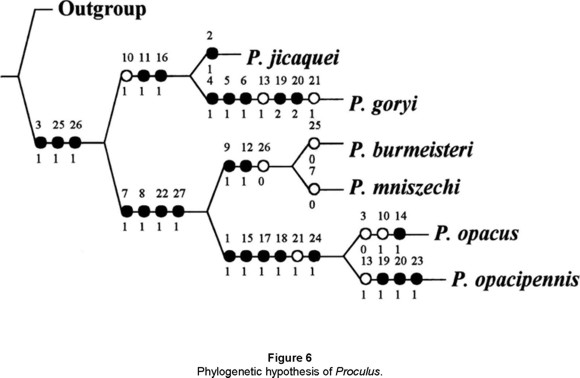
<body><![CDATA[<p align="justify"><font face="verdana" size="2"><i>Proculus goryi</i>: Kaup, 1868: 9&#45;11; Kaup, 1871: 5, 9, 66&#45;67, 118; Bates, 1886&#45;1890: 3, 383; Kuwert, 1891: 192; 1898: 178; Heyne &amp; Taschenberg, 1908: 58; Schulze, 1912: 209&#45;213; Gravely, 1918: 43; Hincks &amp; Dibb, 1935: 31; Blackwelder, 1944: 191; Tr&auml;g&aring;rdh, 1946:384 (mites); Barrera 1969: 6&#45;7; Reyes&#45;Castillo, 1970: 35, 54, 156&#45;158; Schuster &amp; Lavoipierre, 1970: 3 (associated mites); Schuster &amp; Summers, 1978: 301 (mites); Hammond, 1979:113&#45;180; Reyes&#45;Castillo &amp; Jarman, 1980: 265; Schuster &amp; Reyes&#45;Castillo, 1981: 108 (larvae); Reyes&#45;Castillo, 1985: 299; Schuster 1985: 165, 166; 1992a: 287, 289; 1992b: 361; Padilla &amp; Schuster, 1994: 4; Castillo &amp; Reyes&#45;Castillo 1997: 298; Schuster &amp; Schuster 1997: 261; Schuster, Cano &amp; Cardona 2000: 200; Reyes&#45;Castillo 2000: 176; Reyes&#45;Castillo 2002: 479.</font></p>     <p align="justify"><font face="verdana" size="2"><b>Redescription</b>. Head: anterior border of labrum concave, anterior angles rounded. Frontoclypeal suture lacking between internal tubercles. Frontal ridges absent, internal tubercles absent or very small. Median frontal structure (MFS) with a notable central horn, relatively short and with apex free and rounded; with 0&#45;4 setae on each side or 0&#45;2 small punctations. Ligula between insertions of labial palpi, wide, concave or flat, without setae at center, anteriorly triangular (almost pentagonal with the base); ligula matte. Lateral lobes of mentum flat; center of mentum anteriorly bilobate. Last segment of labial palpi large, 1/2 or more than 1/2 of second segment. Dorsal tooth of mandible small, with obtuse angle in lateral view (<a href="#f2">Fig. 2b</a>); aspect of mandibles in ventral view rounded; external part of mandible without a ventral keel. Thorax: Pronotum shiny and smooth, lateral fossae without setae and punctation. Scutellum with small punctate setae. Mesosternum with many long setae on posterior sides and similar abundant setae on mesosternellum. Metasternal disk delimited partially or totally by setose punctation, marginal groove very narrow. Elytra: Shiny and smooth (in some cases slightly grooved); elytral striae marked with strong punctation. Setae present in all interestriae of anterior margin and all of posterior except I, II and III; interestriae VIII, IX and X totally covered with setae; IX more densely setose in apical 1/3. In old specimens these setae appear only as punctures. Legs: Mesotibiae with two or three spines on external border (one in some old specimens).</font></p>     <p align="justify"><font face="verdana" size="2">Dimensions (mm) (n = 6). Total length 68.45&#45;73.10, <img src="/img/revistas/azm/n90/a8e1.jpg"> = 70.12; elytral length 34.80&#45;38.60,<img src="/img/revistas/azm/n90/a8e1.jpg"> = 36.54; pronotal length 18.35&#45;20.50, <img src="/img/revistas/azm/n90/a8e1.jpg"> = 19.45; pronotal width 23.30&#45;25.95, <img src="/img/revistas/azm/n90/a8e1.jpg"> = 24.81; elytral width 24.65&#45;27.25, <img src="/img/revistas/azm/n90/a8e1.jpg"> = 25.93; head width 18.95&#45;21.40, <img src="/img/revistas/azm/n90/a8e1.jpg"> = 20.17.</font></p>     <p align="justify"><font face="verdana" size="2"><b>Material Examined</b>. 65 specimens and two in pieces.</font></p>     <p align="justify"><font face="verdana" size="2">Holotype: <i>Passalus goryi</i> Melly, Guatemala (MHNG).</font></p>     <p align="justify"><font face="verdana" size="2">GUATEMALA: Quetzaltenango, El Palmar (Viejo), finca San Juan Patzul&iacute;n, 1320 m, 21 III 1998, I. Chavez (1). Quetzaltenango, Colomba, Costa Cuca, 1987, O. Bonilla (2). Costa Cuca, Guatemala, F. Sarg, H. W. Bates, Biol. Cent. Amer. (2, MNHN). Museum Paris, Guatemala, env. Du Quetzaltenango, 2000 m, R. Gu&eacute;rin 1905 (2, MNHN). Suchitepequez, Fca. La Pista, 23&#45;25 IV 1991, S. P&eacute;rez (2). Suchitepequez, N. of Mazatenango, Fca. Asturias, collector unknown, 1400&#45;1500 m. (3). San Marcos, La Fraternidad, I 1994, J. Monz&oacute;n, 1900 m, cloud forest (7). Same data but, VIII 1997 (1). Same data but, VII 1998 (1). Same data but, VIII 1996, 1950 m (2). San Marcos, Esquipulas Palo Gordo, aldea Noche Buena, near La Fraternidad, 19 IX 1997, 5500 pies, A. Anzueto (8 whole, 2 in pieces). San Marcos, La Fraternidad, camino a El Bojonal, 1600 m, 28 VI 2000, J. Monz&oacute;n (1). San Marcos, El Tumbador, finca Austria, 4 IV 1998, 1520 m, H. Liere (3). Cerro Zunil, 4&#45;5000 ft, Champion, H.W. Bates, Biol. Cent. Amer. (4, MNHN). Cerro Zunil, 4&#45;5000 ft, Champion, Museum Paris, Amerique Centrale Coll. Du Biol Central Amer., Godman 1906, <i>Proculus goryi</i> Gr. (1, MNHN). Cerro Zunil, 4&#45;5000 ft. Champion (1, IEXA). "Guatemala", Coll. E. Witte, Senckenberg Museum, <i>P. goryi</i> Kaup, P. Pereira det, 1964 (1, MZSP). "Guatemala?", affazado Lc. Psencoh. Recibido do Dr. Bercal, 1931, Luederwaldt 1931, 06153 (1, MZSP). Guatim. <i>Proculus goryi</i> Melly, Ex. Musaeo J. Thompson (1, MNHN). <i>Goryi</i> Gu&eacute;r., Guatemala, Ex Musaeo A. Kuwert 1894 (1. MNHN). MEXICO: Chiapas, Finca las Nubes, 2 X 1946, 1200 m, C. Bolivar (1, MZSP). Same data but 1000 m (1, MZSP). Chiapas, volc&aacute;n Tacan&aacute;, 1 X 1956, 1600 m C. Bol&iacute;var, col. (1, IEXA); Same data (2, CNIN). Chiapas, volc&aacute;n Tacan&aacute;, V 1965, 1400 m, G. Halffter, col. (1, IEXA). Chiapas, Finca Guatimoc, 18 V, G. Halffter, col. (1, MHNM). Chiapas, Tapachula, Finca Irlanda, 18 IV 1950, J. Hendrichs, col. (1, JHSC). Chiapas, Mpio. Tapachula, Ejido Nueva Independencia, 15&deg; 03' 34" N 92&deg; 17'06" W, 21 VI 1998, 1550 m J. Mac&iacute;as, col. (1, IEXA). Chiapas, San Luis Malacat&aacute;n, IV 1958, on ground at light, G. Vel&aacute;squez, col. (1, MAM). Chiapas, Mpio. Villa Corzo, Cerro Tres Picos, 28 V 1995, 1640 m, P. Hern&aacute;ndez y D. Navarrete, col. (1, IEXA; 1, BGG). Chiapas, P. Pereira, det. 1962 (1, IEXA). Veracruz, San Andr&eacute;s Tuxtla, XI 1942, P. Pereira, det. 1962 (1, IEXA). M&eacute;xico (1, MNHN). OTHERS: Senckenberg Museum, Columb. 82, Lehmann 85, Veber Mujulya 19.6.82, <i>Pr. Goryi</i> Kaup, P. Pereira det 1964 (1, MZSP). Venezuela (1, MNHN). Collection Mnizech, Ex Musaeo van Lasberge (3, MNHN).</font></p>     <p align="justify"><font face="verdana" size="2"><b>Biogeography</b>. This species occurs between 800 m &#91;though Bates (1886) mentions 350 m&#93;, and 1950 m altitude in the western portion of the chain of volcanoes of Guatemala and into Sierra Madre of Chiapas on Volc&aacute;n Tacan&aacute; through Cerro Tres Picos (<a href="#f7">Fig. 7</a>). One specimen is cited from San Andr&eacute;s Tuxtla, Veracruz (Reyes&#45;Castillo 1970), far from the known range.</font></p>     <p align="justify"><font face="verdana" size="2"><i><b>Proculus jicaquei</b></i> <b>Schuster, Cano &amp; Reyes&#45;Castillo, new species    <br> </b></font><font face="verdana" size="2"><a href="#f2">Figures 2d</a>, <a href="#f4">4f</a>, <a href="#f5">5f</a>, <a href="#f6">6</a>, <a href="#f7">7</a></font></p>     <p align="justify"><font face="verdana" size="2"><b>Description</b>. Head: anterior border of labrum slightly concave, anterior angles rounded. Frontoclypeal suture partially present between internal tubercles. Frontal ridges absent, internal tubercles very small, distinct. Median frontal structure (MFS) with short center horn with apex not free; lacking setae on each side of horn. Ligula between insertions of labial palpi, posteriorly longitudinally divided with both sides protuberant, lacking setae at center; surface matte, anteriorly triangular. Lateral lobes of mentum flat; center of mentum anteriorly trapezoidal and with unilobate apex. Last segment of labial palpus short, 1/2 or less than 1/2 length of second segment. Dorsal mandibular tooth small (<a href="#f2">Fig. 2d</a>), with obtuse angle in lateral view (<a href="#f2">Fig. 2d</a>); aspect of mandibles in ventral view rounded; external part of mandible without ventral keel. Thorax: Pronotum shiny and smooth, lateral fossae with various setae and punctation. Scutellum with small abundant punctured setae. Mesosternum with many short setae on posterior sides and mesosternellum. Metasternal disk delimited partially or totally by setose punctation, marginal groove narrow. Elytra: Shiny and smooth, elytral striae marked with visible punctation. Setae present only on humerus and anterior margin, interstriae X with setae extending 1/3 elytral length. Legs: Mesotibiae with one spine on external border.</font></p>     ]]></body>
<body><![CDATA[<p align="justify"><font face="verdana" size="2">Dimensions (mm): Total length 59.5 (&#9794;), 67.0 (&#9792;); elytral length 31.5 (&#9794;), 33.35 (&#9792;); pronotal length 17.05 (&#9794;), 19.35 (&#9792;); pronotal width 21.70 (&#9794;), 24.0 (&#9792;); elytral width 22.80 (&#9794;), 25.75 (&#9792;); head width 17.0 (&#9794;), 18.75 (&#9792;).</font></p>     <p align="justify"><font face="verdana" size="2"><b>Material Examined</b>. Two specimens.</font></p>     <p align="justify"><font face="verdana" size="2"><b>Type Material:</b> Holotype &#9794;: HONDURAS, Yoro, 10 km. NW of Moraz&aacute;n, 24 III 1991, J.C. Schuster &amp; A. Pineda, # WJG. Paratype &#9792;: same location and collection data as holotype. Types deposited at the Universidad del Valle de Guatemala collection.</font></p>     <p align="justify"><font face="verdana" size="2"><b>Etymology</b>. Named in honor of the Jicaque, a tribe of people who lives in the area where the specimens were found.</font></p>     <p align="justify"><font face="verdana" size="2"><b>Distribution and Ecology</b>. Known only from the type locality at 575 m on the north side of the Valley of Yoro (<a href="#f7">Fig. 7</a>). Rotten logs with evidence of this <i>Proculus</i>, in the form of characteristic tunnels and feces, were also seen at 800 m.</font></p>     <p align="justify"><font face="Verdana" size="2">&nbsp;</font></p>     <p align="justify"><font face="verdana" size="2"><b>Discussion</b></font></p>     <p align="justify"><font face="verdana" size="2"><b>PHYLOGENY:</b> The phylogenetic matrix includes 27 morphological characters, 21 of which are informative and six are autapomorphies. Phylogenetic analysis under assumptions of maximum parsimony results in only one most parsimonius tree (<a href="#f6">Fig. 6</a>), with a consistency index of 0.72, a retention index of 0.67 and a longitude of 38 steps, excluding autapomorphic states of characters 2, 4, 5, 6, 14 and 23. Under DELTRAN optimization, character 10 (ligula) evolved independently from shiny to matte in the common ancestor of <i>P. goryi</i> and <i>P. jicaquei</i> and <i>P. opacus</i>. Character 13 (center of mentum) evolved independently from unidentate to bidentate in <i>P. goryi</i> and <i>P. opacipennis</i>. DELTRAN also assumes that the common ancestor of all <i>Proculus</i> had minimal setation on 10th elytral interval (state 0 of character 21), that increased in length (state 1) on elytral interval 10 independently in <i>P. goryi</i> and the ancestor of <i>P. opacus</i> and <i>P. opacipennis</i>. Under ACCTRAN optimization, tergite 9 of larvae (character 25) presents long setae in the common ancestor of all <i>Proculus</i>, but represents a reversal (short setae) in <i>P. burmeisteri</i> (larvae of <i>P. jicaquei</i> is unknown). Also, character 26 (hairs below spiracle line in tergites 1&#45;2 of larvae) represents a reversal (short hairs) in the ancestor of <i>P. burmeisteri</i> and <i>P. mniszechi</i> (larvae of <i>P. jicaquei</i> is unknown). Under ACCTRAN optimization, the mandibular tooth was gained in the ancestor of <i>P. opacus, P. opacipennis, P. burmeisteri</i> and <i>P. mniszechi</i> and subsequently lost by <i>P. mniszechi</i> as indicated by a reversal in character 7. Under DELTRAN optimization the mandibular tooth represents a parallelism between <i>P. burmeisteri</i> and the ancestor of <i>P. opacus</i> and <i>P. opacipennis</i>. A better understanding of the adaptative significance of the dorsal mandibular tooth could help to differentiate between these two different evolutionary scenarios.</font></p>     <p align="justify"><font face="verdana" size="2">Another interesting character is the elytral setation. There are two equally parsimonious optimizations for this character. The first would assume the common ancestor of all <i>Proculus</i> had moderate setation (state 1). Under this assumption, the common ancestor of <i>P. burmeisteri</i> and <i>P. mniszechi</i> underwent a subsequent reduction in setation (to state 0) as did <i>P. jicaquei</i> ; and <i>P. goryi</i> underwent an opposite trajectory, increasing the amount of elytral setation (state 2). Under another equally parsimonious optimization, the common ancestor of all <i>Proculus</i> had minimal elytral setation (state 0), which was increased once in the lineage leading to <i>P. opacus</i> and <i>P. opacipennis</i> (state 1) and once independently in <i>P. goryi</i> to a highly setose condition (state 2). Again, understanding of adaptive significance of elytral setation might allow one of these two scenarios to be favored.</font></p>     <p align="justify"><font face="verdana" size="2">Phylogenetic hypotesis shows that <i>P. jicaquei</i> is most closely related to <i>P. goryi</i>, these two taxa form a sister clade to all other <i>Proculus</i> species. <i>Proculus mniszechi</i> and <i>P. burmeisteri</i> are sister taxa, as are <i>P. opacus</i> and <i>P. opacipennis</i>. Due to the use of larval characters in the analysis, we presume that a better resolution of the relationship between <i>P. goryi</i> and <i>P. jicaquei</i> will result when larvae of <i>P. jicaquei</i> are discovered. Also, more state changes in <i>P. goryi</i> since separation from <i>P. jicaquei</i> suggest most rapid evolution, especially because <i>P. goryi</i> is distributed in more geologically recent terrain (Pliocene&#45;Pleistocene).</font></p>     ]]></body>
<body><![CDATA[<p align="justify"><font face="verdana" size="2"><b>BIOGEOGRAPHY:</b> Considering the distribution of <i>Proculus</i> species in relation to the phylogenetic hypothesis, two groups of species become evident to the north and south of the line in <a href="#f7">figure 7</a> corresponding to the first branching of the cladogram. This correlates with the subhumid corridor described by Stuart (1954) that runs from Chiapas Central Depression to Motagua and Comayagua valleys in Guatemala and Honduras. A more detailed analysis of passalid ensamble distribution in Mesoamerica (see Schuster and Cano in press) also correlates with this north&#45;south separation, suggesting that the origin of this corridor represents a vicariance event. A second possible vicariance event may have separated <i>P. mniszechi</i> from <i>P. burmeisteri</i>, as well as <i>P. goryi</i> from <i>P. jicaquei</i> in the area of the border between Honduras and Guatemala. A similar (same time?) event may have separated <i>P. opacus</i> from <i>P. opacipennis.</i> These events may be related to the formation of dry valleys separating montane wet regions as occur today in these areas. In glacial times they were probably connected. The cladogram suggests at least two wet&#45;dry cycles, perhaps two glaciations.</font></p>     <p align="justify"><font face="verdana" size="2">Though <i>Proculus opacipennis</i> and <i>P. mniszechi</i> both occur in the Sierra de las Minas and the western Cuchumatan Mountains, they occur in different forest types at different elevations. The latter occurs in cloud forest above 1500 m, whereas the former occurs in a forest that is a mixture of cloud forest and lowland rain forest between 600 and 1500 m. A similar relationship occurs between <i>P. opacipennis</i> and <i>P. opacus</i> in the western Cuchumatan Mountains and, probably, in the northern mountain ranges of Chiapas. All of the Chiapas <i>P. opacipennis</i> were collected between Tumbal&aacute; and Salto de Agua in the northernmost mountains (<a href="#f7">Fig. 7</a>). The <i>P. opacus</i> of Chiapas were all collected between La Yerbabuena, municipio El Bosque and Nuevo Solistahuacan in the higher range further south. The ranges of the species of <i>Proculus</i> in northern Mesoamerica are shown in <a href="#f7">figure 7</a>. The drier altiplano to the north of the volcanic chain of Guatemala and Chiapas separates <i>P. goryi</i> from all others, a distribution that it shares with <i>Ogyges laevissimus</i> (Kaup). The dry Chiquimula Valley separates <i>P. burmeisteri</i> from <i>P. mniszechi</i> and <i>P. goryi</i>. The Copan Valley and the valley north of Santa Barbara Mountain separate <i>P. burmeisteri</i> from the other species.</font></p>     <p align="justify"><font face="verdana" size="2">One would expect a high degree of endemism in large, flightless beetles such as <i>Proculus</i> ; nevertheless, being mid&#45;elevation species (600&#45;2300 m), some were able to disperse relatively widely during glacial periods when mid&#45;elevation forests moved down the mountains and filled the valleys (MacVean &amp; Schuster 1981). This probably explains the presence of <i>P. mniszechi</i> on both sides of the deep, dry Motagua Valley, as well as perhaps some of the isolated citations from countries to the south of Honduras ( <i>e.g</i>., Costa Rica, in Alfaro 1935). Interestingly, the mite <i>Klinckowstroemia multisetillosa</i> Rosario and Hunter, known only from <i>Proculus</i>, is found on <i>P. burmeisteri, P. mniszechi</i> and <i>P. opacipennis</i> in the Sierra de las Minas, Sierra del Merendon and El Portillo (Padilla &amp; Schuster 1994), evidence of a possible union of these forests at one time.</font></p>     <p align="justify"><font face="verdana" size="2">Though sometimes aridness in the lowlands of Central America is associated with late Pleistocene glaciations ( <i>e.g.</i>, Leyden 1984), Bush <i>et al.</i> (1992) mention lowland (650 m) of Panama with abundant montane forest elements ( <i>Quercus</i> and <i>Magnolia</i> ) at this time. Hooghiemstra <i>et al</i>. (1992) mention a drop of ca.1400 m in the upper forest line in Costa Rica at the Pleistocene&#45;Holocene transition. At any rate, the presence of flightless <i>Proculus</i> from Chiapas to at least Colombia implies the presence of contiguous wet subtropical or cloud forest, or at least overlapping forests through time, connecting these areas.</font></p>     <p align="justify"><font face="verdana" size="2">In general <i>Proculus.</i> as well as other montane species of passalids, is probably in danger of extinction throughout its range due to the elimination of most of the forest where it occurs.</font></p>     <p align="justify"><font face="Verdana" size="2">&nbsp;</font></p>     <p align="justify"><font face="verdana" size="2"><b>Acknowledgments</b></font></p>     <p align="justify"><font face="verdana" size="2">We thank the many people that have contributed specimens or helped us find <i>Proculus</i> specimens; Stephane Boucher of the Paris Museum and Bob Gordon of the U.S. National Museum for facilitating our studies there; Lothar Zerche of the Deutsches Entomologisches Institut of Eberswalde for allowing us to examine and borrow the type of <i>P. beckeri</i>, and Ivan L&ouml;bl, Mus&eacute;um d'Historie Naturelle, Geneva, Switzerland, for loan of type of <i>Proculus goryi</i>; the Los Angeles County Museum of Natural History for the Colombian specimens and Philip A. Silverstone of the Universidad del Valle, Cali, Colombia, for providing data on the Colombian specimens; the Carnegie Museum of Natural History and Ross Bell of the University of Vermont for the loan of a Costa Rican specimen; Also we thank Gonzalo Halffter, Miguel Angel Mor&oacute;n, Jorge Valenzuela, Mar&iacute;a Luisa Castillo, Jorge Mac&iacute;as S&aacute;mano, Benigno G&oacute;mez y G&oacute;mez, Jos&eacute; Monz&oacute;n, Abel Anzueto, Erick Smith, Cristina Bailey, Catherine Cardona, Karla Villatoro, J.P. Beraud, Sergio P&eacute;rez, Mario Jol&oacute;n and Armando Higueros for contributed and loaned specimens. John W. Grimes of Lafayette, Louisiana, who kindly donated camping equipment for use in our combined studies of biodiversity and ecotourism. Drawing of <a href="#f1">figure 1</a> was made by Claudio Aquiles M&eacute;ndez. Christopher J. Marshall, Juan J. Morrone, Alan Gillogly and Claudio R. Vasconcelos da Fonseca provided cogent comments that allowed us to improve the manuscript.</font></p>     <p align="justify"><font face="Verdana" size="2">&nbsp;</font></p>     <p align="justify"><font face="verdana" size="2"><b>Literature cited</b></font></p>     ]]></body>
<body><![CDATA[<!-- ref --><p align="justify"><font face="verdana" size="2"><b>Alfaro, A</b>. 1935. <i>Investigaciones Cient&iacute;ficas. Cap. XXIV&#45;Los Pas&aacute;lidos</i>. Edit. Trejos Hnos. San Jos&eacute;. Pp. 287&#45;308.    &nbsp;&nbsp;&nbsp;&nbsp;&nbsp;&nbsp;&nbsp;&nbsp;[&#160;<a href="javascript:void(0);" onclick="javascript: window.open('/scielo.php?script=sci_nlinks&ref=316585&pid=S0065-1737200300030000800001&lng=','','width=640,height=500,resizable=yes,scrollbars=1,menubar=yes,');">Links</a>&#160;]<!-- end-ref --></font></p>     <!-- ref --><p align="justify"><font face="verdana" size="2"><b>Arnett, R. H. &amp; G. A. Samuelson</b>. 1969. <i>Directory of Coleoptera Collectionn of North America (Canada through Panama)</i>. Purdue University, Indiana.    &nbsp;&nbsp;&nbsp;&nbsp;&nbsp;&nbsp;&nbsp;&nbsp;[&#160;<a href="javascript:void(0);" onclick="javascript: window.open('/scielo.php?script=sci_nlinks&ref=316587&pid=S0065-1737200300030000800002&lng=','','width=640,height=500,resizable=yes,scrollbars=1,menubar=yes,');">Links</a>&#160;]<!-- end-ref --></font></p>     <!-- ref --><p align="justify"><font face="verdana" size="2"><b>Arrow, G. J</b>. 1904. Sound&#45;production in the Lamellicorn beetles. <i>Trans. Ent. Soc. Lond</i>., 4:709&#45;750.    &nbsp;&nbsp;&nbsp;&nbsp;&nbsp;&nbsp;&nbsp;&nbsp;[&#160;<a href="javascript:void(0);" onclick="javascript: window.open('/scielo.php?script=sci_nlinks&ref=316589&pid=S0065-1737200300030000800003&lng=','','width=640,height=500,resizable=yes,scrollbars=1,menubar=yes,');">Links</a>&#160;]<!-- end-ref --></font></p>     <!-- ref --><p align="justify"><font face="verdana" size="2">&#45;&#45;&#45;&#45;&#45;&#45;&#45;&#45;&#45;&#45;. 1907. A contribution to the classification of the Coleopterous family Passalidae. <i>Trans. Ent. Soc. London, part IV</i>:441&#45;469.    &nbsp;&nbsp;&nbsp;&nbsp;&nbsp;&nbsp;&nbsp;&nbsp;[&#160;<a href="javascript:void(0);" onclick="javascript: window.open('/scielo.php?script=sci_nlinks&ref=316591&pid=S0065-1737200300030000800004&lng=','','width=640,height=500,resizable=yes,scrollbars=1,menubar=yes,');">Links</a>&#160;]<!-- end-ref --></font></p>     <!-- ref --><p align="justify"><font face="verdana" size="2"><b>Barrera, A</b>. 1969. Coleoptera Lamellicornia en la Colecci&oacute;n Nacional. <i>Acta Zool. Mex</i>. 9(6): 1&#45;93.    &nbsp;&nbsp;&nbsp;&nbsp;&nbsp;&nbsp;&nbsp;&nbsp;[&#160;<a href="javascript:void(0);" onclick="javascript: window.open('/scielo.php?script=sci_nlinks&ref=316593&pid=S0065-1737200300030000800005&lng=','','width=640,height=500,resizable=yes,scrollbars=1,menubar=yes,');">Links</a>&#160;]<!-- end-ref --></font></p>     ]]></body>
<body><![CDATA[<!-- ref --><p align="justify"><font face="verdana" size="2"><b>Bates, H. W</b>. 1886&#45;1890. <i>Pectinicornia and Lamellicornia</i>. Biolog&iacute;a Centrali&#45;Americana. Insecta Coleoptera, Vol II, Part. 2 F. D. Godman and O. Salvin (eds), London. 423 pp.    &nbsp;&nbsp;&nbsp;&nbsp;&nbsp;&nbsp;&nbsp;&nbsp;[&#160;<a href="javascript:void(0);" onclick="javascript: window.open('/scielo.php?script=sci_nlinks&ref=316595&pid=S0065-1737200300030000800006&lng=','','width=640,height=500,resizable=yes,scrollbars=1,menubar=yes,');">Links</a>&#160;]<!-- end-ref --></font></p>     <!-- ref --><p align="justify"><font face="verdana" size="2"><b>Blackwelder, R. E</b>. 1944. Checklist of the coleopterous insects of Mexico, Central America, the West Indies, and South America. Part 2, <i>Bull. U.S. Nat. Mus.</i> 185:189&#45;341.    &nbsp;&nbsp;&nbsp;&nbsp;&nbsp;&nbsp;&nbsp;&nbsp;[&#160;<a href="javascript:void(0);" onclick="javascript: window.open('/scielo.php?script=sci_nlinks&ref=316597&pid=S0065-1737200300030000800007&lng=','','width=640,height=500,resizable=yes,scrollbars=1,menubar=yes,');">Links</a>&#160;]<!-- end-ref --></font></p>     <!-- ref --><p align="justify"><font face="verdana" size="2"><b>Burmeister, H. C. C</b>. 1847. <i>Coleoptera Lamellicornia Xylophila et Pectinicornia</i>. Handbuch der entomologie. Vol. 5, Berlin. 584 pp.    &nbsp;&nbsp;&nbsp;&nbsp;&nbsp;&nbsp;&nbsp;&nbsp;[&#160;<a href="javascript:void(0);" onclick="javascript: window.open('/scielo.php?script=sci_nlinks&ref=316599&pid=S0065-1737200300030000800008&lng=','','width=640,height=500,resizable=yes,scrollbars=1,menubar=yes,');">Links</a>&#160;]<!-- end-ref --></font></p>     <!-- ref --><p align="justify"><font face="verdana" size="2"><b>Bush, M. B., D. R. Piperno, P. A. Colinvaux, P. E. de Oliveira, L. A. Krissek, M. C. Miller &amp; W. E. Rowe</b>. 1992. A 14300&#45;year paleoecological profile of a lowland tropical lake in Panam&aacute;. <i>Ecol. Monog.</i> 62(2): 251&#45;275.    &nbsp;&nbsp;&nbsp;&nbsp;&nbsp;&nbsp;&nbsp;&nbsp;[&#160;<a href="javascript:void(0);" onclick="javascript: window.open('/scielo.php?script=sci_nlinks&ref=316601&pid=S0065-1737200300030000800009&lng=','','width=640,height=500,resizable=yes,scrollbars=1,menubar=yes,');">Links</a>&#160;]<!-- end-ref --></font></p>     <!-- ref --><p align="justify"><font face="verdana" size="2"><b>Cano, E. B</b>. 1994. Estado actual sobre el conocimiento del edeago en Passalidae (Coleoptera), con la descripci&oacute;n del edeago en seis especies del Viejo Mundo<i>. Acta Zool. Mex. (n.s.)</i> 61: 21&#45;34.    &nbsp;&nbsp;&nbsp;&nbsp;&nbsp;&nbsp;&nbsp;&nbsp;[&#160;<a href="javascript:void(0);" onclick="javascript: window.open('/scielo.php?script=sci_nlinks&ref=316603&pid=S0065-1737200300030000800010&lng=','','width=640,height=500,resizable=yes,scrollbars=1,menubar=yes,');">Links</a>&#160;]<!-- end-ref --></font></p>     ]]></body>
<body><![CDATA[<!-- ref --><p align="justify"><font face="verdana" size="2"><b>Casey, T. L</b>. 1897. Coleopterological notices VII. Passalinae. <i>Ann. New York Acad. Sci.</i> 9(6&#45;12): 640&#45;649.    &nbsp;&nbsp;&nbsp;&nbsp;&nbsp;&nbsp;&nbsp;&nbsp;[&#160;<a href="javascript:void(0);" onclick="javascript: window.open('/scielo.php?script=sci_nlinks&ref=316605&pid=S0065-1737200300030000800011&lng=','','width=640,height=500,resizable=yes,scrollbars=1,menubar=yes,');">Links</a>&#160;]<!-- end-ref --></font></p>     <!-- ref --><p align="justify"><font face="verdana" size="2">&#45;&#45;&#45;&#45;&#45;&#45;&#45;&#45;&#45;&#45;. 1914. <i>Memoirs on the Coleoptera. Passalidae.</i> The New Era Printing Company, 374&#45;375.    &nbsp;&nbsp;&nbsp;&nbsp;&nbsp;&nbsp;&nbsp;&nbsp;[&#160;<a href="javascript:void(0);" onclick="javascript: window.open('/scielo.php?script=sci_nlinks&ref=316607&pid=S0065-1737200300030000800012&lng=','','width=640,height=500,resizable=yes,scrollbars=1,menubar=yes,');">Links</a>&#160;]<!-- end-ref --></font></p>     <!-- ref --><p align="justify"><font face="verdana" size="2"><b>Castillo, M. L. &amp; M. A. Mor&oacute;n</b>. 1992. Observaciones sobre la degradaci&oacute;n de madera por algunas especies de pas&aacute;lidos (Coleoptera, Lamellicornia). <i>Folia Entomol. Mex</i>. 84: 35&#45;44.    &nbsp;&nbsp;&nbsp;&nbsp;&nbsp;&nbsp;&nbsp;&nbsp;[&#160;<a href="javascript:void(0);" onclick="javascript: window.open('/scielo.php?script=sci_nlinks&ref=316609&pid=S0065-1737200300030000800013&lng=','','width=640,height=500,resizable=yes,scrollbars=1,menubar=yes,');">Links</a>&#160;]<!-- end-ref --></font></p>     <!-- ref --><p align="justify"><font face="verdana" size="2"><b>Castillo, M. L. &amp; P. Reyes Castillo</b>. 1997. Passalidae. Pp. 293&#45;298. En: E. Gonz&aacute;lez Soriano, R. Dirzo y R. C. Vogt (Eds.). <i>Historia Natural de los Tuxtlas.</i> Universidad Nacional Aut&oacute;noma de M&eacute;xico. Primera Ed. M&eacute;xico D. F.    &nbsp;&nbsp;&nbsp;&nbsp;&nbsp;&nbsp;&nbsp;&nbsp;[&#160;<a href="javascript:void(0);" onclick="javascript: window.open('/scielo.php?script=sci_nlinks&ref=316611&pid=S0065-1737200300030000800014&lng=','','width=640,height=500,resizable=yes,scrollbars=1,menubar=yes,');">Links</a>&#160;]<!-- end-ref --></font></p>     <!-- ref --><p align="justify"><font face="verdana" size="2"><b>Delgado, L., A. P&eacute;rez &amp; J. Blackaller</b>. 2000. Claves para determinar a los taxones gen&eacute;ricos y supragen&eacute;ricos de Scarabaeoidea Latreille, 1802 (Coleoptera) de M&eacute;xico. <i>Folia Entomol. Mex.</i> 110: 33&#45;87.    &nbsp;&nbsp;&nbsp;&nbsp;&nbsp;&nbsp;&nbsp;&nbsp;[&#160;<a href="javascript:void(0);" onclick="javascript: window.open('/scielo.php?script=sci_nlinks&ref=316613&pid=S0065-1737200300030000800015&lng=','','width=640,height=500,resizable=yes,scrollbars=1,menubar=yes,');">Links</a>&#160;]<!-- end-ref --></font></p>     ]]></body>
<body><![CDATA[<!-- ref --><p align="justify"><font face="verdana" size="2"><b>Gravely, F. H</b>. 1918. A contribution towards the revision of the Passalidae of the World. <i>Mem. Indian Mus.</i> 7(1): 1&#45;143.    &nbsp;&nbsp;&nbsp;&nbsp;&nbsp;&nbsp;&nbsp;&nbsp;[&#160;<a href="javascript:void(0);" onclick="javascript: window.open('/scielo.php?script=sci_nlinks&ref=316615&pid=S0065-1737200300030000800016&lng=','','width=640,height=500,resizable=yes,scrollbars=1,menubar=yes,');">Links</a>&#160;]<!-- end-ref --></font></p>     <!-- ref --><p align="justify"><font face="verdana" size="2"><b>Hammond, P. M</b>. 1979. <i>Wing&#45;folding mechanisms of beetles, with special reference to investigations of adephagan phylogeny. In:</i> T.L. Erwin, G.E. Ball and D.R. Whitehead (eds.). Carabid beetles, their evolution, natural history and classification. Junk, the Hague.    &nbsp;&nbsp;&nbsp;&nbsp;&nbsp;&nbsp;&nbsp;&nbsp;[&#160;<a href="javascript:void(0);" onclick="javascript: window.open('/scielo.php?script=sci_nlinks&ref=316617&pid=S0065-1737200300030000800017&lng=','','width=640,height=500,resizable=yes,scrollbars=1,menubar=yes,');">Links</a>&#160;]<!-- end-ref --></font></p>     <!-- ref --><p align="justify"><font face="verdana" size="2"><b>Heyne, A. &amp; O. Taschenberg,</b> 1908. <i>Die exotischen K&auml;fer in Wort und Bild.</i> Leipzing. 262 pp., 39 pls.    &nbsp;&nbsp;&nbsp;&nbsp;&nbsp;&nbsp;&nbsp;&nbsp;[&#160;<a href="javascript:void(0);" onclick="javascript: window.open('/scielo.php?script=sci_nlinks&ref=316619&pid=S0065-1737200300030000800018&lng=','','width=640,height=500,resizable=yes,scrollbars=1,menubar=yes,');">Links</a>&#160;]<!-- end-ref --></font></p>     <!-- ref --><p align="justify"><font face="verdana" size="2"><b>Hincks, W. D</b>. 1933. Notes on the Passalidae. No. 2. Flightless species. <i>Ent. Monthly Mag</i>. 69: 10&#45;13.    &nbsp;&nbsp;&nbsp;&nbsp;&nbsp;&nbsp;&nbsp;&nbsp;[&#160;<a href="javascript:void(0);" onclick="javascript: window.open('/scielo.php?script=sci_nlinks&ref=316621&pid=S0065-1737200300030000800019&lng=','','width=640,height=500,resizable=yes,scrollbars=1,menubar=yes,');">Links</a>&#160;]<!-- end-ref --></font></p>     <!-- ref --><p align="justify"><font face="verdana" size="2"><b>Hincks, W. D. &amp; J. R. Dibb</b>. 1935. <i>Passalidae</i>. Coleopterorum Catalogus, pars 142. W. Junk's&#45;Gravenhage. 118 pp.    &nbsp;&nbsp;&nbsp;&nbsp;&nbsp;&nbsp;&nbsp;&nbsp;[&#160;<a href="javascript:void(0);" onclick="javascript: window.open('/scielo.php?script=sci_nlinks&ref=316623&pid=S0065-1737200300030000800020&lng=','','width=640,height=500,resizable=yes,scrollbars=1,menubar=yes,');">Links</a>&#160;]<!-- end-ref --></font></p>     ]]></body>
<body><![CDATA[<!-- ref --><p align="justify"><font face="verdana" size="2"><b>&#45;&#45;&#45;&#45;&#45;&#45;&#45;&#45;&#45;&#45;</b>. 1958. <i>Passalidae</i>. Coleopterorum Catalogus. Suplementa Pars 142. Uitgevery W. Junk's&#45;Gravenhage. 32 pp.    &nbsp;&nbsp;&nbsp;&nbsp;&nbsp;&nbsp;&nbsp;&nbsp;[&#160;<a href="javascript:void(0);" onclick="javascript: window.open('/scielo.php?script=sci_nlinks&ref=316625&pid=S0065-1737200300030000800021&lng=','','width=640,height=500,resizable=yes,scrollbars=1,menubar=yes,');">Links</a>&#160;]<!-- end-ref --></font></p>     <!-- ref --><p align="justify"><font face="verdana" size="2"><b>Hooghiemstra, H., A. M. Cleef, G. W. Noldus &amp; M. Kapelle</b>. 1992. Upper Quaternary vegetation dynamics and paleoclimatology of the La Chonta bog area (Cordillera de Talamanca, Costa Rica). <i>J. Quater. Sci.</i> 7(3): 205&#45;225.    &nbsp;&nbsp;&nbsp;&nbsp;&nbsp;&nbsp;&nbsp;&nbsp;[&#160;<a href="javascript:void(0);" onclick="javascript: window.open('/scielo.php?script=sci_nlinks&ref=316627&pid=S0065-1737200300030000800022&lng=','','width=640,height=500,resizable=yes,scrollbars=1,menubar=yes,');">Links</a>&#160;]<!-- end-ref --></font></p>     <!-- ref --><p align="justify"><font face="verdana" size="2"><b>ICZN (International Commision on Zoological Nomenclature)</b>. 1999. <i>International code of zoological nomenclature</i>, fourth edition. The International Trust for Zoological Nomenclature, London. 306 pp.    &nbsp;&nbsp;&nbsp;&nbsp;&nbsp;&nbsp;&nbsp;&nbsp;[&#160;<a href="javascript:void(0);" onclick="javascript: window.open('/scielo.php?script=sci_nlinks&ref=316629&pid=S0065-1737200300030000800023&lng=','','width=640,height=500,resizable=yes,scrollbars=1,menubar=yes,');">Links</a>&#160;]<!-- end-ref --></font></p>     <!-- ref --><p align="justify"><font face="verdana" size="2"><b>Jarman, M</b>. 1985. Errors of measurement of maximum possible performance. <i>Acta Zool. Mex. (n.s.)</i>, 12: 23&#45;29.    &nbsp;&nbsp;&nbsp;&nbsp;&nbsp;&nbsp;&nbsp;&nbsp;[&#160;<a href="javascript:void(0);" onclick="javascript: window.open('/scielo.php?script=sci_nlinks&ref=316631&pid=S0065-1737200300030000800024&lng=','','width=640,height=500,resizable=yes,scrollbars=1,menubar=yes,');">Links</a>&#160;]<!-- end-ref --></font></p>     <!-- ref --><p align="justify"><font face="verdana" size="2"><b>Jarman, M. &amp; P. Reyes&#45;Castillo</b>. 1985. Mandibular force of adult and larval Passalidae in family groups. <i>Acta Zool. Mex. (n.s.)</i>, 12: 13&#45;22.    &nbsp;&nbsp;&nbsp;&nbsp;&nbsp;&nbsp;&nbsp;&nbsp;[&#160;<a href="javascript:void(0);" onclick="javascript: window.open('/scielo.php?script=sci_nlinks&ref=316633&pid=S0065-1737200300030000800025&lng=','','width=640,height=500,resizable=yes,scrollbars=1,menubar=yes,');">Links</a>&#160;]<!-- end-ref --></font></p>     ]]></body>
<body><![CDATA[<!-- ref --><p align="justify"><font face="verdana" size="2"><b>Johnston, D. E</b>. 1959. On the status of Casey's species of <i>Proculus</i> (Passalidae). <i>Coleopt. Bull</i>. 13: 124&#45;126.    &nbsp;&nbsp;&nbsp;&nbsp;&nbsp;&nbsp;&nbsp;&nbsp;[&#160;<a href="javascript:void(0);" onclick="javascript: window.open('/scielo.php?script=sci_nlinks&ref=316635&pid=S0065-1737200300030000800026&lng=','','width=640,height=500,resizable=yes,scrollbars=1,menubar=yes,');">Links</a>&#160;]<!-- end-ref --></font></p>     <!-- ref --><p align="justify"><font face="verdana" size="2"><b>Kaup, J. J</b>. 1868. Prodromus zu einer Monographie der Passaliden. <i>Col. Hefte</i> 4: 1&#45;31.    &nbsp;&nbsp;&nbsp;&nbsp;&nbsp;&nbsp;&nbsp;&nbsp;[&#160;<a href="javascript:void(0);" onclick="javascript: window.open('/scielo.php?script=sci_nlinks&ref=316637&pid=S0065-1737200300030000800027&lng=','','width=640,height=500,resizable=yes,scrollbars=1,menubar=yes,');">Links</a>&#160;]<!-- end-ref --></font></p>     <!-- ref --><p align="justify"><font face="verdana" size="2"><b>&#45;&#45;&#45;&#45;&#45;&#45;&#45;&#45;&#45;&#45;</b>. 1871. Monographie der Passaliden. <i>Berl. Entomol. Zeitschr</i>. 15: 1&#45;126, 5 pl.    &nbsp;&nbsp;&nbsp;&nbsp;&nbsp;&nbsp;&nbsp;&nbsp;[&#160;<a href="javascript:void(0);" onclick="javascript: window.open('/scielo.php?script=sci_nlinks&ref=316639&pid=S0065-1737200300030000800028&lng=','','width=640,height=500,resizable=yes,scrollbars=1,menubar=yes,');">Links</a>&#160;]<!-- end-ref --></font></p>     <!-- ref --><p align="justify"><font face="verdana" size="2"><b>Kuwert, A. F</b>. 1890. Die Passaliden und ihre Monographie von Kaup. <i>Societas Entomologica</i> 5: 1, 9, 17.    &nbsp;&nbsp;&nbsp;&nbsp;&nbsp;&nbsp;&nbsp;&nbsp;[&#160;<a href="javascript:void(0);" onclick="javascript: window.open('/scielo.php?script=sci_nlinks&ref=316641&pid=S0065-1737200300030000800029&lng=','','width=640,height=500,resizable=yes,scrollbars=1,menubar=yes,');">Links</a>&#160;]<!-- end-ref --></font></p>     <!-- ref --><p align="justify"><font face="verdana" size="2">&#45;&#45;&#45;&#45;&#45;&#45;&#45;&#45;&#45;&#45;. 1891. Systematische uebersicht der Passaliden Arten und Gattungen. <i>Deut. Entomol. Zeits</i>. 1: 161&#45;192.    &nbsp;&nbsp;&nbsp;&nbsp;&nbsp;&nbsp;&nbsp;&nbsp;[&#160;<a href="javascript:void(0);" onclick="javascript: window.open('/scielo.php?script=sci_nlinks&ref=316643&pid=S0065-1737200300030000800030&lng=','','width=640,height=500,resizable=yes,scrollbars=1,menubar=yes,');">Links</a>&#160;]<!-- end-ref --></font></p>     ]]></body>
<body><![CDATA[<!-- ref --><p align="justify"><font face="verdana" size="2">&#45;&#45;&#45;&#45;&#45;&#45;&#45;&#45;&#45;&#45;. 1896. Die Passaliden dichotomisch bearbeitet. <i>Nov. Zool</i>. 3: 209&#45;235, plates V&#45;VII.    &nbsp;&nbsp;&nbsp;&nbsp;&nbsp;&nbsp;&nbsp;&nbsp;[&#160;<a href="javascript:void(0);" onclick="javascript: window.open('/scielo.php?script=sci_nlinks&ref=316645&pid=S0065-1737200300030000800031&lng=','','width=640,height=500,resizable=yes,scrollbars=1,menubar=yes,');">Links</a>&#160;]<!-- end-ref --></font></p>     <!-- ref --><p align="justify"><font face="verdana" size="2">&#45;&#45;&#45;&#45;&#45;&#45;&#45;&#45;&#45;&#45;. 1898. Die Passaliden dichotomisch bearbeitet. 2 ter. Theil.&#45;Die Arten. <i>Nov. Zool</i>. 5: 137&#45;205.    &nbsp;&nbsp;&nbsp;&nbsp;&nbsp;&nbsp;&nbsp;&nbsp;[&#160;<a href="javascript:void(0);" onclick="javascript: window.open('/scielo.php?script=sci_nlinks&ref=316647&pid=S0065-1737200300030000800032&lng=','','width=640,height=500,resizable=yes,scrollbars=1,menubar=yes,');">Links</a>&#160;]<!-- end-ref --></font></p>     <!-- ref --><p align="justify"><font face="verdana" size="2"><b>Leyden, B. W</b>. 1984. Guatemalan forest synthesis after Pleistocene aridity. <i>Proc. Natl. Acad. Sci. USA</i> 81: 4856&#45;4859.    &nbsp;&nbsp;&nbsp;&nbsp;&nbsp;&nbsp;&nbsp;&nbsp;[&#160;<a href="javascript:void(0);" onclick="javascript: window.open('/scielo.php?script=sci_nlinks&ref=316649&pid=S0065-1737200300030000800033&lng=','','width=640,height=500,resizable=yes,scrollbars=1,menubar=yes,');">Links</a>&#160;]<!-- end-ref --></font></p>     <!-- ref --><p align="justify"><font face="verdana" size="2"><b>Luederwaldt, H</b>. 1934. O genero <i>Publius</i> com uma chave para a classificacao dos generos da subfamilia Proculinae (Col., Lam., Passalidae). <i>Rev. Mus. Paulista</i> 18: 1&#45;15.    &nbsp;&nbsp;&nbsp;&nbsp;&nbsp;&nbsp;&nbsp;&nbsp;[&#160;<a href="javascript:void(0);" onclick="javascript: window.open('/scielo.php?script=sci_nlinks&ref=316651&pid=S0065-1737200300030000800034&lng=','','width=640,height=500,resizable=yes,scrollbars=1,menubar=yes,');">Links</a>&#160;]<!-- end-ref --></font></p>     <!-- ref --><p align="justify"><font face="verdana" size="2"><b>MacVean, C. &amp; J. C. Schuster</b>. 1981. Altitudinal distibution of passalid beetles (Coleoptera, Passalidae) and Pleistocene dispersal on the volcanic chain of Northern Central America. <i>Biotropica</i> 13(1): 29&#45;38.    &nbsp;&nbsp;&nbsp;&nbsp;&nbsp;&nbsp;&nbsp;&nbsp;[&#160;<a href="javascript:void(0);" onclick="javascript: window.open('/scielo.php?script=sci_nlinks&ref=316653&pid=S0065-1737200300030000800035&lng=','','width=640,height=500,resizable=yes,scrollbars=1,menubar=yes,');">Links</a>&#160;]<!-- end-ref --></font></p>     ]]></body>
<body><![CDATA[<!-- ref --><p align="justify"><font face="verdana" size="2"><b>Melly, A</b>. 1833. (Descriptions). <i>Mag. Zool</i>., 3, plates 56.    &nbsp;&nbsp;&nbsp;&nbsp;&nbsp;&nbsp;&nbsp;&nbsp;[&#160;<a href="javascript:void(0);" onclick="javascript: window.open('/scielo.php?script=sci_nlinks&ref=316655&pid=S0065-1737200300030000800036&lng=','','width=640,height=500,resizable=yes,scrollbars=1,menubar=yes,');">Links</a>&#160;]<!-- end-ref --></font></p>     <!-- ref --><p align="justify"><font face="verdana" size="2"><b>Mor&oacute;n, M. A</b>. 1984. <i>Escarabajos, 200 millones de a&ntilde;os de evoluci&oacute;n</i>. Publ. No. 14. Instituto de Ecolog&iacute;a, M&eacute;xico. 132 pp.    &nbsp;&nbsp;&nbsp;&nbsp;&nbsp;&nbsp;&nbsp;&nbsp;[&#160;<a href="javascript:void(0);" onclick="javascript: window.open('/scielo.php?script=sci_nlinks&ref=316657&pid=S0065-1737200300030000800037&lng=','','width=640,height=500,resizable=yes,scrollbars=1,menubar=yes,');">Links</a>&#160;]<!-- end-ref --></font></p>     <!-- ref --><p align="justify"><font face="verdana" size="2"><b>Padilla, E. E. &amp; J. C. Schuster</b>. 1994. <i>Klinckowstroemia multisetillosa</i> Rosario &amp; Hunter (Acarina: Trigynaspida: Klinckowstroemiidae) associated with three species of <i>Proculus</i> Kuwert (Coleoptera: Passalidae). <i>Acta Zool. Mex. (n.s.)</i> 61: 1&#45;5.    &nbsp;&nbsp;&nbsp;&nbsp;&nbsp;&nbsp;&nbsp;&nbsp;[&#160;<a href="javascript:void(0);" onclick="javascript: window.open('/scielo.php?script=sci_nlinks&ref=316659&pid=S0065-1737200300030000800038&lng=','','width=640,height=500,resizable=yes,scrollbars=1,menubar=yes,');">Links</a>&#160;]<!-- end-ref --></font></p>     <p align="justify"><font face="verdana" size="2"><b>Percheron, A</b>. 1841. R&eacute;vision critique et suppl&eacute;ment &aacute; la monographie du genre <i>Passale</i>; premiere partie. <i>Mag. Zool. Insectes</i>. 48 pp. Plates LXVII&#45;LXIX.</font></p>     <!-- ref --><p align="justify"><font face="verdana" size="2"><b>Quintero, G. &amp; P. Reyes&#45;Castillo</b>. 1983. Monograf&iacute;a del g&eacute;nero <i>Oileus</i> Kaup (Coleoptera, Scarabaeoidea, Passalidae). <i>Folia Entomol. Mex</i>. 57: 1&#45;50.    &nbsp;&nbsp;&nbsp;&nbsp;&nbsp;&nbsp;&nbsp;&nbsp;[&#160;<a href="javascript:void(0);" onclick="javascript: window.open('/scielo.php?script=sci_nlinks&ref=316662&pid=S0065-1737200300030000800039&lng=','','width=640,height=500,resizable=yes,scrollbars=1,menubar=yes,');">Links</a>&#160;]<!-- end-ref --></font></p>     <!-- ref --><p align="justify"><font face="verdana" size="2"><b>Reyes&#45;Castillo, P</b>. 1970. Coleoptera, Passalidae: Morfolog&iacute;a y divisi&oacute;n en grandes grupos: G&eacute;neros americanos. <i>Folia Entomol. Mex</i>. 20&#45;22: 1&#45;240.    &nbsp;&nbsp;&nbsp;&nbsp;&nbsp;&nbsp;&nbsp;&nbsp;[&#160;<a href="javascript:void(0);" onclick="javascript: window.open('/scielo.php?script=sci_nlinks&ref=316664&pid=S0065-1737200300030000800040&lng=','','width=640,height=500,resizable=yes,scrollbars=1,menubar=yes,');">Links</a>&#160;]<!-- end-ref --></font></p>     <!-- ref --><p align="justify"><font face="verdana" size="2">&#45;&#45;&#45;&#45;&#45;&#45;&#45;&#45;&#45;&#45;. 1982. An&aacute;lisis zoogeogr&aacute;fico de los Passalidae (Coleoptera: Lamellicornia) en la Zona de Transici&oacute;n Mexicana. <i>In</i>: Actas VIII Congr. Latinoamericano Zool. 2:1387&#45;1397.    &nbsp;&nbsp;&nbsp;&nbsp;&nbsp;&nbsp;&nbsp;&nbsp;[&#160;<a href="javascript:void(0);" onclick="javascript: window.open('/scielo.php?script=sci_nlinks&ref=316666&pid=S0065-1737200300030000800041&lng=','','width=640,height=500,resizable=yes,scrollbars=1,menubar=yes,');">Links</a>&#160;]<!-- end-ref --></font></p>     <!-- ref --><p align="justify"><font face="verdana" size="2">&#45;&#45;&#45;&#45;&#45;&#45;&#45;&#45;&#45;&#45;. 1985. An&aacute;lisis zoogeogr&aacute;fico de los Passalidae (Coleoptera: Lamellicornia) en M&eacute;xico. <i>S.A.R.H., Publ. Esp</i>. 46: 292&#45;303.    &nbsp;&nbsp;&nbsp;&nbsp;&nbsp;&nbsp;&nbsp;&nbsp;[&#160;<a href="javascript:void(0);" onclick="javascript: window.open('/scielo.php?script=sci_nlinks&ref=316668&pid=S0065-1737200300030000800042&lng=','','width=640,height=500,resizable=yes,scrollbars=1,menubar=yes,');">Links</a>&#160;]<!-- end-ref --></font></p>     <!-- ref --><p align="justify"><font face="verdana" size="2">&#45;&#45;&#45;&#45;&#45;&#45;&#45;&#45;&#45;&#45;. 2000. Coleoptera Passalidae de M&eacute;xico. Pp. 171&#45;182. <i>In:</i> F. Mart&iacute;n&#45;Piera, J.J. Morrone, &amp; A. Melic (Eds.). <i>Hacia un proyecto CyTED para el Inventario y Estimaci&oacute;n de la Diversidad Entomol&oacute;gica en Iberoam&eacute;rica</i>: PrIBES 2000. m3&#45;m&#45;<i>Monograf&iacute;as Tercer Milenio</i> vol.1 Sociedad Entomol&oacute;gica Aragonesa (SEA), Zaragoza, Espa&ntilde;a.    &nbsp;&nbsp;&nbsp;&nbsp;&nbsp;&nbsp;&nbsp;&nbsp;[&#160;<a href="javascript:void(0);" onclick="javascript: window.open('/scielo.php?script=sci_nlinks&ref=316670&pid=S0065-1737200300030000800043&lng=','','width=640,height=500,resizable=yes,scrollbars=1,menubar=yes,');">Links</a>&#160;]<!-- end-ref --></font></p>     <!-- ref --><p align="justify"><font face="verdana" size="2">&#45;&#45;&#45;&#45;&#45;&#45;&#45;&#45;&#45;&#45;. 2002. Passalidae. <i>In:</i> J. Llorente Bousquets &amp; J.J. Morrone (Eds.). <i>Biodiversidad</i>, <i>Taxonom&iacute;a y Biogeograf&iacute;a de artr&oacute;podos de M&eacute;xico: hacia una s&iacute;ntesis de su conocimiento.</i> Universidad Nacional Aut&oacute;noma de M&eacute;xico. Primera Ed&#45; M&eacute;xico D. F.    &nbsp;&nbsp;&nbsp;&nbsp;&nbsp;&nbsp;&nbsp;&nbsp;[&#160;<a href="javascript:void(0);" onclick="javascript: window.open('/scielo.php?script=sci_nlinks&ref=316672&pid=S0065-1737200300030000800044&lng=','','width=640,height=500,resizable=yes,scrollbars=1,menubar=yes,');">Links</a>&#160;]<!-- end-ref --></font></p>     <!-- ref --><p align="justify"><font face="verdana" size="2"><b>Reyes&#45;Castillo, P., C. R. V. Fonseca &amp; C. Castillo</b>. 1987. Descripci&oacute;n de un nuevo g&eacute;nero mesoamericano de Passalidae (Coleoptera: Lamellicornia). <i>Folia Entomol. Mex</i>. 73:47&#45;67.    &nbsp;&nbsp;&nbsp;&nbsp;&nbsp;&nbsp;&nbsp;&nbsp;[&#160;<a href="javascript:void(0);" onclick="javascript: window.open('/scielo.php?script=sci_nlinks&ref=316674&pid=S0065-1737200300030000800045&lng=','','width=640,height=500,resizable=yes,scrollbars=1,menubar=yes,');">Links</a>&#160;]<!-- end-ref --></font></p>     <!-- ref --><p align="justify"><font face="verdana" size="2"><b>Reyes&#45;Castillo, P. &amp; G. Halffter</b>. 1978. An&aacute;lisis de la distribuci&oacute;n geogr&aacute;fica de la tribu Proculini (Coleoptera, Passalidae). <i>Folia Entomol. Mex</i>. 39&#45;40: 222&#45;226.    &nbsp;&nbsp;&nbsp;&nbsp;&nbsp;&nbsp;&nbsp;&nbsp;[&#160;<a href="javascript:void(0);" onclick="javascript: window.open('/scielo.php?script=sci_nlinks&ref=316676&pid=S0065-1737200300030000800046&lng=','','width=640,height=500,resizable=yes,scrollbars=1,menubar=yes,');">Links</a>&#160;]<!-- end-ref --></font></p>     <!-- ref --><p align="justify"><font face="verdana" size="2"><b>Reyes&#45;Castillo, P. &amp; M. Jarman</b>. 1980. Some notes on larval stridulation in Neotropical Passalidae (Coleoptera: Lamellicornia). <i>Coleopts Bull</i>. 34(3): 263&#45;270.    &nbsp;&nbsp;&nbsp;&nbsp;&nbsp;&nbsp;&nbsp;&nbsp;[&#160;<a href="javascript:void(0);" onclick="javascript: window.open('/scielo.php?script=sci_nlinks&ref=316678&pid=S0065-1737200300030000800047&lng=','','width=640,height=500,resizable=yes,scrollbars=1,menubar=yes,');">Links</a>&#160;]<!-- end-ref --></font></p>     <!-- ref --><p align="justify"><font face="verdana" size="2"><b>Rosario, R. M. &amp; P. E. Hunter</b>. 1988. The genus <i>Klinckowstroemia</i> Tr&auml;gr&aring;dh and descriptions of nine new species (Acarina: Trigynaspida: Klinckowstroemiidae). <i>Acarologia</i> 29(2): 119&#45;136.    &nbsp;&nbsp;&nbsp;&nbsp;&nbsp;&nbsp;&nbsp;&nbsp;[&#160;<a href="javascript:void(0);" onclick="javascript: window.open('/scielo.php?script=sci_nlinks&ref=316680&pid=S0065-1737200300030000800048&lng=','','width=640,height=500,resizable=yes,scrollbars=1,menubar=yes,');">Links</a>&#160;]<!-- end-ref --></font></p>     <!-- ref --><p align="justify"><font face="verdana" size="2"><b>Schulze, P</b>. 1912. Die lautapparate der Passaliden <i>Proculus</i> und <i>Pentalobus</i>. <i>Zool. Anz. Leipzing</i> XL(8&#45;9): 209&#45;216.    &nbsp;&nbsp;&nbsp;&nbsp;&nbsp;&nbsp;&nbsp;&nbsp;[&#160;<a href="javascript:void(0);" onclick="javascript: window.open('/scielo.php?script=sci_nlinks&ref=316682&pid=S0065-1737200300030000800049&lng=','','width=640,height=500,resizable=yes,scrollbars=1,menubar=yes,');">Links</a>&#160;]<!-- end-ref --></font></p>     <!-- ref --><p align="justify"><font face="verdana" size="2"><b>Schuster, J. C</b>. 1985. Pas&aacute;lidos como indicadores de &aacute;reas bi&oacute;ticas para el establecimiento de reservas biol&oacute;gicas. <i>In:</i> Mem. Primer Congr. Nac. Biol. Guatemala: 161&#45;169.    &nbsp;&nbsp;&nbsp;&nbsp;&nbsp;&nbsp;&nbsp;&nbsp;[&#160;<a href="javascript:void(0);" onclick="javascript: window.open('/scielo.php?script=sci_nlinks&ref=316684&pid=S0065-1737200300030000800050&lng=','','width=640,height=500,resizable=yes,scrollbars=1,menubar=yes,');">Links</a>&#160;]<!-- end-ref --></font></p>     <!-- ref --><p align="justify"><font face="verdana" size="2">&#45;&#45;&#45;&#45;&#45;&#45;&#45;&#45;&#45;&#45;. 1992a. Biotic areas and the distribution of Passalid beetles (Coleoptera) in Northern Central America: Post&#45;Pleistocene montane refuges. Pp. 285&#45;292. <i>In: Biogeography of Mesoamerica</i>. New Orleans, Tulane University.    &nbsp;&nbsp;&nbsp;&nbsp;&nbsp;&nbsp;&nbsp;&nbsp;[&#160;<a href="javascript:void(0);" onclick="javascript: window.open('/scielo.php?script=sci_nlinks&ref=316686&pid=S0065-1737200300030000800051&lng=','','width=640,height=500,resizable=yes,scrollbars=1,menubar=yes,');">Links</a>&#160;]<!-- end-ref --></font></p>     <!-- ref --><p align="justify"><font face="verdana" size="2">&#45;&#45;&#45;&#45;&#45;&#45;&#45;&#45;&#45;&#45;. 1992b. Passalidae: State of larval taxonomy with description of New World species. <i>Florida Entomol</i>. 75(3): 357&#45;369.    &nbsp;&nbsp;&nbsp;&nbsp;&nbsp;&nbsp;&nbsp;&nbsp;[&#160;<a href="javascript:void(0);" onclick="javascript: window.open('/scielo.php?script=sci_nlinks&ref=316688&pid=S0065-1737200300030000800052&lng=','','width=640,height=500,resizable=yes,scrollbars=1,menubar=yes,');">Links</a>&#160;]<!-- end-ref --></font></p>     <!-- ref --><p align="justify"><font face="verdana" size="2">&#45;&#45;&#45;&#45;&#45;&#45;&#45;&#45;&#45;&#45;. 1993a. <i>Xylopassaloides</i> (Coleoptera: Passalidae) in Mesoamerica: Relations, distribution and new species. <i>Florida Entomologist</i>, 76(1): 114&#45;119.    &nbsp;&nbsp;&nbsp;&nbsp;&nbsp;&nbsp;&nbsp;&nbsp;[&#160;<a href="javascript:void(0);" onclick="javascript: window.open('/scielo.php?script=sci_nlinks&ref=316690&pid=S0065-1737200300030000800053&lng=','','width=640,height=500,resizable=yes,scrollbars=1,menubar=yes,');">Links</a>&#160;]<!-- end-ref --></font></p>     <!-- ref --><p align="justify"><font face="verdana" size="2">&#45;&#45;&#45;&#45;&#45;&#45;&#45;&#45;&#45;&#45;. 1993b. Passalidae: Clave para g&eacute;neros de Colombia. <i>Bol. Mus. Ent. Univ. Valle</i> 1(2): 55&#45;61.    &nbsp;&nbsp;&nbsp;&nbsp;&nbsp;&nbsp;&nbsp;&nbsp;[&#160;<a href="javascript:void(0);" onclick="javascript: window.open('/scielo.php?script=sci_nlinks&ref=316692&pid=S0065-1737200300030000800054&lng=','','width=640,height=500,resizable=yes,scrollbars=1,menubar=yes,');">Links</a>&#160;]<!-- end-ref --></font></p>     <!-- ref --><p align="justify"><font face="verdana" size="2"><b>Schuster, J. C. &amp; E. B. Cano</b>. (In press). La distribuci&oacute;n Mesoam&eacute;ricana de Monta&ntilde;a: s&iacute;ntesis de Passalidae (Col. Scarabaeoidea) para Mesoam&eacute;rica Nuclear. Mem. V Reuni&oacute;n Latinoamericana de Scarabaeoidolog&iacute;a, Quito, Ecuador, 2001.    &nbsp;&nbsp;&nbsp;&nbsp;&nbsp;&nbsp;&nbsp;&nbsp;[&#160;<a href="javascript:void(0);" onclick="javascript: window.open('/scielo.php?script=sci_nlinks&ref=316694&pid=S0065-1737200300030000800055&lng=','','width=640,height=500,resizable=yes,scrollbars=1,menubar=yes,');">Links</a>&#160;]<!-- end-ref --></font></p>     <!-- ref --><p align="justify"><font face="verdana" size="2"><b>Schuster, J. C., E. B. Cano &amp; C. Cardona</b>. 2000. Un m&eacute;todo sencillo para priorizar la conservaci&oacute;n de los bosques nubosos de Guatemala usando Passalidae (Coleoptera) como organismos indicadores. <i>Acta Zool. Mex. (n.s.)</i> 80: 197&#45;209.    &nbsp;&nbsp;&nbsp;&nbsp;&nbsp;&nbsp;&nbsp;&nbsp;[&#160;<a href="javascript:void(0);" onclick="javascript: window.open('/scielo.php?script=sci_nlinks&ref=316696&pid=S0065-1737200300030000800056&lng=','','width=640,height=500,resizable=yes,scrollbars=1,menubar=yes,');">Links</a>&#160;]<!-- end-ref --></font></p>     <!-- ref --><p align="justify"><font face="verdana" size="2"><b>Schuster, R. O &amp; M. J. Lavoipierre</b>. 1970. The mite family Heterocheylidae Tr&auml;g&aring;rdh. <i>Occ. Papers Calif. Acad. Sci.</i> 85: 1&#45;42.    &nbsp;&nbsp;&nbsp;&nbsp;&nbsp;&nbsp;&nbsp;&nbsp;[&#160;<a href="javascript:void(0);" onclick="javascript: window.open('/scielo.php?script=sci_nlinks&ref=316698&pid=S0065-1737200300030000800057&lng=','','width=640,height=500,resizable=yes,scrollbars=1,menubar=yes,');">Links</a>&#160;]<!-- end-ref --></font></p>     <!-- ref --><p align="justify"><font face="verdana" size="2"><b>Schuster, J. C. &amp; P. Reyes&#45;Castillo</b>. 1981. New World genera of Passalidae (Coleoptera): a revision of larvae. <i>An. Esc. Nac. Cien. Biol., M&eacute;x.</i> 25: 79&#45;116.    &nbsp;&nbsp;&nbsp;&nbsp;&nbsp;&nbsp;&nbsp;&nbsp;[&#160;<a href="javascript:void(0);" onclick="javascript: window.open('/scielo.php?script=sci_nlinks&ref=316700&pid=S0065-1737200300030000800058&lng=','','width=640,height=500,resizable=yes,scrollbars=1,menubar=yes,');">Links</a>&#160;]<!-- end-ref --></font></p>     <!-- ref --><p align="justify"><font face="verdana" size="2">&#45;&#45;&#45;&#45;&#45;&#45;&#45;&#45;&#45;&#45;. 1990. Coleoptera, Passalidae: <i>Ogyges</i> Kaup, revisi&oacute;n de un g&eacute;nero mesoamericano de monta&ntilde;a. <i>Acta Zool. Mex. (n.s.)</i>, 40: 1&#45;49.    &nbsp;&nbsp;&nbsp;&nbsp;&nbsp;&nbsp;&nbsp;&nbsp;[&#160;<a href="javascript:void(0);" onclick="javascript: window.open('/scielo.php?script=sci_nlinks&ref=316702&pid=S0065-1737200300030000800059&lng=','','width=640,height=500,resizable=yes,scrollbars=1,menubar=yes,');">Links</a>&#160;]<!-- end-ref --></font></p>     <!-- ref --><p align="justify"><font face="verdana" size="2"><b>Schuster, J. C. &amp; L. B. Schuster</b>. 1997. <i>The evolution of social behavior in Passalidae (Coleoptera)</i>. Pp. 260&#45;269. <i>In:</i> J.C. Choe &amp; B.J. Crespi (Eds.) <i>The Evolution of Social Behavior in Insects and Arachnids.</i> Cambridge University Press, United Kingdom.    &nbsp;&nbsp;&nbsp;&nbsp;&nbsp;&nbsp;&nbsp;&nbsp;[&#160;<a href="javascript:void(0);" onclick="javascript: window.open('/scielo.php?script=sci_nlinks&ref=316704&pid=S0065-1737200300030000800060&lng=','','width=640,height=500,resizable=yes,scrollbars=1,menubar=yes,');">Links</a>&#160;]<!-- end-ref --></font></p>     <!-- ref --><p align="justify"><font face="verdana" size="2"><b>Schuster, R. O. &amp; F. M. Summers</b>. 1978. Mites of the family Diarthrophallidae (Acari: Mesostigmata). <i>Intl. J. Acar</i>. 4(4): 279&#45;385.    &nbsp;&nbsp;&nbsp;&nbsp;&nbsp;&nbsp;&nbsp;&nbsp;[&#160;<a href="javascript:void(0);" onclick="javascript: window.open('/scielo.php?script=sci_nlinks&ref=316706&pid=S0065-1737200300030000800061&lng=','','width=640,height=500,resizable=yes,scrollbars=1,menubar=yes,');">Links</a>&#160;]<!-- end-ref --></font></p>     <!-- ref --><p align="justify"><font face="verdana" size="2"><b>Serrano, J., J. Galian &amp; P. Reyes&#45;Castillo</b>. 1998. Karyotypic evolution and phylogeny of Mexican Passalidae (Coleoptera: Polyphaga: Scarabaeoidea<i>). J. Zool. Syst. Evol. Research</i> 36: 159&#45;167.    &nbsp;&nbsp;&nbsp;&nbsp;&nbsp;&nbsp;&nbsp;&nbsp;[&#160;<a href="javascript:void(0);" onclick="javascript: window.open('/scielo.php?script=sci_nlinks&ref=316708&pid=S0065-1737200300030000800062&lng=','','width=640,height=500,resizable=yes,scrollbars=1,menubar=yes,');">Links</a>&#160;]<!-- end-ref --></font></p>     <!-- ref --><p align="justify"><font face="verdana" size="2"><b>Sharp, D</b>. 1904. The stridulation of Passalidae. <i>Entom. Monthly Mag</i>. XL: 273&#45;274.    &nbsp;&nbsp;&nbsp;&nbsp;&nbsp;&nbsp;&nbsp;&nbsp;[&#160;<a href="javascript:void(0);" onclick="javascript: window.open('/scielo.php?script=sci_nlinks&ref=316710&pid=S0065-1737200300030000800063&lng=','','width=640,height=500,resizable=yes,scrollbars=1,menubar=yes,');">Links</a>&#160;]<!-- end-ref --></font></p>     <!-- ref --><p align="justify"><font face="verdana" size="2"><b>Sharp, D. &amp; F. Muir</b>. 1912. The comparative anatomy of the male genital tube in Coleoptera. <i>Trans. Ent. Soc. London</i>. Part III: 477&#45;642.    &nbsp;&nbsp;&nbsp;&nbsp;&nbsp;&nbsp;&nbsp;&nbsp;[&#160;<a href="javascript:void(0);" onclick="javascript: window.open('/scielo.php?script=sci_nlinks&ref=316712&pid=S0065-1737200300030000800064&lng=','','width=640,height=500,resizable=yes,scrollbars=1,menubar=yes,');">Links</a>&#160;]<!-- end-ref --></font></p>     <!-- ref --><p align="justify"><font face="verdana" size="2"><b>SPSS</b>. 1999. <i>SPSS Base, vers. 9.0.</i> Chicago, Illinois.    &nbsp;&nbsp;&nbsp;&nbsp;&nbsp;&nbsp;&nbsp;&nbsp;[&#160;<a href="javascript:void(0);" onclick="javascript: window.open('/scielo.php?script=sci_nlinks&ref=316714&pid=S0065-1737200300030000800065&lng=','','width=640,height=500,resizable=yes,scrollbars=1,menubar=yes,');">Links</a>&#160;]<!-- end-ref --></font></p>     <!-- ref --><p align="justify"><font face="verdana" size="2"><b>Stuart, L. C</b>. 1954. A description of a subhumid corridor across Northern Central America, with comments on its herpetofaunal indicators. <i>Contrib. Lab. Vert. Zool. Univ. Michigan</i>. 65:1&#45;26 + plates.    &nbsp;&nbsp;&nbsp;&nbsp;&nbsp;&nbsp;&nbsp;&nbsp;[&#160;<a href="javascript:void(0);" onclick="javascript: window.open('/scielo.php?script=sci_nlinks&ref=316716&pid=S0065-1737200300030000800066&lng=','','width=640,height=500,resizable=yes,scrollbars=1,menubar=yes,');">Links</a>&#160;]<!-- end-ref --></font></p>     <!-- ref --><p align="justify"><font face="verdana" size="2"><b>Swofford, D. L</b>. 2002. <i>PAUP: Phylogenetic Analysis Using Parsimony (*and other methods). Version 4</i>. Sinauer Associates, Sunderland, Massachusetts.    &nbsp;&nbsp;&nbsp;&nbsp;&nbsp;&nbsp;&nbsp;&nbsp;[&#160;<a href="javascript:void(0);" onclick="javascript: window.open('/scielo.php?script=sci_nlinks&ref=316718&pid=S0065-1737200300030000800067&lng=','','width=640,height=500,resizable=yes,scrollbars=1,menubar=yes,');">Links</a>&#160;]<!-- end-ref --></font></p>     <!-- ref --><p align="justify"><font face="verdana" size="2"><b>Thompson, M. J</b>. 1857. Archives entomologiques ou recueil contenant des illustrations d'insectes nouveaux ou rares. <i>Soc. Entomol. France</i>. 419&#45;423.    &nbsp;&nbsp;&nbsp;&nbsp;&nbsp;&nbsp;&nbsp;&nbsp;[&#160;<a href="javascript:void(0);" onclick="javascript: window.open('/scielo.php?script=sci_nlinks&ref=316720&pid=S0065-1737200300030000800068&lng=','','width=640,height=500,resizable=yes,scrollbars=1,menubar=yes,');">Links</a>&#160;]<!-- end-ref --></font></p>     <!-- ref --><p align="justify"><font face="verdana" size="2"><b>Tr&auml;g&aring;rdh, I</b>. 1946. Diarthrophallina, a new group of Mesostigmata, found on passalid beetles. <i>Saertryk af Ent. Medd.</i> XXIV (6): 369&#45;394.    &nbsp;&nbsp;&nbsp;&nbsp;&nbsp;&nbsp;&nbsp;&nbsp;[&#160;<a href="javascript:void(0);" onclick="javascript: window.open('/scielo.php?script=sci_nlinks&ref=316722&pid=S0065-1737200300030000800069&lng=','','width=640,height=500,resizable=yes,scrollbars=1,menubar=yes,');">Links</a>&#160;]<!-- end-ref --></font></p>     <!-- ref --><p align="justify"><font face="verdana" size="2"><b>Van Doesburg, P. H</b>. 1942. <i>Passalidae (Col.)</i>. Pp. 329&#45;335. <i>In:</i> Beitr&auml;ge zur Fauna Perus, Bd.    &nbsp;&nbsp;&nbsp;&nbsp;&nbsp;&nbsp;&nbsp;&nbsp;[&#160;<a href="javascript:void(0);" onclick="javascript: window.open('/scielo.php?script=sci_nlinks&ref=316724&pid=S0065-1737200300030000800070&lng=','','width=640,height=500,resizable=yes,scrollbars=1,menubar=yes,');">Links</a>&#160;]<!-- end-ref --></font></p>     <!-- ref --><p align="justify"><font face="verdana" size="2"><b>Villatoro, K</b>. 1997. <i>Evaluaci&oacute;n del m&eacute;todo PCR (reacci&oacute;n en cadena de la polimerasa) para el estudio taxon&oacute;mico de Passalidae</i>. Tesis. Universidad del Valle de Guatemala.    &nbsp;&nbsp;&nbsp;&nbsp;&nbsp;&nbsp;&nbsp;&nbsp;[&#160;<a href="javascript:void(0);" onclick="javascript: window.open('/scielo.php?script=sci_nlinks&ref=316726&pid=S0065-1737200300030000800071&lng=','','width=640,height=500,resizable=yes,scrollbars=1,menubar=yes,');">Links</a>&#160;]<!-- end-ref --></font></p>     <!-- ref --><p align="justify"><font face="verdana" size="2"><b>Virkki, N. &amp; P. Reyes&#45;Castillo</b>. 1972. Citotaxonomy of Passalidae (Coleoptera). <i>An. Esc. Nac. Cienc. Biol., M&eacute;x</i>.19: 49&#45;83.    &nbsp;&nbsp;&nbsp;&nbsp;&nbsp;&nbsp;&nbsp;&nbsp;[&#160;<a href="javascript:void(0);" onclick="javascript: window.open('/scielo.php?script=sci_nlinks&ref=316728&pid=S0065-1737200300030000800072&lng=','','width=640,height=500,resizable=yes,scrollbars=1,menubar=yes,');">Links</a>&#160;]<!-- end-ref --></font></p>     <!-- ref --><p align="justify"><font face="verdana" size="2"><b>Zang, R</b>. 1905. Diagnosen neuer Passaliden. <i>Deut. Entomol. Zeits</i>. 2: 315&#45;316.    &nbsp;&nbsp;&nbsp;&nbsp;&nbsp;&nbsp;&nbsp;&nbsp;[&#160;<a href="javascript:void(0);" onclick="javascript: window.open('/scielo.php?script=sci_nlinks&ref=316730&pid=S0065-1737200300030000800073&lng=','','width=640,height=500,resizable=yes,scrollbars=1,menubar=yes,');">Links</a>&#160;]<!-- end-ref --></font></p>      ]]></body><back>
<ref-list>
<ref id="B1">
<nlm-citation citation-type="book">
<person-group person-group-type="author">
<name>
<surname><![CDATA[Alfaro]]></surname>
<given-names><![CDATA[A]]></given-names>
</name>
</person-group>
<source><![CDATA[Investigaciones Científicas]]></source>
<year>1935</year>
<page-range>287-308</page-range><publisher-loc><![CDATA[San José ]]></publisher-loc>
<publisher-name><![CDATA[Edit. Trejos Hnos]]></publisher-name>
</nlm-citation>
</ref>
<ref id="B2">
<nlm-citation citation-type="book">
<person-group person-group-type="author">
<name>
<surname><![CDATA[Arnett]]></surname>
<given-names><![CDATA[R. H.]]></given-names>
</name>
<name>
<surname><![CDATA[Samuelson]]></surname>
<given-names><![CDATA[G. A.]]></given-names>
</name>
</person-group>
<source><![CDATA[Directory of Coleoptera Collectionn of North America (Canada through Panama)]]></source>
<year>1969</year>
<publisher-loc><![CDATA[Indiana ]]></publisher-loc>
<publisher-name><![CDATA[Purdue University]]></publisher-name>
</nlm-citation>
</ref>
<ref id="B3">
<nlm-citation citation-type="journal">
<person-group person-group-type="author">
<name>
<surname><![CDATA[Arrow]]></surname>
<given-names><![CDATA[G. J]]></given-names>
</name>
</person-group>
<article-title xml:lang="en"><![CDATA[Sound-production in the Lamellicorn beetles]]></article-title>
<source><![CDATA[Trans. Ent. Soc. Lond.]]></source>
<year>1904</year>
<volume>4</volume>
<page-range>709-750</page-range></nlm-citation>
</ref>
<ref id="B4">
<nlm-citation citation-type="book">
<person-group person-group-type="author">
<name>
<surname><![CDATA[Arrow]]></surname>
<given-names><![CDATA[G. J]]></given-names>
</name>
</person-group>
<person-group person-group-type="editor">
<name>
</name>
</person-group>
<source><![CDATA[A contribution to the classification of the Coleopterous family Passalidae]]></source>
<year>1907</year>
<page-range>441-469</page-range><publisher-loc><![CDATA[London ]]></publisher-loc>
<publisher-name><![CDATA[Trans. Ent. Soc.]]></publisher-name>
</nlm-citation>
</ref>
<ref id="B5">
<nlm-citation citation-type="journal">
<person-group person-group-type="author">
<name>
<surname><![CDATA[Barrera]]></surname>
<given-names><![CDATA[A]]></given-names>
</name>
</person-group>
<article-title xml:lang="es"><![CDATA[Coleoptera Lamellicornia en la Colección Nacional]]></article-title>
<source><![CDATA[Acta Zool. Mex.]]></source>
<year>1969</year>
<volume>9</volume>
<numero>6</numero>
<issue>6</issue>
<page-range>1-93</page-range></nlm-citation>
</ref>
<ref id="B6">
<nlm-citation citation-type="">
<person-group person-group-type="author">
<name>
<surname><![CDATA[Bates]]></surname>
<given-names><![CDATA[H. W.]]></given-names>
</name>
</person-group>
<article-title xml:lang="en"><![CDATA[Pectinicornia and Lamellicornia]]></article-title>
<person-group person-group-type="editor">
<name>
<surname><![CDATA[Godman]]></surname>
<given-names><![CDATA[F. D.]]></given-names>
</name>
<name>
<surname><![CDATA[Salvin]]></surname>
<given-names><![CDATA[O.]]></given-names>
</name>
</person-group>
<source><![CDATA[Biología Centrali-Americana. Insecta Coleoptera]]></source>
<year>1890</year>
<volume>II</volume>
<page-range>423</page-range><publisher-loc><![CDATA[London ]]></publisher-loc>
</nlm-citation>
</ref>
<ref id="B7">
<nlm-citation citation-type="journal">
<person-group person-group-type="author">
<name>
<surname><![CDATA[Blackwelder]]></surname>
<given-names><![CDATA[R. E]]></given-names>
</name>
</person-group>
<article-title xml:lang="en"><![CDATA[Checklist of the coleopterous insects of Mexico, Central America, the West Indies, and South America. Part 2,]]></article-title>
<source><![CDATA[Bull. U.S. Nat. Mus.]]></source>
<year>1944</year>
<volume>185</volume>
<page-range>189-341</page-range></nlm-citation>
</ref>
<ref id="B8">
<nlm-citation citation-type="">
<person-group person-group-type="author">
<name>
<surname><![CDATA[Burmeister]]></surname>
<given-names><![CDATA[H. C. C]]></given-names>
</name>
</person-group>
<article-title xml:lang="la"><![CDATA[Coleoptera Lamellicornia Xylophila et Pectinicornia]]></article-title>
<source><![CDATA[Handbuch der entomologie]]></source>
<year>1847</year>
<volume>5</volume>
<page-range>584</page-range><publisher-loc><![CDATA[Berlin ]]></publisher-loc>
</nlm-citation>
</ref>
<ref id="B9">
<nlm-citation citation-type="journal">
<person-group person-group-type="author">
<name>
<surname><![CDATA[Bush]]></surname>
<given-names><![CDATA[M. B.]]></given-names>
</name>
<name>
<surname><![CDATA[Piperno]]></surname>
<given-names><![CDATA[D. R.]]></given-names>
</name>
<name>
<surname><![CDATA[Colinvaux]]></surname>
<given-names><![CDATA[P. A.]]></given-names>
</name>
<name>
<surname><![CDATA[de Oliveira]]></surname>
<given-names><![CDATA[P. E.]]></given-names>
</name>
<name>
<surname><![CDATA[Krissek]]></surname>
<given-names><![CDATA[L. A.]]></given-names>
</name>
<name>
<surname><![CDATA[Miller]]></surname>
<given-names><![CDATA[M. C.]]></given-names>
</name>
<name>
<surname><![CDATA[Rowe]]></surname>
<given-names><![CDATA[W. E.]]></given-names>
</name>
</person-group>
<article-title xml:lang="en"><![CDATA[A 14300-year paleoecological profile of a lowland tropical lake in Panamá]]></article-title>
<source><![CDATA[Ecol. Monog.]]></source>
<year>1992</year>
<volume>62</volume>
<numero>2</numero>
<issue>2</issue>
<page-range>251-275</page-range></nlm-citation>
</ref>
<ref id="B10">
<nlm-citation citation-type="journal">
<person-group person-group-type="author">
<name>
<surname><![CDATA[Cano]]></surname>
<given-names><![CDATA[E. B]]></given-names>
</name>
</person-group>
<article-title xml:lang="es"><![CDATA[Estado actual sobre el conocimiento del edeago en Passalidae (Coleoptera), con la descripción del edeago en seis especies del Viejo Mundo]]></article-title>
<source><![CDATA[Acta Zool. Mex. (n.s.)]]></source>
<year>1994</year>
<volume>61</volume>
<page-range>21-34</page-range></nlm-citation>
</ref>
<ref id="B11">
<nlm-citation citation-type="journal">
<person-group person-group-type="author">
<name>
<surname><![CDATA[Casey]]></surname>
<given-names><![CDATA[T. L]]></given-names>
</name>
</person-group>
<article-title xml:lang="en"><![CDATA[Coleopterological notices VII: Passalinae]]></article-title>
<source><![CDATA[Ann. New York Acad. Sci.]]></source>
<year>1897</year>
<volume>9</volume>
<numero>6</numero><numero>12</numero>
<issue>6</issue><issue>12</issue>
<page-range>640-649</page-range></nlm-citation>
</ref>
<ref id="B12">
<nlm-citation citation-type="book">
<person-group person-group-type="author">
<name>
<surname><![CDATA[Casey]]></surname>
<given-names><![CDATA[T. L]]></given-names>
</name>
</person-group>
<person-group person-group-type="editor">
<name>
</name>
</person-group>
<source><![CDATA[Memoirs on the Coleoptera: Passalidae]]></source>
<year>1914</year>
<page-range>374-375</page-range><publisher-name><![CDATA[The New Era Printing Company]]></publisher-name>
</nlm-citation>
</ref>
<ref id="B13">
<nlm-citation citation-type="journal">
<person-group person-group-type="author">
<name>
<surname><![CDATA[Castillo]]></surname>
<given-names><![CDATA[M. L.]]></given-names>
</name>
<name>
<surname><![CDATA[Morón]]></surname>
<given-names><![CDATA[M. A.]]></given-names>
</name>
</person-group>
<article-title xml:lang="es"><![CDATA[Observaciones sobre la degradación de madera por algunas especies de pasálidos (Coleoptera, Lamellicornia)]]></article-title>
<source><![CDATA[Folia Entomol. Mex.]]></source>
<year>1992</year>
<volume>84</volume>
<page-range>35-44</page-range></nlm-citation>
</ref>
<ref id="B14">
<nlm-citation citation-type="book">
<person-group person-group-type="author">
<name>
<surname><![CDATA[Castillo]]></surname>
<given-names><![CDATA[M. L.]]></given-names>
</name>
<name>
<surname><![CDATA[Reyes Castillo]]></surname>
<given-names><![CDATA[P.]]></given-names>
</name>
</person-group>
<article-title xml:lang="es"><![CDATA[Passalidae]]></article-title>
<person-group person-group-type="editor">
<name>
<surname><![CDATA[González Soriano]]></surname>
<given-names><![CDATA[E.]]></given-names>
</name>
<name>
<surname><![CDATA[Dirzo]]></surname>
<given-names><![CDATA[R.]]></given-names>
</name>
<name>
<surname><![CDATA[Vogt]]></surname>
<given-names><![CDATA[R. C.]]></given-names>
</name>
</person-group>
<source><![CDATA[Historia Natural de los Tuxtlas]]></source>
<year>1997</year>
<edition>Primera</edition>
<page-range>293-298</page-range><publisher-loc><![CDATA[México^eD. F. D. F.]]></publisher-loc>
<publisher-name><![CDATA[Universidad Nacional Autónoma de México]]></publisher-name>
</nlm-citation>
</ref>
<ref id="B15">
<nlm-citation citation-type="journal">
<person-group person-group-type="author">
<name>
<surname><![CDATA[Delgado]]></surname>
<given-names><![CDATA[L.]]></given-names>
</name>
<name>
<surname><![CDATA[Pérez]]></surname>
<given-names><![CDATA[A.]]></given-names>
</name>
<name>
<surname><![CDATA[Blackaller]]></surname>
<given-names><![CDATA[J.]]></given-names>
</name>
</person-group>
<article-title xml:lang="es"><![CDATA[Claves para determinar a los taxones genéricos y supragenéricos de Scarabaeoidea Latreille, 1802 (Coleoptera) de México]]></article-title>
<source><![CDATA[Folia Entomol. Mex.]]></source>
<year>2000</year>
<volume>110</volume>
<page-range>33-87</page-range></nlm-citation>
</ref>
<ref id="B16">
<nlm-citation citation-type="journal">
<person-group person-group-type="author">
<name>
<surname><![CDATA[Gravely]]></surname>
<given-names><![CDATA[F. H]]></given-names>
</name>
</person-group>
<article-title xml:lang="en"><![CDATA[A contribution towards the revision of the Passalidae of the World]]></article-title>
<source><![CDATA[Mem. Indian Mus.]]></source>
<year>1918</year>
<volume>7</volume>
<numero>1</numero>
<issue>1</issue>
<page-range>1-143</page-range></nlm-citation>
</ref>
<ref id="B17">
<nlm-citation citation-type="book">
<person-group person-group-type="author">
<name>
<surname><![CDATA[Hammond]]></surname>
<given-names><![CDATA[P. M]]></given-names>
</name>
</person-group>
<article-title xml:lang="en"><![CDATA[Wing-folding mechanisms of beetles, with special reference to investigations of adephagan phylogeny]]></article-title>
<person-group person-group-type="editor">
<name>
<surname><![CDATA[Erwin]]></surname>
<given-names><![CDATA[T.L.]]></given-names>
</name>
<name>
<surname><![CDATA[Ball]]></surname>
<given-names><![CDATA[G.E.]]></given-names>
</name>
<name>
<surname><![CDATA[Whitehead]]></surname>
<given-names><![CDATA[D.R.]]></given-names>
</name>
</person-group>
<source><![CDATA[Carabid beetles, their evolution, natural history and classification]]></source>
<year>1979</year>
<publisher-loc><![CDATA[the Hague ]]></publisher-loc>
<publisher-name><![CDATA[Junk]]></publisher-name>
</nlm-citation>
</ref>
<ref id="B18">
<nlm-citation citation-type="">
<person-group person-group-type="author">
<name>
<surname><![CDATA[Heyne]]></surname>
<given-names><![CDATA[A.]]></given-names>
</name>
<name>
<surname><![CDATA[Taschenberg]]></surname>
<given-names><![CDATA[O.]]></given-names>
</name>
</person-group>
<source><![CDATA[Die exotischen Käfer in Wort und Bild]]></source>
<year>1908</year>
<page-range>262</page-range><publisher-loc><![CDATA[Leipzing ]]></publisher-loc>
</nlm-citation>
</ref>
<ref id="B19">
<nlm-citation citation-type="journal">
<person-group person-group-type="author">
<name>
<surname><![CDATA[Hincks]]></surname>
<given-names><![CDATA[W. D]]></given-names>
</name>
</person-group>
<article-title xml:lang="en"><![CDATA[Notes on the Passalidae. No. 2. Flightless species]]></article-title>
<source><![CDATA[Ent. Monthly Mag.]]></source>
<year>1933</year>
<volume>69</volume>
<page-range>10-13</page-range></nlm-citation>
</ref>
<ref id="B20">
<nlm-citation citation-type="book">
<person-group person-group-type="author">
<name>
<surname><![CDATA[Hincks]]></surname>
<given-names><![CDATA[W. D.]]></given-names>
</name>
<name>
<surname><![CDATA[Dibb]]></surname>
<given-names><![CDATA[J. R.]]></given-names>
</name>
</person-group>
<source><![CDATA[Passalidae]]></source>
<year>1935</year>
<page-range>118</page-range><publisher-loc><![CDATA[Gravenhage ]]></publisher-loc>
<publisher-name><![CDATA[W. Junk's]]></publisher-name>
</nlm-citation>
</ref>
<ref id="B21">
<nlm-citation citation-type="book">
<person-group person-group-type="author">
<name>
<surname><![CDATA[Hincks]]></surname>
<given-names><![CDATA[W. D.]]></given-names>
</name>
</person-group>
<person-group person-group-type="editor">
<name>
</name>
</person-group>
<source><![CDATA[Passalidae]]></source>
<year>1958</year>
<page-range>32</page-range><publisher-loc><![CDATA[Gravenhage ]]></publisher-loc>
<publisher-name><![CDATA[Uitgevery W. Junk's]]></publisher-name>
</nlm-citation>
</ref>
<ref id="B22">
<nlm-citation citation-type="journal">
<person-group person-group-type="author">
<name>
<surname><![CDATA[Hooghiemstra]]></surname>
<given-names><![CDATA[H.]]></given-names>
</name>
<name>
<surname><![CDATA[Cleef]]></surname>
<given-names><![CDATA[A. M.]]></given-names>
</name>
<name>
<surname><![CDATA[Noldus]]></surname>
<given-names><![CDATA[G. W.]]></given-names>
</name>
<name>
<surname><![CDATA[Kapelle]]></surname>
<given-names><![CDATA[M.]]></given-names>
</name>
</person-group>
<article-title xml:lang="en"><![CDATA[Upper Quaternary vegetation dynamics and paleoclimatology of the La Chonta bog area (Cordillera de Talamanca, Costa Rica)]]></article-title>
<source><![CDATA[J. Quater. Sci.]]></source>
<year>1992</year>
<volume>7</volume>
<numero>3</numero>
<issue>3</issue>
<page-range>205-225</page-range></nlm-citation>
</ref>
<ref id="B23">
<nlm-citation citation-type="book">
<collab>International Commision on Zoological Nomenclature</collab>
<source><![CDATA[International code of zoological nomenclature]]></source>
<year>1999</year>
<edition>fourth</edition>
<page-range>306</page-range><publisher-loc><![CDATA[London ]]></publisher-loc>
<publisher-name><![CDATA[The International Trust for Zoological Nomenclature]]></publisher-name>
</nlm-citation>
</ref>
<ref id="B24">
<nlm-citation citation-type="journal">
<person-group person-group-type="author">
<name>
<surname><![CDATA[Jarman]]></surname>
<given-names><![CDATA[M]]></given-names>
</name>
</person-group>
<article-title xml:lang="en"><![CDATA[Errors of measurement of maximum possible performance]]></article-title>
<source><![CDATA[Acta Zool. Mex. (n.s.)]]></source>
<year>1985</year>
<volume>12</volume>
<page-range>23-29</page-range></nlm-citation>
</ref>
<ref id="B25">
<nlm-citation citation-type="journal">
<person-group person-group-type="author">
<name>
<surname><![CDATA[Jarman]]></surname>
<given-names><![CDATA[M.]]></given-names>
</name>
<name>
<surname><![CDATA[Reyes-Castillo]]></surname>
<given-names><![CDATA[P.]]></given-names>
</name>
</person-group>
<article-title xml:lang="en"><![CDATA[Mandibular force of adult and larval Passalidae in family groups]]></article-title>
<source><![CDATA[Acta Zool. Mex. (n.s.)]]></source>
<year>1985</year>
<volume>12</volume>
<page-range>13-22</page-range></nlm-citation>
</ref>
<ref id="B26">
<nlm-citation citation-type="journal">
<person-group person-group-type="author">
<name>
<surname><![CDATA[Johnston]]></surname>
<given-names><![CDATA[D. E]]></given-names>
</name>
</person-group>
<article-title xml:lang="en"><![CDATA[On the status of Casey's species of Proculus (Passalidae)]]></article-title>
<source><![CDATA[Coleopt. Bull.]]></source>
<year>1959</year>
<volume>13</volume>
<page-range>124-126</page-range></nlm-citation>
</ref>
<ref id="B27">
<nlm-citation citation-type="journal">
<person-group person-group-type="author">
<name>
<surname><![CDATA[Kaup]]></surname>
<given-names><![CDATA[J. J]]></given-names>
</name>
</person-group>
<article-title xml:lang="de"><![CDATA[Prodromus zu einer Monographie der Passaliden]]></article-title>
<source><![CDATA[Col. Hefte]]></source>
<year>1868</year>
<volume>4</volume>
<page-range>1-31</page-range></nlm-citation>
</ref>
<ref id="B28">
<nlm-citation citation-type="journal">
<person-group person-group-type="author">
<name>
<surname><![CDATA[Kaup]]></surname>
<given-names><![CDATA[J. J]]></given-names>
</name>
</person-group>
<article-title xml:lang="de"><![CDATA[Monographie der Passaliden]]></article-title>
<source><![CDATA[Berl. Entomol. Zeitschr.]]></source>
<year>1871</year>
<volume>15</volume>
<page-range>1-126, 5 pl</page-range></nlm-citation>
</ref>
<ref id="B29">
<nlm-citation citation-type="journal">
<person-group person-group-type="author">
<name>
<surname><![CDATA[Kuwert]]></surname>
<given-names><![CDATA[A. F]]></given-names>
</name>
</person-group>
<article-title xml:lang="de"><![CDATA[Die Passaliden und ihre Monographie von Kaup]]></article-title>
<source><![CDATA[Societas Entomologica]]></source>
<year>1890</year>
<volume>5</volume>
<page-range>1, 9, 17</page-range></nlm-citation>
</ref>
<ref id="B30">
<nlm-citation citation-type="journal">
<person-group person-group-type="author">
<name>
<surname><![CDATA[Kuwert]]></surname>
<given-names><![CDATA[A. F]]></given-names>
</name>
</person-group>
<article-title xml:lang="de"><![CDATA[Systematische uebersicht der Passaliden Arten und Gattungen]]></article-title>
<source><![CDATA[Deut. Entomol. Zeits.]]></source>
<year>1891</year>
<volume>1</volume>
<page-range>161-192</page-range></nlm-citation>
</ref>
<ref id="B31">
<nlm-citation citation-type="journal">
<person-group person-group-type="author">
<name>
<surname><![CDATA[Kuwert]]></surname>
<given-names><![CDATA[A. F]]></given-names>
</name>
</person-group>
<article-title xml:lang="de"><![CDATA[Die Passaliden dichotomisch bearbeitet]]></article-title>
<source><![CDATA[Nov. Zool.]]></source>
<year>1896</year>
<volume>3</volume>
<page-range>209-235</page-range></nlm-citation>
</ref>
<ref id="B32">
<nlm-citation citation-type="journal">
<person-group person-group-type="author">
<name>
<surname><![CDATA[Kuwert]]></surname>
<given-names><![CDATA[A. F]]></given-names>
</name>
</person-group>
<article-title xml:lang="de"><![CDATA[Die Passaliden dichotomisch bearbeitet. 2 ter. Theil.-Die Arten]]></article-title>
<source><![CDATA[Nov. Zool.]]></source>
<year>1898</year>
<volume>5</volume>
<page-range>137-205</page-range></nlm-citation>
</ref>
<ref id="B33">
<nlm-citation citation-type="journal">
<person-group person-group-type="author">
<name>
<surname><![CDATA[Leyden]]></surname>
<given-names><![CDATA[B. W]]></given-names>
</name>
</person-group>
<article-title xml:lang="en"><![CDATA[Guatemalan forest synthesis after Pleistocene aridity]]></article-title>
<source><![CDATA[Proc. Natl. Acad. Sci. USA]]></source>
<year>1984</year>
<volume>81</volume>
<page-range>4856-4859</page-range></nlm-citation>
</ref>
<ref id="B34">
<nlm-citation citation-type="journal">
<person-group person-group-type="author">
<name>
<surname><![CDATA[Luederwaldt]]></surname>
<given-names><![CDATA[H]]></given-names>
</name>
</person-group>
<article-title xml:lang="pt"><![CDATA[O genero Publius com uma chave para a classificacao dos generos da subfamilia Proculinae (Col., Lam., Passalidae)]]></article-title>
<source><![CDATA[Rev. Mus. Paulista]]></source>
<year>1934</year>
<volume>18</volume>
<page-range>1-15</page-range></nlm-citation>
</ref>
<ref id="B35">
<nlm-citation citation-type="journal">
<person-group person-group-type="author">
<name>
<surname><![CDATA[MacVean]]></surname>
<given-names><![CDATA[C.]]></given-names>
</name>
<name>
<surname><![CDATA[Schuster]]></surname>
<given-names><![CDATA[J. C.]]></given-names>
</name>
</person-group>
<article-title xml:lang="en"><![CDATA[Altitudinal distibution of passalid beetles (Coleoptera, Passalidae) and Pleistocene dispersal on the volcanic chain of Northern Central America]]></article-title>
<source><![CDATA[Biotropica]]></source>
<year>1981</year>
<volume>13</volume>
<numero>1</numero>
<issue>1</issue>
<page-range>29-38</page-range></nlm-citation>
</ref>
<ref id="B36">
<nlm-citation citation-type="journal">
<person-group person-group-type="author">
<name>
<surname><![CDATA[Melly]]></surname>
<given-names><![CDATA[A]]></given-names>
</name>
</person-group>
<article-title xml:lang="en"><![CDATA[(Descriptions)]]></article-title>
<source><![CDATA[Mag. Zool.]]></source>
<year>1833</year>
<volume>3</volume>
</nlm-citation>
</ref>
<ref id="B37">
<nlm-citation citation-type="book">
<person-group person-group-type="author">
<name>
<surname><![CDATA[Morón]]></surname>
<given-names><![CDATA[M. A]]></given-names>
</name>
</person-group>
<source><![CDATA[Escarabajos, 200 millones de años de evolución]]></source>
<year>1984</year>
<page-range>132</page-range><publisher-loc><![CDATA[México ]]></publisher-loc>
<publisher-name><![CDATA[Instituto de Ecología]]></publisher-name>
</nlm-citation>
</ref>
<ref id="B38">
<nlm-citation citation-type="journal">
<person-group person-group-type="author">
<name>
<surname><![CDATA[Padilla]]></surname>
<given-names><![CDATA[E. E.]]></given-names>
</name>
<name>
<surname><![CDATA[Schuster]]></surname>
<given-names><![CDATA[J. C.]]></given-names>
</name>
</person-group>
<article-title xml:lang="en"><![CDATA[Klinckowstroemia multisetillosa Rosario & Hunter (Acarina: Trigynaspida: Klinckowstroemiidae) associated with three species of Proculus Kuwert (Coleoptera: Passalidae)]]></article-title>
<source><![CDATA[Acta Zool. Mex. (n.s.)]]></source>
<year>1994</year>
<volume>61</volume>
<page-range>1-5</page-range></nlm-citation>
</ref>
<ref id="B39">
<nlm-citation citation-type="journal">
<person-group person-group-type="author">
<name>
<surname><![CDATA[Quintero]]></surname>
<given-names><![CDATA[G.]]></given-names>
</name>
<name>
<surname><![CDATA[Reyes-Castillo]]></surname>
<given-names><![CDATA[P.]]></given-names>
</name>
</person-group>
<article-title xml:lang="es"><![CDATA[Monografía del género Oileus Kaup (Coleoptera, Scarabaeoidea, Passalidae)]]></article-title>
<source><![CDATA[Folia Entomol. Mex.]]></source>
<year>1983</year>
<volume>57</volume>
<page-range>1-50</page-range></nlm-citation>
</ref>
<ref id="B40">
<nlm-citation citation-type="journal">
<person-group person-group-type="author">
<name>
<surname><![CDATA[Reyes-Castillo]]></surname>
<given-names><![CDATA[P]]></given-names>
</name>
</person-group>
<article-title xml:lang="es"><![CDATA[Coleoptera, Passalidae: Morfología y división en grandes grupos: Géneros americanos]]></article-title>
<source><![CDATA[Folia Entomol. Mex.]]></source>
<year>1970</year>
<numero>20</numero><numero>22</numero>
<issue>20</issue><issue>22</issue>
<page-range>1-240</page-range></nlm-citation>
</ref>
<ref id="B41">
<nlm-citation citation-type="journal">
<person-group person-group-type="author">
<name>
<surname><![CDATA[Reyes-Castillo]]></surname>
<given-names><![CDATA[P]]></given-names>
</name>
</person-group>
<article-title xml:lang="es"><![CDATA[Análisis zoogeográfico de los Passalidae (Coleoptera: Lamellicornia) en la Zona de Transición Mexicana]]></article-title>
<source><![CDATA[Actas VIII Congr. Latinoamericano Zool.]]></source>
<year>1982</year>
<volume>2</volume>
<page-range>1387-1397</page-range></nlm-citation>
</ref>
<ref id="B42">
<nlm-citation citation-type="journal">
<person-group person-group-type="author">
<name>
<surname><![CDATA[Reyes-Castillo]]></surname>
<given-names><![CDATA[P]]></given-names>
</name>
</person-group>
<article-title xml:lang="es"><![CDATA[Análisis zoogeográfico de los Passalidae (Coleoptera: Lamellicornia) en México]]></article-title>
<source><![CDATA[S.A.R.H., Publ. Esp.]]></source>
<year>1985</year>
<volume>46</volume>
<page-range>292-303</page-range></nlm-citation>
</ref>
<ref id="B43">
<nlm-citation citation-type="book">
<person-group person-group-type="author">
<name>
<surname><![CDATA[Reyes-Castillo]]></surname>
<given-names><![CDATA[P]]></given-names>
</name>
</person-group>
<article-title xml:lang="es"><![CDATA[Coleoptera Passalidae de México]]></article-title>
<person-group person-group-type="editor">
<name>
<surname><![CDATA[Martín-Piera]]></surname>
<given-names><![CDATA[F.]]></given-names>
</name>
<name>
<surname><![CDATA[Morrone]]></surname>
<given-names><![CDATA[J.J.]]></given-names>
</name>
<name>
<surname><![CDATA[Melic]]></surname>
<given-names><![CDATA[A.]]></given-names>
</name>
</person-group>
<source><![CDATA[Hacia un proyecto CyTED para el Inventario y Estimación de la Diversidad Entomológica en Iberoamérica: PrIBES 2000]]></source>
<year>2000</year>
<page-range>171-182</page-range><publisher-loc><![CDATA[Zaragoza ]]></publisher-loc>
<publisher-name><![CDATA[Sociedad Entomológica Aragonesa (SEA)]]></publisher-name>
</nlm-citation>
</ref>
<ref id="B44">
<nlm-citation citation-type="book">
<person-group person-group-type="author">
<name>
<surname><![CDATA[Reyes-Castillo]]></surname>
<given-names><![CDATA[P]]></given-names>
</name>
</person-group>
<article-title xml:lang="es"><![CDATA[Passalidae]]></article-title>
<person-group person-group-type="editor">
<name>
<surname><![CDATA[Llorente Bousquets]]></surname>
<given-names><![CDATA[J.]]></given-names>
</name>
<name>
<surname><![CDATA[Morrone]]></surname>
<given-names><![CDATA[J.J.]]></given-names>
</name>
</person-group>
<source><![CDATA[Biodiversidad, Taxonomía y Biogeografía de artrópodos de México: hacia una síntesis de su conocimiento]]></source>
<year>2002</year>
<edition>Primera</edition>
<publisher-loc><![CDATA[México^eD. F. D. F.]]></publisher-loc>
<publisher-name><![CDATA[Universidad Nacional Autónoma de México]]></publisher-name>
</nlm-citation>
</ref>
<ref id="B45">
<nlm-citation citation-type="journal">
<person-group person-group-type="author">
<name>
<surname><![CDATA[Reyes-Castillo]]></surname>
<given-names><![CDATA[P.]]></given-names>
</name>
<name>
<surname><![CDATA[Fonseca]]></surname>
<given-names><![CDATA[C. R. V.]]></given-names>
</name>
<name>
<surname><![CDATA[Castillo]]></surname>
<given-names><![CDATA[C.]]></given-names>
</name>
</person-group>
<article-title xml:lang="es"><![CDATA[Descripción de un nuevo género mesoamericano de Passalidae (Coleoptera: Lamellicornia)]]></article-title>
<source><![CDATA[Folia Entomol. Mex.]]></source>
<year>1987</year>
<volume>73</volume>
<page-range>47-67</page-range></nlm-citation>
</ref>
<ref id="B46">
<nlm-citation citation-type="journal">
<person-group person-group-type="author">
<name>
<surname><![CDATA[Reyes-Castillo]]></surname>
<given-names><![CDATA[P.]]></given-names>
</name>
<name>
<surname><![CDATA[Halffter]]></surname>
<given-names><![CDATA[G.]]></given-names>
</name>
</person-group>
<article-title xml:lang="es"><![CDATA[Análisis de la distribución geográfica de la tribu Proculini (Coleoptera, Passalidae)]]></article-title>
<source><![CDATA[Folia Entomol. Mex.]]></source>
<year>1978</year>
<numero>39</numero><numero>40</numero>
<issue>39</issue><issue>40</issue>
<page-range>222-226</page-range></nlm-citation>
</ref>
<ref id="B47">
<nlm-citation citation-type="journal">
<person-group person-group-type="author">
<name>
<surname><![CDATA[Reyes-Castillo]]></surname>
<given-names><![CDATA[P.]]></given-names>
</name>
<name>
<surname><![CDATA[Jarman]]></surname>
<given-names><![CDATA[M.]]></given-names>
</name>
</person-group>
<article-title xml:lang="en"><![CDATA[Some notes on larval stridulation in Neotropical Passalidae (Coleoptera: Lamellicornia)]]></article-title>
<source><![CDATA[Coleopts Bull.]]></source>
<year>1980</year>
<volume>34</volume>
<numero>3</numero>
<issue>3</issue>
<page-range>263-270</page-range></nlm-citation>
</ref>
<ref id="B48">
<nlm-citation citation-type="journal">
<person-group person-group-type="author">
<name>
<surname><![CDATA[Rosario]]></surname>
<given-names><![CDATA[R. M.]]></given-names>
</name>
<name>
<surname><![CDATA[Hunter]]></surname>
<given-names><![CDATA[P. E.]]></given-names>
</name>
</person-group>
<article-title xml:lang="en"><![CDATA[The genus Klinckowstroemia Trägrådh and descriptions of nine new species (Acarina: Trigynaspida: Klinckowstroemiidae)]]></article-title>
<source><![CDATA[Acarologia]]></source>
<year>1988</year>
<volume>29</volume>
<numero>2</numero>
<issue>2</issue>
<page-range>119-136</page-range></nlm-citation>
</ref>
<ref id="B49">
<nlm-citation citation-type="journal">
<person-group person-group-type="author">
<name>
<surname><![CDATA[Schulze]]></surname>
<given-names><![CDATA[P]]></given-names>
</name>
</person-group>
<article-title xml:lang="de"><![CDATA[Die lautapparate der Passaliden Proculus und Pentalobus]]></article-title>
<source><![CDATA[Zool. Anz. Leipzing]]></source>
<year>1912</year>
<volume>XL</volume>
<numero>8</numero><numero>9</numero>
<issue>8</issue><issue>9</issue>
<page-range>209-216</page-range></nlm-citation>
</ref>
<ref id="B50">
<nlm-citation citation-type="">
<person-group person-group-type="author">
<name>
<surname><![CDATA[Schuster]]></surname>
<given-names><![CDATA[J. C]]></given-names>
</name>
</person-group>
<source><![CDATA[Pasálidos como indicadores de áreas bióticas para el establecimiento de reservas biológicas]]></source>
<year>1985</year>
<page-range>161-169</page-range><publisher-loc><![CDATA[Guatemala ]]></publisher-loc>
</nlm-citation>
</ref>
<ref id="B51">
<nlm-citation citation-type="book">
<person-group person-group-type="author">
<name>
<surname><![CDATA[Schuster]]></surname>
<given-names><![CDATA[J. C]]></given-names>
</name>
</person-group>
<article-title xml:lang="en"><![CDATA[Biotic areas and the distribution of Passalid beetles (Coleoptera) in Northern Central America: Post-Pleistocene montane refuges]]></article-title>
<source><![CDATA[Biogeography of Mesoamerica]]></source>
<year>1992</year>
<page-range>285-292</page-range><publisher-loc><![CDATA[New Orleans ]]></publisher-loc>
<publisher-name><![CDATA[Tulane University]]></publisher-name>
</nlm-citation>
</ref>
<ref id="B52">
<nlm-citation citation-type="journal">
<person-group person-group-type="author">
<name>
<surname><![CDATA[Schuster]]></surname>
<given-names><![CDATA[J. C]]></given-names>
</name>
</person-group>
<article-title xml:lang="en"><![CDATA[Passalidae: State of larval taxonomy with description of New World species]]></article-title>
<source><![CDATA[Florida Entomol.]]></source>
<year>1992</year>
<volume>75</volume>
<numero>3</numero>
<issue>3</issue>
<page-range>357-369</page-range></nlm-citation>
</ref>
<ref id="B53">
<nlm-citation citation-type="journal">
<person-group person-group-type="author">
<name>
<surname><![CDATA[Schuster]]></surname>
<given-names><![CDATA[J. C]]></given-names>
</name>
</person-group>
<article-title xml:lang="en"><![CDATA[Xylopassaloides (Coleoptera: Passalidae) in Mesoamerica: Relations, distribution and new species]]></article-title>
<source><![CDATA[Florida Entomologist]]></source>
<year>1993</year>
<volume>76</volume>
<numero>1</numero>
<issue>1</issue>
<page-range>114-119</page-range></nlm-citation>
</ref>
<ref id="B54">
<nlm-citation citation-type="journal">
<person-group person-group-type="author">
<name>
<surname><![CDATA[Schuster]]></surname>
<given-names><![CDATA[J. C]]></given-names>
</name>
</person-group>
<article-title xml:lang="es"><![CDATA[Passalidae: Clave para géneros de Colombia]]></article-title>
<source><![CDATA[Bol. Mus. Ent. Univ. Valle]]></source>
<year>1993</year>
<volume>1</volume>
<numero>2</numero>
<issue>2</issue>
<page-range>55-61</page-range></nlm-citation>
</ref>
<ref id="B55">
<nlm-citation citation-type="">
<person-group person-group-type="author">
<name>
<surname><![CDATA[Schuster]]></surname>
<given-names><![CDATA[J. C.]]></given-names>
</name>
<name>
<surname><![CDATA[Cano]]></surname>
<given-names><![CDATA[E. B.]]></given-names>
</name>
</person-group>
<source><![CDATA[La distribución Mesoaméricana de Montaña: síntesis de Passalidae (Col. Scarabaeoidea) para Mesoamérica Nuclear]]></source>
<year>2001</year>
<publisher-loc><![CDATA[Quito ]]></publisher-loc>
</nlm-citation>
</ref>
<ref id="B56">
<nlm-citation citation-type="journal">
<person-group person-group-type="author">
<name>
<surname><![CDATA[Schuster]]></surname>
<given-names><![CDATA[J. C.]]></given-names>
</name>
<name>
<surname><![CDATA[Cano]]></surname>
<given-names><![CDATA[E. B.]]></given-names>
</name>
<name>
<surname><![CDATA[Cardona]]></surname>
<given-names><![CDATA[C.]]></given-names>
</name>
</person-group>
<article-title xml:lang="es"><![CDATA[Un método sencillo para priorizar la conservación de los bosques nubosos de Guatemala usando Passalidae (Coleoptera) como organismos indicadores]]></article-title>
<source><![CDATA[Acta Zool. Mex. (n.s.)]]></source>
<year>2000</year>
<volume>80</volume>
<page-range>197-209</page-range></nlm-citation>
</ref>
<ref id="B57">
<nlm-citation citation-type="journal">
<person-group person-group-type="author">
<name>
<surname><![CDATA[Schuster]]></surname>
<given-names><![CDATA[R. O]]></given-names>
</name>
<name>
<surname><![CDATA[Lavoipierre]]></surname>
<given-names><![CDATA[M. J.]]></given-names>
</name>
</person-group>
<article-title xml:lang="en"><![CDATA[The mite family Heterocheylidae Trägårdh]]></article-title>
<source><![CDATA[Occ. Papers Calif. Acad. Sci.]]></source>
<year>1970</year>
<volume>85</volume>
<page-range>1-42</page-range></nlm-citation>
</ref>
<ref id="B58">
<nlm-citation citation-type="journal">
<person-group person-group-type="author">
<name>
<surname><![CDATA[Schuster]]></surname>
<given-names><![CDATA[J. C.]]></given-names>
</name>
<name>
<surname><![CDATA[Reyes-Castillo]]></surname>
<given-names><![CDATA[P.]]></given-names>
</name>
</person-group>
<article-title xml:lang="en"><![CDATA[New World genera of Passalidae (Coleoptera): a revision of larvae]]></article-title>
<source><![CDATA[An. Esc. Nac. Cien. Biol., Méx.]]></source>
<year>1981</year>
<volume>25</volume>
<page-range>79-116</page-range></nlm-citation>
</ref>
<ref id="B59">
<nlm-citation citation-type="journal">
<person-group person-group-type="author">
<name>
<surname><![CDATA[Schuster]]></surname>
<given-names><![CDATA[J. C.]]></given-names>
</name>
</person-group>
<article-title xml:lang="es"><![CDATA[Coleoptera, Passalidae: Ogyges Kaup, revisión de un género mesoamericano de montaña]]></article-title>
<source><![CDATA[Acta Zool. Mex. (n.s.)]]></source>
<year>1990</year>
<volume>40</volume>
<page-range>1-49</page-range></nlm-citation>
</ref>
<ref id="B60">
<nlm-citation citation-type="book">
<person-group person-group-type="author">
<name>
<surname><![CDATA[Schuster]]></surname>
<given-names><![CDATA[J. C.]]></given-names>
</name>
<name>
<surname><![CDATA[Schuster]]></surname>
<given-names><![CDATA[L. B.]]></given-names>
</name>
</person-group>
<article-title xml:lang="en"><![CDATA[The evolution of social behavior in Passalidae (Coleoptera)]]></article-title>
<person-group person-group-type="editor">
<name>
<surname><![CDATA[Choe]]></surname>
<given-names><![CDATA[J.C.]]></given-names>
</name>
<name>
<surname><![CDATA[Crespi]]></surname>
<given-names><![CDATA[B.J.]]></given-names>
</name>
</person-group>
<source><![CDATA[The Evolution of Social Behavior in Insects and Arachnids]]></source>
<year>1997</year>
<page-range>260-269</page-range><publisher-name><![CDATA[Cambridge University Press]]></publisher-name>
</nlm-citation>
</ref>
<ref id="B61">
<nlm-citation citation-type="journal">
<person-group person-group-type="author">
<name>
<surname><![CDATA[Schuster]]></surname>
<given-names><![CDATA[R. O.]]></given-names>
</name>
<name>
<surname><![CDATA[Summers]]></surname>
<given-names><![CDATA[F. M.]]></given-names>
</name>
</person-group>
<article-title xml:lang="en"><![CDATA[Mites of the family Diarthrophallidae (Acari: Mesostigmata)]]></article-title>
<source><![CDATA[Intl. J. Acar.]]></source>
<year>1978</year>
<volume>4</volume>
<numero>4</numero>
<issue>4</issue>
<page-range>279-385</page-range></nlm-citation>
</ref>
<ref id="B62">
<nlm-citation citation-type="journal">
<person-group person-group-type="author">
<name>
<surname><![CDATA[Serrano]]></surname>
<given-names><![CDATA[J.]]></given-names>
</name>
<name>
<surname><![CDATA[Galian]]></surname>
<given-names><![CDATA[J.]]></given-names>
</name>
<name>
<surname><![CDATA[Reyes-Castillo]]></surname>
<given-names><![CDATA[P.]]></given-names>
</name>
</person-group>
<article-title xml:lang="en"><![CDATA[Karyotypic evolution and phylogeny of Mexican Passalidae (Coleoptera: Polyphaga: Scarabaeoidea)]]></article-title>
<source><![CDATA[J. Zool. Syst. Evol. Research]]></source>
<year>1998</year>
<volume>36</volume>
<page-range>159-167</page-range></nlm-citation>
</ref>
<ref id="B63">
<nlm-citation citation-type="journal">
<person-group person-group-type="author">
<name>
<surname><![CDATA[Sharp]]></surname>
<given-names><![CDATA[D]]></given-names>
</name>
</person-group>
<article-title xml:lang="en"><![CDATA[The stridulation of Passalidae]]></article-title>
<source><![CDATA[Entom. Monthly Mag.]]></source>
<year>1904</year>
<volume>XL</volume>
<page-range>273-274</page-range></nlm-citation>
</ref>
<ref id="B64">
<nlm-citation citation-type="book">
<person-group person-group-type="author">
<name>
<surname><![CDATA[Sharp]]></surname>
<given-names><![CDATA[D.]]></given-names>
</name>
<name>
<surname><![CDATA[Muir]]></surname>
<given-names><![CDATA[F.]]></given-names>
</name>
</person-group>
<source><![CDATA[The comparative anatomy of the male genital tube in Coleoptera]]></source>
<year>1912</year>
<page-range>477-642</page-range><publisher-loc><![CDATA[London ]]></publisher-loc>
<publisher-name><![CDATA[Trans. Ent. Soc.]]></publisher-name>
</nlm-citation>
</ref>
<ref id="B65">
<nlm-citation citation-type="">
<collab>SPSS</collab>
<source><![CDATA[SPSS Base, vers. 9.0]]></source>
<year>1999</year>
<publisher-loc><![CDATA[Chicago^eIllinois Illinois]]></publisher-loc>
</nlm-citation>
</ref>
<ref id="B66">
<nlm-citation citation-type="journal">
<person-group person-group-type="author">
<name>
<surname><![CDATA[Stuart]]></surname>
<given-names><![CDATA[L. C]]></given-names>
</name>
</person-group>
<article-title xml:lang="en"><![CDATA[A description of a subhumid corridor across Northern Central America, with comments on its herpetofaunal indicators]]></article-title>
<source><![CDATA[Contrib. Lab. Vert. Zool. Univ. Michigan.]]></source>
<year>1954</year>
<volume>65</volume>
<page-range>1-26</page-range></nlm-citation>
</ref>
<ref id="B67">
<nlm-citation citation-type="book">
<person-group person-group-type="author">
<name>
<surname><![CDATA[Swofford]]></surname>
<given-names><![CDATA[D. L]]></given-names>
</name>
</person-group>
<source><![CDATA[PAUP: Phylogenetic Analysis Using Parsimony (*and other methods): Version 4]]></source>
<year>2002</year>
<publisher-loc><![CDATA[Sunderland^eMassachusetts Massachusetts]]></publisher-loc>
<publisher-name><![CDATA[Sinauer Associates]]></publisher-name>
</nlm-citation>
</ref>
<ref id="B68">
<nlm-citation citation-type="book">
<person-group person-group-type="author">
<name>
<surname><![CDATA[Thompson]]></surname>
<given-names><![CDATA[M. J]]></given-names>
</name>
</person-group>
<source><![CDATA[Archives entomologiques ou recueil contenant des illustrations d'insectes nouveaux ou rares]]></source>
<year>1857</year>
<page-range>419-423</page-range><publisher-name><![CDATA[Soc. Entomol]]></publisher-name>
</nlm-citation>
</ref>
<ref id="B69">
<nlm-citation citation-type="journal">
<person-group person-group-type="author">
<name>
<surname><![CDATA[Trägårdh]]></surname>
<given-names><![CDATA[I]]></given-names>
</name>
</person-group>
<article-title xml:lang="en"><![CDATA[Diarthrophallina, a new group of Mesostigmata, found on passalid beetles]]></article-title>
<source><![CDATA[Saertryk af Ent. Medd.]]></source>
<year>1946</year>
<volume>XXIV</volume>
<numero>6</numero>
<issue>6</issue>
<page-range>369-394</page-range></nlm-citation>
</ref>
<ref id="B70">
<nlm-citation citation-type="">
<person-group person-group-type="author">
<name>
<surname><![CDATA[Van Doesburg]]></surname>
<given-names><![CDATA[P. H]]></given-names>
</name>
</person-group>
<article-title xml:lang="es"><![CDATA[Passalidae (Col.)]]></article-title>
<source><![CDATA[Beiträge zur Fauna Perus, Bd.]]></source>
<year>1942</year>
<page-range>329-335</page-range></nlm-citation>
</ref>
<ref id="B71">
<nlm-citation citation-type="">
<person-group person-group-type="author">
<name>
<surname><![CDATA[Villatoro]]></surname>
<given-names><![CDATA[K]]></given-names>
</name>
</person-group>
<source><![CDATA[Evaluación del método PCR (reacción en cadena de la polimerasa) para el estudio taxonómico de Passalidae]]></source>
<year>1997</year>
</nlm-citation>
</ref>
<ref id="B72">
<nlm-citation citation-type="journal">
<person-group person-group-type="author">
<name>
<surname><![CDATA[Virkki]]></surname>
<given-names><![CDATA[N.]]></given-names>
</name>
<name>
<surname><![CDATA[Reyes-Castillo]]></surname>
<given-names><![CDATA[P.]]></given-names>
</name>
</person-group>
<article-title xml:lang="en"><![CDATA[Citotaxonomy of Passalidae (Coleoptera)]]></article-title>
<source><![CDATA[An. Esc. Nac. Cienc. Biol., Méx.]]></source>
<year>1972</year>
<volume>19</volume>
<page-range>49-83</page-range></nlm-citation>
</ref>
<ref id="B73">
<nlm-citation citation-type="journal">
<person-group person-group-type="author">
<name>
<surname><![CDATA[Zang]]></surname>
<given-names><![CDATA[R]]></given-names>
</name>
</person-group>
<article-title xml:lang="de"><![CDATA[Diagnosen neuer Passaliden]]></article-title>
<source><![CDATA[Deut. Entomol. Zeits.]]></source>
<year>1905</year>
<volume>2</volume>
<page-range>315-316</page-range></nlm-citation>
</ref>
</ref-list>
</back>
</article>